EP4113461B1 - Relative movement-based seatbelt use detection - Google Patents
Relative movement-based seatbelt use detection Download PDFInfo
- Publication number
- EP4113461B1 EP4113461B1 EP22178711.2A EP22178711A EP4113461B1 EP 4113461 B1 EP4113461 B1 EP 4113461B1 EP 22178711 A EP22178711 A EP 22178711A EP 4113461 B1 EP4113461 B1 EP 4113461B1
- Authority
- EP
- European Patent Office
- Prior art keywords
- seatbelt
- occupant
- portions
- relative movement
- vehicle
- Prior art date
- Legal status (The legal status is an assumption and is not a legal conclusion. Google has not performed a legal analysis and makes no representation as to the accuracy of the status listed.)
- Active
Links
Images


Classifications
-
- G—PHYSICS
- G06—COMPUTING OR CALCULATING; COUNTING
- G06V—IMAGE OR VIDEO RECOGNITION OR UNDERSTANDING
- G06V20/00—Scenes; Scene-specific elements
- G06V20/50—Context or environment of the image
- G06V20/59—Context or environment of the image inside of a vehicle, e.g. relating to seat occupancy, driver state or inner lighting conditions
- G06V20/597—Recognising the driver's state or behaviour, e.g. attention or drowsiness
-
- G—PHYSICS
- G06—COMPUTING OR CALCULATING; COUNTING
- G06V—IMAGE OR VIDEO RECOGNITION OR UNDERSTANDING
- G06V20/00—Scenes; Scene-specific elements
- G06V20/50—Context or environment of the image
- G06V20/59—Context or environment of the image inside of a vehicle, e.g. relating to seat occupancy, driver state or inner lighting conditions
-
- B—PERFORMING OPERATIONS; TRANSPORTING
- B60—VEHICLES IN GENERAL
- B60Q—ARRANGEMENT OF SIGNALLING OR LIGHTING DEVICES, THE MOUNTING OR SUPPORTING THEREOF OR CIRCUITS THEREFOR, FOR VEHICLES IN GENERAL
- B60Q9/00—Arrangement or adaptation of signal devices not provided for in one of main groups B60Q1/00 - B60Q7/00, e.g. haptic signalling
-
- B—PERFORMING OPERATIONS; TRANSPORTING
- B60—VEHICLES IN GENERAL
- B60R—VEHICLES, VEHICLE FITTINGS, OR VEHICLE PARTS, NOT OTHERWISE PROVIDED FOR
- B60R22/00—Safety belts or body harnesses in vehicles
- B60R22/48—Control systems, alarms, or interlock systems, for the correct application of the belt or harness
-
- G—PHYSICS
- G06—COMPUTING OR CALCULATING; COUNTING
- G06N—COMPUTING ARRANGEMENTS BASED ON SPECIFIC COMPUTATIONAL MODELS
- G06N20/00—Machine learning
-
- G—PHYSICS
- G06—COMPUTING OR CALCULATING; COUNTING
- G06V—IMAGE OR VIDEO RECOGNITION OR UNDERSTANDING
- G06V10/00—Arrangements for image or video recognition or understanding
- G06V10/40—Extraction of image or video features
- G06V10/62—Extraction of image or video features relating to a temporal dimension, e.g. time-based feature extraction; Pattern tracking
-
- G—PHYSICS
- G06—COMPUTING OR CALCULATING; COUNTING
- G06V—IMAGE OR VIDEO RECOGNITION OR UNDERSTANDING
- G06V10/00—Arrangements for image or video recognition or understanding
- G06V10/70—Arrangements for image or video recognition or understanding using pattern recognition or machine learning
- G06V10/762—Arrangements for image or video recognition or understanding using pattern recognition or machine learning using clustering, e.g. of similar faces in social networks
-
- G—PHYSICS
- G06—COMPUTING OR CALCULATING; COUNTING
- G06V—IMAGE OR VIDEO RECOGNITION OR UNDERSTANDING
- G06V10/00—Arrangements for image or video recognition or understanding
- G06V10/70—Arrangements for image or video recognition or understanding using pattern recognition or machine learning
- G06V10/764—Arrangements for image or video recognition or understanding using pattern recognition or machine learning using classification, e.g. of video objects
-
- G—PHYSICS
- G06—COMPUTING OR CALCULATING; COUNTING
- G06V—IMAGE OR VIDEO RECOGNITION OR UNDERSTANDING
- G06V10/00—Arrangements for image or video recognition or understanding
- G06V10/70—Arrangements for image or video recognition or understanding using pattern recognition or machine learning
- G06V10/82—Arrangements for image or video recognition or understanding using pattern recognition or machine learning using neural networks
-
- G—PHYSICS
- G06—COMPUTING OR CALCULATING; COUNTING
- G06V—IMAGE OR VIDEO RECOGNITION OR UNDERSTANDING
- G06V40/00—Recognition of biometric, human-related or animal-related patterns in image or video data
- G06V40/10—Human or animal bodies, e.g. vehicle occupants or pedestrians; Body parts, e.g. hands
-
- B—PERFORMING OPERATIONS; TRANSPORTING
- B60—VEHICLES IN GENERAL
- B60R—VEHICLES, VEHICLE FITTINGS, OR VEHICLE PARTS, NOT OTHERWISE PROVIDED FOR
- B60R22/00—Safety belts or body harnesses in vehicles
- B60R22/48—Control systems, alarms, or interlock systems, for the correct application of the belt or harness
- B60R2022/4808—Sensing means arrangements therefor
- B60R2022/485—Sensing means arrangements therefor for sensing belt anchor position, belt orientation, or the like
-
- B—PERFORMING OPERATIONS; TRANSPORTING
- B60—VEHICLES IN GENERAL
- B60R—VEHICLES, VEHICLE FITTINGS, OR VEHICLE PARTS, NOT OTHERWISE PROVIDED FOR
- B60R22/00—Safety belts or body harnesses in vehicles
- B60R22/48—Control systems, alarms, or interlock systems, for the correct application of the belt or harness
- B60R2022/4866—Displaying or indicating arrangements thereof
Definitions
- Seatbelt use detection systems have been implemented in a wide variety of vehicles. For example, many vehicles have detection sensors built into seatbelt latches that trigger an alert when the vehicles are driving without a seatbelt clip inserted. Such systems can be fooled by occupants placing fake seatbelt clips (e.g., not connected to seatbelts) into the buckles.
- US 2020/298796 Al discloses a system of detecting seat belt operation in a vehicle including at least one light source configured to emit a predetermined wavelength of light onto structures within the vehicle, wherein at least one of the structures is a passenger seat belt assembly having a pattern that reflects the predetermined wavelength at a preferred luminance.
- At least one 3-D time of flight camera is positioned in the vehicle to receive reflected light from the structures in the vehicle and provide images of the structures that distinguish the preferred luminance of the pattern from other structures in the vehicle.
- a computer processor connected to computer memory and the camera includes computer readable instructions causing the processor to reconstruct 3-D information in regard to respective images of the structures and calculate a depth measurement of the distance of the reflective pattern on the passenger seat belt assembly from the camera.
- the image data comprises visible or infrared image data.
- the seatbelt portions comprise a first seatbelt portion proximate a shoulder of the occupant and a second seatbelt portion proximate a hip of the occupant.
- the relative movements comprise at least one of a relative movement between a shoulder of the occupant and a first seatbelt portion or a relative movement between a hip of the occupant and a second seatbelt portion.
- establishing that the seatbelt is a fake seatbelt is based further on: at least one of the relative movements being under the threshold value; or an average of the relative movements being under the threshold value.
- the image data is infrared image data.
- seatbelt-use detection systems may be fooled into determining that an occupant is properly wearing a seatbelt when they are not.
- some vision-based systems can be fooled by an occupant wearing a shirt with a seatbelt printed on it.
- Fooling such systems e.g., wearing a seatbelt shirt instead of properly using a seatbelt is not only illegal in many cases, it is also unsafe.
- the methods and systems herein enable relative movement-based seatbelt use detection.
- Image data of an occupant of a vehicle is received over time.
- the image data is then input into a machine-learned model or other module that determines whether relative movement between one or more portions of the occupant and corresponding portions of a seatbelt are less than a threshold amount. If the relative movement is less than the threshold amount, an indication of seatbelt misuse is output to a vehicle component.
- seatbelt use detection may be improved. Improving seatbelt use detection may increase safety and legality in many environments.
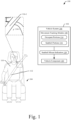
- Fig. 1 illustrates an example environment 100 where relative movement-based seatbelt use detection may be used.
- Fig. 1 also illustrates an example flow 102 of relative movement-based seatbelt use detection.
- the example environment 100 is within a vehicle 104 (not shown).
- the vehicle 104 may be any type of object that utilizes seatbelts (taxi, car, truck, motorcycle, e-bike, boat, air vehicle, and so on).
- the vehicle 104 contains a vehicle system 106 that is configured to perform relative movement-based seatbelt use detection.
- the vehicle system 106 contains a movement tracking module 108 that receives image data and tracks positions of an occupant 110 and a seatbelt 112 associated with the occupant 110 (e.g., corresponding to a seat the occupant 110 is sitting in). Specifically, the movement tracking module 108 tracks one or more occupant portions 114 and one or more seatbelt portions 116 that correspond to respective occupant portions 114.
- one of the occupant portions 114 may correspond to a shoulder of the occupant 110 (left shoulder or right shoulder depending upon a configuration of the seatbelt 112, seat location, whether the vehicle 104 is right or left-hand drive, etc.), and the corresponding seatbelt portion 116 (e.g., seatbelt portion 116-1) may be a portion of the seatbelt 112 that crosses that shoulder.
- Another of the occupant portions 114 may correspond to a hip of the occupant 110 (left hip or right hip depending upon the configuration of the seatbelt 112), and the corresponding seatbelt portion 116 may be a portion of the seatbelt 112 that crosses that hip.
- an occupant portion 114 may be on both sides of the corresponding seatbelt portion 116 (e.g., partially surrounding it) either initially or as the occupant 110 moves. As the occupant 110 moves, a seatbelt portion 116 may move under the corresponding seatbelt portion (if it is not configured to be under or around the seatbelt portion 116 to begin with). Furthermore, the occupant portion 114 may be on the opposite side of the seatbelt portion 116.
- Those of ordinary skill will realize that any number of techniques may be used to isolate the occupant portions 114 and their corresponding seatbelt portions 116 from the image data.
- the movement tracking module 108 is configured to track relative movement or motion between the occupant portions 114 and their corresponding seatbelt portions 116. Any number of known techniques may be used to determine relative movement (e.g., pixel shift, point tracking, tracks, point tracking, centroid tracking).
- the seatbelt misuse indication 118 may be received by a vehicle component 120 that is configured to cause an alert (e.g., visual, auditory, haptic) to the occupant 110 or a driver of the vehicle 104 (if the occupant 110 is not the driver) that the occupant 110 is not properly seat belted. Furthermore, the vehicle component 120 may send a notification to an external system that may alert a third party (e.g., parent, insurance company, law enforcement) of the seatbelt misuse. The vehicle component 120 may also receive a seatbelt use indication from the movement tracking module 108 that indicates a proper seatbelt use. The seatbelt use indication may cause the vehicle component 120 to refrain from performing any additional actions (e.g., the alert).
- an alert e.g., visual, auditory, haptic
- the vehicle component 120 may send a notification to an external system that may alert a third party (e.g., parent, insurance company, law enforcement) of the seatbelt misuse.
- the vehicle component 120 may also receive a seatbelt
- the processor 200 (e.g., application processor, microprocessor, digital-signal processor (DSP), controller) is coupled to the computer-readable storage media 202 via the link 204 and executes computer-executable instructions (e.g., code) stored within the computer-readable storage media 202 (e.g., non-transitory storage device such as a hard drive, solid-state drive (SSD), flash memory, read-only memory (ROM)) to implement or otherwise cause the movement tracking module 108 (or a portion thereof) to perform the techniques described herein.
- computer-executable instructions e.g., code
- non-transitory storage device such as a hard drive, solid-state drive (SSD), flash memory, read-only memory (ROM)
- Fig. 3 is an example flow 300 of relative movement-based seatbelt use detection.
- the example flow 300 may be implemented in any of the previously described environments and by any of the previously described systems or components.
- the example flow 300 can be implemented in the example environment 100 and/or by the vehicle system 106.
- the example flow 300 may also be implemented in other environments, by other systems or components, and utilizing other flows or techniques.
- the example flow 300 may be implemented by any number of entities.
- the order in which the operations are shown and/or described is not intended to be construed as a limitation, and the order may be rearranged without departing from the scope of this invention as defined by the appended claims.
- any number of the operations can be combined with any other number of the operations to implement the example flow or an alternate flow.
- the example flow 300 starts with the movement tracking module 108 receiving the sensor data 206.
- the sensor data 206 is camera or image data (e.g., visible image data, infrared image data) of the occupant 110 from one or more image sensors.
- a seatbelt detection module 302 of the movement tracking module 108 determines and tracks the seatbelt portions 116.
- the seatbelt portions 116 may correspond to any portion of the seatbelt 112.
- the seatbelt detection module 302 may determine and track the seatbelt portion 116-1 near a shoulder of the occupant 110 and another seatbelt portion 116-2 near a hip of the occupant.
- the seatbelt portions 116 may include a portion from a shoulder of the occupant 110 to a b-pillar of the vehicle 104 and/or a portion from a hip of the occupant 110 to a seatbelt receiver corresponding to the seatbelt 112. Furthermore, different seatbelt portions 116 may be used for different steps of the relative movement-based seatbelt use detection.
- the seatbelt detection module 302 may generate or otherwise cause the seatbelt misuse indication 122. However, if it is determined that the seatbelt 112 is across the chest of the occupant 110 (e.g., a yes out of decision 304), the seatbelt detection module 302 may send or otherwise indicate the positions of the seatbelt portions 116 to a relative movement module 306.
- the relative movement module 306 determines locations, and tracks movement of, the occupant portions 114 that correspond to the seatbelt portions 116. For example, the relative movement module 306 may track occupant portion 114-1 and/or other occupant portions. The relative movement module 306 also compares the movement of the occupant portions 114 relative to their corresponding seatbelt portions 116. The relative movement module 306 determines a relative movement between the occupant portion 114-1 and the seatbelt portion 116-1.
- the relative movement module 306 determines if the relative movement is less than a threshold. For example, the decision may be based on a single of the relative movements (e.g., between only one seatbelt portion 116 and occupant portion 114) or a combination of the relative movements (e.g., an average, median, sum). If the relative movement is greater than (or equal to depending on implementation) the threshold, then the decision 308 may be no, indicating a proper seatbelt use indication (e.g., seatbelt use indication 310). In some implementations, a no out of decision 308 may cause the relative movement module 306 to refrain from outputting an indication.
- a threshold e.g., the decision may be based on a single of the relative movements (e.g., between only one seatbelt portion 116 and occupant portion 114) or a combination of the relative movements (e.g., an average, median, sum). If the relative movement is greater than (or equal to depending on implementation) the threshold, then the decision 308 may be no,
- Fig. 4 is an example flow 400 of relative movement-based seatbelt use detection.
- the example flow 400 may be implemented in any of the previously described environments and by any of the previously described systems or components.
- the example flow 400 can be implemented in the example environment 100 and/or by the vehicle system 106.
- the example flow 400 may also be implemented in other environments, by other systems or components, and utilizing other flows or techniques.
- the example flow 400 may be implemented by any number of entities.
- the order in which the operations are shown and/or described is not intended to be construed as a limitation, and the order may be rearranged without departing from the scope of this invention as defined by the appended claims.
- any number of the operations can be combined with any other number of the operations to implement the example flow or an alternate flow.
- the example flow 400 starts with the movement tracking module 108 receiving the sensor data 206.
- the sensor data 206 is camera or image data (e.g., visible image data, infrared image data) of the occupant 110 from one or more image sensors.
- a relative movement machine learned (ML) model 402 tracks the relative movement between the seatbelt 112 and the occupant 110 and determines whether the relative movement indicates a fake seatbelt.
- the relative movement ML model 402 may determine and track the occupant portions 114 and seatbelt portions 116.
- the relative movement ML model 402 may look at the sensor data 206 as a whole.
- the movement tracking module 108 may use a portion module 404 to determine which portions of the sensor data 206 to input into the relative movement ML model 402 (e.g., the portions that contain the occupant portions 114 and the seatbelt portions 116).
- the relative movement ML model 402 may be trained using training sensor data of occupants moving in car seats with real seatbelts on and operated correctly and with fake seatbelts on.
- the relative movement ML model may be configured to receive the sensor data 206 and differentiate between situations where relative movement indicates seatbelt misuse and normal seatbelt use.
- the seatbelt portions 116 may correspond to any portion of the seatbelt 112.
- the seatbelt detection module 302 may determine and track the seatbelt portion 116-1 near a shoulder of the occupant 110 and another seatbelt portion 116-2 near a hip of the occupant.
- the relative movement ML model 402 may be implemented and/or trained using any techniques known by those in the art. For example, supervised learning, unsupervised learning, and/or reinforcement learning may be used. Furthermore, the relative movement ML model 402 may be implemented as a classification model (e.g., a binary classification model with seatbelt use/misuse as the outcomes), a regression model, and/or a clustering model. The relative movement ML model 402 may also be trained using deep learning techniques and/or comprise one or more neural networks.
- the relative movement ML model 402 determines, at decision 406, whether the relative movement between the occupant 110 and the seatbelt 112 indicate that the seatbelt 112 is a real seatbelt (relative movement exists or passes a threshold, e.g., no from decision 406) or a fake seatbelt (relative movement does not exist or does not pass the threshold, e.g., yes from decision 406). If the decision 406 is no, then the relative movement ML model 402 may generate, or otherwise cause a generation of, the seatbelt use indication 310 or refrain from performing additional action. If the decision 406 is yes, then the relative movement ML model 402 may establish that the seatbelt is fake or misused and generate or otherwise cause a generation of the seatbelt misuse indication 122.
- Fig. 5 is an example illustration 500 of a large relative movement between the occupant 110 and the seatbelt 112 (e.g., enough to not trigger the seatbelt misuse indication 122) when the seatbelt 112 is a real seatbelt and routed properly (e.g., across the chest of the occupant 110).
- the example illustration 500 illustrates the occupant 110 and the seatbelt 112 at times 502-1 and 502-2.
- the occupant portion 114-1 has shifted relative to the seatbelt portion 116-1 from time 502-1 to 502-2.
- the seatbelt 112 is real and properly routed, it moves slightly compared to movement of the occupant 110.
- Fig. 6 is an example illustration 600 of no or little relative movement between the occupant 110 and the seatbelt 112 (e.g., low enough to trigger the seatbelt misuse indication 122) when the seatbelt 112 is a fake seatbelt.
- the example illustration 600 illustrates the occupant 110 and the seatbelt 112 at times 602-1 and 602-2. As can be seen, the occupant portion 114-1 has moved with the seatbelt portion 116-1 from time 502-1 to 502-2. When the seatbelt 112 is fake, it moves in conjunction with movement of the occupant 110. The occupant portion 114-1 moved, but the seatbelt portion 114-1 moved as well. Thus, the relative movement is small indicating a fake seatbelt.
- the example illustration 600 may cause the movement tracking module 108 to generate the seatbelt misuse indication 122.
- Fig. 7 is an example method 700 for relative movement-based seatbelt use detection.
- the example method 700 may be implemented in any of the previously described environments, by any of the previously described systems or components, and by utilizing any of the previously described flows, process flows, or techniques.
- the example method 700 can be implemented in the example environment 100, by the vehicle system 106, and/or by following the example flow 300.
- the example method 700 may also be implemented in other environments, by other systems or components, and utilizing other flows, process flows, or techniques.
- Example method 700 may be implemented by one or more entities (e.g., the movement tracking module 108).
- the seatbelt detection module 302 may determine, at decision 304, that the seatbelt 112 is crossing a chest of the occupant 110.
- one or more occupant portions of the occupant are tracked over time based on the sensor data.
- the relative movement module 306 may track the occupant portions 114 of the occupant 110.
- one or more seatbelt portions of the seatbelt are tracked over time.
- the seatbelt portions correspond to respective ones of the occupant portions.
- the seatbelt detection module 302 may track the seatbelt portions 116 that correspond to the occupant portions 114.
- relative movements between the occupant portions and their corresponding seatbelt portions are determined based on the tracking.
- the relative movement module 306 may compare the movements of the occupant portions 114 to their corresponding seatbelt portions 116.
- the relative movement module 306 may determine, at decision 308, that the relative movement is less than a threshold amount.
- an indication of the fake seatbelt is output to a vehicle system of the vehicle.
- the relative movement module 306 may generate the seatbelt misuse indication 122 for receipt by the vehicle component 120.
- Fig. 8 is an example method 800 for relative movement-based seatbelt use detection.
- the example method 800 may be implemented in any of the previously described environments, by any of the previously described systems or components, and by utilizing any of the previously described flows, process flows, or techniques.
- the example method 800 can be implemented in the example environment 100, by the vehicle system 106, and/or by following the example flow 400.
- the example method 800 may also be implemented in other environments, by other systems or components, and utilizing other flows, process flows, or techniques.
- Example method 800 may be implemented by one or more entities (e.g., the movement tracking module 108).
- image data is received over time from one or more cameras with fields of view that include an occupant of a vehicle.
- the movement tracking module 108 may receive the sensor data 206 from one or more cameras within the vehicle 104 with fields of view of the occupant 110.
- At 804 at least a portion of the image data is input into a machine-learned model that is trained to look for relative motion between one or more occupant portions of the occupant and respective seatbelt portions of a seatbelt that correspond to the occupant portions.
- the movement tracking module 108 may input the sensor data 206, or a portion thereof, into the relative movement ML model 402.
- an indication that the relative movement indicates that the seatbelt is a fake seatbelt is received from the machine-learned model.
- the relative movement ML model 402 may determine, at decision 406, that the relative movement indicates a fake seatbelt and provide an indication of the decision to the movement tracking module 108.
- an indication of the fake seatbelt is output to a vehicle system of the vehicle.
- the movement tracking module 108 may generate the seatbelt misuse indication 122 for receipt by the vehicle component 120.
- "at least one of: a, b, or c” is intended to cover a, b, c, a-b, a-c, b-c, and a-b-c, as well as any combination with multiples of the same element (e.g., a-a, a-a-a, a-a-b, a-a-c, a-b-b, a-c-c, b-b, b-b-b, b-b-c, c-c, and c-c-c or any other ordering of a, b, and c).
Landscapes
- Engineering & Computer Science (AREA)
- Theoretical Computer Science (AREA)
- General Physics & Mathematics (AREA)
- Physics & Mathematics (AREA)
- Multimedia (AREA)
- Software Systems (AREA)
- Computer Vision & Pattern Recognition (AREA)
- Evolutionary Computation (AREA)
- Computing Systems (AREA)
- Medical Informatics (AREA)
- Artificial Intelligence (AREA)
- Mechanical Engineering (AREA)
- Health & Medical Sciences (AREA)
- Databases & Information Systems (AREA)
- General Health & Medical Sciences (AREA)
- Automation & Control Theory (AREA)
- Human Computer Interaction (AREA)
- Data Mining & Analysis (AREA)
- General Engineering & Computer Science (AREA)
- Mathematical Physics (AREA)
- Measurement Of The Respiration, Hearing Ability, Form, And Blood Characteristics Of Living Organisms (AREA)
- Automotive Seat Belt Assembly (AREA)
- Traffic Control Systems (AREA)
Description
- Seatbelt use detection systems have been implemented in a wide variety of vehicles. For example, many vehicles have detection sensors built into seatbelt latches that trigger an alert when the vehicles are driving without a seatbelt clip inserted. Such systems can be fooled by occupants placing fake seatbelt clips (e.g., not connected to seatbelts) into the buckles.
- More recently, advanced systems of seatbelt misuse detection have been developed. For example, some systems have been developed that determine whether seatbelts cross chests of occupants. These systems can also be fooled by occupants wearing shirts with prints of seatbelts on them (e.g., a stripe going across their chest). For example,
US 2019/197326 A1 andUS 2019/147262 A1 address the problem of fake seatbelt detection using image analysis. -
US 2020/298796 Al discloses a system of detecting seat belt operation in a vehicle including at least one light source configured to emit a predetermined wavelength of light onto structures within the vehicle, wherein at least one of the structures is a passenger seat belt assembly having a pattern that reflects the predetermined wavelength at a preferred luminance. At least one 3-D time of flight camera is positioned in the vehicle to receive reflected light from the structures in the vehicle and provide images of the structures that distinguish the preferred luminance of the pattern from other structures in the vehicle. A computer processor connected to computer memory and the camera includes computer readable instructions causing the processor to reconstruct 3-D information in regard to respective images of the structures and calculate a depth measurement of the distance of the reflective pattern on the passenger seat belt assembly from the camera. - This document is directed to techniques and hardware for relative movement-based seatbelt use detection. The techniques may include one or more methods for relative movement-based seatbelt use detection. The hardware may include means (e.g., one or more processors) of performing relative movement-based seatbelt use detection. The hardware may also include computer-readable media (e.g., non-transitory storage media) comprising instructions that, when executed, cause one or more associated systems to perform relative movement-based seatbelt use detection.
- The invention is set out in the appended set of claims. A first aspect of the invention is directed to a method. The method includes receiving, from one or more cameras, image data indicating attributes of an interior of a vehicle. The method also includes determining, based on the image data, that a seatbelt is crossing a chest of an occupant of the vehicle. The method further includes tracking, based on the image data, one or more occupant portions of the occupant over time and one or more seatbelt portions of the seatbelt over time. The seatbelt portions correspond to respective ones of the occupant portions. The method also includes determining, based on the tracking, relative movements between the occupant portions and their corresponding seatbelt portions. The method further includes establishing, based on the relative movements being under a threshold value, that the seatbelt is a fake seatbelt and outputting, to a vehicle system of the vehicle, an indication of the fake seatbelt.
- According to an embodiment of the method, the image data comprises visible or infrared image data.
- According to an embodiment of the method, the occupant is a driver of the vehicle.
- According to an embodiment of the method, determining that the seatbelt is crossing the chest of the occupant comprises determining that a stripe goes from a left shoulder to a right hip of the occupant or from a right shoulder to a left hip of the occupant.
- According to an embodiment of the method, the seatbelt portions comprise a first seatbelt portion proximate a shoulder of the occupant and a second seatbelt portion proximate a hip of the occupant.
- According to an embodiment of the method, the occupant portions comprise the shoulder and the hip of the occupant.
- According to an embodiment of the method, the occupant portions at least partially surround their corresponding seatbelt portions.
- According to an embodiment of the method, the relative movements comprise at least one of a relative movement between a shoulder of the occupant and a first seatbelt portion or a relative movement between a hip of the occupant and a second seatbelt portion.
- According to an embodiment of the method, establishing that the seatbelt is a fake seatbelt is based further on: at least one of the relative movements being under the threshold value; or an average of the relative movements being under the threshold value.
- A second aspect of the invention is directed to another method . The other method includes receiving image data over time from one or more cameras with fields of view that include an occupant of a vehicle. The other method also includes inputting at least a portion of the image data into a machine-learned model that is trained to look for a relative movement between one or more occupant portions of the occupant and respective seatbelt portions of a seatbelt that correspond to the occupant portions. The other method further includes receiving, from the machine-learned model, an indication that the relative movement indicates that the seatbelt is a fake seatbelt when the relative movement is under a threshold and outputting, to a vehicle system of the vehicle, an indication of the fake seatbelt.
- According to an embodiment of the other method, the portion of the image data corresponds to the occupant portions.
- Some aspects of the invention described below include one or more components and/or one or more systems comprising one or more processors configured to perform the above methods, portions thereof, and/or other methods, flows, and techniques described below. Some aspects described below also include computer-readable media (e.g., non-transitory storage media) including instructions that, when executed (e.g., by the processors of the components and/or systems), implement the above methods, portions thereof, and/or other methods, flows, and techniques described below.
- A system comprises one or more image sensors; and at least one processor configured to perform the method according to any aforementioned claim.
- According to an embodiment of the aforementioned system, the image data is infrared image data.
- A computer-readable storage media comprises instructions that, when executed, cause at least one processor to perform one of the aforementioned methods.
- This Summary introduces simplified concepts of relative movement-based seatbelt use detection that are further described in the Detailed Description and Drawings. This Summary is not intended to identify essential features of the claimed subject matter, nor is it intended for use in determining the scope of the claimed subject matter.
- Systems and methods of relative movement-based seatbelt use detection are described with reference to the following drawings that use some of the same numbers throughout to reference like or examples of like features and components.
-
Fig. 1 illustrates, in accordance with this invention, an example environment where relative movement-based seatbelt use detection may be used and an example flow of relative movement-based seatbelt use detection. -
Fig. 2 illustrates, in accordance with this invention, an example of a vehicle system configured for relative movement-based seatbelt use detection. -
Fig. 3 illustrates, in accordance with this invention, an example flow of generating a seatbelt misuse indication. -
Fig. 4 illustrates, in accordance with this invention, another example flow of generating a seatbelt misuse indication. -
Fig. 5 illustrates, in accordance with this invention, an example of an environment where a seatbelt use indication may be generated. -
Fig. 6 illustrates, in accordance with this invention, an example of an environment where a seatbelt misuse indication may be generated. -
Fig. 7 illustrates, in accordance with this invention, an example method of relative movement-based seatbelt use detection. -
Fig. 8 illustrates, in accordance with this invention, another example method of relative movement-based seatbelt use detection. - Many seatbelt-use detection systems may be fooled into determining that an occupant is properly wearing a seatbelt when they are not. For example, some vision-based systems can be fooled by an occupant wearing a shirt with a seatbelt printed on it. Fooling such systems (e.g., wearing a seatbelt shirt instead of properly using a seatbelt) is not only illegal in many cases, it is also unsafe.
- The methods and systems herein enable relative movement-based seatbelt use detection. Image data of an occupant of a vehicle is received over time. The image data is then input into a machine-learned model or other module that determines whether relative movement between one or more portions of the occupant and corresponding portions of a seatbelt are less than a threshold amount. If the relative movement is less than the threshold amount, an indication of seatbelt misuse is output to a vehicle component. By basing the indication of seatbelt misuse on relative movement between the occupant and the seatbelt, seatbelt use detection may be improved. Improving seatbelt use detection may increase safety and legality in many environments.
-
Fig. 1 illustrates anexample environment 100 where relative movement-based seatbelt use detection may be used.Fig. 1 also illustrates anexample flow 102 of relative movement-based seatbelt use detection. Theexample environment 100 is within a vehicle 104 (not shown). Thevehicle 104 may be any type of object that utilizes seatbelts (taxi, car, truck, motorcycle, e-bike, boat, air vehicle, and so on). Thevehicle 104 contains avehicle system 106 that is configured to perform relative movement-based seatbelt use detection. - The
vehicle system 106 contains amovement tracking module 108 that receives image data and tracks positions of anoccupant 110 and aseatbelt 112 associated with the occupant 110 (e.g., corresponding to a seat theoccupant 110 is sitting in). Specifically, themovement tracking module 108 tracks one ormore occupant portions 114 and one ormore seatbelt portions 116 that correspond torespective occupant portions 114. - For example, as illustrated, one of the occupant portions 114 (e.g., occupant portion 114-1) may correspond to a shoulder of the occupant 110 (left shoulder or right shoulder depending upon a configuration of the
seatbelt 112, seat location, whether thevehicle 104 is right or left-hand drive, etc.), and the corresponding seatbelt portion 116 (e.g., seatbelt portion 116-1) may be a portion of theseatbelt 112 that crosses that shoulder. Another of theoccupant portions 114 may correspond to a hip of the occupant 110 (left hip or right hip depending upon the configuration of the seatbelt 112), and thecorresponding seatbelt portion 116 may be a portion of theseatbelt 112 that crosses that hip. - Although illustrated as being on a single side of a
seatbelt portion 116, anoccupant portion 114 may be on both sides of the corresponding seatbelt portion 116 (e.g., partially surrounding it) either initially or as theoccupant 110 moves. As theoccupant 110 moves, aseatbelt portion 116 may move under the corresponding seatbelt portion (if it is not configured to be under or around theseatbelt portion 116 to begin with). Furthermore, theoccupant portion 114 may be on the opposite side of theseatbelt portion 116. Those of ordinary skill will realize that any number of techniques may be used to isolate theoccupant portions 114 and theircorresponding seatbelt portions 116 from the image data. - The
movement tracking module 108 is configured to track relative movement or motion between theoccupant portions 114 and theircorresponding seatbelt portions 116. Any number of known techniques may be used to determine relative movement (e.g., pixel shift, point tracking, tracks, point tracking, centroid tracking). - The
movement tracking module 108 may generate a seatbelt misuse indication 118 that indicates a misuse of theseatbelt 112 or that theseatbelt 112 is fake responsive to determining that the relative movement between one or more of the occupant portion/seatbelt portion pairs does not indicate a real seatbelt. For example, if theseatbelt 112 is fake (e.g., it's printed on a shirt), theseatbelt portions 116 may move with theoccupant portions 114. However, if theseatbelt 112 is real, theoccupant portions 114 may move independently of theircorresponding seatbelt portions 116. - Any number of techniques may be used to determine when to generate the seatbelt misuse indication 118. For example, the
movement tracking module 108 may determine that an average relative movement between some or all of the occupant portion/seatbelt portion pairs is less than a threshold value, that a single relative movement between one of the occupant portion/seatbelt portion pairs is less than the threshold value (or another value), that a sum of the relative movement between some or all of the occupant portion/seatbelt portion pairs is less than a threshold value, or any other way of thresholding an amount of movement between theoccupant 110 and theseatbelt 112. - The seatbelt misuse indication 118 may be received by a
vehicle component 120 that is configured to cause an alert (e.g., visual, auditory, haptic) to theoccupant 110 or a driver of the vehicle 104 (if theoccupant 110 is not the driver) that theoccupant 110 is not properly seat belted. Furthermore, thevehicle component 120 may send a notification to an external system that may alert a third party (e.g., parent, insurance company, law enforcement) of the seatbelt misuse. Thevehicle component 120 may also receive a seatbelt use indication from themovement tracking module 108 that indicates a proper seatbelt use. The seatbelt use indication may cause thevehicle component 120 to refrain from performing any additional actions (e.g., the alert). - By tracking relative movement/movement between
occupant portions 114 and theircorresponding seatbelt portions 116, thevehicle system 106 is able to detect fake seatbelts (e.g., those printed on shirts) that may fool conventional seatbelt detection systems. Doing so may increase the safety of occupants (e.g., the occupant 110) through increased proper use of seatbelts (e.g., because the alert is worse for theoccupant 110 than wearing the seatbelt 112). -
Fig. 2 illustrates an example of thevehicle system 106. Components of thevehicle system 106 may be arranged anywhere within or on thevehicle 104. Thevehicle system 106 may include at least oneprocessor 200, computer-readable storage media 202 (e.g., media, medium, mediums), and thevehicle component 120. The components are operatively and/or communicatively coupled via alink 204. - The processor 200 (e.g., application processor, microprocessor, digital-signal processor (DSP), controller) is coupled to the computer-
readable storage media 202 via thelink 204 and executes computer-executable instructions (e.g., code) stored within the computer-readable storage media 202 (e.g., non-transitory storage device such as a hard drive, solid-state drive (SSD), flash memory, read-only memory (ROM)) to implement or otherwise cause the movement tracking module 108 (or a portion thereof) to perform the techniques described herein. Although shown as being within the computer-readable storage media 202, themovement tracking module 108 may be a stand-alone component (e.g., having dedicated computer-readable storage media comprising instructions and/or executed on dedicated hardware, such as a dedicated processor, pre-programmed field-programmable-gate-array (FPGA), system on chip (SOC), and the like). Theprocessor 200 and the computer-readable storage media 202 may be any number of components, comprise multiple components distributed throughout thevehicle 104, located remote to thevehicle 104, dedicated or shared with other components, modules, or systems of thevehicle 104, and/or configured differently than illustrated without departing from the scope of this invention as defined by the appended claims. - The computer-
readable storage media 202 also containssensor data 206 generated by one or more sensors or types of sensors (not shown) that may be local or remote to thevehicle system 106. Thesensor data 206 indicates or otherwise enables the determination of information usable to perform the techniques described herein. For example, the sensors may generatesensor data 206 indicative of aspects usable to determine when to generate the seatbelt misuse indication 118. In some implementations, thesensor data 206 may come from a remote source (e.g., via link 204). Thevehicle system 106 may contain a communication system (not shown) that receivessensor data 206 from the remote source. - The
vehicle component 120 contains one or more systems or components that are communicatively coupled to themovement tracking module 108 and configured to perform one or more vehicle functions based on receiving an indication of the seatbelt misuse indication 118. For example, thevehicle component 120 may comprise an advanced driver assistance system (ADAS) or autonomous driving system that can change an operation based on the seatbelt misuse indication 118 (e.g., not allow autonomous vehicle control). In another example, thevehicle component 120 may comprise an alert system that provides a visual, auditory, and/or haptic alert to the occupant based on the seatbelt misuses indication 118. Thevehicle component 120 is communicatively coupled to themovement tracking module 108 via thelink 204. Although shown as separate components, themovement tracking module 108 may be part of thevehicle component 120 and visa-versa. -
Fig. 3 is anexample flow 300 of relative movement-based seatbelt use detection. Theexample flow 300 may be implemented in any of the previously described environments and by any of the previously described systems or components. For example, theexample flow 300 can be implemented in theexample environment 100 and/or by thevehicle system 106. Theexample flow 300 may also be implemented in other environments, by other systems or components, and utilizing other flows or techniques. Theexample flow 300 may be implemented by any number of entities. The order in which the operations are shown and/or described is not intended to be construed as a limitation, and the order may be rearranged without departing from the scope of this invention as defined by the appended claims. Furthermore, any number of the operations can be combined with any other number of the operations to implement the example flow or an alternate flow. - The example flow 300 starts with the
movement tracking module 108 receiving thesensor data 206. Thesensor data 206 is camera or image data (e.g., visible image data, infrared image data) of theoccupant 110 from one or more image sensors. Aseatbelt detection module 302 of themovement tracking module 108 determines and tracks theseatbelt portions 116. Theseatbelt portions 116 may correspond to any portion of theseatbelt 112. For example, theseatbelt detection module 302 may determine and track the seatbelt portion 116-1 near a shoulder of theoccupant 110 and another seatbelt portion 116-2 near a hip of the occupant. In another example, theseatbelt portions 116 may include a portion from a shoulder of theoccupant 110 to a b-pillar of thevehicle 104 and/or a portion from a hip of theoccupant 110 to a seatbelt receiver corresponding to theseatbelt 112. Furthermore,different seatbelt portions 116 may be used for different steps of the relative movement-based seatbelt use detection. - At
decision 304 theseatbelt detection module 302 determines if theseatbelt 112 is across a chest of theoccupant 110. For example, if the seatbelt portions 116-1 and 116-2 are not found, thedecision 304 may be a no. Theseatbelt detection module 302 may alternatively or in addition, look for another seatbelt portion 116-3 that is in a middle of the chest of theoccupant 110. In some implementations, theseatbelt detection module 302 may determine if a stripe is crossing the chest of theoccupant 110, indicating that a seatbelt is crossing it. If the seatbelt portion 116-3 is not found, thedecision 304 may be a no. - If it is determined that the
seatbelt 112 is not across the chest of the occupant 110 (e.g. a no out of decision 304), theseatbelt detection module 302 may generate or otherwise cause theseatbelt misuse indication 122. However, if it is determined that theseatbelt 112 is across the chest of the occupant 110 (e.g., a yes out of decision 304), theseatbelt detection module 302 may send or otherwise indicate the positions of theseatbelt portions 116 to arelative movement module 306. - The
relative movement module 306 determines locations, and tracks movement of, theoccupant portions 114 that correspond to theseatbelt portions 116. For example, therelative movement module 306 may track occupant portion 114-1 and/or other occupant portions. Therelative movement module 306 also compares the movement of theoccupant portions 114 relative to theircorresponding seatbelt portions 116. Therelative movement module 306 determines a relative movement between the occupant portion 114-1 and the seatbelt portion 116-1. - At
decision 308, therelative movement module 306 determines if the relative movement is less than a threshold. For example, the decision may be based on a single of the relative movements (e.g., between only oneseatbelt portion 116 and occupant portion 114) or a combination of the relative movements (e.g., an average, median, sum). If the relative movement is greater than (or equal to depending on implementation) the threshold, then thedecision 308 may be no, indicating a proper seatbelt use indication (e.g., seatbelt use indication 310). In some implementations, a no out ofdecision 308 may cause therelative movement module 306 to refrain from outputting an indication. If the relative movement is less than the threshold (or equal to depending on implementation), then thedecision 308 may be yes, indicating or establishing a misuse of theseatbelt 112 or that theseatbelt 112 is fake. The yes decision may cause therelative movement module 306 to generate theseatbelt misuse indication 122. -
Fig. 4 is anexample flow 400 of relative movement-based seatbelt use detection. Theexample flow 400 may be implemented in any of the previously described environments and by any of the previously described systems or components. For example, theexample flow 400 can be implemented in theexample environment 100 and/or by thevehicle system 106. Theexample flow 400 may also be implemented in other environments, by other systems or components, and utilizing other flows or techniques. Theexample flow 400 may be implemented by any number of entities. The order in which the operations are shown and/or described is not intended to be construed as a limitation, and the order may be rearranged without departing from the scope of this invention as defined by the appended claims. Furthermore, any number of the operations can be combined with any other number of the operations to implement the example flow or an alternate flow. - The example flow 400 starts with the
movement tracking module 108 receiving thesensor data 206. Thesensor data 206 is camera or image data (e.g., visible image data, infrared image data) of theoccupant 110 from one or more image sensors. A relative movement machine learned (ML) model 402 tracks the relative movement between theseatbelt 112 and theoccupant 110 and determines whether the relative movement indicates a fake seatbelt. In some implementations, the relativemovement ML model 402 may determine and track theoccupant portions 114 andseatbelt portions 116. In other implementations, the relativemovement ML model 402 may look at thesensor data 206 as a whole. Furthermore, themovement tracking module 108 may use aportion module 404 to determine which portions of thesensor data 206 to input into the relative movement ML model 402 (e.g., the portions that contain theoccupant portions 114 and the seatbelt portions 116). - The relative
movement ML model 402 may be trained using training sensor data of occupants moving in car seats with real seatbelts on and operated correctly and with fake seatbelts on. The relative movement ML model may be configured to receive thesensor data 206 and differentiate between situations where relative movement indicates seatbelt misuse and normal seatbelt use. Theseatbelt portions 116 may correspond to any portion of theseatbelt 112. For example, theseatbelt detection module 302 may determine and track the seatbelt portion 116-1 near a shoulder of theoccupant 110 and another seatbelt portion 116-2 near a hip of the occupant. - The relative
movement ML model 402 may be implemented and/or trained using any techniques known by those in the art. For example, supervised learning, unsupervised learning, and/or reinforcement learning may be used. Furthermore, the relativemovement ML model 402 may be implemented as a classification model (e.g., a binary classification model with seatbelt use/misuse as the outcomes), a regression model, and/or a clustering model. The relativemovement ML model 402 may also be trained using deep learning techniques and/or comprise one or more neural networks. - Regardless of how the relative
movement ML model 402 is trained and/or implemented, it determines, atdecision 406, whether the relative movement between theoccupant 110 and theseatbelt 112 indicate that theseatbelt 112 is a real seatbelt (relative movement exists or passes a threshold, e.g., no from decision 406) or a fake seatbelt (relative movement does not exist or does not pass the threshold, e.g., yes from decision 406). If thedecision 406 is no, then the relativemovement ML model 402 may generate, or otherwise cause a generation of, theseatbelt use indication 310 or refrain from performing additional action. If thedecision 406 is yes, then the relativemovement ML model 402 may establish that the seatbelt is fake or misused and generate or otherwise cause a generation of theseatbelt misuse indication 122. -
Fig. 5 is anexample illustration 500 of a large relative movement between theoccupant 110 and the seatbelt 112 (e.g., enough to not trigger the seatbelt misuse indication 122) when theseatbelt 112 is a real seatbelt and routed properly (e.g., across the chest of the occupant 110). Theexample illustration 500 illustrates theoccupant 110 and theseatbelt 112 at times 502-1 and 502-2. As can be seen, the occupant portion 114-1 has shifted relative to the seatbelt portion 116-1 from time 502-1 to 502-2. When theseatbelt 112 is real and properly routed, it moves slightly compared to movement of theoccupant 110. In other words, theoccupant 110 moves under theseatbelt 112 without generally moving theseatbelt 112, at least within the plane shown. Theexample illustration 500 may cause themovement tracking module 108 to generate theseatbelt use indication 310, refrain from generating theseatbelt misuse indication 122, or refrain from performing any additional operations. -
Fig. 6 is anexample illustration 600 of no or little relative movement between theoccupant 110 and the seatbelt 112 (e.g., low enough to trigger the seatbelt misuse indication 122) when theseatbelt 112 is a fake seatbelt. Theexample illustration 600 illustrates theoccupant 110 and theseatbelt 112 at times 602-1 and 602-2. As can be seen, the occupant portion 114-1 has moved with the seatbelt portion 116-1 from time 502-1 to 502-2. When theseatbelt 112 is fake, it moves in conjunction with movement of theoccupant 110. The occupant portion 114-1 moved, but the seatbelt portion 114-1 moved as well. Thus, the relative movement is small indicating a fake seatbelt. Theexample illustration 600 may cause themovement tracking module 108 to generate theseatbelt misuse indication 122. -
Fig. 7 is anexample method 700 for relative movement-based seatbelt use detection. Theexample method 700 may be implemented in any of the previously described environments, by any of the previously described systems or components, and by utilizing any of the previously described flows, process flows, or techniques. For example, theexample method 700 can be implemented in theexample environment 100, by thevehicle system 106, and/or by following theexample flow 300. Theexample method 700 may also be implemented in other environments, by other systems or components, and utilizing other flows, process flows, or techniques.Example method 700 may be implemented by one or more entities (e.g., the movement tracking module 108). The order in which the operations are shown and/or described is not intended to be construed as a limitation, and the order may be rearranged without departing from the scope of this invention as defined by the appended claims. Furthermore, any number of the operations can be combined with any other number of the operations to implement the example process flow or an alternate process flow. - At 702, sensor data indicating attributes of an interior of a vehicle is received from one or more sensors. For example, the
movement tracking module 108 may receive thesensor data 206 from one or more cameras. - At 704, it is determined that a seatbelt is crossing a chest of an occupant of the vehicle based on the sensor data. For example, the
seatbelt detection module 302 may determine, atdecision 304, that theseatbelt 112 is crossing a chest of theoccupant 110. - At 706, one or more occupant portions of the occupant are tracked over time based on the sensor data. For example, the
relative movement module 306 may track theoccupant portions 114 of theoccupant 110. - At 708, one or more seatbelt portions of the seatbelt are tracked over time. The seatbelt portions correspond to respective ones of the occupant portions. For example, the
seatbelt detection module 302 may track theseatbelt portions 116 that correspond to theoccupant portions 114. - At 710, relative movements between the occupant portions and their corresponding seatbelt portions are determined based on the tracking. For example, the
relative movement module 306 may compare the movements of theoccupant portions 114 to theircorresponding seatbelt portions 116. - At 712, it is established that the seatbelt is a fake seatbelt based on the relative movements. For example, the
relative movement module 306 may determine, atdecision 308, that the relative movement is less than a threshold amount. - At 714, an indication of the fake seatbelt is output to a vehicle system of the vehicle. For example, the
relative movement module 306 may generate theseatbelt misuse indication 122 for receipt by thevehicle component 120. -
Fig. 8 is anexample method 800 for relative movement-based seatbelt use detection. Theexample method 800 may be implemented in any of the previously described environments, by any of the previously described systems or components, and by utilizing any of the previously described flows, process flows, or techniques. For example, theexample method 800 can be implemented in theexample environment 100, by thevehicle system 106, and/or by following theexample flow 400. Theexample method 800 may also be implemented in other environments, by other systems or components, and utilizing other flows, process flows, or techniques.Example method 800 may be implemented by one or more entities (e.g., the movement tracking module 108). The order in which the operations are shown and/or described is not intended to be construed as a limitation, and the order may be rearranged without departing from the scope of this invention as defined by the appended claims. Furthermore, any number of the operations can be combined with any other number of the operations to implement the example process flow or an alternate process flow. - At 802, image data is received over time from one or more cameras with fields of view that include an occupant of a vehicle. For example, the
movement tracking module 108 may receive thesensor data 206 from one or more cameras within thevehicle 104 with fields of view of theoccupant 110. - At 804, at least a portion of the image data is input into a machine-learned model that is trained to look for relative motion between one or more occupant portions of the occupant and respective seatbelt portions of a seatbelt that correspond to the occupant portions. For example, the
movement tracking module 108 may input thesensor data 206, or a portion thereof, into the relativemovement ML model 402. - At 806, an indication that the relative movement indicates that the seatbelt is a fake seatbelt is received from the machine-learned model. For example, the relative
movement ML model 402 may determine, atdecision 406, that the relative movement indicates a fake seatbelt and provide an indication of the decision to themovement tracking module 108. - At 808, an indication of the fake seatbelt is output to a vehicle system of the vehicle. For example, the
movement tracking module 108 may generate theseatbelt misuse indication 122 for receipt by thevehicle component 120. - While various embodiments of the invention are described in the foregoing description and shown in the drawings, it is to be understood that this invention is not limited thereto but may be variously embodied to practice within the scope of the appended claims. From the foregoing description, it will be apparent that various changes may be made without departing from the scope of the invention as defined by the appended claims.
- The use of "or" and grammatically related terms indicates non-exclusive alternatives without limitation unless the context clearly dictates otherwise. As used herein, a phrase referring to "at least one of" a list of items refers to any combination of those items, including single members. As an example, "at least one of: a, b, or c" is intended to cover a, b, c, a-b, a-c, b-c, and a-b-c, as well as any combination with multiples of the same element (e.g., a-a, a-a-a, a-a-b, a-a-c, a-b-b, a-c-c, b-b, b-b-b, b-b-c, c-c, and c-c-c or any other ordering of a, b, and c).
Claims (15)
- A method comprising:receiving, from one or more cameras, image data indicating attributes of an interior of a vehicle;determining, based on the image data, that a seatbelt is crossing a chest of an occupant of the vehicle;tracking, based on the image data, one or more occupant portions of the occupant over time;tracking, based on the image data, one or more seatbelt portions of the seatbelt over time, the seatbelt portions corresponding to respective ones of the occupant portions;determining, based on the tracking, relative movements between the occupant portions and their corresponding seatbelt portions;establishing, based on the relative movements being under a threshold value, that the seatbelt is a fake seatbelt; andoutputting, to a vehicle system of the vehicle, an indication of the fake seatbelt.
- The method of claim 1, wherein the image data comprises visible or infrared image data.
- The method of claim 1 or 2, wherein the occupant is a driver of the vehicle.
- The method of claim 1, 2, or 3, wherein determining that the seatbelt is crossing the chest of the occupant comprises determining that a stripe goes from a left shoulder to a right hip of the occupant or from a right shoulder to a left hip of the occupant.
- The method of any preceding claim, wherein the seatbelt portions comprise a first seatbelt portion proximate a shoulder of the occupant and a second seatbelt portion proximate a hip of the occupant.
- The method of claim 5, wherein the occupant portions comprise the shoulder and the hip of the occupant.
- The method of claim 6, wherein the occupant portions at least partially surround their corresponding seatbelt portions.
- The method of any preceding claim, wherein:
the relative movements comprise at least one of a relative movement between a shoulder of the occupant and a first seatbelt portion or a relative movement between a hip of the occupant and a second seatbelt portion. - The method of claim 8, wherein establishing that the seatbelt is a fake seatbelt is based further on:at least one of the relative movements being under the threshold value; oran average of the relative movements being under the threshold value.
- A method comprising:receiving image data over time from one or more cameras with fields of view that include an occupant of a vehicle;inputting at least a portion of the image data into a machine-learned model that is trained to look for a relative movement between one or more occupant portions of the occupant and respective seatbelt portions of a seatbelt that correspond to the occupant portions;receiving, from the machine-learned model, an indication that the relative movement indicates that the seatbelt is a fake seatbelt when the relative movement is under a threshold; andoutputting, to a vehicle system of the vehicle, an indication of the fake seatbelt.
- The method of claim 10, wherein the portion of the image data corresponds to the occupant portions.
- A system comprising:one or more image sensors; andat least one processor configured to perform the method of any of claims 1-9.
- A system comprising:one or more image sensors; andat least one processor configured to perform the method of claim 10 or 11, whereinthe machine-learned model is implemented on the at least one processor.
- The system of claim 12 or 13, wherein the image sensors comprise at least one infrared image sensor.
- Computer-readable media comprising instructions that, when executed, cause at least one processor to perform the method of any of claims 1-11.
Applications Claiming Priority (2)
| Application Number | Priority Date | Filing Date | Title |
|---|---|---|---|
| US202163216839P | 2021-06-30 | 2021-06-30 | |
| US17/804,665 US11975683B2 (en) | 2021-06-30 | 2022-05-31 | Relative movement-based seatbelt use detection |
Publications (2)
| Publication Number | Publication Date |
|---|---|
| EP4113461A1 EP4113461A1 (en) | 2023-01-04 |
| EP4113461B1 true EP4113461B1 (en) | 2025-03-26 |
Family
ID=82846219
Family Applications (1)
| Application Number | Title | Priority Date | Filing Date |
|---|---|---|---|
| EP22178711.2A Active EP4113461B1 (en) | 2021-06-30 | 2022-06-13 | Relative movement-based seatbelt use detection |
Country Status (3)
| Country | Link |
|---|---|
| US (1) | US11975683B2 (en) |
| EP (1) | EP4113461B1 (en) |
| CN (1) | CN115546770B (en) |
Families Citing this family (1)
| Publication number | Priority date | Publication date | Assignee | Title |
|---|---|---|---|---|
| KR20230090556A (en) * | 2021-12-15 | 2023-06-22 | 현대자동차주식회사 | Method and device for detecting seat belt of vehicle |
Family Cites Families (41)
| Publication number | Priority date | Publication date | Assignee | Title |
|---|---|---|---|---|
| US6283503B1 (en) * | 1992-05-05 | 2001-09-04 | Automotive Technologies International Inc. | Methods and arrangements for determining the position of an occupant in a vehicle |
| DE10133759C2 (en) | 2001-07-11 | 2003-07-24 | Daimler Chrysler Ag | Belt guide recognition with image processing system in the vehicle |
| DE10326840A1 (en) | 2003-06-14 | 2004-12-30 | Lux, Peter, Dr. | Vehicle seat device/method for recognizing occupancy of vehicle seats has a TV camera directed at the seat and a lighting unit with a clearance from the camera to light up a pattern to be evaluated |
| FR2877279B1 (en) | 2004-11-03 | 2008-06-27 | Faurecia Sieges Automobile | SYSTEM FOR DETECTING THE PRESENCE OF AN OCCUPANT ON A SEAT OF A MOTOR VEHICLE, SEAT ADAPTED TO THIS SYSTEM AND VEHICLE COMPRISING SUCH A SYSTEM |
| CN2756044Y (en) | 2004-12-10 | 2006-02-08 | 明门实业股份有限公司 | Multi-directional security fasteners |
| JP2007055294A (en) | 2005-08-22 | 2007-03-08 | Tokai Rika Co Ltd | Occupant detection apparatus for vehicle |
| DE102007008602A1 (en) | 2007-02-22 | 2007-11-22 | Daimlerchrysler Ag | Recoil holding system used for vehicle seat comprises a safety belt with a roller for generating the safety belt and a rotation sensor for specifying the relative length and tension required for the safety belt |
| JP2008261749A (en) | 2007-04-12 | 2008-10-30 | Takata Corp | Occupant detection device, actuator control system, seat belt system, and vehicle |
| US20090058061A1 (en) | 2007-08-30 | 2009-03-05 | Fuisz Richard C | System for providing an indication indicative of whether or not a seat belt of a vehicle occupant is fastened |
| JP2010113506A (en) | 2008-11-06 | 2010-05-20 | Aisin Aw Co Ltd | Occupant position detection device, occupant position detection method, and occupant position detection program |
| US8611608B2 (en) | 2011-08-23 | 2013-12-17 | Xerox Corporation | Front seat vehicle occupancy detection via seat pattern recognition |
| CN104417489B (en) | 2013-08-29 | 2017-07-11 | 同观科技(深圳)有限公司 | A kind of car belt detection method and car belt detection means |
| JP6372986B2 (en) | 2013-09-26 | 2018-08-15 | 矢崎総業株式会社 | Seat belt wearing state display device |
| EP2937251B1 (en) | 2014-04-24 | 2017-07-12 | Volvo Car Corporation | Seat belt position detecting system and method |
| US9365186B2 (en) * | 2014-08-17 | 2016-06-14 | Toyota Motor Engineering & Manufacturing North America, Inc. | Advanced seatbelt interlock using video recognition |
| US9650016B2 (en) | 2014-12-04 | 2017-05-16 | GM Global Technology Operations LLC | Detection of seatbelt position in a vehicle |
| CN104700068A (en) | 2014-12-17 | 2015-06-10 | 安徽清新互联信息科技有限公司 | SVM based detection method of safety belt of driver |
| CN105109448A (en) | 2015-08-26 | 2015-12-02 | 安徽工程大学 | System for detecting whether automobile safety belt is worn correctly and detection method of system |
| US10040372B2 (en) * | 2016-02-23 | 2018-08-07 | Samsung Electronics Co., Ltd. | Identifying and localizing a vehicle occupant by correlating hand gesture and seatbelt motion |
| US10000186B2 (en) | 2016-04-11 | 2018-06-19 | Ford Global Technologies, Llc | Belt assembly including plus-two-point belt reminder |
| CN105946786B (en) | 2016-05-06 | 2018-12-07 | 厦门理工学院 | A kind of detection method, system for prompting and control method that safety belt specification is worn |
| JP6758091B2 (en) * | 2016-05-24 | 2020-09-23 | 株式会社東海理化電機製作所 | Seatbelt attachment judgment device |
| JP6629434B2 (en) | 2016-08-31 | 2020-01-15 | 東芝デジタルソリューションズ株式会社 | Attachment detection device, photographing device, restraint device, and attachment detection program |
| DE102016014867A1 (en) | 2016-12-14 | 2017-06-01 | Daimler Ag | Method for determining a belt status |
| WO2018213346A1 (en) | 2017-05-15 | 2018-11-22 | Joyson Safety Systems Acquisition Llc | Detection and monitoring of occupant seat |
| US9878689B1 (en) * | 2017-06-30 | 2018-01-30 | Zoox, Inc. | Seatbelt system including occupant detector |
| US10339401B2 (en) | 2017-11-11 | 2019-07-02 | Bendix Commercial Vehicle Systems Llc | System and methods of monitoring driver behavior for vehicular fleet management in a fleet of vehicles using driver-facing imaging device |
| US10889262B2 (en) * | 2017-12-06 | 2021-01-12 | Tesla, Inc. | Improper seatbelt usage detection |
| US10501048B2 (en) | 2018-01-19 | 2019-12-10 | Ford Global Technologies, Llc | Seatbelt buckling detection |
| US10953850B1 (en) * | 2018-04-05 | 2021-03-23 | Ambarella International Lp | Seatbelt detection using computer vision |
| CN110654343A (en) * | 2018-06-29 | 2020-01-07 | 比亚迪股份有限公司 | Safety belt monitoring system and method, vehicle and storage medium |
| US11046273B2 (en) | 2019-01-22 | 2021-06-29 | GM Global Technology Operations LLC | Seat belt status determining system and method |
| CN109886205B (en) | 2019-02-25 | 2023-08-08 | 苏州清研微视电子科技有限公司 | Real-time safety belt monitoring method and system |
| US10850702B2 (en) | 2019-03-18 | 2020-12-01 | Pony Ai Inc. | Vehicle seat belt monitoring |
| US10691955B1 (en) | 2019-04-02 | 2020-06-23 | Boeing Company, The | Aircraft cabin artificial intelligence crew assistance |
| DE102019211200A1 (en) | 2019-07-29 | 2021-02-04 | Zf Friedrichshafen Ag | Method for detecting incorrect use of a belt system of a motor vehicle, as well as a control device for it and the motor vehicle |
| US10773683B1 (en) | 2019-08-12 | 2020-09-15 | Ford Global Technologies, Llc | Occupant seatbelt status |
| US20210086715A1 (en) | 2019-09-25 | 2021-03-25 | AISIN Technical Center of America, Inc. | System and method for monitoring at least one occupant within a vehicle using a plurality of convolutional neural networks |
| JP6730505B2 (en) | 2019-12-02 | 2020-07-29 | 東芝デジタルソリューションズ株式会社 | Mounting detection device, camera unit, and mounting detection program |
| GB2602830B (en) | 2021-01-18 | 2023-11-29 | Aptiv Tech Ltd | Safety apparatus for indicating the usage state of a seat belt |
| CN116611687A (en) * | 2023-05-22 | 2023-08-18 | 云南电网有限责任公司电力科学研究院 | Power distribution network field operation risk management and control method, system, storage medium and equipment |
-
2022
- 2022-05-31 US US17/804,665 patent/US11975683B2/en active Active
- 2022-06-13 EP EP22178711.2A patent/EP4113461B1/en active Active
- 2022-06-30 CN CN202210767329.5A patent/CN115546770B/en active Active
Also Published As
| Publication number | Publication date |
|---|---|
| CN115546770A (en) | 2022-12-30 |
| EP4113461A1 (en) | 2023-01-04 |
| US20230001885A1 (en) | 2023-01-05 |
| CN115546770B (en) | 2025-10-28 |
| US11975683B2 (en) | 2024-05-07 |
Similar Documents
| Publication | Publication Date | Title |
|---|---|---|
| US12602796B2 (en) | System, device, and methods for detecting and obtaining information on objects in a vehicle | |
| US11597347B2 (en) | Methods and systems for detecting whether a seat belt is used in a vehicle | |
| US11046273B2 (en) | Seat belt status determining system and method | |
| CN110997418B (en) | Vehicle occupancy management system and method | |
| US20070195990A1 (en) | Vision-Based Seat Belt Detection System | |
| US12425551B2 (en) | Enhanced occupant collision safety system | |
| US20180211123A1 (en) | Occupant detection system in a vehicle | |
| US20210312238A1 (en) | System and method for detecting abnormal passenger behavior in autonomous vehicles | |
| EP4113461B1 (en) | Relative movement-based seatbelt use detection | |
| KR101958238B1 (en) | Safety management system for transportation vehicle | |
| US12522172B2 (en) | Method and system for seat belt status detection | |
| EP4420937B1 (en) | Method for determining occupant position to adapt a restraint deployment of a vehicle and system for determining an occupant position in a vehicle to be used in a restraint deployment adaption in a vehicle | |
| EP4361968B1 (en) | Method for detecting that a driver of a vehicle is using a handheld electronic device, method for controlling a leading vehicle, data processing apparatus, computer program, computer-readable storage medium, and system for detecting that a driver of a following vehicle is using a handheld electronic device | |
| US20250058784A1 (en) | Physical Driver Condition Determination for Vehicle Safety | |
| WO2024190506A1 (en) | Electronic device, concentration level calculation method, and concentration level calculation program | |
| CN121600297A (en) | Classification system for vehicles | |
| CN120708200A (en) | Vehicle safety monitoring method, device, vehicle, storage medium and program product | |
| JP2020135035A (en) | Head determination device, computer program, and storage medium | |
| Lemeret et al. | Simulator of obstacle detection and tracking |
Legal Events
| Date | Code | Title | Description |
|---|---|---|---|
| PUAI | Public reference made under article 153(3) epc to a published international application that has entered the european phase |
Free format text: ORIGINAL CODE: 0009012 |
|
| STAA | Information on the status of an ep patent application or granted ep patent |
Free format text: STATUS: THE APPLICATION HAS BEEN PUBLISHED |
|
| AK | Designated contracting states |
Kind code of ref document: A1 Designated state(s): AL AT BE BG CH CY CZ DE DK EE ES FI FR GB GR HR HU IE IS IT LI LT LU LV MC MK MT NL NO PL PT RO RS SE SI SK SM TR |
|
| STAA | Information on the status of an ep patent application or granted ep patent |
Free format text: STATUS: REQUEST FOR EXAMINATION WAS MADE |
|
| 17P | Request for examination filed |
Effective date: 20230330 |
|
| RBV | Designated contracting states (corrected) |
Designated state(s): AL AT BE BG CH CY CZ DE DK EE ES FI FR GB GR HR HU IE IS IT LI LT LU LV MC MK MT NL NO PL PT RO RS SE SI SK SM TR |
|
| RAP1 | Party data changed (applicant data changed or rights of an application transferred) |
Owner name: APTIV TECHNOLOGIES AG |
|
| RAP3 | Party data changed (applicant data changed or rights of an application transferred) |
Owner name: APTIV TECHNOLOGIES AG |
|
| GRAP | Despatch of communication of intention to grant a patent |
Free format text: ORIGINAL CODE: EPIDOSNIGR1 |
|
| STAA | Information on the status of an ep patent application or granted ep patent |
Free format text: STATUS: GRANT OF PATENT IS INTENDED |
|
| RIC1 | Information provided on ipc code assigned before grant |
Ipc: B60R 22/48 20060101ALI20241213BHEP Ipc: G06V 40/10 20220101ALI20241213BHEP Ipc: G06V 10/62 20220101ALI20241213BHEP Ipc: G06V 20/59 20220101AFI20241213BHEP |
|
| INTG | Intention to grant announced |
Effective date: 20250113 |
|
| GRAS | Grant fee paid |
Free format text: ORIGINAL CODE: EPIDOSNIGR3 |
|
| GRAA | (expected) grant |
Free format text: ORIGINAL CODE: 0009210 |
|
| STAA | Information on the status of an ep patent application or granted ep patent |
Free format text: STATUS: THE PATENT HAS BEEN GRANTED |
|
| P01 | Opt-out of the competence of the unified patent court (upc) registered |
Free format text: CASE NUMBER: APP_3602/2025 Effective date: 20250122 |
|
| AK | Designated contracting states |
Kind code of ref document: B1 Designated state(s): AL AT BE BG CH CY CZ DE DK EE ES FI FR GB GR HR HU IE IS IT LI LT LU LV MC MK MT NL NO PL PT RO RS SE SI SK SM TR |
|
| REG | Reference to a national code |
Ref country code: GB Ref legal event code: FG4D |
|
| REG | Reference to a national code |
Ref country code: CH Ref legal event code: EP |
|
| REG | Reference to a national code |
Ref country code: DE Ref legal event code: R096 Ref document number: 602022012148 Country of ref document: DE |
|
| REG | Reference to a national code |
Ref country code: IE Ref legal event code: FG4D |
|
| PG25 | Lapsed in a contracting state [announced via postgrant information from national office to epo] |
Ref country code: RS Free format text: LAPSE BECAUSE OF FAILURE TO SUBMIT A TRANSLATION OF THE DESCRIPTION OR TO PAY THE FEE WITHIN THE PRESCRIBED TIME-LIMIT Effective date: 20250626 |
|
| PG25 | Lapsed in a contracting state [announced via postgrant information from national office to epo] |
Ref country code: FI Free format text: LAPSE BECAUSE OF FAILURE TO SUBMIT A TRANSLATION OF THE DESCRIPTION OR TO PAY THE FEE WITHIN THE PRESCRIBED TIME-LIMIT Effective date: 20250326 |
|
| PGFP | Annual fee paid to national office [announced via postgrant information from national office to epo] |
Ref country code: DE Payment date: 20250519 Year of fee payment: 4 |
|
| REG | Reference to a national code |
Ref country code: LT Ref legal event code: MG9D |
|
| PG25 | Lapsed in a contracting state [announced via postgrant information from national office to epo] |
Ref country code: NO Free format text: LAPSE BECAUSE OF FAILURE TO SUBMIT A TRANSLATION OF THE DESCRIPTION OR TO PAY THE FEE WITHIN THE PRESCRIBED TIME-LIMIT Effective date: 20250626 |
|
| PG25 | Lapsed in a contracting state [announced via postgrant information from national office to epo] |
Ref country code: HR Free format text: LAPSE BECAUSE OF FAILURE TO SUBMIT A TRANSLATION OF THE DESCRIPTION OR TO PAY THE FEE WITHIN THE PRESCRIBED TIME-LIMIT Effective date: 20250326 |
|
| PG25 | Lapsed in a contracting state [announced via postgrant information from national office to epo] |
Ref country code: LV Free format text: LAPSE BECAUSE OF FAILURE TO SUBMIT A TRANSLATION OF THE DESCRIPTION OR TO PAY THE FEE WITHIN THE PRESCRIBED TIME-LIMIT Effective date: 20250326 |
|
| PGFP | Annual fee paid to national office [announced via postgrant information from national office to epo] |
Ref country code: FR Payment date: 20250513 Year of fee payment: 4 |
|
| PG25 | Lapsed in a contracting state [announced via postgrant information from national office to epo] |
Ref country code: GR Free format text: LAPSE BECAUSE OF FAILURE TO SUBMIT A TRANSLATION OF THE DESCRIPTION OR TO PAY THE FEE WITHIN THE PRESCRIBED TIME-LIMIT Effective date: 20250627 Ref country code: BG Free format text: LAPSE BECAUSE OF FAILURE TO SUBMIT A TRANSLATION OF THE DESCRIPTION OR TO PAY THE FEE WITHIN THE PRESCRIBED TIME-LIMIT Effective date: 20250326 |
|
| PGFP | Annual fee paid to national office [announced via postgrant information from national office to epo] |
Ref country code: AT Payment date: 20250721 Year of fee payment: 4 |
|
| REG | Reference to a national code |
Ref country code: NL Ref legal event code: MP Effective date: 20250326 |
|
| PG25 | Lapsed in a contracting state [announced via postgrant information from national office to epo] |
Ref country code: NL Free format text: LAPSE BECAUSE OF FAILURE TO SUBMIT A TRANSLATION OF THE DESCRIPTION OR TO PAY THE FEE WITHIN THE PRESCRIBED TIME-LIMIT Effective date: 20250326 |
|
| PG25 | Lapsed in a contracting state [announced via postgrant information from national office to epo] |
Ref country code: SE Free format text: LAPSE BECAUSE OF FAILURE TO SUBMIT A TRANSLATION OF THE DESCRIPTION OR TO PAY THE FEE WITHIN THE PRESCRIBED TIME-LIMIT Effective date: 20250326 |
|
| REG | Reference to a national code |
Ref country code: AT Ref legal event code: MK05 Ref document number: 1779738 Country of ref document: AT Kind code of ref document: T Effective date: 20250326 |
|
| PG25 | Lapsed in a contracting state [announced via postgrant information from national office to epo] |
Ref country code: SM Free format text: LAPSE BECAUSE OF FAILURE TO SUBMIT A TRANSLATION OF THE DESCRIPTION OR TO PAY THE FEE WITHIN THE PRESCRIBED TIME-LIMIT Effective date: 20250326 |
|
| PG25 | Lapsed in a contracting state [announced via postgrant information from national office to epo] |
Ref country code: ES Free format text: LAPSE BECAUSE OF FAILURE TO SUBMIT A TRANSLATION OF THE DESCRIPTION OR TO PAY THE FEE WITHIN THE PRESCRIBED TIME-LIMIT Effective date: 20250326 Ref country code: PT Free format text: LAPSE BECAUSE OF FAILURE TO SUBMIT A TRANSLATION OF THE DESCRIPTION OR TO PAY THE FEE WITHIN THE PRESCRIBED TIME-LIMIT Effective date: 20250728 |
|
| PG25 | Lapsed in a contracting state [announced via postgrant information from national office to epo] |
Ref country code: IT Free format text: LAPSE BECAUSE OF FAILURE TO SUBMIT A TRANSLATION OF THE DESCRIPTION OR TO PAY THE FEE WITHIN THE PRESCRIBED TIME-LIMIT Effective date: 20250326 Ref country code: PL Free format text: LAPSE BECAUSE OF FAILURE TO SUBMIT A TRANSLATION OF THE DESCRIPTION OR TO PAY THE FEE WITHIN THE PRESCRIBED TIME-LIMIT Effective date: 20250326 |
|
| PG25 | Lapsed in a contracting state [announced via postgrant information from national office to epo] |
Ref country code: AT Free format text: LAPSE BECAUSE OF FAILURE TO SUBMIT A TRANSLATION OF THE DESCRIPTION OR TO PAY THE FEE WITHIN THE PRESCRIBED TIME-LIMIT Effective date: 20250326 |
|
| PG25 | Lapsed in a contracting state [announced via postgrant information from national office to epo] |
Ref country code: EE Free format text: LAPSE BECAUSE OF FAILURE TO SUBMIT A TRANSLATION OF THE DESCRIPTION OR TO PAY THE FEE WITHIN THE PRESCRIBED TIME-LIMIT Effective date: 20250326 |
|
| PG25 | Lapsed in a contracting state [announced via postgrant information from national office to epo] |
Ref country code: RO Free format text: LAPSE BECAUSE OF FAILURE TO SUBMIT A TRANSLATION OF THE DESCRIPTION OR TO PAY THE FEE WITHIN THE PRESCRIBED TIME-LIMIT Effective date: 20250326 |
|
| PG25 | Lapsed in a contracting state [announced via postgrant information from national office to epo] |
Ref country code: SK Free format text: LAPSE BECAUSE OF FAILURE TO SUBMIT A TRANSLATION OF THE DESCRIPTION OR TO PAY THE FEE WITHIN THE PRESCRIBED TIME-LIMIT Effective date: 20250326 |
|
| PG25 | Lapsed in a contracting state [announced via postgrant information from national office to epo] |
Ref country code: IS Free format text: LAPSE BECAUSE OF FAILURE TO SUBMIT A TRANSLATION OF THE DESCRIPTION OR TO PAY THE FEE WITHIN THE PRESCRIBED TIME-LIMIT Effective date: 20250726 |
|
| REG | Reference to a national code |
Ref country code: DE Ref legal event code: R097 Ref document number: 602022012148 Country of ref document: DE |
|
| PG25 | Lapsed in a contracting state [announced via postgrant information from national office to epo] |
Ref country code: DK Free format text: LAPSE BECAUSE OF FAILURE TO SUBMIT A TRANSLATION OF THE DESCRIPTION OR TO PAY THE FEE WITHIN THE PRESCRIBED TIME-LIMIT Effective date: 20250326 |
|
| PG25 | Lapsed in a contracting state [announced via postgrant information from national office to epo] |
Ref country code: CZ Free format text: LAPSE BECAUSE OF FAILURE TO SUBMIT A TRANSLATION OF THE DESCRIPTION OR TO PAY THE FEE WITHIN THE PRESCRIBED TIME-LIMIT Effective date: 20250326 |
|
| REG | Reference to a national code |
Ref country code: CH Ref legal event code: H13 Free format text: ST27 STATUS EVENT CODE: U-0-0-H10-H13 (AS PROVIDED BY THE NATIONAL OFFICE) Effective date: 20260127 |
|
| PG25 | Lapsed in a contracting state [announced via postgrant information from national office to epo] |
Ref country code: MC Free format text: LAPSE BECAUSE OF FAILURE TO SUBMIT A TRANSLATION OF THE DESCRIPTION OR TO PAY THE FEE WITHIN THE PRESCRIBED TIME-LIMIT Effective date: 20250326 |
|
| PLBE | No opposition filed within time limit |
Free format text: ORIGINAL CODE: 0009261 |
|
| STAA | Information on the status of an ep patent application or granted ep patent |
Free format text: STATUS: NO OPPOSITION FILED WITHIN TIME LIMIT |
|
| REG | Reference to a national code |
Ref country code: CH Ref legal event code: L10 Free format text: ST27 STATUS EVENT CODE: U-0-0-L10-L00 (AS PROVIDED BY THE NATIONAL OFFICE) Effective date: 20260211 |
|
| PG25 | Lapsed in a contracting state [announced via postgrant information from national office to epo] |
Ref country code: LU Free format text: LAPSE BECAUSE OF NON-PAYMENT OF DUE FEES Effective date: 20250613 |
|
| REG | Reference to a national code |
Ref country code: BE Ref legal event code: MM Effective date: 20250630 |
|
| 26N | No opposition filed |
Effective date: 20260105 |
|
| PG25 | Lapsed in a contracting state [announced via postgrant information from national office to epo] |
Ref country code: IE Free format text: LAPSE BECAUSE OF NON-PAYMENT OF DUE FEES Effective date: 20250613 |
|
| PG25 | Lapsed in a contracting state [announced via postgrant information from national office to epo] |
Ref country code: BE Free format text: LAPSE BECAUSE OF NON-PAYMENT OF DUE FEES Effective date: 20250630 |
|
| PG25 | Lapsed in a contracting state [announced via postgrant information from national office to epo] |
Ref country code: CH Free format text: LAPSE BECAUSE OF NON-PAYMENT OF DUE FEES Effective date: 20250630 |