EP4113154A1 - Improving accuracy of predictions on radar data using vehicle-to-vehicle technology - Google Patents
Improving accuracy of predictions on radar data using vehicle-to-vehicle technology Download PDFInfo
- Publication number
- EP4113154A1 EP4113154A1 EP22177888.9A EP22177888A EP4113154A1 EP 4113154 A1 EP4113154 A1 EP 4113154A1 EP 22177888 A EP22177888 A EP 22177888A EP 4113154 A1 EP4113154 A1 EP 4113154A1
- Authority
- EP
- European Patent Office
- Prior art keywords
- data
- model
- vehicle
- vehicles
- host
- Prior art date
- Legal status (The legal status is an assumption and is not a legal conclusion. Google has not performed a legal analysis and makes no representation as to the accuracy of the status listed.)
- Withdrawn
Links
Images





Classifications
-
- G—PHYSICS
- G01—MEASURING; TESTING
- G01S—RADIO DIRECTION-FINDING; RADIO NAVIGATION; DETERMINING DISTANCE OR VELOCITY BY USE OF RADIO WAVES; LOCATING OR PRESENCE-DETECTING BY USE OF THE REFLECTION OR RERADIATION OF RADIO WAVES; ANALOGOUS ARRANGEMENTS USING OTHER WAVES
- G01S13/00—Systems using the reflection or reradiation of radio waves, e.g. radar systems; Analogous systems using reflection or reradiation of waves whose nature or wavelength is irrelevant or unspecified
- G01S13/66—Radar-tracking systems; Analogous systems
-
- G—PHYSICS
- G01—MEASURING; TESTING
- G01S—RADIO DIRECTION-FINDING; RADIO NAVIGATION; DETERMINING DISTANCE OR VELOCITY BY USE OF RADIO WAVES; LOCATING OR PRESENCE-DETECTING BY USE OF THE REFLECTION OR RERADIATION OF RADIO WAVES; ANALOGOUS ARRANGEMENTS USING OTHER WAVES
- G01S7/00—Details of systems according to groups G01S13/00, G01S15/00, G01S17/00
- G01S7/003—Transmission of data between radar, sonar or lidar systems and remote stations
-
- G—PHYSICS
- G08—SIGNALLING
- G08G—TRAFFIC CONTROL SYSTEMS
- G08G1/00—Traffic control systems for road vehicles
- G08G1/01—Detecting movement of traffic to be counted or controlled
- G08G1/0104—Measuring and analyzing of parameters relative to traffic conditions
- G08G1/0108—Measuring and analyzing of parameters relative to traffic conditions based on the source of data
-
- G—PHYSICS
- G01—MEASURING; TESTING
- G01S—RADIO DIRECTION-FINDING; RADIO NAVIGATION; DETERMINING DISTANCE OR VELOCITY BY USE OF RADIO WAVES; LOCATING OR PRESENCE-DETECTING BY USE OF THE REFLECTION OR RERADIATION OF RADIO WAVES; ANALOGOUS ARRANGEMENTS USING OTHER WAVES
- G01S13/00—Systems using the reflection or reradiation of radio waves, e.g. radar systems; Analogous systems using reflection or reradiation of waves whose nature or wavelength is irrelevant or unspecified
- G01S13/02—Systems using reflection of radio waves, e.g. primary radar systems; Analogous systems
- G01S13/04—Systems determining presence of a target
-
- G—PHYSICS
- G01—MEASURING; TESTING
- G01S—RADIO DIRECTION-FINDING; RADIO NAVIGATION; DETERMINING DISTANCE OR VELOCITY BY USE OF RADIO WAVES; LOCATING OR PRESENCE-DETECTING BY USE OF THE REFLECTION OR RERADIATION OF RADIO WAVES; ANALOGOUS ARRANGEMENTS USING OTHER WAVES
- G01S13/00—Systems using the reflection or reradiation of radio waves, e.g. radar systems; Analogous systems using reflection or reradiation of waves whose nature or wavelength is irrelevant or unspecified
- G01S13/66—Radar-tracking systems; Analogous systems
- G01S13/72—Radar-tracking systems; Analogous systems for two-dimensional [2D] tracking, e.g. combination of angle and range tracking, track-while-scan radar
-
- G—PHYSICS
- G01—MEASURING; TESTING
- G01S—RADIO DIRECTION-FINDING; RADIO NAVIGATION; DETERMINING DISTANCE OR VELOCITY BY USE OF RADIO WAVES; LOCATING OR PRESENCE-DETECTING BY USE OF THE REFLECTION OR RERADIATION OF RADIO WAVES; ANALOGOUS ARRANGEMENTS USING OTHER WAVES
- G01S13/00—Systems using the reflection or reradiation of radio waves, e.g. radar systems; Analogous systems using reflection or reradiation of waves whose nature or wavelength is irrelevant or unspecified
- G01S13/88—Radar or analogous systems specially adapted for specific applications
- G01S13/93—Radar or analogous systems specially adapted for specific applications for anti-collision purposes
- G01S13/931—Radar or analogous systems specially adapted for specific applications for anti-collision purposes of land vehicles
-
- G—PHYSICS
- G01—MEASURING; TESTING
- G01S—RADIO DIRECTION-FINDING; RADIO NAVIGATION; DETERMINING DISTANCE OR VELOCITY BY USE OF RADIO WAVES; LOCATING OR PRESENCE-DETECTING BY USE OF THE REFLECTION OR RERADIATION OF RADIO WAVES; ANALOGOUS ARRANGEMENTS USING OTHER WAVES
- G01S7/00—Details of systems according to groups G01S13/00, G01S15/00, G01S17/00
- G01S7/02—Details of systems according to groups G01S13/00, G01S15/00, G01S17/00 of systems according to group G01S13/00
- G01S7/41—Details of systems according to groups G01S13/00, G01S15/00, G01S17/00 of systems according to group G01S13/00 using analysis of echo signal for target characterisation; Target signature; Target cross-section
- G01S7/417—Details of systems according to groups G01S13/00, G01S15/00, G01S17/00 of systems according to group G01S13/00 using analysis of echo signal for target characterisation; Target signature; Target cross-section involving the use of neural networks
-
- H—ELECTRICITY
- H04—ELECTRIC COMMUNICATION TECHNIQUE
- H04L—TRANSMISSION OF DIGITAL INFORMATION, e.g. TELEGRAPHIC COMMUNICATION
- H04L41/00—Arrangements for maintenance, administration or management of data switching networks, e.g. of packet switching networks
- H04L41/14—Network analysis or design
- H04L41/145—Network analysis or design involving simulating, designing, planning or modelling of a network
-
- H—ELECTRICITY
- H04—ELECTRIC COMMUNICATION TECHNIQUE
- H04W—WIRELESS COMMUNICATION NETWORKS
- H04W4/00—Services specially adapted for wireless communication networks; Facilities therefor
- H04W4/30—Services specially adapted for particular environments, situations or purposes
- H04W4/40—Services specially adapted for particular environments, situations or purposes for vehicles, e.g. vehicle-to-pedestrians [V2P]
- H04W4/46—Services specially adapted for particular environments, situations or purposes for vehicles, e.g. vehicle-to-pedestrians [V2P] for vehicle-to-vehicle communication [V2V]
-
- G—PHYSICS
- G01—MEASURING; TESTING
- G01S—RADIO DIRECTION-FINDING; RADIO NAVIGATION; DETERMINING DISTANCE OR VELOCITY BY USE OF RADIO WAVES; LOCATING OR PRESENCE-DETECTING BY USE OF THE REFLECTION OR RERADIATION OF RADIO WAVES; ANALOGOUS ARRANGEMENTS USING OTHER WAVES
- G01S13/00—Systems using the reflection or reradiation of radio waves, e.g. radar systems; Analogous systems using reflection or reradiation of waves whose nature or wavelength is irrelevant or unspecified
- G01S13/88—Radar or analogous systems specially adapted for specific applications
- G01S13/93—Radar or analogous systems specially adapted for specific applications for anti-collision purposes
- G01S13/931—Radar or analogous systems specially adapted for specific applications for anti-collision purposes of land vehicles
- G01S2013/9316—Radar or analogous systems specially adapted for specific applications for anti-collision purposes of land vehicles combined with communication equipment with other vehicles or with base stations
-
- H—ELECTRICITY
- H04—ELECTRIC COMMUNICATION TECHNIQUE
- H04W—WIRELESS COMMUNICATION NETWORKS
- H04W4/00—Services specially adapted for wireless communication networks; Facilities therefor
- H04W4/30—Services specially adapted for particular environments, situations or purposes
- H04W4/38—Services specially adapted for particular environments, situations or purposes for collecting sensor information
Definitions
- Advanced safety or driving systems for vehicles may use sensors to track nearby objects. These objects may include other vehicles, pedestrians, and animals, as well as inanimate objects, such as trees and street signs.
- the sensors e.g., optical cameras, radar, lidar
- machine-learned models are used to estimate objects in or near a road; predictions are made while sensor data is collected and input to the models.
- the models need to be trained using large complex datasets that address as many different driving scenarios as possible. Manually generating a huge or intricate dataset that is sufficiently detailed and complex to be used for training a machine-learned model that assists with sensor based driving can be a challenging and time consuming task.
- a method includes receiving, from a V2V communications platform of a host vehicle, V2V communications data from one or more other vehicles in a vicinity of the host vehicle.
- the method also includes receiving sensor data generated by a sensor system of the host vehicle indicative of the one or more other vehicles.
- the method further includes updating a model to generate an updated model by inputting the V2V communications data from the one or more other vehicles as label data for the sensor data, inputting the sensor data to the model, and training the model based on the sensor data and the V2V communications data.
- the method further includes deploying the updated model to the host vehicle for detecting and tracking objects in the vicinity of the host vehicle.
- a system in another example, includes one or more processors configured to receive, from a V2V communications platform of a first vehicle, V2V communications data from one or more other vehicles in a vicinity of the first vehicle.
- the one or more processors are also configured to receive, from a sensor system of the first host vehicle, sensor data related to the one or more other vehicles.
- the one or more processors are further configured to update a model to generate an updated model by inputting, to the model, the V2V communications data from the one or more other vehicles as label data for the sensor data, inputting the sensor data to the model, and training the model based on the sensor data and the V2V communications data.
- the one or more processors are further configured to deploy the updated model to the first vehicle for detecting and tracking objects in the vicinity of the first vehicle.
- the system may be located remotely from the vehicle.
- a system in another example, includes one or more processors configured to receive, from a V2V communications platform of a host vehicle, V2V communications data from one or more other vehicles in a vicinity of the host vehicle.
- the one or more processors are also configured to receive, from a sensor system of the first host vehicle, sensor data related to the one or more other vehicles.
- the one or more processors are further configured to update a model to generate an updated model by inputting, to the model, the V2V communications data from the one or more other vehicles as label data for the sensor data, inputting the sensor data to the model, and training the model based on the sensor data and the V2V communications data.
- the one or more processors are further configured to output the updated model to the host vehicle for detecting and tracking objects in the vicinity of the host vehicle.
- the system may be located on the host vehicle.
- V2V communications data as ground truth data for training sensor-based models
- V2I vehicle-to-infrastructure
- V2P vehicle-to-pedestrian
- V2X vehicle-to-everything data
- the trained models provide a minimum level of accuracy to the sensor systems (e.g., optical cameras, radar, lidar, ultrasonic sensors) and enable the sensor systems to reliably detect and track various objects (e.g., other vehicles, pedestrians, animals, stationary objects such as road signs and vegetation).
- accuracy of the trained models can improve, for example, as the trained models are provided better training data sets (e.g., a larger dataset can account for more object types and driving scenarios).
- sensor data and V2V communications data can be used in combination to improve the accuracy of datasets used to train machine-learned models. While this disclosure primarily describes these training datasets in relation to radar data combined with V2V communications data, the concepts disclosed herein may, likewise, be applied to other combinations of sensor data (e.g., lidar, camera) and other vehicle communications data (e.g., V2I, V2P).
- sensor data e.g., lidar, camera
- vehicle communications data e.g., V2I, V2P
- a solution to this issue, as described herein, is to leverage information gathering already provided by other vehicles or infrastructure near or on the roads.
- data collected by many vehicles in many different environmental and driving scenarios (e.g., urban environments versus rural environments, city scenarios versus non-city scenarios)
- large quantities of data can be acquired to encompass many different real-world scenarios.
- the models of vehicles may more-accurately or more-quickly detect and track objects and avoid collisions with the objects, than when using models trained in other ways.
- V2V communications data and the matching sensor data related to one or more vehicles in the vicinity of a host vehicle are collected.
- the V2V data is used as label data and the radar data is used as the input data for training the model.
- the training may either occur onboard the host vehicle or remotely (e.g., in a cloud). Further, multiple host vehicles may contribute data to train the model.
- the updated model is deployed to the sensor tracking system of the host vehicle. By using the dataset that includes the V2V communications data and the matching sensor data, the updated model may accurately track other vehicles and enable the host vehicle to utilize advanced driver-assistance systems safely and reliably.
- FIG. 1 illustrates an example operating environment 100 of a host vehicle 102 that is configured to improve accuracy of predictions on radar data using V2V technology, in accordance with techniques of this disclosure.
- a V2V system 104 and a radar system 106 are mounted to, or integrated within, the host vehicle 102.
- the host vehicle 102 can represent other types of vehicles and machinery (e.g., a motorcycle, a bus, a tractor, a semi-trailer truck, watercraft, aircraft, or other heavy equipment) including manned and unmanned systems that may be used for a variety of purposes.
- the host vehicle 102 may operate in an autonomous or semi-autonomous mode.
- manufacturers can mount V2V and radar sensors/antennas to any moving platform that can travel in the environment 100.
- the sensors/antennas can project their respective field-of-view (FOV) from any exterior surface of the host vehicle 102.
- vehicle manufacturers can integrate at least a part of the radar system 106 (e.g., the radar sensors/antennas) into a side mirror, bumper, roof, or any other interior or exterior location where the FOV includes a portion of the environment 100 and objects moving or stationary that are in the environment 100.
- Manufacturers can design the location of the sensors/antennas to provide a particular FOV that sufficiently encompasses portions of the environment 100 in which the host vehicle 102 may be traveling.
- a portion of the V2V system 104 and a portion of the radar system 106 are mounted near the front bumper section of the host vehicle 102.
- the V2V system 104 can communicate with other vehicles in the environment 100 that are also equipped with V2V systems.
- a vehicle 108 in the environment 100 includes a V2V system 110.
- the V2V system 104 and the V2V system 110 can communicate to one another via a wireless communication link 112.
- the data conveyed via the wireless communication link 112 by the V2V system 104 and the V2V system 110 to one another may include vehicle information such as speed, location, and heading information of their respective vehicles.
- other vehicles (not illustrated) in the environment 100 that are equipped with V2V systems can transmit similar data and receive similar data from other vehicles with V2V systems.
- the V2V communications data represents accurate and precise information about the vehicle from which the data originates.
- the radar system 106 can transmit radar signals (e.g., electromagnetic radiation) that can be reflected off of objects in the environment 100 (e.g., the vehicle 108) and receive the reflected signals (e.g., as receive signals 114).
- the receive signals 114 includes radar data (e.g., range data, range rate data, and azimuth data) describing the vehicle 108.
- the radar system 106 may use this data, often by utilizing a trained model, to predict future driving actions (e.g., acceleration and braking actions, turning actions) of the vehicle 108.
- the radar system 106 of the host vehicle 102 is one type of a sensor-tracking system.
- the techniques described herein may be applied to other types of sensor-tracking systems including camera systems, lidar systems, ultrasonic systems, or any other sensor systems used to identify, track, and/or avoid objects by the host vehicle 102 in the environment 100.
- the radar system 106 includes the sensor and any object detection and tracking features (e.g., object-tracking modules, sensor-fusion modules, models assisting in the implementation of these features).
- the sensor and the object detection and tracking features may be represented by different and/or separate systems.
- the V2V communications data received by the V2V system 104 from the V2V system 110 and the radar data related to the vehicle 108 received by the radar system 106 can be collected by a data set collector module 116.
- the V2V communications data is collected as label data set 118.
- the radar data is collected and stored as radar data set 120.
- a model training system 122 can receive the label data set 118 and the radar data set 120.
- the model training system 122 trains or retrains a model to be used by the radar system 106 in assisting the radar system 106 in predicting and tracking objects in the environment 100.
- the label data set 118 can serve as the ground truth and the radar data can be used as input data for training (or retraining) a model.
- the model training system 122 can include instructions to be executed by a processor (e.g., electronic control unit (ECU)) installed on the host vehicle 102. Alternatively, or additionally, the model training system 122 (or portions thereof) may be executed remotely (e.g., a cloud environment) to the host vehicle 102.
- a processor e.g., electronic control unit (ECU)
- ECU electronice control unit
- the model training system 122 (or portions thereof) may be executed remotely (e.g., a cloud environment) to the host vehicle 102.
- the model training system 122 uses the label data set 118 and the radar data set 120 to update the model for the radar system 106.
- the label data set 118 and the radar data set 120 can be an aggregate of label data sets and radar data sets collected by multiple host vehicles. After the model is updated, it can be deployed to the radar system 106. Using the updated model, the radar system 106 may be more accurate and reliable in predicting the actions of objects in the environment 100.
- FIG. 2-1 illustrates an example of an automotive system 200-1 for improving accuracy of predictions on radar data using V2V technology, in accordance with techniques of this disclosure.
- the automotive system 200-1 can be integrated within the host vehicle 102.
- the automotive system 200-1 includes a controller 202, a V2V system 104-1, a radar system 106-1, and a model training system 122-1.
- the V2V system 104-1 is an example of the V2V system 104
- the radar system 106-1 is an example of the radar system 106
- the model training system 122-1 is an example of the model training system 122.
- the V2V system 104-1 and the radar system 106-1 can be integrated into an automotive or other vehicular environment.
- model training system 122-1 is integrated into the host vehicle 102.
- an additional model training system may be remote (e.g., in the cloud) to the vehicle and can train a sensor model concurrent with the model training system 122-1, e.g., in an offline fashion.
- the link 230 may be a wired or wireless link and in some cases includes a communication bus.
- the controller 202 performs operations based on information received over the link 230, such as data output from the V2V system 104-1 or the radar system 106-1 as objects in an environment (e.g., the environment 100) are identified from the data.
- the controller 202 includes an over-the-air (OTA) interface 204 (optional in this implementation), a processor 206-1, and a computer-readable storage media (CRM) 208-1 (e.g., a memory, long-term storage, short-term storage), which stores instructions for an automotive module 210.
- OTA over-the-air
- CCM computer-readable storage media
- the CRM 208-1 can include a data set collector module 212.
- the data set collector module 212 can store object information derived from data obtained by the V2V system 104-1 and the radar system 106-1, including the label data set 118 and the radar data set 120 illustrated in FIG. 1 .
- the data set collector module 212 may reside on any CRM 208 integrated within the host vehicle 102.
- the V2V system 104-1 includes a V2V antenna 214, a processor 206-2, and a CRM 208-2, which stores host vehicle data 216 and object data 218.
- the V2V system 104-1 can transmit, via the V2V antenna 214, the host vehicle data 216 as V2V communications data to other vehicles or objects equipped with V2V systems through the wireless communication link 112.
- the V2V system can receive, via the V2V antenna 214, V2V communications data from other vehicles equipped with V2V systems as the object data 218.
- the host vehicle data 216 and the object data 218 can include information (e.g., vehicle speed, location, heading, classification) about the respective vehicle and is considered more accurate and precise than sensor data (e.g., radar data).
- the label data set 118 of the data set collector module 212 can be derived from the object data 218.
- the radar system 106-1 includes one or more radar sensors 220, a processor 206-3, and a CRM 208-3, which includes radar data 222 and a trained model 224.
- the CRM 208-3 also includes instructions for performing sensor operations.
- the radar system 106-1 can receive signals (e.g., the receive signals 114) reflected from nearby objects and can store the data as the radar data 222.
- the radar system 106-1 can detect and track objects in the FOV using the radar data 222.
- the radar data 222 when input to the trained model 224, can provide more accurate and reliable detections and classifications of objects, which the radar system 106-1 can output to the automotive module 210.
- the radar data set 120 of the data set collector module 212 can be derived from the radar data 222.
- the trained model 224 may initially be trained using a generic radar data set and a label data set not derived from V2V communications data. As described in this disclosure, subsequent trained models 224 may include training using the label data set 118 and the radar data set 120.
- the model training system 122-1 includes a processor 206-4 and a CRM 208-4, which stores instructions for a machine learning module 226-1.
- the dedicated processor 206-4 enables the model training system 122-1 to train the trained model 224 without causing disruption to the radar system 106-1 or any other systems of the host vehicle 102.
- the machine learning module 226-1 receives a label data set 118-1 and a radar data set 120-1 from the data set collector module 212. In some aspects, the training will not start until the quantity of data passes a threshold.
- the machine learning module 226-1 can train the trained model 224 or retrain a previously trained model 224 and can deploy the updated trained model 224 to the radar system 106-1.
- the trained model 224 can be compared to another model (e.g., an initially trained model based on generic radar data and labels, an earlier trained model) for accuracy. If the updated trained model 224 does not outperform the other model, the updated trained model 224 may not be deployed.
- the machine learning module 226-1 may train the trained model 224 using machine learning techniques, such as supervised learning, to perform object detection, object tracking, and/or object classification.
- the trained model 224 may include one or more artificial neural networks (e.g., long short-term memory (LSTM) networks, recurrent neural networks (RNN), convolution neural networks (CNN)).
- LSTM long short-term memory
- RNN recurrent neural networks
- CNN convolution neural networks
- the output of the trained model 224 e.g., predictions about objects
- the automotive system 200-1 executes the automotive module 210 to perform an automotive function, which may include using output from the radar system 106-1.
- the automotive module 210 can provide automatic cruise control and monitor the radar system 106-1 for output that indicates the presence of objects in or near the FOV, for instance, to slow the speed and prevent a rear-end collision with the vehicle 108.
- the trained model 224 can output object information to the automotive module 210.
- the automotive module 210 may provide alerts or perform a specific maneuver when the data obtained from the radar system 106-1 indicates that one or more objects are crossing in front of the host vehicle 102.
- the trained model 224 By training the trained model 224 using the radar data 222 as input and the object data 218 as ground truth data, the accuracy and reliability of the radar system 106-1 may be improved.
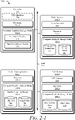
- FIG. 2-2 illustrates another example of an automotive system 200-2 for improving accuracy of predictions on radar data using V2V technology, in accordance with techniques of this disclosure.
- the automotive system 200-2 includes the controller 202, the V2V system 104-1, and the radar system 106-1.
- the controller 202 includes the OTA interface 204 through which the controller 202 can communicate to a model training system 122-2.
- the controller 202 and the model training system 122-2 can communicate through wireless link 232 (e.g., WiFi link, cellular link).
- the OTA interface 204 and the data set collector module 212 may be in a different system or module (e.g., the V2V system 104-1, the radar system 106-1, the model training system 122-1, a dedicated controller (not illustrated) integrated within the host vehicle 102).
- the automotive system 200-2 can, likewise, include a model training system 122-1 that operates according to the description with respect to FIG. 2-1 .
- the model training system 122-2 is remote (e.g., resides on a cloud-based server) to the rest of the automotive system 200-2.
- the model training system 122-2 includes an OTA interface 228 used to communicate on the wireless link 232.
- the model training system 122-2 includes a processor 206-5, a CRM 208-5 which stores instructions for a machine learning module 226-2 to train or retrain a trained model 224, and the model training system 122-2 may use the same training methods and techniques as the model training system 122-1.
- the machine learning module 226-2 of the model training system 122-2 includes a label data set 118-2 (e.g., truth data) and a radar data set 120-2 (e.g., input data) that includes more data than that of the model training system 122-1.
- the model training system 122-2 can receive input from a plurality of automotive systems 200-2.
- the model training system 122-2 can include an artificial neural network that is common to each radar system 106-1 of each automotive system 200-2 of the plurality of automotive systems 200-2.
- the label data set 118-2 and the radar data set 120-2 can include an aggregate of data from the plurality of automotive systems 200-2. Because each automotive system 200-2 of the plurality of automotive systems 200-2 may experience different driving conditions (e.g., dense metropolitan conditions, sparse rural conditions, city streets, interstates, and others), the label data set 118-2 and the radar data set 120-2 can contain large amounts of data that includes the different driving conditions. In this manner, the machine learning module 226-2 can train the trained model 224 with the large amounts of data that includes the different driving conditions.
- the updated trained model 224 may be highly accurate in relation to many different driving conditions in many different environments. This may improve reliability and safety for any vehicle 108 with the updated trained model 224 regardless of the environment in which it travels.
- FIG. 3 illustrates an example implementation 300 using a local model training system 302 for improving accuracy of predictions on radar data using V2V technology, in accordance with techniques of this disclosure.
- a host vehicle 304 has an automotive system, similar to the automotive system 200-1, that includes a V2V system 306, a radar system 308, and a model training system 302 (e.g., the model training system 122-1) is traveling in an environment that includes objects 310-1 and 310-2.
- Objects 310-1 and 310-2 include V2V systems 312-1 and 312-2, respectively.
- the V2V systems 306 and 312-1 can communicate via the wireless link 414-1
- the V2V systems 306 and 312-2 can communicate via the wireless link 414-2.
- the radar system 308 receives reflected signals 316-1 and 316-2 from objects 310-1 and 310-2, respectively.
- the V2V system 306 can receive V2V communications data from the objects 310-1 and 310-2 that can include the vehicle velocity, location, heading, and classification of the objects 310-1 and 310-2.
- the radar system 308 can detect radar data from the objects 310-1 and 310-2 that complements the V2V communications data of the objects 310-1 and 310-2.
- the V2V communications data and the radar data can be collected and retained in a data set collector module.
- data from each of the objects 310 can be collected in the data set collector module.
- the model training system 302 can begin the training process on a radar model of the radar system 308.
- the model training system 302 may not disrupt the operations of the radar system 308 as the training is performed.
- the model training system 302 can deploy the updated model to the radar system 308.
- the updated model may contain data that accounts for the different driving environments and conditions that the host vehicle 304 has experienced to the point of the training process.
- V2V communications data and radar data from other vehicles By accumulating V2V communications data and radar data from other vehicles as the host vehicle 304 encounters them, the data sets used to train the radar model can continue to grow. Larger data sets enable more accurate training. More accurate training may increase the reliability of the radar system 308 and the safety of the host vehicle 304.
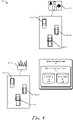
- FIG. 4 illustrates another example implementation 400 using a remote model training system 402 for improving accuracy of predictions on radar data using V2V technology, in accordance with techniques of this disclosure.
- the model training system 402 resides remotely from host vehicles 404, including a first group of host vehicles 404-1 and a second group of host vehicles 404-2. That is, the model training system 402 may reside on a cloud-based server or other computational device that is located outside of any host vehicle 404.
- the host vehicles 404 may communicate with the model training system 402 via wireless communications such as a WiFi connection or a cellular connection (e.g., 4G, 5G).
- the model training system 402, similar to the model training system 122-2 described with reference to FIG. 2-2 includes a machine learning module 406 that stores instructions to train a radar model using a label data set 408 as label data and a radar data set 410 as input to the machine learning module 406.
- the host vehicles 404-1 are traveling in a metropolitan environment 412-1 with dense traffic, and the host vehicles 404-2 are traveling in rural environment 412-2 with less traffic density than the environment 412-1.
- the environments 412 can represent any environments with many different levels of traffic density and driving conditions. For example, the environments 412 may represent interstate travel versus traveling on city streets. As the host vehicles 404 travel in their respective environments 412, they can encounter other host vehicles 404 and other vehicles that include V2V systems (not illustrated) but are not host vehicles.
- the host vehicles 404 are able to communicate with the model training system 402.
- the host vehicles 404 can collect V2V communications data and radar data from one another and from the other vehicles.
- the collected V2V communications data and radar data can be transmitted to the model training system 402.
- the data is transmitted from the host vehicles to the model training system after a quantity of data has been collected that exceeds a threshold.
- the model training system 402 can receive the data from each of the host vehicles to use as a label data set 408 and a radar data set 410.
- the label data set 408 is derived from the collected V2V communications data from each of the host vehicles 404
- the radar data set 410 is derived from the collected radar data from each of the host vehicles 404.
- the label data set 408 and the radar data set 410 may each grow to be large. Additionally, because the host vehicles 404 are traveling in different environments and under different driving conditions, the label data set 408 and the radar data set 410 can include a wide variety of traffic conditions.
- the model training system 402 can deploy the updated radar model to each of the host vehicles 404.
- the updated radar model can include traffic scenarios not normally traveled by each of the host vehicles 404.
- the updated radar model can include rural traffic conditions for the host vehicles 404-1 that may not generally travel in rural areas, and the updated radar model can include metropolitan travel conditions for the host vehicles 404-2 that may not generally travel in dense traffic.
- the updated radar model may include a wide variety of traffic conditions and densities. Thus, the updated radar model may provide more reliability and safety for each of the host vehicles 404, regardless of the environment in which they may encounter.
- FIG. 5 illustrates an example flowchart 500 for improving accuracy of predictions on radar data using V2V technology, in accordance with techniques of this disclosure.
- the operations (or steps) 502 through 514 are performed but are not necessarily limited to the order or combinations in which the operations are shown herein. Further, any of one or more of the operations may be repeated, combined, or reorganized to provide other operations.
- V2V communications data and radar data related to an object are received by a host vehicle.
- the V2V communications data can include classification, location, heading, and speed of the object (e.g., another vehicle).
- the radar data can include range, range rate, and azimuth of the object.
- the V2V communications data and the radar data are collected and retained in a CRM.
- the V2V communications data and the radar data are retained until a minimum quantity of V2V communications data and the radar data is collected.
- the quantity of V2V communications data and the radar data is checked. If the quantity exceeds a threshold, then the V2V communications data and the radar data may be used in step 508. If the quantity of V2V communications data and the radar data is below the threshold, then more V2V communications data and radar data are collected and the quantity can be rechecked.
- a radar model is updated by training the radar model.
- the training may be performed using machine learning techniques.
- the V2V communications are used as truth data (e.g., a label data set).
- the radar data is used as input for training the model.
- the updated radar model is tested for accuracy.
- a safety check is performed on the updated radar model with respect to a production model. The safety check includes comparing the updated radar model and the production model for maximum deviation. If the updated radar model outperforms the production model, then the updated model passes the safety check.
- step 512 if the updated radar model passes the safety check, the updated model is deemed deployable. If the updated radar model fails the safety check, then the process is repeated from step 502 until an updated radar model passes the safety check.
- the updated radar model is deployed to the host vehicle.
- the updated radar model may accurately predict the path and speed of objects in the same environment as the host vehicle.
- the radar model may enable automotive systems of the host vehicle to make safe driving decisions as it travels in an environment.
- FIG. 6 illustrates an example method for improving accuracy of predictions on radar data using V2V technology, in accordance with techniques of this disclosure.
- the operations (or steps) 602 through 608 are performed but are not necessarily limited to the order or combinations in which the operations are shown herein. Further, any of one or more of the operations may be repeated, combined, or reorganized to provide other operations.
- V2V communications data from one or more other vehicles in a vicinity of a host vehicle is received by the host vehicle.
- the V2V communications data is generally considered to be accurate and precise data and can include location data, heading data, velocity data, and classification of each of the one or more other vehicles.
- sensor data related to the one or more other vehicles is received by the host vehicle.
- This disclosure generally describes the sensor data in context to a radar sensor; however, the sensor may be any sensor used by a vehicle to safely travel through an environment. Some examples of other sensors include lidar, cameras, and ultrasonic sensors.
- a model, used by the sensor is updated to generate an updated model.
- the model is updated by applying steps 606-1 through 606-3.
- the V2V communications data is input as label data for the sensor data.
- the sensor data is input into the model.
- the model is trained based on the sensor data and the V2V communications data.
- the model is trained on a dedicated ECU integrated within the host vehicle. A model trained in this manner may include traffic-related information for the environments in which the host vehicle travels.
- the model is trained remotely to the host vehicle.
- the V2V communications data and the sensor data used to train the model can include data received by multiple host vehicles traveling in a variety of environments. By including data of multiple host vehicles, the data set (e.g., the label data set and the sensor data set) used to train the model can be very large compared to other available data sets.
- the updated model is deployed to the host vehicle.
- the updated model may accurately predict object-tracking in a variety of driving environments.
- the host vehicle may use the updated model to safely travel in an environment.
- Example 1 A method comprising: receiving, from a V2V communications platform of a host vehicle, V2V communications data from one or more other vehicles in a vicinity of the host vehicle; receiving sensor data generated by a sensor system of the host vehicle indicative of the one or more other vehicles; updating a model to generate an updated model by: inputting the V2V communications data from the one or more other vehicles as label data for the sensor data; inputting the sensor data to the model; and training the model based on the sensor data and the V2V communications data; and deploying the updated model to the host vehicle for detecting and tracking objects in the vicinity of the host vehicle.
- Example 2 The method of example 1, further comprising: operating the host vehicle in an autonomous or semi-autonomous mode based on the updated model.
- Example 3 The method of any one of the preceding examples, wherein the updated model is generated by the host vehicle.
- Example 4 The method of any one of the preceding examples, wherein updating the model to generate the updated model is performed: utilizing a first processor and a first computer-readable storage media, the first processor and the computer-readable storage media being different from a second processor and a second computer-readable storage media, the second processor and the second computer-readable storage being used for sensor operations of the host vehicle.
- Example 5 The method of any one of the preceding examples, wherein: the host vehicle represents a plurality of host vehicles; the updated model is trained, using a common artificial neural network to each sensor system of each host vehicle of the plurality of host vehicles, remotely in relation to the plurality of host vehicles; and the updated model is deployed to the plurality of host vehicles.
- Example 6 The method of any one of the preceding examples, wherein the updated model is deployed to the plurality of host vehicles via an over-the-air update.
- Example 7 The method of any one of the preceding examples, wherein the updated model is also trained at each of the plurality of host vehicles.
- Example 8 A system comprising: one or more processors configured to: receive, from a V2V communications platform of a first vehicle, V2V communications data from one or more other vehicles in a vicinity of the first vehicle; receive, from a sensor system of the first vehicle, sensor data related to the one or more other vehicles; update a model to generate an updated model by: inputting, to the model, the V2V communications data from the one or more other vehicles as label data for the sensor data; inputting the sensor data to the model; and training the model based on the sensor data and the V2V communications data; and deploy the updated model to the first vehicle for detecting and tracking objects in the vicinity of the first vehicle.
- Example 9 The system of any one of the preceding examples, wherein: the first vehicle represents a plurality of host vehicles; the updated model is trained remotely in relation to the plurality of host vehicles; and the updated model is deployed to the plurality of host vehicles.
- Example 10 The system of any one of the preceding examples, wherein the updated model is deployed to the plurality of host vehicles via an over-the-air update.
- Example 11 The system of any one of the preceding examples, wherein the updated model is also trained on a separate system installed on each of the plurality of host vehicles.
- Example 12 The system of any one of the preceding examples, wherein at least a first group of host vehicles of the plurality of host vehicles operates in a first environment different from a second environment in which at least a second group of host vehicles of the plurality of host vehicles operates.
- Example 13 The system of any one of the preceding examples, wherein the model is updated based on a quantity of the V2V communications data received and the sensor data received exceeding a threshold.
- Example 14 The system of any one of the preceding examples, wherein the one or more processors are further configured to: compare the updated model to a production model; and responsive to the updated model outperforming the production model, deploy the updated model.
- Example 15 The system of any one of the preceding examples, wherein the V2V communications data for each respective other vehicle comprises: location data; heading data; and velocity data.
- Example 16 The system of any one of the preceding examples, wherein the model was previously trained, and wherein the model is continuously trained.
- Example 17 The system of any one of the preceding examples, wherein the sensor system comprises a radar system.
- Example 18 The system of any one of the preceding examples, wherein the sensor data comprises: range data; range rate data; and azimuth data.
- Example 19 A system comprising: one or more processors configured to: receive, from a V2V communications platform of a host vehicle, V2V communications data from one or more other vehicles in a vicinity of the host vehicle; receive, from a sensor system of the host vehicle, sensor data related to the one or more other vehicles; update a model to generate an updated model by: inputting, to the model, the V2V communications data from the one or more other vehicles as label data for the sensor data; inputting the sensor data to the model; and training the model based on the sensor data and the V2V communications data; and output the updated model to the host vehicle for detecting and tracking objects in the vicinity of the host vehicle.
- Example 20 The system of any one of the preceding examples, wherein the system is part of the host vehicle.
- Example 21 A system comprising means for performing the method of any of the preceding examples.
- Example 22 A system comprising at least one processor configured to perform the method of any of the preceding examples.
- Example 23 A computer-readable storage media comprising instructions that, when executed, cause a processor to perform the method of any of the preceding examples.
- Example: 24 The system of any one of the preceding claims, wherein the one or more processors are further configured to: receive, from the V2V communications platform of the first vehicle, additional V2V communications data from the one or more other vehicles; receive, from the sensor system of the first vehicle, additional sensor data related to the one or more other vehicles; further update the model to generate the updated model by: determining, based on the additional V2V communications data, ground truth data for the additional sensor data; updating the model based on the ground truth data; and inputting the additional sensor data to the model; and deploy the updated model to the first vehicle for detecting and tracking objects in the vicinity of the first vehicle.
- "at least one of: a, b, or c” is intended to cover a, b, c, a-b, a-c, b-c, and a-b-c, as well as any combination with multiples of the same element (e.g., a-a, a-a-a, a-a-b, a-a-c, a-b-b, a-c-c, b-b, b-b-b, b-b-c, c-c, and c-c-c or any other ordering of a, b, and c).
Landscapes
- Engineering & Computer Science (AREA)
- Remote Sensing (AREA)
- Radar, Positioning & Navigation (AREA)
- Computer Networks & Wireless Communication (AREA)
- Physics & Mathematics (AREA)
- General Physics & Mathematics (AREA)
- Signal Processing (AREA)
- Electromagnetism (AREA)
- Chemical & Material Sciences (AREA)
- Analytical Chemistry (AREA)
- Evolutionary Computation (AREA)
- Artificial Intelligence (AREA)
- Traffic Control Systems (AREA)
Abstract
Description
- Advanced safety or driving systems for vehicles may use sensors to track nearby objects. These objects may include other vehicles, pedestrians, and animals, as well as inanimate objects, such as trees and street signs. The sensors (e.g., optical cameras, radar, lidar) collect low-level data that is processed in different ways to estimate positions, trajectories, and movements of the objects. Often, machine-learned models are used to estimate objects in or near a road; predictions are made while sensor data is collected and input to the models. For machine-learned models to quickly and accurately predict object whereabouts and movements in and around a road, the models need to be trained using large complex datasets that address as many different driving scenarios as possible. Manually generating a huge or intricate dataset that is sufficiently detailed and complex to be used for training a machine-learned model that assists with sensor based driving can be a challenging and time consuming task.
- This document describes techniques, systems, and methods for improving accuracy of predictions on radar data using vehicle-to-vehicle (V2V) technology. In one example, a method includes receiving, from a V2V communications platform of a host vehicle, V2V communications data from one or more other vehicles in a vicinity of the host vehicle. The method also includes receiving sensor data generated by a sensor system of the host vehicle indicative of the one or more other vehicles. The method further includes updating a model to generate an updated model by inputting the V2V communications data from the one or more other vehicles as label data for the sensor data, inputting the sensor data to the model, and training the model based on the sensor data and the V2V communications data. The method further includes deploying the updated model to the host vehicle for detecting and tracking objects in the vicinity of the host vehicle.
- In another example, a system includes one or more processors configured to receive, from a V2V communications platform of a first vehicle, V2V communications data from one or more other vehicles in a vicinity of the first vehicle. The one or more processors are also configured to receive, from a sensor system of the first host vehicle, sensor data related to the one or more other vehicles. The one or more processors are further configured to update a model to generate an updated model by inputting, to the model, the V2V communications data from the one or more other vehicles as label data for the sensor data, inputting the sensor data to the model, and training the model based on the sensor data and the V2V communications data. The one or more processors are further configured to deploy the updated model to the first vehicle for detecting and tracking objects in the vicinity of the first vehicle. The system may be located remotely from the vehicle.
- In another example, a system includes one or more processors configured to receive, from a V2V communications platform of a host vehicle, V2V communications data from one or more other vehicles in a vicinity of the host vehicle. The one or more processors are also configured to receive, from a sensor system of the first host vehicle, sensor data related to the one or more other vehicles. The one or more processors are further configured to update a model to generate an updated model by inputting, to the model, the V2V communications data from the one or more other vehicles as label data for the sensor data, inputting the sensor data to the model, and training the model based on the sensor data and the V2V communications data. The one or more processors are further configured to output the updated model to the host vehicle for detecting and tracking objects in the vicinity of the host vehicle. The system may be located on the host vehicle.
- This Summary introduces simplified concepts related to improving accuracy of predictions on radar data using V2V technology, further described in the Detailed Description and Drawings. This Summary is not intended to identify essential features of the claimed subject matter, nor is it intended for use in determining the scope of the claimed subject matter. Although primarily described in the context of improving the accuracy of predictions on radar data using V2V communications data, the techniques for using V2V communications data as ground truth data for training sensor-based models can be applied to other applications where accuracy of trained models are desired. Further, these techniques may also be applied to other communications data such as vehicle-to-infrastructure (V2I), vehicle-to-pedestrian (V2P), and vehicle-to-everything data (V2X).
- The details of one or more aspects of improving accuracy of predictions on radar data using V2V technology are described in this document with reference to the following figures, in which same numbers are used throughout to indicate like components:
-
FIG. 1 illustrates an example operating environment of a vehicle that is configured to improve accuracy of predictions on radar data using V2V technology, in accordance with techniques of this disclosure; -
FIG. 2-1 illustrates an example of an automotive system for improving accuracy of predictions on radar data using V2V technology, in accordance with techniques of this disclosure; -
FIG. 2-2 illustrates another example of an automotive system for improving accuracy of predictions on radar data using V2V technology, in accordance with techniques of this disclosure; -
FIG. 3 illustrates an example implementation using a local model training system for improving accuracy of predictions on radar data using V2V technology, in accordance with techniques of this disclosure; -
FIG. 4 illustrates another example implementation using a remote model training system for improving accuracy of predictions on radar data using V2V technology, in accordance with techniques of this disclosure; -
FIG. 5 illustrates an example flowchart for improving accuracy of predictions on radar data using V2V technology, in accordance with techniques of this disclosure; and -
FIG. 6 illustrates an example method for improving accuracy of predictions on radar data using V2V technology, in accordance with techniques of this disclosure. - As vehicles are more often being equipped with autonomous and semi-autonomous systems, machine-learned trained models are being used to assist these systems in object recognition, identification, and/or object tracking applications. The trained models provide a minimum level of accuracy to the sensor systems (e.g., optical cameras, radar, lidar, ultrasonic sensors) and enable the sensor systems to reliably detect and track various objects (e.g., other vehicles, pedestrians, animals, stationary objects such as road signs and vegetation). However, accuracy of the trained models can improve, for example, as the trained models are provided better training data sets (e.g., a larger dataset can account for more object types and driving scenarios). Generating datasets that improve the training of models has been tried, however, several issues remain as obstacles to the creation of the datasets.
- One issue is gathering reliable information for the datasets. Sensor data alone may not provide enough accuracy to reliably train the models. However, as recognized by this disclosure, pairing the sensor data with other highly accurate data may overcome this deficiency. For example, sensor data and V2V communications data can be used in combination to improve the accuracy of datasets used to train machine-learned models. While this disclosure primarily describes these training datasets in relation to radar data combined with V2V communications data, the concepts disclosed herein may, likewise, be applied to other combinations of sensor data (e.g., lidar, camera) and other vehicle communications data (e.g., V2I, V2P).
- Another issue is finding information sources that can provide values that populate these very large datasets. A solution to this issue, as described herein, is to leverage information gathering already provided by other vehicles or infrastructure near or on the roads. By using data collected by many vehicles in many different environmental and driving scenarios (e.g., urban environments versus rural environments, city scenarios versus non-city scenarios), large quantities of data can be acquired to encompass many different real-world scenarios. By training models with sensor data, in combination with accurate V2V communications data, the models of vehicles may more-accurately or more-quickly detect and track objects and avoid collisions with the objects, than when using models trained in other ways.
- This document describes techniques and systems for improving accuracy of predictions on radar data using V2V technology. V2V communications data and the matching sensor data related to one or more vehicles in the vicinity of a host vehicle are collected. The V2V data is used as label data and the radar data is used as the input data for training the model. The training may either occur onboard the host vehicle or remotely (e.g., in a cloud). Further, multiple host vehicles may contribute data to train the model. Once the model has been updated with the included training, the updated model is deployed to the sensor tracking system of the host vehicle. By using the dataset that includes the V2V communications data and the matching sensor data, the updated model may accurately track other vehicles and enable the host vehicle to utilize advanced driver-assistance systems safely and reliably.
-
FIG. 1 illustrates anexample operating environment 100 of ahost vehicle 102 that is configured to improve accuracy of predictions on radar data using V2V technology, in accordance with techniques of this disclosure. In the depictedenvironment 100, aV2V system 104 and aradar system 106 are mounted to, or integrated within, thehost vehicle 102. Although illustrated as a car, thehost vehicle 102 can represent other types of vehicles and machinery (e.g., a motorcycle, a bus, a tractor, a semi-trailer truck, watercraft, aircraft, or other heavy equipment) including manned and unmanned systems that may be used for a variety of purposes. Thehost vehicle 102 may operate in an autonomous or semi-autonomous mode. - In general, manufacturers can mount V2V and radar sensors/antennas to any moving platform that can travel in the
environment 100. The sensors/antennas can project their respective field-of-view (FOV) from any exterior surface of thehost vehicle 102. For example, vehicle manufacturers can integrate at least a part of the radar system 106 (e.g., the radar sensors/antennas) into a side mirror, bumper, roof, or any other interior or exterior location where the FOV includes a portion of theenvironment 100 and objects moving or stationary that are in theenvironment 100. Manufacturers can design the location of the sensors/antennas to provide a particular FOV that sufficiently encompasses portions of theenvironment 100 in which thehost vehicle 102 may be traveling. In the depicted implementation, a portion of theV2V system 104 and a portion of theradar system 106 are mounted near the front bumper section of thehost vehicle 102. - The
V2V system 104 can communicate with other vehicles in theenvironment 100 that are also equipped with V2V systems. For example, avehicle 108 in theenvironment 100 includes aV2V system 110. TheV2V system 104 and theV2V system 110 can communicate to one another via awireless communication link 112. The data conveyed via thewireless communication link 112 by theV2V system 104 and theV2V system 110 to one another may include vehicle information such as speed, location, and heading information of their respective vehicles. Likewise, other vehicles (not illustrated) in theenvironment 100 that are equipped with V2V systems can transmit similar data and receive similar data from other vehicles with V2V systems. Generally, the V2V communications data represents accurate and precise information about the vehicle from which the data originates. - The
radar system 106 can transmit radar signals (e.g., electromagnetic radiation) that can be reflected off of objects in the environment 100 (e.g., the vehicle 108) and receive the reflected signals (e.g., as receive signals 114). In this example, the receivesignals 114 includes radar data (e.g., range data, range rate data, and azimuth data) describing thevehicle 108. Theradar system 106 may use this data, often by utilizing a trained model, to predict future driving actions (e.g., acceleration and braking actions, turning actions) of thevehicle 108. - In the
environment 100, theradar system 106 of thehost vehicle 102 is one type of a sensor-tracking system. In other examples, the techniques described herein may be applied to other types of sensor-tracking systems including camera systems, lidar systems, ultrasonic systems, or any other sensor systems used to identify, track, and/or avoid objects by thehost vehicle 102 in theenvironment 100. Additionally, for simplicity in describing this example, theradar system 106 includes the sensor and any object detection and tracking features (e.g., object-tracking modules, sensor-fusion modules, models assisting in the implementation of these features). In some examples, the sensor and the object detection and tracking features may be represented by different and/or separate systems. - The V2V communications data received by the
V2V system 104 from theV2V system 110 and the radar data related to thevehicle 108 received by theradar system 106 can be collected by a dataset collector module 116. The V2V communications data is collected aslabel data set 118. Similarly, the radar data is collected and stored asradar data set 120. Amodel training system 122 can receive thelabel data set 118 and theradar data set 120. Themodel training system 122 trains or retrains a model to be used by theradar system 106 in assisting theradar system 106 in predicting and tracking objects in theenvironment 100. Thelabel data set 118 can serve as the ground truth and the radar data can be used as input data for training (or retraining) a model. Themodel training system 122 can include instructions to be executed by a processor (e.g., electronic control unit (ECU)) installed on thehost vehicle 102. Alternatively, or additionally, the model training system 122 (or portions thereof) may be executed remotely (e.g., a cloud environment) to thehost vehicle 102. - The
model training system 122 uses thelabel data set 118 and theradar data set 120 to update the model for theradar system 106. In some implementations, thelabel data set 118 and theradar data set 120 can be an aggregate of label data sets and radar data sets collected by multiple host vehicles. After the model is updated, it can be deployed to theradar system 106. Using the updated model, theradar system 106 may be more accurate and reliable in predicting the actions of objects in theenvironment 100. -
FIG. 2-1 illustrates an example of an automotive system 200-1 for improving accuracy of predictions on radar data using V2V technology, in accordance with techniques of this disclosure. The automotive system 200-1 can be integrated within thehost vehicle 102. For example, the automotive system 200-1 includes acontroller 202, a V2V system 104-1, a radar system 106-1, and a model training system 122-1. The V2V system 104-1 is an example of theV2V system 104, the radar system 106-1 is an example of theradar system 106, and the model training system 122-1 is an example of themodel training system 122. The V2V system 104-1 and the radar system 106-1 can be integrated into an automotive or other vehicular environment. In this example, the model training system 122-1 is integrated into thehost vehicle 102. In some implementations, an additional model training system may be remote (e.g., in the cloud) to the vehicle and can train a sensor model concurrent with the model training system 122-1, e.g., in an offline fashion. - The V2V system 104-1, the radar system 106-1, the model training system 122-1, and the
controller 202 communicate over alink 230. Thelink 230 may be a wired or wireless link and in some cases includes a communication bus. - The
controller 202 performs operations based on information received over thelink 230, such as data output from the V2V system 104-1 or the radar system 106-1 as objects in an environment (e.g., the environment 100) are identified from the data. Thecontroller 202 includes an over-the-air (OTA) interface 204 (optional in this implementation), a processor 206-1, and a computer-readable storage media (CRM) 208-1 (e.g., a memory, long-term storage, short-term storage), which stores instructions for anautomotive module 210. - The CRM 208-1 can include a data
set collector module 212. The dataset collector module 212 can store object information derived from data obtained by the V2V system 104-1 and the radar system 106-1, including thelabel data set 118 and theradar data set 120 illustrated inFIG. 1 . Alternatively, the dataset collector module 212 may reside on any CRM 208 integrated within thehost vehicle 102. - The V2V system 104-1 includes a
V2V antenna 214, a processor 206-2, and a CRM 208-2, which stores hostvehicle data 216 andobject data 218. The V2V system 104-1 can transmit, via theV2V antenna 214, thehost vehicle data 216 as V2V communications data to other vehicles or objects equipped with V2V systems through thewireless communication link 112. Likewise, the V2V system can receive, via theV2V antenna 214, V2V communications data from other vehicles equipped with V2V systems as theobject data 218. - The
host vehicle data 216 and theobject data 218 can include information (e.g., vehicle speed, location, heading, classification) about the respective vehicle and is considered more accurate and precise than sensor data (e.g., radar data). Thelabel data set 118 of the dataset collector module 212 can be derived from theobject data 218. - The radar system 106-1 includes one or
more radar sensors 220, a processor 206-3, and a CRM 208-3, which includesradar data 222 and a trainedmodel 224. The CRM 208-3 also includes instructions for performing sensor operations. The radar system 106-1 can receive signals (e.g., the receive signals 114) reflected from nearby objects and can store the data as theradar data 222. The radar system 106-1 can detect and track objects in the FOV using theradar data 222. Theradar data 222, when input to the trainedmodel 224, can provide more accurate and reliable detections and classifications of objects, which the radar system 106-1 can output to theautomotive module 210. - The
radar data set 120 of the dataset collector module 212 can be derived from theradar data 222. The trainedmodel 224 may initially be trained using a generic radar data set and a label data set not derived from V2V communications data. As described in this disclosure, subsequent trainedmodels 224 may include training using thelabel data set 118 and theradar data set 120. - The model training system 122-1 includes a processor 206-4 and a CRM 208-4, which stores instructions for a machine learning module 226-1. The dedicated processor 206-4 enables the model training system 122-1 to train the trained
model 224 without causing disruption to the radar system 106-1 or any other systems of thehost vehicle 102. The machine learning module 226-1 receives a label data set 118-1 and a radar data set 120-1 from the dataset collector module 212. In some aspects, the training will not start until the quantity of data passes a threshold. - Using the label data set 118-1 as ground truth data and the radar data set 120-1 as input, the machine learning module 226-1 can train the trained
model 224 or retrain a previously trainedmodel 224 and can deploy the updated trainedmodel 224 to the radar system 106-1. In some aspects, before the trainedmodel 224 is deployed, the trainedmodel 224 can be compared to another model (e.g., an initially trained model based on generic radar data and labels, an earlier trained model) for accuracy. If the updated trainedmodel 224 does not outperform the other model, the updated trainedmodel 224 may not be deployed. - The machine learning module 226-1 may train the trained
model 224 using machine learning techniques, such as supervised learning, to perform object detection, object tracking, and/or object classification. The trainedmodel 224 may include one or more artificial neural networks (e.g., long short-term memory (LSTM) networks, recurrent neural networks (RNN), convolution neural networks (CNN)). The output of the trained model 224 (e.g., predictions about objects) can be used by theautomotive module 210 for driving applications. - Generally, the automotive system 200-1 executes the
automotive module 210 to perform an automotive function, which may include using output from the radar system 106-1. For example, theautomotive module 210 can provide automatic cruise control and monitor the radar system 106-1 for output that indicates the presence of objects in or near the FOV, for instance, to slow the speed and prevent a rear-end collision with thevehicle 108. In such an example, the trainedmodel 224 can output object information to theautomotive module 210. Theautomotive module 210 may provide alerts or perform a specific maneuver when the data obtained from the radar system 106-1 indicates that one or more objects are crossing in front of thehost vehicle 102. By training the trainedmodel 224 using theradar data 222 as input and theobject data 218 as ground truth data, the accuracy and reliability of the radar system 106-1 may be improved. -
FIG. 2-2 illustrates another example of an automotive system 200-2 for improving accuracy of predictions on radar data using V2V technology, in accordance with techniques of this disclosure. Similar to the automotive system 200-1, the automotive system 200-2 includes thecontroller 202, the V2V system 104-1, and the radar system 106-1. Thecontroller 202 includes theOTA interface 204 through which thecontroller 202 can communicate to a model training system 122-2. Thecontroller 202 and the model training system 122-2 can communicate through wireless link 232 (e.g., WiFi link, cellular link). In other aspects, theOTA interface 204 and the dataset collector module 212 may be in a different system or module (e.g., the V2V system 104-1, the radar system 106-1, the model training system 122-1, a dedicated controller (not illustrated) integrated within the host vehicle 102). Optionally, the automotive system 200-2 can, likewise, include a model training system 122-1 that operates according to the description with respect toFIG. 2-1 . - As illustrated in
FIG. 2-2 , the model training system 122-2 is remote (e.g., resides on a cloud-based server) to the rest of the automotive system 200-2. The model training system 122-2 includes anOTA interface 228 used to communicate on thewireless link 232. Similar to the model training system 122-1, the model training system 122-2 includes a processor 206-5, a CRM 208-5 which stores instructions for a machine learning module 226-2 to train or retrain a trainedmodel 224, and the model training system 122-2 may use the same training methods and techniques as the model training system 122-1. Different than the model training system 122-1, the machine learning module 226-2 of the model training system 122-2 includes a label data set 118-2 (e.g., truth data) and a radar data set 120-2 (e.g., input data) that includes more data than that of the model training system 122-1. By residing remotely to the automotive system 200-2, the model training system 122-2 can receive input from a plurality of automotive systems 200-2. Further, the model training system 122-2 can include an artificial neural network that is common to each radar system 106-1 of each automotive system 200-2 of the plurality of automotive systems 200-2. This enables the model training system 122-2 to use data acquired from each radar system 106-1 even if each radar system 106-1 is different or has different properties due to discretions of mounting or calibration between each radar system 106-1. The label data set 118-2 and the radar data set 120-2 can include an aggregate of data from the plurality of automotive systems 200-2. Because each automotive system 200-2 of the plurality of automotive systems 200-2 may experience different driving conditions (e.g., dense metropolitan conditions, sparse rural conditions, city streets, interstates, and others), the label data set 118-2 and the radar data set 120-2 can contain large amounts of data that includes the different driving conditions. In this manner, the machine learning module 226-2 can train the trainedmodel 224 with the large amounts of data that includes the different driving conditions. The updated trainedmodel 224 may be highly accurate in relation to many different driving conditions in many different environments. This may improve reliability and safety for anyvehicle 108 with the updated trainedmodel 224 regardless of the environment in which it travels. -
FIG. 3 illustrates an example implementation 300 using a localmodel training system 302 for improving accuracy of predictions on radar data using V2V technology, in accordance with techniques of this disclosure. Ahost vehicle 304 has an automotive system, similar to the automotive system 200-1, that includes aV2V system 306, aradar system 308, and a model training system 302 (e.g., the model training system 122-1) is traveling in an environment that includes objects 310-1 and 310-2. Objects 310-1 and 310-2 include V2V systems 312-1 and 312-2, respectively. TheV2V systems 306 and 312-1 can communicate via the wireless link 414-1, and theV2V systems 306 and 312-2 can communicate via the wireless link 414-2. Theradar system 308 receives reflected signals 316-1 and 316-2 from objects 310-1 and 310-2, respectively. - The
V2V system 306 can receive V2V communications data from the objects 310-1 and 310-2 that can include the vehicle velocity, location, heading, and classification of the objects 310-1 and 310-2. Likewise, theradar system 308 can detect radar data from the objects 310-1 and 310-2 that complements the V2V communications data of the objects 310-1 and 310-2. - The V2V communications data and the radar data can be collected and retained in a data set collector module. As the
host vehicle 304 encounters different objects 310, data from each of the objects 310 can be collected in the data set collector module. In some aspects when enough data is collected to surpass a threshold, themodel training system 302 can begin the training process on a radar model of theradar system 308. Themodel training system 302 may not disrupt the operations of theradar system 308 as the training is performed. Once the radar model is updated, themodel training system 302 can deploy the updated model to theradar system 308. The updated model may contain data that accounts for the different driving environments and conditions that thehost vehicle 304 has experienced to the point of the training process. By accumulating V2V communications data and radar data from other vehicles as thehost vehicle 304 encounters them, the data sets used to train the radar model can continue to grow. Larger data sets enable more accurate training. More accurate training may increase the reliability of theradar system 308 and the safety of thehost vehicle 304. -
FIG. 4 illustrates anotherexample implementation 400 using a remotemodel training system 402 for improving accuracy of predictions on radar data using V2V technology, in accordance with techniques of this disclosure. Themodel training system 402 resides remotely from host vehicles 404, including a first group of host vehicles 404-1 and a second group of host vehicles 404-2. That is, themodel training system 402 may reside on a cloud-based server or other computational device that is located outside of any host vehicle 404. The host vehicles 404 may communicate with themodel training system 402 via wireless communications such as a WiFi connection or a cellular connection (e.g., 4G, 5G). Themodel training system 402, similar to the model training system 122-2 described with reference toFIG. 2-2 , includes amachine learning module 406 that stores instructions to train a radar model using alabel data set 408 as label data and aradar data set 410 as input to themachine learning module 406. - In the
example implementation 400, the host vehicles 404-1 are traveling in a metropolitan environment 412-1 with dense traffic, and the host vehicles 404-2 are traveling in rural environment 412-2 with less traffic density than the environment 412-1. The environments 412 can represent any environments with many different levels of traffic density and driving conditions. For example, the environments 412 may represent interstate travel versus traveling on city streets. As the host vehicles 404 travel in their respective environments 412, they can encounter other host vehicles 404 and other vehicles that include V2V systems (not illustrated) but are not host vehicles. - The host vehicles 404 are able to communicate with the
model training system 402. The host vehicles 404 can collect V2V communications data and radar data from one another and from the other vehicles. The collected V2V communications data and radar data can be transmitted to themodel training system 402. In some aspects, the data is transmitted from the host vehicles to the model training system after a quantity of data has been collected that exceeds a threshold. Themodel training system 402 can receive the data from each of the host vehicles to use as alabel data set 408 and aradar data set 410. Thelabel data set 408 is derived from the collected V2V communications data from each of the host vehicles 404, and theradar data set 410 is derived from the collected radar data from each of the host vehicles 404. By collecting data from a plurality of host vehicles 404, thelabel data set 408 and theradar data set 410 may each grow to be large. Additionally, because the host vehicles 404 are traveling in different environments and under different driving conditions, thelabel data set 408 and theradar data set 410 can include a wide variety of traffic conditions. - After the
machine learning module 406 updates a radar model (used by the radar systems of the host vehicles) using thelabel data set 408 and theradar data set 410, themodel training system 402 can deploy the updated radar model to each of the host vehicles 404. The updated radar model can include traffic scenarios not normally traveled by each of the host vehicles 404. In other words, the updated radar model can include rural traffic conditions for the host vehicles 404-1 that may not generally travel in rural areas, and the updated radar model can include metropolitan travel conditions for the host vehicles 404-2 that may not generally travel in dense traffic. The updated radar model may include a wide variety of traffic conditions and densities. Thus, the updated radar model may provide more reliability and safety for each of the host vehicles 404, regardless of the environment in which they may encounter. -
FIG. 5 illustrates anexample flowchart 500 for improving accuracy of predictions on radar data using V2V technology, in accordance with techniques of this disclosure. The operations (or steps) 502 through 514 are performed but are not necessarily limited to the order or combinations in which the operations are shown herein. Further, any of one or more of the operations may be repeated, combined, or reorganized to provide other operations. - At
step 502, V2V communications data and radar data related to an object are received by a host vehicle. The V2V communications data can include classification, location, heading, and speed of the object (e.g., another vehicle). The radar data can include range, range rate, and azimuth of the object. - At
step 504, the V2V communications data and the radar data are collected and retained in a CRM. The V2V communications data and the radar data are retained until a minimum quantity of V2V communications data and the radar data is collected. - At
step 506, the quantity of V2V communications data and the radar data is checked. If the quantity exceeds a threshold, then the V2V communications data and the radar data may be used instep 508. If the quantity of V2V communications data and the radar data is below the threshold, then more V2V communications data and radar data are collected and the quantity can be rechecked. - At
step 508, a radar model is updated by training the radar model. The training may be performed using machine learning techniques. The V2V communications are used as truth data (e.g., a label data set). The radar data is used as input for training the model. - At step 510, the updated radar model is tested for accuracy. A safety check is performed on the updated radar model with respect to a production model. The safety check includes comparing the updated radar model and the production model for maximum deviation. If the updated radar model outperforms the production model, then the updated model passes the safety check.
- At
step 512, if the updated radar model passes the safety check, the updated model is deemed deployable. If the updated radar model fails the safety check, then the process is repeated fromstep 502 until an updated radar model passes the safety check. - At
step 514, the updated radar model is deployed to the host vehicle. By using a large data set (e.g., the V2V communications data and the radar data) the updated radar model may accurately predict the path and speed of objects in the same environment as the host vehicle. The radar model may enable automotive systems of the host vehicle to make safe driving decisions as it travels in an environment. -
FIG. 6 illustrates an example method for improving accuracy of predictions on radar data using V2V technology, in accordance with techniques of this disclosure. The operations (or steps) 602 through 608 are performed but are not necessarily limited to the order or combinations in which the operations are shown herein. Further, any of one or more of the operations may be repeated, combined, or reorganized to provide other operations. - At
step 602, V2V communications data from one or more other vehicles in a vicinity of a host vehicle is received by the host vehicle. The V2V communications data is generally considered to be accurate and precise data and can include location data, heading data, velocity data, and classification of each of the one or more other vehicles. - At
step 604, sensor data related to the one or more other vehicles is received by the host vehicle. This disclosure generally describes the sensor data in context to a radar sensor; however, the sensor may be any sensor used by a vehicle to safely travel through an environment. Some examples of other sensors include lidar, cameras, and ultrasonic sensors. - At
step 606, a model, used by the sensor, is updated to generate an updated model. The model is updated by applying steps 606-1 through 606-3. At step 606-1, the V2V communications data is input as label data for the sensor data. At step 606-2, the sensor data is input into the model. At step 606-3, the model is trained based on the sensor data and the V2V communications data. In some aspects, the model is trained on a dedicated ECU integrated within the host vehicle. A model trained in this manner may include traffic-related information for the environments in which the host vehicle travels. In other aspects, the model is trained remotely to the host vehicle. The V2V communications data and the sensor data used to train the model can include data received by multiple host vehicles traveling in a variety of environments. By including data of multiple host vehicles, the data set (e.g., the label data set and the sensor data set) used to train the model can be very large compared to other available data sets. - At
step 608, the updated model is deployed to the host vehicle. By receiving large quantities of data and training the model with the large quantities of data, the updated model may accurately predict object-tracking in a variety of driving environments. The host vehicle may use the updated model to safely travel in an environment. - Example 1: A method comprising: receiving, from a V2V communications platform of a host vehicle, V2V communications data from one or more other vehicles in a vicinity of the host vehicle; receiving sensor data generated by a sensor system of the host vehicle indicative of the one or more other vehicles; updating a model to generate an updated model by: inputting the V2V communications data from the one or more other vehicles as label data for the sensor data; inputting the sensor data to the model; and training the model based on the sensor data and the V2V communications data; and deploying the updated model to the host vehicle for detecting and tracking objects in the vicinity of the host vehicle.
- Example 2: The method of example 1, further comprising: operating the host vehicle in an autonomous or semi-autonomous mode based on the updated model.
- Example 3: The method of any one of the preceding examples, wherein the updated model is generated by the host vehicle.
- Example 4: The method of any one of the preceding examples, wherein updating the model to generate the updated model is performed: utilizing a first processor and a first computer-readable storage media, the first processor and the computer-readable storage media being different from a second processor and a second computer-readable storage media, the second processor and the second computer-readable storage being used for sensor operations of the host vehicle.
- Example 5: The method of any one of the preceding examples, wherein: the host vehicle represents a plurality of host vehicles; the updated model is trained, using a common artificial neural network to each sensor system of each host vehicle of the plurality of host vehicles, remotely in relation to the plurality of host vehicles; and the updated model is deployed to the plurality of host vehicles.
- Example 6: The method of any one of the preceding examples, wherein the updated model is deployed to the plurality of host vehicles via an over-the-air update.
- Example 7: The method of any one of the preceding examples, wherein the updated model is also trained at each of the plurality of host vehicles.
- Example 8: A system comprising: one or more processors configured to: receive, from a V2V communications platform of a first vehicle, V2V communications data from one or more other vehicles in a vicinity of the first vehicle; receive, from a sensor system of the first vehicle, sensor data related to the one or more other vehicles; update a model to generate an updated model by: inputting, to the model, the V2V communications data from the one or more other vehicles as label data for the sensor data; inputting the sensor data to the model; and training the model based on the sensor data and the V2V communications data; and deploy the updated model to the first vehicle for detecting and tracking objects in the vicinity of the first vehicle.
- Example 9: The system of any one of the preceding examples, wherein: the first vehicle represents a plurality of host vehicles; the updated model is trained remotely in relation to the plurality of host vehicles; and the updated model is deployed to the plurality of host vehicles.
- Example 10: The system of any one of the preceding examples, wherein the updated model is deployed to the plurality of host vehicles via an over-the-air update.
- Example 11: The system of any one of the preceding examples, wherein the updated model is also trained on a separate system installed on each of the plurality of host vehicles.
- Example 12: The system of any one of the preceding examples, wherein at least a first group of host vehicles of the plurality of host vehicles operates in a first environment different from a second environment in which at least a second group of host vehicles of the plurality of host vehicles operates.
- Example 13: The system of any one of the preceding examples, wherein the model is updated based on a quantity of the V2V communications data received and the sensor data received exceeding a threshold.
- Example 14: The system of any one of the preceding examples, wherein the one or more processors are further configured to: compare the updated model to a production model; and responsive to the updated model outperforming the production model, deploy the updated model.
- Example 15: The system of any one of the preceding examples, wherein the V2V communications data for each respective other vehicle comprises: location data; heading data; and velocity data.
- Example 16: The system of any one of the preceding examples, wherein the model was previously trained, and wherein the model is continuously trained.
- Example 17: The system of any one of the preceding examples, wherein the sensor system comprises a radar system.
- Example 18: The system of any one of the preceding examples, wherein the sensor data comprises: range data; range rate data; and azimuth data.
- Example 19: A system comprising: one or more processors configured to: receive, from a V2V communications platform of a host vehicle, V2V communications data from one or more other vehicles in a vicinity of the host vehicle; receive, from a sensor system of the host vehicle, sensor data related to the one or more other vehicles; update a model to generate an updated model by: inputting, to the model, the V2V communications data from the one or more other vehicles as label data for the sensor data; inputting the sensor data to the model; and training the model based on the sensor data and the V2V communications data; and output the updated model to the host vehicle for detecting and tracking objects in the vicinity of the host vehicle.
- Example 20: The system of any one of the preceding examples, wherein the system is part of the host vehicle.
- Example 21: A system comprising means for performing the method of any of the preceding examples.
- Example 22: A system comprising at least one processor configured to perform the method of any of the preceding examples.
- Example 23: A computer-readable storage media comprising instructions that, when executed, cause a processor to perform the method of any of the preceding examples.
- Example: 24: The system of any one of the preceding claims, wherein the one or more processors are further configured to: receive, from the V2V communications platform of the first vehicle, additional V2V communications data from the one or more other vehicles; receive, from the sensor system of the first vehicle, additional sensor data related to the one or more other vehicles; further update the model to generate the updated model by: determining, based on the additional V2V communications data, ground truth data for the additional sensor data; updating the model based on the ground truth data; and inputting the additional sensor data to the model; and deploy the updated model to the first vehicle for detecting and tracking objects in the vicinity of the first vehicle.
- While various embodiments of the disclosure are described in the foregoing description and shown in the drawings, it is to be understood that this disclosure is not limited thereto but may be variously embodied to practice within the scope of the following claims. From the foregoing description, it will be apparent that various changes may be made without departing from the spirit and scope of the disclosure as defined by the following claims. Problems associated with collecting large data sets for model training can occur in other systems. Therefore, although described as a way to improve accuracy of predictions on radar data using V2V technology, the techniques of the foregoing description can be applied to other systems that would benefit from building large data sets to be used to train models. Further, these techniques may also be applied to other communications data, such as V2I, V2P, and V2X.
- The use of "or" and grammatically related terms indicates non-exclusive alternatives without limitation unless the context clearly dictates otherwise. As used herein, a phrase referring to "at least one of' a list of items refers to any combination of those items, including single members. As an example, "at least one of: a, b, or c" is intended to cover a, b, c, a-b, a-c, b-c, and a-b-c, as well as any combination with multiples of the same element (e.g., a-a, a-a-a, a-a-b, a-a-c, a-b-b, a-c-c, b-b, b-b-b, b-b-c, c-c, and c-c-c or any other ordering of a, b, and c).
Claims (15)
- A system comprising:
one or more processors configured to:receive, from a vehicle-to-vehicle (V2V) communications platform of a first vehicle, V2V communications data from one or more other vehicles in a vicinity of the first vehicle;receive, from a sensor system of the first vehicle, sensor data related to the one or more other vehicles;update a model to generate an updated model by:inputting, to the model, the V2V communications data from the one or more other vehicles as label data for the sensor data;inputting the sensor data to the model; andtraining the model based on the sensor data and the V2V communications data; anddeploy the updated model to the first vehicle for detecting and tracking objects in the vicinity of the first vehicle. - The system of claim 1, wherein:the first vehicle represents a plurality of host vehicles;the updated model is trained remotely in relation to the plurality of host vehicles; andthe updated model is deployed to the plurality of host vehicles.
- The system of claim 2, wherein the updated model is deployed to the plurality of host vehicles via an over-the-air update.
- The system of claims 2 or 3, wherein the updated model is also trained on a separate system installed on each of the plurality of host vehicles.
- The system of any one of the claims 2 through 4, wherein at least a first group of host vehicles of the plurality of host vehicles operates in a first environment different from a second environment in which at least a second group of host vehicles of the plurality of host vehicles operates.
- The system of any one of the preceding claims, wherein the model is updated based on a quantity of the V2V communications data received and the sensor data received exceeding a threshold.
- The system of any one of the preceding claims, wherein the one or more processors are further configured to:
compare the updated model to a production model; and
responsive to the updated model outperforming the production model, deploy the updated model. - The system of any one of the preceding claims, wherein the V2V communications data for each respective other vehicle comprises:location data;heading data; andvelocity data.
- The system of any one of the preceding claims, wherein the model was previously trained, and wherein the model is continuously trained.
- The system of any one of the preceding claims, wherein the sensor system comprises a radar system.
- The system of any one of the preceding claims, wherein the sensor data comprises:range data;range rate data; andazimuth data.
- The system of any one of the preceding claims, wherein the one or more processors are further configured to:receive, from the V2V communications platform of the first vehicle, additional V2V communications data from the one or more other vehicles;receive, from the sensor system of the first vehicle, additional sensor data related to the one or more other vehicles;further update the model to generate the updated model by:determining, based on the additional V2V communications data, ground truth data for the additional sensor data;updating the model based on the ground truth data; andinputting the additional sensor data to the model; anddeploy the updated model to the first vehicle for detecting and tracking objects in the vicinity of the first vehicle.
- The system of any one of the preceding claims, wherein the system is part of the first vehicle.
- A method comprising:receiving, from a vehicle-to-vehicle (V2V) communications platform of a host vehicle, V2V communications data from one or more other vehicles in a vicinity of the host vehicle;receiving sensor data generated by a sensor system of the host vehicle indicative of the one or more other vehicles;updating a model to generate an updated model by:inputting the V2V communications data from the one or more other vehicles as label data for the sensor data;inputting the sensor data to the model; andtraining the model based on the sensor data and the V2V communications data; anddeploying the updated model to the host vehicle for detecting and tracking objects in the vicinity of the host vehicle.
- A system comprising means for performing the method of claim 14.
Applications Claiming Priority (4)
| Application Number | Priority Date | Filing Date | Title |
|---|---|---|---|
| US202163218248P | 2021-07-02 | 2021-07-02 | |
| US202163272090P | 2021-10-26 | 2021-10-26 | |
| US202263303347P | 2022-01-26 | 2022-01-26 | |
| US17/662,998 US20230005362A1 (en) | 2021-07-02 | 2022-05-11 | Accuracy of Predictions on Radar Data using Vehicle-to-Vehicle Technology |
Publications (1)
| Publication Number | Publication Date |
|---|---|
| EP4113154A1 true EP4113154A1 (en) | 2023-01-04 |
Family
ID=81984739
Family Applications (1)
| Application Number | Title | Priority Date | Filing Date |
|---|---|---|---|
| EP22177888.9A Withdrawn EP4113154A1 (en) | 2021-07-02 | 2022-06-08 | Improving accuracy of predictions on radar data using vehicle-to-vehicle technology |
Country Status (3)
| Country | Link |
|---|---|
| US (1) | US20230005362A1 (en) |
| EP (1) | EP4113154A1 (en) |
| CN (1) | CN115629375A (en) |
Families Citing this family (3)
| Publication number | Priority date | Publication date | Assignee | Title |
|---|---|---|---|---|
| US10802489B1 (en) | 2017-12-29 | 2020-10-13 | Apex Artificial Intelligence Industries, Inc. | Apparatus and method for monitoring and controlling of a neural network using another neural network implemented on one or more solid-state chips |
| US12081646B2 (en) * | 2019-11-26 | 2024-09-03 | Apex Ai Industries, Llc | Adaptively controlling groups of automated machines |
| US12345833B2 (en) * | 2021-07-21 | 2025-07-01 | Tocaro Blue LLC | Vessel field of awareness apparatus and method |
Citations (1)
| Publication number | Priority date | Publication date | Assignee | Title |
|---|---|---|---|---|
| US20180053102A1 (en) * | 2016-08-16 | 2018-02-22 | Toyota Jidosha Kabushiki Kaisha | Individualized Adaptation of Driver Action Prediction Models |
Family Cites Families (35)
| Publication number | Priority date | Publication date | Assignee | Title |
|---|---|---|---|---|
| US20100023265A1 (en) * | 2008-07-24 | 2010-01-28 | Gm Global Technology Operations, Inc. | Adaptive vehicle control system with integrated driving style recognition |
| JP5737316B2 (en) * | 2013-04-17 | 2015-06-17 | 株式会社デンソー | Convoy travel system |
| CN106331008A (en) * | 2015-06-26 | 2017-01-11 | 中兴通讯股份有限公司 | Method and device for managing vehicle groups in vehicle to everything |
| JP6790977B2 (en) * | 2017-04-11 | 2020-11-25 | 株式会社デンソー | Vehicle data storage device |
| US11392133B2 (en) * | 2017-06-06 | 2022-07-19 | Plusai, Inc. | Method and system for object centric stereo in autonomous driving vehicles |
| JP6910435B2 (en) * | 2017-06-09 | 2021-07-28 | 三菱電機株式会社 | Light irradiation control device and light irradiation control method |
| US10957201B2 (en) * | 2017-09-15 | 2021-03-23 | Qualcomm Incorporated | System and method for relative positioning based safe autonomous driving |
| US10535257B2 (en) * | 2017-10-20 | 2020-01-14 | International Business Machines Corporation | Transfer of image data taken by an on-vehicle camera |
| US20190160998A1 (en) * | 2017-11-29 | 2019-05-30 | GM Global Technology Operations LLC | Headlight control based on messaging and sensor data |
| US11197042B2 (en) * | 2017-12-20 | 2021-12-07 | Intel Corporation | Distributed 3D video for navigation |
| US10916135B2 (en) * | 2018-01-13 | 2021-02-09 | Toyota Jidosha Kabushiki Kaisha | Similarity learning and association between observations of multiple connected vehicles |
| AT520887A1 (en) * | 2018-01-18 | 2019-08-15 | Tgw Logistics Group Gmbh | Method and order-picking system with improved operation of autonomous conveyor vehicles |
| US11169536B2 (en) * | 2018-04-09 | 2021-11-09 | SafeAI, Inc. | Analysis of scenarios for controlling vehicle operations |
| US11550061B2 (en) * | 2018-04-11 | 2023-01-10 | Aurora Operations, Inc. | Control of autonomous vehicle based on environmental object classification determined using phase coherent LIDAR data |
| US11481665B2 (en) * | 2018-11-09 | 2022-10-25 | Hewlett Packard Enterprise Development Lp | Systems and methods for determining machine learning training approaches based on identified impacts of one or more types of concept drift |
| JP7052692B2 (en) * | 2018-11-26 | 2022-04-12 | トヨタ自動車株式会社 | Formation system |
| KR102732488B1 (en) * | 2018-12-14 | 2024-11-21 | 현대자동차주식회사 | Autonomous vehicles traffic information management system and method |
| US11635764B2 (en) * | 2019-02-22 | 2023-04-25 | Uatc, Llc. | Motion prediction for autonomous devices |
| JP7106477B2 (en) * | 2019-03-20 | 2022-07-26 | 本田技研工業株式会社 | vehicle controller |
| US11158194B2 (en) * | 2019-03-29 | 2021-10-26 | Intel Corporation | Technologies for vehicle-to-vehicle communications for autonomous vehicles |
| EP3754359B1 (en) * | 2019-06-18 | 2024-10-09 | Zenuity AB | Method of determination of alignment angles of radar sensors for a road vehicle radar auto-alignment controller |
| KR20210020613A (en) * | 2019-08-16 | 2021-02-24 | 엘지전자 주식회사 | A method for transferring of vehicle between groups during platooning |
| US12071030B2 (en) * | 2019-12-23 | 2024-08-27 | Lyft, Inc. | Camera-sensor fusion module for surface detection and fleet vehicle control systems and methods |
| US11255957B2 (en) * | 2020-01-27 | 2022-02-22 | Ford Global Technologies, Llc | Target velocity detection |
| US11586200B2 (en) * | 2020-06-22 | 2023-02-21 | The Boeing Company | Method and system for vehicle engagement control |
| EP4186253A1 (en) * | 2020-07-21 | 2023-05-31 | Harman International Industries, Incorporated | Systems and methods for data security in autonomous vehicles |
| CN116018292B (en) * | 2020-08-17 | 2025-07-18 | 哈曼国际工业有限公司 | System and method for object detection in an autonomous vehicle |
| US11425852B2 (en) * | 2020-10-16 | 2022-08-30 | Verdant Robotics, Inc. | Autonomous detection and control of vegetation |
| US11694543B2 (en) * | 2020-11-03 | 2023-07-04 | Argo AI, LLC | System and method for data offloading and uploading to exchange data between nodes of a vehicle traffic infrastructure system |
| US20220168894A1 (en) * | 2020-12-01 | 2022-06-02 | Ford Global Technologies, Llc | Automotive parts deployment system |
| CN112580657B (en) * | 2020-12-23 | 2022-11-01 | 陕西天诚软件有限公司 | Self-learning character recognition method |
| US12187301B2 (en) * | 2020-12-23 | 2025-01-07 | Intel Corporation | Distributed learning to learn context-specific driving patterns |
| US11702098B2 (en) * | 2021-03-23 | 2023-07-18 | The Regents Of The University Of Michigan | Roadmanship systems and methods |
| US20220398463A1 (en) * | 2021-06-11 | 2022-12-15 | Robert Bosch Gmbh | Ultrasonic system and method for reconfiguring a machine learning model used within a vehicle |
| US12168461B2 (en) * | 2021-06-29 | 2024-12-17 | Toyota Research Institute, Inc. | Systems and methods for predicting the trajectory of a moving object |
-
2022
- 2022-05-11 US US17/662,998 patent/US20230005362A1/en not_active Abandoned
- 2022-06-08 EP EP22177888.9A patent/EP4113154A1/en not_active Withdrawn
- 2022-06-29 CN CN202210758134.4A patent/CN115629375A/en active Pending
Patent Citations (1)
| Publication number | Priority date | Publication date | Assignee | Title |
|---|---|---|---|---|
| US20180053102A1 (en) * | 2016-08-16 | 2018-02-22 | Toyota Jidosha Kabushiki Kaisha | Individualized Adaptation of Driver Action Prediction Models |
Non-Patent Citations (2)
| Title |
|---|
| ABDELLATIF ALAA AWAD ET AL: "Active Learning-based Classification in Automated Connected Vehicles", IEEE INFOCOM 2020 - IEEE CONFERENCE ON COMPUTER COMMUNICATIONS WORKSHOPS (INFOCOM WKSHPS), IEEE, 6 July 2020 (2020-07-06), pages 598 - 603, XP033808668, DOI: 10.1109/INFOCOMWKSHPS50562.2020.9162964 * |
| RODOLFO VALIENTE ET AL: "Controlling Steering Angle for Cooperative Self-driving Vehicles utilizing CNN and LSTM-based Deep Networks", ARXIV.ORG, CORNELL UNIVERSITY LIBRARY, 201 OLIN LIBRARY CORNELL UNIVERSITY ITHACA, NY 14853, 8 April 2019 (2019-04-08), XP081166769 * |
Also Published As
| Publication number | Publication date |
|---|---|
| US20230005362A1 (en) | 2023-01-05 |
| CN115629375A (en) | 2023-01-20 |
Similar Documents
| Publication | Publication Date | Title |
|---|---|---|
| EP3580084B1 (en) | Autonomous vehicle operational management including operating a partially observable markov decision process model instance | |
| EP3580104B1 (en) | Autonomous vehicle operational management blocking monitoring | |
| EP3580620B1 (en) | Autonomous vehicle operational management control | |
| US20180374341A1 (en) | Systems and methods for predicting traffic patterns in an autonomous vehicle | |
| US20230005362A1 (en) | Accuracy of Predictions on Radar Data using Vehicle-to-Vehicle Technology | |
| CN113165646B (en) | Electronic device for detecting risk factors around a vehicle and control method thereof | |
| US11704912B2 (en) | Label-free performance evaluator for traffic light classifier system | |
| WO2018147871A1 (en) | Autonomous vehicle operational management | |
| EP4160269A1 (en) | Systems and methods for onboard analysis of sensor data for sensor fusion | |
| EP4279869B1 (en) | Determining a state of a vehicle on a road | |
| US11521491B2 (en) | Priority vehicle management | |
| EP4082862B1 (en) | Platform for path planning system development for automated driving system | |
| EP4394626A1 (en) | Classification of objects present on a road | |
| CN116783105A (en) | Onboard feedback systems for autonomous vehicles | |
| US12240487B2 (en) | Platform for perception system development for automated driving systems | |
| US11983918B2 (en) | Platform for perception system development for automated driving system | |
| US20250078477A1 (en) | Method for collecting data for subsequent training of an object detection model | |
| EP4645259A1 (en) | In-vehicle perception performance evaluation | |
| US12545294B2 (en) | Passing vehicle on shoulder | |
| EP4361819B1 (en) | Methods and apparatuses for closed-loop evaluation for autonomous vehicles | |
| US12007248B2 (en) | Ice thickness estimation for mobile object operation | |
| US12451013B2 (en) | Track associations at least partially based on low confidence detections | |
| US20260138646A1 (en) | Passing vehicle on shoulder | |
| US12630189B2 (en) | Methods and apparatuses for closed-loop evaluation for autonomous vehicles |
Legal Events
| Date | Code | Title | Description |
|---|---|---|---|
| PUAI | Public reference made under article 153(3) epc to a published international application that has entered the european phase |
Free format text: ORIGINAL CODE: 0009012 |
|
| STAA | Information on the status of an ep patent application or granted ep patent |
Free format text: STATUS: THE APPLICATION HAS BEEN PUBLISHED |
|
| AK | Designated contracting states |
Kind code of ref document: A1 Designated state(s): AL AT BE BG CH CY CZ DE DK EE ES FI FR GB GR HR HU IE IS IT LI LT LU LV MC MK MT NL NO PL PT RO RS SE SI SK SM TR |
|
| STAA | Information on the status of an ep patent application or granted ep patent |
Free format text: STATUS: REQUEST FOR EXAMINATION WAS MADE |
|
| 17P | Request for examination filed |
Effective date: 20230704 |
|
| RBV | Designated contracting states (corrected) |
Designated state(s): AL AT BE BG CH CY CZ DE DK EE ES FI FR GB GR HR HU IE IS IT LI LT LU LV MC MK MT NL NO PL PT RO RS SE SI SK SM TR |
|
| RAP1 | Party data changed (applicant data changed or rights of an application transferred) |
Owner name: APTIV TECHNOLOGIES AG |
|
| RAP3 | Party data changed (applicant data changed or rights of an application transferred) |
Owner name: APTIV TECHNOLOGIES AG |
|
| STAA | Information on the status of an ep patent application or granted ep patent |
Free format text: STATUS: THE APPLICATION HAS BEEN WITHDRAWN |
|
| 18W | Application withdrawn |
Effective date: 20250411 |