EP4112595A1 - Metal-organic framework with carboxylic acid ion having terphenyl skeleton as ligand - Google Patents
Metal-organic framework with carboxylic acid ion having terphenyl skeleton as ligand Download PDFInfo
- Publication number
- EP4112595A1 EP4112595A1 EP21761442.9A EP21761442A EP4112595A1 EP 4112595 A1 EP4112595 A1 EP 4112595A1 EP 21761442 A EP21761442 A EP 21761442A EP 4112595 A1 EP4112595 A1 EP 4112595A1
- Authority
- EP
- European Patent Office
- Prior art keywords
- group
- substituted
- unsubstituted
- sup
- metal
- Prior art date
- Legal status (The legal status is an assumption and is not a legal conclusion. Google has not performed a legal analysis and makes no representation as to the accuracy of the status listed.)
- Withdrawn
Links
- 239000012621 metal-organic framework Substances 0.000 title claims abstract description 80
- YJTKZCDBKVTVBY-UHFFFAOYSA-N 1,3-Diphenylbenzene Chemical group C1=CC=CC=C1C1=CC=CC(C=2C=CC=CC=2)=C1 YJTKZCDBKVTVBY-UHFFFAOYSA-N 0.000 title abstract description 8
- 239000003446 ligand Substances 0.000 title description 6
- 239000013110 organic ligand Substances 0.000 claims abstract description 84
- 125000004169 (C1-C6) alkyl group Chemical group 0.000 claims abstract description 32
- 238000000034 method Methods 0.000 claims abstract description 20
- 229910021645 metal ion Inorganic materials 0.000 claims abstract description 17
- 125000001424 substituent group Chemical group 0.000 claims abstract description 16
- 125000003178 carboxy group Chemical group [H]OC(*)=O 0.000 claims abstract description 8
- 125000002496 methyl group Chemical group [H]C([H])([H])* 0.000 claims abstract description 7
- 125000000217 alkyl group Chemical group 0.000 claims abstract description 6
- 125000002887 hydroxy group Chemical group [H]O* 0.000 claims abstract description 5
- 125000000623 heterocyclic group Chemical group 0.000 claims description 31
- 239000007789 gas Substances 0.000 claims description 26
- 125000000041 C6-C10 aryl group Chemical group 0.000 claims description 25
- 125000004191 (C1-C6) alkoxy group Chemical group 0.000 claims description 16
- 229910052751 metal Inorganic materials 0.000 claims description 14
- 239000002184 metal Substances 0.000 claims description 14
- 125000004738 (C1-C6) alkyl sulfinyl group Chemical group 0.000 claims description 13
- 125000004739 (C1-C6) alkylsulfonyl group Chemical group 0.000 claims description 13
- 125000006700 (C1-C6) alkylthio group Chemical group 0.000 claims description 13
- 125000006552 (C3-C8) cycloalkyl group Chemical group 0.000 claims description 13
- 125000005135 aryl sulfinyl group Chemical group 0.000 claims description 13
- 125000004391 aryl sulfonyl group Chemical group 0.000 claims description 13
- 125000005110 aryl thio group Chemical group 0.000 claims description 13
- 125000004104 aryloxy group Chemical group 0.000 claims description 13
- 125000005843 halogen group Chemical group 0.000 claims description 13
- 125000005553 heteroaryloxy group Chemical group 0.000 claims description 13
- 125000005150 heteroarylsulfinyl group Chemical group 0.000 claims description 13
- 125000005143 heteroarylsulfonyl group Chemical group 0.000 claims description 13
- 125000005368 heteroarylthio group Chemical group 0.000 claims description 13
- 125000004916 (C1-C6) alkylcarbonyl group Chemical group 0.000 claims description 12
- 125000005129 aryl carbonyl group Chemical group 0.000 claims description 12
- 125000004435 hydrogen atom Chemical group [H]* 0.000 claims description 11
- 125000004093 cyano group Chemical group *C#N 0.000 claims description 10
- 125000000449 nitro group Chemical group [O-][N+](*)=O 0.000 claims description 10
- 229910052802 copper Inorganic materials 0.000 claims description 5
- 229910052804 chromium Inorganic materials 0.000 claims description 4
- 229910052759 nickel Inorganic materials 0.000 claims description 4
- 229910052719 titanium Inorganic materials 0.000 claims description 4
- 229910052725 zinc Inorganic materials 0.000 claims description 4
- 229910052726 zirconium Inorganic materials 0.000 claims description 4
- 229910052782 aluminium Inorganic materials 0.000 claims description 3
- 229910052742 iron Inorganic materials 0.000 claims description 3
- 229910052749 magnesium Inorganic materials 0.000 claims description 3
- 150000002739 metals Chemical class 0.000 claims description 3
- 230000000737 periodic effect Effects 0.000 claims description 3
- OFOBLEOULBTSOW-UHFFFAOYSA-N Malonic acid Chemical compound OC(=O)CC(O)=O OFOBLEOULBTSOW-UHFFFAOYSA-N 0.000 abstract description 4
- -1 carboxylate ion Chemical class 0.000 description 163
- ZMXDDKWLCZADIW-UHFFFAOYSA-N N,N-Dimethylformamide Chemical compound CN(C)C=O ZMXDDKWLCZADIW-UHFFFAOYSA-N 0.000 description 152
- QTBSBXVTEAMEQO-UHFFFAOYSA-N Acetic acid Chemical compound CC(O)=O QTBSBXVTEAMEQO-UHFFFAOYSA-N 0.000 description 75
- 239000007787 solid Substances 0.000 description 74
- 239000000843 powder Substances 0.000 description 67
- 229910009112 xH2O Inorganic materials 0.000 description 40
- HEDRZPFGACZZDS-UHFFFAOYSA-N Chloroform Chemical compound ClC(Cl)Cl HEDRZPFGACZZDS-UHFFFAOYSA-N 0.000 description 32
- 239000000243 solution Substances 0.000 description 31
- 239000006228 supernatant Substances 0.000 description 25
- 238000000926 separation method Methods 0.000 description 23
- 238000006243 chemical reaction Methods 0.000 description 21
- 238000004519 manufacturing process Methods 0.000 description 20
- CSCPPACGZOOCGX-UHFFFAOYSA-N Acetone Chemical compound CC(C)=O CSCPPACGZOOCGX-UHFFFAOYSA-N 0.000 description 18
- 229910052739 hydrogen Inorganic materials 0.000 description 18
- 239000001257 hydrogen Substances 0.000 description 18
- 239000002904 solvent Substances 0.000 description 17
- IJGRMHOSHXDMSA-UHFFFAOYSA-N Atomic nitrogen Chemical compound N#N IJGRMHOSHXDMSA-UHFFFAOYSA-N 0.000 description 16
- 239000012295 chemical reaction liquid Substances 0.000 description 16
- XLYOFNOQVPJJNP-UHFFFAOYSA-N water Substances O XLYOFNOQVPJJNP-UHFFFAOYSA-N 0.000 description 16
- UFHFLCQGNIYNRP-UHFFFAOYSA-N Hydrogen Chemical compound [H][H] UFHFLCQGNIYNRP-UHFFFAOYSA-N 0.000 description 13
- 238000005259 measurement Methods 0.000 description 13
- SUAKHGWARZSWIH-UHFFFAOYSA-N N,N‐diethylformamide Chemical compound CCN(CC)C=O SUAKHGWARZSWIH-UHFFFAOYSA-N 0.000 description 11
- 239000013078 crystal Substances 0.000 description 11
- 125000003808 silyl group Chemical class [H][Si]([H])([H])[*] 0.000 description 11
- ZMANZCXQSJIPKH-UHFFFAOYSA-N Triethylamine Chemical compound CCN(CC)CC ZMANZCXQSJIPKH-UHFFFAOYSA-N 0.000 description 10
- 238000010438 heat treatment Methods 0.000 description 10
- 239000007788 liquid Substances 0.000 description 10
- 229910052757 nitrogen Inorganic materials 0.000 description 10
- 238000011085 pressure filtration Methods 0.000 description 10
- OKKJLVBELUTLKV-UHFFFAOYSA-N Methanol Chemical compound OC OKKJLVBELUTLKV-UHFFFAOYSA-N 0.000 description 9
- 239000011521 glass Substances 0.000 description 8
- XEEYBQQBJWHFJM-UHFFFAOYSA-N iron Substances [Fe] XEEYBQQBJWHFJM-UHFFFAOYSA-N 0.000 description 8
- 150000001732 carboxylic acid derivatives Chemical class 0.000 description 7
- 125000001072 heteroaryl group Chemical group 0.000 description 7
- 239000002243 precursor Substances 0.000 description 7
- CURLTUGMZLYLDI-UHFFFAOYSA-N Carbon dioxide Chemical compound O=C=O CURLTUGMZLYLDI-UHFFFAOYSA-N 0.000 description 6
- KWYUFKZDYYNOTN-UHFFFAOYSA-M Potassium hydroxide Chemical compound [OH-].[K+] KWYUFKZDYYNOTN-UHFFFAOYSA-M 0.000 description 6
- KKEYFWRCBNTPAC-UHFFFAOYSA-N Terephthalic acid Chemical compound OC(=O)C1=CC=C(C(O)=O)C=C1 KKEYFWRCBNTPAC-UHFFFAOYSA-N 0.000 description 6
- WYURNTSHIVDZCO-UHFFFAOYSA-N Tetrahydrofuran Chemical compound C1CCOC1 WYURNTSHIVDZCO-UHFFFAOYSA-N 0.000 description 6
- 125000002723 alicyclic group Chemical group 0.000 description 6
- VNWKTOKETHGBQD-UHFFFAOYSA-N methane Chemical compound C VNWKTOKETHGBQD-UHFFFAOYSA-N 0.000 description 6
- 239000000203 mixture Substances 0.000 description 6
- 125000003367 polycyclic group Chemical group 0.000 description 6
- 239000011701 zinc Substances 0.000 description 6
- 125000003118 aryl group Chemical group 0.000 description 5
- XTVVROIMIGLXTD-UHFFFAOYSA-N copper(II) nitrate Chemical compound [Cu+2].[O-][N+]([O-])=O.[O-][N+]([O-])=O XTVVROIMIGLXTD-UHFFFAOYSA-N 0.000 description 5
- 150000002431 hydrogen Chemical class 0.000 description 5
- 150000002500 ions Chemical class 0.000 description 5
- RBTARNINKXHZNM-UHFFFAOYSA-K iron trichloride Chemical compound Cl[Fe](Cl)Cl RBTARNINKXHZNM-UHFFFAOYSA-K 0.000 description 5
- WOSISLOTWLGNKT-UHFFFAOYSA-L iron(2+);dichloride;hexahydrate Chemical compound O.O.O.O.O.O.Cl[Fe]Cl WOSISLOTWLGNKT-UHFFFAOYSA-L 0.000 description 5
- 150000002736 metal compounds Chemical class 0.000 description 5
- 238000002156 mixing Methods 0.000 description 5
- 238000003756 stirring Methods 0.000 description 5
- VNDYJBBGRKZCSX-UHFFFAOYSA-L zinc bromide Chemical compound Br[Zn]Br VNDYJBBGRKZCSX-UHFFFAOYSA-L 0.000 description 5
- DUNKXUFBGCUVQW-UHFFFAOYSA-J zirconium tetrachloride Chemical compound Cl[Zr](Cl)(Cl)Cl DUNKXUFBGCUVQW-UHFFFAOYSA-J 0.000 description 5
- DNHRBCFMFYOUKM-UHFFFAOYSA-N 1,4-dibromo-2,5-diethylbenzene Chemical compound CCC1=CC(Br)=C(CC)C=C1Br DNHRBCFMFYOUKM-UHFFFAOYSA-N 0.000 description 4
- SXAMGRAIZSSWIH-UHFFFAOYSA-N 2-[3-[2-(2,3-dihydro-1H-inden-2-ylamino)pyrimidin-5-yl]-1,2,4-oxadiazol-5-yl]-1-(2,4,6,7-tetrahydrotriazolo[4,5-c]pyridin-5-yl)ethanone Chemical compound C1C(CC2=CC=CC=C12)NC1=NC=C(C=N1)C1=NOC(=N1)CC(=O)N1CC2=C(CC1)NN=N2 SXAMGRAIZSSWIH-UHFFFAOYSA-N 0.000 description 4
- CSNNHWWHGAXBCP-UHFFFAOYSA-L Magnesium sulfate Chemical compound [Mg+2].[O-][S+2]([O-])([O-])[O-] CSNNHWWHGAXBCP-UHFFFAOYSA-L 0.000 description 4
- FXHOOIRPVKKKFG-UHFFFAOYSA-N N,N-Dimethylacetamide Chemical compound CN(C)C(C)=O FXHOOIRPVKKKFG-UHFFFAOYSA-N 0.000 description 4
- 125000003277 amino group Chemical group 0.000 description 4
- 125000004429 atom Chemical group 0.000 description 4
- 125000004432 carbon atom Chemical group C* 0.000 description 4
- 239000003153 chemical reaction reagent Substances 0.000 description 4
- 150000001875 compounds Chemical class 0.000 description 4
- 239000010949 copper Substances 0.000 description 4
- 239000000126 substance Substances 0.000 description 4
- 239000010936 titanium Substances 0.000 description 4
- ONDPHDOFVYQSGI-UHFFFAOYSA-N zinc nitrate Inorganic materials [Zn+2].[O-][N+]([O-])=O.[O-][N+]([O-])=O ONDPHDOFVYQSGI-UHFFFAOYSA-N 0.000 description 4
- XJKSTNDFUHDPQJ-UHFFFAOYSA-N 1,4-diphenylbenzene Chemical group C1=CC=CC=C1C1=CC=C(C=2C=CC=CC=2)C=C1 XJKSTNDFUHDPQJ-UHFFFAOYSA-N 0.000 description 3
- XIOUDVJTOYVRTB-UHFFFAOYSA-N 1-(1-adamantyl)-3-aminothiourea Chemical compound C1C(C2)CC3CC2CC1(NC(=S)NN)C3 XIOUDVJTOYVRTB-UHFFFAOYSA-N 0.000 description 3
- WZFUQSJFWNHZHM-UHFFFAOYSA-N 2-[4-[2-(2,3-dihydro-1H-inden-2-ylamino)pyrimidin-5-yl]piperazin-1-yl]-1-(2,4,6,7-tetrahydrotriazolo[4,5-c]pyridin-5-yl)ethanone Chemical compound C1C(CC2=CC=CC=C12)NC1=NC=C(C=N1)N1CCN(CC1)CC(=O)N1CC2=C(CC1)NN=N2 WZFUQSJFWNHZHM-UHFFFAOYSA-N 0.000 description 3
- YJLUBHOZZTYQIP-UHFFFAOYSA-N 2-[5-[2-(2,3-dihydro-1H-inden-2-ylamino)pyrimidin-5-yl]-1,3,4-oxadiazol-2-yl]-1-(2,4,6,7-tetrahydrotriazolo[4,5-c]pyridin-5-yl)ethanone Chemical compound C1C(CC2=CC=CC=C12)NC1=NC=C(C=N1)C1=NN=C(O1)CC(=O)N1CC2=C(CC1)NN=N2 YJLUBHOZZTYQIP-UHFFFAOYSA-N 0.000 description 3
- YMWUJEATGCHHMB-UHFFFAOYSA-N Dichloromethane Chemical compound ClCCl YMWUJEATGCHHMB-UHFFFAOYSA-N 0.000 description 3
- LFQSCWFLJHTTHZ-UHFFFAOYSA-N Ethanol Chemical compound CCO LFQSCWFLJHTTHZ-UHFFFAOYSA-N 0.000 description 3
- XEKOWRVHYACXOJ-UHFFFAOYSA-N Ethyl acetate Chemical compound CCOC(C)=O XEKOWRVHYACXOJ-UHFFFAOYSA-N 0.000 description 3
- VEXZGXHMUGYJMC-UHFFFAOYSA-N Hydrochloric acid Chemical compound Cl VEXZGXHMUGYJMC-UHFFFAOYSA-N 0.000 description 3
- 229910021578 Iron(III) chloride Inorganic materials 0.000 description 3
- 239000001569 carbon dioxide Substances 0.000 description 3
- 229910002092 carbon dioxide Inorganic materials 0.000 description 3
- 239000011651 chromium Substances 0.000 description 3
- UFMZWBIQTDUYBN-UHFFFAOYSA-N cobalt dinitrate Chemical compound [Co+2].[O-][N+]([O-])=O.[O-][N+]([O-])=O UFMZWBIQTDUYBN-UHFFFAOYSA-N 0.000 description 3
- 125000001301 ethoxy group Chemical group [H]C([H])([H])C([H])([H])O* 0.000 description 3
- 125000001495 ethyl group Chemical group [H]C([H])([H])C([H])([H])* 0.000 description 3
- 125000002534 ethynyl group Chemical group [H]C#C* 0.000 description 3
- RAXXELZNTBOGNW-UHFFFAOYSA-N imidazole Natural products C1=CNC=N1 RAXXELZNTBOGNW-UHFFFAOYSA-N 0.000 description 3
- VCJMYUPGQJHHFU-UHFFFAOYSA-N iron(3+);trinitrate Chemical compound [Fe+3].[O-][N+]([O-])=O.[O-][N+]([O-])=O.[O-][N+]([O-])=O VCJMYUPGQJHHFU-UHFFFAOYSA-N 0.000 description 3
- 125000000959 isobutyl group Chemical group [H]C([H])([H])C([H])(C([H])([H])[H])C([H])([H])* 0.000 description 3
- 125000001449 isopropyl group Chemical group [H]C([H])([H])C([H])(*)C([H])([H])[H] 0.000 description 3
- 239000012046 mixed solvent Substances 0.000 description 3
- 125000002950 monocyclic group Chemical group 0.000 description 3
- 125000004108 n-butyl group Chemical group [H]C([H])([H])C([H])([H])C([H])([H])C([H])([H])* 0.000 description 3
- 125000001280 n-hexyl group Chemical group C(CCCCC)* 0.000 description 3
- 125000000740 n-pentyl group Chemical group [H]C([H])([H])C([H])([H])C([H])([H])C([H])([H])C([H])([H])* 0.000 description 3
- 125000004123 n-propyl group Chemical group [H]C([H])([H])C([H])([H])C([H])([H])* 0.000 description 3
- PXHVJJICTQNCMI-UHFFFAOYSA-N nickel Substances [Ni] PXHVJJICTQNCMI-UHFFFAOYSA-N 0.000 description 3
- KBJMLQFLOWQJNF-UHFFFAOYSA-N nickel(ii) nitrate Chemical compound [Ni+2].[O-][N+]([O-])=O.[O-][N+]([O-])=O KBJMLQFLOWQJNF-UHFFFAOYSA-N 0.000 description 3
- 239000011148 porous material Substances 0.000 description 3
- 125000002914 sec-butyl group Chemical group [H]C([H])([H])C([H])([H])C([H])(*)C([H])([H])[H] 0.000 description 3
- 125000000999 tert-butyl group Chemical group [H]C([H])([H])C(*)(C([H])([H])[H])C([H])([H])[H] 0.000 description 3
- QDZRBIRIPNZRSG-UHFFFAOYSA-N titanium nitrate Chemical compound [O-][N+](=O)O[Ti](O[N+]([O-])=O)(O[N+]([O-])=O)O[N+]([O-])=O QDZRBIRIPNZRSG-UHFFFAOYSA-N 0.000 description 3
- 238000005406 washing Methods 0.000 description 3
- 238000012982 x-ray structure analysis Methods 0.000 description 3
- JIAARYAFYJHUJI-UHFFFAOYSA-L zinc dichloride Chemical compound [Cl-].[Cl-].[Zn+2] JIAARYAFYJHUJI-UHFFFAOYSA-L 0.000 description 3
- PQCXFUXRTRESBD-UHFFFAOYSA-N (4-methoxycarbonylphenyl)boronic acid Chemical compound COC(=O)C1=CC=C(B(O)O)C=C1 PQCXFUXRTRESBD-UHFFFAOYSA-N 0.000 description 2
- CHCLRVOURKGRSW-UHFFFAOYSA-N 1,4-dibromo-2,5-dimethoxybenzene Chemical compound COC1=CC(Br)=C(OC)C=C1Br CHCLRVOURKGRSW-UHFFFAOYSA-N 0.000 description 2
- HMUNWXXNJPVALC-UHFFFAOYSA-N 1-[4-[2-(2,3-dihydro-1H-inden-2-ylamino)pyrimidin-5-yl]piperazin-1-yl]-2-(2,4,6,7-tetrahydrotriazolo[4,5-c]pyridin-5-yl)ethanone Chemical compound C1C(CC2=CC=CC=C12)NC1=NC=C(C=N1)N1CCN(CC1)C(CN1CC2=C(CC1)NN=N2)=O HMUNWXXNJPVALC-UHFFFAOYSA-N 0.000 description 2
- VZSRBBMJRBPUNF-UHFFFAOYSA-N 2-(2,3-dihydro-1H-inden-2-ylamino)-N-[3-oxo-3-(2,4,6,7-tetrahydrotriazolo[4,5-c]pyridin-5-yl)propyl]pyrimidine-5-carboxamide Chemical compound C1C(CC2=CC=CC=C12)NC1=NC=C(C=N1)C(=O)NCCC(N1CC2=C(CC1)NN=N2)=O VZSRBBMJRBPUNF-UHFFFAOYSA-N 0.000 description 2
- XXZCIYUJYUESMD-UHFFFAOYSA-N 2-[4-[2-(2,3-dihydro-1H-inden-2-ylamino)pyrimidin-5-yl]-3-(morpholin-4-ylmethyl)pyrazol-1-yl]-1-(2,4,6,7-tetrahydrotriazolo[4,5-c]pyridin-5-yl)ethanone Chemical compound C1C(CC2=CC=CC=C12)NC1=NC=C(C=N1)C=1C(=NN(C=1)CC(=O)N1CC2=C(CC1)NN=N2)CN1CCOCC1 XXZCIYUJYUESMD-UHFFFAOYSA-N 0.000 description 2
- WWSJZGAPAVMETJ-UHFFFAOYSA-N 2-[4-[2-(2,3-dihydro-1H-inden-2-ylamino)pyrimidin-5-yl]-3-ethoxypyrazol-1-yl]-1-(2,4,6,7-tetrahydrotriazolo[4,5-c]pyridin-5-yl)ethanone Chemical compound C1C(CC2=CC=CC=C12)NC1=NC=C(C=N1)C=1C(=NN(C=1)CC(=O)N1CC2=C(CC1)NN=N2)OCC WWSJZGAPAVMETJ-UHFFFAOYSA-N 0.000 description 2
- FYELSNVLZVIGTI-UHFFFAOYSA-N 2-[4-[2-(2,3-dihydro-1H-inden-2-ylamino)pyrimidin-5-yl]-5-ethylpyrazol-1-yl]-1-(2,4,6,7-tetrahydrotriazolo[4,5-c]pyridin-5-yl)ethanone Chemical compound C1C(CC2=CC=CC=C12)NC1=NC=C(C=N1)C=1C=NN(C=1CC)CC(=O)N1CC2=C(CC1)NN=N2 FYELSNVLZVIGTI-UHFFFAOYSA-N 0.000 description 2
- 125000003903 2-propenyl group Chemical group [H]C([*])([H])C([H])=C([H])[H] 0.000 description 2
- 125000001494 2-propynyl group Chemical group [H]C#CC([H])([H])* 0.000 description 2
- YLZOPXRUQYQQID-UHFFFAOYSA-N 3-(2,4,6,7-tetrahydrotriazolo[4,5-c]pyridin-5-yl)-1-[4-[2-[[3-(trifluoromethoxy)phenyl]methylamino]pyrimidin-5-yl]piperazin-1-yl]propan-1-one Chemical compound N1N=NC=2CN(CCC=21)CCC(=O)N1CCN(CC1)C=1C=NC(=NC=1)NCC1=CC(=CC=C1)OC(F)(F)F YLZOPXRUQYQQID-UHFFFAOYSA-N 0.000 description 2
- SATWKVZGMWCXOJ-UHFFFAOYSA-N 4-[3,5-bis(4-carboxyphenyl)phenyl]benzoic acid Chemical compound C1=CC(C(=O)O)=CC=C1C1=CC(C=2C=CC(=CC=2)C(O)=O)=CC(C=2C=CC(=CC=2)C(O)=O)=C1 SATWKVZGMWCXOJ-UHFFFAOYSA-N 0.000 description 2
- ROMPPAWVATWIKR-UHFFFAOYSA-N 4-[3-(4-chlorophenyl)-1,2,4-oxadiazol-5-yl]butanoic acid Chemical compound O1C(CCCC(=O)O)=NC(C=2C=CC(Cl)=CC=2)=N1 ROMPPAWVATWIKR-UHFFFAOYSA-N 0.000 description 2
- CONKBQPVFMXDOV-QHCPKHFHSA-N 6-[(5S)-5-[[4-[2-(2,3-dihydro-1H-inden-2-ylamino)pyrimidin-5-yl]piperazin-1-yl]methyl]-2-oxo-1,3-oxazolidin-3-yl]-3H-1,3-benzoxazol-2-one Chemical compound C1C(CC2=CC=CC=C12)NC1=NC=C(C=N1)N1CCN(CC1)C[C@H]1CN(C(O1)=O)C1=CC2=C(NC(O2)=O)C=C1 CONKBQPVFMXDOV-QHCPKHFHSA-N 0.000 description 2
- 125000000882 C2-C6 alkenyl group Chemical group 0.000 description 2
- VZCYOOQTPOCHFL-OWOJBTEDSA-N Fumaric acid Chemical compound OC(=O)\C=C\C(O)=O VZCYOOQTPOCHFL-OWOJBTEDSA-N 0.000 description 2
- 229910021575 Iron(II) bromide Inorganic materials 0.000 description 2
- 229910021577 Iron(II) chloride Inorganic materials 0.000 description 2
- 229910021576 Iron(III) bromide Inorganic materials 0.000 description 2
- 239000013132 MOF-5 Substances 0.000 description 2
- AFCARXCZXQIEQB-UHFFFAOYSA-N N-[3-oxo-3-(2,4,6,7-tetrahydrotriazolo[4,5-c]pyridin-5-yl)propyl]-2-[[3-(trifluoromethoxy)phenyl]methylamino]pyrimidine-5-carboxamide Chemical compound O=C(CCNC(=O)C=1C=NC(=NC=1)NCC1=CC(=CC=C1)OC(F)(F)F)N1CC2=C(CC1)NN=N2 AFCARXCZXQIEQB-UHFFFAOYSA-N 0.000 description 2
- KYQCOXFCLRTKLS-UHFFFAOYSA-N Pyrazine Chemical compound C1=CN=CC=N1 KYQCOXFCLRTKLS-UHFFFAOYSA-N 0.000 description 2
- 125000000738 acetamido group Chemical group [H]C([H])([H])C(=O)N([H])[*] 0.000 description 2
- 125000002777 acetyl group Chemical group [H]C([H])([H])C(*)=O 0.000 description 2
- 239000002253 acid Substances 0.000 description 2
- 125000000641 acridinyl group Chemical group C1(=CC=CC2=NC3=CC=CC=C3C=C12)* 0.000 description 2
- 125000003545 alkoxy group Chemical group 0.000 description 2
- HSFWRNGVRCDJHI-UHFFFAOYSA-N alpha-acetylene Natural products C#C HSFWRNGVRCDJHI-UHFFFAOYSA-N 0.000 description 2
- 125000002490 anilino group Chemical group [H]N(*)C1=C([H])C([H])=C([H])C([H])=C1[H] 0.000 description 2
- 125000004069 aziridinyl group Chemical group 0.000 description 2
- 125000003785 benzimidazolyl group Chemical group N1=C(NC2=C1C=CC=C2)* 0.000 description 2
- WPYMKLBDIGXBTP-UHFFFAOYSA-N benzoic acid Chemical compound OC(=O)C1=CC=CC=C1 WPYMKLBDIGXBTP-UHFFFAOYSA-N 0.000 description 2
- 125000003236 benzoyl group Chemical group [H]C1=C([H])C([H])=C(C([H])=C1[H])C(*)=O 0.000 description 2
- 125000001246 bromo group Chemical group Br* 0.000 description 2
- XJHCXCQVJFPJIK-UHFFFAOYSA-M caesium fluoride Chemical compound [F-].[Cs+] XJHCXCQVJFPJIK-UHFFFAOYSA-M 0.000 description 2
- 125000003917 carbamoyl group Chemical group [H]N([H])C(*)=O 0.000 description 2
- 125000000609 carbazolyl group Chemical group C1(=CC=CC=2C3=CC=CC=C3NC12)* 0.000 description 2
- 125000001309 chloro group Chemical group Cl* 0.000 description 2
- 125000000259 cinnolinyl group Chemical group N1=NC(=CC2=CC=CC=C12)* 0.000 description 2
- KTVIXTQDYHMGHF-UHFFFAOYSA-L cobalt(2+) sulfate Chemical compound [Co+2].[O-]S([O-])(=O)=O KTVIXTQDYHMGHF-UHFFFAOYSA-L 0.000 description 2
- 239000000470 constituent Substances 0.000 description 2
- 238000002447 crystallographic data Methods 0.000 description 2
- 125000001995 cyclobutyl group Chemical group [H]C1([H])C([H])([H])C([H])(*)C1([H])[H] 0.000 description 2
- 125000000113 cyclohexyl group Chemical group [H]C1([H])C([H])([H])C([H])([H])C([H])(*)C([H])([H])C1([H])[H] 0.000 description 2
- 125000001511 cyclopentyl group Chemical group [H]C1([H])C([H])([H])C([H])([H])C([H])(*)C1([H])[H] 0.000 description 2
- 125000001559 cyclopropyl group Chemical group [H]C1([H])C([H])([H])C1([H])* 0.000 description 2
- 125000002147 dimethylamino group Chemical group [H]C([H])([H])N(*)C([H])([H])[H] 0.000 description 2
- 125000000532 dioxanyl group Chemical group 0.000 description 2
- 125000005879 dioxolanyl group Chemical group 0.000 description 2
- 230000000694 effects Effects 0.000 description 2
- 125000003700 epoxy group Chemical group 0.000 description 2
- 125000006125 ethylsulfonyl group Chemical group 0.000 description 2
- 125000004705 ethylthio group Chemical group C(C)S* 0.000 description 2
- 238000001914 filtration Methods 0.000 description 2
- 125000001153 fluoro group Chemical group F* 0.000 description 2
- 125000002541 furyl group Chemical group 0.000 description 2
- 125000005842 heteroatom Chemical group 0.000 description 2
- 150000002430 hydrocarbons Chemical group 0.000 description 2
- 125000002883 imidazolyl group Chemical group 0.000 description 2
- 125000003406 indolizinyl group Chemical group C=1(C=CN2C=CC=CC12)* 0.000 description 2
- 125000002346 iodo group Chemical group I* 0.000 description 2
- INQOMBQAUSQDDS-UHFFFAOYSA-N iodomethane Chemical compound IC INQOMBQAUSQDDS-UHFFFAOYSA-N 0.000 description 2
- NMCUIPGRVMDVDB-UHFFFAOYSA-L iron dichloride Chemical compound Cl[Fe]Cl NMCUIPGRVMDVDB-UHFFFAOYSA-L 0.000 description 2
- BAUYGSIQEAFULO-UHFFFAOYSA-L iron(2+) sulfate (anhydrous) Chemical compound [Fe+2].[O-]S([O-])(=O)=O BAUYGSIQEAFULO-UHFFFAOYSA-L 0.000 description 2
- 229910021506 iron(II) hydroxide Inorganic materials 0.000 description 2
- 229910000359 iron(II) sulfate Inorganic materials 0.000 description 2
- 229910000360 iron(III) sulfate Inorganic materials 0.000 description 2
- GYCHYNMREWYSKH-UHFFFAOYSA-L iron(ii) bromide Chemical compound [Fe+2].[Br-].[Br-] GYCHYNMREWYSKH-UHFFFAOYSA-L 0.000 description 2
- 230000001678 irradiating effect Effects 0.000 description 2
- 125000004594 isoindolinyl group Chemical group C1(NCC2=CC=CC=C12)* 0.000 description 2
- QQVIHTHCMHWDBS-UHFFFAOYSA-N isophthalic acid Chemical compound OC(=O)C1=CC=CC(C(O)=O)=C1 QQVIHTHCMHWDBS-UHFFFAOYSA-N 0.000 description 2
- 125000002183 isoquinolinyl group Chemical group C1(=NC=CC2=CC=CC=C12)* 0.000 description 2
- 125000001786 isothiazolyl group Chemical group 0.000 description 2
- 125000000842 isoxazolyl group Chemical group 0.000 description 2
- 238000000786 liquid-assisted grinding Methods 0.000 description 2
- 239000011777 magnesium Substances 0.000 description 2
- 229910052943 magnesium sulfate Inorganic materials 0.000 description 2
- 235000019341 magnesium sulphate Nutrition 0.000 description 2
- BDAGIHXWWSANSR-UHFFFAOYSA-N methanoic acid Natural products OC=O BDAGIHXWWSANSR-UHFFFAOYSA-N 0.000 description 2
- 125000000956 methoxy group Chemical group [H]C([H])([H])O* 0.000 description 2
- 125000000250 methylamino group Chemical group [H]N(*)C([H])([H])[H] 0.000 description 2
- 125000002816 methylsulfanyl group Chemical group [H]C([H])([H])S[*] 0.000 description 2
- 125000006216 methylsulfinyl group Chemical group [H]C([H])([H])S(*)=O 0.000 description 2
- 125000004170 methylsulfonyl group Chemical group [H]C([H])([H])S(*)(=O)=O 0.000 description 2
- 125000002757 morpholinyl group Chemical group 0.000 description 2
- 125000006606 n-butoxy group Chemical group 0.000 description 2
- 125000004708 n-butylthio group Chemical group C(CCC)S* 0.000 description 2
- 125000003506 n-propoxy group Chemical group [H]C([H])([H])C([H])([H])C([H])([H])O* 0.000 description 2
- 125000004706 n-propylthio group Chemical group C(CC)S* 0.000 description 2
- 125000001624 naphthyl group Chemical group 0.000 description 2
- 125000005029 naphthylthio group Chemical group C1(=CC=CC2=CC=CC=C12)S* 0.000 description 2
- 125000001971 neopentyl group Chemical group [H]C([*])([H])C(C([H])([H])[H])(C([H])([H])[H])C([H])([H])[H] 0.000 description 2
- 125000004433 nitrogen atom Chemical group N* 0.000 description 2
- 239000012044 organic layer Substances 0.000 description 2
- 125000001715 oxadiazolyl group Chemical group 0.000 description 2
- 125000002971 oxazolyl group Chemical group 0.000 description 2
- 125000004430 oxygen atom Chemical group O* 0.000 description 2
- NFHFRUOZVGFOOS-UHFFFAOYSA-N palladium;triphenylphosphane Chemical compound [Pd].C1=CC=CC=C1P(C=1C=CC=CC=1)C1=CC=CC=C1.C1=CC=CC=C1P(C=1C=CC=CC=1)C1=CC=CC=C1.C1=CC=CC=C1P(C=1C=CC=CC=1)C1=CC=CC=C1.C1=CC=CC=C1P(C=1C=CC=CC=1)C1=CC=CC=C1 NFHFRUOZVGFOOS-UHFFFAOYSA-N 0.000 description 2
- 125000001791 phenazinyl group Chemical group C1(=CC=CC2=NC3=CC=CC=C3N=C12)* 0.000 description 2
- 125000000951 phenoxy group Chemical group [H]C1=C([H])C([H])=C(O*)C([H])=C1[H] 0.000 description 2
- 125000001997 phenyl group Chemical group [H]C1=C([H])C([H])=C(*)C([H])=C1[H] 0.000 description 2
- 125000003356 phenylsulfanyl group Chemical group [*]SC1=C([H])C([H])=C([H])C([H])=C1[H] 0.000 description 2
- 125000003170 phenylsulfonyl group Chemical group C1(=CC=CC=C1)S(=O)(=O)* 0.000 description 2
- 125000004592 phthalazinyl group Chemical group C1(=NN=CC2=CC=CC=C12)* 0.000 description 2
- XNGIFLGASWRNHJ-UHFFFAOYSA-N phthalic acid Chemical compound OC(=O)C1=CC=CC=C1C(O)=O XNGIFLGASWRNHJ-UHFFFAOYSA-N 0.000 description 2
- 125000004193 piperazinyl group Chemical group 0.000 description 2
- 125000005936 piperidyl group Chemical group 0.000 description 2
- BWHMMNNQKKPAPP-UHFFFAOYSA-L potassium carbonate Chemical compound [K+].[K+].[O-]C([O-])=O BWHMMNNQKKPAPP-UHFFFAOYSA-L 0.000 description 2
- 125000003226 pyrazolyl group Chemical group 0.000 description 2
- 125000004076 pyridyl group Chemical group 0.000 description 2
- 125000005554 pyridyloxy group Chemical group 0.000 description 2
- 125000005030 pyridylthio group Chemical group N1=C(C=CC=C1)S* 0.000 description 2
- 125000000714 pyrimidinyl group Chemical group 0.000 description 2
- 125000000719 pyrrolidinyl group Chemical group 0.000 description 2
- 125000000168 pyrrolyl group Chemical group 0.000 description 2
- 125000002294 quinazolinyl group Chemical group N1=C(N=CC2=CC=CC=C12)* 0.000 description 2
- 125000002943 quinolinyl group Chemical group N1=C(C=CC2=CC=CC=C12)* 0.000 description 2
- 125000001567 quinoxalinyl group Chemical group N1=C(C=NC2=CC=CC=C12)* 0.000 description 2
- 150000003839 salts Chemical class 0.000 description 2
- 238000010898 silica gel chromatography Methods 0.000 description 2
- 238000006467 substitution reaction Methods 0.000 description 2
- 229910052717 sulfur Inorganic materials 0.000 description 2
- 125000004434 sulfur atom Chemical group 0.000 description 2
- YLQBMQCUIZJEEH-UHFFFAOYSA-N tetrahydrofuran Natural products C=1C=COC=1 YLQBMQCUIZJEEH-UHFFFAOYSA-N 0.000 description 2
- 125000003718 tetrahydrofuranyl group Chemical group 0.000 description 2
- 125000003831 tetrazolyl group Chemical group 0.000 description 2
- 125000001113 thiadiazolyl group Chemical group 0.000 description 2
- 125000001984 thiazolidinyl group Chemical group 0.000 description 2
- 125000000335 thiazolyl group Chemical group 0.000 description 2
- 125000001544 thienyl group Chemical group 0.000 description 2
- 125000003396 thiol group Chemical class [H]S* 0.000 description 2
- UBZYKBZMAMTNKW-UHFFFAOYSA-J titanium tetrabromide Chemical compound Br[Ti](Br)(Br)Br UBZYKBZMAMTNKW-UHFFFAOYSA-J 0.000 description 2
- XJDNKRIXUMDJCW-UHFFFAOYSA-J titanium tetrachloride Chemical compound Cl[Ti](Cl)(Cl)Cl XJDNKRIXUMDJCW-UHFFFAOYSA-J 0.000 description 2
- 125000001425 triazolyl group Chemical group 0.000 description 2
- FEONEKOZSGPOFN-UHFFFAOYSA-K tribromoiron Chemical compound Br[Fe](Br)Br FEONEKOZSGPOFN-UHFFFAOYSA-K 0.000 description 2
- IMNIMPAHZVJRPE-UHFFFAOYSA-N triethylenediamine Chemical compound C1CN2CCN1CC2 IMNIMPAHZVJRPE-UHFFFAOYSA-N 0.000 description 2
- 239000011667 zinc carbonate Substances 0.000 description 2
- 229910000010 zinc carbonate Inorganic materials 0.000 description 2
- 239000011592 zinc chloride Substances 0.000 description 2
- 229910021511 zinc hydroxide Inorganic materials 0.000 description 2
- NWONKYPBYAMBJT-UHFFFAOYSA-L zinc sulfate Chemical compound [Zn+2].[O-]S([O-])(=O)=O NWONKYPBYAMBJT-UHFFFAOYSA-L 0.000 description 2
- 229910000368 zinc sulfate Inorganic materials 0.000 description 2
- ZXAUZSQITFJWPS-UHFFFAOYSA-J zirconium(4+);disulfate Chemical compound [Zr+4].[O-]S([O-])(=O)=O.[O-]S([O-])(=O)=O ZXAUZSQITFJWPS-UHFFFAOYSA-J 0.000 description 2
- LSWWNKUULMMMIL-UHFFFAOYSA-J zirconium(iv) bromide Chemical compound Br[Zr](Br)(Br)Br LSWWNKUULMMMIL-UHFFFAOYSA-J 0.000 description 2
- IPCAPQRVQMIMAN-UHFFFAOYSA-L zirconyl chloride Chemical compound Cl[Zr](Cl)=O IPCAPQRVQMIMAN-UHFFFAOYSA-L 0.000 description 2
- TXXHDPDFNKHHGW-UHFFFAOYSA-N (2E,4E)-2,4-hexadienedioic acid Natural products OC(=O)C=CC=CC(O)=O TXXHDPDFNKHHGW-UHFFFAOYSA-N 0.000 description 1
- TXLCHOOKBILYOH-UHFFFAOYSA-N (3-chloro-4-ethoxycarbonylphenyl)boronic acid Chemical compound CCOC(=O)C1=CC=C(B(O)O)C=C1Cl TXLCHOOKBILYOH-UHFFFAOYSA-N 0.000 description 1
- KIGKDEZFCJUENA-UHFFFAOYSA-N (4-ethoxycarbonyl-3-hydroxyphenyl)boronic acid Chemical compound CCOC(=O)c1ccc(cc1O)B(O)O KIGKDEZFCJUENA-UHFFFAOYSA-N 0.000 description 1
- BNELAMOJAKZGCR-UHFFFAOYSA-N (4-ethoxycarbonyl-3-methylphenyl)boronic acid Chemical compound CCOC(=O)c1ccc(cc1C)B(O)O BNELAMOJAKZGCR-UHFFFAOYSA-N 0.000 description 1
- 125000004454 (C1-C6) alkoxycarbonyl group Chemical group 0.000 description 1
- 125000006624 (C1-C6) alkoxycarbonylamino group Chemical group 0.000 description 1
- 125000004844 (C1-C6) alkoxyimino group Chemical group 0.000 description 1
- 125000004890 (C1-C6) alkylamino group Chemical group 0.000 description 1
- 125000004737 (C1-C6) haloalkoxy group Chemical group 0.000 description 1
- 125000000171 (C1-C6) haloalkyl group Chemical group 0.000 description 1
- 125000004749 (C1-C6) haloalkylsulfinyl group Chemical group 0.000 description 1
- 125000004741 (C1-C6) haloalkylsulfonyl group Chemical group 0.000 description 1
- 125000006719 (C6-C10) aryl (C1-C6) alkyl group Chemical group 0.000 description 1
- RYHBNJHYFVUHQT-UHFFFAOYSA-N 1,4-Dioxane Chemical compound C1COCCO1 RYHBNJHYFVUHQT-UHFFFAOYSA-N 0.000 description 1
- JCKCUJLVHBSTGT-UHFFFAOYSA-N 1,4-dibromo-2,5-di(propan-2-yl)benzene Chemical compound CC(C)C1=CC(Br)=C(C(C)C)C=C1Br JCKCUJLVHBSTGT-UHFFFAOYSA-N 0.000 description 1
- WGHSSTRWRAXZMV-UHFFFAOYSA-N 1,4-dibromo-2,5-di(propan-2-yloxy)benzene Chemical compound CC(C)OC1=CC(Br)=C(OC(C)C)C=C1Br WGHSSTRWRAXZMV-UHFFFAOYSA-N 0.000 description 1
- XCQQVOXIIWKRLJ-UHFFFAOYSA-N 1,4-dibromo-2,5-dibutoxybenzene Chemical compound CCCCOC1=CC(Br)=C(OCCCC)C=C1Br XCQQVOXIIWKRLJ-UHFFFAOYSA-N 0.000 description 1
- KQPSJOQJXHBNRY-UHFFFAOYSA-N 1,4-dibromo-2,5-dibutylbenzene Chemical compound CCCCC1=CC(Br)=C(CCCC)C=C1Br KQPSJOQJXHBNRY-UHFFFAOYSA-N 0.000 description 1
- UMHSPJXRAMIAHY-UHFFFAOYSA-N 1,4-dibromo-2,5-dicyclohexylbenzene Chemical compound BrC1=C(C=C(C(=C1)C1CCCCC1)Br)C1CCCCC1 UMHSPJXRAMIAHY-UHFFFAOYSA-N 0.000 description 1
- TWZPWMNAQFXRCD-UHFFFAOYSA-N 1,4-dibromo-2,5-diethoxybenzene Chemical compound CCOC1=CC(Br)=C(OCC)C=C1Br TWZPWMNAQFXRCD-UHFFFAOYSA-N 0.000 description 1
- ZOVLTDATVFPBGT-UHFFFAOYSA-N 1,4-dibromo-2,5-dipropoxybenzene Chemical compound CCCOC1=CC(Br)=C(OCCC)C=C1Br ZOVLTDATVFPBGT-UHFFFAOYSA-N 0.000 description 1
- ABMXRYZRUBHXHT-UHFFFAOYSA-N 1,4-dibromo-2,5-dipropylbenzene Chemical compound CCCC1=CC(Br)=C(CCC)C=C1Br ABMXRYZRUBHXHT-UHFFFAOYSA-N 0.000 description 1
- RPCYYTRIAPTDOU-UHFFFAOYSA-N 1,4-dibromo-2-chloro-5-methylbenzene Chemical compound CC1=CC(Br)=C(Cl)C=C1Br RPCYYTRIAPTDOU-UHFFFAOYSA-N 0.000 description 1
- HHVFUXWLPJZAIU-UHFFFAOYSA-N 1,4-dibromo-2-methoxy-5-methylbenzene Chemical compound COC1=CC(Br)=C(C)C=C1Br HHVFUXWLPJZAIU-UHFFFAOYSA-N 0.000 description 1
- XCOBLXUKRGCUJG-UHFFFAOYSA-N 1,4-dibromo-2-methyl-5-propan-2-ylbenzene Chemical compound CC(C)C1=CC(Br)=C(C)C=C1Br XCOBLXUKRGCUJG-UHFFFAOYSA-N 0.000 description 1
- OHVLMTFVQDZYHP-UHFFFAOYSA-N 1-(2,4,6,7-tetrahydrotriazolo[4,5-c]pyridin-5-yl)-2-[4-[2-[[3-(trifluoromethoxy)phenyl]methylamino]pyrimidin-5-yl]piperazin-1-yl]ethanone Chemical compound N1N=NC=2CN(CCC=21)C(CN1CCN(CC1)C=1C=NC(=NC=1)NCC1=CC(=CC=C1)OC(F)(F)F)=O OHVLMTFVQDZYHP-UHFFFAOYSA-N 0.000 description 1
- KZEVSDGEBAJOTK-UHFFFAOYSA-N 1-(2,4,6,7-tetrahydrotriazolo[4,5-c]pyridin-5-yl)-2-[5-[2-[[3-(trifluoromethoxy)phenyl]methylamino]pyrimidin-5-yl]-1,3,4-oxadiazol-2-yl]ethanone Chemical compound N1N=NC=2CN(CCC=21)C(CC=1OC(=NN=1)C=1C=NC(=NC=1)NCC1=CC(=CC=C1)OC(F)(F)F)=O KZEVSDGEBAJOTK-UHFFFAOYSA-N 0.000 description 1
- 125000004973 1-butenyl group Chemical group C(=CCC)* 0.000 description 1
- 125000004972 1-butynyl group Chemical group [H]C([H])([H])C([H])([H])C#C* 0.000 description 1
- 125000001478 1-chloroethyl group Chemical group [H]C([H])([H])C([H])(Cl)* 0.000 description 1
- IVORCBKUUYGUOL-UHFFFAOYSA-N 1-ethynyl-2,4-dimethoxybenzene Chemical compound COC1=CC=C(C#C)C(OC)=C1 IVORCBKUUYGUOL-UHFFFAOYSA-N 0.000 description 1
- 125000006021 1-methyl-2-propenyl group Chemical group 0.000 description 1
- 125000006017 1-propenyl group Chemical group 0.000 description 1
- 125000000530 1-propynyl group Chemical group [H]C([H])([H])C#C* 0.000 description 1
- HYZJCKYKOHLVJF-UHFFFAOYSA-N 1H-benzimidazole Chemical compound C1=CC=C2NC=NC2=C1 HYZJCKYKOHLVJF-UHFFFAOYSA-N 0.000 description 1
- 125000000453 2,2,2-trichloroethyl group Chemical group [H]C([H])(*)C(Cl)(Cl)Cl 0.000 description 1
- 125000004206 2,2,2-trifluoroethyl group Chemical group [H]C([H])(*)C(F)(F)F 0.000 description 1
- YQTCQNIPQMJNTI-UHFFFAOYSA-N 2,2-dimethylpropan-1-one Chemical group CC(C)(C)[C]=O YQTCQNIPQMJNTI-UHFFFAOYSA-N 0.000 description 1
- LDXJRKWFNNFDSA-UHFFFAOYSA-N 2-(2,4,6,7-tetrahydrotriazolo[4,5-c]pyridin-5-yl)-1-[4-[2-[[3-(trifluoromethoxy)phenyl]methylamino]pyrimidin-5-yl]piperazin-1-yl]ethanone Chemical compound C1CN(CC2=NNN=C21)CC(=O)N3CCN(CC3)C4=CN=C(N=C4)NCC5=CC(=CC=C5)OC(F)(F)F LDXJRKWFNNFDSA-UHFFFAOYSA-N 0.000 description 1
- VWVRASTUFJRTHW-UHFFFAOYSA-N 2-[3-(azetidin-3-yloxy)-4-[2-(2,3-dihydro-1H-inden-2-ylamino)pyrimidin-5-yl]pyrazol-1-yl]-1-(2,4,6,7-tetrahydrotriazolo[4,5-c]pyridin-5-yl)ethanone Chemical compound O=C(CN1C=C(C(OC2CNC2)=N1)C1=CN=C(NC2CC3=C(C2)C=CC=C3)N=C1)N1CCC2=C(C1)N=NN2 VWVRASTUFJRTHW-UHFFFAOYSA-N 0.000 description 1
- NPHULPIAPWNOOH-UHFFFAOYSA-N 2-[4-[2-(2,3-dihydro-1H-inden-2-ylamino)pyrimidin-5-yl]-3-(2,3-dihydroindol-1-ylmethyl)pyrazol-1-yl]-1-(2,4,6,7-tetrahydrotriazolo[4,5-c]pyridin-5-yl)ethanone Chemical compound C1C(CC2=CC=CC=C12)NC1=NC=C(C=N1)C=1C(=NN(C=1)CC(=O)N1CC2=C(CC1)NN=N2)CN1CCC2=CC=CC=C12 NPHULPIAPWNOOH-UHFFFAOYSA-N 0.000 description 1
- LPZOCVVDSHQFST-UHFFFAOYSA-N 2-[4-[2-(2,3-dihydro-1H-inden-2-ylamino)pyrimidin-5-yl]-3-ethylpyrazol-1-yl]-1-(2,4,6,7-tetrahydrotriazolo[4,5-c]pyridin-5-yl)ethanone Chemical compound C1C(CC2=CC=CC=C12)NC1=NC=C(C=N1)C=1C(=NN(C=1)CC(=O)N1CC2=C(CC1)NN=N2)CC LPZOCVVDSHQFST-UHFFFAOYSA-N 0.000 description 1
- HVTQDSGGHBWVTR-UHFFFAOYSA-N 2-[4-[2-(2,3-dihydro-1H-inden-2-ylamino)pyrimidin-5-yl]-3-phenylmethoxypyrazol-1-yl]-1-morpholin-4-ylethanone Chemical compound C(C1=CC=CC=C1)OC1=NN(C=C1C=1C=NC(=NC=1)NC1CC2=CC=CC=C2C1)CC(=O)N1CCOCC1 HVTQDSGGHBWVTR-UHFFFAOYSA-N 0.000 description 1
- JQMFQLVAJGZSQS-UHFFFAOYSA-N 2-[4-[2-(2,3-dihydro-1H-inden-2-ylamino)pyrimidin-5-yl]piperazin-1-yl]-N-(2-oxo-3H-1,3-benzoxazol-6-yl)acetamide Chemical compound C1C(CC2=CC=CC=C12)NC1=NC=C(C=N1)N1CCN(CC1)CC(=O)NC1=CC2=C(NC(O2)=O)C=C1 JQMFQLVAJGZSQS-UHFFFAOYSA-N 0.000 description 1
- IHCCLXNEEPMSIO-UHFFFAOYSA-N 2-[4-[2-(2,3-dihydro-1H-inden-2-ylamino)pyrimidin-5-yl]piperidin-1-yl]-1-(2,4,6,7-tetrahydrotriazolo[4,5-c]pyridin-5-yl)ethanone Chemical compound C1C(CC2=CC=CC=C12)NC1=NC=C(C=N1)C1CCN(CC1)CC(=O)N1CC2=C(CC1)NN=N2 IHCCLXNEEPMSIO-UHFFFAOYSA-N 0.000 description 1
- ZRPAUEVGEGEPFQ-UHFFFAOYSA-N 2-[4-[2-(2,3-dihydro-1H-inden-2-ylamino)pyrimidin-5-yl]pyrazol-1-yl]-1-(2,4,6,7-tetrahydrotriazolo[4,5-c]pyridin-5-yl)ethanone Chemical compound C1C(CC2=CC=CC=C12)NC1=NC=C(C=N1)C=1C=NN(C=1)CC(=O)N1CC2=C(CC1)NN=N2 ZRPAUEVGEGEPFQ-UHFFFAOYSA-N 0.000 description 1
- NYYDJNCUEKKYEX-UHFFFAOYSA-N 2-amino-4-[2-(3-amino-4-carboxyphenyl)ethenyl]benzoic acid Chemical compound C(=O)(O)C1=C(C=C(C=C1)C=CC1=CC(=C(C=C1)C(=O)O)N)N NYYDJNCUEKKYEX-UHFFFAOYSA-N 0.000 description 1
- 125000004974 2-butenyl group Chemical group C(C=CC)* 0.000 description 1
- 125000000069 2-butynyl group Chemical group [H]C([H])([H])C#CC([H])([H])* 0.000 description 1
- 125000006022 2-methyl-2-propenyl group Chemical group 0.000 description 1
- 125000000094 2-phenylethyl group Chemical group [H]C1=C([H])C([H])=C(C([H])=C1[H])C([H])([H])C([H])([H])* 0.000 description 1
- 125000006479 2-pyridyl methyl group Chemical group [H]C1=C([H])C([H])=C([H])C(=N1)C([H])([H])* 0.000 description 1
- DAWHTISAONTGQE-UHFFFAOYSA-N 3-(2-phenylphenyl)phthalic acid Chemical compound OC(=O)C1=CC=CC(C=2C(=CC=CC=2)C=2C=CC=CC=2)=C1C(O)=O DAWHTISAONTGQE-UHFFFAOYSA-N 0.000 description 1
- 125000004975 3-butenyl group Chemical group C(CC=C)* 0.000 description 1
- 125000000474 3-butynyl group Chemical group [H]C#CC([H])([H])C([H])([H])* 0.000 description 1
- XNDZQQSKSQTQQD-UHFFFAOYSA-N 3-methylcyclohex-2-en-1-ol Chemical compound CC1=CC(O)CCC1 XNDZQQSKSQTQQD-UHFFFAOYSA-N 0.000 description 1
- MWVTWFVJZLCBMC-UHFFFAOYSA-N 4,4'-bipyridine Chemical group C1=NC=CC(C=2C=CN=CC=2)=C1 MWVTWFVJZLCBMC-UHFFFAOYSA-N 0.000 description 1
- OSWFIVFLDKOXQC-UHFFFAOYSA-N 4-(3-methoxyphenyl)aniline Chemical compound COC1=CC=CC(C=2C=CC(N)=CC=2)=C1 OSWFIVFLDKOXQC-UHFFFAOYSA-N 0.000 description 1
- BWRRWBIBNBVHQF-UHFFFAOYSA-N 4-(3-pyridin-2-yl-1,2,4-oxadiazol-5-yl)butanoic acid Chemical compound O1C(CCCC(=O)O)=NC(C=2N=CC=CC=2)=N1 BWRRWBIBNBVHQF-UHFFFAOYSA-N 0.000 description 1
- NEQFBGHQPUXOFH-UHFFFAOYSA-N 4-(4-carboxyphenyl)benzoic acid Chemical group C1=CC(C(=O)O)=CC=C1C1=CC=C(C(O)=O)C=C1 NEQFBGHQPUXOFH-UHFFFAOYSA-N 0.000 description 1
- MGFJDEHFNMWYBD-OWOJBTEDSA-N 4-[(e)-2-pyridin-4-ylethenyl]pyridine Chemical group C=1C=NC=CC=1/C=C/C1=CC=NC=C1 MGFJDEHFNMWYBD-OWOJBTEDSA-N 0.000 description 1
- DWSOSVOJGDWEQY-UHFFFAOYSA-N 4-[1,3-bis(4-carboxyphenyl)-2,4-dihydrotriazin-5-yl]benzoic acid Chemical compound C(=O)(O)C1=CC=C(C=C1)N1NN(CC(=C1)C1=CC=C(C=C1)C(=O)O)C1=CC=C(C=C1)C(=O)O DWSOSVOJGDWEQY-UHFFFAOYSA-N 0.000 description 1
- SRTQKANXPMBQCX-UHFFFAOYSA-N 4-[2,4,5-tris(4-carboxyphenyl)phenyl]benzoic acid Chemical compound C1=CC(C(=O)O)=CC=C1C1=CC(C=2C=CC(=CC=2)C(O)=O)=C(C=2C=CC(=CC=2)C(O)=O)C=C1C1=CC=C(C(O)=O)C=C1 SRTQKANXPMBQCX-UHFFFAOYSA-N 0.000 description 1
- JEQOXOTWBCFOQQ-UHFFFAOYSA-N 4-[2-(4-carboxy-3-nitrophenyl)ethenyl]-2-nitrobenzoic acid Chemical compound C1=CC(=C(C=C1C=CC2=CC(=C(C=C2)C(=O)O)[N+](=O)[O-])[N+](=O)[O-])C(=O)O JEQOXOTWBCFOQQ-UHFFFAOYSA-N 0.000 description 1
- PEQRGMPXYDIZSX-UHFFFAOYSA-N 4-[4-[3,5-bis[4-(4-carboxyphenyl)phenyl]phenyl]phenyl]benzoic acid Chemical compound C1=CC(C(=O)O)=CC=C1C1=CC=C(C=2C=C(C=C(C=2)C=2C=CC(=CC=2)C=2C=CC(=CC=2)C(O)=O)C=2C=CC(=CC=2)C=2C=CC(=CC=2)C(O)=O)C=C1 PEQRGMPXYDIZSX-UHFFFAOYSA-N 0.000 description 1
- DUFCMRCMPHIFTR-UHFFFAOYSA-N 5-(dimethylsulfamoyl)-2-methylfuran-3-carboxylic acid Chemical compound CN(C)S(=O)(=O)C1=CC(C(O)=O)=C(C)O1 DUFCMRCMPHIFTR-UHFFFAOYSA-N 0.000 description 1
- YKADUTAIRWMMFI-UHFFFAOYSA-N 5-cyanobenzene-1,3-dicarboxylic acid Chemical compound OC(=O)C1=CC(C#N)=CC(C(O)=O)=C1 YKADUTAIRWMMFI-UHFFFAOYSA-N 0.000 description 1
- 239000005711 Benzoic acid Substances 0.000 description 1
- WOSCCVXUMMWCEB-UHFFFAOYSA-N C(C)C1=C(C=C(C(=C1)C1=CC=C(C=C1)C(=O)O)CC)C1=CC=C(C=C1)C(=O)O Chemical compound C(C)C1=C(C=C(C(=C1)C1=CC=C(C=C1)C(=O)O)CC)C1=CC=C(C=C1)C(=O)O WOSCCVXUMMWCEB-UHFFFAOYSA-N 0.000 description 1
- 125000005947 C1-C6 alkylsulfonyloxy group Chemical group 0.000 description 1
- ZPIPUFJBRZFYKJ-UHFFFAOYSA-N C1=NC=C2C=CC3=CN=CC4=CC=C1C2=C34 Chemical compound C1=NC=C2C=CC3=CN=CC4=CC=C1C2=C34 ZPIPUFJBRZFYKJ-UHFFFAOYSA-N 0.000 description 1
- 125000003320 C2-C6 alkenyloxy group Chemical group 0.000 description 1
- 125000003601 C2-C6 alkynyl group Chemical group 0.000 description 1
- DQBRPCBORUEKFU-UHFFFAOYSA-N CCCC(C=C(B(O)O)C=C1)=C1C(OCC)=O Chemical compound CCCC(C=C(B(O)O)C=C1)=C1C(OCC)=O DQBRPCBORUEKFU-UHFFFAOYSA-N 0.000 description 1
- HWAGGKPYOQFSQO-UHFFFAOYSA-N COC(C=C(C=C1)C(C(OC)=C2)=CC(OC)=C2C(C=C2)=CC(OC)=C2C(O)=O)=C1C(O)=O Chemical compound COC(C=C(C=C1)C(C(OC)=C2)=CC(OC)=C2C(C=C2)=CC(OC)=C2C(O)=O)=C1C(O)=O HWAGGKPYOQFSQO-UHFFFAOYSA-N 0.000 description 1
- OKTJSMMVPCPJKN-UHFFFAOYSA-N Carbon Chemical compound [C] OKTJSMMVPCPJKN-UHFFFAOYSA-N 0.000 description 1
- 229910019131 CoBr2 Inorganic materials 0.000 description 1
- 229910021503 Cobalt(II) hydroxide Inorganic materials 0.000 description 1
- RYGMFSIKBFXOCR-UHFFFAOYSA-N Copper Chemical compound [Cu] RYGMFSIKBFXOCR-UHFFFAOYSA-N 0.000 description 1
- SECXISVLQFMRJM-UHFFFAOYSA-N N-Methylpyrrolidone Chemical compound CN1CCCC1=O SECXISVLQFMRJM-UHFFFAOYSA-N 0.000 description 1
- NEAPKZHDYMQZCB-UHFFFAOYSA-N N-[2-[4-[2-(2,3-dihydro-1H-inden-2-ylamino)pyrimidin-5-yl]piperazin-1-yl]ethyl]-2-oxo-3H-1,3-benzoxazole-6-carboxamide Chemical compound C1CN(CCN1CCNC(=O)C2=CC3=C(C=C2)NC(=O)O3)C4=CN=C(N=C4)NC5CC6=CC=CC=C6C5 NEAPKZHDYMQZCB-UHFFFAOYSA-N 0.000 description 1
- 229910002651 NO3 Inorganic materials 0.000 description 1
- PCNDJXKNXGMECE-UHFFFAOYSA-N Phenazine Natural products C1=CC=CC2=NC3=CC=CC=C3N=C21 PCNDJXKNXGMECE-UHFFFAOYSA-N 0.000 description 1
- YGYAWVDWMABLBF-UHFFFAOYSA-N Phosgene Chemical compound ClC(Cl)=O YGYAWVDWMABLBF-UHFFFAOYSA-N 0.000 description 1
- 229910011011 Ti(OH)4 Inorganic materials 0.000 description 1
- 229910011006 Ti(SO4)2 Inorganic materials 0.000 description 1
- 229910003074 TiCl4 Inorganic materials 0.000 description 1
- 238000002441 X-ray diffraction Methods 0.000 description 1
- FMRLDPWIRHBCCC-UHFFFAOYSA-L Zinc carbonate Chemical compound [Zn+2].[O-]C([O-])=O FMRLDPWIRHBCCC-UHFFFAOYSA-L 0.000 description 1
- 229910008159 Zr(SO4)2 Inorganic materials 0.000 description 1
- 229910007938 ZrBr4 Inorganic materials 0.000 description 1
- 229910007932 ZrCl4 Inorganic materials 0.000 description 1
- 229910006213 ZrOCl2 Inorganic materials 0.000 description 1
- INNSZZHSFSFSGS-UHFFFAOYSA-N acetic acid;titanium Chemical compound [Ti].CC(O)=O.CC(O)=O.CC(O)=O.CC(O)=O INNSZZHSFSFSGS-UHFFFAOYSA-N 0.000 description 1
- ZOIORXHNWRGPMV-UHFFFAOYSA-N acetic acid;zinc Chemical compound [Zn].CC(O)=O.CC(O)=O ZOIORXHNWRGPMV-UHFFFAOYSA-N 0.000 description 1
- 125000003668 acetyloxy group Chemical group [H]C([H])([H])C(=O)O[*] 0.000 description 1
- 125000005194 alkoxycarbonyloxy group Chemical group 0.000 description 1
- 125000003806 alkyl carbonyl amino group Chemical group 0.000 description 1
- 125000005196 alkyl carbonyloxy group Chemical group 0.000 description 1
- 125000005103 alkyl silyl group Chemical group 0.000 description 1
- 125000004683 alkyl sulfoxy imino group Chemical group 0.000 description 1
- 125000005133 alkynyloxy group Chemical group 0.000 description 1
- 125000005336 allyloxy group Chemical group 0.000 description 1
- FDFGHPKPHFUHBP-UHFFFAOYSA-N anthracene-9,10-dicarboxylic acid Chemical compound C1=CC=C2C(C(=O)O)=C(C=CC=C3)C3=C(C(O)=O)C2=C1 FDFGHPKPHFUHBP-UHFFFAOYSA-N 0.000 description 1
- 125000001769 aryl amino group Chemical group 0.000 description 1
- 125000003828 azulenyl group Chemical group 0.000 description 1
- 125000000043 benzamido group Chemical group [H]N([*])C(=O)C1=C([H])C([H])=C([H])C([H])=C1[H] 0.000 description 1
- 235000010233 benzoic acid Nutrition 0.000 description 1
- 125000001797 benzyl group Chemical group [H]C1=C([H])C([H])=C(C([H])=C1[H])C([H])([H])* 0.000 description 1
- 125000000440 benzylamino group Chemical group [H]N(*)C([H])([H])C1=C([H])C([H])=C([H])C([H])=C1[H] 0.000 description 1
- 125000000051 benzyloxy group Chemical group [H]C1=C([H])C([H])=C(C([H])=C1[H])C([H])([H])O* 0.000 description 1
- 230000015572 biosynthetic process Effects 0.000 description 1
- 125000005997 bromomethyl group Chemical group 0.000 description 1
- 125000000484 butyl group Chemical group [H]C([*])([H])C([H])([H])C([H])([H])C([H])([H])[H] 0.000 description 1
- FJDQFPXHSGXQBY-UHFFFAOYSA-L caesium carbonate Chemical compound [Cs+].[Cs+].[O-]C([O-])=O FJDQFPXHSGXQBY-UHFFFAOYSA-L 0.000 description 1
- 229910000024 caesium carbonate Inorganic materials 0.000 description 1
- 229910052799 carbon Inorganic materials 0.000 description 1
- ZJRWDIJRKKXMNW-UHFFFAOYSA-N carbonic acid;cobalt Chemical compound [Co].OC(O)=O ZJRWDIJRKKXMNW-UHFFFAOYSA-N 0.000 description 1
- ONIOAEVPMYCHKX-UHFFFAOYSA-N carbonic acid;zinc Chemical compound [Zn].OC(O)=O ONIOAEVPMYCHKX-UHFFFAOYSA-N 0.000 description 1
- 125000002915 carbonyl group Chemical group [*:2]C([*:1])=O 0.000 description 1
- 125000004181 carboxyalkyl group Chemical group 0.000 description 1
- 125000002668 chloroacetyl group Chemical group ClCC(=O)* 0.000 description 1
- 125000004218 chloromethyl group Chemical group [H]C([H])(Cl)* 0.000 description 1
- LJAOOBNHPFKCDR-UHFFFAOYSA-K chromium(3+) trichloride hexahydrate Chemical compound O.O.O.O.O.O.[Cl-].[Cl-].[Cl-].[Cr+3] LJAOOBNHPFKCDR-UHFFFAOYSA-K 0.000 description 1
- 229940011182 cobalt acetate Drugs 0.000 description 1
- 229910021446 cobalt carbonate Inorganic materials 0.000 description 1
- GVPFVAHMJGGAJG-UHFFFAOYSA-L cobalt dichloride Chemical compound [Cl-].[Cl-].[Co+2] GVPFVAHMJGGAJG-UHFFFAOYSA-L 0.000 description 1
- 229910001981 cobalt nitrate Inorganic materials 0.000 description 1
- 229910000361 cobalt sulfate Inorganic materials 0.000 description 1
- 229940044175 cobalt sulfate Drugs 0.000 description 1
- ZOTKGJBKKKVBJZ-UHFFFAOYSA-L cobalt(2+);carbonate Chemical compound [Co+2].[O-]C([O-])=O ZOTKGJBKKKVBJZ-UHFFFAOYSA-L 0.000 description 1
- QAHREYKOYSIQPH-UHFFFAOYSA-L cobalt(II) acetate Chemical compound [Co+2].CC([O-])=O.CC([O-])=O QAHREYKOYSIQPH-UHFFFAOYSA-L 0.000 description 1
- 229910000001 cobalt(II) carbonate Inorganic materials 0.000 description 1
- BZRRQSJJPUGBAA-UHFFFAOYSA-L cobalt(ii) bromide Chemical compound Br[Co]Br BZRRQSJJPUGBAA-UHFFFAOYSA-L 0.000 description 1
- ASKVAEGIVYSGNY-UHFFFAOYSA-L cobalt(ii) hydroxide Chemical compound [OH-].[OH-].[Co+2] ASKVAEGIVYSGNY-UHFFFAOYSA-L 0.000 description 1
- SXTLQDJHRPXDSB-UHFFFAOYSA-N copper;dinitrate;trihydrate Chemical compound O.O.O.[Cu+2].[O-][N+]([O-])=O.[O-][N+]([O-])=O SXTLQDJHRPXDSB-UHFFFAOYSA-N 0.000 description 1
- 238000002425 crystallisation Methods 0.000 description 1
- 125000004772 dichloromethyl group Chemical group [H]C(Cl)(Cl)* 0.000 description 1
- 125000001664 diethylamino group Chemical group [H]C([H])([H])C([H])([H])N(*)C([H])([H])C([H])([H])[H] 0.000 description 1
- 238000009792 diffusion process Methods 0.000 description 1
- 125000001028 difluoromethyl group Chemical group [H]C(F)(F)* 0.000 description 1
- MPFLRYZEEAQMLQ-UHFFFAOYSA-N dinicotinic acid Chemical compound OC(=O)C1=CN=CC(C(O)=O)=C1 MPFLRYZEEAQMLQ-UHFFFAOYSA-N 0.000 description 1
- XUPMSLUFFIXCDA-UHFFFAOYSA-N dipyridin-4-yldiazene Chemical compound C1=NC=CC(N=NC=2C=CN=CC=2)=C1 XUPMSLUFFIXCDA-UHFFFAOYSA-N 0.000 description 1
- 125000003754 ethoxycarbonyl group Chemical group C(=O)(OCC)* 0.000 description 1
- 125000006627 ethoxycarbonylamino group Chemical group 0.000 description 1
- 125000005290 ethynyloxy group Chemical group C(#C)O* 0.000 description 1
- MSNWSDPPULHLDL-UHFFFAOYSA-K ferric hydroxide Chemical compound [OH-].[OH-].[OH-].[Fe+3] MSNWSDPPULHLDL-UHFFFAOYSA-K 0.000 description 1
- 238000011049 filling Methods 0.000 description 1
- 239000000706 filtrate Substances 0.000 description 1
- 125000004216 fluoromethyl group Chemical group [H]C([H])(F)* 0.000 description 1
- 235000019253 formic acid Nutrition 0.000 description 1
- 125000004005 formimidoyl group Chemical group [H]\N=C(/[H])* 0.000 description 1
- 125000002485 formyl group Chemical group [H]C(*)=O 0.000 description 1
- 239000001530 fumaric acid Substances 0.000 description 1
- 125000003055 glycidyl group Chemical group C(C1CO1)* 0.000 description 1
- 125000005280 halo alkyl sulfonyloxy group Chemical group 0.000 description 1
- 125000000262 haloalkenyl group Chemical group 0.000 description 1
- 125000005291 haloalkenyloxy group Chemical group 0.000 description 1
- 125000004692 haloalkylcarbonyl group Chemical group 0.000 description 1
- 125000004995 haloalkylthio group Chemical group 0.000 description 1
- 125000000232 haloalkynyl group Chemical group 0.000 description 1
- 238000001027 hydrothermal synthesis Methods 0.000 description 1
- 125000001841 imino group Chemical group [H]N=* 0.000 description 1
- 125000003392 indanyl group Chemical group C1(CCC2=CC=CC=C12)* 0.000 description 1
- 125000003454 indenyl group Chemical group C1(C=CC2=CC=CC=C12)* 0.000 description 1
- QZRHHEURPZONJU-UHFFFAOYSA-N iron(2+) dinitrate nonahydrate Chemical compound O.O.O.O.O.O.O.O.O.[Fe+2].[O-][N+]([O-])=O.[O-][N+]([O-])=O QZRHHEURPZONJU-UHFFFAOYSA-N 0.000 description 1
- MVFCKEFYUDZOCX-UHFFFAOYSA-N iron(2+);dinitrate Chemical compound [Fe+2].[O-][N+]([O-])=O.[O-][N+]([O-])=O MVFCKEFYUDZOCX-UHFFFAOYSA-N 0.000 description 1
- RUTXIHLAWFEWGM-UHFFFAOYSA-H iron(3+) sulfate Chemical compound [Fe+3].[Fe+3].[O-]S([O-])(=O)=O.[O-]S([O-])(=O)=O.[O-]S([O-])(=O)=O RUTXIHLAWFEWGM-UHFFFAOYSA-H 0.000 description 1
- PVFSDGKDKFSOTB-UHFFFAOYSA-K iron(3+);triacetate Chemical compound [Fe+3].CC([O-])=O.CC([O-])=O.CC([O-])=O PVFSDGKDKFSOTB-UHFFFAOYSA-K 0.000 description 1
- YPJCVYYCWSFGRM-UHFFFAOYSA-H iron(3+);tricarbonate Chemical compound [Fe+3].[Fe+3].[O-]C([O-])=O.[O-]C([O-])=O.[O-]C([O-])=O YPJCVYYCWSFGRM-UHFFFAOYSA-H 0.000 description 1
- LNOZJRCUHSPCDZ-UHFFFAOYSA-L iron(ii) acetate Chemical compound [Fe+2].CC([O-])=O.CC([O-])=O LNOZJRCUHSPCDZ-UHFFFAOYSA-L 0.000 description 1
- NCNCGGDMXMBVIA-UHFFFAOYSA-L iron(ii) hydroxide Chemical compound [OH-].[OH-].[Fe+2] NCNCGGDMXMBVIA-UHFFFAOYSA-L 0.000 description 1
- FLTRNWIFKITPIO-UHFFFAOYSA-N iron;trihydrate Chemical compound O.O.O.[Fe] FLTRNWIFKITPIO-UHFFFAOYSA-N 0.000 description 1
- 125000003971 isoxazolinyl group Chemical group 0.000 description 1
- 239000010410 layer Substances 0.000 description 1
- 239000000463 material Substances 0.000 description 1
- 125000001160 methoxycarbonyl group Chemical group [H]C([H])([H])OC(*)=O 0.000 description 1
- 125000006626 methoxycarbonylamino group Chemical group 0.000 description 1
- 238000000465 moulding Methods 0.000 description 1
- PVWOIHVRPOBWPI-UHFFFAOYSA-N n-propyl iodide Chemical compound CCCI PVWOIHVRPOBWPI-UHFFFAOYSA-N 0.000 description 1
- RXOHFPCZGPKIRD-UHFFFAOYSA-N naphthalene-2,6-dicarboxylic acid Chemical compound C1=C(C(O)=O)C=CC2=CC(C(=O)O)=CC=C21 RXOHFPCZGPKIRD-UHFFFAOYSA-N 0.000 description 1
- 125000005184 naphthylamino group Chemical group C1(=CC=CC2=CC=CC=C12)N* 0.000 description 1
- 125000005186 naphthyloxy group Chemical group C1(=CC=CC2=CC=CC=C12)O* 0.000 description 1
- 125000005146 naphthylsulfonyl group Chemical group C1(=CC=CC2=CC=CC=C12)S(=O)(=O)* 0.000 description 1
- AOPCKOPZYFFEDA-UHFFFAOYSA-N nickel(2+);dinitrate;hexahydrate Chemical compound O.O.O.O.O.O.[Ni+2].[O-][N+]([O-])=O.[O-][N+]([O-])=O AOPCKOPZYFFEDA-UHFFFAOYSA-N 0.000 description 1
- 125000004043 oxo group Chemical group O=* 0.000 description 1
- DCKVFVYPWDKYDN-UHFFFAOYSA-L oxygen(2-);titanium(4+);sulfate Chemical compound [O-2].[Ti+4].[O-]S([O-])(=O)=O DCKVFVYPWDKYDN-UHFFFAOYSA-L 0.000 description 1
- GKDATSDYQKXWPA-UHFFFAOYSA-L oxygen(2-);zirconium(4+);dichloride;octahydrate Chemical compound O.O.O.O.O.O.O.O.[O-2].[Cl-].[Cl-].[Zr+4] GKDATSDYQKXWPA-UHFFFAOYSA-L 0.000 description 1
- 125000006340 pentafluoro ethyl group Chemical group FC(F)(F)C(F)(F)* 0.000 description 1
- 125000005003 perfluorobutyl group Chemical group FC(F)(F)C(F)(F)C(F)(F)C(F)(F)* 0.000 description 1
- 125000005005 perfluorohexyl group Chemical group FC(F)(F)C(F)(F)C(F)(F)C(F)(F)C(F)(F)C(F)(F)* 0.000 description 1
- 125000005008 perfluoropentyl group Chemical group FC(C(C(C(C(F)(F)F)(F)F)(F)F)(F)F)(F)* 0.000 description 1
- 125000005009 perfluoropropyl group Chemical group FC(C(C(F)(F)F)(F)F)(F)* 0.000 description 1
- 229920000642 polymer Polymers 0.000 description 1
- 229910000027 potassium carbonate Inorganic materials 0.000 description 1
- 125000001501 propionyl group Chemical group O=C([*])C([H])([H])C([H])([H])[H] 0.000 description 1
- ZUCRGHABDDWQPY-UHFFFAOYSA-N pyrazine-2,3-dicarboxylic acid Chemical compound OC(=O)C1=NC=CN=C1C(O)=O ZUCRGHABDDWQPY-UHFFFAOYSA-N 0.000 description 1
- 125000003373 pyrazinyl group Chemical group 0.000 description 1
- 125000002755 pyrazolinyl group Chemical group 0.000 description 1
- 125000005412 pyrazyl group Chemical group 0.000 description 1
- 125000002098 pyridazinyl group Chemical group 0.000 description 1
- 125000005495 pyridazyl group Chemical group 0.000 description 1
- 239000011541 reaction mixture Substances 0.000 description 1
- 238000010532 solid phase synthesis reaction Methods 0.000 description 1
- 239000011877 solvent mixture Substances 0.000 description 1
- 238000004729 solvothermal method Methods 0.000 description 1
- 125000000547 substituted alkyl group Chemical group 0.000 description 1
- 125000000020 sulfo group Chemical group O=S(=O)([*])O[H] 0.000 description 1
- 238000003786 synthesis reaction Methods 0.000 description 1
- 125000005329 tetralinyl group Chemical group C1(CCCC2=CC=CC=C12)* 0.000 description 1
- 125000000464 thioxo group Chemical group S=* 0.000 description 1
- LLZRNZOLAXHGLL-UHFFFAOYSA-J titanic acid Chemical compound O[Ti](O)(O)O LLZRNZOLAXHGLL-UHFFFAOYSA-J 0.000 description 1
- 229910000348 titanium sulfate Inorganic materials 0.000 description 1
- HDUMBHAAKGUHAR-UHFFFAOYSA-J titanium(4+);disulfate Chemical compound [Ti+4].[O-]S([O-])(=O)=O.[O-]S([O-])(=O)=O HDUMBHAAKGUHAR-UHFFFAOYSA-J 0.000 description 1
- VXUYXOFXAQZZMF-UHFFFAOYSA-N titanium(IV) isopropoxide Chemical compound CC(C)O[Ti](OC(C)C)(OC(C)C)OC(C)C VXUYXOFXAQZZMF-UHFFFAOYSA-N 0.000 description 1
- TXXHDPDFNKHHGW-ZPUQHVIOSA-N trans,trans-muconic acid Chemical compound OC(=O)\C=C\C=C\C(O)=O TXXHDPDFNKHHGW-ZPUQHVIOSA-N 0.000 description 1
- VZCYOOQTPOCHFL-UHFFFAOYSA-N trans-butenedioic acid Natural products OC(=O)C=CC(O)=O VZCYOOQTPOCHFL-UHFFFAOYSA-N 0.000 description 1
- 125000004306 triazinyl group Chemical group 0.000 description 1
- 125000003866 trichloromethyl group Chemical group ClC(Cl)(Cl)* 0.000 description 1
- 125000005034 trifluormethylthio group Chemical group FC(S*)(F)F 0.000 description 1
- 125000004044 trifluoroacetyl group Chemical group FC(C(=O)*)(F)F 0.000 description 1
- 125000000876 trifluoromethoxy group Chemical group FC(F)(F)O* 0.000 description 1
- 125000002023 trifluoromethyl group Chemical group FC(F)(F)* 0.000 description 1
- 125000001889 triflyl group Chemical group FC(F)(F)S(*)(=O)=O 0.000 description 1
- 125000000026 trimethylsilyl group Chemical group [H]C([H])([H])[Si]([*])(C([H])([H])[H])C([H])([H])[H] 0.000 description 1
- 125000000391 vinyl group Chemical group [H]C([*])=C([H])[H] 0.000 description 1
- YZYKBQUWMPUVEN-UHFFFAOYSA-N zafuleptine Chemical compound OC(=O)CCCCCC(C(C)C)NCC1=CC=C(F)C=C1 YZYKBQUWMPUVEN-UHFFFAOYSA-N 0.000 description 1
- 239000004246 zinc acetate Substances 0.000 description 1
- 229940102001 zinc bromide Drugs 0.000 description 1
- 235000004416 zinc carbonate Nutrition 0.000 description 1
- 235000005074 zinc chloride Nutrition 0.000 description 1
- UGZADUVQMDAIAO-UHFFFAOYSA-L zinc hydroxide Chemical compound [OH-].[OH-].[Zn+2] UGZADUVQMDAIAO-UHFFFAOYSA-L 0.000 description 1
- 229940007718 zinc hydroxide Drugs 0.000 description 1
- 229960001763 zinc sulfate Drugs 0.000 description 1
- 239000011686 zinc sulphate Substances 0.000 description 1
- 229910021512 zirconium (IV) hydroxide Inorganic materials 0.000 description 1
- ATYZRBBOXUWECY-UHFFFAOYSA-N zirconium;hydrate Chemical compound O.[Zr] ATYZRBBOXUWECY-UHFFFAOYSA-N 0.000 description 1
Classifications
-
- C—CHEMISTRY; METALLURGY
- C07—ORGANIC CHEMISTRY
- C07F—ACYCLIC, CARBOCYCLIC OR HETEROCYCLIC COMPOUNDS CONTAINING ELEMENTS OTHER THAN CARBON, HYDROGEN, HALOGEN, OXYGEN, NITROGEN, SULFUR, SELENIUM OR TELLURIUM
- C07F3/00—Compounds containing elements of Groups 2 or 12 of the Periodic Table
- C07F3/06—Zinc compounds
-
- C—CHEMISTRY; METALLURGY
- C07—ORGANIC CHEMISTRY
- C07F—ACYCLIC, CARBOCYCLIC OR HETEROCYCLIC COMPOUNDS CONTAINING ELEMENTS OTHER THAN CARBON, HYDROGEN, HALOGEN, OXYGEN, NITROGEN, SULFUR, SELENIUM OR TELLURIUM
- C07F3/00—Compounds containing elements of Groups 2 or 12 of the Periodic Table
- C07F3/003—Compounds containing elements of Groups 2 or 12 of the Periodic Table without C-Metal linkages
-
- B—PERFORMING OPERATIONS; TRANSPORTING
- B01—PHYSICAL OR CHEMICAL PROCESSES OR APPARATUS IN GENERAL
- B01J—CHEMICAL OR PHYSICAL PROCESSES, e.g. CATALYSIS OR COLLOID CHEMISTRY; THEIR RELEVANT APPARATUS
- B01J20/00—Solid sorbent compositions or filter aid compositions; Sorbents for chromatography; Processes for preparing, regenerating or reactivating thereof
- B01J20/22—Solid sorbent compositions or filter aid compositions; Sorbents for chromatography; Processes for preparing, regenerating or reactivating thereof comprising organic material
-
- B—PERFORMING OPERATIONS; TRANSPORTING
- B01—PHYSICAL OR CHEMICAL PROCESSES OR APPARATUS IN GENERAL
- B01J—CHEMICAL OR PHYSICAL PROCESSES, e.g. CATALYSIS OR COLLOID CHEMISTRY; THEIR RELEVANT APPARATUS
- B01J20/00—Solid sorbent compositions or filter aid compositions; Sorbents for chromatography; Processes for preparing, regenerating or reactivating thereof
- B01J20/22—Solid sorbent compositions or filter aid compositions; Sorbents for chromatography; Processes for preparing, regenerating or reactivating thereof comprising organic material
- B01J20/223—Solid sorbent compositions or filter aid compositions; Sorbents for chromatography; Processes for preparing, regenerating or reactivating thereof comprising organic material containing metals, e.g. organo-metallic compounds, coordination complexes
- B01J20/226—Coordination polymers, e.g. metal-organic frameworks [MOF], zeolitic imidazolate frameworks [ZIF]
-
- B—PERFORMING OPERATIONS; TRANSPORTING
- B01—PHYSICAL OR CHEMICAL PROCESSES OR APPARATUS IN GENERAL
- B01J—CHEMICAL OR PHYSICAL PROCESSES, e.g. CATALYSIS OR COLLOID CHEMISTRY; THEIR RELEVANT APPARATUS
- B01J20/00—Solid sorbent compositions or filter aid compositions; Sorbents for chromatography; Processes for preparing, regenerating or reactivating thereof
- B01J20/28—Solid sorbent compositions or filter aid compositions; Sorbents for chromatography; Processes for preparing, regenerating or reactivating thereof characterised by their form or physical properties
- B01J20/28054—Solid sorbent compositions or filter aid compositions; Sorbents for chromatography; Processes for preparing, regenerating or reactivating thereof characterised by their form or physical properties characterised by their surface properties or porosity
- B01J20/28057—Surface area, e.g. B.E.T specific surface area
-
- C—CHEMISTRY; METALLURGY
- C07—ORGANIC CHEMISTRY
- C07C—ACYCLIC OR CARBOCYCLIC COMPOUNDS
- C07C63/00—Compounds having carboxyl groups bound to a carbon atoms of six-membered aromatic rings
- C07C63/33—Polycyclic acids
- C07C63/331—Polycyclic acids with all carboxyl groups bound to non-condensed rings
-
- C—CHEMISTRY; METALLURGY
- C07—ORGANIC CHEMISTRY
- C07C—ACYCLIC OR CARBOCYCLIC COMPOUNDS
- C07C63/00—Compounds having carboxyl groups bound to a carbon atoms of six-membered aromatic rings
- C07C63/33—Polycyclic acids
- C07C63/49—Polycyclic acids containing rings other than six-membered aromatic rings
-
- C—CHEMISTRY; METALLURGY
- C07—ORGANIC CHEMISTRY
- C07C—ACYCLIC OR CARBOCYCLIC COMPOUNDS
- C07C63/00—Compounds having carboxyl groups bound to a carbon atoms of six-membered aromatic rings
- C07C63/68—Compounds having carboxyl groups bound to a carbon atoms of six-membered aromatic rings containing halogen
- C07C63/72—Polycyclic acids
-
- C—CHEMISTRY; METALLURGY
- C07—ORGANIC CHEMISTRY
- C07C—ACYCLIC OR CARBOCYCLIC COMPOUNDS
- C07C65/00—Compounds having carboxyl groups bound to carbon atoms of six—membered aromatic rings and containing any of the groups OH, O—metal, —CHO, keto, ether, groups, groups, or groups
- C07C65/21—Compounds having carboxyl groups bound to carbon atoms of six—membered aromatic rings and containing any of the groups OH, O—metal, —CHO, keto, ether, groups, groups, or groups containing ether groups, groups, groups, or groups
- C07C65/24—Compounds having carboxyl groups bound to carbon atoms of six—membered aromatic rings and containing any of the groups OH, O—metal, —CHO, keto, ether, groups, groups, or groups containing ether groups, groups, groups, or groups polycyclic
-
- C—CHEMISTRY; METALLURGY
- C07—ORGANIC CHEMISTRY
- C07F—ACYCLIC, CARBOCYCLIC OR HETEROCYCLIC COMPOUNDS CONTAINING ELEMENTS OTHER THAN CARBON, HYDROGEN, HALOGEN, OXYGEN, NITROGEN, SULFUR, SELENIUM OR TELLURIUM
- C07F1/00—Compounds containing elements of Groups 1 or 11 of the Periodic Table
- C07F1/005—Compounds containing elements of Groups 1 or 11 of the Periodic Table without C-Metal linkages
-
- C—CHEMISTRY; METALLURGY
- C07—ORGANIC CHEMISTRY
- C07F—ACYCLIC, CARBOCYCLIC OR HETEROCYCLIC COMPOUNDS CONTAINING ELEMENTS OTHER THAN CARBON, HYDROGEN, HALOGEN, OXYGEN, NITROGEN, SULFUR, SELENIUM OR TELLURIUM
- C07F1/00—Compounds containing elements of Groups 1 or 11 of the Periodic Table
- C07F1/08—Copper compounds
-
- C—CHEMISTRY; METALLURGY
- C07—ORGANIC CHEMISTRY
- C07F—ACYCLIC, CARBOCYCLIC OR HETEROCYCLIC COMPOUNDS CONTAINING ELEMENTS OTHER THAN CARBON, HYDROGEN, HALOGEN, OXYGEN, NITROGEN, SULFUR, SELENIUM OR TELLURIUM
- C07F11/00—Compounds containing elements of Groups 6 or 16 of the Periodic Table
-
- C—CHEMISTRY; METALLURGY
- C07—ORGANIC CHEMISTRY
- C07F—ACYCLIC, CARBOCYCLIC OR HETEROCYCLIC COMPOUNDS CONTAINING ELEMENTS OTHER THAN CARBON, HYDROGEN, HALOGEN, OXYGEN, NITROGEN, SULFUR, SELENIUM OR TELLURIUM
- C07F11/00—Compounds containing elements of Groups 6 or 16 of the Periodic Table
- C07F11/005—Compounds containing elements of Groups 6 or 16 of the Periodic Table compounds without a metal-carbon linkage
-
- C—CHEMISTRY; METALLURGY
- C07—ORGANIC CHEMISTRY
- C07F—ACYCLIC, CARBOCYCLIC OR HETEROCYCLIC COMPOUNDS CONTAINING ELEMENTS OTHER THAN CARBON, HYDROGEN, HALOGEN, OXYGEN, NITROGEN, SULFUR, SELENIUM OR TELLURIUM
- C07F15/00—Compounds containing elements of Groups 8, 9, 10 or 18 of the Periodic Table
- C07F15/02—Iron compounds
-
- C—CHEMISTRY; METALLURGY
- C07—ORGANIC CHEMISTRY
- C07F—ACYCLIC, CARBOCYCLIC OR HETEROCYCLIC COMPOUNDS CONTAINING ELEMENTS OTHER THAN CARBON, HYDROGEN, HALOGEN, OXYGEN, NITROGEN, SULFUR, SELENIUM OR TELLURIUM
- C07F15/00—Compounds containing elements of Groups 8, 9, 10 or 18 of the Periodic Table
- C07F15/02—Iron compounds
- C07F15/025—Iron compounds without a metal-carbon linkage
-
- C—CHEMISTRY; METALLURGY
- C07—ORGANIC CHEMISTRY
- C07F—ACYCLIC, CARBOCYCLIC OR HETEROCYCLIC COMPOUNDS CONTAINING ELEMENTS OTHER THAN CARBON, HYDROGEN, HALOGEN, OXYGEN, NITROGEN, SULFUR, SELENIUM OR TELLURIUM
- C07F15/00—Compounds containing elements of Groups 8, 9, 10 or 18 of the Periodic Table
- C07F15/04—Nickel compounds
-
- C—CHEMISTRY; METALLURGY
- C07—ORGANIC CHEMISTRY
- C07F—ACYCLIC, CARBOCYCLIC OR HETEROCYCLIC COMPOUNDS CONTAINING ELEMENTS OTHER THAN CARBON, HYDROGEN, HALOGEN, OXYGEN, NITROGEN, SULFUR, SELENIUM OR TELLURIUM
- C07F15/00—Compounds containing elements of Groups 8, 9, 10 or 18 of the Periodic Table
- C07F15/04—Nickel compounds
- C07F15/045—Nickel compounds without a metal-carbon linkage
-
- C—CHEMISTRY; METALLURGY
- C07—ORGANIC CHEMISTRY
- C07F—ACYCLIC, CARBOCYCLIC OR HETEROCYCLIC COMPOUNDS CONTAINING ELEMENTS OTHER THAN CARBON, HYDROGEN, HALOGEN, OXYGEN, NITROGEN, SULFUR, SELENIUM OR TELLURIUM
- C07F5/00—Compounds containing elements of Groups 3 or 13 of the Periodic Table
- C07F5/06—Aluminium compounds
-
- C—CHEMISTRY; METALLURGY
- C07—ORGANIC CHEMISTRY
- C07F—ACYCLIC, CARBOCYCLIC OR HETEROCYCLIC COMPOUNDS CONTAINING ELEMENTS OTHER THAN CARBON, HYDROGEN, HALOGEN, OXYGEN, NITROGEN, SULFUR, SELENIUM OR TELLURIUM
- C07F5/00—Compounds containing elements of Groups 3 or 13 of the Periodic Table
- C07F5/06—Aluminium compounds
- C07F5/069—Aluminium compounds without C-aluminium linkages
-
- C—CHEMISTRY; METALLURGY
- C07—ORGANIC CHEMISTRY
- C07F—ACYCLIC, CARBOCYCLIC OR HETEROCYCLIC COMPOUNDS CONTAINING ELEMENTS OTHER THAN CARBON, HYDROGEN, HALOGEN, OXYGEN, NITROGEN, SULFUR, SELENIUM OR TELLURIUM
- C07F7/00—Compounds containing elements of Groups 4 or 14 of the Periodic Table
-
- C—CHEMISTRY; METALLURGY
- C07—ORGANIC CHEMISTRY
- C07F—ACYCLIC, CARBOCYCLIC OR HETEROCYCLIC COMPOUNDS CONTAINING ELEMENTS OTHER THAN CARBON, HYDROGEN, HALOGEN, OXYGEN, NITROGEN, SULFUR, SELENIUM OR TELLURIUM
- C07F7/00—Compounds containing elements of Groups 4 or 14 of the Periodic Table
- C07F7/003—Compounds containing elements of Groups 4 or 14 of the Periodic Table without C-Metal linkages
-
- C—CHEMISTRY; METALLURGY
- C07—ORGANIC CHEMISTRY
- C07C—ACYCLIC OR CARBOCYCLIC COMPOUNDS
- C07C2601/00—Systems containing only non-condensed rings
- C07C2601/12—Systems containing only non-condensed rings with a six-membered ring
- C07C2601/14—The ring being saturated
-
- Y—GENERAL TAGGING OF NEW TECHNOLOGICAL DEVELOPMENTS; GENERAL TAGGING OF CROSS-SECTIONAL TECHNOLOGIES SPANNING OVER SEVERAL SECTIONS OF THE IPC; TECHNICAL SUBJECTS COVERED BY FORMER USPC CROSS-REFERENCE ART COLLECTIONS [XRACs] AND DIGESTS
- Y02—TECHNOLOGIES OR APPLICATIONS FOR MITIGATION OR ADAPTATION AGAINST CLIMATE CHANGE
- Y02C—CAPTURE, STORAGE, SEQUESTRATION OR DISPOSAL OF GREENHOUSE GASES [GHG]
- Y02C20/00—Capture or disposal of greenhouse gases
- Y02C20/40—Capture or disposal of greenhouse gases of CO2
-
- Y—GENERAL TAGGING OF NEW TECHNOLOGICAL DEVELOPMENTS; GENERAL TAGGING OF CROSS-SECTIONAL TECHNOLOGIES SPANNING OVER SEVERAL SECTIONS OF THE IPC; TECHNICAL SUBJECTS COVERED BY FORMER USPC CROSS-REFERENCE ART COLLECTIONS [XRACs] AND DIGESTS
- Y02—TECHNOLOGIES OR APPLICATIONS FOR MITIGATION OR ADAPTATION AGAINST CLIMATE CHANGE
- Y02E—REDUCTION OF GREENHOUSE GAS [GHG] EMISSIONS, RELATED TO ENERGY GENERATION, TRANSMISSION OR DISTRIBUTION
- Y02E60/00—Enabling technologies; Technologies with a potential or indirect contribution to GHG emissions mitigation
- Y02E60/30—Hydrogen technology
- Y02E60/32—Hydrogen storage
Definitions
- the present invention relates to a novel metal-organic framework with a carboxylate ion having a terphenyl skeleton as a ligand and a method for storing a gas using such a metal-organic framework.
- Metal-organic frameworks are substances in the form of a solid having a polymer structure having inner spaces (that is, pores) by combining metal ions with bridging organic ligands linking them, and they have attracted high interest as porous materials having functions such as gas storage and separation for the past dozen years or so.
- MOF-5 obtained by a solvothermal method using Zn(NO 3 ) 2 •6H 2 O in DMF with terephthalic acid as a bridging organic ligand can store 7.1% by mass of hydrogen with respect to MOF-5 under the conditions of a temperature of 77 K and 4 MPa (see patent document 1 and non-patent documents 1 to 3).
- a MOF having a surface area of 4000 m 2 /g obtained by heating zirconium chloride and terphenyl dicarboxylic acid in dimethylformamide can store a gas such as hydrogen, methane, or acetylene (see patent document 2).
- a MOF is obtained as a dark brown crystal by heating a dicarboxylic acid of the following formula and Fe 2 CoO(CH 3 COO) 6 or Fe 3 O(CH 3 COO) 6 in N-methyl pyrrolidone in the presence of acetic acid at 150°C for 24 hours and this MOF can store a gas such as hydrogen, methane, carbon dioxide, or nitrogen (see patent document 3) .
- MOFs The structures of MOFs are known to change greatly depending on the metal species, ligand, and reaction conditions used. Regarding MOFs with a dicarboxylic acid having a terphenyl skeleton as an organic ligand, there are only a few examples of reports.
- the present inventors have studied diligently in order to solve the above problem, and as a result, found a novel MOF obtained by using a compound having a specific substituent at a specific site of a terphenyl skeleton as an organic ligand. In addition, the present inventors have found that this novel MOF has a high hydrogen storage capability and completed the present invention.
- the present invention is the following specified by the items shown below.
- the MOF of the present invention is novel, and the use of the MOF of the present invention makes it possible to store a gas such as hydrogen, carbon dioxide, or nitrogen.
- a MOF of the present invention is a MOF comprising a multivalent metal ion and a dicarboxylic acid ion having a terphenyl skeleton bonded to each other.
- the multivalent metal ion used in the present invention is not particularly limited as long as the multivalent metal ion is a di- or higher-valent metal ion, but is preferably an ion of at least one metal selected from the group consisting of metals of groups 2 to 13 of a periodic table of elements, furthermore, preferably an ion of at least one metal selected from Zn, Fe, Co, Ni, Cu, Al, Zr, Ti, Cr, and Mg, and, furthermore, preferably an ion of at least one metal selected from Co, Ni, Cu, Zr, Ti, Cr, and Zn, and these may be used alone or used by mixing of two or more thereof.
- These multivalent metal ions are supplied in the form of various salts.
- the carboxylate ion having a terphenyl skeleton used in the present invention is represented by formula (I).
- R 1 and R 2 each independently are a hydroxy group, an unsubstituted or substituted C1-6 alkyl group, an unsubstituted or substituted C3-8 cycloalkyl group, an unsubstituted or substituted C6-10 aryl group, an unsubstituted or substituted three- to six-membered heterocyclyl group, an unsubstituted or substituted C1-6 alkoxy group, an unsubstituted or substituted C6-10 aryloxy group, an unsubstituted or substituted heteroaryloxy group, a halogeno group, an unsubstituted or substituted C1-6 alkylthio group, an unsubstituted or substituted C6-10 arylthio group, an unsubstituted or substituted heteroarylthio group, an unsubstituted or substituted C1-6 alkylsulfinyl group, an unsubstituted or substituted C6-10 aryls
- the C1-6 alkyl group as R 1 and R 2 may be linear or branched, and as the C1-6 alkyl group, a methyl group, an ethyl group, an n-propyl group, an n-butyl group, an n-pentyl group, an n-hexyl group, an i-propyl group, an i-butyl group, a s-butyl group, a t-butyl group, an i-pentyl group, a neopentyl group, a 2-methyl-n-butyl group, an i-hexyl group or the like is exemplified.
- C3-8 cycloalkyl group as R 1 and R 2 , a cyclopropyl group, a cyclobutyl group, a cyclopentyl group, a cyclohexyl group, a cubanyl group, or the like is exemplified.
- the C6-10 aryl group as R 1 and R 2 may be either of a monocyclic ring and a polycyclic ring, and in the polycyclic aryl group, when at least one ring is an aromatic ring, the remaining ring may be any of a saturated alicyclic ring, an unsaturated alicyclic ring, or an aromatic ring.
- a phenyl group, a naphthyl group, an azulenyl group, an indenyl group, an indanyl group, a tetralinyl group or the like is exemplified.
- the three- to six-membered heterocyclyl group as R 1 and R 2 comprises, as a constituent atom of the ring, 1 to 4 heteroatoms selected from the group consisting of a nitrogen atom, an oxygen atom, and a sulfur atom.
- the heterocyclyl group may be either of a monocyclic ring and a polycyclic ring.
- the remaining ring may be any of a hydrocarbon ring of a saturated alicyclic ring, an unsaturated alicyclic ring, or an aromatic ring.
- the three- to six-membered heterocyclyl group a three- to six-membered saturated heterocyclyl group, a five- to six-membered heteroaryl group, a five- to six-membered partially unsaturated heterocyclyl group or the like is exemplified.
- an aziridinyl group an epoxy group, a pyrrolidinyl group, a tetrahydrofuryl group, a thiazolidinyl group, a piperidyl group, a piperazinyl group, a morpholinyl group, a dioxolanyl group, a dioxanyl group or the like is exemplified.
- a pyridyl group, a pyrazyl group, a pyrimidyl group, a pyridazyl group, a triazyl group, a quinolinyl group, an isoquinolinyl group, a quinoxalinyl group, a cinnolinyl group, a quinazolyl group, a phthalazinyl group, an acridinyl group, a naphthazinyl group, a phenazinyl group or the like may be exemplified.
- a methoxy group, an ethoxy group, an n-propoxy group, an i-propoxy group, an n-butoxy group, a s-butoxy group, an i-butoxy group, and a t-butoxy group or the like is exemplified.
- a phenoxy group, a naphthyloxy group, an azulenyloxy group, an indenyloxy group, an indanyloxy group, a tetralinyloxy group or the like is exemplified.
- heteroaryloxy group As the heteroaryloxy group as R 1 and R 2 , a furyloxy group, a thiazolyloxy group, a pyridyloxy group or the like is exemplified.
- halogeno group as R 1 and R 2 , a fluoro group, a chloro group, a bromo group, an iodo group or the like is exemplified.
- a methylthio group, an ethylthio group, an n-propylthio group, an i-propylthio group, an n-butylthio group, an i-butylthio group, an s-butylthio group, a t-butylthio group or the like is exemplified.
- a phenylthio group As the C6-10 arylthio group as R 1 and R 2 , a phenylthio group, a naphthylthio group, an azulenylthio group, an indenylthio group, an indanylthio group, a tetralinylthio group or the like is exemplified.
- heteroarylthio group As the heteroarylthio group as R 1 and R 2 , a furylthio group, a thiazolylthio group, a pyridylthio group or the like is exemplified.
- C1-6 alkylsulfinyl group As the C1-6 alkylsulfinyl group as R 1 and R 2 , a methylsulfinyl group, an ethylsulfinyl group, a t-butylsulfinyl group or the like is exemplified.
- a phenylsulfinyl group As the C6-10 arylsulfinyl group as R 1 and R 2 , a phenylsulfinyl group, a naphthylsulfinyl group, an azulenylsulfinyl group, an indenylsulfinyl group, an indanylsulfinyl group, a tetralinylsulfinyl group or the like is exemplified.
- heteroarylsulfinyl group As the heteroarylsulfinyl group as R 1 and R 2 , a furylsulfinyl group, a thiazolylsulfinyl group, a pyridylsulfinyl group or the like is exemplified.
- C1-6 alkylsulfonyl group As the C1-6 alkylsulfonyl group as R 1 and R 2 , a methylsulfonyl group, an ethylsulfonyl group, a t-butylsulfonyl group or the like is exemplified.
- a phenylsulfonyl group As the C6-10 arylsulfonyl group as R 1 and R 2 , a phenylsulfonyl group, a naphthylsulfonyl group, an azulenylsulfonyl group, an indenylsulfonyl group, an indanylsulfonyl group, a tetralinylsulfonyl group or the like is exemplified.
- heteroarylsulfonyl group As the heteroarylsulfonyl group as R 1 and R 2 , a furylsulfonyl group, a thiazolylsulfonyl group, a pyridylsulfonyl group or the like is exemplified.
- R 3 and R 4 each independently are a hydrogen atom, an unsubstituted or substituted C1-6 alkyl group, an unsubstituted or substituted C6-10 aryl group, an unsubstituted or substituted C1-6 alkylcarbonyl group, or an unsubstituted or substituted C6-10 arylcarbonyl group.
- * is a bonding site.
- an acetyl group, an n-propionyl group, an isopropionyl group, an n-butyryl group, an isobutyryl group, a pivaloyl group, an n-pentanoyl group or the like is exemplified.
- a benzoyl group As the C6-10 arylcarbonyl group as R 3 and R 4 , a benzoyl group, a 1-naphthylcarbonyl group, a 2-naphthylcarbonyl group or the like is exemplified.
- an amino group a methylamino group, a dimethylamino group, an ethyl-i-propylamino group, an anilino group, a diphenylamino group, an acetylamino group, a benzoylamino group or the like is exemplified.
- R 10 and R 11 each independently are an unsubstituted or substituted C1-6 alkyl group, an unsubstituted or substituted C3-8 cycloalkyl group, an unsubstituted or substituted C6-10 aryl group, an unsubstituted or substituted three- to six-membered heterocyclyl group, an unsubstituted or substituted C1-6 alkoxy group, an unsubstituted or substituted C6-10 aryloxy group, an unsubstituted or substituted heteroaryloxy group, a halogeno group, an unsubstituted or substituted C1-6 alkylthio group, an unsubstituted or substituted C6-10 arylthio group, an unsubstituted or substituted heteroarylthio group, an unsubstituted or substituted C1-6 alkylsulfinyl group, an unsubstituted or substituted C6-10 arylsulfinyl group
- the C1-6 alkyl group as R 10 and R 11 may be linear or branched, and a methyl group, an ethyl group, an n-propyl group, an n-butyl group, an n-pentyl group, an n-hexyl group, an i-propyl group, an i-butyl group, a s-butyl group, a t-butyl group, an i-pentyl group, a neopentyl group, a 2-methyl-n-butyl group, and an i-hexyl group or the like is exemplified.
- R 5 and R 6 each independently are a hydrogen atom, an unsubstituted or substituted C1-6 alkyl group, an unsubstituted or substituted C6-10 aryl group, an unsubstituted or substituted C1-6 alkylcarbonyl group, or an unsubstituted or substituted C6-10 arylcarbonyl group. * is a bonding site.
- R 5 and R 6 those similar to those illustrated for R 3 and R 4 are exemplified, and as the group of formula (III), those similar to those illustrated for the group of formula (II) are exemplified.
- R 20 is an unsubstituted or substituted C1-6 alkyl group, an unsubstituted or substituted C3-8 cycloalkyl group, an unsubstituted or substituted C6-10 aryl group, an unsubstituted or substituted three- to six-membered heterocyclyl group, an unsubstituted or substituted C1-6 alkoxy group, an unsubstituted or substituted C6-10 aryloxy group, an unsubstituted or substituted heteroaryloxy group, a halogeno group, an unsubstituted or substituted C1-6 alkylthio group, an unsubstituted or substituted C6-10 arylthio group, an unsubstituted or substituted heteroarylthio group, an unsubstituted or substituted C1-6 alkylsulfinyl group, an unsubstituted or substituted C6-10 arylsulfinyl group, an unsubstituted or
- R 7 and R 8 each independently are a hydrogen atom, an unsubstituted or substituted C1-6 alkyl group, an unsubstituted or substituted C6-10 aryl group, an unsubstituted or substituted C1-6 alkylcarbonyl group, or an unsubstituted or substituted C6-10 arylcarbonyl group. * is a bonding site.
- R 7 and R 8 those similar to those illustrated for R 3 and R 4 are exemplified, and as the group of formula (IV), those similar to those illustrated for the group of formula (II) are exemplified.
- the term "unsubstituted" means only a group that is a mother nucleus. When only the name of the group that is a mother nucleus is mentioned, unless otherwise noted, it means that the group is "unsubstituted.”
- substituted means that any hydrogen atom in the group that is a mother nucleus is replaced by a group with the same or different structure as the mother nucleus. Therefore, “substituent” is a different group bonded to the group that is a mother nucleus.
- the number of substituents may be one or more. Two or more substituents are the same or different, and two or more substituents may bond to the same atom or different atoms.
- Substituent is not particularly limited as long as the substituent is chemically allowed and has the effect of the present invention.
- a C1-6 alkyl group such as a methyl group, an ethyl group, an n-propyl group, an i-propyl group, an n-butyl group, a s-butyl group, an i-butyl group, a t-butyl group, an n-pentyl group, or an n-hexyl group;
- the above “three- to six-membered heterocyclyl group” comprises, as a constituent atom of the ring, 1 to 4 heteroatoms selected from the group consisting of a nitrogen atom, an oxygen atom, and a sulfur atom.
- the heterocyclyl group may be either of a monocyclic ring and a polycyclic ring.
- the remaining ring may be any of a hydrocarbon ring of a saturated alicyclic ring, an unsaturated alicyclic ring, or an aromatic ring.
- heterocyclyl group a three- to six-membered saturated heterocyclyl group, a five- to six-membered heteroaryl group, a five- to six-membered partially unsaturated heterocyclyl group or the like may be exemplified.
- an aziridinyl group an epoxy group, a pyrrolidinyl group, a tetrahydrofuryl group, a thiazolidinyl group, a piperidyl group, a piperazinyl group, a morpholinyl group, a dioxolanyl group, a dioxanyl group or the like may be exemplified.
- a pyrrolyl group, a furyl group, a thienyl group, an imidazolyl group, a pyrazolyl group, an oxazolyl group, an isoxazolyl group, a thiazolyl group, an isothiazolyl group, a triazolyl group, an oxadiazolyl group, a thiadiazolyl group, a tetrazolyl group, an indonyl group, an isoindolinyl group, an indolizinyl group, a benzimidazolyl group, a carbazolyl group or the like may be exemplified.
- a pyridyl group As the six-membered heteroaryl group, a pyridyl group, a pyrazinyl group, a pyrimidinyl group, a pyridazinyl group, a triazinyl group, a quinolinyl group, an isoquinolinyl group, a quinoxalinyl group, a cinnolinyl group, a quinazolyl group, a phthalazinyl group, an acridinyl group, a naphthazinyl group, a phenazinyl group or the like may be exemplified.
- an isoxazolinyl group, a pyrazolinyl group or the like may be exemplified.
- a glycidyl group, a 2-tetrahydrofurylmethyl group, a 2-pyrrolylmethyl group, a 2-imidazolylmethyl group, a 3-isoxazolylmethyl group, a 5-isoxazolylmethyl group, a 2-pyridylmethyl group, a 4-pyridylmethyl group, a 3-isoxazolinylmethyl group or the like may be exemplified.
- C1-6 indicates that the number of carbon atoms in the group that is a mother nucleus is one to six or the like. This number of carbon atoms does not include the number of carbon atoms present in the substituent.
- an ethoxybutyl group is classified into a C2 alkoxy C4 alkyl group since the group that is a mother nucleus is a butyl group and the substituent is an ethoxy group.
- any hydrogen atom in the substituent may be replaced by a group with a different structure.
- R 1 , R 2 , R 3 , R 4 , R 5 , R 6 , R 7 , R 8 , R 10 , R 11 , and R 20 a carboxy group (COOH) and a carboxylate ion group (COO-) are excluded.
- R 1 is an alkyl group
- a carboxyalkyl group is not regarded as a substituted alkyl group.
- R 10 and R 11 are not a methyl group at the same time.
- the carboxylate ion of formula (I) is not particularly limited as long as the carboxylate ion satisfies the condition of a chemical formula of formula (I), the substitution site of the carboxylate ion group, the substitution sites of R 1 , R 2 , and R 20 , and the like may be arbitrarily selected, but, among them, a carboxylate ion of the following formula (V) is preferable.
- R 1 , R 2 , R 10 , R 11 , n, and m have the same meanings as in formula (I).
- the metal-organic framework of the present invention may comprise an organic ligand other than the carboxylate ion of formula (I).
- an organic ligand terephthalic acid, phthalic acid, isophthalic acid, 5-cyanoisophthalic acid, 1,3,5-trimesic acid, 1,3,5-tris(4-carboxyphenyl)benzene, 4,4'-dicarboxybiphenyl, 3,5-dicarboxypyridine, 2,3-dicarboxypyrazine, 1,3,5-tris(4-carboxyphenyl)benzene, 1,2,4,5-tetrakis(4-carboxyphenyl)benzene, 9,10-anthracendicarboxylic acid, 2,6-naphthalenedicarboxylic acid, [1,1': 4',1"] terphenyl-3,3" ,5,5"-tetracarboxylic acid, biphenyl-3,3",5,5"-tetracarboxylic acid,
- the mixing molar ratio when the carboxylate ion of formula (I) and the organic ligand other than the carboxylate ion of formula (I) are used is not particularly limited, but, for example, when the organic ligand other than the carboxylate ion of formula (I) is used as a pillar molecule, and bridging is performed with the pillar molecule to construct a three-dimensional structure like a pillared layer type, the organic ligand other than the carboxylate ion of formula (I) is preferably used in excess of the carboxylate ion of formula (I).
- the method for producing the metal-organic framework of the present invention is not particularly limited, and it is possible to use any one of a solution method such as a solvent diffusion method, a solvent stirring method, or a hydrothermal method, a microwave method in which a reaction solution is irradiated with microwaves to uniformly heat the entire system in a short time, an ultrasonic method in which by irradiating a reaction container with ultrasonic waves, changes in pressure occur repeatedly in the reaction container, and due to these changes in pressure, a phenomenon called cavitation in which a solvent forms bubbles and collapses occurs, and at the time, energy fields as high as about 5000 K and 10000 bar are reaction fields for the production of crystals locally formed, a solid phase synthesis method in which a metal ion source and an organic ligand are mixed without using a solvent, a LAG (liquid assisted grinding) method in which a metal ion source and an organic ligand are mixed with water at the water-of-crystallization level added, and the like.
- the production method includes, for example, the step of preparing each of a first solution containing a metal compound that is a source of a metal ion, and a solvent, a second solution containing a carboxylate ion of formula (I) or carboxylic acid, which is a precursor thereof, and a solvent, and a third solution containing a compound that is another polydentate ligand, and a solvent, as needed, and the step of mixing the first solution with the second solution and the third solution to prepare a reaction liquid, and heating this reaction liquid to obtain a metal-organic framework.
- the first to third solutions need not be separately prepared, and, for example, the above metal compound, the carboxylate ion of formula (I) or carboxylic acid, which is a precursor thereof, the compound that is another polydentate ligand, and the solvent may be mixed at one time to prepare one solution.
- the mixing molar ratio between the above metal compound and the carboxylate ion of formula (I) or carboxylic acid, which is a precursor thereof, may be arbitrarily selected in accordance with the pore size and surface characteristics of the metal-organic framework to be obtained, but 1 mol or more of the metal compound is preferably used with respect to 1 mol of the carboxylate ion of formula (I) or carboxylic acid, which is a precursor thereof, and further 1.1 mol or more, further 1.2 mol or more, further 1.5 mol or more, further 2 mol or more, and further 3 mol or more of the metal compound is preferably used.
- the concentration of the above metal ion in the reaction liquid is preferably in the range of 25 to 200 mol/L.
- the concentration of the carboxylate ion of formula (I) or carboxylic acid, which is a precursor thereof, in the reaction liquid is preferably in the range of 10 to 100 mol/L.
- the concentration of the organic ligand other than the carboxylate ion of formula (I) or carboxylic acid, which is a precursor thereof, in the reaction liquid is preferably 25 to 100 mol/L.
- one or more solvents selected from the group consisting of N,N-dimethylformamide (hereinafter sometimes described as “DMF”), N,N-diethylformamide (hereinafter sometimes described as “DEF”), N,N-dimethylacetamide (hereinafter sometimes described as “DMA”), and water may be used. It is preferable that among these, any of DMF, DEF, or DMA be used singly, or a DMF/water mixed solvent, a DEF/water mixed solvent, or a DMA/water mixed solvent be used.
- DMF N,N-dimethylformamide
- DEF N,N-diethylformamide
- DMA N,N-dimethylacetamide
- water water
- any of DMF, DEF, or DMA be used singly, or a DMF/water mixed solvent, a DEF/water mixed solvent, or a DMA/water mixed solvent be used.
- the heating temperature of the reaction liquid is not particularly limited but is preferably in the range of room temperature to 140°C.
- the metal-organic framework of the present invention may store a gas such as hydrogen, methane, acetylene, carbon dioxide, or nitrogen by adsorbing or occluding the gas.
- the method for storing a gas using the metal-organic framework of the present invention is not particularly limited, but a method for bringing the metal-organic framework of the present invention and a gas into contact with each other is preferable, and the contact method is not particularly limited.
- Examples of the method include a method for filling a tank with the metal-organic framework of the present invention to provide a gas storage tank, and allowing a gas to flow into the tank, a method for supporting the metal-organic framework of the present invention on the surface constituting the inner wall of a tank to provide a gas storage tank, and allowing a gas to flow into the tank, and a method for molding a tank from a material comprising the metal-organic framework of the present invention to provide a gas storage tank, and allowing a gas to flow into the tank.
- organic ligands 1 to 19 shown in the following Table 1 were used as a carboxylic acid that served as a precursor of the carboxylate ion of formula (I) constituting the metal-organic framework of the present invention.
- Organic ligands 1 to 19 shown in the following Table 1 were used.
- Table 1 Organic ligand 1 Organic ligand 2 Organic ligand 3 Organic ligand 4 Organic ligand 5 Organic ligand 6 Organic ligand 7 Organic ligand 8 Organic ligand 9 Organic ligand 10 Organic ligand 11 Organic ligand 12 Organic ligand 13 Organic ligand 14 Organic ligand 15 Organic ligand 16 Organic ligand 17 Organic ligand 18 Organic ligand 19
- reaction liquid was returned to room temperature, the liquid was separated by adding water, an organic layer extracted with dichloromethane was dried with magnesium sulfate and filtered, the solvent was distilled away at reduced pressure, and the obtained solid was purified using silica gel column chromatography (chloroform), thereby obtaining 2.1 mmol of 2',5'-diethyl[1,1':4',1"-terphenyl]-4,4"-dimethyl dicarboxylate as a colorless solid.
- reaction liquid was returned to room temperature, tetrahydrofuran was distilled away, then, concentrated hydrochloric acid was added, a precipitated solid was filtered and washed with water, and the obtained solid was dried at 100°C, thereby obtaining 2.0 mmol of 2',5'-diethyl[1,1':4',1"-terphenyl]-4,4"-dicarboxylic acid as a colorless solid.
- the obtained solid was separated and purified by silica gel column chromatography (chloroform), thereby obtaining 2',3,3",5'-tetramethoxy-[1,1':4',1"-terphenyl]-4,4"-diethyl dicarboxylate as a colorless solid.
- Potassium hydroxide (10.0 mmol) 20 mL of ethanol, and 10 mL of water were added to the obtained colorless solid and stirred at 90°C overnight.
- An organic ligand 16 was obtained as a colorless solid by the same operation as in Manufacturing Example 15 except that propyl iodide was used instead of methyl iodide used in Manufacturing Example 15.
- a solution obtained by adding 6 mL of DMF to the organic ligand 1 (0.3 mmol) and zinc nitrate hexahydrate (0.6 mmol) was heated in an oven (reaction conditions: 120°C, 24 hours).
- the reaction liquid was returned to room temperature, and the supernatant was removed.
- the residue was washed using 10 mL of DMF, the solvent was removed, 10 mL of chloroform was added to the residue and immersed overnight.
- a solid obtained by removing chloroform from the residue-immersed liquid was dried at 150°C in a vacuum for 5 hours, thereby obtaining a metal-organic framework 1-1 as a colorless solid.
- Metal-organic frameworks 1-2 to 1-16 were obtained by performing operations similar to those of Example 1-1 except that the organic ligands and the solvents shown in the following Table 4 were used, and the reaction was performed under the reaction conditions shown in Table 4. The results are shown in Table 4.
- Example 2-1 The same operation as in Example 2-1 was performed except that the organic ligand 2 was used instead of the organic ligand 1, thereby obtaining a metal-organic framework 2-2 as a milky green solid.
- the organic ligand 1 (0.5 mmol) was dissolved in 7 mL of DMF, triethylamine (2.0 mmol) was added thereto, furthermore, a DMF (8 mL) solution of zinc acetate dihydrate (1.27 mmol) was added dropwise, and the obtained solution was stirred at room temperature for 20 hours and left to stand.
- the reaction liquid was centrifugally separated, then, the supernatant was removed, and the obtained solid was immersed in 20 mL of DMF overnight. After that, an operation in which the supernatant of the solid-immersed liquid was removed, the obtained solid was immersed in 20 mL of chloroform overnight, and then the solid was separated was repeated three times. After that, the separated solid was dried at 150°C in a vacuum for 5 hours, thereby obtaining a metal-organic framework 3-1 as a light gray powder.
- Example Organic ligand Base Stirring time (hr) Property 3-1 1 Et 3 N 20 Light gray powder 3-2 1 None 2.5 Colorless powder 3-3 2 None 2.5 Colorless powder 3-4 2 Et 3 N 2.5 Colorless powder 3-5 3 None 2.5 Colorless powder 3-6 5 None 2.5 Colorless powder 3-7 6 None 2.5 Colorless powder 3-8 7 None 2.5 Colorless powder 3-9 8 None 2.5 Colorless powder 3-10 9 None 2.5 Colorless powder 3-11 10 None 2.5 Colorless powder
- a metal-organic framework 4-2 was obtained as a colorless powder by the same operation as in Example 4-1 except that the organic ligand 2 was used instead of the organic ligand 1.
- a solution obtained by adding 4 mL of DMF to the organic ligand 1 (0.2 mmol) and copper nitrate trihydrate (0.2 mmol) was irradiated with ultrasonic waves for 15 minutes.
- a liquid obtained by filtering the solution was heated at 120°C for 25 hours.
- the reaction liquid was returned to room temperature, then, centrifugal separation was performed for 10 minutes, the supernatant was removed, 10 mL of DMF was added to the residue, centrifugal separation was performed again for 10 minutes, and the supernatant was removed.
- the residue was immersed in DMF overnight, then, centrifugal separation was performed for 10 minutes, DMF was removed by pressure filtration, and then 10 mL of chloroform was added to the obtained solid.
- a metal-organic framework 6-2 (slightly green powder) was obtained by the same operation as in Example 6-1 except that the organic ligand 2 was used instead of the organic ligand 1.
- a metal-organic framework 6-3 (slightly green powder) was obtained by the same operation as in Example 6-1 except that the organic ligand 4 was used instead of the organic ligand 1.
- Example Organic ligand Property 7-1 1 Colorless powder 7-2 2 Colorless powder 7-3 4 Gray powder
- Example 7-4 The same operation as in Example 7-4 was performed except that water was not added, thereby obtaining a metal-organic framework 7-5 (colorless powder).
- the organic ligand 2 (0.36 mmol), tetraisopropyl orthotitanate (0.074 mmol), 2.2 g of acetic acid, and 7 mL of DMF were mixed, and ultrasonic waves were applied thereto. After that, the mixture was heated at 120°C for 48 hours. The mixture was returned to room temperature, then, centrifugal separation was performed for 10 minutes, and the supernatant was removed. DMF was added to the residue, centrifugal separation was performed again for 10 minutes, and the supernatant was removed.
- Example Organic ligand Property 9-2 3 Off-white powder 9-3 5 Colorless powder 9-4 6 Slightly yellow powder 9-5 10 Slightly yellow powder 9-6 12 Gray powder
- Example Organic ligand Heating time (hr) Metal (equivalent) Acid Property 12-2 8 168 Iron nitrate nonahydrate (1) Acetic acid Brown powder 12-3 10 18 Iron chloride hexahydrate (1) TFA Orange powder 12-4 10 18 Iron chloride hexahydrate (1/3) TFA Orange powder
- the BET specific surface area and the amount of hydrogen stored at 77 K-atmospheric pressure were measured.
- the measurement of the BET specific surface area and the amount of hydrogen stored at 77 K-atmospheric pressure was performed using an apparatus for measuring the amount of gas adsorbed, Tristar-II (manufactured by Micromeritics Instrument Corporation).
- the BET specific surface area was calculated by the following method. Approximately 50 mg of a metal-organic framework was placed inside a glass cell. The pressure inside the glass cell was reduced to a vacuum at a temperature of 135°C, and the inside of the glass cell was dried for 6 hours. The glass cell was mounted in the apparatus for measuring the amount of gas adsorbed, and immersed in a constant temperature bath containing liquid nitrogen. The pressure of nitrogen contained in the glass cell was gradually increased. The measurement was performed until the pressure of nitrogen introduced inside the glass cell reached 1.0 ⁇ 10 5 Pa.
- the amount of hydrogen stored at a temperature of 77 K and normal pressure was calculated by the following method. After the measurement of nitrogen, the gas species was changed to hydrogen, and the measurement was performed. The pressure of hydrogen contained in the glass cell was gradually increased. The measurement was performed until the pressure of hydrogen introduced inside the glass cell reached 1.0 ⁇ 10 5 Pa.
- Example 1-2 One 0.1 ⁇ 0.05 ⁇ 0.05 mm colorless and transparent single crystal of the metal-organic framework 1-2 obtained in Example 1-2 was put on a micromount, and diffraction data was acquired by irradiating the single crystal with X-rays having a wavelength of 0.78192 ⁇ using a single crystal X-ray analysis apparatus (D8 VENTURE, manufactured by Bruker) .
- D8 VENTURE a single crystal X-ray analysis apparatus
- Example 2-2 For the metal-organic framework 2-2 obtained in Example 2-2, X-ray structure analysis was performed under conditions similar to those of the measurement shown above. The results are shown in Table 16. [Table 16] Measurement temperature/°C -173°C Crystal size/mm 0.02x0.01x0.01 Color of crystal Colorless Chemical formula C 40 H 26 N 3 O 5 Zn Molecular weight 694.01 Crystal system Monoclinic Space group C2/c a/ ⁇ 25.493(15) b/ ⁇ 28.775(17) c/ ⁇ 9.384(6) ⁇ /° 96.999(7) V/ ⁇ 3 6832(7) Z 8 Reflections collected 76628 Independent reflections 7836
- the metal-organic framework of the present invention may store a gas such as hydrogen at a practical level. As a result, for example, the utilization of hydrogen is easier for the arrival of a hydrogen society.
Landscapes
- Chemical & Material Sciences (AREA)
- Organic Chemistry (AREA)
- Analytical Chemistry (AREA)
- Chemical Kinetics & Catalysis (AREA)
- Inorganic Chemistry (AREA)
- Organic Low-Molecular-Weight Compounds And Preparation Thereof (AREA)
Abstract
Description
- The present invention relates to a novel metal-organic framework with a carboxylate ion having a terphenyl skeleton as a ligand and a method for storing a gas using such a metal-organic framework. This application claims priority to
Japanese Patent Application No. 2020-032043 filed on February 27, 2020 - Metal-organic frameworks (hereinafter sometimes referred to as a "MOFs") are substances in the form of a solid having a polymer structure having inner spaces (that is, pores) by combining metal ions with bridging organic ligands linking them, and they have attracted high interest as porous materials having functions such as gas storage and separation for the past dozen years or so. Much research on terephthalic acid used as an organic ligand has been conducted, and it has been known that MOF-5 obtained by a solvothermal method using Zn(NO3)2•6H2O in DMF with terephthalic acid as a bridging organic ligand can store 7.1% by mass of hydrogen with respect to MOF-5 under the conditions of a temperature of 77 K and 4 MPa (see patent document 1 and non-patent documents 1 to 3).
- Meanwhile, it has been known that a MOF having a surface area of 4000 m2/g obtained by heating zirconium chloride and terphenyl dicarboxylic acid in dimethylformamide can store a gas such as hydrogen, methane, or acetylene (see patent document 2).
- In addition, it has been known that a MOF is obtained as a dark brown crystal by heating a dicarboxylic acid of the following formula and Fe2CoO(CH3COO)6 or Fe3O(CH3COO)6 in N-methyl pyrrolidone in the presence of acetic acid at 150°C for 24 hours and this MOF can store a gas such as hydrogen, methane, carbon dioxide, or nitrogen (see patent document 3) .

-
- Patent Document 1:
U.S. Patent Application Publication No. 2010-75123 - Patent Document 2: International Publication No.
WO 2009-133366 - Patent Document 3: International Publication No.
WO 2015-079229 -
- Non-patent document 1: H. Li, M. Eddaudi, M. O'Keefe, O. M. Yaghi, Nature, 402, 276 (1999)
- Non-patent document 2: M. Eddaudi, J. Kim, N. Rosi, D. Vodak, J. Wachter, M. O'Keefe, O. M. Yaghi, Science 2002, 295 (5554), 469.
- Non-patent document 3: S. Kaye, A. Daily, O. M. Yaghi, J. Long, J. Am. Chem. Soc. 2007, 129 (46), 14176.
- The structures of MOFs are known to change greatly depending on the metal species, ligand, and reaction conditions used. Regarding MOFs with a dicarboxylic acid having a terphenyl skeleton as an organic ligand, there are only a few examples of reports.
- It is an object of the present invention to provide a novel MOF with a dicarboxylic acid having a terphenyl skeleton as an organic ligand and a gas storage method using such a MOF.
- The present inventors have studied diligently in order to solve the above problem, and as a result, found a novel MOF obtained by using a compound having a specific substituent at a specific site of a terphenyl skeleton as an organic ligand. In addition, the present inventors have found that this novel MOF has a high hydrogen storage capability and completed the present invention.
- More specifically, the present invention is the following specified by the items shown below.
- [1] A metal-organic framework comprising a carboxylate ion of formula (I) and a multivalent metal ion bonded to each other,

R1 and R2 each independently are a hydroxy group, an unsubstituted or substituted C1-6 alkyl group, an unsubstituted or substituted C3-8 cycloalkyl group, an unsubstituted or substituted C6-10 aryl group, an unsubstituted or substituted three- to six-membered heterocyclyl group, an unsubstituted or substituted C1-6 alkoxy group, an unsubstituted or substituted C6-10 aryloxy group, an unsubstituted or substituted heteroaryloxy group, a halogeno group, an unsubstituted or substituted C1-6 alkylthio group, an unsubstituted or substituted C6-10 arylthio group, an unsubstituted or substituted heteroarylthio group, an unsubstituted or substituted C1-6 alkylsulfinyl group, an unsubstituted or substituted C6-10 arylsulfinyl group, an unsubstituted or substituted heteroarylsulfinyl group, an unsubstituted or substituted C1-6 alkylsulfonyl group, an unsubstituted or substituted C6-10 arylsulfonyl group, an unsubstituted or substituted heteroarylsulfonyl group, a cyano group, a nitro group, or a group of formula (II):
- (in formula (II), R3 and R4 each independently are a hydrogen atom, an unsubstituted or substituted C1-6 alkyl group, an unsubstituted or substituted C6-10 aryl group, an unsubstituted or substituted C1-6 alkylcarbonyl group, or an unsubstituted or substituted C6-10 arylcarbonyl group, and * is a bonding site),
- n is the number of R1 and is 0, 1, 2, 3, or 4, and when n is 2 or more, a plurality of R1s are the same or different from each other,
- m is the number of R2 and is 0, 1, 2, 3, or 4, and when m is 2 or more, a plurality of R2s are the same or different from each other,
- R10 and R11 each independently are an unsubstituted or substituted C1-6 alkyl group, an unsubstituted or substituted C3-8 cycloalkyl group, an unsubstituted or substituted C6-10 aryl group, an unsubstituted or substituted three- to six-membered heterocyclyl group, an unsubstituted or substituted C1-6 alkoxy group, an unsubstituted or substituted C6-10 aryloxy group, an unsubstituted or substituted heteroaryloxy group, a halogeno group, an unsubstituted or substituted C1-6 alkylthio group, an unsubstituted or substituted C6-10 arylthio group, an unsubstituted or substituted heteroarylthio group, an unsubstituted or substituted C1-6 alkylsulfinyl group, an unsubstituted or substituted C6-10 arylsulfinyl group, an unsubstituted or substituted heteroarylsulfinyl group, an unsubstituted or substituted C1-6 alkylsulfonyl group, an unsubstituted or substituted C6-10 arylsulfonyl group, an unsubstituted or substituted heteroarylsulfonyl group, a cyano group, a nitro group, or a group of formula (III),

- (in formula (III), R5 and R6 each independently are a hydrogen atom, an unsubstituted or substituted C1-6 alkyl group, an unsubstituted or substituted C6-10 aryl group, an unsubstituted or substituted C1-6 alkylcarbonyl group, or an unsubstituted or substituted C6-10 arylcarbonyl group, and * is a bonding site),
- R20 is an unsubstituted or substituted C1-6 alkyl group, an unsubstituted or substituted C3-8 cycloalkyl group, an unsubstituted or substituted C6-10 aryl group, an unsubstituted or substituted three- to six-membered heterocyclyl group, an unsubstituted or substituted C1-6 alkoxy group, an unsubstituted or substituted C6-10 aryloxy group, an unsubstituted or substituted heteroaryloxy group, a halogeno group, an unsubstituted or substituted C1-6 alkylthio group, an unsubstituted or substituted C6-10 arylthio group, an unsubstituted or substituted heteroarylthio group, an unsubstituted or substituted C1-6 alkylsulfinyl group, an unsubstituted or substituted C6-10 arylsulfinyl group, an unsubstituted or substituted heteroarylsulfinyl group, an unsubstituted or substituted C1-6 alkylsulfonyl group, an unsubstituted or substituted C6-10 arylsulfonyl group, an unsubstituted or substituted heteroarylsulfonyl group, a cyano group, a nitro group, or a group of formula (IV),

- (in formula (IV), R7 and R8 each independently are a hydrogen atom, an unsubstituted or substituted C1-6 alkyl group, an unsubstituted or substituted C6-10 aryl group, an unsubstituted or substituted C1-6 alkylcarbonyl group, or an unsubstituted or substituted C6-10 arylcarbonyl group, and * is a bonding site),
- q is the number of R20 and is 0, 1, or 2, and when q is 2, R20s are the same or different from each other,
- provided that, as substituents on R1, R2, R3, R4, R5, R6, R7, R8, R10, R11, and R20, a carboxy group (COOH) and a carboxylate ion group (COO-) are excluded, and in addition, R10 and R11 are not a methyl group at the same time).
- [2] The metal-organic framework according to [1], wherein the carboxylate ion of formula (I) is a carboxylate ion of formula (V),

- [3] The metal-organic framework according to [1] or [2], wherein the multivalent metal ion is an ion of at least one metal selected from the group consisting of metals of groups 2 to 13 of the periodic table of elements.
- [4] The metal-organic framework according to any one of [1] to [3], wherein the multivalent metal ion is an ion of at least one metal selected from Zn, Fe, Co, Ni, Cu, Al, Zr, Ti, Cr, and Mg.
- [5] The metal-organic framework according to any one of [1] to [4], further comprising an organic ligand other than the carboxylate ion of formula (I) as a constitution component.
- [6] A gas storage method comprising a step of bringing a gas into contact with the metal-organic framework according to any one of [1] to [5] to adsorb or occlude the gas inside of the metal-organic framework.
- The MOF of the present invention is novel, and the use of the MOF of the present invention makes it possible to store a gas such as hydrogen, carbon dioxide, or nitrogen.
- A MOF of the present invention is a MOF comprising a multivalent metal ion and a dicarboxylic acid ion having a terphenyl skeleton bonded to each other.
- The multivalent metal ion used in the present invention is not particularly limited as long as the multivalent metal ion is a di- or higher-valent metal ion, but is preferably an ion of at least one metal selected from the group consisting of metals of groups 2 to 13 of a periodic table of elements, furthermore, preferably an ion of at least one metal selected from Zn, Fe, Co, Ni, Cu, Al, Zr, Ti, Cr, and Mg, and, furthermore, preferably an ion of at least one metal selected from Co, Ni, Cu, Zr, Ti, Cr, and Zn, and these may be used alone or used by mixing of two or more thereof.
- These multivalent metal ions are supplied in the form of various salts. As specific metal salts, zinc nitrate (Zn(NO3)2•xH2O), titanium nitrate (Ti(NO3)4•xH2O), cobalt nitrate (Co(NO3)2•xH2O), iron (III) nitrate (Fe(NO3)3•xH2O), iron (II) nitrate (Fe(NO3)2•xH2O), nickel (II) nitrate (Ni(NO3)2•xH2O), copper (II) nitrate (Cu(NO3)2•xH2O); zinc chloride (ZnCl2•xH2O), titanium chloride (TiCl4•xH2O), zirconium chloride (ZrCl4•xH2O), cobalt chloride (COCl2•xH2O), iron (III) chloride (FeCl3•xH2O), iron (II) chloride (FeCl2•xH2O); zinc acetate (Zn(CH3COO)2•xH2O), titanium acetate (Ti(CH3COO)4•xH2O), zirconium acetate (Zr(CH3COO)4•xH2O), cobalt acetate (Co(CH3COO)2•xH2O), iron (III) acetate (Fe(CH3COO)3•xH2O), iron (II) acetate (Fe(CH3COO)2•xH2O); zinc sulfate (ZnSO4•xH2O), titanium sulfate (Ti(SO4)2•xH2O), zirconium sulfate (Zr(SO4)2•xH2O), cobalt sulfate (CoSO4•xH2O), iron (III) sulfate (Fe2(SO4)3•xH2O), iron (II) sulfate (FeSO4•xH2O); zinc hydroxide (Zn(OH)2•xH2O), titanium hydroxide (Ti(OH)4•xH2O), zirconium hydroxide (Zr(OH)4•xH2O), cobalt hydroxide (CO(OH)2•xH2O), iron (III) hydroxide (Fe(OH)3•xH2O), iron (II) hydroxide (Fe(OH)2•xH2O); zinc bromide (ZnBr2•xH2O), titanium bromide (TiBr4•xH2O), zirconium bromide (ZrBr4•xH2O), cobalt bromide (CoBr2•xH2O), iron (III) bromide (FeBr3•xH2O), iron (II) bromide (FeBr2•xH2O); zinc carbonate (ZnCO3•xH2O), cobalt carbonate (CoCO3•XH2O), iron (III) carbonate (Fe2(CO3)3•xH2O); zirconium chloride oxide (ZrOCl2•xH2O) and the like are exemplified. Provided that x is a number of 0 to 12. These may be used alone or used by mixing of two or more thereof.
- The carboxylate ion having a terphenyl skeleton used in the present invention is represented by formula (I).

- In formula (I), R1 and R2 each independently are a hydroxy group, an unsubstituted or substituted C1-6 alkyl group, an unsubstituted or substituted C3-8 cycloalkyl group, an unsubstituted or substituted C6-10 aryl group, an unsubstituted or substituted three- to six-membered heterocyclyl group, an unsubstituted or substituted C1-6 alkoxy group, an unsubstituted or substituted C6-10 aryloxy group, an unsubstituted or substituted heteroaryloxy group, a halogeno group, an unsubstituted or substituted C1-6 alkylthio group, an unsubstituted or substituted C6-10 arylthio group, an unsubstituted or substituted heteroarylthio group, an unsubstituted or substituted C1-6 alkylsulfinyl group, an unsubstituted or substituted C6-10 arylsulfinyl group, an unsubstituted or substituted heteroarylsulfinyl group, an unsubstituted or substituted C1-6 alkylsulfonyl group, an unsubstituted or substituted C6-10 arylsulfonyl group, an unsubstituted or substituted heteroarylsulfonyl group, a cyano group, a nitro group, or a group of formula (II).
- n is the number of R1 and is 0, 1, 2, 3, or 4, and when n is 2 or more, a plurality of R1s are the same or different from each other.
- m is the number of R2 and is 0, 1, 2, 3, or 4, and when m is 2 or more, a plurality of R2s are the same or different from each other.
- The C1-6 alkyl group as R1 and R2 may be linear or branched, and as the C1-6 alkyl group, a methyl group, an ethyl group, an n-propyl group, an n-butyl group, an n-pentyl group, an n-hexyl group, an i-propyl group, an i-butyl group, a s-butyl group, a t-butyl group, an i-pentyl group, a neopentyl group, a 2-methyl-n-butyl group, an i-hexyl group or the like is exemplified.
- As the C3-8 cycloalkyl group as R1 and R2, a cyclopropyl group, a cyclobutyl group, a cyclopentyl group, a cyclohexyl group, a cubanyl group, or the like is exemplified.
- The C6-10 aryl group as R1 and R2 may be either of a monocyclic ring and a polycyclic ring, and in the polycyclic aryl group, when at least one ring is an aromatic ring, the remaining ring may be any of a saturated alicyclic ring, an unsaturated alicyclic ring, or an aromatic ring. Specifically, a phenyl group, a naphthyl group, an azulenyl group, an indenyl group, an indanyl group, a tetralinyl group or the like is exemplified.
- The three- to six-membered heterocyclyl group as R1 and R2 comprises, as a constituent atom of the ring, 1 to 4 heteroatoms selected from the group consisting of a nitrogen atom, an oxygen atom, and a sulfur atom. The heterocyclyl group may be either of a monocyclic ring and a polycyclic ring. In the polycyclic heterocyclyl group, when at least one ring is a heterocycle, the remaining ring may be any of a hydrocarbon ring of a saturated alicyclic ring, an unsaturated alicyclic ring, or an aromatic ring. As the three- to six-membered heterocyclyl group, a three- to six-membered saturated heterocyclyl group, a five- to six-membered heteroaryl group, a five- to six-membered partially unsaturated heterocyclyl group or the like is exemplified.
- As the three- to six-membered saturated heterocyclyl group, an aziridinyl group, an epoxy group, a pyrrolidinyl group, a tetrahydrofuryl group, a thiazolidinyl group, a piperidyl group, a piperazinyl group, a morpholinyl group, a dioxolanyl group, a dioxanyl group or the like is exemplified.
- As the five-membered heteroaryl group, a pyrrolyl group, a furyl group, a thienyl group, an imidazolyl group, a pyrazolyl group, an oxazolyl group, an isoxazolyl group, a thiazolyl group, an isothiazolyl group, a triazolyl group, an oxadiazolyl group, a thiadiazolyl group, a tetrazolyl group, an indonyl group, an isoindolinyl group, an indolizinyl group, a benzimidazolyl group, a carbazolyl group or the like is exemplified.
- As the six-membered heteroaryl group, a pyridyl group, a pyrazyl group, a pyrimidyl group, a pyridazyl group, a triazyl group, a quinolinyl group, an isoquinolinyl group, a quinoxalinyl group, a cinnolinyl group, a quinazolyl group, a phthalazinyl group, an acridinyl group, a naphthazinyl group, a phenazinyl group or the like may be exemplified.
- As the C1-6 alkoxy group as R1 and R2, a methoxy group, an ethoxy group, an n-propoxy group, an i-propoxy group, an n-butoxy group, a s-butoxy group, an i-butoxy group, and a t-butoxy group or the like is exemplified.
- As the C6-10 aryloxy group as R1 and R2, a phenoxy group, a naphthyloxy group, an azulenyloxy group, an indenyloxy group, an indanyloxy group, a tetralinyloxy group or the like is exemplified.
- As the heteroaryloxy group as R1 and R2, a furyloxy group, a thiazolyloxy group, a pyridyloxy group or the like is exemplified.
- As the halogeno group as R1 and R2, a fluoro group, a chloro group, a bromo group, an iodo group or the like is exemplified.
- As the C1-6 alkylthio group as R1 and R2, a methylthio group, an ethylthio group, an n-propylthio group, an i-propylthio group, an n-butylthio group, an i-butylthio group, an s-butylthio group, a t-butylthio group or the like is exemplified.
- As the C6-10 arylthio group as R1 and R2, a phenylthio group, a naphthylthio group, an azulenylthio group, an indenylthio group, an indanylthio group, a tetralinylthio group or the like is exemplified.
- As the heteroarylthio group as R1 and R2, a furylthio group, a thiazolylthio group, a pyridylthio group or the like is exemplified.
- As the C1-6 alkylsulfinyl group as R1 and R2, a methylsulfinyl group, an ethylsulfinyl group, a t-butylsulfinyl group or the like is exemplified.
- As the C6-10 arylsulfinyl group as R1 and R2, a phenylsulfinyl group, a naphthylsulfinyl group, an azulenylsulfinyl group, an indenylsulfinyl group, an indanylsulfinyl group, a tetralinylsulfinyl group or the like is exemplified.
- As the heteroarylsulfinyl group as R1 and R2, a furylsulfinyl group, a thiazolylsulfinyl group, a pyridylsulfinyl group or the like is exemplified.
- As the C1-6 alkylsulfonyl group as R1 and R2, a methylsulfonyl group, an ethylsulfonyl group, a t-butylsulfonyl group or the like is exemplified.
- As the C6-10 arylsulfonyl group as R1 and R2, a phenylsulfonyl group, a naphthylsulfonyl group, an azulenylsulfonyl group, an indenylsulfonyl group, an indanylsulfonyl group, a tetralinylsulfonyl group or the like is exemplified.
- As the heteroarylsulfonyl group as R1 and R2, a furylsulfonyl group, a thiazolylsulfonyl group, a pyridylsulfonyl group or the like is exemplified.
- The group of formula (II) is shown below.

- As the C1-6 alkyl group and the C6-10 aryl group as R3 and R4, those similar to those illustrated for the above R1 and R2 are exemplified.
- As the C1-6 alkylcarbonyl group as R3 and R4, an acetyl group, an n-propionyl group, an isopropionyl group, an n-butyryl group, an isobutyryl group, a pivaloyl group, an n-pentanoyl group or the like is exemplified.
- As the C6-10 arylcarbonyl group as R3 and R4, a benzoyl group, a 1-naphthylcarbonyl group, a 2-naphthylcarbonyl group or the like is exemplified.
- As the group of formula (II), an amino group, a methylamino group, a dimethylamino group, an ethyl-i-propylamino group, an anilino group, a diphenylamino group, an acetylamino group, a benzoylamino group or the like is exemplified.
- In formula (I), R10 and R11 each independently are an unsubstituted or substituted C1-6 alkyl group, an unsubstituted or substituted C3-8 cycloalkyl group, an unsubstituted or substituted C6-10 aryl group, an unsubstituted or substituted three- to six-membered heterocyclyl group, an unsubstituted or substituted C1-6 alkoxy group, an unsubstituted or substituted C6-10 aryloxy group, an unsubstituted or substituted heteroaryloxy group, a halogeno group, an unsubstituted or substituted C1-6 alkylthio group, an unsubstituted or substituted C6-10 arylthio group, an unsubstituted or substituted heteroarylthio group, an unsubstituted or substituted C1-6 alkylsulfinyl group, an unsubstituted or substituted C6-10 arylsulfinyl group, an unsubstituted or substituted heteroarylsulfinyl group, an unsubstituted or substituted C1-6 alkylsulfonyl group, an unsubstituted or substituted C6-10 arylsulfonyl group, an unsubstituted or substituted heteroarylsulfonyl group, a cyano group, a nitro group, or a group of formula (III).
- The C1-6 alkyl group as R10 and R11 may be linear or branched, and a methyl group, an ethyl group, an n-propyl group, an n-butyl group, an n-pentyl group, an n-hexyl group, an i-propyl group, an i-butyl group, a s-butyl group, a t-butyl group, an i-pentyl group, a neopentyl group, a 2-methyl-n-butyl group, and an i-hexyl group or the like is exemplified.
- As the C3-8 cycloalkyl group, the C6-10 aryl group, the three- to six-membered heterocyclyl group, the C1-6 alkoxy group, the C6-10 aryloxy group, the heteroaryloxy group, the halogeno group, the C1-6 alkylthio group, the C6-10 arylthio group, the heteroarylthio group, the C1-6 alkylsulfinyl group, the C6-10 arylsulfinyl group, the heteroarylsulfinyl group, the C1-6 alkylsulfonyl group, the C6-10 arylsulfonyl group, and the heteroarylsulfonyl group as R10 and R11, those similar to those illustrated for R1 and R2 are exemplified.
- The group of formula (III) is shown below.

- In formula (I), R20 is an unsubstituted or substituted C1-6 alkyl group, an unsubstituted or substituted C3-8 cycloalkyl group, an unsubstituted or substituted C6-10 aryl group, an unsubstituted or substituted three- to six-membered heterocyclyl group, an unsubstituted or substituted C1-6 alkoxy group, an unsubstituted or substituted C6-10 aryloxy group, an unsubstituted or substituted heteroaryloxy group, a halogeno group, an unsubstituted or substituted C1-6 alkylthio group, an unsubstituted or substituted C6-10 arylthio group, an unsubstituted or substituted heteroarylthio group, an unsubstituted or substituted C1-6 alkylsulfinyl group, an unsubstituted or substituted C6-10 arylsulfinyl group, an unsubstituted or substituted heteroarylsulfinyl group, an unsubstituted or substituted C1-6 alkylsulfonyl group, an unsubstituted or substituted C6-10 arylsulfonyl group, an unsubstituted or substituted heteroarylsulfonyl group, a cyano group, a nitro group, or a group of formula (IV).
q is the number of R20 and is 0, 1, or 2, and when q is 2, R20s are the same or different from each other. - As the C1-6 alkyl group, the C3-8 cycloalkyl group, the C6-10 aryl group, the three- to six-membered heterocyclyl group, the C1-6 alkoxy group, the C6-10 aryloxy group, the heteroaryloxy group, the halogeno group, the C1-6 alkylthio group, the C6-10 arylthio group, the heteroarylthio group, the C1-6 alkylsulfinyl group, the C6-10 arylsulfinyl group, the heteroarylsulfinyl group, the C1-6 alkylsulfonyl group, the C6-10 arylsulfonyl group, and the heteroarylsulfonyl group as R20, those similar to those illustrated for R1 and R2 are exemplified.
- The group of formula (IV) is shown below.

- In the present invention, the term "unsubstituted" means only a group that is a mother nucleus. When only the name of the group that is a mother nucleus is mentioned, unless otherwise noted, it means that the group is "unsubstituted."
- On the other hand, the term "substituted" means that any hydrogen atom in the group that is a mother nucleus is replaced by a group with the same or different structure as the mother nucleus. Therefore, "substituent" is a different group bonded to the group that is a mother nucleus. The number of substituents may be one or more. Two or more substituents are the same or different, and two or more substituents may bond to the same atom or different atoms.
- "Substituent" is not particularly limited as long as the substituent is chemically allowed and has the effect of the present invention.
- As specific examples of groups that can be "substituent," the following groups may be exemplified.
- A C1-6 alkyl group such as a methyl group, an ethyl group, an n-propyl group, an i-propyl group, an n-butyl group, a s-butyl group, an i-butyl group, a t-butyl group, an n-pentyl group, or an n-hexyl group;
- a C2-6 alkenyl group such as a vinyl group, a 1-propenyl group, a 2-propenyl group (allyl group), a propen-2-yl group, a 1-butenyl group, a 2-butenyl group, a 3-butenyl group, a 1-methyl-2-propenyl group, or a 2-methyl-2-propenyl group;
- a C2-6 alkynyl group such as an ethynyl group, a 1-propynyl group, a 2-propynyl group (propargyl group), a 1-butynyl group, a 2-butynyl group, a 3-butynyl group, or a 1-methyl-2-propynyl group;
- a C3-8 cycloalkyl group such as a cyclopropyl group, a cyclobutyl group, a cyclopentyl group, a cyclohexyl group, or a cubanyl group;
- a C6-10 aryl group such as a phenyl group or a naphthyl group;
- a C6-10 aryl C1-6 alkyl group such as a benzyl group or a phenethyl group;
- a three- to six-membered heterocyclyl group;
- a three- to six-membered heterocyclyl C1-6 alkyl group;
- an oxo group;
- a hydroxyl group;
- a C1-6 alkoxy group such as a methoxy group, an ethoxy group, an n-propoxy group, an i-propoxy group, an n-butoxy group, a s-butoxy group, an i-butoxy group, or a t-butoxy group;
- a C2-6 alkenyloxy group such as a vinyloxy group, an allyloxy group, a 1-propenyloxy group, a propen-2-yloxy group, a 3-butenyloxy group, or a 2-butenyloxy group;
- a C2-6 alkynyloxy group such as an ethynyloxy group or a propargyloxy group;
- a C6-10 aryloxy group such as a phenoxy group or a naphthoxy group;
- a C6-10 aryl C1-6 alkoxy group such as a benzyloxy group or a phenethyloxy group;
- a five- to six-membered heteroaryloxy group such as a thiazolyloxy group or a pyridyloxy group;
- a five- to six-membered heteroaryl C1-6 alkyloxy group such as a thiazolylmethyloxy group or a pyridylmethyloxy group;
- a formyl group;
- a C1-6 alkylcarbonyl group such as an acetyl group or a propionyl group;
- a formyloxy group;
- a C1-6 alkylcarbonyloxy group such as an acetyloxy group or a propionyloxy group;
- a C6-10 arylcarbonyl group such as a benzoyl group;
- a C1-6 alkoxycarbonyl group such as a methoxycarbonyl group, an ethoxycarbonyl group, an n-propoxycarbonyl group, an i-propoxycarbonyl group, an n-butoxycarbonyl group, or a t-butoxycarbonyl group;
- a C1-6 alkoxycarbonyloxy group such as a methoxycarbonyloxy group, an ethoxycarbonyloxy group, an n-propoxycarbonyloxy group, an i-propoxycarbonyloxy group, an n-butoxycarbonyloxy group, or a t-butoxycarbonyloxy group;
- a halogeno group such as a fluoro group, a chloro group, a bromo group, or an iodo group;
- a C1-6 haloalkyl group such as a fluoromethyl group, a difluoromethyl group, a trifluoromethyl group, a 2,2,2-trifluoroethyl group, a pentafluoroethyl group, a 3,3,3-trifluoropropyl group, a 2,2,3,3,3-pentafluoropropyl group, a perfluoropropyl group, a 2,2,2-trifluoro-1-trifluoromethylethyl group, a perfluoroisopropyl group, a 4-fluorobutyl group, a 2,2,3,3,4,4,4-heptafluorobutyl group, a perfluorobutyl group, a perfluoropentyl group, a perfluorohexyl group, a chloromethyl group, a bromomethyl group, a dichloromethyl group, a dibromomethyl group, a trichloromethyl group, a tribromomethyl group, a 1-chloroethyl group, a 2,2,2-trichloroethyl group, a 4-chlorobutyl group, a perchlorohexyl group, or a 2,4,6-trichlorohexyl group;
- a C2-6 haloalkenyl group such as a 2-chloro-1-propenyl group or a 2-fluoro-1-butenyl group;
- a C2-6 haloalkynyl group such as a 4,4-dichloro-1-butynyl group, a 4-fluoro-1-pentynyl group, or a 5-bromo-2-pentynyl group;
- a C1-6 haloalkoxy group such as a trifluoromethoxy group, a 2-chloro-n-propoxy group, or a 2,3-dichlorobutoxy group;
- a C2-6 haloalkenyloxy group such as a 2-chloropropenyloxy group or a 3-bromobutenyloxy group;
- a C1-6 haloalkylcarbonyl group such as a chloroacetyl group, a trifluoroacetyl group, or a trichloroacetyl group;
- an amino group;
- a mono C1-6 alkyl-substituted amino group or a di-C1-6 alkyl-substituted amino group (in the latter case, C1-6 alkyl is the same or different from each other) such as a methylamino group a dimethylamino group, or a diethylamino group;
- a C6-10 arylamino group such as an anilino group or a naphthylamino group;
- a C6-10 aryl C1-6 alkylamino group such as a benzylamino group or a phenethylamino group;
- a formylamino group;
- a C1-6 alkylcarbonylamino group such as an acetylamino group, a propanoylamino group, a butyrylamino group, or an i-propylcarbonylamino group;
- a C1-6 alkoxycarbonylamino group such as a methoxycarbonylamino group, an ethoxycarbonylamino group, an n-propoxycarbonylamino group, or an i-propoxycarbonylamino group;
- a C1-6 alkylsulfoxyimino group such as a S,S-dimethylsulfoxyimino group;
- an unsubstituted or substituted aminocarbonyl group, such as an aminocarbonyl group, a dimethylaminocarbonyl group, a phenylaminocarbonyl group, or an N-phenyl-N-methylaminocarbonyl group;
- an imino C1-6 alkyl group such as an iminomethyl group, a 1-iminoethyl group, or a 1-imino-n-propyl group;
- a substituted or unsubstituted N-hydroxyimino C1-6 alkyl group such as an N-hydroxy-iminomethyl group, a 1-(N-hydroxyimino)ethyl group, a 1-(N-hydroxyimino)propyl group, an N-methoxyiminomethyl group, or a 1-(N-methoxyimino)ethyl group;
- a hydroxyimino group;
- a C1-6 alkoxyimino group such as a methoxyimino group, an ethoxyimino group, an n-propoxyimino group, an i-propoxyimino group, or an n-butoxyimino group;
- an aminocarbonyloxy group;
- a mono C1-6 alkyl-substituted aminocarbonyloxy group or a di-C1-6 alkyl-substituted aminocarbonyloxy group (in the latter case, C1-6 alkyl is the same or different from each other) such as an ethylaminocarbonyloxy group or a dimethylaminocarbonyloxy group;
- a thioxo group;
- a thiol (mercapto) group;
- a C1-6 alkylthio group such as a methylthio group, an ethylthio group, an n-propylthio group, an i-propylthio group, an n-butylthio group, an i-butylthio group, an s-butylthio group, and a t-butylthio group;
- a C1-6 haloalkylthio group such as a trifluoromethylthio group, and a 2,2,2-trifluoroethylthio group;
- a C6-10 arylthio group such as a phenylthio group or a naphthylthio group;
- a five- to six-membered heteroarylthio group such as a thiazolylthio group or a pyridylthio group;
- a C1-6 alkylsulfinyl group such as a methylsulfinyl group, an ethylsulfinyl group, or a t-butylsulfinyl group;
- a C1-6 haloalkylsulfinyl group such as a trifluoromethylsulfinyl group or a 2,2,2-trifluoroethylsulfinyl group;
- a C6-10 arylsulfinyl group such as a phenylsulfinyl group;
- a five- to six-membered heteroarylsulfinyl group such as a thiazolylsulfinyl group or a pyridylsulfinyl group;
- a C1-6 alkylsulfonyl group such as a methylsulfonyl group, an ethylsulfonyl group, or a t-butylsulfonyl group;
- a C1-6 haloalkylsulfonyl group such as a trifluoromethylsulfonyl group or a 2,2,2-trifluoroethylsulfonyl group;
- a C6-10 arylsulfonyl group such as a phenylsulfonyl group;
- a five- to six-membered heteroarylsulfonyl group such as a thiazolylsulfonyl group or a pyridylsulfonyl group;
- a sulfo group;
- a C1-6 alkylsulfonyloxy group such as a methylsulfonyloxy group, an ethylsulfonyloxy group, or a t-butylsulfonyloxy group;
- a C1-6 haloalkylsulfonyloxy group such as a trifluoromethylsulfonyloxy group or a 2,2,2-trifluoroethylsulfonyloxy group;
- a tri-C1-6 alkyl-substituted silyl group such as a trimethylsilyl group, a triethylsilyl group, or a t-butyldimethylsilyl group;
- a tri-C6-10 aryl-substituted silyl group such as a triphenylsilyl group;
- a C2-C6 alkenyl C1-C6 dialkyl-substituted silyl group such as an allyldimethylsilyl group or a vinyldimethylsilyl group;
- a C1-C6 alkyl di-C6-C10 aryl-substituted silyl group such as a t-butyldiphenylsilyl group or a diphenylmethylsilyl group;
- a di-C1-C6 alkyl C6-C10 aryl-substituted silyl group such as a dimethylphenylsilyl group;
- a (C6-C10 phenyl C1-C6 alkyl)di-C1-C6 alkylsilyl group such as a benzyldimethylsilyl group or a 3-phenylpropyldimethylsilyl group;
- a C1-C6 alkyl C6-C10 aryl C2-C6 alkenylsilyl group such as a methylphenylvinylsilyl group;
- a tri-C1-C6 alkoxy-substituted silyl group such as a trimethoxysilyl group or a triethoxysilyl group;
- a di-C1-C6 alkyl-substituted silyl group such as a dimethylsilyl group or a diethylsilyl group;
- a di-C1-C6 alkoxy-substituted silyl group such as a dimethoxysilyl group or a diethoxysilyl group;
- a C1-C6 alkoxy di-C1-C6 alkyl-substituted silyl group such as a methoxydimethylsilyl group;
- a C1-C6 alkoxy di-C6-C10 aryl-substituted silyl group such as a t-butoxydiphenylsilyl group;
- a C1-C6 alkyl di-C1-C6 alkoxy-substituted silyl group such as a methyldimethoxysilyl group;
- a cyano group; and
- a nitro group.
- The above "three- to six-membered heterocyclyl group" comprises, as a constituent atom of the ring, 1 to 4 heteroatoms selected from the group consisting of a nitrogen atom, an oxygen atom, and a sulfur atom. The heterocyclyl group may be either of a monocyclic ring and a polycyclic ring. In the polycyclic heterocyclyl group, when at least one ring is a heterocycle, the remaining ring may be any of a hydrocarbon ring of a saturated alicyclic ring, an unsaturated alicyclic ring, or an aromatic ring. As the "three- to six-membered heterocyclyl group", a three- to six-membered saturated heterocyclyl group, a five- to six-membered heteroaryl group, a five- to six-membered partially unsaturated heterocyclyl group or the like may be exemplified.
- As the three- to six-membered saturated heterocyclyl group, an aziridinyl group, an epoxy group, a pyrrolidinyl group, a tetrahydrofuryl group, a thiazolidinyl group, a piperidyl group, a piperazinyl group, a morpholinyl group, a dioxolanyl group, a dioxanyl group or the like may be exemplified.
- As the five-membered heteroaryl group, a pyrrolyl group, a furyl group, a thienyl group, an imidazolyl group, a pyrazolyl group, an oxazolyl group, an isoxazolyl group, a thiazolyl group, an isothiazolyl group, a triazolyl group, an oxadiazolyl group, a thiadiazolyl group, a tetrazolyl group, an indonyl group, an isoindolinyl group, an indolizinyl group, a benzimidazolyl group, a carbazolyl group or the like may be exemplified.
- As the six-membered heteroaryl group, a pyridyl group, a pyrazinyl group, a pyrimidinyl group, a pyridazinyl group, a triazinyl group, a quinolinyl group, an isoquinolinyl group, a quinoxalinyl group, a cinnolinyl group, a quinazolyl group, a phthalazinyl group, an acridinyl group, a naphthazinyl group, a phenazinyl group or the like may be exemplified.
- As the five- to six-membered partially unsaturated heterocyclyl group, an isoxazolinyl group, a pyrazolinyl group or the like may be exemplified.
- As the three- to six-membered heterocyclyl 1-6 alkyl group, a glycidyl group, a 2-tetrahydrofurylmethyl group, a 2-pyrrolylmethyl group, a 2-imidazolylmethyl group, a 3-isoxazolylmethyl group, a 5-isoxazolylmethyl group, a 2-pyridylmethyl group, a 4-pyridylmethyl group, a 3-isoxazolinylmethyl group or the like may be exemplified.
- The term "C1-6" or the like indicates that the number of carbon atoms in the group that is a mother nucleus is one to six or the like. This number of carbon atoms does not include the number of carbon atoms present in the substituent. For example, an ethoxybutyl group is classified into a C2 alkoxy C4 alkyl group since the group that is a mother nucleus is a butyl group and the substituent is an ethoxy group.
- Provided that, in the case of using the term "C1-6 alkylcarbonyl" or "C6-10 arylcarbonyl", the number of carbon atoms does not include carbon in the carbonyl group.
- As for these "substituents," any hydrogen atom in the substituent may be replaced by a group with a different structure.
- Provided that, in formula (I), as substituents on R1, R2, R3, R4, R5, R6, R7, R8, R10, R11, and R20, a carboxy group (COOH) and a carboxylate ion group (COO-) are excluded. This means that, for example, in a case where R1 is an alkyl group, a carboxyalkyl group is not regarded as a substituted alkyl group. In addition, R10 and R11 are not a methyl group at the same time.
- The carboxylate ion of formula (I) is not particularly limited as long as the carboxylate ion satisfies the condition of a chemical formula of formula (I), the substitution site of the carboxylate ion group, the substitution sites of R1, R2, and R20, and the like may be arbitrarily selected, but, among them, a carboxylate ion of the following formula (V) is preferable.

- In formula (V), R1, R2, R10, R11, n, and m have the same meanings as in formula (I).
- Specifically, as the carboxylate ions of formula (V), compounds of the following formula are exemplified.


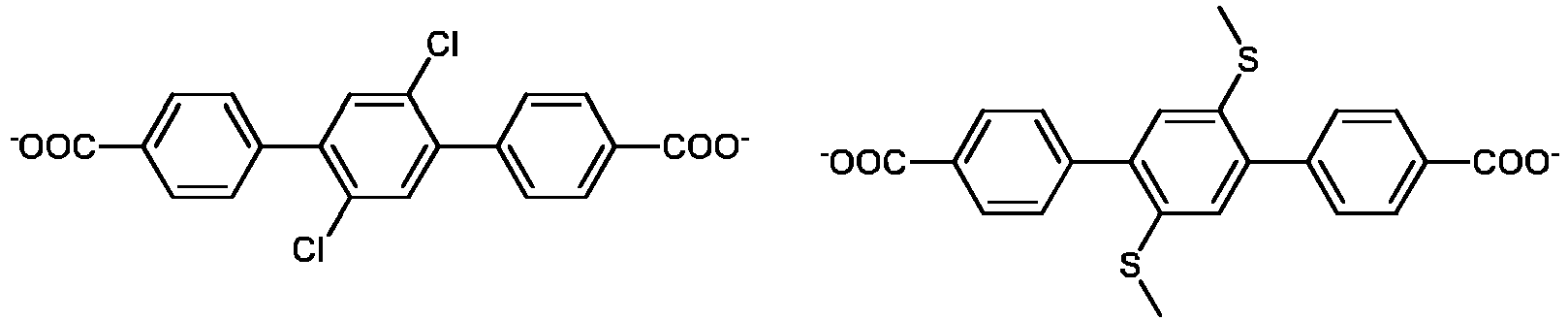


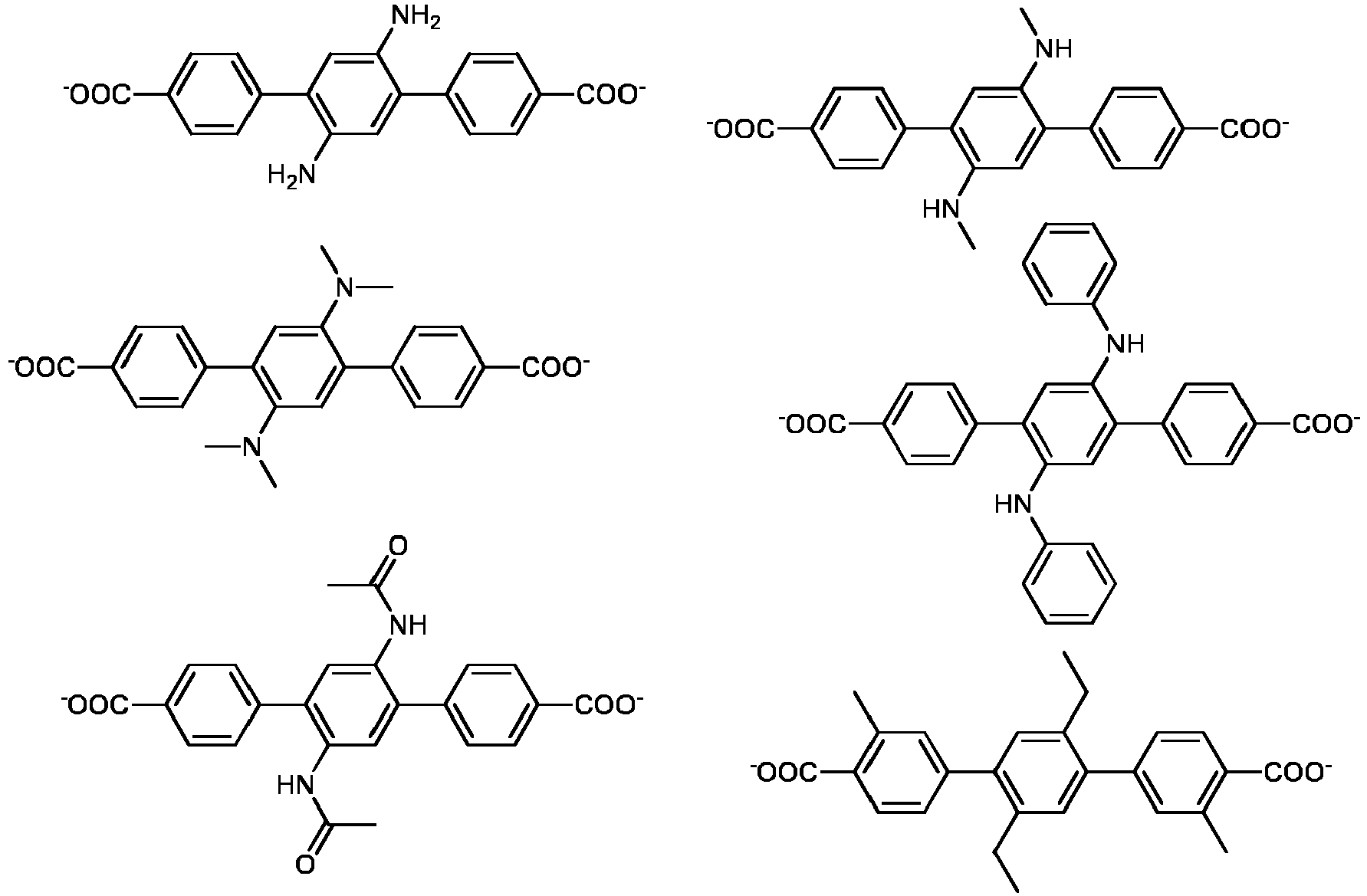


- The metal-organic framework of the present invention may comprise an organic ligand other than the carboxylate ion of formula (I). As such an organic ligand, terephthalic acid, phthalic acid, isophthalic acid, 5-cyanoisophthalic acid, 1,3,5-trimesic acid, 1,3,5-tris(4-carboxyphenyl)benzene, 4,4'-dicarboxybiphenyl, 3,5-dicarboxypyridine, 2,3-dicarboxypyrazine, 1,3,5-tris(4-carboxyphenyl)benzene, 1,2,4,5-tetrakis(4-carboxyphenyl)benzene, 9,10-anthracendicarboxylic acid, 2,6-naphthalenedicarboxylic acid, [1,1': 4',1"] terphenyl-3,3" ,5,5"-tetracarboxylic acid, biphenyl-3,3",5,5"-tetracarboxylic acid, 3,3',5,5'-tetracarboxydiphenylmethane, 1,3,5-tris(4'-carboxy[1,1'-biphenyl]-4-yl)benzene, 1,3,5-tris(4-carboxyphenyl)triazine, 1,2-bis(4-carboxy-3-nitrophenyl)ethene, 1,2-bis(4-carboxy-3-aminophenyl)ethene, trans, trans-muconic acid, fumaric acid, benzimidazole, imidazole, 1,4-diazabicyclo[2.2.2]octane (DABCO), pyrazine, 4,4'-dipyridyl, 1,2-di(4-pyridyl)ethylene, 2,7-diazapyrene, 4,4'-azobispyridine, bis(3-(4-pyridyl)-2,4-pentanedionato)copper or the like is exemplified.
- The mixing molar ratio when the carboxylate ion of formula (I) and the organic ligand other than the carboxylate ion of formula (I) are used is not particularly limited, but, for example, when the organic ligand other than the carboxylate ion of formula (I) is used as a pillar molecule, and bridging is performed with the pillar molecule to construct a three-dimensional structure like a pillared layer type, the organic ligand other than the carboxylate ion of formula (I) is preferably used in excess of the carboxylate ion of formula (I).
- The method for producing the metal-organic framework of the present invention is not particularly limited, and it is possible to use any one of a solution method such as a solvent diffusion method, a solvent stirring method, or a hydrothermal method, a microwave method in which a reaction solution is irradiated with microwaves to uniformly heat the entire system in a short time, an ultrasonic method in which by irradiating a reaction container with ultrasonic waves, changes in pressure occur repeatedly in the reaction container, and due to these changes in pressure, a phenomenon called cavitation in which a solvent forms bubbles and collapses occurs, and at the time, energy fields as high as about 5000 K and 10000 bar are reaction fields for the production of crystals locally formed, a solid phase synthesis method in which a metal ion source and an organic ligand are mixed without using a solvent, a LAG (liquid assisted grinding) method in which a metal ion source and an organic ligand are mixed with water at the water-of-crystallization level added, and the like.
- The production method includes, for example, the step of preparing each of a first solution containing a metal compound that is a source of a metal ion, and a solvent, a second solution containing a carboxylate ion of formula (I) or carboxylic acid, which is a precursor thereof, and a solvent, and a third solution containing a compound that is another polydentate ligand, and a solvent, as needed, and the step of mixing the first solution with the second solution and the third solution to prepare a reaction liquid, and heating this reaction liquid to obtain a metal-organic framework. The first to third solutions need not be separately prepared, and, for example, the above metal compound, the carboxylate ion of formula (I) or carboxylic acid, which is a precursor thereof, the compound that is another polydentate ligand, and the solvent may be mixed at one time to prepare one solution.
- The mixing molar ratio between the above metal compound and the carboxylate ion of formula (I) or carboxylic acid, which is a precursor thereof, may be arbitrarily selected in accordance with the pore size and surface characteristics of the metal-organic framework to be obtained, but 1 mol or more of the metal compound is preferably used with respect to 1 mol of the carboxylate ion of formula (I) or carboxylic acid, which is a precursor thereof, and further 1.1 mol or more, further 1.2 mol or more, further 1.5 mol or more, further 2 mol or more, and further 3 mol or more of the metal compound is preferably used.
- The concentration of the above metal ion in the reaction liquid is preferably in the range of 25 to 200 mol/L.
- The concentration of the carboxylate ion of formula (I) or carboxylic acid, which is a precursor thereof, in the reaction liquid is preferably in the range of 10 to 100 mol/L.
- The concentration of the organic ligand other than the carboxylate ion of formula (I) or carboxylic acid, which is a precursor thereof, in the reaction liquid is preferably 25 to 100 mol/L.
- While not particularly limited, as the solvent used, one or more solvents selected from the group consisting of N,N-dimethylformamide (hereinafter sometimes described as "DMF"), N,N-diethylformamide (hereinafter sometimes described as "DEF"), N,N-dimethylacetamide (hereinafter sometimes described as "DMA"), and water may be used. It is preferable that among these, any of DMF, DEF, or DMA be used singly, or a DMF/water mixed solvent, a DEF/water mixed solvent, or a DMA/water mixed solvent be used.
- The heating temperature of the reaction liquid is not particularly limited but is preferably in the range of room temperature to 140°C.
- The metal-organic framework of the present invention may store a gas such as hydrogen, methane, acetylene, carbon dioxide, or nitrogen by adsorbing or occluding the gas.
- The method for storing a gas using the metal-organic framework of the present invention is not particularly limited, but a method for bringing the metal-organic framework of the present invention and a gas into contact with each other is preferable, and the contact method is not particularly limited. Examples of the method include a method for filling a tank with the metal-organic framework of the present invention to provide a gas storage tank, and allowing a gas to flow into the tank, a method for supporting the metal-organic framework of the present invention on the surface constituting the inner wall of a tank to provide a gas storage tank, and allowing a gas to flow into the tank, and a method for molding a tank from a material comprising the metal-organic framework of the present invention to provide a gas storage tank, and allowing a gas to flow into the tank.
- The present invention will be described in detail below using Examples, but the present invention is in no way limited to the scope of the Examples.
- As a carboxylic acid that served as a precursor of the carboxylate ion of formula (I) constituting the metal-organic framework of the present invention, organic ligands 1 to 19 shown in the following Table 1 were used.
[Table 1] Organic ligand 1 Organic ligand 2 

Organic ligand 3 Organic ligand 4 

Organic ligand 5 Organic ligand 6 

Organic ligand 7 Organic ligand 8 

Organic ligand 9 Organic ligand 10 

Organic ligand 11 Organic ligand 12 

Organic ligand 13 Organic ligand 14 

Organic ligand 15 Organic ligand 16 

Organic ligand 17 Organic ligand 18 

Organic ligand 19 
- A solution of 1,4-dibromo-2,5-diethylbenzene (2.5 mmol), 4-methoxycarbonylphenylboronic acid (7.5 mmol), tetrakis(triphenylphosphine)palladium (0) (0.25 mmol), cesium fluoride (1.25 mmol), cesium carbonate (7.5 mmol), 25 mL of 1,4-dioxane, and 1 mL of water was heated at 100°C overnight under nitrogen. The reaction liquid was returned to room temperature, the liquid was separated by adding water, an organic layer extracted with dichloromethane was dried with magnesium sulfate and filtered, the solvent was distilled away at reduced pressure, and the obtained solid was purified using silica gel column chromatography (chloroform), thereby obtaining 2.1 mmol of 2',5'-diethyl[1,1':4',1"-terphenyl]-4,4"-dimethyl dicarboxylate as a colorless solid. A solution of 2.0 mmol of the obtained 2',5'-diethyl[1,1' :4',1"-terphenyl]-4,4"-dimethyl dicarboxylate, potassium hydroxide (20 mmol), 20 mL of tetrahydrofuran, and 10 mL of water was heated and refluxed for two days. The reaction liquid was returned to room temperature, tetrahydrofuran was distilled away, then, concentrated hydrochloric acid was added, a precipitated solid was filtered and washed with water, and the obtained solid was dried at 100°C, thereby obtaining 2.0 mmol of 2',5'-diethyl[1,1':4',1"-terphenyl]-4,4"-dicarboxylic acid as a colorless solid.
- The same operation as in Manufacturing Example 1 except that a reagent shown in the following Table 2 was used instead of 1,4-dibromo-2,5-diethylbenzene was performed, thereby obtaining organic ligands 2 to 13 all as colorless solids.
[Table 2] Manufacturing example Reagent 1 1,4-Dibromo-2,5-diethylbenzene 2 1,4-Dibromo-2,5-di-n-propylbenzene 3 1,4-Dibromo-2,5-diisopropylbenzene 4 1,4-Dibromo-2,5-di-n-butylbenzene 5 1,4-Dibromo-2,5-dicyclohexylbenzene 6 1,4-Dibromo-2,5-dimethoxybenzene 7 1,4-Dibromo-2,5-diethoxybenzene 8 1,4-Dibromo-2,5-di-n-propoxybenzene 9 1,4-Dibromo-2,5-diisopropoxybenzene 10 1,4-Dibromo-2,5-di-n-butoxybenzene 11 1,4-Dibromo-2-isopropyl-5-methylbenzene 12 1,4-Dibromo-2-methoxy-5-methylbenzene 13 1,4-Dibromo-2-chloro-5-methylbenzene - The same operation as in Manufacturing Example 1 except that 1,4-dibromo-2,5-dimethoxylbenzene was used instead of 1,4-dibromo-2,5-diethylbenzene of Manufacturing Example 1 and 3-hydroxy-4-ethoxycarbonylphenylboronic acid was used instead of 4-methoxycarbonylphenylboronic acid was performed, and an organic ligand 14 was obtained as a colorless solid.
- 3,3"-Dihydroxy-2',5'-dimethoxy-[1,1':4',1"-terphenyl]-4,4"-diethyl dicarboxylate synthesized in Manufacturing Example 14 (1.0 mmol), potassium carbonate (3.0 mmol), and methyl iodide (4.0 mmol) were dissolved in 10 mL of DMF and stirred at 100°C overnight. The reaction liquid was returned to room temperature, water was added, an organic layer extracted with ethyl acetate was dried with magnesium sulfate and filtered, and the filtrate was distilled away at reduced pressure. The obtained solid was separated and purified by silica gel column chromatography (chloroform), thereby obtaining 2',3,3",5'-tetramethoxy-[1,1':4',1"-terphenyl]-4,4"-diethyl dicarboxylate as a colorless solid. Potassium hydroxide (10.0 mmol), 20 mL of ethanol, and 10 mL of water were added to the obtained colorless solid and stirred at 90°C overnight. The solution was returned to room temperature, a solid precipitated by adding dilute hydrochloric acid was filtered, well washed with water, and dried, thereby obtaining 2',3,3",5'-tetramethoxy-[1,1':4',1"-terphenyl]-4,4"-dicarboxylic acid of an organic ligand 15 as a colorless solid.
- An organic ligand 16 was obtained as a colorless solid by the same operation as in Manufacturing Example 15 except that propyl iodide was used instead of methyl iodide used in Manufacturing Example 15.
- The same operation as in Manufacturing Example 14 except that a reagent shown in the following Table 3 was used was performed, thereby obtaining organic ligands 17 to 19 all as colorless solids.
[Table 3] Manufacturing example Reagent 17 3-Methyl-4-ethoxycarbonylphenylboronic acid 18 3-Chloro-4-ethoxycarbonylphenylboronic acid 19 3-n-Propyl-4-ethoxycarbonylphenylboronic acid - A solution obtained by adding 6 mL of DMF to the organic ligand 1 (0.3 mmol) and zinc nitrate hexahydrate (0.6 mmol) was heated in an oven (reaction conditions: 120°C, 24 hours). The reaction liquid was returned to room temperature, and the supernatant was removed. The residue was washed using 10 mL of DMF, the solvent was removed, 10 mL of chloroform was added to the residue and immersed overnight. A solid obtained by removing chloroform from the residue-immersed liquid was dried at 150°C in a vacuum for 5 hours, thereby obtaining a metal-organic framework 1-1 as a colorless solid.
- Metal-organic frameworks 1-2 to 1-16 were obtained by performing operations similar to those of Example 1-1 except that the organic ligands and the solvents shown in the following Table 4 were used, and the reaction was performed under the reaction conditions shown in Table 4. The results are shown in Table 4.
[Table 4] Example Organic ligand Solvent Temperature (°C) Heating time (hr) Property 1-1 1 DMF 120 24 Colorless solid 1-2 1 DEF 120 24 Slightly yellow solid 1-3 1 DMF 90 12 Colorless solid 1-4 2 DMF 90 24 Colorless solid 1-5 2 DMF 120 24 Colorless solid 1-6 2 DEF 90 24 Colorless solid 1-7 2 DEF 120 24 Colorless solid 1-8 3 DMF 90 24 Colorless solid 1-9 3 DMF 120 24 Colorless solid 1-10 3 DEF 90 24 Colorless solid 1-11 3 DEF 120 24 Colorless solid 1-12 14 DMF 120 24 Brownish yellow solid 1-13 15 DMF 120 24 Off-white powder 1-14 16 DMF 120 24 Off-white powder 1-15 17 DMF 120 24 Off-white powder 1-16 19 DMF 120 24 Off-white powder - A solution obtained by adding 7.5 mL of DMF as a solvent to the organic ligand 1 (0.375 mmol), zinc nitrate hexahydrate (0.375 mmol), and 1,4-diazabicyclo[2.2.2]octane (0.20 mmol) as an auxiliary ligand was stirred for 15 minutes and then irradiated with ultrasonic waves. A solution obtained by filtering the liquid mixture was heated in an oven (reaction conditions: 120°C, 48 hours). The reaction liquid was returned to room temperature, and the precipitated solid was washed with 10 mL of DMF three times and further washed with 10 mL of chloroform three times. The obtained solid was immersed in 10 mL of chloroform overnight, and the solid obtained by pressure filtration was dried at 150°C in a vacuum for 5 hours, thereby obtaining a metal-organic framework 2-1 as a colorless solid.
- The same operation as in Example 2-1 was performed except that the organic ligand 2 was used instead of the organic ligand 1, thereby obtaining a metal-organic framework 2-2 as a milky green solid.
- The organic ligand 1 (0.5 mmol) was dissolved in 7 mL of DMF, triethylamine (2.0 mmol) was added thereto, furthermore, a DMF (8 mL) solution of zinc acetate dihydrate (1.27 mmol) was added dropwise, and the obtained solution was stirred at room temperature for 20 hours and left to stand. The reaction liquid was centrifugally separated, then, the supernatant was removed, and the obtained solid was immersed in 20 mL of DMF overnight. After that, an operation in which the supernatant of the solid-immersed liquid was removed, the obtained solid was immersed in 20 mL of chloroform overnight, and then the solid was separated was repeated three times. After that, the separated solid was dried at 150°C in a vacuum for 5 hours, thereby obtaining a metal-organic framework 3-1 as a light gray powder.
- The same operation as in Example 3-1 was performed except that a reaction was performed using an organic ligand shown in the following Table 5 under a reaction condition shown in Table 5, thereby obtaining metal-organic frameworks 3-2 to 3-11. The results are shown in Table 5.
[Table 5] Example Organic ligand Base Stirring time (hr) Property 3-1 1 Et3N 20 Light gray powder 3-2 1 None 2.5 Colorless powder 3-3 2 None 2.5 Colorless powder 3-4 2 Et3N 2.5 Colorless powder 3-5 3 None 2.5 Colorless powder 3-6 5 None 2.5 Colorless powder 3-7 6 None 2.5 Colorless powder 3-8 7 None 2.5 Colorless powder 3-9 8 None 2.5 Colorless powder 3-10 9 None 2.5 Colorless powder 3-11 10 None 2.5 Colorless powder - 0.5 mL of triethylamine was added dropwise under stirring to a DMF (10 mL) solution of the organic ligand 1 (0.3 mmol) and zinc nitrate hexahydrate (0.4 mmol) and stirred at room temperature for five minutes. The reaction mixture was centrifugally separated, then, the supernatant was removed, 10 mL of DMF was added to the residue, centrifugal separation was performed again for 10 minutes, and the supernatant was removed. The residue was immersed in DMF overnight, then, centrifugal separation was performed for 10 minutes, the supernatant was removed, and 10 mL of chloroform was added to the residue. An operation in which a solid obtained by further centrifugally separating the residue-immersed liquid was immersed in 20 mL of chloroform overnight and then centrifugally separated was repeated three times. After that, a solid obtained by centrifugal separation was dried at 150°C in a vacuum for 5 hours, thereby obtaining a metal-organic framework 4-1 as a thin gray powder.
- A metal-organic framework 4-2 was obtained as a colorless powder by the same operation as in Example 4-1 except that the organic ligand 2 was used instead of the organic ligand 1.
- The same operation as in Example 4-1 was performed except that a reaction was performed using an organic ligand shown in the following Table 6 under a reaction condition shown in Table 6, thereby obtaining metal-organic frameworks 4-3 to 4-8. The results are shown in Table 6.
[Table 6] Example Organic ligand Property 4-3 5 Colorless powder 4-4 6 Colorless powder 4-5 7 Colorless powder 4-6 8 Colorless powder 4-7 9 Colorless powder 4-8 10 Colorless powder - A solution obtained by adding 4 mL of DMF to the organic ligand 1 (0.2 mmol) and copper nitrate trihydrate (0.2 mmol) was irradiated with ultrasonic waves for 15 minutes. A liquid obtained by filtering the solution was heated at 120°C for 25 hours. The reaction liquid was returned to room temperature, then, centrifugal separation was performed for 10 minutes, the supernatant was removed, 10 mL of DMF was added to the residue, centrifugal separation was performed again for 10 minutes, and the supernatant was removed. The residue was immersed in DMF overnight, then, centrifugal separation was performed for 10 minutes, DMF was removed by pressure filtration, and then 10 mL of chloroform was added to the obtained solid. An operation in which a solid obtained by further centrifugally separating the solid-immersed liquid was immersed in 20 mL of chloroform overnight and then centrifugally separated was repeated three times. After that, a solid obtained by pressure filtration was dried at 150°C in a vacuum for 5 hours, thereby obtaining a metal-organic framework 5-1.
- The same operation as in Example 5-1 was performed except that a reaction was performed using an organic ligand shown in the following Table 7 under a reaction condition shown in Table 7, thereby obtaining metal-organic frameworks 5-2 to 5-7. The results are shown in Table 7.
[Table 7] Example Organic ligand Solvent Temperature (°C) Heating time (hr) Property 5-1 1 DMF 120 25 Green solid 5-2 1 DMF 90 25 Watery solid 5-3 1 DEF 120 25 Watery solid 5-4 1 DEF 90 25 Watery solid 5-5 2 DMF 120 40 Purple solid 5-6 2 DMF 90 40 Purple solid 5-7 4 DMF 120 24 Purple solid - A solution of 9 mL of THF of the organic ligand 1 (0.4 mmol) and nickel nitrate hexahydrate (0.8 mmol) and 1 mL of water were heated at 100°C for 48 hours. The reaction liquid was returned to room temperature, the supernatant was removed, DMF was added to the residue, and the supernatant was removed again. After that, chloroform was added to the residue, the residue was immersed overnight, a solid obtained by the pressure filtration of the residue-immersed liquid was dried at 150°C in a vacuum for 5 hours, thereby obtaining a metal-organic framework 6-1 as a brownish yellow powder.
- A metal-organic framework 6-2 (slightly green powder) was obtained by the same operation as in Example 6-1 except that the organic ligand 2 was used instead of the organic ligand 1.
- A metal-organic framework 6-3 (slightly green powder) was obtained by the same operation as in Example 6-1 except that the organic ligand 4 was used instead of the organic ligand 1.
- A solution of the organic ligand 1 (0.3 mmol), zirconium chloride (0.3 mmol), water (3.6 mmol), acetic acid (9 mmol), and 4 mL of DMF was irradiated with ultrasonic waves. After that, the solution was heated at 120°C for 24 hours. The reaction liquid was returned to room temperature, then, centrifugal separation was performed for 10 minutes, and the supernatant was removed. DMF was added to the residue, centrifugal separation was performed again for 10 minutes, and the supernatant was removed. The residue was immersed in DMF overnight and then centrifugally separated for 10 minutes, and DMF was removed. An operation in which 10 mL of acetone was added to the residue, the residue was centrifugally separated, and the supernatant was removed was repeated three times, acetone was added again, the residue was immersed overnight and then centrifugally separated, and the obtained solid was dried at 150°C in a vacuum for 5 hours, thereby obtaining a metal-organic framework 7-1 as a colorless solid.
- The same operation as in Example 7-1 was performed except that a reaction was performed with an organic ligand shown in the following Table 8, thereby obtaining metal-organic frameworks 7-2 and 7-3. The results are shown in Table 8.
[Table 8] Example Organic ligand Property 7-1 1 Colorless powder 7-2 2 Colorless powder 7-3 4 Gray powder - Zirconium chloride, water, and acetic acid were dissolved in DMF, ultrasonic waves were applied to the solution, and the solution was left to stand at room temperature for 2 days. After that, the organic ligand 3 was added thereto, and then the same treatment as in Example 7-1 was performed, thereby obtaining a metal-organic framework 7-4 (colorless powder).
- The same operation as in Example 7-4 was performed except that water was not added, thereby obtaining a metal-organic framework 7-5 (colorless powder).
- The same operation as in Example 7-1 was performed except that a reaction was performed with an organic ligand shown in the following Table 9, thereby obtaining metal-organic frameworks 7-6 to 7-25. The results are shown in Table 9.
[Table 9] Example Organic ligand Stirring while heating Acid Property 7-6 2 No Benzoic acid Colorless crystal 7-7 3 No Acetic acid Colorless powder 7-8 3 Yes Acetic acid Colorless powder 7-9 5 No Acetic acid Colorless powder 7-10 6 No Acetic acid Colorless powder 7-11 7 No Acetic acid Colorless powder 7-12 8 No Acetic acid Colorless powder 7-13 8 Yes Acetic acid Colorless powder 7-14 9 No Acetic acid Colorless powder 7-15 10 No Acetic acid Colorless powder 7-16 11 No Acetic acid Colorless powder 7-17 12 No Acetic acid Gray powder 7-18 13 No Acetic acid Colorless powder 7-19 15 No Acetic acid Colorless solid 7-20 16 No Acetic acid Off-white powder 7-21 17 No Acetic acid Colorless solid 7-22 19 No Acetic acid Colorless solid 7-23 14 No Acetic acid Colorless solid 7-24 18 No Acetic acid Colorless solid 7-25 16 No Acetic acid Colorless solid - A solution of the organic ligand 1 (0.175 mmol), zirconium chloride oxide octahydrate (0.175 mmol), and 4 mL of a solvent mixture of formic acid and DMF (1:7) was irradiated with ultrasonic waves. After that, the solution was heated at 120°C for 24 hours. The reaction liquid was returned to room temperature, and then the supernatant was removed. An operation in which DMF was added to the residue, centrifugal separation was performed again for 10 minutes, and the supernatant was removed was repeated three times, then, DMF was added, and the residue was immersed overnight. An operation in which DMF was removed from the residue-immersed liquid, then, methanol was added to the residue, the residue was centrifugally separated, and the supernatant was removed was repeated three times. Methanol was added again to the residue, the residue was immersed overnight, then, methanol was removed, and the obtained solid was dried at 150°C in a vacuum for 5 hours, thereby obtaining a metal-organic framework 8-1 as a light gray powder.
- The organic ligand 2 (0.36 mmol), tetraisopropyl orthotitanate (0.074 mmol), 2.2 g of acetic acid, and 7 mL of DMF were mixed, and ultrasonic waves were applied thereto. After that, the mixture was heated at 120°C for 48 hours. The mixture was returned to room temperature, then, centrifugal separation was performed for 10 minutes, and the supernatant was removed. DMF was added to the residue, centrifugal separation was performed again for 10 minutes, and the supernatant was removed. The residue was immersed in DMF overnight, then, centrifugal separation was performed for 10 minutes, DMF was removed, 10 mL of acetone was added, and centrifugal separation and supernatant removal were repeated three times. Acetone was added again, the residue was immersed overnight, and the centrifugally separated solid was dried at 150°C in a vacuum for 5 hours, thereby obtaining a metal-organic framework 9-1 as an off-white powder.
- The same operation as in Example 9-1 was performed except that a reaction was performed with an organic ligand shown in the following Table 10, thereby obtaining metal-organic frameworks 9-2 to 9-6. The results are shown in Table 10.
[Table 10] Example Organic ligand Property 9-2 3 Off-white powder 9-3 5 Colorless powder 9-4 6 Slightly yellow powder 9-5 10 Slightly yellow powder 9-6 12 Gray powder - 5 mL of DMF was added to the organic ligand 2 (0.5 mmol) and chromium chloride hexahydrate (0.5 mmol), and ultrasonic waves were applied thereto. The solution was heated at 190°C for 24 hours. The mixture was returned to room temperature, then, centrifugal separation was performed for 10 minutes, and the supernatant was removed. 10 mL of DMF was added to the residue, centrifugal separation was performed again for 10 minutes, and the supernatant was removed. The residue was immersed in DMF overnight, then, centrifugal separation was performed for 10 minutes, DMF was removed by pressure filtration, and then 10 mL of chloroform was added. A washing operation in which the centrifugally separated solid was immersed in 20 mL of chloroform overnight and centrifugally separated again was repeated three times. After that, a solid obtained by pressure filtration was dried at 150°C in a vacuum for 5 hours, thereby obtaining a metal-organic framework 10-1 as a green solid.
- The same operation as in Example 10-1 was performed except that a reaction was performed with an organic ligand shown in the following Table 11, thereby obtaining metal-organic frameworks 10-2 to 10-4. The results are shown in Table 11.
[Table 11] Example Organic ligand Heating time (hr) Property 10-2 3 72 Green solid 10-3 6 24 Green solid 10-4 8 24 Green solid - 5 mL of DMF was added to the organic ligand 2 (0.18 mmol) and aluminum nitrate nonahydrate (0.24 mmol), and ultrasonic waves were applied thereto. The solution was heated at 120°C for 24 hours. The mixture was returned to room temperature, then, centrifugal separation was performed for 10 minutes, and the supernatant was removed. 10 mL of DMF was added to the residue, centrifugal separation was performed again for 10 minutes, and the supernatant was removed. The residue was immersed in DMF overnight, then, centrifugal separation was performed for 10 minutes, DMF was removed by pressure filtration, and then 10 mL of acetone was added. A washing operation in which the centrifugally separated solid was immersed in 20 mL of acetone overnight and centrifugally separated again was repeated three times. After that, a solid obtained by pressure filtration was dried at 150°C in a vacuum for 5 hours, thereby obtaining a metal-organic framework 11-1 as a colorless powder.
- The same operation as in Example 11-1 was performed except that a reaction was performed with an organic ligand shown in the following Table 12, thereby obtaining metal-organic frameworks 11-2 to 11-14. The results are shown in Table 12.
[Table 12] Example Organic ligand Heating time (hr) Stirring Solvent Temperature (°C) Property 11-2 3 24 No DMF 120 Colorless powder 11-3 5 24 No DMF 120 Colorless powder 11-4 6 24 No DMF 120 Colorless powder 11-5 8 24 No DMF 120 Colorless powder 11-6 8 42 No H2O 220 Off-white powder 11-7 10 24 No DMF 120 Colorless powder 11-8 10 24 Yes DMF 120 Colorless powder 11-9 15 72 No DMF 120 Slightly brown solid 11-10 16 72 No DMF 120 Colorless solid 11-11 17 72 No DMF 120 Colorless solid 11-12 19 72 No DMF 120 Colorless powder 11-13 18 72 No DMF 120 Colorless powder 11-14 14 72 No DMF 120 Brown powder - 8 mL of DMF and 1 mL of acetic acid were added to the organic ligand 8 (0.1 mmol) and iron (III) chloride (0.25 mmol), and ultrasonic waves were applied thereto. The solution was heated at 150°C for 168 hours. The mixture was returned to room temperature, then, centrifugal separation was performed for 10 minutes, and the supernatant was removed. 10 mL of DMF was added to the residue, centrifugal separation was performed again for 10 minutes, and the supernatant was removed. The residue was immersed in DMF overnight, then, centrifugal separation was performed for 10 minutes, DMF was removed by pressure filtration, and then 10 mL of chloroform was added. A washing operation in which the centrifugally separated solid was immersed in 20 mL of chloroform overnight and centrifugally separated again was repeated three times. After that, a solid obtained by pressure filtration was dried at 150°C in a vacuum for 5 hours, thereby obtaining a metal-organic framework 12-1 as a blown powder.
- The same operation as in Example 12-1 was performed except that a reaction was performed with an organic ligand shown in the following Table 13, thereby obtaining metal-organic frameworks 12-2 to 12-4. The results are shown in Table 13.
[Table 13] Example Organic ligand Heating time (hr) Metal (equivalent) Acid Property 12-2 8 168 Iron nitrate nonahydrate (1) Acetic acid Brown powder 12-3 10 18 Iron chloride hexahydrate (1) TFA Orange powder 12-4 10 18 Iron chloride hexahydrate (1/3) TFA Orange powder - For some of the obtained metal-organic frameworks, the BET specific surface area and the amount of hydrogen stored at 77 K-atmospheric pressure were measured.
- The measurement of the BET specific surface area and the amount of hydrogen stored at 77 K-atmospheric pressure was performed using an apparatus for measuring the amount of gas adsorbed, Tristar-II (manufactured by Micromeritics Instrument Corporation).
- The BET specific surface area was calculated by the following method. Approximately 50 mg of a metal-organic framework was placed inside a glass cell. The pressure inside the glass cell was reduced to a vacuum at a temperature of 135°C, and the inside of the glass cell was dried for 6 hours. The glass cell was mounted in the apparatus for measuring the amount of gas adsorbed, and immersed in a constant temperature bath containing liquid nitrogen. The pressure of nitrogen contained in the glass cell was gradually increased. The measurement was performed until the pressure of nitrogen introduced inside the glass cell reached 1.0 × 10⁵ Pa.
- The amount of hydrogen stored at a temperature of 77 K and normal pressure was calculated by the following method. After the measurement of nitrogen, the gas species was changed to hydrogen, and the measurement was performed. The pressure of hydrogen contained in the glass cell was gradually increased. The measurement was performed until the pressure of hydrogen introduced inside the glass cell reached 1.0 × 10⁵ Pa.
- The results of the measured BET specific surface area and the amount of hydrogen stored measured at 77 K-atmospheric pressure were shown in Table 14. "-" in the table means that no measurement was performed.
[Table 14] Organic metal framework No. BET specific surface area (m2/g) Amount of hydrogen stored (wt %) 1-1 545 - 1-2 19.4 - 1-3 3.94 - 1-4 62.7 - 1-5 25 - 1-6 15.2 - 1-7 34 - 1-8 188 - 1-9 244 - 1-10 59 - 1-11 38.3 - 1-12 971 0.802 1-13 1 0.077 1-14 3 0.080 1-15 11 0.721 1-16 5 0.113 2-1 174 0.400 2-2 451 0.606 3-1 1256 0.933 3-2 1471 1.110 3-3 103 0.357 3-4 403 0.564 3-5 463 1.037 3-6 788 0.878 3-7 210 0.702 3-8 532 0.651 3-9 21 0.412 3-10 788 0.791 3-11 7 0.204 4-1 233 0.444 4-2 314 0.438 4-3 717 0.835 4-4 58 0.446 4-5 180 0.403 4-6 40 0.356 4-7 128 0.568 4-8 59 0.399 5-1 13.1 0.180 5-2 13.2 0.369 5-3 16.3 0.348 5-4 12.9 0.379 5-5 470 0.729 5-6 599 0.797 5-7 - 0.451 6-1 7.39 0.434 6-2 587 0.850 6-3 336 0.863 7-1 3014 1.482 7-2 2652 1.476 7-3 2592 1.549 7-4 2840 1.740 7-5 3046 1.707 7-6 2793 1.561 7-7 3038 1.860 7-8 2871 1.873 7-9 2146 1.830 7-10 3090 1.786 7-11 460 1.048 7-12 2628 1.889 7-13 2367 1.420 7-14 2480 1.540 7-15 2335 1.526 7-16 2603 1.420 7-17 3331 1.453 7-18 2854 1.159 7-19 939 0.837 7-20 - - 7-21 1523 1.072 7-22 1070 1.168 7-23 621 0.688 7-24 198 0.438 7-25 425 1.050 8-1 3.09 0.235 9-1 818 0.632 9-2 858 0.710 9-3 593 0.709 9-4 1030 0.726 9-5 787 0.549 9-6 1038 0.686 10-1 563 0.651 10-2 582 0.802 10-3 428 0.643 10-4 2 0.031 11-1 1140 0.984 11-2 1557 1.367 11-3 1343 1.405 11-4 924 1.054 11-5 1018 1.041 11-6 129 0.464 11-7 1545 1.227 11-8 1602 1.145 11-9 946 0.880 11-10 677 0.576 11-11 1168 1.190 11-12 791 0.693 11-13 708 0.831 11-14 447 0.659 12-1 - 0.243 12-2 - 0.534 12-3 13 0.172 12-4 28 0.202 - For each of the metal-organic frameworks 1-2 and 2-2 obtained in Examples 1-2 and 2-2, X-ray structure analysis was performed under the measurement conditions shown below.
- One 0.1 × 0.05 × 0.05 mm colorless and transparent single crystal of the metal-organic framework 1-2 obtained in Example 1-2 was put on a micromount, and diffraction data was acquired by irradiating the single crystal with X-rays having a wavelength of 0.78192 Å using a single crystal X-ray analysis apparatus (D8 VENTURE, manufactured by Bruker) .
- The obtained diffraction data was analyzed to determine the structure. The results are shown in Table 15.
[Table 15] Measurement temperature/°C -173°C Crystal size/mm 0.10x0.05x0.05 Color of crystal Colorless Chemical formula C15H8.5N0.5O3Zn0.75 Molecular weight 292.75 Crystal system monoclinic Space group l2lm a/Å 6.0704(4) b/Å 27.533(2) c/Å 26.3841(19) α/° 90 β/° 88.881(6) γ/° 90 V/Å3 4408.9(5) Z 8 Reflections collected 19832 Independent reflections 5078 - For the metal-organic framework 2-2 obtained in Example 2-2, X-ray structure analysis was performed under conditions similar to those of the measurement shown above. The results are shown in Table 16.
[Table 16] Measurement temperature/°C -173°C Crystal size/mm 0.02x0.01x0.01 Color of crystal Colorless Chemical formula C40H26N3O5Zn Molecular weight 694.01 Crystal system Monoclinic Space group C2/c a/Å 25.493(15) b/Å 28.775(17) c/Å 9.384(6) β/° 96.999(7) V/Å3 6832(7) Z 8 Reflections collected 76628 Independent reflections 7836 - The metal-organic framework of the present invention may store a gas such as hydrogen at a practical level. As a result, for example, the utilization of hydrogen is easier for the arrival of a hydrogen society.
Claims (6)
- A metal-organic framework comprising a carboxylate ion of formula (I) and a multivalent metal ion bonded to each other,

R1 and R2 each independently are a hydroxy group, an unsubstituted or substituted C1-6 alkyl group, an unsubstituted or substituted C3-8 cycloalkyl group, an unsubstituted or substituted C6-10 aryl group, an unsubstituted or substituted three- to six-membered heterocyclyl group, an unsubstituted or substituted C1-6 alkoxy group, an unsubstituted or substituted C6-10 aryloxy group, an unsubstituted or substituted heteroaryloxy group, a halogeno group, an unsubstituted or substituted C1-6 alkylthio group, an unsubstituted or substituted C6-10 arylthio group, an unsubstituted or substituted heteroarylthio group, an unsubstituted or substituted C1-6 alkylsulfinyl group, an unsubstituted or substituted C6-10 arylsulfinyl group, an unsubstituted or substituted heteroarylsulfinyl group, an unsubstituted or substituted C1-6 alkylsulfonyl group, an unsubstituted or substituted C6-10 arylsulfonyl group, an unsubstituted or substituted heteroarylsulfonyl group, a cyano group, a nitro group, or a group of formula (II): (in formula (II), R3 and R4 each independently are a hydrogen atom, an unsubstituted or substituted C1-6 alkyl group, an unsubstituted or substituted C6-10 aryl group, an unsubstituted or substituted C1-6 alkylcarbonyl group, or an unsubstituted or substituted C6-10 arylcarbonyl group, and * is a bonding site),n is the number of R1 and is 0, 1, 2, 3, or 4, and when n is 2 or more, a plurality of R1s are the same or different from each other,m is the number of R2 and is 0, 1, 2, 3, or 4, and when m is 2 or more, a plurality of R2s are the same or different from each other,R10 and R11 each independently are an unsubstituted or substituted C1-6 alkyl group, an unsubstituted or substituted C3-8 cycloalkyl group, an unsubstituted or substituted C6-10 aryl group, an unsubstituted or substituted three- to six-membered heterocyclyl group, an unsubstituted or substituted C1-6 alkoxy group, an unsubstituted or substituted C6-10 aryloxy group, an unsubstituted or substituted heteroaryloxy group, a halogeno group, an unsubstituted or substituted C1-6 alkylthio group, an unsubstituted or substituted C6-10 arylthio group, an unsubstituted or substituted heteroarylthio group, an unsubstituted or substituted C1-6 alkylsulfinyl group, an unsubstituted or substituted C6-10 arylsulfinyl group, an unsubstituted or substituted heteroarylsulfinyl group, an unsubstituted or substituted C1-6 alkylsulfonyl group, an unsubstituted or substituted C6-10 arylsulfonyl group, an unsubstituted or substituted heteroarylsulfonyl group, a cyano group, a nitro group, or a group of formula (III),
 (in formula (III), R5 and R6 each independently are a hydrogen atom, an unsubstituted or substituted C1-6 alkyl group, an unsubstituted or substituted C6-10 aryl group, an unsubstituted or substituted C1-6 alkylcarbonyl group, or an unsubstituted or substituted C6-10 arylcarbonyl group, and * is a bonding site),R20 is an unsubstituted or substituted C1-6 alkyl group, an unsubstituted or substituted C3-8 cycloalkyl group, an unsubstituted or substituted C6-10 aryl group, an unsubstituted or substituted three- to six-membered heterocyclyl group, an unsubstituted or substituted C1-6 alkoxy group, an unsubstituted or substituted C6-10 aryloxy group, an unsubstituted or substituted heteroaryloxy group, a halogeno group, an unsubstituted or substituted C1-6 alkylthio group, an unsubstituted or substituted C6-10 arylthio group, an unsubstituted or substituted heteroarylthio group, an unsubstituted or substituted C1-6 alkylsulfinyl group, an unsubstituted or substituted C6-10 arylsulfinyl group, an unsubstituted or substituted heteroarylsulfinyl group, an unsubstituted or substituted C1-6 alkylsulfonyl group, an unsubstituted or substituted C6-10 arylsulfonyl group, an unsubstituted or substituted heteroarylsulfonyl group, a cyano group, a nitro group, or a group of formula (IV),
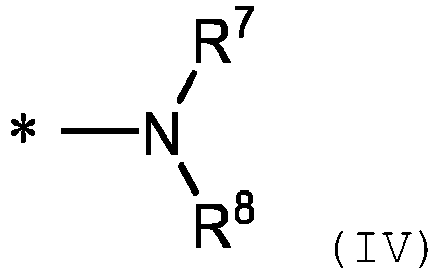 (in formula (IV), R7 and R8 each independently are a hydrogen atom, an unsubstituted or substituted Cl-6 alkyl group, an unsubstituted or substituted C6-10 aryl group, an unsubstituted or substituted C1-6 alkylcarbonyl group, or an unsubstituted or substituted C6-10 arylcarbonyl group, and * is a bonding site),q is the number of R20 and is 0, 1, or 2, and when q is 2, R20s are the same or different from each other,provided that, as substituents on R1, R2, R3, R4, R5, R6, R7, R8, R10, R11, and R20, a carboxy group (COOH) and a carboxylate ion group (COO-) are excluded, and in addition, R10 and R11 are not a methyl group at the same time).
 - The metal-organic framework according to claim 1, wherein the carboxylate ion of formula (I) is a carboxylate ion of formula (V),

- The metal-organic framework according to claim 1 or 2, wherein the multivalent metal ion is an ion of at least one metal selected from the group consisting of metals of groups 2 to 13 of the periodic table of elements.
- The metal-organic framework according to any one of claims 1 to 3, wherein the multivalent metal ion is an ion of at least one metal selected from Zn, Fe, Co, Ni, Cu, Al, Zr, Ti, Cr, and Mg.
- The metal-organic framework according to any one of claims 1 to 4, further comprising an organic ligand other than the carboxylate ion of formula (I) as a constitution component.
- A gas storage method comprising a step of bringing a gas into contact with the metal-organic framework according to any one of claims 1 to 5 to adsorb or occlude the gas inside of the metal-organic framework.
Applications Claiming Priority (2)
| Application Number | Priority Date | Filing Date | Title |
|---|---|---|---|
| JP2020032043 | 2020-02-27 | ||
| PCT/JP2021/007113 WO2021172433A1 (en) | 2020-02-27 | 2021-02-25 | Metal-organic framework with carboxylic acid ion having terphenyl skeleton as ligand |
Publications (2)
| Publication Number | Publication Date |
|---|---|
| EP4112595A1 true EP4112595A1 (en) | 2023-01-04 |
| EP4112595A4 EP4112595A4 (en) | 2024-05-22 |
Family
ID=77491564
Family Applications (1)
| Application Number | Title | Priority Date | Filing Date |
|---|---|---|---|
| EP21761442.9A Withdrawn EP4112595A4 (en) | 2020-02-27 | 2021-02-25 | Metal-organic framework with carboxylic acid ion having terphenyl skeleton as ligand |
Country Status (7)
| Country | Link |
|---|---|
| US (1) | US20230096721A1 (en) |
| EP (1) | EP4112595A4 (en) |
| JP (1) | JP7633229B2 (en) |
| KR (1) | KR20220145824A (en) |
| CN (1) | CN115151523A (en) |
| TW (1) | TWI809360B (en) |
| WO (1) | WO2021172433A1 (en) |
Families Citing this family (5)
| Publication number | Priority date | Publication date | Assignee | Title |
|---|---|---|---|---|
| WO2022072831A1 (en) * | 2020-10-02 | 2022-04-07 | Entegris, Inc. | Methods and systems useful for producing aluminum ions |
| JP7839512B2 (en) * | 2021-05-31 | 2026-04-02 | 学校法人立教学院 | Metal-organic structures, gas storage agents containing the same, and gas storage methods using the same |
| CN116375593B (en) * | 2023-06-06 | 2023-10-20 | 吉林省卓材新研科技有限公司 | Metal-organic framework materials, ligands and applications for iodine adsorption |
| CN118970364B (en) * | 2024-08-02 | 2025-09-05 | 陕西科技大学 | A modified lithium-sulfur battery separator for regulating the pore structure of nitrogen-azole-type MOFs, and its preparation method and application |
| CN121244292B (en) * | 2025-12-04 | 2026-02-17 | 内蒙古大学 | A baseball-shaped photocatalytic material, its preparation method and application |
Family Cites Families (9)
| Publication number | Priority date | Publication date | Assignee | Title |
|---|---|---|---|---|
| US8269029B2 (en) | 2008-04-08 | 2012-09-18 | The Board Of Trustees Of The University Of Illinois | Water repellent metal-organic frameworks, process for making and uses regarding same |
| GB0807862D0 (en) | 2008-04-29 | 2008-06-04 | Uni I Oslo | Compounds |
| KR101600442B1 (en) | 2008-12-24 | 2016-03-08 | 삼성디스플레이 주식회사 | Liquid crystal display and driving method of the same |
| EP2766046B1 (en) * | 2011-10-13 | 2017-08-02 | The Regents of The University of California | Metal-organic frameworks with exceptionally large pore aperatures |
| US20130122297A1 (en) * | 2011-10-24 | 2013-05-16 | Northwestern University | Molecular gauge blocks for building on the nanoscale |
| GB201205365D0 (en) * | 2012-03-27 | 2012-05-09 | Univ Nottingham | Frameworks |
| GB201414113D0 (en) | 2013-11-26 | 2014-09-24 | Texas A & M Univ Sys | Process for preparing metal organic framework materials |
| US10087205B2 (en) * | 2014-03-28 | 2018-10-02 | The Regents Of The University Of California | Metal organic frameworks comprising a plurality of SBUS with different metal ions and/or a plurality of organic linking ligands with different functional groups |
| JP6987721B2 (en) | 2018-08-31 | 2022-01-05 | 富士フイルム株式会社 | Image processing equipment, methods and programs |
-
2021
- 2021-02-25 JP JP2022503693A patent/JP7633229B2/en active Active
- 2021-02-25 KR KR1020227027571A patent/KR20220145824A/en not_active Withdrawn
- 2021-02-25 WO PCT/JP2021/007113 patent/WO2021172433A1/en not_active Ceased
- 2021-02-25 US US17/802,003 patent/US20230096721A1/en not_active Abandoned
- 2021-02-25 EP EP21761442.9A patent/EP4112595A4/en not_active Withdrawn
- 2021-02-25 CN CN202180016580.1A patent/CN115151523A/en active Pending
- 2021-02-26 TW TW110107052A patent/TWI809360B/en not_active IP Right Cessation
Also Published As
| Publication number | Publication date |
|---|---|
| JP7633229B2 (en) | 2025-02-19 |
| EP4112595A4 (en) | 2024-05-22 |
| WO2021172433A1 (en) | 2021-09-02 |
| KR20220145824A (en) | 2022-10-31 |
| US20230096721A1 (en) | 2023-03-30 |
| TWI809360B (en) | 2023-07-21 |
| JPWO2021172433A1 (en) | 2021-09-02 |
| CN115151523A (en) | 2022-10-04 |
| TW202136196A (en) | 2021-10-01 |
Similar Documents
| Publication | Publication Date | Title |
|---|---|---|
| JP7633229B2 (en) | Metal-organic frameworks using terphenyl-based carboxylate ions as ligands | |
| JP7555914B2 (en) | Metal-organic frameworks | |
| US9981243B2 (en) | Metal-organic frameworks | |
| Sharma et al. | A dynamic open framework exhibiting guest-and/or temperature-induced bicycle-pedal motion in single-crystal to single-crystal transformation | |
| JP7621252B2 (en) | Metal-organic frameworks with terephthalic acid ligands | |
| JP2026074203A (en) | Gas storage material containing a metal-organic structure bonded by hydroxamic acid | |
| TWI758763B (en) | Hydrogen storage material containing metal organic structure | |
| JP7839512B2 (en) | Metal-organic structures, gas storage agents containing the same, and gas storage methods using the same | |
| Li et al. | Flexible ligands-dependent formation of a new column layered MOF possess 1D channel and effective separation performance for CO2 | |
| Coghlan et al. | Utilising hinged ligands in MOF synthesis: a covalent linking strategy for forming 3D MOFs | |
| Kim et al. | Cobalt (II) coordination polymers based on dicarboxylates and dipyridyl-type ligands:[CoL1. 5 (NO3) 2],[Co1. 5 (bpdc) 1.5 (dma)]·(dma)·(EtOH),[Co1. 5 (ndc) 1.5 (dma) 2],[Co3 (ndc) 3 (dmf) 4], and [CoL (bpdc)]·(EtOH)(bpdcH2= biphenyl-4, 4′-dicarboxylic acid, ndcH2= 2, 6-naphthalene dicarboxylic acid, L= pyCHNC10H6NCHpy) | |
| Tanaka et al. | Interpenetrated and non-interpenetrated homochiral metal–organic frameworks based on (R)-2, 2′-dihydroxy-1, 1′-binaphthyl-5, 5′-dibenzoic acid | |
| Park et al. | Synthesis, structures and magnetic properties of isoreticular polyrotaxane-type two-dimensional coordination polymers | |
| JP2025067095A (en) | Metal organic structure using crosslinked diarylamine compound having carboxyl group | |
| Bratanovici et al. | 1-(4-Carboxyphenyl)-5-methyl-1H-1, 2, 3-triazole-4-carboxylic acid–A versatile ligand for the preparation of coordination polymers and mononuclear complexes | |
| Li et al. | RETRACTED ARTICLE: Solvent-Free Cyanosilylation of Aldehydes and Anti-cervical Cancer Activity of a Highly Porous Zinc-MOF | |
| JP2024012144A (en) | Metal-organic structure with a carboxylic acid ion having a carbazole skeleton as a ligand |
Legal Events
| Date | Code | Title | Description |
|---|---|---|---|
| STAA | Information on the status of an ep patent application or granted ep patent |
Free format text: STATUS: THE INTERNATIONAL PUBLICATION HAS BEEN MADE |
|
| PUAI | Public reference made under article 153(3) epc to a published international application that has entered the european phase |
Free format text: ORIGINAL CODE: 0009012 |
|
| STAA | Information on the status of an ep patent application or granted ep patent |
Free format text: STATUS: REQUEST FOR EXAMINATION WAS MADE |
|
| 17P | Request for examination filed |
Effective date: 20220824 |
|
| AK | Designated contracting states |
Kind code of ref document: A1 Designated state(s): AL AT BE BG CH CY CZ DE DK EE ES FI FR GB GR HR HU IE IS IT LI LT LU LV MC MK MT NL NO PL PT RO RS SE SI SK SM TR |
|
| DAV | Request for validation of the european patent (deleted) | ||
| DAX | Request for extension of the european patent (deleted) | ||
| RAP3 | Party data changed (applicant data changed or rights of an application transferred) |
Owner name: NIPPON SODA CO., LTD. Owner name: RIKKYO EDUCATIONAL CORPORATION |
|
| A4 | Supplementary search report drawn up and despatched |
Effective date: 20240424 |
|
| RIC1 | Information provided on ipc code assigned before grant |
Ipc: C07F 15/02 20060101ALI20240418BHEP Ipc: C07F 5/06 20060101ALI20240418BHEP Ipc: C07F 3/00 20060101ALI20240418BHEP Ipc: C07F 1/00 20060101ALI20240418BHEP Ipc: C07C 65/24 20060101ALI20240418BHEP Ipc: C07C 63/72 20060101ALI20240418BHEP Ipc: C07C 63/49 20060101ALI20240418BHEP Ipc: B01J 20/28 20060101ALI20240418BHEP Ipc: C07F 11/00 20060101ALI20240418BHEP Ipc: B01J 20/22 20060101ALI20240418BHEP Ipc: C07F 7/00 20060101ALI20240418BHEP Ipc: C07F 15/04 20060101ALI20240418BHEP Ipc: C07F 3/06 20060101ALI20240418BHEP Ipc: C07F 1/08 20060101ALI20240418BHEP Ipc: C07C 63/331 20060101AFI20240418BHEP |
|
| STAA | Information on the status of an ep patent application or granted ep patent |
Free format text: STATUS: THE APPLICATION IS DEEMED TO BE WITHDRAWN |
|
| 18D | Application deemed to be withdrawn |
Effective date: 20241116 |