EP4112501A1 - Control device and conveying system - Google Patents
Control device and conveying system Download PDFInfo
- Publication number
- EP4112501A1 EP4112501A1 EP21760743.1A EP21760743A EP4112501A1 EP 4112501 A1 EP4112501 A1 EP 4112501A1 EP 21760743 A EP21760743 A EP 21760743A EP 4112501 A1 EP4112501 A1 EP 4112501A1
- Authority
- EP
- European Patent Office
- Prior art keywords
- conveyance robot
- control device
- communication
- quality
- state
- Prior art date
- Legal status (The legal status is an assumption and is not a legal conclusion. Google has not performed a legal analysis and makes no representation as to the accuracy of the status listed.)
- Granted
Links
Images


Classifications
-
- G—PHYSICS
- G05—CONTROLLING; REGULATING
- G05D—SYSTEMS FOR CONTROLLING OR REGULATING NON-ELECTRIC VARIABLES
- G05D1/00—Control of position, course, altitude or attitude of land, water, air or space vehicles, e.g. using automatic pilots
- G05D1/20—Control system inputs
- G05D1/22—Command input arrangements
- G05D1/221—Remote-control arrangements
- G05D1/225—Remote-control arrangements operated by off-board computers
-
- B—PERFORMING OPERATIONS; TRANSPORTING
- B65—CONVEYING; PACKING; STORING; HANDLING THIN OR FILAMENTARY MATERIAL
- B65G—TRANSPORT OR STORAGE DEVICES, e.g. CONVEYORS FOR LOADING OR TIPPING, SHOP CONVEYOR SYSTEMS OR PNEUMATIC TUBE CONVEYORS
- B65G1/00—Storing articles, individually or in orderly arrangement, in warehouses or magazines
- B65G1/02—Storage devices
- B65G1/04—Storage devices mechanical
- B65G1/137—Storage devices mechanical with arrangements or automatic control means for selecting which articles are to be removed
- B65G1/1373—Storage devices mechanical with arrangements or automatic control means for selecting which articles are to be removed for fulfilling orders in warehouses
- B65G1/1378—Storage devices mechanical with arrangements or automatic control means for selecting which articles are to be removed for fulfilling orders in warehouses the orders being assembled on fixed commissioning areas remote from the storage areas
-
- B—PERFORMING OPERATIONS; TRANSPORTING
- B25—HAND TOOLS; PORTABLE POWER-DRIVEN TOOLS; MANIPULATORS
- B25J—MANIPULATORS; CHAMBERS PROVIDED WITH MANIPULATION DEVICES
- B25J11/00—Manipulators not otherwise provided for
- B25J11/008—Manipulators for service tasks
-
- B—PERFORMING OPERATIONS; TRANSPORTING
- B25—HAND TOOLS; PORTABLE POWER-DRIVEN TOOLS; MANIPULATORS
- B25J—MANIPULATORS; CHAMBERS PROVIDED WITH MANIPULATION DEVICES
- B25J13/00—Controls for manipulators
- B25J13/006—Controls for manipulators by means of a wireless system for controlling one or several manipulators
-
- B—PERFORMING OPERATIONS; TRANSPORTING
- B25—HAND TOOLS; PORTABLE POWER-DRIVEN TOOLS; MANIPULATORS
- B25J—MANIPULATORS; CHAMBERS PROVIDED WITH MANIPULATION DEVICES
- B25J9/00—Program-controlled manipulators
- B25J9/16—Program controls
- B25J9/1679—Program controls characterised by the tasks executed
- B25J9/1689—Teleoperation
-
- B—PERFORMING OPERATIONS; TRANSPORTING
- B65—CONVEYING; PACKING; STORING; HANDLING THIN OR FILAMENTARY MATERIAL
- B65G—TRANSPORT OR STORAGE DEVICES, e.g. CONVEYORS FOR LOADING OR TIPPING, SHOP CONVEYOR SYSTEMS OR PNEUMATIC TUBE CONVEYORS
- B65G1/00—Storing articles, individually or in orderly arrangement, in warehouses or magazines
- B65G1/02—Storage devices
- B65G1/04—Storage devices mechanical
-
- B—PERFORMING OPERATIONS; TRANSPORTING
- B65—CONVEYING; PACKING; STORING; HANDLING THIN OR FILAMENTARY MATERIAL
- B65G—TRANSPORT OR STORAGE DEVICES, e.g. CONVEYORS FOR LOADING OR TIPPING, SHOP CONVEYOR SYSTEMS OR PNEUMATIC TUBE CONVEYORS
- B65G1/00—Storing articles, individually or in orderly arrangement, in warehouses or magazines
- B65G1/02—Storage devices
- B65G1/04—Storage devices mechanical
- B65G1/0492—Storage devices mechanical with cars adapted to travel in storage aisles
-
- G—PHYSICS
- G05—CONTROLLING; REGULATING
- G05D—SYSTEMS FOR CONTROLLING OR REGULATING NON-ELECTRIC VARIABLES
- G05D1/00—Control of position, course, altitude or attitude of land, water, air or space vehicles, e.g. using automatic pilots
- G05D1/20—Control system inputs
- G05D1/22—Command input arrangements
- G05D1/221—Remote-control arrangements
- G05D1/226—Communication links with the remote-control arrangements
-
- G—PHYSICS
- G05—CONTROLLING; REGULATING
- G05D—SYSTEMS FOR CONTROLLING OR REGULATING NON-ELECTRIC VARIABLES
- G05D1/00—Control of position, course, altitude or attitude of land, water, air or space vehicles, e.g. using automatic pilots
- G05D1/60—Intended control result
- G05D1/69—Coordinated control of the position or course of two or more vehicles
- G05D1/698—Control allocation
- G05D1/6987—Control allocation by centralised control off-board any of the vehicles
-
- G—PHYSICS
- G05—CONTROLLING; REGULATING
- G05D—SYSTEMS FOR CONTROLLING OR REGULATING NON-ELECTRIC VARIABLES
- G05D2105/00—Specific applications of the controlled vehicles
- G05D2105/20—Specific applications of the controlled vehicles for transportation
- G05D2105/28—Specific applications of the controlled vehicles for transportation of freight
-
- G—PHYSICS
- G05—CONTROLLING; REGULATING
- G05D—SYSTEMS FOR CONTROLLING OR REGULATING NON-ELECTRIC VARIABLES
- G05D2107/00—Specific environments of the controlled vehicles
- G05D2107/70—Industrial sites, e.g. warehouses or factories
-
- G—PHYSICS
- G05—CONTROLLING; REGULATING
- G05D—SYSTEMS FOR CONTROLLING OR REGULATING NON-ELECTRIC VARIABLES
- G05D2109/00—Types of controlled vehicles
- G05D2109/10—Land vehicles
Definitions
- the present invention relates to a control device for controlling a conveyance robot and a conveying system including the same.
- Self-propelled conveyance robots such as automated guided vehicles (AGVs) and automated guided forklifts (AGFs) used in factories, warehouses, etc. have been proposed.
- a plurality of such conveyance robots are controlled by a control device through wireless communication to form a conveying system that realizes automation of conveyance in factories, etc.
- Patent Literature 1 Japanese Patent Laid-Open No. 2019-48689
- the control device appropriately assigns conveyance instructions to the plurality of conveyance robots to realize the desired conveyance work.
- a conveying system such as a factory or a warehouse
- a large number of conveyance robots are usually deployed in order to handle a large number of conveyed objects.
- These conveyance robots may be in various states, and even if the control device transmits a conveyance instruction to a specific conveyance robot, a response may not be returned.
- the cause may be a problem in communication quality or a problem inherent in the conveyance robot itself.
- an object of the present invention is to realize a control device of a conveying system that can evaluate the quality of communication between the control device and the conveyance robot in a mode suitable for the conveying system, thereby optimizing the assignment of conveyance instructions.
- the present invention adopts the following configuration in order to solve the above-mentioned problems.
- the control device is a control device for controlling a conveyance robot.
- the control device includes: a master communication unit that performs wireless communication with the conveyance robot; a communication quality determination unit that determines quality of the wireless communication based on a communication state of a telegram generated by the conveyance robot, which is received by the master communication unit; and an instruction state determination unit that determines an instruction state regarding whether to transmit an instruction for controlling the conveyance robot depending on the quality of the wireless communication.
- control device it is possible to realize a control device that can evaluate the quality of communication between the control device and the conveyance robot in a mode suitable for the conveying system, thereby optimizing the assignment of conveyance instructions.
- FIG. 1 is a diagram schematically showing a floor map of a factory 100, which is an example of an area such as a factory or a warehouse to which a conveying system including a control device according to this application example can be applied.
- the factory 100 is equipped with a conveyance robot 20 for conveying the conveyed objects such as products, semi-finished products, parts, tools, jigs, packing materials, and cassettes for storing these.
- the conveyance robot 20 is a self-propelled conveyance robot provided with a robot arm (manipulator) for gripping the conveyed object.
- the conveyance robot 20 may be an automated guided vehicle, an AGF or a self-propelled conveyance device in other forms.
- a shelf 30 on which the conveyed object can be placed is installed in the factory 100. Further, a production facility that applies required processing such as assembly, machining, assembling, and inspection to place the conveyed object in a predetermined pick-up port when placing the conveyed object in a predetermined receiving port is also installed in the factory 100. Depending on the production facility, the receiving port and the pick-up port may be shared.
- the conveyance robot 20 of the conveying system that includes the control device according to this application example can convey the conveyed object between these facilities.
- the conveyance robot 20 is provided with a telegram generator that generates a telegram, and a slave communication unit.
- the control device according to this application example is not shown in the floor map of FIG. 1 .
- the control device according to this application example is provided with a master communication unit that performs wireless communication with the slave communication unit of the conveyance robot 20.
- the control device is further provided with a communication quality determination unit that determines the quality of wireless communication based on a communication state of the telegram received by the master communication unit.
- the control device is provided with an instruction state determination unit that changes an instruction state regarding whether to transmit an instruction for controlling the conveyance robot depending on the quality of wireless communication.
- the quality of communication between the control device and the conveyance robot 20 is evaluated based on the communication state of the telegram transmitted from the side of the conveyance robot 20 to the control device.
- a telegram may be a report for the conveyance robot 20 to notify the control device of the state, which is necessary for the control device to grasp the condition of each conveyance robot 20 and then assign a job.
- the quality of communication can be evaluated by the state of communication actually performed by the control device and the conveyance robot for control, regardless of physical parameters such as wireless radio wave strength and physical communication speed. Therefore, such a communication quality evaluation method is suitable as an evaluation scale for allowing the control device to appropriately control the conveyance robot 20.
- the quality of communication between the control device and the conveyance robot 20 is evaluated, and based on the result, the instruction state regarding whether to transmit an instruction for controlling the conveyance robot is changed.
- the evaluation related to the quality of communication is performed separately from the problem inherent in the conveyance robot 20 to change the instruction state, so the conveying system can be operated appropriately.
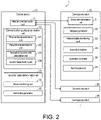
- FIG. 2 is a block diagram showing configurations of a control device 10 according to the first embodiment and a conveying system 1 including the same.
- the conveying system 1 includes the control device 10 and a conveyance robot 20.
- the configuration of one unit of the conveyance robot 20 is shown in detail, but the other units also have the same internal configuration.
- the control device 10 is an information processing system that manages conveyance, which is sometimes called by a name such as a conveying system server (AMHS server: Automated Material Handling System Server).
- the control device 10 transmits a more specific conveyance instruction to the conveyance robot 20 in the conveying system 1 based on a command from a host information processing system or the like.
- the control device 10 may be an information processing system capable of executing such processing, and does not need to be a device physically contained in one housing.
- the host information processing system that manages the production of products in the production factory may be referred to as a manufacturing execution system server (MES server).
- MES server manufacturing execution system server
- WMS server warehouse management system server
- the conveyance robot 20 is provided with a slave communication unit 21, a telegram generator 22, an inherent state monitoring unit 23, an instruction receiver 24, an operation controller 25, and a mechanism unit 26.
- the slave communication unit 21 is a communication interface that executes wireless communication with the control device 10.
- the telegram generator 22 is a functional block that generates a telegram including information of the inherent state of the conveyance robot 20 for reporting to the control device 10 and notifies the control device 10 through the slave communication unit 21.
- the inherent state monitoring unit 23 is a functional block that acquires the inherent state of the conveyance robot 20.
- the inherent state of the conveyance robot 20 refers to a state related to the individual conveyance robot itself, and for example, refers to a state related to the operation of the conveyance robot 20 and other internal states such as the current position, the state of operation, the state of loading of the conveyed object, and the remaining battery level.
- the instruction receiver 24 is a functional block that receives an instruction regarding conveyance from the control device 10 to the conveyance robot 20 through the slave communication unit 21.
- the operation controller 25 is a functional block that controls the mechanism unit 26 based on the instruction received by the instruction receiver 24 and causes the conveyance robot 20 to execute a required operation.
- the mechanism unit 26 is a mechanism for the conveyance robot 20 to execute the conveyance operation.
- the mechanism unit 26 includes at least a traveling mechanism for the conveyance robot 20 to move. Further, the mechanism unit 26 may have a mechanism such as a robot arm for picking up or placing the conveyed object.
- the control device 10 is provided with a master communication unit 11, a communication quality determination unit 12, an instruction state determination unit 13, a slave monitoring unit 14, and an instruction generator 15.
- the master communication unit 11 is a communication interface that realizes wireless communication with a plurality of conveyance robots 20.
- the communication quality determination unit 12 is a functional block that determines the quality of wireless communication with the conveyance robot 20 based on the communication state of the telegram from the conveyance robot 20, which is received by the master communication unit 11.
- the communication quality determination unit 12 includes a time series determination unit 121, a reception determination unit 122, a reception success rate calculation unit 123, and a quality classification unit 124. The functions and operations of each of these units will be described later.
- the instruction state determination unit 13 is a functional block that changes the instruction state regarding whether to transmit an instruction for controlling the conveyance robot based on the determination result of the quality of wireless communication obtained by the communication quality determination unit 12.
- the slave monitoring unit 14 is a functional block that monitors the inherent state of the conveyance robot 20 in the conveying system 1. The slave monitoring unit 14 monitors the inherent state of the conveyance robot 20 at least based on the content of the telegram from the conveyance robot 20 received by the master communication unit 11.
- the instruction generator 15 assigns a job regarding conveyance of the conveyed object in consideration of the inherent state of each conveyance robot 20 acquired by the slave monitoring unit 14 to the conveyance robot 20 in the conveying system 1 based on a command from the host information processing system or the like. Further, the instruction generator 15 generates an instruction such as conveyance to the conveyance robot 20 to which the job is assigned, and transmits the instruction through the master communication unit 11.
- the instruction generator 15 also considers the instruction state determined by the instruction state determination unit 13 to execute assignment of a job regarding conveyance of the conveyed object and transmission of an instruction such as conveyance to the conveyance robot 20.
- the details will be described later.
- the following is given as an example of assigning a job in consideration of the inherent state of the conveyance robot 20.
- the job is assigned to the conveyance robot 20 whose operation state is not in the process of executing a job and is located near the place where the conveyed object is placed.
- the job is assigned by selecting the conveyance robot 20 having a sufficient battery level for conveyance.
- the telegram generator 22 of the conveyance robot 20 creates a telegram including the information of the inherent state of the conveyance robot 20 acquired by the inherent state monitoring unit 23 and time series information. At that time, the telegram may further include information regarding the radio wave strength of the wireless communication with the control device 10.
- the time series information may be information of time or may be the order in which the telegram is created. In the specific example of the first embodiment, it is assumed that the time series information is the information of time.
- the telegram generator 22 periodically generates the above-mentioned telegram in order to sequentially transmit the inherent state of the conveyance robot 20 to the control device 10.
- the slave communication unit 21 of the conveyance robot 20 transmits the telegram as a telegram with an error correction code (so-called checksum) to the control device.
- error correction code such as checksum
- a known method can be appropriately applied as error correction.
- HMAC-SHA256 Hash-based Message Authentication Code - Secure Hash Algorithm 256-bit
- HMAC-SHA256 Hash-based Message Authentication Code - Secure Hash Algorithm 256-bit
- the master communication unit 11 of the control device 10 receives the telegram from the specific conveyance robot 20, the master communication unit 11 determines whether the received telegram has an error due to communication based on the error correction method and extracts the content of the telegram. Error correction may be executed if there is an error when extracting the content of the telegram.
- the content of the telegram is acquired by the slave monitoring unit 14.
- the time series determination unit 121 refers to the time series information of the telegram sequentially transmitted from the specific conveyance robot 20, and determines whether there is a telegram with time series of the received telegram different from the arrival time series.
- the reception determination unit 122 determines whether the reception is successful based on the determination result of the time series determination unit 121 and the determination result of whether there is an error obtained by the master communication unit 11 for a certain telegram.
- the determination as to whether the reception is successful is that if there is no telegram with time series different from the arrival time series and there is no error, the reception is successful; otherwise, it is not successful.
- the reception determination unit 122 counts the number of telegrams whose reception is successful within a predetermined period. It is also possible to determine whether the reception is successful only by the determination result of the time series determination unit 121. Alternatively, it is also possible to determine only by the determination result of whether there is an error obtained by the master communication unit 11.
- the reception success rate calculation unit 123 calculates the reception success rate from the ratio of the number of telegrams received from the specific conveyance robot 20 to the number of telegrams successfully received within the predetermined period. Further, the reception success rate calculation unit 123 may also calculate the reception success rate by including determination as to whether a time difference between the time (time series information) of creating the telegram included in the telegram and the reception time of the telegram is within a predetermined time. Furthermore, the reception success rate calculation unit 123 may also calculate the reception success rate by including determination as to whether the radio wave strength of the information regarding the radio wave strength of the wireless communication with the control device 10 included in the telegram is equal to or greater than a predetermined value.
- the quality classification unit 124 classifies and determines the communication quality according to the value of the reception success rate calculated by the reception success rate calculation unit 123 for each predetermined period.
- the classification of communication quality for example, classifies a case where the reception success rate is equal to or greater than a first threshold value as a first category, a case where the reception success rate is equal to or less than a second threshold value as a third category, and a case between these as a second category.
- the first threshold value can be 70% and the second threshold value can be 30%.
- these threshold values are examples and are appropriately set according to the conveying system.
- the communication quality determination unit 12 determines the quality of communication according to the communication state of the telegram from the conveyance robot 20 received by the master communication unit 11.
- the instruction state determination unit 13 of the control device 10 determines the instruction state of the control device 10 according to the quality of communication determined by the quality classification unit 124 of the communication quality determination unit 12.
- the instruction state can be set to three states, for example, active (first state), pending (second state), and dead (third state) according to the first category, the second category, and the third category, respectively.
- Active corresponds to a state considered to be a quality condition of communication in which the conveyance robot 20 can immediately receive an instruction such as conveyance.
- the control device 10 can execute the instruction to the conveyance robot 20 when the instruction state is active. That is, the instruction is permitted.
- Dead corresponds to a state considered to be a quality condition of communication in which the conveyance robot 20 cannot receive an instruction such as conveyance.
- the control device 10 does not execute the instruction to the conveyance robot 20 when the instruction state is dead. Further, when a response of the instruction to the conveyance robot 20 is not obtained, the job regarding the instruction is reassigned to another machine and the instruction is reissued.
- Pending corresponds to a state considered to be an intermediate communication quality condition between active and dead.
- the control device 10 stands by for an instruction to the conveyance robot 20 when the instruction state is dead. Then, if the instruction state changes to active and the instruction can be made, the instruction of the conveyance robot 20 is executed, and if the instruction state changes to dead, the job is reassigned to another machine.
- the instruction generator 15 assigns a job to a large number of conveyance robots 20 in the conveying system 1 according to the above-mentioned instruction state, and transmits an instruction to a specific conveyance robot 20. Therefore, in the control device 10 of the first embodiment, it is possible to optimize the assignment of the conveyance instruction and the timing of the instruction based on the quality of communication between the control device 10 and the conveyance robot 20.
- the above-mentioned pending state is provided between the instructable active instruction state and the non-instructable dead instruction state. Therefore, unnecessary operations in the conveying system, for example, job reassignment is repeated more than required or multiple conveyance robots 20 try to execute duplicate instructions, are suppressed.
- the evaluation of the quality of communication is performed depending on the state of communication actually performed between the control device 10 and the conveyance robot 20 for control, regardless of physical parameters such as wireless radio wave strength and physical communication speed. Therefore, such a communication quality evaluation method is suitable as an evaluation scale for allowing the control device to appropriately control the conveyance robot 20.
- the control device 10 and the conveying system 1 according to the second embodiment have the same configurations as those of the first embodiment and operate in the same manner except that the operation of the quality classification unit 124 is different from that of the first embodiment.
- the quality classification unit 124 classifies and determines the communication quality according to the value of the reception success rate calculated by the reception success rate calculation unit 123. At that time, the quality classification unit 124 classifies the communication quality for each predetermined period according to the reception success rate in the period (current time).
- FIG. 3 is a table for illustrating the operation result of the quality classification unit 124 of each of the first embodiment and the second embodiment in a specific example of the reception success rate.
- An example of the reception success rate P(t) calculated by the quality classification unit 124 at each time t is shown in the second column.
- the quality classification unit 124 of the communication quality determination unit 12 classifies and determines the communication quality by reflecting not only the reception success rate in the period (current time) but also the past reception success rate.
- the quality classification unit 124 of the second embodiment classifies the communication quality as follows based on the reception success rate.
- the log odds L(t) obtained by converting the reception success rate P(t) at the time t by a logit function are calculated (the fourth column in FIG. 3 ).
- the cumulative log odds Ls(t) which are the accumulation of the log odds L(t) from the past to the time t with the initial value set to 0, are calculated (the fifth column in FIG. 3 ).
- the reception success likelihood P2(t) obtained by converting the cumulative log odds Ls(t) by the inverse function of the logit function is calculated (the sixth column in FIG. 3 ).
- the communication quality is classified depending on the value of the reception success likelihood P2(t) (the seventh column in FIG. 3 ) instead of the reception success rate P(t) in the case of the first embodiment.
- the first threshold value and the second threshold value for classifying the communication quality need to be appropriately set so that the instruction state can be appropriately determined.
- These threshold values can be appropriate values determined by trial and error in a factory or the like to which the conveying system 1 is applied. However, for this purpose, it is necessary to acquire a large amount of data and modify it appropriately to find the most preferable values.
- the third embodiment describes a method that can support determination of such threshold values.
- places with similar communication characteristics are grouped (class determination) as belonging to the same group, and appropriate threshold values are held in advance for each of them. Then, when the conveying system is applied to a new place, the communication characteristics in the place are measured, and the threshold value of the group with the closest characteristics is adopted as the recommended value of the threshold value in the place.
- Such grouping (class determination) in the third embodiment is characterized in that various probabilities regarding the parameters used for calculating the communication quality in each of the above embodiments are used as data to be examined. That is, the data to be examined includes the following.
- Time series validity probability which is the ratio of telegrams having no discrepancy in the reception time series to the telegrams within the period.
- Reliability probability which is the ratio of telegrams having no error correction by the error correction method to the telegrams within the period.
- In-time arrival probability which is the ratio of telegrams, in which the time difference between the time (time series information) of creating the telegram included in the telegram and the reception time of the telegram is within a predetermined time, to the telegrams within the period.
- Valid radio wave strength probability which is the ratio of telegrams, in which the radio wave strength of information regarding the radio wave strength of the wireless communication with the control device 10 included in the telegram is equal to or greater than a predetermined value, to the telegrams within the period.
- a subspace method can be applied as a method of grouping (class determination). Since this method is a known statistical method, it will be briefly described. First, a vector a(k) having each of the data to be examined (various probabilities) as an element is defined for each period k. Further, an in-system communication value matrix Ad in which n vectors a(k) are arranged is defined for the period k (k is an integer from 1 to n) in which measurement is performed.
- the eigenvalue decomposition of the in-system communication value matrix Ad is performed to obtain the eigenvalue ⁇ (k) and the eigenvector x(k).
- the average value vector b of n vectors a(k) is obtained.
- the inner product ⁇ (k) of the vector a(k)-b and the eigenvector x(k) is obtained for each k. This inner product ⁇ (k) is called the expansion count of the eigenvector.
- a vector ⁇ is derived in which the expansion counts ⁇ (k) of the eigenvectors are arranged up to an appropriate dimension m in descending order of the eigenvalues ⁇ (k).
- the vector ⁇ is referred to as an in-system communication feature vector.
- the in-system communication feature vector ⁇ is calculated for various places (factories, warehouses, etc.) to which the conveying system is applied, and is appropriately grouped for each gathering in the space where the in-system communication feature vector ⁇ exists.
- the representative in-system communication feature vector ⁇ g representing the group is calculated.
- the in-system communication feature vector ⁇ is calculated in the same manner, and to which group it belongs is determined depending on which group has the closest representative in-system communication feature vector ⁇ g.
- the threshold value set to the group is adopted as the recommended threshold value in the conveying system applied to the new place.
- the control device further includes a threshold value calculation unit that calculates the threshold value by the above-mentioned method, in addition to the configuration of the control device described in the first embodiment with reference to FIG. 2 .
- the threshold value calculation unit holds in advance the representative in-system communication feature vector ⁇ g of each group and the threshold value, acquires the data to be examined, and calculates the in-system communication feature vector ⁇ to select the recommended value of the threshold value. According to the third embodiment, the setting of the threshold value for classifying the communication quality can be easily set.
- the functional blocks of the control device 10 may be realized by a logic circuit (hardware) formed in an integrated circuit (IC chip) or the like, or may be realized by software.
- control device 10 or the conveyance robot 20 includes a computer that executes instructions of a program that is software for realizing each function.
- the computer includes, for example, one or more processors and a computer-readable recording medium that stores the program. Then, in the computer, the processor reads the program from the recording medium and executes the program, thereby achieving the object of the present invention.
- a CPU Central Processing Unit
- a "non-temporary tangible medium,” for example, a ROM (Read Only Memory) or the like, a tape, a disk, a card, a semiconductor memory, a programmable logic circuit, etc. can be used as the recording medium.
- a RAM Random Access Memory
- the program may be supplied to the computer via any transmission medium (communication network, broadcast wave, etc.) capable of transmitting the program.
- Any transmission medium communication network, broadcast wave, etc.
- One aspect of the present invention can also be realized in the form of a data signal embedded in a carrier wave, in which the above program is embodied by electronic transmission.
- the control device is a control device for controlling a conveyance robot.
- the control device includes: a master communication unit that performs wireless communication with the conveyance robot; a communication quality determination unit that determines quality of the wireless communication based on a communication state of a telegram generated by the conveyance robot, which is received by the master communication unit; and an instruction state determination unit that determines an instruction state regarding whether to transmit an instruction for controlling the conveyance robot depending on the quality of the wireless communication.
- control device of the conveying system that can evaluate the quality of communication between the control device and the conveyance robot in a mode suitable for the conveying system, thereby optimizing the assignment of conveyance instructions.
- the telegram may include information regarding the conveyance robot and time series information.
- the communication quality determination unit may include: a time series determination unit that determines an arrival time series error of the telegram based on the time series information of a plurality of the telegrams from the conveyance robot; a reception success rate calculation unit that calculates a reception success rate of the wireless communication based on at least the number of occurrences of the arrival time series error; and a quality classification unit that classifies the quality of the wireless communication according to the reception success rate.
- the quality of communication is specifically evaluated by the state of communication performed by the control device and the conveyance robot for control.
- evaluation of communication is excellent as a scale for allowing the control device to appropriately control the conveyance robot, and the control device that can more appropriately assign conveyance instructions can be realized.
- the reception success rate calculation unit may further include a configuration that calculates the reception success rate of the wireless communication based on the number of occurrences of error correction of the telegram.
- the quality of communication is specifically evaluated by the state of communication from a plurality of viewpoints performed by the control device and the conveyance robot for control. Therefore, the control device that can more appropriately assign conveyance instructions can be realized.
- the quality classification unit may include a configuration that classifies the quality of the wireless communication by reflecting a past value and a current value of the reception success rate. According to the above configuration, the job assignment and instruction can be performed on the conveyance robot in the conveying system without being affected by small fluctuations in the communication state.
- the instruction state may include a configuration that includes: a first state that permits transmission of a command to the conveyance robot; a second state that stands by for transmission of the command to the conveyance robot; and a third state that reassigns and transmits the command transmitted to the conveyance robot to another conveyance robot.
- a conveying system includes: a conveyance robot provided with a telegram generator that generates the telegram and a slave communication unit that performs the wireless communication, and any of the above control devices. According to the above configuration, it is possible to realize the conveying system that can evaluate the quality of communication between the control device and the conveyance robot in a mode suitable for the conveying system, thereby optimizing the assignment of conveyance instructions performed by the control device.
Landscapes
- Engineering & Computer Science (AREA)
- Mechanical Engineering (AREA)
- Robotics (AREA)
- Automation & Control Theory (AREA)
- Aviation & Aerospace Engineering (AREA)
- Radar, Positioning & Navigation (AREA)
- Remote Sensing (AREA)
- Physics & Mathematics (AREA)
- General Physics & Mathematics (AREA)
- Computer Networks & Wireless Communication (AREA)
- Control Of Position, Course, Altitude, Or Attitude Of Moving Bodies (AREA)
- Warehouses Or Storage Devices (AREA)
- Manipulator (AREA)
Abstract
Description
- The present invention relates to a control device for controlling a conveyance robot and a conveying system including the same.
- Self-propelled conveyance robots such as automated guided vehicles (AGVs) and automated guided forklifts (AGFs) used in factories, warehouses, etc. have been proposed. A plurality of such conveyance robots are controlled by a control device through wireless communication to form a conveying system that realizes automation of conveyance in factories, etc.
- [Patent Literature 1]
Japanese Patent Laid-Open No. 2019-48689 - The control device appropriately assigns conveyance instructions to the plurality of conveyance robots to realize the desired conveyance work. However, in a conveying system such as a factory or a warehouse, a large number of conveyance robots are usually deployed in order to handle a large number of conveyed objects. These conveyance robots may be in various states, and even if the control device transmits a conveyance instruction to a specific conveyance robot, a response may not be returned. The cause may be a problem in communication quality or a problem inherent in the conveyance robot itself.
- However, in the past, it has not been clearly considered whether the cause is a problem in communication quality or a problem inherent in the conveyance robot, and regarding the issuance of instructions to the conveyance robot, no measures were taken in consideration of this point. The present invention has been made in view of such circumstances on one aspect, and an object of the present invention is to realize a control device of a conveying system that can evaluate the quality of communication between the control device and the conveyance robot in a mode suitable for the conveying system, thereby optimizing the assignment of conveyance instructions.
- The present invention adopts the following configuration in order to solve the above-mentioned problems. The control device according to one aspect of the present invention is a control device for controlling a conveyance robot. The control device includes: a master communication unit that performs wireless communication with the conveyance robot; a communication quality determination unit that determines quality of the wireless communication based on a communication state of a telegram generated by the conveyance robot, which is received by the master communication unit; and an instruction state determination unit that determines an instruction state regarding whether to transmit an instruction for controlling the conveyance robot depending on the quality of the wireless communication.
- According to the control device according to one aspect of the present invention, it is possible to realize a control device that can evaluate the quality of communication between the control device and the conveyance robot in a mode suitable for the conveying system, thereby optimizing the assignment of conveyance instructions.
-
-
FIG. 1 is a floor map schematically showing an example of a factory into which a conveying system including a control device according to an application example of the present invention is introduced. -
FIG. 2 is a block diagram showing configurations of a control device according to the first embodiment of the present invention and a conveying system including the same. -
FIG. 3 is a table for illustrating an operation of a quality classification unit in a control device according to the second embodiment of the present invention in comparison with the case of the control device according to the first embodiment. - Hereinafter, embodiments according to one aspect of the present invention will be described with reference to the drawings.
- An example of a situation to which the present invention is applied will be described with reference to
FIG. 1. FIG. 1 is a diagram schematically showing a floor map of afactory 100, which is an example of an area such as a factory or a warehouse to which a conveying system including a control device according to this application example can be applied. - The
factory 100 is equipped with aconveyance robot 20 for conveying the conveyed objects such as products, semi-finished products, parts, tools, jigs, packing materials, and cassettes for storing these. As an example, theconveyance robot 20 is a self-propelled conveyance robot provided with a robot arm (manipulator) for gripping the conveyed object. However, theconveyance robot 20 may be an automated guided vehicle, an AGF or a self-propelled conveyance device in other forms. - A
shelf 30 on which the conveyed object can be placed is installed in thefactory 100. Further, a production facility that applies required processing such as assembly, machining, assembling, and inspection to place the conveyed object in a predetermined pick-up port when placing the conveyed object in a predetermined receiving port is also installed in thefactory 100. Depending on the production facility, the receiving port and the pick-up port may be shared. - The
conveyance robot 20 of the conveying system that includes the control device according to this application example can convey the conveyed object between these facilities. Theconveyance robot 20 is provided with a telegram generator that generates a telegram, and a slave communication unit. The control device according to this application example is not shown in the floor map ofFIG. 1 . The control device according to this application example is provided with a master communication unit that performs wireless communication with the slave communication unit of theconveyance robot 20. - The control device according to this application example is further provided with a communication quality determination unit that determines the quality of wireless communication based on a communication state of the telegram received by the master communication unit. In addition, the control device according to this application example is provided with an instruction state determination unit that changes an instruction state regarding whether to transmit an instruction for controlling the conveyance robot depending on the quality of wireless communication.
- In the control device according to this application example, the quality of communication between the control device and the
conveyance robot 20 is evaluated based on the communication state of the telegram transmitted from the side of theconveyance robot 20 to the control device. Such a telegram may be a report for theconveyance robot 20 to notify the control device of the state, which is necessary for the control device to grasp the condition of eachconveyance robot 20 and then assign a job. - Accordingly, the quality of communication can be evaluated by the state of communication actually performed by the control device and the conveyance robot for control, regardless of physical parameters such as wireless radio wave strength and physical communication speed. Therefore, such a communication quality evaluation method is suitable as an evaluation scale for allowing the control device to appropriately control the
conveyance robot 20. - Further, in the control device according to this application example, the quality of communication between the control device and the
conveyance robot 20 is evaluated, and based on the result, the instruction state regarding whether to transmit an instruction for controlling the conveyance robot is changed. Thus, the evaluation related to the quality of communication is performed separately from the problem inherent in theconveyance robot 20 to change the instruction state, so the conveying system can be operated appropriately. - Hereinafter, more specific configuration examples and operations of the control device and the conveying system will be described.
FIG. 2 is a block diagram showing configurations of acontrol device 10 according to the first embodiment and aconveying system 1 including the same. Theconveying system 1 includes thecontrol device 10 and aconveyance robot 20. InFIG. 2 , the configuration of one unit of theconveyance robot 20 is shown in detail, but the other units also have the same internal configuration. - The
control device 10 is an information processing system that manages conveyance, which is sometimes called by a name such as a conveying system server (AMHS server: Automated Material Handling System Server). Thecontrol device 10 transmits a more specific conveyance instruction to theconveyance robot 20 in theconveying system 1 based on a command from a host information processing system or the like. Thecontrol device 10 may be an information processing system capable of executing such processing, and does not need to be a device physically contained in one housing. - When the scene to which the
conveying system 1 is applied is a production factory, the host information processing system that manages the production of products in the production factory may be referred to as a manufacturing execution system server (MES server). When the scene to which theconveying system 1 is applied is a distribution warehouse, the host information processing system that manages the receipt and delivery of stored items in the distribution warehouse may be referred to as a warehouse management system server (WMS server). - As shown in
FIG. 2 , theconveyance robot 20 is provided with aslave communication unit 21, atelegram generator 22, an inherentstate monitoring unit 23, aninstruction receiver 24, anoperation controller 25, and amechanism unit 26. Theslave communication unit 21 is a communication interface that executes wireless communication with thecontrol device 10. - The
telegram generator 22 is a functional block that generates a telegram including information of the inherent state of theconveyance robot 20 for reporting to thecontrol device 10 and notifies thecontrol device 10 through theslave communication unit 21. The inherentstate monitoring unit 23 is a functional block that acquires the inherent state of theconveyance robot 20. Here, the inherent state of theconveyance robot 20 refers to a state related to the individual conveyance robot itself, and for example, refers to a state related to the operation of theconveyance robot 20 and other internal states such as the current position, the state of operation, the state of loading of the conveyed object, and the remaining battery level. - The
instruction receiver 24 is a functional block that receives an instruction regarding conveyance from thecontrol device 10 to theconveyance robot 20 through theslave communication unit 21. Theoperation controller 25 is a functional block that controls themechanism unit 26 based on the instruction received by theinstruction receiver 24 and causes theconveyance robot 20 to execute a required operation. - The
mechanism unit 26 is a mechanism for theconveyance robot 20 to execute the conveyance operation. Themechanism unit 26 includes at least a traveling mechanism for theconveyance robot 20 to move. Further, themechanism unit 26 may have a mechanism such as a robot arm for picking up or placing the conveyed object. - As shown in
FIG. 2 , thecontrol device 10 is provided with amaster communication unit 11, a communicationquality determination unit 12, an instructionstate determination unit 13, aslave monitoring unit 14, and aninstruction generator 15. Themaster communication unit 11 is a communication interface that realizes wireless communication with a plurality ofconveyance robots 20. - The communication
quality determination unit 12 is a functional block that determines the quality of wireless communication with theconveyance robot 20 based on the communication state of the telegram from theconveyance robot 20, which is received by themaster communication unit 11. The communicationquality determination unit 12 includes a timeseries determination unit 121, areception determination unit 122, a reception successrate calculation unit 123, and aquality classification unit 124. The functions and operations of each of these units will be described later. - The instruction
state determination unit 13 is a functional block that changes the instruction state regarding whether to transmit an instruction for controlling the conveyance robot based on the determination result of the quality of wireless communication obtained by the communicationquality determination unit 12. Theslave monitoring unit 14 is a functional block that monitors the inherent state of theconveyance robot 20 in the conveyingsystem 1. Theslave monitoring unit 14 monitors the inherent state of theconveyance robot 20 at least based on the content of the telegram from theconveyance robot 20 received by themaster communication unit 11. - The
instruction generator 15 assigns a job regarding conveyance of the conveyed object in consideration of the inherent state of eachconveyance robot 20 acquired by theslave monitoring unit 14 to theconveyance robot 20 in the conveyingsystem 1 based on a command from the host information processing system or the like. Further, theinstruction generator 15 generates an instruction such as conveyance to theconveyance robot 20 to which the job is assigned, and transmits the instruction through themaster communication unit 11. - At that time, the
instruction generator 15 also considers the instruction state determined by the instructionstate determination unit 13 to execute assignment of a job regarding conveyance of the conveyed object and transmission of an instruction such as conveyance to theconveyance robot 20. The details will be described later. Here, the following is given as an example of assigning a job in consideration of the inherent state of theconveyance robot 20. - For example, when a certain conveyed object is to be moved, the job is assigned to the
conveyance robot 20 whose operation state is not in the process of executing a job and is located near the place where the conveyed object is placed. Alternatively, the job is assigned by selecting theconveyance robot 20 having a sufficient battery level for conveyance. - Hereinafter, the characteristic operations of the
control device 10 and the conveyingsystem 1 according to the first embodiment will be described in detail. Thetelegram generator 22 of theconveyance robot 20 creates a telegram including the information of the inherent state of theconveyance robot 20 acquired by the inherentstate monitoring unit 23 and time series information. At that time, the telegram may further include information regarding the radio wave strength of the wireless communication with thecontrol device 10. The time series information may be information of time or may be the order in which the telegram is created. In the specific example of the first embodiment, it is assumed that the time series information is the information of time. - The
telegram generator 22 periodically generates the above-mentioned telegram in order to sequentially transmit the inherent state of theconveyance robot 20 to thecontrol device 10. Theslave communication unit 21 of theconveyance robot 20 transmits the telegram as a telegram with an error correction code (so-called checksum) to the control device. A known method can be appropriately applied as error correction. For example, HMAC-SHA256 (Hash-based Message Authentication Code - Secure Hash Algorithm 256-bit) may be used as the error correction method. - When the
master communication unit 11 of thecontrol device 10 receives the telegram from thespecific conveyance robot 20, themaster communication unit 11 determines whether the received telegram has an error due to communication based on the error correction method and extracts the content of the telegram. Error correction may be executed if there is an error when extracting the content of the telegram. The content of the telegram is acquired by theslave monitoring unit 14. The timeseries determination unit 121 refers to the time series information of the telegram sequentially transmitted from thespecific conveyance robot 20, and determines whether there is a telegram with time series of the received telegram different from the arrival time series. - The
reception determination unit 122 determines whether the reception is successful based on the determination result of the timeseries determination unit 121 and the determination result of whether there is an error obtained by themaster communication unit 11 for a certain telegram. The determination as to whether the reception is successful is that if there is no telegram with time series different from the arrival time series and there is no error, the reception is successful; otherwise, it is not successful. - The
reception determination unit 122 counts the number of telegrams whose reception is successful within a predetermined period. It is also possible to determine whether the reception is successful only by the determination result of the timeseries determination unit 121. Alternatively, it is also possible to determine only by the determination result of whether there is an error obtained by themaster communication unit 11. - The reception success
rate calculation unit 123 calculates the reception success rate from the ratio of the number of telegrams received from thespecific conveyance robot 20 to the number of telegrams successfully received within the predetermined period. Further, the reception successrate calculation unit 123 may also calculate the reception success rate by including determination as to whether a time difference between the time (time series information) of creating the telegram included in the telegram and the reception time of the telegram is within a predetermined time. Furthermore, the reception successrate calculation unit 123 may also calculate the reception success rate by including determination as to whether the radio wave strength of the information regarding the radio wave strength of the wireless communication with thecontrol device 10 included in the telegram is equal to or greater than a predetermined value. - The
quality classification unit 124 classifies and determines the communication quality according to the value of the reception success rate calculated by the reception successrate calculation unit 123 for each predetermined period. The classification of communication quality, for example, classifies a case where the reception success rate is equal to or greater than a first threshold value as a first category, a case where the reception success rate is equal to or less than a second threshold value as a third category, and a case between these as a second category. - Further, as an example, the first threshold value can be 70% and the second threshold value can be 30%. However, these threshold values are examples and are appropriately set according to the conveying system. As described above, the communication
quality determination unit 12 determines the quality of communication according to the communication state of the telegram from theconveyance robot 20 received by themaster communication unit 11. - Next, the instruction
state determination unit 13 of thecontrol device 10 determines the instruction state of thecontrol device 10 according to the quality of communication determined by thequality classification unit 124 of the communicationquality determination unit 12. The instruction state can be set to three states, for example, active (first state), pending (second state), and dead (third state) according to the first category, the second category, and the third category, respectively. - Active corresponds to a state considered to be a quality condition of communication in which the
conveyance robot 20 can immediately receive an instruction such as conveyance. Thecontrol device 10 can execute the instruction to theconveyance robot 20 when the instruction state is active. That is, the instruction is permitted. Dead corresponds to a state considered to be a quality condition of communication in which theconveyance robot 20 cannot receive an instruction such as conveyance. Thecontrol device 10 does not execute the instruction to theconveyance robot 20 when the instruction state is dead. Further, when a response of the instruction to theconveyance robot 20 is not obtained, the job regarding the instruction is reassigned to another machine and the instruction is reissued. - Pending corresponds to a state considered to be an intermediate communication quality condition between active and dead. The
control device 10 stands by for an instruction to theconveyance robot 20 when the instruction state is dead. Then, if the instruction state changes to active and the instruction can be made, the instruction of theconveyance robot 20 is executed, and if the instruction state changes to dead, the job is reassigned to another machine. - The
instruction generator 15 assigns a job to a large number ofconveyance robots 20 in the conveyingsystem 1 according to the above-mentioned instruction state, and transmits an instruction to aspecific conveyance robot 20. Therefore, in thecontrol device 10 of the first embodiment, it is possible to optimize the assignment of the conveyance instruction and the timing of the instruction based on the quality of communication between thecontrol device 10 and theconveyance robot 20. - In particular, in the conveying
system 1, the above-mentioned pending state is provided between the instructable active instruction state and the non-instructable dead instruction state. Therefore, unnecessary operations in the conveying system, for example, job reassignment is repeated more than required ormultiple conveyance robots 20 try to execute duplicate instructions, are suppressed. - In addition, the evaluation of the quality of communication is performed depending on the state of communication actually performed between the
control device 10 and theconveyance robot 20 for control, regardless of physical parameters such as wireless radio wave strength and physical communication speed. Therefore, such a communication quality evaluation method is suitable as an evaluation scale for allowing the control device to appropriately control theconveyance robot 20. - Other embodiments of the present invention will be described below. For convenience of explanation, the same reference numerals are given to members having the same functions as the members described in the above embodiment, and the description thereof will not be repeated.
- The
control device 10 and the conveyingsystem 1 according to the second embodiment have the same configurations as those of the first embodiment and operate in the same manner except that the operation of thequality classification unit 124 is different from that of the first embodiment. In thecontrol device 10 according to the first embodiment, thequality classification unit 124 classifies and determines the communication quality according to the value of the reception success rate calculated by the reception successrate calculation unit 123. At that time, thequality classification unit 124 classifies the communication quality for each predetermined period according to the reception success rate in the period (current time). -
FIG. 3 is a table for illustrating the operation result of thequality classification unit 124 of each of the first embodiment and the second embodiment in a specific example of the reception success rate. An example of the reception success rate P(t) calculated by thequality classification unit 124 at each time t is shown in the second column. The instruction state in the case of the first embodiment, in which the communication quality is classified based on the reception success rate P(t) at the time t, is shown in the third column. In the case of the first embodiment, if the reception success rate P(t) fluctuates greatly from time to time, such as time t = 5 and thereafter, a situation in which the instruction state fluctuates between active and dead may occur. - On the contrary, in the
control device 10 according to the second embodiment, thequality classification unit 124 of the communicationquality determination unit 12 classifies and determines the communication quality by reflecting not only the reception success rate in the period (current time) but also the past reception success rate. Thequality classification unit 124 of the second embodiment classifies the communication quality as follows based on the reception success rate. - The log odds L(t) obtained by converting the reception success rate P(t) at the time t by a logit function are calculated (the fourth column in
FIG. 3 ). Next, the cumulative log odds Ls(t), which are the accumulation of the log odds L(t) from the past to the time t with the initial value set to 0, are calculated (the fifth column inFIG. 3 ). The reception success likelihood P2(t) obtained by converting the cumulative log odds Ls(t) by the inverse function of the logit function is calculated (the sixth column inFIG. 3 ). Then, the communication quality is classified depending on the value of the reception success likelihood P2(t) (the seventh column inFIG. 3 ) instead of the reception success rate P(t) in the case of the first embodiment. - When the communication quality is classified by the method of the second embodiment, the classification is made by reflecting the past values of the reception success rate. Therefore, even if the reception success rate P(t) fluctuates greatly from time to time, the fluctuation of the instruction state is suppressed. In the case of the second embodiment, even if the reception success rate P(t) fluctuates greatly from time to time, such as time t = 5 and thereafter in
FIG. 3 , the situation in which the instruction state fluctuates between active and dead is unlikely to occur. Accordingly, according to thecontrol device 10 of the second embodiment, the job assignment and instruction can be performed on theconveyance robot 20 in the conveyingsystem 1 in a more stable state than the first embodiment without being affected by small fluctuations in the communication state. - In each of the above embodiments, the first threshold value and the second threshold value for classifying the communication quality need to be appropriately set so that the instruction state can be appropriately determined. These threshold values can be appropriate values determined by trial and error in a factory or the like to which the conveying
system 1 is applied. However, for this purpose, it is necessary to acquire a large amount of data and modify it appropriately to find the most preferable values. - The third embodiment describes a method that can support determination of such threshold values. In the method of determining the threshold values according to the third embodiment, for various places (factories, warehouses, etc.) to which the conveying system is applied, places with similar communication characteristics are grouped (class determination) as belonging to the same group, and appropriate threshold values are held in advance for each of them. Then, when the conveying system is applied to a new place, the communication characteristics in the place are measured, and the threshold value of the group with the closest characteristics is adopted as the recommended value of the threshold value in the place.
- Such grouping (class determination) in the third embodiment is characterized in that various probabilities regarding the parameters used for calculating the communication quality in each of the above embodiments are used as data to be examined. That is, the data to be examined includes the following.
- Time series validity probability, which is the ratio of telegrams having no discrepancy in the reception time series to the telegrams within the period. Reliability probability, which is the ratio of telegrams having no error correction by the error correction method to the telegrams within the period. In-time arrival probability, which is the ratio of telegrams, in which the time difference between the time (time series information) of creating the telegram included in the telegram and the reception time of the telegram is within a predetermined time, to the telegrams within the period. Valid radio wave strength probability, which is the ratio of telegrams, in which the radio wave strength of information regarding the radio wave strength of the wireless communication with the
control device 10 included in the telegram is equal to or greater than a predetermined value, to the telegrams within the period. - A subspace method can be applied as a method of grouping (class determination). Since this method is a known statistical method, it will be briefly described. First, a vector a(k) having each of the data to be examined (various probabilities) as an element is defined for each period k. Further, an in-system communication value matrix Ad in which n vectors a(k) are arranged is defined for the period k (k is an integer from 1 to n) in which measurement is performed.
- The eigenvalue decomposition of the in-system communication value matrix Ad is performed to obtain the eigenvalue λ(k) and the eigenvector x(k). The average value vector b of n vectors a(k) is obtained. The inner product ω(k) of the vector a(k)-b and the eigenvector x(k) is obtained for each k. This inner product ω(k) is called the expansion count of the eigenvector. A vector Ω is derived in which the expansion counts ω(k) of the eigenvectors are arranged up to an appropriate dimension m in descending order of the eigenvalues λ(k). The vector Ω is referred to as an in-system communication feature vector.
- The in-system communication feature vector Ω is calculated for various places (factories, warehouses, etc.) to which the conveying system is applied, and is appropriately grouped for each gathering in the space where the in-system communication feature vector Ω exists. By a method such as obtaining the average vector of the in-system communication feature vector Ω for the place belonging to a specific group, the representative in-system communication feature vector Ωg representing the group is calculated.
- When the conveying system is applied to a new place, the in-system communication feature vector Ω is calculated in the same manner, and to which group it belongs is determined depending on which group has the closest representative in-system communication feature vector Ωg. The threshold value set to the group is adopted as the recommended threshold value in the conveying system applied to the new place.
- The control device according to the third embodiment further includes a threshold value calculation unit that calculates the threshold value by the above-mentioned method, in addition to the configuration of the control device described in the first embodiment with reference to
FIG. 2 . The threshold value calculation unit holds in advance the representative in-system communication feature vector Ωg of each group and the threshold value, acquires the data to be examined, and calculates the in-system communication feature vector Ω to select the recommended value of the threshold value. According to the third embodiment, the setting of the threshold value for classifying the communication quality can be easily set. - The functional blocks of the control device 10 (particularly, the
master communication unit 11, the communicationquality determination unit 12, the instructionstate determination unit 13, theslave monitoring unit 14, and the instruction generator 15) or the functional blocks of the conveyance robot 20 (particularly, theslave communication unit 21, thetelegram generator 22, the inherentstate monitoring unit 23, theinstruction receiver 24, and the operation controller 25) may be realized by a logic circuit (hardware) formed in an integrated circuit (IC chip) or the like, or may be realized by software. - In the latter case, the
control device 10 or theconveyance robot 20 includes a computer that executes instructions of a program that is software for realizing each function. The computer includes, for example, one or more processors and a computer-readable recording medium that stores the program. Then, in the computer, the processor reads the program from the recording medium and executes the program, thereby achieving the object of the present invention. - For example, a CPU (Central Processing Unit) can be used as the processor. A "non-temporary tangible medium," for example, a ROM (Read Only Memory) or the like, a tape, a disk, a card, a semiconductor memory, a programmable logic circuit, etc. can be used as the recording medium. Further, a RAM (Random Access Memory) for developing the program may be further included.
- Furthermore, the program may be supplied to the computer via any transmission medium (communication network, broadcast wave, etc.) capable of transmitting the program. One aspect of the present invention can also be realized in the form of a data signal embedded in a carrier wave, in which the above program is embodied by electronic transmission.
- The control device according to one aspect of the present invention is a control device for controlling a conveyance robot. The control device includes: a master communication unit that performs wireless communication with the conveyance robot; a communication quality determination unit that determines quality of the wireless communication based on a communication state of a telegram generated by the conveyance robot, which is received by the master communication unit; and an instruction state determination unit that determines an instruction state regarding whether to transmit an instruction for controlling the conveyance robot depending on the quality of the wireless communication.
- According to the above configuration, it is possible to realize the control device of the conveying system that can evaluate the quality of communication between the control device and the conveyance robot in a mode suitable for the conveying system, thereby optimizing the assignment of conveyance instructions.
- In the control device according to the one aspect, the telegram may include information regarding the conveyance robot and time series information. The communication quality determination unit may include: a time series determination unit that determines an arrival time series error of the telegram based on the time series information of a plurality of the telegrams from the conveyance robot; a reception success rate calculation unit that calculates a reception success rate of the wireless communication based on at least the number of occurrences of the arrival time series error; and a quality classification unit that classifies the quality of the wireless communication according to the reception success rate.
- According to the above configuration, the quality of communication is specifically evaluated by the state of communication performed by the control device and the conveyance robot for control. In addition, such evaluation of communication is excellent as a scale for allowing the control device to appropriately control the conveyance robot, and the control device that can more appropriately assign conveyance instructions can be realized.
- In the control device according to the one aspect, the reception success rate calculation unit may further include a configuration that calculates the reception success rate of the wireless communication based on the number of occurrences of error correction of the telegram. According to the above configuration, the quality of communication is specifically evaluated by the state of communication from a plurality of viewpoints performed by the control device and the conveyance robot for control. Therefore, the control device that can more appropriately assign conveyance instructions can be realized.
- In the control device according to the one aspect, the quality classification unit may include a configuration that classifies the quality of the wireless communication by reflecting a past value and a current value of the reception success rate. According to the above configuration, the job assignment and instruction can be performed on the conveyance robot in the conveying system without being affected by small fluctuations in the communication state.
- In the control device according to the one aspect, the instruction state may include a configuration that includes: a first state that permits transmission of a command to the conveyance robot; a second state that stands by for transmission of the command to the conveyance robot; and a third state that reassigns and transmits the command transmitted to the conveyance robot to another conveyance robot. According to the above configuration, unnecessary operations in the conveying system, for example, job reassignment is repeated more than required or multiple conveyance robots try to execute duplicate instructions, are suppressed.
- A conveying system according to one aspect of the present invention includes: a conveyance robot provided with a telegram generator that generates the telegram and a slave communication unit that performs the wireless communication, and any of the above control devices. According to the above configuration, it is possible to realize the conveying system that can evaluate the quality of communication between the control device and the conveyance robot in a mode suitable for the conveying system, thereby optimizing the assignment of conveyance instructions performed by the control device.
- The present invention is not limited to the embodiments described above, and various modifications can be made within the scope of the claims. The technical scope of the present invention also includes embodiments obtained by appropriately combining the disclosed technical means.
-
- 1 Conveying system
- 10 Control device
- 11 Master communication unit
- 12 Communication quality determination unit
- 121 Time series determination unit
- 122 Reception determination unit
- 123 Reception success rate calculation unit
- 124 Quality classification unit
- 13 Instruction state determination unit
- 14 Slave monitoring unit
- 15 Instruction generator
- 20 Conveyance robot
- 21 Slave communication unit
- 22 Telegram generator
- 23 Inherent state monitoring unit
- 24 Instruction receiver
- 25 Operation controller
- 26 Mechanism unit
- 100 Factory
Claims (6)
- A control device for controlling a conveyance robot, comprising:a master communication unit that performs wireless communication with the conveyance robot;a communication quality determination unit that determines quality of the wireless communication based on a communication state of a telegram generated by the conveyance robot, which is received by the master communication unit; andan instruction state determination unit that determines an instruction state regarding whether to transmit an instruction for controlling the conveyance robot depending on the quality of the wireless communication.
- The control device according to claim 1, wherein the telegram comprises information regarding the conveyance robot and time series information, and
the communication quality determination unit comprises:a time series determination unit that determines an arrival time series error of the telegram based on the time series information of a plurality of the telegrams from the conveyance robot;a reception success rate calculation unit that calculates a reception success rate of the wireless communication based on at least the number of occurrences of the arrival time series error; anda quality classification unit that classifies the quality of the wireless communication according to the reception success rate. - The control device according to claim 2, wherein the reception success rate calculation unit further calculates the reception success rate of the wireless communication based on the number of occurrences of error correction of the telegram.
- The control device according to claim 2 or 3, wherein the quality classification unit classifies the quality of the wireless communication by reflecting a past value and a current value of the reception success rate.
- The control device according to any one of claims 1 to 4, wherein the instruction state comprises:a first state that permits transmission of a command to the conveyance robot;a second state that stands by for transmission of the command to the conveyance robot; anda third state that reassigns and transmits the command transmitted to the conveyance robot to another conveyance robot.
- A conveying system, comprising:a conveyance robot provided with a telegram generator that generates the telegram and a slave communication unit that performs the wireless communication; andthe control device according to any one of claims 1 to 5.
Applications Claiming Priority (2)
| Application Number | Priority Date | Filing Date | Title |
|---|---|---|---|
| JP2020034048A JP7388241B2 (en) | 2020-02-28 | 2020-02-28 | Control device and conveyance system |
| PCT/JP2021/004691 WO2021171996A1 (en) | 2020-02-28 | 2021-02-09 | Control device and conveying system |
Publications (3)
| Publication Number | Publication Date |
|---|---|
| EP4112501A1 true EP4112501A1 (en) | 2023-01-04 |
| EP4112501A4 EP4112501A4 (en) | 2024-02-21 |
| EP4112501B1 EP4112501B1 (en) | 2025-02-26 |
Family
ID=77490505
Family Applications (1)
| Application Number | Title | Priority Date | Filing Date |
|---|---|---|---|
| EP21760743.1A Active EP4112501B1 (en) | 2020-02-28 | 2021-02-09 | Control device and conveying system |
Country Status (6)
| Country | Link |
|---|---|
| US (1) | US20230041313A1 (en) |
| EP (1) | EP4112501B1 (en) |
| JP (1) | JP7388241B2 (en) |
| KR (1) | KR20220107057A (en) |
| CN (1) | CN114901570B (en) |
| WO (1) | WO2021171996A1 (en) |
Families Citing this family (1)
| Publication number | Priority date | Publication date | Assignee | Title |
|---|---|---|---|---|
| US12704836B2 (en) * | 2021-12-09 | 2026-08-11 | Intel Products Ip Llc | Learning-based techniques for autonomous agent task allocation |
Family Cites Families (30)
| Publication number | Priority date | Publication date | Assignee | Title |
|---|---|---|---|---|
| JPH06318111A (en) * | 1993-03-31 | 1994-11-15 | Oki Electric Ind Co Ltd | Magazine conveyance control method |
| JPH0930617A (en) * | 1995-07-19 | 1997-02-04 | Toyota Autom Loom Works Ltd | Transfer control system |
| JP3077692B1 (en) * | 1999-03-31 | 2000-08-14 | 株式会社豊田自動織機製作所 | Communication system using feeder line |
| DE10152554B4 (en) * | 2001-10-19 | 2007-11-22 | Hydrometer Electronic Gmbh | Data link radio network |
| US6862502B2 (en) * | 2002-05-15 | 2005-03-01 | General Electric Company | Intelligent communications, command, and control system for a land-based vehicle |
| JP2004299033A (en) * | 2003-04-01 | 2004-10-28 | Sony Corp | Robot apparatus, information processing method, and program |
| JP4824362B2 (en) * | 2005-08-01 | 2011-11-30 | 本田技研工業株式会社 | Mobile robot controller |
| WO2012144068A1 (en) | 2011-04-22 | 2012-10-26 | 三菱電機株式会社 | Communication device using plurality of communication paths |
| US20140018006A1 (en) * | 2012-07-12 | 2014-01-16 | GM Global Technology Operations LLC | Broadcast content for vehicle audio systems |
| KR101642793B1 (en) * | 2012-11-02 | 2016-08-10 | 무라다기카이가부시끼가이샤 | Communication device, communication equipment and communication system |
| WO2015125217A1 (en) * | 2014-02-18 | 2015-08-27 | 株式会社日立製作所 | Carrier control device and carrier control system |
| CN103826317B (en) * | 2014-02-27 | 2015-01-14 | 株洲南车时代电气股份有限公司 | Wireless communication method of wireless reconnection locomotives based on wireless radio |
| JP6314027B2 (en) * | 2014-04-24 | 2018-04-18 | 日立建機株式会社 | Vehicle travel system, operation management server |
| KR101527686B1 (en) | 2014-05-02 | 2015-06-10 | 오학서 | Data transmission system for automated material handling system |
| EP2961092A1 (en) * | 2014-06-27 | 2015-12-30 | Orange | Method for communicating multimedia data between two devices incorporating effectiveness of error correction strategies, associated computer program, communication quality module and device |
| WO2016103452A1 (en) * | 2014-12-26 | 2016-06-30 | 株式会社日立製作所 | Transport vehicle and transport system |
| US9623562B1 (en) * | 2015-04-10 | 2017-04-18 | X Development Llc | Adjusting robot safety limits based on network connectivity |
| NO341951B1 (en) * | 2016-06-30 | 2018-03-05 | Autostore Tech As | Operating method of a communication node in a storage system |
| US20180210460A1 (en) * | 2017-01-23 | 2018-07-26 | James Rowley | Control of Autonomous Vehicles |
| US20190056416A1 (en) * | 2017-08-16 | 2019-02-21 | Rubicon Global Holdings, Llc | System implementing air quality-based waste management |
| DE102017119578A1 (en) * | 2017-08-25 | 2019-02-28 | Phoenix Contact Gmbh & Co. Kg | Method for transmitting data between a central control device and a plurality of distributed devices and corresponding devices |
| JP6951162B2 (en) | 2017-09-08 | 2021-10-20 | 株式会社東芝 | Transport system, transport device and transport method |
| KR20190048689A (en) | 2017-10-31 | 2019-05-09 | 캐논코리아비즈니스솔루션 주식회사 | Writing aid apparatus |
| CN107942979B (en) * | 2017-11-23 | 2019-10-22 | 北京动力机械研究所 | Flexible production line manufacturing execution system and method |
| KR102020662B1 (en) * | 2018-02-01 | 2019-11-04 | 오학서 | Communicating method between the slave and master for controlling of gripper-unit in hoist device of rail car |
| US10663977B2 (en) * | 2018-05-16 | 2020-05-26 | Direct Current Capital LLC | Method for dynamically querying a remote operator for assistance |
| CN118677814A (en) * | 2018-08-09 | 2024-09-20 | 松下电器(美国)知识产权公司 | Information processing method, device and system, and remote operation method, device and system |
| JP7141356B2 (en) * | 2019-03-11 | 2022-09-22 | 大王製紙株式会社 | Electronic tag writing system and method |
| CN110244553A (en) * | 2019-06-28 | 2019-09-17 | 南京灵雀智能制造有限公司 | A kind of transfer robot traffic control system and control method |
| JP7339806B2 (en) * | 2019-08-05 | 2023-09-06 | 川崎重工業株式会社 | Control system, robot system and control method |
-
2020
- 2020-02-28 JP JP2020034048A patent/JP7388241B2/en active Active
-
2021
- 2021-02-09 WO PCT/JP2021/004691 patent/WO2021171996A1/en not_active Ceased
- 2021-02-09 EP EP21760743.1A patent/EP4112501B1/en active Active
- 2021-02-09 KR KR1020227023122A patent/KR20220107057A/en not_active Ceased
- 2021-02-09 US US17/793,041 patent/US20230041313A1/en not_active Abandoned
- 2021-02-09 CN CN202180007922.3A patent/CN114901570B/en active Active
Also Published As
| Publication number | Publication date |
|---|---|
| JP7388241B2 (en) | 2023-11-29 |
| EP4112501A4 (en) | 2024-02-21 |
| CN114901570B (en) | 2024-01-19 |
| KR20220107057A (en) | 2022-08-01 |
| US20230041313A1 (en) | 2023-02-09 |
| JP2021134078A (en) | 2021-09-13 |
| WO2021171996A1 (en) | 2021-09-02 |
| EP4112501B1 (en) | 2025-02-26 |
| CN114901570A (en) | 2022-08-12 |
Similar Documents
| Publication | Publication Date | Title |
|---|---|---|
| CN100370452C (en) | Method and system for automating issue resolution in manufacturing execution and material control systems | |
| CN1725242B (en) | Method for solving transferred error in automatic material processing system | |
| KR102824487B1 (en) | Dynamic dispatching apparatus for automated material handling system in semiconductor manufactoring, and automated material handling system using the same | |
| US7672748B2 (en) | Automated manufacturing systems and methods | |
| KR20210025878A (en) | Integrated management method and system of heterogeneous logistics automation facility | |
| US12038538B2 (en) | LiDAR based monitoring in material handling environment | |
| US7158850B2 (en) | Wireless wafer carrier identification and enterprise data synchronization | |
| CN108891838A (en) | Order processing method, apparatus, electronic equipment and computer readable storage medium | |
| EP4367564B1 (en) | System, method and storage medium for production system automatic control | |
| US12326730B2 (en) | Autonomous system and its control method | |
| EP4112501B1 (en) | Control device and conveying system | |
| CN118701567A (en) | An intelligent control system and method for intelligent warehousing | |
| JP7540316B2 (en) | Control device and transport system | |
| US20240103922A1 (en) | Design execution apparatus and design execution method | |
| CN115310899B (en) | Scheduling method, electronic equipment and storage medium | |
| US12378076B2 (en) | Transport system and transport robot | |
| JP6357255B1 (en) | system | |
| CN119106790B (en) | Commodity logistics sorting management system and method based on artificial intelligence | |
| McGinnis | Some Issues in Controlling Integrated WIP Material Handling Systems | |
| CN122074142A (en) | Method, device, equipment and product for task allocation after robot failure | |
| McGinnis | School of Industrial and Systems Engineering Georgia Institute of Technology | |
| JP2022089062A (en) | Transport system | |
| Liu et al. | Modeling and Analysis of Workshop AGV Robot Queuing Network System | |
| CN121436475A (en) | A method, device and storage medium for robot order allocation | |
| WO2001004741A9 (en) | Automated work in process management system and method |
Legal Events
| Date | Code | Title | Description |
|---|---|---|---|
| STAA | Information on the status of an ep patent application or granted ep patent |
Free format text: STATUS: THE INTERNATIONAL PUBLICATION HAS BEEN MADE |
|
| PUAI | Public reference made under article 153(3) epc to a published international application that has entered the european phase |
Free format text: ORIGINAL CODE: 0009012 |
|
| STAA | Information on the status of an ep patent application or granted ep patent |
Free format text: STATUS: REQUEST FOR EXAMINATION WAS MADE |
|
| 17P | Request for examination filed |
Effective date: 20220708 |
|
| AK | Designated contracting states |
Kind code of ref document: A1 Designated state(s): AL AT BE BG CH CY CZ DE DK EE ES FI FR GB GR HR HU IE IS IT LI LT LU LV MC MK MT NL NO PL PT RO RS SE SI SK SM TR |
|
| DAV | Request for validation of the european patent (deleted) | ||
| DAX | Request for extension of the european patent (deleted) | ||
| A4 | Supplementary search report drawn up and despatched |
Effective date: 20240119 |
|
| GRAP | Despatch of communication of intention to grant a patent |
Free format text: ORIGINAL CODE: EPIDOSNIGR1 |
|
| STAA | Information on the status of an ep patent application or granted ep patent |
Free format text: STATUS: GRANT OF PATENT IS INTENDED |
|
| RIC1 | Information provided on ipc code assigned before grant |
Ipc: G05D 109/10 20240101ALI20240909BHEP Ipc: G05D 107/70 20240101ALI20240909BHEP Ipc: G05D 105/28 20240101ALI20240909BHEP Ipc: G05D 1/698 20240101ALI20240909BHEP Ipc: G05D 1/226 20240101ALI20240909BHEP Ipc: G05D 1/225 20240101ALI20240909BHEP Ipc: B65G 1/04 20060101AFI20240909BHEP |
|
| INTG | Intention to grant announced |
Effective date: 20240924 |
|
| GRAS | Grant fee paid |
Free format text: ORIGINAL CODE: EPIDOSNIGR3 |
|
| GRAA | (expected) grant |
Free format text: ORIGINAL CODE: 0009210 |
|
| STAA | Information on the status of an ep patent application or granted ep patent |
Free format text: STATUS: THE PATENT HAS BEEN GRANTED |
|
| AK | Designated contracting states |
Kind code of ref document: B1 Designated state(s): AL AT BE BG CH CY CZ DE DK EE ES FI FR GB GR HR HU IE IS IT LI LT LU LV MC MK MT NL NO PL PT RO RS SE SI SK SM TR |
|
| REG | Reference to a national code |
Ref country code: GB Ref legal event code: FG4D |
|
| REG | Reference to a national code |
Ref country code: CH Ref legal event code: EP |
|
| REG | Reference to a national code |
Ref country code: DE Ref legal event code: R096 Ref document number: 602021026817 Country of ref document: DE |
|
| REG | Reference to a national code |
Ref country code: IE Ref legal event code: FG4D |
|
| REG | Reference to a national code |
Ref country code: NL Ref legal event code: MP Effective date: 20250226 |
|
| PG25 | Lapsed in a contracting state [announced via postgrant information from national office to epo] |
Ref country code: RS Free format text: LAPSE BECAUSE OF FAILURE TO SUBMIT A TRANSLATION OF THE DESCRIPTION OR TO PAY THE FEE WITHIN THE PRESCRIBED TIME-LIMIT Effective date: 20250526 |
|
| PG25 | Lapsed in a contracting state [announced via postgrant information from national office to epo] |
Ref country code: FI Free format text: LAPSE BECAUSE OF FAILURE TO SUBMIT A TRANSLATION OF THE DESCRIPTION OR TO PAY THE FEE WITHIN THE PRESCRIBED TIME-LIMIT Effective date: 20250226 |
|
| PG25 | Lapsed in a contracting state [announced via postgrant information from national office to epo] |
Ref country code: PL Free format text: LAPSE BECAUSE OF FAILURE TO SUBMIT A TRANSLATION OF THE DESCRIPTION OR TO PAY THE FEE WITHIN THE PRESCRIBED TIME-LIMIT Effective date: 20250226 |
|
| PG25 | Lapsed in a contracting state [announced via postgrant information from national office to epo] |
Ref country code: ES Free format text: LAPSE BECAUSE OF FAILURE TO SUBMIT A TRANSLATION OF THE DESCRIPTION OR TO PAY THE FEE WITHIN THE PRESCRIBED TIME-LIMIT Effective date: 20250226 |
|
| REG | Reference to a national code |
Ref country code: LT Ref legal event code: MG9D |
|
| PG25 | Lapsed in a contracting state [announced via postgrant information from national office to epo] |
Ref country code: NO Free format text: LAPSE BECAUSE OF FAILURE TO SUBMIT A TRANSLATION OF THE DESCRIPTION OR TO PAY THE FEE WITHIN THE PRESCRIBED TIME-LIMIT Effective date: 20250526 Ref country code: IS Free format text: LAPSE BECAUSE OF FAILURE TO SUBMIT A TRANSLATION OF THE DESCRIPTION OR TO PAY THE FEE WITHIN THE PRESCRIBED TIME-LIMIT Effective date: 20250626 |
|
| PG25 | Lapsed in a contracting state [announced via postgrant information from national office to epo] |
Ref country code: NL Free format text: LAPSE BECAUSE OF FAILURE TO SUBMIT A TRANSLATION OF THE DESCRIPTION OR TO PAY THE FEE WITHIN THE PRESCRIBED TIME-LIMIT Effective date: 20250226 |
|
| PG25 | Lapsed in a contracting state [announced via postgrant information from national office to epo] |
Ref country code: HR Free format text: LAPSE BECAUSE OF FAILURE TO SUBMIT A TRANSLATION OF THE DESCRIPTION OR TO PAY THE FEE WITHIN THE PRESCRIBED TIME-LIMIT Effective date: 20250226 |
|
| PG25 | Lapsed in a contracting state [announced via postgrant information from national office to epo] |
Ref country code: PT Free format text: LAPSE BECAUSE OF FAILURE TO SUBMIT A TRANSLATION OF THE DESCRIPTION OR TO PAY THE FEE WITHIN THE PRESCRIBED TIME-LIMIT Effective date: 20250626 Ref country code: LV Free format text: LAPSE BECAUSE OF FAILURE TO SUBMIT A TRANSLATION OF THE DESCRIPTION OR TO PAY THE FEE WITHIN THE PRESCRIBED TIME-LIMIT Effective date: 20250226 |
|
| PG25 | Lapsed in a contracting state [announced via postgrant information from national office to epo] |
Ref country code: BG Free format text: LAPSE BECAUSE OF FAILURE TO SUBMIT A TRANSLATION OF THE DESCRIPTION OR TO PAY THE FEE WITHIN THE PRESCRIBED TIME-LIMIT Effective date: 20250226 Ref country code: GR Free format text: LAPSE BECAUSE OF FAILURE TO SUBMIT A TRANSLATION OF THE DESCRIPTION OR TO PAY THE FEE WITHIN THE PRESCRIBED TIME-LIMIT Effective date: 20250527 |
|
| REG | Reference to a national code |
Ref country code: AT Ref legal event code: MK05 Ref document number: 1770461 Country of ref document: AT Kind code of ref document: T Effective date: 20250226 |
|
| PG25 | Lapsed in a contracting state [announced via postgrant information from national office to epo] |
Ref country code: SE Free format text: LAPSE BECAUSE OF FAILURE TO SUBMIT A TRANSLATION OF THE DESCRIPTION OR TO PAY THE FEE WITHIN THE PRESCRIBED TIME-LIMIT Effective date: 20250226 |
|
| PG25 | Lapsed in a contracting state [announced via postgrant information from national office to epo] |
Ref country code: SM Free format text: LAPSE BECAUSE OF FAILURE TO SUBMIT A TRANSLATION OF THE DESCRIPTION OR TO PAY THE FEE WITHIN THE PRESCRIBED TIME-LIMIT Effective date: 20250226 |
|
| PG25 | Lapsed in a contracting state [announced via postgrant information from national office to epo] |
Ref country code: DK Free format text: LAPSE BECAUSE OF FAILURE TO SUBMIT A TRANSLATION OF THE DESCRIPTION OR TO PAY THE FEE WITHIN THE PRESCRIBED TIME-LIMIT Effective date: 20250226 |
|
| PG25 | Lapsed in a contracting state [announced via postgrant information from national office to epo] |
Ref country code: IT Free format text: LAPSE BECAUSE OF FAILURE TO SUBMIT A TRANSLATION OF THE DESCRIPTION OR TO PAY THE FEE WITHIN THE PRESCRIBED TIME-LIMIT Effective date: 20250226 |
|
| PG25 | Lapsed in a contracting state [announced via postgrant information from national office to epo] |
Ref country code: AT Free format text: LAPSE BECAUSE OF FAILURE TO SUBMIT A TRANSLATION OF THE DESCRIPTION OR TO PAY THE FEE WITHIN THE PRESCRIBED TIME-LIMIT Effective date: 20250226 |
|
| PG25 | Lapsed in a contracting state [announced via postgrant information from national office to epo] |
Ref country code: CZ Free format text: LAPSE BECAUSE OF FAILURE TO SUBMIT A TRANSLATION OF THE DESCRIPTION OR TO PAY THE FEE WITHIN THE PRESCRIBED TIME-LIMIT Effective date: 20250226 Ref country code: EE Free format text: LAPSE BECAUSE OF FAILURE TO SUBMIT A TRANSLATION OF THE DESCRIPTION OR TO PAY THE FEE WITHIN THE PRESCRIBED TIME-LIMIT Effective date: 20250226 |
|
| PG25 | Lapsed in a contracting state [announced via postgrant information from national office to epo] |
Ref country code: RO Free format text: LAPSE BECAUSE OF FAILURE TO SUBMIT A TRANSLATION OF THE DESCRIPTION OR TO PAY THE FEE WITHIN THE PRESCRIBED TIME-LIMIT Effective date: 20250226 |
|
| PG25 | Lapsed in a contracting state [announced via postgrant information from national office to epo] |
Ref country code: SK Free format text: LAPSE BECAUSE OF FAILURE TO SUBMIT A TRANSLATION OF THE DESCRIPTION OR TO PAY THE FEE WITHIN THE PRESCRIBED TIME-LIMIT Effective date: 20250226 |
|
| REG | Reference to a national code |
Ref country code: DE Ref legal event code: R097 Ref document number: 602021026817 Country of ref document: DE |
|
| PLBE | No opposition filed within time limit |
Free format text: ORIGINAL CODE: 0009261 |
|
| STAA | Information on the status of an ep patent application or granted ep patent |
Free format text: STATUS: NO OPPOSITION FILED WITHIN TIME LIMIT |
|
| 26N | No opposition filed |
Effective date: 20251127 |
|
| PGFP | Annual fee paid to national office [announced via postgrant information from national office to epo] |
Ref country code: DE Payment date: 20260217 Year of fee payment: 6 |
|
| PG25 | Lapsed in a contracting state [announced via postgrant information from national office to epo] |
Ref country code: LT Free format text: LAPSE BECAUSE OF FAILURE TO SUBMIT A TRANSLATION OF THE DESCRIPTION OR TO PAY THE FEE WITHIN THE PRESCRIBED TIME-LIMIT Effective date: 20250226 |