EP4112281A2 - Bag-making and packaging machine - Google Patents
Bag-making and packaging machine Download PDFInfo
- Publication number
- EP4112281A2 EP4112281A2 EP22176139.8A EP22176139A EP4112281A2 EP 4112281 A2 EP4112281 A2 EP 4112281A2 EP 22176139 A EP22176139 A EP 22176139A EP 4112281 A2 EP4112281 A2 EP 4112281A2
- Authority
- EP
- European Patent Office
- Prior art keywords
- bag
- making
- packaging machine
- jamming
- control unit
- Prior art date
- Legal status (The legal status is an assumption and is not a legal conclusion. Google has not performed a legal analysis and makes no representation as to the accuracy of the status listed.)
- Granted
Links
Images




Classifications
-
- B—PERFORMING OPERATIONS; TRANSPORTING
- B29—WORKING OF PLASTICS; WORKING OF SUBSTANCES IN A PLASTIC STATE IN GENERAL
- B29C—SHAPING OR JOINING OF PLASTICS; SHAPING OF MATERIAL IN A PLASTIC STATE, NOT OTHERWISE PROVIDED FOR; AFTER-TREATMENT OF THE SHAPED PRODUCTS, e.g. REPAIRING
- B29C65/00—Joining or sealing of preformed parts, e.g. welding of plastics materials; Apparatus therefor
- B29C65/02—Joining or sealing of preformed parts, e.g. welding of plastics materials; Apparatus therefor by heating, with or without pressure
- B29C65/18—Joining or sealing of preformed parts, e.g. welding of plastics materials; Apparatus therefor by heating, with or without pressure using heated tools
-
- B—PERFORMING OPERATIONS; TRANSPORTING
- B65—CONVEYING; PACKING; STORING; HANDLING THIN OR FILAMENTARY MATERIAL
- B65B—MACHINES, APPARATUS OR DEVICES FOR, OR METHODS OF, PACKAGING ARTICLES OR MATERIALS; UNPACKING
- B65B57/00—Automatic control, checking, warning, or safety devices
- B65B57/02—Automatic control, checking, warning, or safety devices responsive to absence, presence, abnormal feed, or misplacement of binding or wrapping material, containers, or packages
-
- B—PERFORMING OPERATIONS; TRANSPORTING
- B29—WORKING OF PLASTICS; WORKING OF SUBSTANCES IN A PLASTIC STATE IN GENERAL
- B29C—SHAPING OR JOINING OF PLASTICS; SHAPING OF MATERIAL IN A PLASTIC STATE, NOT OTHERWISE PROVIDED FOR; AFTER-TREATMENT OF THE SHAPED PRODUCTS, e.g. REPAIRING
- B29C65/00—Joining or sealing of preformed parts, e.g. welding of plastics materials; Apparatus therefor
- B29C65/74—Joining or sealing of preformed parts, e.g. welding of plastics materials; Apparatus therefor by welding and severing, or by joining and severing, the severing being performed in the area to be joined, next to the area to be joined, in the joint area or next to the joint area
- B29C65/745—Joining or sealing of preformed parts, e.g. welding of plastics materials; Apparatus therefor by welding and severing, or by joining and severing, the severing being performed in the area to be joined, next to the area to be joined, in the joint area or next to the joint area using a single unit having both a severing tool and a welding tool
- B29C65/7451—Joining or sealing of preformed parts, e.g. welding of plastics materials; Apparatus therefor by welding and severing, or by joining and severing, the severing being performed in the area to be joined, next to the area to be joined, in the joint area or next to the joint area using a single unit having both a severing tool and a welding tool the severing tool and the welding tool being movable with respect to one-another
-
- B—PERFORMING OPERATIONS; TRANSPORTING
- B29—WORKING OF PLASTICS; WORKING OF SUBSTANCES IN A PLASTIC STATE IN GENERAL
- B29C—SHAPING OR JOINING OF PLASTICS; SHAPING OF MATERIAL IN A PLASTIC STATE, NOT OTHERWISE PROVIDED FOR; AFTER-TREATMENT OF THE SHAPED PRODUCTS, e.g. REPAIRING
- B29C66/00—General aspects of processes or apparatus for joining preformed parts
- B29C66/01—General aspects dealing with the joint area or with the area to be joined
- B29C66/05—Particular design of joint configurations
- B29C66/10—Particular design of joint configurations particular design of the joint cross-sections
- B29C66/11—Joint cross-sections comprising a single joint-segment, i.e. one of the parts to be joined comprising a single joint-segment in the joint cross-section
- B29C66/112—Single lapped joints
- B29C66/1122—Single lap to lap joints, i.e. overlap joints
-
- B—PERFORMING OPERATIONS; TRANSPORTING
- B29—WORKING OF PLASTICS; WORKING OF SUBSTANCES IN A PLASTIC STATE IN GENERAL
- B29C—SHAPING OR JOINING OF PLASTICS; SHAPING OF MATERIAL IN A PLASTIC STATE, NOT OTHERWISE PROVIDED FOR; AFTER-TREATMENT OF THE SHAPED PRODUCTS, e.g. REPAIRING
- B29C66/00—General aspects of processes or apparatus for joining preformed parts
- B29C66/40—General aspects of joining substantially flat articles, e.g. plates, sheets or web-like materials; Making flat seams in tubular or hollow articles; Joining single elements to substantially flat surfaces
- B29C66/41—Joining substantially flat articles ; Making flat seams in tubular or hollow articles
- B29C66/43—Joining a relatively small portion of the surface of said articles
- B29C66/431—Joining the articles to themselves
- B29C66/4312—Joining the articles to themselves for making flat seams in tubular or hollow articles, e.g. transversal seams
-
- B—PERFORMING OPERATIONS; TRANSPORTING
- B29—WORKING OF PLASTICS; WORKING OF SUBSTANCES IN A PLASTIC STATE IN GENERAL
- B29C—SHAPING OR JOINING OF PLASTICS; SHAPING OF MATERIAL IN A PLASTIC STATE, NOT OTHERWISE PROVIDED FOR; AFTER-TREATMENT OF THE SHAPED PRODUCTS, e.g. REPAIRING
- B29C66/00—General aspects of processes or apparatus for joining preformed parts
- B29C66/70—General aspects of processes or apparatus for joining preformed parts characterised by the composition, physical properties or the structure of the material of the parts to be joined; Joining with non-plastics material
- B29C66/73—General aspects of processes or apparatus for joining preformed parts characterised by the composition, physical properties or the structure of the material of the parts to be joined; Joining with non-plastics material characterised by the intensive physical properties of the material of the parts to be joined, by the optical properties of the material of the parts to be joined, by the extensive physical properties of the parts to be joined, by the state of the material of the parts to be joined or by the material of the parts to be joined being a thermoplastic or a thermoset
- B29C66/737—General aspects of processes or apparatus for joining preformed parts characterised by the composition, physical properties or the structure of the material of the parts to be joined; Joining with non-plastics material characterised by the intensive physical properties of the material of the parts to be joined, by the optical properties of the material of the parts to be joined, by the extensive physical properties of the parts to be joined, by the state of the material of the parts to be joined or by the material of the parts to be joined being a thermoplastic or a thermoset characterised by the state of the material of the parts to be joined
- B29C66/7373—Joining soiled or oxidised materials
-
- B—PERFORMING OPERATIONS; TRANSPORTING
- B29—WORKING OF PLASTICS; WORKING OF SUBSTANCES IN A PLASTIC STATE IN GENERAL
- B29C—SHAPING OR JOINING OF PLASTICS; SHAPING OF MATERIAL IN A PLASTIC STATE, NOT OTHERWISE PROVIDED FOR; AFTER-TREATMENT OF THE SHAPED PRODUCTS, e.g. REPAIRING
- B29C66/00—General aspects of processes or apparatus for joining preformed parts
- B29C66/80—General aspects of machine operations or constructions and parts thereof
- B29C66/83—General aspects of machine operations or constructions and parts thereof characterised by the movement of the joining or pressing tools
- B29C66/834—General aspects of machine operations or constructions and parts thereof characterised by the movement of the joining or pressing tools moving with the parts to be joined
- B29C66/8351—Jaws mounted on rollers, cylinders, drums, bands, belts or chains; Flying jaws
- B29C66/83511—Jaws mounted on rollers, cylinders, drums, bands, belts or chains; Flying jaws jaws mounted on rollers, cylinders or drums
- B29C66/83513—Jaws mounted on rollers, cylinders, drums, bands, belts or chains; Flying jaws jaws mounted on rollers, cylinders or drums cooperating jaws mounted on rollers, cylinders or drums and moving in a closed path
-
- B—PERFORMING OPERATIONS; TRANSPORTING
- B29—WORKING OF PLASTICS; WORKING OF SUBSTANCES IN A PLASTIC STATE IN GENERAL
- B29C—SHAPING OR JOINING OF PLASTICS; SHAPING OF MATERIAL IN A PLASTIC STATE, NOT OTHERWISE PROVIDED FOR; AFTER-TREATMENT OF THE SHAPED PRODUCTS, e.g. REPAIRING
- B29C66/00—General aspects of processes or apparatus for joining preformed parts
- B29C66/80—General aspects of machine operations or constructions and parts thereof
- B29C66/84—Specific machine types or machines suitable for specific applications
- B29C66/849—Packaging machines
- B29C66/8491—Packaging machines welding through a filled container, e.g. tube or bag
-
- B—PERFORMING OPERATIONS; TRANSPORTING
- B65—CONVEYING; PACKING; STORING; HANDLING THIN OR FILAMENTARY MATERIAL
- B65B—MACHINES, APPARATUS OR DEVICES FOR, OR METHODS OF, PACKAGING ARTICLES OR MATERIALS; UNPACKING
- B65B1/00—Packaging fluent solid material, e.g. powders, granular or loose fibrous material, loose masses of small articles, in individual containers or receptacles, e.g. bags, sacks, boxes, cartons, cans, or jars
- B65B1/30—Devices or methods for controlling or determining the quantity or quality or the material fed or filled
- B65B1/32—Devices or methods for controlling or determining the quantity or quality or the material fed or filled by weighing
- B65B1/34—Adjusting weight by trickle feed
-
- B—PERFORMING OPERATIONS; TRANSPORTING
- B65—CONVEYING; PACKING; STORING; HANDLING THIN OR FILAMENTARY MATERIAL
- B65B—MACHINES, APPARATUS OR DEVICES FOR, OR METHODS OF, PACKAGING ARTICLES OR MATERIALS; UNPACKING
- B65B43/00—Forming, feeding, opening or setting-up containers or receptacles in association with packaging
- B65B43/02—Forming flat bags from individual sheets or blanks
-
- B—PERFORMING OPERATIONS; TRANSPORTING
- B65—CONVEYING; PACKING; STORING; HANDLING THIN OR FILAMENTARY MATERIAL
- B65B—MACHINES, APPARATUS OR DEVICES FOR, OR METHODS OF, PACKAGING ARTICLES OR MATERIALS; UNPACKING
- B65B51/00—Devices for, or methods of, sealing or securing package folds or closures; Devices for gathering or twisting wrappers, or necks of bags
- B65B51/10—Applying or generating heat or pressure or combinations thereof
-
- B—PERFORMING OPERATIONS; TRANSPORTING
- B65—CONVEYING; PACKING; STORING; HANDLING THIN OR FILAMENTARY MATERIAL
- B65B—MACHINES, APPARATUS OR DEVICES FOR, OR METHODS OF, PACKAGING ARTICLES OR MATERIALS; UNPACKING
- B65B51/00—Devices for, or methods of, sealing or securing package folds or closures; Devices for gathering or twisting wrappers, or necks of bags
- B65B51/10—Applying or generating heat or pressure or combinations thereof
- B65B51/26—Devices specially adapted for producing transverse or longitudinal seams in webs or tubes
- B65B51/30—Devices, e.g. jaws, for applying pressure and heat, e.g. for subdividing filled tubes
- B65B51/303—Devices, e.g. jaws, for applying pressure and heat, e.g. for subdividing filled tubes reciprocating along only one axis
-
- B—PERFORMING OPERATIONS; TRANSPORTING
- B65—CONVEYING; PACKING; STORING; HANDLING THIN OR FILAMENTARY MATERIAL
- B65B—MACHINES, APPARATUS OR DEVICES FOR, OR METHODS OF, PACKAGING ARTICLES OR MATERIALS; UNPACKING
- B65B57/00—Automatic control, checking, warning, or safety devices
- B65B57/02—Automatic control, checking, warning, or safety devices responsive to absence, presence, abnormal feed, or misplacement of binding or wrapping material, containers, or packages
- B65B57/08—Automatic control, checking, warning, or safety devices responsive to absence, presence, abnormal feed, or misplacement of binding or wrapping material, containers, or packages and operating to stop, or to control the speed of, the machine as a whole
-
- B—PERFORMING OPERATIONS; TRANSPORTING
- B65—CONVEYING; PACKING; STORING; HANDLING THIN OR FILAMENTARY MATERIAL
- B65B—MACHINES, APPARATUS OR DEVICES FOR, OR METHODS OF, PACKAGING ARTICLES OR MATERIALS; UNPACKING
- B65B57/00—Automatic control, checking, warning, or safety devices
- B65B57/10—Automatic control, checking, warning, or safety devices responsive to absence, presence, abnormal feed, or misplacement of articles or materials to be packaged
- B65B57/12—Automatic control, checking, warning, or safety devices responsive to absence, presence, abnormal feed, or misplacement of articles or materials to be packaged and operating to control, or stop, the feed of wrapping materials, containers, or packages
-
- B—PERFORMING OPERATIONS; TRANSPORTING
- B65—CONVEYING; PACKING; STORING; HANDLING THIN OR FILAMENTARY MATERIAL
- B65B—MACHINES, APPARATUS OR DEVICES FOR, OR METHODS OF, PACKAGING ARTICLES OR MATERIALS; UNPACKING
- B65B57/00—Automatic control, checking, warning, or safety devices
- B65B57/18—Automatic control, checking, warning, or safety devices causing operation of audible or visible alarm signals
-
- B—PERFORMING OPERATIONS; TRANSPORTING
- B65—CONVEYING; PACKING; STORING; HANDLING THIN OR FILAMENTARY MATERIAL
- B65B—MACHINES, APPARATUS OR DEVICES FOR, OR METHODS OF, PACKAGING ARTICLES OR MATERIALS; UNPACKING
- B65B57/00—Automatic control, checking, warning, or safety devices
- B65B57/20—Applications of counting devices for controlling the feed of articles
-
- B—PERFORMING OPERATIONS; TRANSPORTING
- B65—CONVEYING; PACKING; STORING; HANDLING THIN OR FILAMENTARY MATERIAL
- B65B—MACHINES, APPARATUS OR DEVICES FOR, OR METHODS OF, PACKAGING ARTICLES OR MATERIALS; UNPACKING
- B65B59/00—Arrangements to enable machines to handle articles of different sizes, to produce packages of different sizes, to vary the contents of packages, to handle different types of packaging material, or to give access for cleaning or maintenance purposes
- B65B59/04—Machines constructed with readily-detachable units or assemblies, e.g. to facilitate maintenance
-
- B—PERFORMING OPERATIONS; TRANSPORTING
- B65—CONVEYING; PACKING; STORING; HANDLING THIN OR FILAMENTARY MATERIAL
- B65B—MACHINES, APPARATUS OR DEVICES FOR, OR METHODS OF, PACKAGING ARTICLES OR MATERIALS; UNPACKING
- B65B9/00—Enclosing successive articles, or quantities of material, e.g. liquids or semiliquids, in flat, folded, or tubular webs of flexible sheet material; Subdividing filled flexible tubes to form packages
- B65B9/06—Enclosing successive articles, or quantities of material, in a longitudinally-folded web, or in a web folded into a tube about the articles or quantities of material placed upon it
- B65B9/08—Enclosing successive articles, or quantities of material, in a longitudinally-folded web, or in a web folded into a tube about the articles or quantities of material placed upon it in a web folded and sealed transversely to form pockets which are subsequently filled and then closed by sealing
-
- B—PERFORMING OPERATIONS; TRANSPORTING
- B65—CONVEYING; PACKING; STORING; HANDLING THIN OR FILAMENTARY MATERIAL
- B65B—MACHINES, APPARATUS OR DEVICES FOR, OR METHODS OF, PACKAGING ARTICLES OR MATERIALS; UNPACKING
- B65B9/00—Enclosing successive articles, or quantities of material, e.g. liquids or semiliquids, in flat, folded, or tubular webs of flexible sheet material; Subdividing filled flexible tubes to form packages
- B65B9/10—Enclosing successive articles, or quantities of material, in preformed tubular webs, or in webs formed into tubes around filling nozzles, e.g. extruded tubular webs
- B65B9/20—Enclosing successive articles, or quantities of material, in preformed tubular webs, or in webs formed into tubes around filling nozzles, e.g. extruded tubular webs the webs being formed into tubes in situ around the filling nozzles
- B65B9/213—Enclosing successive articles, or quantities of material, in preformed tubular webs, or in webs formed into tubes around filling nozzles, e.g. extruded tubular webs the webs being formed into tubes in situ around the filling nozzles the web having intermittent motion
-
- B—PERFORMING OPERATIONS; TRANSPORTING
- B29—WORKING OF PLASTICS; WORKING OF SUBSTANCES IN A PLASTIC STATE IN GENERAL
- B29C—SHAPING OR JOINING OF PLASTICS; SHAPING OF MATERIAL IN A PLASTIC STATE, NOT OTHERWISE PROVIDED FOR; AFTER-TREATMENT OF THE SHAPED PRODUCTS, e.g. REPAIRING
- B29C66/00—General aspects of processes or apparatus for joining preformed parts
- B29C66/40—General aspects of joining substantially flat articles, e.g. plates, sheets or web-like materials; Making flat seams in tubular or hollow articles; Joining single elements to substantially flat surfaces
- B29C66/41—Joining substantially flat articles ; Making flat seams in tubular or hollow articles
- B29C66/43—Joining a relatively small portion of the surface of said articles
- B29C66/432—Joining a relatively small portion of the surface of said articles for making tubular articles or closed loops, e.g. by joining several sheets ; for making hollow articles or hollow preforms
- B29C66/4322—Joining a relatively small portion of the surface of said articles for making tubular articles or closed loops, e.g. by joining several sheets ; for making hollow articles or hollow preforms by joining a single sheet to itself
-
- B—PERFORMING OPERATIONS; TRANSPORTING
- B29—WORKING OF PLASTICS; WORKING OF SUBSTANCES IN A PLASTIC STATE IN GENERAL
- B29L—INDEXING SCHEME ASSOCIATED WITH SUBCLASS B29C, RELATING TO PARTICULAR ARTICLES
- B29L2031/00—Other particular articles
- B29L2031/712—Containers; Packaging elements or accessories, Packages
- B29L2031/7128—Bags, sacks, sachets
-
- B—PERFORMING OPERATIONS; TRANSPORTING
- B65—CONVEYING; PACKING; STORING; HANDLING THIN OR FILAMENTARY MATERIAL
- B65B—MACHINES, APPARATUS OR DEVICES FOR, OR METHODS OF, PACKAGING ARTICLES OR MATERIALS; UNPACKING
- B65B5/00—Packaging individual articles in containers or receptacles, e.g. bags, sacks, boxes, cartons, cans, jars
- B65B5/06—Packaging groups of articles, the groups being treated as single articles
- B65B5/064—Potato chips
Definitions
- a bag-making and packaging machine which, as disclosed in JP-A No. 2016-107997 , drops articles into a film that has been formed into a tubular shape and seals the film to thereby make bags.
- the bag-making and packaging machine of JP-A No. 2016-107997 includes determining means that determines seal defects.
- a packaging control unit When a seal defect is determined by the determining means, a packaging control unit performs predetermined processes such as suspending activation of a cutter of transverse sealing means to make a chain of packaged products including a part in which foreign matter is entrapped (jammed), and/or temporarily stopping some operating mechanisms such as the transverse sealing means or an entire bag-making and filling machine and issuing an alert, and/or discharging, on the downstream side to the outside of the system, the packaged product determined to have foreign matter entrapped in it.
- predetermined processes such as suspending activation of a cutter of transverse sealing means to make a chain of packaged products including a part in which foreign matter is entrapped (jammed), and/or temporarily stopping some operating mechanisms such as the transverse sealing means or an entire bag-making and filling machine and issuing an alert, and/or discharging, on the downstream side to the outside of the system, the packaged product determined to have foreign matter entrapped in it.
- a bag-making and packaging machine pertaining to a first aspect of the present invention forms a sheet-like film into a tubular shape and transversely seals the film to thereby manufacture a bag containing an article
- the bag-making and packaging machine including a transverse sealing mechanism and a control unit.
- the transverse sealing mechanism pinches and transversely seals the tubular film that has been formed into a tubular shape to form a transverse seal portion.
- the control unit determines whether or not there is jamming in the transverse seal portion and, in a case where it has determined that there is jamming, switches between a first bag-making process to continue bag-making operation and a second bag-making process to stop bag-making operation based on the state of jamming.
- the present inventor discovered that the problem that there are cases where there is a reduction in the quality of the bag manufactured by the bag-making and packaging machine of patent document 1 and cases where there is a reduction in the operating rate of the bag-making and packaging machine is based on the following primary cause. Specifically, in a case where a bag is determined to have a seal defect and is made into a chain bag, if the bag tears and an article comes out from the bag the article sticks to a member that perform transverse sealing. If the manufacturing of the bag is continued in this state, the article sticks to the bag that is subsequently manufactured and the quality of the bag is reduced. If, to prevent this, bag-making operation by the bag-making and packaging machine are stopped when a bag is determined to have a seal defect, the operating rate ends up being reduced.
- the present inventor came upon the idea of changing, in a case where it has been determined that there is jamming of an article when transverse sealing has been performed, the bag-making process based on the state of jamming, and thus completed the present invention.
- the bag-making and packaging machine of the first aspect includes the control unit that switches between the first bag-making process to continue bag-making operation and the second bag-making process to stop bag-making operation based on the state of jamming. For this reason, the control unit can perform the first bag-making process for inhibiting a reduction in the operating rate and the second bag-making process for inhibiting a reduction in quality based on the state of jamming. Consequently, there can be provided a bag-making and packaging machine that inhibits a reduction in the quality of the bags it manufactures and inhibits a reduction in its operating rate.
- a bag-making and packaging machine pertaining to a second aspect of the present invention is the bag-making and packaging machine pertaining to the first aspect, wherein the control unit switches between the first bag-making process and the second bag-making process based on at least two determination values.
- the control unit has determination values relating to the state of jamming. For this reason, by setting a determination value for when something relatively large is entrapped and a determination value for when something relatively small is entrapped (jammed), the state of jamming can be easily determined based on the plural determination values.
- a bag-making and packaging machine pertaining to a third aspect of the present invention is the bag-making and packaging machine pertaining to the first aspect or the second aspect, further including a cutting mechanism that cuts the transverse seal portion.
- the control unit performs, as the first bag-making process, a process to cease the cutting of the transverse seal portion by the cutting mechanism and manufacture a chain bag in which a plurality of bags are interconnected.
- the control unit when the state of jamming is one where something relatively small is entrapped, the control unit manufactures a chain bag without stopping bag-making operation. In this way, in the case of small jamming, a reduction in the operating rate can be inhibited because the control unit continues bag-making operation. Furthermore, by making into a chain bag with a bag having something entrapped in its transverse seal portion, the bag can be easily discriminated as a defective product.
- a bag-making and packaging machine pertaining to a fourth aspect of the present invention is the bag-making and packaging machine pertaining to the first aspect to the third aspect, wherein at least one of the first bag-making process and the second bag-making process includes a process to change the bag-making capacity.
- control unit performs a process to automatically change the bag-making capacity after it has performed a process to manufacture a chain bag, for example, as the first bag-making process, and/or after it has performed a process to stop bag-making operation, for example, as the second bag-making process. Because of this, occurrences of jamming can be reduced.
- a bag-making and packaging machine pertaining to a fifth aspect of the present invention is the bag-making and packaging machine pertaining to the second aspect, wherein the first bag-making process displays an indication that a first determination value has been exceeded.
- a display of an indication that the first determination value has been exceeded can be performed while bag-making operation is continued based on the state of jamming. For this reason, the user can be made aware of the state of jamming.
- a bag-making and packaging machine that inhibits a reduction in the quality of the bags it manufactures and inhibits a reduction in its operating rate.
- a bag-making and packaging machine 100 pertaining to an embodiment of the present invention will be described below. It will be noted that, in the following description, expressions such as “front (front-facing),” “rear (back-facing),” “upper,” “lower,” “left,” and “right” are sometimes used to indicate directions and the like. Unless otherwise specified, “front,” “rear,” “upper,” “lower,” “left,” and “right” here follow the directions of the arrows added to the drawings.
- FIG. 1 is a perspective view of a packaging machine 1 including a bag-making and packaging machine 100 of this embodiment.
- FIG. 2 is a schematic diagram of the packaging machine 1 including the bag-making and packaging machine 100 of this embodiment.
- the packaging machine 1 includes a weighing machine 2 and the bag-making and packaging machine 100.
- the weighing machine 2 weighs one or more articles A that become put into each bag B.
- the articles A are not particularly limited; here, they are articles such as potato chips or chocolates, for example.
- the bag-making and packaging machine 100 is installed under the weighing machine 2.
- the bag-making and packaging machine 100 receives the articles A from the weighing machine 2 and packages the articles A in a film F that has been formed into a tubular shape (hereafter also called "the tubular film Fm") to thereby manufacture one or more bags B shown in FIG. 3.
- FIG. 3 is a schematic diagram of the bags B manufactured by the bag-making and packaging machine 100 of this embodiment, and shows two bags B.
- the bag-making and packaging machine 100 includes a film supply mechanism 10, a forming mechanism 20, conveyance mechanism 30, a longitudinal sealing mechanism 40, a transverse sealing mechanism 50, and a cutting mechanism 60, which are shown in FIG. 1 and FIG. 2 , and a control unit 70, which is shown in FIG. 4 .
- FIG. 4 is a block diagram of the bag-making and packaging machine 100 of this embodiment.
- the film supply mechanism 10 supplies a sheet-like film F that becomes made into the bags B to the forming mechanism 20.
- the forming mechanism 20 forms the sheet-like film F fed thereto into a tubular shape.
- the conveyance mechanism 30 convey downward the film F that has become a tubular shape (the tubular film Fm).
- the longitudinal sealing mechanism 40 longitudinally seals the tubular film Fm that has been formed into a tubular shape to thereby form a longitudinal seal portion Y shown in FIG. 3 .
- the transverse sealing mechanism 50 seals upper and lower ends of the bags B by pinching and transversely sealing the tubular film Fm to form a transverse seal portion X shown in FIG. 3 .
- the cutting mechanism 60 cuts the upper and lower ends of the bags B.
- the control unit 70 determines whether or not there is jamming in the transverse seal portion X and, in a case where it has determined that there is jamming, switches between a first bag-making process to continue bag-making operation and a second bag-making process to stop bag-making operation based on the state of jamming.
- the film supply mechanism 10 shown in FIG. 1 and FIG. 2 supplies the sheet-like film F to the forming mechanism 20.
- a film roll R in which the film F is wound is set in the film supply mechanism 10, and the film F is paid out from the film roll R.
- the material of the film F is not particularly limited and, for example, includes plastic material and paper material.
- the forming mechanism 20 is a forming mechanism that forms the sheet-like film F into a tubular shape. As shown in FIG. 2 , the forming mechanism 20 has a sailor collar 21 and a tube 22. The tube 22 extends in the up and down direction. The tube 22 is a partially tubular member, and its upper and lower ends are open. The articles A weighed by the weighing machine 2 are input to the opening in the upper end of the tube 22.
- the sailor collar 21 is disposed surrounding the tube 22.
- the sheet-like film F supplied from the film supply mechanism 10 is formed into a tubular shape when it passes between the sailor collar 21 and the tube 22.
- the sailor collar 21 and the tube 22 can be replaced in accordance with the size of the bags B that are manufactured.
- the conveyance mechanism 30 conveys the tubular film Fm.
- the conveyance mechanism 30 conveys the film F pulled out from the film roll R to the sailor collar 21. Furthermore, the conveyance mechanism 30 conveys the tubular film Fm formed by the sailor collar 21 to the transverse sealing mechanism 50. The conveyance mechanism 30 sucks hold of, and convey downward, the tubular film Fm wrapped around the tube 22.
- the conveyance mechanism 30 is disposed under the sailor collar 21. Furthermore, the conveyance mechanism 30 is disposed on the left side (not shown in the drawings) and the right side of the tube 22 respectively.
- the conveyance mechanism 30 each has a belt 31, a drive roller 32, and a follower roller 33.
- the belt 31 has a sucking function.
- the belt 31 is entrained about the drive roller 32 and the follower roller 33.
- the drive roller 32 is coupled to a roller drive motor (not shown in the drawings) and is driven by the roller drive motor. When the drive roller 32 is driven by the drive motor in a state in which the belt 31 is sucking hold of the film F, the tubular film Fm is conveyed downward.
- the longitudinal sealing mechanism 40 seals an overlapping portion of the tubular film Fm in the longitudinal direction (the up and down direction in FIG. 2 ) to form the longitudinal seal portion Y shown in FIG. 3 .
- the longitudinal sealing mechanism 40 longitudinally seals the overlapping portion of the tubular film Fm wrapped around the tube 22 by applying heat to the overlapping portion while pressing it with a predetermined pressure against the tube 22.
- the longitudinal sealing mechanism 40 is positioned on the front-facing (front) side of the tube 22 and has a heater and a heater belt that is heated by the heater and contacts the seam of the tubular film Fm.
- the longitudinal sealing mechanism 40 also has a drive device (not shown in the drawings) for moving the heater belt toward and away from the tube 22.
- the transverse sealing mechanism 50 is disposed under the tube 22.
- the transverse sealing mechanism 50 transversely seals the tubular film Fm in a direction intersecting (in FIG. 2 , orthogonal to) the conveyance direction of the tubular film Fm.
- the transverse sealing mechanism 50 seals the bags B by sealing, in the transverse direction, the portion of the tubular film Fm that becomes the upper and lower ends of the bags.
- FIG. 5 is a side view of the transverse sealing mechanism 50.
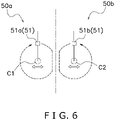
- FIG. 6 is a side view of paths traced by sealing jaws 51, 52.
- the transverse sealing mechanism 50 includes a first sealing mechanism 50a and a second sealing mechanism 50b. It will be noted that the first sealing mechanism 50a is the one positioned on the left side of the tubular film Fm in FIG. 5 and the second sealing mechanism 50b is the one positioned on the right side.
- the sealing jaws 51, 52 have heaters inside. Sealing surfaces of the sealing jaws 51, 52 are heated by the heaters, and the part of the tubular film Fm pinched by the sealing jaws 51, 52 is sealed.
- the sealing jaw 51 of the first sealing mechanism 50a will be called a first sealing j aw 51a and the sealing jaw 51 of the second sealing mechanism 50b will be called a second sealing jaw 51b.
- the first sealing jaw 51a and the second sealing jaw 51b push against each other with the tubular film Fm between them and seal the tubular film Fm.
- the sealing jaw 52 of the first sealing mechanism 50a will be called a first sealing jaw 52a and the sealing jaw 52 of the second sealing mechanism 50b will be called a second sealing jaw 52b.
- the first sealing jaw 52a and the second sealing jaw 52b push against each other with the tubular film Fm between them and seal the tubular film Fm.
- sealing jaws 51, 52 the sealing jaws 51, 52.
- the transverse sealing mechanism 50 is provided with a transverse direction drive mechanism 55 that reciprocally moves the transverse sealing mechanism 50.
- the transverse direction drive mechanism 55 is, for example, a servo motor.
- the transverse sealing mechanism 50 also includes an encoder 56 shown in FIG. 4 .
- the encoder 56 detects the amount of movement of the transverse direction drive mechanism 55.
- the cutting mechanism 60 shown in FIG. 2 cuts the transverse seal portion X shown in FIG. 3 . Specifically, the cutting mechanism 60 cuts the tubular film Fm at the transverse seal portion X that is an end portion of the bag B.
- the cutting mechanism 60 is provided in the transverse sealing mechanism 50.
- the cutting mechanism 60 includes a cutter 61 and a receiver 62.
- the cutter 61 is provided in the first sealing jaws 51.
- the receiver 62 is provided in the second sealing jaws 52.
- the cutter 61 can be extended and retracted.
- the extended cutter 61 is received in the receiver 62.
- the control unit 70 shown in FIG. 4 controls the operation of the conveyance mechanism 30, the longitudinal sealing mechanism 40, the transverse sealing mechanism 50, and the cutting mechanism 60. Furthermore, the control unit 70 sends commands relating to the operation of the weighing machine 2 to a control unit of the weighing machine 2.
- the control unit 70 is realized by a computer.
- the control unit 90 includes a control arithmetic unit and a storage device.
- a processor such as a CPU or a GPU can be used.
- the control arithmetic unit reads programs stored in the storage device and performs predetermined image processing and arithmetic processing in accordance with the programs.
- the control arithmetic unit can write arithmetic results to the storage device and read information stored in the storage device in accordance with the programs.
- the control unit 70 includes a storage unit 71 and a determination unit 72 as shown in FIG. 4 .
- the storage unit 71 has plural determination values relating to the state of jamming.
- the determination unit 72 determines whether or not there is jamming in the transverse seal portion X and, in a case where it has determined that there is jamming, switches between a first bag-making process to continue bag-making operation and a second bag-making process to stop bag-making operation based on the state of jamming.
- the determination unit 72 switches between the first bag-making process and the second bag-making process based on at least two determination values.
- the first bag-making process and the second bag-making process differ from the normal bag-making process.
- jamming in the transverse seal portion X means that a transverse seal portion X having in it something that is normally not there ends up being formed in the tubular film Fm as a result of something that is normally not there (e.g., an article A, etc.) getting caught when the transverse seal portion X is formed.
- the storage unit 71 has plural determination values relating to the state of jamming.
- the storage unit 71 stores plural determination criteria calculated by acquiring information from the transverse sealing mechanism 50.
- the storage unit 71 has a first determination value for performing the first bag-making process (a process for discharging a chain bag) and a second determination value for performing the second bag-making process (a process for stopping bag-making).
- the storage unit 71 has a first determination value for determining a first jamming state and a second determination value for determining a second jamming state.
- the first determination value is a threshold value for determining that something relatively small is entrapped. Cases where something relatively small is entrapped are cases where the effect on quality will be small if bag-making operation are continued.
- jamming of something relatively small examples include jamming of the bag (the tubular film Fm), such as a tuck, and jamming of small articles like powder such as seasoning for the articles A and small articles such as, for example, powder configuring part of the articles A.
- the second determination value is a threshold value for determining that something relatively large is entrapped. Cases where something relatively large is entrapped are cases where the effect on quality will be large if bag-making operation are continued. Examples of jamming of something relatively large include jamming of a large article such as a potato chip or a chocolate as the article A.
- the determination unit 72 determines whether or not an article A or the like is entrapped in the transverse seal portion X based on the plural determination values when the transverse sealing mechanism 50 performs the transverse sealing.
- the determination unit 72 reads the first determination value and the second determination value from the storage unit 71, determines whether or not there is jamming, and, in a case where there is jamming, further determines the state of jamming.
- the determination unit 72 determines that there is jamming of the first jamming state in accordance with the first determination value which is predetermined, the determination unit 72 performs, as the first bag-making process, a process to cease the cutting of the transverse seal portion X by the cutting mechanism 60 and manufacture a chain bag in which a plurality of bags are interconnected.
- the chain bag is easily discriminated as a defective product because its length differs from the length of a normal bag B.
- the chain bag is not limited as long as it is longer than the length of the normal bag B, but preferably it is a chain bag in which two or more bags B are interconnected; here, it is a chain bag in which two bags B are interconnected.
- the determination unit 72 sends to the cutting mechanism 60 a command to cease the cutting of the transverse seal portion X one time.
- the determination unit 72 performs, as the second bag-making process, a process to stop bag-making operation in accordance with the second determination value which is predetermined. In this case, the determination unit 72 sends commands to cease operation to the weighing machine 2, the conveyance mechanism 30, the longitudinal sealing mechanism 40, the transverse sealing mechanism 50, and the cutting mechanism 60.
- At least one of the first bag-making process and the second bag-making process includes a process to change the bag-making capacity.
- at least one of the first bag-making process and the second bag-making process includes a process to automatically change the bag-making capacity. That is, the determination unit 72 performs a process to change the bag-making capacity after it has performed a process to manufacture a chain bag as the first bag-making process and/or after it has performed a process to stop bag-making operation as the second bag-making process. In this embodiment, when the determination unit 72 determines that there is jamming of something relatively small, the determination unit 72 performs a process to manufacture a chain bag as the first bag-making process and thereafter changes the bag-making capacity based on settings in a setting unit 73 described later.
- Changing the bag-making capacity includes, for example, changing the number of bags B manufactured per minute, changing the timing when the articles A are input from the upstream weighing machine 2, and changing the timing when the transverse seal portion X is formed by the transverse sealing mechanism 50.
- FIG. 7 is a flowchart showing control steps executed by the control unit 70.
- FIG. 8 is a drawing for describing control by the control unit 70. In FIG. 8 , the horizontal axis represents elapsed time and the vertical axis represents the jamming measurement value (unit: pulse) when transverse sealing has been performed.
- the storage unit 71 has the first determination value for determining that something relatively small, such as the tubular film Fm is entrapped (a tuck) and the second determination value for determining that something relatively large, like an article A such as a chocolate and not powder, is entrapped.
- the first determination value and the second determination value are set based on average values of measurement values of the transverse seal portion X before normal bag-making operation (during a test run), for example.
- the determination unit 72 can also read the first determination value and the second determination value from the storage unit 71 and, during normal bag-making operation (running) of the bag-making and packaging machine 100, correct the first determination value and the second determination value from moving average values of each transverse seal portion X.
- the second determination value for determining that something relatively large is entrapped is greater than the first determination value for determining that something relatively small is entrapped.
- the determination unit 72 acquires the jamming measurement value from the encoder 56 when the transverse seal portion X has been formed (step S1) and determines whether or not the jamming measurement value exceeds the first determination value and the second determination value (steps S2 and S5).
- the determination unit 72 determines whether or not the jamming measurement value is greater than the second determination value (step S2).
- the determination unit 72 determines that an article A is entrapped and performs, as the second bag-making process, a process to stop bag-making operation (step S3).
- the user can, for example, clean the sealing jaws 51, 52 and the cutter 61.
- the control unit 70 resumes bag-making operation.
- the determination unit 72 changes the bag-making capacity (step S4).
- the determination unit 72 changes the timing when the transverse seal portion X is formed by the transverse sealing mechanism 50.
- the determination unit 72 can also change the first determination value and the second determination value after bag-making operation has resumed.
- the determination unit 72 sets the first determination value and the second determination value higher than they were before bag-making operation was stopped.
- the determination unit 72 determines whether or not the jamming measurement value is greater than the first determination value (step S5).
- the determination unit 72 determines that, for example, there is a tuck in the transverse seal portion X and performs, as the first bag-making process, a process to cease the cutting of the transverse seal portion X by the cutting mechanism 60 and manufacture a chain bag in which a plurality of bags B are interconnected (step S6).
- step S7 the determination unit 72 lowers the bag-making capacity based on settings in the setting unit 73 without stopping bag-making operation.
- step S7 the determination unit 72 sends a command to the weighing machine 2, the conveyance mechanism 30, the longitudinal sealing mechanism 40, the transverse sealing mechanism 50, and the cutting mechanism 60 to reduce the number of bags B manufactured per minute.
- step S5 When the acquired jamming measurement value is equal to or less than the first determination value in step S5, the determination unit 72 determines that there is not jamming and continues normal bag-making operation (step S8).
- the setting unit 73 sets the bag-making capacity.
- the setting unit 73 sets how the bag-making capacity is to be changed after at least one of the first bag-making process and the second bag-making process has been performed by the control unit 70.
- the setting unit 73 is an operation member to which the user can input information and the like, such as a touch panel for example.
- the setting unit 73 of this embodiment can also set bag-making operation of the bag-making and packaging machine 100 and at least two determination values.
- the setting unit 73 sends to the control unit 70 the information that has been set.
- the sheet-like film F supplied from the film supply mechanism 10 is conveyed by the conveyance mechanism 30 to the forming mechanism 20.
- the sheet-like film F is passed through a gap between the sailor collar 21 and the tube 22.
- the sheet-like film F is bent into a tubular shape by the sailor collar 21, and the film F formed into a tubular shape is guided by the tube 22.
- the articles A weighed by the weighing machine 2 are sequentially dropped into the upper open end of the tube 22.
- the outer periphery of the tube 22 is covered by the tubular film Fm for packaging the articles A.
- the tubular film Fm formed by the forming mechanism 20 is conveyed downward by the conveyance mechanism 30, and the overlapping portion of the tubular film Fm is sealed in the longitudinal direction by the longitudinal sealing mechanism 40.
- the tubular film Fm in which the longitudinal seal portion Y has been formed by the longitudinal sealing mechanism 40 is conveyed further downward by the conveyance mechanism 30, and the portion of the tubular film Fm that becomes the upper and lower ends of the bags B is sealed in the transverse direction by the transverse sealing mechanism 50.
- the bag B in which the transverse seal portion X has been formed by the transverse sealing mechanism 50 is cut in the transverse direction at the transverse seal portion X by the cutter 61 of the cutting mechanism 60, whereby the bag B is manufactured.
- the control unit 70 determines whether or not there is jamming in the transverse seal portion X and, in a case where it has determined that there is jamming, switches between the first bag-making process to continue bag-making operation and the second bag-making process to stop bag-making operation based on the state of jamming. Bags B that have been determined by the control unit 70 to not have jamming in their transverse seal portion X are regarded as products. Bags B that have been determined by the control unit 70 to have something small entrapped in their transverse seal portion X are manufactured as a chain bag as the first bag-making process and removed as defective products. Furthermore, bags B that have been determined by the control unit 70 to have something large entrapped in their transverse seal portion X are removed as defective products, with bag-making operation by the bag-making and packaging machine 100 being stopped as the second bag-making process.
- the bag-making and packaging machine 100 pertaining to this embodiment forms the sheet-like film F into a tubular shape and transversely seals the film F to thereby manufacture bags containing the articles A, the bag-making and packaging machine 100 including the transverse sealing mechanism 50 and the control unit 70.
- the transverse sealing mechanism 50 pinches and transversely seals the tubular film Fm that has been formed into a tubular shape to form the transverse seal portion X.
- the control unit 70 determines whether or not there is jamming in the transverse seal portion X and, in a case where it has determined that there is jamming, switches between the first bag-making process to continue bag-making operation and the second bag-making process to stop bag-making operation based on the state of jamming.
- the tubular film Fm may tear and the articles A may come out of the tubular film Fm and stick to the sealing jaws 51, 52 and the cutter 61.
- the control unit 70 performs the second bag-making process to stop bag-making operation in order to inhibit a reduction in quality caused by something large being entrapped in the transverse seal portion X.
- the control unit 70 stops bag-making operation, so the user can clean the sealing jaws 51, 52 and the cutter 61. For this reason, the articles A can be inhibited from sticking to the bags B that are manufactured after something large is entrapped, so a reduction in the quality of the bags B that are manufactured can be inhibited.
- the control unit 70 performs the first bag-making process to continue (not stop) bag-making operation in order to inhibit a reduction in the operating rate in a case where the effect on the quality of the bags B will be small even if the articles A stick to the sealing jaws 51, 52.
- the bag-making and packaging machine 100 of this embodiment can perform the first bag-making process for inhibiting a reduction in the operating rate and the second bag-making process for inhibiting a reduction in quality based on the state of jamming. Consequently, a reduction in the quality of the bags B that are manufactured can be inhibited and a reduction in the operating rate of the bag-making and packaging machine 100 can be inhibited.
- control unit 70 switches between the first bag-making process and the second bag-making process based on at least two determination values.
- control unit 70 has plural determination values relating to the state of jamming. For this reason, by setting a determination value for when something relatively large is entrapped and a determination value for when something relatively small is entrapped, the state of jamming can be easily determined based on the plural determination values.
- the bag-making and packaging machine 100 further includes the cutting mechanism 60 that cuts the transverse seal portion X.
- the control unit 70 performs, as the first bag-making process, a process to cease the cutting of the transverse seal portion X by the cutting mechanism 60 and manufacture a chain bag in which a plurality of bags B are interconnected.
- control unit 70 manufactures a chain bag without stopping bag-making operation when the state of jamming is one where something relatively small is entrapped.
- At least one of the first bag-making process and the second bag-making process includes a process to change the bag-making capacity.
- control unit 70 performs a process to automatically change the bag-making capacity after it has performed a process to manufacture a chain bag as the first bag-making process and/or after it has performed a process to stop bag-making operation as the second bag-making process. Because of this, occurrences of jamming when the transverse seal portion X is formed thereafter can be reduced.
- Example modifications of the embodiment will be described below. It will be noted that some or all of the content of each example modification can also be combined with the content of the embodiment and/or the content of another example modification to the extent that they are not mutually incompatible.
- control unit 70 switches between two processes, the first bag-making process and the second bag-making process, based on the state of jamming, but the control unit of the invention is not limited to this and can also switch between three or more mutually different bag-making processes.
- control unit 70 switches between the first bag-making process and the second bag-making process based on two determination values, but the control unit of the invention is not limited to this and can also have three or more determination values.
- control unit 70 has a third determination value for performing a third bag-making process different from the first and second bag-making processes.
- the control unit 70 performs the third bag-making process in accordance with the third determination value which is predetermined.
- the third bag-making process continues bag-making operation.
- the control unit 70 performs, as the third bag-making process, a process to manufacture the bag B as a product and leave a history of the occurrence of jamming.
- the third determination value is smaller than the first determination value.
- the third determination value is set to determine a state in which something smaller than in the jamming determined by the first determination value is entrapped.
- the determination unit 72 discharges the bag B not as a defective product but as a product and causes the storage unit 71 to store a history of the occurrence of a small jamming. It will be noted that the determination unit 72 can also issue a notification that the acquired jamming measurement value is equal to or greater than the third determination value.
- the first bag-making process is a process to cease the cutting of the transverse seal portion X by the cutting mechanism 60 and manufacture a chain bag in which a plurality of bags B are interconnected, but the first bag-making process is not limited to this.
- the first bag-making process continues normal bag-making operation for manufacturing the bags B without manufacturing a chain bag and displays an indication that the first determination value has been exceeded.
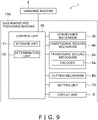
- FIG. 9 is a block diagram of the bag-making and packaging machine of this example modification.
- the control unit 70 causes a display unit 3 to display an indication that the first determination value has been exceeded as the first bag-making process.
- the control unit 70 causes the display unit 3 to display an indication thereof.
- the bag-making and packaging machine 100 further includes the display unit 3 shown in FIG. 1 .
- the display unit 3 is, for example, a touch panel.
- the display unit 3 can be a member different from the setting unit 73, but in this example modification they are the same member.
- the control unit 70 sends a command to the display unit 3 to display an indication that the first determination value or the second determination value determined by the determination unit 72 of the control unit 70 has been exceeded.
- the display unit 3 receiving the command from the determination unit 72 displays a graph such as shown in FIG. 8 . Specifically, the display unit 3 displays a line graph where the horizontal axis represents time and the vertical axis represents jamming measurement values of each bag B that has been manufactured.
- the determination unit 72 can also display, instead of a graph, an error number or a message indicating that the first determination value or the second determination value has been exceeded.
- the information displayed on the display unit 3 is left in a production record as a record of jamming occurrences. That is, the determination unit 72 causes the storage unit 71 to store a record of what it has determined.
- the display unit 3 that displays an indication that the first determination value or the second determination value has been exceeded can be provided in the bag-making and packaging machine 100 or, rather than not being provided in the bag-making and packaging machine 100, can be a terminal device separate from the bag-making and packaging machine 100.
- the first bag-making process displays an indication that the first determination value has been exceeded. Because of this, different displays can be performed based on the state of jamming. For this reason, the user can be made aware of the state of jamming.
- the first bag-making process can also continue bag-making operation for manufacturing a chain bag and display an indication that the first determination value has been exceeded.
- control unit 70 displays an indication and causes the storage unit 71 to store the record that the first determination value has been exceeded, but the control unit 70 is not limited to this. In this example modification, when the first determination value has been exceeded, the control unit 70 issues an alert indicating that.
- the first bag-making process is a process to cease the cutting of the transverse seal portion X by the cutting mechanism 60 and manufacture a chain bag in which a plurality of bags B are interconnected, but the first bag-making process is not limited to this.
- the control unit 70 prints a mark on the bag B as the first bag-making process.
- the bag-making and packaging machine 100 further includes a printing unit that prints a mark on the bag B.
- the bag B on which the mark has been printed can easily be discriminated as a defective product and removed downstream.
- the first bag-making process is a process to manufacture a chain bag in which a plurality of bags B are interconnected and a process to print a mark on the bag B, but the first bag-making process is not limited to this.
- the control unit 70 discharges, to the outside of the path, a bag B in which jamming t has occurred.
- the packaging machine 1 includes a production line that conveys the bags B and a discharge unit that removes defective bags B from the production line.
- the packaging machine 1 also discharges, to the outside of the production line, bags B having something entrapped in their transverse seal portion. Because of this, defective bags B can be easily discovered.
Landscapes
- Engineering & Computer Science (AREA)
- Mechanical Engineering (AREA)
- Quality & Reliability (AREA)
- Containers And Plastic Fillers For Packaging (AREA)
Abstract
Description
- This application claims priority to
Japanese Patent Application No. 2021-110358, filed July 1, 2021 - The present invention relates to a bag-making and packaging machine.
- A bag-making and packaging machine is known which, as disclosed in
JP-A No. 2016-107997 JP-A No. 2016-107997 - However, the present inventor discovered the problem that there are cases where there is a reduction in the quality of the bags manufactured by the bag-making and packaging machine of patent document 1 and cases where there is a reduction in the operating rate of the bag-making and packaging machine.
- It is a goal of the present invention to provide a bag-making and packaging machine that inhibits a reduction in the quality of the bag it manufactures and inhibits a reduction in its operating rate.
- A bag-making and packaging machine pertaining to a first aspect of the present invention forms a sheet-like film into a tubular shape and transversely seals the film to thereby manufacture a bag containing an article, the bag-making and packaging machine including a transverse sealing mechanism and a control unit. The transverse sealing mechanism pinches and transversely seals the tubular film that has been formed into a tubular shape to form a transverse seal portion. The control unit determines whether or not there is jamming in the transverse seal portion and, in a case where it has determined that there is jamming, switches between a first bag-making process to continue bag-making operation and a second bag-making process to stop bag-making operation based on the state of jamming.
- The present inventor discovered that the problem that there are cases where there is a reduction in the quality of the bag manufactured by the bag-making and packaging machine of patent document 1 and cases where there is a reduction in the operating rate of the bag-making and packaging machine is based on the following primary cause. Specifically, in a case where a bag is determined to have a seal defect and is made into a chain bag, if the bag tears and an article comes out from the bag the article sticks to a member that perform transverse sealing. If the manufacturing of the bag is continued in this state, the article sticks to the bag that is subsequently manufactured and the quality of the bag is reduced. If, to prevent this, bag-making operation by the bag-making and packaging machine are stopped when a bag is determined to have a seal defect, the operating rate ends up being reduced.
- Thus, as a result of diligent consideration to achieve a balance between inhibiting a reduction in quality and inhibiting a reduction in the operating rate, the present inventor came upon the idea of changing, in a case where it has been determined that there is jamming of an article when transverse sealing has been performed, the bag-making process based on the state of jamming, and thus completed the present invention.
- The bag-making and packaging machine of the first aspect includes the control unit that switches between the first bag-making process to continue bag-making operation and the second bag-making process to stop bag-making operation based on the state of jamming. For this reason, the control unit can perform the first bag-making process for inhibiting a reduction in the operating rate and the second bag-making process for inhibiting a reduction in quality based on the state of jamming. Consequently, there can be provided a bag-making and packaging machine that inhibits a reduction in the quality of the bags it manufactures and inhibits a reduction in its operating rate.
- A bag-making and packaging machine pertaining to a second aspect of the present invention is the bag-making and packaging machine pertaining to the first aspect, wherein the control unit switches between the first bag-making process and the second bag-making process based on at least two determination values.
- In the bag-making and packaging machine pertaining to the second aspect, the control unit has determination values relating to the state of jamming. For this reason, by setting a determination value for when something relatively large is entrapped and a determination value for when something relatively small is entrapped (jammed), the state of jamming can be easily determined based on the plural determination values.
- A bag-making and packaging machine pertaining to a third aspect of the present invention is the bag-making and packaging machine pertaining to the first aspect or the second aspect, further including a cutting mechanism that cuts the transverse seal portion. The control unit performs, as the first bag-making process, a process to cease the cutting of the transverse seal portion by the cutting mechanism and manufacture a chain bag in which a plurality of bags are interconnected.
- In the bag-making and packaging machine pertaining to the third aspect, when the state of jamming is one where something relatively small is entrapped, the control unit manufactures a chain bag without stopping bag-making operation. In this way, in the case of small jamming, a reduction in the operating rate can be inhibited because the control unit continues bag-making operation. Furthermore, by making into a chain bag with a bag having something entrapped in its transverse seal portion, the bag can be easily discriminated as a defective product.
- A bag-making and packaging machine pertaining to a fourth aspect of the present invention is the bag-making and packaging machine pertaining to the first aspect to the third aspect, wherein at least one of the first bag-making process and the second bag-making process includes a process to change the bag-making capacity.
- In the bag-making and packaging machine pertaining to the fourth aspect, the control unit performs a process to automatically change the bag-making capacity after it has performed a process to manufacture a chain bag, for example, as the first bag-making process, and/or after it has performed a process to stop bag-making operation, for example, as the second bag-making process. Because of this, occurrences of jamming can be reduced.
- A bag-making and packaging machine pertaining to a fifth aspect of the present invention is the bag-making and packaging machine pertaining to the second aspect, wherein the first bag-making process displays an indication that a first determination value has been exceeded.
- In the bag-making and packaging machine of the fifth aspect, a display of an indication that the first determination value has been exceeded can be performed while bag-making operation is continued based on the state of jamming. For this reason, the user can be made aware of the state of jamming.
- According to the present invention, there can be provided a bag-making and packaging machine that inhibits a reduction in the quality of the bags it manufactures and inhibits a reduction in its operating rate.
-
-
FIG. 1 is a perspective view of a packaging machine including a bag-making and packaging machine of an embodiment; -
FIG. 2 is a schematic diagram of the packaging machine including the bag-making and packaging machine of the embodiment; -
FIG. 3 is a schematic diagram showing bags manufactured in the embodiment; -
FIG. 4 is a block diagram of the bag-making and packaging machine of the embodiment; -
FIG. 5 is a side view of a transverse sealing mechanism of the embodiment; -
FIG. 6 is a side view of paths traced by sealing jaws of the embodiment; -
FIG. 7 is a flowchart showing control steps executed by a control unit of the embodiment; -
FIG. 8 is a drawing for describing switching between a first bag-making process and a second bag-making process by the control unit of the embodiment; and -
FIG. 9 is a block diagram of the bag-making and packaging machine of an example modification. - A bag-making and
packaging machine 100 pertaining to an embodiment of the present invention will be described below. It will be noted that, in the following description, expressions such as "front (front-facing)," "rear (back-facing)," "upper," "lower," "left," and "right" are sometimes used to indicate directions and the like. Unless otherwise specified, "front," "rear," "upper," "lower," "left," and "right" here follow the directions of the arrows added to the drawings. -
FIG. 1 is a perspective view of a packaging machine 1 including a bag-making andpackaging machine 100 of this embodiment.FIG. 2 is a schematic diagram of the packaging machine 1 including the bag-making andpackaging machine 100 of this embodiment. InFIG. 1 andFIG. 2 , the packaging machine 1 includes aweighing machine 2 and the bag-making andpackaging machine 100. - As shown in
FIG. 1 andFIG. 2 , theweighing machine 2 weighs one or more articles A that become put into each bag B. The articles A are not particularly limited; here, they are articles such as potato chips or chocolates, for example. The bag-making andpackaging machine 100 is installed under theweighing machine 2. The bag-making andpackaging machine 100 receives the articles A from theweighing machine 2 and packages the articles A in a film F that has been formed into a tubular shape (hereafter also called "the tubular film Fm") to thereby manufacture one or more bags B shown inFIG. 3. FIG. 3 is a schematic diagram of the bags B manufactured by the bag-making andpackaging machine 100 of this embodiment, and shows two bags B. - The bag-making and
packaging machine 100 includes afilm supply mechanism 10, a formingmechanism 20,conveyance mechanism 30, alongitudinal sealing mechanism 40, atransverse sealing mechanism 50, and acutting mechanism 60, which are shown inFIG. 1 andFIG. 2 , and acontrol unit 70, which is shown inFIG. 4 . It will be noted thatFIG. 4 is a block diagram of the bag-making andpackaging machine 100 of this embodiment. - The
film supply mechanism 10 supplies a sheet-like film F that becomes made into the bags B to the formingmechanism 20. The formingmechanism 20 forms the sheet-like film F fed thereto into a tubular shape. Theconveyance mechanism 30 convey downward the film F that has become a tubular shape (the tubular film Fm). Thelongitudinal sealing mechanism 40 longitudinally seals the tubular film Fm that has been formed into a tubular shape to thereby form a longitudinal seal portion Y shown inFIG. 3 . Thetransverse sealing mechanism 50 seals upper and lower ends of the bags B by pinching and transversely sealing the tubular film Fm to form a transverse seal portion X shown inFIG. 3 . Thecutting mechanism 60 cuts the upper and lower ends of the bags B. Thecontrol unit 70 determines whether or not there is jamming in the transverse seal portion X and, in a case where it has determined that there is jamming, switches between a first bag-making process to continue bag-making operation and a second bag-making process to stop bag-making operation based on the state of jamming. - The
film supply mechanism 10 shown inFIG. 1 andFIG. 2 supplies the sheet-like film F to the formingmechanism 20. A film roll R in which the film F is wound is set in thefilm supply mechanism 10, and the film F is paid out from the film roll R. The material of the film F is not particularly limited and, for example, includes plastic material and paper material. - The forming
mechanism 20 is a forming mechanism that forms the sheet-like film F into a tubular shape. As shown inFIG. 2 , the formingmechanism 20 has asailor collar 21 and atube 22. Thetube 22 extends in the up and down direction. Thetube 22 is a partially tubular member, and its upper and lower ends are open. The articles A weighed by the weighingmachine 2 are input to the opening in the upper end of thetube 22. - The
sailor collar 21 is disposed surrounding thetube 22. The sheet-like film F supplied from thefilm supply mechanism 10 is formed into a tubular shape when it passes between thesailor collar 21 and thetube 22. Thesailor collar 21 and thetube 22 can be replaced in accordance with the size of the bags B that are manufactured. - The
conveyance mechanism 30 conveys the tubular film Fm. Here, theconveyance mechanism 30 conveys the film F pulled out from the film roll R to thesailor collar 21. Furthermore, theconveyance mechanism 30 conveys the tubular film Fm formed by thesailor collar 21 to thetransverse sealing mechanism 50. Theconveyance mechanism 30 sucks hold of, and convey downward, the tubular film Fm wrapped around thetube 22. - The
conveyance mechanism 30 is disposed under thesailor collar 21. Furthermore, theconveyance mechanism 30 is disposed on the left side (not shown in the drawings) and the right side of thetube 22 respectively. - The
conveyance mechanism 30 each has abelt 31, adrive roller 32, and afollower roller 33. Thebelt 31 has a sucking function. Thebelt 31 is entrained about thedrive roller 32 and thefollower roller 33. Thedrive roller 32 is coupled to a roller drive motor (not shown in the drawings) and is driven by the roller drive motor. When thedrive roller 32 is driven by the drive motor in a state in which thebelt 31 is sucking hold of the film F, the tubular film Fm is conveyed downward. - The
longitudinal sealing mechanism 40 seals an overlapping portion of the tubular film Fm in the longitudinal direction (the up and down direction inFIG. 2 ) to form the longitudinal seal portion Y shown inFIG. 3 . Thelongitudinal sealing mechanism 40 longitudinally seals the overlapping portion of the tubular film Fm wrapped around thetube 22 by applying heat to the overlapping portion while pressing it with a predetermined pressure against thetube 22. - The
longitudinal sealing mechanism 40 is positioned on the front-facing (front) side of thetube 22 and has a heater and a heater belt that is heated by the heater and contacts the seam of the tubular film Fm. Thelongitudinal sealing mechanism 40 also has a drive device (not shown in the drawings) for moving the heater belt toward and away from thetube 22. - The
transverse sealing mechanism 50 is disposed under thetube 22. Thetransverse sealing mechanism 50 transversely seals the tubular film Fm in a direction intersecting (inFIG. 2 , orthogonal to) the conveyance direction of the tubular film Fm. Here, thetransverse sealing mechanism 50 seals the bags B by sealing, in the transverse direction, the portion of the tubular film Fm that becomes the upper and lower ends of the bags. -
FIG. 5 is a side view of thetransverse sealing mechanism 50.FIG. 6 is a side view of paths traced by sealingjaws FIG. 5 , thetransverse sealing mechanism 50 includes afirst sealing mechanism 50a and asecond sealing mechanism 50b. It will be noted that thefirst sealing mechanism 50a is the one positioned on the left side of the tubular film Fm inFIG. 5 and thesecond sealing mechanism 50b is the one positioned on the right side. - The
first sealing mechanism 50a and thesecond sealing mechanism 50b pinch the tubular film Fm while their sealingjaws FIG. 6 ). - The sealing
jaws jaws jaws - Here, for convenience of description, the sealing
jaw 51 of thefirst sealing mechanism 50a will be called a first sealing j aw 51a and the sealingjaw 51 of thesecond sealing mechanism 50b will be called asecond sealing jaw 51b. Thefirst sealing jaw 51a and thesecond sealing jaw 51b push against each other with the tubular film Fm between them and seal the tubular film Fm. - Similarly, the sealing
jaw 52 of thefirst sealing mechanism 50a will be called afirst sealing jaw 52a and the sealingjaw 52 of thesecond sealing mechanism 50b will be called asecond sealing jaw 52b. Thefirst sealing jaw 52a and thesecond sealing jaw 52b push against each other with the tubular film Fm between them and seal the tubular film Fm. - It will be noted that when referring to matters common to all the sealing jaws, the sealing jaws are called "the sealing
jaws - The sealing
jaws first sealing jaws second sealing jaws - Furthermore, as shown in
FIG. 5 , thetransverse sealing mechanism 50 is provided with a transversedirection drive mechanism 55 that reciprocally moves thetransverse sealing mechanism 50. The transversedirection drive mechanism 55 is, for example, a servo motor. - The
transverse sealing mechanism 50 also includes anencoder 56 shown inFIG. 4 . Theencoder 56 detects the amount of movement of the transversedirection drive mechanism 55. - The
cutting mechanism 60 shown inFIG. 2 cuts the transverse seal portion X shown inFIG. 3 . Specifically, thecutting mechanism 60 cuts the tubular film Fm at the transverse seal portion X that is an end portion of the bag B. - As shown in
FIG. 2 , thecutting mechanism 60 is provided in thetransverse sealing mechanism 50. Thecutting mechanism 60 includes acutter 61 and areceiver 62. Thecutter 61 is provided in the first sealingjaws 51. Thereceiver 62 is provided in thesecond sealing jaws 52. Thecutter 61 can be extended and retracted. Theextended cutter 61 is received in thereceiver 62. By extending thecutter 61, the tubular film Fm is cut in the transverse direction at the transverse seal portion X in the middle of the conveyance direction of the tubular film Fm. - The
control unit 70 shown inFIG. 4 controls the operation of theconveyance mechanism 30, thelongitudinal sealing mechanism 40, thetransverse sealing mechanism 50, and thecutting mechanism 60. Furthermore, thecontrol unit 70 sends commands relating to the operation of the weighingmachine 2 to a control unit of the weighingmachine 2. - The
control unit 70 is realized by a computer. The control unit 90 includes a control arithmetic unit and a storage device. For the control arithmetic unit, a processor such as a CPU or a GPU can be used. The control arithmetic unit reads programs stored in the storage device and performs predetermined image processing and arithmetic processing in accordance with the programs. Moreover, the control arithmetic unit can write arithmetic results to the storage device and read information stored in the storage device in accordance with the programs. - The
control unit 70 includes astorage unit 71 and adetermination unit 72 as shown inFIG. 4 . Thestorage unit 71 has plural determination values relating to the state of jamming. Thedetermination unit 72 determines whether or not there is jamming in the transverse seal portion X and, in a case where it has determined that there is jamming, switches between a first bag-making process to continue bag-making operation and a second bag-making process to stop bag-making operation based on the state of jamming. Here, thedetermination unit 72 switches between the first bag-making process and the second bag-making process based on at least two determination values. The first bag-making process and the second bag-making process differ from the normal bag-making process. - It will be noted that "jamming in the transverse seal portion X" means that a transverse seal portion X having in it something that is normally not there ends up being formed in the tubular film Fm as a result of something that is normally not there (e.g., an article A, etc.) getting caught when the transverse seal portion X is formed.
- The
storage unit 71 has plural determination values relating to the state of jamming. Thestorage unit 71 stores plural determination criteria calculated by acquiring information from thetransverse sealing mechanism 50. - In this embodiment, the
storage unit 71 has a first determination value for performing the first bag-making process (a process for discharging a chain bag) and a second determination value for performing the second bag-making process (a process for stopping bag-making). In other words, thestorage unit 71 has a first determination value for determining a first jamming state and a second determination value for determining a second jamming state. The first determination value is a threshold value for determining that something relatively small is entrapped. Cases where something relatively small is entrapped are cases where the effect on quality will be small if bag-making operation are continued. Examples of jamming of something relatively small include jamming of the bag (the tubular film Fm), such as a tuck, and jamming of small articles like powder such as seasoning for the articles A and small articles such as, for example, powder configuring part of the articles A. The second determination value is a threshold value for determining that something relatively large is entrapped. Cases where something relatively large is entrapped are cases where the effect on quality will be large if bag-making operation are continued. Examples of jamming of something relatively large include jamming of a large article such as a potato chip or a chocolate as the article A. - The
determination unit 72 determines whether or not an article A or the like is entrapped in the transverse seal portion X based on the plural determination values when thetransverse sealing mechanism 50 performs the transverse sealing. Here, thedetermination unit 72 reads the first determination value and the second determination value from thestorage unit 71, determines whether or not there is jamming, and, in a case where there is jamming, further determines the state of jamming. - When the
determination unit 72 determines that there is jamming of the first jamming state in accordance with the first determination value which is predetermined, thedetermination unit 72 performs, as the first bag-making process, a process to cease the cutting of the transverse seal portion X by thecutting mechanism 60 and manufacture a chain bag in which a plurality of bags are interconnected. The chain bag is easily discriminated as a defective product because its length differs from the length of a normal bag B. The chain bag is not limited as long as it is longer than the length of the normal bag B, but preferably it is a chain bag in which two or more bags B are interconnected; here, it is a chain bag in which two bags B are interconnected. In this case, thedetermination unit 72 sends to the cutting mechanism 60 a command to cease the cutting of the transverse seal portion X one time. - Furthermore, the
determination unit 72 performs, as the second bag-making process, a process to stop bag-making operation in accordance with the second determination value which is predetermined. In this case, thedetermination unit 72 sends commands to cease operation to the weighingmachine 2, theconveyance mechanism 30, thelongitudinal sealing mechanism 40, thetransverse sealing mechanism 50, and thecutting mechanism 60. - At least one of the first bag-making process and the second bag-making process includes a process to change the bag-making capacity. Here, at least one of the first bag-making process and the second bag-making process includes a process to automatically change the bag-making capacity. That is, the
determination unit 72 performs a process to change the bag-making capacity after it has performed a process to manufacture a chain bag as the first bag-making process and/or after it has performed a process to stop bag-making operation as the second bag-making process. In this embodiment, when thedetermination unit 72 determines that there is jamming of something relatively small, thedetermination unit 72 performs a process to manufacture a chain bag as the first bag-making process and thereafter changes the bag-making capacity based on settings in asetting unit 73 described later. - Changing the bag-making capacity includes, for example, changing the number of bags B manufactured per minute, changing the timing when the articles A are input from the
upstream weighing machine 2, and changing the timing when the transverse seal portion X is formed by thetransverse sealing mechanism 50. - Here, with reference to
FIG. 7 andFIG. 8 , an example will be described where thecontrol unit 70 determines the state of jamming based on the amount of movement of the servo motor serving as the transversedirection drive mechanism 55 that drives the sealingjaws encoder 56, as the plural determination values.FIG. 7 is a flowchart showing control steps executed by thecontrol unit 70.FIG. 8 is a drawing for describing control by thecontrol unit 70. InFIG. 8 , the horizontal axis represents elapsed time and the vertical axis represents the jamming measurement value (unit: pulse) when transverse sealing has been performed. - The
storage unit 71 has the first determination value for determining that something relatively small, such as the tubular film Fm is entrapped (a tuck) and the second determination value for determining that something relatively large, like an article A such as a chocolate and not powder, is entrapped. The first determination value and the second determination value are set based on average values of measurement values of the transverse seal portion X before normal bag-making operation (during a test run), for example. - It will be noted that the
determination unit 72 can also read the first determination value and the second determination value from thestorage unit 71 and, during normal bag-making operation (running) of the bag-making andpackaging machine 100, correct the first determination value and the second determination value from moving average values of each transverse seal portion X. - When something relatively large is entrapped when the transverse seal portion X is formed, the torque of the servo motor becomes larger and the pulse number becomes larger. When something relatively small is entrapped when the transverse seal portion X is formed, the torque of the servo motor becomes smaller and the pulse number becomes smaller. For this reason, the second determination value for determining that something relatively large is entrapped is greater than the first determination value for determining that something relatively small is entrapped.
- As shown in
FIG. 7 , thedetermination unit 72 acquires the jamming measurement value from theencoder 56 when the transverse seal portion X has been formed (step S1) and determines whether or not the jamming measurement value exceeds the first determination value and the second determination value (steps S2 and S5). - Here, the
determination unit 72 determines whether or not the jamming measurement value is greater than the second determination value (step S2). When the acquired jamming measurement value exceeds the second determination value in step S2 (time t3 inFIG. 8 ), thedetermination unit 72 determines that an article A is entrapped and performs, as the second bag-making process, a process to stop bag-making operation (step S3). After bag-making operation is stopped (step S3), the user can, for example, clean the sealingjaws cutter 61. Then, thecontrol unit 70 resumes bag-making operation. At this time (t4 inFIG. 8 ), thedetermination unit 72 changes the bag-making capacity (step S4). In step S4, thedetermination unit 72 changes the timing when the transverse seal portion X is formed by thetransverse sealing mechanism 50. - It will be noted that the
determination unit 72 can also change the first determination value and the second determination value after bag-making operation has resumed. Here, considering that the tubular film Fm becomes stiffer due to bag-making operation being stopped, thedetermination unit 72 sets the first determination value and the second determination value higher than they were before bag-making operation was stopped. - Next, the
determination unit 72 determines whether or not the jamming measurement value is greater than the first determination value (step S5). When the acquired jamming measurement value is equal to or less than the second determination value and exceeds the first determination value (times t1, t2, and t5 inFIG. 8 ) in step S5, thedetermination unit 72 determines that, for example, there is a tuck in the transverse seal portion X and performs, as the first bag-making process, a process to cease the cutting of the transverse seal portion X by thecutting mechanism 60 and manufacture a chain bag in which a plurality of bags B are interconnected (step S6). Thereafter, thedetermination unit 72 lowers the bag-making capacity based on settings in thesetting unit 73 without stopping bag-making operation (step S7). In step S7, thedetermination unit 72 sends a command to the weighingmachine 2, theconveyance mechanism 30, thelongitudinal sealing mechanism 40, thetransverse sealing mechanism 50, and thecutting mechanism 60 to reduce the number of bags B manufactured per minute. - When the acquired jamming measurement value is equal to or less than the first determination value in step S5, the
determination unit 72 determines that there is not jamming and continues normal bag-making operation (step S8). - The setting
unit 73 sets the bag-making capacity. Here, the settingunit 73 sets how the bag-making capacity is to be changed after at least one of the first bag-making process and the second bag-making process has been performed by thecontrol unit 70. - The setting
unit 73 is an operation member to which the user can input information and the like, such as a touch panel for example. The settingunit 73 of this embodiment can also set bag-making operation of the bag-making andpackaging machine 100 and at least two determination values. The settingunit 73 sends to thecontrol unit 70 the information that has been set. - As shown in
FIG. 1 andFIG. 2 , the sheet-like film F supplied from thefilm supply mechanism 10 is conveyed by theconveyance mechanism 30 to the formingmechanism 20. In the formingmechanism 20, the sheet-like film F is passed through a gap between thesailor collar 21 and thetube 22. The sheet-like film F is bent into a tubular shape by thesailor collar 21, and the film F formed into a tubular shape is guided by thetube 22. - Meanwhile, the articles A weighed by the weighing
machine 2 are sequentially dropped into the upper open end of thetube 22. At this time, the outer periphery of thetube 22 is covered by the tubular film Fm for packaging the articles A. - The tubular film Fm formed by the forming
mechanism 20 is conveyed downward by theconveyance mechanism 30, and the overlapping portion of the tubular film Fm is sealed in the longitudinal direction by thelongitudinal sealing mechanism 40. The tubular film Fm in which the longitudinal seal portion Y has been formed by thelongitudinal sealing mechanism 40 is conveyed further downward by theconveyance mechanism 30, and the portion of the tubular film Fm that becomes the upper and lower ends of the bags B is sealed in the transverse direction by thetransverse sealing mechanism 50. The bag B in which the transverse seal portion X has been formed by thetransverse sealing mechanism 50 is cut in the transverse direction at the transverse seal portion X by thecutter 61 of thecutting mechanism 60, whereby the bag B is manufactured. - When the
transverse sealing mechanism 50 performs the transverse sealing, thecontrol unit 70 determines whether or not there is jamming in the transverse seal portion X and, in a case where it has determined that there is jamming, switches between the first bag-making process to continue bag-making operation and the second bag-making process to stop bag-making operation based on the state of jamming. Bags B that have been determined by thecontrol unit 70 to not have jamming in their transverse seal portion X are regarded as products. Bags B that have been determined by thecontrol unit 70 to have something small entrapped in their transverse seal portion X are manufactured as a chain bag as the first bag-making process and removed as defective products. Furthermore, bags B that have been determined by thecontrol unit 70 to have something large entrapped in their transverse seal portion X are removed as defective products, with bag-making operation by the bag-making andpackaging machine 100 being stopped as the second bag-making process. - (4-1)
The bag-making andpackaging machine 100 pertaining to this embodiment forms the sheet-like film F into a tubular shape and transversely seals the film F to thereby manufacture bags containing the articles A, the bag-making andpackaging machine 100 including thetransverse sealing mechanism 50 and thecontrol unit 70. Thetransverse sealing mechanism 50 pinches and transversely seals the tubular film Fm that has been formed into a tubular shape to form the transverse seal portion X. Thecontrol unit 70 determines whether or not there is jamming in the transverse seal portion X and, in a case where it has determined that there is jamming, switches between the first bag-making process to continue bag-making operation and the second bag-making process to stop bag-making operation based on the state of jamming. - When a large article A is entrapped when the transverse seal portion X is formed, the tubular film Fm may tear and the articles A may come out of the tubular film Fm and stick to the sealing
jaws cutter 61. In this case, if the manufacturing of the bags B is continued, the articles A sticking to the sealingjaws cutter 61 stick to the bags B that are subsequently manufactured and the quality of the bags B is reduced. To inhibit this, in this embodiment, thecontrol unit 70 performs the second bag-making process to stop bag-making operation in order to inhibit a reduction in quality caused by something large being entrapped in the transverse seal portion X. Specifically, when an article A is entrapped and the articles A come out of the tubular film Fm, thecontrol unit 70 stops bag-making operation, so the user can clean the sealingjaws cutter 61. For this reason, the articles A can be inhibited from sticking to the bags B that are manufactured after something large is entrapped, so a reduction in the quality of the bags B that are manufactured can be inhibited. - If the second bag-making process is always performed in a case where there is jamming in the transverse seal portion X, the operating rate ends up becoming lower. To inhibit this, in this embodiment, the
control unit 70 performs the first bag-making process to continue (not stop) bag-making operation in order to inhibit a reduction in the operating rate in a case where the effect on the quality of the bags B will be small even if the articles A stick to the sealingjaws - In this way, the bag-making and
packaging machine 100 of this embodiment can perform the first bag-making process for inhibiting a reduction in the operating rate and the second bag-making process for inhibiting a reduction in quality based on the state of jamming. Consequently, a reduction in the quality of the bags B that are manufactured can be inhibited and a reduction in the operating rate of the bag-making andpackaging machine 100 can be inhibited. - (4-2)
Furthermore, in this embodiment, thecontrol unit 70 switches between the first bag-making process and the second bag-making process based on at least two determination values. - In this way, the
control unit 70 has plural determination values relating to the state of jamming. For this reason, by setting a determination value for when something relatively large is entrapped and a determination value for when something relatively small is entrapped, the state of jamming can be easily determined based on the plural determination values. - Furthermore, by making the determination values smaller, small jamming can be detected. For this reason, in this embodiment, occurrences of small jamming can be detected.
- (4-3)
Furthermore, in this embodiment, the bag-making andpackaging machine 100 further includes thecutting mechanism 60 that cuts the transverse seal portion X. Thecontrol unit 70 performs, as the first bag-making process, a process to cease the cutting of the transverse seal portion X by thecutting mechanism 60 and manufacture a chain bag in which a plurality of bags B are interconnected. - Here, the
control unit 70 manufactures a chain bag without stopping bag-making operation when the state of jamming is one where something relatively small is entrapped. - In this way, in the case of a small jamming, a reduction in the operating rate can be inhibited because the
control unit 70 continues bag-making operation. Furthermore, by making into a chain bag a bag B having something entrapped in its transverse seal portion, the bag B can be easily discriminated as a defective product and removed downstream. - (4-4)
Furthermore, in this embodiment, at least one of the first bag-making process and the second bag-making process includes a process to change the bag-making capacity. - Here, the
control unit 70 performs a process to automatically change the bag-making capacity after it has performed a process to manufacture a chain bag as the first bag-making process and/or after it has performed a process to stop bag-making operation as the second bag-making process. Because of this, occurrences of jamming when the transverse seal portion X is formed thereafter can be reduced. - Example modifications of the embodiment will be described below. It will be noted that some or all of the content of each example modification can also be combined with the content of the embodiment and/or the content of another example modification to the extent that they are not mutually incompatible.
- In the embodiment, the
control unit 70 switches between two processes, the first bag-making process and the second bag-making process, based on the state of jamming, but the control unit of the invention is not limited to this and can also switch between three or more mutually different bag-making processes. - Furthermore, in the embodiment, the
control unit 70 switches between the first bag-making process and the second bag-making process based on two determination values, but the control unit of the invention is not limited to this and can also have three or more determination values. - In this example modification, the
control unit 70 has a third determination value for performing a third bag-making process different from the first and second bag-making processes. Thecontrol unit 70 performs the third bag-making process in accordance with the third determination value which is predetermined. The third bag-making process continues bag-making operation. Here, thecontrol unit 70 performs, as the third bag-making process, a process to manufacture the bag B as a product and leave a history of the occurrence of jamming. - Specifically, the third determination value is smaller than the first determination value. The third determination value is set to determine a state in which something smaller than in the jamming determined by the first determination value is entrapped. In a case where the acquired jamming measurement value is equal to or less than the first and second determination values and exceeds the third determination value, the
determination unit 72 discharges the bag B not as a defective product but as a product and causes thestorage unit 71 to store a history of the occurrence of a small jamming. It will be noted that thedetermination unit 72 can also issue a notification that the acquired jamming measurement value is equal to or greater than the third determination value. - In the embodiment, the first bag-making process is a process to cease the cutting of the transverse seal portion X by the
cutting mechanism 60 and manufacture a chain bag in which a plurality of bags B are interconnected, but the first bag-making process is not limited to this. In this example modification, the first bag-making process continues normal bag-making operation for manufacturing the bags B without manufacturing a chain bag and displays an indication that the first determination value has been exceeded. -
FIG. 9 is a block diagram of the bag-making and packaging machine of this example modification. In this example modification, as shown inFIG. 9 , thecontrol unit 70 causes adisplay unit 3 to display an indication that the first determination value has been exceeded as the first bag-making process. Here, when the second determination value has been exceeded, thecontrol unit 70 causes thedisplay unit 3 to display an indication thereof. - Specifically, the bag-making and
packaging machine 100 further includes thedisplay unit 3 shown inFIG. 1 . Thedisplay unit 3 is, for example, a touch panel. Thedisplay unit 3 can be a member different from the settingunit 73, but in this example modification they are the same member. - The
control unit 70 sends a command to thedisplay unit 3 to display an indication that the first determination value or the second determination value determined by thedetermination unit 72 of thecontrol unit 70 has been exceeded. Thedisplay unit 3 receiving the command from thedetermination unit 72 displays a graph such as shown inFIG. 8 . Specifically, thedisplay unit 3 displays a line graph where the horizontal axis represents time and the vertical axis represents jamming measurement values of each bag B that has been manufactured. - It will be noted that the
determination unit 72 can also display, instead of a graph, an error number or a message indicating that the first determination value or the second determination value has been exceeded. - The information displayed on the
display unit 3 is left in a production record as a record of jamming occurrences. That is, thedetermination unit 72 causes thestorage unit 71 to store a record of what it has determined. - It will be noted that the
display unit 3 that displays an indication that the first determination value or the second determination value has been exceeded can be provided in the bag-making andpackaging machine 100 or, rather than not being provided in the bag-making andpackaging machine 100, can be a terminal device separate from the bag-making andpackaging machine 100. - As described above, in this example modification, the first bag-making process displays an indication that the first determination value has been exceeded. Because of this, different displays can be performed based on the state of jamming. For this reason, the user can be made aware of the state of jamming.
- It will be noted that the first bag-making process can also continue bag-making operation for manufacturing a chain bag and display an indication that the first determination value has been exceeded.
- In example modification B, as the first bag-making process, the
control unit 70 displays an indication and causes thestorage unit 71 to store the record that the first determination value has been exceeded, but thecontrol unit 70 is not limited to this. In this example modification, when the first determination value has been exceeded, thecontrol unit 70 issues an alert indicating that. - In the embodiment, the first bag-making process is a process to cease the cutting of the transverse seal portion X by the
cutting mechanism 60 and manufacture a chain bag in which a plurality of bags B are interconnected, but the first bag-making process is not limited to this. In this example modification, thecontrol unit 70 prints a mark on the bag B as the first bag-making process. - Specifically, the bag-making and
packaging machine 100 further includes a printing unit that prints a mark on the bag B. The bag B on which the mark has been printed can easily be discriminated as a defective product and removed downstream. - In the embodiment and example modification D, the first bag-making process is a process to manufacture a chain bag in which a plurality of bags B are interconnected and a process to print a mark on the bag B, but the first bag-making process is not limited to this. In this example modification, as the first bag-making process, the
control unit 70 discharges, to the outside of the path, a bag B in which jamming t has occurred. - Specifically, the packaging machine 1 includes a production line that conveys the bags B and a discharge unit that removes defective bags B from the production line. The packaging machine 1 also discharges, to the outside of the production line, bags B having something entrapped in their transverse seal portion. Because of this, defective bags B can be easily discovered.
-
- 1:
- Packaging Machine
- 2:
- Weighing machine
- 10:
- Film Supply Mechanism
- 20:
- Forming Mechanism
- 30:
- Conveyance Mechanism
- 40:
- Longitudinal Sealing Mechanism
- 50:
- Transverse Sealing Mechanism
- 60:
- Cutting Mechanism
- 70:
- Control Unit
- 100:
- Bag - making and Packaging Machine
- A:
- Article (Articles)
- B:
- Bag (Bags)
- F, Fm:
- Film
- X:
- Transverse Seal Portion
- Y:
- Longitudinal Seal Portion
Claims (5)
- A bag-making and packaging machine that forms a sheet-like film into a tubular shape and transversely seals the film to manufacture a bag containing an article, the bag-making and packaging machine comprising:a transverse sealing mechanism that pinches and transversely seals a tubular film to form a transverse seal portion; anda control unit that determines whether or not there is jamming in the transverse seal portion and, in a case where it has determined that there is jamming, switches between a first bag-making process to continue bag-making operation and a second bag-making process to stop bag-making operation based on a jamming state.
- The bag-making and packaging machine of claim 1, wherein the control unit switches between the first bag-making process and the second bag-making process based on at least two determination values.
- The bag-making and packaging machine of claim 1 or 2, further comprisinga cutting mechanism that cuts the transverse seal portion, whereinthe control unit performs, as the first bag-making process, a process to cease cutting of the transverse seal portion by the cutting mechanism and manufacture a chain bag in which a plurality of bags are interconnected.
- The bag-making and packaging machine of any one of claims 1 to 3, wherein at least one of the first bag-making process or the second bag-making process includes a process to change bag-making capacity.
- The bag-making and packaging machine of at least claim 2, whereinthe at least two determination values include a first determination value and a second determination value, andthe first bag-making process displays an indication that the first determination value has been exceeded.
Applications Claiming Priority (1)
| Application Number | Priority Date | Filing Date | Title |
|---|---|---|---|
| JP2021110358A JP7705134B2 (en) | 2021-07-01 | 2021-07-01 | Bag making and packaging machine |
Publications (3)
| Publication Number | Publication Date |
|---|---|
| EP4112281A2 true EP4112281A2 (en) | 2023-01-04 |
| EP4112281A3 EP4112281A3 (en) | 2023-01-18 |
| EP4112281B1 EP4112281B1 (en) | 2024-11-06 |
Family
ID=82156519
Family Applications (1)
| Application Number | Title | Priority Date | Filing Date |
|---|---|---|---|
| EP22176139.8A Active EP4112281B1 (en) | 2021-07-01 | 2022-05-30 | Bag-making and packaging machine |
Country Status (5)
| Country | Link |
|---|---|
| US (1) | US20230002095A1 (en) |
| EP (1) | EP4112281B1 (en) |
| JP (1) | JP7705134B2 (en) |
| CN (1) | CN115557009A (en) |
| AU (1) | AU2022203920B2 (en) |
Citations (1)
| Publication number | Priority date | Publication date | Assignee | Title |
|---|---|---|---|---|
| JP2016107997A (en) | 2014-12-02 | 2016-06-20 | 株式会社フジキカイ | Sealing device in bag-making filling machine |
Family Cites Families (26)
| Publication number | Priority date | Publication date | Assignee | Title |
|---|---|---|---|---|
| US4703765A (en) * | 1983-09-09 | 1987-11-03 | United States Tobacco Company | Precise portion packaging machine |
| US5322586A (en) * | 1992-05-11 | 1994-06-21 | Reynolds Metals Company | Computer controller heat-sealing machine |
| JP3473861B2 (en) * | 1993-12-28 | 2003-12-08 | 株式会社イシダ | Method for determining the presence or absence of inclusions interposed in the sealing part of the packaging material |
| US5533322A (en) * | 1994-03-11 | 1996-07-09 | Kliklok Corporation | Continuous vertical form-fill-seal packaging machine with constant motion carriage |
| US5540035A (en) * | 1994-12-07 | 1996-07-30 | Kliklok Corporation | Continuous vertical form-fill-seal packaging machine with synchronized product clamp |
| US5836136A (en) * | 1997-03-18 | 1998-11-17 | Kliklok Corporation | Seal integrity monitoring and adaptive control method and apparatus |
| DE69940934D1 (en) * | 1998-12-28 | 2009-07-09 | Ishida Seisakusho | Weighing, packaging and testing system |
| EP1050469B1 (en) * | 1999-04-07 | 2003-03-19 | Ishida Co., Ltd. | Automatic package inspecting system |
| US6635139B2 (en) * | 2001-06-13 | 2003-10-21 | Pactiv Corporation | Methods of making thermal seals and perforations |
| JP2005104512A (en) * | 2003-09-30 | 2005-04-21 | Ishida Co Ltd | Bag making and packaging machine |
| JP4897346B2 (en) * | 2006-05-08 | 2012-03-14 | 株式会社川島製作所 | Sealing quality judgment method in automatic packaging machine |
| JP4589899B2 (en) * | 2006-08-03 | 2010-12-01 | 株式会社フジキカイ | Article biting detection device for packaging machine |
| ITBO20060791A1 (en) * | 2006-11-22 | 2008-05-23 | Acma S P A | MACHINE FOR THE PRODUCTION OF BAGS OF UNCONTROL MATERIAL |
| US20080172986A1 (en) * | 2007-01-19 | 2008-07-24 | Fipco | Packing material production and bagging apparatus and methods for using same |
| JP5244373B2 (en) * | 2007-11-21 | 2013-07-24 | 株式会社川島製作所 | Automatic packaging machine |
| US20090188579A1 (en) * | 2008-01-25 | 2009-07-30 | M & M Machinery Sales, Llc | Method and apparatus for filling a container with fiber |
| MX2010013053A (en) * | 2008-05-29 | 2011-07-29 | Atlantic Corp | Systems for monitoring and controlling usage of materials. |
| JP2011079581A (en) * | 2009-09-10 | 2011-04-21 | Ishida Co Ltd | Bag manufacturing and packaging apparatus |
| JP5789457B2 (en) * | 2011-09-07 | 2015-10-07 | 株式会社イシダ | Bag making and packaging machine |
| EP2887056B1 (en) * | 2012-10-17 | 2018-07-11 | System Square Inc. | Apparatus for inspecting packaging body |
| JP6258648B2 (en) * | 2013-09-20 | 2018-01-10 | 株式会社イシダ | Packaging machine |
| US10287046B2 (en) * | 2014-10-28 | 2019-05-14 | Omron Corporation | Control apparatus, system, and program library |
| JP2016132454A (en) * | 2015-01-15 | 2016-07-25 | 株式会社イシダ | Bag making and packaging machine |
| CN108349609B (en) * | 2015-11-17 | 2019-05-10 | 株式会社石田 | Bag making and packaging machine |
| JP7071729B2 (en) * | 2017-11-01 | 2022-05-19 | 株式会社イシダ | Bag making and packaging machine |
| CN211943810U (en) * | 2019-09-12 | 2020-11-17 | 汕头美亨利乐生物科技有限公司 | Full-automatic double-material mixing filling machine |
-
2021
- 2021-07-01 JP JP2021110358A patent/JP7705134B2/en active Active
-
2022
- 2022-04-07 CN CN202210361260.6A patent/CN115557009A/en active Pending
- 2022-05-30 EP EP22176139.8A patent/EP4112281B1/en active Active
- 2022-06-01 US US17/829,365 patent/US20230002095A1/en not_active Abandoned
- 2022-06-06 AU AU2022203920A patent/AU2022203920B2/en active Active
Patent Citations (1)
| Publication number | Priority date | Publication date | Assignee | Title |
|---|---|---|---|---|
| JP2016107997A (en) | 2014-12-02 | 2016-06-20 | 株式会社フジキカイ | Sealing device in bag-making filling machine |
Also Published As
| Publication number | Publication date |
|---|---|
| EP4112281B1 (en) | 2024-11-06 |
| CN115557009A (en) | 2023-01-03 |
| AU2022203920A1 (en) | 2023-01-19 |
| JP7705134B2 (en) | 2025-07-09 |
| JP2023007238A (en) | 2023-01-18 |
| AU2022203920B2 (en) | 2023-11-30 |
| US20230002095A1 (en) | 2023-01-05 |
| EP4112281A3 (en) | 2023-01-18 |
Similar Documents
| Publication | Publication Date | Title |
|---|---|---|
| JP4804025B2 (en) | Production system | |
| EP1050460B1 (en) | Packaging system with improved flow of articles | |
| US4813205A (en) | Weighing and packing device having metal detector | |
| US6711874B1 (en) | Automatic package inspecting system | |
| JP3734883B2 (en) | Production line management method and management apparatus | |
| JP4169836B2 (en) | Weighing packaging system | |
| US20080091299A1 (en) | Weighing and packaging system and setting input device for product processing system | |
| EP4112281B1 (en) | Bag-making and packaging machine | |
| AU2021232795B2 (en) | Production processing apparatus | |
| JP2004352287A (en) | Method for controlling bag-making, filling and packaging machine | |
| JP2005104512A (en) | Bag making and packaging machine | |
| JP4334661B2 (en) | Packaging weighing inspection system | |
| JP4108220B2 (en) | Packaging inspection system | |
| JP2014024556A (en) | Continuous packing discharge control method in bag-making filling packing and bag-making filling packing machine for executing continuous packing discharge control | |
| JP7505736B2 (en) | Seal Inspection Equipment | |
| JP2019059508A (en) | Bag filling and packaging machine | |
| JP2000304598A (en) | Combination weighing device | |
| US12565348B2 (en) | Bagmaking and packaging apparatus | |
| JP2022063730A (en) | Bag forming and packaging machine | |
| CN223574856U (en) | Automatic detection device for online missed taping | |
| JPH07285502A (en) | Counting management device for packaging machines | |
| JP2024117617A (en) | Bag making and packaging machine | |
| EP3984894A1 (en) | Bag-making and packaging machine | |
| JPH057258B2 (en) | ||
| JP2008102058A (en) | Weighing packaging system |
Legal Events
| Date | Code | Title | Description |
|---|---|---|---|
| PUAI | Public reference made under article 153(3) epc to a published international application that has entered the european phase |
Free format text: ORIGINAL CODE: 0009012 |
|
| STAA | Information on the status of an ep patent application or granted ep patent |
Free format text: STATUS: REQUEST FOR EXAMINATION WAS MADE |
|
| PUAL | Search report despatched |
Free format text: ORIGINAL CODE: 0009013 |
|
| 17P | Request for examination filed |
Effective date: 20220530 |
|
| AK | Designated contracting states |
Kind code of ref document: A2 Designated state(s): AL AT BE BG CH CY CZ DE DK EE ES FI FR GB GR HR HU IE IS IT LI LT LU LV MC MK MT NL NO PL PT RO RS SE SI SK SM TR |
|
| AK | Designated contracting states |
Kind code of ref document: A3 Designated state(s): AL AT BE BG CH CY CZ DE DK EE ES FI FR GB GR HR HU IE IS IT LI LT LU LV MC MK MT NL NO PL PT RO RS SE SI SK SM TR |
|
| RIC1 | Information provided on ipc code assigned before grant |
Ipc: B65B 61/26 20060101ALN20221215BHEP Ipc: B29C 65/00 20060101ALI20221215BHEP Ipc: B65B 57/18 20060101ALI20221215BHEP Ipc: B65B 57/10 20060101ALI20221215BHEP Ipc: B65B 57/02 20060101ALI20221215BHEP Ipc: B65B 51/30 20060101ALI20221215BHEP Ipc: B65B 9/207 20120101ALI20221215BHEP Ipc: B29C 65/74 20060101ALI20221215BHEP Ipc: B29C 65/18 20060101AFI20221215BHEP |
|
| RIC1 | Information provided on ipc code assigned before grant |
Ipc: B29L 31/00 20060101ALN20240419BHEP Ipc: B65B 61/26 20060101ALN20240419BHEP Ipc: B65B 5/06 20060101ALN20240419BHEP Ipc: B65B 59/04 20060101ALI20240419BHEP Ipc: B65B 57/08 20060101ALI20240419BHEP Ipc: B65B 9/213 20120101ALI20240419BHEP Ipc: B65B 1/34 20060101ALI20240419BHEP Ipc: B65B 57/18 20060101ALI20240419BHEP Ipc: B65B 57/10 20060101ALI20240419BHEP Ipc: B65B 57/02 20060101ALI20240419BHEP Ipc: B65B 51/30 20060101ALI20240419BHEP Ipc: B65B 9/207 20120101ALI20240419BHEP Ipc: B29C 65/74 20060101ALI20240419BHEP Ipc: B29C 65/18 20060101AFI20240419BHEP |
|
| GRAP | Despatch of communication of intention to grant a patent |
Free format text: ORIGINAL CODE: EPIDOSNIGR1 |
|
| STAA | Information on the status of an ep patent application or granted ep patent |
Free format text: STATUS: GRANT OF PATENT IS INTENDED |
|
| INTG | Intention to grant announced |
Effective date: 20240607 |
|
| RIN1 | Information on inventor provided before grant (corrected) |
Inventor name: FUJIHARA, HIROKI Inventor name: NAGASHIMA, RYOTA |
|
| GRAS | Grant fee paid |
Free format text: ORIGINAL CODE: EPIDOSNIGR3 |
|
| GRAA | (expected) grant |
Free format text: ORIGINAL CODE: 0009210 |
|
| STAA | Information on the status of an ep patent application or granted ep patent |
Free format text: STATUS: THE PATENT HAS BEEN GRANTED |
|
| AK | Designated contracting states |
Kind code of ref document: B1 Designated state(s): AL AT BE BG CH CY CZ DE DK EE ES FI FR GB GR HR HU IE IS IT LI LT LU LV MC MK MT NL NO PL PT RO RS SE SI SK SM TR |
|
| REG | Reference to a national code |
Ref country code: GB Ref legal event code: FG4D |
|
| REG | Reference to a national code |
Ref country code: CH Ref legal event code: EP |
|
| REG | Reference to a national code |
Ref country code: DE Ref legal event code: R096 Ref document number: 602022007375 Country of ref document: DE |
|
| REG | Reference to a national code |
Ref country code: IE Ref legal event code: FG4D |
|
| REG | Reference to a national code |
Ref country code: NL Ref legal event code: FP |
|
| REG | Reference to a national code |
Ref country code: LT Ref legal event code: MG9D |
|
| PG25 | Lapsed in a contracting state [announced via postgrant information from national office to epo] |
Ref country code: IS Free format text: LAPSE BECAUSE OF FAILURE TO SUBMIT A TRANSLATION OF THE DESCRIPTION OR TO PAY THE FEE WITHIN THE PRESCRIBED TIME-LIMIT Effective date: 20250306 Ref country code: HR Free format text: LAPSE BECAUSE OF FAILURE TO SUBMIT A TRANSLATION OF THE DESCRIPTION OR TO PAY THE FEE WITHIN THE PRESCRIBED TIME-LIMIT Effective date: 20241106 Ref country code: PT Free format text: LAPSE BECAUSE OF FAILURE TO SUBMIT A TRANSLATION OF THE DESCRIPTION OR TO PAY THE FEE WITHIN THE PRESCRIBED TIME-LIMIT Effective date: 20250306 |
|
| PG25 | Lapsed in a contracting state [announced via postgrant information from national office to epo] |
Ref country code: FI Free format text: LAPSE BECAUSE OF FAILURE TO SUBMIT A TRANSLATION OF THE DESCRIPTION OR TO PAY THE FEE WITHIN THE PRESCRIBED TIME-LIMIT Effective date: 20241106 |
|
| REG | Reference to a national code |
Ref country code: AT Ref legal event code: MK05 Ref document number: 1738937 Country of ref document: AT Kind code of ref document: T Effective date: 20241106 |
|
| PG25 | Lapsed in a contracting state [announced via postgrant information from national office to epo] |
Ref country code: BG Free format text: LAPSE BECAUSE OF FAILURE TO SUBMIT A TRANSLATION OF THE DESCRIPTION OR TO PAY THE FEE WITHIN THE PRESCRIBED TIME-LIMIT Effective date: 20241106 |
|
| PG25 | Lapsed in a contracting state [announced via postgrant information from national office to epo] |
Ref country code: ES Free format text: LAPSE BECAUSE OF FAILURE TO SUBMIT A TRANSLATION OF THE DESCRIPTION OR TO PAY THE FEE WITHIN THE PRESCRIBED TIME-LIMIT Effective date: 20241106 |
|
| PG25 | Lapsed in a contracting state [announced via postgrant information from national office to epo] |
Ref country code: NO Free format text: LAPSE BECAUSE OF FAILURE TO SUBMIT A TRANSLATION OF THE DESCRIPTION OR TO PAY THE FEE WITHIN THE PRESCRIBED TIME-LIMIT Effective date: 20250206 |
|
| PG25 | Lapsed in a contracting state [announced via postgrant information from national office to epo] |
Ref country code: AT Free format text: LAPSE BECAUSE OF FAILURE TO SUBMIT A TRANSLATION OF THE DESCRIPTION OR TO PAY THE FEE WITHIN THE PRESCRIBED TIME-LIMIT Effective date: 20241106 Ref country code: LV Free format text: LAPSE BECAUSE OF FAILURE TO SUBMIT A TRANSLATION OF THE DESCRIPTION OR TO PAY THE FEE WITHIN THE PRESCRIBED TIME-LIMIT Effective date: 20241106 Ref country code: GR Free format text: LAPSE BECAUSE OF FAILURE TO SUBMIT A TRANSLATION OF THE DESCRIPTION OR TO PAY THE FEE WITHIN THE PRESCRIBED TIME-LIMIT Effective date: 20250207 |
|
| PG25 | Lapsed in a contracting state [announced via postgrant information from national office to epo] |
Ref country code: PL Free format text: LAPSE BECAUSE OF FAILURE TO SUBMIT A TRANSLATION OF THE DESCRIPTION OR TO PAY THE FEE WITHIN THE PRESCRIBED TIME-LIMIT Effective date: 20241106 |
|
| PG25 | Lapsed in a contracting state [announced via postgrant information from national office to epo] |
Ref country code: RS Free format text: LAPSE BECAUSE OF FAILURE TO SUBMIT A TRANSLATION OF THE DESCRIPTION OR TO PAY THE FEE WITHIN THE PRESCRIBED TIME-LIMIT Effective date: 20250206 |
|
| PGFP | Annual fee paid to national office [announced via postgrant information from national office to epo] |
Ref country code: NL Payment date: 20250522 Year of fee payment: 4 |
|
| PG25 | Lapsed in a contracting state [announced via postgrant information from national office to epo] |
Ref country code: SM Free format text: LAPSE BECAUSE OF FAILURE TO SUBMIT A TRANSLATION OF THE DESCRIPTION OR TO PAY THE FEE WITHIN THE PRESCRIBED TIME-LIMIT Effective date: 20241106 |
|
| PGFP | Annual fee paid to national office [announced via postgrant information from national office to epo] |
Ref country code: DE Payment date: 20250519 Year of fee payment: 4 |
|
| PG25 | Lapsed in a contracting state [announced via postgrant information from national office to epo] |
Ref country code: DK Free format text: LAPSE BECAUSE OF FAILURE TO SUBMIT A TRANSLATION OF THE DESCRIPTION OR TO PAY THE FEE WITHIN THE PRESCRIBED TIME-LIMIT Effective date: 20241106 |
|
| PGFP | Annual fee paid to national office [announced via postgrant information from national office to epo] |
Ref country code: IT Payment date: 20250531 Year of fee payment: 4 |
|
| PG25 | Lapsed in a contracting state [announced via postgrant information from national office to epo] |
Ref country code: EE Free format text: LAPSE BECAUSE OF FAILURE TO SUBMIT A TRANSLATION OF THE DESCRIPTION OR TO PAY THE FEE WITHIN THE PRESCRIBED TIME-LIMIT Effective date: 20241106 |
|
| PG25 | Lapsed in a contracting state [announced via postgrant information from national office to epo] |
Ref country code: RO Free format text: LAPSE BECAUSE OF FAILURE TO SUBMIT A TRANSLATION OF THE DESCRIPTION OR TO PAY THE FEE WITHIN THE PRESCRIBED TIME-LIMIT Effective date: 20241106 |
|
| PG25 | Lapsed in a contracting state [announced via postgrant information from national office to epo] |
Ref country code: SK Free format text: LAPSE BECAUSE OF FAILURE TO SUBMIT A TRANSLATION OF THE DESCRIPTION OR TO PAY THE FEE WITHIN THE PRESCRIBED TIME-LIMIT Effective date: 20241106 |
|
| PG25 | Lapsed in a contracting state [announced via postgrant information from national office to epo] |
Ref country code: CZ Free format text: LAPSE BECAUSE OF FAILURE TO SUBMIT A TRANSLATION OF THE DESCRIPTION OR TO PAY THE FEE WITHIN THE PRESCRIBED TIME-LIMIT Effective date: 20241106 |
|
| REG | Reference to a national code |
Ref country code: DE Ref legal event code: R097 Ref document number: 602022007375 Country of ref document: DE |
|
| PG25 | Lapsed in a contracting state [announced via postgrant information from national office to epo] |
Ref country code: SE Free format text: LAPSE BECAUSE OF FAILURE TO SUBMIT A TRANSLATION OF THE DESCRIPTION OR TO PAY THE FEE WITHIN THE PRESCRIBED TIME-LIMIT Effective date: 20241106 |
|
| PLBE | No opposition filed within time limit |
Free format text: ORIGINAL CODE: 0009261 |
|
| STAA | Information on the status of an ep patent application or granted ep patent |
Free format text: STATUS: NO OPPOSITION FILED WITHIN TIME LIMIT |
|
| 26N | No opposition filed |
Effective date: 20250807 |
|
| REG | Reference to a national code |
Ref country code: CH Ref legal event code: H13 Free format text: ST27 STATUS EVENT CODE: U-0-0-H10-H13 (AS PROVIDED BY THE NATIONAL OFFICE) Effective date: 20251223 |
|
| PG25 | Lapsed in a contracting state [announced via postgrant information from national office to epo] |
Ref country code: LU Free format text: LAPSE BECAUSE OF NON-PAYMENT OF DUE FEES Effective date: 20250530 |
|
| PG25 | Lapsed in a contracting state [announced via postgrant information from national office to epo] |
Ref country code: CH Free format text: LAPSE BECAUSE OF NON-PAYMENT OF DUE FEES Effective date: 20250531 |
|
| REG | Reference to a national code |
Ref country code: BE Ref legal event code: MM Effective date: 20250531 |
|
| PG25 | Lapsed in a contracting state [announced via postgrant information from national office to epo] |
Ref country code: MC Free format text: LAPSE BECAUSE OF FAILURE TO SUBMIT A TRANSLATION OF THE DESCRIPTION OR TO PAY THE FEE WITHIN THE PRESCRIBED TIME-LIMIT Effective date: 20241106 |
|
| PG25 | Lapsed in a contracting state [announced via postgrant information from national office to epo] |
Ref country code: IE Free format text: LAPSE BECAUSE OF NON-PAYMENT OF DUE FEES Effective date: 20250530 |
|
| PG25 | Lapsed in a contracting state [announced via postgrant information from national office to epo] |
Ref country code: BE Free format text: LAPSE BECAUSE OF NON-PAYMENT OF DUE FEES Effective date: 20250531 |
|
| PG25 | Lapsed in a contracting state [announced via postgrant information from national office to epo] |
Ref country code: FR Free format text: LAPSE BECAUSE OF NON-PAYMENT OF DUE FEES Effective date: 20250531 |