EP4111032B1 - Four-stroke opposed piston engine architecture and related methods - Google Patents
Four-stroke opposed piston engine architecture and related methods Download PDFInfo
- Publication number
- EP4111032B1 EP4111032B1 EP21756276.8A EP21756276A EP4111032B1 EP 4111032 B1 EP4111032 B1 EP 4111032B1 EP 21756276 A EP21756276 A EP 21756276A EP 4111032 B1 EP4111032 B1 EP 4111032B1
- Authority
- EP
- European Patent Office
- Prior art keywords
- ope
- cylinders
- cylinder
- engine
- coolant
- Prior art date
- Legal status (The legal status is an assumption and is not a legal conclusion. Google has not performed a legal analysis and makes no representation as to the accuracy of the status listed.)
- Active
Links
Images






Classifications
-
- F—MECHANICAL ENGINEERING; LIGHTING; HEATING; WEAPONS; BLASTING
- F01—MACHINES OR ENGINES IN GENERAL; ENGINE PLANTS IN GENERAL; STEAM ENGINES
- F01B—MACHINES OR ENGINES, IN GENERAL OR OF POSITIVE-DISPLACEMENT TYPE, e.g. STEAM ENGINES
- F01B7/00—Machines or engines with two or more pistons reciprocating within same cylinder or within essentially coaxial cylinders
- F01B7/02—Machines or engines with two or more pistons reciprocating within same cylinder or within essentially coaxial cylinders with oppositely reciprocating pistons
- F01B7/14—Machines or engines with two or more pistons reciprocating within same cylinder or within essentially coaxial cylinders with oppositely reciprocating pistons acting on different main shafts
-
- F—MECHANICAL ENGINEERING; LIGHTING; HEATING; WEAPONS; BLASTING
- F01—MACHINES OR ENGINES IN GENERAL; ENGINE PLANTS IN GENERAL; STEAM ENGINES
- F01P—COOLING OF MACHINES OR ENGINES IN GENERAL; COOLING OF INTERNAL-COMBUSTION ENGINES
- F01P3/00—Liquid cooling
- F01P3/02—Arrangements for cooling cylinders or cylinder heads
-
- F—MECHANICAL ENGINEERING; LIGHTING; HEATING; WEAPONS; BLASTING
- F02—COMBUSTION ENGINES; HOT-GAS OR COMBUSTION-PRODUCT ENGINE PLANTS
- F02B—INTERNAL-COMBUSTION PISTON ENGINES; COMBUSTION ENGINES IN GENERAL
- F02B75/00—Other engines
- F02B75/28—Engines with two or more pistons reciprocating within same cylinder or within essentially coaxial cylinders
- F02B75/282—Engines with two or more pistons reciprocating within same cylinder or within essentially coaxial cylinders the pistons having equal strokes
-
- F—MECHANICAL ENGINEERING; LIGHTING; HEATING; WEAPONS; BLASTING
- F01—MACHINES OR ENGINES IN GENERAL; ENGINE PLANTS IN GENERAL; STEAM ENGINES
- F01P—COOLING OF MACHINES OR ENGINES IN GENERAL; COOLING OF INTERNAL-COMBUSTION ENGINES
- F01P3/00—Liquid cooling
- F01P3/02—Arrangements for cooling cylinders or cylinder heads
- F01P2003/021—Cooling cylinders
- F01P2003/022—Cooling cylinders combined with air cooling
-
- Y—GENERAL TAGGING OF NEW TECHNOLOGICAL DEVELOPMENTS; GENERAL TAGGING OF CROSS-SECTIONAL TECHNOLOGIES SPANNING OVER SEVERAL SECTIONS OF THE IPC; TECHNICAL SUBJECTS COVERED BY FORMER USPC CROSS-REFERENCE ART COLLECTIONS [XRACs] AND DIGESTS
- Y02—TECHNOLOGIES OR APPLICATIONS FOR MITIGATION OR ADAPTATION AGAINST CLIMATE CHANGE
- Y02T—CLIMATE CHANGE MITIGATION TECHNOLOGIES RELATED TO TRANSPORTATION
- Y02T10/00—Road transport of goods or passengers
- Y02T10/10—Internal combustion engine [ICE] based vehicles
- Y02T10/12—Improving ICE efficiencies
Definitions
- This disclosure relates to the field of inwardly opposed piston engines (OPEs) and their applications, and more specifically to OPEs that provide a substantial reduction in vibration and size without compromising on power, density (size & weight), performance, and fuel economy.
- OPEs inwardly opposed piston engines
- inventive OPEs include inventive configurations that integrate modular intake and exhaust assemblies, and reduce the amount of vibrations typically expected in traditional piston engines, among other things.
- an inventive OPE may comprise a four-stroke opposed OPE that comprises: one or more cylinders, each cylinder comprising a pair of inwardly opposed pistons; a cooling jacket configured to cool the one or more cylinders, and comprising one or more fins to increase the surface area of the cooling jacket to expose coolant flowing inside the jacket to air; and an intake aperture in each of the one or more cylinders for receiving a removable, modular intake valve assembly that enables a flow of combustion air into an interior of the cylinder, and an exhaust aperture in each of the one or more cylinders for receiving a removable, modular exhaust valve assembly that enables a flow of exhaust and combustion by-products out of the interior of the cylinder.
- Each of the one or more cylinders may further comprise a section surrounding a substantially circular or oval opening in the cylinder for receiving an engine connection element, such a sleeve that is configured to allow better energy transfer from a spark plug inserted into the sleeve to the cylinder, for example.
- the inventive OPE may be further configured to comprise one or more camshafts positioned above and/or below a center point of the OPE.
- inventive OPE may comprise an engine connection element configured to hold an engine component, where the engine component may comprise one of a pressure transducer assembly, glow plug assembly, spark plug, or glow plug direct fuel injector.
- inventive OPE may comprise a crankshaft counter weight for balancing a crankshaft comprising a mass substantially equal to a mass needed to address a rotating mass and rotational movement of the crankshaft.
- an inventive OPE may comprise (i) one or more oil supply jets for distributing pressurized oil to internal parts of the OPE in a pattern, where the internal parts may comprise pistons or connecting rods, for example; (ii) an internal heat exchanger embedded within an oil pan; (iii) a stepper motor configured to control operation of a guide valve to direct flow of a first coolant percentage of a coolant to the cooling jacket and direct a second coolant percentage of the coolant to an external heat exchanger; and (iv) an engine control subsystem (e.g., motor controller, microcontroller, programmable controller) for controlling the stepper motor that generates one or more stepper motor, coolant control signals based on a measured or sensed temperature.
- an engine control subsystem e.g., motor controller, microcontroller, programmable controller
- the cooling jacket may be an integral one piece jacket, may be a plurality of separate, cooling elements and may be configured to surround the one or more cylinders.
- the cooling jacket may comprise a number of cooling jackets, each configured to surround at least one of the one or more cylinders.
- one inventive method for cooling a four-stroke OPE may comprise: configuring a cooling jacket to surround and cool one or more cylinders of the OPE, each cylinder comprising a pair of inwardly opposed pistons, and configuring the cooling jacket to comprise one or more fins to increase the surface area of the cooling jacket to expose coolant flowing inside the jacket to air.
- Such an inventive method may further comprise controlling the operation of a guide valve that directs flow of a first coolant percentage to the cooling jacket and directs a second coolant percentage to an external heat exchanger using a stepper moto, and/or controlling the stepper motor using an engine control subsystem that generates one or more stepper motor, coolant control signals based on a measured or sensed temperature.
- Another inventive method is a method for configuring an OPE without a piston head.
- Such an inventive method may comprise: configuring the OPE with an intake aperture in each of one or more cylinders; configuring the OPE with an exhaust aperture in each of the one or more cylinders; receiving a removable, modular intake valve assembly in the intake aperture that enables a flow of combustion air into an interior of the cylinder, and receiving a removable, modular exhaust valve assembly in the exhaust aperture that enables a flow of exhaust and combustion by-products out of the interior of the cylinder.
- inventive OPEs and methods described above are just some of the inventive OPEs and methods that will be apparent from the discussion herein.
- the term "comprises,” “comprising,” or variations thereof are intended to refer to a non-exclusive inclusion, such that a process, method, article of manufacture, or apparatus (e.g., an OPE) that comprises a list of elements does not include only those elements in the list, but may include other elements not expressly listed or inherent to such process, method, article of manufacture, or apparatus.
- x-axis or “first axis”, “y-axis” or “second axis” and “z-axis” or “third axis” mean three different geometric directions and planes.
- the x-axis is used to indicate motion in a horizontal direction/plane
- the y-axis is used to indicate motion in the vertical direction/plane
- the z-axis is used to indicate motion in an axis that is perpendicular to both the x and y axes.
- the orientation and supporting structure of an OPE may be interchangeable.
- inventive OPEs are configured to reduce vibrations typically found in existing piston engines by, among other things, incorporating inventive crank balancing designs.
- the reduction in vibrations is believed to lessen the "wear and tear" on OPE components, thus extending the life-time of the inventive OPEs.
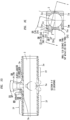
- FIG. 1 there is depicted an inventive OPE 1 according to one embodiment of the present invention while Figure 2 depicts a cut away view of the OPE 1 shown in Figure 1 .
- the OPE 1 may comprise a four-cycle or four-stroke engine and while the figures may show only one cylinder 2 of the engine 1 for clarity, it should be understood that one or more cylinders may be utilized depending on the amount of power desired to be produced by the OPE 1 (e.g., two or more cylinders). That said, it should be understood that the structural arrangements and operating principles described herein may alternatively be applied to an inventive, two-stroke OPE.
- each cylinder comprises one or more inwardly opposed pistons (see Figure 2 , elements 7a , 7b).
- the inventive OPEs described herein may be configured to provide 0.5 kilowatt to 1.0 megawatts of power and be configured to have a displacement range of 24.8 cc to 500 liters, for example.
- An exemplary engine housing 3 may enclose engine pistons, crankshafts, connecting rods, gear trains, and portions of the output shafts and other engine components which are operatively coupled to the pistons as may be described herein (see Figure 2 , for example).
- the engine housing 3 may also serve as a base onto which other portions of the engine or other devices powered by, or connected to, the OPE 1 may be mounted or secured.
- the exemplary housing 3 shown in Figure 1 accommodates a single pair of opposed pistons 7a , 7b (see Figure 2 ) and associated engine components which are operatively coupled to the pistons.
- the engine housing 3 may be configured to accommodate more than one pair of opposed pistons according to the requirements of a particular application, for example.
- the housing 3 may be a single component or comprise multiple sections (e.g., two or three sections) and may be formed by casting, machining, and other similar processes, for example. Further, the housing 3 (and/or its sections) may be formed from steel, aluminum, or any other suitable material or materials. If the housing 3 comprises multiple sections then each section may be formed separately and then attached, or connected to (collectively "connected to") one another using a suitable method. In one particular embodiment, sections of a housing may be welded together, for example. Alternatively, bolts or other removable fasteners may be used to connect sections of an inventive housing.
- Such attachment methods enable a housing and its respective sections to be varied in size such that the overall size of an inventive housing may also be varied in size to meet a range of desired engine configurations.
- suitable gaskets or seals may (not shown in figures) be positioned along any seams between joined sections of an engine housing to prevent the escape of lubricating oil and gases from the interior of the housing.
- the housing 3 may be secured to a frame or to another portion of a larger device (e.g., hot water tank, vehicle) or to other engine components (e.g., catalytic converter, muffler), for example, using bolts, welds, or any other suitable mechanism.
- the inventive OPEs described herein may be configured to provide 0.5 kilowatt to 1.0 megawatts of power and be configured to have a displacement range of 24.8 cc to 500 liters, for example.
- the inventive OPE 1 is depicted with two, inwardly opposed pistons 7a , 7b connected to respective crankshafts 9a , 9b by respective connecting rods 8a , 8b, for example, within a cylinder 2 of housing 3.
- Pistons 7a , 7b are configured to move within cylinder 2 to rotate the crankshafts 9a , 9b via rods 8a , 8b .
- Each associated crankshaft 9a , 9b and/or connecting rod 8a , 8b may be configured to aid in providing a predetermined stroke length to its associated piston 7a , 7b, respectively, residing within the cylinder 2.
- an oil pan 10 comprising an internal heat exchanger 14 that is discussed elsewhere herein.
- the opposed first and second pistons 7a , 7b may have predetermined lengths and predetermined diameters.
- the stroke length of each of pistons 7a , 7b may be twice the amount of a conventional engine, for example.
- the total difference between the spacing of the pistons at closest approach to each other (i.e., at "top dead center") and the maximum spacing of the pistons during the engine cycle (i.e., at "bottom dead center”) may also be twice the amount of a conventional engine, for example.
- first and second piston caps may be attached to faces of associated ones of pistons 7a , 7b (or to associated, optional piston spacers (not shown) in an embodiment where spacers are used).
- each piston cap may be formed from a sandwich of two sheets of carbon fiber with a ceramic center.
- piston caps exposed to a combustion event may be slightly concave in form so that when the two piston caps meet in the center of the cylinder 2 they form a somewhat spherical combustion chamber, though it should be noted that only the ceramic cores of the piston caps actually come into contact with an interior wall of the cylinder 2. Further, it should be understood that a spherical combustion shaped chamber is only one of the many shapes that piston caps included in an inventive OPE may be designed to form. Said another way, piston caps included in an inventive OPE may form a plurality of different shaped combustion chambers, for example, hour glass design, asymmetrical, symmetrical, pent roof to name just a few of the different shapes.
- each piston 7a , 7b may have a length from a piston fire ring to the cap suitable for keeping the piston rings out of cylinder apertures.
- Optional spacers, and piston caps may each have a diameter roughly equal to the interior of the associated cylinder 2, and may be made of carbon fiber, ceramic, or any other suitable material to aid in minimizing thermal inefficiencies during engine operation.
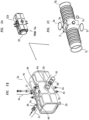
- the assembly 20 may comprise: (i) a plurality of O-rings 3a to 3j, each operable to form a seal between components of the assembly 20 and/or components connected to the assembly 20 in order to prevent gases or liquids from escaping and/or entering the assembly 20, for example; (ii) a plurality of cam connection elements 4a to 4n (where "n" represents the last element), each element comprising a combination of washer, nut and stud, for example, operable to connect a portion of a respective cam to pistons within the assembly 20 (not shown), (iii) cylinder 2, (iv) cooling jacket 2a, (v) one or more spark plug connection components 2b where each may comprise a combination of a sleeve or grommet (collectively "sleeve") 15, retaining ring 16 and an O-ring 3d, for example, and one or more optional ports, each
- the element 2c may comprise a spark plug connection element though this is merely exemplary.
- a spark plug connection element 2c may comprise a combination of a sleeve, and O-rings 3a , 3h, for example.
- the sleeve 15 may function as a heat sink in order to transfer heat from the spark plug (not shown) during operation of the inventive OPE 1.
- the sleeve 15 may be composed of a copper, for example.
- a coolant outlet 12b that is connected to (or made a part of) the jacket 2a and an indication of the flow of a coolant into a coolant inlet 12a that is connected to (or made a part of) the jacket 2a (the inlet 12a is not shown because it is on the bottom of the jacket 2a which is hidden in Figure 3A ).
- the cooling jacket 2a may be an integral one piece jacket, or may be composed of more than one piece. Further, the cooling jacket 2a may comprise a plurality of separate, cooling elements that are integrated together as one jacket.
- a single inventive cooling jacket may surround one or more cylinders (e.g., a plurality of cylinders), or, alternatively, a separate cooling jacket may surround an individual cylinder.
- an inventive OPE that comprises a plurality of cylinders may further comprise a number of cooling jackets, each configured to surround at least one of the one or more cylinders.
- FIG. 3D there is depicted a simplified drawing of the cylinder 2 and the cooling jacket 2a comprising one or more fins/valleys 2f (collectively "fins").
- fins are labeled in Figure 3D for the sake of clarity, and, in addition, the shape and number of the fins 2f depicted are merely exemplary.
- the fins 2f can be of a plurality of shapes and dimensions, such as rectangular, tapered, and/or conical.
- Figure 3E depicts a view of a portion of cylinder 2 that depicts two openings 2cc each configured to receive an engine component (not shown), such as a spark plug, glow plug, fuel injector, sensor (e.g., pressure, and other sensors), infrared camera, or another component that assists the combustion process or some combination of the components mentioned above).
- the openings 2cc may be formed in one or more walls 2d of the cylinder 2.
- the cylinder 2 is depicted comprising a housing 2e that may be bolted or welded to engine housing 3, for example. Alternatively, other connection methods may be used.
- cylinder housing 2e may be composed of aluminum, an aluminum alloy, steel, or any other suitable material using known processes such as casting, boring and finish machining, for example.
- connection element 2c is shown in Figure 3B , it should be understood that multiple connection elements may be used along with a corresponding engine component (e.g., spark plug), it being understood that the type of components making up a connection element 2c may differ depending on the engine component that is to be connected to the cylinder 2.
- each spark plug may be connected to the cylinder 2 using a respective connection element 2c, for example. Once connected each spark plug may be operable to ignite a fuel-air mixture residing in a combustion chamber formed by the cylinder 2.
- the spark plug may be coupled to a conventional distributor for controlling voltage to the spark plug. Any number of fuels may be used in the fuel air mixture such as kerosene, ethanol, gasoline, similar non-compression ignition fuels and/or compression ignition fuels with spark assist.
- An exemplary sparkplug that may be used with the inventive OPE 1 may be a statically mounted element of an overall ignition source described in more detail U.S. Pat. No. 7,448,352 .
- Other ignition sources suitable for the purposes described herein are disclosed in U.S. Patent No. 8,113,164 and U.S. Patent No. 9,869,244 .
- Other types of ignition sources e.g., compression configurations
- a section of the cylinder 2 that surrounds the substantially circular or oval opening 6b, for example, for receiving a spark-plug may be modified to include a connection element 2c that includes, for example, a sleeve, such as sleeve 15 described elsewhere herein.
- the sleeve 15 may be configured to allow better energy transfer from the spark plug to the cylinder 2 which acts as spark-plug heat sink, for example. As a result the temperature of the spark plug is reduced which, in turn, reduces the degradation of the spark-plug and lengthens its operational lifetime.
- the OPE 1 may comprise a cylinder 2 and a separate, external cooling jacket 2a (see Figures 3A, 3B and 3D ) for cooling the cylinder by allowing coolant to flow freely in the jacket 2a .
- coolant e.g., water, glycol or a mixture
- inlet 12a and exit via outlet 12b see also Figure 7A .
- Such a configuration may also allow for simpler castings to be made while providing a greater surface area for the coolant to dissipate heat from the OPE 1.
- the cooling jacket 2a may comprise one or more fins 2f of different size/shapes/dimensions to increase the surface area of the cooling jacket 2a in order to expose the coolant flowing inside the jacket 2a to air, thereby eliminating (in some cases) the need for a separate radiator.
- valve assembly aperture 5a is depicted. Similar to other features discussed above, though only a single circular aperture 5a is shown it should be understood that multiple apertures of different shapes/sizes/inclination at multiple, different locations may be formed in the cylinder 2. For example, aperture 5a may be on the top of the cylinder 2 while another may be 180 degrees away from the on the bottom of the cylinder (see Figure 3G for a second valve assembly aperture 5b, for example).
- the assembly 20 may comprise a cylinder 2 having valve assembly apertures that are positioned less than 180 degrees a part from one another.
- valve assemblies are positioned 180 degrees a part from one another (i.e., directly opposite one another across a shared combustion chamber), one skilled in the art will recognize that such a configuration may create a crossflow effect to maximize the intake and exhaust of gases, thus leading to measurable, improved performance.
- either aperture 5a , 5b may function as an intake aperture for receiving a removable, modular intake valve assembly (not shown, but see component 40 in Figures 4A and 4B ) that is operable to enable a flow of combustion air into the interior of the cylinder 2 during an intake portion of a combustion cycle or as an exhaust aperture for receiving a removable, modular exhaust valve assembly (not shown, but see component 42 in Figures 4C and 4D ) that is operable to enable a flow of exhaust and combustion by-products out of the interior of the cylinder 2 during an exhaust portion of the combustion cycle, for example.
- a removable, modular intake valve assembly not shown, but see component 40 in Figures 4A and 4B
- an exhaust aperture for receiving a removable, modular exhaust valve assembly (not shown, but see component 42 in Figures 4C and 4D ) that is operable to enable a flow of exhaust and combustion by-products out of the interior of the cylinder 2 during an exhaust portion of the combustion cycle, for example.
- a desired number of intake and exhaust apertures may be provided, having a desired shape and/or axial orientation with respect to each other and any desired spatial arrangement to meet the requirements of a particular engine configuration, depending on such factors as the geometry of the end-use envelope in which the engine is to be installed, and/or the air and exhaust volumetric flow rate requirements for the desired combustion reaction or cycle.
- the characteristics/shape/form of structures (e.g., the cylinder 2) surrounding the apertures 5a, 5b may be specified so as to enable the use of valves of a certain type or to enable the mounting of the valves at desired locations along the cylinder 2 to control intake and exhaust flow, and other pertinent factors. That is to say, the number, size, shape and locations of valve apertures may be varied and specified to meet the requirements of a particular OPE design (i.e., geometry and/or operation of an OPE, for example).
- valves that are a part of a removable intake and/or exhaust valve assembly may be throttle valves, poppet valves (e.g., spring loaded poppet valves) or a desmodromic valve (e.g., a valve that is closed by a camming mechanism, rather than by a spring mechanism), for example.
- poppet valves e.g., spring loaded poppet valves
- desmodromic valve e.g., a valve that is closed by a camming mechanism, rather than by a spring mechanism
- Other types of valves are also contemplated.
- the cylinder 2 may be a replaceable, modular component of the OPE 1.
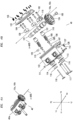
- FIG. 4A and 4B there is depicted a view of a removable intake valve assembly 40 ( Figure 4A ) and an exploded view of the assembly 40 ( Figure 4B ), while in Figures 4C and 4D thee is depicted a removable exhaust valve assembly 42 ( Figure 4C ) and an exploded view of the assembly 42 ( Figure 4D ).
- the OPE 1 may be configured to receive a removable intake valve assembly 40 within an intake aperture (such as aperture 5a in Figure 3C or aperture 5b in Figure 3G ) in each of one or more cylinders of the OPE, and may be configured to receive a removable exhaust valve assembly 42 within an exhaust aperture (such as aperture 5a in Figure 3C or aperture 5b in Figure 3G ) in each of the one or more cylinders.
- a removable intake valve assembly 40 within an intake aperture (such as aperture 5a in Figure 3C or aperture 5b in Figure 3G ) in each of one or more cylinders of the OPE
- an exhaust valve assembly 42 such as aperture 5a in Figure 3C or aperture 5b in Figure 3G
- each assembly 40, 42 may be separately, removably connected/disconnected to/from the cylinder 2 without the need to remove a cylinder head because such a head is not utilized by inventive OPEs provided by the present inventors. Accordingly, the inventors believe that maintenance or repair of an intake/exhaust valve may be more easily accomplished versus existing designs that require the removal of the cylinder head.
- a respective valve body 40a, 42a of each assembly 40, 42 may be connected to the cylinder 2 by inserting a respective seat 116 (see Figure 4b ), 218 (see Figure 4D ) which may protrude from a respective assembly 40, 42. Accordingly, each body 40a, 42a becomes more of an external component and less of a central element of an inventive OPE as is the case when the cylinder head must be removed.
- Each of the modular valve bodies 40a, 42a may be affixed into position using one or more bolts (not shown, e.g., four bolts in a single cylinder OPE). Said another way, the more the number of cylinders the more the number of bolts (e.g., the more the number of sets of four bolts).
- each of the modular valve assemblies 40, 42 may use a bucket style actuation, or, when a specific spatial need arises, may employ a rocker arm (not shown) to lessen the external dimensions of an inventive OPE.
- a push-rod valve actuation system may be integrated into each of the modular valve assemblies 40, 42.
- Tables I and II provide separate listings of other components making up, or associated with, the intake valve assembly 40 (Table I) shown in Figure 4B or exhaust valve assembly 42 (Table II) shown in Figure 4D .
- an inventive OPE does not include a typical cylinder head as in a traditional engine.
- a cylinder head may function as a heat sink due to the fact that it typically comprises a large surface area and it is proximate to combustion events, thereby exposing the head to the entirety of the heart discharged by the combustion events. This typically leads to a loss of energy due to the conversion of energy form work into heat.
- the inventive OPEs do not use a typical cylinder head, such losses are minimized (i.e., the inventive OPEs convert more fuel into work and less into heat than typical, traditional engines).
- inventive modular, removable valve assemblies allow for ease of servicing, lowered production costs.
- the modular intake and exhaust assemblies 40, 42 may be directly affixed (connected) to a cylinder (e.g., cylinder 2), thus increasing the overall simplicity and practicality of the inventive OPE 1. That is to say, in general, because the inventive OPEs do not need to incorporate a cylinder head the intake and exhaust assemblies can be directly connected to the engine block, rather than be connected to the head. As a result, the inventive OPEs may be more compact and weigh less than traditional engines.
- intake and exhaust valve assemblies made a part of an inventive OPE need not necessarily be configured to be actuated in an overhead configuration. Alternatively, such valve assemblies may be actuated by a push-rod and camshaft combination, for example.
- an inventive OPE may be configured with one or more camshafts 10a, 10b (only two of the ends or lobes are shown) positioned above and/or below the OPE's 1 center point that is defined by the intersection of the x- and y-axes shown in Figure 2 , where the x-axis represents a geometric plane through the centers of crankshafts 9a , 9b . Yet further, each of the camshafts 10a, 10b may be positioned such that their centers are positioned to the left of the OPE's center point. By so positioning the camshafts 10a, 10b, the mechanism used to drive the camshafts 10a, 10b may be selected from a number of different designs.
- the camshafts 10a, 10b may be driven by a belt (e.g., neoprene rubber, Kevlar, fibers etc.), chain (metal), gears or by an electrical actuator depending on the requirements of a specific application. It should be noted that a combination of different drive systems may also be used.
- a belt e.g., neoprene rubber, Kevlar, fibers etc.
- chain metal
- gears e.g., gears etc.
- an electrical actuator e.g., a combination of different drive systems may also be used.
- OPE 1 may comprise crankshafts 9a , 9b , connecting rods 8a , 8b and pistons 7a , 7b in cylinder 2 of OPE 1 (e.g., four-stroke engine).
- OPE 1 e.g., four-stroke engine
- the reciprocating motion of the pistons 7a , 7b along the x-axis causes a movement of the rods 8a , 8b and rotation of the crankshafts 9a,9b along the z-axis (directed into the paper in Figure 2 ), where the z-axis is the axis around which the pistons move.
- the inventors To balance the crankshafts 9a , 9b (reduce the effect of vibrations) in the x and y-axes the inventors first added appropriate counterweights to the crankshafts using traditional methods. However, because the pistons 7a , 7b and connecting rods 8a, 8b are structurally the same and are moving at substantially the same time (albeit in opposite directions) the inventors discovered that there was little or no need to add counterweights to the crankshafts 9a, 9b to balance the crankshafts of the cylinder 2 along the one-axis (e.g., the z-axis) because the mass of the pistons and the majority of the connecting rods was effectively self-cancelling.
- the one-axis e.g., the z-axis
- counterweight i.e., mass
- the amount of counterweight (i.e., mass) needed to be added to each crankshaft can be dramatically reduced versus existing, conventional engine designs. Said another way, because the reciprocating mass of the pistons and most of the connecting rods 7a,7b and 8a,8b is balanced along the z-axis, little if any counterweight needs to be added to balance each of the crankshafts 9a,9b along the z-axis. Accordingly, counterweight can be subtracted (or reduced) because the objective becomes to balance only the crank pin and the elements of the connecting rod which moves appreciably off the x-axis centerline. Thus, counterweight needs to be added mainly to balance each of the crankshafts along the y-axis.
- crankshaft counterweight the mass of counterweight needed to be added to an inventive OPE to balance each of the crankshafts 9a, 9b along the y-axis.
- crankshaft counterweight the mass of counterweight needed to be added to an inventive OPE to balance each of the crankshafts 9a, 9b along the y-axis.
- crankshaft counterweight may be added to an inventive OPE.
- each of the opposed pistons of an inventive OPE and approximately 65% of the mass of each of their connecting rods may be treated as being separate from the two crankshafts.
- the two sets of opposed pistons and their connecting rods have a mirror balancing effect on each other, and as the majority of the connecting rod does not move appreciably off of the cylinder's centerline, it does not require the same amount of counterforce (i.e., counterweight) which a conventional, single cylinder engine would require, for example.
- the mass that remains to be balanced is (i) the mass of the approximately 35% of the connecting rod, (ii) the mass of the crankshaft's throw, and (iii) the mass of the connecting rod's journal.
- the mass of a counterweight that is substantially equal to the mass of all three components can be used to effectively reduce vibrations.
- reductions in vibrations can be represented as a substantially flat sine wave (i.e., a straight line).
- Figure 5 depicts an exemplary graph that illustrates crankshaft balancing for an exemplary four-stroke OPE using three different bob weights (counterweights) according to an embodiment of the invention where in (i) graph A, the bob weight equals 100% of the rotating mass and 61% of the reciprocating mass (first or x-axis motion), (ii) graph B, the bob weight equals 92% of the rotating mass and 0% of the reciprocating mass, and (iii) graph C, there is virtually no bob weight.
- Graph B illustrates that there is little or no vibration (called “Moment-X”) along the first or x-axis and therefore, counterweight need only be applied to a crankshaft for balancing in the second or y-axis, therefore reducing the overall weight of the cylinder required to balance the crankshafts and its associated engine while simultaneously reducing vibrational forces.
- Moment-X there is little or no vibration
- inventive OPE 100 may include many of the same or similar components as OPE 1 (and vice-versa) and, in addition, include additional features described below or as can be readily discerned from a comparison of the two OPEs 1,600 from the figures.
- OPE 600 may comprise one or more oil supply jets 603 for distributing pressurized oil to internal parts of the OPE 600, such as to the pistons 607a, 607b and connecting rods 108a, 108b. Though only one jet 603 is shown, it should be understood that more than one jet 603 may be incorporated into an inventive OPE 600. Further, pressurized oil to be distributed by the jet 603 may first traverse through a passageway 602, formed as a pipe or formed as an integral channel in a housing, for example, that leads from an oil pump (not shown, that applies pressure to oil) connected to a connector 601. In an embodiment the passageway may be 0.711 millimetres (0.028 inches) in diameter, for example.
- each jet 603 may be configured to distribute the pressurized oil in a spray pattern or jet pattern, to name just two of the many patterns that the jet(s) 603 may use to distribute the oil onto internal parts of the OPE 600. It should be understood that inventive OPE 1 may also incorporate such jets and passageways.
- the inventive OPE 600 may be configured with camshafts 609a, 609b (only the ends or lobes are shown) positioned above and/or below the OPE's 600 center point that is defined by the intersection of the x- and y-axes shown in Figure 6 , where the x-axis represents a geometric plane through the centers of crankshafts 610a, 610b. Yet further, each of the camshafts 609a, 609b may be positioned such that their centers are positioned along the OPE's 600 center point. By so positioning the camshafts 609a, 609b, the mechanism used to drive the camshafts 609a, 609b may be selected from a number of different designs.
- the camshafts 609a, 609b may be driven by a belt (e.g., neoprene rubber, Kevlar, fibers etc.), chain (metal), gears or by an electrical actuator depending on the requirements of a specific application. It should be noted that a combination of different drive systems may also be used. Further, the cam shafts may be push-rod actuated, bucket and shim actuated, finger follower actuated, or use electro and pneumatic actuation.
- a belt e.g., neoprene rubber, Kevlar, fibers etc.
- chain metal
- gears e.g., gears etc.
- an electrical actuator e.g., a combination of different drive systems may also be used.
- the cam shafts may be push-rod actuated, bucket and shim actuated, finger follower actuated, or use electro and pneumatic actuation.
- OPE 600 includes a different valve actuating mechanism 611 than OPE 1 that may require different space considerations.
- the OPE 1 may comprise a cooling jacket 2a that may be cylindrically shaped, for example.
- the jacket 2a may be configured to surround the cylinder 2 (not shown in Figures 7A or 7B , but see Figures 3A, 3B ).
- coolant e.g., water glycol or a mixture of the two
- an internal heat exchanger e.g., coils; not shown, but see component 14 in Figure 2
- coolant from the internal heat exchanger 14 may flow into the jacket 2a via inlet 12a after the coolant.
- the coolant flowing through internal heat exchanger 14 may either absorb heat from the oil within the pan 10 that surrounds the internal heat exchanger 14 during normal operating conditions, or provide heat to the oil in the pan 10 during "cold start” conditions. Thereafter, the coolant from internal heat exchanger 14 may flow through the cooling jacket 2a .
- the stepper motor 11a may be controlled by an engine control subsystem (not shown; e.g., motor controller, microcontroller, programmable controller) that maybe configured to generate one or more stepper motor, coolant control signals that are based on a measured or sensed temperature (e.g., ambient temperature) and sends the signals to the stepper motor 11a .
- an engine control subsystem not shown; e.g., motor controller, microcontroller, programmable controller
- the coolant control signals are used to control the flow of coolant.
- the stepper motor 11a may be configured to control operation of a guide valve to direct flow of a first coolant percentage (e.g., 0 to 100%) of a coolant to the cooling jacket and send a second coolant percentage (e.g., 0 to 100%) of the coolant to an external heat exchanger.
- a first coolant percentage e.g., 0 to 100%
- a second coolant percentage e.g., 0 to 100%
- the stepper motor 11a may control the positioning/movement of the guide valve such that substantially 100% of the heated coolant from the internal heat exchanger 14 is sent back to the jacket 2a through the water pump 11b in order to quickly start the OPE 1.
- substantially 0% of the heated coolant from the internal heat exchanger 14 may be directed by the valve to an external heat changer (external heat exchanger not shown, e.g., a water tank / hydronic heat exchanger that is part of a combined heat and power system) via inlet 13b .
- the stepper motor 11a may be further configured to control the valve such that substantially 100% of the hot coolant from the internal heat exchanger 14 is sent to the external heat changer via water pump 11b (e.g., electrical and/or mechanical water pump) and inlet 13b that is connected to the external heat exchanger (not shown), for example. Coolant sent to the external heat exchanger may return to the OPE 1 via outlet 13a , for example.
- water pump 11b e.g., electrical and/or mechanical water pump
- inlet 13b that is connected to the external heat exchanger (not shown)
- Coolant sent to the external heat exchanger may return to the OPE 1 via outlet 13a , for example.
- the stepper motor 11a may be configured to send a percentage that is less than 100 to the cooling jacket 2a and to the external heat exchanger (e.g., 50% is sent to the cooling jacket 2a, and 50% is sent to the external heat exchanger to name just one of the many percentages).
Landscapes
- Engineering & Computer Science (AREA)
- Mechanical Engineering (AREA)
- General Engineering & Computer Science (AREA)
- Chemical & Material Sciences (AREA)
- Combustion & Propulsion (AREA)
- Cylinder Crankcases Of Internal Combustion Engines (AREA)
- Pistons, Piston Rings, And Cylinders (AREA)
Description
- This disclosure relates to the field of inwardly opposed piston engines (OPEs) and their applications, and more specifically to OPEs that provide a substantial reduction in vibration and size without compromising on power, density (size & weight), performance, and fuel economy.
- This section introduces aspects that may help facilitate a better understanding of the inventions. Accordingly, the statements of this section are to be read in this light and are not to be understood as admissions about what is, or what is not, prior art.
- To date, it has been challenging to produce an OPE that provides sufficient power for a range of applications, yet is quiet, small in size and reliable. An OPE having modular intake and exhaust assemblies is shown in
US9708976 B1 - Accordingly, it is desirable to provide solutions to this challenge.
- The inventors describe various exemplary, inventive OPEs. The inventive OPEs include inventive configurations that integrate modular intake and exhaust assemblies, and reduce the amount of vibrations typically expected in traditional piston engines, among other things.
- In one embodiment, an inventive OPE may comprise a four-stroke opposed OPE that comprises: one or more cylinders, each cylinder comprising a pair of inwardly opposed pistons; a cooling jacket configured to cool the one or more cylinders, and comprising one or more fins to increase the surface area of the cooling jacket to expose coolant flowing inside the jacket to air; and an intake aperture in each of the one or more cylinders for receiving a removable, modular intake valve assembly that enables a flow of combustion air into an interior of the cylinder, and an exhaust aperture in each of the one or more cylinders for receiving a removable, modular exhaust valve assembly that enables a flow of exhaust and combustion by-products out of the interior of the cylinder.
- Each of the one or more cylinders may further comprise a section surrounding a substantially circular or oval opening in the cylinder for receiving an engine connection element, such a sleeve that is configured to allow better energy transfer from a spark plug inserted into the sleeve to the cylinder, for example.
- The inventive OPE may be further configured to comprise one or more camshafts positioned above and/or below a center point of the OPE.
- Yet further, the inventive OPE may comprise an engine connection element configured to hold an engine component, where the engine component may comprise one of a pressure transducer assembly, glow plug assembly, spark plug, or glow plug direct fuel injector.
- Still further, the inventive OPE may comprise a crankshaft counter weight for balancing a crankshaft comprising a mass substantially equal to a mass needed to address a rotating mass and rotational movement of the crankshaft.
- In addition to the features set forth above, an inventive OPE may comprise (i) one or more oil supply jets for distributing pressurized oil to internal parts of the OPE in a pattern, where the internal parts may comprise pistons or connecting rods, for example; (ii) an internal heat exchanger embedded within an oil pan; (iii) a stepper motor configured to control operation of a guide valve to direct flow of a first coolant percentage of a coolant to the cooling jacket and direct a second coolant percentage of the coolant to an external heat exchanger; and (iv) an engine control subsystem (e.g., motor controller, microcontroller, programmable controller) for controlling the stepper motor that generates one or more stepper motor, coolant control signals based on a measured or sensed temperature.
- In embodiments of the invention the cooling jacket may be an integral one piece jacket, may be a plurality of separate, cooling elements and may be configured to surround the one or more cylinders. Alternatively, when an OPE comprises a plurality of cylinders, then the cooling jacket may comprise a number of cooling jackets, each configured to surround at least one of the one or more cylinders.
- In addition to inventive OPEs, the present inventors provide for inventive methods that relate to such OPEs. For example, one inventive method for cooling a four-stroke OPE may comprise: configuring a cooling jacket to surround and cool one or more cylinders of the OPE, each cylinder comprising a pair of inwardly opposed pistons, and configuring the cooling jacket to comprise one or more fins to increase the surface area of the cooling jacket to expose coolant flowing inside the jacket to air.
- Such an inventive method may further comprise controlling the operation of a guide valve that directs flow of a first coolant percentage to the cooling jacket and directs a second coolant percentage to an external heat exchanger using a stepper moto, and/or controlling the stepper motor using an engine control subsystem that generates one or more stepper motor, coolant control signals based on a measured or sensed temperature.
- Another inventive method is a method for configuring an OPE without a piston head. Such an inventive method may comprise: configuring the OPE with an intake aperture in each of one or more cylinders; configuring the OPE with an exhaust aperture in each of the one or more cylinders; receiving a removable, modular intake valve assembly in the intake aperture that enables a flow of combustion air into an interior of the cylinder, and receiving a removable, modular exhaust valve assembly in the exhaust aperture that enables a flow of exhaust and combustion by-products out of the interior of the cylinder.
- The inventive OPEs and methods described above are just some of the inventive OPEs and methods that will be apparent from the discussion herein.
- The present invention is illustrated by way of example and is not limited by the accompanying figures in which like reference numerals indicate similar elements and in which:
-
Figure 1 depicts an isometric view of an inventive, single cylinder OPE according to one embodiment of the present invention andFigure 2 depicts a cut-a-way view of an inventive, single cylinder OPE according to an embodiment of the invention. It should be noted that the design of the OPE shown inFigures 1 and2 may be applicable to an OPE having a plurality of cylinders. -
Figures 3A to 3E depict an inventive cylinder assembly and its elements according to an embodiment of the invention. -
Figures 3F and 3G depict views of an inventive cylinder used in experiments according to an embodiment of the invention. -
Figures 4A and 4B depict a removable intake valve assembly whileFigures 4C and 4D depict a removable exhaust assembly for a two-cylinder OPE according to embodiments of the invention. It should be noted that components of the assemblies shown inFigures 4A to 4D may be incorporated into an OPE having more than two cylinders. - Tables I and II provide separate listings of other components making up, or associated with, the intake valve assembly (Table I) or exhaust valve assembly (Table II) depicted in
Figures 4A to 4D . -
Figure 5 depicts an exemplary graph that illustrates balancing for an exemplary four-stroke OPE using three different bob weights according to an embodiment of the invention. -
Figure 6 depicts a cut-a-way view of another inventive, single-cylinder OPE according to an embodiment of the invention. It should be noted that the design of the OPE shown inFigure 6 may be applicable to an OPE having a plurality of cylinders. -
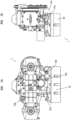
Figures 7A and 7B depict back & left side views of an inventive, single-cylinder OPE according to an embodiment of the invention. It should be noted that the design of the OPE shown inFigures 7A and 7B may be applicable to an OPE having a plurality of cylinders. - Specific embodiments of the present invention are disclosed below with reference to various figures and sketches. Both the description and the illustrations have been drafted with the intent to enhance understanding. For example, the dimensions of some of the elements in the figures may be exaggerated relative to other elements, and well-known elements that are beneficial or even necessary to a commercially successful implementation may not be depicted so that a less obstructed and a more clear presentation of embodiments may be achieved.
- Simplicity and clarity in both illustration and description are sought to effectively enable a person of skill in the art to make, use, and best practice the present invention in view of what is already known in the art. One of skill in the art will appreciate that various modifications and changes may be made to the specific embodiments described below without departing from the scope of the present invention, as defined by the appended claims.
- The detailed description that follows describes exemplary embodiments and is not intended to be limited to the expressly disclosed combination(s). Therefore, unless otherwise noted, features disclosed herein may be combined together to form additional combinations that were not otherwise shown for purposes of brevity.
- The disclosure provided herein describes features in terms of preferred and exemplary embodiments thereof. Numerous other embodiments, modifications and variations within the scope of the appended claims will occur to persons of ordinary skill in the art from a review of this disclosure.
- As used herein and in the appended claims, the term "comprises," "comprising," or variations thereof are intended to refer to a non-exclusive inclusion, such that a process, method, article of manufacture, or apparatus (e.g., an OPE) that comprises a list of elements does not include only those elements in the list, but may include other elements not expressly listed or inherent to such process, method, article of manufacture, or apparatus.
- The terms "a" or "an", as used herein, are defined as one, or more than one. The term "plurality", as used herein, is defined as two, or more than two. The term "another", as used herein, is defined as at least a second or more.
- Unless otherwise indicated herein, the use of relational terms, if any, such as "first" and "second", "top" and "bottom", "back" and "front", and "left" and "right" and the like are used solely to distinguish one view, entity or action from another view, entity or action without necessarily requiring or implying any actual such relationship, order or importance between such views, entities or actions.
- The terms "including" and/or "having", as used herein, are defined as comprising (i.e., open language).
- As used herein "x-axis" or "first axis", "y-axis" or "second axis" and "z-axis" or "third axis" mean three different geometric directions and planes. Typically, the x-axis is used to indicate motion in a horizontal direction/plane, the y-axis is used to indicate motion in the vertical direction/plane and the z-axis is used to indicate motion in an axis that is perpendicular to both the x and y axes. However, depending on the orientation and supporting structure of an OPE and the origin of the three axes may be interchangeable.
- As used herein the phrase "operable to" means "functions to" unless the context or knowledge of one skilled in the art indicates otherwise.
- Similar reference characters denote similar features consistently throughout the attached drawings.
- As described in more detail herein, inventive, four-stroke OPEs may incorporate a number of inventive features. For example, some of the inventive OPEs include modular, removable intake and exhaust valve assemblies that meet many of the stringent emissions regulations currently in effect and those being proposed or promulgated by various federal and state agencies-- a feat not practical with existing opposed piston engines. In addition, inventive OPEs are configured such that thermal losses are minimized while still meeting or exceeding nitrogen oxide (NOx) and particulate emission standards. For example, the inventive OPEs described herein (e.g., a four stroke OPE) more completely consume fuel versus traditional two stroke engines which, in turn, leads to lower emissions. In a conventional two-stroke design, some percentage (20% -35%) of the fuel from the intake is scavenged directly into the exhaust prior to combustion. However, these scavenging or direct entrainment of fuel from intake to exhaust are eliminated in this novel four stroke OPE.
- The inventive modular, removable valve train assemblies (e.g., intake and exhaust assemblies) allow for ease of servicing, lowered production costs. In embodiments the modular intake and exhaust housings may be directly affixed (connected) to a cylinder, thus increasing the overall simplicity and practicality of the inventive OPEs. That is to say, because the inventive OPEs do not need to incorporate a cylinder head, the intake and exhaust assemblies are directly connected to the engine block, rather than be connected to the head. As a result, the inventive OPEs may be more compact and weigh less than traditional engines.
- Still further, as described in more detail herein, inventive OPEs are configured to reduce vibrations typically found in existing piston engines by, among other things, incorporating inventive crank balancing designs. The reduction in vibrations is believed to lessen the "wear and tear" on OPE components, thus extending the life-time of the inventive OPEs. These and other features will now be discussed in more detail.
- Referring now to
Figure 1 , there is depicted aninventive OPE 1 according to one embodiment of the present invention whileFigure 2 depicts a cut away view of theOPE 1 shown inFigure 1 . - The
OPE 1 may comprise a four-cycle or four-stroke engine and while the figures may show only onecylinder 2 of theengine 1 for clarity, it should be understood that one or more cylinders may be utilized depending on the amount of power desired to be produced by the OPE 1 (e.g., two or more cylinders). That said, it should be understood that the structural arrangements and operating principles described herein may alternatively be applied to an inventive, two-stroke OPE. In an embodiment, each cylinder comprises one or more inwardly opposed pistons (seeFigure 2 ,elements - In embodiments of the invention, the inventive OPEs described herein may be configured to provide 0.5 kilowatt to 1.0 megawatts of power and be configured to have a displacement range of 24.8 cc to 500 liters, for example.
- An
exemplary engine housing 3 may enclose engine pistons, crankshafts, connecting rods, gear trains, and portions of the output shafts and other engine components which are operatively coupled to the pistons as may be described herein (seeFigure 2 , for example). Theengine housing 3 may also serve as a base onto which other portions of the engine or other devices powered by, or connected to, theOPE 1 may be mounted or secured. Theexemplary housing 3 shown inFigure 1 accommodates a single pair ofopposed pistons Figure 2 ) and associated engine components which are operatively coupled to the pistons. However, theengine housing 3 may be configured to accommodate more than one pair of opposed pistons according to the requirements of a particular application, for example. - In embodiments, the
housing 3 may be a single component or comprise multiple sections (e.g., two or three sections) and may be formed by casting, machining, and other similar processes, for example. Further, the housing 3 (and/or its sections) may be formed from steel, aluminum, or any other suitable material or materials. If thehousing 3 comprises multiple sections then each section may be formed separately and then attached, or connected to (collectively "connected to") one another using a suitable method. In one particular embodiment, sections of a housing may be welded together, for example. Alternatively, bolts or other removable fasteners may be used to connect sections of an inventive housing. Such attachment methods enable a housing and its respective sections to be varied in size such that the overall size of an inventive housing may also be varied in size to meet a range of desired engine configurations. If desired, suitable gaskets or seals may (not shown in figures) be positioned along any seams between joined sections of an engine housing to prevent the escape of lubricating oil and gases from the interior of the housing. Thehousing 3 may be secured to a frame or to another portion of a larger device (e.g., hot water tank, vehicle) or to other engine components (e.g., catalytic converter, muffler), for example, using bolts, welds, or any other suitable mechanism. - As noted above, due to the fact that the size of the
housing 3 can be varied the desired number of cylinders can also be varied to meet specific power requirements, for example. Accordingly, as previously noted, the inventive OPEs described herein may be configured to provide 0.5 kilowatt to 1.0 megawatts of power and be configured to have a displacement range of 24.8 cc to 500 liters, for example. - Referring now to
Figure 2 , theinventive OPE 1 is depicted with two, inwardly opposedpistons respective crankshafts rods cylinder 2 ofhousing 3.Pistons cylinder 2 to rotate thecrankshafts rods crankshaft rod piston cylinder 2. Also shown inFigure 2 is anoil pan 10 comprising aninternal heat exchanger 14 that is discussed elsewhere herein. - Continuing, the opposed first and
second pistons pistons - The piston lengths may be geometrically determined in accordance with the piston stroke length and the lengths of apertures formed in a wall of the cylinders through which flow exhaust gases and air for combustion (e.g., see
element 5a inFigure 3C ). In addition, first and second piston caps (not shown) may be attached to faces of associated ones ofpistons cylinder 2 they form a somewhat spherical combustion chamber, though it should be noted that only the ceramic cores of the piston caps actually come into contact with an interior wall of thecylinder 2. Further, it should be understood that a spherical combustion shaped chamber is only one of the many shapes that piston caps included in an inventive OPE may be designed to form. Said another way, piston caps included in an inventive OPE may form a plurality of different shaped combustion chambers, for example, hour glass design, asymmetrical, symmetrical, pent roof to name just a few of the different shapes. - In embodiments, each
piston cylinder 2, and may be made of carbon fiber, ceramic, or any other suitable material to aid in minimizing thermal inefficiencies during engine operation. - Referring to
Figures 3A to 3C there is depicted an exemplaryinventive cylinder assembly 20. As shown inFigures 3B and 3C , the assembly 20 may comprise: (i) a plurality of O-rings 3a to 3j, each operable to form a seal between components of the assembly 20 and/or components connected to the assembly 20 in order to prevent gases or liquids from escaping and/or entering the assembly 20, for example; (ii) a plurality of cam connection elements 4a to 4n (where "n" represents the last element), each element comprising a combination of washer, nut and stud, for example, operable to connect a portion of a respective cam to pistons within the assembly 20 (not shown), (iii) cylinder 2, (iv) cooling jacket 2a, (v) one or more spark plug connection components 2b where each may comprise a combination of a sleeve or grommet (collectively "sleeve") 15, retaining ring 16 and an O-ring 3d, for example, and one or more optional ports, each port for inserting a respective engine connection element 2c and configured to hold an engine component (e.g. a pressure transducer assembly, glow plug assembly, spark plug, glow plug direct fuel injector, or another assembly that aids in the actual combustion process or for understanding the combustion process) and connect the component to the cylinder 2. In the embodiment depicted inFigure 3B theelement 2c may comprise a spark plug connection element though this is merely exemplary. Such a sparkplug connection element 2c may comprise a combination of a sleeve, and O-rings sleeve 15 may function as a heat sink in order to transfer heat from the spark plug (not shown) during operation of theinventive OPE 1. In an embodiment, thesleeve 15 may be composed of a copper, for example. Also shown inFigure 3A are acoolant outlet 12b that is connected to (or made a part of) thejacket 2a and an indication of the flow of a coolant into acoolant inlet 12a that is connected to (or made a part of) thejacket 2a (theinlet 12a is not shown because it is on the bottom of thejacket 2a which is hidden inFigure 3A ). In embodiments the coolingjacket 2a may be an integral one piece jacket, or may be composed of more than one piece. Further, the coolingjacket 2a may comprise a plurality of separate, cooling elements that are integrated together as one jacket. Still further, it should be understood that a single inventive cooling jacket may surround one or more cylinders (e.g., a plurality of cylinders), or, alternatively, a separate cooling jacket may surround an individual cylinder. Thus, an inventive OPE that comprises a plurality of cylinders may further comprise a number of cooling jackets, each configured to surround at least one of the one or more cylinders. - Referring to
Figure 3D , there is depicted a simplified drawing of thecylinder 2 and the coolingjacket 2a comprising one or more fins/valleys 2f (collectively "fins"). It should be noted that only some of thefins 2f are labeled inFigure 3D for the sake of clarity, and, in addition, the shape and number of thefins 2f depicted are merely exemplary. For example, thefins 2f can be of a plurality of shapes and dimensions, such as rectangular, tapered, and/or conical. -
Figure 3E depicts a view of a portion ofcylinder 2 that depicts two openings 2cc each configured to receive an engine component (not shown), such as a spark plug, glow plug, fuel injector, sensor (e.g., pressure, and other sensors), infrared camera, or another component that assists the combustion process or some combination of the components mentioned above). The openings 2cc may be formed in one ormore walls 2d of thecylinder 2. InFigure 3D , thecylinder 2 is depicted comprising ahousing 2e that may be bolted or welded toengine housing 3, for example. Alternatively, other connection methods may be used. Inembodiments cylinder housing 2e may be composed of aluminum, an aluminum alloy, steel, or any other suitable material using known processes such as casting, boring and finish machining, for example. - Referring now to
Figure 3F , one component (e.g., a spark plug, etc.) 6a is shown installed for illustrative purposes only, though a second component (e.g., spark plug, glow plug, fuel injector, various sensors, infrared camera or another component that assists the combustion process) may be inserted intoopening 6b. Relatedly, it should be understood though while only asingle connection element 2c is shown inFigure 3B , it should be understood that multiple connection elements may be used along with a corresponding engine component (e.g., spark plug), it being understood that the type of components making up aconnection element 2c may differ depending on the engine component that is to be connected to thecylinder 2. - Yet further, it should be understood that one or more spark plugs may be utilized as an ignition source in combination with compression ignition. In an embodiment, each spark plug may be connected to the
cylinder 2 using arespective connection element 2c, for example. Once connected each spark plug may be operable to ignite a fuel-air mixture residing in a combustion chamber formed by thecylinder 2. In embodiments where a conventional spark plug is used, the spark plug may be coupled to a conventional distributor for controlling voltage to the spark plug. Any number of fuels may be used in the fuel air mixture such as kerosene, ethanol, gasoline, similar non-compression ignition fuels and/or compression ignition fuels with spark assist. - An exemplary sparkplug that may be used with the
inventive OPE 1 may be a statically mounted element of an overall ignition source described in more detailU.S. Pat. No. 7,448,352 . Other ignition sources suitable for the purposes described herein are disclosed inU.S. Patent No. 8,113,164 andU.S. Patent No. 9,869,244 inventive OPE 1. - During experimental operation of the
inventive OPE 1, the inventors discovered that the temperatures of a spark plug may increase rapidly past the threshold temperature where ignition can be affected. Other times the temperature exceeded the limits of the spark plug's design parameters which led to degradation of the physical structure of the spark plug. Accordingly, in embodiments of the invention a section of thecylinder 2 that surrounds the substantially circular oroval opening 6b, for example, for receiving a spark-plug, for example, may be modified to include aconnection element 2c that includes, for example, a sleeve, such assleeve 15 described elsewhere herein. Upon installing a spark-plug into thesleeve 15, thesleeve 15 may be configured to allow better energy transfer from the spark plug to thecylinder 2 which acts as spark-plug heat sink, for example. As a result the temperature of the spark plug is reduced which, in turn, reduces the degradation of the spark-plug and lengthens its operational lifetime. - Backtracking somewhat, to aid in the control of the inventive OPE's 1 operating temperature the
OPE 1 may comprise acylinder 2 and a separate,external cooling jacket 2a (seeFigures 3A, 3B and3D ) for cooling the cylinder by allowing coolant to flow freely in thejacket 2a. InFigure 3A , coolant (e.g., water, glycol or a mixture) may enter thejacket 2a viainlet 12a and exit viaoutlet 12b (see alsoFigure 7A ). Such a configuration may also allow for simpler castings to be made while providing a greater surface area for the coolant to dissipate heat from theOPE 1. As indicated previously, the coolingjacket 2a may comprise one ormore fins 2f of different size/shapes/dimensions to increase the surface area of the coolingjacket 2a in order to expose the coolant flowing inside thejacket 2a to air, thereby eliminating (in some cases) the need for a separate radiator. - Referring back to
Figure 3C avalve assembly aperture 5a is depicted. Similar to other features discussed above, though only a singlecircular aperture 5a is shown it should be understood that multiple apertures of different shapes/sizes/inclination at multiple, different locations may be formed in thecylinder 2. For example,aperture 5a may be on the top of thecylinder 2 while another may be 180 degrees away from the on the bottom of the cylinder (seeFigure 3G for a secondvalve assembly aperture 5b, for example). In additional embodiments, theassembly 20 may comprise acylinder 2 having valve assembly apertures that are positioned less than 180 degrees a part from one another. - In the configuration where the valve assemblies are positioned 180 degrees a part from one another (i.e., directly opposite one another across a shared combustion chamber), one skilled in the art will recognize that such a configuration may create a crossflow effect to maximize the intake and exhaust of gases, thus leading to measurable, improved performance.
- In embodiments, either
aperture component 40 inFigures 4A and 4B ) that is operable to enable a flow of combustion air into the interior of thecylinder 2 during an intake portion of a combustion cycle or as an exhaust aperture for receiving a removable, modular exhaust valve assembly (not shown, but seecomponent 42 inFigures 4C and 4D ) that is operable to enable a flow of exhaust and combustion by-products out of the interior of thecylinder 2 during an exhaust portion of the combustion cycle, for example. - Again, while the figures may show one configuration of an intake and exhaust aperture, a desired number of intake and exhaust apertures may be provided, having a desired shape and/or axial orientation with respect to each other and any desired spatial arrangement to meet the requirements of a particular engine configuration, depending on such factors as the geometry of the end-use envelope in which the engine is to be installed, and/or the air and exhaust volumetric flow rate requirements for the desired combustion reaction or cycle. Still further, the characteristics/shape/form of structures (e.g., the cylinder 2) surrounding the
apertures cylinder 2 to control intake and exhaust flow, and other pertinent factors. That is to say, the number, size, shape and locations of valve apertures may be varied and specified to meet the requirements of a particular OPE design (i.e., geometry and/or operation of an OPE, for example). - In embodiments of the invention the valves that are a part of a removable intake and/or exhaust valve assembly may be throttle valves, poppet valves (e.g., spring loaded poppet valves) or a desmodromic valve (e.g., a valve that is closed by a camming mechanism, rather than by a spring mechanism), for example. Other types of valves are also contemplated.
- In an embodiment the
cylinder 2 may be a replaceable, modular component of theOPE 1. - Referring now to
Figures 4A and 4B there is depicted a view of a removable intake valve assembly 40 (Figure 4A ) and an exploded view of the assembly 40 (Figure 4B ), while inFigures 4C and 4D thee is depicted a removable exhaust valve assembly 42 (Figure 4C ) and an exploded view of the assembly 42 (Figure 4D ). - In an embodiment, the
OPE 1 may be configured to receive a removableintake valve assembly 40 within an intake aperture (such asaperture 5a inFigure 3C oraperture 5b inFigure 3G ) in each of one or more cylinders of the OPE, and may be configured to receive a removableexhaust valve assembly 42 within an exhaust aperture (such asaperture 5a inFigure 3C oraperture 5b inFigure 3G ) in each of the one or more cylinders. - In embodiments, each
assembly cylinder 2 without the need to remove a cylinder head because such a head is not utilized by inventive OPEs provided by the present inventors. Accordingly, the inventors believe that maintenance or repair of an intake/exhaust valve may be more easily accomplished versus existing designs that require the removal of the cylinder head. For example, in116 an embodiment to connect each of theassemblies cylinder 2 arespective valve body assembly cylinder 2 by inserting a respective seat 116 (seeFigure 4b ), 218 (seeFigure 4D ) which may protrude from arespective assembly body - Each of the
modular valve bodies - Yet further, the specific method of actuating an intake or exhaust valve within each
assembly assembly modular valve assemblies modular valve assemblies - Tables I and II provide separate listings of other components making up, or associated with, the intake valve assembly 40 (Table I) shown in
Figure 4B or exhaust valve assembly 42 (Table II) shown inFigure 4D . - As noted above, because an inventive OPE includes removable intake and exhaust valve assemblies, an inventive OPE does not include a typical cylinder head as in a traditional engine. This provides a number of advantages. For example, a cylinder head may function as a heat sink due to the fact that it typically comprises a large surface area and it is proximate to combustion events, thereby exposing the head to the entirety of the heart discharged by the combustion events. This typically leads to a loss of energy due to the conversion of energy form work into heat. However, because the inventive OPEs do not use a typical cylinder head, such losses are minimized (i.e., the inventive OPEs convert more fuel into work and less into heat than typical, traditional engines). Further, the inventive modular, removable valve assemblies (e.g., intake and exhaust assemblies) allow for ease of servicing, lowered production costs. In embodiments the modular intake and
exhaust assemblies inventive OPE 1. That is to say, in general, because the inventive OPEs do not need to incorporate a cylinder head the intake and exhaust assemblies can be directly connected to the engine block, rather than be connected to the head. As a result, the inventive OPEs may be more compact and weigh less than traditional engines. It should be noted that intake and exhaust valve assemblies made a part of an inventive OPE need not necessarily be configured to be actuated in an overhead configuration. Alternatively, such valve assemblies may be actuated by a push-rod and camshaft combination, for example. - Referring back to
Figure 2 , in an embodiment an inventive OPE may be configured with one ormore camshafts Figure 2 , where the x-axis represents a geometric plane through the centers ofcrankshafts camshafts camshafts camshafts camshafts - As noted previously,
OPE 1 may comprisecrankshafts rods pistons cylinder 2 of OPE 1 (e.g., four-stroke engine). When connected, the reciprocating motion of thepistons rods crankshafts Figure 2 ), where the z-axis is the axis around which the pistons move. - Typically, significant efforts may be made to reduce engine vibrations in order to reduce their adverse effects which include reducing the life of an engine, and placing stresses on a system the engine is integrated into.
- Accordingly, to balance the
crankshafts pistons rods crankshafts cylinder 2 along the one-axis (e.g., the z-axis) because the mass of the pistons and the majority of the connecting rods was effectively self-cancelling. - Accordingly, the inventors discovered that the amount of counterweight (i.e., mass) needed to be added to each crankshaft can be dramatically reduced versus existing, conventional engine designs. Said another way, because the reciprocating mass of the pistons and most of the connecting
rods crankshafts crankshafts crankshaft - In more detail, to understand an inventive method of balancing crankshafts the mass of each of the opposed pistons of an inventive OPE and approximately 65% of the mass of each of their connecting rods may be treated as being separate from the two crankshafts. The two sets of opposed pistons and their connecting rods have a mirror balancing effect on each other, and as the majority of the connecting rod does not move appreciably off of the cylinder's centerline, it does not require the same amount of counterforce (i.e., counterweight) which a conventional, single cylinder engine would require, for example. Accordingly, the mass that remains to be balanced is (i) the mass of the approximately 35% of the connecting rod, (ii) the mass of the crankshaft's throw, and (iii) the mass of the connecting rod's journal. Thus, the mass of a counterweight that is substantially equal to the mass of all three components can be used to effectively reduce vibrations. Graphically, such reductions in vibrations can be represented as a substantially flat sine wave (i.e., a straight line).
- For example,
Figure 5 depicts an exemplary graph that illustrates crankshaft balancing for an exemplary four-stroke OPE using three different bob weights (counterweights) according to an embodiment of the invention where in (i) graph A, the bob weight equals 100% of the rotating mass and 61% of the reciprocating mass (first or x-axis motion), (ii) graph B, the bob weight equals 92% of the rotating mass and 0% of the reciprocating mass, and (iii) graph C, there is virtually no bob weight. As depicted, Graph B illustrates that there is little or no vibration (called "Moment-X") along the first or x-axis and therefore, counterweight need only be applied to a crankshaft for balancing in the second or y-axis, therefore reducing the overall weight of the cylinder required to balance the crankshafts and its associated engine while simultaneously reducing vibrational forces. - Though the primary source of an imbalance is typically due to crankshaft vibrations as noted above, vibrations are also introduced by the camshaft and valve configuration and operation. Many times these imbalances are barely noted because they are overshadowed by the vibration profile presented by the crankshaft, connecting rods, and pistons assembly. To reduce the effects of such vibrations a series of small counterweights may be affixed or incorporated into the camshaft to counteract the rotational forces of the imbalanced camshaft and valve configuration resulting in an inventive, reciprocating engine with a barely detectable sine-wave, even in a single cylinder configuration.
- Referring now to
Figure 6 there is shown a cut-a-way view of another inventive four stoke,OPE 600. In an embodiment of the invention, the inventive OPE 100 may include many of the same or similar components as OPE 1 (and vice-versa) and, in addition, include additional features described below or as can be readily discerned from a comparison of the two OPEs 1,600 from the figures. - In an embodiment,
OPE 600 may comprise one or moreoil supply jets 603 for distributing pressurized oil to internal parts of theOPE 600, such as to thepistons 607a, 607b and connecting rods 108a, 108b. Though only onejet 603 is shown, it should be understood that more than onejet 603 may be incorporated into aninventive OPE 600. Further, pressurized oil to be distributed by thejet 603 may first traverse through apassageway 602, formed as a pipe or formed as an integral channel in a housing, for example, that leads from an oil pump (not shown, that applies pressure to oil) connected to aconnector 601. In an embodiment the passageway may be 0.711 millimetres (0.028 inches) in diameter, for example. - Upon receiving pressurized oil from the
passageway 602 eachjet 603 may be configured to distribute the pressurized oil in a spray pattern or jet pattern, to name just two of the many patterns that the jet(s) 603 may use to distribute the oil onto internal parts of theOPE 600. It should be understood thatinventive OPE 1 may also incorporate such jets and passageways. - In an embodiment the
inventive OPE 600 may be configured withcamshafts 609a, 609b (only the ends or lobes are shown) positioned above and/or below the OPE's 600 center point that is defined by the intersection of the x- and y-axes shown inFigure 6 , where the x-axis represents a geometric plane through the centers ofcrankshafts camshafts 609a, 609b may be positioned such that their centers are positioned along the OPE's 600 center point. By so positioning thecamshafts 609a, 609b, the mechanism used to drive thecamshafts 609a, 609b may be selected from a number of different designs. For example, thecamshafts 609a, 609b may be driven by a belt (e.g., neoprene rubber, Kevlar, fibers etc.), chain (metal), gears or by an electrical actuator depending on the requirements of a specific application. It should be noted that a combination of different drive systems may also be used. Further, the cam shafts may be push-rod actuated, bucket and shim actuated, finger follower actuated, or use electro and pneumatic actuation. - It should also be noted that the
OPE 600 includes a differentvalve actuating mechanism 611 thanOPE 1 that may require different space considerations. - Referring now to
Figures 7A and 7B there are depicted additional views of theinventive OPE 1. As noted previously, theOPE 1 may comprise acooling jacket 2a that may be cylindrically shaped, for example. Thejacket 2a may be configured to surround the cylinder 2 (not shown inFigures 7A or 7B , but seeFigures 3A, 3B ). In an embodiment, coolant (e.g., water glycol or a mixture of the two) from thejacket 2a may flow from theoutlet 12b to an internal heat exchanger (e.g., coils; not shown, but seecomponent 14 inFigure 2 ) that are embedded withinoil pan 10, and coolant from theinternal heat exchanger 14 may flow into thejacket 2a viainlet 12a after the coolant. In embodiments, the coolant flowing throughinternal heat exchanger 14 may either absorb heat from the oil within thepan 10 that surrounds theinternal heat exchanger 14 during normal operating conditions, or provide heat to the oil in thepan 10 during "cold start" conditions. Thereafter, the coolant frominternal heat exchanger 14 may flow through the coolingjacket 2a. - Also shown in
Figure 7B iswater pump 11b and anoptional stepper motor 11a. In an embodiment, thestepper motor 11a may be configured to control the operation of a guide valve (not shown) that in turn directs the flow of the coolant after the coolant has flowed through theinternal heat exchanger 14 withinoil pan 10 to either thejacket 2a or to an external heat exchanger (not shown). - In more detail, an operator of the
OPE 1 may desire to start theOPE 1 under so-called "cold start" conditions which are characterized by either (i) temperatures that are below an inventive OPE's optimum operating temperature (e.g., below an ambient temperature, i.e... "cold" weather), or (ii) an OPE that has been inactive or abandoned for a significant amount of time such as weeks, months, years or even decades. In such an instance, thestepper motor 11a may be controlled by an engine control subsystem (not shown; e.g., motor controller, microcontroller, programmable controller) that maybe configured to generate one or more stepper motor, coolant control signals that are based on a measured or sensed temperature (e.g., ambient temperature) and sends the signals to thestepper motor 11a. Once received by thestepper motor 11a the coolant control signals are used to control the flow of coolant. - In particular, the
stepper motor 11a may be configured to control operation of a guide valve to direct flow of a first coolant percentage (e.g., 0 to 100%) of a coolant to the cooling jacket and send a second coolant percentage (e.g., 0 to 100%) of the coolant to an external heat exchanger. - For example, the
stepper motor 11a may control the positioning/movement of the guide valve such that substantially 100% of the heated coolant from theinternal heat exchanger 14 is sent back to thejacket 2a through thewater pump 11b in order to quickly start theOPE 1. In this case, substantially 0% of the heated coolant from theinternal heat exchanger 14 may be directed by the valve to an external heat changer (external heat exchanger not shown, e.g., a water tank / hydronic heat exchanger that is part of a combined heat and power system) viainlet 13b. - However, when it is unnecessary to start or operate the
OPE 1 under cold start conditions (e.g., when the temperature of theOPE 1 is above a desired temperature (e.g., 71°C (160°F) - a non-limiting temperature) thestepper motor 11a may be further configured to control the valve such that substantially 100% of the hot coolant from theinternal heat exchanger 14 is sent to the external heat changer viawater pump 11b (e.g., electrical and/or mechanical water pump) andinlet 13b that is connected to the external heat exchanger (not shown), for example. Coolant sent to the external heat exchanger may return to theOPE 1 via outlet 13a, for example. - Still further, rather than send 100% of the heated coolant to the
cooling jacket 2a or to an external heat exchanger, thestepper motor 11a may be configured to send a percentage that is less than 100 to thecooling jacket 2a and to the external heat exchanger (e.g., 50% is sent to thecooling jacket 2a, and 50% is sent to the external heat exchanger to name just one of the many percentages).
Claims (14)
- A four-stroke opposed piston engine, OPE (1, 600), comprising:one or more cylinders, each cylinder (2) comprising a pair of inwardly opposed pistons (7a, 7b);a cooling jacket (2a) configured to cool the one or more cylinders, and comprising one or more fins (2f) to increase the surface area of the cooling jacket (2a) to expose coolant flowing inside the jacket (2a) to air;an intake aperture in each of the one or more cylinders for receiving a removable, modular intake valve assembly (40) that enables a flow of combustion air into an interior of the cylinder (2), and an exhaust aperture in each of the one or more cylinders for receiving a removable, modular exhaust valve assembly (42) that enables a flow of exhaust and combustion by-products out of the interior of the cylinder (2);the OPE (1, 600) further comprising:one or more modular intake valve assemblies and one or more modular exhaust valve assemblies; andrespective seats (116, 218) inserted into the one or more modular intake valve assemblies and the one or more modular exhaust valve assemblies, the seats (116, 218) protruding from the one or more modular intake valve assemblies and the one or more modular exhaust valve assemblies;wherein the one or more modular intake valve assemblies and the one or more modular exhaust valve assemblies are each connected to the one or more cylinders by the seats (116, 218).
- The OPE (1, 600) as in claim 1 wherein each of the one or more cylinders further comprises a housing (3), the housing (3) comprising multiple sections, wherein one or more sections of the multiple sections surround a substantially circular or oval opening (6b) in the cylinder (2) for receiving an engine connection element (2c).
- The OPE (1, 600) as in claim 2, wherein the OPE (1, 600) comprises an engine connection element (2c), the engine connection element (2c) comprising a sleeve (15), optionally wherein the sleeve (15) functions as a heat sink, and further optionally or alternatively, the sleeve (15) is composed of copper.
- The OPE (1, 600) as in claim 1 further comprising one or more camshafts (10a, 10b) positioned above and/or below a center point of the OPE (1, 600).
- The OPE (1, 600) as in claim 2 OPE (1, 600) comprises an engine connection element (2c), the engine connection element (2c) configured to hold an engine component, and
wherein the engine component comprises one of a pressure transducer assembly, glow plug assembly, spark plug, glow plug, or direct fuel injector. - The OPE (1, 600) as in claim 1 further comprising a crankshaft counter weight, a connecting rod, a crankshaft throw, and a connecting rod's journal, the crankshaft counter weight having a mass substantially equal to the mass of approximately 35% of the connecting rod, the crankshaft throw, and the connecting rod's journal.
- The OPE (1, 600) as in claim 1 further comprising one or more oil supply jets (603) for distributing pressurized oil to internal parts of the OPE (1, 600) in a pattern, and
wherein the internal parts comprise the pistons (7a, 7b) or connecting rods (8a, 8b). - The OPE (1, 600) as in claim 1 further comprising an internal heat exchanger (14) embedded within an oil pan (10).
- The OPE (1, 600) as in claim 1 further comprising a stepper motor (11a) configured to control operation of a guide valve to direct flow of a first coolant percentage of a coolant to the cooling jacket (2a) and direct a second coolant percentage of the coolant to an external heat exchanger.
- The OPE (1, 600) as in claim 9 further comprising an engine control subsystem for controlling the stepper motor (11a) that generates one or more stepper motor, coolant control signals based on a measured or sensed temperature.
- The OPE (1, 600) as in claim 1 wherein:the cooling jacket (2a) is an integral one piece jacket; orthe cooling jacket (2a) comprises a plurality of separate, cooling elements; orthe cooling jacket (2a) is configured to surround the one or more cylinders.
- The OPE (1, 600) as in claim 1 wherein the one or more cylinders is a plurality of cylinders, and the cooling jacket (2a) is a number of cooling jackets, each configured to surround one or more of the plurality of cylinders.
- A method for cooling an OPE (1, 600) as claimed in claim 9 or 10, the method comprising controlling operation of the guide valve.
- The method as in claim 13, when dependent upon claim 10, further comprising controlling the stepper motor (11a) using the engine control subsystem.
Priority Applications (1)
| Application Number | Priority Date | Filing Date | Title |
|---|---|---|---|
| EP25152099.5A EP4517061A3 (en) | 2020-02-22 | 2021-02-21 | Four-stroke opposed piston engine architecture and related methods |
Applications Claiming Priority (4)
| Application Number | Priority Date | Filing Date | Title |
|---|---|---|---|
| US202062980167P | 2020-02-22 | 2020-02-22 | |
| US16/875,963 US10955168B2 (en) | 2017-06-13 | 2020-05-15 | Methods systems and devices for controlling temperature and humidity using excess energy from a combined heat and power system |
| US17/151,253 US11598243B2 (en) | 2020-02-22 | 2021-01-18 | Four-stroke opposed piston engine architecture and related methods |
| PCT/US2021/018943 WO2021168382A1 (en) | 2020-02-22 | 2021-02-21 | Four-stroke opposed piston engine architecture and related methods |
Related Child Applications (2)
| Application Number | Title | Priority Date | Filing Date |
|---|---|---|---|
| EP25152099.5A Division EP4517061A3 (en) | 2020-02-22 | 2021-02-21 | Four-stroke opposed piston engine architecture and related methods |
| EP25152099.5A Division-Into EP4517061A3 (en) | 2020-02-22 | 2021-02-21 | Four-stroke opposed piston engine architecture and related methods |
Publications (3)
| Publication Number | Publication Date |
|---|---|
| EP4111032A1 EP4111032A1 (en) | 2023-01-04 |
| EP4111032A4 EP4111032A4 (en) | 2023-06-07 |
| EP4111032B1 true EP4111032B1 (en) | 2025-03-05 |
Family
ID=77365925
Family Applications (2)
| Application Number | Title | Priority Date | Filing Date |
|---|---|---|---|
| EP21756276.8A Active EP4111032B1 (en) | 2020-02-22 | 2021-02-21 | Four-stroke opposed piston engine architecture and related methods |
| EP25152099.5A Pending EP4517061A3 (en) | 2020-02-22 | 2021-02-21 | Four-stroke opposed piston engine architecture and related methods |
Family Applications After (1)
| Application Number | Title | Priority Date | Filing Date |
|---|---|---|---|
| EP25152099.5A Pending EP4517061A3 (en) | 2020-02-22 | 2021-02-21 | Four-stroke opposed piston engine architecture and related methods |
Country Status (4)
| Country | Link |
|---|---|
| US (1) | US11598243B2 (en) |
| EP (2) | EP4111032B1 (en) |
| KR (2) | KR20250002768A (en) |
| WO (1) | WO2021168382A1 (en) |
Families Citing this family (3)
| Publication number | Priority date | Publication date | Assignee | Title |
|---|---|---|---|---|
| WO2024044281A2 (en) * | 2022-08-23 | 2024-02-29 | Enginuity Power Systems, Inc. | Combined heat and power architectures and related methods |
| FR3142219A1 (en) * | 2022-11-19 | 2024-05-24 | Claude Bonnin | 4-stroke engine made in a single piston return/return. |
| WO2024253662A1 (en) * | 2023-06-09 | 2024-12-12 | Enginuity Power Systems, Inc. | Opposed piston engine architecture and related methods |
Family Cites Families (26)
| Publication number | Priority date | Publication date | Assignee | Title |
|---|---|---|---|---|
| US2334917A (en) * | 1942-09-12 | 1943-11-23 | Ford Motor Co | Opposed-piston engine |
| US4834032A (en) * | 1987-03-11 | 1989-05-30 | Union Machine Company Of Lynn | Two-stroke cycle engine and pump having three-stroke cycle effect |
| US5261357A (en) * | 1992-02-07 | 1993-11-16 | Kia Motors Corporation | Lightweight engine block cooling system |
| US5408965A (en) | 1993-10-04 | 1995-04-25 | Ford Motor Company | Internal combustion engine oil pan with oil cooler |
| US5533472A (en) | 1995-07-31 | 1996-07-09 | Chrysler Corporation | Oil jet nozzle for an internal combustion with reciprocating pistons |
| JPH10248206A (en) * | 1997-03-03 | 1998-09-14 | Isuzu Ceramics Kenkyusho:Kk | Cogeneration device with multiple generators |
| JP3092604B2 (en) | 1998-11-12 | 2000-09-25 | トヨタ自動車株式会社 | Internal combustion engine |
| US7004120B2 (en) * | 2003-05-09 | 2006-02-28 | Warren James C | Opposed piston engine |
| US6957632B1 (en) | 2004-05-20 | 2005-10-25 | Ford Global Technologies, Llc | Air charging system for an opposed piston opposed cylinder free piston engine |
| US7156056B2 (en) * | 2004-06-10 | 2007-01-02 | Achates Power, Llc | Two-cycle, opposed-piston internal combustion engine |
| US9869244B2 (en) * | 2005-10-31 | 2018-01-16 | Warren Engine Company, Inc. | Ignition source adapted for positioning within a combustion chamber |
| US8113164B2 (en) * | 2005-10-31 | 2012-02-14 | Warren James C | Ignition source adapted for positioning within a combustion chamber |
| US7448352B2 (en) * | 2005-10-31 | 2008-11-11 | Warren James C | Centrally located ignition source in a combustion chamber |
| US8161924B1 (en) * | 2006-04-17 | 2012-04-24 | James Lockshaw | Orbital, non-reciprocating, internal combustion engine |
| US8869756B2 (en) | 2008-12-10 | 2014-10-28 | Ford Global Technologies, Llc | Cooling system and method for a vehicle engine |
| IT1395325B1 (en) * | 2009-08-25 | 2012-09-14 | A P Sistem Di Piccinini Alberto | SYSTEM FOR THE PRODUCTION OF ELECTRIC OR MECHANICAL ENERGY FROM THE WAVE MOTION |
| CA2813680A1 (en) * | 2010-09-03 | 2012-03-08 | Icr Turbine Engine Corporation | Gas turbine engine configurations |
| US9708910B2 (en) * | 2010-09-08 | 2017-07-18 | Warren Engine Company, Inc. | Inwardly opposed pistons, fixed position common cylinder engine with external induction |
| US8763583B2 (en) | 2011-02-11 | 2014-07-01 | Ecomotors, Inc. | Opposed-piston, opposed-cylinder engine with collinear cylinders |
| US10280810B2 (en) * | 2011-03-30 | 2019-05-07 | Warren Engine Company, Inc. | Opposed piston engine with variable compression ratio |
| US20130139507A1 (en) * | 2011-06-06 | 2013-06-06 | Arthur P. Morse | Thermal Compression and Waste Heat Recovery Heat Engine and Methods |
| US20130047616A1 (en) * | 2011-08-23 | 2013-02-28 | GM Global Technology Operations LLC | Electrical power cogeneration system |
| US9708976B1 (en) * | 2011-09-30 | 2017-07-18 | Warren Engine Company, Inc. | Opposed piston engine and elements thereof |
| GB2504517A (en) * | 2012-08-01 | 2014-02-05 | Perkins Engines Co Ltd | A sleeve with integrated heat pipes for seating engine components in a cylinder head |
| EP3469205B1 (en) * | 2016-06-13 | 2023-02-15 | Enginuity Power Systems, Inc. | Energy recovery system |
| US10955168B2 (en) * | 2017-06-13 | 2021-03-23 | Enginuity Power Systems, Inc. | Methods systems and devices for controlling temperature and humidity using excess energy from a combined heat and power system |
-
2021
- 2021-01-18 US US17/151,253 patent/US11598243B2/en active Active
- 2021-02-21 WO PCT/US2021/018943 patent/WO2021168382A1/en not_active Ceased
- 2021-02-21 EP EP21756276.8A patent/EP4111032B1/en active Active
- 2021-02-21 EP EP25152099.5A patent/EP4517061A3/en active Pending
- 2021-02-21 KR KR1020247040370A patent/KR20250002768A/en active Pending
- 2021-02-21 KR KR1020227029855A patent/KR102762583B1/en active Active
Also Published As
| Publication number | Publication date |
|---|---|
| KR20220129641A (en) | 2022-09-23 |
| US20210262381A1 (en) | 2021-08-26 |
| US11598243B2 (en) | 2023-03-07 |
| EP4111032A1 (en) | 2023-01-04 |
| EP4517061A2 (en) | 2025-03-05 |
| KR102762583B1 (en) | 2025-02-05 |
| KR20250002768A (en) | 2025-01-07 |
| EP4517061A3 (en) | 2025-06-18 |
| WO2021168382A1 (en) | 2021-08-26 |
| EP4111032A4 (en) | 2023-06-07 |
Similar Documents
| Publication | Publication Date | Title |
|---|---|---|
| EP4111032B1 (en) | Four-stroke opposed piston engine architecture and related methods | |
| US7861679B2 (en) | Cylinder and piston assemblies for opposed piston engines | |
| KR102156098B1 (en) | Pre-combustion chamber of an internal combustion engine and method of operating the same | |
| US7360511B2 (en) | Opposed piston engine | |
| EP1359303B1 (en) | Variable stroke engine | |
| US6854429B2 (en) | Engine with double sided piston | |
| US5152259A (en) | Cylinder head for internal combustion engine | |
| US3528394A (en) | Internal combustion engine | |
| EP2573355B1 (en) | Pre-combustion chamber tip | |
| JPH09170449A (en) | Duplex type compression and duplex type expansion engine | |
| CA3182005C (en) | Four-stroke opposed piston engine architecture and related methods | |
| EP0651855B1 (en) | Lean-burn internal combustion gas engine | |
| CA3182005A1 (en) | Four-stroke opposed piston engine architecture and related methods | |
| US3087473A (en) | Engine | |
| WO2024253662A1 (en) | Opposed piston engine architecture and related methods | |
| US4864981A (en) | Overhead valve type engine | |
| US2935055A (en) | Concentric valve internal combustion engine | |
| EP0435875A1 (en) | Low profile internal combustion engine | |
| US6328012B1 (en) | Cylinder head and valve configuration | |
| US11873754B2 (en) | Multiple cylinder engine | |
| US6601558B2 (en) | Cylinder head configuration | |
| CA1306152C (en) | Overhead valve type engine | |
| KR19990032849U (en) | Swirl Generator of Gasoline Engine |
Legal Events
| Date | Code | Title | Description |
|---|---|---|---|
| STAA | Information on the status of an ep patent application or granted ep patent |
Free format text: STATUS: THE INTERNATIONAL PUBLICATION HAS BEEN MADE |
|
| PUAI | Public reference made under article 153(3) epc to a published international application that has entered the european phase |
Free format text: ORIGINAL CODE: 0009012 |
|
| STAA | Information on the status of an ep patent application or granted ep patent |
Free format text: STATUS: REQUEST FOR EXAMINATION WAS MADE |
|
| 17P | Request for examination filed |
Effective date: 20221121 |
|
| AK | Designated contracting states |
Kind code of ref document: A1 Designated state(s): AL AT BE BG CH CY CZ DE DK EE ES FI FR GB GR HR HU IE IS IT LI LT LU LV MC MK MT NL NO PL PT RO RS SE SI SK SM TR |
|
| DAV | Request for validation of the european patent (deleted) | ||
| DAX | Request for extension of the european patent (deleted) | ||
| A4 | Supplementary search report drawn up and despatched |
Effective date: 20230510 |
|
| RIC1 | Information provided on ipc code assigned before grant |
Ipc: F01P 3/08 20060101ALI20230503BHEP Ipc: F01B 7/00 20060101ALI20230503BHEP Ipc: F02B 75/28 20060101ALI20230503BHEP Ipc: F01B 7/08 20060101AFI20230503BHEP |
|
| P01 | Opt-out of the competence of the unified patent court (upc) registered |
Effective date: 20230905 |
|
| STAA | Information on the status of an ep patent application or granted ep patent |
Free format text: STATUS: EXAMINATION IS IN PROGRESS |
|
| 17Q | First examination report despatched |
Effective date: 20240320 |
|
| GRAP | Despatch of communication of intention to grant a patent |
Free format text: ORIGINAL CODE: EPIDOSNIGR1 |
|
| STAA | Information on the status of an ep patent application or granted ep patent |
Free format text: STATUS: GRANT OF PATENT IS INTENDED |
|
| INTG | Intention to grant announced |
Effective date: 20241014 |
|
| GRAS | Grant fee paid |
Free format text: ORIGINAL CODE: EPIDOSNIGR3 |
|
| GRAA | (expected) grant |
Free format text: ORIGINAL CODE: 0009210 |
|
| STAA | Information on the status of an ep patent application or granted ep patent |
Free format text: STATUS: THE PATENT HAS BEEN GRANTED |
|
| AK | Designated contracting states |
Kind code of ref document: B1 Designated state(s): AL AT BE BG CH CY CZ DE DK EE ES FI FR GB GR HR HU IE IS IT LI LT LU LV MC MK MT NL NO PL PT RO RS SE SI SK SM TR |
|
| REG | Reference to a national code |
Ref country code: GB Ref legal event code: FG4D |
|
| REG | Reference to a national code |
Ref country code: CH Ref legal event code: EP |
|
| REG | Reference to a national code |
Ref country code: DE Ref legal event code: R096 Ref document number: 602021027198 Country of ref document: DE |
|
| REG | Reference to a national code |
Ref country code: IE Ref legal event code: FG4D |
|
| PG25 | Lapsed in a contracting state [announced via postgrant information from national office to epo] |
Ref country code: RS Free format text: LAPSE BECAUSE OF FAILURE TO SUBMIT A TRANSLATION OF THE DESCRIPTION OR TO PAY THE FEE WITHIN THE PRESCRIBED TIME-LIMIT Effective date: 20250605 |
|
| PG25 | Lapsed in a contracting state [announced via postgrant information from national office to epo] |
Ref country code: FI Free format text: LAPSE BECAUSE OF FAILURE TO SUBMIT A TRANSLATION OF THE DESCRIPTION OR TO PAY THE FEE WITHIN THE PRESCRIBED TIME-LIMIT Effective date: 20250305 |
|
| REG | Reference to a national code |
Ref country code: NL Ref legal event code: MP Effective date: 20250305 |
|
| PG25 | Lapsed in a contracting state [announced via postgrant information from national office to epo] |
Ref country code: ES Free format text: LAPSE BECAUSE OF FAILURE TO SUBMIT A TRANSLATION OF THE DESCRIPTION OR TO PAY THE FEE WITHIN THE PRESCRIBED TIME-LIMIT Effective date: 20250305 |
|
| REG | Reference to a national code |
Ref country code: LT Ref legal event code: MG9D |
|
| PG25 | Lapsed in a contracting state [announced via postgrant information from national office to epo] |
Ref country code: NO Free format text: LAPSE BECAUSE OF FAILURE TO SUBMIT A TRANSLATION OF THE DESCRIPTION OR TO PAY THE FEE WITHIN THE PRESCRIBED TIME-LIMIT Effective date: 20250605 |
|
| PG25 | Lapsed in a contracting state [announced via postgrant information from national office to epo] |
Ref country code: HR Free format text: LAPSE BECAUSE OF FAILURE TO SUBMIT A TRANSLATION OF THE DESCRIPTION OR TO PAY THE FEE WITHIN THE PRESCRIBED TIME-LIMIT Effective date: 20250305 |
|
| PG25 | Lapsed in a contracting state [announced via postgrant information from national office to epo] |
Ref country code: LV Free format text: LAPSE BECAUSE OF FAILURE TO SUBMIT A TRANSLATION OF THE DESCRIPTION OR TO PAY THE FEE WITHIN THE PRESCRIBED TIME-LIMIT Effective date: 20250305 |
|
| PG25 | Lapsed in a contracting state [announced via postgrant information from national office to epo] |
Ref country code: GR Free format text: LAPSE BECAUSE OF FAILURE TO SUBMIT A TRANSLATION OF THE DESCRIPTION OR TO PAY THE FEE WITHIN THE PRESCRIBED TIME-LIMIT Effective date: 20250606 Ref country code: BG Free format text: LAPSE BECAUSE OF FAILURE TO SUBMIT A TRANSLATION OF THE DESCRIPTION OR TO PAY THE FEE WITHIN THE PRESCRIBED TIME-LIMIT Effective date: 20250305 |
|
| REG | Reference to a national code |
Ref country code: AT Ref legal event code: MK05 Ref document number: 1773088 Country of ref document: AT Kind code of ref document: T Effective date: 20250305 |
|
| PG25 | Lapsed in a contracting state [announced via postgrant information from national office to epo] |
Ref country code: NL Free format text: LAPSE BECAUSE OF FAILURE TO SUBMIT A TRANSLATION OF THE DESCRIPTION OR TO PAY THE FEE WITHIN THE PRESCRIBED TIME-LIMIT Effective date: 20250305 |
|
| PG25 | Lapsed in a contracting state [announced via postgrant information from national office to epo] |
Ref country code: SE Free format text: LAPSE BECAUSE OF FAILURE TO SUBMIT A TRANSLATION OF THE DESCRIPTION OR TO PAY THE FEE WITHIN THE PRESCRIBED TIME-LIMIT Effective date: 20250305 |
|
| PG25 | Lapsed in a contracting state [announced via postgrant information from national office to epo] |
Ref country code: SM Free format text: LAPSE BECAUSE OF FAILURE TO SUBMIT A TRANSLATION OF THE DESCRIPTION OR TO PAY THE FEE WITHIN THE PRESCRIBED TIME-LIMIT Effective date: 20250305 |
|
| PG25 | Lapsed in a contracting state [announced via postgrant information from national office to epo] |
Ref country code: PT Free format text: LAPSE BECAUSE OF FAILURE TO SUBMIT A TRANSLATION OF THE DESCRIPTION OR TO PAY THE FEE WITHIN THE PRESCRIBED TIME-LIMIT Effective date: 20250707 |
|
| PG25 | Lapsed in a contracting state [announced via postgrant information from national office to epo] |
Ref country code: IT Free format text: LAPSE BECAUSE OF FAILURE TO SUBMIT A TRANSLATION OF THE DESCRIPTION OR TO PAY THE FEE WITHIN THE PRESCRIBED TIME-LIMIT Effective date: 20250305 Ref country code: PL Free format text: LAPSE BECAUSE OF FAILURE TO SUBMIT A TRANSLATION OF THE DESCRIPTION OR TO PAY THE FEE WITHIN THE PRESCRIBED TIME-LIMIT Effective date: 20250305 |
|
| PG25 | Lapsed in a contracting state [announced via postgrant information from national office to epo] |
Ref country code: AT Free format text: LAPSE BECAUSE OF FAILURE TO SUBMIT A TRANSLATION OF THE DESCRIPTION OR TO PAY THE FEE WITHIN THE PRESCRIBED TIME-LIMIT Effective date: 20250305 |
|
| PG25 | Lapsed in a contracting state [announced via postgrant information from national office to epo] |
Ref country code: CZ Free format text: LAPSE BECAUSE OF FAILURE TO SUBMIT A TRANSLATION OF THE DESCRIPTION OR TO PAY THE FEE WITHIN THE PRESCRIBED TIME-LIMIT Effective date: 20250305 Ref country code: EE Free format text: LAPSE BECAUSE OF FAILURE TO SUBMIT A TRANSLATION OF THE DESCRIPTION OR TO PAY THE FEE WITHIN THE PRESCRIBED TIME-LIMIT Effective date: 20250305 |
|
| PG25 | Lapsed in a contracting state [announced via postgrant information from national office to epo] |
Ref country code: RO Free format text: LAPSE BECAUSE OF FAILURE TO SUBMIT A TRANSLATION OF THE DESCRIPTION OR TO PAY THE FEE WITHIN THE PRESCRIBED TIME-LIMIT Effective date: 20250305 |
|
| PG25 | Lapsed in a contracting state [announced via postgrant information from national office to epo] |
Ref country code: SK Free format text: LAPSE BECAUSE OF FAILURE TO SUBMIT A TRANSLATION OF THE DESCRIPTION OR TO PAY THE FEE WITHIN THE PRESCRIBED TIME-LIMIT Effective date: 20250305 |
|
| PG25 | Lapsed in a contracting state [announced via postgrant information from national office to epo] |
Ref country code: IS Free format text: LAPSE BECAUSE OF FAILURE TO SUBMIT A TRANSLATION OF THE DESCRIPTION OR TO PAY THE FEE WITHIN THE PRESCRIBED TIME-LIMIT Effective date: 20250705 |
|
| REG | Reference to a national code |
Ref country code: DE Ref legal event code: R097 Ref document number: 602021027198 Country of ref document: DE |
|
| PLBE | No opposition filed within time limit |
Free format text: ORIGINAL CODE: 0009261 |
|
| STAA | Information on the status of an ep patent application or granted ep patent |
Free format text: STATUS: NO OPPOSITION FILED WITHIN TIME LIMIT |
|
| PG25 | Lapsed in a contracting state [announced via postgrant information from national office to epo] |
Ref country code: DK Free format text: LAPSE BECAUSE OF FAILURE TO SUBMIT A TRANSLATION OF THE DESCRIPTION OR TO PAY THE FEE WITHIN THE PRESCRIBED TIME-LIMIT Effective date: 20250305 |
|
| REG | Reference to a national code |
Ref country code: CH Ref legal event code: L10 Free format text: ST27 STATUS EVENT CODE: U-0-0-L10-L00 (AS PROVIDED BY THE NATIONAL OFFICE) Effective date: 20260114 |
|
| 26N | No opposition filed |
Effective date: 20251208 |
|
| PGFP | Annual fee paid to national office [announced via postgrant information from national office to epo] |
Ref country code: GB Payment date: 20260210 Year of fee payment: 6 |
|
| PGFP | Annual fee paid to national office [announced via postgrant information from national office to epo] |
Ref country code: DE Payment date: 20260211 Year of fee payment: 6 |
|
| PGFP | Annual fee paid to national office [announced via postgrant information from national office to epo] |
Ref country code: FR Payment date: 20260209 Year of fee payment: 6 |