EP4109580B1 - Automatic electrode drying control system and automatic electrode drying control method - Google Patents
Automatic electrode drying control system and automatic electrode drying control method Download PDFInfo
- Publication number
- EP4109580B1 EP4109580B1 EP21895092.1A EP21895092A EP4109580B1 EP 4109580 B1 EP4109580 B1 EP 4109580B1 EP 21895092 A EP21895092 A EP 21895092A EP 4109580 B1 EP4109580 B1 EP 4109580B1
- Authority
- EP
- European Patent Office
- Prior art keywords
- dried
- drying
- level
- electrode sheet
- information
- Prior art date
- Legal status (The legal status is an assumption and is not a legal conclusion. Google has not performed a legal analysis and makes no representation as to the accuracy of the status listed.)
- Active
Links
Images


Classifications
-
- F—MECHANICAL ENGINEERING; LIGHTING; HEATING; WEAPONS; BLASTING
- F26—DRYING
- F26B—DRYING SOLID MATERIALS OR OBJECTS BY REMOVING LIQUID THEREFROM
- F26B21/00—Arrangements for supplying or controlling air or other gases for drying solid materials or objects
- F26B21/30—Controlling, e.g. regulating, parameters of gas supply
- F26B21/35—Temperature; Pressure
-
- F—MECHANICAL ENGINEERING; LIGHTING; HEATING; WEAPONS; BLASTING
- F26—DRYING
- F26B—DRYING SOLID MATERIALS OR OBJECTS BY REMOVING LIQUID THEREFROM
- F26B13/00—Machines and apparatus for drying fabrics, fibres, yarns, or other materials in long lengths, with progressive movement
- F26B13/10—Arrangements for feeding, heating or supporting materials; Controlling movement, tension or position of materials
- F26B13/101—Supporting materials without tension, e.g. on or between foraminous belts
- F26B13/103—Supporting materials without tension, e.g. on or between foraminous belts with mechanical supporting means, e.g. belts, rollers, and fluid impingement arrangement having a displacing effect on the materials
-
- F—MECHANICAL ENGINEERING; LIGHTING; HEATING; WEAPONS; BLASTING
- F26—DRYING
- F26B—DRYING SOLID MATERIALS OR OBJECTS BY REMOVING LIQUID THEREFROM
- F26B21/00—Arrangements for supplying or controlling air or other gases for drying solid materials or objects
- F26B21/30—Controlling, e.g. regulating, parameters of gas supply
- F26B21/37—Velocity of flow; Quantity of flow
-
- F—MECHANICAL ENGINEERING; LIGHTING; HEATING; WEAPONS; BLASTING
- F26—DRYING
- F26B—DRYING SOLID MATERIALS OR OBJECTS BY REMOVING LIQUID THEREFROM
- F26B21/00—Arrangements for supplying or controlling air or other gases for drying solid materials or objects
- F26B21/50—Ducting arrangements from the source of air or other gases to the materials or objects being dried
-
- F—MECHANICAL ENGINEERING; LIGHTING; HEATING; WEAPONS; BLASTING
- F26—DRYING
- F26B—DRYING SOLID MATERIALS OR OBJECTS BY REMOVING LIQUID THEREFROM
- F26B25/00—Details of general application not covered by group F26B21/00 or F26B23/00
- F26B25/22—Controlling the drying process in dependence on liquid content of solid materials or objects
-
- F—MECHANICAL ENGINEERING; LIGHTING; HEATING; WEAPONS; BLASTING
- F26—DRYING
- F26B—DRYING SOLID MATERIALS OR OBJECTS BY REMOVING LIQUID THEREFROM
- F26B3/00—Drying solid materials or objects by processes involving the application of heat
- F26B3/02—Drying solid materials or objects by processes involving the application of heat by convection, i.e. heat being conveyed from a heat source to the materials or objects to be dried by a gas or vapour, e.g. air
- F26B3/04—Drying solid materials or objects by processes involving the application of heat by convection, i.e. heat being conveyed from a heat source to the materials or objects to be dried by a gas or vapour, e.g. air the gas or vapour circulating over or surrounding the materials or objects to be dried
-
- F—MECHANICAL ENGINEERING; LIGHTING; HEATING; WEAPONS; BLASTING
- F26—DRYING
- F26B—DRYING SOLID MATERIALS OR OBJECTS BY REMOVING LIQUID THEREFROM
- F26B3/00—Drying solid materials or objects by processes involving the application of heat
- F26B3/28—Drying solid materials or objects by processes involving the application of heat by radiation, e.g. from the sun
- F26B3/283—Drying solid materials or objects by processes involving the application of heat by radiation, e.g. from the sun in combination with convection
-
- H—ELECTRICITY
- H01—ELECTRIC ELEMENTS
- H01M—PROCESSES OR MEANS, e.g. BATTERIES, FOR THE DIRECT CONVERSION OF CHEMICAL ENERGY INTO ELECTRICAL ENERGY
- H01M4/00—Electrodes
- H01M4/02—Electrodes composed of, or comprising, active material
- H01M4/04—Processes of manufacture in general
- H01M4/0471—Processes of manufacture in general involving thermal treatment, e.g. firing, sintering, backing particulate active material, thermal decomposition, pyrolysis
-
- F—MECHANICAL ENGINEERING; LIGHTING; HEATING; WEAPONS; BLASTING
- F26—DRYING
- F26B—DRYING SOLID MATERIALS OR OBJECTS BY REMOVING LIQUID THEREFROM
- F26B3/00—Drying solid materials or objects by processes involving the application of heat
- F26B3/28—Drying solid materials or objects by processes involving the application of heat by radiation, e.g. from the sun
- F26B3/30—Drying solid materials or objects by processes involving the application of heat by radiation, e.g. from the sun from infrared-emitting elements
-
- H—ELECTRICITY
- H01—ELECTRIC ELEMENTS
- H01M—PROCESSES OR MEANS, e.g. BATTERIES, FOR THE DIRECT CONVERSION OF CHEMICAL ENERGY INTO ELECTRICAL ENERGY
- H01M10/00—Secondary cells; Manufacture thereof
- H01M10/04—Construction or manufacture in general
- H01M10/0404—Machines for assembling batteries
- H01M10/0409—Machines for assembling batteries for cells with wound electrodes
-
- H—ELECTRICITY
- H01—ELECTRIC ELEMENTS
- H01M—PROCESSES OR MEANS, e.g. BATTERIES, FOR THE DIRECT CONVERSION OF CHEMICAL ENERGY INTO ELECTRICAL ENERGY
- H01M4/00—Electrodes
- H01M4/02—Electrodes composed of, or comprising, active material
- H01M4/13—Electrodes for accumulators with non-aqueous electrolyte, e.g. for lithium-accumulators; Processes of manufacture thereof
-
- Y—GENERAL TAGGING OF NEW TECHNOLOGICAL DEVELOPMENTS; GENERAL TAGGING OF CROSS-SECTIONAL TECHNOLOGIES SPANNING OVER SEVERAL SECTIONS OF THE IPC; TECHNICAL SUBJECTS COVERED BY FORMER USPC CROSS-REFERENCE ART COLLECTIONS [XRACs] AND DIGESTS
- Y02—TECHNOLOGIES OR APPLICATIONS FOR MITIGATION OR ADAPTATION AGAINST CLIMATE CHANGE
- Y02E—REDUCTION OF GREENHOUSE GAS [GHG] EMISSIONS, RELATED TO ENERGY GENERATION, TRANSMISSION OR DISTRIBUTION
- Y02E60/00—Enabling technologies; Technologies with a potential or indirect contribution to GHG emissions mitigation
- Y02E60/10—Energy storage using batteries
Definitions
- the present invention relates to a system and method for automatically controlling an electrode drying, and more particularly, to a system and method for automatically controlling an electrode drying, which is capable of recognizing the dried level from information on the dried amount such as the solid content and surface temperature of an electrode sheet, and accordingly adjusting the dried amount of the electrode in real time by automatically operating the drying means.
- secondary batteries capable of charging and discharging have been widely used as energy sources of wireless mobile devices.
- the secondary battery has attracted attention as an energy source of an electric vehicle, a hybrid electric vehicle, etc., which are proposed as a solution for air pollution of existing gasoline vehicles and diesel vehicles using fossil fuel. Therefore, the types of applications using the secondary battery are currently much diversified due to the advantages of the secondary battery, and it is expected that the secondary battery will be applied to many fields and products in the future.
- Such secondary batteries may be classified into lithium ion batteries, lithium ion polymer batteries, lithium polymer batteries, etc., depending on the composition of the electrode and the electrolyte, and among them, the amount of use of lithium-ion polymer batteries that are less likely to leak electrolyte and are easy to manufacture is on the increase.
- secondary batteries are classified into cylindrical batteries and prismatic batteries in which an electrode assembly is embedded in a cylindrical or rectangular metal can, depending on the shape of a battery case, and pouch-type batteries in which the electrode assembly is embedded in a pouch-type case of an aluminum laminate sheet.
- the electrode assembly built into the battery case is composed of a positive electrode, a negative electrode, and a separator interposed between the positive electrode and the negative electrode, and is a power generating element capable of charging and discharging.
- the electrode assembly is classified into a jelly-roll type wound with a separator interposed between the positive electrode and the negative electrode which are long sheet-shaped and are coated with active materials, and a stack type in which a plurality of positive electrodes and negative electrodes of a predetermined size are sequentially stacked while a separator is interposed therebetween.
- the drying condition of the electrode influences the quality and physical properties of the electrode.
- the adhesive force and the coupled level of the surface of the electrode can be significantly changed according to control of the deviation of the dryness for the width direction of the electrode and the time point when the drying is completed during the drying.
- an electrode was dried by determining the initial process condition in advance, and the dried amount was evaluated through measurement of physical properties of a sample after completing the drying and the process condition was then adjusted.
- such a method required a lot of time in measuring the physical properties, and it was difficult to reflect the dried amount evaluation result to the process in real time. As such, this method was not appropriate for a roll-to-roll consecutive production process.
- an aspect of the present invention provides a system and method of automatically controlling an electrode drying capable of reducing the deviation of a product by maintaining the dried level of a final electrode constant by automatically controlling the dried level of the electrode in real time.
- a system for automatically controlling an electrode drying according to the present invention is recited in claim 1.
- the measuring unit is set to periodically collect information on the dried amount of the electrode sheet at regular time intervals, and the controller periodically controls the drying intensity of the oven by determining the dried level of the electrode sheet whenever receiving the information on the dried amount from the measuring unit.
- the measuring unit collects information on the dried amount for 1 to 5 minutes right before a time point when the control of the drying intensity by the controller is expected.
- the information on the dried amount includes information on at least one of a solid content and a surface temperature of the electrode sheet.
- the controller includes: a data input unit which receives an input of the information on the dried amount collected by the measuring unit, and a reference setting value on the dried amount; a determination unit which determines the dried level of the electrode sheet by comparing the information on the dried amount with the setting value, and determines whether to adjust the drying intensity in the oven according the determined dried level; and a command unit which controls the drying intensity of the oven based on a result of determination of the determination unit.
- the controller controls to reduce the drying intensity of the oven, and when the dried level of the electrode sheet is determined as the non-dried level or the excessively non-dried level, the controller controls to increase the drying intensity of the oven.
- the controller controls the drying intensity for drying sections other than a drying section at a front end of the oven among the plurality of drying sections.
- the measuring unit transmits an average value or a median value of the collected information on the dried amount to the controller.
- each of the plurality of drying sections includes a drying means, and the drying means includes at least one of a hot air nozzle, which applies convective heat by supplying hot air to the electrode sheet, and a heater, which applies radiant heat to the electrode sheet.
- the controller controls at least one selected from the group consisting of a speed of hot air of the hot air nozzle, a volume of hot air of the hot air nozzle, a temperature of the heater, and a moving speed of a transfer roller which moves the electrode sheet.
- the measuring unit includes at least one of a web gauge for measuring the loading amount of the electrode sheet and a temperature measuring instrument.
- the measuring unit further includes a calculation unit, and the calculation unit calculates a solid content of the electrode sheet from the loading amount measured by the web gauge.
- the information on the dried amount includes information on at least one of a solid content and a surface temperature of the electrode sheet.
- the step (b) includes periodically collecting information on the dried amount of the electrode sheet at regular time intervals, and the step (c) includes periodically controlling the drying intensity of the oven by determining the dried level of the electrode sheet whenever receiving the information on the dried amount through the step (b).
- the present invention it is possible to automatically control the dried level of an electrode in real time by controlling the dried amount of the oven in real time by collecting the information on the dried amount of the electrode sheet and determining the dried level of the electrode from the collected information on the dried amount.
- FIG. 1 is a block diagram showing a configuration of an automatic electrode drying control system according to the present invention
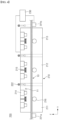
- FIG. 2 is a schematic diagram illustrating a structure of an automatic electrode drying control system according to an embodiment of the present invention.
- a system 100 for automatically controlling an electrode drying includes: an oven 110 which provides a space where an electrode sheet is moved and dried, includes a drying means which applies hot air and/or radiant heat to the electrode sheet, and is divided into a plurality of drying sections; a measuring unit 120 which collects information on a dried amount of the electrode sheet 10 and transmits the collected information to a controller 130; and the controller 130 which determines a dried level of the electrode sheet 10 based on the information on the dried amount received from the measuring unit 120, and control a drying intensity of the oven 110 according to the determined dried level.
- the controller 130 independently controls the plurality of drying sections.
- the drying condition of the electrode significantly influences the quality and physical properties of the electrode.
- the system for automatically controlling an electrode drying of the present invention it is possible to automatically control the dried level of an electrode by appropriately adjusting the dried amount according to the dried level of the electrode sheet by determining the dried level by collecting information on the dried amount of the electrode sheet in real time and accordingly independently controlling a plurality of drying sections.
- the x-axis means a direction in which an electrode is transferred
- the y-axis means a direction which is perpendicular to the transfer direction of the electrode on the electrode surface, as the width direction of the electrode.
- the z-axis corresponds to a direction in which hot air is sprayed or infrared rays are irradiated, as a direction perpendicular to the electrode surface.
- an automatic electrode drying control system 100 includes an oven 110.
- the oven 110 has a chamber shape and provides a space where an electrode sheet 10 is dried, which is a space where the electrode sheet 10 to be dried may be moved inside the oven 110, and can prevent the internal heat from escaping.
- the electrode sheet 10 may have a structure in which an electrode active material layer 12 is formed as a slurry for electrode formation including an electrode active material is coated on the current collector sheet 11.
- the electrode slurry may be applied to at least one surface of the current collector.
- the current collector may be a positive electrode current collector or a negative electrode current collector
- the electrode active material may be a positive electrode active material or a negative electrode active material
- the electrode slurry may further include a conductive material and a binder in addition to the electrode active material.
- the positive electrode collector generally has a thickness of 3 to 500 micrometers.
- the positive electrode current collector is not particularly limited as long as it has high conductivity without causing a chemical change in the battery.
- Examples of the positive electrode current collector include stainless steel, aluminum, nickel, titanium, sintered carbon or aluminum or stainless steel of which the surface has been treated with carbon, nickel, titanium, silver, or the like.
- the current collector may have fine irregularities on the surface thereof to increase the adhesion of the positive electrode active material, and various forms such as a film, a sheet, a foil, a net, a porous body, a foam, and a nonwoven fabric are possible.
- the sheet for the negative electrode collector generally has a thickness of 3 to 500 micrometers.
- the negative electrode current collector is not particularly limited as long as it has electrical conductivity without causing chemical changes in the battery, and examples thereof include copper, stainless steel, aluminum, nickel, titanium, sintered carbon, copper or stainless steel of which the surface has been treated with carbon, nickel, titanium, silver or the like, aluminum-cadmium alloy, or the like.
- fine unevenness can be formed on the surface to enhance the bonding force of the negative electrode active material, and it can be used in various forms such as a film, a sheet, a foil, a net, a porous body, a foam, and a nonwoven fabric.
- the positive electrode active material is a material capable of causing an electrochemical reaction and a lithium transition metal oxide, and contains two or more transition metals.
- the negative electrode active material examples include carbon such as non-graphitized carbon and graphite carbon; metal complex oxide such as Li x Fe 2 O 3 (0 ⁇ x ⁇ 1), Li x WO 2 (0 ⁇ x ⁇ 1), Sn x Me 1-x Me' y O z (Me: Mn, Fe, Pb, Ge; Me': Al, B, P, Si, groups 1, 2, and 3 of the periodic table, halogen; 0 ⁇ x ⁇ 1; 1 ⁇ y ⁇ 3; 1 ⁇ z ⁇ 8); lithium alloy; silicon alloy; tin alloy; metal oxides such as SnO, SnO 2 , PbO, PbO 2 , Pb 2 O 3 , Pb 3 O 4 , Sb 2 O 3 , Sb 2 O 4 , Sb 2 O 5 , GeO, GeO 2 , Bi 2 O 3 , Bi 2 O 4 , and Bi 2 O 5 ; conductive polymers such as polyacetylene; and Li-Co-Ni-based materials.
- metal complex oxide such as Li
- the conductive material is usually added in an amount of 1 to 30% by weight based on the total weight of the mixture including the positive electrode active material.
- a conductive material is not particularly limited as long as it has electrical conductivity without causing a chemical change in the battery, and examples thereof include graphite such as natural graphite and artificial graphite; carbon black such as carbon black, acetylene black, Ketjen black, channel black, furnace black, lamp black, and summer black; conductive fibers such as carbon fiber and metal fiber; metal powders such as carbon fluoride, aluminum and nickel powder; conductive whiskey such as zinc oxide and potassium titanate; conductive metal oxides such as titanium oxide; and conductive materials such as polyphenylene derivatives and the like.
- the binder is added in an amount of 1 to 30% by weight, on the basis of the total weight of the mixture containing the positive electrode active material, as a component that assists in bonding between the active material and the conductive material and bonding to the current collector.
- binders include polyvinylidene fluoride, polyvinyl alcohol, carboxymethylcellulose (CMC), starch, hydroxypropylcellulose, regenerated cellulose, polyvinylpyrrolidone, tetrafluoroethylene, polyethylene, polypropylene, ethylene-propylene-diene terpolymer (EPDM), sulfonated EPDM, styrene butylene rubber, fluorine rubber, various copolymers and the like.
- an electrode slurry may be prepared by dissolving an electrode active material, a conductive material, and a binder in a solvent.
- the type of the solvent is not particularly limited as long as it is capable of dispersing an electrode active material, and either an aqueous solvent or a non-aqueous solvent may be used.
- the solvent may be a solvent generally used in the art, such as dimethyl sulfoxide (DMSO), isopropyl alcohol, N-methylpyrrolidone (NMP ), acetone, or water, and one of them alone or a mixture of two or more may be used.
- the amount of the solvent used may be such that the slurry can be adjusted to have an appropriate viscosity in consideration of the coating thickness, production yield, and workability of the slurry, and is not particularly limited.
- the oven 110 is divided into a plurality of drying sections 111, 112, and 113, and each of the drying sections includes a drying means for drying the electrode sheet 10 therein.
- the drying means includes a hot air nozzle 114, which applies convective heat by supplying hot air to the electrode sheet 10, and a heater 115, which applies radiant heat to the electrode sheet 10.
- the hot air nozzles 114 and the heaters 115 may be arranged at regular intervals along the transfer direction (MD direction, x direction) of the electrode sheet 10, and hot air or radiant heat is applied in a direction perpendicular to the electrode sheet 10.
- MD direction, x direction transfer direction
- the hot air nozzle 114 and the infrared heater 115 are positioned on the upper portion of the electrode sheet 10, that is, the lower surface of the ceiling of the oven 110, but when the electrode active material layer is formed on both surfaces of the current collector, the hot air nozzle 114 and the heater 115 may be positioned on the upper portion and the lower portion of the electrode sheet 10, respectively. It is illustrated in FIG. 2 that both a hot air nozzle and a heater are included as the drying means, but the present invention is not limited to this example, and only one of the hot air nozzle and the heater may be included as the drying means.
- the hot air nozzle 114 includes a main body unit and an injection unit.
- the main body unit constitutes the body of the hot air nozzle, and fixes the hot air nozzle 114 to the ceiling of the oven.
- the main body unit is empty inside and transmits hot air transmitted from a hot air supply source (not shown) to the injection unit.
- the injection unit is provided on the lower surface of the main body unit. The injection unit communicates with the main body unit, and an injection hole portion through which hot air is injected is formed on the lower surface of the injection unit.
- the injection hole portion may have a structure in which a plurality of pores are arranged at regular intervals.
- the heater 115 may be an infrared heater in a specific example of the present invention, and the infrared heater may include an infrared lamp which irradiates infrared rays to the electrode, and a cradle which supports the infrared lamp.
- the shape of the infrared lamp is not particularly limited, and for example, the rod-shaped lamp may be arranged in parallel along the transfer direction of the electrode while extending in the width direction of the electrode.
- the hot air nozzles 114 and the heaters 115 may be alternately arranged in a direction in which the electrode sheet 10 is moved in order to evenly supply hot air and infrared rays to the surface of the electrode sheet 10.
- the arrangement scheme of the hot air nozzles 114 and the infrared heaters 115 can be appropriately changed by one of ordinary skill in the art according to the drying condition.
- a transfer roller 116 for transferring an electrode may be included in the oven 110.
- a plurality of transfer rollers 116 may be arranged at regular intervals along the transfer direction of the electrode sheet 10, and the transfer rollers 116 support the electrode sheet 10 during the drying process and transfer the electrode sheet 10 to the outside of the oven 110. Further, the dried amount of the electrode sheet can also be controlled by adjusting the rotation speed of the transfer roller.
- the oven 110 is be divided into a plurality of drying zones. When an overdried or non-dried situation occurs during the drying process of the electrode sheet 10, the electrode sheet 10 may need to be appropriately dried while changing the drying intensity. At this time, it is possible to independently control the drying intensity for each drying section by dividing the oven 110 into a plurality of drying sections. It is illustrated in FIG. 2 that the oven 110 is divided into 3 drying sections, but the oven may also be divided into 3 to 20 drying sections or 5 to 15 drying sections, and the present invention is not limited to this example. In the specification of the present invention, the 3 drying sections are referred to as a first drying section 111, a second drying section 112, and a third drying section 113.
- the first drying section 111, the second drying section 112, and the third drying section 113 may be physically divided spaces by installing an inner wall between drying sections or may also be abstractly divided spaces according to the drying condition.
- the system 100 for automatically controlling an electrode drying according to the present invention includes a measuring unit which collects information on a dried amount of the electrode sheet and transmits the collected information to a controller.
- the information on the dried amount includes information on at least one of a solid content and a surface temperature of the electrode sheet.
- the system for automatically controlling an electrode drying of the present invention determines the dried level of the electrode sheet through information on the solid content and/or temperature, which is collected through the measuring unit.
- the measuring unit may include at least one of a web gauge for measuring the loading amount of the electrode sheet and a temperature measuring instrument in order to collect information on the solid content and the surface temperature of the electrode sheet.
- the measuring units 120a and 120b include a web gauge which measures the loading amount of the electrode sheet, and the measuring unit 120 may be installed at the entrance and the exit of the oven 110, respectively and measure the loading amount before drying the electrode sheet and the loading amount after drying the electrode sheet.
- the measuring unit may further include a calculation unit in order to derive the solid content, and the calculation unit may derive the solid content of the electrode active material layer 12 from the measured loading amount using a pre-entered calculation formula.
- a known formula in the related art can be used to derive the solid content from the loading amount.
- the solid content becomes greater than the reference value, and when the dried level of the electrode sheet is not sufficient, the solid content becomes smaller than the reference value. Hence, the solid content can become an indicator for recognizing the dried level of the electrode sheet.
- the system 100 for automatically controlling an electrode drying according to the present invention includes a controller 130.
- the controller 130 may determine a dried level of the electrode sheet based on the information on the dried amount received from the measuring units 120a and 120b, and control a drying intensity of the oven 110 according to the determined dried level, to thereby adjust the dried amount of the electrode sheet in real time.
- the measuring unit is set to periodically collect information on the dried amount of the electrode sheet at regular time intervals, and the controller periodically controls the drying intensity of the oven by determining the dried level of the electrode sheet whenever receiving the information on the dried amount from the measuring unit.
- FIG. 3 is a block diagram showing the configuration of a system for automatically controlling an electrode drying according to one embodiment of the present invention.
- a controller 130 of the present invention includes: a data input unit 131 which receives an input of the information on the dried amount collected by the measuring unit, and a reference setting value on the dried amount; a determination unit 132 which determines the dried level of the electrode sheet by comparing the information on the dried amount with the setting value, and determines whether to adjust the drying intensity in the oven according the determined dried level; and a command unit 133 which controls the drying intensity of the oven based on a result of determination of the determination unit 132.
- the data input unit 131 may receive information on the loading amount before/after drying the electrode sheet, and/or the dried amount, such as the temperature of the surface of the electrode from the measuring unit 120, and receives the input of the reference value for determining whether the dried level of the electrode sheet is excessive or insufficient. Further, the information on the dried amount and the reference value, which are inputted through the data input unit, are transmitted to the determination unit 132.
- the determination unit 132 determines whether the dried level of the electrode sheet is the overdried level, the non-dried level or the normal level by comparing the information on the dried amount received from the data input unit 131 with the reference value, and the determination unit 132 determines the method of controlling the drying intensity by quantitatively recognizing the overdried or non-dried degree by comparing the information on the dried amount with the reference value.
- the controller controls at least one of a speed of hot air of the hot air nozzle, a volume of hot air of the hot air nozzle, a temperature of the heater, and a moving speed of a transfer roller which moves the electrode sheet.
- the command unit 133 transmits a driving operation command to the oven according to the change of the drying intensity determined by the determination unit.
- the oven may adjust the drying intensity in the oven according to the driving operation command received from the command unit of the controller.
- the oven includes a hot air nozzle which applies convective heat by supplying hot air to the electrode sheet; and a heater which applies radiant heat to the electrode sheet, as a drying means.
- the control of the drying intensity by the controller is periodically performed at regular time intervals.
- the controller may repeatedly control the drying intensity of the oven at the period of 5 to 20 minutes and preferably at the period of 6 to 15 minutes, but the present invention is not limited to these examples.
- the measuring unit is set to periodically collect the information on the dried amount of the electrode sheet at regular time intervals according to the drying intensity control by the controller.
- the measuring unit collects information on the dried amount for 1 to 5 minutes right before the time point when the control of the drying intensity by the controller is expected. Namely, the measuring unit does not promptly collect information on the dried amount of the electrode sheet after controlling the drying intensity of the oven, but it collects information on the dried amount of the electrode sheet after predetermined time passes from the performance of the control of the drying intensity by the controller. This is because it requires a predetermined time until the effect of dried amount adjustment according to the change of the drying intensity of the oven is shown.
- the measuring unit set the average value or median value of the information on the dried amount collected during the predetermined time, as the representative value of the information on the dried amount, and transmit the value to the controller.
- the controller controls the drying intensity for drying sections other than a drying section at a front end of the oven among the plurality of drying sections.
- the front end drying section means a drying section located at the entrance of the oven.
- the front end drying section may mean the first drying section to a (N/3)-th drying section, but the present invention is not limited to this example.
- the controller of the present invention controls the adjust the drying intensity in drying sections except for the front end drying section among a plurality of drying sections of the oven.
- the controller determines the dried level of the electrode sheet as one of 5 levels of normal level, overdried level, non-dried level, excessively overdried level, and excessively non-dried level.
- the controller determines the dried level of the electrode sheet based on the predetermined reference value. If the information on the dried amount collected by the measuring unit is beyond the predetermined reference value but the difference is small, it is determined as the overdried level and the non-dried level, but if the difference is large, it is determined as the excessively overdried level or the excessively non-dried level.
- the controller of the present invention also distinguishes the excessively overdried level and the excessively non-dried level by quantitatively recognizing the overdried and non-dried degree. Accordingly, the optimized drying intensity control can be performed according to the dried level.
- the controller does not perform control of adjusting the drying intensity of the oven. Namely, a command to adjust the drying intensity is not transmitted to the oven.
- the controller of the present invention controls to reduce the drying intensity of the oven, and when the dried level of the electrode sheet is determined as the non-dried level or the excessively non-dried level, the controller controls to increase the drying intensity of the oven.
- the controller of the present invention controls to adjust the drying intensity for one drying section, and when the dried level of the electrode sheet is determined as the excessively overdried level or the excessively non-dried level, the controller controls to adjust the drying intensity of two or more drying sections together.
- the difference with the reference value is small.
- the drying intensity is uniformly adjusted for a plurality of drying sections, a reverse effect may be caused. For example, if the drying intensity for all drying sections is increased to adjust the non-dried state, the overdried level may be caused.
- the controller first controls to increase the drying intensity for only one drying section and receives a feedback on the information on the dried amount from the measuring unit and then performs follow-up control.
- the controller controls to increase the drying intensity in the following section of the drying section where the drying intensity has been previously controlled. Further, if the received information on the dried amount is within the range of the reference value, the adjustment of the drying intensity is not necessary. Hence, the control of adjusting the drying intensity is not performed.
- the controller of the present invention may sequentially reduce the drying intensity from the rear end drying section to the medium drying section.
- the controller may sequentially increase the drying intensity from the middle drying section to the rear end drying section. The order of controlling the drying intensity is changed depending on whether the electrode sheet has been overdried or non-dried in order to enhance the dried amount adjusting efficiency.
- the drying intensity is sequentially controlled according to the time sequential order, the drying intensity is not controlled for the front end drying section. Since the dried amount adjusting effect is small in the front end drying section, the control is sequentially performed from the middle drying section in order to enhance the dried amount adjusting efficiency.
- the controller of the present invention controls to adjust the drying intensity of two or more drying sections.
- the control of simultaneously decreasing the drying intensity for the middle drying section and the rear end drying section is performed.
- the control of simultaneously increasing the drying intensity for the middle drying section and the rear end drying section is performed.
- FIG. 4 is a schematic diagram illustrating a structure of an automatic electrode drying control system according to another embodiment of the present invention.
- web gauges 221a and 221b for measuring the loading amount of the electrode sheet are installed at the entrance and the exit of the oven, respectively, and a temperature measuring instrument 222 is installed between the first drying section 211 and the second drying section 212, between the second drying section 212 and the third drying section 213, and at the exit of the oven.
- the temperature measuring instrument may measure the temperature of the surface of the electrode. Further, it is illustrated in FIG. 4 that the temperature measuring instrument 222 is positioned on the upper portion of the electrode sheet 10, but when the electrode active material layer is formed on both surfaces of the current collector, the temperature measuring instrument 222 may be positioned on both the upper portion and the lower portion of the electrode.
- the temperature measuring instrument 222 may be positioned inside the oven 110 and measure the temperature of the surface of the electrode sheet 10.
- the type of the temperature measuring instrument as long as it can measure the temperature of the surface of the electrode.
- it may be a temperature sensor or a thermal imaging camera.
- the temperature measuring instrument 222 is a thermal imaging camera
- it may be arranged in a manner that penetrates the outer wall of the oven, and in order to prevent the thermal imaging camera from being exposed to an excessively high temperature, it is preferably positioned at a relatively low temperature place.
- the thermal imaging camera is preferably positioned at a place where a user's view is not blocked by the hot air nozzle 214 and the heater 215 in the oven 210.
- the thermal imaging camera may be positioned at a position where the hot air nozzle 213 and the infrared heater 215 have not been arranged.
- a cooling device for cooling the temperature measuring instrument may be further included.
- the cooling device allows the continuous measurement of the temperature of the surface of the electrode by preventing a damage to the temperature measuring instrument by a high temperature environment in the oven.
- the cooling device may be fastened or attached to the temperature measuring instrument from the external side of the oven in order to prevent a change in the temperature inside the oven.
- the cooling device may be fastened or attached to the temperature measuring instrument from the external side of the oven in order to prevent a change in the temperature inside the oven.
- the shape of the cooling device as long as it can cool the temperature measuring instrument.
- it may be a cooling jacket which covers the temperature measuring instrument and contains refrigerants therein.
- the present invention provides a method of automatically controlling an electrode drying.
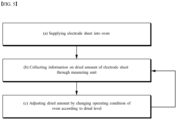
- FIG. 5 is a flowchart illustrating an order of an automatic electrode drying control method according to the present invention.
- a method of automatically controlling an electrode drying includes: (a) supplying an electrode sheet into an oven which is divided into a plurality of drying sections and has a drying means; (b) collecting information on a dried amount of the electrode sheet through a measuring unit; and (c) determining a dried level of the electrode sheet by comparing the collected information on the dried amount with a reference value, and controlling a drying intensity of the oven according to the determined dried level.
- the determining of the dried level includes independently controlling the plurality of drying sections.
- the collecting of the information includes periodically collecting information on the dried amount of the electrode sheet at regular time intervals, and the determining of the dried level includes periodically controlling the drying intensity of the oven by determining the dried level of the electrode sheet whenever receiving the information on the dried amount during the collecting of the information. Therefore, according to the method of automatically controlling an electrode drying of the present invention, it is possible to automatically control the dried amount to be uniform by adjusting the dried amount to fit the predetermined reference value after receiving information on the dried amount of the electrode sheet in real time.
- an electrode sheet is manufactured by coating a slurry for electrode formation including an active material on the current collector sheet. Details of the electrode sheet are the same as described above. If the electrode sheet is manufactured, a drying is started by supplying the electrode sheet into the above-described oven.
- the electrode sheet When an electrode sheet is supplied into an oven, the electrode sheet is dried as a solvent in the slurry is removed by a drying means such as a heater or a hot air nozzle while the electrode sheet is moved inside the oven. Further, the measuring unit collects information on the dried amount of the electrode sheet.
- the information on the dried amount includes information on at least one of a solid content and a surface temperature of the electrode sheet.
- the process of collecting information on the dried amount by the measuring unit is performed by measuring the surface temperature of the electrode sheet through a temperature measuring instrument installed inside or outside the oven or by an electrode loading amount measuring means such as a web gauge which is installed at the entrance and the exit of the oven.
- the measuring unit may further include a calculation unit which calculates the solid content from the loading amount of the electrode sheet before and after the drying.
- the measure dried amount is smaller than the reference value, it means that the drying is insufficient.
- the measure dried amount is greater than the reference value, it means that it has been overdried.
- the measure dried amount is possible to decrease at least one of the temperature, speed and volume of the hot air of the hot air nozzle, and the temperature of the heater in the oven.
- the oven may be divided into a plurality of drying sections as described above, and they drying sections may be divided into a front end drying section, a middle drying section, and a rear end drying section.
- the method of automatically controlling an electrode drying of the present invention does not perform control of the drying intensity in the front end drying section.
- the front end drying section is an initial drying section where the electrode sheet is dried right after the termination of the coating process. It is not desirable to periodically change the drying intensity at the initial drying section where the electrode sheet is stabilized, and the dried amount adjustment in the middle drying section and the rear end drying section is sufficient in terms of the dried amount adjusting efficiency.
- the drying intensity is controlled by changing the driving condition of the hot air nozzle or the heater installed in the middle drying section and the rear end drying section without changing the driving condition of the hot air nozzle or the heater included in the front end drying section.
- the method of automatically controlling an electrode drying of the present invention may be changed according to the quantitative change between the dried level of the electrode sheet determined according to the above method and the target dried level.
- the determining of the dried level includes determining the dried level of the electrode sheet as one of 5 levels of normal level, overdried level, non-dried level, excessively overdried level, and excessively non-dried level.
- the reference value of the predetermined solid content is 88 to 89%
- the information on the dried amount of the electrode sheet collected by the measuring unit is within ⁇ 1%, compared with the reference value, it is determined as the overdried level or the non-dried level
- the information on the dried amount of the electrode sheet collected by the measuring unit is beyond ⁇ 1%, compared with the reference value, it is determined as the excessively overdried level or the excessively non-dried level
- the information on the dried amount of the electrode sheet collected by the measuring unit is within the reference value range, it is determined as the normal level.
- the controller controls to adjust the drying intensity for one drying section, and when the dried level of the electrode sheet is determined as the excessively overdried level or the excessively non-dried level, the controller controls to adjust the drying intensity of two or more drying sections together. Further, in the case that it is determined that the dried level of the electrode sheet is normal, control of adjusting the drying intensity of the oven is not performed because the drying intensity of the oven is appropriate.
- the drying intensity may first be increased for one drying section, and after some time passes until the dried amount adjusting effect according to the adjustment of the drying intensity is shown, the dried level is determined again by receiving information on the dried amount from the measuring unit, and follow-up drying intensity control is performed according the received information, thereby more accurately adjusting the dried amount.
- the method of adjusting the drying intensity for one drying section after determining whether the dried level of the electrode sheet is the overdried level or the non-dried level may be different, depending on whether it is the overdried level or the non-dried level. Specifically, when the dried level of the electrode sheet is determined as the overdried level, the control of decreasing the drying intensity should be performed. At this time, the control of sequentially decreasing the drying intensity from a drying section close to the exit of the oven is performed.
- the drying sections of the entrance to the exit are numbered as are referred to as a first drying section to a N-th drying section, if the dried level of the electrode sheet is determined as the overdried level, the control of decreasing the drying intensity is performed in the N-th drying section closest to the exit of the oven. Further, predetermined time passes, and in the case that the measuring unit collects information on the dried amount of the electrode sheet and compares the information with the reference value, if the dried level of the electrode sheet is still determined as the overdried level, the control of decreasing the drying intensity in the (N-1)-th drying section is performed.
- the control of increasing the drying intensity should be performed.
- the control of sequentially increasing the drying intensity from drying sections close to the entrance of the oven is performed.
- the control of adjusting the drying intensity is not performed in the initial drying section close to the entrance of the oven, and accordingly, if the initial drying section corresponds to the first drying section to the 8th drying section, the control of increasing the drying intensity is performed in the 9th drying section.
- predetermined time passes, and in the case that the measuring unit collects information on the dried amount of the electrode sheet and compares the information with the reference value, if the dried level of the electrode sheet is still determined as the non-dried level, the control of increasing the drying intensity in the 10th drying section is performed.
- the effect of adjusting the dried amount may not be sufficient by changing the drying intensity in only one drying section.
- an appropriate control of the drying intensity may be performed by simultaneously adjusting the drying intensity of two or more drying sections.
- the process of drying the electrode sheet with the adjusted drying intensity is performed for predetermined time.
- the dried amount of the electrode sheet may be adjusted to some extent by the adjusted drying intensity.
- the process of collecting information on the dried amount is performed in the same manner as described above.
- information on the dried amount may be collected for 1 to 5 minutes right before a time point when the following control of the drying intensity is expected.
- the information on the dried amount of the electrode sheet may be collected for 2 minutes right before a time point when the following control of the drying intensity is expected, for 3 minutes right before a time point when the following control of the drying intensity is expected, or for 4 minutes right before a time point when the following control of the drying intensity is expected.
- an average value or a median value of information on the dried amount collected for predetermined time may be recognized as information on the dried amount.
- the process of determining the dried level of the electrode sheet in the same manner as described based on the recognized information on the dried amount, and controlling the drying intensity of the oven is performed, and the dried level of the electrode sheet can be controlled to be uniform by periodically performing the dried amount collection process, the dried level determination and drying intensity control process.
- Table 1 shows the reference value for determining the dried level of the electrode sheet, and the determination result and control method according thereto.
- Reference value Solid content of electrode sheet collected in measuring unit Dried level Drying intensity control method Reference value: 88 to 89% solid content less than 87% Excessively non-dried level Increase drying intensity in drying section except for front end drying section (Two plus control) Equal to or greater than 87% and less than 88% Non-dried level Increase drying intensity from drying section after front end drying section (One plus control) 88% ⁇ 89% Normal level Drying intensity control is not performed Greater than 89% and equal to or less than 90% Overdried level Decrease drying intensity from rear end drying section among drying sections except for front end drying section (One minus control) Greater than 90% Excessively overdried level Decrease drying intensity in drying section except for front end drying section (Two minus control)
- the reference value of the solid content is 88 to 89%.
- the drying intensity is raised because it means that the drying is insufficient, and on the other hand, in the case that the measured solid content is greater than the setting value, the drying intensity is reduced because it means that the drying is excessive.
- a plurality of drying sections which are sequentially arranged from the entrance to the exit of the oven, are divided into a first drying section, a second drying section, ... , a (N-1)-th drying section, and a N-th drying section, and the method of controlling the drying intensity will be described in detail.
- the measured solid content is in the range of 88 to 89%, it means that the dried level is normal, and accordingly, the existing drying intensity may be maintained. Hence, control of adjusting the drying intensity does not need to be performed.
- the control of increasing the drying intensity is performed for the drying sections except for the front end drying section. If the front end drying section corresponds to the first drying section to the (N/3)-th drying section, the drying intensity is increased from the following drying section to the N-th drying section. This is referred to as two plus control for the convenience of explanation.
- the control of decreasing the drying intensity is performed for the drying sections except for the front end drying section. This is referred to as two minus control for the convenience of explanation.
- the drying intensity is increased at the following drying section of the front end drying section.
- This is referred to as one plus control for the convenience of explanation.
- One plus control does not increase the drying intensity for the drying section, where the drying intensity has already been increased, and increases the drying intensity for the following drying section.
- control of increasing the drying intensity of the 5th drying section to some extent is performed by performing one plus control in the 5th drying section, and after some time passes, if the solid content collected from the measuring unit is 87.5%, it is still in the non-dried level, and accordingly one plus control should be performed. At this time, control of increasing the drying intensity of the 6th drying section followed by the 5th drying section is performed, and control of changing the drying intensity of the 5th drying section is not performed.
- the measured solid content is greater than 89% and is equal to or less than 90%, it is determined as the overdried level, and accordingly, control of decreasing the drying intensity from the rear end drying section close to the exit of the oven among drying sections except for the front end drying section is performed.
- This is referred to as one minus control for the convenience of explanation.
- One minus control does not decrease the drying intensity for the drying section, where the drying intensity has already been deceased, and decreases the drying intensity for the previous drying section.
- control of decreasing the drying intensity of the 15th drying section to some extent is performed by performing one minus control in the 15th drying section, and after some time passes, if the solid content collected from the measuring unit is 89.8%, it is still in the overdried level, and accordingly one minus control should be performed. At this time, control of decreasing the drying intensity of the 14th drying section before the 15th drying section is performed, and control of changing the drying intensity of the 15th drying section is not performed.
- the dried level of the electrode sheet is determined as the non-dried level, and one plus control is performed.
- the drying intensity of the 10th drying section becomes 2, which is increased by 1 from the drying intensity 1 at the sequence number 1, by increasing the drying intensity for only the 10th drying section, and the control of increasing the drying intensity is not performed in other drying sections, thereby maintaining the drying intensity 1 of the sequence number 1.
- sequence number 3 corresponds to the non-coated part, the control is not performed.
- the dried level of the electrode sheet is determined as the excessively overdried level, and two minus control is performed. As such, the control of decreasing the drying intensity by 1 is performed for each of the 10-th drying section to 12th drying section. As such, the drying intensity becomes 1, 0 and 0 which are decreased by 1 from drying intensity 2, 1 and 1 of each zone at sequence number 2.
- the dried level of the electrode sheet is determined as the normal level, and the control of adjusting the drying intensity is not performed.
- the drying intensity of the 10th drying section to 12th drying section is the same as each of the drying sections at the sequence number 4.
- the dried level of the electrode sheet is determined as the non-dried level, and one plus control is performed.
- the drying intensity is increased in the 11th drying section which is a drying section followed by the 10th drying section in which the drying intensity has been increased in the sequence number 2.
- the drying intensity at the 10th drying section is maintained as the drying intensity 1 at the sequence number 5, and the drying intensity of the 11-th drying section becomes 1 which has been increased by 1 from the drying intensity 0 of the 11th drying section in the sequence number 5.
- the dried level of the electrode sheet is determined as the non-dried level, and one plus control is performed.
- the drying intensity is increased by 1 only in the 12th drying section which is a drying section followed by the 11th drying section in which the drying intensity has been increased in the sequence number 6.
- the drying intensity of each of the 10th drying section to the 12th drying section becomes 1, 1 and 1 from the drying intensity 1, 1 and 0 in the sequence number 6.
- the dried level of the electrode sheet is determined as the non-dried level, and one plus control is performed. Since the drying intensity has been sequentially increased in the 10th drying section to the 12th drying section, the drying intensity is increased again by 1 in only the 10th drying section. As such, the drying intensity of each of the 10th drying section to the 12th drying section becomes 2, 1 and 1 from the drying intensity 1, 1 and 1 in the sequence number 7.
- the dried level of the electrode sheet is determined as the non-dried level, and one plus control should be performed. However, since the drying intensity of the 10th to 12th drying sections was increased to the upper limit (2), control is not performed in order not to increase the drying intensity any more.
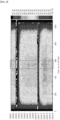
- FIG. 6 illustrates a photograph obtained by photographing the electrode sheet, which has been dried according to the control of sequence numbers 2 to 15, using a thermal imaging camera.
- the electrode sheet which has been dried according to the automatic drying control system according to the example of the present invention, shows the uniform temperature along the longitudinal direction.
- the automatic drying control system of the present invention shows an effect of manufacturing an electrode sheet having a uniform dried level.
Landscapes
- Engineering & Computer Science (AREA)
- Mechanical Engineering (AREA)
- General Engineering & Computer Science (AREA)
- Microbiology (AREA)
- Life Sciences & Earth Sciences (AREA)
- Chemical & Material Sciences (AREA)
- Manufacturing & Machinery (AREA)
- Chemical Kinetics & Catalysis (AREA)
- Electrochemistry (AREA)
- General Chemical & Material Sciences (AREA)
- Combustion & Propulsion (AREA)
- Textile Engineering (AREA)
- Battery Electrode And Active Subsutance (AREA)
Description
- The present invention relates to a system and method for automatically controlling an electrode drying, and more particularly, to a system and method for automatically controlling an electrode drying, which is capable of recognizing the dried level from information on the dried amount such as the solid content and surface temperature of an electrode sheet, and accordingly adjusting the dried amount of the electrode in real time by automatically operating the drying means.
- Recently, secondary batteries capable of charging and discharging have been widely used as energy sources of wireless mobile devices. In addition, the secondary battery has attracted attention as an energy source of an electric vehicle, a hybrid electric vehicle, etc., which are proposed as a solution for air pollution of existing gasoline vehicles and diesel vehicles using fossil fuel. Therefore, the types of applications using the secondary battery are currently much diversified due to the advantages of the secondary battery, and it is expected that the secondary battery will be applied to many fields and products in the future.
- Such secondary batteries may be classified into lithium ion batteries, lithium ion polymer batteries, lithium polymer batteries, etc., depending on the composition of the electrode and the electrolyte, and among them, the amount of use of lithium-ion polymer batteries that are less likely to leak electrolyte and are easy to manufacture is on the increase. In general, secondary batteries are classified into cylindrical batteries and prismatic batteries in which an electrode assembly is embedded in a cylindrical or rectangular metal can, depending on the shape of a battery case, and pouch-type batteries in which the electrode assembly is embedded in a pouch-type case of an aluminum laminate sheet. The electrode assembly built into the battery case is composed of a positive electrode, a negative electrode, and a separator interposed between the positive electrode and the negative electrode, and is a power generating element capable of charging and discharging. The electrode assembly is classified into a jelly-roll type wound with a separator interposed between the positive electrode and the negative electrode which are long sheet-shaped and are coated with active materials, and a stack type in which a plurality of positive electrodes and negative electrodes of a predetermined size are sequentially stacked while a separator is interposed therebetween.
- The positive electrode and the negative electrode are formed by applying a positive electrode slurry containing a positive electrode active material and a negative electrode slurry containing a negative electrode active material to a positive electrode current collector and a negative electrode current collector, to thereby form a positive electrode active material layer and a negative electrode active material layer, respectively, followed by drying and rolling them.
- At this time, the drying condition of the electrode influences the quality and physical properties of the electrode. Particularly, the adhesive force and the coupled level of the surface of the electrode can be significantly changed according to control of the deviation of the dryness for the width direction of the electrode and the time point when the drying is completed during the drying. Conventionally, an electrode was dried by determining the initial process condition in advance, and the dried amount was evaluated through measurement of physical properties of a sample after completing the drying and the process condition was then adjusted. However, such a method required a lot of time in measuring the physical properties, and it was difficult to reflect the dried amount evaluation result to the process in real time. As such, this method was not appropriate for a roll-to-roll consecutive production process.
- Hence, there is a need for an electrode drying method capable of maintaining the dryness of the completed electrode constant by monitoring the dried amount of the electrode in real time and promptly reflecting the monitoring result to the process.
- Document
US 2014/0014037 A1 relates to an electrode plate production device. - The present invention is believed to solve at least some of the above problems. For example, an aspect of the present invention provides a system and method of automatically controlling an electrode drying capable of reducing the deviation of a product by maintaining the dried level of a final electrode constant by automatically controlling the dried level of the electrode in real time.
- A system for automatically controlling an electrode drying according to the present invention is recited in
claim 1. - In an embodiment of the present invention, the measuring unit is set to periodically collect information on the dried amount of the electrode sheet at regular time intervals, and the controller periodically controls the drying intensity of the oven by determining the dried level of the electrode sheet whenever receiving the information on the dried amount from the measuring unit.
- In an embodiment of the present invention, the measuring unit collects information on the dried amount for 1 to 5 minutes right before a time point when the control of the drying intensity by the controller is expected.
- In an embodiment of the present invention, the information on the dried amount includes information on at least one of a solid content and a surface temperature of the electrode sheet.
- In an embodiment of the present invention, the controller includes: a data input unit which receives an input of the information on the dried amount collected by the measuring unit, and a reference setting value on the dried amount; a determination unit which determines the dried level of the electrode sheet by comparing the information on the dried amount with the setting value, and determines whether to adjust the drying intensity in the oven according the determined dried level; and a command unit which controls the drying intensity of the oven based on a result of determination of the determination unit.
- In an embodiment of the present invention, when the dried level of the electrode sheet is determined as the overdried level or the excessively overdried level, the controller controls to reduce the drying intensity of the oven, and when the dried level of the electrode sheet is determined as the non-dried level or the excessively non-dried level, the controller controls to increase the drying intensity of the oven.
- In an embodiment of the present invention, the controller controls the drying intensity for drying sections other than a drying section at a front end of the oven among the plurality of drying sections.
- In an embodiment of the present invention, the measuring unit transmits an average value or a median value of the collected information on the dried amount to the controller.
- In an embodiment of the present invention, each of the plurality of drying sections includes a drying means, and the drying means includes at least one of a hot air nozzle, which applies convective heat by supplying hot air to the electrode sheet, and a heater, which applies radiant heat to the electrode sheet.
- In an embodiment of the present invention, the controller controls at least one selected from the group consisting of a speed of hot air of the hot air nozzle, a volume of hot air of the hot air nozzle, a temperature of the heater, and a moving speed of a transfer roller which moves the electrode sheet.
- In an embodiment of the present invention, the measuring unit includes at least one of a web gauge for measuring the loading amount of the electrode sheet and a temperature measuring instrument.
- In an embodiment of the present invention, the measuring unit further includes a calculation unit, and the calculation unit calculates a solid content of the electrode sheet from the loading amount measured by the web gauge.
- A method of automatically controlling an electrode drying according to the invention is recited in
claim 13
In an embodiment of the present invention, during the step (b), the information on the dried amount includes information on at least one of a solid content and a surface temperature of the electrode sheet. - In an embodiment of the present invention, the step (b) includes periodically collecting information on the dried amount of the electrode sheet at regular time intervals, and the step (c) includes periodically controlling the drying intensity of the oven by determining the dried level of the electrode sheet whenever receiving the information on the dried amount through the step (b).
- According to the present invention, it is possible to automatically control the dried level of an electrode in real time by controlling the dried amount of the oven in real time by collecting the information on the dried amount of the electrode sheet and determining the dried level of the electrode from the collected information on the dried amount.
-
-
FIG. 1 is a block diagram showing a configuration of an automatic electrode drying control system according to the present invention. -
FIG. 2 is a schematic diagram illustrating a structure of an automatic electrode drying control system according to an embodiment of the present invention. -
FIG. 3 is a block diagram illustrating a configuration of an automatic electrode drying control system according to an embodiment of the present invention. -
FIG. 4 is a schematic diagram illustrating a structure of an automatic electrode drying control system according to another embodiment of the present invention. -
FIG. 5 is a flowchart illustrating an order of an automatic electrode drying control method according to the present invention. -
FIG. 6 is a photograph obtained by photographing an electrode sheet dried by an automatic control method according to an embodiment of the present invention using a thermal imaging camera. - Hereinafter, the present invention will be described in detail with reference to the drawings. The terms and words used in the present specification and claims should not be construed as limited to ordinary or dictionary terms and the inventor may properly define the concept of the terms in order to best describe its invention. The terms and words should be construed as meaning and concept consistent with the technical idea of the present invention.
- In this application, it should be understood that terms such as "include" or "have" are intended to indicate that there is a feature, number, step, operation, component, part, or a combination thereof described on the specification, and they do not exclude in advance the possibility of the presence or addition of one or more other features or numbers, steps, operations, components, parts or combinations thereof. Also, when a portion such as a layer, a film, an area, a plate, etc. is referred to as being "on" another portion, this includes not only the case where the portion is "directly on" the another portion but also the case where further another portion is interposed therebetween. On the other hand, when a portion such as a layer, a film, an area, a plate, etc. is referred to as being "under" another portion, this includes not only the case where the portion is "directly under" the another portion but also the case where further another portion is interposed therebetween. In addition, to be disposed "on" in the present application may include the case disposed at the bottom as well as the top.
- Hereinafter, the present invention will be described in detail with reference to the drawings.
-
FIG. 1 is a block diagram showing a configuration of an automatic electrode drying control system according to the present invention, andFIG. 2 is a schematic diagram illustrating a structure of an automatic electrode drying control system according to an embodiment of the present invention. Referring to these drawings, asystem 100 for automatically controlling an electrode drying includes: anoven 110 which provides a space where an electrode sheet is moved and dried, includes a drying means which applies hot air and/or radiant heat to the electrode sheet, and is divided into a plurality of drying sections; ameasuring unit 120 which collects information on a dried amount of theelectrode sheet 10 and transmits the collected information to acontroller 130; and thecontroller 130 which determines a dried level of theelectrode sheet 10 based on the information on the dried amount received from themeasuring unit 120, and control a drying intensity of theoven 110 according to the determined dried level. Herein, thecontroller 130 independently controls the plurality of drying sections. - As described above, the drying condition of the electrode significantly influences the quality and physical properties of the electrode. Conventionally, after drying an electrode by determining the initial process condition in advance, and the process condition was then adjusted through the evaluation of the dryness and physical properties of the product. However, in this case, it was difficult to control the drying of the electrode in real time.
- According to the system for automatically controlling an electrode drying of the present invention, it is possible to automatically control the dried level of an electrode by appropriately adjusting the dried amount according to the dried level of the electrode sheet by determining the dried level by collecting information on the dried amount of the electrode sheet in real time and accordingly independently controlling a plurality of drying sections.
- Further, in the present invention, the x-axis means a direction in which an electrode is transferred, and the y-axis means a direction which is perpendicular to the transfer direction of the electrode on the electrode surface, as the width direction of the electrode. The z-axis corresponds to a direction in which hot air is sprayed or infrared rays are irradiated, as a direction perpendicular to the electrode surface.
- Hereinafter, the configuration of the automatic electrode drying control system according to the present invention will be described in detail.
- Referring to
FIG. 2 , an automatic electrode dryingcontrol system 100 according to the present invention includes anoven 110. Theoven 110 has a chamber shape and provides a space where anelectrode sheet 10 is dried, which is a space where theelectrode sheet 10 to be dried may be moved inside theoven 110, and can prevent the internal heat from escaping. - Further, the
electrode sheet 10 may have a structure in which an electrodeactive material layer 12 is formed as a slurry for electrode formation including an electrode active material is coated on thecurrent collector sheet 11. The electrode slurry may be applied to at least one surface of the current collector. - In this case, the current collector may be a positive electrode current collector or a negative electrode current collector, and the electrode active material may be a positive electrode active material or a negative electrode active material. In addition, the electrode slurry may further include a conductive material and a binder in addition to the electrode active material.
- In the present invention, the positive electrode collector generally has a thickness of 3 to 500 micrometers. The positive electrode current collector is not particularly limited as long as it has high conductivity without causing a chemical change in the battery. Examples of the positive electrode current collector include stainless steel, aluminum, nickel, titanium, sintered carbon or aluminum or stainless steel of which the surface has been treated with carbon, nickel, titanium, silver, or the like. The current collector may have fine irregularities on the surface thereof to increase the adhesion of the positive electrode active material, and various forms such as a film, a sheet, a foil, a net, a porous body, a foam, and a nonwoven fabric are possible.
- The sheet for the negative electrode collector generally has a thickness of 3 to 500 micrometers. The negative electrode current collector is not particularly limited as long as it has electrical conductivity without causing chemical changes in the battery, and examples thereof include copper, stainless steel, aluminum, nickel, titanium, sintered carbon, copper or stainless steel of which the surface has been treated with carbon, nickel, titanium, silver or the like, aluminum-cadmium alloy, or the like. In addition, like the positive electrode current collector, fine unevenness can be formed on the surface to enhance the bonding force of the negative electrode active material, and it can be used in various forms such as a film, a sheet, a foil, a net, a porous body, a foam, and a nonwoven fabric.
- In the present invention, the positive electrode active material is a material capable of causing an electrochemical reaction and a lithium transition metal oxide, and contains two or more transition metals. Examples thereof include: layered compounds such as lithium cobalt oxide (LiCoO2) and lithium nickel oxide (LiNiO2) substituted with one or more transition metals; lithium manganese oxide substituted with one or more transition metals; lithium nickel oxide represented by the formula LiNi1-yMyO2 (wherein M = Co, Mn, Al, Cu, Fe, Mg, B, Cr, Zn or Ga and contains at least one of the above elements, 0.01 ≤ y ≤ 0.7); lithium nickel cobalt manganese composite oxide represented by the formula Li1+zNibMncCo1-(b+c+d)MdO(2-e)Ae such as Li1+zNi1/3Co1/3Mn1/3O2, Li1+zN0.4Mn0.4Co0.2O2 etc. (wherein - 0.5≤z≤0.5, 0.1≤b≤0.8, 0.1≤c≤0.8, 0≤d≤0.2, 0≤e≤0.2, b+c+d<1, M = Al, Mg, Cr, Ti, Si or Y, and A = F, P or Cl); olivine-based lithium metal phosphate represented by the formula Li1+xM1-yM'yPO4-zXz (wherein M = transition metal, preferably Fe, Mn, Co or Ni, M'= Al, Mg or Ti, X = F, S or N, and -0.5≤x≤0.5, 0≤y≤0.5, 0≤z≤0.1).
- Examples of the negative electrode active material include carbon such as non-graphitized carbon and graphite carbon; metal complex oxide such as LixFe2O3(0≤x≤1), LixWO2(0≤x≤1), SnxMe1-xMe'yOz (Me: Mn, Fe, Pb, Ge; Me': Al, B, P, Si,
groups - The conductive material is usually added in an amount of 1 to 30% by weight based on the total weight of the mixture including the positive electrode active material. Such a conductive material is not particularly limited as long as it has electrical conductivity without causing a chemical change in the battery, and examples thereof include graphite such as natural graphite and artificial graphite; carbon black such as carbon black, acetylene black, Ketjen black, channel black, furnace black, lamp black, and summer black; conductive fibers such as carbon fiber and metal fiber; metal powders such as carbon fluoride, aluminum and nickel powder; conductive whiskey such as zinc oxide and potassium titanate; conductive metal oxides such as titanium oxide; and conductive materials such as polyphenylene derivatives and the like.
- The binder is added in an amount of 1 to 30% by weight, on the basis of the total weight of the mixture containing the positive electrode active material, as a component that assists in bonding between the active material and the conductive material and bonding to the current collector. Examples of such binders include polyvinylidene fluoride, polyvinyl alcohol, carboxymethylcellulose (CMC), starch, hydroxypropylcellulose, regenerated cellulose, polyvinylpyrrolidone, tetrafluoroethylene, polyethylene, polypropylene, ethylene-propylene-diene terpolymer (EPDM), sulfonated EPDM, styrene butylene rubber, fluorine rubber, various copolymers and the like.
- Meanwhile, such an electrode slurry may be prepared by dissolving an electrode active material, a conductive material, and a binder in a solvent. The type of the solvent is not particularly limited as long as it is capable of dispersing an electrode active material, and either an aqueous solvent or a non-aqueous solvent may be used. For example, the solvent may be a solvent generally used in the art, such as dimethyl sulfoxide (DMSO), isopropyl alcohol, N-methylpyrrolidone (NMP ), acetone, or water, and one of them alone or a mixture of two or more may be used. The amount of the solvent used may be such that the slurry can be adjusted to have an appropriate viscosity in consideration of the coating thickness, production yield, and workability of the slurry, and is not particularly limited.
- The
oven 110 is divided into a plurality of dryingsections electrode sheet 10 therein. The drying means includes ahot air nozzle 114, which applies convective heat by supplying hot air to theelectrode sheet 10, and aheater 115, which applies radiant heat to theelectrode sheet 10. Referring toFIG. 2 , thehot air nozzles 114 and theheaters 115 may be arranged at regular intervals along the transfer direction (MD direction, x direction) of theelectrode sheet 10, and hot air or radiant heat is applied in a direction perpendicular to theelectrode sheet 10. InFIG. 2 , it is illustrated that thehot air nozzle 114 and theinfrared heater 115 are positioned on the upper portion of theelectrode sheet 10, that is, the lower surface of the ceiling of theoven 110, but when the electrode active material layer is formed on both surfaces of the current collector, thehot air nozzle 114 and theheater 115 may be positioned on the upper portion and the lower portion of theelectrode sheet 10, respectively. It is illustrated inFIG. 2 that both a hot air nozzle and a heater are included as the drying means, but the present invention is not limited to this example, and only one of the hot air nozzle and the heater may be included as the drying means. - On the other hand, the
hot air nozzle 114 includes a main body unit and an injection unit. The main body unit constitutes the body of the hot air nozzle, and fixes thehot air nozzle 114 to the ceiling of the oven. In addition, the main body unit is empty inside and transmits hot air transmitted from a hot air supply source (not shown) to the injection unit. On the other hand, the injection unit is provided on the lower surface of the main body unit. The injection unit communicates with the main body unit, and an injection hole portion through which hot air is injected is formed on the lower surface of the injection unit. The injection hole portion may have a structure in which a plurality of pores are arranged at regular intervals. - Further, the
heater 115 may be an infrared heater in a specific example of the present invention, and the infrared heater may include an infrared lamp which irradiates infrared rays to the electrode, and a cradle which supports the infrared lamp. The shape of the infrared lamp is not particularly limited, and for example, the rod-shaped lamp may be arranged in parallel along the transfer direction of the electrode while extending in the width direction of the electrode. - The
hot air nozzles 114 and theheaters 115 may be alternately arranged in a direction in which theelectrode sheet 10 is moved in order to evenly supply hot air and infrared rays to the surface of theelectrode sheet 10. However, there is no particular limitation on the type of the arrangement, and the arrangement scheme of thehot air nozzles 114 and theinfrared heaters 115 can be appropriately changed by one of ordinary skill in the art according to the drying condition. - Further, a
transfer roller 116 for transferring an electrode may be included in theoven 110. A plurality oftransfer rollers 116 may be arranged at regular intervals along the transfer direction of theelectrode sheet 10, and thetransfer rollers 116 support theelectrode sheet 10 during the drying process and transfer theelectrode sheet 10 to the outside of theoven 110. Further, the dried amount of the electrode sheet can also be controlled by adjusting the rotation speed of the transfer roller. - The
oven 110 is be divided into a plurality of drying zones. When an overdried or non-dried situation occurs during the drying process of theelectrode sheet 10, theelectrode sheet 10 may need to be appropriately dried while changing the drying intensity. At this time, it is possible to independently control the drying intensity for each drying section by dividing theoven 110 into a plurality of drying sections. It is illustrated inFIG. 2 that theoven 110 is divided into 3 drying sections, but the oven may also be divided into 3 to 20 drying sections or 5 to 15 drying sections, and the present invention is not limited to this example. In the specification of the present invention, the 3 drying sections are referred to as afirst drying section 111, asecond drying section 112, and athird drying section 113. - The
first drying section 111, thesecond drying section 112, and thethird drying section 113 may be physically divided spaces by installing an inner wall between drying sections or may also be abstractly divided spaces according to the drying condition. - The
system 100 for automatically controlling an electrode drying according to the present invention includes a measuring unit which collects information on a dried amount of the electrode sheet and transmits the collected information to a controller. - In a specific example of the present invention, the information on the dried amount includes information on at least one of a solid content and a surface temperature of the electrode sheet. The system for automatically controlling an electrode drying of the present invention determines the dried level of the electrode sheet through information on the solid content and/or temperature, which is collected through the measuring unit. The measuring unit may include at least one of a web gauge for measuring the loading amount of the electrode sheet and a temperature measuring instrument in order to collect information on the solid content and the surface temperature of the electrode sheet.
- Referring to
FIG. 2 , the measuringunits unit 120 may be installed at the entrance and the exit of theoven 110, respectively and measure the loading amount before drying the electrode sheet and the loading amount after drying the electrode sheet. The measuring unit may further include a calculation unit in order to derive the solid content, and the calculation unit may derive the solid content of the electrodeactive material layer 12 from the measured loading amount using a pre-entered calculation formula. A known formula in the related art can be used to derive the solid content from the loading amount. - When the dried level of the electrode sheet is excessive (overdrying), the solid content becomes greater than the reference value, and when the dried level of the electrode sheet is not sufficient, the solid content becomes smaller than the reference value. Hence, the solid content can become an indicator for recognizing the dried level of the electrode sheet.
- The
system 100 for automatically controlling an electrode drying according to the present invention includes acontroller 130. Thecontroller 130 may determine a dried level of the electrode sheet based on the information on the dried amount received from the measuringunits oven 110 according to the determined dried level, to thereby adjust the dried amount of the electrode sheet in real time. - In order to adjust the dried amount of the electrode sheet in real time, the measuring unit is set to periodically collect information on the dried amount of the electrode sheet at regular time intervals, and the controller periodically controls the drying intensity of the oven by determining the dried level of the electrode sheet whenever receiving the information on the dried amount from the measuring unit.
-
FIG. 3 is a block diagram showing the configuration of a system for automatically controlling an electrode drying according to one embodiment of the present invention. Referring toFIG. 3 , acontroller 130 of the present invention includes: adata input unit 131 which receives an input of the information on the dried amount collected by the measuring unit, and a reference setting value on the dried amount; adetermination unit 132 which determines the dried level of the electrode sheet by comparing the information on the dried amount with the setting value, and determines whether to adjust the drying intensity in the oven according the determined dried level; and acommand unit 133 which controls the drying intensity of the oven based on a result of determination of thedetermination unit 132. - The
data input unit 131 may receive information on the loading amount before/after drying the electrode sheet, and/or the dried amount, such as the temperature of the surface of the electrode from the measuringunit 120, and receives the input of the reference value for determining whether the dried level of the electrode sheet is excessive or insufficient. Further, the information on the dried amount and the reference value, which are inputted through the data input unit, are transmitted to thedetermination unit 132. - The
determination unit 132 determines whether the dried level of the electrode sheet is the overdried level, the non-dried level or the normal level by comparing the information on the dried amount received from thedata input unit 131 with the reference value, and thedetermination unit 132 determines the method of controlling the drying intensity by quantitatively recognizing the overdried or non-dried degree by comparing the information on the dried amount with the reference value. - The controller controls at least one of a speed of hot air of the hot air nozzle, a volume of hot air of the hot air nozzle, a temperature of the heater, and a moving speed of a transfer roller which moves the electrode sheet. In order for the controller to control the drying intensity of the oven, the
command unit 133 transmits a driving operation command to the oven according to the change of the drying intensity determined by the determination unit. - The oven may adjust the drying intensity in the oven according to the driving operation command received from the command unit of the controller. The oven includes a hot air nozzle which applies convective heat by supplying hot air to the electrode sheet; and a heater which applies radiant heat to the electrode sheet, as a drying means. Herein, it is possible to adjust the dried amount of the electrode sheet by changing at least one of the temperature, speed and volume of hot air sprayed from the hot air nozzle according to driving operation command.
- Further, it is possible to adjust the dried amount by controlling the rotation speed of the transfer roller which transfers the electrode sheet in addition to the driving operation of the hot air nozzle and/or heater.
- The control of the drying intensity by the controller is periodically performed at regular time intervals. In one specific example, the controller may repeatedly control the drying intensity of the oven at the period of 5 to 20 minutes and preferably at the period of 6 to 15 minutes, but the present invention is not limited to these examples.
- Further, the measuring unit is set to periodically collect the information on the dried amount of the electrode sheet at regular time intervals according to the drying intensity control by the controller. In one specific example, the measuring unit collects information on the dried amount for 1 to 5 minutes right before the time point when the control of the drying intensity by the controller is expected. Namely, the measuring unit does not promptly collect information on the dried amount of the electrode sheet after controlling the drying intensity of the oven, but it collects information on the dried amount of the electrode sheet after predetermined time passes from the performance of the control of the drying intensity by the controller. This is because it requires a predetermined time until the effect of dried amount adjustment according to the change of the drying intensity of the oven is shown.
- The measuring unit set the average value or median value of the information on the dried amount collected during the predetermined time, as the representative value of the information on the dried amount, and transmit the value to the controller.
- In the system for automatically controlling an electrode drying of the present invention, the controller controls the drying intensity for drying sections other than a drying section at a front end of the oven among the plurality of drying sections. The front end drying section means a drying section located at the entrance of the oven. In one specific example, in the case that an oven is sequentially divided into a first drying section to a N-th drying section from the entrance to the exit, the front end drying section may mean the first drying section to a (N/3)-th drying section, but the present invention is not limited to this example.
- In such a front end drying section, since the electrode sheet has just been supplied into the oven, even if the drying intensity is adjusted in the front end drying section, the dried amount adjusting effect is insignificant, compared the effect in the following sections. Hence, the controller of the present invention controls the adjust the drying intensity in drying sections except for the front end drying section among a plurality of drying sections of the oven.
- According to the invention, the controller determines the dried level of the electrode sheet as one of 5 levels of normal level, overdried level, non-dried level, excessively overdried level, and excessively non-dried level. The controller determines the dried level of the electrode sheet based on the predetermined reference value. If the information on the dried amount collected by the measuring unit is beyond the predetermined reference value but the difference is small, it is determined as the overdried level and the non-dried level, but if the difference is large, it is determined as the excessively overdried level or the excessively non-dried level.
- The controller of the present invention also distinguishes the excessively overdried level and the excessively non-dried level by quantitatively recognizing the overdried and non-dried degree. Accordingly, the optimized drying intensity control can be performed according to the dried level.
- Specifically, in the case that the dried level of the electrode sheet is normal, the drying intensity does not need to be changed. As such, the controller does not perform control of adjusting the drying intensity of the oven. Namely, a command to adjust the drying intensity is not transmitted to the oven.
- When the dried level of the electrode sheet is determined as the overdried level or the excessively overdried level, the controller of the present invention controls to reduce the drying intensity of the oven, and when the dried level of the electrode sheet is determined as the non-dried level or the excessively non-dried level, the controller controls to increase the drying intensity of the oven.
- Further, when the dried level of the electrode sheet is determined as the overdried level or the non-dried level, the controller of the present invention controls to adjust the drying intensity for one drying section, and when the dried level of the electrode sheet is determined as the excessively overdried level or the excessively non-dried level, the controller controls to adjust the drying intensity of two or more drying sections together.
- In the case that the dried level of the electrode sheet is determined as the overdried level or non-dried level, the difference with the reference value is small. As such, if the drying intensity is uniformly adjusted for a plurality of drying sections, a reverse effect may be caused. For example, if the drying intensity for all drying sections is increased to adjust the non-dried state, the overdried level may be caused. Hence, the controller first controls to increase the drying intensity for only one drying section and receives a feedback on the information on the dried amount from the measuring unit and then performs follow-up control.
- Further, when performing follow-up control, if the received information on the dried amount goes beyond the reference value and it is still determined as the non-dried level, the controller controls to increase the drying intensity in the following section of the drying section where the drying intensity has been previously controlled. Further, if the received information on the dried amount is within the range of the reference value, the adjustment of the drying intensity is not necessary. Hence, the control of adjusting the drying intensity is not performed.
- Further, in the case that the dried level of the electrode sheet is determined as the overdried level, the controller of the present invention may sequentially reduce the drying intensity from the rear end drying section to the medium drying section. On the contrary, in the case that the dried level of the electrode sheet is determined as the non-dried level, the controller may sequentially increase the drying intensity from the middle drying section to the rear end drying section. The order of controlling the drying intensity is changed depending on whether the electrode sheet has been overdried or non-dried in order to enhance the dried amount adjusting efficiency.
- Likewise, when the drying intensity is sequentially controlled according to the time sequential order, the drying intensity is not controlled for the front end drying section. Since the dried amount adjusting effect is small in the front end drying section, the control is sequentially performed from the middle drying section in order to enhance the dried amount adjusting efficiency.
- Further, in the case that the dried level of the electrode sheet is the excessively overdried level or the excessively non-dried level, the difference with the reference value is relatively large. In this case, if the drying intensity is adjusted for only one drying section, the dried amount adjusting effect is insignificant. Hence, in this case, in order to relatively increase the change of the drying intensity, the controller of the present invention controls to adjust the drying intensity of two or more drying sections.
- Specifically, when the dried level of the electrode sheet is determined as the excessively overdried level and the control of decreasing the drying intensity is performed, the control of simultaneously decreasing the drying intensity for the middle drying section and the rear end drying section is performed. On the other hand, when the dried level of the electrode sheet is determined as the excessively non-dried level and the control of increasing the drying intensity is performed, the control of simultaneously increasing the drying intensity for the middle drying section and the rear end drying section is performed.
-
FIG. 4 is a schematic diagram illustrating a structure of an automatic electrode drying control system according to another embodiment of the present invention. Referring toFIG. 4 , web gauges 221a and 221b for measuring the loading amount of the electrode sheet are installed at the entrance and the exit of the oven, respectively, and atemperature measuring instrument 222 is installed between thefirst drying section 211 and thesecond drying section 212, between thesecond drying section 212 and thethird drying section 213, and at the exit of the oven. The temperature measuring instrument may measure the temperature of the surface of the electrode. Further, it is illustrated inFIG. 4 that thetemperature measuring instrument 222 is positioned on the upper portion of theelectrode sheet 10, but when the electrode active material layer is formed on both surfaces of the current collector, thetemperature measuring instrument 222 may be positioned on both the upper portion and the lower portion of the electrode. - In one example, the
temperature measuring instrument 222 may be positioned inside theoven 110 and measure the temperature of the surface of theelectrode sheet 10. There is no limitation to the type of the temperature measuring instrument as long as it can measure the temperature of the surface of the electrode. Specifically, it may be a temperature sensor or a thermal imaging camera. - In the case that the
temperature measuring instrument 222 is a thermal imaging camera, it may be arranged in a manner that penetrates the outer wall of the oven, and in order to prevent the thermal imaging camera from being exposed to an excessively high temperature, it is preferably positioned at a relatively low temperature place. Further, the thermal imaging camera is preferably positioned at a place where a user's view is not blocked by thehot air nozzle 214 and theheater 215 in theoven 210. Hence, the thermal imaging camera may be positioned at a position where thehot air nozzle 213 and theinfrared heater 215 have not been arranged. - Further, in order to prevent a damage to the temperature measuring instrument installed inside the oven, a cooling device (not shown) for cooling the temperature measuring instrument may be further included. The cooling device allows the continuous measurement of the temperature of the surface of the electrode by preventing a damage to the temperature measuring instrument by a high temperature environment in the oven.
- The cooling device may be fastened or attached to the temperature measuring instrument from the external side of the oven in order to prevent a change in the temperature inside the oven. There is no limitation to the shape of the cooling device as long as it can cool the temperature measuring instrument. For example, it may be a cooling jacket which covers the temperature measuring instrument and contains refrigerants therein.
- Further the present invention provides a method of automatically controlling an electrode drying.
-
FIG. 5 is a flowchart illustrating an order of an automatic electrode drying control method according to the present invention. - Referring to
FIG. 5 , a method of automatically controlling an electrode drying includes: (a) supplying an electrode sheet into an oven which is divided into a plurality of drying sections and has a drying means; (b) collecting information on a dried amount of the electrode sheet through a measuring unit; and (c) determining a dried level of the electrode sheet by comparing the collected information on the dried amount with a reference value, and controlling a drying intensity of the oven according to the determined dried level. Herein, the determining of the dried level includes independently controlling the plurality of drying sections. - According to the method of automatically controlling an electrode drying of the present invention, the collecting of the information includes periodically collecting information on the dried amount of the electrode sheet at regular time intervals, and the determining of the dried level includes periodically controlling the drying intensity of the oven by determining the dried level of the electrode sheet whenever receiving the information on the dried amount during the collecting of the information. Therefore, according to the method of automatically controlling an electrode drying of the present invention, it is possible to automatically control the dried amount to be uniform by adjusting the dried amount to fit the predetermined reference value after receiving information on the dried amount of the electrode sheet in real time.
- Hereinafter, each step of the automatic electrode drying control system according to the present invention will be described in detail.
- First, an electrode sheet is manufactured by coating a slurry for electrode formation including an active material on the current collector sheet. Details of the electrode sheet are the same as described above. If the electrode sheet is manufactured, a drying is started by supplying the electrode sheet into the above-described oven.
- When an electrode sheet is supplied into an oven, the electrode sheet is dried as a solvent in the slurry is removed by a drying means such as a heater or a hot air nozzle while the electrode sheet is moved inside the oven. Further, the measuring unit collects information on the dried amount of the electrode sheet. The information on the dried amount includes information on at least one of a solid content and a surface temperature of the electrode sheet. The process of collecting information on the dried amount by the measuring unit is performed by measuring the surface temperature of the electrode sheet through a temperature measuring instrument installed inside or outside the oven or by an electrode loading amount measuring means such as a web gauge which is installed at the entrance and the exit of the oven.
- In one specific example, the measuring unit may further include a calculation unit which calculates the solid content from the loading amount of the electrode sheet before and after the drying.
- If information on the dried amount such as the surface temperature of the electrode sheet or the solid content is obtained from the measuring unit, it is compared with the reference value to thereby perform the operation of determining the dried level of the electrode sheet. If the measure dried amount is smaller than the reference value, it means that the drying is insufficient. Hence, in order to increase the drying intensity, it is possible to increase at least one of the temperature, speed and volume of the hot air of the hot air nozzle, and the temperature of the heater in the oven. On the contrary, if the measure dried amount is greater than the reference value, it means that it has been overdried. Hence, in order to decrease the drying intensity, it is possible to decrease at least one of the temperature, speed and volume of the hot air of the hot air nozzle, and the temperature of the heater in the oven.
- Further, the oven may be divided into a plurality of drying sections as described above, and they drying sections may be divided into a front end drying section, a middle drying section, and a rear end drying section. The method of automatically controlling an electrode drying of the present invention does not perform control of the drying intensity in the front end drying section. The front end drying section is an initial drying section where the electrode sheet is dried right after the termination of the coating process. It is not desirable to periodically change the drying intensity at the initial drying section where the electrode sheet is stabilized, and the dried amount adjustment in the middle drying section and the rear end drying section is sufficient in terms of the dried amount adjusting efficiency.
- Hence, even when the control of the drying intensity is necessary, the drying intensity is controlled by changing the driving condition of the hot air nozzle or the heater installed in the middle drying section and the rear end drying section without changing the driving condition of the hot air nozzle or the heater included in the front end drying section.
- Further, the method of automatically controlling an electrode drying of the present invention may be changed according to the quantitative change between the dried level of the electrode sheet determined according to the above method and the target dried level. Specifically, the determining of the dried level includes determining the dried level of the electrode sheet as one of 5 levels of normal level, overdried level, non-dried level, excessively overdried level, and excessively non-dried level.
- According to the control method of the present invention, when the information on the dried amount of the electrode sheet collected by the measuring unit is compared with the target reference value, if the information on the dried amount of the electrode sheet fits the reference value, it is determined as the normal level. When the information on the dried amount of the electrode sheet collected by the measuring unit is compared with the target reference value, if the difference is within the predetermined range, it is determined as the overdried level or the non-dried level. If the difference is beyond the predetermined range, the dried level of the electrode sheet is determined as the excessively overdried level or the excessively non-dried level.
- For example, on an assumption that the dried level of the electrode sheet is determined through the solid content, and the reference value of the predetermined solid content is 88 to 89%, if the information on the dried amount of the electrode sheet collected by the measuring unit is within ±1%, compared with the reference value, it is determined as the overdried level or the non-dried level, if the information on the dried amount of the electrode sheet collected by the measuring unit is beyond ±1%, compared with the reference value, it is determined as the excessively overdried level or the excessively non-dried level, and if the information on the dried amount of the electrode sheet collected by the measuring unit is within the reference value range, it is determined as the normal level.
- In the method of automatically controlling an electrode drying of the present invention, when the dried level of the electrode sheet is determined as the overdried level or the non-dried level, the controller controls to adjust the drying intensity for one drying section, and when the dried level of the electrode sheet is determined as the excessively overdried level or the excessively non-dried level, the controller controls to adjust the drying intensity of two or more drying sections together. Further, in the case that it is determined that the dried level of the electrode sheet is normal, control of adjusting the drying intensity of the oven is not performed because the drying intensity of the oven is appropriate.
- In the case that the dried level of the electrode sheet is the overdried level or the non-dried level, the drying intensity may first be increased for one drying section, and after some time passes until the dried amount adjusting effect according to the adjustment of the drying intensity is shown, the dried level is determined again by receiving information on the dried amount from the measuring unit, and follow-up drying intensity control is performed according the received information, thereby more accurately adjusting the dried amount.
- Further, the method of adjusting the drying intensity for one drying section after determining whether the dried level of the electrode sheet is the overdried level or the non-dried level may be different, depending on whether it is the overdried level or the non-dried level. Specifically, when the dried level of the electrode sheet is determined as the overdried level, the control of decreasing the drying intensity should be performed. At this time, the control of sequentially decreasing the drying intensity from a drying section close to the exit of the oven is performed. In the case that, in an oven, which is divided into a plurality of drying sections, the drying sections of the entrance to the exit are numbered as are referred to as a first drying section to a N-th drying section, if the dried level of the electrode sheet is determined as the overdried level, the control of decreasing the drying intensity is performed in the N-th drying section closest to the exit of the oven. Further, predetermined time passes, and in the case that the measuring unit collects information on the dried amount of the electrode sheet and compares the information with the reference value, if the dried level of the electrode sheet is still determined as the overdried level, the control of decreasing the drying intensity in the (N-1)-th drying section is performed.
- On the contrary, if the dried level of the electrode sheet is determined as the non-dried level, the control of increasing the drying intensity should be performed. At this time, the control of sequentially increasing the drying intensity from drying sections close to the entrance of the oven is performed. In the present invention, the control of adjusting the drying intensity is not performed in the initial drying section close to the entrance of the oven, and accordingly, if the initial drying section corresponds to the first drying section to the 8th drying section, the control of increasing the drying intensity is performed in the 9th drying section. Further, predetermined time passes, and in the case that the measuring unit collects information on the dried amount of the electrode sheet and compares the information with the reference value, if the dried level of the electrode sheet is still determined as the non-dried level, the control of increasing the drying intensity in the 10th drying section is performed.
- Further, in the case that the dried level of the electrode sheet is determined as the overdried level or the excessively overdried level, the effect of adjusting the dried amount may not be sufficient by changing the drying intensity in only one drying section. As such, an appropriate control of the drying intensity may be performed by simultaneously adjusting the drying intensity of two or more drying sections.
- After performing the control of adjusting the drying intensity of the oven as described above, the process of drying the electrode sheet with the adjusted drying intensity is performed for predetermined time. As such, the dried amount of the electrode sheet may be adjusted to some extent by the adjusted drying intensity. Further, in order to recognize the dried level of the electrode sheet again, the process of collecting information on the dried amount is performed in the same manner as described above.
- At this time, information on the dried amount may be collected for 1 to 5 minutes right before a time point when the following control of the drying intensity is expected. Namely, the information on the dried amount of the electrode sheet may be collected for 2 minutes right before a time point when the following control of the drying intensity is expected, for 3 minutes right before a time point when the following control of the drying intensity is expected, or for 4 minutes right before a time point when the following control of the drying intensity is expected. Further, an average value or a median value of information on the dried amount collected for predetermined time may be recognized as information on the dried amount.
- Likewise, the process of determining the dried level of the electrode sheet in the same manner as described based on the recognized information on the dried amount, and controlling the drying intensity of the oven is performed, and the dried level of the electrode sheet can be controlled to be uniform by periodically performing the dried amount collection process, the dried level determination and drying intensity control process.
- Hereinafter, an automatic control system of the present invention will be described in more detail through an embodiment of the present invention. The following table 1 shows the reference value for determining the dried level of the electrode sheet, and the determination result and control method according thereto.
[Table 1] Reference value Solid content of electrode sheet collected in measuring unit Dried level Drying intensity control method Reference value: 88 to 89% solid content less than 87% Excessively non-dried level Increase drying intensity in drying section except for front end drying section (Two plus control) Equal to or greater than 87% and less than 88% Non-dried level Increase drying intensity from drying section after front end drying section (One plus control) 88%~89% Normal level Drying intensity control is not performed Greater than 89% and equal to or less than 90% Overdried level Decrease drying intensity from rear end drying section among drying sections except for front end drying section (One minus control) Greater than 90% Excessively overdried level Decrease drying intensity in drying section except for front end drying section (Two minus control) - Referring to Table 1, the reference value of the solid content is 88 to 89%. In the case that the measured solid content is less than the setting value, the drying intensity is raised because it means that the drying is insufficient, and on the other hand, in the case that the measured solid content is greater than the setting value, the drying intensity is reduced because it means that the drying is excessive.
- A plurality of drying sections, which are sequentially arranged from the entrance to the exit of the oven, are divided into a first drying section, a second drying section, ... , a (N-1)-th drying section, and a N-th drying section, and the method of controlling the drying intensity will be described in detail.
- First, if the measured solid content is in the range of 88 to 89%, it means that the dried level is normal, and accordingly, the existing drying intensity may be maintained. Hence, control of adjusting the drying intensity does not need to be performed.
- If the measured solid content is less than 87%, it is determined as the excessively non-dried level, and accordingly, the control of increasing the drying intensity is performed for the drying sections except for the front end drying section. If the front end drying section corresponds to the first drying section to the (N/3)-th drying section, the drying intensity is increased from the following drying section to the N-th drying section. This is referred to as two plus control for the convenience of explanation.
- If the measured solid content is greater than 90%, it is determined as the excessively overdried level, and accordingly, the control of decreasing the drying intensity is performed for the drying sections except for the front end drying section. This is referred to as two minus control for the convenience of explanation.
- If the measured solid content is between 87% and 88%, it is determined as the non-dried level, and accordingly, the drying intensity is increased at the following drying section of the front end drying section. This is referred to as one plus control for the convenience of explanation. One plus control does not increase the drying intensity for the drying section, where the drying intensity has already been increased, and increases the drying intensity for the following drying section. For example, control of increasing the drying intensity of the 5th drying section to some extent is performed by performing one plus control in the 5th drying section, and after some time passes, if the solid content collected from the measuring unit is 87.5%, it is still in the non-dried level, and accordingly one plus control should be performed. At this time, control of increasing the drying intensity of the 6th drying section followed by the 5th drying section is performed, and control of changing the drying intensity of the 5th drying section is not performed.
- Since the measured solid content is greater than 89% and is equal to or less than 90%, it is determined as the overdried level, and accordingly, control of decreasing the drying intensity from the rear end drying section close to the exit of the oven among drying sections except for the front end drying section is performed. This is referred to as one minus control for the convenience of explanation. One minus control does not decrease the drying intensity for the drying section, where the drying intensity has already been deceased, and decreases the drying intensity for the previous drying section. For example, control of decreasing the drying intensity of the 15th drying section to some extent is performed by performing one minus control in the 15th drying section, and after some time passes, if the solid content collected from the measuring unit is 89.8%, it is still in the overdried level, and accordingly one minus control should be performed. At this time, control of decreasing the drying intensity of the 14th drying section before the 15th drying section is performed, and control of changing the drying intensity of the 15th drying section is not performed.
- Hereinafter, the control system and the control method of the present invention will be described in more detail with reference to Table 2 below.
[Table 2] Seq. No. Time Solid content 10th drying section 11th drying section 12th drying section Control method 1 09:25 87.9 1 1 1 - 2 09:35 87.6 2 1 1 One plus control 3 09:45 NA - - - no control because it is non-coated 4 09:55 91.8 1 0 0 Two minus control 5 10:05 88.2 1 0 0 Target 6 10:15 87.7 1 1 0 One plus control 7 10:25 87.4 1 1 1 One plus control 8 10:35 87.2 2 1 1 One plus control 9 10:45 87.5 2 2 1 One plus control 10 10:55 87.3 2 2 2 One plus control 11 11:05 87.3 2 2 2 Upper limit 12 11:15 94.6 1 1 1 Two minus control 13 11:25 88.4 1 1 1 Target 14 11:35 87.8 2 1 1 One plus control 15 11:45 87.6 2 2 1 One plus control - Referring to the above Table 2, solid contents are measured at intervals of 10 minutes from
sequence number 1 to sequencenumber 15, and accordingly, control of adjusting the drying intensity was performed (herein, solid content was not measured insequence number 3 becausesequence number 3 corresponds to a non-coated part). Further, the control method according to the solid content measured for each sequence number was disclosed at the last row of Table 2. Further,numbers - The automatic control system and automatic control method of the present invention will be described in detail with reference to the above Table 2.
- Since the solid content is 87.6% in the
sequence number 2, the dried level of the electrode sheet is determined as the non-dried level, and one plus control is performed. As such, the drying intensity of the 10th drying section becomes 2, which is increased by 1 from the dryingintensity 1 at thesequence number 1, by increasing the drying intensity for only the 10th drying section, and the control of increasing the drying intensity is not performed in other drying sections, thereby maintaining the dryingintensity 1 of thesequence number 1. - Since
sequence number 3 corresponds to the non-coated part, the control is not performed. - Since the solid content is 91.8% in the
sequence number 4, the dried level of the electrode sheet is determined as the excessively overdried level, and two minus control is performed. As such, the control of decreasing the drying intensity by 1 is performed for each of the 10-th drying section to 12th drying section. As such, the drying intensity becomes 1, 0 and 0 which are decreased by 1 from dryingintensity sequence number 2. - Since the solid content is 88.2% in the
sequence number 5, the dried level of the electrode sheet is determined as the normal level, and the control of adjusting the drying intensity is not performed. As such, the drying intensity of the 10th drying section to 12th drying section is the same as each of the drying sections at thesequence number 4. - Since the solid content is 87.7% in the
sequence number 6, the dried level of the electrode sheet is determined as the non-dried level, and one plus control is performed. As such, the drying intensity is increased in the 11th drying section which is a drying section followed by the 10th drying section in which the drying intensity has been increased in thesequence number 2. As such, the drying intensity at the 10th drying section is maintained as the dryingintensity 1 at thesequence number 5, and the drying intensity of the 11-th drying section becomes 1 which has been increased by 1 from the dryingintensity 0 of the 11th drying section in thesequence number 5. - Since the solid content is 87.4% in the
sequence number 7, the dried level of the electrode sheet is determined as the non-dried level, and one plus control is performed. As such, the drying intensity is increased by 1 only in the 12th drying section which is a drying section followed by the 11th drying section in which the drying intensity has been increased in thesequence number 6. Hence, the drying intensity of each of the 10th drying section to the 12th drying section becomes 1, 1 and 1 from the dryingintensity sequence number 6. - Since the solid content is 87.2% in the
sequence number 8, the dried level of the electrode sheet is determined as the non-dried level, and one plus control is performed. Since the drying intensity has been sequentially increased in the 10th drying section to the 12th drying section, the drying intensity is increased again by 1 in only the 10th drying section. As such, the drying intensity of each of the 10th drying section to the 12th drying section becomes 2, 1 and 1 from the dryingintensity sequence number 7. - In the
sequence numbers - Since the solid content is 87.3% in the
sequence number 11, the dried level of the electrode sheet is determined as the non-dried level, and one plus control should be performed. However, since the drying intensity of the 10th to 12th drying sections was increased to the upper limit (2), control is not performed in order not to increase the drying intensity any more. - Since the control method in the
sequence numbers 12 to 15 is the same as part of what was described above, the detailed description thereof is omitted. -
FIG. 6 illustrates a photograph obtained by photographing the electrode sheet, which has been dried according to the control ofsequence numbers 2 to 15, using a thermal imaging camera. Referring toFIG. 6 , the electrode sheet, which has been dried according to the automatic drying control system according to the example of the present invention, shows the uniform temperature along the longitudinal direction. Hence, the automatic drying control system of the present invention shows an effect of manufacturing an electrode sheet having a uniform dried level. - The drawings disclosed in the present invention are not intended to limit the technical idea of the present invention but to describe the present invention, and the scope of the technical idea of the present invention is not limited by these drawings. The scope of protection of the present invention should be interpreted by the following claims.
Claims (15)
- A system (100) for automatically controlling an electrode drying, the system (100) comprising:an oven (110) which provides a space where an electrode sheet (10) is moved and dried, includes a drying means (114, 115) which applies hot air and/or radiant heat to the electrode sheet (10), and is divided into a plurality of drying sections (111, 112, 113);a measuring unit (120) which collects information on a dried amount of the electrode sheet (10) and transmits the collected information to a controller (130); andthe controller (130) which determines a dried level of the electrode sheet (10) based on the information on the dried amount received from the measuring unit (120), and controls a drying intensity of the oven (110) according to the determined dried level,wherein the controller (130) independently controls the plurality of drying sections (111, 112, 113),characterized in that the controller (130) determines the dried level of the electrode sheet (10) as one of 5 levels of normal level, overdried level, non-dried level, excessively overdried level, and excessively non-dried level,in that, when the dried level of the electrode sheet (10) is determined as the overdried level or the non-dried level, the controller (130) controls to adjust the drying intensity for one drying section (111, 112, 113), andin that, when the dried level of the electrode sheet (10) is determined as the excessively overdried level or the excessively non-dried level, the controller (130) controls to adjust the drying intensity of two or more drying sections (111, 112, 113) together.
- The system (100) of claim 1, wherein the measuring unit (120) is set to periodically collect information on the dried amount of the electrode sheet (10) at regular time intervals, and
wherein the controller (130) periodically controls the drying intensity of the oven (110) by determining the dried level of the electrode sheet (10) whenever receiving the information on the dried amount from the measuring unit (120). - The system (100) of claim 2, wherein the measuring unit (120) collects information on the dried amount for 1 to 5 minutes right before a time point when the control of the drying intensity by the controller (130) is expected.
- The system (100) of claim 1, wherein the information on the dried amount includes information on at least one of a solid content and a surface temperature of the electrode sheet (10).
- The system (100) of claim 1, wherein the controller (130) includes:a data input unit (131) which receives an input of the information on the dried amount collected by the measuring unit (120), and a reference setting value on the dried amount;a determination unit (132) which determines the dried level of the electrode sheet (10) by comparing the information on the dried amount with the setting value, and determines whether to adjust the drying intensity in the oven (110) according the determined dried level; anda command unit (133) which controls the drying intensity of the oven (110) based on a result of determination of the determination unit (132).
- The system (100) of claim 1, wherein, when the dried level of the electrode sheet (10) is determined as the overdried level or the excessively overdried level, the controller (130) controls to reduce the drying intensity of the oven (110), and
wherein, when the dried level of the electrode sheet (10) is determined as the non-dried level or the excessively non-dried level, the controller (130) controls to increase the drying intensity of the oven (110). - The system (100) of claim 1, wherein the controller (130) controls the drying intensity for drying sections (112, 113) other than a drying section (111) at a front end of the oven (110) among the plurality of drying sections.
- The system (100) of claim 1, wherein the measuring unit (120) transmits an average value or a median value of the collected information on the dried amount to the controller (130).
- The system (100) of claim 1, wherein each of the plurality of drying sections (111, 112, 113) includes a drying means (114, 115), and
wherein the drying means includes at least one of a hot air nozzle (114), which applies convective heat by supplying hot air to the electrode sheet (10), and a heater (115), which applies radiant heat to the electrode sheet (10). - The system (100) of claim 9, wherein the controller (130) controls at least one selected from the group consisting of a speed of hot air of the hot air nozzle (114), a volume of hot air of the hot air nozzle (114), a temperature of the heater (115), and a moving speed of a transfer roller (116) which moves the electrode sheet (10).
- The system (100) of claim 1, wherein the measuring unit (120) includes at least one of a web gauge (120a) for measuring the loading amount of the electrode sheet (10) and a temperature measuring instrument (222).
- The system of claim 11, wherein the measuring unit (120) further includes a calculation unit, and
wherein the calculation unit calculates a solid content of the electrode sheet (10) from the loading amount measured by the web gauge (120a). - A method of automatically controlling an electrode drying, the method comprising:(a) supplying an electrode sheet (10) into an oven (110) which is divided into a plurality of drying sections (111, 112, 113) and has a drying means (114, 115);(b) collecting information on a dried amount of the electrode sheet (10) through a measuring unit (120); and(c) determining a dried level of the electrode sheet (10) by comparing the collected information on the dried amount with a reference value, and controlling a drying intensity of the oven (110) according to the determined dried level, wherein the determining of the dried level includes independently controlling the plurality of drying sections (111, 112, 113),characterized in that the determining of the dried level includes determining the dried level of the electrode sheet (10) as one of 5 levels of normal level, overdried level, non-dried level, excessively overdried level, and excessively non-dried level, andin that, during the determining of the dried level, when the dried level of the electrode sheet (10) is determined as the overdried level or the non-dried level, the drying intensity is controlled to be adjusted for one drying section (111, 112, 113), and, when the dried level of the electrode sheet (10) is determined as the excessively overdried level or the excessively non-dried level, the drying intensity of two or more drying sections (111, 112, 113) is controlled to be adjusted together.
- The method of claim 13, wherein, during the collecting of the information, the information on the dried amount includes information on at least one of a solid content and a surface temperature of the electrode sheet (10).
- The method of claim 13, wherein the collecting of the information includes periodically collecting information on the dried amount of the electrode sheet (10) at regular time intervals, and
wherein the determining of the dried level includes periodically controlling the drying intensity of the oven (110) by determining the dried level of the electrode sheet (10) whenever receiving the information on the dried amount during the collecting of the information.
Applications Claiming Priority (3)
| Application Number | Priority Date | Filing Date | Title |
|---|---|---|---|
| KR20200154295 | 2020-11-18 | ||
| KR1020210157703A KR102872085B1 (en) | 2020-11-18 | 2021-11-16 | System for automatically controlling the drying of electrodes and method for automatically controlling the drying of electrodes |
| PCT/KR2021/016858 WO2022108324A1 (en) | 2020-11-18 | 2021-11-17 | Automatic electrode drying control system and automatic electrode drying control method |
Publications (3)
| Publication Number | Publication Date |
|---|---|
| EP4109580A1 EP4109580A1 (en) | 2022-12-28 |
| EP4109580A4 EP4109580A4 (en) | 2023-11-22 |
| EP4109580B1 true EP4109580B1 (en) | 2025-06-11 |
Family
ID=81709360
Family Applications (1)
| Application Number | Title | Priority Date | Filing Date |
|---|---|---|---|
| EP21895092.1A Active EP4109580B1 (en) | 2020-11-18 | 2021-11-17 | Automatic electrode drying control system and automatic electrode drying control method |
Country Status (6)
| Country | Link |
|---|---|
| US (1) | US12607403B2 (en) |
| EP (1) | EP4109580B1 (en) |
| CN (1) | CN115315826B (en) |
| ES (1) | ES3034611T3 (en) |
| HU (1) | HUE072097T2 (en) |
| WO (1) | WO2022108324A1 (en) |
Families Citing this family (4)
| Publication number | Priority date | Publication date | Assignee | Title |
|---|---|---|---|---|
| KR102813677B1 (en) * | 2020-09-10 | 2025-05-28 | 주식회사 엘지에너지솔루션 | Device for drying electrodes and method for drying electrodes |
| EP4109580B1 (en) * | 2020-11-18 | 2025-06-11 | LG Energy Solution, Ltd. | Automatic electrode drying control system and automatic electrode drying control method |
| ES3008015T3 (en) * | 2020-11-27 | 2025-03-21 | Lg Energy Solution Ltd | Electrode drying system and electrode drying method |
| CN217094252U (en) * | 2022-01-25 | 2022-08-02 | 宁德时代新能源科技股份有限公司 | Drying device and pole piece manufacturing equipment |
Family Cites Families (30)
| Publication number | Priority date | Publication date | Assignee | Title |
|---|---|---|---|---|
| US5540000A (en) * | 1995-05-10 | 1996-07-30 | Eastman Kodak Company | Method of photosensitive material drying |
| US5950325A (en) * | 1995-07-06 | 1999-09-14 | E. I. Du Pont De Nemours And Company | Method and apparatus for low temperature continuous drying of temperature sensitive materials (granular agricultural pesticides) at atmospheric pressure using radio frequency energy |
| DE19911394A1 (en) * | 1999-03-15 | 2000-09-21 | Voith Sulzer Papiertech Patent | Method for operating a machine for the production and / or finishing of material webs |
| ATE403145T1 (en) * | 2000-01-31 | 2008-08-15 | Univ Texas | PORTABLE DEVICE HAVING A SENSOR ARRAY ARRANGEMENT |
| JP2004267834A (en) | 2003-03-05 | 2004-09-30 | Nissan Motor Co Ltd | Middle top coating wet-on-wet coating method and coating film drying device |
| US6920704B1 (en) * | 2004-01-21 | 2005-07-26 | Silverbrook Research Pty Ltd | Drying method for a printer |
| JP4929747B2 (en) * | 2005-03-28 | 2012-05-09 | コニカミノルタオプト株式会社 | Manufacturing method of optical film |
| KR101286003B1 (en) * | 2006-03-09 | 2013-07-15 | 삼성에스디아이 주식회사 | Method of drying slurry for electrode of rechargeable battery and Apparatus for the same |
| JP5897808B2 (en) * | 2011-03-29 | 2016-03-30 | 東レエンジニアリング株式会社 | Electrode plate manufacturing equipment |
| KR101285913B1 (en) | 2011-12-16 | 2013-07-12 | 주식회사 엘지실트론 | Wafer drying apparatus and method for it |
| JP5831223B2 (en) * | 2011-12-28 | 2015-12-09 | 日産自動車株式会社 | Electrode drying method, electrode drying control method, electrode drying apparatus, and electrode drying control apparatus |
| WO2014039194A1 (en) * | 2012-09-07 | 2014-03-13 | Applied Materials, Inc. | Integrated processing of porous dielectric, polymer-coated substrates and epoxy within a multi-chamber vacuum system confirmation |
| JP5984643B2 (en) * | 2012-11-29 | 2016-09-06 | 株式会社メイコー | Electrode sheet drying apparatus and electrode sheet drying method |
| WO2015058027A1 (en) * | 2013-10-17 | 2015-04-23 | Triglia Joseph P Jr | System and method of removing moisture from fibrous or porous materials using microwave radiation and rf energy |
| US9126434B2 (en) * | 2014-01-22 | 2015-09-08 | Ricoh Company, Ltd. | Radiant heat control with adjustable reflective element |
| KR101735034B1 (en) * | 2014-09-29 | 2017-05-12 | 주식회사 엘지화학 | Apparatus for drying electrode |
| CN104374793A (en) | 2014-12-17 | 2015-02-25 | 中国科学院青海盐湖研究所 | Method for quickly measuring content of potassium ions in solid sample |
| KR102075098B1 (en) | 2017-01-03 | 2020-02-07 | 주식회사 엘지화학 | Manufacturing system for secondary battery electrode with scratch tester |
| JP6841246B2 (en) | 2017-03-23 | 2021-03-10 | 株式会社村田製作所 | Manufacturing line of laminated electronic parts and manufacturing method of laminated electronic parts |
| KR20180125721A (en) * | 2017-05-16 | 2018-11-26 | 주식회사 엘지화학 | An automated system for controlling a dry oven of secondary battery electrodes |
| CA3113413A1 (en) * | 2017-10-13 | 2019-04-18 | Malcolm FREDRIC | Moisture measurement of timber |
| JP2019155214A (en) | 2018-03-07 | 2019-09-19 | 日立化成株式会社 | Coating controller, coating control method and coating control program |
| CN108906536A (en) * | 2018-07-19 | 2018-11-30 | 深圳市赢合科技股份有限公司 | A kind of lithium battery coating machine drying system |
| US20210370053A1 (en) * | 2018-10-30 | 2021-12-02 | Newrom Biomedical, Llc | Neuro-stimulation and Sensor Devices Comprising Low-Impedance Electrodes, and Methods, Systems And Uses Thereof |
| KR20200082246A (en) | 2018-12-28 | 2020-07-08 | 주식회사 케이씨씨 | Non-uv type adhesive composition for semiconductor and dicing die donding films manufactured using the same |
| KR102409286B1 (en) | 2020-06-22 | 2022-06-16 | 주식회사 바이오솔루션 | Disposable small-packaged laboratory solution |
| US12228338B2 (en) * | 2020-08-21 | 2025-02-18 | Ziel Equipment, Sales And Services, Inc. | RF treatment systems and methods |
| KR102813677B1 (en) * | 2020-09-10 | 2025-05-28 | 주식회사 엘지에너지솔루션 | Device for drying electrodes and method for drying electrodes |
| EP4109580B1 (en) * | 2020-11-18 | 2025-06-11 | LG Energy Solution, Ltd. | Automatic electrode drying control system and automatic electrode drying control method |
| CN120479720A (en) * | 2021-07-30 | 2025-08-15 | 宁德时代新能源科技股份有限公司 | Coating apparatus |
-
2021
- 2021-11-17 EP EP21895092.1A patent/EP4109580B1/en active Active
- 2021-11-17 ES ES21895092T patent/ES3034611T3/en active Active
- 2021-11-17 WO PCT/KR2021/016858 patent/WO2022108324A1/en not_active Ceased
- 2021-11-17 US US17/913,006 patent/US12607403B2/en active Active
- 2021-11-17 HU HUE21895092A patent/HUE072097T2/en unknown
- 2021-11-17 CN CN202180021776.XA patent/CN115315826B/en active Active
Also Published As
| Publication number | Publication date |
|---|---|
| HUE072097T2 (en) | 2025-10-28 |
| WO2022108324A1 (en) | 2022-05-27 |
| CN115315826B (en) | 2025-05-23 |
| US12607403B2 (en) | 2026-04-21 |
| EP4109580A4 (en) | 2023-11-22 |
| US20230175776A1 (en) | 2023-06-08 |
| ES3034611T3 (en) | 2025-08-20 |
| CN115315826A (en) | 2022-11-08 |
| EP4109580A1 (en) | 2022-12-28 |
Similar Documents
| Publication | Publication Date | Title |
|---|---|---|
| KR102872085B1 (en) | System for automatically controlling the drying of electrodes and method for automatically controlling the drying of electrodes | |
| EP4109580B1 (en) | Automatic electrode drying control system and automatic electrode drying control method | |
| KR102813677B1 (en) | Device for drying electrodes and method for drying electrodes | |
| EP4101547B1 (en) | Electrode coating apparatus and electrode coating method | |
| KR102872088B1 (en) | System for the drying of electrodes and method the drying of electrodes | |
| EP4106041B1 (en) | Electrode drying system and electrode drying method | |
| KR20220030745A (en) | Device for drying the electrode and method for drying the electrode | |
| EP4106040B1 (en) | Electrode drying system and electrode drying method | |
| EP4258376A1 (en) | Electrode sheet drying device capable of preventing thermal wrinkles in uncoated portion | |
| EP4067920A1 (en) | Apparatus for measuring battery cell capacity and method for measuring battery cell capacity | |
| KR102886274B1 (en) | Device for evaluating the real-time surface drying condition of electrodes and electrode device for drying electrode including the same | |
| KR20220030751A (en) | System for automatically controlling the drying of electrodes and method for automatically controlling the drying of electrodes | |
| EP4083608A1 (en) | Dry quality evaluation device for electrode and dry quality evaluation method for electrode | |
| KR102872057B1 (en) | Device for drying electrode compring humidifying part | |
| US20230335735A1 (en) | Negative electrode and secondary battery including the same | |
| EP4468381A1 (en) | Electrode drying system and electrode drying method using same | |
| KR20220058196A (en) | Method for estimating adhesion strength of electrode | |
| KR20230067927A (en) | Electrode drying device that can prevent thermal wrinkles in the non-coated portion | |
| US12224421B2 (en) | Method of rolling electrode | |
| KR20220023514A (en) | Method for rolling electrode |
Legal Events
| Date | Code | Title | Description |
|---|---|---|---|
| STAA | Information on the status of an ep patent application or granted ep patent |
Free format text: STATUS: THE INTERNATIONAL PUBLICATION HAS BEEN MADE |
|
| PUAI | Public reference made under article 153(3) epc to a published international application that has entered the european phase |
Free format text: ORIGINAL CODE: 0009012 |
|
| STAA | Information on the status of an ep patent application or granted ep patent |
Free format text: STATUS: REQUEST FOR EXAMINATION WAS MADE |
|
| 17P | Request for examination filed |
Effective date: 20220919 |
|
| AK | Designated contracting states |
Kind code of ref document: A1 Designated state(s): AL AT BE BG CH CY CZ DE DK EE ES FI FR GB GR HR HU IE IS IT LI LT LU LV MC MK MT NL NO PL PT RO RS SE SI SK SM TR |
|
| A4 | Supplementary search report drawn up and despatched |
Effective date: 20231020 |
|
| RIC1 | Information provided on ipc code assigned before grant |
Ipc: F26B 21/06 20060101ALI20231016BHEP Ipc: F26B 3/30 20060101ALI20231016BHEP Ipc: F26B 21/00 20060101ALI20231016BHEP Ipc: H01M 4/04 20060101AFI20231016BHEP |
|
| DAV | Request for validation of the european patent (deleted) | ||
| DAX | Request for extension of the european patent (deleted) | ||
| GRAP | Despatch of communication of intention to grant a patent |
Free format text: ORIGINAL CODE: EPIDOSNIGR1 |
|
| STAA | Information on the status of an ep patent application or granted ep patent |
Free format text: STATUS: GRANT OF PATENT IS INTENDED |
|
| INTG | Intention to grant announced |
Effective date: 20250327 |
|
| GRAS | Grant fee paid |
Free format text: ORIGINAL CODE: EPIDOSNIGR3 |
|
| GRAA | (expected) grant |
Free format text: ORIGINAL CODE: 0009210 |
|
| STAA | Information on the status of an ep patent application or granted ep patent |
Free format text: STATUS: THE PATENT HAS BEEN GRANTED |
|
| P01 | Opt-out of the competence of the unified patent court (upc) registered |
Free format text: CASE NUMBER: APP_16848/2025 Effective date: 20250407 |
|
| AK | Designated contracting states |
Kind code of ref document: B1 Designated state(s): AL AT BE BG CH CY CZ DE DK EE ES FI FR GB GR HR HU IE IS IT LI LT LU LV MC MK MT NL NO PL PT RO RS SE SI SK SM TR |
|
| REG | Reference to a national code |
Ref country code: GB Ref legal event code: FG4D |
|
| REG | Reference to a national code |
Ref country code: CH Ref legal event code: EP |
|
| REG | Reference to a national code |
Ref country code: IE Ref legal event code: FG4D |
|
| REG | Reference to a national code |
Ref country code: DE Ref legal event code: R096 Ref document number: 602021032268 Country of ref document: DE |
|
| REG | Reference to a national code |
Ref country code: ES Ref legal event code: FG2A Ref document number: 3034611 Country of ref document: ES Kind code of ref document: T3 Effective date: 20250820 |
|
| PG25 | Lapsed in a contracting state [announced via postgrant information from national office to epo] |
Ref country code: FI Free format text: LAPSE BECAUSE OF FAILURE TO SUBMIT A TRANSLATION OF THE DESCRIPTION OR TO PAY THE FEE WITHIN THE PRESCRIBED TIME-LIMIT Effective date: 20250611 |
|
| REG | Reference to a national code |
Ref country code: LT Ref legal event code: MG9D |
|
| PG25 | Lapsed in a contracting state [announced via postgrant information from national office to epo] |
Ref country code: GR Free format text: LAPSE BECAUSE OF FAILURE TO SUBMIT A TRANSLATION OF THE DESCRIPTION OR TO PAY THE FEE WITHIN THE PRESCRIBED TIME-LIMIT Effective date: 20250912 Ref country code: NO Free format text: LAPSE BECAUSE OF FAILURE TO SUBMIT A TRANSLATION OF THE DESCRIPTION OR TO PAY THE FEE WITHIN THE PRESCRIBED TIME-LIMIT Effective date: 20250911 |
|
| REG | Reference to a national code |
Ref country code: NL Ref legal event code: MP Effective date: 20250611 |
|
| PG25 | Lapsed in a contracting state [announced via postgrant information from national office to epo] |
Ref country code: BG Free format text: LAPSE BECAUSE OF FAILURE TO SUBMIT A TRANSLATION OF THE DESCRIPTION OR TO PAY THE FEE WITHIN THE PRESCRIBED TIME-LIMIT Effective date: 20250611 |
|
| PG25 | Lapsed in a contracting state [announced via postgrant information from national office to epo] |
Ref country code: HR Free format text: LAPSE BECAUSE OF FAILURE TO SUBMIT A TRANSLATION OF THE DESCRIPTION OR TO PAY THE FEE WITHIN THE PRESCRIBED TIME-LIMIT Effective date: 20250611 |
|
| PG25 | Lapsed in a contracting state [announced via postgrant information from national office to epo] |
Ref country code: RS Free format text: LAPSE BECAUSE OF FAILURE TO SUBMIT A TRANSLATION OF THE DESCRIPTION OR TO PAY THE FEE WITHIN THE PRESCRIBED TIME-LIMIT Effective date: 20250911 |
|
| REG | Reference to a national code |
Ref country code: HU Ref legal event code: AG4A Ref document number: E072097 Country of ref document: HU |
|
| PG25 | Lapsed in a contracting state [announced via postgrant information from national office to epo] |
Ref country code: LV Free format text: LAPSE BECAUSE OF FAILURE TO SUBMIT A TRANSLATION OF THE DESCRIPTION OR TO PAY THE FEE WITHIN THE PRESCRIBED TIME-LIMIT Effective date: 20250611 |
|
| PG25 | Lapsed in a contracting state [announced via postgrant information from national office to epo] |
Ref country code: NL Free format text: LAPSE BECAUSE OF FAILURE TO SUBMIT A TRANSLATION OF THE DESCRIPTION OR TO PAY THE FEE WITHIN THE PRESCRIBED TIME-LIMIT Effective date: 20250611 |
|
| PG25 | Lapsed in a contracting state [announced via postgrant information from national office to epo] |
Ref country code: PT Free format text: LAPSE BECAUSE OF FAILURE TO SUBMIT A TRANSLATION OF THE DESCRIPTION OR TO PAY THE FEE WITHIN THE PRESCRIBED TIME-LIMIT Effective date: 20251013 |
|
| PGFP | Annual fee paid to national office [announced via postgrant information from national office to epo] |
Ref country code: HU Payment date: 20251127 Year of fee payment: 5 |
|
| REG | Reference to a national code |
Ref country code: AT Ref legal event code: MK05 Ref document number: 1802968 Country of ref document: AT Kind code of ref document: T Effective date: 20250611 |
|
| PG25 | Lapsed in a contracting state [announced via postgrant information from national office to epo] |
Ref country code: IS Free format text: LAPSE BECAUSE OF FAILURE TO SUBMIT A TRANSLATION OF THE DESCRIPTION OR TO PAY THE FEE WITHIN THE PRESCRIBED TIME-LIMIT Effective date: 20251011 |
|
| PGFP | Annual fee paid to national office [announced via postgrant information from national office to epo] |
Ref country code: DE Payment date: 20251020 Year of fee payment: 5 |
|
| PGFP | Annual fee paid to national office [announced via postgrant information from national office to epo] |
Ref country code: GB Payment date: 20251023 Year of fee payment: 5 |
|
| PG25 | Lapsed in a contracting state [announced via postgrant information from national office to epo] |
Ref country code: SM Free format text: LAPSE BECAUSE OF FAILURE TO SUBMIT A TRANSLATION OF THE DESCRIPTION OR TO PAY THE FEE WITHIN THE PRESCRIBED TIME-LIMIT Effective date: 20250611 Ref country code: AT Free format text: LAPSE BECAUSE OF FAILURE TO SUBMIT A TRANSLATION OF THE DESCRIPTION OR TO PAY THE FEE WITHIN THE PRESCRIBED TIME-LIMIT Effective date: 20250611 |
|
| PGFP | Annual fee paid to national office [announced via postgrant information from national office to epo] |
Ref country code: FR Payment date: 20251021 Year of fee payment: 5 |
|
| PGFP | Annual fee paid to national office [announced via postgrant information from national office to epo] |
Ref country code: BE Payment date: 20251020 Year of fee payment: 5 |
|
| PG25 | Lapsed in a contracting state [announced via postgrant information from national office to epo] |
Ref country code: CZ Free format text: LAPSE BECAUSE OF FAILURE TO SUBMIT A TRANSLATION OF THE DESCRIPTION OR TO PAY THE FEE WITHIN THE PRESCRIBED TIME-LIMIT Effective date: 20250611 |
|
| PG25 | Lapsed in a contracting state [announced via postgrant information from national office to epo] |
Ref country code: PL Free format text: LAPSE BECAUSE OF FAILURE TO SUBMIT A TRANSLATION OF THE DESCRIPTION OR TO PAY THE FEE WITHIN THE PRESCRIBED TIME-LIMIT Effective date: 20250611 |
|
| PG25 | Lapsed in a contracting state [announced via postgrant information from national office to epo] |
Ref country code: EE Free format text: LAPSE BECAUSE OF FAILURE TO SUBMIT A TRANSLATION OF THE DESCRIPTION OR TO PAY THE FEE WITHIN THE PRESCRIBED TIME-LIMIT Effective date: 20250611 |
|
| PG25 | Lapsed in a contracting state [announced via postgrant information from national office to epo] |
Ref country code: SK Free format text: LAPSE BECAUSE OF FAILURE TO SUBMIT A TRANSLATION OF THE DESCRIPTION OR TO PAY THE FEE WITHIN THE PRESCRIBED TIME-LIMIT Effective date: 20250611 |
|
| PGFP | Annual fee paid to national office [announced via postgrant information from national office to epo] |
Ref country code: ES Payment date: 20251215 Year of fee payment: 5 |
|
| PG25 | Lapsed in a contracting state [announced via postgrant information from national office to epo] |
Ref country code: RO Free format text: LAPSE BECAUSE OF FAILURE TO SUBMIT A TRANSLATION OF THE DESCRIPTION OR TO PAY THE FEE WITHIN THE PRESCRIBED TIME-LIMIT Effective date: 20250611 |
|
| REG | Reference to a national code |
Ref country code: DE Ref legal event code: R097 Ref document number: 602021032268 Country of ref document: DE |
|
| PG25 | Lapsed in a contracting state [announced via postgrant information from national office to epo] |
Ref country code: DK Free format text: LAPSE BECAUSE OF FAILURE TO SUBMIT A TRANSLATION OF THE DESCRIPTION OR TO PAY THE FEE WITHIN THE PRESCRIBED TIME-LIMIT Effective date: 20250611 |
|
| PG25 | Lapsed in a contracting state [announced via postgrant information from national office to epo] |
Ref country code: IT Free format text: LAPSE BECAUSE OF FAILURE TO SUBMIT A TRANSLATION OF THE DESCRIPTION OR TO PAY THE FEE WITHIN THE PRESCRIBED TIME-LIMIT Effective date: 20250611 |
|
| PLBE | No opposition filed within time limit |
Free format text: ORIGINAL CODE: 0009261 |
|
| STAA | Information on the status of an ep patent application or granted ep patent |
Free format text: STATUS: NO OPPOSITION FILED WITHIN TIME LIMIT |
|
| REG | Reference to a national code |
Ref country code: CH Ref legal event code: L10 Free format text: ST27 STATUS EVENT CODE: U-0-0-L10-L00 (AS PROVIDED BY THE NATIONAL OFFICE) Effective date: 20260423 |