EP4109351A1 - Inference program, inference method, and information processing apparatus - Google Patents
Inference program, inference method, and information processing apparatus Download PDFInfo
- Publication number
- EP4109351A1 EP4109351A1 EP22161742.6A EP22161742A EP4109351A1 EP 4109351 A1 EP4109351 A1 EP 4109351A1 EP 22161742 A EP22161742 A EP 22161742A EP 4109351 A1 EP4109351 A1 EP 4109351A1
- Authority
- EP
- European Patent Office
- Prior art keywords
- inference
- accuracy
- approximate model
- inference result
- result obtained
- Prior art date
- Legal status (The legal status is an assumption and is not a legal conclusion. Google has not performed a legal analysis and makes no representation as to the accuracy of the status listed.)
- Withdrawn
Links
Images





Classifications
-
- G—PHYSICS
- G06—COMPUTING OR CALCULATING; COUNTING
- G06N—COMPUTING ARRANGEMENTS BASED ON SPECIFIC COMPUTATIONAL MODELS
- G06N3/00—Computing arrangements based on biological models
- G06N3/02—Neural networks
- G06N3/08—Learning methods
- G06N3/084—Backpropagation, e.g. using gradient descent
-
- G—PHYSICS
- G06—COMPUTING OR CALCULATING; COUNTING
- G06N—COMPUTING ARRANGEMENTS BASED ON SPECIFIC COMPUTATIONAL MODELS
- G06N3/00—Computing arrangements based on biological models
- G06N3/02—Neural networks
- G06N3/08—Learning methods
-
- G—PHYSICS
- G06—COMPUTING OR CALCULATING; COUNTING
- G06F—ELECTRIC DIGITAL DATA PROCESSING
- G06F17/00—Digital computing or data processing equipment or methods, specially adapted for specific functions
- G06F17/10—Complex mathematical operations
- G06F17/11—Complex mathematical operations for solving equations, e.g. nonlinear equations, general mathematical optimization problems
-
- G—PHYSICS
- G06—COMPUTING OR CALCULATING; COUNTING
- G06F—ELECTRIC DIGITAL DATA PROCESSING
- G06F30/00—Computer-aided design [CAD]
- G06F30/20—Design optimisation, verification or simulation
- G06F30/23—Design optimisation, verification or simulation using finite element methods [FEM] or finite difference methods [FDM]
-
- G—PHYSICS
- G06—COMPUTING OR CALCULATING; COUNTING
- G06F—ELECTRIC DIGITAL DATA PROCESSING
- G06F30/00—Computer-aided design [CAD]
- G06F30/20—Design optimisation, verification or simulation
- G06F30/27—Design optimisation, verification or simulation using machine learning, e.g. artificial intelligence, neural networks, support vector machines [SVM] or training a model
-
- G—PHYSICS
- G06—COMPUTING OR CALCULATING; COUNTING
- G06N—COMPUTING ARRANGEMENTS BASED ON SPECIFIC COMPUTATIONAL MODELS
- G06N3/00—Computing arrangements based on biological models
- G06N3/02—Neural networks
- G06N3/04—Architecture, e.g. interconnection topology
- G06N3/0464—Convolutional networks [CNN, ConvNet]
-
- G—PHYSICS
- G06—COMPUTING OR CALCULATING; COUNTING
- G06N—COMPUTING ARRANGEMENTS BASED ON SPECIFIC COMPUTATIONAL MODELS
- G06N3/00—Computing arrangements based on biological models
- G06N3/02—Neural networks
- G06N3/08—Learning methods
- G06N3/09—Supervised learning
-
- G—PHYSICS
- G06—COMPUTING OR CALCULATING; COUNTING
- G06F—ELECTRIC DIGITAL DATA PROCESSING
- G06F2111/00—Details relating to CAD techniques
- G06F2111/10—Numerical modelling
-
- G—PHYSICS
- G06—COMPUTING OR CALCULATING; COUNTING
- G06F—ELECTRIC DIGITAL DATA PROCESSING
- G06F2119/00—Details relating to the type or aim of the analysis or the optimisation
- G06F2119/14—Force analysis or force optimisation, e.g. static or dynamic forces
-
- G—PHYSICS
- G06—COMPUTING OR CALCULATING; COUNTING
- G06N—COMPUTING ARRANGEMENTS BASED ON SPECIFIC COMPUTATIONAL MODELS
- G06N3/00—Computing arrangements based on biological models
- G06N3/02—Neural networks
- G06N3/04—Architecture, e.g. interconnection topology
- G06N3/045—Combinations of networks
-
- Y—GENERAL TAGGING OF NEW TECHNOLOGICAL DEVELOPMENTS; GENERAL TAGGING OF CROSS-SECTIONAL TECHNOLOGIES SPANNING OVER SEVERAL SECTIONS OF THE IPC; TECHNICAL SUBJECTS COVERED BY FORMER USPC CROSS-REFERENCE ART COLLECTIONS [XRACs] AND DIGESTS
- Y02—TECHNOLOGIES OR APPLICATIONS FOR MITIGATION OR ADAPTATION AGAINST CLIMATE CHANGE
- Y02T—CLIMATE CHANGE MITIGATION TECHNOLOGIES RELATED TO TRANSPORTATION
- Y02T90/00—Enabling technologies or technologies with a potential or indirect contribution to GHG emissions mitigation
Definitions
- the embodiment discussed herein is related to an inference program, an inference method, and an information processing apparatus.
- a numerical simulation that conducts numerical analysis performed on a computer by using a mesh obtained by discretizing phenomena of structural mechanics, fluid mechanics, or the like is widely used to design structural objects.
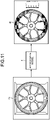
- FIG. 11 is a diagram illustrating an example of simulation result estimation obtained from an approximate model.
- an approximate model 5 is a NN that is obtained by training the relationship between pieces of input/output data of a numerical simulation.
- input data 4a such as a mesh of a structural object
- output data 4b in which the simulation result has been estimated.
- GMRES generalized minimal residual method
- DNN deep neural network
- FIG. 12 is a diagram illustrating the related technology.
- the horizontal axis of the graph illustrated in FIG. 12 is the axis associated with time step (i) of a simulation related to the non-stationary analysis of the fluid performed by using the GMRES, whereas the vertical axis indicates time in each of the time step (time needed for the iterative calculation).
- time step (i) of a simulation related to the non-stationary analysis of the fluid performed by using the GMRES
- the vertical axis indicates time in each of the time step (time needed for the iterative calculation).
- the entirety of the analysis is divided into short time and an operation of obtaining a phenomenon of next time is repeated while advancing time little by little, so that a plurality of time steps are included.
- a triangle mark indicates time needed for each of the time steps in a case where the DNN is not used, and the average time is indicated by a line 6a.
- An open circle mark indicates time needed for each of the time steps in a case where the DNN is used, and the average time is indicated by a line 6b.
- Patent Document 1 Japanese Laid-open Patent Publication No. 2007-157000
- Patent Document 2 Japanese Laid-open Patent Publication No. 2008-226178
- the approximate model (NN) is an image in which the magnitude of the output is a fixed length; therefore, the magnitude of the output from the approximate model is not matched with the vector length of the solution vector x. As a result, it is not easy to correct the solution by using the output obtained from the approximate model or to improve the model based on the inference result.
- the related technology that applies the DNN to the GMRES is limited to a case (non-stationary analysis) of repeatedly using a coefficient matrix A in which an applicable scope is the same; therefore, the related technology is not able to be applied to a steady analysis.
- a non-stationary analysis since a plurality of time steps are included, it is possible to advance the training of the DNN.
- time steps are not included; therefore, it is not possible to perform training of the DNN by using the result of the time steps that are obtained up to the last time.
- an inference program capable of efficiently obtaining a solution with accuracy that satisfies a request received from a user.
- an inference program causes a computer to execute a process including: inferring, by inputting new input data to an approximate model that is obtained by conducting practice by using training data in which a relationship between input data and output data of a numerical simulation is defined, output data that is associated with the new input data; determining whether or not accuracy of an inference result obtained from the approximate model satisfies a condition; correcting the inference result when the accuracy of the inference result obtained from the approximate model does not satisfy the condition; and outputting the corrected inference result.
- GNN graph neural network
- GCN graph convolutional network
- FIG. 1 is a diagram illustrating an example of a GCN.
- a GCN 30 includes an input (Input) 31a, an output (Output) 31b, hidden layers (Hidden layer) 32a and 32b, and activating functions (rectified linear units: ReLUs) 33a and 33b.
- the GCN 30 gives a feature value to each vertices included in a graph structure (a set of vertices and branches) as an input, and then, obtains, by using a NN, an output of each of the vertices based on the associated feature values of the (adjacent) vertices from which branches spread. It is assumed that a feature vector is given to each of the vertices, and following processes at Step S1 and Step S2 are performed on, for example, all of the layers.
- the process performed on each of the layers included in the GCN 30 is performed by, regarding each of the vertices, aggregating (Aggregation) the feature vectors held by the adjacent vertices (Step S1), and calculating (Combine) an output of the own feature vector by combining the weights (Step S2).
- Equation (1) The process performed on the layers included in the GCN 30 is able to be represented by Equation (1).
- X denotes a feature matrix of N ⁇ F 0
- H i denotes a feature matrix of N ⁇ F i
- A denotes an adjacent matrix of N ⁇ N
- N denotes the number of vertices
- F° denotes a magnitude of a feature (vector).
- H i f H i ⁇ 1 A
- H 0 X
- Equation (2) the process performed on the layers included in the GCN 30 is also able to be represented by Equation (2).
- Wi denotes a weighting matrix of F i ⁇ F i+1
- ⁇ denotes an activating function.
- the magnitude of the weighting matrix depends on a graph shape.
- the information processing apparatus performs the process, which will be described later, by using the GNN (GCN) described above.
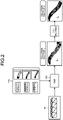
- FIG. 2 is a diagram (1) illustrating a process performed by the information processing apparatus according to the present embodiment.
- the information processing apparatus generates training purpose data 142 by performing a numerical simulation in advance, and trains (practices) a GNN 143.
- the information processing apparatus inputs inference purpose data 40 that is related to a scheduled analysis to the trained GNN 143, and derives an inference of a solution vector x.
- inference purpose data 40 as will be described later, mesh data, a coefficient matrix A, and a right-hand side vector b are included.
- the information processing apparatus determines whether or not the accuracy of the solution vector x is sufficient by obtaining a residual error of the solution vector x. If the accuracy of the solution vector x is not sufficient, the information processing apparatus corrects the solution vector x by using a conjugate gradient (CG) method, and outputs a corrected solution vector x'.
- the CG method is an example of an iterative method.
- the information processing apparatus determines whether or not the accuracy of a solution of the GNN 143 obtained in the case where the inference purpose data 40 is input is sufficient, and, if the accuracy is not sufficient, the information processing apparatus corrects the solution vector x by using the iterative method. As a result, it is possible to obtain a solution with accuracy that satisfies a request received from a user.
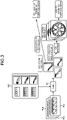
- FIG. 3 is a diagram (2) illustrating a process performed by the information processing apparatus according to the present embodiment.
- the information processing apparatus generates the training purpose data 142 by performing, similarly to the case illustrated in FIG. 2 , a numerical simulation in advance, and trains (drills) the GNN 143 in advance.
- the information processing apparatus inputs a plurality of kinds of inference purpose data 40a, 40b, 40c to the trained GNN 143, and calculates a plurality of solution vectors x.
- the information processing apparatus determines, by obtaining a residual error of each of the solution vectors x, whether or not the accuracy of the solution vectors x is sufficient.
- the information processing apparatus corrects the solution vectors x by using the CG method, adds the corrected solution vector x' to the training purpose data, and uses the updated training purpose data in a case retraining the GNN 143. If the accuracy of the solution vectors x is sufficient, the information processing apparatus does not add the corrected solution vector x' to the training purpose data.
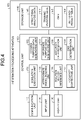
- FIG. 4 is a functional block diagram illustrating the configuration of the information processing apparatus according to the present embodiment.
- an information processing apparatus 100 includes a communication unit 110, an input unit 120, a display unit 130, a storage unit 140, and a control unit 150.
- the communication unit 110 is connected to an external device or the like in a wired or wireless manner, and transmits and receives information to and from the external device or the like.
- the communication unit 110 is implemented by a network interface card (NIC), or the like.
- NIC network interface card
- the communication unit 110 may be connected to a network that is not illustrated.
- the input unit 120 is an input device that inputs various kinds of information to the information processing apparatus 100.
- the input unit 120 corresponds to a keyboard, a mouse, a touch panel, or the like.
- the user operates the input unit 120 and designates, for example, a threshold that is related to a residual error or an error and that is requested in terms of the accuracy of a solution.
- the display unit 130 is a display device that displays information that is output from the control unit 150.
- the display unit 130 corresponds to a liquid crystal display, an organic electro luminescence (EL) display, a touch panel, or the like. For example, a simulation result obtained from the GNN 143 is displayed on the display unit 130.
- EL organic electro luminescence
- the storage unit 140 includes a structural analysis data 141, the training purpose data 142, the GNN 143, and an inference result table 144.
- the storage unit 140 is implemented by a semiconductor memory device, such as a random access memory (RAM) and a flash memory, or a storage device, such as a hard disk and an optical disk.
- RAM random access memory
- flash memory or a storage device, such as a hard disk and an optical disk.
- the structural analysis data 141 is data that is used for a simulation.
- the solution vector x obtained by the simulation indicates a displacement of each of the points (elements) in the structure.
- a set of the mesh data, a coefficient matrix A, and a right-hand side vector b is included.
- FIG. 5 is a diagram illustrating an example of the mesh data.
- the coefficient matrix A and the right-hand side vector b are generated based on the mesh data m.
- a boundary condition is set to the right-hand side vector b. For example, if a predetermined force is applied to a certain element i, the force held by the element i is set as the boundary condition.
- the training purpose data 142 is data for training (practicing) the GNN 143.
- FIG. 6 is a diagram illustrating an example of the data structure of the training purpose data. As illustrated in FIG. 6 , the training purpose data 142 associates the input data with a correct answer label. In the input data, the mesh data m, the coefficient matrix A, and the right-hand side vector b are included. In the correct answer label, the solution vector x is included. The relationship between the input data and the correct answer label is specified by an execution result of a simulation.
- the GNN 143 is an approximate model corresponding to the GNN (the GCN 30) described above with reference to FIG. 1 , and is constituted from a plurality of layers.
- a parameter, such as weight, is set to the plurality of layers, and practice is conducted based on the training purpose data 142.
- the inference result table 144 is a table that holds an inference result of the solution vectors x obtained from the GNN 143.
- FIG. 7 is a diagram illustrating an example of the data structure of the inference result table. As illustrated in FIG. 7 , the inference result table 144 associates the inference purpose data with the inference result. In the inference purpose data, the mesh data m, the coefficient matrix A, and the right-hand side vector b that are used for inferences are included. The inference result corresponds to the solution vector x that is inferred by inputting the input data to the GNN 143.
- the control unit 150 includes a simulation execution unit 151, a training purpose data generating unit 152, an approximate model building unit 153, an inference purpose data generating unit 154, a solution vector inference unit 155, an accuracy determination unit 156, an accuracy correction unit 157, and an end determination unit 158.
- the control unit 150 may be implemented by an integrated circuit, such as an application specific integrated circuit (ASIC), a field programmable gate array (FPGA), or the like.
- ASIC application specific integrated circuit
- FPGA field programmable gate array
- the simulation execution unit 151 acquires the structural analysis data 141 from the training purpose data generating unit 152, and performs a simulation for calculating the solution vector x. By conducting a simulation under a plurality of conditions, the simulation execution unit 151 calculates a plurality of sets of the mesh data m, the coefficient matrix A, the right-hand side vector b, and the solution vector x. The simulation execution unit 151 outputs the execution result of the simulation to the training purpose data generating unit 152.
- the training purpose data generating unit 152 is a processing unit that generates the training purpose data 142 by using the simulation execution unit 151.
- the training purpose data generating unit 152 outputs the structural analysis data 141 to the simulation execution unit 151 to conduct a simulation under a plurality of conditions, and obtains a simulation result.
- a plurality of pairs of a set of mesh data m, the coefficient matrix A, and the right-hand side vector b, and the solution vector x are included.
- the training purpose data generating unit 152 registers, in the training purpose data 142, the mesh data m, the coefficient matrix A, and the right-hand side vector b as input data, and the solution vector x as the correct answer label.
- the training purpose data generating unit 152 acquires an instruction from the end determination unit 158, which will be described later, indicating that the training purpose data is to be added, the training purpose data generating unit 152 newly generates a pair of the input data and the correct answer label by changing the condition, and adds the generated pair to the training purpose data 142.
- the approximate model building unit 153 performs training on the GNN 143 based on the training purpose data 142. For example, the approximate model building unit 153 repeatedly performs a process of adjusting the parameter of the GNN 143 such that the output data that is output from the GNN 143 approaches the correct answer label in the case where the approximate model building unit 153 acquires a pair of the input data and the correct answer label from the training purpose data 142 and inputs the input data to the GNN 143.
- the approximate model building unit 153 performs training on the GNN 143 by using an error backpropagation method or the like.
- the approximate model building unit 153 performs retraining on the GNN 143 by using the updated training purpose data 142.
- the inference purpose data generating unit 154 generates inference purpose data. For example, if the inference purpose data generating unit 154 receives data on the structure that corresponds to the analysis object from the input unit 120 or the like, the inference purpose data generating unit 154 generates the mesh data m in which the structure is represented in the form of a mesh. Furthermore, the inference purpose data generating unit 154 generates the coefficient matrix A and the right-hand side vector b based on the mesh data m. The inference purpose data generating unit 154 outputs the inference purpose data that includes the mesh data m, the coefficient matrix A, and the right-hand side vector b to the solution vector inference unit 155.
- the inference purpose data generating unit 154 If the inference purpose data generating unit 154 receives an update of a step from the end determination unit 158, which will be described later, the inference purpose data generating unit 154 generates the inference purpose data by changing the condition, and repeatedly performs the process of outputting the generated data to the solution vector inference unit 155.
- the solution vector inference unit 155 infers (calculates) the solution vector x by inputting the inference purpose data to the trained GNN 143.
- the solution vector inference unit 155 registers a relationship between the inference purpose data and the solution vector x that corresponds to the inference result into the inference result table 144. Furthermore, the solution vector inference unit 155 outputs the inference purpose data and the solution vector x to the accuracy determination unit 156.
- the solution vector inference unit 155 repeatedly performs the process described above every time the solution vector inference unit 155 acquires the inference purpose data from the inference purpose data generating unit 154.
- the accuracy determination unit 156 determines whether or not the accuracy of the solution vector x is sufficient. For example, the accuracy determination unit 156 determines, based on a residual error or an error, whether or not the accuracy of the solution vector x is sufficient. A process of determining the accuracy based on the residual error and a process of determining the accuracy based on an error performed by the accuracy determination unit 156 will be described.
- the accuracy determination unit 156 calculates a residual error r based on Equation (3).
- A corresponds to the coefficient matrix A included in the inference purpose data
- b corresponds to right-hand side vector b included in the inference purpose data.
- the value of the residual error r is closer to zero as the accuracy of the solution vector x is higher.
- the accuracy determination unit 156 determines that the accuracy of the solution vector x is sufficient. If the accuracy determination unit 156 determines that the accuracy of the solution vector x is not sufficient, the accuracy determination unit 156 outputs the inference purpose data and the solution vector x to the accuracy correction unit 157.
- the first threshold is previously designated by a user.
- the accuracy determination unit 156 calculates an error e based on Equation (4).
- the accuracy determination unit 156 determines that the accuracy of the solution vector x is sufficient. If the accuracy determination unit 156 determines that the accuracy of the solution vector x is not sufficient, the accuracy determination unit 156 outputs the inference purpose data and the solution vector x to the accuracy correction unit 157.
- the second threshold is previously designated by the user.
- the accuracy correction unit 157 acquires the solution vector x that is targeted for the correction from the accuracy determination unit 156, the accuracy correction unit 157 performs the iterative method (the CG method) for linear solvers, and corrects the solution vector x until the residual error r is less than the first threshold.
- the accuracy correction unit 157 associates the inference purpose data with the corrected solution vector x' and registers the associated data into the inference result table 144.
- the accuracy correction unit 157 associates the inference purpose data with the corrected solution vector x' and registers the associated data into the training purpose data 142.
- the inference purpose data corresponds to the input data and the corrected solution vector x' corresponds to the correct answer label.
- the end determination unit 158 is a processing unit that determines whether or not the simulation has ended. The end determination unit 158 determines to end the simulation when a predetermined end condition is satisfied. The end determination unit 158 outputs an update of the step to the inference purpose data generating unit 154 in a period of time for which the simulation is continued. Furthermore, the end determination unit 158 may output an instruction to the training purpose data generating unit 152 indicating that the training purpose data is added.
- the end determination unit 158 may output the information on the inference result table 144 to the display unit 130 and cause the display unit 130 to display the output information, or the end determination unit 158 may notify an external device of the information on the inference result table 144 via a network.
- FIG. 8 is a flowchart illustrating the flow of the process of a training phase performed by the information processing apparatus according to the present embodiment.
- the simulation execution unit 151 included in the information processing apparatus 100 conducts a simulation under the plurality of conditions (Step S101).
- the training purpose data generating unit 152 included in the information processing apparatus 100 accumulates the mesh data m, the coefficient matrix A, the right-hand side vector b, the solution vector x of each of the simulations and generates the training purpose data 142 (Step S102).
- the approximate model building unit 153 included in the information processing apparatus 100 performs training on the GNN 143 by using the training purpose data 142 (Step S103).
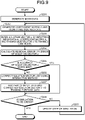
- FIG. 9 is a flowchart illustrating the flow of the process of an inference phase performed by the information processing apparatus according to the present embodiment.
- the inference purpose data generating unit 154 included in the information processing apparatus 100 generates the mesh data m (Step S201).
- the inference purpose data generating unit 154 generates the coefficient matrix A and the right-hand side vector b (Step S202).
- the solution vector inference unit 155 included in the information processing apparatus 100 inputs the mesh data m, the coefficient matrix A, and the right-hand side vector b to the trained GNN 143, and then, infers the solution vector x (Step S203).
- the accuracy determination unit 156 included in the information processing apparatus 100 calculates the residual error of the solution vector x or the error (Step S204).
- the accuracy determination unit 156 determines whether or not the accuracy of the solution vector x is sufficient based on the obtained residual error or the error (Step S205). For example, in a case of using the residual error at Step S205, if the residual error is less than the first threshold, it is determined that the accuracy of the solution vector x is sufficient. Furthermore, in a case of using the error, if the error is less than the second threshold, it is determined that the accuracy of the solution vector x is sufficient.
- Step S205 If the accuracy of the solution vector x is sufficient (Yes at Step S205), the accuracy determination unit 156 proceeds to Step S208.
- Step S206 the accuracy correction unit 157 included in the information processing apparatus 100 corrects the solution vector x by using the iterative method (Step S206).
- the accuracy determination unit 156 adds the pair of the input data and the corrected solution vector x' to the training purpose data 142 (Step S207).
- Step S208 If the end determination unit 158 included in the information processing apparatus 100 ends the simulation (Yes at Step S208), the end determination unit 158 ends the process. In contrast, if the end determination unit 158 does not end the simulation (No at Step S208), the end determination unit 158 updates the step of the simulation (Step S209), and proceeds to Step S202.
- the information processing apparatus 100 determines whether or not the accuracy of the solution of the GNN 143 obtained in the case where the inference purpose data is input is sufficient, and corrects, if the accuracy if not sufficient, the solution vector x by using the iterative method. As a result, it is possible to efficiently obtain the solution with accuracy that satisfies the request received from the user.
- the information processing apparatus 100 corrects the solution vector x by using the iterative method, adds the corrected solution vector x' to the training purpose data 142, and uses the updated training purpose data 142 at the time of retraining the GNN 143. As a result, it is possible to efficiently generate a case of the simulation that is useful to improve the GNN 143.
- the information processing apparatus 100 calculates the residual error of the solution vector x or the error, and determines whether or not the accuracy of the solution vector x is sufficient based on the calculated residual error or the error. As a result, it is possible to appropriately determine whether or not the accuracy of the solution vector x is sufficient.
- the information processing apparatus 100 calculates the solution vector x of the simultaneous linear equation; however, the embodiment is not limited to this.
- the embodiment is not limited to this.
- a Newton-Raphson method by solving a simultaneous linear equation by a plurality of steps, it is possible to conduct a nonlinear analysis (elastic mechanics).
- FIG. 10 is a diagram illustrating an example of a hardware configuration of the computer that implements the same function as that of the information processing apparatus according to the embodiment.
- a computer 200 includes a CPU 201 that performs various kinds of arithmetic processing, an input device 202 that receives an input of data from a user, and a display 203. Furthermore, the computer 200 includes a communication device 204 that transmits and receives data to and from an external device or the like via a wired or wireless network, and an interface device 205. Furthermore, the computer 200 includes a RAM 206 that temporarily stores therein various kinds of information, and a hard disk device 207. In addition, each of the devices 201 to 207 is connected to a bus 208.
- the hard disk device 207 includes a training program 207a and an inference program 207b. Furthermore, the CPU 201 reads each of the programs 207a and 207b and loads the programs 207a and 207b into the RAM 206.
- the training program 207a functions as a training process 206a.
- the inference program 207b functions as an inference process 206b.
- the process of the training process 206a corresponds to each of the processes performed by the simulation execution unit 151, the training purpose data generating unit 152, and the approximate model building unit 153.
- the process of the inference process 206b corresponds to each of the processes performed by the inference purpose data generating unit 154, the solution vector inference unit 155, the accuracy determination unit 156, the accuracy correction unit 157, and the end determination unit 158.
- each of the programs 207a and 207b does not need to be stored in the hard disk device 207 from the beginning.
- each of the programs is stored in a "portable physical medium", such as a flexible disk (FD), a CD-ROM, a DVD disk, a magneto-optic disk, an IC card, that is to be inserted into the computer 200.
- the computer 200 may also read each of the programs 207a and 207b from the portable physical medium and execute the programs.
- the various features may be implemented in hardware, or as software modules running on one or more processors/computers.
- the invention also provides a computer program or a computer program product comprising instructions which, when executed by a computer, cause the computer to carry out any of the methods/method steps described herein, and a non-transitory computer-readable medium comprising instructions which, when executed by a computer, cause the computer to carry out any of the methods/method steps described herein.
- a computer program embodying the invention may be stored on a non-transitory computer-readable medium, or it could, for example, be in the form of a signal such as a downloadable data signal provided from an Internet website, or it could be in any other form.
Landscapes
- Engineering & Computer Science (AREA)
- Physics & Mathematics (AREA)
- Theoretical Computer Science (AREA)
- General Physics & Mathematics (AREA)
- Evolutionary Computation (AREA)
- General Engineering & Computer Science (AREA)
- Mathematical Physics (AREA)
- Software Systems (AREA)
- Artificial Intelligence (AREA)
- Data Mining & Analysis (AREA)
- Biomedical Technology (AREA)
- Molecular Biology (AREA)
- Health & Medical Sciences (AREA)
- Life Sciences & Earth Sciences (AREA)
- Computing Systems (AREA)
- Biophysics (AREA)
- Computational Linguistics (AREA)
- General Health & Medical Sciences (AREA)
- Geometry (AREA)
- Computer Hardware Design (AREA)
- Medical Informatics (AREA)
- Computer Vision & Pattern Recognition (AREA)
- Computational Mathematics (AREA)
- Mathematical Analysis (AREA)
- Mathematical Optimization (AREA)
- Pure & Applied Mathematics (AREA)
- Operations Research (AREA)
- Algebra (AREA)
- Databases & Information Systems (AREA)
- Management, Administration, Business Operations System, And Electronic Commerce (AREA)
Abstract
Description
- The embodiment discussed herein is related to an inference program, an inference method, and an information processing apparatus.
- A numerical simulation that conducts numerical analysis performed on a computer by using a mesh obtained by discretizing phenomena of structural mechanics, fluid mechanics, or the like is widely used to design structural objects.
- It is possible to reduce design costs or the like by speeding up simulations by causing approximate models, which are obtained by training relationships of input/output data of numerical simulations conducted by using high-performance computing (HPC) on a neural network (NN) or the like, to infer the simulation results.
-
FIG. 11 is a diagram illustrating an example of simulation result estimation obtained from an approximate model. InFIG. 11 , anapproximate model 5 is a NN that is obtained by training the relationship between pieces of input/output data of a numerical simulation. By inputtinginput data 4a, such as a mesh of a structural object, to theapproximate model 5, it is possible to obtainoutput data 4b in which the simulation result has been estimated. - Furthermore, there is the generalized minimal residual method (GMRES) as a type of an iterative method for obtaining a solution of a simultaneous linear equation, and, there is a related technology for speeding up iterative calculation by applying a deep neural network (DNN) to the GMRES. Hereinafter, simply referred to as a related technology.
- With the related technology, regarding a simultaneous linear equation (Ax=b), training of the relationship between a right-hand side vector b and a solution vector x is performed on the DNN while performing a non-stationary analysis on a fluid by using the GMRES. In equation above, "A" denotes a matrix. Furthermore, in the related technology, by using the solution vector x that is output from the DNN trained up to that time and in which the training result is reflected, it is possible to reduce time needed for the iterative calculation.
-
FIG. 12 is a diagram illustrating the related technology. The horizontal axis of the graph illustrated inFIG. 12 is the axis associated with time step (i) of a simulation related to the non-stationary analysis of the fluid performed by using the GMRES, whereas the vertical axis indicates time in each of the time step (time needed for the iterative calculation). In the non-stationary analysis, the entirety of the analysis is divided into short time and an operation of obtaining a phenomenon of next time is repeated while advancing time little by little, so that a plurality of time steps are included. - In
FIG. 12 , a triangle mark indicates time needed for each of the time steps in a case where the DNN is not used, and the average time is indicated by aline 6a. An open circle mark indicates time needed for each of the time steps in a case where the DNN is used, and the average time is indicated by aline 6b. As the time step advances, the training of the DNN advances, and thus, the solution vector x that is more suitable is output from the DNN, so that the time needed to perform the iterative calculation is gradually reduced. In other words, it is possible to speed up the iterative calculation by advancing the training of the DNN while performing the non-stationary analysis of the fluid by using the GMRES, and by using the output result of the DNN. - Patent Document 1:
Japanese Laid-open Patent Publication No. 2007-157000 - Patent Document 2:
Japanese Laid-open Patent Publication No. 2008-226178 - For example, it is conceivable to increase a scene in which the approximate model described above is able to be used by adopting a method for determining whether or not the accuracy of the inference result is sufficient or performing correction of the inference result.
- Here, in order to examine the accuracy of the output obtained from the approximate model, it is conceivable to perform simulations under the same condition and compare the simulation result to the output result obtained from the approximate model. However, if a simulation is performed on each of the output results obtained from the approximate model, there is no point to speed up the iterative calculation performed by using the approximate model.
- Furthermore, in general, the approximate model (NN) is an image in which the magnitude of the output is a fixed length; therefore, the magnitude of the output from the approximate model is not matched with the vector length of the solution vector x. As a result, it is not easy to correct the solution by using the output obtained from the approximate model or to improve the model based on the inference result.
- Furthermore, the related technology that applies the DNN to the GMRES is limited to a case (non-stationary analysis) of repeatedly using a coefficient matrix A in which an applicable scope is the same; therefore, the related technology is not able to be applied to a steady analysis. In a non-stationary analysis, since a plurality of time steps are included, it is possible to advance the training of the DNN. In contrast, in the steady analysis, time steps are not included; therefore, it is not possible to perform training of the DNN by using the result of the time steps that are obtained up to the last time.
- Accordingly, it is desirable to provide an inference program, an inference method, and an information processing apparatus capable of efficiently obtaining a solution with accuracy that satisfies a request received from a user.
- According to an embodiment of one aspect of the invention, an inference program causes a computer to execute a process including: inferring, by inputting new input data to an approximate model that is obtained by conducting practice by using training data in which a relationship between input data and output data of a numerical simulation is defined, output data that is associated with the new input data; determining whether or not accuracy of an inference result obtained from the approximate model satisfies a condition; correcting the inference result when the accuracy of the inference result obtained from the approximate model does not satisfy the condition; and outputting the corrected inference result.
- The invention is described, by way of example only, with reference to the following drawings:
-
FIG. 1 is a diagram illustrating an example of a GCN; -
FIG. 2 is a diagram (1) illustrating a process performed by an information processing apparatus according to an embodiment; -
FIG. 3 is a diagram (2) illustrating a process performed by the information processing apparatus according to an embodiment; -
FIG. 4 is a functional block diagram illustrating a configuration of the information processing apparatus according to the embodiment; -
FIG. 5 is a diagram illustrating an example of mesh data; -
FIG. 6 is a diagram illustrating an example of a data structure of training purpose data; -
FIG. 7 is a diagram illustrating an example of a data structure of an inference result table; -
FIG. 8 is a flowchart illustrating the flow of a process of a training phase performed by the information processing apparatus according to the embodiment; -
FIG. 9 is a flowchart illustrating the flow of a process of an inference phase performed by the information processing apparatus according to the embodiment; -
FIG. 10 is a diagram illustrating an example of a hardware configuration of a computer that implements the same function as that of the information processing apparatus according to the embodiment; -
FIG. 11 is a diagram illustrating an example of simulation result estimation obtained from an approximate model; and -
FIG. 12 is a diagram illustrating a related technology. - Preferred embodiments will be explained with reference to accompanying drawings. Furthermore, the present invention is not limited to the embodiments.
- Before the present embodiment is described, an example of a graph neural network (GNN) will be described. Here, as an example of the GNN, a description will be given by using a graph convolutional network (GCN).
-
FIG. 1 is a diagram illustrating an example of a GCN. As illustrated inFIG. 1 , aGCN 30 includes an input (Input) 31a, an output (Output) 31b, hidden layers (Hidden layer) 32a and 32b, and activating functions (rectified linear units: ReLUs) 33a and 33b. - The
GCN 30 gives a feature value to each vertices included in a graph structure (a set of vertices and branches) as an input, and then, obtains, by using a NN, an output of each of the vertices based on the associated feature values of the (adjacent) vertices from which branches spread. It is assumed that a feature vector is given to each of the vertices, and following processes at Step S1 and Step S2 are performed on, for example, all of the layers. - The process performed on each of the layers included in the
GCN 30 is performed by, regarding each of the vertices, aggregating (Aggregation) the feature vectors held by the adjacent vertices (Step S1), and calculating (Combine) an output of the own feature vector by combining the weights (Step S2). - In the
GCN 30, training and an inference is possible with respect to an arbitrary number of vertices. The weight of the NN and inside the NN is common to all of the vertices (independent of the number of vertices); therefore, it is possible to infer the NN trained (practiced) by using pieces of data including an arbitrary number of vertices from pieces of data including arbitrary number of vertices. - The process performed on the layers included in the
GCN 30 is able to be represented by Equation (1). In Equation (1), X denotes a feature matrix of N×F0, Hi denotes a feature matrix of N×Fi, A denotes an adjacent matrix of N×N, N denotes the number of vertices, and F° denotes a magnitude of a feature (vector).
- In a case of the simplest GCN, the process performed on the layers included in the
GCN 30 is also able to be represented by Equation (2). Here, Wi denotes a weighting matrix of Fi×Fi+1, and σ denotes an activating function. The magnitude of the weighting matrix depends on a graph shape.
- The information processing apparatus according to the present embodiment performs the process, which will be described later, by using the GNN (GCN) described above.
- In the following, the information processing apparatus according to the present embodiment will be described.
FIG. 2 is a diagram (1) illustrating a process performed by the information processing apparatus according to the present embodiment. As illustrated inFIG. 2 , the information processing apparatus generatestraining purpose data 142 by performing a numerical simulation in advance, and trains (practices) aGNN 143. - The information processing apparatus inputs
inference purpose data 40 that is related to a scheduled analysis to the trainedGNN 143, and derives an inference of a solution vector x. In theinference purpose data 40, as will be described later, mesh data, a coefficient matrix A, and a right-hand side vector b are included. The information processing apparatus determines whether or not the accuracy of the solution vector x is sufficient by obtaining a residual error of the solution vector x. If the accuracy of the solution vector x is not sufficient, the information processing apparatus corrects the solution vector x by using a conjugate gradient (CG) method, and outputs a corrected solution vector x'. The CG method is an example of an iterative method. - As described above, the information processing apparatus determines whether or not the accuracy of a solution of the
GNN 143 obtained in the case where theinference purpose data 40 is input is sufficient, and, if the accuracy is not sufficient, the information processing apparatus corrects the solution vector x by using the iterative method. As a result, it is possible to obtain a solution with accuracy that satisfies a request received from a user. -
FIG. 3 is a diagram (2) illustrating a process performed by the information processing apparatus according to the present embodiment. The information processing apparatus generates thetraining purpose data 142 by performing, similarly to the case illustrated inFIG. 2 , a numerical simulation in advance, and trains (drills) theGNN 143 in advance. - The information processing apparatus inputs a plurality of kinds of
inference purpose data GNN 143, and calculates a plurality of solution vectors x. The information processing apparatus determines, by obtaining a residual error of each of the solution vectors x, whether or not the accuracy of the solution vectors x is sufficient. - If the accuracy of the solution vectors x is not sufficient, the information processing apparatus corrects the solution vectors x by using the CG method, adds the corrected solution vector x' to the training purpose data, and uses the updated training purpose data in a case retraining the
GNN 143. If the accuracy of the solution vectors x is sufficient, the information processing apparatus does not add the corrected solution vector x' to the training purpose data. - If the accuracy of the solution vectors x is insufficient, it can be said that training of the
GNN 143 related to the solution vectors x is not sufficient. Thus, by adding a pair of inference purpose data that is associated with the solution vector x in which the accuracy is insufficient and the corrected solution vector x' to thetraining purpose data 142, it is possible to efficiently generate a case of the simulation that is useful to improve theGNN 143. - In the following, a configuration of the information processing apparatus according to the present embodiment that performs the processes described above with reference to
FIG. 2 andFIG. 3 will be described.FIG. 4 is a functional block diagram illustrating the configuration of the information processing apparatus according to the present embodiment. As illustrated inFIG. 4 , aninformation processing apparatus 100 includes acommunication unit 110, aninput unit 120, adisplay unit 130, astorage unit 140, and acontrol unit 150. - The
communication unit 110 is connected to an external device or the like in a wired or wireless manner, and transmits and receives information to and from the external device or the like. For example, thecommunication unit 110 is implemented by a network interface card (NIC), or the like. Thecommunication unit 110 may be connected to a network that is not illustrated. - The
input unit 120 is an input device that inputs various kinds of information to theinformation processing apparatus 100. Theinput unit 120 corresponds to a keyboard, a mouse, a touch panel, or the like. The user operates theinput unit 120 and designates, for example, a threshold that is related to a residual error or an error and that is requested in terms of the accuracy of a solution. - The
display unit 130 is a display device that displays information that is output from thecontrol unit 150. Thedisplay unit 130 corresponds to a liquid crystal display, an organic electro luminescence (EL) display, a touch panel, or the like. For example, a simulation result obtained from theGNN 143 is displayed on thedisplay unit 130. - The
storage unit 140 includes astructural analysis data 141, thetraining purpose data 142, theGNN 143, and an inference result table 144. Thestorage unit 140 is implemented by a semiconductor memory device, such as a random access memory (RAM) and a flash memory, or a storage device, such as a hard disk and an optical disk. - The
structural analysis data 141 is data that is used for a simulation. In the present embodiment, the solution vector x of a simultaneous linear equation (Ax=b) is calculated by the simulation. For example, the solution vector x obtained by the simulation indicates a displacement of each of the points (elements) in the structure. In thestructural analysis data 141, a set of the mesh data, a coefficient matrix A, and a right-hand side vector b is included. -
FIG. 5 is a diagram illustrating an example of the mesh data. Mesh data m is represented in the form of a mesh in which each of the points included in the structure is connected by lines. For example, each of the points in the mesh data m is associated with a plurality of elements i (i=1 to n). The coefficient matrix A and the right-hand side vector b are generated based on the mesh data m. In the coefficient matrix A, the strength of the connection relationship between the elements i,j (i=1 to n and j=1 to m) is set by a numerical value. A boundary condition is set to the right-hand side vector b. For example, if a predetermined force is applied to a certain element i, the force held by the element i is set as the boundary condition. - The
training purpose data 142 is data for training (practicing) theGNN 143.FIG. 6 is a diagram illustrating an example of the data structure of the training purpose data. As illustrated inFIG. 6 , thetraining purpose data 142 associates the input data with a correct answer label. In the input data, the mesh data m, the coefficient matrix A, and the right-hand side vector b are included. In the correct answer label, the solution vector x is included. The relationship between the input data and the correct answer label is specified by an execution result of a simulation. - The
GNN 143 is an approximate model corresponding to the GNN (the GCN 30) described above with reference toFIG. 1 , and is constituted from a plurality of layers. A parameter, such as weight, is set to the plurality of layers, and practice is conducted based on thetraining purpose data 142. - The inference result table 144 is a table that holds an inference result of the solution vectors x obtained from the
GNN 143.FIG. 7 is a diagram illustrating an example of the data structure of the inference result table. As illustrated inFIG. 7 , the inference result table 144 associates the inference purpose data with the inference result. In the inference purpose data, the mesh data m, the coefficient matrix A, and the right-hand side vector b that are used for inferences are included. The inference result corresponds to the solution vector x that is inferred by inputting the input data to theGNN 143. - A description will be given here by referring back to
FIG. 4 . Thecontrol unit 150 includes asimulation execution unit 151, a training purposedata generating unit 152, an approximatemodel building unit 153, an inference purposedata generating unit 154, a solutionvector inference unit 155, anaccuracy determination unit 156, anaccuracy correction unit 157, and anend determination unit 158. Thecontrol unit 150 may be implemented by an integrated circuit, such as an application specific integrated circuit (ASIC), a field programmable gate array (FPGA), or the like. - The
simulation execution unit 151 acquires thestructural analysis data 141 from the training purposedata generating unit 152, and performs a simulation for calculating the solution vector x. By conducting a simulation under a plurality of conditions, thesimulation execution unit 151 calculates a plurality of sets of the mesh data m, the coefficient matrix A, the right-hand side vector b, and the solution vector x. Thesimulation execution unit 151 outputs the execution result of the simulation to the training purposedata generating unit 152. - The training purpose
data generating unit 152 is a processing unit that generates thetraining purpose data 142 by using thesimulation execution unit 151. The training purposedata generating unit 152 outputs thestructural analysis data 141 to thesimulation execution unit 151 to conduct a simulation under a plurality of conditions, and obtains a simulation result. In the simulation result, a plurality of pairs of a set of mesh data m, the coefficient matrix A, and the right-hand side vector b, and the solution vector x are included. The training purposedata generating unit 152 registers, in thetraining purpose data 142, the mesh data m, the coefficient matrix A, and the right-hand side vector b as input data, and the solution vector x as the correct answer label. - If the training purpose
data generating unit 152 acquires an instruction from theend determination unit 158, which will be described later, indicating that the training purpose data is to be added, the training purposedata generating unit 152 newly generates a pair of the input data and the correct answer label by changing the condition, and adds the generated pair to thetraining purpose data 142. - The approximate
model building unit 153 performs training on theGNN 143 based on thetraining purpose data 142. For example, the approximatemodel building unit 153 repeatedly performs a process of adjusting the parameter of theGNN 143 such that the output data that is output from theGNN 143 approaches the correct answer label in the case where the approximatemodel building unit 153 acquires a pair of the input data and the correct answer label from thetraining purpose data 142 and inputs the input data to theGNN 143. The approximatemodel building unit 153 performs training on theGNN 143 by using an error backpropagation method or the like. - If the new input data and the correct answer label are registered in the
training purpose data 142 by theaccuracy correction unit 157, which will be described later and if thetraining purpose data 142 is updated, the approximatemodel building unit 153 performs retraining on theGNN 143 by using the updatedtraining purpose data 142. - The inference purpose
data generating unit 154 generates inference purpose data. For example, if the inference purposedata generating unit 154 receives data on the structure that corresponds to the analysis object from theinput unit 120 or the like, the inference purposedata generating unit 154 generates the mesh data m in which the structure is represented in the form of a mesh. Furthermore, the inference purposedata generating unit 154 generates the coefficient matrix A and the right-hand side vector b based on the mesh data m. The inference purposedata generating unit 154 outputs the inference purpose data that includes the mesh data m, the coefficient matrix A, and the right-hand side vector b to the solutionvector inference unit 155. - If the inference purpose
data generating unit 154 receives an update of a step from theend determination unit 158, which will be described later, the inference purposedata generating unit 154 generates the inference purpose data by changing the condition, and repeatedly performs the process of outputting the generated data to the solutionvector inference unit 155. - The solution
vector inference unit 155 infers (calculates) the solution vector x by inputting the inference purpose data to the trainedGNN 143. The solutionvector inference unit 155 registers a relationship between the inference purpose data and the solution vector x that corresponds to the inference result into the inference result table 144. Furthermore, the solutionvector inference unit 155 outputs the inference purpose data and the solution vector x to theaccuracy determination unit 156. - The solution
vector inference unit 155 repeatedly performs the process described above every time the solutionvector inference unit 155 acquires the inference purpose data from the inference purposedata generating unit 154. - The
accuracy determination unit 156 determines whether or not the accuracy of the solution vector x is sufficient. For example, theaccuracy determination unit 156 determines, based on a residual error or an error, whether or not the accuracy of the solution vector x is sufficient.
A process of determining the accuracy based on the residual error and a process of determining the accuracy based on an error performed by theaccuracy determination unit 156 will be described. - The process of determining the accuracy performed based on the residual error by the
accuracy determination unit 156 will be described. Theaccuracy determination unit 156 calculates a residual error r based on Equation (3). In Equation (3), "A" corresponds to the coefficient matrix A included in the inference purpose data, and "b" corresponds to right-hand side vector b included in the inference purpose data. The value of the residual error r is closer to zero as the accuracy of the solution vector x is higher.
- If the residual error r is less than a first threshold, the
accuracy determination unit 156 determines that the accuracy of the solution vector x is sufficient. If theaccuracy determination unit 156 determines that the accuracy of the solution vector x is not sufficient, theaccuracy determination unit 156 outputs the inference purpose data and the solution vector x to theaccuracy correction unit 157. The first threshold is previously designated by a user. - The process of determining the accuracy performed based on an error by the
accuracy determination unit 156 will be described. Theaccuracy determination unit 156 calculates an error e based on Equation (4). Theaccuracy determination unit 156 calculates x(1) by performing the iterative method by one step by using the solution vector x as the initial value. The difference between the solution vector x and x(1) is decreased as the accuracy of the solution vector x is higher.
- If the error e is less than a second threshold, the
accuracy determination unit 156 determines that the accuracy of the solution vector x is sufficient. If theaccuracy determination unit 156 determines that the accuracy of the solution vector x is not sufficient, theaccuracy determination unit 156 outputs the inference purpose data and the solution vector x to theaccuracy correction unit 157. The second threshold is previously designated by the user. - If the
accuracy correction unit 157 acquires the solution vector x that is targeted for the correction from theaccuracy determination unit 156, theaccuracy correction unit 157 performs the iterative method (the CG method) for linear solvers, and corrects the solution vector x until the residual error r is less than the first threshold. Theaccuracy correction unit 157 associates the inference purpose data with the corrected solution vector x' and registers the associated data into the inference result table 144. - The
accuracy correction unit 157 associates the inference purpose data with the corrected solution vector x' and registers the associated data into thetraining purpose data 142. The inference purpose data corresponds to the input data and the corrected solution vector x' corresponds to the correct answer label. - The
end determination unit 158 is a processing unit that determines whether or not the simulation has ended. Theend determination unit 158 determines to end the simulation when a predetermined end condition is satisfied. Theend determination unit 158 outputs an update of the step to the inference purposedata generating unit 154 in a period of time for which the simulation is continued. Furthermore, theend determination unit 158 may output an instruction to the training purposedata generating unit 152 indicating that the training purpose data is added. - The
end determination unit 158 may output the information on the inference result table 144 to thedisplay unit 130 and cause thedisplay unit 130 to display the output information, or theend determination unit 158 may notify an external device of the information on the inference result table 144 via a network. - In the following, an example of the flow of the process performed by the information processing apparatus according to the present embodiment will be described.
FIG. 8 is a flowchart illustrating the flow of the process of a training phase performed by the information processing apparatus according to the present embodiment. As illustrated inFIG. 8 , thesimulation execution unit 151 included in theinformation processing apparatus 100 conducts a simulation under the plurality of conditions (Step S101). - The training purpose
data generating unit 152 included in theinformation processing apparatus 100 accumulates the mesh data m, the coefficient matrix A, the right-hand side vector b, the solution vector x of each of the simulations and generates the training purpose data 142 (Step S102). - The approximate
model building unit 153 included in theinformation processing apparatus 100 performs training on theGNN 143 by using the training purpose data 142 (Step S103). - Furthermore, the process illustrated in
FIG. 8 is performed again when new data is added to thetraining purpose data 142. -
FIG. 9 is a flowchart illustrating the flow of the process of an inference phase performed by the information processing apparatus according to the present embodiment. As illustrated inFIG. 9 , the inference purposedata generating unit 154 included in theinformation processing apparatus 100 generates the mesh data m (Step S201). The inference purposedata generating unit 154 generates the coefficient matrix A and the right-hand side vector b (Step S202). - The solution
vector inference unit 155 included in theinformation processing apparatus 100 inputs the mesh data m, the coefficient matrix A, and the right-hand side vector b to the trainedGNN 143, and then, infers the solution vector x (Step S203). - The
accuracy determination unit 156 included in theinformation processing apparatus 100 calculates the residual error of the solution vector x or the error (Step S204). Theaccuracy determination unit 156 determines whether or not the accuracy of the solution vector x is sufficient based on the obtained residual error or the error (Step S205). For example, in a case of using the residual error at Step S205, if the residual error is less than the first threshold, it is determined that the accuracy of the solution vector x is sufficient. Furthermore, in a case of using the error, if the error is less than the second threshold, it is determined that the accuracy of the solution vector x is sufficient. - If the accuracy of the solution vector x is sufficient (Yes at Step S205), the
accuracy determination unit 156 proceeds to Step S208. - In contrast, if the accuracy of the solution vector x is not sufficient (No at Step S205), the
accuracy determination unit 156 proceeds to Step S206. Theaccuracy correction unit 157 included in theinformation processing apparatus 100 corrects the solution vector x by using the iterative method (Step S206). - The
accuracy determination unit 156 adds the pair of the input data and the corrected solution vector x' to the training purpose data 142 (Step S207). - If the
end determination unit 158 included in theinformation processing apparatus 100 ends the simulation (Yes at Step S208), theend determination unit 158 ends the process. In contrast, if theend determination unit 158 does not end the simulation (No at Step S208), theend determination unit 158 updates the step of the simulation (Step S209), and proceeds to Step S202. - In the following, effects of the
information processing apparatus 100 according to the present embodiment will be described. Theinformation processing apparatus 100 determines whether or not the accuracy of the solution of theGNN 143 obtained in the case where the inference purpose data is input is sufficient, and corrects, if the accuracy if not sufficient, the solution vector x by using the iterative method. As a result, it is possible to efficiently obtain the solution with accuracy that satisfies the request received from the user. - If the accuracy of the solution vector x is not sufficient, the
information processing apparatus 100 corrects the solution vector x by using the iterative method, adds the corrected solution vector x' to thetraining purpose data 142, and uses the updatedtraining purpose data 142 at the time of retraining theGNN 143. As a result, it is possible to efficiently generate a case of the simulation that is useful to improve theGNN 143. - The
information processing apparatus 100 calculates the residual error of the solution vector x or the error, and determines whether or not the accuracy of the solution vector x is sufficient based on the calculated residual error or the error. As a result, it is possible to appropriately determine whether or not the accuracy of the solution vector x is sufficient. - Incidentally, in the embodiment described above, a case has been described in which the
information processing apparatus 100 calculates the solution vector x of the simultaneous linear equation; however, the embodiment is not limited to this. For example, based on a Newton-Raphson method, by solving a simultaneous linear equation by a plurality of steps, it is possible to conduct a nonlinear analysis (elastic mechanics). - In the following, an example of a hardware configuration of a computer that implements the same function as that of the
information processing apparatus 100 according to the embodiment described above will be described.FIG. 10 is a diagram illustrating an example of a hardware configuration of the computer that implements the same function as that of the information processing apparatus according to the embodiment. - As illustrated in
FIG. 10 , a computer 200 includes aCPU 201 that performs various kinds of arithmetic processing, aninput device 202 that receives an input of data from a user, and a display 203. Furthermore, the computer 200 includes a communication device 204 that transmits and receives data to and from an external device or the like via a wired or wireless network, and an interface device 205. Furthermore, the computer 200 includes aRAM 206 that temporarily stores therein various kinds of information, and ahard disk device 207. In addition, each of thedevices 201 to 207 is connected to abus 208. - The
hard disk device 207 includes atraining program 207a and aninference program 207b. Furthermore, theCPU 201 reads each of theprograms programs RAM 206. - The
training program 207a functions as atraining process 206a. Theinference program 207b functions as aninference process 206b. - The process of the
training process 206a corresponds to each of the processes performed by thesimulation execution unit 151, the training purposedata generating unit 152, and the approximatemodel building unit 153. The process of theinference process 206b corresponds to each of the processes performed by the inference purposedata generating unit 154, the solutionvector inference unit 155, theaccuracy determination unit 156, theaccuracy correction unit 157, and theend determination unit 158. - Furthermore, each of the
programs hard disk device 207 from the beginning. For example, each of the programs is stored in a "portable physical medium", such as a flexible disk (FD), a CD-ROM, a DVD disk, a magneto-optic disk, an IC card, that is to be inserted into the computer 200. Then, the computer 200 may also read each of theprograms - It is possible to efficiently obtain a solution with accuracy that satisfies a request received from a user.
- In any of the above aspects, the various features may be implemented in hardware, or as software modules running on one or more processors/computers.
- The invention also provides a computer program or a computer program product comprising instructions which, when executed by a computer, cause the computer to carry out any of the methods/method steps described herein, and a non-transitory computer-readable medium comprising instructions which, when executed by a computer, cause the computer to carry out any of the methods/method steps described herein. A computer program embodying the invention may be stored on a non-transitory computer-readable medium, or it could, for example, be in the form of a signal such as a downloadable data signal provided from an Internet website, or it could be in any other form.
Claims (15)
- An inference program (207b) that causes a computer (200) to execute a process comprising:inferring, by inputting new input data to an approximate model that is obtained by conducting practice by using training data in which a relationship between input data and output data of a numerical simulation is defined, output data that is associated with the new input data;determining whether or not accuracy of an inference result obtained from the approximate model satisfies a condition;correcting the inference result when the accuracy of the inference result obtained from the approximate model does not satisfy the condition; andoutputting the corrected inference result.
- The inference program (207b) according to claim 1, wherein the correcting includes correcting a solution vector corresponding to the inference result by performing an iterative method.
- The inference program (207b) according to claim 1 or 2, wherein the determining includes determining, based on a residual error that is obtained from a solution vector corresponding to the inference result obtained from the approximate model, whether or not the accuracy of the inference result obtained from the approximate model satisfies the condition.
- The inference program (207b) according to any of claims 1 to 3, wherein the determining includes determining, based on an error between a result obtained by performing an iterative method by one step by using, as an initial value, a solution vector corresponding to the inference result obtained from the approximate model and the initial value, whether or not the accuracy of the inference result obtained from the approximate model satisfies the condition.
- The inference program (207b) according to any of claims 1 to 4, wherein the process further includes performing retraining on the approximate model by using an inference result in which the accuracy does not satisfy the condition.
- An inference method that causes a computer (200) to execute a process comprising:inferring, by inputting new input data to an approximate model that is obtained by conducting practice by using training data in which a relationship between input data and output data of a numerical simulation is defined, output data that is associated with the new input data;determining whether or not accuracy of an inference result obtained from the approximate model satisfies a condition;correcting the inference result when the accuracy of the inference result obtained from the approximate model does not satisfy the condition; andoutputting the corrected inference result.
- The inference method according to claim 6, wherein the correcting includes correcting a solution vector corresponding to the inference result by performing an iterative method.
- The inference method according to claim 6 or 7, wherein the determining includes determining, based on a residual error that is obtained from a solution vector corresponding to the inference result obtained from the approximate model, whether or not the accuracy of the inference result obtained from the approximate model satisfies the condition.
- The inference method according to any of claims 6 to 8, wherein the determining includes determining, based on an error between a result obtained by performing an iterative method by one step by using, as an initial value, a solution vector corresponding to the inference result obtained from the approximate model and the initial value, whether or not the accuracy of the inference result obtained from the approximate model satisfies the condition.
- The inference method according to any of claims 6 to 9, further including performing retraining on the approximate model by using an inference result in which the accuracy does not satisfy the condition.
- An information processing apparatus (100) comprising:a solution vector inference unit (155) configured to infer, by inputting new input data to an approximate model that is obtained by conducting practice by using training data in which a relationship between input data and output data of a numerical simulation is defined, output data that is associated with the new input data;an accuracy determination unit (156) configured to determine whether or not accuracy of an inference result obtained from the approximate model satisfies a condition; andan accuracy correction unit (157) configured to correct the inference result when the accuracy of the inference result obtained from the approximate model does not satisfy the condition and output the corrected inference result.
- The information processing apparatus according to claim 11, wherein the accuracy correction unit (157) is configured to correct a solution vector corresponding to the inference result by performing an iterative method.
- The information processing apparatus according to claim 11 or 12, wherein the accuracy determination unit (156) is configured to determine, based on a residual error that is obtained from a solution vector corresponding to the inference result obtained from the approximate model, whether or not the accuracy of the inference result obtained from the approximate model satisfies the condition.
- The information processing apparatus according to any of claims 11 to 13, wherein the accuracy determination unit (156) is configured to determine, based on an error between a result obtained by performing an iterative method by one step by using, as an initial value, a solution vector corresponding to the inference result obtained from the approximate model and the initial value, whether or not the accuracy of the inference result obtained from the approximate model satisfies the condition.
- The information processing apparatus according to any of claims 11 to 14, further including an approximate model building unit (153) configured to perform retraining on the approximate model by using an inference result in which the accuracy does not satisfy the condition.
Applications Claiming Priority (1)
| Application Number | Priority Date | Filing Date | Title |
|---|---|---|---|
| JP2021104194A JP2023003177A (en) | 2021-06-23 | 2021-06-23 | Inference program, inference method, and information processing apparatus |
Publications (1)
| Publication Number | Publication Date |
|---|---|
| EP4109351A1 true EP4109351A1 (en) | 2022-12-28 |
Family
ID=80738795
Family Applications (1)
| Application Number | Title | Priority Date | Filing Date |
|---|---|---|---|
| EP22161742.6A Withdrawn EP4109351A1 (en) | 2021-06-23 | 2022-03-11 | Inference program, inference method, and information processing apparatus |
Country Status (4)
| Country | Link |
|---|---|
| US (1) | US20220414461A1 (en) |
| EP (1) | EP4109351A1 (en) |
| JP (1) | JP2023003177A (en) |
| CN (1) | CN115510731A (en) |
Families Citing this family (2)
| Publication number | Priority date | Publication date | Assignee | Title |
|---|---|---|---|---|
| US11922314B1 (en) | 2018-11-30 | 2024-03-05 | Ansys, Inc. | Systems and methods for building dynamic reduced order physical models |
| CN117313821B (en) * | 2023-09-06 | 2025-11-04 | 北京奇艺世纪科技有限公司 | Online learning methods, video recommendation methods and related devices |
Citations (4)
| Publication number | Priority date | Publication date | Assignee | Title |
|---|---|---|---|---|
| JP2007157000A (en) | 2005-12-07 | 2007-06-21 | Sony Corp | Learning device, learning method, and computer program |
| JP2008226178A (en) | 2007-03-15 | 2008-09-25 | Fujitsu Ltd | Staffing optimization program, staffing optimization method, and staffing optimization device |
| US20190102694A1 (en) * | 2017-09-29 | 2019-04-04 | Facebook, Inc. | Content delivery based on corrective modeling techniques |
| WO2020227383A1 (en) * | 2019-05-09 | 2020-11-12 | Aspen Technology, Inc. | Combining machine learning with domain knowledge and first principles for modeling in the process industries |
-
2021
- 2021-06-23 JP JP2021104194A patent/JP2023003177A/en active Pending
-
2022
- 2022-03-11 EP EP22161742.6A patent/EP4109351A1/en not_active Withdrawn
- 2022-03-17 US US17/696,923 patent/US20220414461A1/en not_active Abandoned
- 2022-03-18 CN CN202210269181.2A patent/CN115510731A/en active Pending
Patent Citations (4)
| Publication number | Priority date | Publication date | Assignee | Title |
|---|---|---|---|---|
| JP2007157000A (en) | 2005-12-07 | 2007-06-21 | Sony Corp | Learning device, learning method, and computer program |
| JP2008226178A (en) | 2007-03-15 | 2008-09-25 | Fujitsu Ltd | Staffing optimization program, staffing optimization method, and staffing optimization device |
| US20190102694A1 (en) * | 2017-09-29 | 2019-04-04 | Facebook, Inc. | Content delivery based on corrective modeling techniques |
| WO2020227383A1 (en) * | 2019-05-09 | 2020-11-12 | Aspen Technology, Inc. | Combining machine learning with domain knowledge and first principles for modeling in the process industries |
Non-Patent Citations (1)
| Title |
|---|
| UEDA TAKAYA ET AL: "Data Correction by a Generative Model with an Encoder and its Application to Structure Design", 27 September 2018, SAT 2015 18TH INTERNATIONAL CONFERENCE, AUSTIN, TX, USA, SEPTEMBER 24-27, 2015; [LECTURE NOTES IN COMPUTER SCIENCE; LECT.NOTES COMPUTER], SPRINGER, BERLIN, HEIDELBERG, PAGE(S) 403 - 413, ISBN: 978-3-540-74549-5, XP047492363 * |
Also Published As
| Publication number | Publication date |
|---|---|
| US20220414461A1 (en) | 2022-12-29 |
| CN115510731A (en) | 2022-12-23 |
| JP2023003177A (en) | 2023-01-11 |
Similar Documents
| Publication | Publication Date | Title |
|---|---|---|
| US20250190774A1 (en) | Transposing neural network matrices in hardware | |
| US12475355B2 (en) | Quantizing trained long short-term memory neural networks | |
| US20230206070A1 (en) | Vector Computation Unit In A Neural Network Processor | |
| US20250335771A1 (en) | Training machine learning models by determining update rules using neural networks | |
| US20230252327A1 (en) | Neural architecture search for convolutional neural networks | |
| US11544573B2 (en) | Projection neural networks | |
| JP7645896B2 (en) | Hardware-optimized Neural Architecture Search | |
| US11977983B2 (en) | Noisy neural network layers with noise parameters | |
| US11093817B2 (en) | Information processing device and information processing method | |
| US11697205B2 (en) | Determining control policies for robots with noise-tolerant structured exploration | |
| US20220309331A1 (en) | Error compensation in analog neural networks | |
| US20240378416A1 (en) | Training neural networks using distributed batch normalization | |
| EP4109351A1 (en) | Inference program, inference method, and information processing apparatus | |
| CN109074415A (en) | System and method for material constitutive modeling | |
| US11676033B1 (en) | Training machine learning models to be robust against label noise | |
| US20210397953A1 (en) | Deep neural network operation method and apparatus | |
| US20230206094A1 (en) | Inferring device, inferring method and non-transitory computer readable medium | |
| KR20150064673A (en) | Method and device for determining a gradient of a data-based function model | |
| JP2018156614A (en) | Arithmetic apparatus, arithmetic method and arithmetic program | |
| CN111563548A (en) | A data preprocessing method, system and related equipment based on reinforcement learning |
Legal Events
| Date | Code | Title | Description |
|---|---|---|---|
| PUAI | Public reference made under article 153(3) epc to a published international application that has entered the european phase |
Free format text: ORIGINAL CODE: 0009012 |
|
| STAA | Information on the status of an ep patent application or granted ep patent |
Free format text: STATUS: THE APPLICATION HAS BEEN PUBLISHED |
|
| AK | Designated contracting states |
Kind code of ref document: A1 Designated state(s): AL AT BE BG CH CY CZ DE DK EE ES FI FR GB GR HR HU IE IS IT LI LT LU LV MC MK MT NL NO PL PT RO RS SE SI SK SM TR |
|
| STAA | Information on the status of an ep patent application or granted ep patent |
Free format text: STATUS: REQUEST FOR EXAMINATION WAS MADE |
|
| STAA | Information on the status of an ep patent application or granted ep patent |
Free format text: STATUS: EXAMINATION IS IN PROGRESS |
|
| 17P | Request for examination filed |
Effective date: 20230303 |
|
| RBV | Designated contracting states (corrected) |
Designated state(s): AL AT BE BG CH CY CZ DE DK EE ES FI FR GB GR HR HU IE IS IT LI LT LU LV MC MK MT NL NO PL PT RO RS SE SI SK SM TR |
|
| 17Q | First examination report despatched |
Effective date: 20230328 |
|
| STAA | Information on the status of an ep patent application or granted ep patent |
Free format text: STATUS: THE APPLICATION IS DEEMED TO BE WITHDRAWN |
|
| 18D | Application deemed to be withdrawn |
Effective date: 20241001 |