EP4109265A2 - Method and apparatus for generating operator - Google Patents
Method and apparatus for generating operator Download PDFInfo
- Publication number
- EP4109265A2 EP4109265A2 EP22189729.1A EP22189729A EP4109265A2 EP 4109265 A2 EP4109265 A2 EP 4109265A2 EP 22189729 A EP22189729 A EP 22189729A EP 4109265 A2 EP4109265 A2 EP 4109265A2
- Authority
- EP
- European Patent Office
- Prior art keywords
- application programming
- basic
- kernel
- operator
- programming interface
- Prior art date
- Legal status (The legal status is an assumption and is not a legal conclusion. Google has not performed a legal analysis and makes no representation as to the accuracy of the status listed.)
- Pending
Links
Images




Classifications
-
- G—PHYSICS
- G06—COMPUTING OR CALCULATING; COUNTING
- G06F—ELECTRIC DIGITAL DATA PROCESSING
- G06F8/00—Arrangements for software engineering
- G06F8/30—Creation or generation of source code
- G06F8/31—Programming languages or programming paradigms
-
- G—PHYSICS
- G06—COMPUTING OR CALCULATING; COUNTING
- G06F—ELECTRIC DIGITAL DATA PROCESSING
- G06F9/00—Arrangements for program control, e.g. control units
- G06F9/06—Arrangements for program control, e.g. control units using stored programs, i.e. using an internal store of processing equipment to receive or retain programs
- G06F9/44—Arrangements for executing specific programs
- G06F9/448—Execution paradigms, e.g. implementations of programming paradigms
-
- G—PHYSICS
- G06—COMPUTING OR CALCULATING; COUNTING
- G06F—ELECTRIC DIGITAL DATA PROCESSING
- G06F9/00—Arrangements for program control, e.g. control units
- G06F9/06—Arrangements for program control, e.g. control units using stored programs, i.e. using an internal store of processing equipment to receive or retain programs
- G06F9/46—Multiprogramming arrangements
- G06F9/54—Interprogram communication
- G06F9/545—Interprogram communication where tasks reside in different layers, e.g. user- and kernel-space
-
- G—PHYSICS
- G06—COMPUTING OR CALCULATING; COUNTING
- G06N—COMPUTING ARRANGEMENTS BASED ON SPECIFIC COMPUTATIONAL MODELS
- G06N20/00—Machine learning
- G06N20/10—Machine learning using kernel methods, e.g. support vector machines [SVM]
-
- G—PHYSICS
- G06—COMPUTING OR CALCULATING; COUNTING
- G06F—ELECTRIC DIGITAL DATA PROCESSING
- G06F8/00—Arrangements for software engineering
- G06F8/30—Creation or generation of source code
- G06F8/36—Software reuse
-
- G—PHYSICS
- G06—COMPUTING OR CALCULATING; COUNTING
- G06F—ELECTRIC DIGITAL DATA PROCESSING
- G06F9/00—Arrangements for program control, e.g. control units
- G06F9/06—Arrangements for program control, e.g. control units using stored programs, i.e. using an internal store of processing equipment to receive or retain programs
- G06F9/44—Arrangements for executing specific programs
- G06F9/448—Execution paradigms, e.g. implementations of programming paradigms
- G06F9/4482—Procedural
-
- G—PHYSICS
- G06—COMPUTING OR CALCULATING; COUNTING
- G06F—ELECTRIC DIGITAL DATA PROCESSING
- G06F9/00—Arrangements for program control, e.g. control units
- G06F9/06—Arrangements for program control, e.g. control units using stored programs, i.e. using an internal store of processing equipment to receive or retain programs
- G06F9/44—Arrangements for executing specific programs
- G06F9/451—Execution arrangements for user interfaces
-
- G—PHYSICS
- G06—COMPUTING OR CALCULATING; COUNTING
- G06F—ELECTRIC DIGITAL DATA PROCESSING
- G06F9/00—Arrangements for program control, e.g. control units
- G06F9/06—Arrangements for program control, e.g. control units using stored programs, i.e. using an internal store of processing equipment to receive or retain programs
- G06F9/46—Multiprogramming arrangements
- G06F9/54—Interprogram communication
- G06F9/547—Remote procedure calls [RPC]; Web services
-
- G—PHYSICS
- G06—COMPUTING OR CALCULATING; COUNTING
- G06N—COMPUTING ARRANGEMENTS BASED ON SPECIFIC COMPUTATIONAL MODELS
- G06N3/00—Computing arrangements based on biological models
- G06N3/02—Neural networks
- G06N3/04—Architecture, e.g. interconnection topology
-
- G—PHYSICS
- G06—COMPUTING OR CALCULATING; COUNTING
- G06F—ELECTRIC DIGITAL DATA PROCESSING
- G06F16/00—Information retrieval; Database structures therefor; File system structures therefor
- G06F16/30—Information retrieval; Database structures therefor; File system structures therefor of unstructured textual data
-
- G—PHYSICS
- G06—COMPUTING OR CALCULATING; COUNTING
- G06F—ELECTRIC DIGITAL DATA PROCESSING
- G06F30/00—Computer-aided design [CAD]
- G06F30/20—Design optimisation, verification or simulation
-
- G—PHYSICS
- G06—COMPUTING OR CALCULATING; COUNTING
- G06F—ELECTRIC DIGITAL DATA PROCESSING
- G06F8/00—Arrangements for software engineering
- G06F8/30—Creation or generation of source code
- G06F8/35—Creation or generation of source code model driven
-
- G—PHYSICS
- G06—COMPUTING OR CALCULATING; COUNTING
- G06F—ELECTRIC DIGITAL DATA PROCESSING
- G06F8/00—Arrangements for software engineering
- G06F8/40—Transformation of program code
- G06F8/41—Compilation
-
- G—PHYSICS
- G06—COMPUTING OR CALCULATING; COUNTING
- G06F—ELECTRIC DIGITAL DATA PROCESSING
- G06F8/00—Arrangements for software engineering
- G06F8/40—Transformation of program code
- G06F8/41—Compilation
- G06F8/44—Encoding
-
- G—PHYSICS
- G06—COMPUTING OR CALCULATING; COUNTING
- G06F—ELECTRIC DIGITAL DATA PROCESSING
- G06F8/00—Arrangements for software engineering
- G06F8/40—Transformation of program code
- G06F8/51—Source to source
-
- G—PHYSICS
- G06—COMPUTING OR CALCULATING; COUNTING
- G06N—COMPUTING ARRANGEMENTS BASED ON SPECIFIC COMPUTATIONAL MODELS
- G06N20/00—Machine learning
-
- G—PHYSICS
- G06—COMPUTING OR CALCULATING; COUNTING
- G06N—COMPUTING ARRANGEMENTS BASED ON SPECIFIC COMPUTATIONAL MODELS
- G06N3/00—Computing arrangements based on biological models
- G06N3/02—Neural networks
- G06N3/10—Interfaces, programming languages or software development kits, e.g. for simulating neural networks
Definitions
- the present disclosure relates to the technical field of computers, specifically relates to the technical field of neural networks, and more specifically relates to a method and apparatus for generating an operator.
- a deep neural network framework contains a large number of operators. In a current operator system, it is required to separately develop a Kernel function for each operator. For different hardware, Kernel implementations are different, i.e., each hardware platform for each operator in an existing deep learning framework corresponds to at least one Kernel.
- Embodiments of the present disclosure provide a method and apparatus for generating an operator, a device, and a storage medium.
- an embodiment of the present disclosure provides a method for generating an operator, including: constructing a group of basic application programming interfaces for providing one of the following basic functions: an access function, a storage function, and a computing function; constructing a kernel application programming interface for invoking the basic application programming interfaces to implement an operator logic; and generating a target kernel operator based on the group of basic application programming interfaces and the kernel application programming interface.
- an embodiment of the present disclosure provides an apparatus for generating an operator, including: a first constructing module configured to construct a group of basic application programming interfaces for providing one of the following basic functions: an access function, a storage function, and a computing function; a second constructing module configured to construct a kernel application programming interface for invoking the basic application programming interfaces to implement an operator logic; and a target generating module configured to generate a target kernel operator based on the group of basic application programming interfaces and the kernel application programming interface.
- an embodiment of the present disclosure provides an electronic device, including: one or more processors; and a storage apparatus storing one or more programs thereon, where the one or more programs, when executed by the one or more processors, cause the one or more processors to implement the method for generating an operator according to any one embodiment in the first aspect.
- an embodiment of the present disclosure provides a computer readable medium storing a computer program thereon, where the program, when executed by a processor, implements the method for generating an operator according to any one embodiment in the first aspect.
- an embodiment of the present disclosure provides a computer program product including a computer program, where the computer program, when executed by a processor, implements the method for generating an operator according to any one embodiment in the first aspect.
- the present disclosure accelerates the operator development, and improves an operator maintainability.
- Fig. 1 shows an exemplary system architecture 100 in which a method for generating an operator of an embodiment of the present disclosure may be applied.
- the system architecture 100 may include terminal devices 101, 102, and 103, a network 104, and a server 105.
- the network 104 serves as a medium providing a communication link between the terminal devices 101, 102, and 103, and the server 105.
- the network 104 may include various types of connections, such as wired or wireless communication links, or optical cables.
- a user may interact with the server 105 using the terminal devices 101, 102, and 103 via the network 104, e.g., to receive or send a message.
- the terminal devices 101, 102, and 103 may be provided with a deep neural network framework.
- the terminal devices 101, 102, and 103 may be hardware, or may be software.
- the terminal devices 101, 102, and 103 are hardware, the terminal devices may be various electronic devices having display screens, including but not limited to a mobile phone and a notebook computer.
- the terminal devices 101, 102, and 103 are software, the terminal devices may be installed in the above-listed electronic devices, or may be implemented as a plurality of software programs or software modules (e.g., software programs or software modules for providing operator generating services), or may be implemented as a single software program or software module. This is not specifically limited here.
- the server 105 may be a server providing various services, for example, constructing a group of basic application programming interfaces for providing one of the following basic functions: an access function, a storage function, and a computing function; constructing a kernel application programming interface for invoking the basic application programming interfaces to implement an operator logic; and generating a target kernel operator based on the group of basic application programming interfaces and the kernel application programming interface.
- the server 105 may be hardware, or may be software.
- the server may be implemented as a distributed server cluster composed of a plurality of servers, or may be implemented as a single server.
- the server may be implemented as a plurality of software programs or software modules (e.g., software programs or software modules for providing an operator generating service), or may be implemented as a single software program or software module. This is not specifically limited here.
- the method for generating an operator may be executed by the server 105, or may be executed by the terminal devices 101, 102, and 103, or may be executed by the server 105 and the terminal devices 101, 102, and 103 through cooperation with each other. Accordingly, each part (for example, each unit, sub-unit, module, and sub-module) included in an apparatus for generating an operator may be entirely arranged in the server 105, or may be entirely arranged in the terminal devices 101, 102, and 103, or may be arranged in the server 105 and the terminal devices 101, 102, and 103, respectively.
- terminal devices, networks, and servers in Fig. 1 are merely illustrative. Any number of terminal devices, networks, and servers may be provided based on actual requirements.
- Fig. 2 shows a schematic flowchart 200 of a method for generating an operator of an embodiment.
- the method for generating an operator includes the following steps 201 to step 203.
- Step 201 constructing a group of basic application programming interfaces.
- an executing body may construct a group of basic application programming interfaces, i.e., basic APIs (application programming interfaces), i.e., a group of primitive APIs.
- a basic API corresponds to a module-level device function, which is a function that completes functions using multi-threading in a multi-threaded environment, and provide at least one of the following basic functions: an access function (i.e., a data reading function), a storage function (i.e., a data writing function), and a computing function.
- the APIs are predefined functions designed to provide a group of routines that are accessible to applications and developers based on a certain software or hardware, without accessing source codes or understanding details of internal working mechanisms.
- SIMD single instruction multiple data
- GPU graphics processing unit
- NPU embedded neural network processing unit
- the basic APIs are simultaneously invoked by multiple threads, for example, thread1, thread2, and thread3, and each thread has its own local memory space and a shared memory space.
- the group of basic APIs may include one or more basic APIs.
- the group of basic APIs may include 10 basic APIs, one basic API of the 10 basic APIs is used for providing an access function, another one basic API of the 10 basic APIs is used for providing a storage function, and the remaining 8 basic APIs of the 10 basic APIs are used for providing different computing functions.
- Step 202 constructing a kernel application programming interface.
- the executing body constructs the kernel application programming interface, i.e., a kernel API, which corresponds to a kernel-level function.
- a kernel API which corresponds to a kernel-level function.
- Each kernel operator corresponds to a kernel API, and the kernel API is used for invoking a basic API to implement an operator logic.
- the kernel API may be applied to different hardware devices.
- Step 203 generating a target kernel operator based on the group of basic application programming interfaces and the kernel application programming interface.
- the executing body may generate the target kernel operator based on one or more basic APIs in the group of basic APIs and the kernel API, i.e., invoke one or more basic APIs in the group of basic APIs using a kernel operator, to generate the target internal operator.
- the group of basic APIs may include 5 basic APIs, one basic API of the 5 basis APIs is used for providing an access function, another one basic API of the 5 basis APIs is used for providing a storage function, and the remaining 3 basic APIs of the 5 basis APIs are used for providing different computing functions.
- the 3 basic APIs for providing different computing functions are a basic API for providing a computing function A, a basic API for providing a computing function B, and a basic API for providing a computing function C, respectively.
- the executing body may invoke, using a kernel operator, a basic API that provides an access function, a basic API that provides a computing function A, and a basic API that provides a storage function in the group of basic APIs, to generate a target kernel operator A; may invoke, using a kernel operator, a basic API that provides an access function, a basic API that provides a computing function A, a basic API that provides a computing function B, and a basic API that provides a storage function in the group of basic APIs, to generate a target kernel operator D; or may invoke, using a kernel operator, a basic API that provides an access function, a basic API that provides a computing function A, a basic API that provides a computing function B, a basic API that provides a computing function C, and a basic API that provides a storage function in the group of basic APIs, to generate a target kernel operator E.
- a function of the target kernel operator generally corresponds to a function of the basic API which is used in generating the target kernel operator and provides the computing function.
- the generating the target kernel operator based on the group of basic application programming interfaces and the kernel application programming interface includes: generating, in response to detecting an updating operation on the basic application programming interfaces, an updated group of basic application programming interfaces based on the updating operation; and generating the target kernel operator based on the updated group of basic application programming interfaces and the kernel application programming interface.
- the executing body may detect whether an updating operation on the basic APIs is performed by a user in real time or periodically, generate, in response to determining that an updating operation on the basic APIs is performed by a user in real time or periodically, the updated group of basic APIs based on the updating operation, and generate the target kernel operator based on the updated group of basic APIs and the kernel API.
- the present implementation generates, in response to detecting an updating operation on the basic APIs, the updated group of basic APIs based on the updating operation; and generates the target kernel operator based on the updated group of basic APIs and the kernel API. That is, a large number of kernel operators may be optimized and upgraded by directly optimizing and upgrading a group of basic APIs invoked by each kernel operator without upgrading and optimizing the large number of kernel operators one by one, thereby improving a development and optimization efficiency.
- constructing the group of basic application programming interfaces includes: constructing the group of basic application programming interfaces based on a category of a hardware architecture of the to-be-generated target kernel operator.
- the executing body may first acquire the category of the hardware architecture of the to-be-generated target kernel operator, such as GPU or NPU, and construct a group of basic application programming interfaces adapted to a current hardware architecture based on the category of the hardware architecture.
- the to-be-generated target kernel operator such as GPU or NPU
- the executing body may construct a group of basic application programming interfaces adapted to the GPU architecture. If the category of the hardware architecture of the to-be-generated target kernel operator is NPU, the executing body may construct a group of basic application programming interfaces adapted to the NPU architecture.
- the present implementation constructs a group of basic APIs based on the category of the hardware architecture of the to-be-generated target kernel operator, and then generates a target kernel operator adapted to the current hardware architecture based on the group of basic APIs and the kernel API, thereby generating the target kernel operator based on the group of basic APIs and the kernel API under different hardware architecture conditions, avoiding modifying a large number of kernel operators to adapt to the hardware architecture during hardware migration. That is, it is only necessary to construct a group of basic APIs adapted to the current hardware architecture, and effectively reducing hardware migration costs.
- Fig. 3 is a schematic diagram of an application scenario of the method for generating an operator according to the present embodiment.
- An executing body 301 may construct a group of basic APIs 302, which may include three types of basic APIs, namely a type of basic API for providing an access function, a type of basic API for providing a storage function, and a type of basic API for providing a computing function, respectively.
- this group of basic APIs totally include 4 basic APIs, namely a basic API for providing an access function, a basic API for providing a storage function, a basic API for providing a computing function M, and a basic API for providing a computing function N, respectively.
- the executing body constructs a kernel API 303 for invoking the basic APIs to implement an operator logic; and generates a target kernel operator 304, based on the group of basic APIs 302 and the kernel API 303.
- the executing body invokes the basic API for providing the access function, the basic API for providing the storage function, and the basic API for providing the computing function M by using the kernel API to generate a target kernel operator M.
- the method for generating an operator constructs a group of basic APIs for providing one of the following basic functions: an access function, a storage function, and a computing function; constructs a kernel API for invoking the basic APIs to implement an operator logic; and generates a target kernel operator based on the group of basic APIs and the kernel API. That is, by invoking a limited number of basic APIs through the kernel API, it is possible to implement a target kernel operator of any functional type, thereby effectively solving the problem in existing technologies in which it is necessary to separately develop a large number of kernel operators with different functions, effectively accelerating the operator development, and improving the operator maintainability.
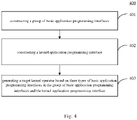
- a process 400 of the method for generating an operator shown in Fig. 2 according to another embodiment is shown.
- the process 400 of the method for generating an operator in the present embodiment may include the following step 401 to step 403.
- Step 401 constructing a group of basic application programming interfaces.
- step 201 may be referred to for the implementation details and technical effects of step 401 in the present embodiment. The description will not be repeated here.
- Step 402 constructing a kernel application programming interface.
- step 202 may be referred to for the implementation details and technical effects of step 402 in the present embodiment. The description will not be repeated here.
- Step 403 generating a target kernel operator based on three types of basic application programming interfaces in the group of basic application programming interfaces and the kernel application programming interface.
- an executing body may generate the target kernel operator based on three types of basic application programming interfaces in the group of basic application programming interfaces and the kernel application programming interface.
- the three types of basic application programming interfaces are a type of input/output application programming interface (i.e., IO API), a type of computing application programming interface (i.e., Compute API), and a type of computing rule application programming interface (i.e., OpFunc API), respectively.
- IO API input/output application programming interface
- computing application programming interface i.e., Compute API
- OpFunc API computing rule application programming interface
- the IO API is used for completing read/write in a global memory and a register
- the computing API is a general-purpose computing function, such as ElementwiseBinary or ElementwiseUnary
- the OpFunc API is used for defining a computing rule in the computing API for invoking by the computing API.
- OpFunc API such as AddFunctor
- Compute API such as ElementwiseBinary
- a default OpFunc API may be directly used as the OpFunc API, or the OpFunc API may be customized as required. This is not limited in the present disclosure.
- ReadData data reading
- CUDA Computer Unified Device Architecture
- a complete target kernel operator e.g., an ADD operator, specifically may be represented by the following codes:
- the OpFunc application programming interface is set based on user needs.
- the executing body may generate the target kernel operator based on the three types of basic APIs in the group of basic APIs and the kernel API, where the OpFunc API may be customized and generated based on user needs.
- This implementation generates the target kernel operator based on three types of basic APIs in the group of basic APIs and the kernel API, where the OpFunc API is set based on user needs, to further improve the development efficiency and flexibility of operators.
- the above embodiment of the present disclosure highlights the constructing a group of basic application programming interfaces; constructing a kernel application programming interface; and generating a target kernel operator based on three types of basic application programming interfaces in the group of basic application programming interfaces and the kernel application programming interface, where the three types of basic application programming interfaces are a type of input/output application programming interface, a type of Compute application programming interface, and a type of OpFunc application programming interface, respectively.
- the target kernel operator is generated by the limited number of basic application programming interfaces with three types of basic functions: the input/output application programming interface, the compute application programming interface, and the OpFunc application programming interface, and the kernel application programming interface, thereby contributing to further simplifying the codes, and improving the development efficiency and maintainability of operators.
- an embodiment of the present disclosure provides an apparatus for generating an operator.
- the embodiment of the apparatus corresponds to the embodiment of the method shown in Fig. 1 , and the apparatus may be specifically applied to various electronic devices.
- the apparatus 500 for generating an operator of the present embodiment includes: a first constructing module 501, a second constructing module 502, and a target generating module 503.
- the first constructing module 501 may be configured to construct a group of basic application programming interfaces for providing one of the following basic functions: an access function, a storage function, and a computing function.
- the second constructing module 502 may be configured to construct a kernel application programming interface for invoking the basic application programming interfaces to implement an operator logic.
- the target generating module 503 may be configured to generate a target kernel operator based on the group of basic application programming interfaces and the kernel application programming interface.
- the target generating module is further configured to: generate the target kernel operator based on three types of basic application programming interfaces in the group of basic application programming interfaces and the kernel application programming interface, wherein the three types of basic application programming interfaces are a type of input/output application programming interface, a type of computing application programing interface, and a type of computing rule application programming interface, respectively, wherein the input/output application programming interface is used for completing read/write in a global memory and a register, the computing application programming interface is a general-purpose computing function, and the computing rule application programming interface is used for defining a computing rule in the computing application programming interface for invoking by the computing application programming interface.
- the target generating module is further configured to: generate, in response to detecting an updating operation on the basic application programming interfaces, an updated group of basic application programming interfaces based on the updating operation; and generate the target kernel operator based on the updated group of basic application programming interfaces and the kernel application programming interface.
- the first constructing module is further configured to: construct the group of basic application programming interfaces based on a category of a hardware architecture of the target kernel operator to be generated.
- the computing rule application programming interface is set based on user needs.
- the acquisition, storage, and application of personal information of a user involved are in conformity with relevant laws and regulations, and do not violate public order and good customs.
- the present disclosure further provides an electronic device, a readable storage medium, and a computer program product.
- FIG. 6 a block diagram of an electronic device of the method for generating an operator according to embodiments of the present disclosure is shown.
- the electronic device 600 is a block diagram of an electronic device of the method for generating an operator according to the embodiments of the present disclosure.
- the electronic device is intended to represent various forms of digital computers, such as a laptop computer, a desktop computer, a workbench, a personal digital assistant, a server, a blade server, a mainframe computer, and other suitable computers.
- the electronic device may further represent various forms of mobile apparatuses, such as a personal digital assistant, a cellular phone, a smart phone, a wearable device, and other similar computing apparatuses.
- the components shown herein, the connections and relationships thereof, and the functions thereof are used as examples only, and are not intended to limit implementations of the present disclosure described and/or claimed herein.
- the electronic device includes: one or more processors 601, a memory 602, and interfaces for connecting various components, including a high-speed interface and a low-speed interface.
- the various components are interconnected using different buses, and may be mounted on a common motherboard or in other manners as required.
- the processor may process instructions for execution within the electronic device, including instructions stored in the memory or on the memory to display graphical information for a GUI on an external input/output apparatus (e.g., a display device coupled to an interface).
- a plurality of processors and/or a plurality of buses may be used, as appropriate, along with a plurality of memories and a plurality of memories.
- a plurality of electronic devices may be connected, with each device providing portions of necessary operations (e.g., as a server array, a group of blade servers, or a multi-processor system).
- a processor 601 is taken as an example.
- the memory 602 is a non-transitory computer readable storage medium provided in the present disclosure.
- the memory stores instructions executable by at least one processor, such that the at least one processor executes the method for generating an operator provided in the present disclosure.
- the non-transitory computer readable storage medium of the present disclosure stores computer instructions. The computer instructions are used for causing a computer to execute the method for generating an operator provided in the present disclosure.
- the memory 602 may be configured to store non-transitory software programs, non-transitory computer executable programs, and modules, e.g., the program instructions/modules (e.g., the first constructing 501 and the second constructing 502 shown in Fig. 5 ) corresponding to the method for generating an operator in the embodiments of the present disclosure.
- the processor 601 runs non-transitory software programs, instructions, and modules stored in the memory 602, so as to execute various function applications and data processing of a server, i.e., implementing the method for generating an operator in the above embodiments of the method.
- the memory 602 may include a program storage area and a data storage area, where the program storage area may store an operating system and an application program required by at least one function; and the data storage area may store, e.g., data created based on use of the electronic device for face tracking.
- the memory 602 may include a high-speed random-access memory, and may further include a non-transitory memory, such as at least one disk storage component, a flash memory component, or other non-transitory solid state storage components.
- the memory 602 alternatively includes memories disposed remotely relative to the processor 601, and these remote memories may be connected to an electronic device for generating an operator via a network. Examples of the above network include, but are not limited to, the Internet, an intranet, a local area network, a mobile communication network, and a combination thereof.
- the electronic device of the method for generating an operator may further include: an input apparatus 603 and an output apparatus 604.
- the processor 601, the memory 602, the input apparatus 603, and the output apparatus 604 may be connected through a bus or in other manners. Bus connection is taken as an example in Fig. 6 .
- the input apparatus 603 may receive inputted number or character information, and generate a keying signal input related to user settings and function control of the electronic device for generating an operator, e.g., an input apparatus such as a touch screen, a keypad, a mouse, a trackpad, a touchpad, an indicating arm, one or more mouse buttons, a trackball, and a joystick.
- the output apparatus 604 may include a display device, an auxiliary lighting apparatus (e.g., an LED), a haptic feedback apparatus (e.g., a vibration motor), and the like.
- the display device may include, but is not limited to, a liquid crystal display (LCD), a light emitting diode (LED) display, and a plasma display. In some implementations, the display device may be a touch screen.
- Various implementations of the systems and technologies described herein may be implemented in a digital electronic circuit system, an integrated circuit system, an ASIC (application specific integrated circuit), computer hardware, firmware, software, and/or a combination thereof.
- the various implementations may include: an implementation in one or more computer programs that are executable and/or interpretable on a programmable system including at least one programmable processor, which may be a special-purpose or general-purpose programmable processor, and may receive data and instructions from, and transmit data and instructions to, a storage system, at least one input apparatus, and at least one output apparatus.
- machine-readable medium and “computer readable medium” refer to any computer program product, device, and/or apparatus (e.g., a magnetic disk, an optical disk, a memory, or a programmable logic device (PLD)) configured to provide machine instructions and/or data to a programmable processor, and include a machine-readable medium receiving machine instructions as machine-readable signals.
- machine-readable signal refers to any signal used to provide machine instructions and/or data to a programmable processor.
- a display apparatus e.g., a CRT (cathode ray tube) or a LCD (liquid crystal display) monitor
- a keyboard and a pointing apparatus e.g., a mouse or a trackball
- Other kinds of apparatuses may also be configured to provide interaction with the user.
- feedback provided to the user may be any form of sensory feedback (e.g., visual feedback, auditory feedback, or haptic feedback); and an input may be received from the user in any form (including an acoustic input, a voice input, or a tactile input).
- the systems and technologies described herein may be implemented in a computing system (e.g., as a data server) that includes a back-end component, or a computing system (e.g., an application server) that includes a middleware component, or a computing system (e.g., a user computer with a graphical user interface or a web browser through which the user can interact with an implementation of the systems and technologies described herein) that includes a front-end component, or a computing system that includes any combination of such a back-end component, such a middleware component, or such a front-end component.
- the components of the system may be interconnected by digital data communication (e.g., a communication network) in any form or medium. Examples of the communication network include: a local area network (LAN), a wide area network (WAN), and the Internet.
- the computer system may include a client and a server.
- the client and the server are generally remote from each other, and usually interact via a communication network.
- the relationship between the client and the server arises by virtue of computer programs that run on corresponding computers and have a client-server relationship with each other.
Landscapes
- Engineering & Computer Science (AREA)
- Software Systems (AREA)
- Theoretical Computer Science (AREA)
- General Engineering & Computer Science (AREA)
- Physics & Mathematics (AREA)
- General Physics & Mathematics (AREA)
- Computing Systems (AREA)
- Evolutionary Computation (AREA)
- Mathematical Physics (AREA)
- Artificial Intelligence (AREA)
- Data Mining & Analysis (AREA)
- General Health & Medical Sciences (AREA)
- Computational Linguistics (AREA)
- Molecular Biology (AREA)
- Biophysics (AREA)
- Biomedical Technology (AREA)
- Life Sciences & Earth Sciences (AREA)
- Health & Medical Sciences (AREA)
- Human Computer Interaction (AREA)
- Computer Vision & Pattern Recognition (AREA)
- Medical Informatics (AREA)
- Stored Programmes (AREA)
- Signal Processing For Digital Recording And Reproducing (AREA)
- Reverberation, Karaoke And Other Acoustics (AREA)
Abstract
Description
- The present disclosure relates to the technical field of computers, specifically relates to the technical field of neural networks, and more specifically relates to a method and apparatus for generating an operator.
- At present, a deep neural network framework contains a large number of operators. In a current operator system, it is required to separately develop a Kernel function for each operator. For different hardware, Kernel implementations are different, i.e., each hardware platform for each operator in an existing deep learning framework corresponds to at least one Kernel.
- Embodiments of the present disclosure provide a method and apparatus for generating an operator, a device, and a storage medium.
- In a first aspect, an embodiment of the present disclosure provides a method for generating an operator, including: constructing a group of basic application programming interfaces for providing one of the following basic functions: an access function, a storage function, and a computing function; constructing a kernel application programming interface for invoking the basic application programming interfaces to implement an operator logic; and generating a target kernel operator based on the group of basic application programming interfaces and the kernel application programming interface.
- In a second aspect, an embodiment of the present disclosure provides an apparatus for generating an operator, including: a first constructing module configured to construct a group of basic application programming interfaces for providing one of the following basic functions: an access function, a storage function, and a computing function; a second constructing module configured to construct a kernel application programming interface for invoking the basic application programming interfaces to implement an operator logic; and a target generating module configured to generate a target kernel operator based on the group of basic application programming interfaces and the kernel application programming interface.
- In a third aspect, an embodiment of the present disclosure provides an electronic device, including: one or more processors; and a storage apparatus storing one or more programs thereon, where the one or more programs, when executed by the one or more processors, cause the one or more processors to implement the method for generating an operator according to any one embodiment in the first aspect.
- In a fourth aspect, an embodiment of the present disclosure provides a computer readable medium storing a computer program thereon, where the program, when executed by a processor, implements the method for generating an operator according to any one embodiment in the first aspect.
- In a fifth aspect, an embodiment of the present disclosure provides a computer program product including a computer program, where the computer program, when executed by a processor, implements the method for generating an operator according to any one embodiment in the first aspect.
- The present disclosure accelerates the operator development, and improves an operator maintainability.
- It should be understood that contents described in the SUMMARY are neither intended to identify key or important features of embodiments of the present disclosure, nor intended to limit the scope of the present disclosure. Other features of the present disclosure will become readily understood with reference to the following description.
-
-
Fig. 1 is a diagram of an exemplary system architecture in which embodiments of the present disclosure may be implemented; -
Fig. 2 is a flowchart of a method for generating an operator according to an embodiment of the present disclosure; -
Fig. 3 is a schematic diagram of an application scenario of the method for generating an operator according to the present disclosure; -
Fig. 4 is a flowchart of the method for generating an operator according to another embodiment of the present disclosure; -
Fig. 5 is a schematic diagram of an apparatus for generating an operator according to an embodiment of the present disclosure; and -
Fig. 6 is a schematic structural diagram of a computer system adapted to implement an electronic device of embodiments of the present disclosure. - Example embodiments of the present disclosure are described below with reference to the accompanying drawings, including various details of the embodiments of the present disclosure to contribute to understanding, which should be considered merely as examples. Therefore, those of ordinary skills in the art should realize that various alterations and modifications may be made to the embodiments described here without departing from the scope and spirit of the present disclosure. Similarly, for clearness and conciseness, descriptions of well-known functions and structures are omitted in the following description.
- It should be noted that the embodiments in the present disclosure and the features in the embodiments may be combined with each other on a non-conflict basis. The present disclosure will be described in detail below with reference to the accompanying drawings and in combination with the embodiments.
-
Fig. 1 shows anexemplary system architecture 100 in which a method for generating an operator of an embodiment of the present disclosure may be applied. - As shown in
Fig. 1 , thesystem architecture 100 may includeterminal devices network 104, and aserver 105. Thenetwork 104 serves as a medium providing a communication link between theterminal devices server 105. Thenetwork 104 may include various types of connections, such as wired or wireless communication links, or optical cables. - A user may interact with the
server 105 using theterminal devices network 104, e.g., to receive or send a message. Theterminal devices - The
terminal devices terminal devices terminal devices - The
server 105 may be a server providing various services, for example, constructing a group of basic application programming interfaces for providing one of the following basic functions: an access function, a storage function, and a computing function; constructing a kernel application programming interface for invoking the basic application programming interfaces to implement an operator logic; and generating a target kernel operator based on the group of basic application programming interfaces and the kernel application programming interface. - It should be noted that the
server 105 may be hardware, or may be software. When theserver 105 is hardware, the server may be implemented as a distributed server cluster composed of a plurality of servers, or may be implemented as a single server. When the server is software, the server may be implemented as a plurality of software programs or software modules (e.g., software programs or software modules for providing an operator generating service), or may be implemented as a single software program or software module. This is not specifically limited here. - It should be noted that the method for generating an operator provided in the embodiment of the present disclosure may be executed by the
server 105, or may be executed by theterminal devices server 105 and theterminal devices server 105, or may be entirely arranged in theterminal devices server 105 and theterminal devices - It should be understood that the numbers of terminal devices, networks, and servers in
Fig. 1 are merely illustrative. Any number of terminal devices, networks, and servers may be provided based on actual requirements. -
Fig. 2 shows aschematic flowchart 200 of a method for generating an operator of an embodiment. The method for generating an operator includes thefollowing steps 201 tostep 203. - Step 201: constructing a group of basic application programming interfaces.
- In the present embodiment, an executing body (for example, the
server 105 or theterminal devices Fig. 1 ) may construct a group of basic application programming interfaces, i.e., basic APIs (application programming interfaces), i.e., a group of primitive APIs. A basic API corresponds to a module-level device function, which is a function that completes functions using multi-threading in a multi-threaded environment, and provide at least one of the following basic functions: an access function (i.e., a data reading function), a storage function (i.e., a data writing function), and a computing function. - The APIs are predefined functions designed to provide a group of routines that are accessible to applications and developers based on a certain software or hardware, without accessing source codes or understanding details of internal working mechanisms.
- Here, the basic APIs are mainly oriented towards a SIMD (single instruction multiple data) hardware architecture, for example, a GPU (graphics processing unit), or a NPU (embedded neural network processing unit).
- Specifically, in a multi-threaded environment of the SIMD hardware architecture, the basic APIs are simultaneously invoked by multiple threads, for example, thread1, thread2, and thread3, and each thread has its own local memory space and a shared memory space.
- It should be noted that the basic APIs cannot be separately used as kernel operators, and basic APIs invokable by different hardware devices are different.
- Here, the group of basic APIs may include one or more basic APIs.
- Specifically, the group of basic APIs may include 10 basic APIs, one basic API of the 10 basic APIs is used for providing an access function, another one basic API of the 10 basic APIs is used for providing a storage function, and the remaining 8 basic APIs of the 10 basic APIs are used for providing different computing functions.
- Step 202: constructing a kernel application programming interface.
- In the present embodiment, the executing body constructs the kernel application programming interface, i.e., a kernel API, which corresponds to a kernel-level function. Each kernel operator corresponds to a kernel API, and the kernel API is used for invoking a basic API to implement an operator logic.
- Here, the kernel API may be applied to different hardware devices.
- Step 203: generating a target kernel operator based on the group of basic application programming interfaces and the kernel application programming interface.
- In the present embodiment, the executing body may generate the target kernel operator based on one or more basic APIs in the group of basic APIs and the kernel API, i.e., invoke one or more basic APIs in the group of basic APIs using a kernel operator, to generate the target internal operator.
- Specifically, the group of basic APIs may include 5 basic APIs, one basic API of the 5 basis APIs is used for providing an access function, another one basic API of the 5 basis APIs is used for providing a storage function, and the remaining 3 basic APIs of the 5 basis APIs are used for providing different computing functions. The 3 basic APIs for providing different computing functions are a basic API for providing a computing function A, a basic API for providing a computing function B, and a basic API for providing a computing function C, respectively. The executing body may invoke, using a kernel operator, a basic API that provides an access function, a basic API that provides a computing function A, and a basic API that provides a storage function in the group of basic APIs, to generate a target kernel operator A; may invoke, using a kernel operator, a basic API that provides an access function, a basic API that provides a computing function A, a basic API that provides a computing function B, and a basic API that provides a storage function in the group of basic APIs, to generate a target kernel operator D; or may invoke, using a kernel operator, a basic API that provides an access function, a basic API that provides a computing function A, a basic API that provides a computing function B, a basic API that provides a computing function C, and a basic API that provides a storage function in the group of basic APIs, to generate a target kernel operator E.
- Here, a function of the target kernel operator generally corresponds to a function of the basic API which is used in generating the target kernel operator and provides the computing function.
- In some optional implementations, the generating the target kernel operator based on the group of basic application programming interfaces and the kernel application programming interface includes: generating, in response to detecting an updating operation on the basic application programming interfaces, an updated group of basic application programming interfaces based on the updating operation; and generating the target kernel operator based on the updated group of basic application programming interfaces and the kernel application programming interface.
- In the present implementation, the executing body may detect whether an updating operation on the basic APIs is performed by a user in real time or periodically, generate, in response to determining that an updating operation on the basic APIs is performed by a user in real time or periodically, the updated group of basic APIs based on the updating operation, and generate the target kernel operator based on the updated group of basic APIs and the kernel API.
- The present implementation generates, in response to detecting an updating operation on the basic APIs, the updated group of basic APIs based on the updating operation; and generates the target kernel operator based on the updated group of basic APIs and the kernel API. That is, a large number of kernel operators may be optimized and upgraded by directly optimizing and upgrading a group of basic APIs invoked by each kernel operator without upgrading and optimizing the large number of kernel operators one by one, thereby improving a development and optimization efficiency.
- In some optional implementations, constructing the group of basic application programming interfaces includes: constructing the group of basic application programming interfaces based on a category of a hardware architecture of the to-be-generated target kernel operator.
- In the present implementation, the executing body may first acquire the category of the hardware architecture of the to-be-generated target kernel operator, such as GPU or NPU, and construct a group of basic application programming interfaces adapted to a current hardware architecture based on the category of the hardware architecture.
- Specifically, if the category of the hardware architecture of the to-be-generated target kernel operator is GPU, the executing body may construct a group of basic application programming interfaces adapted to the GPU architecture. If the category of the hardware architecture of the to-be-generated target kernel operator is NPU, the executing body may construct a group of basic application programming interfaces adapted to the NPU architecture.
- The present implementation constructs a group of basic APIs based on the category of the hardware architecture of the to-be-generated target kernel operator, and then generates a target kernel operator adapted to the current hardware architecture based on the group of basic APIs and the kernel API, thereby generating the target kernel operator based on the group of basic APIs and the kernel API under different hardware architecture conditions, avoiding modifying a large number of kernel operators to adapt to the hardware architecture during hardware migration. That is, it is only necessary to construct a group of basic APIs adapted to the current hardware architecture, and effectively reducing hardware migration costs.
- Further referring to
Fig. 3, Fig. 3 is a schematic diagram of an application scenario of the method for generating an operator according to the present embodiment. An executingbody 301 may construct a group ofbasic APIs 302, which may include three types of basic APIs, namely a type of basic API for providing an access function, a type of basic API for providing a storage function, and a type of basic API for providing a computing function, respectively. For example, this group of basic APIs totally include 4 basic APIs, namely a basic API for providing an access function, a basic API for providing a storage function, a basic API for providing a computing function M, and a basic API for providing a computing function N, respectively. Further, the executing body constructs akernel API 303 for invoking the basic APIs to implement an operator logic; and generates atarget kernel operator 304, based on the group ofbasic APIs 302 and thekernel API 303. For example, the executing body invokes the basic API for providing the access function, the basic API for providing the storage function, and the basic API for providing the computing function M by using the kernel API to generate a target kernel operator M. - The method for generating an operator provided in embodiments of the present disclosure constructs a group of basic APIs for providing one of the following basic functions: an access function, a storage function, and a computing function; constructs a kernel API for invoking the basic APIs to implement an operator logic; and generates a target kernel operator based on the group of basic APIs and the kernel API. That is, by invoking a limited number of basic APIs through the kernel API, it is possible to implement a target kernel operator of any functional type, thereby effectively solving the problem in existing technologies in which it is necessary to separately develop a large number of kernel operators with different functions, effectively accelerating the operator development, and improving the operator maintainability.
- Further referring to
Fig. 4 , aprocess 400 of the method for generating an operator shown inFig. 2 according to another embodiment is shown. Theprocess 400 of the method for generating an operator in the present embodiment may include the followingstep 401 to step 403. - Step 401: constructing a group of basic application programming interfaces.
- The description of
step 201 may be referred to for the implementation details and technical effects ofstep 401 in the present embodiment. The description will not be repeated here. - Step 402: constructing a kernel application programming interface.
- The description of
step 202 may be referred to for the implementation details and technical effects ofstep 402 in the present embodiment. The description will not be repeated here. - Step 403: generating a target kernel operator based on three types of basic application programming interfaces in the group of basic application programming interfaces and the kernel application programming interface.
- In the present embodiment, an executing body may generate the target kernel operator based on three types of basic application programming interfaces in the group of basic application programming interfaces and the kernel application programming interface.
- The three types of basic application programming interfaces are a type of input/output application programming interface (i.e., IO API), a type of computing application programming interface (i.e., Compute API), and a type of computing rule application programming interface (i.e., OpFunc API), respectively.
- Here, the IO API is used for completing read/write in a global memory and a register, the computing API is a general-purpose computing function, such as ElementwiseBinary or ElementwiseUnary, and the OpFunc API is used for defining a computing rule in the computing API for invoking by the computing API.
- Specifically, it is necessary to define the OpFunc API, such as AddFunctor, to implement an ADD operation, for invoking by the Compute API, such as ElementwiseBinary.
- Here, a default OpFunc API may be directly used as the OpFunc API, or the OpFunc API may be customized as required. This is not limited in the present disclosure.
- It should be noted that the above three types of basic APIs are block-level multi-threaded APIs, in which a data pointer and an operation type of a current block may be directly introduced to complete corresponding computing.
- Specifically, data reading, i.e., ReadData, in the IO API is used to read data from the global memory to an on-chip memory, and may be represented by the following CUDA (Compute Unified Device Architecture) programming codes:
- template<typename Tx,typename Ty,int NX,int NY,int BlockSize,bool IsBoundary=false>
- _device_void ReadData(Ty*dst,const Tx*src,int size_nx,int size_ny,int stride_nx,int stride_ny);
- Data protocol, i.e., Reduce, in the Compute API is used to reduce the data size on the premise of remaining the original data as far as possible, and may be represented by the following codes:
- template<typename T,int NX,int NY,int BlockSize,class ReduceFunctor, ReduceMode Mode>
- _device_void Reduce(T*out,T*in,ReduceFunctor reducer, bool reduce_last_dim);
- A complete target kernel operator, e.g., an ADD operator, specifically may be represented by the following codes:
  InT args[2][VecSize];
  OutT result[VecSize];
  //load
  kps::Init<InT,VecSize>(args[0],static_cast<InT>(1.0f
 ));
  kps::Init<InT,VecSize>(args[1],static_cast<InT>(1.0f
 ));
  kps::ReadData<InT,VecSize,1,1,IsBoundary>(args[0],in
 [0]+data_offset,num);
  kps::ReadData<InT,VecSize,1,1,IsBoundary>(args[1],in
 [1]+data_offset,num);
  //compute
  kps::ElementwiseBinary<InT,OutT,VecSize,1,1,Functor>
 (result,args[0],args[1],func) ;
  //store
  kps::WriteData<OutT,VecSize,1,1,IsBoundary>(out+data
 _offset,result,num) ;
generate the target kernel operator based on three types of basic application programming interfaces in the group of basic application programming interfaces and the kernel application programming interface, wherein the three types of basic application programming interfaces are a type of input/output application programming interface, a type of computing application programing interface, and a type of computing rule application programming interface, respectively, wherein the input/output application programming interface is used for completing read/write in a global memory and a register, the computing application programming interface is a general-purpose computing function, and the computing rule application programming interface is used for defining a computing rule in the computing application programming interface for invoking by the computing application programming interface.
generate, in response to detecting an updating operation on the basic application programming interfaces, an updated group of basic application programming interfaces based on the updating operation; and generate the target kernel operator based on the updated group of basic application programming interfaces and the kernel application programming interface.
construct the group of basic application programming interfaces based on a category of a hardware architecture of the target kernel operator to be generated.
Claims (13)
- A method for generating an operator, comprising:constructing (201) a group of basic application programming interfaces for providing one of following basic functions: an access function, a storage function, and a computing function;constructing (202) a kernel application programming interface for invoking the basic application programming interfaces to implement an operator logic; andgenerating (203) a target kernel operator based on the group of basic application programming interfaces and the kernel application programming interface.
- The method according to claim 1, wherein generating the target kernel operator based on the group of basic application programming interfaces and the kernel application programming interface comprises:
generating (403) the target kernel operator based on three types of basic application programming interfaces in the group of basic application programming interfaces and the kernel application programming interface, wherein the three types of basic application programming interfaces are a type of input/output application programming interface, a type of computing application programing interface, and a type of computing rule application programming interface, respectively, wherein the input/output application programming interface is used for completing read/write in a global memory and a register, the computing application programming interface is a general-purpose computing function, and the computing rule application programming interface is used for defining a computing rule in the computing application programming interface for invoking by the computing application programming interface. - The method according to claim 1 or 2, wherein generating the target kernel operator based on the group of basic application programming interfaces and the kernel application programming interface comprises:generating, in response to detecting an updating operation on the basic application programming interfaces, an updated group of basic application programming interfaces based on the updating operation; andgenerating the target kernel operator based on the updated group of basic application programming interfaces and the kernel application programing interface.
- The method according to any one of claims 1 to 3, wherein constructing the group of basic application programming interfaces comprises:
constructing the group of basic application programming interfaces based on a category of a hardware architecture of the target kernel operator to be generated. - The method according to claim 2, wherein the computing rule application programming interface is set based on user needs.
- An apparatus for generating an operator, comprising:a first constructing module (501) configured to construct a group of basic application programming interfaces for providing one of following basic functions: an access function, a storage function, and a computing function;a second constructing module (502) configured to construct a kernel application programming interface for invoking the basic application programming interfaces to implement an operator logic; anda target generating module (503) configured to generate a target kernel operator based on the group of basic application programming interfaces and the kernel application programming interface.
- The apparatus according to claim 6, wherein the target generating module is further configured to:
generate the target kernel operator based on three types of basic application programming interfaces in the group of basic application programming interfaces and the kernel application programming interface, wherein the three types of basic application programming interfaces are a type of input/output application programming interface, a type of computing application programing interface, and a type of computing rule application programming interface, respectively, wherein the input/output application programming interface is used for completing read/write in a global memory and a register, the computing application programming interface is a general-purpose computing function, and the computing rule application programming interface is used for defining a computing rule in the computing application programming interface for invoking by the computing application programming interface. - The apparatus according to claim 6 or 7, wherein the target generating module is further configured to:generate, in response to detecting an updating operation on the basic application programming interfaces, an updated group of basic application programming interfaces based on the updating operation; andgenerate the target kernel operator based on the updated group of basic application programming interfaces and the kernel application programming interface.
- The apparatus according to any one of claims 6 to 8, wherein the first constructing module is further configured to:
construct the group of basic application programming interfaces based on a category of a hardware architecture of the target kernel operator to be generated. - The apparatus according to claim 7, wherein the computing rule application programming interface is set based on user needs.
- An electronic device, comprising:at least one processor; anda memory communicatively connected to the at least one processor; whereinthe memory stores instructions executable by the at least one processor, and the instructions are executed by the at least one processor, such that the at least one processor can execute the method according to any one of claims 1 to 5.
- A non-transitory computer readable storage medium storing computer instructions, wherein the computer instructions are used for causing a computer to execute the method according to any one of claims 1 to 5.
- A computer program product, comprising a computer program, wherein the computer program, when executed by a processor, implements the method according to any one of claims 1 to 5 .
Applications Claiming Priority (1)
| Application Number | Priority Date | Filing Date | Title |
|---|---|---|---|
| CN202111503431.6A CN114201154B (en) | 2021-12-10 | 2021-12-10 | Operator generation method and device |
Publications (2)
| Publication Number | Publication Date |
|---|---|
| EP4109265A2 true EP4109265A2 (en) | 2022-12-28 |
| EP4109265A3 EP4109265A3 (en) | 2023-05-03 |
Family
ID=80652002
Family Applications (1)
| Application Number | Title | Priority Date | Filing Date |
|---|---|---|---|
| EP22189729.1A Pending EP4109265A3 (en) | 2021-12-10 | 2022-08-10 | Method and apparatus for generating operator |
Country Status (5)
| Country | Link |
|---|---|
| US (1) | US12586003B2 (en) |
| EP (1) | EP4109265A3 (en) |
| JP (1) | JP7403586B2 (en) |
| KR (1) | KR102810664B1 (en) |
| CN (1) | CN114201154B (en) |
Citations (3)
| Publication number | Priority date | Publication date | Assignee | Title |
|---|---|---|---|---|
| US20180293057A1 (en) * | 2017-04-11 | 2018-10-11 | Beijing Deephi Technology Co., Ltd. | Programming model of neural network-oriented heterogeneous computing platform |
| US10216548B1 (en) * | 2013-12-19 | 2019-02-26 | VCE IP Holding Company LLC | Dynamic and adaptive programmatic interface selection (DAPIS) |
| US20210294602A1 (en) * | 2020-03-17 | 2021-09-23 | Onspecta, Inc. | Microkernel-based software optimization of neural networks |
Family Cites Families (17)
| Publication number | Priority date | Publication date | Assignee | Title |
|---|---|---|---|---|
| FR2990547B1 (en) * | 2012-05-11 | 2014-06-20 | Thales Sa | CENTRALIZED PARAMETRABLE MAINTENANCE SYSTEM FOR AN AIRCRAFT |
| JP6200824B2 (en) | 2014-02-10 | 2017-09-20 | ルネサスエレクトロニクス株式会社 | Arithmetic control apparatus, arithmetic control method, program, and OpenCL device |
| US9501269B2 (en) | 2014-09-30 | 2016-11-22 | Advanced Micro Devices, Inc. | Automatic source code generation for accelerated function calls |
| FR3068895B1 (en) | 2017-07-17 | 2019-08-23 | François Emmanuel VIGNEAU | MULTISPORTS SPACE FOR THE PRACTICE OF SEVERAL SPORTS OF GOALS AND SPORTS OF THREADS |
| EP3816030B1 (en) | 2018-05-16 | 2023-05-10 | Honda Motor Co., Ltd. | Retrofitting electric device for bicycle, and bicycle |
| CN109447256A (en) * | 2018-09-12 | 2019-03-08 | 上海交通大学 | The design method that Tensorflow system based on FPGA accelerates |
| US20200334522A1 (en) | 2019-04-18 | 2020-10-22 | Cambricon Technologies Corporation Limited | Data processing method and related products |
| US11663523B2 (en) | 2019-09-14 | 2023-05-30 | Oracle International Corporation | Machine learning (ML) infrastructure techniques |
| CN110908797B (en) * | 2019-11-07 | 2023-09-15 | 浪潮电子信息产业股份有限公司 | Call request data processing methods, devices, equipment, storage media and systems |
| CN110929883A (en) * | 2019-11-22 | 2020-03-27 | 苏州浪潮智能科技有限公司 | Method and device for supporting FPGA (field programmable gate array) training in TensorFlow |
| CN112860420B (en) * | 2019-11-27 | 2024-06-11 | 阿里巴巴集团控股有限公司 | Data processing method and device based on hardware virtualization |
| CN111695501B (en) * | 2020-06-11 | 2021-08-10 | 青岛大学 | Equipment soft fault detection method based on operating system kernel calling data |
| CN111782181A (en) | 2020-06-28 | 2020-10-16 | 北京百度网讯科技有限公司 | Code generation method, apparatus, electronic device and storage medium |
| CN111930521B (en) | 2020-09-23 | 2024-08-06 | 北京百度网讯科技有限公司 | Method, device, electronic equipment and readable storage medium for deploying application |
| CN112487973B (en) | 2020-11-30 | 2023-09-12 | 阿波罗智联(北京)科技有限公司 | Method and device for updating user image recognition model |
| CN112613577B (en) * | 2020-12-31 | 2024-06-11 | 上海商汤智能科技有限公司 | Neural network training method and device, computer equipment and storage medium |
| US12099848B2 (en) * | 2021-07-29 | 2024-09-24 | Nvidia Corporation | Automatic compute kernel generation |
-
2021
- 2021-12-10 CN CN202111503431.6A patent/CN114201154B/en active Active
-
2022
- 2022-06-10 JP JP2022094040A patent/JP7403586B2/en active Active
- 2022-08-10 EP EP22189729.1A patent/EP4109265A3/en active Pending
- 2022-08-15 US US17/887,951 patent/US12586003B2/en active Active
- 2022-08-24 KR KR1020220106027A patent/KR102810664B1/en active Active
Patent Citations (3)
| Publication number | Priority date | Publication date | Assignee | Title |
|---|---|---|---|---|
| US10216548B1 (en) * | 2013-12-19 | 2019-02-26 | VCE IP Holding Company LLC | Dynamic and adaptive programmatic interface selection (DAPIS) |
| US20180293057A1 (en) * | 2017-04-11 | 2018-10-11 | Beijing Deephi Technology Co., Ltd. | Programming model of neural network-oriented heterogeneous computing platform |
| US20210294602A1 (en) * | 2020-03-17 | 2021-09-23 | Onspecta, Inc. | Microkernel-based software optimization of neural networks |
Non-Patent Citations (1)
| Title |
|---|
| HIGUCHI TOMOKAZU ET AL: "ClPy: A NumPy-Compatible Library Accelerated with OpenCL", 2019 IEEE INTERNATIONAL PARALLEL AND DISTRIBUTED PROCESSING SYMPOSIUM WORKSHOPS (IPDPSW), IEEE, 20 May 2019 (2019-05-20), pages 933 - 940, XP033583387, [retrieved on 20190726], DOI: 10.1109/IPDPSW.2019.00159 * |
Also Published As
| Publication number | Publication date |
|---|---|
| KR102810664B1 (en) | 2025-05-20 |
| US12586003B2 (en) | 2026-03-24 |
| US20220391774A1 (en) | 2022-12-08 |
| KR20220124661A (en) | 2022-09-14 |
| JP7403586B2 (en) | 2023-12-22 |
| CN114201154A (en) | 2022-03-18 |
| JP2022113774A (en) | 2022-08-04 |
| EP4109265A3 (en) | 2023-05-03 |
| CN114201154B (en) | 2023-01-31 |
Similar Documents
| Publication | Publication Date | Title |
|---|---|---|
| EP3896567B1 (en) | Page pre-rendering method and apparatus, electronic device, and storage medium | |
| KR102799126B1 (en) | Deep learning based operator registration processing method, device and electronic equipment | |
| US11294651B2 (en) | Code execution method, device, and rendering apparatus | |
| US11941055B2 (en) | Method and apparatus for graph computing, electronic device and storage medium | |
| US11615159B2 (en) | Data processing method for mini app, apparatus, device and medium | |
| US11379201B2 (en) | Wrapping method, registration method, device, and rendering apparatus | |
| EP3869377A1 (en) | Method and apparatus for data processing based on smart contract, device and storage medium | |
| US11689630B2 (en) | Request processing method and apparatus, electronic device, and computer storage medium | |
| EP3819758A2 (en) | Instruction executing method and apparatus, electronic device, and computer-readable storage medium | |
| US10620916B2 (en) | Read-only communication operator | |
| CN115268859B (en) | OpenCL TensorFlow implementation method and device, electronic equipment and storage medium | |
| KR20040107414A (en) | Mechanism for asynchronous components to be application framework agnostic | |
| US12586003B2 (en) | Method and apparatus for generating operator | |
| CN114265658A (en) | Page display method, device and equipment | |
| CN119473272A (en) | A heterogeneous model calling method, device and storage medium for strongly typed languages | |
| CN118628333A (en) | A method and device for image processing by arithmetic operator class | |
| US20150234667A1 (en) | Defining classes as singleton classes or non-singleton classes | |
| US20120072891A1 (en) | Computer Language Syntax for Automatic Callback Function Generation | |
| US8954947B2 (en) | Fast variable validation for state management of a graphics pipeline | |
| US11487564B1 (en) | Terminal shell switching | |
| US20220374331A1 (en) | Method of debugging applet, electronic device, and storage medium | |
| CN116055463A (en) | Method and device for realizing open interface | |
| US9436462B2 (en) | Identifying singleton classes | |
| CN122045587A (en) | Function processing method, function processing device, function processing equipment, storage medium and function processing product |
Legal Events
| Date | Code | Title | Description |
|---|---|---|---|
| PUAI | Public reference made under article 153(3) epc to a published international application that has entered the european phase |
Free format text: ORIGINAL CODE: 0009012 |
|
| STAA | Information on the status of an ep patent application or granted ep patent |
Free format text: STATUS: REQUEST FOR EXAMINATION WAS MADE |
|
| 17P | Request for examination filed |
Effective date: 20220810 |
|
| AK | Designated contracting states |
Kind code of ref document: A2 Designated state(s): AL AT BE BG CH CY CZ DE DK EE ES FI FR GB GR HR HU IE IS IT LI LT LU LV MC MK MT NL NO PL PT RO RS SE SI SK SM TR |
|
| PUAL | Search report despatched |
Free format text: ORIGINAL CODE: 0009013 |
|
| AK | Designated contracting states |
Kind code of ref document: A3 Designated state(s): AL AT BE BG CH CY CZ DE DK EE ES FI FR GB GR HR HU IE IS IT LI LT LU LV MC MK MT NL NO PL PT RO RS SE SI SK SM TR |
|
| RIC1 | Information provided on ipc code assigned before grant |
Ipc: G06F 8/51 20180101ALI20230328BHEP Ipc: G06F 8/36 20180101ALI20230328BHEP Ipc: G06F 9/54 20060101AFI20230328BHEP |
|
| STAA | Information on the status of an ep patent application or granted ep patent |
Free format text: STATUS: EXAMINATION IS IN PROGRESS |
|
| 17Q | First examination report despatched |
Effective date: 20240531 |