EP4109007A1 - Adaptive control system for controlling the thermal comfort inside an environment and method thereof - Google Patents
Adaptive control system for controlling the thermal comfort inside an environment and method thereof Download PDFInfo
- Publication number
- EP4109007A1 EP4109007A1 EP22181042.7A EP22181042A EP4109007A1 EP 4109007 A1 EP4109007 A1 EP 4109007A1 EP 22181042 A EP22181042 A EP 22181042A EP 4109007 A1 EP4109007 A1 EP 4109007A1
- Authority
- EP
- European Patent Office
- Prior art keywords
- fuzzy
- value
- fuzzy data
- updated
- predetermined
- Prior art date
- Legal status (The legal status is an assumption and is not a legal conclusion. Google has not performed a legal analysis and makes no representation as to the accuracy of the status listed.)
- Granted
Links
Images


Classifications
-
- F—MECHANICAL ENGINEERING; LIGHTING; HEATING; WEAPONS; BLASTING
- F24—HEATING; RANGES; VENTILATING
- F24F—AIR-CONDITIONING; AIR-HUMIDIFICATION; VENTILATION; USE OF AIR CURRENTS FOR SCREENING
- F24F11/00—Control or safety arrangements
- F24F11/62—Control or safety arrangements characterised by the type of control or by internal processing, e.g. using fuzzy logic, adaptive control or estimation of values
- F24F11/63—Electronic processing
- F24F11/64—Electronic processing using pre-stored data
-
- F—MECHANICAL ENGINEERING; LIGHTING; HEATING; WEAPONS; BLASTING
- F24—HEATING; RANGES; VENTILATING
- F24F—AIR-CONDITIONING; AIR-HUMIDIFICATION; VENTILATION; USE OF AIR CURRENTS FOR SCREENING
- F24F11/00—Control or safety arrangements
- F24F11/70—Control systems characterised by their outputs; Constructional details thereof
- F24F11/72—Control systems characterised by their outputs; Constructional details thereof for controlling the supply of treated air, e.g. its pressure
- F24F11/74—Control systems characterised by their outputs; Constructional details thereof for controlling the supply of treated air, e.g. its pressure for controlling air flow rate or air velocity
-
- F—MECHANICAL ENGINEERING; LIGHTING; HEATING; WEAPONS; BLASTING
- F24—HEATING; RANGES; VENTILATING
- F24F—AIR-CONDITIONING; AIR-HUMIDIFICATION; VENTILATION; USE OF AIR CURRENTS FOR SCREENING
- F24F11/00—Control or safety arrangements
- F24F11/70—Control systems characterised by their outputs; Constructional details thereof
- F24F11/72—Control systems characterised by their outputs; Constructional details thereof for controlling the supply of treated air, e.g. its pressure
- F24F11/74—Control systems characterised by their outputs; Constructional details thereof for controlling the supply of treated air, e.g. its pressure for controlling air flow rate or air velocity
- F24F11/77—Control systems characterised by their outputs; Constructional details thereof for controlling the supply of treated air, e.g. its pressure for controlling air flow rate or air velocity by controlling the speed of ventilators
-
- F—MECHANICAL ENGINEERING; LIGHTING; HEATING; WEAPONS; BLASTING
- F24—HEATING; RANGES; VENTILATING
- F24F—AIR-CONDITIONING; AIR-HUMIDIFICATION; VENTILATION; USE OF AIR CURRENTS FOR SCREENING
- F24F2110/00—Control inputs relating to air properties
- F24F2110/10—Temperature
-
- Y—GENERAL TAGGING OF NEW TECHNOLOGICAL DEVELOPMENTS; GENERAL TAGGING OF CROSS-SECTIONAL TECHNOLOGIES SPANNING OVER SEVERAL SECTIONS OF THE IPC; TECHNICAL SUBJECTS COVERED BY FORMER USPC CROSS-REFERENCE ART COLLECTIONS [XRACs] AND DIGESTS
- Y02—TECHNOLOGIES OR APPLICATIONS FOR MITIGATION OR ADAPTATION AGAINST CLIMATE CHANGE
- Y02B—CLIMATE CHANGE MITIGATION TECHNOLOGIES RELATED TO BUILDINGS, e.g. HOUSING, HOUSE APPLIANCES OR RELATED END-USER APPLICATIONS
- Y02B30/00—Energy efficient heating, ventilation or air conditioning [HVAC]
- Y02B30/70—Efficient control or regulation technologies, e.g. for control of refrigerant flow, motor or heating
Definitions
- the present invention relates to an adaptive control system for controlling the thermal comfort inside an environment.
- said environment can be a working environment or a domestic environment and the present invention refers to an adaptive control system designed to control the level of thermal comfort based on the needs of a user positioned within said environment.
- control of the level of thermal comfort perceived by a user inside said environment is based on the acquisition and processing of a plurality of data (for example data relating to the internal temperature of said environment and to the temperature variation) and based on parameters set by the user.
- a plurality of data for example data relating to the internal temperature of said environment and to the temperature variation
- thermal comfort means " the psychophysical state in which a subject expresses satisfaction with the thermal environment ", i.e. said subject has neither the sensation of heat nor the sensation of cold.
- This psychophysical state is fundamental for a person's health and personal satisfaction can lead to well-being in the home, as well as better productivity in a work environment.
- HVAC Heating, Ventilation and Air Conditioning
- ON-OFF controllers or the use of PID controllers is known to regulate the operations of an HVAC system.
- the ON-OFF regulators are intuitive and simple and regulate a temperature differential between two predetermined values with respect to a desired internal temperature of the environment: a predetermined first value and a predetermined second value, greater than said predetermined first value.
- ON-OFF controllers regulate thermal comfort using the internal temperature measured moment by moment by temperature sensors placed in the environment, without taking into account additional information, such as climate change or the heat exchange of the building.
- PID controllers Proportional-Integrative-Derivative
- control system of an HVAC must correlate input variables to output variables.
- a further known type control system for controlling thermal comfort comprises one or more microclimatic control units, each of which is able to acquire a plurality of environmental parameters (such as, for example, the air temperature, the surface temperature, the temperature of liquids and fumes, the radiant temperature, the relative humidity, the atmospheric and differential pressure, the air velocity, the illumination, the solar radiation and the radiant asymmetry, the thermal flow, the gas concentration and any meteorological quantities) and a logic control unit configured to apply subjective parameters, and to provide as output the value of a PMV ( Predicted Mean Vote ) index concerning the position in which said microclimatic control units are installed.
- a PMV Predicted Mean Vote
- the PMV index is one of the main indicators according to the UNI EN ISO 7730 standard of the thermal comfort of an indoor environment.
- This index predicts the average response (in statistical terms) of the thermal sensation of a large part of people exposed to certain thermal conditions for long time periods.
- thermography measurement system for real-time monitoring of comfort and heat rate exchange in the built environment
- Measurement Science and Technology vol. 23, no. 3, 2012 .
- the most influential variables are the metabolic rate, the temperature of the indoor environment and the humidity of the indoor environment.
- the final formula of PMV can be a nonlinear function of measurable environmental variables (at least temperature and humidity).
- control systems through which it is possible to manage the level of thermal comfort mainly use control techniques based on the use of PID controllers or control techniques aimed at optimally limiting energy consumption.
- Some known control systems may comprise one or more NEST thermostats, i.e. a programmable thermostat that requires the configuration of parameters based on user preferences, or one or more KNX thermostats that require data from devices / systems that use the same communication protocol.
- NEST thermostats i.e. a programmable thermostat that requires the configuration of parameters based on user preferences
- KNX thermostats that require data from devices / systems that use the same communication protocol.
- the aim of the present invention is to overcome said disadvantages by providing an adaptive control system to control thermal comfort in an environment, in which said control system has a simple structure and operation (with respect to the complexity of the functions used and the calculations that the control systems of known types must be carried out to regulate thermal comfort) and is able to control thermal comfort in a fine manner.
- a second aim of the present invention is to provide a control system for controlling thermal comfort, also reducing energy consumption.
- a further aim of the present invention is to provide a versatile control system both for a user (so that the user can preferably be an active part in choosing the level of thermal comfort) and for an operator.
- this control system offers a user the possibility of customizing some parameters and an operator the possibility of carrying out maintenance in a simple way.
- an adaptive control system for controlling the thermal comfort inside an environment.
- an air conditioning unit U is arranged inside said environment.
- An air conditioning unit U comprising a fan F, adjusting means A for adjusting the speed of said fan F, control valve V for controlling the flow rate of a thermovector fluid over time.
- the control system comprises:
- said temperature detecting means 1 comprise a temperature sensor.
- said storage means 3 comprise a memory.
- the memory is arranged inside said logic control unit 4.
- logic control unit is configured to:
- Each group of fuzzy sets F1, F2, F3, F4 comprises a respective a plurality of fuzzy sets, particularly at least two fuzzy sets.
- Each fuzzy set identifies a degree of belonging (in other words each fuzzy set is associated with a degree of belonging).
- a value of an input variable can belong with a degree of belonging to one or more predetermined classes which are established based on type of the application.
- a temperature value equal to 25 °C can belong to a class "warm” which has a degree of belonging equal to 0,8 and to a class "cold” which has a degree of belonging equal to 0,4.
- the inferential rules are established a priori, i.e. before the use of the control system.
- Said inferential rules allow to establish the degree of belonging of the opening state of the control valve V to each fuzzy set F3 1 ,F3 2 ...F3 N of the third group of fuzzy sets F3, and the degree of the belonging of the speed of fan F to each fuzzy set F4 1 ,F4 2 ...F4 N of the fourth group of fuzzy sets F4, on the basis of the degree of belonging to each value of internal temperature T INi and of the degree of belonging to each value of variation temperature ⁇ T Dj .
- logic control unit 4 is configured to:
- the fuzzification allows precise numeric data, i.e. the value of internal temperature T INi and the value of the temperature variation ⁇ T Dj , to pass to the fuzzy domain and therefore said precise numeric data become fuzzy data.
- the defuzzification allows the transition from the fuzzy domain to the domain of real numbers.
- the defuzzification is applied on each fuzzy data set of a third fuzzy data of a third fuzzy data set P3 i and on each further fuzzy data set of a third fuzzy data of a fourth fuzzy data set P4 i .
- Said third fuzzy data set P3 i and said fourth fuzzy data set P4 i are obtained through the application of the predetermined inferential rules (stored in said storage means 3) to each possible pair of fuzzy data formed by a first fuzzy data P1 i1 ,P1 i2... P1 iN and by a second fuzzy data P2 i1 ,P2 i2 ...P2 iN .
- Said first fuzzy data P1 i1 ,P1 i2 ...P1 iN and said second fuzzy data P2 i1 ,P2 i2 ...P2 iN belong respectively to a first fuzzy data set P1 i and to a second fuzzy data set P2 i , wherein said first fuzzy data set P1 i and said second fuzzy data set P2 i can comprise a respective plurality of fuzzy data.
- the defuzzification can be performed by means of one of the following methods of known type: mean of maxima, last of maxima, center of sums, center of area, center of inertia, center of gravity.
- the defuzzication referred to said fuzzy data set associated with to a third fuzzy data of a third fuzzy data set P3 i is performed through a method called mean of maxima.
- the logic control unit 4 is configured to:
- defuzzification referred to said further set associated with a fourth fuzzy data of a fourth fuzzy data set P4 i is performed through the method called mean of maxima.
- the logic control unit 4 is configured to:
- the logic control unit 4 is configured to perform a neural network (shown in Figures 3 and 4).
- Said neural network comprises an input layer and an output layer.
- the neural network does not have any intermediate layer between the input layer and the output layer.
- the input layer comprises a plurality of input nodes for receiving a respective value.
- the input layer comprises four input nodes: a first input node N IN1 , a second input node N IN2 , a third input node N IN3 and a fourth input node N IN4 .
- said neural network is a Kohonen network and said first input node N IN1 receives a value of internal temperature T INi , said second input node N IN2 receives a value of temperature Tu selected by the user, said third input node N IN3 receives a value of speed Vu of the fan F selected by the user and said fourth input node N IN4 receives a value of temperature variation ⁇ T Dj .
- the output layer comprises:
- each fuzzy set of the first group of fuzzy sets F1 there is a respective first group of output nodes and for each fuzzy set of the second group of fuzzy sets F2 there is a respective second group of output nodes.
- Each first group of output nodes comprises one or more output nodes and each second group of output nodes comprises one or more output nodes.
- said neural network is configured to:
- the logic control unit 4 is configured to:
- each first group of output nodes comprises three respective output nodes N OUT1F11 ,N OUT2F11 ,N OUT3F11 , N OUT1F12 ,N OUT2F12 ,N OUT3F12 ,... N OUT1F1N ,N OUT2F1N ,N OUT3F1N and said neural network is configured to provide at each output node of said first group of output nodes a respective updated parameter a 1 , b 1 , c 1 .
- Each second group of output nodes comprises three respective output nodes N OUT1F21 ,N OUT2F21 ,N OUT3F21 , N OUT1F21 ,N OUT2F21 ,N OUT3F21 , ...N OUT1F2N ,N OUT2F2N ,N OUT3F2N and said neural network is configured to provide at each output node of said second group of output nodes a respective updated parameter a 2 , b 2 , c 2 . In this way it is possible to obtain a second triad of updated parameters a 2 , b 2 , c 2 .
- said neural network is a Kohonen network and said input node N IN2 for receiving a value of temperature T U selected by the user and said input node N IN3 for receiving a value of speed Vu of the fan F selected by the user are arranged between said input node N IN1 for receiving a value of internal temperature T INi and said input node N IN4 for receiving a value of temperature variation ⁇ T Dj .
- said logic control unit 4 is configured to insert the first triad of updated parameters a 1 , b 1 , c 1 in the predetermined first equation to obtain a first updated fuzzy data P1 i and to insert the second triad of updated parameters a 2 , b 2 , c 2 in the predetermined second equation to obtain a second updated fuzzy data P2 i .
- the output layer of the neural network can comprise:
- the neural network is configured to provide as output:
- the logic control unit 4 can be configured to:
- Each third group of output nodes N OUT1F31 , N OUT2F31 ...N OUTNF31 , N OUT1F32 ,N OUT2F32... N OUTNF32 ,... N OUT1F3N ,N OUT2F3N ...N OUTNF3N comprises three output nodes N OUT1F31 , N OUT2F31, N OUT3F31 , N OUT1F32 ,N OUT2F32 ,N OUT3F32 ,...N OUT1F3N ,N OUT2F3N ,N OUT3F3N and said neural network can be configured to provide at each output node of said third group of output nodes a respective updated parameter a 3 , b 3 , c 3 for said predetermined third equation.
- Said logic control unit 4 can be configured to insert said updated parameters a 3 , b 3 , c 3 in said predetermined third equation to obtain an updated fuzzy data set, due to the change of the shape of the function represented by said predetermined third equation, wherein said updated fuzzy data set is associated with said third fuzzy data of said third fuzzy data set P3 i .
- Each fourth group of output nodes N OUT1F41 , N OUT2F41 ...N OUTNF41 ;N OUT1F42 ,N OUT2F42... N OUTNF42 ,... N OUT1F4N ,N OUT2F4N ...N OUTNF4N comprises three respective output nodes N OUT1F41 , NOUT2F41,NOUT3F41, N OUT1F42 ,N OUT2F42... N OUTNF42 , ... N OUT1F4N ,N OUT2F4N ... N OUTNF4N , at which a respective updated parameter a 4 , b 4 , c 4 is present.
- Said logic control unit 4 can be configured to insert said updated parameters a 4 , b 4 , c 4 in said predetermined fourth equation to obtain a further updated fuzzy data set, due to the change of the shape of the function represented by said predetermined fourth equation, wherein said further updated fuzzy data set is associated with said fourth fuzzy data of said fourth fuzzy data set P4 i .
- control logic unit 4 performs the defuzzification of said fuzzy data set associated with said third fuzzy data of said third fuzzy data set P3 i to obtain a first updated real number R 1 indicating if the control valve V is to be open and how or if is to be closed, as well as the defuzzification of said further fuzzy data set associated with said fourth fuzzy data of said fourth fuzzy data set P4 i to obtain a second updated real number R 2 indicating the speed of the fan F.
- the logic control unit 4 generates a signal adapted to control the control valve V containing an information (i.e. said first real number R 1) concerning the opening/closing of said control valve V and a further signal adapted to control said adjusting means A containing an information (i.e. said second real number R 2) concerning the speed of the fan.
- an information i.e. said first real number R 1 concerning the opening/closing of said control valve V
- a further signal adapted to control said adjusting means A containing an information (i.e. said second real number R 2) concerning the speed of the fan.
- the logic control unit 4 generates a signal containing a first real number R 1 for controlling the opening/closing of the control valve V and subsequently generates a signal containing a first updated real number R 1 every time that a value of temperature Tu or a value of speed Vu of the fan F is selected by an user.
- the information contained in the signal generated by the logic control unit 4 is at the beginning a first real number R 1 and subsequently a first updated real number R 1.
- the logic control unit 4 generates a further signal containing a second real number R2 for controlling the speed of the fan F through said adjusting means A and subsequently generates a further signal containing a second updated real number R 2 every time that a value of temperature Tu or a value of speed Vu of the fan F is selected by an user.
- the information contained in the further signal generated by the logic control unit 4 is at the beginning the second real number R 2 and subsequently the second updated real number R 2.
- the update of the first real number R 1 and the second real number R 2 is due to the fact that the logic control unit 4 takes into account of the changes of said value of temperature Tu or said value of speed Vu
- the logic control unit 4 After generating the signal and the further signal, the logic control unit 4 will send said signal and said further signal to the air conditioning unit U.
- said logic control unit 4 is a neuro-fuzzy controller.
- the air conditioning unit U is provided with adjusting means A for adjusting the speed of the fan F.
- said adjusting means can comprise an inverter.
- said adjusting means can comprise one or more relay.
- the fourth group of fuzzy sets F4 comprise at least fourth fuzzy sets F4 1 ,F4 2, F4 3, F4 4 :
- said fourth group of fuzzy sets F4 comprises two respective fuzzy sets F4 1 ,F4 2 for each relay:
- the first real number R 1 and the second real number R 2 obtained through the defuzzification are both numbers greater than 0 and less than or equal to 10.
- the present invention relates also to a method for controlling the thermal comfort inside an environment, through the control system above mentioned.
- Said method comprises the following steps:
- Each temperature value is obtained at the end of a respective predetermined time period.
- the first group of fuzzy sets F1 comprises three fuzzy sets F1 1 ,F1 2, F1 3 , so that three number identifying a respective degree of belonging to a fuzzy set of said first group of fuzzy sets F1 are associated with the value of internal temperature T IN 1 .
- the first group of fuzzy sets F1 comprises:
- Each fuzzy set F1 1 , F1 2 , F1 3 is identified a respective first equation representing a Gaussian curve defined by a first triad of parameters a 1 , b 1 , c 1 which is predefined.
- the second group of fuzzy sets F2 comprises three fuzzy sets F2 1 , F2 2 , F2 3 , so that three numbers identifying a respective degree of belonging to a fuzzy set of said second group of fuzzy sets F2 are associated with the value of temperature variation ⁇ T D 1 .
- the second group of fuzzy sets F2 comprises:
- Each fuzzy set F2 1 , F23 2 , F2 3 is identified by a respective second equation representing a Gaussian curve defined by a second triad of parameters a 2 , b 2 , c 2 which is predefined.
- the third group of fuzzy sets F3 comprises fourth fuzzy sets F3 1 , F3 2 , F3 3 , F3 4 :
- Each fuzzy set F3 1 , F3 2 , F3 3 , F3 4 is identified by a respective third equation representing a Gaussian curve defined by a third triad of parameters a 3 , b 3 , c 3 which is predefined.
- said adjusting means A for adjusting the speed of the fan F comprise an inverter.
- Said fourth group of fuzzy sets F4 comprises two respective fuzzy sets F4 1 ,F4 2 for the inverter:
- the possible pairs of fuzzy data are formed by a first fuzzy data of the first fuzzy data set and by a second fuzzy data of the second fuzzy data set, wherein a thermal condition is associates with the first fuzzy data and a temperature variation is associated with the second fuzzy data.
- One or more numerical values can correspond to each fuzzy set that identifies a degree of belonging of the control valve and to each fuzzy set that identifies the fan speed.
- the temperature value Tu selected by the user through the user interface module is 24°C and the speed value Vu of the fan F selected by the user is remained unchanged with respect to a value already previously selected by the user.
- the neural network takes into account the temperature value Tu and speed Vu selected by the user together to the internal temperature value and the temperature variation values and provides as output the triads of updated parameters shown in the following table.
- the numerical values of the first updated parameter triad are inserted into the first equation and the numerical values of the second updated parameter triad are inserted into the second equation to obtain respectively:
- the possible fuzzy data pairs are formed by a first updated fuzzy data belonging to the first fuzzy data set and by a second updated fuzzy data belonging to the second fuzzy data set, in which a thermal condition is associated with the first updated fuzzy data, and a temperature variation is associated with the second updated fuzzy datum.
- One or more updated numerical values can correspond to each fuzzy set that identifies a degree of belonging of the control valve and to each fuzzy set that identifies a degree of belonging of the fan speed.
- control logic unit 4 will generate a signal to control the control valve V and a further signal to control said adjusting means A of said air conditioning unit U (taking into account the information obtained by applying the inferential rules to the updated fuzzy data pairs) in order to check the thermal comfort of an environment in which a user is present, based on the user's needs.
- said signal and said further signal are respective voltage signals.
- control system object of the invention it is possible to control the thermal comfort level inside an environment taking into account of the needs of a user inside said environment.
- a neuro-fuzzy controller using a fuzzy logic in combination with a neural network allows an adaptive control of the thermal comfort level.
- control system is adapted to control the thermal comfort reducing the energy consumption by means of an appropriate use of the resources available to said user.
- a third advantage is given by the fact that the control system object of the invention can be easily used both by a user and by an operator assigned to the maintenance and management of said control system.
- a fourth advantage is to offer the user the possibility of actively participating in the definition of the thermal comfort conditions of the control system, modifying the values of parameters useful for determining the thermal comfort.
- a further advantage is given by the possibility of reducing the differences between what is described by the rules on well-being and the real perception of well-being by a user, without distorting the indications imposed by these rules.
Landscapes
- Engineering & Computer Science (AREA)
- Physics & Mathematics (AREA)
- Chemical & Material Sciences (AREA)
- Combustion & Propulsion (AREA)
- Mechanical Engineering (AREA)
- General Engineering & Computer Science (AREA)
- Fluid Mechanics (AREA)
- Signal Processing (AREA)
- Fuzzy Systems (AREA)
- Mathematical Physics (AREA)
- Feedback Control In General (AREA)
- Air Conditioning Control Device (AREA)
Abstract
Description
- The present invention relates to an adaptive control system for controlling the thermal comfort inside an environment.
- In particular, said environment can be a working environment or a domestic environment and the present invention refers to an adaptive control system designed to control the level of thermal comfort based on the needs of a user positioned within said environment.
- More specifically, the control of the level of thermal comfort perceived by a user inside said environment is based on the acquisition and processing of a plurality of data (for example data relating to the internal temperature of said environment and to the temperature variation) and based on parameters set by the user.
- The expression "thermal comfort" means "the psychophysical state in which a subject expresses satisfaction with the thermal environment", i.e. said subject has neither the sensation of heat nor the sensation of cold.
- This psychophysical state is fundamental for a person's health and personal satisfaction can lead to well-being in the home, as well as better productivity in a work environment.
- For practical reasons, in winter it is advisable to set the internal temperature between 21 °C and 23 °C, while in summer it is advisable to set a higher temperature than the one set for the winter to reduce the passage of heat from the outside towards the internal in order to save energy.
- These temperature settings have been confirmed to meet the needs of 80% of people and are recommended by the American Society of Heating Refrigerating and Air Conditioning Engineers (ASHRAE).
- The control of HVAC (Heating, Ventilation and Air Conditioning) systems is directed to improve the quality of an indoor environment, increasing thermal comfort and reducing energy consumption.
- The use of ON-OFF controllers or the use of PID controllers is known to regulate the operations of an HVAC system.
- The ON-OFF regulators are intuitive and simple and regulate a temperature differential between two predetermined values with respect to a desired internal temperature of the environment: a predetermined first value and a predetermined second value, greater than said predetermined first value.
- However, a disadvantage of the use of these ON-OFF regulators is due to the fact that the thermal comfort control through said ON-OFF regulators is subject to a wide fluctuation in temperature.
- Moreover, a further disadvantage is given by the fact that it is not possible to control the thermal comfort with time delays by means of these ON-OFF regulators.
- These ON-OFF controllers regulate thermal comfort using the internal temperature measured moment by moment by temperature sensors placed in the environment, without taking into account additional information, such as climate change or the heat exchange of the building.
- The use of PID controllers (Proportional-Integrative-Derivative) allows an accurate thermal comfort control, using a dynamic error related to the temperature, which is the variable to be controlled.
- However, a disadvantage is that it is necessary that said PID controllers are frequently calibrated with respect to the environmental conditions.
- A common disadvantage to the use of ON-OFF controllers and PID controllers is that, due to the ability of a building to store heat, the HVAC systems controlled by the aforementioned controllers respond to changes in internal temperature with considerable delays.
- This can cause a cooling or overheating of the environment of a building, and consequently a higher energy consumption.
- Due to the different influences on the general quality of the indoor environment, the control system of an HVAC must correlate input variables to output variables.
- For this reason, the control system has numerous elements of uncertainty.
- A further known type control system for controlling thermal comfort comprises one or more microclimatic control units, each of which is able to acquire a plurality of environmental parameters (such as, for example, the air temperature, the surface temperature, the temperature of liquids and fumes, the radiant temperature, the relative humidity, the atmospheric and differential pressure, the air velocity, the illumination, the solar radiation and the radiant asymmetry, the thermal flow, the gas concentration and any meteorological quantities) and a logic control unit configured to apply subjective parameters, and to provide as output the value of a PMV (Predicted Mean Vote) index concerning the position in which said microclimatic control units are installed.
- The PMV index is one of the main indicators according to the UNI EN ISO 7730 standard of the thermal comfort of an indoor environment.
- This index predicts the average response (in statistical terms) of the thermal sensation of a large part of people exposed to certain thermal conditions for long time periods.
- The classic formula with which it is possible to calculate the PMV index was presented by Fanger in 1972 and depends on six variables:
- i. the metabolic rate,
- ii. the insulation provided by clothes,
- iii. the temperature of the indoor environment,
- iv. the humidity of the indoor environment,
- v. the speed of the air,
- vi. the mean radiant temperature.
- According to a sensitivity analysis published in G. M. Revel, E. Sabbatini, and M. Arnesano, "Development and experimental evaluation of a thermography measurement system for real-time monitoring of comfort and heat rate exchange in the built environment" Measurement Science and Technology , vol. 23, no. 3, 2012., the most influential variables are the metabolic rate, the temperature of the indoor environment and the humidity of the indoor environment.
- Without loss of generality, human activities and variables related to clothing can be estimated based on the ISO-7730 standard.
- According to these hypotheses, the final formula of PMV can be a nonlinear function of measurable environmental variables (at least temperature and humidity).
- Currently, the known control systems through which it is possible to manage the level of thermal comfort mainly use control techniques based on the use of PID controllers or control techniques aimed at optimally limiting energy consumption.
- Some known control systems may comprise one or more NEST thermostats, i.e. a programmable thermostat that requires the configuration of parameters based on user preferences, or one or more KNX thermostats that require data from devices / systems that use the same communication protocol.
- The aim of the present invention is to overcome said disadvantages by providing an adaptive control system to control thermal comfort in an environment, in which said control system has a simple structure and operation (with respect to the complexity of the functions used and the calculations that the control systems of known types must be carried out to regulate thermal comfort) and is able to control thermal comfort in a fine manner.
- A second aim of the present invention is to provide a control system for controlling thermal comfort, also reducing energy consumption.
- A further aim of the present invention is to provide a versatile control system both for a user (so that the user can preferably be an active part in choosing the level of thermal comfort) and for an operator. In fact, this control system offers a user the possibility of customizing some parameters and an operator the possibility of carrying out maintenance in a simple way.
- It is therefore object of the invention an adaptive control system according to
claim 1. - Further embodiments of the control system are disclosed in the dependent claims.
- It is object of the invention also an air conditioning unit comprising said adaptive control system.
- It is object of the invention also a method for controlling the thermal comfort inside an environment through said control system.
- The present invention will be now described, for illustrative, but not limitative purposes, according to its embodiment, making particular reference to the enclosed figures, wherein:
-
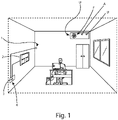
Figure 1 is a schematic view of an adaptive control system for controlling the thermal comfort level of an environment according to the invention, wherein said control system comprises a control logic unit and a user interface module associated with an air conditioning unit arranged in said environment, in which the logic control unit is configured to communicate with said user interface module and with said air conditioning unit; -
Figure 2 is a schematic view of a first part of a neural network showing four input nodes and some groups of output nodes; -
Figure 3 is a schematic view of a second part of the neural network showing the remaining groups of output nodes (and the input nodes shown inFigure 2 are again shown). - With reference to
Figure 1 , an adaptive control system for controlling the thermal comfort inside an environment. - In the embodiment being disclosed, an air conditioning unit U is arranged inside said environment.
- An air conditioning unit U comprising a fan F, adjusting means A for adjusting the speed of said fan F, control valve V for controlling the flow rate of a thermovector fluid over time.
- The control system comprises:
- temperature detecting means 1, to be installed in said environment, configured to detect a respective value of internal temperature TINi of said environment for a plurality of predetermined time periods ΔtREFi , with i=1,...,N, wherein N is a positive integer,
- a
user interface module 2 configured to allow a user to select at least one temperature value Tu and a speed value Vu of the fan F, - storage means 3, and
- a
logic control unit 4 connected to saidtemperature detecting means 1, to saiduser interface module 2, and to said storage means 3. - In the embodiment being disclosed, said
temperature detecting means 1 comprise a temperature sensor. - Furthermore, said storage means 3 comprise a memory.
- In particular, the memory is arranged inside said
logic control unit 4. - However, it is not necessary that the memory is arranged inside said
logic control unit 4. - Furthermore, the logic control unit is configured to:
- ∘ acquire a value of internal temperature TINi from said
temperature detecting means 1 for a respective predetermined time period ΔtREFi , as well as a temperature value TU and a speed value VU from saiduser interface module 2, - ∘ calculate one or more values of temperature variations δTDj , with j=1,...,M, wherein M is a positive integer and j is the number of predetermined time periods, and wherein each value of temperature variation δTDj is obtained by the subtraction between the value of internal temperature TINi in a predetermined time period and the value of internal temperature T INi-1 in the previous predetermined time period;
- ∘ store in said storage means 3:
- the values of internal temperature TINi referred to at least two predetermined time periods ΔtREFi and said one or more values of temperature variation δTDj , as well as said temperature value TU and said speed value VU,
- a first group of fuzzy sets F1 comprising a plurality of fuzzy sets F11,F12...F1N (i.e. at least two fuzzy sets), each of which identifies a respective degree of belonging of a value of internal temperature TINi , a second group of fuzzy sets F2 comprising a plurality of fuzzy sets F21,F22...F2N (i.e. at least two fuzzy sets), each of which identifies a respective degree of belonging of a value of temperature variation δTDj , a third group of fuzzy sets F3 comprising a plurality of fuzzy sets F31,F32...F3N (i.e. at least two fuzzy sets), each of which identifies a respective degree of belonging of an opening state of the control valve V,
- a fourth group of fuzzy sets F4 comprising a plurality of fuzzy sets F41,F42...F4N (i.e. at least two fuzzy sets) each of which identifies a respective degree of belonging of a value of the speed of the fan F, a plurality of predetermined inferential rules that establish on the basis of the degree of belonging of each value of internal temperature TINi and the degree of belonging of each value of temperature variation δTDj , the degree of belonging of the opening state of the control valve V and the degree of belonging of the speed of the fan F.
- Each group of fuzzy sets F1, F2, F3, F4 comprises a respective a plurality of fuzzy sets, particularly at least two fuzzy sets.
- Each fuzzy set identifies a degree of belonging (in other words each fuzzy set is associated with a degree of belonging).
- Consequently more fuzzy sets (and then more degrees of belonging) can be associated with a same value of an input variable which can be a value of internal temperature TINi , a value of temperature variation δTDj , a value associated with to an open state of the control valve V and a value associated with the speed of the fan F.
- This is due to the fact that, when a fuzzy domain is used, a value of an input variable can belong with a degree of belonging to one or more predetermined classes which are established based on type of the application.
- For example, a temperature value equal to 25 °C can belong to a class "warm" which has a degree of belonging equal to 0,8 and to a class "cold" which has a degree of belonging equal to 0,4.
- In this example, two fuzzy data (0,8 and 0,4) are associated with to the same temperature value (25 °C) which is a precise data.
- The inferential rules are established a priori, i.e. before the use of the control system.
- Said inferential rules allow to establish the degree of belonging of the opening state of the control valve V to each fuzzy set F31,F32...F3N of the third group of fuzzy sets F3, and the degree of the belonging of the speed of fan F to each fuzzy set F41,F42...F4N of the fourth group of fuzzy sets F4, on the basis of the degree of belonging to each value of internal temperature TINi and of the degree of belonging to each value of variation temperature δTDj .
- Furthermore, the
logic control unit 4 is configured to: - ∘ perform a respective fuzzification (or fuzzy transform) referred to:
- each value of internal temperature TINi to obtain a respective first fuzzy data set P1 i comprising a respective plurality of first fuzzy data P1i1,P1i2... P1iN, wherein each first fuzzy data identifies a respective degree of belonging of said value of internal temperature TINi , and is obtained by means of a predetermined first equation defined by a plurality of parameters,
- each value of temperature variation δTDj to obtain a respective second fuzzy data set P2 i comprising a respective plurality of second fuzzy data P2i1,P2i2...P2iN, wherein each second fuzzy data identifies a respective degree of belonging of said value of temperature variation δTDj , and is obtained by means of a predetermined second equation defined by a plurality of further parameters,
- ∘ apply said predetermined inferential rules to each pair of fuzzy data formed by a first fuzzy data P1i1,P1i2...P1iN and a second fuzzy data P2i1,P2i2...P2iN to obtain a respective third fuzzy data set P3 i comprising a plurality of third fuzzy data P3i1,P3i2...P3iN, wherein each third fuzzy data identifies a respective degree of belonging of said opening state of the control valve V with a respective fuzzy data set associated with said third fuzzy data of said third fuzzy data set P3 i , and a respective fourth fuzzy data set P4 i comprising a plurality of fourth fuzzy data P4i1,P4i2...P4iN, wherein each fourth fuzzy data identifies a respective degree of belonging of said value of the speed of the fan F with respect to a respective further fuzzy data set associated with said fourth fuzzy data of said fourth fuzzy data set P4 i ,
- ∘ perform a respective defuzzification (or fuzzy inverse transform) referred to:
said fuzzy data set associated with to said third fuzzy data of said third fuzzy data set P3 i to obtain a first real number R1 indicating if the control valve V is to be open and how much to open or if it is to be closed, said further fuzzy data set associated with fourth fuzzy data of said fourth fuzzy data set P4 i to obtain a second real number R2 indicating the speed of the fan F. - The fuzzification allows precise numeric data, i.e. the value of internal temperature TINi and the value of the temperature variation δTDj , to pass to the fuzzy domain and therefore said precise numeric data become fuzzy data.
- For fuzzification it is possible to use any equation that represents any function adapted to identify a degree of belonging to a fuzzy set.
- For the fuzzification of each value of internal temperature value TINi it is possible to use a predetermined first equation which represents any function identifying a degree of belonging to a fuzzy set of the first group of fuzzy sets.
- For the fuzzification of each value of temperature variation value δTDj it is possible to use a predetermined second equation which represents any function identifying a degree of belonging to a fuzzy set of the second group of fuzzy sets.
- In particular, in the embodiment being described, with reference to the fuzzification referred to each value of internal temperature TINi , said predetermined first equation is defined by a first triad of parameters a 1, b 1, c 1 and represents a Gaussian curve:

- the parameter a 1 is a predetermined number greater than 0 and less than or equal to 1 and represents the height of the Gaussian curve;
- the parameter b 1 is a predetermined value of temperature in which the Gaussian curve is centred;
- the parameter c 1 is a predetermined value indicating the distance between a symmetry axis of the Gaussian curve and an inflection point of the Gaussian curve; and
- xi is a respective value of internal temperature TINi .
- Furthermore, with reference to the fuzzification referred to each value of the temperature variation δTDj , said predetermined second equation is defined by a second triad of parameters a 2, b 2, c 2 and represents a Gaussian curve:

- the parameter a 2 is a predetermined number greater than 0 and less than or equal to 1 and represents the height of the Gaussian curve;
- the parameter b 2 is a predetermined value of temperature in which the Gaussian curve is centred;
- the parameter c 2 is a predetermined value indicating the distance between a symmetry axis of the Gaussian curve and an inflection point of the Gaussian curve; and
- xj is a respective value of temperature variation δTDj .
- The defuzzification allows the transition from the fuzzy domain to the domain of real numbers.
- The defuzzification is applied on each fuzzy data set of a third fuzzy data of a third fuzzy data set P3 i and on each further fuzzy data set of a third fuzzy data of a fourth fuzzy data set P4 i .
- Said third fuzzy data set P3 i and said fourth fuzzy data set P4 i are obtained through the application of the predetermined inferential rules (stored in said storage means 3) to each possible pair of fuzzy data formed by a first fuzzy data P1i1,P1i2...P1iN and by a second fuzzy data P2i1,P2i2...P2iN.
- Said first fuzzy data P1i1,P1i2...P1iN and said second fuzzy data P2i1,P2i2...P2iN belong respectively to a first fuzzy data set P1 i and to a second fuzzy data set P2 i , wherein said first fuzzy data set P1 i and said second fuzzy data set P2 i can comprise a respective plurality of fuzzy data.
- The defuzzification can be performed by means of one of the following methods of known type: mean of maxima, last of maxima, center of sums, center of area, center of inertia, center of gravity.
- In the embodiment being disclosed, the defuzzication referred to said fuzzy data set associated with to a third fuzzy data of a third fuzzy data set P3 i is performed through a method called mean of maxima.
- The
logic control unit 4 is configured to: - ∘ select a maximum value P3 iMAX with respect to each third fuzzy data P3i1,P3i2...P3iN, wherein said maximum value is associated with at least one fuzzy set F31,F32...F3N of the third group of fuzzy sets F3,
- ∘ calculate at least two real numbers P31,P32 applying a predetermined third equation defined by a third triad of parameters a 3, b 3, c 3:

- the parameter a 3 is a number greater than 0 and less than or equal to 1 and represents the height of a Gaussian curve;
- the parameter b 3 is a value of temperature in which a Gaussian curve is centred;
- the parameter c 3 is the value of the distance between a symmetry axis of a Gaussian curve and an inflection point of said Gaussian curve; and
- x is the value that P3 can assume;
- ∘ calculate said first real number R1 equal to the mean value of said at least two real numbers P31,P32.
- Also the defuzzification referred to said further set associated with a fourth fuzzy data of a fourth fuzzy data set P4 i is performed through the method called mean of maxima.
- The
logic control unit 4 is configured to: - ∘ select a maximum value P4 iMAX with respect to each fourth fuzzy data P4i1,P4i2...P4iN, wherein said maximum value is associated with at least one fuzzy set F41,F42...F4N of the fourth group of fuzzy sets F4,
- ∘ calculate at least two reals number P41,P42 applying the following predetermined fourth equation defined by a forth triad of parameters a 4, b 4, c 4:

- the parameter a 4 is a number greater than 0 and less than or equal to 1 and represents the height of a Gaussian curve;
- the parameter b 4 is a value of temperature in which a Gaussian curve is centred;
- the parameter c 4 is the value of the distance between a symmetry axis of a Gaussian curve and an inflection point of said Gaussian curve; and
- x is the value that P4 can assume;
- ∘ calculate said second real number R2 equal to the mean value of said at least two real numbers P41,P42.
- Furthermore, the
logic control unit 4 is configured to perform a neural network (shown inFigures 3 and 4). - Said neural network comprises an input layer and an output layer.
- In the embodiment being disclosed, the neural network does not have any intermediate layer between the input layer and the output layer.
- The input layer comprises a plurality of input nodes for receiving a respective value.
- In the embodiment being disclosed, the input layer comprises four input nodes: a first input node NIN1, a second input node NIN2, a third input node NIN3 and a fourth input node NIN4.
- In particular, said neural network is a Kohonen network and said first input node NIN1 receives a value of internal temperature TINi , said second input node NIN2 receives a value of temperature Tu selected by the user, said third input node NIN3 receives a value of speed Vu of the fan F selected by the user and said fourth input node NIN4 receives a value of temperature variation δTDj .
- The output layer comprises:
- ▪ a respective first group of output nodes NOUT1F11, NOUT2F11...NOUTNF11; NOUTIF12,NOUT2F12...NOUTNF12;... NOUT1F1N,NOUT2F1N...NOUTNF1N for each fuzzy set F11,F12...F1N of the first group of fuzzy sets F1,
- ▪ a respective second group of output nodes NOUT1F21,NOUT2F21...NOUTNF21; NOUT1F22,NOUT2F22...NOUTNF22;... NOUTIF2N, NOUT2F2N...NOUTNF2N for each fuzzy set F21,F22...F2N of the second group of fuzzy sets F2.
- In other words, for each fuzzy set of the first group of fuzzy sets F1 there is a respective first group of output nodes and for each fuzzy set of the second group of fuzzy sets F2 there is a respective second group of output nodes.
- Each first group of output nodes comprises one or more output nodes and each second group of output nodes comprises one or more output nodes.
- In particular, said neural network is configured to:
- receive over time said value of internal temperature TINi , said value of temperature variation δTDj , said temperature value Tu and said speed value Vu at a respective input layer NIN1,NIN2,NIN3,NIN4, and
- provide as output the updated parameters for said predetermined first equation at a respective output node of each first group of output nodes, and the further updated parameters for said predetermined second equation at a respective output node of each second group of output nodes.
- The
logic control unit 4 is configured to: - ∘ insert said updated parameters in said predetermined first equation to obtain a first updated fuzzy data P1 i and said further updated parameters in said predetermined second equation to obtain a second updated fuzzy data P2 i ,
- ∘ apply said predetermined inferential rules to each pair of fuzzy data formed by a first updated fuzzy data P1 i and a second updated fuzzy data P2 i , so as to obtain a third updated fuzzy data P3 i associated with the control valve V and a fourth updated fuzzy data P4 i associated with the speed of the fan F, as well as to obtain an updated first real number R1 and an updated second real number R2, through defuzzification;
- ∘ generate a signal to control said control valve V containing an information concerning said first real number R1 or said updated first real number R1 for opening/closing the control valve V and a further signal to control said adjusting means A containing an information concerning said second real number R2 or said updated second real number R2 for the speed of the fan F.
- In the embodiment being disclosed, each first group of output nodes comprises three respective output nodes NOUT1F11,NOUT2F11,NOUT3F11, NOUT1F12,NOUT2F12,NOUT3F12,... NOUT1F1N,NOUT2F1N,NOUT3F1N and said neural network is configured to provide at each output node of said first group of output nodes a respective updated parameter a 1, b 1, c 1.
- In this way, it is possible to obtain a respective first triad of updated parameters a 1, b 1, c 1.
- Each second group of output nodes comprises three respective output nodes NOUT1F21,NOUT2F21,NOUT3F21, NOUT1F21,NOUT2F21,NOUT3F21, ...NOUT1F2N,NOUT2F2N,NOUT3F2N and said neural network is configured to provide at each output node of said second group of output nodes a respective updated parameter a 2, b 2, c 2. In this way it is possible to obtain a second triad of updated parameters a 2, b 2, c 2.
- In particular, said neural network is a Kohonen network and said input node NIN2 for receiving a value of temperature TU selected by the user and said input node NIN3 for receiving a value of speed Vu of the fan F selected by the user are arranged between said input node NIN1 for receiving a value of internal temperature TINi and said input node NIN4 for receiving a value of temperature variation δTDj .
- Consequently, said
logic control unit 4 is configured to insert the first triad of updated parameters a 1, b 1, c 1 in the predetermined first equation to obtain a first updated fuzzy data P1 i and to insert the second triad of updated parameters a 2, b 2, c 2 in the predetermined second equation to obtain a second updated fuzzy data P2 i . - In other words, through the neural network it is possible to take into account to control the thermal comfort the temperature TU desired by the user and the speed Vu of the fan desired by the user and update both the parameters which are used in the first equation for the fuzzification of the values of internal temperature TINi and the parameters which are used in the second equation for the fuzzification of the values of temperature variation δTDj .
- Consequently, if at the beginning the fuzzification of the values of internal temperature TINi and the fuzzification of the values of temperature variation δTDj are respectively obtained through equations which are predetermined (i.e. the predetermined first equation and the predetermined second equation) since the parameters used in the respective equations are decided a priori, through the neural network it is possible to update the parameters present in said equations to adapt the thermal comfort to the needs of the user.
- The output layer of the neural network can comprise:
- ▪ a respective third group of output nodes NOUT1F31, NOUT2F31...NOUTNF31, NOUT1F32,NOUT2F32...NOUTNF32, ... NOUT1F3N,NOUT2F3N...NOUTNF3N for each fuzzy set F31,F32...F3N of the third group of fuzzy set F3,
- ▪ a respective fourth group of output nodes NOUT1F41,NOUT2F41...NOUTNF41, NOUT1F42,NOUT2F42...NOUTNF42, ...NOUT1F4N,NOUT2F4N...NOUTNF4N for each fuzzy set F41,F42...F4N of the fourth group of fuzzy set F4.
- The neural network is configured to provide as output:
- the updated parameters a 3, b 3, c 3 of said third triad of parameters for said predetermined third equation, each of which is at a respective output node of each third group of output nodes,
- the updated parameters a 4, b 4, c 4 of said fourth triad of parameters for said predetermined fourth equation, each of which is at an output node of each fourth group of output nodes.
- The
logic control unit 4 can be configured to: - ∘ insert said third triad of updated parameters a 3, b 3, c 3 in said predetermined third equation to obtain an updated fuzzy data set, due to the change of the shape of the function represented by said predetermined third equation, wherein said updated fuzzy data set is associated with said third fuzzy data of said third fuzzy data set P3 i ,
- ∘ insert said fourth triad of updated parameters a 4, b 4, c 4 in said predetermined fourth equation to obtain a further updated fuzzy data set, due to the shape of the function represented by said predetermined fourth equation, wherein said further fuzzy data set is associated with said fourth fuzzy data of said fourth fuzzy data set P3 i ,
- ∘ defuzzify said updated fuzzy data (to obtain a first updated real number R1) and said further updated fuzzy data set (to obtain a second updated real number R2).
- Each third group of output nodes NOUT1F31, NOUT2F31...NOUTNF31, NOUT1F32,NOUT2F32...NOUTNF32,... NOUT1F3N,NOUT2F3N...NOUTNF3N comprises three output nodes NOUT1F31, NOUT2F31,NOUT3F31, NOUT1F32,NOUT2F32,NOUT3F32,...NOUT1F3N,NOUT2F3N,NOUT3F3N and said neural network can be configured to provide at each output node of said third group of output nodes a respective updated parameter a 3, b 3, c 3 for said predetermined third equation.
- In this way it is possible to obtain a respective third triad of updated parameters a 3, b 3, c 3 for each third group of output nodes.
- Said
logic control unit 4 can be configured to insert said updated parameters a 3, b 3, c 3 in said predetermined third equation to obtain an updated fuzzy data set, due to the change of the shape of the function represented by said predetermined third equation, wherein said updated fuzzy data set is associated with said third fuzzy data of said third fuzzy data set P3 i . - Each fourth group of output nodes NOUT1F41, NOUT2F41...NOUTNF41;NOUT1F42,NOUT2F42...NOUTNF42,...
NOUT1F4N,NOUT2F4N...NOUTNF4N comprises three respective output nodes NOUT1F41, NOUT2F41,NOUT3F41, NOUT1F42,NOUT2F42...NOUTNF42, ... NOUT1F4N,NOUT2F4N... NOUTNF4N, at which a respective updated parameter a 4, b 4, c 4 is present. - In this way it is possible to obtain a respective fourth triad of updated parameters a 4, b 4, c 4 for each fourth group of output nodes.
- Said
logic control unit 4 can be configured to insert said updated parameters a 4, b 4, c 4 in said predetermined fourth equation to obtain a further updated fuzzy data set, due to the change of the shape of the function represented by said predetermined fourth equation, wherein said further updated fuzzy data set is associated with said fourth fuzzy data of said fourth fuzzy data set P4 i . - In other words, at the beginning, the
control logic unit 4 performs the defuzzification of said fuzzy data set associated with said third fuzzy data of said third fuzzy data set P3 i to obtain a first updated real number R1 indicating if the control valve V is to be open and how or if is to be closed, as well as the defuzzification of said further fuzzy data set associated with said fourth fuzzy data of said fourth fuzzy data set P4 i to obtain a second updated real number R2 indicating the speed of the fan F. - Subsequently, every time that the parameters of the predetermined third equation are updated, the form of the function represented by said predetermined third equation changes according to said parameters and therefore the fuzzy data set associated with said third fuzzy data of said third data set fuzzy P3 i changes.
- Similarly, every time that the parameters of the predetermined fourth equation are updated, the form of the function represented by said predetermined fourth equation changes according to said parameters and therefore the further set of fuzzy data associated with said fourth fuzzy data of said fourth set of fuzzy data P4 i changes.
- Consequently, every time that the parameters of the predetermined third equation are updated a first updated real number is obtained through the fuzzification of the respective fuzzy data set and every time that the parameters of the predetermined fourth equation are updated a second updated real number is obtained through the defuzzification of the respective further fuzzy data set.
- Finally, the
logic control unit 4 generates a signal adapted to control the control valve V containing an information (i.e. said first real number R1) concerning the opening/closing of said control valve V and a further signal adapted to control said adjusting means A containing an information (i.e. said second real number R2) concerning the speed of the fan. - In other words, at the beginning the
logic control unit 4 generates a signal containing a first real number R1 for controlling the opening/closing of the control valve V and subsequently generates a signal containing a first updated real number R1 every time that a value of temperature Tu or a value of speed Vu of the fan F is selected by an user. - Therefore, the information contained in the signal generated by the
logic control unit 4 is at the beginning a first real number R1 and subsequently a first updated real number R1. - Similarly to what has been said for the signal, at the beginning the
logic control unit 4 generates a further signal containing a second real number R2 for controlling the speed of the fan F through said adjusting means A and subsequently generates a further signal containing a second updated real number R2 every time that a value of temperature Tu or a value of speed Vu of the fan F is selected by an user. - Therefore, the information contained in the further signal generated by the
logic control unit 4 is at the beginning the second real number R2 and subsequently the second updated real number R2. - In fact, the update of the first real number R1 and the second real number R2 (and then of the respective fuzzy data sets from which the real numbers mentioned above are obtained) is due to the fact that the
logic control unit 4 takes into account of the changes of said value of temperature Tu or said value of speed Vu - After generating the signal and the further signal, the
logic control unit 4 will send said signal and said further signal to the air conditioning unit U. - With reference to the
logic control unit 4 disclosed above adapted to perform a fuzzification and a defuzzification as well as a neural network, saidlogic control unit 4 is a neuro-fuzzy controller. - As already said, the air conditioning unit U is provided with adjusting means A for adjusting the speed of the fan F.
- In a first alternative, said adjusting means can comprise an inverter.
- In a second alternative, said adjusting means can comprise one or more relay.
- When said adjusting means A for adjusting the speed of the fan F comprise an inverter, the fourth group of fuzzy sets F4 comprise at least fourth fuzzy sets F41,F42,F43,F44:
- a first fuzzy set F41 for identifying a first speed of the fan F,
- a second fuzzy set F42 for identifying a second speed of the fan F, different from said first speed,
- a third fuzzy set F43 for identifying a third speed of the fan F, different from said first speed and said second speed, and
- a fourth fuzzy set F44 for identifying a fourth speed of the fan F equal to zero.
- When said adjusting means A for adjusting the speed of the fan F comprise one or more relays, said fourth group of fuzzy sets F4 comprises two respective fuzzy sets F41,F42 for each relay:
- a first fuzzy set F41 for identifying a first speed of the fan F equal to zero, and
- a secondo fuzzy set F42 for identifying a second speed, different from said first speed.
- Regardless of whether said adjusting means comprise an inverter or one or more relays, the first real number R1 and the second real number R2 obtained through the defuzzification are both numbers greater than 0 and less than or equal to 10.
- The present invention relates also to a method for controlling the thermal comfort inside an environment, through the control system above mentioned.
- Said method comprises the following steps:
- ∘ acquiring a value of internal temperature TINi by said
temperature detecting means 1 for a respective predetermined time period ΔtREFi , as well as said value of temperature TU and said value of speed VU from saiduser interface module 2; - ∘ calculating one or more values of temperature variation δTDj , with j=1,...,M, where M is a positive integer and j is the number of predetermined time periods, and wherein each value of temperature variation δTDj is obtained by the subtraction between the value of internal temperature TINi in a predetermined time period and the value of internal temperature T INi-1 in the previous predetermined time period;
- ∘ storing:
- the values of internal temperature TINi referred to at least two predetermined time periods ΔtREFi and said one or more values of temperature variation δTDj , as well as said temperature value Tu and said value of speed Vu;
- a first group of fuzzy sets F1 comprising a plurality of fuzzy sets F11,F12...F1N, each of which identifies a respective degree of belonging of a value of internal temperature TINi ;
- a second group of fuzzy sets F2 comprising a plurality of fuzzy sets F21,F22...F2N, each of which identifies a respective degree of belonging of a value of temperature variation δTDj ;
- a third group of fuzzy sets F3 comprising a plurality of fuzzy sets F31,F32...F3N, each of which identifies a respective degree of belonging of an opening state of the control valve V;
- a fourth group of fuzzy sets F4 comprising a plurality of fuzzy sets F41,F42...F4N, each of which identifies a respective degree of belonging of a value of the speed of the fan F;
- a plurality of predetermined inferential rules that establish on the basis of the degree of belonging of each value of internal temperature TINi and the degree of belonging of each value of temperature variation δTDj , the degree of belonging of the opening state of the control valve V and the degree of belonging of the speed of the fan F,
- ∘ performing a respective fuzzification referred to:
- each value of internal temperature TINi to obtain a respective first fuzzy data set P1 i comprising a respective plurality of first fuzzy data P1i1,P1i2... P1iN, wherein each first fuzzy data identifies a respective degree of belonging of said value of internal temperature TINi , and is obtained by means of a predetermined first equation defined by a plurality of parameters;
- each value of temperature variation δTDj to obtain a respective second fuzzy data set P2 i comprising a respective plurality of second fuzzy data P2i1,P2i2...P2iN, wherein each second fuzzy data identifies a respective degree of belonging of said value of temperature variation δTDj , and is obtained by means of a predetermined second equation defined by a plurality of further parameters,
- ∘ applying said predetermined inferential rules to each pair of fuzzy data formed by a first fuzzy data P1i1,P1i2...P1iN and a second fuzzy data P2i1,P2i2...P2iN to obtain a respective third fuzzy data set P3 i comprising a plurality of third fuzzy data P3i1,P3i2...P3iN, wherein each third fuzzy data identifies a respective degree of belonging of said opening state of the control valve V with respect to a respective fuzzy data set associated with said third fuzzy data of said third fuzzy data set P3 i , and a respective fourth fuzzy data set P4 i comprising a plurality of fourth fuzzy data P4i1,P4i2...P4iN, wherein each fourth fuzzy data identifies a respective degree of belonging of said value of said speed of the fan F with respect to a respective further fuzzy data set associated with said fourth fuzzy data of said fourth fuzzy data set P4 i ,
- ∘ performing a respective defuzzification referred to:
said fuzzy data set associated with said third fuzzy data of said third fuzzy data set P3 i to obtain a first real number R1 indicating if the control valve V is to be open and how much to open or if it is to be closed, said further fuzzy data set associated with said fourth fuzzy data of said fourth fuzzy data set P4 i to obtain a second real number R2 indicating the speed of the fan F, - ∘ receiving over time a value of internal temperature TINi , a value of temperature variation δTDj , a temperature value Tu and a speed value Vu at a respective input node NIN1,NIN2,NIN3,NIN4 of said neural network;
- ∘ providing as output the updated parameters for said predetermined first equation at a respective output node of each first group of output nodes of said neural network, and the further updated parameters for said predetermined second equation at a respective output node of each second group of output nodes of said neural network;
- ∘ inserting said updated parameters in said predetermined first equation to obtain a first updated fuzzy data P1 i and said further updated parameters in said predetermined second equation to obtain a second updated fuzzy data P2 i ,
- ∘ applying said predetermined inferential rules to each pair of fuzzy data formed by a first updated fuzzy data P1 i and a second updated fuzzy data P2 i , so as to obtain a third updated fuzzy data P3 i associated with the control valve V and a fourth updated fuzzy data P4 i associated with the speed of the fan F, as well as to obtain an updated first real number R1 or a second real number R2, through defuzzification;
- ∘ generating a signal to control said control valve V containing an information concerning said first real number R1 or said updated first real number R1 for opening/closing the control valve V and a further signal to control said adjusting means A containing an information concerning said second real number R2 or said updated second real number R2 for the speed of the fan F.
- An example is described below in which two internal temperature values TINi are taken into consideration:
- a first internal temperature value TINi = 20 ° C in a predetermined first time period,
- a second internal temperature value T IN2 = 21,5°C in a second predetermined period of time, subsequent to said predetermined first time period.
- Each temperature value is obtained at the end of a respective predetermined time period.
- Consequently, the value of temperature variation is the following: δT D1 = T IN2- T IN1 = 1,5°C.
- Furthermore, the first group of fuzzy sets F1 comprises three fuzzy sets F11,F12,F13, so that three number identifying a respective degree of belonging to a fuzzy set of said first group of fuzzy sets F1 are associated with the value of internal temperature T IN1 .
- In particular, the first group of fuzzy sets F1 comprises:
- a first fuzzy set F11 for identifying a first thermal condition called 'COLD',
- a second fuzzy set F12 for identifying a second thermal condition called 'GOOD', different from the first thermal condition,
- a third fuzzy set F13 for identifying a third thermal condition 'HOT', different from the first thermal condition and from the second thermal condition.
- Each fuzzy set F11, F12, F13 is identified a respective first equation representing a Gaussian curve defined by a first triad of parameters a 1 , b 1, c 1 which is predefined.
- Below a first table which shows for each fuzzy set of the first group of fuzzy sets F1 a respective thermal condition and a respective first triad of parameters.
Table 1 Fuzzy set Thermal Condition Parameters (first triad) F11 COLD a 1 = 0,3989 b 1 = 20 c 1 = 1,414 F12 GOOD a 1 = 0,3989 b 1 = 22 c 1 = 1,414 F13 HOT a 1 = 0,3989 b 1 = 24 c 1 = 1,414 - The second group of fuzzy sets F2 comprises three fuzzy sets F21, F22, F23, so that three numbers identifying a respective degree of belonging to a fuzzy set of said second group of fuzzy sets F2 are associated with the value of temperature variation δT D1.
- In particular, the second group of fuzzy sets F2 comprises:
- a first fuzzy set F21 for identifying a first temperature variation called 'SLOW',
- a second fuzzy set F22 for identifying a second temperature variation called 'MEDIUM', different from the first temperature variation,
- a third fuzzy set F23 for identifying a third temperature variation call 'FAST', different from the first temperature variation and from the second temperature variation.
- Each fuzzy set F21, F232, F23 is identified by a respective second equation representing a Gaussian curve defined by a second triad of parameters a 2 , b 2, c 2 which is predefined.
- Below a second table which shows for each fuzzy set of the second group of fuzzy sets F2 a respective temperature variation and a respective second triad of parameters.
Table 2 Fuzzy set Temperature variation temperatura Parameters (second triad) F21 SLOW a 2 = 0,3989 b 2 = 1 c 2 = 1,414 F22 MEDIUM a 2 = 0,3989 b 2 = 2 c 2 = 1,414 F23 FAST a 2 = 0,3989 b 2 = 3 c 2 = 1,414 - The third group of fuzzy sets F3 comprises fourth fuzzy sets F31, F32, F33, F34:
- a first fuzzy set F31 for identifying a first open state of the control valve V: '
state 1 = OPEN1', - a second fuzzy set F32 for identifying a second open state of the control valve V, different from the first open state: '
state 2 = OPEN2', - a third fuzzy set F33 for identifying a third open state of the control valve V, different from the first open state and the second open state: '
state 3 = OPEN3', and - a fourth fuzzy set F34 for identifying a closed state of the control valve V: '
state 4 = CLOSED'. - Each fuzzy set F31, F32, F33, F34 is identified by a respective third equation representing a Gaussian curve defined by a third triad of parameters a 3 , b 3, c 3 which is predefined.
- Below a third table which shows for each fuzzy set of the third group of fuzzy sets F3 a respective state of the control valve and a respective third triad of parameters.
Table 3 Fuzzy sets State of the control valve Parameters (third triad) F31 OPEN1 a 3 = 0,3989 b 3 = 3 c 3 = 1,414 F32 OPEN2 a 3 = 0,3989 b 3 = 6 c 3 = 1,414 F33 OPEN3 a 3 = 0,3989 b 3 = 10 c 3 = 1,414 F34 CLOSED a 3 = 0,3989 b 3 = 0 c 3 = 1,414 - In the example being disclosed, said adjusting means A for adjusting the speed of the fan F comprise an inverter.
- Said fourth group of fuzzy sets F4 comprises two respective fuzzy sets F41,F42 for the inverter:
- a first fuzzy set F41 for identifying a first speed condition for the fan F equal to zero called 'SPEED0', and
- a second fuzzy set F42 for identifying a second speed condition for the fan F called 'SPEED1', different from the first speed condition.
- Below a fourth table which shows for each fuzzy set of the fourth group of fuzzy sets F4 a respective speed condition for the fan F and a respective fourth triad of parameters.
Table 4 Fuzzy sets Speed condition of the fan Parameters (fourth triad) F41 SPEED0 a 4 = 0,3989 b 4 = 2 c 4 = 1,414 F42 SPEED1 a 4 = 0,3989 b 4 = 8 c 4 = 1,414 - Below a fifth table which shows the inferential rules stored in the storage means 3.
Table 5 Inferential rules If TIN1 = COLD and tD1 =SLOW V = OPEN1 and F = SPEED1 If TIN1 = COLD and tD1 = MEDIUM V = OPEN2 and F = SPEED1 If TIN1 = COLD and tD1 = FAST V = OPEN3 and F = SPEED1 If TIN1 = GOOD and tD1 = SLOW V = CLOSED and F = SPEED0 If TIN1 = GOOD and tD1 = MEDIUM V = OPEN1 and F = SPEED1 If TIN1 = GOOD and tD1 = FAST V = OPEN2 and F = SPEED1 If TIN1 = HOT and tD1 = SLOW V = OPEN1 and F = SPEED1 If TIN1 = HOT and tD1 = MEDIUM V = OPEN2 and F = SPEED1 If TIN1 = HOT and tD1 = FAST V = OPEN3 and F = SPEED1 - The fuzzication referred to the value of internal temperature TIN1 = 21,5°C allows to obtain a first set of fuzzy data P1 i :
- P1i1=0,1295,
- P1i2=0,3520,
- P1i3=0,0175.
- The fuzzification referred to the value of temperature variation δT D1 = 1,5°C allows to obtain a second set of fuzzy data P2 i :
- P2i1=0,3520,
- P2i2=0,3520,
- P2i3=0,1295.
- The possible pairs of fuzzy data are formed by a first fuzzy data of the first fuzzy data set and by a second fuzzy data of the second fuzzy data set, wherein a thermal condition is associates with the first fuzzy data and a temperature variation is associated with the second fuzzy data.
- The sixth table below shows the possible combinations of thermal condition and temperature variation.
Table 6 Thermal condition Temperature variation COLD SLOW COLD MEDIUM COLD FAST GOOD SLOW GOOD MEDIUM GOOD FAST HOT SLOW HOT MEDIUM HOT FAST - The application of the inferential rules to each pair of fuzzy data formed by a thermal condition and a temperature variation (to which respective fuzzy data are associated) allows to obtain the results shown in the seventh table below (i.e. the numerical values associated with the fuzzy sets relating to the state of the control valve and the numerical values associated to the fuzzy sets relating to the fan speed).
Table 7 Inferential rules Thermal condition Temperature variation State of the control valve Speed of the fan COLD SLOW OPEN1 =0,1295 SPEED1 =0,1295 COLD MEDIUM OPEN2=0,1295 SPEED1 =0,1295 COLD FAST OPEN3=0,1295 SPEED1 =0,1295 GOOD SLOW CLOSED=0,3520 SPEED0=0,3520 GOOD MEDIUM OPEN1=0,3520 SPEED1 =0,3520 GOOD FAST OPEN2=0,1295 SPEED1 =0,1295 HOT SLOW OPEN1=0,0175 SPEED1 =0,0175 HOT MEDIUM OPEN2=0,0175 SPEED1 =0,0175 HOT FAST OPEN3=0,0175 SPEED1 =0,0175 - One or more numerical values can correspond to each fuzzy set that identifies a degree of belonging of the control valve and to each fuzzy set that identifies the fan speed.
- The numerical values associated with each degree of belonging to both the control valve and the fan speed are indicated below:
- OPEN1 = 0,1295; 0,3520; 0,0175,
- OPEN2 = 0,1295; 0,1295; 0,0175,
- OPEN3 = 0,1295; 0; 0,0175
- CLOSED = 0; 0,3520; 0,
- SPEED0 = 0,3520,
- SPEED1= 0,1295; 0,1295; 0,1295; 0,3520; 0,1295; 0,0175; 0,0175; 0,0175.
- Below is the maximum value for each degree of belonging mentioned above:
- OPEN1 = OR(0,1295; 0,3520; 0,0175) = 0,3520,
- OPEN2 = OR(0,1295; 0,1295; 0,0175) = 0,1295,
- OPEN3 = OR(0,1295; 0; 0,0175) = 0,1295,
- CLOSED = OR(0; 0,3520; 0) = 0,3520,
- SPEED0 = 0,3520.
- SPEED1=OR (0,1295; 0,1295; 0,1295; 0,3520; 0,1295; 0,0175; 0,0175; 0,0175) = 0,3520.
- By applying the defuzzification equations according to the method called "mean of the maxima" it is possible to obtain the following numerical values in the real domain:
- VALVE = 1,5V,
- FAN = 5V.
- The temperature value Tu selected by the user through the user interface module is 24°C and the speed value Vu of the fan F selected by the user is remained unchanged with respect to a value already previously selected by the user.
- The neural network takes into account the temperature value Tu and speed Vu selected by the user together to the internal temperature value and the temperature variation values and provides as output the triads of updated parameters shown in the following table.
- Although the fan speed has not changed, the value of the fan speed is still taken into account by the neural network to obtain the updated parameters as reported in the eighth table and in the ninth table below.
Table 8 Fuzzy sets Updated parameters (first triad) F11=COLD a 1 = 0,3989 b 1 = 22 c 1 = 1,414 F12=GOOD a 1 = 0,3989 b 1 = 24 c 1 = 1,414 F13=HOT a 1 = 0,3989 b 1 = 26 c 1 = 1,414 Table 9 Fuzzy sets Updated parameters (second triad) F21=SLOW a 2 = 0,3989 b 2 = 1 c 2 = 1,414 F22=NORMAL a 2 = 0,3989 b 2 = 2 c 2 = 1,414 F23=FAST a 2 = 0,3989 b 2 = 3 c 2 = 1,414 - The numerical values of the first updated parameter triad are inserted into the first equation and the numerical values of the second updated parameter triad are inserted into the second equation to obtain respectively:
- a respective first updated fuzzy data P1 i :
- P1i1=0,3520,
- P1i2=0,0175,
- P1i3=0; and
- a respective second updated fuzzy data P2 i :
- P2i10,0175,
- P2i2=0,1295,
- P2i3=0,3520.
- Therefore, the possible fuzzy data pairs are formed by a first updated fuzzy data belonging to the first fuzzy data set and by a second updated fuzzy data belonging to the second fuzzy data set, in which a thermal condition is associated with the first updated fuzzy data, and a temperature variation is associated with the second updated fuzzy datum.
- As it is clear from the tenth table and from the eleventh table shown below, the thermal conditions and the temperature variations are respectively the same thermal conditions and the same temperature variations shown in table 6 but some numerical values associated with the fuzzy sets relating to the state control valve V and some numerical values associated with the fuzzy sets related to the fan speed F have changed.
Table 10 Thermal condition Temperature variation COLD SLOW COLD MEDIUM COLD FAST GOOD SLOW GOOD MEDIUM GOOD FAST HOT SLOW HOT MEDIUM HOT FAST - The application of the inferential rules to each pair of data formed by an updated thermal condition and a temperature variation (to which respective updated fuzzy data are associated) allows to obtain the results shown in the eleventh table below.
Table 11 Inferential rules Thermal condition Temperature variation State of the control valve Speed of the fan COLD SLOW OPEN1 =0,0175 SPEED1 =0,0175 COLD MEDIUM OPEN2=0,1295 SPEED1 =0,1295 COLD FAST OPEN3=0,3520 SPEED1 =0,3520 GOOD SLOW CLOSED=0,0175 SPEED0=0,0175 GOOD MEDIUM OPEN1=0,0175 SPEED1=0,0175 GOOD FAST OPEN2=0,0175 SPEED1 =0,0175 HOT SLOW OPEN1 =0 SPEED1 =0 HOT MEDIUM OPEN2=0 SPEED1 =0 HOT FAST OPEN3=0 SPEED1 =0 - By comparing table 11 with table 7, the numerical values of some third updated fuzzy data referring to the status of the control valve V and the numerical values of some fourth updated fuzzy data referring to the fan speed have changed.
- One or more updated numerical values can correspond to each fuzzy set that identifies a degree of belonging of the control valve and to each fuzzy set that identifies a degree of belonging of the fan speed.
- The updated numerical values associated with each degree of belonging to both the control valve and the fan speed are shown below:
- OPEN1 = 0,0175; 0,0175; 0,
- OPEN2 = 0,1295; 0,0175; 0,
- OPEN3 = 0,3520; 0; 0,
- CLOSED = 0; 0,0175; 0,
- SPEED0 = 0,0175,
- SPEED1 = 0,0175; 0,1295;0,3520; 0,0175; 0,0175; 0; 0; 0.
- Below the maximum value for each degree of belonging mentioned above is shown:
- OPEN1 = OR(0,0175; 0,0175; 0) = 0,0175,
- OPEN2 = OR(0,1295; 0,0175; 0) = 0,1295,
- OPEN3 = OR(0,3520; 0; 0) = 0,3520,
- CLOSED = OR(0; 0,0175; 0) = 0,0175,
- SPEED0 = 0,0175,
- SPEED1 = OR(0,0175; 0,1295;0,3520; 0,0175; 0,0175; 0; 0; 0) = 0,3520.
- By applying the defuzzification equations according to the method called "mean of the maxima", the following numerical values are obtained in the real domain:
- VALVE = 10V,
- FAN = 8V.
- The numerical value associated with the state of the control valve V and the numerical value associated with the fan speed F have changed with respect to the numerical values mentioned above (i.e. 1.5V for the valve and 5V for the fan).
- Each numerical value associated with the state of the control valve V and each numerical value associated with the fan speed F are expressed in Volts.
- Finally, the
control logic unit 4 will generate a signal to control the control valve V and a further signal to control said adjusting means A of said air conditioning unit U (taking into account the information obtained by applying the inferential rules to the updated fuzzy data pairs) in order to check the thermal comfort of an environment in which a user is present, based on the user's needs. - In particular, said signal and said further signal are respective voltage signals.
- Advantageously, through the control system object of the invention, it is possible to control the thermal comfort level inside an environment taking into account of the needs of a user inside said environment.
- In particular, the use of a neuro-fuzzy controller using a fuzzy logic in combination with a neural network allows an adaptive control of the thermal comfort level.
- A second advantage is given by the fact that the control system is adapted to control the thermal comfort reducing the energy consumption by means of an appropriate use of the resources available to said user.
- A third advantage is given by the fact that the control system object of the invention can be easily used both by a user and by an operator assigned to the maintenance and management of said control system.
- A fourth advantage is to offer the user the possibility of actively participating in the definition of the thermal comfort conditions of the control system, modifying the values of parameters useful for determining the thermal comfort.
- A further advantage is given by the possibility of reducing the differences between what is described by the rules on well-being and the real perception of well-being by a user, without distorting the indications imposed by these rules.
- The present invention has been described for illustrative, but not limitative purposes, according to its preferred embodiment, but it is to be understood that variations and/or modifications can be carried out by a skilled in the art, without departing from the scope thereof, as defined according to enclosed claims.
Claims (15)
- Control system for controlling the thermal comfort inside an environment in which at least one air conditioning unit (U) is positioned, said air conditioning unit (U) being of the type comprising a fan (F), adjusting means (A) for adjusting the speed of said fan (F), a control valve (V) for controlling the flow rate of a thermovector fluid over time, said control system comprising:- temperature detecting means (1), to be installed in said environment, configured to detect a respective value of internal temperature TINi of said environment for a plurality of predetermined time periods ΔtREFi , with i=1,...,N, wherein N is a positive integer,- a user interface module (2) configured to allow a user to select a temperature value Tu and a speed value Vu of the fan (V),- storage means (3),- a logic control unit (4) configured to:∘ acquire a value of internal temperature TINi from said temperature detecting means (1) for a respective predetermined time period ΔtREFi , as well as said temperature value TU and said speed value VU from said user interface module (2),∘ calculate one or more values of temperature variations δTDj , with j=1,...,M, wherein M is a positive integer and j is the number of predetermined time periods, and wherein each value of temperature variation δTDj is obtained by the subtraction between the value of internal temperature TINi in a predetermined time period and the value of internal temperature T INi-1 in the previous predetermined time period;∘ store in said storage means (3):the values of internal temperature TINi referred to at least two predetermined time periods ΔtREFi and said one or more values of temperature variation δTDj , as well as said temperature value TU and said speed value VU,a first group of fuzzy sets F1 comprising a plurality of fuzzy sets F11,F12...F1N, each of which identifies a respective degree of belonging of a value of internal temperature TINi ,a second group of fuzzy sets F2 comprising a plurality of fuzzy sets F21,F22...F2N, each of which identifies a respective degree of belonging of a value of temperature variation δTDj ,a third group of fuzzy sets F3 comprising a plurality of fuzzy sets F31,F32...F3N, each of which identifies a respective degree of belonging of an opening state of the control valve (V),a fourth group of fuzzy sets F4 comprising a plurality of fuzzy sets F41,F42...F4N, each of which identifies a respective degree of belonging of a value of the speed of the fan (F),a plurality of predetermined inferential rules that establish on the basis of the degree of belonging of each value of internal temperature TINi and the degree of belonging of each value of temperature variation δTDj , the degree of belonging of the opening state of the control valve (V) and the degree of belonging of the speed of the fan (F),∘ perform a respective fuzzification referred to:each value of internal temperature TINi to obtain a respective first fuzzy data set P1 i comprising a respective plurality of first fuzzy data P1i1,P1i2... P1iN, wherein each first fuzzy data identifies a respective degree of belonging of said value of internal temperature TINi , and is obtained by means of a predetermined first equation defined by a plurality of parameters,each value of temperature variation δTDj to obtain a respective second fuzzy data set P2 i comprising a respective plurality of second fuzzy data P2i1,P2i2...P2iN, wherein each second fuzzy data identifies a respective degree of belonging of said value of temperature variation δTDj , and is obtained by means of a predetermined second equation defined by a plurality of further parameters,∘ apply said predetermined inferential rules to each pair of fuzzy data formed by a first fuzzy data P1i1,P1i2...P1iN and a second fuzzy data P2i1,P2i2...P2iN to obtain a respective third fuzzy data set P3 i comprising a plurality of third fuzzy data P3i1,P3i2...P3iN, wherein each third fuzzy data identifies a respective degree of belonging of said opening state of the control valve (V) with a respective fuzzy data set associated with said third fuzzy data of said third fuzzy data set P3 i , and a respective fourth fuzzy data set P4 i comprising a plurality of fourth fuzzy data P4i1,P4i2...P4iN, wherein each fourth fuzzy data identifies a respective degree of belonging of said value of the speed of the fan (F) with respect to a respective further fuzzy data set associated with said fourth fuzzy data of said fourth fuzzy data set P4 i ,∘ perform a respective defuzzification referred to:said fuzzy data set associated with to said third fuzzy data of said third fuzzy data set P3 i to obtain a first real number R1 indicating if the control valve (V) is to be open and how much to open or if it is to be closed,said further fuzzy data set associated with said fourth fuzzy data of said fourth fuzzy data set P4 i to obtain a second real number R2 indicating the speed of the fan (F),∘ perform a neural network comprising:
an input layer comprising a plurality of input nodes (NIN1,NIN2,NIN3,NIN4), and an output layer comprising a respective first group of output nodes (NOUT1F11, NOUT2F11...NOUTNF11; NOUT1F12,NOUT2F12...NOUTNF12;... NOUT1F1N,NOUT2F1N...NOUTNF1N) for each fuzzy set F11,F12...F1N of the first group of fuzzy sets F1, as well as a respective second group of output nodes (NOUT1F21,NOUT2F21...NOUTNF21; NOUT1F22,NOUT2F22...NOUTNF22;... NOUT1F2N, NOUT2F2N...NOUTNF2N) for each fuzzy set F21,F22...F2N of the second group of fuzzy sets F2, wherein said neural network is configured to:• receive over time said value of internal temperature TINi , said value of temperature variation δTDj , said temperature value Tu and said speed value Vu at a respective input layer (NIN1,NIN2,NIN3,NIN4), and• provide as output the updated parameters for said predetermined first equation at a respective output node of each first group of output nodes, and the further updated parameters for said predetermined second equation at a respective output node of each second group of output nodes,∘ insert said updated parameters in said predetermined first equation to obtain a first updated fuzzy data P1 i and said further updated parameters in said predetermined second equation to obtain a second updated fuzzy data P2 i ,∘ apply said predetermined inferential rules to each pair of fuzzy data formed by a first updated fuzzy data P1 i and a second updated fuzzy data P2 i , so as to obtain a third updated fuzzy data P3 i associated with the control valve (V) and a fourth updated fuzzy data P4 i associated with the speed of the fan (F), as well as to obtain an updated first real number R1 and an updated second real number R2, through defuzzification;∘ generate a signal to control said control valve (V) containing an information concerning said first real number R1 or said updated first real number R1 for opening/closing the control valve (V) and a further signal to control said adjusting means (A) containing an information concerning said second real number R2 or said updated second real number R2 for the speed of the fan (F). - Control system according to the previous claim, whereinwith reference to the fuzzification referred to each value of internal temperature TINi , said predetermined first equation is defined by a first triad of parameters a 1, b 1, c 1 and represents a Gaussian curve:
 the parameter a 1 is a predetermined number greater than 0 and less than or equal to 1 and represents the height of the Gaussian curve;the parameter b 1 is a predetermined value of temperature in which the Gaussian curve is centred;the parameter c 1 is a predetermined value indicating the distance between a symmetry axis of the Gaussian curve and an inflection point of the Gaussian curve; andxi is a respective value of internal temperature TINi ,whereinwith reference to the fuzzification referred to each value of temperature variation δTDj , said predetermined second equation is defined by a second triad of parameters a 2, b 2, c 2 and represents a Gaussian curve:
 the parameter a 2 is a predetermined number greater than 0 and less than or equal to 1 and represents the height of the Gaussian curve;the parameter b 2 is a predetermined value of temperature in which the Gaussian curve is centred;the parameter c 2 is a predetermined value indicating the distance between a symmetry axis of the Gaussian curve and an inflection point of the Gaussian curve; andxj is a respective value of temperature variation δTDj .
 - Control system according to the claim 2,
whereineach first group of output nodes (NOUT1F11, NOUT2F11...NOUTNF11;NOUT1F12,NOUT2F12...NOUTNF12;...NOUT1F1N,NOUT2F1N...NOUT NF1N) comprising three respective output nodes (NOUT1F11, NOUT2F11,NOUT3F11; NOUT1F12,NOUT2F12,NOUT3F12;...NOUT1F1N,NOUT2F1N,NOUT3F1N) and said neural network is configured to provide at each output node of said first group of output nodes a respective updated parameter a 1, b 1, c 1, so as to obtain a respective first triad of updated parameters a 1, b 1, c 1, andsaid logic control unit (4) is configured to insert said first triad of updated parameters a 1, b 1, c 1 in said predetermined first equation to obtain a first updated fuzzy data P1 i ;whereineach second group of output nodes (NOUT1F21,NOUT2F21...NOUTNF21; NOUT1F22,NOUT2F22...NOUTNF22;... NOUT1F2N, NOUT2F2N...NOUTNF2N) comprising three respective output nodes (NOUT1F21,NOUT2F21,NOUT3F21;NOUT1F21,NOUT2F21,NOUT3F21;...NOUT1F2N,NOUT2F2N, NOUT3F2N) and said neural network is configured to provide at each output node of said second group of output nodes a respective updated parameter a 2, b 2, c 2, so as to obtain a second triad of updated parameters a 2, b 2, c 2, andsaid logic control unit (4) is configured to insert said second triad of updated parameters a 2, b 2, c 2 in said predetermined second equation to obtain a second updated fuzzy data P2 i . - Control system according to claim 2 or 3, wherein
the defuzzification referred to said fuzzy data set associated with said third fuzzy data of said third fuzzy data set P3 i is performed trough a method called mean of maxima and the logic control unit (4) is configured to:∘ select a maximum value P3 iMAX with respect to each third fuzzy data P3i1,P3i2...P3iN, wherein said maximum value is associated with at least one fuzzy set F31,F32...F3N of the third group of fuzzy sets F3,∘ calculate at least two real numbers P31,P32 applying a predetermined third equation defined by a third triad of parameters a 3, b 3, c 3: the parameter a 3 is a number greater than 0 and less than or equal to 1 and represents the height of a Gaussian curve;the parameter b 3 is a value of temperature in which a Gaussian curve is centred;the parameter c 3 is the value of the distance between a symmetry axis of a Gaussian curve and an inflection point of said Gaussian curve; and x is a value that P3 can assume;∘ calculate said first real number R1 equal to the mean value of said at least two real numbers P31,P32; andwherein
the defuzzification referred to said further fuzzy data associated with said fourth fuzzy data of said fourth fuzzy data set P4 i is performed through a method called mean of maxima and the logic control unit (4) is configured to:∘ select a maximum value P4 iMAX with respect to each fourth fuzzy data P4i1,P4i2...P4iN, wherein said maximum value is associated with at least one fuzzy set F41,F42...F4N of the fourth group of fuzzy sets F4,∘ calculate at least two reals number P41,P42 applying the following predetermined fourth equation defined by a forth triad of parameters a 4, b 4, c 4: the parameter a 4 is a number greater than 0 and less than or equal to 1 and represents the height of a Gaussian curve;the parameter b 4 is a value of temperature in which a Gaussian curve is centred;the parameter c 4 is the value of the distance between a symmetry axis of a Gaussian curve and an inflection point of said Gaussian curve; and x is the value that P4 can assume;calculate said second real number R2 equal to the mean value of said at least two real numbers P41,P42.
 - Control system according to the previous claim, whereinthe output layer of said neural network comprises:▪ a respective third group of output nodes (NOUT1F31, NOUT2F31...NOUTNF31;NOUT1F32,NOUT2F32...NOUTNF32;... NOUT1F3N,NOUT2F3N...NOUTNF3N) for each fuzzy set F31,F32...F3N of the third group of fuzzy sets F3,▪ a respective fourth group of output nodes (NOUT1F41,NOUT2F41... NOUTNF41 ;NOUT1F42,NOUT2F42...NOUTNF42;...NOUT1F4N ,NOUT2F4N...NOUTNF4N) for each fuzzy set F41,F42...F4N of the fourth group of fuzzy sets F4,whereinsaid neural network is configured to provide as output:the updated parameters a 3, b 3, c 3 of said third triad of parameters for said predetermined third equation, each of which is at a respective output node of each third group of output nodes,the updated parameters a 4, b 4, c 4 of said fourth triad of parameters for said predetermined fourth equation, each of which is at an output node of each fourth group of output nodes,whereinsaid logic control unit (4) is configured to:∘ insert said third triad of updated parameters a 3, b 3, c 3 in said predetermined third equation to obtain an updated fuzzy data set, due to the change of the shape of the function represented by said predetermined third equation, wherein said updated fuzzy data set is associated with said third fuzzy data of said third fuzzy data set P3 i ,∘ insert said fourth triad of updated parameters a 4, b 4, c 4 in said predetermined fourth equation to obtain an updated further fuzzy data set, due to the change of the shape of the function represented by said predetermined fourth equation, wherein said updated further fuzzy data set is associated with said fourth fuzzy data of said fourth fuzzy data set P4 i ,defuzzify each updated fuzzy data set and each updated further fuzzy data set.
- Control system according to the previous claim, whereineach third group of output nodes (NOUT1F31, NOUT2F31...NOUTNF31;NOUT1F32,NOUT2F32...NOUTNF32;... NOUT1F3N,NOUT2F3N...NOUTNF3N) comprises three output nodes (NOUT1F31, NOUT2F31, NOUT3F31;NOUT1F32, NOUT2F32,NOUT3F32;...NOUT1F3N,NOUT2F3N,NOUT3F3N) and said neural network is configured to provide a respective updated parameter a 3, b 3, c 3 for said third equation at each output node of said third group of output nodes, so as to obtain a respective third triad of updated parameters a 3, b 3, c 3 for each third group of output nodes, andsaid logic control unit (4) is configured to insert said updated parameters a 3, b 3, c 3 in said predetermined third equation to obtain an updated fuzzy data set, due to the change of the shape of the function represented by said predetermined third equation, wherein said updated fuzzy data set is associated with said third fuzzy data of said third fuzzy data set P3 i , whereineach fourth group of output nodes (NOUT1F41, NOUT2F41...NOUTNF41;NOUT1F42,NOUT2F42...NOUTNF42;...NOUT1F4N,NOUT2F4N...NOUT NF4N) comprises three respective output nodes (NOUT1F41,NOUT2F41,NOUT3F41;NOUT1F42,NOUT2F42...NOUTNF42;...NOUT1F4N,NOUT2F4 N...NOUTNF4N), in which a respective updated parameter a 4, b 4, c 4 is present, so as to obtain a respective fourth triad of updated parameters a 4, b 4, c 4 for each fourth group of output nodes, andsaid logic control unit (4) is configured to insert said updated parameters a 4, b 4, c 4 in said predetermined fourth equation to obtain an updated further fuzzy data set, due to the change of the shape of the function represented by said predetermined fourth equation, wherein said updated further fuzzy data set is associated with said fourth fuzzy data of said fourth fuzzy data set P4 i .
- Control system according any one of the previous claims, wherein said neural network is Kohonen network and said input layer (NIN2) for receiving said value of temperature TU selected by the user and said input layer (NIN3) for receiving said value of speed Vu of the fan (F) selected by the user are arranged between said input node (NIN1) for receiving a value of internal temperature TINi and said input node (NIN4) for receiving a value of temperature variation δTDj .
- Control system according to the claim 1, wherein said predetermined first equation for the fuzzification of each value of internal temperature TINi is any one function identifying a degree of belonging to a fuzzy set of the first group of fuzzy sets, and
said predetermined second equation for the fuzzification of each value of temperature variation δTDj is any one function identifying a degree of belonging to a fuzzy set of the second group of fuzzy sets. - Control system according to any one of claims 1-3, wherein said defuzzification is performed by means of one of the following methods: last of maxima, center of sums, center of area, center of inertia, center of gravity.
- Control System according to any one of the previous claims, wherein Said first group of fuzzy sets F1 comprises at least three fuzzy sets F11,F12,F13, so that at least three numbers identifying a respective degree of belonging to a fuzzy set of said first group of fuzzy sets F1 are associated with to each value of internal temperature TINi ,
wherein
said second group of fuzzy sets F2 comprises at least three fuzzy sets F21,F22,F23, so that at least three numbers identifying a respective degree of belonging to a fuzzy set of said second group of fuzzy sets F2 are associated to each value of temperature variation δTDj . - Control system according to any one of the previous claims, wherein said third group of fuzzy sets F3 comprises at least four fuzzy sets F31,F32,F33,F34: a first fuzzy set F31 to identify a first opening state of the control valve (4), a second fuzzy set F32 to identify a second opening state of the control valve (V), different from said first opening state, a third set fuzzy F33 to identify a third opening state of the control valve (V), different from said first opening state and said second opening state, and a fourth fuzzy set F34 to identify a closing state of the control valve (V).
- Control system according to any one of claims 1-11, wherein, when said adjusting means (A) to adjust the speed of the fan (F) comprise an inverter, said fourth group of fuzzy sets F4 comprises at least four fuzzy sets F41,F42,F43,F44: a first fuzzy set F41 to identify a first speed of the fan (F), a second fuzzy set F42 to identify a second speed of the fan (F), different from said first speed, a third fuzzy set F43 to identify a third speed of the fan (F), different from said first speed and from said second speed, and a fourth fuzzy set F44 to identify a fourth speed of the fan (F) equal to zero; said first real number R1 being preferable greater than 0 and less than or equal to 10, and said second real number R2 being preferable greater than 0 and less than 10.
- Control system according to any one of claims 1-11, wherein, when said adjusting means (A) to adjust the speed of the fan (F) comprises one or more relay, said fourth group of fuzzy sets F4 comprises two respective fuzzy sets F41,F42 for each relay: a first fuzzy set F41 to identify a first speed of the fan (F) equal to zero and a second fuzzy set F42 to identify a second speed, different from said first speed; said first real number R1 being preferable greater than 0 and less than or equal to 10, and said second real number R2 being preferable greater than 0 and less than 10.
- Air conditioning unit (U) comprising a control system according to any one of the previous claims.
- Method for controlling, through the control system according to any one of the claims 1-14, the thermal comfort inside an environment, in which at least one air conditioning unit (U) is positioned, said air conditioning unit (U) being of the type comprising a fan (F), adjusting means (A) for adjusting the speed of said fan (F), a control valve (V) for controlling the flow rate of a thermovector fluid over time, said method comprising the following steps:∘ acquiring a value of internal temperature TINi for a respective predetermined time period ΔtREFi , as well as said value of temperature TU and said value of speed VU from said user interface module (2);∘ calculating one or more values of temperature variation δTDj , with j=1,...,M, where M is a positive integer and j is the number of predetermined time periods, and wherein each value of temperature variation δTDj is obtained by the subtraction between the value of internal temperature TINi in a predetermined time period and the value of internal temperature T INi-1 in the previous predetermined time period;∘ storing:the values of internal temperature TINi referred to at least two predetermined time periods ΔtREFi and said one or more values of temperature variation δTDj , as well as said temperature value TU and said value of speed VU;a first group of fuzzy sets F1 comprising a plurality of fuzzy sets F11,F12...F1N, each of which identifies a respective degree of belonging of a value of internal temperature TINi ;a second group of fuzzy sets F2 comprising a plurality of fuzzy sets F21,F22...F2N, each of which identifies a respective degree of belonging of a value of temperature variation δTDj ;a third group of fuzzy sets F3 comprising a plurality of fuzzy sets F31,F32...F3N, each of which identifies a respective degree of belonging of an opening state of the control valve (V);a fourth group of fuzzy sets F4 comprising a plurality of fuzzy sets F41,F42...F4N, each of which identifies a respective degree of belonging of a value of the speed of the fan (F);a plurality of predetermined inferential rules that establish on the basis of the degree of belonging of each value of internal temperature TINi and the degree of belonging of each value of temperature variation δTDj , the degree of belonging of the opening state of the control valve (V) and the degree of belonging of the speed of the fan (F),∘ performing a respective fuzzification referred to:each value of internal temperature TINi to obtain a respective first fuzzy data set P1 i comprising a respective plurality of first fuzzy data P1i1,P1i2... P1iN, wherein each first fuzzy data identifies a respective degree of belonging of said value of internal temperature TINi , and is obtained by means of a predetermined first equation defined by a plurality of parameters;each value of temperature variation δTDj to obtain a respective second fuzzy data set P2 i comprising a respective plurality of second fuzzy data P2i1,P2i2...P2iN, wherein each second fuzzy data identifies a respective degree of belonging of said value of temperature variation δTDj , and is obtained by means of a predetermined second equation defined by a plurality of further parameters,∘ applying said predetermined inferential rules to each pair of fuzzy data formed by a first fuzzy data P1i1,P1i2...P1iN and a second fuzzy data P2i1,P2i2...P2iN to obtain a respective third fuzzy data set P3 i comprising a plurality of third fuzzy data P3i1,P3i2...P3iN, wherein each third fuzzy data identifies a respective degree of belonging of said opening state of the control valve (V) with respect to a respective fuzzy data set associated with said third fuzzy data of said third fuzzy data set P3 i , and a respective fourth fuzzy data set P4 i comprising a plurality of fourth fuzzy data P4i1,P4i2...P4iN, wherein each fourth fuzzy data identifies a respective degree of belonging of said value of said speed of the fan (F) with respect to a respective further fuzzy data set associated with said fourth fuzzy data of said fourth fuzzy data set P4 i ,∘ performing a respective defuzzification referred to:
said fuzzy data set associated with said third fuzzy data of said third fuzzy data set P3 i to obtain a first real number R1 indicating if the control valve (V) is to be open and how much to open or if it is to be closed, said further fuzzy data set associated with said fourth fuzzy data of said fourth fuzzy data set P4 i to obtain a second real number R2 indicating the speed of the fan (F),∘ receiving over time a value of internal temperature TINi , a value of temperature variation δTDj , a temperature value Tu and a speed value Vu at a respective input node (NIN1,NIN2,NIN3,NIN4) of said neural network;∘ providing as output the updated parameters for said predetermined first equation at a respective output node of each first group of output nodes of said neural network, and the further updated parameters for said predetermined second equation at a respective output node of each second group of output nodes of said neural network;∘ inserting said updated parameters in said predetermined first equation to obtain a first updated fuzzy data P1 i and said further updated parameters in said predetermined second equation to obtain a second updated fuzzy data P2 i ,∘ applying said predetermined inferential rules to each pair of fuzzy data formed by a first updated fuzzy data P1 i and a second updated fuzzy data P2 i , so as to obtain a third updated fuzzy data P3 i associated with the control valve (V) and a fourth updated fuzzy data P4 i associated with the speed of the fan (F), as well as to obtain an updated first real number R1 or a second real number R2, through defuzzification;∘ generating a signal to control said control valve (V) containing an information concerning said first real number R1 or said updated first real number R1 for opening/closing the control valve (V) and a further signal to control said adjusting means (A) containing an information concerning said second real number R2 or said updated second real number R2 for the speed of the fan (F).
Applications Claiming Priority (1)
| Application Number | Priority Date | Filing Date | Title |
|---|---|---|---|
| IT102021000016754A IT202100016754A1 (en) | 2021-06-25 | 2021-06-25 | Adaptive control system for controlling thermal comfort in a room and related method. |
Publications (3)
| Publication Number | Publication Date |
|---|---|
| EP4109007A1 true EP4109007A1 (en) | 2022-12-28 |
| EP4109007B1 EP4109007B1 (en) | 2025-08-06 |
| EP4109007C0 EP4109007C0 (en) | 2025-08-06 |
Family
ID=77802058
Family Applications (1)
| Application Number | Title | Priority Date | Filing Date |
|---|---|---|---|
| EP22181042.7A Active EP4109007B1 (en) | 2021-06-25 | 2022-06-24 | Adaptive control system for controlling the thermal comfort inside an environment and method thereof |
Country Status (2)
| Country | Link |
|---|---|
| EP (1) | EP4109007B1 (en) |
| IT (1) | IT202100016754A1 (en) |
Cited By (1)
| Publication number | Priority date | Publication date | Assignee | Title |
|---|---|---|---|---|
| CN120160269A (en) * | 2025-05-19 | 2025-06-17 | 广东普而通科技有限公司 | Variable air volume air conditioning control adjustment method and system based on parameter adjustment |
Citations (4)
| Publication number | Priority date | Publication date | Assignee | Title |
|---|---|---|---|---|
| JPH05264086A (en) * | 1992-03-19 | 1993-10-12 | Hitachi Ltd | Air conditioner and controller thereof |
| WO2018082103A1 (en) * | 2016-11-07 | 2018-05-11 | City University Of Hong Kong | A thermostat apparatus and a temperature regulation system |
| EP3511639A1 (en) * | 2016-09-12 | 2019-07-17 | Mitsubishi Electric Corporation | Air conditioning system |
| US20190353377A1 (en) * | 2018-05-21 | 2019-11-21 | Johnson Controls Technology Company | Systems and methods for smart multi-zone control |
-
2021
- 2021-06-25 IT IT102021000016754A patent/IT202100016754A1/en unknown
-
2022
- 2022-06-24 EP EP22181042.7A patent/EP4109007B1/en active Active
Patent Citations (4)
| Publication number | Priority date | Publication date | Assignee | Title |
|---|---|---|---|---|
| JPH05264086A (en) * | 1992-03-19 | 1993-10-12 | Hitachi Ltd | Air conditioner and controller thereof |
| EP3511639A1 (en) * | 2016-09-12 | 2019-07-17 | Mitsubishi Electric Corporation | Air conditioning system |
| WO2018082103A1 (en) * | 2016-11-07 | 2018-05-11 | City University Of Hong Kong | A thermostat apparatus and a temperature regulation system |
| US20190353377A1 (en) * | 2018-05-21 | 2019-11-21 | Johnson Controls Technology Company | Systems and methods for smart multi-zone control |
Non-Patent Citations (3)
| Title |
|---|
| ALLEN WILLIAM HAND ET AL: "Fuzzy Neural Network-Based Health Monitoring for HVAC System Variable-Air-Volume Unit", IEEE TRANSACTIONS ON INDUSTRY APPLICATIONS, IEEE SERVICE CENTER, PISCATAWAY, NJ, US, vol. 52, no. 3, 1 May 2016 (2016-05-01), pages 2513 - 2524, XP011610279, ISSN: 0093-9994, [retrieved on 20160518], DOI: 10.1109/TIA.2015.2511160 * |
| REVEL G M ET AL: "Paper;Development and experimental evaluation of a thermography measurement system for real-time monitoring of comfort and heat rate exchange in the built environment;Development and experimental evaluation of a thermography measurement system for real-time monitoring of comfort and heat rate exchan", MEASUREMENT SCIENCE AND TECHNOLOGY, IOP, BRISTOL, GB, vol. 23, no. 3, 1 February 2012 (2012-02-01), pages 35005, XP020219569, ISSN: 0957-0233, DOI: 10.1088/0957-0233/23/3/035005 * |
| SABBATINIM. ARNESANO: "Development and experimental evaluation of a thermography measurement system for real-time monitoring of comfort and heat rate exchange in the built environment", MEASUREMENT SCIENCE AND TECHNOLOGY, vol. 23, no. 3, 2012, XP020219569, DOI: 10.1088/0957-0233/23/3/035005 |
Cited By (1)
| Publication number | Priority date | Publication date | Assignee | Title |
|---|---|---|---|---|
| CN120160269A (en) * | 2025-05-19 | 2025-06-17 | 广东普而通科技有限公司 | Variable air volume air conditioning control adjustment method and system based on parameter adjustment |
Also Published As
| Publication number | Publication date |
|---|---|
| EP4109007B1 (en) | 2025-08-06 |
| IT202100016754A1 (en) | 2022-12-25 |
| EP4109007C0 (en) | 2025-08-06 |
Similar Documents
| Publication | Publication Date | Title |
|---|---|---|
| Aguilera et al. | Thermal adaptation in occupant-driven HVAC control | |
| Gouda et al. | Thermal comfort based fuzzy logic controller | |
| Perera et al. | Control of temperature and energy consumption in buildings-a review. | |
| Zhang et al. | The impact of personal preference-based thermal control on energy use and thermal comfort: Field implementation | |
| Nweye et al. | MARTINI: Smart meter driven estimation of HVAC schedules and energy savings based on Wi-Fi sensing and clustering | |
| US20160320081A1 (en) | Method and System for Personalization of Heating, Ventilation, and Air Conditioning Services | |
| Ferreira et al. | Neural network PMV estimation for model-based predictive control of HVAC systems | |
| EP3308238B1 (en) | Method and thermostat controller for determining a temperature set point | |
| CN107883536B (en) | Parameter adjusting method and device of air conditioning equipment and terminal | |
| CN110671798A (en) | Indoor thermal environment control system for predicting thermal sensation based on artificial intelligence technology | |
| EP2866117A1 (en) | Distributed adaptive and predictive heating control system and method | |
| KR101799754B1 (en) | An intelligent homeostasis maintaining system and method for making a comfortable environment | |
| Omarov et al. | Design of fuzzy logic based controller for energy efficient operation in smart buildings | |
| US20250093065A1 (en) | Learning device, air conditioning control system, inference device, air conditioning control device, and trained model generation method | |
| EP3771957A1 (en) | Method and system for controlling of heating, ventilation and air conditioning | |
| EP4109007B1 (en) | Adaptive control system for controlling the thermal comfort inside an environment and method thereof | |
| Cho et al. | Estimation of energy savings potential through hydraulic balancing of heating systems in buildings | |
| Kanthila et al. | Markov chain-based algorithms for building occupancy modeling: A review | |
| Omarov et al. | Fuzzy-PID based self-adjusted indoor temperature control for ensuring thermal comfort in sport complexes | |
| Omarov | Development of fuzzy based smart building energy and comfort management system | |
| Wang et al. | Humans-in-the-building: Getting rid of thermostats in comfort-based energy management control systems | |
| US20210033299A1 (en) | Method and system for controlling heating, ventilation and air conditioning | |
| CN116182349B (en) | Control method and device of fresh air device and fresh air air conditioner | |
| JP2734193B2 (en) | Control device for air conditioner | |
| Derbas et al. | Thermostat control and window opening: Impact on indoor environmental conditions and building performance |
Legal Events
| Date | Code | Title | Description |
|---|---|---|---|
| PUAI | Public reference made under article 153(3) epc to a published international application that has entered the european phase |
Free format text: ORIGINAL CODE: 0009012 |
|
| STAA | Information on the status of an ep patent application or granted ep patent |
Free format text: STATUS: THE APPLICATION HAS BEEN PUBLISHED |
|
| AK | Designated contracting states |
Kind code of ref document: A1 Designated state(s): AL AT BE BG CH CY CZ DE DK EE ES FI FR GB GR HR HU IE IS IT LI LT LU LV MC MK MT NL NO PL PT RO RS SE SI SK SM TR |
|
| STAA | Information on the status of an ep patent application or granted ep patent |
Free format text: STATUS: REQUEST FOR EXAMINATION WAS MADE |
|
| 17P | Request for examination filed |
Effective date: 20230627 |
|
| RBV | Designated contracting states (corrected) |
Designated state(s): AL AT BE BG CH CY CZ DE DK EE ES FI FR GB GR HR HU IE IS IT LI LT LU LV MC MK MT NL NO PL PT RO RS SE SI SK SM TR |
|
| GRAP | Despatch of communication of intention to grant a patent |
Free format text: ORIGINAL CODE: EPIDOSNIGR1 |
|
| STAA | Information on the status of an ep patent application or granted ep patent |
Free format text: STATUS: GRANT OF PATENT IS INTENDED |
|
| INTG | Intention to grant announced |
Effective date: 20250312 |
|
| GRAS | Grant fee paid |
Free format text: ORIGINAL CODE: EPIDOSNIGR3 |
|
| GRAA | (expected) grant |
Free format text: ORIGINAL CODE: 0009210 |
|
| STAA | Information on the status of an ep patent application or granted ep patent |
Free format text: STATUS: THE PATENT HAS BEEN GRANTED |
|
| AK | Designated contracting states |
Kind code of ref document: B1 Designated state(s): AL AT BE BG CH CY CZ DE DK EE ES FI FR GB GR HR HU IE IS IT LI LT LU LV MC MK MT NL NO PL PT RO RS SE SI SK SM TR |
|
| REG | Reference to a national code |
Ref country code: GB Ref legal event code: FG4D |
|
| REG | Reference to a national code |
Ref country code: CH Ref legal event code: EP |
|
| REG | Reference to a national code |
Ref country code: IE Ref legal event code: FG4D |
|
| REG | Reference to a national code |
Ref country code: DE Ref legal event code: R096 Ref document number: 602022018786 Country of ref document: DE |
|
| U01 | Request for unitary effect filed |
Effective date: 20250827 |
|
| U07 | Unitary effect registered |
Designated state(s): AT BE BG DE DK EE FI FR IT LT LU LV MT NL PT RO SE SI Effective date: 20250902 |
|
| PG25 | Lapsed in a contracting state [announced via postgrant information from national office to epo] |
Ref country code: IS Free format text: LAPSE BECAUSE OF FAILURE TO SUBMIT A TRANSLATION OF THE DESCRIPTION OR TO PAY THE FEE WITHIN THE PRESCRIBED TIME-LIMIT Effective date: 20251206 |
|
| PG25 | Lapsed in a contracting state [announced via postgrant information from national office to epo] |
Ref country code: NO Free format text: LAPSE BECAUSE OF FAILURE TO SUBMIT A TRANSLATION OF THE DESCRIPTION OR TO PAY THE FEE WITHIN THE PRESCRIBED TIME-LIMIT Effective date: 20251106 |
|
| PG25 | Lapsed in a contracting state [announced via postgrant information from national office to epo] |
Ref country code: HR Free format text: LAPSE BECAUSE OF FAILURE TO SUBMIT A TRANSLATION OF THE DESCRIPTION OR TO PAY THE FEE WITHIN THE PRESCRIBED TIME-LIMIT Effective date: 20250806 |
|
| PG25 | Lapsed in a contracting state [announced via postgrant information from national office to epo] |
Ref country code: GR Free format text: LAPSE BECAUSE OF FAILURE TO SUBMIT A TRANSLATION OF THE DESCRIPTION OR TO PAY THE FEE WITHIN THE PRESCRIBED TIME-LIMIT Effective date: 20251107 |
|
| PG25 | Lapsed in a contracting state [announced via postgrant information from national office to epo] |
Ref country code: PL Free format text: LAPSE BECAUSE OF FAILURE TO SUBMIT A TRANSLATION OF THE DESCRIPTION OR TO PAY THE FEE WITHIN THE PRESCRIBED TIME-LIMIT Effective date: 20250806 |
|
| PG25 | Lapsed in a contracting state [announced via postgrant information from national office to epo] |
Ref country code: RS Free format text: LAPSE BECAUSE OF FAILURE TO SUBMIT A TRANSLATION OF THE DESCRIPTION OR TO PAY THE FEE WITHIN THE PRESCRIBED TIME-LIMIT Effective date: 20251106 |
|
| PG25 | Lapsed in a contracting state [announced via postgrant information from national office to epo] |
Ref country code: ES Free format text: LAPSE BECAUSE OF FAILURE TO SUBMIT A TRANSLATION OF THE DESCRIPTION OR TO PAY THE FEE WITHIN THE PRESCRIBED TIME-LIMIT Effective date: 20250806 |
|
| PG25 | Lapsed in a contracting state [announced via postgrant information from national office to epo] |
Ref country code: SM Free format text: LAPSE BECAUSE OF FAILURE TO SUBMIT A TRANSLATION OF THE DESCRIPTION OR TO PAY THE FEE WITHIN THE PRESCRIBED TIME-LIMIT Effective date: 20250806 |
|
| PG25 | Lapsed in a contracting state [announced via postgrant information from national office to epo] |
Ref country code: CZ Free format text: LAPSE BECAUSE OF FAILURE TO SUBMIT A TRANSLATION OF THE DESCRIPTION OR TO PAY THE FEE WITHIN THE PRESCRIBED TIME-LIMIT Effective date: 20250806 |
|
| PG25 | Lapsed in a contracting state [announced via postgrant information from national office to epo] |
Ref country code: SK Free format text: LAPSE BECAUSE OF FAILURE TO SUBMIT A TRANSLATION OF THE DESCRIPTION OR TO PAY THE FEE WITHIN THE PRESCRIBED TIME-LIMIT Effective date: 20250806 |