EP4108441B1 - Pressurization device comprising fluid and manufacturing method for electrode and electrode assembly - Google Patents
Pressurization device comprising fluid and manufacturing method for electrode and electrode assembly Download PDFInfo
- Publication number
- EP4108441B1 EP4108441B1 EP21818335.8A EP21818335A EP4108441B1 EP 4108441 B1 EP4108441 B1 EP 4108441B1 EP 21818335 A EP21818335 A EP 21818335A EP 4108441 B1 EP4108441 B1 EP 4108441B1
- Authority
- EP
- European Patent Office
- Prior art keywords
- target object
- pressing
- pressing apparatus
- pressure adjustment
- contact portion
- Prior art date
- Legal status (The legal status is an assumption and is not a legal conclusion. Google has not performed a legal analysis and makes no representation as to the accuracy of the status listed.)
- Active
Links
Images


Classifications
-
- B—PERFORMING OPERATIONS; TRANSPORTING
- B30—PRESSES
- B30B—PRESSES IN GENERAL
- B30B5/00—Presses characterised by the use of pressing means other than those mentioned in the preceding groups
- B30B5/02—Presses characterised by the use of pressing means other than those mentioned in the preceding groups wherein the pressing means is in the form of a flexible element, e.g. diaphragm, urged by fluid pressure
-
- B—PERFORMING OPERATIONS; TRANSPORTING
- B30—PRESSES
- B30B—PRESSES IN GENERAL
- B30B15/00—Details of, or accessories for, presses; Auxiliary measures in connection with pressing
- B30B15/0052—Details of, or accessories for, presses; Auxiliary measures in connection with pressing for fluid driven presses
-
- B—PERFORMING OPERATIONS; TRANSPORTING
- B30—PRESSES
- B30B—PRESSES IN GENERAL
- B30B15/00—Details of, or accessories for, presses; Auxiliary measures in connection with pressing
- B30B15/16—Control arrangements for fluid-driven presses
- B30B15/24—Control arrangements for fluid-driven presses controlling the movement of a plurality of actuating members to maintain parallel movement of the platen or press beam
-
- B—PERFORMING OPERATIONS; TRANSPORTING
- B30—PRESSES
- B30B—PRESSES IN GENERAL
- B30B3/00—Presses characterised by the use of rotary pressing members, e.g. rollers, rings, discs
- B30B3/005—Roll constructions
-
- H—ELECTRICITY
- H01—ELECTRIC ELEMENTS
- H01M—PROCESSES OR MEANS, e.g. BATTERIES, FOR THE DIRECT CONVERSION OF CHEMICAL ENERGY INTO ELECTRICAL ENERGY
- H01M10/00—Secondary cells; Manufacture thereof
- H01M10/04—Construction or manufacture in general
-
- H—ELECTRICITY
- H01—ELECTRIC ELEMENTS
- H01M—PROCESSES OR MEANS, e.g. BATTERIES, FOR THE DIRECT CONVERSION OF CHEMICAL ENERGY INTO ELECTRICAL ENERGY
- H01M10/00—Secondary cells; Manufacture thereof
- H01M10/04—Construction or manufacture in general
- H01M10/0404—Machines for assembling batteries
-
- H—ELECTRICITY
- H01—ELECTRIC ELEMENTS
- H01M—PROCESSES OR MEANS, e.g. BATTERIES, FOR THE DIRECT CONVERSION OF CHEMICAL ENERGY INTO ELECTRICAL ENERGY
- H01M10/00—Secondary cells; Manufacture thereof
- H01M10/04—Construction or manufacture in general
- H01M10/0468—Compression means for stacks of electrodes and separators
-
- H—ELECTRICITY
- H01—ELECTRIC ELEMENTS
- H01M—PROCESSES OR MEANS, e.g. BATTERIES, FOR THE DIRECT CONVERSION OF CHEMICAL ENERGY INTO ELECTRICAL ENERGY
- H01M10/00—Secondary cells; Manufacture thereof
- H01M10/04—Construction or manufacture in general
- H01M10/0481—Compression means other than compression means for stacks of electrodes and separators
-
- H—ELECTRICITY
- H01—ELECTRIC ELEMENTS
- H01M—PROCESSES OR MEANS, e.g. BATTERIES, FOR THE DIRECT CONVERSION OF CHEMICAL ENERGY INTO ELECTRICAL ENERGY
- H01M4/00—Electrodes
- H01M4/02—Electrodes composed of, or comprising, active material
- H01M4/04—Processes of manufacture in general
-
- H—ELECTRICITY
- H01—ELECTRIC ELEMENTS
- H01M—PROCESSES OR MEANS, e.g. BATTERIES, FOR THE DIRECT CONVERSION OF CHEMICAL ENERGY INTO ELECTRICAL ENERGY
- H01M4/00—Electrodes
- H01M4/02—Electrodes composed of, or comprising, active material
- H01M4/04—Processes of manufacture in general
- H01M4/043—Processes of manufacture in general involving compressing or compaction
-
- H—ELECTRICITY
- H01—ELECTRIC ELEMENTS
- H01M—PROCESSES OR MEANS, e.g. BATTERIES, FOR THE DIRECT CONVERSION OF CHEMICAL ENERGY INTO ELECTRICAL ENERGY
- H01M4/00—Electrodes
- H01M4/02—Electrodes composed of, or comprising, active material
- H01M4/04—Processes of manufacture in general
- H01M4/043—Processes of manufacture in general involving compressing or compaction
- H01M4/0433—Molding
-
- H—ELECTRICITY
- H01—ELECTRIC ELEMENTS
- H01M—PROCESSES OR MEANS, e.g. BATTERIES, FOR THE DIRECT CONVERSION OF CHEMICAL ENERGY INTO ELECTRICAL ENERGY
- H01M4/00—Electrodes
- H01M4/02—Electrodes composed of, or comprising, active material
- H01M4/04—Processes of manufacture in general
- H01M4/043—Processes of manufacture in general involving compressing or compaction
- H01M4/0435—Rolling or calendering
-
- H—ELECTRICITY
- H01—ELECTRIC ELEMENTS
- H01M—PROCESSES OR MEANS, e.g. BATTERIES, FOR THE DIRECT CONVERSION OF CHEMICAL ENERGY INTO ELECTRICAL ENERGY
- H01M4/00—Electrodes
- H01M4/02—Electrodes composed of, or comprising, active material
- H01M4/13—Electrodes for accumulators with non-aqueous electrolyte, e.g. for lithium-accumulators; Processes of manufacture thereof
- H01M4/139—Processes of manufacture
-
- Y—GENERAL TAGGING OF NEW TECHNOLOGICAL DEVELOPMENTS; GENERAL TAGGING OF CROSS-SECTIONAL TECHNOLOGIES SPANNING OVER SEVERAL SECTIONS OF THE IPC; TECHNICAL SUBJECTS COVERED BY FORMER USPC CROSS-REFERENCE ART COLLECTIONS [XRACs] AND DIGESTS
- Y02—TECHNOLOGIES OR APPLICATIONS FOR MITIGATION OR ADAPTATION AGAINST CLIMATE CHANGE
- Y02E—REDUCTION OF GREENHOUSE GAS [GHG] EMISSIONS, RELATED TO ENERGY GENERATION, TRANSMISSION OR DISTRIBUTION
- Y02E60/00—Enabling technologies; Technologies with a potential or indirect contribution to GHG emissions mitigation
- Y02E60/10—Energy storage using batteries
Definitions
- the present invention relates to a pressing apparatus including a fluid and a pressing method using the same, and more particularly to a pressing apparatus including a pressure adjustment portion having a fluid contained therein, whereby pressure applied to target object to be pressed is changed depending on the shape of the target object, and a pressing method using the same.
- the secondary batteries which are being capable of being charged and discharged, are intimately used in daily life.
- the secondary batteries are used in mobile devices, electric vehicles, and hybrid electric vehicles.
- Various shapes of battery cells may be generally formed by receiving, in a curved or bent case, an electrode having a shape corresponding to the shape of the case or an electrode assembly constituted by stacking electrodes.
- an electrode active material is applied to one surface or opposite surfaces of an electrode current collector formed so as to have a uniform shape, and is then pressed.
- various shapes of electrodes and separators are stacked, and a lamination process is performed in order to increase the force of coupling therebetween.
- FIG. 1 is a schematic view of a conventional pressing apparatus.
- a pressing portion of the conventional pressing apparatus 20 which is a portion configured to come into contact with the target object 10, is flat.
- the pressing apparatus 20 having the flat pressing portion cannot apply uniform force to a target object 10 having various heights or shapes.
- an additional pressing process may be performed with respect to the portion of the target object 10 that is not properly laminated. In this case, however, process time is lengthened and related cost is increased as a result of performing such an additional process.
- Patent Document 1 a pattern is formed on the surface of a roll member such that compression force that is transmitted to an electrode and a separator is applied only to some regions thereof.
- a problem in that only a portion of a target object is compressed, whereby the entirety of the target object is not uniformly pressed at once.
- Patent Document 1 Korean Patent Application Publication No. 2017-0099213 (2017.08.31 ).
- WO2012/135333 A1 discloses a pressing apparatus according to the preamble of claim 1.
- KR 100 533 766 B1 and JP 2007 067273 A disclose various pressing apparatuses.
- the present invention has been made in view of the above problems, and it is an object of the present invention to provide a pressing apparatus capable of applying uniform pressing force to a target object to be pressed.
- the contact portion has a pattern configured to change a pressure applied to the target object depending on the shape of the target object.
- the pattern may be an oblique pattern, an X-shaped pattern, or a dot type pattern having a plurality of micro-scale protrusions.
- the contact portion may have a plurality of protrusions configured to be individually movable.
- the pressure adjustment portion may be individually connected to the contact portion.
- the pressing portion may be individually or integrally connected to the pressure adjustment portion.
- the fluid of the pressure adjustment portion may be connected to the plurality of protrusions.
- the fluid of the pressure adjustment portion may occupy less than 90% of the pressure adjustment portion.
- the pressing apparatus may include an upper roll including the contact portion, the pressing portion, and the pressure adjustment portion and a lower roll having the same identical construction as the upper roll.
- the present invention provides an electrode and electrode assembly manufacturing method including (S1) preparing an electrode or an electrode assembly that is the target object to be pressed, (S2) disposing the target object in the pressing apparatus, and (S3) pressing the target object using the pressing apparatus.
- step (S3) the pressing apparatus may be deformed depending on the shape of the target object or a pressing force applied to the contact portion, configured to come into contact with the target object, may be changed depending on the shape of the target object.
- the present invention provides a unit cell including the above-mentioned electrode or electrode assembly.
- the present invention provides a battery module or a battery pack including the unit cell.
- the present invention provides a device having the unit cell, the battery module, or the battery pack mounted therein.
- one or more constructions that do not conflict with each other may be selected and combined from among the above constructions.
- a pressing apparatus includes a contact portion having a shape changeable depending on the shape of a target object to be pressed, a pressing portion configured to apply uniform force to the contact portion, and a pressure adjustment portion configured to adjust the force applied from the pressing portion differently depending on the shape of the target object in order to change the shape of the contact portion, whereby it is possible to apply uniform pressing force to the target object irrespective of the shape of the target object.
- the target object to which uniform pressing force is applied irrespective of the shape of the target object, may be uniformly laminated while the uniform shape of the target object is maintained.
- all parts of the target object are uniformly laminated, whereby it is possible to obtain a target object, the uniform shape of which is maintained.
- defects of the target object at a specific part thereof are remarkably reduced.
- the pressing apparatus 200 according to the present invention is characterized in that uniform pressure is applied to a target object 100 irrespective of the shape of the target object 100.
- the positive electrode includes a positive electrode active material layer applied to at least one surface of a positive electrode current collector.
- the positive electrode active material layer may be manufactured by applying a positive electrode mixture of a positive electrode active material, a conductive agent, and a binder. A filler may be further added to the positive electrode mixture as needed.
- the positive electrode current collector is manufactured so as to have a thickness of 3 ⁇ m to 500 ⁇ m.
- the positive electrode current collector is not particularly restricted as long as the positive electrode current collector exhibits high conductivity while the positive electrode current collector does not induce any chemical change in a battery to which the positive electrode current collector is applied.
- the positive electrode current collector may be made of stainless steel, aluminum, nickel, or titanium.
- the positive electrode current collector may be made of aluminum or stainless steel, the surface of which is treated with carbon, nickel, titanium, or silver.
- aluminum may be used.
- the positive electrode current collector may have a micro-scale uneven pattern formed on the surface thereof so as to increase the force of adhesion to the positive electrode active material layer.
- the positive electrode current collector may be configured in any of various forms, such as a film, a sheet, a foil, a net, a porous body, a foam body, or a non-woven fabric body.
- the conductive agent is generally added so that the conductive agent accounts for 0.1 weight% to 30 weight% based on the total weight of the mixture including the positive electrode active material.
- the conductive agent is not particularly restricted as long as the conductive agent exhibits high conductivity without inducing any chemical change in a battery to which the conductive agent is applied.
- graphite such as natural graphite or artificial graphite
- carbon black such as carbon black, acetylene black, Ketjen black, channel black, furnace black, lamp black, or thermal black
- conductive fiber such as carbon fiber or metallic fiber
- carbon fluoride powder metallic powder, such as aluminum powder, or nickel powder
- conductive whisker such as a zinc oxide or potassium titanate
- a conductive metal oxide such as a titanium oxide
- a conductive material such as a polyphenylene derivative
- the binder which is included in the positive electrode, is a component assisting in binding between the active material and the conductive agent and in binding with the current collector.
- the binder is generally added in an amount of 0.1 weight% to 30 weight% based on the total weight of the mixture including the positive electrode active material.
- binder there may be used polyvinylidene fluoride, polyvinyl alcohol, carboxymethylcellulose (CMC), starch, hydroxypropylcellulose, regenerated cellulose, polyvinyl pyrrolidone, tetrafluoroethylene, polyethylene, polypropylene, ethylenepropylene-diene terpolymer, sulfonated ethylene-propylenediene monomer, styrene butadiene rubber, fluoro rubber, and various copolymers.
- CMC carboxymethylcellulose
- the negative electrode is manufactured by applying a negative electrode active material to one surface or opposite surfaces of a negative electrode current collector and drying the same, whereby a negative electrode active material layer is provided at one surface of the negative electrode.
- the above-described components may be selectively further included as needed.
- the negative electrode is provided as a single-sided negative electrode having a negative electrode active material layer provided only at one surface of a negative electrode current collector, the space of a pouch-shaped secondary battery occupied by the negative electrode is reduced, whereby the capacity of the pouch-shaped secondary battery is increased.
- the negative electrode active material for example, there may be used carbon, such as a non-graphitizing carbon or a graphite-based carbon; a metal composite oxide, such as Li x Fe 2 O 3 (0 ⁇ x ⁇ 1), Li x WO 2 (0 ⁇ x ⁇ 1), or Sn x Me 1-x Me' y O z (Me: Mn, Fe, Pb, Ge; Me': Al, B, P, Si, Group 1, 2 and 3 elements of the periodic table, halogen; 0 ⁇ x ⁇ 1; 1 ⁇ y ⁇ 3; 1 ⁇ z ⁇ 8); lithium metal; lithium alloy; a silicon-based alloy; a tin-based alloy; a metal oxide, such as SnO, SnO 2 , PbO, PbO 2 , Pb 2 O 3 , Pb 3 O 4 , Sb 2 O3, Sb 2 O 4 , Sb 2 O 5 , GeO, GeO 2 , Bi 2 O 3 , Bi 2 O 4 , or Bi 2 O 5 ; a metal composite
- the separator is interposed between the positive electrode and the negative electrode, and an insulative thin film that exhibits high ion permeability and mechanical strength is used as the separator.
- the separator generally has a pore diameter of 0.01 ⁇ m to 10 ⁇ m and a thickness of 5 ⁇ m to 300 ⁇ m.
- a sheet or non-woven fabric made of an olefin-based polymer, such as polypropylene, which exhibits chemical resistance and hydrophobicity, glass fiber, or polyethylene is used.
- a solid electrolyte such as a polymer
- the solid electrolyte may also function as the separator.
- the electrode assembly may be a stacked type electrode assembly constituted by unit cells, each of which is configured to have a structure in which a rectangular positive electrode and a rectangular negative electrode are stacked in the state in which a separator is interposed therebetween, or a laminated/stacked type electrode assembly, which is configured to have a structure in which unit cells are stacked so as to be attached to each other in the state in which a separator is interposed between therebetween, but the present invention is not limited thereto.
- the electrode assembly not to be a jelly-roll type electrode assembly, which is configured to have a structure in which a long sheet type positive electrode and a long sheet type negative electrode are wound in the state in which a separator is interposed therebetween, or a stacked and folded type electrode assembly, which is configured to have a structure in which unit cells are wound using a long separation film, which reduces impregnability of an electrolyte solution.
- the pressing apparatus presses the positive electrode, the negative electrode, or the electrode assembly in a stacking direction.
- the pressing apparatus 200 includes a pressing portion 210 configured to apply uniform force in the pressing apparatus, a contact portion 220 configured to come into direct contact with the target object 100, and a pressure adjustment portion 230 located between the pressing portion and the contact portion, the pressure adjustment portion having a fluid contained therein.
- the pressing apparatus 200 is moved toward the target object 100 by the pressing portion 210, and the contact portion 220 of the pressing apparatus 200 may come into contact with the entirety of the outer surface of the target object 100.
- the pressing portion 210 may not be connected to the pressure adjustment portion but may be connected to another region at which the pressure adjustment portion and the contact portion 220 can be pressed at once, as shown in FIG. 3 .
- the pressing portion 210 may be configured to be in contact with the pressure adjustment portion 230.
- the pressing portion may be configured to press a roll including a contact portion 220 and a pressure adjustment portion (not shown).
- the roll may be configured such that the contact portion is located at the outer surface of the roll and the pressure adjustment portion is disposed in the contact portion.
- the pressing portion 210 may be configured to move the pressing apparatus 200 using physical mechanical force, or may be located in the pressing apparatus so as to move members constituting the pressing apparatus, such as the contact portion 220 and the pressure adjustment portion 230, using hydraulic pressure in order to perform pressing.
- the pressing portion 210 may apply a pressing force of 1 kg/mm to 100 kg/mm to the contact portion 220 so as to come into contact with the target object 100; however, the pressing force may be changed depending on the thickness of the target object 100, elastic force of the target object 100, and a purpose to be achieved by pressing.
- the contact portion 220 which is configured to come into direct contact with the target object 100, may be deformed depending on the shape of the target object 100.
- the contact portion 220 may be made of an elastic material. Even in the case in which the outer surface of the target object includes a curved or bent portion, therefore, the contact portion may be deformed so as to come into tight contact with the entirety of the outer surface of the target object.
- the shape of the contact portion 220 may be changed depending on the shape of the target object 100.
- the shape of the contact portion 220 is changed so as to correspond to the shape of the target object 100 by force applied by the pressing portion 210.
- the pressure adjustment portion 230 has a fluid contained therein. Consequently, pressure applied by the pressing portion 210 is distributed depending on the shape of the target object 100, whereby the shape of the contact portion 220 is changed so as to correspond to the external shape of the target object 100.
- late pressing force F2 applied by the pressure adjustment portion 230 is generated as a result of early pressing force F1 applied by the pressing portion 210 being appropriately dispersed by the fluid contained in the pressure adjustment portion 230 depending on the shape of the target object 100, whereby the contact portion 220 presses the entire surface of the target object 100.
- the height of the contact portion 220 may be changed. That is, the shape of the pressure adjustment portion 230 having the fluid contained therein may be changed to adjust projection or depression of the contact portion.
- the pressing apparatus 200 may be configured to have a structure in which a single pressure adjustment portion 230 is connected to a plurality of contact portions 220. That is, the pressure adjustment portion 230 may be a single member connected to a contact portion 220 constituted by a plurality of protrusions, and a fluid may be contained in the pressure adjustment portion.
- the fluid may be contained in the pressure adjustment portion so as to account for a percentage of less than 90%, whereby the fluid may be moved by the pressing portion 210 and the contact portion 220.
- the contact portion 220 may be operated in a manner in which the contact portion 220 projects out of the pressing apparatus 200 or is depressed into the pressing apparatus through one surface thereof as a result of the members constituting the pressing apparatus 200, i.e. the contact portion 220, the pressing portion 210, and the pressure adjustment portion 230, moving together, as shown in FIG. 4 .
- pressure adjustment portions 230 may be individually connected to contact portions 220. That is, the pressure adjustment portions 230 may be individually connected to the contact portions 220, which form a pattern, in order to adjust the shape or position of the contact portions 220.
- pressing portions 210 may be connected to the pressure adjustment portions 230 individually, i.e. one to one, as shown in FIG. 5 , or a plurality of pressing portions 210 may be integrally connected to a single pressure adjustment portion 230, as shown in FIG. 4 .
- a movement range or a deformation range of each of the contact portions 220 may be further increased.
- the contact portion 220 may be formed separately from the pressure adjustment portion 230, or the contact portion 220 and the pressure adjustment portion 230 may be integrated.
- the contact portion 220 is constituted by a plurality of protrusions configured to be individually movable, whereby movement ranges of the protrusions may be different from each other depending on the shape of the target object 100.
- the contact portion 220 may be configured to have a pattern in which the heights of the protrusions are different from each other depending on the shape of the target object 100.
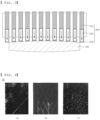
- the contact portion 220 may have an oblique pattern (a), an X-shaped pattern (b), or a dot type pattern (c) having a plurality of micro-scale protrusions.
- the oblique pattern may be used in the case in which the shape of the target object 100 is the same oblique shape as the pattern of the contact portion 220 while having a uniform height or in the case in which the target object has the same shape as the pattern of the contact portion based on a specific reference line.
- the interval or the size of the pattern may be changed depending on the shape of the target object 100. In general, however, it is preferable for the interval of the pattern to be 1 mm to 100 mm. In the case in which the interval of the pattern is less than the above range, it may be difficult to perform a fine adjustment or form a contact portion 220 having a pattern by a fluid. In the case in which the interval of the pattern is greater than the above range, it may be difficult to achieve uniformity in lamination through uniform pressing force, which must be achieved in the present invention.
- the contact portion 220 may simultaneously perform heating while performing pressing. As a result, it is possible to easily achieve lamination for increasing coupling force of the positive electrode, the negative electrode, or the electrode assembly.
- the pressing apparatus according to the first embodiment may be configured to have a structure in which a single pressure adjustment portion 230 is connected to a plurality of contact portions 220, as shown in FIG. 4 . That is, the pressure adjustment portion 230 may be constituted by a single fluid layer connected to a contact portion 220 constituted by a plurality of protrusions.
- a fluid may be contained in the fluid layer so as to account for a percentage of less than 90%, whereby the fluid may be moved by the pressing portion 210 and the contact portion 220.
- pressure adjustment portions 230 may be individually connected to contact portions 220, as shown in FIG. 5 . That is, the pressure adjustment portions 230 may be individually connected to the contact portions 220, which form a pattern, in order to adjust the shape or position of the contact portions 220.
- pressing portions 210 may be individually connected to the pressure adjustment portions 230 or may be integrally connected to the pressure adjustment portions 230.
- the pressing portion 210 may not be connected to the pressure adjustment portion 230.
- the pressing apparatus 200 may press the target object 100 only in one direction depending on the shape of the target object 100
- the pressing apparatus 200 may be constituted by an upper roll and a lower roll, each of which includes the pressing portion 210, the contact portion 220, and the pressure adjustment portion 230, in order to press a three-dimensional target object 100.
- the pressing apparatus may press one surface or opposite surfaces of the target object. At this time, the direction in which the pressing apparatus presses the target object may be changed depending on the shape of the target object.
- the pressing apparatus may be deformed depending on the shape of the target object, or pressing force applied to the contact portion that comes into contact with the target object may be changed depending on the shape of the target object. Since the pressing apparatus has a shape changed depending on the shape of the target object, as described above, it is possible to apply uniform pressure to the target object. As a result, the target object may be uniformly laminated, whereby a defect rate of the target object may be reduced and various shapes of target objects may be formed.
Landscapes
- Engineering & Computer Science (AREA)
- Chemical & Material Sciences (AREA)
- Chemical Kinetics & Catalysis (AREA)
- General Chemical & Material Sciences (AREA)
- Electrochemistry (AREA)
- Manufacturing & Machinery (AREA)
- Mechanical Engineering (AREA)
- Physics & Mathematics (AREA)
- Fluid Mechanics (AREA)
- Materials Engineering (AREA)
- Battery Electrode And Active Subsutance (AREA)
- Press Drives And Press Lines (AREA)
- Secondary Cells (AREA)
Description
- This application claims the benefit of priority to
Korean Patent Application No. 2020-0066918 filed on June 3, 2020 - The present invention relates to a pressing apparatus including a fluid and a pressing method using the same, and more particularly to a pressing apparatus including a pressure adjustment portion having a fluid contained therein, whereby pressure applied to target object to be pressed is changed depending on the shape of the target object, and a pressing method using the same.
- With recent development of alternative energies due to air pollution and energy depletion caused as the result of use of fossil fuels, demand for secondary batteries capable of storing electrical energy that is produced has increased. The secondary batteries, which are being capable of being charged and discharged, are intimately used in daily life. For example, the secondary batteries are used in mobile devices, electric vehicles, and hybrid electric vehicles.
- Secondary batteries used as energy sources of various kinds of electronic devices inevitably used in modern society have been used in a state of being mounted in various kinds of devices, such as mobile devices and electric vehicles. Various shapes of battery cells are required in response to user demand and variety in shape of devices in which secondary batteries are mounted.
- Various shapes of battery cells may be generally formed by receiving, in a curved or bent case, an electrode having a shape corresponding to the shape of the case or an electrode assembly constituted by stacking electrodes. In order to form various shapes of electrodes, an electrode active material is applied to one surface or opposite surfaces of an electrode current collector formed so as to have a uniform shape, and is then pressed. In addition, for various shapes of electrode assemblies, various shapes of electrodes and separators are stacked, and a lamination process is performed in order to increase the force of coupling therebetween.
-
FIG. 1 is a schematic view of a conventional pressing apparatus. - In order to press a
target object 10 to be pressed, a pressing portion of the conventionalpressing apparatus 20, which is a portion configured to come into contact with thetarget object 10, is flat. However, thepressing apparatus 20 having the flat pressing portion cannot apply uniform force to atarget object 10 having various heights or shapes. - That is, stronger force is applied to a portion of the
target object 10 that protrudes farther than the other portions of the target object, and weaker force is applied to a portion of thetarget object 10 that is depressed farther than the other portions of the target object, whereby thetarget object 10 is not uniformly laminated. In order to solve the above problem, an additional pressing process may be performed with respect to the portion of thetarget object 10 that is not properly laminated. In this case, however, process time is lengthened and related cost is increased as a result of performing such an additional process. - In Patent Document 1, a pattern is formed on the surface of a roll member such that compression force that is transmitted to an electrode and a separator is applied only to some regions thereof. However, there is a problem in that only a portion of a target object is compressed, whereby the entirety of the target object is not uniformly pressed at once.
- In order to solve the above problem, it is necessary to consider a method capable of uniformly pressing a target object while reducing process time.
- (Patent Document 1)
Korean Patent Application Publication No. 2017-0099213 (2017.08.31 WO2012/135333 A1 discloses a pressing apparatus according to the preamble of claim 1.KR 100 533 766 B1JP 2007 067273 A - The present invention has been made in view of the above problems, and it is an object of the present invention to provide a pressing apparatus capable of applying uniform pressing force to a target object to be pressed.
- It is another object of the present invention to easily produce various shapes of electrodes or electrode assemblies using the pressing apparatus. It is a further object of the present invention to simplify an electrode and electrode assembly manufacturing process and to reduce a defect rate, whereby it is possible to reduce production cost.
- In order to accomplish the above objects, a pressing apparatus according to claim 1 and an electrode and electrode assembly manufacturing method according to claim 9 is provided.-.
- In addition, the contact portion has a pattern configured to change a pressure applied to the target object depending on the shape of the target object.
- The pattern may be an oblique pattern, an X-shaped pattern, or a dot type pattern having a plurality of micro-scale protrusions.
- The contact portion may have a plurality of protrusions configured to be individually movable.
- The pressure adjustment portion may be individually connected to the contact portion.
- In addition, the pressing portion may be individually or integrally connected to the pressure adjustment portion.
- The fluid of the pressure adjustment portion may be connected to the plurality of protrusions.
- In addition, the fluid of the pressure adjustment portion may occupy less than 90% of the pressure adjustment portion.
- In addition, the pressing apparatus may include an upper roll including the contact portion, the pressing portion, and the pressure adjustment portion and a lower roll having the same identical construction as the upper roll.
- The present invention provides an electrode and electrode assembly manufacturing method including (S1) preparing an electrode or an electrode assembly that is the target object to be pressed, (S2) disposing the target object in the pressing apparatus, and (S3) pressing the target object using the pressing apparatus.
- In step (S3), the pressing apparatus may be deformed depending on the shape of the target object or a pressing force applied to the contact portion, configured to come into contact with the target object, may be changed depending on the shape of the target object.
- The present invention provides a unit cell including the above-mentioned electrode or electrode assembly. In addition, the present invention provides a battery module or a battery pack including the unit cell. In addition, the present invention provides a device having the unit cell, the battery module, or the battery pack mounted therein.
- In the present invention, one or more constructions that do not conflict with each other may be selected and combined from among the above constructions.
- As is apparent from the above description, a pressing apparatus according to the present invention includes a contact portion having a shape changeable depending on the shape of a target object to be pressed, a pressing portion configured to apply uniform force to the contact portion, and a pressure adjustment portion configured to adjust the force applied from the pressing portion differently depending on the shape of the target object in order to change the shape of the contact portion, whereby it is possible to apply uniform pressing force to the target object irrespective of the shape of the target object.
- In addition, the target object, to which uniform pressing force is applied irrespective of the shape of the target object, may be uniformly laminated while the uniform shape of the target object is maintained. As a result, all parts of the target object are uniformly laminated, whereby it is possible to obtain a target object, the uniform shape of which is maintained. Furthermore, defects of the target object at a specific part thereof are remarkably reduced.
- In addition, it is not necessary to perform an additional process for uniform lamination, whereby it is possible to reduce time and cost incurred in the process, which is economical.
-
-
FIG. 1 is a schematic view of a conventional pressing apparatus. -
FIG. 2 is a schematic view of a pressing apparatus according to the present invention. -
FIG. 3 is a schematic view of the pressing apparatus according to the present invention configured to have a pressing roll type structure. -
FIG. 4 is a schematic view showing the interior of a pressing apparatus according to a first embodiment of the present invention. -
FIG. 5 is a schematic view showing the interior of a pressing apparatus according to a second embodiment of the present invention. -
FIG. 6 is a photograph showing the shape of a pattern of a contact portion according to the present invention. - Now, preferred embodiments of the present invention will be described in detail with reference to the accompanying drawings such that the preferred embodiments of the present invention can be easily implemented by a person having ordinary skill in the art to which the present invention pertains. In describing the principle of operation of the preferred embodiments of the present invention in detail, however, a detailed description of known functions and configurations incorporated herein will be omitted when the same may obscure the subject matter of the present invention.
- In addition, the same reference numbers will be used throughout the drawings to refer to parts that perform similar functions or operations. In the case in which one part is said to be connected to another part in the entire specification, not only may the one part be directly connected to the other part, but also, the one part may be indirectly connected to the other part via a further part. In addition, that a certain element is included does not mean that other elements are excluded, but means that such elements may be further included unless mentioned otherwise.
-
FIG. 2 is a schematic view of a pressing apparatus according to the present invention,FIG. 3 is a schematic view of the pressing apparatus according to the present invention configured to have a pressing roll type structure,FIG. 4 is a schematic view showing the interior of a pressing apparatus according to a first embodiment of the present invention, andFIG. 5 is a schematic view showing the interior of a pressing apparatus according to a second embodiment of the present invention. - The
pressing apparatus 200 according to the present invention is characterized in that uniform pressure is applied to atarget object 100 irrespective of the shape of thetarget object 100. - The
target object 100 may be an electrode having an active material applied to one surface or opposite surfaces of an electrode current collector or an electrode assembly including electrodes, each of which is formed as described above, i.e. a positive electrode and a negative electrode, which are stacked in the state in which a separator is interposed therebetween. - The positive electrode includes a positive electrode active material layer applied to at least one surface of a positive electrode current collector. The positive electrode active material layer may be manufactured by applying a positive electrode mixture of a positive electrode active material, a conductive agent, and a binder. A filler may be further added to the positive electrode mixture as needed.
- In general, the positive electrode current collector is manufactured so as to have a thickness of 3 µm to 500 µm. The positive electrode current collector is not particularly restricted as long as the positive electrode current collector exhibits high conductivity while the positive electrode current collector does not induce any chemical change in a battery to which the positive electrode current collector is applied. For example, the positive electrode current collector may be made of stainless steel, aluminum, nickel, or titanium. Alternatively, the positive electrode current collector may be made of aluminum or stainless steel, the surface of which is treated with carbon, nickel, titanium, or silver. Specifically, aluminum may be used. The positive electrode current collector may have a micro-scale uneven pattern formed on the surface thereof so as to increase the force of adhesion to the positive electrode active material layer. The positive electrode current collector may be configured in any of various forms, such as a film, a sheet, a foil, a net, a porous body, a foam body, or a non-woven fabric body.
- The positive electrode active material may be constituted, for example, by a layered compound, such as a lithium nickel oxide (LiNiO2), or a compound substituted with one or more transition metals; a lithium manganese oxide represented by the chemical formula Li1+xMn2-xO4 (where x = 0 to 0.33) or a lithium manganese oxide, such as LiMnO3, LiMn2O3, or LiMnO2; a lithium copper oxide (Li2CuO2); a vanadium oxide, such as LiV3O8, LiV3O4, V2O5, or Cu2V2O7; an Ni-sited lithium nickel oxide represented by the chemical formula LiNi1-xMxO2 (where M = Co, Mn, Al, Cu, Fe, Mg, B, or Ga, and x = 0.01 to 0.3); a lithium manganese composite oxide represented by the chemical formula LiMn2-xMxO2 (where M = Co, Ni, Fe, Cr, Zn, or Ta, and x = 0.01 to 0.1) or the chemical formula Li2Mn3MO8 (where M = Fe, Co, Ni, Cu, or Zn); LiMn2O4 in which a portion of Li in the chemical formula is replaced by alkaline earth metal ions; a disulfide compound; or Fe2(MoO4)3. However, the present invention is not limited thereto.
- The conductive agent is generally added so that the conductive agent accounts for 0.1 weight% to 30 weight% based on the total weight of the mixture including the positive electrode active material. The conductive agent is not particularly restricted as long as the conductive agent exhibits high conductivity without inducing any chemical change in a battery to which the conductive agent is applied. For example, graphite, such as natural graphite or artificial graphite; carbon black, such as carbon black, acetylene black, Ketjen black, channel black, furnace black, lamp black, or thermal black; conductive fiber, such as carbon fiber or metallic fiber; carbon fluoride powder; metallic powder, such as aluminum powder, or nickel powder; conductive whisker, such as a zinc oxide or potassium titanate; a conductive metal oxide, such as a titanium oxide; or a conductive material, such as a polyphenylene derivative, may be used as the conductive agent.
- The binder, which is included in the positive electrode, is a component assisting in binding between the active material and the conductive agent and in binding with the current collector. The binder is generally added in an amount of 0.1 weight% to 30 weight% based on the total weight of the mixture including the positive electrode active material. As examples of the binder, there may be used polyvinylidene fluoride, polyvinyl alcohol, carboxymethylcellulose (CMC), starch, hydroxypropylcellulose, regenerated cellulose, polyvinyl pyrrolidone, tetrafluoroethylene, polyethylene, polypropylene, ethylenepropylene-diene terpolymer, sulfonated ethylene-propylenediene monomer, styrene butadiene rubber, fluoro rubber, and various copolymers.
- The negative electrode is manufactured by applying a negative electrode active material to one surface or opposite surfaces of a negative electrode current collector and drying the same, whereby a negative electrode active material layer is provided at one surface of the negative electrode. The above-described components may be selectively further included as needed.
- Since the negative electrode is provided as a single-sided negative electrode having a negative electrode active material layer provided only at one surface of a negative electrode current collector, the space of a pouch-shaped secondary battery occupied by the negative electrode is reduced, whereby the capacity of the pouch-shaped secondary battery is increased.
- As the negative electrode active material, for example, there may be used carbon, such as a non-graphitizing carbon or a graphite-based carbon; a metal composite oxide, such as LixFe2O3 (0≤x≤1), LixWO2 (0≤x≤1), or SnxMe1-xMe'yOz (Me: Mn, Fe, Pb, Ge; Me': Al, B, P, Si, Group 1, 2 and 3 elements of the periodic table, halogen; 0<x≤1; 1≤y≤3; 1≤z≤8); lithium metal; lithium alloy; a silicon-based alloy; a tin-based alloy; a metal oxide, such as SnO, SnO2, PbO, PbO2, Pb2O3, Pb3O4, Sb2O3, Sb2O4, Sb2O5, GeO, GeO2, Bi2O3, Bi2O4, or Bi2O5; a conductive polymer, such as polyacetylene; or a Li-Co-Ni based material.
- The separator is interposed between the positive electrode and the negative electrode, and an insulative thin film that exhibits high ion permeability and mechanical strength is used as the separator. The separator generally has a pore diameter of 0.01 µm to 10 µm and a thickness of 5 µm to 300 µm. As the material for the separator, for example, a sheet or non-woven fabric made of an olefin-based polymer, such as polypropylene, which exhibits chemical resistance and hydrophobicity, glass fiber, or polyethylene is used. In the case in which a solid electrolyte, such as a polymer, is used as an electrolyte, the solid electrolyte may also function as the separator.
- The electrode assembly may be a stacked type electrode assembly constituted by unit cells, each of which is configured to have a structure in which a rectangular positive electrode and a rectangular negative electrode are stacked in the state in which a separator is interposed therebetween, or a laminated/stacked type electrode assembly, which is configured to have a structure in which unit cells are stacked so as to be attached to each other in the state in which a separator is interposed between therebetween, but the present invention is not limited thereto. However, it is preferable for the electrode assembly not to be a jelly-roll type electrode assembly, which is configured to have a structure in which a long sheet type positive electrode and a long sheet type negative electrode are wound in the state in which a separator is interposed therebetween, or a stacked and folded type electrode assembly, which is configured to have a structure in which unit cells are wound using a long separation film, which reduces impregnability of an electrolyte solution.
- The pressing apparatus according to the present invention presses the positive electrode, the negative electrode, or the electrode assembly in a stacking direction.
- When describing the
pressing apparatus 200 with reference toFIG. 2 , thepressing apparatus 200 includes apressing portion 210 configured to apply uniform force in the pressing apparatus, acontact portion 220 configured to come into direct contact with thetarget object 100, and apressure adjustment portion 230 located between the pressing portion and the contact portion, the pressure adjustment portion having a fluid contained therein. - The
pressing apparatus 200 is moved toward thetarget object 100 by thepressing portion 210, and thecontact portion 220 of thepressing apparatus 200 may come into contact with the entirety of the outer surface of thetarget object 100. - Also, in the pressing roll type pressing apparatus shown in
FIG. 2 , thepressing portion 210 may not be connected to the pressure adjustment portion but may be connected to another region at which the pressure adjustment portion and thecontact portion 220 can be pressed at once, as shown inFIG. 3 . - As shown in
FIG. 2 , thepressing portion 210 may be configured to be in contact with thepressure adjustment portion 230. Alternatively, as shown inFIG. 3 , the pressing portion may be configured to press a roll including acontact portion 220 and a pressure adjustment portion (not shown). The roll may be configured such that the contact portion is located at the outer surface of the roll and the pressure adjustment portion is disposed in the contact portion. - The
pressing portion 210 may be configured to move thepressing apparatus 200 using physical mechanical force, or may be located in the pressing apparatus so as to move members constituting the pressing apparatus, such as thecontact portion 220 and thepressure adjustment portion 230, using hydraulic pressure in order to perform pressing. - In general, the
pressing portion 210 may apply a pressing force of 1 kg/mm to 100 kg/mm to thecontact portion 220 so as to come into contact with thetarget object 100; however, the pressing force may be changed depending on the thickness of thetarget object 100, elastic force of thetarget object 100, and a purpose to be achieved by pressing. - The
contact portion 220, which is configured to come into direct contact with thetarget object 100, may be deformed depending on the shape of thetarget object 100. For example, thecontact portion 220 may be made of an elastic material. Even in the case in which the outer surface of the target object includes a curved or bent portion, therefore, the contact portion may be deformed so as to come into tight contact with the entirety of the outer surface of the target object. - As an example, as shown in
FIG. 2 , the shape of thecontact portion 220 may be changed depending on the shape of thetarget object 100. As can be seen fromFIG. 2 , the shape of thecontact portion 220 is changed so as to correspond to the shape of thetarget object 100 by force applied by thepressing portion 210. Thepressure adjustment portion 230 has a fluid contained therein. Consequently, pressure applied by thepressing portion 210 is distributed depending on the shape of thetarget object 100, whereby the shape of thecontact portion 220 is changed so as to correspond to the external shape of thetarget object 100. At this time, late pressing force F2 applied by thepressure adjustment portion 230 is generated as a result of early pressing force F1 applied by thepressing portion 210 being appropriately dispersed by the fluid contained in thepressure adjustment portion 230 depending on the shape of thetarget object 100, whereby thecontact portion 220 presses the entire surface of thetarget object 100. - As another example, as shown in
FIGS. 4 and5 , the height of thecontact portion 220 may be changed. That is, the shape of thepressure adjustment portion 230 having the fluid contained therein may be changed to adjust projection or depression of the contact portion. - Specifically, the
pressing apparatus 200 according to the first embodiment shown inFIG. 4 may be configured to have a structure in which a singlepressure adjustment portion 230 is connected to a plurality ofcontact portions 220. That is, thepressure adjustment portion 230 may be a single member connected to acontact portion 220 constituted by a plurality of protrusions, and a fluid may be contained in the pressure adjustment portion. - At this time, the fluid may be contained in the pressure adjustment portion so as to account for a percentage of less than 90%, whereby the fluid may be moved by the
pressing portion 210 and thecontact portion 220. - At this time, the
contact portion 220 may be operated in a manner in which thecontact portion 220 projects out of thepressing apparatus 200 or is depressed into the pressing apparatus through one surface thereof as a result of the members constituting thepressing apparatus 200, i.e. thecontact portion 220, thepressing portion 210, and thepressure adjustment portion 230, moving together, as shown inFIG. 4 . - In the
pressing apparatus 200 according to the second embodiment shown inFIG. 5 ,pressure adjustment portions 230 may be individually connected to contactportions 220. That is, thepressure adjustment portions 230 may be individually connected to thecontact portions 220, which form a pattern, in order to adjust the shape or position of thecontact portions 220. - At this time, pressing
portions 210 may be connected to thepressure adjustment portions 230 individually, i.e. one to one, as shown inFIG. 5 , or a plurality ofpressing portions 210 may be integrally connected to a singlepressure adjustment portion 230, as shown inFIG. 4 . - In the case in which the
pressure adjustment portions 230 are individually connected to thecontact portions 220, a movement range or a deformation range of each of thecontact portions 220 may be further increased. - The
contact portion 220 may be formed separately from thepressure adjustment portion 230, or thecontact portion 220 and thepressure adjustment portion 230 may be integrated. - As shown in
FIG. 5 , thecontact portion 220 is constituted by a plurality of protrusions configured to be individually movable, whereby movement ranges of the protrusions may be different from each other depending on the shape of thetarget object 100. - At this time, the
contact portion 220 may be configured to have a pattern in which the heights of the protrusions are different from each other depending on the shape of thetarget object 100. -
FIG. 6 is a photograph showing the shape of the pattern of the contact portion according to the present invention. - As can be seen from
FIG. 6 , thecontact portion 220 according to the present invention may have an oblique pattern (a), an X-shaped pattern (b), or a dot type pattern (c) having a plurality of micro-scale protrusions. - The oblique pattern may be used in the case in which the shape of the
target object 100 is the same oblique shape as the pattern of thecontact portion 220 while having a uniform height or in the case in which the target object has the same shape as the pattern of the contact portion based on a specific reference line. - In addition, the X-shaped pattern (b) may be used in the case in which a
target object 100 having a changed height while having a uniform pattern is pressed, and the dot type pattern (c) may be used in the case in which anamorphous target object 100 is pressed. - The interval or the size of the pattern may be changed depending on the shape of the
target object 100. In general, however, it is preferable for the interval of the pattern to be 1 mm to 100 mm. In the case in which the interval of the pattern is less than the above range, it may be difficult to perform a fine adjustment or form acontact portion 220 having a pattern by a fluid. In the case in which the interval of the pattern is greater than the above range, it may be difficult to achieve uniformity in lamination through uniform pressing force, which must be achieved in the present invention. - The
contact portion 220 may simultaneously perform heating while performing pressing. As a result, it is possible to easily achieve lamination for increasing coupling force of the positive electrode, the negative electrode, or the electrode assembly. - The pressing apparatus according to the first embodiment may be configured to have a structure in which a single
pressure adjustment portion 230 is connected to a plurality ofcontact portions 220, as shown inFIG. 4 . That is, thepressure adjustment portion 230 may be constituted by a single fluid layer connected to acontact portion 220 constituted by a plurality of protrusions. - At this time, a fluid may be contained in the fluid layer so as to account for a percentage of less than 90%, whereby the fluid may be moved by the
pressing portion 210 and thecontact portion 220. - In the pressing apparatus according to the second embodiment,
pressure adjustment portions 230 may be individually connected to contactportions 220, as shown inFIG. 5 . That is, thepressure adjustment portions 230 may be individually connected to thecontact portions 220, which form a pattern, in order to adjust the shape or position of thecontact portions 220. - At this time, pressing
portions 210 may be individually connected to thepressure adjustment portions 230 or may be integrally connected to thepressure adjustment portions 230. - In the case in which the
pressure adjustment portions 230 are individually connected to thecontact portions 220, a movement range or a deformation range of each of thecontact portions 220 may be further increased. - Also, in the pressing roll type pressing apparatus shown in
FIG. 2 , thepressing portion 210 may not be connected to thepressure adjustment portion 230. - The
contact portion 220 may be formed separately from thepressure adjustment portion 230, or thecontact portion 220 and thepressure adjustment portion 230 may be integrated. - Although the
pressing apparatus 200 according to the present invention may press thetarget object 100 only in one direction depending on the shape of thetarget object 100, thepressing apparatus 200 may be constituted by an upper roll and a lower roll, each of which includes thepressing portion 210, thecontact portion 220, and thepressure adjustment portion 230, in order to press a three-dimensional target object 100. - An electrode and electrode assembly manufacturing method according to the present invention includes a step (S1) of preparing an electrode or an electrode assembly as a target object to be pressed, a step (S2) of disposing the target object in the pressing apparatus described above, and a step (S3) of pressing the target object using the pressing apparatus.
- The pressing apparatus may press one surface or opposite surfaces of the target object. At this time, the direction in which the pressing apparatus presses the target object may be changed depending on the shape of the target object.
- In order to uniformly press the target object while maintaining the shape of the target object, the pressing apparatus may be deformed depending on the shape of the target object, or pressing force applied to the contact portion that comes into contact with the target object may be changed depending on the shape of the target object. Since the pressing apparatus has a shape changed depending on the shape of the target object, as described above, it is possible to apply uniform pressure to the target object. As a result, the target object may be uniformly laminated, whereby a defect rate of the target object may be reduced and various shapes of target objects may be formed.
- The present invention provides a unit cell including the above-mentioned electrode or electrode assembly. In addition, the present invention provides a battery module or a battery pack including the unit cell. In addition, the present invention provides a device having the unit cell, the battery module, or the battery pack mounted therein.
- The device may be an electronic device including a large-capacity battery, such as an electric vehicle, a hybrid electric vehicle, or a plug-in hybrid electric vehicle.
-
- 10, 100: Target objects
- 20, 200: Pressing apparatuses
- 210: Pressing portion
- 220: Contact portion
- 230: Pressure adjustment portion
- F1: Early pressing force
- F2: Late pressing force
- As is apparent from the above description, a pressing apparatus according to the present invention includes a contact portion having a shape changeable depending on the shape of a target object to be pressed, a pressing portion configured to apply uniform force to the contact portion, and a pressure adjustment portion configured to adjust the force applied from the pressing portion differently depending on the shape of the target object in order to change the shape of the contact portion, whereby it is possible to apply uniform pressing force to the target object irrespective of the shape of the target object.
- In addition, the target object, to which uniform pressing force is applied irrespective of the shape of the target object, may be uniformly laminated while the uniform shape of the target object is maintained. As a result, all parts of the target object are uniformly laminated, whereby it is possible to obtain a target object, the uniform shape of which is maintained. Furthermore, defects of the target object at a specific part thereof are remarkably reduced.
Claims (10)
- A pressing apparatus (200) comprising:a contact portion (220) having a shape or position configured to be changed depending on a shape of a target object (100) to be pressed so that the pressing apparatus (200) comes into contact with the entirety of the outer surface of the target object (100);a pressing portion (210) configured to apply uniform force to the contact portion (220); anda pressure adjustment portion (230) located between the contact portion (220) and the pressing portion (210), the pressure adjustment portion (230) having a fluid contained therein;and wherein the contact portion (220) of the pressing apparatus (200) is configured to press the entire surface of the target object (100) characterized in that the contact portion (220) has a plurality of protrusions configured to be individually movable.
- The pressing apparatus (200) according to claim 1, wherein the contact portion (220) has a pattern configured to change a pressure applied to the target object (100) depending on the shape of the target object (100).
- The pressing apparatus (200) according to claim 2, wherein the pattern is an oblique pattern, an X-shaped pattern, or a dot type pattern having a plurality of micro-scale protrusions.
- The pressing apparatus (200) according to claim 1, wherein the pressure adjustment portion (230) is individually connected to the contact portion (220).
- The pressing apparatus (200) according to claim 4, wherein the pressing portion (210) is individually or integrally connected to the pressure adjustment portion (230).
- The pressing apparatus according to claim 3, wherein the fluid of the pressure adjustment portion (230) is connected to the plurality of protrusions.
- The pressing apparatus (200) according to claim 1, wherein the fluid of the pressure adjustment portion (230) occupies less than 90% of the pressure adjustment portion (230).
- The pressing apparatus (200) according to claim 1, wherein the pressing apparatus (200) comprises:an upper roll comprising the contact portion (220), the pressing portion (210), and the pressure adjustment portion (230); anda lower roll having an identical construction as the upper roll.
- An electrode and electrode assembly manufacturing method comprising:(S1) preparing an electrode or an electrode assembly that is the target object (100) to be pressed;(S2) disposing the target object (100) in the pressing apparatus (200) according to any one of claims 1 to 8; and(S3) moving the pressing apparatus (200) toward the target object (100) so that the pressing apparatus (200) comes into contact with the entirety of the outer surface of the target object (100) and pressing the entire surface of the target object (100) using the pressing apparatus (200).
- The electrode and electrode assembly manufacturing method according to claim 9, wherein, in step (S3), the pressing apparatus (200) is deformed depending on the shape of the target object (100) or a pressing force applied to the contact portion (220), configured to come into contact with the target object (100), is changed depending on the shape of the target object (100).
Applications Claiming Priority (2)
| Application Number | Priority Date | Filing Date | Title |
|---|---|---|---|
| KR1020200066918A KR102689451B1 (en) | 2020-06-03 | 2020-06-03 | Pressure device having fluid and manufacturing method for electrode and electrode assembly using the same |
| PCT/KR2021/001974 WO2021246615A1 (en) | 2020-06-03 | 2021-02-16 | Pressurization device comprising fluid, electrode using same, and manufacturing method for electrode and electrode assembly |
Publications (3)
| Publication Number | Publication Date |
|---|---|
| EP4108441A1 EP4108441A1 (en) | 2022-12-28 |
| EP4108441A4 EP4108441A4 (en) | 2023-10-11 |
| EP4108441B1 true EP4108441B1 (en) | 2025-04-02 |
Family
ID=78831311
Family Applications (1)
| Application Number | Title | Priority Date | Filing Date |
|---|---|---|---|
| EP21818335.8A Active EP4108441B1 (en) | 2020-06-03 | 2021-02-16 | Pressurization device comprising fluid and manufacturing method for electrode and electrode assembly |
Country Status (8)
| Country | Link |
|---|---|
| US (1) | US12337567B2 (en) |
| EP (1) | EP4108441B1 (en) |
| JP (1) | JP7424571B2 (en) |
| KR (1) | KR102689451B1 (en) |
| CN (1) | CN115038579B (en) |
| ES (1) | ES3023048T3 (en) |
| HU (1) | HUE070996T2 (en) |
| WO (1) | WO2021246615A1 (en) |
Family Cites Families (22)
| Publication number | Priority date | Publication date | Assignee | Title |
|---|---|---|---|---|
| US4030961A (en) * | 1974-08-14 | 1977-06-21 | Saint-Gobain Industries | Device for assembling glass sheets and layers of plastic material |
| JP3742111B2 (en) * | 1996-10-25 | 2006-02-01 | ブイエムアイ エペ ホランド ベスローテン フェンノートシャップ | Pressure roll for tire forming equipment |
| JP2000073288A (en) | 1998-08-26 | 2000-03-07 | Hitachi Zosen Corp | Control method and control device for control roll in paper machine |
| JP3057259U (en) | 1998-09-03 | 1999-04-09 | トキワ工業株式会社 | Flexible dies |
| TW569062B (en) * | 2001-12-25 | 2004-01-01 | Toshiba Corp | Thermal bonding device and method |
| JP2004113049A (en) | 2002-09-25 | 2004-04-15 | Kuraray Co Ltd | Transesterification method with biocatalyst in room temperature molten salt |
| JP3910514B2 (en) | 2002-09-25 | 2007-04-25 | 本田技研工業株式会社 | Cushion device for press machine |
| JP4636429B2 (en) * | 2004-10-27 | 2011-02-23 | 横浜ゴム株式会社 | Unvulcanized rubber groove forming device |
| JP4866582B2 (en) * | 2005-09-01 | 2012-02-01 | 株式会社ケミトロニクス | Crimping mechanism |
| JP4812785B2 (en) | 2008-01-25 | 2011-11-09 | アイシン高丘株式会社 | Heating apparatus and heating method for heated material |
| JP5330817B2 (en) * | 2008-03-31 | 2013-10-30 | 富士重工業株式会社 | Press machine |
| JP2010034423A (en) * | 2008-07-30 | 2010-02-12 | Fujitsu Ltd | Pressure-heating apparatus and method |
| JP5636634B2 (en) * | 2009-02-25 | 2014-12-10 | トヨタ自動車株式会社 | Electrode plate pressurizing device |
| JP5843784B2 (en) | 2009-12-22 | 2016-01-13 | スリーエム イノベイティブ プロパティズ カンパニー | Apparatus and method for microcontact printing using a pressure roller |
| KR20140027135A (en) * | 2011-03-31 | 2014-03-06 | 다우 코닝 코포레이션 | Method of forming a photovoltaic cell module with a cell press |
| KR101537517B1 (en) | 2013-09-03 | 2015-07-17 | 한국기계연구원 | Pressure roller for uniform pressing of roll-to-roll apparatus |
| JP6541965B2 (en) | 2014-12-22 | 2019-07-10 | Toyo Tire株式会社 | Apparatus and method for grooving sheet-like member |
| KR101965830B1 (en) | 2016-02-23 | 2019-04-04 | 주식회사 엘지화학 | Roll press and lamination method using roll press |
| KR101916919B1 (en) | 2017-05-08 | 2019-01-30 | 한국생산기술연구원 | Hot multipoint mold apparatus having cooling nozzle and pressing punch and multipoint forming method using the same |
| CN111919328A (en) * | 2018-03-28 | 2020-11-10 | 新东工业株式会社 | Rolling device, control system of rolling device and control method of rolling device |
| JP7067426B2 (en) | 2018-11-05 | 2022-05-16 | トヨタ自動車株式会社 | Electrode manufacturing method |
| KR102225355B1 (en) | 2018-12-03 | 2021-03-09 | (주)허니냅스 | Apparatus and method of controlling door based on non-contact measurement for body heat |
-
2020
- 2020-06-03 KR KR1020200066918A patent/KR102689451B1/en active Active
-
2021
- 2021-02-16 JP JP2022551361A patent/JP7424571B2/en active Active
- 2021-02-16 CN CN202180011397.2A patent/CN115038579B/en active Active
- 2021-02-16 US US17/914,102 patent/US12337567B2/en active Active
- 2021-02-16 ES ES21818335T patent/ES3023048T3/en active Active
- 2021-02-16 HU HUE21818335A patent/HUE070996T2/en unknown
- 2021-02-16 EP EP21818335.8A patent/EP4108441B1/en active Active
- 2021-02-16 WO PCT/KR2021/001974 patent/WO2021246615A1/en not_active Ceased
Also Published As
| Publication number | Publication date |
|---|---|
| JP7424571B2 (en) | 2024-01-30 |
| HUE070996T2 (en) | 2025-07-28 |
| US12337567B2 (en) | 2025-06-24 |
| WO2021246615A1 (en) | 2021-12-09 |
| EP4108441A4 (en) | 2023-10-11 |
| KR20210150035A (en) | 2021-12-10 |
| US20230398758A1 (en) | 2023-12-14 |
| KR102689451B1 (en) | 2024-07-30 |
| ES3023048T3 (en) | 2025-05-29 |
| CN115038579A (en) | 2022-09-09 |
| JP2023516938A (en) | 2023-04-21 |
| CN115038579B (en) | 2025-04-25 |
| EP4108441A1 (en) | 2022-12-28 |
Similar Documents
| Publication | Publication Date | Title |
|---|---|---|
| US9692082B2 (en) | Electrode assembly and manufacturing method thereof | |
| EP3079196B1 (en) | Secondary battery laminating device and secondary battery laminating method | |
| EP2555305B1 (en) | Electrode assembly having a novel structure and a production method for the same | |
| KR102913783B1 (en) | Jig for charging and discharging a battery cell | |
| KR101686615B1 (en) | Press-In Device for Preventing Wrinkles on Anode Active Material-non-coated Portion of Battery | |
| KR20140036437A (en) | Fabricating method of secondary battery and electrochemical cell having the secondary battery | |
| KR101476040B1 (en) | Pouch-typed lithium secondary battery comprising a separator coated with a gas-adsorbent, large-sized battery module employed with the same | |
| EP4044331A1 (en) | Pouch-type secondary battery having increased energy density, and method for manufacturing same | |
| EP4108441B1 (en) | Pressurization device comprising fluid and manufacturing method for electrode and electrode assembly | |
| KR20130133332A (en) | Secondary battery of novel structure | |
| KR20220060186A (en) | All solid-state battery having a positive electrode with larger area than the negative electrode and a method for manufacturing the same | |
| KR20140048622A (en) | Electrode assembly and containing the electrode assembly, electrochemical cell | |
| KR20140018136A (en) | Electrode assembly and electrochemical cell containing the same | |
| KR20140018135A (en) | Electrode assembly and electrochemical cell containing the same | |
| KR20220057166A (en) | Bipolar all-solid-state battery comprising a porous supporting layer | |
| KR20160140507A (en) | Electrode assembly with directional thickness and Lithium secondary battery comprising the same | |
| KR20140029677A (en) | Electrode assembly and secondary battery including the electrode assembly | |
| EP4322310A1 (en) | Electrode assembly comprising anode with extension part | |
| JP7596013B2 (en) | Bipolar solid-state battery with porous support layer | |
| JP2026508220A (en) | Battery cell activation device and battery cell activation method using the same | |
| JP2025537930A (en) | Positive electrode for lithium secondary battery and lithium secondary battery including the same |
Legal Events
| Date | Code | Title | Description |
|---|---|---|---|
| STAA | Information on the status of an ep patent application or granted ep patent |
Free format text: STATUS: THE INTERNATIONAL PUBLICATION HAS BEEN MADE |
|
| PUAI | Public reference made under article 153(3) epc to a published international application that has entered the european phase |
Free format text: ORIGINAL CODE: 0009012 |
|
| STAA | Information on the status of an ep patent application or granted ep patent |
Free format text: STATUS: REQUEST FOR EXAMINATION WAS MADE |
|
| 17P | Request for examination filed |
Effective date: 20220923 |
|
| AK | Designated contracting states |
Kind code of ref document: A1 Designated state(s): AL AT BE BG CH CY CZ DE DK EE ES FI FR GB GR HR HU IE IS IT LI LT LU LV MC MK MT NL NO PL PT RO RS SE SI SK SM TR |
|
| DAV | Request for validation of the european patent (deleted) | ||
| DAX | Request for extension of the european patent (deleted) | ||
| A4 | Supplementary search report drawn up and despatched |
Effective date: 20230912 |
|
| RIC1 | Information provided on ipc code assigned before grant |
Ipc: H01M 10/04 20060101ALI20230906BHEP Ipc: H01M 4/04 20060101ALI20230906BHEP Ipc: B30B 15/00 20060101ALI20230906BHEP Ipc: B30B 3/00 20060101AFI20230906BHEP |
|
| REG | Reference to a national code |
Ref country code: DE Ref legal event code: R079 Ref country code: DE Ref legal event code: R079 Ref document number: 602021028639 Country of ref document: DE Free format text: PREVIOUS MAIN CLASS: B30B0003000000 Ipc: H01M0004139000 |
|
| GRAP | Despatch of communication of intention to grant a patent |
Free format text: ORIGINAL CODE: EPIDOSNIGR1 |
|
| STAA | Information on the status of an ep patent application or granted ep patent |
Free format text: STATUS: GRANT OF PATENT IS INTENDED |
|
| RIC1 | Information provided on ipc code assigned before grant |
Ipc: B30B 15/00 20060101ALI20240819BHEP Ipc: H01M 4/04 20060101ALI20240819BHEP Ipc: H01M 10/04 20060101ALI20240819BHEP Ipc: B30B 15/24 20060101ALI20240819BHEP Ipc: B30B 3/00 20060101ALI20240819BHEP Ipc: B30B 5/02 20060101ALI20240819BHEP Ipc: H01M 4/139 20100101AFI20240819BHEP |
|
| INTG | Intention to grant announced |
Effective date: 20240902 |
|
| GRAJ | Information related to disapproval of communication of intention to grant by the applicant or resumption of examination proceedings by the epo deleted |
Free format text: ORIGINAL CODE: EPIDOSDIGR1 |
|
| STAA | Information on the status of an ep patent application or granted ep patent |
Free format text: STATUS: REQUEST FOR EXAMINATION WAS MADE |
|
| GRAP | Despatch of communication of intention to grant a patent |
Free format text: ORIGINAL CODE: EPIDOSNIGR1 |
|
| STAA | Information on the status of an ep patent application or granted ep patent |
Free format text: STATUS: GRANT OF PATENT IS INTENDED |
|
| INTC | Intention to grant announced (deleted) | ||
| P01 | Opt-out of the competence of the unified patent court (upc) registered |
Free format text: CASE NUMBER: APP_56687/2024 Effective date: 20241017 |
|
| INTG | Intention to grant announced |
Effective date: 20241108 |
|
| GRAS | Grant fee paid |
Free format text: ORIGINAL CODE: EPIDOSNIGR3 |
|
| GRAA | (expected) grant |
Free format text: ORIGINAL CODE: 0009210 |
|
| STAA | Information on the status of an ep patent application or granted ep patent |
Free format text: STATUS: THE PATENT HAS BEEN GRANTED |
|
| AK | Designated contracting states |
Kind code of ref document: B1 Designated state(s): AL AT BE BG CH CY CZ DE DK EE ES FI FR GB GR HR HU IE IS IT LI LT LU LV MC MK MT NL NO PL PT RO RS SE SI SK SM TR |
|
| REG | Reference to a national code |
Ref country code: GB Ref legal event code: FG4D |
|
| REG | Reference to a national code |
Ref country code: CH Ref legal event code: EP |
|
| REG | Reference to a national code |
Ref country code: IE Ref legal event code: FG4D |
|
| REG | Reference to a national code |
Ref country code: DE Ref legal event code: R096 Ref document number: 602021028639 Country of ref document: DE |
|
| REG | Reference to a national code |
Ref country code: ES Ref legal event code: FG2A Ref document number: 3023048 Country of ref document: ES Kind code of ref document: T3 Effective date: 20250529 |
|
| REG | Reference to a national code |
Ref country code: HU Ref legal event code: AG4A Ref document number: E070996 Country of ref document: HU |
|
| REG | Reference to a national code |
Ref country code: NL Ref legal event code: MP Effective date: 20250402 |
|
| PG25 | Lapsed in a contracting state [announced via postgrant information from national office to epo] |
Ref country code: NL Free format text: LAPSE BECAUSE OF FAILURE TO SUBMIT A TRANSLATION OF THE DESCRIPTION OR TO PAY THE FEE WITHIN THE PRESCRIBED TIME-LIMIT Effective date: 20250402 |
|
| REG | Reference to a national code |
Ref country code: AT Ref legal event code: MK05 Ref document number: 1782208 Country of ref document: AT Kind code of ref document: T Effective date: 20250402 |
|
| PG25 | Lapsed in a contracting state [announced via postgrant information from national office to epo] |
Ref country code: PT Free format text: LAPSE BECAUSE OF FAILURE TO SUBMIT A TRANSLATION OF THE DESCRIPTION OR TO PAY THE FEE WITHIN THE PRESCRIBED TIME-LIMIT Effective date: 20250804 Ref country code: FI Free format text: LAPSE BECAUSE OF FAILURE TO SUBMIT A TRANSLATION OF THE DESCRIPTION OR TO PAY THE FEE WITHIN THE PRESCRIBED TIME-LIMIT Effective date: 20250402 |
|
| REG | Reference to a national code |
Ref country code: LT Ref legal event code: MG9D |
|
| PG25 | Lapsed in a contracting state [announced via postgrant information from national office to epo] |
Ref country code: GR Free format text: LAPSE BECAUSE OF FAILURE TO SUBMIT A TRANSLATION OF THE DESCRIPTION OR TO PAY THE FEE WITHIN THE PRESCRIBED TIME-LIMIT Effective date: 20250703 Ref country code: NO Free format text: LAPSE BECAUSE OF FAILURE TO SUBMIT A TRANSLATION OF THE DESCRIPTION OR TO PAY THE FEE WITHIN THE PRESCRIBED TIME-LIMIT Effective date: 20250702 |
|
| PG25 | Lapsed in a contracting state [announced via postgrant information from national office to epo] |
Ref country code: PL Free format text: LAPSE BECAUSE OF FAILURE TO SUBMIT A TRANSLATION OF THE DESCRIPTION OR TO PAY THE FEE WITHIN THE PRESCRIBED TIME-LIMIT Effective date: 20250402 |
|
| PG25 | Lapsed in a contracting state [announced via postgrant information from national office to epo] |
Ref country code: BG Free format text: LAPSE BECAUSE OF FAILURE TO SUBMIT A TRANSLATION OF THE DESCRIPTION OR TO PAY THE FEE WITHIN THE PRESCRIBED TIME-LIMIT Effective date: 20250402 |
|
| PG25 | Lapsed in a contracting state [announced via postgrant information from national office to epo] |
Ref country code: HR Free format text: LAPSE BECAUSE OF FAILURE TO SUBMIT A TRANSLATION OF THE DESCRIPTION OR TO PAY THE FEE WITHIN THE PRESCRIBED TIME-LIMIT Effective date: 20250402 |
|
| PG25 | Lapsed in a contracting state [announced via postgrant information from national office to epo] |
Ref country code: AT Free format text: LAPSE BECAUSE OF FAILURE TO SUBMIT A TRANSLATION OF THE DESCRIPTION OR TO PAY THE FEE WITHIN THE PRESCRIBED TIME-LIMIT Effective date: 20250402 |
|
| PG25 | Lapsed in a contracting state [announced via postgrant information from national office to epo] |
Ref country code: RS Free format text: LAPSE BECAUSE OF FAILURE TO SUBMIT A TRANSLATION OF THE DESCRIPTION OR TO PAY THE FEE WITHIN THE PRESCRIBED TIME-LIMIT Effective date: 20250702 |
|
| PG25 | Lapsed in a contracting state [announced via postgrant information from national office to epo] |
Ref country code: IS Free format text: LAPSE BECAUSE OF FAILURE TO SUBMIT A TRANSLATION OF THE DESCRIPTION OR TO PAY THE FEE WITHIN THE PRESCRIBED TIME-LIMIT Effective date: 20250802 |
|
| PG25 | Lapsed in a contracting state [announced via postgrant information from national office to epo] |
Ref country code: LV Free format text: LAPSE BECAUSE OF FAILURE TO SUBMIT A TRANSLATION OF THE DESCRIPTION OR TO PAY THE FEE WITHIN THE PRESCRIBED TIME-LIMIT Effective date: 20250402 |
|
| REG | Reference to a national code |
Ref country code: DE Ref legal event code: R097 Ref document number: 602021028639 Country of ref document: DE |
|
| PG25 | Lapsed in a contracting state [announced via postgrant information from national office to epo] |
Ref country code: SM Free format text: LAPSE BECAUSE OF FAILURE TO SUBMIT A TRANSLATION OF THE DESCRIPTION OR TO PAY THE FEE WITHIN THE PRESCRIBED TIME-LIMIT Effective date: 20250402 Ref country code: DK Free format text: LAPSE BECAUSE OF FAILURE TO SUBMIT A TRANSLATION OF THE DESCRIPTION OR TO PAY THE FEE WITHIN THE PRESCRIBED TIME-LIMIT Effective date: 20250402 |
|
| PG25 | Lapsed in a contracting state [announced via postgrant information from national office to epo] |
Ref country code: CZ Free format text: LAPSE BECAUSE OF FAILURE TO SUBMIT A TRANSLATION OF THE DESCRIPTION OR TO PAY THE FEE WITHIN THE PRESCRIBED TIME-LIMIT Effective date: 20250402 |
|
| PG25 | Lapsed in a contracting state [announced via postgrant information from national office to epo] |
Ref country code: EE Free format text: LAPSE BECAUSE OF FAILURE TO SUBMIT A TRANSLATION OF THE DESCRIPTION OR TO PAY THE FEE WITHIN THE PRESCRIBED TIME-LIMIT Effective date: 20250402 |
|
| PG25 | Lapsed in a contracting state [announced via postgrant information from national office to epo] |
Ref country code: SK Free format text: LAPSE BECAUSE OF FAILURE TO SUBMIT A TRANSLATION OF THE DESCRIPTION OR TO PAY THE FEE WITHIN THE PRESCRIBED TIME-LIMIT Effective date: 20250402 |
|
| PG25 | Lapsed in a contracting state [announced via postgrant information from national office to epo] |
Ref country code: IT Free format text: LAPSE BECAUSE OF FAILURE TO SUBMIT A TRANSLATION OF THE DESCRIPTION OR TO PAY THE FEE WITHIN THE PRESCRIBED TIME-LIMIT Effective date: 20250402 |
|
| PLBE | No opposition filed within time limit |
Free format text: ORIGINAL CODE: 0009261 |
|
| STAA | Information on the status of an ep patent application or granted ep patent |
Free format text: STATUS: NO OPPOSITION FILED WITHIN TIME LIMIT |
|
| REG | Reference to a national code |
Ref country code: CH Ref legal event code: L10 Free format text: ST27 STATUS EVENT CODE: U-0-0-L10-L00 (AS PROVIDED BY THE NATIONAL OFFICE) Effective date: 20260211 |
|
| 26N | No opposition filed |
Effective date: 20260105 |
|
| PGFP | Annual fee paid to national office [announced via postgrant information from national office to epo] |
Ref country code: HU Payment date: 20260227 Year of fee payment: 6 |
|
| PGFP | Annual fee paid to national office [announced via postgrant information from national office to epo] |
Ref country code: GB Payment date: 20260122 Year of fee payment: 6 |
|
| PGFP | Annual fee paid to national office [announced via postgrant information from national office to epo] |
Ref country code: ES Payment date: 20260324 Year of fee payment: 6 |
|
| PGFP | Annual fee paid to national office [announced via postgrant information from national office to epo] |
Ref country code: DE Payment date: 20260120 Year of fee payment: 6 |
|
| PGFP | Annual fee paid to national office [announced via postgrant information from national office to epo] |
Ref country code: BE Payment date: 20260121 Year of fee payment: 6 |
|
| PGFP | Annual fee paid to national office [announced via postgrant information from national office to epo] |
Ref country code: FR Payment date: 20260121 Year of fee payment: 6 |