EP4108435A1 - Polyethylene composition with improved processability - Google Patents
Polyethylene composition with improved processability Download PDFInfo
- Publication number
- EP4108435A1 EP4108435A1 EP21181464.5A EP21181464A EP4108435A1 EP 4108435 A1 EP4108435 A1 EP 4108435A1 EP 21181464 A EP21181464 A EP 21181464A EP 4108435 A1 EP4108435 A1 EP 4108435A1
- Authority
- EP
- European Patent Office
- Prior art keywords
- range
- mfr
- multimodal
- ethylene polymer
- metallocene
- Prior art date
- Legal status (The legal status is an assumption and is not a legal conclusion. Google has not performed a legal analysis and makes no representation as to the accuracy of the status listed.)
- Granted
Links
Classifications
-
- C—CHEMISTRY; METALLURGY
- C08—ORGANIC MACROMOLECULAR COMPOUNDS; THEIR PREPARATION OR CHEMICAL WORKING-UP; COMPOSITIONS BASED THEREON
- C08F—MACROMOLECULAR COMPOUNDS OBTAINED BY REACTIONS ONLY INVOLVING CARBON-TO-CARBON UNSATURATED BONDS
- C08F210/00—Copolymers of unsaturated aliphatic hydrocarbons having only one carbon-to-carbon double bond
- C08F210/16—Copolymers of ethene with alpha-alkenes, e.g. EP rubbers
-
- C—CHEMISTRY; METALLURGY
- C08—ORGANIC MACROMOLECULAR COMPOUNDS; THEIR PREPARATION OR CHEMICAL WORKING-UP; COMPOSITIONS BASED THEREON
- C08J—WORKING-UP; GENERAL PROCESSES OF COMPOUNDING; AFTER-TREATMENT NOT COVERED BY SUBCLASSES C08B, C08C, C08F, C08G or C08H
- C08J5/00—Manufacture of articles or shaped materials containing macromolecular substances
- C08J5/18—Manufacture of films or sheets
-
- B—PERFORMING OPERATIONS; TRANSPORTING
- B29—WORKING OF PLASTICS; WORKING OF SUBSTANCES IN A PLASTIC STATE IN GENERAL
- B29D—PRODUCING PARTICULAR ARTICLES FROM PLASTICS OR FROM SUBSTANCES IN A PLASTIC STATE
- B29D7/00—Producing flat articles, e.g. films or sheets
- B29D7/01—Films or sheets
-
- C—CHEMISTRY; METALLURGY
- C08—ORGANIC MACROMOLECULAR COMPOUNDS; THEIR PREPARATION OR CHEMICAL WORKING-UP; COMPOSITIONS BASED THEREON
- C08F—MACROMOLECULAR COMPOUNDS OBTAINED BY REACTIONS ONLY INVOLVING CARBON-TO-CARBON UNSATURATED BONDS
- C08F2420/00—Metallocene catalysts
- C08F2420/07—Heteroatom-substituted Cp, i.e. Cp or analog where at least one of the substituent of the Cp or analog ring is or contains a heteroatom
-
- C—CHEMISTRY; METALLURGY
- C08—ORGANIC MACROMOLECULAR COMPOUNDS; THEIR PREPARATION OR CHEMICAL WORKING-UP; COMPOSITIONS BASED THEREON
- C08F—MACROMOLECULAR COMPOUNDS OBTAINED BY REACTIONS ONLY INVOLVING CARBON-TO-CARBON UNSATURATED BONDS
- C08F4/00—Polymerisation catalysts
- C08F4/42—Metals; Metal hydrides; Metallo-organic compounds; Use thereof as catalyst precursors
- C08F4/44—Metals; Metal hydrides; Metallo-organic compounds; Use thereof as catalyst precursors selected from light metals, zinc, cadmium, mercury, copper, silver, gold, boron, gallium, indium, thallium, rare earths or actinides
- C08F4/60—Metals; Metal hydrides; Metallo-organic compounds; Use thereof as catalyst precursors selected from light metals, zinc, cadmium, mercury, copper, silver, gold, boron, gallium, indium, thallium, rare earths or actinides together with refractory metals, iron group metals, platinum group metals, manganese, rhenium technetium or compounds thereof
- C08F4/62—Refractory metals or compounds thereof
- C08F4/64—Titanium, zirconium, hafnium or compounds thereof
- C08F4/659—Component covered by group C08F4/64 containing a transition metal-carbon bond
- C08F4/65912—Component covered by group C08F4/64 containing a transition metal-carbon bond in combination with an organoaluminium compound
-
- C—CHEMISTRY; METALLURGY
- C08—ORGANIC MACROMOLECULAR COMPOUNDS; THEIR PREPARATION OR CHEMICAL WORKING-UP; COMPOSITIONS BASED THEREON
- C08F—MACROMOLECULAR COMPOUNDS OBTAINED BY REACTIONS ONLY INVOLVING CARBON-TO-CARBON UNSATURATED BONDS
- C08F4/00—Polymerisation catalysts
- C08F4/42—Metals; Metal hydrides; Metallo-organic compounds; Use thereof as catalyst precursors
- C08F4/44—Metals; Metal hydrides; Metallo-organic compounds; Use thereof as catalyst precursors selected from light metals, zinc, cadmium, mercury, copper, silver, gold, boron, gallium, indium, thallium, rare earths or actinides
- C08F4/60—Metals; Metal hydrides; Metallo-organic compounds; Use thereof as catalyst precursors selected from light metals, zinc, cadmium, mercury, copper, silver, gold, boron, gallium, indium, thallium, rare earths or actinides together with refractory metals, iron group metals, platinum group metals, manganese, rhenium technetium or compounds thereof
- C08F4/62—Refractory metals or compounds thereof
- C08F4/64—Titanium, zirconium, hafnium or compounds thereof
- C08F4/659—Component covered by group C08F4/64 containing a transition metal-carbon bond
- C08F4/65916—Component covered by group C08F4/64 containing a transition metal-carbon bond supported on a carrier, e.g. silica, MgCl2, polymer
-
- C—CHEMISTRY; METALLURGY
- C08—ORGANIC MACROMOLECULAR COMPOUNDS; THEIR PREPARATION OR CHEMICAL WORKING-UP; COMPOSITIONS BASED THEREON
- C08J—WORKING-UP; GENERAL PROCESSES OF COMPOUNDING; AFTER-TREATMENT NOT COVERED BY SUBCLASSES C08B, C08C, C08F, C08G or C08H
- C08J2323/00—Characterised by the use of homopolymers or copolymers of unsaturated aliphatic hydrocarbons having only one carbon-to-carbon double bond; Derivatives of such polymers
- C08J2323/02—Characterised by the use of homopolymers or copolymers of unsaturated aliphatic hydrocarbons having only one carbon-to-carbon double bond; Derivatives of such polymers not modified by chemical after treatment
- C08J2323/04—Homopolymers or copolymers of ethene
- C08J2323/08—Copolymers of ethene
-
- C—CHEMISTRY; METALLURGY
- C08—ORGANIC MACROMOLECULAR COMPOUNDS; THEIR PREPARATION OR CHEMICAL WORKING-UP; COMPOSITIONS BASED THEREON
- C08J—WORKING-UP; GENERAL PROCESSES OF COMPOUNDING; AFTER-TREATMENT NOT COVERED BY SUBCLASSES C08B, C08C, C08F, C08G or C08H
- C08J2423/00—Characterised by the use of homopolymers or copolymers of unsaturated aliphatic hydrocarbons having only one carbon-to-carbon double bond; Derivatives of such polymers
- C08J2423/02—Characterised by the use of homopolymers or copolymers of unsaturated aliphatic hydrocarbons having only one carbon-to-carbon double bond; Derivatives of such polymers not modified by chemical after treatment
- C08J2423/04—Homopolymers or copolymers of ethene
- C08J2423/08—Copolymers of ethene
-
- C—CHEMISTRY; METALLURGY
- C08—ORGANIC MACROMOLECULAR COMPOUNDS; THEIR PREPARATION OR CHEMICAL WORKING-UP; COMPOSITIONS BASED THEREON
- C08L—COMPOSITIONS OF MACROMOLECULAR COMPOUNDS
- C08L23/00—Compositions of homopolymers or copolymers of unsaturated aliphatic hydrocarbons having only one carbon-to-carbon double bond; Compositions of derivatives of such polymers
- C08L23/02—Compositions of homopolymers or copolymers of unsaturated aliphatic hydrocarbons having only one carbon-to-carbon double bond; Compositions of derivatives of such polymers not modified by chemical after-treatment
- C08L23/04—Homopolymers or copolymers of ethene
- C08L23/08—Copolymers of ethene
- C08L23/0807—Copolymers of ethene with unsaturated hydrocarbons only containing four or more carbon atoms
- C08L23/0815—Copolymers of ethene with unsaturated hydrocarbons only containing four or more carbon atoms with aliphatic 1-olefins containing one carbon-to-carbon double bond
-
- C—CHEMISTRY; METALLURGY
- C08—ORGANIC MACROMOLECULAR COMPOUNDS; THEIR PREPARATION OR CHEMICAL WORKING-UP; COMPOSITIONS BASED THEREON
- C08L—COMPOSITIONS OF MACROMOLECULAR COMPOUNDS
- C08L2314/00—Polymer mixtures characterised by way of preparation
- C08L2314/06—Metallocene or single site catalysts
Definitions
- the present invention relates to a metallocene-catalysed multimodal polyethylene copolymer (P) which has improved processability, to the use of the multimodal polyethylene copolymer (P) in film applications and to a film comprising the polymer composition of the invention.
- Unimodal polyethylene (PE) polymers for instance SSC products, are usually used for film applications.
- Unimodal PE polymers have for instance good optical properties, like low haze, but for instance, the melt processing of such polymers is not satisfactory in production point of view and may cause quality problems of the final product as well.
- Multimodal PE polymers with two or more different polymer components are better to process, but e.g. melt homogenisation of the multimodal PE may be problematic resulting in inhomogeneous final product evidenced e.g. by high gel content of the final product.
- mLLDPE metalocene catalysed linear low density polyethylene
- melt flow rate (MFR 2 ) of a polymer resin By increasing the melt flow rate (MFR 2 ) of a polymer resin, melt temperature and melt pressure during film blowing can be decreased. This is expected to increase the output of a blown film process.
- MFR 2 melt flow rate
- an increased MFR typically has a negative effect on bubble stability, and therefore in order to have good bubble stability during blown film processes, film resins with low MFR 2 are preferred. Lower MFR 2 -values are also advantageous in view of toughness.
- the present inventors therefore sought to maximise the processability of mLLDPE resins, which enable higher throughput, especially in blown film processes, while maintaining bubble robustness and stability. It goes without saying that any manipulation of the polymer properties to enable improved throughput should not be detrimental to the final film properties, e.g. in terms of mechanical strength, optical properties, sealing properties and the like.
- a metallocene-catalysed multimodal polyethylene copolymer (P) made with a specific metallocene catalyst and having a specific polymer design has an improved processability, which can be seen, inter alia, in terms of higher possible take off speed.
- Such a metallocene-catalysed multimodal polyethylene copolymer (P) has an improved rheological behavior, especially in terms of shear thinning index.
- the films made from such a metallocene-catalysed multimodal polyethylene copolymer (P) have in addition an improved balance of properties, especially in view of lower sealing initiation temperature (SIT), higher stiffness (i.e. tensile modulus) and good impact strength (i.e. dart drop impact, DDI).
- the present invention is therefore directed to a metallocene-catalysed multimodal polyethylene copolymer (P) of ethylene with at least two different comonomers selected from alpha-olefins having from 4 to 10 carbon atoms, which consists of
- the ethylene polymer component (A) of the metallocene-catalysed multimodal polyethylene copolymer (P) consists of an ethylene polymer fraction (A-1) and an ethylene polymer fraction (A-2), wherein the ethylene polymer fraction (A-1) has a density in the range of from 920 to 960 kg/m 3 and an MFR 2 (190°C, 2.16 kg, ISO 1133) in the range of from 1.0 to 10.0 g/10 min, and the ethylene polymer fraction (A-2) has a density in the range of from 920 to 960 kg/m 3 and an MFR 2 and (190°C, 2.16 kg, ISO 1133) in the range of from 2.0 to 15.0 g/10 min.
- the metallocene-catalysed multimodal polyethylene copolymer (P) is prepared in the presence of a metallocene of formula (I):
- metallocene-catalysed multimodal polyethylene copolymer (P) shows an improved processability compared to other multimodal polyethylene copolymers with a comparable MFR 2 value.
- the multimodal polyethylene copolymer (P) of the invention provides improved sealing properties to films, such as lower sealing initiation temperature (SIT) in combination with good mechanical properties such as high dart drop strength (DDI) and good tensile modulus.
- the present invention is further related to the use of the above defined metallocene-catalysed multimodal polyethylene copolymer (P) for producing blown films and to the blown films made of such metallocene-catalysed multimodal polyethylene copolymer (P).
- the invention is therefore further directed to a film comprising at least one layer comprising the metallocene-catalysed multimodal polyethylene copolymer (P).
- the film is characterized by a sealing initiation temperature (SIT) measured as described in the experimental part on a 40 ⁇ m monolayer test blown film of below 97°C, preferably in the range of 60 to 96°C, more preferably in the range of 70 to 95°C.
- SIT sealing initiation temperature
- Metallocene catalysed multimodal copolymer is defined in this invention as multimodal copolymer (P) of ethylene with at least two different comonomers selected from alpha-olefins having from 4 to 10 carbon atoms, which has been produced in the presence of a metallocene catalyst.
- multimodal polyethylene copolymer in context of multimodal polyethylene copolymer (P) means herein multimodality with respect to melt flow rate (MFR) of the ethylene polymer components (A) and (B) as well as of the optional ethylene polymer fractions (A-1) and (A-2), i.e. the ethylene polymer components (A) and (B), as well as the optional fractions (A-1) and (A-2) have different MFR values.
- MFR melt flow rate
- the multimodal polyethylene copolymer (P) can have further multimodality with respect to one or more further properties between the ethylene polymer components (A) and (B) as well as between fractions (A-1) and (A-2), as will be described later below.
- multimodal polyethylene copolymer (P) of the invention as defined above, below or in claims is also referred herein shortly as “multimodal PE” or “multimodal copolymer (P)".
- rheological polydispersity index is used herein to refer to the value of 10 5 /Gc where Gc stands for the cross-over modulus.
- Cross-over modulus is a rheological parameter determined as defined in the experimental part.
- the rheological polydispersity index is therefore measured rheological here and is not the same as Mw/Mn as determined by GPC.
- Multimodal PE as well as ethylene polymer component (A) and (B) and ethylene polymer fractions (A-1) and (A-2)
- the metallocene catalysed multimodal copolymer (P) is referred herein as "multimodal", since the ethylene polymer component (A) and ethylene polymer component (B) have been produced under different polymerization conditions resulting in different Melt Flow Rates (MFR, e.g. MFR 2 ).
- MFR Melt Flow Rates
- the multimodal PE is multimodal at least with respect to difference in MFR of the ethylene polymer components (A) and (B).
- the metallocene catalysed multimodal copolymer (P) consists of
- the ethylene polymer component (A) consists of an ethylene polymer fraction (A-1) and (A-2).
- the MFR 2 of the ethylene polymer fractions (A-1) and (A-2) may be the same or may be different from each other.
- the MFR 2 of the ethylene polymer fractions (A-1) and (A-2) are different from each other, more preferably the ethylene polymer fractions (A-2) has a higher MFR 2 than ethylene polymer fractions (A-1).
- the ethylene polymer fractions (A-1) and (A-2) have a MFR 2 (190°C, 2.16 kg, ISO 1133) in the range of 0.5 to 100 g/10 min, preferably of 1.0 to 50.0 g/10 min, more preferably of 1.5 to 30.0 g/10 min, even more preferably of 2.0 to 15.0 g/10 min, and yet more preferably of 2.5 to 10.0 g/10 min.
- the MFR 2 of the ethylene polymer components (A) and (B) are different from each other.
- the ethylene polymer component (A) has a MFR 2 (190°C, 2.16 kg, ISO 1133) in the range of 1.0 to 20 g/10 min, preferably of 2.0 to 15 g/10 min, more preferably of 3.0 to 10 g/10 min and even more preferably of 4.0 to 8.0 g/10 min.
- the ethylene polymer component (B) has a MFR 2 (190°C, 2.16 kg, ISO 1133) in the range of 0.01 to 1.5 g/10 min, preferably of 0.1 to 1.2 g/10 min, more preferably of 0.2 to 1.0 g/10 min and even more preferably of 0.3 to 1.0 g/10 min.
- the MFR 2 (190°C, 2.16 kg, ISO 1133) of the multimodal copolymer (P) is in the range of 0.1 to 10.0 g/10 min, preferably 0.3 to 8.0 g/10 min, more preferably 0.5 to 5.0 g/10 min and even more preferably 1.0 to 3.0 g/10 min.
- the multimodal copolymer (P) has a ratio of the MFR 21 (190°C, 21.6 kg, ISO 1133) to MFR 2 (190°C, 2.16 kg, ISO 1133), MFR 21 /MFR 2 , in the range of from greater than 20 to 50, preferably from 21 to 40, more preferably from 25 to 35.
- the ratio of the MFR 2 (190°C, 2.16 kg, ISO 1133) of ethylene polymer component (A) to the MFR 2 (190°C, 2.16 kg, ISO 1133) of the final multimodal copolymer (P) may be 1.5 to lower than 5.1, preferably 2.3 to 5.0, more preferably 2.5 to 4.5 and even more preferably 2.8 to 4.0.
- the multimodal PE of the invention can also be multimodal e.g. with respect to one or both of the two further properties:
- the multimodal copolymer (P) is further multimodal with respect to comonomer type and/or comonomer content (wt%), more preferably wherein the alpha-olefin comonomer having from 4 to 10 carbon atoms of ethylene polymer component (A) is different from the alpha-olefin comonomer having from 4 to 10 carbon atoms of ethylene polymer component (B), even more preferably wherein the alpha-olefin comonomer having from 4 to 10 carbon atoms of ethylene polymer component (A) is 1-butene and the alpha-olefin comonomer having from 4 to 10 carbon atoms of ethylene polymer component (B) is 1-hexene.
- the comonomer type for the optional polymer fractions (A-1) and (A-2) is the same, thus the same alpha-olefin comonomer having from 4 to 10 carbon atoms is used for fraction (A-1) and (A-2), more preferably both fractions therefore have 1-butene as comonomer.
- the comonomer content of component (A) and (B) can be measured, or, in case, and preferably, one of the components is produced first and the other thereafter in the presence of the first produced in so called multistage process, then the comonomer content of the first produced component, e.g. component (A), can be measured and the comonomer content of the other component, e.g. component (B), can be calculated according to following formula:
- the total amount of 1-butene, based on the multimodal polymer (P) is preferably in the range of from 0.1 to 1.5 wt%, preferably 0.2 to 1.2 wt% and more preferably 0.3 to 1.0 wt%.
- the total amount of 1-hexene, based on the multimodal polymer (P) preferably is in the range of 2.0 to 20.0 wt%, preferably 4.0 to 15.0 wt% and more preferably 5.0 to 12.0 wt%.
- the total amount (wt%) of 1-butene, present in the ethylene polymer component (A) is of 0.5 to 5.0 wt%, preferably of 0.8 to 4.0 wt%, more preferably of 1.0 to 3.0 wt%, even more preferably of 1.0 to 2.5 wt%, based on the ethylene-1-butene polymer component (A).
- the total amount (wt%) of 1-hexene, present in the ethylene polymer component (B) is of 8.0 to 25.0 wt%, preferably of 10.0 to 22.0 wt%, more preferably of 12.0 to 20.0 wt%, based on the ethylene-1-hexene polymer component (B).
- the multimodal polymer (P) of the invention is further multimodal with respect to difference in density between the ethylene polymer component (A) and ethylene polymer component (B).
- the density of ethylene polymer component (A) is different, preferably higher, than the density of the ethylene polymer component (B).
- the density of the ethylene polymer component (A) is in the range of 920 to 950 kg/m 3 , preferably of 925 to 950 kg/m 3 , more preferably 930 to 945 kg/m 3 and/or the density of the ethylene polymer component (B) is of in the range of 890 to 915 kg/m 3 , preferably of 895 to 910kg/m 3 .
- the polymer fractions (A-1) has a density in the range of from 920 to 960 kg/m 3 , preferably of 925 to 955 kg/m 3 , more preferably of 930 to 950 kg/m 3 , like 935 to 945 kg/m 3 .
- the density of polymer fraction (A-2) may be the same as for polymer fraction (A-1) or may be different from the density of the polymer fraction (A-1).
- the density of the polymer fraction (A-2) is thus in the range of from 920 to 960 kg/m 3 , preferably of 925 to 955 kg/m 3 and more preferably of 930 to 950 kg/m 3 , like 935 to 945 kg/m 3 .
- the metallocene catalysed multimodal copolymer (P) is preferably a linear low density polyethylene (LLDPE) which has a well known meaning.
- LLDPE linear low density polyethylene
- the density of the multimodal copolymer (P) is in the range of 910 to 940 kg/m 3 , preferably of 912.0 to 935 kg/m 3 , more preferably of 915.0 to 930.0 kg/m 3 , even more preferably of 916 to 928 kg/m 3 , and yet more preferably in the range of 918 to 925 kg/m 3 .
- the multimodal copolymer (P) is multimodal at least with respect to, i.e. has a difference between, the MFR 2 , the comonomer content as well as with respect to, i.e. has a difference between, the density of the ethylene polymer components (A) and (B), as defined above, below or in the claims including any of the preferable ranges or embodiments of the polymer composition.
- first and the second ethylene polymer fraction (A-1 and A-2) of the ethylene polymer component (A) are present in a weight ratio of 4:1 up to 1:4, such as 3:1 to 1:3, or 2:1 to 1:2, or 1:1.
- the ethylene polymer component (A) is present in an amount of 30.0 to 70.0 wt% based on the multimodal copolymer (P), preferably in an amount of 32.0 to 55.0 wt% and even more preferably in an amount of 34.0 to 45.0 wt%.
- the ethylene polymer component (B) is present in an amount of 70.0 to 30.0 wt% based on the multimodal copolymer (P), preferably in an amount of 68.0 to 45.0 wt% and more preferably in an amount of 66.0 to 55.0 wt%.
- the metallocene catalysed multimodal copolymer (P) according to the present invention has improved rheological properties, which lead to an improved processability without any detrimental effects on other polymer properties.
- the metallocene catalysed multimodal copolymer (P) is therefore further characterized by a rheological polydispersity index defined as 10 5 /Gc with Gc being the crossover modulus from dynamic rheology according to ISO 6271-10 at 190°C in the range of greater than 0.57 to 2.0 Pa -1 , preferably in the range of 0.60 to 1.5 Pa -1 , more preferably in the range of 0.62 to 1.2 Pa -1 and a shear thinning index SHI 0/50 measured as described in the experimental part in the range of greater than 1.80 to 10.0, preferably in the range of 2.00 to 8.0, more preferably in the range of 2.5 to 5.0.
- a rheological polydispersity index defined as 10 5 /Gc with Gc being the crossover modulus from dynamic rheology according to ISO 6271-10 at 190°C in the range of greater than 0.57 to 2.0 Pa -1 , preferably in the range of 0.60 to 1.5 Pa -1 , more preferably in the
- the shear thinning index SHI 0/50 is the ratio of the complex viscosity at 190°C and a shear stress of 0 kPa ( ⁇ *0) and the complex viscosity at 190°C and a shear stress of 50 kPa (n*50).
- the metallocene catalysed multimodal copolymer (P) may be further characterized by shear thinning index SHI 1/100 measured as described in the experimental part in the range of greater than 2.2 to 10.0, preferably in the range of 2.5 to 8.0, more preferably in the range of 3.0 to 5.0.
- the shear thinning index SHI 1/100 is the ratio of the complex viscosity at 190°C and a shear stress of 1 kPa ( ⁇ *1) and the complex viscosity at 190°C and a shear stress of 100 kPa ( ⁇ *100).
- the metallocene catalysed multimodal copolymer (P) can be produced in a 2-stage process, preferably comprising a slurry reactor (loop reactor), whereby the slurry (loop) reactor is connected in series to a gas phase reactor (GPR), whereby the ethylene polymer component (A) is produced in the loop reactor and the ethylene polymer component (B) is produced in GPR in the presence of the ethylene polymer component (A) to produce the multimodal copolymer (P).
- a slurry reactor (loop reactor) reactor is connected in series to a gas phase reactor (GPR)
- GPR gas phase reactor
- the multimodal copolymer (P) can be produced with a 3-stage process, preferably comprising a first slurry reactor (loop reactor 1), whereby the first slurry loop reactor is connected in series with another slurry reactor (loop reactor 2), so that the first ethylene polymer fraction (A-1) produced in the loop reactor 1 is fed to the loop reactor 2, wherein the second ethylene polymer fraction (A-2) is produced in the presence of the first fraction (A-1).
- a 3-stage process preferably comprising a first slurry reactor (loop reactor 1), whereby the first slurry loop reactor is connected in series with another slurry reactor (loop reactor 2), so that the first ethylene polymer fraction (A-1) produced in the loop reactor 1 is fed to the loop reactor 2, wherein the second ethylene polymer fraction (A-2) is produced in the presence of the first fraction (A-1).
- the loop reactor 2 is thereby connected in series to a gas phase reactor (GPR), so that the first ethylene polymer component (A) leaving the second slurry reactor is fed to the GPR to produce a trimodal polyethylene copolymer.
- GPR gas phase reactor
- the reaction conditions in the two slurry reactors are chosen in a way that in the two slurry reactors different products in view of MFR and/or density are produced.
- a suitable process is the Borstar PE process or the Borstar PE 3G process.
- the metallocene catalysed multimodal copolymer (P) according to the present invention is therefore preferably produced in a loop gas cascade or a loop loop gas cascade.
- Such polymerization steps may be preceded by a prepolymerization step.
- the purpose of the prepolymerization is to polymerize a small amount of polymer onto the catalyst at a low temperature and/or a low monomer concentration. By prepolymerization it is possible to improve the performance of the catalyst in slurry and/or modify the properties of the final polymer.
- the prepolymerization step is preferably conducted in slurry and the amount of polymer produced in an optional prepolymerization step is counted to the amount (wt%) of ethylene polymer component (A).
- the catalyst components are preferably all introduced to the prepolymerization step when a prepolymerization step is present.
- the solid catalyst component and the cocatalyst can be fed separately it is possible that only a part of the cocatalyst is introduced into the prepolymerization stage and the remaining part into subsequent polymerization stages. Also in such cases it is necessary to introduce so much cocatalyst into the prepolymerization stage that a sufficient polymerization reaction is obtained therein.
- the amount or polymer produced in the prepolymerization lies within 1.0 to 5.0 wt% in respect to the final metallocene catalysed multimodal copolymer (P). This can counted as part of the first ethylene polymer component (A).
- the metallocene catalysed multimodal copolymer (P) used in the process of the invention is one made using a metallocene catalyst.
- a metallocene catalyst comprises a metallocene complex and a cocatalyst.
- the metallocene compound or complex is referred herein also as organometallic compound (C).
- the organometallic compound (C) comprises a transition metal (M) of Group 3 to 10 of the Periodic Table (IUPAC 2007) or of an actinide or lanthanide.
- an organometallic compound (C) in accordance with the present invention includes any metallocene or non-metallocene compound of a transition metal, which bears at least one organic (coordination) ligand and exhibits the catalytic activity alone or together with a cocatalyst.
- the transition metal compounds are well known in the art and the present invention covers compounds of metals from Group 3 to 10, e.g. Group 3 to 7, or 3 to 6, such as Group 4 to 6 of the Periodic Table, (IUPAC 2007), as well as lanthanides or actinides.
- the organometallic compound (C) has the following formula (I):
- the compound of formula (I) has the structure
- the ethylene polymer components (A) and (B) of the multimodal copolymer (P) are produced using, i.e. in the presence of, the same metallocene catalyst.
- a cocatalyst also known as an activator, is used, as is well known in the art.
- Cocatalysts comprising Al or B are well known and can be used here.
- the use of aluminoxanes (e.g. MAO) or boron based cocatalysts (such as borates) is preferred.
- Polyethylene copolymers made using single site catalysis, as opposed to Ziegler Natta catalysis have characteristic features that allow them to be distinguished from Ziegler Natta materials. In particular, the comonomer distribution is more homogeneous. This can be shown using TREF or Crystaf techniques. Catalyst residues may also indicate the catalyst used. Ziegler Natta catalysts would not contain a Zr or Hf group (IV) metal for example.
- the metallocene catalysed multimodal copolymer (P) may contain further polymer components and optionally additives and/or fillers. In case the metallocene catalysed multimodal copolymer (P) contains further polymer components, then the amount of the further polymer component(s) typically varies between 3.0 to 20.0 wt% based on the combined amount of the metallocene catalysed multimodal copolymer (P) and the other polymer component(s).
- additives and fillers and the used amounts thereof are conventional in the field of film applications.
- additives are, among others, antioxidants, process stabilizers, UV-stabilizers, pigments, fillers, antistatic additives, antiblock agents, nucleating agents, acid scavengers as well as polymer processing agent (PPA).
- PPA polymer processing agent
- any of the additives and/or fillers can optionally be added in so-called master batch, which comprises the respective additive(s) together with a carrier polymer.
- the carrier polymer is not calculated to the polymer components of the metallocene catalysed multimodal copolymer (P), but to the amount of the respective additive(s), based on the total amount of polymer composition (100 wt%).
- a further embodiment the present invention is further related to the use of the above defined metallocene-catalysed multimodal polyethylene copolymer (P) for producing blown films and to the blown films made of such metallocene-catalysed multimodal polyethylene copolymer (P).
- the film of the invention comprises at least one layer comprising the metallocene catalysed multimodal copolymer (P).
- the film can be a monolayer film comprising the metallocene catalysed multimodal copolymer (P) or a multilayer film, wherein at least one layer comprises the metallocene catalysed multimodal copolymer (P).
- the terms "monolayer film” and multilayer film” have well known meanings in the art.
- the layer of the monolayer or multilayer film of the invention may consist of the metallocene catalysed multimodal copolymer (P) as such or of a blend of the metallocene catalysed multimodal copolymer (P) together with further polymer(s).
- any further polymer is different from the metallocene catalysed multimodal copolymer (P) and is preferably a polyolefin.
- Part of the above mentioned additives, like processing aids, can optionally added to the metallocene catalysed multimodal copolymer (P) during the film preparation process.
- the at least one layer of the invention comprises at least 50 wt%, more preferably at least 60 wt%, even more preferably at least 70 wt%, yet more preferably at least 80 wt%, of the metallocene catalysed multimodal copolymer (P) of the invention.
- said at least one layer of the film of invention consists of the metallocene catalysed multimodal copolymer (P).
- the films of the present invention may comprise a single layer (i.e. monolayer) or may be multilayered.
- Multilayer films typically, and preferably, comprise at least 3 layers.
- the films are preferably produced by any conventional blown film extrusion procedure known in the art.
- the blown film is produced by extrusion through an annular die and blowing into a tubular film by forming a bubble, which is collapsed between nip rollers after solidification. This film can then be slit, cut or converted (e.g. gusseted) as desired. Conventional film production techniques may be used in this regard. If the blown is a multilayer film then the various layers are typically coextruded. The skilled man will be aware of suitable extrusion conditions.
- Films according to the present invention may be subjected to post-treatment processes, e.g. surface modifications, lamination or orientation processes or the like.
- orientation processes can be mono-axially (MDO) or bi-axially orientation, wherein mono-axial orientation is preferred.
- the films are unoriented.
- films may have any thickness conventional in the art.
- the thickness of the film is not critical and depends on the end use.
- films may have a thickness of, for example, 300 ⁇ m or less, typically 6 to 200 ⁇ m, preferably 10 to 180 ⁇ m, e.g. 20 to 150 ⁇ m or 20 to 120 ⁇ m.
- the polymer of the invention enables thicknesses of less than 100 ⁇ m, e.g. less than 50 ⁇ m. Films of the invention with thickness even less than 20 ⁇ m can also be produced whilst maintaining good mechanical properties.
- the present invention is also directed to the use of the inventive article as packing material, in particular as a packing material for food and/or medical products.
- the invention is further directed to a film comprising at least one layer comprising the metallocene-catalysed multimodal polyethylene copolymer (P).
- the film is characterized by a sealing initiation temperature (SIT) measured as described in the experimental part on a 40 ⁇ m monolayer test blown film of below 97°C, preferably in the range of 60 to 96°C, more preferably in the range of 70 to 95°C and even more preferably in the range of 80 to 94°C.
- SIT sealing initiation temperature
- the films comprising the metallocene catalysed multimodal copolymer (P) are additionally characterized by a dart-drop impact strength (DDI) determined according to ASTM D1709, method A on a 40 ⁇ m monolayer test blown film of at least 500 g to more than 1700 g, preferably 600 g to 1500 g and more preferably 700 g to 1200 g.
- DMI dart-drop impact strength
- the upper limit of "more than 1700 g" is due to the upper detection limit of 1700 g of the respective method.
- the films comprising the metallocene catalysed multimodal polyethylene copolymer (P) are characterized by having at least
- Films according to the present invention furthermore have good stiffness (tensile modulus measured on a 40 ⁇ m monolayer test blown film according to ISO 527-3), i.e. > 150MPa (in both directions).
- the films comprising the metallocene catalysed multimodal copolymer (P) may further or in addition have a tensile modulus (measured on a 40 ⁇ m monolayer test blown film according to ISO 527-3) in machine (MD) as well as in transverse (TD) direction in the range of from > 150MPa to 400 MPa, preferably of from 200 MPa to 350 MPa.
- MD machine
- TD transverse
- the specific design of the metallocene catalysed multimodal copolymer (P) of the invention makes the polymer very beneficial for making films. Benefits can be seen in excellent extrudability and especially in the clearly higher output, which is possible by using the metallocene catalysed multimodal copolymer (P) of the invention in the film making machinery than corresponding film materials having the same level of density and MFR. The higher possible throughput is not achieved at the expense of good mechanical properties.
- the films made from such a metallocene-catalysed multimodal polyethylene copolymer (P) have in addition an improved balance of properties, especially in view of lower sealing initiation temperature (SIT), higher stiffness (i.e. tensile modulus) and good impact strength (i.e. dart drop impact, DDI).
- the melt flow rate (MFR) was determined according to ISO 1133 and is indicated in g/10 min.
- the MFR is an indication of the flowability, and hence the processability, of the polymer. The higher the melt flow rate, the lower the viscosity of the polymer.
- the MFR is determined at 190°C for polyethylene. MFR may be determined at different loadings such as 2.16 kg (MFR 2 ), 5 kg (MFR 5 ) or 21.6 kg (MFR 21 ).
- Density of the polymer was measured according to ASTM; D792, Method B (density by balance at 23°C) on compression moulded specimen prepared according to EN ISO 1872-2 and is given in kg/m 3 .
- NMR nuclear-magnetic resonance
- Standard single-pulse excitation was employed utilizing the NOE at short recycle delays of 3 s ⁇ pollard04, klimke06 ⁇ and the RS-HEPT decoupling scheme ⁇ fillip05,griffin07 ⁇ .
- a total of 1024 (1k) transients were acquired per spectra.
- Quantitative 13 C ⁇ 1 H ⁇ NMR spectra were processed, integrated and relevant quantitative properties determined from the integrals. All chemical shifts are internally referenced to the bulk methylene signal ( ⁇ +) at 30.00 ppm.
- the characterization of polymer melts by dynamic shear measurements complies with ISO standards 6721-1 and 6721-10.
- the measurements were performed on an Anton Paar MCR501 stress controlled rotational rheometer, equipped with a 25 mm parallel plate geometry. Measurements were undertaken on compression moulded plates using nitrogen atmosphere and setting a strain within the linear viscoelastic regime. The oscillatory shear tests were done at 190°C applying a frequency range between 0.01 and 600 rad/s and setting a gap of 1.3 mm.
- the SHI (2.7/210) is defined by the value of the complex viscosity, in Pa s, determined for a value of G* equal to 2.7 kPa, divided by the value of the complex viscosity, in Pa s, determined for a value of G* equal to 210 kPa and the SHI (5/200) is defined by the value of the complex viscosity, in Pa s, determined for a value of G* equal to 5 kPa, divided by the value of the complex viscosity, in Pa s, determined for a value of G* equal to 200 kPa.
- ⁇ * 300rad/s (eta* 300rad/s ) is used as abbreviation for the complex viscosity at the frequency of 300 rad/s and ⁇ * 0.05rad/s (eta* 0.05rad/s ) is used as abbreviation for the complex viscosity at the frequency of 0.05 rad/s.
- the loss tangent tan (delta) is defined as the ratio of the loss modulus (G") and the storage modulus (G') at a given frequency.
- tan 0.05 is used as abbreviation for the ratio of the loss modulus (G") and the storage modulus (G') at 0.05 rad/s
- tan 300 is used as abbreviation for the ratio of the loss modulus (G") and the storage modulus (G') at 300 rad/s.
- the elasticity balance tan 0.05 /tan 300 is defined as the ratio of the loss tangent tan 0.05 and the loss tangent tan 300 .
- the elasticity index Ei(x) is the value of the storage modulus, G' determined for a value of the loss modulus, G" of x kPa and can be described by equation 10.
- the EI(5kPa) is the defined by the value of the storage modulus G', determined for a value of G" equal to 5 kPa.
- the polydispersity index, PI is defined by equation 11.
- PI 10 5 G ⁇ ⁇ COP
- ⁇ COP is the cross-over angular frequency, determined as the angular frequency for which the storage modulus, G', equals the loss modulus, G".
- the values are determined by means of a single point interpolation procedure, as defined by Rheoplus software. In situations for which a given G* value is not experimentally reached, the value is determined by means of an extrapolation, using the same procedure as before. In both cases (interpolation or extrapolation), the option from Rheoplus "Interpolate y-values to x-values from parameter" and the "logarithmic interpolation type" were applied.
- the method determines the sealing temperature range (sealing range) of polyethylene films, in particular blown films or cast films.
- the sealing temperature range is the temperature range, in which the films can be sealed according to conditions given below.
- the lower limit (heat sealing initiation temperature (SIT)) is the sealing temperature at which a sealing strength of ⁇ 5 N is achieved.
- the upper limit (sealing end temperature (SET)) is reached, when the films stick to the sealing device.
- the measurement was done according to the slightly modified ASTM F1921 - 12, where the test parameters sealing pressure, cooling time and test speed have been modified. The determination of the force/temperature curve was continued until thermal failure of the film.
- the sealing range was determined on a J&B Universal Sealing Machine Type 4000 with a blown film of 40 ⁇ m thickness with the following further parameters:
- Dart-drop was measured using ASTM D1709, method A (Alternative Testing Technique) from the films as produced indicated below.
- a dart with a 38 mm diameter hemispherical head was dropped from a height of 0.66 m onto a multilayer film clamped over a hole.
- Successive sets of twenty specimens were tested. One weight was used for each set and the weight was increased (or decreased) from set to set by uniform increments. The weight resulting in failure of 50 % of the specimens was calculated and reported.
- E-Mod Tensile modulus
- Reactor temperature was set to 10°C (oil circulation temp) and stirring 40 rpm for MAO/tol/MC addition.
- MAO/tol/MC solution target 22.5 kg, actual 22.2 kg was added within 205 min followed by 60 min stirring time (oil circulation temp was set to 25°C).
- stirring "dry mixture” was stabilised for 12 h at 25°C (oil circulation temp), stirring 0 rpm.
- Reactor was turned 20° (back and forth) and stirring was turned on 5 rpm for few rounds once an hour.
- the catalyst was dried at 60°C (oil circulation temp) for 2 h under nitrogen flow 2 kg/h, followed by 13 h under vacuum (same nitrogen flow with stirring 5 rpm). Dried catalyst was sampled and HC content was measured in the glove box with Sartorius Moisture Analyser, (Model MA45) using thermogravimetric method. Target HC level was ⁇ 2% (actual 1.3 %).
- catalyst CAT2 an alumoxane containing, supported catalyst containing metallocene bis(1-methyl-3-n-butylcyclopentadienyl) zirconium (IV) chloride and with enhanced ActivCat ® activator technology from Grace was used.
- inventive multimodal copolymers (P) of example 1 (IE1) as well as of the comparative example (CE1) were produced by using the polymerization conditions as given in Table 1.
- Table 1 Polymerization conditions IE CE CAT1 CAT2 Prepoly reactor Temp. (°C) 50 50 Press.
- (kPa) 5615 5391 C2 (kg/h) 4.0 4.0 H2 (g/h) 0.0 0.2 C4 (g/h) 79.0 100.0 Split (%) 3.5 3.0 loop 1 Fraction (A-1) Temp. (°C) 85 85 Press.
- the polymers were mixed with 2400 ppm of Irganox B561, 270 ppm of Dynamar FX 5922, compounded and extruded under nitrogen atmosphere to pellets by using a JSW extruder at a melt temperature of 200°C and a throughput rate of about 220 kg/h.
- Table 2 Material properties of inventive multimodal copolymer (P) and comparative copolymer Material IE CE MFR 2 (g/10 min) (final) 1.6 1.4 MFR 21 (g/10 min) 43.3 27.3 MFR 21 /MFR 2 27 20 Density (kg/m 3 ) 920 920 C4 (wt%) 0.6 0.4 C6 (wt%) 7.5 6.7 MFR 2 (A)/MFR 2 (final) 3.3 5.2 PI (Pa -1 ) 0.69 0.55 SHI (0/50) 3.05 1.67 SHI (1/100) 3.39 2.05
- the bimodality of MFR 2 i.e. MFR 2 (A)/MFR 2 (final) of the inventive example IE is lower than for the comparative example CE, nevertheless the inventive copolymer (P) of IE has higher SHI and PI.
- test films consisting of the inventive multimodal copolymer (P) and respective comparative polymers of 40 ⁇ m thickness, were prepared using a Alpine 7 layer machine with 7 extruders.
- inventive examples As inventive examples (IE1 and IE2) the inventive polymer IE was processed at an output rate of 190 kg/h and 240 kg/h, and the comparative example (CE) was processed only at an output rate of 190 kg/h. Further film processing parameters can be seen in Table 3.
- the merit of the inventive polymer (P) from IE is, that the die pressure of each extruder A to G for IE-1 is lower than for CE (for both the throughput was 190 kg/h) and it raised to the comparable level when the throughput was 240kg/h (IE-2).
- the inventive polymer (P) from IE higher levels of through put can be achieved with die pressures comparable to the comparative example at a throughput of 190 kg/h.
- take-off speed increased from 30 to 38 m/min, which means an increase of about +25% for the output rate.
- Table 4 Properties of films with 40 ⁇ m thickness IE-1 IE-2 CE TM-MD/MPa 216 203 177 TM-TD/MPa 266 250 208 DDI/g 712 712 735 SIT /°C 91 93 97 n.m not measured
- the improved processability of the inventive multimodal copolymer (P) has no negative effect on the film properties, i.e. films consisting of the inventive multimodal copolymer (P) show an even lower sealing initiation temperature (SIT), higher tensile modulus and comparable DDI, thus having an improved overall performance.
- SIT sealing initiation temperature
Landscapes
- Chemical & Material Sciences (AREA)
- Health & Medical Sciences (AREA)
- Chemical Kinetics & Catalysis (AREA)
- Medicinal Chemistry (AREA)
- Polymers & Plastics (AREA)
- Organic Chemistry (AREA)
- Engineering & Computer Science (AREA)
- Manufacturing & Machinery (AREA)
- Materials Engineering (AREA)
- Addition Polymer Or Copolymer, Post-Treatments, Or Chemical Modifications (AREA)
Abstract
Description
- The present invention relates to a metallocene-catalysed multimodal polyethylene copolymer (P) which has improved processability, to the use of the multimodal polyethylene copolymer (P) in film applications and to a film comprising the polymer composition of the invention.
- Unimodal polyethylene (PE) polymers, for instance SSC products, are usually used for film applications. Unimodal PE polymers have for instance good optical properties, like low haze, but for instance, the melt processing of such polymers is not satisfactory in production point of view and may cause quality problems of the final product as well. Multimodal PE polymers with two or more different polymer components are better to process, but e.g. melt homogenisation of the multimodal PE may be problematic resulting in inhomogeneous final product evidenced e.g. by high gel content of the final product.
- State of the art mLLDPE (metallocene catalysed linear low density polyethylene) is widely used everywhere in daily life, like packaging, due to its excellent cost / performance ratios. One of the famous drawback is the narrow molecular weight distribution and therefore less shear thinning, which leads to the problem in film conversion, e.g. limiting the throughput.
- It is desirable to increase output in film production, since increased output is economically beneficial as more product can be produced per unit time and is furthermore advantageous in view of the CO2 footprint, whereby any increases in output must be achieved without detriment the properties of the polymer.
- By increasing the melt flow rate (MFR2) of a polymer resin, melt temperature and melt pressure during film blowing can be decreased. This is expected to increase the output of a blown film process. On the other hand, an increased MFR typically has a negative effect on bubble stability, and therefore in order to have good bubble stability during blown film processes, film resins with low MFR2 are preferred. Lower MFR2-values are also advantageous in view of toughness.
- There is therefore a tradeoff between higher MFR and increased output and poor processability through poor bubble stability.
- The present inventors therefore sought to maximise the processability of mLLDPE resins, which enable higher throughput, especially in blown film processes, while maintaining bubble robustness and stability. It goes without saying that any manipulation of the polymer properties to enable improved throughput should not be detrimental to the final film properties, e.g. in terms of mechanical strength, optical properties, sealing properties and the like.
- The inventors have now found, that a metallocene-catalysed multimodal polyethylene copolymer (P) made with a specific metallocene catalyst and having a specific polymer design has an improved processability, which can be seen, inter alia, in terms of higher possible take off speed.
- Such a metallocene-catalysed multimodal polyethylene copolymer (P) has an improved rheological behavior, especially in terms of shear thinning index.
- The films made from such a metallocene-catalysed multimodal polyethylene copolymer (P) have in addition an improved balance of properties, especially in view of lower sealing initiation temperature (SIT), higher stiffness (i.e. tensile modulus) and good impact strength (i.e. dart drop impact, DDI).
- The present invention is therefore directed to a metallocene-catalysed multimodal polyethylene copolymer (P) of ethylene with at least two different comonomers selected from alpha-olefins having from 4 to 10 carbon atoms, which consists of
- (i) 30.0 to 70.0 wt% of an ethylene polymer component (A), and
- (ii) 70.0 to 30.0 wt% of an ethylene polymer component (B),
- a) a density in the range of from 910 to 940 kg/m3,
- b) an MFR2 (190°C, 2.16 kg, ISO 1133) in the range of from 0.1 to 10.0 g/10 min,
- c) a ratio of the MFR21 (190°C, 21.6 kg, ISO 1133) to MFR2 (190°C, 2.16 kg, ISO 1133), MFR21/MFR2, in the range of from greater than 20 to 50,
- d) a rheological polydispersity index defined as 105/Gc with Gc being the crossover modulus from dynamic rheology according to ISO 6271-10 at 190°C in the range of greater than 0.57 to 2.0 Pa-1 and
- e) a shear thinning index SHI0/50 measured as described in the experimental part in the range of greater than 1.80 to 10.0.
- In one embodiment of the present invention, the ethylene polymer component (A) of the metallocene-catalysed multimodal polyethylene copolymer (P) consists of an ethylene polymer fraction (A-1) and an ethylene polymer fraction (A-2), wherein
the ethylene polymer fraction (A-1) has a density in the range of from 920 to 960 kg/m3 and an MFR2 (190°C, 2.16 kg, ISO 1133) in the range of from 1.0 to 10.0 g/10 min, and
the ethylene polymer fraction (A-2) has a density in the range of from 920 to 960 kg/m3 and an MFR2 and (190°C, 2.16 kg, ISO 1133) in the range of from 2.0 to 15.0 g/10 min. - In another embodiment of the present invention, the metallocene-catalysed multimodal polyethylene copolymer (P) is prepared in the presence of a metallocene of formula (I):

- wherein each X is independently a halogen atom, a C1-6-alkyl, C1-6-alkoxy group, phenyl or benzyl group;
- each Het is independently a monocyclic heteroaromatic group containing at least one heteroatom selected from O or S;
- L is -R'2Si-, wherein each R' is independently C1-20-hydrocarbyl or C1-10-alkyl substituted with alkoxy having 1 to 10 carbon atoms;
- M is Ti, Zr or Hf;
- each R1 is the same or different and is a C1-6-alkyl group or C1-6-alkoxy group;
- each n is 1 to 2;
- each R2 is the same or different and is a C1-6-alkyl group, C1-6-alkoxy group or -Si(R)3 group;
- each R is C1-10-alkyl or phenyl group optionally substituted by 1 to 3 C1-6-alkyl groups; and each p is 0 to 1.
- Unexpectedly such a metallocene-catalysed multimodal polyethylene copolymer (P) shows an improved processability compared to other multimodal polyethylene copolymers with a comparable MFR2 value.
- This allows therefore reductions in melt pressure and temperature during film blowing to be achieved and hence an increase in output/ higher take off speed, whilst maintaining stable process conditions (i.e. a stable / robust bubble).
- In addition, the multimodal polyethylene copolymer (P) of the invention provides improved sealing properties to films, such as lower sealing initiation temperature (SIT) in combination with good mechanical properties such as high dart drop strength (DDI) and good tensile modulus.
- Therefore, in a further embodiment the present invention is further related to the use of the above defined metallocene-catalysed multimodal polyethylene copolymer (P) for producing blown films and to the blown films made of such metallocene-catalysed multimodal polyethylene copolymer (P).
- The invention is therefore further directed to a film comprising at least one layer comprising the metallocene-catalysed multimodal polyethylene copolymer (P).
- The film is characterized by a sealing initiation temperature (SIT) measured as described in the experimental part on a 40 µm monolayer test blown film of below 97°C, preferably in the range of 60 to 96°C, more preferably in the range of 70 to 95°C.
- Where the term "comprising" is used in the present description and claims, it does not exclude other non-specified elements of major or minor functional importance. For the purposes of the present invention, the term "consisting of" is considered to be a preferred embodiment of the term "comprising of". If hereinafter a group is defined to comprise at least a certain number of embodiments, this is also to be understood to disclose a group, which preferably consists only of these embodiments.
- Whenever the terms "including" or "having" are used, these terms are meant to be equivalent to "comprising" as defined above.
- Where an indefinite or definite article is used when referring to a singular noun, e.g. "a", "an" or "the", this includes a plural of that noun unless something else is specifically stated.
- Metallocene catalysed multimodal copolymer is defined in this invention as multimodal copolymer (P) of ethylene with at least two different comonomers selected from alpha-olefins having from 4 to 10 carbon atoms, which has been produced in the presence of a metallocene catalyst.
- Term "multimodal" in context of multimodal polyethylene copolymer (P) means herein multimodality with respect to melt flow rate (MFR) of the ethylene polymer components (A) and (B) as well as of the optional ethylene polymer fractions (A-1) and (A-2), i.e. the ethylene polymer components (A) and (B), as well as the optional fractions (A-1) and (A-2) have different MFR values. The multimodal polyethylene copolymer (P) can have further multimodality with respect to one or more further properties between the ethylene polymer components (A) and (B) as well as between fractions (A-1) and (A-2), as will be described later below.
- The multimodal polyethylene copolymer (P) of the invention as defined above, below or in claims is also referred herein shortly as "multimodal PE" or "multimodal copolymer (P)".
- The term rheological polydispersity index is used herein to refer to the value of 105/Gc where Gc stands for the cross-over modulus. Cross-over modulus is a rheological parameter determined as defined in the experimental part. The rheological polydispersity index is therefore measured rheological here and is not the same as Mw/Mn as determined by GPC.
- The following preferable embodiments, properties and subgroups of multimodal PE and the ethylene polymer components (A) and (B) thereof, as well as the ethylene polymer fractions (A-1) and (A-2) and the film of the invention including the preferable ranges thereof, are independently generalisable so that they can be used in any order or combination to further define the preferable embodiments of the multimodal PE and the article of the invention.
- The metallocene catalysed multimodal copolymer (P) is referred herein as "multimodal", since the ethylene polymer component (A) and ethylene polymer component (B) have been produced under different polymerization conditions resulting in different Melt Flow Rates (MFR, e.g. MFR2). I.e. the multimodal PE is multimodal at least with respect to difference in MFR of the ethylene polymer components (A) and (B).
- The metallocene catalysed multimodal copolymer (P) consists of
- (i) 30.0 to 70.0 wt% of an ethylene polymer component (A), and
- (ii) 70.0 to 30.0 wt% of an ethylene polymer component (B).
- The amount of (A) and (B) add up to 100.0 wt%.
- In an embodiment of the present invention, the ethylene polymer component (A) consists of an ethylene polymer fraction (A-1) and (A-2).
- The MFR2 of the ethylene polymer fractions (A-1) and (A-2) may be the same or may be different from each other. Preferably, the MFR2 of the ethylene polymer fractions (A-1) and (A-2) are different from each other, more preferably the ethylene polymer fractions (A-2) has a higher MFR2 than ethylene polymer fractions (A-1).
- Thus, the ethylene polymer fractions (A-1) and (A-2) have a MFR2 (190°C, 2.16 kg, ISO 1133) in the range of 0.5 to 100 g/10 min, preferably of 1.0 to 50.0 g/10 min, more preferably of 1.5 to 30.0 g/10 min, even more preferably of 2.0 to 15.0 g/10 min, and yet more preferably of 2.5 to 10.0 g/10 min.
- The MFR2 of the ethylene polymer components (A) and (B) are different from each other.
- The ethylene polymer component (A) has a MFR2 (190°C, 2.16 kg, ISO 1133) in the range of 1.0 to 20 g/10 min, preferably of 2.0 to 15 g/10 min, more preferably of 3.0 to 10 g/10 min and even more preferably of 4.0 to 8.0 g/10 min.
- The ethylene polymer component (B) has a MFR2 (190°C, 2.16 kg, ISO 1133) in the range of 0.01 to 1.5 g/10 min, preferably of 0.1 to 1.2 g/10 min, more preferably of 0.2 to 1.0 g/10 min and even more preferably of 0.3 to 1.0 g/10 min.
- The MFR2 (190°C, 2.16 kg, ISO 1133) of the multimodal copolymer (P) is in the range of 0.1 to 10.0 g/10 min, preferably 0.3 to 8.0 g/10 min, more preferably 0.5 to 5.0 g/10 min and even more preferably 1.0 to 3.0 g/10 min.
- The multimodal copolymer (P) has a ratio of the MFR21 (190°C, 21.6 kg, ISO 1133) to MFR2 (190°C, 2.16 kg, ISO 1133), MFR21/MFR2, in the range of from greater than 20 to 50, preferably from 21 to 40, more preferably from 25 to 35.
- In one further embodiment, the ratio of the MFR2 (190°C, 2.16 kg, ISO 1133) of ethylene polymer component (A) to the MFR2 (190°C, 2.16 kg, ISO 1133) of the final multimodal copolymer (P) may be 1.5 to lower than 5.1, preferably 2.3 to 5.0, more preferably 2.5 to 4.5 and even more preferably 2.8 to 4.0.
- Naturally, in addition to multimodality with respect to, i.e. difference between, the MFR2 of ethylene polymer components (A) and (B), and optionally multimodality, i.e. difference between, the MFR2 of fractions (A-1) and (A-2), the multimodal PE of the invention can also be multimodal e.g. with respect to one or both of the two further properties:
- multimodality with respect to, i.e. difference between,
- the comonomer content(s) and/or type present in the ethylene polymer components (A) and (B); and/or
- the density of the ethylene polymer components (A) and (B).
- Preferably, the multimodal copolymer (P) is further multimodal with respect to comonomer type and/or comonomer content (wt%), more preferably wherein the alpha-olefin comonomer having from 4 to 10 carbon atoms of ethylene polymer component (A) is different from the alpha-olefin comonomer having from 4 to 10 carbon atoms of ethylene polymer component (B), even more preferably wherein the alpha-olefin comonomer having from 4 to 10 carbon atoms of ethylene polymer component (A) is 1-butene and the alpha-olefin comonomer having from 4 to 10 carbon atoms of ethylene polymer component (B) is 1-hexene.
- The comonomer type for the optional polymer fractions (A-1) and (A-2) is the same, thus the same alpha-olefin comonomer having from 4 to 10 carbon atoms is used for fraction (A-1) and (A-2), more preferably both fractions therefore have 1-butene as comonomer.
- The comonomer content of component (A) and (B) can be measured, or, in case, and preferably, one of the components is produced first and the other thereafter in the presence of the first produced in so called multistage process, then the comonomer content of the first produced component, e.g. component (A), can be measured and the comonomer content of the other component, e.g. component (B), can be calculated according to following formula:
- Comonomer content (mol%) in component B = (comonomer content (mol%) in final product - (weight fraction of component A* comonomer content (mol%) in component A)) / (weight fraction of component B)
- The total amount of 1-butene, based on the multimodal polymer (P) is preferably in the range of from 0.1 to 1.5 wt%, preferably 0.2 to 1.2 wt% and more preferably 0.3 to 1.0 wt%. The total amount of 1-hexene, based on the multimodal polymer (P) preferably is in the range of 2.0 to 20.0 wt%, preferably 4.0 to 15.0 wt% and more preferably 5.0 to 12.0 wt%.
- The total amount (wt%) of 1-butene, present in the ethylene polymer component (A) is of 0.5 to 5.0 wt%, preferably of 0.8 to 4.0 wt%, more preferably of 1.0 to 3.0 wt%, even more preferably of 1.0 to 2.5 wt%, based on the ethylene-1-butene polymer component (A).
- The total amount (wt%) of 1-hexene, present in the ethylene polymer component (B) is of 8.0 to 25.0 wt%, preferably of 10.0 to 22.0 wt%, more preferably of 12.0 to 20.0 wt%, based on the ethylene-1-hexene polymer component (B).
- Even more preferably the multimodal polymer (P) of the invention is further multimodal with respect to difference in density between the ethylene polymer component (A) and ethylene polymer component (B). Preferably, the density of ethylene polymer component (A) is different, preferably higher, than the density of the ethylene polymer component (B).
- The density of the ethylene polymer component (A) is in the range of 920 to 950 kg/m3, preferably of 925 to 950 kg/m3, more preferably 930 to 945 kg/m3 and/or the density of the ethylene polymer component (B) is of in the range of 890 to 915 kg/m3, preferably of 895 to 910kg/m3.
- The polymer fractions (A-1) has a density in the range of from 920 to 960 kg/m3, preferably of 925 to 955 kg/m3, more preferably of 930 to 950 kg/m3, like 935 to 945 kg/m3.
- The density of polymer fraction (A-2) may be the same as for polymer fraction (A-1) or may be different from the density of the polymer fraction (A-1).
- The density of the polymer fraction (A-2) is thus in the range of from 920 to 960 kg/m3, preferably of 925 to 955 kg/m3 and more preferably of 930 to 950 kg/m3, like 935 to 945 kg/m3.
- The metallocene catalysed multimodal copolymer (P) is preferably a linear low density polyethylene (LLDPE) which has a well known meaning.
- The density of the multimodal copolymer (P) is in the range of 910 to 940 kg/m3, preferably of 912.0 to 935 kg/m3, more preferably of 915.0 to 930.0 kg/m3, even more preferably of 916 to 928 kg/m3, and yet more preferably in the range of 918 to 925 kg/m3.
- More preferably the multimodal copolymer (P) is multimodal at least with respect to, i.e. has a difference between, the MFR2, the comonomer content as well as with respect to, i.e. has a difference between, the density of the ethylene polymer components (A) and (B), as defined above, below or in the claims including any of the preferable ranges or embodiments of the polymer composition.
- It is within the scope of the invention, that the first and the second ethylene polymer fraction (A-1 and A-2) of the ethylene polymer component (A) are present in a weight ratio of 4:1 up to 1:4, such as 3:1 to 1:3, or 2:1 to 1:2, or 1:1.
- The ethylene polymer component (A) is present in an amount of 30.0 to 70.0 wt% based on the multimodal copolymer (P), preferably in an amount of 32.0 to 55.0 wt% and even more preferably in an amount of 34.0 to 45.0 wt%.
- Thus, the ethylene polymer component (B) is present in an amount of 70.0 to 30.0 wt% based on the multimodal copolymer (P), preferably in an amount of 68.0 to 45.0 wt% and more preferably in an amount of 66.0 to 55.0 wt%.
- The metallocene catalysed multimodal copolymer (P) according to the present invention has improved rheological properties, which lead to an improved processability without any detrimental effects on other polymer properties.
- The metallocene catalysed multimodal copolymer (P) is therefore further characterized by a rheological polydispersity index defined as 105/Gc with Gc being the crossover modulus from dynamic rheology according to ISO 6271-10 at 190°C in the range of greater than 0.57 to 2.0 Pa-1, preferably in the range of 0.60 to 1.5 Pa-1, more preferably in the range of 0.62 to 1.2 Pa-1 and
a shear thinning index SHI0/50 measured as described in the experimental part in the range of greater than 1.80 to 10.0, preferably in the range of 2.00 to 8.0, more preferably in the range of 2.5 to 5.0. - The shear thinning index SHI0/50 is the ratio of the complex viscosity at 190°C and a shear stress of 0 kPa (η*0) and the complex viscosity at 190°C and a shear stress of 50 kPa (n*50).
- Alternatively or in addition, the metallocene catalysed multimodal copolymer (P) may be further characterized by shear thinning index SHI1/100 measured as described in the experimental part in the range of greater than 2.2 to 10.0, preferably in the range of 2.5 to 8.0, more preferably in the range of 3.0 to 5.0.
- The shear thinning index SHI1/100 is the ratio of the complex viscosity at 190°C and a shear stress of 1 kPa (η*1) and the complex viscosity at 190°C and a shear stress of 100 kPa (η*100).
- The metallocene catalysed multimodal copolymer (P), can be produced in a 2-stage process, preferably comprising a slurry reactor (loop reactor), whereby the slurry (loop) reactor is connected in series to a gas phase reactor (GPR), whereby the ethylene polymer component (A) is produced in the loop reactor and the ethylene polymer component (B) is produced in GPR in the presence of the ethylene polymer component (A) to produce the multimodal copolymer (P).
- In case that the ethylene component (A) of the multimodal copolymer (P) consists of ethylene polymer fractions (A-1) and (A-2), the multimodal copolymer (P) can be produced with a 3-stage process, preferably comprising a first slurry reactor (loop reactor 1), whereby the first slurry loop reactor is connected in series with another slurry reactor (loop reactor 2), so that the first ethylene polymer fraction (A-1) produced in the loop reactor 1 is fed to the loop reactor 2, wherein the second ethylene polymer fraction (A-2) is produced in the presence of the first fraction (A-1). The loop reactor 2 is thereby connected in series to a gas phase reactor (GPR), so that the first ethylene polymer component (A) leaving the second slurry reactor is fed to the GPR to produce a trimodal polyethylene copolymer. In this case, the reaction conditions in the two slurry reactors are chosen in a way that in the two slurry reactors different products in view of MFR and/or density are produced.
- Such a process is described inter alia in
WO 2016/198273 ,WO 2021009189 ,WO 2021009190 ,WO 2021009191 andWO 2021009192 . Full details of how to prepare suitable metallocene catalysed multimodal copolymer (P) can be found in these references. - A suitable process is the Borstar PE process or the Borstar PE 3G process.
- The metallocene catalysed multimodal copolymer (P) according to the present invention is therefore preferably produced in a loop gas cascade or a loop loop gas cascade. Such polymerization steps may be preceded by a prepolymerization step. The purpose of the prepolymerization is to polymerize a small amount of polymer onto the catalyst at a low temperature and/or a low monomer concentration. By prepolymerization it is possible to improve the performance of the catalyst in slurry and/or modify the properties of the final polymer. The prepolymerization step is preferably conducted in slurry and the amount of polymer produced in an optional prepolymerization step is counted to the amount (wt%) of ethylene polymer component (A).
- The catalyst components are preferably all introduced to the prepolymerization step when a prepolymerization step is present. However, where the solid catalyst component and the cocatalyst can be fed separately it is possible that only a part of the cocatalyst is introduced into the prepolymerization stage and the remaining part into subsequent polymerization stages. Also in such cases it is necessary to introduce so much cocatalyst into the prepolymerization stage that a sufficient polymerization reaction is obtained therein.
- It is understood within the scope of the invention, that the amount or polymer produced in the prepolymerization lies within 1.0 to 5.0 wt% in respect to the final metallocene catalysed multimodal copolymer (P). This can counted as part of the first ethylene polymer component (A).
- The metallocene catalysed multimodal copolymer (P) used in the process of the invention is one made using a metallocene catalyst. A metallocene catalyst comprises a metallocene complex and a cocatalyst. The metallocene compound or complex is referred herein also as organometallic compound (C).
- The organometallic compound (C) comprises a transition metal (M) of Group 3 to 10 of the Periodic Table (IUPAC 2007) or of an actinide or lanthanide.
- The term "an organometallic compound (C)" in accordance with the present invention includes any metallocene or non-metallocene compound of a transition metal, which bears at least one organic (coordination) ligand and exhibits the catalytic activity alone or together with a cocatalyst. The transition metal compounds are well known in the art and the present invention covers compounds of metals from Group 3 to 10, e.g. Group 3 to 7, or 3 to 6, such as Group 4 to 6 of the Periodic Table, (IUPAC 2007), as well as lanthanides or actinides.
- In an embodiment, the organometallic compound (C) has the following formula (I):

- wherein each X is independently a halogen atom, a C1-6-alkyl, C1-6-alkoxy group, phenyl or benzyl group;
- each Het is independently a monocyclic heteroaromatic group containing at least one heteroatom selected from O or S;
- L is -R'2Si-, wherein each R' is independently C1-20-hydrocarbyl or C1-10-alkyl substituted with alkoxy having 1 to 10 carbon atoms;
- M is Ti, Zr or Hf;
- each R1 is the same or different and is a C1-6-alkyl group or C1-6-alkoxy group;
- each n is 1 to 2;
- each R2 is the same or different and is a C1-6-alkyl group, C1-6-alkoxy group or -Si(R)3 group;
- each R is C1-10-alkyl or phenyl group optionally substituted by 1 to 3 C1-6-alkyl groups; and each p is 0 to 1.
- Preferably, the compound of formula (I) has the structure

- wherein each X is independently a halogen atom, a C1-6-alkyl, C1-6-alkoxy group, phenyl or benzyl group;
- L is a Me2Si-;
- each R1 is the same or different and is a C1-6-alkyl group, e.g. methyl or t-Bu;
- each n is 1 to 2;
- R2 is a -Si(R)3 alkyl group; each p is 1;
- each R is C1-6-alkyl or phenyl group.
- Highly preferred complexes of formula (I) are


- Most preferably the complex dimethylsilanediylbis[2-(5-trimethylsilylfuran-2-yl)-4,5-dimethylcyclopentadien-1-yl] zirconium dichloride is used.
- More preferably the ethylene polymer components (A) and (B) of the multimodal copolymer (P) are produced using, i.e. in the presence of, the same metallocene catalyst.
- To form a catalyst, a cocatalyst, also known as an activator, is used, as is well known in the art. Cocatalysts comprising Al or B are well known and can be used here. The use of aluminoxanes (e.g. MAO) or boron based cocatalysts (such as borates) is preferred. Polyethylene copolymers made using single site catalysis, as opposed to Ziegler Natta catalysis, have characteristic features that allow them to be distinguished from Ziegler Natta materials. In particular, the comonomer distribution is more homogeneous. This can be shown using TREF or Crystaf techniques. Catalyst residues may also indicate the catalyst used. Ziegler Natta catalysts would not contain a Zr or Hf group (IV) metal for example.
- The metallocene catalysed multimodal copolymer (P) may contain further polymer components and optionally additives and/or fillers. In case the metallocene catalysed multimodal copolymer (P) contains further polymer components, then the amount of the further polymer component(s) typically varies between 3.0 to 20.0 wt% based on the combined amount of the metallocene catalysed multimodal copolymer (P) and the other polymer component(s).
- The optional additives and fillers and the used amounts thereof are conventional in the field of film applications. Examples of such additives are, among others, antioxidants, process stabilizers, UV-stabilizers, pigments, fillers, antistatic additives, antiblock agents, nucleating agents, acid scavengers as well as polymer processing agent (PPA).
- It is understood herein that any of the additives and/or fillers can optionally be added in so-called master batch, which comprises the respective additive(s) together with a carrier polymer. In such case the carrier polymer is not calculated to the polymer components of the metallocene catalysed multimodal copolymer (P), but to the amount of the respective additive(s), based on the total amount of polymer composition (100 wt%).
- A further embodiment the present invention is further related to the use of the above defined metallocene-catalysed multimodal polyethylene copolymer (P) for producing blown films and to the blown films made of such metallocene-catalysed multimodal polyethylene copolymer (P).
- The film of the invention comprises at least one layer comprising the metallocene catalysed multimodal copolymer (P). The film can be a monolayer film comprising the metallocene catalysed multimodal copolymer (P) or a multilayer film, wherein at least one layer comprises the metallocene catalysed multimodal copolymer (P). The terms "monolayer film" and multilayer film" have well known meanings in the art.
- The layer of the monolayer or multilayer film of the invention may consist of the metallocene catalysed multimodal copolymer (P) as such or of a blend of the metallocene catalysed multimodal copolymer (P) together with further polymer(s). In case of blends, any further polymer is different from the metallocene catalysed multimodal copolymer (P) and is preferably a polyolefin. Part of the above mentioned additives, like processing aids, can optionally added to the metallocene catalysed multimodal copolymer (P) during the film preparation process.
- Preferably, the at least one layer of the invention comprises at least 50 wt%, more preferably at least 60 wt%, even more preferably at least 70 wt%, yet more preferably at least 80 wt%, of the metallocene catalysed multimodal copolymer (P) of the invention. Most preferably said at least one layer of the film of invention consists of the metallocene catalysed multimodal copolymer (P).
- Accordingly, the films of the present invention may comprise a single layer (i.e. monolayer) or may be multilayered. Multilayer films typically, and preferably, comprise at least 3 layers.
- The films are preferably produced by any conventional blown film extrusion procedure known in the art. Most preferably, the blown film is produced by extrusion through an annular die and blowing into a tubular film by forming a bubble, which is collapsed between nip rollers after solidification. This film can then be slit, cut or converted (e.g. gusseted) as desired. Conventional film production techniques may be used in this regard. If the blown is a multilayer film then the various layers are typically coextruded. The skilled man will be aware of suitable extrusion conditions.
- Films according to the present invention may be subjected to post-treatment processes, e.g. surface modifications, lamination or orientation processes or the like. Such orientation processes can be mono-axially (MDO) or bi-axially orientation, wherein mono-axial orientation is preferred.
- In another preferred embodiment, the films are unoriented.
- The resulting films may have any thickness conventional in the art. The thickness of the film is not critical and depends on the end use. Thus, films may have a thickness of, for example, 300 µm or less, typically 6 to 200 µm, preferably 10 to 180 µm, e.g. 20 to 150 µm or 20 to 120 µm. If desired, the polymer of the invention enables thicknesses of less than 100 µm, e.g. less than 50 µm. Films of the invention with thickness even less than 20 µm can also be produced whilst maintaining good mechanical properties.
- Furthermore, the present invention is also directed to the use of the inventive article as packing material, in particular as a packing material for food and/or medical products.
- The invention is further directed to a film comprising at least one layer comprising the metallocene-catalysed multimodal polyethylene copolymer (P).
- The film is characterized by a sealing initiation temperature (SIT) measured as described in the experimental part on a 40 µm monolayer test blown film of below 97°C, preferably in the range of 60 to 96°C, more preferably in the range of 70 to 95°C and even more preferably in the range of 80 to 94°C.
- In an embodiment, the films comprising the metallocene catalysed multimodal copolymer (P) are additionally characterized by a dart-drop impact strength (DDI) determined according to ASTM D1709, method A on a 40 µm monolayer test blown film of at least 500 g to more than 1700 g, preferably 600 g to 1500 g and more preferably 700 g to 1200 g. The upper limit of "more than 1700 g" is due to the upper detection limit of 1700 g of the respective method.
- Thus, in a preferred embodiment, the films comprising the metallocene catalysed multimodal polyethylene copolymer (P) are characterized by having at least
- a) a sealing initiation temperature determined as described in the experimental part on a blown film with a thickness of 40 µm of below 97°C, preferably in the range of 60 to 96°C, more preferably in the range of 70 to 95°C and even more preferably in the range of 80 to 94°C,
- b) a dart-drop impact strength (DDI) determined according to ASTM D1709, method A on a 40 µm monolayer test blown film of at least 500 g to more than 1700 g, preferably 600 g to 1500 g and more preferably 700 g to 1200 g.
- Films according to the present invention furthermore have good stiffness (tensile modulus measured on a 40 µm monolayer test blown film according to ISO 527-3), i.e. > 150MPa (in both directions).
- Thus, the films comprising the metallocene catalysed multimodal copolymer (P) may further or in addition have a tensile modulus (measured on a 40 µm monolayer test blown film according to ISO 527-3) in machine (MD) as well as in transverse (TD) direction in the range of from > 150MPa to 400 MPa, preferably of from 200 MPa to 350 MPa.
- The specific design of the metallocene catalysed multimodal copolymer (P) of the invention makes the polymer very beneficial for making films. Benefits can be seen in excellent extrudability and especially in the clearly higher output, which is possible by using the metallocene catalysed multimodal copolymer (P) of the invention in the film making machinery than corresponding film materials having the same level of density and MFR. The higher possible throughput is not achieved at the expense of good mechanical properties.
- The films made from such a metallocene-catalysed multimodal polyethylene copolymer (P) have in addition an improved balance of properties, especially in view of lower sealing initiation temperature (SIT), higher stiffness (i.e. tensile modulus) and good impact strength (i.e. dart drop impact, DDI).
- The invention will be further described with reference to the following non-limiting examples.
- Unless otherwise stated in the description or in the experimental part, the following methods were used for the property determinations of the polymers (including its fractions and components) and/or any sample preparations thereof as specified in the text or experimental part.
- The melt flow rate (MFR) was determined according to ISO 1133 and is indicated in g/10 min. The MFR is an indication of the flowability, and hence the processability, of the polymer. The higher the melt flow rate, the lower the viscosity of the polymer. The MFR is determined at 190°C for polyethylene. MFR may be determined at different loadings such as 2.16 kg (MFR2), 5 kg (MFR5) or 21.6 kg (MFR21).
-


- For Component B:
- B = MFR2 of Component (A)
- C = MFR2 of Component (B)
- A = final MFR2 (mixture) of multimodal polyethylene copolymer (P)
- X = weight fraction of Component (A)
- For Fraction (A-2):
- B = MFR2 of 1st fraction (A-1)
- C = MFR2 of 2nd fraction (A-2)
- A = final MFR2 (mixture) of loop polymer (=Component (A))
- X = weight fraction of the 1st fraction (A-1)
- Density of the polymer was measured according to ASTM; D792, Method B (density by balance at 23°C) on compression moulded specimen prepared according to EN ISO 1872-2 and is given in kg/m3.
- Quantitative nuclear-magnetic resonance (NMR) spectroscopy was used to quantify the comonomer content of the polymers.
- Quantitative 13C{1H} NMR spectra recorded in the molten-state using a Bruker Avance III 500 NMR spectrometer operating at 500.13 and 125.76 MHz for 1H and 13C respectively. All spectra were recorded using a 13C optimized 7 mm magic-angle spinning (MAS) probehead at 150°C using nitrogen gas for all pneumatics. Approximately 200 mg of material was packed into a 7 mm outer diameter zirconia MAS rotor and spun at 4 kHz. This setup was chosen primarily for the high sensitivity needed for rapid identification and accurate quantification {klimke06, parkinson07, castignolles09}. Standard single-pulse excitation was employed utilizing the NOE at short recycle delays of 3 s {pollard04, klimke06} and the RS-HEPT decoupling scheme{fillip05,griffin07}. A total of 1024 (1k) transients were acquired per spectra.
- Quantitative 13C{1H} NMR spectra were processed, integrated and relevant quantitative properties determined from the integrals. All chemical shifts are internally referenced to the bulk methylene signal (δ+) at 30.00 ppm.
- The amount of ethylene was quantified using the integral of the methylene (δ+) sites at 30.00 ppm accounting for the number of reporting sites per monomer:


- Characteristic signals corresponding to the incorporation of 1-butene were observed and the comonomer fraction calculated as the fraction of 1-butene in the polymer with respect to all monomer in the polymer:

- The amount isolated 1-butene incorporated in EEBEE sequences was quantified using the integral of the *B2 sites at 39.8 ppm accounting for the number of reporting sites per comonomer:

- If present the amount consecutively incorporated 1-butene in EEBBEE sequences was quantified using the integral of the ααB2B2 site at 39.4 ppm accounting for the number of reporting sites per comonomer:

- If present the amount non consecutively incorporated 1-butene in EEBEBEE sequences was quantified using the integral of the ββB2B2 site at 24.6 ppm accounting for the number of reporting sites per comonomer:

- Due to the overlap of the *B2 and *βB2B2 sites of isolated (EEBEE) and non-consecutively incorporated (EEBEBEE) 1-butene respectively the total amount of isolated 1-butene incorporation is corrected based on the amount of non-consecutive 1-butene present:

- Sequences of BBB were not observed. The total 1-butene content was calculated based on the sum of isolated, consecutive and non consecutively incorporated 1-butene:

- The total mole fraction of 1-butene in the polymer was then calculated as:

- Characteristic signals corresponding to the incorporation of 1-hexene were observed and the comonomer fraction calculated as the fraction of 1-hexene in the polymer with respect to all monomer in the polymer:

- The amount isolated 1-hexene incorporated in EEHEE sequences was quantified using the integral of the *B4 sites at 38.3 ppm accounting for the number of reporting sites per comonomer:

- If present the amount consecutively incorporated 1-hexene in EEHHEE sequences was quantified using the integral of the ααB4B4 site at 40.5 ppm accounting for the number of reporting sites per comonomer:

- If present the amount non consecutively incorporated 1-hexene in EEHEHEE sequences was quantified using the integral of the ββB4B4 site at 24.7 ppm accounting for the number of reporting sites per comonomer:

- Sequences of HHH were not observed. The total 1-hexene content was calculated based on the sum of isolated, consecutive and non consecutively incorporated 1-hexene:

- The total mole fraction of 1-hexene in the polymer was then calculated as:

- The mole percent comonomer incorporation is calculated from the mole fraction:


- The weight percent comonomer incorporation is calculated from the mole fraction:


- References:
- Klimke, K., Parkinson, M., Piel, C., Kaminsky, W., Spiess, H.W., Wilhelm, M., Macromol. Chem. Phys. 2006;207:382.
- Parkinson, M., Klimke, K., Spiess, H.W., Wilhelm, M., Macromol. Chem. Phys. 2007;208:2128.
- Pollard, M., Klimke, K., Graf, R., Spiess, H.W., Wilhelm, M., Sperber, O., Piel, C., Kaminsky, W., Macromolecules 2004;37:813.
- Filip, X., Tripon, C., Filip, C., J. Mag. Resn. 2005, 176, 239
- Griffin, J.M., Tripon, C., Samoson, A., Filip, C., and Brown, S.P., Mag. Res. in Chem. 2007 45, S1, S198
- Castignolles, P., Graf, R., Parkinson, M., Wilhelm, M., Gaborieau, M., Polymer 50 (2009) 2373
- Busico, V., Cipullo, R., Prog. Polym. Sci. 26 (2001) 443
- Busico, V., Cipullo, R., Monaco, G., Vacatello, M., Segre, A.L., Macromoleucles 30 (1997) 6251
- Zhou, Z., Kuemmerle, R., Qiu, X., Redwine, D., Cong, R., Taha, A., Baugh, D. Winniford, B., J. Mag. Reson. 187 (2007) 225
- Busico, V., Carbonniere, P., Cipullo, R., Pellecchia, R., Severn, J., Talarico, G., Macromol. Rapid Commun. 2007, 28, 1128
- Resconi, L., Cavallo, L., Fait, A., Piemontesi, F., Chem. Rev. 2000, 100, 1253
- The characterization of polymer melts by dynamic shear measurements complies with ISO standards 6721-1 and 6721-10. The measurements were performed on an Anton Paar MCR501 stress controlled rotational rheometer, equipped with a 25 mm parallel plate geometry. Measurements were undertaken on compression moulded plates using nitrogen atmosphere and setting a strain within the linear viscoelastic regime. The oscillatory shear tests were done at 190°C applying a frequency range between 0.01 and 600 rad/s and setting a gap of 1.3 mm.
- In a dynamic shear experiment the probe is subjected to a homogeneous deformation at a sinusoidal varying shear strain or shear stress (strain and stress controlled mode, respectively). On a controlled strain experiment, the probe is subjected to a sinusoidal strain that can be expressed by

- If the applied strain is within the linear viscoelastic regime, the resulting sinusoidal stress response can be given by

- Dynamic test results are typically expressed by means of several different rheological functions, namely the shear storage modulus, G', the shear loss modulus, G", the complex shear modulus, G*, the complex shear viscosity, η*, the dynamic shear viscosity, η', the out-of-phase component of the complex shear viscosity, η" and the loss tangent, tan η, which can be expressed as follows:


- The determination of so-called Shear Thinning Index, which correlates with MWD and is independent of Mw, is done as described in equation 9.

- For example, the SHI(2.7/210) is defined by the value of the complex viscosity, in Pa s, determined for a value of G* equal to 2.7 kPa, divided by the value of the complex viscosity, in Pa s, determined for a value of G* equal to 210 kPa and the SHI(5/200) is defined by the value of the complex viscosity, in Pa s, determined for a value of G* equal to 5 kPa, divided by the value of the complex viscosity, in
Pa s, determined for a value of G* equal to 200 kPa. - The values of storage modulus (G'), loss modulus (G"), complex modulus (G*) and complex viscosity (η*) were obtained as a function of frequency (ω).
- Thereby, e.g. η*300rad/s (eta*300rad/s) is used as abbreviation for the complex viscosity at the frequency of 300 rad/s and η*0.05rad/s (eta*0.05rad/s) is used as abbreviation for the complex viscosity at the frequency of 0.05 rad/s.
- The loss tangent tan (delta) is defined as the ratio of the loss modulus (G") and the storage modulus (G') at a given frequency. Thereby, e.g. tan0.05 is used as abbreviation for the ratio of the loss modulus (G") and the storage modulus (G') at 0.05 rad/s and tan300 is used as abbreviation for the ratio of the loss modulus (G") and the storage modulus (G') at 300 rad/s.
- The elasticity balance tan0.05/tan300 is defined as the ratio of the loss tangent tan0.05 and the loss tangent tan300.
- Besides the above mentioned rheological functions one can also determine other rheological parameters such as the so-called elasticity index EI(x). The elasticity index Ei(x) is the value of the storage modulus, G' determined for a value of the loss modulus, G" of x kPa and can be described by equation 10.

- For example, the EI(5kPa) is the defined by the value of the storage modulus G', determined for a value of G" equal to 5 kPa.
- The polydispersity index, PI, is defined by equation 11.

- The values are determined by means of a single point interpolation procedure, as defined by Rheoplus software. In situations for which a given G* value is not experimentally reached, the value is determined by means of an extrapolation, using the same procedure as before. In both cases (interpolation or extrapolation), the option from Rheoplus "Interpolate y-values to x-values from parameter" and the "logarithmic interpolation type" were applied.
-
- [1] "Rheological characterization of polyethylene fractions", Heino, E.L., Lehtinen, A., Tanner J., Seppälä, J., Neste Oy, Porvoo, Finland, Theor. Appl. Rheol., Proc. Int. Congr. Rheol, 11th (1992), 1, 360-362.
- [2] "The influence of molecular structure on some rheological properties of polyethylene", Heino, E.L., Borealis Polymers Oy, Porvoo, Finland, Annual Transactions of the Nordic Rheology Society, 1995.
- [3] "Definition of terms relating to the non-ultimate mechanical properties of polymers", Pure & Appl. Chem., Vol. 70, No. 3, pp. 701-754, 1998.
- The method determines the sealing temperature range (sealing range) of polyethylene films, in particular blown films or cast films. The sealing temperature range is the temperature range, in which the films can be sealed according to conditions given below.
- The lower limit (heat sealing initiation temperature (SIT)) is the sealing temperature at which a sealing strength of ≥ 5 N is achieved. The upper limit (sealing end temperature (SET)) is reached, when the films stick to the sealing device.
- The measurement was done according to the slightly modified ASTM F1921 - 12, where the test parameters sealing pressure, cooling time and test speed have been modified. The determination of the force/temperature curve was continued until thermal failure of the film.
- The sealing range was determined on a J&B Universal Sealing Machine Type 4000 with a blown film of 40 µm thickness with the following further parameters:
- Conditioning time: > 96 h
- Specimen width: 25 mm
- Sealing pressure: 0.4 N/mm2 (PE)
- Sealing time: 1 sec
- Delay time: 30 sec
- Sealing jaws dimension: 50x5 mm
- Sealing jaws shape: flat
- Sealing jaws coating: Niptef
- Sealing temperature: ambient - 240°C
- Sealing temperature interval: 5°C
- Start temperature: 50°C
- Grip separation rate: 42 mm/sec
- Dart-drop was measured using ASTM D1709, method A (Alternative Testing Technique) from the films as produced indicated below. A dart with a 38 mm diameter hemispherical head was dropped from a height of 0.66 m onto a multilayer film clamped over a hole. Successive sets of twenty specimens were tested. One weight was used for each set and the weight was increased (or decreased) from set to set by uniform increments. The weight resulting in failure of 50 % of the specimens was calculated and reported.
- Tensile modulus (E-Mod (MPa) was measured in machine and/or transverse direction according to ISO 527-3 on film samples prepared as described under the Film Sample preparation with film thickness of 40 µm and at a cross head speed of 1 mm/min for the modulus.
- 10 kg of silica (PQ Corporation ES757, calcined 600°C) was added from a feeding drum and inertized in the reactor until O2 level below 2 ppm was reached.
- 30 wt% MAO in toluene (14.1 kg) was added into another reactor from a balance followed by toluene (4.0 kg) at 25°C (oil circulation temp) and stirring 95 rpm. Stirring speed was increased 95 rpm -> 200 rpm after toluene addition, stirring time 30 min. Metallocene Rac-dimethylsilanediylbis{2-(5-(trimethylsilyl)furan-2-yl)-4,5-dimethylcyclopentadien-1-yl}zirconium dichloride 477 g was added from a metal cylinder followed by flushing with 4 kg toluene (total toluene amount 8.0 kg). Reactor stirring speed was changed to 95 rpm for MC feeding and returned back to 200 rpm for 3 h reaction time. After reaction time MAO/tol/MC solution was transferred into a feeding vessel.
- Reactor temperature was set to 10°C (oil circulation temp) and stirring 40 rpm for MAO/tol/MC addition. MAO/tol/MC solution (target 22.5 kg, actual 22.2 kg) was added within 205 min followed by 60 min stirring time (oil circulation temp was set to 25°C). After stirring "dry mixture" was stabilised for 12 h at 25°C (oil circulation temp), stirring 0 rpm. Reactor was turned 20° (back and forth) and stirring was turned on 5 rpm for few rounds once an hour.
- After stabilisation the catalyst was dried at 60°C (oil circulation temp) for 2 h under nitrogen flow 2 kg/h, followed by 13 h under vacuum (same nitrogen flow with stirring 5 rpm). Dried catalyst was sampled and HC content was measured in the glove box with Sartorius Moisture Analyser, (Model MA45) using thermogravimetric method. Target HC level was < 2% (actual 1.3 %).
- As catalyst CAT2 an alumoxane containing, supported catalyst containing metallocene bis(1-methyl-3-n-butylcyclopentadienyl) zirconium (IV) chloride and with enhanced ActivCat® activator technology from Grace was used.
- Borstar pilot plant with a 3-reactor set-up (loop1- loop2 - GPR 1) and a prepolymerization loop reactor.
- The inventive multimodal copolymers (P) of example 1 (IE1) as well as of the comparative example (CE1) were produced by using the polymerization conditions as given in Table 1.
Table 1: Polymerization conditions IE CE CAT1 CAT2 Prepoly reactor Temp. (°C) 50 50 Press. (kPa) 5615 5391 C2 (kg/h) 4.0 4.0 H2 (g/h) 0.0 0.2 C4 (g/h) 79.0 100.0 Split (%) 3.5 3.0 loop 1 Fraction (A-1) Temp. (°C) 85 85 Press. (kPa) 5543 5148 C2 conc. (mol%) 4.3 2.6 H2/C2 ratio (mol/kmol) 0.38 0.19 C4/C2 ratio (mol/kmol) 43.0 104.7 Split % 17.9 18.2 Density (kg/m3) 939.2 939.6 MFR2 (g/10 min) 3.4 5.9 loop 2 Temp. (°C) 85 85 Press. (kPa) 5335 4964 C2 conc. (mol%) 4.0 2.8 H2/C2 ratio (mol/kmol) 0.5 0.1 C4/C2 ratio (mol/kmol) 29 94 Split (%) 20.7 21.4 Density (kg/m3) after loop 2 (component (A)) 938.6 940.5 MFR2 (g/10 min) after loop 2 (component (A)) 5.2 7.3 MFR2 (g/10 min) of loop 2 material (fraction (A-2)) 8 9 Density (kg/m3) of loop 2 material (fraction (A-2)) 938 941 C4 (wt%) after loop 2 material (component (A)) 1.43 0.94 GPR Temp. (°C) 75 76 Press. (kPa) 2000 2000 C2 partial Press. (kPa) 686 779 H2/C2 ratio (mol/kmol) 1.17 0.19 C6/C2 ratio (mol/kmol) 10.03 28.41 Split % 57.9 57.4 MFR2 (g/10 min) of GPR material (component B) 0.7 0.4 Density (kg/m3) of GPR material (component B) 906 905 C6 (wt%) of GPR material (Component (B)) 13.0 11.7 - The polymers were mixed with 2400 ppm of Irganox B561, 270 ppm of Dynamar FX 5922, compounded and extruded under nitrogen atmosphere to pellets by using a JSW extruder at a melt temperature of 200°C and a throughput rate of about 220 kg/h.
Table 2: Material properties of inventive multimodal copolymer (P) and comparative copolymer Material IE CE MFR2 (g/10 min) (final) 1.6 1.4 MFR21 (g/10 min) 43.3 27.3 MFR21/MFR2 27 20 Density (kg/m3) 920 920 C4 (wt%) 0.6 0.4 C6 (wt%) 7.5 6.7 MFR2(A)/MFR2(final) 3.3 5.2 PI (Pa-1) 0.69 0.55 SHI (0/50) 3.05 1.67 SHI (1/100) 3.39 2.05 - Surprisingly, the bimodality of MFR2, i.e. MFR2(A)/MFR2(final) of the inventive example IE is lower than for the comparative example CE, nevertheless the inventive copolymer (P) of IE has higher SHI and PI.
- The test films consisting of the inventive multimodal copolymer (P) and respective comparative polymers of 40 µm thickness, were prepared using a Alpine 7 layer machine with 7 extruders.
- As inventive examples (IE1 and IE2) the inventive polymer IE was processed at an output rate of 190 kg/h and 240 kg/h, and the comparative example (CE) was processed only at an output rate of 190 kg/h. Further film processing parameters can be seen in Table 3.
Table 3: Film processing parameters IE-1 IE-2 CE Output rate kg/h 190 240 190 BUR 1:3 1:3 1:3 Take off m/min 30.5 38.5 30.4 Extruder A Film thickness % 14.3 14.3 14.3 Melt temperature T/°C 201 200 200 Melt pressure /bar 257 314 338 Extruder B Film thickness % 14.3 14.3 14.3 Melt temperature T/°C 217 223 220 Melt pressure /bar 285 330 346 Extruder C Film thickness % 14.3 14.3 14.3 Melt temperature T/°C 219 224 222 Melt pressure /bar 306 352 355 Extruder D Film thickness % 14.3 14.3 14.3 Melt temperature T/°C 219 226 224 Melt pressure /bar 338 379 388 Extruder E Film thickness % 14.3 14.3 14.3 Melt temperature T/°C 197 197 196 Melt pressure /bar 318 360 354 Extruder F Film thickness % 14.3 14.3 14.3 Melt temperature T/°C 198 198 197 Melt pressure /bar 308 353 380 Extruder G Film thickness % 14.2 14.2 14.2 Melt temperature T/°C 215 220 222 Melt pressure /bar 275 319 347 - As can be seen from the Table above, the merit of the inventive polymer (P) from IE is, that the die pressure of each extruder A to G for IE-1 is lower than for CE (for both the throughput was 190 kg/h) and it raised to the comparable level when the throughput was 240kg/h (IE-2). Thus, with the inventive polymer (P) from IE higher levels of through put can be achieved with die pressures comparable to the comparative example at a throughput of 190 kg/h.
- Additionally the take-off speed increased from 30 to 38 m/min, which means an increase of about +25% for the output rate.
- The film properties are shown in Table 4.
Table 4: Properties of films with 40µm thickness IE-1 IE-2 CE TM-MD/MPa 216 203 177 TM-TD/MPa 266 250 208 DDI/g 712 712 735 SIT /°C 91 93 97 n.m not measured - From the above table it can be clearly seen, that the improved processability of the inventive multimodal copolymer (P) has no negative effect on the film properties, i.e. films consisting of the inventive multimodal copolymer (P) show an even lower sealing initiation temperature (SIT), higher tensile modulus and comparable DDI, thus having an improved overall performance.
the ethylene polymer component (B) has a density in the range of from 890 to 915 kg/m3 and an MFR2 (190°C, 2.16 kg, ISO 1133) in the range of from 0.01 to 1.5 g/10 min; and
whereby the multimodal polyethylene copolymer (P) has
Claims (15)
- A metallocene-catalysed multimodal polyethylene copolymer (P) of ethylene with at least two different comonomers selected from alpha-olefins having from 4 to 10 carbon atoms, which consists of(i) 30.0 to 70.0 wt% of an ethylene polymer component (A), and(ii) 70.0 to 30.0 wt% of an ethylene polymer component (B),whereby the ethylene polymer component (A) has a density in the range of from 920 to 950 kg/m3 and an MFR2 (190°C, 2.16 kg, ISO 1133) in the range of from 1.0 to 20.0 g/10 min; and
the ethylene polymer component (B) has a density in the range of from 890 to 915 kg/m3 and an MFR2 (190°C, 2.16 kg, ISO 1133) in the range of from 0.01 to 1.5 g/10 min; and
whereby the multimodal polyethylene copolymer (P) hasa) a density in the range of from 910 to 940 kg/m3,b) an MFR2 (190°C, 2.16 kg, ISO 1133) in the range of from 0.1 to 10.0 g/10 min,c) a ratio of the MFR21 (190°C, 21.6 kg, ISO 1133) to MFR2 (190°C, 2.16 kg, ISO 1133), MFR21/MFR2, in the range of from greater than 20 to 50,d) a rheological polydispersity index defined as 105/Gc with Gc being the crossover modulus from dynamic rheology according to ISO 6271-10 at 190°C in the range of greater than 0.57 to 2.0 Pa-1 ande) a shear thinning index SHI0/50 measured as described in the experimental part in the range of greater than 1.80 to 10.0. - The metallocene-catalysed multimodal polyethylene copolymer (P) according to claim 1, wherein ethylene polymer component (A) consists of an ethylene polymer fraction (A-1) and an ethylene polymer fraction (A-2),
wherein the ethylene polymer fractions (A-1) and (A-2) have a density in the range of from 920 to 960 kg/m3, preferably of 925 to 955 kg/m3 and more preferably of 930 to 950 kg/m3, most preferably 935 to 945 kg/m3 and an MFR2 (190°C, 2.16 kg, ISO 1133) in the range of 0.5 to 100.0 g/10 min, preferably of 1.0 to 50.0 g/10 min, more preferably of 1.5 to 30.0 g/10 min, even more preferably of 2.0 to 15.0 g/10 min, and yet more preferably of 2.5 to 10.0 g/10 min, and
wherein the MFR2 of the ethylene polymer fractions (A-1) and (A-2) may be the same or may be different from each other, preferably, the MFR2 of the ethylene polymer fractions (A-1) and (A-2) are different from each other, more preferably the ethylene polymer fractions (A-2) has a higher MFR2 than ethylene polymer fractions (A-1); and
wherein the density of polymer fraction (A-2) may be the same as for polymer fraction (A-1) or may be different from the density of the polymer fraction (A-1). - The metallocene-catalysed multimodal copolymer (P) according to claim 1 or 2, wherein- the ethylene polymer component (A) preferably has a MFR2 2.0 to 15 g/10 min, more preferably of 3.0 to 10 g/10 min and even more preferably of 4.0 to 8.0 g/10 min and- the ethylene polymer component (B) preferably has a MFR2 of 0.1 to 1.2 g/10 min, more preferably of 0.2 to 1.0 g/10 min and even more preferably of 0.3 to 1.0 g/10 min and/or the MFR2 of the multimodal copolymer (P) preferably is in the range of 0.8 to 8.0 g/10 min, more preferably 1.0 to 5.0 g/10 min and even more preferably 1.2 to 3.0 g/10 min.
- The metallocene-catalysed multimodal copolymer (P) according to any of the preceding claims, wherein the ratio of the MFR21 (190°C, 21.6 kg, ISO 1133) to MFR2 (190°C, 2.16 kg, ISO 1133), MFR21/MFR2, is preferably from 21 to 40, more preferably from 25 to 35.
- The metallocene-catalysed multimodal copolymer (P) according to any of the preceding claims, wherein the total amount of 1-butene, based on the multimodal polymer (P) is preferably in the range of from 0.1 to 1.5 wt%, preferably 0.2 to 1.2 wt% and more preferably 0.3 to 1.0 wt%, and
the total amount of 1-hexene, based on the multimodal polymer (P) preferably is in the range of from 2.0 to 20.0 wt%, preferably 4.0 to 15.0 wt% and more preferably 5.0 to 12.0 wt%. - The metallocene-catalysed multimodal copolymer (P) according to any of the preceding claims, wherein the total amount (wt%) of 1-butene, present in the ethylene polymer component (A), is in the range of 0.5 to 5.0 wt%, preferably of 0.8 to 4.0 wt%, more preferably of 1.0 to 3.0 wt%, even more preferably of 1.0 to 2.5 wt%, based on the ethylene-1-butene polymer component (A), and
the total amount (wt%) of 1-hexene, present in the ethylene polymer component (B) is in the range of 8.0 to 25.0 wt%, preferably of 10.0 to 22.0 wt%, more preferably of 12.0 to 20.0 wt%, based on the ethylene-1-hexene polymer component (B). - The metallocene-catalysed multimodal copolymer (P) according to any of the preceding claims, wherein the rheological polydispersity index defined as 105/Gc with Gc being the crossover modulus from dynamic rheology according to ISO 6271-10 at 190°C preferably is in the range of 0.60 to 1.5 Pa-1, more preferably in the range of 0.62 to 1.2 Pa-1 and/or the shear thinning index SHI0/50 measured as described in the experimental part preferably is in the range of 2.00 to 8.0, more preferably in the range of 2.5 to 5.0.
- The metallocene-catalysed multimodal copolymer (P) according to any of the preceding claims, wherein the metallocene catalysed multimodal copolymer (P) may be further characterized by shear thinning index SHI1/100 measured as described in the experimental part in the range of greater than 2.2 to 10.0, preferably in the range of 2.5 to 8.0, more preferably in the range of 3.0 to 5.0.
- The metallocene-catalysed multimodal copolymer (P) according to any of the preceding claims, wherein the multimodal copolymer (P) is produced in the presence of metallocene complex of formula (II):
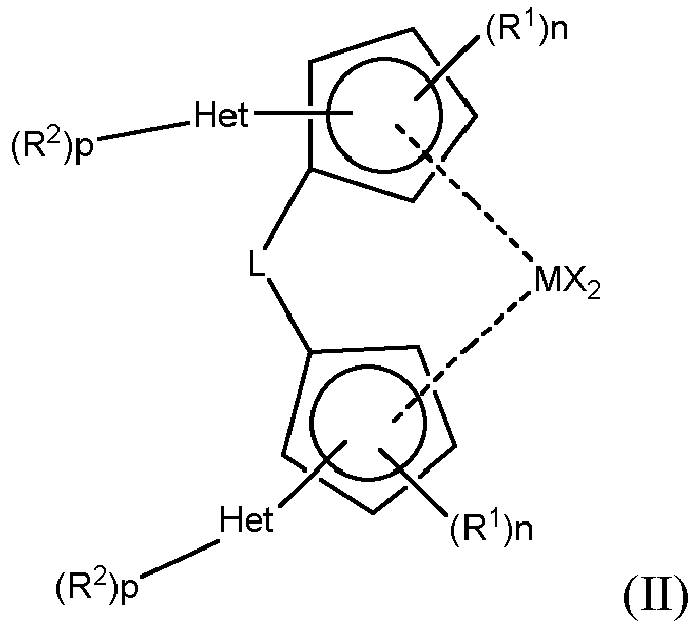 wherein each X is independently a halogen atom, a C1-6-alkyl, C1-6-alkoxy group, phenyl or benzyl group;each Het is independently a monocyclic heteroaromatic group containing at least one heteroatom selected from O or S;L is -R'2Si-, wherein each R' is independently C1-20-hydrocarbyl or C1-10-alkyl substituted with alkoxy having 1 to 10 carbon atoms;M is Ti, Zr or Hf;each R1 is the same or different and is a C1-6-alkyl group or C1-6-alkoxy group;each n is 1 to 2;each R2 is the same or different and is a C1-6-alkyl group, C1-6-alkoxy group or -Si(R)3 group;each R is C1-10-alkyl or phenyl group optionally substituted by 1 to 3 C1-6-alkyl groups; and each p is 0 to 1.
 - Blown film comprising a metallocene-catalysed multimodal copolymer (P) according to any of the preceding claims 1 to 9.
- Film according to claim 10, wherein the film is characterized by a sealing initiation temperature determined as described in the experimental part on a blown film with a thickness of 40 µm of below 97°C, preferably in the range of 60 to 96°C, more preferably in the range of 70 to 95°C and even more preferably in the range of 80 to 94°C.
- Film according to claim 10, wherein the film is characterized by a dart-drop impact strength (DDI) determined according to ASTM D1709, method A on a 40 µm monolayer test blown film of at least 500 g to 1200 g, preferably 600 g to 1000 g and more preferably 700 g to more than 900 g.
- Film according to claim 10, wherein the film is characterized by having at leasta) a sealing initiation temperature determined as described in the experimental part on a blown film with a thickness of 40 µm of below 97°C, preferably in the range of 60 to 96°C, more preferably in the range of 70 to 95°C and even more preferably in the range of 80 to 94°C,andb) a dart-drop impact strength (DDI) determined according to ASTM D1709, method A on a 40 µm monolayer test blown film of at least 500 g to 1200 g, preferably 600 g to 1000 g and more preferably 700 g to more than 900 g.
- Film according to any of the claims 10 to 13, wherein the films have a tensile modulus (measured on a 40 µm monolayer test blown film according to ISO 527-3) in machine (MD) as well as in transverse (TD) direction in the range of from > 150MPa to 400 MPa, preferably of from 200 MPa to 350 MPa.
- Use of a film according to any of the preceding claims 10 to 14 as packing material, in particular as a packing material for food and/or medical products.
Priority Applications (5)
| Application Number | Priority Date | Filing Date | Title |
|---|---|---|---|
| EP21181464.5A EP4108435B1 (en) | 2021-06-24 | 2021-06-24 | Polyethylene composition with improved processability |
| ES21181464T ES2983547T3 (en) | 2021-06-24 | 2021-06-24 | Polyethylene composition with improved processability |
| CN202280044604.9A CN117545621A (en) | 2021-06-24 | 2022-06-23 | Polyethylene composition with improved processability |
| US18/572,946 US20250270356A1 (en) | 2021-06-24 | 2022-06-23 | Polyethylene composition with improved processability |
| PCT/EP2022/067192 WO2022268964A1 (en) | 2021-06-24 | 2022-06-23 | Polyethylene composition with improved processability |
Applications Claiming Priority (1)
| Application Number | Priority Date | Filing Date | Title |
|---|---|---|---|
| EP21181464.5A EP4108435B1 (en) | 2021-06-24 | 2021-06-24 | Polyethylene composition with improved processability |
Publications (2)
| Publication Number | Publication Date |
|---|---|
| EP4108435A1 true EP4108435A1 (en) | 2022-12-28 |
| EP4108435B1 EP4108435B1 (en) | 2024-05-01 |
Family
ID=76971615
Family Applications (1)
| Application Number | Title | Priority Date | Filing Date |
|---|---|---|---|
| EP21181464.5A Active EP4108435B1 (en) | 2021-06-24 | 2021-06-24 | Polyethylene composition with improved processability |
Country Status (5)
| Country | Link |
|---|---|
| US (1) | US20250270356A1 (en) |
| EP (1) | EP4108435B1 (en) |
| CN (1) | CN117545621A (en) |
| ES (1) | ES2983547T3 (en) |
| WO (1) | WO2022268964A1 (en) |
Cited By (1)
| Publication number | Priority date | Publication date | Assignee | Title |
|---|---|---|---|---|
| WO2025026856A1 (en) | 2023-08-01 | 2025-02-06 | Borealis Ag | Polyethylene copolymer for a film layer |
Citations (8)
| Publication number | Priority date | Publication date | Assignee | Title |
|---|---|---|---|---|
| US20140194277A1 (en) * | 2011-03-30 | 2014-07-10 | Japan Polyethylene Corporation | Ethylene-based polymer, polyethylene-based resin composition and use thereof, catalyst component for olefin polymerization, olefin polymerization catalyst containing the component, and method for producing ethylene-based polymer by using the catalyst |
| WO2016083208A1 (en) * | 2014-11-26 | 2016-06-02 | Borealis Ag | Polyethylene composition for a film layer |
| WO2016198273A1 (en) | 2015-06-10 | 2016-12-15 | Borealis Ag | Multimodal copolymer of ethylene and at least two alpha-olefin comonomers and final articles made thereof |
| WO2020109563A1 (en) * | 2018-11-29 | 2020-06-04 | Borealis Ag | Process to produce a polymer and polymer |
| WO2021009190A1 (en) | 2019-07-17 | 2021-01-21 | Borealis Ag | Process for producing a polymer composition |
| WO2021009191A1 (en) | 2019-07-17 | 2021-01-21 | Borealis Ag | Process for producing a polymer composition |
| WO2021009192A1 (en) | 2019-07-17 | 2021-01-21 | Borealis Ag | Process for producing a polymer composition |
| WO2021009189A1 (en) | 2019-07-17 | 2021-01-21 | Borealis Ag | Process for producing a polymer composition |
Family Cites Families (1)
| Publication number | Priority date | Publication date | Assignee | Title |
|---|---|---|---|---|
| GB2533770B (en) * | 2014-12-22 | 2021-02-10 | Norner Verdandi As | Polyethylene for pipes |
-
2021
- 2021-06-24 ES ES21181464T patent/ES2983547T3/en active Active
- 2021-06-24 EP EP21181464.5A patent/EP4108435B1/en active Active
-
2022
- 2022-06-23 WO PCT/EP2022/067192 patent/WO2022268964A1/en not_active Ceased
- 2022-06-23 CN CN202280044604.9A patent/CN117545621A/en active Pending
- 2022-06-23 US US18/572,946 patent/US20250270356A1/en active Pending
Patent Citations (8)
| Publication number | Priority date | Publication date | Assignee | Title |
|---|---|---|---|---|
| US20140194277A1 (en) * | 2011-03-30 | 2014-07-10 | Japan Polyethylene Corporation | Ethylene-based polymer, polyethylene-based resin composition and use thereof, catalyst component for olefin polymerization, olefin polymerization catalyst containing the component, and method for producing ethylene-based polymer by using the catalyst |
| WO2016083208A1 (en) * | 2014-11-26 | 2016-06-02 | Borealis Ag | Polyethylene composition for a film layer |
| WO2016198273A1 (en) | 2015-06-10 | 2016-12-15 | Borealis Ag | Multimodal copolymer of ethylene and at least two alpha-olefin comonomers and final articles made thereof |
| WO2020109563A1 (en) * | 2018-11-29 | 2020-06-04 | Borealis Ag | Process to produce a polymer and polymer |
| WO2021009190A1 (en) | 2019-07-17 | 2021-01-21 | Borealis Ag | Process for producing a polymer composition |
| WO2021009191A1 (en) | 2019-07-17 | 2021-01-21 | Borealis Ag | Process for producing a polymer composition |
| WO2021009192A1 (en) | 2019-07-17 | 2021-01-21 | Borealis Ag | Process for producing a polymer composition |
| WO2021009189A1 (en) | 2019-07-17 | 2021-01-21 | Borealis Ag | Process for producing a polymer composition |
Non-Patent Citations (14)
| Title |
|---|
| "Definition of terms relating to the non-ultimate mechanical properties of polymers", PURE & APPL. CHEM., vol. 70, no. 3, 1998, pages 701 - 754 |
| BUSICO, V.CARBONNIERE, P.CIPULLO, R.PELLECCHIA, R.SEVERN, J.TALARICO, G., MACROMOL. RAPID COMMUN., vol. 28, 2007, pages 1128 |
| BUSICO, V.CIPULLO, R., PROG. POLYM. SCI., vol. 26, 2001, pages 443 |
| BUSICO, V.CIPULLO, R.MONACO, G.VACATELLO, M.SEGRE, A.L., MACROMOLEUCLES, vol. 30, 1997, pages 6251 |
| CASTIGNOLLES, P.GRAF, R.PARKINSON, M.WILHELM, M.GABORIEAU, M., POLYMER, vol. 50, 2009, pages 2373 |
| FILIP, X.TRIPON, C.FILIP, C., J. MAG. RESN., vol. 176, 2005, pages 239 |
| GRIFFIN, J.M.TRIPON, C.SAMOSON, A.FILIP, C.BROWN, S.P., MAG. RES. IN CHEM., vol. 45, no. S1, 2007, pages S198 |
| HEINO, E.L.: "Annual Transactions of the Nordic Rheology Society", 1995, BOREALIS POLYMERS OY, article "The influence of molecular structure on some rheological properties of polyethylene" |
| HEINO, E.L.LEHTINEN, A.TANNER J.SEPPALA, J.: "Theor. Appl. Rheol., Proc. Int. Congr. Rheol, 11th", vol. 1, 1992, NESTE OY, article "Rheological characterization of polyethylene fractions", pages: 360 - 362 |
| KLIMKE, K.PARKINSON, M.PIEL, C.KAMINSKY, W.SPIESS, H.W.WILHELM, M., MACROMOL. CHEM. PHYS., vol. 207, 2006, pages 382 |
| PARKINSON, M.KLIMKE, K.SPIESS, H.W.WILHELM, M., MACROMOL. CHEM. PHYS., vol. 208, 2007, pages 2128 |
| POLLARD, M.KLIMKE, K.GRAF, R.SPIESS, H.W.WILHELM, M.SPERBER, O.PIEL, C.KAMINSKY, W., MACROMOLECULES, vol. 37, 2004, pages 813 |
| RESCONI, L.CAVALLO, L.FAIT, A.PIEMONTESI, F., CHEM. REV., vol. 100, 2000, pages 1253 |
| ZHOU, Z.KUEMMERLE, R.QIU, X.REDWINE, D.CONG, R.TAHA, A.BAUGH, D.WINNIFORD, B., J. MAG. RESON., vol. 187, 2007, pages 225 |
Cited By (1)
| Publication number | Priority date | Publication date | Assignee | Title |
|---|---|---|---|---|
| WO2025026856A1 (en) | 2023-08-01 | 2025-02-06 | Borealis Ag | Polyethylene copolymer for a film layer |
Also Published As
| Publication number | Publication date |
|---|---|
| EP4108435B1 (en) | 2024-05-01 |
| WO2022268964A1 (en) | 2022-12-29 |
| ES2983547T3 (en) | 2024-10-23 |
| US20250270356A1 (en) | 2025-08-28 |
| CN117545621A (en) | 2024-02-09 |
Similar Documents
| Publication | Publication Date | Title |
|---|---|---|
| EP3224317A1 (en) | Polyethylene composition for a film layer | |
| EP4116359B1 (en) | Monolayer blown film | |
| US20250270355A1 (en) | Polyethylene Copolymer For A Film Layer | |
| EP4163333A1 (en) | Polyethylene composition for a film layer | |
| EP4522669A1 (en) | Polyethylene copolymer for a film layer | |
| US20250270354A1 (en) | Polyethylene copolymer for a film layer | |
| US20240287224A1 (en) | Polyethylene copolymer for a film layer | |
| US20250263509A1 (en) | Polyethylene copolymer with improved sealing performance | |
| EP4108435B1 (en) | Polyethylene composition with improved processability | |
| US20240336714A1 (en) | Polyethylene copolymer for a film layer | |
| WO2023144114A1 (en) | Polyethylene blend for a film layer | |
| EP4219601B1 (en) | Polyethylene blend for a film layer | |
| EP4219602B1 (en) | Polyethylene blend for a film layer | |
| EP4219600B1 (en) | Polyethylene blend for a film layer | |
| EP4219598B1 (en) | Polyethylene blend for a film layer | |
| EP4570831A1 (en) | Polyethylene copolymer for a film layer | |
| EP4245805A1 (en) | Polyethylene blend for a film layer | |
| WO2024074320A1 (en) | Polyethylene polymer for a film layer | |
| US20260139084A1 (en) | Polyethylene polymer for a film layer | |
| EP4296289A1 (en) | Polyethylene copolymer for a film layer |
Legal Events
| Date | Code | Title | Description |
|---|---|---|---|
| PUAI | Public reference made under article 153(3) epc to a published international application that has entered the european phase |
Free format text: ORIGINAL CODE: 0009012 |
|
| STAA | Information on the status of an ep patent application or granted ep patent |
Free format text: STATUS: THE APPLICATION HAS BEEN PUBLISHED |
|
| AK | Designated contracting states |
Kind code of ref document: A1 Designated state(s): AL AT BE BG CH CY CZ DE DK EE ES FI FR GB GR HR HU IE IS IT LI LT LU LV MC MK MT NL NO PL PT RO RS SE SI SK SM TR |
|
| STAA | Information on the status of an ep patent application or granted ep patent |
Free format text: STATUS: REQUEST FOR EXAMINATION WAS MADE |
|
| 17P | Request for examination filed |
Effective date: 20230314 |
|
| RBV | Designated contracting states (corrected) |
Designated state(s): AL AT BE BG CH CY CZ DE DK EE ES FI FR GB GR HR HU IE IS IT LI LT LU LV MC MK MT NL NO PL PT RO RS SE SI SK SM TR |
|
| GRAP | Despatch of communication of intention to grant a patent |
Free format text: ORIGINAL CODE: EPIDOSNIGR1 |
|
| STAA | Information on the status of an ep patent application or granted ep patent |
Free format text: STATUS: GRANT OF PATENT IS INTENDED |
|
| INTG | Intention to grant announced |
Effective date: 20231215 |
|
| RIC1 | Information provided on ipc code assigned before grant |
Ipc: C08F 4/659 20060101ALN20231201BHEP Ipc: C08L 23/08 20060101ALI20231201BHEP Ipc: C08J 5/18 20060101ALI20231201BHEP Ipc: C08F 210/16 20060101ALI20231201BHEP Ipc: B32B 25/00 20060101ALI20231201BHEP Ipc: B32B 7/04 20190101ALI20231201BHEP Ipc: B29D 7/01 20060101AFI20231201BHEP |
|
| P01 | Opt-out of the competence of the unified patent court (upc) registered |
Effective date: 20240112 |
|
| GRAS | Grant fee paid |
Free format text: ORIGINAL CODE: EPIDOSNIGR3 |
|
| GRAA | (expected) grant |
Free format text: ORIGINAL CODE: 0009210 |
|
| STAA | Information on the status of an ep patent application or granted ep patent |
Free format text: STATUS: THE PATENT HAS BEEN GRANTED |
|
| AK | Designated contracting states |
Kind code of ref document: B1 Designated state(s): AL AT BE BG CH CY CZ DE DK EE ES FI FR GB GR HR HU IE IS IT LI LT LU LV MC MK MT NL NO PL PT RO RS SE SI SK SM TR |
|
| REG | Reference to a national code |
Ref country code: GB Ref legal event code: FG4D |
|
| REG | Reference to a national code |
Ref country code: CH Ref legal event code: EP |
|
| REG | Reference to a national code |
Ref country code: DE Ref legal event code: R096 Ref document number: 602021012524 Country of ref document: DE |
|
| REG | Reference to a national code |
Ref country code: IE Ref legal event code: FG4D |
|
| REG | Reference to a national code |
Ref country code: LT Ref legal event code: MG9D |
|
| REG | Reference to a national code |
Ref country code: NL Ref legal event code: MP Effective date: 20240501 |
|
| PG25 | Lapsed in a contracting state [announced via postgrant information from national office to epo] |
Ref country code: IS Free format text: LAPSE BECAUSE OF FAILURE TO SUBMIT A TRANSLATION OF THE DESCRIPTION OR TO PAY THE FEE WITHIN THE PRESCRIBED TIME-LIMIT Effective date: 20240901 |
|
| PG25 | Lapsed in a contracting state [announced via postgrant information from national office to epo] |
Ref country code: BG Free format text: LAPSE BECAUSE OF FAILURE TO SUBMIT A TRANSLATION OF THE DESCRIPTION OR TO PAY THE FEE WITHIN THE PRESCRIBED TIME-LIMIT Effective date: 20240501 |
|
| PG25 | Lapsed in a contracting state [announced via postgrant information from national office to epo] |
Ref country code: FI Free format text: LAPSE BECAUSE OF FAILURE TO SUBMIT A TRANSLATION OF THE DESCRIPTION OR TO PAY THE FEE WITHIN THE PRESCRIBED TIME-LIMIT Effective date: 20240501 Ref country code: HR Free format text: LAPSE BECAUSE OF FAILURE TO SUBMIT A TRANSLATION OF THE DESCRIPTION OR TO PAY THE FEE WITHIN THE PRESCRIBED TIME-LIMIT Effective date: 20240501 |
|
| PG25 | Lapsed in a contracting state [announced via postgrant information from national office to epo] |
Ref country code: GR Free format text: LAPSE BECAUSE OF FAILURE TO SUBMIT A TRANSLATION OF THE DESCRIPTION OR TO PAY THE FEE WITHIN THE PRESCRIBED TIME-LIMIT Effective date: 20240802 |
|
| PG25 | Lapsed in a contracting state [announced via postgrant information from national office to epo] |
Ref country code: PT Free format text: LAPSE BECAUSE OF FAILURE TO SUBMIT A TRANSLATION OF THE DESCRIPTION OR TO PAY THE FEE WITHIN THE PRESCRIBED TIME-LIMIT Effective date: 20240902 |
|
| REG | Reference to a national code |
Ref country code: AT Ref legal event code: MK05 Ref document number: 1681790 Country of ref document: AT Kind code of ref document: T Effective date: 20240501 |
|
| PG25 | Lapsed in a contracting state [announced via postgrant information from national office to epo] |
Ref country code: NL Free format text: LAPSE BECAUSE OF FAILURE TO SUBMIT A TRANSLATION OF THE DESCRIPTION OR TO PAY THE FEE WITHIN THE PRESCRIBED TIME-LIMIT Effective date: 20240501 |
|
| REG | Reference to a national code |
Ref country code: ES Ref legal event code: FG2A Ref document number: 2983547 Country of ref document: ES Kind code of ref document: T3 Effective date: 20241023 |
|
| PG25 | Lapsed in a contracting state [announced via postgrant information from national office to epo] |
Ref country code: AT Free format text: LAPSE BECAUSE OF FAILURE TO SUBMIT A TRANSLATION OF THE DESCRIPTION OR TO PAY THE FEE WITHIN THE PRESCRIBED TIME-LIMIT Effective date: 20240501 |
|
| PG25 | Lapsed in a contracting state [announced via postgrant information from national office to epo] |
Ref country code: PL Free format text: LAPSE BECAUSE OF FAILURE TO SUBMIT A TRANSLATION OF THE DESCRIPTION OR TO PAY THE FEE WITHIN THE PRESCRIBED TIME-LIMIT Effective date: 20240501 |
|
| PG25 | Lapsed in a contracting state [announced via postgrant information from national office to epo] |
Ref country code: LV Free format text: LAPSE BECAUSE OF FAILURE TO SUBMIT A TRANSLATION OF THE DESCRIPTION OR TO PAY THE FEE WITHIN THE PRESCRIBED TIME-LIMIT Effective date: 20240501 |
|
| PG25 | Lapsed in a contracting state [announced via postgrant information from national office to epo] |
Ref country code: PT Free format text: LAPSE BECAUSE OF FAILURE TO SUBMIT A TRANSLATION OF THE DESCRIPTION OR TO PAY THE FEE WITHIN THE PRESCRIBED TIME-LIMIT Effective date: 20240902 Ref country code: PL Free format text: LAPSE BECAUSE OF FAILURE TO SUBMIT A TRANSLATION OF THE DESCRIPTION OR TO PAY THE FEE WITHIN THE PRESCRIBED TIME-LIMIT Effective date: 20240501 Ref country code: NO Free format text: LAPSE BECAUSE OF FAILURE TO SUBMIT A TRANSLATION OF THE DESCRIPTION OR TO PAY THE FEE WITHIN THE PRESCRIBED TIME-LIMIT Effective date: 20240801 Ref country code: NL Free format text: LAPSE BECAUSE OF FAILURE TO SUBMIT A TRANSLATION OF THE DESCRIPTION OR TO PAY THE FEE WITHIN THE PRESCRIBED TIME-LIMIT Effective date: 20240501 Ref country code: LV Free format text: LAPSE BECAUSE OF FAILURE TO SUBMIT A TRANSLATION OF THE DESCRIPTION OR TO PAY THE FEE WITHIN THE PRESCRIBED TIME-LIMIT Effective date: 20240501 Ref country code: IS Free format text: LAPSE BECAUSE OF FAILURE TO SUBMIT A TRANSLATION OF THE DESCRIPTION OR TO PAY THE FEE WITHIN THE PRESCRIBED TIME-LIMIT Effective date: 20240901 Ref country code: HR Free format text: LAPSE BECAUSE OF FAILURE TO SUBMIT A TRANSLATION OF THE DESCRIPTION OR TO PAY THE FEE WITHIN THE PRESCRIBED TIME-LIMIT Effective date: 20240501 Ref country code: GR Free format text: LAPSE BECAUSE OF FAILURE TO SUBMIT A TRANSLATION OF THE DESCRIPTION OR TO PAY THE FEE WITHIN THE PRESCRIBED TIME-LIMIT Effective date: 20240802 Ref country code: FI Free format text: LAPSE BECAUSE OF FAILURE TO SUBMIT A TRANSLATION OF THE DESCRIPTION OR TO PAY THE FEE WITHIN THE PRESCRIBED TIME-LIMIT Effective date: 20240501 Ref country code: BG Free format text: LAPSE BECAUSE OF FAILURE TO SUBMIT A TRANSLATION OF THE DESCRIPTION OR TO PAY THE FEE WITHIN THE PRESCRIBED TIME-LIMIT Effective date: 20240501 Ref country code: AT Free format text: LAPSE BECAUSE OF FAILURE TO SUBMIT A TRANSLATION OF THE DESCRIPTION OR TO PAY THE FEE WITHIN THE PRESCRIBED TIME-LIMIT Effective date: 20240501 Ref country code: RS Free format text: LAPSE BECAUSE OF FAILURE TO SUBMIT A TRANSLATION OF THE DESCRIPTION OR TO PAY THE FEE WITHIN THE PRESCRIBED TIME-LIMIT Effective date: 20240801 |
|
| PG25 | Lapsed in a contracting state [announced via postgrant information from national office to epo] |
Ref country code: DK Free format text: LAPSE BECAUSE OF FAILURE TO SUBMIT A TRANSLATION OF THE DESCRIPTION OR TO PAY THE FEE WITHIN THE PRESCRIBED TIME-LIMIT Effective date: 20240501 |
|
| PG25 | Lapsed in a contracting state [announced via postgrant information from national office to epo] |
Ref country code: EE Free format text: LAPSE BECAUSE OF FAILURE TO SUBMIT A TRANSLATION OF THE DESCRIPTION OR TO PAY THE FEE WITHIN THE PRESCRIBED TIME-LIMIT Effective date: 20240501 |
|
| PG25 | Lapsed in a contracting state [announced via postgrant information from national office to epo] |
Ref country code: CZ Free format text: LAPSE BECAUSE OF FAILURE TO SUBMIT A TRANSLATION OF THE DESCRIPTION OR TO PAY THE FEE WITHIN THE PRESCRIBED TIME-LIMIT Effective date: 20240501 |
|
| PG25 | Lapsed in a contracting state [announced via postgrant information from national office to epo] |
Ref country code: SK Free format text: LAPSE BECAUSE OF FAILURE TO SUBMIT A TRANSLATION OF THE DESCRIPTION OR TO PAY THE FEE WITHIN THE PRESCRIBED TIME-LIMIT Effective date: 20240501 Ref country code: RO Free format text: LAPSE BECAUSE OF FAILURE TO SUBMIT A TRANSLATION OF THE DESCRIPTION OR TO PAY THE FEE WITHIN THE PRESCRIBED TIME-LIMIT Effective date: 20240501 |
|
| PG25 | Lapsed in a contracting state [announced via postgrant information from national office to epo] |
Ref country code: SM Free format text: LAPSE BECAUSE OF FAILURE TO SUBMIT A TRANSLATION OF THE DESCRIPTION OR TO PAY THE FEE WITHIN THE PRESCRIBED TIME-LIMIT Effective date: 20240501 |
|
| PG25 | Lapsed in a contracting state [announced via postgrant information from national office to epo] |
Ref country code: SM Free format text: LAPSE BECAUSE OF FAILURE TO SUBMIT A TRANSLATION OF THE DESCRIPTION OR TO PAY THE FEE WITHIN THE PRESCRIBED TIME-LIMIT Effective date: 20240501 Ref country code: SK Free format text: LAPSE BECAUSE OF FAILURE TO SUBMIT A TRANSLATION OF THE DESCRIPTION OR TO PAY THE FEE WITHIN THE PRESCRIBED TIME-LIMIT Effective date: 20240501 Ref country code: RO Free format text: LAPSE BECAUSE OF FAILURE TO SUBMIT A TRANSLATION OF THE DESCRIPTION OR TO PAY THE FEE WITHIN THE PRESCRIBED TIME-LIMIT Effective date: 20240501 Ref country code: EE Free format text: LAPSE BECAUSE OF FAILURE TO SUBMIT A TRANSLATION OF THE DESCRIPTION OR TO PAY THE FEE WITHIN THE PRESCRIBED TIME-LIMIT Effective date: 20240501 Ref country code: DK Free format text: LAPSE BECAUSE OF FAILURE TO SUBMIT A TRANSLATION OF THE DESCRIPTION OR TO PAY THE FEE WITHIN THE PRESCRIBED TIME-LIMIT Effective date: 20240501 Ref country code: CZ Free format text: LAPSE BECAUSE OF FAILURE TO SUBMIT A TRANSLATION OF THE DESCRIPTION OR TO PAY THE FEE WITHIN THE PRESCRIBED TIME-LIMIT Effective date: 20240501 Ref country code: MC Free format text: LAPSE BECAUSE OF FAILURE TO SUBMIT A TRANSLATION OF THE DESCRIPTION OR TO PAY THE FEE WITHIN THE PRESCRIBED TIME-LIMIT Effective date: 20240501 |
|
| REG | Reference to a national code |
Ref country code: CH Ref legal event code: PL |
|
| REG | Reference to a national code |
Ref country code: DE Ref legal event code: R097 Ref document number: 602021012524 Country of ref document: DE |
|
| PG25 | Lapsed in a contracting state [announced via postgrant information from national office to epo] |
Ref country code: LU Free format text: LAPSE BECAUSE OF NON-PAYMENT OF DUE FEES Effective date: 20240624 |
|
| PLBE | No opposition filed within time limit |
Free format text: ORIGINAL CODE: 0009261 |
|
| STAA | Information on the status of an ep patent application or granted ep patent |
Free format text: STATUS: NO OPPOSITION FILED WITHIN TIME LIMIT |
|
| 26N | No opposition filed |
Effective date: 20250204 |
|
| PG25 | Lapsed in a contracting state [announced via postgrant information from national office to epo] |
Ref country code: IE Free format text: LAPSE BECAUSE OF NON-PAYMENT OF DUE FEES Effective date: 20240624 |
|
| PG25 | Lapsed in a contracting state [announced via postgrant information from national office to epo] |
Ref country code: BE Free format text: LAPSE BECAUSE OF NON-PAYMENT OF DUE FEES Effective date: 20240630 Ref country code: SI Free format text: LAPSE BECAUSE OF FAILURE TO SUBMIT A TRANSLATION OF THE DESCRIPTION OR TO PAY THE FEE WITHIN THE PRESCRIBED TIME-LIMIT Effective date: 20240501 Ref country code: CH Free format text: LAPSE BECAUSE OF NON-PAYMENT OF DUE FEES Effective date: 20240630 |
|
| REG | Reference to a national code |
Ref country code: BE Ref legal event code: MM Effective date: 20240630 |
|
| PGFP | Annual fee paid to national office [announced via postgrant information from national office to epo] |
Ref country code: DE Payment date: 20250618 Year of fee payment: 5 |
|
| PGFP | Annual fee paid to national office [announced via postgrant information from national office to epo] |
Ref country code: GB Payment date: 20250618 Year of fee payment: 5 |
|
| PGFP | Annual fee paid to national office [announced via postgrant information from national office to epo] |
Ref country code: FR Payment date: 20250627 Year of fee payment: 5 |
|
| PG25 | Lapsed in a contracting state [announced via postgrant information from national office to epo] |
Ref country code: SE Free format text: LAPSE BECAUSE OF FAILURE TO SUBMIT A TRANSLATION OF THE DESCRIPTION OR TO PAY THE FEE WITHIN THE PRESCRIBED TIME-LIMIT Effective date: 20240501 |
|
| PGFP | Annual fee paid to national office [announced via postgrant information from national office to epo] |
Ref country code: ES Payment date: 20250731 Year of fee payment: 5 |
|
| PGFP | Annual fee paid to national office [announced via postgrant information from national office to epo] |
Ref country code: IT Payment date: 20250624 Year of fee payment: 5 |
|
| PG25 | Lapsed in a contracting state [announced via postgrant information from national office to epo] |
Ref country code: CY Free format text: LAPSE BECAUSE OF FAILURE TO SUBMIT A TRANSLATION OF THE DESCRIPTION OR TO PAY THE FEE WITHIN THE PRESCRIBED TIME-LIMIT; INVALID AB INITIO Effective date: 20210624 |
|
| PG25 | Lapsed in a contracting state [announced via postgrant information from national office to epo] |
Ref country code: HU Free format text: LAPSE BECAUSE OF FAILURE TO SUBMIT A TRANSLATION OF THE DESCRIPTION OR TO PAY THE FEE WITHIN THE PRESCRIBED TIME-LIMIT; INVALID AB INITIO Effective date: 20210624 |