EP4108106A1 - Gravure printed banded wrapper paper - Google Patents
Gravure printed banded wrapper paper Download PDFInfo
- Publication number
- EP4108106A1 EP4108106A1 EP22166022.8A EP22166022A EP4108106A1 EP 4108106 A1 EP4108106 A1 EP 4108106A1 EP 22166022 A EP22166022 A EP 22166022A EP 4108106 A1 EP4108106 A1 EP 4108106A1
- Authority
- EP
- European Patent Office
- Prior art keywords
- fibrous crystalline
- crystalline cellulosic
- cellulosic material
- base web
- fibrous
- Prior art date
- Legal status (The legal status is an assumption and is not a legal conclusion. Google has not performed a legal analysis and makes no representation as to the accuracy of the status listed.)
- Granted
Links
Images



Classifications
-
- A—HUMAN NECESSITIES
- A24—TOBACCO; CIGARS; CIGARETTES; SIMULATED SMOKING DEVICES; SMOKERS' REQUISITES
- A24C—MACHINES FOR MAKING CIGARS OR CIGARETTES
- A24C5/00—Making cigarettes; Making tipping materials for, or attaching filters or mouthpieces to, cigars or cigarettes
- A24C5/005—Treatment of cigarette paper
-
- A—HUMAN NECESSITIES
- A24—TOBACCO; CIGARS; CIGARETTES; SIMULATED SMOKING DEVICES; SMOKERS' REQUISITES
- A24D—CIGARS; CIGARETTES; TOBACCO SMOKE FILTERS; MOUTHPIECES OF CIGARS OR CIGARETTES; MANUFACTURE OF TOBACCO SMOKE FILTERS OR MOUTHPIECES
- A24D1/00—Cigars; Cigarettes
- A24D1/02—Cigars; Cigarettes with special covers
- A24D1/025—Cigars; Cigarettes with special covers the covers having material applied to defined areas, e.g. bands for reducing the ignition propensity
-
- A—HUMAN NECESSITIES
- A24—TOBACCO; CIGARS; CIGARETTES; SIMULATED SMOKING DEVICES; SMOKERS' REQUISITES
- A24D—CIGARS; CIGARETTES; TOBACCO SMOKE FILTERS; MOUTHPIECES OF CIGARS OR CIGARETTES; MANUFACTURE OF TOBACCO SMOKE FILTERS OR MOUTHPIECES
- A24D1/00—Cigars; Cigarettes
- A24D1/04—Cigars; Cigarettes with mouthpieces or filter-tips
- A24D1/045—Cigars; Cigarettes with mouthpieces or filter-tips with smoke filter means
-
- A—HUMAN NECESSITIES
- A24—TOBACCO; CIGARS; CIGARETTES; SIMULATED SMOKING DEVICES; SMOKERS' REQUISITES
- A24D—CIGARS; CIGARETTES; TOBACCO SMOKE FILTERS; MOUTHPIECES OF CIGARS OR CIGARETTES; MANUFACTURE OF TOBACCO SMOKE FILTERS OR MOUTHPIECES
- A24D1/00—Cigars; Cigarettes
- A24D1/16—Bands for cigars or cigarettes
-
- D—TEXTILES; PAPER
- D21—PAPER-MAKING; PRODUCTION OF CELLULOSE
- D21H—PULP COMPOSITIONS; PREPARATION THEREOF NOT COVERED BY SUBCLASSES D21C OR D21D; IMPREGNATING OR COATING OF PAPER; TREATMENT OF FINISHED PAPER NOT COVERED BY CLASS B31 OR SUBCLASS D21G; PAPER NOT OTHERWISE PROVIDED FOR
- D21H19/00—Coated paper; Coating material
- D21H19/36—Coatings with pigments
- D21H19/44—Coatings with pigments characterised by the other ingredients, e.g. the binder or dispersing agent
- D21H19/52—Cellulose; Derivatives thereof
Definitions
- the Ignition Propensity value for a smoking article should preferably be no greater than about 25%, when tested in accordance with ASTM E2187. More preferably, the IP value should be no greater than about 20%, and even more preferably no greater than about 10%. Accordingly, efforts to meet such limits are undertaken by various manufacturers of smoking articles.
- a smoking article includes a tobacco rod comprising a column of filler and a wrapper surrounding the column of filler.
- the tobacco rod has a circumferential direction, a longitudinal direction, a lit end, and a mouth end.
- the wrapper includes a base web having generally parallel first and second side edges extending in the longitudinal direction and two ends extending in the circumferential direction wherein the base web is disposed around the column of filler such that the first and second side edges of the base web overlap and form a seam.
- the base web includes at least one circumferentially extending banded region of fibrous crystalline cellulosic material thereon.
- the fibrous crystalline cellulosic material is in a condition of having been gravure printed on the base web as a fibrous crystalline cellulosic slurry that comprises water, crystalline cellulose, and chalk wherein the fibrous crystalline cellulosic slurry has a solids content of about 10% or less by weight of the fibrous crystalline cellulosic slurry.
- a wrapper for smoking articles includes a base web having generally parallel first and second side edges extending in a longitudinal direction, two ends extending in a transverse direction, and a plurality of longitudinally spaced banded regions of fibrous crystalline cellulosic material thereon, the fibrous crystalline cellulosic material having been gravure printed on the base web as a fibrous crystalline cellulosic slurry comprising water, crystalline cellulose, and chalk wherein the fibrous crystalline cellulosic slurry has a solids content of about 10% or less by weight of the fibrous crystalline cellulosic slurry.
- a method of making banded wrapper paper for smoking articles includes advancing a base web to a first printing station and printing a first layer of a fibrous crystalline cellulosic slurry on the base web.
- the fibrous crystalline cellulosic slurry includes water, crystalline cellulose, and chalk and has a solids content of about 10% or less by weight of the fibrous crystalline cellulosic slurry.
- the printing includes applying the fibrous crystalline cellulosic slurry to a patterned gravure roller, and contacting the advancing base web with the patterned gravure roller to apply bands of the fibrous crystalline cellulosic slurry on the base web. Banded regions of fibrous crystalline cellulosic material are formed on the base web by drying the bands of the fibrous crystalline cellulosic slurry.
- a smoking article 120 such as a cigarette, can comprise a tobacco rod 122 and a filter 132 attached to one end of the tobacco rod 122 with tipping paper 129.
- the tobacco rod 122 comprises a column of shredded tobacco ("cut filler") and a piece of banded wrapper paper 123 disposed about the column of shredded tobacco.
- the tobacco rod 122 has a lightable or lit end 124 and a tipped end 130, which, in the case of non-filtered cigarettes, is referenced as the mouth end 130 of the smoking article 120. Cut filler tobacco is an industry-standard designation.
- the tobacco rod 122 has a generally circular cross section. In other example embodiments, the tobacco rod 122 can have an oval cross section or other non-circular shape cross section.
- the wrapper 123 is sealed along a longitudinal seam to form the tobacco rod 122.
- the smoking article 120 has a nominal length measured from the edge 131 of the tipping paper to the lit end 124 of the tobacco rod 122 along a longitudinal axis of smoking article 120.
- that nominal length may lie in the range of about 60 to about 100 mm.
- the banded wrapper paper 123 can include a base web 140 that may be made from flax, wood pulp, cellulose fiber, or the like.
- the base web 140 has a plurality of bands of fibrous crystalline cellulosic material 126 on one or both sides thereof.
- the bands of fibrous crystalline cellulosic material 126 are applied to a wire side of the base web 140 such that they are on the inside of the banded wrapper paper 123 when a piece of the wrapper 123 surrounds a column of shredded tobacco to form a tobacco rod 122.
- base web 140 In the manufacture of base web 140 suited for the construction of the various embodiments of banded wrapper paper disclosed herein, such manufacture usually will include the production of a roll of base web 140 of several feet across (usually about 3 feet to about 5 feet across or in transverse dimension), which is then slit into ribbons that are wound on bobbins. Printing operations are conducted on the rolls, but could be conducted after slitting.
- the bobbins themselves will have a transverse dimension equivalent to the width needed to make tobacco rods 122 or an integral number of such widths (e.g., 1, 2, or 4 of such widths).
- the bobbins are adapted for use with typical cigarette making machines.
- the banded wrapper paper has a dimension in cross-direction that takes into account the nominal circumference of the tobacco rod 122 and an overlapping seam. As a result, when the banded wrapper paper 123 is slit, the smoking article 120 formed therefrom always has a longitudinal seam with an exact overlap.
- longitudinal refers to the direction along the length of a tobacco rod 122 (e.g., along the axis 134 in FIG. 1 ), or along the length of a base web 140 (e.g., arrow 142 in FIGs. 2 and 6 ) used in the preparation of banded wrapper paper 123 that, in turn, may be used to fabricate a tobacco rod 122.
- transverse refers to the direction circumferentially around a tobacco rod 122 (see FIG. 1 ) or the direction perpendicular to the length of the base web 140 (e.g., arrow 144 in FIGs. 2 and 6 ) used in the preparation of banded wrapper paper 123 that, in turn, may be used to fabricate a tobacco rod 122.
- a “band” or “banded region” 126 is an area (see FIG. 2 ) on an underlying base web 140 to which a fibrous crystalline cellulosic slurry has been printed to form a region of fibrous crystalline cellulosic material.
- the phrase “leading edge” refers to the edge 146 (see FIG.
- band spacing refers to the distance between the trailing edge 148 of one banded region 126 and the leading edge 146 of an adjacent banded region 126 on the base web 140 from which banded wrapper paper 123 is fashioned.
- phase refers to the distance from the leading edge 146 of one banded region 126 to the leading edge 146 of an adjacent banded region 126.
- the banded regions of fibrous crystalline cellulosic material 126 extend transversely across the base web 140 and are separated by regions free of added fibrous crystalline cellulosic material in the longitudinal direction 142 of the base web 140.
- the banded regions of fibrous crystalline cellulosic material 126 are applied to the base web 140 of the banded wrapper paper 123 to obtain satisfactory or improved Ignition Propensity ("IP") characteristics for a smoking article including a piece of the banded wrapper paper 123 and optionally to also obtain improved Self-Extinguishment ("SE”) characteristics for the smoking article.
- IP Ignition Propensity
- SE Self-Extinguishment
- the banded regions of fibrous crystalline cellulosic material 126 are arranged on the base web 140 such that at least one banded region of fibrous crystalline cellulosic material 126 is positioned between the lit end 124 and the tipped end 130 of the tobacco rod 122 in each finished smoking article 120 that includes the banded wrapper paper 123. In an example embodiment, at least two banded regions of fibrous crystalline cellulosic material 126 are positioned between the lit end 124 and the tipped end 130 of the tobacco rod 122 in each finished smoking article 120 that includes the banded wrapper paper 123. In an example embodiment, the banded regions of fibrous crystalline cellulosic material 126 extend circumferentially around the tobacco rod at one or more longitudinally spaced locations along the axis 134 thereof.
- band or banded region "width” extends in a longitudinal direction along axis 142 of the base web 140 (see FIG. 2 ) or axis 134 of the tobacco rod 122, whereas a dimension in the circumferential direction will be expressed as “circumferential” or “transverse” or “in cross-direction.”
- the "width" of the banded regions of fibrous crystalline cellulosic material 126 is measured in the longitudinal direction 142 from a leading edge 146 to a trailing edge 148 thereof.
- the widths of the banded regions of fibrous crystalline cellulosic material 126 are each about 5 to about 9 mm (from the leading edge 146 to the trailing edge 148).
- the widths of the banded regions of fibrous crystalline cellulosic material 126 are each about 5.5 to about 7.5 mm.
- the widths of the banded regions of fibrous crystalline cellulosic material 126 are each about 6 to about 7 mm.
- adjacent banded regions of fibrous crystalline cellulosic material 126 are longitudinally spaced by regions of the base web 140 free of added fibrous crystalline cellulosic material by a distance of about 20 mm to about 30 mm.
- the phase i.e., the spacing from the leading edge 146 of one banded region 126 to the leading edge 146 of an adjacent banded region 126) is about 25 mm or 27 mm.
- banded regions of fibrous crystalline cellulosic material 126 are depicted in this disclosure as solid bands, other configurations of the banded regions 126 on the base web 140 are within the spirit and scope of this disclosure, including, but not limited to, configurations in which the banded regions 126 have one or more areas free of added fibrous crystalline cellulosic material between the leading and trailing edges 146, 148 thereof.
- the base web 140 of the banded wrapper paper 123 is permeable to air. Permeability of the base web 140 is typically identified in CORESTA units.
- a CORESTA unit measures paper permeability in terms of volumetric flow rate (i.e., cm 3 /sec) per unit area (i.e., cm 2 ) per unit pressure drop (i.e., cm of water).
- the base web 140 of the banded wrapper paper 123 has a permeability of at least about 20 CORESTA units and a basis weight of about 22 to 30 gram(s) per square meter in regions outside of the banded regions of fibrous crystalline cellulosic material 126.
- the base web 140 of the banded wrapper paper 123 has a permeability of at least about 20 CORESTA units and a basis weight of about 25 to 27 gsm in regions outside of the banded regions of fibrous crystalline cellulosic material 126. In an example embodiment, the base web 140 of the wrapper 123 has a permeability greater than about 30 CORESTA in regions outside of the banded regions of fibrous crystalline cellulosic material 126.
- the base web 140 of the wrapper 123 has a permeability of about 33 CORESTA with a basis weight of about 25 gsm in regions outside of the banded regions of fibrous crystalline cellulosic material 126. In an example embodiment, the base web 140 of the wrapper 123 has a permeability of about 46 CORESTA with a basis weight of about 25 gsm in regions outside of the banded regions of fibrous crystalline cellulosic material 126. In an example embodiment, the base web 140 of the wrapper 123 has a permeability of about 60 CORESTA in regions outside of the banded regions of fibrous crystalline cellulosic material 126.
- the base web 140 of the wrapper 123 has a permeability of about 60 CORESTA with a basis weight of about 25 gsm in regions outside of the banded regions of fibrous crystalline cellulosic material 126. In an example embodiment, the base web 140 of the wrapper 123 has a permeability of about 60 CORESTA with a basis weight of about 26 gsm in regions outside of the banded regions of fibrous crystalline cellulosic material 126.
- the base web 140 has a permeability greater than about 60 CORESTA with a basis weight of about 25 gsm or more, a permeability greater than about 80 CORESTA with a basis weight of about 25 gsm or more, or a permeability greater than about 100 CORESTA with a basis weight of about 25 gsm or more in regions outside of the banded regions of fibrous crystalline cellulosic material 126.
- application of the fibrous crystalline cellulosic slurry to a base web 140 and drying thereof forms a banded region of fibrous crystalline cellulosic material 126 on the base web 140 that is effective to locally reduce the permeability of the base web 140 within the banded region 126.
- bands of fibrous crystalline cellulosic slurry are printed on the base web 140 with a gravure roller 610 to reduce the permeability of the base web 140 within the banded regions of fibrous crystalline cellulosic material 126 to about 0 to about 12 CORESTA.
- the permeability of the base web 140 within the banded regions of fibrous crystalline cellulosic material 126 is 7 CORESTA or less.
- application of the fibrous crystalline cellulosic slurry to the base web 140 and drying thereof forms a banded region of fibrous crystalline cellulosic material 126 on the base web 140 that is effective to locally reduce diffusivity values of the base web 140 from a diffusivity level of about 2 cm/sec or greater (for the base web 140 in regions free of added fibrous crystalline cellulosic material) to a value in the range of 0.0 to about 0.2 cm/sec as measured by a Sodim CO 2 Diffusivity Tester (purchased from Sodim SAS of France).
- the banded wrapper paper 123 is positioned within a clamping head so that the banded wrapper paper 123 separates two vertically arranged chambers.
- the upper chamber contains a carrier gas, such as nitrogen, while the lower chamber contains a marker gas, such as carbon dioxide.
- a carrier gas such as nitrogen
- the lower chamber contains a marker gas, such as carbon dioxide.
- the concentration of carbon dioxide within the nitrogen stream of the upper chamber is measured in an analyzer.
- a computer then converts the detected level of concentration into a measure of diffusivity.
- the diffusivity of the base web 140 within the banded regions of fibrous crystalline cellulosic material 126 is less than about 0.15 cm/sec.
- the diffusivity of the base web 140 within the banded regions of fibrous crystalline cellulosic material 126 is about 0 to about 0.1 cm/sec (e.g. about 0.01 to about 0.09 cm/sec, about 0.02 to about 0.08 cm/sec, about 0.03 to about 0.07 cm/sec or about 0.04 to about 0.06 cm/sec).
- each banded region of fibrous crystalline cellulosic material 126 may be formed by gravure printing a "layer" of a fibrous crystalline cellulosic slurry on the base web 140 to reduce the permeability of the base web 140 in the corresponding banded region.
- the fibrous crystalline cellulosic slurry is aqueous.
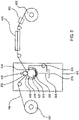
- FIG. 3 is a schematic view of a single stage printing apparatus 602.
- a supply reel 601 supplies a blank base web 140 to a gravure printing station 602 where a banded region of fibrous crystalline cellulosic slurry is printed on the blank base web 140 by the gravure roller 610 and dried in a drier 634.
- the drier 634 can include at least one steam can.
- the drier 634 can include two steam cans wherein the base web 140 is advanced and pressed between the steam cans to reduce wrinkling of the base web 140.
- the dried, patterned base web 140 then advances to a collection reel 608.
- a wide base web 140 may be slit or divided by a slitter 635 into a plurality of narrower strips of base web that may be wound to form individual bobbins after the printing operation, where the bobbins have a width corresponding to that required for a smoking article 120.
- the optional slitter 635 may be used on the base web 140 as that base web 140 leaves the printing station, or the slitter and slitting operation may be conducted at a different location.
- Example embodiments of gravure printing the fibrous crystalline cellulosic slurry as disclosed herein enable high-speed printing on the base web 140.
- "high-speed" printing refers to printing processes where the base web 140 advances through the printing process at a linear speed greater than about 300 feet/min.
- the size of the crystalline fibers in the fibrous crystalline cellulosic slurry, and the deposition rate and viscosity of the fibrous crystalline cellulosic slurry are selected such that base web printing speeds of greater than 500 feet/minute can be achieved.
- the gravure cylinder (roller) 610 includes a plurality of cells 700 arranged in a pattern corresponding to a band that is to be printed on the base web 140 by the gravure roller 610.
- the gravure cylinder 610 includes two or more circumferentially spaced regions 701 of cells 700 wherein each region 701 of cells 700 is arranged in a pattern corresponding to a band that is to be printed on the base web 140 by the gravure roller 610.
- adjacent regions 701 of cells 700 are circumferentially spaced by cell free surfaces 703 of the gravure roller 610 which extend a distance corresponding to the spacing between adjacent banded regions to be printed on the base web 140.
- the pattern of cells 700 corresponding to banded regions are arranged in a chevron pattern wherein angle "A" at the tip or apex of the chevron is preferably greater than about 170 degrees.
- angle "A" at the tip or apex of the chevron is preferably greater than about 170 degrees.
- the cells of the gravure roller 610 can be formed by etching the gravure roller 610. Suitable etching processes and gravure cylinders can be obtained from Heliograph Holding GmbH.
- photoresist 801 is applied to a metallic surface 800, and lasers 802 are used to activate the photoresist, which serves to mask areas where walls are desired.
- the gravure roller 610 (shown in FIG. 4 ) has a plurality of cells 700 which have a generally hexagonal shape.
- the cells 700 of the gravure roller 610 can have walls 702 ranging from about 12 to about 80 microns in width between adjacent cells 700 depending on the desired final volume of each cell 700. In an example embodiment, the cells 700 of the gravure roller 610 can have walls 702 ranging from about 12 to about 20 microns in width between adjacent cells 700. In an example embodiment, the gravure cylinder 610 can be formed such that certain cells within a region of cells are thinner than walls of other cells of the gravure roller 610. In an example embodiment, the cells 700 of the gravure roller 610 can have a generally circular shape. In an example embodiment, the depth of the cells 700 is uniform. However, in other embodiments, the depth of the cells 700 can vary.
- the cells 700 are filled with the fibrous crystalline cellulosic slurry such that they may print the fibrous crystalline cellulosic slurry on the base web 140.
- the cells 700 are sized to print dots of the fibrous crystalline cellulosic slurry which spread to form a continuous band of fibrous crystalline cellulosic material 126 on the base web 140 when the fibrous crystalline cellulosic slurry is dried.
- the cells 700 are sized to print dots of the fibrous crystalline cellulosic slurry to form a substantially continuous band of fibrous crystalline cellulosic material 126 on the base web 140 when the fibrous crystalline cellulosic slurry is dried.
- the cells 700 are sized to print small enough dots of the fibrous crystalline cellulosic slurry to form a non-continuous band of fibrous crystalline cellulosic material 126 on the base web 140 when the fibrous crystalline cellulosic slurry is dried wherein one or more areas within the non-continuous band of fibrous crystalline cellulosic material 126 are free of added fibrous crystalline cellulosic material. Adjustment of diffusivity of the banded regions of fibrous crystalline cellulosic material 126 can be facilitated by changing the size and/or number of cells 700 which apply fibrous crystalline cellulosic slurry.
- a gravure roller 610 is supplied fibrous crystalline cellulosic slurry, and moves through a doctor blade 630 that extends along the length of the gravure roller 610.
- the doctor blade 630 is positioned so that is wipes the surface of the gravure roller 610 such that portions 703 of the gravure roller 610 that define the nominal spacing between adjacent banded regions 126 are essentially wiped clean of the fibrous crystalline cellulosic slurry, while the cells 700 of the gravure roller 610 advance toward a nip 616 of the printing station 602 full of the fibrous crystalline cellulosic slurry.
- the gravure roller 610 contacts one side of the base web 140 in the nip 616 between the gravure roller 610 and an impression cylinder 612 backed by backing roller 614 to print the fibrous crystalline cellulosic slurry in the cells of the gravure roller 610 on the base web 140.
- the fibrous crystalline cellulosic slurry is delivered from a reservoir 618 to an applicator 624 by a suitable pump 620.
- the fibrous crystalline cellulosic slurry is spread on the gravure roller 610 by the applicator 624.
- Excess fibrous crystalline cellulosic slurry accumulates in a bath 626 held by collector 627 from which excess fibrous crystalline cellulosic slurry returns via drain 628 to the reservoir 618.
- the fibrous crystalline cellulosic slurry is continuously circulated between the reservoir 618 and the bath 626 to prevent the solids in the fibrous crystalline cellulosic slurry from settling in the bottom of the reservoir 618 or the bottom of the bath 626.
- the fibrous crystalline cellulosic slurry in the reservoir 618 is continuously agitated or mixed, to prevent solids in the fibrous crystalline cellulosic slurry from settling in the bottom of the reservoir 618.
- the fibrous crystalline cellulosic slurry printed on the base web 140 at room temperature.
- the fibrous crystalline cellulosic slurry can be prepared by mixing fibrous crystalline cellulosic material and chalk with a sufficient amount of water to make an aqueous slurry having a composition of less than about 10% solids.
- the fibrous crystalline cellulosic material is insoluble in the water such that mixing the fibrous crystalline cellulosic material and chalk with the water suspends the fibrous crystalline cellulosic material and the chalk in the water to form a stable slurry.
- the fibrous crystalline cellulosic material is free of any modified cellulose.
- the fibrous crystalline cellulosic material is free of any binders.
- the fibrous crystalline cellulosic material is free of any binders and modified cellulose. In an example embodiment, the fibrous crystalline cellulosic material is free of any bacterial cellulose. In an example embodiment, the fibrous crystalline cellulosic material is microcrystalline cellulose and is free of any binders and modified cellulose. In an example embodiment, the fibrous crystalline cellulosic material is microcrystalline cellulose and a binder.
- the fibrous crystalline cellulosic material includes microcrystalline cellulose and a binder, and is free of any modified cellulose.
- the fibrous crystalline cellulosic material is free of starch, guar gum, alginate, and/or cellulose derivatives.
- the fibrous crystalline cellulosic material is free of any film forming material.
- the fibrous crystalline cellulosic material includes a binder such as sodium carboxymethyl cellulose or carboxymethyl cellulose.
- the fibrous crystalline cellulosic material includes microcrystalline cellulose and a binder wherein the binder is less than about 9% by weight of the fibrous crystalline cellulosic material.
- the fibrous crystalline cellulosic material includes AVICEL TM microcrystalline cellulose.
- the fibrous crystalline cellulosic material includes microcrystalline cellulose and a binder, and is free of any modified cellulose.
- the fibrous crystalline cellulosic material includes microcrystalline cellulose wherein the fibers of the microcrystalline cellulose are predominately of a size of about 200 microns or less.
- the fibrous crystalline cellulosic material includes microcrystalline cellulose wherein at least 90% of the fibers of the microcrystalline cellulose have a size of about 200 microns or less.
- the fibrous crystalline cellulosic material includes microcrystalline cellulose wherein the fibers of the microcrystalline cellulose are predominately of a size of about 10 microns or more.
- the fibrous crystalline cellulosic material is insoluble in room temperature water wherein the fibrous crystalline cellulosic material is mixed with room temperature water.
- the fibrous crystalline cellulosic material is insoluble in water having a temperature less than about 38° C wherein the fibrous crystalline cellulosic material is mixed with water having a temperature less than about 38° C.
- the fibrous crystalline cellulosic material and chalk is mixed with non-deionized water such as tap water.
- the fibrous crystalline cellulosic slurry is a composition having less than about 9.5% fibrous crystalline cellulosic material and less than about 5.5% chalk.
- the fibrous crystalline cellulosic slurry is a composition having about 9.5% fibrous crystalline cellulosic material and about 5.5% chalk.
- the fibrous crystalline cellulosic slurry includes up to 9.5 weight % cellulosic fibrous crystalline material and up to 5.5 weight % chalk.
- a room temperature viscosity of the fibrous crystalline cellulosic slurry is no greater than about 40 centipoises.
- a room temperature viscosity of the fibrous crystalline cellulosic slurry is between about 30 to 40 centipoises.
- a room temperature viscosity of the fibrous crystalline cellulosic slurry is less than about 30 to 40 centipoises.
- the fibrous crystalline cellulosic slurry is a composition having less than about 10% solids wherein a ratio fibrous crystalline cellulosic material to chalk in the fibrous crystalline cellulosic slurry is about 95 to 5. In an example embodiment, the fibrous crystalline cellulosic slurry is a composition having less than about 8% solids wherein a ratio fibrous crystalline cellulosic material to chalk in the fibrous crystalline cellulosic slurry is about 95 to 5.
- the fibrous crystalline cellulosic slurry is a composition having less than about 6% solids wherein a ratio fibrous crystalline cellulosic material to chalk in the fibrous crystalline cellulosic slurry is about 95 to 5. In an embodiment, the fibrous crystalline cellulosic slurry is a composition having less than about 5% solids wherein a ratio fibrous crystalline cellulosic material to chalk in the fibrous crystalline cellulosic slurry is about 95 to 5.
- the fibrous crystalline cellulosic slurry is a composition having about 2% solids wherein a ratio fibrous crystalline cellulosic material to chalk in the fibrous crystalline cellulosic slurry is about 95 to 5. In an embodiment, the fibrous crystalline cellulosic slurry is a composition having less than about 10% solids wherein a ratio fibrous crystalline cellulosic material to chalk in the fibrous crystalline cellulosic slurry is about 94.5 to 5.5.
- the fibrous crystalline cellulosic slurry is a composition having less than about 8% solids wherein a ratio fibrous crystalline cellulosic material to chalk in the fibrous crystalline cellulosic slurry is about 94.5 to 5.5. In an embodiment, the fibrous crystalline cellulosic slurry is a composition having less than about 6% solids wherein a ratio fibrous crystalline cellulosic material to chalk in the fibrous crystalline cellulosic slurry is about 94.5 to 5.5.
- the fibrous crystalline cellulosic slurry is a composition having less than about 5% solids wherein a ratio fibrous crystalline cellulosic material to chalk in the fibrous crystalline cellulosic slurry is about 94.5 to 5.5. In an embodiment, the fibrous crystalline cellulosic slurry is a composition having about 2% solids wherein a ratio fibrous crystalline cellulosic material to chalk in the fibrous crystalline cellulosic slurry is about 94.5 to 5.5.
- the final fibrous crystalline cellulosic slurry can be printed as longitudinally spaced apart banded regions, as described with respect to FIG. 2 , to a base web 140 used to form banded wrapper paper 123 for smoking articles wherein the base web 140 has a nominal width ranging from about 36 inches (i.e., about 920 mm) to about 60 inches at the gravure printing press.
- the moisture content of the base web 140 at the time of gravure printing is at least 3%.
- the base web 140 is passed through a sprayer operable to spray water on the base web 140 before gravure printing to increase the moisture level of the base web 140 to at least 3%.
- the fibrous crystalline cellulosic slurry can be applied to the base web 140 at a target rate of about 5 to 50 BCM (billion cubic microns per square inch). In an embodiment, the fibrous crystalline cellulosic slurry can be applied to the base web 140 at a target rate of about 5 BCM to about 38 BCM. Thereafter the base web 140 can be dried so that the printing solution dries. In an example embodiment, the fibrous crystalline cellulosic slurry is gravure printed on the base web 140 in a single pass to form bands of fibrous crystalline cellulosic material 126 wherein the total dry weight of the added fibrous crystalline cellulosic material of each band is up to about 2.5 gsm.
- the fibrous crystalline cellulosic slurry is gravure printed on the base web 140 in a single pass to form bands of fibrous crystalline cellulosic material 126 wherein the total dry weight of the added fibrous crystalline cellulosic material of each band is about 2.5 gsm.
- the fibrous crystalline cellulosic slurry is gravure printed on the base web 140 in multiple passes to form bands having multiple layers of fibrous crystalline cellulosic material 126 wherein the total dry weight of the added fibrous crystalline cellulosic material is up to about 2.5 gsm.
- the fibrous crystalline cellulosic slurry is gravure printed on the base web 140 in multiple passes to form bands having multiple layers of fibrous crystalline cellulosic material 126 wherein the total dry weight of the added fibrous crystalline cellulosic material is about 2.5 gsm.
- the base web 140 may be passed through a drier 634, such as a heated can drier, to dry or partially dry the base web 140 between passes.
- the base web 140 can be passed through the drier 634 and advanced under tension to a slitter 635 where the nominal width of the base web can be longitudinally cut into a plurality of strips or ribbons, each strip having a width of about 27 mm (e.g., the width required to surround a conventional tobacco rod and have a longitudinal glue seam). While the base web 140 is still under tension, the plurality of strips can be simultaneously wound onto individual bobbins.
- Ignition Propensity or IP is a standard test conducted as set forth in ASTM E 2187-04, "Standard Test Method for Measuring the Ignition Strength of Smoking Articles", which is incorporated herein in its entirety by this reference thereto.
- Ignition propensity measures the probability that a smoking article, when smoldering and placed on a substrate, will generate sufficient heat to maintain smoldering of the tobacco rod.
- Low values for IP are desirable as such values correlate with a reduced likelihood that a smoldering smoking article, when inadvertently left unattended upon a substrate, will cause combustion in the substrate.
- An IP value of a smoking article should be no greater than about 25%, and preferably no greater than about 20%, and even more preferably no greater than about 10% as described in US Patent Application Publication No. 2013/0306082 published Nov. 21, 2013 , the entire content of which is incorporated herein by reference thereto.
- Self-Extinguishment or SE herein is a reference to smoldering characteristics of a smoking article under free burn conditions.
- SE Self-Extinguishment
- a laboratory test is conducted at a temperature of 23° C +- 0.3° C and relative humidity of 55% +- 0.5%, both of which should be monitored by a recording hygrothermograph. Exhaust hood(s) remove combustion products formed during testing.
- smoking articles to be tested Prior to testing, smoking articles to be tested are conditioned at 55% +-0.5% relative humidity and 23° C +- 0.3° C for 24 hours. Just prior to testing, the smoking articles are placed in glass beakers to assure free air access.
- SE testing takes place within an enclosure or test box.
- a single port smoking machine or an electric lighter is used to ignite the smoking articles for the test.
- an apparatus or "angle holder” holds the smoking articles to be tested by holding an end at angles of 0° (horizontal), 45°, and/or 90° (vertical).
- 0° horizontal
- 45° 45°
- 90° 90°
- twenty (20) smoking articles are tested at each of the 0°, 45°, and 90° positions.
- the apparatuses are preferably positioned such that the smoking articles face away from each other to avoid cross interference.
- an SE value of 95% indicates that 95% of the smoking articles tested exhibited self-extinguishment under free burn conditions; while an SE value of 20% indicates that only 20% of the smoking articles tested exhibited self-extinguishment under such free burn conditions.
- the SE value for a smoking article should be no greater than about 80% (at horizontal orientation) and preferably no greater than about 50% and even more preferably no greater than about 25% as described in US Patent Application Publication No. 2013/0306082 published Nov. 21, 2013 , the entire content of which is incorporated herein by reference thereto. It is desirable to achieve IP performance that meets and exceeds governmental requirements. Moreover, as also previously noted, that desired IP performance often adversely impacts the SE performance of the smoking article. Stated differently, while the IP performance may meet or exceed the governmental requirements, that IP performance is typically associated with a smoking article that will self-extinguish when hand held by a smoker--an SE of 100%. Since smokers ordinarily prefer not to need to relight a smoking article, improvement of SE performance while maintaining IP performance constitutes a highly desirable feature for improved wrappers.
- a band 126 configuration such as shown in FIG. 6 is capable of better sustaining smoldering during free burns, yet when placed adjacent a substrate, does not sustain smoldering.
- about 10% IP can be obtained for paper having diffusion ranging from about 0 to about 0.2 cm/sec, while maintaining about 18% SE, by controlling the print area and volume of fibrous crystalline cellulosic slurry printed on the base web 140.
- banded wrapper paper 123 can include a base web 140 which includes a plurality of bands of fibrous crystalline cellulosic material 126 on one or both sides thereof.
- the bands of fibrous crystalline cellulosic material 126 can be arranged on the base web 140 such that a smoking article 120 (see e.g., FIG.
- each band of fibrous crystalline cellulosic material has a first zone 202, a second zone 203, and optionally a third zone 204 of fibrous crystalline cellulosic material wherein the amount of the fibrous cellulosic crystalline cellulosic material within each zone can be selected to control the IP performance and/or SE performance of a smoking article including the wrapper paper.
- the first zone 202 and the third zone 204 include about the same amount of fibrous crystalline cellulosic material on the base web 140, while the second zone 203 has about 20% to about 80% (e.g., about 25% to about 75%, about 30% to about 70%, about 35% to about 65%, about 40% to about 60%, or about 45% to about 55%) less fibrous crystalline cellulosic material on the base web 140 than the first or third zones 202, 204.
- the fibrous crystalline cellulosic material of each zone is applied as a plurality of dots of fibrous crystalline cellulosic slurry arranged in a pattern, generally within the zone, to produce a banded region of fibrous crystalline cellulosic material on the base web 140.
- each dot of fibrous crystalline cellulosic slurry printed in the second zone 203 has smaller dimensions than each dot of fibrous crystalline cellulosic slurry printed in the first zone 202 and the third zone 204.
- FIG. 7 shows an example embodiment of a patterned portion of a gravure cylinder (roller) 610 that may be used to print banded regions of fibrous crystalline cellulosic slurry to form banded regions of fibrous crystalline cellulosic material 126 which have a first zone 202, a second zone 203, and a third zone 204 of fibrous crystalline cellulosic material.
- the first, second, and third zones 202, 203, 204 of each banded region 126 are directly adjacent to one another such that they are not separated by a length of base web 140 that is free of added fibrous crystalline cellulosic material. As shown in FIG.
- the gravure roller 610 includes a plurality of cells 700 etched thereon in a pattern corresponding to the aforementioned zones 202, 203, 204 wherein the cells 700 have a generally hexagonal shape.
- the gravure cylinder 610 includes first and third zones 712 and a second zone 710 therebetween wherein walls 720 between adjacent cells 722 in the first and third zones 712 have a narrower width than walls 724 between adjacent cells 726 of the second zone 710.
- dots of printed slurry in the first zone 202 and third zone 204 are formed by a gravure roller 610 including cells 722 having thinner walls 720 between adjacent cells 726, such that a greater amount of fibrous crystalline cellulosic slurry is applied and the dots of printed slurry tend to run together when printed on the base web 140.
- the walls 724 of the cells 726 may be configured such that the dots of printed slurry run together when printed on the base web 140.
- the walls 720 between adjacent cells 726 of the first and/or third zones 202, 204 may be configured such that the dots printed thereby tend to stay separated once printed on the base web 140.
- the first zone 202 and the third zone 204 can have a diffusivity ranging from about 0 to about 0.1 cm/sec (e.g. about 0.01 to about 0.09 cm/sec, about 0.02 to about 0.08 cm/sec, about 0.03 to about 0.07 cm/sec or about 0.04 to about 0.06 cm/sec), and the second zone 203 can have a diffusivity ranging from about 0.1 to about 0.4 cm/sec (e.g. about 0.15 to about 0.35 cm/sec or about 0.2 to about 0.3 cm/sec).
- embodiments of the invention comprise the following features:
Landscapes
- Cigarettes, Filters, And Manufacturing Of Filters (AREA)
Abstract
Description
- As part of efforts to reduce the incidence of accidental fires resulting from untended smoking articles, various jurisdictions have imposed, are imposing, and may impose in the future limitations on the burning characteristics of smoking articles. One measure of the tendency of a smoking article to cause ignition of an underlying substrate is the Ignition Propensity value. To meet common governmental requirements, the Ignition Propensity value, or IP value, for a smoking article should preferably be no greater than about 25%, when tested in accordance with ASTM E2187. More preferably, the IP value should be no greater than about 20%, and even more preferably no greater than about 10%. Accordingly, efforts to meet such limits are undertaken by various manufacturers of smoking articles.
- According to an example disclosed herein, a smoking article includes a tobacco rod comprising a column of filler and a wrapper surrounding the column of filler. The tobacco rod has a circumferential direction, a longitudinal direction, a lit end, and a mouth end. The wrapper includes a base web having generally parallel first and second side edges extending in the longitudinal direction and two ends extending in the circumferential direction wherein the base web is disposed around the column of filler such that the first and second side edges of the base web overlap and form a seam. The base web includes at least one circumferentially extending banded region of fibrous crystalline cellulosic material thereon. The fibrous crystalline cellulosic material is in a condition of having been gravure printed on the base web as a fibrous crystalline cellulosic slurry that comprises water, crystalline cellulose, and chalk wherein the fibrous crystalline cellulosic slurry has a solids content of about 10% or less by weight of the fibrous crystalline cellulosic slurry.
- According to an example disclosed herein, a wrapper for smoking articles includes a base web having generally parallel first and second side edges extending in a longitudinal direction, two ends extending in a transverse direction, and a plurality of longitudinally spaced banded regions of fibrous crystalline cellulosic material thereon, the fibrous crystalline cellulosic material having been gravure printed on the base web as a fibrous crystalline cellulosic slurry comprising water, crystalline cellulose, and chalk wherein the fibrous crystalline cellulosic slurry has a solids content of about 10% or less by weight of the fibrous crystalline cellulosic slurry.
- According to an example disclosed herein, a method of making banded wrapper paper for smoking articles includes advancing a base web to a first printing station and printing a first layer of a fibrous crystalline cellulosic slurry on the base web. The fibrous crystalline cellulosic slurry includes water, crystalline cellulose, and chalk and has a solids content of about 10% or less by weight of the fibrous crystalline cellulosic slurry. The printing includes applying the fibrous crystalline cellulosic slurry to a patterned gravure roller, and contacting the advancing base web with the patterned gravure roller to apply bands of the fibrous crystalline cellulosic slurry on the base web. Banded regions of fibrous crystalline cellulosic material are formed on the base web by drying the bands of the fibrous crystalline cellulosic slurry.
-
-
FIG. 1 is an example embodiment of a smoking article having banded wrapper paper as described herein. -
FIG. 2 is a schematic view of an example embodiment of banded wrapper paper as described herein. -
FIG. 3 is a schematic view of an example gravure printing process suitable for producing embodiments of banded wrapper paper as described herein. -
FIG. 4 is an illustration of an example embodiment of a gravure cylinder as described herein. -
FIGS. 5A, 5B, and 5C are illustrations of an example embodiment of a gravure cylinder etching process. -
FIG. 6 is a schematic view of an example embodiment of banded wrapper paper as described herein. -
FIG. 7 is an illustration of an example embodiment of a gravure cylinder as described herein. - Referring to
FIG. 1 , a smokingarticle 120, such as a cigarette, can comprise atobacco rod 122 and afilter 132 attached to one end of thetobacco rod 122 with tippingpaper 129. Thetobacco rod 122 comprises a column of shredded tobacco ("cut filler") and a piece ofbanded wrapper paper 123 disposed about the column of shredded tobacco. - The
tobacco rod 122 has a lightable orlit end 124 and a tippedend 130, which, in the case of non-filtered cigarettes, is referenced as themouth end 130 of the smokingarticle 120. Cut filler tobacco is an industry-standard designation. In an example embodiment, thetobacco rod 122 has a generally circular cross section. In other example embodiments, thetobacco rod 122 can have an oval cross section or other non-circular shape cross section. Thewrapper 123 is sealed along a longitudinal seam to form thetobacco rod 122. - The
smoking article 120 has a nominal length measured from theedge 131 of the tipping paper to thelit end 124 of thetobacco rod 122 along a longitudinal axis of smokingarticle 120. By way of example, that nominal length may lie in the range of about 60 to about 100 mm. - As shown in
FIG. 2 , thebanded wrapper paper 123 can include abase web 140 that may be made from flax, wood pulp, cellulose fiber, or the like. In an example embodiment, thebase web 140 has a plurality of bands of fibrous crystallinecellulosic material 126 on one or both sides thereof. In an example embodiment, the bands of fibrous crystallinecellulosic material 126 are applied to a wire side of thebase web 140 such that they are on the inside of thebanded wrapper paper 123 when a piece of thewrapper 123 surrounds a column of shredded tobacco to form atobacco rod 122. - In the manufacture of
base web 140 suited for the construction of the various embodiments of banded wrapper paper disclosed herein, such manufacture usually will include the production of a roll ofbase web 140 of several feet across (usually about 3 feet to about 5 feet across or in transverse dimension), which is then slit into ribbons that are wound on bobbins. Printing operations are conducted on the rolls, but could be conducted after slitting. The bobbins themselves will have a transverse dimension equivalent to the width needed to maketobacco rods 122 or an integral number of such widths (e.g., 1, 2, or 4 of such widths). The bobbins are adapted for use with typical cigarette making machines. In an example embodiment, the banded wrapper paper has a dimension in cross-direction that takes into account the nominal circumference of thetobacco rod 122 and an overlapping seam. As a result, when thebanded wrapper paper 123 is slit, thesmoking article 120 formed therefrom always has a longitudinal seam with an exact overlap. - For purposes of this disclosure, "longitudinal" refers to the direction along the length of a tobacco rod 122 (e.g., along the
axis 134 inFIG. 1 ), or along the length of a base web 140 (e.g.,arrow 142 inFIGs. 2 and6 ) used in the preparation ofbanded wrapper paper 123 that, in turn, may be used to fabricate atobacco rod 122. - For purposes of this disclosure, "transverse" refers to the direction circumferentially around a tobacco rod 122 (see
FIG. 1 ) or the direction perpendicular to the length of the base web 140 (e.g.,arrow 144 inFIGs. 2 and6 ) used in the preparation ofbanded wrapper paper 123 that, in turn, may be used to fabricate atobacco rod 122. - For purposes of this disclosure, a "band" or "banded region" 126 is an area (see
FIG. 2 ) on anunderlying base web 140 to which a fibrous crystalline cellulosic slurry has been printed to form a region of fibrous crystalline cellulosic material. As used herein, the phrase "leading edge" refers to the edge 146 (seeFIG. 1 ) of abanded region 126 that is closest to an approaching coal during smoldering of asmoking article 120 whosewrapper 123 contains thebanded region 126, while the phrase "trailing edge" refers to theedge 148 of abanded region 126 that is farthest from an approaching coal during smoldering of asmoking article 120 whosewrapper 123 contains thebanded region 126. As used herein, "band spacing" refers to the distance between thetrailing edge 148 of onebanded region 126 and the leadingedge 146 of an adjacentbanded region 126 on thebase web 140 from whichbanded wrapper paper 123 is fashioned. As used herein, "phase" refers to the distance from the leadingedge 146 of onebanded region 126 to the leadingedge 146 of an adjacentbanded region 126. - In an example embodiment, the banded regions of fibrous crystalline
cellulosic material 126 extend transversely across thebase web 140 and are separated by regions free of added fibrous crystalline cellulosic material in thelongitudinal direction 142 of thebase web 140. The banded regions of fibrous crystallinecellulosic material 126 are applied to thebase web 140 of thebanded wrapper paper 123 to obtain satisfactory or improved Ignition Propensity ("IP") characteristics for a smoking article including a piece of thebanded wrapper paper 123 and optionally to also obtain improved Self-Extinguishment ("SE") characteristics for the smoking article. - In an example embodiment, the banded regions of fibrous crystalline
cellulosic material 126 are arranged on thebase web 140 such that at least one banded region of fibrous crystallinecellulosic material 126 is positioned between thelit end 124 and the tippedend 130 of thetobacco rod 122 in each finished smokingarticle 120 that includes thebanded wrapper paper 123. In an example embodiment, at least two banded regions of fibrous crystallinecellulosic material 126 are positioned between thelit end 124 and the tippedend 130 of thetobacco rod 122 in each finished smokingarticle 120 that includes thebanded wrapper paper 123. In an example embodiment, the banded regions of fibrous crystallinecellulosic material 126 extend circumferentially around the tobacco rod at one or more longitudinally spaced locations along theaxis 134 thereof. - It is noted for sake of convention that, in describing dimensions of various embodiments herein, that band or banded region "width" extends in a longitudinal direction along
axis 142 of the base web 140 (seeFIG. 2 ) oraxis 134 of thetobacco rod 122, whereas a dimension in the circumferential direction will be expressed as "circumferential" or "transverse" or "in cross-direction." - In an example embodiment, where the banded regions of fibrous crystalline
cellulosic material 126 extend transversely across the base web 140 (or circumferentially around a tobacco rod 122), the "width" of the banded regions of fibrous crystallinecellulosic material 126 is measured in thelongitudinal direction 142 from a leadingedge 146 to atrailing edge 148 thereof. In an example embodiment, the widths of the banded regions of fibrous crystallinecellulosic material 126 are each about 5 to about 9 mm (from the leadingedge 146 to the trailing edge 148). In an example embodiment, the widths of the banded regions of fibrous crystallinecellulosic material 126 are each about 5.5 to about 7.5 mm. In an example embodiment, the widths of the banded regions of fibrous crystallinecellulosic material 126 are each about 6 to about 7 mm. In an example embodiment, adjacent banded regions of fibrous crystallinecellulosic material 126 are longitudinally spaced by regions of thebase web 140 free of added fibrous crystalline cellulosic material by a distance of about 20 mm to about 30 mm. In an example embodiment, the phase (i.e., the spacing from the leadingedge 146 of onebanded region 126 to the leadingedge 146 of an adjacent banded region 126) is about 25 mm or 27 mm. While the banded regions of fibrous crystallinecellulosic material 126 are depicted in this disclosure as solid bands, other configurations of thebanded regions 126 on thebase web 140 are within the spirit and scope of this disclosure, including, but not limited to, configurations in which thebanded regions 126 have one or more areas free of added fibrous crystalline cellulosic material between the leading andtrailing edges - The
base web 140 of thebanded wrapper paper 123 is permeable to air. Permeability of thebase web 140 is typically identified in CORESTA units. A CORESTA unit measures paper permeability in terms of volumetric flow rate (i.e., cm3/sec) per unit area (i.e., cm2) per unit pressure drop (i.e., cm of water). In example embodiments, thebase web 140 of the bandedwrapper paper 123 has a permeability of at least about 20 CORESTA units and a basis weight of about 22 to 30 gram(s) per square meter in regions outside of the banded regions of fibrous crystallinecellulosic material 126. In this specification, the unit of measurement for basis weight, gram(s) per square meter, is abbreviated as "gsm". In example embodiments, thebase web 140 of the bandedwrapper paper 123 has a permeability of at least about 20 CORESTA units and a basis weight of about 25 to 27 gsm in regions outside of the banded regions of fibrous crystallinecellulosic material 126. In an example embodiment, thebase web 140 of thewrapper 123 has a permeability greater than about 30 CORESTA in regions outside of the banded regions of fibrous crystallinecellulosic material 126. In an example embodiment, thebase web 140 of thewrapper 123 has a permeability of about 33 CORESTA with a basis weight of about 25 gsm in regions outside of the banded regions of fibrous crystallinecellulosic material 126. In an example embodiment, thebase web 140 of thewrapper 123 has a permeability of about 46 CORESTA with a basis weight of about 25 gsm in regions outside of the banded regions of fibrous crystallinecellulosic material 126. In an example embodiment, thebase web 140 of thewrapper 123 has a permeability of about 60 CORESTA in regions outside of the banded regions of fibrous crystallinecellulosic material 126. In an example embodiment, thebase web 140 of thewrapper 123 has a permeability of about 60 CORESTA with a basis weight of about 25 gsm in regions outside of the banded regions of fibrous crystallinecellulosic material 126. In an example embodiment, thebase web 140 of thewrapper 123 has a permeability of about 60 CORESTA with a basis weight of about 26 gsm in regions outside of the banded regions of fibrous crystallinecellulosic material 126. In example embodiments, thebase web 140 has a permeability greater than about 60 CORESTA with a basis weight of about 25 gsm or more, a permeability greater than about 80 CORESTA with a basis weight of about 25 gsm or more, or a permeability greater than about 100 CORESTA with a basis weight of about 25 gsm or more in regions outside of the banded regions of fibrous crystallinecellulosic material 126. - In example embodiments, application of the fibrous crystalline cellulosic slurry to a
base web 140 and drying thereof, forms a banded region of fibrous crystallinecellulosic material 126 on thebase web 140 that is effective to locally reduce the permeability of thebase web 140 within the bandedregion 126. In example embodiments, bands of fibrous crystalline cellulosic slurry are printed on thebase web 140 with agravure roller 610 to reduce the permeability of thebase web 140 within the banded regions of fibrous crystallinecellulosic material 126 to about 0 to about 12 CORESTA. In an example embodiment, the permeability of thebase web 140 within the banded regions of fibrous crystallinecellulosic material 126 is 7 CORESTA or less. - In example embodiments, application of the fibrous crystalline cellulosic slurry to the
base web 140 and drying thereof, forms a banded region of fibrous crystallinecellulosic material 126 on thebase web 140 that is effective to locally reduce diffusivity values of thebase web 140 from a diffusivity level of about 2 cm/sec or greater (for thebase web 140 in regions free of added fibrous crystalline cellulosic material) to a value in the range of 0.0 to about 0.2 cm/sec as measured by a Sodim CO2 Diffusivity Tester (purchased from Sodim SAS of France). To measure the diffusivity of a piece of bandedwrapper paper 123 using a Diffusivity Tester, the bandedwrapper paper 123 is positioned within a clamping head so that the bandedwrapper paper 123 separates two vertically arranged chambers. The upper chamber contains a carrier gas, such as nitrogen, while the lower chamber contains a marker gas, such as carbon dioxide. There is no pressure difference between the two chambers such that there is no permeability effect, which occurs when a pressure difference is maintained between two surfaces of the bandedwrapper paper 123. As such, any migration of gases between the two chambers is due to differences in concentrations of the gases. After a predetermined period of time (e.g., for about 25 seconds or less), the concentration of carbon dioxide within the nitrogen stream of the upper chamber is measured in an analyzer. A computer then converts the detected level of concentration into a measure of diffusivity. In an example embodiment, the diffusivity of thebase web 140 within the banded regions of fibrous crystallinecellulosic material 126 is less than about 0.15 cm/sec. In an example embodiment, the diffusivity of thebase web 140 within the banded regions of fibrous crystallinecellulosic material 126 is about 0 to about 0.1 cm/sec (e.g. about 0.01 to about 0.09 cm/sec, about 0.02 to about 0.08 cm/sec, about 0.03 to about 0.07 cm/sec or about 0.04 to about 0.06 cm/sec). - As used herein, "layer" refers to a quantity of fibrous crystalline cellulosic slurry printed on the
base web 140 by a gravure roller from which bandedwrapper paper 123 is fabricated. In an example embodiment, each banded region of fibrous crystallinecellulosic material 126 may be formed by gravure printing a "layer" of a fibrous crystalline cellulosic slurry on thebase web 140 to reduce the permeability of thebase web 140 in the corresponding banded region. In an example embodiment, the fibrous crystalline cellulosic slurry is aqueous. - To form the banded regions of fibrous crystalline
cellulosic material 126, a single pass or multi-pass gravure printing process can be utilized. Alternatively, multiple pass gravure printing can be utilized.FIG. 3 is a schematic view of a singlestage printing apparatus 602. With reference to the above-description for printing, asupply reel 601 supplies ablank base web 140 to agravure printing station 602 where a banded region of fibrous crystalline cellulosic slurry is printed on theblank base web 140 by thegravure roller 610 and dried in a drier 634. In an example embodiment, the drier 634 can include at least one steam can. In an example embodiment, the drier 634 can include two steam cans wherein thebase web 140 is advanced and pressed between the steam cans to reduce wrinkling of thebase web 140. The dried, patternedbase web 140 then advances to acollection reel 608. If desired, awide base web 140 may be slit or divided by aslitter 635 into a plurality of narrower strips of base web that may be wound to form individual bobbins after the printing operation, where the bobbins have a width corresponding to that required for asmoking article 120. Theoptional slitter 635 may be used on thebase web 140 as thatbase web 140 leaves the printing station, or the slitter and slitting operation may be conducted at a different location. - Example embodiments of gravure printing the fibrous crystalline cellulosic slurry as disclosed herein enable high-speed printing on the
base web 140. For purposes of this disclosure, "high-speed" printing refers to printing processes where thebase web 140 advances through the printing process at a linear speed greater than about 300 feet/min. In an example embodiment, the size of the crystalline fibers in the fibrous crystalline cellulosic slurry, and the deposition rate and viscosity of the fibrous crystalline cellulosic slurry are selected such that base web printing speeds of greater than 500 feet/minute can be achieved. - As shown in
FIG. 4 , the gravure cylinder (roller) 610 includes a plurality ofcells 700 arranged in a pattern corresponding to a band that is to be printed on thebase web 140 by thegravure roller 610. In an example embodiment, thegravure cylinder 610 includes two or more circumferentially spacedregions 701 ofcells 700 wherein eachregion 701 ofcells 700 is arranged in a pattern corresponding to a band that is to be printed on thebase web 140 by thegravure roller 610. In this embodiment,adjacent regions 701 ofcells 700 are circumferentially spaced by cellfree surfaces 703 of thegravure roller 610 which extend a distance corresponding to the spacing between adjacent banded regions to be printed on thebase web 140. In an embodiment, the pattern ofcells 700 corresponding to banded regions are arranged in a chevron pattern wherein angle "A" at the tip or apex of the chevron is preferably greater than about 170 degrees. Such arrangement helps distribute stress due to shrinkage in thebase web 140 upon application of the fibrous crystalline cellulosic slurry and drying, which in turn, helps alleviate the tendency of the paper to pucker or wrinkle in the course of gravure printing operations. - In an example embodiment, as shown in
FIGS. 5A, 5B, and 5C , the cells of thegravure roller 610 can be formed by etching thegravure roller 610. Suitable etching processes and gravure cylinders can be obtained from Heliograph Holding GmbH. In an example embodiment,photoresist 801 is applied to ametallic surface 800, andlasers 802 are used to activate the photoresist, which serves to mask areas where walls are desired. In an example embodiment, as shown inFIG. 4 , the gravure roller 610 (shown inFIG. 4 ) has a plurality ofcells 700 which have a generally hexagonal shape. In an example embodiment, thecells 700 of thegravure roller 610 can havewalls 702 ranging from about 12 to about 80 microns in width betweenadjacent cells 700 depending on the desired final volume of eachcell 700. In an example embodiment, thecells 700 of thegravure roller 610 can havewalls 702 ranging from about 12 to about 20 microns in width betweenadjacent cells 700. In an example embodiment, thegravure cylinder 610 can be formed such that certain cells within a region of cells are thinner than walls of other cells of thegravure roller 610. In an example embodiment, thecells 700 of thegravure roller 610 can have a generally circular shape. In an example embodiment, the depth of thecells 700 is uniform. However, in other embodiments, the depth of thecells 700 can vary. - In use, the
cells 700 are filled with the fibrous crystalline cellulosic slurry such that they may print the fibrous crystalline cellulosic slurry on thebase web 140. In an example embodiment, thecells 700 are sized to print dots of the fibrous crystalline cellulosic slurry which spread to form a continuous band of fibrous crystallinecellulosic material 126 on thebase web 140 when the fibrous crystalline cellulosic slurry is dried. In an example embodiment, thecells 700 are sized to print dots of the fibrous crystalline cellulosic slurry to form a substantially continuous band of fibrous crystallinecellulosic material 126 on thebase web 140 when the fibrous crystalline cellulosic slurry is dried. In an example embodiment, thecells 700 are sized to print small enough dots of the fibrous crystalline cellulosic slurry to form a non-continuous band of fibrous crystallinecellulosic material 126 on thebase web 140 when the fibrous crystalline cellulosic slurry is dried wherein one or more areas within the non-continuous band of fibrous crystallinecellulosic material 126 are free of added fibrous crystalline cellulosic material. Adjustment of diffusivity of the banded regions of fibrous crystallinecellulosic material 126 can be facilitated by changing the size and/or number ofcells 700 which apply fibrous crystalline cellulosic slurry. - In the
printing station 602, agravure roller 610 is supplied fibrous crystalline cellulosic slurry, and moves through adoctor blade 630 that extends along the length of thegravure roller 610. Thedoctor blade 630 is positioned so that is wipes the surface of thegravure roller 610 such thatportions 703 of thegravure roller 610 that define the nominal spacing between adjacentbanded regions 126 are essentially wiped clean of the fibrous crystalline cellulosic slurry, while thecells 700 of thegravure roller 610 advance toward a nip 616 of theprinting station 602 full of the fibrous crystalline cellulosic slurry. Thegravure roller 610 contacts one side of thebase web 140 in thenip 616 between thegravure roller 610 and animpression cylinder 612 backed by backingroller 614 to print the fibrous crystalline cellulosic slurry in the cells of thegravure roller 610 on thebase web 140. In an example embodiment, the fibrous crystalline cellulosic slurry is delivered from areservoir 618 to anapplicator 624 by asuitable pump 620. The fibrous crystalline cellulosic slurry is spread on thegravure roller 610 by theapplicator 624. Excess fibrous crystalline cellulosic slurry accumulates in abath 626 held bycollector 627 from which excess fibrous crystalline cellulosic slurry returns viadrain 628 to thereservoir 618. In an example embodiment, the fibrous crystalline cellulosic slurry is continuously circulated between thereservoir 618 and thebath 626 to prevent the solids in the fibrous crystalline cellulosic slurry from settling in the bottom of thereservoir 618 or the bottom of thebath 626. In an example embodiment, the fibrous crystalline cellulosic slurry in thereservoir 618 is continuously agitated or mixed, to prevent solids in the fibrous crystalline cellulosic slurry from settling in the bottom of thereservoir 618. In an embodiment, the fibrous crystalline cellulosic slurry printed on thebase web 140 at room temperature. In an embodiment, the fibrous crystalline cellulosic slurry printed on thebase web 140 at a temperature less than about 38° C. - In an example embodiment, the fibrous crystalline cellulosic slurry can be prepared by mixing fibrous crystalline cellulosic material and chalk with a sufficient amount of water to make an aqueous slurry having a composition of less than about 10% solids. In an example embodiment, the fibrous crystalline cellulosic material is insoluble in the water such that mixing the fibrous crystalline cellulosic material and chalk with the water suspends the fibrous crystalline cellulosic material and the chalk in the water to form a stable slurry. In an example embodiment, the fibrous crystalline cellulosic material is free of any modified cellulose. In an example embodiment, the fibrous crystalline cellulosic material is free of any binders. In an example embodiment, the fibrous crystalline cellulosic material is free of any binders and modified cellulose. In an example embodiment, the fibrous crystalline cellulosic material is free of any bacterial cellulose. In an example embodiment, the fibrous crystalline cellulosic material is microcrystalline cellulose and is free of any binders and modified cellulose. In an example embodiment, the fibrous crystalline cellulosic material is microcrystalline cellulose and a binder.
- In an example embodiment, the fibrous crystalline cellulosic material includes microcrystalline cellulose and a binder, and is free of any modified cellulose. In an example embodiment, the fibrous crystalline cellulosic material is free of starch, guar gum, alginate, and/or cellulose derivatives. In an example embodiment, the fibrous crystalline cellulosic material is free of any film forming material. In an example embodiment, the fibrous crystalline cellulosic material includes a binder such as sodium carboxymethyl cellulose or carboxymethyl cellulose. In an example embodiment, the fibrous crystalline cellulosic material includes microcrystalline cellulose and a binder wherein the binder is less than about 9% by weight of the fibrous crystalline cellulosic material.
- In an example embodiment, the fibrous crystalline cellulosic material includes AVICEL™ microcrystalline cellulose. In an example embodiment, the fibrous crystalline cellulosic material includes microcrystalline cellulose and a binder, and is free of any modified cellulose. In an example embodiment, the fibrous crystalline cellulosic material includes microcrystalline cellulose wherein the fibers of the microcrystalline cellulose are predominately of a size of about 200 microns or less. In an example embodiment, the fibrous crystalline cellulosic material includes microcrystalline cellulose wherein at least 90% of the fibers of the microcrystalline cellulose have a size of about 200 microns or less. In an example embodiment, the fibrous crystalline cellulosic material includes microcrystalline cellulose wherein the fibers of the microcrystalline cellulose are predominately of a size of about 10 microns or more.
- In an example embodiment, the fibrous crystalline cellulosic material is insoluble in room temperature water wherein the fibrous crystalline cellulosic material is mixed with room temperature water. In an embodiment, the fibrous crystalline cellulosic material is insoluble in water having a temperature less than about 38° C wherein the fibrous crystalline cellulosic material is mixed with water having a temperature less than about 38° C. In an example embodiment, the fibrous crystalline cellulosic material and chalk is mixed with non-deionized water such as tap water. In an example embodiment, the fibrous crystalline cellulosic slurry is a composition having less than about 9.5% fibrous crystalline cellulosic material and less than about 5.5% chalk. In an example embodiment, the fibrous crystalline cellulosic slurry is a composition having about 9.5% fibrous crystalline cellulosic material and about 5.5% chalk. In an example embodiment, the fibrous crystalline cellulosic slurry includes up to 9.5 weight % cellulosic fibrous crystalline material and up to 5.5 weight % chalk. In an embodiment, a room temperature viscosity of the fibrous crystalline cellulosic slurry is no greater than about 40 centipoises. In an example embodiment, a room temperature viscosity of the fibrous crystalline cellulosic slurry is between about 30 to 40 centipoises. In an embodiment, a room temperature viscosity of the fibrous crystalline cellulosic slurry is less than about 30 to 40 centipoises.
- In an example embodiment, the fibrous crystalline cellulosic slurry is a composition having less than about 10% solids wherein a ratio fibrous crystalline cellulosic material to chalk in the fibrous crystalline cellulosic slurry is about 95 to 5. In an example embodiment, the fibrous crystalline cellulosic slurry is a composition having less than about 8% solids wherein a ratio fibrous crystalline cellulosic material to chalk in the fibrous crystalline cellulosic slurry is about 95 to 5. In an example embodiment, the fibrous crystalline cellulosic slurry is a composition having less than about 6% solids wherein a ratio fibrous crystalline cellulosic material to chalk in the fibrous crystalline cellulosic slurry is about 95 to 5. In an embodiment, the fibrous crystalline cellulosic slurry is a composition having less than about 5% solids wherein a ratio fibrous crystalline cellulosic material to chalk in the fibrous crystalline cellulosic slurry is about 95 to 5. In an embodiment, the fibrous crystalline cellulosic slurry is a composition having about 2% solids wherein a ratio fibrous crystalline cellulosic material to chalk in the fibrous crystalline cellulosic slurry is about 95 to 5. In an embodiment, the fibrous crystalline cellulosic slurry is a composition having less than about 10% solids wherein a ratio fibrous crystalline cellulosic material to chalk in the fibrous crystalline cellulosic slurry is about 94.5 to 5.5. In an embodiment, the fibrous crystalline cellulosic slurry is a composition having less than about 8% solids wherein a ratio fibrous crystalline cellulosic material to chalk in the fibrous crystalline cellulosic slurry is about 94.5 to 5.5. In an embodiment, the fibrous crystalline cellulosic slurry is a composition having less than about 6% solids wherein a ratio fibrous crystalline cellulosic material to chalk in the fibrous crystalline cellulosic slurry is about 94.5 to 5.5. In an embodiment, the fibrous crystalline cellulosic slurry is a composition having less than about 5% solids wherein a ratio fibrous crystalline cellulosic material to chalk in the fibrous crystalline cellulosic slurry is about 94.5 to 5.5. In an embodiment, the fibrous crystalline cellulosic slurry is a composition having about 2% solids wherein a ratio fibrous crystalline cellulosic material to chalk in the fibrous crystalline cellulosic slurry is about 94.5 to 5.5.
- In an embodiment, the final fibrous crystalline cellulosic slurry can be printed as longitudinally spaced apart banded regions, as described with respect to
FIG. 2 , to abase web 140 used to form bandedwrapper paper 123 for smoking articles wherein thebase web 140 has a nominal width ranging from about 36 inches (i.e., about 920 mm) to about 60 inches at the gravure printing press. In an embodiment, the moisture content of thebase web 140 at the time of gravure printing is at least 3%. In an embodiment, thebase web 140 is passed through a sprayer operable to spray water on thebase web 140 before gravure printing to increase the moisture level of thebase web 140 to at least 3%. - In an embodiment, the fibrous crystalline cellulosic slurry can be applied to the
base web 140 at a target rate of about 5 to 50 BCM (billion cubic microns per square inch). In an embodiment, the fibrous crystalline cellulosic slurry can be applied to thebase web 140 at a target rate of about 5 BCM to about 38 BCM. Thereafter thebase web 140 can be dried so that the printing solution dries. In an example embodiment, the fibrous crystalline cellulosic slurry is gravure printed on thebase web 140 in a single pass to form bands of fibrous crystallinecellulosic material 126 wherein the total dry weight of the added fibrous crystalline cellulosic material of each band is up to about 2.5 gsm. In an example embodiment, the fibrous crystalline cellulosic slurry is gravure printed on thebase web 140 in a single pass to form bands of fibrous crystallinecellulosic material 126 wherein the total dry weight of the added fibrous crystalline cellulosic material of each band is about 2.5 gsm. In an example embodiment, the fibrous crystalline cellulosic slurry is gravure printed on thebase web 140 in multiple passes to form bands having multiple layers of fibrous crystallinecellulosic material 126 wherein the total dry weight of the added fibrous crystalline cellulosic material is up to about 2.5 gsm. In an example embodiment, the fibrous crystalline cellulosic slurry is gravure printed on thebase web 140 in multiple passes to form bands having multiple layers of fibrous crystallinecellulosic material 126 wherein the total dry weight of the added fibrous crystalline cellulosic material is about 2.5 gsm. In an example embodiment wherein the fibrous crystalline cellulosic slurry is gravure printed on thebase web 140 in multiple passes, thebase web 140 may be passed through a drier 634, such as a heated can drier, to dry or partially dry thebase web 140 between passes. - Once printed, the
base web 140 can be passed through the drier 634 and advanced under tension to aslitter 635 where the nominal width of the base web can be longitudinally cut into a plurality of strips or ribbons, each strip having a width of about 27 mm (e.g., the width required to surround a conventional tobacco rod and have a longitudinal glue seam). While thebase web 140 is still under tension, the plurality of strips can be simultaneously wound onto individual bobbins. - Ignition Propensity or IP is a standard test conducted as set forth in ASTM E 2187-04, "Standard Test Method for Measuring the Ignition Strength of Smoking Articles", which is incorporated herein in its entirety by this reference thereto. Ignition propensity measures the probability that a smoking article, when smoldering and placed on a substrate, will generate sufficient heat to maintain smoldering of the tobacco rod. Low values for IP are desirable as such values correlate with a reduced likelihood that a smoldering smoking article, when inadvertently left unattended upon a substrate, will cause combustion in the substrate. An IP value of a smoking article should be no greater than about 25%, and preferably no greater than about 20%, and even more preferably no greater than about 10% as described in
US Patent Application Publication No. 2013/0306082 published Nov. 21, 2013 , the entire content of which is incorporated herein by reference thereto. - Self-Extinguishment or SE herein is a reference to smoldering characteristics of a smoking article under free burn conditions. To evaluate SE, a laboratory test is conducted at a temperature of 23° C +- 0.3° C and relative humidity of 55% +- 0.5%, both of which should be monitored by a recording hygrothermograph. Exhaust hood(s) remove combustion products formed during testing. Prior to testing, smoking articles to be tested are conditioned at 55% +-0.5% relative humidity and 23° C +- 0.3° C for 24 hours. Just prior to testing, the smoking articles are placed in glass beakers to assure free air access.
- SE testing takes place within an enclosure or test box. A single port smoking machine or an electric lighter is used to ignite the smoking articles for the test. During testing, an apparatus or "angle holder" holds the smoking articles to be tested by holding an end at angles of 0° (horizontal), 45°, and/or 90° (vertical). Preferably, twenty (20) smoking articles are tested at each of the 0°, 45°, and 90° positions. If more than one apparatus is used, the apparatuses are preferably positioned such that the smoking articles face away from each other to avoid cross interference. If a smoking article goes out before the front line of the smoldering coal reaches the tipping paper, the outcome is scored as "self-extinguishment"; on the other hand, if the smoking article continues smoldering until the front line of the smoldering coal reaches the tipping paper, then the outcome is scored as "non-extinguishment". Thus, for example, an SE value of 95% indicates that 95% of the smoking articles tested exhibited self-extinguishment under free burn conditions; while an SE value of 20% indicates that only 20% of the smoking articles tested exhibited self-extinguishment under such free burn conditions.
- The SE value for a smoking article should be no greater than about 80% (at horizontal orientation) and preferably no greater than about 50% and even more preferably no greater than about 25% as described in
US Patent Application Publication No. 2013/0306082 published Nov. 21, 2013 , the entire content of which is incorporated herein by reference thereto. It is desirable to achieve IP performance that meets and exceeds governmental requirements. Moreover, as also previously noted, that desired IP performance often adversely impacts the SE performance of the smoking article. Stated differently, while the IP performance may meet or exceed the governmental requirements, that IP performance is typically associated with a smoking article that will self-extinguish when hand held by a smoker--an SE of 100%. Since smokers ordinarily prefer not to need to relight a smoking article, improvement of SE performance while maintaining IP performance constitutes a highly desirable feature for improved wrappers. - To improve SE performance, certain example band configurations disclosed herein are useful in constructing smoking articles having both improved SE performance and desired IP performance. For example, a
band 126 configuration such as shown inFIG. 6 is capable of better sustaining smoldering during free burns, yet when placed adjacent a substrate, does not sustain smoldering. In addition, about 10% IP can be obtained for paper having diffusion ranging from about 0 to about 0.2 cm/sec, while maintaining about 18% SE, by controlling the print area and volume of fibrous crystalline cellulosic slurry printed on thebase web 140. - According to an example embodiment, as shown in
FIG. 6 , bandedwrapper paper 123 can include abase web 140 which includes a plurality of bands of fibrous crystallinecellulosic material 126 on one or both sides thereof. In an example embodiment, the bands of fibrous crystallinecellulosic material 126 can be arranged on thebase web 140 such that a smoking article 120 (see e.g.,FIG. 1 ) including a piece of the bandedwrapper paper 123 includes at least two bands of fibrous crystallinecellulosic material 126, wherein each band of fibrous crystalline cellulosic material has afirst zone 202, asecond zone 203, and optionally athird zone 204 of fibrous crystalline cellulosic material wherein the amount of the fibrous cellulosic crystalline cellulosic material within each zone can be selected to control the IP performance and/or SE performance of a smoking article including the wrapper paper. In an example embodiment, thefirst zone 202 and thethird zone 204 include about the same amount of fibrous crystalline cellulosic material on thebase web 140, while thesecond zone 203 has about 20% to about 80% (e.g., about 25% to about 75%, about 30% to about 70%, about 35% to about 65%, about 40% to about 60%, or about 45% to about 55%) less fibrous crystalline cellulosic material on thebase web 140 than the first orthird zones - In an example embodiment, the fibrous crystalline cellulosic material of each zone is applied as a plurality of dots of fibrous crystalline cellulosic slurry arranged in a pattern, generally within the zone, to produce a banded region of fibrous crystalline cellulosic material on the
base web 140. Moreover, each dot of fibrous crystalline cellulosic slurry printed in thesecond zone 203 has smaller dimensions than each dot of fibrous crystalline cellulosic slurry printed in thefirst zone 202 and thethird zone 204.FIG. 7 shows an example embodiment of a patterned portion of a gravure cylinder (roller) 610 that may be used to print banded regions of fibrous crystalline cellulosic slurry to form banded regions of fibrous crystallinecellulosic material 126 which have afirst zone 202, asecond zone 203, and athird zone 204 of fibrous crystalline cellulosic material. In an example embodiment, the first, second, andthird zones region 126 are directly adjacent to one another such that they are not separated by a length ofbase web 140 that is free of added fibrous crystalline cellulosic material. As shown inFIG. 7 , thegravure roller 610 includes a plurality ofcells 700 etched thereon in a pattern corresponding to theaforementioned zones cells 700 have a generally hexagonal shape. In an example embodiment, thegravure cylinder 610 includes first andthird zones 712 and asecond zone 710 therebetween whereinwalls 720 betweenadjacent cells 722 in the first andthird zones 712 have a narrower width thanwalls 724 betweenadjacent cells 726 of thesecond zone 710. Because thewalls 724 betweenadjacent cells 726 of thegravure cylinder 610 used to form the dots of printed slurry in thesecond zone 203 are thicker, less fibrous crystalline cellulosic slurry is applied by thegravure roller 610 and the dots of printed slurry tend to stay separated once printed on thebase web 140. In contrast, dots of printed slurry in thefirst zone 202 andthird zone 204 are formed by agravure roller 610 includingcells 722 havingthinner walls 720 betweenadjacent cells 726, such that a greater amount of fibrous crystalline cellulosic slurry is applied and the dots of printed slurry tend to run together when printed on thebase web 140. In an example embodiment, thewalls 724 of thecells 726 may be configured such that the dots of printed slurry run together when printed on thebase web 140. In an example embodiment, thewalls 720 betweenadjacent cells 726 of the first and/orthird zones base web 140. - In example embodiments, the
first zone 202 and thethird zone 204 can have a diffusivity ranging from about 0 to about 0.1 cm/sec (e.g. about 0.01 to about 0.09 cm/sec, about 0.02 to about 0.08 cm/sec, about 0.03 to about 0.07 cm/sec or about 0.04 to about 0.06 cm/sec), and thesecond zone 203 can have a diffusivity ranging from about 0.1 to about 0.4 cm/sec (e.g. about 0.15 to about 0.35 cm/sec or about 0.2 to about 0.3 cm/sec). - When the word "about" is used in this specification in connection with a numerical value, it is intended that the associated numerical value include a tolerance of +/-10% around the stated numerical value. Moreover, when reference is made to percentages in this specification, it is intended that those percentages are based on weight, i.e., weight percentages.
- The terms and phrases used herein are not to be interpreted with mathematical or geometric precision, rather geometric terminology is to be interpreted as meaning approximating or similar to the geometric terms and concepts. For example, rounded or filleted corners are intended to be included in geometric shapes such as a rectangular, hexagonal, and the like. Terms such as "generally" and "substantially" are intended to encompass both precise meanings of the associated terms and concepts as well as to provide reasonable latitude which is consistent with form, function, and/or meaning.
- It will now be apparent to those skilled in the art that this specification describes a new, useful, and nonobvious smoking article, wrapper therefor, and process for making the wrapper and smoking article. It will also be apparent to those skilled in the art that numerous modifications, variations, substitutes, and equivalents exist for various aspects of the smoking article, wrapper and process that have been described in the detailed description above. Accordingly, it is expressly intended that all such modifications, variations, substitutions, and equivalents that fall within the spirit and scope of the invention, as defined by the appended claims, be embraced thereby.
- By way of example, embodiments of the invention comprise the following features:
- 1. A smoking article, comprising:
- a tobacco rod comprising a column of filler and a wrapper surrounding the column of filler, the tobacco rod having a circumferential direction, a longitudinal direction, a lit end, and a mouth end;
- the wrapper further including a base web having generally parallel first and second side edges extending in the longitudinal direction and two ends extending in the circumferential direction wherein the base web is disposed around the column of filler such that the first and second side edges of the base web overlap and form a seam, the base web having at least one circumferentially extending banded region of fibrous crystalline cellulosic material thereon, the fibrous crystalline cellulosic material having been gravure printed on the base web as a fibrous crystalline cellulosic slurry comprising water, crystalline cellulose, and chalk wherein the fibrous crystalline cellulosic slurry has a solids content of about 10% or less by weight of the fibrous crystalline cellulosic slurry.
- 2. The smoking article of claim 1, wherein (a) the tobacco rod has a filter attached to the mouth end; (b) the chalk is calcium carbonate; (c) the base web includes at least two longitudinally spaced circumferentially extending banded region of fibrous crystalline cellulosic material thereon; (d) the at least one circumferentially extending banded region of fibrous crystalline cellulosic material is printed as a single layer; (e) the at least one circumferentially extending banded region of fibrous crystalline cellulosic material is printed in at least two layers; (f) the base web has a permeability of greater than about 20 CORESTA and less than about 100 CORESTA in regions outside of the at least one circumferentially extending banded region of fibrous crystalline cellulosic material and a CORESTA of 12 or less in regions within the at least one circumferentially extending banded region of fibrous crystalline cellulosic material; (g) the at least one circumferentially extending banded region of fibrous crystalline cellulosic material includes microcrystalline cellulose; (h) the at least one circumferentially extending banded region of fibrous crystalline cellulosic material is free of any binders, modified cellulose, and bacterial cellulose; (i) the fibrous crystalline cellulosic material consists essentially of about 95% microcrystalline cellulose and about 5% chalk; (j) the fibrous crystalline cellulosic material includes microcrystalline cellulose, a binder, and chalk, wherein the binder is included in an amount of about 9% or less by weight of the of the microcrystalline cellulose; (k) the fibrous crystalline cellulosic material includes microcrystalline cellulose wherein at least 90% of the fibers of the microcrystalline cellulose have a size of about 200 microns or less; (1) the fibrous crystalline cellulosic material includes microcrystalline cellulose wherein at least 90% of the fibers of the microcrystalline cellulose have a size of about 200 microns or less; (m) the at least one banded region of fibrous crystalline cellulosic material includes up to about 2.5 gsm of added fibrous crystalline cellulosic material; (n) the Ignition Propensity of the smoking article is no greater than 25% and the Self-Extinguishment of the smoking article is no greater than 50%; or (o) the at least one banded region of fibrous crystalline cellulosic material includes a first zone, a second zone, and a third zone wherein the first and third zones include about the same amount of fibrous crystalline cellulosic material and the second zone includes less fibrous crystalline cellulosic material than the first or third zones.
- 3. The smoking article of claim 2, wherein the base web is free of added fibrous crystalline cellulosic material in regions outside of the at least two longitudinally spaced circumferentially extending banded region of fibrous crystalline cellulosic material.
- 4. A wrapper for smoking articles, comprising:
a base web having generally parallel first and second side edges extending in a longitudinal direction and two ends extending in a transverse direction and a plurality of longitudinally spaced banded regions of fibrous crystalline cellulosic material thereon, the fibrous crystalline cellulosic material having been gravure printed on the base web as a fibrous crystalline cellulosic slurry comprising water, crystalline cellulose, and chalk wherein the fibrous crystalline cellulosic slurry has a solids content of about 10% or less by weight of the fibrous crystalline cellulosic slurry. - 5. The wrapper of claim 4, wherein: (a) the chalk is calcium carbonate; (b) the base web is free of added fibrous crystalline cellulosic material in regions outside of the plurality longitudinally spaced banded regions of fibrous crystalline cellulosic material; (c) the plurality longitudinally spaced banded regions of fibrous crystalline cellulosic material are each printed as a single layer; (d) the plurality longitudinally spaced banded regions of fibrous crystalline cellulosic material are each printed in at least two layers; (e) the base web has a permeability of greater than about 20 CORESTA and less than about 100 CORESTA in regions outside of the plurality longitudinally spaced banded regions of fibrous crystalline cellulosic material and a CORESTA of 12 or less in regions within the plurality longitudinally spaced banded regions of fibrous crystalline cellulosic material; (f) the plurality longitudinally spaced banded regions of fibrous crystalline cellulosic material includes microcrystalline cellulose; (g) the plurality longitudinally spaced banded regions of fibrous crystalline cellulosic material are free of any binders, modified cellulose, and bacterial cellulose; (h) the fibrous crystalline cellulosic material consists essentially of about 95% microcrystalline cellulose and about 5% chalk; (i) the fibrous crystalline cellulosic material includes microcrystalline cellulose, a binder, and chalk, wherein the binder is included in an amount of about 9% or less by weight of the of the microcrystalline cellulose; (j) the fibrous crystalline cellulosic material includes microcrystalline cellulose wherein at least 90% of the fibers of the microcrystalline cellulose have a size of about 200 microns or less; (k) the plurality longitudinally spaced banded regions of fibrous crystalline cellulosic material each include up to about 2.5 gsm of added fibrous crystalline cellulosic material; or (1) the plurality longitudinally spaced banded regions of fibrous crystalline cellulosic material each include a first zone, a second zone, and a third zone wherein the first and third zones include about the same amount of fibrous crystalline cellulosic material and the second zone includes less fibrous crystalline cellulosic material than the first or third zones.
- 6. A method of making banded wrapper paper for smoking articles, the method comprising:
- advancing a base web to a first printing station;
- printing a first layer of a fibrous crystalline cellulosic slurry on the base web, the fibrous crystalline cellulosic slurry comprising water, crystalline cellulose, and chalk wherein the fibrous crystalline cellulosic slurry has a solids content of about 10% or less by weight of the fibrous crystalline cellulosic slurry, said printing comprising applying the fibrous crystalline cellulosic slurry to a patterned gravure roller, and contacting the advancing base web with the patterned gravure roller to apply bands of the fibrous crystalline cellulosic slurry on the base web; and
- forming banded regions of fibrous crystalline cellulosic material on the base web by drying the bands of the fibrous crystalline cellulosic slurry.
- 7. The method of making the banded wrapper paper of claim 6, wherein: (a) the fibrous crystalline cellulosic slurry is not heated when applied to the gravure roller; (b) the drying comprises passing the base web over at least one steam can; (c) only the first layer of fibrous crystalline cellulosic slurry is printed on the base web; (d) the amount of fibrous crystalline cellulosic slurry applied to the base web is sufficient to form banded regions of fibrous crystalline cellulosic material having a weight of about 2.5 gsm; or (e) permeability of the banded wrapper paper in regions outside of the banded regions of fibrous crystalline cellulosic material is about 20 CORESTA to about 100 CORESTA, and permeability of the banded wrapper paper within the banded regions of fibrous crystalline cellulosic material is about 12 CORESTA or less.
- 8. The method of making the banded wrapper paper of claim 6, including a step of printing a second layer of the fibrous crystalline cellulosic slurry on top of the first layer.
- 9. The method of making the banded wrapper paper of claim 8, wherein (a) the second layer is printed with a coat weight that is at least 1% greater than a coat weight of the first printed layer; or (b) including drying the base web between printing of the first and second layers.
- 10. The method of making the banded wrapper paper of claim 6, wherein the fibrous crystalline cellulosic slurry comprises water, crystalline cellulose, and chalk.
- 11. The method of making the banded wrapper paper of claim 10, wherein: (a) the fibrous crystalline cellulosic slurry includes at least 90% by weight water, up to 10% microcrystalline cellulose and up to 1% chalk; (b) the fibrous crystalline cellulosic slurry consists essentially of water, microcrystalline cellulose, and chalk; or (c) the fibrous crystalline cellulosic slurry includes a binder.
- 12. The method of making the banded wrapper paper of claim 6, wherein the fibrous crystalline cellulosic slurry is continuously agitated before applied to the gravure roller.
- 13. The method of making the banded wrapper paper of claim 6, wherein the gravure roller is configured to apply a quantity of the fibrous crystalline cellulosic slurry in a single pass sufficient to provide self-extinguishment of a smoking article incorporating the banded wrapper paper.
- 14. The method of making the banded wrapper paper of claim 6, wherein the fibrous crystalline cellulosic slurry includes up to 9.5 weight % cellulosic fibrous crystalline material and up to 5.5 weight % chalk.
- 15. The method of making the banded wrapper paper of claim 6, wherein: (a) the fibrous crystalline cellulosic slurry includes microcrystalline cellulose with a fiber size of less than 200 microns; (b) the gravure roller has hexagonal cells separated by cell walls having a thickness of 12 to 20 microns; or (c) printing the plurality longitudinally spaced banded regions of fibrous crystalline cellulosic slurry includes applying the fibrous crystalline cellulosic slurry of each banded region in a first zone, a second zone, and a third zone wherein the first and third zones include about the same amount of fibrous crystalline cellulosic slurry and the second zone includes less fibrous crystalline cellulosic slurry than the first or third zones.
Claims (16)
- A smoking article, comprising:
a tobacco rod including,a column of filler, anda wrapper surrounding the column of filler, the tobacco rod having a circumferential direction, a longitudinal direction, a lit end, and a mouth end; the wrapper including,a base web having generally parallel first and second side edges extending in the longitudinal direction and two ends extending in the circumferential direction, the base web being around the column of filler such that the first and second side edges of the base web overlap and form a seam, the base web having at least one circumferentially extending banded region of a fibrous crystalline cellulosic material thereon,the fibrous crystalline cellulosic material having been gravure printed on the base web as a fibrous crystalline cellulosic slurry including water, crystalline cellulose, and chalk, the fibrous crystalline cellulosic slurry having a solids content of about 10% or less by weight of the fibrous crystalline cellulosic slurry, the solids including the crystalline cellulose and chalk in a ratio of 94.5 to 5.5 to a ratio of 95 to 5, and the at least one circumferentially extending banded region of fibrous crystalline cellulosic material being free of modified cellulose or bacterial cellulose. - The smoking article of claim 1, wherein the tobacco rod has a filter at the mouth end.
- The smoking article of claim 1, wherein the chalk is calcium carbonate.
- The smoking article of claim 1, wherein the base web includes at least two longitudinally spaced circumferentially extending banded regions of fibrous crystalline cellulosic material thereon.
- The smoking article of claim 4, wherein the base web is free of added fibrous crystalline cellulosic material in regions outside of the at least two longitudinally spaced circumferentially extending banded regions of fibrous crystalline cellulosic material.
- The smoking article of claim 1, wherein the at least one circumferentially extending banded region of fibrous crystalline cellulosic material is printed as a single layer.
- The smoking article of claim 1, wherein the at least one circumferentially extending banded region of fibrous crystalline cellulosic material is printed in at least two layers.
- The smoking article of claim 1, wherein the base web has a permeability of greater than about 20 CORESTA and less than about 100 CORESTA in regions outside of the at least one circumferentially extending banded region of fibrous crystalline cellulosic material and a CORESTA of 12 or less in regions within the at least one circumferentially extending banded region of fibrous crystalline cellulosic material.
- The smoking article of claim 1, wherein the at least one circumferentially extending banded region of fibrous crystalline cellulosic material includes microcrystalline cellulose.
- The smoking article of claim 1, wherein the at least one circumferentially extending banded region of fibrous crystalline cellulosic material is free of any binders.
- The smoking article of claim 1, wherein the fibrous crystalline cellulosic material consists essentially of about 95% microcrystalline cellulose and about 5% chalk.
- The smoking article of claim 1, wherein the fibrous crystalline cellulosic material includes microcrystalline cellulose, a binder, and chalk, wherein the binder is included in an amount of about 9% or less by weight of the of the microcrystalline cellulose.
- The smoking article of claim 1, wherein the fibrous crystalline cellulosic material includes microcrystalline cellulose wherein at least 90% of the fibers of the microcrystalline cellulose have a size of about 200 microns or less.
- The smoking article of claim 1, wherein the at least one banded region of fibrous crystalline cellulosic material includes up to about 2.5 gsm of added fibrous crystalline cellulosic material.
- The smoking article of claim 1, wherein the Ignition Propensity of the smoking article is no greater than 25% and the Self-Extinguishment of the smoking article is no greater than 50%.
- The smoking article of claim 1, whereinthe at least one banded region of fibrous crystalline cellulosic material includes a first zone, a second zone, and a third zone, andthe first and third zones include about the same amount of fibrous crystalline cellulosic material and the second zone includes less fibrous crystalline cellulosic material than the first or third zones.
Priority Applications (1)
| Application Number | Priority Date | Filing Date | Title |
|---|---|---|---|
| EP25206424.1A EP4670524A3 (en) | 2019-03-01 | 2020-02-27 | Wrapping paper with deep-printed stripes |
Applications Claiming Priority (2)
| Application Number | Priority Date | Filing Date | Title |
|---|---|---|---|
| US16/290,327 US20200275690A1 (en) | 2019-03-01 | 2019-03-01 | Gravure printed banded wrapper paper |
| EP20159740.8A EP3701810B1 (en) | 2019-03-01 | 2020-02-27 | Gravure printed banded wrapper paper |
Related Parent Applications (1)
| Application Number | Title | Priority Date | Filing Date |
|---|---|---|---|
| EP20159740.8A Division EP3701810B1 (en) | 2019-03-01 | 2020-02-27 | Gravure printed banded wrapper paper |
Related Child Applications (2)
| Application Number | Title | Priority Date | Filing Date |
|---|---|---|---|
| EP25206424.1A Division-Into EP4670524A3 (en) | 2019-03-01 | 2020-02-27 | Wrapping paper with deep-printed stripes |
| EP25206424.1A Division EP4670524A3 (en) | 2019-03-01 | 2020-02-27 | Wrapping paper with deep-printed stripes |
Publications (2)
| Publication Number | Publication Date |
|---|---|
| EP4108106A1 true EP4108106A1 (en) | 2022-12-28 |
| EP4108106B1 EP4108106B1 (en) | 2025-11-05 |
Family
ID=69742730
Family Applications (3)
| Application Number | Title | Priority Date | Filing Date |
|---|---|---|---|
| EP25206424.1A Pending EP4670524A3 (en) | 2019-03-01 | 2020-02-27 | Wrapping paper with deep-printed stripes |
| EP22166022.8A Active EP4108106B1 (en) | 2019-03-01 | 2020-02-27 | Gravure printed banded wrapper paper |
| EP20159740.8A Active EP3701810B1 (en) | 2019-03-01 | 2020-02-27 | Gravure printed banded wrapper paper |
Family Applications Before (1)
| Application Number | Title | Priority Date | Filing Date |
|---|---|---|---|
| EP25206424.1A Pending EP4670524A3 (en) | 2019-03-01 | 2020-02-27 | Wrapping paper with deep-printed stripes |
Family Applications After (1)
| Application Number | Title | Priority Date | Filing Date |
|---|---|---|---|
| EP20159740.8A Active EP3701810B1 (en) | 2019-03-01 | 2020-02-27 | Gravure printed banded wrapper paper |
Country Status (2)
| Country | Link |
|---|---|
| US (2) | US20200275690A1 (en) |
| EP (3) | EP4670524A3 (en) |
Families Citing this family (1)
| Publication number | Priority date | Publication date | Assignee | Title |
|---|---|---|---|---|
| WO2025037316A1 (en) * | 2023-08-16 | 2025-02-20 | RSDA Technologies Ltd. | Smokable rollable card |
Citations (3)
| Publication number | Priority date | Publication date | Assignee | Title |
|---|---|---|---|---|
| US5263999A (en) * | 1991-09-10 | 1993-11-23 | Philip Morris Incorporated | Smoking article wrapper for controlling burn rate and method for making same |
| US20060021625A1 (en) * | 2004-07-30 | 2006-02-02 | Philip Morris Usa Inc. | Make-your-own smoking article with controlled burn rate |
| US20130306082A1 (en) | 2012-05-16 | 2013-11-21 | Altria Client Services Inc. | Novel banded cigarette wrapper with opened-area bands |
Family Cites Families (2)
| Publication number | Priority date | Publication date | Assignee | Title |
|---|---|---|---|---|
| US6779530B2 (en) * | 2002-01-23 | 2004-08-24 | Schweitzer-Mauduit International, Inc. | Smoking articles with reduced ignition proclivity characteristics |
| DE102009030546B3 (en) * | 2009-06-25 | 2011-01-20 | Delfortgroup Ag | Film-forming composition for application to cigarette paper, cigarette paper, cigarette and method for producing a cigarette paper |
-
2019
- 2019-03-01 US US16/290,327 patent/US20200275690A1/en not_active Abandoned
-
2020
- 2020-02-27 EP EP25206424.1A patent/EP4670524A3/en active Pending
- 2020-02-27 EP EP22166022.8A patent/EP4108106B1/en active Active
- 2020-02-27 EP EP20159740.8A patent/EP3701810B1/en active Active
-
2025
- 2025-10-30 US US19/373,993 patent/US20260053183A1/en active Pending
Patent Citations (3)
| Publication number | Priority date | Publication date | Assignee | Title |
|---|---|---|---|---|
| US5263999A (en) * | 1991-09-10 | 1993-11-23 | Philip Morris Incorporated | Smoking article wrapper for controlling burn rate and method for making same |
| US20060021625A1 (en) * | 2004-07-30 | 2006-02-02 | Philip Morris Usa Inc. | Make-your-own smoking article with controlled burn rate |
| US20130306082A1 (en) | 2012-05-16 | 2013-11-21 | Altria Client Services Inc. | Novel banded cigarette wrapper with opened-area bands |
Also Published As
| Publication number | Publication date |
|---|---|
| EP4108106B1 (en) | 2025-11-05 |
| EP4670524A3 (en) | 2026-05-20 |
| EP3701810B1 (en) | 2022-04-06 |
| US20260053183A1 (en) | 2026-02-26 |
| EP4670524A2 (en) | 2025-12-31 |
| EP3701810A1 (en) | 2020-09-02 |
| US20200275690A1 (en) | 2020-09-03 |
Similar Documents
| Publication | Publication Date | Title |
|---|---|---|
| US20240407428A1 (en) | Novel banded cigarette wrapper with opened-area bands | |
| CA2688157C (en) | Patterned wrapper paper with an anti-wrinkling agent | |
| EP2180799B1 (en) | Crenellated banded cigarette paper | |
| US11602161B2 (en) | Cigarette wrapper with novel pattern | |
| US20260053183A1 (en) | Gravure printed banded wrapper paper | |
| US20230301343A1 (en) | Low ignition propensity cigarette paper and manufacture thereof | |
| EP2160105B1 (en) | Crenellated banded cigarette paper | |
| WO2013173609A1 (en) | Cigarette wrapper with novel pattern | |
| US11707082B2 (en) | Process of preparing printing solution and making patterned cigarette wrapper | |
| US20230210165A1 (en) | Cigarette wrapper with novel pattern |
Legal Events
| Date | Code | Title | Description |
|---|---|---|---|
| PUAI | Public reference made under article 153(3) epc to a published international application that has entered the european phase |
Free format text: ORIGINAL CODE: 0009012 |
|
| STAA | Information on the status of an ep patent application or granted ep patent |
Free format text: STATUS: THE APPLICATION HAS BEEN PUBLISHED |
|
| AC | Divisional application: reference to earlier application |
Ref document number: 3701810 Country of ref document: EP Kind code of ref document: P |
|
| AK | Designated contracting states |
Kind code of ref document: A1 Designated state(s): AL AT BE BG CH CY CZ DE DK EE ES FI FR GB GR HR HU IE IS IT LI LT LU LV MC MK MT NL NO PL PT RO RS SE SI SK SM TR |
|
| STAA | Information on the status of an ep patent application or granted ep patent |
Free format text: STATUS: REQUEST FOR EXAMINATION WAS MADE |
|
| P01 | Opt-out of the competence of the unified patent court (upc) registered |
Effective date: 20230525 |
|
| 17P | Request for examination filed |
Effective date: 20230628 |
|
| RBV | Designated contracting states (corrected) |
Designated state(s): AL AT BE BG CH CY CZ DE DK EE ES FI FR GB GR HR HU IE IS IT LI LT LU LV MC MK MT NL NO PL PT RO RS SE SI SK SM TR |
|
| STAA | Information on the status of an ep patent application or granted ep patent |
Free format text: STATUS: EXAMINATION IS IN PROGRESS |
|
| 17Q | First examination report despatched |
Effective date: 20241009 |
|
| GRAP | Despatch of communication of intention to grant a patent |
Free format text: ORIGINAL CODE: EPIDOSNIGR1 |
|
| STAA | Information on the status of an ep patent application or granted ep patent |
Free format text: STATUS: GRANT OF PATENT IS INTENDED |
|
| INTG | Intention to grant announced |
Effective date: 20250528 |
|
| GRAS | Grant fee paid |
Free format text: ORIGINAL CODE: EPIDOSNIGR3 |
|
| GRAA | (expected) grant |
Free format text: ORIGINAL CODE: 0009210 |
|
| STAA | Information on the status of an ep patent application or granted ep patent |
Free format text: STATUS: THE PATENT HAS BEEN GRANTED |
|
| AC | Divisional application: reference to earlier application |
Ref document number: 3701810 Country of ref document: EP Kind code of ref document: P |
|
| AK | Designated contracting states |
Kind code of ref document: B1 Designated state(s): AL AT BE BG CH CY CZ DE DK EE ES FI FR GB GR HR HU IE IS IT LI LT LU LV MC MK MT NL NO PL PT RO RS SE SI SK SM TR |
|
| REG | Reference to a national code |
Ref country code: CH Ref legal event code: F10 Free format text: ST27 STATUS EVENT CODE: U-0-0-F10-F00 (AS PROVIDED BY THE NATIONAL OFFICE) Effective date: 20251105 Ref country code: GB Ref legal event code: FG4D |
|
| REG | Reference to a national code |
Ref country code: DE Ref legal event code: R096 Ref document number: 602020061956 Country of ref document: DE |
|
| REG | Reference to a national code |
Ref country code: IE Ref legal event code: FG4D |
|
| REG | Reference to a national code |
Ref country code: CH Ref legal event code: R17 Free format text: ST27 STATUS EVENT CODE: U-0-0-R10-R17 (AS PROVIDED BY THE NATIONAL OFFICE) Effective date: 20251222 |
|
| REG | Reference to a national code |
Ref country code: CH Ref legal event code: U11 Free format text: ST27 STATUS EVENT CODE: U-0-0-U10-U11 (AS PROVIDED BY THE NATIONAL OFFICE) Effective date: 20260301 |
|
| REG | Reference to a national code |
Ref country code: NL Ref legal event code: MP Effective date: 20251105 |
|
| PGFP | Annual fee paid to national office [announced via postgrant information from national office to epo] |
Ref country code: GB Payment date: 20260227 Year of fee payment: 7 |
|
| PG25 | Lapsed in a contracting state [announced via postgrant information from national office to epo] |
Ref country code: ES Free format text: LAPSE BECAUSE OF FAILURE TO SUBMIT A TRANSLATION OF THE DESCRIPTION OR TO PAY THE FEE WITHIN THE PRESCRIBED TIME-LIMIT Effective date: 20251105 |
|
| REG | Reference to a national code |
Ref country code: LT Ref legal event code: MG9D |
|
| PG25 | Lapsed in a contracting state [announced via postgrant information from national office to epo] |
Ref country code: NO Free format text: LAPSE BECAUSE OF FAILURE TO SUBMIT A TRANSLATION OF THE DESCRIPTION OR TO PAY THE FEE WITHIN THE PRESCRIBED TIME-LIMIT Effective date: 20260205 |
|
| PGFP | Annual fee paid to national office [announced via postgrant information from national office to epo] |
Ref country code: DE Payment date: 20260227 Year of fee payment: 7 |
|
| PG25 | Lapsed in a contracting state [announced via postgrant information from national office to epo] |
Ref country code: HR Free format text: LAPSE BECAUSE OF FAILURE TO SUBMIT A TRANSLATION OF THE DESCRIPTION OR TO PAY THE FEE WITHIN THE PRESCRIBED TIME-LIMIT Effective date: 20251105 Ref country code: AT Free format text: LAPSE BECAUSE OF FAILURE TO SUBMIT A TRANSLATION OF THE DESCRIPTION OR TO PAY THE FEE WITHIN THE PRESCRIBED TIME-LIMIT Effective date: 20251105 Ref country code: FI Free format text: LAPSE BECAUSE OF FAILURE TO SUBMIT A TRANSLATION OF THE DESCRIPTION OR TO PAY THE FEE WITHIN THE PRESCRIBED TIME-LIMIT Effective date: 20251105 |
|
| REG | Reference to a national code |
Ref country code: AT Ref legal event code: MK05 Ref document number: 1853316 Country of ref document: AT Kind code of ref document: T Effective date: 20251105 |
|
| PG25 | Lapsed in a contracting state [announced via postgrant information from national office to epo] |
Ref country code: NL Free format text: LAPSE BECAUSE OF FAILURE TO SUBMIT A TRANSLATION OF THE DESCRIPTION OR TO PAY THE FEE WITHIN THE PRESCRIBED TIME-LIMIT Effective date: 20251105 |
|
| PG25 | Lapsed in a contracting state [announced via postgrant information from national office to epo] |
Ref country code: RS Free format text: LAPSE BECAUSE OF FAILURE TO SUBMIT A TRANSLATION OF THE DESCRIPTION OR TO PAY THE FEE WITHIN THE PRESCRIBED TIME-LIMIT Effective date: 20260205 |
|
| PG25 | Lapsed in a contracting state [announced via postgrant information from national office to epo] |
Ref country code: IS Free format text: LAPSE BECAUSE OF FAILURE TO SUBMIT A TRANSLATION OF THE DESCRIPTION OR TO PAY THE FEE WITHIN THE PRESCRIBED TIME-LIMIT Effective date: 20260305 |
|
| PGFP | Annual fee paid to national office [announced via postgrant information from national office to epo] |
Ref country code: FR Payment date: 20260225 Year of fee payment: 7 |
|
| PG25 | Lapsed in a contracting state [announced via postgrant information from national office to epo] |
Ref country code: PT Free format text: LAPSE BECAUSE OF FAILURE TO SUBMIT A TRANSLATION OF THE DESCRIPTION OR TO PAY THE FEE WITHIN THE PRESCRIBED TIME-LIMIT Effective date: 20260305 |
|
| PGFP | Annual fee paid to national office [announced via postgrant information from national office to epo] |
Ref country code: CH Payment date: 20260301 Year of fee payment: 7 |
|
| PG25 | Lapsed in a contracting state [announced via postgrant information from national office to epo] |
Ref country code: PL Free format text: LAPSE BECAUSE OF FAILURE TO SUBMIT A TRANSLATION OF THE DESCRIPTION OR TO PAY THE FEE WITHIN THE PRESCRIBED TIME-LIMIT Effective date: 20251105 |
|
| PG25 | Lapsed in a contracting state [announced via postgrant information from national office to epo] |
Ref country code: LV Free format text: LAPSE BECAUSE OF FAILURE TO SUBMIT A TRANSLATION OF THE DESCRIPTION OR TO PAY THE FEE WITHIN THE PRESCRIBED TIME-LIMIT Effective date: 20251105 |
|
| PG25 | Lapsed in a contracting state [announced via postgrant information from national office to epo] |
Ref country code: BG Free format text: LAPSE BECAUSE OF FAILURE TO SUBMIT A TRANSLATION OF THE DESCRIPTION OR TO PAY THE FEE WITHIN THE PRESCRIBED TIME-LIMIT Effective date: 20251105 |