EP4107375B1 - Impact energy absorber with integrated engine exhaust noise muffler - Google Patents
Impact energy absorber with integrated engine exhaust noise muffler Download PDFInfo
- Publication number
- EP4107375B1 EP4107375B1 EP21756974.8A EP21756974A EP4107375B1 EP 4107375 B1 EP4107375 B1 EP 4107375B1 EP 21756974 A EP21756974 A EP 21756974A EP 4107375 B1 EP4107375 B1 EP 4107375B1
- Authority
- EP
- European Patent Office
- Prior art keywords
- vehicle
- walls
- impact
- muffler
- crash
- Prior art date
- Legal status (The legal status is an assumption and is not a legal conclusion. Google has not performed a legal analysis and makes no representation as to the accuracy of the status listed.)
- Active
Links
Images




Classifications
-
- F—MECHANICAL ENGINEERING; LIGHTING; HEATING; WEAPONS; BLASTING
- F01—MACHINES OR ENGINES IN GENERAL; ENGINE PLANTS IN GENERAL; STEAM ENGINES
- F01N—GAS-FLOW SILENCERS OR EXHAUST APPARATUS FOR MACHINES OR ENGINES IN GENERAL; GAS-FLOW SILENCERS OR EXHAUST APPARATUS FOR INTERNAL-COMBUSTION ENGINES
- F01N1/00—Silencing apparatus characterised by method of silencing
- F01N1/02—Silencing apparatus characterised by method of silencing by using resonance
-
- B—PERFORMING OPERATIONS; TRANSPORTING
- B22—CASTING; POWDER METALLURGY
- B22F—WORKING METALLIC POWDER; MANUFACTURE OF ARTICLES FROM METALLIC POWDER; MAKING METALLIC POWDER; APPARATUS OR DEVICES SPECIALLY ADAPTED FOR METALLIC POWDER
- B22F10/00—Additive manufacturing of workpieces or articles from metallic powder
- B22F10/20—Direct sintering or melting
- B22F10/28—Powder bed fusion, e.g. selective laser melting [SLM] or electron beam melting [EBM]
-
- B—PERFORMING OPERATIONS; TRANSPORTING
- B22—CASTING; POWDER METALLURGY
- B22F—WORKING METALLIC POWDER; MANUFACTURE OF ARTICLES FROM METALLIC POWDER; MAKING METALLIC POWDER; APPARATUS OR DEVICES SPECIALLY ADAPTED FOR METALLIC POWDER
- B22F10/00—Additive manufacturing of workpieces or articles from metallic powder
- B22F10/60—Treatment of workpieces or articles after build-up
- B22F10/68—Cleaning or washing
-
- B—PERFORMING OPERATIONS; TRANSPORTING
- B22—CASTING; POWDER METALLURGY
- B22F—WORKING METALLIC POWDER; MANUFACTURE OF ARTICLES FROM METALLIC POWDER; MAKING METALLIC POWDER; APPARATUS OR DEVICES SPECIALLY ADAPTED FOR METALLIC POWDER
- B22F5/00—Manufacture of workpieces or articles from metallic powder characterised by the special shape of the product
- B22F5/10—Manufacture of workpieces or articles from metallic powder characterised by the special shape of the product of articles with cavities or holes, not otherwise provided for in the preceding subgroups
-
- B—PERFORMING OPERATIONS; TRANSPORTING
- B33—ADDITIVE MANUFACTURING TECHNOLOGY
- B33Y—ADDITIVE MANUFACTURING, i.e. MANUFACTURING OF THREE-DIMENSIONAL [3D] OBJECTS BY ADDITIVE DEPOSITION, ADDITIVE AGGLOMERATION OR ADDITIVE LAYERING, e.g. BY 3D PRINTING, STEREOLITHOGRAPHY OR SELECTIVE LASER SINTERING
- B33Y80/00—Products made by additive manufacturing
-
- B—PERFORMING OPERATIONS; TRANSPORTING
- B60—VEHICLES IN GENERAL
- B60R—VEHICLES, VEHICLE FITTINGS, OR VEHICLE PARTS, NOT OTHERWISE PROVIDED FOR
- B60R13/00—Elements for body-finishing, identifying, or decorating; Arrangements or adaptations for advertising purposes
- B60R13/08—Insulating elements, e.g. for sound insulation
- B60R13/0876—Insulating elements, e.g. for sound insulation for mounting around heat sources, e.g. exhaust pipes
-
- B—PERFORMING OPERATIONS; TRANSPORTING
- B60—VEHICLES IN GENERAL
- B60R—VEHICLES, VEHICLE FITTINGS, OR VEHICLE PARTS, NOT OTHERWISE PROVIDED FOR
- B60R19/00—Wheel guards; Radiator guards, e.g. grilles; Obstruction removers; Fittings damping bouncing force in collisions
- B60R19/02—Bumpers, i.e. impact receiving or absorbing members for protecting vehicles or fending off blows from other vehicles or objects
-
- B—PERFORMING OPERATIONS; TRANSPORTING
- B62—LAND VEHICLES FOR TRAVELLING OTHERWISE THAN ON RAILS
- B62D—MOTOR VEHICLES; TRAILERS
- B62D21/00—Understructures, i.e. chassis frame on which a vehicle body may be mounted
- B62D21/15—Understructures, i.e. chassis frame on which a vehicle body may be mounted having impact absorbing means, e.g. a frame designed to permanently or temporarily change shape or dimension upon impact with another body
- B62D21/152—Front or rear frames
-
- F—MECHANICAL ENGINEERING; LIGHTING; HEATING; WEAPONS; BLASTING
- F01—MACHINES OR ENGINES IN GENERAL; ENGINE PLANTS IN GENERAL; STEAM ENGINES
- F01N—GAS-FLOW SILENCERS OR EXHAUST APPARATUS FOR MACHINES OR ENGINES IN GENERAL; GAS-FLOW SILENCERS OR EXHAUST APPARATUS FOR INTERNAL-COMBUSTION ENGINES
- F01N1/00—Silencing apparatus characterised by method of silencing
- F01N1/02—Silencing apparatus characterised by method of silencing by using resonance
- F01N1/026—Annular resonance chambers arranged concentrically to an exhaust passage and communicating with it, e.g. via at least one opening in the exhaust passage
-
- F—MECHANICAL ENGINEERING; LIGHTING; HEATING; WEAPONS; BLASTING
- F01—MACHINES OR ENGINES IN GENERAL; ENGINE PLANTS IN GENERAL; STEAM ENGINES
- F01N—GAS-FLOW SILENCERS OR EXHAUST APPARATUS FOR MACHINES OR ENGINES IN GENERAL; GAS-FLOW SILENCERS OR EXHAUST APPARATUS FOR INTERNAL-COMBUSTION ENGINES
- F01N13/00—Exhaust or silencing apparatus characterised by constructional features
- F01N13/18—Construction facilitating manufacture, assembly, or disassembly
- F01N13/1805—Fixing exhaust manifolds, exhaust pipes or pipe sections to each other, to engine or to vehicle body
- F01N13/1811—Fixing exhaust manifolds, exhaust pipes or pipe sections to each other, to engine or to vehicle body with means permitting relative movement, e.g. compensation of thermal expansion or vibration
-
- G—PHYSICS
- G10—MUSICAL INSTRUMENTS; ACOUSTICS
- G10K—SOUND-PRODUCING DEVICES; METHODS OR DEVICES FOR PROTECTING AGAINST, OR FOR DAMPING, NOISE OR OTHER ACOUSTIC WAVES IN GENERAL; ACOUSTICS NOT OTHERWISE PROVIDED FOR
- G10K11/00—Methods or devices for transmitting, conducting or directing sound in general; Methods or devices for protecting against, or for damping, noise or other acoustic waves in general
- G10K11/16—Methods or devices for protecting against, or for damping, noise or other acoustic waves in general
- G10K11/161—Methods or devices for protecting against, or for damping, noise or other acoustic waves in general in systems with fluid flow
-
- G—PHYSICS
- G10—MUSICAL INSTRUMENTS; ACOUSTICS
- G10K—SOUND-PRODUCING DEVICES; METHODS OR DEVICES FOR PROTECTING AGAINST, OR FOR DAMPING, NOISE OR OTHER ACOUSTIC WAVES IN GENERAL; ACOUSTICS NOT OTHERWISE PROVIDED FOR
- G10K11/00—Methods or devices for transmitting, conducting or directing sound in general; Methods or devices for protecting against, or for damping, noise or other acoustic waves in general
- G10K11/16—Methods or devices for protecting against, or for damping, noise or other acoustic waves in general
- G10K11/162—Selection of materials
-
- G—PHYSICS
- G10—MUSICAL INSTRUMENTS; ACOUSTICS
- G10K—SOUND-PRODUCING DEVICES; METHODS OR DEVICES FOR PROTECTING AGAINST, OR FOR DAMPING, NOISE OR OTHER ACOUSTIC WAVES IN GENERAL; ACOUSTICS NOT OTHERWISE PROVIDED FOR
- G10K11/00—Methods or devices for transmitting, conducting or directing sound in general; Methods or devices for protecting against, or for damping, noise or other acoustic waves in general
- G10K11/16—Methods or devices for protecting against, or for damping, noise or other acoustic waves in general
- G10K11/172—Methods or devices for protecting against, or for damping, noise or other acoustic waves in general using resonance effects
-
- F—MECHANICAL ENGINEERING; LIGHTING; HEATING; WEAPONS; BLASTING
- F01—MACHINES OR ENGINES IN GENERAL; ENGINE PLANTS IN GENERAL; STEAM ENGINES
- F01N—GAS-FLOW SILENCERS OR EXHAUST APPARATUS FOR MACHINES OR ENGINES IN GENERAL; GAS-FLOW SILENCERS OR EXHAUST APPARATUS FOR INTERNAL-COMBUSTION ENGINES
- F01N2470/00—Structure or shape of exhaust gas passages, pipes or tubes
- F01N2470/02—Tubes being perforated
-
- F—MECHANICAL ENGINEERING; LIGHTING; HEATING; WEAPONS; BLASTING
- F01—MACHINES OR ENGINES IN GENERAL; ENGINE PLANTS IN GENERAL; STEAM ENGINES
- F01N—GAS-FLOW SILENCERS OR EXHAUST APPARATUS FOR MACHINES OR ENGINES IN GENERAL; GAS-FLOW SILENCERS OR EXHAUST APPARATUS FOR INTERNAL-COMBUSTION ENGINES
- F01N2490/00—Structure, disposition or shape of gas-chambers
- F01N2490/15—Plurality of resonance or dead chambers
-
- Y—GENERAL TAGGING OF NEW TECHNOLOGICAL DEVELOPMENTS; GENERAL TAGGING OF CROSS-SECTIONAL TECHNOLOGIES SPANNING OVER SEVERAL SECTIONS OF THE IPC; TECHNICAL SUBJECTS COVERED BY FORMER USPC CROSS-REFERENCE ART COLLECTIONS [XRACs] AND DIGESTS
- Y02—TECHNOLOGIES OR APPLICATIONS FOR MITIGATION OR ADAPTATION AGAINST CLIMATE CHANGE
- Y02P—CLIMATE CHANGE MITIGATION TECHNOLOGIES IN THE PRODUCTION OR PROCESSING OF GOODS
- Y02P10/00—Technologies related to metal processing
- Y02P10/25—Process efficiency
Definitions
- the present disclosure relates generally to additively manufactured systems, and more particularly, to multifunction muffler and crash structures in vehicles.
- FR 3 069 888 A1 relates to a silencer for a thermal engine exhaust line.
- the present disclosure is directed to a multifunction apparatus for use in a vehicle that both suppresses engine noise as a muffler, and controllably deforms responsive to an impact as a crash structure.
- the multifunction apparatus can help reduce vehicle mass and size while protecting the passengers in a cabin from an impact, as well as reducing the volume of exhaust noise incurred in everyday vehicle operation.
- the apparatus may be positioned in different regions of the automobile, in various embodiments the apparatus includes mounts that enable the apparatus to be arranged between the rear bumper and the engine in the plane of an anticipated rear impact.
- a multifunction apparatus for a vehicle includes a muffler.
- the muffler includes a body having a plurality of walls that bound an array of resonator cells.
- the resonator cells are arranged between inlet and outlet pipes to suppress exhaust noise.
- the walls are configured to controllably deform during an impact event.
- a multifunction noise suppression and energy absorption structure for a vehicle includes a muffler.
- the muffler includes a body, an inlet pipe, an outlet pipe, and a plurality of internal walls within the body that bound an array of resonator cells.
- the internal walls are configured to absorb energy by deforming during an impact.
- a dual function muffler in still another aspect of the disclosure, includes a housing, an inlet pipe, an outlet pipe, and a plurality of internal walls defining resonator cells, the internal walls being configured to deform during an impact event.
- the one or more aspects comprise the features hereinafter fully described and particularly pointed out in the claims.
- the following description and the annexed drawings set forth in detail certain illustrative features of the one or more aspects. These features are indicative, however, of but a few of the various ways in which the principles of various aspects may be employed, and this description is intended to include all such aspects and their equivalents.
- the principles of this disclosure include structures that in various embodiments may be three-dimensionally (3D) printed.
- the disclosure can, to this end, be applicable to a variety of 3D printing technologies, including but not limited to fused deposition modeling (FDM), digital light processing (DLP), stereolithography/masked stereolithography (SLA, MSLA), powder bed fusion (PBF) printers including selective laser sintering (SLS), direct metal laser sintering (DMLS), selective laser melting (SLM), electron beam melting (EBM), Binder Jetting, Material Jetting (MJ), Drop on Demand (DoD), and others.
- FDM fused deposition modeling
- DLP digital light processing
- SLA stereolithography/masked stereolithography
- PPF powder bed fusion
- SLS selective laser sintering
- DMLS direct metal laser sintering
- SLM selective laser melting
- EBM electron beam melting
- Binder Jetting Material Jetting
- MJ Drop on Demand
- DoD Drop on Demand
- vehicle is broadly construed to include automobiles of all types (e.g., cars sedans, sports cars, race cars, sports utility vehicles, convertibles minivans, station wagons, vans, hybrid cars and any type of consumer or commercial automobile available), including also pickup trucks, larger trucks, commercial trucks, and generally any type of consumer or commercial transport structure. Vehicles also include all means of public transport, such as trains, busses, minibuses, subways, and other such transports.
- the present disclosure is directed to multifunction apparatuses for use in vehicles.
- the multifunction apparatus may both perform the vehicular muffler function by suppressing engine noise and may concurrently act as a crash structure by being aligned with predicted impact directions and controllably deforming responsive to an impact event.
- Conventional mufflers are not designed to controllably deform during an impact, much less assist with passenger protection in the event of a crash.
- the effect of a conventional muffler on the passenger cabin area during an impact, even if it is positioned within the axis of the impact, would be at most unpredictable given the detailed design considerations that can govern crash structures, which are not factored while designing conventional mufflers.
- the muffler's effect, if so positioned within the axis of impact could even be deleterious to the passenger.
- Typical mufflers are composed of an array of selectively positioned tubes, channels and holes that are arranged between, and one or more input pipes and one or more output pipes.
- the input pipes bring exhaust gases from the engine along with the sound waves created from the explosion of gasoline in the car's engine cylinders into the muffler.
- a muffler uses selectively sized and positioned resonator cells.
- the resonator cells are associated with a predesigned resonant sound frequency and dampen the specific resonant frequencies of sound waves in the exhaust.
- Some mufflers may use the resonator cells as echo chambers that receive, combine and cancel out sound waves.
- a number of resonators within the muffler means that a variety of different resonant frequencies associated with exhaust noise can be dampened.
- the quantity of damping that is to say, the amount of noise suppression in decibels-- is proportional to the number of the chambers in the muffler.
- the frequency of damping, which governs the pitch of the noise is based on the size of these chambers, rather than the number of chambers.
- crash structures In contrast to mufflers, crash structures, also called crumple zones or crunch zones, are structural safety features used to absorb sudden bursts of energy during an impact event in order to prevent the brunt of that energy from being transferred to the passenger cabin and causing serious injury or death to the vehicle occupants.
- Crash structures can be designed to have walls that controllably deform, e.g., responsive to a rear impact. Crash structures may be located at various points in the vehicle, whether by strategy or legal mandate. Strategically placed crash structures can use this controlled deformation to effectively increase the time over which the occupants decelerate (e.g., reducing the "crash pulse" or sudden deceleration of the occupants), which effectively reduces a maximum force applied to the passenger area.
- the crash structures are intentionally designed to receive damage by crumpling, to protect the vehicle occupants.
- Crash structures may include box-type or rectangular structures, as well as rail-based structures.
- a multifunction apparatus includes a body that can be used for exhaust noise suppression, and that can concurrently be used as a crash structure configured to controllably deform during an impact event.
- the material used can be lighter, and adjacent crash rails can likewise be made smaller and lighter when the multifunction apparatus is correctly oriented in the plane of impact as described further below.
- the combination of the muffler with the crash structure reduces the number of components in the vehicle, and as a consequence it can reduce the mass of the vehicle while increasing the available space within the vehicle.
- the multifunction apparatus may in some embodiments be three-dimensional (3D) printed.
- a computer aided design (CAD) model of the structure can be carefully designed that implements the detail of the muffler and its attendant resonator cells, while simultaneously accommodating the structure necessary to achieve the precise energy absorption characteristics of a controllable deformation that characterizes the crash structure functionality.
- the model can undergo simulations prior to 3D printing to refine the design.
- the 3D printed nature of the multifunction apparatus may use a material that controllably deforms when the multifunction apparatus is at low or high operating temperatures.
- AM additive manufacturing
- build pieces 3D printing
- machining 3D printing
- AM parts can advantageously be printed with diverse geometries and compositions using materials that allow the part to have specifically-tailored properties for a target application.
- the walls can be designed to not only form resonator cells with the appropriate characteristics, but also can be designed to crumple in a controlled manner when needed as a crash structure.
- the conventional muffler may have little, if any, effect on the vehicle's overall crash profile.
- the multifunction apparatus as described herein may be equipped with mounts that enable it to be uniquely positioned, such as in the rear of a vehicle directly in the plane of a predicted impact.
- the multifunction apparatus can be arranged between the two crash rails in a lateral (side-to-side) direction of the vehicle, while also being arranged between an engine and a rear bumper in a longitudinal (front-to-back) direction of the vehicle. There may be intervening components in some embodiments.
- the multifunction apparatus may beneficially reduce the size and mass needs of the crash rails when it is so positioned to absorb energy from the impact. This is because the multifunction apparatus can share the impact with the crash rails in the event it occurs.
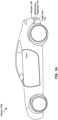
- FIG. 1A is a side view of a vehicle 100A showing an exemplary placement of a multifunction apparatus 104 for noise suppression and impact energy absorption.
- the side view shows crash rails 102, also known as crush rails or frame rails, on one side of the vehicle in a plane closer to the viewer.
- the apparatus 104 may instead be located between an end of the crash rail and a rear bumper 108.
- the multifunction apparatus 104 is oriented in a rear portion of the vehicle 100A, where it is configured along with the adjacent frame rails 102 to absorb energy due to an impact.
- the apparatus 104 is configured to receive exhaust from the nearby engine and to stifle the loud engine frequencies before ejecting the exhaust from one of its outlets.
- FIG. 1B is a top view of a vehicle 100B showing an exemplary placement of the multifunction apparatus 104.
- the engine 114 is mounted via engine mounts 123 along a longitudinal axis X of the vehicle 100B between the passenger cabin 124 at one end, and the rear bumper region 130 at the other end. Between the engine 114 and the rear bumper region 130 along the longitudinal axis X lies multifunction apparatus 104.
- the crash rails 102 may run along longitudinal axis X on each side of multifunction apparatus 104.
- the crash rails 102 are coupled to the chassis 110 of the vehicle 100B.
- Engine 114 is also mounted in the direction of the lateral axis Y along both sides of the chassis 110.
- Multifunction apparatus 104 is oriented such that it receives the engine exhaust from the engine, and that it outputs the exhaust at the rear of the vehicle 100B. Multifunction apparatus 104 is further oriented such that it lies within the plane of a rear impact.
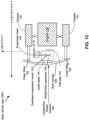
- FIG. 1C is a top view showing the placement of components in a rear of the vehicle.
- rear bumper 125 is shown as running generally along a direction of the lateral axis Y.
- the crash rails 102 run on each of the respective lateral sides of the vehicle along longitudinal axis X and are coupled to chassis portions 116.
- Multifunction apparatus 104 is shown between rear bumper 125 and the engine 114.
- multifunction apparatus 104 may be mounted along its lateral sides using mounting fixtures on the sides of apparatus 104.
- multifunction apparatus 104 may include an overhead suspension mount 123.
- the overhead suspension mount may be used to couple to a rod or other fixed structure in the top rear region of the vehicle 100C, such that multifunction apparatus 104 is positioned to suspend in the vehicle between the crash rails 102 in the lateral direction Y.
- the multifunction apparatus 104 also includes inlet pipe 142 and outlet pipes 144.
- Inlet pipe 142 is coupled to an exhaust pipe from the engine. More than one inlet pipe may be used.
- Output pipes 144 carry the exhaust gases from the engine, in this embodiment, out toward the rear of the vehicle.
- the inlet pipe 142 or outlet pipes 144 may in various embodiments include a manifold that carries the exhaust gases in a one-to-many or many-to-one fashion, depending on the design of the multifunction apparatus 104, the engine 114, and the exhaust system.
- the multifunction apparatus 104 is positioned in a plane of a rear impact between the rear bumper 125 on one side, and the engine 114 and further down the passenger cabin, on the other side.
- the multifunction apparatus 104 may be closely adjacent, or may even contact, the rear bumper.
- the multifunction apparatus 104 may effectively be isolated in space, suspended between the crash rails 102 laterally and between the engine 114 and rear bumper 125 longitudinally. This spatial isolation advantageously keeps the radiation and heat energy of the exhaust away from lower temperature components of the vehicle, minimizing the possibility of damage of components due to thermal exposure.
- the multifunction apparatus may be positioned in other impact zones or crumple zones of a vehicle.
- the embodiments shown in FIGS. 1A-1C are beneficial in that in many jurisdictions, regulatory laws require the presence of an energy absorbing structure in the area shown by the multifunction apparatus 104.
- multifunction apparatus 104 can be used in conjunction with the crash rails to reduce the transfer of energy due to an impact to the passenger cabin 124 ( FIG. 1B ).
- Isolating the multifunction apparatus may also be important because when the apparatus is subject to heating, the apparatus can expand and grow in size by several millimeters due to thermal expansion caused by the hot exhaust gases. The growth can be several millimeters in some embodiments.
- Inconel and certain other metal allows are good candidate materials for 3D printing the apparatus. Inconel, for example, can withstand temperatures of 1000° Celsius.
- the rear bumper 125 is supported by the two crash rails which are coupled to the vehicle's chassis 116.
- the multifunction apparatus 104 functions as a muffler, receiving exhaust gas via an inlet pipe (the exhaust path is omitted for clarity) from engine 114, suppressing and/or canceling engine noise using resonator cells bounded by inner walls, and allowing the exhaust to be output via pipes 144, which may be coupled to a manifold or other exhaust system for routing the exhaust out of the vehicle.
- the multifunction apparatus 104 is composed of one or more materials whose material properties are sufficient to withstand the operating temperature of the vehicle, including the high temperatures of the exhaust gas, while still being about to controllably deform. Accordingly, in various embodiments, the material of the multifunction apparatus is composed of Inconel, titanium, or another material. Using Inconel or a similar metal alloy beneficially allows the apparatus 104 to function properly as a muffler and to correctly crumple in the case of a rear impact - all the while maintaining a relatively low mass. It is noteworthy that most crash tests are performed when the engine is cold, rather than when the vehicle is at its operating temperature (about 800° Celsius at the muffler). The multifunction apparatus 104 can be manufactured to controllably deform during high energy impacts that occur whether the vehicle is still relatively cold or is already at full operating temperature and while the apparatus 104 is receiving hot exhaust gases.
- the multifunction apparatus 104 is 3-D printed, such as by using powder bed fusion (PBF).
- PPF powder bed fusion
- the print material may be selected to be Inconel, another Nickel alloy, titanium, or a similar material. Desirable features include a reasonably low mass, a high temperature tolerance, and a flexibility that enables it to undergo controlled deformation over a wide operating temperature range. Inconel, for example, is generally functional over more than a 1000°C range.
- the multifunction apparatus 104 including its interior structure (described below) is in various embodiments optimized over two global optima - namely, impact energy and exhaust energy.
- one or more optimizing algorithms may be used with the CAD model of apparatus 104 to optimize these two criteria.
- the multifunction apparatus 104 may be attached to the vehicle by any rigid structure nearby the apparatus 104.
- the structure may in an embodiment perform a different function, and may also be used to connect to the multifunction apparatus 104 securely, to keep the apparatus in place.
- the overhead suspension mount 123 may be coupled to a steel or alloy-based suspension rod 134 that has a high heat tolerance.
- the suspension rod 134 in turn, may be coupled to the rigid structure discussed above, referenced in FIG. 1C as the suspension base 132.
- the suspension base 132 can be any rigid body capable of connecting to suspension rod 134 to form a secure connection.
- the suspension base 132 need not be part of the chassis 116 in cases where it is desirable to isolate the apparatus 104 from the chassis 116.
- the mounts of the multifunction apparatus 104 are instead arranged on the sides ( see FIGS. 2 , 3 ), and the side mounts in those embodiments can each be connected to suspension bases 132 or other structures on both sides to implement a more secure attachment platform.
- any number of embodiments can be used for effectively securing and mounting the apparatus 104 to securably be suspended in its proper orientation.
- the multifunction apparatus 104 can be designed such it can absorb 60-75% of the impact energy, and the crash rails 102 only need to each absorb about one-half of the remaining 25-40%.
- the multifunction apparatus 104 can accord additional benefits to the vehicle by allowing the length and width of the crash rails 102 to be reduced. This in turn allows the overall mass of the vehicle to be reduced.
- the multifunction apparatus 104 is optimally positioned in the embodiments shown is that, in general, the engine 114 and the transmission to which it is coupled (not shown) are generally too stiff to act as crash structures. The engine and transmission therefore do not properly deform or crush during an impact. For this reason, it would be undesirable for the engine 114 to simply be positioned in front of the rear bumper 125, because a strong impact could cause the engine to act as a projectile toward the passenger cabin. Instead, positioning the multifunction apparatus 104 between the rear bumper 125 and the engine 114 allows the "crumple-zone" to be longitudinally behind the engine and transmission. The multifunction apparatus 104 can then be configured to protect the engine, and more importantly the passenger cabin, from receiving the brunt of the energy impact.
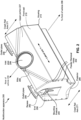
- FIG. 2 is a front perspective view of multifunction apparatus 200 for exhaust noise suppression and energy absorption.
- the longer side of the apparatus 200 may be positioned such that the apparatus 200 is "sandwiched" between the rear bumper 125 and engine 114 (as in FIGS. 1A-D ).
- the multifunction apparatus 200 may be configured to be positioned in a different location and direction within the vehicle in other embodiments, such as another location with crumple zone requirements, provided only that the apparatus 200 has reasonable access to the exhaust path.
- the 3D printing of the apparatus 200 makes it possible to add intricate geometries around and within the structure without the expensive and labor-intensive limitations associated with more conventional subtractive manufacturing techniques, like machining or extruding.
- the multifunction apparatus includes a plurality of powder removal holes 202.
- Powder removal holes 202 may have been 3D printed along with the original multifunction apparatus 200. After the 3D printing, in various types of such printing including powder bed fusion, there will likely remain loose powder in hollow chambers of the apparatus 200.
- the powder removal holes 202 are configured to enable the manufacturer to remove (via suction or otherwise) loose powder from inside the multifunction apparatus 200.
- One or more powder removal holes 202 can be made available for each chamber of the apparatus 200 that may include residual powder. After this residual powder is vacuumed out or otherwise removed, the powder removal holes 202 can thereafter be welded shut or otherwise sealed via an appropriate adhesive or other means.
- the multifunction apparatus 200 may include an outer housing 210 which surrounds a large portion of the multifunction apparatus 200.
- the housing 210 may be made thicker or may include additional walls (see below) to protect the multifunction apparatus 200 and to help contain exhaust heat and noise within the multifunction apparatus 200.
- Apparatus 200 includes a front wall 219 which may face generally toward the vehicle front. The vertical positioning of apparatus 200 may depend in part on the predicted direction or identified plane(s) of maximum force due to a rear impact.
- the front wall 219 may face the engine.
- Multifunction apparatus 200 further includes ends 258 that can be aligned along the crash rail axis 271, although apparatus 200 need not actually contact the crash rail.
- each end 258 may include a recess 262, within which a mounting feature 204 can be incorporated to mount the apparatus 200 on a stable structure within the vehicle.
- the mounting features 204 in these embodiments can additionally or alternatively be included on the ends 258 in order to fix the apparatus 200 sufficiently in place.
- the apparatus may be mounted on fixtures, rods or other structures that may be independent of the chassis.
- the front wall 219 may face toward a front of the vehicle 296, with the apparatus 200 adjacent a rear portion of the engine.
- An exhaust pipe or manifold (not shown) may be used to securably couple the exhaust output at the engine, as in a traditional muffler, to inlet pipe(s) 208.
- the exhaust pipe may be welded to inlet pipe 208.
- an adhesive that is designed to withstand high temperatures may be used to connect the pipes.
- any number of types of mechanical fasteners screws, nuts, bolts, etc.
- outlet pipes 206 can be seen that complement the inlet pipe 208 on the "roof-like" upper portion 227 of the multifunction apparatus 200.
- An additional set of exhaust pipes (not shown) can be secured to the outlet pipes 206 in the same way as the inlet pipe 208 is secured to its counterpart component.
- the outlet pipes 206 advantageously facing the rear of the vehicle in this embodiment, may easily route the residual noise-suppressed exhaust out the back of the vehicle.
- truck, trains, and larger-scale transport vehicles may use positioning techniques for the multifunction apparatus that are different from above and that are ideal for those larger vehicles, all without departing from the spirit and scope of the teachings herein.
- the upper portion 227 may show reinforcing ribs 266, which may be extensions of inner walls of the apparatus 200.
- an apparatus 200 in general, it should include structures that are designed to crumple in a controlled manner responsive to the crash, to absorb the received kinetic energy.
- the impacting structure For successful absorption of energy, the impacting structure must be capable of doing "work" on the crash structure, which is the product of force and distance along the direction of the impact.
- structures which run perpendicular to the direction of the impact e.g., a rear-facing collision
- front wall 219 of apparatus 200 are generally of little if any benefit in a crash, since front wall 219 is positioned to be perpendicular to a longitudinal impact direction 190 ( FIG. 1C ), and therefore the front wall provides no distance for the received force to penetrate.
- the momentum simply continues forward in the direction 190.
- the external ends 258, the posterior 285, and the upper portion 227 of the multifunction apparatus 200 can be configured to contribute positively to the overall controlled deformation responsive to a rear impact event, because each of these external structures have directional components along the direction 190 of the rear impact. Therefore, they can all absorb various amounts of the kinetic energy from the impact, effectively reducing the forward momentum towards the passenger cabin.
- the internal regions of the multifunction apparatus 200 are designed to provide most of the protection responsive to the rear impacts.
- a side (lateral impact) on the vehicle may make perpendicularly-configured front wall 219 as well as upper portion 227 crumple and thus may absorb energy, meaning that front wall 219 and upper portion 227 would be important in that case, whereas in the same case the ends 258 and other portions do little if anything to stifle the side impact.
- a side (lateral impact) on the vehicle may make perpendicularly-configured front wall 219 as well as upper portion 227 crumple and thus may absorb energy, meaning that front wall 219 and upper portion 227 would be important in that case, whereas in the same case the ends 258 and other portions do little if anything to stifle the side impact.
- there are often additional or different crumple zones on a vehicle that are designed to accommodate impacts in different directions, including from the front and side of the vehicle (along with other safety measures such as airbags, seatbelts, etc.) for protecting the passengers.
- FIG. 3 is a side perspective view of the multifunction apparatus 300 adjacent a crash rail. It will be appreciated that only a portion of one of the crash rails 306 is made visible in this view to avoid unduly obscuring the concepts in the illustration. A second crash rail direction 370 is shown on the other side of the apparatus 300.
- Multifunction apparatus 300 may include, like prior embodiments, an inlet pipe 308 and a pair of outlet pipes 306, although this configuration is exemplary and a different number and position of inlet or outlet pipes are possible.
- each end 358 includes a plurality of connection features 367. Connection features 367 may be used to suspend the multifunction apparatus 300 or otherwise secure the position of the multifunction apparatus 300 within a plane of impact, e.g., adjacent a rear bumper.
- the inlet pipe 308 also faces toward the front of the vehicle 396, which makes routing the engine exhaust to the inlet straightforward.
- the outlet pipes 306 are on the opposite surface of the upper portion 327 and may point towards the rear of the vehicle 398.
- the embodiment shown also includes diagonally-spaced lines on the surface of housing 310.
- the diagonally-spaced lines may be ribs 334.
- the ribs 334 may in some embodiments correspond to extension of internal walls used for both energy absorption and noise suppression purposes. In other embodiments, the ribs 334 may simply be part of a reinforcement layer of the housing 310.
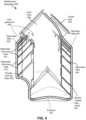
- FIG. 4 is a cross-sectional view of the multifunction apparatus 400 showing resonator volumes 410 around inlet exhaust pipe 408.
- FIG. 4 shows, for example, a portion of the outer wall removed to reveal the resonator cells 410 and a double-walled heat shield 407.
- the outer wall of the double-walled heat shield 407 is configured to extend over and conform to the outer surface of the inner wall, offset only by an air gap.
- the double-walled heat shield 407 acts as a thermal radiation shield to help protect external components from the high exhaust temperatures.
- an air gap may be included between the two outer walls. The air gap may serve as a thermal insulator.
- the double-walled heat shield 407 with the air gap may extend around most or all of the surface of the multifunction apparatus 400.
- the double-walled heat shield can isolate the other components from thermal radiation. This protection may be particularly important in vehicles that use components that are connected by adhesives. In these cases, it is important to protect the low temperature structures from becoming thermally stressed by heat from the multifunction apparatus 400, which may also tend to soften nearby adhesives.
- the air gap may be vented near the exhaust output to remove the excess heat.
- the air gap may include its own input and output ports to receive air and to carry thermal radiation away.
- FIG. 4 also shows a plurality of resonator walls 404 that are positioned along opposite sides of the structure.
- the vertically-aligned resonator walls 404 in this embodiment are not exactly aligned with the direction of a rear impact; rather, they are aligned at about 45° from the impact direction.
- the deviation from perfect alignment may be an engineering choice based on the dual requirements of the resonator walls 404 to crumple in response to an impact and to establish accurate resonator cells 410. That is, the resonator walls 404 may have a dual function.
- a first function is to bound resonator volumes 410 along with other resonator walls 404 oriented in a different way.
- the resonator volumes 410 are also referred to herein as resonator cells.
- the resonator cells 410 are sized and shaped to dampen a particular frequency of sound waves as it enters the cell 410.
- the resonator cells 410 may also be configured to receive, combine and cancel sound waves of a particular frequency.
- a second function of the resonator walls 404 is to controllably deform as a result of an impact. There are a number of resonator walls 404, both horizontally and vertically disposed.
- the horizontal and vertical resonator walls 404 jutting out from the body of the apparatus 400 also form the resonator cells 410, which may be of different size and shape to dampen different resonant frequencies of engine noise.
- the internal resonator walls 404 have at least some directional component along the impact axis, and are therefore used as part of a crash structure as needed.
- the inlet exhaust air may enter the different resonator cells 410 by means of one or more inlet apertures 459, which can be holes in portions of the inlet pipe 404 that enable exhaust gases to enter corresponding resonator cells 410.
- the resonator cells dampen the engine noise as a result.
- the outer wall or portion of the housing that was removed to show the cross sectional view of FIG. 4 may also intersect with the outcropping resonator walls to form additional resonator cells 410 adjacent the surface of the apparatus 400. That is, the inner walls 404 may be connected to the outer walls 407 to form additional cells 410 near the surface.
- the dampened exhaust that flows through the cells is routed out of the apparatus 400 via the outlet pipe(s) 406.
- each of the horizontal and vertical resonator walls 404 of the apparatus 400 have a directional component that is aligned with a predicted axis of rear impact.
- the resonator walls 404 on the right are aligned, albeit at a slight incline, to the axis of the impact.
- each of the resonator walls 404 can be carefully designed with features including a desired thickness to controllably crumple with desired properties when an impact event occurs.
- the resonator walls 404 can be modeled to both provide resonator cells 410 for muffling exhaust noise and for incorporating the necessary crumpling properties of a crash structure.
- inlet and outlet pipes 408 and 406, as well as portions of the double-walled heat shield 407 have certain directional components that align at least in part with the axis of impact.
- the pipes 408, 406 and external walls of the heat shield 407 can be modeled during the CAD process to contribute to the overall effectiveness of the crash structure.
- FIG. 5 is a cross-sectional view of the front of the multifunction apparatus showing the inner walls that bound the resonator volumes.
- FIG. 5 can be viewed as a portion of the multifunction apparatus 500 that is vertically cut from the top down on the front side along a portion of the inlet pipe 508 such an inner portion of the inlet pipe 508 is visible, the outer portion of the inlet pipe 508 being near the upper portion 527 of the apparatus 500.
- the upper lip 527 of the inlet pipe 508 is curved inward, under the plane of the drawing, thus exposing the inner surface of inlet pipe 508 rather than its outer surface.
- the density of concentration of resonator walls 504 is shown to increase beginning from the posterior portion 585 of the apparatus 500 and moving vertically up to the upper portion 527. That is, the resonator walls 504 get progressively closer together moving from the bottom to the top of the apparatus 500.
- a cross-section of the double-walled heat shield 507 is also seen around the perimeter of the multifunction apparatus 500. A number of apertures are shown which allow the exhaust gases from the inlet pipe 508 to flow through the different resonator cells 510, and ultimately to flow out of the outlet pipes 506.
- the resonator walls 504 may be carefully designed to bound resonator volumes or cells 510 for damping the desired frequencies.
- the horizontally-disposed resonator walls 504 in this embodiment are aligned closely with a parallel direction of a rear impact. Some vertical resonator walls such as 504a are angled inward, and thus appear to have an incline up to about 45° from the direction of impact.
- the multifunction apparatus 500 is vertically positioned with the predicted axis of impact such that the denser concentration portion of horizontally disposed resonator walls 504 (i.e., the denser horizontal walls 504 vertically closer to the upper portion 527) are aligned directly with the axis of the impact, whereas the less dense concentrations of resonator walls 504 closer to the posterior portion 585, while also aligned with the axis of impact, are more offset from the predicted direction than are the denser portion of resonator walls 504.
- the densest concentration of resonator walls 504 are most closely aligned with the rear axis of impact, making the crash structure more effective in a correctly predicted impact event since the densest concentration of walls 504 can be used to absorb the crash energy more effectively.
- the combination of functions in one apparatus 500 beneficially removes the necessity for both structures, and as such removes mass that would otherwise be present in the vehicle.
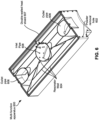
- FIG. 6 is an upper cross-sectional view of the multifunction apparatus 600.
- FIG. 6 shows the top portion of the apparatus with the upper portion removed to expose the resonator walls 604.
- the resonator walls 604 may be inclined up to about 45° from the direction of impact.
- the resonator walls 604 may be oriented such that they do not require any support structures while being 3D-printed. This may be achieved by factoring in the 3D-print vector (i.e., the vector that represents the orientation of the part with respect to the print bed) while designing the multifunction apparatus. Cut-off sections of inlet pipe 608 as well as outlet pipes 606 are visible. Double-walled heat shield 607 is also shown surrounding the perimeter of apparatus 600.
- the double-walled heat shield 607 can act to prevent damaging heat flow to external components, the double-walled heat shield 607 may also be useful to dampen noise from the exhaust as the gases move through the resonator cells. Powder removal holes 602 may enable the manufacturer to remove loose powder particles immediately after the print job.
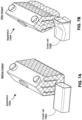
- FIGS. 7A-B are side perspective views of the multifunction apparatus adjacent a portion of a crash rail before and after an impact event, respectively.
- FIG. 7A shows apparatus 700A as it would be generally aligned with a portion of crash rail 706A.
- FIGS. 7A-B are side perspective views of the multifunction apparatus adjacent a portion of a crash rail before and after an impact event, respectively.
- FIG. 7A shows apparatus 700A as it would be generally aligned with a portion of crash rail 706A.
- the other details in this embodiment, such as the mounting of the apparatus and the remaining portions of the exhaust system, are omitted for clarity.
- the apparatus 700B is sown along with the crash rail 706B to be controllably deformed.
- the severity of the impact will likely be proportional to the amount of deformation.
- the passenger cabin and even the engine and transmission have likely missed a significant amount of the impact force, which was absorbed in the apparatus 700B and the crash rail portion 706B.
- FIGS. 8A-B are upper views of the multifunction apparatus adjacent a crash rail portion before and after a rear impact event, respectively.
- the multifunction apparatus 800A is positioned to receive a rear impact, although other embodiments (e.g., a front vehicle crash structure) are also possible.
- the impact load direction 850 is shown to be on the right side of the apparatus 800A.
- FIGS. 8A-B therefore show a similar view as FIGS. 7A-B but this time from the top.
- apparatus 800A is generally aligned as shown with a pair of crash rails, here again with only a portion of one crash rail 806A being shown for illustrative purposes.
- apparatus 800B is deformed as is crash rail 806B, with an amount of damages and a set of consequences similar to those of FIGS. 7A-B .
Landscapes
- Engineering & Computer Science (AREA)
- Chemical & Material Sciences (AREA)
- Mechanical Engineering (AREA)
- Physics & Mathematics (AREA)
- Combustion & Propulsion (AREA)
- Acoustics & Sound (AREA)
- Manufacturing & Machinery (AREA)
- Multimedia (AREA)
- General Engineering & Computer Science (AREA)
- Materials Engineering (AREA)
- Transportation (AREA)
- Fluid Mechanics (AREA)
- Aviation & Aerospace Engineering (AREA)
- Plasma & Fusion (AREA)
- Exhaust Silencers (AREA)
- Body Structure For Vehicles (AREA)
- Soundproofing, Sound Blocking, And Sound Damping (AREA)
- Cooling, Air Intake And Gas Exhaust, And Fuel Tank Arrangements In Propulsion Units (AREA)
Description
- The present disclosure relates generally to additively manufactured systems, and more particularly, to multifunction muffler and crash structures in vehicles.
- For vehicle manufacturers, fuel economy and performance-related criteria often make it desirable to minimize a vehicle's mass as much as practicable. In many vehicle types, minimizing mass or size, whether generally or with respect to specific components, has inherent benefits. These techniques can also provide other advantages, such as maximizing overall available space for component placement or a passenger cabin. Not surprisingly, finding new ways to minimize vehicle mass and to optimize space for components remains an ongoing engineering challenge. These objectives may persist in part because other manufacturing requirements may, as a practical matter or by necessity, increase the vehicle's form factor, resulting in mass increases. For instance, safety regulations may call for crumple zones in the vehicle that incorporate crash structures for absorbing energy by deforming during impacts. Crash structures add to vehicle size and mass. Together with other well-known fundamental vehicle components, the vehicle mass and size can ultimately add up in a way such that even modest mass reductions to the resulting vehicle, if possible, can be of great value to the manufacturer.
-
WO 2006/018581 A1 relates to an exhaust line element for an internal combustion engine of a motor vehicle. -
JP 2004 036402 A -
FR 3 069 888 A1 -
DE 10 2016 105914 A1 relates to a muffler for enhanced crash safety. -
KR 2009 0060821 A -
JP 2014 118892 A - The present disclosure addresses these and other shortcomings in the art.
- According to the invention, there is provided a multifunction apparatus for a vehicle according to appended claim 1.
- The following presents a simplified summary of one or more aspects in order to provide a basic understanding of such aspects. This summary is not an extensive overview of all contemplated aspects, and is intended to neither identify key or critical elements of all aspects nor delineate the scope of any or all aspects. Its sole purpose is to present some concepts of one or more aspects in a simplified form as a prelude to the more detailed description that is presented later.
- The present disclosure is directed to a multifunction apparatus for use in a vehicle that both suppresses engine noise as a muffler, and controllably deforms responsive to an impact as a crash structure. Among numerous other benefits, the multifunction apparatus can help reduce vehicle mass and size while protecting the passengers in a cabin from an impact, as well as reducing the volume of exhaust noise incurred in everyday vehicle operation. While the multifunction apparatus may be positioned in different regions of the automobile, in various embodiments the apparatus includes mounts that enable the apparatus to be arranged between the rear bumper and the engine in the plane of an anticipated rear impact.
- In one aspect of the disclosure, a multifunction apparatus for a vehicle includes a muffler. The muffler includes a body having a plurality of walls that bound an array of resonator cells. The resonator cells are arranged between inlet and outlet pipes to suppress exhaust noise. The walls are configured to controllably deform during an impact event.
- In another aspect of the disclosure, a multifunction noise suppression and energy absorption structure for a vehicle includes a muffler. The muffler includes a body, an inlet pipe, an outlet pipe, and a plurality of internal walls within the body that bound an array of resonator cells. The internal walls are configured to absorb energy by deforming during an impact.
- In still another aspect of the disclosure, a dual function muffler includes a housing, an inlet pipe, an outlet pipe, and a plurality of internal walls defining resonator cells, the internal walls being configured to deform during an impact event.
- To the accomplishment of the foregoing and related ends, the one or more aspects comprise the features hereinafter fully described and particularly pointed out in the claims. The following description and the annexed drawings set forth in detail certain illustrative features of the one or more aspects. These features are indicative, however, of but a few of the various ways in which the principles of various aspects may be employed, and this description is intended to include all such aspects and their equivalents.
- Various aspects of multifunction noise suppression and crash structures will now be presented in the detailed description by way of example, and not by way of limitation, in the accompanying drawings, wherein:
-
FIG. 1A is a side view of a vehicle showing an exemplary placement of a multifunction apparatus for noise suppression and impact energy absorption. -
FIG. 1B is a top view of a vehicle showing an exemplary placement of the multifunction apparatus. -
FIG. 1C is a top view showing the placement of components in a rear of the vehicle. -
FIG. 1D is a top view showing the placement of components in a rear of the vehicle following an impact event. -
FIG. 2 is a front perspective view of a multifunction apparatus for exhaust noise suppression and energy absorption. -
FIG. 3 is a side perspective view of the multifunction apparatus adjacent a crash rail. -
FIG. 4 is a cross-sectional view of the multifunction apparatus showing resonator volumes around inlet exhaust pipe in more detail. -
FIG. 5 is a posterior cross-sectional view of the multifunction apparatus showing an interior portion of the inlet pipe and the inner walls that bound the resonator cells. -
FIG. 6 is an upper cross-sectional view of the multifunction apparatus showing inclined resonator walls for energy absorption. -
FIGS. 7A-B are side perspective views of the multifunction apparatus adjacent a portion of a crash rail before and after an impact event, respectively. -
FIGS. 8A-B are upper views of the multifunction apparatus adjacent a crash rail portion before and after a rear impact event, respectively. - The detailed description set forth below in connection with the appended drawings is intended to provide a description of various exemplary embodiments of the concepts disclosed herein and is not intended to represent the only embodiments in which the disclosure may be practiced. The terms "exemplary" and "example" used in this disclosure mean "serving as an example, instance, or illustration," and should not be construed as excluding other possible configurations or as preferred or advantageous over other embodiments presented in this disclosure. The detailed description includes specific details for the purpose of providing a thorough and complete disclosure that fully conveys the scope of the concepts to those skilled in the art. However, the disclosure may be practiced without these specific details. In some instances, well-known structures and components may be shown in block diagram form, or omitted entirely, in order to avoid obscuring the various concepts presented throughout this disclosure.
- The principles of this disclosure include structures that in various embodiments may be three-dimensionally (3D) printed. The disclosure can, to this end, be applicable to a variety of 3D printing technologies, including but not limited to fused deposition modeling (FDM), digital light processing (DLP), stereolithography/masked stereolithography (SLA, MSLA), powder bed fusion (PBF) printers including selective laser sintering (SLS), direct metal laser sintering (DMLS), selective laser melting (SLM), electron beam melting (EBM), Binder Jetting, Material Jetting (MJ), Drop on Demand (DoD), and others. For purposes of this disclosure, "vehicle" is broadly construed to include automobiles of all types (e.g., cars sedans, sports cars, race cars, sports utility vehicles, convertibles minivans, station wagons, vans, hybrid cars and any type of consumer or commercial automobile available), including also pickup trucks, larger trucks, commercial trucks, and generally any type of consumer or commercial transport structure. Vehicles also include all means of public transport, such as trains, busses, minibuses, subways, and other such transports.
- The present disclosure is directed to multifunction apparatuses for use in vehicles. The multifunction apparatus may both perform the vehicular muffler function by suppressing engine noise and may concurrently act as a crash structure by being aligned with predicted impact directions and controllably deforming responsive to an impact event. Conventional mufflers are not designed to controllably deform during an impact, much less assist with passenger protection in the event of a crash. The effect of a conventional muffler on the passenger cabin area during an impact, even if it is positioned within the axis of the impact, would be at most unpredictable given the detailed design considerations that can govern crash structures, which are not factored while designing conventional mufflers. The muffler's effect, if so positioned within the axis of impact, could even be deleterious to the passenger.
- It is therefore not surprising that conventional mufflers in cars are ordinarily placed towards the bottom of a vehicle as part of the exhaust manifold, and below the predicted plane of a typical crash or impact event. Hence, these conventional structures are not likely to influence energy absorption characteristics of a passenger cabin resulting from an impact. Further, in normal operation, the muffler is at an elevated temperature due to the exhaust gases passing through it. This results in a debit in mechanical properties and its performance during a crash event, which would be weakened. For these reasons, the muffler is conventionally relegated to performing its dedicated function of suppressing exhaust noise, with separate crash structures present in the zones of likely impact.
- Typical mufflers are composed of an array of selectively positioned tubes, channels and holes that are arranged between, and one or more input pipes and one or more output pipes. The input pipes bring exhaust gases from the engine along with the sound waves created from the explosion of gasoline in the car's engine cylinders into the muffler. A muffler uses selectively sized and positioned resonator cells. The resonator cells are associated with a predesigned resonant sound frequency and dampen the specific resonant frequencies of sound waves in the exhaust. Some mufflers may use the resonator cells as echo chambers that receive, combine and cancel out sound waves. A number of resonators within the muffler means that a variety of different resonant frequencies associated with exhaust noise can be dampened. The quantity of damping -that is to say, the amount of noise suppression in decibels-- is proportional to the number of the chambers in the muffler. The frequency of damping, which governs the pitch of the noise, is based on the size of these chambers, rather than the number of chambers. By selecting an appropriate range of resonator numbers and sizes, the muffler can drown out loud engine noises.
- In contrast to mufflers, crash structures, also called crumple zones or crunch zones, are structural safety features used to absorb sudden bursts of energy during an impact event in order to prevent the brunt of that energy from being transferred to the passenger cabin and causing serious injury or death to the vehicle occupants. Crash structures can be designed to have walls that controllably deform, e.g., responsive to a rear impact. Crash structures may be located at various points in the vehicle, whether by strategy or legal mandate. Strategically placed crash structures can use this controlled deformation to effectively increase the time over which the occupants decelerate (e.g., reducing the "crash pulse" or sudden deceleration of the occupants), which effectively reduces a maximum force applied to the passenger area. The crash structures are intentionally designed to receive damage by crumpling, to protect the vehicle occupants. Crash structures may include box-type or rectangular structures, as well as rail-based structures.
- In much the same way as mufflers are not used as crash structures, conventional crash structures are neither used for nor capable of exhaust noise suppression, the latter of which, as indicated, typically uses specially-designed resonator cells arranged within a path of the exhaust gas to suppress undesired vehicle noise. Current vehicles use separate components located in different regions for these two purposes, both of which must be accounted for in considering the overall space and availability of vehicle components.
- Another historical obstacle to producing vehicle parts that perform multiple unrelated functions in general is that such composite designs would be intricate and could not practicably be implemented using conventional manufacturing techniques like machining, casting or extrusion. For example, both crash structures and mufflers have specially designed structures for performing their desired purposes. It would be difficult or impossible to use machining and similar techniques to create such a sophisticated geometrical hybrid structure capable of performing these two functions. Exacerbating factors to such an attempted design would be to ensure the end result is oriented in the vehicle the right way to properly receive and eliminate exhaust gases for noise suppression, and that also include materials that would controllably deform from high-energy impacts that occur while the muffler is hot. Current materials used in a muffler, for example, may not controllably deform while at ambient temperatures, much less while at the muffler's very high operating temperature because conventional mufflers are not designed to crumple.
- In an aspect of the disclosure, a multifunction apparatus includes a body that can be used for exhaust noise suppression, and that can concurrently be used as a crash structure configured to controllably deform during an impact event. Unlike conventional crash structures, the material used can be lighter, and adjacent crash rails can likewise be made smaller and lighter when the multifunction apparatus is correctly oriented in the plane of impact as described further below. The combination of the muffler with the crash structure reduces the number of components in the vehicle, and as a consequence it can reduce the mass of the vehicle while increasing the available space within the vehicle.
- To address any potential challenges in manufacturing such a structure to include the necessary geometrical precision, the multifunction apparatus may in some embodiments be three-dimensional (3D) printed. A computer aided design (CAD) model of the structure can be carefully designed that implements the detail of the muffler and its attendant resonator cells, while simultaneously accommodating the structure necessary to achieve the precise energy absorption characteristics of a controllable deformation that characterizes the crash structure functionality. The model can undergo simulations prior to 3D printing to refine the design. The 3D printed nature of the multifunction apparatus may use a material that controllably deforms when the multifunction apparatus is at low or high operating temperatures. 3D printing, also known as additive manufacturing (AM), can produce structures (referred to as build pieces) with geometrically complex shapes, including some shapes that are difficult or impossible to create by relying on conventional manufacturing processes, such as machining. AM parts can advantageously be printed with diverse geometries and compositions using materials that allow the part to have specifically-tailored properties for a target application. Here, the walls can be designed to not only form resonator cells with the appropriate characteristics, but also can be designed to crumple in a controlled manner when needed as a crash structure.
- As noted, being positioned away from the key axes of impact, the conventional muffler may have little, if any, effect on the vehicle's overall crash profile. The multifunction apparatus as described herein, by contrast, may be equipped with mounts that enable it to be uniquely positioned, such as in the rear of a vehicle directly in the plane of a predicted impact. In some examples, the multifunction apparatus can be arranged between the two crash rails in a lateral (side-to-side) direction of the vehicle, while also being arranged between an engine and a rear bumper in a longitudinal (front-to-back) direction of the vehicle. There may be intervening components in some embodiments. The multifunction apparatus may beneficially reduce the size and mass needs of the crash rails when it is so positioned to absorb energy from the impact. This is because the multifunction apparatus can share the impact with the crash rails in the event it occurs.
-
FIG. 1A is a side view of avehicle 100A showing an exemplary placement of a multifunction apparatus 104 for noise suppression and impact energy absorption. The side view shows crash rails 102, also known as crush rails or frame rails, on one side of the vehicle in a plane closer to the viewer. In some embodiments, the apparatus 104 may instead be located between an end of the crash rail and arear bumper 108. Here, the multifunction apparatus 104 is oriented in a rear portion of thevehicle 100A, where it is configured along with the adjacent frame rails 102 to absorb energy due to an impact. At the same time, as described herein, the apparatus 104 is configured to receive exhaust from the nearby engine and to stifle the loud engine frequencies before ejecting the exhaust from one of its outlets. -
FIG. 1B is a top view of avehicle 100B showing an exemplary placement of the multifunction apparatus 104. The top view shows additional detail. In various embodiments, theengine 114 is mounted via engine mounts 123 along a longitudinal axis X of thevehicle 100B between thepassenger cabin 124 at one end, and the rear bumper region 130 at the other end. Between theengine 114 and the rear bumper region 130 along the longitudinal axis X lies multifunction apparatus 104. The crash rails 102 may run along longitudinal axis X on each side of multifunction apparatus 104. The crash rails 102 are coupled to thechassis 110 of thevehicle 100B.Engine 114 is also mounted in the direction of the lateral axis Y along both sides of thechassis 110. Multifunction apparatus 104 is oriented such that it receives the engine exhaust from the engine, and that it outputs the exhaust at the rear of thevehicle 100B. Multifunction apparatus 104 is further oriented such that it lies within the plane of a rear impact. -
FIG. 1C is a top view showing the placement of components in a rear of the vehicle. In this embodiment,rear bumper 125 is shown as running generally along a direction of the lateral axis Y. As before, the crash rails 102 run on each of the respective lateral sides of the vehicle along longitudinal axis X and are coupled tochassis portions 116. Multifunction apparatus 104 is shown betweenrear bumper 125 and theengine 114. In various embodiments, multifunction apparatus 104 may be mounted along its lateral sides using mounting fixtures on the sides of apparatus 104. In other embodiments such as shown, multifunction apparatus 104 may include an overhead suspension mount 123. The overhead suspension mount may be used to couple to a rod or other fixed structure in the top rear region of thevehicle 100C, such that multifunction apparatus 104 is positioned to suspend in the vehicle between the crash rails 102 in the lateral direction Y. The multifunction apparatus 104 also includesinlet pipe 142 andoutlet pipes 144.Inlet pipe 142 is coupled to an exhaust pipe from the engine. More than one inlet pipe may be used.Output pipes 144 carry the exhaust gases from the engine, in this embodiment, out toward the rear of the vehicle. Theinlet pipe 142 oroutlet pipes 144 may in various embodiments include a manifold that carries the exhaust gases in a one-to-many or many-to-one fashion, depending on the design of the multifunction apparatus 104, theengine 114, and the exhaust system. - As is evident from
FIGS. 1A-1C , in these embodiments the multifunction apparatus 104 is positioned in a plane of a rear impact between therear bumper 125 on one side, and theengine 114 and further down the passenger cabin, on the other side. In some embodiments, the multifunction apparatus 104 may be closely adjacent, or may even contact, the rear bumper. In some embodiments, the multifunction apparatus 104 may effectively be isolated in space, suspended between the crash rails 102 laterally and between theengine 114 andrear bumper 125 longitudinally. This spatial isolation advantageously keeps the radiation and heat energy of the exhaust away from lower temperature components of the vehicle, minimizing the possibility of damage of components due to thermal exposure. This position is exemplary in nature, and in different embodiments, the multifunction apparatus may be positioned in other impact zones or crumple zones of a vehicle. The embodiments shown inFIGS. 1A-1C are beneficial in that in many jurisdictions, regulatory laws require the presence of an energy absorbing structure in the area shown by the multifunction apparatus 104. Moreover, multifunction apparatus 104 can be used in conjunction with the crash rails to reduce the transfer of energy due to an impact to the passenger cabin 124 (FIG. 1B ). - Isolating the multifunction apparatus may also be important because when the apparatus is subject to heating, the apparatus can expand and grow in size by several millimeters due to thermal expansion caused by the hot exhaust gases. The growth can be several millimeters in some embodiments. Inconel and certain other metal allows are good candidate materials for 3D printing the apparatus. Inconel, for example, can withstand temperatures of 1000° Celsius.
- As
FIG. 1C also demonstrates, therear bumper 125 is supported by the two crash rails which are coupled to the vehicle'schassis 116. During ordinary vehicle operation, the multifunction apparatus 104 functions as a muffler, receiving exhaust gas via an inlet pipe (the exhaust path is omitted for clarity) fromengine 114, suppressing and/or canceling engine noise using resonator cells bounded by inner walls, and allowing the exhaust to be output viapipes 144, which may be coupled to a manifold or other exhaust system for routing the exhaust out of the vehicle. - The multifunction apparatus 104 is composed of one or more materials whose material properties are sufficient to withstand the operating temperature of the vehicle, including the high temperatures of the exhaust gas, while still being about to controllably deform. Accordingly, in various embodiments, the material of the multifunction apparatus is composed of Inconel, titanium, or another material. Using Inconel or a similar metal alloy beneficially allows the apparatus 104 to function properly as a muffler and to correctly crumple in the case of a rear impact - all the while maintaining a relatively low mass. It is noteworthy that most crash tests are performed when the engine is cold, rather than when the vehicle is at its operating temperature (about 800° Celsius at the muffler). The multifunction apparatus 104 can be manufactured to controllably deform during high energy impacts that occur whether the vehicle is still relatively cold or is already at full operating temperature and while the apparatus 104 is receiving hot exhaust gases.
- In various embodiments, the multifunction apparatus 104 is 3-D printed, such as by using powder bed fusion (PBF). The print material may be selected to be Inconel, another Nickel alloy, titanium, or a similar material. Desirable features include a reasonably low mass, a high temperature tolerance, and a flexibility that enables it to undergo controlled deformation over a wide operating temperature range. Inconel, for example, is generally functional over more than a 1000°C range.
- During the CAD modeling of the multifunction apparatus 104, the multifunction apparatus 104 including its interior structure (described below) is in various embodiments optimized over two global optima - namely, impact energy and exhaust energy. Thus, one or more optimizing algorithms may be used with the CAD model of apparatus 104 to optimize these two criteria.
- Referring still to
FIG. 1C , in one embodiment, the multifunction apparatus 104 may be attached to the vehicle by any rigid structure nearby the apparatus 104. The structure may in an embodiment perform a different function, and may also be used to connect to the multifunction apparatus 104 securely, to keep the apparatus in place. For example, the overhead suspension mount 123 may be coupled to a steel or alloy-based suspension rod 134 that has a high heat tolerance. The suspension rod 134, in turn, may be coupled to the rigid structure discussed above, referenced inFIG. 1C as the suspension base 132. The suspension base 132 can be any rigid body capable of connecting to suspension rod 134 to form a secure connection. The suspension base 132 need not be part of thechassis 116 in cases where it is desirable to isolate the apparatus 104 from thechassis 116. In other embodiments, the mounts of the multifunction apparatus 104 are instead arranged on the sides (seeFIGS. 2 ,3 ), and the side mounts in those embodiments can each be connected to suspension bases 132 or other structures on both sides to implement a more secure attachment platform. In short, any number of embodiments can be used for effectively securing and mounting the apparatus 104 to securably be suspended in its proper orientation. -
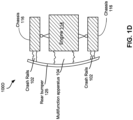
FIG. 1D is a top view showing the placement of components in arear section 100D of the vehicle following an impact event. When therear bumper 125 is deflected by a sufficient amount, such as by a rear collision, the multifunction apparatus 104 and the crash rails 102 deform in the longitudinal direction as defined above. In various arrangements, the multifunction apparatus can be made out of a strong enough material like Inconel, such that the crash rails 102 can be made thinner and shorter. This beneficially reduces the overall vehicle mass. In embodiments where the multifunction apparatus is placed at the rear of the vehicle, the apparatus can assist the crash rails 102 such that the load of an impact may be spread across the different components. For example, in various embodiments the multifunction apparatus 104 can be designed such it can absorb 60-75% of the impact energy, and the crash rails 102 only need to each absorb about one-half of the remaining 25-40%. Thus the multifunction apparatus 104 can accord additional benefits to the vehicle by allowing the length and width of the crash rails 102 to be reduced. This in turn allows the overall mass of the vehicle to be reduced. - Another reason that the multifunction apparatus 104 is optimally positioned in the embodiments shown is that, in general, the
engine 114 and the transmission to which it is coupled (not shown) are generally too stiff to act as crash structures. The engine and transmission therefore do not properly deform or crush during an impact. For this reason, it would be undesirable for theengine 114 to simply be positioned in front of therear bumper 125, because a strong impact could cause the engine to act as a projectile toward the passenger cabin. Instead, positioning the multifunction apparatus 104 between therear bumper 125 and theengine 114 allows the "crumple-zone" to be longitudinally behind the engine and transmission. The multifunction apparatus 104 can then be configured to protect the engine, and more importantly the passenger cabin, from receiving the brunt of the energy impact. -
FIG. 2 is a front perspective view of multifunction apparatus 200 for exhaust noise suppression and energy absorption. As clarified by the "lateral axis y" designation on a surface of the apparatus 200, the longer side of the apparatus 200 may be positioned such that the apparatus 200 is "sandwiched" between therear bumper 125 and engine 114 (as inFIGS. 1A-D ). As noted above, the multifunction apparatus 200 may be configured to be positioned in a different location and direction within the vehicle in other embodiments, such as another location with crumple zone requirements, provided only that the apparatus 200 has reasonable access to the exhaust path. In cases where the multifunction apparatus 200 is 3D printed, the 3D printing of the apparatus 200 makes it possible to add intricate geometries around and within the structure without the expensive and labor-intensive limitations associated with more conventional subtractive manufacturing techniques, like machining or extruding. - In addition, in various embodiments, the multifunction apparatus includes a plurality of powder removal holes 202. Powder removal holes 202 may have been 3D printed along with the original multifunction apparatus 200. After the 3D printing, in various types of such printing including powder bed fusion, there will likely remain loose powder in hollow chambers of the apparatus 200. The powder removal holes 202 are configured to enable the manufacturer to remove (via suction or otherwise) loose powder from inside the multifunction apparatus 200. One or more powder removal holes 202 can be made available for each chamber of the apparatus 200 that may include residual powder. After this residual powder is vacuumed out or otherwise removed, the powder removal holes 202 can thereafter be welded shut or otherwise sealed via an appropriate adhesive or other means.
- Referring still to
FIG. 2 , the multifunction apparatus 200 may include an outer housing 210 which surrounds a large portion of the multifunction apparatus 200. The housing 210 may be made thicker or may include additional walls (see below) to protect the multifunction apparatus 200 and to help contain exhaust heat and noise within the multifunction apparatus 200. Apparatus 200 includes afront wall 219 which may face generally toward the vehicle front. The vertical positioning of apparatus 200 may depend in part on the predicted direction or identified plane(s) of maximum force due to a rear impact. Thefront wall 219 may face the engine. - Multifunction apparatus 200 further includes ends 258 that can be aligned along the
crash rail axis 271, although apparatus 200 need not actually contact the crash rail. As shown in these embodiments, eachend 258 may include arecess 262, within which a mountingfeature 204 can be incorporated to mount the apparatus 200 on a stable structure within the vehicle. Thus, unlike the embodiment reference inFIG. 1C with the suspension mount positioned on a top of the multifunction apparatus 200, the mounting features 204 in these embodiments can additionally or alternatively be included on theends 258 in order to fix the apparatus 200 sufficiently in place. As noted above, in some embodiments it is desirable to isolate the multifunction apparatus 200 from the chassis at least in part, to thereby prevent all of the received forces from an impact to be transferred to the chassis. Thus, in various embodiments, the apparatus may be mounted on fixtures, rods or other structures that may be independent of the chassis. - With continued reference to
FIG. 2 , thefront wall 219 may face toward a front of thevehicle 296, with the apparatus 200 adjacent a rear portion of the engine. An exhaust pipe or manifold (not shown) may be used to securably couple the exhaust output at the engine, as in a traditional muffler, to inlet pipe(s) 208. In some embodiments, the exhaust pipe may be welded toinlet pipe 208. In other embodiments, an adhesive that is designed to withstand high temperatures may be used to connect the pipes. In still other embodiments, any number of types of mechanical fasteners (screws, nuts, bolts, etc.), may be used to implement the connection. - Towards the rear of the
vehicle 298, twooutlet pipes 206 can be seen that complement theinlet pipe 208 on the "roof-like"upper portion 227 of the multifunction apparatus 200. An additional set of exhaust pipes (not shown) can be secured to theoutlet pipes 206 in the same way as theinlet pipe 208 is secured to its counterpart component. Theoutlet pipes 206, advantageously facing the rear of the vehicle in this embodiment, may easily route the residual noise-suppressed exhaust out the back of the vehicle. - Other embodiments such as trucks, trains, and larger-scale transport vehicles may use positioning techniques for the multifunction apparatus that are different from above and that are ideal for those larger vehicles, all without departing from the spirit and scope of the teachings herein.
- Referring still to
FIG. 2 , theupper portion 227 may show reinforcingribs 266, which may be extensions of inner walls of the apparatus 200. - In general, for an apparatus 200 to be useful as a crash structure, it should include structures that are designed to crumple in a controlled manner responsive to the crash, to absorb the received kinetic energy. For successful absorption of energy, the impacting structure must be capable of doing "work" on the crash structure, which is the product of force and distance along the direction of the impact. For these reasons, structures which run perpendicular to the direction of the impact (e.g., a rear-facing collision), such as
front wall 219 of apparatus 200, are generally of little if any benefit in a crash, sincefront wall 219 is positioned to be perpendicular to a longitudinal impact direction 190 (FIG. 1C ), and therefore the front wall provides no distance for the received force to penetrate. Thus the momentum simply continues forward in thedirection 190. For the same reasons, however, it is also true that the external ends 258, theposterior 285, and theupper portion 227 of the multifunction apparatus 200 (FIG. 2 ) can be configured to contribute positively to the overall controlled deformation responsive to a rear impact event, because each of these external structures have directional components along thedirection 190 of the rear impact. Therefore, they can all absorb various amounts of the kinetic energy from the impact, effectively reducing the forward momentum towards the passenger cabin. As described below, however, the internal regions of the multifunction apparatus 200 are designed to provide most of the protection responsive to the rear impacts. - It should be noted for completeness that, while the direction of the crash can be statistically predicted with confidence, it is not known in all instances with certainty. For example, because the actual direction of an impact may not always be directly from the rear, the level of protection that the various portions of multifunction apparatus can provide will vary in some situations. For example, a side (lateral impact) on the vehicle may make perpendicularly-configured
front wall 219 as well asupper portion 227 crumple and thus may absorb energy, meaning thatfront wall 219 andupper portion 227 would be important in that case, whereas in the same case theends 258 and other portions do little if anything to stifle the side impact. However, there are often additional or different crumple zones on a vehicle that are designed to accommodate impacts in different directions, including from the front and side of the vehicle (along with other safety measures such as airbags, seatbelts, etc.) for protecting the passengers. -
FIG. 3 is a side perspective view of the multifunction apparatus 300 adjacent a crash rail. It will be appreciated that only a portion of one of the crash rails 306 is made visible in this view to avoid unduly obscuring the concepts in the illustration. A secondcrash rail direction 370 is shown on the other side of the apparatus 300. Multifunction apparatus 300 may include, like prior embodiments, aninlet pipe 308 and a pair ofoutlet pipes 306, although this configuration is exemplary and a different number and position of inlet or outlet pipes are possible. In this embodiment, eachend 358 includes a plurality of connection features 367. Connection features 367 may be used to suspend the multifunction apparatus 300 or otherwise secure the position of the multifunction apparatus 300 within a plane of impact, e.g., adjacent a rear bumper. Theinlet pipe 308 also faces toward the front of thevehicle 396, which makes routing the engine exhaust to the inlet straightforward. Theoutlet pipes 306 are on the opposite surface of theupper portion 327 and may point towards the rear of thevehicle 398. The embodiment shown also includes diagonally-spaced lines on the surface of housing 310. The diagonally-spaced lines may beribs 334. Theribs 334 may in some embodiments correspond to extension of internal walls used for both energy absorption and noise suppression purposes. In other embodiments, theribs 334 may simply be part of a reinforcement layer of the housing 310. -
FIG. 4 is a cross-sectional view of the multifunction apparatus 400showing resonator volumes 410 aroundinlet exhaust pipe 408.FIG. 4 shows, for example, a portion of the outer wall removed to reveal theresonator cells 410 and a double-walled heat shield 407. In various embodiments, the outer wall of the double-walled heat shield 407 is configured to extend over and conform to the outer surface of the inner wall, offset only by an air gap. The double-walled heat shield 407 acts as a thermal radiation shield to help protect external components from the high exhaust temperatures. In various embodiments, an air gap may be included between the two outer walls. The air gap may serve as a thermal insulator. To protect the entire apparatus from radiating too much heat, the double-walled heat shield 407 with the air gap may extend around most or all of the surface of the multifunction apparatus 400. The double-walled heat shield can isolate the other components from thermal radiation. This protection may be particularly important in vehicles that use components that are connected by adhesives. In these cases, it is important to protect the low temperature structures from becoming thermally stressed by heat from the multifunction apparatus 400, which may also tend to soften nearby adhesives. In various embodiments, the air gap may be vented near the exhaust output to remove the excess heat. For example, in various embodiments, the air gap may include its own input and output ports to receive air and to carry thermal radiation away.FIG. 4 also shows a plurality ofresonator walls 404 that are positioned along opposite sides of the structure. The vertically-alignedresonator walls 404 in this embodiment are not exactly aligned with the direction of a rear impact; rather, they are aligned at about 45° from the impact direction. The deviation from perfect alignment may be an engineering choice based on the dual requirements of theresonator walls 404 to crumple in response to an impact and to establishaccurate resonator cells 410. That is, theresonator walls 404 may have a dual function. A first function is to boundresonator volumes 410 along withother resonator walls 404 oriented in a different way. Theresonator volumes 410 are also referred to herein as resonator cells. Theresonator cells 410 are sized and shaped to dampen a particular frequency of sound waves as it enters thecell 410. Theresonator cells 410 may also be configured to receive, combine and cancel sound waves of a particular frequency. A second function of theresonator walls 404 is to controllably deform as a result of an impact. There are a number ofresonator walls 404, both horizontally and vertically disposed. - For example, as shown on the left side of
FIG. 4 , the horizontal andvertical resonator walls 404 jutting out from the body of the apparatus 400 also form theresonator cells 410, which may be of different size and shape to dampen different resonant frequencies of engine noise. In various embodiments, most if not all of theinternal resonator walls 404 have at least some directional component along the impact axis, and are therefore used as part of a crash structure as needed. The inlet exhaust air may enter thedifferent resonator cells 410 by means of one ormore inlet apertures 459, which can be holes in portions of theinlet pipe 404 that enable exhaust gases to entercorresponding resonator cells 410. The resonator cells dampen the engine noise as a result. The outer wall or portion of the housing that was removed to show the cross sectional view ofFIG. 4 may also intersect with the outcropping resonator walls to formadditional resonator cells 410 adjacent the surface of the apparatus 400. That is, theinner walls 404 may be connected to the outer walls 407 to formadditional cells 410 near the surface. The dampened exhaust that flows through the cells is routed out of the apparatus 400 via the outlet pipe(s) 406. - In
FIG. 4 it can be seen that each of the horizontal andvertical resonator walls 404 of the apparatus 400 have a directional component that is aligned with a predicted axis of rear impact. For example, theresonator walls 404 on the right are aligned, albeit at a slight incline, to the axis of the impact. As a result, each of theresonator walls 404 can be carefully designed with features including a desired thickness to controllably crumple with desired properties when an impact event occurs. Using CAD modeling and suitable optimization software, along with the precision of 3D printing, theresonator walls 404 can be modeled to both provideresonator cells 410 for muffling exhaust noise and for incorporating the necessary crumpling properties of a crash structure. In addition, the inlet andoutlet pipes 408 and 406, as well as portions of the double-walled heat shield 407 have certain directional components that align at least in part with the axis of impact. Thus in some embodiments, thepipes 408, 406 and external walls of the heat shield 407 can be modeled during the CAD process to contribute to the overall effectiveness of the crash structure. -
FIG. 5 is a cross-sectional view of the front of the multifunction apparatus showing the inner walls that bound the resonator volumes.FIG. 5 can be viewed as a portion of the multifunction apparatus 500 that is vertically cut from the top down on the front side along a portion of theinlet pipe 508 such an inner portion of theinlet pipe 508 is visible, the outer portion of theinlet pipe 508 being near theupper portion 527 of the apparatus 500. In the illustrated point of view, theupper lip 527 of theinlet pipe 508 is curved inward, under the plane of the drawing, thus exposing the inner surface ofinlet pipe 508 rather than its outer surface. Also, in this view, the density of concentration ofresonator walls 504 is shown to increase beginning from theposterior portion 585 of the apparatus 500 and moving vertically up to theupper portion 527. That is, theresonator walls 504 get progressively closer together moving from the bottom to the top of the apparatus 500. A cross-section of the double-walled heat shield 507 is also seen around the perimeter of the multifunction apparatus 500. A number of apertures are shown which allow the exhaust gases from theinlet pipe 508 to flow through thedifferent resonator cells 510, and ultimately to flow out of theoutlet pipes 506. - As discussed with reference to
FIG. 4 , theresonator walls 504 may be carefully designed to bound resonator volumes orcells 510 for damping the desired frequencies. In addition, the horizontally-disposedresonator walls 504 in this embodiment are aligned closely with a parallel direction of a rear impact. Some vertical resonator walls such as 504a are angled inward, and thus appear to have an incline up to about 45° from the direction of impact. - In various embodiments, the multifunction apparatus 500 is vertically positioned with the predicted axis of impact such that the denser concentration portion of horizontally disposed resonator walls 504 (i.e., the denser
horizontal walls 504 vertically closer to the upper portion 527) are aligned directly with the axis of the impact, whereas the less dense concentrations ofresonator walls 504 closer to theposterior portion 585, while also aligned with the axis of impact, are more offset from the predicted direction than are the denser portion ofresonator walls 504. That way the densest concentration ofresonator walls 504 are most closely aligned with the rear axis of impact, making the crash structure more effective in a correctly predicted impact event since the densest concentration ofwalls 504 can be used to absorb the crash energy more effectively. - The combination of functions in one apparatus 500, e.g., multifunction apparatus, beneficially removes the necessity for both structures, and as such removes mass that would otherwise be present in the vehicle.
-
FIG. 6 is an upper cross-sectional view of the multifunction apparatus 600.FIG. 6 shows the top portion of the apparatus with the upper portion removed to expose theresonator walls 604. In this embodiment, theresonator walls 604 may be inclined up to about 45° from the direction of impact. In embodiments where the multifunction apparatus is 3D-printed, theresonator walls 604 may be oriented such that they do not require any support structures while being 3D-printed. This may be achieved by factoring in the 3D-print vector (i.e., the vector that represents the orientation of the part with respect to the print bed) while designing the multifunction apparatus. Cut-off sections ofinlet pipe 608 as well asoutlet pipes 606 are visible. Double-walled heat shield 607 is also shown surrounding the perimeter of apparatus 600. While the double-walled heat shield 607 can act to prevent damaging heat flow to external components, the double-walled heat shield 607 may also be useful to dampen noise from the exhaust as the gases move through the resonator cells. Powder removal holes 602 may enable the manufacturer to remove loose powder particles immediately after the print job. -
FIGS. 7A-B are side perspective views of the multifunction apparatus adjacent a portion of a crash rail before and after an impact event, respectively.FIG. 7A shows apparatus 700A as it would be generally aligned with a portion of crash rail 706A. For clarity, the other details in this embodiment, such as the mounting of the apparatus and the remaining portions of the exhaust system, are omitted for clarity. - Following a rear impact event, the apparatus 700B is sown along with the
crash rail 706B to be controllably deformed. The severity of the impact will likely be proportional to the amount of deformation. The passenger cabin and even the engine and transmission have likely missed a significant amount of the impact force, which was absorbed in the apparatus 700B and thecrash rail portion 706B. -
FIGS. 8A-B are upper views of the multifunction apparatus adjacent a crash rail portion before and after a rear impact event, respectively. In this embodiment, the multifunction apparatus 800A is positioned to receive a rear impact, although other embodiments (e.g., a front vehicle crash structure) are also possible. As per earlier embodiments, theimpact load direction 850 is shown to be on the right side of the apparatus 800A.FIGS. 8A-B therefore show a similar view asFIGS. 7A-B but this time from the top. In the rear impact case, apparatus 800A is generally aligned as shown with a pair of crash rails, here again with only a portion of onecrash rail 806A being shown for illustrative purposes. Following the crash event,apparatus 800B is deformed as iscrash rail 806B, with an amount of damages and a set of consequences similar to those ofFIGS. 7A-B .
Claims (15)
- A multifunction apparatus (500) for a vehicle, comprising:a muffler including a body having a plurality of walls (504) that are disposed between a posterior portion (585) of the apparatus and an upper portion (527) of the apparatus and that bound an array of resonator cells (510), the resonator cells arranged between inlet and outlet pipes (508, 506) to suppress exhaust noise;wherein the walls are configured to controllably deform during an impact event,and wherein a density of concentration of the walls increases beginning from the posterior portion and moving vertically up to the upper portion.
- The apparatus (500) of claim 1, wherein the muffler comprises a material configured to controllably deform at a temperature of at least 800 degrees Celsius.
- The apparatus (500) of claim 1, wherein the muffler is 3D printed.
- The apparatus (500) of claim 3, further comprising a co-printed radiation shield (507) surrounding an outer surface of the body and separated from the outer surface by an air gap.
- The apparatus (500) of claim 4, wherein the radiation shield (507) comprises walls shaped to conform to the body and configured to reduce an outflow of thermal radiation due to exhaust gasses in the muffler.
- The apparatus (500) of claim 1, wherein a lateral axis of the body is configured to be oriented between two crash rails and adjacent a rear vehicle bumper.
- The apparatus (500) of claim 6, wherein a longitudinal axis of the body is further configured to be positioned between the engine and the rear vehicle bumper.
- The apparatus (500) of claim 6 or 7, further comprising a suspension structure coupled to the body and configured to suspend the muffler between two crash rails near the rear bumper.
- The apparatus (500) of claim 8, wherein the suspension structure is further configured to isolate the muffler from a chassis of the vehicle.
- The apparatus (500) of claim 1, wherein at least some of the walls are configured to align with a directional axis of a rear impact event to enable the controlled deformation to increase energy absorption.
- The apparatus (500) of claim 1, wherein the walls are aligned within an angle of 0° to 45° (degrees) from a direction parallel to a predicted direction of the impact event.
- The apparatus (500) of claim 1, wherein regions of the body having non-perpendicular directional components to a direction of the impact event are configured to controllably deform during the impact event.
- The apparatus (500) of claim 12, wherein the regions of the body include a posterior wall and side vertical walls.
- The apparatus (500) of claim 1, wherein portions of at least one of the inlet pipe (508) or the outlet pipe (506) are configured to absorb energy by deforming during the impact event.
- The apparatus (500) of claim 1, wherein the walls (504) and the resonator cells (510) are oriented and sized to maximize (i) energy absorption during the impact event and (ii) vehicle noise suppression.
Applications Claiming Priority (3)
| Application Number | Priority Date | Filing Date | Title |
|---|---|---|---|
| US202062978232P | 2020-02-18 | 2020-02-18 | |
| US17/178,048 US12203397B2 (en) | 2020-02-18 | 2021-02-17 | Impact energy absorber with integrated engine exhaust noise muffler |
| PCT/US2021/018628 WO2021168152A1 (en) | 2020-02-18 | 2021-02-18 | Impact energy absorber with integrated engine exhaust noise muffler |
Publications (3)
| Publication Number | Publication Date |
|---|---|
| EP4107375A1 EP4107375A1 (en) | 2022-12-28 |
| EP4107375A4 EP4107375A4 (en) | 2024-03-13 |
| EP4107375B1 true EP4107375B1 (en) | 2025-03-19 |
Family
ID=77273723
Family Applications (1)
| Application Number | Title | Priority Date | Filing Date |
|---|---|---|---|
| EP21756974.8A Active EP4107375B1 (en) | 2020-02-18 | 2021-02-18 | Impact energy absorber with integrated engine exhaust noise muffler |
Country Status (6)
| Country | Link |
|---|---|
| US (1) | US12203397B2 (en) |
| EP (1) | EP4107375B1 (en) |
| JP (1) | JP2023513337A (en) |
| KR (1) | KR20220134768A (en) |
| CN (1) | CN115176074A (en) |
| WO (1) | WO2021168152A1 (en) |
Families Citing this family (5)
| Publication number | Priority date | Publication date | Assignee | Title |
|---|---|---|---|---|
| USD1058462S1 (en) * | 2021-08-24 | 2025-01-21 | Dr. Ing. H.C. F. Porsche Aktiengesellschaft | Rear quarter panel for motor vehicle |
| IT202200005870A1 (en) * | 2022-03-24 | 2023-09-24 | Ferrari Spa | MOTOR VEHICLE WITH REAR CHASSIS ASSEMBLY HAVING A CENTRAL ABSORPTION BOX |
| US20230405937A1 (en) * | 2022-06-21 | 2023-12-21 | The Boeing Company | Methods and systems for modeling apertures for additive manufacturing |
| FR3143665A1 (en) * | 2022-12-19 | 2024-06-21 | Renault S.A.S | Exhaust acoustic volume of a motor vehicle with a heat shield |
| CN118650868A (en) * | 2024-08-16 | 2024-09-17 | 深圳工数创新科技有限公司 | Muffler preparation method and muffler |
Family Cites Families (328)
| Publication number | Priority date | Publication date | Assignee | Title |
|---|---|---|---|---|
| USRE22283E (en) * | 1943-03-09 | Sound attenuating device | ||
| JPS5431254Y2 (en) | 1976-09-06 | 1979-09-29 | ||
| JPS6057716U (en) | 1983-09-29 | 1985-04-22 | 三菱自動車工業株式会社 | vehicle silencer |
| IT1226297B (en) * | 1988-07-25 | 1990-12-27 | Alfa Lancia Ind Spa A | SILENCER FOR THE EXHAUST GASES OF C.I. ENGINES OF VEHICLES |
| US5203226A (en) | 1990-04-17 | 1993-04-20 | Toyoda Gosei Co., Ltd. | Steering wheel provided with luminous display device |
| DE29507827U1 (en) | 1995-05-16 | 1995-07-20 | Edag Engineering + Design Ag, 36039 Fulda | Feeding device intended for feeding welding studs to a welding gun |
| DE19518175A1 (en) | 1995-05-19 | 1996-11-21 | Edag Eng & Design Ag | Method for the automatic installation of a component of a motor vehicle body |
| DE19519643B4 (en) | 1995-05-30 | 2005-09-22 | Edag Engineering + Design Ag | Bin shifting device |
| US5990444A (en) | 1995-10-30 | 1999-11-23 | Costin; Darryl J. | Laser method and system of scribing graphics |
| US6252196B1 (en) | 1996-10-11 | 2001-06-26 | Technolines Llc | Laser method of scribing graphics |
| US5742385A (en) | 1996-07-16 | 1998-04-21 | The Boeing Company | Method of airplane interiors assembly using automated rotating laser technology |
| WO1998024958A1 (en) | 1996-12-05 | 1998-06-11 | Teijin Limited | Fiber aggregate molding method |
| US6010155A (en) | 1996-12-31 | 2000-01-04 | Dana Corporation | Vehicle frame assembly and method for manufacturing same |
| US5726398A (en) | 1997-02-26 | 1998-03-10 | Ap Parts Manufacturing Company | Automotive bumper and muffler combination |
| US6140602A (en) | 1997-04-29 | 2000-10-31 | Technolines Llc | Marking of fabrics and other materials using a laser |
| SE509041C2 (en) | 1997-10-23 | 1998-11-30 | Ssab Hardtech Ab | Vehicle impact protection beam |
| DE19907015A1 (en) | 1999-02-18 | 2000-08-24 | Edag Eng & Design Ag | Clamping device that can be used in production lines for motor vehicles and production line with such a clamping device |
| US6811744B2 (en) | 1999-07-07 | 2004-11-02 | Optomec Design Company | Forming structures from CAD solid models |
| US6391251B1 (en) | 1999-07-07 | 2002-05-21 | Optomec Design Company | Forming structures from CAD solid models |
| US6409930B1 (en) | 1999-11-01 | 2002-06-25 | Bmc Industries, Inc. | Lamination of circuit sub-elements while assuring registration |
| US6365057B1 (en) | 1999-11-01 | 2002-04-02 | Bmc Industries, Inc. | Circuit manufacturing using etched tri-metal media |
| US6468439B1 (en) | 1999-11-01 | 2002-10-22 | Bmc Industries, Inc. | Etching of metallic composite articles |
| US6318642B1 (en) | 1999-12-22 | 2001-11-20 | Visteon Global Tech., Inc | Nozzle assembly |
| JP4156172B2 (en) * | 2000-05-12 | 2008-09-24 | 富士重工業株式会社 | Car silencer |
| US6585151B1 (en) | 2000-05-23 | 2003-07-01 | The Regents Of The University Of Michigan | Method for producing microporous objects with fiber, wire or foil core and microporous cellular objects |
| US6919035B1 (en) | 2001-05-18 | 2005-07-19 | Ensci Inc. | Metal oxide coated polymer substrates |
| JP3889940B2 (en) | 2001-06-13 | 2007-03-07 | 株式会社東海理化電機製作所 | Mold apparatus, method of using mold apparatus, and method of sharing mold apparatus |
| ES2263848T3 (en) | 2001-08-31 | 2006-12-16 | Edag Engineering + Design Aktiengesellschaft | ROLLER FOLDING HEAD AND PROCEDURE FOR FOLDING AN EDGE. |
| US6595319B1 (en) * | 2001-10-30 | 2003-07-22 | Ronald G. Huff | Muffler |
| CN100406190C (en) | 2001-11-02 | 2008-07-30 | 波音公司 | Apparatus and method for forming a weld joint having a distribution of residual compressive stress |
| JP2004036402A (en) | 2002-06-28 | 2004-02-05 | Nissan Motor Co Ltd | Vehicle silencer |
| US6644721B1 (en) | 2002-08-30 | 2003-11-11 | Ford Global Technologies, Llc | Vehicle bed assembly |
| DE10325906B4 (en) | 2003-06-05 | 2007-03-15 | Erwin Martin Heberer | Device for shielding coherent electromagnetic radiation and laser cabin with such a device |
| DE102004014662A1 (en) | 2004-03-25 | 2005-10-13 | Audi Ag | Arrangement with a vehicle fuse and an analog / digital converter |
| JP2005329758A (en) | 2004-05-18 | 2005-12-02 | Toyota Motor Corp | Exhaust system structure |
| US7745293B2 (en) | 2004-06-14 | 2010-06-29 | Semiconductor Energy Laboratory Co., Ltd | Method for manufacturing a thin film transistor including forming impurity regions by diagonal doping |
| FR2873746B1 (en) * | 2004-07-27 | 2009-03-13 | Faurecia Sys Echappement | EXHAUST LINE ELEMENT |
| DE502005001712D1 (en) | 2004-09-24 | 2007-11-29 | Edag Eng & Design Ag | Beading device and crimping process with component protection |
| US20060108783A1 (en) | 2004-11-24 | 2006-05-25 | Chi-Mou Ni | Structural assembly for vehicles and method of making same |
| DE102005004474B3 (en) | 2005-01-31 | 2006-08-31 | Edag Engineering + Design Ag | Beading device and crimping method for transferring a crimping web of a component about a crimping edge |
| DE102005030944B4 (en) | 2005-06-30 | 2007-08-02 | Edag Engineering + Design Ag | Method and device for joining joining structures, in particular in the assembly of vehicle components |
| EP1928963B1 (en) | 2005-09-28 | 2012-03-21 | Dip Tech. Ltd. | Ink providing etch-like effect for printing on ceramic surfaces |
| US7716802B2 (en) | 2006-01-03 | 2010-05-18 | The Boeing Company | Method for machining using sacrificial supports |
| DE102006014282A1 (en) | 2006-03-28 | 2007-10-04 | Edag Engineering + Design Ag | Clamping system for sheet metal components to be joined comprises two beds which hold components and can be fastened together by couplings mounted at their ends which push them together |
| DE102006014279A1 (en) | 2006-03-28 | 2007-10-04 | Edag Engineering + Design Ag | Clamping device comprising connecting components (B1,B2), component receivers, a clamping structure, a robot structure and sub-stations |
| JP2007292048A (en) | 2006-03-29 | 2007-11-08 | Yamaha Motor Co Ltd | Saddle type vehicle exhaust system and saddle type vehicle |
| US7730996B2 (en) | 2006-04-12 | 2010-06-08 | Ocv Intellectual Capital, Llc | Long fiber thermoplastic composite muffler system with integrated crash management |
| JP5934459B2 (en) | 2006-04-17 | 2016-06-15 | オムニビジョン テクノロジーズ, インコーポレイテッド | Arrayed imaging system and related method |
| DE102006021755A1 (en) | 2006-05-10 | 2007-11-15 | Edag Engineering + Design Ag | Energy beam soldering or welding of components |
| JP2007317750A (en) | 2006-05-23 | 2007-12-06 | Matsushita Electric Ind Co Ltd | Imaging device |
| DE102006038795A1 (en) | 2006-08-18 | 2008-03-20 | Fft Edag Produktionssysteme Gmbh & Co. Kg | Monitoring device for a laser processing device |
| DE602006014830D1 (en) | 2006-09-14 | 2010-07-22 | Ibiden Co Ltd | Method for producing a honeycomb body and composition for sintered honeycomb bodies |
| DE202006018552U1 (en) | 2006-12-08 | 2007-02-22 | Edag Engineering + Design Ag | Handheld, optionally motor-driven tool for beading sheet metal, used e.g. in automobile bodywork repair or prototyping, includes roller spring-loaded against adjustable jaw |
| US7344186B1 (en) | 2007-01-08 | 2008-03-18 | Ford Global Technologies, Llc | A-pillar structure for an automotive vehicle |
| DE102007002856B4 (en) | 2007-01-15 | 2012-02-09 | Edag Gmbh & Co. Kgaa | Device for flanging and welding or soldering of components |
| EP1949981B1 (en) | 2007-01-18 | 2015-04-29 | Toyota Motor Corporation | Composite of sheet metal parts |
| DE202007003110U1 (en) | 2007-03-02 | 2007-08-02 | Edag Engineering + Design Ag | Car for making it easy for a passenger to get out has a bodywork with side parts limiting a passenger compartment, door openings and fixed and moving roof areas |
| US7710347B2 (en) | 2007-03-13 | 2010-05-04 | Raytheon Company | Methods and apparatus for high performance structures |
| DE102007022102B4 (en) | 2007-05-11 | 2014-04-10 | Fft Edag Produktionssysteme Gmbh & Co. Kg | Beading of components in series production with short cycle times |
| DE202007007838U1 (en) | 2007-06-01 | 2007-09-13 | Edag Engineering + Design Ag | Roller flanging tool used in the production of a wheel housing, sliding roof, engine hood and mudguards comprises a support structure, arms connected to each other in a connecting section and flanging rollers |
| ES2760927T3 (en) | 2007-07-13 | 2020-05-18 | Advanced Ceramics Mfg Llc | Aggregate-based chucks for the production of composite material parts and production methods for composite material parts |
| WO2009014233A1 (en) | 2007-07-20 | 2009-01-29 | Nippon Steel Corporation | Hydroforming method, and hydroformed parts |
| KR101338660B1 (en) | 2007-12-10 | 2013-12-16 | 현대자동차주식회사 | Muffler integrated with rear bumper in vehicle |
| US9071436B2 (en) | 2007-12-21 | 2015-06-30 | The Invention Science Fund I, Llc | Security-activated robotic system |
| US9626487B2 (en) | 2007-12-21 | 2017-04-18 | Invention Science Fund I, Llc | Security-activated production device |
| US8752166B2 (en) | 2007-12-21 | 2014-06-10 | The Invention Science Fund I, Llc | Security-activated operational components |
| US8429754B2 (en) | 2007-12-21 | 2013-04-23 | The Invention Science Fund I, Llc | Control technique for object production rights |
| US9818071B2 (en) | 2007-12-21 | 2017-11-14 | Invention Science Fund I, Llc | Authorization rights for operational components |
| US9128476B2 (en) | 2007-12-21 | 2015-09-08 | The Invention Science Fund I, Llc | Secure robotic operational system |
| US8286236B2 (en) | 2007-12-21 | 2012-10-09 | The Invention Science Fund I, Llc | Manufacturing control system |
| DE102008003067B4 (en) | 2008-01-03 | 2013-05-29 | Edag Gmbh & Co. Kgaa | Method and bending tool for bending a workpiece |
| US7908922B2 (en) | 2008-01-24 | 2011-03-22 | Delphi Technologies, Inc. | Silicon integrated angular rate sensor |
| DE102008008306A1 (en) | 2008-02-07 | 2009-08-13 | Edag Gmbh & Co. Kgaa | turntable |
| DE102008013591B4 (en) | 2008-03-11 | 2010-02-18 | Edag Gmbh & Co. Kgaa | Tool, plant and method for producing a wiring harness |
| DE102008047800B4 (en) | 2008-05-09 | 2021-11-18 | Fft Produktionssysteme Gmbh & Co. Kg | Method and tool for producing a fixing connection on positively joined components |
| EP2824526B1 (en) | 2008-05-21 | 2020-08-19 | FFT Produktionssysteme GmbH & Co. KG | Clamping frame-less joining of components |
| WO2009154484A2 (en) | 2008-06-20 | 2009-12-23 | Business Intelligence Solutions Safe B.V. | Methods, apparatus and systems for data visualization and related applications |
| JP5157782B2 (en) * | 2008-09-25 | 2013-03-06 | スズキ株式会社 | Vehicle exhaust pipe structure |
| US8383028B2 (en) | 2008-11-13 | 2013-02-26 | The Boeing Company | Method of manufacturing co-molded inserts |
| US8452073B2 (en) | 2009-04-08 | 2013-05-28 | The United States Of America As Represented By The Administrator Of The National Aeronautics And Space Administration | Closed-loop process control for electron beam freeform fabrication and deposition processes |
| DE102009018619B4 (en) | 2009-04-27 | 2014-07-17 | Fft Edag Produktionssysteme Gmbh & Co. Kg | robot support |
| DE102009018618B4 (en) | 2009-04-27 | 2018-09-06 | Fft Produktionssysteme Gmbh & Co. Kg | Clamping device, system and method for processing of changing component types |
| DE102009024344B4 (en) | 2009-06-09 | 2011-02-24 | Edag Gmbh & Co. Kgaa | Method and tool for flanging a workpiece |
| DE202009012432U1 (en) | 2009-09-15 | 2010-01-28 | Edag Gmbh & Co. Kgaa | body component |
| US8354170B1 (en) | 2009-10-06 | 2013-01-15 | Hrl Laboratories, Llc | Elastomeric matrix composites |
| US8610761B2 (en) | 2009-11-09 | 2013-12-17 | Prohectionworks, Inc. | Systems and methods for optically projecting three-dimensional text, images and/or symbols onto three-dimensional objects |
| US8606540B2 (en) | 2009-11-10 | 2013-12-10 | Projectionworks, Inc. | Hole measurement apparatuses |
| US8755923B2 (en) | 2009-12-07 | 2014-06-17 | Engineering Technology Associates, Inc. | Optimization system |
| US8686997B2 (en) | 2009-12-18 | 2014-04-01 | Sassault Systemes | Method and system for composing an assembly |
| SI2520677T1 (en) | 2009-12-28 | 2019-11-29 | Nippon Steel Corp | Heat-resistant titanium alloy material for exhaust system components with excellent oxidation resistance, manufacturing method of heat-resistant titanium alloy sheet with excellent oxidation resistance for exhaust system components, and exhaust system |
| EP2383669B1 (en) | 2010-04-02 | 2018-07-11 | Dassault Systèmes | Design of a part modeled by parallel geodesic curves |
| EP2583253A2 (en) | 2010-06-21 | 2013-04-24 | Johan Gielis | Computer implemented tool box systems and methods |
| US8289352B2 (en) | 2010-07-15 | 2012-10-16 | HJ Laboratories, LLC | Providing erasable printing with nanoparticles |
| US8978535B2 (en) | 2010-08-11 | 2015-03-17 | Massachusetts Institute Of Technology | Articulating protective system for resisting mechanical loads |
| EP2799150B1 (en) | 2013-05-02 | 2016-04-27 | Hexagon Technology Center GmbH | Graphical application system |
| US9898776B2 (en) | 2010-09-24 | 2018-02-20 | Amazon Technologies, Inc. | Providing services related to item delivery via 3D manufacturing on demand |
| US9858604B2 (en) | 2010-09-24 | 2018-01-02 | Amazon Technologies, Inc. | Vendor interface for item delivery via 3D manufacturing on demand |
| US9684919B2 (en) | 2010-09-24 | 2017-06-20 | Amazon Technologies, Inc. | Item delivery using 3D manufacturing on demand |
| US9672550B2 (en) | 2010-09-24 | 2017-06-06 | Amazon Technologies, Inc. | Fulfillment of orders for items using 3D manufacturing on demand |
| US9566758B2 (en) | 2010-10-19 | 2017-02-14 | Massachusetts Institute Of Technology | Digital flexural materials |
| US9294011B2 (en) | 2011-02-07 | 2016-03-22 | Ion Geophysical Corporation | Method and apparatus for sensing underwater signals |
| JP2012166612A (en) | 2011-02-10 | 2012-09-06 | Mazda Motor Corp | Structure coping with crash of vehicle rear part |
| EP2495292B1 (en) | 2011-03-04 | 2013-07-24 | FFT EDAG Produktionssysteme GmbH & Co. KG | Joining surface treatment device and method |
| CN103717378B (en) | 2011-06-02 | 2016-04-27 | A·雷蒙德公司 | By the securing member that three dimensional printing manufactures |
| US9246299B2 (en) | 2011-08-04 | 2016-01-26 | Martin A. Stuart | Slab laser and amplifier |
| JP2013091410A (en) | 2011-10-26 | 2013-05-16 | Honda Motor Co Ltd | Vehicle body rear structure of vehicle |
| US9101979B2 (en) | 2011-10-31 | 2015-08-11 | California Institute Of Technology | Methods for fabricating gradient alloy articles with multi-functional properties |
| US10011089B2 (en) | 2011-12-31 | 2018-07-03 | The Boeing Company | Method of reinforcement for additive manufacturing |
| KR101262612B1 (en) * | 2012-02-16 | 2013-05-08 | 현대자동차주식회사 | Horizontally installed muffer having sporty tone |
| DE102012101939A1 (en) | 2012-03-08 | 2013-09-12 | Klaus Schwärzler | Method and device for the layered construction of a shaped body |
| US9566742B2 (en) | 2012-04-03 | 2017-02-14 | Massachusetts Institute Of Technology | Methods and apparatus for computer-assisted spray foam fabrication |
| US9469057B2 (en) | 2012-05-18 | 2016-10-18 | 3D Systems, Inc. | Support structures and deposition techniques for 3D printing |
| US8873238B2 (en) | 2012-06-11 | 2014-10-28 | The Boeing Company | Chassis system and method for holding and protecting electronic modules |
| US9533526B1 (en) | 2012-06-15 | 2017-01-03 | Joel Nevins | Game object advances for the 3D printing entertainment industry |
| WO2013192599A1 (en) | 2012-06-21 | 2013-12-27 | Massachusetts Institute Of Technology | Methods and apparatus for digital material skins |
| US9672389B1 (en) | 2012-06-26 | 2017-06-06 | The Mathworks, Inc. | Generic human machine interface for a graphical model |
| EP2689865B1 (en) | 2012-07-27 | 2016-09-14 | FFT Produktionssysteme GmbH & Co. KG | Hemming press |
| WO2014019998A1 (en) | 2012-07-30 | 2014-02-06 | Materialise Nv | Systems and methods for forming and utilizing bending maps for object design |
| US8437513B1 (en) | 2012-08-10 | 2013-05-07 | EyeVerify LLC | Spoof detection for biometric authentication |
| US10029415B2 (en) | 2012-08-16 | 2018-07-24 | Stratasys, Inc. | Print head nozzle for use with additive manufacturing system |
| KR101448745B1 (en) * | 2012-12-10 | 2014-10-08 | 현대자동차 주식회사 | Impact absorbing device for vehicle |
| JP2014118892A (en) | 2012-12-17 | 2014-06-30 | Toyota Motor Corp | Vehicle muffler structure |
| US9389315B2 (en) | 2012-12-19 | 2016-07-12 | Basf Se | Detector comprising a transversal optical sensor for detecting a transversal position of a light beam from an object and a longitudinal optical sensor sensing a beam cross-section of the light beam in a sensor region |
| US9329020B1 (en) | 2013-01-02 | 2016-05-03 | Lockheed Martin Corporation | System, method, and computer program product to provide wireless sensing based on an aggregate magnetic field reading |
| US9244986B2 (en) | 2013-01-11 | 2016-01-26 | Buckyball Mobile, Inc. | Method and system for interactive geometric representations, configuration and control of data |
| US9609755B2 (en) | 2013-01-17 | 2017-03-28 | Hewlett-Packard Development Company, L.P. | Nanosized particles deposited on shaped surface geometries |
| US9626489B2 (en) | 2013-03-13 | 2017-04-18 | Intertrust Technologies Corporation | Object rendering systems and methods |
| US9764415B2 (en) | 2013-03-15 | 2017-09-19 | The United States Of America As Represented By The Administrator Of Nasa | Height control and deposition measurement for the electron beam free form fabrication (EBF3) process |
| US20140277669A1 (en) | 2013-03-15 | 2014-09-18 | Sikorsky Aircraft Corporation | Additive topology optimized manufacturing for multi-functional components |
| US9555580B1 (en) | 2013-03-21 | 2017-01-31 | Temper Ip, Llc. | Friction stir welding fastener |
| US9186848B2 (en) | 2013-03-22 | 2015-11-17 | Markforged, Inc. | Three dimensional printing of composite reinforced structures |
| US9156205B2 (en) | 2013-03-22 | 2015-10-13 | Markforged, Inc. | Three dimensional printer with composite filament fabrication |
| CA3121870A1 (en) | 2013-03-22 | 2014-09-25 | Markforged, Inc. | Three dimensional printing |
| US9126365B1 (en) | 2013-03-22 | 2015-09-08 | Markforged, Inc. | Methods for composite filament fabrication in three dimensional printing |
| US9149988B2 (en) | 2013-03-22 | 2015-10-06 | Markforged, Inc. | Three dimensional printing |
| WO2014169238A1 (en) | 2013-04-11 | 2014-10-16 | Digimarc Corporation | Methods for object recognition and related arrangements |
| BR112015026696A2 (en) | 2013-04-26 | 2017-07-25 | Dsm Ip Assets Bv | functionalized vinyl urethane resins for powder coating compositions |
| ES2556564T3 (en) | 2013-05-22 | 2016-01-18 | Fft Produktionssysteme Gmbh & Co. Kg | Assembling a workpiece with a hidden assembly weld |
| EP2810749B1 (en) | 2013-06-07 | 2015-04-29 | FFT Produktionssysteme GmbH & Co. KG | Device for use in handling a load and method for producing such a device |
| AU2014280332B2 (en) | 2013-06-13 | 2017-09-07 | Basf Se | Detector for optically detecting at least one object |
| EP2813432B1 (en) | 2013-06-13 | 2017-12-20 | Airbus Operations GmbH | Method of installing a fixture |
| CN105210190A (en) | 2013-06-13 | 2015-12-30 | 巴斯夫欧洲公司 | Optical detector and method for manufacturing the same |
| US9724877B2 (en) | 2013-06-23 | 2017-08-08 | Robert A. Flitsch | Methods and apparatus for mobile additive manufacturing of advanced structures and roadways |
| US9688032B2 (en) | 2013-07-01 | 2017-06-27 | GM Global Technology Operations LLC | Thermoplastic component repair |
| DE102013214612B4 (en) | 2013-07-26 | 2016-03-31 | Bayerische Motoren Werke Aktiengesellschaft | Silencer for an exhaust system of a vehicle and vehicle |
| GB201313841D0 (en) | 2013-08-02 | 2013-09-18 | Rolls Royce Plc | Method of Manufacturing a Component |
| GB201313840D0 (en) | 2013-08-02 | 2013-09-18 | Rolls Royce Plc | Method of Manufacturing a Component |
| GB201313839D0 (en) | 2013-08-02 | 2013-09-18 | Rolls Royce Plc | Method of Manufacturing a Component |
| JP6483127B2 (en) | 2013-08-19 | 2019-03-13 | ビーエーエスエフ ソシエタス・ヨーロピアBasf Se | Detector for determining the position of at least one object |
| AU2014310703B2 (en) | 2013-08-19 | 2018-09-27 | Basf Se | Optical detector |
| US10197338B2 (en) | 2013-08-22 | 2019-02-05 | Kevin Hans Melsheimer | Building system for cascading flows of matter and energy |
| US10052820B2 (en) | 2013-09-13 | 2018-08-21 | Made In Space, Inc. | Additive manufacturing of extended structures |
| WO2015053940A1 (en) | 2013-10-07 | 2015-04-16 | United Technologies Corporation | Additively grown enhanced impact resistance features for improved structure and joint protection |
| US9248611B2 (en) | 2013-10-07 | 2016-02-02 | David A. Divine | 3-D printed packaging |
| US10705509B2 (en) | 2013-10-21 | 2020-07-07 | Made In Space, Inc. | Digital catalog for manufacturing |
| US10086568B2 (en) | 2013-10-21 | 2018-10-02 | Made In Space, Inc. | Seamless scanning and production devices and methods |
| KR20160086826A (en) | 2013-11-21 | 2016-07-20 | 사빅 글로벌 테크놀러지스 비.브이. | Reduced density article |
| EP3071651B1 (en) | 2013-11-21 | 2017-12-20 | DSM IP Assets B.V. | Thermosetting powder coating compositions comprising methyl-substituted benzoyl peroxide |
| EP3074951B1 (en) | 2013-11-25 | 2022-01-05 | 7D Surgical ULC | System and method for generating partial surface from volumetric data for registration to surface topology image data |
| US9555315B2 (en) | 2013-12-05 | 2017-01-31 | Aaron Benjamin Aders | Technologies for transportation |
| US9604124B2 (en) | 2013-12-05 | 2017-03-28 | Aaron Benjamin Aders | Technologies for transportation |
| EP2886448B1 (en) | 2013-12-20 | 2017-03-08 | Airbus Operations GmbH | A load bearing element and a method for manufacturing a load bearing element |
| TW201527070A (en) | 2014-01-06 | 2015-07-16 | Prior Company Ltd | Decoration film and manufacturing method thereof and manufacturing method of decorated molding article |
| WO2015105024A1 (en) | 2014-01-10 | 2015-07-16 | 勝義 近藤 | Titanium powder material, titanium material, and method for producing oxygen solid solution titanium powder material |
| JP6261618B2 (en) | 2014-01-24 | 2018-01-17 | 勝義 近藤 | Method for producing titanium material and nitrogen solid solution titanium powder material |
| US9424503B2 (en) | 2014-08-11 | 2016-08-23 | Brian Kieser | Structurally encoded component and method of manufacturing structurally encoded component |
| SG10201807147TA (en) | 2014-02-24 | 2018-09-27 | Univ Singapore Technology & Design | Verification methods and verification devices |
| US9817922B2 (en) | 2014-03-01 | 2017-11-14 | Anguleris Technologies, Llc | Method and system for creating 3D models from 2D data for building information modeling (BIM) |
| US9782936B2 (en) | 2014-03-01 | 2017-10-10 | Anguleris Technologies, Llc | Method and system for creating composite 3D models for building information modeling (BIM) |
| US9703896B2 (en) | 2014-03-11 | 2017-07-11 | Microsoft Technology Licensing, Llc | Generation of custom modular objects |
| US10006156B2 (en) | 2014-03-21 | 2018-06-26 | Goodrich Corporation | Systems and methods for calculated tow fiber angle |
| US9765226B2 (en) | 2014-03-27 | 2017-09-19 | Disney Enterprises, Inc. | Ultraviolet printing with luminosity control |
| US10294982B2 (en) | 2014-03-28 | 2019-05-21 | The Boeing Company | Systems, methods, and apparatus for supported shafts |
| KR101588762B1 (en) | 2014-04-09 | 2016-01-26 | 현대자동차 주식회사 | A Front Body Member of a Vehicle |
| US10018576B2 (en) | 2014-04-09 | 2018-07-10 | Texas Instruments Incorporated | Material detection and analysis using a dielectric waveguide |
| US9597843B2 (en) | 2014-05-15 | 2017-03-21 | The Boeing Company | Method and apparatus for layup tooling |
| ES2770053T3 (en) | 2014-05-16 | 2020-06-30 | Divergent Tech Inc | Modular formed nodes for vehicle chassis and their methods of use |
| US9643361B2 (en) | 2014-05-27 | 2017-05-09 | Jian Liu | Method and apparatus for three-dimensional additive manufacturing with a high energy high power ultrafast laser |
| US10074128B2 (en) | 2014-06-08 | 2018-09-11 | Shay C. Colson | Pre-purchase mechanism for autonomous vehicles |
| DE202014102800U1 (en) | 2014-06-17 | 2014-06-27 | Fft Produktionssysteme Gmbh & Co. Kg | Segmented component support |
| CN106488819B (en) | 2014-06-20 | 2018-06-22 | 维洛3D公司 | Apparatus, system and method for three-dimensional printing |
| CN106573586B (en) | 2014-07-25 | 2020-07-10 | 沙特基础工业全球技术有限公司 | Crushable polymer stringer extensions, systems and methods of making and using the same |
| JP6740211B2 (en) | 2014-08-04 | 2020-08-12 | ワシントン ステイト ユニバーシティー | Steam-cooled shield liner for cryogenic storage in composite pressure vessels |
| US9783324B2 (en) | 2014-08-26 | 2017-10-10 | The Boeing Company | Vessel insulation assembly |
| WO2016038692A1 (en) | 2014-09-09 | 2016-03-17 | グラフェンプラットフォーム株式会社 | Graphite-based carbon material which is used as graphene precursor, graphene dispersion and graphene composite including same, and method for producing same |
| US9696238B2 (en) | 2014-09-16 | 2017-07-04 | The Boeing Company | Systems and methods for icing flight tests |
| CA2961026C (en) | 2014-09-24 | 2022-11-08 | Holland Lp | Grating connector and spacer apparatus, system, and methods of using the same |
| US10285219B2 (en) | 2014-09-25 | 2019-05-07 | Aurora Flight Sciences Corporation | Electrical curing of composite structures |
| US9854828B2 (en) | 2014-09-29 | 2018-01-02 | William Langeland | Method, system and apparatus for creating 3D-printed edible objects |
| US10081140B2 (en) | 2014-10-29 | 2018-09-25 | The Boeing Company | Apparatus for and method of compaction of a prepreg |
| US10108766B2 (en) | 2014-11-05 | 2018-10-23 | The Boeing Company | Methods and apparatus for analyzing fatigue of a structure and optimizing a characteristic of the structure based on the fatigue analysis |
| EP3018051A1 (en) | 2014-11-06 | 2016-05-11 | Airbus Operations GmbH | Structural component and method for producing a structural component |
| WO2016077669A1 (en) | 2014-11-13 | 2016-05-19 | Sabic Global Technologies B.V. | Drag reducing aerodynamic vehicle components and methods of making the same |
| US10022792B2 (en) | 2014-11-13 | 2018-07-17 | The Indian Institute of Technology | Process of dough forming of polymer-metal blend suitable for shape forming |
| US10016852B2 (en) | 2014-11-13 | 2018-07-10 | The Boeing Company | Apparatuses and methods for additive manufacturing |
| US9915527B2 (en) | 2014-11-17 | 2018-03-13 | The Boeing Company | Detachable protective coverings and protection methods |
| DE102014116938A1 (en) | 2014-11-19 | 2016-05-19 | Airbus Operations Gmbh | Production of components of a vehicle using additive layer manufacturing |
| US9600929B1 (en) | 2014-12-01 | 2017-03-21 | Ngrain (Canada) Corporation | System, computer-readable medium and method for 3D-differencing of 3D voxel models |
| US9595795B2 (en) | 2014-12-09 | 2017-03-14 | Te Connectivity Corporation | Header assembly |
| DE102014225488A1 (en) | 2014-12-10 | 2016-06-16 | Fraunhofer-Gesellschaft zur Förderung der angewandten Forschung e.V. | Retarded crystallization polymer composition, crystallization behavior affecting additive composition, method of reducing the crystallization point, and use of an additive composition |
| US10160278B2 (en) | 2014-12-16 | 2018-12-25 | Aktv8 LLC | System and method for vehicle stabilization |
| US9789922B2 (en) | 2014-12-18 | 2017-10-17 | The Braun Corporation | Modified door opening of a motorized vehicle for accommodating a ramp system and method thereof |
| US9821339B2 (en) | 2014-12-19 | 2017-11-21 | Palo Alto Research Center Incorporated | System and method for digital fabrication of graded, hierarchical material structures |
| US9486960B2 (en) | 2014-12-19 | 2016-11-08 | Palo Alto Research Center Incorporated | System for digital fabrication of graded, hierarchical material structures |
| US9854227B2 (en) | 2015-01-08 | 2017-12-26 | David G Grossman | Depth sensor |
| DE102015100659B4 (en) | 2015-01-19 | 2023-01-05 | Fft Produktionssysteme Gmbh & Co. Kg | Flanging system, flanging unit and flanging process for self-sufficient flanging |
| US9718434B2 (en) | 2015-01-21 | 2017-08-01 | GM Global Technology Operations LLC | Tunable energy absorbers |
| GB2534582A (en) | 2015-01-28 | 2016-08-03 | Jaguar Land Rover Ltd | An impact energy absorbing device for a vehicle |
| US10449737B2 (en) | 2015-03-04 | 2019-10-22 | Ebert Composites Corporation | 3D thermoplastic composite pultrusion system and method |
| US10124546B2 (en) | 2015-03-04 | 2018-11-13 | Ebert Composites Corporation | 3D thermoplastic composite pultrusion system and method |
| US9616623B2 (en) | 2015-03-04 | 2017-04-11 | Ebert Composites Corporation | 3D thermoplastic composite pultrusion system and method |
| US9731773B2 (en) | 2015-03-11 | 2017-08-15 | Caterpillar Inc. | Node for a space frame |
| WO2016149400A1 (en) | 2015-03-16 | 2016-09-22 | Sabic Global Technologies B.V. | Fibrillated polymer compositions and methods of their manufacture |
| US10065367B2 (en) | 2015-03-20 | 2018-09-04 | Chevron Phillips Chemical Company Lp | Phonon generation in bulk material for manufacturing |
| US10040239B2 (en) | 2015-03-20 | 2018-08-07 | Chevron Phillips Chemical Company Lp | System and method for writing an article of manufacture into bulk material |
| GB2536956B (en) | 2015-04-02 | 2018-10-31 | Ford Global Tech Llc | Muffler for enhanced crash safety |
| US9611667B2 (en) | 2015-05-05 | 2017-04-04 | West Virginia University | Durable, fire resistant, energy absorbing and cost-effective strengthening systems for structural joints and members |
| WO2016179441A1 (en) | 2015-05-07 | 2016-11-10 | Massachusetts Institute Of Technology | Digital material assembly by passive means and modular isotropic lattice extruder system (miles) |
| EP3090948A1 (en) | 2015-05-08 | 2016-11-09 | Raymond R M Wang | Airflow modification apparatus and method |
| JP6512031B2 (en) | 2015-05-21 | 2019-05-15 | トヨタ自動車株式会社 | Vehicle rear structure |
| US9481402B1 (en) | 2015-05-26 | 2016-11-01 | Honda Motor Co., Ltd. | Methods and apparatus for supporting vehicle components |
| DE102015108495A1 (en) | 2015-05-29 | 2016-12-01 | Eberspächer Exhaust Technology GmbH & Co. KG | Exhaust silencer for transverse installation in a vehicle |
| US9796137B2 (en) | 2015-06-08 | 2017-10-24 | The Boeing Company | Additive manufacturing methods |
| US9963978B2 (en) | 2015-06-09 | 2018-05-08 | Ebert Composites Corporation | 3D thermoplastic composite pultrusion system and method |
| US10343330B2 (en) | 2015-07-31 | 2019-07-09 | The Boeing Company | Systems for additively manufacturing composite parts |
| US10232550B2 (en) | 2015-07-31 | 2019-03-19 | The Boeing Company | Systems for additively manufacturing composite parts |
| WO2017023586A1 (en) | 2015-07-31 | 2017-02-09 | Portland State University | Embedding data on objects using surface modulation |
| US10201941B2 (en) | 2015-07-31 | 2019-02-12 | The Boeing Company | Systems for additively manufacturing composite parts |
| US10279580B2 (en) | 2015-07-31 | 2019-05-07 | The Boeing Company | Method for additively manufacturing composite parts |
| US10343355B2 (en) | 2015-07-31 | 2019-07-09 | The Boeing Company | Systems for additively manufacturing composite parts |
| WO2017031003A1 (en) | 2015-08-14 | 2017-02-23 | Whitehead Scott | Vehicle protection apparatus |
| EP3135442B1 (en) | 2015-08-26 | 2018-12-19 | Airbus Operations GmbH | Robot system and method of operating a robot system |
| EP3135566B1 (en) | 2015-08-28 | 2020-11-25 | EDAG Engineering GmbH | Vehicle lightweight construction structure with flexible manufacturing |
| US9957031B2 (en) | 2015-08-31 | 2018-05-01 | The Boeing Company | Systems and methods for manufacturing a tubular structure |
| US9789548B2 (en) | 2015-08-31 | 2017-10-17 | The Boeing Company | Geodesic structure forming systems and methods |
| DE202015104709U1 (en) | 2015-09-04 | 2015-10-13 | Edag Engineering Gmbh | Mobile communication device and software code as well as traffic entity |
| US9590699B1 (en) | 2015-09-11 | 2017-03-07 | Texas Instuments Incorporated | Guided near field communication for short range data communication |
| JP6755316B2 (en) | 2015-09-14 | 2020-09-16 | トリナミクス ゲゼルシャフト ミット ベシュレンクテル ハフツング | A camera that records at least one image of at least one object |
| US9718302B2 (en) | 2015-09-22 | 2017-08-01 | The Boeing Company | Decorative laminate with non-visible light activated material and system and method for using the same |
| EP3360118B1 (en) | 2015-10-07 | 2021-03-31 | Michael D. Velez | Flow alarm |
| HK1258239A1 (en) | 2015-10-07 | 2019-11-08 | 加利福尼亚大学校董会 | Graphene-based multi-modal sensors |
| DE202015105595U1 (en) | 2015-10-21 | 2016-01-14 | Fft Produktionssysteme Gmbh & Co. Kg | Absolute robot-assisted positioning method |
| US9676145B2 (en) | 2015-11-06 | 2017-06-13 | Velo3D, Inc. | Adept three-dimensional printing |
| US10022912B2 (en) | 2015-11-13 | 2018-07-17 | GM Global Technology Operations LLC | Additive manufacturing of a unibody vehicle |
| US9846933B2 (en) | 2015-11-16 | 2017-12-19 | General Electric Company | Systems and methods for monitoring components |
| US10048769B2 (en) | 2015-11-18 | 2018-08-14 | Ted Selker | Three-dimensional computer-aided-design system user interface |
| WO2017087036A1 (en) | 2015-11-20 | 2017-05-26 | University Of South Florida | Shape-morphing space frame apparatus using unit cell bistable elements |
| WO2017087959A1 (en) | 2015-11-21 | 2017-05-26 | Ats Mer, Llc | Systems and methods for forming a layer onto a surface of a solid substrate and products formed thereby |
| US10436038B2 (en) | 2015-12-07 | 2019-10-08 | General Electric Company | Turbine engine with an airfoil having a tip shelf outlet |
| US10071422B2 (en) | 2015-12-10 | 2018-09-11 | Velo3D, Inc. | Skillful three-dimensional printing |
| US10343331B2 (en) | 2015-12-22 | 2019-07-09 | Carbon, Inc. | Wash liquids for use in additive manufacturing with dual cure resins |
| CN108139665B (en) | 2015-12-22 | 2022-07-05 | 卡本有限公司 | Dual precursor resin system for additive manufacturing with dual cure resins |
| US10289263B2 (en) | 2016-01-08 | 2019-05-14 | The Boeing Company | Data acquisition and encoding process linking physical objects with virtual data for manufacturing, inspection, maintenance and repair |
| US10294552B2 (en) | 2016-01-27 | 2019-05-21 | GM Global Technology Operations LLC | Rapidly solidified high-temperature aluminum iron silicon alloys |
| WO2017142953A1 (en) | 2016-02-16 | 2017-08-24 | Board Of Regents, University Of Texas System | Mechanisms for constructing spline surfaces to provide inter-surface continuity |
| CN108883575A (en) | 2016-02-18 | 2018-11-23 | 维洛3D公司 | Accurate 3 D-printing |
| US10336050B2 (en) | 2016-03-07 | 2019-07-02 | Thermwood Corporation | Apparatus and methods for fabricating components |
| US10011685B2 (en) | 2016-03-11 | 2018-07-03 | The Boeing Company | Polyarylether ketone imide adhesives |
| US9976063B2 (en) | 2016-03-11 | 2018-05-22 | The Boeing Company | Polyarylether ketone imide sulfone adhesives |
| US10544724B2 (en) | 2016-03-24 | 2020-01-28 | Faurecia Emissions Control Technologies, Usa, Llc | Vehicle exhaust system component having an insulating heat shield assembly with encapsulated pockets |
| US10234342B2 (en) | 2016-04-04 | 2019-03-19 | Xerox Corporation | 3D printed conductive compositions anticipating or indicating structural compromise |
| WO2017184778A1 (en) | 2016-04-20 | 2017-10-26 | Arconic Inc. | Fcc materials of aluminum, cobalt and nickel, and products made therefrom |
| CN109072347A (en) | 2016-04-20 | 2018-12-21 | 奥科宁克有限公司 | Aluminium, cobalt, the FCC material of iron and nickel and the product that is made from it |
| US10393315B2 (en) | 2016-04-26 | 2019-08-27 | Ford Global Technologies, Llc | Cellular structures with twelve-cornered cells |
| DE102016108501A1 (en) * | 2016-05-09 | 2017-11-09 | Eberspächer Exhaust Technology GmbH & Co. KG | Exhaust silencer for longitudinal installation in a vehicle |
| ES2873503T3 (en) | 2016-05-24 | 2021-11-03 | Airbus Operations Gmbh | System and method for manipulating a component |
| HUE058865T2 (en) | 2016-05-24 | 2022-09-28 | Divergent Tech Inc | Systems and methods of additives |
| JP2017210121A (en) | 2016-05-26 | 2017-11-30 | 本田技研工業株式会社 | Exhaust device |
| US10384393B2 (en) | 2016-05-27 | 2019-08-20 | Florida State University Research Foundation, Inc. | Polymeric ceramic precursors, apparatuses, systems, and methods |
| KR20190006593A (en) | 2016-06-09 | 2019-01-18 | 디버전트 테크놀로지스, 인크. | Systems and methods for arc and node design and fabrication |
| US10275564B2 (en) | 2016-06-17 | 2019-04-30 | The Boeing Company | System for analysis of a repair for a structure |
| US10286452B2 (en) | 2016-06-29 | 2019-05-14 | Velo3D, Inc. | Three-dimensional printing and three-dimensional printers |
| WO2018027166A2 (en) | 2016-08-04 | 2018-02-08 | The Regents Of The University Of Michigan | Fiber-reinforced 3d printing |
| US10254499B1 (en) | 2016-08-05 | 2019-04-09 | Southern Methodist University | Additive manufacturing of active devices using dielectric, conductive and magnetic materials |
| US9933092B2 (en) | 2016-08-18 | 2018-04-03 | Deflecto, LLC | Tubular structures and knurling systems and methods of manufacture and use thereof |
| KR101840277B1 (en) * | 2016-08-18 | 2018-05-04 | 현대자동차주식회사 | Structure of muffler |
| US10359756B2 (en) | 2016-08-23 | 2019-07-23 | Echostar Technologies Llc | Dynamic 3D object recognition and printing |
| US10179640B2 (en) | 2016-08-24 | 2019-01-15 | The Boeing Company | Wing and method of manufacturing |
| US10392131B2 (en) | 2016-08-26 | 2019-08-27 | The Boeing Company | Additive manufactured tool assembly |
| US10220881B2 (en) | 2016-08-26 | 2019-03-05 | Ford Global Technologies, Llc | Cellular structures with fourteen-cornered cells |
| US10291193B2 (en) | 2016-09-02 | 2019-05-14 | Texas Instruments Incorporated | Combining power amplifiers at millimeter wave frequencies |
| US10429006B2 (en) | 2016-10-12 | 2019-10-01 | Ford Global Technologies, Llc | Cellular structures with twelve-cornered cells |
| US10214248B2 (en) | 2016-11-14 | 2019-02-26 | Hall Labs Llc | Tripartite support mechanism for frame-mounted vehicle components |
| US9879981B1 (en) | 2016-12-02 | 2018-01-30 | General Electric Company | Systems and methods for evaluating component strain |
| US10015908B2 (en) | 2016-12-07 | 2018-07-03 | The Boeing Company | System and method for cryogenic cooling of electromagnetic induction filter |
| US10210662B2 (en) | 2016-12-09 | 2019-02-19 | Fyusion, Inc. | Live augmented reality using tracking |
| US9996945B1 (en) | 2016-12-12 | 2018-06-12 | Fyusion, Inc. | Live augmented reality guides |
| US10017384B1 (en) | 2017-01-06 | 2018-07-10 | Nanoclear Technologies Inc. | Property control of multifunctional surfaces |
| DE102017200191B4 (en) | 2017-01-09 | 2024-12-05 | Ford Global Technologies, Llc | Method and device for smoothing a surface of an article made of a plastic and articles produced by means of the method |
| US10071525B2 (en) | 2017-02-07 | 2018-09-11 | Thermwood Corporation | Apparatus and method for printing long composite thermoplastic parts on a dual gantry machine during additive manufacturing |
| US10392097B2 (en) | 2017-02-16 | 2019-08-27 | The Boeing Company | Efficient sub-structures |
| US20180240565A1 (en) | 2017-02-17 | 2018-08-23 | Polydrop, Llc | Conductive polymer-matrix compositions and uses thereof |
| US10337542B2 (en) | 2017-02-28 | 2019-07-02 | The Boeing Company | Curtain retention bracket |
| US20180250744A1 (en) | 2017-03-02 | 2018-09-06 | Velo3D, Inc. | Three-dimensional printing of three-dimensional objects |
| US10343725B2 (en) | 2017-03-03 | 2019-07-09 | GM Global Technology Operations LLC | Automotive structural component and method of manufacture |
| US10068316B1 (en) | 2017-03-03 | 2018-09-04 | Fyusion, Inc. | Tilts as a measure of user engagement for multiview digital media representations |
| US10356395B2 (en) | 2017-03-03 | 2019-07-16 | Fyusion, Inc. | Tilts as a measure of user engagement for multiview digital media representations |
| US10440351B2 (en) | 2017-03-03 | 2019-10-08 | Fyusion, Inc. | Tilts as a measure of user engagement for multiview interactive digital media representations |
| US10449696B2 (en) | 2017-03-28 | 2019-10-22 | Velo3D, Inc. | Material manipulation in three-dimensional printing |
| US10178800B2 (en) | 2017-03-30 | 2019-01-08 | Honeywell International Inc. | Support structure for electronics having fluid passageway for convective heat transfer |
| US10438407B2 (en) | 2017-04-05 | 2019-10-08 | Aerion Intellectual Property Management Corporation | Solid modeler that provides spatial gradients of 3D CAD models of solid objects |
| US10313651B2 (en) | 2017-05-22 | 2019-06-04 | Fyusion, Inc. | Snapshots at predefined intervals or angles |
| US10237477B2 (en) | 2017-05-22 | 2019-03-19 | Fyusion, Inc. | Loop closure |
| US10200677B2 (en) | 2017-05-22 | 2019-02-05 | Fyusion, Inc. | Inertial measurement unit progress estimation |
| US10343724B2 (en) | 2017-06-02 | 2019-07-09 | Gm Global Technology Operations Llc. | System and method for fabricating structures |
| US10221530B2 (en) | 2017-06-12 | 2019-03-05 | Driskell Holdings, LLC | Directional surface marking safety and guidance devices and systems |
| US10391710B2 (en) | 2017-06-27 | 2019-08-27 | Arevo, Inc. | Deposition of non-uniform non-overlapping curvilinear segments of anisotropic filament to form non-uniform layers |
| US10461810B2 (en) | 2017-06-29 | 2019-10-29 | Texas Instruments Incorporated | Launch topology for field confined near field communication system |
| US10171578B1 (en) | 2017-06-29 | 2019-01-01 | Texas Instruments Incorporated | Tapered coax launch structure for a near field communication system |
| US10425793B2 (en) | 2017-06-29 | 2019-09-24 | Texas Instruments Incorporated | Staggered back-to-back launch topology with diagonal waveguides for field confined near field communication system |
| US10389410B2 (en) | 2017-06-29 | 2019-08-20 | Texas Instruments Incorporated | Integrated artificial magnetic launch surface for near field communication system |
| US10572963B1 (en) | 2017-07-14 | 2020-02-25 | Synapse Technology Corporation | Detection of items |
| FR3069888A1 (en) | 2017-08-01 | 2019-02-08 | Psa Automobiles Sa | SILENCER FOR THERMAL ENGINE EXHAUST LINE |
| DE202017104785U1 (en) | 2017-08-09 | 2017-09-07 | Edag Engineering Gmbh | Bearing for cab of a vehicle |
| DE202017105281U1 (en) | 2017-09-01 | 2017-09-11 | Fft Produktionssysteme Gmbh & Co. Kg | Trolley for transporting and positioning an aircraft component |
| DE102017120384B4 (en) | 2017-09-05 | 2023-03-16 | Fft Produktionssysteme Gmbh & Co. Kg | Filling device for filling air conditioning systems with CO2 |
| DE102017120422B4 (en) | 2017-09-05 | 2020-07-23 | Edag Engineering Gmbh | Swivel joint with an additional degree of freedom |
| DE202017105474U1 (en) | 2017-09-08 | 2018-12-14 | Edag Engineering Gmbh | Material-optimized connection node |
| DE202017105475U1 (en) | 2017-09-08 | 2018-12-12 | Edag Engineering Gmbh | Generatively manufactured battery holder |
| US20190079492A1 (en) * | 2017-09-14 | 2019-03-14 | Divergent Technologies, Inc. | Apparatus and methods for additively manufacturing lattice structures |
| US10421496B2 (en) | 2017-09-15 | 2019-09-24 | Honda Motor Co., Ltd. | Panoramic roof stiffener reinforcement |
| JP6894341B2 (en) * | 2017-10-10 | 2021-06-30 | トヨタ自動車株式会社 | Internal combustion engine exhaust system |
| US10469768B2 (en) | 2017-10-13 | 2019-11-05 | Fyusion, Inc. | Skeleton-based effects and background replacement |
| FR3074220B1 (en) * | 2017-11-27 | 2021-08-06 | Psa Automobiles Sa | EXHAUST MUFFLER |
| US10382739B1 (en) | 2018-04-26 | 2019-08-13 | Fyusion, Inc. | Visual annotation using tagging sessions |
| US10310197B1 (en) | 2018-09-17 | 2019-06-04 | Waymo Llc | Transmitter devices having bridge structures |
| CN210033596U (en) | 2019-06-26 | 2020-02-07 | 上海工程技术大学 | A 3D printed car exhaust tail drum |
| JP7265496B2 (en) | 2020-01-27 | 2023-04-26 | フタバ産業株式会社 | Silencer |
-
2021
- 2021-02-17 US US17/178,048 patent/US12203397B2/en active Active
- 2021-02-18 CN CN202180015425.8A patent/CN115176074A/en active Pending
- 2021-02-18 WO PCT/US2021/018628 patent/WO2021168152A1/en not_active Ceased
- 2021-02-18 KR KR1020227029731A patent/KR20220134768A/en not_active Ceased
- 2021-02-18 EP EP21756974.8A patent/EP4107375B1/en active Active
- 2021-02-18 JP JP2022548747A patent/JP2023513337A/en active Pending
Also Published As
| Publication number | Publication date |
|---|---|
| KR20220134768A (en) | 2022-10-05 |
| CN115176074A (en) | 2022-10-11 |
| US20210254522A1 (en) | 2021-08-19 |
| WO2021168152A1 (en) | 2021-08-26 |
| JP2023513337A (en) | 2023-03-30 |
| EP4107375A4 (en) | 2024-03-13 |
| EP4107375A1 (en) | 2022-12-28 |
| US12203397B2 (en) | 2025-01-21 |
Similar Documents
| Publication | Publication Date | Title |
|---|---|---|
| EP4107375B1 (en) | Impact energy absorber with integrated engine exhaust noise muffler | |
| JP7778744B2 (en) | Impact Features | |
| US12420869B2 (en) | Method to reduced lateral deflection of longitudinal members in side impact | |
| EP3608210B1 (en) | Vehicle front structure | |
| JP7784998B2 (en) | Side impact crash structure | |
| CN103079899B (en) | Motor vehicles with crash energy absorbing structures | |
| US8567856B2 (en) | Swept front torque box | |
| US8251437B2 (en) | Front assembly for a motor vehicle comprising a front bumper shield | |
| CN103189237A (en) | Unitary energy absorbing assembly and method of making the same | |
| JP2012131486A (en) | System for absorbing and diffusing side impact energy using battery pack | |
| CN114644055A (en) | Cowl structure for vehicle | |
| US11518445B2 (en) | Side vehicle body structure of vehicle | |
| CN116323375A (en) | Motor vehicle cross member extending between two shock cups | |
| JP7316506B2 (en) | Rear structure of electric vehicle | |
| JP4529469B2 (en) | Vehicle fuel tank mounting structure | |
| JP7828532B2 (en) | Vehicle body structure | |
| CN223949106U (en) | High-strength vehicle bumper | |
| EP4234368A1 (en) | Vehicle-body front structure | |
| EP4159515B1 (en) | Electric-vehicle-body structure | |
| WO2024118364A1 (en) | Design method to reduced lateral deflection of longitudinal members in side impact | |
| JP2007153236A (en) | Vehicle shock absorption structure |
Legal Events
| Date | Code | Title | Description |
|---|---|---|---|
| STAA | Information on the status of an ep patent application or granted ep patent |
Free format text: STATUS: THE INTERNATIONAL PUBLICATION HAS BEEN MADE |
|
| PUAI | Public reference made under article 153(3) epc to a published international application that has entered the european phase |
Free format text: ORIGINAL CODE: 0009012 |
|
| STAA | Information on the status of an ep patent application or granted ep patent |
Free format text: STATUS: REQUEST FOR EXAMINATION WAS MADE |
|
| 17P | Request for examination filed |
Effective date: 20220803 |
|
| AK | Designated contracting states |
Kind code of ref document: A1 Designated state(s): AL AT BE BG CH CY CZ DE DK EE ES FI FR GB GR HR HU IE IS IT LI LT LU LV MC MK MT NL NO PL PT RO RS SE SI SK SM TR |
|
| DAV | Request for validation of the european patent (deleted) | ||
| DAX | Request for extension of the european patent (deleted) | ||
| A4 | Supplementary search report drawn up and despatched |
Effective date: 20240213 |
|
| RIC1 | Information provided on ipc code assigned before grant |
Ipc: G10K 11/172 20060101ALI20240207BHEP Ipc: G10K 11/16 20060101ALI20240207BHEP Ipc: B33Y 80/00 20150101ALI20240207BHEP Ipc: B60R 13/08 20060101ALI20240207BHEP Ipc: B22F 10/68 20210101ALI20240207BHEP Ipc: B22F 10/28 20210101ALI20240207BHEP Ipc: B22F 5/10 20060101ALI20240207BHEP Ipc: F01N 1/02 20060101ALI20240207BHEP Ipc: F01N 1/00 20060101AFI20240207BHEP |
|
| RIC1 | Information provided on ipc code assigned before grant |
Ipc: G10K 11/172 20060101ALI20240916BHEP Ipc: G10K 11/16 20060101ALI20240916BHEP Ipc: B33Y 80/00 20150101ALI20240916BHEP Ipc: B60R 13/08 20060101ALI20240916BHEP Ipc: B22F 10/68 20210101ALI20240916BHEP Ipc: B22F 10/28 20210101ALI20240916BHEP Ipc: B22F 5/10 20060101ALI20240916BHEP Ipc: F01N 1/02 20060101ALI20240916BHEP Ipc: F01N 1/00 20060101AFI20240916BHEP |
|
| GRAP | Despatch of communication of intention to grant a patent |
Free format text: ORIGINAL CODE: EPIDOSNIGR1 |
|
| STAA | Information on the status of an ep patent application or granted ep patent |
Free format text: STATUS: GRANT OF PATENT IS INTENDED |
|
| INTG | Intention to grant announced |
Effective date: 20241111 |
|
| GRAS | Grant fee paid |
Free format text: ORIGINAL CODE: EPIDOSNIGR3 |
|
| GRAA | (expected) grant |
Free format text: ORIGINAL CODE: 0009210 |
|
| STAA | Information on the status of an ep patent application or granted ep patent |
Free format text: STATUS: THE PATENT HAS BEEN GRANTED |
|
| P01 | Opt-out of the competence of the unified patent court (upc) registered |
Free format text: CASE NUMBER: APP_3799/2025 Effective date: 20250123 |
|
| AK | Designated contracting states |
Kind code of ref document: B1 Designated state(s): AL AT BE BG CH CY CZ DE DK EE ES FI FR GB GR HR HU IE IS IT LI LT LU LV MC MK MT NL NO PL PT RO RS SE SI SK SM TR |
|
| REG | Reference to a national code |
Ref country code: GB Ref legal event code: FG4D |
|
| REG | Reference to a national code |
Ref country code: CH Ref legal event code: EP |
|
| REG | Reference to a national code |
Ref country code: IE Ref legal event code: FG4D |
|
| REG | Reference to a national code |
Ref country code: DE Ref legal event code: R096 Ref document number: 602021027848 Country of ref document: DE |
|
| PG25 | Lapsed in a contracting state [announced via postgrant information from national office to epo] |
Ref country code: RS Free format text: LAPSE BECAUSE OF FAILURE TO SUBMIT A TRANSLATION OF THE DESCRIPTION OR TO PAY THE FEE WITHIN THE PRESCRIBED TIME-LIMIT Effective date: 20250619 |
|
| PG25 | Lapsed in a contracting state [announced via postgrant information from national office to epo] |
Ref country code: FI Free format text: LAPSE BECAUSE OF FAILURE TO SUBMIT A TRANSLATION OF THE DESCRIPTION OR TO PAY THE FEE WITHIN THE PRESCRIBED TIME-LIMIT Effective date: 20250319 |
|
| REG | Reference to a national code |
Ref country code: LT Ref legal event code: MG9D |
|
| PG25 | Lapsed in a contracting state [announced via postgrant information from national office to epo] |
Ref country code: NO Free format text: LAPSE BECAUSE OF FAILURE TO SUBMIT A TRANSLATION OF THE DESCRIPTION OR TO PAY THE FEE WITHIN THE PRESCRIBED TIME-LIMIT Effective date: 20250619 |
|
| PG25 | Lapsed in a contracting state [announced via postgrant information from national office to epo] |
Ref country code: HR Free format text: LAPSE BECAUSE OF FAILURE TO SUBMIT A TRANSLATION OF THE DESCRIPTION OR TO PAY THE FEE WITHIN THE PRESCRIBED TIME-LIMIT Effective date: 20250319 |
|
| PG25 | Lapsed in a contracting state [announced via postgrant information from national office to epo] |
Ref country code: LV Free format text: LAPSE BECAUSE OF FAILURE TO SUBMIT A TRANSLATION OF THE DESCRIPTION OR TO PAY THE FEE WITHIN THE PRESCRIBED TIME-LIMIT Effective date: 20250319 |
|
| PG25 | Lapsed in a contracting state [announced via postgrant information from national office to epo] |
Ref country code: GR Free format text: LAPSE BECAUSE OF FAILURE TO SUBMIT A TRANSLATION OF THE DESCRIPTION OR TO PAY THE FEE WITHIN THE PRESCRIBED TIME-LIMIT Effective date: 20250620 Ref country code: BG Free format text: LAPSE BECAUSE OF FAILURE TO SUBMIT A TRANSLATION OF THE DESCRIPTION OR TO PAY THE FEE WITHIN THE PRESCRIBED TIME-LIMIT Effective date: 20250319 |
|
| REG | Reference to a national code |
Ref country code: NL Ref legal event code: MP Effective date: 20250319 |
|
| REG | Reference to a national code |
Ref country code: AT Ref legal event code: MK05 Ref document number: 1777102 Country of ref document: AT Kind code of ref document: T Effective date: 20250319 |
|
| PG25 | Lapsed in a contracting state [announced via postgrant information from national office to epo] |
Ref country code: NL Free format text: LAPSE BECAUSE OF FAILURE TO SUBMIT A TRANSLATION OF THE DESCRIPTION OR TO PAY THE FEE WITHIN THE PRESCRIBED TIME-LIMIT Effective date: 20250319 |
|
| PG25 | Lapsed in a contracting state [announced via postgrant information from national office to epo] |
Ref country code: SE Free format text: LAPSE BECAUSE OF FAILURE TO SUBMIT A TRANSLATION OF THE DESCRIPTION OR TO PAY THE FEE WITHIN THE PRESCRIBED TIME-LIMIT Effective date: 20250319 |
|
| PG25 | Lapsed in a contracting state [announced via postgrant information from national office to epo] |
Ref country code: SM Free format text: LAPSE BECAUSE OF FAILURE TO SUBMIT A TRANSLATION OF THE DESCRIPTION OR TO PAY THE FEE WITHIN THE PRESCRIBED TIME-LIMIT Effective date: 20250319 |
|
| PG25 | Lapsed in a contracting state [announced via postgrant information from national office to epo] |
Ref country code: ES Free format text: LAPSE BECAUSE OF FAILURE TO SUBMIT A TRANSLATION OF THE DESCRIPTION OR TO PAY THE FEE WITHIN THE PRESCRIBED TIME-LIMIT Effective date: 20250319 Ref country code: PT Free format text: LAPSE BECAUSE OF FAILURE TO SUBMIT A TRANSLATION OF THE DESCRIPTION OR TO PAY THE FEE WITHIN THE PRESCRIBED TIME-LIMIT Effective date: 20250721 |
|
| PG25 | Lapsed in a contracting state [announced via postgrant information from national office to epo] |
Ref country code: PL Free format text: LAPSE BECAUSE OF FAILURE TO SUBMIT A TRANSLATION OF THE DESCRIPTION OR TO PAY THE FEE WITHIN THE PRESCRIBED TIME-LIMIT Effective date: 20250319 |
|
| PG25 | Lapsed in a contracting state [announced via postgrant information from national office to epo] |
Ref country code: AT Free format text: LAPSE BECAUSE OF FAILURE TO SUBMIT A TRANSLATION OF THE DESCRIPTION OR TO PAY THE FEE WITHIN THE PRESCRIBED TIME-LIMIT Effective date: 20250319 |
|
| PG25 | Lapsed in a contracting state [announced via postgrant information from national office to epo] |
Ref country code: CZ Free format text: LAPSE BECAUSE OF FAILURE TO SUBMIT A TRANSLATION OF THE DESCRIPTION OR TO PAY THE FEE WITHIN THE PRESCRIBED TIME-LIMIT Effective date: 20250319 Ref country code: EE Free format text: LAPSE BECAUSE OF FAILURE TO SUBMIT A TRANSLATION OF THE DESCRIPTION OR TO PAY THE FEE WITHIN THE PRESCRIBED TIME-LIMIT Effective date: 20250319 |
|
| PG25 | Lapsed in a contracting state [announced via postgrant information from national office to epo] |
Ref country code: RO Free format text: LAPSE BECAUSE OF FAILURE TO SUBMIT A TRANSLATION OF THE DESCRIPTION OR TO PAY THE FEE WITHIN THE PRESCRIBED TIME-LIMIT Effective date: 20250319 |
|
| PG25 | Lapsed in a contracting state [announced via postgrant information from national office to epo] |
Ref country code: SK Free format text: LAPSE BECAUSE OF FAILURE TO SUBMIT A TRANSLATION OF THE DESCRIPTION OR TO PAY THE FEE WITHIN THE PRESCRIBED TIME-LIMIT Effective date: 20250319 |
|
| PG25 | Lapsed in a contracting state [announced via postgrant information from national office to epo] |
Ref country code: IS Free format text: LAPSE BECAUSE OF FAILURE TO SUBMIT A TRANSLATION OF THE DESCRIPTION OR TO PAY THE FEE WITHIN THE PRESCRIBED TIME-LIMIT Effective date: 20250719 |
|
| REG | Reference to a national code |
Ref country code: DE Ref legal event code: R097 Ref document number: 602021027848 Country of ref document: DE |
|
| PG25 | Lapsed in a contracting state [announced via postgrant information from national office to epo] |
Ref country code: DK Free format text: LAPSE BECAUSE OF FAILURE TO SUBMIT A TRANSLATION OF THE DESCRIPTION OR TO PAY THE FEE WITHIN THE PRESCRIBED TIME-LIMIT Effective date: 20250319 |
|
| PLBE | No opposition filed within time limit |
Free format text: ORIGINAL CODE: 0009261 |
|
| STAA | Information on the status of an ep patent application or granted ep patent |
Free format text: STATUS: NO OPPOSITION FILED WITHIN TIME LIMIT |
|
| REG | Reference to a national code |
Ref country code: CH Ref legal event code: L10 Free format text: ST27 STATUS EVENT CODE: U-0-0-L10-L00 (AS PROVIDED BY THE NATIONAL OFFICE) Effective date: 20260128 |
|
| 26N | No opposition filed |
Effective date: 20251222 |