EP4106055A1 - Prussian blue analogue having core-shell structure, preparation method therefor and sodium-ion secondary battery containing prussian blue analogue - Google Patents
Prussian blue analogue having core-shell structure, preparation method therefor and sodium-ion secondary battery containing prussian blue analogue Download PDFInfo
- Publication number
- EP4106055A1 EP4106055A1 EP21912317.1A EP21912317A EP4106055A1 EP 4106055 A1 EP4106055 A1 EP 4106055A1 EP 21912317 A EP21912317 A EP 21912317A EP 4106055 A1 EP4106055 A1 EP 4106055A1
- Authority
- EP
- European Patent Office
- Prior art keywords
- core
- prussian blue
- sodium
- blue analog
- shell structure
- Prior art date
- Legal status (The legal status is an assumption and is not a legal conclusion. Google has not performed a legal analysis and makes no representation as to the accuracy of the status listed.)
- Granted
Links
Images







Classifications
-
- C—CHEMISTRY; METALLURGY
- C01—INORGANIC CHEMISTRY
- C01C—AMMONIA; CYANOGEN; COMPOUNDS THEREOF
- C01C3/00—Cyanogen; Compounds thereof
- C01C3/08—Simple or complex cyanides of metals
- C01C3/11—Complex cyanides
-
- H—ELECTRICITY
- H01—ELECTRIC ELEMENTS
- H01M—PROCESSES OR MEANS, e.g. BATTERIES, FOR THE DIRECT CONVERSION OF CHEMICAL ENERGY INTO ELECTRICAL ENERGY
- H01M4/00—Electrodes
- H01M4/02—Electrodes composed of, or comprising, active material
- H01M4/13—Electrodes for accumulators with non-aqueous electrolyte, e.g. for lithium-accumulators; Processes of manufacture thereof
- H01M4/136—Electrodes based on inorganic compounds other than oxides or hydroxides, e.g. sulfides, selenides, tellurides, halogenides or LiCoFy
-
- C—CHEMISTRY; METALLURGY
- C01—INORGANIC CHEMISTRY
- C01C—AMMONIA; CYANOGEN; COMPOUNDS THEREOF
- C01C3/00—Cyanogen; Compounds thereof
- C01C3/08—Simple or complex cyanides of metals
- C01C3/12—Simple or complex iron cyanides
-
- H—ELECTRICITY
- H01—ELECTRIC ELEMENTS
- H01M—PROCESSES OR MEANS, e.g. BATTERIES, FOR THE DIRECT CONVERSION OF CHEMICAL ENERGY INTO ELECTRICAL ENERGY
- H01M10/00—Secondary cells; Manufacture thereof
- H01M10/05—Accumulators with non-aqueous electrolyte
- H01M10/054—Accumulators with insertion or intercalation of metals other than lithium, e.g. with magnesium or aluminium
-
- H—ELECTRICITY
- H01—ELECTRIC ELEMENTS
- H01M—PROCESSES OR MEANS, e.g. BATTERIES, FOR THE DIRECT CONVERSION OF CHEMICAL ENERGY INTO ELECTRICAL ENERGY
- H01M4/00—Electrodes
- H01M4/02—Electrodes composed of, or comprising, active material
- H01M4/04—Processes of manufacture in general
- H01M4/0438—Processes of manufacture in general by electrochemical processing
- H01M4/045—Electrochemical coating; Electrochemical impregnation
- H01M4/0452—Electrochemical coating; Electrochemical impregnation from solutions
-
- H—ELECTRICITY
- H01—ELECTRIC ELEMENTS
- H01M—PROCESSES OR MEANS, e.g. BATTERIES, FOR THE DIRECT CONVERSION OF CHEMICAL ENERGY INTO ELECTRICAL ENERGY
- H01M4/00—Electrodes
- H01M4/02—Electrodes composed of, or comprising, active material
- H01M4/13—Electrodes for accumulators with non-aqueous electrolyte, e.g. for lithium-accumulators; Processes of manufacture thereof
- H01M4/139—Processes of manufacture
- H01M4/1397—Processes of manufacture of electrodes based on inorganic compounds other than oxides or hydroxides, e.g. sulfides, selenides, tellurides, halogenides or LiCoFy
-
- H—ELECTRICITY
- H01—ELECTRIC ELEMENTS
- H01M—PROCESSES OR MEANS, e.g. BATTERIES, FOR THE DIRECT CONVERSION OF CHEMICAL ENERGY INTO ELECTRICAL ENERGY
- H01M4/00—Electrodes
- H01M4/02—Electrodes composed of, or comprising, active material
- H01M4/36—Selection of substances as active materials, active masses, active liquids
- H01M4/362—Composites
- H01M4/366—Composites as layered products
-
- H—ELECTRICITY
- H01—ELECTRIC ELEMENTS
- H01M—PROCESSES OR MEANS, e.g. BATTERIES, FOR THE DIRECT CONVERSION OF CHEMICAL ENERGY INTO ELECTRICAL ENERGY
- H01M4/00—Electrodes
- H01M4/02—Electrodes composed of, or comprising, active material
- H01M4/36—Selection of substances as active materials, active masses, active liquids
- H01M4/58—Selection of substances as active materials, active masses, active liquids of inorganic compounds other than oxides or hydroxides, e.g. sulfides, selenides, tellurides, halogenides or LiCoFy; of polyanionic structures, e.g. phosphates, silicates or borates
-
- C—CHEMISTRY; METALLURGY
- C01—INORGANIC CHEMISTRY
- C01P—INDEXING SCHEME RELATING TO STRUCTURAL AND PHYSICAL ASPECTS OF SOLID INORGANIC COMPOUNDS
- C01P2002/00—Crystal-structural characteristics
- C01P2002/50—Solid solutions
-
- C—CHEMISTRY; METALLURGY
- C01—INORGANIC CHEMISTRY
- C01P—INDEXING SCHEME RELATING TO STRUCTURAL AND PHYSICAL ASPECTS OF SOLID INORGANIC COMPOUNDS
- C01P2002/00—Crystal-structural characteristics
- C01P2002/70—Crystal-structural characteristics defined by measured X-ray, neutron or electron diffraction data
- C01P2002/72—Crystal-structural characteristics defined by measured X-ray, neutron or electron diffraction data by d-values or two theta-values, e.g. as X-ray diagram
-
- C—CHEMISTRY; METALLURGY
- C01—INORGANIC CHEMISTRY
- C01P—INDEXING SCHEME RELATING TO STRUCTURAL AND PHYSICAL ASPECTS OF SOLID INORGANIC COMPOUNDS
- C01P2002/00—Crystal-structural characteristics
- C01P2002/80—Crystal-structural characteristics defined by measured data other than those specified in group C01P2002/70
- C01P2002/85—Crystal-structural characteristics defined by measured data other than those specified in group C01P2002/70 by XPS, EDX or EDAX data
-
- C—CHEMISTRY; METALLURGY
- C01—INORGANIC CHEMISTRY
- C01P—INDEXING SCHEME RELATING TO STRUCTURAL AND PHYSICAL ASPECTS OF SOLID INORGANIC COMPOUNDS
- C01P2004/00—Particle morphology
- C01P2004/01—Particle morphology depicted by an image
- C01P2004/03—Particle morphology depicted by an image obtained by SEM
-
- C—CHEMISTRY; METALLURGY
- C01—INORGANIC CHEMISTRY
- C01P—INDEXING SCHEME RELATING TO STRUCTURAL AND PHYSICAL ASPECTS OF SOLID INORGANIC COMPOUNDS
- C01P2004/00—Particle morphology
- C01P2004/80—Particles consisting of a mixture of two or more inorganic phases
- C01P2004/82—Particles consisting of a mixture of two or more inorganic phases two phases having the same anion, e.g. both oxidic phases
- C01P2004/84—Particles consisting of a mixture of two or more inorganic phases two phases having the same anion, e.g. both oxidic phases one phase coated with the other
-
- C—CHEMISTRY; METALLURGY
- C01—INORGANIC CHEMISTRY
- C01P—INDEXING SCHEME RELATING TO STRUCTURAL AND PHYSICAL ASPECTS OF SOLID INORGANIC COMPOUNDS
- C01P2006/00—Physical properties of inorganic compounds
- C01P2006/40—Electric properties
-
- H—ELECTRICITY
- H01—ELECTRIC ELEMENTS
- H01M—PROCESSES OR MEANS, e.g. BATTERIES, FOR THE DIRECT CONVERSION OF CHEMICAL ENERGY INTO ELECTRICAL ENERGY
- H01M4/00—Electrodes
- H01M4/02—Electrodes composed of, or comprising, active material
- H01M2004/021—Physical characteristics, e.g. porosity, surface area
-
- H—ELECTRICITY
- H01—ELECTRIC ELEMENTS
- H01M—PROCESSES OR MEANS, e.g. BATTERIES, FOR THE DIRECT CONVERSION OF CHEMICAL ENERGY INTO ELECTRICAL ENERGY
- H01M4/00—Electrodes
- H01M4/02—Electrodes composed of, or comprising, active material
- H01M2004/026—Electrodes composed of, or comprising, active material characterised by the polarity
- H01M2004/028—Positive electrodes
-
- Y—GENERAL TAGGING OF NEW TECHNOLOGICAL DEVELOPMENTS; GENERAL TAGGING OF CROSS-SECTIONAL TECHNOLOGIES SPANNING OVER SEVERAL SECTIONS OF THE IPC; TECHNICAL SUBJECTS COVERED BY FORMER USPC CROSS-REFERENCE ART COLLECTIONS [XRACs] AND DIGESTS
- Y02—TECHNOLOGIES OR APPLICATIONS FOR MITIGATION OR ADAPTATION AGAINST CLIMATE CHANGE
- Y02E—REDUCTION OF GREENHOUSE GAS [GHG] EMISSIONS, RELATED TO ENERGY GENERATION, TRANSMISSION OR DISTRIBUTION
- Y02E60/00—Enabling technologies; Technologies with a potential or indirect contribution to GHG emissions mitigation
- Y02E60/10—Energy storage using batteries
Definitions
- the present application relates to the field of sodium-ion secondary batteries, particularly to a prussian blue analog having a core-shell structure, and to a method for preparing the prussian blue analog having a core-shell structure, as well as a sodium-ion secondary battery, a battery module, a battery pack and a powered device comprising the same.
- lithium-ion batteries In recent years, with the gradual development and application of lithium-ion batteries from portable electronic devices to high-power electric vehicles, large-scale energy storage power stations and smart grids, the demand for lithium-ion batteries is increasing; however, the limited lithium resources have limited the sustainable development of lithium-ion batteries.
- Sodium which is in the same main group as lithium, has similar chemical properties to lithium and is abundant. Therefore, sodium-ion batteries that work in a similar way to lithium-ion batteries are being developed, and are expected to be an important supplement for lithium-ion batteries in large-scale energy storage applications.
- PBA prussian blue analog
- the chemical formula of PBA can generally be written as Na x PR(CN) 6 (P and R are transition metal elements such as Fe, Co, Ni, Mn, etc.).
- PBA material has a series of commercializable advantages of high capacity, high voltage platform, rapid sodium-ion transport channel, low cost, and simple preparation, etc., it is not favorable for industrial application due to the difficulty of long-term storage. If the deterioration of electrochemical performance of PBA material during long-term storage can be suppressed, its electrochemical performance and stability are expected to be greatly improved, thus greatly promoting the application process of PBA in sodium-ion secondary batteries.
- the present application has been made in view of the above-mentioned topics, and an objective thereof is to provide a prussian blue analog as a positive electrode material for a sodium-ion secondary battery; the prussian blue analog is not prone to deterioration after long-term storage, and can still maintain excellent electrochemical performances such as cycling performance, and is suitable for industrial application in sodium-ion secondary batteries.
- the inventors of the present application have found that the deterioration of the electrochemical performances of the PBA material may be related to the water absorption of the PBA material.
- Previously there had been a technique of dehydrating the PBA material by means of vacuum heating.
- the dehydration of MnFe-PBA by vacuum drying at 100°C for 30h under a high vacuum of 15mTorr can reduce the water content of MnFe-PBA as low as 0.5wt% (0.08H 2 O/f.u.) ( Journal of the American Chemical Society, 2015, 137(7): 2658-2664 ).
- such dehydration process is time-consuming and costly.
- the PBA material is easy to absorb water, and even if water molecules are removed by high temperature and vacuum, the dehydrated PBA material easily absorbs water again when stored in air, resulting in rapid degradation of its electrochemical performances, especially cycling performance, and possibly sodium precipitation during charge-discharge cycles.
- the present application provides a prussian blue analog having a core-shell structure, which has a core and a cladding layer that clads the core, wherein
- the shell can especially effectively hinder the entry of water molecules into the core-shell structure, so that the PBA material is not easy to absorb water, thus greatly improving the storage stability of the PBA material at normal temperatures and pressures, greatly reducing the manufacturing cost at the subsequent battery cell level, while improving the structural stability of the PBA material, and meeting the requirements of sodium-ion secondary batteries. Furthermore, the preparation cost of the PBA material with the core-shell structure is low.
- the P, R, L and M are each independently selected from at least one of Fe, Mn, Ni, Co, Cu and Zn.
- the use of the above-mentioned transition metal ions can ensure the structural integrity of the PBA material, while enabling the PBA material to have good electrochemical performances such as maintaining electrochemical capacity.
- the A is selected from at least one of Li, K, Rb, Cs, Be, Mg, Ca, Sr and Ba, optionally at least one of K, Rb, Cs, Mg and Ca, for example, at least one of K, Rb and Cs.
- the x and y are each independently 0.5-2, and optionally the x and y are each independently 1.5-2.
- the electrochemical capacity of the material can be increased by selecting a high ⁇ and/or x and/or y value.
- the thickness of the cladding layer is 100nm or less, optionally 60nm or less, more optionally 50nm or less, and optionally in a range of 5nm-40nm, and further optionally in a range of 10nm-20nm. If the thickness of the cladding layer is within the above-mentioned numerical range, the hindering effect on water is sufficient, the electrochemical capacity of the material is not easily reduced, while the rapid transport of sodium ions is facilitated.
- the cladding amount of the cladding layer is 10 wt% or less, optionally 1 wt%-5 wt%. If the cladding amount of the cladding layer is within the above-mentioned range, the hindering effect on water is sufficient, the electrochemical capacity of the material is not easily reduced, while the rapid transport of sodium ions is facilitated.
- the prussian blue analog has a particle size of 100nm to 50 ⁇ m. By selecting the above-mentioned particle size range, it is helpful for the material to maintain good ion and electron transport properties.
- a second aspect of the present application provides a method for preparing a prussian blue analog having a core-shell structure, the method comprising the steps of:
- a prussian blue analog having chemical composition A y L[M(CN) 6 ] ⁇ is formed as an outer shell on the surface of a sodium-containing prussian blue analog particle, and the outer shell obtained by the method is uniform and can completely clad the sodium-containing prussian blue analog particle, so that the entry of water molecules into the core-shell structure can be especially effectively hindered, so that the PBA material is not easy to absorb water, thus greatly improving the storage stability of the PBA material at normal temperatures and pressures, and while improving the structural stability of the material. Also, the method has low cost.
- the prussian blue analog particle in step 1) is prepared by a method comprising the steps of:
- the slow-releasing agent containing Na in step i) is at least one selected from sodium citrate, sodium ascorbate, disodium ethylenediamine tetraacetate, tetrasodium ethylenediamine tetraacetate, sodium chloride, sodium sulfate and sodium acetate.
- the soluble transition metal cyano complex in step ii) is a divalent transition metal sodium cyanide.
- the solution in the step iii), is maintained in a temperature range of 20°C-120°C, optionally in a temperature range of 70°C-90°C, and optionally at 80°C.
- a better morphology of the cladding layer can be obtained.
- the respective solvents 1, 2 and 3 in steps 1), 2) and 3) may be the same or different, each being independently selected from at least one of deionized water and an organic solvent, optionally the organic solvent is selected from at least one of alcohol, ketone, and halogenated hydrocarbon, and optionally is selected from at least one of methanol, glycerol, acetone, and ethanol.
- the soluble transition metal cyano complex in step 3) is a divalent transition metal sodium cyanide.
- the rates of dropwise addition of the solution c and the solution d are each independently in a range of 0.1 ml/min-10 ml/min, optionally in a range of 0.1 ml/min-5ml/min, for example in a range of 0.1 ml/min-2ml/min; or in step 4), the reaction system is maintained in a temperature range of 20°C-120°C, optionally in a temperature range of 70°C-90°C, and optionally at 80°C.
- a better morphology of the cladding layer can be obtained.
- a third aspect of the present application provides a sodium-ion secondary battery comprising the prussian blue analog having a core-shell structure of the first aspect of the present application or the prussian blue analog having a core-shell structure obtained by the method of the second aspect of the present application.
- a fourth aspect of the present application provides a battery module including the sodium-ion secondary battery of the third aspect of the present application.
- a fifth aspect of the present application provides a battery pack including the battery module of the fourth aspect of the present application.
- a sixth aspect of the present application provides a powered device including one or more selected from the sodium-ion secondary battery of the third aspect of the present application, the battery module of the fourth aspect of the present application, or the battery pack of the fifth aspect of the present application.
- any lower limit can be combined with any upper limit to form a range not explicitly recited; and any lower limit can be combined with another lower limit to form a range not explicitly recited, and likewise, any upper limit can be combined with any another upper limit to form a range not explicitly recited.
- each individually disclosed point or individual numerical value can itself be used as a lower limit or an upper limit to combine with any another point or individual numerical value or with another lower limit or upper limit to form a range not explicitly recited.
- the prussian blue analog having a core-shell structure of the present application has a core and a cladding layer that clads the core, wherein
- the chemical formula of the core is the following Formula 1, Na x P[R(CN) 6 ] ⁇ ⁇ zH 2 O Formula 1 wherein the P and R are each independently selected from at least one of transition metal elements, 0 ⁇ x ⁇ 2, 0 ⁇ 1, and 0 ⁇ z ⁇ 10,
- the chemical formula of the cladding layer is the following Formula 2, A y L[M(CN) 6 ] ⁇ ⁇ wH 2 O Formula 2 wherein the A is an alkali metal or alkaline earth metal element other than sodium, and the L and M are each independently selected from at least one of transition metal elements, 0 ⁇ y ⁇ 2, 0 ⁇ 1, and 0 ⁇ w ⁇ 10.
- the modification of the PBA surface with alkali metal or alkaline earth metal ions having a large ionic radius allows the large-radius ions to occupy positions where water of crystallization might otherwise exist, reducing the water of crystallization in the lattice structure, and thus the resulting prussian blue analog having a core-shell structure has less structural defects, crystallization is complete, and its electrochemical performances such as reversible specific capacity, cycling performance, etc. can be improved.
- the surface cladding of the prussian blue analog having the chemical composition Na x P[R(CN) 6 ] ⁇ as the core with the prussian blue analog having the chemical composition A y L[M(CN) 6 ] ⁇ as the outer shell is beneficial to obtain a uniform core-shell structure, and the prussian blue analog having the chemical composition A y L[M(CN) 6 ] ⁇ as the outer shell clads the entire surface of the core, which has an excellent effect of hindering the entry of water molecules, so that the material has the property of not easily absorbing water, and the storage stability is greatly improved.
- the transition metal elements P, R, L, and M are each independently selected from Fe, Mn, Ni, Co, Cu, and Zn.
- the transition metal elements P, R, L, and M are each independently selected from Fe and Mn.
- the alkali metal or alkaline earth metal element A is selected from at least one of Li, K, Rb, Cs, Be, Mg, Ca, Sr and Ba.
- A is selected from at least one of K, Rb, Cs, Mg and Ca.
- A is selected from at least one of K, Rb and Cs.
- ⁇ in Formula 1 satisfies 0.7 ⁇ 1.
- the prussian blue analog can have a larger capacity and a more stable structure when used as the positive electrode material for sodium-ion secondary batteries.
- the x and y are each independently, for example, in a range of 0.5-2, for example in a range of 1.5-2.
- the prussian blue analog can have a larger capacity when used as the positive electrode material for sodium-ion secondary batteries.
- the thickness of the cladding layer is 100 nm or less, for example 60nm or less or 50nm or less.
- the thickness of the cladding layer may be 5nm-40nm, for example 10nm-20nm. The inventors have found that when the thickness of the cladding layer is within the given range, it is possible to ensure a higher capacity of the PBA material as the positive electrode active material while improving the water absorption resistance and electrochemical performance.
- the cladding amount of the cladding layer is 10wt% or less, for example 1wt%-5wt%.
- the cladding amount is defined as the ratio of the mass of the cladding layer to the total mass of the entire core-shell structured particle.
- the thickness of the cladding layer can be tested using equipment and methods known in the art.
- thickness and uniformity can be measured using focused ion beam technology (FIB) + transmission electron microscopy (TEM).
- the cladding amount of the cladding layer can be tested using equipment and methods known in the art.
- measurements can be made using Inductive Coupled Plasma Emission Spectrometer (ICP).
- ICP Inductive Coupled Plasma Emission Spectrometer
- the particle size of the prussian blue analog is 100nm to 50 ⁇ m, for example 200nm to 30 ⁇ m.
- the particle size of the prussian blue analog can be tested using equipment and methods known in the art. For example, using a scanning electron microscope (e.g. ZEISS Sigma 300) and referring to JY/T010-1996, a scanning electron microscope (SEM) image of the prussian blue analog is obtained, and the particle size (i.e., the distance between the furthest two points on the particle) of the particle in the test area is read.
- a scanning electron microscope e.g. ZEISS Sigma 300
- JY/T010-1996 a scanning electron microscope (SEM) image of the prussian blue analog is obtained, and the particle size (i.e., the distance between the furthest two points on the particle) of the particle in the test area is read.
- the specific surface area of the prussian blue analog is 1-20m 2 /g, for example 5-18 m 2 /g.
- the specific surface area of the prussian blue analog can be tested using equipment and methods known in the art.
- the monolayer adsorption amount of the sample is calculated based on the multilayer adsorption theory of Brunauer-Emmett-Teller (BET) and the equation thereof, and thus the specific surface area of the solid is calculated.
- BET Brunauer-Emmett-Teller
- the present application further provides a method for preparing a prussian blue analog having a core-shell structure, the method comprising the steps of:
- the solvents in steps 1), 2) and 3) may be the same or different, may be common solvents in the art, and can be selected by those skilled in the art according to actual needs.
- the solvents in steps 1), 2) and 3) are each independently selected from at least one of deionized water and an organic solvent, for example at least one of deionized water, alcohol, ketone, halogenated hydrocarbon.
- the solvents in steps 1), 2) and 3) are each independently selected from at least one of deionized water, methanol, glycerol, acetone and ethanol.
- the solvent is selected from deionized water, methanol, glycerol, acetone and ethanol
- the thickness of the cladding layer is ⁇ 20 nm and the cladding amount is ⁇ 5wt%
- it is also easy to obtain a uniform cladding layer and it is possible to obtain a reversible specific capacity comparable to that of a PBA material without a cladding layer while ensuring a low water absorption of the material.
- the dispersion in step 1) can be carried out by those skilled in the art by choosing an appropriate method. In some embodiments, dispersion is assisted by sonication and stirring in step 1).
- a slow-releasing agent may also be added when preparing the solution c.
- the molar ratio of the transition metal element L to the slow-releasing agent is 1:0.1-10.
- the molar ratio of the transition metal element L to the slow-releasing agent is 1:1-7, for example 1:1-5, for example 1:3.
- the slow-releasing agent is a chelating agent, the anion of which has the effect of complexing with the transition metal ions, such that the transition metal ions do not exist in the solution alone, or is a sodium-containing compound which readily dissociates sodium ions in the solution.
- the slow-releasing agent in step 2) is at least one selected from sodium citrate, sodium ascorbate, disodium ethylenediamine tetraacetate, tetrasodium ethylenediamine tetraacetate, sodium chloride, sodium sulfate and sodium acetate.
- concentration of the slow-releasing agent in the solution is, for example, in a range of 0.01 mol/L -10mol/L.
- the anion of the soluble salt containing the transition metal element L in step 2) is not particularly limited, as long as the salt is a soluble salt.
- the soluble salt containing the transition metal element L in step 2) is a divalent sulfate, a nitrate, a chloride or a salt of a weak acid, such as an oxalate. Its concentration in the solution is, for example, in a range of 0.01 mol/L-1mol/L.
- the anion of the soluble salt containing the alkali metal or alkaline earth metal element A other than sodium in step 3) is not particularly limited, as long as the salt is a soluble salt.
- the soluble salt containing the alkali metal or alkaline earth metal element A other than sodium is a sulfate, a nitrate, a chloride or a salt of a weak acid. Its concentration in the solution is, for example, in a range of 0.001 mol/L-1mol/L.
- the soluble transition metal cyano complex in step 3) is a divalent transition metal sodium cyanide. Its concentration in the solution is, for example, in a range of 0.01 mol/L-1mol/L.
- step 4 after the completion of dropwise addition of all the solutions c and d, stirring of the reaction system is continued for 0.01h-48h, for example 12h.
- the reaction system in step 4), is maintained in a temperature range of 20°C-120°C, for example 70°C-90°C, for example at 80°C.
- the uniformity of the cladding layer can be controlled to obtain a better morphology of the cladding layer.
- the rate of dropwise addition of each solution is independently in a range of 0.1 ml/min-10ml/min, optionally in a range of 0.1 ml/min-5ml/min, for example in a range of 0.1 ml/min-2ml/min.
- the stirring rate is in a range of 200rpm-1200rpm.
- step 5 can be carried out by those skilled in the art by choosing an appropriate drying method.
- the drying is carried out by vacuum drying, for example in a temperature range of 0-300°C, for example 150°C; and the vacuum degree is for example 10-15mTorr.
- the prussian blue analog particle in step 1) is prepared by a method comprising the steps of:
- the PBA material prepared by the method has less defects and high sodium content, which is helpful in obtaining a structurally stable material.
- the molar ratio of the transition metal element P to the slow-releasing agent is 1:0.1-10. In some embodiments, the molar ratio of the transition metal element P to the slow-releasing agent is 1:1-5, for example 1:3.2.
- the anion of the soluble salt containing the transition metal element P in step i) is not particularly limited, as long as the salt is a soluble salt.
- the soluble salt containing the transition metal element P in step i) is a divalent sulfate, a nitrate, a chloride or a salt of a weak acid, such as an oxalate. Its concentration in the solution is, for example, in a range of 0.01 mol/L-1mol/L.
- the slow-releasing agent containing Na in step i) is at least one selected from sodium citrate, sodium ascorbate, disodium ethylenediamine tetraacetate, tetrasodium ethylenediamine tetraacetate, sodium chloride, sodium sulfate and sodium acetate.
- concentration of the slow-releasing agent in the solution is, for example, in a range of 0.01 mol/L -10mol/L.
- a protective gas is introduced into the vessel in which the solution b is placed to protect the transition metal element against oxidation.
- the protective gas can be an appropriate inert gas selected by those skilled in the art.
- the protective gas is at least one of N 2 , Ar and He.
- a soluble sodium salt can also be added when preparing the solution b.
- the soluble sodium salt may be at least one selected from sodium citrate, disodium ethylenediamine tetraacetate, tetrasodium ethylenediamine tetraacetate, sodium chloride, sodium sulfate and sodium acetate.
- the molar ratio of the soluble transition metal cyano complex containing the transition metal element R to the soluble sodium salt is 1:0.1-100.
- the concentration of the soluble sodium salt in the solution is, for example, in a range of 0.01 mol/L-10mol/L.
- the soluble transition metal cyano complex in step ii) is a divalent transition metal sodium cyanide. Its concentration in the solution is, for example, in a range of 0.01 mol/L-1mol/L.
- the stirring rate is in a range of 200rpm-1200rpm.
- the solution in step iii), is maintained in a temperature range of 20°C-120°C, for example 70°C-90°C, for example at 80°C.
- the uniformity of the cladding layer can be controlled to obtain a better morphology of the cladding layer.
- step iii) the solution a is added dropwise at a rate of 0. 1ml/min-10ml/min, for example at a rate of 1ml/min.
- the rate of dropwise addition of the solution within the above range, the uniformity of the cladding layer can be controlled to obtain a better morphology of the cladding layer.
- step iii) the aging is performed for 0.01h-48h, for example for 12h, and the aging can be performed, for example, under stirring.
- step iv) can be carried out by those skilled in the art by choosing an appropriate solvent.
- the washing in step iv), can be performed using a mixture of deionized water and ethanol, as well as ethanol or acetone etc., and can be performed one or more times.
- step iv) can be carried out by those skilled in the art by choosing an appropriate drying method.
- the drying is carried out by vacuum drying, for example in a temperature range of 0-300°C, for example 150°C; and the vacuum degree is for example 10-15mTorr.
- the present application further provides a positive electrode sheet for sodium-ion secondary batteries, the positive electrode sheet including a positive electrode current collector and the prussian blue analog having a core-shell structure of the first aspect of the present application or the prussian blue analog having a core-shell structure prepared by the method of the second aspect of the present application provided on the current collector.
- At least one surface of the positive electrode current collector is provided with a positive electrode film layer comprising the prussian blue analog having a core-shell structure of the first aspect of the present application.
- the positive electrode current collector has two opposite surfaces in the direction of its own thickness, and the positive electrode film layer is provided on either or both of the two opposite surfaces of the positive electrode current collector.
- the positive electrode current collector can be a conventional metal foil or a composite current collector.
- the metal foil an aluminium foil can be used.
- the composite current collector may include a high molecular material substrate layer and a metal layer formed on at least one surface of the high molecular material substrate layer.
- the composite current collector can be formed by forming the metal material (for example, aluminium, aluminium alloy, nickel, nickel alloy, titanium, titanium alloy, silver and silver alloy, etc.) on the high molecular material substrate (such substrate as polypropylene (PP), polyethylene terephthalate (PET), polybutylene terephthalate (PBT), polystyrene (PS), polyethylene (PE), etc.).
- the positive electrode current collector may be an aluminium foil, such as a 5-30 ⁇ m carbon-coated aluminium foil.
- the positive electrode film layer further optionally comprises a conductive agent.
- a conductive agent is not particularly limited, and those skilled in the art can make a selection according to the actual needs.
- the conductive agent for the positive electrode film layer may be selected from one or more of superconducting carbon, acetylene black, carbon black, Ketjen black, carbon dot, carbon nanotube, graphene, and carbon nanofiber.
- the positive electrode sheet can be prepared according to the methods known in the art.
- the positive electrode active material, the conductive agent and the binder of the present application can be dispersed in a solvent (for example, N-methyl pyrrolidone (NMP)) to form a uniform positive electrode slurry; the positive electrode slurry is coated on the positive electrode current collector, and after oven drying, cold pressing and other procedures, the positive electrode sheet is obtained.
- NMP N-methyl pyrrolidone
- the positive electrode sheet is coated on the current collector with: 70-90 parts by weight of the prussian blue analog having a core-shell structure, 1-20 parts by weight of the conductive agent and 1-10 parts by weight of the binder.
- the present application further provides a sodium-ion secondary battery including the above-mentioned positive electrode sheet.
- a sodium-ion secondary battery typically includes a positive electrode sheet, a negative electrode sheet, an electrolyte, and a separator.
- active ions are intercalated and deintercalated back and forth between the positive electrode sheet and the negative electrode sheet.
- the electrolyte serves to conduct ions between the positive electrode sheet and the negative electrode sheet.
- the separator is provided between the positive electrode sheet and the negative electrode sheet, and mainly functions to prevent a short circuit between the positive electrode and the negative electrode while allowing ions to pass through.
- the negative electrode sheet includes a negative electrode current collector and a negative electrode film layer provided on at least one surface of the negative electrode current collector, wherein the negative electrode film layer comprises a negative electrode active material.
- the negative electrode current collector has two opposite surfaces in the direction of its own thickness, and the negative electrode film layer is provided on either or both of the two opposite surfaces of the negative electrode current collector.
- the negative electrode current collector can be a metal foil or a composite current collector.
- the metal foil an aluminium foil can be used.
- the composite current collector may include a high molecular material substrate layer and a metal layer formed on at least one surface of the high molecular material substrate.
- the composite current collector can be formed by forming the metal material (for example, aluminium, aluminium alloy, nickel, nickel alloy, titanium, titanium alloy, silver and silver alloy, etc.) on the high molecular material substrate (such substrate as polypropylene (PP), polyethylene terephthalate (PET), polybutylene terephthalate (PBT), polystyrene (PS), polyethylene (PE), etc.).
- PP polypropylene
- PET polyethylene terephthalate
- PBT polybutylene terephthalate
- PS polystyrene
- PE polyethylene
- the negative electrode film layer generally comprises a negative electrode active material and an optional binder, an optional conductive agent and other optional auxiliaries, and is usually formed by coating a negative electrode slurry and drying.
- the negative electrode slurry is generally formed by dispersing the negative electrode active material as well as the optional conductive agent and the binder, etc. in a solvent and uniformly stirring.
- the solvent may be N-methyl pyrrolidone (NMP) or deionized water.
- the conductive agent may be selected from one or more of superconducting carbon, acetylene black, carbon black, Ketjen black, carbon dot, carbon nanotube, graphene, and carbon nanofiber.
- the binder may be selected from one or more of styrene butadiene rubber (SBR), polyacrylic acid (PAA), sodium polyacrylate (PAAS), polyacrylamide (PAM), polyvinyl alcohol (PVA), sodium alginate (SA), polymethacrylic acid (PMAA) and carboxymethyl chitosan (CMCS).
- SBR styrene butadiene rubber
- PAA polyacrylic acid
- PAAS sodium polyacrylate
- PAM polyacrylamide
- PVA polyvinyl alcohol
- SA sodium alginate
- PMAA polymethacrylic acid
- CMCS carboxymethyl chitosan
- auxiliaries are, for example, thickeners (e. g., sodium carboxymethyl cellulose (CMC-Na)) and the like.
- thickeners e. g., sodium carboxymethyl cellulose (CMC-Na)
- CMC-Na sodium carboxymethyl cellulose
- the negative electrode active material may be selected from one or more of carbon material, alloy material, transition metal oxide and sulfide, phosphorus-based material, and titanate material.
- the negative electrode active material soft carbon, hard carbon, silicon-based material, tin-based material, and the like may be cited.
- the silicon-based material may be selected from one or more of elemental silicon, silicon-oxygen compound, silicon-carbon composite, silicon-nitrogen composite, and silicon alloy.
- the tin-based material may be selected from one or more of elemental tin, tin-oxygen compound, and tin alloy.
- the negative electrode sheet may directly use a sodium metal sheet or a sodium metal alloy sheet.
- the electrolyte serves to conduct ions between the positive electrode sheet and the negative electrode sheet.
- the type of the electrolyte is not particularly limited in the present application, and can be selected according to needs.
- the electrolyte may be selected from at least one of solid electrolyte and liquid electrolyte (i.e., electrolyte solution).
- an electrolyte solution is used as the electrolyte.
- the electrolyte solution comprises an electrolyte salt and a solvent.
- the electrolyte solution can comprise an electrolyte salt and a solvent.
- the solvent may be selected from one or more of ethylene carbonate (EC), propylene carbonate (PC), ethyl methyl carbonate (EMC), diethyl carbonate (DEC), dimethyl carbonate (DMC), dipropyl carbonate (DPC), methyl propyl carbonate (MPC), ethyl propyl carbonate (EPC), butylene carbonate (BC), fluoroethylene carbonate (FEC), methyl formate (MF), methyl acetate (MA), ethyl acetate (EA), propyl acetate (PA), methyl propionate (MP), ethyl propionate (EP), propyl propionate (PP), methyl butyrate (MB), ethyl butyrate (EB), 1,4-butyrolactone (GBL), sulfolane (SF), dimethyl sulfone (MSM), methyl ethyl
- the electrolyte solution further optionally comprises an additive.
- the additive may include a negative electrode film-forming additive, may also include a positive electrode film-forming additive, and may further include an additive capable of improving certain performances of the battery, such as an additive for improving the overcharging performance of the battery, an additive for improving the high temperature performance of the battery, and an additive for improving the low temperature performance of the battery, etc.
- the secondary battery using an electrolyte solution and some secondary batteries using a solid electrolyte further include a separator.
- a separator is provided between the positive electrode sheet and the negative electrode sheet, and functions to separate.
- the type of the separator is not particularly limited in the present application, and any well-known separator with a porous structure having good chemical stability and mechanical stability may be selected.
- the material of the separator may be selected from one or more of glass fiber, nonwoven cloth, polyethylene, polypropylene, and polyvinylidene fluoride.
- the separator may be a single-layer film or a multi-layer composite film, and is not particularly limited. When the separator is a multi-layer composite film, the material of each layer may be the same or different, and there is no particular limitation.
- the positive electrode sheet, the negative electrode sheet, and the separator can be made into an electrode assembly by a winding process or a lamination process.
- the secondary battery may include an outer package.
- the outer package can be used to encapsulate the above-mentioned electrode assembly and electrolyte.
- the outer package of the secondary battery may be a hard case, such as a hard plastic case, an aluminium case, a steel case, and the like.
- the outer package of the secondary battery can also be a soft pack, such as a bag-type soft pack.
- the material of the soft pack can be a plastic, and examples as plastics include polypropylene (PP), polybutylene terephthalate (PBT) and polybutylene succinate (PBS), etc.
- the shape of the secondary battery is not particularly limited in the present application, and may be cylindrical, square or of any other shapes.
- the outer package can include a case 51 and a cover plate 53.
- the case 51 can include a bottom plate and a side plate connected to the bottom plate, with the bottom plate and the side plate enclosing to form an accommodating cavity.
- the case 51 has an opening that communicates with the accommodating cavity, and the cover plate 53 can cover the opening to close the accommodating cavity.
- the positive electrode sheet, the negative electrode sheet, and the separator may be formed into an electrode assembly 52 by a winding process or a lamination process.
- the electrode assembly 52 is encapsulated within the accommodating cavity.
- the electrolyte solution impregnates the electrode assembly 52.
- the number of electrode assemblies 52 contained in the secondary battery 5 can be one or more, and can be selected by those skilled in the art according to specific actual needs.
- secondary batteries can be assembled into a battery module, the number of secondary batteries contained in the battery module can be one or more, and the specific number can be selected by those skilled in the art according to the application and capacity of the battery module.
- Fig. 11 is an example of battery module 4.
- a plurality of secondary batteries 5 can be sequentially arranged along the length direction of the battery module 4.
- the plurality of secondary batteries 5 may further be fixed by fasteners.
- the battery module 4 can further include a case having an accommodating space, in which the plurality of secondary batteries 5 are accommodated.
- the above-mentioned battery modules can further be assembled into a battery pack, and the number of battery modules contained in the battery pack can be selected by those skilled in the art according to the application and capacity of the battery pack.
- the battery pack 1 can include a battery box and a plurality of battery modules 4 provided in the battery box.
- the battery box includes an upper box 2 and a lower box 3, wherein the upper box 2 can cover the lower box 3, and forms an enclosed space for accommodating the battery module 4.
- the plurality of battery modules 4 can be arranged in the battery box according to any manner.
- the present application further provides a powered device, and the powered device includes one or more of the secondary battery, the battery module, or the battery pack provided by the present application.
- the secondary battery, battery module, or battery pack can be used as a power source for the powered device, and can also be used as an energy storage unit for the powered device.
- the powered device may be, but is not limited to, a mobile device (such as a mobile phone, a laptop, etc.), an electric vehicle (such as an all-electric vehicle, a hybrid electric vehicle, a plug-in hybrid electric vehicle, an electric bicycle, an electric scooter, an electric golf cart, an electric truck, etc.), an electric train, a ship, a satellite, an energy storage system, etc.
- the secondary battery, the battery module, or the battery pack can be selected according to its use requirements.
- Fig. 14 is an example of powered device.
- the powered device is an all-electric vehicle, a hybrid electric vehicle, or a plug-in hybrid electric vehicle, etc.
- a battery pack or a battery module may be used.
- the powered device may be a mobile phone, a tablet computer, a laptop, etc.
- the powered device is generally required to be light and thin, and can use a secondary battery as a power source.
- the positive electrode sheet was prepared by the following method: the PBA material (positive electrode active material) prepared in each Example and Comparative example, a conductive agent Ketjen black (KB) and a binder polyvinylidene fluoride (PVDF) were added to N-methyl pyrrolidone (NMP), and stirred by a rotor for 1-3 h to make a slurry.
- NMP N-methyl pyrrolidone
- the slurry was coated on a current collector Al foil, with the coating thickness being 200-300 ⁇ m. It was dried in a vacuum drying oven at 90-110°C for 10-15 h, and then naturally cooled down to room temperature to obtain the positive electrode sheet.
- the negative electrode sheet was prepared by the following method: Type I/II/III commercial hard carbon negative electrode material (negative electrode active material) purchased from KURARAY of Japan, a conductive agent carbon black (CB), and a binder polyvinylidene fluoride (PVDF) were added to N-methyl pyrrolidone (NMP), and stirred by a rotor for 1-3 h to make a slurry.
- Type I/II/III commercial hard carbon negative electrode material negative electrode active material
- CB conductive agent carbon black
- PVDF binder polyvinylidene fluoride
- a sodium-ion button-type half battery was prepared by the following method: the positive electrode sheet prepared by the above method was cut into electrode sheets with a diameter of 14-16 mm using a sheet cutter, a glass fiber separator was used, sodium metal was used as the negative electrode, an electrolyte solution was added, and a CR 2032 button-type battery was assembled in a glove box filled with an argon atmosphere.
- the electrolyte solution is a solution containing NaClO 4 and FEC (fluoroethylene carbonate), wherein the solvent is a mixture of ethylene carbonate (EC) and diethyl carbonate (DEC) with a volume ratio of 1:1, the concentration of NaClO 4 is 1M, and the mass of FEC is 2% of the mass of the solution.
- FEC fluoroethylene carbonate
- a sodium-ion button-type full battery was prepared by the following method: the positive electrode sheet and the negative electrode sheet prepared by the above method (1) were cut into electrode sheets with diameters of 14 mm and 16 mm, respectively, using a sheet cutter, a glass fiber separator was used, an electrolyte solution was added, and a CR 2032 button-type battery was assembled in a glove box filled with an argon atmosphere.
- the electrolyte solution is a solution containing NaClO 4 and FEC (fluoroethylene carbonate), wherein the solvent is a mixture of ethylene carbonate (EC) and diethyl carbonate (DEC) with a volume ratio of 1:1, the concentration of NaClO 4 is 1M, and the mass of FEC is 2% of the mass of the solution.
- FEC fluoroethylene carbonate
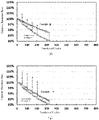
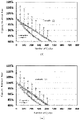
- the prepared sodium-ion button-type half battery was charged and discharged at a current density of 150mA/g at 45°C, and the capacity value of each charge-discharge of the battery was recorded. Taking the capacity value of the first charge-discharge as 100%, the percentage of the capacity value of each subsequent charge-discharge in the initial capacity value was calculated. This percentage was plotted against the number of cycles, and was shown in Fig. 5 .
- the prepared sodium-ion button-type full battery was charged at different current densities, and discharged at a rate of 0.33C, and the capacity value of each discharge was recorded to calculate the capacity retention rate.
- the current density and capacity retention rate were plotted to obtain a rate curve of the battery.
- the rate curves of the batteries prepared with the PBA materials of Example 1 and Comparative example 1 were shown in Fig. 6 .
- Fig. 7 showed a TEM photograph obtained by the above method for the PBA material of Example 1.
- the cladding layer thicknesses of the PBA materials of Examples 1-7 as measured by the above method were given in Tables 1-2.
- Manganese chloride tetrahydrate and sodium citrate monohydrate were added to 100ml of deionized water, stirred for 30min to form a solution a; after uniformly stirring, it was added dropwise to the above solution b with a rate of dropwise addition of 1ml/min; and after the completion of dropwise addition, it was stirred for 24h with a stirring rate of 400 rpm at a temperature of 80°C to form a suspension.
- the solid material in the above suspension was filtered with a Buchner funnel, and washed 3 times with deionized water until no sodium salt and transition metal ions remained in the product.
- the obtained material was vacuum-dried at 120°C for 24h with a relative vacuum degree ⁇ -0.1Mpa to obtain 10g of prussian blue analog particle Na 2 MnFe(CN) 6 .
- the obtained prussian blue analog particle was added to 100ml of deionized water and ultrasonically dispersed for 10min to form a suspension.
- 0.9681g of sodium ferrocyanide decahydrate, 0.745g of potassium chloride and 0.3958g of manganese chloride tetrahydrate were weighed.
- the above-mentioned sodium ferrocyanide decahydrate and potassium chloride were added to 10ml of deionized water, stirred for 30min to form a solution d; and manganese chloride tetrahydrate was added to 10ml of deionized water, and stirred for 30min to form a solution c.
- c and d were added dropwise to the above suspension at a rate of dropwise addition of 0.2ml/min, and after the completion of dropwise addition, stirring was continued to age for 12h.
- the stirring rate was 400 rpm, and the temperature was 80°C.
- the solid material in the suspension was filtered with a Buchner funnel, and washed 3 times with deionized water until no sodium salt and potassium salt as well as transition metal ions remained in the product.
- the obtained material was vacuum-dried at 120°C for 24h with a relative vacuum degree ⁇ -0.1Mpa to obtain a prussian blue analog having a core-shell structure.
- the outer shell was K 2 MnFe(CN) 6
- the core was Na 2 MnFe(CN) 6 .
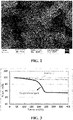
- the prussian blue analog had a particle size of 500-1000nm, and had a small cubic morphology with sharp edges and corners, and the micro-morphology SEM and the element distribution EDS were as shown in Fig. 2 .
- a prussian blue analog having a core-shell structure was prepared in the same manner as in Example 1, except that 1.21g of rubidium chloride was used instead of 0.745g of potassium chloride in the preparation of the solution d.
- a prussian blue analog having a core-shell structure was obtained.
- the outer shell was Rb 2 MnFe(CN) 6
- the core was Na 2 MnFe(CN) 6 .
- a prussian blue analog having a core-shell structure was prepared in the same manner as in Example 1, except that 1.68g of cesium chloride was used instead of 0.745g of potassium chloride in the preparation of the solution d.
- a prussian blue analog having a core-shell structure was obtained.
- the outer shell was Cs 2 MnFe(CN) 6
- the core was Na 2 MnFe(CN) 6 .
- a prussian blue analog having a core-shell structure was prepared in the same manner as in Example 1, except that 0.43g of lithium chloride was used instead of 0.745g of potassium chloride in the preparation of the solution d.
- a prussian blue analog having a core-shell structure was obtained.
- the outer shell was Li 2 MnFe(CN) 6
- the core was Na 2 MnFe(CN) 6 .
- a prussian blue analogue with core-shell structure was prepared in the same manner as in Example 1, except that 1.9362g of sodium ferrocyanide decahydrate, 1.49g of potassium chloride and 20ml of deionized water were used to prepare the solution d, and 0.7916g of manganese chloride tetrahydrate and 20ml of deionized water were used to prepare the solution c.
- a prussian blue analog having a core-shell structure was obtained.
- the outer shell was K 2 MnFe(CN) 6
- the core was Na 2 MnFe(CN) 6 .
- a prussian blue analogue with core-shell structure was prepared in the same manner as in Example 1, except that 0.3973g of sodium ferrocyanide decahydrate, 0.30g of potassium chloride and 4ml of deionized water were used to prepare the solution d, and 0.1583g of manganese chloride tetrahydrate and 4ml of deionized water were used to prepare the solution c.
- a prussian blue analog having a core-shell structure was obtained.
- the outer shell was K 2 MnFe(CN) 6
- the core was Na 2 MnFe(CN) 6 .
- a prussian blue analogue with core-shell structure was prepared in the same manner as in Example 1, except that 0.19362g of sodium ferrocyanide decahydrate, 0.15g of potassium chloride and 1ml of deionized water were used to prepare the solution d, and 0.07916g of manganese chloride tetrahydrate and 1ml of deionized water were used to prepare the solution c.
- a prussian blue analog having a core-shell structure was obtained.
- the outer shell was K 2 MnFe(CN) 6
- the core was Na 2 MnFe(CN) 6 .
- c and d were added dropwise to the above suspension at a rate of dropwise addition of 0.2ml/min, and after the completion of dropwise addition, stirring was continued to age for 12h, the stirring rate was 400 rpm, and the temperature was 80°C.
- the solid material in the suspension was filtered with a Buchner funnel, and washed 3 times with deionized water until no sodium salt and potassium salt as well as transition metal ions remained in the product.
- the obtained material was vacuum-dried at 120°C for 24h with a relative vacuum degree ⁇ -0.1Mpa to obtain a prussian blue analog having a core-shell structure.
- the outer shell was K 2 MnFe(CN) 6
- the core was Na 2 MnFe(CN) 6 .
- a prussian blue analog having a core-shell structure was prepared in the same manner as in Example 5, except that respectively, 100ml of a mixed liquid of deionized water and ethanol (the volume ratio of deionized water to ethanol was 7 : 3) was used instead of 100ml of deionized water to prepare the suspension of the solution b, the solution a and the prussian blue analog particle, 20ml of a mixed liquid of deionized water and ethanol (the volume ratio of deionized water to ethanol was 7 : 3) was used instead of 20ml of deionized water to prepare the solution d, and 20ml of ethanol was used instead of 20ml of deionized water to prepare the solution c.
- a prussian blue analogue with core-shell structure was prepared in the same manner as in Example 1, except that 3.529g of sodium citrate monohydrate was further added in the preparation of the solution c.
- a prussian blue analog having a core-shell structure was obtained.
- the outer shell was K 2 MnFe(CN) 6
- the core was Na 2 MnFe(CN) 6 .
- the prussian blue analog had a particle size of 500-1000nm, and had a small cubic morphology with sharp edges and corners.
- a prussian blue analog having a core-shell structure was prepared in the same manner as in Example 1, except that 7.125g of manganese chloride tetrahydrate was used instead of 7.9164g of manganese chloride tetrahydrate to prepare the solution a, the prussian blue analog having a core-shell structure was obtained.
- the outer shell was K 2 MnFe(CN) 6
- the core was Na 2 MnFe(CN) 6 .
- the prussian blue analog had a particle size of 500-1000nm, and had a small cubic morphology with sharp edges and corners.
- a prussian blue analogue with core-shell structure was prepared in the same manner as in Example 1, except that 70.584g of sodium citrate monohydrate was used instead of 35.292g of sodium citrate monohydrate to prepare the solution a.
- a prussian blue analog having a core-shell structure was obtained.
- the outer shell was K 2 MnFe(CN) 6
- the core was Na 2 MnFe(CN) 6 .
- the prussian blue analog had a particle size of 500-1000nm, and had a small cubic morphology with sharp edges and corners.
- a prussian blue analogue with core-shell structure was prepared in the same manner as in Example 1, except that 42.161g of tetrasodium ethylenediamine tetraacetate was used instead of 35.292g of sodium citrate monohydrate, and 7.125g of manganese chloride tetrahydrate was used instead of 7.9164g of manganese chloride tetrahydrate to prepare the solution a.
- a prussian blue analog having a core-shell structure was obtained.
- the outer shell was K 2 MnFe(CN) 6
- the core was Na 2 MnFe(CN) 6 .
- the prussian blue analog had a particle size of 500-1000nm, and had a small cubic morphology with sharp edges and corners.
- a prussian blue analog having a core-shell structure was prepared in the same manner as in Example 11, except that 35g of sodium chloride was further added in the preparation of the solution b.
- a prussian blue analog having a core-shell structure was obtained.
- the outer shell was K 2 MnFe(CN) 6
- the core was Na 2 MnFe(CN) 6 .
- the prussian blue analog had a particle size of 500-1000nm, and had a morphology of sphere.
- a prussian blue analog having a core-shell structure was prepared in the same manner as in Example 11, except that 35g of sodium chloride was further added in the preparation of the solution b, and the rate of dropwise addition of the solution a was 10ml/min.
- a prussian blue analog having a core-shell structure was obtained.
- the outer shell was K 2 MnFe(CN) 6
- the core was Na 2 MnFe(CN) 6 .
- the prussian blue analog had a particle size of 500-1000nm, and had a small cubic morphology with sharp edges and corners.
- a prussian blue analog having a core-shell structure was prepared in the same manner as in Example 1, except that the temperature at which stirring was continued to age after the completion of the dropwise addition of the solutions c and d was 40°C.
- a prussian blue analog having a core-shell structure was obtained.
- the outer shell was K 2 MnFe(CN) 6
- the core was Na 2 MnFe(CN) 6 .
- the prussian blue analog had a particle size of 500-1000nm, and had a small cubic morphology with sharp edges and corners.
- a prussian blue analog having a core-shell structure was prepared in the same manner as in Example 1, except that the temperature at which stirring was continued to age after the completion of the dropwise addition of the solutions c and d was 110°C.
- a prussian blue analog having a core-shell structure was obtained.
- the outer shell was K 2 MnFe(CN) 6
- the core was Na 2 MnFe(CN) 6 .
- the prussian blue analog had a particle size of 500-1000nm, and had a small cubic morphology with sharp edges and corners.
- Table 8 Eleme nt A of claddi ng layer Claddi ng amount Slow-releasing agent in solution a Molar ratio of P to slow-releasi ng agent in solutio n a Solvent system Temperat ure of step 4 Water content of material after 48h of water absorpti on in humid air (0-300°C TGA) Reversi ble specific capacity of first discharg e (mAh/g) Examp le 1 K 5% Sodium citrate monohydr ate 1:3.2 Deioniz ed water 80°C 2.6% 150.9 Examp le 16 K 5% Sodium citrate monohydr ate 1:3.2 Deioniz ed water 40°C 2.9% 143.9 Examp le 17 K 5% Sodium citrate monohydr ate 1:3.2 Deioniz ed water 110°C 5.1% 148.9
- a prussian blue analog having a core-shell structure was prepared in the same manner as in Example 1, except that the rates of dropwise addition of the solutions c and d were each 2ml/min.
- a prussian blue analog having a core-shell structure was obtained.
- the outer shell was K 2 MnFe(CN) 6
- the core was Na 2 MnFe(CN) 6 .
- the prussian blue analog had a particle size of 500-1000nm, and had a small cubic morphology with sharp edges and corners.
- a prussian blue analog having a core-shell structure was prepared in the same manner as in Example 1, except that the rates of dropwise addition of the solutions c and d were each 5ml/min.
- a prussian blue analog having a core-shell structure was obtained.
- the outer shell was K 2 MnFe(CN) 6
- the core was Na 2 MnFe(CN) 6 .
- the prussian blue analog had a particle size of 500-1000nm, and had a small cubic morphology with sharp edges and corners.
- a prussian blue analog having a core-shell structure was prepared in the same manner as in Example 1, except that the rates of dropwise addition of the solutions c and d were each 8ml/min.
- a prussian blue analog having a core-shell structure was obtained.
- the outer shell was K 2 MnFe(CN) 6
- the core was Na 2 MnFe(CN) 6 .
- the prussian blue analog had a particle size of 500-1000nm, and had a small cubic morphology with sharp edges and corners.
- a prussian blue analog particle was prepared in the same manner as in Example 1 using 19.3624g of sodium ferrocyanide decahydrate, 35.292g of sodium citrate monohydrate and 7.9164g of manganese chloride tetrahydrate, except that the step of cladding the shell layer with solutions c and d was not carried out. 10g of prussian blue analog particle Na 2 MnFe(CN) 6 was obtained, having a particle size of 500-1000nm and a small cubic morphology with sharp edges and corners.
- dopamine hydrochloride 0.5mol was placed in a beaker, 4L of deionized water and 210ml of concentrated hydrochloric acid were added to dissolve, and a 5L volumetric flask was used to bring the solution to the precise volume to obtain a dopamine solution with a molar concentration of 0.1mol/L.
- 10g of prepared Na 2 MnFe(CN) 6 sample was taken and placed in a vessel, 100ml of deionized water was added, and ultrasonically dispersed to obtain a suspension.
- the water absorption rates of the PBA materials having a core-shell structure of Examples 1-20 were significantly lower than those of Comparative examples 1 and 2.
- the reversible specific capacities of the materials of Examples 1-20 were close to those of Comparative examples 1 and 2.
- the reversible specific capacities for the first charge/discharge of the secondary battery prepared with the PBA material of Example 1 were 155.2mAh/g and 150.9mAh/g. That is, the effect of the cladding shell on the reversible specific capacity of the material is within an acceptable range.
- characterization of the long-term cycling and short-term charge rate performances of the PBA materials of each Example and Comparative example revealed that the cladded material of each Example exhibited significantly superior performance in terms of rate and cycling performances, especially in terms of high temperature cycling at 45°C.
- the secondary battery prepared with the PBA material of Example 1 could maintain a capacity retention rate of 85% or more after 500 cycles at a current density of 150mA/g. It can be seen from Fig. 5 that the long-term cycling performances of the PBA materials of Examples 1-20 were all superior to that of Comparative example 1. It can be seen from Fig. 6 that the short-term charging rate of the PBA material of Example 1 was also superior to that of Comparative example 1.
- Fig. 8 showed photographs of positive electrode sheets prepared with the PBA materials of Comparative example 1 and Example 1 after 400 charging-discharging cycles, and it can be seen that the PBA material of Comparative example 1 showed white spots due to sodium deposition, which could lead to the deterioration of the electrochemical performance of the PBA material. In contrast, the PBA material of Example 1 showed no white spots.
Landscapes
- Chemical & Material Sciences (AREA)
- Engineering & Computer Science (AREA)
- General Chemical & Material Sciences (AREA)
- Electrochemistry (AREA)
- Chemical Kinetics & Catalysis (AREA)
- Inorganic Chemistry (AREA)
- Materials Engineering (AREA)
- Manufacturing & Machinery (AREA)
- Health & Medical Sciences (AREA)
- Organic Chemistry (AREA)
- General Health & Medical Sciences (AREA)
- Toxicology (AREA)
- Composite Materials (AREA)
- Battery Electrode And Active Subsutance (AREA)
- Secondary Cells (AREA)
Abstract
the chemical formula of the core is the following Formula 1,
NaxP[R(CN)6]δ·zH2O Formula 1
wherein the P and R are each independently selected from at least one of transition metal elements, 0<x≤2, 0<δ≤1, and 0≤z≤10,
the chemical formula of the cladding layer is the following Formula 2,
AyL[M(CN)6]α·wH2O Formula 2
wherein the A is an alkali metal or alkaline earth metal element other than sodium, and the L and M are each independently selected from at least one of transition metal elements, 0<y≤2, 0<α≤1, and 0≤w≤10.
Description
- The present application relates to the field of sodium-ion secondary batteries, particularly to a prussian blue analog having a core-shell structure, and to a method for preparing the prussian blue analog having a core-shell structure, as well as a sodium-ion secondary battery, a battery module, a battery pack and a powered device comprising the same.
- In recent years, with the gradual development and application of lithium-ion batteries from portable electronic devices to high-power electric vehicles, large-scale energy storage power stations and smart grids, the demand for lithium-ion batteries is increasing; however, the limited lithium resources have limited the sustainable development of lithium-ion batteries. Sodium, which is in the same main group as lithium, has similar chemical properties to lithium and is abundant. Therefore, sodium-ion batteries that work in a similar way to lithium-ion batteries are being developed, and are expected to be an important supplement for lithium-ion batteries in large-scale energy storage applications.
- As a positive electrode material for a sodium-ion secondary battery, prussian blue analog (hereinafter sometimes referred to as PBA) has significant advantages in both specific capacity and ion transport due to its special open-framework crystal structure. The chemical formula of PBA can generally be written as NaxPR(CN)6 (P and R are transition metal elements such as Fe, Co, Ni, Mn, etc.). The transition metal ions P and R and -C=N- are arranged according to P-C=N-R to form a three-dimensional cubic frame structure, and the transition metal atoms P and R are located at the vertex positions of a face-centered cubic structure, connected by the -C=N-located on the edge. Its theoretical specific capacity is close to 170mAh/g, and the voltage platform is between 3-3.5V; and meanwhile, the relatively large void size of the cube (diameter being of about 4.6Å) and the relatively wide channel (about 4.6Å) in the [100] direction greatly facilitate the rapid migration of alkali metal ions with large ionic radii.
- However, the existing PBA materials are prone to gradual degradation of electrochemical performance during long-term storage. Therefore, although PBA material has a series of commercializable advantages of high capacity, high voltage platform, rapid sodium-ion transport channel, low cost, and simple preparation, etc., it is not favorable for industrial application due to the difficulty of long-term storage. If the deterioration of electrochemical performance of PBA material during long-term storage can be suppressed, its electrochemical performance and stability are expected to be greatly improved, thus greatly promoting the application process of PBA in sodium-ion secondary batteries.
- Therefore, it is of great significance in the field of sodium-ion secondary batteries to provide a prussian blue analog which is stable during long-term storage.
- The present application has been made in view of the above-mentioned topics, and an objective thereof is to provide a prussian blue analog as a positive electrode material for a sodium-ion secondary battery; the prussian blue analog is not prone to deterioration after long-term storage, and can still maintain excellent electrochemical performances such as cycling performance, and is suitable for industrial application in sodium-ion secondary batteries.
- Through extensive research, the inventors of the present application have found that the deterioration of the electrochemical performances of the PBA material may be related to the water absorption of the PBA material. Previously, there had been a technique of dehydrating the PBA material by means of vacuum heating. For example, the dehydration of MnFe-PBA by vacuum drying at 100°C for 30h under a high vacuum of 15mTorr can reduce the water content of MnFe-PBA as low as 0.5wt% (0.08H2O/f.u.) (Journal of the American Chemical Society, 2015, 137(7): 2658-2664). However, such dehydration process is time-consuming and costly. Moreover, the PBA material is easy to absorb water, and even if water molecules are removed by high temperature and vacuum, the dehydrated PBA material easily absorbs water again when stored in air, resulting in rapid degradation of its electrochemical performances, especially cycling performance, and possibly sodium precipitation during charge-discharge cycles.
- In order to achieve the above objective, in a first aspect, the present application provides a prussian blue analog having a core-shell structure, which has a core and a cladding layer that clads the core, wherein
- the chemical formula of the core is the following Formula 1,
NaxP[R(CN)6]δ·zH2OFormula 1
- wherein the P and R are each independently selected from at least one of transition metal elements, 0<x≤2, 0<δ≤1, and 0≤z≤10,
- the chemical formula of the cladding layer is the following
Formula 2,
AyL[M(CN)6]α·wH2O Formula 2
- wherein the A is an alkali metal or alkaline earth metal element other than sodium, and the L and M are each independently selected from at least one of transition metal elements, 0<y≤2, 0<α≤1, and 0≤w≤10.
- By using the prussian blue analog having the chemical composition AyL[M(CN)6]α as the shell to clad the surface of the sodium-containing prussian blue analog, the shell can especially effectively hinder the entry of water molecules into the core-shell structure, so that the PBA material is not easy to absorb water, thus greatly improving the storage stability of the PBA material at normal temperatures and pressures, greatly reducing the manufacturing cost at the subsequent battery cell level, while improving the structural stability of the PBA material, and meeting the requirements of sodium-ion secondary batteries. Furthermore, the preparation cost of the PBA material with the core-shell structure is low.
- In any of embodiments, the P, R, L and M are each independently selected from at least one of Fe, Mn, Ni, Co, Cu and Zn. Thus, the use of the above-mentioned transition metal ions can ensure the structural integrity of the PBA material, while enabling the PBA material to have good electrochemical performances such as maintaining electrochemical capacity.
- In any of embodiments, the A is selected from at least one of Li, K, Rb, Cs, Be, Mg, Ca, Sr and Ba, optionally at least one of K, Rb, Cs, Mg and Ca, for example, at least one of K, Rb and Cs. Thus, by selecting the above-mentioned ions as the A ions, a good blocking effect on the transport of water molecules is achieved.
- In any of embodiments,in Formula 1, 0.7≤δ≤1; and/or, in Formula 1 and Formula 2, the x and y are each independently 0.5-2, and optionally the x and y are each independently 1.5-2. The electrochemical capacity of the material can be increased by selecting a high δ and/or x and/or y value.
- In any of embodiments, the thickness of the cladding layer is 100nm or less, optionally 60nm or less, more optionally 50nm or less, and optionally in a range of 5nm-40nm, and further optionally in a range of 10nm-20nm. If the thickness of the cladding layer is within the above-mentioned numerical range, the hindering effect on water is sufficient, the electrochemical capacity of the material is not easily reduced, while the rapid transport of sodium ions is facilitated.
- In any of embodiments, the cladding amount of the cladding layer is 10 wt% or less, optionally 1 wt%-5 wt%. If the cladding amount of the cladding layer is within the above-mentioned range, the hindering effect on water is sufficient, the electrochemical capacity of the material is not easily reduced, while the rapid transport of sodium ions is facilitated.
- In any of embodiments, the prussian blue analog has a particle size of 100nm to 50µm. By selecting the above-mentioned particle size range, it is helpful for the material to maintain good ion and electron transport properties.
- A second aspect of the present application provides a method for preparing a prussian blue analog having a core-shell structure, the method comprising the steps of:
- 1) adding a prussian blue analog particle to a
solvent 1 and dispersing to obtain a suspension, the chemical formula of the prussian blue analog particle being the followingFormula 1,
NaxP[R(CN)6]δ·zH2OFormula 1
wherein the P and R are each independently selected from at least one of transition metal elements, 0<x≤2, 0<δ≤1, and 0≤z≤10; - 2) dissolving a soluble salt containing a transition metal element L in a
solvent 2 to make a solution c; - 3) dissolving a soluble salt containing an alkali metal or alkaline earth metal element A other than sodium and a soluble transition metal cyano complex containing a transition metal element M in a
solvent 3 to make a solution d; - 4) adding the solutions c and d dropwise to the suspension obtained in step 1) under stirring, and filtering the suspension to obtain a precipitate;
- 5) washing and drying the precipitate obtained in step 4) to obtain a prussian blue analog having a core-shell structure, wherein the prussian blue analog having a core-shell structure has a core and a cladding layer that clads the core, the core is the prussian blue analog particle, and the chemical formula of the cladding layer is the following
Formula 2,
AyL[M(CN)6]α·wH2O Formula 2
wherein the A is an alkali metal or alkaline earth metal element other than sodium, and the L and M are each independently selected from at least one of transition metal elements,0<y≤2, 0<α≤1, and 0≤w≤10. - By the above-mentioned preparation method, a prussian blue analog having chemical composition AyL[M(CN)6]α is formed as an outer shell on the surface of a sodium-containing prussian blue analog particle, and the outer shell obtained by the method is uniform and can completely clad the sodium-containing prussian blue analog particle, so that the entry of water molecules into the core-shell structure can be especially effectively hindered, so that the PBA material is not easy to absorb water, thus greatly improving the storage stability of the PBA material at normal temperatures and pressures, and while improving the structural stability of the material. Also, the method has low cost.
- In any of embodiments, the prussian blue analog particle in step 1) is prepared by a method comprising the steps of:
- i) dissolving a soluble salt containing P as a transition metal element and a slow-releasing agent containing Na in water to make a solution a;
- ii) dissolving a soluble transition metal cyano complex containing R as a transition metal element in water to make a solution b;
- iii) adding the solution a dropwise to the solution b under stirring, and after the completion of dropwise addition, aging and filtering to obtain a precipitate; and
- iv) washing and drying the precipitate obtained in step iii) to obtain the prussian blue analog particle.
- The above-mentioned method is helpful in preparing structurally stable prussian blue analog particle.
- In any of embodiments, the slow-releasing agent containing Na in step i) is at least one selected from sodium citrate, sodium ascorbate, disodium ethylenediamine tetraacetate, tetrasodium ethylenediamine tetraacetate, sodium chloride, sodium sulfate and sodium acetate. By selecting the above-mentioned slow-releasing agent, it is helpful in obtaining a more uniform cladding layer.
- In any of embodiments, the soluble transition metal cyano complex in step ii) is a divalent transition metal sodium cyanide.
- In any of embodiments, in the step iii), the solution is maintained in a temperature range of 20°C-120°C, optionally in a temperature range of 70°C-90°C, and optionally at 80°C. By controlling the temperature of the solution in the above-mentioned range, a better morphology of the cladding layer can be obtained.
- In any of embodiments, the
respective solvents - In any of embodiments, the soluble transition metal cyano complex in step 3) is a divalent transition metal sodium cyanide.
- In any of embodiments, in step 4), the rates of dropwise addition of the solution c and the solution d are each independently in a range of 0.1 ml/min-10 ml/min, optionally in a range of 0.1 ml/min-5ml/min, for example in a range of 0.1 ml/min-2ml/min; or in step 4), the reaction system is maintained in a temperature range of 20°C-120°C, optionally in a temperature range of 70°C-90°C, and optionally at 80°C. By controlling the rate or temperature of dropwise addition, a better morphology of the cladding layer can be obtained.
- A third aspect of the present application provides a sodium-ion secondary battery comprising the prussian blue analog having a core-shell structure of the first aspect of the present application or the prussian blue analog having a core-shell structure obtained by the method of the second aspect of the present application.
- A fourth aspect of the present application provides a battery module including the sodium-ion secondary battery of the third aspect of the present application.
- A fifth aspect of the present application provides a battery pack including the battery module of the fourth aspect of the present application.
- A sixth aspect of the present application provides a powered device including one or more selected from the sodium-ion secondary battery of the third aspect of the present application, the battery module of the fourth aspect of the present application, or the battery pack of the fifth aspect of the present application.
- In order to illustrate the technical solutions of the present application more clearly, a brief introduction will be given below of the drawings that are required to be used in the examples of the present application; it is apparently that the drawings described below are only some examples of the present application, and for those of ordinary skill in the art, according to the drawings, other drawings can also be obtained without involving any creative efforts.
-
Fig. 1 shows the XRD patterns of the PBA materials prepared in Examples 1-4 and Comparative example 1 of the present application. -
Fig. 2 shows the SEM and EDS images of the PBA material prepared in Example 1 of the present application. -
Fig. 3 shows the thermogravimetric analysis profiles of the water content of the PBA materials prepared in Example 1 and Comparative example 1 of the present application. -
Fig. 4 is a graph showing the water content in humid air versus time for the PBA materials prepared in Example 1 and Comparative example 1 of the present application. -
Fig. 5 shows the graphs of long-term cycling performance of sodium-ion secondary batteries when charging and discharging at a current density of 150mA/g, wherein the PBA materials prepared in Examples and Comparative example of the present application are each used as the positive electrode active materials in the sodium-ion secondary batteries. -
Fig. 6 shows the rate curves of sodium-ion secondary batteries when charging at different current densities and discharging at a rate of 0.33C, wherein the PBA materials prepared in Example 1 and Comparative example 1 of the present application are each used as the positive electrode active materials in the sodium-ion secondary batteries. -
Fig. 7 is a K element distribution diagram obtained by elemental analysis of the cross section of the PBA material of Example 1 using a transmission electron microscope (TEM) and an energy spectrometer. -
Fig. 8 shows the photographs of positive electrode sheets prepared with the PBA materials of Comparative example 1 and Example 1 after 400 charging-discharging cycles. -
Fig. 9 is a schematic diagram of a secondary battery according to an embodiment of the present application. -
Fig. 10 is an exploded view of the secondary battery according to an embodiment of the present application shown inFig. 9 . -
Fig. 11 is a schematic diagram of a battery module according to an embodiment of the present application. -
Fig. 12 is a schematic diagram of a battery pack according to an embodiment of the present application. -
Fig. 13 is an exploded view of the battery pack according to an embodiment of the present application shown inFig. 12 . -
Fig.14 is a schematic diagram of a powered device using a secondary battery according to an embodiment of the present application. - Description of reference numerals:
- 1 Battery pack
- 2 Upper box
- 3 Lower box
- 4 Battery module
- 5 Secondary battery
- 51 Case
- 52 Electrode assembly
- 53 Cover plate
- For the sake of brevity, the present application specifically discloses some numerical ranges. However, any lower limit can be combined with any upper limit to form a range not explicitly recited; and any lower limit can be combined with another lower limit to form a range not explicitly recited, and likewise, any upper limit can be combined with any another upper limit to form a range not explicitly recited. In addition, each individually disclosed point or individual numerical value can itself be used as a lower limit or an upper limit to combine with any another point or individual numerical value or with another lower limit or upper limit to form a range not explicitly recited.
- The prussian blue analog having a core-shell structure of the present application has a core and a cladding layer that clads the core, wherein
- The chemical formula of the core is the following
Formula 1,
NaxP[R(CN)6]δ·zH2O Formula 1
wherein the P and R are each independently selected from at least one of transition metal elements, 0<x≤2, 0<δ≤1, and 0≤z≤10, - The chemical formula of the cladding layer is the following
Formula 2,
AyL[M(CN)6]α·wH2O Formula 2
wherein the A is an alkali metal or alkaline earth metal element other than sodium, and the L and M are each independently selected from at least one of transition metal elements, 0<y≤2, 0<α≤1, and 0≤w≤10. - Without wishing to be bound by any theory, it is believed that the modification of the PBA surface with alkali metal or alkaline earth metal ions having a large ionic radius allows the large-radius ions to occupy positions where water of crystallization might otherwise exist, reducing the water of crystallization in the lattice structure, and thus the resulting prussian blue analog having a core-shell structure has less structural defects, crystallization is complete, and its electrochemical performances such as reversible specific capacity, cycling performance, etc. can be improved. Also, the surface cladding of the prussian blue analog having the chemical composition NaxP[R(CN)6]δ as the core with the prussian blue analog having the chemical composition AyL[M(CN)6]α as the outer shell is beneficial to obtain a uniform core-shell structure, and the prussian blue analog having the chemical composition AyL[M(CN)6]α as the outer shell clads the entire surface of the core, which has an excellent effect of hindering the entry of water molecules, so that the material has the property of not easily absorbing water, and the storage stability is greatly improved.
- In some embodiments, the transition metal elements P, R, L, and M are each independently selected from Fe, Mn, Ni, Co, Cu, and Zn. For example, the transition metal elements P, R, L, and M are each independently selected from Fe and Mn. By selecting these transition metal ions, the material can have the desired electrochemical performance and electrochemical capacity while ensuring structural integrity.
- In some embodiments, the alkali metal or alkaline earth metal element A is selected from at least one of Li, K, Rb, Cs, Be, Mg, Ca, Sr and Ba. For example, A is selected from at least one of K, Rb, Cs, Mg and Ca. In some embodiments, A is selected from at least one of K, Rb and Cs. By appropriately selecting the alkali metal or alkaline earth metal element A, a good blocking effect on the transport of water molecules is realized, which is beneficial to achieve a better effect of reducing the water absorption of the prussian blue analog.
- In some embodiments, δ in
Formula 1 satisfies 0.7≤δ≤1. By selecting the numerical range of δ, the prussian blue analog can have a larger capacity and a more stable structure when used as the positive electrode material for sodium-ion secondary batteries. - In some embodiments, in
Formula 1 andFormula 2, the x and y are each independently, for example, in a range of 0.5-2, for example in a range of 1.5-2. By appropriately selecting the numerical ranges of x and y, the prussian blue analog can have a larger capacity when used as the positive electrode material for sodium-ion secondary batteries. - In some embodiments, the thickness of the cladding layer is 100 nm or less, for example 60nm or less or 50nm or less. For example, the thickness of the cladding layer may be 5nm-40nm, for example 10nm-20nm. The inventors have found that when the thickness of the cladding layer is within the given range, it is possible to ensure a higher capacity of the PBA material as the positive electrode active material while improving the water absorption resistance and electrochemical performance.
- In some embodiments, the cladding amount of the cladding layer is 10wt% or less, for example 1wt%-5wt%. The cladding amount is defined as the ratio of the mass of the cladding layer to the total mass of the entire core-shell structured particle. When the cladding amount of the cladding layer is within the given range, it is possible to ensure a higher capacity of the PBA as the positive electrode active material while improving the water absorption resistance and electrochemical performance.
- In the present application, the thickness of the cladding layer can be tested using equipment and methods known in the art. By way of example, thickness and uniformity can be measured using focused ion beam technology (FIB) + transmission electron microscopy (TEM).
- In the present application, the cladding amount of the cladding layer can be tested using equipment and methods known in the art. By way of example, measurements can be made using Inductive Coupled Plasma Emission Spectrometer (ICP).
- In some embodiments, the particle size of the prussian blue analog is 100nm to 50µm, for example 200nm to 30µm. By controlling the particle size of the prussian blue analog within the above range, it is beneficial to obtain a uniform cladding layer and a smaller cladding layer thickness, so that the material maintains better ion and electron transport properties.
- In the present application, the particle size of the prussian blue analog can be tested using equipment and methods known in the art. For example, using a scanning electron microscope (e.g. ZEISS Sigma 300) and referring to JY/T010-1996, a scanning electron microscope (SEM) image of the prussian blue analog is obtained, and the particle size (i.e., the distance between the furthest two points on the particle) of the particle in the test area is read.
- In some embodiments, the specific surface area of the prussian blue analog is 1-20m2/g, for example 5-18 m2/g.
- In the present application, the specific surface area of the prussian blue analog can be tested using equipment and methods known in the art. For example, according to the national standard
GB/T 19587-2004 - The present application further provides a method for preparing a prussian blue analog having a core-shell structure, the method comprising the steps of:
- 1) adding a prussian blue analog particle to a solvent 1 and dispersing to obtain a suspension, the chemical formula of the prussian blue analog particle being the following
Formula 1,
NaxP[R(CN)6]δ·zH2O Formula 1
wherein the P and R are each independently selected from at least one of transition metal elements, 0<x≤2, 0<δ≤1, and 0≤z≤10; - 2) dissolving a soluble salt containing a transition metal element L in a solvent 2 to make a solution c;
- 3) dissolving a soluble salt containing an alkali metal or alkaline earth metal element A other than sodium and a soluble transition metal cyano complex containing a transition metal element M in a solvent 3 to make a solution d;
- 4) adding the solutions c and d dropwise to the suspension obtained in step 1) under stirring, and filtering the suspension to obtain a precipitate;
- 5) washing and drying the precipitate obtained in step 4) to obtain a prussian blue analog having a core-shell structure, wherein the prussian blue analog having a core-shell structure has a core and a cladding layer that clads the core, the core is the prussian blue analog particle, and the chemical formula of the cladding layer is the following
Formula 2,
AyL[M(CN)6]α·wH2O Formula 2
wherein the A is an alkali metal or alkaline earth metal element other than sodium, and the L and M are each independently selected from at least one of transition metal elements, 0<y≤2, 0<α≤1, and 0≤w≤10. - The descriptions and definitions of P, R, A, L, M, x, y, δ, α, z and w hereinabove in the section of "prussian blue analog having a core-shell structure" also apply to the methods of the present application.
- The solvents in steps 1), 2) and 3) may be the same or different, may be common solvents in the art, and can be selected by those skilled in the art according to actual needs. In some embodiments, the solvents in steps 1), 2) and 3) are each independently selected from at least one of deionized water and an organic solvent, for example at least one of deionized water, alcohol, ketone, halogenated hydrocarbon. In some embodiments, the solvents in steps 1), 2) and 3) are each independently selected from at least one of deionized water, methanol, glycerol, acetone and ethanol. In a case where the solvent is selected from deionized water, methanol, glycerol, acetone and ethanol, when the thickness of the cladding layer is <20 nm and the cladding amount is <5wt%, it is also easy to obtain a uniform cladding layer, and it is possible to obtain a reversible specific capacity comparable to that of a PBA material without a cladding layer while ensuring a low water absorption of the material.
- The dispersion in step 1) can be carried out by those skilled in the art by choosing an appropriate method. In some embodiments, dispersion is assisted by sonication and stirring in step 1).
- In some embodiments, in step 2), a slow-releasing agent may also be added when preparing the solution c. In a case of adding the slow-releasing agent, for example, the molar ratio of the transition metal element L to the slow-releasing agent is 1:0.1-10. In some embodiments, the molar ratio of the transition metal element L to the slow-releasing agent is 1:1-7, for example 1:1-5, for example 1:3. By adding an appropriate amount of the slow-releasing agent, the degree of uniformity of the cladding layer can be controlled to obtain a more uniform cladding layer.
- In the present application, the slow-releasing agent is a chelating agent, the anion of which has the effect of complexing with the transition metal ions, such that the transition metal ions do not exist in the solution alone, or is a sodium-containing compound which readily dissociates sodium ions in the solution.
- In some embodiments, the slow-releasing agent in step 2) is at least one selected from sodium citrate, sodium ascorbate, disodium ethylenediamine tetraacetate, tetrasodium ethylenediamine tetraacetate, sodium chloride, sodium sulfate and sodium acetate. By selecting the above-mentioned slow-releasing agent, a more uniform cladding layer can be obtained by controlling the reaction rate. The concentration of the slow-releasing agent in the solution is, for example, in a range of 0.01 mol/L -10mol/L.
- The anion of the soluble salt containing the transition metal element L in step 2) is not particularly limited, as long as the salt is a soluble salt. In some embodiments, the soluble salt containing the transition metal element L in step 2) is a divalent sulfate, a nitrate, a chloride or a salt of a weak acid, such as an oxalate. Its concentration in the solution is, for example, in a range of 0.01 mol/L-1mol/L.
- The anion of the soluble salt containing the alkali metal or alkaline earth metal element A other than sodium in step 3) is not particularly limited, as long as the salt is a soluble salt. In some embodiments, in step 3), the soluble salt containing the alkali metal or alkaline earth metal element A other than sodium is a sulfate, a nitrate, a chloride or a salt of a weak acid. Its concentration in the solution is, for example, in a range of 0.001 mol/L-1mol/L.
- In some embodiments, the soluble transition metal cyano complex in step 3) is a divalent transition metal sodium cyanide. Its concentration in the solution is, for example, in a range of 0.01 mol/L-1mol/L.
- In some embodiments, in step 4), after the completion of dropwise addition of all the solutions c and d, stirring of the reaction system is continued for 0.01h-48h, for example 12h.
- In some embodiments, in step 4), the reaction system is maintained in a temperature range of 20°C-120°C, for example 70°C-90°C, for example at 80°C. By controlling the temperature of the reaction system within the above range, the uniformity of the cladding layer can be controlled to obtain a better morphology of the cladding layer.
- In some embodiments, in step 4), the rate of dropwise addition of each solution is independently in a range of 0.1 ml/min-10ml/min, optionally in a range of 0.1 ml/min-5ml/min, for example in a range of 0.1 ml/min-2ml/min. By controlling the rate of dropwise addition of the solution within the above range, the uniformity of the cladding layer can be controlled to obtain a better morphology of the cladding layer.
- In some embodiments, in step 4), the stirring rate is in a range of 200rpm-1200rpm.
- The drying in step 5) can be carried out by those skilled in the art by choosing an appropriate drying method. In some embodiments, in step 5), the drying is carried out by vacuum drying, for example in a temperature range of 0-300°C, for example 150°C; and the vacuum degree is for example 10-15mTorr.
- In some embodiments, the prussian blue analog particle in step 1) is prepared by a method comprising the steps of:
- i) dissolving a soluble salt containing P as a transition metal element and a slow-releasing agent containing Na in water to make a solution a;
- ii) dissolving a soluble transition metal cyano complex containing R as a transition metal element in water to make a solution b;
- iii) adding the solution a dropwise to the solution b under stirring, and after the completion of dropwise addition, aging and filtering to obtain a precipitate;
- iv) washing and drying the precipitate obtained in step iii) to obtain the prussian blue analog particle.
- The PBA material prepared by the method has less defects and high sodium content, which is helpful in obtaining a structurally stable material.
- In some embodiments, in step i), the molar ratio of the transition metal element P to the slow-releasing agent is 1:0.1-10. In some embodiments, the molar ratio of the transition metal element P to the slow-releasing agent is 1:1-5, for example 1:3.2. By controlling the molar ratio within the above range, the uniformity of the cladding layer can be controlled to obtain a better morphology of the cladding layer.
- The anion of the soluble salt containing the transition metal element P in step i) is not particularly limited, as long as the salt is a soluble salt. In some embodiments, the soluble salt containing the transition metal element P in step i) is a divalent sulfate, a nitrate, a chloride or a salt of a weak acid, such as an oxalate. Its concentration in the solution is, for example, in a range of 0.01 mol/L-1mol/L.
- In some embodiments, the slow-releasing agent containing Na in step i) is at least one selected from sodium citrate, sodium ascorbate, disodium ethylenediamine tetraacetate, tetrasodium ethylenediamine tetraacetate, sodium chloride, sodium sulfate and sodium acetate. By selecting the above-mentioned slow-releasing agent, a more uniform cladding layer can be obtained by controlling the reaction rate. The concentration of the slow-releasing agent in the solution is, for example, in a range of 0.01 mol/L -10mol/L.
- In some embodiments, in step ii), a protective gas is introduced into the vessel in which the solution b is placed to protect the transition metal element against oxidation. The protective gas can be an appropriate inert gas selected by those skilled in the art. In some embodiments, in step ii), the protective gas is at least one of N2, Ar and He.
- In some embodiments, in step ii), a soluble sodium salt can also be added when preparing the solution b. For example, the soluble sodium salt may be at least one selected from sodium citrate, disodium ethylenediamine tetraacetate, tetrasodium ethylenediamine tetraacetate, sodium chloride, sodium sulfate and sodium acetate. In a case where a soluble sodium salt is added, for example, the molar ratio of the soluble transition metal cyano complex containing the transition metal element R to the soluble sodium salt is 1:0.1-100. The concentration of the soluble sodium salt in the solution is, for example, in a range of 0.01 mol/L-10mol/L. By adding the soluble sodium salt, the sodium source can be supplemented, and the morphology of the core particle can be adjusted.
- In some embodiments, the soluble transition metal cyano complex in step ii) is a divalent transition metal sodium cyanide. Its concentration in the solution is, for example, in a range of 0.01 mol/L-1mol/L.
- In some embodiments, in step iii), the stirring rate is in a range of 200rpm-1200rpm.
- In some embodiments, in step iii), the solution is maintained in a temperature range of 20°C-120°C, for example 70°C-90°C, for example at 80°C. By controlling the temperature of the solution within the above range, the uniformity of the cladding layer can be controlled to obtain a better morphology of the cladding layer.
- In some embodiments, in step iii), the solution a is added dropwise at a rate of 0. 1ml/min-10ml/min, for example at a rate of 1ml/min. By controlling the rate of dropwise addition of the solution within the above range, the uniformity of the cladding layer can be controlled to obtain a better morphology of the cladding layer.
- In some embodiments, instep iii), the aging is performed for 0.01h-48h, for example for 12h, and the aging can be performed, for example, under stirring.
- The washing in step iv) can be carried out by those skilled in the art by choosing an appropriate solvent. In some embodiments, in step iv), the washing can be performed using a mixture of deionized water and ethanol, as well as ethanol or acetone etc., and can be performed one or more times.
- The drying in step iv) can be carried out by those skilled in the art by choosing an appropriate drying method. In some embodiments, in step iv), the drying is carried out by vacuum drying, for example in a temperature range of 0-300°C, for example 150°C; and the vacuum degree is for example 10-15mTorr.
- The present application further provides a positive electrode sheet for sodium-ion secondary batteries, the positive electrode sheet including a positive electrode current collector and the prussian blue analog having a core-shell structure of the first aspect of the present application or the prussian blue analog having a core-shell structure prepared by the method of the second aspect of the present application provided on the current collector.
- At least one surface of the positive electrode current collector is provided with a positive electrode film layer comprising the prussian blue analog having a core-shell structure of the first aspect of the present application.
- By way of example, the positive electrode current collector has two opposite surfaces in the direction of its own thickness, and the positive electrode film layer is provided on either or both of the two opposite surfaces of the positive electrode current collector.
- In some embodiments, the positive electrode current collector can be a conventional metal foil or a composite current collector. For example, as the metal foil, an aluminium foil can be used. The composite current collector may include a high molecular material substrate layer and a metal layer formed on at least one surface of the high molecular material substrate layer. The composite current collector can be formed by forming the metal material (for example, aluminium, aluminium alloy, nickel, nickel alloy, titanium, titanium alloy, silver and silver alloy, etc.) on the high molecular material substrate (such substrate as polypropylene (PP), polyethylene terephthalate (PET), polybutylene terephthalate (PBT), polystyrene (PS), polyethylene (PE), etc.). By way of example, the positive electrode current collector may be an aluminium foil, such as a 5-30µm carbon-coated aluminium foil.
- The positive electrode film layer further optionally comprises a conductive agent.However, the type of the conductive agent is not particularly limited, and those skilled in the art can make a selection according to the actual needs. By way of example, the conductive agent for the positive electrode film layer may be selected from one or more of superconducting carbon, acetylene black, carbon black, Ketjen black, carbon dot, carbon nanotube, graphene, and carbon nanofiber.
- In the present application, the positive electrode sheet can be prepared according to the methods known in the art. By way of example, the positive electrode active material, the conductive agent and the binder of the present application can be dispersed in a solvent (for example, N-methyl pyrrolidone (NMP)) to form a uniform positive electrode slurry; the positive electrode slurry is coated on the positive electrode current collector, and after oven drying, cold pressing and other procedures, the positive electrode sheet is obtained.
- In some embodiments, the positive electrode sheet is coated on the current collector with: 70-90 parts by weight of the prussian blue analog having a core-shell structure, 1-20 parts by weight of the conductive agent and 1-10 parts by weight of the binder.
- The present application further provides a sodium-ion secondary battery including the above-mentioned positive electrode sheet.
- Typically, a sodium-ion secondary battery includes a positive electrode sheet, a negative electrode sheet, an electrolyte, and a separator. During charging and discharging of the battery, active ions are intercalated and deintercalated back and forth between the positive electrode sheet and the negative electrode sheet. The electrolyte serves to conduct ions between the positive electrode sheet and the negative electrode sheet. The separator is provided between the positive electrode sheet and the negative electrode sheet, and mainly functions to prevent a short circuit between the positive electrode and the negative electrode while allowing ions to pass through.
- The negative electrode sheet includes a negative electrode current collector and a negative electrode film layer provided on at least one surface of the negative electrode current collector, wherein the negative electrode film layer comprises a negative electrode active material.
- By way of example, the negative electrode current collector has two opposite surfaces in the direction of its own thickness, and the negative electrode film layer is provided on either or both of the two opposite surfaces of the negative electrode current collector.
- In some embodiments, the negative electrode current collector can be a metal foil or a composite current collector. For example, as the metal foil, an aluminium foil can be used. The composite current collector may include a high molecular material substrate layer and a metal layer formed on at least one surface of the high molecular material substrate. The composite current collector can be formed by forming the metal material (for example, aluminium, aluminium alloy, nickel, nickel alloy, titanium, titanium alloy, silver and silver alloy, etc.) on the high molecular material substrate (such substrate as polypropylene (PP), polyethylene terephthalate (PET), polybutylene terephthalate (PBT), polystyrene (PS), polyethylene (PE), etc.).
- In the secondary battery of the present application, the negative electrode film layer generally comprises a negative electrode active material and an optional binder, an optional conductive agent and other optional auxiliaries, and is usually formed by coating a negative electrode slurry and drying. The negative electrode slurry is generally formed by dispersing the negative electrode active material as well as the optional conductive agent and the binder, etc. in a solvent and uniformly stirring. The solvent may be N-methyl pyrrolidone (NMP) or deionized water.
- By way of example, the conductive agent may be selected from one or more of superconducting carbon, acetylene black, carbon black, Ketjen black, carbon dot, carbon nanotube, graphene, and carbon nanofiber.
- By way of example, the binder may be selected from one or more of styrene butadiene rubber (SBR), polyacrylic acid (PAA), sodium polyacrylate (PAAS), polyacrylamide (PAM), polyvinyl alcohol (PVA), sodium alginate (SA), polymethacrylic acid (PMAA) and carboxymethyl chitosan (CMCS).
- Other optional auxiliaries are, for example, thickeners (e. g., sodium carboxymethyl cellulose (CMC-Na)) and the like.
- By way of example, the negative electrode active material may be selected from one or more of carbon material, alloy material, transition metal oxide and sulfide, phosphorus-based material, and titanate material. For example, as the negative electrode active material, soft carbon, hard carbon, silicon-based material, tin-based material, and the like may be cited. The silicon-based material may be selected from one or more of elemental silicon, silicon-oxygen compound, silicon-carbon composite, silicon-nitrogen composite, and silicon alloy. The tin-based material may be selected from one or more of elemental tin, tin-oxygen compound, and tin alloy.
- In some embodiments, the negative electrode sheet may directly use a sodium metal sheet or a sodium metal alloy sheet.
- The electrolyte serves to conduct ions between the positive electrode sheet and the negative electrode sheet. The type of the electrolyte is not particularly limited in the present application, and can be selected according to needs. For example, the electrolyte may be selected from at least one of solid electrolyte and liquid electrolyte (i.e., electrolyte solution).
- In some embodiments, an electrolyte solution is used as the electrolyte. The electrolyte solution comprises an electrolyte salt and a solvent.
- The electrolyte solution can comprise an electrolyte salt and a solvent. By way of example, the solvent may be selected from one or more of ethylene carbonate (EC), propylene carbonate (PC), ethyl methyl carbonate (EMC), diethyl carbonate (DEC), dimethyl carbonate (DMC), dipropyl carbonate (DPC), methyl propyl carbonate (MPC), ethyl propyl carbonate (EPC), butylene carbonate (BC), fluoroethylene carbonate (FEC), methyl formate (MF), methyl acetate (MA), ethyl acetate (EA), propyl acetate (PA), methyl propionate (MP), ethyl propionate (EP), propyl propionate (PP), methyl butyrate (MB), ethyl butyrate (EB), 1,4-butyrolactone (GBL), sulfolane (SF), dimethyl sulfone (MSM), methyl ethyl sulfone (EMS) and diethyl sulfone (ESE). By way of example, the electrolyte salt may be NaClO4, NaPF6 or NaFSI (sodium bisfluorosulfonimide), etc.
- In some embodiments, the electrolyte solution further optionally comprises an additive. For example, the additive may include a negative electrode film-forming additive, may also include a positive electrode film-forming additive, and may further include an additive capable of improving certain performances of the battery, such as an additive for improving the overcharging performance of the battery, an additive for improving the high temperature performance of the battery, and an additive for improving the low temperature performance of the battery, etc.
- The secondary battery using an electrolyte solution and some secondary batteries using a solid electrolyte further include a separator. A separator is provided between the positive electrode sheet and the negative electrode sheet, and functions to separate. The type of the separator is not particularly limited in the present application, and any well-known separator with a porous structure having good chemical stability and mechanical stability may be selected. In some embodiments, the material of the separator may be selected from one or more of glass fiber, nonwoven cloth, polyethylene, polypropylene, and polyvinylidene fluoride. The separator may be a single-layer film or a multi-layer composite film, and is not particularly limited. When the separator is a multi-layer composite film, the material of each layer may be the same or different, and there is no particular limitation.
- In some embodiments, the positive electrode sheet, the negative electrode sheet, and the separator can be made into an electrode assembly by a winding process or a lamination process.
- In some embodiments, the secondary battery may include an outer package. The outer package can be used to encapsulate the above-mentioned electrode assembly and electrolyte.
- In some embodiments, the outer package of the secondary battery may be a hard case, such as a hard plastic case, an aluminium case, a steel case, and the like. The outer package of the secondary battery can also be a soft pack, such as a bag-type soft pack. The material of the soft pack can be a plastic, and examples as plastics include polypropylene (PP), polybutylene terephthalate (PBT) and polybutylene succinate (PBS), etc.
- The shape of the secondary battery is not particularly limited in the present application, and may be cylindrical, square or of any other shapes.
- In some embodiments, referring to
Fig. 10 , the outer package can include acase 51 and acover plate 53. Here, thecase 51 can include a bottom plate and a side plate connected to the bottom plate, with the bottom plate and the side plate enclosing to form an accommodating cavity. Thecase 51 has an opening that communicates with the accommodating cavity, and thecover plate 53 can cover the opening to close the accommodating cavity. The positive electrode sheet, the negative electrode sheet, and the separator may be formed into anelectrode assembly 52 by a winding process or a lamination process. Theelectrode assembly 52 is encapsulated within the accommodating cavity. The electrolyte solution impregnates theelectrode assembly 52. The number ofelectrode assemblies 52 contained in thesecondary battery 5 can be one or more, and can be selected by those skilled in the art according to specific actual needs. - In some embodiments, secondary batteries can be assembled into a battery module, the number of secondary batteries contained in the battery module can be one or more, and the specific number can be selected by those skilled in the art according to the application and capacity of the battery module.
-
Fig. 11 is an example ofbattery module 4. Referring toFig. 11 , in thebattery module 4, a plurality ofsecondary batteries 5 can be sequentially arranged along the length direction of thebattery module 4. Of course, any other arrangement is also possible. The plurality ofsecondary batteries 5 may further be fixed by fasteners. - Optionally, the
battery module 4 can further include a case having an accommodating space, in which the plurality ofsecondary batteries 5 are accommodated. - In some embodiments, the above-mentioned battery modules can further be assembled into a battery pack, and the number of battery modules contained in the battery pack can be selected by those skilled in the art according to the application and capacity of the battery pack.
-
Fig. 12 andFig. 13 are an example ofbattery pack 1. Referring toFig. 12 andFig. 13 , thebattery pack 1 can include a battery box and a plurality ofbattery modules 4 provided in the battery box. The battery box includes anupper box 2 and alower box 3, wherein theupper box 2 can cover thelower box 3, and forms an enclosed space for accommodating thebattery module 4. The plurality ofbattery modules 4 can be arranged in the battery box according to any manner. - In addition, the present application further provides a powered device, and the powered device includes one or more of the secondary battery, the battery module, or the battery pack provided by the present application. The secondary battery, battery module, or battery pack can be used as a power source for the powered device, and can also be used as an energy storage unit for the powered device. The powered device may be, but is not limited to, a mobile device (such as a mobile phone, a laptop, etc.), an electric vehicle (such as an all-electric vehicle, a hybrid electric vehicle, a plug-in hybrid electric vehicle, an electric bicycle, an electric scooter, an electric golf cart, an electric truck, etc.), an electric train, a ship, a satellite, an energy storage system, etc.
- For the powered device, the secondary battery, the battery module, or the battery pack can be selected according to its use requirements.
-
Fig. 14 is an example of powered device. The powered device is an all-electric vehicle, a hybrid electric vehicle, or a plug-in hybrid electric vehicle, etc. In order to meet the requirements of the powered device for high power and high energy density of secondary batteries, a battery pack or a battery module may be used. - By way of another example, the powered device may be a mobile phone, a tablet computer, a laptop, etc. The powered device is generally required to be light and thin, and can use a secondary battery as a power source.
- Hereinafter, examples of the present application are illustrated. The examples described below are illustrative, are merely used to explain the present application, and should not be construed as a limitation to the present application. Where specific techniques or conditions are not specified in the examples, the techniques or conditions described in the literature's of the art or the product specifications are followed. Where manufacturers are not specified, the reagents or instruments used are conventional products and are commercially available. The beneficial effects of the present application are further illustrated below in conjunction with the examples.
- 1 g of the PBA material prepared in each Example and Comparative example was placed in a humid air atmosphere with a relative humidity of 70%, weighed after storage of 15min, 30min, 60min, 180min, respectively, and weighed every three hours after 180min. Assuming that the mass weighed was m, then the water absorption = (m-1) /1∗100%. The calculated water absorption was plotted against time, and
Fig. 4 showed the curves of water absorption over time for each of the PBA materials having a core-shell structure prepared in Example 1 and Comparative example 1. - 1 g of the PBA material prepared in each Example and Comparative example was placed in a humid air atmosphere with a relative humidity of 70%, respectively, and after storage of 48h, the stored sample was subjected to thermogravimetric analysis test in an N2 atmosphere with a purity of 99.99%, the heating rate was 10°C/min, and the temperature range was 0-300°C, thus the water content in the material was quantitatively determined. The quantitative determination of the water content in the material was carried out as follows: the initial weight and the weight at 300°C were extracted by thermogravimetric analysis test, and the water content was obtained by dividing the difference by the initial weight. The water content test results for the PBA material of each Example and Comparative example were listed in Tables 1-10 below. Also, the water contents of the PBA materials prepared in Example 1 and Comparative example 1 as a function of temperature in thermogravimetric analysis test were shown in
Fig.3 . - The positive electrode sheet was prepared by the following method: the PBA material (positive electrode active material) prepared in each Example and Comparative example, a conductive agent Ketjen black (KB) and a binder polyvinylidene fluoride (PVDF) were added to N-methyl pyrrolidone (NMP), and stirred by a rotor for 1-3 h to make a slurry. The slurry was coated on a current collector Al foil, with the coating thickness being 200-300 µm. It was dried in a vacuum drying oven at 90-110°C for 10-15 h, and then naturally cooled down to room temperature to obtain the positive electrode sheet. The mass ratio of the materials used was the positive electrode active material : the conductive agent Ketjen Black : the binder polyvinylidene fluoride = 7: 2: 1, and 28 g of active material was added for every 20-40 g of NMP
- The negative electrode sheet was prepared by the following method: Type I/II/III commercial hard carbon negative electrode material (negative electrode active material) purchased from KURARAY of Japan, a conductive agent carbon black (CB), and a binder polyvinylidene fluoride (PVDF) were added to N-methyl pyrrolidone (NMP), and stirred by a rotor for 1-3 h to make a slurry. The slurry was coated on a current collector Al foil, the coating amount is determined according to the absolute capacity of the positive electrode, and the absolute capacity of the negative electrode : the absolute capacity of the positive electrode = 1.16, wherein the absolute capacity (mAh) = reversible specific capacity of the first discharge (mAh/g) ∗ the total weight of the active material (g), and the reversible specific capacity was measured as described below. It was dried in a vacuum drying oven at 90-110°C for 10-15 h, and then naturally cooled down to room temperature to obtain the positive electrode sheet. The mass ratio of the materials used was the negative electrode active material: the conductive agent carbon black CB: the binder polyvinylidene fluoride = 9 : 0.4 : 0.6, and 28 g of active material was added for every 20-40 g of NMP.
- A sodium-ion button-type half battery was prepared by the following method: the positive electrode sheet prepared by the above method was cut into electrode sheets with a diameter of 14-16 mm using a sheet cutter, a glass fiber separator was used, sodium metal was used as the negative electrode, an electrolyte solution was added, and a CR 2032 button-type battery was assembled in a glove box filled with an argon atmosphere. The electrolyte solution is a solution containing NaClO4 and FEC (fluoroethylene carbonate), wherein the solvent is a mixture of ethylene carbonate (EC) and diethyl carbonate (DEC) with a volume ratio of 1:1, the concentration of NaClO4 is 1M, and the mass of FEC is 2% of the mass of the solution.
- A sodium-ion button-type full battery was prepared by the following method: the positive electrode sheet and the negative electrode sheet prepared by the above method (1) were cut into electrode sheets with diameters of 14 mm and 16 mm, respectively, using a sheet cutter, a glass fiber separator was used, an electrolyte solution was added, and a CR 2032 button-type battery was assembled in a glove box filled with an argon atmosphere. The electrolyte solution is a solution containing NaClO4 and FEC (fluoroethylene carbonate), wherein the solvent is a mixture of ethylene carbonate (EC) and diethyl carbonate (DEC) with a volume ratio of 1:1, the concentration of NaClO4 is 1M, and the mass of FEC is 2% of the mass of the solution.
- In the interval of 2.5-4.0V and at room temperature of 25°C, the sodium-ion button-type full battery was charged and discharged at a current density of 20mA/g, the capacity of the battery during charge-discharge was recorded, and the reversible specific capacity was obtained by dividing the capacity by the mass of the positive electrode active material. The test results of the first discharge reversible specific capacity of the secondary battery prepared with the PBA material of each Example and Comparative example were listed in Tables 1-10 below.
- The prepared sodium-ion button-type half battery was charged and discharged at a current density of 150mA/g at 45°C, and the capacity value of each charge-discharge of the battery was recorded. Taking the capacity value of the first charge-discharge as 100%, the percentage of the capacity value of each subsequent charge-discharge in the initial capacity value was calculated. This percentage was plotted against the number of cycles, and was shown in
Fig. 5 . - The prepared sodium-ion button-type full battery was charged at different current densities, and discharged at a rate of 0.33C, and the capacity value of each discharge was recorded to calculate the capacity retention rate. The current density and capacity retention rate were plotted to obtain a rate curve of the battery. The rate curves of the batteries prepared with the PBA materials of Example 1 and Comparative example 1 were shown in
Fig. 6 . - A sample of PBA material was subjected to ion beam shearing using a focused ion beam (FIB) to expose a cross-section of the material, and then the sample with exposed cross-section was vacuum transferred into a transmission electron microscope (TEM) testing apparatus; elemental analysis was performed on the cross-section by using an energy spectrometer to determine the location and uniformity of K element distribution.
Fig. 7 showed a TEM photograph obtained by the above method for the PBA material of Example 1. The cladding layer thicknesses of the PBA materials of Examples 1-7 as measured by the above method were given in Tables 1-2. - 19.3624g of sodium ferrocyanide decahydrate, 35.292g of sodium citrate monohydrate and 7.9164g of manganese chloride tetrahydrate were weighed. The above sodium ferrocyanide decahydrate was added to 100ml of deionized water, and stirred for 30min to form a solution b. Manganese chloride tetrahydrate and sodium citrate monohydrate were added to 100ml of deionized water, stirred for 30min to form a solution a; after uniformly stirring, it was added dropwise to the above solution b with a rate of dropwise addition of 1ml/min; and after the completion of dropwise addition, it was stirred for 24h with a stirring rate of 400 rpm at a temperature of 80°C to form a suspension.
- The solid material in the above suspension was filtered with a Buchner funnel, and washed 3 times with deionized water until no sodium salt and transition metal ions remained in the product. The obtained material was vacuum-dried at 120°C for 24h with a relative vacuum degree <-0.1Mpa to obtain 10g of prussian blue analog particle Na2MnFe(CN)6.
- The obtained prussian blue analog particle was added to 100ml of deionized water and ultrasonically dispersed for 10min to form a suspension. 0.9681g of sodium ferrocyanide decahydrate, 0.745g of potassium chloride and 0.3958g of manganese chloride tetrahydrate were weighed. The above-mentioned sodium ferrocyanide decahydrate and potassium chloride were added to 10ml of deionized water, stirred for 30min to form a solution d; and manganese chloride tetrahydrate was added to 10ml of deionized water, and stirred for 30min to form a solution c. After uniformly stirring, c and d were added dropwise to the above suspension at a rate of dropwise addition of 0.2ml/min, and after the completion of dropwise addition, stirring was continued to age for 12h. The stirring rate was 400 rpm, and the temperature was 80°C.
- The solid material in the suspension was filtered with a Buchner funnel, and washed 3 times with deionized water until no sodium salt and potassium salt as well as transition metal ions remained in the product. The obtained material was vacuum-dried at 120°C for 24h with a relative vacuum degree <-0.1Mpa to obtain a prussian blue analog having a core-shell structure. The outer shell was K2MnFe(CN)6, and the core was Na2MnFe(CN)6. The prussian blue analog had a particle size of 500-1000nm, and had a small cubic morphology with sharp edges and corners, and the micro-morphology SEM and the element distribution EDS were as shown in
Fig. 2 . - A prussian blue analog having a core-shell structure was prepared in the same manner as in Example 1, except that 1.21g of rubidium chloride was used instead of 0.745g of potassium chloride in the preparation of the solution d. A prussian blue analog having a core-shell structure was obtained. The outer shell was Rb2MnFe(CN)6, and the core was Na2MnFe(CN)6.
- A prussian blue analog having a core-shell structure was prepared in the same manner as in Example 1, except that 1.68g of cesium chloride was used instead of 0.745g of potassium chloride in the preparation of the solution d. A prussian blue analog having a core-shell structure was obtained. The outer shell was Cs2MnFe(CN)6, and the core was Na2MnFe(CN)6.
- A prussian blue analog having a core-shell structure was prepared in the same manner as in Example 1, except that 0.43g of lithium chloride was used instead of 0.745g of potassium chloride in the preparation of the solution d. A prussian blue analog having a core-shell structure was obtained. The outer shell was Li2MnFe(CN)6, and the core was Na2MnFe(CN)6.
Table 1 Elemen t A of claddin g layer Clad ding amo unt Slow-releasing agent in solution a Molar ratio of P to slow-releasing agent in solution a Solvent system Water content of material after 48h of water absorption in humid air (0-300°C TGA) Reversib le specific capacity of first discharg e (mAh/g) Claddi ng layer thickn ess (nm) Exa mple 1 K 5% Sodium citrate monohyd rate 1:3.2 Deioniz ed water 2.6% 150.9 19 Exa mple 2Rb 5% Sodium citrate monohyd rate 1:3.2 Deioniz ed water 2.1% 148.9 14 Exa mple 3 Cs 5% Sodium citrate monohyd rate 1:3.2 Deioniz ed water 1.6% 146.5 10 Exa mple 4Li 5% Sodium citrate monohyd rate 1:3.2 Deioniz ed water 4.5% 151.4 30 - A prussian blue analogue with core-shell structure was prepared in the same manner as in Example 1, except that 1.9362g of sodium ferrocyanide decahydrate, 1.49g of potassium chloride and 20ml of deionized water were used to prepare the solution d, and 0.7916g of manganese chloride tetrahydrate and 20ml of deionized water were used to prepare the solution c. A prussian blue analog having a core-shell structure was obtained. The outer shell was K2MnFe(CN)6, and the core was Na2MnFe(CN)6.
- A prussian blue analogue with core-shell structure was prepared in the same manner as in Example 1, except that 0.3973g of sodium ferrocyanide decahydrate, 0.30g of potassium chloride and 4ml of deionized water were used to prepare the solution d, and 0.1583g of manganese chloride tetrahydrate and 4ml of deionized water were used to prepare the solution c. A prussian blue analog having a core-shell structure was obtained. The outer shell was K2MnFe(CN)6, and the core was Na2MnFe(CN)6.
- A prussian blue analogue with core-shell structure was prepared in the same manner as in Example 1, except that 0.19362g of sodium ferrocyanide decahydrate, 0.15g of potassium chloride and 1ml of deionized water were used to prepare the solution d, and 0.07916g of manganese chloride tetrahydrate and 1ml of deionized water were used to prepare the solution c. A prussian blue analog having a core-shell structure was obtained. The outer shell was K2MnFe(CN)6, and the core was Na2MnFe(CN)6.
Table 2 Eleme nt A of claddin g layer Claddi ng amount Slow-releasing agent in solution a Molar ratio of P to slow-releasin g agent in solutio n a Solvent system Water content of material after 48h of water absorpti on in humid air (0-300°C TGA) Reversib le specific capacity of first discharg e (mAh/g) Claddin g layer thickne ss (nm) Examp le 1 K 5% Sodium citrate monohydr ate 1:3.2 Deioniz ed water 2.6% 150.9 19 Examp le 5 K 10% Sodium citrate monohydr ate 1:3.2 Deioniz ed water 2% 143.1 40 Examp le 6 K 2% Sodium citrate monohydr ate 1:3.2 Deioniz ed water 3.9% 153.6 5 Examp le 7 K 1% Sodium citrate monohydr ate 1:3.2 Deioniz ed water 4.5% 154.8 3 - 10g finished product of prussian blue analog particle Na2MnFe(CN)6 prepared according to the method in the literature Journal of The Electrochemical Society, 163 (9) A2117-A2123 (2016) was added to 100ml of deionized water, and ultrasonically dispersed for 10min to form a suspension. 1.9362g of sodium ferrocyanide decahydrate, 1.49g of potassium chloride and 0.7916g of manganese chloride tetrahydrate were weighed, and the above-mentioned sodium ferrocyanide decahydrate and potassium chloride were added to 20ml of deionized water, stirred for 30min to form a solution d, and the above-mentioned manganese chloride tetrahydrate were added to 20ml of deionized water, and stirred for 30min to form a solution c. After uniformly stirring, c and d were added dropwise to the above suspension at a rate of dropwise addition of 0.2ml/min, and after the completion of dropwise addition, stirring was continued to age for 12h, the stirring rate was 400 rpm, and the temperature was 80°C.
- The solid material in the suspension was filtered with a Buchner funnel, and washed 3 times with deionized water until no sodium salt and potassium salt as well as transition metal ions remained in the product. The obtained material was vacuum-dried at 120°C for 24h with a relative vacuum degree <-0.1Mpa to obtain a prussian blue analog having a core-shell structure. The outer shell was K2MnFe(CN)6, and the core was Na2MnFe(CN)6.
Table 3 Element A of cladding layer Cladding amount Solvent system Water content of material after 48h of water absorption in humid air (0-300°C TGA) Reversible specific capacity of first discharge (mAh/g) Example 5 K 10 % Deionized water 2% 143.1 Example 8 K 10% Deionized water 2.2% 147.3 - A prussian blue analog having a core-shell structure was prepared in the same manner as in Example 5, except that respectively, 100ml of a mixed liquid of deionized water and ethanol (the volume ratio of deionized water to ethanol was 7 : 3) was used instead of 100ml of deionized water to prepare the suspension of the solution b, the solution a and the prussian blue analog particle, 20ml of a mixed liquid of deionized water and ethanol (the volume ratio of deionized water to ethanol was 7 : 3) was used instead of 20ml of deionized water to prepare the solution d, and 20ml of ethanol was used instead of 20ml of deionized water to prepare the solution c. A prussian blue analog having a core-shell structure was obtained. The outer shell was K2MnFe(CN)6, and the core was Na2MnFe(CN)6.
Table 4 Element A of cladding layer Cladding amount Slow-releasing agent in solutiona Molar ratio of P to slow-releasing agent in solutiona Solvent system Water content of material after 48h of water absorptio n in humid air (0-300°C TGA) Reversibl e specific capacity of first discharge (mAh/g) Exampl e 5 K 10% Sodium citrate monohydrat e 1:3.2 Deionized water 2% 143.1 Exampl e 6 K 2% Sodium citrate monohydrat e 1:3.2 Deionized water 3.9% 153.6 Exampl e 9 K 10% Sodium citrate monohydrat e 1:3.2 Mixture of deionized water and ethanol/ethan ol 1.5% 151.5 - A prussian blue analogue with core-shell structure was prepared in the same manner as in Example 1, except that 3.529g of sodium citrate monohydrate was further added in the preparation of the solution c. A prussian blue analog having a core-shell structure was obtained. The outer shell was K2MnFe(CN)6, and the core was Na2MnFe(CN)6. The prussian blue analog had a particle size of 500-1000nm, and had a small cubic morphology with sharp edges and corners.
Table 5 Eleme nt A of claddi ng layer Claddi ng amount Slow-releasing agent in solution c Slow-releasing agent in solution a Molar ratio of P to slow-releasi ng agent in solutio n a Solvent system Water content of material after 48h of water absorpti on in humid air (0-300°C TGA) Reversi ble specific capacity of first discharg e (mAh/g) Examp le 1 K 5% - Sodium citrate monohydr ate 1:3.2 Deioniz ed water 2.6% 150.9 Examp le 10 K 5% Sodium citrate monohydr ate Sodium citrate monohydr ate 1:3.2 Deioniz ed water 2.2% 151.2 - A prussian blue analog having a core-shell structure was prepared in the same manner as in Example 1, except that 7.125g of manganese chloride tetrahydrate was used instead of 7.9164g of manganese chloride tetrahydrate to prepare the solution a, the prussian blue analog having a core-shell structure was obtained. The outer shell was K2MnFe(CN)6, and the core was Na2MnFe(CN)6. The prussian blue analog had a particle size of 500-1000nm, and had a small cubic morphology with sharp edges and corners.
- A prussian blue analogue with core-shell structure was prepared in the same manner as in Example 1, except that 70.584g of sodium citrate monohydrate was used instead of 35.292g of sodium citrate monohydrate to prepare the solution a. A prussian blue analog having a core-shell structure was obtained. The outer shell was K2MnFe(CN)6, and the core was Na2MnFe(CN)6. The prussian blue analog had a particle size of 500-1000nm, and had a small cubic morphology with sharp edges and corners.
- A prussian blue analogue with core-shell structure was prepared in the same manner as in Example 1, except that 42.161g of tetrasodium ethylenediamine tetraacetate was used instead of 35.292g of sodium citrate monohydrate, and 7.125g of manganese chloride tetrahydrate was used instead of 7.9164g of manganese chloride tetrahydrate to prepare the solution a. A prussian blue analog having a core-shell structure was obtained. The outer shell was K2MnFe(CN)6, and the core was Na2MnFe(CN)6. The prussian blue analog had a particle size of 500-1000nm, and had a small cubic morphology with sharp edges and corners.
Table 6 Elemen t A of claddin g layer Claddin g amount Slow-releasing agent in solution a Molar ratio of P to slow-releasin g agent in solution a Solvent system Water content of material after 48h of water absorptio n in humid air (0-300°C TGA) Reversibl e specific capacity of first discharge (mAh/g) Exampl e 1 K 5% Sodium citrate monohydrate 1:3.2 Deionize d water 2.6% 150.9 Exampl e 11 K 5% Sodium citrate monohydrate 1:3.6 Deionize d water 4.2% 144.5 Exampl e 12 K 5% Sodium citrate monohydrate 1:6.4 Deionize d water 4.8% 145.6 Exampl e 13 K 5% Tetrasodium ethylenediamin e tetraacetate 1:3.1 Deionize d water 5.3% 147.3 - A prussian blue analog having a core-shell structure was prepared in the same manner as in Example 11, except that 35g of sodium chloride was further added in the preparation of the solution b. A prussian blue analog having a core-shell structure was obtained. The outer shell was K2MnFe(CN)6, and the core was Na2MnFe(CN)6. The prussian blue analog had a particle size of 500-1000nm, and had a morphology of sphere.
- A prussian blue analog having a core-shell structure was prepared in the same manner as in Example 11, except that 35g of sodium chloride was further added in the preparation of the solution b, and the rate of dropwise addition of the solution a was 10ml/min. A prussian blue analog having a core-shell structure was obtained. The outer shell was K2MnFe(CN)6, and the core was Na2MnFe(CN)6. The prussian blue analog had a particle size of 500-1000nm, and had a small cubic morphology with sharp edges and corners.
Table 7 Eleme nt A of claddi ng layer Claddi ng amoun t Slow-releasing agent in solution a Molar ratio of P to slow-releasi ng agent in solutio n a Solub le sodiu m salt in soluti on b Rate of dropw ise additio n of solutio n a (ml/mi n) Solvent system Water content of materia 1 after 48h of water absorpti on in humid air (0-300°C TGA)Reversi ble specific capacit y of first dischar ge (mAh/g ) Exam ple 11 K 5% Sodium citrate monohyd rate 1:3.6 - 1 Deioni zed water 4.2% 144.5 Exam ple 14 K 5% Sodium citrate monohyd rate 1:3.6 Sodiu m chlori de 1 Deioni zed water 3.8% 143.7 Exam ple 15 K 5% Sodium citrate monohyd rate 1:3.6 Sodiu m chlori de 10 Deioni zed water 4.7% 145.6 - A prussian blue analog having a core-shell structure was prepared in the same manner as in Example 1, except that the temperature at which stirring was continued to age after the completion of the dropwise addition of the solutions c and d was 40°C. A prussian blue analog having a core-shell structure was obtained. The outer shell was K2MnFe(CN)6, and the core was Na2MnFe(CN)6. The prussian blue analog had a particle size of 500-1000nm, and had a small cubic morphology with sharp edges and corners.
- A prussian blue analog having a core-shell structure was prepared in the same manner as in Example 1, except that the temperature at which stirring was continued to age after the completion of the dropwise addition of the solutions c and d was 110°C. A prussian blue analog having a core-shell structure was obtained. The outer shell was K2MnFe(CN)6, and the core was Na2MnFe(CN)6. The prussian blue analog had a particle size of 500-1000nm, and had a small cubic morphology with sharp edges and corners.
Table 8 Eleme nt A of claddi ng layer Claddi ng amount Slow-releasing agent in solution a Molar ratio of P to slow-releasi ng agent in solutio n a Solvent system Temperat ure of step 4Water content of material after 48h of water absorpti on in humid air (0-300°C TGA) Reversi ble specific capacity of first discharg e (mAh/g) Examp le 1 K 5% Sodium citrate monohydr ate 1:3.2 Deioniz ed water 80°C 2.6% 150.9 Examp le 16 K 5% Sodium citrate monohydr ate 1:3.2 Deioniz ed water 40°C 2.9% 143.9 Examp le 17 K 5% Sodium citrate monohydr ate 1:3.2 Deioniz ed water 110°C 5.1% 148.9 - A prussian blue analog having a core-shell structure was prepared in the same manner as in Example 1, except that the rates of dropwise addition of the solutions c and d were each 2ml/min. A prussian blue analog having a core-shell structure was obtained. The outer shell was K2MnFe(CN)6, and the core was Na2MnFe(CN)6. The prussian blue analog had a particle size of 500-1000nm, and had a small cubic morphology with sharp edges and corners.
- A prussian blue analog having a core-shell structure was prepared in the same manner as in Example 1, except that the rates of dropwise addition of the solutions c and d were each 5ml/min. A prussian blue analog having a core-shell structure was obtained. The outer shell was K2MnFe(CN)6, and the core was Na2MnFe(CN)6. The prussian blue analog had a particle size of 500-1000nm, and had a small cubic morphology with sharp edges and corners.
- A prussian blue analog having a core-shell structure was prepared in the same manner as in Example 1, except that the rates of dropwise addition of the solutions c and d were each 8ml/min. A prussian blue analog having a core-shell structure was obtained. The outer shell was K2MnFe(CN)6, and the core was Na2MnFe(CN)6. The prussian blue analog had a particle size of 500-1000nm, and had a small cubic morphology with sharp edges and corners.
Table 9 Ele ment A of clad ding layer Clad ding amo unt Slow-releasing agent in solution a Molar ratio of P to slow-releasing agent in solution a Solvent system Rates of dropwise addition of solutions c and d (ml/min) Water content of material after 48h of water absorption in humid air (0-300°C TGA) Reversib le specific capacity of first discharg e (mAh/g) Exa mple 1 K 5% Sodium citrate monohyd rate 1:3.2 Deionize d water 0.2 2.6% 150.9 Exa mple 18 K 5% Sodium citrate monohyd rate 1:3.2 Deionize d water 2 3.3% 146.9 Exa mple 19 K 5% Sodium citrate monohyd rate 1:3.2 Deionize d water 5 3.5% 144.6 Exa mple 20 K 5% Sodium citrate monohyd rate 1:3.2 Deionize d water 8 3.9% 145.8 - A prussian blue analog particle was prepared in the same manner as in Example 1 using 19.3624g of sodium ferrocyanide decahydrate, 35.292g of sodium citrate monohydrate and 7.9164g of manganese chloride tetrahydrate, except that the step of cladding the shell layer with solutions c and d was not carried out. 10g of prussian blue analog particle Na2MnFe(CN)6 was obtained, having a particle size of 500-1000nm and a small cubic morphology with sharp edges and corners.
- 19.3624g of sodium ferrocyanide decahydrate, 35.292g of sodium citrate monohydrate and 7.9164g of manganese chloride tetrahydrate were used, the preparation method was the same as in Example 1, and 10g of prussian blue analog particle Na2MnFe(CN)6 without cladding shell layer was obtained, having a particle size of 500-1000nm and a small cubic morphology with sharp edges and corners.
- 0.5mol of dopamine hydrochloride was placed in a beaker, 4L of deionized water and 210ml of concentrated hydrochloric acid were added to dissolve, and a 5L volumetric flask was used to bring the solution to the precise volume to obtain a dopamine solution with a molar concentration of 0.1mol/L. 10g of prepared Na2MnFe(CN)6 sample was taken and placed in a vessel, 100ml of deionized water was added, and ultrasonically dispersed to obtain a suspension. 20ml of the dopamine solution and 0.25g of sodium alginate were taken and placed in a vessel, 100ml of deionized water was added to dissolve; it was uniformly mixed with the Na2MnFe(CN)6 suspension, and allowed to stand for 24h at room temperature. Then by washing with water three times, washing with alcohol three times, and after drying treatment, a polydopamine cladded Na2MnFe(CN)6 material was obtained.
Table 10 Element A of cladding layer Cladding amount Water content of material after 48h of water absorption in humid air (0-300°C TGA) Reversible specific capacity of first discharge (mAh/g) Example 1 K 5% 2.6% 150.9 Comparative example 1 None None 14% 157.7 Comparative example 2 Polydopamine 5% 12% 155.3 - As can be seen from Table 1 to Table 10, the water absorption rates of the PBA materials having a core-shell structure of Examples 1-20 were significantly lower than those of Comparative examples 1 and 2. Also, the reversible specific capacities of the materials of Examples 1-20 were close to those of Comparative examples 1 and 2. For example, the reversible specific capacities for the first charge/discharge of the secondary battery prepared with the PBA material of Example 1 were 155.2mAh/g and 150.9mAh/g. That is, the effect of the cladding shell on the reversible specific capacity of the material is within an acceptable range.
- Meanwhile, characterization of the long-term cycling and short-term charge rate performances of the PBA materials of each Example and Comparative example revealed that the cladded material of each Example exhibited significantly superior performance in terms of rate and cycling performances, especially in terms of high temperature cycling at 45°C. The secondary battery prepared with the PBA material of Example 1 could maintain a capacity retention rate of 85% or more after 500 cycles at a current density of 150mA/g. It can be seen from
Fig. 5 that the long-term cycling performances of the PBA materials of Examples 1-20 were all superior to that of Comparative example 1. It can be seen fromFig. 6 that the short-term charging rate of the PBA material of Example 1 was also superior to that of Comparative example 1. - It can be seen from
Fig. 7 that in the PBA material prepared in Example 1, K atoms were uniformly distributed on the core surface of the PBA particle, and the thickness of the cladding layer was between 15-20nm, about 19nm. - Additionally,
Fig. 8 showed photographs of positive electrode sheets prepared with the PBA materials of Comparative example 1 and Example 1 after 400 charging-discharging cycles, and it can be seen that the PBA material of Comparative example 1 showed white spots due to sodium deposition, which could lead to the deterioration of the electrochemical performance of the PBA material. In contrast, the PBA material of Example 1 showed no white spots. - While the present application has been described with reference to examples, various improvements can be made, and equivalents can be substituted for elements therein without departing from the scope of the present application. In particular, the technical features mentioned in the various examples can be combined in any manner as long as there is no structural conflict. The present application is not limited to the specific examples disclosed herein, and includes all technical solutions falling within the scope of the claims.
Claims (20)
- A prussian blue analog having a core-shell structure, characterized by having a core and a cladding layer that clads the core, whereinthe chemical formula of the core is the following Formula 1,
NaxP[R(CN)6]δ·zH2O Formula 1
wherein the P and R are each independently selected from at least one of transition metal elements, 0<x≤2, 0<δ≤1, and 0≤z≤10,the chemical formula of the cladding layer is the following Formula 2,
AyL[M(CN)6]α·wH2O Formula 2
wherein the A is an alkali metal or alkaline earth metal element other than sodium, and the L and M are each independently selected from at least one of transition metal elements, 0<y≤2, 0<α≤1, and 0≤w≤10. - The prussian blue analog having a core-shell structure according to claim 1, characterized in that
the P, R, L and M are each independently selected from at least one of Fe, Mn, Ni, Co, Cu and Zn. - The prussian blue analog having a core-shell structure according to claim 1 or 2, characterized in that
the A is selected from at least one of Li, K, Rb, Cs, Be, Mg, Ca, Sr and Ba, optionally at least one of K, Rb, Cs, Mg and Ca, further optionally at least one of K, Rb and Cs. - The prussian blue analog having a core-shell structure according to any one of claims 1-3, characterized in thatin Formula 1, the 0.7≤δ≤1; and/orin Formula 1 and Formula 2, the x and y are each independently selected from 0.5-2, optionally 1.5-2.
- The prussian blue analog having a core-shell structure according to any one of claims 1-4, characterized in that
the thickness of the cladding layer is 100nm or less, optionally 60nm or less, more optionally 50nm or less, and optionally in a range of 5nm-40nm, and further optionally in a range of 10nm-20nm. - The prussian blue analog having a core-shell structure according to any one of claims 1-5, characterized in that
the cladding amount of the cladding layer is 10 wt% or less, optionally 1wt%-5wt%. - The prussian blue analog having a core-shell structure according to any one of claims 1-6, characterized in that the prussian blue analog has a particle size of 100nm to 50µm.
- A method for preparing a prussian blue analog having a core-shell structure, characterized in that
the method comprises the steps of:1) adding a prussian blue analog particle to a solvent 1 and dispersing to obtain a suspension, the chemical formula of the prussian blue analog particle being the following Formula 1,
NaxP[R(CN)6]δ·zH2O Formula 1
wherein the P and R are each independently selected from at least one of transition metal elements, 0<x≤2, 0<δ≤1, and 0≤z≤10;2) dissolving a soluble salt containing a transition metal element L in a solvent 2 to make a solution c;3) dissolving a soluble salt containing an alkali metal or alkaline earth metal element A other than sodium and a soluble transition metal cyano complex containing a transition metal element M in a solvent 3 to make a solution d;4) adding the solutions c and d dropwise to the suspension obtained in step 1) under stirring, and filtering the suspension to obtain a precipitate; and5) washing and drying the precipitate obtained in step 4) to obtain a prussian blue analog having a core-shell structure, wherein the prussian blue analog having a core-shell structure has a core and a cladding layer that clads the core, the core is the prussian blue analog particle, and the chemical formula of the cladding layer is the following Formula 2,
AyL[M(CN)6]α·wH2O Formula 2
wherein the A is an alkali metal or alkaline earth metal element other than sodium, and the L and M are each independently selected from at least one of transition metal elements, 0<y≤2, 0<α≤1, and 0≤w≤10. - The method according to claim 8, characterized in that
the prussian blue analog particle in step 1) is prepared by a method comprising the steps of:v) dissolving a soluble salt containing P as a transition metal element and a slow-releasing agent containing Na in water to make a solution a;vi) dissolving a soluble transition metal cyano complex containing R as a transition metal element in water to make a solution b;vii) adding the solution a dropwise to the solution b under stirring, and after the completion of dropwise addition, aging and filtering to obtain a precipitate; andviii) washing and drying the precipitate obtained in step iii) to obtain the prussian blue analog particle. - The method according to claim 9, characterized in that
the slow-releasing agent containing Na in step i) is at least one selected from sodium citrate, sodium ascorbate, disodium ethylenediamine tetraacetate, tetrasodium ethylenediamine tetraacetate, sodium chloride, sodium sulfate and sodium acetate. - The method according to claim 9 or 10, characterized in that
the soluble transition metal cyano complex in step ii) is a divalent transition metal sodium cyanide. - The method according to any one of claims 9-11, wherein
in the step iii), the solution is maintained in a temperature range of 20°C-120°C, optionally in a temperature range of 70°C-90°C, and optionally at 80°C. - The method according to any one of claims 8-12, characterized in that
the respective solvents 1, 2 and 3 in steps 1), 2) and 3) may be the same or different, each being independently selected from at least one of deionized water and an organic solvent, optionally the organic solvent is selected from at least one of alcohol, ketone, and halogenated hydrocarbon, and optionally selected from at least one of methanol, glycerol, acetone, and ethanol. - The method according to any one of claims 8-13, characterized in that
the soluble transition metal cyano complex in step 3) is a divalent transition metal sodium cyanide. - The method according to any one of claims 8-14, characterized in thatin step 4), the rates of dropwise addition of the solution c and the solution d are each independently in a range of 0.1 ml/min-10 ml/min, optionally in a range of 0.1 ml/min-5ml/min, and optionally in a range of 0.1 ml/min-2ml/min; orin step 4), the reaction system is maintained in a temperature range of 20°C-120°C, optionally in a temperature range of 70°C-90°C, and optionally at 80°C.
- The method according to any one of claims 8-15, characterized in that
the A is selected from at least one of Li, K, Rb, Cs, Be, Mg, Ca, Sr and Ba, optionally at least one of K, Rb, Cs, Mg and Ca, further optionally at least one of K, Rb and Cs. - A sodium-ion secondary battery, characterized by comprising the prussian blue analog having a core-shell structure of any one of claims 1-7 or a prussian blue analog having a core-shell structure obtained by the method of any one of claims 8-16.
- A battery module, characterized by including the sodium-ion secondary battery of claim 17.
- A battery pack, characterized by including the battery module of claim 18.
- A powered device, characterized by including one or more of the sodium-ion secondary battery of claim 17, the battery module of claim 18 or the battery pack of claim 19.
Applications Claiming Priority (1)
| Application Number | Priority Date | Filing Date | Title |
|---|---|---|---|
| PCT/CN2021/090979 WO2022226892A1 (en) | 2021-04-29 | 2021-04-29 | Prussian blue analogue having core-shell structure, preparation method therefor and sodium-ion secondary battery containing prussian blue analogue |
Publications (4)
| Publication Number | Publication Date |
|---|---|
| EP4106055A1 true EP4106055A1 (en) | 2022-12-21 |
| EP4106055A4 EP4106055A4 (en) | 2023-09-13 |
| EP4106055C0 EP4106055C0 (en) | 2024-07-24 |
| EP4106055B1 EP4106055B1 (en) | 2024-07-24 |
Family
ID=83846574
Family Applications (1)
| Application Number | Title | Priority Date | Filing Date |
|---|---|---|---|
| EP21912317.1A Active EP4106055B1 (en) | 2021-04-29 | 2021-04-29 | Prussian blue analogue having core-shell structure, preparation method therefor and sodium-ion secondary battery containing prussian blue analogue |
Country Status (5)
| Country | Link |
|---|---|
| US (1) | US20220399536A1 (en) |
| EP (1) | EP4106055B1 (en) |
| JP (1) | JP7457817B2 (en) |
| CN (1) | CN116490464B (en) |
| WO (1) | WO2022226892A1 (en) |
Families Citing this family (22)
| Publication number | Priority date | Publication date | Assignee | Title |
|---|---|---|---|---|
| WO2023123415A1 (en) * | 2021-12-31 | 2023-07-06 | 宁德时代新能源科技股份有限公司 | Positive electrode active material, sodium ion secondary battery comprising same, and electric apparatus |
| CN115745030B (en) * | 2023-01-09 | 2023-05-12 | 浙江帕瓦新能源股份有限公司 | Potassium ion battery anode material, precursor thereof and preparation method |
| CN117185361B (en) * | 2023-01-19 | 2025-12-19 | 安徽维晶新材料科技有限公司 | Copper-aluminum-based Prussian blue compound synergistically modified copper-aluminum-based sodium ion battery anode oxide and preparation method thereof |
| CN116314663B (en) * | 2023-02-09 | 2025-07-25 | 钠远新材科技(无锡)有限公司 | Sodium ion battery positive electrode composite material, preparation method thereof and sodium ion battery |
| CN116053443B (en) * | 2023-02-22 | 2025-09-30 | 广东邦普循环科技有限公司 | Low-hygroscopic Prussian blue electrode material, preparation method and application |
| CN115863633B (en) * | 2023-02-24 | 2023-05-23 | 江门市科恒实业股份有限公司 | Sodium ion battery positive electrode material and preparation method thereof |
| CN116409802B (en) * | 2023-03-07 | 2025-12-12 | 温州大学碳中和技术创新研究院 | A thermal repair modification method for Prussian white sodium-ion battery cathode material |
| CN116588951A (en) * | 2023-03-17 | 2023-08-15 | 上海交通大学 | One-step Synthesis of Co-Fe-like Prussian Blue with Core-Satellite Structure |
| KR102862385B1 (en) * | 2023-04-06 | 2025-09-18 | 울산과학기술원 | Solid Electrolyte for Sodium Metal Secondary Battery Containing Prussian Blue Analogue and Sodium Metal Secondary Battery Containing the Same |
| US20240343595A1 (en) * | 2023-04-13 | 2024-10-17 | Natron Energy, Inc. | Multiproduct manufacturing methods for prussian blue analogues |
| WO2025000365A1 (en) * | 2023-06-29 | 2025-01-02 | 广东邦普循环科技有限公司 | Modified prussian blue material, preparation method therefor, and use thereof |
| CN116812949A (en) * | 2023-07-10 | 2023-09-29 | 陕西煤业化工技术研究院有限责任公司 | Preparation method of doped binary Prussian blue positive electrode material and positive electrode plate |
| CN117185339B (en) * | 2023-09-05 | 2025-12-09 | 陕西煤业化工技术研究院有限责任公司 | Carbon-Prussian blue-zinc oxide composite material, preparation method thereof, positive electrode material and sodium ion battery |
| SE547368C2 (en) * | 2023-11-21 | 2025-07-15 | Altris Ab | Process for preparing a cathode comprising a prussian blue analogue |
| CN117699823B (en) * | 2023-12-12 | 2026-03-03 | 合肥国轩电池材料有限公司 | Spherical manganese-iron-based Prussian white material, and preparation method and application thereof |
| CN117457902B (en) * | 2023-12-25 | 2025-03-28 | 宁波容百新能源科技股份有限公司 | A Prussian blue positive electrode material and preparation method thereof, and battery |
| CN117894940A (en) * | 2024-01-02 | 2024-04-16 | 浙江工业大学 | A Prussian blue analogue/polymer composite material and its preparation method and application |
| CN117810428B (en) * | 2024-01-10 | 2025-10-24 | 井冈山大学 | Preparation method of carbon-coated wrinkled nano-sheet zinc-cobalt metal compound |
| CN118954539A (en) * | 2024-08-02 | 2024-11-15 | 江苏华钠新能源有限公司 | Preparation method and application of positive electrode material, battery positive electrode and sodium ion battery |
| CN119252905B (en) * | 2024-12-04 | 2025-03-04 | 天津国安盟固利新材料科技股份有限公司 | Method for coating active material by using electrostatic spinning technology, coated active material and application |
| CN119240744B (en) * | 2024-12-05 | 2025-04-04 | 山东海化集团有限公司 | Polyacrylonitrile coated copper-doped manganese-based Prussian blue positive electrode material, and preparation method and application thereof |
| CN119954181B (en) * | 2025-04-10 | 2025-06-27 | 太原理工大学 | Preparation method and application of Prussian blue compound with core-shell heterostructure |
Family Cites Families (10)
| Publication number | Priority date | Publication date | Assignee | Title |
|---|---|---|---|---|
| JP5697068B2 (en) * | 2006-12-28 | 2015-04-08 | 独立行政法人産業技術総合研究所 | Method for producing Prussian blue-type metal complex nanoparticles, Prussian blue-type metal complex nanoparticles obtained thereby, dispersion thereof, color development control method thereof, electrode and transmission light control device using the same |
| US9853318B2 (en) * | 2012-11-02 | 2017-12-26 | Natron Energy, Inc. | Stabilization of battery electrodes using polymer coatings |
| JP2018106911A (en) * | 2016-12-26 | 2018-07-05 | 学校法人東京理科大学 | Positive electrode active material for potassium ion battery, positive electrode for potassium ion battery, and potassium ion battery |
| CN109065883B (en) * | 2018-07-27 | 2021-02-09 | 张五星 | Prussian blue and modification method of Prussian blue analogue and sodium ion battery |
| CN109742398A (en) * | 2019-01-07 | 2019-05-10 | 中国矿业大学 | Synthesis and application method of manganese-based Prussian blue-like material for lithium ion battery |
| CN110224130A (en) * | 2019-06-27 | 2019-09-10 | 浙江大学 | A kind of prussian blue sodium-ion battery positive material and preparation method thereof of conducting polymer cladding |
| CN116364877A (en) * | 2019-07-29 | 2023-06-30 | 宁德时代新能源科技股份有限公司 | Negative electrode active material and secondary battery |
| CN111403735B (en) * | 2020-03-04 | 2024-04-05 | 溧阳中科海钠科技有限责任公司 | Positive electrode material of sodium ion secondary battery, preparation method and application thereof |
| CN112174167A (en) * | 2020-08-13 | 2021-01-05 | 国网浙江省电力有限公司电力科学研究院 | Prussian blue material with core-shell structure and preparation method and application thereof |
| CN112259730B (en) * | 2020-12-08 | 2021-05-04 | 江苏时代新能源科技有限公司 | Prussian blue transition metal cyanide and preparation method and application thereof |
-
2021
- 2021-04-29 EP EP21912317.1A patent/EP4106055B1/en active Active
- 2021-04-29 JP JP2022544167A patent/JP7457817B2/en active Active
- 2021-04-29 CN CN202180075464.7A patent/CN116490464B/en active Active
- 2021-04-29 WO PCT/CN2021/090979 patent/WO2022226892A1/en not_active Ceased
-
2022
- 2022-08-15 US US17/887,883 patent/US20220399536A1/en active Pending
Also Published As
| Publication number | Publication date |
|---|---|
| EP4106055C0 (en) | 2024-07-24 |
| WO2022226892A1 (en) | 2022-11-03 |
| CN116490464B (en) | 2026-03-13 |
| CN116490464A (en) | 2023-07-25 |
| US20220399536A1 (en) | 2022-12-15 |
| EP4106055A4 (en) | 2023-09-13 |
| JP2023542445A (en) | 2023-10-10 |
| JP7457817B2 (en) | 2024-03-28 |
| EP4106055B1 (en) | 2024-07-24 |
Similar Documents
| Publication | Publication Date | Title |
|---|---|---|
| EP4106055A1 (en) | Prussian blue analogue having core-shell structure, preparation method therefor and sodium-ion secondary battery containing prussian blue analogue | |
| CN116601798B (en) | Carbon-coated lithium iron phosphate positive electrode active material, preparation method thereof, positive electrode sheet containing same, and lithium-ion battery | |
| CN115885396B (en) | Positive electrode active material, lithium ion secondary battery, battery module, battery pack and electric device | |
| EP4604201A1 (en) | Positive electrode active material and preparation method therefor, positive electrode sheet, battery and electric device | |
| KR20220122714A (en) | Anode active material, manufacturing method thereof, secondary battery and battery module including secondary battery, battery pack and device | |
| US12230810B2 (en) | Secondary battery and apparatus containing the same | |
| KR102462670B1 (en) | Lithium manganate positive electrode active material and positive electrode sheet comprising same, secondary battery, battery module, battery pack, and electric device | |
| WO2020143531A1 (en) | Positive electrode active material and preparation method therefor, sodium ion battery, and device comprising sodium ion battery | |
| EP4280300A1 (en) | Positive electrode active material, preparation method therefor, and positive electrode plate, secondary battery, and electric device comprising same | |
| EP4322259A1 (en) | Positive electrode material, manufacturing method therefor, and secondary battery having same | |
| US12151946B2 (en) | Positive electrode active material, sodium-ion secondary battery comprising the same and electrical apparatus | |
| CN118402097B (en) | Composite lithium iron manganese phosphate material, preparation method thereof, secondary battery and electricity utilization device | |
| EP4481852A1 (en) | Positive electrode active material, positive electrode sheet, electrochemical energy storage device, secondary battery, electrical device, and preparation method | |
| WO2023142673A1 (en) | Multilayer composite separator film, secondary battery comprising same, and electrical device | |
| CN116504953B (en) | Positive electrode active material, preparation method, positive electrode plate, battery and electric equipment | |
| EP4138203A1 (en) | Organic-inorganic hybrid-type composite, coating composition comprising same, separator, secondary battery, battery module, battery pack, and electrical device | |
| CN119768935A (en) | Silicon-carbon composite material and preparation method thereof, negative electrode sheet, secondary battery and electrical device | |
| CN117317229A (en) | Composite cathode lithium supplement material and its preparation method and application | |
| EP4276953A1 (en) | Positive electrode active material and preparation method therefor, positive electrode plate comprising same, secondary battery and electric device | |
| EP3800711A1 (en) | Siloxane compound, preparation method therefor, and related secondary battery, battery module, battery pack, and apparatus | |
| CN119581505B (en) | Composite silicon materials and their preparation methods, negative electrode sheets, secondary batteries and electrical devices | |
| EP4668344A1 (en) | Positive electrode active material and method for preparing same, and positive electrode sheet, battery and electric device comprising same | |
| ES2972871T3 (en) | Lithium secondary battery cathode comprising iron oxide, and lithium secondary battery comprising the same | |
| KR102623251B1 (en) | Cathode active material, sodium ion secondary battery and electrical device containing the same | |
| EP4550475A1 (en) | Carbonaceous material and preparation method therefor, and secondary battery and electrical device comprising same |
Legal Events
| Date | Code | Title | Description |
|---|---|---|---|
| STAA | Information on the status of an ep patent application or granted ep patent |
Free format text: STATUS: UNKNOWN |
|
| STAA | Information on the status of an ep patent application or granted ep patent |
Free format text: STATUS: THE INTERNATIONAL PUBLICATION HAS BEEN MADE |
|
| PUAI | Public reference made under article 153(3) epc to a published international application that has entered the european phase |
Free format text: ORIGINAL CODE: 0009012 |
|
| STAA | Information on the status of an ep patent application or granted ep patent |
Free format text: STATUS: REQUEST FOR EXAMINATION WAS MADE |
|
| 17P | Request for examination filed |
Effective date: 20220706 |
|
| AK | Designated contracting states |
Kind code of ref document: A1 Designated state(s): AL AT BE BG CH CY CZ DE DK EE ES FI FR GB GR HR HU IE IS IT LI LT LU LV MC MK MT NL NO PL PT RO RS SE SI SK SM TR |
|
| A4 | Supplementary search report drawn up and despatched |
Effective date: 20230811 |
|
| RIC1 | Information provided on ipc code assigned before grant |
Ipc: H01M 4/1397 20100101ALI20230808BHEP Ipc: H01M 4/136 20100101ALI20230808BHEP Ipc: H01M 4/36 20060101ALI20230808BHEP Ipc: H01M 4/04 20060101ALI20230808BHEP Ipc: C01C 3/12 20060101ALI20230808BHEP Ipc: H01M 4/58 20100101AFI20230808BHEP |
|
| STAA | Information on the status of an ep patent application or granted ep patent |
Free format text: STATUS: EXAMINATION IS IN PROGRESS |
|
| 17Q | First examination report despatched |
Effective date: 20231221 |
|
| GRAP | Despatch of communication of intention to grant a patent |
Free format text: ORIGINAL CODE: EPIDOSNIGR1 |
|
| STAA | Information on the status of an ep patent application or granted ep patent |
Free format text: STATUS: GRANT OF PATENT IS INTENDED |
|
| GRAS | Grant fee paid |
Free format text: ORIGINAL CODE: EPIDOSNIGR3 |
|
| DAV | Request for validation of the european patent (deleted) | ||
| DAX | Request for extension of the european patent (deleted) | ||
| INTG | Intention to grant announced |
Effective date: 20240521 |
|
| GRAA | (expected) grant |
Free format text: ORIGINAL CODE: 0009210 |
|
| STAA | Information on the status of an ep patent application or granted ep patent |
Free format text: STATUS: THE PATENT HAS BEEN GRANTED |
|
| AK | Designated contracting states |
Kind code of ref document: B1 Designated state(s): AL AT BE BG CH CY CZ DE DK EE ES FI FR GB GR HR HU IE IS IT LI LT LU LV MC MK MT NL NO PL PT RO RS SE SI SK SM TR |
|
| REG | Reference to a national code |
Ref country code: GB Ref legal event code: FG4D |
|
| REG | Reference to a national code |
Ref country code: CH Ref legal event code: EP |
|
| REG | Reference to a national code |
Ref country code: DE Ref legal event code: R096 Ref document number: 602021016290 Country of ref document: DE |
|
| REG | Reference to a national code |
Ref country code: IE Ref legal event code: FG4D |
|
| REG | Reference to a national code |
Ref country code: GB Ref legal event code: 732E Free format text: REGISTERED BETWEEN 20240822 AND 20240828 |
|
| U01 | Request for unitary effect filed |
Effective date: 20240819 |
|
| RAP2 | Party data changed (patent owner data changed or rights of a patent transferred) |
Owner name: CONTEMPORARY AMPEREX TECHNOLOGY(HONG KONG) LIMITED |
|
| U07 | Unitary effect registered |
Designated state(s): AT BE BG DE DK EE FI FR IT LT LU LV MT NL PT SE SI Effective date: 20240828 |
|
| PG25 | Lapsed in a contracting state [announced via postgrant information from national office to epo] |
Ref country code: NO Free format text: LAPSE BECAUSE OF FAILURE TO SUBMIT A TRANSLATION OF THE DESCRIPTION OR TO PAY THE FEE WITHIN THE PRESCRIBED TIME-LIMIT Effective date: 20241024 |
|
| PG25 | Lapsed in a contracting state [announced via postgrant information from national office to epo] |
Ref country code: PL Free format text: LAPSE BECAUSE OF FAILURE TO SUBMIT A TRANSLATION OF THE DESCRIPTION OR TO PAY THE FEE WITHIN THE PRESCRIBED TIME-LIMIT Effective date: 20240724 Ref country code: GR Free format text: LAPSE BECAUSE OF FAILURE TO SUBMIT A TRANSLATION OF THE DESCRIPTION OR TO PAY THE FEE WITHIN THE PRESCRIBED TIME-LIMIT Effective date: 20241025 |
|
| PG25 | Lapsed in a contracting state [announced via postgrant information from national office to epo] |
Ref country code: IS Free format text: LAPSE BECAUSE OF FAILURE TO SUBMIT A TRANSLATION OF THE DESCRIPTION OR TO PAY THE FEE WITHIN THE PRESCRIBED TIME-LIMIT Effective date: 20241124 |
|
| PG25 | Lapsed in a contracting state [announced via postgrant information from national office to epo] |
Ref country code: HR Free format text: LAPSE BECAUSE OF FAILURE TO SUBMIT A TRANSLATION OF THE DESCRIPTION OR TO PAY THE FEE WITHIN THE PRESCRIBED TIME-LIMIT Effective date: 20240724 |
|
| PG25 | Lapsed in a contracting state [announced via postgrant information from national office to epo] |
Ref country code: ES Free format text: LAPSE BECAUSE OF FAILURE TO SUBMIT A TRANSLATION OF THE DESCRIPTION OR TO PAY THE FEE WITHIN THE PRESCRIBED TIME-LIMIT Effective date: 20240724 Ref country code: RS Free format text: LAPSE BECAUSE OF FAILURE TO SUBMIT A TRANSLATION OF THE DESCRIPTION OR TO PAY THE FEE WITHIN THE PRESCRIBED TIME-LIMIT Effective date: 20241024 |
|
| PG25 | Lapsed in a contracting state [announced via postgrant information from national office to epo] |
Ref country code: RS Free format text: LAPSE BECAUSE OF FAILURE TO SUBMIT A TRANSLATION OF THE DESCRIPTION OR TO PAY THE FEE WITHIN THE PRESCRIBED TIME-LIMIT Effective date: 20241024 Ref country code: PL Free format text: LAPSE BECAUSE OF FAILURE TO SUBMIT A TRANSLATION OF THE DESCRIPTION OR TO PAY THE FEE WITHIN THE PRESCRIBED TIME-LIMIT Effective date: 20240724 Ref country code: NO Free format text: LAPSE BECAUSE OF FAILURE TO SUBMIT A TRANSLATION OF THE DESCRIPTION OR TO PAY THE FEE WITHIN THE PRESCRIBED TIME-LIMIT Effective date: 20241024 Ref country code: IS Free format text: LAPSE BECAUSE OF FAILURE TO SUBMIT A TRANSLATION OF THE DESCRIPTION OR TO PAY THE FEE WITHIN THE PRESCRIBED TIME-LIMIT Effective date: 20241124 Ref country code: HR Free format text: LAPSE BECAUSE OF FAILURE TO SUBMIT A TRANSLATION OF THE DESCRIPTION OR TO PAY THE FEE WITHIN THE PRESCRIBED TIME-LIMIT Effective date: 20240724 Ref country code: GR Free format text: LAPSE BECAUSE OF FAILURE TO SUBMIT A TRANSLATION OF THE DESCRIPTION OR TO PAY THE FEE WITHIN THE PRESCRIBED TIME-LIMIT Effective date: 20241025 Ref country code: ES Free format text: LAPSE BECAUSE OF FAILURE TO SUBMIT A TRANSLATION OF THE DESCRIPTION OR TO PAY THE FEE WITHIN THE PRESCRIBED TIME-LIMIT Effective date: 20240724 |
|
| PG25 | Lapsed in a contracting state [announced via postgrant information from national office to epo] |
Ref country code: RO Free format text: LAPSE BECAUSE OF FAILURE TO SUBMIT A TRANSLATION OF THE DESCRIPTION OR TO PAY THE FEE WITHIN THE PRESCRIBED TIME-LIMIT Effective date: 20240724 Ref country code: SM Free format text: LAPSE BECAUSE OF FAILURE TO SUBMIT A TRANSLATION OF THE DESCRIPTION OR TO PAY THE FEE WITHIN THE PRESCRIBED TIME-LIMIT Effective date: 20240724 |
|
| PG25 | Lapsed in a contracting state [announced via postgrant information from national office to epo] |
Ref country code: CZ Free format text: LAPSE BECAUSE OF FAILURE TO SUBMIT A TRANSLATION OF THE DESCRIPTION OR TO PAY THE FEE WITHIN THE PRESCRIBED TIME-LIMIT Effective date: 20240724 |
|
| PG25 | Lapsed in a contracting state [announced via postgrant information from national office to epo] |
Ref country code: SK Free format text: LAPSE BECAUSE OF FAILURE TO SUBMIT A TRANSLATION OF THE DESCRIPTION OR TO PAY THE FEE WITHIN THE PRESCRIBED TIME-LIMIT Effective date: 20240724 |
|
| U20 | Renewal fee for the european patent with unitary effect paid |
Year of fee payment: 5 Effective date: 20250422 |
|
| PLBE | No opposition filed within time limit |
Free format text: ORIGINAL CODE: 0009261 |
|
| STAA | Information on the status of an ep patent application or granted ep patent |
Free format text: STATUS: NO OPPOSITION FILED WITHIN TIME LIMIT |
|
| 26N | No opposition filed |
Effective date: 20250425 |
|
| REG | Reference to a national code |
Ref country code: CH Ref legal event code: H13 Free format text: ST27 STATUS EVENT CODE: U-0-0-H10-H13 (AS PROVIDED BY THE NATIONAL OFFICE) Effective date: 20251125 |
|
| PG25 | Lapsed in a contracting state [announced via postgrant information from national office to epo] |
Ref country code: MC Free format text: LAPSE BECAUSE OF FAILURE TO SUBMIT A TRANSLATION OF THE DESCRIPTION OR TO PAY THE FEE WITHIN THE PRESCRIBED TIME-LIMIT Effective date: 20240724 |
|
| PG25 | Lapsed in a contracting state [announced via postgrant information from national office to epo] |
Ref country code: CH Free format text: LAPSE BECAUSE OF NON-PAYMENT OF DUE FEES Effective date: 20250430 |
|
| PGFP | Annual fee paid to national office [announced via postgrant information from national office to epo] |
Ref country code: GB Payment date: 20260327 Year of fee payment: 6 |
|
| PG25 | Lapsed in a contracting state [announced via postgrant information from national office to epo] |
Ref country code: IE Free format text: LAPSE BECAUSE OF NON-PAYMENT OF DUE FEES Effective date: 20250429 |