EP4105848A1 - Method and apparatus for evaluating joint training model - Google Patents
Method and apparatus for evaluating joint training model Download PDFInfo
- Publication number
- EP4105848A1 EP4105848A1 EP21785015.5A EP21785015A EP4105848A1 EP 4105848 A1 EP4105848 A1 EP 4105848A1 EP 21785015 A EP21785015 A EP 21785015A EP 4105848 A1 EP4105848 A1 EP 4105848A1
- Authority
- EP
- European Patent Office
- Prior art keywords
- model
- sample set
- joint training
- evaluation data
- training model
- Prior art date
- Legal status (The legal status is an assumption and is not a legal conclusion. Google has not performed a legal analysis and makes no representation as to the accuracy of the status listed.)
- Granted
Links
Images




Classifications
-
- G—PHYSICS
- G06—COMPUTING OR CALCULATING; COUNTING
- G06F—ELECTRIC DIGITAL DATA PROCESSING
- G06F18/00—Pattern recognition
- G06F18/20—Analysing
- G06F18/21—Design or setup of recognition systems or techniques; Extraction of features in feature space; Blind source separation
- G06F18/217—Validation; Performance evaluation; Active pattern learning techniques
-
- G—PHYSICS
- G06—COMPUTING OR CALCULATING; COUNTING
- G06F—ELECTRIC DIGITAL DATA PROCESSING
- G06F16/00—Information retrieval; Database structures therefor; File system structures therefor
- G06F16/20—Information retrieval; Database structures therefor; File system structures therefor of structured data, e.g. relational data
- G06F16/24—Querying
- G06F16/245—Query processing
- G06F16/2458—Special types of queries, e.g. statistical queries, fuzzy queries or distributed queries
-
- G—PHYSICS
- G06—COMPUTING OR CALCULATING; COUNTING
- G06F—ELECTRIC DIGITAL DATA PROCESSING
- G06F18/00—Pattern recognition
- G06F18/20—Analysing
- G06F18/21—Design or setup of recognition systems or techniques; Extraction of features in feature space; Blind source separation
- G06F18/211—Selection of the most significant subset of features
-
- G—PHYSICS
- G06—COMPUTING OR CALCULATING; COUNTING
- G06F—ELECTRIC DIGITAL DATA PROCESSING
- G06F18/00—Pattern recognition
- G06F18/20—Analysing
- G06F18/21—Design or setup of recognition systems or techniques; Extraction of features in feature space; Blind source separation
- G06F18/214—Generating training patterns; Bootstrap methods, e.g. bagging or boosting
-
- G—PHYSICS
- G06—COMPUTING OR CALCULATING; COUNTING
- G06F—ELECTRIC DIGITAL DATA PROCESSING
- G06F18/00—Pattern recognition
- G06F18/20—Analysing
- G06F18/21—Design or setup of recognition systems or techniques; Extraction of features in feature space; Blind source separation
- G06F18/2163—Partitioning the feature space
-
- G—PHYSICS
- G06—COMPUTING OR CALCULATING; COUNTING
- G06N—COMPUTING ARRANGEMENTS BASED ON SPECIFIC COMPUTATIONAL MODELS
- G06N20/00—Machine learning
Definitions
- the present disclosure relates to technical field of computers, and particular to a method and an apparatus for evaluating a joint training model.
- a joint trainig molde is utilized to establish a machine learning model without exposing origianl data.
- the joint training model is generally trained by adjusting model paramters based on model gradients tranmitted between multiple model training participating parties.
- a method and an apparatus for evaluating a joint training model are provided according to embodiments of the present disclosure.
- a method for evaluating a joint training model includes: receiving a model evaluation data request sent by a target device, where the target device includes a participant of the joint training model; obtaining a sample set matching with the model evaluation data request, where the matching sample set includes tagged data associated with the joint training model; and generating model evaluation data of the joint training model according to the matching sample set.
- the model evaluation data request includes data division information, and the data division information indicates a division method of samples.
- the process of obtaining a sample set matching with the model evaluation data request includes: obtaining a sample set for training the joint training model; and selecting samples from the sample set according to the data division information, to form a sample set matching with the model evaluation data request.
- the generating model evaluation data of the joint training model according to the matching sample set includes: dividing the matching sample set into a training sample set and a test sample set; and generating index change information of the joint training model by using the matching sample set, where the index change information of the joint training model is used to indicate change of model evaluation data of the joint training model over time.
- the model evaluation data request further includes data search permission information.
- the data search permission information is used to indicate at least one dimension of the index change information.
- the method further includes: extracting model evaluation data matching with the data search permission information from the index change information; and sending the matching model evaluation data to the target device.
- an apparatus for evaluating a joint training model includes a receiving unit, an obtaining unit and a generating unit.
- the receiving unit is configured to receive a model evaluation data request sent by a target device, where the target device includes a participant of the joint training model.
- the obtaining unit is configured to obtain a sample set matching with the model evaluation data request.
- the matching sample set includes tagged data associated with the joint training model.
- the generating unit is configured to generate model evaluation data of the joint training model according to the matching sample set.
- the model evaluation data request includes data division information.
- the data division information indicates a division method of samples.
- the obtaining unit includes an obtaining module and a first generating module.
- the obtaining module is configured to obtain a sample set for training the joint training model.
- the first generating module is configured to select samples from the sample set according to the data division information, to form a sample set matching with the model evaluation data request.
- the generating unit includes a division module and a second generating module.
- the division module is configured to divide the matching sample set into a training sample set and a test sample set.
- the second generating module is configured to generate index change information of the joint training model by using the matching sample set.
- the index change information of the joint training model is used to indicate change of model evaluation data of the joint training model over time.
- the model evaluation data request further includes data search permission information.
- the data search permission information is used to indicate at least one dimension of index change information.
- the apparatus further includes an extracting unit and a sending unit.
- the extracting unit is configured to extract model evaluation data matching with the data search permission information from the index change information.
- the sending unit is configured to send the matching model evaluation data to the target device.
- a system for evaluating a joint training model includes a first participating terminal and a second participating terminal.
- the first participating terminal is configured to obtain a local sample set, where samples in the local sample set are tag-free data for training the joint training model; generate a model evaluation data request of a joint training model associated with the local sample set; and send the model evaluation data request to a second participating terminal.
- the second participating terminal and the first participating terminal jointly train the joint training model.
- the second participating terminal is configured to receive the model evaluation data request sent by the first participating terminal; obtain a sample set matching with the model evaluation data request, where the matching sample set includes tagged data associated with the joint training model; and generate model evaluation data of the joint training model according to the matching sample set.
- the model evaluation data request includes data division information.
- the first participating terminal is further configured to generate data division information according to feature dimensions of samples in the local sample set.
- the data division information is used to indicate a division method of samples.
- the first participating terminal is further configured to: obtain model evaluation data of the joint training model from the second participating terminal; and adjust the joint training model based on the model evaluation data.
- a server in a fourth aspect, includes: one or more processors; and a storage apparatus storing one or more programs.
- the one or more programs when being executed by the one or more processors, cause the one or more processors to implement the method according to the first aspect.
- a computer readable medium storing computer programs is provided according to embodiments of the present disclosure.
- the programs are executed by a processor to implement the method according to the first aspect.
- a model evaluation data request sent by the target device is received.
- the target device includes a participant of the joint training model.
- a sample set matching with the model evaluation data request is obtained.
- the matching sample set includes tagged data associated with the joint training model.
- model evaluation data of the joint training model is generated according to the matching sample set, thereby sharing an effect index of the joint training model without exposing original sample data, and thus providing timely and effective data reference basis for optimizing and improving of the j oint training model.
- Figure 1 shows a schematic system structure 100 to which a method for evaluating a joint training model or an apparatus for evaluating a joint training model according to the present disclosure may be applied.
- the system structure 100 may include: terminal devices 101, 102, networks 103, 104 and servers 105, 106.
- the network 103 is configured to provide a medium of a communication link between the terminal devices 101, 102 and the servers 105, 106.
- the network 104 is used to provide a medium of a communication link between the server 105 and the server 106.
- the networks 103 and 104 may include various connection types, such as wired connection, wireless communication link or optical fiber cable.
- the terminal devices 101 and 102 interact with the servers 105 and 106 over the network 103, to receive or send message.
- the terminal devices 101 and 102 may be installed with various communication client applications, such as webpage browser application, shopping application, searching application, instant communication tool, mailbox client, social platform software and text editing application.
- the terminal devices 101 and 102 may be implemented by hardware or software.
- the terminal device may be an electronic device with a display screen and supporting data transmission, including but not limited to a smartphone, a tablet computer, an electronic book reader, a laptop portable computer and a desktop computer.
- the terminal device may be installed in the electronic device listed above.
- the terminal device may be implemented as multiple software or software modules (for example, software or software modules for providing distributed service), or may be implemented as single software or software module. Implementations of the terminal device are not limited herein.
- the servers 105 and 106 may be servers providing various services, for example a background server providing support for various communication client applications installed in the terminal devices 101 and 102.
- the background server may analyze a received data request and feeds back a processing result (such as webpage content recommended) to the terminal device.
- the servers 105 and 106 may transmit intermediate data over the network 104 to jointly train a machine learning model.
- the server may be implemented by hardware or software.
- the server may be implemented as a distributed server cluster consisting of multiple servers, or may be implemented as a single server.
- the server may be implemented as multiple software or software modules (for example, software or software module for providing distributed service), or may be implemented as a single software or software module. Implementations of the server are not limited herein.
- the method for evaluating a joint training model in the embodiments of the present disclosure is generally performed by the server 105 or the server 106. Accordingly, the apparatus for evaluating the joint training model is generally provided in the server 105 or the server 106.
- terminal device network and server in Figure 1 are only schematic. Any number of terminal device, network and server may be provided according to actual requirements.
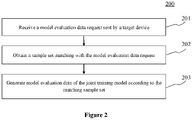
- Figure 2 shows a flow 200 of a method for evaluating a joint training model according to an embodiment of the present disclosure.
- the method includes steps 201 to 203 as follows.
- step 201 a model evaluation data request sent by a target device is received.
- an object performing the method for evaluating a joint training model may receive a model evaluation data request sent by the target device via a wired manner or a wireless manner.
- the target device may include a participant of the joint training model.
- the joint training model may include various models jointly trained by multiple parties without exposing original data. Encrypted features and model intermediate results (such as gradients) are transmitted between participants of the joint training model, to adjust model parameters of sub-models trained by each participant.
- the model evaluation data request may be used to obtain model evaluation data of a joint training model jointly trained by the performing object and the target device.
- the model evaluation data may include but not limited to at least one of: accuracy, recall rate, AUC (area under curve, area under ROC curve), PSI (Population Stability Index), and log loss.
- each of the two participants stores a sample set.
- Samples sets of the two participants generally have a certain intersection.
- samples of the sample set of only one participant have tags, and samples of the sample set of another participant include only features.
- the two participants need to align samples.
- the model evaluation data request may further include data search permission information.
- the data search permission information may be used to indicate at least one dimension of the model evaluation data.
- the dimension may include but not limited at least one of: key of the model evaluation data, sampling granularity and a preset time period.
- step 202 a sample set matching with the model evaluation data request is obtained.
- the performing object may obtain a sample set matching with the model evaluation data request via a wired manner or a wireless manner.
- the matching sample set generally includes tagged data associated with the joint training model. That is, samples in the sample set may include features and tags corresponding to the features.
- the performing object may obtain a sample set which is stored locally in advance and is used to train a joint training model indicated by the model evaluation data request.
- the performing object may obtain the matching sample set from an electronic device in communication connection with the performing object (for example a storing server). It should be noted that, in order to ensure data security, the electronic device in communication connection with the performing object and other participants of the joint training model do not directly share original sample data.
- the model evaluation data request may include data division information.
- the data division information may be used to indicate a division method of samples.
- the sample identification may include a request identification in network connection, for example.
- the performing object may obtain the sample set matching with the model evaluation data request by performing the following steps.
- a sample set for training a joint training model is obtained.
- the performing object may obtain a sample set for training the joint training model locally or from an electronic device in communication connection with the performing object.
- the sample set for training the joint training model may include aligned samples. It should be noted that, in order to ensure data security, the electronic device in communication connection with the performing object and other participants of the joint training model do not directly share original sample data.
- samples are selected from the sample set according to data division information, to form a sample set matching with the model evaluation data request.
- the performing object may select samples from the sample set obtained in the first step, to form a sample set matching with the model evaluation data request.
- the data division information may include a list of sample identifications in a form of white list.
- the performing object may select samples matching with identifications in the list of sample identifications from the sample set obtained in the first step.
- the sample identification may include a character string which can uniquely identify the sample, such as a sequence number or a sample feature.
- the performing object may select a specific sample set matching with the data division information, to provide data basis for training of the joint training model and generating of the model evaluation data subsequently.
- step 203 model evaluation data of the joint training model is generated according to the matching sample set.
- the performing object may generate the model evaluation data of the joint training model in various manners.
- the performing object may train the model with the sample set of the joint training model indicated by the model evaluation data request, so as to generate model evaluation data matching with the model evaluation data request.
- the model evaluation data request is used to indicate accuracy data of the obtained model
- the performing object generates an accuracy index of the above model according to test results of the trained model.
- the performing object may generate various model evaluation data sets of the model when training of the model is finished. The performing object may select model evaluation data matching with data indicated by the model evaluation data request from a model evaluation data set.
- the performing object may send the generated model evaluation data of the joint training model to the target device, as response information of the model evaluation data request.
- Figure 3 shows a schematic diagram of an application scenario of a method for evaluating a joint training model according to an embodiment of the present disclosure.
- a background server 301 of an information application and a background server 302 of a shopping application may jointly train a joint training model 305 by respectively utilizing a sample set A303 and a sample set B304.
- Samples in the sample set A303 may include various user attribute information (for example gender, age and preference).
- Samples in the sample set B304 may include user identifications and whether a user goes shopping (for example, adding a commodity in a shopping cart).
- the background server 301 and the background server 302 do not directly obtain sample data from each other.
- the background server 301 may obtain a commodity link by utilizing the trained joint training model 305, and send the commodity link to the terminal 306, so that the terminal 306 presents the commodity link to the user.
- the background server 301 may send a model evaluation data request 307 to the background server 302 to obtain an effect index (such as accuracy) of the joint training model 305.
- the background server 302 may obtain the sample set B304 matching with the model evaluation data request 307. According to the sample set B304, the background server 302 generates an effect index (such as accuracy) of the joint training model 305 trained with the sample set B 304, as the model evaluation data.
- the background server 302 may send response information 308 including the model evaluation data to the background server 301.
- the model evaluation data of the joint training model is generated according to the model evaluation data request sent by the participant including no tagged sample, thereby sharing the effect index of the joint training model without exposing the original sample data, and thus providing timely and effective data reference basis for optimizing and improving of the joint training model.
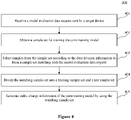
- FIG. 4 shows a flow 400 of a method for evaluating a joint training model according to an embodiment of the present disclosure.
- the flow 400 includes steps 401 to 405 as follows.
- step 401 a model evaluation data request sent by a target device is received.
- the model evaluation data request may include data division information.
- the data division information may be used to indicate a division method of samples.
- the model evaluation data request may include data search permission information.
- the data search permission information is used to indicate at least one dimension of index change information.
- step 402 a sample set for training the j oint training model is obtained.
- samples are selected from the sample set according to data division information, to form a sample set matching with the model evaluation data request.
- Steps 401, 402 and 403 correspond to steps 201 and 202 in the previous embodiments, and description of steps 201 and 202 in the optional implementations adapts to steps 401, 402 and 403. Details are not repeated herein.
- step 404 the matching sample set is divided into a training sample set and a test sample set.
- an object for performing the method for evaluating the joint training model may divide the matching sample set obtained in step 403 into a training sample set and a test sample set.
- the method for dividing the sample set may include but not limited to at least one of: hold-out, cross validation and bootstrapping.
- step 405 index change information of the joint training model is generated by utilizing the matching sample set.
- the performing object may generate the index change information of the joint training model via multiple manners.
- the index change information of the joint training model is used to indicate change of model evaluation data of the joint training model over a time dimension.
- the time dimension may include but not limited to at least one of time and global step.
- the performing object adjusts parameters of the joint training model by utilizing a training sample set in the matching sample set according to the time dimension, and then generates model evaluation data of the adjusted joint training model by utilizing a test sample set in the matching sample set.
- the model evaluation data may include but not limited to at least one of: accuracy, recall rate and AUC.
- the performing object may generate a curve showing change of the model evaluation data over time, as index change information of the joint training model.
- the performing object may perform the following steps.
- model evaluation data matching with the data search permission information is extracted from the index change information.
- the performing object extracts the model evaluation data matching with the data search permission information from the generated index change information.
- the data search permission information may be used to indicate at least one dimension of the index change information.
- the dimension may include but not limited to at least one of time, identification of model evaluation data (for example a name), and sampling granularity.
- the matching model evaluation data is sent to the target device.
- the performing object may send the matching model evaluation data extracted in the first step to the target device.
- the target device may obtain required model evaluation data in the dimension such as time, name of model evaluation data (such as accuracy and AUC) by utilizing the data search permission information.
- the flow 400 further includes: generating index change information of the joint training model with the divided matching sample set. Therefore, according to the technical solution described in the embodiment, the joint training model is trained by utilizing the divided sample set, and change information of the model evaluation data over time is generated during the model training process, thereby sharing the model evaluation index of the joint training model in a case of ensuring data security.
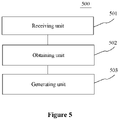
- Figure 5 shows an apparatus for evaluating a joint training model according to an embodiment of the present disclosure.
- the apparatus may perform the method described above.
- the apparatus embodiment corresponds to the method embodiment shown in Figure 2 .
- the apparatus may be applied to various electronic devices.
- an apparatus 500 for evaluating a joint training model includes: a receiving unit 501, an obtaining unit 502 and a generating unit 503.
- the receiving unit 501 is configured to receive a model evaluation data request sent by a target device.
- the target device includes a participant of the joint training model.
- the obtaining unit 502 is configured to obtain a sample set matching with the model evaluation data request.
- the matching sample set includes tagged data associated with the joint training set.
- the generating unit 503 is configured to generate model evaluation data of the joint training model according to the matching sample set.
- the model evaluation data request includes data division information.
- the data division information is sued to indicate a division method of samples.
- the obtaining unit 502 may include an obtaining module (not shown) and a first generating module (not shown).
- the obtaining module is configured to obtain a sample set for training the joint training model.
- the first generating module is configured to select samples from the sample set according to the data division information, to form a sample set matching with the model evaluation data request.
- the generating unit 503 may include a division module (not shown) and a second generating module (not shown).
- the division module is configured to divide the matching sample set into a training sample set and a test sample set.
- the second generating module is configured to generate index change information of the joint training model by utilizing the matching sample set.
- the index change information of the joint training model is used to indicate change of model evaluation data of the joint training model over time.
- the model evaluation data request includes data search permission information.
- the data search permission information is used to indicate at least one dimension of the index change information.
- the apparatus 500 may further include: an extracting unit (not shown) and a sending unit (not shown).
- the extracting unit is configured to extract model evaluation data matching with the data search permission information from the index change information.
- the sending unit is configured to send the matching model evaluation data to the target device.
- the receiving unit 501 receives the model evaluation data request sent by the target device.
- the target device includes the participant of the joint training model.
- the obtaining unit 502 obtains a sample set matching with the model evaluation data request.
- the matching sample set includes tagged data associated with the joint training model.
- the generating unit 503 generates model evaluation data of the joint training model according to the matching sample set, thereby sharing the effect index of the joint training model without exposing the original sample data, and thus providing timely and effective data reference basis for optimizing and improving of the joint training model.
- the system may include a first participating terminal (such as the server 105 shown in Figure 1 ) and a second participating terminal (such as the server 106 shown in Figure 1 ).
- the first participating terminal is configured to: obtain a local sample set, where samples in the local sample set are tag-free data for training the joint training model; generate a model evaluation data request of the joint training model associated with the local sample set; and send the model evaluation data request to the second participating terminal.
- the second participating terminal and the first participating terminal jointly train the joint training model.
- the second participating terminal is configured to receive the model evaluation data request sent by the first participating terminal; obtain a sample set matching with the model evaluation data request, where the matching sample set includes tagged data associated with the joint training model; and generate model evaluation data of the joint training model according to the matching sample set.
- the model evaluation data request may include data division information.
- the first participating terminal is configured to: generate data division information according to feature dimensions of samples in the local sample set.
- the data division information is used to indicate a division method of samples.
- the first participating terminal is configured to: obtain model evaluation data of the joint training model from the second participating terminal; and adjust the joint training model based on the model evaluation data.
- step 601 the first participating terminal obtains a local sample set.
- the first participating terminal may obtain the local sample set.
- Samples in the local sample set are generally tag-free data for training the joint training model. That is, samples in the sample set generally include only features. Samples in the local sample set generally include more features than samples of the tagged data.
- the feature of the sample of the tagged data may include gender, age, region, preference and historic browsing information; and the feature of the sample of the tag-free data may include an account.
- step 602 the first participating terminal generates a model evaluation data request of the joint training model associated with the local sample set.
- the first participating terminal may generate the model evaluation data request of the joint training model associated with the local sample set obtained in step 601 via multiple manners.
- the model evaluation data request is used to obtain model evaluation data of the joint training model.
- the first participating terminal generates the model evaluation data request according to a preset model index list.
- the model index list may include at least one of: accuracy, recall rate, AUC, PSI and log loss.
- the first participating terminal may randomly select at least one index from the model index list.
- the first participating terminal generates the model evaluation data request for obtaining the model index according to information for indicating the model index which is sent by the terminal used by the technician.
- the first participating terminal may generate data division information according to feature dimensions of samples in the local sample set obtained in step 601.
- the data division information is used to indicate a division method of samples.
- the feature dimension may include a user dimension (such as ID) and a user feature dimension (such as online duration).
- the data division information may include a list of request identifications of network connection in a form of white list.
- the data division information may be a preset hash function.
- the preset hash function may be a security strategy function generated based on multiple encryption methods. Original data cannot be inferred from the security strategy function, thereby ensuring data security of the joint training model.
- step 603 the first participating terminal sends a model evaluation data request to the second participating terminal.
- the second participating terminal and the first participating terminal jointly train the joint training model.
- step 604 the second participating terminal receives the model evaluation data request sent by the first participating terminal.
- step 605 the second participating terminal obtains a sample set matching with the model evaluation data request.
- step 606 the second participating terminal generates model evaluation data of the joint training model according to the matching sample set.
- Steps 604, 605 and 606 correspond to steps 201, 202 and 203 in the previous embodiment or correspond to steps 401 to 405 in the previous embodiment. Description of implementations of steps 201, 202 and 203 or steps 401 to 405 also adapts to steps 604, 605 and 606. Details are not repeated herein.
- the first participating terminal may perform the fowling steps.
- step 607 the model evaluation data of the joint training model is obtained from the second participating terminal.
- step 608 the joint training model is adjusted based on the model evaluation data.
- the first participating terminal may adjust the joint training model via multiple manners.
- the first participating terminal determines whether the model evaluation data meets a preset model adjustment condition.
- the preset model adjustment condition may include that model accuracy is less than a preset threshold.
- the performing object can adjust the joint training model via multiple manners. For example, the performing object may train the joint training model with samples which have not been used for training. In another example, the performing object may adjust a feature insensitive to the model output (for example, replace region with age) in the samples.
- the first participating terminal obtains the local sample set. Samples in the local sample set are tag-free data for training the joint training model.
- the first participating terminal generates a model evaluation data request of the joint training model associated with the local sample set.
- the first participating terminal sends the model evaluation data request to the second participating terminal.
- the second participating terminal and the first participating terminal jointly train the joint training model.
- the second participating terminal receives the model evaluation data request sent by the first participating terminal.
- the second participating terminal obtains the sample set matching with the model evaluation data request.
- the matching sample set includes tagged data associated with the joint training model.
- the second participating terminal generates the model evaluation data of the joint training model according to the matching sample set.
- the participant of the joint training model including no tagged sample generates and sends the model evaluation data request, and the participant including the tagged sample generates the model evaluation data of the joint training model, thereby sharing the effect index of the joint training model without exposing original sample data, and thus providing timely and effective data reference basis for optimizing and improving of the joint training model.
- Figure 7 shows a schematic structural diagram of an electronic device 700 (such as the server 105 shown in Figure 1 ) for implementing the embodiments of the present disclosure.
- the server shown in Figure 7 is only schematic, and does not limit the function and use scope of embodiments of the present disclosure in any manner.
- the electronic device may include a processing apparatus (such as a central processor and a graphic processor) 701.
- the processing apparatus may perform various appropriate actions and processing by executing programs stored in a read-only memory (ROM) 702 or programs uploaded from a storage apparatus 708 to a random access memory (RAM) 703.
- ROM read-only memory
- RAM random access memory
- Various programs and data required for operations of the electronic device are also stored in the RAM 703.
- the processing apparatus 701, the ROM 702 and the RAM 703 are connected to each other through a bus 704.
- An input/output (I/O) interface 705 is also connected to the bus 704.
- the following components are connected to the I/O interface 705: an input apparatus 706 such as a touch screen, a touch panel, a keyboard, a mouse; an output apparatus 707 such as a liquid crystal display (LCD), a loudspeaker and a vibrator; a storage apparatus 708 such as a magnetic tape and a hard disk; and a communication apparatus 709.
- the communication apparatus 709 may allow the electronic device 700 to communicate with other device in a wired or wireless manner to exchange data.
- Figure 7 shows the electronic device 700 including multiple apparatuses, it should be understood that not all shown apparatuses are necessary. Alternatively, more or less apparatuses may be included. Each block in Figure 7 may represent one or more apparatuses according to requirements.
- a process described in the flowchart may be implemented by computer software programs.
- a computer program product including computer program carried on a computer readable medium is provided.
- the computer program includes program codes for performing the method shown in the flowchart.
- the computer program may be downloaded and installed from the network through the communication apparatus 709, installed from the storage apparatus 708 or installed from the ROM 702.
- the computer program is executed by the processing apparatus 701 to perform functions defined in the method in the above embodiment of the present disclosure.
- the computer readable medium described in the present disclosure may be a computer readable signal medium, a computer readable storage medium or any combination thereof.
- the computer readable storage medium may include but not limited to a system, an apparatus or a device in an electric, magnetic, optical, electromagnetic, infrared or a semiconductor form, or any combination thereof.
- the computer readable storage medium may include but not limited to electric connection of one or more wires, a portable computer magnetic disk, a hard disk, a random access memory (RAM), a read-only memory (ROM), an erasable programmable read only memory (EPROM or a flash memory), an optical fiber, a portable compact disk read only memory (CD-ROM), an optical storage device, a magnetic storage device or any combination thereof.
- the computer readable storage medium may be a tangible medium including or storing programs.
- the programs may be used by an instruction execution system, apparatus or device, or may be used in combination with the instruction execution system, apparatus or device.
- a computer readable signal medium may include a data signal in a baseband or propagated as a part of carrier.
- the computer readable signal medium carries computer readable program codes.
- the propagated data signal may include an electromagnetic signal, an optical signal or any combination thereof.
- the computer readable signal medium may be any computer readable medium other than the computer readable storage medium.
- the computer readable signal medium may send, propagate or transmit programs used by the instruction execution system, apparatus or device or the programs used in combination with the instruction execution system, apparatus or device.
- the program code included in the computer readable medium may be transmitted via any appropriate medium, including but not limited to an electric wire, an optical fiber, radio frequency (RF) or any appropriate combination thereof.
- RF radio frequency
- the computer readable medium may be included in the electronic device, or may exist independently and is not installed in the electronic device.
- the computer readable medium carries one or more programs.
- the one or more programs are executed by the server, so that the server is configured to: receive a model evaluation data request sent by a target device, where the target device includes a participant of the joint training model; obtain a sample set matching with the model evaluation data request, where the matching sample set includes tagged data associated with the joint training model; and generate model evaluation data of the joint training model according to the matching sample set.
- Computer program codes for performing operations of the present disclosure may be written by using one or more program design language or any combination.
- the program design language includes object oriented program design language such as Java, Smalltalk and C++, and further includes conventional process-type program design language such as "C" or similar program design language.
- the program codes may be completely or partially executed on a user computer, performed as an independent software packet, partially executed on the user computer and partially executed on a remote computer, or completely executed on the remote computer or a server.
- the remote computer may connect to the user computer via any type of network such as a local area network (LAN) and a wide area network (WAN).
- the remote computer may connect to an external computer (such as achieving internet connection by services provided by the internet network service provider).
- each block in the block diagrams and/or flowcharts, and a combination of blocks in the block diagrams and/or flowcharts may be implemented by a dedicated hardware system for performing specified functions or operations, or may be implemented by a combination of dedicated hardware and computer instructions.
- Units involved in the embodiments of the present disclosure may be implemented by software or hardware.
- the units may be provided in a processor.
- a processor includes a receiving unit, an obtaining unit and a generating unit. Names of the units do not limit the units in some cases.
- the receiving unit may be described as a unit receiving a model evaluation data request sent by the target device.
- the target device includes the participant of the joint training model.
Landscapes
- Engineering & Computer Science (AREA)
- Theoretical Computer Science (AREA)
- Data Mining & Analysis (AREA)
- Physics & Mathematics (AREA)
- General Engineering & Computer Science (AREA)
- General Physics & Mathematics (AREA)
- Artificial Intelligence (AREA)
- Computer Vision & Pattern Recognition (AREA)
- Evolutionary Computation (AREA)
- Software Systems (AREA)
- Bioinformatics & Computational Biology (AREA)
- Evolutionary Biology (AREA)
- Bioinformatics & Cheminformatics (AREA)
- Life Sciences & Earth Sciences (AREA)
- Mathematical Physics (AREA)
- Medical Informatics (AREA)
- Computing Systems (AREA)
- Fuzzy Systems (AREA)
- Probability & Statistics with Applications (AREA)
- Computational Linguistics (AREA)
- Databases & Information Systems (AREA)
- Information Transfer Between Computers (AREA)
- Management, Administration, Business Operations System, And Electronic Commerce (AREA)
Abstract
Description
- The present application claims the priority to
Chinese Patent Application No. 202010272019.7, titled "METHOD AND APPARATUS FOR EVALUATING JOINT TRAINING MODEL", filed on April 08, 2020 - The present disclosure relates to technical field of computers, and particular to a method and an apparatus for evaluating a joint training model.
- With development of the artifical intelligence technology, machine learning is increasingly widely applied. In recent years, in order to solve the problem of data island and data privacy, a joint trainig molde is utilized to establish a machine learning model without exposing origianl data. The joint training model is generally trained by adjusting model paramters based on model gradients tranmitted between multiple model training participating parties.
- A method and an apparatus for evaluating a joint training model are provided according to embodiments of the present disclosure.
- In a first aspect, a method for evaluating a joint training model is provided according to embodiments of the present disclosure. The method includes: receiving a model evaluation data request sent by a target device, where the target device includes a participant of the joint training model; obtaining a sample set matching with the model evaluation data request, where the matching sample set includes tagged data associated with the joint training model; and generating model evaluation data of the joint training model according to the matching sample set.
- In some embodiments, the model evaluation data request includes data division information, and the data division information indicates a division method of samples. The process of obtaining a sample set matching with the model evaluation data request includes: obtaining a sample set for training the joint training model; and selecting samples from the sample set according to the data division information, to form a sample set matching with the model evaluation data request.
- In some embodiments, the generating model evaluation data of the joint training model according to the matching sample set includes: dividing the matching sample set into a training sample set and a test sample set; and generating index change information of the joint training model by using the matching sample set, where the index change information of the joint training model is used to indicate change of model evaluation data of the joint training model over time.
- In some embodiments, the model evaluation data request further includes data search permission information. The data search permission information is used to indicate at least one dimension of the index change information. The method further includes: extracting model evaluation data matching with the data search permission information from the index change information; and sending the matching model evaluation data to the target device.
- In a second aspect, an apparatus for evaluating a joint training model is provided according to embodiments of the present disclosure. The apparatus includes a receiving unit, an obtaining unit and a generating unit. The receiving unit is configured to receive a model evaluation data request sent by a target device, where the target device includes a participant of the joint training model. The obtaining unit is configured to obtain a sample set matching with the model evaluation data request. The matching sample set includes tagged data associated with the joint training model. The generating unit is configured to generate model evaluation data of the joint training model according to the matching sample set.
- In some embodiments, the model evaluation data request includes data division information. The data division information indicates a division method of samples. The obtaining unit includes an obtaining module and a first generating module. The obtaining module is configured to obtain a sample set for training the joint training model. The first generating module is configured to select samples from the sample set according to the data division information, to form a sample set matching with the model evaluation data request.
- In some embodiments of the present disclosure, the generating unit includes a division module and a second generating module. The division module is configured to divide the matching sample set into a training sample set and a test sample set. The second generating module is configured to generate index change information of the joint training model by using the matching sample set. The index change information of the joint training model is used to indicate change of model evaluation data of the joint training model over time.
- In some embodiments, the model evaluation data request further includes data search permission information. The data search permission information is used to indicate at least one dimension of index change information. The apparatus further includes an extracting unit and a sending unit. The extracting unit is configured to extract model evaluation data matching with the data search permission information from the index change information. The sending unit is configured to send the matching model evaluation data to the target device.
- In a third aspect, a system for evaluating a joint training model is provided according to embodiments of the present disclosure. The system includes a first participating terminal and a second participating terminal. The first participating terminal is configured to obtain a local sample set, where samples in the local sample set are tag-free data for training the joint training model; generate a model evaluation data request of a joint training model associated with the local sample set; and send the model evaluation data request to a second participating terminal. The second participating terminal and the first participating terminal jointly train the joint training model. The second participating terminal is configured to receive the model evaluation data request sent by the first participating terminal; obtain a sample set matching with the model evaluation data request, where the matching sample set includes tagged data associated with the joint training model; and generate model evaluation data of the joint training model according to the matching sample set.
- In some embodiments, the model evaluation data request includes data division information. The first participating terminal is further configured to generate data division information according to feature dimensions of samples in the local sample set. The data division information is used to indicate a division method of samples.
- In some embodiments, the first participating terminal is further configured to: obtain model evaluation data of the joint training model from the second participating terminal; and adjust the joint training model based on the model evaluation data.
- In a fourth aspect, a server is provided according to embodiments of the present disclosure. The server includes: one or more processors; and a storage apparatus storing one or more programs. The one or more programs, when being executed by the one or more processors, cause the one or more processors to implement the method according to the first aspect.
- In a fifth aspect, a computer readable medium storing computer programs is provided according to embodiments of the present disclosure. The programs are executed by a processor to implement the method according to the first aspect.
- According to the method and apparatus for evaluating a joint training model in the embodiments of the present disclosure, a model evaluation data request sent by the target device is received. The target device includes a participant of the joint training model. Then, a sample set matching with the model evaluation data request is obtained. The matching sample set includes tagged data associated with the joint training model. Finally, model evaluation data of the joint training model is generated according to the matching sample set, thereby sharing an effect index of the joint training model without exposing original sample data, and thus providing timely and effective data reference basis for optimizing and improving of the j oint training model.
- Other features, objects and advantages of the present disclosure become more apparent with reference to detailed description of non-limiting embodiments in conjunction with the drawings hereinafter.
-
Figure 1 is a schematic structural diagram of a system according to an embodiment of the present disclosure; -
Figure 2 is a flowchart of a method for evaluating a joint training model according to an embodiment of the present disclosure; -
Figure 3 is a schematic diagram of an application scenario of a method for evaluating a joint training model according to an embodiment of the present disclosure; -
Figure 4 is a flowchart of a method for evaluating a joint training model according to another embodiment of the present disclosure; -
Figure 5 is a schematic structural diagram of an apparatus for evaluating a joint training model according to an embodiment of the present disclosure; -
Figure 6 is a timing diagram of interaction between devices in a system for evaluating a joint training model according to an embodiment of the present disclosure; and -
Figure 7 is a schematic structural diagram of an electronic device for implementing the embodiment of the present disclosure. - The present disclosure is further described in detail with reference to the drawings and embodiments hereinafter. It should be understood that, embodiments described herein are only used to explain the present disclosure rather than limit the present disclosure. It should be noted that, for facilitating description, parts related to the present disclosure are shown in the drawings.
- It should be noted that, embodiments in the present disclosure and features in the embodiments may be combined without a conflict. The present disclosure is described in detail with reference to the drawings in conjunction with the embodiments hereinafter.
-
Figure 1 shows aschematic system structure 100 to which a method for evaluating a joint training model or an apparatus for evaluating a joint training model according to the present disclosure may be applied. - As shown in
Figure 1 , thesystem structure 100 may include:terminal devices networks servers network 103 is configured to provide a medium of a communication link between theterminal devices servers network 104 is used to provide a medium of a communication link between theserver 105 and theserver 106. Thenetworks - The
terminal devices servers network 103, to receive or send message. Theterminal devices - The
terminal devices terminal devices terminal devices - The
servers terminal devices servers network 104 to jointly train a machine learning model. - It should be noted that, the server may be implemented by hardware or software. When the server is implemented by hardware, the server may be implemented as a distributed server cluster consisting of multiple servers, or may be implemented as a single server. When the server is implemented by software, the server may be implemented as multiple software or software modules (for example, software or software module for providing distributed service), or may be implemented as a single software or software module. Implementations of the server are not limited herein.
- It should be noted that, the method for evaluating a joint training model in the embodiments of the present disclosure is generally performed by the
server 105 or theserver 106. Accordingly, the apparatus for evaluating the joint training model is generally provided in theserver 105 or theserver 106. - It should be understood that, the numbers of terminal device, network and server in
Figure 1 are only schematic. Any number of terminal device, network and server may be provided according to actual requirements. - Reference is made to
Figure 2 which shows aflow 200 of a method for evaluating a joint training model according to an embodiment of the present disclosure. The method includessteps 201 to 203 as follows. - In
step 201, a model evaluation data request sent by a target device is received. - In the embodiment, an object performing the method for evaluating a joint training model (such as the
server 105 or theserver 106 shown inFigure 1 ) may receive a model evaluation data request sent by the target device via a wired manner or a wireless manner. The target device may include a participant of the joint training model. The joint training model may include various models jointly trained by multiple parties without exposing original data. Encrypted features and model intermediate results (such as gradients) are transmitted between participants of the joint training model, to adjust model parameters of sub-models trained by each participant. The model evaluation data request may be used to obtain model evaluation data of a joint training model jointly trained by the performing object and the target device. The model evaluation data may include but not limited to at least one of: accuracy, recall rate, AUC (area under curve, area under ROC curve), PSI (Population Stability Index), and log loss. - It should be noted that, in an example, in an application scenario of the joint training model involving two participants, each of the two participants stores a sample set. Samples sets of the two participants generally have a certain intersection. Generally, samples of the sample set of only one participant have tags, and samples of the sample set of another participant include only features. Before training, the two participants need to align samples.
- In some optional implementations of the embodiment, the model evaluation data request may further include data search permission information. The data search permission information may be used to indicate at least one dimension of the model evaluation data. The dimension may include but not limited at least one of: key of the model evaluation data, sampling granularity and a preset time period.
- In
step 202, a sample set matching with the model evaluation data request is obtained. - In the embodiment, the performing object may obtain a sample set matching with the model evaluation data request via a wired manner or a wireless manner. The matching sample set generally includes tagged data associated with the joint training model. That is, samples in the sample set may include features and tags corresponding to the features.
- In an example, the performing object may obtain a sample set which is stored locally in advance and is used to train a joint training model indicated by the model evaluation data request. In another example, the performing object may obtain the matching sample set from an electronic device in communication connection with the performing object (for example a storing server). It should be noted that, in order to ensure data security, the electronic device in communication connection with the performing object and other participants of the joint training model do not directly share original sample data.
- In some optional implementations of the embodiment, the model evaluation data request may include data division information. The data division information may be used to indicate a division method of samples. The sample identification may include a request identification in network connection, for example. The performing object may obtain the sample set matching with the model evaluation data request by performing the following steps.
- In a first step, a sample set for training a joint training model is obtained.
- In some implementations, the performing object may obtain a sample set for training the joint training model locally or from an electronic device in communication connection with the performing object. Generally, the sample set for training the joint training model may include aligned samples. It should be noted that, in order to ensure data security, the electronic device in communication connection with the performing object and other participants of the joint training model do not directly share original sample data.
- In a second step, samples are selected from the sample set according to data division information, to form a sample set matching with the model evaluation data request.
- In the implementations, according to the sample division method indicated by the data division information, the performing object may select samples from the sample set obtained in the first step, to form a sample set matching with the model evaluation data request. In an example, the data division information may include a list of sample identifications in a form of white list. The performing object may select samples matching with identifications in the list of sample identifications from the sample set obtained in the first step. The sample identification may include a character string which can uniquely identify the sample, such as a sequence number or a sample feature.
- Based on the above optional implementations, the performing object may select a specific sample set matching with the data division information, to provide data basis for training of the joint training model and generating of the model evaluation data subsequently.
- In
step 203, model evaluation data of the joint training model is generated according to the matching sample set. - In the embodiment, according to the matching sample set obtained in
step 202, the performing object may generate the model evaluation data of the joint training model in various manners. In an example, the performing object may train the model with the sample set of the joint training model indicated by the model evaluation data request, so as to generate model evaluation data matching with the model evaluation data request. For example, the model evaluation data request is used to indicate accuracy data of the obtained model, the performing object generates an accuracy index of the above model according to test results of the trained model. In an example, the performing object may generate various model evaluation data sets of the model when training of the model is finished. The performing object may select model evaluation data matching with data indicated by the model evaluation data request from a model evaluation data set. - In some optional implementations of the embodiment, the performing object may send the generated model evaluation data of the joint training model to the target device, as response information of the model evaluation data request.
- Reference is made to
Figure 3 which shows a schematic diagram of an application scenario of a method for evaluating a joint training model according to an embodiment of the present disclosure. In the application scenario shown inFigure 3 , abackground server 301 of an information application and abackground server 302 of a shopping application may jointly train ajoint training model 305 by respectively utilizing a sample set A303 and a sample set B304. Samples in the sample set A303 may include various user attribute information (for example gender, age and preference). Samples in the sample set B304 may include user identifications and whether a user goes shopping (for example, adding a commodity in a shopping cart). Generally, thebackground server 301 and thebackground server 302 do not directly obtain sample data from each other. When the user uses the information application via the terminal 306, thebackground server 301 may obtain a commodity link by utilizing the trainedjoint training model 305, and send the commodity link to the terminal 306, so that the terminal 306 presents the commodity link to the user. Thebackground server 301 may send a modelevaluation data request 307 to thebackground server 302 to obtain an effect index (such as accuracy) of thejoint training model 305. Thebackground server 302 may obtain the sample set B304 matching with the modelevaluation data request 307. According to the sample set B304, thebackground server 302 generates an effect index (such as accuracy) of thejoint training model 305 trained with thesample set B 304, as the model evaluation data. In an example, thebackground server 302 may sendresponse information 308 including the model evaluation data to thebackground server 301. - According to the conventional technology, efficiency of massive model training is improved by adopting a distributed training manner, resulting in that a participant including no tagged sample is difficult to obtain a training effect of the model in a case of ensuring data security. While according to the method described in the embodiment of the present disclosure, the model evaluation data of the joint training model is generated according to the model evaluation data request sent by the participant including no tagged sample, thereby sharing the effect index of the joint training model without exposing the original sample data, and thus providing timely and effective data reference basis for optimizing and improving of the joint training model.
- Reference is made to
Figure 4 which shows aflow 400 of a method for evaluating a joint training model according to an embodiment of the present disclosure. Theflow 400 includessteps 401 to 405 as follows. - In
step 401, a model evaluation data request sent by a target device is received. - In the embodiment, the model evaluation data request may include data division information. The data division information may be used to indicate a division method of samples.
- In some optional implementations of the embodiment, the model evaluation data request may include data search permission information. The data search permission information is used to indicate at least one dimension of index change information.
- In
step 402, a sample set for training the j oint training model is obtained. - In
step 403, samples are selected from the sample set according to data division information, to form a sample set matching with the model evaluation data request. -
Steps steps steps steps - In
step 404, the matching sample set is divided into a training sample set and a test sample set. - In the embodiment, an object for performing the method for evaluating the joint training model (such as the
server 105 or the sever 106 shown inFigure 1 ) may divide the matching sample set obtained instep 403 into a training sample set and a test sample set. The method for dividing the sample set may include but not limited to at least one of: hold-out, cross validation and bootstrapping. - In
step 405, index change information of the joint training model is generated by utilizing the matching sample set. - In the embodiment, with the matching sample set, the performing object may generate the index change information of the joint training model via multiple manners. The index change information of the joint training model is used to indicate change of model evaluation data of the joint training model over a time dimension. The time dimension may include but not limited to at least one of time and global step. In an example, the performing object adjusts parameters of the joint training model by utilizing a training sample set in the matching sample set according to the time dimension, and then generates model evaluation data of the adjusted joint training model by utilizing a test sample set in the matching sample set. The model evaluation data may include but not limited to at least one of: accuracy, recall rate and AUC. The performing object may generate a curve showing change of the model evaluation data over time, as index change information of the joint training model.
- In some optional implementations of the embodiment, based on data search permission information included in the model evaluation data request, the performing object may perform the following steps.
- In a first step, model evaluation data matching with the data search permission information is extracted from the index change information.
- In some implementations, based on the data search permission information included in the model evaluation data request, the performing object extracts the model evaluation data matching with the data search permission information from the generated index change information. The data search permission information may be used to indicate at least one dimension of the index change information. The dimension may include but not limited to at least one of time, identification of model evaluation data (for example a name), and sampling granularity.
- In a second step, the matching model evaluation data is sent to the target device.
- In some implementations, the performing object may send the matching model evaluation data extracted in the first step to the target device.
- Based on the optional implementations, the target device may obtain required model evaluation data in the dimension such as time, name of model evaluation data (such as accuracy and AUC) by utilizing the data search permission information.
- As shown in
Figure 4 , theflow 400 further includes: generating index change information of the joint training model with the divided matching sample set. Therefore, according to the technical solution described in the embodiment, the joint training model is trained by utilizing the divided sample set, and change information of the model evaluation data over time is generated during the model training process, thereby sharing the model evaluation index of the joint training model in a case of ensuring data security. - Reference is made to
Figure 5 which shows an apparatus for evaluating a joint training model according to an embodiment of the present disclosure. The apparatus may perform the method described above. The apparatus embodiment corresponds to the method embodiment shown inFigure 2 . The apparatus may be applied to various electronic devices. - As shown in
Figure 5 , anapparatus 500 for evaluating a joint training model according to the embodiment includes: a receivingunit 501, an obtainingunit 502 and agenerating unit 503. The receivingunit 501 is configured to receive a model evaluation data request sent by a target device. The target device includes a participant of the joint training model. The obtainingunit 502 is configured to obtain a sample set matching with the model evaluation data request. The matching sample set includes tagged data associated with the joint training set. The generatingunit 503 is configured to generate model evaluation data of the joint training model according to the matching sample set. - In the embodiment, for specific processing of the receiving
unit 501, the obtainingunit 502 and thegenerating unit 503 in theapparatus 500 for evaluating the joint training model and corresponding technical effect, one may refer to related description ofsteps Figure 2 orsteps 401 to 405 in the embodiment shown inFigure 4 . Details are not repeated herein. - In some optional implementations of the embodiment, the model evaluation data request includes data division information. The data division information is sued to indicate a division method of samples. The obtaining
unit 502 may include an obtaining module (not shown) and a first generating module (not shown). The obtaining module is configured to obtain a sample set for training the joint training model. The first generating module is configured to select samples from the sample set according to the data division information, to form a sample set matching with the model evaluation data request. - In some optional implementations of the embodiment, the generating
unit 503 may include a division module (not shown) and a second generating module (not shown). The division module is configured to divide the matching sample set into a training sample set and a test sample set. The second generating module is configured to generate index change information of the joint training model by utilizing the matching sample set. The index change information of the joint training model is used to indicate change of model evaluation data of the joint training model over time. - In some optional implementations of the embodiment, the model evaluation data request includes data search permission information. The data search permission information is used to indicate at least one dimension of the index change information. The
apparatus 500 may further include: an extracting unit (not shown) and a sending unit (not shown). The extracting unit is configured to extract model evaluation data matching with the data search permission information from the index change information. The sending unit is configured to send the matching model evaluation data to the target device. - According to the apparatus provided in the embodiment of the present disclosure, the receiving
unit 501 receives the model evaluation data request sent by the target device. The target device includes the participant of the joint training model. The obtainingunit 502 obtains a sample set matching with the model evaluation data request. The matching sample set includes tagged data associated with the joint training model. Finally, the generatingunit 503 generates model evaluation data of the joint training model according to the matching sample set, thereby sharing the effect index of the joint training model without exposing the original sample data, and thus providing timely and effective data reference basis for optimizing and improving of the joint training model. - Reference is made to
Figure 6 which showstiming 600 of interaction between devices in a system for evaluating a joint training model according to an embodiment of the present disclosure. The system may include a first participating terminal (such as theserver 105 shown inFigure 1 ) and a second participating terminal (such as theserver 106 shown inFigure 1 ). The first participating terminal is configured to: obtain a local sample set, where samples in the local sample set are tag-free data for training the joint training model; generate a model evaluation data request of the joint training model associated with the local sample set; and send the model evaluation data request to the second participating terminal. The second participating terminal and the first participating terminal jointly train the joint training model. The second participating terminal is configured to receive the model evaluation data request sent by the first participating terminal; obtain a sample set matching with the model evaluation data request, where the matching sample set includes tagged data associated with the joint training model; and generate model evaluation data of the joint training model according to the matching sample set. - In some optional implementations of the embodiment, the model evaluation data request may include data division information. The first participating terminal is configured to: generate data division information according to feature dimensions of samples in the local sample set. The data division information is used to indicate a division method of samples.
- In some optional implementations of the embodiment, the first participating terminal is configured to: obtain model evaluation data of the joint training model from the second participating terminal; and adjust the joint training model based on the model evaluation data.
- As shown in
Figure 6 , instep 601, the first participating terminal obtains a local sample set. - In the embodiment, the first participating terminal may obtain the local sample set. Samples in the local sample set are generally tag-free data for training the joint training model. That is, samples in the sample set generally include only features. Samples in the local sample set generally include more features than samples of the tagged data. In an example, the feature of the sample of the tagged data may include gender, age, region, preference and historic browsing information; and the feature of the sample of the tag-free data may include an account.
- In
step 602, the first participating terminal generates a model evaluation data request of the joint training model associated with the local sample set. - In the embodiment, the first participating terminal may generate the model evaluation data request of the joint training model associated with the local sample set obtained in
step 601 via multiple manners. The model evaluation data request is used to obtain model evaluation data of the joint training model. The first participating terminal generates the model evaluation data request according to a preset model index list. The model index list may include at least one of: accuracy, recall rate, AUC, PSI and log loss. In an example, the first participating terminal may randomly select at least one index from the model index list. In another example, the first participating terminal generates the model evaluation data request for obtaining the model index according to information for indicating the model index which is sent by the terminal used by the technician. - In some optional implementations of the embodiment, the first participating terminal may generate data division information according to feature dimensions of samples in the local sample set obtained in
step 601. The data division information is used to indicate a division method of samples. The feature dimension may include a user dimension (such as ID) and a user feature dimension (such as online duration). In an embodiment, the data division information may include a list of request identifications of network connection in a form of white list. In an example, the data division information may be a preset hash function. The preset hash function may be a security strategy function generated based on multiple encryption methods. Original data cannot be inferred from the security strategy function, thereby ensuring data security of the joint training model. - In
step 603, the first participating terminal sends a model evaluation data request to the second participating terminal. - In the embodiment, the second participating terminal and the first participating terminal jointly train the joint training model.
- In
step 604, the second participating terminal receives the model evaluation data request sent by the first participating terminal. - In
step 605, the second participating terminal obtains a sample set matching with the model evaluation data request. - In
step 606, the second participating terminal generates model evaluation data of the joint training model according to the matching sample set. -
Steps steps steps 401 to 405 in the previous embodiment. Description of implementations ofsteps steps 401 to 405 also adapts tosteps - In the optional implementations of the embodiment, the first participating terminal may perform the fowling steps.
- In
step 607, the model evaluation data of the joint training model is obtained from the second participating terminal. - In step 608, the joint training model is adjusted based on the model evaluation data.
- In some optional implementations, based on the model evaluation data, the first participating terminal may adjust the joint training model via multiple manners. In an example, the first participating terminal determines whether the model evaluation data meets a preset model adjustment condition. The preset model adjustment condition may include that model accuracy is less than a preset threshold. In response to determining that the model evaluation data meets the preset model adjust condition, the performing object can adjust the joint training model via multiple manners. For example, the performing object may train the joint training model with samples which have not been used for training. In another example, the performing object may adjust a feature insensitive to the model output (for example, replace region with age) in the samples.
- According to the system for evaluating a joint training model provided in the embodiment of the present disclosure, the first participating terminal obtains the local sample set. Samples in the local sample set are tag-free data for training the joint training model. The first participating terminal generates a model evaluation data request of the joint training model associated with the local sample set. The first participating terminal sends the model evaluation data request to the second participating terminal. The second participating terminal and the first participating terminal jointly train the joint training model. The second participating terminal receives the model evaluation data request sent by the first participating terminal. The second participating terminal obtains the sample set matching with the model evaluation data request. The matching sample set includes tagged data associated with the joint training model. The second participating terminal generates the model evaluation data of the joint training model according to the matching sample set. In this case, the participant of the joint training model including no tagged sample generates and sends the model evaluation data request, and the participant including the tagged sample generates the model evaluation data of the joint training model, thereby sharing the effect index of the joint training model without exposing original sample data, and thus providing timely and effective data reference basis for optimizing and improving of the joint training model.
- Reference is made to
Figure 7 which shows a schematic structural diagram of an electronic device 700 (such as theserver 105 shown inFigure 1 ) for implementing the embodiments of the present disclosure. The server shown inFigure 7 is only schematic, and does not limit the function and use scope of embodiments of the present disclosure in any manner. - As shown in
Figure 7 , the electronic device may include a processing apparatus (such as a central processor and a graphic processor) 701. The processing apparatus may perform various appropriate actions and processing by executing programs stored in a read-only memory (ROM) 702 or programs uploaded from astorage apparatus 708 to a random access memory (RAM) 703. Various programs and data required for operations of the electronic device are also stored in theRAM 703. Theprocessing apparatus 701, theROM 702 and theRAM 703 are connected to each other through abus 704. An input/output (I/O)interface 705 is also connected to thebus 704. - Generally, the following components are connected to the I/O interface 705: an
input apparatus 706 such as a touch screen, a touch panel, a keyboard, a mouse; anoutput apparatus 707 such as a liquid crystal display (LCD), a loudspeaker and a vibrator; astorage apparatus 708 such as a magnetic tape and a hard disk; and acommunication apparatus 709. Thecommunication apparatus 709 may allow theelectronic device 700 to communicate with other device in a wired or wireless manner to exchange data. AlthoughFigure 7 shows theelectronic device 700 including multiple apparatuses, it should be understood that not all shown apparatuses are necessary. Alternatively, more or less apparatuses may be included. Each block inFigure 7 may represent one or more apparatuses according to requirements. - According to an embodiment of the present disclosure, a process described in the flowchart may be implemented by computer software programs. For example, according to an embodiment of the present disclosure, a computer program product including computer program carried on a computer readable medium is provided. The computer program includes program codes for performing the method shown in the flowchart. In such embodiment, the computer program may be downloaded and installed from the network through the
communication apparatus 709, installed from thestorage apparatus 708 or installed from theROM 702. The computer program is executed by theprocessing apparatus 701 to perform functions defined in the method in the above embodiment of the present disclosure. - It should be noted that, the computer readable medium described in the present disclosure may be a computer readable signal medium, a computer readable storage medium or any combination thereof. The computer readable storage medium may include but not limited to a system, an apparatus or a device in an electric, magnetic, optical, electromagnetic, infrared or a semiconductor form, or any combination thereof. The computer readable storage medium may include but not limited to electric connection of one or more wires, a portable computer magnetic disk, a hard disk, a random access memory (RAM), a read-only memory (ROM), an erasable programmable read only memory (EPROM or a flash memory), an optical fiber, a portable compact disk read only memory (CD-ROM), an optical storage device, a magnetic storage device or any combination thereof. In the embodiments of the present disclosure, the computer readable storage medium may be a tangible medium including or storing programs. The programs may be used by an instruction execution system, apparatus or device, or may be used in combination with the instruction execution system, apparatus or device. In the embodiment of the present disclosure, a computer readable signal medium may include a data signal in a baseband or propagated as a part of carrier. The computer readable signal medium carries computer readable program codes. The propagated data signal may include an electromagnetic signal, an optical signal or any combination thereof. The computer readable signal medium may be any computer readable medium other than the computer readable storage medium. The computer readable signal medium may send, propagate or transmit programs used by the instruction execution system, apparatus or device or the programs used in combination with the instruction execution system, apparatus or device. The program code included in the computer readable medium may be transmitted via any appropriate medium, including but not limited to an electric wire, an optical fiber, radio frequency (RF) or any appropriate combination thereof.
- The computer readable medium may be included in the electronic device, or may exist independently and is not installed in the electronic device. The computer readable medium carries one or more programs. The one or more programs are executed by the server, so that the server is configured to: receive a model evaluation data request sent by a target device, where the target device includes a participant of the joint training model; obtain a sample set matching with the model evaluation data request, where the matching sample set includes tagged data associated with the joint training model; and generate model evaluation data of the joint training model according to the matching sample set.
- Computer program codes for performing operations of the present disclosure may be written by using one or more program design language or any combination. The program design language includes object oriented program design language such as Java, Smalltalk and C++, and further includes conventional process-type program design language such as "C" or similar program design language. The program codes may be completely or partially executed on a user computer, performed as an independent software packet, partially executed on the user computer and partially executed on a remote computer, or completely executed on the remote computer or a server. In a case of involving the remote computer, the remote computer may connect to the user computer via any type of network such as a local area network (LAN) and a wide area network (WAN). Alternatively, the remote computer may connect to an external computer (such as achieving internet connection by services provided by the internet network service provider).
- The flowcharts and block diagrams shown in drawings show a system architecture, function and operation which may be implemented by the system, method and computer program product according to the embodiments of the present disclosure. Each block in the flowcharts or the block diagram may represent a part of a module, a program section or codes including executable instructions for implementing specified logic functions. It should be noted that, in alternative embodiments, functions denoted in the blocks may be performed in an order different from the order denoted in the drawing. For example, operations in two blocks connected successively may be performed in parallel, or may be performed in an opposite order, depending on the involved function. It should be noted that, each block in the block diagrams and/or flowcharts, and a combination of blocks in the block diagrams and/or flowcharts may be implemented by a dedicated hardware system for performing specified functions or operations, or may be implemented by a combination of dedicated hardware and computer instructions.
- Units involved in the embodiments of the present disclosure may be implemented by software or hardware. The units may be provided in a processor. For example, a processor includes a receiving unit, an obtaining unit and a generating unit. Names of the units do not limit the units in some cases. For example, the receiving unit may be described as a unit receiving a model evaluation data request sent by the target device. The target device includes the participant of the joint training model.
- Preferred embodiments of the present disclosure and the applied technical principles are described above. It should be understood by those skilled in the art that the scope of the embodiments of the present disclosure is not limited by the technical solutions formed by specific combinations of the above technical features, and other technical solutions formed by any combination of the above technical features or equivalents thereof without departing from the invention concept shall fall within the protection scope of the present disclosure, for example, the technical solution formed by replacing between the above technical features and technical features having similar functions disclosed (not limited) in the embodiments of the present disclosure.
Claims (10)
- A method for evaluating a joint training model, comprising:receiving a model evaluation data request sent by a target device, wherein the target device comprises a participant of the joint training model;obtaining a sample set matching with the model evaluation data request, wherein the matching sample set comprises tagged data associated with the joint training model; andgenerating model evaluation data of the joint training model according to the matching sample set.
- The method according to claim 1, wherein the model evaluation data request comprises data division information, and the data division information indicates a division method of samples;
and wherein the obtaining a sample set matching with the model evaluation data request comprises:obtaining a sample set for training the joint training model; andselecting samples from the sample set according to the data division information, to form a sample set matching with the model evaluation data request. - The method according to claim 2, wherein the generating model evaluation data of the joint training model according to the matching sample set comprises:dividing the matching sample set into a training sample set and a test sample set; andgenerating index change information of the joint training model by using the matching sample set, wherein the index change information of the joint training model is used to indicate change of model evaluation data of the joint training model over time.
- The method according to claim 3, wherein the model evaluation data request further comprises data search permission information, wherein the data search permission information is used to indicate at least one dimension of the index change information;
and wherein the method further comprises:extracting model evaluation data matching with the data search permission information from the index change information; andsending the matching model evaluation data to the target device. - An apparatus for evaluating a joint training model, comprising:a receiving unit, configured to receive a model evaluation data request sent by a target device, wherein the target device comprises a participant of the joint training model;an obtaining unit, configured to obtain a sample set matching with the model evaluation data request, wherein the matching sample set comprises tagged data associated with the joint training model; anda generating unit, configured to generate model evaluation data of the joint training model according to the matching sample set.
- A system for evaluating a joint training model, comprising:a first participating terminal, configured to: obtain a local sample set, wherein samples in the local sample set are tag-free data for training the joint training model; generate a model evaluation data request of a joint training model associated with the local sample set; send the model evaluation data request to a second participating terminal, wherein the second participating terminal and the first participating terminal jointly train the joint training model; andthe second participating terminal, configured to receive the model evaluation data request sent by the first participating terminal; obtain a sample set matching with the model evaluation data request, wherein the matching sample set comprises tagged data associated with the joint training model; and generate model evaluation data of the joint training model according to the matching sample set.
- The system according to claim 6, wherein the model evaluation data request comprises data division information;
and wherein the first participating terminal is further configured to: generate data division information according to feature dimensions of samples in the local sample set, wherein the data division information is used to indicate a division method of samples. - The system according to claim 6 or 7, wherein the first participating terminal is further configured to:obtain model evaluation data of the joint training model from the second participating terminal; andadjust the joint training model based on the model evaluation data.
- A server, comprising:one or more processors; anda storage apparatus storing one or more programs,wherein the one or more programs, when being executed by the one or more processors, cause the one or more processors to implement the method according to any one of claims 1 to 4.
- A computer readable medium storing computer programs, wherein the programs are executed by a processor to implement the method according to any one of claims 1 to 4.
Applications Claiming Priority (2)
| Application Number | Priority Date | Filing Date | Title |
|---|---|---|---|
| CN202010272019.7A CN111488995B (en) | 2020-04-08 | 2020-04-08 | Method, device and system for evaluating joint training model |
| PCT/CN2021/080878 WO2021203919A1 (en) | 2020-04-08 | 2021-03-15 | Method and apparatus for evaluating joint training model |
Publications (4)
| Publication Number | Publication Date |
|---|---|
| EP4105848A1 true EP4105848A1 (en) | 2022-12-21 |
| EP4105848A4 EP4105848A4 (en) | 2023-07-26 |
| EP4105848B1 EP4105848B1 (en) | 2025-12-03 |
| EP4105848C0 EP4105848C0 (en) | 2025-12-03 |
Family
ID=71810905
Family Applications (1)
| Application Number | Title | Priority Date | Filing Date |
|---|---|---|---|
| EP21785015.5A Active EP4105848B1 (en) | 2020-04-08 | 2021-03-15 | Method and apparatus for evaluating joint training model |
Country Status (5)
| Country | Link |
|---|---|
| US (1) | US20220391642A1 (en) |
| EP (1) | EP4105848B1 (en) |
| JP (1) | JP7483929B2 (en) |
| CN (1) | CN111488995B (en) |
| WO (1) | WO2021203919A1 (en) |
Families Citing this family (10)
| Publication number | Priority date | Publication date | Assignee | Title |
|---|---|---|---|---|
| CN111488995B (en) * | 2020-04-08 | 2021-12-24 | 北京字节跳动网络技术有限公司 | Method, device and system for evaluating joint training model |
| CN111681091B (en) * | 2020-08-12 | 2020-11-27 | 腾讯科技(深圳)有限公司 | Financial risk prediction method, device and storage medium based on time domain information |
| CN112231746B (en) * | 2020-09-10 | 2024-02-02 | 杭州锘崴信息科技有限公司 | Joint data analysis method, device, system and computer readable storage medium |
| CN112541705B (en) * | 2020-12-23 | 2024-01-23 | 北京百度网讯科技有限公司 | Methods, devices, equipment and storage media for generating user behavior evaluation models |
| JP7336477B2 (en) * | 2021-03-05 | 2023-08-31 | 横河電機株式会社 | LEARNING DEVICE, EVALUATION DEVICE, EVALUATION SYSTEM, LEARNING METHOD, LEARNING PROGRAM, EVALUATION METHOD, AND EVALUATION PROGRAM |
| CN113190872B (en) * | 2021-05-28 | 2024-08-13 | 脸萌有限公司 | Data protection method, network structure training method, device, medium and equipment |
| CN117113386B (en) * | 2022-05-13 | 2025-02-11 | 北京字节跳动网络技术有限公司 | Method, device, apparatus and medium for model performance evaluation |
| CN117792909A (en) * | 2022-09-20 | 2024-03-29 | 维沃移动通信有限公司 | Information acquisition method, device, network side equipment and storage medium |
| CN116245399A (en) * | 2022-12-29 | 2023-06-09 | 浙江中控技术股份有限公司 | Model training method, device, non-volatile storage medium and electronic equipment |
| CN121773650A (en) * | 2023-08-18 | 2026-03-31 | Oppo广东移动通信有限公司 | Method and device for model test |
Family Cites Families (19)
| Publication number | Priority date | Publication date | Assignee | Title |
|---|---|---|---|---|
| US10824958B2 (en) | 2014-08-26 | 2020-11-03 | Google Llc | Localized learning from a global model |
| US11461635B2 (en) * | 2017-10-09 | 2022-10-04 | Nec Corporation | Neural network transfer learning for quality of transmission prediction |
| US11526745B2 (en) | 2018-02-08 | 2022-12-13 | Intel Corporation | Methods and apparatus for federated training of a neural network using trusted edge devices |
| JP6981329B2 (en) | 2018-03-23 | 2021-12-15 | 日本電信電話株式会社 | Distributed deep learning system |
| US10621991B2 (en) * | 2018-05-06 | 2020-04-14 | Microsoft Technology Licensing, Llc | Joint neural network for speaker recognition |
| CN112424797B (en) * | 2018-05-17 | 2024-07-12 | 弗劳恩霍夫应用研究促进协会 | Concept of distributed learning of neural networks and/or transmission of parameterized updates thereof |
| CN110738323B (en) * | 2018-07-03 | 2022-06-28 | 百度在线网络技术(北京)有限公司 | Method and device for establishing machine learning model based on data sharing |
| US20200034665A1 (en) | 2018-07-30 | 2020-01-30 | DataRobot, Inc. | Determining validity of machine learning algorithms for datasets |
| CN109325541A (en) * | 2018-09-30 | 2019-02-12 | 北京字节跳动网络技术有限公司 | Method and apparatus for training pattern |
| CN110189192B (en) * | 2019-05-10 | 2021-04-13 | 深圳前海微众银行股份有限公司 | Information recommendation model generation method and device |
| CN110288094B (en) * | 2019-06-10 | 2020-12-18 | 深圳前海微众银行股份有限公司 | Model parameter training method and device based on federated learning |
| CN110309587B (en) * | 2019-06-28 | 2024-01-16 | 京东城市(北京)数字科技有限公司 | Decision model construction method, decision method and decision model |
| CN110378488B (en) * | 2019-07-22 | 2024-04-26 | 深圳前海微众银行股份有限公司 | Client-side change federal training method, device, training terminal and storage medium |
| CN110399742B (en) * | 2019-07-29 | 2020-12-18 | 深圳前海微众银行股份有限公司 | A training and prediction method and device for a federated transfer learning model |
| CN110442457A (en) * | 2019-08-12 | 2019-11-12 | 北京大学深圳研究生院 | Model training method, device and server based on federation's study |
| KR20190103090A (en) * | 2019-08-15 | 2019-09-04 | 엘지전자 주식회사 | Method and apparatus for learning a model to generate poi data using federated learning |
| CN110874484A (en) * | 2019-10-16 | 2020-03-10 | 众安信息技术服务有限公司 | Data processing method and system based on neural network and federal learning |
| CN110728375B (en) * | 2019-10-16 | 2021-03-19 | 支付宝(杭州)信息技术有限公司 | Method and device for training logistic regression model by combining multiple computing units |
| CN111488995B (en) * | 2020-04-08 | 2021-12-24 | 北京字节跳动网络技术有限公司 | Method, device and system for evaluating joint training model |
-
2020
- 2020-04-08 CN CN202010272019.7A patent/CN111488995B/en active Active
-
2021
- 2021-03-15 EP EP21785015.5A patent/EP4105848B1/en active Active
- 2021-03-15 JP JP2022561404A patent/JP7483929B2/en active Active
- 2021-03-15 WO PCT/CN2021/080878 patent/WO2021203919A1/en not_active Ceased
-
2022
- 2022-08-12 US US17/887,022 patent/US20220391642A1/en not_active Abandoned
Also Published As
| Publication number | Publication date |
|---|---|
| WO2021203919A1 (en) | 2021-10-14 |
| JP7483929B2 (en) | 2024-05-15 |
| CN111488995A (en) | 2020-08-04 |
| EP4105848B1 (en) | 2025-12-03 |
| EP4105848C0 (en) | 2025-12-03 |
| EP4105848A4 (en) | 2023-07-26 |
| CN111488995B (en) | 2021-12-24 |
| US20220391642A1 (en) | 2022-12-08 |
| JP2023521120A (en) | 2023-05-23 |
Similar Documents
| Publication | Publication Date | Title |
|---|---|---|
| US20220391642A1 (en) | Method and apparatus for evaluating joint training model | |
| US11132114B2 (en) | Method and apparatus for generating customized visualization component | |
| US20190114365A1 (en) | Method and apparatus for displaying information | |
| US20200322570A1 (en) | Method and apparatus for aligning paragraph and video | |
| US11106754B1 (en) | Methods and systems for hyperlinking user-specific content on a website or mobile applications | |
| US10776444B1 (en) | Methods and systems for universal deep linking across web and mobile applications | |
| US11704373B2 (en) | Methods and systems for generating custom content using universal deep linking across web and mobile applications | |
| CN107330087B (en) | Method and device for generating page file | |
| US12418499B2 (en) | Intelligent assistant content generation | |
| JP2021096814A (en) | Method and device for generating summaries | |
| CN114297476A (en) | Questionnaire survey method, system, electronic equipment and storage medium based on user tags | |
| US11244153B2 (en) | Method and apparatus for processing information | |
| CN114282506A (en) | Certificate generation method, system, electronic device and storage medium | |
| CN114238585A (en) | Query method and device based on 5G message, computer equipment and storage medium | |
| CN112614049A (en) | Image processing method, image processing device, storage medium and terminal | |
| CN113313623A (en) | Watermark information display method, watermark information display device, electronic equipment and computer readable medium | |
| CN112905464A (en) | Application running environment data processing method and device | |
| US20170279749A1 (en) | Modular Communications | |
| CN116860644A (en) | Automatic test method, device, computer equipment and storage medium | |
| WO2014166371A1 (en) | Data information processing system and method | |
| CN116204602A (en) | Word mapping method, device, storage medium and terminal | |
| CN117112665B (en) | Link data processing method, device, computer equipment and storage medium | |
| CA3175466A1 (en) | Methods and systems for universal deep linking across web and mobile applications | |
| WO2016178920A1 (en) | Insertion of unsaved content via content channel | |
| US20250225702A1 (en) | Image processing method, apparatus, electronic device, and storage medium |
Legal Events
| Date | Code | Title | Description |
|---|---|---|---|
| STAA | Information on the status of an ep patent application or granted ep patent |
Free format text: STATUS: THE INTERNATIONAL PUBLICATION HAS BEEN MADE |
|
| PUAI | Public reference made under article 153(3) epc to a published international application that has entered the european phase |
Free format text: ORIGINAL CODE: 0009012 |
|
| STAA | Information on the status of an ep patent application or granted ep patent |
Free format text: STATUS: REQUEST FOR EXAMINATION WAS MADE |
|
| 17P | Request for examination filed |
Effective date: 20220916 |
|
| AK | Designated contracting states |
Kind code of ref document: A1 Designated state(s): AL AT BE BG CH CY CZ DE DK EE ES FI FR GB GR HR HU IE IS IT LI LT LU LV MC MK MT NL NO PL PT RO RS SE SI SK SM TR |
|
| DAV | Request for validation of the european patent (deleted) | ||
| DAX | Request for extension of the european patent (deleted) | ||
| A4 | Supplementary search report drawn up and despatched |
Effective date: 20230626 |
|
| RIC1 | Information provided on ipc code assigned before grant |
Ipc: G06F 18/21 20230101ALI20230620BHEP Ipc: G06F 18/214 20230101ALI20230620BHEP Ipc: G06N 20/00 20190101AFI20230620BHEP |
|
| STAA | Information on the status of an ep patent application or granted ep patent |
Free format text: STATUS: EXAMINATION IS IN PROGRESS |
|
| 17Q | First examination report despatched |
Effective date: 20240415 |
|
| GRAP | Despatch of communication of intention to grant a patent |
Free format text: ORIGINAL CODE: EPIDOSNIGR1 |
|
| STAA | Information on the status of an ep patent application or granted ep patent |
Free format text: STATUS: GRANT OF PATENT IS INTENDED |
|
| INTG | Intention to grant announced |
Effective date: 20250903 |
|
| GRAS | Grant fee paid |
Free format text: ORIGINAL CODE: EPIDOSNIGR3 |
|
| GRAA | (expected) grant |
Free format text: ORIGINAL CODE: 0009210 |
|
| STAA | Information on the status of an ep patent application or granted ep patent |
Free format text: STATUS: THE PATENT HAS BEEN GRANTED |
|
| AK | Designated contracting states |
Kind code of ref document: B1 Designated state(s): AL AT BE BG CH CY CZ DE DK EE ES FI FR GB GR HR HU IE IS IT LI LT LU LV MC MK MT NL NO PL PT RO RS SE SI SK SM TR |
|
| REG | Reference to a national code |
Ref country code: CH Ref legal event code: F10 Free format text: ST27 STATUS EVENT CODE: U-0-0-F10-F00 (AS PROVIDED BY THE NATIONAL OFFICE) Effective date: 20251203 Ref country code: GB Ref legal event code: FG4D |
|
| REG | Reference to a national code |
Ref country code: IE Ref legal event code: FG4D |
|
| U01 | Request for unitary effect filed |
Effective date: 20251203 |
|
| U07 | Unitary effect registered |
Designated state(s): AT BE BG DE DK EE FI FR IT LT LU LV MT NL PT RO SE SI Effective date: 20251208 |
|
| U20 | Renewal fee for the european patent with unitary effect paid |
Year of fee payment: 6 Effective date: 20260303 |
|
| PG25 | Lapsed in a contracting state [announced via postgrant information from national office to epo] |
Ref country code: ES Free format text: LAPSE BECAUSE OF FAILURE TO SUBMIT A TRANSLATION OF THE DESCRIPTION OR TO PAY THE FEE WITHIN THE PRESCRIBED TIME-LIMIT Effective date: 20251203 |
|
| PG25 | Lapsed in a contracting state [announced via postgrant information from national office to epo] |
Ref country code: NO Free format text: LAPSE BECAUSE OF FAILURE TO SUBMIT A TRANSLATION OF THE DESCRIPTION OR TO PAY THE FEE WITHIN THE PRESCRIBED TIME-LIMIT Effective date: 20260303 |
|
| PG25 | Lapsed in a contracting state [announced via postgrant information from national office to epo] |
Ref country code: HR Free format text: LAPSE BECAUSE OF FAILURE TO SUBMIT A TRANSLATION OF THE DESCRIPTION OR TO PAY THE FEE WITHIN THE PRESCRIBED TIME-LIMIT Effective date: 20251203 |
|
| PG25 | Lapsed in a contracting state [announced via postgrant information from national office to epo] |
Ref country code: RS Free format text: LAPSE BECAUSE OF FAILURE TO SUBMIT A TRANSLATION OF THE DESCRIPTION OR TO PAY THE FEE WITHIN THE PRESCRIBED TIME-LIMIT Effective date: 20260303 |
|
| PG25 | Lapsed in a contracting state [announced via postgrant information from national office to epo] |
Ref country code: PL Free format text: LAPSE BECAUSE OF FAILURE TO SUBMIT A TRANSLATION OF THE DESCRIPTION OR TO PAY THE FEE WITHIN THE PRESCRIBED TIME-LIMIT Effective date: 20251203 |
|
| U1N | Appointed representative for the unitary patent procedure changed after the registration of the unitary effect |
Representative=s name: MARKS & CLERK LLP; GB |