EP4105782A1 - Hardware accelerator service discovery - Google Patents
Hardware accelerator service discovery Download PDFInfo
- Publication number
- EP4105782A1 EP4105782A1 EP22156098.0A EP22156098A EP4105782A1 EP 4105782 A1 EP4105782 A1 EP 4105782A1 EP 22156098 A EP22156098 A EP 22156098A EP 4105782 A1 EP4105782 A1 EP 4105782A1
- Authority
- EP
- European Patent Office
- Prior art keywords
- accelerator card
- listing
- acceleration services
- accelerator
- workload
- Prior art date
- Legal status (The legal status is an assumption and is not a legal conclusion. Google has not performed a legal analysis and makes no representation as to the accuracy of the status listed.)
- Granted
Links
Images



Classifications
-
- G—PHYSICS
- G06—COMPUTING OR CALCULATING; COUNTING
- G06F—ELECTRIC DIGITAL DATA PROCESSING
- G06F9/00—Arrangements for program control, e.g. control units
- G06F9/06—Arrangements for program control, e.g. control units using stored programs, i.e. using an internal store of processing equipment to receive or retain programs
- G06F9/46—Multiprogramming arrangements
- G06F9/50—Allocation of resources, e.g. of the central processing unit [CPU]
- G06F9/5005—Allocation of resources, e.g. of the central processing unit [CPU] to service a request
- G06F9/5027—Allocation of resources, e.g. of the central processing unit [CPU] to service a request the resource being a machine, e.g. CPUs, Servers, Terminals
- G06F9/5044—Allocation of resources, e.g. of the central processing unit [CPU] to service a request the resource being a machine, e.g. CPUs, Servers, Terminals considering hardware capabilities
-
- G—PHYSICS
- G06—COMPUTING OR CALCULATING; COUNTING
- G06F—ELECTRIC DIGITAL DATA PROCESSING
- G06F9/00—Arrangements for program control, e.g. control units
- G06F9/06—Arrangements for program control, e.g. control units using stored programs, i.e. using an internal store of processing equipment to receive or retain programs
- G06F9/46—Multiprogramming arrangements
- G06F9/48—Program initiating; Program switching, e.g. by interrupt
- G06F9/4806—Task transfer initiation or dispatching
- G06F9/4843—Task transfer initiation or dispatching by program, e.g. task dispatcher, supervisor, operating system
- G06F9/4881—Scheduling strategies for dispatcher, e.g. round robin, multi-level priority queues
-
- G—PHYSICS
- G06—COMPUTING OR CALCULATING; COUNTING
- G06F—ELECTRIC DIGITAL DATA PROCESSING
- G06F9/00—Arrangements for program control, e.g. control units
- G06F9/06—Arrangements for program control, e.g. control units using stored programs, i.e. using an internal store of processing equipment to receive or retain programs
- G06F9/46—Multiprogramming arrangements
- G06F9/50—Allocation of resources, e.g. of the central processing unit [CPU]
- G06F9/5005—Allocation of resources, e.g. of the central processing unit [CPU] to service a request
- G06F9/5027—Allocation of resources, e.g. of the central processing unit [CPU] to service a request the resource being a machine, e.g. CPUs, Servers, Terminals
- G06F9/505—Allocation of resources, e.g. of the central processing unit [CPU] to service a request the resource being a machine, e.g. CPUs, Servers, Terminals considering the load
-
- G—PHYSICS
- G06—COMPUTING OR CALCULATING; COUNTING
- G06F—ELECTRIC DIGITAL DATA PROCESSING
- G06F9/00—Arrangements for program control, e.g. control units
- G06F9/06—Arrangements for program control, e.g. control units using stored programs, i.e. using an internal store of processing equipment to receive or retain programs
- G06F9/46—Multiprogramming arrangements
- G06F9/50—Allocation of resources, e.g. of the central processing unit [CPU]
- G06F9/5005—Allocation of resources, e.g. of the central processing unit [CPU] to service a request
- G06F9/5027—Allocation of resources, e.g. of the central processing unit [CPU] to service a request the resource being a machine, e.g. CPUs, Servers, Terminals
- G06F9/5055—Allocation of resources, e.g. of the central processing unit [CPU] to service a request the resource being a machine, e.g. CPUs, Servers, Terminals considering software capabilities, i.e. software resources associated or available to the machine
-
- G—PHYSICS
- G06—COMPUTING OR CALCULATING; COUNTING
- G06F—ELECTRIC DIGITAL DATA PROCESSING
- G06F9/00—Arrangements for program control, e.g. control units
- G06F9/06—Arrangements for program control, e.g. control units using stored programs, i.e. using an internal store of processing equipment to receive or retain programs
- G06F9/46—Multiprogramming arrangements
- G06F9/50—Allocation of resources, e.g. of the central processing unit [CPU]
- G06F9/5061—Partitioning or combining of resources
-
- G—PHYSICS
- G06—COMPUTING OR CALCULATING; COUNTING
- G06F—ELECTRIC DIGITAL DATA PROCESSING
- G06F2209/00—Indexing scheme relating to G06F9/00
- G06F2209/50—Indexing scheme relating to G06F9/50
- G06F2209/509—Offload
Definitions
- processors may be hardcoded with software, such as drivers, to communicate with particular hardware accelerator cards.
- software such as drivers
- hardcoding processors with the necessary software to communicate with particular hardware accelerator cards limit the processors to only those particular hardware accelerator cards. Thus, processors are not able to leverage the functions and capabilities of other hardware accelerator cards or hardware accelerator cards that were developed after the processor was produced.
- some hardware accelerator cards may expose their functionalities and capabilities as separate devices within the operating system of a computing device.
- the operating system may detect or otherwise be notified of the connection and list each function and capability of the hardware accelerator card as discrete devices within the operating system according to predefined classes and subclasses. Based on the devices listed in the operating system, the computing device may be able to use the capabilities and functionalities of the hardware accelerator card.
- the technology described herein relates to systems and methods for discovering hardware acceleration services provided by hardware (HW) accelerators connected to a computing device via a communication interface.
- HW hardware
- One aspect of the disclosure relates to a method for discovering the functions and capabilities of a hardware (HW) accelerator card.
- the method may include requesting, by the one or more processors via a communication interface, a listing of acceleration services from the HW accelerator card; and receiving, by the one or more processors via the communication interface, the listing of acceleration services from the HW accelerator card, wherein the listing of acceleration services is stored within the HW accelerator card.
- HW hardware
- FIG. 1 Another aspect of the disclosure relates to a system including a communication interface, a hardware (HW) accelerator card comprising one or more accelerators and a first memory storing a listing of acceleration services provided by the one or more accelerators, and a processor, in communication with the HW accelerator card via the communication interface.
- the processor may be configured to request, via the communication interface, the listing of acceleration services from the HW accelerator card and receive, via the communication interface, the listing of acceleration services from the HW accelerator card.
- Another aspect of the disclosure relates to a non-transitory, tangible computer-readable storage medium on which computer-readable instructions of a program are stored, the instructions, when executed by one or more computing devices, cause the one or more computing devices to perform a method.
- the method may include requesting, via a communication interface, a listing of acceleration services from the HW accelerator card and receiving, via the communication interface, the listing of acceleration services from the HW accelerator card, wherein the listing of acceleration services is stored within the HW accelerator card.
- a workload instruction may be transmitted to the HW accelerator card.
- the workload instructions may define a workload for processing by the HW accelerator card that uses one or more of the acceleration services in the listing of acceleration services.
- status updates may be requested from the HW accelerator card during the processing of the workload by the HW accelerator card.
- a handle to a hardware (HW) accelerator card may be requested prior to requesting the listing of acceleration services.
- the request for the listing of acceleration services from the HW accelerator card may be sent using the handle.
- the handle may be closed after receiving a status update indicating completion of the workload instructions.
- the listing of acceleration services includes functions and/or capabilities of accelerators on the HW accelerator.
- a processor of the HW accelerator may retrieve the listing of acceleration services from memory of the HW accelerator in response to receiving the request from the one or more processors.
- the technology is directed to discovering hardware acceleration services provided by hardware (HW) accelerator cards connected to a computing device via communication interfaces.
- a processor may communicate a request for a listing of the functions and capabilities of the HW accelerator card connected to the computing device via the communication interface.
- a listing of the functions and capabilities of the HW accelerator card hereinafter referred to as "acceleration services,” may be stored in the memory of the HW accelerator card.
- the HW accelerator card may retrieve the listing from memory and provide a response to the processor that includes a listing of the HW acceleration services provided by the HW accelerator card.
- each HW accelerator card may store a listing of identifiers that correspond to the acceleration services provided by the accelerators on that card.
- processors which retrieve the listings from the HW accelerator cards will be able to determine and leverage more accelerator services offered by the accelerators on the HW accelerator cards.
- acceleration services refers to the capabilities and functionalities offered by accelerators of a HW accelerator card.
- References to “acceleration services” of a HW accelerator card refers to the acceleration services of the accelerators on that HW accelerator card.
- Acceleration services may include capabilities and functionalities that an accelerator can leverage to control the processing of data, referred to herein as control-plane acceleration services.
- Acceleration services may also include capabilities and functionalities that an accelerator can leverage to process the data, referred to herein as data-plane acceleration services.
- an accelerator can support acceleration services that provide controls and/or policies for sharing memory between memory on the host (the computing device) and the accelerator. This control-plane acceleration service can be identified and communicated as an acceleration service.
- each HW accelerator card may have many accelerators, each HW accelerator may provide many acceleration services having the same and/or different capabilities and functionalities. Further, each accelerator may include more than one function and capability.
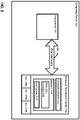
- FIG. 1 depicts an example architecture of a computing device 110 in which the features described herein may be implemented. This example should not be considered as limiting the scope of the disclosure or usefulness of the features described herein.
- Computing device 110 may be a server, personal computer, or other such systems.
- the architecture of the computing device 110 includes a processor 112, memory 114, and a hardware accelerator card 118.
- the processor 112 may include one or more general purpose processors, such as a Central Processing Unit (CPU), and/or one or more special purpose processors, such as application specific integrated circuits (ASICs), field programmable gate arrays (FPGAs), etc.
- the processor 112 may be of any type including but not limited to one or more microprocessor (uP), one or more microcontroller (uC), one or more digital signal processor (DSP), or any combination thereof.
- the processor may include one or more levels of caching, one or more processor cores, and one or more registers.
- Each processor core may include an arithmetic logic unit (ALU), a floating point unit (FPU), a digital signal processing core (DSP Core), or any combination thereof.
- the processor 112 may be configured to execute computer-readable program instructions that may be contained in a data storage, such as instruction 117 stored in memory 114, and/or other instructions as described herein.
- the memory 114 can store information accessible by the processor 112, including instructions 117 that can be executed by the processor 112. Memory can also include data 116 that can be retrieved, manipulated, or stored by the processor 112.
- the memory 114 may be a type of non-transitory computer readable medium capable of storing information accessible by the processor 112, such as a hard-drive, solid state drive, tape drive, optical storage, memory card, ROM, RAM, DVD, CD-ROM, write-capable, and read-only memories.
- the instructions 117 can be a set of instructions executed directly, such as machine code, or indirectly, such as scripts, by the processor 112.
- the terms "instructions,” “steps,” and “programs” can be used interchangeably herein.
- the instructions 117 can be stored in object code format for direct processing by the processor 112, or other types of computer language including scripts or collections of independent source code modules that are interpreted on demand or compiled in advance.
- the data 116 can be retrieved, stored, or modified by the processor 112 in accordance with the instructions 117 or other such instructions.
- the data 116 can be stored in computer registers, in a distributed storage system as a structure having a plurality of different fields and records, or documents, or buffers.
- the data 116 can also be formatted in a computer-readable format such as, but not limited to, binary values, ASCII or Unicode.
- the data 116 can include information sufficient to identify relevant information, such as numbers, descriptive text, proprietary codes, pointers, references to data stored in other memories, including other network locations, or information that is used by a function to calculate relevant data.
- FIG. 1 functionally illustrates the processor 112 and memory 114 as being within the same block, the processor 112 and memory 114 may actually include multiple processors and memories that may or may not be stored within the same physical housing. For example, some of the instructions 117 and data 116 can be stored on a removable CD-ROM and others within a read-only DRAM chip. Some or all of the instructions and data can be stored in a location physically remote from, yet still accessible by, the processor 112.
- FIG. 1 illustrates computing device 110 as including only one processor 112, memory, 114, and HW accelerator card 118, the computing device 110 may include any number of processors, memory, and HW accelerator cards.
- the processor 120 can actually include a collection of processors, which may or may not operate in parallel.
- the computing device may further include a hardware (HW) accelerator card 118.
- the hardware accelerator card 118 may be any device configured to efficiently process particular types of tasks.
- Some examples of HW accelerator cards include network accelerator cards, video transcoding accelerator cards, security function accelerator cards, cryptography accelerator cards, sound processing accelerator cards, artificial intelligence accelerator cards, etc.
- Each of these HW accelerator cards may be configured to provide particular acceleration services such as compression, encryption, transcoding, hash generation, graphic processing, simulation, etc.
- Some HW accelerator cards may be configured to provide multiple acceleration services such as compression and encryption, or any other combination of acceleration services.
- the HW accelerator card may include a compute complex 212, memory 214, and accelerators 228a, 228b, and 228c.
- the compute complex may be comprised of one or more processors.
- the one or more processors may control the general operation of the other components of the hardware accelerator, such as by distributing processing tasks amongst the accelerators 228a-228c and communicating with other devices in the computing device 110, such as processor 112.
- the one or more processors of the compute complex 212 may be comprised of one or more general purpose processors and/or special purpose processors.
- the compute complex of a hardware accelerator card is comprised of one or more special purpose processors, such as application specific integrated circuits (ASICs), field programmable gate arrays (FPGAs), etc., capable of executing ARM-based instruction sets, although other instruction sets may be used.
- ASICs application specific integrated circuits
- FPGAs field programmable gate arrays
- the accelerators 228a-228c may each be comprised of one or more processors capable of providing particular acceleration services.
- each accelerator may be configured to provide particular acceleration services such as compression, encryption, transcoding, hash generation, graphic processing, simulation, etc.
- Some HW accelerator cards may be configured to provide multiple acceleration services such as compression and encryption, or any other combination of acceleration services.
- the one or more processors of the accelerators may be one or more special purpose processors, such as application specific integrated circuits (ASICs), field programmable gate arrays (FPGAs), specialized processors, etc. used.
- ASICs application specific integrated circuits
- FPGAs field programmable gate arrays
- HW accelerator cards may include any number of accelerators.
- each individual accelerator may be configured to provide more than one acceleration service (e.g., more than one function and/or capability).
- the HW accelerator card includes memory 214.
- the memory 214 may be compared to memory 114 in that it may be any type of non-transitory computer readable medium capable of storing information accessible by the processor 120, such as a hard-drive, solid state drive, tape drive, optical storage, memory card, ROM, RAM, DVD, CD-ROM, write-capable, and read-only memories.
- Memory 214 may store information accessible by the compute complex 212 and/or accelerators 228a-228c, including instructions 217 that can be executed by the compute complex 212 and/or accelerators 228a-228c.
- each accelerator 228-228c may have its own memory and/or a pool of shared memory for storing data and instructions for execution of tasks assigned by the compute complex 212.
- the data 216 within memory 214 can be retrieved, stored or modified by the compute complex 212 and/or accelerators 228a-228c in accordance with the instructions 217 or other such instructions.
- the data 216 may include one or more accelerations service listing 218.
- the acceleration service listing 218 may contain a list of the acceleration services provided by each accelerator 228a-228c.
- the listings of acceleration services may be in a standardized form.
- each particular acceleration service may be assigned a particular, unique identifier. All accelerators that have a certain acceleration service would include the unique identifier associated with that certain acceleration service in the listing of acceleration services.
- FIG. 3 illustrates example listings 328a-328c which correspond to accelerators 228a-228c, respectively, as stored within memory 214.
- memory 214 includes a listing for each accelerator on the HW accelerator card 118.
- listing 328a identifies the acceleration services provided by accelerator 228a, as identified by unique identifiers including Function 1, Capability 1, Function 3, and Function 5.
- accelerator 228b is capable of providing three acceleration services, and each acceleration service is identified within listing 328b by its unique identifier, including Function 1, Function 5, and Capability 9.
- Accelerator 228c is capable of providing two acceleration services. Each of these two acceleration services is identified in listing 328c by unique identifiers including Capability 9 and Function 5.
- accelerators that provide a common acceleration service may be associated with the same unique identifier in their respective listings.
- Function 1 is the unique identifier associated with a particular function capable of being performed by accelerators 228a and 228b.
- listings 328a and 328b contain the same unique identifier Function 1.
- Capability 9 is the unique identifier associated with a particular capability of accelerators 228b and 228c.
- listings 328b and 32c contain the same unique identifier of Capability 9.
- the unique identifiers in FIG. 3 are merely examples of possible identifiers. Identifiers may include any value or other such indicator, including numbers, letters, symbols, etc.
- the listings 328a-328c are examples of a possible format for listing unique identifiers associated with accelerators of the HW accelerator card 118.
- the listings of accelerators may be stored in a combined listing, such as a spreadsheet or database.
- the combined listing may identify each accelerator and the unique identifiers associated with the acceleration services provided by that accelerator.
- the listing may be grouped according to accelerators. For instance, a first listing may include a combined listing for a first set of accelerators and a second listing may include a combined listing for a second set of accelerators. Other data may also be included in the listings.
- FIGs. 2 and 3 illustrate the listings as being stored on memory 216, the listings may be stored on the memory of one or more accelerators.
- a manager may maintain a repository of acceleration services and associated unique identifiers for the acceleration services.
- the manager may be an individual(s), a company, a collection of companies, a standards organization(s), etc.
- the manager may also assign the unique identifiers to each acceleration service and add additional acceleration services and corresponding unique identifiers when developed, received, or otherwise requested.
- the identifiers used to indicate acceleration services may be consistent across HW accelerator cards, even when the HW accelerator cards are manufactured by different vendors.
- the processor 112 may communicate directly with the hardware accelerator card 118 using a communication interface and protocol.
- the processor(s) 112 may communicate with the hardware accelerator card(s) using PCIe interface 260.
- FIG. 2 illustrates a PCIe interface 260, other communication interfaces and protocols may be used.
- the processor(s) 112 may communicate with the HW accelerator card(s) 118 using one or more of a CAN interface and protocol, an SPI interface and protocol, a USB interface and protocol, an eSPI interface and protocol, an Ethernet interface and protocol, an IDE interface and protocol, or any other such interface and protocol.
- Communication between devices over the communication interface, such as processor 112 and HW accelerator card 118 over PCIe interface 260 may be controlled via an operating system executing on the computing device 110.
- the operating system may setup a handle to provide a communication channel between devices attached to the PCIe interface 260.
- the operating system may also close communication channels between different devices connected to the PCIe interface 260.
- the computing device 110 may include other components normally found in a personal computer and/or server such as a display device, for example, a monitor having a screen, a projector, a touch-screen, a small LCD screen, a television, or another device such as an electrical device that can be operable to display information processed by processor 112.
- Computing device 110 may also include speakers, network interface devices, such as one or more modems and/or network interface cards.
- Computing device 110 may also include one or more user input devices, such as a mouse, keyboard, touch screen, microphone, etc.
- the computing device 110 may also include hardware for connecting some or all of the aforementioned components together with one another.
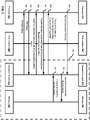
- FIG 4 is a flow diagram illustrating the process of discovering acceleration services provided by a HW accelerator card, such as HW accelerator card 118 connected to a processor, such as processor 112 via a communication interface, such as PCIe bus 260.
- the processor 112 may request to communicate with the HW accelerator card 118 (shown in dashed line) via the PCIe interface.
- the operating system executing on the computing device may provide a communication channel over the PCIe bus between the HW accelerator card and processor 112.
- the processor 112 may transmit a request a listing of acceleration services provided by the accelerators on the HW accelerator card 118, as shown by line 423.
- the compute complex 212 of the HW accelerator card 118 may query and receive a listing of acceleration services from memory 214 of the HW accelerator card (or memory of the accelerators), as illustrated by arrows 425 and 427, respectively.
- the HW accelerator card may aggregate the acceleration services of all accelerators. In certain instances, the HW accelerator card 118 may query only some accelerators.
- the HW accelerator card 118 may aggregate the acceleration services of the accelerators in a hierarchical manner.
- acceleration services may be hierarchical, in that one acceleration service may rely on or be dependent on another acceleration service. This hierarchical relationship between acceleration services may be identified and stored in this listing. In some instances, each level in the hierarchical relationship may identify the capabilities and functionalities of the levels underneath.
- the compute complex 212 may provide the listing of acceleration services to the processor 112 via the PCIe bus 260, as shown by line 429. Once the processor receives the listing of acceleration services the communication channel may be closed.
- the processor 112 may request the HW accelerator card complete one or more tasks using one of the provided acceleration services offered by the accelerators on the HW accelerator card 118.
- FIG. 5 illustrates a processor 112 requesting information regarding the acceleration services of a HW accelerator card 118 connected via PCIe bus 260.
- steps 521-529 correspond to steps 421-429 described above.
- the HW accelerator indicates that it is capable of providing compression services.
- the processor 112 may provide a workload instruction including an indication of a location storing data and an instruction to the HW accelerator card 118 to compress the data, as shown by arrow 531.
- the compute complex 212 of the HW accelerator card may then confirm the instruction and provides an ID that the processor 212 may communicate with to get status updates on the compression by the HW accelerator card 118 as shown by arrow 533.
- the processor 212 may then request and receive a status of the compression as shown by arrows 535 and 537, respectively.
- FIG. 5 illustrates a compression service
- the processing performed by the HW accelerator can be any type of operation or combination of operations.
Landscapes
- Engineering & Computer Science (AREA)
- Software Systems (AREA)
- Theoretical Computer Science (AREA)
- Physics & Mathematics (AREA)
- General Engineering & Computer Science (AREA)
- General Physics & Mathematics (AREA)
- Advance Control (AREA)
Abstract
Description
- In most systems, it is difficult for a computing device, including the components of the computing device and/or the software executing on the computing device, including the operating system, to discover the functionality and capabilities provided by hardware accelerator cards connected to the computing device by a communication interface, such as a PCIe bus. To avoid these issues, processors may be hardcoded with software, such as drivers, to communicate with particular hardware accelerator cards. However, hardcoding processors with the necessary software to communicate with particular hardware accelerator cards limit the processors to only those particular hardware accelerator cards. Thus, processors are not able to leverage the functions and capabilities of other hardware accelerator cards or hardware accelerator cards that were developed after the processor was produced.
- Additionally, some hardware accelerator cards may expose their functionalities and capabilities as separate devices within the operating system of a computing device. In this regard, when a hardware accelerator card is connected to a computing device by a communication interface, such as a PCIe bus, the operating system may detect or otherwise be notified of the connection and list each function and capability of the hardware accelerator card as discrete devices within the operating system according to predefined classes and subclasses. Based on the devices listed in the operating system, the computing device may be able to use the capabilities and functionalities of the hardware accelerator card.
- As the capabilities and functionalities of hardware accelerator cards have increased and become more specialized, these new capabilities and functionalities are not clearly identified by the classes and subclasses provided for by current operating systems. Thus, some operating systems may provide an indication of the capabilities and functionalities provided by hardware accelerator cards, but may not be able to identify all of the capabilities and functionalities of the hardware accelerator cards. Further, some of the capabilities and functionalities of the hardware accelerator cards may not be recognized and/or clearly identified within the operating systems. As such, computing devices may not be able to leverage or even be made aware of all of the features and capabilities of available hardware accelerator cards.
- The technology described herein relates to systems and methods for discovering hardware acceleration services provided by hardware (HW) accelerators connected to a computing device via a communication interface.
- One aspect of the disclosure relates to a method for discovering the functions and capabilities of a hardware (HW) accelerator card. The method may include requesting, by the one or more processors via a communication interface, a listing of acceleration services from the HW accelerator card; and receiving, by the one or more processors via the communication interface, the listing of acceleration services from the HW accelerator card, wherein the listing of acceleration services is stored within the HW accelerator card.
- Another aspect of the disclosure relates to a system including a communication interface, a hardware (HW) accelerator card comprising one or more accelerators and a first memory storing a listing of acceleration services provided by the one or more accelerators, and a processor, in communication with the HW accelerator card via the communication interface. The processor may be configured to request, via the communication interface, the listing of acceleration services from the HW accelerator card and receive, via the communication interface, the listing of acceleration services from the HW accelerator card.
- Another aspect of the disclosure relates to a non-transitory, tangible computer-readable storage medium on which computer-readable instructions of a program are stored, the instructions, when executed by one or more computing devices, cause the one or more computing devices to perform a method. The method may include requesting, via a communication interface, a listing of acceleration services from the HW accelerator card and receiving, via the communication interface, the listing of acceleration services from the HW accelerator card, wherein the listing of acceleration services is stored within the HW accelerator card.
- In some instances, a workload instruction may be transmitted to the HW accelerator card. The workload instructions may define a workload for processing by the HW accelerator card that uses one or more of the acceleration services in the listing of acceleration services.
- In some instances, status updates may be requested from the HW accelerator card during the processing of the workload by the HW accelerator card.
- In some instances, prior to requesting the listing of acceleration services, a handle to a hardware (HW) accelerator card may be requested. The request for the listing of acceleration services from the HW accelerator card may be sent using the handle.
- In some examples, the handle may be closed after receiving a status update indicating completion of the workload instructions.
- In some instances, the listing of acceleration services includes functions and/or capabilities of accelerators on the HW accelerator.
- In some examples, a processor of the HW accelerator may retrieve the listing of acceleration services from memory of the HW accelerator in response to receiving the request from the one or more processors.
-
-
FIG. 1 is an illustration of an example system in accordance with aspects of the present disclosure. -
FIG. 2 is another illustration of an example system in accordance with aspects of the present disclosure. -
FIG. 3 is an illustration of an example listing of acceleration services in accordance with aspects of the present disclosure. -
FIG. 4 is a flow diagram of an example process for requesting acceleration services from a hardware accelerator card in accordance with aspects of the disclosure. -
FIG. 5 is another flow diagram of an example process for requesting acceleration services from a hardware accelerator card and providing a workload to leverage the acceleration services in accordance with aspects of the disclosure. - The technology is directed to discovering hardware acceleration services provided by hardware (HW) accelerator cards connected to a computing device via communication interfaces. In this regard, a processor may communicate a request for a listing of the functions and capabilities of the HW accelerator card connected to the computing device via the communication interface. A listing of the functions and capabilities of the HW accelerator card, hereinafter referred to as "acceleration services," may be stored in the memory of the HW accelerator card. In response to receiving the request from the processor, the HW accelerator card may retrieve the listing from memory and provide a response to the processor that includes a listing of the HW acceleration services provided by the HW accelerator card.
- To overcome the deficiencies of discovering acceleration services the technology described herein uses a standardized listing of identifiers that correspond to acceleration services that can be provided by the accelerators on HW accelerator cards. In this regard, each HW accelerator card may store a listing of identifiers that correspond to the acceleration services provided by the accelerators on that card. As the identifiers can provide more granularity than the device classes and subclasses currently used, processors which retrieve the listings from the HW accelerator cards will be able to determine and leverage more accelerator services offered by the accelerators on the HW accelerator cards.
- As used herein, the term "acceleration services" refers to the capabilities and functionalities offered by accelerators of a HW accelerator card. References to "acceleration services" of a HW accelerator card refers to the acceleration services of the accelerators on that HW accelerator card. Acceleration services may include capabilities and functionalities that an accelerator can leverage to control the processing of data, referred to herein as control-plane acceleration services. Acceleration services may also include capabilities and functionalities that an accelerator can leverage to process the data, referred to herein as data-plane acceleration services. For example, an accelerator can support acceleration services that provide controls and/or policies for sharing memory between memory on the host (the computing device) and the accelerator. This control-plane acceleration service can be identified and communicated as an acceleration service.
- As each HW accelerator card may have many accelerators, each HW accelerator may provide many acceleration services having the same and/or different capabilities and functionalities. Further, each accelerator may include more than one function and capability.
-
FIG. 1 depicts an example architecture of acomputing device 110 in which the features described herein may be implemented. This example should not be considered as limiting the scope of the disclosure or usefulness of the features described herein.Computing device 110 may be a server, personal computer, or other such systems. The architecture of thecomputing device 110 includes aprocessor 112,memory 114, and ahardware accelerator card 118. - The
processor 112 may include one or more general purpose processors, such as a Central Processing Unit (CPU), and/or one or more special purpose processors, such as application specific integrated circuits (ASICs), field programmable gate arrays (FPGAs), etc. Theprocessor 112 may be of any type including but not limited to one or more microprocessor (uP), one or more microcontroller (uC), one or more digital signal processor (DSP), or any combination thereof. The processor may include one or more levels of caching, one or more processor cores, and one or more registers. Each processor core may include an arithmetic logic unit (ALU), a floating point unit (FPU), a digital signal processing core (DSP Core), or any combination thereof. Theprocessor 112 may be configured to execute computer-readable program instructions that may be contained in a data storage, such asinstruction 117 stored inmemory 114, and/or other instructions as described herein. - The
memory 114 can store information accessible by theprocessor 112, includinginstructions 117 that can be executed by theprocessor 112. Memory can also includedata 116 that can be retrieved, manipulated, or stored by theprocessor 112. Thememory 114 may be a type of non-transitory computer readable medium capable of storing information accessible by theprocessor 112, such as a hard-drive, solid state drive, tape drive, optical storage, memory card, ROM, RAM, DVD, CD-ROM, write-capable, and read-only memories. - The
instructions 117 can be a set of instructions executed directly, such as machine code, or indirectly, such as scripts, by theprocessor 112. In this regard, the terms "instructions," "steps," and "programs" can be used interchangeably herein. Theinstructions 117 can be stored in object code format for direct processing by theprocessor 112, or other types of computer language including scripts or collections of independent source code modules that are interpreted on demand or compiled in advance. - The
data 116 can be retrieved, stored, or modified by theprocessor 112 in accordance with theinstructions 117 or other such instructions. For instance, although the system and method are not limited by a particular data structure, thedata 116 can be stored in computer registers, in a distributed storage system as a structure having a plurality of different fields and records, or documents, or buffers. Thedata 116 can also be formatted in a computer-readable format such as, but not limited to, binary values, ASCII or Unicode. Moreover, thedata 116 can include information sufficient to identify relevant information, such as numbers, descriptive text, proprietary codes, pointers, references to data stored in other memories, including other network locations, or information that is used by a function to calculate relevant data. - Although
Fig. 1 functionally illustrates theprocessor 112 andmemory 114 as being within the same block, theprocessor 112 andmemory 114 may actually include multiple processors and memories that may or may not be stored within the same physical housing. For example, some of theinstructions 117 anddata 116 can be stored on a removable CD-ROM and others within a read-only DRAM chip. Some or all of the instructions and data can be stored in a location physically remote from, yet still accessible by, theprocessor 112. AlthoughFIG. 1 illustratescomputing device 110 as including only oneprocessor 112, memory, 114, andHW accelerator card 118, thecomputing device 110 may include any number of processors, memory, and HW accelerator cards. Similarly, the processor 120 can actually include a collection of processors, which may or may not operate in parallel. - The computing device may further include a hardware (HW)
accelerator card 118. Thehardware accelerator card 118 may be any device configured to efficiently process particular types of tasks. Some examples of HW accelerator cards include network accelerator cards, video transcoding accelerator cards, security function accelerator cards, cryptography accelerator cards, sound processing accelerator cards, artificial intelligence accelerator cards, etc. Each of these HW accelerator cards may be configured to provide particular acceleration services such as compression, encryption, transcoding, hash generation, graphic processing, simulation, etc. Some HW accelerator cards may be configured to provide multiple acceleration services such as compression and encryption, or any other combination of acceleration services. - Referring to
FIG 2 ., the HW accelerator card may include acompute complex 212,memory 214, andaccelerators accelerators 228a-228c and communicating with other devices in thecomputing device 110, such asprocessor 112. The one or more processors of thecompute complex 212 may be comprised of one or more general purpose processors and/or special purpose processors. Typically, the compute complex of a hardware accelerator card is comprised of one or more special purpose processors, such as application specific integrated circuits (ASICs), field programmable gate arrays (FPGAs), etc., capable of executing ARM-based instruction sets, although other instruction sets may be used. - The
accelerators 228a-228c may each be comprised of one or more processors capable of providing particular acceleration services. For example, each accelerator may be configured to provide particular acceleration services such as compression, encryption, transcoding, hash generation, graphic processing, simulation, etc. Some HW accelerator cards may be configured to provide multiple acceleration services such as compression and encryption, or any other combination of acceleration services. The one or more processors of the accelerators may be one or more special purpose processors, such as application specific integrated circuits (ASICs), field programmable gate arrays (FPGAs), specialized processors, etc. used. Although three accelerators are illustrated inFIG. 2 , includingaccelerators 228a-228c, HW accelerator cards may include any number of accelerators. As previously explained, each individual accelerator may be configured to provide more than one acceleration service (e.g., more than one function and/or capability). - Referring again to
FIG 2 , the HW accelerator card includesmemory 214. Thememory 214 may be compared tomemory 114 in that it may be any type of non-transitory computer readable medium capable of storing information accessible by the processor 120, such as a hard-drive, solid state drive, tape drive, optical storage, memory card, ROM, RAM, DVD, CD-ROM, write-capable, and read-only memories.Memory 214 may store information accessible by thecompute complex 212 and/oraccelerators 228a-228c, includinginstructions 217 that can be executed by thecompute complex 212 and/oraccelerators 228a-228c. Although not shown, each accelerator 228-228c may have its own memory and/or a pool of shared memory for storing data and instructions for execution of tasks assigned by thecompute complex 212. - The
data 216 withinmemory 214 can be retrieved, stored or modified by thecompute complex 212 and/oraccelerators 228a-228c in accordance with theinstructions 217 or other such instructions. As further illustrated inFIG. 2 , thedata 216 may include one or moreaccelerations service listing 218. Theacceleration service listing 218 may contain a list of the acceleration services provided by eachaccelerator 228a-228c. - The listings of acceleration services may be in a standardized form. In this regard, each particular acceleration service may be assigned a particular, unique identifier. All accelerators that have a certain acceleration service would include the unique identifier associated with that certain acceleration service in the listing of acceleration services.
-
FIG. 3 illustratesexample listings 328a-328c which correspond toaccelerators 228a-228c, respectively, as stored withinmemory 214. In this regard,memory 214 includes a listing for each accelerator on theHW accelerator card 118. As illustrated,listing 328a identifies the acceleration services provided byaccelerator 228a, as identified by uniqueidentifiers including Function 1,Capability 1, Function 3, andFunction 5. Similarly,accelerator 228b is capable of providing three acceleration services, and each acceleration service is identified withinlisting 328b by its unique identifier, includingFunction 1,Function 5, andCapability 9.Accelerator 228c is capable of providing two acceleration services. Each of these two acceleration services is identified inlisting 328c by uniqueidentifiers including Capability 9 andFunction 5. - As further illustrated in
FIG. 3 , accelerators that provide a common acceleration service may be associated with the same unique identifier in their respective listings. For instance,Function 1 is the unique identifier associated with a particular function capable of being performed byaccelerators listings unique identifier Function 1. Similarly,Capability 9 is the unique identifier associated with a particular capability ofaccelerators listings 328b and 32c contain the same unique identifier ofCapability 9. The unique identifiers inFIG. 3 are merely examples of possible identifiers. Identifiers may include any value or other such indicator, including numbers, letters, symbols, etc. - The
listings 328a-328c are examples of a possible format for listing unique identifiers associated with accelerators of theHW accelerator card 118. In some examples, the listings of accelerators may be stored in a combined listing, such as a spreadsheet or database. For example, the combined listing may identify each accelerator and the unique identifiers associated with the acceleration services provided by that accelerator. Similarly, the listing may be grouped according to accelerators. For instance, a first listing may include a combined listing for a first set of accelerators and a second listing may include a combined listing for a second set of accelerators. Other data may also be included in the listings. AlthoughFIGs. 2 and3 illustrate the listings as being stored onmemory 216, the listings may be stored on the memory of one or more accelerators. - Although not illustrated, a manager may maintain a repository of acceleration services and associated unique identifiers for the acceleration services. The manager may be an individual(s), a company, a collection of companies, a standards organization(s), etc. In addition to maintaining the repository, the manager may also assign the unique identifiers to each acceleration service and add additional acceleration services and corresponding unique identifiers when developed, received, or otherwise requested. By providing a repository of acceleration services and associated unique identifiers, the identifiers used to indicate acceleration services may be consistent across HW accelerator cards, even when the HW accelerator cards are manufactured by different vendors.
- Referring to
FIG. 2 , theprocessor 112 may communicate directly with thehardware accelerator card 118 using a communication interface and protocol. For example, the processor(s) 112 may communicate with the hardware accelerator card(s) usingPCIe interface 260. AlthoughFIG. 2 illustrates aPCIe interface 260, other communication interfaces and protocols may be used. For example, the processor(s) 112 may communicate with the HW accelerator card(s) 118 using one or more of a CAN interface and protocol, an SPI interface and protocol, a USB interface and protocol, an eSPI interface and protocol, an Ethernet interface and protocol, an IDE interface and protocol, or any other such interface and protocol. - Communication between devices over the communication interface, such as
processor 112 andHW accelerator card 118 overPCIe interface 260 may be controlled via an operating system executing on thecomputing device 110. In this regard, the operating system may setup a handle to provide a communication channel between devices attached to thePCIe interface 260. In some instances, the operating system may also close communication channels between different devices connected to thePCIe interface 260. - Although not shown in
FIGS. 1 and2 , thecomputing device 110 may include other components normally found in a personal computer and/or server such as a display device, for example, a monitor having a screen, a projector, a touch-screen, a small LCD screen, a television, or another device such as an electrical device that can be operable to display information processed byprocessor 112.Computing device 110 may also include speakers, network interface devices, such as one or more modems and/or network interface cards.Computing device 110 may also include one or more user input devices, such as a mouse, keyboard, touch screen, microphone, etc. Thecomputing device 110 may also include hardware for connecting some or all of the aforementioned components together with one another. -
Figure 4 is a flow diagram illustrating the process of discovering acceleration services provided by a HW accelerator card, such asHW accelerator card 118 connected to a processor, such asprocessor 112 via a communication interface, such asPCIe bus 260. Theprocessor 112 may request to communicate with the HW accelerator card 118 (shown in dashed line) via the PCIe interface. The operating system executing on the computing device may provide a communication channel over the PCIe bus between the HW accelerator card andprocessor 112. - Using the communication channel, the
processor 112 may transmit a request a listing of acceleration services provided by the accelerators on theHW accelerator card 118, as shown byline 423. In response to receiving the request from theprocessor 118, thecompute complex 212 of theHW accelerator card 118 may query and receive a listing of acceleration services frommemory 214 of the HW accelerator card (or memory of the accelerators), as illustrated byarrows HW accelerator card 118 may query only some accelerators. - In some instances, the
HW accelerator card 118 may aggregate the acceleration services of the accelerators in a hierarchical manner. In this regard, acceleration services may be hierarchical, in that one acceleration service may rely on or be dependent on another acceleration service. This hierarchical relationship between acceleration services may be identified and stored in this listing. In some instances, each level in the hierarchical relationship may identify the capabilities and functionalities of the levels underneath. - The
compute complex 212 may provide the listing of acceleration services to theprocessor 112 via thePCIe bus 260, as shown byline 429. Once the processor receives the listing of acceleration services the communication channel may be closed. - In the event the processor can leverage one or more acceleration services, the
processor 112 may request the HW accelerator card complete one or more tasks using one of the provided acceleration services offered by the accelerators on theHW accelerator card 118.FIG. 5 illustrates aprocessor 112 requesting information regarding the acceleration services of aHW accelerator card 118 connected viaPCIe bus 260. In this regard, steps 521-529 correspond to steps 421-429 described above. - As illustrated by
arrow 529, the HW accelerator indicates that it is capable of providing compression services. Upon receiving the acceleration services, theprocessor 112 may provide a workload instruction including an indication of a location storing data and an instruction to theHW accelerator card 118 to compress the data, as shown byarrow 531. Thecompute complex 212 of the HW accelerator card may then confirm the instruction and provides an ID that theprocessor 212 may communicate with to get status updates on the compression by theHW accelerator card 118 as shown byarrow 533. Theprocessor 212 may then request and receive a status of the compression as shown byarrows processor 112 andHW accelerator card 118 may cease or further tasks may be sent from theprocessor 112 to the HW accelerator card. AlthoughFIG. 5 illustrates a compression service, the processing performed by the HW accelerator can be any type of operation or combination of operations. - Unless otherwise stated, the foregoing alternative examples are not mutually exclusive but may be implemented in various combinations to achieve unique advantages. As these and other variations and combinations of the features discussed above can be utilized without departing from the subject matter defined by the claims, the foregoing description of the embodiments should be taken by way of illustration rather than by way of limitation of the subject matter defined by the claims. In addition, the provision of the examples described herein, as well as clauses phrased as "such as," "including" and the like, should not be interpreted as limiting the subject matter of the claims to the specific examples; rather, the examples are intended to illustrate only one of many possible embodiments. Further, the same reference numbers in different drawings can identify the same or similar elements.
Claims (15)
- A method for discovering capabilities of a hardware, HW, accelerator card, the method comprising:requesting, by one or more processors via a communication interface, a listing of acceleration services from the HW accelerator card; andreceiving, by the one or more processors via the communication interface, the listing of acceleration services from the HW accelerator card, wherein the listing of acceleration services is stored within the HW accelerator card.
- The method of claim 1, further comprising:
transmitting, by the one or more processors, a workload instruction to the HW accelerator card, wherein the workload instructions define a workload for processing by the HW accelerator card that uses one or more of the acceleration services in the listing of acceleration services. - The method of claim 1 or 2, further comprising requesting status updates from the HW accelerator card during processing of the workload by the HW accelerator card;prior to requesting the listing of acceleration services, requesting, by the one or more processors, a handle to the HW, accelerator card, wherein the request for the listing of acceleration services from the HW accelerator card is sent using the handle; andclosing the handle after receiving a status update indicating completion of the workload instructions.
- The method of one of claims 1 to 3, wherein the listing of acceleration services includes functions and/or capabilities of accelerators on the HW accelerator.
- The method of one of claims 1 to 4, wherein a processor of the HW accelerator retrieves the listing of acceleration services from memory of the HW accelerator in response to receiving the request from the one or more processors.
- A system comprising:a communication interface;a hardware, HW, accelerator card comprising one or more accelerators and a first memory storing a listing of acceleration services provided by the one or more accelerators; anda processor, in communication with the HW accelerator card via the communication interface, the processor configured to:request, via the communication interface, the listing of acceleration services from the HW accelerator card; andreceive, via the communication interface, the listing of acceleration services from the HW accelerator card.
- The system of claim 6, wherein the processor is further configured to:
transmit a workload instruction to the HW accelerator card, wherein the workload instructions define a workload for processing by the HW accelerator card that uses one or more of the acceleration services in the listing of acceleration services. - The system of claim 6 or 7, wherein the processor is further configured to request status updates from the HW accelerator card during processing of the workload by the HW accelerator card;prior to requesting the listing of acceleration services, request a handle to the HW accelerator card, wherein the request for the listing of acceleration services from the HW accelerator card is sent using the handle; andclose the handle after receiving a status update indicating completion of the workload instructions from the HW accelerator card.
- The system of one of claims 6 to 8, wherein the listing of acceleration services includes functions and/or capabilities of the accelerators on the HW accelerator card.
- The system of one of claims 6 to 9, wherein the HW accelerator card further comprises a compute complex, the compute complex configured to:
retrieve the listing of acceleration services from the first memory in response to receiving the request from the processor. - A non-transitory, tangible computer-readable storage medium on which computer-readable instructions of a program are stored, the instructions, when executed by one or more computing devices, cause the one or more computing devices to perform a method, the method comprising:requesting, via a communication interface, a listing of acceleration services from the HW accelerator card; andreceiving, via the communication interface, the listing of acceleration services from the HW accelerator card, wherein the listing of acceleration services is stored within the HW accelerator card.
- The non-transitory, tangible computer-readable storage medium of claim 11, the method further comprising:
transmitting a workload instruction to the HW accelerator card, wherein the workload instructions define a workload for processing by the HW accelerator card that uses one or more of the acceleration services in the listing of acceleration services. - The non-transitory, tangible computer-readable storage medium of claim 11 or 12, the method further comprising requesting status updates from the HW accelerator card during processing of the workload by the HW accelerator card.
- The non-transitory, tangible computer-readable storage medium of one of claims 11 to 13, the method further comprising:prior to requesting the listing of acceleration services, requesting, from an operating system executing on the one or more computing devices, a handle to the HW accelerator card, wherein the request a listing of acceleration services from the HW accelerator card is sent using the handle; andclosing the handle after receiving a status update indicating completion of the workload instructions.
- The non-transitory, tangible computer-readable storage medium of one of claims 11 to 14, wherein the listing of acceleration services including functions and/or capabilities of accelerators on the HW accelerator.
Applications Claiming Priority (1)
| Application Number | Priority Date | Filing Date | Title |
|---|---|---|---|
| US17/351,849 US11861408B2 (en) | 2021-06-18 | 2021-06-18 | Hardware accelerator service discovery |
Publications (2)
| Publication Number | Publication Date |
|---|---|
| EP4105782A1 true EP4105782A1 (en) | 2022-12-21 |
| EP4105782B1 EP4105782B1 (en) | 2026-01-21 |
Family
ID=80447009
Family Applications (1)
| Application Number | Title | Priority Date | Filing Date |
|---|---|---|---|
| EP22156098.0A Active EP4105782B1 (en) | 2021-06-18 | 2022-02-10 | Hardware accelerator service discovery |
Country Status (2)
| Country | Link |
|---|---|
| US (2) | US11861408B2 (en) |
| EP (1) | EP4105782B1 (en) |
Families Citing this family (1)
| Publication number | Priority date | Publication date | Assignee | Title |
|---|---|---|---|---|
| US12321638B2 (en) * | 2023-01-13 | 2025-06-03 | Innogrit Technologies Co., Ltd. | Compression accelerator card and method of simulating hard disk mode to access the compression accelerator card |
Citations (4)
| Publication number | Priority date | Publication date | Assignee | Title |
|---|---|---|---|---|
| US6633898B1 (en) * | 1998-12-08 | 2003-10-14 | Fujitsu Limited | System, apparatus, method and computer program product for processing distributed service modules |
| US20110320739A1 (en) * | 2010-06-29 | 2011-12-29 | Canon Kabushiki Kaisha | Discovery of network services |
| US20200028921A1 (en) * | 2017-03-20 | 2020-01-23 | China Mobile Communication Co., Ltd Research Institute | Network function information interaction method and device, and computer storage medium |
| EP3731091A1 (en) * | 2019-04-24 | 2020-10-28 | INTEL Corporation | Technologies for providing an accelerator device discovery service |
Family Cites Families (12)
| Publication number | Priority date | Publication date | Assignee | Title |
|---|---|---|---|---|
| US9405550B2 (en) | 2011-03-31 | 2016-08-02 | International Business Machines Corporation | Methods for the transmission of accelerator commands and corresponding command structure to remote hardware accelerator engines over an interconnect link |
| US9594718B2 (en) | 2013-01-24 | 2017-03-14 | Qualcomm Innovation Center, Inc. | Hardware accelerated communications over a chip-to-chip interface |
| CN105940638B (en) | 2014-02-27 | 2019-06-28 | 英特尔公司 | Apparatus, method, and machine-readable medium for computing resource discovery and management |
| CN105824706B (en) | 2015-12-31 | 2020-11-06 | 华为技术有限公司 | A method and apparatus for configuring an accelerator |
| CN112099941B (en) | 2016-08-26 | 2021-08-03 | 华为技术有限公司 | Method, device and system for implementing hardware accelerated processing |
| US10860390B2 (en) | 2017-06-28 | 2020-12-08 | Intel Corporation | Microservices architecture |
| EP3814899B1 (en) | 2018-06-27 | 2022-11-23 | Amazon Technologies, Inc. | Attached accelerator based inference service |
| US11216314B2 (en) | 2018-11-02 | 2022-01-04 | EMC IP Holding Company LLC | Dynamic reallocation of resources in accelerator-as-a-service computing environment |
| US10911342B2 (en) | 2018-11-30 | 2021-02-02 | Sap Se | Distributed monitoring in clusters with self-healing |
| US11301407B2 (en) | 2019-01-08 | 2022-04-12 | Intel Corporation | Technologies for accelerator fabric protocol multipathing |
| US11436051B2 (en) | 2019-04-30 | 2022-09-06 | Intel Corporation | Technologies for providing attestation of function as a service flavors |
| US11321907B1 (en) | 2021-03-02 | 2022-05-03 | Samsung Electronics Co., Ltd. | Method and apparatus for graphics driver optimization using daemon-based resources |
-
2021
- 2021-06-18 US US17/351,849 patent/US11861408B2/en active Active
-
2022
- 2022-02-10 EP EP22156098.0A patent/EP4105782B1/en active Active
-
2023
- 2023-11-21 US US18/516,072 patent/US12314766B2/en active Active
Patent Citations (4)
| Publication number | Priority date | Publication date | Assignee | Title |
|---|---|---|---|---|
| US6633898B1 (en) * | 1998-12-08 | 2003-10-14 | Fujitsu Limited | System, apparatus, method and computer program product for processing distributed service modules |
| US20110320739A1 (en) * | 2010-06-29 | 2011-12-29 | Canon Kabushiki Kaisha | Discovery of network services |
| US20200028921A1 (en) * | 2017-03-20 | 2020-01-23 | China Mobile Communication Co., Ltd Research Institute | Network function information interaction method and device, and computer storage medium |
| EP3731091A1 (en) * | 2019-04-24 | 2020-10-28 | INTEL Corporation | Technologies for providing an accelerator device discovery service |
Also Published As
| Publication number | Publication date |
|---|---|
| US11861408B2 (en) | 2024-01-02 |
| US20240086247A1 (en) | 2024-03-14 |
| EP4105782B1 (en) | 2026-01-21 |
| US20220405143A1 (en) | 2022-12-22 |
| US12314766B2 (en) | 2025-05-27 |
Similar Documents
| Publication | Publication Date | Title |
|---|---|---|
| US7673029B2 (en) | Grid automation bus to integrate management frameworks for dynamic grid management | |
| EP3103239B1 (en) | Cloud service custom execution environment | |
| ES2765415T3 (en) | Microservices-based data processing apparatus, method and program | |
| EP2864900B1 (en) | System and method for end-to-end exposure of exported representations of native data types to third-party applications | |
| EP4323872B1 (en) | Hardware accelerator service aggregation | |
| EP3513317A1 (en) | Data serialization in a distributed event processing system | |
| US10872003B2 (en) | Flexible event ingestion framework in an event processing system | |
| CN107133309B (en) | Method and device for storing and querying process example, storage medium and electronic equipment | |
| EP3436935A1 (en) | Pre-formed instructions for a mobile cloud service | |
| WO2020088681A1 (en) | Management method for model files and terminal device | |
| US20180307692A1 (en) | Software application interface for mediating access to services of a centralized data store | |
| CN119883296A (en) | Speed up application and sub-package installation | |
| AU2017237089B2 (en) | Technologies for auto discover and connect to a rest interface | |
| US12314766B2 (en) | Hardware accelerator service discovery | |
| WO2019223136A1 (en) | Data acquisition method and apparatus, and computer device and storage medium | |
| CN113760987A (en) | Data processing method and data processing platform | |
| US11593150B2 (en) | Method and apparatus for cloud service | |
| CN112261072B (en) | A service calling method, device, equipment and storage medium | |
| US10341420B1 (en) | Approaches for preparing and delivering bulk data to clients | |
| WO2025075803A1 (en) | Simplified data access and management for data computing | |
| US20130097622A1 (en) | Framework for system communication for handling data | |
| US11614981B2 (en) | Handling of metadata for microservices processing | |
| CN114036180A (en) | Report generation method, device, equipment and storage medium | |
| CN109561146A (en) | Document down loading method, device, terminal device | |
| CN116842555A (en) | Data operation control method and device |
Legal Events
| Date | Code | Title | Description |
|---|---|---|---|
| PUAI | Public reference made under article 153(3) epc to a published international application that has entered the european phase |
Free format text: ORIGINAL CODE: 0009012 |
|
| STAA | Information on the status of an ep patent application or granted ep patent |
Free format text: STATUS: THE APPLICATION HAS BEEN PUBLISHED |
|
| AK | Designated contracting states |
Kind code of ref document: A1 Designated state(s): AL AT BE BG CH CY CZ DE DK EE ES FI FR GB GR HR HU IE IS IT LI LT LU LV MC MK MT NL NO PL PT RO RS SE SI SK SM TR |
|
| STAA | Information on the status of an ep patent application or granted ep patent |
Free format text: STATUS: REQUEST FOR EXAMINATION WAS MADE |
|
| 17P | Request for examination filed |
Effective date: 20230619 |
|
| RBV | Designated contracting states (corrected) |
Designated state(s): AL AT BE BG CH CY CZ DE DK EE ES FI FR GB GR HR HU IE IS IT LI LT LU LV MC MK MT NL NO PL PT RO RS SE SI SK SM TR |
|
| GRAP | Despatch of communication of intention to grant a patent |
Free format text: ORIGINAL CODE: EPIDOSNIGR1 |
|
| STAA | Information on the status of an ep patent application or granted ep patent |
Free format text: STATUS: GRANT OF PATENT IS INTENDED |
|
| INTG | Intention to grant announced |
Effective date: 20250812 |
|
| GRAS | Grant fee paid |
Free format text: ORIGINAL CODE: EPIDOSNIGR3 |
|
| GRAA | (expected) grant |
Free format text: ORIGINAL CODE: 0009210 |
|
| STAA | Information on the status of an ep patent application or granted ep patent |
Free format text: STATUS: THE PATENT HAS BEEN GRANTED |
|
| AK | Designated contracting states |
Kind code of ref document: B1 Designated state(s): AL AT BE BG CH CY CZ DE DK EE ES FI FR GB GR HR HU IE IS IT LI LT LU LV MC MK MT NL NO PL PT RO RS SE SI SK SM TR |
|
| REG | Reference to a national code |
Ref country code: CH Ref legal event code: F10 Free format text: ST27 STATUS EVENT CODE: U-0-0-F10-F00 (AS PROVIDED BY THE NATIONAL OFFICE) Effective date: 20260121 |
|
| REG | Reference to a national code |
Ref country code: DE Ref legal event code: R096 Ref document number: 602022028694 Country of ref document: DE |
|
| P01 | Opt-out of the competence of the unified patent court (upc) registered |
Free format text: CASE NUMBER: UPC_APP_0002035_4105782/2026 Effective date: 20260120 |
|
| REG | Reference to a national code |
Ref country code: IE Ref legal event code: FG4D |
|
| PGFP | Annual fee paid to national office [announced via postgrant information from national office to epo] |
Ref country code: NL Payment date: 20260226 Year of fee payment: 5 |
|
| PGFP | Annual fee paid to national office [announced via postgrant information from national office to epo] |
Ref country code: GB Payment date: 20260227 Year of fee payment: 5 |
|
| PGFP | Annual fee paid to national office [announced via postgrant information from national office to epo] |
Ref country code: DE Payment date: 20260227 Year of fee payment: 5 |
|
| PGFP | Annual fee paid to national office [announced via postgrant information from national office to epo] |
Ref country code: AT Payment date: 20260301 Year of fee payment: 5 |
|
| PGFP | Annual fee paid to national office [announced via postgrant information from national office to epo] |
Ref country code: FR Payment date: 20260225 Year of fee payment: 5 |
|
| REG | Reference to a national code |
Ref country code: NL Ref legal event code: FP |