EP4105747A1 - Prediction system, prediction method, and non-transitory storage medium - Google Patents
Prediction system, prediction method, and non-transitory storage medium Download PDFInfo
- Publication number
- EP4105747A1 EP4105747A1 EP22174615.9A EP22174615A EP4105747A1 EP 4105747 A1 EP4105747 A1 EP 4105747A1 EP 22174615 A EP22174615 A EP 22174615A EP 4105747 A1 EP4105747 A1 EP 4105747A1
- Authority
- EP
- European Patent Office
- Prior art keywords
- product
- defect
- casting
- characteristic value
- trained model
- Prior art date
- Legal status (The legal status is an assumption and is not a legal conclusion. Google has not performed a legal analysis and makes no representation as to the accuracy of the status listed.)
- Granted
Links
Images


Classifications
-
- G—PHYSICS
- G05—CONTROLLING; REGULATING
- G05B—CONTROL OR REGULATING SYSTEMS IN GENERAL; FUNCTIONAL ELEMENTS OF SUCH SYSTEMS; MONITORING OR TESTING ARRANGEMENTS FOR SUCH SYSTEMS OR ELEMENTS
- G05B19/00—Program-control systems
- G05B19/02—Program-control systems electric
- G05B19/418—Total factory control, i.e. centrally controlling a plurality of machines, e.g. direct or distributed numerical control [DNC], flexible manufacturing systems [FMS], integrated manufacturing systems [IMS] or computer integrated manufacturing [CIM]
- G05B19/41875—Total factory control, i.e. centrally controlling a plurality of machines, e.g. direct or distributed numerical control [DNC], flexible manufacturing systems [FMS], integrated manufacturing systems [IMS] or computer integrated manufacturing [CIM] characterised by quality surveillance of production
-
- G—PHYSICS
- G06—COMPUTING OR CALCULATING; COUNTING
- G06Q—INFORMATION AND COMMUNICATION TECHNOLOGY [ICT] SPECIALLY ADAPTED FOR ADMINISTRATIVE, COMMERCIAL, FINANCIAL, MANAGERIAL OR SUPERVISORY PURPOSES; SYSTEMS OR METHODS SPECIALLY ADAPTED FOR ADMINISTRATIVE, COMMERCIAL, FINANCIAL, MANAGERIAL OR SUPERVISORY PURPOSES, NOT OTHERWISE PROVIDED FOR
- G06Q10/00—Administration; Management
- G06Q10/04—Forecasting or optimisation specially adapted for administrative or management purposes, e.g. linear programming or "cutting stock problem"
-
- B—PERFORMING OPERATIONS; TRANSPORTING
- B22—CASTING; POWDER METALLURGY
- B22D—CASTING OF METALS; CASTING OF OTHER SUBSTANCES BY THE SAME PROCESSES OR DEVICES
- B22D17/00—Pressure die casting or injection die casting, i.e. casting in which the metal is forced into a mould under high pressure
- B22D17/20—Accessories: Details
- B22D17/32—Controlling equipment
-
- B—PERFORMING OPERATIONS; TRANSPORTING
- B22—CASTING; POWDER METALLURGY
- B22D—CASTING OF METALS; CASTING OF OTHER SUBSTANCES BY THE SAME PROCESSES OR DEVICES
- B22D46/00—Controlling, supervising, not restricted to casting covered by a single main group, e.g. for safety reasons
-
- G—PHYSICS
- G05—CONTROLLING; REGULATING
- G05B—CONTROL OR REGULATING SYSTEMS IN GENERAL; FUNCTIONAL ELEMENTS OF SUCH SYSTEMS; MONITORING OR TESTING ARRANGEMENTS FOR SUCH SYSTEMS OR ELEMENTS
- G05B19/00—Program-control systems
- G05B19/02—Program-control systems electric
- G05B19/418—Total factory control, i.e. centrally controlling a plurality of machines, e.g. direct or distributed numerical control [DNC], flexible manufacturing systems [FMS], integrated manufacturing systems [IMS] or computer integrated manufacturing [CIM]
- G05B19/4183—Total factory control, i.e. centrally controlling a plurality of machines, e.g. direct or distributed numerical control [DNC], flexible manufacturing systems [FMS], integrated manufacturing systems [IMS] or computer integrated manufacturing [CIM] characterised by data acquisition, e.g. workpiece identification
-
- G—PHYSICS
- G05—CONTROLLING; REGULATING
- G05B—CONTROL OR REGULATING SYSTEMS IN GENERAL; FUNCTIONAL ELEMENTS OF SUCH SYSTEMS; MONITORING OR TESTING ARRANGEMENTS FOR SUCH SYSTEMS OR ELEMENTS
- G05B19/00—Program-control systems
- G05B19/02—Program-control systems electric
- G05B19/418—Total factory control, i.e. centrally controlling a plurality of machines, e.g. direct or distributed numerical control [DNC], flexible manufacturing systems [FMS], integrated manufacturing systems [IMS] or computer integrated manufacturing [CIM]
- G05B19/4188—Total factory control, i.e. centrally controlling a plurality of machines, e.g. direct or distributed numerical control [DNC], flexible manufacturing systems [FMS], integrated manufacturing systems [IMS] or computer integrated manufacturing [CIM] characterised by CIM planning or realisation
-
- G—PHYSICS
- G06—COMPUTING OR CALCULATING; COUNTING
- G06F—ELECTRIC DIGITAL DATA PROCESSING
- G06F18/00—Pattern recognition
- G06F18/20—Analysing
- G06F18/21—Design or setup of recognition systems or techniques; Extraction of features in feature space; Blind source separation
- G06F18/214—Generating training patterns; Bootstrap methods, e.g. bagging or boosting
-
- G—PHYSICS
- G06—COMPUTING OR CALCULATING; COUNTING
- G06F—ELECTRIC DIGITAL DATA PROCESSING
- G06F30/00—Computer-aided design [CAD]
- G06F30/10—Geometric CAD
- G06F30/17—Mechanical parametric or variational design
-
- G—PHYSICS
- G06—COMPUTING OR CALCULATING; COUNTING
- G06F—ELECTRIC DIGITAL DATA PROCESSING
- G06F30/00—Computer-aided design [CAD]
- G06F30/20—Design optimisation, verification or simulation
- G06F30/27—Design optimisation, verification or simulation using machine learning, e.g. artificial intelligence, neural networks, support vector machines [SVM] or training a model
-
- G—PHYSICS
- G06—COMPUTING OR CALCULATING; COUNTING
- G06Q—INFORMATION AND COMMUNICATION TECHNOLOGY [ICT] SPECIALLY ADAPTED FOR ADMINISTRATIVE, COMMERCIAL, FINANCIAL, MANAGERIAL OR SUPERVISORY PURPOSES; SYSTEMS OR METHODS SPECIALLY ADAPTED FOR ADMINISTRATIVE, COMMERCIAL, FINANCIAL, MANAGERIAL OR SUPERVISORY PURPOSES, NOT OTHERWISE PROVIDED FOR
- G06Q50/00—Information and communication technology [ICT] specially adapted for implementation of business processes of specific business sectors, e.g. utilities or tourism
- G06Q50/04—Manufacturing
-
- G—PHYSICS
- G05—CONTROLLING; REGULATING
- G05B—CONTROL OR REGULATING SYSTEMS IN GENERAL; FUNCTIONAL ELEMENTS OF SUCH SYSTEMS; MONITORING OR TESTING ARRANGEMENTS FOR SUCH SYSTEMS OR ELEMENTS
- G05B2219/00—Program-control systems
- G05B2219/30—Nc systems
- G05B2219/32—Operator till task planning
- G05B2219/32193—Ann, neural base quality management
-
- G—PHYSICS
- G05—CONTROLLING; REGULATING
- G05B—CONTROL OR REGULATING SYSTEMS IN GENERAL; FUNCTIONAL ELEMENTS OF SUCH SYSTEMS; MONITORING OR TESTING ARRANGEMENTS FOR SUCH SYSTEMS OR ELEMENTS
- G05B2219/00—Program-control systems
- G05B2219/30—Nc systems
- G05B2219/32—Operator till task planning
- G05B2219/32194—Quality prediction
-
- G—PHYSICS
- G05—CONTROLLING; REGULATING
- G05B—CONTROL OR REGULATING SYSTEMS IN GENERAL; FUNCTIONAL ELEMENTS OF SUCH SYSTEMS; MONITORING OR TESTING ARRANGEMENTS FOR SUCH SYSTEMS OR ELEMENTS
- G05B2219/00—Program-control systems
- G05B2219/30—Nc systems
- G05B2219/32—Operator till task planning
- G05B2219/32222—Fault, defect detection of origin of fault, defect of product
Definitions
- the invention relates to a prediction system, a prediction method, and a non-transitory storage medium.
- a technology for predicting a defect of a product is used in various industries including the automobile industry.
- the characteristic prediction apparatus predicts the characteristics of the aluminum product by using a neural network that outputs the characteristic values of the aluminum product manufactured under the manufacturing conditions.
- the characteristic prediction apparatus described in WO 2018/062398 predicts a defect of a product based on only the manufacturing conditions of a product, so the characteristic prediction apparatus is not capable of predicting a defect due to the shape of a product.
- the invention provides a prediction system, a prediction method, and a non-transitory storage medium that are capable of predicting a defect due to the shape of a product.
- a first aspect of the invention relates to a prediction system configured to predict a defect of a target product.
- the prediction system includes a first pre-trained model trained based on a defect characteristic value indicating a defect associated with a location in an existing product, a feature of a three-dimensional shape of the existing product, and conditional information indicating a manufacturing condition of the existing product.
- the first pre-trained model is configured to, when a feature of a three-dimensional shape of the target product is input, output a defect characteristic value indicating a defect associated with a location in the target product.
- the defect of the product may include at least one of seizure, shrinkage, flow line, galling, raw material deformation, die cracking, and entrapment of the product.
- the defect characteristic value may include a value indicating a degree of the defect of the product.
- the first pre-trained model may be further trained by at least one of a die volume of the casting, a casting volume, a casting surface area, and a thickness of the casting.
- the prediction system may further include a second pre-trained model configured to, when shape information indicating the three-dimensional shape of the existing product is input, output the feature of the three-dimensional shape of the existing product, and the first pre-trained model may be trained by using the feature output from the second pre-trained model.
- the manufacturing condition may include at least one of molten metal type, molten metal temperature, internal cooling temperature, water flow time, die temperature, die surface treatment, cycle time, die time, die opening sequence, spray application amount, spray time, and air blow sequence.
- the prediction system may further include a display device, and the defect characteristic value indicating the defect associated with the location in the target product may be displayed on the display device.
- a second aspect of the invention relates to a prediction method of predicting a defect of a target product.
- the prediction method includes inputting, by a computer, a feature of a three-dimensional shape of the target product to a first pre-trained model, trained based on a defect characteristic value indicating a defect associated with a location in an existing product, shape information indicating a three-dimensional shape of the existing product, and conditional information indicating a manufacturing condition of the existing product, and causing the first pre-trained model to output a defect characteristic value indicating a defect associated with a location in the target product.
- the configurations applicable to the prediction system according to the first aspect may also be applied to the prediction method according to the second aspect.
- the prediction method may further include inputting, by the computer, the shape information indicating the three-dimensional shape of the existing product to a second pre-trained model and causing the second pre-trained model to output a feature of the three-dimensional shape of the existing product; and causing, by the computer, the first pre-trained model to train by using the feature output from the second pre-trained model.
- a third aspect of the invention relates to a non-transitory storage medium storing a program that is a pre-trained model configured to predict a defect of a target product.
- the pre-trained model is trained based on a defect characteristic value indicating a defect associated with a location in an existing product, a feature of a three-dimensional shape of the existing product, and conditional information indicating a manufacturing condition of the existing product, and the pre-trained model is configured to, when a feature of a three-dimensional shape of the target product is input, output a defect characteristic value indicating a defect associated with a location in the target product.
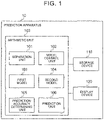
- FIG. 1 is a block diagram showing the configuration of a prediction apparatus 10 according to the embodiment of the invention.
- the prediction apparatus 10 predicts a defect of a target product.
- Specific examples of the prediction apparatus 10 include information processing apparatuses, such as a server and a personal computer (PC); however, the prediction apparatus 10 is not limited thereto.
- the prediction apparatus 10 may be regarded as a prediction system.
- Examples of the target product include castings for use in vehicles, such as automobiles.
- the prediction apparatus 10 includes an arithmetic unit 100, a storage device 110, and a display device 120.
- the arithmetic unit 100 is an arithmetic unit, such as a central processing unit (CPU) and a micro processing unit (MPU).
- the arithmetic unit 100 executes a prediction method of predicting a defect of a target product by reading and running a program saved in the storage device 110.
- the storage device 110 is a storage device in which the program to be run by the arithmetic unit 100 and various data such as information on an existing product and information on the target product are saved.
- the information on the existing product includes a defect characteristic value indicating a defect associated with a location in the existing product, shape information indicating the three-dimensional shape of the existing product, and conditional information indicating the manufacturing condition of the existing product.
- the defect characteristic value and shape information of the existing product are obtained by means of, for example, the computer-aided engineering (CAE) analysis of the existing product.
- the information on the target product includes shape information indicating the three-dimensional shape of the target product and conditional information indicating the manufacturing condition of the target product.
- the defect of the product may be a general casting defect.
- Specific examples of the casting defect include seizure, shrinkage, flow line, galling, raw material deformation, die cracking, and entrapment.
- the raw material deformation means an undesirable deformation that can occur when a casting is cooled to an ordinary temperature after the casting is formed in a casting process.
- the defect of the product, indicated by the defect characteristic value is not limited to these examples.
- the defect characteristic value is a quantitative variable and is a value indicating the degree of a defect of the product.
- the defect characteristic value indicates the degree of a defect of the product by its magnitude.
- the manufacturing condition indicated by the conditional information may be a condition that is set in a general casting process.
- Specific examples of the manufacturing condition indicated by the conditional information include molten metal type, molten metal temperature, internal cooling temperature, water flow time, die temperature, die surface treatment, cycle time, die time, die opening sequence, spray application amount, spray time, and air blow sequence in order to manufacture a casting.
- the manufacturing condition is not limited to these examples.
- the molten metal type is a type of molten metal.
- the molten metal temperature is the temperature of molten metal.
- the internal cooling temperature is the temperature of water that passes through the inside of a die for cooling a casting.
- the die temperature is the temperature of a die at the time of forming a casting.
- the water flow time is a time taken by water to pass through the inside of the die.
- the die surface treatment is a heat treatment or the like that is carried out to reduce abrasion of a die surface.
- the cycle time is a time required in a casting process at the time when castings are continuously produced.
- the cycle of the casting process consists of die closing, pouring, solidification, die opening, removal of a casting, mold release agent application, air blow, and die closing.
- the die time is a time included in a cycle time and is a time from solidification, that is, completion of pouring, to die opening.
- the die opening sequence is the sequence of opening a die made up of a plurality of die components.
- the spray application amount is the amount of application of die release agent used to easily remove a casting from a die.
- the spray time is a time to apply die release agent.
- the air blow sequence is the sequence of removing die release agent remaining on a die with air blow.
- the programs to be run by the arithmetic unit 100 include a separation unit 101, a model control unit 102, a first model 103, a second model 104, a prediction accuracy determining unit 105, and a prediction unit 106.
- an integrated circuit such as field-programmable gate array (FPGA) and application specific integrated circuit (ASIC), may run these programs.
- FPGA field-programmable gate array
- ASIC application specific integrated circuit
- a server, a PC, an arithmetic unit, and an integrated circuit may be regarded as a computer.
- the separation unit 101 is a program that acquires information on the existing product from the storage device 110 and that separates the information on the existing product into the defect characteristic value of the existing product and the shape information of the existing product.
- the first model 103 is a program trained based on the defect characteristic value indicating a defect associated with a location in the existing product, a feature of the three-dimensional shape of the existing product, and the conditional information indicating the manufacturing condition of the existing product.
- the first model 103 may be trained by using machine learning, such as deep learning.
- machine learning such as deep learning
- the first model 103 can be implemented by a neural network.
- Machine learning is not limited to deep learning, and another technology may be adopted.
- the second model 104 is a program that, when the shape information indicating the three-dimensional shape of the existing product is input, outputs the feature of the three-dimensional shape of the existing product.
- the second model 104 may be implemented by a convolutional neural network.
- the feature of the three-dimensional shape can be expressed in the form of a feature vector.
- the model control unit 102 is a program that controls the first model 103 and the second model 104.
- the model control unit 102 is capable of training the second model 104 by inputting the shape information indicating the three-dimensional shape of the existing product to the second model 104.
- the model control unit 102 is capable of training the first model 103 by using the feature output from the second pre-trained model 104, the defect characteristic value of the existing product, obtained by the separation unit 101, and one or more pieces of the conditional information on the existing product, saved in the storage device 110.
- the model control unit 102 may input not only the feature output from the second pre-trained model 104 but also another feature of the existing product to the first model 103.
- the existing product is a casting
- examples of the other feature include a die volume of the casting, a casting volume, a casting surface area, and a thickness of the casting.
- the first model 103 may be further trained by at least one of the die volume of the casting, the casting volume, the casting surface area, and the thickness of the casting.
- the prediction accuracy determining unit 105 is a program that compares the defect characteristic value output from the first model 103 with the defect characteristic value of the existing product and that determines whether the defect prediction accuracy of the first model 103 is higher than or equal to a set accuracy. With this determination, the defect characteristic value at each location in the existing product, obtained by simulation, such as CAE analysis, can be used as the defect characteristic value of the existing product.
- a defect characteristic value is able to indicate the degree of defect of a product.
- the prediction accuracy determining unit 105 is able to, when the difference between the defect characteristic value output from the first model 103 and the defect characteristic value of the existing product, obtained by simulation, is less than or equal to a prescribed value, determine that the defect prediction accuracy of the first model 103 is higher than or equal to the set accuracy.
- the prediction unit 106 is a program that predicts a defect of the target product by using the first pre-trained model 103. Specifically, the prediction unit 106 is capable of predicting a defect of the target product by inputting, to the first pre-trained model 103, a feature indicating a feature quantity of the three-dimensional shape of the target product. The prediction unit 106 displays a defect characteristic value indicating a defect associated with a location in the target product on the display device 120 based on the defect characteristic value of the target product, output from the first pre-trained model 103.
- the prediction unit 106 may predict a defect of the target product by inputting not only a feature indicating a feature quantity of the three-dimensional shape of the target product but also conditional information indicating one or more manufacturing conditions of the target product to the first pre-trained model 103.
- FIG. 4 is a view showing an example of an image showing a prediction result of defects of the target product.
- the defects of the target product are shown location by location.
- the defects are represented by circle marks for the sake of convenience.
- the defects of the target product may be represented location by location by using color indication or various shapes.
- the degree of defect of the target product may be expressed by the type of color.
- the degree of defect of the target product may also be expressed by the size of the shape indicating each defect.
- FIG. 2 is a flowchart showing an example of a process of training the first model 103 and the second model 104.
- the separation unit 101 of the prediction apparatus 10 separates the information on the existing product into the defect characteristic values and the shape information.
- the model control unit 102 inputs the shape information on the existing product to the second model 104.
- step S103 the second model 104 executes a process of convolving the three-dimensional shape of the existing product by using the shape information on the existing product, and generates a feature of the three-dimensional shape of the existing product.
- step S104 the second model 104 outputs the generated feature of the three-dimensional shape of the existing product.
- step S105 the model control unit 102 inputs the defect characteristic values of the existing product, obtained in step S101, the feature of the existing product, output in step S104, and the conditional information on the existing product to the first model 103.
- step S106 the first model 103 associates the defect characteristic values, feature, and conditional information on the existing product with one another.
- the first model 103 constructs a regression expression based on the association among the defect characteristic values, feature, and conditional information on the existing product.
- step S108 the first model 103 outputs the defect characteristic values respectively associated with locations in the existing product.
- step S109 the prediction accuracy determining unit 105 compares the defect characteristic values output from the first model 103 with the defect characteristic values of the existing product, obtained by simulation, and determines whether the defect prediction accuracy of the first model 103 is higher than or equal to a set accuracy.
- the process returns to step S102, and the first model 103 and the second model 104 are repeatedly trained.
- the process of FIG. 2 ends.
- FIG. 3 is a flowchart showing an example of a process of predicting a defect of a target product.
- the prediction unit 106 of the prediction apparatus 10 inputs a feature indicating the feature quantity of the three-dimensional shape of the target product to the first pre-trained model 103 trained through the process shown in FIG. 2 .
- the first pre-trained model 103 outputs a defect characteristic value indicating a defect associated with a location in the target product.
- the prediction unit 106 displays the defect characteristic value of the target product, output by the first pre-trained model 103, on the display device 120, and the process of FIG. 3 ends.
- the first model 103 is trained based on the defect characteristic value indicating the defect associated with the location in the existing product, the feature of the three-dimensional shape of the existing product, and the conditional information indicating the manufacturing condition of the existing product.
- the first pre-trained model 103 outputs a defect characteristic value indicating a defect associated with a location in the target product.
- the defect characteristic value of the existing product correlates with the defect characteristic value of the target product.
- the three-dimensional shape of a product correlates with a defect of the product.
- the manufacturing condition of a product correlates with a defect of the product. Therefore, a defect associated with the three-dimensional shape of the target product is able to be predicted by using the first pre-trained model 103 trained based on the defect characteristic value, the feature of the three-dimensional shape, and the conditional information indicating the manufacturing condition, of the existing product. Therefore, a defect due to the shape of the target product, such as a new product, is able to be predicted location by location.
- the defect of the product includes at least one of seizure, shrinkage, flow line, galling, raw material deformation, die cracking, and entrapment of the product.
- seizure, shrinkage, flow line, galling, raw material deformation, die cracking, and entrapment of the target product it is possible to predict seizure, shrinkage, flow line, galling, raw material deformation, die cracking, and entrapment of the target product.
- the defect characteristic value includes a value indicating the degree of defect of the target product. Therefore, it is possible to predict the degree of defect of the target product location by location.
- the first pre-trained model 103 may be further trained by at least one of a die volume of the casting, a casting volume, a casting surface area, and a thickness of the casting.
- the first pre-trained model 103 is capable of predicting a defect with considerations to the die volume of a casting, a casting volume, a casting surface area, and the thickness of the casting.
- the manufacturing condition includes at least one of molten metal type, molten metal temperature, internal cooling temperature, water flow time, die temperature, die surface treatment, cycle time, die time, die opening sequence, spray application amount, spray time, and air blow sequence.
- a program includes a command set (or software code) for causing a computer to execute one or more functions described in the embodiment when the program is loaded onto the computer.
- the program may be stored in a non-transitory computer-readable medium or a tangible non-transitory storage medium.
- Nonrestrictive examples of the computer-readable medium or tangible non-transitory storage medium include memory technologies, such as a random-access memory (RAM), a read-only memory (ROM), a flash memory, a solid-state drive (SSD), and others, optical disk storages, such as a CD-ROM, a digital versatile disc (DVD), a Blu-ray (registered trademark) disc, and others, and magnetic storage devices, such as a magnetic cassette, a magnetic tape, a magnetic disk storage, and others.
- the program may be transmitted on a temporary computer-readable medium or communication medium.
- Nonrestrictive examples of the temporary computer-readable medium or communication medium include an electrical, optical, acoustic, or other-type propagation signals.
- the prediction apparatus 10 that is a single apparatus may be regarded as a prediction system.
- a prediction system may be implemented by a plurality of apparatuses.
- the separation unit 101, model control unit 102, first model 103, second model 104, prediction accuracy determining unit 105, and prediction unit 106 implemented in the arithmetic unit 100 may be implemented in a distributed manner among a plurality of apparatuses.
Landscapes
- Engineering & Computer Science (AREA)
- Physics & Mathematics (AREA)
- General Physics & Mathematics (AREA)
- Theoretical Computer Science (AREA)
- General Engineering & Computer Science (AREA)
- Quality & Reliability (AREA)
- Manufacturing & Machinery (AREA)
- Business, Economics & Management (AREA)
- Automation & Control Theory (AREA)
- Geometry (AREA)
- Evolutionary Computation (AREA)
- Human Resources & Organizations (AREA)
- Economics (AREA)
- Strategic Management (AREA)
- General Business, Economics & Management (AREA)
- Marketing (AREA)
- Mechanical Engineering (AREA)
- Artificial Intelligence (AREA)
- Computer Hardware Design (AREA)
- Computer Vision & Pattern Recognition (AREA)
- Data Mining & Analysis (AREA)
- Tourism & Hospitality (AREA)
- General Health & Medical Sciences (AREA)
- Primary Health Care (AREA)
- Health & Medical Sciences (AREA)
- Evolutionary Biology (AREA)
- Bioinformatics & Computational Biology (AREA)
- Development Economics (AREA)
- Game Theory and Decision Science (AREA)
- Entrepreneurship & Innovation (AREA)
- Operations Research (AREA)
- Medical Informatics (AREA)
- Software Systems (AREA)
- Bioinformatics & Cheminformatics (AREA)
- Life Sciences & Earth Sciences (AREA)
- Computational Mathematics (AREA)
- Mathematical Analysis (AREA)
- Mathematical Optimization (AREA)
- Pure & Applied Mathematics (AREA)
- Management, Administration, Business Operations System, And Electronic Commerce (AREA)
Abstract
Description
- The invention relates to a prediction system, a prediction method, and a non-transitory storage medium.
- Generally, a technology for predicting a defect of a product is used in various industries including the automobile industry. There is a characteristic prediction apparatus described in
WO 2018/062398 as an example of such a technology. When parameters that indicate manufacturing conditions of an aluminum product are input, the characteristic prediction apparatus predicts the characteristics of the aluminum product by using a neural network that outputs the characteristic values of the aluminum product manufactured under the manufacturing conditions. - However, the characteristic prediction apparatus described in
WO 2018/062398 predicts a defect of a product based on only the manufacturing conditions of a product, so the characteristic prediction apparatus is not capable of predicting a defect due to the shape of a product. - The invention provides a prediction system, a prediction method, and a non-transitory storage medium that are capable of predicting a defect due to the shape of a product.
- A first aspect of the invention relates to a prediction system configured to predict a defect of a target product. The prediction system includes a first pre-trained model trained based on a defect characteristic value indicating a defect associated with a location in an existing product, a feature of a three-dimensional shape of the existing product, and conditional information indicating a manufacturing condition of the existing product. The first pre-trained model is configured to, when a feature of a three-dimensional shape of the target product is input, output a defect characteristic value indicating a defect associated with a location in the target product.
- When the product is a casting, the defect of the product, indicated by the defect characteristic value, may include at least one of seizure, shrinkage, flow line, galling, raw material deformation, die cracking, and entrapment of the product.
- The defect characteristic value may include a value indicating a degree of the defect of the product.
- When the product is a casting, the first pre-trained model may be further trained by at least one of a die volume of the casting, a casting volume, a casting surface area, and a thickness of the casting.
- The prediction system may further include a second pre-trained model configured to, when shape information indicating the three-dimensional shape of the existing product is input, output the feature of the three-dimensional shape of the existing product, and the first pre-trained model may be trained by using the feature output from the second pre-trained model.
- When the product is a casting, the manufacturing condition may include at least one of molten metal type, molten metal temperature, internal cooling temperature, water flow time, die temperature, die surface treatment, cycle time, die time, die opening sequence, spray application amount, spray time, and air blow sequence.
- The prediction system may further include a display device, and the defect characteristic value indicating the defect associated with the location in the target product may be displayed on the display device.
- A second aspect of the invention relates to a prediction method of predicting a defect of a target product. The prediction method includes inputting, by a computer, a feature of a three-dimensional shape of the target product to a first pre-trained model, trained based on a defect characteristic value indicating a defect associated with a location in an existing product, shape information indicating a three-dimensional shape of the existing product, and conditional information indicating a manufacturing condition of the existing product, and causing the first pre-trained model to output a defect characteristic value indicating a defect associated with a location in the target product. The configurations applicable to the prediction system according to the first aspect may also be applied to the prediction method according to the second aspect.
- The prediction method may further include inputting, by the computer, the shape information indicating the three-dimensional shape of the existing product to a second pre-trained model and causing the second pre-trained model to output a feature of the three-dimensional shape of the existing product; and causing, by the computer, the first pre-trained model to train by using the feature output from the second pre-trained model.
- A third aspect of the invention relates to a non-transitory storage medium storing a program that is a pre-trained model configured to predict a defect of a target product. The pre-trained model is trained based on a defect characteristic value indicating a defect associated with a location in an existing product, a feature of a three-dimensional shape of the existing product, and conditional information indicating a manufacturing condition of the existing product, and the pre-trained model is configured to, when a feature of a three-dimensional shape of the target product is input, output a defect characteristic value indicating a defect associated with a location in the target product.
- According to the aspects of the invention, it is possible to provide a prediction system, a prediction method, and a non-transitory storage medium that are capable of predicting a defect due to the shape of a product.
- Features, advantages, and technical and industrial significance of exemplary embodiments of the invention will be described below with reference to the accompanying drawings, in which like signs denote like elements, and wherein:
-
FIG. 1 is a block diagram showing the configuration of a prediction apparatus according to an embodiment of the invention; -
FIG. 2 is a flowchart showing an example of a process to be executed by the prediction apparatus according to the embodiment of the invention; -
FIG. 3 is a flowchart showing another example of a process to be executed by the prediction apparatus according to the embodiment of the invention; and -
FIG. 4 is a view showing an example of an image showing a prediction result according to the embodiment of the invention. - Hereinafter, an embodiment of the invention will be described with reference to the accompanying drawings.
FIG. 1 is a block diagram showing the configuration of aprediction apparatus 10 according to the embodiment of the invention. Theprediction apparatus 10 predicts a defect of a target product. Specific examples of theprediction apparatus 10 include information processing apparatuses, such as a server and a personal computer (PC); however, theprediction apparatus 10 is not limited thereto. Theprediction apparatus 10 may be regarded as a prediction system. Examples of the target product include castings for use in vehicles, such as automobiles. - The
prediction apparatus 10 includes anarithmetic unit 100, astorage device 110, and adisplay device 120. Thearithmetic unit 100 is an arithmetic unit, such as a central processing unit (CPU) and a micro processing unit (MPU). Thearithmetic unit 100 executes a prediction method of predicting a defect of a target product by reading and running a program saved in thestorage device 110. - The
storage device 110 is a storage device in which the program to be run by thearithmetic unit 100 and various data such as information on an existing product and information on the target product are saved. Specifically, the information on the existing product includes a defect characteristic value indicating a defect associated with a location in the existing product, shape information indicating the three-dimensional shape of the existing product, and conditional information indicating the manufacturing condition of the existing product. The defect characteristic value and shape information of the existing product are obtained by means of, for example, the computer-aided engineering (CAE) analysis of the existing product. The information on the target product includes shape information indicating the three-dimensional shape of the target product and conditional information indicating the manufacturing condition of the target product. - When the product is a casting, the defect of the product, indicated by the defect characteristic value, may be a general casting defect. Specific examples of the casting defect include seizure, shrinkage, flow line, galling, raw material deformation, die cracking, and entrapment. The raw material deformation means an undesirable deformation that can occur when a casting is cooled to an ordinary temperature after the casting is formed in a casting process. The defect of the product, indicated by the defect characteristic value, is not limited to these examples.
- The defect characteristic value is a quantitative variable and is a value indicating the degree of a defect of the product. The defect characteristic value indicates the degree of a defect of the product by its magnitude.
- When the product is a casting, the manufacturing condition indicated by the conditional information may be a condition that is set in a general casting process. Specific examples of the manufacturing condition indicated by the conditional information include molten metal type, molten metal temperature, internal cooling temperature, water flow time, die temperature, die surface treatment, cycle time, die time, die opening sequence, spray application amount, spray time, and air blow sequence in order to manufacture a casting. The manufacturing condition is not limited to these examples.
- The molten metal type is a type of molten metal. The molten metal temperature is the temperature of molten metal. The internal cooling temperature is the temperature of water that passes through the inside of a die for cooling a casting. The die temperature is the temperature of a die at the time of forming a casting. The water flow time is a time taken by water to pass through the inside of the die. The die surface treatment is a heat treatment or the like that is carried out to reduce abrasion of a die surface.
- The cycle time is a time required in a casting process at the time when castings are continuously produced. The cycle of the casting process consists of die closing, pouring, solidification, die opening, removal of a casting, mold release agent application, air blow, and die closing.
- The die time is a time included in a cycle time and is a time from solidification, that is, completion of pouring, to die opening. The die opening sequence is the sequence of opening a die made up of a plurality of die components. The spray application amount is the amount of application of die release agent used to easily remove a casting from a die. The spray time is a time to apply die release agent. The air blow sequence is the sequence of removing die release agent remaining on a die with air blow.
- The programs to be run by the
arithmetic unit 100 include aseparation unit 101, amodel control unit 102, afirst model 103, asecond model 104, a predictionaccuracy determining unit 105, and aprediction unit 106. In another embodiment, an integrated circuit, such as field-programmable gate array (FPGA) and application specific integrated circuit (ASIC), may run these programs. A server, a PC, an arithmetic unit, and an integrated circuit may be regarded as a computer. - The
separation unit 101 is a program that acquires information on the existing product from thestorage device 110 and that separates the information on the existing product into the defect characteristic value of the existing product and the shape information of the existing product. - The
first model 103 is a program trained based on the defect characteristic value indicating a defect associated with a location in the existing product, a feature of the three-dimensional shape of the existing product, and the conditional information indicating the manufacturing condition of the existing product. Thefirst model 103 may be trained by using machine learning, such as deep learning. In the case of, for example, deep learning, thefirst model 103 can be implemented by a neural network. Machine learning is not limited to deep learning, and another technology may be adopted. - The
second model 104 is a program that, when the shape information indicating the three-dimensional shape of the existing product is input, outputs the feature of the three-dimensional shape of the existing product. Thesecond model 104 may be implemented by a convolutional neural network. The feature of the three-dimensional shape can be expressed in the form of a feature vector. - The
model control unit 102 is a program that controls thefirst model 103 and thesecond model 104. Themodel control unit 102 is capable of training thesecond model 104 by inputting the shape information indicating the three-dimensional shape of the existing product to thesecond model 104. Themodel control unit 102 is capable of training thefirst model 103 by using the feature output from the secondpre-trained model 104, the defect characteristic value of the existing product, obtained by theseparation unit 101, and one or more pieces of the conditional information on the existing product, saved in thestorage device 110. - In another embodiment, the
model control unit 102 may input not only the feature output from the secondpre-trained model 104 but also another feature of the existing product to thefirst model 103. When the existing product is a casting, examples of the other feature include a die volume of the casting, a casting volume, a casting surface area, and a thickness of the casting. In other words, thefirst model 103 may be further trained by at least one of the die volume of the casting, the casting volume, the casting surface area, and the thickness of the casting. - The prediction
accuracy determining unit 105 is a program that compares the defect characteristic value output from thefirst model 103 with the defect characteristic value of the existing product and that determines whether the defect prediction accuracy of thefirst model 103 is higher than or equal to a set accuracy. With this determination, the defect characteristic value at each location in the existing product, obtained by simulation, such as CAE analysis, can be used as the defect characteristic value of the existing product. - A defect characteristic value is able to indicate the degree of defect of a product. The prediction
accuracy determining unit 105 is able to, when the difference between the defect characteristic value output from thefirst model 103 and the defect characteristic value of the existing product, obtained by simulation, is less than or equal to a prescribed value, determine that the defect prediction accuracy of thefirst model 103 is higher than or equal to the set accuracy. - The
prediction unit 106 is a program that predicts a defect of the target product by using the firstpre-trained model 103. Specifically, theprediction unit 106 is capable of predicting a defect of the target product by inputting, to the firstpre-trained model 103, a feature indicating a feature quantity of the three-dimensional shape of the target product. Theprediction unit 106 displays a defect characteristic value indicating a defect associated with a location in the target product on thedisplay device 120 based on the defect characteristic value of the target product, output from the firstpre-trained model 103. - In another embodiment, the
prediction unit 106 may predict a defect of the target product by inputting not only a feature indicating a feature quantity of the three-dimensional shape of the target product but also conditional information indicating one or more manufacturing conditions of the target product to the firstpre-trained model 103. -
FIG. 4 is a view showing an example of an image showing a prediction result of defects of the target product. In the example shown inFIG. 4 , the defects of the target product are shown location by location. In the example shown inFIG. 4 , the defects are represented by circle marks for the sake of convenience. Alternatively, the defects of the target product may be represented location by location by using color indication or various shapes. In this case, the degree of defect of the target product may be expressed by the type of color. The degree of defect of the target product may also be expressed by the size of the shape indicating each defect. -
FIG. 2 is a flowchart showing an example of a process of training thefirst model 103 and thesecond model 104. In step S101, theseparation unit 101 of theprediction apparatus 10 separates the information on the existing product into the defect characteristic values and the shape information. In step S102, themodel control unit 102 inputs the shape information on the existing product to thesecond model 104. - In step S103, the
second model 104 executes a process of convolving the three-dimensional shape of the existing product by using the shape information on the existing product, and generates a feature of the three-dimensional shape of the existing product. In step S104, thesecond model 104 outputs the generated feature of the three-dimensional shape of the existing product. - In step S105, the
model control unit 102 inputs the defect characteristic values of the existing product, obtained in step S101, the feature of the existing product, output in step S104, and the conditional information on the existing product to thefirst model 103. - In step S106, the
first model 103 associates the defect characteristic values, feature, and conditional information on the existing product with one another. In step S107, thefirst model 103 constructs a regression expression based on the association among the defect characteristic values, feature, and conditional information on the existing product. In step S108, thefirst model 103 outputs the defect characteristic values respectively associated with locations in the existing product. - In step S109, the prediction
accuracy determining unit 105 compares the defect characteristic values output from thefirst model 103 with the defect characteristic values of the existing product, obtained by simulation, and determines whether the defect prediction accuracy of thefirst model 103 is higher than or equal to a set accuracy. When the defect prediction accuracy of thefirst model 103 is lower than the set accuracy (NO), the process returns to step S102, and thefirst model 103 and thesecond model 104 are repeatedly trained. On the other hand, when the defect prediction accuracy of thefirst model 103 is higher than or equal to the set accuracy (YES), the process ofFIG. 2 ends. -
FIG. 3 is a flowchart showing an example of a process of predicting a defect of a target product. In step S201, theprediction unit 106 of theprediction apparatus 10 inputs a feature indicating the feature quantity of the three-dimensional shape of the target product to the firstpre-trained model 103 trained through the process shown inFIG. 2 . In step S202, the firstpre-trained model 103 outputs a defect characteristic value indicating a defect associated with a location in the target product. In step S203, theprediction unit 106 displays the defect characteristic value of the target product, output by the firstpre-trained model 103, on thedisplay device 120, and the process ofFIG. 3 ends. - In the above embodiment, the
first model 103 is trained based on the defect characteristic value indicating the defect associated with the location in the existing product, the feature of the three-dimensional shape of the existing product, and the conditional information indicating the manufacturing condition of the existing product. When a feature of the three-dimensional shape of the target product and conditional information indicating a manufacturing condition of the target product are input to the firstpre-trained model 103, the firstpre-trained model 103 outputs a defect characteristic value indicating a defect associated with a location in the target product. - The defect characteristic value of the existing product correlates with the defect characteristic value of the target product. The three-dimensional shape of a product correlates with a defect of the product. The manufacturing condition of a product correlates with a defect of the product. Therefore, a defect associated with the three-dimensional shape of the target product is able to be predicted by using the first
pre-trained model 103 trained based on the defect characteristic value, the feature of the three-dimensional shape, and the conditional information indicating the manufacturing condition, of the existing product. Therefore, a defect due to the shape of the target product, such as a new product, is able to be predicted location by location. - When the product is a casting, the defect of the product, indicated by the defect characteristic value, includes at least one of seizure, shrinkage, flow line, galling, raw material deformation, die cracking, and entrapment of the product. Thus, it is possible to predict seizure, shrinkage, flow line, galling, raw material deformation, die cracking, and entrapment of the target product. Particularly, it is possible to predict seizure, shrinkage, flow line, galling, raw material deformation, die cracking, and entrapment of the target product location by location.
- The defect characteristic value includes a value indicating the degree of defect of the target product. Therefore, it is possible to predict the degree of defect of the target product location by location.
- When the product is a casting, the first
pre-trained model 103 may be further trained by at least one of a die volume of the casting, a casting volume, a casting surface area, and a thickness of the casting. Thus, the firstpre-trained model 103 is capable of predicting a defect with considerations to the die volume of a casting, a casting volume, a casting surface area, and the thickness of the casting. - When the product is a casting, the manufacturing condition includes at least one of molten metal type, molten metal temperature, internal cooling temperature, water flow time, die temperature, die surface treatment, cycle time, die time, die opening sequence, spray application amount, spray time, and air blow sequence. Thus, it is possible to predict a defect of the target product location by location based on these various manufacturing conditions.
- In the above example, a program includes a command set (or software code) for causing a computer to execute one or more functions described in the embodiment when the program is loaded onto the computer. The program may be stored in a non-transitory computer-readable medium or a tangible non-transitory storage medium. Nonrestrictive examples of the computer-readable medium or tangible non-transitory storage medium include memory technologies, such as a random-access memory (RAM), a read-only memory (ROM), a flash memory, a solid-state drive (SSD), and others, optical disk storages, such as a CD-ROM, a digital versatile disc (DVD), a Blu-ray (registered trademark) disc, and others, and magnetic storage devices, such as a magnetic cassette, a magnetic tape, a magnetic disk storage, and others. The program may be transmitted on a temporary computer-readable medium or communication medium. Nonrestrictive examples of the temporary computer-readable medium or communication medium include an electrical, optical, acoustic, or other-type propagation signals.
- The invention is not limited to the above-described embodiment and may be modified as needed without departing from the scope of the invention. For example, in the above embodiment, the
prediction apparatus 10 that is a single apparatus may be regarded as a prediction system. Alternatively, in another embodiment, a prediction system may be implemented by a plurality of apparatuses. For example, theseparation unit 101,model control unit 102,first model 103,second model 104, predictionaccuracy determining unit 105, andprediction unit 106 implemented in thearithmetic unit 100 may be implemented in a distributed manner among a plurality of apparatuses.
Claims (15)
- A prediction system (10) configured to predict a defect of a target product, the prediction system (10) comprising a first pre-trained model (103) trained based on a defect characteristic value indicating a defect associated with a location in an existing product, a feature of a three-dimensional shape of the existing product, and conditional information indicating a manufacturing condition of the existing product, wherein
the first pre-trained model (103) is configured to, when a feature of a three-dimensional shape of the target product is input, output a defect characteristic value indicating a defect associated with a location in the target product. - The prediction system (10) according to claim 1, wherein:the product is a casting; andthe defect of the product, indicated by the defect characteristic value, includes at least one of seizure, shrinkage, flow line, galling, raw material deformation, die cracking, and entrapment of the product.
- The prediction system (10) according to claim 1 or 2, wherein the defect characteristic value includes a value indicating a degree of the defect of the product.
- The prediction system (10) according to any one of claims 1 to 3, wherein, when the product is a casting, the first pre-trained model (103) is further trained by at least one of a die volume of the casting, a casting volume, a casting surface area, and a thickness of the casting.
- The prediction system (10) according to any one of claims 1 to 4, further comprising a second pre-trained model (104) configured to, when shape information indicating the three-dimensional shape of the existing product is input, output the feature of the three-dimensional shape of the existing product, wherein
the first pre-trained model (103) is trained by using the feature output from the second pre-trained model (104). - The prediction system (10) according to any one of claims 1 to 5, wherein, when the product is a casting, the manufacturing condition includes at least one of molten metal type, molten metal temperature, internal cooling temperature, water flow time, die temperature, die surface treatment, cycle time, die time, die opening sequence, spray application amount, spray time, and air blow sequence.
- The prediction system (10) according to any one of claims 1 to 6, further comprising a display device (120), wherein
the defect characteristic value indicating the defect associated with the location in the target product is displayed on the display device (120). - A prediction method of predicting a defect of a target product, the prediction method comprising inputting, by a computer, a feature of a three-dimensional shape of the target product to a first pre-trained model (103), trained based on a defect characteristic value indicating a defect associated with a location in an existing product, shape information indicating a three-dimensional shape of the existing product, and conditional information indicating a manufacturing condition of the existing product, and causing the first pre-trained model (103) to output a defect characteristic value indicating a defect associated with a location in the target product.
- The prediction method according to claim 8, wherein, when the product is a casting, the defect of the product, indicated by the defect characteristic value, includes at least one of seizure, shrinkage, flow line, galling, raw material deformation, die cracking, and entrapment of the product.
- The prediction method according to claim 8 or 9, wherein the defect characteristic value includes a value indicating a degree of the defect of the product.
- The prediction method according to any one of claims 8 to 10, wherein, when the product is a casting, the first pre-trained model (103) is further trained by at least one of a die volume of the casting, a casting volume, a casting surface area, and a thickness of the casting.
- The prediction method according to any one of claims 8 to 11, further comprising:inputting, by the computer, the shape information indicating the three-dimensional shape of the existing product to a second pre-trained model (104) and causing the second pre-trained model (104) to output a feature of the three-dimensional shape of the existing product; andtraining, by the computer, the first pre-trained model (103) by using the feature output from the second pre-trained model (104).
- The prediction method according to any one of claims 8 to 12, wherein, when the product is a casting, the manufacturing condition includes at least one of molten metal type, molten metal temperature, internal cooling temperature, water flow time, die temperature, die surface treatment, cycle time, die time, die opening sequence, spray application amount, spray time, and air blow sequence.
- The prediction method according to any one of claims 8 to 13, further comprising displaying the defect characteristic value indicating the defect associated with the location in the target product on a display device (120).
- A non-transitory storage medium storing a program that is a pre-trained model (103) configured to predict a defect of a target product, wherein:the pre-trained model (103) is trained based on a defect characteristic value indicating a defect associated with a location in an existing product, a feature of a three-dimensional shape of the existing product, and conditional information indicating a manufacturing condition of the existing product; andthe pre-trained model (103) is configured to, when a feature of a three-dimensional shape of the target product is input, output a defect characteristic value indicating a defect associated with a location in the target product.
Applications Claiming Priority (1)
| Application Number | Priority Date | Filing Date | Title |
|---|---|---|---|
| JP2021099239A JP7690787B2 (en) | 2021-06-15 | 2021-06-15 | Prediction system and method |
Publications (2)
| Publication Number | Publication Date |
|---|---|
| EP4105747A1 true EP4105747A1 (en) | 2022-12-21 |
| EP4105747B1 EP4105747B1 (en) | 2025-01-22 |
Family
ID=82058293
Family Applications (1)
| Application Number | Title | Priority Date | Filing Date |
|---|---|---|---|
| EP22174615.9A Active EP4105747B1 (en) | 2021-06-15 | 2022-05-20 | Prediction system, prediction method, and non-transitory storage medium |
Country Status (4)
| Country | Link |
|---|---|
| US (1) | US20220397892A1 (en) |
| EP (1) | EP4105747B1 (en) |
| JP (1) | JP7690787B2 (en) |
| CN (1) | CN115481775A (en) |
Families Citing this family (3)
| Publication number | Priority date | Publication date | Assignee | Title |
|---|---|---|---|---|
| CN116822341B (en) * | 2023-06-12 | 2024-06-21 | 华中科技大学 | Defect prediction method and system based on three-dimensional casting model feature extraction |
| CN117436570B (en) * | 2023-09-20 | 2025-11-07 | 上海朋熙半导体有限公司 | Wafer manufacturing defect prediction method, device, equipment and readable medium |
| CN119849262B (en) * | 2025-03-18 | 2025-09-16 | 贵州大学 | Defect prediction method and system for investment casting of aircraft engine tail nozzle regulating plate |
Citations (4)
| Publication number | Priority date | Publication date | Assignee | Title |
|---|---|---|---|---|
| WO2018062398A1 (en) | 2016-09-30 | 2018-04-05 | 株式会社Uacj | Device for predicting aluminum product properties, method for predicting aluminum product properties, control program, and storage medium |
| EP3316061A1 (en) * | 2016-10-31 | 2018-05-02 | Fundacion Deusto | Procedure for predicting the mechanical properties of pieces obtained by casting |
| DE102019110360A1 (en) * | 2019-04-18 | 2020-10-22 | Volume Graphics Gmbh | Computer-implemented method for determining defects in an object manufactured using an additive manufacturing process |
| DE102020210967A1 (en) * | 2019-11-14 | 2021-05-20 | Sms Group Gmbh | Method and system for optimizing a production process in a production plant in the metal-producing industry, the non-ferrous industry or the steel industry for the production of semi-finished or finished products, in particular for monitoring the product quality of rolled or forged metal products |
Family Cites Families (15)
| Publication number | Priority date | Publication date | Assignee | Title |
|---|---|---|---|---|
| JP4536197B2 (en) * | 2000-03-03 | 2010-09-01 | 東芝機械株式会社 | Die-casting machine control device and casting method using die-casting machine |
| US6772821B1 (en) * | 2002-06-21 | 2004-08-10 | L & P Property Management Company | System for manufacturing die castings |
| US7760347B2 (en) * | 2005-05-13 | 2010-07-20 | Applied Materials, Inc. | Design-based method for grouping systematic defects in lithography pattern writing system |
| US8214182B2 (en) * | 2009-05-12 | 2012-07-03 | GM Global Technology Operations LLC | Methods of predicting residual stresses and distortion in quenched aluminum castings |
| JP5494352B2 (en) | 2009-09-14 | 2014-05-14 | マツダ株式会社 | Mold welding determination method and apparatus |
| JP5831310B2 (en) | 2012-03-14 | 2015-12-09 | アイシン・エィ・ダブリュ株式会社 | Method and program for predicting appearance defects of products manufactured with molds |
| JP6070135B2 (en) | 2012-12-07 | 2017-02-01 | アイシン・エィ・ダブリュ株式会社 | Mold seizure prediction method and program |
| US9489620B2 (en) * | 2014-06-04 | 2016-11-08 | Gm Global Technology Operations, Llc | Quick analysis of residual stress and distortion in cast aluminum components |
| US20160034614A1 (en) * | 2014-08-01 | 2016-02-04 | GM Global Technology Operations LLC | Materials property predictor for cast aluminum alloys |
| CN108897925B (en) * | 2018-06-11 | 2020-09-08 | 华中科技大学 | A casting process parameter optimization method based on casting defect prediction model |
| TWI722344B (en) * | 2018-12-05 | 2021-03-21 | 財團法人工業技術研究院 | Automatic generation system for machining parameter |
| JP7342450B2 (en) | 2018-12-28 | 2023-09-12 | 株式会社ジェイテクト | Quality prediction system and molding machine |
| JP2020157333A (en) | 2019-03-26 | 2020-10-01 | 日本製鉄株式会社 | Learning model creation device, slab quality estimation device, learning model creation method, slab quality estimation method, and program |
| US11112349B2 (en) * | 2019-07-16 | 2021-09-07 | Saudi Arabian Oil Company | Metal loss determinations based on thermography machine learning approach for insulated structures |
| JP2021037522A (en) | 2019-09-02 | 2021-03-11 | トヨタ自動車株式会社 | Mold burn-in prediction method |
-
2021
- 2021-06-15 JP JP2021099239A patent/JP7690787B2/en active Active
-
2022
- 2022-05-16 US US17/663,517 patent/US20220397892A1/en active Pending
- 2022-05-17 CN CN202210540715.0A patent/CN115481775A/en active Pending
- 2022-05-20 EP EP22174615.9A patent/EP4105747B1/en active Active
Patent Citations (4)
| Publication number | Priority date | Publication date | Assignee | Title |
|---|---|---|---|---|
| WO2018062398A1 (en) | 2016-09-30 | 2018-04-05 | 株式会社Uacj | Device for predicting aluminum product properties, method for predicting aluminum product properties, control program, and storage medium |
| EP3316061A1 (en) * | 2016-10-31 | 2018-05-02 | Fundacion Deusto | Procedure for predicting the mechanical properties of pieces obtained by casting |
| DE102019110360A1 (en) * | 2019-04-18 | 2020-10-22 | Volume Graphics Gmbh | Computer-implemented method for determining defects in an object manufactured using an additive manufacturing process |
| DE102020210967A1 (en) * | 2019-11-14 | 2021-05-20 | Sms Group Gmbh | Method and system for optimizing a production process in a production plant in the metal-producing industry, the non-ferrous industry or the steel industry for the production of semi-finished or finished products, in particular for monitoring the product quality of rolled or forged metal products |
Non-Patent Citations (1)
| Title |
|---|
| CHEN JOSEPH C ET AL: "Artificial neural network-based online defect detection system with in-mold temperature and pressure sensors for high precision injection molding", THE INTERNATIONAL JOURNAL OF ADVANCED MANUFACTURING TECHNOLOGY, SPRINGER, LONDON, vol. 110, no. 7-8, 1 September 2020 (2020-09-01), pages 2023 - 2033, XP037240571, ISSN: 0268-3768, [retrieved on 20200901], DOI: 10.1007/S00170-020-06011-4 * |
Also Published As
| Publication number | Publication date |
|---|---|
| JP2022190798A (en) | 2022-12-27 |
| CN115481775A (en) | 2022-12-16 |
| JP7690787B2 (en) | 2025-06-11 |
| EP4105747B1 (en) | 2025-01-22 |
| US20220397892A1 (en) | 2022-12-15 |
Similar Documents
| Publication | Publication Date | Title |
|---|---|---|
| EP4105747A1 (en) | Prediction system, prediction method, and non-transitory storage medium | |
| CN118862371B (en) | Deformation prediction method and system for injection molded parts of automobile | |
| CN118849364B (en) | Injection molding method for producing 6G antenna hole parts | |
| CN111886121A (en) | Injection molding machine system | |
| US20220318667A1 (en) | Intelligent real-time defect prediction, detection, and ai driven automated correction solution | |
| JP5462750B2 (en) | Molten steel temperature management method, apparatus and program | |
| US20190184456A1 (en) | Cast product mechanical characteristic prediction method, cast product mechanical characteristic prediction system, and computer readable recording medium recording cast product mechanical characteristic prediction program | |
| EP4254087B1 (en) | System and method for recommending a recipe in a manufacturing process | |
| Suthar et al. | Critical parameters influencing the quality of metal castings: a systematic literature review | |
| Gondkar et al. | Optimization of casting process parameters through simulation | |
| TW202206255A (en) | Apparatus, method, and program | |
| Park et al. | Convolutional LSTM based melt-pool prediction from images of laser tool path strategy in laser powder bed fusion for additive manufacturing | |
| Bhagwat et al. | An overview of machine learning applications in metal casting industries | |
| JP4952442B2 (en) | Mold temperature analysis method | |
| CN119849262B (en) | Defect prediction method and system for investment casting of aircraft engine tail nozzle regulating plate | |
| CN115169027A (en) | Prediction method and device for material safety margin | |
| JP2015174116A (en) | Estimation method for shrinkage crack and memory medium for estimation program of the same | |
| JP4303252B2 (en) | Casting plan evaluation device | |
| CN119329061A (en) | Adaptive support structure generation method for top-down stereolithography 3D printing | |
| Shetty et al. | Enhanced classification of refractory coatings in foundries: a VPCA-based machine learning approach | |
| JP4032755B2 (en) | Molding simulation method, molding simulation apparatus, molding simulation program, and computer-readable recording medium recording the molding simulation program | |
| CN117034176B (en) | A casting abnormality prediction system during directional solidification process | |
| US9475221B2 (en) | Method of predicing injection molding cycle time | |
| CN119539619B (en) | Magmasoft-based casting quality control method and Magmasoft-based casting quality control system | |
| JP2006102792A (en) | Casting plan evaluation apparatus and casting plan evaluation method |
Legal Events
| Date | Code | Title | Description |
|---|---|---|---|
| PUAI | Public reference made under article 153(3) epc to a published international application that has entered the european phase |
Free format text: ORIGINAL CODE: 0009012 |
|
| STAA | Information on the status of an ep patent application or granted ep patent |
Free format text: STATUS: REQUEST FOR EXAMINATION WAS MADE |
|
| 17P | Request for examination filed |
Effective date: 20220520 |
|
| AK | Designated contracting states |
Kind code of ref document: A1 Designated state(s): AL AT BE BG CH CY CZ DE DK EE ES FI FR GB GR HR HU IE IS IT LI LT LU LV MC MK MT NL NO PL PT RO RS SE SI SK SM TR |
|
| GRAP | Despatch of communication of intention to grant a patent |
Free format text: ORIGINAL CODE: EPIDOSNIGR1 |
|
| STAA | Information on the status of an ep patent application or granted ep patent |
Free format text: STATUS: GRANT OF PATENT IS INTENDED |
|
| GRAS | Grant fee paid |
Free format text: ORIGINAL CODE: EPIDOSNIGR3 |
|
| INTG | Intention to grant announced |
Effective date: 20241118 |
|
| GRAA | (expected) grant |
Free format text: ORIGINAL CODE: 0009210 |
|
| STAA | Information on the status of an ep patent application or granted ep patent |
Free format text: STATUS: THE PATENT HAS BEEN GRANTED |
|
| AK | Designated contracting states |
Kind code of ref document: B1 Designated state(s): AL AT BE BG CH CY CZ DE DK EE ES FI FR GB GR HR HU IE IS IT LI LT LU LV MC MK MT NL NO PL PT RO RS SE SI SK SM TR |
|
| REG | Reference to a national code |
Ref country code: GB Ref legal event code: FG4D |
|
| REG | Reference to a national code |
Ref country code: CH Ref legal event code: EP |
|
| REG | Reference to a national code |
Ref country code: IE Ref legal event code: FG4D |
|
| REG | Reference to a national code |
Ref country code: DE Ref legal event code: R096 Ref document number: 602022009722 Country of ref document: DE |
|
| REG | Reference to a national code |
Ref country code: NL Ref legal event code: MP Effective date: 20250122 |
|
| P01 | Opt-out of the competence of the unified patent court (upc) registered |
Free format text: CASE NUMBER: APP_20536/2025 Effective date: 20250430 |
|
| PG25 | Lapsed in a contracting state [announced via postgrant information from national office to epo] |
Ref country code: NL Free format text: LAPSE BECAUSE OF FAILURE TO SUBMIT A TRANSLATION OF THE DESCRIPTION OR TO PAY THE FEE WITHIN THE PRESCRIBED TIME-LIMIT Effective date: 20250122 |
|
| PG25 | Lapsed in a contracting state [announced via postgrant information from national office to epo] |
Ref country code: RS Free format text: LAPSE BECAUSE OF FAILURE TO SUBMIT A TRANSLATION OF THE DESCRIPTION OR TO PAY THE FEE WITHIN THE PRESCRIBED TIME-LIMIT Effective date: 20250422 |
|
| PG25 | Lapsed in a contracting state [announced via postgrant information from national office to epo] |
Ref country code: FI Free format text: LAPSE BECAUSE OF FAILURE TO SUBMIT A TRANSLATION OF THE DESCRIPTION OR TO PAY THE FEE WITHIN THE PRESCRIBED TIME-LIMIT Effective date: 20250122 |
|
| PG25 | Lapsed in a contracting state [announced via postgrant information from national office to epo] |
Ref country code: PL Free format text: LAPSE BECAUSE OF FAILURE TO SUBMIT A TRANSLATION OF THE DESCRIPTION OR TO PAY THE FEE WITHIN THE PRESCRIBED TIME-LIMIT Effective date: 20250122 |
|
| PGFP | Annual fee paid to national office [announced via postgrant information from national office to epo] |
Ref country code: DE Payment date: 20250402 Year of fee payment: 4 |
|
| PG25 | Lapsed in a contracting state [announced via postgrant information from national office to epo] |
Ref country code: ES Free format text: LAPSE BECAUSE OF FAILURE TO SUBMIT A TRANSLATION OF THE DESCRIPTION OR TO PAY THE FEE WITHIN THE PRESCRIBED TIME-LIMIT Effective date: 20250122 |
|
| REG | Reference to a national code |
Ref country code: LT Ref legal event code: MG9D |
|
| PG25 | Lapsed in a contracting state [announced via postgrant information from national office to epo] |
Ref country code: IS Free format text: LAPSE BECAUSE OF FAILURE TO SUBMIT A TRANSLATION OF THE DESCRIPTION OR TO PAY THE FEE WITHIN THE PRESCRIBED TIME-LIMIT Effective date: 20250522 Ref country code: NO Free format text: LAPSE BECAUSE OF FAILURE TO SUBMIT A TRANSLATION OF THE DESCRIPTION OR TO PAY THE FEE WITHIN THE PRESCRIBED TIME-LIMIT Effective date: 20250422 |
|
| REG | Reference to a national code |
Ref country code: AT Ref legal event code: MK05 Ref document number: 1761914 Country of ref document: AT Kind code of ref document: T Effective date: 20250122 |
|
| PG25 | Lapsed in a contracting state [announced via postgrant information from national office to epo] |
Ref country code: HR Free format text: LAPSE BECAUSE OF FAILURE TO SUBMIT A TRANSLATION OF THE DESCRIPTION OR TO PAY THE FEE WITHIN THE PRESCRIBED TIME-LIMIT Effective date: 20250122 |
|
| PG25 | Lapsed in a contracting state [announced via postgrant information from national office to epo] |
Ref country code: LV Free format text: LAPSE BECAUSE OF FAILURE TO SUBMIT A TRANSLATION OF THE DESCRIPTION OR TO PAY THE FEE WITHIN THE PRESCRIBED TIME-LIMIT Effective date: 20250122 Ref country code: PT Free format text: LAPSE BECAUSE OF FAILURE TO SUBMIT A TRANSLATION OF THE DESCRIPTION OR TO PAY THE FEE WITHIN THE PRESCRIBED TIME-LIMIT Effective date: 20250522 |
|
| PG25 | Lapsed in a contracting state [announced via postgrant information from national office to epo] |
Ref country code: BG Free format text: LAPSE BECAUSE OF FAILURE TO SUBMIT A TRANSLATION OF THE DESCRIPTION OR TO PAY THE FEE WITHIN THE PRESCRIBED TIME-LIMIT Effective date: 20250122 Ref country code: GR Free format text: LAPSE BECAUSE OF FAILURE TO SUBMIT A TRANSLATION OF THE DESCRIPTION OR TO PAY THE FEE WITHIN THE PRESCRIBED TIME-LIMIT Effective date: 20250423 |
|
| PG25 | Lapsed in a contracting state [announced via postgrant information from national office to epo] |
Ref country code: AT Free format text: LAPSE BECAUSE OF FAILURE TO SUBMIT A TRANSLATION OF THE DESCRIPTION OR TO PAY THE FEE WITHIN THE PRESCRIBED TIME-LIMIT Effective date: 20250122 |
|
| PG25 | Lapsed in a contracting state [announced via postgrant information from national office to epo] |
Ref country code: SE Free format text: LAPSE BECAUSE OF FAILURE TO SUBMIT A TRANSLATION OF THE DESCRIPTION OR TO PAY THE FEE WITHIN THE PRESCRIBED TIME-LIMIT Effective date: 20250122 |
|
| REG | Reference to a national code |
Ref country code: DE Ref legal event code: R084 Ref document number: 602022009722 Country of ref document: DE |
|
| PG25 | Lapsed in a contracting state [announced via postgrant information from national office to epo] |
Ref country code: SM Free format text: LAPSE BECAUSE OF FAILURE TO SUBMIT A TRANSLATION OF THE DESCRIPTION OR TO PAY THE FEE WITHIN THE PRESCRIBED TIME-LIMIT Effective date: 20250122 |
|
| PG25 | Lapsed in a contracting state [announced via postgrant information from national office to epo] |
Ref country code: DK Free format text: LAPSE BECAUSE OF FAILURE TO SUBMIT A TRANSLATION OF THE DESCRIPTION OR TO PAY THE FEE WITHIN THE PRESCRIBED TIME-LIMIT Effective date: 20250122 |
|
| PG25 | Lapsed in a contracting state [announced via postgrant information from national office to epo] |
Ref country code: IT Free format text: LAPSE BECAUSE OF FAILURE TO SUBMIT A TRANSLATION OF THE DESCRIPTION OR TO PAY THE FEE WITHIN THE PRESCRIBED TIME-LIMIT Effective date: 20250122 |
|
| PG25 | Lapsed in a contracting state [announced via postgrant information from national office to epo] |
Ref country code: EE Free format text: LAPSE BECAUSE OF FAILURE TO SUBMIT A TRANSLATION OF THE DESCRIPTION OR TO PAY THE FEE WITHIN THE PRESCRIBED TIME-LIMIT Effective date: 20250122 Ref country code: CZ Free format text: LAPSE BECAUSE OF FAILURE TO SUBMIT A TRANSLATION OF THE DESCRIPTION OR TO PAY THE FEE WITHIN THE PRESCRIBED TIME-LIMIT Effective date: 20250122 |
|
| REG | Reference to a national code |
Ref country code: DE Ref legal event code: R097 Ref document number: 602022009722 Country of ref document: DE |
|
| PG25 | Lapsed in a contracting state [announced via postgrant information from national office to epo] |
Ref country code: RO Free format text: LAPSE BECAUSE OF FAILURE TO SUBMIT A TRANSLATION OF THE DESCRIPTION OR TO PAY THE FEE WITHIN THE PRESCRIBED TIME-LIMIT Effective date: 20250122 |
|
| PG25 | Lapsed in a contracting state [announced via postgrant information from national office to epo] |
Ref country code: SK Free format text: LAPSE BECAUSE OF FAILURE TO SUBMIT A TRANSLATION OF THE DESCRIPTION OR TO PAY THE FEE WITHIN THE PRESCRIBED TIME-LIMIT Effective date: 20250122 |
|
| PLBE | No opposition filed within time limit |
Free format text: ORIGINAL CODE: 0009261 |
|
| STAA | Information on the status of an ep patent application or granted ep patent |
Free format text: STATUS: NO OPPOSITION FILED WITHIN TIME LIMIT |
|
| REG | Reference to a national code |
Ref country code: CH Ref legal event code: L10 Free format text: ST27 STATUS EVENT CODE: U-0-0-L10-L00 (AS PROVIDED BY THE NATIONAL OFFICE) Effective date: 20251203 |
|
| REG | Reference to a national code |
Ref country code: CH Ref legal event code: H13 Free format text: ST27 STATUS EVENT CODE: U-0-0-H10-H13 (AS PROVIDED BY THE NATIONAL OFFICE) Effective date: 20251223 |
|
| 26N | No opposition filed |
Effective date: 20251023 |
|
| PG25 | Lapsed in a contracting state [announced via postgrant information from national office to epo] |
Ref country code: LU Free format text: LAPSE BECAUSE OF NON-PAYMENT OF DUE FEES Effective date: 20250520 |
|
| PG25 | Lapsed in a contracting state [announced via postgrant information from national office to epo] |
Ref country code: CH Free format text: LAPSE BECAUSE OF NON-PAYMENT OF DUE FEES Effective date: 20250531 |
|
| REG | Reference to a national code |
Ref country code: BE Ref legal event code: MM Effective date: 20250531 |
|
| PG25 | Lapsed in a contracting state [announced via postgrant information from national office to epo] |
Ref country code: MC Free format text: LAPSE BECAUSE OF FAILURE TO SUBMIT A TRANSLATION OF THE DESCRIPTION OR TO PAY THE FEE WITHIN THE PRESCRIBED TIME-LIMIT Effective date: 20250122 |
|
| PG25 | Lapsed in a contracting state [announced via postgrant information from national office to epo] |
Ref country code: IE Free format text: LAPSE BECAUSE OF NON-PAYMENT OF DUE FEES Effective date: 20250520 |
|
| PG25 | Lapsed in a contracting state [announced via postgrant information from national office to epo] |
Ref country code: BE Free format text: LAPSE BECAUSE OF NON-PAYMENT OF DUE FEES Effective date: 20250531 |
|
| PG25 | Lapsed in a contracting state [announced via postgrant information from national office to epo] |
Ref country code: FR Free format text: LAPSE BECAUSE OF NON-PAYMENT OF DUE FEES Effective date: 20250531 |