EP4105276A1 - Polyrotaxane, polymer composition, cross-linked polymer composition, and method for producing cross-linked polymer composition - Google Patents
Polyrotaxane, polymer composition, cross-linked polymer composition, and method for producing cross-linked polymer composition Download PDFInfo
- Publication number
- EP4105276A1 EP4105276A1 EP20918554.5A EP20918554A EP4105276A1 EP 4105276 A1 EP4105276 A1 EP 4105276A1 EP 20918554 A EP20918554 A EP 20918554A EP 4105276 A1 EP4105276 A1 EP 4105276A1
- Authority
- EP
- European Patent Office
- Prior art keywords
- polymer composition
- polyrotaxane
- crosslinked
- group
- polymer
- Prior art date
- Legal status (The legal status is an assumption and is not a legal conclusion. Google has not performed a legal analysis and makes no representation as to the accuracy of the status listed.)
- Granted
Links
Images


Classifications
-
- C—CHEMISTRY; METALLURGY
- C08—ORGANIC MACROMOLECULAR COMPOUNDS; THEIR PREPARATION OR CHEMICAL WORKING-UP; COMPOSITIONS BASED THEREON
- C08L—COMPOSITIONS OF MACROMOLECULAR COMPOUNDS
- C08L5/00—Compositions of polysaccharides or of their derivatives not provided for in groups C08L1/00 or C08L3/00
- C08L5/16—Cyclodextrin; Derivatives thereof
-
- C—CHEMISTRY; METALLURGY
- C08—ORGANIC MACROMOLECULAR COMPOUNDS; THEIR PREPARATION OR CHEMICAL WORKING-UP; COMPOSITIONS BASED THEREON
- C08B—POLYSACCHARIDES; DERIVATIVES THEREOF
- C08B37/00—Preparation of polysaccharides not provided for in groups C08B1/00 - C08B35/00; Derivatives thereof
- C08B37/0006—Homoglycans, i.e. polysaccharides having a main chain consisting of one single sugar, e.g. colominic acid
- C08B37/0009—Homoglycans, i.e. polysaccharides having a main chain consisting of one single sugar, e.g. colominic acid alpha-D-Glucans, e.g. polydextrose, alternan, glycogen; (alpha-1,4)(alpha-1,6)-D-Glucans; (alpha-1,3)(alpha-1,4)-D-Glucans, e.g. isolichenan or nigeran; (alpha-1,4)-D-Glucans; (alpha-1,3)-D-Glucans, e.g. pseudonigeran; Derivatives thereof
- C08B37/0012—Cyclodextrin [CD], e.g. cycle with 6 units (alpha), with 7 units (beta) and with 8 units (gamma), large-ring cyclodextrin or cycloamylose with 9 units or more; Derivatives thereof
- C08B37/0015—Inclusion compounds, i.e. host-guest compounds, e.g. polyrotaxanes
-
- C—CHEMISTRY; METALLURGY
- C08—ORGANIC MACROMOLECULAR COMPOUNDS; THEIR PREPARATION OR CHEMICAL WORKING-UP; COMPOSITIONS BASED THEREON
- C08G—MACROMOLECULAR COMPOUNDS OBTAINED OTHERWISE THAN BY REACTIONS ONLY INVOLVING UNSATURATED CARBON-TO-CARBON BONDS
- C08G83/00—Macromolecular compounds not provided for in groups C08G2/00 - C08G81/00
- C08G83/007—Polyrotaxanes; Polycatenanes
-
- C—CHEMISTRY; METALLURGY
- C08—ORGANIC MACROMOLECULAR COMPOUNDS; THEIR PREPARATION OR CHEMICAL WORKING-UP; COMPOSITIONS BASED THEREON
- C08J—WORKING-UP; GENERAL PROCESSES OF COMPOUNDING; AFTER-TREATMENT NOT COVERED BY SUBCLASSES C08B, C08C, C08F, C08G or C08H
- C08J3/00—Processes of treating or compounding macromolecular substances
- C08J3/24—Crosslinking, e.g. vulcanising, of macromolecules
- C08J3/246—Intercrosslinking of at least two polymers
-
- C—CHEMISTRY; METALLURGY
- C08—ORGANIC MACROMOLECULAR COMPOUNDS; THEIR PREPARATION OR CHEMICAL WORKING-UP; COMPOSITIONS BASED THEREON
- C08J—WORKING-UP; GENERAL PROCESSES OF COMPOUNDING; AFTER-TREATMENT NOT COVERED BY SUBCLASSES C08B, C08C, C08F, C08G or C08H
- C08J2300/00—Characterised by the use of unspecified polymers
- C08J2300/10—Polymers characterised by the presence of specified groups, e.g. terminal or pendant functional groups
-
- C—CHEMISTRY; METALLURGY
- C08—ORGANIC MACROMOLECULAR COMPOUNDS; THEIR PREPARATION OR CHEMICAL WORKING-UP; COMPOSITIONS BASED THEREON
- C08J—WORKING-UP; GENERAL PROCESSES OF COMPOUNDING; AFTER-TREATMENT NOT COVERED BY SUBCLASSES C08B, C08C, C08F, C08G or C08H
- C08J2300/00—Characterised by the use of unspecified polymers
- C08J2300/26—Elastomers
-
- C—CHEMISTRY; METALLURGY
- C08—ORGANIC MACROMOLECULAR COMPOUNDS; THEIR PREPARATION OR CHEMICAL WORKING-UP; COMPOSITIONS BASED THEREON
- C08J—WORKING-UP; GENERAL PROCESSES OF COMPOUNDING; AFTER-TREATMENT NOT COVERED BY SUBCLASSES C08B, C08C, C08F, C08G or C08H
- C08J2400/00—Characterised by the use of unspecified polymers
- C08J2400/20—Polymers characterized by their physical structure
- C08J2400/21—Polyrotaxanes; Polycatenanes
-
- C—CHEMISTRY; METALLURGY
- C08—ORGANIC MACROMOLECULAR COMPOUNDS; THEIR PREPARATION OR CHEMICAL WORKING-UP; COMPOSITIONS BASED THEREON
- C08L—COMPOSITIONS OF MACROMOLECULAR COMPOUNDS
- C08L71/00—Compositions of polyethers obtained by reactions forming an ether link in the main chain; Compositions of derivatives of such polymers
- C08L71/02—Polyalkylene oxides
Definitions
- the present invention relates to a polyrotaxane, a polymer composition containing the polyrotaxane, and a crosslinked polymer composition containing the polyrotaxane.
- each rubber material has its own limit on improvement.
- EPDM ethylene-propylene-diene rubber
- breakage of a rubber product causes a problem when the product is used in a field where high elongation performance is required.
- EPDM is transitioned to lightweight rubber having a higher foaming rate, it is more likely to break due to sticking or a similar phenomenon.
- a polyrotaxane is a molecular assembly having a structure wherein a linear molecule slidably penetrates through a cyclic molecule, and the cyclic molecule is prevented from being removed by blocking groups disposed at both ends of the linear molecule.
- the polyrotaxane is also called "slide-ring material.”
- Patent Document 2 discloses a crosslinked rubber composition containing EPDM sulfur-crosslinked with a polyrotaxane having a vinyl group, and exhibiting desired tensile strength, tensile elongation rate, and permanent compression set.
- Patent Document 3 discloses a crosslinked rubber composition containing styrene-butadiene rubber (SBR) sulfur-crosslinked with a polyrotaxane wherein the cyclic molecule has a mercapto group, and exhibiting superior durability.
- SBR styrene-butadiene rubber
- an object of the present invention is to provide a crosslinked polymer composition exhibiting significantly improved elongation at break over conventional ones, and to provide a polymer composition and a polyrotaxane, each of which can be used as a raw material of the crosslinked polymer composition.
- the cyclic molecule is preferably cyclodextrin.
- the double bond of the polymer preferably contains a vinylidene group.
- examples of the polymer include VNB-EPDM.
- a method for producing a crosslinked polymer composition including crosslinking the polymer composition according to [2] above or a preferred embodiment thereof in the presence of a catalyst through chemical reaction between the hydrosilyl group of the cyclic molecule and the double bond of the polymer.
- the present invention can provide a crosslinked polymer composition exhibiting significantly improved elongation at break over conventional ones, and can provide a polymer composition and a polyrotaxane, each of which can be used as a raw material of the crosslinked polymer composition.
- cyclic molecule examples include cyclodextrin, crown ether, cyclophane, calixarene, cucurbituril, and cyclic amide.
- the cyclic molecule is preferably cyclodextrin, and particularly preferably selected from ⁇ -cyclodextrin, ⁇ -cyclodextrin, and ⁇ -cyclodextrin.
- the cyclic molecule may contain cyclodextrin and another cyclic molecule.
- linear molecule examples include polyethylene glycol, polylactic acid, polyisoprene, polyisobutylene, polybutadiene, polypropylene glycol, polytetrahydrofuran, polydimethylsiloxane, polyethylene, polypropylene, polyvinyl alcohol, and polyvinyl methyl ether.
- the linear molecule is preferably polyethylene glycol, and may contain polyethylene glycol and another linear molecule.
- the blocking group examples include dinitrophenyl group, cyclodextrin group, adamantane group, trityl group, fluorescein group, pyrene group, substituted benzene group (the substituent may be, for example, alkyl, alkyloxy, hydroxy, halogen, cyano, sulfonyl, carboxyl, amino, or phenyl; one or more substituents may be present), optionally substituted polynuclear aromatic group (the substituent may be, for example, the same as those described above; one or more substituents may be present), and steroid group.
- the substituent may be, for example, alkyl, alkyloxy, hydroxy, halogen, cyano, sulfonyl, carboxyl, amino, or phenyl; one or more substituents may be present
- optionally substituted polynuclear aromatic group the substituent may be, for example, the same as those described above; one or more substituent
- the blocking group is preferably selected from the group consisting of dinitrophenyl group, cyclodextrin group, adamantane group, trityl group, fluorescein group, and pyrene group, and is more preferably adamantane group or trityl group.
- BR butadiene rubber
- NBR acrylonitrile-butadiene rubber
- CR chloroprene rubber
- IR isoprene rubber
- IIR isobutylene-isoprene rubber
- EPDM in particular, VNB (5-vinyl-2-norbornene)-EPDM.
- a catalyst No particular limitation is imposed on the type of a catalyst.
- the catalyst include platinum catalysts (including platinum complex catalysts) and platinum group catalysts (including platinum group complex catalysts).
- HAPR hydroxypropyl-group-modified polyrotaxane
- Patent Document 1 the hydroxypropyl-group-modified polyrotaxane disclosed in International Publication WO 2005/080469
- Patent Document 1 was prepared as a polyrotaxane containing cyclodextrin as a cyclic molecule, polyethylene glycol as a linear molecule, and blocking groups disposed at both ends of the linear molecule.
- the left side of FIG. 1 schematically shows HAPR.
- a two-necked flask was charged with 200 mL of chloroform (special grade reagent, available from FUJIFILM Wako Pure Chemical Corporation), 10 mL of 1,1,3,3-tetramethyldisilazane (TMDS) (available from Tokyo Chemical Industry Co., Ltd.), and 0.1 mL of 1,8-diazabicyclo[5.4.0]undec-7-ene (DBU) (available from Tokyo Chemical Industry Co., Ltd.) in this order, and the resultant mixture was stirred for five minutes.
- chloroform special grade reagent, available from FUJIFILM Wako Pure Chemical Corporation
- TMDS 1,1,3,3-tetramethyldisilazane
- DBU 1,8-diazabicyclo[5.4.0]undec-7-ene
- the HAPR prepared in ⁇ 1> above, and the resultant mixture was stirred at room temperature. Immediately after addition of the HAPR, the HAPR did not dissolve in the mixture and formed clumps. However, the HAPR dissolved gradually from the interface and then completely dissolved after the elapse of about one to two hours.
- ammonia gas i.e., by-product
- reaction time about three days.
- a hydrosilyl group (-SiH)-modified polyrotaxane hereinafter may be abbreviated as "HAPR-SiH"
- HPR-SiH hydrosilyl group-modified polyrotaxane
- the reaction mixture was diluted with 300 mL of chloroform, and the diluted mixture was filtered with a funnel and a PTFE membrane filter (available from Merck Millipore, pore size: 10 ⁇ m), to thereby yield a filtrate.
- a PTFE membrane filter available from Merck Millipore, pore size: 10 ⁇ m
- the HAPR-SiH cannot be redissolved due to the effect of hydrogen bonding.
- the HAPR-SiH was stored in the form of solution (filtrate) and used for formation of a film or production of a crosslinked product.
- the HAPR-SiH concentration of the solution is 2.5% by mass.
- Crosslinked products (crosslinked rubber composition films) X-1 to X-5 and Y1 to Y4, each having a formulation (unit: g) shown in Table 1 below, were produced as described below.
- Table 1 Crosslinked Product No. X-1 X-2 X-3 X-4 X-5 Y-1 Y-2 Y-3 Y-4 EPDM + PR1wt% EPDM + PR5wt% EPDM + PR10wt% EPDM EPDM + TDMS NBR NBR + PR5wt% CR CR + PR5wt% Rubber Polymer
- Crosslinking Material (g) HAPR-SiH 0.05 0.34 0.55 - - - 0.34 - 0.34 TMDS - - - - 10 - - - - Properties Elastic Modul
- NBR trade name: Nipol DN003, available from Zeon Corporation
- CR grade name: DCR-35, available from Denka Company Limited
- the solvent was volatilized at room temperature for one to two days, to thereby form a film of crosslinked product, and the film was removed.
- the thickness of the film is 0.3 mm.
- Each of the crosslinked products was processed into a strip form (initial length: 2.8 to 6.2 mm ⁇ width: 10 mm) to thereby prepare a measurement sample.
- the crosslinked products have different initial lengths.
- the properties of each sample are calculated by normalizing its initial length (and area based on the initial length), and thus are probably unaffected by a difference in initial length.
- Each measurement sample was subjected to a tensile test with a tester "AG-X universal tester” available from SHIMADZU CORPORATION in a longitudinal direction at a tensile rate of 500 mm/min, to thereby measure a stress-strain curve.
- the results are shown in FIG. 4 .
- the elastic modulus was calculated from the slope of a linear approximation of the stress-strain curve up to 5% elongation. The results are shown in Table 1.
- the elongation was defined as a value up to where no slippage of the chuck of the tester occurred, since the chuck began to slip when the crosslinked products elongated over 3,000% (although not broken) .
- the elongation at break of these crosslinked products was considered to be more than the value up to where no slippage of the chuck of the tester occurred.
- the elongation at break was measured with the tester. The results are shown in Table 1.
- a slit-like notch (length: 5 mm) was provided in a strip-form measurement sample (initial length: 1.4 to 3 mm ⁇ width: 10 mm) so as to extend inward from the center of a short side, and the resultant sample was subjected to a tensile test with the aforementioned tester in a longitudinal direction at a tensile rate of 6 mm/second, to thereby measure a stress-strain curve (see the curve on the lower side of FIG. 5B for X-2) and also to measure a strain ( ⁇ fracture ) at the beginning of crack propagation from the notch of the measurement sample with a digital camera.
- the fracture energy was calculated by the below-described formulae I and II from a stress-strain curve (see the curve on the upper side of FIG. 5B for X-2) measured by using the measurement sample without notch (described in (1) above) .
- ⁇ denotes a fracture energy
- U denotes a stored energy until crack propagation
- h denotes the initial length of a sample
- ⁇ denotes a stress (Pa).
- Crosslinked products X-4, X-5, Y-1, and Y-3 correspond to Comparative Examples.
- Crosslinked products X-1 to X-3 are positioned as Examples, since they have a significantly higher elongation at break than crosslinked product X-4 and higher elongation at break and fracture energy than crosslinked product X-5.
- Crosslinked product Y-2 is positioned as Example, since it has a significantly higher elongation at break than crosslinked product Y-1 and is estimated to have a higher elongation at break than crosslinked product Y-1.
- Crosslinked product Y-4 is positioned as Example, since it has a significantly higher elongation at break than crosslinked product Y-3 and is estimated to have a higher elongation at break than crosslinked product Y-3.
Landscapes
- Chemical & Material Sciences (AREA)
- Health & Medical Sciences (AREA)
- Chemical Kinetics & Catalysis (AREA)
- Medicinal Chemistry (AREA)
- Polymers & Plastics (AREA)
- Organic Chemistry (AREA)
- Life Sciences & Earth Sciences (AREA)
- General Health & Medical Sciences (AREA)
- Molecular Biology (AREA)
- Engineering & Computer Science (AREA)
- Biochemistry (AREA)
- Materials Engineering (AREA)
- Compositions Of Macromolecular Compounds (AREA)
Abstract
Description
- The present invention relates to a polyrotaxane, a polymer composition containing the polyrotaxane, and a crosslinked polymer composition containing the polyrotaxane.
- Although efforts have been conventionally made to improve the elongation at break of rubber, each rubber material has its own limit on improvement. For example, ethylene-propylene-diene rubber (EPDM) breaks at about 220 to 900% elongation. Thus, breakage of a rubber product causes a problem when the product is used in a field where high elongation performance is required. For example, when EPDM is transitioned to lightweight rubber having a higher foaming rate, it is more likely to break due to sticking or a similar phenomenon.
- In recent years, attempts have been made to improve the physical properties of rubber by addition of a polyrotaxane to the rubber. Additional attempts have also been made to cause a polyrotaxane to function as a crosslinking agent for rubber, to thereby develop physical properties different from those of conventional crosslinked rubber. As disclosed in
Patent Document 1, a polyrotaxane is a molecular assembly having a structure wherein a linear molecule slidably penetrates through a cyclic molecule, and the cyclic molecule is prevented from being removed by blocking groups disposed at both ends of the linear molecule. The polyrotaxane is also called "slide-ring material." -
Patent Document 2 discloses a crosslinked rubber composition containing EPDM sulfur-crosslinked with a polyrotaxane having a vinyl group, and exhibiting desired tensile strength, tensile elongation rate, and permanent compression set. -
Patent Document 3 discloses a crosslinked rubber composition containing styrene-butadiene rubber (SBR) sulfur-crosslinked with a polyrotaxane wherein the cyclic molecule has a mercapto group, and exhibiting superior durability. -
- Patent Document 1: International Publication
WO 2005/080469 - Patent Document 2:
Japanese Unexamined Patent Application Publication No. 2015-203037 JP 2015-203037 A - Patent Document 3:
Japanese Unexamined Patent Application Publication No. 2018-24768 JP 2018-24768 A - However, the crosslinked EPDM disclosed in
Patent Document 2 exhibits a tensile elongation rate of 130 to 460%, and the crosslinked SBR disclosed inPatent Document 3 exhibits an elongation at break of 98 to 116%. Thus, none of these rubber products exhibit a significant improvement in properties over conventional rubber products. - In view of the foregoing, an object of the present invention is to provide a crosslinked polymer composition exhibiting significantly improved elongation at break over conventional ones, and to provide a polymer composition and a polyrotaxane, each of which can be used as a raw material of the crosslinked polymer composition.
- A polyrotaxane containing a linear molecule, a cyclic molecule enclosing the linear molecule such that the cyclic molecule is skewered with the linear molecule, and blocking groups disposed at both ends of the linear molecule for preventing removal of the cyclic molecule, characterized in that:
the cyclic molecule has a hydrosilyl group. - In the polyrotaxane, the cyclic molecule is preferably cyclodextrin.
- A polymer composition containing the polyrotaxane according to [1] above or a preferred embodiment thereof, and a polymer, wherein the polymer has a double bond on at least either a main chain or a side chain.
- The double bond of the polymer preferably contains a vinylidene group. Examples of the polymer include VNB-EPDM.
- A crosslinked polymer composition produced by crosslinking of the polymer composition according to [2] above or a preferred embodiment thereof, wherein the crosslinking is achieved through chemical reaction between the hydrosilyl group of the cyclic molecule and the double bond of the polymer.
- A method for producing a crosslinked polymer composition, the method including crosslinking the polymer composition according to [2] above or a preferred embodiment thereof in the presence of a catalyst through chemical reaction between the hydrosilyl group of the cyclic molecule and the double bond of the polymer.
-
- (A) Slide crosslinking points applicable to general-purpose rubber having a double bond can be provided by crosslinking between the SiH group of the polyrotaxane and the double bond of the polymer. In the present crosslinking system, the crosslinking can be achieved at low temperature and at high rate.
- (B) An elongation of more than 1,000% can be realized by crosslinking with a double bond originally contained in general-purpose rubber.
- The present invention can provide a crosslinked polymer composition exhibiting significantly improved elongation at break over conventional ones, and can provide a polymer composition and a polyrotaxane, each of which can be used as a raw material of the crosslinked polymer composition.
-
-
FIG. 1 is a schematic view for describing modification of a hydroxypropyl-group-modified polyrotaxane into a hydrosilyl-group-modified polyrotaxane; -
FIG. 2 shows a procedure for producing a crosslinked product by crosslinking reaction between EPDM and a hydrosilyl-group-modified polyrotaxane; -
FIG. 3A shows the aforementioned crosslinking reaction in a schematic manner, andFIG. 3B shows the crosslinking reaction by a chemical scheme; -
FIG. 4 is a graph showing stress-strain curves in a tensile test performed on prepared crosslinked products X-1 to X-5 and Y1 to Y4; and -
FIG. 5A is a perspective view of a measurement sample for determining the fracture energy of crosslinked product X-2, andFIG. 5B is a view for describing a calculation method for the fracture energy. - No particular limitation is imposed on the type of a polyrotaxane, so long as the cyclic molecule has a hydrosilyl group.
- Examples of the cyclic molecule include cyclodextrin, crown ether, cyclophane, calixarene, cucurbituril, and cyclic amide. The cyclic molecule is preferably cyclodextrin, and particularly preferably selected from α-cyclodextrin, β-cyclodextrin, and γ-cyclodextrin. The cyclic molecule may contain cyclodextrin and another cyclic molecule.
- Examples of the linear molecule include polyethylene glycol, polylactic acid, polyisoprene, polyisobutylene, polybutadiene, polypropylene glycol, polytetrahydrofuran, polydimethylsiloxane, polyethylene, polypropylene, polyvinyl alcohol, and polyvinyl methyl ether. The linear molecule is preferably polyethylene glycol, and may contain polyethylene glycol and another linear molecule.
- Examples of the blocking group include dinitrophenyl group, cyclodextrin group, adamantane group, trityl group, fluorescein group, pyrene group, substituted benzene group (the substituent may be, for example, alkyl, alkyloxy, hydroxy, halogen, cyano, sulfonyl, carboxyl, amino, or phenyl; one or more substituents may be present), optionally substituted polynuclear aromatic group (the substituent may be, for example, the same as those described above; one or more substituents may be present), and steroid group. The blocking group is preferably selected from the group consisting of dinitrophenyl group, cyclodextrin group, adamantane group, trityl group, fluorescein group, and pyrene group, and is more preferably adamantane group or trityl group.
- No particular limitation is imposed on the type of a rubber polymer having a double bond in the molecule. Examples of the rubber polymer having a double bond on a main chain include butadiene rubber (BR), acrylonitrile-butadiene rubber (NBR), chloroprene rubber (CR), isoprene rubber (IR), and isobutylene-isoprene rubber (IIR). Examples of the rubber polymer having a double bond on a side chain include EPDM (in particular, VNB (5-vinyl-2-norbornene)-EPDM).
- No particular limitation is imposed on the type of a catalyst. Examples of the catalyst include platinum catalysts (including platinum complex catalysts) and platinum group catalysts (including platinum group complex catalysts).
- The present invention will next be described with reference to Examples (i.e., embodiments of the invention) and Comparative Examples in the following order. The present invention should not be construed as being limited to the Examples.
- <1> Preparation of Hydroxypropyl-Group-Modified Polyrotaxane
- <2> Modification into Hydrosilyl-Group-Modified Polyrotaxane
- <3> Production of Crosslinked Products X-1 to X-5 and Y1 to Y4
- <4> Measurement of Properties
- <5> Evaluation
- Firstly, the hydroxypropyl-group-modified polyrotaxane (hereinafter may be abbreviated as "HAPR") disclosed in International Publication
WO 2005/080469 (Patent Document 1) was prepared as a polyrotaxane containing cyclodextrin as a cyclic molecule, polyethylene glycol as a linear molecule, and blocking groups disposed at both ends of the linear molecule. The left side ofFIG. 1 schematically shows HAPR. - A two-necked flask was charged with 200 mL of chloroform (special grade reagent, available from FUJIFILM Wako Pure Chemical Corporation), 10 mL of 1,1,3,3-tetramethyldisilazane (TMDS) (available from Tokyo Chemical Industry Co., Ltd.), and 0.1 mL of 1,8-diazabicyclo[5.4.0]undec-7-ene (DBU) (available from Tokyo Chemical Industry Co., Ltd.) in this order, and the resultant mixture was stirred for five minutes.
- To the mixture was added 5 g of the HAPR prepared in <1> above, and the resultant mixture was stirred at room temperature. Immediately after addition of the HAPR, the HAPR did not dissolve in the mixture and formed clumps. However, the HAPR dissolved gradually from the interface and then completely dissolved after the elapse of about one to two hours.
- After initiation of the dissolution of the HAPR in chloroform, ammonia gas (i.e., by-product) is continuously generated until completion of the reaction shown in
FIG. 1 ; i.e., the reaction is completed when generation of ammonia gas is stopped (reaction time: about three days). Thus, a hydrosilyl group (-SiH)-modified polyrotaxane (hereinafter may be abbreviated as "HAPR-SiH") shown in the right side ofFIG. 1 was produced. Generation of ammonia was determined with a phenolphthalein solution (50% aqueous ethanol solution) as an indicator. - After completion of the reaction, the reaction mixture was diluted with 300 mL of chloroform, and the diluted mixture was filtered with a funnel and a PTFE membrane filter (available from Merck Millipore, pore size: 10 µm), to thereby yield a filtrate. When precipitated or dried, the HAPR-SiH cannot be redissolved due to the effect of hydrogen bonding. Thus, the HAPR-SiH was stored in the form of solution (filtrate) and used for formation of a film or production of a crosslinked product. The HAPR-SiH concentration of the solution is 2.5% by mass.
- Crosslinked products (crosslinked rubber composition films) X-1 to X-5 and Y1 to Y4, each having a formulation (unit: g) shown in Table 1 below, were produced as described below.
[Table 1] Crosslinked Product No. X-1 X-2 X-3 X-4 X-5 Y-1 Y-2 Y-3 Y-4 EPDM + PR1wt% EPDM + PR5wt% EPDM + PR10wt% EPDM EPDM + TDMS NBR NBR + PR5wt% CR CR + PR5wt% Rubber Polymer (g) EPDM 4.95 6.41 4.95 5 90 - - - - NBR - - - - - 5 6.41 - - CR - - - - - - - 5 6.41 Crosslinking Material (g) HAPR-SiH 0.05 0.34 0.55 - - - 0.34 - 0.34 TMDS - - - - 10 - - - - Properties Elastic Modulus (Mpa) 1 0.6 0.3 0.8 1.1 - 1.2 - 1.3 Elongation at Break (%) * Value up to where no slippage of chuck occurred * 3000 to 4000 * 3000 to 4000 * 3000 to 4000 640 to 2500 to 800 2080 to 100 1000 2180 Fracture Energy (J/mm2) - 24629 - - 7617 - - - - - (1) Firstly, as shown in
FIG. 2A , a rubber polymer and crosslinking material for each crosslinked product were placed in a petri dish, and they were dissolved in chloroform (product code: 038-02601, available from FUJIFILM Wako Pure Chemical Corporation) and then stirred, to thereby prepare a homogeneous solution. Rubber polymers and crosslinking materials for the respective crosslinked products are detailed as follows. - For X-1, 4.95 g of EPDM (VNB-EPDM available from Mitsui Chemicals, Inc., solid) and 0.05 g (in terms of solid content) of the HAPR-SiH prepared in <2> above were placed in a petri dish. The proportion of the HAPR-SiH in these materials is 1% by mass.
- For X-2, 6.41 g of EPDM (the same as above) and 0.34 g (in terms of solid content) of HAPR-SiH (the same as above) were placed in a petri dish. The proportion of the HAPR-SiH in these materials is 5% by mass.
- For X-3, 4.95 g of EPDM (the same as above) and 0.55 g (in terms of solid content) of HAPR-SiH (the same as above) were placed in a petri dish. The proportion of the HAPR-SiH in these materials is 10% by mass.
- For X-4, 5 g of EPDM (the same as above) was placed in a petri dish, and a crosslinking material was not placed therein.
- For X-5, 90 g of EPDM (the same as above) and 10 g of tetramethyldisilazane (TMDS, product code: T0833, available from Tokyo Chemical Industry Co., Ltd.) were placed in a petri dish.
- For Y-1, 5 g of NBR (trade name: Nipol DN003, available from Zeon Corporation) was placed in a petri dish, and a crosslinking material was not placed therein.
- For Y-2, 6.41 g of NBR (the same as above) and 0.34 g (in terms of solid content) of HAPR-SiH (the same as above) were placed in a petri dish. The proportion of the HAPR-SiH in these materials is 5% by mass.
- For Y-3, 5 g of CR (grade name: DCR-35, available from Denka Company Limited) was placed in a petri dish.
- For Y-4, 6.41 g of CR (the same as above) and 0.34 g (in terms of solid content) of HAPR-SiH (the same as above) were placed in a petri dish.
- (2) Subsequently, as shown in
FIG. 2B , five droplets of Karsted catalyst (product number: 479519-5G, available from Sigma-Aldrich) serving as a platinum complex catalyst were added to a solution for each crosslinked product, and appropriately mixed with stirring. - (3) Subsequently, as shown in
FIG. 2C , the solvent was volatilized at room temperature for one to two days, to thereby form a film of crosslinked product, and the film was removed. The thickness of the film is 0.3 mm. - (4) Subsequently, as shown in
FIG. 2D , the film of crosslinked product was immersed in methanol for 12 hours or more, to thereby eliminate impurities. - (5) Thereafter, as shown in
FIG. 2E , the film of crosslinked product was dried under vacuum at 45°C for 24 hours or more, to thereby remove the solvent. - Through the aforementioned steps (2) to (3), in X-1 to X-3, the crosslinking reaction shown in
FIGS. 3A and 3B occurred, and a crosslinked product was produced by chemical reaction between the hydrosilyl group of the cyclic molecule of HAPR-SiH and the double bond of EPDM. Similarly, in Y-2 or Y-4, a crosslinked product was produced by chemical reaction between the hydrosilyl group of the cyclic molecule of HAPR-SiH and the double bond of NBR or CR. - Each of the crosslinked products was processed into a strip form (initial length: 2.8 to 6.2 mm × width: 10 mm) to thereby prepare a measurement sample. In this case, the crosslinked products have different initial lengths. However, the properties of each sample are calculated by normalizing its initial length (and area based on the initial length), and thus are probably unaffected by a difference in initial length.
- Each measurement sample was subjected to a tensile test with a tester "AG-X universal tester" available from SHIMADZU CORPORATION in a longitudinal direction at a tensile rate of 500 mm/min, to thereby measure a stress-strain curve. The results are shown in
FIG. 4 . - The elastic modulus was calculated from the slope of a linear approximation of the stress-strain curve up to 5% elongation. The results are shown in Table 1.
- For crosslinked products X-1 to X-3, the elongation was defined as a value up to where no slippage of the chuck of the tester occurred, since the chuck began to slip when the crosslinked products elongated over 3,000% (although not broken) . Thus, the elongation at break of these crosslinked products was considered to be more than the value up to where no slippage of the chuck of the tester occurred. For other crosslinked products X-4, Y-1, and Y-3, the elongation at break was measured with the tester. The results are shown in Table 1.
- For a crosslinked product X-2 or X-5, as shown in
FIG. 5A , a slit-like notch (length: 5 mm) was provided in a strip-form measurement sample (initial length: 1.4 to 3 mm × width: 10 mm) so as to extend inward from the center of a short side, and the resultant sample was subjected to a tensile test with the aforementioned tester in a longitudinal direction at a tensile rate of 6 mm/second, to thereby measure a stress-strain curve (see the curve on the lower side ofFIG. 5B for X-2) and also to measure a strain (εfracture) at the beginning of crack propagation from the notch of the measurement sample with a digital camera. - The fracture energy was calculated by the below-described formulae I and II from a stress-strain curve (see the curve on the upper side of
FIG. 5B for X-2) measured by using the measurement sample without notch (described in (1) above) . In Formulae I and II, Γ denotes a fracture energy, U denotes a stored energy until crack propagation, h denotes the initial length of a sample, and σ denotes a stress (Pa). The results are shown in Table 1.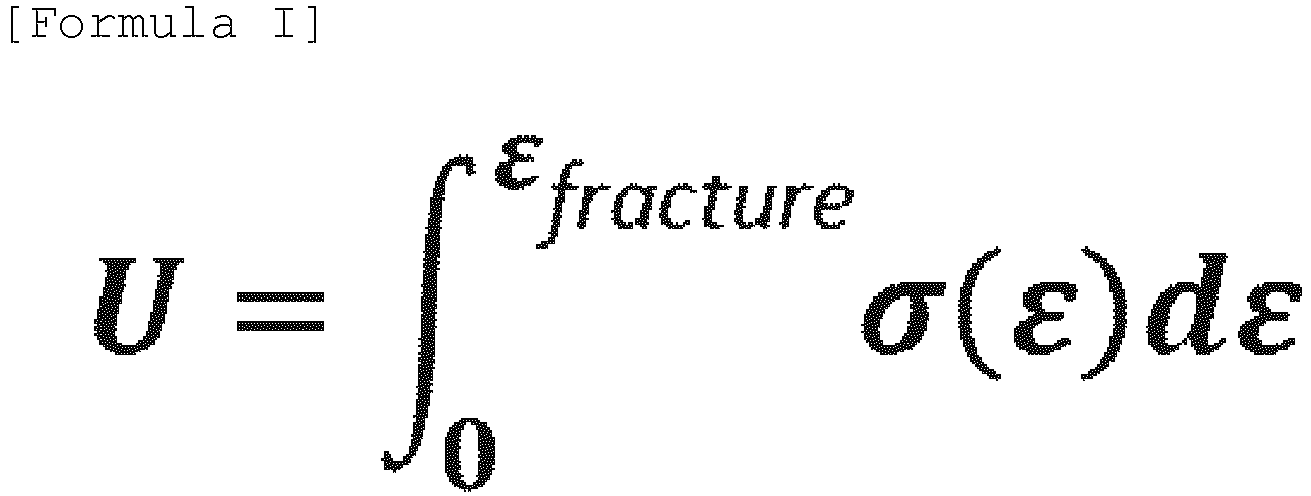

- Crosslinked products X-4, X-5, Y-1, and Y-3 correspond to Comparative Examples.
- Crosslinked products X-1 to X-3 are positioned as Examples, since they have a significantly higher elongation at break than crosslinked product X-4 and higher elongation at break and fracture energy than crosslinked product X-5.
- Crosslinked product Y-2 is positioned as Example, since it has a significantly higher elongation at break than crosslinked product Y-1 and is estimated to have a higher elongation at break than crosslinked product Y-1.
- Crosslinked product Y-4 is positioned as Example, since it has a significantly higher elongation at break than crosslinked product Y-3 and is estimated to have a higher elongation at break than crosslinked product Y-3.
- The present invention is not limited to the aforementioned examples, and may be appropriately modified and embodied without departing from the spirit of the invention.
Claims (6)
- A polyrotaxane comprising a linear molecule, a cyclic molecule enclosing the linear molecule such that the cyclic molecule is skewered with the linear molecule, and blocking groups disposed at both ends of the linear molecule for preventing removal of the cyclic molecule, characterized in that:
the cyclic molecule has a hydrosilyl group. - The polyrotaxane according to claim 1, wherein the cyclic molecule is cyclodextrin.
- A polymer composition comprising the polyrotaxane according to claim 1 or 2, and a polymer, wherein the polymer has a double bond on at least either a main chain or a side chain.
- The polymer composition according to claim 3, wherein the double bond of the polymer contains a vinylidene group.
- A crosslinked polymer composition produced by crosslinking of the polymer composition according to claim 3 or 4, wherein the crosslinking is achieved through chemical reaction between the hydrosilyl group of the cyclic molecule and the double bond of the polymer.
- A method for producing a crosslinked polymer composition, the method comprising crosslinking the polymer composition according to claim 3 or 4 in the presence of a catalyst through chemical reaction between the hydrosilyl group of the cyclic molecule and the double bond of the polymer.
Applications Claiming Priority (2)
| Application Number | Priority Date | Filing Date | Title |
|---|---|---|---|
| JP2020021219A JP7383258B2 (en) | 2020-02-12 | 2020-02-12 | Polyrotaxane, polymer composition, crosslinked polymer composition and manufacturing method thereof |
| PCT/JP2020/044782 WO2021161626A1 (en) | 2020-02-12 | 2020-12-02 | Polyrotaxane, polymer composition, cross-linked polymer composition, and method for producing cross-linked polymer composition |
Publications (3)
| Publication Number | Publication Date |
|---|---|
| EP4105276A1 true EP4105276A1 (en) | 2022-12-21 |
| EP4105276A4 EP4105276A4 (en) | 2024-03-06 |
| EP4105276B1 EP4105276B1 (en) | 2025-01-29 |
Family
ID=77292812
Family Applications (1)
| Application Number | Title | Priority Date | Filing Date |
|---|---|---|---|
| EP20918554.5A Active EP4105276B1 (en) | 2020-02-12 | 2020-12-02 | Polyrotaxane, polymer composition, cross-linked polymer composition, and method for producing cross-linked polymer composition |
Country Status (4)
| Country | Link |
|---|---|
| US (1) | US12503577B2 (en) |
| EP (1) | EP4105276B1 (en) |
| JP (1) | JP7383258B2 (en) |
| WO (1) | WO2021161626A1 (en) |
Families Citing this family (5)
| Publication number | Priority date | Publication date | Assignee | Title |
|---|---|---|---|---|
| JP7868804B2 (en) * | 2021-08-06 | 2026-06-02 | 豊田合成株式会社 | Polyrotaxane, crosslinked EPDM composition and weatherstrip |
| CN113881240B (en) * | 2021-11-03 | 2022-10-14 | 包头稀土研究院 | Polylactic acid composite material and preparation method and application thereof |
| JP7757845B2 (en) * | 2022-03-16 | 2025-10-22 | 豊田合成株式会社 | catheter |
| JP2023135924A (en) * | 2022-03-16 | 2023-09-29 | 豊田合成株式会社 | Rubber glove |
| JP2025034521A (en) * | 2023-08-31 | 2025-03-13 | 国立大学法人 東京大学 | Strengthening of silicone-based polymer materials by adding polyrotaxane |
Family Cites Families (7)
| Publication number | Priority date | Publication date | Assignee | Title |
|---|---|---|---|---|
| WO2005080469A1 (en) | 2004-01-08 | 2005-09-01 | The University Of Tokyo | Compound having crosslinked polyrotaxane and process for producing the same |
| KR101180169B1 (en) * | 2004-03-31 | 2012-09-05 | 도꾜 다이가꾸 | Polymeric Material Having Polyrotaxane and Process for Producing the Same |
| US6972309B1 (en) * | 2004-06-17 | 2005-12-06 | The Goodyear Tire & Rubber Company | Cure system for polyisoprene rubber |
| JP2006233007A (en) | 2005-02-24 | 2006-09-07 | Kaneka Corp | Polyrotaxane and its preparation method |
| WO2014196636A1 (en) * | 2013-06-07 | 2014-12-11 | アドバンスト・ソフトマテリアルズ株式会社 | Crosslinking composition having a polyrotaxane and a compound having two or more oxirane groups and/or oxetane groups |
| JP2015203037A (en) | 2014-04-11 | 2015-11-16 | アドバンスト・ソフトマテリアルズ株式会社 | Rubber composition, crosslinked product formed from rubber composition, and production method of said crosslinked product |
| JP2018024768A (en) | 2016-08-10 | 2018-02-15 | 株式会社ブリヂストン | Rubber composition and tire |
-
2020
- 2020-02-12 JP JP2020021219A patent/JP7383258B2/en active Active
- 2020-12-02 WO PCT/JP2020/044782 patent/WO2021161626A1/en not_active Ceased
- 2020-12-02 US US17/796,216 patent/US12503577B2/en active Active
- 2020-12-02 EP EP20918554.5A patent/EP4105276B1/en active Active
Also Published As
| Publication number | Publication date |
|---|---|
| WO2021161626A1 (en) | 2021-08-19 |
| US20230123626A1 (en) | 2023-04-20 |
| JP2021127362A (en) | 2021-09-02 |
| US12503577B2 (en) | 2025-12-23 |
| EP4105276A4 (en) | 2024-03-06 |
| EP4105276B1 (en) | 2025-01-29 |
| JP7383258B2 (en) | 2023-11-20 |
Similar Documents
| Publication | Publication Date | Title |
|---|---|---|
| EP4105276B1 (en) | Polyrotaxane, polymer composition, cross-linked polymer composition, and method for producing cross-linked polymer composition | |
| US4158000A (en) | Antidegradants for rubber | |
| EP3315576B1 (en) | Composition for gas seal member, and gas seal member | |
| EP3212682B1 (en) | Vulcanisable compositions comprising ethylene-vinylacetate-copolymers containing epoxy groups | |
| EP2700689B1 (en) | Adhesive composition, bonding method using same, laminate and tire | |
| EP3831905B1 (en) | Adhesive agent and adhesive tape using said adhesive agent | |
| EP4477696A1 (en) | Method for decomposing crosslinked rubber | |
| Madsen et al. | Enhancing the electro-mechanical properties of polydimethylsiloxane elastomers through blending with poly (dimethylsiloxane-co-methylphenylsiloxane) copolymers | |
| EP4130078A1 (en) | Chloroprene block copolymer, latex, latex composition, and rubber composition | |
| CN105255021A (en) | High-intensity and low-compression-permanent-deformation rubber material and preparation method of high-intensity and low-compression permanent deformation rubber material | |
| Gögelein et al. | Phase morphology of NR, BR, and EPDM blends produced by an optimized sequential mixing procedure | |
| US20260001975A1 (en) | Process for producing a polyethylene composition using molecular weight enlargement | |
| CN119039559B (en) | Polyurethane elastomer for highway expansion joint and preparation method thereof | |
| EP1928951B1 (en) | Rubber mixture for inner liner of pneumatic vehicle tyres | |
| EP4382553A1 (en) | Method for returning crosslinked site of crosslinked elastomer to uncrosslinked state | |
| EP1925465A1 (en) | Rubber composition for tire inner liner and pneumatic tire using the same | |
| EP0919594B1 (en) | Process for the production of addition-cured silicone elastomers having low compression set | |
| EP3604474A1 (en) | Composition for gas seal member and method for producing same, gas seal member for high-pressure hydrogen equipment, and high-pressure hydrogen equipment | |
| US9908998B2 (en) | Class of rubber product anti-aging agents | |
| Pazur et al. | Effect of thermo-oxidation on permeation resistance of bromobutyl compounds | |
| WO2023013426A1 (en) | Polyrotaxane, crosslinked epdm composition, and weather strip | |
| Kurien et al. | Studies on sulphur vulcanisation of natural rubber using amidino thiourea | |
| EP4223838A1 (en) | Elastomer composition, method for producing elastomer composition, crosslinked product, and molded body | |
| JPH0748405A (en) | Natural rubber and production thereof | |
| JP4128210B2 (en) | Rubber composition for tire inner liner and pneumatic tire using the same |
Legal Events
| Date | Code | Title | Description |
|---|---|---|---|
| STAA | Information on the status of an ep patent application or granted ep patent |
Free format text: STATUS: THE INTERNATIONAL PUBLICATION HAS BEEN MADE |
|
| PUAI | Public reference made under article 153(3) epc to a published international application that has entered the european phase |
Free format text: ORIGINAL CODE: 0009012 |
|
| STAA | Information on the status of an ep patent application or granted ep patent |
Free format text: STATUS: REQUEST FOR EXAMINATION WAS MADE |
|
| 17P | Request for examination filed |
Effective date: 20220809 |
|
| AK | Designated contracting states |
Kind code of ref document: A1 Designated state(s): AL AT BE BG CH CY CZ DE DK EE ES FI FR GB GR HR HU IE IS IT LI LT LU LV MC MK MT NL NO PL PT RO RS SE SI SK SM TR |
|
| DAV | Request for validation of the european patent (deleted) | ||
| DAX | Request for extension of the european patent (deleted) | ||
| A4 | Supplementary search report drawn up and despatched |
Effective date: 20240206 |
|
| RIC1 | Information provided on ipc code assigned before grant |
Ipc: C08J 3/24 20060101ALI20240131BHEP Ipc: C08G 83/00 20060101ALI20240131BHEP Ipc: C08B 37/16 20060101ALI20240131BHEP Ipc: C08L 71/02 20060101ALI20240131BHEP Ipc: C08L 5/16 20060101AFI20240131BHEP |
|
| GRAP | Despatch of communication of intention to grant a patent |
Free format text: ORIGINAL CODE: EPIDOSNIGR1 |
|
| STAA | Information on the status of an ep patent application or granted ep patent |
Free format text: STATUS: GRANT OF PATENT IS INTENDED |
|
| RIC1 | Information provided on ipc code assigned before grant |
Ipc: C08J 3/24 20060101ALI20240812BHEP Ipc: C08G 83/00 20060101ALI20240812BHEP Ipc: C08B 37/16 20060101ALI20240812BHEP Ipc: C08L 71/02 20060101ALI20240812BHEP Ipc: C08L 5/16 20060101AFI20240812BHEP |
|
| INTG | Intention to grant announced |
Effective date: 20240913 |
|
| GRAS | Grant fee paid |
Free format text: ORIGINAL CODE: EPIDOSNIGR3 |
|
| GRAA | (expected) grant |
Free format text: ORIGINAL CODE: 0009210 |
|
| STAA | Information on the status of an ep patent application or granted ep patent |
Free format text: STATUS: THE PATENT HAS BEEN GRANTED |
|
| AK | Designated contracting states |
Kind code of ref document: B1 Designated state(s): AL AT BE BG CH CY CZ DE DK EE ES FI FR GB GR HR HU IE IS IT LI LT LU LV MC MK MT NL NO PL PT RO RS SE SI SK SM TR |
|
| REG | Reference to a national code |
Ref country code: GB Ref legal event code: FG4D |
|
| REG | Reference to a national code |
Ref country code: CH Ref legal event code: EP |
|
| REG | Reference to a national code |
Ref country code: DE Ref legal event code: R096 Ref document number: 602020045677 Country of ref document: DE |
|
| REG | Reference to a national code |
Ref country code: IE Ref legal event code: FG4D |
|
| REG | Reference to a national code |
Ref country code: NL Ref legal event code: MP Effective date: 20250129 |
|
| PG25 | Lapsed in a contracting state [announced via postgrant information from national office to epo] |
Ref country code: NL Free format text: LAPSE BECAUSE OF FAILURE TO SUBMIT A TRANSLATION OF THE DESCRIPTION OR TO PAY THE FEE WITHIN THE PRESCRIBED TIME-LIMIT Effective date: 20250129 |
|
| PG25 | Lapsed in a contracting state [announced via postgrant information from national office to epo] |
Ref country code: RS Free format text: LAPSE BECAUSE OF FAILURE TO SUBMIT A TRANSLATION OF THE DESCRIPTION OR TO PAY THE FEE WITHIN THE PRESCRIBED TIME-LIMIT Effective date: 20250429 |
|
| PG25 | Lapsed in a contracting state [announced via postgrant information from national office to epo] |
Ref country code: FI Free format text: LAPSE BECAUSE OF FAILURE TO SUBMIT A TRANSLATION OF THE DESCRIPTION OR TO PAY THE FEE WITHIN THE PRESCRIBED TIME-LIMIT Effective date: 20250129 |
|
| PG25 | Lapsed in a contracting state [announced via postgrant information from national office to epo] |
Ref country code: PL Free format text: LAPSE BECAUSE OF FAILURE TO SUBMIT A TRANSLATION OF THE DESCRIPTION OR TO PAY THE FEE WITHIN THE PRESCRIBED TIME-LIMIT Effective date: 20250129 |
|
| PG25 | Lapsed in a contracting state [announced via postgrant information from national office to epo] |
Ref country code: ES Free format text: LAPSE BECAUSE OF FAILURE TO SUBMIT A TRANSLATION OF THE DESCRIPTION OR TO PAY THE FEE WITHIN THE PRESCRIBED TIME-LIMIT Effective date: 20250129 |
|
| REG | Reference to a national code |
Ref country code: LT Ref legal event code: MG9D |
|
| PG25 | Lapsed in a contracting state [announced via postgrant information from national office to epo] |
Ref country code: IS Free format text: LAPSE BECAUSE OF FAILURE TO SUBMIT A TRANSLATION OF THE DESCRIPTION OR TO PAY THE FEE WITHIN THE PRESCRIBED TIME-LIMIT Effective date: 20250529 Ref country code: NO Free format text: LAPSE BECAUSE OF FAILURE TO SUBMIT A TRANSLATION OF THE DESCRIPTION OR TO PAY THE FEE WITHIN THE PRESCRIBED TIME-LIMIT Effective date: 20250429 |
|
| REG | Reference to a national code |
Ref country code: AT Ref legal event code: MK05 Ref document number: 1763422 Country of ref document: AT Kind code of ref document: T Effective date: 20250129 |
|
| PG25 | Lapsed in a contracting state [announced via postgrant information from national office to epo] |
Ref country code: HR Free format text: LAPSE BECAUSE OF FAILURE TO SUBMIT A TRANSLATION OF THE DESCRIPTION OR TO PAY THE FEE WITHIN THE PRESCRIBED TIME-LIMIT Effective date: 20250129 |
|
| PG25 | Lapsed in a contracting state [announced via postgrant information from national office to epo] |
Ref country code: LV Free format text: LAPSE BECAUSE OF FAILURE TO SUBMIT A TRANSLATION OF THE DESCRIPTION OR TO PAY THE FEE WITHIN THE PRESCRIBED TIME-LIMIT Effective date: 20250129 Ref country code: PT Free format text: LAPSE BECAUSE OF FAILURE TO SUBMIT A TRANSLATION OF THE DESCRIPTION OR TO PAY THE FEE WITHIN THE PRESCRIBED TIME-LIMIT Effective date: 20250529 |
|
| PG25 | Lapsed in a contracting state [announced via postgrant information from national office to epo] |
Ref country code: GR Free format text: LAPSE BECAUSE OF FAILURE TO SUBMIT A TRANSLATION OF THE DESCRIPTION OR TO PAY THE FEE WITHIN THE PRESCRIBED TIME-LIMIT Effective date: 20250430 Ref country code: BG Free format text: LAPSE BECAUSE OF FAILURE TO SUBMIT A TRANSLATION OF THE DESCRIPTION OR TO PAY THE FEE WITHIN THE PRESCRIBED TIME-LIMIT Effective date: 20250129 |
|
| PG25 | Lapsed in a contracting state [announced via postgrant information from national office to epo] |
Ref country code: AT Free format text: LAPSE BECAUSE OF FAILURE TO SUBMIT A TRANSLATION OF THE DESCRIPTION OR TO PAY THE FEE WITHIN THE PRESCRIBED TIME-LIMIT Effective date: 20250129 |
|
| PG25 | Lapsed in a contracting state [announced via postgrant information from national office to epo] |
Ref country code: SE Free format text: LAPSE BECAUSE OF FAILURE TO SUBMIT A TRANSLATION OF THE DESCRIPTION OR TO PAY THE FEE WITHIN THE PRESCRIBED TIME-LIMIT Effective date: 20250129 |
|
| PG25 | Lapsed in a contracting state [announced via postgrant information from national office to epo] |
Ref country code: SM Free format text: LAPSE BECAUSE OF FAILURE TO SUBMIT A TRANSLATION OF THE DESCRIPTION OR TO PAY THE FEE WITHIN THE PRESCRIBED TIME-LIMIT Effective date: 20250129 |
|
| PG25 | Lapsed in a contracting state [announced via postgrant information from national office to epo] |
Ref country code: DK Free format text: LAPSE BECAUSE OF FAILURE TO SUBMIT A TRANSLATION OF THE DESCRIPTION OR TO PAY THE FEE WITHIN THE PRESCRIBED TIME-LIMIT Effective date: 20250129 |
|
| PG25 | Lapsed in a contracting state [announced via postgrant information from national office to epo] |
Ref country code: IT Free format text: LAPSE BECAUSE OF FAILURE TO SUBMIT A TRANSLATION OF THE DESCRIPTION OR TO PAY THE FEE WITHIN THE PRESCRIBED TIME-LIMIT Effective date: 20250129 |
|
| PG25 | Lapsed in a contracting state [announced via postgrant information from national office to epo] |
Ref country code: EE Free format text: LAPSE BECAUSE OF FAILURE TO SUBMIT A TRANSLATION OF THE DESCRIPTION OR TO PAY THE FEE WITHIN THE PRESCRIBED TIME-LIMIT Effective date: 20250129 Ref country code: CZ Free format text: LAPSE BECAUSE OF FAILURE TO SUBMIT A TRANSLATION OF THE DESCRIPTION OR TO PAY THE FEE WITHIN THE PRESCRIBED TIME-LIMIT Effective date: 20250129 |
|
| PG25 | Lapsed in a contracting state [announced via postgrant information from national office to epo] |
Ref country code: RO Free format text: LAPSE BECAUSE OF FAILURE TO SUBMIT A TRANSLATION OF THE DESCRIPTION OR TO PAY THE FEE WITHIN THE PRESCRIBED TIME-LIMIT Effective date: 20250129 |
|
| PG25 | Lapsed in a contracting state [announced via postgrant information from national office to epo] |
Ref country code: SK Free format text: LAPSE BECAUSE OF FAILURE TO SUBMIT A TRANSLATION OF THE DESCRIPTION OR TO PAY THE FEE WITHIN THE PRESCRIBED TIME-LIMIT Effective date: 20250129 |
|
| REG | Reference to a national code |
Ref country code: DE Ref legal event code: R097 Ref document number: 602020045677 Country of ref document: DE |
|
| PLBE | No opposition filed within time limit |
Free format text: ORIGINAL CODE: 0009261 |
|
| STAA | Information on the status of an ep patent application or granted ep patent |
Free format text: STATUS: NO OPPOSITION FILED WITHIN TIME LIMIT |
|
| REG | Reference to a national code |
Ref country code: CH Ref legal event code: L10 Free format text: ST27 STATUS EVENT CODE: U-0-0-L10-L00 (AS PROVIDED BY THE NATIONAL OFFICE) Effective date: 20251210 |
|
| 26N | No opposition filed |
Effective date: 20251030 |
|
| PGFP | Annual fee paid to national office [announced via postgrant information from national office to epo] |
Ref country code: DE Payment date: 20251028 Year of fee payment: 6 |
|
| PG25 | Lapsed in a contracting state [announced via postgrant information from national office to epo] |
Ref country code: LT Free format text: LAPSE BECAUSE OF FAILURE TO SUBMIT A TRANSLATION OF THE DESCRIPTION OR TO PAY THE FEE WITHIN THE PRESCRIBED TIME-LIMIT Effective date: 20250129 |
|
| PG25 | Lapsed in a contracting state [announced via postgrant information from national office to epo] |
Ref country code: MC Free format text: LAPSE BECAUSE OF FAILURE TO SUBMIT A TRANSLATION OF THE DESCRIPTION OR TO PAY THE FEE WITHIN THE PRESCRIBED TIME-LIMIT Effective date: 20250129 |
|
| REG | Reference to a national code |
Ref country code: CH Ref legal event code: H13 Free format text: ST27 STATUS EVENT CODE: U-0-0-H10-H13 (AS PROVIDED BY THE NATIONAL OFFICE) Effective date: 20260723 |