EP4102609A1 - Electrochemical device and electronic device comprising same - Google Patents
Electrochemical device and electronic device comprising same Download PDFInfo
- Publication number
- EP4102609A1 EP4102609A1 EP20922559.8A EP20922559A EP4102609A1 EP 4102609 A1 EP4102609 A1 EP 4102609A1 EP 20922559 A EP20922559 A EP 20922559A EP 4102609 A1 EP4102609 A1 EP 4102609A1
- Authority
- EP
- European Patent Office
- Prior art keywords
- lithium
- active material
- layer
- electrochemical device
- negative active
- Prior art date
- Legal status (The legal status is an assumption and is not a legal conclusion. Google has not performed a legal analysis and makes no representation as to the accuracy of the status listed.)
- Pending
Links
- 239000010410 layer Substances 0.000 claims abstract description 120
- 239000012790 adhesive layer Substances 0.000 claims abstract description 85
- 239000007773 negative electrode material Substances 0.000 claims abstract description 67
- 150000002642 lithium compounds Chemical class 0.000 claims abstract description 66
- XGZVUEUWXADBQD-UHFFFAOYSA-L lithium carbonate Chemical compound [Li+].[Li+].[O-]C([O-])=O XGZVUEUWXADBQD-UHFFFAOYSA-L 0.000 claims abstract description 4
- 229910052808 lithium carbonate Inorganic materials 0.000 claims abstract description 4
- FUJCRWPEOMXPAD-UHFFFAOYSA-N lithium oxide Chemical compound [Li+].[Li+].[O-2] FUJCRWPEOMXPAD-UHFFFAOYSA-N 0.000 claims abstract description 4
- 229910001947 lithium oxide Inorganic materials 0.000 claims abstract description 4
- 229920000642 polymer Polymers 0.000 claims description 72
- -1 polytetrafluoroethylene Polymers 0.000 claims description 60
- 239000002245 particle Substances 0.000 claims description 15
- 125000001424 substituent group Chemical group 0.000 claims description 14
- 230000003746 surface roughness Effects 0.000 claims description 14
- 125000004185 ester group Chemical group 0.000 claims description 13
- 229920002981 polyvinylidene fluoride Polymers 0.000 claims description 11
- OKTJSMMVPCPJKN-UHFFFAOYSA-N Carbon Chemical compound [C] OKTJSMMVPCPJKN-UHFFFAOYSA-N 0.000 claims description 9
- LYCAIKOWRPUZTN-UHFFFAOYSA-N Ethylene glycol Chemical compound OCCO LYCAIKOWRPUZTN-UHFFFAOYSA-N 0.000 claims description 9
- 239000011230 binding agent Substances 0.000 claims description 7
- 239000006258 conductive agent Substances 0.000 claims description 7
- 239000000178 monomer Substances 0.000 claims description 6
- 125000003178 carboxy group Chemical group [H]OC(*)=O 0.000 claims description 5
- 125000002887 hydroxy group Chemical group [H]O* 0.000 claims description 5
- 125000002924 primary amino group Chemical group [H]N([H])* 0.000 claims description 5
- 239000002153 silicon-carbon composite material Substances 0.000 claims description 4
- IMROMDMJAWUWLK-UHFFFAOYSA-N Ethenol Chemical compound OC=C IMROMDMJAWUWLK-UHFFFAOYSA-N 0.000 claims description 3
- 229920002125 Sokalan® Polymers 0.000 claims description 3
- FDLZQPXZHIFURF-UHFFFAOYSA-N [O-2].[Ti+4].[Li+] Chemical compound [O-2].[Ti+4].[Li+] FDLZQPXZHIFURF-UHFFFAOYSA-N 0.000 claims description 3
- OBNDGIHQAIXEAO-UHFFFAOYSA-N [O].[Si] Chemical compound [O].[Si] OBNDGIHQAIXEAO-UHFFFAOYSA-N 0.000 claims description 3
- DPXJVFZANSGRMM-UHFFFAOYSA-N acetic acid;2,3,4,5,6-pentahydroxyhexanal;sodium Chemical compound [Na].CC(O)=O.OCC(O)C(O)C(O)C(O)C=O DPXJVFZANSGRMM-UHFFFAOYSA-N 0.000 claims description 3
- 125000003368 amide group Chemical group 0.000 claims description 3
- IAQRGUVFOMOMEM-UHFFFAOYSA-N but-2-ene Chemical group CC=CC IAQRGUVFOMOMEM-UHFFFAOYSA-N 0.000 claims description 3
- 239000001768 carboxy methyl cellulose Substances 0.000 claims description 3
- 239000002131 composite material Substances 0.000 claims description 3
- 125000004093 cyano group Chemical group *C#N 0.000 claims description 3
- 150000003949 imides Chemical class 0.000 claims description 3
- VNWKTOKETHGBQD-UHFFFAOYSA-N methane Chemical compound C VNWKTOKETHGBQD-UHFFFAOYSA-N 0.000 claims description 3
- 239000004584 polyacrylic acid Substances 0.000 claims description 3
- 235000019812 sodium carboxymethyl cellulose Nutrition 0.000 claims description 3
- 229920001027 sodium carboxymethylcellulose Polymers 0.000 claims description 3
- 229920003048 styrene butadiene rubber Polymers 0.000 claims description 3
- 229920000049 Carbon (fiber) Polymers 0.000 claims description 2
- CERQOIWHTDAKMF-UHFFFAOYSA-N Methacrylic acid Chemical compound CC(=C)C(O)=O CERQOIWHTDAKMF-UHFFFAOYSA-N 0.000 claims description 2
- VVQNEPGJFQJSBK-UHFFFAOYSA-N Methyl methacrylate Chemical compound COC(=O)C(C)=C VVQNEPGJFQJSBK-UHFFFAOYSA-N 0.000 claims description 2
- 239000004952 Polyamide Substances 0.000 claims description 2
- 239000006230 acetylene black Substances 0.000 claims description 2
- 229910021417 amorphous silicon Inorganic materials 0.000 claims description 2
- 229910021383 artificial graphite Inorganic materials 0.000 claims description 2
- 239000004917 carbon fiber Substances 0.000 claims description 2
- 229910021393 carbon nanotube Inorganic materials 0.000 claims description 2
- 239000002041 carbon nanotube Substances 0.000 claims description 2
- 229910021389 graphene Inorganic materials 0.000 claims description 2
- 229910021385 hard carbon Inorganic materials 0.000 claims description 2
- 239000003273 ketjen black Substances 0.000 claims description 2
- 239000002931 mesocarbon microbead Substances 0.000 claims description 2
- 229910021421 monocrystalline silicon Inorganic materials 0.000 claims description 2
- 229910021382 natural graphite Inorganic materials 0.000 claims description 2
- 229920003229 poly(methyl methacrylate) Polymers 0.000 claims description 2
- 229920000058 polyacrylate Polymers 0.000 claims description 2
- 229920002239 polyacrylonitrile Polymers 0.000 claims description 2
- 229920002647 polyamide Polymers 0.000 claims description 2
- 239000004926 polymethyl methacrylate Substances 0.000 claims description 2
- 229920001343 polytetrafluoroethylene Polymers 0.000 claims description 2
- 239000004810 polytetrafluoroethylene Substances 0.000 claims description 2
- 229920001289 polyvinyl ether Polymers 0.000 claims description 2
- 239000001267 polyvinylpyrrolidone Substances 0.000 claims description 2
- 229920000036 polyvinylpyrrolidone Polymers 0.000 claims description 2
- 235000013855 polyvinylpyrrolidone Nutrition 0.000 claims description 2
- 229910021384 soft carbon Inorganic materials 0.000 claims description 2
- 125000000956 methoxy group Chemical group [H]C([H])([H])O* 0.000 claims 1
- 229920000131 polyvinylidene Polymers 0.000 claims 1
- 159000000000 sodium salts Chemical class 0.000 claims 1
- 229910052744 lithium Inorganic materials 0.000 abstract description 45
- WHXSMMKQMYFTQS-UHFFFAOYSA-N Lithium Chemical compound [Li] WHXSMMKQMYFTQS-UHFFFAOYSA-N 0.000 abstract description 36
- 239000000853 adhesive Substances 0.000 abstract description 32
- 230000001070 adhesive effect Effects 0.000 abstract description 32
- 238000000034 method Methods 0.000 abstract description 30
- 230000008569 process Effects 0.000 abstract description 26
- 239000013589 supplement Substances 0.000 abstract description 24
- HBBGRARXTFLTSG-UHFFFAOYSA-N Lithium ion Chemical compound [Li+] HBBGRARXTFLTSG-UHFFFAOYSA-N 0.000 description 63
- 229910001416 lithium ion Inorganic materials 0.000 description 63
- 238000012360 testing method Methods 0.000 description 32
- 239000004743 Polypropylene Substances 0.000 description 31
- 229920001155 polypropylene Polymers 0.000 description 31
- 125000003118 aryl group Chemical group 0.000 description 20
- 230000000052 comparative effect Effects 0.000 description 20
- 125000004432 carbon atom Chemical group C* 0.000 description 17
- 125000001183 hydrocarbyl group Chemical group 0.000 description 16
- 125000000217 alkyl group Chemical group 0.000 description 15
- 125000001072 heteroaryl group Chemical group 0.000 description 14
- 239000008151 electrolyte solution Substances 0.000 description 12
- 239000007774 positive electrode material Substances 0.000 description 11
- 125000000304 alkynyl group Chemical group 0.000 description 10
- 125000000623 heterocyclic group Chemical group 0.000 description 10
- 238000002360 preparation method Methods 0.000 description 9
- PXHVJJICTQNCMI-UHFFFAOYSA-N Nickel Chemical compound [Ni] PXHVJJICTQNCMI-UHFFFAOYSA-N 0.000 description 8
- 125000003342 alkenyl group Chemical group 0.000 description 8
- 125000000753 cycloalkyl group Chemical group 0.000 description 8
- 239000002002 slurry Substances 0.000 description 8
- KMTRUDSVKNLOMY-UHFFFAOYSA-N Ethylene carbonate Chemical compound O=C1OCCO1 KMTRUDSVKNLOMY-UHFFFAOYSA-N 0.000 description 7
- 229910052782 aluminium Inorganic materials 0.000 description 7
- XAGFODPZIPBFFR-UHFFFAOYSA-N aluminium Chemical compound [Al] XAGFODPZIPBFFR-UHFFFAOYSA-N 0.000 description 7
- 239000000463 material Substances 0.000 description 7
- XUIMIQQOPSSXEZ-UHFFFAOYSA-N Silicon Chemical compound [Si] XUIMIQQOPSSXEZ-UHFFFAOYSA-N 0.000 description 6
- HEMHJVSKTPXQMS-UHFFFAOYSA-M Sodium hydroxide Chemical compound [OH-].[Na+] HEMHJVSKTPXQMS-UHFFFAOYSA-M 0.000 description 6
- 239000011575 calcium Substances 0.000 description 6
- 239000011651 chromium Substances 0.000 description 6
- 239000010949 copper Substances 0.000 description 6
- 238000001035 drying Methods 0.000 description 6
- 239000010954 inorganic particle Substances 0.000 description 6
- 239000011777 magnesium Substances 0.000 description 6
- 239000000523 sample Substances 0.000 description 6
- 238000004626 scanning electron microscopy Methods 0.000 description 6
- 229910052710 silicon Inorganic materials 0.000 description 6
- 239000010703 silicon Substances 0.000 description 6
- 239000000126 substance Substances 0.000 description 6
- 239000010936 titanium Substances 0.000 description 6
- RYGMFSIKBFXOCR-UHFFFAOYSA-N Copper Chemical compound [Cu] RYGMFSIKBFXOCR-UHFFFAOYSA-N 0.000 description 5
- 239000004698 Polyethylene Substances 0.000 description 5
- 239000011248 coating agent Substances 0.000 description 5
- 238000000576 coating method Methods 0.000 description 5
- 125000004122 cyclic group Chemical group 0.000 description 5
- 239000011888 foil Substances 0.000 description 5
- 239000011572 manganese Substances 0.000 description 5
- 229920000573 polyethylene Polymers 0.000 description 5
- ATJFFYVFTNAWJD-UHFFFAOYSA-N Tin Chemical compound [Sn] ATJFFYVFTNAWJD-UHFFFAOYSA-N 0.000 description 4
- 239000011203 carbon fibre reinforced carbon Substances 0.000 description 4
- 239000003792 electrolyte Substances 0.000 description 4
- 239000000839 emulsion Substances 0.000 description 4
- 238000002156 mixing Methods 0.000 description 4
- RUOJZAUFBMNUDX-UHFFFAOYSA-N propylene carbonate Chemical compound CC1COC(=O)O1 RUOJZAUFBMNUDX-UHFFFAOYSA-N 0.000 description 4
- 239000002210 silicon-based material Substances 0.000 description 4
- 239000000243 solution Substances 0.000 description 4
- 239000002904 solvent Substances 0.000 description 4
- 238000006467 substitution reaction Methods 0.000 description 4
- 229910052718 tin Inorganic materials 0.000 description 4
- 230000004580 weight loss Effects 0.000 description 4
- SBLRHMKNNHXPHG-UHFFFAOYSA-N 4-fluoro-1,3-dioxolan-2-one Chemical compound FC1COC(=O)O1 SBLRHMKNNHXPHG-UHFFFAOYSA-N 0.000 description 3
- WEVYAHXRMPXWCK-UHFFFAOYSA-N Acetonitrile Chemical compound CC#N WEVYAHXRMPXWCK-UHFFFAOYSA-N 0.000 description 3
- ZOXJGFHDIHLPTG-UHFFFAOYSA-N Boron Chemical compound [B] ZOXJGFHDIHLPTG-UHFFFAOYSA-N 0.000 description 3
- OYPRJOBELJOOCE-UHFFFAOYSA-N Calcium Chemical compound [Ca] OYPRJOBELJOOCE-UHFFFAOYSA-N 0.000 description 3
- VYZAMTAEIAYCRO-UHFFFAOYSA-N Chromium Chemical compound [Cr] VYZAMTAEIAYCRO-UHFFFAOYSA-N 0.000 description 3
- OIFBSDVPJOWBCH-UHFFFAOYSA-N Diethyl carbonate Chemical compound CCOC(=O)OCC OIFBSDVPJOWBCH-UHFFFAOYSA-N 0.000 description 3
- XEEYBQQBJWHFJM-UHFFFAOYSA-N Iron Chemical compound [Fe] XEEYBQQBJWHFJM-UHFFFAOYSA-N 0.000 description 3
- FYYHWMGAXLPEAU-UHFFFAOYSA-N Magnesium Chemical compound [Mg] FYYHWMGAXLPEAU-UHFFFAOYSA-N 0.000 description 3
- PWHULOQIROXLJO-UHFFFAOYSA-N Manganese Chemical compound [Mn] PWHULOQIROXLJO-UHFFFAOYSA-N 0.000 description 3
- ZOKXTWBITQBERF-UHFFFAOYSA-N Molybdenum Chemical compound [Mo] ZOKXTWBITQBERF-UHFFFAOYSA-N 0.000 description 3
- ZMXDDKWLCZADIW-UHFFFAOYSA-N N,N-Dimethylformamide Chemical compound CN(C)C=O ZMXDDKWLCZADIW-UHFFFAOYSA-N 0.000 description 3
- SECXISVLQFMRJM-UHFFFAOYSA-N N-Methylpyrrolidone Chemical compound CN1CCCC1=O SECXISVLQFMRJM-UHFFFAOYSA-N 0.000 description 3
- RTAQQCXQSZGOHL-UHFFFAOYSA-N Titanium Chemical compound [Ti] RTAQQCXQSZGOHL-UHFFFAOYSA-N 0.000 description 3
- 229910052796 boron Inorganic materials 0.000 description 3
- 229910052791 calcium Inorganic materials 0.000 description 3
- 229910052804 chromium Inorganic materials 0.000 description 3
- 239000011247 coating layer Substances 0.000 description 3
- 150000001875 compounds Chemical class 0.000 description 3
- 229910052802 copper Inorganic materials 0.000 description 3
- 238000005520 cutting process Methods 0.000 description 3
- 125000001995 cyclobutyl group Chemical group [H]C1([H])C([H])([H])C([H])(*)C1([H])[H] 0.000 description 3
- 125000001559 cyclopropyl group Chemical group [H]C1([H])C([H])([H])C1([H])* 0.000 description 3
- 238000007599 discharging Methods 0.000 description 3
- 125000000524 functional group Chemical group 0.000 description 3
- 125000005842 heteroatom Chemical group 0.000 description 3
- RAXXELZNTBOGNW-UHFFFAOYSA-N imidazole Natural products C1=CNC=N1 RAXXELZNTBOGNW-UHFFFAOYSA-N 0.000 description 3
- 229910000625 lithium cobalt oxide Inorganic materials 0.000 description 3
- 229910003002 lithium salt Inorganic materials 0.000 description 3
- 159000000002 lithium salts Chemical class 0.000 description 3
- BFZPBUKRYWOWDV-UHFFFAOYSA-N lithium;oxido(oxo)cobalt Chemical compound [Li+].[O-][Co]=O BFZPBUKRYWOWDV-UHFFFAOYSA-N 0.000 description 3
- 229910052749 magnesium Inorganic materials 0.000 description 3
- 229910052748 manganese Inorganic materials 0.000 description 3
- 229910052750 molybdenum Inorganic materials 0.000 description 3
- 239000011733 molybdenum Substances 0.000 description 3
- 229910052712 strontium Inorganic materials 0.000 description 3
- CIOAGBVUUVVLOB-UHFFFAOYSA-N strontium atom Chemical compound [Sr] CIOAGBVUUVVLOB-UHFFFAOYSA-N 0.000 description 3
- JBQYATWDVHIOAR-UHFFFAOYSA-N tellanylidenegermanium Chemical compound [Te]=[Ge] JBQYATWDVHIOAR-UHFFFAOYSA-N 0.000 description 3
- YLQBMQCUIZJEEH-UHFFFAOYSA-N tetrahydrofuran Natural products C=1C=COC=1 YLQBMQCUIZJEEH-UHFFFAOYSA-N 0.000 description 3
- 229910052719 titanium Inorganic materials 0.000 description 3
- WFKWXMTUELFFGS-UHFFFAOYSA-N tungsten Chemical compound [W] WFKWXMTUELFFGS-UHFFFAOYSA-N 0.000 description 3
- 229910052721 tungsten Inorganic materials 0.000 description 3
- 239000010937 tungsten Substances 0.000 description 3
- LEONUFNNVUYDNQ-UHFFFAOYSA-N vanadium atom Chemical compound [V] LEONUFNNVUYDNQ-UHFFFAOYSA-N 0.000 description 3
- 125000000008 (C1-C10) alkyl group Chemical group 0.000 description 2
- VAYTZRYEBVHVLE-UHFFFAOYSA-N 1,3-dioxol-2-one Chemical compound O=C1OC=CO1 VAYTZRYEBVHVLE-UHFFFAOYSA-N 0.000 description 2
- IAZDPXIOMUYVGZ-UHFFFAOYSA-N Dimethylsulphoxide Chemical compound CS(C)=O IAZDPXIOMUYVGZ-UHFFFAOYSA-N 0.000 description 2
- ZHNUHDYFZUAESO-UHFFFAOYSA-N Formamide Chemical compound NC=O ZHNUHDYFZUAESO-UHFFFAOYSA-N 0.000 description 2
- 229910001290 LiPF6 Inorganic materials 0.000 description 2
- 229910000572 Lithium Nickel Cobalt Manganese Oxide (NCM) Inorganic materials 0.000 description 2
- CPLXHLVBOLITMK-UHFFFAOYSA-N Magnesium oxide Chemical compound [Mg]=O CPLXHLVBOLITMK-UHFFFAOYSA-N 0.000 description 2
- 229910019142 PO4 Inorganic materials 0.000 description 2
- XBDQKXXYIPTUBI-UHFFFAOYSA-M Propionate Chemical compound CCC([O-])=O XBDQKXXYIPTUBI-UHFFFAOYSA-M 0.000 description 2
- KYQCOXFCLRTKLS-UHFFFAOYSA-N Pyrazine Chemical compound C1=CN=CC=N1 KYQCOXFCLRTKLS-UHFFFAOYSA-N 0.000 description 2
- JUJWROOIHBZHMG-UHFFFAOYSA-N Pyridine Chemical compound C1=CC=NC=C1 JUJWROOIHBZHMG-UHFFFAOYSA-N 0.000 description 2
- KAESVJOAVNADME-UHFFFAOYSA-N Pyrrole Chemical compound C=1C=CNC=1 KAESVJOAVNADME-UHFFFAOYSA-N 0.000 description 2
- WYURNTSHIVDZCO-UHFFFAOYSA-N Tetrahydrofuran Chemical compound C1CCOC1 WYURNTSHIVDZCO-UHFFFAOYSA-N 0.000 description 2
- YTPLMLYBLZKORZ-UHFFFAOYSA-N Thiophene Chemical compound C=1C=CSC=1 YTPLMLYBLZKORZ-UHFFFAOYSA-N 0.000 description 2
- GWEVSGVZZGPLCZ-UHFFFAOYSA-N Titan oxide Chemical compound O=[Ti]=O GWEVSGVZZGPLCZ-UHFFFAOYSA-N 0.000 description 2
- MCMNRKCIXSYSNV-UHFFFAOYSA-N Zirconium dioxide Chemical compound O=[Zr]=O MCMNRKCIXSYSNV-UHFFFAOYSA-N 0.000 description 2
- FBDMTTNVIIVBKI-UHFFFAOYSA-N [O-2].[Mn+2].[Co+2].[Ni+2].[Li+] Chemical compound [O-2].[Mn+2].[Co+2].[Ni+2].[Li+] FBDMTTNVIIVBKI-UHFFFAOYSA-N 0.000 description 2
- 125000002252 acyl group Chemical group 0.000 description 2
- NDPGDHBNXZOBJS-UHFFFAOYSA-N aluminum lithium cobalt(2+) nickel(2+) oxygen(2-) Chemical compound [Li+].[O--].[O--].[O--].[O--].[Al+3].[Co++].[Ni++] NDPGDHBNXZOBJS-UHFFFAOYSA-N 0.000 description 2
- 230000015572 biosynthetic process Effects 0.000 description 2
- 229910052794 bromium Inorganic materials 0.000 description 2
- 150000001732 carboxylic acid derivatives Chemical class 0.000 description 2
- 239000000460 chlorine Substances 0.000 description 2
- 229910052801 chlorine Inorganic materials 0.000 description 2
- 239000010941 cobalt Substances 0.000 description 2
- 229910017052 cobalt Inorganic materials 0.000 description 2
- GUTLYIVDDKVIGB-UHFFFAOYSA-N cobalt atom Chemical compound [Co] GUTLYIVDDKVIGB-UHFFFAOYSA-N 0.000 description 2
- 239000011889 copper foil Substances 0.000 description 2
- 125000000392 cycloalkenyl group Chemical group 0.000 description 2
- 238000010586 diagram Methods 0.000 description 2
- 238000009826 distribution Methods 0.000 description 2
- 230000000694 effects Effects 0.000 description 2
- 239000011267 electrode slurry Substances 0.000 description 2
- 239000003995 emulsifying agent Substances 0.000 description 2
- FKRCODPIKNYEAC-UHFFFAOYSA-N ethyl propionate Chemical compound CCOC(=O)CC FKRCODPIKNYEAC-UHFFFAOYSA-N 0.000 description 2
- 229910052731 fluorine Inorganic materials 0.000 description 2
- 229910052736 halogen Inorganic materials 0.000 description 2
- 150000002367 halogens Chemical group 0.000 description 2
- 125000000959 isobutyl group Chemical group [H]C([H])([H])C([H])(C([H])([H])[H])C([H])([H])* 0.000 description 2
- 125000001449 isopropyl group Chemical group [H]C([H])([H])C([H])(*)C([H])([H])[H] 0.000 description 2
- 229910052746 lanthanum Inorganic materials 0.000 description 2
- FZLIPJUXYLNCLC-UHFFFAOYSA-N lanthanum atom Chemical compound [La] FZLIPJUXYLNCLC-UHFFFAOYSA-N 0.000 description 2
- 229910002102 lithium manganese oxide Inorganic materials 0.000 description 2
- VLXXBCXTUVRROQ-UHFFFAOYSA-N lithium;oxido-oxo-(oxomanganiooxy)manganese Chemical compound [Li+].[O-][Mn](=O)O[Mn]=O VLXXBCXTUVRROQ-UHFFFAOYSA-N 0.000 description 2
- 125000002496 methyl group Chemical group [H]C([H])([H])* 0.000 description 2
- GRVDJDISBSALJP-UHFFFAOYSA-N methyloxidanyl Chemical group [O]C GRVDJDISBSALJP-UHFFFAOYSA-N 0.000 description 2
- 239000000203 mixture Substances 0.000 description 2
- YWFWDNVOPHGWMX-UHFFFAOYSA-N n,n-dimethyldodecan-1-amine Chemical compound CCCCCCCCCCCCN(C)C YWFWDNVOPHGWMX-UHFFFAOYSA-N 0.000 description 2
- 125000004108 n-butyl group Chemical group [H]C([H])([H])C([H])([H])C([H])([H])C([H])([H])* 0.000 description 2
- 125000004123 n-propyl group Chemical group [H]C([H])([H])C([H])([H])C([H])([H])* 0.000 description 2
- 229910052759 nickel Inorganic materials 0.000 description 2
- 239000011356 non-aqueous organic solvent Substances 0.000 description 2
- 239000003960 organic solvent Substances 0.000 description 2
- 238000004806 packaging method and process Methods 0.000 description 2
- 238000011056 performance test Methods 0.000 description 2
- 239000010452 phosphate Substances 0.000 description 2
- 125000003367 polycyclic group Chemical group 0.000 description 2
- 238000003825 pressing Methods 0.000 description 2
- 125000002914 sec-butyl group Chemical group [H]C([H])([H])C([H])([H])C([H])(*)C([H])([H])[H] 0.000 description 2
- VSZWPYCFIRKVQL-UHFFFAOYSA-N selanylidenegallium;selenium Chemical compound [Se].[Se]=[Ga].[Se]=[Ga] VSZWPYCFIRKVQL-UHFFFAOYSA-N 0.000 description 2
- 238000007493 shaping process Methods 0.000 description 2
- 230000009469 supplementation Effects 0.000 description 2
- 125000000999 tert-butyl group Chemical group [H]C([H])([H])C(*)(C([H])([H])[H])C([H])([H])[H] 0.000 description 2
- XOLBLPGZBRYERU-UHFFFAOYSA-N tin dioxide Chemical compound O=[Sn]=O XOLBLPGZBRYERU-UHFFFAOYSA-N 0.000 description 2
- 229930195735 unsaturated hydrocarbon Natural products 0.000 description 2
- XLYOFNOQVPJJNP-UHFFFAOYSA-N water Chemical compound O XLYOFNOQVPJJNP-UHFFFAOYSA-N 0.000 description 2
- 238000004804 winding Methods 0.000 description 2
- 229910052727 yttrium Inorganic materials 0.000 description 2
- VWQVUPCCIRVNHF-UHFFFAOYSA-N yttrium atom Chemical compound [Y] VWQVUPCCIRVNHF-UHFFFAOYSA-N 0.000 description 2
- CYSGHNMQYZDMIA-UHFFFAOYSA-N 1,3-Dimethyl-2-imidazolidinon Chemical compound CN1CCN(C)C1=O CYSGHNMQYZDMIA-UHFFFAOYSA-N 0.000 description 1
- 125000001637 1-naphthyl group Chemical group [H]C1=C([H])C([H])=C2C(*)=C([H])C([H])=C([H])C2=C1[H] 0.000 description 1
- UHOPWFKONJYLCF-UHFFFAOYSA-N 2-(2-sulfanylethyl)isoindole-1,3-dione Chemical compound C1=CC=C2C(=O)N(CCS)C(=O)C2=C1 UHOPWFKONJYLCF-UHFFFAOYSA-N 0.000 description 1
- YEVQZPWSVWZAOB-UHFFFAOYSA-N 2-(bromomethyl)-1-iodo-4-(trifluoromethyl)benzene Chemical compound FC(F)(F)C1=CC=C(I)C(CBr)=C1 YEVQZPWSVWZAOB-UHFFFAOYSA-N 0.000 description 1
- PPDFQRAASCRJAH-UHFFFAOYSA-N 2-methylthiolane 1,1-dioxide Chemical compound CC1CCCS1(=O)=O PPDFQRAASCRJAH-UHFFFAOYSA-N 0.000 description 1
- 125000001622 2-naphthyl group Chemical group [H]C1=C([H])C([H])=C2C([H])=C(*)C([H])=C([H])C2=C1[H] 0.000 description 1
- 125000004975 3-butenyl group Chemical group C(CC=C)* 0.000 description 1
- WXNUAYPPBQAQLR-UHFFFAOYSA-N B([O-])(F)F.[Li+] Chemical compound B([O-])(F)F.[Li+] WXNUAYPPBQAQLR-UHFFFAOYSA-N 0.000 description 1
- WKBOTKDWSSQWDR-UHFFFAOYSA-N Bromine atom Chemical compound [Br] WKBOTKDWSSQWDR-UHFFFAOYSA-N 0.000 description 1
- 125000000882 C2-C6 alkenyl group Chemical group 0.000 description 1
- ZAMOUSCENKQFHK-UHFFFAOYSA-N Chlorine atom Chemical compound [Cl] ZAMOUSCENKQFHK-UHFFFAOYSA-N 0.000 description 1
- PXGOKWXKJXAPGV-UHFFFAOYSA-N Fluorine Chemical compound FF PXGOKWXKJXAPGV-UHFFFAOYSA-N 0.000 description 1
- 102000004310 Ion Channels Human genes 0.000 description 1
- 229910015044 LiB Inorganic materials 0.000 description 1
- 229910013188 LiBOB Inorganic materials 0.000 description 1
- 229910013375 LiC Inorganic materials 0.000 description 1
- 229910000552 LiCF3SO3 Inorganic materials 0.000 description 1
- 229910013406 LiN(SO2CF3)2 Inorganic materials 0.000 description 1
- 229910012576 LiSiF6 Inorganic materials 0.000 description 1
- FXHOOIRPVKKKFG-UHFFFAOYSA-N N,N-Dimethylacetamide Chemical compound CN(C)C(C)=O FXHOOIRPVKKKFG-UHFFFAOYSA-N 0.000 description 1
- ZCQWOFVYLHDMMC-UHFFFAOYSA-N Oxazole Chemical compound C1=COC=N1 ZCQWOFVYLHDMMC-UHFFFAOYSA-N 0.000 description 1
- 239000002033 PVDF binder Substances 0.000 description 1
- PCNDJXKNXGMECE-UHFFFAOYSA-N Phenazine Natural products C1=CC=CC2=NC3=CC=CC=C3N=C21 PCNDJXKNXGMECE-UHFFFAOYSA-N 0.000 description 1
- 239000004642 Polyimide Substances 0.000 description 1
- WTKZEGDFNFYCGP-UHFFFAOYSA-N Pyrazole Chemical compound C=1C=NNC=1 WTKZEGDFNFYCGP-UHFFFAOYSA-N 0.000 description 1
- CZPWVGJYEJSRLH-UHFFFAOYSA-N Pyrimidine Chemical compound C1=CN=CN=C1 CZPWVGJYEJSRLH-UHFFFAOYSA-N 0.000 description 1
- 229910002370 SrTiO3 Inorganic materials 0.000 description 1
- DHXVGJBLRPWPCS-UHFFFAOYSA-N Tetrahydropyran Chemical compound C1CCOCC1 DHXVGJBLRPWPCS-UHFFFAOYSA-N 0.000 description 1
- FZWLAAWBMGSTSO-UHFFFAOYSA-N Thiazole Chemical compound C1=CSC=N1 FZWLAAWBMGSTSO-UHFFFAOYSA-N 0.000 description 1
- 239000004699 Ultra-high molecular weight polyethylene Substances 0.000 description 1
- YWJVFBOUPMWANA-UHFFFAOYSA-H [Li+].[V+5].[O-]P([O-])([O-])=O.[O-]P([O-])([O-])=O Chemical compound [Li+].[V+5].[O-]P([O-])([O-])=O.[O-]P([O-])([O-])=O YWJVFBOUPMWANA-UHFFFAOYSA-H 0.000 description 1
- KXKVLQRXCPHEJC-UHFFFAOYSA-N acetic acid trimethyl ester Natural products COC(C)=O KXKVLQRXCPHEJC-UHFFFAOYSA-N 0.000 description 1
- 239000000654 additive Substances 0.000 description 1
- 239000003513 alkali Substances 0.000 description 1
- 239000012670 alkaline solution Substances 0.000 description 1
- 125000003545 alkoxy group Chemical group 0.000 description 1
- 239000000956 alloy Substances 0.000 description 1
- 229910045601 alloy Inorganic materials 0.000 description 1
- HSFWRNGVRCDJHI-UHFFFAOYSA-N alpha-acetylene Natural products C#C HSFWRNGVRCDJHI-UHFFFAOYSA-N 0.000 description 1
- WNROFYMDJYEPJX-UHFFFAOYSA-K aluminium hydroxide Chemical compound [OH-].[OH-].[OH-].[Al+3] WNROFYMDJYEPJX-UHFFFAOYSA-K 0.000 description 1
- 229910021502 aluminium hydroxide Inorganic materials 0.000 description 1
- PNEYBMLMFCGWSK-UHFFFAOYSA-N aluminium oxide Inorganic materials [O-2].[O-2].[O-2].[Al+3].[Al+3] PNEYBMLMFCGWSK-UHFFFAOYSA-N 0.000 description 1
- 229910052787 antimony Inorganic materials 0.000 description 1
- WATWJIUSRGPENY-UHFFFAOYSA-N antimony atom Chemical compound [Sb] WATWJIUSRGPENY-UHFFFAOYSA-N 0.000 description 1
- 239000003963 antioxidant agent Substances 0.000 description 1
- 230000003078 antioxidant effect Effects 0.000 description 1
- 239000004760 aramid Substances 0.000 description 1
- 229920003235 aromatic polyamide Polymers 0.000 description 1
- QVGXLLKOCUKJST-UHFFFAOYSA-N atomic oxygen Chemical compound [O] QVGXLLKOCUKJST-UHFFFAOYSA-N 0.000 description 1
- 239000002585 base Substances 0.000 description 1
- 125000001797 benzyl group Chemical group [H]C1=C([H])C([H])=C(C([H])=C1[H])C([H])([H])* 0.000 description 1
- 229910052797 bismuth Inorganic materials 0.000 description 1
- JCXGWMGPZLAOME-UHFFFAOYSA-N bismuth atom Chemical compound [Bi] JCXGWMGPZLAOME-UHFFFAOYSA-N 0.000 description 1
- 230000000903 blocking effect Effects 0.000 description 1
- 229910001593 boehmite Inorganic materials 0.000 description 1
- GDTBXPJZTBHREO-UHFFFAOYSA-N bromine Substances BrBr GDTBXPJZTBHREO-UHFFFAOYSA-N 0.000 description 1
- 125000000484 butyl group Chemical group [H]C([*])([H])C([H])([H])C([H])([H])C([H])([H])[H] 0.000 description 1
- ODINCKMPIJJUCX-UHFFFAOYSA-N calcium oxide Inorganic materials [Ca]=O ODINCKMPIJJUCX-UHFFFAOYSA-N 0.000 description 1
- 239000003990 capacitor Substances 0.000 description 1
- 150000001721 carbon Chemical group 0.000 description 1
- 229910052799 carbon Inorganic materials 0.000 description 1
- CETPSERCERDGAM-UHFFFAOYSA-N ceric oxide Chemical compound O=[Ce]=O CETPSERCERDGAM-UHFFFAOYSA-N 0.000 description 1
- 229910000422 cerium(IV) oxide Inorganic materials 0.000 description 1
- 230000008859 change Effects 0.000 description 1
- 238000006243 chemical reaction Methods 0.000 description 1
- 238000013329 compounding Methods 0.000 description 1
- 238000010276 construction Methods 0.000 description 1
- 238000007796 conventional method Methods 0.000 description 1
- 229910052593 corundum Inorganic materials 0.000 description 1
- 230000001186 cumulative effect Effects 0.000 description 1
- 150000004292 cyclic ethers Chemical class 0.000 description 1
- 125000000113 cyclohexyl group Chemical group [H]C1([H])C([H])([H])C([H])([H])C([H])(*)C([H])([H])C1([H])[H] 0.000 description 1
- 125000001511 cyclopentyl group Chemical group [H]C1([H])C([H])([H])C([H])([H])C([H])(*)C1([H])[H] 0.000 description 1
- 125000002704 decyl group Chemical group [H]C([H])([H])C([H])([H])C([H])([H])C([H])([H])C([H])([H])C([H])([H])C([H])([H])C([H])([H])C([H])([H])C([H])([H])* 0.000 description 1
- 239000008367 deionised water Substances 0.000 description 1
- 229910021641 deionized water Inorganic materials 0.000 description 1
- 230000002542 deteriorative effect Effects 0.000 description 1
- 238000011161 development Methods 0.000 description 1
- IEJIGPNLZYLLBP-UHFFFAOYSA-N dimethyl carbonate Chemical compound COC(=O)OC IEJIGPNLZYLLBP-UHFFFAOYSA-N 0.000 description 1
- SNQXJPARXFUULZ-UHFFFAOYSA-N dioxolane Chemical compound C1COOC1 SNQXJPARXFUULZ-UHFFFAOYSA-N 0.000 description 1
- 238000006073 displacement reaction Methods 0.000 description 1
- 238000004146 energy storage Methods 0.000 description 1
- 238000005516 engineering process Methods 0.000 description 1
- 150000002148 esters Chemical class 0.000 description 1
- RTZKZFJDLAIYFH-UHFFFAOYSA-N ether Substances CCOCC RTZKZFJDLAIYFH-UHFFFAOYSA-N 0.000 description 1
- 125000001495 ethyl group Chemical group [H]C([H])([H])C([H])([H])* 0.000 description 1
- JBTWLSYIZRCDFO-UHFFFAOYSA-N ethyl methyl carbonate Chemical compound CCOC(=O)OC JBTWLSYIZRCDFO-UHFFFAOYSA-N 0.000 description 1
- 125000002534 ethynyl group Chemical group [H]C#C* 0.000 description 1
- 238000005562 fading Methods 0.000 description 1
- 238000001914 filtration Methods 0.000 description 1
- 239000011737 fluorine Substances 0.000 description 1
- 239000011245 gel electrolyte Substances 0.000 description 1
- 230000014509 gene expression Effects 0.000 description 1
- 229910052732 germanium Inorganic materials 0.000 description 1
- GNPVGFCGXDBREM-UHFFFAOYSA-N germanium atom Chemical compound [Ge] GNPVGFCGXDBREM-UHFFFAOYSA-N 0.000 description 1
- 229910001679 gibbsite Inorganic materials 0.000 description 1
- 229910002804 graphite Inorganic materials 0.000 description 1
- 239000010439 graphite Substances 0.000 description 1
- 229920001903 high density polyethylene Polymers 0.000 description 1
- 239000004700 high-density polyethylene Substances 0.000 description 1
- 229940063583 high-density polyethylene Drugs 0.000 description 1
- 125000004435 hydrogen atom Chemical group [H]* 0.000 description 1
- FAHBNUUHRFUEAI-UHFFFAOYSA-M hydroxidooxidoaluminium Chemical compound O[Al]=O FAHBNUUHRFUEAI-UHFFFAOYSA-M 0.000 description 1
- 238000010191 image analysis Methods 0.000 description 1
- 230000006872 improvement Effects 0.000 description 1
- 230000008595 infiltration Effects 0.000 description 1
- 238000001764 infiltration Methods 0.000 description 1
- PNDPGZBMCMUPRI-UHFFFAOYSA-N iodine Chemical compound II PNDPGZBMCMUPRI-UHFFFAOYSA-N 0.000 description 1
- 230000001788 irregular Effects 0.000 description 1
- 125000004491 isohexyl group Chemical group C(CCC(C)C)* 0.000 description 1
- 125000001972 isopentyl group Chemical group [H]C([H])([H])C([H])(C([H])([H])[H])C([H])([H])C([H])([H])* 0.000 description 1
- 125000000555 isopropenyl group Chemical group [H]\C([H])=C(\*)C([H])([H])[H] 0.000 description 1
- 150000004715 keto acids Chemical class 0.000 description 1
- 239000002346 layers by function Substances 0.000 description 1
- 239000004973 liquid crystal related substance Substances 0.000 description 1
- 238000006138 lithiation reaction Methods 0.000 description 1
- 229910001540 lithium hexafluoroarsenate(V) Inorganic materials 0.000 description 1
- GELKBWJHTRAYNV-UHFFFAOYSA-K lithium iron phosphate Chemical compound [Li+].[Fe+2].[O-]P([O-])([O-])=O GELKBWJHTRAYNV-UHFFFAOYSA-K 0.000 description 1
- MHCFAGZWMAWTNR-UHFFFAOYSA-M lithium perchlorate Chemical compound [Li+].[O-]Cl(=O)(=O)=O MHCFAGZWMAWTNR-UHFFFAOYSA-M 0.000 description 1
- 229910001486 lithium perchlorate Inorganic materials 0.000 description 1
- 229910001496 lithium tetrafluoroborate Inorganic materials 0.000 description 1
- QSZMZKBZAYQGRS-UHFFFAOYSA-N lithium;bis(trifluoromethylsulfonyl)azanide Chemical compound [Li+].FC(F)(F)S(=O)(=O)[N-]S(=O)(=O)C(F)(F)F QSZMZKBZAYQGRS-UHFFFAOYSA-N 0.000 description 1
- DVATZODUVBMYHN-UHFFFAOYSA-K lithium;iron(2+);manganese(2+);phosphate Chemical compound [Li+].[Mn+2].[Fe+2].[O-]P([O-])([O-])=O DVATZODUVBMYHN-UHFFFAOYSA-K 0.000 description 1
- 229920001684 low density polyethylene Polymers 0.000 description 1
- 239000004702 low-density polyethylene Substances 0.000 description 1
- VTHJTEIRLNZDEV-UHFFFAOYSA-L magnesium dihydroxide Chemical compound [OH-].[OH-].[Mg+2] VTHJTEIRLNZDEV-UHFFFAOYSA-L 0.000 description 1
- 229910001862 magnesium hydroxide Inorganic materials 0.000 description 1
- 239000000347 magnesium hydroxide Substances 0.000 description 1
- 230000014759 maintenance of location Effects 0.000 description 1
- 229910052751 metal Inorganic materials 0.000 description 1
- 239000002184 metal Substances 0.000 description 1
- 230000000116 mitigating effect Effects 0.000 description 1
- 238000012986 modification Methods 0.000 description 1
- 230000004048 modification Effects 0.000 description 1
- 229910003465 moissanite Inorganic materials 0.000 description 1
- 125000002950 monocyclic group Chemical group 0.000 description 1
- 125000002757 morpholinyl group Chemical group 0.000 description 1
- 125000003136 n-heptyl group Chemical group [H]C([H])([H])C([H])([H])C([H])([H])C([H])([H])C([H])([H])C([H])([H])C([H])([H])* 0.000 description 1
- 125000001280 n-hexyl group Chemical group C(CCCCC)* 0.000 description 1
- 125000000740 n-pentyl group Chemical group [H]C([H])([H])C([H])([H])C([H])([H])C([H])([H])C([H])([H])* 0.000 description 1
- 125000001971 neopentyl group Chemical group [H]C([*])([H])C(C([H])([H])[H])(C([H])([H])[H])C([H])([H])[H] 0.000 description 1
- GNRSAWUEBMWBQH-UHFFFAOYSA-N nickel(II) oxide Inorganic materials [Ni]=O GNRSAWUEBMWBQH-UHFFFAOYSA-N 0.000 description 1
- 229910052757 nitrogen Inorganic materials 0.000 description 1
- 125000004433 nitrogen atom Chemical group N* 0.000 description 1
- 125000002868 norbornyl group Chemical group C12(CCC(CC1)C2)* 0.000 description 1
- 125000002347 octyl group Chemical group [H]C([*])([H])C([H])([H])C([H])([H])C([H])([H])C([H])([H])C([H])([H])C([H])([H])C([H])([H])[H] 0.000 description 1
- 239000001301 oxygen Substances 0.000 description 1
- 229910052760 oxygen Inorganic materials 0.000 description 1
- 125000001997 phenyl group Chemical group [H]C1=C([H])C([H])=C(*)C([H])=C1[H] 0.000 description 1
- NBIIXXVUZAFLBC-UHFFFAOYSA-K phosphate Chemical compound [O-]P([O-])([O-])=O NBIIXXVUZAFLBC-UHFFFAOYSA-K 0.000 description 1
- 125000003386 piperidinyl group Chemical group 0.000 description 1
- 239000002985 plastic film Substances 0.000 description 1
- 229920006255 plastic film Polymers 0.000 description 1
- 229920001495 poly(sodium acrylate) polymer Polymers 0.000 description 1
- 229920005569 poly(vinylidene fluoride-co-hexafluoropropylene) Polymers 0.000 description 1
- 239000005020 polyethylene terephthalate Substances 0.000 description 1
- 229920000139 polyethylene terephthalate Polymers 0.000 description 1
- 229920001721 polyimide Polymers 0.000 description 1
- 239000000843 powder Substances 0.000 description 1
- 238000012545 processing Methods 0.000 description 1
- 125000001436 propyl group Chemical group [H]C([*])([H])C([H])([H])C([H])([H])[H] 0.000 description 1
- QQONPFPTGQHPMA-UHFFFAOYSA-N propylene Natural products CC=C QQONPFPTGQHPMA-UHFFFAOYSA-N 0.000 description 1
- 125000004805 propylene group Chemical group [H]C([H])([H])C([H])([*:1])C([H])([H])[*:2] 0.000 description 1
- UMJSCPRVCHMLSP-UHFFFAOYSA-N pyridine Natural products COC1=CC=CN=C1 UMJSCPRVCHMLSP-UHFFFAOYSA-N 0.000 description 1
- 125000000719 pyrrolidinyl group Chemical group 0.000 description 1
- 238000011160 research Methods 0.000 description 1
- 238000005070 sampling Methods 0.000 description 1
- 229930195734 saturated hydrocarbon Natural products 0.000 description 1
- 238000007789 sealing Methods 0.000 description 1
- 238000000926 separation method Methods 0.000 description 1
- 238000007086 side reaction Methods 0.000 description 1
- HBMJWWWQQXIZIP-UHFFFAOYSA-N silicon carbide Chemical compound [Si+]#[C-] HBMJWWWQQXIZIP-UHFFFAOYSA-N 0.000 description 1
- 229910010271 silicon carbide Inorganic materials 0.000 description 1
- NNMHYFLPFNGQFZ-UHFFFAOYSA-M sodium polyacrylate Chemical compound [Na+].[O-]C(=O)C=C NNMHYFLPFNGQFZ-UHFFFAOYSA-M 0.000 description 1
- 239000012798 spherical particle Substances 0.000 description 1
- 238000003756 stirring Methods 0.000 description 1
- HXJUTPCZVOIRIF-UHFFFAOYSA-N sulfolane Chemical compound O=S1(=O)CCCC1 HXJUTPCZVOIRIF-UHFFFAOYSA-N 0.000 description 1
- AKEJUJNQAAGONA-UHFFFAOYSA-N sulfur trioxide Inorganic materials O=S(=O)=O AKEJUJNQAAGONA-UHFFFAOYSA-N 0.000 description 1
- 230000001502 supplementing effect Effects 0.000 description 1
- 230000001629 suppression Effects 0.000 description 1
- 238000010998 test method Methods 0.000 description 1
- 229930192474 thiophene Natural products 0.000 description 1
- 125000003944 tolyl group Chemical group 0.000 description 1
- 150000003852 triazoles Chemical class 0.000 description 1
- DQWPFSLDHJDLRL-UHFFFAOYSA-N triethyl phosphate Chemical compound CCOP(=O)(OCC)OCC DQWPFSLDHJDLRL-UHFFFAOYSA-N 0.000 description 1
- WVLBCYQITXONBZ-UHFFFAOYSA-N trimethyl phosphate Chemical compound COP(=O)(OC)OC WVLBCYQITXONBZ-UHFFFAOYSA-N 0.000 description 1
- 229920000785 ultra high molecular weight polyethylene Polymers 0.000 description 1
- 238000009461 vacuum packaging Methods 0.000 description 1
- 125000005287 vanadyl group Chemical group 0.000 description 1
- 125000000391 vinyl group Chemical group [H]C([*])=C([H])[H] 0.000 description 1
- 229920002554 vinyl polymer Polymers 0.000 description 1
- 229910001845 yogo sapphire Inorganic materials 0.000 description 1
- RUDFQVOCFDJEEF-UHFFFAOYSA-N yttrium(III) oxide Inorganic materials [O-2].[O-2].[O-2].[Y+3].[Y+3] RUDFQVOCFDJEEF-UHFFFAOYSA-N 0.000 description 1
- XLOMVQKBTHCTTD-UHFFFAOYSA-N zinc oxide Inorganic materials [Zn]=O XLOMVQKBTHCTTD-UHFFFAOYSA-N 0.000 description 1
Images
Classifications
-
- H—ELECTRICITY
- H01—ELECTRIC ELEMENTS
- H01M—PROCESSES OR MEANS, e.g. BATTERIES, FOR THE DIRECT CONVERSION OF CHEMICAL ENERGY INTO ELECTRICAL ENERGY
- H01M50/00—Constructional details or processes of manufacture of the non-active parts of electrochemical cells other than fuel cells, e.g. hybrid cells
- H01M50/40—Separators; Membranes; Diaphragms; Spacing elements inside cells
- H01M50/46—Separators, membranes or diaphragms characterised by their combination with electrodes
- H01M50/461—Separators, membranes or diaphragms characterised by their combination with electrodes with adhesive layers between electrodes and separators
-
- H—ELECTRICITY
- H01—ELECTRIC ELEMENTS
- H01M—PROCESSES OR MEANS, e.g. BATTERIES, FOR THE DIRECT CONVERSION OF CHEMICAL ENERGY INTO ELECTRICAL ENERGY
- H01M10/00—Secondary cells; Manufacture thereof
- H01M10/05—Accumulators with non-aqueous electrolyte
- H01M10/052—Li-accumulators
- H01M10/0525—Rocking-chair batteries, i.e. batteries with lithium insertion or intercalation in both electrodes; Lithium-ion batteries
-
- H—ELECTRICITY
- H01—ELECTRIC ELEMENTS
- H01M—PROCESSES OR MEANS, e.g. BATTERIES, FOR THE DIRECT CONVERSION OF CHEMICAL ENERGY INTO ELECTRICAL ENERGY
- H01M4/00—Electrodes
- H01M4/02—Electrodes composed of, or comprising, active material
- H01M4/13—Electrodes for accumulators with non-aqueous electrolyte, e.g. for lithium-accumulators; Processes of manufacture thereof
-
- H—ELECTRICITY
- H01—ELECTRIC ELEMENTS
- H01M—PROCESSES OR MEANS, e.g. BATTERIES, FOR THE DIRECT CONVERSION OF CHEMICAL ENERGY INTO ELECTRICAL ENERGY
- H01M4/00—Electrodes
- H01M4/02—Electrodes composed of, or comprising, active material
- H01M4/36—Selection of substances as active materials, active masses, active liquids
- H01M4/38—Selection of substances as active materials, active masses, active liquids of elements or alloys
- H01M4/381—Alkaline or alkaline earth metals elements
- H01M4/382—Lithium
-
- H—ELECTRICITY
- H01—ELECTRIC ELEMENTS
- H01M—PROCESSES OR MEANS, e.g. BATTERIES, FOR THE DIRECT CONVERSION OF CHEMICAL ENERGY INTO ELECTRICAL ENERGY
- H01M4/00—Electrodes
- H01M4/02—Electrodes composed of, or comprising, active material
- H01M4/36—Selection of substances as active materials, active masses, active liquids
- H01M4/58—Selection of substances as active materials, active masses, active liquids of inorganic compounds other than oxides or hydroxides, e.g. sulfides, selenides, tellurides, halogenides or LiCoFy; of polyanionic structures, e.g. phosphates, silicates or borates
- H01M4/583—Carbonaceous material, e.g. graphite-intercalation compounds or CFx
-
- H—ELECTRICITY
- H01—ELECTRIC ELEMENTS
- H01M—PROCESSES OR MEANS, e.g. BATTERIES, FOR THE DIRECT CONVERSION OF CHEMICAL ENERGY INTO ELECTRICAL ENERGY
- H01M4/00—Electrodes
- H01M4/02—Electrodes composed of, or comprising, active material
- H01M4/62—Selection of inactive substances as ingredients for active masses, e.g. binders, fillers
-
- H—ELECTRICITY
- H01—ELECTRIC ELEMENTS
- H01M—PROCESSES OR MEANS, e.g. BATTERIES, FOR THE DIRECT CONVERSION OF CHEMICAL ENERGY INTO ELECTRICAL ENERGY
- H01M4/00—Electrodes
- H01M4/02—Electrodes composed of, or comprising, active material
- H01M4/62—Selection of inactive substances as ingredients for active masses, e.g. binders, fillers
- H01M4/621—Binders
- H01M4/622—Binders being polymers
- H01M4/623—Binders being polymers fluorinated polymers
-
- H—ELECTRICITY
- H01—ELECTRIC ELEMENTS
- H01M—PROCESSES OR MEANS, e.g. BATTERIES, FOR THE DIRECT CONVERSION OF CHEMICAL ENERGY INTO ELECTRICAL ENERGY
- H01M4/00—Electrodes
- H01M4/02—Electrodes composed of, or comprising, active material
- H01M2004/026—Electrodes composed of, or comprising, active material characterised by the polarity
- H01M2004/027—Negative electrodes
-
- Y—GENERAL TAGGING OF NEW TECHNOLOGICAL DEVELOPMENTS; GENERAL TAGGING OF CROSS-SECTIONAL TECHNOLOGIES SPANNING OVER SEVERAL SECTIONS OF THE IPC; TECHNICAL SUBJECTS COVERED BY FORMER USPC CROSS-REFERENCE ART COLLECTIONS [XRACs] AND DIGESTS
- Y02—TECHNOLOGIES OR APPLICATIONS FOR MITIGATION OR ADAPTATION AGAINST CLIMATE CHANGE
- Y02E—REDUCTION OF GREENHOUSE GAS [GHG] EMISSIONS, RELATED TO ENERGY GENERATION, TRANSMISSION OR DISTRIBUTION
- Y02E60/00—Enabling technologies; Technologies with a potential or indirect contribution to GHG emissions mitigation
- Y02E60/10—Energy storage using batteries
Definitions
- This application relates to the technical field of energy storage, and in particular, to an electrochemical device and an electronic device containing the electrochemical device.
- an electrochemical device such as a lithium-ion battery
- a higher energy density a higher C-rate, higher safety, and less fading of capacity that occurs after repeated charge and discharge processes.
- the energy density and cycle performance of the electrochemical device are closely related to a positive active material and a negative active material.
- people keep researching and improving the negative active material in pursuit of a negative active material of a higher energy density.
- negative active materials of a higher energy density such as a silicon-based material
- an electrode assembly structure for example, a negative electrode, a separator, and a positive electrode
- This application provides an electrochemical device and an electronic device that includes the electrochemical device in an attempt to solve at least one problem in the related art to at least some extent.
- this application provides an electrochemical device, including: a positive electrode, a negative electrode, a separator, an adhesive layer, and a lithium compound layer.
- the negative electrode includes a negative active material layer.
- the separator is disposed between the positive electrode and the negative electrode.
- the adhesive layer is disposed between the negative active material layer and the separator.
- the lithium compound layer is disposed between the adhesive layer and the negative active material layer.
- the lithium compound layer includes at least one of lithium carbonate or lithium oxide.
- this application provides an electronic device.
- the electronic device includes the electrochemical device.
- the electrochemical device After undergoing a lithium supplement process, the electrochemical device according to this application further includes a lithium compound layer formed on the surface of the negative active material layer.
- the adhesive layer disposed between the lithium compound layer and the separator effectively enhances an adhesive force between the negative electrode and the separator. After the electrochemical device undergoes a plurality of charge-and-discharge cycles, a sufficient adhesive force is still maintained between the negative electrode and the separator, thereby improving the cycle performance and safety performance of the electrochemical device.
- a quantity, a ratio, or another numerical value herein is sometimes expressed in the format of a range. Understandably, such a range format is for convenience and brevity, and shall be flexibly understood to include not only the numerical values explicitly specified and defined in the range, but also all individual numerical values or sub-ranges covered in the range as if each individual numerical value and each sub-range were explicitly specified.
- a list of items referred to by using the terms such as "at least one of”, “at least one thereof”, “at least one type of” or other similar terms may mean any combination of the listed items.
- the phrases “at least one of A and B” and “at least one of A or B” mean: A alone; B alone; or both A and B.
- the phrases “at least one of A, B, and C” and “at least one of A, B, or C” mean: A alone; B alone; C alone; A and B (excluding C); A and C (excluding B); B and C (excluding A); or all of A, B, and C.
- the item A may include a single element or a plurality of elements.
- the item B may include a single element or a plurality of elements.
- the item C may include a single element or a plurality of elements.
- C x represents carbon atoms that are x in number.
- a C 1 to C 10 alkyl is an alkyl group containing 1 to 10 carbon atoms.
- hydrocarbyl covers an alkyl, alkenyl, alkynyl, cycloalkyl, and aryl.
- a hydrocarbyl is intended to be a linear hydrocarbon structure containing 1 to 20 carbon atoms.
- Hydrocarbyl is also intended to be a branched or cyclic hydrocarbon structure containing 3 to 20 carbon atoms.
- a hydrocarbyl containing a specified quantity of carbon atoms is intended to cover all geometric isomers that each contain such quantity of carbon atoms.
- the hydrocarbyl herein may be a C 1 to C 15 hydrocarbyl, a C 1 to C 10 hydrocarbyl, a C 1 to C 5 hydrocarbyl, a C 5 to C 20 hydrocarbyl, a C 5 to C 15 hydrocarbyl, or a C 5 to C 10 hydrocarbyl.
- the hydrocarbyl may be optionally substituted.
- the hydrocarbyl may be substituted by halogen including fluorine, chlorine, bromine, and iodine, or by alkyl, aryl, or heteroaryl.
- hydroxyl means an -OH group.
- amino means a base formed of one nitrogen atom and two hydrogen atoms, and represents an -NH2 group.
- carboxyl is a functional group of carboxylic acid, and represents a -C(O)-OH group.
- hydrocarbyloxyl means an L-O- group, in which L is alkyl, alkenyl, alkynyl, cycloalkyl, or aryl.
- L alkyl
- alkenyl alkynyl
- cycloalkyl cycloalkyl
- aryl aryl
- hydrocarbyloxyl herein may be a C 1 to C 20 hydrocarbyloxyl, a C 1 to C 15 hydrocarbyloxyl, a C 1 to C 10 hydrocarbyloxyl, a C 1 to C 5 hydrocarbyloxyl, a C 5 to C 20 hydrocarbyloxyl, a C 5 to C 15 hydrocarbyloxyl, or a C 5 to C 10 hydrocarbyloxyl.
- ester group is a functional group of ester in a carboxylic acid derivative, and represents a -C(O)-O-R group, in which R covers an alkyl, alkenyl, alkynyl, cycloalkyl, and aryl.
- the ester group is intended to be a linear, branched, or cyclic structure containing 1 to 200 carbon atoms.
- the "ester group” is intended to be a C 2 to C 10 ester group.
- An ester group containing a specified quantity of carbon atoms is intended to cover all geometric isomers that each contain such quantity of carbon atoms.
- ester group herein may be a C 1 to C 15 ester group, a C 1 to C 10 ester group, a C 1 to C 5 ester group, a C 5 to C 20 ester group, a C 5 to C 15 ester group, or a C 5 to C 10 ester group.
- alkyl is intended to be a linear saturated hydrocarbon structure containing 1 to 20 carbon atoms. "Alkyl” is also intended to be a branched or cyclic hydrocarbon structure possessing 3 to 20 carbon atoms.
- the alkyl may be a C 1 to C 20 alkyl, a C 1 to C 10 alkyl, a C 1 to C 5 alkyl, a C 5 to C 20 alkyl, a C 5 to C 15 alkyl, or a C 5 to C 10 alkyl.
- An alkyl containing a specified quantity of carbon atoms is intended to cover all geometric isomers containing the specified quantity of carbon atoms.
- butyl is intended to include n-butyl, sec-butyl, isobutyl, tert-butyl, and cyclobutyl; and "propyl” includes n-propyl, isopropyl, and cyclopropyl.
- alkyl examples include, but are not limited to, methyl, ethyl, n-propyl, isopropyl, cyclopropyl, n-butyl, isobutyl, sec-butyl, tert-butyl, cyclobutyl, n-pentyl, isopentyl, neopentyl, cyclopentyl, methylcyclopentyl, ethylcyclopentyl, n-hexyl, isohexyl, cyclohexyl, n-heptyl, octyl, cyclopropyl, cyclobutyl, norbornyl, and the like.
- the alkyl may be optionally substituted.
- alkenyl means a linear or branched monovalent unsaturated hydrocarbon group containing at least one carbon-carbon double bond, and typically, 1, 2, or 3 carbon-carbon double bonds.
- an alkenyl typically contains 2 to 20 carbon atoms, and may be, for example, a C 2 to C 20 alkenyl, a C 6 to C 20 alkenyl, a C 2 to C 12 alkenyl, or a C 2 to C 6 alkenyl.
- Representative alkenyls include, for example, vinyl, n-propenyl, isopropenyl, n-but-2-enyl, but-3-enyl, n-hex-3-enyl, and the like.
- the alkenyl may be optionally substituted.
- alkynyl means a linear or branched monovalent unsaturated hydrocarbon group containing at least one carbon-carbon triple bond, and typically, 1, 2, or 3 carbon-carbon triple bonds. Unless otherwise defined, an alkynyl typically contains 2 to 20 carbon atoms, and may be, for example, a C 2 to C 20 alkynyl, a C 6 to C 20 alkynyl, a C 2 to C 10 alkynyl, or a C 2 to C 6 alkynyl.
- alkynyls include, for example, ethynyl, prop-2-ynyl (n-propynyl), n-but-2-ynyl, n-hex-3-ynyl, and the like. In addition, the alkynyl may be optionally substituted.
- acyl means an atomic group that remains after the hydroxyl (-OH group) is removed from organic or inorganic oxoacid, and represents an R-M(O)-group, in which M is a carbon atom, R is an alkyl, alkenyl, alkynyl, cycloalkyl, aryl or another commonly seen substituent. For example, when R is amino, “acyl” is "amido".
- aryl covers a monocyclic system and a polycyclic system.
- Polycyclic means two or more rings, in which two adjacent rings (the rings are “condensed”) share two carbon atoms.
- the rings at least one ring is aromatic, and other rings may be, for example, a cycloalkyl, cycloalkenyl, aryl, or a heterocyclic and/or heteroaryl.
- the aryl may be a C 6 to C 50 aryl, a C 6 to C 40 aryl, a C 6 to C 30 aryl, a C 6 to C 20 aryl, or a C 6 to C 10 aryl.
- aryls include (for example), phenyl, methylphenyl, propylphenyl, isopropylphenyl, benzyl, naphth-1-yl, naphth-2-yl, and the like. In addition, the aryl may be optionally substituted.
- heterocyclyl covers aromatic and non-aromatic cyclic groups.
- a heteroaromatic cyclic group also means an aromatic hetero group.
- a heteroaromatic cyclic group and a hetero-non-aromatic cyclic group are a C 1 to C 50 heterocyclyl, C 1 to C 40 heterocyclyl, C 1 to C 30 heterocyclyl, C 1 to C 20 heterocyclyl, C 1 to C 10 heterocyclyl, or C 1 to C 6 heterocyclyl, which, in each case, contains at least one heteroatom.
- heterocyclyls include, for example, morpholinyl, piperidinyl, pyrrolidinyl, and the like, as well as cyclic ethers, such as tetrahydrofuran, tetrahydropyran, and the like.
- the heterocyclyl may be optionally substituted.
- heteroaryl covers monocyclic heteroaromatic groups that each may contain one to three heteroatoms, for example, pyrrole, furan, thiophene, imidazole, oxazole, thiazole, triazole, pyrazole, pyridine, pyrazine, and pyrimidine.
- heteroaryl further includes a polycyclic heteroaromatic system containing two or more rings, in which two adjacent rings (the rings are "condensed”) share two carbon atoms.
- at least one ring is a heteroaryl, and other rings may be a cycloalkyl, cycloalkenyl, aryl, or a heterocyclic and/or heteroaryl.
- the heteroaryl may be a C 6 to C 50 heteroaryl, a C 6 to C 40 heteroaryl, a C 6 to C 30 heteroaryl, a C 6 to C 20 heteroaryl, or a C 6 to C 10 heteroaryl.
- the heteroaryl may be optionally substituted.
- halogen herein may be F, Cl, Br, or I.
- cyano herein covers an organic functional group that contains - CN.
- fraction of coverage herein means the degree of coverage of a coating layer on a surface of a coated object. For example, a fraction of coverage being 100% means that the coating layer covers the full area of the surface of the coated object. The fraction of coverage being 40% means that the coating layer covers just 40% of the area of the surface of the coated object, but exposes the remaining 60% of the area of the surface of the coated object.
- degree of substitution means an average number of groups substituted by the substituent in a single monomer on the main chain of the polymer.
- degree of substitution being 0.5 means that averagely 0.5 substituent group exists in a single monomer of the polymer.
- particle size herein is represented by D v50 that is obtained in a laser particle size test and that denotes particle characteristics of a sample material.
- D v50 is a particle diameter of the sample material measured when the cumulative volume percentage of the measured particles calculated from a small-diameter side reaches 50% of the total volume of the sample particles in a volume-based particle size distribution.
- the lithium supplement process is a method for supplementing the negative active material with lithium to increase the energy density.
- a relatively mature lithium supplement process is to compound a given amount of lithium metal with the surface of the negative active material layer and roll-compact the surface. After an electrolytic solution is injected into the lithium-ion battery, the metal lithium can quickly react with the negative active material and be intercalated in the negative active material, thereby improving the first-cycle Coulombic efficiency of the negative active material.
- Such a negative active material of a higher energy density incurs a huge volume change effect (for example, by more than 300%) in lithiation and delithiation processes. Severe expansion of a negative electrode may cause deformation of an interface between the negative electrode and the separator or even cause detachment of the separator, thereby deteriorating cycle performance of the lithium-ion battery.
- lithium metal is prone to side reaction with moisture and oxygen in the air to form a lithium compound layer on the surface of the negative active material layer.
- the adhesive force between the lithium compound layer and the conventional coating on the surface of the separator is very weak (for example, less than 1 N/m), resulting in weak bonding or no bonding between the negative electrode and the separator. Therefore, if weak bonding or no bonding exists between the coating of the separator and the surface of a silicon negative electrode, the excessive volume expansion during the charge-and-discharge cycles will not only cause deformation of the electrode assembly to deteriorate the cycle performance, but also be prone to disrupt the structure of the lithium-ion battery and severely impair the safety performance of lithium-ion batteries.
- this application studies how to suppress the expansion of the negative electrode during charging by increasing interfacial adhesion between the separator and the negative electrode.
- an adhesive layer is disposed between the negative electrode and the separator, and the adhesive force of the adhesive layer to the lithium compound layer is increased by controlling the lithium compound layer generated by the lithium supplement process, thereby effectively increasing the adhesive force of the separator to the negative electrode, reducing the volume expansion rate of the negative electrode during the charge-and-discharge cycles, and helping to alleviate the deformation of the electrode assembly.
- the adhesive layer is applicable to an electrochemical device that adopt a negative active material of a higher energy density, so as to improve the cycle stability and safety of the electrochemical device.
- due to suppression of expansion and deformation the interface between the negative electrode and the separator is steadier, thereby increasing the cycle capacity retention rate.
- an embodiment of this application provides an adhesive layer disposed between the negative electrode and the separator.
- the adhesive layer exerts a sufficient adhesive force on a lithium compound layer in a negative electrode subjected to lithium supplementation. Therefore, the electrochemical device can ensure relatively high cycle performance and safety performance by adding the adhesive layer between the lithium compound layer and the separator.
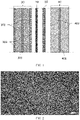
- FIG. 1 is a schematic structural diagram of an electrode assembly of an electrochemical device according to some embodiments of this application.
- the electrochemical device includes: a positive electrode 40, a negative electrode 30, a separator 10, and an adhesive layer 20.
- the negative electrode 30 includes a negative active material layer 302.
- the separator 10 is disposed between the positive electrode 40 and the negative electrode 30.
- the adhesive layer 20 is disposed between the negative active material layer 302 and the separator 10.
- the negative electrode of the electrochemical device is subjected to a lithium supplement process, and a lithium compound layer 303 is formed on the negative active material layer 302.
- the lithium compound layer 303 is disposed between the adhesive layer 20 and the negative active material layer 302.
- the lithium compound layer 303 includes at least one of lithium carbonate or lithium oxide.
- the lithium compound layer 303 is in contact with the negative active material layer 302, and the lithium compound layer 303 is in contact with the adhesive layer 20.
- the term "layer” herein is used to describe a layered structure of each functional material in the electrochemical device, for example, an adhesive layer, a negative active material layer, a positive active material layer, and a lithium compound layer.
- the layered structure may be, but without being limited to, a continuous, discontinuous, or through-hole-containing layered structure, or a layered structure formed of a plurality of particles.
- a continuous layered structure is a complete layer with no gaps in the layer; and a discontinuous layered structure is a layer containing a plurality of interspersed or segmental parts between which a fracture surface or gap exists.
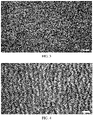
- FIG. 2 and FIG. 3 show a 50 ⁇ and 400 ⁇ , respectively, scanning electron microscopy image of a surface of a negative electrode that is not subjected to a lithium supplement process.
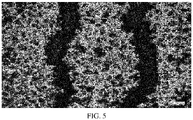
- FIG. 4 and FIG. 5 show a 50 ⁇ and 400 ⁇ , respectively, scanning electron microscopy image of a surface of a negative electrode subjected to a lithium supplement process.
- the lithium compound layer exhibits a bumpy and vertically grained morphology in comparison with the negative electrode that is not subjected to lithium supplementation.
- the negative active material layer overlaid with the lithium compound layer increases a vertical deviation value between the exposed part of the negative active material layer and the surface formed by the part overlaid with the lithium compound layer, thereby increasing roughness of a surface of the negative electrode, where the surface is oriented toward the separator.
- the porosity of the negative electrode subjected to the lithium supplement process increases, thereby further increasing the surface roughness of the negative electrode.
- the distribution, shape, and fraction of coverage of the lithium compound layer on the negative active material layer can be controlled by the setting of lithium metal in the lithium supplement process.
- lithium metal strips of fixed length and width are used in the lithium supplement process, and are interspaced at fixed intervals, so that the formed lithium compound layer is distributed in stripes on the negative active material layer.
- the shape of the lithium compound layer is planar, striped, speckled, irregular, or the like.
- the lithium compound layer is striped.
- the fraction of coverage of the lithium compound layer on the negative active material layer is greater than or equal to 30%. In other embodiments, the fraction of coverage of the lithium compound layer on the negative active material layer is approximately 40%, 50%, 60%, 70%, 80%, 90%, or 100%, for example.
- the porosity of the negative active material layer and the lithium compound layer is 10% to 60%. In other embodiments, the porosity of the negative active material layer and the lithium compound layer is approximately 10%, 15%, 20%, 30%, 40%, 50%, 60%, or a range formed by any two thereof, for example.
- the surface roughness of the negative electrode is 0.5 ⁇ m to 4.0 ⁇ m. In other embodiments, the surface roughness of the negative electrode is approximately 0.5 ⁇ m, 1.0 ⁇ m, 1.5 ⁇ m, 2.0 ⁇ m, 2.5 ⁇ m, 3.0 ⁇ m, 3.5 ⁇ m, 4.0 ⁇ m, or a range formed by any two thereof, for example.
- the contact area between the adhesive layer and the negative electrode can be further controlled, so that the polymer particles in the adhesive layer can be intercalated into the surface of the negative electrode, so as to form a "riveted” state and increase the mutual acting force.
- the thickness of the lithium compound layer is 0.01 ⁇ m to 3 ⁇ m.
- the polymer is a modified polypropylene structure polymer, and the polymer includes a main chain and a substituent.
- the main chain of the polymer is formed of at least one of the following monomers: methyl propylene, methacrylic acid, methyl methacrylate, imide, vinyl alcohol, and ethylene glycol. In some embodiments, the main chain of the polymer is formed of at least one of the following monomers: methyl propylene, imide, vinyl alcohol, and ethylene glycol.
- the substituent of the polymer includes at least one of carboxyl, hydroxyl, amino, amido, methoxyl, cyano, or ester group. In some embodiments, the substituent of the polymer includes at least one of carboxyl, hydroxyl, or amino.
- the degree of substitution of the substituent in the polymer is 0.2 to 0.8.
- a polymer with a substituent of a high electronegativity is selected.
- the higher the electronegativity the greater the intermolecular force between the polymer in the adhesive layer and a bonded interface substance, and the higher the adhesive force of the adhesive layer.
- a dielectric constant of the polymer is 5 F/m to 50 F/m to achieve a great intermolecular force on the bonded interface substance.
- a polymer formed of a specified main chain structure and a specified substituent is selected, so that the adhesive layer can be well infiltrated by the electrolytic solution to implement firm adhesion.
- ethylene carbonate Due to high electrochemical stability, ethylene carbonate can well dissolve typical lithium battery additives such as fluoroethylene carbonate (FEC), and is the most commonly used solvent system for the electrolytic solution. Therefore, a contact angle of the polymer in the adhesive layer to the ethylene carbonate can represent the degree of infiltrating the adhesive layer by the electrolytic solution.
- the contact angle of the polymer in the adhesive layer to the ethylene carbonate is 0° to 90°.
- the contact angle of the polymer to the ethylene carbonate is 10° to 50° to achieve a high degree of infiltration by the electrolytic solution.
- a polymer with a specified substituent is selected to enhance structural stability of the polymer in an alkaline solution effectively.
- the adhesive layer is still adhesive to the negative electrode and the separator after a plurality of charge-and-discharge cycles, thereby increasing the cycle life of the electrochemical device.
- the structural stability of the polymer in the adhesive layer can be represented by a weight loss rate measured in an alkali resistance test. A higher weight loss rate represents a greater extent of peeling the substituent of the polymer from the adhesive layer, and represents a lower adhesive force and a lower structural stability of the adhesive layer.
- the weight loss rate of the polymer after being soaked in the1 mol/L sodium hydroxide solution for 0.5 hour is less than 20%. In other embodiments, the weight loss rate of the polymer after being soaked in the 1 mol/L sodium hydroxide solution for 0.5 hour is less than or equal to 10%.
- the adhesive force of the adhesive layer to the lithium compound layer or the separator of the negative electrode can be greater than or equal to 10 N/m. In other embodiments, the adhesive force of the adhesive layer to the lithium compound layer or the separator of the negative electrode is 15 N/m. In other embodiments, the adhesive force of the adhesive layer to the lithium compound layer or the separator of the negative electrode is 20 N/m.
- the polymer is particles, and the particle size of the polymer is 0.01 ⁇ m to 20 ⁇ m. In other embodiments, the particle size of the polymer is approximately 0.01 ⁇ m, 0.05 ⁇ m, 0.1 ⁇ m, 0.5 ⁇ m, 1.0 ⁇ m, 5.0 ⁇ m, 10.0 ⁇ m, 20.0 ⁇ m, or a range formed by any two thereof, for example.
- a number-average molecular weight of the polymer is 1 kDa to 1000 kDa. In other embodiments, the number-average molecular weight of the polymer is approximately 1 kDa, 10 kDa, 100 kDa, 200 kDa, 400 kDa, 600 kDa, 800 kDa, 1000 kDa, or a range formed by any two thereof, for example.
- the adhesive layer further includes inorganic particles.
- the inorganic particles include at least one of SrTiO 3 , SnO 2 , CeO 2 , MgO, NiO, CaO, ZnO, ZrO 2 , Y 2 O 3 , Al 2 O 3 , TiO 2 , Al(OH) 3 , Mg(OH) 2 , SiC, or boehmite.
- the mechanical strength of the adhesive layer can be increased by adding the inorganic particles into the adhesive layer. When the electrode assembly is overheated or thermal runaway during charge-and-discharge cycles, the adhesive layer of high mechanical strength can suppress safety accidents (such as short circuit and rupture) of the separator caused by thermal shrinkage.
- a weight percent of inorganic particles is less than or equal to 50 wt%. In other embodiments, based on the total weight of the adhesive layer, the weight percent of inorganic particles is less than or equal to 30 wt%.
- the thickness of the adhesive layer is 0.1 ⁇ m to 10 ⁇ m. In other embodiments, the thickness of the adhesive layer is approximately 0.1 ⁇ m, 0.5 ⁇ m, 1 ⁇ m, 1.5 ⁇ m, 2 ⁇ m, 3 ⁇ m, 4 ⁇ m, 5 ⁇ m, 10 ⁇ m, or a range formed by any two thereof, for example.
- the porosity of the adhesive layer is 20% to 80%. In other embodiments, the porosity of the adhesive layer is approximately 20%, 30%, 40%, 50%, 60%, 70%, 80%, or a range formed by any two thereof, for example.
- the thickness and the porosity range of the adhesive layer that are set according to this embodiment of this application ensure a sufficient contact area of the bonded interface, so as to ensure a sufficient adhesive force and prevent the adhesive layer from blocking the ion channel of the separator or the negative electrode, and in turn, maintain an appropriate ionic conductivity.
- the electrochemical device is a lithium-ion battery.
- the positive electrode 40 includes a positive current collector 401
- the negative electrode 30 includes a negative current collector 301.
- the positive current collector 401 may be an aluminum foil or a nickel foil
- the negative current collector 301 may be a copper foil or a nickel foil.
- other positive current collectors and negative current collectors commonly used in the art may be used instead without limitation.
- the negative electrode 30 includes a negative active material layer 302.
- the negative active material layer 302 includes a negative active material.
- the negative active material includes at least one of: artificial graphite, natural graphite, mesocarbon microbead, hard carbon, soft carbon, lithium titanium oxide, single crystal silicon, amorphous silicon, a silicon-oxygen composite, or a silicon-carbon composite.
- the negative active material layer further includes a negative active material of a high energy density
- examples of the negative active material include, but are not limited to, at least one of a simple substance, alloy, or compound of silicon, tin, germanium, antimony, bismuth, and aluminum.
- the negative active material includes at least one of silicon, a silicon-oxygen composite, or a silicon-carbon composite.
- the positive electrode 40 includes a positive active material layer 402.
- the positive active material layer 402 includes a positive active material capable of absorbing and releasing lithium (Li) (hereinafter sometimes referred to as "positive active material capable of absorbing/releasing lithium Li").
- positive active material capable of absorbing/releasing lithium (Li) may include one or more of lithium cobalt oxide, lithium nickel cobalt manganese oxide, lithium nickel cobalt aluminum oxide, lithium manganese oxide, lithium iron manganese phosphate, lithium vanadium phosphate, lithium vanadyl phosphate, lithium iron phosphate, lithium titanium oxide, and a lithium-rich manganese-based materials.
- the chemical formula of the lithium cobalt oxide may be Li y Co a M1 b O2 -c , where the element M1 is selected from at least one of nickel (Ni), manganese (Mn), magnesium (Mg), aluminum (Al), boron (B), titanium (Ti), vanadium (V), chromium (Cr), iron (Fe), copper (Cu), zinc (Zn), molybdenum (Mo), tin (Sn), calcium (Ca), strontium (Sr), tungsten (W), yttrium (Y), lanthanum (La), zirconium (Zr), and silicon (Si), and values of y, a, b, and c are in the following ranges: 0.8 ⁇ y ⁇ 1.2, 0.8 ⁇ a ⁇ 1,0 ⁇ b ⁇ 0.2, -0.1 ⁇ c ⁇ 0.2, respectively.
- the chemical formula of the lithium nickel cobalt manganese oxide or the lithium nickel cobalt aluminum oxide may be Li z Ni d M2 e O 2-f , where the element M2 is selected from at least one of cobalt (Co), manganese (Mn), magnesium (Mg), aluminum (Al), boron (B), titanium (Ti), vanadium (V), chromium (Cr), iron (Fe), copper (Cu), zinc (Zn), molybdenum (Mo), tin (Sn), calcium (Ca), strontium (Sr), tungsten (W), Yttrium (Y), Lanthanum (La), zirconium (Zr), or silicon (Si), and values of z, d, e, and f fall in the following ranges: 0.8 ⁇ z ⁇ 1.2, 0.3 ⁇ d ⁇ 0.98, 0.02 ⁇ e ⁇ 0.7, -0.1 ⁇ f ⁇ 0.2, respectively.
- the chemical formula of lithium manganese oxide is Li u Mn 2-g M3 g O 4-h , where the element M3 is selected from at least one of cobalt (Co), nickel (Ni), magnesium (Mg), aluminum (Al), boron (B), titanium (Ti), vanadium (V), chromium (Cr), iron (Fe), copper (Cu), zinc (Zn), molybdenum (Mo), tin (Sn), calcium (Ca), strontium (Sr), and tungsten (W), and values of z, g, and h are in the following ranges: 0.8 ⁇ u ⁇ 1.2, 0 ⁇ g ⁇ 1.0, and -0.2 ⁇ h ⁇ 0.2, respectively.
- the positive active material layer and the negative active material layer each can independently further include at least one of a binder or a conductive agent.
- the binder includes at least one of polyvinylidene fluoride, poly(vinylidene fluoride-co-hexafluoropropylene), polyamide, polyacrylonitrile, polyacrylate, polyacrylic acid, sodium polyacrylate, sodium carboxymethyl cellulose, polyvinylpyrrolidone, polyvinyl ether, poly methyl methacrylate, polytetrafluoroethylene, polyhexafluoropropylene, or styrene butadiene rubber.
- the conductive agent includes at least one of carbon nanotubes, carbon fibers, conductive carbon black, acetylene black, graphene, or Ketjen black. Understandably, a person skilled in the art may select a conventional binder and a conventional conductive agent according actual requirements without limitation.
- the lithium compound layer includes neither a binder nor a conductive agent.
- the separator includes, but is not limited to, at least one of polyethylene, polypropylene, polyethylene terephthalate, polyimide, and aramid.
- the polyethylene includes a component selected from at least one of highdensity polyethylene, low-density polyethylene, and ultra-high-molecular-weight polyethylene.
- the separator is polypropylene.
- the polypropylene is of high affinity with the polymer described in the foregoing embodiment, and helps to increase the adhesive force between the adhesive layer and the separator.
- the lithium-ion battery according to this application further includes an electrolyte.
- the electrolyte may be one or more of a gel electrolyte, a solid-state electrolyte, and an electrolytic solution.
- the electrolytic solution includes a lithium salt and a nonaqueous solvent.
- the lithium salt is at least one selected from LiPF 6 , LiBF 4 , LiAsF 6 , LiClO 4 , LiB(C 6 H 5 ) 4 , LiCH 3 SO 3 , LiCF 3 SO 3 , LiN(SO 2 CF 3 ) 2 , LiC(SO 2 CF 3 ) 3 , LiSiF6, LiBOB, and lithium difluoroborate.
- the lithium salt is LiPF6 because it provides a high ionic conductivity and improves cycle characteristics.
- the nonaqueous solvent may be a carbonate compound, a carboxylate compound, an ether compound, another organic solvent, or any combination thereof.
- the carbonate compound may be a chain carbonate compound, a cyclic carbonate compound, a fluorocarbonate compound, or any combination thereof.
- Examples of the other organic solvent are dimethyl sulfoxide, 1,2-dioxolane, sulfolane, methyl sulfolane, 1,3-dimethyl-2-imidazolidinone, N-methyl-2-pyrrolidone, formamide, dimethylformamide, acetonitrile, trimethyl phosphate, triethyl phosphate, trioctyl phosphate, phosphate ester, and any combination thereof.
- the nonaqueous solvent is selected from groups that each include ethylene carbonate, propylene carbonate, diethyl carbonate, dimethyl carbonate, ethyl methyl carbonate, propylene carbonate, methyl acetate, ethyl propionate, fluoroethylene carbonate, and any combination thereof.
- the method for preparing the positive electrode, the negative electrode, the separator, and the electrolyte in this embodiment of this application may be, but without being limited to, any appropriate conventional method in the art according to specific requirements to the extent of not departing from the spirit of this application.
- the method for preparing a lithium-ion battery according to this application includes the following steps:
- Preparing an adhesive layer Adding a polymer, an antioxidant (412S, by Tianjin Rianlon Corporation), an emulsifier (N-dodecyl dimethylamine) into a multiagitator high-speed dispersing reactor at a weight percent of 99%, 0.5%, and 0.5% respectively. Controlling the reaction temperature to be 80 °C to 160 °C. Vacuumizing until a pressure of -0.8 MPa to -0.5 MPa. Keeping reacting for 4 hours, and performing filtering to obtain a polymer slurry. Mixing the polymer slurry with the inorganic particles to form an adhesive layer slurry. Coating the separator with the adhesive layer slurry, and performing a drying process to obtain a separator overlaid with an adhesive layer.
- an antioxidant 412S, by Tianjin Rianlon Corporation
- an emulsifier N-dodecyl dimethylamine
- Lithium supplement process for the negative electrode Drying the negative electrode at a temperature of 85 °C for 24 hours in a drying room, and controlling the moisture content to be less than 300 ppm. Roll-compacting the lithium metal foil until it is several micrometers in thickness, and then compounding the lithium metal foil with the surface of the negative active material layer, and roll-compacting the compounded surface to form a lithium-supplemented negative electrode.
- Assembling a lithium-ion battery Arranging the positive electrode, the separator (the side coated with the adhesive layer is oriented toward the negative electrode), and the lithium-supplemented negative electrode in sequence; winding, folding, or stacking them to form an electrode assembly; putting the electrode assembly into a packaging bag, injecting an electrolytic solution, and then performing steps such as vacuum sealing, standing, formation, and shaping to obtain a lithium-ion battery.
- the electrochemical device is a lithium secondary battery, including a lithium metal secondary battery, a lithium-ion secondary battery, a lithium polymer secondary battery, or a lithium-ion polymer secondary battery.
- Some embodiments of this application further provide an electronic device.
- the electronic device includes the electrochemical device according to embodiments of this application.
- the electronic device is not particularly limited, and may be any electronic device known in the prior art.
- the electronic device may include, but is not limited to, a notebook computer, a pen-inputting computer, a mobile computer, an e-book player, a portable phone, a portable fax machine, a portable photocopier, a portable printer, a stereo headset, a video recorder, a liquid crystal display television set, a handheld cleaner, a portable CD player, a mini CD-ROM, a transceiver, an electronic notepad, a calculator, a memory card, a portable voice recorder, a radio, a backup power supply, a motor, a car, a motorcycle, a power-assisted bicycle, a bicycle, a lighting appliance, a toy, a game console, a watch, a power tool, a flashlight, a camera, a large household battery, a lithium-ion capacitor, and the like.
- Disassembling a chemically formed lithium-ion battery and a 400 th -cycle-completed lithium-ion battery in a dry room environment by separating a positive electrode from a separator of the batteries. Leaving the batteries to stand for 5 minutes until an electrolytic solution of the batteries is evaporated to dryness. Cutting out a 150 mm ⁇ 20 mm sample of a stacked structure of the negative electrode, the adhesive layer, and the separator. Testing the interfacial adhesive force of the sample by pulling the sample at a tensile speed of 50 mm/min at a peel angle of 180° for a tensile displacement of 50 mm using a GoTech tensile strength testing machine (AL-3000). Testing the lithium-ion batteries in groups, with each group containing 4 batteries. Calculating an average of the adhesive forces between the negative electrode and the separator of the lithium-ion batteries.
- Cycle thickness expansion rate of a lithium-ion battery (thickness of the 800 th -cycle lithium-ion battery/thickness of a chemically formed lithium-ion battery - 1) ⁇ 100%.
- a copper foil as a negative current collector coating the negative electrode slurry onto the negative current collector; and performing steps of drying, cold pressing, and cutting to obtain a negative electrode.
- the preparation method is the same as that in Comparative Embodiment 1 except that Comparative Embodiment 2 uses a bare separator made of polyethylene (without an adhesive layer).
- the preparation method is the same as that in Comparative Embodiment 1 except: in Embodiment 1, the negative electrode is further subjected to a lithium supplement process: a layer of lithium metal foil is disposed on the surface of the negative active material layer of the negative electrode to form a 0.04 ⁇ m-thick lithium compound layer, in which the fraction of coverage of the lithium compound layer on the negative active material layer is 80%. Subsequently, the positive electrode, the separator, the adhesive layer, and the negative electrode are arranged in sequence, and assembled to obtain a lithium-ion battery.
- the preparation method is the same as that in Embodiment 1 except: in Embodiments 2 to 6, the polyvinylidene difluoride aqueous emulsion is replaced by a polymer aqueous emulsion formed by a polymer (modified polypropylene polymer) made from spherical particles; of the polymer, the monomer of the main chain is propylene, the substituent is carboxyl, the degree of substitution is 0.65, the molecular weight is 30000, and the particle size is 1.1 ⁇ m; and the thickness of the adhesive layer is changed, as detailed in Table 1.
- the preparation method is the same as that in Embodiment 4 except: in Embodiments 7 to 12, the thickness of the lithium compound layer is changed, as detailed in Table 1.
- the preparation method is the same as that in Embodiment 4 except: in Embodiments 13 to 18, the surface roughness of the negative electrode is changed, as detailed in Table 1.
- the preparation method is the same as that in Embodiment 4 except: in Embodiments 19 to 21, the fraction of coverage of the lithium compound layer is changed, as detailed in Table 1.
- the preparation method is the same as that in Embodiment 4 except: in Embodiments 22 to 26, the porosity of the negative active material layer and the lithium compound layer is changed, as detailed in Table 1.
- the thickness, width, length, and weight of fresh lithium-ion batteries in the foregoing embodiments and comparative embodiments are measured. Subsequently, a part of the fresh lithium-ion batteries are disassembled to measure the surface roughness and thickness of the lithium compound layer of the batteries. The remaining part of the lithium-ion batteries are subjected to a capacity test, an adhesive force test, a cycle thickness expansion rate test, and a cycle performance test, and the test results are recorded.
- Table 1 shows statistical values of the negative electrodes and the functional layers of the negative electrode described in Embodiments 1 to 26 and Comparative Embodiments 1 to 2.
- Table 1 Embodiment/ Comparative Embodiment Material of adhesive layer Surface roughness of negative electrode ( ⁇ m) Fraction of coverage of lithium compound layer Porosity of negative active material layer and lithium compound layer Subjected to lithium supplement process?
- Table 2 shows test results of the adhesive force test, capacity test, and cycle thickness expansion rate test of the lithium-ion batteries described in Embodiments 1 to 21 and Comparative Embodiments 1 and 2.
- Table 2 Embodiment/ Comparative Embodiment Adhesive force of adhesive layer (N/m) Volumetric energy density (wh/L) Cycle thickness expansion rate Comparative Embodiment 1 10.0 698.2 8.0% Comparative Embodiment 2 0 713.3 11.1% Embodiment 1 0.4 778.2 16.2% Embodiment 2 5.6 806.5 7.8% Embodiment 3 11.2 803.5 6.6% Embodiment 4 16.1 792.9 5.5% Embodiment 5 21.3 771.1 4.6% Embodiment 6 23.1 740.5 3.9% Embodiment 7 18.3 731.1 5.1% Embodiment 8 16.7 761.9 5.4% Embodiment 9 15.1 799.8 5.9% Embodiment 10 13.8 805.9 6.3% Embodiment 11 11.2 819.7 7.8% Embodiment
- Table 3 shows test results of the adhesive force test, capacity test, cycle thickness expansion rate test, and cycle performance test of the lithium-ion batteries described in Embodiments 22 to 26 and Comparative Embodiments 1 and 2.
- Table 3 Embodiment/ Comparative Embodiment Adhesive force of adhesive layer (N/m) Volumetric energy density (wh/L) Cycle thickness expansion rate Number of cycles when capacity attenuates to 80% Comparative Embodiment 1 10.0 698.2 8.0% 653
- Comparative Embodiment 2 0 713.3 11.1% 301 Embodiment 22 15.8 792.8 5.9% 672 Embodiment 23 16.4 793.5 5.5% 706 Embodiment 24 16.0 792.3 5.4% 721 Embodiment 25 16.3 792.7 5.5% 753 Embodiment 26 16.1 793.7 5.5% 755
- an adhesive layer containing the polymer specified in this application is disposed, and can effectively increase the adhesive force of the adhesive layer to the lithium compound layer, thereby reducing the cycle thickness expansion rate of the lithium-ion batteries while maintaining a given volumetric energy density.
- the polymer of the adhesive layer in Embodiment 4 of this application is a modified polypropylene polymer, and can effectively increase the adhesive force between the separator and the negative electrode subjected to the lithium supplement process.
- the lithium-ion battery subjected to the lithium supplement process achieves a higher volumetric energy density, thereby improving the cycle performance, electrochemical performance, and safety performance of the electrochemical devices described in Embodiments 2 to 26.
- the greater the thickness of the adhesive layer of the lithium-ion battery the higher the adhesive force of the adhesive layer to the lithium metal layer and the separator.
- the higher thickness of the adhesive layer further reduces the volumetric energy density of the lithium-ion battery.
- the greater the thickness of the lithium compound layer of the lithium-ion battery the higher the volumetric energy density of the lithium-ion battery.
- the greater thickness of the lithium compound layer further reduces the adhesive force of the adhesive layer to the lithium compound layer.
- the increased porosity of the negative active material layer and the lithium compound layer can improve the cycle performance of the lithium-ion battery.
- the porosity of the negative active material layer and the lithium compound layer exceeds 60%, the improvement of the cycle performance of the lithium-ion battery is not evident.
- an excessive porosity may impair the structural stability of the lithium-ion battery.
- the electrochemical device according to this application can effectively improve the energy density, and form a lithium compound layer on the negative electrode.
- the adhesive layer disposed between the lithium compound layer and the separator increases the adhesive force between the negative electrode and the separator, thereby reducing the cycle thickness expansion rate and deformation of the electrochemical device while maintaining a high energy density.
- this application can further ensure an appropriate adhesive force of the adhesive layer between the negative electrode and the separator, thereby improving the safety performance and cycle performance of the electrochemical device significantly.
- references to “embodiments”, “some embodiments”, “an embodiment”, “another example”, “example”, “specific example” or “some examples” throughout the specification mean that at least one embodiment or example in this application includes specific features, structures, materials, or characteristics described in the embodiment(s) or example(s). Therefore, descriptions throughout the specification, which make references by using expressions such as “in some embodiments”, “in an embodiment”, “in one embodiment”, “in another example”, “in an example”, “in a specific example”, or “example”, do not necessarily refer to the same embodiment or example in this application.
- specific features, structures, materials, or characteristics herein may be combined in one or more embodiments or examples in any appropriate manner.
Landscapes
- Chemical & Material Sciences (AREA)
- Chemical Kinetics & Catalysis (AREA)
- Electrochemistry (AREA)
- General Chemical & Material Sciences (AREA)
- Engineering & Computer Science (AREA)
- Materials Engineering (AREA)
- Manufacturing & Machinery (AREA)
- Inorganic Chemistry (AREA)
- Battery Electrode And Active Subsutance (AREA)
- Secondary Cells (AREA)
- Cell Separators (AREA)
Abstract
Description
- This application relates to the technical field of energy storage, and in particular, to an electrochemical device and an electronic device containing the electrochemical device.
- With rapid development of mobile electronic technologies, people are using a mobile electronic device such as a mobile phone, a tablet computer, a notebook computer, and an unmanned aerial vehicle more often and people's experience requirements are increasingly higher. Therefore, an electrochemical device (such as a lithium-ion battery) that provides energy for the electronic device needs to provide a higher energy density, a higher C-rate, higher safety, and less fading of capacity that occurs after repeated charge and discharge processes.
- The energy density and cycle performance of the electrochemical device are closely related to a positive active material and a negative active material. In view of this, people keep researching and improving the negative active material in pursuit of a negative active material of a higher energy density. However, negative active materials of a higher energy density (such as a silicon-based material) are generally not compatible with existing electrode assembly structures and give rise to problems such as an insufficient electrical conductivity, an excessive expansion rate under heat, and insufficient processing performance. Therefore, currently, it is an urgent research topic to improve and optimize an electrode assembly structure (for example, a negative electrode, a separator, and a positive electrode) of the electrochemical device that uses a material of a higher energy density as a negative active material.
- This application provides an electrochemical device and an electronic device that includes the electrochemical device in an attempt to solve at least one problem in the related art to at least some extent.
- According to an aspect of this application, this application provides an electrochemical device, including: a positive electrode, a negative electrode, a separator, an adhesive layer, and a lithium compound layer. The negative electrode includes a negative active material layer. The separator is disposed between the positive electrode and the negative electrode. The adhesive layer is disposed between the negative active material layer and the separator. The lithium compound layer is disposed between the adhesive layer and the negative active material layer. The lithium compound layer includes at least one of lithium carbonate or lithium oxide.
- According and another aspect of this application, this application provides an electronic device. The electronic device includes the electrochemical device.
- After undergoing a lithium supplement process, the electrochemical device according to this application further includes a lithium compound layer formed on the surface of the negative active material layer. The adhesive layer disposed between the lithium compound layer and the separator effectively enhances an adhesive force between the negative electrode and the separator. After the electrochemical device undergoes a plurality of charge-and-discharge cycles, a sufficient adhesive force is still maintained between the negative electrode and the separator, thereby improving the cycle performance and safety performance of the electrochemical device.
- Additional aspects and advantages of the embodiments of this application will be partly described or illustrated later herein or expounded through implementation of the embodiments of this application.
- For ease of describing the embodiments of this application, the following outlines the drawings needed for describing the embodiments of this application or the prior art. Evidently, the drawings outlined below are merely a part of embodiments in this application. Without making any creative efforts, a person skilled in the art can still derive the drawings of other embodiments according to the structures illustrated in these drawings.
-
FIG. 1 is a schematic structural diagram of an electrode assembly of an electrochemical device according to some embodiments of this application; -
FIG. 2 shows a 50× scanning electron microscopy image of a surface of a negative electrode that is not subjected to a lithium supplement process; -
FIG. 3 shows a 400× scanning electron microscopy image of a surface of a negative electrode that is not subjected to a lithium supplement process; -
FIG. 4 shows a 50× scanning electron microscopy image of a surface of a negative electrode subjected to a lithium supplement process; and -
FIG. 5 shows a 400× scanning electron microscopy image of a surface of a negative electrode subjected to a lithium supplement process. - Embodiments of this application will be described in detail below. Throughout the specification of this application, the same or similar components and the components having the same or similar functions are denoted by similar reference numerals. The embodiments described herein with reference to the drawings are illustrative and graphical in nature, and are intended to enable a basic understanding of this application. The embodiments of this application are not to be construed as a limitation on this application.
- In this specification, unless otherwise specified or defined, relativity terms such as "central", "longitudinal", "lateral", "front", "rear", "right" "," "left", "internal", "external", "lower", "higher", "horizontal", "perpendicular", "higher than", "lower than", "above", "under", "top", "bottom", and derivative terms thereof (such as "horizontally", "downwardly", "upwardly") shall be interpreted as a direction described in the context or a direction illustrated in the drawings. Such relative terms are merely used for ease of description, but not intended to require a construction or operation in this application to be performed in a given direction.
- In addition, a quantity, a ratio, or another numerical value herein is sometimes expressed in the format of a range. Understandably, such a range format is for convenience and brevity, and shall be flexibly understood to include not only the numerical values explicitly specified and defined in the range, but also all individual numerical values or sub-ranges covered in the range as if each individual numerical value and each sub-range were explicitly specified.
- In the embodiments and claims, a list of items referred to by using the terms such as "at least one of", "at least one thereof", "at least one type of" or other similar terms may mean any combination of the listed items. For example, if items A and B are listed, the phrases "at least one of A and B" and "at least one of A or B" mean: A alone; B alone; or both A and B. In another example, if items A, B, and C are listed, the phrases "at least one of A, B, and C" and "at least one of A, B, or C" mean: A alone; B alone; C alone; A and B (excluding C); A and C (excluding B); B and C (excluding A); or all of A, B, and C. The item A may include a single element or a plurality of elements. The item B may include a single element or a plurality of elements. The item C may include a single element or a plurality of elements.
- Unless otherwise expressly specified, the following terms used herein have the meanings defined below.
- The term "Cx" represents carbon atoms that are x in number. For example, a C1 to C10 alkyl is an alkyl group containing 1 to 10 carbon atoms.
- The term "hydrocarbyl" covers an alkyl, alkenyl, alkynyl, cycloalkyl, and aryl. For example, a hydrocarbyl is intended to be a linear hydrocarbon structure containing 1 to 20 carbon atoms. "Hydrocarbyl" is also intended to be a branched or cyclic hydrocarbon structure containing 3 to 20 carbon atoms. A hydrocarbyl containing a specified quantity of carbon atoms is intended to cover all geometric isomers that each contain such quantity of carbon atoms. Further, the hydrocarbyl herein may be a C1 to C15 hydrocarbyl, a C1 to C10 hydrocarbyl, a C1 to C5 hydrocarbyl, a C5 to C20 hydrocarbyl, a C5 to C15 hydrocarbyl, or a C5 to C10 hydrocarbyl. In addition, the hydrocarbyl may be optionally substituted. For example, the hydrocarbyl may be substituted by halogen including fluorine, chlorine, bromine, and iodine, or by alkyl, aryl, or heteroaryl.
- The term "hydroxyl" means an -OH group.
- The term "amino" means a base formed of one nitrogen atom and two hydrogen atoms, and represents an -NH2 group.
- The term "carboxyl" is a functional group of carboxylic acid, and represents a -C(O)-OH group.
- The term "hydrocarbyloxyl" means an L-O- group, in which L is alkyl, alkenyl, alkynyl, cycloalkyl, or aryl. For example, when the L group is an alkyl, "hydrocarbyloxyl" may be referred to as "alkoxyl"; and, when the L group is a methyl, "hydrocarbyloxyl" may be referred to as "methoxyl". Further, the hydrocarbyloxyl herein may be a C1 to C20 hydrocarbyloxyl, a C1 to C15 hydrocarbyloxyl, a C1 to C10 hydrocarbyloxyl, a C1 to C5 hydrocarbyloxyl, a C5 to C20 hydrocarbyloxyl, a C5 to C15 hydrocarbyloxyl, or a C5 to C10 hydrocarbyloxyl.
- The term "ester group" is a functional group of ester in a carboxylic acid derivative, and represents a -C(O)-O-R group, in which R covers an alkyl, alkenyl, alkynyl, cycloalkyl, and aryl. For example, the ester group is intended to be a linear, branched, or cyclic structure containing 1 to 200 carbon atoms. Further, the "ester group" is intended to be a C2 to C10 ester group. An ester group containing a specified quantity of carbon atoms is intended to cover all geometric isomers that each contain such quantity of carbon atoms. Further, the ester group herein may be a C1 to C15 ester group, a C1 to C10 ester group, a C1 to C5 ester group, a C5 to C20 ester group, a C5 to C15 ester group, or a C5 to C10 ester group.
- The term "alkyl" is intended to be a linear saturated hydrocarbon structure containing 1 to 20 carbon atoms. "Alkyl" is also intended to be a branched or cyclic hydrocarbon structure possessing 3 to 20 carbon atoms. For example, the alkyl may be a C1 to C20 alkyl, a C1 to C10 alkyl, a C1 to C5 alkyl, a C5 to C20 alkyl, a C5 to C15 alkyl, or a C5 to C10 alkyl. An alkyl containing a specified quantity of carbon atoms is intended to cover all geometric isomers containing the specified quantity of carbon atoms. Therefore, for example, "butyl" is intended to include n-butyl, sec-butyl, isobutyl, tert-butyl, and cyclobutyl; and "propyl" includes n-propyl, isopropyl, and cyclopropyl. Examples of alkyl include, but are not limited to, methyl, ethyl, n-propyl, isopropyl, cyclopropyl, n-butyl, isobutyl, sec-butyl, tert-butyl, cyclobutyl, n-pentyl, isopentyl, neopentyl, cyclopentyl, methylcyclopentyl, ethylcyclopentyl, n-hexyl, isohexyl, cyclohexyl, n-heptyl, octyl, cyclopropyl, cyclobutyl, norbornyl, and the like. In addition, the alkyl may be optionally substituted.
- The term "alkenyl" means a linear or branched monovalent unsaturated hydrocarbon group containing at least one carbon-carbon double bond, and typically, 1, 2, or 3 carbon-carbon double bonds. Unless otherwise defined, an alkenyl typically contains 2 to 20 carbon atoms, and may be, for example, a C2 to C20 alkenyl, a C6 to C20 alkenyl, a C2 to C12 alkenyl, or a C2 to C6 alkenyl. Representative alkenyls include, for example, vinyl, n-propenyl, isopropenyl, n-but-2-enyl, but-3-enyl, n-hex-3-enyl, and the like. In addition, the alkenyl may be optionally substituted.
- The term "alkynyl" means a linear or branched monovalent unsaturated hydrocarbon group containing at least one carbon-carbon triple bond, and typically, 1, 2, or 3 carbon-carbon triple bonds. Unless otherwise defined, an alkynyl typically contains 2 to 20 carbon atoms, and may be, for example, a C2 to C20 alkynyl, a C6 to C20 alkynyl, a C2 to C10 alkynyl, or a C2 to C6 alkynyl. Representative alkynyls include, for example, ethynyl, prop-2-ynyl (n-propynyl), n-but-2-ynyl, n-hex-3-ynyl, and the like. In addition, the alkynyl may be optionally substituted.
- The term "acyl" means an atomic group that remains after the hydroxyl (-OH group) is removed from organic or inorganic oxoacid, and represents an R-M(O)-group, in which M is a carbon atom, R is an alkyl, alkenyl, alkynyl, cycloalkyl, aryl or another commonly seen substituent. For example, when R is amino, "acyl" is "amido".
- The term "aryl" covers a monocyclic system and a polycyclic system. "Polycyclic" means two or more rings, in which two adjacent rings (the rings are "condensed") share two carbon atoms. Among the rings, at least one ring is aromatic, and other rings may be, for example, a cycloalkyl, cycloalkenyl, aryl, or a heterocyclic and/or heteroaryl. For example, the aryl may be a C6 to C50 aryl, a C6 to C40 aryl, a C6 to C30 aryl, a C6 to C20 aryl, or a C6 to C10 aryl. Representative aryls include (for example), phenyl, methylphenyl, propylphenyl, isopropylphenyl, benzyl, naphth-1-yl, naphth-2-yl, and the like. In addition, the aryl may be optionally substituted.
- The term "heterocyclyl" covers aromatic and non-aromatic cyclic groups. A heteroaromatic cyclic group also means an aromatic hetero group. In some embodiments, a heteroaromatic cyclic group and a hetero-non-aromatic cyclic group are a C1 to C50 heterocyclyl, C1 to C40 heterocyclyl, C1 to C30 heterocyclyl, C1 to C20 heterocyclyl, C1 to C10 heterocyclyl, or C1 to C6 heterocyclyl, which, in each case, contains at least one heteroatom. Representative heterocyclyls include, for example, morpholinyl, piperidinyl, pyrrolidinyl, and the like, as well as cyclic ethers, such as tetrahydrofuran, tetrahydropyran, and the like. In addition, the heterocyclyl may be optionally substituted.
- The term "heteroaryl" covers monocyclic heteroaromatic groups that each may contain one to three heteroatoms, for example, pyrrole, furan, thiophene, imidazole, oxazole, thiazole, triazole, pyrazole, pyridine, pyrazine, and pyrimidine. The term "heteroaryl" further includes a polycyclic heteroaromatic system containing two or more rings, in which two adjacent rings (the rings are "condensed") share two carbon atoms. Among the rings, at least one ring is a heteroaryl, and other rings may be a cycloalkyl, cycloalkenyl, aryl, or a heterocyclic and/or heteroaryl. For example, the heteroaryl may be a C6 to C50 heteroaryl, a C6 to C40 heteroaryl, a C6 to C30 heteroaryl, a C6 to C20 heteroaryl, or a C6 to C10 heteroaryl. In addition, the heteroaryl may be optionally substituted.
- The term "halogen" herein may be F, Cl, Br, or I.
- The term "cyano" herein covers an organic functional group that contains - CN.
- The term "fraction of coverage" herein means the degree of coverage of a coating layer on a surface of a coated object. For example, a fraction of coverage being 100% means that the coating layer covers the full area of the surface of the coated object. The fraction of coverage being 40% means that the coating layer covers just 40% of the area of the surface of the coated object, but exposes the remaining 60% of the area of the surface of the coated object.
- The term "degree of substitution" means an average number of groups substituted by the substituent in a single monomer on the main chain of the polymer. For example, the degree of substitution being 0.5 means that averagely 0.5 substituent group exists in a single monomer of the polymer.
- The term "particle size" herein is represented by Dv50 that is obtained in a laser particle size test and that denotes particle characteristics of a sample material. Dv50 is a particle diameter of the sample material measured when the cumulative volume percentage of the measured particles calculated from a small-diameter side reaches 50% of the total volume of the sample particles in a volume-based particle size distribution.
- In the field of electrochemical devices, in order to pursue a higher energy density, attempts have been made to replace graphite in the conventional negative active material with a negative active material of a higher energy density. However, in applying such a negative active material of a higher energy density, the negative active material needs to be further processed due to different material properties. For example, silicon-based materials are mainstream negative active materials to be developed in the future for electrochemical devices (such as a lithium-ion battery) with a higher volumetric energy density by virtue of a theoretical gram capacity as high as 4200 mAh/g. However, a first-cycle Coulombic efficiency of the silicon-based materials is low, bottlenecking further increase of the volumetric energy density of the lithium-ion battery. Therefore, the first-cycle Coulombic efficiency of the silicon-based materials needs to be improved by a lithium supplement process, so that the volumetric energy density of the lithium-ion battery can be increased effectively. The lithium supplement process is a method for supplementing the negative active material with lithium to increase the energy density. For example, a relatively mature lithium supplement process is to compound a given amount of lithium metal with the surface of the negative active material layer and roll-compact the surface. After an electrolytic solution is injected into the lithium-ion battery, the metal lithium can quickly react with the negative active material and be intercalated in the negative active material, thereby improving the first-cycle Coulombic efficiency of the negative active material.
- Such a negative active material of a higher energy density incurs a huge volume change effect (for example, by more than 300%) in lithiation and delithiation processes. Severe expansion of a negative electrode may cause deformation of an interface between the negative electrode and the separator or even cause detachment of the separator, thereby deteriorating cycle performance of the lithium-ion battery. In addition, limited by the preparation process for the negative electrode subjected to the lithium supplement process, lithium metal is prone to side reaction with moisture and oxygen in the air to form a lithium compound layer on the surface of the negative active material layer. The adhesive force between the lithium compound layer and the conventional coating on the surface of the separator is very weak (for example, less than 1 N/m), resulting in weak bonding or no bonding between the negative electrode and the separator. Therefore, if weak bonding or no bonding exists between the coating of the separator and the surface of a silicon negative electrode, the excessive volume expansion during the charge-and-discharge cycles will not only cause deformation of the electrode assembly to deteriorate the cycle performance, but also be prone to disrupt the structure of the lithium-ion battery and severely impair the safety performance of lithium-ion batteries.
- With a view to mitigating the expansion of the negative electrode, this application studies how to suppress the expansion of the negative electrode during charging by increasing interfacial adhesion between the separator and the negative electrode. In this application, an adhesive layer is disposed between the negative electrode and the separator, and the adhesive force of the adhesive layer to the lithium compound layer is increased by controlling the lithium compound layer generated by the lithium supplement process, thereby effectively increasing the adhesive force of the separator to the negative electrode, reducing the volume expansion rate of the negative electrode during the charge-and-discharge cycles, and helping to alleviate the deformation of the electrode assembly. In this application, the adhesive layer is applicable to an electrochemical device that adopt a negative active material of a higher energy density, so as to improve the cycle stability and safety of the electrochemical device. In addition, due to suppression of expansion and deformation, the interface between the negative electrode and the separator is steadier, thereby increasing the cycle capacity retention rate.
- According to an aspect of this application, an embodiment of this application provides an adhesive layer disposed between the negative electrode and the separator. The adhesive layer exerts a sufficient adhesive force on a lithium compound layer in a negative electrode subjected to lithium supplementation. Therefore, the electrochemical device can ensure relatively high cycle performance and safety performance by adding the adhesive layer between the lithium compound layer and the separator.
-
FIG. 1 is a schematic structural diagram of an electrode assembly of an electrochemical device according to some embodiments of this application. - As shown in
FIG. 1 , the electrochemical device according to this application includes: apositive electrode 40, anegative electrode 30, aseparator 10, and anadhesive layer 20. Thenegative electrode 30 includes a negativeactive material layer 302. Theseparator 10 is disposed between thepositive electrode 40 and thenegative electrode 30. Theadhesive layer 20 is disposed between the negativeactive material layer 302 and theseparator 10. The negative electrode of the electrochemical device is subjected to a lithium supplement process, and alithium compound layer 303 is formed on the negativeactive material layer 302. Thelithium compound layer 303 is disposed between theadhesive layer 20 and the negativeactive material layer 302. In some embodiments, thelithium compound layer 303 includes at least one of lithium carbonate or lithium oxide. - In some embodiments, the
lithium compound layer 303 is in contact with the negativeactive material layer 302, and thelithium compound layer 303 is in contact with theadhesive layer 20. - The term "layer" herein is used to describe a layered structure of each functional material in the electrochemical device, for example, an adhesive layer, a negative active material layer, a positive active material layer, and a lithium compound layer. In a specific embodiment, the layered structure may be, but without being limited to, a continuous, discontinuous, or through-hole-containing layered structure, or a layered structure formed of a plurality of particles. For example, a continuous layered structure is a complete layer with no gaps in the layer; and a discontinuous layered structure is a layer containing a plurality of interspersed or segmental parts between which a fracture surface or gap exists.
-
FIG. 2 andFIG. 3 show a 50× and 400×, respectively, scanning electron microscopy image of a surface of a negative electrode that is not subjected to a lithium supplement process.FIG. 4 andFIG. 5 show a 50× and 400×, respectively, scanning electron microscopy image of a surface of a negative electrode subjected to a lithium supplement process. - As shown in
FIG. 2 to FIG. 5 , the lithium compound layer exhibits a bumpy and vertically grained morphology in comparison with the negative electrode that is not subjected to lithium supplementation. The negative active material layer overlaid with the lithium compound layer increases a vertical deviation value between the exposed part of the negative active material layer and the surface formed by the part overlaid with the lithium compound layer, thereby increasing roughness of a surface of the negative electrode, where the surface is oriented toward the separator. In addition, due to a relatively high porosity of the lithium compound layer, the porosity of the negative electrode subjected to the lithium supplement process increases, thereby further increasing the surface roughness of the negative electrode. - Understandably, the distribution, shape, and fraction of coverage of the lithium compound layer on the negative active material layer can be controlled by the setting of lithium metal in the lithium supplement process. For example, as shown in
FIG. 4 andFIG. 5 , lithium metal strips of fixed length and width are used in the lithium supplement process, and are interspaced at fixed intervals, so that the formed lithium compound layer is distributed in stripes on the negative active material layer. In some embodiments, the shape of the lithium compound layer is planar, striped, speckled, irregular, or the like. In some embodiments, the lithium compound layer is striped. - In some embodiments, the fraction of coverage of the lithium compound layer on the negative active material layer is greater than or equal to 30%. In other embodiments, the fraction of coverage of the lithium compound layer on the negative active material layer is approximately 40%, 50%, 60%, 70%, 80%, 90%, or 100%, for example.
- In some embodiments, the porosity of the negative active material layer and the lithium compound layer is 10% to 60%. In other embodiments, the porosity of the negative active material layer and the lithium compound layer is approximately 10%, 15%, 20%, 30%, 40%, 50%, 60%, or a range formed by any two thereof, for example.
- In some embodiments, the surface roughness of the negative electrode is 0.5 µm to 4.0 µm. In other embodiments, the surface roughness of the negative electrode is approximately 0.5 µm, 1.0 µm, 1.5 µm, 2.0 µm, 2.5 µm, 3.0 µm, 3.5 µm, 4.0 µm, or a range formed by any two thereof, for example.
- By adjusting the porosity of the negative active material layer and the lithium compound layer as well as the surface roughness of the negative electrode, the contact area between the adhesive layer and the negative electrode can be further controlled, so that the polymer particles in the adhesive layer can be intercalated into the surface of the negative electrode, so as to form a "riveted" state and increase the mutual acting force.
- In some embodiments, the thickness of the lithium compound layer is 0.01 µm to 3 µm.
- In some embodiments, the polymer is a modified polypropylene structure polymer, and the polymer includes a main chain and a substituent.
- In some embodiments, the main chain of the polymer is formed of at least one of the following monomers: methyl propylene, methacrylic acid, methyl methacrylate, imide, vinyl alcohol, and ethylene glycol. In some embodiments, the main chain of the polymer is formed of at least one of the following monomers: methyl propylene, imide, vinyl alcohol, and ethylene glycol.
- In some embodiments, the substituent of the polymer includes at least one of carboxyl, hydroxyl, amino, amido, methoxyl, cyano, or ester group. In some embodiments, the substituent of the polymer includes at least one of carboxyl, hydroxyl, or amino.
- In some embodiments, the degree of substitution of the substituent in the polymer is 0.2 to 0.8.
- In this embodiment of this application, on the one hand, a polymer with a substituent of a high electronegativity is selected. The higher the electronegativity, the greater the intermolecular force between the polymer in the adhesive layer and a bonded interface substance, and the higher the adhesive force of the adhesive layer. In some embodiments of this application, a dielectric constant of the polymer is 5 F/m to 50 F/m to achieve a great intermolecular force on the bonded interface substance.
- In this embodiment of this application, on the other hand, a polymer formed of a specified main chain structure and a specified substituent is selected, so that the adhesive layer can be well infiltrated by the electrolytic solution to implement firm adhesion. Due to high electrochemical stability, ethylene carbonate can well dissolve typical lithium battery additives such as fluoroethylene carbonate (FEC), and is the most commonly used solvent system for the electrolytic solution. Therefore, a contact angle of the polymer in the adhesive layer to the ethylene carbonate can represent the degree of infiltrating the adhesive layer by the electrolytic solution. In some embodiments of this application, the contact angle of the polymer in the adhesive layer to the ethylene carbonate is 0° to 90°. In some embodiments of this application, the contact angle of the polymer to the ethylene carbonate is 10° to 50° to achieve a high degree of infiltration by the electrolytic solution.
- In this embodiment of this application, on the other hand, a polymer with a specified substituent is selected to enhance structural stability of the polymer in an alkaline solution effectively. The adhesive layer is still adhesive to the negative electrode and the separator after a plurality of charge-and-discharge cycles, thereby increasing the cycle life of the electrochemical device. The structural stability of the polymer in the adhesive layer can be represented by a weight loss rate measured in an alkali resistance test. A higher weight loss rate represents a greater extent of peeling the substituent of the polymer from the adhesive layer, and represents a lower adhesive force and a lower structural stability of the adhesive layer. In some embodiments, the weight loss rate of the polymer after being soaked in the1 mol/L sodium hydroxide solution for 0.5 hour is less than 20%. In other embodiments, the weight loss rate of the polymer after being soaked in the 1 mol/L sodium hydroxide solution for 0.5 hour is less than or equal to 10%.
- In some embodiments, the adhesive force of the adhesive layer to the lithium compound layer or the separator of the negative electrode can be greater than or equal to 10 N/m. In other embodiments, the adhesive force of the adhesive layer to the lithium compound layer or the separator of the negative electrode is 15 N/m. In other embodiments, the adhesive force of the adhesive layer to the lithium compound layer or the separator of the negative electrode is 20 N/m.
- In some embodiments, the polymer is particles, and the particle size of the polymer is 0.01 µm to 20 µm. In other embodiments, the particle size of the polymer is approximately 0.01 µm, 0.05 µm, 0.1 µm, 0.5 µm, 1.0 µm, 5.0 µm, 10.0 µm, 20.0 µm, or a range formed by any two thereof, for example.
- In some embodiments, a number-average molecular weight of the polymer is 1 kDa to 1000 kDa. In other embodiments, the number-average molecular weight of the polymer is approximately 1 kDa, 10 kDa, 100 kDa, 200 kDa, 400 kDa, 600 kDa, 800 kDa, 1000 kDa, or a range formed by any two thereof, for example.
- In some embodiments, the adhesive layer further includes inorganic particles. The inorganic particles include at least one of SrTiO3, SnO2, CeO2, MgO, NiO, CaO, ZnO, ZrO2, Y2O3, Al2O3, TiO2, Al(OH)3, Mg(OH)2, SiC, or boehmite. The mechanical strength of the adhesive layer can be increased by adding the inorganic particles into the adhesive layer. When the electrode assembly is overheated or thermal runaway during charge-and-discharge cycles, the adhesive layer of high mechanical strength can suppress safety accidents (such as short circuit and rupture) of the separator caused by thermal shrinkage.
- In some embodiments, based on a total weight of the adhesive layer, a weight percent of inorganic particles is less than or equal to 50 wt%. In other embodiments, based on the total weight of the adhesive layer, the weight percent of inorganic particles is less than or equal to 30 wt%.
- In some embodiments, the thickness of the adhesive layer is 0.1 µm to 10 µm. In other embodiments, the thickness of the adhesive layer is approximately 0.1 µm, 0.5 µm, 1 µm, 1.5 µm, 2 µm, 3 µm, 4 µm, 5 µm, 10 µm, or a range formed by any two thereof, for example.
- In some embodiments, the porosity of the adhesive layer is 20% to 80%. In other embodiments, the porosity of the adhesive layer is approximately 20%, 30%, 40%, 50%, 60%, 70%, 80%, or a range formed by any two thereof, for example.
- The thickness and the porosity range of the adhesive layer that are set according to this embodiment of this application ensure a sufficient contact area of the bonded interface, so as to ensure a sufficient adhesive force and prevent the adhesive layer from blocking the ion channel of the separator or the negative electrode, and in turn, maintain an appropriate ionic conductivity.
- In some embodiments, the electrochemical device is a lithium-ion battery.
- Referring to
FIG. 1 , in some embodiments, thepositive electrode 40 includes a positivecurrent collector 401, and thenegative electrode 30 includes a negativecurrent collector 301. The positivecurrent collector 401 may be an aluminum foil or a nickel foil, and the negativecurrent collector 301 may be a copper foil or a nickel foil. However, other positive current collectors and negative current collectors commonly used in the art may be used instead without limitation. - In some embodiments, the
negative electrode 30 includes a negativeactive material layer 302. The negativeactive material layer 302 includes a negative active material. The negative active material includes at least one of: artificial graphite, natural graphite, mesocarbon microbead, hard carbon, soft carbon, lithium titanium oxide, single crystal silicon, amorphous silicon, a silicon-oxygen composite, or a silicon-carbon composite. - In other embodiments, the negative active material layer further includes a negative active material of a high energy density, Examples of the negative active material include, but are not limited to, at least one of a simple substance, alloy, or compound of silicon, tin, germanium, antimony, bismuth, and aluminum. In other embodiments, the negative active material includes at least one of silicon, a silicon-oxygen composite, or a silicon-carbon composite.
- In some embodiments, the
positive electrode 40 includes a positiveactive material layer 402. The positiveactive material layer 402 includes a positive active material capable of absorbing and releasing lithium (Li) (hereinafter sometimes referred to as "positive active material capable of absorbing/releasing lithium Li"). Examples of the positive active material capable of absorbing/releasing lithium (Li) may include one or more of lithium cobalt oxide, lithium nickel cobalt manganese oxide, lithium nickel cobalt aluminum oxide, lithium manganese oxide, lithium iron manganese phosphate, lithium vanadium phosphate, lithium vanadyl phosphate, lithium iron phosphate, lithium titanium oxide, and a lithium-rich manganese-based materials. - In the positive active material, the chemical formula of the lithium cobalt oxide may be LiyCoaM1bO2-c, where the element M1 is selected from at least one of nickel (Ni), manganese (Mn), magnesium (Mg), aluminum (Al), boron (B), titanium (Ti), vanadium (V), chromium (Cr), iron (Fe), copper (Cu), zinc (Zn), molybdenum (Mo), tin (Sn), calcium (Ca), strontium (Sr), tungsten (W), yttrium (Y), lanthanum (La), zirconium (Zr), and silicon (Si), and values of y, a, b, and c are in the following ranges: 0.8 ≤ y ≤ 1.2, 0.8 ≤ a ≤ 1,0≤ b ≤ 0.2, -0.1 ≤ c ≤ 0.2, respectively.
- In the positive active material, the chemical formula of the lithium nickel cobalt manganese oxide or the lithium nickel cobalt aluminum oxide may be LizNidM2eO2-f, where the element M2 is selected from at least one of cobalt (Co), manganese (Mn), magnesium (Mg), aluminum (Al), boron (B), titanium (Ti), vanadium (V), chromium (Cr), iron (Fe), copper (Cu), zinc (Zn), molybdenum (Mo), tin (Sn), calcium (Ca), strontium (Sr), tungsten (W), Yttrium (Y), Lanthanum (La), zirconium (Zr), or silicon (Si), and values of z, d, e, and f fall in the following ranges: 0.8 ≤ z ≤ 1.2, 0.3 ≤ d ≤ 0.98, 0.02 ≤ e ≤ 0.7, -0.1 ≤ f ≤ 0.2, respectively.
- Among the positive active materials, the chemical formula of lithium manganese oxide is LiuMn2-gM3gO4-h, where the element M3 is selected from at least one of cobalt (Co), nickel (Ni), magnesium (Mg), aluminum (Al), boron (B), titanium (Ti), vanadium (V), chromium (Cr), iron (Fe), copper (Cu), zinc (Zn), molybdenum (Mo), tin (Sn), calcium (Ca), strontium (Sr), and tungsten (W), and values of z, g, and h are in the following ranges: 0.8 ≤ u ≤ 1.2, 0 ≤ g <1.0, and -0.2 ≤ h ≤ 0.2, respectively.
- In some embodiments, the positive active material layer and the negative active material layer each can independently further include at least one of a binder or a conductive agent.
- In some embodiments, the binder includes at least one of polyvinylidene fluoride, poly(vinylidene fluoride-co-hexafluoropropylene), polyamide, polyacrylonitrile, polyacrylate, polyacrylic acid, sodium polyacrylate, sodium carboxymethyl cellulose, polyvinylpyrrolidone, polyvinyl ether, poly methyl methacrylate, polytetrafluoroethylene, polyhexafluoropropylene, or styrene butadiene rubber. In some embodiments, the conductive agent includes at least one of carbon nanotubes, carbon fibers, conductive carbon black, acetylene black, graphene, or Ketjen black. Understandably, a person skilled in the art may select a conventional binder and a conventional conductive agent according actual requirements without limitation.
- In some embodiments, the lithium compound layer includes neither a binder nor a conductive agent.
- In some embodiments, the separator includes, but is not limited to, at least one of polyethylene, polypropylene, polyethylene terephthalate, polyimide, and aramid. For example, the polyethylene includes a component selected from at least one of highdensity polyethylene, low-density polyethylene, and ultra-high-molecular-weight polyethylene. Especially, the polyethylene and the polypropylene are highly effective in preventing short circuits, and can improve stability of the battery through a turn-off effect. In some embodiments, the separator is polypropylene. The polypropylene is of high affinity with the polymer described in the foregoing embodiment, and helps to increase the adhesive force between the adhesive layer and the separator.
- The lithium-ion battery according to this application further includes an electrolyte. The electrolyte may be one or more of a gel electrolyte, a solid-state electrolyte, and an electrolytic solution. The electrolytic solution includes a lithium salt and a nonaqueous solvent.
- In some embodiments, the lithium salt is at least one selected from LiPF6, LiBF4, LiAsF6, LiClO4, LiB(C6H5)4, LiCH3SO3, LiCF3SO3, LiN(SO2CF3)2, LiC(SO2CF3)3, LiSiF6, LiBOB, and lithium difluoroborate. For example, the lithium salt is LiPF6 because it provides a high ionic conductivity and improves cycle characteristics.
- The nonaqueous solvent may be a carbonate compound, a carboxylate compound, an ether compound, another organic solvent, or any combination thereof.
- The carbonate compound may be a chain carbonate compound, a cyclic carbonate compound, a fluorocarbonate compound, or any combination thereof.
- Examples of the other organic solvent are dimethyl sulfoxide, 1,2-dioxolane, sulfolane, methyl sulfolane, 1,3-dimethyl-2-imidazolidinone, N-methyl-2-pyrrolidone, formamide, dimethylformamide, acetonitrile, trimethyl phosphate, triethyl phosphate, trioctyl phosphate, phosphate ester, and any combination thereof.
- In some embodiments, the nonaqueous solvent is selected from groups that each include ethylene carbonate, propylene carbonate, diethyl carbonate, dimethyl carbonate, ethyl methyl carbonate, propylene carbonate, methyl acetate, ethyl propionate, fluoroethylene carbonate, and any combination thereof.
- Understandably, the method for preparing the positive electrode, the negative electrode, the separator, and the electrolyte in this embodiment of this application may be, but without being limited to, any appropriate conventional method in the art according to specific requirements to the extent of not departing from the spirit of this application.
- In some embodiments, the method for preparing a lithium-ion battery according to this application includes the following steps:
- Preparing an adhesive layer: Adding a polymer, an antioxidant (412S, by Tianjin Rianlon Corporation), an emulsifier (N-dodecyl dimethylamine) into a multiagitator high-speed dispersing reactor at a weight percent of 99%, 0.5%, and 0.5% respectively. Controlling the reaction temperature to be 80 °C to 160 °C. Vacuumizing until a pressure of -0.8 MPa to -0.5 MPa. Keeping reacting for 4 hours, and performing filtering to obtain a polymer slurry. Mixing the polymer slurry with the inorganic particles to form an adhesive layer slurry. Coating the separator with the adhesive layer slurry, and performing a drying process to obtain a separator overlaid with an adhesive layer.
- Lithium supplement process for the negative electrode: Drying the negative electrode at a temperature of 85 °C for 24 hours in a drying room, and controlling the moisture content to be less than 300 ppm. Roll-compacting the lithium metal foil until it is several micrometers in thickness, and then compounding the lithium metal foil with the surface of the negative active material layer, and roll-compacting the compounded surface to form a lithium-supplemented negative electrode.
- Assembling a lithium-ion battery: Arranging the positive electrode, the separator (the side coated with the adhesive layer is oriented toward the negative electrode), and the lithium-supplemented negative electrode in sequence; winding, folding, or stacking them to form an electrode assembly; putting the electrode assembly into a packaging bag, injecting an electrolytic solution, and then performing steps such as vacuum sealing, standing, formation, and shaping to obtain a lithium-ion battery.
- Although a lithium-ion battery is used as an examples above, a person skilled in the art, by reading this application, understands that, specific examples of the electrochemical device according to this application include all types of primary batteries or secondary batteries to the extent of not departing from the spirit of this application. In particular, the electrochemical device is a lithium secondary battery, including a lithium metal secondary battery, a lithium-ion secondary battery, a lithium polymer secondary battery, or a lithium-ion polymer secondary battery.
- Some embodiments of this application further provide an electronic device. The electronic device includes the electrochemical device according to embodiments of this application.
- The electronic device according to the embodiments of this application is not particularly limited, and may be any electronic device known in the prior art. In some embodiments, the electronic device may include, but is not limited to, a notebook computer, a pen-inputting computer, a mobile computer, an e-book player, a portable phone, a portable fax machine, a portable photocopier, a portable printer, a stereo headset, a video recorder, a liquid crystal display television set, a handheld cleaner, a portable CD player, a mini CD-ROM, a transceiver, an electronic notepad, a calculator, a memory card, a portable voice recorder, a radio, a backup power supply, a motor, a car, a motorcycle, a power-assisted bicycle, a bicycle, a lighting appliance, a toy, a game console, a watch, a power tool, a flashlight, a camera, a large household battery, a lithium-ion capacitor, and the like.
- The following enumerates some specific embodiments and comparative embodiments, and performs a surface roughness test and a thickness test on the negative electrode, an adhesive force test on the negative electrode and the separator, and a capacity test and a cycle thickness expansion rate test on the electrochemical device (lithium-ion battery) separately to describe the technical solutions of this application more clearly.
- Capturing a three-dimensional morphology image of a part of a surface region of a lithium compound layer of a lithium-ion battery by using a confocal laser scanning microscope (Olympus, LEXT 0LS3100), and obtaining a surface roughness and a thickness of the region through image analysis. Sampling different regions of the same test object to obtain an average of surface roughness values and thickness values.
- Leaving a chemically formed lithium-ion battery to stand in a 25±3 °C environment for 30 minutes, charging the battery at a constant current of 0.5 C rate until the voltage reaches 4.45 V, and then charging the battery at a constant voltage of 4.45 V until the current reaches 0.05 C, and leaving the lithium-ion battery under test to stand for 30 minutes. Subsequently, discharging the lithium-ion battery at a 0.2 C rate until the voltage reaches 3.0 V, and leaving the lithium-ion battery under test to stand for 30 minutes. Finally, using a discharge capacity measured at this time as an actual battery capacity of the lithium-ion battery. Volumetric energy density of lithium-ion battery = actual battery capacity/(length × width × thickness of lithium-ion battery).
- Disassembling a chemically formed lithium-ion battery and a 400th-cycle-completed lithium-ion battery in a dry room environment by separating a positive electrode from a separator of the batteries. Leaving the batteries to stand for 5 minutes until an electrolytic solution of the batteries is evaporated to dryness. Cutting out a 150 mm × 20 mm sample of a stacked structure of the negative electrode, the adhesive layer, and the separator. Testing the interfacial adhesive force of the sample by pulling the sample at a tensile speed of 50 mm/min at a peel angle of 180° for a tensile displacement of 50 mm using a GoTech tensile strength testing machine (AL-3000). Testing the lithium-ion batteries in groups, with each group containing 4 batteries. Calculating an average of the adhesive forces between the negative electrode and the separator of the lithium-ion batteries.
- Measuring a thickness of a lithium-ion battery using a 600 g parallel plate gauge (Elastocon, EV 01). Putting the lithium-ion battery into a 25 °C±2 °C thermostat, leaving the battery to stand for 2 hours, charging the battery at a constant current of 0.7 C until the voltage reaches 4.45 V, and then charging the battery at a constant voltage of 4.45 V until the current reaches 0.05 C, and leaving the battery to stand for 15 minutes, and then discharging the battery at a constant current of 0.7 C until the voltage reaches 3.0 V, thereby completing one charge-and-discharge cycle; recording a thickness of the lithium-ion battery in a fully charged state at the end of the first cycle; and then performing 800 charge-and-discharge cycles repeatedly according to the foregoing method, and recording a thickness of the lithium-ion battery in the fully charged state at the end of each cycle.
- Testing the lithium-ion batteries in groups, with each group containing 4 batteries. Calculating an average of the cycle thickness expansion rates of the lithium-ion batteries. Cycle thickness expansion rate of a lithium-ion battery = (thickness of the 800th-cycle lithium-ion battery/thickness of a chemically formed lithium-ion battery - 1) × 100%.
- Charging a lithium-ion battery at a constant current of 0.5 C in a 25 °C±2 °C thermostat until the voltage reaches 4.45 V, charging the battery at a constant voltage of 4.45 V until the current reaches 0.05 C, and leaving the battery to stand for 15 minutes; discharging the battery at a constant current of 0.5 C until the voltage reaches 3.0 V, and leaving the battery to stand for 5 minutes, thereby completing one charge-and-discharge cycle. Repeating the charge-and-discharge cycle of the battery with a first-cycle discharge capacity of 100%, and stopping the test when the discharge capacity attenuates to 80%. Recording the number of cycles as an indicator of the cycle performance of the lithium-ion battery.
- Dissolving lithium cobalt oxide, conductive carbon black, and polyvinylidene difluoride (PVDF) in an N-methylpyrrolidone solution at a weight ratio of 97: 1.4: 1.6 to form a positive slurry. Using an aluminum foil as a positive current collector, coating the positive electrode slurry onto the positive current collector, and performing steps of drying, cold pressing, and cutting to obtain a positive electrode.
- Dissolving a silicon-carbon composite, styrene butadiene rubber, and sodium carboxymethyl cellulose at a weight ratio of 97.7: 1.0: 1.3 in deionized water to form a negative slurry, in which the weight percent of silicon is 10%. Using a copper foil as a negative current collector, coating the negative electrode slurry onto the negative current collector; and performing steps of drying, cold pressing, and cutting to obtain a negative electrode.
- Mixing lithium hexafluorophosphate with a nonaqueous organic solvent at a weight ratio of 8: 92 in an environment with a moisture content of less than 10 ppm to prepare an electrolytic solution, where the nonaqueous organic solvent is a mixture of ethylene carbonate (EC): diethyl carbonate (DEC): propylene carbonate (PC): propyl propionate (PP): vinylene carbonate (VC) mixed at a weight ratio of 20: 30: 20: 28: 2.
- Mixing polyvinylidene difluoride powder, dodecyl dimethylamine (an emulsifier), and water at a weight ratio of 9.5: 0.5: 90 at a normal temperature, and stirring for 1 hour, and then leaving the mixture to stand for 3 hours to obtain a polyvinylidene difluoride aqueous emulsion. Mixing the polyvinylidene difluoride aqueous emulsion with dimethylacetamide at a weight ratio of 2: 1 to form an adhesive layer slurry. Using polyethylene as a separator, applying the adhesive layer slurry onto both sides of the separator, and drying to obtain an adhesive layer and a separator, where the thickness of the adhesive layer on a single side is 2.0 µm and the thickness of the separator is 5.0 µm.
- Subsequently, stacking the positive electrode, the separator, the adhesive layer, and the negative electrode in sequence, placing the separator between the positive electrode and the negative electrode to serve a separation function, placing the adhesive layer between the separator and the negative electrode to serve an adhesion function, and then winding them into an electrode assembly. Subsequently, putting the electrode assembly into an aluminum plastic film packaging bag. Subsequently, injecting the electrolytic solution into the dry electrode assembly, and performing steps such as vacuum packaging, standing, formation, and shaping to complete preparing the lithium-ion battery.
- The preparation method is the same as that in Comparative Embodiment 1 except that Comparative Embodiment 2 uses a bare separator made of polyethylene (without an adhesive layer).
- The preparation method is the same as that in Comparative Embodiment 1 except: in Embodiment 1, the negative electrode is further subjected to a lithium supplement process: a layer of lithium metal foil is disposed on the surface of the negative active material layer of the negative electrode to form a 0.04 µm-thick lithium compound layer, in which the fraction of coverage of the lithium compound layer on the negative active material layer is 80%. Subsequently, the positive electrode, the separator, the adhesive layer, and the negative electrode are arranged in sequence, and assembled to obtain a lithium-ion battery.
- The preparation method is the same as that in Embodiment 1 except: in Embodiments 2 to 6, the polyvinylidene difluoride aqueous emulsion is replaced by a polymer aqueous emulsion formed by a polymer (modified polypropylene polymer) made from spherical particles; of the polymer, the monomer of the main chain is propylene, the substituent is carboxyl, the degree of substitution is 0.65, the molecular weight is 30000, and the particle size is 1.1 µm; and the thickness of the adhesive layer is changed, as detailed in Table 1.
- The preparation method is the same as that in Embodiment 4 except: in Embodiments 7 to 12, the thickness of the lithium compound layer is changed, as detailed in Table 1.
- The preparation method is the same as that in Embodiment 4 except: in Embodiments 13 to 18, the surface roughness of the negative electrode is changed, as detailed in Table 1.
- The preparation method is the same as that in Embodiment 4 except: in Embodiments 19 to 21, the fraction of coverage of the lithium compound layer is changed, as detailed in Table 1.
- The preparation method is the same as that in Embodiment 4 except: in Embodiments 22 to 26, the porosity of the negative active material layer and the lithium compound layer is changed, as detailed in Table 1.
- The thickness, width, length, and weight of fresh lithium-ion batteries in the foregoing embodiments and comparative embodiments are measured. Subsequently, a part of the fresh lithium-ion batteries are disassembled to measure the surface roughness and thickness of the lithium compound layer of the batteries. The remaining part of the lithium-ion batteries are subjected to a capacity test, an adhesive force test, a cycle thickness expansion rate test, and a cycle performance test, and the test results are recorded.
- Table 1 shows statistical values of the negative electrodes and the functional layers of the negative electrode described in Embodiments 1 to 26 and Comparative Embodiments 1 to 2.
Table 1 Embodiment/ Comparative Embodiment Material of adhesive layer Surface roughness of negative electrode (µm) Fraction of coverage of lithium compound layer Porosity of negative active material layer and lithium compound layer Subjected to lithium supplement process? Thickness of lithium compound layer (µm) Thickness of adhesive layer (µm) Comparative Embodiment 1 Polyvinylidene difluoride 3.1 / / No / 2.0 Comparative Embodiment 2 / 3.1 / / No 0.04 / Embodiment 1 Polyvinylidene difluoride 3.0 80% 30% Yes 0.04 2.0 Embodiment 2 Modified polypropylene polymer 3.0 80% 30% Yes 0.04 0.1 Embodiment 3 Modified polypropylene polymer 3.0 80% 30% Yes 0.04 1.0 Embodiment 4 Modified polypropylene polymer 3.0 80% 30% Yes 0.04 2.0 Embodiment 5 Modified polypropylene polymer 3.0 80% 30% Yes 0.04 5.0 Embodiment 6 Modified polypropylene polymer 3.0 80% 30% Yes 0.04 10.0 Embodiment 7 Modified polypropylene polymer 3.0 80% 30% Yes 0.005 2.0 Embodiment 8 Modified polypropylene polymer 3.0 80% 30% Yes 0.01 2.0 Embodiment 9 Modified polypropylene polymer 3.0 80% 30% Yes 0.1 2.0 Embodiment 10 Modified polypropylene polymer 3.0 80% 30% Yes 1.02 2.0 Embodiment 11 Modified polypropylene polymer 3.0 80% 30% Yes 3.0 2.0 Embodiment 12 Modified polypropylene polymer 3.0 80% 30% Yes 4.0 2.0 Embodiment 13 Modified polypropylene polymer 0.2 80% 30% Yes 0.04 2.0 Embodiment 14 Modified polypropylene polymer 0.5 80% 30% Yes 0.04 2.0 Embodiment 15 Modified polypropylene polymer 1.1 80% 30% Yes 0.04 2.0 Embodiment 16 Modified polypropylene polymer 2.3 80% 30% Yes 0.04 2.0 Embodiment 17 Modified polypropylene polymer 4.0 80% 30% Yes 0.04 2.0 Embodiment 18 Modified polypropylene polymer 5.0 80% 30% Yes 0.04 2.0 Embodiment 19 Modified polypropylene polymer 3.0 20% 30% Yes 0.04 2.0 Embodiment 20 Modified polypropylene polymer 3.0 30% 30% Yes 0.04 2.0 Embodiment 21 Modified polypropylene polymer 3.0 50% 30% Yes 0.04 2.0 Embodiment 22 Modified polypropylene polymer 3.0 80% 5% Yes 0.04 2.0 Embodiment 23 Modified polypropylene polymer 3.0 80% 10% Yes 0.04 2.0 Embodiment 24 Modified polypropylene polymer 3.0 80% 40% Yes 0.04 2.0 Embodiment 25 Modified polypropylene polymer 3.0 80% 60% Yes 0.04 2.0 Embodiment 26 Modified polypropylene polymer 3.0 80% 70% Yes 0.04 2.0 - Table 2 shows test results of the adhesive force test, capacity test, and cycle thickness expansion rate test of the lithium-ion batteries described in Embodiments 1 to 21 and Comparative Embodiments 1 and 2.
Table 2 Embodiment/ Comparative Embodiment Adhesive force of adhesive layer (N/m) Volumetric energy density (wh/L) Cycle thickness expansion rate Comparative Embodiment 1 10.0 698.2 8.0% Comparative Embodiment 2 0 713.3 11.1% Embodiment 1 0.4 778.2 16.2% Embodiment 2 5.6 806.5 7.8% Embodiment 3 11.2 803.5 6.6% Embodiment 4 16.1 792.9 5.5% Embodiment 5 21.3 771.1 4.6% Embodiment 6 23.1 740.5 3.9% Embodiment 7 18.3 731.1 5.1% Embodiment 8 16.7 761.9 5.4% Embodiment 9 15.1 799.8 5.9 % Embodiment 10 13.8 805.9 6.3% Embodiment 11 11.2 819.7 7.8% Embodiment 12 5.1 837.6 10.5% Embodiment 13 6.2 792.7 8.7% Embodiment 14 10.2 792.5 7.3% Embodiment 15 13.7 793.2 6.5% Embodiment 16 16.1 792.7 5.9% Embodiment 17 17.8 792.6 5.5% Embodiment 18 18.1 792.2 5.5% Embodiment 19 9.5 785.2 8.3 % Embodiment 20 12.7 790.2 5.5% Embodiment 21 15.3 792.5 5.3% - Table 3 shows test results of the adhesive force test, capacity test, cycle thickness expansion rate test, and cycle performance test of the lithium-ion batteries described in Embodiments 22 to 26 and Comparative Embodiments 1 and 2.
Table 3 Embodiment/ Comparative Embodiment Adhesive force of adhesive layer (N/m) Volumetric energy density (wh/L) Cycle thickness expansion rate Number of cycles when capacity attenuates to 80% Comparative Embodiment 1 10.0 698.2 8.0% 653 Comparative Embodiment 2 0 713.3 11.1% 301 Embodiment 22 15.8 792.8 5.9% 672 Embodiment 23 16.4 793.5 5.5% 706 Embodiment 24 16.0 792.3 5.4% 721 Embodiment 25 16.3 792.7 5.5% 753 Embodiment 26 16.1 793.7 5.5% 755 - As shown in Tables 1 to 3, in the lithium-ion batteries subjected to the lithium supplement process in the embodiments of this application, an adhesive layer containing the polymer specified in this application is disposed, and can effectively increase the adhesive force of the adhesive layer to the lithium compound layer, thereby reducing the cycle thickness expansion rate of the lithium-ion batteries while maintaining a given volumetric energy density. As can be seen from Embodiments 1 and 4 versus Comparative Embodiments 1 and 2, in comparison with the absence of the adhesive layer or the practice of using the conventional polyvinylidene difluoride as the adhesive layer, the polymer of the adhesive layer in Embodiment 4 of this application is a modified polypropylene polymer, and can effectively increase the adhesive force between the separator and the negative electrode subjected to the lithium supplement process. In addition, the lithium-ion battery subjected to the lithium supplement process achieves a higher volumetric energy density, thereby improving the cycle performance, electrochemical performance, and safety performance of the electrochemical devices described in Embodiments 2 to 26.
- As can be seen from comparison between Embodiments 2 to 6, the greater the thickness of the adhesive layer of the lithium-ion battery, the higher the adhesive force of the adhesive layer to the lithium metal layer and the separator. However, the higher thickness of the adhesive layer further reduces the volumetric energy density of the lithium-ion battery. As can be seen from comparison between Embodiments 4 and 7 to 12, the greater the thickness of the lithium compound layer of the lithium-ion battery, the higher the volumetric energy density of the lithium-ion battery. However, the greater thickness of the lithium compound layer further reduces the adhesive force of the adhesive layer to the lithium compound layer. The lithium-ion batteries within the scope of the embodiments of this application can maintain a relatively low cycle thickness expansion rate while maintaining a relatively high volumetric energy density.
- As can be seen from comparison between Embodiments 4 and Embodiments 13 to 18, a higher surface roughness of the negative electrode of the lithium-ion battery increases the adhesive force of the adhesive layer, and reduces the cycle thickness expansion rate. However, as shown in Table 2, when the surface roughness of the negative electrode exceeds 3 µm, the decrease of the cycle thickness expansion rate of the lithium-ion battery is not evident. In addition, excessive roughness can further impair the bonding between the negative electrode and the separator, and increase the risks of impairing the safety performance of the lithium-ion battery.
- As can be seen from comparison between Embodiment 4 and Embodiments 19 to 21, the higher the fraction of coverage of the lithium compound layer on the negative active material layer, the greater the adhesive force of the adhesive layer of the lithium-ion battery.
- As can be seen from comparison between Embodiment 4 and Embodiments 22 to 26, as shown in Table 3, the increased porosity of the negative active material layer and the lithium compound layer can improve the cycle performance of the lithium-ion battery. However, when the porosity of the negative active material layer and the lithium compound layer exceeds 60%, the improvement of the cycle performance of the lithium-ion battery is not evident. In addition, an excessive porosity may impair the structural stability of the lithium-ion battery.
- Through the comparison between the foregoing embodiments, it can be clearly understood that, after undergoing a lithium supplement process, the electrochemical device according to this application can effectively improve the energy density, and form a lithium compound layer on the negative electrode. The adhesive layer disposed between the lithium compound layer and the separator increases the adhesive force between the negative electrode and the separator, thereby reducing the cycle thickness expansion rate and deformation of the electrochemical device while maintaining a high energy density. In addition, by defining the polymer of the adhesive layer, this application can further ensure an appropriate adhesive force of the adhesive layer between the negative electrode and the separator, thereby improving the safety performance and cycle performance of the electrochemical device significantly.
- References to "embodiments", "some embodiments", "an embodiment", "another example", "example", "specific example" or "some examples" throughout the specification mean that at least one embodiment or example in this application includes specific features, structures, materials, or characteristics described in the embodiment(s) or example(s). Therefore, descriptions throughout the specification, which make references by using expressions such as "in some embodiments", "in an embodiment", "in one embodiment", "in another example", "in an example", "in a specific example", or "example", do not necessarily refer to the same embodiment or example in this application. In addition, specific features, structures, materials, or characteristics herein may be combined in one or more embodiments or examples in any appropriate manner.
- Although illustrative embodiments have been demonstrated and described above, a person skilled in the art understands that the above embodiments are not to be construed as a limitation on this application, and changes, replacements, and modifications may be made to the embodiments without departing from the spirit, principles, and scope of this application.
Claims (11)
- An electrochemical device, comprising:a positive electrode;a negative electrode, comprising a negative active material layer;a separator, wherein the separator is disposed between the positive electrode and the negative electrode;an adhesive layer disposed between the negative active material layer and the separator; anda lithium compound layer, wherein the lithium compound layer is disposed between the adhesive layer and the negative active material layer, and the lithium compound layer comprises at least one of lithium carbonate or lithium oxide.
- The electrochemical device according to claim 1, wherein the adhesive layer comprises a polymer, the polymer comprises a main chain and a substituent, the main chain is formed of at least one monomer selected from the group consisting of methyl propylene, methacrylic acid, methyl methacrylate, imide, vinyl alcohol, and ethylene glycol; and the substituent comprises at least one selected from the group consisting of carboxyl, hydroxyl, amino, amido, methoxy, cyano, and ester group.
- The electrochemical device according to claim 2, wherein the polymer is embodied as particles, and a particle size of the polymer is 0.01 µm to 20 µm.
- The electrochemical device according to claim 1, wherein a thickness of the lithium compound layer is 0.01 µm to 3 µm, a thickness of the adhesive layer is 0.1 µm to 10 µm, and a surface roughness of the negative electrode is 0.5 µm to 4.0 µm.
- The electrochemical device according to claim 1, wherein the lithium compound layer is in contact with the negative active material layer, and the lithium compound layer is in contact with the adhesive layer.
- The electrochemical device according to claim 1, wherein more than 30% of the negative active material layer is covered by the lithium compound layer.
- The electrochemical device according to any one of claims 1 to 6, wherein a porosity of the negative active material layer and the lithium compound layer is 10% to 60%.
- The electrochemical device according to claim 1, wherein the negative active material layer comprises a negative active material, and the negative active material comprises at least one of artificial graphite, natural graphite, mesocarbon microbead, hard carbon, soft carbon, lithium titanium oxide, single crystal silicon, amorphous silicon, silicon-oxygen composite, or silicon-carbon composite.
- The electrochemical device according to claim 8, wherein the negative active material layer further comprises at least one of a binder or a conductive agent, the binder comprises at least one of polyvinylidene difluoride, poly(vinylidene difluoride-co-hexafluoropropylene), polyamide, polyacrylonitrile, polyacrylate, polyacrylic acid, polyacrylic acid sodium salt, sodium carboxymethyl cellulose, polyvinylpyrrolidone, polyvinyl ether, polymethyl methacrylate, polytetrafluoroethylene, polyhexafluoropropylene, or styrene butadiene rubber, and the conductive agent comprises at least one of carbon nanotubes, carbon fibers, conductive carbon black, acetylene black, graphene, or Ketjen black.
- The electrochemical device according to claim 9, wherein the lithium compound layer comprises neither the binder nor the conductive agent.
- An electronic device, comprising the electrochemical device according to any one of claims 1 to 10.
Applications Claiming Priority (1)
| Application Number | Priority Date | Filing Date | Title |
|---|---|---|---|
| PCT/CN2020/077769 WO2021174443A1 (en) | 2020-03-04 | 2020-03-04 | Electrochemical device and electronic device comprising same |
Publications (2)
| Publication Number | Publication Date |
|---|---|
| EP4102609A1 true EP4102609A1 (en) | 2022-12-14 |
| EP4102609A4 EP4102609A4 (en) | 2023-04-05 |
Family
ID=77612830
Family Applications (1)
| Application Number | Title | Priority Date | Filing Date |
|---|---|---|---|
| EP20922559.8A Pending EP4102609A4 (en) | 2020-03-04 | 2020-03-04 | Electrochemical device and electronic device comprising same |
Country Status (5)
| Country | Link |
|---|---|
| US (1) | US20230058850A1 (en) |
| EP (1) | EP4102609A4 (en) |
| JP (1) | JP7437516B2 (en) |
| CN (1) | CN113614969A (en) |
| WO (1) | WO2021174443A1 (en) |
Families Citing this family (7)
| Publication number | Priority date | Publication date | Assignee | Title |
|---|---|---|---|---|
| US12620592B2 (en) | 2018-03-05 | 2026-05-05 | The Research Foundation For The State University Of New York | ϵ-VOPO4 cathode production, and applications thereof |
| CN115295795B (en) * | 2021-12-24 | 2025-07-18 | 深圳市德方创域新能源科技有限公司 | Positive electrode lithium supplementing additive, preparation method and application thereof |
| CN114188664B (en) * | 2022-02-15 | 2022-06-24 | 上海瑞浦青创新能源有限公司 | Lithium supplement isolating membrane and preparation method thereof, and battery cell containing lithium supplement isolating membrane and preparation method thereof |
| CN114843440B (en) * | 2022-07-01 | 2022-10-18 | 宁德新能源科技有限公司 | Electrochemical device and preparation method thereof, and electronic device |
| CN116581404A (en) * | 2023-07-14 | 2023-08-11 | 宁德时代新能源科技股份有限公司 | Battery, battery lithium replenishment method, electrical device |
| CN121909562A (en) * | 2023-09-29 | 2026-04-21 | 松下知识产权经营株式会社 | Nonaqueous electrolyte secondary battery |
| CN118811809B (en) * | 2024-08-13 | 2025-03-18 | 湖北景焕新能源科技有限公司 | A lithium-ion battery graphite negative electrode regeneration method and regenerated graphite |
Family Cites Families (25)
| Publication number | Priority date | Publication date | Assignee | Title |
|---|---|---|---|---|
| US6001139A (en) * | 1995-03-06 | 1999-12-14 | Fuji Photo Film Co., Ltd. | Nonaqueous secondary battery having multiple-layered negative electrode |
| JP4281129B2 (en) * | 1998-10-28 | 2009-06-17 | 三菱電機株式会社 | Lithium ion secondary battery |
| JP2001297797A (en) * | 2000-04-12 | 2001-10-26 | Yuasa Corp | Lithium secondary battery |
| AU2003242351B2 (en) * | 2002-05-22 | 2006-06-29 | Nippon Shokubai Co., Ltd. | Solid oxide type fuel cell-use electrode support substrate and production method therefor |
| US20080070120A1 (en) * | 2006-09-14 | 2008-03-20 | Shin-Etsu Chemical Co., Ltd. | Non-aqueous electrolyte secondary battery and making method |
| JP2009099523A (en) * | 2007-09-27 | 2009-05-07 | Sanyo Electric Co Ltd | Lithium secondary battery |
| JP2010097843A (en) | 2008-10-17 | 2010-04-30 | Panasonic Corp | Lithium-ion secondary battery |
| JP2014225324A (en) | 2011-09-13 | 2014-12-04 | パナソニック株式会社 | Nonaqueous electrolyte secondary cell |
| TWI620368B (en) * | 2011-11-11 | 2018-04-01 | Lg化學股份有限公司 | Separator, fabricating method thereof and electrochemical device having the same |
| JP5910164B2 (en) * | 2012-02-28 | 2016-04-27 | 日産自動車株式会社 | Nonaqueous electrolyte secondary battery |
| WO2013151144A1 (en) * | 2012-04-05 | 2013-10-10 | 日本ゼオン株式会社 | Separator for secondary cell |
| EP2973789B1 (en) * | 2013-03-15 | 2019-05-08 | Sion Power Corporation | Protected electrode structures and methods |
| CN103606644B (en) * | 2013-10-28 | 2017-01-04 | 珠海光宇电池有限公司 | The negative plate of lithium ion battery, barrier film and both manufacture methods |
| CN105374571B (en) * | 2014-08-26 | 2018-01-23 | 万星光电子(东莞)有限公司 | Lithium-ion capacitor negative plate and preparation method thereof, winding type lithium ion capacitor |
| JP6770952B2 (en) * | 2014-09-09 | 2020-10-21 | シオン・パワー・コーポレーション | Protective layer in lithium-ion electrochemical cells, and related electrodes and methods |
| US10002717B2 (en) * | 2014-10-30 | 2018-06-19 | General Capacitor, Llc | High performance lithium-ion capacitor laminate cells |
| CN104779366A (en) * | 2015-04-15 | 2015-07-15 | 东莞市创明电池技术有限公司 | A kind of preparation method of lithium-ion battery negative plate and prepared lithium-ion battery |
| CN106129313A (en) * | 2016-07-28 | 2016-11-16 | 上海恩捷新材料科技股份有限公司 | A kind of electrochemical appliance isolating membrane and its production and use |
| KR102090296B1 (en) * | 2017-01-23 | 2020-03-17 | 주식회사 엘지화학 | Negative electrode for lithium secondary battery, lithium secondary battery comprising the same, and preparing method thereof |
| WO2019013557A2 (en) * | 2017-07-12 | 2019-01-17 | 주식회사 엘지화학 | Negative electrode for lithium secondary battery, lithium secondary battery comprising same, and method for manufacturing same |
| EP3553203B1 (en) * | 2018-02-07 | 2022-11-30 | ULVAC, Inc. | Thin film formation method and thin film formation device |
| JP7069938B2 (en) * | 2018-03-28 | 2022-05-18 | Tdk株式会社 | Positive electrode for lithium-ion secondary battery and lithium-ion secondary battery using it |
| CN108878748A (en) * | 2018-06-25 | 2018-11-23 | 宁德新能源科技有限公司 | Electrochemical appliance |
| KR102743750B1 (en) * | 2019-01-21 | 2024-12-17 | 삼성전자주식회사 | A battery including the adhesive layer formed on an extension of a separator of an electrode assembly and an electronic device having the same |
| CN112117418B (en) * | 2019-06-21 | 2023-04-18 | 宁德新能源科技有限公司 | Composite pole piece and battery cell with same |
-
2020
- 2020-03-04 CN CN202080016450.3A patent/CN113614969A/en active Pending
- 2020-03-04 EP EP20922559.8A patent/EP4102609A4/en active Pending
- 2020-03-04 WO PCT/CN2020/077769 patent/WO2021174443A1/en not_active Ceased
- 2020-03-04 US US17/909,075 patent/US20230058850A1/en active Pending
- 2020-03-04 JP JP2022544320A patent/JP7437516B2/en active Active
Also Published As
| Publication number | Publication date |
|---|---|
| WO2021174443A1 (en) | 2021-09-10 |
| EP4102609A4 (en) | 2023-04-05 |
| CN113614969A (en) | 2021-11-05 |
| US20230058850A1 (en) | 2023-02-23 |
| JP2023512967A (en) | 2023-03-30 |
| JP7437516B2 (en) | 2024-02-22 |
Similar Documents
| Publication | Publication Date | Title |
|---|---|---|
| EP3588613A1 (en) | Electrochemical device | |
| US20230058850A1 (en) | Electrochemical device and electronic device comprising same | |
| EP4064384B1 (en) | Negative electrode plate, electrochemical device and electronic device | |
| CN112753112B (en) | Electrochemical device and electronic device including the same | |
| EP4020614A1 (en) | Electrochemical apparatus, preparation method thereof, and electronic apparatus | |
| CN111628219A (en) | Electrolyte and electrochemical device and electronic device containing electrolyte | |
| EP3968415A1 (en) | Negative electrode active material and electrochemical device and electronic device using same | |
| EP4297138A1 (en) | Electrochemical device and electronic device comprising same | |
| EP3751644A1 (en) | Secondary battery having improved high-temperature properties | |
| CN110429335A (en) | Electrolyte and electrochemical device and electronic device containing same | |
| EP3480878A1 (en) | Positive electrode additive and preparation method therefor, positive electrode plate and secondary lithium ion battery | |
| KR102947098B1 (en) | Positive electrode for secondary battery, method for preparing thereof and lithium secondary battery comprising the same | |
| KR20210074187A (en) | Negative electrode active material, method for manufacturing the same, negative electrode and secondary battery comprising the same | |
| CN110854432A (en) | Electrolyte and electrochemical devices and electronic devices using the same | |
| CN111697266A (en) | Electrolyte solution, and electrochemical device and electronic device including the same | |
| CN111430793A (en) | Electrolyte and electrochemical device and electronic device using the same | |
| US20210408600A1 (en) | Electrolyte, and electrochemical device and electronic device using the same | |
| US20250293301A1 (en) | Electrochemical apparatus and electronic apparatus containing same | |
| EP4535466A1 (en) | Electrochemical apparatus and electronic apparatus | |
| US20220223915A1 (en) | Electrolyte, electrochemical device including same, and electronic device | |
| CN111740162A (en) | Electrolyte and electrochemical device and electronic device including electrolyte | |
| WO2023122855A1 (en) | Electrochemical device and electronic device | |
| EP4235893A1 (en) | Electrochemical device and electronic device comprising same | |
| EP4071917A1 (en) | Electrochemical device and electronic device comprising same | |
| CN112103561A (en) | Electrolyte and electrochemical device |
Legal Events
| Date | Code | Title | Description |
|---|---|---|---|
| STAA | Information on the status of an ep patent application or granted ep patent |
Free format text: STATUS: THE INTERNATIONAL PUBLICATION HAS BEEN MADE |
|
| PUAI | Public reference made under article 153(3) epc to a published international application that has entered the european phase |
Free format text: ORIGINAL CODE: 0009012 |
|
| STAA | Information on the status of an ep patent application or granted ep patent |
Free format text: STATUS: REQUEST FOR EXAMINATION WAS MADE |
|
| 17P | Request for examination filed |
Effective date: 20220908 |
|
| AK | Designated contracting states |
Kind code of ref document: A1 Designated state(s): AL AT BE BG CH CY CZ DE DK EE ES FI FR GB GR HR HU IE IS IT LI LT LU LV MC MK MT NL NO PL PT RO RS SE SI SK SM TR |
|
| A4 | Supplementary search report drawn up and despatched |
Effective date: 20230307 |
|
| RIC1 | Information provided on ipc code assigned before grant |
Ipc: H01M 4/02 20060101ALN20230301BHEP Ipc: H01M 50/451 20210101ALI20230301BHEP Ipc: H01M 50/446 20210101ALI20230301BHEP Ipc: H01M 50/417 20210101ALI20230301BHEP Ipc: H01M 50/414 20210101ALI20230301BHEP Ipc: H01M 4/587 20100101ALI20230301BHEP Ipc: H01M 4/485 20100101ALI20230301BHEP Ipc: H01M 4/48 20060101ALI20230301BHEP Ipc: H01M 4/38 20060101ALI20230301BHEP Ipc: H01M 4/36 20060101ALI20230301BHEP Ipc: H01M 4/1393 20100101ALI20230301BHEP Ipc: H01M 4/133 20100101ALI20230301BHEP Ipc: H01M 4/131 20100101ALI20230301BHEP Ipc: H01M 10/0525 20100101AFI20230301BHEP |
|
| DAV | Request for validation of the european patent (deleted) | ||
| DAX | Request for extension of the european patent (deleted) |