EP4102424A1 - Broker entity to bridge semantic gaps for information produced in industrial plants - Google Patents
Broker entity to bridge semantic gaps for information produced in industrial plants Download PDFInfo
- Publication number
- EP4102424A1 EP4102424A1 EP21178440.0A EP21178440A EP4102424A1 EP 4102424 A1 EP4102424 A1 EP 4102424A1 EP 21178440 A EP21178440 A EP 21178440A EP 4102424 A1 EP4102424 A1 EP 4102424A1
- Authority
- EP
- European Patent Office
- Prior art keywords
- transformation
- values
- broker entity
- transformations
- semantic
- Prior art date
- Legal status (The legal status is an assumption and is not a legal conclusion. Google has not performed a legal analysis and makes no representation as to the accuracy of the status listed.)
- Pending
Links
Images
Classifications
-
- G—PHYSICS
- G05—CONTROLLING; REGULATING
- G05B—CONTROL OR REGULATING SYSTEMS IN GENERAL; FUNCTIONAL ELEMENTS OF SUCH SYSTEMS; MONITORING OR TESTING ARRANGEMENTS FOR SUCH SYSTEMS OR ELEMENTS
- G05B19/00—Program-control systems
- G05B19/02—Program-control systems electric
- G05B19/418—Total factory control, i.e. centrally controlling a plurality of machines, e.g. direct or distributed numerical control [DNC], flexible manufacturing systems [FMS], integrated manufacturing systems [IMS] or computer integrated manufacturing [CIM]
- G05B19/4183—Total factory control, i.e. centrally controlling a plurality of machines, e.g. direct or distributed numerical control [DNC], flexible manufacturing systems [FMS], integrated manufacturing systems [IMS] or computer integrated manufacturing [CIM] characterised by data acquisition, e.g. workpiece identification
-
- G—PHYSICS
- G06—COMPUTING OR CALCULATING; COUNTING
- G06Q—INFORMATION AND COMMUNICATION TECHNOLOGY [ICT] SPECIALLY ADAPTED FOR ADMINISTRATIVE, COMMERCIAL, FINANCIAL, MANAGERIAL OR SUPERVISORY PURPOSES; SYSTEMS OR METHODS SPECIALLY ADAPTED FOR ADMINISTRATIVE, COMMERCIAL, FINANCIAL, MANAGERIAL OR SUPERVISORY PURPOSES, NOT OTHERWISE PROVIDED FOR
- G06Q10/00—Administration; Management
- G06Q10/06—Resources, workflows, human or project management; Enterprise or organisation planning; Enterprise or organisation modelling
- G06Q10/063—Operations research, analysis or management
- G06Q10/0631—Resource planning, allocation, distributing or scheduling for enterprises or organisations
- G06Q10/06313—Resource planning in a project environment
-
- G—PHYSICS
- G05—CONTROLLING; REGULATING
- G05B—CONTROL OR REGULATING SYSTEMS IN GENERAL; FUNCTIONAL ELEMENTS OF SUCH SYSTEMS; MONITORING OR TESTING ARRANGEMENTS FOR SUCH SYSTEMS OR ELEMENTS
- G05B19/00—Program-control systems
- G05B19/02—Program-control systems electric
- G05B19/418—Total factory control, i.e. centrally controlling a plurality of machines, e.g. direct or distributed numerical control [DNC], flexible manufacturing systems [FMS], integrated manufacturing systems [IMS] or computer integrated manufacturing [CIM]
- G05B19/4185—Total factory control, i.e. centrally controlling a plurality of machines, e.g. direct or distributed numerical control [DNC], flexible manufacturing systems [FMS], integrated manufacturing systems [IMS] or computer integrated manufacturing [CIM] characterised by the network communication
-
- G—PHYSICS
- G06—COMPUTING OR CALCULATING; COUNTING
- G06Q—INFORMATION AND COMMUNICATION TECHNOLOGY [ICT] SPECIALLY ADAPTED FOR ADMINISTRATIVE, COMMERCIAL, FINANCIAL, MANAGERIAL OR SUPERVISORY PURPOSES; SYSTEMS OR METHODS SPECIALLY ADAPTED FOR ADMINISTRATIVE, COMMERCIAL, FINANCIAL, MANAGERIAL OR SUPERVISORY PURPOSES, NOT OTHERWISE PROVIDED FOR
- G06Q10/00—Administration; Management
- G06Q10/06—Resources, workflows, human or project management; Enterprise or organisation planning; Enterprise or organisation modelling
- G06Q10/063—Operations research, analysis or management
- G06Q10/0639—Performance analysis of employees; Performance analysis of enterprise or organisation operations
-
- G—PHYSICS
- G06—COMPUTING OR CALCULATING; COUNTING
- G06N—COMPUTING ARRANGEMENTS BASED ON SPECIFIC COMPUTATIONAL MODELS
- G06N20/00—Machine learning
Definitions
- the invention relates to the processing of information that is produced in industrial plants, in particular by sensor devices, actuator devices and other control equipment that is in a direct relationship with a process executed on the plant.
- the monitoring and active controlling of an industrial plant is based on various information gathered within the plant. For example, sensor devices output measurement values, and actuator devices report their operational status.
- each piece of information has some semantic meaning.
- each measurement value carries a measurement unit.
- the device from which it is sent gives away a notion of the location within the plant from which the information emanates.
- Consumers of information may need to obtain the information in the context of an information model that is different from the information model in which the information was originally acquired. Previously, it was the job of each individual consumer to obtain the information according to the original information model in which it was acquired, and translate it to the information model in which it was actually needed.
- WO 2020/182 893 A1 discloses a system and method to improve interoperability in the communication between producers and consumers of information.
- a digital representation of a physical device stores a plurality of data models, and each data model corresponds to one of the information systems that are to communicate.
- the invention provides a computer-implemented broker entity for conveying state information from a technical system as a producer to a requesting device as a consumer.
- This state information comprises a plurality of values that have been measured and/or generated by components of the technical system. Each such value is associated with a given semantic meaning.
- a measurement instrument when a measurement instrument outputs a measurement value, this value is associated with a measurement unit of a physical quantity that a value represents.
- a temperature may be measured in degrees Fahrenheit, degrees Celsius or in Kelvin, and a pressure may be measured in bar or in pounds per square inch, psi.
- the source device from which the measurement value gives away a location that is associated with this measurement value such as "thermometer number X” or "pressure gauge number Y”.
- each pixel of the image is assigned classification scores with respect to particular classes (e.g., "tree", "bushes”, “vehicle” or “road") of a given classification.
- Other applications may define their own semantic meanings of values.
- the Self-Monitoring, Analysis and Reporting Technology S.M.A.R.T.
- S.M.A.R.T. the Self-Monitoring, Analysis and Reporting Technology
- a requesting device that is to monitor and/or control the technical system may need the values in the context of a different semantic meaning.
- a process controller may need to know the pressure in a certain vessel in which substance S is manufactured, in bar. It is the job of the broker entity to answer such requests and obviate the need for the requesting device to have much more detailed knowledge about the internal workings of the technical system, such as an industrial plant.
- the broker entity is configured to receive, from the requesting device, a request for one or more target values of state information that have sought target semantic meanings.
- the location "vessel in which substance S is manufactured” and the measurement unit "bar" for the pressure are both sought target semantic meanings.
- the broker entity is further configured to obtain, from the technical system, one or more source values of state information that are associated with given source semantic meanings.
- the source values may comprise pressure measurement values from many different sensors in the plant, part of which report the pressure in bar and part of which report the pressure in psi.
- the broker entity is configured to obtain, at least in part from a transformation library, one or more transformations.
- Each such transformation maps one or more first values that are associated with first semantic meanings to one or more second values that are associated with second semantic meanings.
- the transformation library may comprise transformations that convert a measurement value from one measurement unit (such as psi for pressure) to another (such as bar). But the transformation may, for example, also transform locations.
- the transformation may map an identifier of a device that has measured a measurement value to a location within the plant, based on a known layout of the plant. The location may, for example, be in the form of coordinates, and/or in the form of a functional unit of the plant.
- the broker entity when asked for measurement values from a particular section of the plant, it may respond with just the values that come from this section, without the requesting device having to know details of how sensor devices are assigned to plant sections.
- the transformation library may also comprise transformations that convert classification scores that relate to a source class hierarchy to classification scores that relate to a target class hierarchy.
- a semantic segmentation of an image may comprise trees, bushes, cars, bikes and a roadway. But the target semantic meaning may just distinguish between plants, vehicles and roadway.
- the transformation may thus combine the pixels labelled "tree” and pixels labelled "bush” to pixels labelled "plants” in the target image.
- the pixels labelled "car” and the pixels labelled "bike” may be combined to pixels labelled "vehicle” in the target image.
- the broker entity is configured to apply one or more transformations, or a new transformation obtained based on the one or more transformations, to the source values of state information. In this manner, the one or more target values of state information are obtained.
- the broker entity may deliver pressure measurement values from all sensors that sense the pressure in the vessel where substance S is manufactured, and wherever a sensor device outputs the pressure in psi, this is automatically converted to bar.
- the broker entity is further configured to transmit the one or more target values to the requesting device. That is, the whole transformation from source values of the source semantic meaning to the target values of the sought target meaning is now demand-driven, triggered by the needs of the requesting device.
- the broker entity may ensure a continuous flow of data from the technical system to the requesting device.
- the broker entity thus introduces a layer of abstraction.
- the requesting device no longer needs to do any conversions; rather, it just requests the information according to the information model in which it is needed for further processing.
- Conversions and transformations are all managed by the broker entity.
- transformations from the transformation library may be re-used. For example, if multiple requesting devices require conversion of a measurement value between measurement units, one and the same transformation may be used over and over again. There is no need for each requesting device to have program code to perform this transformation. This eliminates sources of error and reduces the burden for testing. The code for the transformation needs to be written and tested only once.
- combinations of transformations that are already in the transformation library may just use these already tried-and-tested individual transformations, without a need for testing every possible combination again.
- the abstraction layer minimizes the required effort in case the requesting device, and/or a device that produces measurement values, changes. For example, a field device may break after a long time of use, and it may turn out to be impossible to replace it by exactly the same type of device because this type was already discontinued long ago. The device will then have to be replaced by a newer device that may behave differently in some aspects.
- Another exemplary use case comprises accessory devices for cars that tap into the on-board diagnosis, OBD, or CAN bus of the car for measurement values.
- OBD on-board diagnosis
- CAN bus of the car for measurement values.
- some insurance companies are granting a discount on the regular premium in exchange for a consent to monitoring the driver behavior with a measuring device.
- the monitored behavior is evaluated for signs of carelessness or readiness to take risks on the side of the driver.
- Cautious behavior is rewarded by plus points and a lower premium
- reckless behavior is penalized by minus points and a higher premium.
- Initial measuring devices of this kind were quite simple and registered, e.g., acceleration forces in multiple axes, the times of day the vehicle was used, and the length of trips.
- the measuring device in order to arrive at a more accurate assessment, it is desirable to obtain information, such as a steering angle or pedal positions, directly from vehicle systems. While the exchange of information within the car, and in particular the output of the OBD port, is standardized at least to some degree, some information is exchanged in proprietary formats. If the measuring device is to be ported from one type of vehicle to the next, and it utilizes the broker entity, the broker entity performs all the magic of the switch to a new type of vehicle. No program code of the measuring device itself needs to be adapted and tested again.
- the broker entity may be embodied in software, hardware, firmware or any suitable combination thereof. Furthermore, the broker entity may also be provided "as a service" in a cloud. For example, a cloud microservice with a very large transformation library may offer to convert any source semantic meaning to any target semantic meaning at a pay-per-use price, akin to "AWS Elemental MediaConvert” marketed by Amazon for transcoding video content.
- Transformations in the transformation library are not limited to taking one value as input and returning one value as output.
- at least one transformation may compute, from two or more first measurement values of different physical quantities, at least one second value of an aggregate of these physical quantities. For example, a voltage drop over an electrical line and a current flowing through that line may be aggregated to the electrical resistance of this line according to Ohm's law.
- the broker entity may form new transformations out of already existing transformations in any suitable manner.
- the new transformations may then be stored in the transformation library as well for future use.
- the transformation library may "learn" during continued use.
- the functionality of forming new transformations out of already existing transformations may preferably be realized in a transformation engine that is a distinct sub-entity of the broker entity. This facilitates the outsourcing of said functionality to a different compute entity, such as a higher-powered compute instance in a cloud. For example, if a richly filled transformation library is already available, it may become necessary only occasionally to form new transformations. A container or other virtualized compute instance with the transformation engine may then be temporarily spun up with a higher amount of allocated compute resources, so that the needed new transformation may be obtained more quickly without hogging the high amount of compute resources all the time.
- transformations may be combined by applying a first transformation to one subset of the first values, and applying a second transformation to another subset of the first values.
- first transformation to one subset of the first values
- second transformation to another subset of the first values.
- both temperature measurement values and pressure measurement values may be converted into their respective SI units Kelvin and Pascal.
- the combined transformation converts a complete record of measurement values, which comprises temperature values and pressure values, into SI units.
- a first transformation may be applied to one or more values, and a second transformation may be applied to the result of the first transformation. That is, two transformations may be chained to form a new transformation. For example, a pressure may first be converted from psi to bar, and then the atmospheric pressure may be subtracted, thereby arriving at a pressure in bar above atmospheric pressure.
- a path finding algorithm or approach may be used to find a chain of transformations that can resolve a path between a source semantic meaning and a target semantic meaning.
- an inverse of a transformation may become a new transformation.
- Many transformations may be automatically inverted, so that given one transformation, the inverse transformation may be used without writing additional code.
- the broker entity is further configured to generate, from one or more transformations obtained from the transformation library, one or more candidate transformations.
- a distance between an intermediate semantic meaning to which this candidate transformation can map the source semantic meanings on the one hand and the sought target semantic meanings on the other hand may then be determined according to any appropriate metric. If the candidate transformation delivers exactly the sought target semantic meanings, this corresponds to a distance of zero.
- a candidate transformation for which the distance is optimal may be stored in the transformation library as an optimal new transformation.
- the broker entity may be further configured to demand, from an engineer, input of a further transformation from the intermediate semantic meaning outputted by the optimal new transformation to the sought target semantic meaning.
- the broker entity may work out the overall transformation from the source semantic meaning to the sought target semantic meaning as far as possible in an automated manner, asking the engineer only for the test that cannot be worked out automatically.
- the broker entity may be lacking knowledge as to which section of the plant a particular sensor belongs, or how to map a pressure value to a desired target scale for further processing.
- the engineer may be asked to provide just this "missing link", which may then go into the transformation library and may then be re-used whenever needed again. If the engineer is asked for more than the "missing link", he is asked for more manual work than is actually needed in the situation at hand.
- the solution obtained from the engineer becomes more complex, and it becomes more unlikely that re-using this solution in other situations will be possible.
- a candidate transformation is a full solution to go from the source semantic meanings to the target semantic meanings, then this may be further verified and validated.
- Schemas such as JSON, may be used for such verification and validation.
- missing optional or mandatory fields may be identified, and data types (such as int, string or Boolean) of the resulting field may be validated.
- candidate transformations may, for example, be generated based on a brute-force approach that tries all possible combinations, or based on a Monte-Carlo approach that samples such combinations. But more intelligent approaches may be used as well.
- inheritance hierarchies akin to those in object-oriented programming may be exploited. For example, if a transformation is needed in the context of a particular car model as a technical system, it may be useful to start from a more generic transformation in the context of all cars from this manufacturer, or from an even more generic transformation that is valid for all cars, and optimize this as described above.
- the broker entity is further configured to obtain the new transformation, and/or the candidate transformation, based at least in part on a match between
- the invention also provides a method for conveying state information from an industrial plant as a technical system to a requesting device as a consumer.
- the broker entity described above is provided in whatever form. At least one request for one or more target values of state information that have sought target semantic meanings from the requesting device to the broker entity. The target values obtained from the broker entity are forwarded to the requesting device. As described above, the newly introduced layer of abstraction will uncouple the processing of state information by the requesting device from many intricate details of the industrial plant.
- the components of the industrial plant that measure and/or generate values may be chosen to comprise at least one of:
- sensor devices are voltmeters, ammeters, thermometers, pressure gauges, strain gauges and other sensors that capture a value of a physical measurement quantity.
- actor devices are valves, heaters, stirrers and any other devices that modify the behavior of an industrial process.
- the broker entity is placed within an internal network of the industrial plant, and/or on an edge device of this internal network. Connectivity between the broker entity and a transformation library that resides outside this internal network is provided. In this manner, an externally provided broker entity with a potentially very large and comprehensive transformation library may be used. But at the same time, the broker entity is ensured to be in constant contact with the requesting device and the plant devices that generate the source values. In case the connection from the broker entity to the transformation library breaks down, the broker entity will then still be able to use the transformations that it has already pulled from the transformation library. Thus, it will still be able to handle all situations that it has handled before during plant operation. Only the capability to react to new situations that require pulling more transformations from the transformation library will then be lost until the connection is restored.
- the providing of the broker entity comprises providing access to a transformation library that is common to multiple industrial plants.
- the transformation library may combine knowledge that has been "learned" on the multiple plants, including transformations that have been requested from an engineer to fill in gaps as described above. This knowledge may be re-used wherever appropriate as described above.
- the transformation library is of value on its own because a larger and more complete transformation library directly increases the capability of the broker entity to transform from source semantic meanings to target semantic meanings.
- the transformation library may, for example, be sold separately, or set up as a cloud micro-service with a pay-per-use pricing model.
- the invention also provides a transformation library with multiple transformations.
- Each of these multiple transformations maps one or more first values that are associated with first semantic meanings in the context of at least one industrial plant to one or more second values that are associated with second semantic meanings in the context of the plant.
- the first semantic meaning, and/or the second semantic meaning comprise one or more of:
- At least a first transformation relates to a first semantic meaning and a second semantic meaning that are relevant within the context of a first industrial plant.
- At least a second transformation relates to a different first semantic meaning and a different second semantic meaning that are relevant within the context of a different second industrial plant, but not within the context of the first industrial plant. In this manner, distinct knowledge from the multiple plants is "pooled" in the transformation library.
- the broker entity, and/or the method may be at least partially implemented in software.
- the invention therefore also provides a computer program with machine-readable instructions that, when executed by one or more computers, and/or one or more virtualized execution environments, upgrade the one or more computers, and/or the one or more virtualized execution environments, to the broker entity as described above, and/or cause the one or more computers, and/or the one or more virtualized execution environments, to perform the method as described above.
- the invention also provides a non-transitory storage medium, and/or a download product, with this computer program, and/or with the transformation library described above.
- a download product is a product that may be sold in an online shop for immediate fulfillment by download.
- the invention also provides one or more computers and/or virtualized execution environments with the transformation library as described above, with the computer program, and/or with the non-transitory storage medium and/or download product.
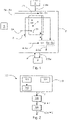
- Figure 1 is a schematic diagram of the interaction between a broker entity 7, a technical system 1 and a requesting device 2.
- the requesting device 2 transmits a request 3 for one or more target values 6 of state information that have sought target semantic meanings 6a to the broker entity 7.
- the broker entity 7 obtains one or more source values 4 of state information that are associated with given source semantic meanings 4a from the technical system 1. This may, for example, happen upon request (such as polling) sent by the broker entity 7. But the broker entity 7 may also, for example, be permanently subscribed to topics that are published by the technical system 1 and comprise source values 4 with the given source semantic meanings 4a.
- the broker entity 7 obtains transformations 5a-5c from a transformation library 5. Each such transformation maps one or more first values that are associated with first semantic meanings to one or more second values that are associated with second semantic meanings.
- the transformations 5a-5c may be used directly. Alternatively or in combination, a new transformation 5* obtained based on the one or more transformations 5a-5c may be used. Whichever transformations 5a-5c, 5* are used, they are applied to the source values 4 with the given source semantic meanings 4a, to yield the target values 6 of the sought target semantic meanings 6a.
- One exemplary way of obtaining a new transform 5* is to generate one or more candidate transformations 5#. Based on a distance 8 between the respective achieved intermediate semantic meanings and the target semantic meanings 6a, these candidate transformations 5# may be optimized to yield a final new transformation 5*.
- the generating and optimizing of candidate transformations 5# is performed in a transformation engine 71 that is a sub-entity of the broker entity 7.
- the transformation engine 71 may be run on a compute entity that is distinct from the one used to run the rest of the broker entity 7. For example, while the rest of the broker entity 7 may run continuously on a compute instance with modest resources, the transformation engine 71 may be run on a higher-powered compute instance that is spun up temporarily whenever the creation and optimization of candidate transformations 5# is needed.
- an engineer may augment the transformations 5a-5c, and/or the candidate transformations 5#, with a further transformation 5+ that fills a gap between the currently achievable intermediate semantic meanings and the sought target semantic meanings 6a.
- Figure 2 is a schematic flow chart of an embodiment of the method 100 for conveying state information from an industrial plant as a technical system 1 to a requesting device 2 as a consumer.
- step 110 the broker entity 7 discussed in Figure 1 is provided.
- step 120 at least one request 3 for one or more target values 6 of state information that have sought target semantic meanings 6a from the requesting device to the broker entity 7.
- step 130 the target values 6 with the sought target semantic meanings 6a that have been obtained from the broker entity 7 are forwarded to the requesting device 2.
- the broker entity may be placed within an internal network of the industrial plant, and/or on an edge device of this internal network.
- connectivity between the broker entity 7 and a transformation library 5 that resides outside this internal network may be provided.
- access to a transformation library 5 that is common to multiple industrial plants may be provided, so as to maximize the re-using of knowledge across plant boundaries.
Landscapes
- Business, Economics & Management (AREA)
- Engineering & Computer Science (AREA)
- Human Resources & Organizations (AREA)
- Physics & Mathematics (AREA)
- Quality & Reliability (AREA)
- General Physics & Mathematics (AREA)
- Economics (AREA)
- Entrepreneurship & Innovation (AREA)
- Strategic Management (AREA)
- Educational Administration (AREA)
- Development Economics (AREA)
- General Engineering & Computer Science (AREA)
- Manufacturing & Machinery (AREA)
- Automation & Control Theory (AREA)
- Operations Research (AREA)
- Tourism & Hospitality (AREA)
- General Business, Economics & Management (AREA)
- Marketing (AREA)
- Theoretical Computer Science (AREA)
- Game Theory and Decision Science (AREA)
- Biodiversity & Conservation Biology (AREA)
- Life Sciences & Earth Sciences (AREA)
- Management, Administration, Business Operations System, And Electronic Commerce (AREA)
- Information Retrieval, Db Structures And Fs Structures Therefor (AREA)
Abstract
• receive, from the requesting device (2), a request (3) for one or more target values (6) of state information that have sought target semantic meanings (6a);
• obtain, from the technical system (1), one or more source values (4) of state information that are associated with given source semantic meanings (4a);
• obtain, at least in part from a transformation library (5), one or more transformations (5a-5c), wherein each transformation (5a-5c) maps one or more first values that are associated with first semantic meanings to one or more second values that are associated with second semantic meanings;
• apply the one or more transformations (5a-5c), or a new transformation (5*) obtained based on the one or more transformations (5a-5c), to the source values (4) of state information, thereby obtaining the one or more target values (6) of state information; and
• transmit the one or more target values (6) to the requesting device (2).
Description
- The invention relates to the processing of information that is produced in industrial plants, in particular by sensor devices, actuator devices and other control equipment that is in a direct relationship with a process executed on the plant.
- The monitoring and active controlling of an industrial plant is based on various information gathered within the plant. For example, sensor devices output measurement values, and actuator devices report their operational status.
- Each piece of information has some semantic meaning. For example, each measurement value carries a measurement unit. Also, for each piece of information, the device from which it is sent gives away a notion of the location within the plant from which the information emanates.
- Consumers of information, such as components of a distributed control system or a SCADA system, may need to obtain the information in the context of an information model that is different from the information model in which the information was originally acquired. Previously, it was the job of each individual consumer to obtain the information according to the original information model in which it was acquired, and translate it to the information model in which it was actually needed.
-
WO 2020/182 893 A1 discloses a system and method to improve interoperability in the communication between producers and consumers of information. A digital representation of a physical device stores a plurality of data models, and each data model corresponds to one of the information systems that are to communicate. - It is an objective of the present invention to further facilitate the exchange of information between producers and consumers of information in a situation where the data acquisition, e.g. the measurement, happens in the context of a first information model, but the evaluation for the monitoring and/or control of a technical system needs to happen in the context of a second information model.
- This objective is achieved by a computer-implemented broker entity, a method, and a transformation library according to respective independent claims. Further advantageous embodiments are detailed in the respective dependent claims.
- The invention provides a computer-implemented broker entity for conveying state information from a technical system as a producer to a requesting device as a consumer. This state information comprises a plurality of values that have been measured and/or generated by components of the technical system. Each such value is associated with a given semantic meaning.
- For example, when a measurement instrument outputs a measurement value, this value is associated with a measurement unit of a physical quantity that a value represents. E.g., a temperature may be measured in degrees Fahrenheit, degrees Celsius or in Kelvin, and a pressure may be measured in bar or in pounds per square inch, psi. Also, the source device from which the measurement value gives away a location that is associated with this measurement value, such as "thermometer number X" or "pressure gauge number Y". In semantic segmentation of images, each pixel of the image is assigned classification scores with respect to particular classes (e.g., "tree", "bushes", "vehicle" or "road") of a given classification. Other applications may define their own semantic meanings of values. For example, the Self-Monitoring, Analysis and Reporting Technology, S.M.A.R.T., for computer hard drives measures a variety of parameters that are indicative of the physical health status of the hard drive. Each parameter is mapped to a scale that ranges from 0 to 255. When a parameter passes a predefined threshold, a warning is issued.
- But a requesting device that is to monitor and/or control the technical system may need the values in the context of a different semantic meaning. For example, a process controller may need to know the pressure in a certain vessel in which substance S is manufactured, in bar. It is the job of the broker entity to answer such requests and obviate the need for the requesting device to have much more detailed knowledge about the internal workings of the technical system, such as an industrial plant.
- To this end, the broker entity is configured to receive, from the requesting device, a request for one or more target values of state information that have sought target semantic meanings. In the mentioned example, the location "vessel in which substance S is manufactured" and the measurement unit "bar" for the pressure are both sought target semantic meanings.
- The broker entity is further configured to obtain, from the technical system, one or more source values of state information that are associated with given source semantic meanings. In the example mentioned above, the source values may comprise pressure measurement values from many different sensors in the plant, part of which report the pressure in bar and part of which report the pressure in psi.
- The broker entity is configured to obtain, at least in part from a transformation library, one or more transformations. Each such transformation maps one or more first values that are associated with first semantic meanings to one or more second values that are associated with second semantic meanings.
- For example, the transformation library may comprise transformations that convert a measurement value from one measurement unit (such as psi for pressure) to another (such as bar). But the transformation may, for example, also transform locations. For example, the transformation may map an identifier of a device that has measured a measurement value to a location within the plant, based on a known layout of the plant. The location may, for example, be in the form of coordinates, and/or in the form of a functional unit of the plant. Thus, when the broker entity is asked for measurement values from a particular section of the plant, it may respond with just the values that come from this section, without the requesting device having to know details of how sensor devices are assigned to plant sections.
- The transformation library may also comprise transformations that convert classification scores that relate to a source class hierarchy to classification scores that relate to a target class hierarchy. For example, a semantic segmentation of an image may comprise trees, bushes, cars, bikes and a roadway. But the target semantic meaning may just distinguish between plants, vehicles and roadway. The transformation may thus combine the pixels labelled "tree" and pixels labelled "bush" to pixels labelled "plants" in the target image. Likewise, the pixels labelled "car" and the pixels labelled "bike" may be combined to pixels labelled "vehicle" in the target image.
- The broker entity is configured to apply one or more transformations, or a new transformation obtained based on the one or more transformations, to the source values of state information. In this manner, the one or more target values of state information are obtained. In the example mentioned above, the broker entity may deliver pressure measurement values from all sensors that sense the pressure in the vessel where substance S is manufactured, and wherever a sensor device outputs the pressure in psi, this is automatically converted to bar.
- The broker entity is further configured to transmit the one or more target values to the requesting device. That is, the whole transformation from source values of the source semantic meaning to the target values of the sought target meaning is now demand-driven, triggered by the needs of the requesting device. The broker entity may ensure a continuous flow of data from the technical system to the requesting device.
- The broker entity thus introduces a layer of abstraction. The requesting device no longer needs to do any conversions; rather, it just requests the information according to the information model in which it is needed for further processing. Conversions and transformations are all managed by the broker entity. In particular, in a situation where many different requesting devices need state information, transformations from the transformation library may be re-used. For example, if multiple requesting devices require conversion of a measurement value between measurement units, one and the same transformation may be used over and over again. There is no need for each requesting device to have program code to perform this transformation. This eliminates sources of error and reduces the burden for testing. The code for the transformation needs to be written and tested only once.
- Also, combinations of transformations that are already in the transformation library may just use these already tried-and-tested individual transformations, without a need for testing every possible combination again.
- Moreover, the abstraction layer minimizes the required effort in case the requesting device, and/or a device that produces measurement values, changes. For example, a field device may break after a long time of use, and it may turn out to be impossible to replace it by exactly the same type of device because this type was already discontinued long ago. The device will then have to be replaced by a newer device that may behave differently in some aspects.
- Another exemplary use case comprises accessory devices for cars that tap into the on-board diagnosis, OBD, or CAN bus of the car for measurement values. For example, some insurance companies are granting a discount on the regular premium in exchange for a consent to monitoring the driver behavior with a measuring device. The monitored behavior is evaluated for signs of carelessness or readiness to take risks on the side of the driver. Cautious behavior is rewarded by plus points and a lower premium, reckless behavior is penalized by minus points and a higher premium. Initial measuring devices of this kind were quite simple and registered, e.g., acceleration forces in multiple axes, the times of day the vehicle was used, and the length of trips. But in order to arrive at a more accurate assessment, it is desirable to obtain information, such as a steering angle or pedal positions, directly from vehicle systems. While the exchange of information within the car, and in particular the output of the OBD port, is standardized at least to some degree, some information is exchanged in proprietary formats. If the measuring device is to be ported from one type of vehicle to the next, and it utilizes the broker entity, the broker entity performs all the magic of the switch to a new type of vehicle. No program code of the measuring device itself needs to be adapted and tested again.
- The broker entity may be embodied in software, hardware, firmware or any suitable combination thereof. Furthermore, the broker entity may also be provided "as a service" in a cloud. For example, a cloud microservice with a very large transformation library may offer to convert any source semantic meaning to any target semantic meaning at a pay-per-use price, akin to "AWS Elemental MediaConvert" marketed by Amazon for transcoding video content.
- Transformations in the transformation library are not limited to taking one value as input and returning one value as output. For example, at least one transformation may compute, from two or more first measurement values of different physical quantities, at least one second value of an aggregate of these physical quantities. For example, a voltage drop over an electrical line and a current flowing through that line may be aggregated to the electrical resistance of this line according to Ohm's law.
- The broker entity may form new transformations out of already existing transformations in any suitable manner. The new transformations may then be stored in the transformation library as well for future use. Thus, the transformation library may "learn" during continued use.
- The functionality of forming new transformations out of already existing transformations may preferably be realized in a transformation engine that is a distinct sub-entity of the broker entity. This facilitates the outsourcing of said functionality to a different compute entity, such as a higher-powered compute instance in a cloud. For example, if a richly filled transformation library is already available, it may become necessary only occasionally to form new transformations. A container or other virtualized compute instance with the transformation engine may then be temporarily spun up with a higher amount of allocated compute resources, so that the needed new transformation may be obtained more quickly without hogging the high amount of compute resources all the time.
- In one example, transformations may be combined by applying a first transformation to one subset of the first values, and applying a second transformation to another subset of the first values. For example, both temperature measurement values and pressure measurement values may be converted into their respective SI units Kelvin and Pascal. The combined transformation converts a complete record of measurement values, which comprises temperature values and pressure values, into SI units.
- In another example, a first transformation may be applied to one or more values, and a second transformation may be applied to the result of the first transformation. That is, two transformations may be chained to form a new transformation. For example, a pressure may first be converted from psi to bar, and then the atmospheric pressure may be subtracted, thereby arriving at a pressure in bar above atmospheric pressure. Of course, this example is non-limiting with respect to the number of transformations. Any number of transformations may be chained in the same manner. For example, a path finding algorithm or approach may be used to find a chain of transformations that can resolve a path between a source semantic meaning and a target semantic meaning.
- In another example, an inverse of a transformation may become a new transformation. Many transformations may be automatically inverted, so that given one transformation, the inverse transformation may be used without writing additional code.
- In a further advantageous embodiment, the broker entity is further configured to generate, from one or more transformations obtained from the transformation library, one or more candidate transformations. A distance between an intermediate semantic meaning to which this candidate transformation can map the source semantic meanings on the one hand and the sought target semantic meanings on the other hand may then be determined according to any appropriate metric. If the candidate transformation delivers exactly the sought target semantic meanings, this corresponds to a distance of zero. A candidate transformation for which the distance is optimal may be stored in the transformation library as an optimal new transformation.
- This opens up a possibility for further learning of the transformation library. In particular, the broker entity may be further configured to demand, from an engineer, input of a further transformation from the intermediate semantic meaning outputted by the optimal new transformation to the sought target semantic meaning. In this manner, the broker entity may work out the overall transformation from the source semantic meaning to the sought target semantic meaning as far as possible in an automated manner, asking the engineer only for the test that cannot be worked out automatically. For example, the broker entity may be lacking knowledge as to which section of the plant a particular sensor belongs, or how to map a pressure value to a desired target scale for further processing. The engineer may be asked to provide just this "missing link", which may then go into the transformation library and may then be re-used whenever needed again. If the engineer is asked for more than the "missing link", he is asked for more manual work than is actually needed in the situation at hand. Furthermore, the solution obtained from the engineer becomes more complex, and it becomes more unlikely that re-using this solution in other situations will be possible.
- That is, even if the automated lookup and/or creation of a transformation only goes part of the way from the source semantic meaning to the sought target semantic meaning, much time is already saved compared with the previous situation where an engineer had to work out the whole transformation from the source semantic meaning to the sought target semantic meaning.
- If a candidate transformation is a full solution to go from the source semantic meanings to the target semantic meanings, then this may be further verified and validated. For example, Schemas, such as JSON, may be used for such verification and validation. For example, missing optional or mandatory fields may be identified, and data types (such as int, string or Boolean) of the resulting field may be validated.
- Depending on the size of the available transformation library, candidate transformations may, for example, be generated based on a brute-force approach that tries all possible combinations, or based on a Monte-Carlo approach that samples such combinations. But more intelligent approaches may be used as well.
- For example, inheritance hierarchies akin to those in object-oriented programming may be exploited. For example, if a transformation is needed in the context of a particular car model as a technical system, it may be useful to start from a more generic transformation in the context of all cars from this manufacturer, or from an even more generic transformation that is valid for all cars, and optimize this as described above. Thus, in a further advantageous embodiment, the broker entity is further configured to obtain the new transformation, and/or the candidate transformation, based at least in part on a match between
- the technical system on the one hand, and
- other technical systems to which transformations that form an inheritance hierarchy within in the transformation library relate on the other hand.
- Commonalities along model standards in the same domain may be exploited in a similar manner. For example, a transformation addressing a generic type in another standard may be applied to a similar type in a given standard.
- The invention also provides a method for conveying state information from an industrial plant as a technical system to a requesting device as a consumer.
- In the course of this method, the broker entity described above is provided in whatever form. At least one request for one or more target values of state information that have sought target semantic meanings from the requesting device to the broker entity. The target values obtained from the broker entity are forwarded to the requesting device. As described above, the newly introduced layer of abstraction will uncouple the processing of state information by the requesting device from many intricate details of the industrial plant.
- In particular, the components of the industrial plant that measure and/or generate values may be chosen to comprise at least one of:
- sensor devices that measure physical quantities in an industrial process executed on the plant; and
- actor devices that act upon the execution of the industrial process and report a state of operation.
- Examples of sensor devices are voltmeters, ammeters, thermometers, pressure gauges, strain gauges and other sensors that capture a value of a physical measurement quantity. Examples of actor devices are valves, heaters, stirrers and any other devices that modify the behavior of an industrial process.
- In an advantageous embodiment, the broker entity is placed within an internal network of the industrial plant, and/or on an edge device of this internal network. Connectivity between the broker entity and a transformation library that resides outside this internal network is provided. In this manner, an externally provided broker entity with a potentially very large and comprehensive transformation library may be used. But at the same time, the broker entity is ensured to be in constant contact with the requesting device and the plant devices that generate the source values. In case the connection from the broker entity to the transformation library breaks down, the broker entity will then still be able to use the transformations that it has already pulled from the transformation library. Thus, it will still be able to handle all situations that it has handled before during plant operation. Only the capability to react to new situations that require pulling more transformations from the transformation library will then be lost until the connection is restored.
- In a further advantageous embodiment, the providing of the broker entity comprises providing access to a transformation library that is common to multiple industrial plants. In this manner, the transformation library may combine knowledge that has been "learned" on the multiple plants, including transformations that have been requested from an engineer to fill in gaps as described above. This knowledge may be re-used wherever appropriate as described above.
- The transformation library is of value on its own because a larger and more complete transformation library directly increases the capability of the broker entity to transform from source semantic meanings to target semantic meanings. Thus, the transformation library may, for example, be sold separately, or set up as a cloud micro-service with a pay-per-use pricing model.
- Therefore, the invention also provides a transformation library with multiple transformations. Each of these multiple transformations maps one or more first values that are associated with first semantic meanings in the context of at least one industrial plant to one or more second values that are associated with second semantic meanings in the context of the plant. The first semantic meaning, and/or the second semantic meaning, comprise one or more of:
- a measurement unit of a physical quantity measured in the plant that a value represents;
- a location in the plant where a value has been determined; and
- one or more classes with respect to which a value is a classification score.
- In an advantageous embodiment, at least a first transformation relates to a first semantic meaning and a second semantic meaning that are relevant within the context of a first industrial plant. At least a second transformation relates to a different first semantic meaning and a different second semantic meaning that are relevant within the context of a different second industrial plant, but not within the context of the first industrial plant. In this manner, distinct knowledge from the multiple plants is "pooled" in the transformation library.
- As discussed before, the broker entity, and/or the method, may be at least partially implemented in software. The invention therefore also provides a computer program with machine-readable instructions that, when executed by one or more computers, and/or one or more virtualized execution environments, upgrade the one or more computers, and/or the one or more virtualized execution environments, to the broker entity as described above, and/or cause the one or more computers, and/or the one or more virtualized execution environments, to perform the method as described above.
- The invention also provides a non-transitory storage medium, and/or a download product, with this computer program, and/or with the transformation library described above. A download product is a product that may be sold in an online shop for immediate fulfillment by download.
- The invention also provides one or more computers and/or virtualized execution environments with the transformation library as described above, with the computer program, and/or with the non-transitory storage medium and/or download product.
- In the following, the invention is illustrated using Figures without any intention to limit the scope of the invention. The Figures show:
-
Figure 1 : Exemplary embodiment of thebroker entity 7 in cooperation with atechnical system 1 and a requestingdevice 2; -
Figure 2 : Exemplary embodiment of themethod 100 for conveying state information. -
Figure 1 is a schematic diagram of the interaction between abroker entity 7, atechnical system 1 and a requestingdevice 2. The requestingdevice 2 transmits arequest 3 for one or more target values 6 of state information that have sought target semantic meanings 6a to thebroker entity 7. Thebroker entity 7 obtains one or more source values 4 of state information that are associated with given source semantic meanings 4a from thetechnical system 1. This may, for example, happen upon request (such as polling) sent by thebroker entity 7. But thebroker entity 7 may also, for example, be permanently subscribed to topics that are published by thetechnical system 1 and comprise source values 4 with the given source semantic meanings 4a. - The
broker entity 7 obtainstransformations 5a-5c from atransformation library 5. Each such transformation maps one or more first values that are associated with first semantic meanings to one or more second values that are associated with second semantic meanings. - The
transformations 5a-5c may be used directly. Alternatively or in combination, anew transformation 5* obtained based on the one ormore transformations 5a-5c may be used. Whichevertransformations 5a-5c, 5* are used, they are applied to the source values 4 with the given source semantic meanings 4a, to yield the target values 6 of the sought target semantic meanings 6a. - One exemplary way of obtaining a
new transform 5* is to generate one ormore candidate transformations 5#. Based on adistance 8 between the respective achieved intermediate semantic meanings and the target semantic meanings 6a, thesecandidate transformations 5# may be optimized to yield a finalnew transformation 5*. In the example shown inFigure 1 , the generating and optimizing ofcandidate transformations 5# is performed in atransformation engine 71 that is a sub-entity of thebroker entity 7. As discussed before, thetransformation engine 71 may be run on a compute entity that is distinct from the one used to run the rest of thebroker entity 7. For example, while the rest of thebroker entity 7 may run continuously on a compute instance with modest resources, thetransformation engine 71 may be run on a higher-powered compute instance that is spun up temporarily whenever the creation and optimization ofcandidate transformations 5# is needed. - Alternatively or in combination, an engineer may augment the
transformations 5a-5c, and/or thecandidate transformations 5#, with afurther transformation 5+ that fills a gap between the currently achievable intermediate semantic meanings and the sought target semantic meanings 6a. -
Figure 2 is a schematic flow chart of an embodiment of themethod 100 for conveying state information from an industrial plant as atechnical system 1 to a requestingdevice 2 as a consumer. - In
step 110, thebroker entity 7 discussed inFigure 1 is provided. Instep 120, at least onerequest 3 for one or more target values 6 of state information that have sought target semantic meanings 6a from the requesting device to thebroker entity 7. Instep 130, the target values 6 with the sought target semantic meanings 6a that have been obtained from thebroker entity 7 are forwarded to the requestingdevice 2. - According to block 111, the broker entity may be placed within an internal network of the industrial plant, and/or on an edge device of this internal network. According to block 112, connectivity between the
broker entity 7 and atransformation library 5 that resides outside this internal network may be provided. - According to block 113, access to a
transformation library 5 that is common to multiple industrial plants may be provided, so as to maximize the re-using of knowledge across plant boundaries. -
- 1
- technical system
- 2
- requesting device
- 3
- request for values 6 of semantic meaning 6a
- 4
- source values of state information of
technical system 1 - 4a
- semantic meanings of source values 4
- 5
- transformation library
- 5a-5c
- transformations obtained from
transformation library 5 - 5*
- new transformation, obtained based on
transformations 5a-5c - 5#
- candidate transformation
- 5+
- further transformation requested from engineer
- 6
- target values
- 6a
- sought target semantic meanings of target values 6
- 7
- broker entity
- 71
- transformation engine of
broker entity 7 - 8
- distance to sought target semantic meanings 6a
- 100
- method for conveying state information
- 110
- providing
broker entity 7 - 111
- placing
broker entity 7 on internal network - 112
- providing connectivity to
transformation library 5 outside internal network - 113
- providing access to
transformation library 5 for multiple plants - 120
- forwarding
request 3 to brokerentity 7 - 130
- forwarding target values 6 from
broker entity 7 to requestingdevice 2
Claims (16)
- A computer-implemented broker entity (7) for conveying state information from a technical system (1) as a producer to a requesting device (2) as a consumer, wherein the state information comprises a plurality of values that have been measured and/or generated by components of the technical system, each value is associated with a given semantic meaning, and the broker entity is configured to:• receive, from the requesting device (2), a request (3) for one or more target values (6) of state information that have sought target semantic meanings (6a);• obtain, from the technical system (1), one or more source values (4) of state information that are associated with given source semantic meanings (4a);• obtain, at least in part from a transformation library (5), one or more transformations (5a-5c), wherein each transformation (5a-5c) maps one or more first values that are associated with first semantic meanings to one or more second values that are associated with second semantic meanings;• apply the one or more transformations (5a-5c), or a new transformation (5*) obtained based on the one or more transformations (5a-5c), to the source values (4) of state information, thereby obtaining the one or more target values (6) of state information; and• transmit the one or more target values (6) to the requesting device (2).
- The broker entity (7) of claim 1, wherein the source semantic meanings (4a), and/or the target semantic meanings (6a), comprise one or more of:• a measurement unit of a physical quantity that a value represents;• a location in the technical system (1) where a value has been determined; and• one or more classes with respect to which a value is a classification score.
- The broker entity (7) of claim 2, further configured to obtain at least one transformation (5a-5c, 5*) that computes, from two or more first measurement values of different physical quantities, at least one second value of an aggregate of these physical quantities.
- The broker entity (7) of any one of claims 1 to 3, wherein a new transformation (5*) obtained based on the one more transformations (5a-5c) comprises one or more of:• applying a first transformation (5a-5c) to one subset of the first values, and applying a second transformation (5a-5c) to another subset of the first values;• applying a first transformation (5a-5c) to one or more values, and applying a second transformation (5a-5c) to the result of the first transformation; and• applying an inverse of a transformation (5a-5c).
- The broker entity (7) of any one of claims 1 to 4, further configured to:• generate, from one or more transformations (5a-5c) obtained from the transformation library (5), one or more candidate transformations (5#);• determine a distance (8) between an intermediate semantic meaning to which this candidate transformation (5#) can map the source semantic meanings (4a) on the one hand and the sought target semantic meanings (6a) on the other hand; and• storing a candidate transformation (5#) for which this distance is optimal in the transformation library as an optimal new transformation (5*).
- The broker entity (7) of claim 5, further configured to:• demand, from an engineer, input of a further transformation (5+) from the intermediate semantic meaning outputted by the optimal new transformation to the sought target semantic meaning (6a); and• store this further transformation in the transformation library (5).
- The broker entity (7) of any one of claims 1 to 6, further configured to obtain the new transformation (5*), and/or the candidate transformation (5#), based at least in part on a match between• the technical system (1) on the one hand, and• other technical systems to which transformations (5a-5c) that form an inheritance hierarchy within in the transformation library (5) relate on the other hand.
- A method (100) for conveying state information from an industrial plant as a technical system (1) to a requesting device (2) as a consumer, comprising the steps of:• providing (110) the broker entity (7) of any one of claims 1 to 7;• forwarding (120) at least one request (3) for one or more target values (6) of state information that have sought target semantic meanings (6a) from the requesting device to the broker entity (7); and• forwarding (130) the target values (6) to the requesting device (2).
- The method (100) of claim 8, wherein the components of the industrial plant that measure and/or generate values are chosen to comprise at least one of:• sensor devices that measure physical quantities in an industrial process executed on the plant; and• actor devices that act upon the execution of the industrial process and report a state of operation.
- The method (100) of any one of claims 8 to 9, wherein providing (110) of the broker entity (7) comprises:• placing (111) the broker entity (7) within an internal network of the industrial plant, and/or on an edge device of this internal network; and• providing (112) connectivity between the broker entity (7) and a transformation library (5) that resides outside this internal network.
- The method (100) of any one of claims 8 to 10, wherein the providing (110) of the broker entity (7) comprises: providing (113) access to a transformation library (5) that is common to multiple industrial plants.
- A transformation library (5), comprising multiple transformations (5a-5c), wherein each transformation (5a-5c) maps one or more first values that are associated with first semantic meanings in the context of at least one industrial plant to one or more second values that are associated with second semantic meanings in the context of the plant, wherein the first semantic meaning, and/or the second semantic meaning, comprise one or more of:• a measurement unit of a physical quantity measured in the plant that a value represents;• a location in the plant where a value has been determined; and• one or more classes with respect to which a value is a classification score.
- The transformation library (5) of claim 12, wherein at least a first transformation relates to a first semantic meaning and a second semantic meaning that are relevant within the context of a first industrial plant, and at least a second transformation relates to a different first semantic meaning and a different second semantic meaning that are relevant within the context of a different second industrial plant, but not within the context of the first industrial plant.
- A computer program, comprising machine-readable instructions that, when executed by one or more computers, and/or one or more virtualized execution environments, upgrade the one or more computers, and/or the one or more virtualized execution environments, to the broker entity (7) of any one of claims 1 to 7, and/or cause the one or more computers, and/or the one or more virtualized execution environments, to perform the method (100) of any one of claims 8 to 11.
- A non-transitory storage medium, and/or a download product, with the computer program of claim 14, and/or with the transformation library (5) of any one of claims 12 to 13.
- One or more computers and/or virtualized execution environments with the transformation library (5) of any one of claims 12 to 13, with the computer program of claim 14, and/or with the non-transitory storage medium and/or download product of claim 15.
Priority Applications (4)
| Application Number | Priority Date | Filing Date | Title |
|---|---|---|---|
| EP21178440.0A EP4102424A1 (en) | 2021-06-09 | 2021-06-09 | Broker entity to bridge semantic gaps for information produced in industrial plants |
| PCT/EP2022/063436 WO2022258329A1 (en) | 2021-06-09 | 2022-05-18 | Broker entity to bridge semantic gaps for information produced in industrial plants |
| CN202280041089.9A CN117501287A (en) | 2021-06-09 | 2022-05-18 | Proxy entities to bridge semantic gaps for information generated in industrial plants |
| US18/532,243 US20240111272A1 (en) | 2021-06-09 | 2023-12-07 | Broker Entity to Bridge Semantic Gaps for Information Produced in Industrial Plants |
Applications Claiming Priority (1)
| Application Number | Priority Date | Filing Date | Title |
|---|---|---|---|
| EP21178440.0A EP4102424A1 (en) | 2021-06-09 | 2021-06-09 | Broker entity to bridge semantic gaps for information produced in industrial plants |
Publications (1)
| Publication Number | Publication Date |
|---|---|
| EP4102424A1 true EP4102424A1 (en) | 2022-12-14 |
Family
ID=76355347
Family Applications (1)
| Application Number | Title | Priority Date | Filing Date |
|---|---|---|---|
| EP21178440.0A Pending EP4102424A1 (en) | 2021-06-09 | 2021-06-09 | Broker entity to bridge semantic gaps for information produced in industrial plants |
Country Status (4)
| Country | Link |
|---|---|
| US (1) | US20240111272A1 (en) |
| EP (1) | EP4102424A1 (en) |
| CN (1) | CN117501287A (en) |
| WO (1) | WO2022258329A1 (en) |
Cited By (1)
| Publication number | Priority date | Publication date | Assignee | Title |
|---|---|---|---|---|
| EP4651468A1 (en) | 2024-05-16 | 2025-11-19 | Abb Schweiz Ag | Computer-implemented method and system for an automated transformation of data information for at least a field device |
Citations (3)
| Publication number | Priority date | Publication date | Assignee | Title |
|---|---|---|---|---|
| EP3401800A1 (en) * | 2017-05-12 | 2018-11-14 | BAE SYSTEMS plc | A system for improved data storage and retrieval |
| EP3709227A1 (en) * | 2019-03-11 | 2020-09-16 | ABB Schweiz AG | System and method for interoperable communication of an automation system component with multiple information sources |
| US20210096551A1 (en) * | 2019-09-30 | 2021-04-01 | Rockwell Automation Technologies, Inc. | Artificial intelligence channel for industrial automation |
Family Cites Families (8)
| Publication number | Priority date | Publication date | Assignee | Title |
|---|---|---|---|---|
| US8473388B2 (en) * | 2008-06-30 | 2013-06-25 | The Invention Science Fund I, Llc | Facilitating compensation arrangements providing for data tracking components |
| EP2701020A1 (en) * | 2012-08-22 | 2014-02-26 | Siemens Aktiengesellschaft | Monitoring of the initial equipment of a technical system for fabricating a product |
| US20140222712A1 (en) * | 2013-02-01 | 2014-08-07 | Sps Commerce, Inc. | Data acquisition, normalization, and exchange in a retail ecosystem |
| US11397272B2 (en) * | 2018-12-11 | 2022-07-26 | Exxonmobil Upstream Research Company | Data augmentation for seismic interpretation systems and methods |
| EP3726810B1 (en) * | 2019-04-16 | 2023-12-06 | ABB Schweiz AG | System and method for interoperable communication of automation system components |
| US11704494B2 (en) * | 2019-05-31 | 2023-07-18 | Ab Initio Technology Llc | Discovering a semantic meaning of data fields from profile data of the data fields |
| US11886399B2 (en) * | 2020-02-26 | 2024-01-30 | Ab Initio Technology Llc | Generating rules for data processing values of data fields from semantic labels of the data fields |
| EP4321947A1 (en) * | 2022-08-09 | 2024-02-14 | Abb Schweiz Ag | Communicating with field devices based on semantically identified variables |
-
2021
- 2021-06-09 EP EP21178440.0A patent/EP4102424A1/en active Pending
-
2022
- 2022-05-18 CN CN202280041089.9A patent/CN117501287A/en active Pending
- 2022-05-18 WO PCT/EP2022/063436 patent/WO2022258329A1/en not_active Ceased
-
2023
- 2023-12-07 US US18/532,243 patent/US20240111272A1/en active Pending
Patent Citations (4)
| Publication number | Priority date | Publication date | Assignee | Title |
|---|---|---|---|---|
| EP3401800A1 (en) * | 2017-05-12 | 2018-11-14 | BAE SYSTEMS plc | A system for improved data storage and retrieval |
| EP3709227A1 (en) * | 2019-03-11 | 2020-09-16 | ABB Schweiz AG | System and method for interoperable communication of an automation system component with multiple information sources |
| WO2020182893A1 (en) | 2019-03-11 | 2020-09-17 | Abb Schweiz Ag | System and method for interoperable communication of an automation system component with multiple information sources |
| US20210096551A1 (en) * | 2019-09-30 | 2021-04-01 | Rockwell Automation Technologies, Inc. | Artificial intelligence channel for industrial automation |
Cited By (1)
| Publication number | Priority date | Publication date | Assignee | Title |
|---|---|---|---|---|
| EP4651468A1 (en) | 2024-05-16 | 2025-11-19 | Abb Schweiz Ag | Computer-implemented method and system for an automated transformation of data information for at least a field device |
Also Published As
| Publication number | Publication date |
|---|---|
| CN117501287A (en) | 2024-02-02 |
| WO2022258329A1 (en) | 2022-12-15 |
| US20240111272A1 (en) | 2024-04-04 |
Similar Documents
| Publication | Publication Date | Title |
|---|---|---|
| US12052330B2 (en) | Autonomous telematics data signal tracking using artificial intelligence | |
| CN113119937B (en) | Intelligent brake-by-wire system based on digital twins and prediction control method thereof | |
| US20190043278A1 (en) | Test drive scenario system for virtual test drive scenarios | |
| EP2894529B1 (en) | Remote diagnostic system | |
| CN109791668A (en) | System and method for providing an interactive vehicle diagnostic display | |
| US20240111272A1 (en) | Broker Entity to Bridge Semantic Gaps for Information Produced in Industrial Plants | |
| CN114370471A (en) | Brake pad wear reminding method, device, equipment and storage medium | |
| CN112595537A (en) | Equipment health state monitoring method and system based on signal analysis and storage medium | |
| CN107924423B (en) | Model Determination Equipment and Model Determination Methods | |
| BinMasoud et al. | Design of an iot-based vehicle state monitoring system using raspberry pi | |
| CN113011852A (en) | Vehicle maintenance reminder method, device, in-vehicle equipment and storage medium | |
| Richter et al. | Anticipating Automated Vehicle Presence and the Effects on Interactions with Conventional Traffic and Infrastructure. | |
| US20210405181A1 (en) | Conversion of measured data between measurement modalities | |
| JP2023151522A (en) | Information processing device, information processing method, and information processing program | |
| Kamiński | Experimental and numerical studies of mechanical subsystem for simulation of agricultural trailer air braking systems | |
| CN116342111B (en) | Intelligent transaction method and system for automobile parts based on big data | |
| Martinus et al. | Virtual test driving hardware-independent integration of series software | |
| Shivakarthik et al. | Maintenance of automobiles by predicting system fault severity using machine learning | |
| JP2024127846A (en) | Measuring the generalization ability of a trained machine learning model on given measurement data | |
| CN101071486A (en) | System and method for automated acceptance and evaluation of the quality of mass data of a technical process or a technical project | |
| US9148357B2 (en) | System and method for object abstraction and logging | |
| CN116263998A (en) | Evaluation of generators for producing realistic images | |
| US20250272615A1 (en) | Division of measurement data records across the phases of the training of a machine learning model | |
| CN115146382A (en) | Vehicle condition visual marking method and device, electronic equipment and medium | |
| CN119809326A (en) | A detailed review of supplier risk early warning system and early warning method |
Legal Events
| Date | Code | Title | Description |
|---|---|---|---|
| PUAI | Public reference made under article 153(3) epc to a published international application that has entered the european phase |
Free format text: ORIGINAL CODE: 0009012 |
|
| STAA | Information on the status of an ep patent application or granted ep patent |
Free format text: STATUS: THE APPLICATION HAS BEEN PUBLISHED |
|
| AK | Designated contracting states |
Kind code of ref document: A1 Designated state(s): AL AT BE BG CH CY CZ DE DK EE ES FI FR GB GR HR HU IE IS IT LI LT LU LV MC MK MT NL NO PL PT RO RS SE SI SK SM TR |
|
| STAA | Information on the status of an ep patent application or granted ep patent |
Free format text: STATUS: REQUEST FOR EXAMINATION WAS MADE |
|
| 17P | Request for examination filed |
Effective date: 20230531 |
|
| RBV | Designated contracting states (corrected) |
Designated state(s): AL AT BE BG CH CY CZ DE DK EE ES FI FR GB GR HR HU IE IS IT LI LT LU LV MC MK MT NL NO PL PT RO RS SE SI SK SM TR |
|
| STAA | Information on the status of an ep patent application or granted ep patent |
Free format text: STATUS: EXAMINATION IS IN PROGRESS |
|
| 17Q | First examination report despatched |
Effective date: 20250326 |