EP4102303A1 - Toner - Google Patents
Toner Download PDFInfo
- Publication number
- EP4102303A1 EP4102303A1 EP22177460.7A EP22177460A EP4102303A1 EP 4102303 A1 EP4102303 A1 EP 4102303A1 EP 22177460 A EP22177460 A EP 22177460A EP 4102303 A1 EP4102303 A1 EP 4102303A1
- Authority
- EP
- European Patent Office
- Prior art keywords
- toner
- particles
- particle
- external additive
- hydrotalcite
- Prior art date
- Legal status (The legal status is an assumption and is not a legal conclusion. Google has not performed a legal analysis and makes no representation as to the accuracy of the status listed.)
- Pending
Links
- 239000002245 particle Substances 0.000 claims abstract description 324
- GDVKFRBCXAPAQJ-UHFFFAOYSA-A dialuminum;hexamagnesium;carbonate;hexadecahydroxide Chemical compound [OH-].[OH-].[OH-].[OH-].[OH-].[OH-].[OH-].[OH-].[OH-].[OH-].[OH-].[OH-].[OH-].[OH-].[OH-].[OH-].[Mg+2].[Mg+2].[Mg+2].[Mg+2].[Mg+2].[Mg+2].[Al+3].[Al+3].[O-]C([O-])=O GDVKFRBCXAPAQJ-UHFFFAOYSA-A 0.000 claims abstract description 89
- 229910001701 hydrotalcite Inorganic materials 0.000 claims abstract description 89
- 229960001545 hydrotalcite Drugs 0.000 claims abstract description 89
- 239000000654 additive Substances 0.000 claims abstract description 82
- 230000000996 additive effect Effects 0.000 claims abstract description 77
- PNEYBMLMFCGWSK-UHFFFAOYSA-N aluminium oxide Inorganic materials [O-2].[O-2].[O-2].[Al+3].[Al+3] PNEYBMLMFCGWSK-UHFFFAOYSA-N 0.000 claims abstract description 75
- 229920005989 resin Polymers 0.000 claims abstract description 58
- 239000011347 resin Substances 0.000 claims abstract description 58
- LFQSCWFLJHTTHZ-UHFFFAOYSA-N Ethanol Chemical compound CCO LFQSCWFLJHTTHZ-UHFFFAOYSA-N 0.000 claims abstract description 37
- DNIAPMSPPWPWGF-GSVOUGTGSA-N (R)-(-)-Propylene glycol Chemical compound C[C@@H](O)CO DNIAPMSPPWPWGF-GSVOUGTGSA-N 0.000 claims abstract description 32
- 239000011230 binding agent Substances 0.000 claims abstract description 22
- 125000004432 carbon atom Chemical group C* 0.000 claims abstract description 11
- 239000000049 pigment Substances 0.000 claims description 23
- 239000003086 colorant Substances 0.000 claims description 19
- 229920001225 polyester resin Polymers 0.000 claims description 17
- 239000004645 polyester resin Substances 0.000 claims description 17
- 229920005792 styrene-acrylic resin Polymers 0.000 claims description 12
- 239000007771 core particle Substances 0.000 claims description 8
- 230000005540 biological transmission Effects 0.000 claims description 5
- 239000011258 core-shell material Substances 0.000 claims description 3
- 229910052799 carbon Inorganic materials 0.000 claims description 2
- VPWFPZBFBFHIIL-UHFFFAOYSA-L disodium 4-[(4-methyl-2-sulfophenyl)diazenyl]-3-oxidonaphthalene-2-carboxylate Chemical compound [Na+].[Na+].[O-]S(=O)(=O)C1=CC(C)=CC=C1N=NC1=C(O)C(C([O-])=O)=CC2=CC=CC=C12 VPWFPZBFBFHIIL-UHFFFAOYSA-L 0.000 claims description 2
- 238000005259 measurement Methods 0.000 description 57
- 239000000178 monomer Substances 0.000 description 42
- -1 CO3 2- Chemical class 0.000 description 39
- 238000000034 method Methods 0.000 description 38
- VYPSYNLAJGMNEJ-UHFFFAOYSA-N Silicium dioxide Chemical compound O=[Si]=O VYPSYNLAJGMNEJ-UHFFFAOYSA-N 0.000 description 35
- 230000006870 function Effects 0.000 description 32
- 239000000523 sample Substances 0.000 description 26
- 238000011156 evaluation Methods 0.000 description 23
- XLYOFNOQVPJJNP-UHFFFAOYSA-N water Substances O XLYOFNOQVPJJNP-UHFFFAOYSA-N 0.000 description 23
- PPBRXRYQALVLMV-UHFFFAOYSA-N Styrene Chemical compound C=CC1=CC=CC=C1 PPBRXRYQALVLMV-UHFFFAOYSA-N 0.000 description 22
- 239000006185 dispersion Substances 0.000 description 21
- 239000007788 liquid Substances 0.000 description 21
- LQZZUXJYWNFBMV-UHFFFAOYSA-N dodecan-1-ol Chemical compound CCCCCCCCCCCCO LQZZUXJYWNFBMV-UHFFFAOYSA-N 0.000 description 20
- 238000004519 manufacturing process Methods 0.000 description 20
- 239000010419 fine particle Substances 0.000 description 16
- 239000003795 chemical substances by application Substances 0.000 description 15
- 239000000470 constituent Substances 0.000 description 15
- 239000000377 silicon dioxide Substances 0.000 description 15
- 230000000694 effects Effects 0.000 description 13
- 239000001993 wax Substances 0.000 description 13
- 238000005481 NMR spectroscopy Methods 0.000 description 12
- KKEYFWRCBNTPAC-UHFFFAOYSA-N Terephthalic acid Chemical compound OC(=O)C1=CC=C(C(O)=O)C=C1 KKEYFWRCBNTPAC-UHFFFAOYSA-N 0.000 description 12
- 238000000045 pyrolysis gas chromatography Methods 0.000 description 12
- 239000012756 surface treatment agent Substances 0.000 description 12
- HEDRZPFGACZZDS-MICDWDOJSA-N Trichloro(2H)methane Chemical compound [2H]C(Cl)(Cl)Cl HEDRZPFGACZZDS-MICDWDOJSA-N 0.000 description 11
- 230000004927 fusion Effects 0.000 description 11
- 229910052751 metal Inorganic materials 0.000 description 11
- 239000002184 metal Substances 0.000 description 11
- 239000000203 mixture Substances 0.000 description 10
- KDYFGRWQOYBRFD-UHFFFAOYSA-N Succinic acid Natural products OC(=O)CCC(O)=O KDYFGRWQOYBRFD-UHFFFAOYSA-N 0.000 description 9
- 239000002253 acid Substances 0.000 description 9
- 238000004458 analytical method Methods 0.000 description 9
- 239000011521 glass Substances 0.000 description 9
- 239000000463 material Substances 0.000 description 9
- 238000010298 pulverizing process Methods 0.000 description 9
- 238000006243 chemical reaction Methods 0.000 description 8
- 230000000052 comparative effect Effects 0.000 description 8
- 150000001875 compounds Chemical class 0.000 description 8
- 235000014113 dietary fatty acids Nutrition 0.000 description 8
- 229940021013 electrolyte solution Drugs 0.000 description 8
- 239000008151 electrolyte solution Substances 0.000 description 8
- 239000000194 fatty acid Substances 0.000 description 8
- 229930195729 fatty acid Natural products 0.000 description 8
- QQVIHTHCMHWDBS-UHFFFAOYSA-N isophthalic acid Chemical compound OC(=O)C1=CC=CC(C(O)=O)=C1 QQVIHTHCMHWDBS-UHFFFAOYSA-N 0.000 description 8
- 229910021645 metal ion Inorganic materials 0.000 description 8
- GLDOVTGHNKAZLK-UHFFFAOYSA-N octadecan-1-ol Chemical compound CCCCCCCCCCCCCCCCCCO GLDOVTGHNKAZLK-UHFFFAOYSA-N 0.000 description 8
- XNGIFLGASWRNHJ-UHFFFAOYSA-N phthalic acid Chemical compound OC(=O)C1=CC=CC=C1C(O)=O XNGIFLGASWRNHJ-UHFFFAOYSA-N 0.000 description 8
- 238000011002 quantification Methods 0.000 description 8
- 239000007787 solid Substances 0.000 description 8
- 239000000243 solution Substances 0.000 description 8
- ARCGXLSVLAOJQL-UHFFFAOYSA-N trimellitic acid Chemical compound OC(=O)C1=CC=C(C(O)=O)C(C(O)=O)=C1 ARCGXLSVLAOJQL-UHFFFAOYSA-N 0.000 description 8
- 230000001276 controlling effect Effects 0.000 description 7
- 229920001577 copolymer Polymers 0.000 description 7
- 239000003921 oil Substances 0.000 description 7
- 238000006116 polymerization reaction Methods 0.000 description 7
- 239000000047 product Substances 0.000 description 7
- 238000003756 stirring Methods 0.000 description 7
- IJGRMHOSHXDMSA-UHFFFAOYSA-N Atomic nitrogen Chemical compound N#N IJGRMHOSHXDMSA-UHFFFAOYSA-N 0.000 description 6
- HEDRZPFGACZZDS-UHFFFAOYSA-N Chloroform Chemical compound ClC(Cl)Cl HEDRZPFGACZZDS-UHFFFAOYSA-N 0.000 description 6
- PEDCQBHIVMGVHV-UHFFFAOYSA-N Glycerine Chemical compound OCC(O)CO PEDCQBHIVMGVHV-UHFFFAOYSA-N 0.000 description 6
- 229910052782 aluminium Inorganic materials 0.000 description 6
- 239000012736 aqueous medium Substances 0.000 description 6
- 238000011088 calibration curve Methods 0.000 description 6
- 150000001732 carboxylic acid derivatives Chemical class 0.000 description 6
- 238000005119 centrifugation Methods 0.000 description 6
- 239000004205 dimethyl polysiloxane Substances 0.000 description 6
- 235000013870 dimethyl polysiloxane Nutrition 0.000 description 6
- 238000000605 extraction Methods 0.000 description 6
- 150000004665 fatty acids Chemical class 0.000 description 6
- 150000002500 ions Chemical class 0.000 description 6
- 239000010410 layer Substances 0.000 description 6
- 230000007774 longterm Effects 0.000 description 6
- 229910052757 nitrogen Inorganic materials 0.000 description 6
- 235000019198 oils Nutrition 0.000 description 6
- 229920000435 poly(dimethylsiloxane) Polymers 0.000 description 6
- 150000003839 salts Chemical class 0.000 description 6
- 238000000926 separation method Methods 0.000 description 6
- 239000002904 solvent Substances 0.000 description 6
- 239000007921 spray Substances 0.000 description 6
- 239000000126 substance Substances 0.000 description 6
- KBPLFHHGFOOTCA-UHFFFAOYSA-N 1-Octanol Chemical compound CCCCCCCCO KBPLFHHGFOOTCA-UHFFFAOYSA-N 0.000 description 5
- VEXZGXHMUGYJMC-UHFFFAOYSA-N Hydrochloric acid Chemical compound Cl VEXZGXHMUGYJMC-UHFFFAOYSA-N 0.000 description 5
- OFOBLEOULBTSOW-UHFFFAOYSA-N Malonic acid Chemical compound OC(=O)CC(O)=O OFOBLEOULBTSOW-UHFFFAOYSA-N 0.000 description 5
- 238000004220 aggregation Methods 0.000 description 5
- 230000002776 aggregation Effects 0.000 description 5
- 239000007864 aqueous solution Substances 0.000 description 5
- 238000001816 cooling Methods 0.000 description 5
- 239000007822 coupling agent Substances 0.000 description 5
- 238000001035 drying Methods 0.000 description 5
- 239000000975 dye Substances 0.000 description 5
- 239000000706 filtrate Substances 0.000 description 5
- 239000007789 gas Substances 0.000 description 5
- 230000003993 interaction Effects 0.000 description 5
- 229910052749 magnesium Inorganic materials 0.000 description 5
- 239000011777 magnesium Substances 0.000 description 5
- 238000002156 mixing Methods 0.000 description 5
- 239000011164 primary particle Substances 0.000 description 5
- 239000002994 raw material Substances 0.000 description 5
- 125000000391 vinyl group Chemical group [H]C([*])=C([H])[H] 0.000 description 5
- NIXOWILDQLNWCW-UHFFFAOYSA-N 2-Propenoic acid Natural products OC(=O)C=C NIXOWILDQLNWCW-UHFFFAOYSA-N 0.000 description 4
- VZCYOOQTPOCHFL-OWOJBTEDSA-N Fumaric acid Chemical compound OC(=O)\C=C\C(O)=O VZCYOOQTPOCHFL-OWOJBTEDSA-N 0.000 description 4
- GWEVSGVZZGPLCZ-UHFFFAOYSA-N Titan oxide Chemical compound O=[Ti]=O GWEVSGVZZGPLCZ-UHFFFAOYSA-N 0.000 description 4
- MCMNRKCIXSYSNV-UHFFFAOYSA-N Zirconium dioxide Chemical compound O=[Zr]=O MCMNRKCIXSYSNV-UHFFFAOYSA-N 0.000 description 4
- 150000007513 acids Chemical class 0.000 description 4
- 150000001298 alcohols Chemical class 0.000 description 4
- 125000005907 alkyl ester group Chemical group 0.000 description 4
- 150000001450 anions Chemical class 0.000 description 4
- 239000000571 coke Substances 0.000 description 4
- 239000012141 concentrate Substances 0.000 description 4
- 239000006059 cover glass Substances 0.000 description 4
- MWKFXSUHUHTGQN-UHFFFAOYSA-N decan-1-ol Chemical compound CCCCCCCCCCO MWKFXSUHUHTGQN-UHFFFAOYSA-N 0.000 description 4
- NOPFSRXAKWQILS-UHFFFAOYSA-N docosan-1-ol Chemical compound CCCCCCCCCCCCCCCCCCCCCCO NOPFSRXAKWQILS-UHFFFAOYSA-N 0.000 description 4
- BXWNKGSJHAJOGX-UHFFFAOYSA-N hexadecan-1-ol Chemical compound CCCCCCCCCCCCCCCCO BXWNKGSJHAJOGX-UHFFFAOYSA-N 0.000 description 4
- 238000005342 ion exchange Methods 0.000 description 4
- XEEYBQQBJWHFJM-UHFFFAOYSA-N iron Substances [Fe] XEEYBQQBJWHFJM-UHFFFAOYSA-N 0.000 description 4
- 239000000843 powder Substances 0.000 description 4
- 238000000197 pyrolysis Methods 0.000 description 4
- 229920002545 silicone oil Polymers 0.000 description 4
- 150000005846 sugar alcohols Polymers 0.000 description 4
- HLZKNKRTKFSKGZ-UHFFFAOYSA-N tetradecan-1-ol Chemical compound CCCCCCCCCCCCCCO HLZKNKRTKFSKGZ-UHFFFAOYSA-N 0.000 description 4
- VZCYOOQTPOCHFL-UHFFFAOYSA-N trans-butenedioic acid Natural products OC(=O)C=CC(O)=O VZCYOOQTPOCHFL-UHFFFAOYSA-N 0.000 description 4
- 238000012546 transfer Methods 0.000 description 4
- 229920002554 vinyl polymer Polymers 0.000 description 4
- 238000005406 washing Methods 0.000 description 4
- LYCAIKOWRPUZTN-UHFFFAOYSA-N Ethylene glycol Chemical compound OCCO LYCAIKOWRPUZTN-UHFFFAOYSA-N 0.000 description 3
- CTQNGGLPUBDAKN-UHFFFAOYSA-N O-Xylene Chemical compound CC1=CC=CC=C1C CTQNGGLPUBDAKN-UHFFFAOYSA-N 0.000 description 3
- DNIAPMSPPWPWGF-UHFFFAOYSA-N Propylene glycol Chemical compound CC(O)CO DNIAPMSPPWPWGF-UHFFFAOYSA-N 0.000 description 3
- HEMHJVSKTPXQMS-UHFFFAOYSA-M Sodium hydroxide Chemical compound [OH-].[Na+] HEMHJVSKTPXQMS-UHFFFAOYSA-M 0.000 description 3
- CZMRCDWAGMRECN-UGDNZRGBSA-N Sucrose Chemical compound O[C@H]1[C@H](O)[C@@H](CO)O[C@@]1(CO)O[C@@H]1[C@H](O)[C@@H](O)[C@H](O)[C@@H](CO)O1 CZMRCDWAGMRECN-UGDNZRGBSA-N 0.000 description 3
- 229930006000 Sucrose Natural products 0.000 description 3
- 238000003917 TEM image Methods 0.000 description 3
- RTAQQCXQSZGOHL-UHFFFAOYSA-N Titanium Chemical compound [Ti] RTAQQCXQSZGOHL-UHFFFAOYSA-N 0.000 description 3
- 150000008065 acid anhydrides Chemical class 0.000 description 3
- 150000001338 aliphatic hydrocarbons Chemical class 0.000 description 3
- 239000003945 anionic surfactant Substances 0.000 description 3
- 125000003118 aryl group Chemical group 0.000 description 3
- 238000004364 calculation method Methods 0.000 description 3
- 150000001735 carboxylic acids Chemical class 0.000 description 3
- 239000003599 detergent Substances 0.000 description 3
- MTHSVFCYNBDYFN-UHFFFAOYSA-N diethylene glycol Chemical compound OCCOCCO MTHSVFCYNBDYFN-UHFFFAOYSA-N 0.000 description 3
- 238000009826 distribution Methods 0.000 description 3
- 239000000839 emulsion Substances 0.000 description 3
- 230000005284 excitation Effects 0.000 description 3
- 238000010304 firing Methods 0.000 description 3
- 238000002290 gas chromatography-mass spectrometry Methods 0.000 description 3
- 238000010438 heat treatment Methods 0.000 description 3
- 229910052742 iron Inorganic materials 0.000 description 3
- 238000004898 kneading Methods 0.000 description 3
- 238000000691 measurement method Methods 0.000 description 3
- 125000005395 methacrylic acid group Chemical group 0.000 description 3
- 230000007935 neutral effect Effects 0.000 description 3
- 239000002736 nonionic surfactant Substances 0.000 description 3
- 229920000642 polymer Polymers 0.000 description 3
- 229920001343 polytetrafluoroethylene Polymers 0.000 description 3
- 239000004810 polytetrafluoroethylene Substances 0.000 description 3
- 238000012545 processing Methods 0.000 description 3
- 150000004671 saturated fatty acids Chemical class 0.000 description 3
- 239000002002 slurry Substances 0.000 description 3
- 238000001228 spectrum Methods 0.000 description 3
- 239000005720 sucrose Substances 0.000 description 3
- 238000004381 surface treatment Methods 0.000 description 3
- 238000010558 suspension polymerization method Methods 0.000 description 3
- 238000012360 testing method Methods 0.000 description 3
- 239000010936 titanium Substances 0.000 description 3
- 229910052719 titanium Inorganic materials 0.000 description 3
- 239000008096 xylene Substances 0.000 description 3
- PUPZLCDOIYMWBV-UHFFFAOYSA-N (+/-)-1,3-Butanediol Chemical compound CC(O)CCO PUPZLCDOIYMWBV-UHFFFAOYSA-N 0.000 description 2
- ARXKVVRQIIOZGF-UHFFFAOYSA-N 1,2,4-butanetriol Chemical compound OCCC(O)CO ARXKVVRQIIOZGF-UHFFFAOYSA-N 0.000 description 2
- 238000005160 1H NMR spectroscopy Methods 0.000 description 2
- SMZOUWXMTYCWNB-UHFFFAOYSA-N 2-(2-methoxy-5-methylphenyl)ethanamine Chemical compound COC1=CC=C(C)C=C1CCN SMZOUWXMTYCWNB-UHFFFAOYSA-N 0.000 description 2
- QDCPNGVVOWVKJG-UHFFFAOYSA-N 2-dodec-1-enylbutanedioic acid Chemical compound CCCCCCCCCCC=CC(C(O)=O)CC(O)=O QDCPNGVVOWVKJG-UHFFFAOYSA-N 0.000 description 2
- VPWNQTHUCYMVMZ-UHFFFAOYSA-N 4,4'-sulfonyldiphenol Chemical class C1=CC(O)=CC=C1S(=O)(=O)C1=CC=C(O)C=C1 VPWNQTHUCYMVMZ-UHFFFAOYSA-N 0.000 description 2
- 229910002012 Aerosil® Inorganic materials 0.000 description 2
- 229930185605 Bisphenol Natural products 0.000 description 2
- SOGAXMICEFXMKE-UHFFFAOYSA-N Butylmethacrylate Chemical compound CCCCOC(=O)C(C)=C SOGAXMICEFXMKE-UHFFFAOYSA-N 0.000 description 2
- VTYYLEPIZMXCLO-UHFFFAOYSA-L Calcium carbonate Chemical compound [Ca+2].[O-]C([O-])=O VTYYLEPIZMXCLO-UHFFFAOYSA-L 0.000 description 2
- FBPFZTCFMRRESA-FSIIMWSLSA-N D-Glucitol Natural products OC[C@H](O)[C@H](O)[C@@H](O)[C@H](O)CO FBPFZTCFMRRESA-FSIIMWSLSA-N 0.000 description 2
- FBPFZTCFMRRESA-JGWLITMVSA-N D-glucitol Chemical compound OC[C@H](O)[C@@H](O)[C@H](O)[C@H](O)CO FBPFZTCFMRRESA-JGWLITMVSA-N 0.000 description 2
- WOBHKFSMXKNTIM-UHFFFAOYSA-N Hydroxyethyl methacrylate Chemical compound CC(=C)C(=O)OCCO WOBHKFSMXKNTIM-UHFFFAOYSA-N 0.000 description 2
- CERQOIWHTDAKMF-UHFFFAOYSA-N Methacrylic acid Chemical compound CC(=C)C(O)=O CERQOIWHTDAKMF-UHFFFAOYSA-N 0.000 description 2
- BAPJBEWLBFYGME-UHFFFAOYSA-N Methyl acrylate Chemical compound COC(=O)C=C BAPJBEWLBFYGME-UHFFFAOYSA-N 0.000 description 2
- VVQNEPGJFQJSBK-UHFFFAOYSA-N Methyl methacrylate Chemical compound COC(=O)C(C)=C VVQNEPGJFQJSBK-UHFFFAOYSA-N 0.000 description 2
- UFWIBTONFRDIAS-UHFFFAOYSA-N Naphthalene Chemical compound C1=CC=CC2=CC=CC=C21 UFWIBTONFRDIAS-UHFFFAOYSA-N 0.000 description 2
- PXHVJJICTQNCMI-UHFFFAOYSA-N Nickel Chemical compound [Ni] PXHVJJICTQNCMI-UHFFFAOYSA-N 0.000 description 2
- 239000004743 Polypropylene Substances 0.000 description 2
- FAPWRFPIFSIZLT-UHFFFAOYSA-M Sodium chloride Chemical compound [Na+].[Cl-] FAPWRFPIFSIZLT-UHFFFAOYSA-M 0.000 description 2
- ZJCCRDAZUWHFQH-UHFFFAOYSA-N Trimethylolpropane Chemical compound CCC(CO)(CO)CO ZJCCRDAZUWHFQH-UHFFFAOYSA-N 0.000 description 2
- XLOMVQKBTHCTTD-UHFFFAOYSA-N Zinc monoxide Chemical compound [Zn]=O XLOMVQKBTHCTTD-UHFFFAOYSA-N 0.000 description 2
- 230000001133 acceleration Effects 0.000 description 2
- WNLRTRBMVRJNCN-UHFFFAOYSA-N adipic acid Chemical compound OC(=O)CCCCC(O)=O WNLRTRBMVRJNCN-UHFFFAOYSA-N 0.000 description 2
- VSCWAEJMTAWNJL-UHFFFAOYSA-K aluminium trichloride Chemical compound Cl[Al](Cl)Cl VSCWAEJMTAWNJL-UHFFFAOYSA-K 0.000 description 2
- JGDITNMASUZKPW-UHFFFAOYSA-K aluminium trichloride hexahydrate Chemical compound O.O.O.O.O.O.Cl[Al](Cl)Cl JGDITNMASUZKPW-UHFFFAOYSA-K 0.000 description 2
- 229940009861 aluminum chloride hexahydrate Drugs 0.000 description 2
- 150000008064 anhydrides Chemical class 0.000 description 2
- WERYXYBDKMZEQL-UHFFFAOYSA-N butane-1,4-diol Chemical compound OCCCCO WERYXYBDKMZEQL-UHFFFAOYSA-N 0.000 description 2
- CQEYYJKEWSMYFG-UHFFFAOYSA-N butyl acrylate Chemical compound CCCCOC(=O)C=C CQEYYJKEWSMYFG-UHFFFAOYSA-N 0.000 description 2
- 229910052791 calcium Inorganic materials 0.000 description 2
- 239000011575 calcium Substances 0.000 description 2
- 239000006229 carbon black Substances 0.000 description 2
- 239000004203 carnauba wax Substances 0.000 description 2
- 235000013869 carnauba wax Nutrition 0.000 description 2
- 229960000541 cetyl alcohol Drugs 0.000 description 2
- 230000008859 change Effects 0.000 description 2
- 238000005229 chemical vapour deposition Methods 0.000 description 2
- 238000004140 cleaning Methods 0.000 description 2
- 239000002131 composite material Substances 0.000 description 2
- 229910052802 copper Inorganic materials 0.000 description 2
- 239000010949 copper Substances 0.000 description 2
- 239000013078 crystal Substances 0.000 description 2
- 238000005520 cutting process Methods 0.000 description 2
- 230000018044 dehydration Effects 0.000 description 2
- 238000006297 dehydration reaction Methods 0.000 description 2
- 239000008367 deionised water Substances 0.000 description 2
- 229910021641 deionized water Inorganic materials 0.000 description 2
- 238000001514 detection method Methods 0.000 description 2
- 239000002270 dispersing agent Substances 0.000 description 2
- 238000010494 dissociation reaction Methods 0.000 description 2
- 230000005593 dissociations Effects 0.000 description 2
- 238000004090 dissolution Methods 0.000 description 2
- 229960000735 docosanol Drugs 0.000 description 2
- POULHZVOKOAJMA-UHFFFAOYSA-N dodecanoic acid Chemical compound CCCCCCCCCCCC(O)=O POULHZVOKOAJMA-UHFFFAOYSA-N 0.000 description 2
- 125000004185 ester group Chemical group 0.000 description 2
- 150000002148 esters Chemical class 0.000 description 2
- 238000001914 filtration Methods 0.000 description 2
- 239000001530 fumaric acid Substances 0.000 description 2
- 229910021485 fumed silica Inorganic materials 0.000 description 2
- LNTHITQWFMADLM-UHFFFAOYSA-N gallic acid Chemical compound OC(=O)C1=CC(O)=C(O)C(O)=C1 LNTHITQWFMADLM-UHFFFAOYSA-N 0.000 description 2
- 230000005484 gravity Effects 0.000 description 2
- IRHTZOCLLONTOC-UHFFFAOYSA-N hexacosan-1-ol Chemical compound CCCCCCCCCCCCCCCCCCCCCCCCCCO IRHTZOCLLONTOC-UHFFFAOYSA-N 0.000 description 2
- IPCSVZSSVZVIGE-UHFFFAOYSA-N hexadecanoic acid Chemical compound CCCCCCCCCCCCCCCC(O)=O IPCSVZSSVZVIGE-UHFFFAOYSA-N 0.000 description 2
- ZSIAUFGUXNUGDI-UHFFFAOYSA-N hexan-1-ol Chemical compound CCCCCCO ZSIAUFGUXNUGDI-UHFFFAOYSA-N 0.000 description 2
- 125000002887 hydroxy group Chemical group [H]O* 0.000 description 2
- 230000006872 improvement Effects 0.000 description 2
- 229910052738 indium Inorganic materials 0.000 description 2
- 238000002347 injection Methods 0.000 description 2
- 239000007924 injection Substances 0.000 description 2
- 239000004816 latex Substances 0.000 description 2
- 229920000126 latex Polymers 0.000 description 2
- 229940050906 magnesium chloride hexahydrate Drugs 0.000 description 2
- DHRRIBDTHFBPNG-UHFFFAOYSA-L magnesium dichloride hexahydrate Chemical compound O.O.O.O.O.O.[Mg+2].[Cl-].[Cl-] DHRRIBDTHFBPNG-UHFFFAOYSA-L 0.000 description 2
- HQKMJHAJHXVSDF-UHFFFAOYSA-L magnesium stearate Chemical compound [Mg+2].CCCCCCCCCCCCCCCCCC([O-])=O.CCCCCCCCCCCCCCCCCC([O-])=O HQKMJHAJHXVSDF-UHFFFAOYSA-L 0.000 description 2
- VZCYOOQTPOCHFL-UPHRSURJSA-N maleic acid Chemical compound OC(=O)\C=C/C(O)=O VZCYOOQTPOCHFL-UPHRSURJSA-N 0.000 description 2
- 239000011976 maleic acid Substances 0.000 description 2
- 239000012528 membrane Substances 0.000 description 2
- 150000002739 metals Chemical class 0.000 description 2
- VNWKTOKETHGBQD-UHFFFAOYSA-N methane Chemical compound C VNWKTOKETHGBQD-UHFFFAOYSA-N 0.000 description 2
- 238000013508 migration Methods 0.000 description 2
- 239000003607 modifier Substances 0.000 description 2
- 238000000465 moulding Methods 0.000 description 2
- GOQYKNQRPGWPLP-UHFFFAOYSA-N n-heptadecyl alcohol Natural products CCCCCCCCCCCCCCCCCO GOQYKNQRPGWPLP-UHFFFAOYSA-N 0.000 description 2
- BDJRBEYXGGNYIS-UHFFFAOYSA-N nonanedioic acid Chemical compound OC(=O)CCCCCCCC(O)=O BDJRBEYXGGNYIS-UHFFFAOYSA-N 0.000 description 2
- UTOPWMOLSKOLTQ-UHFFFAOYSA-N octacosanoic acid Chemical compound CCCCCCCCCCCCCCCCCCCCCCCCCCCC(O)=O UTOPWMOLSKOLTQ-UHFFFAOYSA-N 0.000 description 2
- CXQXSVUQTKDNFP-UHFFFAOYSA-N octamethyltrisiloxane Chemical compound C[Si](C)(C)O[Si](C)(C)O[Si](C)(C)C CXQXSVUQTKDNFP-UHFFFAOYSA-N 0.000 description 2
- 238000007254 oxidation reaction Methods 0.000 description 2
- 239000012188 paraffin wax Substances 0.000 description 2
- IJTNSXPMYKJZPR-UHFFFAOYSA-N parinaric acid Chemical compound CCC=CC=CC=CC=CCCCCCCCC(O)=O IJTNSXPMYKJZPR-UHFFFAOYSA-N 0.000 description 2
- WXZMFSXDPGVJKK-UHFFFAOYSA-N pentaerythritol Chemical compound OCC(CO)(CO)CO WXZMFSXDPGVJKK-UHFFFAOYSA-N 0.000 description 2
- 229920001568 phenolic resin Polymers 0.000 description 2
- 239000005011 phenolic resin Substances 0.000 description 2
- 238000004987 plasma desorption mass spectroscopy Methods 0.000 description 2
- 238000006068 polycondensation reaction Methods 0.000 description 2
- 229920001155 polypropylene Polymers 0.000 description 2
- 229920001296 polysiloxane Polymers 0.000 description 2
- 239000011148 porous material Substances 0.000 description 2
- 230000008092 positive effect Effects 0.000 description 2
- 238000002360 preparation method Methods 0.000 description 2
- 238000003825 pressing Methods 0.000 description 2
- CYIDZMCFTVVTJO-UHFFFAOYSA-N pyromellitic acid Chemical compound OC(=O)C1=CC(C(O)=O)=C(C(O)=O)C=C1C(O)=O CYIDZMCFTVVTJO-UHFFFAOYSA-N 0.000 description 2
- 150000003242 quaternary ammonium salts Chemical class 0.000 description 2
- YGSDEFSMJLZEOE-UHFFFAOYSA-N salicylic acid Chemical compound OC(=O)C1=CC=CC=C1O YGSDEFSMJLZEOE-UHFFFAOYSA-N 0.000 description 2
- 229920006395 saturated elastomer Polymers 0.000 description 2
- CXMXRPHRNRROMY-UHFFFAOYSA-N sebacic acid Chemical compound OC(=O)CCCCCCCCC(O)=O CXMXRPHRNRROMY-UHFFFAOYSA-N 0.000 description 2
- 238000007873 sieving Methods 0.000 description 2
- 229910052710 silicon Inorganic materials 0.000 description 2
- 239000010703 silicon Substances 0.000 description 2
- 239000006104 solid solution Substances 0.000 description 2
- 239000000600 sorbitol Substances 0.000 description 2
- 238000005011 time of flight secondary ion mass spectroscopy Methods 0.000 description 2
- 238000002042 time-of-flight secondary ion mass spectrometry Methods 0.000 description 2
- OGIDPMRJRNCKJF-UHFFFAOYSA-N titanium oxide Inorganic materials [Ti]=O OGIDPMRJRNCKJF-UHFFFAOYSA-N 0.000 description 2
- REZQBEBOWJAQKS-UHFFFAOYSA-N triacontan-1-ol Chemical compound CCCCCCCCCCCCCCCCCCCCCCCCCCCCCCO REZQBEBOWJAQKS-UHFFFAOYSA-N 0.000 description 2
- XYJRNCYWTVGEEG-UHFFFAOYSA-N trimethoxy(2-methylpropyl)silane Chemical compound CO[Si](OC)(OC)CC(C)C XYJRNCYWTVGEEG-UHFFFAOYSA-N 0.000 description 2
- 229910052721 tungsten Inorganic materials 0.000 description 2
- 238000001132 ultrasonic dispersion Methods 0.000 description 2
- 235000021122 unsaturated fatty acids Nutrition 0.000 description 2
- 150000004670 unsaturated fatty acids Chemical class 0.000 description 2
- 229910052725 zinc Inorganic materials 0.000 description 2
- 239000011701 zinc Substances 0.000 description 2
- NDDLLTAIKYHPOD-ISLYRVAYSA-N (2e)-6-chloro-2-(6-chloro-4-methyl-3-oxo-1-benzothiophen-2-ylidene)-4-methyl-1-benzothiophen-3-one Chemical compound S/1C2=CC(Cl)=CC(C)=C2C(=O)C\1=C1/SC(C=C(Cl)C=C2C)=C2C1=O NDDLLTAIKYHPOD-ISLYRVAYSA-N 0.000 description 1
- JNYAEWCLZODPBN-JGWLITMVSA-N (2r,3r,4s)-2-[(1r)-1,2-dihydroxyethyl]oxolane-3,4-diol Chemical compound OC[C@@H](O)[C@H]1OC[C@H](O)[C@H]1O JNYAEWCLZODPBN-JGWLITMVSA-N 0.000 description 1
- CFQZKFWQLAHGSL-FNTYJUCDSA-N (3e,5e,7e,9e,11e,13e,15e,17e)-18-[(3e,5e,7e,9e,11e,13e,15e,17e)-18-[(3e,5e,7e,9e,11e,13e,15e)-octadeca-3,5,7,9,11,13,15,17-octaenoyl]oxyoctadeca-3,5,7,9,11,13,15,17-octaenoyl]oxyoctadeca-3,5,7,9,11,13,15,17-octaenoic acid Chemical compound OC(=O)C\C=C\C=C\C=C\C=C\C=C\C=C\C=C\C=C\OC(=O)C\C=C\C=C\C=C\C=C\C=C\C=C\C=C\C=C\OC(=O)C\C=C\C=C\C=C\C=C\C=C\C=C\C=C\C=C CFQZKFWQLAHGSL-FNTYJUCDSA-N 0.000 description 1
- CUXYLFPMQMFGPL-UHFFFAOYSA-N (9Z,11E,13E)-9,11,13-Octadecatrienoic acid Natural products CCCCC=CC=CC=CCCCCCCCC(O)=O CUXYLFPMQMFGPL-UHFFFAOYSA-N 0.000 description 1
- CPUBMKFFRRFXIP-YPAXQUSRSA-N (9z,33z)-dotetraconta-9,33-dienediamide Chemical compound NC(=O)CCCCCCC\C=C/CCCCCCCCCCCCCCCCCCCCCC\C=C/CCCCCCCC(N)=O CPUBMKFFRRFXIP-YPAXQUSRSA-N 0.000 description 1
- XVOUMQNXTGKGMA-OWOJBTEDSA-N (E)-glutaconic acid Chemical compound OC(=O)C\C=C\C(O)=O XVOUMQNXTGKGMA-OWOJBTEDSA-N 0.000 description 1
- BQCIDUSAKPWEOX-UHFFFAOYSA-N 1,1-Difluoroethene Chemical compound FC(F)=C BQCIDUSAKPWEOX-UHFFFAOYSA-N 0.000 description 1
- FBMQNRKSAWNXBT-UHFFFAOYSA-N 1,4-diaminoanthracene-9,10-dione Chemical compound O=C1C2=CC=CC=C2C(=O)C2=C1C(N)=CC=C2N FBMQNRKSAWNXBT-UHFFFAOYSA-N 0.000 description 1
- 229940084778 1,4-sorbitan Drugs 0.000 description 1
- 239000005968 1-Decanol Substances 0.000 description 1
- TUSDEZXZIZRFGC-UHFFFAOYSA-N 1-O-galloyl-3,6-(R)-HHDP-beta-D-glucose Natural products OC1C(O2)COC(=O)C3=CC(O)=C(O)C(O)=C3C3=C(O)C(O)=C(O)C=C3C(=O)OC1C(O)C2OC(=O)C1=CC(O)=C(O)C(O)=C1 TUSDEZXZIZRFGC-UHFFFAOYSA-N 0.000 description 1
- KTZVZZJJVJQZHV-UHFFFAOYSA-N 1-chloro-4-ethenylbenzene Chemical compound ClC1=CC=C(C=C)C=C1 KTZVZZJJVJQZHV-UHFFFAOYSA-N 0.000 description 1
- OEVVKKAVYQFQNV-UHFFFAOYSA-N 1-ethenyl-2,4-dimethylbenzene Chemical compound CC1=CC=C(C=C)C(C)=C1 OEVVKKAVYQFQNV-UHFFFAOYSA-N 0.000 description 1
- NVZWEEGUWXZOKI-UHFFFAOYSA-N 1-ethenyl-2-methylbenzene Chemical compound CC1=CC=CC=C1C=C NVZWEEGUWXZOKI-UHFFFAOYSA-N 0.000 description 1
- JZHGRUMIRATHIU-UHFFFAOYSA-N 1-ethenyl-3-methylbenzene Chemical compound CC1=CC=CC(C=C)=C1 JZHGRUMIRATHIU-UHFFFAOYSA-N 0.000 description 1
- LNETULKMXZVUST-UHFFFAOYSA-N 1-naphthoic acid Chemical compound C1=CC=C2C(C(=O)O)=CC=CC2=C1 LNETULKMXZVUST-UHFFFAOYSA-N 0.000 description 1
- FYGFTTWEWBXNMP-UHFFFAOYSA-N 10-amino-10-oxodecanoic acid Chemical compound NC(=O)CCCCCCCCC(O)=O FYGFTTWEWBXNMP-UHFFFAOYSA-N 0.000 description 1
- 238000001644 13C nuclear magnetic resonance spectroscopy Methods 0.000 description 1
- FFQALBCXGPYQGT-UHFFFAOYSA-N 2,4-difluoro-5-(trifluoromethyl)aniline Chemical compound NC1=CC(C(F)(F)F)=C(F)C=C1F FFQALBCXGPYQGT-UHFFFAOYSA-N 0.000 description 1
- URMOYRZATJTSJV-UHFFFAOYSA-N 2-(10-methylundec-1-enyl)butanedioic acid Chemical compound CC(C)CCCCCCCC=CC(C(O)=O)CC(O)=O URMOYRZATJTSJV-UHFFFAOYSA-N 0.000 description 1
- LIDLDSRSPKIEQI-UHFFFAOYSA-N 2-(10-methylundecyl)butanedioic acid Chemical compound CC(C)CCCCCCCCCC(C(O)=O)CC(O)=O LIDLDSRSPKIEQI-UHFFFAOYSA-N 0.000 description 1
- VZSRBBMJRBPUNF-UHFFFAOYSA-N 2-(2,3-dihydro-1H-inden-2-ylamino)-N-[3-oxo-3-(2,4,6,7-tetrahydrotriazolo[4,5-c]pyridin-5-yl)propyl]pyrimidine-5-carboxamide Chemical compound C1C(CC2=CC=CC=C12)NC1=NC=C(C=N1)C(=O)NCCC(N1CC2=C(CC1)NN=N2)=O VZSRBBMJRBPUNF-UHFFFAOYSA-N 0.000 description 1
- JAHNSTQSQJOJLO-UHFFFAOYSA-N 2-(3-fluorophenyl)-1h-imidazole Chemical compound FC1=CC=CC(C=2NC=CN=2)=C1 JAHNSTQSQJOJLO-UHFFFAOYSA-N 0.000 description 1
- QWPXQVDMKQUGJX-UHFFFAOYSA-N 2-(6-methylhept-1-enyl)butanedioic acid Chemical compound CC(C)CCCC=CC(C(O)=O)CC(O)=O QWPXQVDMKQUGJX-UHFFFAOYSA-N 0.000 description 1
- JTWBYEWVFCYRSF-UHFFFAOYSA-N 2-(6-methylheptyl)butanedioic acid Chemical compound CC(C)CCCCCC(C(O)=O)CC(O)=O JTWBYEWVFCYRSF-UHFFFAOYSA-N 0.000 description 1
- DJOYTAUERRJRAT-UHFFFAOYSA-N 2-(n-methyl-4-nitroanilino)acetonitrile Chemical compound N#CCN(C)C1=CC=C([N+]([O-])=O)C=C1 DJOYTAUERRJRAT-UHFFFAOYSA-N 0.000 description 1
- RWLALWYNXFYRGW-UHFFFAOYSA-N 2-Ethyl-1,3-hexanediol Chemical compound CCCC(O)C(CC)CO RWLALWYNXFYRGW-UHFFFAOYSA-N 0.000 description 1
- GOXQRTZXKQZDDN-UHFFFAOYSA-N 2-Ethylhexyl acrylate Chemical compound CCCCC(CC)COC(=O)C=C GOXQRTZXKQZDDN-UHFFFAOYSA-N 0.000 description 1
- WYGWHHGCAGTUCH-UHFFFAOYSA-N 2-[(2-cyano-4-methylpentan-2-yl)diazenyl]-2,4-dimethylpentanenitrile Chemical compound CC(C)CC(C)(C#N)N=NC(C)(C#N)CC(C)C WYGWHHGCAGTUCH-UHFFFAOYSA-N 0.000 description 1
- VPSXHKGJZJCWLV-UHFFFAOYSA-N 2-[4-[2-(2,3-dihydro-1H-inden-2-ylamino)pyrimidin-5-yl]-3-(1-ethylpiperidin-4-yl)oxypyrazol-1-yl]-1-(2,4,6,7-tetrahydrotriazolo[4,5-c]pyridin-5-yl)ethanone Chemical compound C1C(CC2=CC=CC=C12)NC1=NC=C(C=N1)C=1C(=NN(C=1)CC(=O)N1CC2=C(CC1)NN=N2)OC1CCN(CC1)CC VPSXHKGJZJCWLV-UHFFFAOYSA-N 0.000 description 1
- DXCXWVLIDGPHEA-UHFFFAOYSA-N 2-[4-[2-(2,3-dihydro-1H-inden-2-ylamino)pyrimidin-5-yl]-3-[(4-ethylpiperazin-1-yl)methyl]pyrazol-1-yl]-1-(2,4,6,7-tetrahydrotriazolo[4,5-c]pyridin-5-yl)ethanone Chemical compound C1C(CC2=CC=CC=C12)NC1=NC=C(C=N1)C=1C(=NN(C=1)CC(=O)N1CC2=C(CC1)NN=N2)CN1CCN(CC1)CC DXCXWVLIDGPHEA-UHFFFAOYSA-N 0.000 description 1
- APLNAFMUEHKRLM-UHFFFAOYSA-N 2-[5-[2-(2,3-dihydro-1H-inden-2-ylamino)pyrimidin-5-yl]-1,3,4-oxadiazol-2-yl]-1-(3,4,6,7-tetrahydroimidazo[4,5-c]pyridin-5-yl)ethanone Chemical compound C1C(CC2=CC=CC=C12)NC1=NC=C(C=N1)C1=NN=C(O1)CC(=O)N1CC2=C(CC1)N=CN2 APLNAFMUEHKRLM-UHFFFAOYSA-N 0.000 description 1
- TXBCBTDQIULDIA-UHFFFAOYSA-N 2-[[3-hydroxy-2,2-bis(hydroxymethyl)propoxy]methyl]-2-(hydroxymethyl)propane-1,3-diol Chemical compound OCC(CO)(CO)COCC(CO)(CO)CO TXBCBTDQIULDIA-UHFFFAOYSA-N 0.000 description 1
- PTJWCLYPVFJWMP-UHFFFAOYSA-N 2-[[3-hydroxy-2-[[3-hydroxy-2,2-bis(hydroxymethyl)propoxy]methyl]-2-(hydroxymethyl)propoxy]methyl]-2-(hydroxymethyl)propane-1,3-diol Chemical compound OCC(CO)(CO)COCC(CO)(CO)COCC(CO)(CO)CO PTJWCLYPVFJWMP-UHFFFAOYSA-N 0.000 description 1
- YLAXZGYLWOGCBF-UHFFFAOYSA-N 2-dodecylbutanedioic acid Chemical compound CCCCCCCCCCCCC(C(O)=O)CC(O)=O YLAXZGYLWOGCBF-UHFFFAOYSA-N 0.000 description 1
- OMIGHNLMNHATMP-UHFFFAOYSA-N 2-hydroxyethyl prop-2-enoate Chemical compound OCCOC(=O)C=C OMIGHNLMNHATMP-UHFFFAOYSA-N 0.000 description 1
- VHSHLMUCYSAUQU-UHFFFAOYSA-N 2-hydroxypropyl methacrylate Chemical compound CC(O)COC(=O)C(C)=C VHSHLMUCYSAUQU-UHFFFAOYSA-N 0.000 description 1
- XYHGSPUTABMVOC-UHFFFAOYSA-N 2-methylbutane-1,2,4-triol Chemical compound OCC(O)(C)CCO XYHGSPUTABMVOC-UHFFFAOYSA-N 0.000 description 1
- SZJXEIBPJWMWQR-UHFFFAOYSA-N 2-methylpropane-1,1,1-triol Chemical compound CC(C)C(O)(O)O SZJXEIBPJWMWQR-UHFFFAOYSA-N 0.000 description 1
- RUMACXVDVNRZJZ-UHFFFAOYSA-N 2-methylpropyl 2-methylprop-2-enoate Chemical compound CC(C)COC(=O)C(C)=C RUMACXVDVNRZJZ-UHFFFAOYSA-N 0.000 description 1
- CFVWNXQPGQOHRJ-UHFFFAOYSA-N 2-methylpropyl prop-2-enoate Chemical compound CC(C)COC(=O)C=C CFVWNXQPGQOHRJ-UHFFFAOYSA-N 0.000 description 1
- FPOGSOBFOIGXPR-UHFFFAOYSA-N 2-octylbutanedioic acid Chemical compound CCCCCCCCC(C(O)=O)CC(O)=O FPOGSOBFOIGXPR-UHFFFAOYSA-N 0.000 description 1
- YLZOPXRUQYQQID-UHFFFAOYSA-N 3-(2,4,6,7-tetrahydrotriazolo[4,5-c]pyridin-5-yl)-1-[4-[2-[[3-(trifluoromethoxy)phenyl]methylamino]pyrimidin-5-yl]piperazin-1-yl]propan-1-one Chemical compound N1N=NC=2CN(CCC=21)CCC(=O)N1CCN(CC1)C=1C=NC(=NC=1)NCC1=CC(=CC=C1)OC(F)(F)F YLZOPXRUQYQQID-UHFFFAOYSA-N 0.000 description 1
- FVUKYCZRWSQGAS-UHFFFAOYSA-N 3-carbamoylbenzoic acid Chemical compound NC(=O)C1=CC=CC(C(O)=O)=C1 FVUKYCZRWSQGAS-UHFFFAOYSA-N 0.000 description 1
- JLBJTVDPSNHSKJ-UHFFFAOYSA-N 4-Methylstyrene Chemical compound CC1=CC=C(C=C)C=C1 JLBJTVDPSNHSKJ-UHFFFAOYSA-N 0.000 description 1
- VNGLVZLEUDIDQH-UHFFFAOYSA-N 4-[2-(4-hydroxyphenyl)propan-2-yl]phenol;2-methyloxirane Chemical compound CC1CO1.C=1C=C(O)C=CC=1C(C)(C)C1=CC=C(O)C=C1 VNGLVZLEUDIDQH-UHFFFAOYSA-N 0.000 description 1
- VXEGSRKPIUDPQT-UHFFFAOYSA-N 4-[4-(4-methoxyphenyl)piperazin-1-yl]aniline Chemical compound C1=CC(OC)=CC=C1N1CCN(C=2C=CC(N)=CC=2)CC1 VXEGSRKPIUDPQT-UHFFFAOYSA-N 0.000 description 1
- QPQKUYVSJWQSDY-UHFFFAOYSA-N 4-phenyldiazenylaniline Chemical compound C1=CC(N)=CC=C1N=NC1=CC=CC=C1 QPQKUYVSJWQSDY-UHFFFAOYSA-N 0.000 description 1
- FEIQOMCWGDNMHM-UHFFFAOYSA-N 5-phenylpenta-2,4-dienoic acid Chemical compound OC(=O)C=CC=CC1=CC=CC=C1 FEIQOMCWGDNMHM-UHFFFAOYSA-N 0.000 description 1
- PBWGCNFJKNQDGV-UHFFFAOYSA-N 6-phenylimidazo[2,1-b][1,3]thiazol-5-amine Chemical compound N1=C2SC=CN2C(N)=C1C1=CC=CC=C1 PBWGCNFJKNQDGV-UHFFFAOYSA-N 0.000 description 1
- 239000004925 Acrylic resin Substances 0.000 description 1
- 229920000178 Acrylic resin Polymers 0.000 description 1
- GVNWZKBFMFUVNX-UHFFFAOYSA-N Adipamide Chemical compound NC(=O)CCCCC(N)=O GVNWZKBFMFUVNX-UHFFFAOYSA-N 0.000 description 1
- 206010001597 Alcohol interaction Diseases 0.000 description 1
- 238000004438 BET method Methods 0.000 description 1
- BVKZGUZCCUSVTD-UHFFFAOYSA-M Bicarbonate Chemical compound OC([O-])=O BVKZGUZCCUSVTD-UHFFFAOYSA-M 0.000 description 1
- DPUOLQHDNGRHBS-UHFFFAOYSA-N Brassidinsaeure Natural products CCCCCCCCC=CCCCCCCCCCCCC(O)=O DPUOLQHDNGRHBS-UHFFFAOYSA-N 0.000 description 1
- USNHAJPAKIRSSN-UHFFFAOYSA-N CCCCCCCCCCCCCCCCCC(=O)OC(CCCCCCCCCCC)OC(=O)CCCCCCCCCCCCCCCCC Chemical compound CCCCCCCCCCCCCCCCCC(=O)OC(CCCCCCCCCCC)OC(=O)CCCCCCCCCCCCCCCCC USNHAJPAKIRSSN-UHFFFAOYSA-N 0.000 description 1
- OYPRJOBELJOOCE-UHFFFAOYSA-N Calcium Chemical compound [Ca] OYPRJOBELJOOCE-UHFFFAOYSA-N 0.000 description 1
- UXVMQQNJUSDDNG-UHFFFAOYSA-L Calcium chloride Chemical compound [Cl-].[Cl-].[Ca+2] UXVMQQNJUSDDNG-UHFFFAOYSA-L 0.000 description 1
- 239000004215 Carbon black (E152) Substances 0.000 description 1
- RYGMFSIKBFXOCR-UHFFFAOYSA-N Copper Chemical compound [Cu] RYGMFSIKBFXOCR-UHFFFAOYSA-N 0.000 description 1
- YZCKVEUIGOORGS-OUBTZVSYSA-N Deuterium Chemical compound [2H] YZCKVEUIGOORGS-OUBTZVSYSA-N 0.000 description 1
- JIGUQPWFLRLWPJ-UHFFFAOYSA-N Ethyl acrylate Chemical compound CCOC(=O)C=C JIGUQPWFLRLWPJ-UHFFFAOYSA-N 0.000 description 1
- 239000001263 FEMA 3042 Substances 0.000 description 1
- YCKRFDGAMUMZLT-UHFFFAOYSA-N Fluorine atom Chemical compound [F] YCKRFDGAMUMZLT-UHFFFAOYSA-N 0.000 description 1
- 239000005639 Lauric acid Substances 0.000 description 1
- FYYHWMGAXLPEAU-UHFFFAOYSA-N Magnesium Chemical compound [Mg] FYYHWMGAXLPEAU-UHFFFAOYSA-N 0.000 description 1
- GWFGDXZQZYMSMJ-UHFFFAOYSA-N Octadecansaeure-heptadecylester Natural products CCCCCCCCCCCCCCCCCOC(=O)CCCCCCCCCCCCCCCCC GWFGDXZQZYMSMJ-UHFFFAOYSA-N 0.000 description 1
- 235000021314 Palmitic acid Nutrition 0.000 description 1
- LRBQNJMCXXYXIU-PPKXGCFTSA-N Penta-digallate-beta-D-glucose Natural products OC1=C(O)C(O)=CC(C(=O)OC=2C(=C(O)C=C(C=2)C(=O)OC[C@@H]2[C@H]([C@H](OC(=O)C=3C=C(OC(=O)C=4C=C(O)C(O)=C(O)C=4)C(O)=C(O)C=3)[C@@H](OC(=O)C=3C=C(OC(=O)C=4C=C(O)C(O)=C(O)C=4)C(O)=C(O)C=3)[C@H](OC(=O)C=3C=C(OC(=O)C=4C=C(O)C(O)=C(O)C=4)C(O)=C(O)C=3)O2)OC(=O)C=2C=C(OC(=O)C=3C=C(O)C(O)=C(O)C=3)C(O)=C(O)C=2)O)=C1 LRBQNJMCXXYXIU-PPKXGCFTSA-N 0.000 description 1
- ALQSHHUCVQOPAS-UHFFFAOYSA-N Pentane-1,5-diol Chemical compound OCCCCCO ALQSHHUCVQOPAS-UHFFFAOYSA-N 0.000 description 1
- 239000004698 Polyethylene Substances 0.000 description 1
- 239000004793 Polystyrene Substances 0.000 description 1
- NRCMAYZCPIVABH-UHFFFAOYSA-N Quinacridone Chemical group N1C2=CC=CC=C2C(=O)C2=C1C=C1C(=O)C3=CC=CC=C3NC1=C2 NRCMAYZCPIVABH-UHFFFAOYSA-N 0.000 description 1
- BUGBHKTXTAQXES-UHFFFAOYSA-N Selenium Chemical compound [Se] BUGBHKTXTAQXES-UHFFFAOYSA-N 0.000 description 1
- 229910003910 SiCl4 Inorganic materials 0.000 description 1
- 239000006087 Silane Coupling Agent Substances 0.000 description 1
- 235000021355 Stearic acid Nutrition 0.000 description 1
- ATJFFYVFTNAWJD-UHFFFAOYSA-N Tin Chemical compound [Sn] ATJFFYVFTNAWJD-UHFFFAOYSA-N 0.000 description 1
- XSTXAVWGXDQKEL-UHFFFAOYSA-N Trichloroethylene Chemical group ClC=C(Cl)Cl XSTXAVWGXDQKEL-UHFFFAOYSA-N 0.000 description 1
- XTXRWKRVRITETP-UHFFFAOYSA-N Vinyl acetate Chemical compound CC(=O)OC=C XTXRWKRVRITETP-UHFFFAOYSA-N 0.000 description 1
- HCHKCACWOHOZIP-UHFFFAOYSA-N Zinc Chemical compound [Zn] HCHKCACWOHOZIP-UHFFFAOYSA-N 0.000 description 1
- QROGIFZRVHSFLM-QHHAFSJGSA-N [(e)-prop-1-enyl]benzene Chemical compound C\C=C\C1=CC=CC=C1 QROGIFZRVHSFLM-QHHAFSJGSA-N 0.000 description 1
- SQAMZFDWYRVIMG-UHFFFAOYSA-N [3,5-bis(hydroxymethyl)phenyl]methanol Chemical compound OCC1=CC(CO)=CC(CO)=C1 SQAMZFDWYRVIMG-UHFFFAOYSA-N 0.000 description 1
- LNXUQKDKOXLHDD-UHFFFAOYSA-N [C].CCCCCCCCCCCCO Chemical compound [C].CCCCCCCCCCCCO LNXUQKDKOXLHDD-UHFFFAOYSA-N 0.000 description 1
- YRKCREAYFQTBPV-UHFFFAOYSA-N acetylacetone Natural products CC(=O)CC(C)=O YRKCREAYFQTBPV-UHFFFAOYSA-N 0.000 description 1
- 239000001361 adipic acid Substances 0.000 description 1
- 235000011037 adipic acid Nutrition 0.000 description 1
- 230000004931 aggregating effect Effects 0.000 description 1
- 230000032683 aging Effects 0.000 description 1
- 125000003158 alcohol group Chemical group 0.000 description 1
- 125000005233 alkylalcohol group Chemical group 0.000 description 1
- CUXYLFPMQMFGPL-SUTYWZMXSA-N all-trans-octadeca-9,11,13-trienoic acid Chemical compound CCCC\C=C\C=C\C=C\CCCCCCCC(O)=O CUXYLFPMQMFGPL-SUTYWZMXSA-N 0.000 description 1
- 229910045601 alloy Inorganic materials 0.000 description 1
- 239000000956 alloy Substances 0.000 description 1
- XYLMUPLGERFSHI-UHFFFAOYSA-N alpha-Methylstyrene Chemical compound CC(=C)C1=CC=CC=C1 XYLMUPLGERFSHI-UHFFFAOYSA-N 0.000 description 1
- IJTNSXPMYKJZPR-WVRBZULHSA-N alpha-parinaric acid Natural products CCC=C/C=C/C=C/C=CCCCCCCCC(=O)O IJTNSXPMYKJZPR-WVRBZULHSA-N 0.000 description 1
- 230000004075 alteration Effects 0.000 description 1
- AZDRQVAHHNSJOQ-UHFFFAOYSA-N alumane Chemical group [AlH3] AZDRQVAHHNSJOQ-UHFFFAOYSA-N 0.000 description 1
- XAGFODPZIPBFFR-UHFFFAOYSA-N aluminium Chemical compound [Al] XAGFODPZIPBFFR-UHFFFAOYSA-N 0.000 description 1
- DIZPMCHEQGEION-UHFFFAOYSA-H aluminium sulfate (anhydrous) Chemical compound [Al+3].[Al+3].[O-]S([O-])(=O)=O.[O-]S([O-])(=O)=O.[O-]S([O-])(=O)=O DIZPMCHEQGEION-UHFFFAOYSA-H 0.000 description 1
- 229940063656 aluminum chloride Drugs 0.000 description 1
- 239000012298 atmosphere Substances 0.000 description 1
- IOGARICUVYSYGI-UHFFFAOYSA-K azanium (4-oxo-1,3,2-dioxalumetan-2-yl) carbonate Chemical compound [NH4+].[Al+3].[O-]C([O-])=O.[O-]C([O-])=O IOGARICUVYSYGI-UHFFFAOYSA-K 0.000 description 1
- 229910052788 barium Inorganic materials 0.000 description 1
- JRPBQTZRNDNNOP-UHFFFAOYSA-N barium titanate Chemical compound [Ba+2].[Ba+2].[O-][Ti]([O-])([O-])[O-] JRPBQTZRNDNNOP-UHFFFAOYSA-N 0.000 description 1
- 229910002113 barium titanate Inorganic materials 0.000 description 1
- 239000002585 base Substances 0.000 description 1
- 239000000981 basic dye Substances 0.000 description 1
- 229940090958 behenyl behenate Drugs 0.000 description 1
- 229910052790 beryllium Inorganic materials 0.000 description 1
- ATBAMAFKBVZNFJ-UHFFFAOYSA-N beryllium atom Chemical compound [Be] ATBAMAFKBVZNFJ-UHFFFAOYSA-N 0.000 description 1
- 230000015572 biosynthetic process Effects 0.000 description 1
- MAGJOSJRYKEYAZ-UHFFFAOYSA-N bis[4-(dimethylamino)phenyl]-[4-(methylamino)phenyl]methanol Chemical compound C1=CC(NC)=CC=C1C(O)(C=1C=CC(=CC=1)N(C)C)C1=CC=C(N(C)C)C=C1 MAGJOSJRYKEYAZ-UHFFFAOYSA-N 0.000 description 1
- IISBACLAFKSPIT-UHFFFAOYSA-N bisphenol A Chemical class C=1C=C(O)C=CC=1C(C)(C)C1=CC=C(O)C=C1 IISBACLAFKSPIT-UHFFFAOYSA-N 0.000 description 1
- 229920001400 block copolymer Polymers 0.000 description 1
- 238000007664 blowing Methods 0.000 description 1
- 238000009835 boiling Methods 0.000 description 1
- 229910052796 boron Inorganic materials 0.000 description 1
- 150000001639 boron compounds Chemical class 0.000 description 1
- LOGBRYZYTBQBTB-UHFFFAOYSA-N butane-1,2,4-tricarboxylic acid Chemical compound OC(=O)CCC(C(O)=O)CC(O)=O LOGBRYZYTBQBTB-UHFFFAOYSA-N 0.000 description 1
- OWBTYPJTUOEWEK-UHFFFAOYSA-N butane-2,3-diol Chemical compound CC(O)C(C)O OWBTYPJTUOEWEK-UHFFFAOYSA-N 0.000 description 1
- KDYFGRWQOYBRFD-NUQCWPJISA-N butanedioic acid Chemical compound O[14C](=O)CC[14C](O)=O KDYFGRWQOYBRFD-NUQCWPJISA-N 0.000 description 1
- QHIWVLPBUQWDMQ-UHFFFAOYSA-N butyl prop-2-enoate;methyl 2-methylprop-2-enoate;prop-2-enoic acid Chemical compound OC(=O)C=C.COC(=O)C(C)=C.CCCCOC(=O)C=C QHIWVLPBUQWDMQ-UHFFFAOYSA-N 0.000 description 1
- 229910000019 calcium carbonate Inorganic materials 0.000 description 1
- 239000001110 calcium chloride Substances 0.000 description 1
- 229910001628 calcium chloride Inorganic materials 0.000 description 1
- LLSDKQJKOVVTOJ-UHFFFAOYSA-L calcium chloride dihydrate Chemical compound O.O.[Cl-].[Cl-].[Ca+2] LLSDKQJKOVVTOJ-UHFFFAOYSA-L 0.000 description 1
- CJZGTCYPCWQAJB-UHFFFAOYSA-L calcium stearate Chemical compound [Ca+2].CCCCCCCCCCCCCCCCCC([O-])=O.CCCCCCCCCCCCCCCCCC([O-])=O CJZGTCYPCWQAJB-UHFFFAOYSA-L 0.000 description 1
- 235000013539 calcium stearate Nutrition 0.000 description 1
- 239000008116 calcium stearate Substances 0.000 description 1
- AOWKSNWVBZGMTJ-UHFFFAOYSA-N calcium titanate Chemical compound [Ca+2].[O-][Ti]([O-])=O AOWKSNWVBZGMTJ-UHFFFAOYSA-N 0.000 description 1
- HIAAVKYLDRCDFQ-UHFFFAOYSA-L calcium;dodecanoate Chemical compound [Ca+2].CCCCCCCCCCCC([O-])=O.CCCCCCCCCCCC([O-])=O HIAAVKYLDRCDFQ-UHFFFAOYSA-L 0.000 description 1
- VTJUKNSKBAOEHE-UHFFFAOYSA-N calixarene Chemical compound COC(=O)COC1=C(CC=2C(=C(CC=3C(=C(C4)C=C(C=3)C(C)(C)C)OCC(=O)OC)C=C(C=2)C(C)(C)C)OCC(=O)OC)C=C(C(C)(C)C)C=C1CC1=C(OCC(=O)OC)C4=CC(C(C)(C)C)=C1 VTJUKNSKBAOEHE-UHFFFAOYSA-N 0.000 description 1
- 150000004649 carbonic acid derivatives Chemical class 0.000 description 1
- 239000003054 catalyst Substances 0.000 description 1
- 230000005591 charge neutralization Effects 0.000 description 1
- 239000013522 chelant Chemical class 0.000 description 1
- IWWWBRIIGAXLCJ-BGABXYSRSA-N chembl1185241 Chemical compound C1=2C=C(C)C(NCC)=CC=2OC2=C\C(=N/CC)C(C)=CC2=C1C1=CC=CC=C1C(=O)OCC IWWWBRIIGAXLCJ-BGABXYSRSA-N 0.000 description 1
- ALLOLPOYFRLCCX-UHFFFAOYSA-N chembl1986529 Chemical compound COC1=CC=CC=C1N=NC1=C(O)C=CC2=CC=CC=C12 ALLOLPOYFRLCCX-UHFFFAOYSA-N 0.000 description 1
- HNEGQIOMVPPMNR-IHWYPQMZSA-N citraconic acid Chemical compound OC(=O)C(/C)=C\C(O)=O HNEGQIOMVPPMNR-IHWYPQMZSA-N 0.000 description 1
- 229940018557 citraconic acid Drugs 0.000 description 1
- 229910017052 cobalt Inorganic materials 0.000 description 1
- 239000010941 cobalt Substances 0.000 description 1
- GUTLYIVDDKVIGB-UHFFFAOYSA-N cobalt atom Chemical compound [Co] GUTLYIVDDKVIGB-UHFFFAOYSA-N 0.000 description 1
- 229910052681 coesite Inorganic materials 0.000 description 1
- 238000006482 condensation reaction Methods 0.000 description 1
- 238000010924 continuous production Methods 0.000 description 1
- 229910052906 cristobalite Inorganic materials 0.000 description 1
- ZXJXZNDDNMQXFV-UHFFFAOYSA-M crystal violet Chemical compound [Cl-].C1=CC(N(C)C)=CC=C1[C+](C=1C=CC(=CC=1)N(C)C)C1=CC=C(N(C)C)C=C1 ZXJXZNDDNMQXFV-UHFFFAOYSA-M 0.000 description 1
- WTNDADANUZETTI-UHFFFAOYSA-N cyclohexane-1,2,4-tricarboxylic acid Chemical compound OC(=O)C1CCC(C(O)=O)C(C(O)=O)C1 WTNDADANUZETTI-UHFFFAOYSA-N 0.000 description 1
- GKAWAQNIMXHVNI-UHFFFAOYSA-N decanamide;ethene Chemical compound C=C.CCCCCCCCCC(N)=O.CCCCCCCCCC(N)=O GKAWAQNIMXHVNI-UHFFFAOYSA-N 0.000 description 1
- 238000000354 decomposition reaction Methods 0.000 description 1
- 230000007547 defect Effects 0.000 description 1
- 230000003111 delayed effect Effects 0.000 description 1
- 238000001212 derivatisation Methods 0.000 description 1
- 230000006866 deterioration Effects 0.000 description 1
- 229910052805 deuterium Inorganic materials 0.000 description 1
- LSXWFXONGKSEMY-UHFFFAOYSA-N di-tert-butyl peroxide Chemical compound CC(C)(C)OOC(C)(C)C LSXWFXONGKSEMY-UHFFFAOYSA-N 0.000 description 1
- JGFBRKRYDCGYKD-UHFFFAOYSA-N dibutyl(oxo)tin Chemical compound CCCC[Sn](=O)CCCC JGFBRKRYDCGYKD-UHFFFAOYSA-N 0.000 description 1
- PRNNATBNXILRSR-UHFFFAOYSA-N didocosyl decanedioate Chemical compound CCCCCCCCCCCCCCCCCCCCCCOC(=O)CCCCCCCCC(=O)OCCCCCCCCCCCCCCCCCCCCCC PRNNATBNXILRSR-UHFFFAOYSA-N 0.000 description 1
- 238000007865 diluting Methods 0.000 description 1
- LKQVTDHFOWEXDI-UHFFFAOYSA-N dioctadecyl dodecanedioate Chemical compound C(CCCCCCCCCCC(=O)OCCCCCCCCCCCCCCCCCC)(=O)OCCCCCCCCCCCCCCCCCC LKQVTDHFOWEXDI-UHFFFAOYSA-N 0.000 description 1
- PGSPHMWBVZRSIT-UHFFFAOYSA-N dioctadecyl octadecanedioate Chemical compound CCCCCCCCCCCCCCCCCCOC(=O)CCCCCCCCCCCCCCCCC(=O)OCCCCCCCCCCCCCCCCCC PGSPHMWBVZRSIT-UHFFFAOYSA-N 0.000 description 1
- 150000002009 diols Chemical class 0.000 description 1
- WSALIDVQXCHFEG-UHFFFAOYSA-L disodium;4,8-diamino-1,5-dihydroxy-9,10-dioxoanthracene-2,6-disulfonate Chemical compound [Na+].[Na+].O=C1C2=C(N)C=C(S([O-])(=O)=O)C(O)=C2C(=O)C2=C1C(O)=C(S([O-])(=O)=O)C=C2N WSALIDVQXCHFEG-UHFFFAOYSA-L 0.000 description 1
- SVTDYSXXLJYUTM-UHFFFAOYSA-N disperse red 9 Chemical compound O=C1C2=CC=CC=C2C(=O)C2=C1C=CC=C2NC SVTDYSXXLJYUTM-UHFFFAOYSA-N 0.000 description 1
- ILRSCQWREDREME-UHFFFAOYSA-N dodecanamide Chemical compound CCCCCCCCCCCC(N)=O ILRSCQWREDREME-UHFFFAOYSA-N 0.000 description 1
- GFQOFGWPGYRLAO-UHFFFAOYSA-N dodecanamide;ethene Chemical compound C=C.CCCCCCCCCCCC(N)=O.CCCCCCCCCCCC(N)=O GFQOFGWPGYRLAO-UHFFFAOYSA-N 0.000 description 1
- LJZKUDYOSCNJPU-UHFFFAOYSA-N dotetracontanediamide Chemical compound NC(=O)CCCCCCCCCCCCCCCCCCCCCCCCCCCCCCCCCCCCCCCCC(N)=O LJZKUDYOSCNJPU-UHFFFAOYSA-N 0.000 description 1
- 238000000921 elemental analysis Methods 0.000 description 1
- 238000010828 elution Methods 0.000 description 1
- 238000007720 emulsion polymerization reaction Methods 0.000 description 1
- 238000005516 engineering process Methods 0.000 description 1
- 230000007613 environmental effect Effects 0.000 description 1
- 239000003822 epoxy resin Substances 0.000 description 1
- 238000005886 esterification reaction Methods 0.000 description 1
- SWSBIGKFUOXRNJ-CVBJKYQLSA-N ethene;(z)-octadec-9-enamide Chemical compound C=C.CCCCCCCC\C=C/CCCCCCCC(N)=O.CCCCCCCC\C=C/CCCCCCCC(N)=O SWSBIGKFUOXRNJ-CVBJKYQLSA-N 0.000 description 1
- MEGHWIAOTJPCHQ-UHFFFAOYSA-N ethenyl butanoate Chemical compound CCCC(=O)OC=C MEGHWIAOTJPCHQ-UHFFFAOYSA-N 0.000 description 1
- GFJVXXWOPWLRNU-UHFFFAOYSA-N ethenyl formate Chemical compound C=COC=O GFJVXXWOPWLRNU-UHFFFAOYSA-N 0.000 description 1
- UIWXSTHGICQLQT-UHFFFAOYSA-N ethenyl propanoate Chemical compound CCC(=O)OC=C UIWXSTHGICQLQT-UHFFFAOYSA-N 0.000 description 1
- SUPCQIBBMFXVTL-UHFFFAOYSA-N ethyl 2-methylprop-2-enoate Chemical compound CCOC(=O)C(C)=C SUPCQIBBMFXVTL-UHFFFAOYSA-N 0.000 description 1
- 125000000816 ethylene group Chemical group [H]C([H])([*:1])C([H])([H])[*:2] 0.000 description 1
- 210000003746 feather Anatomy 0.000 description 1
- 239000011737 fluorine Substances 0.000 description 1
- 229910052731 fluorine Inorganic materials 0.000 description 1
- HDNHWROHHSBKJG-UHFFFAOYSA-N formaldehyde;furan-2-ylmethanol Chemical compound O=C.OCC1=CC=CO1 HDNHWROHHSBKJG-UHFFFAOYSA-N 0.000 description 1
- 239000007849 furan resin Substances 0.000 description 1
- 229940074391 gallic acid Drugs 0.000 description 1
- 235000004515 gallic acid Nutrition 0.000 description 1
- 229910052733 gallium Inorganic materials 0.000 description 1
- LRBQNJMCXXYXIU-QWKBTXIPSA-N gallotannic acid Chemical compound OC1=C(O)C(O)=CC(C(=O)OC=2C(=C(O)C=C(C=2)C(=O)OC[C@H]2[C@@H]([C@@H](OC(=O)C=3C=C(OC(=O)C=4C=C(O)C(O)=C(O)C=4)C(O)=C(O)C=3)[C@H](OC(=O)C=3C=C(OC(=O)C=4C=C(O)C(O)=C(O)C=4)C(O)=C(O)C=3)[C@@H](OC(=O)C=3C=C(OC(=O)C=4C=C(O)C(O)=C(O)C=4)C(O)=C(O)C=3)O2)OC(=O)C=2C=C(OC(=O)C=3C=C(O)C(O)=C(O)C=3)C(O)=C(O)C=2)O)=C1 LRBQNJMCXXYXIU-QWKBTXIPSA-N 0.000 description 1
- 230000009477 glass transition Effects 0.000 description 1
- 238000005469 granulation Methods 0.000 description 1
- 230000003179 granulation Effects 0.000 description 1
- 150000002357 guanidines Chemical class 0.000 description 1
- WTIFIAZWCCBCGE-UUOKFMHZSA-N guanosine 2'-monophosphate Chemical compound C1=2NC(N)=NC(=O)C=2N=CN1[C@@H]1O[C@H](CO)[C@@H](O)[C@H]1OP(O)(O)=O WTIFIAZWCCBCGE-UUOKFMHZSA-N 0.000 description 1
- 150000002366 halogen compounds Chemical class 0.000 description 1
- LNEPOXFFQSENCJ-UHFFFAOYSA-N haloperidol Chemical compound C1CC(O)(C=2C=CC(Cl)=CC=2)CCN1CCCC(=O)C1=CC=C(F)C=C1 LNEPOXFFQSENCJ-UHFFFAOYSA-N 0.000 description 1
- RBTKNAXYKSUFRK-UHFFFAOYSA-N heliogen blue Chemical compound [Cu].[N-]1C2=C(C=CC=C3)C3=C1N=C([N-]1)C3=CC=CC=C3C1=NC([N-]1)=C(C=CC=C3)C3=C1N=C([N-]1)C3=CC=CC=C3C1=N2 RBTKNAXYKSUFRK-UHFFFAOYSA-N 0.000 description 1
- 239000001307 helium Substances 0.000 description 1
- 229910052734 helium Inorganic materials 0.000 description 1
- SWQJXJOGLNCZEY-UHFFFAOYSA-N helium atom Chemical compound [He] SWQJXJOGLNCZEY-UHFFFAOYSA-N 0.000 description 1
- 229910052595 hematite Inorganic materials 0.000 description 1
- 239000011019 hematite Substances 0.000 description 1
- FEEPBTVZSYQUDP-UHFFFAOYSA-N heptatriacontanediamide Chemical compound NC(=O)CCCCCCCCCCCCCCCCCCCCCCCCCCCCCCCCCCCC(N)=O FEEPBTVZSYQUDP-UHFFFAOYSA-N 0.000 description 1
- RLMXGBGAZRVYIX-UHFFFAOYSA-N hexane-1,2,3,6-tetrol Chemical compound OCCCC(O)C(O)CO RLMXGBGAZRVYIX-UHFFFAOYSA-N 0.000 description 1
- GWCHPNKHMFKKIQ-UHFFFAOYSA-N hexane-1,2,5-tricarboxylic acid Chemical compound OC(=O)C(C)CCC(C(O)=O)CC(O)=O GWCHPNKHMFKKIQ-UHFFFAOYSA-N 0.000 description 1
- XXMIOPMDWAUFGU-UHFFFAOYSA-N hexane-1,6-diol Chemical compound OCCCCCCO XXMIOPMDWAUFGU-UHFFFAOYSA-N 0.000 description 1
- 238000004128 high performance liquid chromatography Methods 0.000 description 1
- 229920001519 homopolymer Polymers 0.000 description 1
- 238000009396 hybridization Methods 0.000 description 1
- 229930195733 hydrocarbon Natural products 0.000 description 1
- 150000002430 hydrocarbons Chemical class 0.000 description 1
- 239000001257 hydrogen Substances 0.000 description 1
- 229910052739 hydrogen Inorganic materials 0.000 description 1
- IXCSERBJSXMMFS-UHFFFAOYSA-N hydrogen chloride Substances Cl.Cl IXCSERBJSXMMFS-UHFFFAOYSA-N 0.000 description 1
- 229910000041 hydrogen chloride Inorganic materials 0.000 description 1
- 238000005984 hydrogenation reaction Methods 0.000 description 1
- 230000003301 hydrolyzing effect Effects 0.000 description 1
- KCYQMQGPYWZZNJ-UHFFFAOYSA-N hydron;2-oct-1-enylbutanedioate Chemical compound CCCCCCC=CC(C(O)=O)CC(O)=O KCYQMQGPYWZZNJ-UHFFFAOYSA-N 0.000 description 1
- YAGKRVSRTSUGEY-UHFFFAOYSA-Q hydron;iron(3+);hexacyanide Chemical compound [H+].[H+].[H+].[Fe+3].N#[C-].N#[C-].N#[C-].N#[C-].N#[C-].N#[C-] YAGKRVSRTSUGEY-UHFFFAOYSA-Q 0.000 description 1
- XLYOFNOQVPJJNP-UHFFFAOYSA-M hydroxide Chemical compound [OH-] XLYOFNOQVPJJNP-UHFFFAOYSA-M 0.000 description 1
- 239000005457 ice water Substances 0.000 description 1
- 150000002460 imidazoles Chemical class 0.000 description 1
- 239000012535 impurity Substances 0.000 description 1
- APFVFJFRJDLVQX-UHFFFAOYSA-N indium atom Chemical compound [In] APFVFJFRJDLVQX-UHFFFAOYSA-N 0.000 description 1
- 150000002484 inorganic compounds Chemical class 0.000 description 1
- 229910010272 inorganic material Inorganic materials 0.000 description 1
- 230000010354 integration Effects 0.000 description 1
- UQSXHKLRYXJYBZ-UHFFFAOYSA-N iron oxide Inorganic materials [Fe]=O UQSXHKLRYXJYBZ-UHFFFAOYSA-N 0.000 description 1
- 235000013980 iron oxide Nutrition 0.000 description 1
- VBMVTYDPPZVILR-UHFFFAOYSA-N iron(2+);oxygen(2-) Chemical class [O-2].[Fe+2] VBMVTYDPPZVILR-UHFFFAOYSA-N 0.000 description 1
- LIKBJVNGSGBSGK-UHFFFAOYSA-N iron(3+);oxygen(2-) Chemical compound [O-2].[O-2].[O-2].[Fe+3].[Fe+3] LIKBJVNGSGBSGK-UHFFFAOYSA-N 0.000 description 1
- SZVJSHCCFOBDDC-UHFFFAOYSA-N iron(II,III) oxide Inorganic materials O=[Fe]O[Fe]O[Fe]=O SZVJSHCCFOBDDC-UHFFFAOYSA-N 0.000 description 1
- 229940033355 lauric acid Drugs 0.000 description 1
- SFIHQZFZMWZOJV-HZJYTTRNSA-N linoleamide Chemical compound CCCCC\C=C/C\C=C/CCCCCCCC(N)=O SFIHQZFZMWZOJV-HZJYTTRNSA-N 0.000 description 1
- ZLNQQNXFFQJAID-UHFFFAOYSA-L magnesium carbonate Chemical compound [Mg+2].[O-]C([O-])=O ZLNQQNXFFQJAID-UHFFFAOYSA-L 0.000 description 1
- 239000001095 magnesium carbonate Substances 0.000 description 1
- 229910000021 magnesium carbonate Inorganic materials 0.000 description 1
- 235000019359 magnesium stearate Nutrition 0.000 description 1
- 229940091250 magnesium supplement Drugs 0.000 description 1
- 150000002689 maleic acids Chemical class 0.000 description 1
- WPBNNNQJVZRUHP-UHFFFAOYSA-L manganese(2+);methyl n-[[2-(methoxycarbonylcarbamothioylamino)phenyl]carbamothioyl]carbamate;n-[2-(sulfidocarbothioylamino)ethyl]carbamodithioate Chemical compound [Mn+2].[S-]C(=S)NCCNC([S-])=S.COC(=O)NC(=S)NC1=CC=CC=C1NC(=S)NC(=O)OC WPBNNNQJVZRUHP-UHFFFAOYSA-L 0.000 description 1
- 238000013507 mapping Methods 0.000 description 1
- 150000002736 metal compounds Chemical class 0.000 description 1
- 229910044991 metal oxide Inorganic materials 0.000 description 1
- 150000004706 metal oxides Chemical class 0.000 description 1
- 125000005641 methacryl group Chemical group 0.000 description 1
- 230000011987 methylation Effects 0.000 description 1
- 238000007069 methylation reaction Methods 0.000 description 1
- LVHBHZANLOWSRM-UHFFFAOYSA-N methylenebutanedioic acid Natural products OC(=O)CC(=C)C(O)=O LVHBHZANLOWSRM-UHFFFAOYSA-N 0.000 description 1
- 239000004200 microcrystalline wax Substances 0.000 description 1
- 235000019808 microcrystalline wax Nutrition 0.000 description 1
- 239000004005 microsphere Substances 0.000 description 1
- 239000002480 mineral oil Substances 0.000 description 1
- 239000011259 mixed solution Substances 0.000 description 1
- 230000004048 modification Effects 0.000 description 1
- 238000012986 modification Methods 0.000 description 1
- 235000013872 montan acid ester Nutrition 0.000 description 1
- 229940043348 myristyl alcohol Drugs 0.000 description 1
- PZNXLZZWWBSQQK-UHFFFAOYSA-N n-(5-benzamido-9,10-dioxoanthracen-1-yl)benzamide Chemical compound C=1C=CC=CC=1C(=O)NC(C=1C(=O)C2=CC=C3)=CC=CC=1C(=O)C2=C3NC(=O)C1=CC=CC=C1 PZNXLZZWWBSQQK-UHFFFAOYSA-N 0.000 description 1
- UCANIZWVDIFCHH-UHFFFAOYSA-N n-(9,10-dioxoanthracen-1-yl)-7-oxobenzo[e]perimidine-4-carboxamide Chemical compound O=C1C2=CC=CC=C2C2=NC=NC3=C2C1=CC=C3C(=O)NC1=CC=CC2=C1C(=O)C1=CC=CC=C1C2=O UCANIZWVDIFCHH-UHFFFAOYSA-N 0.000 description 1
- WQEPLUUGTLDZJY-UHFFFAOYSA-N n-Pentadecanoic acid Natural products CCCCCCCCCCCCCCC(O)=O WQEPLUUGTLDZJY-UHFFFAOYSA-N 0.000 description 1
- WRYWBRATLBWSSG-UHFFFAOYSA-N naphthalene-1,2,4-tricarboxylic acid Chemical compound C1=CC=CC2=C(C(O)=O)C(C(=O)O)=CC(C(O)=O)=C21 WRYWBRATLBWSSG-UHFFFAOYSA-N 0.000 description 1
- LATKICLYWYUXCN-UHFFFAOYSA-N naphthalene-1,3,6-tricarboxylic acid Chemical compound OC(=O)C1=CC(C(O)=O)=CC2=CC(C(=O)O)=CC=C21 LATKICLYWYUXCN-UHFFFAOYSA-N 0.000 description 1
- SLCVBVWXLSEKPL-UHFFFAOYSA-N neopentyl glycol Chemical compound OCC(C)(C)CO SLCVBVWXLSEKPL-UHFFFAOYSA-N 0.000 description 1
- 229910052759 nickel Inorganic materials 0.000 description 1
- 239000012299 nitrogen atmosphere Substances 0.000 description 1
- FVXBCDWMKCEPCL-UHFFFAOYSA-N nonane-1,1-diol Chemical compound CCCCCCCCC(O)O FVXBCDWMKCEPCL-UHFFFAOYSA-N 0.000 description 1
- HNWJSFBLWQRXIR-UHFFFAOYSA-N octadecanamide;1,3-xylene Chemical compound CC1=CC=CC(C)=C1.CCCCCCCCCCCCCCCCCC(N)=O.CCCCCCCCCCCCCCCCCC(N)=O HNWJSFBLWQRXIR-UHFFFAOYSA-N 0.000 description 1
- QIQXTHQIDYTFRH-UHFFFAOYSA-N octadecanoic acid Chemical compound CCCCCCCCCCCCCCCCCC(O)=O QIQXTHQIDYTFRH-UHFFFAOYSA-N 0.000 description 1
- OQCDKBAXFALNLD-UHFFFAOYSA-N octadecanoic acid Natural products CCCCCCCC(C)CCCCCCCCC(O)=O OQCDKBAXFALNLD-UHFFFAOYSA-N 0.000 description 1
- NKBWPOSQERPBFI-UHFFFAOYSA-N octadecyl octadecanoate Chemical compound CCCCCCCCCCCCCCCCCCOC(=O)CCCCCCCCCCCCCCCCC NKBWPOSQERPBFI-UHFFFAOYSA-N 0.000 description 1
- WDAISVDZHKFVQP-UHFFFAOYSA-N octane-1,2,7,8-tetracarboxylic acid Chemical compound OC(=O)CC(C(O)=O)CCCCC(C(O)=O)CC(O)=O WDAISVDZHKFVQP-UHFFFAOYSA-N 0.000 description 1
- FATBGEAMYMYZAF-KTKRTIGZSA-N oleamide Chemical compound CCCCCCCC\C=C/CCCCCCCC(N)=O FATBGEAMYMYZAF-KTKRTIGZSA-N 0.000 description 1
- 238000011017 operating method Methods 0.000 description 1
- 150000007524 organic acids Chemical class 0.000 description 1
- 150000002902 organometallic compounds Chemical class 0.000 description 1
- 230000010355 oscillation Effects 0.000 description 1
- 229910052762 osmium Inorganic materials 0.000 description 1
- SYQBFIAQOQZEGI-UHFFFAOYSA-N osmium atom Chemical compound [Os] SYQBFIAQOQZEGI-UHFFFAOYSA-N 0.000 description 1
- 230000003647 oxidation Effects 0.000 description 1
- 239000004209 oxidized polyethylene wax Substances 0.000 description 1
- 235000013873 oxidized polyethylene wax Nutrition 0.000 description 1
- FJKROLUGYXJWQN-UHFFFAOYSA-N papa-hydroxy-benzoic acid Natural products OC(=O)C1=CC=C(O)C=C1 FJKROLUGYXJWQN-UHFFFAOYSA-N 0.000 description 1
- 239000008188 pellet Substances 0.000 description 1
- WEAYWASEBDOLRG-UHFFFAOYSA-N pentane-1,2,5-triol Chemical compound OCCCC(O)CO WEAYWASEBDOLRG-UHFFFAOYSA-N 0.000 description 1
- PNJWIWWMYCMZRO-UHFFFAOYSA-N pent‐4‐en‐2‐one Natural products CC(=O)CC=C PNJWIWWMYCMZRO-UHFFFAOYSA-N 0.000 description 1
- 239000012071 phase Substances 0.000 description 1
- ISWSIDIOOBJBQZ-UHFFFAOYSA-N phenol group Chemical group C1(=CC=CC=C1)O ISWSIDIOOBJBQZ-UHFFFAOYSA-N 0.000 description 1
- 150000002989 phenols Chemical class 0.000 description 1
- 150000004714 phosphonium salts Chemical class 0.000 description 1
- DHRLEVQXOMLTIM-UHFFFAOYSA-N phosphoric acid;trioxomolybdenum Chemical compound O=[Mo](=O)=O.O=[Mo](=O)=O.O=[Mo](=O)=O.O=[Mo](=O)=O.O=[Mo](=O)=O.O=[Mo](=O)=O.O=[Mo](=O)=O.O=[Mo](=O)=O.O=[Mo](=O)=O.O=[Mo](=O)=O.O=[Mo](=O)=O.O=[Mo](=O)=O.OP(O)(O)=O DHRLEVQXOMLTIM-UHFFFAOYSA-N 0.000 description 1
- IYDGMDWEHDFVQI-UHFFFAOYSA-N phosphoric acid;trioxotungsten Chemical compound O=[W](=O)=O.O=[W](=O)=O.O=[W](=O)=O.O=[W](=O)=O.O=[W](=O)=O.O=[W](=O)=O.O=[W](=O)=O.O=[W](=O)=O.O=[W](=O)=O.O=[W](=O)=O.O=[W](=O)=O.O=[W](=O)=O.OP(O)(O)=O IYDGMDWEHDFVQI-UHFFFAOYSA-N 0.000 description 1
- IEQIEDJGQAUEQZ-UHFFFAOYSA-N phthalocyanine Chemical group N1C(N=C2C3=CC=CC=C3C(N=C3C4=CC=CC=C4C(=N4)N3)=N2)=C(C=CC=C2)C2=C1N=C1C2=CC=CC=C2C4=N1 IEQIEDJGQAUEQZ-UHFFFAOYSA-N 0.000 description 1
- 230000000704 physical effect Effects 0.000 description 1
- 229920006122 polyamide resin Polymers 0.000 description 1
- 229920000647 polyepoxide Polymers 0.000 description 1
- 229920000728 polyester Polymers 0.000 description 1
- 229920000573 polyethylene Polymers 0.000 description 1
- 229920013716 polyethylene resin Polymers 0.000 description 1
- 239000003505 polymerization initiator Substances 0.000 description 1
- 230000000379 polymerizing effect Effects 0.000 description 1
- 229920002223 polystyrene Polymers 0.000 description 1
- 229920005990 polystyrene resin Polymers 0.000 description 1
- 229920005749 polyurethane resin Polymers 0.000 description 1
- 229920002689 polyvinyl acetate Polymers 0.000 description 1
- 239000011118 polyvinyl acetate Substances 0.000 description 1
- 229920000915 polyvinyl chloride Polymers 0.000 description 1
- 239000004800 polyvinyl chloride Substances 0.000 description 1
- 229920002102 polyvinyl toluene Polymers 0.000 description 1
- 239000002244 precipitate Substances 0.000 description 1
- 230000008569 process Effects 0.000 description 1
- BOQSSGDQNWEFSX-UHFFFAOYSA-N propan-2-yl 2-methylprop-2-enoate Chemical compound CC(C)OC(=O)C(C)=C BOQSSGDQNWEFSX-UHFFFAOYSA-N 0.000 description 1
- LYBIZMNPXTXVMV-UHFFFAOYSA-N propan-2-yl prop-2-enoate Chemical compound CC(C)OC(=O)C=C LYBIZMNPXTXVMV-UHFFFAOYSA-N 0.000 description 1
- NHARPDSAXCBDDR-UHFFFAOYSA-N propyl 2-methylprop-2-enoate Chemical compound CCCOC(=O)C(C)=C NHARPDSAXCBDDR-UHFFFAOYSA-N 0.000 description 1
- PNXMTCDJUBJHQJ-UHFFFAOYSA-N propyl prop-2-enoate Chemical compound CCCOC(=O)C=C PNXMTCDJUBJHQJ-UHFFFAOYSA-N 0.000 description 1
- 125000004805 propylene group Chemical group [H]C([H])([H])C([H])([*:1])C([H])([H])[*:2] 0.000 description 1
- 230000001681 protective effect Effects 0.000 description 1
- 238000010926 purge Methods 0.000 description 1
- 230000035484 reaction time Effects 0.000 description 1
- 238000010992 reflux Methods 0.000 description 1
- 230000001105 regulatory effect Effects 0.000 description 1
- 238000011160 research Methods 0.000 description 1
- 230000000630 rising effect Effects 0.000 description 1
- 229960004889 salicylic acid Drugs 0.000 description 1
- 235000003441 saturated fatty acids Nutrition 0.000 description 1
- 238000000550 scanning electron microscopy energy dispersive X-ray spectroscopy Methods 0.000 description 1
- 229910052711 selenium Inorganic materials 0.000 description 1
- 239000011669 selenium Substances 0.000 description 1
- 229910000077 silane Inorganic materials 0.000 description 1
- 150000003376 silicon Chemical class 0.000 description 1
- FDNAPBUWERUEDA-UHFFFAOYSA-N silicon tetrachloride Chemical compound Cl[Si](Cl)(Cl)Cl FDNAPBUWERUEDA-UHFFFAOYSA-N 0.000 description 1
- 239000005049 silicon tetrachloride Substances 0.000 description 1
- 229920002050 silicone resin Polymers 0.000 description 1
- 239000002356 single layer Substances 0.000 description 1
- 239000000344 soap Substances 0.000 description 1
- 239000011780 sodium chloride Substances 0.000 description 1
- 239000001488 sodium phosphate Substances 0.000 description 1
- 229910000162 sodium phosphate Inorganic materials 0.000 description 1
- 238000001179 sorption measurement Methods 0.000 description 1
- 241000894007 species Species 0.000 description 1
- 238000001694 spray drying Methods 0.000 description 1
- 238000005507 spraying Methods 0.000 description 1
- 239000003381 stabilizer Substances 0.000 description 1
- 239000008117 stearic acid Substances 0.000 description 1
- 229940012831 stearyl alcohol Drugs 0.000 description 1
- 229910052682 stishovite Inorganic materials 0.000 description 1
- VEALVRVVWBQVSL-UHFFFAOYSA-N strontium titanate Chemical compound [Sr+2].[O-][Ti]([O-])=O VEALVRVVWBQVSL-UHFFFAOYSA-N 0.000 description 1
- 229920003066 styrene-(meth)acrylic acid ester copolymer Polymers 0.000 description 1
- 150000003440 styrenes Chemical class 0.000 description 1
- 238000006467 substitution reaction Methods 0.000 description 1
- 239000006228 supernatant Substances 0.000 description 1
- 230000001629 suppression Effects 0.000 description 1
- 238000005211 surface analysis Methods 0.000 description 1
- 239000000725 suspension Substances 0.000 description 1
- 238000003786 synthesis reaction Methods 0.000 description 1
- 235000015523 tannic acid Nutrition 0.000 description 1
- 229940033123 tannic acid Drugs 0.000 description 1
- 229920002258 tannic acid Polymers 0.000 description 1
- SJMYWORNLPSJQO-UHFFFAOYSA-N tert-butyl 2-methylprop-2-enoate Chemical compound CC(=C)C(=O)OC(C)(C)C SJMYWORNLPSJQO-UHFFFAOYSA-N 0.000 description 1
- ISXSCDLOGDJUNJ-UHFFFAOYSA-N tert-butyl prop-2-enoate Chemical compound CC(C)(C)OC(=O)C=C ISXSCDLOGDJUNJ-UHFFFAOYSA-N 0.000 description 1
- 229910052718 tin Inorganic materials 0.000 description 1
- 239000011135 tin Substances 0.000 description 1
- XOLBLPGZBRYERU-UHFFFAOYSA-N tin dioxide Chemical compound O=[Sn]=O XOLBLPGZBRYERU-UHFFFAOYSA-N 0.000 description 1
- 229910001887 tin oxide Inorganic materials 0.000 description 1
- XJDNKRIXUMDJCW-UHFFFAOYSA-J titanium tetrachloride Chemical compound Cl[Ti](Cl)(Cl)Cl XJDNKRIXUMDJCW-UHFFFAOYSA-J 0.000 description 1
- DPUOLQHDNGRHBS-MDZDMXLPSA-N trans-Brassidic acid Chemical compound CCCCCCCC\C=C\CCCCCCCCCCCC(O)=O DPUOLQHDNGRHBS-MDZDMXLPSA-N 0.000 description 1
- 238000005809 transesterification reaction Methods 0.000 description 1
- 229910052905 tridymite Inorganic materials 0.000 description 1
- ZIBGPFATKBEMQZ-UHFFFAOYSA-N triethylene glycol Chemical compound OCCOCCOCCO ZIBGPFATKBEMQZ-UHFFFAOYSA-N 0.000 description 1
- OEIXGLMQZVLOQX-UHFFFAOYSA-N trimethyl-[3-(prop-2-enoylamino)propyl]azanium;chloride Chemical compound [Cl-].C[N+](C)(C)CCCNC(=O)C=C OEIXGLMQZVLOQX-UHFFFAOYSA-N 0.000 description 1
- QXJQHYBHAIHNGG-UHFFFAOYSA-N trimethylolethane Chemical compound OCC(C)(CO)CO QXJQHYBHAIHNGG-UHFFFAOYSA-N 0.000 description 1
- AAAQKTZKLRYKHR-UHFFFAOYSA-N triphenylmethane Chemical compound C1=CC=CC=C1C(C=1C=CC=CC=1)C1=CC=CC=C1 AAAQKTZKLRYKHR-UHFFFAOYSA-N 0.000 description 1
- RYFMWSXOAZQYPI-UHFFFAOYSA-K trisodium phosphate Chemical compound [Na+].[Na+].[Na+].[O-]P([O-])([O-])=O RYFMWSXOAZQYPI-UHFFFAOYSA-K 0.000 description 1
- WFKWXMTUELFFGS-UHFFFAOYSA-N tungsten Chemical compound [W] WFKWXMTUELFFGS-UHFFFAOYSA-N 0.000 description 1
- 239000010937 tungsten Substances 0.000 description 1
- 150000003672 ureas Chemical class 0.000 description 1
- 229910052720 vanadium Inorganic materials 0.000 description 1
- GPPXJZIENCGNKB-UHFFFAOYSA-N vanadium Chemical compound [V]#[V] GPPXJZIENCGNKB-UHFFFAOYSA-N 0.000 description 1
- 239000012808 vapor phase Substances 0.000 description 1
- UGCDBQWJXSAYIL-UHFFFAOYSA-N vat blue 6 Chemical compound O=C1C2=CC=CC=C2C(=O)C(C=C2Cl)=C1C1=C2NC2=C(C(=O)C=3C(=CC=CC=3)C3=O)C3=CC(Cl)=C2N1 UGCDBQWJXSAYIL-UHFFFAOYSA-N 0.000 description 1
- KJPJZBYFYBYKPK-UHFFFAOYSA-N vat yellow 1 Chemical compound C12=CC=CC=C2C(=O)C2=CC=C3N=C4C5=CC=CC=C5C(=O)C5=C4C4=C3C2=C1N=C4C=C5 KJPJZBYFYBYKPK-UHFFFAOYSA-N 0.000 description 1
- 235000015112 vegetable and seed oil Nutrition 0.000 description 1
- 235000019871 vegetable fat Nutrition 0.000 description 1
- KOZCZZVUFDCZGG-UHFFFAOYSA-N vinyl benzoate Chemical compound C=COC(=O)C1=CC=CC=C1 KOZCZZVUFDCZGG-UHFFFAOYSA-N 0.000 description 1
- 229920001567 vinyl ester resin Polymers 0.000 description 1
- 239000001060 yellow colorant Substances 0.000 description 1
- 239000011787 zinc oxide Substances 0.000 description 1
- XOOUIPVCVHRTMJ-UHFFFAOYSA-L zinc stearate Chemical compound [Zn+2].CCCCCCCCCCCCCCCCCC([O-])=O.CCCCCCCCCCCCCCCCCC([O-])=O XOOUIPVCVHRTMJ-UHFFFAOYSA-L 0.000 description 1
- 229910000859 α-Fe Inorganic materials 0.000 description 1
Images
Classifications
-
- G—PHYSICS
- G03—PHOTOGRAPHY; CINEMATOGRAPHY; ANALOGOUS TECHNIQUES USING WAVES OTHER THAN OPTICAL WAVES; ELECTROGRAPHY; HOLOGRAPHY
- G03G—ELECTROGRAPHY; ELECTROPHOTOGRAPHY; MAGNETOGRAPHY
- G03G9/00—Developers
- G03G9/08—Developers with toner particles
- G03G9/097—Plasticisers; Charge controlling agents
- G03G9/09708—Inorganic compounds
-
- G—PHYSICS
- G03—PHOTOGRAPHY; CINEMATOGRAPHY; ANALOGOUS TECHNIQUES USING WAVES OTHER THAN OPTICAL WAVES; ELECTROGRAPHY; HOLOGRAPHY
- G03G—ELECTROGRAPHY; ELECTROPHOTOGRAPHY; MAGNETOGRAPHY
- G03G9/00—Developers
- G03G9/08—Developers with toner particles
- G03G9/0819—Developers with toner particles characterised by the dimensions of the particles
-
- G—PHYSICS
- G03—PHOTOGRAPHY; CINEMATOGRAPHY; ANALOGOUS TECHNIQUES USING WAVES OTHER THAN OPTICAL WAVES; ELECTROGRAPHY; HOLOGRAPHY
- G03G—ELECTROGRAPHY; ELECTROPHOTOGRAPHY; MAGNETOGRAPHY
- G03G9/00—Developers
- G03G9/08—Developers with toner particles
- G03G9/0821—Developers with toner particles characterised by physical parameters
-
- G—PHYSICS
- G03—PHOTOGRAPHY; CINEMATOGRAPHY; ANALOGOUS TECHNIQUES USING WAVES OTHER THAN OPTICAL WAVES; ELECTROGRAPHY; HOLOGRAPHY
- G03G—ELECTROGRAPHY; ELECTROPHOTOGRAPHY; MAGNETOGRAPHY
- G03G9/00—Developers
- G03G9/08—Developers with toner particles
- G03G9/0821—Developers with toner particles characterised by physical parameters
- G03G9/0823—Electric parameters
-
- G—PHYSICS
- G03—PHOTOGRAPHY; CINEMATOGRAPHY; ANALOGOUS TECHNIQUES USING WAVES OTHER THAN OPTICAL WAVES; ELECTROGRAPHY; HOLOGRAPHY
- G03G—ELECTROGRAPHY; ELECTROPHOTOGRAPHY; MAGNETOGRAPHY
- G03G9/00—Developers
- G03G9/08—Developers with toner particles
- G03G9/0827—Developers with toner particles characterised by their shape, e.g. degree of sphericity
-
- G—PHYSICS
- G03—PHOTOGRAPHY; CINEMATOGRAPHY; ANALOGOUS TECHNIQUES USING WAVES OTHER THAN OPTICAL WAVES; ELECTROGRAPHY; HOLOGRAPHY
- G03G—ELECTROGRAPHY; ELECTROPHOTOGRAPHY; MAGNETOGRAPHY
- G03G9/00—Developers
- G03G9/08—Developers with toner particles
- G03G9/087—Binders for toner particles
- G03G9/08702—Binders for toner particles comprising macromolecular compounds obtained by reactions only involving carbon-to-carbon unsaturated bonds
- G03G9/08706—Polymers of alkenyl-aromatic compounds
- G03G9/08708—Copolymers of styrene
- G03G9/08711—Copolymers of styrene with esters of acrylic or methacrylic acid
-
- G—PHYSICS
- G03—PHOTOGRAPHY; CINEMATOGRAPHY; ANALOGOUS TECHNIQUES USING WAVES OTHER THAN OPTICAL WAVES; ELECTROGRAPHY; HOLOGRAPHY
- G03G—ELECTROGRAPHY; ELECTROPHOTOGRAPHY; MAGNETOGRAPHY
- G03G9/00—Developers
- G03G9/08—Developers with toner particles
- G03G9/087—Binders for toner particles
- G03G9/08742—Binders for toner particles comprising macromolecular compounds obtained otherwise than by reactions only involving carbon-to-carbon unsaturated bonds
- G03G9/08755—Polyesters
-
- G—PHYSICS
- G03—PHOTOGRAPHY; CINEMATOGRAPHY; ANALOGOUS TECHNIQUES USING WAVES OTHER THAN OPTICAL WAVES; ELECTROGRAPHY; HOLOGRAPHY
- G03G—ELECTROGRAPHY; ELECTROPHOTOGRAPHY; MAGNETOGRAPHY
- G03G9/00—Developers
- G03G9/08—Developers with toner particles
- G03G9/09—Colouring agents for toner particles
- G03G9/0906—Organic dyes
- G03G9/092—Quinacridones
-
- G—PHYSICS
- G03—PHOTOGRAPHY; CINEMATOGRAPHY; ANALOGOUS TECHNIQUES USING WAVES OTHER THAN OPTICAL WAVES; ELECTROGRAPHY; HOLOGRAPHY
- G03G—ELECTROGRAPHY; ELECTROPHOTOGRAPHY; MAGNETOGRAPHY
- G03G9/00—Developers
- G03G9/08—Developers with toner particles
- G03G9/093—Encapsulated toner particles
- G03G9/09307—Encapsulated toner particles specified by the shell material
- G03G9/09314—Macromolecular compounds
- G03G9/09328—Macromolecular compounds obtained otherwise than by reactions only involving carbon-to-carbon unsaturated bonds
-
- G—PHYSICS
- G03—PHOTOGRAPHY; CINEMATOGRAPHY; ANALOGOUS TECHNIQUES USING WAVES OTHER THAN OPTICAL WAVES; ELECTROGRAPHY; HOLOGRAPHY
- G03G—ELECTROGRAPHY; ELECTROPHOTOGRAPHY; MAGNETOGRAPHY
- G03G9/00—Developers
- G03G9/08—Developers with toner particles
- G03G9/093—Encapsulated toner particles
- G03G9/0935—Encapsulated toner particles specified by the core material
- G03G9/09357—Macromolecular compounds
- G03G9/09364—Macromolecular compounds obtained by reactions only involving carbon-to-carbon unsaturated bonds
-
- G—PHYSICS
- G03—PHOTOGRAPHY; CINEMATOGRAPHY; ANALOGOUS TECHNIQUES USING WAVES OTHER THAN OPTICAL WAVES; ELECTROGRAPHY; HOLOGRAPHY
- G03G—ELECTROGRAPHY; ELECTROPHOTOGRAPHY; MAGNETOGRAPHY
- G03G9/00—Developers
- G03G9/08—Developers with toner particles
- G03G9/097—Plasticisers; Charge controlling agents
- G03G9/09733—Organic compounds
Definitions
- the present disclosure relates to a toner suitable for an electrophotographic method, an electrostatic recording method, and a toner jet recording method.
- a demand for further improvement in performance of electrophotographic image forming apparatuses has been on the rise in recent years, and toners are also required to be further improved in various types of performance.
- the diversification of usage environment has increased a demand for maintaining the image quality at no less than a certain level for a long period of time (suppression of environmental dependence of image quality) in any usage environment.
- deterioration of charging performance due to adsorption of moisture, and fusion due to out-migration of wax or oil tend to be problems.
- a decrease in flowability due to a charge-up of toner, and uneven density of an image due to non-uniformity of charging tend to be problems.
- a charging aid such as a microcarrier has been used as an external additive in order to improve the charging performance in a high-temperature and high-humidity environment.
- various problems such as charge-up in a low-temperature and low-humidity environment are likely to occur. Therefore, the environment dependence of image quality has been suppressed by controlling the characteristics of the toner base and the external additive.
- Japanese Patent Laid-Open No. 2000-035692 proposes suppressing the decrease in charge in a high-temperature and high-humidity environment by adding hydrotalcite as an external additive.
- the dielectric loss tangent is controlled by adding a magnetic substance to a toner particle, and the electrostatic offset in a low-temperature and low-humidity environment is suppressed.
- the toner described in Japanese Patent Laid- Open No. 2000-035692 suppresses fogging in a high-temperature and high-humidity environment.
- the rise-up of charging is a problem, and the density at the tips of the image tends to decrease in a high-temperature and high-humidity environment.
- charge-up occurs and ghosts are likely to occur in a low-temperature and low-humidity environment.
- the toner described in Japanese Patent Laid-Open No. 2020-056914 suppresses fogging by suppressing overcharging, which tends to be a problem in a low-temperature and low-humidity environment.
- fogging is likely to occur due to insufficient charging, and there is room for improvement in the dependence of image quality on environment.
- the present disclosure provides a toner that solves the abovementioned problems. Specifically, the present invention provides a toner capable of suppressing the uneven density, occurrence of fogging, and fusion during long-term use in a high-temperature and high-humidity environment and suppressing the occurrence of ghosts in a low-temperature and low-humidity environment.
- the present invention in its first aspect provides a toner as specified in claims 1 to 14.
- a toner capable of suppressing the uneven density, occurrence of fogging, and fusion during long-term use in a high-temperature and high-humidity environment and suppressing the occurrence of ghosts in a low-temperature and low-humidity environment.
- FIG. 1 is an example of a work function measurement curve
- the expression of "from XX to YY" or "XX to YY” indicating a numerical range means a numerical range including a lower limit and an upper limit which are end points, unless otherwise specified. Also, when a numerical range is described in a stepwise manner, the upper and lower limits of each numerical range can be arbitrarily combined.
- hydrotalcite particles and alumina particles have a smaller work function than a toner particle and donate electrons to the toner particle. Therefore, by adding hydrotalcite particles or alumina particles as an external additive to the negative-charging toner, these particles act as microcarriers and have the effect of improving the charging performance of the toner.
- the microcarriers donate an electric charge and charge the toner particle as they separate from the toner particle. Therefore, in order to obtain a sufficient effect of improving the charging performance, it is required that the microcarriers be adhered to the toner particle before charging and be rapidly dissociated from the toner particle when charging is required.
- the adhesion between the microcarrier and the toner particle is weakened in order to obtain the above effect, the charge-providing effect at the time of dissociation becomes small, so that the charging performance at the initial stage of use tends to decrease.
- the microcarriers are separated from the toner particle in long-term use, and the charging performance of the toner tends to change during use.
- the microcarriers are strongly adhered to the toner particle in order to improve the initial rise-up of charging and the change in charge due to durable use, the microcarriers are less likely to dissociate from the toner particle when charging is required, and the charging performance is likely to be lowered.
- the present inventors have found that the above problem can be solved by adding a monohydric aliphatic alcohol to the toner, controlling the addition amount and the number of carbon atoms of the monohydric aliphatic alcohol within certain ranges, and adding hydrotalcite particles or alumina particles externally. Specifically, it has been found that the above problem can be solved by the following toner.
- a toner comprising
- the toner By adding a monohydric aliphatic alcohol to the toner, controlling the addition amount and the number of carbon atoms of the monohydric aliphatic alcohol within certain ranges, and adding hydrotalcite particles or alumina particles externally, it is possible to maintain good charging performance for a long period of time regardless of the usage environment. Specifically, the interaction between the alcohol and the hydrotalcite particles or the alumina particles can increase, as appropriate, the adhesion between the hydrotalcite particles or the alumina particles and the toner particle and makes it possible to obtain a large charge-providing effect at the time of dissociation. In addition, the alcohol makes the transfer of electric charge on the toner surface smooth and can suppress overcharging. Furthermore, by controlling the amount of alcohol added within a certain range, it is possible to suppress the out-migration of alcohol during durable use and suppress the fusion.
- the monohydric aliphatic alcohol has 8 to 18, preferably 10 to 16, and more preferably 12 to 14 carbon atoms.
- the number of carbon atoms is less than 8, alcohol out-migrates to the toner particle surface, and fogging and uneven density occur due to poor charging.
- long-term use causes fusion to a sleeve and a developing roller.
- the number of carbon atoms is larger than 18, the dispersibility of the alcohol in the toner particle is reduced, and the alcohol forms domains. As a result, the interaction between the hydrotalcite particles or alumina particles and the alcohol becomes non-uniform, the charging performance degrades, and the charge distribution becomes broad.
- the content ratio of the monohydric aliphatic alcohol extracted from the toner with ethanol is from 30 to 300 mass ppm, preferably from 70 to 250 mass ppm, and more preferably from 110 to 200 mass ppm.
- the content ratio of the monohydric aliphatic alcohol is less than 30 mass ppm, the interaction with the hydrotalcite particles or alumina particles is weak, and the adhesion between the toner particle and the hydrotalcite particles or alumina particles becomes small. As a result, the rise-up of charging of the toner is delayed, and initial density unevenness and fogging occur in a high-temperature and high-humidity environment.
- the monohydric aliphatic alcohol When the content ratio of the monohydric aliphatic alcohol is more than 300 mass ppm, the monohydric aliphatic alcohol out-migrates to the toner particle surface, and fusion occurs after long-term use. In addition, the interaction between the monohydric aliphatic alcohol and the hydrotalcite particles or alumina particles becomes strong, and the adhesion between the toner particles and the hydrotalcite particles or alumina particles becomes too strong. As a result, initial density unevenness and fogging occur in a high-temperature and high-humidity environment.
- the external additive is at least one selected from the group consisting of hydrotalcite particles and alumina particles.
- Hydrotalcite particles and alumina particles have a small work function and high positive charging performance. Therefore, by using such particles as an external additive, the negative charging performance of the toner can be enhanced. Further, hydrotalcite particles and alumina particles are easily adsorbed on the hydroxyl group of the alcohol. As a result, the external additive can interact with the alcohol in the toner particle to appropriately improve the adhesion, and it is easy to control the charging performance.
- the number average value of major axes of at least one selected from the group consisting of hydrotalcite particles and alumina particles is preferably from 60 to 820 nm, and more preferably from 300 to 500 nm.
- the number average value of major axes of the hydrotalcite particles can be controlled by changing the ratio and type of the compound added at the time of synthesis. Further, the number average value of major axes of alumina particles can be controlled by changing the reaction temperature and reaction time.
- the total amount of the hydrotalcite particles and alumina particles is preferably 0.02 parts by mass or more, more preferably 0.03 parts by mass or more, still more preferably 0.05 parts by mass or more, and even more preferably 0.15 parts by mass or more with respect to 100 parts by mass of the toner particles.
- the amount of the hydrotalcite particles and alumina particles added is in this range, the toner can exert a sufficiently improved charging performance, and fogging and initial concentration unevenness in a high-temperature and high-humidity environment can be further suppressed.
- the total amount of the hydrotalcite particles and alumina particles is preferably 1.00 parts by mass or less, more preferably 0.80 parts by mass or less, still more preferably 0.50 parts by mass or less, and even more preferably 0.30 parts by mass or less with respect to 100 parts by mass of the toner particles.
- the amount of the hydrotalcite particles and alumina particles is in this range, the charge-up in a low-temperature and low-humidity environment can be suppressed and the ghosts can be further suppressed.
- the binder resin preferably includes a styrene acrylic resin.
- the content ratio of the styrene acrylic resin in the toner is preferably 50% by mass or more, more preferably 70% by mass or more, and further preferably 75% by mass or more.
- the upper limit is not particularly limited, but is preferably 90% by mass or less, and more preferably 85% by mass or less.
- Wa - Wb satisfies the relationship of a following formula (1). More preferably, the relationship of a formula (1') is satisfied.
- Wa - Wb is larger than 0.05 eV
- the charging performance is improved and fogging can be further suppressed in a high-temperature and high-humidity environment.
- Wa - Wb is smaller than 0.50 eV
- charge-up in a low-temperature and low-humidity environment can be suppressed, and ghosts can be further suppressed.
- the work function of the toner particle can be controlled by changing the type of the charge control agent or pigment used.
- the work function Wa of the toner particle is preferably from 5.25 to 5.70 eV, and more preferably from 5.40 to 5.60 eV.
- the external additive contain an external additive C different from the hydrotalcite particles and alumina particles, and where the work function of the external additive C is denoted by Wc, it is preferable that Wa, Wb and Wc satisfy the relationship of a following formula (2).
- the charge transfer on the toner surface becomes smooth and ghosts in a low-temperature and low-humidity environment can be further suppressed.
- the external additive C is, for example, silica
- the work function of the external additive C can be controlled by changing the type of the surface treatment agent.
- At least one selected from the group consisting of hydrotalcite particles and alumina particles is preferably hydrotalcite particles. That is, the external additive preferably comprises hydrotalcite particles.
- the hydrotalcite particles have a greater interaction with alcohol and are more likely to improve the charging performance of the toner.
- the average circularity of the toner is preferably 0.97 or more, and more preferably 0.98 or more.
- the upper limit is not particularly limited but is preferably from 1.00 to 0.99. When the average circularity of the toner is within the above range, the hydrotalcite particles or alumina particles are likely to be uniformly attached to the toner particle surface, and the charge of the toner is likely to be more uniform.
- the hydrotalcite particles will be explained in detail.
- the hydrotalcite particles are not particularly limited as long as the characteristics can be achieved.
- the hydrotalcite particles preferably comprise Al and Mg.
- the hydrotalcite particle is preferably a layered inorganic compound that can be represented by a following formula (A) and has positively charged basic layers ([M 2+ 1-x M 3+ x (OH) - 2 ] in the formula (A)) and negatively charged intermediate layers ([x/nA n- ⁇ mH 2 O] in the formula (A)). [M 2+ 1-x M 3+ x (OH) - 2 ][x/nA n- ⁇ mH 2 O] (A)
- the divalent metal ion M 2+ can be exemplified by Mg, Zn, Ca, Ba, Ni, Sr, Cu, and Fe
- the trivalent metal ion M 3+ can be exemplified by Al, B, Ga, Fe, Co, and In.
- the divalent metal ions M 2+ and trivalent metal ions M 3+ may form a solid solution comprising a plurality of different elements and may comprise a trace amount of a monovalent metal ion in addition to these metal ions.
- a n- represents an n-valent anion such as CO 3 2- , OH - , Cl - , I - , F - , Br-, SO 4 2- , HCO 3 2- , CH 3 COO - , NO 3 - , etc., and a single such anion or a plurality thereof may be present.
- An integer "m" in the formula (A) satisfies m ⁇ 0.
- a compound included in the formula (A) may be exemplified by [Mg 2+ 0.750 Al 3+ 0.250 (OH) - 2.000 ] [0.125CO 3 2-• 0.500H 2 O].
- the hydrotalcite particles preferably comprise Mg 2+ as the divalent metal ion M 2+ , and preferably comprise Al 3+ as the trivalent metal ion M 3+ . Further, from the viewpoint of imparting charging performance to the toner particle, CO 3 2- and Cl - are preferable as the n-valent anion.
- the hydrotalcite particles may be treated with a surface treatment agent for the purpose of imparting hydrophobicity and controlling the charging performance, but from the viewpoint of maintaining the strong positive property which is responsible for the high charge-providing effect of the hydrotalcite particles, it is preferable to use the untreated hydrotalcite particles.
- a surface treatment agent When a surface treatment agent is to be used, higher fatty acids, coupling agents, esters, and oils such as silicone oil can be used.
- a known method can be used for surface-treating hydrotalcite particles with a surface treatment agent.
- the surface treatment agent may be dissolved and mixed in a solvent, or the surface treatment agent may be melted by heating to make it liquid and then wet-mixed with untreated hydrotalcite particles.
- a method of mechanically drying and mixing a fine powdered surface treatment agent and hydrotalcite particles can be mentioned.
- means such as washing, dehydration, drying, pulverization, and classification can be selected, as appropriate, to obtain surface-treated hydrotalcite particles.
- the work function of hydrotalcite particles is preferably from 4.95 to 5.40 eV, and more preferably from 5.10 to 5.30 eV. When the work function of hydrotalcite particles is within the above range, it becomes easy to obtain the effect of a charging aid for a negative-charging toner.
- the work function of hydrotalcite particles can be controlled by changing the type and amount of the surface treatment agent, the types and ratios of M 2+ and M 3+ in the hydrotalcite particles, and the types of n-valent anions.
- the alumina particles are not particularly limited as long as the characteristics can be achieved.
- a known method can be adopted for producing the alumina particles.
- a Bayer method an underwater spark discharge method, an aluminum alum pyrolysis method, an ammonium aluminum carbonate pyrolysis method, the method of firing alumina hydrate obtained by hydrolyzing an aluminum alkoxide, a chemical vapor deposition method, and the like can be mentioned.
- alumina particles produced by the chemical vapor deposition method are preferable because such particles have a polyhedral shape and the particle size distribution tends to be uniform.
- Alumina particles may be treated with a surface treatment agent for the purpose of imparting hydrophobicity and controlling the charging performance, but from the viewpoint of maintaining the strong positive property which is responsible for the high charge-providing effect of the alumina particles, it is preferable to use the untreated alumina particles.
- a surface treatment agent a hydrophobizing oil, a coupling agent, and a hydrophobizing resin are preferable.
- silicone-based oils, coupling agents, organic acid-based resins and the like are preferably used.
- suitable oils include silicone oils such as dimethylpolysiloxane and methyl hydrogen polysiloxane, paraffin, mineral oils, and the like.
- the surface treatment of alumina particles with these hydrophobizing agents can be carried out by a known method.
- the work function of alumina particles is preferably from 4.95 to 5.40 eV, and more preferably from 5.10 to 5.30 eV.
- the work function of alumina particles can be controlled by changing the type and amount of the surface treatment agent and the crystal structure of alumina particles.
- the raw materials to be used for the toner particle will be explained hereinbelow.
- the toner particle comprises a binder resin.
- the following polymers and the like can be used as the binder resin to be used for the toner particle.
- Styrene and homopolymers of substitution products thereof such as polystyrene, poly-p-chlorostyrene, polyvinyl toluene, and the like; styrene-based copolymers such as styrene-p-chlorostyrene copolymer, styrene-vinyl toluene copolymer, styrene-vinyl naphthalin copolymer, styrene-acrylic acid ester copolymers, styrene-methacrylic acid ester copolymers, and the like; polyvinyl chloride, phenolic resins, natural resin-modified phenolic resins, natural resin-modified maleic acid resins, acrylic resins, methacrylic resins, polyvinyl acetate, silicone resins, polyester resins, polyurethane resins, polyamide resins, furan resins, epoxy resins, xylene resins, polyethylene resin
- the main component of the binder resin be a styrene-based copolymer, which is a copolymer of styrene and another vinyl monomer. More preferably, the main component is a styrene acrylic resin.
- the toner particle comprises a monohydric aliphatic alcohol.
- Monohydric aliphatic alcohols are inclusive of both linear and branched aliphatic alcohols, and the monohydric aliphatic alcohols may be used alone or in combination of two or more. Examples of monohydric aliphatic alcohols having 8 to 18 carbon atoms include octyl alcohol, decyl alcohol, dodecyl alcohol, lauryl alcohol, myristyl alcohol, cetyl alcohol, and stearyl alcohol. Among them, linear aliphatic alcohols are preferable.
- the toner particle may comprise a colorant.
- the colorant include the following.
- black colorant include carbon black and those colored black using a yellow colorant, a magenta colorant, and a cyan colorant.
- the pigment may be used alone as the colorant.
- Pigments for magenta toners can be exemplified by the following: C. I. Pigment Red 1, 2, 3, 4, 5, 6, 7, 8, 9, 10, 11, 12, 13, 14, 15, 16, 17, 18, 19, 21, 22, 23, 30, 31, 32, 37, 38, 39, 40, 41, 48:2, 48:3, 48:4, 49, 50, 51, 52, 53, 54, 55, 57:1, 58, 60, 63, 64, 68, 81:1, 83, 87, 88, 89, 90, 112, 114, 122, 123, 146, 147, 150, 163, 184, 202, 206, 207, 209, 238, 269, and 282; C. I. Pigment Violet 19; and C. I.
- Vat Red 1, 2, 10, 13, 15, 23, 29, and 35 Dyes for magenta toners can be exemplified by the following: oil-soluble dyes such as C. I. Solvent Red 1, 3, 8, 23, 24, 25, 27, 30, 49, 81, 82, 83, 84, 100, 109, and 121; C. I. Disperse Red 9; C. I. Solvent Violet 8, 13, 14, 21, and 27; and C. I. Disperse Violet 1, and basic dyes such as C. I. Basic Red 1, 2, 9, 12, 13, 14, 15, 17, 18, 22, 23, 24, 27, 29, 32, 34, 35, 36, 37, 38, 39, and 40 and C. I. Basic Violet 1, 3, 7, 10, 14, 15, 21, 25, 26, 27, and 28.
- oil-soluble dyes such as C. I. Solvent Red 1, 3, 8, 23, 24, 25, 27, 30, 49, 81, 82, 83, 84, 100, 109, and 121
- C. I. Disperse Red 9 C. I. Solvent Violet 8, 13, 14, 21, and 27
- Pigments for cyan toners can be exemplified by the following: C. I. Pigment Blue 2, 3, 15:2, 15:3, 15:4, 16, and 17; C. I. Vat Blue 6; C. I. Acid Blue 45; and copper phthalocyanine pigments having at least 1 and not more than 5 phthalimidomethyl groups substituted on the phthalocyanine skeleton.
- C. I. Solvent Blue 70 is an example of a dye for cyan toners.
- Pigments for yellow toners can be exemplified by the following: C. I.
- C. I. Solvent Yellow 162 is an example of a dye for yellow toners.
- the colorant preferably includes at least one selected from the group consisting of C. I. Pigment Violet 19, C. I. Pigment Red 122, C. I. Pigment Red 202, and C. I. Pigment Red 209.
- the quinacridone skeleton contained in these colorants delocalizes the charge and makes it easier to suppress fogging.
- the amount of the colorant is preferably from 0.1 to 30.0 parts by mass with respect to 100.0 parts by mass of the binder resin. When the amount of the colorant is within the above range, it is easy to achieve a balance in terms of hue angle, saturation, lightness, light resistance, OHP transparency, and dispersibility in the toner.
- magnetic bodies in the toner particle, thereby obtaining a magnetic toner particle.
- magnetic bodies include iron oxides such as magnetite, hematite and ferrites; metals such as iron, cobalt and nickel, alloys of these metals and a metal such as aluminum, copper, magnesium, tin, zinc, beryllium, calcium, manganese, selenium, titanium, tungsten, and vanadium, and mixtures thereof.
- the magnetic bodies are preferably surface-modified magnetic bodies.
- the magnetic toner be hydrophobized with a surface modifier which is a substance that does not inhibit polymerization.
- a surface modifier include silane coupling agents and titanium coupling agents.
- the number average particle diameter of these magnetic bodies is preferably 2.0 ⁇ m or less, and more preferably from 0.1 to 0.5 ⁇ m.
- the amount of the magnetic bodies is preferably from 20 to 200 parts by mass, and more preferably from 40 to 150 parts by mass with respect to 100 parts by mass of the binder resin.
- the toner particle preferably comprises a release agent.
- the release agent include waxes including a fatty acid ester as the main component, such as carnauba wax, montanic acid ester wax, and the like; fatty acid esters from which an acid component has been partially or entirely removed, such as deoxidized carnauba wax and the like; methyl ester compounds having a hydroxy group which are obtained by hydrogenation of vegetable fats and oils; saturated fatty acid monoesters such as stearyl stearate, behenyl behenate, and the like; diesterification products of saturated aliphatic dicarboxylic acids and saturated aliphatic alcohols such as dibehenyl sebacate, distearyl dodecanedioate, distearyl octadecanedioate, and the like; aliphatic hydrocarbon waxes such as diesterification products of saturated aliphatic diols and saturated fatty acids such as nonanediol dibehenate, dode
- the amount of the release agent in the toner particle is preferably 1.0% to 30.0% by mass, and more preferably 2.0% to 25.0% by mass.
- the toner particle may contain a charge control agent.
- charge control agents that impart the toner particle with negative chargeability include the compounds listed below.
- organometallic compounds and chelate compounds include monoazo metal compounds, acetylacetone metal compounds, aromatic oxycarboxylic acids, aromatic dicarboxylic acids, and oxycarboxylic acid-based and dicarboxylic acid-based metal compounds.
- aromatic oxycarboxylic acids, aromatic monocarboxylic acids and polycarboxylic acids and its metal salts and anhydrides, phenol derivatives such as esters and bisphenols and the like, are also included.
- Further examples include urea derivatives, metal-containing salicylic acid-based compounds, metal-containing naphthoic acid-based compounds, boron compounds, quaternary ammonium salts and calixarene.
- examples of charge control agents that impart the toner particle with positive chargeability include the compounds listed below. Products modified by means of nigrosine and fatty acid metal salts; guanidine compounds; imidazole compounds; quaternary ammonium salts such as tributylbenzyl ammonium-1-hydroxy-4-naphthosulfonic acid salts, tetrabutyl ammonium tetrafluoroborate, (3-Acrylamidopropyl) trimethylammonium chloride, and analogs thereof; onium salts such as phosphonium salts, and lake pigments thereof; triphenylmethane dyes and Lake pigments thereof (examples of laking agents include phosphotungstic acid, phosphomolybdic acid, phosphotungstic-molybdic acid, tannic acid, lauric acid, gallic acid, ferricyanic acid and ferrocyanic compounds); metal salts of higher fatty acids; and resin-based charge control agents.
- a single one of these charge control agents may be incorporated or a combination of two or more may be incorporated.
- the amount of charge control agent addition is preferably from 0.01 to 10.0 parts by mass per 100 parts by mass of the binder resin or the polymerizable monomers to produce binder resin.
- a method of producing toner particles will be explained hereinbelow.
- a method for producing the toner particles a known means can be used, and a wet production method such as a suspension polymerization method, an emulsion polymerization and aggregation method, or an emulsion and aggregation method, or a kneading and pulverizing method can be used.
- the toner particles are preferably toner particles obtained by a wet production method, and more preferably toner particles obtained by a suspension polymerization method.
- toner particles are produced through a granulation step of dispersing a polymerizable monomer composition including a polymerizable monomer capable of producing a binder resin, a monohydric aliphatic alcohol, and optionally an additive such as a colorant and a wax in an aqueous medium to form droplet particles of the polymerizable monomer composition, and a polymerization step of producing toner particles by polymerizing the polymerizable monomer in the droplet particles.
- Preferred examples of the polymerizable monomer include vinyl-based polymerizable monomers. Specifically, the following can be exemplified.
- the monofunctional monomer examples include styrene; styrene derivatives such as ⁇ -methyl styrene, ⁇ -methyl styrene, o-methylstyrene, m-methylstyrene, p-methylstyrene, 2,4-dimethylstyrene, and the like; acrylic polymerizable monomers such as methyl acrylate, ethyl acrylate, n-propyl acrylate, iso-propyl acrylate, n-butyl acrylate, iso-butyl acrylate, tert-butyl acrylate, 2-ethylhexyl acrylate, and the like; methacrylic polymerizable monomers such as methyl methacrylate, ethyl methacrylate, n-propyl methacrylate, iso-propyl methacrylate, n-butyl methacrylate, iso-butyl meth
- the binder resin is preferably a styrene acrylic resin. That is, the binder resin is preferably a polymer of styrene and at least one selected from the group consisting of an acryl-based polymerizable monomer and a methacryl-based polymerizable monomer.
- an aqueous dispersion liquid of fine particles composed of constituent materials of toner particles, which are sufficiently small with respect to the target particle diameter, is prepared in advance, the fine particles are aggregated in an aqueous medium until the toner particle diameter is reached, and the resin is fused by heating to produce a toner.
- the emulsion and aggregation method includes a dispersion step of preparing each fine particle dispersion liquid including a constituent material of the toner particles, an aggregation step of aggregating the fine particles including the constituent materials of the toner particles, and controlling the particle diameter until the particle diameter of the toner particles is reached to obtain aggregated particles, and a fusion step of fusing the resin contained in the obtained aggregated particles. Further, if necessary, a subsequent cooling step, a filtration/washing step of separating the obtained toner particles and washing them with ion-exchanged water, and a step of removing the moisture of the washed toner particles and drying may be included.
- a method for producing toner particles by a pulverization method will be explained in detail by way of an example.
- a binder resin, monohydric aliphatic alcohol, and if necessary, a colorant, wax, and other additives are weighed in predetermined amounts, compounded, and mixed as materials constituting the toner particles.
- the mixing device include a double-cone mixer, a V-type mixer, a drum-type mixer, a Super mixer, an FM mixer, a Nauta mixer, MechanoHybrid (manufactured by Nippon Coke & Engineering, Ltd.), and the like.
- the mixed materials are melt-kneaded to disperse the colorant and wax the like in the binder resin.
- a batch-type kneader such as a pressure kneader or a Banbury mixer, or a continuous kneader can be used.
- Single-screw or twin-screw extruders are mainly used because of their superiority in continuous production.
- Examples thereof include a KTK type twin-screw extruder (manufactured by Kobe Steel, Ltd.), a TEM type twin-screw extruder (manufactured by Toshiba Machine Co., Ltd.), a PCM kneader (manufactured by Ikegai Corp.), a twin-screw extruder (manufactured by KCK Engineering Co.), a co-kneader (manufactured by Buss AG), Kneadex (manufactured by Nippon Coke & Engineering Co., Ltd.), and the like. Further, the kneaded product obtained by melt-kneading may be rolled with two rolls or the like and cooled with water or the like in a cooling step.
- the cooled product of the kneaded product can be pulverized to a desired particle diameter in the pulverization step.
- fine pulverization is further performed, for example, with Cryptron System (manufactured by Kawasaki Heavy Industries, Ltd.), Super Rotor (manufactured by Nisshin Engineering Co., Ltd.), a turbo mill (manufactured by Freund-Turbo Corporation), or a fine pulverizer based on an air jet method.
- classification is performed with a classifier or a sieving machine such as Elbow Jet of an inertial classification system (manufactured by Nittetsu Mining Co., Ltd.), Turboplex of a centrifugal force classification system (manufactured by Hosokawa Micron Corporation), a TSP separator (manufactured by Hosokawa Micron Corporation), and Faculty (manufactured by Hosokawa Micron Corporation) to obtain toner particles.
- a classifier or a sieving machine such as Elbow Jet of an inertial classification system (manufactured by Nittetsu Mining Co., Ltd.), Turboplex of a centrifugal force classification system (manufactured by Hosokawa Micron Corporation), a TSP separator (manufactured by Hosokawa Micron Corporation), and Faculty (manufactured by Hosokawa Micron Corporation) to obtain toner particles.
- the toner particles may be spheroidized.
- spheroidization may be performed using a hybridization system (manufactured by Nara Machinery Co., Ltd.), a Mechanofusion system (manufactured by Hosokawa Micron Corporation), Faculty (manufactured by Hosokawa Micron Corporation), and Meteorainbow MR Type (manufactured by Nippon Pneumatic Mfg. Co., Ltd.).
- the glass transition temperature (Tg) of the toner particles is preferably from 40 to 60°C.
- the toner can be obtained by externally adding at least one selected from the group consisting of hydrotalcite particles and alumina particles, and if necessary, the external additive C to the obtained toner particles and mixing.
- the external addition and mixing may be performed by a known means using a Henschel mixer or the like.
- the toner particle preferably comprises a core-shell structure comprising a core particle and a shell on the surface of the core particle.
- the toner particle comprises a core-shell structure, the durability and charging performance of the toner can be improved.
- the shell does not necessarily have to cover the entire core particle, and there may be a portion where the core particle is exposed.
- the resin that forms the shell of the toner particles preferably mainly comprises a resin such as a polyester resin, a styrene acrylic resin, and the like, and more preferably a polyester resin. Since the polyester resin is easily compatible with alcohols, where the shell has the polyester resin, the monohydric aliphatic alcohol efficiently concentrates near the toner particle surface, and the effect can be easily obtained by adding a small amount of alcohol.
- the shell be present inside the contour of the cross section of the toner particle, and that the shell comprise a polyester resin.
- the thickness of the shell is preferably 0.8 to 100 nm, and more preferably 1 to 30 nm.
- the polyester resin makes it easier for the monohydric aliphatic alcohol to concentrate near the toner particle surface. Where the thickness of the shell is 100 nm or less, the fixing performance is improved. In addition, the alcohol is suitably concentrated near the toner particle surface and it becomes easier to suppress fusion during long-term use. A method for measuring the thickness of the shell will be described hereinbelow.
- a polyhydric alcohol dihydric, trihydric or higher alcohol
- a polyvalent carboxylic acid divalent, trivalent or higher carboxylic acid
- an acid anhydride thereof or a lower alkyl ester thereof can be used as the monomers to be used in the polyester resin.
- the following polyhydric alcohol monomers can be used as the polyhydric alcohol monomer used for the polyester resin.
- dihydric alcohol components include ethylene glycol, propylene glycol, 1,3-butanediol, 1,4-butanediol, 2,3-butanediol, diethylene glycol, triethylene glycol, 1,5-pentanediol, 1,6-hexanediol, neopentyl glycol, 2-ethyl-1,3-hexanediol, hydrogenated bisphenol A, and bisphenols represented by a formula (A) and derivatives thereof; and diols represented by a formula (B).
- R represents an ethylene group or a propylene group
- x and y are each an integer of 0 or more
- the average value of x + y is from 0 to 10.
- R' represents -CH 2 CH 2 -, -CH 2 CH(CH 3 )- or -CH 2 C(CH 3 ) 2 -
- x and y are integers of 0 or more, respectively, and the average value of x + y is 0 or more and 10 or less.
- trihydric or higher alcohol components examples include sorbitol, 1,2,3,6-hexanetetrol, 1,4-sorbitan, pentaerythritol, dipentaerythritol, tripentaerythritol, 1,2,4-butanetriol, 1,2,5-pentantriol, glycerol, 2-methylpropanetriol, 2-methyl-1,2,4-butanetriol, trimethylolethane, trimethylolpropane, and 1,3,5-trihydroxymethylbenzene.
- glycerol trimethylolpropane, and pentaerythritol are preferably used.
- divalent alcohols and trihydric or higher alcohols can be used alone or in combination of two or more.
- polyvalent carboxylic acid monomer to be used for the polyester resin the following polyvalent carboxylic acid monomers can be used.
- divalent carboxylic acid components include maleic acid, fumaric acid, citraconic acid, itaconic acid, glutaconic acid, phthalic acid, isophthalic acid, terephthalic acid, succinic acid, adipic acid, sebacic acid, azelaic acid, malonic acid, n-dodecenyl succinic acid, isododecenyl succinic acid, n-dodecyl succinic acid, isododecyl succinic acid, n-octenyl succinic acid, n-octyl succinic acid, isooctenyl succinic acid, isooctyl succinic acid, anhydrides of these acids and lower alkyl esters thereof.
- maleic acid fumaric acid, terephthalic acid, and n-dodecenyl succinic acid are preferably used.
- trivalent or higher carboxylic acids, acid anhydrides thereof or lower alkyl esters thereof examples include 1,2,4-benzenetricarboxylic acid, 2,5,7-naphthalentricarboxylic acid, 1,2,4-naphthalenetricarboxylic acid, 1,2,4-butanetricarboxylic acid, 1,2,5-hexanetricarboxylic acid, 1,3-dicarboxyl-2-methyl-2-methylenecarboxypropane, 1,2,4-cyclohexanetricarboxylic acid, tetra(methylenecarboxyl)methane, 1,2,7,8-octanetetracarboxylic acid, pyromellitic acid, Empol trimer acid, acid anhydrides thereof or lower alkyl esters thereof.
- 1,2,4-benzenetricarboxylic acid that is, trimellitic acid or a derivative thereof, is preferably used because such acid is inexpensive and reaction control thereof is easy.
- divalent carboxylic acids and the like and trivalent or higher carboxylic acids can be used alone or in combination of two or more.
- a method for producing the polyester resin is not particularly limited, and a known method can be used.
- the above-mentioned alcohol monomer and carboxylic acid monomer are simultaneously charged and polymerized through an esterification reaction or a transesterification reaction and a condensation reaction to produce a polyester resin.
- the styrene acrylic resin used for the shell the abovementioned vinyl-based polymerizable monomer can be used.
- a monomer having a polar group such as acrylic acid, methacrylic acid, 2-hydroxyethyl acrylate, 2-hydroxyethyl methacrylate, and 2-hydroxypropyl methacrylate.
- the styrene acrylic resin used for the shell is preferably a polymer of at least one selected from the group consisting of acrylic polymerizable monomers and methacrylic polymerizable monomers, at least one selected from the group consisting of monomers having a polar group, and styrene.
- the external additive include an external additive C different from the hydrotalcite particles and alumina particles.
- the external additive C is, for example, fluorine-based resin particles such as vinylidene fluoride fine particles and polytetrafluoroethylene fine powder; silica fine particles such as wet silica or dry silica, titanium oxide fine particles, and alumina fine particles; hydrophobized fine particles obtained by subjecting the aforementioned fine particles to surface treatment with a hydrophobizing agent such as a silane compound, a titanium coupling agent, silicone oil, and the like; oxides such as zinc oxide and tin oxide; complex oxides such as strontium titanate, barium titanate, calcium titanate, strontium zirconate, and calcium zirconate; carbonate compounds such as calcium carbonate and magnesium carbonate; and the like.
- fluorine-based resin particles such as vinylidene fluoride fine particles and polytetrafluoroethylene fine powder
- silica fine particles such as wet silica or dry silica, titanium oxide fine particles, and alumina fine particles
- hydrophobized fine particles obtained by
- the external additive C is preferably silica fine particles, and the so-called dry silica or dry silica fine particles called fumed silica, which are fine particles obtained by vapor-phase oxidation of a silicon halogen compound are preferred.
- the dry production method utilizes, for example, a pyrolysis oxidation reaction of silicon tetrachloride gas in oxyhydrogen flame, and the basic reaction formula is as follows. SiCl 4 + 2H 2 + O 2 ⁇ SiO 2 + 4HCl
- silica fine particles are also inclusive of such composite fine particles.
- the external additive C have a number average particle diameter of from 3 to 200 nm because high charging performance and flowability can be ensured.
- the number average particle diameter of primary particles of the external additive C is more preferably from 5 to 20 nm.
- the amount of the external additive C is preferably from 0.01 to 3.0 parts by mass, and more preferably from 0.5 to 2.0 parts by mass with respect to 100 parts by mass of the toner particle. When the amount of the external additive C is in the above range, it is possible to improve the fixing performance while maintaining good flowability.
- the external additive C is preferably surface-treated with a hydrophobizing agent. By surface-treating the external additive C, it becomes easy to obtain a good image regardless of the usage environment.
- a total of 2 g of toner and 18 g of ethanol are added, homogenized by hand, and then irradiated with ultrasonic waves for 5 min. Then, the mixture is allowed to stand in a thermostat at 60°C for a whole day and night, and further allowed to stand at room temperature for 3 days. The supernatant of the sample is then collected and filtered through a PTFE syringe filter (pore size 250 nm), and the filtrate is used as an extraction sample.
- a PTFE syringe filter pore size 250 nm
- the GC/MS device is GC TRACE-1310 (manufactured by Thermo Fisher Scientific Corp.), the detector is a single quadrupole analyzer MS ISQ LT (manufactured by Thermo Fisher Scientific Corp.), and the autosampler is TRIPLUS RSH (manufactured by Thermo Fisher Scientific Corp.). The measurement is performed under the conditions shown below.
- Samples for preparing a calibration curve are prepared so that the concentration of monohydric aliphatic alcohol (based on mass) in an ethanol solution is 10 ppm, 50 ppm, 100 ppm, and 250 ppm. These samples are measured under the above conditions, and a calibration curve is created from the area value of the peak derived from the monohydric aliphatic alcohol. Using the obtained calibration curve, the extraction sample is analyzed, and the content ratio of monohydric aliphatic alcohol in the toner extracted with ethanol is calculated.
- the above-mentioned extraction sample is analyzed and the structure thereof is determined using a FT NMR device JNM-EX400 (manufactured by JEOL Ltd.) [ 1 H-NMR 400 MHz, CDCl 3 , room temperature (25°C)] ( 13 C-NMR etc. are also used).
- the work functions of toner particle and external additive are measured by the following measurement method.
- the work function is quantified as energy (eV) for extracting an electron from the substance.
- the work function is measured using a surface analyzer (AC-2 manufactured by Riken Keiki Co., Ltd.). In this device, a deuterium lamp is used and measurement is performed under the following conditions.
- FIG. 1 shows an example of a measurement curve of the work function obtained by the measurement under the above conditions.
- the horizontal axis represents the excitation energy [eV]
- the vertical axis represents the value Y of the number of emitted photons to the power of 0.5 (normalized photon yield).
- the excitation energy value exceeds a certain threshold
- the emission of photons that is, the normalized photon yield
- the work function measurement curve rises rapidly.
- the rising point is defined as a photoelectric work function value [Wf].
- This photoelectric work function value [Wf] is taken as the work function of the sample.
- the sample uses toner particles, hydrotalcite particles, alumina particles, or external additive C.
- the toner particles obtained by removing the external additive from the toner by the following method may be used as a sample.
- sucrose manufactured by Kishida Chemical Co., Ltd.
- a total of 160 g of sucrose is added to 100 mL of ion-exchanged water and dissolved in a water bath to prepare a sucrose concentrate.
- a total of 31 g of the sucrose concentrate and 6 mL of Contaminone N (10% by mass aqueous solution of a neutral detergent for cleaning precision measuring instruments that is composed of a nonionic surfactant, an anionic surfactant, and an organic builder and has pH 7, manufactured by Wako Pure Chemical Industries, Ltd.) are placed in a centrifuge tube to prepare a dispersion liquid.
- 1 g of toner is added, and toner lumps are loosened with a spatula or the like.
- the centrifuge tube is set in "KM Shaker” (model: V.SX, manufactured by Iwaki Sangyo Co., Ltd.) and shaken for 20 min under the condition of 350 reciprocations per min. After shaking, the solution is transferred to a glass tube (50 mL) for a swing rotor, and centrifugation is performed under the conditions of 3500rpm and 30 min with a centrifuge. In the glass tube after centrifugation, toner particles are present in the uppermost layer, and the external additive is present on the aqueous solution side of the lower layer. Toner particles of the top layer are separated. If necessary, shaking and centrifugation may be repeated to perform sufficient separation.
- KM Shaker model: V.SX, manufactured by Iwaki Sangyo Co., Ltd.
- hydrotalcite particles or alumina particles and the external additive C are available independently, the hydrotalcite particles or alumina particles and the external additive C can be measured independently.
- the toner is dispersed in a solvent such as chloroform or the like, and then the hydrotalcite particles, alumina particles, and external additive C are separated by centrifugation or the like based on a difference in specific gravity. The method is as follows.
- toner 1 g is added to 31 g of chloroform in a vial and dispersed to separate hydrotalcite particles, alumina particles, and external additive C from the toner.
- an ultrasonic homogenizer is used for 30 min to prepare a dispersion liquid.
- the processing conditions are as follows.
- the dispersion liquid is transferred to a glass tube (50 mL) for a swing rotor, and centrifuged under the conditions of 58.33 S -1 for 30 min with a centrifuge (H-9R; manufactured by Kokusan Co., Ltd.).
- a centrifuge H-9R; manufactured by Kokusan Co., Ltd.
- the fraction containing mainly hydrotalcite particles or alumina particles and the external additive C can be separated by the specific gravity. Where the separation is not successful, the speed and time of centrifugation are adjusted.
- the obtained fraction is dried under vacuum conditions (40°C/24 h) to obtain a sample.
- the weight-average particle diameter (D4) of the toner is calculated in the manner described below.
- a precision particle size distribution measuring apparatus based on a pore electric resistance method with a 100 ⁇ m aperture tube (a Coulter Counter Multisizer 3 (registered trademark) produced by Beckman Coulter, Inc.) and dedicated software for the measurement apparatus (Beckman Coulter Multisizer 3 Version 3.51 produced by Beckman Coulter, Inc.) for setting measurement conditions and analysis of measured data are used for measurement. The measurements are carried out using 25,000 effective measurement channels, and then measurement data is analyzed and calculated.
- the dedicated software was set up in the following way before carrying out measurements and analysis.
- SOM Standard Operating Method
- the total count number in control mode is set to 50,000 particles
- the number of measurements is set to 1
- the Kd value is set to the value obtained by using "standard particle 10.0 ⁇ m" (Beckman Coulter).
- threshold values and noise levels are automatically set.
- the current is set to 1600 ⁇ A
- the gain is set to 2
- the electrolyte solution is set to ISOTON II
- the "Flush aperture tube after measurement” option is checked.
- the bin interval is set to logarithmic particle diameter
- the particle diameter bin is set to 256 particle diameter bin
- the particle diameter range is set to from 2 ⁇ m to 60 ⁇ m.
- the average circularity of the toner is measured with an "FPIA-3000" flow particle image analyzer (Sysmex Corporation) under the measurement and analysis conditions for calibration operations.
- the specific measurement methods are as follows.
- ion-exchange water from which solid impurities and the like have been removed is first placed in a glass container.
- 0.2 mL of a dilute solution of "Contaminon N" (a 10 mass% aqueous solution of a pH 7 neutral detergent for washing precision instruments, comprising a nonionic surfactant, an anionic surfactant and an organic builder, manufactured by Wako Pure Chemical Industries, Ltd.) diluted three times by mass with ion-exchange water is then added as a dispersant.
- 0.02 g of the measurement sample is then added and dispersed for 2 minutes with an ultrasonic disperser to obtain a dispersion for measurement. Cooling is performed as appropriate during this process so that the temperature of the dispersion is 10 to 40°C.
- a tabletop ultrasonic cleaner and disperser having an oscillating frequency of 50 kHz and an electrical output of 150 W (for example, "VS-150” manufactured by Velvo-Clear) as an ultrasonic disperser
- 150 W for example, "VS-150” manufactured by Velvo-Clear
- a predetermined amount of ion-exchange water is placed on the water tank, and 2 mL of the Contaminon N is added to the tank.
- a flow type particle image analyzer equipped with "UPlanApro” (magnification 10 times, numerical aperture 0.40) as an objective lens is used, and a particle sheath "PSE-900A" (manufactured by Sysmex Corporation) is used as a sheath liquid.
- the liquid dispersion obtained by the procedures above is introduced into the flow particle image analyzer, and 3,000 toner particles are measured in HPF measurement mode, total count mode.
- the average circularity of the toner is then determined with a binarization threshold of 85% during particle analysis, and with the analyzed particle diameters limited to equivalent circle diameters of from 1.985 to less than 39.69 ⁇ m.
- autofocus adjustment is performed using standard latex particles (for example, Duke Scientific Corporation "RESEARCH AND TEST PARTICLES Latex Microsphere Suspensions 5100A" diluted with ion-exchange water). Autofocus adjustment is then performed again every two hours after the start of measurement.
- standard latex particles for example, Duke Scientific Corporation "RESEARCH AND TEST PARTICLES Latex Microsphere Suspensions 5100A" diluted with ion-exchange water. Autofocus adjustment is then performed again every two hours after the start of measurement.
- the flow particle image analyzer used had been calibrated by the Sysmex Corporation and had been issued a calibration certificate by the Sysmex Corporation.
- the measurements were carried out under the same measurement and analysis conditions as when the calibration certification was received, with the exception that the analyzed particle diameter was limited to a circle-equivalent diameter of from 1.985 to 39.69 ⁇ m.
- a pyrolysis gas chromatography mass spectrometer (hereinafter, pyrolysis GC/MS) and NMR are used.
- a component having a molecular weight of 1500 or more is taken as a measurement object. This is because the region with a molecular weight of less than 1500 is considered to be a region in which the proportion of wax is high and the resin component is substantially not contained.
- NMR measurement of the deuterated chloroform-soluble component is performed, and the constituent monomers are determined and quantified (quantification result 1).
- pyrolysis GC/MS measurement is performed on the deuterated chloroform-soluble component, and the peak area of the peak attributed to each constituent monomer is determined.
- the quantitative result 1 obtained by NMR measurement the relationship between the amount of each constituent monomer and the peak area of pyrolysis GC/MS is determined.
- pyrolysis GC/MS measurement of the deuterated chloroform-insoluble component is performed, and the peak area of the peak attributed to each constituent monomer is determined.
- the constituent monomers in the deuterated chloroform-insoluble component are quantified (quantification results 2).
- the quantification result 1 and the quantification result 2 are combined to obtain the final quantification result of each constituent monomer.
- the mol ratio of each monomer component is obtained from the integrated value of the obtained spectrum, and the composition ratio (mass%) is calculated based on this.
- the resin type of the toner particle shell is analyzed using time-of-flight secondary ion mass spectrometry (TOF-SIMS).
- TOF-SIMS time-of-flight secondary ion mass spectrometry
- the polyester resin has a structure derived from phthalic acid, isophthalic acid or terephthalic acid, TRIFT-IV manufactured by ULVAC-PHI, Inc. can be used.
- the analysis conditions are as follows.
- Sample preparation the toner is attached to an indium sheet.
- the toner particles obtained by separating the external additive from the toner may be used as a sample.
- the total value of this peak intensity and the peak intensity (EI) derived from phthalic acid, isophthalic acid or terephthalic acid containing an ester group is taken as the peak intensity (ZI) derived from the resin on the toner particle surface.
- EI/ZI is calculated from the peak intensity. For example, when EI/ZI ⁇ 0.5, it is determined that the polyester resin is present on the surface of the toner particle.
- the mass number in the measurement of peak intensity (EI) can be changed according to the constituent monomers of the polyester resin used.
- the thickness of the shell is measured with a transmission electron microscope.
- the cross section of the toner observed with a transmission electron microscope is prepared as follows.
- the toner is sprayed on cover glass (Matsunami Glass Co., Ltd., angular cover glass, Square No. 1) so as to form a single layer, and an Os film (5 nm) and a naphthalene film (20 nm) are applied as protective films by using an osmium plasma coater (Filgen Co., Ltd., OPC80T).
- cover glass Matsunami Glass Co., Ltd., angular cover glass, Square No. 1
- an Os film 5 nm
- a naphthalene film (20 nm) are applied as protective films by using an osmium plasma coater (Filgen Co., Ltd., OPC80T).
- a PTFE tube ⁇ 1.5 mm ⁇ ⁇ 3 mm ⁇ 3 mm
- the cover glass is gently placed on the tube with the orientation such that the toner comes into contact with the photocurable resin D800.
- the cover glass and the tube are removed to form a cylindrical resin in which to
- a layer with a thickness equal to the half of the toner particle diameter (4.0 ⁇ m when the weight average particle diameter (D4) is 8.0 ⁇ m) is cut from the outermost surface of the cylindrical resin at a cutting speed of 0.6 mm/s by an ultrasonic ultramicrotome (Leica Biosystems Nussloch GmbH, UC7) to expose a cross section of the toner particles.
- the magnetic toner is cut to a film thickness of 100 nm to prepare a flaky sample of toner particle cross section. By cutting by such a method, a cross section of the central portion of the toner particle can be obtained.
- TEM transmission electron microscope
- 10 particles with a diameter within ⁇ 1.0 ⁇ m from the weight average particle diameter (D4) are selected and images thereof are captured.
- the observation magnification is 20,000 times.
- WinROOF manufactured by Mitani Corporation
- TEM images of 10 toner particles randomly selected according to the above criteria the thickness of the shell is measured at 4 points for each particle. Specifically, two perpendicular straight lines are drawn through substantially the center of the toner cross section, and the thickness of the shell is measured at four points where the two lines intersect the shell.
- the thickness of the shell is the distance from the contour of the cross section of the toner particle to the interface between the binder resin and the shell.
- the arithmetic mean value of all measured values is taken as the thickness of the toner particle shell.
- the location of the hydrotalcite particles and alumina particles and also the external additive C such as silica particles that are present on the toner surface can be specified by observation with an ultra-high resolution field emission scanning electron microscope S-4800 (Hitachi High Technologies Co., Ltd.) (SEM-EDX) and by elemental analysis. For example, where observation and element mapping are performed in a continuous field of view at a magnification of 20,000 times and the presence of both Mg and Al elements could be confirmed in the particle under observation, it can be determined that this is a hydrotalcite particle. Similarly, where the presence of Al could be confirmed in the particle under observation, it can be determined that this is an alumina particle, and where the presence of Si could be confirmed, it can be determined that this is a silica particle.
- a method for measuring the number average value of major axes of hydrotalcite particles will be described hereinbelow.
- the major axis is measured for at least 300 hydrotalcite particles on the toner surface and the average is calculated. Some hydrotalcite particles are present as aggregated particles, but such aggregated particles are not subject to particle diameter measurement. Further, the maximum diameter of the particles is treated as the major axis. Further, the average of major axes of alumina particles is measured and calculated in the same manner as the average of major axes of hydrotalcite particles.
- the number average particle diameter of the primary particles is calculated by counting the absolute maximum length thereof as a particle diameter when the particle has a spherical shape and counting the major axis as a particle diameter when the particle has a major axis and a minor axis.
- the amount of hydrotalcite particles, alumina particles, and external additive C is obtained by calculation from the intensity of elements from the hydrotalcite particles, alumina particles, and external additive C in the toner measured by a fluorescent X-ray analyzer (XRF). For example, using a calibration curve method, the amount of hydrotalcite particles can be analyzed and calculated from the intensity of Al and Mg elements. Further, the amount of alumina particles can be analyzed and calculated from the intensity of Al element. Where the external additive C is a silica particle, the amount can be analyzed and calculated from the intensity of Si element.
- XRF fluorescent X-ray analyzer
- a wavelength dispersive fluorescent X-ray analyzer "Axios" manufactured by PANalytical
- dedicated software "SuperQ ver.4.0F” manufactured by PANalytical
- Rh is used as the anode of an X-ray tube
- the measurement atmosphere is vacuum
- the measurement diameter (collimator mask diameter) is 10 mm
- the measurement time is 10 sec.
- a proportional counter (PC) is used for detection
- SC scintillation counter
- the measurement is performed under the above conditions, the element is identified based on the obtained peak position of X-rays, and the concentration thereof is calculated from the count rate (unit: cps) which is the number of X-ray photons per unit time.
- the amount is calculated from the obtained peak intensity on the basis of the calibration curve plotted in advance from the samples with a known amount.
- a total of 203.3 g of magnesium chloride hexahydrate and 96.6 g of aluminum chloride hexahydrate were dissolved in 1 L of deionized water, and while keeping this solution at 25°C, pH thereof was adjusted to 10.5 with a solution obtained by dissolving 60g of sodium hydroxide in 1 L of ionized water. Then, aging was performed at 98°C for 24 h. After cooling, the precipitate was washed with deionized water until the conductivity of the filtrate became 100 ⁇ S/cm or less to obtain a slurry having a concentration of 5% by mass.
- the external additive B1 was obtained by spray drying with a spray dryer (DL-41, manufactured by Yamato Scientific Co., Ltd.) at a drying temperature of 180°C, a spray pressure of 0.16 MPa, and a spray rate of about 150 mL/min.
- the physical characteristics are shown in Table 1.
- Table 1 External additive Particle diameter (nm) Surface treatment agent Work function (eV) No.
- the particle diameter is the number average value of major axes (for silica, the number average particle diameter of primary particles).
- the abbreviations in the table are as follows.
- External additives B2 to B10 were obtained in the same manner as in the production of the external additive B1, except that the addition amounts of magnesium chloride hexahydrate and aluminum chloride hexahydrate and the spray pressure and the spray rate of the spray dryer were adjusted.
- the physical characteristics are shown in Table 1.
- a test was conducted by using alumina hydroxide as an alumina raw material, adding 0.02 parts of ⁇ -alumina as a seed crystal (the amount added is for 100 parts of the alumina amount obtained from the alumina raw material; the same applies hereinafter), and introducing hydrogen chloride gas as the atmospheric gas into a tubular furnace.
- the introduction temperature of the atmospheric gas was 900°C
- the holding temperature (firing temperature) was 1200°C
- the holding time (firing time) was 30 min.
- the physical characteristics of the external additive B11 are shown in Table 1.
- An external additive B13 was produced by the same method as the external additive B12, except that polydimethylsiloxane was replaced with amino-modified silicone oil.
- the physical characteristics are shown in Table 1.
- Anatase-type titanium oxide was treated with 12% by mass of isobutyltrimethoxysilane to obtain an external additive B14.
- the physical characteristics are shown in Table 1.
- a total of 40 mol% of terephthalic acid, 10 mol% of trimellitic acid, and 50 mol% of bisphenol A-propylene oxide (PO) 2 mol adduct were placed in a reaction vessel equipped with a nitrogen introduction tube, a dehydration tube, a stirrer and a thermocouple, and dibutyltin oxide was added as a catalyst at 1.5 parts per 100 parts of the total amount of the monomers. Then, the temperature was rapidly raised to 180°C under normal pressure and under a nitrogen atmosphere, and then water was distilled off while heating at a rate of 10°C/h from 180°C to 210°C to carry out polycondensation.
- PO bisphenol A-propylene oxide
- the pressure inside the reaction vessel was reduced to 5 kPa or less, and polycondensation was performed under the conditions of 210°C and 5 kPa or less to obtain a shell resin 1.
- the polymerization time was adjusted so that the softening point of the obtained shell resin 1 was 120°C.
- a calcium chloride aqueous solution prepared by dissolving 9.2 parts of calcium chloride (dihydrate) in 10.0 parts of ion-exchanged water was batch-added while stirring at 12,000 rpm by using T. K. Homomixer (manufactured by Tokushu Kika Kogyo Co., Ltd.) to prepare an aqueous medium including a dispersion stabilizer. Further, hydrochloric acid was added to the aqueous medium to adjust the pH to 6.0 and obtain an aqueous medium 1.
- the mixed liquid was heated to a temperature of 60°C and stirred with T. K. Homomixer (manufactured by Tokushu Kika Kogyo Co., Ltd.) at 9000 r/min to cause dissolution and dispersion.
- T. K. Homomixer manufactured by Tokushu Kika Kogyo Co., Ltd.
- the monomer composition was put into the aqueous medium and granulated for 15 min while rotating CLEARMIX at 15,000 rpm at a temperature of 60°C.
- the mixture was transferred to a propeller type stirrer and stirred at 100 r/min while reacting at a temperature of 70°C for 5 h, then heated to a temperature of 80°C and further reacted for 5 h to produce toner particles.
- the slurry containing the particles was cooled, hydrochloric acid was added, the pH was adjusted to 1.4 or less, the mixture was stirred for 1 h, and then solid-liquid separation was performed with a pressure filter to obtain a toner cake.
- This was re-slurried with ion-exchanged water to form a dispersion liquid again, and then solid-liquid separation was performed with the above-mentioned filter.
- the re-slurrying and solid-liquid separation were repeated until the electric conductivity of the filtrate became 5.0 ⁇ S/cm or less, and then the solid-liquid separation was finally performed to obtain a toner cake.
- the obtained toner cake was dried with an airflow dryer Flash Jet Dryer (manufactured by Seishin Enterprise Co., Ltd.).
- the blowing temperature was 90°C
- the dryer outlet temperature was 40°C
- the toner cake supply speed was adjusted according to the water content of the toner cake so that the outlet temperature did not deviate from 40°C.
- fine and coarse powders were cut using a multi-division classifier utilizing the Coanda effect to obtain toner particles A1 having a weight average particle diameter (D4) of 6.8 ⁇ m.
- the external additives of the types and the number of parts shown in Table 3-1 were externally added and mixed by FM10C (manufactured by Nippon Coke Industries Co., Ltd.) with 100 parts of the obtained toner particles 1.
- the external addition conditions were as follows: the amount of toner particles charged: 1.8 kg, the rotation speed: 60 s -1 , and the external addition time: 15 min. Then, the toner 1 was obtained by sieving with a mesh having an opening of 200 ⁇ m.
- the amount of StAc resin is the content ratio (% by mass) of the styrene acrylic resin in the toner.
- Toner particles A2 to A20 were obtained in the same manner as the toner particles 1, except that the type and amount of alcohol, the amount and type of shell resin, and the type of pigment were changed as shown in Table 2. The physical characteristics are shown in Table 2.
- Toners 2 to 27 were obtained in the same manner as toner 1 except that the type and amount of the external additive were changed as shown in Table 3-1.
- the physical characteristics are shown in Table 3-2. Further, when the amount of the external additives was measured in the obtained toners, it was confirmed that each external additive was contained in the number of parts shown in Table 3-1.
- toner 1 A cartridge filled with the toner 1 obtained above was mounted on a Canon laser beam printer LBP652C, and the following evaluation was performed.
- As the transfer material A4 size of CS-680 (basis weight 68 g/cm 2 ) was used. The evaluation was also performed after the above machine was allowed to stand for 3 days in each evaluation environment.
- the evaluation was performed in a high-temperature and high-humidity (H/H) environment (32.5°C, 80% RH).
- H/H high-temperature and high-humidity
- a solid image was output, the image density for one round of the developing roller from the top of the solid image and the image density for the second and subsequent rounds were measured with a color reflection densitometer (X-Rite 404A), and the evaluation was performed in the following manner based on the difference between these image densities.
- the evaluation results are shown in Table 4.
- the evaluation was performed in a high-temperature and high-humidity (H/H) environment (32.5°C, 80% RH).
- H/H high-temperature and high-humidity
- the evaluation was performed using a numerical value (fogging value) (%) obtained by subtracting the obtained reflectance from the reflectance (%) of the unused printout paper (standard paper) measured in the same manner. The smaller the numerical value, the more the image fogging is suppressed.
- Table 4 The evaluation results are shown in Table 4.
- the evaluation was performed in a low-temperature and low-humidity (L/L) environment (15.0°C, 10% RH). After 1000 sheets with monochromatic solid white images having a print percentage of 0% were output continuously, a monochromatic ghost determination image was output.
- the ghost determination image was obtained by arranging seven solid images of 15 mm ⁇ 15 mm in a horizontal row at 15 mm intervals at a position of 5 mm from the top edge of the transfer paper and forming a halftone image with a toner laid-on level of 0.20 mg/cm 2 below these solid images. The difference in density due to the solid image of 15 mm ⁇ 15 mm in the halftone portion of the image was visually determined.
- the evaluation results are shown in Table 4.
- the evaluation was performed in a high-temperature and high-humidity (H/H) environment (32.5°C, 80% RH). After 7000 sheets with images having a print percentage of 1% were output continuously, the developing container was disassembled and the surface and edges of the toner carrying member were visually evaluated. The evaluation results are shown in Table 4.
- Example 4 The same evaluation as in Example 1 was performed on the toners 2 to 21. The results are shown in Table 4.
- Example 1 1 A 0.02 A 0.5 A A Example 2 2 C 0.15 C 4.8 A C Example 3 3 C 0.12 B 2.5 A A Example 4 4 C 0.15 B 1.6 A A Example 5 5 C 0.12 C 4.7 A C Example 6 6 B 0.06 B 1.5 A A Example 7 7 B 0.07 A 0.9 A A Example 8 8 B 0.07 B 2.9 A B Example 9 9 B 0.10 A 0.9 B B Example 10 10 B 0.06 B 2.8 A B Example 11 11 A 0.05 B 1.3 C A Example 12 12 B 0.07 B 2.5 B A Example 13 13 B 0.06 A 0.5 A A Example 14 14 B 0.10 A 0.5 A A Example 15 15 A 0.05 A 0.7 A A Example 16 16 A 0.05 C 3.5 A A Example 17 17 B 0.07 B 1.2 A B Example 18 18 B 0.10 B 1.8 C B Example 19 19 B 0.06 B
- a toner comprising a toner particle comprising a binder resin, and an external additive, wherein the toner particle further comprises a monohydric aliphatic alcohol, the monohydric aliphatic alcohol has 8 to 18 carbon atoms, a content ratio of the monohydric aliphatic alcohol extracted from the toner with ethanol is 30 to 300 ppm by mass in the toner, and the external additive comprises at least one selected from the group consisting of hydrotalcite particles and alumina particles.
Landscapes
- Physics & Mathematics (AREA)
- General Physics & Mathematics (AREA)
- Chemical & Material Sciences (AREA)
- Chemical Kinetics & Catalysis (AREA)
- Spectroscopy & Molecular Physics (AREA)
- Inorganic Chemistry (AREA)
- Developing Agents For Electrophotography (AREA)
Abstract
Description
- The present disclosure relates to a toner suitable for an electrophotographic method, an electrostatic recording method, and a toner jet recording method.
- A demand for further improvement in performance of electrophotographic image forming apparatuses has been on the rise in recent years, and toners are also required to be further improved in various types of performance. From the viewpoint of image quality, the diversification of usage environment has increased a demand for maintaining the image quality at no less than a certain level for a long period of time (suppression of environmental dependence of image quality) in any usage environment. For example, in a high-temperature and high-humidity environment, deterioration of charging performance due to adsorption of moisture, and fusion due to out-migration of wax or oil tend to be problems. In a low-temperature and low-humidity environment, a decrease in flowability due to a charge-up of toner, and uneven density of an image due to non-uniformity of charging tend to be problems.
- Conventionally, a charging aid such as a microcarrier has been used as an external additive in order to improve the charging performance in a high-temperature and high-humidity environment. However, where the charge quantity of the toner is simply increased, various problems such as charge-up in a low-temperature and low-humidity environment are likely to occur. Therefore, the environment dependence of image quality has been suppressed by controlling the characteristics of the toner base and the external additive.
-
Japanese Patent Laid-Open No. 2000-035692 Japanese Patent Laid-Open No. 2020-056914 - The toner described in
Japanese Patent Laid- Open No. 2000-035692 - Meanwhile, the toner described in
Japanese Patent Laid-Open No. 2020-056914 - The present disclosure provides a toner that solves the abovementioned problems. Specifically, the present invention provides a toner capable of suppressing the uneven density, occurrence of fogging, and fusion during long-term use in a high-temperature and high-humidity environment and suppressing the occurrence of ghosts in a low-temperature and low-humidity environment.
- The present invention in its first aspect provides a toner as specified in claims 1 to 14.
- According to the present disclosure, it is possible to provide a toner capable of suppressing the uneven density, occurrence of fogging, and fusion during long-term use in a high-temperature and high-humidity environment and suppressing the occurrence of ghosts in a low-temperature and low-humidity environment.
- Further features of the present invention will become apparent from the following description of exemplary embodiments with reference to the attached drawings.
- FIG. 1 is an example of a work function measurement curve
- In the present disclosure, the expression of "from XX to YY" or "XX to YY" indicating a numerical range means a numerical range including a lower limit and an upper limit which are end points, unless otherwise specified. Also, when a numerical range is described in a stepwise manner, the upper and lower limits of each numerical range can be arbitrarily combined.
- Normally, hydrotalcite particles and alumina particles have a smaller work function than a toner particle and donate electrons to the toner particle. Therefore, by adding hydrotalcite particles or alumina particles as an external additive to the negative-charging toner, these particles act as microcarriers and have the effect of improving the charging performance of the toner. The microcarriers donate an electric charge and charge the toner particle as they separate from the toner particle. Therefore, in order to obtain a sufficient effect of improving the charging performance, it is required that the microcarriers be adhered to the toner particle before charging and be rapidly dissociated from the toner particle when charging is required.
- However, where the adhesion between the microcarrier and the toner particle is weakened in order to obtain the above effect, the charge-providing effect at the time of dissociation becomes small, so that the charging performance at the initial stage of use tends to decrease. In addition, the microcarriers are separated from the toner particle in long-term use, and the charging performance of the toner tends to change during use.
- Meanwhile, when the microcarriers are strongly adhered to the toner particle in order to improve the initial rise-up of charging and the change in charge due to durable use, the microcarriers are less likely to dissociate from the toner particle when charging is required, and the charging performance is likely to be lowered.
- In addition, where the amount of microcarriers added is increased in order to further impart charging performance, a large effect is exerted in an environment where the charging performance tends to decrease, such as a high-temperature and high-humidity environment. Meanwhile, in an environment where the charging performance tends to be high, such as a low-temperature and low-humidity environment, charge-up tends to occur and image defects such as ghosts are likely to occur. Therefore, it is a big problem to maintain good charging performance for a long period of time regardless of the usage environment.
- As a result of repeated studies, the present inventors have found that the above problem can be solved by adding a monohydric aliphatic alcohol to the toner, controlling the addition amount and the number of carbon atoms of the monohydric aliphatic alcohol within certain ranges, and adding hydrotalcite particles or alumina particles externally. Specifically, it has been found that the above problem can be solved by the following toner.
- A toner comprising
- a toner particle comprising a binder resin, and
- an external additive, wherein
- the toner particle further comprises a monohydric aliphatic alcohol,
- the monohydric aliphatic alcohol has 8 to 18 carbon atoms,
- a content ratio of the monohydric aliphatic alcohol extracted from the toner with ethanol is 30 to 300 ppm by mass in the toner, and
- the external additive comprises at least one selected from the group consisting of hydrotalcite particles and alumina particles.
- By adding a monohydric aliphatic alcohol to the toner, controlling the addition amount and the number of carbon atoms of the monohydric aliphatic alcohol within certain ranges, and adding hydrotalcite particles or alumina particles externally, it is possible to maintain good charging performance for a long period of time regardless of the usage environment. Specifically, the interaction between the alcohol and the hydrotalcite particles or the alumina particles can increase, as appropriate, the adhesion between the hydrotalcite particles or the alumina particles and the toner particle and makes it possible to obtain a large charge-providing effect at the time of dissociation. In addition, the alcohol makes the transfer of electric charge on the toner surface smooth and can suppress overcharging. Furthermore, by controlling the amount of alcohol added within a certain range, it is possible to suppress the out-migration of alcohol during durable use and suppress the fusion.
- The monohydric aliphatic alcohol has 8 to 18, preferably 10 to 16, and more preferably 12 to 14 carbon atoms. When the number of carbon atoms is less than 8, alcohol out-migrates to the toner particle surface, and fogging and uneven density occur due to poor charging. In addition, long-term use causes fusion to a sleeve and a developing roller. When the number of carbon atoms is larger than 18, the dispersibility of the alcohol in the toner particle is reduced, and the alcohol forms domains. As a result, the interaction between the hydrotalcite particles or alumina particles and the alcohol becomes non-uniform, the charging performance degrades, and the charge distribution becomes broad.
- The content ratio of the monohydric aliphatic alcohol extracted from the toner with ethanol is from 30 to 300 mass ppm, preferably from 70 to 250 mass ppm, and more preferably from 110 to 200 mass ppm.
- When the content ratio of the monohydric aliphatic alcohol is less than 30 mass ppm, the interaction with the hydrotalcite particles or alumina particles is weak, and the adhesion between the toner particle and the hydrotalcite particles or alumina particles becomes small. As a result, the rise-up of charging of the toner is delayed, and initial density unevenness and fogging occur in a high-temperature and high-humidity environment.
- When the content ratio of the monohydric aliphatic alcohol is more than 300 mass ppm, the monohydric aliphatic alcohol out-migrates to the toner particle surface, and fusion occurs after long-term use. In addition, the interaction between the monohydric aliphatic alcohol and the hydrotalcite particles or alumina particles becomes strong, and the adhesion between the toner particles and the hydrotalcite particles or alumina particles becomes too strong. As a result, initial density unevenness and fogging occur in a high-temperature and high-humidity environment.
- The external additive is at least one selected from the group consisting of hydrotalcite particles and alumina particles. Hydrotalcite particles and alumina particles have a small work function and high positive charging performance. Therefore, by using such particles as an external additive, the negative charging performance of the toner can be enhanced. Further, hydrotalcite particles and alumina particles are easily adsorbed on the hydroxyl group of the alcohol. As a result, the external additive can interact with the alcohol in the toner particle to appropriately improve the adhesion, and it is easy to control the charging performance.
- The number average value of major axes of at least one selected from the group consisting of hydrotalcite particles and alumina particles is preferably from 60 to 820 nm, and more preferably from 300 to 500 nm. When the number average value of major axes is within the above range, the toner particle and the hydrotalcite particles or alumina particles are appropriately adhered to each other, and the charge improving effect of the microcarrier is likely to be obtained. As a result, initial density unevenness and fogging can be further suppressed in a high-temperature and high-humidity environment. The number average value of major axes of the hydrotalcite particles can be controlled by changing the ratio and type of the compound added at the time of synthesis. Further, the number average value of major axes of alumina particles can be controlled by changing the reaction temperature and reaction time.
- The total amount of the hydrotalcite particles and alumina particles is preferably 0.02 parts by mass or more, more preferably 0.03 parts by mass or more, still more preferably 0.05 parts by mass or more, and even more preferably 0.15 parts by mass or more with respect to 100 parts by mass of the toner particles. When the amount of the hydrotalcite particles and alumina particles added is in this range, the toner can exert a sufficiently improved charging performance, and fogging and initial concentration unevenness in a high-temperature and high-humidity environment can be further suppressed.
- The total amount of the hydrotalcite particles and alumina particles is preferably 1.00 parts by mass or less, more preferably 0.80 parts by mass or less, still more preferably 0.50 parts by mass or less, and even more preferably 0.30 parts by mass or less with respect to 100 parts by mass of the toner particles. When the amount of the hydrotalcite particles and alumina particles is in this range, the charge-up in a low-temperature and low-humidity environment can be suppressed and the ghosts can be further suppressed.
- The binder resin preferably includes a styrene acrylic resin. The content ratio of the styrene acrylic resin in the toner is preferably 50% by mass or more, more preferably 70% by mass or more, and further preferably 75% by mass or more. The upper limit is not particularly limited, but is preferably 90% by mass or less, and more preferably 85% by mass or less. When the content ratio of the styrene acrylic resin is within the above range, the dispersibility of the alcohol in the binder resin can be easily controlled, and the interaction between the hydrotalcite particles or alumina particles and the alcohol can be further enhanced.
- Where the work function of the toner particle is denoted by Wa and the work function of the hydrotalcite particle or alumina particle is denoted by Wb, it is preferable that Wa - Wb satisfies the relationship of a following formula (1). More preferably, the relationship of a formula (1') is satisfied.


- Where Wa - Wb is larger than 0.05 eV, the charging performance is improved and fogging can be further suppressed in a high-temperature and high-humidity environment. Further, when Wa - Wb is smaller than 0.50 eV, charge-up in a low-temperature and low-humidity environment can be suppressed, and ghosts can be further suppressed. The work function of the toner particle can be controlled by changing the type of the charge control agent or pigment used. For example, the work function Wa of the toner particle is preferably from 5.25 to 5.70 eV, and more preferably from 5.40 to 5.60 eV.
- It is preferable that the external additive contain an external additive C different from the hydrotalcite particles and alumina particles, and where the work function of the external additive C is denoted by Wc, it is preferable that Wa, Wb and Wc satisfy the relationship of a following formula (2).

- Where Wa, Wb, and Wc satisfy the relationship of the formula (2), the charge transfer on the toner surface becomes smooth and ghosts in a low-temperature and low-humidity environment can be further suppressed. When the external additive C is, for example, silica, the work function of the external additive C can be controlled by changing the type of the surface treatment agent.
- At least one selected from the group consisting of hydrotalcite particles and alumina particles is preferably hydrotalcite particles. That is, the external additive preferably comprises hydrotalcite particles. The hydrotalcite particles have a greater interaction with alcohol and are more likely to improve the charging performance of the toner.
- The average circularity of the toner is preferably 0.97 or more, and more preferably 0.98 or more. The upper limit is not particularly limited but is preferably from 1.00 to 0.99. When the average circularity of the toner is within the above range, the hydrotalcite particles or alumina particles are likely to be uniformly attached to the toner particle surface, and the charge of the toner is likely to be more uniform.
- The hydrotalcite particles will be explained in detail. The hydrotalcite particles are not particularly limited as long as the characteristics can be achieved. The hydrotalcite particles preferably comprise Al and Mg. The hydrotalcite particle is preferably a layered inorganic compound that can be represented by a following formula (A) and has positively charged basic layers ([M2+ 1-xM3+ x(OH)- 2] in the formula (A)) and negatively charged intermediate layers ([x/nAn-·mH2O] in the formula (A)).
[M2+ 1-xM3+ x(OH)- 2][x/nAn- ▪ mH2O] (A)
- In the formula (A), the divalent metal ion M2+ can be exemplified by Mg, Zn, Ca, Ba, Ni, Sr, Cu, and Fe, and the trivalent metal ion M3+ can be exemplified by Al, B, Ga, Fe, Co, and In. The divalent metal ions M2+ and trivalent metal ions M3+ may form a solid solution comprising a plurality of different elements and may comprise a trace amount of a monovalent metal ion in addition to these metal ions. An- represents an n-valent anion such as CO3 2-, OH-, Cl-, I-, F-, Br-, SO4 2-, HCO3 2-, CH3COO-, NO3 -, etc., and a single such anion or a plurality thereof may be present. An integer "m" in the formula (A) satisfies m ≥ 0.
- A compound included in the formula (A) may be exemplified by [Mg2+ 0.750Al3+ 0.250(OH)- 2.000] [0.125CO3 2-•0.500H2O].
- From the viewpoint of charge-providing ability, the hydrotalcite particles preferably comprise Mg2+ as the divalent metal ion M2+, and preferably comprise Al3+ as the trivalent metal ion M3+. Further, from the viewpoint of imparting charging performance to the toner particle, CO3 2- and Cl- are preferable as the n-valent anion.
- The hydrotalcite particles may be treated with a surface treatment agent for the purpose of imparting hydrophobicity and controlling the charging performance, but from the viewpoint of maintaining the strong positive property which is responsible for the high charge-providing effect of the hydrotalcite particles, it is preferable to use the untreated hydrotalcite particles. When a surface treatment agent is to be used, higher fatty acids, coupling agents, esters, and oils such as silicone oil can be used.
- A known method can be used for surface-treating hydrotalcite particles with a surface treatment agent. For example, the surface treatment agent may be dissolved and mixed in a solvent, or the surface treatment agent may be melted by heating to make it liquid and then wet-mixed with untreated hydrotalcite particles. In addition, a method of mechanically drying and mixing a fine powdered surface treatment agent and hydrotalcite particles can be mentioned. After the surface treatment, means such as washing, dehydration, drying, pulverization, and classification can be selected, as appropriate, to obtain surface-treated hydrotalcite particles.
- The work function of hydrotalcite particles is preferably from 4.95 to 5.40 eV, and more preferably from 5.10 to 5.30 eV. When the work function of hydrotalcite particles is within the above range, it becomes easy to obtain the effect of a charging aid for a negative-charging toner. The work function of hydrotalcite particles can be controlled by changing the type and amount of the surface treatment agent, the types and ratios of M2+ and M3+ in the hydrotalcite particles, and the types of n-valent anions.
- Next, the alumina particles will be described in detail. The alumina particles are not particularly limited as long as the characteristics can be achieved. A known method can be adopted for producing the alumina particles. For example, a Bayer method, an underwater spark discharge method, an aluminum alum pyrolysis method, an ammonium aluminum carbonate pyrolysis method, the method of firing alumina hydrate obtained by hydrolyzing an aluminum alkoxide, a chemical vapor deposition method, and the like can be mentioned. Among these, alumina particles produced by the chemical vapor deposition method are preferable because such particles have a polyhedral shape and the particle size distribution tends to be uniform.
- Alumina particles may be treated with a surface treatment agent for the purpose of imparting hydrophobicity and controlling the charging performance, but from the viewpoint of maintaining the strong positive property which is responsible for the high charge-providing effect of the alumina particles, it is preferable to use the untreated alumina particles. When a surface treatment agent is to be used, a hydrophobizing oil, a coupling agent, and a hydrophobizing resin are preferable. Among these, silicone-based oils, coupling agents, organic acid-based resins and the like are preferably used. Examples of suitable oils include silicone oils such as dimethylpolysiloxane and methyl hydrogen polysiloxane, paraffin, mineral oils, and the like. The surface treatment of alumina particles with these hydrophobizing agents can be carried out by a known method.
- The work function of alumina particles is preferably from 4.95 to 5.40 eV, and more preferably from 5.10 to 5.30 eV. When the work function of alumina particles is within the above range, it becomes easy to obtain the effect of a charging aid for a negative-charging toner. The work function of alumina particles can be controlled by changing the type and amount of the surface treatment agent and the crystal structure of alumina particles.
- The raw materials to be used for the toner particle will be explained hereinbelow. The toner particle comprises a binder resin. The following polymers and the like can be used as the binder resin to be used for the toner particle.
- Styrene and homopolymers of substitution products thereof such as polystyrene, poly-p-chlorostyrene, polyvinyl toluene, and the like; styrene-based copolymers such as styrene-p-chlorostyrene copolymer, styrene-vinyl toluene copolymer, styrene-vinyl naphthalin copolymer, styrene-acrylic acid ester copolymers, styrene-methacrylic acid ester copolymers, and the like; polyvinyl chloride, phenolic resins, natural resin-modified phenolic resins, natural resin-modified maleic acid resins, acrylic resins, methacrylic resins, polyvinyl acetate, silicone resins, polyester resins, polyurethane resins, polyamide resins, furan resins, epoxy resins, xylene resins, polyethylene resin, polypropylene resin, and the like.
- From the viewpoint of developing performance, fixing performance, and compatibility with monohydric aliphatic alcohols, it is preferable that the main component of the binder resin be a styrene-based copolymer, which is a copolymer of styrene and another vinyl monomer. More preferably, the main component is a styrene acrylic resin.
- The toner particle comprises a monohydric aliphatic alcohol. Monohydric aliphatic alcohols are inclusive of both linear and branched aliphatic alcohols, and the monohydric aliphatic alcohols may be used alone or in combination of two or more. Examples of monohydric aliphatic alcohols having 8 to 18 carbon atoms include octyl alcohol, decyl alcohol, dodecyl alcohol, lauryl alcohol, myristyl alcohol, cetyl alcohol, and stearyl alcohol. Among them, linear aliphatic alcohols are preferable.
- The toner particle may comprise a colorant. Examples of the colorant include the following. Examples of black colorant include carbon black and those colored black using a yellow colorant, a magenta colorant, and a cyan colorant. The pigment may be used alone as the colorant.
- Pigments for magenta toners can be exemplified by the following: C. I. Pigment Red 1, 2, 3, 4, 5, 6, 7, 8, 9, 10, 11, 12, 13, 14, 15, 16, 17, 18, 19, 21, 22, 23, 30, 31, 32, 37, 38, 39, 40, 41, 48:2, 48:3, 48:4, 49, 50, 51, 52, 53, 54, 55, 57:1, 58, 60, 63, 64, 68, 81:1, 83, 87, 88, 89, 90, 112, 114, 122, 123, 146, 147, 150, 163, 184, 202, 206, 207, 209, 238, 269, and 282; C. I. Pigment Violet 19; and C. I. Vat Red 1, 2, 10, 13, 15, 23, 29, and 35. Dyes for magenta toners can be exemplified by the following: oil-soluble dyes such as C. I. Solvent Red 1, 3, 8, 23, 24, 25, 27, 30, 49, 81, 82, 83, 84, 100, 109, and 121; C. I. Disperse Red 9; C. I. Solvent Violet 8, 13, 14, 21, and 27; and C. I. Disperse Violet 1, and basic dyes such as C. I. Basic Red 1, 2, 9, 12, 13, 14, 15, 17, 18, 22, 23, 24, 27, 29, 32, 34, 35, 36, 37, 38, 39, and 40 and C. I. Basic Violet 1, 3, 7, 10, 14, 15, 21, 25, 26, 27, and 28.
- Pigments for cyan toners can be exemplified by the following: C. I. Pigment Blue 2, 3, 15:2, 15:3, 15:4, 16, and 17; C. I. Vat Blue 6; C. I. Acid Blue 45; and copper phthalocyanine pigments having at least 1 and not more than 5 phthalimidomethyl groups substituted on the phthalocyanine skeleton. C. I. Solvent Blue 70 is an example of a dye for cyan toners. Pigments for yellow toners can be exemplified by the following: C. I. Pigment Yellow 1, 2, 3, 4, 5, 6, 7, 10, 11, 12, 13, 14, 15, 16, 17, 23, 62, 65, 73, 74, 83, 93, 94, 95, 97, 109, 110, 111, 120, 127, 128, 129, 147, 151, 154, 155, 168, 174, 175, 176, 180, 181, and 185 and by C. I. Vat Yellow 1, 3, and 20. C. I. Solvent Yellow 162 is an example of a dye for yellow toners.
- A single one of these colorants may be used or a mixture may be used and these colorants may also be used in a solid solution state. The colorant preferably includes at least one selected from the group consisting of C. I. Pigment Violet 19, C. I. Pigment Red 122, C. I. Pigment Red 202, and C. I. Pigment Red 209.The quinacridone skeleton contained in these colorants delocalizes the charge and makes it easier to suppress fogging. The amount of the colorant is preferably from 0.1 to 30.0 parts by mass with respect to 100.0 parts by mass of the binder resin. When the amount of the colorant is within the above range, it is easy to achieve a balance in terms of hue angle, saturation, lightness, light resistance, OHP transparency, and dispersibility in the toner.
- It is also possible to include magnetic bodies in the toner particle, thereby obtaining a magnetic toner particle. Examples of magnetic bodies include iron oxides such as magnetite, hematite and ferrites; metals such as iron, cobalt and nickel, alloys of these metals and a metal such as aluminum, copper, magnesium, tin, zinc, beryllium, calcium, manganese, selenium, titanium, tungsten, and vanadium, and mixtures thereof. The magnetic bodies are preferably surface-modified magnetic bodies.
- When a magnetic toner is prepared by a polymerization method, it is preferable that the magnetic toner be hydrophobized with a surface modifier which is a substance that does not inhibit polymerization. Examples of such a surface modifier include silane coupling agents and titanium coupling agents. The number average particle diameter of these magnetic bodies is preferably 2.0 µm or less, and more preferably from 0.1 to 0.5 µm. The amount of the magnetic bodies is preferably from 20 to 200 parts by mass, and more preferably from 40 to 150 parts by mass with respect to 100 parts by mass of the binder resin.
- The toner particle preferably comprises a release agent. Examples of the release agent include waxes including a fatty acid ester as the main component, such as carnauba wax, montanic acid ester wax, and the like; fatty acid esters from which an acid component has been partially or entirely removed, such as deoxidized carnauba wax and the like; methyl ester compounds having a hydroxy group which are obtained by hydrogenation of vegetable fats and oils; saturated fatty acid monoesters such as stearyl stearate, behenyl behenate, and the like; diesterification products of saturated aliphatic dicarboxylic acids and saturated aliphatic alcohols such as dibehenyl sebacate, distearyl dodecanedioate, distearyl octadecanedioate, and the like; aliphatic hydrocarbon waxes such as diesterification products of saturated aliphatic diols and saturated fatty acids such as nonanediol dibehenate, dodecanediol distearate, and the like, low molecular weight polyethylene, low molecular weight polypropylene, microcrystalline wax, paraffin wax, Fischer-Tropsch wax, and the like; oxides of aliphatic hydrocarbon waxes such as oxidized polyethylene wax and the like or block copolymers thereof; waxes obtained by grafting a vinyl monomer such as styrene, acrylic acid, and the like onto aliphatic hydrocarbon waxes; saturated linear fatty acids such as palmitic acid, stearic acid, montanic acid, and the like; unsaturated fatty acids such as brassidic acid, eleostearic acid, parinaric acid, and the like; saturated alcohols such as stearyl alcohol, aralkyl alcohol, behenyl alcohol, carnaubyl alcohol, ceryl alcohol, melissyl alcohol, and the like; polyhydric alcohols such as sorbitol and the like; fatty acid amides such as linoleic acid amide, oleic acid amide, lauric acid amide, and the like; saturated fatty acid bisamides such as methylene bisstearic acid amide, ethylene biscapric acid amide, ethylene bislauric acid amide, hexamethylene bisstearic acid amide, and the like; unsaturated fatty acid amides such as ethylene bisoleic acid amide, hexamethylene bisoleic acid amide, N,N'-dioleyl adipic acid amide, N,N'-dioleyl sebacic acid amide, and the like; aromatic bisamides such as m-xylene bisstearic acid amide, N,N'-dystearyl isophthalic acid amide, and the like; fatty acid metal salts (generally referred to as metal soaps) such as calcium stearate, calcium laurate, zinc stearate, magnesium stearate, and the like; long-chain alkyl alcohols or long-chain alkyl carboxylic acids with 12 or more carbon atoms; and the like.
- The amount of the release agent in the toner particle is preferably 1.0% to 30.0% by mass, and more preferably 2.0% to 25.0% by mass.
- The toner particle may contain a charge control agent. Examples of charge control agents that impart the toner particle with negative chargeability include the compounds listed below. Examples of organometallic compounds and chelate compounds include monoazo metal compounds, acetylacetone metal compounds, aromatic oxycarboxylic acids, aromatic dicarboxylic acids, and oxycarboxylic acid-based and dicarboxylic acid-based metal compounds. In addition, aromatic oxycarboxylic acids, aromatic monocarboxylic acids and polycarboxylic acids and its metal salts and anhydrides, phenol derivatives such as esters and bisphenols and the like, are also included. Further examples include urea derivatives, metal-containing salicylic acid-based compounds, metal-containing naphthoic acid-based compounds, boron compounds, quaternary ammonium salts and calixarene.
- Meanwhile, examples of charge control agents that impart the toner particle with positive chargeability include the compounds listed below. Products modified by means of nigrosine and fatty acid metal salts; guanidine compounds; imidazole compounds; quaternary ammonium salts such as tributylbenzyl ammonium-1-hydroxy-4-naphthosulfonic acid salts, tetrabutyl ammonium tetrafluoroborate, (3-Acrylamidopropyl) trimethylammonium chloride, and analogs thereof; onium salts such as phosphonium salts, and lake pigments thereof; triphenylmethane dyes and Lake pigments thereof (examples of laking agents include phosphotungstic acid, phosphomolybdic acid, phosphotungstic-molybdic acid, tannic acid, lauric acid, gallic acid, ferricyanic acid and ferrocyanic compounds); metal salts of higher fatty acids; and resin-based charge control agents. A single one of these charge control agents may be incorporated or a combination of two or more may be incorporated. The amount of charge control agent addition is preferably from 0.01 to 10.0 parts by mass per 100 parts by mass of the binder resin or the polymerizable monomers to produce binder resin.
- A method of producing toner particles will be explained hereinbelow. As a method for producing the toner particles, a known means can be used, and a wet production method such as a suspension polymerization method, an emulsion polymerization and aggregation method, or an emulsion and aggregation method, or a kneading and pulverizing method can be used. The toner particles are preferably toner particles obtained by a wet production method, and more preferably toner particles obtained by a suspension polymerization method.
- In the suspension polymerization method, toner particles are produced through a granulation step of dispersing a polymerizable monomer composition including a polymerizable monomer capable of producing a binder resin, a monohydric aliphatic alcohol, and optionally an additive such as a colorant and a wax in an aqueous medium to form droplet particles of the polymerizable monomer composition, and a polymerization step of producing toner particles by polymerizing the polymerizable monomer in the droplet particles. Preferred examples of the polymerizable monomer include vinyl-based polymerizable monomers. Specifically, the following can be exemplified.
- Examples of the monofunctional monomer include styrene; styrene derivatives such as α-methyl styrene, β-methyl styrene, o-methylstyrene, m-methylstyrene, p-methylstyrene, 2,4-dimethylstyrene, and the like; acrylic polymerizable monomers such as methyl acrylate, ethyl acrylate, n-propyl acrylate, iso-propyl acrylate, n-butyl acrylate, iso-butyl acrylate, tert-butyl acrylate, 2-ethylhexyl acrylate, and the like; methacrylic polymerizable monomers such as methyl methacrylate, ethyl methacrylate, n-propyl methacrylate, iso-propyl methacrylate, n-butyl methacrylate, iso-butyl methacrylate, tert-butyl methacrylate, and the like;Methylene aliphatic monocarboxylic acid esters; vinyl esters such as vinyl acetate, vinyl propionate, vinyl benzoate, vinyl butyrate, and vinyl formate.
- The binder resin is preferably a styrene acrylic resin. That is, the binder resin is preferably a polymer of styrene and at least one selected from the group consisting of an acryl-based polymerizable monomer and a methacryl-based polymerizable monomer.
- In the emulsion and aggregation method, an aqueous dispersion liquid of fine particles composed of constituent materials of toner particles, which are sufficiently small with respect to the target particle diameter, is prepared in advance, the fine particles are aggregated in an aqueous medium until the toner particle diameter is reached, and the resin is fused by heating to produce a toner.
- Preferably, the emulsion and aggregation method includes a dispersion step of preparing each fine particle dispersion liquid including a constituent material of the toner particles, an aggregation step of aggregating the fine particles including the constituent materials of the toner particles, and controlling the particle diameter until the particle diameter of the toner particles is reached to obtain aggregated particles, and a fusion step of fusing the resin contained in the obtained aggregated particles. Further, if necessary, a subsequent cooling step, a filtration/washing step of separating the obtained toner particles and washing them with ion-exchanged water, and a step of removing the moisture of the washed toner particles and drying may be included.
- Hereinafter, a method for producing toner particles by a pulverization method will be explained in detail by way of an example. In a raw material mixing step, a binder resin, monohydric aliphatic alcohol, and if necessary, a colorant, wax, and other additives are weighed in predetermined amounts, compounded, and mixed as materials constituting the toner particles. Examples of the mixing device include a double-cone mixer, a V-type mixer, a drum-type mixer, a Super mixer, an FM mixer, a Nauta mixer, MechanoHybrid (manufactured by Nippon Coke & Engineering, Ltd.), and the like.
- Next, the mixed materials are melt-kneaded to disperse the colorant and wax the like in the binder resin. In the melt-kneading step, a batch-type kneader such as a pressure kneader or a Banbury mixer, or a continuous kneader can be used. Single-screw or twin-screw extruders are mainly used because of their superiority in continuous production. Examples thereof include a KTK type twin-screw extruder (manufactured by Kobe Steel, Ltd.), a TEM type twin-screw extruder (manufactured by Toshiba Machine Co., Ltd.), a PCM kneader (manufactured by Ikegai Corp.), a twin-screw extruder (manufactured by KCK Engineering Co.), a co-kneader (manufactured by Buss AG), Kneadex (manufactured by Nippon Coke & Engineering Co., Ltd.), and the like. Further, the kneaded product obtained by melt-kneading may be rolled with two rolls or the like and cooled with water or the like in a cooling step.
- Then, the cooled product of the kneaded product can be pulverized to a desired particle diameter in the pulverization step. In the pulverization step, after coarse pulverization with a pulverizer such as a crusher, a hammer mill, or a feather mill, fine pulverization is further performed, for example, with Cryptron System (manufactured by Kawasaki Heavy Industries, Ltd.), Super Rotor (manufactured by Nisshin Engineering Co., Ltd.), a turbo mill (manufactured by Freund-Turbo Corporation), or a fine pulverizer based on an air jet method.
- After that, if necessary, classification is performed with a classifier or a sieving machine such as Elbow Jet of an inertial classification system (manufactured by Nittetsu Mining Co., Ltd.), Turboplex of a centrifugal force classification system (manufactured by Hosokawa Micron Corporation), a TSP separator (manufactured by Hosokawa Micron Corporation), and Faculty (manufactured by Hosokawa Micron Corporation) to obtain toner particles.
- Further, the toner particles may be spheroidized. For example, after pulverizing, spheroidization may be performed using a hybridization system (manufactured by Nara Machinery Co., Ltd.), a Mechanofusion system (manufactured by Hosokawa Micron Corporation), Faculty (manufactured by Hosokawa Micron Corporation), and Meteorainbow MR Type (manufactured by Nippon Pneumatic Mfg. Co., Ltd.). From the viewpoint of low-temperature fixability, the glass transition temperature (Tg) of the toner particles is preferably from 40 to 60°C.
- The toner can be obtained by externally adding at least one selected from the group consisting of hydrotalcite particles and alumina particles, and if necessary, the external additive C to the obtained toner particles and mixing. The external addition and mixing may be performed by a known means using a Henschel mixer or the like.
- The toner particle preferably comprises a core-shell structure comprising a core particle and a shell on the surface of the core particle. When the toner particle comprises a core-shell structure, the durability and charging performance of the toner can be improved. The shell does not necessarily have to cover the entire core particle, and there may be a portion where the core particle is exposed.
- The resin that forms the shell of the toner particles preferably mainly comprises a resin such as a polyester resin, a styrene acrylic resin, and the like, and more preferably a polyester resin. Since the polyester resin is easily compatible with alcohols, where the shell has the polyester resin, the monohydric aliphatic alcohol efficiently concentrates near the toner particle surface, and the effect can be easily obtained by adding a small amount of alcohol.
- In cross-sectional observation of the toner with a transmission electron microscope, it is preferable that the shell be present inside the contour of the cross section of the toner particle, and that the shell comprise a polyester resin. The thickness of the shell is preferably 0.8 to 100 nm, and more preferably 1 to 30 nm.
- Where the thickness of the shell is 0.8 nm or more, durability is likely to improve. In addition, the polyester resin makes it easier for the monohydric aliphatic alcohol to concentrate near the toner particle surface. Where the thickness of the shell is 100 nm or less, the fixing performance is improved. In addition, the alcohol is suitably concentrated near the toner particle surface and it becomes easier to suppress fusion during long-term use. A method for measuring the thickness of the shell will be described hereinbelow.
- A polyhydric alcohol (dihydric, trihydric or higher alcohol), a polyvalent carboxylic acid (divalent, trivalent or higher carboxylic acid), and an acid anhydride thereof or a lower alkyl ester thereof can be used as the monomers to be used in the polyester resin.
- The following polyhydric alcohol monomers can be used as the polyhydric alcohol monomer used for the polyester resin.
- Examples of dihydric alcohol components include ethylene glycol, propylene glycol, 1,3-butanediol, 1,4-butanediol, 2,3-butanediol, diethylene glycol, triethylene glycol, 1,5-pentanediol, 1,6-hexanediol, neopentyl glycol, 2-ethyl-1,3-hexanediol, hydrogenated bisphenol A, and bisphenols represented by a formula (A) and derivatives thereof; and diols represented by a formula (B).
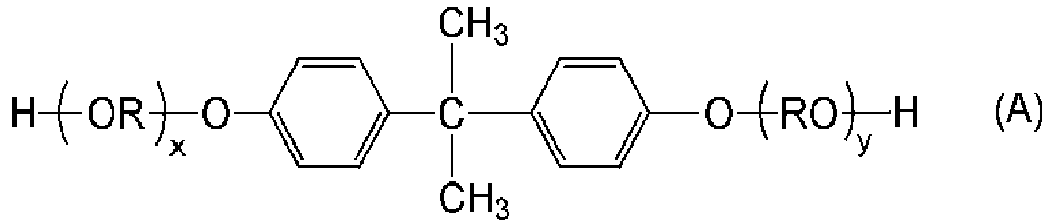
- (In the formula (A), R represents an ethylene group or a propylene group, x and y are each an integer of 0 or more, and the average value of x + y is from 0 to 10.)

- (In the formula (B), R' represents -CH2CH2-, -CH2CH(CH3)- or -CH2C(CH3)2-, x and y are integers of 0 or more, respectively, and the average value of x + y is 0 or more and 10 or less.)
- Examples of trihydric or higher alcohol components include sorbitol, 1,2,3,6-hexanetetrol, 1,4-sorbitan, pentaerythritol, dipentaerythritol, tripentaerythritol, 1,2,4-butanetriol, 1,2,5-pentantriol, glycerol, 2-methylpropanetriol, 2-methyl-1,2,4-butanetriol, trimethylolethane, trimethylolpropane, and 1,3,5-trihydroxymethylbenzene.
- Of these, glycerol, trimethylolpropane, and pentaerythritol are preferably used. These divalent alcohols and trihydric or higher alcohols can be used alone or in combination of two or more.
- As the polyvalent carboxylic acid monomer to be used for the polyester resin, the following polyvalent carboxylic acid monomers can be used.
- Examples of divalent carboxylic acid components include maleic acid, fumaric acid, citraconic acid, itaconic acid, glutaconic acid, phthalic acid, isophthalic acid, terephthalic acid, succinic acid, adipic acid, sebacic acid, azelaic acid, malonic acid, n-dodecenyl succinic acid, isododecenyl succinic acid, n-dodecyl succinic acid, isododecyl succinic acid, n-octenyl succinic acid, n-octyl succinic acid, isooctenyl succinic acid, isooctyl succinic acid, anhydrides of these acids and lower alkyl esters thereof.
- Of these, maleic acid, fumaric acid, terephthalic acid, and n-dodecenyl succinic acid are preferably used.
- Examples of trivalent or higher carboxylic acids, acid anhydrides thereof or lower alkyl esters thereof include 1,2,4-benzenetricarboxylic acid, 2,5,7-naphthalentricarboxylic acid, 1,2,4-naphthalenetricarboxylic acid, 1,2,4-butanetricarboxylic acid, 1,2,5-hexanetricarboxylic acid, 1,3-dicarboxyl-2-methyl-2-methylenecarboxypropane, 1,2,4-cyclohexanetricarboxylic acid, tetra(methylenecarboxyl)methane, 1,2,7,8-octanetetracarboxylic acid, pyromellitic acid, Empol trimer acid, acid anhydrides thereof or lower alkyl esters thereof.
- Of these, 1,2,4-benzenetricarboxylic acid, that is, trimellitic acid or a derivative thereof, is preferably used because such acid is inexpensive and reaction control thereof is easy.
- These divalent carboxylic acids and the like and trivalent or higher carboxylic acids can be used alone or in combination of two or more.
- A method for producing the polyester resin is not particularly limited, and a known method can be used. For example, the above-mentioned alcohol monomer and carboxylic acid monomer are simultaneously charged and polymerized through an esterification reaction or a transesterification reaction and a condensation reaction to produce a polyester resin.
- As the styrene acrylic resin used for the shell, the abovementioned vinyl-based polymerizable monomer can be used. In addition, it is preferable to use a monomer having a polar group such as acrylic acid, methacrylic acid, 2-hydroxyethyl acrylate, 2-hydroxyethyl methacrylate, and 2-hydroxypropyl methacrylate. The styrene acrylic resin used for the shell is preferably a polymer of at least one selected from the group consisting of acrylic polymerizable monomers and methacrylic polymerizable monomers, at least one selected from the group consisting of monomers having a polar group, and styrene.
- In order to improve the performance of the toner, it is preferable that the external additive include an external additive C different from the hydrotalcite particles and alumina particles.
- The external additive C is, for example, fluorine-based resin particles such as vinylidene fluoride fine particles and polytetrafluoroethylene fine powder; silica fine particles such as wet silica or dry silica, titanium oxide fine particles, and alumina fine particles; hydrophobized fine particles obtained by subjecting the aforementioned fine particles to surface treatment with a hydrophobizing agent such as a silane compound, a titanium coupling agent, silicone oil, and the like; oxides such as zinc oxide and tin oxide; complex oxides such as strontium titanate, barium titanate, calcium titanate, strontium zirconate, and calcium zirconate; carbonate compounds such as calcium carbonate and magnesium carbonate; and the like.
- The external additive C is preferably silica fine particles, and the so-called dry silica or dry silica fine particles called fumed silica, which are fine particles obtained by vapor-phase oxidation of a silicon halogen compound are preferred.
- The dry production method utilizes, for example, a pyrolysis oxidation reaction of silicon tetrachloride gas in oxyhydrogen flame, and the basic reaction formula is as follows.
SiCl4 + 2H2 + O2 → SiO2 + 4HCl
- In this production process, it is also possible to obtain composite fine particles of silica and another metal oxide by using a silicon halogen compound together with another metal halogen compound such as aluminum chloride or titanium chloride, and silica fine particles are also inclusive of such composite fine particles.
- It is preferable that the external additive C have a number average particle diameter of from 3 to 200 nm because high charging performance and flowability can be ensured. The number average particle diameter of primary particles of the external additive C is more preferably from 5 to 20 nm. The amount of the external additive C is preferably from 0.01 to 3.0 parts by mass, and more preferably from 0.5 to 2.0 parts by mass with respect to 100 parts by mass of the toner particle. When the amount of the external additive C is in the above range, it is possible to improve the fixing performance while maintaining good flowability. Further, the external additive C is preferably surface-treated with a hydrophobizing agent. By surface-treating the external additive C, it becomes easy to obtain a good image regardless of the usage environment.
- Methods for measuring various physical properties will be explained hereinbelow.
- A total of 2 g of toner and 18 g of ethanol are added, homogenized by hand, and then irradiated with ultrasonic waves for 5 min. Then, the mixture is allowed to stand in a thermostat at 60°C for a whole day and night, and further allowed to stand at room temperature for 3 days. The supernatant of the sample is then collected and filtered through a PTFE syringe filter (pore size 250 nm), and the filtrate is used as an extraction sample.
- The GC/MS device is GC TRACE-1310 (manufactured by Thermo Fisher Scientific Corp.), the detector is a single quadrupole analyzer MS ISQ LT (manufactured by Thermo Fisher Scientific Corp.), and the autosampler is TRIPLUS RSH (manufactured by Thermo Fisher Scientific Corp.). The measurement is performed under the conditions shown below.
- Sample amount: 1 µL (liquid spraying)
- Column: HP5-MS (manufactured by Agilent Technologies, Inc.)
- Length: 30 m, inner diameter 0.25 mm, film thickness 0.25 µm
- Split ratio: 10
- Split flow: 15 mL/min
- Injection port temperature: 250°C
- Flow rate of helium gas in the column: 1.5 mL/min
- MS ionization: EI
- Column temperature condition: held at 40°C for 3 min, then raised to 300°C at 10°./min and held for 10 min.
- Ion source temperature: 250°C
- Mass Range: m/z 45-1000
- Transport line temperature: 250°C
- Samples for preparing a calibration curve are prepared so that the concentration of monohydric aliphatic alcohol (based on mass) in an ethanol solution is 10 ppm, 50 ppm, 100 ppm, and 250 ppm. These samples are measured under the above conditions, and a calibration curve is created from the area value of the peak derived from the monohydric aliphatic alcohol. Using the obtained calibration curve, the extraction sample is analyzed, and the content ratio of monohydric aliphatic alcohol in the toner extracted with ethanol is calculated.
- For the structure of monohydric aliphatic alcohol, the above-mentioned extraction sample is analyzed and the structure thereof is determined using a FT NMR device JNM-EX400 (manufactured by JEOL Ltd.) [1H-NMR 400 MHz, CDCl3, room temperature (25°C)] (13C-NMR etc. are also used).
- The work functions of toner particle and external additive are measured by the following measurement method. The work function is quantified as energy (eV) for extracting an electron from the substance. The work function is measured using a surface analyzer (AC-2 manufactured by Riken Keiki Co., Ltd.). In this device, a deuterium lamp is used and measurement is performed under the following conditions.
- Irradiation light quantity: 800 nW
- Spectrometer: monochromatic light
- Spot size: 4 [mm] × 4 [mm]
- Energy scanning range: 3.6 to 6.2 [eV]
- Anode voltage: 2910 V
- Measurement time: 30 [sec/1 point]
- Then, photoelectrons emitted from the sample surface are detected, and the work function calculation software built into the surface analyzer is used for arithmetic processing. The work function is measured with a repeatability (standard deviation) of 0.02 [eV]. When measuring a powder, a cell for measuring a powder is used.
- In the surface analysis, where the excitation energy of monochromatic light is scanned from low to high at 0.05 eV intervals, photon emission starts from a certain energy value [eV], and this energy threshold value is taken as a work function [eV].
- FIG. 1 shows an example of a measurement curve of the work function obtained by the measurement under the above conditions. In FIG. 1, the horizontal axis represents the excitation energy [eV], and the vertical axis represents the value Y of the number of emitted photons to the power of 0.5 (normalized photon yield). In general, when the excitation energy value exceeds a certain threshold, the emission of photons, that is, the normalized photon yield, increases rapidly, and the work function measurement curve rises rapidly. The rising point is defined as a photoelectric work function value [Wf]. This photoelectric work function value [Wf] is taken as the work function of the sample.
- In the measurement of the work function, the sample uses toner particles, hydrotalcite particles, alumina particles, or external additive C.
- Regarding the toner particles, the toner particles obtained by removing the external additive from the toner by the following method may be used as a sample.
- A total of 160 g of sucrose (manufactured by Kishida Chemical Co., Ltd.) is added to 100 mL of ion-exchanged water and dissolved in a water bath to prepare a sucrose concentrate. A total of 31 g of the sucrose concentrate and 6 mL of Contaminone N (10% by mass aqueous solution of a neutral detergent for cleaning precision measuring instruments that is composed of a nonionic surfactant, an anionic surfactant, and an organic builder and has pH 7, manufactured by Wako Pure Chemical Industries, Ltd.) are placed in a centrifuge tube to prepare a dispersion liquid. To this dispersion liquid, 1 g of toner is added, and toner lumps are loosened with a spatula or the like.
- The centrifuge tube is set in "KM Shaker" (model: V.SX, manufactured by Iwaki Sangyo Co., Ltd.) and shaken for 20 min under the condition of 350 reciprocations per min. After shaking, the solution is transferred to a glass tube (50 mL) for a swing rotor, and centrifugation is performed under the conditions of 3500rpm and 30 min with a centrifuge. In the glass tube after centrifugation, toner particles are present in the uppermost layer, and the external additive is present on the aqueous solution side of the lower layer. Toner particles of the top layer are separated. If necessary, shaking and centrifugation may be repeated to perform sufficient separation.
- Where the hydrotalcite particles or alumina particles and the external additive C are available independently, the hydrotalcite particles or alumina particles and the external additive C can be measured independently. When these are not available alone, the toner is dispersed in a solvent such as chloroform or the like, and then the hydrotalcite particles, alumina particles, and external additive C are separated by centrifugation or the like based on a difference in specific gravity. The method is as follows.
- First, 1 g of toner is added to 31 g of chloroform in a vial and dispersed to separate hydrotalcite particles, alumina particles, and external additive C from the toner. For dispersion, an ultrasonic homogenizer is used for 30 min to prepare a dispersion liquid. The processing conditions are as follows.
- Ultrasonic processing device: ultrasonic homogenizer VP-050 (manufactured by TIETECH Co., Ltd.)
- Microchip: step type microchip, tip diameter ϕ2 mm
- Microchip tip position: central part of glass vial and at a height of 5 mm from the vial bottom
- Ultrasonic conditions: intensity 30%, 30 min. At this time, ultrasonic waves are applied while cooling the vial with ice water so that the temperature of the dispersion liquid does not rise.
- The dispersion liquid is transferred to a glass tube (50 mL) for a swing rotor, and centrifuged under the conditions of 58.33 S-1 for 30 min with a centrifuge (H-9R; manufactured by Kokusan Co., Ltd.). In the glass tube after centrifugation, the fraction containing mainly hydrotalcite particles or alumina particles and the external additive C can be separated by the specific gravity. Where the separation is not successful, the speed and time of centrifugation are adjusted. The obtained fraction is dried under vacuum conditions (40°C/24 h) to obtain a sample.
- The weight-average particle diameter (D4) of the toner is calculated in the manner described below. A precision particle size distribution measuring apparatus based on a pore electric resistance method with a 100 µm aperture tube (a Coulter Counter Multisizer 3 (registered trademark) produced by Beckman Coulter, Inc.) and dedicated software for the measurement apparatus (Beckman Coulter Multisizer 3 Version 3.51 produced by Beckman Coulter, Inc.) for setting measurement conditions and analysis of measured data are used for measurement. The measurements are carried out using 25,000 effective measurement channels, and then measurement data is analyzed and calculated. A solution obtained by dissolving special grade sodium chloride in ion exchanged water at a concentration of approximately 1 mass%, such as "ISOTON II" (produced by Beckman Coulter), can be used as an aqueous electrolyte solution used in the measurements.
- The dedicated software was set up in the following way before carrying out measurements and analysis. On the "Standard Operating Method (SOM) alteration" screen in the dedicated software, the total count number in control mode is set to 50,000 particles, the number of measurements is set to 1, and the Kd value is set to the value obtained by using "standard particle 10.0 µm" (Beckman Coulter). By pressing the "Threshold value/noise level measurement button", threshold values and noise levels are automatically set. In addition, the current is set to 1600 µA, the gain is set to 2, the electrolyte solution is set to ISOTON II, and the "Flush aperture tube after measurement" option is checked. On the "Conversion settings from pulse to particle diameter" screen in the dedicated software, the bin interval is set to logarithmic particle diameter, the particle diameter bin is set to 256 particle diameter bin, and the particle diameter range is set to from 2 µm to 60 µm. The specific measurement method is as follows.
- 1. 200 mL of the aqueous electrolyte solution is placed in a dedicated Multisizer 3 250 mL glass round bottomed beaker, the beaker is set on a sample stand, and a stirring rod is rotated anticlockwise at a rate of 24 rotations/second. By carrying out the "Aperture tube flush" function of the dedicated software, dirt and bubbles in the aperture tube are removed.
- 2. Approximately 30 mL of the aqueous electrolyte solution is placed in a 100 mL glass flat bottomed beaker. Approximately 0.3 mL of a diluted liquid, which is obtained by diluting "Contaminon N" (a 10 mass% aqueous solution of a neutral detergent for cleaning precision measurement equipment, which has a pH of 7 and comprises a non-ionic surfactant, an anionic surfactant and an organic builder, available from Wako Pure Chemical Industries, Ltd.) approximately 3-fold in terms of mass with ion exchanged water, is added to the beaker as a dispersant.
- 3. An ultrasonic wave disperser (Ultrasonic Dispersion System Tetra 150 produced by Nikkaki Bios Co., Ltd.) having an electrical output of 120 W, in which two oscillators having an oscillation frequency of 50 kHz are housed so that their phases are staggered by 180° is prepared. A predetermined amount of ion exchanged water is placed in a water bath in the ultrasonic dispersion system, and approximately 2 mL of Contaminon N is added to this water bath.
- 4. The beaker mentioned in step (2) above is placed in a beaker-fixing hole in the ultrasonic wave disperser, and the ultrasonic wave disperser is activated. The height of the beaker is adjusted so that the resonant state of the liquid surface of the aqueous electrolyte solution in the beaker is at a maximum.
- 5. While the aqueous electrolyte solution in the beaker mentioned in section (4) above is being irradiated with ultrasonic waves, approximately 10 mg of toner is added a little at a time to the aqueous electrolyte solution and dispersed therein. The ultrasonic wave dispersion treatment is continued for a further 60 seconds. When carrying out the ultrasonic wave dispersion, the temperature of the water bath is adjusted as appropriate to a temperature of from 10°C to 40°C.
- 6. The aqueous electrolyte solution mentioned in section (5) above, in which the toner is dispersed, is added dropwise by means of a pipette to the round bottomed beaker mentioned in section (1) above, which is disposed on the sample stand, and the measurement concentration is adjusted to approximately 5%. Measurements are carried out until the number of particles measured reaches 50,000.
- 7. The weight-average particle diameter (D4) is calculated by analyzing measurement data using the accompanying dedicated software. The "AVERAGE DIAMETER" on the "ANALYSIS/VOLUME STATISTICAL VALUE (ARITHMETIC MEAN)" screen when the special software is set to graph/volume% is the weight average particle diameter (D4).
- The average circularity of the toner is measured with an "FPIA-3000" flow particle image analyzer (Sysmex Corporation) under the measurement and analysis conditions for calibration operations. The specific measurement methods are as follows.
- 20 mL of ion-exchange water from which solid impurities and the like have been removed is first placed in a glass container. 0.2 mL of a dilute solution of "Contaminon N" (a 10 mass% aqueous solution of a pH 7 neutral detergent for washing precision instruments, comprising a nonionic surfactant, an anionic surfactant and an organic builder, manufactured by Wako Pure Chemical Industries, Ltd.) diluted three times by mass with ion-exchange water is then added as a dispersant. 0.02 g of the measurement sample is then added and dispersed for 2 minutes with an ultrasonic disperser to obtain a dispersion for measurement. Cooling is performed as appropriate during this process so that the temperature of the dispersion is 10 to 40°C.
- Using a tabletop ultrasonic cleaner and disperser having an oscillating frequency of 50 kHz and an electrical output of 150 W (for example, "VS-150" manufactured by Velvo-Clear) as an ultrasonic disperser, a predetermined amount of ion-exchange water is placed on the water tank, and 2 mL of the Contaminon N is added to the tank. For the measurement, a flow type particle image analyzer equipped with "UPlanApro" (magnification 10 times, numerical aperture 0.40) as an objective lens is used, and a particle sheath "PSE-900A" (manufactured by Sysmex Corporation) is used as a sheath liquid.
- The liquid dispersion obtained by the procedures above is introduced into the flow particle image analyzer, and 3,000 toner particles are measured in HPF measurement mode, total count mode. The average circularity of the toner is then determined with a binarization threshold of 85% during particle analysis, and with the analyzed particle diameters limited to equivalent circle diameters of from 1.985 to less than 39.69 µm.
- Prior to the start of measurement, autofocus adjustment is performed using standard latex particles (for example, Duke Scientific Corporation "RESEARCH AND TEST PARTICLES Latex Microsphere Suspensions 5100A" diluted with ion-exchange water). Autofocus adjustment is then performed again every two hours after the start of measurement.
- In the examples in the present application, the flow particle image analyzer used had been calibrated by the Sysmex Corporation and had been issued a calibration certificate by the Sysmex Corporation. The measurements were carried out under the same measurement and analysis conditions as when the calibration certification was received, with the exception that the analyzed particle diameter was limited to a circle-equivalent diameter of from 1.985 to 39.69 µm.
- For the analysis of the content ratio of resin, a pyrolysis gas chromatography mass spectrometer (hereinafter, pyrolysis GC/MS) and NMR are used. In the present disclosure, a component having a molecular weight of 1500 or more is taken as a measurement object. This is because the region with a molecular weight of less than 1500 is considered to be a region in which the proportion of wax is high and the resin component is substantially not contained.
- In pyrolysis GC/MS, it is possible to determine constituent monomers of total resin in the toner and obtain the peak area of each monomer, but in order to perform quantification, it is necessary to standardize the peak intensity using a sample with a known concentration as a reference. Meanwhile, in NMR, it is possible to determine and quantify constituent monomers without using a sample having a known concentration. Therefore, depending on the situation, the constituent monomers are identified while comparing the spectra of both NMR and pyrolysis GC/MS.
- Specifically, when the amount of the resin component insoluble in deuterated chloroform, which is the extraction solvent at the time of NMR measurement, is less than 5.0% by mass, quantification is performed by NMR measurement. Meanwhile, when a resin component insoluble in deuterated chloroform, which is an extraction solvent at the time of NMR measurement, is present in an amount of 5.0% by mass or more, both NMR measurement and pyrolysis GC/MS measurement are performed on the deuterated chloroform-soluble component, and pyrolysis GC/MS measurement is performed on the deuterated chloroform-insoluble component.
- In this case, first, NMR measurement of the deuterated chloroform-soluble component is performed, and the constituent monomers are determined and quantified (quantification result 1). Next, pyrolysis GC/MS measurement is performed on the deuterated chloroform-soluble component, and the peak area of the peak attributed to each constituent monomer is determined. Using the quantitative result 1 obtained by NMR measurement, the relationship between the amount of each constituent monomer and the peak area of pyrolysis GC/MS is determined.
- Next, pyrolysis GC/MS measurement of the deuterated chloroform-insoluble component is performed, and the peak area of the peak attributed to each constituent monomer is determined. Based on the relationship between the amount of each constituent monomer obtained by measuring the deuterated chloroform-soluble component and the peak area of pyrolysis GC/MS, the constituent monomers in the deuterated chloroform-insoluble component are quantified (quantification results 2). Then, the quantification result 1 and the quantification result 2 are combined to obtain the final quantification result of each constituent monomer.
- Specifically, the following operations are performed.
- (1) A total of 500 mg of toner is weighed into a 30 mL glass sample bottle, 10 mL of deuterated chloroform is added, the bottle is covered, and dispersion and dissolution are performed with an ultrasonic disperser for 1 h. Then, filtration is performed with a membrane filter having a diameter of 0.4 µm, and the filtrate is collected. At this time, the deuterated chloroform-insoluble component remains on the membrane filter.
- (2) Using high-performance liquid chromatography (HPLC), components having a molecular weight of less than 1500 are removed from 3 mL of the filtrate with a fraction collector, and a resin solution is collected. Chloroform is removed from the collected solution using a rotary evaporator to obtain a resin. The components with a molecular weight less than 1500 are determined by measuring a polystyrene resin having a known molecular weight in advance and obtaining the elution time.
- (3) A total of 20 mg of the obtained resin is dissolved in 1 mL of deuterated chloroform, 1H-NMR measurement is performed, a spectrum is attributed to each constituent unit used for the polyester resin, and a quantitative value is obtained.
- (4) If the deuterated chloroform-insoluble component needs to be analyzed, analysis is performed by pyrolysis GC/MS. If necessary, derivatization treatment such as methylation is performed.
-
- Device: FT NMR device JNM-EX400 (manufactured by JEOL Ltd.)
- Measurement frequency: 400 MHz
- Pulse condition: 5.0 µs
- Frequency range: 10,500 Hz
- Number of integrations: 1024 times
- Measurement temperature: 25°C
- Sample: prepared by placing 50 mg of the measurement sample in a sample tube having an inner diameter of 5 mm, adding deuterated chloroform (CDCl3) as a solvent, and dissolving in a thermostat at 40°C
- The mol ratio of each monomer component is obtained from the integrated value of the obtained spectrum, and the composition ratio (mass%) is calculated based on this.
-
- Pyrolysis device: JPS-700 (Japan Analytical Industry Co., Ltd.)
- Decomposition temperature: 590°C
- GC/MS device: Focus GC/ISQ (Thermo Fisher Scientific Corp.)
- Column: HP-5MS, length 60 m, inner diameter 0.25 mm, film thickness 0.25 µm
- Injection port temperature: 200°C
- Flow pressure: 100 kPa
- Split: 50 mL/min
- MS ionization: EI
- Ion source temperature: 200°C
- Mass Range: 45-650
- The resin type of the toner particle shell is analyzed using time-of-flight secondary ion mass spectrometry (TOF-SIMS). For the measurement of the amount of polyester on the toner particle surface, for example, when the polyester resin has a structure derived from phthalic acid, isophthalic acid or terephthalic acid, TRIFT-IV manufactured by ULVAC-PHI, Inc. can be used. The analysis conditions are as follows.
- Sample preparation: the toner is attached to an indium sheet. The toner particles obtained by separating the external additive from the toner may be used as a sample.
- Sample pretreatment: none
- Primary ion: Au+
- Acceleration voltage: 30 kV
- Charge neutralization mode: On
- Measurement mode: positive
- Raster: 100 µm
- Calculation of peak intensity (EI) derived from phthalic acid, isophthalic acid or terephthalic acid including an ester group: according to ULVAC-PHI standard software (WinCadence), the total count peak number with mass numbers 148 to 150 is taken as the peak intensity (EI).
- Calculation of peak intensity derived from other resins: according to ULVAC-PHI standard software (WinCadence), the total count peak number with mass numbers 90 to 105 is taken as the peak intensity derived from other resins.
- The total value of this peak intensity and the peak intensity (EI) derived from phthalic acid, isophthalic acid or terephthalic acid containing an ester group is taken as the peak intensity (ZI) derived from the resin on the toner particle surface. EI/ZI is calculated from the peak intensity. For example, when EI/ZI ≥ 0.5, it is determined that the polyester resin is present on the surface of the toner particle. The mass number in the measurement of peak intensity (EI) can be changed according to the constituent monomers of the polyester resin used.
- The thickness of the shell is measured with a transmission electron microscope. The cross section of the toner observed with a transmission electron microscope is prepared as follows.
- First, the toner is sprayed on cover glass (Matsunami Glass Co., Ltd., angular cover glass, Square No. 1) so as to form a single layer, and an Os film (5 nm) and a naphthalene film (20 nm) are applied as protective films by using an osmium plasma coater (Filgen Co., Ltd., OPC80T). Next, a PTFE tube (Φ1.5 mm × Φ3 mm × 3 mm) is filled with a photocurable resin D800 (JEOL Ltd.), and the cover glass is gently placed on the tube with the orientation such that the toner comes into contact with the photocurable resin D800. After curing the resin by light irradiation in this state, the cover glass and the tube are removed to form a cylindrical resin in which toner is embedded in the outermost surface.
- A layer with a thickness equal to the half of the toner particle diameter (4.0 µm when the weight average particle diameter (D4) is 8.0 µm) is cut from the outermost surface of the cylindrical resin at a cutting speed of 0.6 mm/s by an ultrasonic ultramicrotome (Leica Biosystems Nussloch GmbH, UC7) to expose a cross section of the toner particles. Next, the magnetic toner is cut to a film thickness of 100 nm to prepare a flaky sample of toner particle cross section. By cutting by such a method, a cross section of the central portion of the toner particle can be obtained.
- Using a transmission electron microscope (TEM) (JEM2800 manufactured by JEOL Ltd.), a TEM image of toner is prepared under the condition of an acceleration voltage of 200 kV. The image is acquired with a TEM probe size of 1 nm and an image size of 1024 × 1024 pixels. In the obtained TEM image, the binder resin contained in the core particle and the shell are observed as different contrasts.
- The difference in light and darkness differs depending on the material, but in the present disclosure, the part observed as differing in contrast from the binder resin contained in the core particles is referred to as a shell. In the toner under observation, 10 particles with a diameter within ± 1.0 µm from the weight average particle diameter (D4) are selected and images thereof are captured. The observation magnification is 20,000 times.
- For thickness measurement, commercially available image analysis software, WinROOF (manufactured by Mitani Corporation) is used. In TEM images of 10 toner particles randomly selected according to the above criteria, the thickness of the shell is measured at 4 points for each particle. Specifically, two perpendicular straight lines are drawn through substantially the center of the toner cross section, and the thickness of the shell is measured at four points where the two lines intersect the shell. The thickness of the shell is the distance from the contour of the cross section of the toner particle to the interface between the binder resin and the shell. The arithmetic mean value of all measured values is taken as the thickness of the toner particle shell.
- The location of the hydrotalcite particles and alumina particles and also the external additive C such as silica particles that are present on the toner surface can be specified by observation with an ultra-high resolution field emission scanning electron microscope S-4800 (Hitachi High Technologies Co., Ltd.) (SEM-EDX) and by elemental analysis. For example, where observation and element mapping are performed in a continuous field of view at a magnification of 20,000 times and the presence of both Mg and Al elements could be confirmed in the particle under observation, it can be determined that this is a hydrotalcite particle. Similarly, where the presence of Al could be confirmed in the particle under observation, it can be determined that this is an alumina particle, and where the presence of Si could be confirmed, it can be determined that this is a silica particle.
- A method for measuring the number average value of major axes of hydrotalcite particles will be described hereinbelow. The major axis is measured for at least 300 hydrotalcite particles on the toner surface and the average is calculated. Some hydrotalcite particles are present as aggregated particles, but such aggregated particles are not subject to particle diameter measurement. Further, the maximum diameter of the particles is treated as the major axis. Further, the average of major axes of alumina particles is measured and calculated in the same manner as the average of major axes of hydrotalcite particles. Where the external additive C is silica particles, the number average particle diameter of the primary particles is calculated by counting the absolute maximum length thereof as a particle diameter when the particle has a spherical shape and counting the major axis as a particle diameter when the particle has a major axis and a minor axis.
- The amount of hydrotalcite particles, alumina particles, and external additive C is obtained by calculation from the intensity of elements from the hydrotalcite particles, alumina particles, and external additive C in the toner measured by a fluorescent X-ray analyzer (XRF). For example, using a calibration curve method, the amount of hydrotalcite particles can be analyzed and calculated from the intensity of Al and Mg elements. Further, the amount of alumina particles can be analyzed and calculated from the intensity of Al element. Where the external additive C is a silica particle, the amount can be analyzed and calculated from the intensity of Si element.
- As the measuring device, a wavelength dispersive fluorescent X-ray analyzer "Axios" (manufactured by PANalytical) equipped with dedicated software "SuperQ ver.4.0F" (manufactured by PANalytical) for setting measurement conditions and analyzing measurement data is used. Rh is used as the anode of an X-ray tube, the measurement atmosphere is vacuum, the measurement diameter (collimator mask diameter) is 10 mm, and the measurement time is 10 sec. Further, when measuring a light element, a proportional counter (PC) is used for detection, and when measuring a heavy element, a scintillation counter (SC) is used for detection. The measurement is performed under the above conditions, the element is identified based on the obtained peak position of X-rays, and the concentration thereof is calculated from the count rate (unit: cps) which is the number of X-ray photons per unit time.
- A pellet prepared by placing about 1 g of toner in a dedicated aluminum ring for pressing, flattening, pressurizing for 60 sec under 20 MPa and molding to a thickness of about 2 mm by using a tablet molding compressor "BRE-32" (manufactured by Maekawa Testing Machine Mfg. Co., Ltd.) is used as a measurement sample. The amount is calculated from the obtained peak intensity on the basis of the calibration curve plotted in advance from the samples with a known amount. Examples
- The present invention will be described in more detail hereinbelow with reference to Examples and Comparative Examples, but the present invention is not limited thereto. Unless otherwise specified, the parts used in the examples are based on mass.
- A total of 203.3 g of magnesium chloride hexahydrate and 96.6 g of aluminum chloride hexahydrate were dissolved in 1 L of deionized water, and while keeping this solution at 25°C, pH thereof was adjusted to 10.5 with a solution obtained by dissolving 60g of sodium hydroxide in 1 L of ionized water. Then, aging was performed at 98°C for 24 h. After cooling, the precipitate was washed with deionized water until the conductivity of the filtrate became 100 µS/cm or less to obtain a slurry having a concentration of 5% by mass. While stirring this slurry, the external additive B1 was obtained by spray drying with a spray dryer (DL-41, manufactured by Yamato Scientific Co., Ltd.) at a drying temperature of 180°C, a spray pressure of 0.16 MPa, and a spray rate of about 150 mL/min. The physical characteristics are shown in Table 1.
[Table 1] External additive Particle diameter (nm) Surface treatment agent Work function (eV) No. Types B1 Hydrotalcite 450 - 5.15 B2 Hydrotalcite 500 - 5.15 B3 Hydrotalcite 450 - 4.97 B4 Hydrotalcite 70 - 5.15 B5 Hydrotalcite 50 - 5.15 B6 Hydrotalcite 800 - 5.15 B7 Hydrotalcite 860 - 5.15 B8 Hydrotalcite 200 - 5.35 B9 Hydrotalcite 450 - 5.43 B10 Hydrotalcite 450 - 4.90 B11 Alumina 400 - 5.27 B12 Silica 7 PDMS 5.63 B13 Silica 7 Amino-modified silicon oil 5.30 B14 Titania 400 Isobutyltrimethoxysilane 5.15 - The particle diameter is the number average value of major axes (for silica, the number average particle diameter of primary particles). The abbreviations in the table are as follows.
- External additives B2 to B10 were obtained in the same manner as in the production of the external additive B1, except that the addition amounts of magnesium chloride hexahydrate and aluminum chloride hexahydrate and the spray pressure and the spray rate of the spray dryer were adjusted. The physical characteristics are shown in Table 1.
- A test was conducted by using alumina hydroxide as an alumina raw material, adding 0.02 parts of α-alumina as a seed crystal (the amount added is for 100 parts of the alumina amount obtained from the alumina raw material; the same applies hereinafter), and introducing hydrogen chloride gas as the atmospheric gas into a tubular furnace. The introduction temperature of the atmospheric gas was 900°C, the holding temperature (firing temperature) was 1200°C, and the holding time (firing time) was 30 min. The physical characteristics of the external additive B11 are shown in Table 1.
- A total of 10.0 parts of polydimethylsiloxane was sprayed on 100 parts of fumed silica (trade name: AEROSIL 380S, specific surface area by BET method: 380 m2/g, average particle diameter of primary particles: 7 nm, manufactured by Nippon Aerosil Co., Ltd.), followed by stirring for 30 min. Then, the temperature was raised to 300°C with stirring, and stirring was further performed for 2 h to prepare an external additive B12. The physical characteristics are shown in Table 1.
- An external additive B13 was produced by the same method as the external additive B12, except that polydimethylsiloxane was replaced with amino-modified silicone oil. The physical characteristics are shown in Table 1.
- Anatase-type titanium oxide was treated with 12% by mass of isobutyltrimethoxysilane to obtain an external additive B14. The physical characteristics are shown in Table 1.
- A total of 40 mol% of terephthalic acid, 10 mol% of trimellitic acid, and 50 mol% of bisphenol A-propylene oxide (PO) 2 mol adduct were placed in a reaction vessel equipped with a nitrogen introduction tube, a dehydration tube, a stirrer and a thermocouple, and dibutyltin oxide was added as a catalyst at 1.5 parts per 100 parts of the total amount of the monomers. Then, the temperature was rapidly raised to 180°C under normal pressure and under a nitrogen atmosphere, and then water was distilled off while heating at a rate of 10°C/h from 180°C to 210°C to carry out polycondensation. After reaching 210°C, the pressure inside the reaction vessel was reduced to 5 kPa or less, and polycondensation was performed under the conditions of 210°C and 5 kPa or less to obtain a shell resin 1. At that time, the polymerization time was adjusted so that the softening point of the obtained shell resin 1 was 120°C.
- A total of 300 parts of xylene (boiling point 144°C) was charged into a flask that could be pressurized and depressurized, the inside of the container was sufficiently purged with nitrogen under stirring, the temperature was then raised, and refluxing was performed. A mixed solution of the following raw materials was added.
- Styrene: 91.7 parts
- Methyl methacrylate: 2.50 parts
- Methacrylic acid: 3.30 parts
- 2-Hydroxyethyl methacrylate: 2.50 parts
- Di-tert-butyl peroxide: 2.00 parts
- Polymerization was carried out for 5 h at a polymerization temperature of 175°C and a reaction pressure of 0.125 MPa. Then, the solvent removal step was carried out under reduced pressure for 3 h to remove xylene, and pulverization was performed to obtain a shell resin 2 (acid value = 10.9, molecular weight (Mp) = 14,500).
- A total of 390.0 parts of ion-exchanged water and 14.0 parts of sodium phosphate (12-hydrate) [manufactured by Rasa Industries., Ltd.] were put into a reaction vessel, and the components were kept warm at 65°C for 1.0 h while purging with nitrogen. Next, a calcium chloride aqueous solution prepared by dissolving 9.2 parts of calcium chloride (dihydrate) in 10.0 parts of ion-exchanged water was batch-added while stirring at 12,000 rpm by using T. K. Homomixer (manufactured by Tokushu Kika Kogyo Co., Ltd.) to prepare an aqueous medium including a dispersion stabilizer. Further, hydrochloric acid was added to the aqueous medium to adjust the pH to 6.0 and obtain an aqueous medium 1.
- Meanwhile, the following materials were put into an attritor (manufactured by Nippon Coke Industries, Ltd.), zirconia particles having a diameter of 1.7 mm were further put into the attritor, dispersion was performed at 220 rpm for 5.0 h, and then the zirconia particles were removed to prepare a dispersion liquid 1 in which a colorant was dispersed.
- Styrene: 60.0 parts
- Colorant (Pigment Red 122): 6.5 parts
- Next, the following materials were added to the prepared dispersion liquid 1.
- Styrene: 15.0 parts
- N-butyl acrylate: 25.0 parts
- Shell resin 1: 4.0 parts
- Charge control agent (di-t-aluminum salicylate): 0.7 parts
- Hydrocarbon wax (HNP-51, manufactured by Nippon Seiro Co., Ltd.): 9.0 parts
- Dodecyl alcohol: 0.5 parts
- Then, the mixed liquid was heated to a temperature of 60°C and stirred with T. K. Homomixer (manufactured by Tokushu Kika Kogyo Co., Ltd.) at 9000 r/min to cause dissolution and dispersion. A total of 10.0 parts of a polymerization initiator 2,2'-azobis(2,4-dimethylvaleronitrile) was dissolved therein to prepare a monomer composition. The monomer composition was put into the aqueous medium and granulated for 15 min while rotating CLEARMIX at 15,000 rpm at a temperature of 60°C. Then, the mixture was transferred to a propeller type stirrer and stirred at 100 r/min while reacting at a temperature of 70°C for 5 h, then heated to a temperature of 80°C and further reacted for 5 h to produce toner particles.
- After completion of the polymerization reaction, the slurry containing the particles was cooled, hydrochloric acid was added, the pH was adjusted to 1.4 or less, the mixture was stirred for 1 h, and then solid-liquid separation was performed with a pressure filter to obtain a toner cake. This was re-slurried with ion-exchanged water to form a dispersion liquid again, and then solid-liquid separation was performed with the above-mentioned filter. The re-slurrying and solid-liquid separation were repeated until the electric conductivity of the filtrate became 5.0 µS/cm or less, and then the solid-liquid separation was finally performed to obtain a toner cake.
- The obtained toner cake was dried with an airflow dryer Flash Jet Dryer (manufactured by Seishin Enterprise Co., Ltd.). As for the drying conditions, the blowing temperature was 90°C, the dryer outlet temperature was 40°C, and the toner cake supply speed was adjusted according to the water content of the toner cake so that the outlet temperature did not deviate from 40°C. Further, fine and coarse powders were cut using a multi-division classifier utilizing the Coanda effect to obtain toner particles A1 having a weight average particle diameter (D4) of 6.8 µm.
- The physical characteristics are shown in Table 2.
[Table 2] Toner particles No. Shell resin Alcohol type Pigment Work function Wa (eV) No. Thickness (nm) A1 1 22 1-Dodecanol PR122 5.45 A2 1 22 1-Octanol PR122 5.45 A3 1 22 1-Octadecanol PR122 5.45 A4 1 22 1-Dodecanol PR122 5.45 A5 1 22 1-Dodecanol PR122 5.45 A6 1 93 1-Hexadecanol PR122 5.45 A7 1 22 1-Decanol PR122 5.45 A8 1 111 1-Dodecanol PR122 5.45 A9 1 22 1-Dodecanol PR122 5.45 A10 1 1 1-Tetradecanol PR122 5.45 A11 None - 1-Dodecanol PR122 5.45 A12 None - 1-Dodecanol PR122 5.45 A13 1 22 1-Dodecanol Carbon black 5.73 A14 2 - 1-Dodecanol PR122 5.45 A15 1 22 - PR122 5.45 A16 1 22 1-Hexanol PR122 5.45 A17 1 22 1-Docosanol PR122 5.45 A18 1 22 1-Octadecanol PR122 5.45 A19 1 22 1-Octanol PR122 5.45 A20 1 22 1-Dodecanol PR122 5.45 - The external additives of the types and the number of parts shown in Table 3-1 were externally added and mixed by FM10C (manufactured by Nippon Coke Industries Co., Ltd.) with 100 parts of the obtained toner particles 1. The external addition conditions were as follows: the amount of toner particles charged: 1.8 kg, the rotation speed: 60 s-1, and the external addition time: 15 min. Then, the toner 1 was obtained by sieving with a mesh having an opening of 200 µm.
- The physical characteristics are shown in Tables 3-1 and 3-2.
[Table 3-1] Toner No. Toner particles No. Amount of StAc resin (mass%) Alcohol (mass ppm) First external additive Second external additive No. parts No. parts 1 A1 82 193 B1 0.2 B12 1.0 2 A2 82 193 B1 0.2 B12 1.0 3 A3 82 193 B1 0.2 B12 1.0 4 A4 82 33 B1 0.2 B12 1.0 5 A5 82 296 B1 0.2 B12 1.0 6 A1 82 193 B11 0.2 B12 1.0 7 A6 82 193 B2 0.2 B12 1.0 8 A7 82 193 B1 0.2 B12 1.0 9 A8 82 72 B3 0.2 B12 1.0 10 A9 82 250 B1 0.2 B12 1.0 11 A1 82 193 B4 0.55 B12 1.0 12 A1 82 193 B5 0.5 B12 1.0 13 A1 82 193 B6 0.2 B12 1.0 14 A1 82 193 B7 0.3 B12 1.0 15 A10 82 110 B8 0.15 B12 1.0 16 A1 82 193 B9 0.2 B12 1.0 17 A11 69 193 B1 0.2 B12 1.0 18 A12 49 193 B10 0.2 B12 1.0 19 A1 82 193 B1 0.05 B13 1.0 20 A13 82 193 B1 0.2 B12 1.0 21 A14 82 193 B1 0.03 B12 1.0 22 A15 82 - B11 0.55 B12 1.0 23 A16 82 193 B1 0.2 B12 1.0 24 A17 82 296 B1 0.55 B12 1.0 25 A18 82 15 B11 0.55 B12 1.0 26 A19 82 450 B1 0.2 B12 1.0 27 A20 82 296 B14 0.2 B12 1.0 [Table 3-2] Toner No. Wa-Wb Relationship of Wa, Wb, and Wc Average circularity 1 0.30 Wb<Wa<Wc 0.98 2 0.30 Wb<Wa<Wc 0.98 3 0.30 Wb<Wa<Wc 0.98 4 0.30 Wb<Wa<Wc 0.98 5 0.30 Wb<Wa<Wc 0.98 6 0.18 Wb<Wa<Wc 0.98 7 0.30 Wb<Wa<Wc 0.98 8 0.30 Wb<Wa<Wc 0.98 9 0.48 Wb<Wa<Wc 0.98 10 0.30 Wb<Wa<Wc 0.98 11 0.30 Wb<Wa<Wc 0.98 12 0.30 Wb<Wa<Wc 0.98 13 0.30 Wb<Wa<Wc 0.98 14 0.30 Wb<Wa<Wc 0.98 15 0.10 Wb<Wa<Wc 0.98 16 0.02 Wb<Wa<Wc 0.98 17 0.30 Wb<Wa<Wc 0.97 18 0.55 Wb<Wa<Wc 0.96 19 0.30 Wb<Wc<Wa 0.98 20 0.55 Wb<Wa<Wc 0.98 21 0.30 Wb<Wa<Wc 0.98 22 0.18 Wb<Wa<Wc 0.98 23 0.30 Wb<Wa<Wc 0.98 24 0.30 Wb<Wa<Wc 0.98 25 0.18 Wb<Wa<Wc 0.98 26 0.30 Wb<Wa<Wc 0.98 27 0.30 Wb<Wa<Wc 0.98 - In the table, the amount of StAc resin is the content ratio (% by mass) of the styrene acrylic resin in the toner.
- Toner particles A2 to A20 were obtained in the same manner as the toner particles 1, except that the type and amount of alcohol, the amount and type of shell resin, and the type of pigment were changed as shown in Table 2. The physical characteristics are shown in Table 2.
- Toners 2 to 27 were obtained in the same manner as toner 1 except that the type and amount of the external additive were changed as shown in Table 3-1. The physical characteristics are shown in Table 3-2. Further, when the amount of the external additives was measured in the obtained toners, it was confirmed that each external additive was contained in the number of parts shown in Table 3-1.
- The following evaluation was carried out for toner 1. A cartridge filled with the toner 1 obtained above was mounted on a Canon laser beam printer LBP652C, and the following evaluation was performed. As the transfer material, A4 size of CS-680 (basis weight 68 g/cm2) was used. The evaluation was also performed after the above machine was allowed to stand for 3 days in each evaluation environment.
- The evaluation was performed in a high-temperature and high-humidity (H/H) environment (32.5°C, 80% RH). A solid image was output, the image density for one round of the developing roller from the top of the solid image and the image density for the second and subsequent rounds were measured with a color reflection densitometer (X-Rite 404A), and the evaluation was performed in the following manner based on the difference between these image densities. The evaluation results are shown in Table 4.
- A: difference between image densities is 0.05 or less
- B: difference between image densities is larger than 0.05 and 0.10 or less.
- C: difference between image densities is larger than 0.10 and 0.15 or less.
- D: difference between image densities is larger than 0.15
- The evaluation was performed in a high-temperature and high-humidity (H/H) environment (32.5°C, 80% RH). In the H/H environment, after 1000 sheets with images having a print percentage of 1% were output continuously, one solid white image with a print percentage of 0% was output, and the reflectance (%) thereof was measured with "REFLECTOMETER MODEL TC-6DS" (manufactured by Tokyo Denshoku Co., Ltd.). The evaluation was performed using a numerical value (fogging value) (%) obtained by subtracting the obtained reflectance from the reflectance (%) of the unused printout paper (standard paper) measured in the same manner. The smaller the numerical value, the more the image fogging is suppressed. The evaluation results are shown in Table 4.
-
- A: fogging value is less than 1.0%
- B: fogging value is 1.0% or more and less than 3.0%
- C: fogging value is 3.0% or more and less than 5.0%
- D: fogging value is 5.0% or more
- The evaluation was performed in a low-temperature and low-humidity (L/L) environment (15.0°C, 10% RH). After 1000 sheets with monochromatic solid white images having a print percentage of 0% were output continuously, a monochromatic ghost determination image was output. The ghost determination image was obtained by arranging seven solid images of 15 mm × 15 mm in a horizontal row at 15 mm intervals at a position of 5 mm from the top edge of the transfer paper and forming a halftone image with a toner laid-on level of 0.20 mg/cm2 below these solid images. The difference in density due to the solid image of 15 mm × 15 mm in the halftone portion of the image was visually determined. The evaluation results are shown in Table 4.
-
- A: no difference in density is observed
- B: there is a slight difference in density
- C: some difference in density is observed
- D: difference in density is clearly recognized
- The evaluation was performed in a high-temperature and high-humidity (H/H) environment (32.5°C, 80% RH). After 7000 sheets with images having a print percentage of 1% were output continuously, the developing container was disassembled and the surface and edges of the toner carrying member were visually evaluated. The evaluation results are shown in Table 4.
-
- A: there are no circumferential streaks on the surface or edges of the toner carrying member which are caused by foreign matter caught between the toner regulating member and the toner carrying member as a result of toner fracture or fusion
- B: some foreign matter is caught between the toner carrying member and the toner end seal
- C: one to four streaks in the circumferential direction can be seen at the ends
- D: five or more streaks in the circumferential direction can be seen in the entire area.
- The same evaluation as in Example 1 was performed on the toners 2 to 21. The results are shown in Table 4.
- The same evaluation as in Example 1 was performed on the toners 22 to 27. The results are shown in Table 4.
[Table 4] Toner No. Tip density Fogging Ghost Fusion Rank Numerical value Rank Numerical value Example 1 1 A 0.02 A 0.5 A A Example 2 2 C 0.15 C 4.8 A C Example 3 3 C 0.12 B 2.5 A A Example 4 4 C 0.15 B 1.6 A A Example 5 5 C 0.12 C 4.7 A C Example 6 6 B 0.06 B 1.5 A A Example 7 7 B 0.07 A 0.9 A A Example 8 8 B 0.07 B 2.9 A B Example 9 9 B 0.10 A 0.9 B B Example 10 10 B 0.06 B 2.8 A B Example 11 11 A 0.05 B 1.3 C A Example 12 12 B 0.07 B 2.5 B A Example 13 13 B 0.06 A 0.5 A A Example 14 14 B 0.10 A 0.5 A A Example 15 15 A 0.05 A 0.7 A A Example 16 16 A 0.05 C 3.5 A A Example 17 17 B 0.07 B 1.2 A B Example 18 18 B 0.10 B 1.8 C B Example 19 19 B 0.06 B 2.8 B A Example 20 20 A 0.02 B 2.0 C A Example 21 21 B 0.09 C 3.2 A B Comparative Example 1 22 D 0.19 C 3.8 C A Comparative Example 2 23 D 0.17 D 5.5 A D Comparative Example 3 24 D 0.26 D 7.5 C C Comparative Example 4 25 D 0.19 D 5.5 C A Comparative Example 5 26 D 0.29 D 7.4 A D Comparative Example 6 27 D 0.25 D 6.7 A C - While the present invention has been described with reference to exemplary embodiments, it is to be understood that the invention is not limited to the disclosed exemplary embodiments. The scope of the following claims is to be accorded the broadest interpretation so as to encompass all such modifications and equivalent structures and functions.
- A toner comprising a toner particle comprising a binder resin, and an external additive, wherein the toner particle further comprises a monohydric aliphatic alcohol, the monohydric aliphatic alcohol has 8 to 18 carbon atoms, a content ratio of the monohydric aliphatic alcohol extracted from the toner with ethanol is 30 to 300 ppm by mass in the toner, and the external additive comprises at least one selected from the group consisting of hydrotalcite particles and alumina particles.
Claims (14)
- A toner comprisinga toner particle comprising a binder resin, andan external additive, whereinthe toner particle further comprises a monohydric aliphatic alcohol,the monohydric aliphatic alcohol has 8 to 18 carbon atoms,a content ratio of the monohydric aliphatic alcohol extracted from the toner with ethanol is 30 to 300 ppm by mass in the toner, andthe external additive comprises at least one selected from the group consisting of hydrotalcite particles and alumina particles.
- The toner according to claim 1, whereinthe external additive comprises the hydrotalcite particles, andthe hydrotalcite particles has a number average value of major axes of 60 to 820 nm.
- The toner according to claim 1, whereinthe external additive comprises the alumina particles, andthe alumina particles has a number average value of major axes of 60 to 820 nm.
- The toner according to any one of claims 1 to 3, wherein a total amount of content of the hydrotalcite particles and alumina particles is 0.02 to 1.00 part by mass with respect to 100 parts by mass of the toner particle.
- The toner according to any one of claims 1 to 4, wherein the total amount of content of the hydrotalcite particles and alumina particles is 0.05 to 0.50 parts by mass with respect to 100 parts by mass of the toner particle.
- The toner according to any one of claims 1 to 5, whereinthe binder resin comprises a styrene acrylic resin, anda content ratio of the styrene acrylic resin in the toner is 50% by mass or more.
- The toner according to any one of claims 1 to 6, wherein
where a work function of the toner particle is denoted by Wa and a work function of the hydrotalcite particle is denoted by Wb, the Wa and the Wb satisfy a following formula (1):
- The toner according to any one of claims 1 to 6, wherein
where a work function of the toner particle is denoted by Wa, and a work function of the alumina particle is denoted by Wb, the Wa and the Wb satisfy a following formula (1):
- The toner according to any one of claims 1 to 8, whereinthe toner particle comprises a colorant, andthe colorant comprises at least one selected from the group consisting of C. I. Pigment Violet 19, C. I. Pigment Red 122, C. I. Pigment Red 202, and C. I. Pigment Red 209.
- The toner according to any one of claims 1 to 9, whereinthe external additive comprises an external additive C different from the hydrotalcite particles and the alumina particles,where a work function of the toner particle is denoted by Wa, a work function of the hydrotalcite particle is denoted by Wb, and a work function of the external additive C is denoted by Wc, the Wa, the Wb, and the Wc satisfy a following formula (2):

- The toner according to any one of claims 1 to 9, whereinthe external additive comprises an external additive C different from the hydrotalcite particles and the alumina particles,where a work function of the toner particle is denoted by Wa, a work function of the alumina particle is denoted by Wb, and a work function of the external additive C is denoted by Wc, the Wa, the Wb, and the Wc satisfy a following formula (2):

- The toner according to any one of claims 1 to 11, wherein the external additive comprises the hydrotalcite particles.
- The toner according to any one of claims 1 to 12, whereinthe toner particle comprises a core-shell structure comprising a core particle and a shell on a surface of the core particle,in cross-sectional observation of the toner with a transmission electron microscope,the shell is present inside a contour of a cross section of the toner particle,the shell comprises a polyester resin, andthe shell has a thickness of 0.8 to 100 nm.
- The toner according to any one of claims 1 to 13, wherein the toner has an average circularity of 0.97 or more.
Applications Claiming Priority (1)
| Application Number | Priority Date | Filing Date | Title |
|---|---|---|---|
| JP2021095997A JP7699968B2 (en) | 2021-06-08 | 2021-06-08 | toner |
Publications (1)
| Publication Number | Publication Date |
|---|---|
| EP4102303A1 true EP4102303A1 (en) | 2022-12-14 |
Family
ID=81975279
Family Applications (1)
| Application Number | Title | Priority Date | Filing Date |
|---|---|---|---|
| EP22177460.7A Pending EP4102303A1 (en) | 2021-06-08 | 2022-06-07 | Toner |
Country Status (4)
| Country | Link |
|---|---|
| US (1) | US12461463B2 (en) |
| EP (1) | EP4102303A1 (en) |
| JP (1) | JP7699968B2 (en) |
| CN (1) | CN115453837A (en) |
Families Citing this family (5)
| Publication number | Priority date | Publication date | Assignee | Title |
|---|---|---|---|---|
| JP7599914B2 (en) | 2020-11-06 | 2024-12-16 | キヤノン株式会社 | toner |
| JP7799510B2 (en) | 2022-02-28 | 2026-01-15 | キヤノン株式会社 | toner |
| JP7844191B2 (en) | 2022-02-28 | 2026-04-13 | キヤノン株式会社 | toner |
| JP7791006B2 (en) | 2022-02-28 | 2025-12-23 | キヤノン株式会社 | toner |
| JP7853023B2 (en) | 2022-06-08 | 2026-04-28 | キヤノン株式会社 | toner |
Citations (4)
| Publication number | Priority date | Publication date | Assignee | Title |
|---|---|---|---|---|
| JP2000035692A (en) | 1998-05-13 | 2000-02-02 | Canon Inc | Toner and image forming method |
| US20070111124A1 (en) * | 2003-11-20 | 2007-05-17 | Yasuhito Yuasa | Toner and two-component developer |
| US20130252159A1 (en) * | 2012-03-23 | 2013-09-26 | Fuji Xerox Co., Ltd. | Electrostatic charge image developing toner, electrostatic charge image developer, toner cartridge, developer cartridge, process cartridge, image forming apparatus, and image forming method |
| JP2020056914A (en) | 2018-10-02 | 2020-04-09 | キヤノン株式会社 | Magnetic toner |
Family Cites Families (103)
| Publication number | Priority date | Publication date | Assignee | Title |
|---|---|---|---|---|
| JPH08160660A (en) | 1994-12-09 | 1996-06-21 | Ricoh Co Ltd | Toner for developing electrostatic image and method for producing the same |
| JP2003255586A (en) | 2002-03-05 | 2003-09-10 | Konica Corp | Electrostatic charge image developing toner, method for manufacturing the same, and image forming method |
| JP4123121B2 (en) * | 2003-09-30 | 2008-07-23 | コニカミノルタビジネステクノロジーズ株式会社 | Toner for developing electrostatic image and method for producing toner for developing electrostatic image |
| WO2005085958A1 (en) | 2004-03-03 | 2005-09-15 | Canon Kabushiki Kaisha | Magenta toner and process for producing magenta toner |
| US7390604B2 (en) * | 2005-01-21 | 2008-06-24 | Seiko Epson Corporation | Negatively chargeable spherical toner, color image forming apparatus, and process for producing negatively chargeable spherical toner |
| JP4544418B2 (en) * | 2005-01-21 | 2010-09-15 | セイコーエプソン株式会社 | Method for producing negatively charged spherical toner |
| WO2006088170A1 (en) | 2005-02-15 | 2006-08-24 | Canon Kabushiki Kaisha | Cyan toner and method for producing cyan toner |
| JP4662475B2 (en) | 2006-03-10 | 2011-03-30 | 株式会社リコー | Toner for electrostatic image development |
| JP4898384B2 (en) * | 2006-10-20 | 2012-03-14 | キヤノン株式会社 | toner |
| WO2008069045A1 (en) | 2006-11-30 | 2008-06-12 | Canon Kabushiki Kaisha | Dye compound, and yellow toner comprising the dye compound |
| JP5472670B2 (en) | 2007-01-29 | 2014-04-16 | セイコーエプソン株式会社 | Ink set, ink jet recording method and recorded matter |
| JP5230435B2 (en) | 2007-02-19 | 2013-07-10 | キヤノン株式会社 | Method for producing aqueous dispersion of resin fine particles, aqueous dispersion of resin fine particles, method for producing toner, and toner |
| WO2008114886A1 (en) | 2007-03-19 | 2008-09-25 | Canon Kabushiki Kaisha | Dye compound, yellow toner, thermal transfer recording sheet, and ink |
| JP2008233567A (en) * | 2007-03-20 | 2008-10-02 | Nippon Zeon Co Ltd | Positively chargeable toner for developing electrostatic image and image forming method |
| US8652737B2 (en) | 2007-11-08 | 2014-02-18 | Canon Kabushiki Kaisha | Toner and image forming process |
| WO2009088034A1 (en) | 2008-01-10 | 2009-07-16 | Canon Kabushiki Kaisha | Yellow toner |
| EP3009888B1 (en) | 2008-02-26 | 2017-12-13 | Canon Kabushiki Kaisha | Toner |
| KR101251750B1 (en) | 2008-06-02 | 2013-04-05 | 캐논 가부시끼가이샤 | Fine resin particle aqueous dispersion, method for producing same and method for producing toner particles |
| JP5251975B2 (en) | 2008-09-19 | 2013-07-31 | コニカミノルタビジネステクノロジーズ株式会社 | Toner, developer, and toner production method |
| JP4811459B2 (en) | 2008-12-22 | 2011-11-09 | 富士ゼロックス株式会社 | Toner for developing electrostatic image, developer for developing electrostatic image, toner cartridge, process cartridge, and image forming apparatus |
| US8697327B2 (en) | 2009-05-28 | 2014-04-15 | Canon Kabushiki Kaisha | Toner production process and toner |
| JP5506325B2 (en) | 2009-10-22 | 2014-05-28 | キヤノン株式会社 | toner |
| US8916317B2 (en) | 2009-12-10 | 2014-12-23 | Xerox Corporation | Toner processes |
| KR20110091370A (en) | 2010-02-05 | 2011-08-11 | 삼성정밀화학 주식회사 | Manufacturing method of toner |
| JP5581778B2 (en) | 2010-03-31 | 2014-09-03 | 三菱化学株式会社 | Method for producing toner for developing electrostatic image |
| JP4927221B2 (en) | 2010-05-12 | 2012-05-09 | キヤノン株式会社 | toner |
| JP5825849B2 (en) | 2010-06-15 | 2015-12-02 | キヤノン株式会社 | Toner production method |
| JP5609412B2 (en) | 2010-08-13 | 2014-10-22 | 富士ゼロックス株式会社 | Toner for developing electrostatic image, electrostatic image developer, toner cartridge, process cartridge, and image forming apparatus |
| JP4999997B2 (en) | 2010-08-27 | 2012-08-15 | キヤノン株式会社 | Azo compound, pigment dispersant, pigment composition, pigment dispersion and toner containing the azo compound |
| EP2615142A4 (en) | 2010-09-07 | 2015-07-01 | Canon Kk | Azo compound, and pigment dispersant, pigment composition, pigment dispersion and toner comprising azo compound |
| JP5691737B2 (en) | 2011-03-29 | 2015-04-01 | 富士ゼロックス株式会社 | Toner for developing electrostatic image, developer for developing electrostatic image, toner cartridge, process cartridge, method for producing toner for developing electrostatic image, and image forming apparatus |
| US9146485B2 (en) | 2011-07-27 | 2015-09-29 | Canon Kabushiki Kaisha | Magenta toner and method for producing the same |
| US8815484B2 (en) | 2011-10-12 | 2014-08-26 | Canon Kabushiki Kaisha | Toner including compound having bisazo skeleton |
| US20130202998A1 (en) | 2012-02-06 | 2013-08-08 | Canon Kabushiki Kaisha | Method for producing aqueous dispersion of resin fine particles and method for producing toner |
| CN104137001A (en) | 2012-02-29 | 2014-11-05 | 佳能株式会社 | Cyan toner containing a compound having an azo skeleton |
| US8940467B2 (en) | 2012-02-29 | 2015-01-27 | Canon Kabushiki Kaisha | Toner |
| JP5971985B2 (en) | 2012-02-29 | 2016-08-17 | キヤノン株式会社 | Toner production method |
| EP2820481A4 (en) | 2012-02-29 | 2015-11-18 | Canon Kk | Magenta toner containing compound having azo skeleton |
| US20140356779A1 (en) | 2012-02-29 | 2014-12-04 | Canon Kabuahik Kaisha | Black toner containing compound having azo skeleton |
| JP5835054B2 (en) | 2012-03-28 | 2015-12-24 | 日本ゼオン株式会社 | Method for producing color toner for developing electrostatic image |
| US9158216B2 (en) | 2013-04-03 | 2015-10-13 | Canon Kabushiki Kaisha | Method for producing toner particles |
| JP5879297B2 (en) * | 2013-04-19 | 2016-03-08 | 京セラドキュメントソリューションズ株式会社 | Method for producing toner for developing electrostatic image |
| US20140356778A1 (en) | 2013-05-29 | 2014-12-04 | Xerox Corporation | Toner Comprising Surface Modified Colorant |
| CN104678725B (en) | 2013-11-29 | 2018-11-20 | 佳能株式会社 | Toner |
| US9500972B2 (en) | 2013-11-29 | 2016-11-22 | Canon Kabushiki Kaisha | Toner |
| US9383668B2 (en) | 2013-11-29 | 2016-07-05 | Canon Kabushiki Kaisha | Toner |
| DE102014224190B4 (en) | 2013-11-29 | 2020-03-19 | Canon Kabushiki Kaisha | toner |
| CN104678724B (en) | 2013-11-29 | 2018-10-09 | 佳能株式会社 | Toner |
| JP6264078B2 (en) * | 2014-02-14 | 2018-01-24 | 富士ゼロックス株式会社 | Electrostatic image developing toner, electrostatic image developer, toner cartridge, process cartridge, image forming apparatus, and image forming method |
| US9575424B2 (en) | 2014-03-12 | 2017-02-21 | Canon Kabushiki Kaisha | Method of producing a toner particle |
| US9715187B2 (en) | 2014-04-01 | 2017-07-25 | Canon Kabushiki Kaisha | Method of producing a compound having a colorant structure, and toner containing a compound obtained by the production method |
| US9556290B2 (en) | 2014-04-01 | 2017-01-31 | Canon Kabushiki Kaisha | Method for producing compound having colorant structure at main chain terminal of polymer, and pigment dispersant, pigment composition, pigment dispersion and toner containing compound obtained by the production method |
| JP6525736B2 (en) | 2014-06-20 | 2019-06-05 | キヤノン株式会社 | toner |
| JP6643111B2 (en) | 2015-02-25 | 2020-02-12 | キヤノン株式会社 | toner |
| JP6812134B2 (en) | 2015-05-14 | 2021-01-13 | キヤノン株式会社 | Toner and toner manufacturing method |
| JP2016218208A (en) | 2015-05-19 | 2016-12-22 | 株式会社リコー | Toner and developer storage unit |
| JP6738183B2 (en) | 2015-05-27 | 2020-08-12 | キヤノン株式会社 | toner |
| JP6739982B2 (en) | 2015-05-28 | 2020-08-12 | キヤノン株式会社 | toner |
| JP6587456B2 (en) | 2015-08-21 | 2019-10-09 | キヤノン株式会社 | toner |
| US9904193B2 (en) | 2015-08-28 | 2018-02-27 | Canon Kabushiki Kaisha | Toner and method of producing toner |
| DE102016009868B4 (en) | 2015-08-28 | 2021-03-18 | Canon Kabushiki Kaisha | toner |
| JP6708401B2 (en) | 2015-12-04 | 2020-06-10 | キヤノン株式会社 | Toner manufacturing method |
| JP6857021B2 (en) | 2015-12-24 | 2021-04-14 | 花王株式会社 | Fumaric acid production method |
| JP6824513B2 (en) * | 2016-03-11 | 2021-02-03 | 株式会社リコー | Ester wax for toner, and toner, developer, toner storage unit and image forming device using it. |
| JP2017191312A (en) | 2016-04-11 | 2017-10-19 | キヤノン株式会社 | toner |
| JP6784152B2 (en) | 2016-11-24 | 2020-11-11 | 富士ゼロックス株式会社 | Toner for static charge image development, static charge image developer, toner cartridge, process cartridge, image forming apparatus and image forming method |
| JP2018084774A (en) | 2016-11-25 | 2018-05-31 | 三菱ケミカル株式会社 | Method for producing toner for developing electrostatic image and toner for developing electrostatic image |
| US10151990B2 (en) | 2016-11-25 | 2018-12-11 | Canon Kabushiki Kaisha | Toner |
| US10216107B2 (en) | 2017-01-11 | 2019-02-26 | Canon Kabushiki Kaisha | Toner and method of producing toner |
| DE112018003985T5 (en) | 2017-08-04 | 2020-04-16 | Canon Kabushiki Kaisha | TONER |
| JP2019066781A (en) * | 2017-10-05 | 2019-04-25 | 京セラドキュメントソリューションズ株式会社 | Toner, and image forming apparatus |
| JP7069809B2 (en) | 2018-02-21 | 2022-05-18 | 富士フイルムビジネスイノベーション株式会社 | Toner for static charge image development, static charge image developer, toner cartridge, process cartridge, image forming apparatus, and image forming method. |
| US10747136B2 (en) | 2018-04-27 | 2020-08-18 | Canon Kabushiki Kaisha | Toner |
| US10877389B2 (en) | 2018-06-13 | 2020-12-29 | Canon Kabushiki Kaisha | Toner |
| US10732530B2 (en) | 2018-06-13 | 2020-08-04 | Canon Kabushiki Kaisha | Toner and method for producing toner |
| US10877388B2 (en) | 2018-06-13 | 2020-12-29 | Canon Kabushiki Kaisha | Toner |
| EP3582018B1 (en) | 2018-06-13 | 2024-03-27 | Canon Kabushiki Kaisha | Positive-charging toner |
| JP2020013119A (en) | 2018-07-10 | 2020-01-23 | キヤノン株式会社 | toner |
| JP7150564B2 (en) | 2018-10-30 | 2022-10-11 | キヤノン株式会社 | Toner and toner manufacturing method |
| US10948839B2 (en) | 2018-10-30 | 2021-03-16 | Canon Kabushiki Kaisha | Toner having a toner particle with a binder resin containing a copolymer of a styrenic polymerizable monomer, and at least one of an acrylic or methacrylic polymerizable monomer |
| JP7224976B2 (en) * | 2019-03-14 | 2023-02-20 | キヤノン株式会社 | toner |
| JP7330725B2 (en) | 2019-03-19 | 2023-08-22 | キヤノン株式会社 | External additives for toner and toner |
| US10795275B1 (en) | 2019-04-08 | 2020-10-06 | Lexmark International, Inc. | Chemically prepared core shell magenta toner using a borax coupling agent and method to make the same |
| JP7292951B2 (en) | 2019-04-25 | 2023-06-19 | キヤノン株式会社 | toner |
| US11249412B2 (en) | 2019-04-25 | 2022-02-15 | Canon Kabushiki Kaisha | Toner |
| JP2020181068A (en) | 2019-04-25 | 2020-11-05 | キヤノン株式会社 | toner |
| JP7327993B2 (en) | 2019-05-13 | 2023-08-16 | キヤノン株式会社 | Toner and toner manufacturing method |
| JP7467219B2 (en) | 2019-05-14 | 2024-04-15 | キヤノン株式会社 | toner |
| JP7292978B2 (en) | 2019-05-28 | 2023-06-19 | キヤノン株式会社 | Toner and toner manufacturing method |
| JP7433867B2 (en) * | 2019-11-29 | 2024-02-20 | キヤノン株式会社 | Image forming device and process cartridge |
| JP2021148843A (en) | 2020-03-16 | 2021-09-27 | キヤノン株式会社 | toner |
| JP7455624B2 (en) | 2020-03-16 | 2024-03-26 | キヤノン株式会社 | toner |
| JP7475907B2 (en) | 2020-03-16 | 2024-04-30 | キヤノン株式会社 | toner |
| JP7483428B2 (en) | 2020-03-16 | 2024-05-15 | キヤノン株式会社 | toner |
| JP7757029B2 (en) | 2020-03-24 | 2025-10-21 | キヤノン株式会社 | toner |
| JP7651340B2 (en) | 2020-04-06 | 2025-03-26 | キヤノン株式会社 | Toner and method for producing the same |
| JP7458915B2 (en) | 2020-06-25 | 2024-04-01 | キヤノン株式会社 | toner |
| JP7551409B2 (en) | 2020-09-10 | 2024-09-17 | キヤノン株式会社 | toner |
| JP7612374B2 (en) | 2020-10-23 | 2025-01-14 | キヤノン株式会社 | toner |
| JP7665311B2 (en) | 2020-10-23 | 2025-04-21 | キヤノン株式会社 | toner |
| JP7599914B2 (en) | 2020-11-06 | 2024-12-16 | キヤノン株式会社 | toner |
| JP7596123B2 (en) | 2020-11-06 | 2024-12-09 | キヤノン株式会社 | toner |
| JP7699969B2 (en) | 2021-06-08 | 2025-06-30 | キヤノン株式会社 | toner |
-
2021
- 2021-06-08 JP JP2021095997A patent/JP7699968B2/en active Active
-
2022
- 2022-06-01 US US17/804,880 patent/US12461463B2/en active Active
- 2022-06-07 EP EP22177460.7A patent/EP4102303A1/en active Pending
- 2022-06-07 CN CN202210640522.2A patent/CN115453837A/en active Pending
Patent Citations (4)
| Publication number | Priority date | Publication date | Assignee | Title |
|---|---|---|---|---|
| JP2000035692A (en) | 1998-05-13 | 2000-02-02 | Canon Inc | Toner and image forming method |
| US20070111124A1 (en) * | 2003-11-20 | 2007-05-17 | Yasuhito Yuasa | Toner and two-component developer |
| US20130252159A1 (en) * | 2012-03-23 | 2013-09-26 | Fuji Xerox Co., Ltd. | Electrostatic charge image developing toner, electrostatic charge image developer, toner cartridge, developer cartridge, process cartridge, image forming apparatus, and image forming method |
| JP2020056914A (en) | 2018-10-02 | 2020-04-09 | キヤノン株式会社 | Magnetic toner |
Also Published As
| Publication number | Publication date |
|---|---|
| US12461463B2 (en) | 2025-11-04 |
| JP7699968B2 (en) | 2025-06-30 |
| CN115453837A (en) | 2022-12-09 |
| US20220404730A1 (en) | 2022-12-22 |
| JP2022187809A (en) | 2022-12-20 |
Similar Documents
| Publication | Publication Date | Title |
|---|---|---|
| EP4102303A1 (en) | Toner | |
| EP3561598B1 (en) | Toner | |
| US10423086B2 (en) | Toner | |
| EP3929659B1 (en) | Toner | |
| EP3674805B1 (en) | Toner | |
| EP3674802B1 (en) | Toner and toner manufacturing method | |
| CN108508719B (en) | Toner and image forming apparatus | |
| EP3709087B1 (en) | Toner | |
| CN107367912B (en) | Toner for electrophotographic system and electrostatic printing system | |
| EP3929660B1 (en) | Toner | |
| DE102015112925B4 (en) | Magnetic toner | |
| EP4002012A1 (en) | Toner | |
| JP7301637B2 (en) | toner | |
| DE112014003510T5 (en) | Magnetic toner | |
| JP7023721B2 (en) | toner | |
| JP6732532B2 (en) | toner | |
| JP6300508B2 (en) | Toner and toner production method | |
| JP7654456B2 (en) | Toner and method for producing the same | |
| US20210286283A1 (en) | Toner | |
| JP6727803B2 (en) | Toner and toner manufacturing method | |
| JP7837791B2 (en) | toner | |
| JP2019191451A (en) | toner | |
| JP2019168632A (en) | toner | |
| JP7336219B2 (en) | toner | |
| JP2018045004A (en) | Toner and toner production method |
Legal Events
| Date | Code | Title | Description |
|---|---|---|---|
| PUAI | Public reference made under article 153(3) epc to a published international application that has entered the european phase |
Free format text: ORIGINAL CODE: 0009012 |
|
| STAA | Information on the status of an ep patent application or granted ep patent |
Free format text: STATUS: THE APPLICATION HAS BEEN PUBLISHED |
|
| AK | Designated contracting states |
Kind code of ref document: A1 Designated state(s): AL AT BE BG CH CY CZ DE DK EE ES FI FR GB GR HR HU IE IS IT LI LT LU LV MC MK MT NL NO PL PT RO RS SE SI SK SM TR |
|
| STAA | Information on the status of an ep patent application or granted ep patent |
Free format text: STATUS: REQUEST FOR EXAMINATION WAS MADE |
|
| 17P | Request for examination filed |
Effective date: 20230614 |
|
| RBV | Designated contracting states (corrected) |
Designated state(s): AL AT BE BG CH CY CZ DE DK EE ES FI FR GB GR HR HU IE IS IT LI LT LU LV MC MK MT NL NO PL PT RO RS SE SI SK SM TR |