EP4101719A1 - Ad-hoc network-based train dynamic grouping and ungrouping method and system - Google Patents
Ad-hoc network-based train dynamic grouping and ungrouping method and system Download PDFInfo
- Publication number
- EP4101719A1 EP4101719A1 EP21879015.2A EP21879015A EP4101719A1 EP 4101719 A1 EP4101719 A1 EP 4101719A1 EP 21879015 A EP21879015 A EP 21879015A EP 4101719 A1 EP4101719 A1 EP 4101719A1
- Authority
- EP
- European Patent Office
- Prior art keywords
- train
- unmarshalling
- marshalling
- group
- sets
- Prior art date
- Legal status (The legal status is an assumption and is not a legal conclusion. Google has not performed a legal analysis and makes no representation as to the accuracy of the status listed.)
- Granted
Links
Images


Classifications
-
- B—PERFORMING OPERATIONS; TRANSPORTING
- B61—RAILWAYS
- B61B—RAILWAY SYSTEMS; EQUIPMENT THEREFOR NOT OTHERWISE PROVIDED FOR
- B61B1/00—General arrangement of stations, platforms, or sidings; Railway networks; Rail vehicle marshalling systems
- B61B1/005—Rail vehicle marshalling systems; Rail freight terminals
-
- B—PERFORMING OPERATIONS; TRANSPORTING
- B61—RAILWAYS
- B61C—LOCOMOTIVES; MOTOR RAILCARS
- B61C17/00—Arrangement or disposition of parts; Details or accessories not otherwise provided for; Use of control gear and control systems
- B61C17/12—Control gear; Arrangements for controlling locomotives from remote points in the train or when operating in multiple units
-
- B—PERFORMING OPERATIONS; TRANSPORTING
- B61—RAILWAYS
- B61L—GUIDING RAILWAY TRAFFIC; ENSURING THE SAFETY OF RAILWAY TRAFFIC
- B61L15/00—Indicators provided on the vehicle or train for signalling purposes
- B61L15/0018—Communication with or on the vehicle or train
- B61L15/0027—Radio-based, e.g. using GSM-R
-
- B—PERFORMING OPERATIONS; TRANSPORTING
- B61—RAILWAYS
- B61L—GUIDING RAILWAY TRAFFIC; ENSURING THE SAFETY OF RAILWAY TRAFFIC
- B61L15/00—Indicators provided on the vehicle or train for signalling purposes
- B61L15/0072—On-board train data handling
-
- B—PERFORMING OPERATIONS; TRANSPORTING
- B61—RAILWAYS
- B61L—GUIDING RAILWAY TRAFFIC; ENSURING THE SAFETY OF RAILWAY TRAFFIC
- B61L17/00—Switching systems for classification yards
- B61L17/02—Details, e.g. indicating degree of track filling
- B61L17/023—Signalling; Signals with multiple indicating means
-
- B—PERFORMING OPERATIONS; TRANSPORTING
- B61—RAILWAYS
- B61L—GUIDING RAILWAY TRAFFIC; ENSURING THE SAFETY OF RAILWAY TRAFFIC
- B61L23/00—Control, warning or like safety means along the route or between vehicles or trains
- B61L23/08—Control, warning or like safety means along the route or between vehicles or trains for controlling traffic in one direction only
-
- B—PERFORMING OPERATIONS; TRANSPORTING
- B61—RAILWAYS
- B61L—GUIDING RAILWAY TRAFFIC; ENSURING THE SAFETY OF RAILWAY TRAFFIC
- B61L23/00—Control, warning or like safety means along the route or between vehicles or trains
- B61L23/34—Control, warning or like safety means along the route or between vehicles or trains for indicating the distance between vehicles or trains by the transmission of signals therebetween
-
- B—PERFORMING OPERATIONS; TRANSPORTING
- B61—RAILWAYS
- B61L—GUIDING RAILWAY TRAFFIC; ENSURING THE SAFETY OF RAILWAY TRAFFIC
- B61L27/00—Central railway traffic control systems; Trackside control; Communication systems specially adapted therefor
- B61L27/20—Trackside control of safe travel of vehicle or train, e.g. braking curve calculation
-
- B—PERFORMING OPERATIONS; TRANSPORTING
- B61—RAILWAYS
- B61L—GUIDING RAILWAY TRAFFIC; ENSURING THE SAFETY OF RAILWAY TRAFFIC
- B61L27/00—Central railway traffic control systems; Trackside control; Communication systems specially adapted therefor
- B61L27/40—Handling position reports or trackside vehicle data
Definitions
- the present invention belongs to the technical field of transportation, and particularly relates to an ad-hoc network-based train dynamic marshalling and unmarshalling method and system.
- the multi-locomotive joint control requires very high synchronization between locomotives that are required to start, accelerate, decelerate and brake simultaneously within a certain time range according to commands of a master control locomotive. If the control of multiple traction locomotives is not synchronized, it may lead to coupler extrusion and breakage between trains, which seriously affects the transportation safety.
- the transport volume of a train can be increased from 20,000 tons to 50,000 tons if needed. If the extended train marshalling is adopted, the effective length of tracks needs to be increased to 5 km or above. As a result, it is difficult to solve this problem by increasing the effective length of tracks. If the multi-locomotive joint control is adopted, more locomotives will be used for synchronous traction, causing a higher risk of coupler extrusion and breakage. Therefore, it is difficult to solve this problem by adding locomotives and vehicles for conventional coupling marshalling.
- the present invention provides an ad-hoc network-based train dynamic marshalling and unmarshalling method.
- the method includes train dynamic marshalling and train dynamic unmarshalling; the train dynamic marshalling includes first marshalling; the first marshalling includes: after a rear train set enters a U code section, verifying, by a front train set and the rear train set, IDs for each other, and if the verification succeeds, marshalling the two train sets when the two train sets meet marshalling conditions, and updating group information;
- the dynamic unmarshalling includes first unmarshalling and second unmarshalling;
- the first unmarshalling includes: receiving, by the two train sets in a group, an unmarshalling command during operation, and unmarshalling the two train sets if a tracking distance between the two train sets is greater than a first unmarshalling threshold and the rear train set receives an LU code; and the second unmarshalling includes: when the rear train set has a speed of 0
- the train set includes a train and a group train; and the two train sets include two trains, one train and one group train, and two group trains.
- the tracking distance is a distance between an end of the front train set and a head of the rear train set.
- first marshalling includes:
- the train dynamic marshalling includes second marshalling; and the second marshalling includes: receiving, by a plurality of train sets, a marshalling plan including train IDs, verifying, by the plurality of train sets, the IDs for one another, and if the verification succeeds, marshalling the plurality of train sets to form a new train group; and departing in a mode of the new train group after the plurality of train sets are marshalled.
- train dynamic unmarshalling further includes: receiving an unmarshalling plan, and setting an unmarshalling command according to the unmarshalling plan.
- the unmarshalling plan includes a specific unmarshalling mode of the train group.
- the dynamic unmarshalling includes third unmarshalling.
- the dynamic unmarshalling includes fourth unmarshalling; and the fourth unmarshalling includes: when the rear train set has the speed of 0 during operation of the two train sets in the group, unmarshalling the two train sets if wireless communication connection times out.
- the present invention further provides an ad-hoc network-based train dynamic marshalling and unmarshalling system.
- the system includes a train dynamic marshalling subsystem and a train dynamic unmarshalling subsystem;
- the train set includes a train and a group train; and the two train sets include two trains, one train and one group train, and two group trains.
- the tracking distance is a distance between an end of the front train set and a head of the rear train set.
- the train dynamic marshalling includes second marshalling; and the second marshalling includes: receiving, by a plurality of train sets, a marshalling plan including train IDs, verifying, by the plurality of train sets, the IDs for one another, and if the verification succeeds, marshalling the plurality of train sets to form a new train group; and departing in a mode of the new train group after the plurality of train sets are marshalled.
- system includes:
- group control subsystem is further configured for receiving an unmarshalling plan, setting an unmarshalling command according to the unmarshalling plan, and sending the unmarshalling command to the train group.
- the unmarshalling plan includes a specific unmarshalling mode of the train group.
- the dynamic unmarshalling includes third unmarshalling.
- the dynamic unmarshalling includes fourth unmarshalling.
- the trains are no longer hardly coupled by means of couplers and are flexibly connected by means of an ad-hoc network.
- a train transport volume is increased, a 5,000 t standard train may be used, thereby avoiding high costs caused by adding effective tracks.
- Group trains may be flexibly marshalled, such that a plurality of tracks are fully utilized.
- a mode of marshalling first and then departing is used to improve the departure efficiency.
- An embodiment of the present invention discloses an ad-hoc network-based train dynamic marshalling and unmarshalling method.
- the method includes train dynamic marshalling and train dynamic unmarshalling;
- the train dynamic marshalling includes first marshalling, and the first marshalling includes: after a rear train set enters a U code section, a front train set and the rear train set verify IDs for each other, and if the verification succeeds, the two train sets are marshalled when meeting marshalling conditions, and group information is updated;
- the dynamic unmarshalling includes first unmarshalling and second unmarshalling;
- the first unmarshalling includes: the two train sets in a group receive an unmarshalling command during operation, and the two train sets are unmarshalled if a tracking distance between the two train sets is greater than a first unmarshalling threshold and the rear train set receives an LU code;
- the second unmarshalling includes: when the rear train set has a speed of 0
- a heavy haul train generally refers to a kind of super-long and over-heavy freight train that is marshalled by means of a large special freight train on a transport line with concentrated reception and departure of freights, and is driven by dual or multi-locomotive traction.
- the heavy haul train has large load capacity. A large number of vehicles may be marshalled and coupled to the train.
- the train-to-ground communication means that the train communicates with ground equipment.
- the train-to-train communication is further divided into train-to-ground-to-train communication and train-to-train communication.
- the train-to-ground-to-train communication means that multiple trains communicate via the ground equipment or information of the ground equipment.
- the train obtains other train information via the ground equipment, such as a data exchange center, and then communicates with other trains according to the obtained information, which belongs to the train-to-ground-to-train communication.
- the train-to-train communication that is, the establishment of a communication connection between trains for communication and the disconnection of communication do not depend on the ground equipment, and are completed by train equipment.
- the communication involved in the present invention is the train-to-train communication.
- the communication mode used in the present invention is an ad-hoc network.
- the group train mentioned in the present invention is a train group including multiple physical trains, the ground equipment controls the train group according to one train, and the trains in the train group are controlled cooperatively.
- the train set mentioned in the present invention may be a train or a group train. In the dynamic marshalling and unmarshalling mentioned in the present invention, all train sets are in the same ad-hoc network and can communicate freely with one another.
- the marshalling mentioned in the present invention may be marshalling of two trains, marshalling of one train (rear train) and one group train (front train), marshalling of one group train (rear train) and one train (front train), or marshalling of two group trains. From this, those skilled in the art can derive a method for marshalling several train sets. For example, two train sets can be marshalled first to generate a new group train, then other train sets are marshalled with the new group train, and finally marshalling of all the train sets is completed.
- the unmarshalling mentioned in the present invention may be unmarshalling of one group train to form two trains, unmarshalling to form one train (front train) and one new group train (rear train), unmarshalling to form one new group train (front train) and one train, or unmarshalling to form two new group trains. From this, those skilled in the art can derive a method for unmarshalling one train group to several train sets. One group train can be unmarshalled to form two train sets first, then one of the train sets is unmarshalled, and finally unmarshalling of the train group is completed.
- the several train sets establish or join the same ad-hoc network in but not limited to the mode below.
- Ad-hoc network equipment is arranged on the train, and the communication range of the ad-hoc network equipment on the train is wide enough to enable normal communication between the front train and the rear train.
- the ad-hoc network equipment may be proprietary equipment, or may be rebuilt using equipment such as Ad hoc, as long as it can complete the functions below.
- the train-to-train communication of the ad-hoc network equipment is performed by means of two radios that are both original train equipment, without adding hardware equipment.
- One of the radios is configured for long-distance communication, and the other of the radios is configured for short and medium-distance communication.
- the switching of the two radios is completed by the ad-hoc network equipment.
- a local wireless broadband communication private network may be established in a short time in an ad-hoc manner. All ad-hoc network equipment in the wireless broadband communication private network communicates with one another by using the wireless broadband communication private network.
- the ad-hoc network equipment on the train searches for communication equipment of other trains within a preset distance.
- the communication range of the ad-hoc network equipment on the train is wide enough to enable normal communication between the front train and the rear train.
- the train-to-train communication of the ad-hoc network equipment is performed by means of two radios that are both original train equipment, without adding hardware equipment.
- One of the radios is configured for long-distance communication, and the other of the radios is configured for short and medium-distance communication.
- the switching of the two radios is completed by the ad-hoc network equipment.
- a local wireless broadband communication private network may be established in a short time in an ad-hoc manner. All ad-hoc network equipment in the wireless broadband communication private network communicates with one another by using the wireless broadband communication private network. After the wireless broadband communication private network has been established, new ad-hoc network equipment is communicatively connected to any ad-hoc network equipment in the wireless broadband communication private network, and when networking conditions are met, the new ad-hoc network equipment will automatically join the wireless broadband communication private network to form a new wireless broadband communication private network.
- the new ad-hoc network equipment communicates with all the ad-hoc network equipment in the original wireless broadband communication private network via the new wireless broadband communication private network.
- the ad-hoc network equipment on the train searches for communication equipment of other trains within a preset distance.
- the preset distance such as the shortest distance between the front train and the rear train in normal tracking operation, the longest distance for long-distance communication of radios, etc. may be agreed in advance.
- the ad-hoc network equipment is arranged at a head of the train.
- a communication equipment of end of train (EOT) of this train communicates with communication equipment of head of train (HOT) of other trains within a preset distance, communication of other trains, and ad-hoc network equipment of other trains can receive the signal.
- the ad-hoc network equipment has the function of identifying communication equipment of EOT and HOT of a train on an adjacent line, thereby avoiding the inclusion of a train head or end set of the train on the adjacent line in the wireless communication network.
- the communication equipment may be identified in but not limited to the following mode: the ad-hoc network equipment sends networking request information to four sides, and informs itself of a track where it is located; and trains on the same track reply to their own corresponding information after receiving the networking request information, and trains on different tracks do not reply or reply with their track information.
- the ad-hoc network equipment can determine which trains are on the same track as itself according to the received information.
- the train on the adjacent line may also join the ad-hoc network as required.
- the establishment of the ad-hoc network between the trains needs to meet the networking conditions.
- the networking conditions include: the target train is internally provided with the ad-hoc network equipment; the target train is allowed to establish the ad-hoc network; and the communication between the target train and this train is stable.
- the train can join the ad-hoc network only when being provided with the ad-hoc network equipment. Any train provided with the ad-hoc network equipment has the function of authorizing/prohibiting itself to establish or join the ad-hoc network.
- a train When a train is set to authorize itself to establish or join the ad-hoc network, other trains send requests for establishing or joining the ad-hoc network to this train, and when all the networking conditions are met, this train establishes or joins the ad-hoc network.
- the train that establishes the ad-hoc network needs to maintain stable communication.
- the communication equipment of EOT of the train has the function of communication relay.
- a train head can communicate with other trains via the communication equipment of EOT, and other trains can also communicate with the train head via a train end of this train.
- the ad-hoc network When the ad-hoc network is established, two pieces of ad-hoc network equipment can be communicatively connected via the communication equipment of EOT, and stable communication is also considered to be stable communication between the target train and this train.
- the ad-hoc network When the ad-hoc network is established, there may be multiple trains in the ad-hoc network, and the ad-hoc network equipment also has the function of communication relay.
- any train in the ad-hoc network communicates with the target train, whether direct communication or communication via relay of other one or more trains in the ad-hoc network is considered to be stable communication between the target train and this train as long as the communication is stable.
- the ad-hoc network equipment on the train determines whether the ad-hoc network already exists currently. If the ad-hoc network does not exist, all the trains meeting the networking conditions and the original train establish the ad-hoc network. If the ad-hoc network already exists, all the trains meeting the networking conditions join the original ad-hoc network to form a new ad-hoc network. After establishing or joining the ad-hoc network, the train sets in the ad-hoc network communicate with each other via the ad-hoc network.
- several train sets receive a marshalling plan including train IDs, a route command, and a movement authority; the several train sets are subjected to route setting according to the route command; and the several train sets control train operation according to ground authorization and a train marshalling status.
- the train operation requires a series of authorities and related data, and can be performed only after these authorities and data are obtained.
- the train marshalling also requires an authority, that is, the marshalling plan, such as A, B, C, D and other train sets, and which the train sets are marshaled, which the train set is in the front and which the train set is in the rear need to be planned and authorized in advance.
- the marshalling plan, etc. may be sent to the train in but not limited to the mode below.
- a centralized traffic control (CTC) subsystem sends a marshalling plan and an unmarshalling plan (containing locomotive IDs) to a group control subsystem (GCS).
- the centralized traffic control subsystem sends a route command to a computer-based interlocking (CBI) subsystem according to the marshalling plan and the unmarshalling plan.
- the computer-based interlocking subsystem sets routes of the train sets according to the route command provided by the centralized traffic control subsystem, clears a signal when route conditions are met, and provides route status information to the group control subsystem.
- the group control subsystem sends the marshalling and unmarshalling plans of the centralized traffic control subsystem to relevant train sets. Several train sets are subjected to route setting according to the route command.
- the group control subsystem provides a movement authority (MA) for a first train in a group train, and provides following trains with line data and temporary speed limit functions according to the route status information provided by the computer-based interlocking subsystem, a train status (including position information, train integrality, etc.) provided by an on-board subsystem, and information such as line data.
- the first train in the group calculates a train speed curve and supervises a speed limit according to the movement authority issued by the group control subsystem.
- a non-first train in the group calculates the train speed curve and supervises the speed limit according to the train status information and the line data of the front train.
- the tracking distance is a distance between an end of the front train set and a head of the rear train set.
- the marshalling plan including train IDs.
- the marshalling plan when the train set A is to be marshalled with the train set B, the train set A joins the train set B to form a new group. Then the train set A operates in the rear, and the train set B operates in the front.
- the train set A and the train set B verify the IDs for each other, and if the verification fails, the train set A and the train set B will not be marshalled, and the two train sets continue to operate forward. If the verification succeeds, the train set A moves close to the train set B, and starts to determine whether the marshalling conditions are met.
- the marshalling threshold is a preset value, determined by technicians according to factors such as vehicle conditions, current line conditions, etc.
- the tracking distance L1 is calculated.
- the tracking distance L1 may be obtained in but not limited to the mode below, and is calculated by the rear train set.
- the front train set sends the position and length of the front train set via the ad-hoc network, and the rear train set obtains its position by vehicle equipment or the ground equipment.
- the tracking distance L1 is equal to the position of the front train set minus the position of the rear train set minus the length of the front train set.
- L2 is calculated.
- L2 is equal to the length of the block section where the U code is located plus the length of the block section where the HU code is located minus the distance the rear train set has operated at the U code.
- marshalling may be restored with this method.
- marshalling of the train set A and the train set B is to be restored.
- the train set A operates in the rear, and the train set B operates in the front.
- the train set A and the train set B verify the IDs for each other, and if the verification succeeds, the train set A and the train set B are marshalled when meeting the marshalling conditions.
- the train dynamic marshalling further includes second marshalling; the second marshalling includes: several train sets receive the marshalling plan including train IDs, the several train sets verify the IDs for one another, and if the verification succeeds, the several train sets are marshalled to form a new train group; and the several train sets depart in a mode of the new train group after being marshalled.
- train sets may also be marshalled to form a train group, and depart in a mode of the train group (multiple trains depart continuously at a very small distance). Compared with an existing train control system in which only a single train can depart, this solution can improve the departure efficiency.
- train sets have received the marshalling plan including train IDs. For example, in the marshalling plan, when the train set A is to be marshalled with the train set B, the train set A joins the train set B to form a new group. Then the train set A operates in the rear, and the train set B operates in the front.
- the train set A and the train set B verify the IDs for each other, if the verification fails, the train set A and the train set B will not be marshalled, and if the verification succeeds, the two train sets are marshalled to form a new train group. After marshalling, when the route command is received, the new train group controls all the trains therein to depart in a group mode.
- Departure, etc. may be implemented in but not limited to the following mode:
- the centralized traffic control subsystem sends the marshalling plan and the unmarshalling plan (containing locomotive IDs) to the group control subsystem.
- the group control subsystem sends the marshalling and unmarshalling plans of the centralized traffic control subsystem to relevant train sets. Several train sets are marshalled to form a new train group. The new train group departs in a group mode after receiving a command.
- the first marshalling in the dynamic marshalling is illustrated with examples below.
- First dynamic marshalling example a single train tracks a train group for dynamic marshalling.
- a train group Q ⁇ A,B,C,D ⁇ including a train A, a train B, a train C and a train D is operating, and a train E is in normal tracking operation after the group Q.
- the trains A, B, C and D communicate with one another via an ad-hoc network established among them.
- the train E joins the ad-hoc network and communicates with the train A, which is not shown in the figure.
- a distance between the trains A and B, a distance between the trains B and C, and a distance between the trains C and D are respectively L distance1 , Ldistance2, and Ldistance3, where L distance1 represents a distance between a first train and a second train in a group network, L distance2 represents a distance between the second train and a third train in the group network, and L distance3 represents a distance between the third train and a fourth train in the group network. Since the trains A, B, C and D form the train group Q ⁇ A,B,C,D ⁇ to operate, the train group Q controls the trains A, B, C and D to operate in a group mode, and L distance1 , Ldistance2, and Ldistance3 are all smaller than a normal train operation distance. During normal tracking operation, a target stop point of the train E is behind the train D. In an emergency, the train E can stop safely without colliding an end of the train D.
- a current marshalling plan is that the train group Q ⁇ A,B,C,D ⁇ and the train E are marshalled to form a train group Q' ⁇ A,B,C,D,E ⁇
- the train E reduces a distance from the front train D according to the plan.
- the train E and the train group Q verify IDs for each other, that is to say, the train E and the train A verify the IDs for each other. If the verification succeeds, the train E continues to operate until the marshalling conditions are met, and the train E is marshalled with the train group Q to form the new train group Q' ⁇ A,B,C,D,E ⁇ , as shown in FIG. 3 .
- a distance between the train E and the train D is L distance4 .
- the trains A, B, C, D, and E communicate with one another via an ad-hoc network established between them.
- the train group Q' controls the trains A, B, C, D, and E to operate in a group mode.
- the train A is a first train, and the rest of the trains are following trains.
- Second dynamic marshalling example a train group tracks a single train for dynamic marshalling.
- a train group Q ⁇ A,B,C,D ⁇ including a train A, a train B, a train C and a train D is tracking a front train F and normally operates, as shown in FIG. 4 .
- a current marshalling plan is that the train group Q ⁇ A,B,C,D ⁇ and the train F are marshalled to form a train group Q' ⁇ F,A,B,C,D ⁇
- the train A reduces a distance from the front train F according to the plan.
- the train A enters a U code section the train A and the train F verify IDs for each other.
- the train A continues to operate until the marshalling conditions are met, and the train group Q is marshalled with the train F to form the new train group Q' ⁇ F,A,B,C,D ⁇ , as shown in FIG. 5 .
- a distance between the trains A and B, a distance between the trains B and C, and a distance between the trains C and D are respectively L distance1 , L distance2 , and Ldistance3.
- a distance between the trains F and A is L distance1
- a distance between the trains A and B, a distance between the trains B and C, and a distance between the trains C and D are respectively Ldistance2, Ldistance3, and Ldistance4.
- Third dynamic marshalling example a train group tracks a train group for dynamic marshalling.
- a train group Q rear ⁇ C,D ⁇ including a train C and a train D is tracking a train group Q front ⁇ A,B ⁇ including a train A and a train B, and normally operates, as shown in FIG. 6 .
- a current marshalling plan is that the train groups Q rear ⁇ C,D ⁇ and Q front ⁇ A,B ⁇ are marshalled to form a train group Q combination ⁇ A,B,C,D ⁇ , then the train C reduces a distance from the front train B according to the plan.
- the train C enters a U code section, the train C and the train A verify IDs for each other.
- the train C continues to operate until the marshalling conditions are met, and the train groups Q rear ⁇ C,D ⁇ and Q front ⁇ A,B ⁇ are marshalled to form the new train group Q combination ⁇ A,B,C,D ⁇ , as shown in FIG. 7 .
- the dynamic unmarshalling includes first unmarshalling and second unmarshalling; and the dynamic unmarshalling further includes: an unmarshalling plan is received, and an unmarshalling command is set according to the unmarshalling plan.
- the unmarshalling plan includes a specific unmarshalling mode of the train group.
- the first unmarshalling includes: the two train sets in the group receive the unmarshalling command during operation, and the two train sets are unmarshalled if the tracking distance between the two train sets is greater than the unmarshalling threshold and the rear train set receives the LU code; and the second unmarshalling includes: when the rear train set has the speed of 0 during operation of the two train sets in the group, the two train sets are unmarshalled if the unmarshalling command is received.
- the dynamic unmarshalling is divided into two cases, in which one is unmarshalling according to the plan.
- the unmarshalling plan is made by an operator in advance.
- the unmarshalling plan includes the specific unmarshalling mode of the train group, for example, the train group is unmarshalled to form a train and a new train group, two new train groups, a new train group and a train, etc.
- the unmarshalling plan may also be unmarshalling by time, by location, etc.
- the unmarshalling by location refers to that when arriving at a designated location, the train group is unmarshalled according to the unmarshalling plan.
- the corresponding unmarshalling command is set.
- the unmarshalling command is sent to the train group by using, but not limited to, the ground equipment, or by using the group control subsystem.
- the planned unmarshalling includes first unmarshalling and second unmarshalling.
- the first unmarshalling includes: the two train sets in the group receives the unmarshalling command during operation, the two train sets are unmarshalled if the tracking distance between the two train sets is greater than the first unmarshalling threshold and the rear train set receives the LU code.
- the train group is to be unmarshalled to form two train sets according to the plan.
- the rear train set increases the distance from the front train.
- the first unmarshalling threshold is a preset value, determined by technicians according to factors such as vehicle conditions, current line conditions, etc.
- the train group is unmarshalled to form the two train sets if the tracking distance between the two train sets is greater than the first unmarshalling threshold and the rear train set receives the LU code.
- the train group controls the operation of all the trains in a group mode; and after unmarshalling, the two train sets operate separately.
- a train operation line includes an uphill and a downhill. When the train operates at the uphill, the speed will be decreased if a tractive force is not increased; and when the train operates at the downhill, the speed will be increased if the tractive force is not reduced or braking is not performed.
- the train group When the train group operates to a line with an uphill first and then a downhill, the tracking distance between the front train set at the downhill and the rear train set at the uphill is increased.
- the technicians can set the unmarshalling plan on a similar line.
- the train group When the train group operates to such line, the very long train group is unmarshalled to form several train sets by using the first unmarshalling, such that the train operation is safer. All the train sets continue to be marshalled for operation after passing this line.
- the second unmarshalling includes: when the rear train set has the speed of 0 during operation of the two train sets in the group, the two train sets are unmarshalled if the unmarshalling command is received.
- the train group is to be unmarshalled to form two train sets according to the plan.
- the two train sets are unmarshalled if the unmarshalling command is received.
- the rear train set is braked, but still not receive the LU code until the speed is 0. At this time, the two train sets are unmarshalled. This unmarshalling mode still belongs to the second unmarshalling.
- the dynamic unmarshalling further includes third unmarshalling; and the third unmarshalling includes: during operation of the two train sets in the group, the rear train set is braked if wireless communication connection times out; and when the tracking distance between the rear train set and the front train set is greater than a second unmarshalling threshold or the speed of the rear train set is 0, the two train sets are unmarshalled.
- the train group communicates using the ad-hoc network to control the operation of the entire train group. If there is a communication failure, for example, the front train set enters a tunnel, the rear train set cannot communicate with the front train set, and the rear train set cannot know the specific situation of the front train set. At this time, if the rear train set still operates in the previous mode, safety accidents may occur. When the wireless communication connection times out, the rear train set is braked.
- the communication connection timeout may be a few times of mutual communication timeout, or may be no mutual communication all the time.
- the wireless communication connection timeout is defined by technicians in advance. For example, the front and rear train sets are defined to communicate with each other.
- the rear train set When the rear train set sends a message to the front train set and does not receive a reply if the time exceeds a timeout threshold set by the technicians, it is considered that the wireless communication connection times out. It may also be defined that when the rear train set sends multiple messages to the front train set and receives replies with the number less than a reply threshold set by the technicians, it is considered that the wireless communication connection times out.
- the rear train set is braked, and until the tracking distance between the rear train set and the front train set is greater than the second unmarshalling threshold or the speed of the rear train set is 0, the original train group is unmarshalled to form the two train sets.
- the dynamic unmarshalling further includes fourth unmarshalling; and the fourth unmarshalling includes: when the rear train set has the speed of 0 during operation of the two train sets in the group, the two train sets are unmarshalled if wireless communication connection times out.
- the two train sets are unmarshalled if wireless communication connection with the front train set or the ground equipment times out, that is to say, the message from the front train set or the unmarshalling command transmitted from the ground equipment is not received.
- a train group Q ⁇ A,B,C,D ⁇ including a train A, a train B, a train C and a train D is operating normally.
- the train A is a first train, and the trains B, C and D are following trains.
- First dynamic unmarshalling example unmarshalling is performed to form a train group and a train.
- the communication connection with the train A, the train B, and the train C times out during operation of the train D.
- the train group Q is unmarshalled to form a train group Q1 ⁇ A,B,C ⁇ and the train D.
- the train A is a first train according to the train position, as shown in FIG. 8 .
- the train D recalculates a target stop point and operates under the guidance of the ground equipment.
- Second dynamic unmarshalling example unmarshalling is performed to form a train and a train group.
- a current unmarshalling plan is that the train group Q ⁇ A,B,C,D ⁇ is unmarshalled to form a train group Q2 ⁇ B,C,D ⁇ and the train A.
- the train group Q is unmarshalled to form the train group Q2 ⁇ B,C,D ⁇ and the train A after the unmarshalling command is received.
- the train B is a first train according to the train position, and a target stop point of the train B is recalculated, as shown in FIG. 9 .
- Third dynamic unmarshalling example unmarshalling is performed to form a train group and a train group.
- a current unmarshalling plan is that the train group Q ⁇ A,B,C,D ⁇ is unmarshalled to form a train group Q1 ⁇ A,B ⁇ and a train group Q2 ⁇ C,D ⁇
- the train C increases the distance from the front train B, and the train D keeps the tracking distance from the train C and continues to operate by following the train C.
- the train group Q is unmarshalled to form the train group Q1 ⁇ A,B ⁇ and the train group Q2 ⁇ C,D ⁇ when the tracking distance between the train C and the train B is greater than the first unmarshalling threshold and the train C receives the LU code.
- the train A is a first train in the new train group Q1 ⁇ A,B ⁇
- the train C is a first train in the new train group Q2 ⁇ C,D ⁇ , as shown in FIG. 10 .
- An embodiment of the present invention further provides an ad-hoc network-based train dynamic marshalling and unmarshalling system.
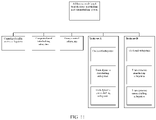
- the system includes a train dynamic marshalling subsystem, a train dynamic unmarshalling subsystem, a centralized traffic control subsystem, a computer-based interlocking subsystem, a group control subsystem, and an on-board subsystem.
- the train dynamic marshalling subsystem is configured for train dynamic marshalling, the dynamic marshalling includes first marshalling, and the first marshalling includes: after a rear train set enters a U code section, a front train set and a rear train set verify IDs for each other, and if the verification succeeds, the two train sets are marshalled when meeting marshalling conditions, and group information is updated.
- the train dynamic unmarshalling subsystem is configured for train dynamic unmarshalling, and the dynamic unmarshalling includes first unmarshalling and second unmarshalling;
- the first unmarshalling includes: the two train sets in a group receive an unmarshalling command during operation, and the two train sets are unmarshalled if a tracking distance between the two train sets is greater than a first unmarshalling threshold and the rear train set receives an LU code;
- the second unmarshalling includes: during operation of the two train sets in the group, when the rear train set has a speed of 0, the two train sets are unmarshalled if the unmarshalling command is received.
- the centralized traffic control subsystem is configured for sending marshalling and unmarshalling plans including train IDs to the group control subsystem, and sending a route command to the computer-based interlocking subsystem according to the marshalling and unmarshalling plans.
- the computer-based interlocking subsystem is configured for setting routes of the train sets according to the route command provided by the centralized traffic control subsystem, clearing a signal when route conditions are met, and providing route status information to the group control subsystem.
- the group control subsystem is configured for sending the marshalling and unmarshalling plans of the centralized traffic control subsystem to relevant train sets, and providing a movement authority for a first train in a group train, and providing following trains with line data and temporary speed limit functions according to the route status information provided by the computer-based interlocking subsystem, a train status provided by the on-board subsystem, and information such as line data.
- the group control subsystem is further configured for receiving the unmarshalling plan, setting the unmarshalling command according to the unmarshalling plan, and sending the unmarshalling command to the train group.
- the unmarshalling plan includes a specific unmarshalling mode of the train group.
- the on-board subsystem is configured for controlling train operation according to ground authorization and a train marshalling status.
- the train set includes a train and a group train; and the two train sets include two trains, one train and one group train, and two group trains.
- the tracking distance is a distance between an end of the front train set and a head of the rear train set.
- the train dynamic marshalling further includes second marshalling; the second marshalling includes: several train sets receive the marshalling plan including train IDs, the several train sets verify the IDs for one another, and if the verification succeeds, the several train sets are marshalled to form a new train group; and the several train sets depart in a mode of the new train group after being marshalled.
- the dynamic unmarshalling further includes third unmarshalling; and the third unmarshalling includes: during operation of the two train sets in the group, the rear train set is braked if wireless communication connection times out; and when the tracking distance between the rear train set and the front train set is greater than a second unmarshalling threshold or the speed of the rear train set is 0, the two train sets are unmarshalled.
- the dynamic unmarshalling further includes fourth unmarshalling; and the fourth unmarshalling includes: during operation of the two train sets in the group, the rear train set is braked if wireless communication connection times out; and when the tracking distance between the rear train set and the front train set is greater than the second unmarshalling threshold or the speed of the rear train set is 0, the two train sets are unmarshalled.
- the trains are no longer hardly coupled by means of couplers, and are flexibly connected by means of the ad-hoc network.
- the distance between the two trains in the group train can be adjusted adaptively to completely solve the problems of coupler extrusion and breakage, thereby improving the transportation safety.
- the train in the ad-hoc network may be a 5,000 t standard train. Compared with marshalling of an extended train (such as 20,000 tons), the length of the standard train is only a quarter of the length of the rear train, thereby avoiding high costs caused by adding effective tracks.
- the group trains may be flexibly marshalled, such that a plurality of tracks are fully utilized. During departure, a mode of marshalling first and then departing is used to improve the departure efficiency.
Landscapes
- Engineering & Computer Science (AREA)
- Mechanical Engineering (AREA)
- Transportation (AREA)
- Automation & Control Theory (AREA)
- Mobile Radio Communication Systems (AREA)
- Train Traffic Observation, Control, And Security (AREA)
Abstract
Description
- The present invention belongs to the technical field of transportation, and particularly relates to an ad-hoc network-based train dynamic marshalling and unmarshalling method and system.
- At present, the operation of heavy haul trains (such as 20,000 tons) is mostly realized in working modes of extended train marshalling, and joint traction of multiple locomotives (generally 3 locomotives). Extended train marshalling requires longer effective tracks. However, the addition of effective tracks involves land acquisition and other issues, which is extremely expensive. Meanwhile, the use of multi-section vehicle marshalling results in the fact that ordinary station tracks can no longer meet the needs of marshalling. The marshalling often occupies the section for operation, which seriously affects the main line operation. The use of multi-section train marshalling or unmarshalling takes about 120 min, which is extremely low in efficiency. In addition, a large number of ground personnel are required to cooperate with the marshalling and unmarshalling operation, leading to a heavy workload and occasional personnel injuries during the operation. The multi-locomotive joint control requires very high synchronization between locomotives that are required to start, accelerate, decelerate and brake simultaneously within a certain time range according to commands of a master control locomotive. If the control of multiple traction locomotives is not synchronized, it may lead to coupler extrusion and breakage between trains, which seriously affects the transportation safety.
- The transport volume of a train can be increased from 20,000 tons to 50,000 tons if needed. If the extended train marshalling is adopted, the effective length of tracks needs to be increased to 5 km or above. As a result, it is difficult to solve this problem by increasing the effective length of tracks. If the multi-locomotive joint control is adopted, more locomotives will be used for synchronous traction, causing a higher risk of coupler extrusion and breakage. Therefore, it is difficult to solve this problem by adding locomotives and vehicles for conventional coupling marshalling.
- In view of the above problems, the present invention provides an ad-hoc network-based train dynamic marshalling and unmarshalling method. The method includes train dynamic marshalling and train dynamic unmarshalling; the train dynamic marshalling includes first marshalling; the first marshalling includes: after a rear train set enters a U code section, verifying, by a front train set and the rear train set, IDs for each other, and if the verification succeeds, marshalling the two train sets when the two train sets meet marshalling conditions, and updating group information; the dynamic unmarshalling includes first unmarshalling and second unmarshalling; the first unmarshalling includes: receiving, by the two train sets in a group, an unmarshalling command during operation, and unmarshalling the two train sets if a tracking distance between the two train sets is greater than a first unmarshalling threshold and the rear train set receives an LU code; and the second unmarshalling includes: when the rear train set has a speed of 0 during operation of the two train sets in the group, unmarshalling the two train sets if the unmarshalling command is received.
- Further, the train set includes a train and a group train; and
the two train sets include two trains, one train and one group train, and two group trains. - Further, the tracking distance is a distance between an end of the front train set and a head of the rear train set.
- Further, the meeting marshalling conditions includes: calculating the tracking distance L1, calculating L2, and meeting the marshalling conditions when a value of L1-L2 is less than a marshalling threshold,
where L2 = the length of a block section where a U code is located + the length of a block section where an HU code is located - the distance the rear train set has operated at the U code. - Further, the first marshalling includes:
- receiving, by a plurality of train sets, a marshalling plan comprising train IDs, a route command, and a movement authority;
- performing route setting on the plurality of train sets according to the route command; and
- controlling, by the plurality of train sets, train operation according to ground authorization and a train marshalling status.
- Further, the train dynamic marshalling includes second marshalling; and
the second marshalling includes: receiving, by a plurality of train sets, a marshalling plan including train IDs, verifying, by the plurality of train sets, the IDs for one another, and if the verification succeeds, marshalling the plurality of train sets to form a new train group; and departing in a mode of the new train group after the plurality of train sets are marshalled. - Further, the train dynamic unmarshalling further includes: receiving an unmarshalling plan, and setting an unmarshalling command according to the unmarshalling plan.
- Further, the unmarshalling plan includes a specific unmarshalling mode of the train group.
- Further, the dynamic unmarshalling includes third unmarshalling; and
- the third unmarshalling includes: during operation of the two train sets in the group, braking the rear train set if wireless communication connection times out; and
- when the tracking distance between the rear train set and the front train set is greater than a second unmarshalling threshold or the speed of the rear train set is 0, unmarshalling the two train sets.
- Further, the dynamic unmarshalling includes fourth unmarshalling; and
the fourth unmarshalling includes: when the rear train set has the speed of 0 during operation of the two train sets in the group, unmarshalling the two train sets if wireless communication connection times out. - The present invention further provides an ad-hoc network-based train dynamic marshalling and unmarshalling system. The system includes a train dynamic marshalling subsystem and a train dynamic unmarshalling subsystem;
- the train dynamic marshalling subsystem is configured for train dynamic marshalling, the dynamic marshalling includes first marshalling, and the first marshalling includes: after a rear train set enters a U code section, verifying, by a front train set and the rear train set, IDs for each other, and if the verification succeeds, marshalling the two train sets when the two train sets meet marshalling conditions, and updating group information;
- the dynamic unmarshalling subsystem is configured for train dynamic unmarshalling, and the dynamic unmarshalling includes first unmarshalling and second unmarshalling;
- the first unmarshalling includes: receiving, by the two train sets in a group, an unmarshalling command during operation, and unmarshalling the two train sets if a tracking distance between the two train sets is greater than a first unmarshalling threshold and the rear train set receives an LU code; and
- the second unmarshalling comprises: when the rear train set has a speed of 0 during operation of the two train sets in the group, unmarshalling the two train sets if the unmarshalling command is received.
- Further, the train set includes a train and a group train; and
the two train sets include two trains, one train and one group train, and two group trains. - Further, the tracking distance is a distance between an end of the front train set and a head of the rear train set.
- Further, the meeting marshalling conditions includes: calculating the tracking distance L1, calculating L2, and meeting the marshalling conditions when a value of L1-L2 is less than a marshalling threshold,
where L2 = the length of a block section where a U code is located + the length of a block section where an HU code is located - the distance the rear train set has operated at the U code. - Further, the train dynamic marshalling includes second marshalling; and
the second marshalling includes: receiving, by a plurality of train sets, a marshalling plan including train IDs, verifying, by the plurality of train sets, the IDs for one another, and if the verification succeeds, marshalling the plurality of train sets to form a new train group; and departing in a mode of the new train group after the plurality of train sets are marshalled. - Further, the system includes:
- a centralized traffic control subsystem
- for sending a marshalling plan and an unmarshalling plan to a group control subsystem, and
- sending a route command to a computer-based interlocking subsystem according to the marshalling plan and the unmarshalling plan, where the marshalling plan and the unmarshalling plan include train IDs;
- the computer-based interlocking subsystem
- for setting routes of the train sets according to the route command provided by the centralized traffic control subsystem, clearing a signal when route conditions are met, and providing route status information to the group control subsystem;
- the group control subsystem
- for sending the marshalling and unmarshalling plans of the centralized traffic control subsystem to relevant train sets, and
- providing a movement authority for a first train in a group train, and providing following trains with line data and temporary speed limit functions according to the route status information provided by the computer-based interlocking subsystem, a train status provided by an on-board subsystem, and information such as line data; and
- the on-board subsystem
- for controlling train operation according to ground authorization and a train marshalling status.
- Further, the group control subsystem is further configured for receiving an unmarshalling plan, setting an unmarshalling command according to the unmarshalling plan, and sending the unmarshalling command to the train group.
- Further, the unmarshalling plan includes a specific unmarshalling mode of the train group.
- Further, the dynamic unmarshalling includes third unmarshalling; and
- the third unmarshalling includes: during operation of the two train sets in the group, braking the rear train set if wireless communication connection times out; and
- when the tracking distance between the rear train set and the front train set is greater than a second unmarshalling threshold or the speed of the rear train set is 0, unmarshalling the two train sets.
- Further, the dynamic unmarshalling includes fourth unmarshalling; and
- the fourth unmarshalling includes: during operation of the two train sets in the group, braking the rear train set if the wireless communication connection times out; and
- when the tracking distance between the rear train set and the front train set is greater than the second unmarshalling threshold or the speed of the rear train set is 0, unmarshalling the two train sets.
- According to the method designed in th present invention, the trains are no longer hardly coupled by means of couplers and are flexibly connected by means of an ad-hoc network. When the train transport volume is increased, a 5,000 t standard train may be used, thereby avoiding high costs caused by adding effective tracks. Group trains may be flexibly marshalled, such that a plurality of tracks are fully utilized. During departure, a mode of marshalling first and then departing is used to improve the departure efficiency.
- Other features and advantages of the present invention will be set forth in the subsequent specification, and in addition, they will be apparent from the specification partially or understood by implementing the present invention. The objectives and other advantages of the present invention may be realized and attained by the structures pointed out in the specification, claims and drawings.
- In order to more clearly illustrate the embodiments of the present invention or the technical solution in the prior art, the accompanying drawings that need to be used in the description of the embodiments or the prior art will be simply introduced below. Apparently, the accompanying drawings in the description below are some embodiments of the present application. Those of ordinary skill in the art may also derive other accompanying drawings according to the provided accompanying drawings without creative efforts.
-
FIG. 1 shows a schematic flowchart of an ad-hoc network-based train dynamic marshalling and unmarshalling method according to an embodiment of the present invention; -
FIG. 2 shows a schematic diagram of tracking a train group by a single train before dynamic marshalling according to an embodiment of the present invention; -
FIG. 3 shows a schematic diagram of tracking a train group by a single train after dynamic marshalling according to an embodiment of the present invention; -
FIG. 4 shows a schematic diagram of tracking a single train by a train group before dynamic marshalling according to an embodiment of the present invention; -
FIG. 5 shows a schematic diagram of tracking a single train by a train group after dynamic marshalling according to an embodiment of the present invention; -
FIG. 6 shows a schematic diagram of tracking a train group by a train group before dynamic marshalling according to an embodiment of the present invention; -
FIG. 7 shows a schematic diagram of tracking a train group by a train group after dynamic marshalling according to an embodiment of the present invention; -
FIG. 8 shows a schematic diagram of unmarshalling to form a train group and a train according to an embodiment of the present invention; -
FIG. 9 shows a schematic diagram of unmarshalling to form a train and a train group according to an embodiment of the present invention; -
FIG. 10 shows a schematic diagram of unmarshalling to form a train group and a train group according to an embodiment of the present invention; and -
FIG. 11 shows a schematic structural diagram of an ad-hoc network-based train dynamic marshalling and unmarshalling system according to an embodiment of the present invention. - In order to make the objectives, technical solutions and advantages of the embodiments of the present invention clearer, the technical solutions in the embodiments of the present invention will be clearly and completely described below with reference to the accompanying drawings in the embodiments of the present invention. Apparently, the described embodiments are a part, rather than all of the embodiments of the present invention. All other embodiments obtained by those of ordinary skill in the art based on the embodiments in the present application without creative efforts shall fall within the scope of protection of the present application.
- An embodiment of the present invention discloses an ad-hoc network-based train dynamic marshalling and unmarshalling method. As shown in
FIG. 1 , the method includes train dynamic marshalling and train dynamic unmarshalling; the train dynamic marshalling includes first marshalling, and the first marshalling includes: after a rear train set enters a U code section, a front train set and the rear train set verify IDs for each other, and if the verification succeeds, the two train sets are marshalled when meeting marshalling conditions, and group information is updated; the dynamic unmarshalling includes first unmarshalling and second unmarshalling; the first unmarshalling includes: the two train sets in a group receive an unmarshalling command during operation, and the two train sets are unmarshalled if a tracking distance between the two train sets is greater than a first unmarshalling threshold and the rear train set receives an LU code; and the second unmarshalling includes: when the rear train set has a speed of 0 during operation of the two train sets in the group, the two train sets are unmarshalled if the unmarshalling command is received. - The present invention is mainly applied to the field of heavy haul trains, and can also be applied to the field of other trains. A heavy haul train generally refers to a kind of super-long and over-heavy freight train that is marshalled by means of a large special freight train on a transport line with concentrated reception and departure of freights, and is driven by dual or multi-locomotive traction. The heavy haul train has large load capacity. A large number of vehicles may be marshalled and coupled to the train. According to the main technical policies and regulations of special existing railways, when a 5,000 t heavy haul freight train operates, the effective lengths of reception and departure lines of stations are 1,050 m, and when a 10,000 t heavy haul freight train operates on a special coal transport line, the effective lengths of reception and departure lines of some stations are 1,700 m.
- Current train communication modes include train-to-ground communication and train-to-train communication. The train-to-ground communication means that the train communicates with ground equipment. The train-to-train communication is further divided into train-to-ground-to-train communication and train-to-train communication. The train-to-ground-to-train communication means that multiple trains communicate via the ground equipment or information of the ground equipment. The train obtains other train information via the ground equipment, such as a data exchange center, and then communicates with other trains according to the obtained information, which belongs to the train-to-ground-to-train communication. The train-to-train communication, that is, the establishment of a communication connection between trains for communication and the disconnection of communication do not depend on the ground equipment, and are completed by train equipment. The communication involved in the present invention is the train-to-train communication. The communication mode used in the present invention is an ad-hoc network. The group train mentioned in the present invention is a train group including multiple physical trains, the ground equipment controls the train group according to one train, and the trains in the train group are controlled cooperatively. The train set mentioned in the present invention may be a train or a group train. In the dynamic marshalling and unmarshalling mentioned in the present invention, all train sets are in the same ad-hoc network and can communicate freely with one another. The marshalling mentioned in the present invention may be marshalling of two trains, marshalling of one train (rear train) and one group train (front train), marshalling of one group train (rear train) and one train (front train), or marshalling of two group trains. From this, those skilled in the art can derive a method for marshalling several train sets. For example, two train sets can be marshalled first to generate a new group train, then other train sets are marshalled with the new group train, and finally marshalling of all the train sets is completed. The unmarshalling mentioned in the present invention may be unmarshalling of one group train to form two trains, unmarshalling to form one train (front train) and one new group train (rear train), unmarshalling to form one new group train (front train) and one train, or unmarshalling to form two new group trains. From this, those skilled in the art can derive a method for unmarshalling one train group to several train sets. One group train can be unmarshalled to form two train sets first, then one of the train sets is unmarshalled, and finally unmarshalling of the train group is completed.
- The several train sets establish or join the same ad-hoc network in but not limited to the mode below. Taking an example of establishing the ad-hoc network with several trains below, from which those skilled in the art can derive how two or several train sets establish the ad-hoc network. Ad-hoc network equipment is arranged on the train, and the communication range of the ad-hoc network equipment on the train is wide enough to enable normal communication between the front train and the rear train. The ad-hoc network equipment may be proprietary equipment, or may be rebuilt using equipment such as Ad hoc, as long as it can complete the functions below. The train-to-train communication of the ad-hoc network equipment is performed by means of two radios that are both original train equipment, without adding hardware equipment. One of the radios is configured for long-distance communication, and the other of the radios is configured for short and medium-distance communication. The switching of the two radios is completed by the ad-hoc network equipment. After communication is established between two or more pieces of ad-hoc network equipment and networking conditions are met, a local wireless broadband communication private network may be established in a short time in an ad-hoc manner. All ad-hoc network equipment in the wireless broadband communication private network communicates with one another by using the wireless broadband communication private network.
- The ad-hoc network equipment on the train searches for communication equipment of other trains within a preset distance. When the front train and the rear train are in normal tracking operation, the communication range of the ad-hoc network equipment on the train is wide enough to enable normal communication between the front train and the rear train. The train-to-train communication of the ad-hoc network equipment is performed by means of two radios that are both original train equipment, without adding hardware equipment. One of the radios is configured for long-distance communication, and the other of the radios is configured for short and medium-distance communication. The switching of the two radios is completed by the ad-hoc network equipment. After communication is established between two or more pieces of ad-hoc network equipment and networking conditions are met, a local wireless broadband communication private network may be established in a short time in an ad-hoc manner. All ad-hoc network equipment in the wireless broadband communication private network communicates with one another by using the wireless broadband communication private network. After the wireless broadband communication private network has been established, new ad-hoc network equipment is communicatively connected to any ad-hoc network equipment in the wireless broadband communication private network, and when networking conditions are met, the new ad-hoc network equipment will automatically join the wireless broadband communication private network to form a new wireless broadband communication private network. The new ad-hoc network equipment communicates with all the ad-hoc network equipment in the original wireless broadband communication private network via the new wireless broadband communication private network. The ad-hoc network equipment on the train searches for communication equipment of other trains within a preset distance. The preset distance, such as the shortest distance between the front train and the rear train in normal tracking operation, the longest distance for long-distance communication of radios, etc. may be agreed in advance.
- The ad-hoc network equipment is arranged at a head of the train. When the ad-hoc network equipment on the train sends a wireless signal to four sides, a communication equipment of end of train (EOT) of this train, communication equipment of head of train (HOT) of other trains within a preset distance, communication of other trains, and ad-hoc network equipment of other trains can receive the signal. The ad-hoc network equipment has the function of identifying communication equipment of EOT and HOT of a train on an adjacent line, thereby avoiding the inclusion of a train head or end set of the train on the adjacent line in the wireless communication network. The communication equipment may be identified in but not limited to the following mode: the ad-hoc network equipment sends networking request information to four sides, and informs itself of a track where it is located; and trains on the same track reply to their own corresponding information after receiving the networking request information, and trains on different tracks do not reply or reply with their track information. The ad-hoc network equipment can determine which trains are on the same track as itself according to the received information. In the present invention, the train on the adjacent line may also join the ad-hoc network as required.
- The establishment of the ad-hoc network between the trains needs to meet the networking conditions. The networking conditions include: the target train is internally provided with the ad-hoc network equipment; the target train is allowed to establish the ad-hoc network; and the communication between the target train and this train is stable. The train can join the ad-hoc network only when being provided with the ad-hoc network equipment. Any train provided with the ad-hoc network equipment has the function of authorizing/prohibiting itself to establish or join the ad-hoc network. When a train is set to authorize itself to establish or join the ad-hoc network, other trains send requests for establishing or joining the ad-hoc network to this train, and when all the networking conditions are met, this train establishes or joins the ad-hoc network. The train that establishes the ad-hoc network needs to maintain stable communication. The communication equipment of EOT of the train has the function of communication relay. When the train is in a tunnel or a cave, a train head can communicate with other trains via the communication equipment of EOT, and other trains can also communicate with the train head via a train end of this train. When the ad-hoc network is established, two pieces of ad-hoc network equipment can be communicatively connected via the communication equipment of EOT, and stable communication is also considered to be stable communication between the target train and this train. When the ad-hoc network is established, there may be multiple trains in the ad-hoc network, and the ad-hoc network equipment also has the function of communication relay. When any train in the ad-hoc network communicates with the target train, whether direct communication or communication via relay of other one or more trains in the ad-hoc network is considered to be stable communication between the target train and this train as long as the communication is stable.
- When the networking conditions are met, the ad-hoc network equipment on the train determines whether the ad-hoc network already exists currently. If the ad-hoc network does not exist, all the trains meeting the networking conditions and the original train establish the ad-hoc network. If the ad-hoc network already exists, all the trains meeting the networking conditions join the original ad-hoc network to form a new ad-hoc network. After establishing or joining the ad-hoc network, the train sets in the ad-hoc network communicate with each other via the ad-hoc network.
- Specifically, several train sets receive a marshalling plan including train IDs, a route command, and a movement authority; the several train sets are subjected to route setting according to the route command; and the several train sets control train operation according to ground authorization and a train marshalling status.
- The train operation requires a series of authorities and related data, and can be performed only after these authorities and data are obtained. The train marshalling also requires an authority, that is, the marshalling plan, such as A, B, C, D and other train sets, and which the train sets are marshaled, which the train set is in the front and which the train set is in the rear need to be planned and authorized in advance.
- The marshalling plan, etc. may be sent to the train in but not limited to the mode below. A centralized traffic control (CTC) subsystem sends a marshalling plan and an unmarshalling plan (containing locomotive IDs) to a group control subsystem (GCS). The centralized traffic control subsystem sends a route command to a computer-based interlocking (CBI) subsystem according to the marshalling plan and the unmarshalling plan. The computer-based interlocking subsystem sets routes of the train sets according to the route command provided by the centralized traffic control subsystem, clears a signal when route conditions are met, and provides route status information to the group control subsystem. The group control subsystem sends the marshalling and unmarshalling plans of the centralized traffic control subsystem to relevant train sets. Several train sets are subjected to route setting according to the route command. The group control subsystem provides a movement authority (MA) for a first train in a group train, and provides following trains with line data and temporary speed limit functions according to the route status information provided by the computer-based interlocking subsystem, a train status (including position information, train integrality, etc.) provided by an on-board subsystem, and information such as line data. The first train in the group calculates a train speed curve and supervises a speed limit according to the movement authority issued by the group control subsystem. A non-first train in the group calculates the train speed curve and supervises the speed limit according to the train status information and the line data of the front train.
- Specifically, the dynamic train marshalling includes first marshalling, and the first marshalling includes: after the rear train set enters the U code section, the front train set and the rear train set verify IDs for each other, and if the verification succeeds, the two train sets are marshalled when meeting the marshalling conditions, and the group information is updated; and the meeting marshalling conditions includes: a tracking distance L1 is calculated, L2 is calculated, and the marshalling conditions are met when a value of L1-L2 is less than a marshalling threshold, where L2 = the length of a block section where a U code is located + the length of a block section where an HU code is located - the distance the rear train set has operated at the U code. The tracking distance is a distance between an end of the front train set and a head of the rear train set.
- Exemplarily, several train sets have received the marshalling plan including train IDs. For example, in the marshalling plan, when the train set A is to be marshalled with the train set B, the train set A joins the train set B to form a new group. Then the train set A operates in the rear, and the train set B operates in the front. When a train A enters the U code section, the train set A and the train set B verify the IDs for each other, and if the verification fails, the train set A and the train set B will not be marshalled, and the two train sets continue to operate forward. If the verification succeeds, the train set A moves close to the train set B, and starts to determine whether the marshalling conditions are met. The marshalling threshold is a preset value, determined by technicians according to factors such as vehicle conditions, current line conditions, etc. The tracking distance L1 is calculated. The tracking distance L1 may be obtained in but not limited to the mode below, and is calculated by the rear train set. The front train set sends the position and length of the front train set via the ad-hoc network, and the rear train set obtains its position by vehicle equipment or the ground equipment. The tracking distance L1 is equal to the position of the front train set minus the position of the rear train set minus the length of the front train set. L2 is calculated. L2 is equal to the length of the block section where the U code is located plus the length of the block section where the HU code is located minus the distance the rear train set has operated at the U code. When the value of L1-L2 is greater than or equal to the marshalling threshold, the marshalling conditions are not met, and the two train sets continue to move forward; and when the value of L1-L2 is less than the marshalling threshold, the marshalling conditions are met. The front and rear train sets are marshalled. The group information is updated after marshalling. When it is assumed that a first train of the original train set A is a, a first train of the train group B is b, and a new train group C is formed after marshalling, a first train of the train group C is b, b in the train group C obtains information, and other trains in the train group C are following trains.
- When unmarshalling is performed due to various reasons during operation of the train group, marshalling may be restored with this method. For example, marshalling of the train set A and the train set B is to be restored. The train set A operates in the rear, and the train set B operates in the front. When the train A enters the U code section, the train set A and the train set B verify the IDs for each other, and if the verification succeeds, the train set A and the train set B are marshalled when meeting the marshalling conditions.
- The train dynamic marshalling further includes second marshalling; the second marshalling includes: several train sets receive the marshalling plan including train IDs, the several train sets verify the IDs for one another, and if the verification succeeds, the several train sets are marshalled to form a new train group; and the several train sets depart in a mode of the new train group after being marshalled.
- Exemplarily, before departure, several train sets may also be marshalled to form a train group, and depart in a mode of the train group (multiple trains depart continuously at a very small distance). Compared with an existing train control system in which only a single train can depart, this solution can improve the departure efficiency. Several train sets have received the marshalling plan including train IDs. For example, in the marshalling plan, when the train set A is to be marshalled with the train set B, the train set A joins the train set B to form a new group. Then the train set A operates in the rear, and the train set B operates in the front. The train set A and the train set B verify the IDs for each other, if the verification fails, the train set A and the train set B will not be marshalled, and if the verification succeeds, the two train sets are marshalled to form a new train group. After marshalling, when the route command is received, the new train group controls all the trains therein to depart in a group mode.
- Departure, etc. may be implemented in but not limited to the following mode:
The centralized traffic control subsystem sends the marshalling plan and the unmarshalling plan (containing locomotive IDs) to the group control subsystem. The group control subsystem sends the marshalling and unmarshalling plans of the centralized traffic control subsystem to relevant train sets. Several train sets are marshalled to form a new train group. The new train group departs in a group mode after receiving a command. - The first marshalling in the dynamic marshalling is illustrated with examples below.
- First dynamic marshalling example: a single train tracks a train group for dynamic marshalling.
- As shown in
FIG. 2 , a train group Q{ A,B,C,D} including a train A, a train B, a train C and a train D is operating, and a train E is in normal tracking operation after the group Q. The trains A, B, C and D communicate with one another via an ad-hoc network established among them. The train E joins the ad-hoc network and communicates with the train A, which is not shown in the figure. A distance between the trains A and B, a distance between the trains B and C, and a distance between the trains C and D are respectively Ldistance1, Ldistance2, and Ldistance3, where Ldistance1 represents a distance between a first train and a second train in a group network, Ldistance2 represents a distance between the second train and a third train in the group network, and Ldistance3 represents a distance between the third train and a fourth train in the group network. Since the trains A, B, C and D form the train group Q{A,B,C,D} to operate, the train group Q controls the trains A, B, C and D to operate in a group mode, and Ldistance1, Ldistance2, and Ldistance3 are all smaller than a normal train operation distance. During normal tracking operation, a target stop point of the train E is behind the train D. In an emergency, the train E can stop safely without colliding an end of the train D. - If a current marshalling plan is that the train group Q{A,B,C,D} and the train E are marshalled to form a train group Q'{A,B,C,D,E}, then the train E reduces a distance from the front train D according to the plan. When the train E enters a U code section, the train E and the train group Q verify IDs for each other, that is to say, the train E and the train A verify the IDs for each other. If the verification succeeds, the train E continues to operate until the marshalling conditions are met, and the train E is marshalled with the train group Q to form the new train group Q'{A,B,C,D,E}, as shown in
FIG. 3 . A distance between the train E and the train D is Ldistance4. The trains A, B, C, D, and E communicate with one another via an ad-hoc network established between them. The train group Q' controls the trains A, B, C, D, and E to operate in a group mode. In the train group Q', according to relative positions of the trains, the train A is a first train, and the rest of the trains are following trains. - Second dynamic marshalling example: a train group tracks a single train for dynamic marshalling.
- A train group Q{A,B,C,D} including a train A, a train B, a train C and a train D is tracking a front train F and normally operates, as shown in
FIG. 4 . If a current marshalling plan is that the train group Q{A,B,C,D} and the train F are marshalled to form a train group Q'{F,A,B,C,D}, then the train A reduces a distance from the front train F according to the plan. When the train A enters a U code section, the train A and the train F verify IDs for each other. After the verification succeeds, the train A continues to operate until the marshalling conditions are met, and the train group Q is marshalled with the train F to form the new train group Q'{F,A,B,C,D}, as shown inFIG. 5 . In the train group Q, a distance between the trains A and B, a distance between the trains B and C, and a distance between the trains C and D are respectively Ldistance1, Ldistance2, and Ldistance3. After the new train group Q' is formed, a distance between the trains F and A is Ldistance1, and a distance between the trains A and B, a distance between the trains B and C, and a distance between the trains C and D are respectively Ldistance2, Ldistance3, and Ldistance4. - Third dynamic marshalling example: a train group tracks a train group for dynamic marshalling.
- A train group Qrear{ C,D} including a train C and a train D is tracking a train group Qfront{A,B} including a train A and a train B, and normally operates, as shown in
FIG. 6 . If a current marshalling plan is that the train groups Qrear{C,D} and Qfront{A,B} are marshalled to form a train group Qcombination{A,B,C,D}, then the train C reduces a distance from the front train B according to the plan. When the train C enters a U code section, the train C and the train A verify IDs for each other. After the verification succeeds, the train C continues to operate until the marshalling conditions are met, and the train groups Qrear{C,D} and Qfront{A,B} are marshalled to form the new train group Qcombination{A,B,C,D}, as shown inFIG. 7 . - Specifically, the dynamic unmarshalling includes first unmarshalling and second unmarshalling; and the dynamic unmarshalling further includes: an unmarshalling plan is received, and an unmarshalling command is set according to the unmarshalling plan. The unmarshalling plan includes a specific unmarshalling mode of the train group. The first unmarshalling includes: the two train sets in the group receive the unmarshalling command during operation, and the two train sets are unmarshalled if the tracking distance between the two train sets is greater than the unmarshalling threshold and the rear train set receives the LU code; and the second unmarshalling includes: when the rear train set has the speed of 0 during operation of the two train sets in the group, the two train sets are unmarshalled if the unmarshalling command is received.
- Exemplarily, the dynamic unmarshalling is divided into two cases, in which one is unmarshalling according to the plan. The unmarshalling plan is made by an operator in advance. The unmarshalling plan includes the specific unmarshalling mode of the train group, for example, the train group is unmarshalled to form a train and a new train group, two new train groups, a new train group and a train, etc. The unmarshalling plan may also be unmarshalling by time, by location, etc. For example, the unmarshalling by location refers to that when arriving at a designated location, the train group is unmarshalled according to the unmarshalling plan. According to the received unmarshalling plan, the corresponding unmarshalling command is set. The unmarshalling command is sent to the train group by using, but not limited to, the ground equipment, or by using the group control subsystem.
- The planned unmarshalling includes first unmarshalling and second unmarshalling. The first unmarshalling includes: the two train sets in the group receives the unmarshalling command during operation, the two train sets are unmarshalled if the tracking distance between the two train sets is greater than the first unmarshalling threshold and the rear train set receives the LU code. The train group is to be unmarshalled to form two train sets according to the plan. During operation of the train group, when the two train sets in the train group receive the unmarshalling command, the rear train set increases the distance from the front train. The first unmarshalling threshold is a preset value, determined by technicians according to factors such as vehicle conditions, current line conditions, etc. The train group is unmarshalled to form the two train sets if the tracking distance between the two train sets is greater than the first unmarshalling threshold and the rear train set receives the LU code. Before unmarshalling, the train group controls the operation of all the trains in a group mode; and after unmarshalling, the two train sets operate separately. A train operation line includes an uphill and a downhill. When the train operates at the uphill, the speed will be decreased if a tractive force is not increased; and when the train operates at the downhill, the speed will be increased if the tractive force is not reduced or braking is not performed. When the train group operates to a line with an uphill first and then a downhill, the tracking distance between the front train set at the downhill and the rear train set at the uphill is increased. The technicians can set the unmarshalling plan on a similar line. When the train group operates to such line, the very long train group is unmarshalled to form several train sets by using the first unmarshalling, such that the train operation is safer. All the train sets continue to be marshalled for operation after passing this line.
- The second unmarshalling includes: when the rear train set has the speed of 0 during operation of the two train sets in the group, the two train sets are unmarshalled if the unmarshalling command is received. The train group is to be unmarshalled to form two train sets according to the plan. During operation of the two train sets in the group, when the rear train set has the speed of 0 due to various reasons, the two train sets are unmarshalled if the unmarshalling command is received. After the unmarshalling command is received, the rear train set is braked, but still not receive the LU code until the speed is 0. At this time, the two train sets are unmarshalled. This unmarshalling mode still belongs to the second unmarshalling.
- Specifically, the dynamic unmarshalling further includes third unmarshalling; and the third unmarshalling includes: during operation of the two train sets in the group, the rear train set is braked if wireless communication connection times out; and when the tracking distance between the rear train set and the front train set is greater than a second unmarshalling threshold or the speed of the rear train set is 0, the two train sets are unmarshalled.
- Exemplarily, the train group communicates using the ad-hoc network to control the operation of the entire train group. If there is a communication failure, for example, the front train set enters a tunnel, the rear train set cannot communicate with the front train set, and the rear train set cannot know the specific situation of the front train set. At this time, if the rear train set still operates in the previous mode, safety accidents may occur. When the wireless communication connection times out, the rear train set is braked. The communication connection timeout may be a few times of mutual communication timeout, or may be no mutual communication all the time. The wireless communication connection timeout is defined by technicians in advance. For example, the front and rear train sets are defined to communicate with each other. When the rear train set sends a message to the front train set and does not receive a reply if the time exceeds a timeout threshold set by the technicians, it is considered that the wireless communication connection times out. It may also be defined that when the rear train set sends multiple messages to the front train set and receives replies with the number less than a reply threshold set by the technicians, it is considered that the wireless communication connection times out. The rear train set is braked, and until the tracking distance between the rear train set and the front train set is greater than the second unmarshalling threshold or the speed of the rear train set is 0, the original train group is unmarshalled to form the two train sets.
- Specifically, the dynamic unmarshalling further includes fourth unmarshalling; and the fourth unmarshalling includes: when the rear train set has the speed of 0 during operation of the two train sets in the group, the two train sets are unmarshalled if wireless communication connection times out.
- Exemplarily, during operation of the two train sets in the group, when the rear train set has the speed of 0, the two train sets are unmarshalled if wireless communication connection with the front train set or the ground equipment times out, that is to say, the message from the front train set or the unmarshalling command transmitted from the ground equipment is not received.
- The dynamic unmarshalling is illustrated with examples below.
- As shown in
FIG. 7 , a train group Q{A,B,C,D} including a train A, a train B, a train C and a train D is operating normally. The train A is a first train, and the trains B, C and D are following trains. - First dynamic unmarshalling example: unmarshalling is performed to form a train group and a train.
- If the current train group Q{A,B,C,D} is operating, the communication connection with the train A, the train B, and the train C times out during operation of the train D. When the train D is braked, and the distance from the front train C exceeds the second unmarshalling threshold or the speed of the train D is 0, the train group Q is unmarshalled to form a train group Q1 {A,B,C} and the train D. After unmarshalling, in the new train group Q1 {A,B,C}, the train A is a first train according to the train position, as shown in
FIG. 8 . The train D recalculates a target stop point and operates under the guidance of the ground equipment. - Second dynamic unmarshalling example: unmarshalling is performed to form a train and a train group.
- If a current unmarshalling plan is that the train group Q{A,B,C,D} is unmarshalled to form a train group Q2{B,C,D} and the train A. During operation, when a speed of the train group Q2 is 0, the train group Q is unmarshalled to form the train group Q2{B,C,D} and the train A after the unmarshalling command is received. After unmarshalling, in the new train group Q2{B,C,D}, the train B is a first train according to the train position, and a target stop point of the train B is recalculated, as shown in
FIG. 9 . - Third dynamic unmarshalling example: unmarshalling is performed to form a train group and a train group.
- If a current unmarshalling plan is that the train group Q{A,B,C,D} is unmarshalled to form a train group Q1 {A,B} and a train group Q2{C,D}, then the train C increases the distance from the front train B, and the train D keeps the tracking distance from the train C and continues to operate by following the train C. The train group Q is unmarshalled to form the train group Q1{A,B} and the train group Q2{C,D} when the tracking distance between the train C and the train B is greater than the first unmarshalling threshold and the train C receives the LU code. After unmarshalling, the train A is a first train in the new train group Q1{A,B}, and the train C is a first train in the new train group Q2{C,D}, as shown in
FIG. 10 . - An embodiment of the present invention further provides an ad-hoc network-based train dynamic marshalling and unmarshalling system. As shown in
FIG. 11 , the system includes a train dynamic marshalling subsystem, a train dynamic unmarshalling subsystem, a centralized traffic control subsystem, a computer-based interlocking subsystem, a group control subsystem, and an on-board subsystem. - The train dynamic marshalling subsystem is configured for train dynamic marshalling, the dynamic marshalling includes first marshalling, and the first marshalling includes: after a rear train set enters a U code section, a front train set and a rear train set verify IDs for each other, and if the verification succeeds, the two train sets are marshalled when meeting marshalling conditions, and group information is updated.
- The train dynamic unmarshalling subsystem is configured for train dynamic unmarshalling, and the dynamic unmarshalling includes first unmarshalling and second unmarshalling; the first unmarshalling includes: the two train sets in a group receive an unmarshalling command during operation, and the two train sets are unmarshalled if a tracking distance between the two train sets is greater than a first unmarshalling threshold and the rear train set receives an LU code; and the second unmarshalling includes: during operation of the two train sets in the group, when the rear train set has a speed of 0, the two train sets are unmarshalled if the unmarshalling command is received.
- The centralized traffic control subsystem is configured for sending marshalling and unmarshalling plans including train IDs to the group control subsystem, and sending a route command to the computer-based interlocking subsystem according to the marshalling and unmarshalling plans.
- The computer-based interlocking subsystem is configured for setting routes of the train sets according to the route command provided by the centralized traffic control subsystem, clearing a signal when route conditions are met, and providing route status information to the group control subsystem.
- The group control subsystem is configured for sending the marshalling and unmarshalling plans of the centralized traffic control subsystem to relevant train sets, and providing a movement authority for a first train in a group train, and providing following trains with line data and temporary speed limit functions according to the route status information provided by the computer-based interlocking subsystem, a train status provided by the on-board subsystem, and information such as line data. The group control subsystem is further configured for receiving the unmarshalling plan, setting the unmarshalling command according to the unmarshalling plan, and sending the unmarshalling command to the train group. The unmarshalling plan includes a specific unmarshalling mode of the train group.
- The on-board subsystem is configured for controlling train operation according to ground authorization and a train marshalling status.
- The train set includes a train and a group train; and the two train sets include two trains, one train and one group train, and two group trains.
- The tracking distance is a distance between an end of the front train set and a head of the rear train set.
- The meeting marshalling conditions includes: the tracking distance L1 is calculated, L2 is calculated, and the marshalling conditions are met when a value of L1-L2 is less than a marshalling threshold, where L2 = the length of a block section where a U code is located + the length of a block section where an HU code is located - the distance the rear train set has operated at the U code.
- The train dynamic marshalling further includes second marshalling; the second marshalling includes: several train sets receive the marshalling plan including train IDs, the several train sets verify the IDs for one another, and if the verification succeeds, the several train sets are marshalled to form a new train group; and the several train sets depart in a mode of the new train group after being marshalled.
- The dynamic unmarshalling further includes third unmarshalling; and the third unmarshalling includes: during operation of the two train sets in the group, the rear train set is braked if wireless communication connection times out; and when the tracking distance between the rear train set and the front train set is greater than a second unmarshalling threshold or the speed of the rear train set is 0, the two train sets are unmarshalled.
- The dynamic unmarshalling further includes fourth unmarshalling; and the fourth unmarshalling includes: during operation of the two train sets in the group, the rear train set is braked if wireless communication connection times out; and when the tracking distance between the rear train set and the front train set is greater than the second unmarshalling threshold or the speed of the rear train set is 0, the two train sets are unmarshalled.
- According to the ad-hoc network based dynamic marshalling and unmarshalling technology designed in the present invention, the trains are no longer hardly coupled by means of couplers, and are flexibly connected by means of the ad-hoc network. The distance between the two trains in the group train can be adjusted adaptively to completely solve the problems of coupler extrusion and breakage, thereby improving the transportation safety. The train in the ad-hoc network may be a 5,000 t standard train. Compared with marshalling of an extended train (such as 20,000 tons), the length of the standard train is only a quarter of the length of the rear train, thereby avoiding high costs caused by adding effective tracks. The group trains may be flexibly marshalled, such that a plurality of tracks are fully utilized. During departure, a mode of marshalling first and then departing is used to improve the departure efficiency.
- Although the present invention has been described in detail with reference to the foregoing embodiments, those of ordinary skill in the art should understand that it is still possible to perform modifications on the technical solutions recorded in the foregoing embodiments, or perform equivalent substitutions on some of the technical features; and these modifications or substitutions do not make the essence of the corresponding technical solutions depart from the spirit and scope of the technical solutions of the embodiments of the present invention.
Claims (20)
- An ad-hoc network-based train dynamic marshalling and unmarshalling method, characterized in that the method comprises train dynamic marshalling and train dynamic unmarshalling; the train dynamic marshalling comprises first marshalling; the first marshalling comprises: after a rear train set enters a U code section, verifying, by a front train set and the rear train set, IDs for each other, and if the verification succeeds, marshalling the two train sets when the two train sets meet marshalling conditions, and updating group information; the dynamic unmarshalling comprises first unmarshalling and second unmarshalling; the first unmarshalling comprises: receiving, by the two train sets in a group, an unmarshalling command during operation, and unmarshalling the two train sets if a tracking distance between the two train sets is greater than a first unmarshalling threshold and the rear train set receives an LU code; and the second unmarshalling comprises: when the rear train set has a speed of 0 during operation of the two train sets in the group, unmarshalling the two train sets if the unmarshalling command is received.
- The marshalling and unmarshalling method according to claim 1, characterized in that the train set comprises a train and a group train; and the two train sets comprise two trains, one train and one group train, and two group trains.
- The marshalling and unmarshalling method according to claim 1, characterized in that the tracking distance is a distance between an end of the front train set and a head of the rear train set.
- The marshalling and unmarshalling method according to claim 3, characterized in that the meeting marshalling conditions comprises: calculating the tracking distance L1, calculating L2, and meeting the marshalling conditions when a value of L1-L2 is less than a marshalling threshold, where L2 = the length of a block section where a U code is located + the length of a block section where an HU code is located - the distance the rear train set has operated at the U code.
- The marshalling and unmarshalling method according to claim 1, characterized in that the first marshalling further comprises: receiving, by a plurality of train sets, a marshalling plan comprising train IDs, a route command, and a movement authority; performing route setting on the plurality of train sets according to the route command; and controlling, by the plurality of train sets, train operation according to ground authorization and a train marshalling status.
- The marshalling and unmarshalling method according to claim 1, characterized in that the train dynamic marshalling further comprises second marshalling; and the second marshalling comprises: receiving, by a plurality of train sets, a marshalling plan comprising train IDs, verifying, by the plurality of train sets, the IDs for one another, and if the verification succeeds, marshalling the plurality of train sets to form a new train group; and departing in a mode of the new train group after the plurality of train sets are marshalled.
- The marshalling and unmarshalling method according to claim 1, characterized in that the train dynamic unmarshalling further comprises: receiving an unmarshalling plan, and setting an unmarshalling command according to the unmarshalling plan.
- The marshalling and unmarshalling method according to claim 6, characterized in that an unmarshalling plan comprises a specific unmarshalling mode of the train group.
- The marshalling and unmarshalling method according to claim 1, characterized in that the dynamic unmarshalling further comprises third unmarshalling; and the third unmarshalling comprises: during operation of the two train sets in the group, braking the rear train set if wireless communication connection times out; and when the tracking distance between the rear train set and the front train set is greater than a second unmarshalling threshold or the speed of the rear train set is 0, unmarshalling the two train sets.
- The marshalling and unmarshalling method according to claim 1, characterized in that the dynamic unmarshalling further comprises fourth unmarshalling; and the fourth unmarshalling comprises: when the rear train set has the speed of 0 during operation of the two train sets in the group, unmarshalling the two train sets if wireless communication connection times out.
- An ad-hoc network-based train dynamic marshalling and unmarshalling system, characterized in that the system comprises a train dynamic marshalling subsystem and a train dynamic unmarshalling subsystem; the train dynamic marshalling subsystem is configured for train dynamic marshalling, the dynamic marshalling comprises first marshalling, and the first marshalling comprises: after a rear train set enters a U code section, verifying, by a front train set and the rear train set, IDs for each other, and if the verification succeeds, marshalling the two train sets when the two train sets meet marshalling conditions, and updating group information; the dynamic unmarshalling subsystem is configured for train dynamic unmarshalling, and the dynamic unmarshalling comprises first unmarshalling and second unmarshalling; the first unmarshalling comprises: receiving, by the two train sets in a group, an unmarshalling command during operation, and unmarshalling the two train sets if a tracking distance between the two train sets is greater than a first unmarshalling threshold and the rear train set receives an LU code; and the second unmarshalling comprises: when the rear train set has a speed of 0 during operation of the two train sets in the group, unmarshalling the two train sets if the unmarshalling command is received.
- The marshalling and unmarshalling system according to claim 11, characterized in that the train set comprises a train and a group train; and the two train sets comprise two trains, one train and one group train, and two group trains.
- The marshalling and unmarshalling system according to claim 11, characterized in that the tracking distance is a distance between an end of the front train set and a head of the rear train set.
- The marshalling and unmarshalling system according to claim 13, characterized in that the meeting marshalling conditions comprises: calculating the tracking distance L1, calculating L2, and meeting the marshalling conditions when a value of L1-L2 is less than a marshalling threshold, where L2 = the length of a block section where a U code is located + the length of a block section where an HU code is located - the distance the rear train set has operated at the U code.
- The marshalling and unmarshalling system according to claim 11, characterized in that the train dynamic marshalling further comprises second marshalling; and the second marshalling comprises: receiving, by a plurality of train sets, a marshalling plan comprising train IDs, verifying, by the plurality of train sets, the IDs for one another, and if the verification succeeds, marshalling the plurality of train sets to form a new train group; and departing in a mode of the new train group after the plurality of train sets are marshalled.
- The marshalling and unmarshalling system according to claim 11, characterized in that the system further comprises: a centralized traffic control subsystem for sending a marshalling plan and an unmarshalling plan to a group control subsystem, and sending a route command to a computer-based interlocking subsystem according to the marshalling plan and the unmarshalling plan, where the marshalling plan and the unmarshalling plan comprise train IDs; the computer-based interlocking subsystem for setting routes of the train sets according to the route command provided by the centralized traffic control subsystem, clearing a signal when route conditions are met, and providing route status information to the group control subsystem; the group control subsystem for sending the marshalling and unmarshalling plans of the centralized traffic control subsystem to relevant train sets, and providing a movement authority for a first train in a group train, and providing following trains with line data and temporary speed limit functions according to the route status information provided by the computer-based interlocking subsystem, a train status provided by an on-board subsystem, and information such as line data; and the on-board subsystem for controlling train operation according to ground authorization and a train marshalling status.
- The marshalling and unmarshalling system according to claim 16, characterized in that the group control subsystem is further configured for receiving an unmarshalling plan, setting an unmarshalling command according to the unmarshalling plan, and sending the unmarshalling command to the train group.
- The marshalling and unmarshalling system according to claim 17, characterized in that the unmarshalling plan comprises a specific unmarshalling mode of the train group.
- The marshalling and unmarshalling system according to claim 11, characterized in that the dynamic unmarshalling further comprises third unmarshalling; and the third unmarshalling comprises: during operation of the two train sets in the group, braking the rear train set if wireless communication connection times out; and when the tracking distance between the rear train set and the front train set is greater than a second unmarshalling threshold or the speed of the rear train set is 0, unmarshalling the two train sets.
- The marshalling and unmarshalling system according to claim 11, characterized in that the dynamic unmarshalling further comprises fourth unmarshalling; and the fourth unmarshalling comprises: during operation of the two train sets in the group, braking the rear train set if wireless communication connection times out; and when the tracking distance between the rear train set and the front train set is greater than a second unmarshalling threshold or the speed of the rear train set is 0, unmarshalling the two train sets.
Applications Claiming Priority (2)
| Application Number | Priority Date | Filing Date | Title |
|---|---|---|---|
| CN202011099741.1A CN111923931B (en) | 2020-10-15 | 2020-10-15 | A method and system for dynamic marshalling and unmarshalling of trains based on ad hoc network |
| PCT/CN2021/105124 WO2022077967A1 (en) | 2020-10-15 | 2021-07-08 | Ad-hoc network-based train dynamic grouping and ungrouping method and system |
Publications (4)
| Publication Number | Publication Date |
|---|---|
| EP4101719A1 true EP4101719A1 (en) | 2022-12-14 |
| EP4101719A4 EP4101719A4 (en) | 2024-02-21 |
| EP4101719B1 EP4101719B1 (en) | 2026-02-11 |
| EP4101719C0 EP4101719C0 (en) | 2026-02-11 |
Family
ID=73334820
Family Applications (1)
| Application Number | Title | Priority Date | Filing Date |
|---|---|---|---|
| EP21879015.2A Active EP4101719B1 (en) | 2020-10-15 | 2021-07-08 | Ad-hoc network-based train dynamic grouping and ungrouping method and system |
Country Status (3)
| Country | Link |
|---|---|
| EP (1) | EP4101719B1 (en) |
| CN (1) | CN111923931B (en) |
| WO (1) | WO2022077967A1 (en) |
Cited By (1)
| Publication number | Priority date | Publication date | Assignee | Title |
|---|---|---|---|---|
| EP4098513A4 (en) * | 2021-03-25 | 2023-09-13 | Crsc Research & Design Institute Group Co., Ltd. | System and method for controlling multiple trains on basis of vehicle-to-vehicle communication |
Families Citing this family (21)
| Publication number | Priority date | Publication date | Assignee | Title |
|---|---|---|---|---|
| CN111923931B (en) * | 2020-10-15 | 2020-12-29 | 北京全路通信信号研究设计院集团有限公司 | A method and system for dynamic marshalling and unmarshalling of trains based on ad hoc network |
| CN112606878B (en) * | 2020-12-28 | 2022-09-02 | 交控科技股份有限公司 | Multi-train formation control method and device and train |
| CN112937643B (en) * | 2021-01-18 | 2022-03-29 | 青岛四方庞巴迪铁路运输设备有限公司 | Rail vehicle handheld control method |
| CN113002565B (en) * | 2021-03-17 | 2024-05-07 | 重庆交通大学 | Intelligent networking strapdown system and operation control method |
| CN112977555B (en) * | 2021-04-27 | 2021-08-10 | 北京全路通信信号研究设计院集团有限公司 | Ad-hoc network-based train group high-efficiency dispatching system and method |
| CN113232697B (en) * | 2021-05-17 | 2022-07-19 | 交控科技股份有限公司 | Virtual marshalling adjustment method and device |
| CN113562036B (en) * | 2021-07-05 | 2022-09-02 | 交控科技股份有限公司 | Marshalling train decompiling method and system |
| CN113696943B (en) * | 2021-10-29 | 2022-04-22 | 北京全路通信信号研究设计院集团有限公司 | Control method and system based on train group |
| CN116198566A (en) * | 2021-11-30 | 2023-06-02 | 比亚迪股份有限公司 | Method and system for operating virtual marshalling train based on vehicle-to-vehicle communication |
| CN114194253A (en) * | 2021-12-03 | 2022-03-18 | 中车唐山机车车辆有限公司 | Flexible marshalling decompiling method, equipment and storage medium |
| CN114954582B (en) * | 2022-05-31 | 2024-04-05 | 通号城市轨道交通技术有限公司 | Train grouping method, train grouping device, electronic device, and storage medium |
| CN114906187B (en) * | 2022-06-14 | 2024-08-23 | 交控科技股份有限公司 | Virtual marshalling train operation control method and system |
| CN115257880B (en) * | 2022-06-30 | 2024-06-07 | 通号城市轨道交通技术有限公司 | Train coupling control system |
| CN115303332B (en) * | 2022-08-02 | 2023-08-22 | 北京城建智控科技股份有限公司 | Dynamic de-braiding method for train |
| CN115632744B (en) * | 2022-09-19 | 2025-05-02 | 中国铁道科学研究院集团有限公司通信信号研究所 | A CTC and CBI interface optimization method |
| CN115503793B (en) * | 2022-09-27 | 2024-03-26 | 卡斯柯信号有限公司 | Train control system supporting virtual connection and operation method thereof |
| CN115771549B (en) * | 2022-12-02 | 2024-09-20 | 上海电气泰雷兹交通自动化系统有限公司 | Automatic train connecting and hanging method |
| CN116390057B (en) * | 2023-02-23 | 2025-09-05 | 中国神华能源股份有限公司神朔铁路分公司 | Locomotive marshaling and disassembling method, device, computer equipment and storage medium |
| CN116552605B (en) * | 2023-05-22 | 2025-11-28 | 天津津航计算技术研究所 | Virtual marshalling train dynamic marshalling method suitable for rail transit |
| CN116552570B (en) * | 2023-06-15 | 2025-07-08 | 中车青岛四方车辆研究所有限公司 | Network grouping method and wireless ad hoc network system for heavy-duty railway freight car |
| CN117002572A (en) * | 2023-08-14 | 2023-11-07 | 无锡时代智能交通研究院有限公司 | A method to implement dynamic virtual connection between teams |
Family Cites Families (19)
| Publication number | Priority date | Publication date | Assignee | Title |
|---|---|---|---|---|
| DE1605368B2 (en) * | 1966-11-18 | 1976-04-15 | Siemens AG, 1000 Berlin und 8000 München | CONTROL DEVICE FOR A TRACK BRAKE IN A SEWAGE SYSTEM |
| DE19641521C1 (en) * | 1996-09-30 | 1998-04-09 | Siemens Ag | Method of controlling railway marshalling track occupancy using automatic signalling systems especially for controlling entry into station |
| CN1710841B (en) * | 2004-06-16 | 2010-07-21 | 郑州捷安网络科技开发有限公司 | On-board wireless ad hoc network communication and train status real-time monitoring system |
| CN102267480B (en) * | 2011-05-18 | 2014-04-02 | 长沙南睿轨道交通电气设备有限公司 | Locomotive wireless reconnection control method based on wireless broadband communication |
| CN103067879A (en) * | 2012-12-28 | 2013-04-24 | 侯荣涛 | Non-central command and dispatching system and calling method based on self-organizing network |
| US10286924B2 (en) * | 2013-01-14 | 2019-05-14 | Frank E. Bunn | Rail bus transportation network loop system |
| CN119741763A (en) * | 2013-08-26 | 2025-04-01 | 刘健 | Automatic ticket selling and checking system of rail train with long super platform |
| NO2777285T3 (en) * | 2014-04-04 | 2018-01-13 | ||
| CN107878468B (en) * | 2016-12-27 | 2019-03-29 | 比亚迪股份有限公司 | Train, train marshalling list operating system and method |
| CN109664923B (en) * | 2017-10-17 | 2021-03-12 | 交控科技股份有限公司 | Urban rail transit train control system based on vehicle-vehicle communication |
| CN108163012B (en) * | 2017-12-27 | 2019-12-03 | 卡斯柯信号有限公司 | A control method supporting dynamic connection and decoupling of trains |
| CN108791366B (en) * | 2018-05-31 | 2020-02-14 | 北京全路通信信号研究设计院集团有限公司 | Multi-train cooperative control method and system adopting virtual coupling |
| CN109080667B (en) * | 2018-06-06 | 2020-09-01 | 卡斯柯信号有限公司 | Train moving authorization method based on vehicle-vehicle cooperation |
| CN111314399A (en) * | 2018-12-11 | 2020-06-19 | 株洲中车时代电气股份有限公司 | Ethernet-based train flexible dynamic marshalling method, device, medium and equipment |
| CN109895810B (en) * | 2019-03-12 | 2020-06-23 | 北京交通大学 | Self-adaptive dynamic code sending method for track circuit in high-speed railway |
| CN110843867B (en) * | 2019-10-15 | 2021-03-12 | 交控科技股份有限公司 | 4. Method and system for train sleep and wake-up in marshalling double-column position warehouse |
| CN110962888B (en) * | 2019-12-09 | 2021-06-29 | 中南大学 | Method and system for real-time dynamic marshalling of trains |
| CN111746595B (en) * | 2020-07-01 | 2021-07-06 | 同济大学 | A kind of fast freight train running safety intelligent monitoring system |
| CN111923931B (en) * | 2020-10-15 | 2020-12-29 | 北京全路通信信号研究设计院集团有限公司 | A method and system for dynamic marshalling and unmarshalling of trains based on ad hoc network |
-
2020
- 2020-10-15 CN CN202011099741.1A patent/CN111923931B/en active Active
-
2021
- 2021-07-08 WO PCT/CN2021/105124 patent/WO2022077967A1/en not_active Ceased
- 2021-07-08 EP EP21879015.2A patent/EP4101719B1/en active Active
Cited By (1)
| Publication number | Priority date | Publication date | Assignee | Title |
|---|---|---|---|---|
| EP4098513A4 (en) * | 2021-03-25 | 2023-09-13 | Crsc Research & Design Institute Group Co., Ltd. | System and method for controlling multiple trains on basis of vehicle-to-vehicle communication |
Also Published As
| Publication number | Publication date |
|---|---|
| CN111923931B (en) | 2020-12-29 |
| EP4101719B1 (en) | 2026-02-11 |
| WO2022077967A1 (en) | 2022-04-21 |
| EP4101719A4 (en) | 2024-02-21 |
| CN111923931A (en) | 2020-11-13 |
| EP4101719C0 (en) | 2026-02-11 |
Similar Documents
| Publication | Publication Date | Title |
|---|---|---|
| EP4101719B1 (en) | Ad-hoc network-based train dynamic grouping and ungrouping method and system | |
| CN112009526B (en) | Train group control method and system based on ad hoc network | |
| CN111994131B (en) | Ad hoc network-based vehicle receiving method and system and group computer interlock | |
| CN108466637B (en) | Train control method | |
| CN106314487B (en) | Capacity based on dynamic interval can configure train operation control system and method | |
| CN110126882B (en) | Train control method and system and calculation method of movement authorization | |
| CN112693506B (en) | Group train receiving method and system | |
| US9522688B2 (en) | On-board device, signaling system, and control method of moving vehicle | |
| CN111994130B (en) | Self-networking based departure method and system and group computer interlocking | |
| US9849897B2 (en) | Signaling system and control method of moving vehicle | |
| CN105235714A (en) | A driver-less goods transport system and transport method | |
| CN112124358B (en) | Implementation system and method based on automatic inter-station block switching to mobile block | |
| CN110126883A (en) | The planing method and Vehicle Controller in train travel path | |
| CN116039717A (en) | Method, device and storage medium for train virtual marshalling | |
| WO2022198836A1 (en) | System and method for controlling multiple trains on basis of vehicle-to-vehicle communication | |
| CN116654054A (en) | A virtual marshalling full-state switching control system and method based on vehicle-to-vehicle communication | |
| WO2020082925A1 (en) | Method and system for controling train group entering/exiting station | |
| WO2025179872A1 (en) | Control method and system for group running of electric multiple units | |
| CN116437318B (en) | Method, equipment and medium for switching virtual marshalling wireless block centers of heavy haul railway | |
| CN114615644B (en) | A wireless communication vehicle-ground two-way communication system | |
| CN120863718A (en) | Protection partition processing method for train based on train-to-train communication architecture | |
| CN113055852B (en) | Train head communication method and system of heavy-duty train | |
| CN114655284A (en) | Train dynamic marshalling method and device, electronic equipment and storage medium | |
| CN116691781A (en) | Train control system switching method and system | |
| CN110775104B (en) | Double-vehicle opposite direction tracking method based on vehicle-vehicle communication |
Legal Events
| Date | Code | Title | Description |
|---|---|---|---|
| STAA | Information on the status of an ep patent application or granted ep patent |
Free format text: STATUS: THE INTERNATIONAL PUBLICATION HAS BEEN MADE |
|
| PUAI | Public reference made under article 153(3) epc to a published international application that has entered the european phase |
Free format text: ORIGINAL CODE: 0009012 |
|
| STAA | Information on the status of an ep patent application or granted ep patent |
Free format text: STATUS: REQUEST FOR EXAMINATION WAS MADE |
|
| 17P | Request for examination filed |
Effective date: 20220905 |
|
| AK | Designated contracting states |
Kind code of ref document: A1 Designated state(s): AL AT BE BG CH CY CZ DE DK EE ES FI FR GB GR HR HU IE IS IT LI LT LU LV MC MK MT NL NO PL PT RO RS SE SI SK SM TR |
|
| DAV | Request for validation of the european patent (deleted) | ||
| DAX | Request for extension of the european patent (deleted) | ||
| A4 | Supplementary search report drawn up and despatched |
Effective date: 20240122 |
|
| RIC1 | Information provided on ipc code assigned before grant |
Ipc: B61C 17/12 20060101ALI20240116BHEP Ipc: B61L 27/40 20220101ALI20240116BHEP Ipc: B61L 27/20 20220101ALI20240116BHEP Ipc: B61L 17/02 20060101ALI20240116BHEP Ipc: B61L 15/00 20060101ALI20240116BHEP Ipc: B61L 23/34 20060101ALI20240116BHEP Ipc: B61B 1/00 20060101AFI20240116BHEP |
|
| STAA | Information on the status of an ep patent application or granted ep patent |
Free format text: STATUS: EXAMINATION IS IN PROGRESS |
|
| 17Q | First examination report despatched |
Effective date: 20241010 |
|
| GRAP | Despatch of communication of intention to grant a patent |
Free format text: ORIGINAL CODE: EPIDOSNIGR1 |
|
| STAA | Information on the status of an ep patent application or granted ep patent |
Free format text: STATUS: GRANT OF PATENT IS INTENDED |
|
| INTG | Intention to grant announced |
Effective date: 20250710 |
|
| GRAJ | Information related to disapproval of communication of intention to grant by the applicant or resumption of examination proceedings by the epo deleted |
Free format text: ORIGINAL CODE: EPIDOSDIGR1 |
|
| STAA | Information on the status of an ep patent application or granted ep patent |
Free format text: STATUS: EXAMINATION IS IN PROGRESS |
|
| GRAP | Despatch of communication of intention to grant a patent |
Free format text: ORIGINAL CODE: EPIDOSNIGR1 |
|
| STAA | Information on the status of an ep patent application or granted ep patent |
Free format text: STATUS: GRANT OF PATENT IS INTENDED |
|
| INTC | Intention to grant announced (deleted) | ||
| INTG | Intention to grant announced |
Effective date: 20251007 |
|
| GRAS | Grant fee paid |
Free format text: ORIGINAL CODE: EPIDOSNIGR3 |
|
| GRAA | (expected) grant |
Free format text: ORIGINAL CODE: 0009210 |
|
| STAA | Information on the status of an ep patent application or granted ep patent |
Free format text: STATUS: THE PATENT HAS BEEN GRANTED |
|
| GRAL | Information related to payment of fee for publishing/printing deleted |
Free format text: ORIGINAL CODE: EPIDOSDIGR3 |
|
| GRAS | Grant fee paid |
Free format text: ORIGINAL CODE: EPIDOSNIGR3 |
|
| AK | Designated contracting states |
Kind code of ref document: B1 Designated state(s): AL AT BE BG CH CY CZ DE DK EE ES FI FR GB GR HR HU IE IS IT LI LT LU LV MC MK MT NL NO PL PT RO RS SE SI SK SM TR |
|
| REG | Reference to a national code |
Ref country code: CH Ref legal event code: F10 Free format text: ST27 STATUS EVENT CODE: U-0-0-F10-F00 (AS PROVIDED BY THE NATIONAL OFFICE) Effective date: 20260211 Ref country code: GB Ref legal event code: FG4D |
|
| REG | Reference to a national code |
Ref country code: DE Ref legal event code: R096 Ref document number: 602021047919 Country of ref document: DE |
|
| REG | Reference to a national code |
Ref country code: IE Ref legal event code: FG4D |
|
| U01 | Request for unitary effect filed |
Effective date: 20260310 |
|
| U07 | Unitary effect registered |
Designated state(s): AT BE BG DE DK EE FI FR IT LT LU LV MT NL PT RO SE SI Effective date: 20260313 |