EP4101656A1 - Marking pen - Google Patents
Marking pen Download PDFInfo
- Publication number
- EP4101656A1 EP4101656A1 EP21751384.5A EP21751384A EP4101656A1 EP 4101656 A1 EP4101656 A1 EP 4101656A1 EP 21751384 A EP21751384 A EP 21751384A EP 4101656 A1 EP4101656 A1 EP 4101656A1
- Authority
- EP
- European Patent Office
- Prior art keywords
- mass
- tip end
- shaft cylinder
- pen core
- ink composition
- Prior art date
- Legal status (The legal status is an assumption and is not a legal conclusion. Google has not performed a legal analysis and makes no representation as to the accuracy of the status listed.)
- Pending
Links
- 239000000203 mixture Substances 0.000 claims abstract description 52
- XLYOFNOQVPJJNP-UHFFFAOYSA-N water Substances O XLYOFNOQVPJJNP-UHFFFAOYSA-N 0.000 claims abstract description 46
- 239000003960 organic solvent Substances 0.000 claims abstract description 35
- 229920000742 Cotton Polymers 0.000 claims abstract description 20
- XSQUKJJJFZCRTK-UHFFFAOYSA-N Urea Chemical compound NC(N)=O XSQUKJJJFZCRTK-UHFFFAOYSA-N 0.000 claims description 13
- 239000004202 carbamide Substances 0.000 claims description 13
- MTHSVFCYNBDYFN-UHFFFAOYSA-N diethylene glycol Chemical compound OCCOCCO MTHSVFCYNBDYFN-UHFFFAOYSA-N 0.000 description 18
- 101000579646 Penaeus vannamei Penaeidin-1 Proteins 0.000 description 17
- LYCAIKOWRPUZTN-UHFFFAOYSA-N Ethylene glycol Chemical compound OCCO LYCAIKOWRPUZTN-UHFFFAOYSA-N 0.000 description 15
- 238000011156 evaluation Methods 0.000 description 14
- 230000000052 comparative effect Effects 0.000 description 13
- PEDCQBHIVMGVHV-UHFFFAOYSA-N Glycerine Chemical compound OCC(O)CO PEDCQBHIVMGVHV-UHFFFAOYSA-N 0.000 description 12
- 239000000049 pigment Substances 0.000 description 12
- 239000002270 dispersing agent Substances 0.000 description 7
- 239000003755 preservative agent Substances 0.000 description 7
- 230000002335 preservative effect Effects 0.000 description 7
- ZJCCRDAZUWHFQH-UHFFFAOYSA-N Trimethylolpropane Chemical compound CCC(CO)(CO)CO ZJCCRDAZUWHFQH-UHFFFAOYSA-N 0.000 description 6
- 235000011187 glycerol Nutrition 0.000 description 6
- KWIUHFFTVRNATP-UHFFFAOYSA-N glycine betaine Chemical compound C[N+](C)(C)CC([O-])=O KWIUHFFTVRNATP-UHFFFAOYSA-N 0.000 description 6
- 150000002500 ions Chemical group 0.000 description 6
- HDTRYLNUVZCQOY-UHFFFAOYSA-N α-D-glucopyranosyl-α-D-glucopyranoside Natural products OC1C(O)C(O)C(CO)OC1OC1C(O)C(O)C(O)C(CO)O1 HDTRYLNUVZCQOY-UHFFFAOYSA-N 0.000 description 5
- HDTRYLNUVZCQOY-WSWWMNSNSA-N Trehalose Natural products O[C@@H]1[C@@H](O)[C@@H](O)[C@@H](CO)O[C@@H]1O[C@@H]1[C@H](O)[C@@H](O)[C@@H](O)[C@@H](CO)O1 HDTRYLNUVZCQOY-WSWWMNSNSA-N 0.000 description 5
- HDTRYLNUVZCQOY-LIZSDCNHSA-N alpha,alpha-trehalose Chemical compound O[C@@H]1[C@@H](O)[C@H](O)[C@@H](CO)O[C@@H]1O[C@@H]1[C@H](O)[C@@H](O)[C@H](O)[C@@H](CO)O1 HDTRYLNUVZCQOY-LIZSDCNHSA-N 0.000 description 5
- 230000000694 effects Effects 0.000 description 5
- QXJQHYBHAIHNGG-UHFFFAOYSA-N trimethylolethane Chemical compound OCC(C)(CO)CO QXJQHYBHAIHNGG-UHFFFAOYSA-N 0.000 description 5
- DNIAPMSPPWPWGF-UHFFFAOYSA-N Propylene glycol Chemical compound CC(O)CO DNIAPMSPPWPWGF-UHFFFAOYSA-N 0.000 description 3
- 239000001055 blue pigment Substances 0.000 description 3
- 230000002093 peripheral effect Effects 0.000 description 3
- 239000000126 substance Substances 0.000 description 3
- YCKRFDGAMUMZLT-UHFFFAOYSA-N Fluorine atom Chemical compound [F] YCKRFDGAMUMZLT-UHFFFAOYSA-N 0.000 description 2
- 239000000835 fiber Substances 0.000 description 2
- 229910052731 fluorine Inorganic materials 0.000 description 2
- 239000011737 fluorine Substances 0.000 description 2
- 150000002894 organic compounds Chemical class 0.000 description 2
- 229920000728 polyester Polymers 0.000 description 2
- 239000004094 surface-active agent Substances 0.000 description 2
- 229920005692 JONCRYL® Polymers 0.000 description 1
- 239000012736 aqueous medium Substances 0.000 description 1
- 230000007423 decrease Effects 0.000 description 1
- 125000001165 hydrophobic group Chemical group 0.000 description 1
- 125000002887 hydroxy group Chemical group [H]O* 0.000 description 1
- 239000003550 marker Substances 0.000 description 1
- WXZMFSXDPGVJKK-UHFFFAOYSA-N pentaerythritol Chemical compound OCC(CO)(CO)CO WXZMFSXDPGVJKK-UHFFFAOYSA-N 0.000 description 1
- 229920013716 polyethylene resin Polymers 0.000 description 1
- 239000007787 solid Substances 0.000 description 1
- 238000010998 test method Methods 0.000 description 1
- 239000010409 thin film Substances 0.000 description 1
- ZIBGPFATKBEMQZ-UHFFFAOYSA-N triethylene glycol Chemical compound OCCOCCOCCO ZIBGPFATKBEMQZ-UHFFFAOYSA-N 0.000 description 1
Images


Classifications
-
- B—PERFORMING OPERATIONS; TRANSPORTING
- B43—WRITING OR DRAWING IMPLEMENTS; BUREAU ACCESSORIES
- B43K—IMPLEMENTS FOR WRITING OR DRAWING
- B43K24/00—Mechanisms for selecting, projecting, retracting or locking writing units
- B43K24/02—Mechanisms for selecting, projecting, retracting or locking writing units for locking a single writing unit in only fully projected or retracted positions
- B43K24/08—Mechanisms for selecting, projecting, retracting or locking writing units for locking a single writing unit in only fully projected or retracted positions operated by push-buttons
-
- B—PERFORMING OPERATIONS; TRANSPORTING
- B43—WRITING OR DRAWING IMPLEMENTS; BUREAU ACCESSORIES
- B43K—IMPLEMENTS FOR WRITING OR DRAWING
- B43K25/00—Attaching writing implements to wearing apparel or objects involving constructional changes of the implements
- B43K25/02—Clips
-
- B—PERFORMING OPERATIONS; TRANSPORTING
- B43—WRITING OR DRAWING IMPLEMENTS; BUREAU ACCESSORIES
- B43K—IMPLEMENTS FOR WRITING OR DRAWING
- B43K8/00—Pens with writing-points other than nibs or balls
- B43K8/02—Pens with writing-points other than nibs or balls with writing-points comprising fibres, felt, or similar porous or capillary material
- B43K8/022—Pens with writing-points other than nibs or balls with writing-points comprising fibres, felt, or similar porous or capillary material with writing-points comprising fibres
-
- B—PERFORMING OPERATIONS; TRANSPORTING
- B43—WRITING OR DRAWING IMPLEMENTS; BUREAU ACCESSORIES
- B43K—IMPLEMENTS FOR WRITING OR DRAWING
- B43K8/00—Pens with writing-points other than nibs or balls
- B43K8/02—Pens with writing-points other than nibs or balls with writing-points comprising fibres, felt, or similar porous or capillary material
- B43K8/026—Pens with writing-points other than nibs or balls with writing-points comprising fibres, felt, or similar porous or capillary material with writing-points comprising capillary material
-
- B—PERFORMING OPERATIONS; TRANSPORTING
- B43—WRITING OR DRAWING IMPLEMENTS; BUREAU ACCESSORIES
- B43K—IMPLEMENTS FOR WRITING OR DRAWING
- B43K8/00—Pens with writing-points other than nibs or balls
- B43K8/02—Pens with writing-points other than nibs or balls with writing-points comprising fibres, felt, or similar porous or capillary material
- B43K8/04—Arrangements for feeding ink to writing-points
- B43K8/06—Wick feed from within reservoir to writing-points
-
- B—PERFORMING OPERATIONS; TRANSPORTING
- B43—WRITING OR DRAWING IMPLEMENTS; BUREAU ACCESSORIES
- B43K—IMPLEMENTS FOR WRITING OR DRAWING
- B43K8/00—Pens with writing-points other than nibs or balls
- B43K8/02—Pens with writing-points other than nibs or balls with writing-points comprising fibres, felt, or similar porous or capillary material
- B43K8/04—Arrangements for feeding ink to writing-points
- B43K8/06—Wick feed from within reservoir to writing-points
- B43K8/08—Wick separate from writing-points
-
- B—PERFORMING OPERATIONS; TRANSPORTING
- B43—WRITING OR DRAWING IMPLEMENTS; BUREAU ACCESSORIES
- B43K—IMPLEMENTS FOR WRITING OR DRAWING
- B43K8/00—Pens with writing-points other than nibs or balls
- B43K8/24—Pens with writing-points other than nibs or balls characterised by the means for retracting writing-points
-
- C—CHEMISTRY; METALLURGY
- C09—DYES; PAINTS; POLISHES; NATURAL RESINS; ADHESIVES; COMPOSITIONS NOT OTHERWISE PROVIDED FOR; APPLICATIONS OF MATERIALS NOT OTHERWISE PROVIDED FOR
- C09D—COATING COMPOSITIONS, e.g. PAINTS, VARNISHES OR LACQUERS; FILLING PASTES; CHEMICAL PAINT OR INK REMOVERS; INKS; CORRECTING FLUIDS; WOODSTAINS; PASTES OR SOLIDS FOR COLOURING OR PRINTING; USE OF MATERIALS THEREFOR
- C09D11/00—Inks
- C09D11/16—Writing inks
Definitions
- the present invention relates to a retractable marking pen.
- marking pens including fluorescent marker pens
- marking pens which have an inner cotton that is accommodated in a shaft cylinder and is filled with an aqueous ink to be fed to a porous pen core by means of capillarity.
- marking pens are provided with a delivery mechanism that is formed so as to enable a tip end of the pen core to project from, and to retract into, an opening part at a tip end of the shaft cylinder, as disclosed in Japanese Patent Application Laid-Open ( JP-A) Nos. 2016-172343 and 2016-55576 .
- a retractable marking pen does not have a cap, the opening part remains open even in a state in which the tip end of the pen core has been retracted into the shaft cylinder.
- a marking pen in this state is dropped with the tip end facing downward, owing to the low viscosity of an aqueous ink filled in the inner cotton, the impact upon landing will tend to cause the ink immersed in the pen core to splatter and dirty the interior of the shaft cylinder.
- the tip end of the pen core will sometimes move toward and protrude from the opening part and mark what the tip end touches owing to the pen core moving counter to the action of the delivery mechanism at the tip end of the shaft cylinder of keeping the pen core retracted by urging the pen core rearward in the shaft cylinder (e.g., an action of urging the pen core rearward in the shaft cylinder by a restoring force of a pressed spring).
- a marking pen as disclosed in the aforementioned Patent Document 1 and Patent Document 2, is provided with a mechanism in which a member capable of opening and closing is provided in a vicinity of the opening part of the tip end of the shaft cylinder, with the mechanism closing the opening part in a state in which the tip end of the pen core is retracted into the shaft cylinder.
- a member capable of opening and closing is provided in a vicinity of the opening part of the tip end of the shaft cylinder, with the mechanism closing the opening part in a state in which the tip end of the pen core is retracted into the shaft cylinder.
- a marking pen of a first aspect of the present application comprises: a shaft cylinder; a porous pen core accommodated in the shaft cylinder, and configured to be able to project from and retract into an opening part provided at a tip end of the shaft cylinder; an inner cotton accommodated in the shaft cylinder, and filled with an aqueous ink composition to be fed to the pen core, the aqueous ink composition including a water soluble organic solvent in an amount of from 20 mass% to 60 mass%; and a delivery mechanism configured to cause a tip end of the pen core to project from and retract into the opening part.
- the affinity between the aqueous ink composition and the inner cotton is increased. Due to the increase of the affinity between the aqueous ink and the inner cotton, the force by which the inner cotton retains the aqueous ink composition increases, and this retaining force resists the impact of landing and prevents the aqueous ink composition from splattering.
- the aqueous ink composition contains urea in an amount from 1 mass% to 30 mass%. Due thereto, a film-like matter is formed at the tip end of the pen core and prevents dirtying due to the adhesion of ink that arises due to an unexpected contact between the tip end of the pen core, which projects out from the opening part due to the impact of landing, and a region where the tip end collides.
- a marking pen of a third aspect of the present application in addition to the structure of the first or second aspect, in a state in which the tip end of the pen core has been retracted into the shaft cylinder, the tip end is positioned rearward from the opening part by 1 mm or more. Due thereto, it is unlikely for the tip end of the pen core to project out from the opening part at a time of landing.
- the pen core is formed from a porous body covered by an outer skin. Accordingly, even if the tip end of the pen core projects out from the opening part due to the impact of landing, if the outer skin contacts the region that is collided with, it is unlikely to arise dirtying by the aqueous ink composition.
- the shaft cylinder has a projection structure that projects outwardly, and the projection structure has a shape that is asymmetrical relative to an opposite side of the shaft cylinder, with respect to an axial center of the shaft cylinder.
- the projection structure here is, for example, a clip.
- aspects of the present application are structured as described above, splattering of ink and projection of the tip end of the pen core from the opening part can be restrained, without a special structure such as a mechanism that opens and closes the opening part at the tip end of the shaft cylinder.
- the side of a marking pen 1 at which side a writing tip end 43 is positioned is referred to as the tip end side, and the side opposite thereto is referred to as the rear end side.
- the direction heading toward the tip end side is referred to as the frontward direction, and the direction opposite thereto is referred to as the rearward direction.
- the identical reference numerals indicate identical structures even if the structures indicated by the reference numerals are not referenced per drawing.
- Fig. 1A to Fig. 1D illustrate a state in which, at the marking pen 1 of the embodiment of the present application, the writing tip end 43 that is the tip end of a pen core 40 has been retracted.
- the marking pen 1 has, at the tip end side of a shaft cylinder 10 that is cylindrical tube shaped, a tip end reduced-diameter portion 11 whose outer diameter gradually decreases toward the front side, and has a tail end portion 14 that is attached to the rear end of the shaft cylinder 10, a clip 15 that projects out from a side surface of the tail end portion and extends forward, and a click button 32 that projects out from the tail end portion 14.
- the clip 15 is a projection structure that projects out toward the outer side at the shaft cylinder 10.
- An opening part 12 (see Fig. 1D ) is formed at the tip end of the tip end reduced-diameter portion 11. Due to the clip 15 that serves as a projection structure being formed, as illustrated in the plan view of Fig. 1C , the marking pen 1 is a shape that is asymmetrical relative to the opposite side of the shaft cylinder 10 across axial center 2.
- an ink accommodating tube 20 which is tubular and at whose tip end side the pen core 40 is mounted, is housed at the interior of the shaft cylinder 10 of the marking pen 1.
- Inner cotton 21 that is formed from polyester fibers is accommodated at the interior of the ink accommodating tube 20.
- An aqueous ink composition is charged in the inner cotton 21.
- the tip end side of the ink accommodating tube 20 is a pen core fixing portion 22 whose outer diameter is reduced.
- the aqueous ink composition includes a water soluble organic solvent in an amount of from 20 mass% to 60 mass%, and preferably from 25 mass% to 45 mass%.
- This water soluble organic solvent is not particularly limited provided that it is an organic solvent having a hydrophobic group and a hydrophilic group in the molecule structure, and an organic compound having two or more, and preferably two or three, hydroxy groups (-OH) within the molecule is preferable. Examples of such an organic compound are glycerin, diethylene glycol, triethylene glycol, propylene glycol, and ethylene glycol. Inclusion of such a water soluble organic solvent improves the affinity of the aqueous ink composition with respect to the inner cotton 21.
- the effect of improving the affinity of the water soluble ink composition with respect to the inner cotton 21 is not sufficiently obtained.
- the content of the water soluble organic solvent in the water soluble ink composition exceeds 60 mass%, the effect of improving the affinity of the water soluble ink composition with respect to the inner cotton 21 does not change, but there are cases in which the ability of the ink to flow out suffers owing to the increase of the viscosity of the aqueous ink composition.
- a film-like article be formed at the tip end of the pen core, and, in order to prevent dirtying due to the adhesion of ink, that urea be included in an amount of from 1 mass% to 30 mass%.
- the aqueous ink composition it is preferable for the aqueous ink composition to have the initial viscosity at shear rates of 1 to 383 s -1 (25°C) within the range of 2 to 15 mPa • sec, and the surface tension (25°C) greater than or equal to 30 mN/m.
- the content of urea in the water soluble ink composition is less than 1 mass%, the effects of forming a film-like article at the tip end of the pen core and preventing dirtying due to adhesion of the ink are not sufficiently obtained.
- the content of the urea in the water soluble ink composition exceeds 30 mass%, there is no change in the effects of forming a film-like article at the tip end of the pen core and preventing dirtying due to adhesion of the ink, but there are cases in which the solubility of the urea in the aqueous ink composition is insufficient.
- a tail plug 26 that is substantially shaped as a cylindrical tube is press-fit into and fixed to the rear end side of the ink accommodating tube 20.
- the rear end side of the inner cotton 21 is compressed by this tail plug 26.
- the rear end of the tail plug 26 abuts the tip end of a rotator 31 that structures a so-called can-knock mechanism. Further, the outer diameter of the rear end of the rotator 31 is reduced, and the click button 32 is placed on this portion, and, as described above, projects out rearward from the tail end portion 14.
- a delivery mechanism 30 is formed by the rotator 31 and the click button 32. As will be described later, this delivery mechanism 30 causes the writing tip end 43 to project out from and retract into the opening part 12.
- a spring 24 that is placed on the pen core fixing portion 22 is interposed between a rear end supporting step 13, which is a step positioned at the rear end edge of the pen core fixing portion 22 of the ink accommodating tube 20, and a tip end supporting step 23, which is a step formed at the inner peripheral surface of the tip end reduced-diameter portion 11 of the shaft cylinder 10.
- This spring 24 always urges the ink accommodating tube 20 toward the rear in the shaft cylinder 10. It is preferable that the spring load of the spring 24 be 1 N or more. Due to the rearward urging of this spring 24, the writing tip end 43 of the pen core 40 is positioned at distance d illustrated in Fig. ID, and specifically, rearward from the opening part 12 by 1 mm or more.
- the pen core 40 is formed in the shape of a rod having a circular cross-section.
- the tip end side of the pen core 40 is the writing tip end 43 that is formed in a substantially hemispherical shape.
- the rear end side of the pen core 40 is a piercing rear end 44 that is taper-shaped. This piercing rear end 44 is the portion that pierces the inner cotton 21 as illustrated in Fig. 1D .
- the pen core 40 has a structure in which a porous body 41, which is porous and is formed by polyester fibers being compacted, is covered by an outer skin 42 that is a thin film made of a polyethylene resin.
- the outer skin 42 is peeled off and the porous body 41 is exposed due to the writing tip end 43 and the piercing rear end 44 of the pen core 40 being cut into their respective shapes. Due to the pen core 40 piercing the inner cotton 21, the aqueous ink composition filled in the inner cotton 21 is supplied from the piercing rear end 44 to the writing tip end 43 by the capillarity of the porous body 41, and writing is possible.
- an unillustrated cam groove is formed in the inner peripheral surface of the rear end side of the shaft cylinder 10. Due to the click button 32 that serves as the delivery mechanism 30 being pushed forward as illustrated in Fig. 3A to Fig. 3C , an unillustrated cam projection formed at the outer peripheral surface of the rotator 31 slides along the cam groove of the shaft cylinder and compresses the spring 24, and the ink accommodating tube 20 moves forward. Due thereto, the writing tip end 43 of the pen core 40 projects out from the opening part 12 of the shaft cylinder 10. At this time, the rotator 31 engages with the cam groove, and this projected state is maintained. In this projected state, writing by the marking pen 1 is possible.
- the mass of the shaft cylinder 10 including the tail end portion 14 (including the clip 15) and the delivery mechanism 30 is 15 g or less, and that the mass of the ink accommodating tube 20 including the pen core 40 is 10 g or less.
- the marking pen 1 of the present embodiment is structured as described above, in a case in which the marking pen 1, which is in the state in which the writing tip end 43 has been retracted that is illustrated in Fig. 1A to Fig. 1D , is dropped with the tip end facing downward, even if the tip end collides with a horizontal surface such as the top of a desk or the floor, the writing tip end 43 contacting the region that is collided with against the spring load of the spring 24, and further, the aqueous ink composition that has seeped into the pen core 40 splattering onto the region that is collided with, are prevented.
- the shaft cylinder has an asymmetrical shape due to the clip 15 that serves as the projection structure being provided at the shaft cylinder 10, and, due thereto, the probability of the marking pen 1 landing upon a horizontal surface from the tip end thereof when the marking pen 1 is dropped is reduced.
- Aqueous ink compositions of respective Examples and Comparative Examples are the following compositions.
- MA100 Mitsubishi Chemical
- CHROMOFINE BLUE A-220JC (Dainichiseika Color & Chemicals) was used as a blue pigment
- Joncryl 63J BASF
- Bioden S (Daiwa Chemical Industries) was used as a preservative
- Capstone FS-10 (Dupont) was used as a fluorine surfactant, respectively.
- the initial viscosity of the aqueous ink composition of Example 1 was 6.4 mPa • sec, and the surface tension was 56.0 mN/m.
- the initial viscosity of the aqueous ink composition of Example 2 was 5.8 mPa • sec, and the surface tension was 55.0 mN/m.
- the initial viscosity of the aqueous ink composition of Example 3 was 5.9 mPa • sec, and the surface tension was 56.0 mN/m.
- the initial viscosity of the aqueous ink composition of Example 4 was 5.3 mPa • sec, and the surface tension was 57.0 mN/m.
- the initial viscosity of the aqueous ink composition of Comparative Example 1 was 3.9 mPa • sec, and the surface tension was 29.5 mN/m.
- the initial viscosity of the aqueous ink composition of Comparative Example 2 was 2.5 mPa • sec, and the surface tension was 58.2 mN/m.
- the mass of the shaft cylinder 10 including the tail end portion 14 (including the clip 15) and the delivery mechanism 30 was 4.8 g
- the mass of the ink accommodating tube 20 including the pen core 40 and the inner cotton 21 in which the aqueous ink composition was filled was 3.0 g
- the total mass of marking pen 1 was 7.8 g.
- the spring load of the spring 24 was 2.0 N.
- the writing tip end 43 illustrated in Fig. 1A to Fig. ID the writing tip end 43 was positioned 1.4 mm rearward of the opening part 12.
- the marking pen 1 of (2) was, in a state in which the writing tip end 43 had been retracted, freely dropped from 30 cm above a concrete horizontal surface with the tip end facing downward, and collided from the tip end.
- all of the respective Examples in which the content of the water soluble organic solvents in the aqueous ink composition was from 20 mass% to 60 mass% were evaluated highly.
- Example 3 it is thought that the urea content being 1.0 mass%, which was the lowest among the Examples, was a cause of the evaluation thereof being slightly lower than those of Example 1 and Example 2.
- the present invention can be applied to marking pens having a delivery mechanism such as a knock mechanism.
Landscapes
- Chemical & Material Sciences (AREA)
- Life Sciences & Earth Sciences (AREA)
- Engineering & Computer Science (AREA)
- Materials Engineering (AREA)
- Wood Science & Technology (AREA)
- Organic Chemistry (AREA)
- Pens And Brushes (AREA)
- Clips For Writing Implements (AREA)
- Mechanical Pencils And Projecting And Retracting Systems Therefor, And Multi-System Writing Instruments (AREA)
- Inks, Pencil-Leads, Or Crayons (AREA)
Abstract
Description
- The present invention relates to a retractable marking pen.
- Various types of writing instruments, such as marking pens including fluorescent marker pens, have been provided, which have an inner cotton that is accommodated in a shaft cylinder and is filled with an aqueous ink to be fed to a porous pen core by means of capillarity. Some of such marking pens are provided with a delivery mechanism that is formed so as to enable a tip end of the pen core to project from, and to retract into, an opening part at a tip end of the shaft cylinder, as disclosed in Japanese Patent Application Laid-Open (
JP-A) Nos. 2016-172343 2016-55576 - Since a retractable marking pen does not have a cap, the opening part remains open even in a state in which the tip end of the pen core has been retracted into the shaft cylinder. When a marking pen in this state is dropped with the tip end facing downward, owing to the low viscosity of an aqueous ink filled in the inner cotton, the impact upon landing will tend to cause the ink immersed in the pen core to splatter and dirty the interior of the shaft cylinder. Further, at such time, the tip end of the pen core will sometimes move toward and protrude from the opening part and mark what the tip end touches owing to the pen core moving counter to the action of the delivery mechanism at the tip end of the shaft cylinder of keeping the pen core retracted by urging the pen core rearward in the shaft cylinder (e.g., an action of urging the pen core rearward in the shaft cylinder by a restoring force of a pressed spring).
- A marking pen, as disclosed in the
aforementioned Patent Document 1 andPatent Document 2, is provided with a mechanism in which a member capable of opening and closing is provided in a vicinity of the opening part of the tip end of the shaft cylinder, with the mechanism closing the opening part in a state in which the tip end of the pen core is retracted into the shaft cylinder. However, if such an opening/closing mechanism is provided, not only is the number of parts of the marking pen increased, but further, when the tip is extended, the tip end of the pen core is projected out while the opening/closing mechanism is opened, and therefore, the distance of movement of the pen core (the so-called "click stroke") is lengthened. Accordingly, it is hoped that splattering of the ink and popping out of the tip end of the pen core from the opening part at the time of an impact due to dropping might be suppressed without the need for providing this kind of specialized opening/closing mechanism. - In view of the above-described problem, a marking pen of a first aspect of the present application comprises: a shaft cylinder; a porous pen core accommodated in the shaft cylinder, and configured to be able to project from and retract into an opening part provided at a tip end of the shaft cylinder; an inner cotton accommodated in the shaft cylinder, and filled with an aqueous ink composition to be fed to the pen core, the aqueous ink composition including a water soluble organic solvent in an amount of from 20 mass% to 60 mass%; and a delivery mechanism configured to cause a tip end of the pen core to project from and retract into the opening part.
- In the present aspect, due to a water soluble organic solvent being included in an aqueous medium, the affinity between the aqueous ink composition and the inner cotton is increased. Due to the increase of the affinity between the aqueous ink and the inner cotton, the force by which the inner cotton retains the aqueous ink composition increases, and this retaining force resists the impact of landing and prevents the aqueous ink composition from splattering.
- In a marking pen of a second aspect of the present application, in addition to the structure of the first aspect, the aqueous ink composition contains urea in an amount from 1 mass% to 30 mass%. Due thereto, a film-like matter is formed at the tip end of the pen core and prevents dirtying due to the adhesion of ink that arises due to an unexpected contact between the tip end of the pen core, which projects out from the opening part due to the impact of landing, and a region where the tip end collides.
- In a marking pen of a third aspect of the present application, in addition to the structure of the first or second aspect, in a state in which the tip end of the pen core has been retracted into the shaft cylinder, the tip end is positioned rearward from the opening part by 1 mm or more. Due thereto, it is unlikely for the tip end of the pen core to project out from the opening part at a time of landing.
- In a marking pen of a fourth aspect of the present application, in addition to the structure of any one of the first through third aspects, the pen core is formed from a porous body covered by an outer skin. Accordingly, even if the tip end of the pen core projects out from the opening part due to the impact of landing, if the outer skin contacts the region that is collided with, it is unlikely to arise dirtying by the aqueous ink composition.
- In a marking pen of a fifth aspect of the present application, in addition to the structure of any one of the first through fourth aspects, the shaft cylinder has a projection structure that projects outwardly, and the projection structure has a shape that is asymmetrical relative to an opposite side of the shaft cylinder, with respect to an axial center of the shaft cylinder. The projection structure here is, for example, a clip. By providing the projection structure that has a shape that is asymmetrical relative to the opposite side of the shaft cylinder across the axial center in this way, the probability that the tip end of the shaft cylinder will collide when landing is reduced. Due thereto, the possibility of splattering of the aqueous ink composition from the pen core and projection of the tip end of the pen core from the opening part is reduced.
- Because aspects of the present application are structured as described above, splattering of ink and projection of the tip end of the pen core from the opening part can be restrained, without a special structure such as a mechanism that opens and closes the opening part at the tip end of the shaft cylinder.
-
-
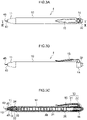
Fig. 1 is a front view of a marking pen of an embodiment of the present application, and illustrates a state in which a tip end of a pen core has been retracted. -
Fig. 1B illustrates the state ofFig. 1A in a side view. -
Fig. 1C illustrates the state ofFig. 1A in a plan view. -
Fig. 1D illustrates the state ofFig. 1A in a I-I cross-sectional view. -
Fig. 2A is a front view of the pen core. -
Fig. 2B is a bottom view of the pen core. -
Fig. 2C is a II-II cross-sectional view ofFig. 2A . -
Fig. 3A illustrates, in a front view, a state in which the tip end of the pen core projects out from the state ofFig. 1A . -
Fig. 3B illustrates the state ofFig. 3A in a side view. -
Fig. 3C illustrates the state ofFig. 3A in a III-III cross-sectional view. - An embodiment of the present application is described hereinafter with reference to the drawings. In the following description, the side of a
marking pen 1 at which side awriting tip end 43 is positioned is referred to as the tip end side, and the side opposite thereto is referred to as the rear end side. Further, the direction heading toward the tip end side is referred to as the frontward direction, and the direction opposite thereto is referred to as the rearward direction. Moreover, in cases in which identical reference numerals are used in different drawings, the identical reference numerals indicate identical structures even if the structures indicated by the reference numerals are not referenced per drawing. -
Fig. 1A to Fig. 1D illustrate a state in which, at themarking pen 1 of the embodiment of the present application, thewriting tip end 43 that is the tip end of apen core 40 has been retracted. As illustrated in the front view ofFig. 1A and the side view ofFig. 1B , the markingpen 1 has, at the tip end side of ashaft cylinder 10 that is cylindrical tube shaped, a tip end reduced-diameter portion 11 whose outer diameter gradually decreases toward the front side, and has atail end portion 14 that is attached to the rear end of theshaft cylinder 10, aclip 15 that projects out from a side surface of the tail end portion and extends forward, and aclick button 32 that projects out from thetail end portion 14. Theclip 15 is a projection structure that projects out toward the outer side at theshaft cylinder 10. An opening part 12 (seeFig. 1D ) is formed at the tip end of the tip end reduced-diameter portion 11. Due to theclip 15 that serves as a projection structure being formed, as illustrated in the plan view ofFig. 1C , the markingpen 1 is a shape that is asymmetrical relative to the opposite side of theshaft cylinder 10 acrossaxial center 2. - As illustrated in
Fig. 1D that is a I-I cross-sectional view ofFig. 1A , anink accommodating tube 20, which is tubular and at whose tip end side thepen core 40 is mounted, is housed at the interior of theshaft cylinder 10 of the markingpen 1.Inner cotton 21 that is formed from polyester fibers is accommodated at the interior of theink accommodating tube 20. An aqueous ink composition is charged in theinner cotton 21. The tip end side of theink accommodating tube 20 is a pencore fixing portion 22 whose outer diameter is reduced. Apen core holder 25, which is shaped as a solid cylinder and through which the rod-shapedpen core 40 passes, is inserted in and fixed to the pencore fixing portion 22. The rear end of the pen core pierces the tip end of theinner cotton 21. - The aqueous ink composition includes a water soluble organic solvent in an amount of from 20 mass% to 60 mass%, and preferably from 25 mass% to 45 mass%. This water soluble organic solvent is not particularly limited provided that it is an organic solvent having a hydrophobic group and a hydrophilic group in the molecule structure, and an organic compound having two or more, and preferably two or three, hydroxy groups (-OH) within the molecule is preferable. Examples of such an organic compound are glycerin, diethylene glycol, triethylene glycol, propylene glycol, and ethylene glycol. Inclusion of such a water soluble organic solvent improves the affinity of the aqueous ink composition with respect to the
inner cotton 21. Note that, if the content of the water soluble organic solvent in the water soluble ink composition is less than 20 mass%, the effect of improving the affinity of the water soluble ink composition with respect to theinner cotton 21 is not sufficiently obtained. On the other hand, even if the content of the water soluble organic solvent in the water soluble ink composition exceeds 60 mass%, the effect of improving the affinity of the water soluble ink composition with respect to theinner cotton 21 does not change, but there are cases in which the ability of the ink to flow out suffers owing to the increase of the viscosity of the aqueous ink composition. - Further, it is preferable that a film-like article be formed at the tip end of the pen core, and, in order to prevent dirtying due to the adhesion of ink, that urea be included in an amount of from 1 mass% to 30 mass%. Further, it is preferable for the aqueous ink composition to have the initial viscosity at shear rates of 1 to 383 s-1 (25°C) within the range of 2 to 15 mPa • sec, and the surface tension (25°C) greater than or equal to 30 mN/m. Note that, if the content of urea in the water soluble ink composition is less than 1 mass%, the effects of forming a film-like article at the tip end of the pen core and preventing dirtying due to adhesion of the ink are not sufficiently obtained. On the other hand, even if the content of the urea in the water soluble ink composition exceeds 30 mass%, there is no change in the effects of forming a film-like article at the tip end of the pen core and preventing dirtying due to adhesion of the ink, but there are cases in which the solubility of the urea in the aqueous ink composition is insufficient.
- A
tail plug 26 that is substantially shaped as a cylindrical tube is press-fit into and fixed to the rear end side of theink accommodating tube 20. The rear end side of theinner cotton 21 is compressed by thistail plug 26. The rear end of thetail plug 26 abuts the tip end of arotator 31 that structures a so-called can-knock mechanism. Further, the outer diameter of the rear end of therotator 31 is reduced, and theclick button 32 is placed on this portion, and, as described above, projects out rearward from thetail end portion 14. Adelivery mechanism 30 is formed by therotator 31 and theclick button 32. As will be described later, thisdelivery mechanism 30 causes thewriting tip end 43 to project out from and retract into theopening part 12. On the other hand, aspring 24 that is placed on the pencore fixing portion 22 is interposed between a rearend supporting step 13, which is a step positioned at the rear end edge of the pencore fixing portion 22 of theink accommodating tube 20, and a tipend supporting step 23, which is a step formed at the inner peripheral surface of the tip end reduced-diameter portion 11 of theshaft cylinder 10. Thisspring 24 always urges theink accommodating tube 20 toward the rear in theshaft cylinder 10. It is preferable that the spring load of thespring 24 be 1 N or more. Due to the rearward urging of thisspring 24, the writingtip end 43 of thepen core 40 is positioned at distance d illustrated in Fig. ID, and specifically, rearward from the openingpart 12 by 1 mm or more. - As illustrated in the front view of
Fig. 2A and the bottom view ofFig. 2B , thepen core 40 is formed in the shape of a rod having a circular cross-section. The tip end side of thepen core 40 is the writingtip end 43 that is formed in a substantially hemispherical shape. The rear end side of thepen core 40 is a piercingrear end 44 that is taper-shaped. This piercingrear end 44 is the portion that pierces theinner cotton 21 as illustrated inFig. 1D . As illustrated inFig. 2C , thepen core 40 has a structure in which aporous body 41, which is porous and is formed by polyester fibers being compacted, is covered by anouter skin 42 that is a thin film made of a polyethylene resin. Theouter skin 42 is peeled off and theporous body 41 is exposed due to thewriting tip end 43 and the piercingrear end 44 of thepen core 40 being cut into their respective shapes. Due to thepen core 40 piercing theinner cotton 21, the aqueous ink composition filled in theinner cotton 21 is supplied from the piercingrear end 44 to thewriting tip end 43 by the capillarity of theporous body 41, and writing is possible. - Here, an unillustrated cam groove is formed in the inner peripheral surface of the rear end side of the
shaft cylinder 10. Due to theclick button 32 that serves as thedelivery mechanism 30 being pushed forward as illustrated inFig. 3A to Fig. 3C , an unillustrated cam projection formed at the outer peripheral surface of therotator 31 slides along the cam groove of the shaft cylinder and compresses thespring 24, and theink accommodating tube 20 moves forward. Due thereto, the writingtip end 43 of thepen core 40 projects out from the openingpart 12 of theshaft cylinder 10. At this time, therotator 31 engages with the cam groove, and this projected state is maintained. In this projected state, writing by the markingpen 1 is possible. - When, from the projected state of the writing
tip end 43 illustrated inFig. 3A to Fig. 3C , theclick button 32 is pushed again, the engagement of therotator 31 and the cam groove is cancelled, and theink accommodating tube 20 moves rearward due to the restoring force of thespring 24, and the writingtip end 43 is again returned to the retracted state illustrated inFig. 1A to Fig. 1D . In this way, the writingtip end 43 can be projected from and retracted into the opening part by thedelivery mechanism 30. - At the marking
pen 1 of the present embodiment, it is preferable that the mass of theshaft cylinder 10 including the tail end portion 14 (including the clip 15) and thedelivery mechanism 30 is 15 g or less, and that the mass of theink accommodating tube 20 including thepen core 40 is 10 g or less. - Since the marking
pen 1 of the present embodiment is structured as described above, in a case in which the markingpen 1, which is in the state in which thewriting tip end 43 has been retracted that is illustrated inFig. 1A to Fig. 1D , is dropped with the tip end facing downward, even if the tip end collides with a horizontal surface such as the top of a desk or the floor, the writingtip end 43 contacting the region that is collided with against the spring load of thespring 24, and further, the aqueous ink composition that has seeped into thepen core 40 splattering onto the region that is collided with, are prevented. Further, the shaft cylinder has an asymmetrical shape due to theclip 15 that serves as the projection structure being provided at theshaft cylinder 10, and, due thereto, the probability of the markingpen 1 landing upon a horizontal surface from the tip end thereof when the markingpen 1 is dropped is reduced. - Aqueous ink compositions of respective Examples and Comparative Examples are the following compositions. Note that MA100 (Mitsubishi Chemical) was used as a black pigment, CHROMOFINE BLUE A-220JC (Dainichiseika Color & Chemicals) was used as a blue pigment, Joncryl 63J (BASF) was used as a pigment dispersing agent, Bioden S (Daiwa Chemical Industries) was used as a preservative, and Capstone FS-10 (Dupont) was used as a fluorine surfactant, respectively.
-
- black pigment: 5.5 mass%
- pigment dispersing agent: 4.0 mass%
- glycerin (water soluble organic solvent): 10.0 mass%
- ethylene glycol (water soluble organic solvent): 10.0 mass%
- diethylene glycol (water soluble organic solvent): 10.0 mass%
- (total water soluble organic solvents): 30.0 mass%
- preservative: 0.4 mass%
- urea: 10.0 mass%
- trimethylglycine: 5.0 mass%
- trehalose: 2.0 mass%
- trimethylolpropane: 1.0 mass%
- trimethylolethane: 0.5 mass%
- ion exchanged water: 41.6 mass%
- Due to the above composition, the initial viscosity of the aqueous ink composition of Example 1 was 6.4 mPa • sec, and the surface tension was 56.0 mN/m.
-
- blue pigment: 4.5 mass%
- pigment dispersing agent: 3.6 mass%
- glycerin (water soluble organic solvent): 15.0 mass%
- diethylene glycol (water soluble organic solvent): 10.0 mass%
- (total water soluble organic solvents): 25.0 mass%
- preservative: 0.4 mass%
- urea: 20.0 mass%
- trimethylglycine: 3.0 mass%
- pentaerythritol: 2.0 mass%
- trimethylolpropane: 2.0 mass%
- ion exchanged water: 39.5 mass%
- Due to the above composition, the initial viscosity of the aqueous ink composition of Example 2 was 5.8 mPa • sec, and the surface tension was 55.0 mN/m.
-
- black pigment: 5.5 mass%
- pigment dispersing agent: 4.0 mass%
- glycerin (water soluble organic solvent): 10.0 mass%
- ethylene glycol (water soluble organic solvent): 10.0 mass%
- diethylene glycol (water soluble organic solvent): 10.0 mass%
- (total water soluble organic solvents): 30.0 mass%
- preservative: 0.4 mass%
- urea: 1.0 mass%
- trimethylglycine: 5.0 mass%
- trehalose: 2.0 mass%
- trimethylolpropane: 1.0 mass%
- trimethylolethane: 0.5 mass%
- ion exchanged water: 50.6 mass%
- Due to the above composition, the initial viscosity of the aqueous ink composition of Example 3 was 5.9 mPa • sec, and the surface tension was 56.0 mN/m.
-
- black pigment: 5.5 mass%
- pigment dispersing agent: 4.0 mass%
- glycerin (water soluble organic solvent): 10.0 mass%
- diethylene glycol (water soluble organic solvent): 10.0 mass%
- (total water soluble organic solvents): 20.0 mass%
- preservative: 0.4 mass%
- urea: 20.0 mass%
- trimethylglycine: 3.0 mass%
- trehalose: 3.0 mass%
- trimethylolpropane: 1.0 mass%
- trimethylolethane: 1.0 mass%
- ion exchanged water: 42.1 mass%
- Due to the above composition, the initial viscosity of the aqueous ink composition of Example 4 was 5.3 mPa • sec, and the surface tension was 57.0 mN/m.
-
- black pigment: 5.5 mass%
- pigment dispersing agent: 4.0 mass%
- ethylene glycol (water soluble organic solvent): 18.0 mass%
- (total water soluble organic solvents): 18.0 mass%
- preservative: 0.4 mass%
- urea: 10.0 mass%
- trimethylglycine: 5.0 mass%
- trehalose: 2.0 mass%
- trimethylolpropane: 1.0 mass%
- trimethylolethane: 0.5 mass%
- fluorine surfactant: 0.2 mass%
- ion exchanged water: 53.4 mass%
- Due to the above composition, the initial viscosity of the aqueous ink composition of Comparative Example 1 was 3.9 mPa • sec, and the surface tension was 29.5 mN/m.
-
- blue pigment: 4.5 mass%
- pigment dispersing agent: 3.6 mass%
- glycerin (water soluble organic solvent): 6.0 mass%
- ethylene glycol (water soluble organic solvent): 6.0 mass%
- diethylene glycol (water soluble organic solvent): 6.0 mass%
- (total water soluble organic solvents): 18.0 mass%
- preservative: 0.4 mass%
- urea: 0.5 mass%
- trimethylglycine: 1.0 mass%
- trehalose: 1.0 mass%
- trimethylolpropane: 0.5 mass%
- trimethylolethane: 0.5 mass%
- ion exchanged water: 70.0 mass%
- Due to the above composition, the initial viscosity of the aqueous ink composition of Comparative Example 2 was 2.5 mPa • sec, and the surface tension was 58.2 mN/m.
- One ml of the aqueous ink composition of the above-described Examples and Comparative Examples was charged into the
inner cotton 21 of the markingpen 1 of the above-described embodiment, respectively. Note that the mass of theshaft cylinder 10 including the tail end portion 14 (including the clip 15) and thedelivery mechanism 30 was 4.8 g, the mass of theink accommodating tube 20 including thepen core 40 and theinner cotton 21 in which the aqueous ink composition was filled was 3.0 g, and the total mass of markingpen 1 was 7.8 g. Further, the spring load of thespring 24 was 2.0 N. Moreover, in the retracted state of the writingtip end 43 illustrated inFig. 1A to Fig. ID, the writingtip end 43 was positioned 1.4 mm rearward of theopening part 12. - The marking
pen 1 of (2) was, in a state in which thewriting tip end 43 had been retracted, freely dropped from 30 cm above a concrete horizontal surface with the tip end facing downward, and collided from the tip end. - At the interior of the
shaft cylinder 10 of the markingpen 1 that had collided with the concrete horizontal surface in (3), dirtying by the aqueous ink composition that had splattered was observed. The evaluation standards were following A to C, in that order from an excellent evaluation. - A: No dirtying was noted.
- B: A slight amount of dirtying was noted.
- C: Dirtying was conspicuous.
- At the concrete horizontal surface with which the (3) marking
pen 1 collided, dirtying by the aqueous ink composition was observed. The evaluation standards were following A to C, in that order from an excellent evaluation. - A: No dirtying was noted, or only a very slight amount of dirtying was noted.
- B: Some dirtying was noted.
- C: Dirtying was conspicuous.
- The test results of (3) for the aqueous ink compositions of the respective Examples and Comparative Examples are as put forth in following Table 1.
[Table 1] Example / Comparative Example Evaluation 1 Evaluation 2Example 1 A A Example 2 A A Example 3 A B Example 4 B A Comparative Example 1 C B Comparative Example 2 C C - As shown in above Table 1, Comparative Example 1 and Comparative Example 2 in which the content of the water soluble organic solvents in the aqueous ink composition was less than 20 mass% had poor evaluations in both
Evaluation 1 andEvaluation 2. In particular, it is thought that the surface tension of Comparative Example 1 being 29.5 mN/m, which was the only one less than 30 mN/m, was a cause of the poor evaluation. On the other hand, all of the respective Examples in which the content of the water soluble organic solvents in the aqueous ink composition was from 20 mass% to 60 mass% were evaluated highly. - From the above results, it can be concluded that splattering of the ink and dirtying of the surface that is dropped upon can be prevented by, in addition to the mechanism of the marking
pen 1 described in the embodiment, having the content of water soluble organic solvents in the aqueous ink composition be from 20 mass% to 60 mass%. - Note that, with regard to the splattering of ink of Example 4 in which the content of water soluble organic solvents in the aqueous ink composition was 20 mass% which is the lower limit value, the slightly inferior evaluation (B) was obtained. Due thereto, the critical significance of the lower limit value of the numerical range, which is that the content of water soluble organic solvent in the aqueous ink composition is 20 mass% or more, is inferred. Note that, in Example 3, it is thought that the urea content being 1.0 mass%, which was the lowest among the Examples, was a cause of the evaluation thereof being slightly lower than those of Example 1 and Example 2.
- The present invention can be applied to marking pens having a delivery mechanism such as a knock mechanism.
Claims (5)
- A marking pen, comprising:a shaft cylinder;a porous pen core accommodated in the shaft cylinder, and configured to project from, and retract into, an opening part provided at a tip end of the shaft cylinder;an inner cotton accommodated in the shaft cylinder, and filled with an aqueous ink composition to be fed to the pen core, the aqueous ink composition including a water soluble organic solvent in an amount of from 20 mass% to 60 mass%; anda delivery mechanism configured to cause a tip end of the pen core to project from, and retract into, the opening part.
- The marking pen of claim 1, wherein the aqueous ink composition includes urea in an amount of from 1 mass% to 30 mass%.
- The marking pen of claim 1 or 2, wherein, in a state in which the tip end of the pen core has been retracted into the shaft cylinder, the tip end is positioned rearward from the opening part by 1 mm or more.
- The marking pen of any one of claims 1 to 3, wherein the pen core is formed from a porous body covered by an outer skin.
- The marking pen of any one of claims 1 to 4, wherein:the shaft cylinder has a projection structure that projects outwardly, andthe projection structure has a shape that is asymmetrical relative to an opposite side of the shaft cylinder, with respect to an axial center of the shaft cylinder.
Applications Claiming Priority (2)
| Application Number | Priority Date | Filing Date | Title |
|---|---|---|---|
| JP2020019066A JP7474059B2 (en) | 2020-02-06 | 2020-02-06 | Marking pen |
| PCT/JP2021/001085 WO2021157314A1 (en) | 2020-02-06 | 2021-01-14 | Marking pen |
Publications (2)
| Publication Number | Publication Date |
|---|---|
| EP4101656A1 true EP4101656A1 (en) | 2022-12-14 |
| EP4101656A4 EP4101656A4 (en) | 2024-03-13 |
Family
ID=77199264
Family Applications (1)
| Application Number | Title | Priority Date | Filing Date |
|---|---|---|---|
| EP21751384.5A Pending EP4101656A4 (en) | 2020-02-06 | 2021-01-14 | Marking pen |
Country Status (6)
| Country | Link |
|---|---|
| US (1) | US11987068B2 (en) |
| EP (1) | EP4101656A4 (en) |
| JP (2) | JP7474059B2 (en) |
| KR (1) | KR20220139345A (en) |
| CN (1) | CN115003516A (en) |
| WO (1) | WO2021157314A1 (en) |
Families Citing this family (1)
| Publication number | Priority date | Publication date | Assignee | Title |
|---|---|---|---|---|
| JP7508299B2 (en) * | 2020-07-20 | 2024-07-01 | 三菱鉛筆株式会社 | Knock-type writing instrument |
Family Cites Families (26)
| Publication number | Priority date | Publication date | Assignee | Title |
|---|---|---|---|---|
| US3477792A (en) * | 1967-12-05 | 1969-11-11 | Sidney X Shore | Retractable marking pens |
| JPS5343324B2 (en) * | 1972-07-05 | 1978-11-18 | ||
| GB1428972A (en) * | 1972-07-18 | 1976-03-24 | Wilkinson Sword Ltd | Pens and nibs therefor |
| JPS6144875Y2 (en) * | 1980-01-18 | 1986-12-17 | ||
| JPH0730389Y2 (en) * | 1988-10-12 | 1995-07-12 | 三菱鉛筆株式会社 | Refill for writing instruments such as water-based ballpoint pens |
| JPH0615740Y2 (en) * | 1988-10-18 | 1994-04-27 | 株式会社東海 | Knock type writing instrument |
| US5174814A (en) * | 1990-06-20 | 1992-12-29 | Dennison Manufacturing Company | Retractable marker pen and inks therefor |
| JP2001047786A (en) | 1999-08-05 | 2001-02-20 | Teiboo Kk | Forming method of nib point |
| JP4516681B2 (en) * | 2000-10-06 | 2010-08-04 | シヤチハタ株式会社 | Double-head writing instrument |
| US7541394B2 (en) * | 2003-01-10 | 2009-06-02 | Sakura Color Products Corporation | Water base pigment ink composition for inner lead type writing instrument |
| JP2006044177A (en) * | 2004-08-09 | 2006-02-16 | Hidekazu Yasuzumi | Penpoint projecting-retracting structure of writing implement or the like |
| JP2007203644A (en) * | 2006-02-03 | 2007-08-16 | Mitsubishi Pencil Co Ltd | Writing instrument |
| JP2008093962A (en) * | 2006-10-12 | 2008-04-24 | Pilot Ink Co Ltd | Intrusive writing instrument |
| JP2010155387A (en) * | 2008-12-26 | 2010-07-15 | Tsukasa Sogyo Kk | Capless writing utensil |
| US20110103875A1 (en) | 2009-11-03 | 2011-05-05 | Shih-Yuan Huang | Retractable push button pen |
| JP2011178979A (en) | 2010-02-05 | 2011-09-15 | Pilot Ink Co Ltd | Ink composition for reversible thermochromic writing instrument and writing instrument containing the same |
| JP5638336B2 (en) | 2010-10-06 | 2014-12-10 | パイロットインキ株式会社 | Pastel tone reversible thermochromic ink composition for writing instrument, writing instrument using the same, and writing instrument set |
| JP2013116614A (en) * | 2011-12-05 | 2013-06-13 | Pentel Corp | Writing instrument |
| EP3009493B1 (en) * | 2013-06-14 | 2018-01-31 | The Pilot Ink Co., Ltd. | Thermochromic color-memorizing composition and thermochromic color-memorizing microcapsule pigment encapsulating same |
| JP6373693B2 (en) | 2014-09-11 | 2018-08-15 | ゼブラ株式会社 | Intrusive writing instrument |
| JP2016172343A (en) | 2015-03-17 | 2016-09-29 | 株式会社サクラクレパス | Protrusible-retreatable coating tool |
| JP6209244B2 (en) * | 2016-05-06 | 2017-10-04 | 三菱鉛筆株式会社 | Writing instrument |
| JP2018126962A (en) * | 2017-02-10 | 2018-08-16 | モリス コーポレーションMorris Corporation | Retractable writing instrument |
| JP2018171857A (en) * | 2017-03-31 | 2018-11-08 | ぺんてる株式会社 | Applicator |
| WO2019189364A1 (en) | 2018-03-28 | 2019-10-03 | ぺんてる株式会社 | Applicator |
| JP7098406B2 (en) * | 2018-04-27 | 2022-07-11 | 株式会社パイロットコーポレーション | A water-based ink composition for writing tools and a writing tool containing the colored resin particle dispersion, a method for producing the same, and the colored resin particle dispersion. |
-
2020
- 2020-02-06 JP JP2020019066A patent/JP7474059B2/en active Active
-
2021
- 2021-01-14 KR KR1020227029960A patent/KR20220139345A/en active Pending
- 2021-01-14 EP EP21751384.5A patent/EP4101656A4/en active Pending
- 2021-01-14 WO PCT/JP2021/001085 patent/WO2021157314A1/en not_active Ceased
- 2021-01-14 CN CN202180009887.9A patent/CN115003516A/en active Pending
- 2021-01-14 US US17/759,387 patent/US11987068B2/en active Active
-
2024
- 2024-04-12 JP JP2024064563A patent/JP2024086886A/en active Pending
Also Published As
| Publication number | Publication date |
|---|---|
| CN115003516A (en) | 2022-09-02 |
| JP2021123050A (en) | 2021-08-30 |
| EP4101656A4 (en) | 2024-03-13 |
| JP7474059B2 (en) | 2024-04-24 |
| US20230086315A1 (en) | 2023-03-23 |
| KR20220139345A (en) | 2022-10-14 |
| JP2024086886A (en) | 2024-06-28 |
| US11987068B2 (en) | 2024-05-21 |
| WO2021157314A1 (en) | 2021-08-12 |
Similar Documents
| Publication | Publication Date | Title |
|---|---|---|
| KR101448180B1 (en) | Water-based ink composition for ballpoint pens, refill for ballpoint pens, ballpoint pens and disposable ballpoint pens | |
| US6340261B1 (en) | Ball-point pen | |
| JPWO1998030401A1 (en) | ballpoint pen | |
| JPWO1999024266A1 (en) | ballpoint pen | |
| US11987068B2 (en) | Marking pen | |
| EP1024027B1 (en) | Push button type ballpoint pen | |
| JP2011011392A (en) | Retractable ballpoint pen | |
| US6435751B1 (en) | Click type writing implement | |
| EP1295734A1 (en) | Writing utensil | |
| JP7316086B2 (en) | Haunting Writing Instrument and Marker Refill | |
| JP2009160939A (en) | Intrusive writing instrument | |
| CN116234705B (en) | Ball pen | |
| JP2000096033A (en) | Aqueous ink follower composition for ballpoint pens | |
| JP6734184B2 (en) | Pressurized writing instrument | |
| JP4442798B2 (en) | Correction pen refill | |
| JPH081908Y2 (en) | Out-of-the-box writing instrument | |
| JP4671547B2 (en) | Capless writing instrument | |
| JP7523941B2 (en) | Oil-based ballpoint pen | |
| JP3590911B2 (en) | Water-based ballpoint pen and method for producing the same | |
| JP2001171286A (en) | Knock-type writing instrument | |
| JPH08282177A (en) | Low viscosity water-based ballpoint pen | |
| JP2003312184A (en) | Knock-type writing instrument | |
| JP2002052885A (en) | Ballpoint pen refill | |
| JP2026002143A (en) | Ballpoint pen refills and oil-based ballpoint pens | |
| JP2024146874A (en) | Oil-based ink composition for ballpoint pen and ballpoint pen |
Legal Events
| Date | Code | Title | Description |
|---|---|---|---|
| STAA | Information on the status of an ep patent application or granted ep patent |
Free format text: STATUS: THE INTERNATIONAL PUBLICATION HAS BEEN MADE |
|
| PUAI | Public reference made under article 153(3) epc to a published international application that has entered the european phase |
Free format text: ORIGINAL CODE: 0009012 |
|
| STAA | Information on the status of an ep patent application or granted ep patent |
Free format text: STATUS: REQUEST FOR EXAMINATION WAS MADE |
|
| 17P | Request for examination filed |
Effective date: 20220902 |
|
| AK | Designated contracting states |
Kind code of ref document: A1 Designated state(s): AL AT BE BG CH CY CZ DE DK EE ES FI FR GB GR HR HU IE IS IT LI LT LU LV MC MK MT NL NO PL PT RO RS SE SI SK SM TR |
|
| DAV | Request for validation of the european patent (deleted) | ||
| DAX | Request for extension of the european patent (deleted) | ||
| RAP3 | Party data changed (applicant data changed or rights of an application transferred) |
Owner name: MITSUBISHI PENCIL COMPANY, LIMITED |
|
| A4 | Supplementary search report drawn up and despatched |
Effective date: 20240214 |
|
| RIC1 | Information provided on ipc code assigned before grant |
Ipc: B43K 8/06 20060101ALI20240208BHEP Ipc: B43K 24/08 20060101ALI20240208BHEP Ipc: B43K 8/24 20060101ALI20240208BHEP Ipc: B43K 8/02 20060101AFI20240208BHEP |