EP4101371A1 - Electroencephalogram signal classifying method and apparatus, electroencephalogram signal classifying model training method and apparatus, and medium - Google Patents
Electroencephalogram signal classifying method and apparatus, electroencephalogram signal classifying model training method and apparatus, and medium Download PDFInfo
- Publication number
- EP4101371A1 EP4101371A1 EP21859962.9A EP21859962A EP4101371A1 EP 4101371 A1 EP4101371 A1 EP 4101371A1 EP 21859962 A EP21859962 A EP 21859962A EP 4101371 A1 EP4101371 A1 EP 4101371A1
- Authority
- EP
- European Patent Office
- Prior art keywords
- feature
- signal
- electroencephalogram signal
- domain
- electroencephalogram
- Prior art date
- Legal status (The legal status is an assumption and is not a legal conclusion. Google has not performed a legal analysis and makes no representation as to the accuracy of the status listed.)
- Granted
Links
Images





Classifications
-
- B—PERFORMING OPERATIONS; TRANSPORTING
- B25—HAND TOOLS; PORTABLE POWER-DRIVEN TOOLS; MANIPULATORS
- B25J—MANIPULATORS; CHAMBERS PROVIDED WITH MANIPULATION DEVICES
- B25J9/00—Program-controlled manipulators
- B25J9/0006—Exoskeletons, i.e. resembling a human figure
-
- A—HUMAN NECESSITIES
- A61—MEDICAL OR VETERINARY SCIENCE; HYGIENE
- A61B—DIAGNOSIS; SURGERY; IDENTIFICATION
- A61B5/00—Measuring for diagnostic purposes; Identification of persons
- A61B5/72—Signal processing specially adapted for physiological signals or for diagnostic purposes
- A61B5/7235—Details of waveform analysis
- A61B5/7264—Classification of physiological signals or data, e.g. using neural networks, statistical classifiers, expert systems or fuzzy systems
- A61B5/7267—Classification of physiological signals or data, e.g. using neural networks, statistical classifiers, expert systems or fuzzy systems involving training the classification device
-
- A—HUMAN NECESSITIES
- A61—MEDICAL OR VETERINARY SCIENCE; HYGIENE
- A61B—DIAGNOSIS; SURGERY; IDENTIFICATION
- A61B5/00—Measuring for diagnostic purposes; Identification of persons
- A61B5/24—Detecting, measuring or recording bioelectric or biomagnetic signals of the body or parts thereof
- A61B5/316—Modalities, i.e. specific diagnostic methods
- A61B5/369—Electroencephalography [EEG]
-
- A—HUMAN NECESSITIES
- A61—MEDICAL OR VETERINARY SCIENCE; HYGIENE
- A61B—DIAGNOSIS; SURGERY; IDENTIFICATION
- A61B5/00—Measuring for diagnostic purposes; Identification of persons
- A61B5/24—Detecting, measuring or recording bioelectric or biomagnetic signals of the body or parts thereof
- A61B5/316—Modalities, i.e. specific diagnostic methods
- A61B5/369—Electroencephalography [EEG]
- A61B5/372—Analysis of electroencephalograms
- A61B5/374—Detecting the frequency distribution of signals, e.g. detecting delta, theta, alpha, beta or gamma waves
-
- A—HUMAN NECESSITIES
- A61—MEDICAL OR VETERINARY SCIENCE; HYGIENE
- A61B—DIAGNOSIS; SURGERY; IDENTIFICATION
- A61B5/00—Measuring for diagnostic purposes; Identification of persons
- A61B5/72—Signal processing specially adapted for physiological signals or for diagnostic purposes
- A61B5/7271—Specific aspects of physiological measurement analysis
- A61B5/7275—Determining trends in physiological measurement data; Predicting development of a medical condition based on physiological measurements, e.g. determining a risk factor
-
- A—HUMAN NECESSITIES
- A61—MEDICAL OR VETERINARY SCIENCE; HYGIENE
- A61G—TRANSPORT, PERSONAL CONVEYANCES, OR ACCOMMODATION SPECIALLY ADAPTED FOR PATIENTS OR DISABLED PERSONS; OPERATING TABLES OR CHAIRS; CHAIRS FOR DENTISTRY; FUNERAL DEVICES
- A61G5/00—Chairs or personal conveyances specially adapted for patients or disabled persons, e.g. wheelchairs
- A61G5/04—Chairs or personal conveyances specially adapted for patients or disabled persons, e.g. wheelchairs motor-driven
-
- A—HUMAN NECESSITIES
- A61—MEDICAL OR VETERINARY SCIENCE; HYGIENE
- A61G—TRANSPORT, PERSONAL CONVEYANCES, OR ACCOMMODATION SPECIALLY ADAPTED FOR PATIENTS OR DISABLED PERSONS; OPERATING TABLES OR CHAIRS; CHAIRS FOR DENTISTRY; FUNERAL DEVICES
- A61G5/00—Chairs or personal conveyances specially adapted for patients or disabled persons, e.g. wheelchairs
- A61G5/10—Parts, details or accessories
- A61G5/1051—Arrangements for steering
-
- A—HUMAN NECESSITIES
- A61—MEDICAL OR VETERINARY SCIENCE; HYGIENE
- A61H—PHYSICAL THERAPY APPARATUS, e.g. DEVICES FOR LOCATING OR STIMULATING REFLEX POINTS IN THE BODY; ARTIFICIAL RESPIRATION; MASSAGE; BATHING DEVICES FOR SPECIAL THERAPEUTIC OR HYGIENIC PURPOSES OR SPECIFIC PARTS OF THE BODY
- A61H3/00—Appliances for aiding patients or disabled persons to walk about
-
- A—HUMAN NECESSITIES
- A63—SPORTS; GAMES; AMUSEMENTS
- A63F—CARD, BOARD, OR ROULETTE GAMES; INDOOR GAMES USING SMALL MOVING PLAYING BODIES; VIDEO GAMES; GAMES NOT OTHERWISE PROVIDED FOR
- A63F13/00—Video games, i.e. games using an electronically generated display having two or more dimensions
- A63F13/20—Input arrangements for video game devices
- A63F13/21—Input arrangements for video game devices characterised by their sensors, purposes or types
- A63F13/212—Input arrangements for video game devices characterised by their sensors, purposes or types using sensors worn by the player, e.g. for measuring heart beat or leg activity
-
- A—HUMAN NECESSITIES
- A63—SPORTS; GAMES; AMUSEMENTS
- A63F—CARD, BOARD, OR ROULETTE GAMES; INDOOR GAMES USING SMALL MOVING PLAYING BODIES; VIDEO GAMES; GAMES NOT OTHERWISE PROVIDED FOR
- A63F13/00—Video games, i.e. games using an electronically generated display having two or more dimensions
- A63F13/30—Interconnection arrangements between game servers and game devices; Interconnection arrangements between game devices; Interconnection arrangements between game servers
- A63F13/35—Details of game servers
-
- A—HUMAN NECESSITIES
- A63—SPORTS; GAMES; AMUSEMENTS
- A63F—CARD, BOARD, OR ROULETTE GAMES; INDOOR GAMES USING SMALL MOVING PLAYING BODIES; VIDEO GAMES; GAMES NOT OTHERWISE PROVIDED FOR
- A63F13/00—Video games, i.e. games using an electronically generated display having two or more dimensions
- A63F13/40—Processing input control signals of video game devices, e.g. signals generated by the player or derived from the environment
- A63F13/42—Processing input control signals of video game devices, e.g. signals generated by the player or derived from the environment by mapping the input signals into game commands, e.g. mapping the displacement of a stylus on a touch screen to the steering angle of a virtual vehicle
-
- A—HUMAN NECESSITIES
- A63—SPORTS; GAMES; AMUSEMENTS
- A63F—CARD, BOARD, OR ROULETTE GAMES; INDOOR GAMES USING SMALL MOVING PLAYING BODIES; VIDEO GAMES; GAMES NOT OTHERWISE PROVIDED FOR
- A63F13/00—Video games, i.e. games using an electronically generated display having two or more dimensions
- A63F13/55—Controlling game characters or game objects based on the game progress
-
- A—HUMAN NECESSITIES
- A63—SPORTS; GAMES; AMUSEMENTS
- A63F—CARD, BOARD, OR ROULETTE GAMES; INDOOR GAMES USING SMALL MOVING PLAYING BODIES; VIDEO GAMES; GAMES NOT OTHERWISE PROVIDED FOR
- A63F13/00—Video games, i.e. games using an electronically generated display having two or more dimensions
- A63F13/60—Generating or modifying game content before or while executing the game program, e.g. authoring tools specially adapted for game development or game-integrated level editor
- A63F13/67—Generating or modifying game content before or while executing the game program, e.g. authoring tools specially adapted for game development or game-integrated level editor adaptively or by learning from player actions, e.g. skill level adjustment or by storing successful combat sequences for re-use
-
- B—PERFORMING OPERATIONS; TRANSPORTING
- B25—HAND TOOLS; PORTABLE POWER-DRIVEN TOOLS; MANIPULATORS
- B25J—MANIPULATORS; CHAMBERS PROVIDED WITH MANIPULATION DEVICES
- B25J13/00—Controls for manipulators
-
- B—PERFORMING OPERATIONS; TRANSPORTING
- B25—HAND TOOLS; PORTABLE POWER-DRIVEN TOOLS; MANIPULATORS
- B25J—MANIPULATORS; CHAMBERS PROVIDED WITH MANIPULATION DEVICES
- B25J13/00—Controls for manipulators
- B25J13/006—Controls for manipulators by means of a wireless system for controlling one or several manipulators
-
- G—PHYSICS
- G06—COMPUTING OR CALCULATING; COUNTING
- G06F—ELECTRIC DIGITAL DATA PROCESSING
- G06F3/00—Input arrangements for transferring data to be processed into a form capable of being handled by the computer; Output arrangements for transferring data from processing unit to output unit, e.g. interface arrangements
- G06F3/01—Input arrangements or combined input and output arrangements for interaction between user and computer
- G06F3/011—Arrangements for interaction with the human body, e.g. for user immersion in virtual reality
- G06F3/015—Input arrangements based on nervous system activity detection, e.g. brain waves [EEG] detection, electromyograms [EMG] detection, electrodermal response detection
-
- G—PHYSICS
- G16—INFORMATION AND COMMUNICATION TECHNOLOGY [ICT] SPECIALLY ADAPTED FOR SPECIFIC APPLICATION FIELDS
- G16H—HEALTHCARE INFORMATICS, i.e. INFORMATION AND COMMUNICATION TECHNOLOGY [ICT] SPECIALLY ADAPTED FOR THE HANDLING OR PROCESSING OF MEDICAL OR HEALTHCARE DATA
- G16H50/00—ICT specially adapted for medical diagnosis, medical simulation or medical data mining; ICT specially adapted for detecting, monitoring or modelling epidemics or pandemics
- G16H50/20—ICT specially adapted for medical diagnosis, medical simulation or medical data mining; ICT specially adapted for detecting, monitoring or modelling epidemics or pandemics for computer-aided diagnosis, e.g. based on medical expert systems
-
- G—PHYSICS
- G16—INFORMATION AND COMMUNICATION TECHNOLOGY [ICT] SPECIALLY ADAPTED FOR SPECIFIC APPLICATION FIELDS
- G16H—HEALTHCARE INFORMATICS, i.e. INFORMATION AND COMMUNICATION TECHNOLOGY [ICT] SPECIALLY ADAPTED FOR THE HANDLING OR PROCESSING OF MEDICAL OR HEALTHCARE DATA
- G16H50/00—ICT specially adapted for medical diagnosis, medical simulation or medical data mining; ICT specially adapted for detecting, monitoring or modelling epidemics or pandemics
- G16H50/70—ICT specially adapted for medical diagnosis, medical simulation or medical data mining; ICT specially adapted for detecting, monitoring or modelling epidemics or pandemics for mining of medical data, e.g. analysing previous cases of other patients
-
- A—HUMAN NECESSITIES
- A61—MEDICAL OR VETERINARY SCIENCE; HYGIENE
- A61B—DIAGNOSIS; SURGERY; IDENTIFICATION
- A61B2505/00—Evaluating, monitoring or diagnosing in the context of a particular type of medical care
- A61B2505/09—Rehabilitation or training
-
- A—HUMAN NECESSITIES
- A61—MEDICAL OR VETERINARY SCIENCE; HYGIENE
- A61G—TRANSPORT, PERSONAL CONVEYANCES, OR ACCOMMODATION SPECIALLY ADAPTED FOR PATIENTS OR DISABLED PERSONS; OPERATING TABLES OR CHAIRS; CHAIRS FOR DENTISTRY; FUNERAL DEVICES
- A61G2203/00—General characteristics of devices
- A61G2203/10—General characteristics of devices characterised by specific control means, e.g. for adjustment or steering
-
- A—HUMAN NECESSITIES
- A61—MEDICAL OR VETERINARY SCIENCE; HYGIENE
- A61G—TRANSPORT, PERSONAL CONVEYANCES, OR ACCOMMODATION SPECIALLY ADAPTED FOR PATIENTS OR DISABLED PERSONS; OPERATING TABLES OR CHAIRS; CHAIRS FOR DENTISTRY; FUNERAL DEVICES
- A61G2203/00—General characteristics of devices
- A61G2203/10—General characteristics of devices characterised by specific control means, e.g. for adjustment or steering
- A61G2203/18—General characteristics of devices characterised by specific control means, e.g. for adjustment or steering by patient's head, eyes, facial muscles or voice
-
- A—HUMAN NECESSITIES
- A61—MEDICAL OR VETERINARY SCIENCE; HYGIENE
- A61G—TRANSPORT, PERSONAL CONVEYANCES, OR ACCOMMODATION SPECIALLY ADAPTED FOR PATIENTS OR DISABLED PERSONS; OPERATING TABLES OR CHAIRS; CHAIRS FOR DENTISTRY; FUNERAL DEVICES
- A61G5/00—Chairs or personal conveyances specially adapted for patients or disabled persons, e.g. wheelchairs
- A61G5/10—Parts, details or accessories
-
- A—HUMAN NECESSITIES
- A61—MEDICAL OR VETERINARY SCIENCE; HYGIENE
- A61H—PHYSICAL THERAPY APPARATUS, e.g. DEVICES FOR LOCATING OR STIMULATING REFLEX POINTS IN THE BODY; ARTIFICIAL RESPIRATION; MASSAGE; BATHING DEVICES FOR SPECIAL THERAPEUTIC OR HYGIENIC PURPOSES OR SPECIFIC PARTS OF THE BODY
- A61H3/00—Appliances for aiding patients or disabled persons to walk about
- A61H2003/005—Appliances for aiding patients or disabled persons to walk about with knee, leg or stump rests
-
- A—HUMAN NECESSITIES
- A61—MEDICAL OR VETERINARY SCIENCE; HYGIENE
- A61H—PHYSICAL THERAPY APPARATUS, e.g. DEVICES FOR LOCATING OR STIMULATING REFLEX POINTS IN THE BODY; ARTIFICIAL RESPIRATION; MASSAGE; BATHING DEVICES FOR SPECIAL THERAPEUTIC OR HYGIENIC PURPOSES OR SPECIFIC PARTS OF THE BODY
- A61H3/00—Appliances for aiding patients or disabled persons to walk about
- A61H2003/007—Appliances for aiding patients or disabled persons to walk about secured to the patient, e.g. with belts
-
- A—HUMAN NECESSITIES
- A61—MEDICAL OR VETERINARY SCIENCE; HYGIENE
- A61H—PHYSICAL THERAPY APPARATUS, e.g. DEVICES FOR LOCATING OR STIMULATING REFLEX POINTS IN THE BODY; ARTIFICIAL RESPIRATION; MASSAGE; BATHING DEVICES FOR SPECIAL THERAPEUTIC OR HYGIENIC PURPOSES OR SPECIFIC PARTS OF THE BODY
- A61H2201/00—Characteristics of apparatus not provided for in the preceding codes
- A61H2201/50—Control means thereof
- A61H2201/5007—Control means thereof computer controlled
-
- A—HUMAN NECESSITIES
- A61—MEDICAL OR VETERINARY SCIENCE; HYGIENE
- A61H—PHYSICAL THERAPY APPARATUS, e.g. DEVICES FOR LOCATING OR STIMULATING REFLEX POINTS IN THE BODY; ARTIFICIAL RESPIRATION; MASSAGE; BATHING DEVICES FOR SPECIAL THERAPEUTIC OR HYGIENIC PURPOSES OR SPECIFIC PARTS OF THE BODY
- A61H2201/00—Characteristics of apparatus not provided for in the preceding codes
- A61H2201/50—Control means thereof
- A61H2201/5023—Interfaces to the user
- A61H2201/5041—Interfaces to the user control is restricted to certain individuals
-
- A—HUMAN NECESSITIES
- A63—SPORTS; GAMES; AMUSEMENTS
- A63F—CARD, BOARD, OR ROULETTE GAMES; INDOOR GAMES USING SMALL MOVING PLAYING BODIES; VIDEO GAMES; GAMES NOT OTHERWISE PROVIDED FOR
- A63F2300/00—Features of games using an electronically generated display having two or more dimensions, e.g. on a television screen, showing representations related to the game
- A63F2300/10—Features of games using an electronically generated display having two or more dimensions, e.g. on a television screen, showing representations related to the game characterized by input arrangements for converting player-generated signals into game device control signals
- A63F2300/1012—Features of games using an electronically generated display having two or more dimensions, e.g. on a television screen, showing representations related to the game characterized by input arrangements for converting player-generated signals into game device control signals involving biosensors worn by the player, e.g. for measuring heart beat, limb activity
-
- A—HUMAN NECESSITIES
- A63—SPORTS; GAMES; AMUSEMENTS
- A63F—CARD, BOARD, OR ROULETTE GAMES; INDOOR GAMES USING SMALL MOVING PLAYING BODIES; VIDEO GAMES; GAMES NOT OTHERWISE PROVIDED FOR
- A63F2300/00—Features of games using an electronically generated display having two or more dimensions, e.g. on a television screen, showing representations related to the game
- A63F2300/80—Features of games using an electronically generated display having two or more dimensions, e.g. on a television screen, showing representations related to the game specially adapted for executing a specific type of game
- A63F2300/8082—Virtual reality
Definitions
- This application relates to the field of transfer learning, and in particular to a method and an apparatus for classifying an electroencephalogram signal, a method and an apparatus for training a classification model, and a medium.
- Electroencephalogram signals are electrical signals generated by neurons during brain activity. Motor imagery types of the electroencephalogram signals may be recognized according to the electroencephalogram signals, that is, limb movement implemented by a brain through "ideas" is recognized.
- the electroencephalogram signal may be applied to the medical field.
- medical staff detects a lesion region of a patient according to an electroencephalogram signal, by using a cloud platform for medical and health services created through "cloud computing" in combination with the medical technology.
- An electroencephalogram signal acquisition device is usually connected to a computer device (an external device) via a brain computer interface (BCI), and a motor imagery type represented by an electroencephalogram signal outputted by the brain computer interface is recognized by using the external device (for example, the computer device), to directly control an object by a brain.
- Electroencephalogram signals of different persons significantly differ from each other, and thus an electroencephalogram signal classification model needs to be trained for an electroencephalogram signal of each person, to ensure that the trained model can correctly recognize a motor imagery type represented by the electroencephalogram signal.
- the electroencephalogram signal classification model can recognize only an electroencephalogram signal used when the model is trained, resulting in that a use scenario of the electroencephalogram signal classification model is limited and the electroencephalogram signal classification model does not have universality.
- a method and an apparatus for classifying an electroencephalogram signal a method and an apparatus for training a classification model, and a medium are provided.
- the technical solutions are described as follows.
- a method for classifying an electroencephalogram signal is provided.
- the method is applicable to a computer device, and the method includes:
- a method for training an electroencephalogram signal classification model is provided.
- the method is applicable to a computer device, and the method includes:
- an apparatus for classifying an electroencephalogram signal includes:
- an apparatus for training an electroencephalogram signal classification model includes:
- a computer device including a processor and a memory.
- the memory stores at least one instruction, at least one program, a code set or an instruction set.
- the at least one instruction, the at least one program, the code set or the instruction set is loaded and executed by the processor to implement the method for classifying an electroencephalogram signal and the method for training an electroencephalogram signal classification model according to the foregoing aspects.
- a computer-readable storage medium stores at least one instruction, at least one program, a code set or an instruction set.
- the at least one instruction, the at least one program, the code set or the instruction set is loaded and executed by a processor to implement the method for classifying an electroencephalogram signal and the method for training an electroencephalogram signal classification model according to the foregoing aspects.
- a computer program product or a computer program includes computer instructions.
- the computer instructions are stored in a computer-readable storage medium.
- a processor of the computer device reads the computer instructions from the computer-readable storage medium and executes the computer instructions to cause the computer device to perform the method for classifying an electroencephalogram signal and the method for training an electroencephalogram signal classification model according to the foregoing aspects.
- a distribution of a signal feature corresponding to an electroencephalogram signal in a feature domain is dynamically adjusted according to a difference distribution ratio, to align the signal feature of the electroencephalogram signal with a source domain feature, so as to ensure that the signal feature of the electroencephalogram signal is similar to the source domain feature for feature distribution.
- An electroencephalogram signal classification model trained based on the source domain feature can apply a classification method to the signal feature corresponding to the electroencephalogram signal, thereby improving the accuracy of recognizing a motor imagery type corresponding to the electroencephalogram signal by the electroencephalogram signal classification model, recognizing multiple types of electroencephalogram signals by the electroencephalogram signal classification model, and thus achieving universality.
- Electroencephalogram (EEG) signal refers to an electrical signal generated by each neuron during brain activity, and collectively reflects an electrophysiological activity of a brain neural cell on a cerebral cortex or a scalp surface.
- a biological voltage of a brain is acquired by using an invasive or non-invasive brain computer interface device to obtain an electroencephalogram signal, and a curve is drawn by using the electroencephalogram signal, to obtain an electroencephalogram.
- EEG Electroencephalogram
- Motor imagery refers to a thinking process in which a person imagines normal movement of limbs through a brain, where a movement process is imagined or rehearsed repeatedly, to control limb movement by using "ideas", and is a spontaneous electroencephalogram signal.
- Common motor imagery parts include a left hand, a right hand, feet, and a tongue.
- Brain computer interface is a connection path established when a brain of a person or an animal exchanges information with the external device.
- a BCI system combined with an electric wheelchair controls a movement direction of the electric wheelchair by acquiring an electroencephalogram signal of a user, to help the user with physical disabilities to move freely .
- Domain adaption learning is a machine learning theory that can resolve a problem that a probability distribution of a training sample is inconsistent with a probability distribution of a test sample.
- DAL Domain adaption learning
- the source domain refers to an existing knowledge or a learned knowledge of a model
- the target domain refers to a to-be-learned knowledge of the model.
- Medical cloud is a cloud platform for medical and health services created by using "cloud computing" based on new technologies such as cloud computing, a mobile technology, multimedia, 4G communication, big data, and Internet of Things in combination with a medical technology, to share medical resources and enlarge a medical range.
- cloud computing based on new technologies such as cloud computing, a mobile technology, multimedia, 4G communication, big data, and Internet of Things in combination with a medical technology, to share medical resources and enlarge a medical range.
- the medical cloud improves the efficiency of a medical institution and facilitates residents to see a doctor.
- pre-registration, an electronic medical record, and health insurance are products of the combination of cloud computing and the medical field.
- the medical cloud further has the advantages of data security, information sharing, dynamic expansion, and overall layout.
- a method for classifying an electroencephalogram signal provided in the embodiments of the present disclosure may be combined with the cloud platform for medical and health services. Medical staff uploads electroencephalogram signals of multiple patients and motor imagery types corresponding to the electroencephal
- Cloud gaming also referred to as a gaming on demand, is an online gaming technology based on the cloud computing technology.
- the cloud gaming technology enables a thin client with relatively limited graphics processing and data computing capabilities to run a high-quality game.
- the game is run on the cloud server rather than a game terminal of a player, and the cloud server renders the game scenario into a video and audio stream, and transmits the video and audio stream to the game terminal of the player over a network.
- the game terminal of the player is unnecessary to have powerful graphics computing and data processing capabilities, and is only required to have a basic streaming media playback capability and the capability of acquiring instructions inputted by the player and sending the instructions to the cloud server.
- the method for classifying an electroencephalogram signal provided in the embodiments of the present disclosure may be combined with the cloud gaming.
- a motor imagery type corresponding to an electroencephalogram signal is recognized, to control a game character in the cloud gaming to move.
- the method for classifying an electroencephalogram signal provided in the embodiments of the present disclosure is applicable to the following scenarios.
- the method for classifying an electroencephalogram signal provided in the embodiments of the present disclosure is applicable to BCI systems of some medical instruments or rehabilitation robots.
- an electroencephalogram signal of a patient suffering from hemiplegia or cerebral stroke is inputted into a BCI system of an exoskeleton robot.
- the BCI system of the exoskeleton robot recognizes the electroencephalogram signal of the patient according to the method for classifying an electroencephalogram signal provided in the embodiments of the present disclosure, and determines a motor imagery type of the electroencephalogram signal, to drive the exoskeleton robot to help the patient to perform active rehabilitation.
- an electroencephalogram signal of a user with physical disabilities is inputted into a BCI system of an electric wheelchair.
- the BCI system of the electric wheelchair recognizes the electroencephalogram signal of the user with physical disabilities according to the method for classifying an electroencephalogram signal provided in the embodiments of the present disclosure, and determines a motor imagery type of the electroencephalogram signal, to control the electric wheelchair to move according to the motor imagery type, thereby helping the user with physical disabilities to move freely.
- the method for classifying an electroencephalogram signal provided in the embodiments of the present disclosure is applicable to a backend server at a game application side.
- a dynamic domain adaption model is constructed in the backend server.
- An electroencephalogram signal of a user is obtained, and a motor imagery type of the electroencephalogram signal of the user is determined, so that a virtual role in a game is driven to perform various activities in a virtual environment according to the motor imagery type.
- a user wears a head-mounted device with an electroencephalogram signal acquisition function, so that the user can control a virtual role in the virtual reality application through "ideas".
- the method provided in the embodiments of the present disclosure is further applicable to other scenarios in which an object needs to be controlled by using an electroencephalogram signal (for example, a scenario in which an etiology of a patient is analyzed by using an electroencephalogram signal).
- a specific application scenario is not limited in the embodiments of the present disclosure.
- the method for classifying an electroencephalogram signal and a method for training an electroencephalogram signal classification model provided in the embodiments of the present disclosure are applicable to a computer device with a data processing capability.
- the method for classifying an electroencephalogram signal and the method for training an electroencephalogram signal classification model provided in the embodiments of the present disclosure are applicable to a personal computer, a workstation, or a server, that is, an electroencephalogram signal may be classified and an electroencephalogram signal classification model may be trained by using the personal computer, the workstation, or the server.
- the computer device performing the method for classifying an electroencephalogram signal is a first computer device
- the computer device for performing the method for training an electroencephalogram signal classification model is a second computer device.
- the first computer device and the second computer device may be a same device or may be different devices.
- the trained electroencephalogram signal classification model may be implemented as a part of an application and is installed in a terminal, so that the terminal, when receiving an electroencephalogram signal, recognizes a motor imagery type of the electroencephalogram signal.
- the trained electroencephalogram signal classification model is provided in a backend server of an application, so that a terminal in which the application is installed implements a function of recognizing a motor imagery type of an electroencephalogram signal by using the backend server.
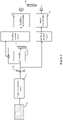
- Figure 1 is a schematic diagram of a computer system 100 according to an exemplary embodiment of the present disclosure.
- the computer system 100 includes a terminal 110 and a server 120.
- the terminal 110 and the server 120 perform data communication with each other through a communication network.
- the communication network may be a wired network or a wireless network, and the communication network may be at least one of a local area network, a metropolitan area network, or a wide area network.
- An application that supports an electroencephalogram signal recognition function is installed in the terminal 110.
- the application may be a virtual reality (VR) application, an augmented reality (AR) application, a medical application, a game application, or the like.
- a type of the application is not limited in this embodiment of the present disclosure.
- the terminal 110 may be a mobile terminal such as a mobile phone, a smartwatch, a tablet computer, a laptop portable notebook computer, or an intelligent robot, or may be a terminal such as a desktop computer or a projection computer, or may be a terminal such as an exoskeleton robot, an electric wheelchair, or a head mounted display.
- a type of the terminal is not limited in the embodiment of the present disclosure.
- the server 120 may be an independent physical server, or may be a server cluster or a distributed system formed by multiple physical servers, or may be a cloud server that provides basic cloud computing services such as a cloud service, a cloud database, cloud computing, a cloud function, cloud storage, a network service, cloud communication, a middleware service, a domain name service, a security service, a content delivery network (CDN), big data, and an AI platform.
- the server 120 is a backend server of the application in the terminal 110.
- a game application is run in the terminal 110, and a user controls a virtual role 111 in the game application by using an electroencephalogram signal 11.
- the user wears an electroencephalogram signal acquisition device for acquiring an electroencephalogram signal, such as an electroencephalogram signal acquisition helmet.
- the electroencephalogram signal acquisition device is an invasive or non-invasive signal acquisition device.
- the electroencephalogram signal acquisition device is connected to the terminal 110.
- the terminal records the electroencephalogram signal 11 of the user and sends the electroencephalogram signal 11 of the user to the server 120.
- An electroencephalogram signal classification model 10 is established in the server 120, and the electroencephalogram signal classification model 10 is a trained machine learning model.
- the electroencephalogram signal classification model 10 When receiving the electroencephalogram signal 11 of the user, the electroencephalogram signal classification model 10 extracts a signal feature 12 of the electroencephalogram signal and aligns the signal feature 12 with a source domain feature 13 of a source domain electroencephalogram signal used when the electroencephalogram signal classification model 10 is trained, so that the signal feature 12 is similar to the source domain feature 13 in a feature domain, to obtain an aligned signal feature 14. Therefore, the electroencephalogram signal classification model 10 performs transferring according to a domain adaption learning method, so that the electroencephalogram signal classification model 10 is suitable for recognizing the current electroencephalogram signal 11.
- the aligned signal feature 14 is inputted into a classifier 15 of the electroencephalogram signal classification model 10, and a motor imagery type 16 of the electroencephalogram signal 11 is outputted.
- the motor imagery type 16 includes at least one of forward movement, backward movement, lying prone, squatting, shooting, throwing, or driving a virtual carrier.
- the server 120 generates a control instruction according to the motor imagery type and sends the control instruction to the terminal 110.
- the terminal 110 controls, in response to the control instruction, the virtual role 111 to perform an activity corresponding to the motor imagery type.
- a user wears an electroencephalogram signal acquisition helmet and the user imagines controlling a virtual role 111 to run forward.
- the electroencephalogram signal acquisition helmet sends an acquired electroencephalogram signal 11 to the terminal 110, and the terminal 110 sends the electroencephalogram signal 11 to the server 120.
- the electroencephalogram signal classification model 10 recognizes that a motor imagery type of the electroencephalogram signal 11 is running forward, the server 120 generates a control instruction of running forward according to the motor imagery type of running forward and sends the control instruction to the terminal 110.
- the terminal 110 displays a picture in which the virtual role 111 runs forward, so that the user controls the virtual role 111 by using the electroencephalogram signal 11.
- the electroencephalogram signal acquisition device is connected to the server 120.
- the electroencephalogram signal classification model is established in the server 120.
- the electroencephalogram signal acquisition device directly inputs the acquired electroencephalogram signal 11 to the server 120.
- the electroencephalogram signal classification model is established in the terminal 110. The terminal 110 receives and recognizes the acquired electroencephalogram signal 11.
- the electroencephalogram signal classification model may further be established in a driving system of a robot with a rehabilitation function and established in a driving system of an electric wheelchair.
- Motor imagery types of electroencephalogram signals are different for different application scenarios.
- the type of the electroencephalogram is not limited in this embodiment of the present disclosure.
- the two methods may be performed by the terminal, that is, the two methods may be performed by a computer device.
- FIG 2 is a flowchart of a method for classifying an electroencephalogram signal according to an exemplary embodiment of the present disclosure.
- a description is made by using an example in which the method is applicable to the server 120 in the computer system 100 shown in Figure 1 .
- the method includes the following steps 201 to 205.
- step 201 an electroencephalogram signal is obtained.
- the electroencephalogram signal refers to an electrical signal generated by each neuron during brain activity, and collectively reflects an electrophysiological activity of a brain nerve cell on a cerebral cortex or a scalp surface.
- the electroencephalogram signal may be obtained by an electroencephalogram signal acquisition device.
- the electroencephalogram signal may be obtained in an invasive manner and a non-invasive manner.
- a micro-electrode needs to be implanted into nerve cortical of a person through surgery, to collect potential information of a single neuron or local nerve cortical.
- the non-invasive manner is a non-invasive nerve activity information obtaining manner.
- a detection electrode is attached to a brain to acquire an electroencephalogram signal.
- a subject that is, a person of which an electroencephalogram signal is acquired
- wears an electroencephalogram signal acquisition device such as an electroencephalogram signal acquisition helmet, or an electrode attached to a head of the subject, to acquire the electroencephalogram signal.
- Electroencephalogram signal images of different types are generated according to different electroencephalogram signal acquisition manners, for example, at least one of an electroencephalography (EEG), function magnetic resonance imaging (FMRI), a near infra-red spectroscopy (NIRS), or a magneto encephalography (EMG).
- EEG electroencephalography
- FMRI function magnetic resonance imaging
- NIRS near infra-red spectroscopy
- EMG magneto encephalography
- the electroencephalogram signal acquisition device is in communication connection with the server.
- the electroencephalogram signal acquisition device sends an acquired electroencephalogram signal to the server.
- the electroencephalogram signal acquisition device is in communication connection with a terminal used by a user.
- the terminal is in communication connection with the server, the terminal records and stores the acquired electroencephalogram signal, and the terminal sends the electroencephalogram signal to the server.
- the electroencephalogram signal acquisition device is in communication connection with the terminal used by the user. The terminal records and stores the acquired electroencephalogram signal, and the terminal recognizes the electroencephalogram signal. This is not limited in this embodiment of the present disclosure.
- step 202 a feature of the electroencephalogram signal is extracted, to obtain a signal feature corresponding to the electroencephalogram signal.
- an electroencephalogram signal classification model is established in the server 120.
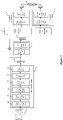
- the electroencephalogram signal classification model includes a feature extraction model 21.
- a signal feature 12 corresponding to an electroencephalogram signal 11 is extracted by using the feature extraction model 21.
- the electroencephalogram signal needs to be pre-processed, to remove an artifact and interference from the electroencephalogram signal, so as to reduce an impact of noise on the electroencephalogram signal.
- the signal feature 12 of the inputted electroencephalogram signal 11 that is not easily observed and detected is extracted by using the feature extraction model 21, so that the electroencephalogram signal classification model can accurately classify the signal feature 12.
- the signal feature 12 of the electroencephalogram signal includes: a time domain feature and a spatial domain feature.
- the time domain feature refers to a change of the electroencephalogram signal over time
- the spatial domain feature refers to a change of the electroencephalogram signal in different brain regions.
- the signal feature 12 of the electroencephalogram signal further includes a frequency domain feature.
- the frequency domain feature refers to a change of the electroencephalogram signal in frequency. In this embodiment of the present disclosure, a description is made by using an example in which the signal feature of the electroencephalogram signal includes the time domain feature and the spatial domain feature.
- a difference distribution ratio is obtained.
- the difference distribution ratio represents impacts of difference distributions of different types on distributions of the signal feature and a source domain feature in a feature domain.
- the source domain feature indicates a feature corresponding to a source domain electroencephalogram signal.
- the source domain feature is a signal feature corresponding to a source domain electroencephalogram signal.
- the source domain electroencephalogram signal is a sample electroencephalogram signal used when the electroencephalogram signal classification model is trained.
- the electroencephalogram signal is a test electroencephalogram signal used when the electroencephalogram signal classification model is tested (or is used).
- distributions of electroencephalogram signals of different subjects are different in a same time domain and spatial domain. Distributions of electroencephalogram signals of a same subject are different in the same time domain or spatial domain under different states or emotions, that is, different electroencephalogram signals have a distribution difference in a feature domain.
- a physical status and an emotion status of a subject 1 are similar to that of a subject 2.
- An electroencephalogram signal of the subject 1 reaches a peak value from the 4th second to the 6th second, and an electroencephalogram signal of the subject 2 reaches a peak value from the 6th second to the 8th second.
- the subject 1 is a young person, and the electroencephalogram signal is always in an active state.
- the subject 2 is an old person and the electroencephalogram signal is always in a non-active state.
- the difference distribution ratio represents impacts of difference distributions of different types on distributions of the signal feature and the source domain feature in the feature domain.
- a difference distribution type includes a conditional distribution difference and a marginal distribution difference.
- the difference distribution ratio includes a first distribution ratio corresponding to the marginal distribution difference and a second distribution ratio corresponding to the conditional distribution difference.
- an electroencephalogram signal 1 is a source domain electroencephalogram signal
- an electroencephalogram signal 2 is a test electroencephalogram signal inputted into the electroencephalogram signal classification model.
- the electroencephalogram signal 1 is similar to the electroencephalogram signal 2, the electroencephalogram signal 1 and the electroencephalogram signal 2 form the conditional distribution difference in the feature domain. If the electroencephalogram signal 1 is significantly differs from the electroencephalogram signal 2, the electroencephalogram signal 1 and the electroencephalogram signal 2 form the marginal distribution difference in the feature domain.
- step 204 the signal feature is aligned with the source domain feature according to the difference distribution ratio, to obtain an aligned signal feature.
- Alignment is performed so that distributions of two different electroencephalogram signals in the feature domain tend to be the same.
- An electroencephalogram signal used when the electroencephalogram signal classification model is trained is the source domain electroencephalogram signal, and the electroencephalogram signal classification model can recognize an electroencephalogram signal the same as the source domain electroencephalogram signal.
- the test electroencephalogram signal used when the electroencephalogram signal classification model is tested is different from the source domain electroencephalogram signal.
- the electroencephalogram signal classification model may erroneously classify the test electroencephalogram signal.
- the distribution of the signal feature in the feature domain is similar to the distribution of the source domain feature in the feature domain, so that the electroencephalogram signal classification model correctly classifies the test electroencephalogram signal.
- the electroencephalogram signal classification model includes a condition discriminator 22 and a margin discriminator 23.
- the condition discriminator 22 is configured to align the signal feature 12 of the electroencephalogram signal with the source domain feature in the feature domain according to the second distribution ratio corresponding to the conditional distribution difference.
- the margin discriminator 23 is configured to align the signal feature 12 of the electroencephalogram signal with the source domain feature in the feature domain according to the first distribution ratio corresponding to the marginal distribution difference.
- the condition discriminator 22 and the margin discriminator 23 simultaneously align the signal feature 12 with the source domain feature in the feature domain according to the respective distribution ratios.
- step 205 the aligned signal feature is classified, to obtain a motor imagery type of the electroencephalogram signal.
- the electroencephalogram signal classification model applies a method for classifying the source domain feature to the signal feature by using a transfer learning manner, so that the electroencephalogram signal classification model can accurately classify the electroencephalogram signal.
- the electroencephalogram signal classification model includes a classifier 15.
- the classifier 15 is configured to classify the signal feature 12 of the electroencephalogram signal.
- a prediction probability 18 of a motor imagery type is outputted according to the classifier 15, the condition discriminator 22 and the margin discriminator 23.
- Motor imagery refers to a thinking process in which a person imagines normal movement of limbs through a brain, that is, the person imagines that the limbs are moving, but the limbs are actually not moving.
- a common motor imagery type includes at least one of movement of hands, movement of feet, or movement of a tongue (swallowing).
- the motor imagery type indicates limb movement imagined through the electroencephalogram signal.
- a distribution of a signal feature corresponding to an electroencephalogram signal in a feature domain is dynamically adjusted according to the difference distribution ratio, to align the signal feature of the electroencephalogram signal with a source domain feature, so as to ensure that the signal feature of the electroencephalogram signal is similar to the source domain feature for feature distribution.
- An electroencephalogram signal classification model trained based on the source domain feature can apply a classification method to the signal feature corresponding to the electroencephalogram signal, thereby improving the accuracy of recognizing a motor imagery type corresponding to the electroencephalogram signal by the electroencephalogram signal classification model, recognizing multiple types of electroencephalogram signals by the electroencephalogram signal classification model, and thus achieving universality.
- Figure 4 is a flowchart of a method for classifying an electroencephalogram signal according to another exemplary embodiment of the present disclosure.
- a description is made by using an example in which the method is applicable to the server 120 in the computer system 100 shown in Figure 1 .
- the method includes the following steps 401 to 408.
- step 401 an electroencephalogram signal is obtained.
- electroencephalogram electrodes configured to record eye activities
- a signal sampling rate is 250 Hz
- electroencephalogram signals of four motor imagery types are acquired.
- the quantities of the electroencephalogram electrodes and the electrooculogram electrodes are schematic and are not limited in different embodiments.
- the acquired electroencephalogram signals are pre-processed, and an electroencephalogram signal located within a time interval corresponding to motor imagery is intercepted from the electroencephalogram signals.
- an electroencephalogram signal located between the 2nd second and the 6th second is intercepted.
- an acquisition device may acquire some noise signals interfering with the electroencephalogram signal or non-electroencephalogram signals. Therefore, interception is performed from the 2nd second to the 6th second.
- the three electrooculogram channels are removed from the intercepted electroencephalogram signal, and the twenty-two electroencephalogram channels are retained.
- Filtering processing is performed on the electroencephalogram signals in the twenty-two electroencephalogram channels by using a band-pass filter (a three-order Butterworth filter) (a band-pass range is between 0 and 38 Hz), to remove biological artifacts (for example, an eyeball artifact, a muscle artifact, and a cardiac artifact) and noise in some electroencephalogram signals again.
- the filtered electroencephalogram signals are standardized. Schematically, the standardization is performed by using the exponentially weighted moving average method, and a weight parameter is set to be 0.999. Alternatively, the standardization is performed by using mean variance standardization or a common spatial patterns (CSP) algorithm.
- CSP common spatial patterns
- step 402 a feature of the electroencephalogram signal is extracted, to obtain a signal feature corresponding to the electroencephalogram signal.
- an electroencephalogram signal classification model includes a feature extraction model 21.
- the feature extraction model 21 includes a temporal convolutional layer 211, a spatial convolutional layer 212, a batch normalization layer 213, a square activation layer 214, an average pooling layer 215, and a dropout layer 216.
- the electroencephalogram signal acquired in step 401 has 1000 dimensions (250 ⁇ 4), and a size of each electroencephalogram signal is 1000 ⁇ 22.
- the temporal convolutional layer 211 is invoked to perform extract a feature of the electroencephalogram signal, to obtain a first signal feature corresponding to the electroencephalogram signal.
- the temporal convolutional layer 211 is configured to perform a convolutional operation on the inputted electroencephalogram signal in a time dimension.
- the spatial convolutional layer 212 is invoked to extract a feature of the first signal feature, to obtain a second signal feature corresponding to the electroencephalogram signal.
- the spatial convolutional layer 212 is configured to perform a convolutional operation on the inputted first signal feature in a spatial dimension.
- the batch normalization layer 213 is invoked to extract a feature of the second signal feature, to obtain a third signal feature corresponding to the electroencephalogram signal.
- the square activation layer 214 is invoked to extract a feature of the third signal feature, to obtain a fourth signal feature corresponding to the electroencephalogram signal.
- the average pooling layer 215 is invoked to extract a feature of the fourth signal feature, to obtain a fifth signal feature corresponding to the electroencephalogram signal.
- the dropout layer 216 is invoked to extract a feature of the fifth signal feature, to obtain a sixth signal feature corresponding to the electroencephalogram signal.
- the sixth signal feature is determined as the signal feature corresponding to the electroencephalogram signal, that is, the signal feature finally outputted by the feature extraction model 21.
- Table 1 shows parameters of layers in the electroencephalogram signal classification model and sizes of signals outputted by the layers.
- Table 1 Layers Sizes of outputted signals Model parameters Temporal convolutional layer 40 ⁇ 1000 ⁇ 22 Convolution kernel size: 25 ⁇ 1, quantity of convolution channels: 40, stride: 1, and padding boundary: 12 ⁇ 0 Spatial convolutional layer 40 ⁇ 1000 ⁇ 1 Convolution kernel size: 1 ⁇ 22 (22 is a quantity of electrodes), quantity of convolution channels: 40; and stride: 1 Batch normalization layer -- -- Square activation layer -- -- Average pooling layer 40 ⁇ 61 ⁇ 1 Convolution kernel size: 75 ⁇ 1 and stride: 15 ⁇ 1 Dropout layer - Drop rate: 0.5 Convolutional layer 4 Convolution kernel size: 61 ⁇ 1, stride: 4 Deep convolutional layer 2 Convolution kernel size: 61 ⁇ 1, stride: 2
- the dropout layer when the electroencephalogram signal classification model performs forward propagation, a neuron stops working with a specific probability (a discarded node).
- the drop rate is a ratio of the number of nodes discarded in the dropout layer to the total number of nodes.
- a difference distribution ratio is obtained.
- the difference distribution ratio represents impacts of difference distributions of different types on distributions of the signal feature and a source domain feature in a feature domain.
- the source domain feature indicates a feature corresponding to a source domain electroencephalogram signal.
- the source domain feature is a signal feature corresponding to a source domain electroencephalogram signal.
- the source domain electroencephalogram signal is a sample electroencephalogram signal used when the electroencephalogram signal classification model is trained.
- the inputted electroencephalogram signal is a test electroencephalogram signal used when the electroencephalogram signal classification model is tested (or is used).
- the difference distribution ratio includes a first distribution ratio corresponding to a marginal distribution difference and a second distribution ratio corresponding to a conditional distribution difference.
- a distribution of an event within a range is described by using a random variable X or a random variable Y.
- the distribution is usually referred to as a marginal distribution.
- distributions of remaining random variables are referred to conditional distributions.
- an electroencephalogram signal 1 is a source domain electroencephalogram signal
- an electroencephalogram signal 2 is a test electroencephalogram signal inputted into the electroencephalogram signal classification model.
- the electroencephalogram signal 1 is similar to the electroencephalogram signal 2, the electroencephalogram signal 1 and the electroencephalogram signal 2 form the conditional distribution difference in the feature domain. If the electroencephalogram signal 1 significantly differs from the electroencephalogram signal 2, the electroencephalogram signal 1 and the electroencephalogram signal 2 form the marginal distribution difference in the feature domain.
- step 403 may include the following steps 4031 to 4033.
- a first distribution distance and a second distribution distance between the signal feature and the source domain feature are obtained.
- the first distribution distance represents the marginal distribution difference between the signal feature and source domain feature
- the second distribution distance represents the conditional distribution difference between the signal feature and the source domain feature.
- the first distribution distance is calculated according to classification accuracy of a margin discriminator, and the second distribution distance calculated according to classification accuracy of a condition discriminator. Reference is made to step 4041 to step 4043.
- step 4032 a type quantity of motor imagery types is obtained.
- the motor imagery types include left hand movement, right hand movement, feet movement, and tongue movement. It may be understood that the motor imagery types are classified according to actual electroencephalogram signals, and the motor imagery types are not limited herein.
- step 4031 and step 4032 may be performed at the same time, or step 4031 may be performed before step 4032, or step 4032 may be performed before step 4031.
- step 4033 a first distribution ratio corresponding to the marginal distribution difference and a second distribution ratio corresponding to the conditional distribution difference are obtained according to the first distribution distance, the second distribution distance, and the type quantity.
- Step 4031 and step 4032 are used for calculating the first distribution ratio and the second distribution ratio.
- the first distribution ratio is calculated according to the following equation.
- d A , g D s c D t c represents the first distribution distance between the source domain feature and the signal feature
- d A , l D s c D t c represents the second distribution distance between the source domain feature and the signal feature
- C represents the type quantity of motor imagery types, and represents importance of a marginal distribution to a distribution difference between the source domain feature and the signal feature in the feature domain.
- the second distribution ratio is 1- , representing importance of a conditional distribution to the distribution difference between the source domain feature and the signal feature in the feature domain.
- the second distribution ratio corresponding to the conditional distribution difference is calculated, and then the first distribution ratio is obtained based on the second distribution ratio.
- step 404 the marginal distribution difference and the conditional distribution difference between the source domain feature and the signal feature in the feature domain are obtained.
- step 404 may include the following steps 4041 to 4043.
- first classification accuracy of a margin discriminator and second classification accuracy of a condition discriminator are obtained.
- the margin discriminator is configured to determine a domain signal type to which the electroencephalogram signal belongs.
- the condition discriminator is configured to determine a domain signal type to which different electroencephalogram signals belong.
- the domain signal includes at least one of the source domain electroencephalogram signal or an inputted electroencephalogram signal.
- the margin discriminator 23 is configured to output a prediction probability that the electroencephalogram signal belongs to a certain domain signal type, that is, outputting a prediction probability that the electroencephalogram signal is the source domain electroencephalogram signal and a prediction probability that the electroencephalogram signal is the target domain electroencephalogram signal.
- the source domain electroencephalogram signal is a sample electroencephalogram signal used when the electroencephalogram signal classification model is trained
- the target domain electroencephalogram signal is a test electroencephalogram signal used when the electroencephalogram signal classification model is tested.
- the margin discriminator 23 outputs the prediction probability that the electroencephalogram signal is the source domain electroencephalogram signal being 0.3 and outputs the prediction probability that the electroencephalogram signal is the target domain electroencephalogram signal being 0.7.
- a prediction result is that the inputted electroencephalogram signal is the target domain electroencephalogram signal, being consistent with a type of the inputted electroencephalogram signal.
- the prediction result outputted by the margin discriminator 23 is correct, and first classification accuracy of the margin discriminator 23 is recorded.
- the condition discriminator 22 is configured to output prediction probabilities that different electroencephalogram signals belong to a domain signal type.
- the different electroencephalogram signals are electroencephalogram signals corresponding to different subjects or electroencephalogram signals of different brain regions of a same subject.
- the condition discriminator 22 outputs a prediction probability that an electroencephalogram signal of first type is a source domain electroencephalogram signal being 0.19, and outputs a prediction probability that the electroencephalogram signal of first type is a target domain electroencephalogram signal being 0.82.
- a prediction result is that the inputted electroencephalogram signal is the target domain electroencephalogram signal, being consistent with a type of the inputted electroencephalogram signal.
- the prediction result outputted by the condition discriminator 22 is correct, and second classification accuracy of the condition discriminator 22 is recorded.
- step 4042 the first distribution distance between the signal feature and the source domain feature is obtained according to the first classification accuracy, and the second distribution distance between the signal feature and the source domain feature is obtained according to the second classification accuracy.
- a distribution difference dynamic evaluation mechanism is introduced to evaluate a difference between two distributions, and a distance evaluation indicator (A-distance) is used to evaluate a distribution difference between a source domain and a target domain.
- the first distribution distance and the second distribution distance are calculated by using the following formulas.
- d A , g D s c D t c represents the first distribution distance between the source domain feature and the signal feature
- d A , l D s c D t c represents the second distribution distance between the source domain feature and the signal feature
- ⁇ g c represents the first classification accuracy of the margin discriminator
- ⁇ l c represents the second classification accuracy of the condition discriminator.
- step 4043 the first distribution distance is determined as the marginal distribution difference and the second distribution distance is determined as the conditional distribution difference.
- the first distribution distance d A , g D s c D t c is determined as the marginal distribution difference, and the second distribution distance d A , l D s c D t c is determined as the conditional distribution difference.
- step 405 the marginal distribution difference is scaled down according to the first distribution ratio and the conditional distribution difference is scaled down according to the second distribution ratio.
- the conditional distribution difference and the marginal distribution difference are scaled down simultaneously.
- the marginal distribution difference and the conditional distribution difference are respectively adjusted according to the first distribution ratio and the second distribution ratio.
- step 406 a signal feature with a scaled-down distribution difference is obtained according to a scaled-down marginal distribution difference and a scaled-down conditional distribution difference.
- conditional distribution and the marginal distribution of the signal feature in the feature domain are aligned with the source domain feature, to obtain an aligned signal feature.
- a distribution difference between the signal feature and the source domain feature is scaled down.
- step 407 the signal feature with the scaled-down distribution difference is determined as an aligned signal feature.
- the distribution of the signal feature in the feature domain is similar to the distribution of the source domain feature in the same feature domain.
- step 408 the aligned signal feature is classified, to obtain a motor imagery type of the electroencephalogram signal.
- step 408 may include the following steps 4081 to 4083.
- a classifier is invoked to process the aligned signal feature, to obtain a prediction probability of the motor imagery type of the electroencephalogram signal.
- the motor imagery type includes at least one of movement of hands, movement of feet, or movement of a tongue.
- the signal feature of the electroencephalogram signal outputted by the feature extraction model 21 is inputted into the classifier 15, the condition discriminator 22, and the margin discriminator 23.
- the classifier 15 includes a convolutional layer (a convolutional neural network, C-Conv or CNN) and a logistic regression layer (softmax).
- the convolutional layer performs convolution processing on the signal feature and outputs an intermediate vector.
- the intermediate vector is inputted into the logistic regression layer, and the prediction probability of the motor imagery type of the electroencephalogram signal is outputted.
- the classifier 15 outputs: a prediction probability of left hand movement is 0.2, a prediction probability of right hand movement is 0.7, a prediction probability of movement of feet is 0, and a prediction probability of tongue movement is 0.1.
- a feature vector outputted by the classifier 15 is inputted into a gradient reversal layer (GRL) 217.
- the gradient reversal layer 217 performs further calculation, to obtain another feature vector.
- the another feature vector is inputted into the condition discriminator 22 and the margin discriminator 23.
- the gradient reversal layer 217 is configured to multiply an error transmitted to the layer by a negative number (- ⁇ ), so that a training target of the network layer is changed after the gradient reversal layer, thereby achieving a confrontation effect.
- step 4082 the condition discriminator is invoked to process the aligned signal feature, to obtain the prediction probabilities that different electroencephalogram signals belong to the domain signal type.
- the domain signal includes at least one of the source domain electroencephalogram signal or the inputted electroencephalogram signal.
- the condition discriminator 22 includes a deep convolutional layer (a deep convolutional neural network, D-Conv or DCNN) and a logistic regression layer.
- the deep convolutional layer performs convolution processing on the signal feature and outputs an intermediate vector.
- the intermediate vector is inputted into the logistic regression layer, and prediction probabilities that different electroencephalogram signals belong to a domain signal type are outputted.
- Electroencephalogram signals may be classified according to types of subjects or according to different brain regions or according to emotions (or states) of a subject.
- a prediction probability that an electroencephalogram signal of a first type is the source domain electroencephalogram signal outputted by the condition discriminator 22 is 0.7
- a prediction probability that the electroencephalogram signal of the first type is the target domain electroencephalogram signal outputted by the condition discriminator 22 is 0.3
- the electroencephalogram signal of the first type is classified according to electroencephalogram signals generated by different brain regions.
- step 4083 the margin discriminator is invoked to process the aligned signal feature, to obtain the prediction probability that the electroencephalogram signal belongs to the domain signal type.
- the margin discriminator 23 includes a deep convolutional layer and a logistic regression layer.
- the deep convolutional layer performs convolution processing on the signal feature and outputs an intermediate vector.
- the intermediate vector is inputted into the logistic regression layer, and the prediction probability that the electroencephalogram signal belongs to the domain signal type is outputted.
- the margin discriminator 23 differs from the condition discriminator 22 in that the margin discriminator 23 determines only the domain signal type to which the electroencephalogram signal belongs.
- Step 4081, step 4082, and step 4083 are performed simultaneously.
- step 4084 the motor imagery type of the electroencephalogram signal is obtained according to the prediction probability of the motor imagery type of the electroencephalogram signal, the prediction probabilities that different electroencephalogram signals belong to the domain signal type, and the prediction probability that the electroencephalogram signal belongs to the domain signal type.
- the distribution difference dynamic evaluation mechanism is introduced to evaluate the difference between the two distributions. A distribution with a significant impact is aligned preferentially.
- the condition discriminator 22 and the margin discriminator 23 determine respective distribution ratios. Therefore, the electroencephalogram signal classification model outputs the motor imagery type according to the output results of the classifier 15, the condition discriminator 22, and the margin discriminator 23.
- a distribution of a signal feature of an electroencephalogram signal in a feature domain is dynamically adjusted according to a difference distribution ratio, to align the signal feature of the electroencephalogram signal with a source domain feature, so as to ensure that the signal feature of the electroencephalogram signal is similar to the source domain feature for feature distribution.
- An electroencephalogram signal classification model trained based on the source domain feature can apply a classification method to the signal feature of the electroencephalogram signal, thereby improving the accuracy of recognizing a motor imagery type of the electroencephalogram signal by the electroencephalogram signal classification model, recognizing multiple types of electroencephalogram signals the electroencephalogram signal classification model, and thus achieving universality.
- a distribution difference between the signal feature and the source domain feature that are inputted into the electroencephalogram signal classification model is dynamically adjusted according to a first distribution ratio corresponding to a marginal distribution difference and a second distribution ratio corresponding to a conditional distribution difference, so that the signal feature is more similar to the source domain feature, thereby ensuring that the electroencephalogram signal classification model can accurately obtain the aligned signal feature.
- a first distribution distance and a second distribution distance between the source domain feature and the signal feature are determined according to first classification accuracy of a margin discriminator and second classification accuracy of a condition discriminator, so that the electroencephalogram signal classification model determines the marginal distribution difference and the conditional distribution difference according to the first distribution distance and the second distribution distance.
- the first distribution distance and the second distribution distance between the signal feature and the source domain feature respectively represent the marginal distribution difference and the conditional distribution difference between the signal feature and the source domain feature, so that the first distribution ratio corresponding to the marginal distribution difference and the second distribution ratio corresponding to the conditional distribution difference are accurately calculated according to a type quantity of motor imagery types.
- the aligned signal feature is processed by invoking a classifier, the margin discriminator, and the condition discriminator, and a motor imagery classification model of the electroencephalogram signal is obtained according to prediction probabilities outputted by the classifier, the margin discriminator, and the condition discriminator, so that the electroencephalogram signal classification model can recognize different types electroencephalogram signals, thereby improving accuracy of the motor imagery type outputted by the electroencephalogram signal classification model.
- the signal feature of the electroencephalogram signal is outputted by invoking layers in a feature extraction model, so that the signal feature of the electroencephalogram signal has time invariance, and subsequently the electroencephalogram signal classification model outputs an accurate motor imagery type.
- Figure 6 is a flowchart of a method for training an electroencephalogram signal classification model according to an exemplary embodiment of the present disclosure.
- a description is made by using an example in which the method is applicable to the server 120 in the computer system 100 shown in Figure 1 .
- the method includes the following steps 601 to 605.
- step 601 a source domain electroencephalogram signal and a target domain electroencephalogram signal are obtained.
- the source domain electroencephalogram signal is a sample electroencephalogram signal used when an electroencephalogram signal classification model is trained
- the target domain electroencephalogram signal is a test electroencephalogram signal used when the electroencephalogram signal classification model is tested.
- the electroencephalogram signal classification model is trained by using a public dataset.
- the public dataset includes a training set and a test set.
- a public competition dataset such as the BCI competition IV dataset 2a is used.
- the dataset includes nine subjects, electroencephalogram data of each subject is recorded by using twenty-two electroencephalogram electrodes and three electrooculogram electrodes, a signal sampling rate is 205 Hz, and four motor imagery types (left hand movement, right hand movement, feet movement, and tongue movement) are included.
- the training process of the electroencephalogram signal classification model is the same as the use process, including: 701, inputting an electroencephalogram signal, 702, pre-processing the electroencephalogram signal, introducing a distribution difference dynamic evaluation mechanism 703 into an electroencephalogram signal classification model 704, and 705, outputting a prediction result.
- the pre-processing 702 includes band-pass filtering 7021 and signal standardization 7022.
- the electroencephalogram signal classification model is also referred to as a dynamic domain adaption model.
- step 401 For the pre-processing process of the electroencephalogram signal, one may refer to the implementation of step 401. Details are not described herein again.
- step 602 features of the source domain electroencephalogram signal and the target domain electroencephalogram signal are extracted, to obtain a source domain feature of the source domain electroencephalogram signal and a target domain feature of the target domain electroencephalogram signal.
- a source domain electroencephalogram signal 101 and a target domain electroencephalogram signal 102 are inputted into a feature extraction model 21 in the electroencephalogram signal classification model 704.
- a source domain feature of the source domain electroencephalogram signal and a target domain feature of the target domain electroencephalogram signal are outputted through layers of the feature extraction model 21.
- step 603 a difference distribution ratio is obtained.
- the difference distribution ratio represents impacts of difference distributions of different types on distributions of the source domain feature and the target domain feature in a feature domain.
- the difference distribution ratio includes a first distribution ratio corresponding to a marginal distribution difference and a second distribution ratio corresponding to a conditional distribution difference.
- the distributions of the target domain feature and the source domain feature in the feature domain are different. Therefore, to evaluate the impact of difference distributions of different types on the source domain feature and the target domain feature, a distribution difference dynamic evaluation mechanism is introduced to evaluate the marginal distribution difference and the conditional distribution difference between the source domain feature and the target domain feature.
- a difference distribution with a relatively large impact is dynamically adjusted according to distribution ratios corresponding to the marginal distribution difference and the conditional distribution difference.
- step 604 the source domain feature is aligned with the target domain feature in the feature domain according to the difference distribution ratio, to obtain an aligned target domain feature.
- Step 604 may include the following steps 6041 to 6044.
- step 6041 a marginal distribution difference and a conditional distribution difference between the source domain feature and the target domain feature in the feature domain are obtained.
- First classification accuracy of a margin discriminator and second classification accuracy of a condition discriminator are obtained.
- the first margin discriminator is configured to determine a domain signal type to which the electroencephalogram signal belongs
- the condition discriminator is configured to determine, according to a motor imagery type, a domain signal type to which the electroencephalogram signal belongs.
- the domain signal includes at least one of the source domain electroencephalogram signal or the target domain electroencephalogram signal.
- a first distribution distance between the target domain feature and the source domain feature is obtained according to the first classification accuracy and a second distribution distance between the target domain feature and the source domain feature is obtained according to the second classification accuracy.
- the first distribution distance is determined as the marginal distribution difference
- the second distribution distance is determined as the conditional distribution difference.
- step 6041 one may refer to the implementations of step 4041 to step 4043. Details are not described herein again.
- step 6042 the marginal distribution difference is scaled down according to the first distribution ratio and the conditional distribution difference is scaled down according to the second distribution ratio.
- a target domain feature with a scaled-down distribution difference is obtained according to a scaled-down marginal distribution difference and a scaled-down conditional distribution difference.
- step 6044 the target domain feature with the scaled-down distribution difference is determined as the aligned target domain feature.
- step 6041 to step 6043 one may refer to the implementations of step 404 to step 407. Details are not described herein again.
- step 605 the aligned target domain feature is classified, and an electroencephalogram signal classification model is trained according to a classification result, to obtain a trained electroencephalogram signal classification model.
- Step 605 may include the following steps 6051 to 6052.
- step 6051 a classifier, a margin discriminator, and a condition discriminator in the electroencephalogram signal classification model are invoked to process the aligned target domain feature, to obtain a prediction probability of a motor imagery type of the target domain electroencephalogram signal.
- a classifier 15, a margin discriminator 23, and a condition discriminator 22 simultaneously process, according to the distribution difference dynamic evaluation mechanism, a source domain feature and a target domain feature that are outputted by the feature extraction model. Because a distribution of the source domain feature is similar to a distribution of the target domain feature in the feature domain, the electroencephalogram signal classification model can apply a method for classifying the source domain feature to the target domain feature, so that the electroencephalogram signal classification model obtains a motor imagery type of the target domain electroencephalogram signal.
- a feature vector outputted by the classifier 15 is inputted into a gradient reversal layer (GRL) 217.
- the gradient reversal layer 217 performs further calculation, to obtain another feature vector.
- the another feature vector is inputted into the condition discriminator 22 and the margin discriminator 23.
- the gradient reversal layer 217 is configured to multiply an error transmitted to the layer by a negative number (- ⁇ ), so that a training target of the network layer is changed after the gradient reversal layer, thereby achieving a confrontation effect.
- step 6052 an error of the electroencephalogram signal classification model is calculated according to the prediction probability and a real label of the motor imagery type of the electroencephalogram signal.
- the error includes an error corresponding to the classifier, an error corresponding to the condition discriminator, and an error corresponding to the margin discriminator.
- an example in which the error is calculated by using an error function is used. Calculation manners of the three errors are described below.
- a first loss function corresponding to the classifier is calculated according to the prediction probability and the real label.
- L c ( ⁇ f , ⁇ c ) represents the first loss function corresponding to the classifier
- E x i s y i s represents an expected value of the source domain feature
- x i s represents the source domain electroencephalogram signal
- y i s represents a prediction probability of the source domain electroencephalogram signal
- D s represents a source domain
- L() represent a cross entropy loss function
- p i s represents a real label of the source domain electroencephalogram signal
- " ⁇ " represents a belonging relationship.
- the formula represents that the source domain electroencephalogram signal and the real label corresponding to the source domain electroencephalogram signal are obtained from a source domain electroencephalogram signal dataset, and an expectation of a classification loss of the source domain electroencephalogram signal is calculated.
- a second loss function corresponding to the condition discriminator is calculated according to a source domain condition feature map corresponding to the source domain feature and a target domain condition feature map corresponding to the target domain feature that are outputted by the condition discriminator.
- g i s represents the source domain condition feature map
- g j t represents the target domain condition feature map
- D c represents a c th -type condition discriminator, that is, a source domain electroencephalogram signal and a target domain electroencephalogram signal that belong to a c th -type are inputted into the condition discriminator for classification
- D s represents the source domain
- D t represent a target domain
- E x i s represents the expected value of the source domain feature
- E x j t represents an expected value of the target domain feature
- " ⁇ " represents the belonging relationship.
- a third loss function corresponding to the margin discriminator is calculated according to a source domain feature map corresponding to the source domain feature and a target domain feature map corresponding to the target domain feature that are outputted by the margin discriminator.
- x i s represents the source domain feature map
- x j t represents the target domain feature map
- G(x) represents a feature extraction model
- D m represents the margin discriminator
- D s represents the source domain
- Dt represent the target domain
- E x i s represents the expected value of the source domain feature
- E x j t represents the expected value of the target domain feature
- " ⁇ " represents the belonging relationship.
- L c represents the first loss function of the classifier
- ⁇ represents a to-be-learned parameter of the electroencephalogram signal classification model
- L g represents the third loss function corresponding to the margin discriminator
- L 1 represents the second loss function corresponding to the condition discriminator
- C represents a type quantity of motor imagery types.
- step 6053 the electroencephalogram signal classification model is trained according to the error by using an error back propagation algorithm, to obtain the trained electroencephalogram signal classification model.
- an output error is propagated backward layer by layer to an input layer through a hidden layer in a particular form, and the error is allocated to all units in each layer, to obtain an error signal of each layer.
- the error signal serves as a basis of correcting a unit weight.
- a learning process of a machine learning model includes forward propagation and error backward propagation. During forward propagation, an input sample is inputted from an input layer, is processed by hidden layers layer by layer, and is propagated to an output layer. If an actual output of the output layer is inconsistent with an expected output, an error backward propagation is performed.
- a parameter of a neural network model is resolved by using a gradient descent method based on stochastic gradient descent (SGD), and the model parameter is initialized by using a Xavier initialization method.
- SGD stochastic gradient descent
- an electroencephalogram signal of each subject and a corresponding label are transmitted into a network for learning, and the model is optimized through error backward propagation.
- a distribution of a target domain feature in a feature domain is dynamically adjusted according to a difference distribution ratio, to align the target domain feature with a source domain feature, so as to train an electroencephalogram signal classification model based on an aligned target domain feature, so that the electroencephalogram signal classification model can apply a classification learning method to the target domain feature, and the trained electroencephalogram signal classification model can accurately output a motor imagery type of an electroencephalogram signal, thereby recognizing multiple types of electroencephalogram signals by the electroencephalogram signal classification model, and thus achieving universality.
- a distribution difference between the target domain feature and the source domain feature that are inputted into the electroencephalogram signal classification model is dynamically adjusted according to a first distribution ratio corresponding to a marginal distribution difference and a second distribution ratio corresponding to a conditional distribution difference, so that the target domain feature is more similar to the source domain feature, thereby ensuring that the electroencephalogram signal classification model can accurately obtain an aligned target domain feature.
- a first distribution distance and a second distribution distance between the source domain feature and the target domain feature are determined according to first classification accuracy of a margin discriminator and second classification accuracy of a condition discriminator, so that the electroencephalogram signal classification model determines the marginal distribution difference and the conditional distribution difference according to the first distribution distance and the second distribution distance.
- the aligned target domain feature is processed by using a classifier, the margin discriminator, and the condition discriminator, and the electroencephalogram signal classification model is trained according to a difference between a real label of the motor imagery type of the electroencephalogram signal and a prediction probability outputted by the electroencephalogram signal classification model, thereby ensuring that the electroencephalogram signal classification model can accelerate convergence, and thus shortening a training time of the model.
- An error of the electroencephalogram signal classification model is accurately calculated according to a first loss function corresponding to the classifier, a second loss function corresponding to the margin discriminator, and a third loss function corresponding to the condition discriminator, so that the electroencephalogram signal classification model is trained based on the accurate error, thereby improving a convergence speed of the model and thus shortening the training time of the model.
- Figure 9 is a structural block diagram of an apparatus for classifying an electroencephalogram signal according to an exemplary embodiment of the present disclosure.
- the apparatus may be implemented as an entire computer device or a part of the computer device.
- the apparatus includes a first obtaining module 910, a first feature extraction module 920, a first processing module 930 and a classifying module 940.
- the first obtaining module 910 is configured to obtain an electroencephalogram signal.
- the first feature extraction module 920 is configured to extract a feature of the electroencephalogram signal, to obtain a signal feature of the electroencephalogram signal.
- the first obtaining module 910 is further configured to obtain a difference distribution ratio.
- the difference distribution ratio represents impacts of difference distributions of different types on distributions of the signal feature and a source domain feature in a feature domain.
- the source domain feature indicates a feature corresponding to a source domain electroencephalogram signal;
- the first processing module 930 is configured to align the signal feature with the source domain feature according to the difference distribution ratio, to obtain an aligned signal feature.
- the classification module 940 is configured to classify the aligned signal feature, to obtain a motor imagery type of the electroencephalogram signal.
- the difference distribution ratio includes a first distribution ratio corresponding to a marginal distribution difference and a second distribution ratio corresponding to a conditional distribution difference.
- the first obtaining module 910 is configured to obtain the marginal distribution difference and the conditional distribution difference between the source domain feature and the signal feature in the feature domain.
- the first processing module 930 is configured to scale down the marginal distribution difference according to the first distribution ratio and scale down the conditional distribution difference according to the second distribution ratio; obtain a signal feature with a scaled-down distribution difference according to a scaled-down marginal distribution difference and a scaled-down conditional distribution difference; and determine the signal feature with the scaled-down distribution difference as the aligned signal feature.
- the first obtaining module 910 is configured to obtain first classification accuracy of a margin discriminator and second classification accuracy of a condition discriminator.
- the margin discriminator is configured to determine a domain signal type to which the electroencephalogram signal belongs
- the condition discriminator is configured to determine a domain signal type to which different electroencephalogram signals belong.
- the domain signal includes at least one of the source domain electroencephalogram signal or an inputted electroencephalogram signal.
- the first obtaining module 910 is further configured to: obtain a first distribution distance between the signal feature and the source domain feature according to the first classification accuracy and obtain a second distribution distance between the signal feature and the source domain feature according to the second classification accuracy; and determine the first distribution distance as the marginal distribution difference, and determine the second distribution distance the conditional distribution difference.
- the difference distribution ratio includes the first distribution ratio corresponding to the marginal distribution difference and the second distribution ratio corresponding to the conditional distribution difference.
- the first obtaining module 910 is configured to obtain the first distribution distance and the second distribution distance between the signal feature and the source domain feature, the first distribution distance representing the marginal distribution difference between the signal feature and source domain feature, and the second distribution distance representing the conditional distribution difference between signal feature and the source domain feature; obtain a type quantity of motor imagery types; and obtain the first distribution ratio corresponding to the marginal distribution difference and the second distribution ratio corresponding to the conditional distribution difference according to the first distribution distance, the second distribution distance, and the type quantity.
- the classification module 940 includes a classifier 9401, a condition discriminator 9402, and a margin discriminator 9403.
- the classifier 9401 is configured to process the aligned signal feature, to obtain a prediction probability of the motor imagery type of the electroencephalogram signal.
- the motor imagery type includes at least one of movement of hands, movement of feet, or movement of a tongue.
- the condition discriminator 9402 is configured to process the aligned signal feature, to obtain prediction probabilities that different electroencephalogram signals belong to the domain signal type.
- the domain signal includes at least one of the source domain electroencephalogram signal or the inputted electroencephalogram signal.
- the margin discriminator 9403 is configured to process the aligned signal feature, to obtain a prediction probability that the electroencephalogram signal belongs to the domain signal type.
- the classification module 940 is configured to obtain the motor imagery type of the electroencephalogram signal according to the prediction probability of the motor imagery type of the electroencephalogram signal, the prediction probability that different electroencephalogram signals belong to the domain signal type, and the prediction probability that the electroencephalogram signal belongs to the domain signal type.
- the first feature extraction module 920 includes a temporal convolutional layer 9201, a spatial convolutional layer 9202, a batch normalization layer 9203, a square activation layer 9204, an average pooling layer 9205, and a dropout layer 9206.
- the temporal convolutional layer 9201 is configured to extract a feature of the electroencephalogram signal, to obtain a first signal feature of the electroencephalogram signal.
- the spatial convolutional layer 9202 is configured to extract a feature of the first signal feature, to obtain a second signal feature of the electroencephalogram signal.
- the batch normalization layer 9203 is configured to extract a feature of the second signal feature, to obtain a third signal feature of the electroencephalogram signal.
- the square activation layer 9204 is configured to extract a feature of the third signal feature, to obtain a fourth signal feature of the electroencephalogram signal.
- the average pooling layer 9205 is configured to extract a feature of the fourth signal feature, to obtain a fifth signal feature of the electroencephalogram signal.
- the dropout layer 9206 is configured to extract a feature of the fifth signal feature, to obtain a sixth signal feature of the electroencephalogram signal; and determine the sixth signal feature as the signal feature of the electroencephalogram signal.
- a distribution of a signal feature of an electroencephalogram signal in a feature domain is dynamically adjusted according to a difference distribution ratio, to align the signal feature of the electroencephalogram signal with a source domain feature, so as to ensure that the signal feature of the electroencephalogram signal is similar to the source domain feature for feature distribution.
- An electroencephalogram signal classification model trained based on the source domain feature can apply a classification method to the signal feature of the electroencephalogram signal, thereby improving the accuracy of recognizing a motor imagery type of the electroencephalogram signal by the electroencephalogram signal classification model, recognizing multiple types of electroencephalogram signals by the electroencephalogram signal classification model, and thus achieving universality.
- a distribution difference between the signal feature and the source domain feature that are inputted into the electroencephalogram signal classification model is dynamically adjusted according to a first distribution ratio corresponding to a marginal distribution difference and a second distribution ratio corresponding to a conditional distribution difference, so that the signal feature is more similar to the source domain feature, thereby ensuring that the electroencephalogram signal classification model can accurately obtain an aligned signal feature.
- a first distribution distance and a second distribution distance between the source domain feature and the signal feature are determined according to first classification accuracy of a margin discriminator and second classification accuracy of a condition discriminator, so that the electroencephalogram signal classification model determines the marginal distribution difference and the conditional distribution difference according to the first distribution distance and the second distribution distance.
- the first distribution distance and the second distribution distance between the signal feature and the source domain feature respectively represent the marginal distribution difference and the conditional distribution difference between the signal feature and the source domain feature, so that the first distribution ratio corresponding to the marginal distribution difference and the second distribution ratio corresponding to the conditional distribution difference are accurately calculated according to a type quantity of motor imagery types.
- the aligned signal feature is processed by invoking a classifier, the margin discriminator, and the condition discriminator, and a motor imagery classification model corresponding to the electroencephalogram signal is obtained according to prediction probabilities outputted by the classifier, the margin discriminator, and the condition discriminator, so that the electroencephalogram signal classification model can recognize different types electroencephalogram signals, thereby improving accuracy of the motor imagery type outputted by the electroencephalogram signal classification model.
- the signal feature of the electroencephalogram signal is outputted by invoking layers in a feature extraction model, so that the signal feature of the electroencephalogram signal has time invariance, and subsequently the electroencephalogram signal classification model outputs an accurate motor imagery type.
- the apparatus for classifying an electroencephalogram signal provided in the foregoing embodiments is illustrated based on the foregoing functional modules.
- the functions may be allocated to different functional modules according to requirements, that is, the apparatus is divided into different functional modules, to implement all or some of the functions described above.
- the apparatus for classifying an electroencephalogram signal provided in the foregoing embodiment shares the same concept as the embodiment of the method for classifying an electroencephalogram signal.
- the specific implementation process of the apparatus one may refer to description of the method embodiment, and details are not described herein again.
- Figure 10 is a structural block diagram of an apparatus for training an electroencephalogram signal classification model according to an exemplary embodiment of the present disclosure.
- the apparatus may be implemented as an entire computer device or a part of the computer device.
- the apparatus includes a second obtaining module 1010, a second feature extraction module 1020, a second processing module 1030 and a training module 1040.
- the second obtaining module 1010 is configured to obtain a source domain electroencephalogram signal and a target domain electroencephalogram signal.
- T second feature extraction module 1020 is configured to extract features of the source domain electroencephalogram signal and the target domain electroencephalogram signal, to obtain a source domain feature of the source domain electroencephalogram signal and a target domain feature of the target domain electroencephalogram signal.
- the second obtaining module 1010 is configured to obtain a difference distribution ratio.
- the difference distribution ratio represents impacts of difference distributions of different types on distributions of the source domain feature and the target domain feature in a feature domain.
- the second processing module 1030 is configured to align the source domain feature with the target domain feature in the feature domain according to the difference distribution ratio, to obtain an aligned target domain feature.
- the training module 1040 is configured to classify the aligned target domain feature, and train an electroencephalogram signal classification model according to a classification result, to obtain a trained electroencephalogram signal classification model.
- the difference distribution ratio includes a first distribution ratio corresponding to a marginal distribution difference and a second distribution ratio corresponding to a conditional distribution difference.
- the second obtaining module 1010 is configured to obtain the marginal distribution difference and the conditional distribution difference between the source domain feature and the target domain feature in the feature domain.
- the second processing module 1030 is configured to scale down the marginal distribution difference according to the first distribution ratio and scale down the conditional distribution difference according to the second distribution ratio; obtain a signal feature with a scaled-down distribution difference according to a scaled-down marginal distribution difference and a scaled-down conditional distribution difference; and determine the target domain feature with the scaled-down distribution difference as the aligned target domain feature.
- the second obtaining module 1010 is configured to obtain first classification accuracy of a margin discriminator and second classification accuracy of a condition discriminator.
- the margin discriminator is configured to determine a domain signal type to which the electroencephalogram signal belongs.
- the condition discriminator is configured to determine, according to the motor imagery type, a domain signal type to which different electroencephalogram signals belong.
- the domain signal includes at least one of the source domain electroencephalogram signal or the target domain electroencephalogram signal.
- the second obtaining module 1010 is further configured to: obtain a first distribution distance between the target domain feature and the source domain feature according to the first classification accuracy, and obtain a second distribution distance between the target domain feature and the source domain feature according to the second classification accuracy; and determine the first distribution distance as the marginal distribution difference, and determine the second distribution distance as the conditional distribution difference.
- the apparatus includes an electroencephalogram signal classification model 1050.
- the electroencephalogram signal classification model 1050 is configured to invoke a classifier, a margin discriminator, and a condition discriminator to process the aligned target domain feature, to obtain a prediction probability of a motor imagery type of the target domain electroencephalogram signal.
- the training module 1040 is configured to calculate an error of the electroencephalogram signal classification model according to the prediction probability and a real label of the motor imagery type of the electroencephalogram signal; and train the electroencephalogram signal classification model according to the error by using an error back propagation algorithm, to obtain a trained electroencephalogram signal classification model.
- the training module 1040 is configured to calculate a first loss function corresponding to the classifier according to the prediction probability and the real label; calculate a second loss function corresponding to the condition discriminator according to a source domain condition feature map corresponding to the source domain feature and a target domain condition feature map corresponding to the target domain feature that are outputted by the condition discriminator; calculate a third loss function corresponding to the margin discriminator according to a source domain feature map corresponding to the source domain feature and a target domain feature map corresponding to the target domain feature that are outputted by the margin discriminator; and calculate the error of the electroencephalogram signal classification model according to the first loss function, the second loss function, and the third loss function.
- a distribution of a target domain feature in a feature domain is dynamically adjusted according to a difference distribution ratio, to align the target domain feature with a source domain feature, so as to train an electroencephalogram signal classification model based on an aligned target domain feature, so that the electroencephalogram signal classification model can apply a classification learning method to the target domain feature, and the trained electroencephalogram signal classification model can accurately output a motor imagery type of an electroencephalogram signal, thereby recognizing multiple types of electroencephalogram signals, and thus achieving universality.
- a distribution difference between the target domain feature and the source domain feature that are inputted into the electroencephalogram signal classification model is dynamically adjusted according to a first distribution ratio corresponding to a marginal distribution difference and a second distribution ratio corresponding to a conditional distribution difference, so that the target domain feature is more similar to the source domain feature, thereby ensuring that the electroencephalogram signal classification model can accurately obtain an aligned target domain feature.
- a first distribution distance and a second distribution distance between the source domain feature and the target domain feature are determined according to first classification accuracy of a margin discriminator and second classification accuracy of a condition discriminator, so that the electroencephalogram signal classification model determines the marginal distribution difference and the conditional distribution difference according to the first distribution distance and the second distribution distance.
- the aligned target domain feature is processed by using a classifier, the margin discriminator, and the condition discriminator, and the electroencephalogram signal classification model is trained according to a difference between a real label of the motor imagery type of the electroencephalogram signal and a prediction probability outputted by the electroencephalogram signal classification model, thereby ensuring that the electroencephalogram signal classification model can accelerate convergence, and thus shortening a training time of the model.
- An error of the electroencephalogram signal classification model is accurately calculated according to a first loss function corresponding to the classifier, a second loss function corresponding to the margin discriminator, and a third loss function corresponding to the condition discriminator, so that the electroencephalogram signal classification model is trained based on the accurate error, thereby improving a convergence speed of the model, and thus shortening the training time of the model.
- the apparatus for training an electroencephalogram signal classification model provided in the foregoing embodiments is illustrated based on the foregoing functional modules.
- the functions may be allocated to different functional modules according to requirements, that is, the apparatus is divided into different functional modules, to implement all or some of the functions described above.
- the apparatus for training an electroencephalogram signal classification model provided in the foregoing embodiment shares the same concept as the embodiment of the method for training an electroencephalogram signal classification model.
- the specific implementation process of the apparatus one may refer to description of the method embodiment, and details are not described herein again.
- FIG 11 is a schematic structural diagram of a server according to an exemplary embodiment of the present disclosure.
- the server may be the server 120 in the computer system 100 shown in Figure 1 .
- a server 1100 includes a central processing unit (CPU) 1101, a system memory 1104 , and a system bus 1105 connecting the system memory 1104 to the CPU 1101.
- the system memory 1104 includes a random access memory (RAM) 1102 and a read only memory (ROM) 1103.
- the server 1100 further includes a basic input/output (I/O) system 1106 configured to transmit information between devices in a computer, and a mass storage device 1107 configured to store an operating system 1113, an application program 1114 and another program module 1115.
- I/O basic input/output
- the basic I/O system 1106 includes a display 1108 configured to display information and an input device 1109 configured to input information by a user, such as a mouse or a keyboard.
- the display 1108 and the input device 1109 are both connected to the CPU 1101 via an input/output controller 1110 that is connected to the system bus 1105.
- the basic I/O system 1106 may further include the I/O controller 1110 configured to receive and process input from multiple other devices such as a keyboard, a mouse, or an electronic stylus.
- the I/O controller 1110 further provides an output to a display screen, a printer, or another type of output device.
- the mass storage device 1107 is connected to the CPU 1101 by using a mass storage controller (not shown) connected to the system bus 1105.
- the mass storage device 1107 and a computer-readable medium associated with the mass storage device provide non-volatile storage for the server 1100. That is, the mass storage device 1107 may include a computer-readable medium (not shown) such as a hard disk or a compact disc read only memory (CD-ROM) drive.
- a computer-readable medium such as a hard disk or a compact disc read only memory (CD-ROM) drive.
- the computer-readable medium may include a computer storage medium and a communication medium.
- the computer-storage medium includes volatile and non-volatile media, and removable and non-removable media implemented by using any method or technology, used for storing information such as computer-readable instructions, data structures, program modules, or other data.
- the computer storage medium includes a RAM, a ROM, an erasable programmable ROM (EPROM), an electrically erasable programmable ROM (EEPROM), a flash memory or another solid-state memory technology, a CD-ROM, a digital versatile disc (DVD) or a solid state drive (SSD), another optical memory, a magnetic cassette, a magnetic tape, a magnetic disk memory, or another magnetic storage device.
- the RAM may include a resistance random access memory (ReRAM) and a dynamic random access memory (DRAM).
- ReRAM resistance random access memory
- DRAM dynamic random access memory
- the computer storage medium is not limited to the foregoing types.
- the system memory 1104 and the mass storage device 1107 may be collectively referred to as a memory.
- the server 1100 may be connected, over a network such as the Internet, to a remote computer on the network and run. That is, the server 1100 may be connected to a network 1112 via a network interface unit 1111 that is connected to the system bus 1105, or may be connected to a network of another type or a remote computer system (not shown) via the network interface unit 1111.
- the memory further includes one or more programs, which are to be executed by the CPU.
- a computer device including a processor and a memory.
- the memory stores at least one instruction, at least one program, a code set or an instruction set.
- the at least one instruction, the at least one program, the code set or the instruction set is loaded and executed by the processor to implement at least one of the method for classifying an electroencephalogram signal or the method for training an electroencephalogram signal classification model.
- a computer-readable storage medium storing at least one instruction, at least one program, a code set or an instruction set.
- the at least one instruction, the at least one program, the code set or the instruction set is loaded and executed by a processor to implement at least one of the method for classifying an electroencephalogram signal or the method for training an electroencephalogram signal classification model.
- the computer-readable storage medium may include: a ROM, a RAM, a solid state drive (SSD), an optical disc, or the like.
- the RAM may include a resistance random access memory (ReRAM) and a dynamic random access memory (DRAM).
- ReRAM resistance random access memory
- DRAM dynamic random access memory
- a computer program product or a computer program is further provided according to embodiments of the present disclosure.
- the computer program product or the computer program includes computer instructions, and the computer instructions are stored in a computer readable storage medium.
- a processor of the computer device reads the computer instructions from the computer-readable storage medium and executes the computer instructions to cause the computer device to perform at least one of the method for classifying an electroencephalogram signal or the method for training an electroencephalogram signal classification model.
Landscapes
- Engineering & Computer Science (AREA)
- Health & Medical Sciences (AREA)
- Life Sciences & Earth Sciences (AREA)
- Public Health (AREA)
- General Health & Medical Sciences (AREA)
- Multimedia (AREA)
- Artificial Intelligence (AREA)
- Physics & Mathematics (AREA)
- Medical Informatics (AREA)
- Biomedical Technology (AREA)
- Animal Behavior & Ethology (AREA)
- Veterinary Medicine (AREA)
- Pathology (AREA)
- Biophysics (AREA)
- Heart & Thoracic Surgery (AREA)
- Surgery (AREA)
- Molecular Biology (AREA)
- Psychiatry (AREA)
- Human Computer Interaction (AREA)
- Signal Processing (AREA)
- Computer Vision & Pattern Recognition (AREA)
- Physiology (AREA)
- Mathematical Physics (AREA)
- Fuzzy Systems (AREA)
- Evolutionary Computation (AREA)
- Mechanical Engineering (AREA)
- Data Mining & Analysis (AREA)
- Epidemiology (AREA)
- Robotics (AREA)
- Psychology (AREA)
- Databases & Information Systems (AREA)
- Theoretical Computer Science (AREA)
- Primary Health Care (AREA)
- General Engineering & Computer Science (AREA)
- Rehabilitation Therapy (AREA)
- Pain & Pain Management (AREA)
- Cardiology (AREA)
- Dermatology (AREA)
- Neurology (AREA)
- Neurosurgery (AREA)
Abstract
Description
- This application claims priority to
Chinese Patent Application No. 202010867943.X, titled "METHOD AND APPARATUS FOR CLASSIFYING ELECTROENCEPHALOGRAM SIGNAL, METHOD AND APPARATUS FOR TRAINING CLASSIFICATION MODEL, AND MEDIUM" and filed on August 26, 2020 - This application relates to the field of transfer learning, and in particular to a method and an apparatus for classifying an electroencephalogram signal, a method and an apparatus for training a classification model, and a medium.
- Electroencephalogram signals are electrical signals generated by neurons during brain activity. Motor imagery types of the electroencephalogram signals may be recognized according to the electroencephalogram signals, that is, limb movement implemented by a brain through "ideas" is recognized.
- The electroencephalogram signal may be applied to the medical field. For example, medical staff detects a lesion region of a patient according to an electroencephalogram signal, by using a cloud platform for medical and health services created through "cloud computing" in combination with the medical technology. An electroencephalogram signal acquisition device is usually connected to a computer device (an external device) via a brain computer interface (BCI), and a motor imagery type represented by an electroencephalogram signal outputted by the brain computer interface is recognized by using the external device (for example, the computer device), to directly control an object by a brain. Electroencephalogram signals of different persons significantly differ from each other, and thus an electroencephalogram signal classification model needs to be trained for an electroencephalogram signal of each person, to ensure that the trained model can correctly recognize a motor imagery type represented by the electroencephalogram signal.
- In the above technical solution, the electroencephalogram signal classification model can recognize only an electroencephalogram signal used when the model is trained, resulting in that a use scenario of the electroencephalogram signal classification model is limited and the electroencephalogram signal classification model does not have universality.
- According to embodiments of the present disclosure, a method and an apparatus for classifying an electroencephalogram signal, a method and an apparatus for training a classification model, and a medium are provided. The technical solutions are described as follows.
- According to an aspect of the present disclosure, a method for classifying an electroencephalogram signal is provided. The method is applicable to a computer device, and the method includes:
- obtaining an electroencephalogram signal;
- extracting a feature of the electroencephalogram signal, to obtain a signal feature of the electroencephalogram signal;
- obtaining a difference distribution ratio, the difference distribution ratio representing impacts of difference distributions of different types on distributions of the signal feature and a source domain feature in a feature domain, the source domain feature indicating a feature corresponding to a source domain electroencephalogram signal, and the source domain electroencephalogram signal being a sample electroencephalogram signal used when an electroencephalogram signal classification model is trained;
- aligning the signal feature with the source domain feature according to the difference distribution ratio, to obtain an aligned signal feature; and
- classifying the aligned signal feature, to obtain a motor imagery type of the electroencephalogram signal.
- According to another aspect of the present disclosure, a method for training an electroencephalogram signal classification model is provided. The method is applicable to a computer device, and the method includes:
- obtaining a source domain electroencephalogram signal and a target domain electroencephalogram signal;
- extracting features of the source domain electroencephalogram signal and the target domain electroencephalogram signal, to obtain a source domain feature of the source domain electroencephalogram signal and a target domain feature of the target domain electroencephalogram signal;
- obtaining a difference distribution ratio, the difference distribution ratio representing impacts of difference distributions of different types on distributions of the source domain feature and the target domain feature in a feature domain;
- aligning the source domain feature with the target domain feature in the feature domain according to the difference distribution ratio, to obtain an aligned target domain feature; and
- classifying the aligned target domain feature, and training an electroencephalogram signal classification model according to a classification result, to obtain a trained electroencephalogram signal classification model.
- According to another aspect of the present disclosure, an apparatus for classifying an electroencephalogram signal is provided. The apparatus includes:
- a first obtaining module, configured to obtain an electroencephalogram signal;
- a first feature extraction module, configured to extract a feature of the electroencephalogram signal, to obtain a signal feature of the electroencephalogram signal;
- the first obtaining module being further configured to obtain a difference distribution ratio, the difference distribution ratio representing impacts of difference distributions of different types on distributions of the signal feature and a source domain feature in a feature domain, the source domain feature indicating a feature corresponding to a source domain electroencephalogram signal; the source domain electroencephalogram signal being a sample electroencephalogram signal used when an electroencephalogram signal classification model is trained;
- a first processing module, configured to align the signal feature with the source domain feature according to the difference distribution ratio, to obtain an aligned signal feature; and
- a classification module, configured to classify the aligned signal feature, to obtain a motor imagery type of the electroencephalogram signal.
- According to another aspect of the present disclosure, an apparatus for training an electroencephalogram signal classification model is provided. The apparatus includes:
- a second obtaining module, configured to obtain a source domain electroencephalogram signal and a target domain electroencephalogram signal;
- a second feature extraction module, configured to extract features of the source domain electroencephalogram signal and the target domain electroencephalogram signal, to obtain a source domain feature of the source domain electroencephalogram signal and a target domain feature of the target domain electroencephalogram signal;
- the second obtaining module being further configured to obtain a difference distribution ratio, the difference distribution ratio representing impacts of difference distributions of different types on distributions of the source domain feature and the target domain feature in a feature domain;
- a second processing module, configured to align the source domain feature with the target domain feature in the feature domain according to the difference distribution ratio, to obtain an aligned target domain feature; and
- a training module, configured to classify the aligned target domain feature, and train an electroencephalogram signal classification model according to a classification result, to obtain a trained electroencephalogram signal classification model.
- According to another aspect of the present disclosure, a computer device is provided, including a processor and a memory. The memory stores at least one instruction, at least one program, a code set or an instruction set. The at least one instruction, the at least one program, the code set or the instruction set is loaded and executed by the processor to implement the method for classifying an electroencephalogram signal and the method for training an electroencephalogram signal classification model according to the foregoing aspects.
- According to another aspect of the present disclosure, a computer-readable storage medium is provided. The storage medium stores at least one instruction, at least one program, a code set or an instruction set. The at least one instruction, the at least one program, the code set or the instruction set is loaded and executed by a processor to implement the method for classifying an electroencephalogram signal and the method for training an electroencephalogram signal classification model according to the foregoing aspects.
- According to another aspect of the present disclosure, a computer program product or a computer program is provided. The computer program product or the computer program includes computer instructions. The computer instructions are stored in a computer-readable storage medium. A processor of the computer device reads the computer instructions from the computer-readable storage medium and executes the computer instructions to cause the computer device to perform the method for classifying an electroencephalogram signal and the method for training an electroencephalogram signal classification model according to the foregoing aspects.
- The technical solutions provided in the embodiments of the present disclosure generate at least the following beneficial effects.
- A distribution of a signal feature corresponding to an electroencephalogram signal in a feature domain is dynamically adjusted according to a difference distribution ratio, to align the signal feature of the electroencephalogram signal with a source domain feature, so as to ensure that the signal feature of the electroencephalogram signal is similar to the source domain feature for feature distribution. An electroencephalogram signal classification model trained based on the source domain feature can apply a classification method to the signal feature corresponding to the electroencephalogram signal, thereby improving the accuracy of recognizing a motor imagery type corresponding to the electroencephalogram signal by the electroencephalogram signal classification model, recognizing multiple types of electroencephalogram signals by the electroencephalogram signal classification model, and thus achieving universality.
-
-
Figure 1 is a frame diagram of a computer system according to an exemplary embodiment of the present disclosure. -
Figure 2 is a flowchart of a method for classifying an electroencephalogram signal according to an exemplary embodiment of the present disclosure. -
Figure 3 is a schematic structural diagram of an electroencephalogram signal classification model according to an exemplary embodiment of the present disclosure. -
Figure 4 is a flowchart of a method for classifying an electroencephalogram signal according to another exemplary embodiment of the present disclosure. -
Figure 5 is a schematic structural diagram of an electroencephalogram signal classification model according to another exemplary embodiment of the present disclosure. -
Figure 6 is a flowchart of a method for training an electroencephalogram signal classification model according to an exemplary embodiment of the present disclosure. -
Figure 7 is a frame diagram of a method for training an electroencephalogram signal classification model according to an exemplary embodiment of the present disclosure. -
Figure 8 is a schematic structural diagram of an electroencephalogram signal classification model according to another exemplary embodiment of the present disclosure. -
Figure 9 is a structural block diagram of an apparatus for classifying an electroencephalogram signal according to an exemplary embodiment of the present disclosure. -
Figure 10 is a structural block diagram of an apparatus for training an electroencephalogram signal classification model according to an exemplary embodiment of the present disclosure. -
Figure 11 is a schematic structural diagram of a server according to an exemplary embodiment of the present disclosure. - First, terms involved the embodiments of the present disclosure are introduced as follows.
- Electroencephalogram (EEG) signal refers to an electrical signal generated by each neuron during brain activity, and collectively reflects an electrophysiological activity of a brain neural cell on a cerebral cortex or a scalp surface. A biological voltage of a brain is acquired by using an invasive or non-invasive brain computer interface device to obtain an electroencephalogram signal, and a curve is drawn by using the electroencephalogram signal, to obtain an electroencephalogram. By analyzing the electroencephalogram signal, activation effects of different brain regions are detected and recognized to determine a user intention, to implement communication and control between a human brain and an external device. In the embodiments of the present disclosure, a description is made by using an example in which the non-invasive brain computer interface device acquires the biological voltage of the brain.
- Motor imagery (MI) refers to a thinking process in which a person imagines normal movement of limbs through a brain, where a movement process is imagined or rehearsed repeatedly, to control limb movement by using "ideas", and is a spontaneous electroencephalogram signal. Common motor imagery parts include a left hand, a right hand, feet, and a tongue.
- Brain computer interface (BCI) is a connection path established when a brain of a person or an animal exchanges information with the external device. For example, a BCI system combined with an electric wheelchair controls a movement direction of the electric wheelchair by acquiring an electroencephalogram signal of a user, to help the user with physical disabilities to move freely .
- Domain adaption learning (DAL) is a machine learning theory that can resolve a problem that a probability distribution of a training sample is inconsistent with a probability distribution of a test sample. In a conventional machine learning algorithm, it is usually assumed that a training sample (a source domain) and a test sample (a target domain) follow a same probability distribution, and a corresponding model and a discrimination criterion are constructed to predict a to-be-tested sample. However, in some scenarios, the test sample and the training sample do not follow the same probability distribution, and a problem that a probability distribution of the source domain is inconsistent with a probability distribution of the target domain can be resolved through the DAL. In the DAL, the source domain refers to an existing knowledge or a learned knowledge of a model; and the target domain refers to a to-be-learned knowledge of the model.
- Medical cloud is a cloud platform for medical and health services created by using "cloud computing" based on new technologies such as cloud computing, a mobile technology, multimedia, 4G communication, big data, and Internet of Things in combination with a medical technology, to share medical resources and enlarge a medical range. With application and combination of the cloud computing technology, the medical cloud improves the efficiency of a medical institution and facilitates residents to see a doctor. For example, pre-registration, an electronic medical record, and health insurance are products of the combination of cloud computing and the medical field. The medical cloud further has the advantages of data security, information sharing, dynamic expansion, and overall layout. A method for classifying an electroencephalogram signal provided in the embodiments of the present disclosure may be combined with the cloud platform for medical and health services. Medical staff uploads electroencephalogram signals of multiple patients and motor imagery types corresponding to the electroencephalogram signals to the cloud platform for reference by other medical staff during diagnosis and treatment.
- Cloud gaming, also referred to as a gaming on demand, is an online gaming technology based on the cloud computing technology. The cloud gaming technology enables a thin client with relatively limited graphics processing and data computing capabilities to run a high-quality game. In a cloud gaming scenario, the game is run on the cloud server rather than a game terminal of a player, and the cloud server renders the game scenario into a video and audio stream, and transmits the video and audio stream to the game terminal of the player over a network. The game terminal of the player is unnecessary to have powerful graphics computing and data processing capabilities, and is only required to have a basic streaming media playback capability and the capability of acquiring instructions inputted by the player and sending the instructions to the cloud server. The method for classifying an electroencephalogram signal provided in the embodiments of the present disclosure may be combined with the cloud gaming. A motor imagery type corresponding to an electroencephalogram signal is recognized, to control a game character in the cloud gaming to move.
- The method for classifying an electroencephalogram signal provided in the embodiments of the present disclosure is applicable to the following scenarios.
- In this application scenario, the method for classifying an electroencephalogram signal provided in the embodiments of the present disclosure is applicable to BCI systems of some medical instruments or rehabilitation robots.
- For example, an electroencephalogram signal of a patient suffering from hemiplegia or cerebral stroke is inputted into a BCI system of an exoskeleton robot. The BCI system of the exoskeleton robot recognizes the electroencephalogram signal of the patient according to the method for classifying an electroencephalogram signal provided in the embodiments of the present disclosure, and determines a motor imagery type of the electroencephalogram signal, to drive the exoskeleton robot to help the patient to perform active rehabilitation.
- In another example, an electroencephalogram signal of a user with physical disabilities is inputted into a BCI system of an electric wheelchair. The BCI system of the electric wheelchair recognizes the electroencephalogram signal of the user with physical disabilities according to the method for classifying an electroencephalogram signal provided in the embodiments of the present disclosure, and determines a motor imagery type of the electroencephalogram signal, to control the electric wheelchair to move according to the motor imagery type, thereby helping the user with physical disabilities to move freely.
- In this application scenario, the method for classifying an electroencephalogram signal provided in the embodiments of the present disclosure is applicable to a backend server at a game application side. A dynamic domain adaption model is constructed in the backend server. An electroencephalogram signal of a user is obtained, and a motor imagery type of the electroencephalogram signal of the user is determined, so that a virtual role in a game is driven to perform various activities in a virtual environment according to the motor imagery type. For example, in a virtual reality application, a user wears a head-mounted device with an electroencephalogram signal acquisition function, so that the user can control a virtual role in the virtual reality application through "ideas".
- A description is made above by using only the two application scenarios as examples. The method provided in the embodiments of the present disclosure is further applicable to other scenarios in which an object needs to be controlled by using an electroencephalogram signal (for example, a scenario in which an etiology of a patient is analyzed by using an electroencephalogram signal). A specific application scenario is not limited in the embodiments of the present disclosure.
- The method for classifying an electroencephalogram signal and a method for training an electroencephalogram signal classification model provided in the embodiments of the present disclosure are applicable to a computer device with a data processing capability. In an implementation, the method for classifying an electroencephalogram signal and the method for training an electroencephalogram signal classification model provided in the embodiments of the present disclosure are applicable to a personal computer, a workstation, or a server, that is, an electroencephalogram signal may be classified and an electroencephalogram signal classification model may be trained by using the personal computer, the workstation, or the server. It is assumed that the computer device performing the method for classifying an electroencephalogram signal is a first computer device, and the computer device for performing the method for training an electroencephalogram signal classification model is a second computer device. The first computer device and the second computer device may be a same device or may be different devices.
- The trained electroencephalogram signal classification model may be implemented as a part of an application and is installed in a terminal, so that the terminal, when receiving an electroencephalogram signal, recognizes a motor imagery type of the electroencephalogram signal. Alternatively, the trained electroencephalogram signal classification model is provided in a backend server of an application, so that a terminal in which the application is installed implements a function of recognizing a motor imagery type of an electroencephalogram signal by using the backend server.
-
Figure 1 is a schematic diagram of acomputer system 100 according to an exemplary embodiment of the present disclosure. Thecomputer system 100 includes a terminal 110 and aserver 120. The terminal 110 and theserver 120 perform data communication with each other through a communication network. Optionally, the communication network may be a wired network or a wireless network, and the communication network may be at least one of a local area network, a metropolitan area network, or a wide area network. - An application that supports an electroencephalogram signal recognition function is installed in the
terminal 110. The application may be a virtual reality (VR) application, an augmented reality (AR) application, a medical application, a game application, or the like. A type of the application is not limited in this embodiment of the present disclosure. - Optionally, the terminal 110 may be a mobile terminal such as a mobile phone, a smartwatch, a tablet computer, a laptop portable notebook computer, or an intelligent robot, or may be a terminal such as a desktop computer or a projection computer, or may be a terminal such as an exoskeleton robot, an electric wheelchair, or a head mounted display. A type of the terminal is not limited in the embodiment of the present disclosure.
- The
server 120 may be an independent physical server, or may be a server cluster or a distributed system formed by multiple physical servers, or may be a cloud server that provides basic cloud computing services such as a cloud service, a cloud database, cloud computing, a cloud function, cloud storage, a network service, cloud communication, a middleware service, a domain name service, a security service, a content delivery network (CDN), big data, and an AI platform. In an implementation, theserver 120 is a backend server of the application in theterminal 110. - As shown in
Figure 1 , in this embodiment, a game application is run in the terminal 110, and a user controls avirtual role 111 in the game application by using anelectroencephalogram signal 11. Schematically, the user wears an electroencephalogram signal acquisition device for acquiring an electroencephalogram signal, such as an electroencephalogram signal acquisition helmet. The electroencephalogram signal acquisition device is an invasive or non-invasive signal acquisition device. Schematically, the electroencephalogram signal acquisition device is connected to the terminal 110. When the electroencephalogram signal acquisition device acquires theelectroencephalogram signal 11 of the user, the terminal records theelectroencephalogram signal 11 of the user and sends theelectroencephalogram signal 11 of the user to theserver 120. An electroencephalogramsignal classification model 10 is established in theserver 120, and the electroencephalogramsignal classification model 10 is a trained machine learning model. - When receiving the
electroencephalogram signal 11 of the user, the electroencephalogramsignal classification model 10 extracts asignal feature 12 of the electroencephalogram signal and aligns thesignal feature 12 with asource domain feature 13 of a source domain electroencephalogram signal used when the electroencephalogramsignal classification model 10 is trained, so that thesignal feature 12 is similar to thesource domain feature 13 in a feature domain, to obtain an aligned signal feature 14. Therefore, the electroencephalogramsignal classification model 10 performs transferring according to a domain adaption learning method, so that the electroencephalogramsignal classification model 10 is suitable for recognizing thecurrent electroencephalogram signal 11. The aligned signal feature 14 is inputted into aclassifier 15 of the electroencephalogramsignal classification model 10, and amotor imagery type 16 of theelectroencephalogram signal 11 is outputted. Schematically, themotor imagery type 16 includes at least one of forward movement, backward movement, lying prone, squatting, shooting, throwing, or driving a virtual carrier. - The
server 120 generates a control instruction according to the motor imagery type and sends the control instruction to the terminal 110. The terminal 110 controls, in response to the control instruction, thevirtual role 111 to perform an activity corresponding to the motor imagery type. - In an example, a user wears an electroencephalogram signal acquisition helmet and the user imagines controlling a
virtual role 111 to run forward. The electroencephalogram signal acquisition helmet sends an acquiredelectroencephalogram signal 11 to the terminal 110, and the terminal 110 sends theelectroencephalogram signal 11 to theserver 120. The electroencephalogramsignal classification model 10 recognizes that a motor imagery type of theelectroencephalogram signal 11 is running forward, theserver 120 generates a control instruction of running forward according to the motor imagery type of running forward and sends the control instruction to the terminal 110. The terminal 110 displays a picture in which thevirtual role 111 runs forward, so that the user controls thevirtual role 111 by using theelectroencephalogram signal 11. - In some embodiments, the electroencephalogram signal acquisition device is connected to the
server 120. The electroencephalogram signal classification model is established in theserver 120. The electroencephalogram signal acquisition device directly inputs the acquiredelectroencephalogram signal 11 to theserver 120. In some other embodiments, the electroencephalogram signal classification model is established in theterminal 110. The terminal 110 receives and recognizes the acquiredelectroencephalogram signal 11. - It may be understood that only the game application in the terminal is used as an example in the foregoing embodiment. In an actual use process, the electroencephalogram signal classification model may further be established in a driving system of a robot with a rehabilitation function and established in a driving system of an electric wheelchair. Motor imagery types of electroencephalogram signals are different for different application scenarios. The type of the electroencephalogram is not limited in this embodiment of the present disclosure.
- For ease of description, a description is made by using an example in which a method for classifying an electroencephalogram signal and a method for training an electroencephalogram signal classification model are performed by the server in the following embodiments. However, the two methods may be performed by the terminal, that is, the two methods may be performed by a computer device.
-
Figure 2 is a flowchart of a method for classifying an electroencephalogram signal according to an exemplary embodiment of the present disclosure. In this embodiment, a description is made by using an example in which the method is applicable to theserver 120 in thecomputer system 100 shown inFigure 1 . The method includes the followingsteps 201 to 205. - In
step 201, an electroencephalogram signal is obtained. - The electroencephalogram signal refers to an electrical signal generated by each neuron during brain activity, and collectively reflects an electrophysiological activity of a brain nerve cell on a cerebral cortex or a scalp surface. The electroencephalogram signal may be obtained by an electroencephalogram signal acquisition device.
- The electroencephalogram signal may be obtained in an invasive manner and a non-invasive manner. In the invasive manner, a micro-electrode needs to be implanted into nerve cortical of a person through surgery, to collect potential information of a single neuron or local nerve cortical. The non-invasive manner is a non-invasive nerve activity information obtaining manner. A detection electrode is attached to a brain to acquire an electroencephalogram signal. Schematically, a subject (that is, a person of which an electroencephalogram signal is acquired) wears an electroencephalogram signal acquisition device, such as an electroencephalogram signal acquisition helmet, or an electrode attached to a head of the subject, to acquire the electroencephalogram signal.
- Electroencephalogram signal images of different types are generated according to different electroencephalogram signal acquisition manners, for example, at least one of an electroencephalography (EEG), function magnetic resonance imaging (FMRI), a near infra-red spectroscopy (NIRS), or a magneto encephalography (EMG).
- In some embodiments, the electroencephalogram signal acquisition device is in communication connection with the server. The electroencephalogram signal acquisition device sends an acquired electroencephalogram signal to the server. In some other embodiments, the electroencephalogram signal acquisition device is in communication connection with a terminal used by a user. The terminal is in communication connection with the server, the terminal records and stores the acquired electroencephalogram signal, and the terminal sends the electroencephalogram signal to the server. In some other embodiments, the electroencephalogram signal acquisition device is in communication connection with the terminal used by the user. The terminal records and stores the acquired electroencephalogram signal, and the terminal recognizes the electroencephalogram signal. This is not limited in this embodiment of the present disclosure.
- In
step 202, a feature of the electroencephalogram signal is extracted, to obtain a signal feature corresponding to the electroencephalogram signal. - As shown in
Figure 3 , an electroencephalogram signal classification model is established in theserver 120. The electroencephalogram signal classification model includes afeature extraction model 21. Asignal feature 12 corresponding to anelectroencephalogram signal 11 is extracted by using thefeature extraction model 21. In some embodiments, before theelectroencephalogram signal 11 is inputted into the feature extraction model, the electroencephalogram signal needs to be pre-processed, to remove an artifact and interference from the electroencephalogram signal, so as to reduce an impact of noise on the electroencephalogram signal. - The
signal feature 12 of the inputtedelectroencephalogram signal 11 that is not easily observed and detected is extracted by using thefeature extraction model 21, so that the electroencephalogram signal classification model can accurately classify thesignal feature 12. Thesignal feature 12 of the electroencephalogram signal includes: a time domain feature and a spatial domain feature. The time domain feature refers to a change of the electroencephalogram signal over time, and the spatial domain feature refers to a change of the electroencephalogram signal in different brain regions. In some embodiments, thesignal feature 12 of the electroencephalogram signal further includes a frequency domain feature. The frequency domain feature refers to a change of the electroencephalogram signal in frequency. In this embodiment of the present disclosure, a description is made by using an example in which the signal feature of the electroencephalogram signal includes the time domain feature and the spatial domain feature. - In
step 203, a difference distribution ratio is obtained. The difference distribution ratio represents impacts of difference distributions of different types on distributions of the signal feature and a source domain feature in a feature domain. The source domain feature indicates a feature corresponding to a source domain electroencephalogram signal. - The source domain feature is a signal feature corresponding to a source domain electroencephalogram signal. The source domain electroencephalogram signal is a sample electroencephalogram signal used when the electroencephalogram signal classification model is trained. In this embodiment, the electroencephalogram signal is a test electroencephalogram signal used when the electroencephalogram signal classification model is tested (or is used).
- Because different subjects have great differences, distributions of electroencephalogram signals of different subjects are different in a same time domain and spatial domain. Distributions of electroencephalogram signals of a same subject are different in the same time domain or spatial domain under different states or emotions, that is, different electroencephalogram signals have a distribution difference in a feature domain. For example, a physical status and an emotion status of a subject 1 are similar to that of a subject 2. An electroencephalogram signal of the subject 1 reaches a peak value from the 4th second to the 6th second, and an electroencephalogram signal of the subject 2 reaches a peak value from the 6th second to the 8th second. In another example, the subject 1 is a young person, and the electroencephalogram signal is always in an active state. The subject 2 is an old person and the electroencephalogram signal is always in a non-active state.
- The difference distribution ratio represents impacts of difference distributions of different types on distributions of the signal feature and the source domain feature in the feature domain. In the embodiment of the present disclosure, a description is made by using an example in which a difference distribution type includes a conditional distribution difference and a marginal distribution difference. The difference distribution ratio includes a first distribution ratio corresponding to the marginal distribution difference and a second distribution ratio corresponding to the conditional distribution difference. For example, an electroencephalogram signal 1 is a source domain electroencephalogram signal, and an electroencephalogram signal 2 is a test electroencephalogram signal inputted into the electroencephalogram signal classification model. If the electroencephalogram signal 1 is similar to the electroencephalogram signal 2, the electroencephalogram signal 1 and the electroencephalogram signal 2 form the conditional distribution difference in the feature domain. If the electroencephalogram signal 1 is significantly differs from the electroencephalogram signal 2, the electroencephalogram signal 1 and the electroencephalogram signal 2 form the marginal distribution difference in the feature domain.
- In
step 204, the signal feature is aligned with the source domain feature according to the difference distribution ratio, to obtain an aligned signal feature. - Alignment is performed so that distributions of two different electroencephalogram signals in the feature domain tend to be the same. An electroencephalogram signal used when the electroencephalogram signal classification model is trained is the source domain electroencephalogram signal, and the electroencephalogram signal classification model can recognize an electroencephalogram signal the same as the source domain electroencephalogram signal. The test electroencephalogram signal used when the electroencephalogram signal classification model is tested is different from the source domain electroencephalogram signal. When the test electroencephalogram signal is inputted into the electroencephalogram signal classification model, the electroencephalogram signal classification model may erroneously classify the test electroencephalogram signal. When the signal feature is aligned with the source domain feature in the feature domain, the distribution of the signal feature in the feature domain is similar to the distribution of the source domain feature in the feature domain, so that the electroencephalogram signal classification model correctly classifies the test electroencephalogram signal.
- As shown in
Figure 3 , the electroencephalogram signal classification model includes acondition discriminator 22 and amargin discriminator 23. Thecondition discriminator 22 is configured to align thesignal feature 12 of the electroencephalogram signal with the source domain feature in the feature domain according to the second distribution ratio corresponding to the conditional distribution difference. Themargin discriminator 23 is configured to align thesignal feature 12 of the electroencephalogram signal with the source domain feature in the feature domain according to the first distribution ratio corresponding to the marginal distribution difference. Optionally, thecondition discriminator 22 and themargin discriminator 23 simultaneously align thesignal feature 12 with the source domain feature in the feature domain according to the respective distribution ratios. - In
step 205, the aligned signal feature is classified, to obtain a motor imagery type of the electroencephalogram signal. - Because the distribution of the signal feature of the electroencephalogram signal is similar to the distribution of the source domain feature in the feature domain, the electroencephalogram signal classification model applies a method for classifying the source domain feature to the signal feature by using a transfer learning manner, so that the electroencephalogram signal classification model can accurately classify the electroencephalogram signal.
- As shown in
Figure 3 , the electroencephalogram signal classification model includes aclassifier 15. Theclassifier 15 is configured to classify thesignal feature 12 of the electroencephalogram signal. Aprediction probability 18 of a motor imagery type is outputted according to theclassifier 15, thecondition discriminator 22 and themargin discriminator 23. Motor imagery refers to a thinking process in which a person imagines normal movement of limbs through a brain, that is, the person imagines that the limbs are moving, but the limbs are actually not moving. According to different application scenarios, a common motor imagery type includes at least one of movement of hands, movement of feet, or movement of a tongue (swallowing). - Schematically, the motor imagery type indicates limb movement imagined through the electroencephalogram signal.
- According to the method provided in this embodiment, a distribution of a signal feature corresponding to an electroencephalogram signal in a feature domain is dynamically adjusted according to the difference distribution ratio, to align the signal feature of the electroencephalogram signal with a source domain feature, so as to ensure that the signal feature of the electroencephalogram signal is similar to the source domain feature for feature distribution. An electroencephalogram signal classification model trained based on the source domain feature can apply a classification method to the signal feature corresponding to the electroencephalogram signal, thereby improving the accuracy of recognizing a motor imagery type corresponding to the electroencephalogram signal by the electroencephalogram signal classification model, recognizing multiple types of electroencephalogram signals by the electroencephalogram signal classification model, and thus achieving universality.
-
Figure 4 is a flowchart of a method for classifying an electroencephalogram signal according to another exemplary embodiment of the present disclosure. In this embodiment, a description is made by using an example in which the method is applicable to theserver 120 in thecomputer system 100 shown inFigure 1 . The method includes the followingsteps 401 to 408. - In
step 401, an electroencephalogram signal is obtained. - Schematically, twenty-two electroencephalogram electrodes and three electrooculogram electrodes (electrodes configured to record eye activities) are attached to a head of a subject, a signal sampling rate is 250 Hz, and electroencephalogram signals of four motor imagery types (a left hand, a right hand, feet, and a tongue) are acquired. The quantities of the electroencephalogram electrodes and the electrooculogram electrodes are schematic and are not limited in different embodiments.
- The acquired electroencephalogram signals are pre-processed, and an electroencephalogram signal located within a time interval corresponding to motor imagery is intercepted from the electroencephalogram signals. Schematically, in this embodiment of the present disclosure, a description is made by using an example in which an electroencephalogram signal located between the 2nd second and the 6th second is intercepted. During first two seconds, data acquisition preparation work is performed. In this case, an acquisition device may acquire some noise signals interfering with the electroencephalogram signal or non-electroencephalogram signals. Therefore, interception is performed from the 2nd second to the 6th second.
- Subsequently, the three electrooculogram channels are removed from the intercepted electroencephalogram signal, and the twenty-two electroencephalogram channels are retained. Filtering processing is performed on the electroencephalogram signals in the twenty-two electroencephalogram channels by using a band-pass filter (a three-order Butterworth filter) (a band-pass range is between 0 and 38 Hz), to remove biological artifacts (for example, an eyeball artifact, a muscle artifact, and a cardiac artifact) and noise in some electroencephalogram signals again. The filtered electroencephalogram signals are standardized. Schematically, the standardization is performed by using the exponentially weighted moving average method, and a weight parameter is set to be 0.999. Alternatively, the standardization is performed by using mean variance standardization or a common spatial patterns (CSP) algorithm.
- In
step 402, a feature of the electroencephalogram signal is extracted, to obtain a signal feature corresponding to the electroencephalogram signal. - As shown in
Figure 5 , an electroencephalogram signal classification model includes afeature extraction model 21. Thefeature extraction model 21 includes a temporalconvolutional layer 211, a spatialconvolutional layer 212, abatch normalization layer 213, asquare activation layer 214, anaverage pooling layer 215, and adropout layer 216. - For example, the electroencephalogram signal acquired in
step 401 has 1000 dimensions (250∗4), and a size of each electroencephalogram signal is 1000∗22. - For example, the temporal
convolutional layer 211 is invoked to perform extract a feature of the electroencephalogram signal, to obtain a first signal feature corresponding to the electroencephalogram signal. The temporalconvolutional layer 211 is configured to perform a convolutional operation on the inputted electroencephalogram signal in a time dimension. The spatialconvolutional layer 212 is invoked to extract a feature of the first signal feature, to obtain a second signal feature corresponding to the electroencephalogram signal. The spatialconvolutional layer 212 is configured to perform a convolutional operation on the inputted first signal feature in a spatial dimension. Thebatch normalization layer 213 is invoked to extract a feature of the second signal feature, to obtain a third signal feature corresponding to the electroencephalogram signal. Thesquare activation layer 214 is invoked to extract a feature of the third signal feature, to obtain a fourth signal feature corresponding to the electroencephalogram signal. Theaverage pooling layer 215 is invoked to extract a feature of the fourth signal feature, to obtain a fifth signal feature corresponding to the electroencephalogram signal. Thedropout layer 216 is invoked to extract a feature of the fifth signal feature, to obtain a sixth signal feature corresponding to the electroencephalogram signal. The sixth signal feature is determined as the signal feature corresponding to the electroencephalogram signal, that is, the signal feature finally outputted by thefeature extraction model 21. - Table 1 shows parameters of layers in the electroencephalogram signal classification model and sizes of signals outputted by the layers.
Table 1 Layers Sizes of outputted signals Model parameters Temporal convolutional layer 40∗1000∗22 Convolution kernel size: 25∗1, quantity of convolution channels: 40, stride: 1, and padding boundary: 12∗0 Spatial convolutional layer 40∗1000∗1 Convolution kernel size: 1∗22 (22 is a quantity of electrodes), quantity of convolution channels: 40; and stride: 1 Batch normalization layer -- -- Square activation layer -- -- Average pooling layer 40∗61∗1 Convolution kernel size: 75∗1 and stride: 15∗1 Dropout layer - Drop rate: 0.5 Convolutional layer 4 Convolution kernel size: 61∗1, stride: 4 Deep convolutional layer 2 Convolution kernel size: 61∗1, stride: 2 - In the dropout layer, when the electroencephalogram signal classification model performs forward propagation, a neuron stops working with a specific probability (a discarded node). The drop rate is a ratio of the number of nodes discarded in the dropout layer to the total number of nodes.
- In
step 403, a difference distribution ratio is obtained. The difference distribution ratio represents impacts of difference distributions of different types on distributions of the signal feature and a source domain feature in a feature domain. The source domain feature indicates a feature corresponding to a source domain electroencephalogram signal. - The source domain feature is a signal feature corresponding to a source domain electroencephalogram signal. The source domain electroencephalogram signal is a sample electroencephalogram signal used when the electroencephalogram signal classification model is trained. In this embodiment, the inputted electroencephalogram signal is a test electroencephalogram signal used when the electroencephalogram signal classification model is tested (or is used).
- The difference distribution ratio includes a first distribution ratio corresponding to a marginal distribution difference and a second distribution ratio corresponding to a conditional distribution difference. A distribution of an event within a range is described by using a random variable X or a random variable Y. The distribution is usually referred to as a marginal distribution. When values of some random variables among a group of random variables are determined, distributions of remaining random variables are referred to conditional distributions. For example, an electroencephalogram signal 1 is a source domain electroencephalogram signal, and an electroencephalogram signal 2 is a test electroencephalogram signal inputted into the electroencephalogram signal classification model. If the electroencephalogram signal 1 is similar to the electroencephalogram signal 2, the electroencephalogram signal 1 and the electroencephalogram signal 2 form the conditional distribution difference in the feature domain. If the electroencephalogram signal 1 significantly differs from the electroencephalogram signal 2, the electroencephalogram signal 1 and the electroencephalogram signal 2 form the marginal distribution difference in the feature domain.
- For example, step 403 may include the following steps 4031 to 4033.
- In step 4031, a first distribution distance and a second distribution distance between the signal feature and the source domain feature are obtained. The first distribution distance represents the marginal distribution difference between the signal feature and source domain feature, and the second distribution distance represents the conditional distribution difference between the signal feature and the source domain feature.
- The first distribution distance is calculated according to classification accuracy of a margin discriminator, and the second distribution distance calculated according to classification accuracy of a condition discriminator. Reference is made to step 4041 to step 4043.
- In step 4032, a type quantity of motor imagery types is obtained.
- In this embodiment of the present disclosure, a description is made by using four motor imagery types. That is, the motor imagery types include left hand movement, right hand movement, feet movement, and tongue movement. It may be understood that the motor imagery types are classified according to actual electroencephalogram signals, and the motor imagery types are not limited herein.
- It may be understood that step 4031 and step 4032 may be performed at the same time, or step 4031 may be performed before step 4032, or step 4032 may be performed before step 4031.
- In step 4033, a first distribution ratio corresponding to the marginal distribution difference and a second distribution ratio corresponding to the conditional distribution difference are obtained according to the first distribution distance, the second distribution distance, and the type quantity.
- Step 4031 and step 4032 are used for calculating the first distribution ratio and the second distribution ratio. The first distribution ratio is calculated according to the following equation.

- In which,

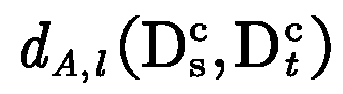 represents importance of a marginal distribution to a distribution difference between the source domain feature and the signal feature in the feature domain.
- It can be learned that the second distribution ratio is 1-, representing importance of a conditional distribution to the distribution difference between the source domain feature and the signal feature in the feature domain.

- It may be understood that the second distribution ratio corresponding to the conditional distribution difference is calculated, and then the first distribution ratio is obtained based on the second distribution ratio.
- In
step 404, the marginal distribution difference and the conditional distribution difference between the source domain feature and the signal feature in the feature domain are obtained. - Schematically,
step 404 may include the following steps 4041 to 4043. - In step 4041, first classification accuracy of a margin discriminator and second classification accuracy of a condition discriminator are obtained. The margin discriminator is configured to determine a domain signal type to which the electroencephalogram signal belongs. The condition discriminator is configured to determine a domain signal type to which different electroencephalogram signals belong. The domain signal includes at least one of the source domain electroencephalogram signal or an inputted electroencephalogram signal.
- The
margin discriminator 23 is configured to output a prediction probability that the electroencephalogram signal belongs to a certain domain signal type, that is, outputting a prediction probability that the electroencephalogram signal is the source domain electroencephalogram signal and a prediction probability that the electroencephalogram signal is the target domain electroencephalogram signal. The source domain electroencephalogram signal is a sample electroencephalogram signal used when the electroencephalogram signal classification model is trained, and the target domain electroencephalogram signal is a test electroencephalogram signal used when the electroencephalogram signal classification model is tested. For example, themargin discriminator 23 outputs the prediction probability that the electroencephalogram signal is the source domain electroencephalogram signal being 0.3 and outputs the prediction probability that the electroencephalogram signal is the target domain electroencephalogram signal being 0.7. A prediction result is that the inputted electroencephalogram signal is the target domain electroencephalogram signal, being consistent with a type of the inputted electroencephalogram signal. The prediction result outputted by themargin discriminator 23 is correct, and first classification accuracy of themargin discriminator 23 is recorded. - The
condition discriminator 22 is configured to output prediction probabilities that different electroencephalogram signals belong to a domain signal type. The different electroencephalogram signals are electroencephalogram signals corresponding to different subjects or electroencephalogram signals of different brain regions of a same subject. For example, thecondition discriminator 22 outputs a prediction probability that an electroencephalogram signal of first type is a source domain electroencephalogram signal being 0.19, and outputs a prediction probability that the electroencephalogram signal of first type is a target domain electroencephalogram signal being 0.82. A prediction result is that the inputted electroencephalogram signal is the target domain electroencephalogram signal, being consistent with a type of the inputted electroencephalogram signal. The prediction result outputted by thecondition discriminator 22 is correct, and second classification accuracy of thecondition discriminator 22 is recorded. - In step 4042, the first distribution distance between the signal feature and the source domain feature is obtained according to the first classification accuracy, and the second distribution distance between the signal feature and the source domain feature is obtained according to the second classification accuracy.
- To evaluate impacts of the marginal distribution and the conditional distribution on a cross-domain difference, a distribution difference dynamic evaluation mechanism is introduced to evaluate a difference between two distributions, and a distance evaluation indicator (A-distance) is used to evaluate a distribution difference between a source domain and a target domain. The first distribution distance and the second distribution distance are calculated by using the following formulas.


- In which,


- In step 4043, the first distribution distance is determined as the marginal distribution difference and the second distribution distance is determined as the conditional distribution difference.
- The first distribution distance


- In
step 405, the marginal distribution difference is scaled down according to the first distribution ratio and the conditional distribution difference is scaled down according to the second distribution ratio. - When the signal feature is aligned with the source domain feature in the feature domain, the conditional distribution difference and the marginal distribution difference are scaled down simultaneously. The marginal distribution difference and the conditional distribution difference are respectively adjusted according to the first distribution ratio and the second distribution ratio.
- In
step 406, a signal feature with a scaled-down distribution difference is obtained according to a scaled-down marginal distribution difference and a scaled-down conditional distribution difference. - The conditional distribution and the marginal distribution of the signal feature in the feature domain are aligned with the source domain feature, to obtain an aligned signal feature. A distribution difference between the signal feature and the source domain feature is scaled down.
- In
step 407, the signal feature with the scaled-down distribution difference is determined as an aligned signal feature. - In this case, the distribution of the signal feature in the feature domain is similar to the distribution of the source domain feature in the same feature domain.
- In
step 408, the aligned signal feature is classified, to obtain a motor imagery type of the electroencephalogram signal. - Schematically,
step 408 may include the following steps 4081 to 4083. - In step 4081, a classifier is invoked to process the aligned signal feature, to obtain a prediction probability of the motor imagery type of the electroencephalogram signal. The motor imagery type includes at least one of movement of hands, movement of feet, or movement of a tongue.
- As shown in
Figure 5 , the signal feature of the electroencephalogram signal outputted by thefeature extraction model 21 is inputted into theclassifier 15, thecondition discriminator 22, and themargin discriminator 23. Theclassifier 15 includes a convolutional layer (a convolutional neural network, C-Conv or CNN) and a logistic regression layer (softmax). The convolutional layer performs convolution processing on the signal feature and outputs an intermediate vector. The intermediate vector is inputted into the logistic regression layer, and the prediction probability of the motor imagery type of the electroencephalogram signal is outputted. For example, theclassifier 15 outputs: a prediction probability of left hand movement is 0.2, a prediction probability of right hand movement is 0.7, a prediction probability of movement of feet is 0, and a prediction probability of tongue movement is 0.1. - A feature vector outputted by the
classifier 15 is inputted into a gradient reversal layer (GRL) 217. Thegradient reversal layer 217 performs further calculation, to obtain another feature vector. The another feature vector is inputted into thecondition discriminator 22 and themargin discriminator 23. Thegradient reversal layer 217 is configured to multiply an error transmitted to the layer by a negative number (-λ), so that a training target of the network layer is changed after the gradient reversal layer, thereby achieving a confrontation effect. - In step 4082, the condition discriminator is invoked to process the aligned signal feature, to obtain the prediction probabilities that different electroencephalogram signals belong to the domain signal type. The domain signal includes at least one of the source domain electroencephalogram signal or the inputted electroencephalogram signal.
- As shown in
Figure 5 , thecondition discriminator 22 includes a deep convolutional layer (a deep convolutional neural network, D-Conv or DCNN) and a logistic regression layer. The deep convolutional layer performs convolution processing on the signal feature and outputs an intermediate vector. The intermediate vector is inputted into the logistic regression layer, and prediction probabilities that different electroencephalogram signals belong to a domain signal type are outputted. Electroencephalogram signals may be classified according to types of subjects or according to different brain regions or according to emotions (or states) of a subject. For example, a prediction probability that an electroencephalogram signal of a first type is the source domain electroencephalogram signal outputted by thecondition discriminator 22 is 0.7, and a prediction probability that the electroencephalogram signal of the first type is the target domain electroencephalogram signal outputted by thecondition discriminator 22 is 0.3, thus it is determined that the electroencephalogram signal of the first type is the source domain electroencephalogram signal. The electroencephalogram signal of the first type is classified according to electroencephalogram signals generated by different brain regions. - In step 4083, the margin discriminator is invoked to process the aligned signal feature, to obtain the prediction probability that the electroencephalogram signal belongs to the domain signal type.
- As shown in
Figure 5 , themargin discriminator 23 includes a deep convolutional layer and a logistic regression layer. The deep convolutional layer performs convolution processing on the signal feature and outputs an intermediate vector. The intermediate vector is inputted into the logistic regression layer, and the prediction probability that the electroencephalogram signal belongs to the domain signal type is outputted. Themargin discriminator 23 differs from thecondition discriminator 22 in that themargin discriminator 23 determines only the domain signal type to which the electroencephalogram signal belongs. - Step 4081, step 4082, and step 4083 are performed simultaneously.
- In step 4084, the motor imagery type of the electroencephalogram signal is obtained according to the prediction probability of the motor imagery type of the electroencephalogram signal, the prediction probabilities that different electroencephalogram signals belong to the domain signal type, and the prediction probability that the electroencephalogram signal belongs to the domain signal type.
- The distribution difference dynamic evaluation mechanism is introduced to evaluate the difference between the two distributions. A distribution with a significant impact is aligned preferentially. The
condition discriminator 22 and themargin discriminator 23 determine respective distribution ratios. Therefore, the electroencephalogram signal classification model outputs the motor imagery type according to the output results of theclassifier 15, thecondition discriminator 22, and themargin discriminator 23. - Based on the foregoing, according to the method provided in this embodiment, a distribution of a signal feature of an electroencephalogram signal in a feature domain is dynamically adjusted according to a difference distribution ratio, to align the signal feature of the electroencephalogram signal with a source domain feature, so as to ensure that the signal feature of the electroencephalogram signal is similar to the source domain feature for feature distribution. An electroencephalogram signal classification model trained based on the source domain feature can apply a classification method to the signal feature of the electroencephalogram signal, thereby improving the accuracy of recognizing a motor imagery type of the electroencephalogram signal by the electroencephalogram signal classification model, recognizing multiple types of electroencephalogram signals the electroencephalogram signal classification model, and thus achieving universality.
- A distribution difference between the signal feature and the source domain feature that are inputted into the electroencephalogram signal classification model is dynamically adjusted according to a first distribution ratio corresponding to a marginal distribution difference and a second distribution ratio corresponding to a conditional distribution difference, so that the signal feature is more similar to the source domain feature, thereby ensuring that the electroencephalogram signal classification model can accurately obtain the aligned signal feature.
- A first distribution distance and a second distribution distance between the source domain feature and the signal feature are determined according to first classification accuracy of a margin discriminator and second classification accuracy of a condition discriminator, so that the electroencephalogram signal classification model determines the marginal distribution difference and the conditional distribution difference according to the first distribution distance and the second distribution distance.
- The first distribution distance and the second distribution distance between the signal feature and the source domain feature respectively represent the marginal distribution difference and the conditional distribution difference between the signal feature and the source domain feature, so that the first distribution ratio corresponding to the marginal distribution difference and the second distribution ratio corresponding to the conditional distribution difference are accurately calculated according to a type quantity of motor imagery types.
- The aligned signal feature is processed by invoking a classifier, the margin discriminator, and the condition discriminator, and a motor imagery classification model of the electroencephalogram signal is obtained according to prediction probabilities outputted by the classifier, the margin discriminator, and the condition discriminator, so that the electroencephalogram signal classification model can recognize different types electroencephalogram signals, thereby improving accuracy of the motor imagery type outputted by the electroencephalogram signal classification model.
- The signal feature of the electroencephalogram signal is outputted by invoking layers in a feature extraction model, so that the signal feature of the electroencephalogram signal has time invariance, and subsequently the electroencephalogram signal classification model outputs an accurate motor imagery type.
- Methods for training an electroencephalogram signal classification model are described hereinafter.
-
Figure 6 is a flowchart of a method for training an electroencephalogram signal classification model according to an exemplary embodiment of the present disclosure. In this embodiment, a description is made by using an example in which the method is applicable to theserver 120 in thecomputer system 100 shown inFigure 1 . The method includes the followingsteps 601 to 605. - In
step 601, a source domain electroencephalogram signal and a target domain electroencephalogram signal are obtained. - The source domain electroencephalogram signal is a sample electroencephalogram signal used when an electroencephalogram signal classification model is trained, and the target domain electroencephalogram signal is a test electroencephalogram signal used when the electroencephalogram signal classification model is tested. Schematically, the electroencephalogram signal classification model is trained by using a public dataset. The public dataset includes a training set and a test set. For example, a public competition dataset such as the BCI competition IV dataset 2a is used. The dataset includes nine subjects, electroencephalogram data of each subject is recorded by using twenty-two electroencephalogram electrodes and three electrooculogram electrodes, a signal sampling rate is 205 Hz, and four motor imagery types (left hand movement, right hand movement, feet movement, and tongue movement) are included.
- As shown in
Figure 7 , the training process of the electroencephalogram signal classification model is the same as the use process, including: 701, inputting an electroencephalogram signal, 702, pre-processing the electroencephalogram signal, introducing a distribution differencedynamic evaluation mechanism 703 into an electroencephalogramsignal classification model pass filtering 7021 andsignal standardization 7022. In some embodiments, the electroencephalogram signal classification model is also referred to as a dynamic domain adaption model. - For the pre-processing process of the electroencephalogram signal, one may refer to the implementation of
step 401. Details are not described herein again. - In step 602, features of the source domain electroencephalogram signal and the target domain electroencephalogram signal are extracted, to obtain a source domain feature of the source domain electroencephalogram signal and a target domain feature of the target domain electroencephalogram signal.
- As shown in
Figure 8 , a sourcedomain electroencephalogram signal 101 and a targetdomain electroencephalogram signal 102 are inputted into afeature extraction model 21 in the electroencephalogramsignal classification model 704. A source domain feature of the source domain electroencephalogram signal and a target domain feature of the target domain electroencephalogram signal are outputted through layers of thefeature extraction model 21. Reference is made to the implementation ofstep 402. Details are not described herein again. - In
step 603, a difference distribution ratio is obtained. The difference distribution ratio represents impacts of difference distributions of different types on distributions of the source domain feature and the target domain feature in a feature domain. - The difference distribution ratio includes a first distribution ratio corresponding to a marginal distribution difference and a second distribution ratio corresponding to a conditional distribution difference.
- The distributions of the target domain feature and the source domain feature in the feature domain are different. Therefore, to evaluate the impact of difference distributions of different types on the source domain feature and the target domain feature, a distribution difference dynamic evaluation mechanism is introduced to evaluate the marginal distribution difference and the conditional distribution difference between the source domain feature and the target domain feature. A difference distribution with a relatively large impact is dynamically adjusted according to distribution ratios corresponding to the marginal distribution difference and the conditional distribution difference.
- In
step 604, the source domain feature is aligned with the target domain feature in the feature domain according to the difference distribution ratio, to obtain an aligned target domain feature. - Step 604 may include the following steps 6041 to 6044.
- In step 6041, a marginal distribution difference and a conditional distribution difference between the source domain feature and the target domain feature in the feature domain are obtained.
- First classification accuracy of a margin discriminator and second classification accuracy of a condition discriminator are obtained. The first margin discriminator is configured to determine a domain signal type to which the electroencephalogram signal belongs, and the condition discriminator is configured to determine, according to a motor imagery type, a domain signal type to which the electroencephalogram signal belongs. The domain signal includes at least one of the source domain electroencephalogram signal or the target domain electroencephalogram signal. A first distribution distance between the target domain feature and the source domain feature is obtained according to the first classification accuracy and a second distribution distance between the target domain feature and the source domain feature is obtained according to the second classification accuracy. The first distribution distance is determined as the marginal distribution difference, and the second distribution distance is determined as the conditional distribution difference.
- For step 6041, one may refer to the implementations of step 4041 to step 4043. Details are not described herein again.
- In step 6042, the marginal distribution difference is scaled down according to the first distribution ratio and the conditional distribution difference is scaled down according to the second distribution ratio.
- In step 6043, a target domain feature with a scaled-down distribution difference is obtained according to a scaled-down marginal distribution difference and a scaled-down conditional distribution difference.
- In step 6044, the target domain feature with the scaled-down distribution difference is determined as the aligned target domain feature.
- For implementations of step 6041 to step 6043, one may refer to the implementations of
step 404 to step 407. Details are not described herein again. - In
step 605, the aligned target domain feature is classified, and an electroencephalogram signal classification model is trained according to a classification result, to obtain a trained electroencephalogram signal classification model. - Step 605 may include the following steps 6051 to 6052.
- In step 6051, a classifier, a margin discriminator, and a condition discriminator in the electroencephalogram signal classification model are invoked to process the aligned target domain feature, to obtain a prediction probability of a motor imagery type of the target domain electroencephalogram signal.
- As shown in
Figure 8 , aclassifier 15, amargin discriminator 23, and acondition discriminator 22 simultaneously process, according to the distribution difference dynamic evaluation mechanism, a source domain feature and a target domain feature that are outputted by the feature extraction model. Because a distribution of the source domain feature is similar to a distribution of the target domain feature in the feature domain, the electroencephalogram signal classification model can apply a method for classifying the source domain feature to the target domain feature, so that the electroencephalogram signal classification model obtains a motor imagery type of the target domain electroencephalogram signal. - A feature vector outputted by the
classifier 15 is inputted into a gradient reversal layer (GRL) 217. Thegradient reversal layer 217 performs further calculation, to obtain another feature vector. The another feature vector is inputted into thecondition discriminator 22 and themargin discriminator 23. Thegradient reversal layer 217 is configured to multiply an error transmitted to the layer by a negative number (-λ), so that a training target of the network layer is changed after the gradient reversal layer, thereby achieving a confrontation effect. - In step 6052, an error of the electroencephalogram signal classification model is calculated according to the prediction probability and a real label of the motor imagery type of the electroencephalogram signal.
- The error includes an error corresponding to the classifier, an error corresponding to the condition discriminator, and an error corresponding to the margin discriminator. In this embodiment of the present disclosure, an example in which the error is calculated by using an error function is used. Calculation manners of the three errors are described below.
- A first loss function corresponding to the classifier is calculated according to the prediction probability and the real label. A calculation formula is as follows.

- In which, Lc (θf ,θc ) represents the first loss function corresponding to the classifier,


- A second loss function corresponding to the condition discriminator is calculated according to a source domain condition feature map corresponding to the source domain feature and a target domain condition feature map corresponding to the target domain feature that are outputted by the condition discriminator. A calculation formula is as follows.

- In which,


- A calculation manner of the condition feature map is described as follows.
- A prediction probability of the classifier is set to be f = [f 1,f 2,f 3 ...fd ], and a feature map is indicated as p = [p 1,p 2,p 3 ...pd ], so that the condition feature map g is indicated by the following matrix.

- A third loss function corresponding to the margin discriminator is calculated according to a source domain feature map corresponding to the source domain feature and a target domain feature map corresponding to the target domain feature that are outputted by the margin discriminator. A calculation formula is as follows.

- In which,


- Based on the foregoing, the error is calculated according to the following equation.

- In which, Lc represents the first loss function of the classifier, α represents a to-be-learned parameter of the electroencephalogram signal classification model, Lg represents the third loss function corresponding to the margin discriminator, L1 represents the second loss function corresponding to the condition discriminator,represents importance of a marginal distribution to a distribution difference between the source domain feature and the signal feature in the feature domain, and C represents a type quantity of motor imagery types.

- In step 6053, the electroencephalogram signal classification model is trained according to the error by using an error back propagation algorithm, to obtain the trained electroencephalogram signal classification model.
- According to the error back propagation (BP) algorithm, an output error is propagated backward layer by layer to an input layer through a hidden layer in a particular form, and the error is allocated to all units in each layer, to obtain an error signal of each layer. The error signal serves as a basis of correcting a unit weight. A learning process of a machine learning model includes forward propagation and error backward propagation. During forward propagation, an input sample is inputted from an input layer, is processed by hidden layers layer by layer, and is propagated to an output layer. If an actual output of the output layer is inconsistent with an expected output, an error backward propagation is performed.
- In this embodiment of the present disclosure, a parameter of a neural network model is resolved by using a gradient descent method based on stochastic gradient descent (SGD), and the model parameter is initialized by using a Xavier initialization method. During resolution, an electroencephalogram signal of each subject and a corresponding label are transmitted into a network for learning, and the model is optimized through error backward propagation.
- Based on the foregoing, according to the method provided in this embodiment, a distribution of a target domain feature in a feature domain is dynamically adjusted according to a difference distribution ratio, to align the target domain feature with a source domain feature, so as to train an electroencephalogram signal classification model based on an aligned target domain feature, so that the electroencephalogram signal classification model can apply a classification learning method to the target domain feature, and the trained electroencephalogram signal classification model can accurately output a motor imagery type of an electroencephalogram signal, thereby recognizing multiple types of electroencephalogram signals by the electroencephalogram signal classification model, and thus achieving universality.
- A distribution difference between the target domain feature and the source domain feature that are inputted into the electroencephalogram signal classification model is dynamically adjusted according to a first distribution ratio corresponding to a marginal distribution difference and a second distribution ratio corresponding to a conditional distribution difference, so that the target domain feature is more similar to the source domain feature, thereby ensuring that the electroencephalogram signal classification model can accurately obtain an aligned target domain feature.
- A first distribution distance and a second distribution distance between the source domain feature and the target domain feature are determined according to first classification accuracy of a margin discriminator and second classification accuracy of a condition discriminator, so that the electroencephalogram signal classification model determines the marginal distribution difference and the conditional distribution difference according to the first distribution distance and the second distribution distance.
- The aligned target domain feature is processed by using a classifier, the margin discriminator, and the condition discriminator, and the electroencephalogram signal classification model is trained according to a difference between a real label of the motor imagery type of the electroencephalogram signal and a prediction probability outputted by the electroencephalogram signal classification model, thereby ensuring that the electroencephalogram signal classification model can accelerate convergence, and thus shortening a training time of the model.
- An error of the electroencephalogram signal classification model is accurately calculated according to a first loss function corresponding to the classifier, a second loss function corresponding to the margin discriminator, and a third loss function corresponding to the condition discriminator, so that the electroencephalogram signal classification model is trained based on the accurate error, thereby improving a convergence speed of the model and thus shortening the training time of the model.
-
Figure 9 is a structural block diagram of an apparatus for classifying an electroencephalogram signal according to an exemplary embodiment of the present disclosure. The apparatus may be implemented as an entire computer device or a part of the computer device. The apparatus includes a first obtainingmodule 910, a firstfeature extraction module 920, afirst processing module 930 and a classifyingmodule 940. - The first obtaining
module 910 is configured to obtain an electroencephalogram signal. - The first
feature extraction module 920 is configured to extract a feature of the electroencephalogram signal, to obtain a signal feature of the electroencephalogram signal. - The first obtaining
module 910 is further configured to obtain a difference distribution ratio. The difference distribution ratio represents impacts of difference distributions of different types on distributions of the signal feature and a source domain feature in a feature domain. The source domain feature indicates a feature corresponding to a source domain electroencephalogram signal; - The
first processing module 930 is configured to align the signal feature with the source domain feature according to the difference distribution ratio, to obtain an aligned signal feature. - The
classification module 940 is configured to classify the aligned signal feature, to obtain a motor imagery type of the electroencephalogram signal. - In an optional embodiment, the difference distribution ratio includes a first distribution ratio corresponding to a marginal distribution difference and a second distribution ratio corresponding to a conditional distribution difference.
- The first obtaining
module 910 is configured to obtain the marginal distribution difference and the conditional distribution difference between the source domain feature and the signal feature in the feature domain. - The
first processing module 930 is configured to scale down the marginal distribution difference according to the first distribution ratio and scale down the conditional distribution difference according to the second distribution ratio; obtain a signal feature with a scaled-down distribution difference according to a scaled-down marginal distribution difference and a scaled-down conditional distribution difference; and determine the signal feature with the scaled-down distribution difference as the aligned signal feature. - In an optional embodiment, the first obtaining
module 910 is configured to obtain first classification accuracy of a margin discriminator and second classification accuracy of a condition discriminator. The margin discriminator is configured to determine a domain signal type to which the electroencephalogram signal belongs, and the condition discriminator is configured to determine a domain signal type to which different electroencephalogram signals belong. The domain signal includes at least one of the source domain electroencephalogram signal or an inputted electroencephalogram signal. The first obtainingmodule 910 is further configured to: obtain a first distribution distance between the signal feature and the source domain feature according to the first classification accuracy and obtain a second distribution distance between the signal feature and the source domain feature according to the second classification accuracy; and determine the first distribution distance as the marginal distribution difference, and determine the second distribution distance the conditional distribution difference. - In an optional embodiment, the difference distribution ratio includes the first distribution ratio corresponding to the marginal distribution difference and the second distribution ratio corresponding to the conditional distribution difference.
- The first obtaining
module 910 is configured to obtain the first distribution distance and the second distribution distance between the signal feature and the source domain feature, the first distribution distance representing the marginal distribution difference between the signal feature and source domain feature, and the second distribution distance representing the conditional distribution difference between signal feature and the source domain feature; obtain a type quantity of motor imagery types; and obtain the first distribution ratio corresponding to the marginal distribution difference and the second distribution ratio corresponding to the conditional distribution difference according to the first distribution distance, the second distribution distance, and the type quantity. - In an optional embodiment, the
classification module 940 includes aclassifier 9401, acondition discriminator 9402, and amargin discriminator 9403. - The
classifier 9401 is configured to process the aligned signal feature, to obtain a prediction probability of the motor imagery type of the electroencephalogram signal. Schematically, the motor imagery type includes at least one of movement of hands, movement of feet, or movement of a tongue. - The
condition discriminator 9402 is configured to process the aligned signal feature, to obtain prediction probabilities that different electroencephalogram signals belong to the domain signal type. The domain signal includes at least one of the source domain electroencephalogram signal or the inputted electroencephalogram signal. - The
margin discriminator 9403 is configured to process the aligned signal feature, to obtain a prediction probability that the electroencephalogram signal belongs to the domain signal type. - The
classification module 940 is configured to obtain the motor imagery type of the electroencephalogram signal according to the prediction probability of the motor imagery type of the electroencephalogram signal, the prediction probability that different electroencephalogram signals belong to the domain signal type, and the prediction probability that the electroencephalogram signal belongs to the domain signal type. - In an optional embodiment, the first
feature extraction module 920 includes atemporal convolutional layer 9201, a spatialconvolutional layer 9202, abatch normalization layer 9203, asquare activation layer 9204, anaverage pooling layer 9205, and adropout layer 9206. - The
temporal convolutional layer 9201 is configured to extract a feature of the electroencephalogram signal, to obtain a first signal feature of the electroencephalogram signal. - The
spatial convolutional layer 9202 is configured to extract a feature of the first signal feature, to obtain a second signal feature of the electroencephalogram signal. - The
batch normalization layer 9203 is configured to extract a feature of the second signal feature, to obtain a third signal feature of the electroencephalogram signal. - The
square activation layer 9204 is configured to extract a feature of the third signal feature, to obtain a fourth signal feature of the electroencephalogram signal. - The
average pooling layer 9205 is configured to extract a feature of the fourth signal feature, to obtain a fifth signal feature of the electroencephalogram signal. - The
dropout layer 9206 is configured to extract a feature of the fifth signal feature, to obtain a sixth signal feature of the electroencephalogram signal; and determine the sixth signal feature as the signal feature of the electroencephalogram signal. - Based on the foregoing, according to the apparatus provided in this embodiment, a distribution of a signal feature of an electroencephalogram signal in a feature domain is dynamically adjusted according to a difference distribution ratio, to align the signal feature of the electroencephalogram signal with a source domain feature, so as to ensure that the signal feature of the electroencephalogram signal is similar to the source domain feature for feature distribution. An electroencephalogram signal classification model trained based on the source domain feature can apply a classification method to the signal feature of the electroencephalogram signal, thereby improving the accuracy of recognizing a motor imagery type of the electroencephalogram signal by the electroencephalogram signal classification model, recognizing multiple types of electroencephalogram signals by the electroencephalogram signal classification model, and thus achieving universality.
- A distribution difference between the signal feature and the source domain feature that are inputted into the electroencephalogram signal classification model is dynamically adjusted according to a first distribution ratio corresponding to a marginal distribution difference and a second distribution ratio corresponding to a conditional distribution difference, so that the signal feature is more similar to the source domain feature, thereby ensuring that the electroencephalogram signal classification model can accurately obtain an aligned signal feature.
- A first distribution distance and a second distribution distance between the source domain feature and the signal feature are determined according to first classification accuracy of a margin discriminator and second classification accuracy of a condition discriminator, so that the electroencephalogram signal classification model determines the marginal distribution difference and the conditional distribution difference according to the first distribution distance and the second distribution distance.
- The first distribution distance and the second distribution distance between the signal feature and the source domain feature respectively represent the marginal distribution difference and the conditional distribution difference between the signal feature and the source domain feature, so that the first distribution ratio corresponding to the marginal distribution difference and the second distribution ratio corresponding to the conditional distribution difference are accurately calculated according to a type quantity of motor imagery types.
- The aligned signal feature is processed by invoking a classifier, the margin discriminator, and the condition discriminator, and a motor imagery classification model corresponding to the electroencephalogram signal is obtained according to prediction probabilities outputted by the classifier, the margin discriminator, and the condition discriminator, so that the electroencephalogram signal classification model can recognize different types electroencephalogram signals, thereby improving accuracy of the motor imagery type outputted by the electroencephalogram signal classification model.
- The signal feature of the electroencephalogram signal is outputted by invoking layers in a feature extraction model, so that the signal feature of the electroencephalogram signal has time invariance, and subsequently the electroencephalogram signal classification model outputs an accurate motor imagery type.
- The apparatus for classifying an electroencephalogram signal provided in the foregoing embodiments is illustrated based on the foregoing functional modules. In actual application, the functions may be allocated to different functional modules according to requirements, that is, the apparatus is divided into different functional modules, to implement all or some of the functions described above. In addition, the apparatus for classifying an electroencephalogram signal provided in the foregoing embodiment shares the same concept as the embodiment of the method for classifying an electroencephalogram signal. For the specific implementation process of the apparatus, one may refer to description of the method embodiment, and details are not described herein again.
-
Figure 10 is a structural block diagram of an apparatus for training an electroencephalogram signal classification model according to an exemplary embodiment of the present disclosure. The apparatus may be implemented as an entire computer device or a part of the computer device. The apparatus includes a second obtainingmodule 1010, a secondfeature extraction module 1020, asecond processing module 1030 and atraining module 1040. - The second obtaining
module 1010 is configured to obtain a source domain electroencephalogram signal and a target domain electroencephalogram signal. - T second
feature extraction module 1020 is configured to extract features of the source domain electroencephalogram signal and the target domain electroencephalogram signal, to obtain a source domain feature of the source domain electroencephalogram signal and a target domain feature of the target domain electroencephalogram signal. - The second obtaining
module 1010 is configured to obtain a difference distribution ratio. The difference distribution ratio represents impacts of difference distributions of different types on distributions of the source domain feature and the target domain feature in a feature domain. - The
second processing module 1030 is configured to align the source domain feature with the target domain feature in the feature domain according to the difference distribution ratio, to obtain an aligned target domain feature. - The
training module 1040 is configured to classify the aligned target domain feature, and train an electroencephalogram signal classification model according to a classification result, to obtain a trained electroencephalogram signal classification model. - In an optional embodiment, the difference distribution ratio includes a first distribution ratio corresponding to a marginal distribution difference and a second distribution ratio corresponding to a conditional distribution difference.
- The second obtaining
module 1010 is configured to obtain the marginal distribution difference and the conditional distribution difference between the source domain feature and the target domain feature in the feature domain. - The
second processing module 1030 is configured to scale down the marginal distribution difference according to the first distribution ratio and scale down the conditional distribution difference according to the second distribution ratio; obtain a signal feature with a scaled-down distribution difference according to a scaled-down marginal distribution difference and a scaled-down conditional distribution difference; and determine the target domain feature with the scaled-down distribution difference as the aligned target domain feature. - In an optional embodiment, the second obtaining
module 1010 is configured to obtain first classification accuracy of a margin discriminator and second classification accuracy of a condition discriminator. The margin discriminator is configured to determine a domain signal type to which the electroencephalogram signal belongs. The condition discriminator is configured to determine, according to the motor imagery type, a domain signal type to which different electroencephalogram signals belong. The domain signal includes at least one of the source domain electroencephalogram signal or the target domain electroencephalogram signal. The second obtainingmodule 1010 is further configured to: obtain a first distribution distance between the target domain feature and the source domain feature according to the first classification accuracy, and obtain a second distribution distance between the target domain feature and the source domain feature according to the second classification accuracy; and determine the first distribution distance as the marginal distribution difference, and determine the second distribution distance as the conditional distribution difference. - In an optional embodiment, the apparatus includes an electroencephalogram
signal classification model 1050. - The electroencephalogram
signal classification model 1050 is configured to invoke a classifier, a margin discriminator, and a condition discriminator to process the aligned target domain feature, to obtain a prediction probability of a motor imagery type of the target domain electroencephalogram signal. - The
training module 1040 is configured to calculate an error of the electroencephalogram signal classification model according to the prediction probability and a real label of the motor imagery type of the electroencephalogram signal; and train the electroencephalogram signal classification model according to the error by using an error back propagation algorithm, to obtain a trained electroencephalogram signal classification model. - In an optional embodiment, the
training module 1040 is configured to calculate a first loss function corresponding to the classifier according to the prediction probability and the real label; calculate a second loss function corresponding to the condition discriminator according to a source domain condition feature map corresponding to the source domain feature and a target domain condition feature map corresponding to the target domain feature that are outputted by the condition discriminator; calculate a third loss function corresponding to the margin discriminator according to a source domain feature map corresponding to the source domain feature and a target domain feature map corresponding to the target domain feature that are outputted by the margin discriminator; and calculate the error of the electroencephalogram signal classification model according to the first loss function, the second loss function, and the third loss function. - Based on the foregoing, according to the apparatus provided in this embodiment, a distribution of a target domain feature in a feature domain is dynamically adjusted according to a difference distribution ratio, to align the target domain feature with a source domain feature, so as to train an electroencephalogram signal classification model based on an aligned target domain feature, so that the electroencephalogram signal classification model can apply a classification learning method to the target domain feature, and the trained electroencephalogram signal classification model can accurately output a motor imagery type of an electroencephalogram signal, thereby recognizing multiple types of electroencephalogram signals, and thus achieving universality.
- A distribution difference between the target domain feature and the source domain feature that are inputted into the electroencephalogram signal classification model is dynamically adjusted according to a first distribution ratio corresponding to a marginal distribution difference and a second distribution ratio corresponding to a conditional distribution difference, so that the target domain feature is more similar to the source domain feature, thereby ensuring that the electroencephalogram signal classification model can accurately obtain an aligned target domain feature.
- A first distribution distance and a second distribution distance between the source domain feature and the target domain feature are determined according to first classification accuracy of a margin discriminator and second classification accuracy of a condition discriminator, so that the electroencephalogram signal classification model determines the marginal distribution difference and the conditional distribution difference according to the first distribution distance and the second distribution distance.
- The aligned target domain feature is processed by using a classifier, the margin discriminator, and the condition discriminator, and the electroencephalogram signal classification model is trained according to a difference between a real label of the motor imagery type of the electroencephalogram signal and a prediction probability outputted by the electroencephalogram signal classification model, thereby ensuring that the electroencephalogram signal classification model can accelerate convergence, and thus shortening a training time of the model.
- An error of the electroencephalogram signal classification model is accurately calculated according to a first loss function corresponding to the classifier, a second loss function corresponding to the margin discriminator, and a third loss function corresponding to the condition discriminator, so that the electroencephalogram signal classification model is trained based on the accurate error, thereby improving a convergence speed of the model, and thus shortening the training time of the model.
- The apparatus for training an electroencephalogram signal classification model provided in the foregoing embodiments is illustrated based on the foregoing functional modules. In actual application, the functions may be allocated to different functional modules according to requirements, that is, the apparatus is divided into different functional modules, to implement all or some of the functions described above. In addition, the apparatus for training an electroencephalogram signal classification model provided in the foregoing embodiment shares the same concept as the embodiment of the method for training an electroencephalogram signal classification model. For the specific implementation process of the apparatus, one may refer to description of the method embodiment, and details are not described herein again.
-
Figure 11 is a schematic structural diagram of a server according to an exemplary embodiment of the present disclosure. The server may be theserver 120 in thecomputer system 100 shown inFigure 1 . - A
server 1100 includes a central processing unit (CPU) 1101, asystem memory 1104 , and asystem bus 1105 connecting thesystem memory 1104 to theCPU 1101. Thesystem memory 1104 includes a random access memory (RAM) 1102 and a read only memory (ROM) 1103. Theserver 1100 further includes a basic input/output (I/O)system 1106 configured to transmit information between devices in a computer, and amass storage device 1107 configured to store anoperating system 1113, anapplication program 1114 and anotherprogram module 1115. - The basic I/
O system 1106 includes adisplay 1108 configured to display information and aninput device 1109 configured to input information by a user, such as a mouse or a keyboard. Thedisplay 1108 and theinput device 1109 are both connected to theCPU 1101 via an input/output controller 1110 that is connected to thesystem bus 1105. The basic I/O system 1106 may further include the I/O controller 1110 configured to receive and process input from multiple other devices such as a keyboard, a mouse, or an electronic stylus. Similarly, the I/O controller 1110 further provides an output to a display screen, a printer, or another type of output device. - The
mass storage device 1107 is connected to theCPU 1101 by using a mass storage controller (not shown) connected to thesystem bus 1105. Themass storage device 1107 and a computer-readable medium associated with the mass storage device provide non-volatile storage for theserver 1100. That is, themass storage device 1107 may include a computer-readable medium (not shown) such as a hard disk or a compact disc read only memory (CD-ROM) drive. - The computer-readable medium may include a computer storage medium and a communication medium. The computer-storage medium includes volatile and non-volatile media, and removable and non-removable media implemented by using any method or technology, used for storing information such as computer-readable instructions, data structures, program modules, or other data. The computer storage medium includes a RAM, a ROM, an erasable programmable ROM (EPROM), an electrically erasable programmable ROM (EEPROM), a flash memory or another solid-state memory technology, a CD-ROM, a digital versatile disc (DVD) or a solid state drive (SSD), another optical memory, a magnetic cassette, a magnetic tape, a magnetic disk memory, or another magnetic storage device. The RAM may include a resistance random access memory (ReRAM) and a dynamic random access memory (DRAM). Certainly, a person skilled in the art may know that the computer storage medium is not limited to the foregoing types. The
system memory 1104 and themass storage device 1107 may be collectively referred to as a memory. - According to various embodiments of the present disclosure, the
server 1100 may be connected, over a network such as the Internet, to a remote computer on the network and run. That is, theserver 1100 may be connected to anetwork 1112 via anetwork interface unit 1111 that is connected to thesystem bus 1105, or may be connected to a network of another type or a remote computer system (not shown) via thenetwork interface unit 1111. - The memory further includes one or more programs, which are to be executed by the CPU.
- In an optional embodiment, a computer device is provided, including a processor and a memory. The memory stores at least one instruction, at least one program, a code set or an instruction set. The at least one instruction, the at least one program, the code set or the instruction set is loaded and executed by the processor to implement at least one of the method for classifying an electroencephalogram signal or the method for training an electroencephalogram signal classification model.
- In an optional embodiment, a computer-readable storage medium is provided, storing at least one instruction, at least one program, a code set or an instruction set. The at least one instruction, the at least one program, the code set or the instruction set is loaded and executed by a processor to implement at least one of the method for classifying an electroencephalogram signal or the method for training an electroencephalogram signal classification model.
- Optionally, the computer-readable storage medium may include: a ROM, a RAM, a solid state drive (SSD), an optical disc, or the like. The RAM may include a resistance random access memory (ReRAM) and a dynamic random access memory (DRAM). The sequence numbers of the foregoing embodiments of the present disclosure are only for illustration, and are not intended to indicate the preference among the embodiments.
- A computer program product or a computer program is further provided according to embodiments of the present disclosure. The computer program product or the computer program includes computer instructions, and the computer instructions are stored in a computer readable storage medium. A processor of the computer device reads the computer instructions from the computer-readable storage medium and executes the computer instructions to cause the computer device to perform at least one of the method for classifying an electroencephalogram signal or the method for training an electroencephalogram signal classification model.
Claims (15)
- A method for classifying an electroencephalogram signal, applicable to a computer device, the method comprising:obtaining an electroencephalogram signal;extracting a feature of the electroencephalogram signal, to obtain a signal feature of the electroencephalogram signal;obtaining a difference distribution ratio, the difference distribution ratio representing impacts of difference distributions of different types on distributions of the signal feature and a source domain feature in a feature domain, the source domain feature indicating a feature corresponding to a source domain electroencephalogram signal;aligning the signal feature with the source domain feature according to the difference distribution ratio, to obtain an aligned signal feature; andclassifying the aligned signal feature, to obtain a motor imagery type of the electroencephalogram signal.
- The method according to claim 1, wherein the difference distribution ratio comprises a first distribution ratio corresponding to a marginal distribution difference and a second distribution ratio corresponding to a conditional distribution difference;
wherein the aligning the signal feature with the source domain feature according to the difference distribution ratio, to obtain an aligned signal feature comprises:obtaining the marginal distribution difference and the conditional distribution difference between the source domain feature and the signal feature in the feature domain;scaling down the marginal distribution difference according to the first distribution ratio, and scaling down the conditional distribution difference according to the second distribution ratio;obtaining a signal feature with a scaled-down distribution difference according to a scaled-down marginal distribution difference and a scaled-down conditional distribution difference; anddetermining the signal feature with the scaled-down distribution difference as the aligned signal feature. - The method according to claim 2, wherein the obtaining the marginal distribution difference and the conditional distribution difference between the source domain feature and the signal feature in the feature domain comprises:obtaining first classification accuracy of a margin discriminator and second classification accuracy of a condition discriminator, the margin discriminator being configured to determine a domain signal type to which the electroencephalogram signal belongs, the condition discriminator being configured to determine a domain signal type to which different electroencephalogram signals belong, and the domain signal comprising at least one of the source domain electroencephalogram signal or an inputted electroencephalogram signal;obtaining a first distribution distance between the signal feature and the source domain feature according to the first classification accuracy, and obtaining a second distribution distance between the signal feature and the source domain feature according to the second classification accuracy; anddetermining the first distribution distance as the marginal distribution difference, and determining the second distribution distance as the conditional distribution difference.
- The method according to any one of claims 1 to 3, wherein the difference distribution ratio comprises the first distribution ratio corresponding to the marginal distribution difference and the second distribution ratio corresponding to the conditional distribution difference;
wherein the obtaining a difference distribution ratio comprises:obtaining the first distribution distance and the second distribution distance between the signal feature and the source domain feature, the first distribution distance representing the marginal distribution difference between the signal feature and the source domain feature, and the second distribution distance representing the conditional distribution difference between the signal feature and the source domain feature;obtaining a type quantity of motor imagery types; andobtaining the first distribution ratio corresponding to the marginal distribution difference and the second distribution ratio corresponding to the conditional distribution difference according to the first distribution distance, the second distribution distance, and the type quantity. - The method according to any one of claims 1 to 3, wherein the classifying the aligned signal feature, to obtain a motor imagery type of the electroencephalogram signal comprises:invoking a classifier to process the aligned signal feature, to obtain a prediction probability of the motor imagery type of the electroencephalogram signal;invoking the condition discriminator to process the aligned signal feature, to obtain a prediction probability that different electroencephalogram signals belong to the domain signal type, the domain signal comprising at least one of the source domain electroencephalogram signal or the inputted electroencephalogram signal;invoking the margin discriminator to process the aligned signal feature, to obtain a prediction probability that the electroencephalogram signal belongs to the domain signal type; andobtaining the motor imagery type of the electroencephalogram signal according to the prediction probability of the motor imagery type of the electroencephalogram signal, the prediction probability that different electroencephalogram signals belong to the domain signal type, and the prediction probability that the electroencephalogram signal belongs to the domain signal type.
- The method according to any one of claims 1 to 3, wherein the extracting a feature of the electroencephalogram signal, to obtain a signal feature of the electroencephalogram signal comprises:invoking a temporal convolutional layer to extract a feature of the electroencephalogram signal, to obtain a first signal feature of the electroencephalogram signal;invoking a spatial convolutional layer to extract a feature of the first signal feature, to obtain a second signal feature of the electroencephalogram signal;invoking a batch normalization layer to extract a feature of the second signal feature, to obtain a third signal feature of the electroencephalogram signal;invoking a square activation layer to extract a feature of the third signal feature, to obtain a fourth signal feature of the electroencephalogram signal;invoking an average pooling layer to extract a feature of the fourth signal feature, to obtain a fifth signal feature of the electroencephalogram signal; andinvoking a dropout layer to extract a feature of the fifth signal feature, to obtain a sixth signal feature of the electroencephalogram signal, and determining the sixth signal feature as the signal feature of the electroencephalogram signal.
- A method for training an electroencephalogram signal classification model, comprising:obtaining a source domain electroencephalogram signal and a target domain electroencephalogram signal;extracting features of the source domain electroencephalogram signal and the target domain electroencephalogram signal, to obtain a source domain feature of the source domain electroencephalogram signal and a target domain feature of the target domain electroencephalogram signal;obtaining a difference distribution ratio, the difference distribution ratio representing impacts of difference distributions of different types on distributions of the source domain feature and the target domain feature in a feature domain;aligning the source domain feature with the target domain feature in the feature domain according to the difference distribution ratio, to obtain an aligned target domain feature; andclassifying the aligned target domain feature, and training an electroencephalogram signal classification model according to a classification result, to obtain a trained electroencephalogram signal classification model.
- The method according to claim 7, wherein the difference distribution ratio comprises a first distribution ratio corresponding to a marginal distribution difference and a second distribution ratio corresponding to a conditional distribution difference;
wherein the aligning the source domain feature with the target domain feature in the feature domain according to the difference distribution ratio, to obtain an aligned target domain feature comprises:obtaining a marginal distribution difference and a conditional distribution difference between the source domain feature and the target domain feature in the feature domain;scaling down the marginal distribution difference according to the first distribution ratio, and scaling down the conditional distribution difference according to the second distribution ratio;obtaining a target domain feature with a scaled-down distribution difference according to a scaled-down marginal distribution difference and a scaled-down conditional distribution difference; anddetermining the target domain feature with the scaled-down distribution difference as the aligned target domain feature. - The method according to claim 8, wherein the obtaining a marginal distribution difference and a conditional distribution difference between the source domain feature and the target domain feature in the feature domain comprises:obtaining first classification accuracy of a margin discriminator and second classification accuracy of a condition discriminator, the margin discriminator being configured to determine a domain signal type to which the electroencephalogram signal belongs, the condition discriminator being configured to determine a domain signal type to which different electroencephalogram signals belong, and the domain signal comprising at least one of the source domain electroencephalogram signal or the target domain electroencephalogram signal;obtaining a first distribution distance between the target domain feature and the source domain feature according to the first classification accuracy, and obtaining a second distribution distance between the target domain feature and the source domain feature according to the second classification accuracy; anddetermining the first distribution distance as the marginal distribution difference, and determining the second distribution distance as the conditional distribution difference.
- The method according to any one of claims 7 to 9, wherein the classifying the aligned target domain feature, and training an electroencephalogram signal classification model according to a classification result, to obtain a trained electroencephalogram signal classification model comprises:invoking a classifier, the margin discriminator, and the condition discriminator in the electroencephalogram signal classification model to process the aligned target domain feature, to obtain a prediction probability of a motor imagery type of the target domain electroencephalogram signal;calculating an error of the electroencephalogram signal classification model according to the prediction probability and a real label of the motor imagery type of the electroencephalogram signal; andtraining the electroencephalogram signal classification model according to the error by using an error back propagation algorithm, to obtain the trained electroencephalogram signal classification model.
- The method according to claim 10, wherein the calculating an error of the electroencephalogram signal classification model according to the prediction probability and a real label of the motor imagery type of the electroencephalogram signal comprises:calculating a first loss function corresponding to the classifier according to the prediction probability and the real label;calculating a second loss function corresponding to the condition discriminator according to a source domain condition feature map corresponding to the source domain feature and a target domain condition feature map corresponding to the target domain feature that are outputted by the condition discriminator;calculating a third loss function corresponding to the margin discriminator according to a source domain feature map corresponding to the source domain feature and a target domain feature map corresponding to the target domain feature that are outputted by the margin discriminator; andcalculating the error of the electroencephalogram signal classification model according to the first loss function, the second loss function, and the third loss function.
- An apparatus for classifying an electroencephalogram signal, comprising:a first obtaining module, configured to obtain an electroencephalogram signal, wherein the first obtaining module is further configured to obtain a difference distribution ratio, the difference distribution ratio representing impacts of difference distributions of different types on distributions of the signal feature and a source domain feature in a feature domain, the source domain feature indicating a feature corresponding to a source domain electroencephalogram signal;a first feature extraction module, configured to extract a feature of the electroencephalogram signal, to obtain a signal feature of the electroencephalogram signal;a first processing module, configured to align the signal feature with the source domain feature according to the difference distribution ratio, to obtain an aligned signal feature; anda classification module, configured to classify the aligned signal feature, to obtain a motor imagery type of the electroencephalogram signal.
- An apparatus for training an electroencephalogram signal classification model, comprising:a second obtaining module, configured to obtain a source domain electroencephalogram signal and a target domain electroencephalogram signal, wherein the second obtaining module is further configured to obtain a difference distribution ratio, the difference distribution ratio representing impacts of difference distributions of different types on distributions of the source domain feature and the target domain feature in a feature domain;a second feature extraction module, configured to extract features of the source domain electroencephalogram signal and the target domain electroencephalogram signal, to obtain a source domain feature of the source domain electroencephalogram signal and a target domain feature of the target domain electroencephalogram signal;a second processing module, configured to align the source domain feature with the target domain feature in the feature domain according to the difference distribution ratio, to obtain an aligned target domain feature; anda training module, configured to classify the aligned target domain feature, and train an electroencephalogram signal classification model according to a classification result, to obtain a trained electroencephalogram signal classification model.
- A computer device, comprising a processor and a memory, wherein the memory stores at least one program, and the at least one program is loaded and executed by the processor to implement the method for classifying an electroencephalogram signal according to any one of claims 1 to 6 and the method for training an electroencephalogram signal classification model according to any one of claims 7 to 11.
- A computer-readable storage medium, storing at least one program, wherein the at least one program is loaded and executed by a processor to implement the method for classifying an electroencephalogram signal according to any one of claims 1 to 6 and the method for training an electroencephalogram signal classification model according to any one of claims 7 to 11.
Applications Claiming Priority (2)
| Application Number | Priority Date | Filing Date | Title |
|---|---|---|---|
| CN202010867943.XA CN111728609B (en) | 2020-08-26 | 2020-08-26 | Electroencephalogram signal classification method, classification model training method, device and medium |
| PCT/CN2021/106614 WO2022042122A1 (en) | 2020-08-26 | 2021-07-15 | Electroencephalogram signal classifying method and apparatus, electroencephalogram signal classifying model training method and apparatus, and medium |
Publications (3)
| Publication Number | Publication Date |
|---|---|
| EP4101371A1 true EP4101371A1 (en) | 2022-12-14 |
| EP4101371A4 EP4101371A4 (en) | 2023-08-02 |
| EP4101371B1 EP4101371B1 (en) | 2026-05-06 |
Family
ID=72658890
Family Applications (1)
| Application Number | Title | Priority Date | Filing Date |
|---|---|---|---|
| EP21859962.9A Active EP4101371B1 (en) | 2020-08-26 | 2021-07-15 | Electroencephalogram signal classifying method and apparatus, electroencephalogram signal classifying model training method and apparatus |
Country Status (4)
| Country | Link |
|---|---|
| US (1) | US20230054751A1 (en) |
| EP (1) | EP4101371B1 (en) |
| CN (1) | CN111728609B (en) |
| WO (1) | WO2022042122A1 (en) |
Cited By (1)
| Publication number | Priority date | Publication date | Assignee | Title |
|---|---|---|---|---|
| CN116996722A (en) * | 2023-06-29 | 2023-11-03 | 广州慧思软件科技有限公司 | Virtual synchronous classroom teaching system in 5G network environment and working method thereof |
Families Citing this family (29)
| Publication number | Priority date | Publication date | Assignee | Title |
|---|---|---|---|---|
| CN111728609B (en) * | 2020-08-26 | 2020-11-17 | 腾讯科技(深圳)有限公司 | Electroencephalogram signal classification method, classification model training method, device and medium |
| CN112690793B (en) * | 2020-12-28 | 2023-05-16 | 中国人民解放军战略支援部队信息工程大学 | Emotion electroencephalogram migration model training method and system and emotion recognition method and equipment |
| CN113693613B (en) * | 2021-02-26 | 2024-05-24 | 腾讯科技(深圳)有限公司 | Brain electrical signal classification method, device, computer equipment and storage medium |
| CN113712573B (en) * | 2021-03-01 | 2026-02-03 | 腾讯科技(深圳)有限公司 | Electroencephalogram signal classification method, device, equipment and storage medium |
| CN113705296B (en) * | 2021-03-11 | 2025-09-09 | 腾讯科技(深圳)有限公司 | Physiological electric signal classification processing method, device, computer equipment and storage medium |
| CN113031766B (en) * | 2021-03-15 | 2022-09-23 | 哈尔滨工业大学 | Method for decoding Chinese pronunciation through electroencephalogram |
| KR20240024856A (en) | 2021-05-27 | 2024-02-26 | 조지아 테크 리서치 코포레이션 | Wireless soft scalp electronics and virtual reality systems for brain-device interfaces |
| CN113392733B (en) * | 2021-05-31 | 2022-06-21 | 杭州电子科技大学 | Multi-source domain self-adaptive cross-tested EEG cognitive state evaluation method based on label alignment |
| CN113688673B (en) * | 2021-07-15 | 2023-05-30 | 电子科技大学 | Cross-user emotion recognition method for electrocardiosignals in online scene |
| CN113925509B (en) * | 2021-09-09 | 2024-01-23 | 杭州回车电子科技有限公司 | Attention value calculation method and device based on electroencephalogram signals and electronic device |
| CN113842152B (en) * | 2021-09-28 | 2023-05-30 | 西交利物浦大学 | Electroencephalogram signal classification network training method, classification method, equipment and storage medium |
| CN114103974B (en) * | 2021-11-01 | 2022-07-29 | 北京理工大学 | Brain-computer interface method for vehicle continuous control |
| CN114377376A (en) * | 2021-12-17 | 2022-04-22 | 复旦大学 | Game interaction system based on brain-computer interface |
| CN114334139B (en) * | 2022-01-25 | 2026-03-17 | 山东工商学院 | Epilepsy Seizure Detection System Based on EEG Feature Distribution Adaptive Transfer Learning |
| CN114692697B (en) * | 2022-04-22 | 2024-09-20 | 南通大学 | Online multi-feature space migration identification method for scalp electroencephalogram signals |
| CN114912492B (en) * | 2022-05-20 | 2025-04-15 | 中国科学院自动化研究所 | Cross-temporal individual recognition method and system based on deep learning of EEG signals |
| CN115186700B (en) * | 2022-06-13 | 2026-01-16 | 广东医科大学 | Real-time classification methods, devices, storage media, and electronic equipment for spike signals |
| CN115169384A (en) * | 2022-06-15 | 2022-10-11 | 中国科学院深圳先进技术研究院 | Electroencephalogram classification model training method, intention identification method, equipment and medium |
| CN115836864B (en) * | 2022-09-30 | 2024-08-09 | 中国人民解放军国防科技大学 | Target enhancement interpretation method and device based on multi-brain BCI |
| CN115640539A (en) * | 2022-10-21 | 2023-01-24 | 哈尔滨工业大学 | An Adaptive Classification Method of Motor Imagery EEG Signals Based on Covariance Alignment |
| WO2024192259A1 (en) * | 2023-03-14 | 2024-09-19 | The Regents Of The University Of California | Systems and methods for brain-machine interface shared autonomy |
| CN116196017B (en) * | 2023-03-21 | 2025-08-19 | 西交利物浦大学 | Electroencephalogram signal classification model training method, electroencephalogram signal classification method and electroencephalogram signal classification device |
| CN116070796B (en) * | 2023-03-29 | 2023-06-23 | 中国科学技术大学 | Diesel vehicle emission level assessment method and system |
| CN117056791A (en) * | 2023-06-29 | 2023-11-14 | 湖州师范学院 | Training methods, devices, equipment, media and products for EEG signal recognition models |
| CN116889411B (en) * | 2023-07-21 | 2024-12-17 | 北京交通大学 | Automatic driving safety personnel brain electricity information semantic analysis method and system |
| CN117034078B (en) * | 2023-08-07 | 2024-09-20 | 上海韶脑传感技术有限公司 | Electroencephalogram signal decoding method and device, upper computer and computer readable storage medium |
| CN117390542A (en) * | 2023-10-13 | 2024-01-12 | 上海韶脑传感技术有限公司 | A cross-subject motor imagery EEG modeling method based on domain generalization |
| CN119987544B (en) * | 2025-01-15 | 2026-01-06 | 哈尔滨工业大学 | A domain-adaptive method for addressing subject variability in motor imagery brain-computer interfaces |
| CN120045995A (en) * | 2025-01-21 | 2025-05-27 | 华中科技大学 | Decoding model construction method and decoding method for motor imagery brain-computer interface signals |
Family Cites Families (16)
| Publication number | Priority date | Publication date | Assignee | Title |
|---|---|---|---|---|
| US8332334B2 (en) * | 2009-09-24 | 2012-12-11 | Yahoo! Inc. | System and method for cross domain learning for data augmentation |
| CN104523268B (en) * | 2015-01-15 | 2017-02-22 | 江南大学 | Electroencephalogram signal recognition fuzzy system and method with transfer learning ability |
| CN104523269A (en) * | 2015-01-15 | 2015-04-22 | 江南大学 | Self-adaptive recognition method orienting epilepsy electroencephalogram transfer environment |
| US9984283B2 (en) * | 2015-02-14 | 2018-05-29 | The Trustees Of The University Of Pennsylvania | Methods, systems, and computer readable media for automated detection of abnormalities in medical images |
| US20190073605A1 (en) * | 2017-02-27 | 2019-03-07 | Andrew Jay KELLER | Systems and methods for real-time neural command classification and task execution |
| CN107273853B (en) * | 2017-06-16 | 2019-05-21 | 中国地质大学(武汉) | A kind of remote sensing images transfer learning method being aligned based on the class heart and covariance |
| CN112788993A (en) * | 2018-08-03 | 2021-05-11 | 瑞格斯威夫特私人有限公司 | Stroke rehabilitation method and system using brain-computer interface (BCI) |
| CN111444747B (en) * | 2019-01-17 | 2023-09-29 | 复旦大学 | An epilepsy state recognition method based on transfer learning and atrous convolution |
| CN110503082B (en) * | 2019-08-30 | 2024-03-12 | 腾讯科技(深圳)有限公司 | Model training method based on deep learning and related device |
| CN110531861B (en) * | 2019-09-06 | 2021-11-19 | 腾讯科技(深圳)有限公司 | Method and device for processing motor imagery electroencephalogram signal and storage medium |
| CN111104509B (en) * | 2019-11-08 | 2023-06-16 | 武汉理工大学 | An Adaptive Entity Relationship Classification Method Based on Probability Distribution |
| CN110851783B (en) * | 2019-11-12 | 2021-10-08 | 华中科技大学 | A Heterogeneous Label Space Transfer Learning Method for Brain-Computer Interface Calibration |
| CN111444859A (en) * | 2020-03-30 | 2020-07-24 | 哈尔滨工程大学 | An unsupervised cross-domain facial expression recognition method |
| CN111544856B (en) * | 2020-04-30 | 2021-05-25 | 天津大学 | Brain-EMG Intelligent Whole Limb Rehabilitation Method Based on Novel Transfer Learning Model |
| CN111584029B (en) * | 2020-04-30 | 2023-04-18 | 天津大学 | Electroencephalogram self-adaptive model based on discriminant confrontation network and application of electroencephalogram self-adaptive model in rehabilitation |
| CN111728609B (en) * | 2020-08-26 | 2020-11-17 | 腾讯科技(深圳)有限公司 | Electroencephalogram signal classification method, classification model training method, device and medium |
-
2020
- 2020-08-26 CN CN202010867943.XA patent/CN111728609B/en active Active
-
2021
- 2021-07-15 EP EP21859962.9A patent/EP4101371B1/en active Active
- 2021-07-15 WO PCT/CN2021/106614 patent/WO2022042122A1/en not_active Ceased
-
2022
- 2022-10-19 US US17/969,177 patent/US20230054751A1/en active Pending
Cited By (2)
| Publication number | Priority date | Publication date | Assignee | Title |
|---|---|---|---|---|
| CN116996722A (en) * | 2023-06-29 | 2023-11-03 | 广州慧思软件科技有限公司 | Virtual synchronous classroom teaching system in 5G network environment and working method thereof |
| CN116996722B (en) * | 2023-06-29 | 2024-06-04 | 广州慧思软件科技有限公司 | Virtual synchronous classroom teaching system in 5G network environment and working method thereof |
Also Published As
| Publication number | Publication date |
|---|---|
| EP4101371B1 (en) | 2026-05-06 |
| EP4101371A4 (en) | 2023-08-02 |
| CN111728609B (en) | 2020-11-17 |
| US20230054751A1 (en) | 2023-02-23 |
| WO2022042122A1 (en) | 2022-03-03 |
| CN111728609A (en) | 2020-10-02 |
Similar Documents
| Publication | Publication Date | Title |
|---|---|---|
| EP4101371A1 (en) | Electroencephalogram signal classifying method and apparatus, electroencephalogram signal classifying model training method and apparatus, and medium | |
| US11989340B2 (en) | Systems, methods, apparatuses and devices for detecting facial expression and for tracking movement and location in at least one of a virtual and augmented reality system | |
| CN115590529B (en) | Epileptic EEG signal monitoring method and system based on spatiotemporal attention mechanism | |
| EP2901342B1 (en) | System for sensory and cognitive profiling | |
| CN113052113B (en) | A method and system for depression recognition based on compact convolutional neural network | |
| Kee et al. | Binary and multi-class motor imagery using Renyi entropy for feature extraction | |
| Zhuang et al. | Real-time emotion recognition system with multiple physiological signals | |
| CN116010901A (en) | A method and system for identifying depression based on a multimodal data fusion model | |
| Li et al. | Neuron perception inspired EEG emotion recognition with parallel contrastive learning | |
| CN111584032A (en) | Novel brain-controlled intelligent rehabilitation method based on capsule network and application | |
| US11175736B2 (en) | Apparatus, systems and methods for using pupillometry parameters for assisted communication | |
| Sun et al. | Meeg-transformer: transformer network based on multi-domain eeg for emotion recognition | |
| CN117976217A (en) | Pain assessment method, device and terminal | |
| Mohan et al. | Exploring the exciting potential and challenges of brain computer interfaces | |
| Khushaba et al. | A neuroscientific approach to choice modeling: Electroencephalogram (EEG) and user preferences | |
| Lu et al. | LGL-BCI: a lightweight geometric learning framework for motor imagery-based brain-computer interfaces | |
| Wang et al. | DeepLap: A deep learning based non-specific low back pain symptomatic muscles recognition system | |
| Hu et al. | Evaluating 3D visual fatigue induced by VR headset using EEG and self-attention CNN | |
| CN115500845A (en) | Method and system for analyzing brain waves on cloud for paralyzed patients | |
| Alami et al. | Exploring a deeper convolutional neural network architecture with high dropout for motor imagery BCI decoding | |
| CN117218154B (en) | A Patient Attention Determination Method Based on Information Entropy in a Meta-Clinic Scenario | |
| HK40030751B (en) | Electroencephalogram signal classification method, classification model training method, apparatus and medium | |
| HK40030751A (en) | Electroencephalogram signal classification method, classification model training method, apparatus and medium | |
| Pont | Design and development of a clinical tool based on brain-computer interface (BCI) technology for motor rehabilitation | |
| CN111460952B (en) | A method, system and prediction system for generating facial recognition rules for schizophrenia |
Legal Events
| Date | Code | Title | Description |
|---|---|---|---|
| STAA | Information on the status of an ep patent application or granted ep patent |
Free format text: STATUS: THE INTERNATIONAL PUBLICATION HAS BEEN MADE |
|
| PUAI | Public reference made under article 153(3) epc to a published international application that has entered the european phase |
Free format text: ORIGINAL CODE: 0009012 |
|
| STAA | Information on the status of an ep patent application or granted ep patent |
Free format text: STATUS: REQUEST FOR EXAMINATION WAS MADE |
|
| 17P | Request for examination filed |
Effective date: 20220906 |
|
| AK | Designated contracting states |
Kind code of ref document: A1 Designated state(s): AL AT BE BG CH CY CZ DE DK EE ES FI FR GB GR HR HU IE IS IT LI LT LU LV MC MK MT NL NO PL PT RO RS SE SI SK SM TR |
|
| A4 | Supplementary search report drawn up and despatched |
Effective date: 20230630 |
|
| RIC1 | Information provided on ipc code assigned before grant |
Ipc: G06F 3/01 20060101ALI20230626BHEP Ipc: A61B 5/374 20210101ALI20230626BHEP Ipc: B25J 13/00 20060101ALI20230626BHEP Ipc: A63F 13/55 20140101ALI20230626BHEP Ipc: A63F 13/42 20140101ALI20230626BHEP Ipc: A61H 3/00 20060101ALI20230626BHEP Ipc: A61G 5/10 20060101ALI20230626BHEP Ipc: A61G 5/04 20130101ALI20230626BHEP Ipc: A61B 5/00 20060101AFI20230626BHEP |
|
| DAV | Request for validation of the european patent (deleted) | ||
| DAX | Request for extension of the european patent (deleted) | ||
| STAA | Information on the status of an ep patent application or granted ep patent |
Free format text: STATUS: EXAMINATION IS IN PROGRESS |
|
| 17Q | First examination report despatched |
Effective date: 20250205 |
|
| GRAP | Despatch of communication of intention to grant a patent |
Free format text: ORIGINAL CODE: EPIDOSNIGR1 |
|
| STAA | Information on the status of an ep patent application or granted ep patent |
Free format text: STATUS: GRANT OF PATENT IS INTENDED |
|
| GRAS | Grant fee paid |
Free format text: ORIGINAL CODE: EPIDOSNIGR3 |
|
| GRAA | (expected) grant |
Free format text: ORIGINAL CODE: 0009210 |
|
| STAA | Information on the status of an ep patent application or granted ep patent |
Free format text: STATUS: THE PATENT HAS BEEN GRANTED |
|
| INTG | Intention to grant announced |
Effective date: 20260312 |