EP4098256B1 - Dosage regimen for a s1p receptor agonist - Google Patents
Dosage regimen for a s1p receptor agonist Download PDFInfo
- Publication number
- EP4098256B1 EP4098256B1 EP22187007.4A EP22187007A EP4098256B1 EP 4098256 B1 EP4098256 B1 EP 4098256B1 EP 22187007 A EP22187007 A EP 22187007A EP 4098256 B1 EP4098256 B1 EP 4098256B1
- Authority
- EP
- European Patent Office
- Prior art keywords
- agonist
- dosage
- treatment
- receptor
- daily dosage
- Prior art date
- Legal status (The legal status is an assumption and is not a legal conclusion. Google has not performed a legal analysis and makes no representation as to the accuracy of the status listed.)
- Active
Links
Images
Classifications
-
- A—HUMAN NECESSITIES
- A61—MEDICAL OR VETERINARY SCIENCE; HYGIENE
- A61K—PREPARATIONS FOR MEDICAL, DENTAL OR TOILETRY PURPOSES
- A61K31/00—Medicinal preparations containing organic active ingredients
- A61K31/13—Amines
- A61K31/135—Amines having aromatic rings, e.g. ketamine, nortriptyline
- A61K31/137—Arylalkylamines, e.g. amphetamine, epinephrine, salbutamol, ephedrine or methadone
-
- A—HUMAN NECESSITIES
- A61—MEDICAL OR VETERINARY SCIENCE; HYGIENE
- A61K—PREPARATIONS FOR MEDICAL, DENTAL OR TOILETRY PURPOSES
- A61K31/00—Medicinal preparations containing organic active ingredients
- A61K31/13—Amines
- A61K31/135—Amines having aromatic rings, e.g. ketamine, nortriptyline
-
- A—HUMAN NECESSITIES
- A61—MEDICAL OR VETERINARY SCIENCE; HYGIENE
- A61K—PREPARATIONS FOR MEDICAL, DENTAL OR TOILETRY PURPOSES
- A61K31/00—Medicinal preparations containing organic active ingredients
- A61K31/13—Amines
- A61K31/135—Amines having aromatic rings, e.g. ketamine, nortriptyline
- A61K31/138—Aryloxyalkylamines, e.g. propranolol, tamoxifen, phenoxybenzamine
-
- A—HUMAN NECESSITIES
- A61—MEDICAL OR VETERINARY SCIENCE; HYGIENE
- A61K—PREPARATIONS FOR MEDICAL, DENTAL OR TOILETRY PURPOSES
- A61K31/00—Medicinal preparations containing organic active ingredients
- A61K31/66—Phosphorus compounds
- A61K31/661—Phosphorus acids or esters thereof not having P—C bonds, e.g. fosfosal, dichlorvos, malathion or mevinphos
-
- A—HUMAN NECESSITIES
- A61—MEDICAL OR VETERINARY SCIENCE; HYGIENE
- A61P—SPECIFIC THERAPEUTIC ACTIVITY OF CHEMICAL COMPOUNDS OR MEDICINAL PREPARATIONS
- A61P37/00—Drugs for immunological or allergic disorders
-
- A—HUMAN NECESSITIES
- A61—MEDICAL OR VETERINARY SCIENCE; HYGIENE
- A61P—SPECIFIC THERAPEUTIC ACTIVITY OF CHEMICAL COMPOUNDS OR MEDICINAL PREPARATIONS
- A61P37/00—Drugs for immunological or allergic disorders
- A61P37/02—Immunomodulators
- A61P37/06—Immunosuppressants, e.g. drugs for graft rejection
-
- C—CHEMISTRY; METALLURGY
- C07—ORGANIC CHEMISTRY
- C07F—ACYCLIC, CARBOCYCLIC OR HETEROCYCLIC COMPOUNDS CONTAINING ELEMENTS OTHER THAN CARBON, HYDROGEN, HALOGEN, OXYGEN, NITROGEN, SULFUR, SELENIUM OR TELLURIUM
- C07F9/00—Compounds containing elements of Groups 5 or 15 of the Periodic Table
- C07F9/02—Phosphorus compounds
- C07F9/06—Phosphorus compounds without P—C bonds
- C07F9/08—Esters of oxyacids of phosphorus
- C07F9/09—Esters of phosphoric acids
- C07F9/10—Phosphatides, e.g. lecithin
Definitions
- the present invention relates to a dosage regimen of a S1P receptor modulator or agonist, which signals as an agonist at one or more S1P receptors and which is selective for the S1P1 receptor and which induces a negative chronotropic effect in heart rate. More specifically, the present invention relates to a dosage regimen for the treatment of patients suffering from autoimmune diseases selected from multiple sclerosis, polymyositis, lupus nephritis, rheumatoid arthritis, inflammatory bowel disease and psoriasis with such a S1P receptor modulator or agonist.
- S1P receptor modulators or agonists are compounds which signal as agonists at one or more sphingosine-1 phosphate receptors, for example, S1P1 to S1P8.
- the binding of an agonist to a S1P receptor may, for example, result in the dissociation of intracellular heterotrimeric G-proteins into Gá-GTP and Gâ ⁇ -GTP, and/or the increased phosphorylation of the agonist-occupied receptor, and/or the activation of downstream signaling pathways/kinases.
- S1P receptor modulators or agonists are useful therapeutic compounds for the treatment of various conditions in mammals, especially in human beings.
- the efficacy of S1P receptor modulators or agonists in the prevention of transplant rejection has been demonstrated in rat (skin, heart, liver, small bowel), dog (kidney), and monkey (kidney) models.
- S1P receptor modulators or agonists are also useful for the treatment of inflammatory and autoimmune diseases.
- the efficacy of the S1P receptor agonist FTY720 in the treatment of multiple sclerosis has been demonstrated in humans (as described in, for example, " FTY720 therapy exerts differential effects on T cell subsets in multiple sclerosis".
- S1P receptor modulators or agonists may produce a negative chronotropic effect, i.e. they may reduce the cardiac rhythm, as described e.g. in " FTY720: Placebo-Controlled Study of the Effect on Cardiac Rate and Rhythm in Healthy Subjects", Robert Schmouder, Denise Serra, Yibin Wang, John M. Kovarik, John DiMarco, Thomas L. Hunt and Marie-Claude Bastien. J. Clin. Pharmacol. 2006; 46; 895 .
- Administration of 1.25 mg of FTY720 may induce a decrease in heart rate of approximately 8 beats/min (BPM).
- the dosage regimen of the present invention is a regimen for the initiation of S1P receptor modulator or agonist therapy, which enables the standard daily therapeutic dosage range of the S1P receptor to be achieved with minimal negative chronotropic effects and/or the AV block effects possibly associated with S1P receptor modulator therapy.
- S1P receptor modulators or agonists are typically sphingosine analogues, such as 2-substituted 2-amino- propane-1,3-diol or 2-amino-propanol derivatives.
- the group of formula X is a functional group which is attached as a terminal group to a moiety which may be hydrophilic or lipophilic and comprise one or more aliphatic, alicyclic, aromatic and/or heterocyclic residues.
- the resultant molecule functions as a modulator/agonist at one of more sphingosine-1-phosphate receptors.
- At least one of Z and R 1z is or comprises a residue of formula (a).
- S1P receptor agonists or modulators examples include:
- the compounds of formulae I, IIa or IIb may exist in free or salt form.
- pharmaceutically acceptable salts of the compounds of the formulae I, IIa or IIb include salts with inorganic acids, such as hydrochloride, hydrobromide and sulfate, salts with organic acids, such as acetate, fumarate, maleate, benzoate, citrate, malate, methanesulfonate and benzenesulfonate salts, or, when appropriate, salts with metals such as sodium, potassium, calcium and aluminium, salts with amines, such as triethylamine and salts with dibasic amino acids, such as lysine.
- the compounds and salts of the combination of the present invention encompass hydrate and solvate forms.
- the carbon chain as R 1 is substituted in the compounds of formula I, it is preferably substituted by halogen, nitro, amino, hydroxy or carboxy.
- the carbon chain is interrupted by an optionally substituted phenylene, the carbon chain is preferably unsubstituted.
- the phenylene moiety is substituted, it is preferably substituted by halogen, nitro, amino, methoxy, hydroxy or carboxy.
- Preferred compounds of formula I are those wherein R 1 is C 13-20 alkyl, optionally substituted by nitro, halogen, amino, hydroxy or carboxy, and, more preferably those wherein R 1 is phenylalkyl substituted by C 6-14 -alkyl chain optionally substituted by halogen and the alkyl moiety is a C 1-6 alkyl optionally substituted by hydroxy. More preferably, R 1 is phenyl-C 1-6 alkyl substituted on the phenyl by a straight or branched, preferably straight, C 6-14 alkyl chain. The C 6-14 alkyl chain may be in ortho, meta or para, preferably in para.
- each of R 2 to R 5 is H.
- a preferred compound of formula I is 2-amino-2-tetradecyl-1,3-propanediol.
- a particularly preferred S1P receptor agonist of formula I is FTY720, i.e. 2-amino-2-[2-(4-octylphenyl) ethyl]propane-1,3-diol in free form or in a pharmaceutically acceptable salt form (referred to hereinafter as Compound A), or a prodrug thereof.
- the agonist of formula I is FTY720 hydrochloride, as shown below:
- a preferred compound of formula IIa is the FTY720-phosphate (Compound B) (R 2a is H, R 3a is OH, X a is O, R 1a and R 1b are OH).
- a preferred compound of formula IIb is the Compound C-phosphate (R 2a is H, R 3b is OH, X a is O, R 1a and R 1b are OH, Y a is O and R 4a is heptyl).
- the S1P receptor agonist or modulator for use in the dosage regimen of the invention is selective for the S1P 1 receptor.
- the 35 S-GTP ⁇ S binding assay is described in WO03/097028 and follows the following protocol: GTP ⁇ S binding experiments are performed as described by DS. Im et al., Mol. Pharmacol. 2000; 57:753 .
- Ligand-mediated GTP?S binding to G-proteins is measured in GTP binding buffer (in mM: 50 HEPES, 100 NaCl, 10 MgCl 2 , pH 7.5) using 25 ⁇ g of a membrane preparation from transiently transfected HEK293 cells.
- Ligand is added to membranes in the presence of 10 ⁇ M GDP and 0.1 nM [ 35 S]GTP ⁇ S (1200 Ci/mmol) and incubated at 30°C for 30 min.
- Bound GTP ⁇ S is separated from unbound using the Brandel harvester (Gaithersburg, MD) and counted with a liquid scintillation counter.
- the present invention provides a novel dosage regimen which is adapted to minimize the negative chronotropic effects and/or the AV block effects possibly associated with S1P receptor modulator or agonist therapy.
- a S1P receptor modulator or agonist which signals as an agonist at one or more S1P receptors and which is selective for the S1P1 receptor and which induces a negative chronostropic effect in heart rate in the manufacture of a medication for the treatment of an autoimmune disease selected from multiple sclerosis, polymyositis, lupus nephritis, rheumatoid arthritis, inflammatory bowel disease and psoriasis, whereby said medication is administered in such a way that during the initial period of treatment the dosage is lower than the standard daily dosage and the dosage is increasedstepwise, or only once, until the standard daily dosage dose is reached.
- an autoimmune disease selected from multiple sclerosis, polymyositis, lupus nephritis, rheumatoid arthritis, inflammatory bowel disease and psoriasis
Landscapes
- Health & Medical Sciences (AREA)
- Chemical & Material Sciences (AREA)
- Life Sciences & Earth Sciences (AREA)
- General Health & Medical Sciences (AREA)
- Public Health (AREA)
- Veterinary Medicine (AREA)
- Medicinal Chemistry (AREA)
- Pharmacology & Pharmacy (AREA)
- Animal Behavior & Ethology (AREA)
- Epidemiology (AREA)
- Immunology (AREA)
- Organic Chemistry (AREA)
- Engineering & Computer Science (AREA)
- Bioinformatics & Cheminformatics (AREA)
- Chemical Kinetics & Catalysis (AREA)
- General Chemical & Material Sciences (AREA)
- Nuclear Medicine, Radiotherapy & Molecular Imaging (AREA)
- Emergency Medicine (AREA)
- Transplantation (AREA)
- Molecular Biology (AREA)
- Biochemistry (AREA)
- Acyclic And Carbocyclic Compounds In Medicinal Compositions (AREA)
- Pharmaceuticals Containing Other Organic And Inorganic Compounds (AREA)
- Medicines That Contain Protein Lipid Enzymes And Other Medicines (AREA)
Description
- The present invention relates to a dosage regimen of a S1P receptor modulator or agonist, which signals as an agonist at one or more S1P receptors and which is selective for the S1P1 receptor and which induces a negative chronotropic effect in heart rate. More specifically, the present invention relates to a dosage regimen for the treatment of patients suffering from autoimmune diseases selected from multiple sclerosis, polymyositis, lupus nephritis, rheumatoid arthritis, inflammatory bowel disease and psoriasis with such a S1P receptor modulator or agonist.
- S1P receptor modulators or agonists are compounds which signal as agonists at one or more sphingosine-1 phosphate receptors, for example, S1P1 to S1P8. The binding of an agonist to a S1P receptor may, for example, result in the dissociation of intracellular heterotrimeric G-proteins into Gá-GTP and Gâã-GTP, and/or the increased phosphorylation of the agonist-occupied receptor, and/or the activation of downstream signaling pathways/kinases.
- S1P receptor modulators or agonists are useful therapeutic compounds for the treatment of various conditions in mammals, especially in human beings. For example, the efficacy of S1P receptor modulators or agonists in the prevention of transplant rejection has been demonstrated in rat (skin, heart, liver, small bowel), dog (kidney), and monkey (kidney) models. In addition, due to their immune-modulating potency, S1P receptor modulators or agonists are also useful for the treatment of inflammatory and autoimmune diseases. In particular, the efficacy of the S1P receptor agonist FTY720 in the treatment of multiple sclerosis has been demonstrated in humans (as described in, for example, "FTY720 therapy exerts differential effects on T cell subsets in multiple sclerosis". Mehling M, Brinkmann V, Antel J, Bar-Or A, Goebels N, Vedrine C, Kristofic C, Kuhle J, Lindberg RL, Kappos L. Neurology. 2008 Oct 14;71(16):1261-7; and "Oral fingolimod (FTY720) for relapsing multiple sclerosis". Kappos L, Antel J, Comi G, Montalban X, O'Connor P, Polman CH, Haas T, Korn AA, Karlsson G, Radue EW; FTY720 D2201 Study Group. N Engl J Med. 2006 Sep 14;355(11):1124-40.).
- Multiple sclerosis is the chief cause of neurological disability in young adults and the most common demyelinating disorder of the central nervous system. Currently available therapies, such as interferon-â and glatiramer acetate, only have modest efficacy and therefore demonstrate only marginal effects on the progression of the disease. Furthermore, these biological agents are administered parenterally and are associated with some adverse effects such as, for example, localized reactions at the injection site and pyretic symptoms. Therefore, there is a strong medical need for an effective oral treatment for multiple sclerosis.
- S1P receptor modulators or agonists may produce a negative chronotropic effect, i.e. they may reduce the cardiac rhythm, as described e.g. in "FTY720: Placebo-Controlled Study of the Effect on Cardiac Rate and Rhythm in Healthy Subjects", Robert Schmouder, Denise Serra, Yibin Wang, John M. Kovarik, John DiMarco, Thomas L. Hunt and Marie-Claude Bastien. J. Clin. Pharmacol. 2006; 46; 895. Administration of 1.25 mg of FTY720 may induce a decrease in heart rate of approximately 8 beats/min (BPM).
- As a consequence of this side effect, the S1P modulator or agonist therapy may have to be initiated under close medical supervision in order to check that the cardiac rhythm is maintained at an acceptable level. This may involve the hospitalisation of patients, which makes the treatment more expensive and complicated.
- Therefore, there is a need to reduce the negative chronotropic side effect that may be generated by the administration of S1P receptor modulators or agonists, while maintaining the ability to administer an adequate dosage in order to treat or prevent the diseases for which the compound is administered. There is furthermore a need to enhance patient compliance.
- Schmouder et al., Multiple Sclerosis 2008, vol. 14, page S177, discloses results of a study to assess cardiac function in healthy volunteers receiving the lower doses of oral fingolimod (0.5 or 1.25mg).
- Graler et al., FASEB Journal, [Online], vol. 18, no. 3, 8 January 2004 discloses that the immunosuppressant FTY720 down-regulates sphingosine 1-phosphate G protein-coupled receptors.
- Boon et al: "Davidson's Principles & Practice of Medicine", 2006, pages 24-25, generally describes how a dosage regimen may be chosen.
-
WO2009/115954 discloses a dosing regimen for a selective S1Pi receptor agonist, whereby the selective S1Pi receptor agonist is administered to a subject in such a way that during the initial treatment phase the selective S1Pi receptor agonist is administered at a dose which induces desensitization of the heart wherein said dose is below the target dose, and at a dosing frequency that sustains desensitization of the heart, until no further acute heart rate reduction occurs, followed by dose uptitration to the target dose of the selective S1Pi receptor agonist. -
WO2009/151529 discloses compounds that activate a sphingosine-1-phosphate receptor of thesubtype 1. Certain compounds, for example compound 265, selectively activate thereceptor subtype 1 in relation to the sphingosine-1-phosphate receptor subtype 3. -
WO2009/155475 discloses pharmaceutical compositions comprising a 2-amino-2-[2-(4-C2-20-alkylphenyl)ethyl]propane-1,3-diol compound or a pharmaceutically acceptable salt thereof, and the use thereof for treating, preventing or delaying the progression of multiple sclerosis in a paediatric patient or a patient suffering from a specific condition. - Surprisingly it has been found that by administering the S1P receptor modulator or agonist which signals as an agonist at one or more S1P receptors and which is selective for the S1P1 receptor and which induces a negative chronotropic effect in heart rate according to a specific dosage regimen, it is possible to reduce side effects which may be associated with the administration of such compounds. For example, administering such a S1P receptor agonist or modulator according to the specific dosage regimen of the present invention may significantly, reduce or even completely eliminate, the negative chronotropic side effect. In particular it may avoid an abrupt drop in the heart rate.
- Administering such a S1P receptor agonist or modulator according to the specific dosage regimen of the present invention may also significantly reduce or even completely eliminate the risks that the patients taken the S1P receptor agonist or modulator suffer from atrio-ventricular (AV) blocks or heart pause.
- Furthermore the specific dosage regimen of the present invention permits to administer such a S1P receptor agonist or modulator to categories of patients for which the ratio risk/benefit may otherwise be less favourable. Such patients are for example patients susceptible to or suffering from heart failure or arrythmias, patients with high grade atrio-ventricular blocks or sick sinus syndrome, patients with a history of syncopal episodes, or patients under beta blockers or anti-arrhythmic treatment, such as patients under anti-arrhythmic drugs; or patients that have undergone an interruption or treatment holiday in the maintenance dosage regime e.g. a holiday of greater than 4 days, greater than 6, 8, 10, 12 or 14 days.
- The dosage regimen of the present invention is a regimen for the initiation of S1P receptor modulator or agonist therapy, which enables the standard daily therapeutic dosage range of the S1P receptor to be achieved with minimal negative chronotropic effects and/or the AV block effects possibly associated with S1P receptor modulator therapy.
- Preferred S1P receptor agonists or modulators are, for example, compounds which, in addition to their S1P binding properties, also have accelerating lymphocyte homing properties. For example, the compounds may elicit lymphopenia resulting from a redistribution of lymphocytes from the circulation to the secondary lymphatic tissue, which is preferably reversible, without evoking a generalized immunosuppression. Suitably, naïve cells are sequestered and CD4 and CD8 T-cells and B-cells from the blood are stimulated to migrate into lymph nodes (LN) and Peyer's patches (PP).
- S1P receptor modulators or agonists are typically sphingosine analogues, such as 2-substituted 2-amino- propane-1,3-diol or 2-amino-propanol derivatives.
- In an embodiment of the invention, the S1P receptor modulator or agonist is a compound comprising a group of formula X


- wherein Z1 is a direct bond or O, preferably O;
- each of R5z and R6z, independently, is H, or C1-4alkyl optionally substituted by 1, 2 or 3 halogen atoms;
- R1z is OH, acyloxy or a residue of formula (a); and each of R2z and R3z independently, is H, C1-4alkyl or acyl.
- The group of formula X is a functional group which is attached as a terminal group to a moiety which may be hydrophilic or lipophilic and comprise one or more aliphatic, alicyclic, aromatic and/or heterocyclic residues. The resultant molecule functions as a modulator/agonist at one of more sphingosine-1-phosphate receptors.
- Suitably, at least one of Z and R1z is or comprises a residue of formula (a).
- Examples of appropriate S1P receptor agonists or modulators include:
- (i) Compounds as disclosed in
EP627406A1 
- wherein R1 is a straight- or branched (C12-22)chain
- which may have in the chain a bond or a hetero atom selected from a double bond, a triple bond, O, S, NR6, wherein R6 is H, C1-4alkyl, aryl-C1-4alkyl, acyl or (C1-4alkoxy)carbonyl, and carbonyl, and/or
- which may have as a substituent C1-4alkoxy, C2-4alkenyloxy, C2-4alkynyloxy, arylC1-4alkyl-oxy, acyl, C1-4alkylamino, C1-4alkylthio, acylamino, (C1-4alkoxy)carbonyl, (C1-4alkoxy)-carbonylamino, acyloxy, (C1-4alkyl)carbamoyl, nitro, halogen, amino, hydroxyimino, hydroxy or carboxy; or
- R1 is
- a phenylalkyl wherein alkyl is a straight- or branched (C6-20)carbon chain; or
- a phenylalkyl wherein alkyl is a straight- or branched (C1-30)carbon chain wherein said phenylalkyl is substituted by
- a straight- or branched (C6-20)carbon chain optionally substituted by halogen,
- a straight- or branched (C6-20)alkoxy chain optionally substitued by halogen,
- a straight- or branched (C6-20)alkenyloxy,
- phenyl-C1-14alkoxy, halophenyl-C1-4alkoxy, phenyl-C1-14alkoxy-C1-14alkyl, phenoxy-C1-4alkoxy or phenoxy-C1-4alkyl,
- cycloalkylalkyl substituted by C6-20alkyl,
- heteroarylalkyl substituted by C6-20alkyl,
- heterocyclic C6-20alkyl or
- heterocyclic alkyl substituted by C2-20alkyl,
- and wherein the alkyl moiety may have:
- in the carbon chain, a bond or a heteroatom selected from a double bond, a triple bond, O, S, sulfinyl, sulfonyl, or NR6, wherein R6 is as defined above, and
- as a substituent C1-4alkoxy, C2-4alkenyloxy, C2-4alkynyloxy, arylC1-4alkyloxy, acyl, C1- 4alkyl-amino, C1-4alkylthio, acylamino, (C1-4alkoxy)carbonyl, (C1-4alkoxy)carbonylamino, acyloxy, (C1-4alkyl)carbamoyl, nitro, halogen, amino, hydroxy or carboxy; and
- each of R2, R3, R4 and R5, independently, is H, C1-4 alkyl or acyl
- or a pharmaceutically acceptable salt or hydrate thereof.
- wherein R1 is a straight- or branched (C12-22)chain
- (ii)Compounds as disclosed in
WO02/18395 
- wherein Xa is O, S, NR1s or a group -(CH2)na-, which group is unsubstituted or substituted by 1 to 4 halogen; na is 1 or 2, R1s is H or (C1-4)alkyl, which alkyl is unsubstituted or substituted by halogen; R1a is H, OH, (C1-4)alkyl or O(C1-4)alkyl wherein alkyl is unsubstituted or substituted by 1 to 3 halogen; R1b is H, OH or (C1-4)alkyl, wherein alkyl is unsubstituted or substituted by halogen; each R2a is independently selected from H or (C1-4)alkyl, which alkyl is unsubstituted or substitued by halogen; R3a is H, OH, halogen or O(C1-4)alkyl wherein alkyl is unsubstituted or substituted by halogen; and R3b is H, OH, halogen, (C1-4)alkyl wherein alkyl is unsubstituted or substituted by hydroxy, or O(C1-4)alkyl wherein alkyl is unsubstituted or substituted by halogen; Ya is -CH2-, -C(O)-, -CH(OH)-, -C(=NOH)-, O or S, and R4a is (C4-14)alkyl or (C4-14)alkenyl;
- or a pharmaceutically acceptable salt or hydrate thereof.
- When the compounds of formulae I or IIa or Ilb have one or more asymmetric centers in the molecule, the present invention is to be understood as embracing the various optical isomers, as well as racemates, diastereoisomers and mixtures thereof are embraced. Compounds of formula Ila or Ilb, when the carbon atom bearing the amino group is asymmetric, have preferably the R-configuration at this carbon atom.
- The compounds of formulae I, IIa or IIb may exist in free or salt form. Examples of pharmaceutically acceptable salts of the compounds of the formulae I, IIa or IIb include salts with inorganic acids, such as hydrochloride, hydrobromide and sulfate, salts with organic acids, such as acetate, fumarate, maleate, benzoate, citrate, malate, methanesulfonate and benzenesulfonate salts, or, when appropriate, salts with metals such as sodium, potassium, calcium and aluminium, salts with amines, such as triethylamine and salts with dibasic amino acids, such as lysine. The compounds and salts of the combination of the present invention encompass hydrate and solvate forms.
- In the above definitions:
- acyl may be a residue Ry-CO- wherein Ry is C1-6alkyl, C3-6cycloalkyl, phenyl or phenyl-C1-4alkyl
- unless otherwise stated, alkyl, alkoxy, alkenyl or alkynyl may be straight or branched;
- aryl may be phenyl or naphthyl, preferably phenyl;
- "heterocyclic group" represents a 5- to 7 membered heterocyclic group having 1 to 3 heteroatoms selected from S, O and N. Examples of such heterocyclic groups include the heteroaryl groups indicated above, and heterocyclic compounds corresponding to partially or completely hydrogenated heteroaryl groups, e.g. furyl, thienyl, pyrrolyl, azepinyl, pyrazolyl, imidazolyl, oxazolyl, isoxazolyl, thiazolyl, isothiazolyl, 1,2,3-oxadiazolyl, triazolyl, tetrazolyl, thiadiazolyl, pyranyl, pyridyl, pyridazinyl, pyrimidinyl, pyrazinyl, tetrahydropyranyl, morpholinyl, thiomorpholinyl, pyrrolidinyl, pyrrolyl, imidazolidinyl, pyrazolidinyl, piperidinyl, piperazinyl, oxazolidinyl, isoxazolidinyl, thiazolidinyl or pyrazolidinyl. Preferred heterocyclic groups are 5-or 6-membered heteroaryl groups and the most preferred heteocyclic group is a morpholinyl, thiomorpholinyl or piperidinyl group.
- When the carbon chain as R1 is substituted in the compounds of formula I, it is preferably substituted by halogen, nitro, amino, hydroxy or carboxy. When the carbon chain is interrupted by an optionally substituted phenylene, the carbon chain is preferably unsubstituted. When the phenylene moiety is substituted, it is preferably substituted by halogen, nitro, amino, methoxy, hydroxy or carboxy.
- Preferred compounds of formula I are those wherein R1 is C13-20alkyl, optionally substituted by nitro, halogen, amino, hydroxy or carboxy, and, more preferably those wherein R1 is phenylalkyl substituted by C6-14-alkyl chain optionally substituted by halogen and the alkyl moiety is a C1-6alkyl optionally substituted by hydroxy. More preferably, R1 is phenyl-C1-6alkyl substituted on the phenyl by a straight or branched, preferably straight, C6-14alkyl chain. The C6-14alkyl chain may be in ortho, meta or para, preferably in para.
- Preferably each of R2 to R5 is H.
- A preferred compound of formula I is 2-amino-2-tetradecyl-1,3-propanediol.
- A particularly preferred S1P receptor agonist of formula I is FTY720, i.e. 2-amino-2-[2-(4-octylphenyl) ethyl]propane-1,3-diol in free form or in a pharmaceutically acceptable salt form (referred to hereinafter as Compound A), or a prodrug thereof.
- In an embodiment of the invention, the agonist of formula I is FTY720 hydrochloride, as shown below:

- A preferred compound of formula IIa is the FTY720-phosphate (Compound B) (R2a is H, R3a is OH, Xa is O, R1a and R1b are OH).
- A preferred compound of formula IIb is the Compound C-phosphate (R2a is H, R3b is OH, Xa is O, R1a and R1b are OH, Ya is O and R4a is heptyl).
- The S1P receptor agonist or modulator for use in the dosage regimen of the invention is selective for the S1P1 receptor. For example, a compound which possesses selectivity for the S1P1 receptor over the S1P3 receptor of at least 20 fold, e.g. 100, 500, 1000 or 2000 fold, as measured by the ratio of EC50 for the S1P1 receptor to the EC50 for the S1P3 receptor as measured by a 35S-GTPγS binding assay, and wherein said compound has an EC50 for binding to the S1P1 receptor of 100 nM or less as evaluated by the 35S-GTPγS binding assay.
- The 35S-GTPγS binding assay is described in
WO03/097028
GTPγS binding experiments are performed as described by DS. Im et al., Mol. Pharmacol. 2000; 57:753. Ligand-mediated GTP?S binding to G-proteins is measured in GTP binding buffer (in mM: 50 HEPES, 100 NaCl, 10 MgCl2, pH 7.5) using 25 µg of a membrane preparation from transiently transfected HEK293 cells. Ligand is added to membranes in the presence of 10 µM GDP and 0.1 nM [35S]GTPγS (1200 Ci/mmol) and incubated at 30°C for 30 min. Bound GTPγS is separated from unbound using the Brandel harvester (Gaithersburg, MD) and counted with a liquid scintillation counter. - As previously stated, the present invention provides a novel dosage regimen which is adapted to minimize the negative chronotropic effects and/or the AV block effects possibly associated with S1P receptor modulator or agonist therapy.
- Heart effects include AV blocks, which include first degree AV blocks (e.g. PR intervals greater then 0.2 seconds) and second degree AV blocks e.g. first degree AV blocks. Heart effects include heart pauses e.g. heart pauses greater than 2 seconds.
- According to the invention, there is provided the use of a S1P receptor modulator or agonist which signals as an agonist at one or more S1P receptors and which is selective for the S1P1 receptor and which induces a negative chronostropic effect in heart rate in the manufacture of a medication for the treatment of an autoimmune disease selected from multiple sclerosis, polymyositis, lupus nephritis, rheumatoid arthritis, inflammatory bowel disease and psoriasis, whereby said medication is administered in such a way that during the initial period of treatment the dosage is lower than the standard daily dosage and the dosage is increasedstepwise, or only once, until the standard daily dosage dose is reached. Thereafter the treatment is continued with the standard daily dosage of said S1P receptor modulator or agonist, wherein the initial period of treatment during which the S1P receptor modulator or agonist is administered at a dosage lower than the standard daily dosage is 7 days, such that at the day the standard daily dosage of said S1P receptor modulator or agonist is administered the decrease in heart rate is limited to approximately 2 beats/min or less.
- Preferably during the initial period of treatment, the medication is administered in a dosage regimen such that daily decrease in heart rate (e.g. average or minimum daily heart rate) is acceptable or clinically not significant, or that the sinus rhythm of the patient is normal. For example, the daily decrease in heart rate (e.g. average or minimum daily heart rate) may be less than about 4bpm, e.g. less than about 3 bpm or less than about 2bpm.
- The term "normal sinus rhythm" refers to the sinus rhythm of the patient when not undergoing treatment. The evaluation of normal sinus rhythm is within the ability of a physician. A normal sinus rhythm will generally give rise to a heart rate in the range from 60-100 bpm.
- During the initial period of treatment the dosage is lower than the standard daily dosage and the dosage is increased stepwise, or only once, until the standard daily dosage dose is reached. Thereafter the treatment is continued with the standard daily dosage of said S1P receptor modulator or agonist.
- According to the invention, the "initial period of treatment" refers to the period during which the S1P receptor modulator or agonist is administered at a dosage lower than the standard daily dosage. Preferably the "initial period of treatment" starts with the first administration of the S1P receptor modulator or agonist.
- The duration of the initial period of treatment is a week.
- As herein above defined, standard daily dosage (also called standard daily dose) refers to the required daily maintenance dose of the drug which is given to the patients for treating or preventing the disease to be treated or prevented. Suitably, the standard daily dosage corresponds to the therapeutically effective dosage.
- The therapeutically effective dosage (also called therapeutic dose) refers to the dosage of the S1P receptor modulator or agonist which is necessary to effectively treat the intended disease or condition (i.e. so that the subject shows reduced signs or symptoms of rebound of the disease to be treated or prevented, and preferably no signs and symptoms at all).
- During the initial period of treatment the S1P receptor modulator or agonist may be administered at a dosage e.g. up to 10-fold less, e.g. up to 8-fold less, e.g. up to 4-fold less, than the standard daily maintenance dose, e.g. than the therapeutic dose.
- In a preferred embodiment, there is provided the use of an S1P receptor modulator or agonist which signals as an agonist at one or more S1P receptors and which is selective for the S1P1 receptor and which induces a negative chronotropic effect in heart rate in the manufacture of a medication, whereby said medication is administered in such a way that during the initial period of treatment (the first week of treatment), the dosage of said S1P receptor modulator or agonist is given at a dosage of up to 10-fold less, e.g. up to 5-fold less, than the standard daily dose, e.g. the therapeutic dose. Optionally the dose is then raised stepwise up to the standard daily dose, e.g. the therapeutic dose, during the initial period of treatment as herein above defined.
- Medications according to the invention comprise medication for patients suffering from autoimmune diseases selected from multiple sclerosis, Polymyositis, lupus nephritis, rheumatoid arthritis, inflammatory bowel diseases or psoriasis. In an embodiment of the invention, medications are medications for patients suffering from multiple sclerosis, for example relapse remitting multiple sclerosis (RRMS) or primary progressive multiple sclerosis (PPMS), e.g. for patients suffering from RRMS.
- The dosage regimen of the present invention is particularly useful for treating patents at risk of cardiac side effects, for example patients at risk of heart failure, arrythmias, patients with high grade atrio-ventricular blocks or sick sinus syndrome, patients with a history of syncopal episodes, or patients requiring or under beta blockers, or patients requiring or under anti-arrhythmic treatment, such as patients under treatment with Class la (e.g. quinidine, procainamide) or Class III anti-arrhythmic drugs (e.g., amiodarone, sotalol).
- For compound A (or B), an example of standard daily dosage may be a daily dosage of up to 5mg, for example, the dosage may be between 0.5 and 5 mg, e.g. between 0.5 and 2mg. In a specific embodiment, the standard daily dosage is about 1.25 mg. In another embodiment, the standard daily dosage is about 0.5 mg.
- Preferably, the dosage of the S1P receptor modulator or agonist during the initial period of treatment is increased stepwise in defined increments up to the standard daily dosage of the S1P receptor modulator or agonist. Preferably, the dosage of said S1P receptor modulator or agonist during the initial period of treatment as hereinabove defined, i.e. during the first week of treatment is increased in increments of about 1.5- to about 3.5-fold, for example from 2 to 3-fold, for example 2-fold, for example about 1.5-fold.
- For example, during the initial period, the dose may be about 10-fold less, or about 8-fold less, or about 5-fold less, or about 3-fold less, about 2-fold less or about 1.5-fold less than the standard daily dosage, e.g. than the therapeutic dose. Suitably the initial dosage administered during the initial period of treatment is about 10-fold less than the standard daily dosage, e.g. than the therapeutic dose, and is then increased in increments to a daily dosage which is about 5 fold less than the standard daily dosage and then about 2.5 fold less than the standard daily dosage. Thereafter, treatment is commenced at the standard daily dosage.
- In another embodiment of the invention, the initial dosage administered during the initial period of treatment as hereinabove defined is about 4-fold less than the standard daily dosage, e.g. than the therapeutic dose, and is then increased in increments to a daily dosage which is about 2 fold less than the standard daily dosage. Thereafter, treatment is commenced at the standard daily dosage.
- The same dose may be given during the first 1, 2, 3, 4, 5, 6, or 7 days of treatment before the dosage is increased, preferably during the first 2 to 4 days of treatment. Suitably each subsequent incremental dosage increase is administered for 1, 2, 3, 4 or 5 days. In a particular embodiment, each subsequent incremental dosage increase is administered for 2 or 3 days.
- During the initial period of treatment, i.e. before the standard daily dosage is given, the same initial dosage may be given during the first 1 to 7 days, e.g. for 2 to 5 days, e.g. the first 2 days, before the dosage is further increased, e.g. up to the standard daily dosage in one or more increments.
- One or more dosage increases, e.g. up to 10 dosage increases, e.g. up to 6 dosage increases, e.g. up to 5 dosage increases, up to 4 dosage increases, up to 3 dosage increases, may be performed until the standard daily dosage is given. For example 1 to 3, or 3 to 6 dosage increases may be given.
- In an embodiment, the daily dosage is governed by a Fibonacci series i.e. the dosage given on a specific day is the sum of the dosages on the previous two days. In an aspect of this embodiment, some variation in this scheme is permitted. For example, the dosage on a given day may be the sum of the dosages on the two previous days ± 40%, for example ± 30%, for example ± 20% or ± 10%.
- For example, the first dosage increase may occur on
day 2 today 5,e.g. day 2 today 4,e.g. day 2,day 3,day 4 orday 5, after the first administration. The second dosage increase, if any, may occur e.g. onday 4 to 6,e.g. day 5, after the first administration. The third dosage increase, if any, may occur onday - In one embodiment of the invention, only one or two dosage increase occur before the standard daily dosage, e.g. the therapeutic dosage, is given.
- In a particular embodiment, the S1P receptor agonist is Compound A or Compound B, e.g. FTY720, or a pharmaceutically acceptable salt thereof, e.g. the hydrochloride salt of FTY720.
- According to a preferred embodiment of the invention, the highest initial dosage of the S1P receptor modulator or agonist (e.g. Compound A, Compound B or a salt thereof) is between 0.01 mg and 0.30 mg, e.g. between 0.125 and 0.25mg, preferably 0.125mg or 0.1mg.
- A particularly preferred dosage range of the S1P receptor modulator or agonist (e.g. Compound A,Compound B or a salt thereof, e.g. the hydrochloride salt of FTY720) during the initial period of treatment as hereinabove defined is e.g. 0.125-1.25 mg, or 0.1-0.5 mg, or 0.125-0.5 mg, or 0.25-0.5 mg.
- For example it may be a regimen of 0.125mg/0.25mg/0.5mg, respectively, during the initial period of e.g. up to the first 7days. Thereafter the treatment is continued with the standard daily dosage, e.g. a dosage of 1.25 mg. This regimen is particularly adapted for compound A.
- Alternatively, it may be a regimen comprising an initial daily dose of 0.125mg which is subsequently increased to a daily dose of 0.25mg during the initial period of treatment. Thereafter the treatment is continued with the standard daily dosage, e.g. 0.5mg. Again, this regimen is particularly adapted for compound A.
- In a series of further specific or alternative embodiments, the present invention also provides:
- 1.1 The use of a S1P receptor modulator or agonist which signals as an agonist at one or more S1P receptors and which is selective for the S1P1 receptor and which induces a negative chronotropic effect in heart rate, e.g. compound A, or B, or a salt or prodrug thereof, preferably compound A, a salt or prodrug thereof, in the manufacture of a medication, whereby said medication is administered in such a way to a subject that the daily decrease in heart rate (e.g. the average daily heart rate) is approximatively of 2 beats/min or less.
- 1.2 The use of a S1P receptor modulator or agonist, which signals as an agonist at one or more S1P receptors and which is selective for the S1P1 receptor and which induces a negative chronotropic effect in heart rate e.g. compound A, or B, or a salt or prodrug thereof, preferably compound A, a salt or prodrug thereof, in the manufacture of a medication, whereby said medication is administered in such a way to a subject that at the day the therapeutic dosage of said S1P receptor modulator or agonist is administered the decrease in heart rate (e.g. the average daily heart rate) is approximatively of 2 beats/min or less.
- 1.3 The use of a S1P receptor modulator or agonist which signals as an agonist at one or more S1P receptors and which is selective for the receptor and which induces a negative chronotropic effect in heart rate, e.g. compound A, or B, or a salt or prodrug thereof, preferably compound A, a salt or prodrug thereof, in the manufacture of a medication, whereby said medication is administered at a lower dosage than standard dosage, e.g. up to 10-fold less, e.g. 4-fold less, than the standard daily dosage, during the initial period, i.e during the first week of treatment. Optionally the dosage is then increased stepwise up to the standard daily dosage, e.g. the therapeutic dosage, of said S1P receptor agonist.
- During the initial period of treatment, i.e. the first week of treatment, the daily dosage of the S1P receptor modulator or agonist is lower than the standard dosage, and is raised stepwise up to 6 times, e.g. three times, e.g. two times,up to the standard daily dosage of said S1P receptor modulator or agonist and thereafter the treatment is continued with the standard daily dosage of said S1P receptor modulator or agonist.
- 1.4. The use of a S1P receptor modulator or agonist which signals as an agonist at one or more S1P receptors and which is selective for the receptor and which induces a negative chronotropic effect in heart rate, e.g. compound A, or B, or a salt or prodrug thereof, preferably compound A, a salt or prodrug thereof, in the manufacture of a medication, whereby said medication is administered in such a way that during the initial period of treatment, i.e. the first week of treatment, the dosage of said S1P receptor modulator or agonist is 10; 5; and 2-3 fold less than the standard daily dosage, respectively, and thereafter the treatment is continued with the standard daily dosage of the S1P receptor modulator or agonist.
- 1.5 The use of a S1P receptor modulator or agonist which signals as an agonist at one or more S1P receptors and which is selective for the receptor and which induces a negative chronotropic effect in heart rate, e.g. compound A, or B, or a salt or prodrug thereof, preferably compound A, a salt or prodrug thereof, in the manufacture of a medication, whereby said medication is administered in such a way that during the initial period of treatment, i.e. the first week of treatment, the dosage of said S1P receptor modulator or agonist is 4; and 2 fold less than the standard daily dosage, respectively, and thereafter the treatment is continued with the standard daily dosage of the S1P receptor modulator or agonist.
- 1.6 The use of a S1P receptor modulator or agonist which signals as an agonist at one or more S1P receptors and which is selective for the receptor and which induces a negative chronotropic effect in heart rate, e.g. compound A, or B, or a salt or prodrug thereof, preferably compound A, a salt or prodrug thereof, in the manufacture of a medication, whereby said medication is administered in such a way that during the initial period of treatment, i.e. the first week of treatment, the dosage of said S1P receptor modulator or agonist increases from an initial dosage which is 10 fold less than the standard daily dosage to a dosage which is 1.5-3 or 2-3 fold less than the standard daily dosage, and thereafter the treatment is continued with the standard daily dosage of the S1P receptor modulator or agonist.
- 1.7. The use of a S1P receptor modulator or agonist which signals as an agonist at one or more S1P receptors and which is selective for the receptor and which induces a negative chronotropic effect in heart rate, e.g. compound A, B, or a salt or prodrug thereof, preferably compound A, or a salt or prodrug thereof, in the manufacture of a medication, whereby said medication is administered in such a way that during the initial 2 to 4 days of treatment the dosage of said S1P receptor modulator or agonist is not more than 1/10, or not more than ¼, of the standard daily dose of the S1P receptor modulator or agonist.
- 1.8 The use of a S1P receptor modulator or agonist which signals as an agonist at one or more S1P receptors and which is selective for the receptor and which induces a negative chronotropic effect in heart rate, e.g. compound A, B, or a salt or prodrug thereof, preferably compound A, or a salt or prodrug thereof, in the manufacture of a medication, whereby said medication is administered in such a way that during the initial 2 to 4 days of treatment the dosage of said S1P receptor modulator or agonist is not more than 10% or not more than 25% of the standard daily dose of the S1P receptor modulator or agonist.
- 1.9 The use of an S1P receptor modulator or agonist which signals as an agonist at one or more S1P receptors and which is selective for the receptor and which induces a negative chronotropic effect in heart rate, e.g. compound A, B, or a salt or prodrug thereof, in the manufacture of a medication, whereby said medication is administered in such a way that during the initial 7 days, of treatment the dosage of said S1P receptor modulator or agonist is lower than the standard daily dosage of said S1P receptor modulator or agonist and then the dosage is raised so that the standard daily dosage is administered after several dose increases, e.g. up to 6, e.g. two or three dose increases, and thereafter the treatment is continued with the standard daily dosage of said S1P receptor agonist.
- 1.10 The use of a S1P receptor modulator or agonist which signals as an agonist at one or more S1P receptors and which is selective for the receptor and which induces a negative chronotropic effect in heart rate, e.g. compound A, or B, or a salt or prodrug thereof, preferably compound A, a salt or prodrug thereof, in the manufacture of a medication, whereby said medication is administered in such a way to a subject that the possible risk of AV block is limited or reduced to a level clinically not significant. Preferably the use is then as defined under 1.1 to 1.9.
- 1.11 The use of a S1P receptor modulator or agonist which signals as an agonist at one or more S1P receptors and which is selective for the receptor and which induces a negative chronotropic effect in heart rate, e.g. compound A, or B, or a salt or prodrug thereof, preferably compound A, a salt or prodrug thereof, in the manufacture of a medication, whereby said medication is administered in such a way to a subject that the sinus rhythm of the patient is normal. Preferably the use is then as defined under 1.1 to 1.9.
- 1.12 Use as defined under 1.1 to 1.11, wherein the initial period of treatment is a week.
- 1.13 The use as defined under 1.1 to 1.12 wherein the medication is given to a patient who is at risk of heart failure.
- 1.14 The use as defined under 1.1 to 1.12 wherein the medication is given to a patient who is at risk of AV block.
- 1.15 The use as defined under 1.1 to 1.12 wherein the medication is given to a patient who experience symptoms including dizziness, fatigue, palpitations.
- 1.16 The use as defined under 1.1 to 1.12 wherein the medication is given to a patient with high grade atrio-ventricular blocks or sick sinus syndrome.
- 1.17 The use as defined under 1.1 to 1.12 wherein the medication is given to a patient with arrhythmias, e.g. requiring or under treatment with Class la (e.g. quinidine, procainamide) or Class III anti-arrhythmic drugs (e.g. amiodarone, sotalol).
- 1.18 The use as defined under 1.1 to 1.12 wherein the medication is given to a patient requiring or under beta-blocker therapy.
- 1.19 The use as defined under 1.1 to 1.18 wherein the medication is given to a patient, e.g. a patient suffering from multiple sclerosis, wherein the administration of said S1P receptor modulator or agonist, e.g. compound A, or B, or a salt or prodrug thereof, preferably compound A, a salt or prodrug thereof, has been discontinuedformore than 10 days, e.g. more than 12 days, e.g. more than 14 days.
- 1.20 The use of FTY720, a salt or prodrug thereof in the manufacture of a medication, whereby said medication is administered, after an initial regimen as hereinabove defined, at a daily dosage of about 1.25 mg, or about 0,5mg or less as herein above defined.
- 1.21 Use as defined in 1.1 to 1.20, for treating an autoimmune disease as defined in the claims, e.g. multiple sclerosis, e.g. RRMS.
- 1.22 Use of FTY720 (Compound A), Compound B, or a pharmaceutically acceptable salt thereof, in the manufacture of a medicament for use in the treatment of autoimmune diseases as defined in the claims, wherein, prior to commencing the administration of FTY720, Compound B, or a pharmaceutically acceptable salt thereof, at the standard daily dosage, the FTY720, Compound B, or a pharmaceutically acceptable salt thereof, is administered at a daily dosage which is lower than the standard daily dosage during an initial period of treatment as herein above defined (7 days).
- 1.23 The use as defined in 1.22 wherein the standard daily dosage is about 0.5mg to about 1.25mg.
- 1.24 The use as defined in 1.23 wherein an initial daily dose of 0.125 mg is administered which is subsequently increased to 0.25 mg and then further increased to 0.5 mg during the initial period of treatment, and thereafter treatment is continued at the standard daily dosage, e.g. 1.25 mg.
- 1.25 The use as defined in 1.23 wherein an initial daily dose of 0.125 mg is administered which is subsequently increased to 0.25 mg during the initial period of treatment and thereafter treatment is continued with the standard daily dosage, e.g. 0.5 mg.
- In yet another embodiment of the invention, there is provided
3.0 A S1P receptor modulator or agonist which signals as an agonist at one or more S1P receptors and which is selective for the receptor and which induces a negative chronotropic effect in heart rate for use in the treatment of an autoimmune disease selected from multiple sclerosis, polymyositis, lupus nephritis, rheumatoid arthritis, inflammatory bowel disease and psoriasis, whereby said medication is administered in such a way that during the initial period of treatment the dosage is lower than the standard daily dosage and the dosage is increased stepwise, or only once, until the standard daily dosage is reached, and thereafter the treatment is continued with the standard daily dosage of said S1P receptor modulator or agonist, wherein the initial period of treatment during which the S1P receptor modulator or agonist is administered at a dosage lower than the standard daily dosage is 7 days, such that at the day the standard daily dosage of said S1P receptor modulator or agonist is administered the decrease in heart rate is limited to approximately 2 beats/min or less. - The regimen of S1P receptor modulator or agonist which is administered to the subject according to the invention may be given either during at the beginning of the disease therapy, e.g. during the initial 7 days, or after an interruption of S1P receptor modulator or agonist therapy, for example an interruption of more than 10 days, more than 12 days, e.g. more than 14 days.
- In a further aspect, the present invention relates to a daily dosage of the S1P receptor modulator or agonist, e.g. compound A (or B), or, in each case, a pharmaceutically acceptable salt, e.g. a hydrochloride salt, thereof, selected from any one of the following: about 1.25 mg or less, e.g. is from about 1.25 mg to about. 0.01 mg, e.g. is 1.25 mg, e.g. 1.20 mg, e.g. 1.15 mg, e.g. 1.10 mg, e.g. 1.05mg, e.g. 1.00 mg, e.g. 0.95mg, e.g. 0.90 mg, e.g. 0.85mg, e.g. 0.80 mg, e.g. 0.75 mg, e.g. 0.70 mg, e.g. 0.65 mg, e.g. 0.60 mg, e.g. 0.55 mg, e.g. 0.50 mg, e.g. 0.45 mg, e.g. 0.40 mg, e.g. 0.35 mg, e.g. 0.30 mg, e.g. 0.25mg, e.g. 0.20 mg, e.g. 0.15 mg, e.g. 0.125 mg, e.g. 0.12 mg, e.g. 0.115 mg, e.g. 0.11mg, e.g. 105 mg, e.g. 0.1 mg, e.g. 0.055 mg, e.g. 0.05 mg, e.g. 0.045 mg, e.g. 0.04 mg, e.g. 0.035 mg, e.g. 0.03 mg, e.g. 0.025 mg, e.g. 0.02 mg, e.g. 0.01 mg.
- Preferably the daily dosage of the compound, e.g. FTY720 or FTY720 phosphate, is 0.5mg.
- The present invention therefore includes, in a further aspect, the above mentioned daily dosages of FTY720, FTY720 phosphate or, in each case, a pharmaceutically acceptable salt, e.g. a hydrochloride salt, thereof. In particular, the invention relates to the above mentioned daily dosages of FTY720 phosphate or the hydrochloride salt of FTY720.
- In a specific embodiment the daily dosage of FTY720, FTY720 phosphate or, in each case, a pharmaceutically acceptable salt, e.g. a hydrochloride salt, is about 0.5 mg, or about 0.25mg, or about 0.125 mg, or about 0.1mg. In another embodiment the daily dosage of FTY720 phosphate or the hydrochloride salt of FTY720 is about 0.5 mg, or about 0.25mg, or about 0.125 mg, or about 0.1mg.
- The utility of an S1P receptor modulator or agonist dosage regimen in treating diseases and conditions as hereinabove specified may be demonstrated in standard animal or clinical tests, e.g. in accordance with the methods described hereinafter.
-
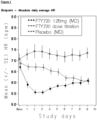
Figure 1 shows the mean (+/- standard error) daily average heart rate ondays 1 to 9 for the treatment regimen groups described in the Example below. The x-axis is shows the study days and the Y-axis shows the mean (+/-SE) daily average heart rate (beats per minute (BPM)). - A single-center, double-blind, placebo-controlled, dose titration, once-daily, multiple-oral-dose clinical study in healthy subjects was conducted to evaluate the effect of a dosage regimen of FTY720 according to the present invention.
- A total of 36 subjects were randomly assigned to one of the three groups.
- Each subject participated in a screening period of maximal 21 days, a baseline period (Day -1), a 9-day dose-administration period, and clinical study completion assessments on
Day 10. Subjects were assigned to one of the three groups (dose titration regimen group, placebo control group, or active control group) and received the once daily dose in a double-blinded manner (Table 1). - In the dose titration group, increasing once daily doses of Compound A (FTY720), starting at 0.125 mg o.d. and ending at the maximal therapeutic dose of 1.25 mg o.d. were administered on
days 1 to 9 of the study according to the schedule shown in Table 1 below. The placebo control group received placebo through out the duration of the study and the active control group received a once daily dose of 1.25 mg of FTY720 ondays 1 to 9.Table 1 Study group / Number of subjects Baseline Administration period Day Day -1 Day 1Day 2Day 3Day 4Day 5Day 6Day 7Day 8Day 9Dose titration regimen group / N = 15 Placebo 0.125 mg 0.125 mg 0.125 mg 0.25 mg 0.25 mg 0.5 mg 0.5 mg 1.25 mg 1.25 mg Placebo control group / N = 9 Placebo Placebo, once daily over 9 days Active control group / N = 12 Placebo 1.25 mg, once daily over 9 days - On Day -1 (baseline), subjects will undergo baseline assessments including 24 hour holter monitoring and telemetry assessments.
- Pharmacodynamic and safety assessments are performed up to 24 hours post last dose. Heart rate is monitored via telemetry on Day -1 through
Day 10, 24 hour after the last dosing. Heart rhythm is assessed via 24hr continuous holter monitoring on Day -1,Day 1, andDay 9. For each dosing for each subject, the drug is administered as closely as practically possible to the time administered on Day -1. Safety assessments includes physical examinations, vital signs and body measurements, 12-lead ECG evaluations, standard clinical laboratory evaluations hematology, blood chemistry, urinalysis, adverse event and serious adverse event monitoring. Systolic and diastolic blood pressure and pulse are measured after the subject has rested quietly in the sitting position for at least 3 minutes. Blood pressure is measured at the same arm on each occasion. Standard 12-lead ECGs are recorded at Screening, baseline, 4 hours post-dose onDay 1 andDay 8, and at Study Completion. The variables recorded are: date and time of ECG, heart rate, PR interval, QT interval (uncorrected), QTcB, QRS duration. The overall interpretation is collected with a Yes/No statement to confirm if any clinically relevant abnormalities are present, which needs to be specified further. - Subjects remain on continuous telemetry, starting before breakfast on Day -1 and proceeding throughout the administration period up to Day 10 (24 hour after the last dose). Over this ten day duration of continuous heart rate collection for each subject, one heart rate value is obtained every minute ('minute unit heart rate'), representing the average heart rate value over that minute. The heart rate database for each subject contains approximately 14,400 data points (10 days x 24 hr x 60 min).
- 24-hour continuous Holter-ECG data are captured via a digital Holter monitor (12-lead, on Days -1, 1, 6, and 8), and transferred for interpretation and reporting. Holter monitoring starts approximately at 7:00 and the time of dose administration is regarded as the time "0 hours". Holter "cuts" are derived from the dataset at 1 hour intervals starting from Day -1 and continuing for 24 hours or the end of the cleaned Holter monitoring dataset.
- Cardiac conduction intervals: arrhythmia monitoring includes the frequency and duration of sinus pauses (>2 sec and > 3 sec) and atrio-ventricular blocks. Frequency and duration of atrial and ventricular ectopy and sinus rhythm are also recorded.
- The daily chronotropic effect is defined as the percent decrease in HRmin (minimum heart rate) between two consecutive days. It is calculated on
days 1 to 9. - The results are shown in
Figure 1 . In the placebo group, daily average heart rate varies by approximately 5 BPM (beats per min) over the course of the study with a trend for heart rate to increase approximately 3-4 BPM from Day -1 toDay 2. The FTY720 1.25 mg treatment group manifestes a significant decrease in heart rate of approximately 8 BPM from Day -1 toDay 1 and an additional decrease in heart rate approximately 3 BPM fromDay 1 toDay 2. The FTY720 titration group manifestes a gradual decrease in heart rate of approximately 1-2 BPM per day over the course of eight day course of the dose titration. The initiation of the 1.25 mg FTY720 onDay 8 does not result in dip in heart rate compared to the preceding days. - These results indicate that the use of a dose titration regimen according to the invention attenuates the negative chronotropic effect seen on
Day 1 of FTY720 treatment initiation. - Furthermore multiple analyses have been conducted to compare minimum heart rates between the two FTY720 treatment group. These analysis show that the FTY720 dose titration regimen provides improved daily minimum heart rates during the course of the study.
Claims (2)
- Use of a S1P receptor modulator or agonist which signals as an agonist at one or more S1P receptors and which is selective for the receptor and which induces a negative chronotropic effect in heart rate in the manufacture of a medication for the treatment of an autoimmune disease selected from multiple sclerosis, polymyositis, lupus nephritis, rheumatoid arthritis, inflammatory bowel disease and psoriasis, whereby said medication is administered in such a way that during the initial period of treatment the dosage is lower than the standard daily dosage and the dosage is increased stepwise, or only once, until the standard daily dosage is reached, and thereafter the treatment is continued with the standard daily dosage of said S1P receptor modulator or agonist, wherein the initial period of treatment during which the S1P receptor modulator or agonist is administered at a dosage lower than the standard daily dosage is 7 days, such that at the day the standard daily dosage of said S1P receptor modulator or agonist is administered the decrease in heart rate is limited to approximately 2 beats/min or less.
- A S1P receptor modulator or agonist which signals as an agonist at one or more S1P receptors and which is selective for the receptor and which induces a negative chronotropic effect in heart rate for use in the treatment of an autoimmune disease selected from multiple sclerosis, polymyositis, lupus nephritis, rheumatoid arthritis, inflammatory bowel disease and psoriasis, whereby said medication is administered in such a way that during the initial period of treatment the dosage is lower than the standard daily dosage and the dosage is increased stepwise, or only once, until the standard daily dosage is reached, and thereafter the treatment is continued with the standard daily dosage of said S1P receptor modulator or agonist, wherein the initial period of treatment during which the S1P receptor modulator or agonist is administered at a dosage lower than the standard daily dosage is 7 days, such that at the day the standard daily dosage of said S1P receptor modulator or agonist is administered the decrease in heart rate is limited to approximately 2 beats/min or less.
Priority Applications (4)
| Application Number | Priority Date | Filing Date | Title |
|---|---|---|---|
| RS20250452A RS66784B9 (en) | 2008-12-22 | 2009-12-21 | Dosage regimen for a s1p receptor agonist |
| HRP20250568TT HRP20250568T1 (en) | 2008-12-22 | 2009-12-21 | Dosage regimen for a s1p receptor agonist |
| SI200932211T SI4098256T1 (en) | 2008-12-22 | 2009-12-21 | Dosage regimen for a s1p receptor agonist |
| HUS2500026C HUS2500026I1 (en) | 2008-12-22 | 2025-06-13 | Dosage regimen for a s1p receptor agonist |
Applications Claiming Priority (9)
| Application Number | Priority Date | Filing Date | Title |
|---|---|---|---|
| US13967208P | 2008-12-22 | 2008-12-22 | |
| US21853009P | 2009-06-19 | 2009-06-19 | |
| US24671509P | 2009-09-29 | 2009-09-29 | |
| EP20160225.7A EP3677260A1 (en) | 2008-12-22 | 2009-12-21 | Dosage regimen for a s1p receptor agonist |
| EP18201062.9A EP3453387B1 (en) | 2008-12-22 | 2009-12-21 | Dosage regimen for a s1p receptor agonist |
| PCT/US2009/068888 WO2010075239A1 (en) | 2008-12-22 | 2009-12-21 | Dosage regimen for a s1p receptor agonist |
| EP09797234.3A EP2379067B1 (en) | 2008-12-22 | 2009-12-21 | Dosage regimen for fingolimod for the treatment of multiple sclerosis |
| EP16182876.9A EP3120844A1 (en) | 2008-12-22 | 2009-12-21 | Dosage regimen for a s1p receptor agonist |
| EP15158251.7A EP2907511A1 (en) | 2008-12-22 | 2009-12-21 | Dosage regimen for a s1p receptor agonist |
Related Parent Applications (5)
| Application Number | Title | Priority Date | Filing Date |
|---|---|---|---|
| EP16182876.9A Division EP3120844A1 (en) | 2008-12-22 | 2009-12-21 | Dosage regimen for a s1p receptor agonist |
| EP18201062.9A Division EP3453387B1 (en) | 2008-12-22 | 2009-12-21 | Dosage regimen for a s1p receptor agonist |
| EP09797234.3A Division EP2379067B1 (en) | 2008-12-22 | 2009-12-21 | Dosage regimen for fingolimod for the treatment of multiple sclerosis |
| EP15158251.7A Division EP2907511A1 (en) | 2008-12-22 | 2009-12-21 | Dosage regimen for a s1p receptor agonist |
| EP20160225.7A Division EP3677260A1 (en) | 2008-12-22 | 2009-12-21 | Dosage regimen for a s1p receptor agonist |
Publications (3)
| Publication Number | Publication Date |
|---|---|
| EP4098256A1 EP4098256A1 (en) | 2022-12-07 |
| EP4098256B1 true EP4098256B1 (en) | 2025-02-26 |
| EP4098256B9 EP4098256B9 (en) | 2025-06-18 |
Family
ID=41667217
Family Applications (7)
| Application Number | Title | Priority Date | Filing Date |
|---|---|---|---|
| EP18201062.9A Revoked EP3453387B1 (en) | 2008-12-22 | 2009-12-21 | Dosage regimen for a s1p receptor agonist |
| EP22187007.4A Active EP4098256B9 (en) | 2008-12-22 | 2009-12-21 | Dosage regimen for a s1p receptor agonist |
| EP16182876.9A Withdrawn EP3120844A1 (en) | 2008-12-22 | 2009-12-21 | Dosage regimen for a s1p receptor agonist |
| EP09797234.3A Revoked EP2379067B1 (en) | 2008-12-22 | 2009-12-21 | Dosage regimen for fingolimod for the treatment of multiple sclerosis |
| EP20160225.7A Pending EP3677260A1 (en) | 2008-12-22 | 2009-12-21 | Dosage regimen for a s1p receptor agonist |
| EP15158251.7A Withdrawn EP2907511A1 (en) | 2008-12-22 | 2009-12-21 | Dosage regimen for a s1p receptor agonist |
| EP18179301.9A Revoked EP3409274B1 (en) | 2008-12-22 | 2009-12-21 | Dosage regimen for a s1p receptor agonist |
Family Applications Before (1)
| Application Number | Title | Priority Date | Filing Date |
|---|---|---|---|
| EP18201062.9A Revoked EP3453387B1 (en) | 2008-12-22 | 2009-12-21 | Dosage regimen for a s1p receptor agonist |
Family Applications After (5)
| Application Number | Title | Priority Date | Filing Date |
|---|---|---|---|
| EP16182876.9A Withdrawn EP3120844A1 (en) | 2008-12-22 | 2009-12-21 | Dosage regimen for a s1p receptor agonist |
| EP09797234.3A Revoked EP2379067B1 (en) | 2008-12-22 | 2009-12-21 | Dosage regimen for fingolimod for the treatment of multiple sclerosis |
| EP20160225.7A Pending EP3677260A1 (en) | 2008-12-22 | 2009-12-21 | Dosage regimen for a s1p receptor agonist |
| EP15158251.7A Withdrawn EP2907511A1 (en) | 2008-12-22 | 2009-12-21 | Dosage regimen for a s1p receptor agonist |
| EP18179301.9A Revoked EP3409274B1 (en) | 2008-12-22 | 2009-12-21 | Dosage regimen for a s1p receptor agonist |
Country Status (43)
Families Citing this family (31)
| Publication number | Priority date | Publication date | Assignee | Title |
|---|---|---|---|---|
| WO2009115954A1 (en) * | 2008-03-17 | 2009-09-24 | Actelion Pharmaceuticals Ltd | Dosing regimen for a selective s1p1 receptor agonist |
| PL2379067T3 (en) | 2008-12-22 | 2016-02-29 | Novartis Ag | Dosage regimen for fingolimod for the treatment of multiple sclerosis |
| EP3061449A1 (en) | 2009-09-29 | 2016-08-31 | Novartis AG | Dosage regimen of an s1p receptor modulator |
| US20110124605A1 (en) * | 2009-11-20 | 2011-05-26 | Shreeram Aradhye | Use of an S1P Receptor Agonist |
| CA2786994C (en) | 2010-01-27 | 2018-01-16 | Arena Pharmaceuticals, Inc. | Processes for the preparation of (r)-2-(7-(4-cyclopentyl-3-(trifluoromethyl)benzyloxy)-1,2,3,4-tetrahydrocyclopenta[b]indol-3-yl)acetic acid and salts thereof |
| AU2011249789B2 (en) * | 2010-05-06 | 2015-03-19 | Novartis Ag | Dosage regimen of diaryl sulfide derivatives |
| EP2455080A1 (en) * | 2010-11-23 | 2012-05-23 | Almirall, S.A. | S1P1 receptor agonists for use in the treatment of multiple sclerosis |
| FR2968556B1 (en) | 2010-12-13 | 2013-12-27 | Centre Nat Rech Scient | INHIBITORS OF HIV INFECTIONS AND USES THEREOF |
| JP6111202B2 (en) | 2011-01-07 | 2017-04-05 | ノバルティス アーゲー | Immunosuppressive preparation |
| US9592288B2 (en) | 2011-02-18 | 2017-03-14 | The Scripps Research Institute | Directed differentiation of oligodendrocyte precursor cells to a myelinating cell fate |
| JO3177B1 (en) | 2011-04-01 | 2018-03-08 | Novartis Ag | Formulations comprising 2-amino-2-[2-(4-octylphenyl)ethyl]propane-1,3-diol |
| WO2012162392A1 (en) * | 2011-05-23 | 2012-11-29 | Timothy Hla | Endothelium protective materials and methods of use |
| TW201320994A (en) * | 2011-10-11 | 2013-06-01 | Novartis Ag | Dosage regimen |
| SMT202000298T1 (en) | 2012-08-17 | 2020-07-08 | Actelion Pharmaceuticals Ltd | Process for the preparation of (2z,5z)-5-(3-chloro-4-((r)-2,3-dihydroxypropoxy)benzylidene)-2-(propylimino)-3-(o-tolyl)thiazolidin-4-one and intermediate used in said process |
| US20160129084A1 (en) * | 2013-03-06 | 2016-05-12 | Acorda Therapeutics, Inc. | Therapeutic Dosing of a Neuregulin or a Fragment Thereof for Treatment or Prophylaxis of Heart Failure |
| US10022340B2 (en) | 2013-10-11 | 2018-07-17 | Teikoku Pharma Usa, Inc. | Topical sphingosine-1-phosphate receptor agonist formulations and methods of using the same |
| US10675254B2 (en) | 2013-10-11 | 2020-06-09 | Teikoku Seiyaku Co., Ltd. | Sphingosine-1-phosphate receptor agonist iontophoretic devices and methods of using the same |
| EP3831378A1 (en) * | 2014-04-10 | 2021-06-09 | Novartis AG | Siponimod immediate release dosage regimen for treating autoimmune diseases |
| DK3256125T3 (en) | 2014-12-11 | 2022-03-21 | Actelion Pharmaceuticals Ltd | DOSAGE REGISTER FOR PONESIMOD, A SELECTIVE S1P1 RECEPTOR AGONIST |
| MA41139B1 (en) | 2014-12-11 | 2026-02-27 | Laboratoires Juvise Pharmaceuticals | Pharmaceutical combination including ponesimod and its use in the treatment of multiple sclerosis |
| AU2016205361C1 (en) | 2015-01-06 | 2021-04-08 | Arena Pharmaceuticals, Inc. | Methods of treating conditions related to the S1P1 receptor |
| US20180042895A1 (en) | 2015-02-26 | 2018-02-15 | Novartis Ag | Treatment of autoimmune disease in a patient receiving additionally a beta-blocker |
| PL3310760T3 (en) | 2015-06-22 | 2023-03-06 | Arena Pharmaceuticals, Inc. | Crystalline l-arginine salt of (r)-2-(7-(4-cyclopentyl-3-(trifluoromethyl)benzyloxy)-1,2,3,4-tetrahydrocyclo-penta[b]indol-3-yl)acetic acid for use in s1p1 receptor-associated disorders |
| KR20190116416A (en) | 2017-02-16 | 2019-10-14 | 아레나 파마슈티칼스, 인크. | Compounds and Methods for Treating Primary Bile Cholangitis |
| JP2020507610A (en) | 2017-02-16 | 2020-03-12 | アリーナ ファーマシューティカルズ, インコーポレイテッド | Compounds and methods for the treatment of inflammatory bowel disease with parenteral symptoms |
| AU2019280822A1 (en) | 2018-06-06 | 2021-01-07 | Arena Pharmaceuticals, Inc. | Methods of treating conditions related to the S1P1 receptor |
| TW202131921A (en) | 2019-10-31 | 2021-09-01 | 瑞士商愛杜西亞製藥有限公司 | Combination of a cxcr7 antagonist with an s1p1 receptor modulator |
| WO2021158838A1 (en) | 2020-02-07 | 2021-08-12 | Argentum Pharmaceuticals Llc | Dosage regimen of an s1p receptor modulator |
| WO2021158848A1 (en) * | 2020-02-07 | 2021-08-12 | Argentum Pharmaceuticals Llc | Dosage regimen of an s1p receptor agonist |
| EP4110332A4 (en) * | 2020-02-28 | 2024-03-06 | Akaal Pharma Pty Ltd | S1P RECEIVER MODULATORS |
| CN113332435B (en) * | 2021-06-18 | 2022-10-18 | 广州中医药大学(广州中医药研究院) | Sphingosine-1-phosphate 4 receptor agonist and application of sphingosine-1-phosphate 4 receptor agonist and Zhenwu decoction in preparation of medicine for treating chronic glomerulonephritis |
Family Cites Families (13)
| Publication number | Priority date | Publication date | Assignee | Title |
|---|---|---|---|---|
| EP0627406B1 (en) | 1992-10-21 | 1998-10-28 | Yoshitomi Pharmaceutical Industries, Ltd. | 2-amino-1,3-propanediol compound and immunosuppressant |
| AU8533101A (en) | 2000-08-31 | 2002-03-13 | Merck & Co Inc | Phosphate derivatives as immunoregulatory agents |
| CA2483594C (en) | 2002-05-16 | 2011-02-15 | Novartis Ag | Use of edg receptor binding agents in cancer |
| US20050090520A1 (en) * | 2003-09-12 | 2005-04-28 | Per Lindquist | Treatment of disease or injury of the nervous system with FTY720 |
| US20060002999A1 (en) * | 2004-06-17 | 2006-01-05 | Forest Laboratories, Inc. | Immediate release formulations of 1-aminocyclohexane compounds, memantine and neramexane |
| SG187468A1 (en) * | 2004-11-29 | 2013-02-28 | Novartis Ag | Dosage regimen of an s1p receptor agonist |
| EP1688141A1 (en) * | 2005-01-31 | 2006-08-09 | elbion AG | The use of flupirtine for the treatment of overactive bladder and associated diseases, and for the treatment of irritable bowel syndrome |
| CN101541227B (en) * | 2005-02-10 | 2013-06-05 | G.I.视频有限公司 | Advancement techniques for gastrointestinal tool with guiding element |
| PT2465492E (en) * | 2007-10-12 | 2015-10-15 | Novartis Ag | Compositions comprising sphingosine i phosphate (sip) receptor modulators |
| WO2009115954A1 (en) * | 2008-03-17 | 2009-09-24 | Actelion Pharmaceuticals Ltd | Dosing regimen for a selective s1p1 receptor agonist |
| KR20180017232A (en) * | 2008-06-20 | 2018-02-20 | 노파르티스 아게 | Paediatric compositions for treating multiple sclerosis |
| PL2379067T3 (en) | 2008-12-22 | 2016-02-29 | Novartis Ag | Dosage regimen for fingolimod for the treatment of multiple sclerosis |
| WO2010072703A1 (en) | 2008-12-22 | 2010-07-01 | Novartis Ag | Dosage regimen of an s1p receptor agonist |
-
2009
- 2009-12-21 PL PL09797234T patent/PL2379067T3/en unknown
- 2009-12-21 SM SM20200441T patent/SMT202000441T1/en unknown
- 2009-12-21 EP EP18201062.9A patent/EP3453387B1/en not_active Revoked
- 2009-12-21 HR HRP20151190TT patent/HRP20151190T1/en unknown
- 2009-12-21 ME MEP-2020-156A patent/ME03802B/en unknown
- 2009-12-21 SG SG2011037629A patent/SG171404A1/en unknown
- 2009-12-21 EA EA201100978A patent/EA201100978A1/en unknown
- 2009-12-21 ES ES22187007T patent/ES3017254T3/en active Active
- 2009-12-21 EP EP22187007.4A patent/EP4098256B9/en active Active
- 2009-12-21 ES ES09797234.3T patent/ES2552823T3/en active Active
- 2009-12-21 PL PL18179301T patent/PL3409274T3/en unknown
- 2009-12-21 PE PE2011001265A patent/PE20120337A1/en not_active Application Discontinuation
- 2009-12-21 HU HUE18179301A patent/HUE048717T4/en unknown
- 2009-12-21 AR ARP090105010A patent/AR074826A1/en not_active Application Discontinuation
- 2009-12-21 SM SM20200054T patent/SMT202000054T1/en unknown
- 2009-12-21 LT LTEP18201062.9T patent/LT3453387T/en unknown
- 2009-12-21 EP EP16182876.9A patent/EP3120844A1/en not_active Withdrawn
- 2009-12-21 TW TW098143960A patent/TW201028143A/en unknown
- 2009-12-21 PT PT221870074T patent/PT4098256T/en unknown
- 2009-12-21 CA CA2747802A patent/CA2747802C/en active Active
- 2009-12-21 ES ES18201062T patent/ES2810823T3/en active Active
- 2009-12-21 LT LTEP18179301.9T patent/LT3409274T/en unknown
- 2009-12-21 PT PT97972343T patent/PT2379067E/en unknown
- 2009-12-21 MX MX2018006099A patent/MX385959B/en unknown
- 2009-12-21 EP EP09797234.3A patent/EP2379067B1/en not_active Revoked
- 2009-12-21 EP EP20160225.7A patent/EP3677260A1/en active Pending
- 2009-12-21 WO PCT/US2009/068888 patent/WO2010075239A1/en not_active Ceased
- 2009-12-21 ES ES18179301T patent/ES2760607T3/en active Active
- 2009-12-21 LT LTEP22187007.4T patent/LT4098256T/en unknown
- 2009-12-21 AU AU2009330176A patent/AU2009330176C9/en not_active Withdrawn - After Issue
- 2009-12-21 SI SI200932015T patent/SI3409274T1/en unknown
- 2009-12-21 HU HUE09797234A patent/HUE026869T2/en unknown
- 2009-12-21 MX MX2011006623A patent/MX2011006623A/en unknown
- 2009-12-21 EP EP15158251.7A patent/EP2907511A1/en not_active Withdrawn
- 2009-12-21 EP EP18179301.9A patent/EP3409274B1/en not_active Revoked
- 2009-12-21 CN CN2009801518640A patent/CN102264359A/en active Pending
- 2009-12-21 HR HRP20250568TT patent/HRP20250568T1/en unknown
- 2009-12-21 DK DK18179301.9T patent/DK3409274T3/en active
- 2009-12-21 RS RS20200900A patent/RS60666B1/en unknown
- 2009-12-21 HU HUE22187007A patent/HUE071189T2/en unknown
- 2009-12-21 UY UY0001032352A patent/UY32352A/en not_active Application Discontinuation
- 2009-12-21 PT PT182010629T patent/PT3453387T/en unknown
- 2009-12-21 KR KR1020117017073A patent/KR101347919B1/en active Active
- 2009-12-21 RS RS20250452A patent/RS66784B9/en unknown
- 2009-12-21 MA MA34034A patent/MA32981B1/en unknown
- 2009-12-21 US US12/642,892 patent/US20100160259A1/en not_active Abandoned
- 2009-12-21 SI SI200931311T patent/SI2379067T1/en unknown
- 2009-12-21 RS RS20191546A patent/RS59857B1/en unknown
- 2009-12-21 SI SI200932211T patent/SI4098256T1/en unknown
- 2009-12-21 BR BRPI0923500-0A patent/BRPI0923500A2/en not_active Application Discontinuation
- 2009-12-21 PL PL22187007.4T patent/PL4098256T3/en unknown
- 2009-12-21 PL PL18201062T patent/PL3453387T3/en unknown
- 2009-12-21 DK DK18201062.9T patent/DK3453387T3/en active
- 2009-12-21 DK DK09797234.3T patent/DK2379067T3/en active
- 2009-12-21 PT PT181793019T patent/PT3409274T/en unknown
- 2009-12-21 JP JP2011542521A patent/JP2012513401A/en not_active Withdrawn
- 2009-12-21 US US13/141,552 patent/US20110257133A1/en not_active Abandoned
- 2009-12-21 FI FIEP22187007.4T patent/FI4098256T3/en active
- 2009-12-21 NZ NZ593065A patent/NZ593065A/en not_active IP Right Cessation
- 2009-12-21 ME MEP-2019-339A patent/ME03594B/en unknown
- 2009-12-21 SI SI200932080T patent/SI3453387T1/en unknown
- 2009-12-21 HU HUE18201062A patent/HUE052048T2/en unknown
- 2009-12-21 DK DK22187007.4T patent/DK4098256T5/en active
-
2011
- 2011-05-25 CR CR20110274A patent/CR20110274A/en not_active Application Discontinuation
- 2011-05-25 ZA ZA2011/03863A patent/ZA201103863B/en unknown
- 2011-05-26 IL IL213170A patent/IL213170A0/en unknown
- 2011-05-26 TN TN2011000272A patent/TN2011000272A1/en unknown
- 2011-06-17 MX MX2021010759A patent/MX2021010759A/en unknown
- 2011-06-21 CL CL2011001529A patent/CL2011001529A1/en unknown
- 2011-06-22 CU CU20110136A patent/CU20110136A7/en unknown
- 2011-06-22 HN HN2011001759A patent/HN2011001759A/en unknown
- 2011-06-22 EC EC2011011222A patent/ECSP11011222A/en unknown
- 2011-06-23 CO CO11079290A patent/CO6390117A2/en not_active Application Discontinuation
-
2012
- 2012-08-06 ZA ZA2012/05942A patent/ZA201205942B/en unknown
-
2013
- 2013-05-31 CL CL2013001558A patent/CL2013001558A1/en unknown
- 2013-09-06 US US14/020,058 patent/US20140066657A1/en not_active Abandoned
-
2014
- 2014-01-31 US US14/169,660 patent/US20140148415A1/en not_active Abandoned
- 2014-04-10 JP JP2014080892A patent/JP2014144970A/en not_active Withdrawn
-
2015
- 2015-10-14 JP JP2015202669A patent/JP2016135752A/en not_active Withdrawn
- 2015-11-30 CY CY20151101084T patent/CY1116990T1/en unknown
- 2015-12-02 US US14/956,855 patent/US20160081949A1/en not_active Abandoned
-
2016
- 2016-05-23 US US15/161,778 patent/US20160263061A1/en not_active Abandoned
-
2017
- 2017-03-06 JP JP2017041331A patent/JP2017141238A/en not_active Withdrawn
- 2017-03-21 US US15/465,091 patent/US20170189353A1/en not_active Abandoned
-
2018
- 2018-06-11 US US16/005,137 patent/US20180289638A1/en not_active Abandoned
- 2018-11-26 US US16/199,905 patent/US20190091180A1/en not_active Abandoned
-
2019
- 2019-05-22 JP JP2019095899A patent/JP7329965B2/en active Active
- 2019-12-02 HR HRP20192175TT patent/HRP20192175T1/en unknown
- 2019-12-03 CY CY20191101264T patent/CY1122812T1/en unknown
-
2020
- 2020-05-05 US US16/867,293 patent/US20200330407A1/en not_active Abandoned
- 2020-05-18 IL IL274756A patent/IL274756A/en unknown
- 2020-07-27 HR HRP20201167TT patent/HRP20201167T1/en unknown
- 2020-08-03 CY CY20201100712T patent/CY1123255T1/en unknown
- 2020-11-17 LT LTPA2020005C patent/LTPA2020005I1/en unknown
- 2020-11-17 LU LU00183C patent/LUC00183I2/fr unknown
- 2020-11-18 NO NO2020038C patent/NO2020038I1/en unknown
- 2020-11-19 HU HUS2000046C patent/HUS2000046I1/en unknown
- 2020-11-19 CY CY2020036C patent/CY2020036I2/en unknown
- 2020-11-19 FR FR20C1060C patent/FR20C1060I1/en active Active
- 2020-11-23 IL IL278914A patent/IL278914A/en unknown
-
2021
- 2021-09-20 US US17/479,649 patent/US20220142949A1/en not_active Abandoned
-
2022
- 2022-04-21 JP JP2022070231A patent/JP2022103194A/en active Pending
-
2024
- 2024-06-06 JP JP2024092377A patent/JP2024129030A/en active Pending
- 2024-09-27 US US18/900,154 patent/US20250262171A1/en active Pending
-
2025
- 2025-04-08 FR FR25C1012C patent/FR25C1012I1/en active Active
- 2025-04-11 CY CY2025012C patent/CY2025012I2/en unknown
- 2025-05-19 LT LTPA2025520C patent/LTPA2025520I1/lt unknown
- 2025-05-23 FI FIC20253002C patent/FIC20253002I1/en unknown
- 2025-06-13 HU HUS2500026C patent/HUS2500026I1/en unknown
Also Published As
Similar Documents
| Publication | Publication Date | Title |
|---|---|---|
| US20250262171A1 (en) | Dosage regimen for a s1p receptor agonist | |
| AU2020267194B2 (en) | Dosage regimen for a S1P receptor agonist | |
| HK40004681B (en) | Dosage regimen for a s1p receptor agonist | |
| HK40004681A (en) | Dosage regimen for a s1p receptor agonist | |
| AU2013204103A1 (en) | Dosage regimen for a S1P receptor agonist |
Legal Events
| Date | Code | Title | Description |
|---|---|---|---|
| REG | Reference to a national code |
Ref country code: HR Ref legal event code: TUEP Ref document number: P20250568T Country of ref document: HR |
|
| PUAI | Public reference made under article 153(3) epc to a published international application that has entered the european phase |
Free format text: ORIGINAL CODE: 0009012 |
|
| STAA | Information on the status of an ep patent application or granted ep patent |
Free format text: STATUS: REQUEST FOR EXAMINATION WAS MADE |
|
| STAA | Information on the status of an ep patent application or granted ep patent |
Free format text: STATUS: EXAMINATION IS IN PROGRESS |
|
| 17P | Request for examination filed |
Effective date: 20220726 |
|
| AC | Divisional application: reference to earlier application |
Ref document number: 2379067 Country of ref document: EP Kind code of ref document: P Ref document number: 2907511 Country of ref document: EP Kind code of ref document: P Ref document number: 3120844 Country of ref document: EP Kind code of ref document: P Ref document number: 3453387 Country of ref document: EP Kind code of ref document: P Ref document number: 3677260 Country of ref document: EP Kind code of ref document: P |
|
| AK | Designated contracting states |
Kind code of ref document: A1 Designated state(s): AT BE BG CH CY CZ DE DK EE ES FI FR GB GR HR HU IE IS IT LI LT LU LV MC MK MT NL NO PL PT RO SE SI SK SM TR |
|
| 17Q | First examination report despatched |
Effective date: 20221109 |
|
| RAX | Requested extension states of the european patent have changed |
Extension state: RS Payment date: 20230602 Extension state: BA Payment date: 20230602 Extension state: AL Payment date: 20230602 |
|
| RBV | Designated contracting states (corrected) |
Designated state(s): AT BE BG CH CY CZ DE DK EE ES FI FR GB GR HR HU IE IS IT LI LT LU LV MC MK MT NL NO PL PT RO SE SI SK SM TR |
|
| GRAP | Despatch of communication of intention to grant a patent |
Free format text: ORIGINAL CODE: EPIDOSNIGR1 |
|
| STAA | Information on the status of an ep patent application or granted ep patent |
Free format text: STATUS: GRANT OF PATENT IS INTENDED |
|
| GRAS | Grant fee paid |
Free format text: ORIGINAL CODE: EPIDOSNIGR3 |
|
| GRAA | (expected) grant |
Free format text: ORIGINAL CODE: 0009210 |
|
| STAA | Information on the status of an ep patent application or granted ep patent |
Free format text: STATUS: THE PATENT HAS BEEN GRANTED |
|
| INTG | Intention to grant announced |
Effective date: 20250115 |
|
| AC | Divisional application: reference to earlier application |
Ref document number: 2379067 Country of ref document: EP Kind code of ref document: P Ref document number: 2907511 Country of ref document: EP Kind code of ref document: P Ref document number: 3120844 Country of ref document: EP Kind code of ref document: P Ref document number: 3453387 Country of ref document: EP Kind code of ref document: P Ref document number: 3677260 Country of ref document: EP Kind code of ref document: P |
|
| AK | Designated contracting states |
Kind code of ref document: B1 Designated state(s): AT BE BG CH CY CZ DE DK EE ES FI FR GB GR HR HU IE IS IT LI LT LU LV MC MK MT NL NO PL PT RO SE SI SK SM TR |
|
| P01 | Opt-out of the competence of the unified patent court (upc) registered |
Free format text: CASE NUMBER: APP_2756/2025 Effective date: 20250116 |
|
| REG | Reference to a national code |
Ref country code: GB Ref legal event code: FG4D |
|
| REG | Reference to a national code |
Ref country code: CH Ref legal event code: EP |
|
| REG | Reference to a national code |
Ref country code: DE Ref legal event code: R096 Ref document number: 602009065476 Country of ref document: DE |
|
| REG | Reference to a national code |
Ref country code: IE Ref legal event code: FG4D |
|
| REG | Reference to a national code |
Ref country code: FI Ref legal event code: FGE Ref country code: CH Ref legal event code: SPCF Free format text: PRODUCT NAME: OZANIMOD; REGISTRATION NO/DATE: SWISSMEDIC-ZULASSUNG 67046 11.08.2020 Filing date: 20250325 |
|
| REG | Reference to a national code |
Ref country code: LU Ref legal event code: SPCF Free format text: PRODUCT NAME: OZANIMOD, OU UN SEL PHARMACEUTIQUEMENT ACCEPTABLE DE CELUI-CI, Y COMPRIS LE SEL CHLORHYDRATE; AUTHORISATION NUMBER AND DATE: EU/1/20/1442/001-003 20200525 Spc suppl protection certif: LUC00382 Filing date: 20250304 Expiry date: 20291221 Extension date: 20341221 |
|
| REG | Reference to a national code |
Ref country code: FR Ref legal event code: CP Free format text: PRODUCT NAME: OZANIMOD, NOTAMMENT SOUS LA FORME DE CHLORHYDRATE; REGISTRATION NO/DATE: EU/1/20/1442 20200525 Spc suppl protection certif: 25C1012 Filing date: 20250408 |
|
| REG | Reference to a national code |
Ref country code: GB Ref legal event code: CTFF Free format text: PRODUCT NAME: OZANIMOD, OR A PHARMACEUTICALLY ACCEPTABLE SALT THEREOF, INCLUDING THE HYDROCHLORIDE SALT; REGISTERED: UK EU/1/20/1442(FOR NI) 20200525; UK MORE ON HISTORY TAB 20200525 Spc suppl protection certif: SPC/GB25/014 Filing date: 20250313 Ref country code: NL Ref legal event code: SPCF Free format text: PRODUCT NAME: OZANIMOD, DESGEWENST IN DE VORM VAN EEN FARMACEUTISCH AANVAARDBAAR ZOUT, MET INBEGRIP VAN HET HYDROCHLORIDE ZOUT; REGISTRATION NO/DATE: EU/1/20/1442 20200525 Spc suppl protection certif: 301324 Filing date: 20250404 Expiry date: 20291220 Extension date: 20341220 Ref country code: NL Ref legal event code: FP |
|
| REG | Reference to a national code |
Ref country code: PT Ref legal event code: SC4A Ref document number: 4098256 Country of ref document: PT Date of ref document: 20250410 Kind code of ref document: T Free format text: AVAILABILITY OF NATIONAL TRANSLATION Effective date: 20250403 |
|
| REG | Reference to a national code |
Ref country code: SE Ref legal event code: TRGR Ref country code: DK Ref legal event code: T3 Effective date: 20250415 |
|
| REG | Reference to a national code |
Ref country code: DE Ref legal event code: R065 Ref document number: 602009065476 Country of ref document: DE Free format text: PRODUCT NAME: OZANIMOD ODER EIN PHARMAZEUTISCH VERTRAEGLICHES SALZ DAVON, EINSCHLIESSLICH DES HYDROCHLORID-SALZES; REGISTRATION NO/DATE: EU/1/20/1442 20200520 Spc suppl protection certif: 122025000015 Filing date: 20250327 Expiry date: 20291222 |
|
| REG | Reference to a national code |
Ref country code: DK Ref legal event code: CTFF Free format text: PRODUCT NAME: OZANIMOD, OR A PHARMACEUTICALLY ACCEPTABLE SALT THEREOF, INCLUDING THE HYDROCHLORIDE SALT; REG. NO/DATE: EU/1/20/1442 20200525 Spc suppl protection certif: CA 2025 00015 Filing date: 20250424 Expiry date: 20291221 Extension date: 20341221 |
|
| REG | Reference to a national code |
Ref country code: ES Ref legal event code: FG2A Ref document number: 3017254 Country of ref document: ES Kind code of ref document: T3 Effective date: 20250512 |
|
| REG | Reference to a national code |
Ref country code: FI Ref legal event code: SPCF Ref document number: C20253002 Country of ref document: FI Spc suppl protection certif: C20253002 Filing date: 20250523 Expiry date: 20291221 Ref country code: SE Ref legal event code: SPCF Free format text: PRODUCT NAME: OZANOMID; REG. NO/DATE: EU/1/20/1442/001-003 20200525 Spc suppl protection certif: 2590012-7 |
|
| REG | Reference to a national code |
Ref country code: SK Ref legal event code: T3 Ref document number: E 46215 Country of ref document: SK |
|
| REG | Reference to a national code |
Ref country code: CH Ref legal event code: PK Free format text: BERICHTIGUNG B9 Ref country code: GR Ref legal event code: EP Ref document number: 20250400727 Country of ref document: GR Effective date: 20250514 |
|
| REG | Reference to a national code |
Ref country code: EE Ref legal event code: FG4A Ref document number: E024981 Country of ref document: EE Effective date: 20250326 |
|
| REG | Reference to a national code |
Ref country code: IE Ref legal event code: SPCF Free format text: PRODUCT NAME: OZANIMOD, OR A PHARMACEUTICALLY ACCEPTABLE SALT THEREOF, INCLUDING THE HYDROCHLORIDE SALT; REGISTRATION NO/DATE: EU/1/20/1442/001-003 20200525 Spc suppl protection certif: 2025/017 Filing date: 20250520 |
|
| REG | Reference to a national code |
Ref country code: LT Ref legal event code: SPCF Free format text: PRODUCT NAME: OZANIMODAS; REGISTRATION NO/DATE: EU/1/20/1442 20200520 Spc suppl protection certif: PA2025520 Filing date: 20250519 Expiry date: 20291221 |
|
| REG | Reference to a national code |
Ref country code: SI Ref legal event code: SPCF Ref document number: 4098256 Country of ref document: SI Kind code of ref document: T1 Free format text: PRODUCT NAME: OZANIMOD; NATIONAL AUTHORISATION NUMBER: EU/1/20/1442/001-003; DATE OF NATIONAL AUTHORISATION: 20200520; AUTHORITY FOR NATIONAL AUTHORISATION: EU Spc suppl protection certif: 202540017 Filing date: 20250508 |
|
| REG | Reference to a national code |
Ref country code: ES Ref legal event code: SPCF Free format text: PRODUCT NAME: OZANIMOD, O UNA SAL FARMACEUTICAMENTE ACEPTABLE DEL MISMO, INCLUIDA LA CLORHIDRATO; NATIONAL AUTHORISATION NUMBER: EU/1/20/1442; DATE OF AUTHORISATION: 20200520; NUMBER OF FIRST AUTHORISATION IN EUROPEAN ECONOMIC AREA (EEA): EU/1/20/1442; DATE OF FIRST AUTHORISATION IN EEA: 20200520 Spc suppl protection certif: C202530025 Effective date: 20250513 |
|
| REG | Reference to a national code |
Ref country code: HR Ref legal event code: T1PR Ref document number: P20250568 Country of ref document: HR |
|
| REG | Reference to a national code |
Ref country code: EE Ref legal event code: AA1Y Ref document number: E024981 Country of ref document: EE Free format text: PRODUCT NAME: OSANIMOOD;REG NO/DATE: EU/1/20/1442/001-003 25.05.2020 Spc suppl protection certif: C20250011 Filing date: 20250326 |
|
| REG | Reference to a national code |
Ref country code: DK Ref legal event code: T5 Effective date: 20250716 |
|
| REG | Reference to a national code |
Ref country code: HU Ref legal event code: AA1S Ref document number: E071189 Country of ref document: HU Spc suppl protection certif: S2500026 Filing date: 20250613 |
|
| REG | Reference to a national code |
Ref country code: BE Ref legal event code: SPCF Free format text: PRODUCT NAME: OZANIMOD, OF EEN FAMACEUTISCH AANVAARDBAAR ZOUT DAARVAN, INCLUSIEF HET HYDROCHLORIDEZOUT; AUTHORISATION NUMBER AND DATE: EU/1/20/1442 20200525 Spc suppl protection certif: 2025C/521 Filing date: 20250523 Expiry date: 20291221 Extension date: 20341221 |
|
| REG | Reference to a national code |
Ref country code: HU Ref legal event code: AG4A Ref document number: E071189 Country of ref document: HU |
|
| PG25 | Lapsed in a contracting state [announced via postgrant information from national office to epo] |
Ref country code: SM Free format text: LAPSE BECAUSE OF FAILURE TO SUBMIT A TRANSLATION OF THE DESCRIPTION OR TO PAY THE FEE WITHIN THE PRESCRIBED TIME-LIMIT Effective date: 20250226 |
|
| REG | Reference to a national code |
Ref country code: SE Ref legal event code: SPCG Free format text: PRODUCT NAME: OZANIMOD; REG. NO/DATE: EU/1/20/1442/001-003 20200525 Spc suppl protection certif: 2590012-7 Expiry date: 20291222 Extension date: 20341221 |
|
| REG | Reference to a national code |
Ref country code: EE Ref legal event code: LD4A Ref document number: E024981 Country of ref document: EE |
|
| REG | Reference to a national code |
Ref country code: DE Ref legal event code: R097 Ref document number: 602009065476 Country of ref document: DE |
|
| PGFP | Annual fee paid to national office [announced via postgrant information from national office to epo] |
Ref country code: NL Payment date: 20251126 Year of fee payment: 17 |
|
| REG | Reference to a national code |
Ref country code: AT Ref legal event code: SPCF Ref document number: 1769983 Country of ref document: AT Kind code of ref document: T Free format text: PRODUCT NAME: OZANIMOD; REGISTRATION NO/DATE: EU/1/20/1442 (MITTEILUNG) 20200525 Spc suppl protection certif: 18/2025 Filing date: 20250526 Effective date: 20251215 |
|
| PLBE | No opposition filed within time limit |
Free format text: ORIGINAL CODE: 0009261 |
|
| REG | Reference to a national code |
Ref country code: CH Ref legal event code: U11 Free format text: ST27 STATUS EVENT CODE: U-0-0-U10-U11 (AS PROVIDED BY THE NATIONAL OFFICE) Effective date: 20260101 |
|
| STAA | Information on the status of an ep patent application or granted ep patent |
Free format text: STATUS: NO OPPOSITION FILED WITHIN TIME LIMIT |
|
| REG | Reference to a national code |
Ref country code: HR Ref legal event code: ODRP Ref document number: P20250568 Country of ref document: HR Payment date: 20251120 Year of fee payment: 17 |
|
| PGFP | Annual fee paid to national office [announced via postgrant information from national office to epo] |
Ref country code: IS Payment date: 20251219 Year of fee payment: 17 Ref country code: DE Payment date: 20251119 Year of fee payment: 17 |
|
| PGFP | Annual fee paid to national office [announced via postgrant information from national office to epo] |
Ref country code: GB Payment date: 20251120 Year of fee payment: 17 Ref country code: LT Payment date: 20251121 Year of fee payment: 17 |
|
| PGFP | Annual fee paid to national office [announced via postgrant information from national office to epo] |
Ref country code: NO Payment date: 20251210 Year of fee payment: 17 |
|
| PGFP | Annual fee paid to national office [announced via postgrant information from national office to epo] |
Ref country code: AT Payment date: 20251126 Year of fee payment: 17 Ref country code: PT Payment date: 20251219 Year of fee payment: 17 |
|
| PGFP | Annual fee paid to national office [announced via postgrant information from national office to epo] |
Ref country code: IT Payment date: 20251126 Year of fee payment: 17 Ref country code: FI Payment date: 20251211 Year of fee payment: 17 Ref country code: DK Payment date: 20251212 Year of fee payment: 17 |
|
| PGFP | Annual fee paid to national office [announced via postgrant information from national office to epo] |
Ref country code: LU Payment date: 20251215 Year of fee payment: 17 Ref country code: HR Payment date: 20251120 Year of fee payment: 17 Ref country code: HU Payment date: 20251212 Year of fee payment: 17 Ref country code: FR Payment date: 20251124 Year of fee payment: 17 |
|
| PGFP | Annual fee paid to national office [announced via postgrant information from national office to epo] |
Ref country code: TR Payment date: 20251219 Year of fee payment: 17 Ref country code: GR Payment date: 20251128 Year of fee payment: 17 Ref country code: BE Payment date: 20251127 Year of fee payment: 17 |
|
| PGFP | Annual fee paid to national office [announced via postgrant information from national office to epo] |
Ref country code: SE Payment date: 20251126 Year of fee payment: 17 |
|
| PGFP | Annual fee paid to national office [announced via postgrant information from national office to epo] |
Ref country code: CZ Payment date: 20251205 Year of fee payment: 17 Ref country code: IE Payment date: 20251126 Year of fee payment: 17 Ref country code: CY Payment date: 20251124 Year of fee payment: 17 |
|
| PGFP | Annual fee paid to national office [announced via postgrant information from national office to epo] |
Ref country code: MT Payment date: 20251222 Year of fee payment: 17 Ref country code: LV Payment date: 20251119 Year of fee payment: 17 |
|
| PGFP | Annual fee paid to national office [announced via postgrant information from national office to epo] |
Ref country code: PL Payment date: 20251125 Year of fee payment: 17 Ref country code: BG Payment date: 20251127 Year of fee payment: 17 |
|
| PGFP | Annual fee paid to national office [announced via postgrant information from national office to epo] |
Ref country code: EE Payment date: 20251125 Year of fee payment: 17 |
|
| PGFP | Annual fee paid to national office [announced via postgrant information from national office to epo] |
Ref country code: SK Payment date: 20251126 Year of fee payment: 17 Ref country code: RO Payment date: 20251210 Year of fee payment: 17 |
|
| PGFP | Annual fee paid to national office [announced via postgrant information from national office to epo] |
Ref country code: SI Payment date: 20251127 Year of fee payment: 17 |
|
| REG | Reference to a national code |
Ref country code: SI Ref legal event code: SPCG Ref document number: 4098256 Country of ref document: SI Kind code of ref document: T1 Free format text: PRODUCT NAME: OZANIMOD; NATIONAL AUTHORISATION NUMBER: EU/1/20/1442/001-003; DATE OF NATIONAL AUTHORISATION: 20200520; AUTHORITY FOR NATIONAL AUTHORISATION: EU Spc suppl protection certif: 202540017 Filing date: 20250508 Expiry date: 20291221 Extension date: 20341221 |
|
| 26N | No opposition filed |
Effective date: 20251127 |
|
| PGFP | Annual fee paid to national office [announced via postgrant information from national office to epo] |
Ref country code: ES Payment date: 20260115 Year of fee payment: 17 |
|
| PGFP | Annual fee paid to national office [announced via postgrant information from national office to epo] |
Ref country code: CH Payment date: 20260101 Year of fee payment: 17 |