EP4096963B1 - A bi-directional tightening device for tightening of a threadable line, and a method for operating the bi-directional tightening device - Google Patents
A bi-directional tightening device for tightening of a threadable line, and a method for operating the bi-directional tightening device Download PDFInfo
- Publication number
- EP4096963B1 EP4096963B1 EP21747150.7A EP21747150A EP4096963B1 EP 4096963 B1 EP4096963 B1 EP 4096963B1 EP 21747150 A EP21747150 A EP 21747150A EP 4096963 B1 EP4096963 B1 EP 4096963B1
- Authority
- EP
- European Patent Office
- Prior art keywords
- spool
- ratchet
- tightening device
- ratchet wheel
- locking mechanism
- Prior art date
- Legal status (The legal status is an assumption and is not a legal conclusion. Google has not performed a legal analysis and makes no representation as to the accuracy of the status listed.)
- Active
Links
Images




Classifications
-
- B—PERFORMING OPERATIONS; TRANSPORTING
- B60—VEHICLES IN GENERAL
- B60P—VEHICLES ADAPTED FOR LOAD TRANSPORTATION OR TO TRANSPORT, TO CARRY, OR TO COMPRISE SPECIAL LOADS OR OBJECTS
- B60P7/00—Securing or covering of load on vehicles
- B60P7/06—Securing of load
- B60P7/08—Securing to the vehicle floor or sides
- B60P7/0823—Straps; Tighteners
- B60P7/083—Tensioning by repetetive movement of an actuating member
-
- B—PERFORMING OPERATIONS; TRANSPORTING
- B25—HAND TOOLS; PORTABLE POWER-DRIVEN TOOLS; MANIPULATORS
- B25B—TOOLS OR BENCH DEVICES NOT OTHERWISE PROVIDED FOR, FOR FASTENING, CONNECTING, DISENGAGING, OR HOLDING
- B25B25/00—Implements for fastening, connecting or tensioning of wire or strip
-
- B—PERFORMING OPERATIONS; TRANSPORTING
- B60—VEHICLES IN GENERAL
- B60P—VEHICLES ADAPTED FOR LOAD TRANSPORTATION OR TO TRANSPORT, TO CARRY, OR TO COMPRISE SPECIAL LOADS OR OBJECTS
- B60P7/00—Securing or covering of load on vehicles
- B60P7/06—Securing of load
-
- B—PERFORMING OPERATIONS; TRANSPORTING
- B65—CONVEYING; PACKING; STORING; HANDLING THIN OR FILAMENTARY MATERIAL
- B65B—MACHINES, APPARATUS OR DEVICES FOR, OR METHODS OF, PACKAGING ARTICLES OR MATERIALS; UNPACKING
- B65B13/00—Bundling articles
- B65B13/18—Details of, or auxiliary devices used in, bundling machines or bundling tools
- B65B13/22—Means for controlling tension of binding means
-
- F—MECHANICAL ENGINEERING; LIGHTING; HEATING; WEAPONS; BLASTING
- F16—ENGINEERING ELEMENTS AND UNITS; GENERAL MEASURES FOR PRODUCING AND MAINTAINING EFFECTIVE FUNCTIONING OF MACHINES OR INSTALLATIONS; THERMAL INSULATION IN GENERAL
- F16G—BELTS, CABLES, OR ROPES, PREDOMINANTLY USED FOR DRIVING PURPOSES; CHAINS; FITTINGS PREDOMINANTLY USED THEREFOR
- F16G11/00—Means for fastening cables or ropes to one another or to other objects; Caps or sleeves for fixing on cables or ropes
- F16G11/12—Connections or attachments, e.g. turnbuckles, adapted for straining of cables, ropes, or wire
-
- Y—GENERAL TAGGING OF NEW TECHNOLOGICAL DEVELOPMENTS; GENERAL TAGGING OF CROSS-SECTIONAL TECHNOLOGIES SPANNING OVER SEVERAL SECTIONS OF THE IPC; TECHNICAL SUBJECTS COVERED BY FORMER USPC CROSS-REFERENCE ART COLLECTIONS [XRACs] AND DIGESTS
- Y10—TECHNICAL SUBJECTS COVERED BY FORMER USPC
- Y10T—TECHNICAL SUBJECTS COVERED BY FORMER US CLASSIFICATION
- Y10T24/00—Buckles, buttons, clasps, etc.
- Y10T24/21—Strap tighteners
Definitions
- the present disclosure is related to a cargo securing device for securing a cargo on a means of transport. More particularly, the disclosure is related to a bi-directional tightening device for tightening of a threadable line, and a method for operating the bi-directional tightening device.
- the tightening device comprises a rotatable spool provided with an aperture for receiving the line, and a ratchet mechanism rotationally fixed to the spool.
- the spool is supported by a frame comprising a handle for rotating the spool by means of a drive pawl coupled to the frame and configured to engage the ratchet mechanism when the handle is stroked to rotate the spool.
- the tightening further comprises a locking mechanism configured for keeping the ratchet wheel in place during a return stroke of the handle.
- a cargo tightening device for tightening lines, particularly belts or webs, comprising a ratcheting mechanism to wind the tightening lines are well known for securing a load on a means for transport on land, sea or in the air. Examples of such prior tightening devices are disclosed in the publications US 7,950,629 B2 , US 6,195,848 B1 , US 8,499,662 B2 , and US 1,401,739 A .
- DE 10 2012 110036 B4 discloses a bi-directional tightening device similar to the preamble of claim 1.
- the prior art devices suffer from the same drawback, namely that the direction of a power stroke for rotating the spool is fixed for each particular device.
- the power stroke refers to the direction in which the handle is moved in order to engage the drive pawl with the ratchet mechanism.
- the power stroke may be either a "pull" stroke or a "push” stroke.
- a pull stroke may be advantageous when an operator can use his or her body weight to assist in moving the handle.
- Publication DE 102012110036 A1 discloses a pawl lever block provided with attachment element suspended and connected to a wire rope to displace a gear rack such that the gear rack is displaced by driving ratchet wheel so as to allow goods to be bundled and stably packed by proper wire rope tension.
- the lever block is provided with a ratchet wheel formed with an annularly arranged ratchet teeth on a rotary axis.
- the gear rack is arranged on a support and engaged with the ratchet teeth of the ratchet wheel.
- An attachment element is arranged on the gear rack such that another attachment element is fixed at a certain point.
- the former attachment element is suspended and connected to the wire rope to displace the gear rack such that the gear rack is displaced by driving the ratchet wheel.
- Publication US 7,412,754 B2 discloses a bi-directional tightening device for tightening of a threadable line and an anchoring line.
- the device is configured for allowing an operator to select the power stroke to be a "pull" stroke or a "push” stroke simply by inverting a connection position of the threadable line and the anchoring line with respect to the tightening device.
- the operator must select a "pull" stroke configuration or a "push” stroke configuration prior to connecting the threadable line and anchoring line to the device.
- the invention has for its object to remedy or to reduce at least one of the drawbacks of the prior art, or at least provide a useful alternative to prior art.
- the inventor has surprisingly found that it is possible to make a tightening device that allows an operator to select between a "push” stroke or a "pull” stroke even after the threadable line and an anchoring line have been connected to the apparatus.
- a bi-directional tightening device for tightening of a threadable line, the tightening device comprising:
- the ratchet mechanism comprises at least one first ratchet wheel for rotating the spool in a first direction and at least one second ratchet wheel for rotating the spool in a second direction opposite the first direction, the drive pawl and the locking mechanism being sideways and radially displaceable, and provided with protrusions configured for selectively engaging either one of the ratchet wheels, to allow bi-directional tightening of the line.
- an additional anchoring line is connected to a portion of the tightening device in a way known per se. End portions of both the threaded line and the anchoring line facing away from the tightening device are typically provided with attachment means, for example a hook, for engaging a portion of a substructure.
- attachment means for example a hook
- the threaded line and the anchoring line may be subject to considerable tension and portions of at least one of the lines may abut tightly against the object.
- Another effect of selecting either the first ratchet wheel or the second ratchet wheel to be engaged by the drive pawl and the locking mechanism is that a tension in the threaded line and the anchoring line may be reduced in a controlled manner simply by repositioning the engagement of the drive pawl and the locking mechanism from one of the first ratchet wheel or the second ratchet wheel, to the other one of the second ratchet wheel and the first ratchet wheel, respectively.
- a minor slack in the lines may thus be provided without fully releasing the tension in the lines and possibly losing engagement between for example the hooks of the lines and the substructure.
- the at least one first ratchet wheel comprises a set of two ratchet wheels
- the at least one second ratchet wheel comprises a set of two ratchet wheels.
- first ratchet wheels and the second ratchet wheels are arranged alternating along a longitudinal axis of the spool.
- the drive pawl and the locking mechanism may be configured for being operated independently of each other, i.e. individual operation. Individual operation of the drive pawl and the locking mechanism makes possible arranging the drive pawl in engagement with one of the at least one first ratchet wheel for rotating the spool in a first direction and at least one second ratchet wheel for rotating the spool in a second direction opposite the first direction, while the locking mechanism may be arranged into engagement with the other one of the at least one second ratchet wheel or the at least one first ratchet wheel that are not engaged with the drive pawl. This has the effect that the spool is prevented from rotation. A secure locking of the tightening device may thus be achieved independently of a position of the part of the frame comprising the handle.
- a bi-directional tightening device according to the first aspect of the invention, the method comprises the steps of:
- the method may comprise arranging the locking mechanism into engagement with the same ratchet wheel as the drive pawl to provide a tightening device operable in a push or a pull mode.
- the method may comprise arranging the locking mechanism into engagement with the opposite ratchet wheel as the drive pawl to provide a locking of the tightening device.
- the drive pawl and the locking mechanism may be operated independently of whether the spool carries a line.
- the method may thus comprise operating the drive pawl and the locking mechanism after a line has been threaded onto the spool.
- an operator can select which one of the first rotation direction and the second rotation direction to be activated even after the line has been inserted through the spool.
- the method may comprise slackening of a threaded line in a controlled manner by releasing the drive pawl and the locking mechanism from engagement with one of the first and second ratchet wheel to the other one of the second and first ratchet wheel; and slackening of the line by means of operating the handle of the frame.
- positional indications such as for example left, right, and sideways, refer to the position shown in the figures.
- reference numeral 1 denotes a tightening device according to the present invention.
- the tightening device 1 disclosed herein is a modification of a prior art tightening device and the skilled person will understand a basic principle of how a ratchet mechanism operates. The discussion hereinafter therefore mainly focuses on the inventive features of the tightening device.
- the tightening device 1 comprises a rotatable spool 3 provided with an aperture 5 for receiving a line (not shown).
- a line (not shown)
- a line will typically be a strap.
- the spool 3 is constituted by two semi-circular rods 3' arranged in parallel and spaced apart to provide the rotatable spool 3.
- the spool 3 is supported in a frame comprising two frame parts: a base frame 22; and a drive frame 26.
- the drive frame 26 is formed by two parallel arms 28, 28' interconnected by a spacer bolt 29 and a handle 30 comprising a bolt.
- the base frame 22 and the drive frame 26 are interconnected by means of the spool 3 threaded through complementary and overlapping apertures 25 and 25' arranged in the base frame 22 and each one of the arms 28, 28', respectively.
- the apertures 25, 25' are best seen in fig. 7 .
- the spool 3 is locked to the frame 20 by means of pins 33 extending through apertures 33' at each end portion of the semi-circular rod 3'.
- a ratchet mechanism 40 here in the form of four ratchet wheels 41, 42, 43, 44, is rotationally fixed to the spool 3.
- Each one of the ratchet wheels are provided with two semi-circular apertures 47 as best seen in fig. 7 configured for mating with the semi-circular rod 3' of the spool 3.
- the ratchet wheels 41, 42, 43, 44 are threaded onto the semi-circular rods 3' and is therefore rotationally fixed to the spool 3.
- the ratchet wheels 42, 43 are prevented from moving towards each other by means of for example a clamping sleeve (not shown) inserted through mating holes 32 in the semi-circular rods 3'.
- a first pair of ratchet wheels is formed by the wheels 41, 42 and a second pair of ratchet wheels is formed by the wheels 43, 44.
- the first pair of ratchet wheels 41, 42 has teeth and dents slanting in a first direction
- the second pair of ratchet wheels 43, 44 has teeth and dents slanting in a second direction opposite the first direction of the first pair of teeth.
- a drive pawl 50 is slidably coupled to a slot 27 in each arm 28, 28' of the drive member 26.
- the drive pawl 50 is configured for cooperating with the ratchet mechanism 40.
- a length of the slot 27 is longer than the portion of the drive pawl 50 extending through the slot 27.
- the drive pawl 50 is configured for sliding both sideways between the two arms 28, 28' of the drive member 26, and radially with respect to the ratchet mechanism 40 and thus the spool 3.
- the tightening device 1 is further provided with a locking mechanism 60 configured for keeping the ratchet mechanism 40 in place during a return stroke of the handle 30.
- the locking mechanism 60 is coupled to slots 23 in the base frame 22 and is arranged sideways slidable within the slots 23.
- the part of the locking mechanism 60 facing the ratchet mechanism 40 is provided with locking protrusions 62 configured for engaging either the first pair of ratchet wheels 41, 42, or the second pair of ratchet wheels 43, 44. Juxtaposed to either side of the locking protrusions 62 there is provided indents 64, 66. The purpose of the indents 64, 66 is to accommodate the set of ratchet wheel that are not being engaged by the protrusions 52 of the drive pawl 50.
- a length of each slot 23 is longer than the portion of the locking mechanism 60 extending through the slots 23.
- the locking mechanism 60 is configured for sliding both sideways within the base frame 22, and radially with respect to the ratchet mechanism 40 and thus the spool 3. In the embodiment shown, this radial movement of the locking mechanism 60 is also provided by an operator when releasing a tension in a line tightened by the device 1.
- the drive pawl 50 moves radially back and forth with respect to the ratchet mechanism 40 as the protrusions 52 pass over the teeth of the ratchet wheels 41, 42.
- the drive pawl 50 is urged radially towards the ratchet mechanism 50 by means of a biasing means, here in the form of a pin member 54 protruding from the arm 28 and engages an aperture 56 in the drive pawl 50.
- a periphery of the second pair of ratchet wheels 43, 44 is "accommodated” in the indents 64 of the locking mechanism 60 so that ratchet wheels 43, 44 are not engaged by the locking mechanism 60.
- the second pair of ratchet wheels 43, 44 are neither engaged by the protrusions 52 of the drive pawl 50, nor the locking device 60.
- the second pair of ratchet wheels is in a passive mode.
- a strutting member 3" secured to the base frame 22 for example by means of a weld.
- a purpose of the strutting member 3" is to stabilize the portion of the base frame 22 surrounding the apertures 25.
- the apertures 25 are best seen in fig. 7 .
- the locking mechanism 60 has also been slid to the right in figures 1 and 2 (and thus to the left in fig. 3 wherein the device 1 is seen from behind). In this position, the protrusions 62 of the locking mechanism 60 engages the first set of ratchet wheels 41, 42 and prevents the ratchet mechanism 40 and thus the spool 3 from rotating.
- the tightening device 1 is in a second or "pull" configuration.
- the drive pawl 50 has been slid to the left. In this position, the protrusions 52 of the drive pawl engage the second set of ratchet wheels 43, 44.
- the ratchet mechanism 40 and thus the spool 3 is rotated clockwise when spool 3 is seen from right to left.
- the drive pawl 50 moves radially back and forth with respect to the ratchet mechanism as the protrusions 52 pass over the teeth of the ratchet wheels 41, 42.
- the locking mechanism 60 has also been slid to the left. In this position, the protrusions 62 of the locking mechanism 60 engage the second set of ratchet wheels 43, 44 and prevent the ratchet mechanism 40 and thus the spool 3, from rotating.
- the tightening device is in a locked configuration.
- the protrusions 52 of the drive pawl 50 engage the second set of ratchet wheels 43, 44, while the locking mechanism 60 is oriented so that the protrusions 62 engage the first set of ratchet wheels 41, 42.
- the ratchet mechanism 40 and the spool 3 are therefore prevented from rotating, and the drive frame 26 is prevented from movement with respect to the rest of the tightening device 1.
- the configuration shown in figures 4 and 6 may be important when there is a need for safe locking of the tightening device.
- Fig. 7 is a principle exploded view of the tightening device shown in fig. 3 .
Landscapes
- Engineering & Computer Science (AREA)
- Mechanical Engineering (AREA)
- General Engineering & Computer Science (AREA)
- Transportation (AREA)
- Basic Packing Technique (AREA)
- Yarns And Mechanical Finishing Of Yarns Or Ropes (AREA)
- Transmission Devices (AREA)
- Clamps And Clips (AREA)
Description
- The present disclosure is related to a cargo securing device for securing a cargo on a means of transport. More particularly, the disclosure is related to a bi-directional tightening device for tightening of a threadable line, and a method for operating the bi-directional tightening device. The tightening device comprises a rotatable spool provided with an aperture for receiving the line, and a ratchet mechanism rotationally fixed to the spool. The spool is supported by a frame comprising a handle for rotating the spool by means of a drive pawl coupled to the frame and configured to engage the ratchet mechanism when the handle is stroked to rotate the spool. The tightening further comprises a locking mechanism configured for keeping the ratchet wheel in place during a return stroke of the handle.
- A cargo tightening device for tightening lines, particularly belts or webs, comprising a ratcheting mechanism to wind the tightening lines are well known for securing a load on a means for transport on land, sea or in the air. Examples of such prior tightening devices are disclosed in the publications
US 7,950,629 B2 ,US 6,195,848 B1 ,US 8,499,662 B2 , andUS 1,401,739 A .DE 10 2012 110036 B4 discloses a bi-directional tightening device similar to the preamble ofclaim 1. - The prior art devices, however, suffer from the same drawback, namely that the direction of a power stroke for rotating the spool is fixed for each particular device. In this document, the power stroke refers to the direction in which the handle is moved in order to engage the drive pawl with the ratchet mechanism. The power stroke may be either a "pull" stroke or a "push" stroke. A pull stroke may be advantageous when an operator can use his or her body weight to assist in moving the handle. However, in some situations, typically when the tightening device is at a low level with respect to the operator, it may be more convenient for the operator to provide a "push" stroke for moving the handle.
- Publication
DE 102012110036 A1 discloses a pawl lever block provided with attachment element suspended and connected to a wire rope to displace a gear rack such that the gear rack is displaced by driving ratchet wheel so as to allow goods to be bundled and stably packed by proper wire rope tension. The lever block is provided with a ratchet wheel formed with an annularly arranged ratchet teeth on a rotary axis. The gear rack is arranged on a support and engaged with the ratchet teeth of the ratchet wheel. An attachment element is arranged on the gear rack such that another attachment element is fixed at a certain point. The former attachment element is suspended and connected to the wire rope to displace the gear rack such that the gear rack is displaced by driving the ratchet wheel. - Publication
US 7,412,754 B2 discloses a bi-directional tightening device for tightening of a threadable line and an anchoring line. The device is configured for allowing an operator to select the power stroke to be a "pull" stroke or a "push" stroke simply by inverting a connection position of the threadable line and the anchoring line with respect to the tightening device. Thus, the operator must select a "pull" stroke configuration or a "push" stroke configuration prior to connecting the threadable line and anchoring line to the device. - The invention has for its object to remedy or to reduce at least one of the drawbacks of the prior art, or at least provide a useful alternative to prior art.
- The object is achieved through features specified in the description below and in the claims that follow.
- The inventor has surprisingly found that it is possible to make a tightening device that allows an operator to select between a "push" stroke or a "pull" stroke even after the threadable line and an anchoring line have been connected to the apparatus.
- The invention is defined by the independent patent claims. The dependent claims define advantageous embodiments of the invention.
- In a first aspect of the invention there is provided a bi-directional tightening device for tightening of a threadable line, the tightening device comprising:
- a rotatable spool provided with an aperture for receiving the line;
- a frame for supporting the spool, the frame comprising a handle for rotating the spool;
- a ratchet mechanism rotationally fixed to the spool;
- a drive pawl coupled to the frame and configured to engage the ratchet mechanism when the handle is stroked to rotate the spool;
- a locking mechanism configured for keeping the ratchet mechanism in place during a return stroke of the handle.
- The ratchet mechanism comprises at least one first ratchet wheel for rotating the spool in a first direction and at least one second ratchet wheel for rotating the spool in a second direction opposite the first direction, the drive pawl and the locking mechanism being sideways and radially displaceable, and provided with protrusions configured for selectively engaging either one of the ratchet wheels, to allow bi-directional tightening of the line.
- By selecting which one of the first ratchet wheel and the second ratchet wheel to be engaged by the drive pawl and the locking mechanism, an operator can select whether tightening of the threadable line shall be performed by applying a "push" stroke or a "pull" stroke, even after the threadable line has been inserted through the aperture of the rotatable spool.
- When in operation, an additional anchoring line is connected to a portion of the tightening device in a way known per se. End portions of both the threaded line and the anchoring line facing away from the tightening device are typically provided with attachment means, for example a hook, for engaging a portion of a substructure. In an active position wherein the tightening device ties an object to a substructure, the threaded line and the anchoring line may be subject to considerable tension and portions of at least one of the lines may abut tightly against the object.
- Another effect of selecting either the first ratchet wheel or the second ratchet wheel to be engaged by the drive pawl and the locking mechanism, is that a tension in the threaded line and the anchoring line may be reduced in a controlled manner simply by repositioning the engagement of the drive pawl and the locking mechanism from one of the first ratchet wheel or the second ratchet wheel, to the other one of the second ratchet wheel and the first ratchet wheel, respectively. Contrary to prior art tightening devices, a minor slack in the lines may thus be provided without fully releasing the tension in the lines and possibly losing engagement between for example the hooks of the lines and the substructure.
- In one embodiment the at least one first ratchet wheel comprises a set of two ratchet wheels, and the at least one second ratchet wheel comprises a set of two ratchet wheels. Providing two ratchet wheels of each type is advantageous with respect to transferring torque from the drive pawl to the spool via the ratchet wheels.
- In one embodiment, the first ratchet wheels and the second ratchet wheels are arranged alternating along a longitudinal axis of the spool.
- The drive pawl and the locking mechanism may be configured for being operated independently of each other, i.e. individual operation. Individual operation of the drive pawl and the locking mechanism makes possible arranging the drive pawl in engagement with one of the at least one first ratchet wheel for rotating the spool in a first direction and at least one second ratchet wheel for rotating the spool in a second direction opposite the first direction, while the locking mechanism may be arranged into engagement with the other one of the at least one second ratchet wheel or the at least one first ratchet wheel that are not engaged with the drive pawl. This has the effect that the spool is prevented from rotation. A secure locking of the tightening device may thus be achieved independently of a position of the part of the frame comprising the handle.
- In a second aspect of the invention there is provided a method of operating of a bi-directional tightening device according to the first aspect of the invention, the method comprises the steps of:
- bringing the drive pawl into engagement with one of: the ratchet wheel for rotating the spool in the first direction; and the ratchet wheel for rotating the spool in the second direction; and
- bringing the locking mechanism into engagement with one of: the ratchet wheel for rotating the spool in the first direction; and the ratchet wheel for rotating the spool in the second direction.
- The method may comprise arranging the locking mechanism into engagement with the same ratchet wheel as the drive pawl to provide a tightening device operable in a push or a pull mode.
- The method may comprise arranging the locking mechanism into engagement with the opposite ratchet wheel as the drive pawl to provide a locking of the tightening device.
- The drive pawl and the locking mechanism may be operated independently of whether the spool carries a line. The method may thus comprise operating the drive pawl and the locking mechanism after a line has been threaded onto the spool. Thus, an operator can select which one of the first rotation direction and the second rotation direction to be activated even after the line has been inserted through the spool.
- The method may comprise slackening of a threaded line in a controlled manner by releasing the drive pawl and the locking mechanism from engagement with one of the first and second ratchet wheel to the other one of the second and first ratchet wheel; and slackening of the line by means of operating the handle of the frame.
- In the following is described an example of a preferred embodiment illustrated in the accompanying drawings, wherein:
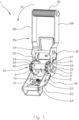
- Fig. 1
- shows a perspective view of a tightening device according to the invention in a first operation mode/configuration;
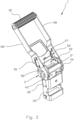
- Fig. 2
- shows another view of the tightening device in
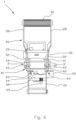
fig 1 ; - Fig. 3
- shows the tightening device in
fig. 1 seen from behind; - Fig. 4
- shows the tightening device in
fig. 2 in a second operation mode/configuration; - Fig. 5
- shows another view of the tightening device in
fig 2 , in a locked operation mode; - Fig. 6
- shows the tightening device in
fig. 5 seen from behind; and - Fig. 7
- shows an exploded view of the tightening device in
fig. 3 . - In the figures, positional indications such as for example left, right, and sideways, refer to the position shown in the figures.
- Same or corresponding elements are indicated by same reference numerals. For clarity reasons some elements may in some of the figures be without reference numerals.
- In the figures,
reference numeral 1 denotes a tightening device according to the present invention. Thetightening device 1 disclosed herein is a modification of a prior art tightening device and the skilled person will understand a basic principle of how a ratchet mechanism operates. The discussion hereinafter therefore mainly focuses on the inventive features of the tightening device. - The
tightening device 1 comprises arotatable spool 3 provided with anaperture 5 for receiving a line (not shown). In the embodiment shown, such a line will typically be a strap. Thespool 3 is constituted by two semi-circular rods 3' arranged in parallel and spaced apart to provide therotatable spool 3. - The
spool 3 is supported in a frame comprising two frame parts: abase frame 22; and adrive frame 26. Thedrive frame 26 is formed by twoparallel arms 28, 28' interconnected by aspacer bolt 29 and ahandle 30 comprising a bolt. Thebase frame 22 and thedrive frame 26 are interconnected by means of thespool 3 threaded through complementary and overlappingapertures 25 and 25' arranged in thebase frame 22 and each one of thearms 28, 28', respectively. Theapertures 25, 25' are best seen infig. 7 . - In the embodiment shown, the
spool 3 is locked to the frame 20 by means ofpins 33 extending through apertures 33' at each end portion of the semi-circular rod 3'. - A
ratchet mechanism 40, here in the form of fourratchet wheels spool 3. Each one of the ratchet wheels are provided with twosemi-circular apertures 47 as best seen infig. 7 configured for mating with the semi-circular rod 3' of thespool 3. Theratchet wheels spool 3. Theratchet wheels - In the embodiment shown with four
ratchet wheels wheels wheels - The first pair of
ratchet wheels ratchet wheels - A
drive pawl 50 is slidably coupled to aslot 27 in eacharm 28, 28' of thedrive member 26. Thedrive pawl 50 is configured for cooperating with theratchet mechanism 40. - The
drive pawl 50 comprises twoprotrusions 52 configured for engaging either the first set ofratchet wheels ratchet wheels protrusions 52 by sliding thedrive pawl 50 sideways between the twoarms 28, 28' of thedrive member 26. - To facilitate sideways sliding of the
drive pawl 50 to select which one of the sets of ratchet wheels to be engaged by theprotrusions 52, a length of theslot 27 is longer than the portion of thedrive pawl 50 extending through theslot 27. Thus, thedrive pawl 50 is configured for sliding both sideways between the twoarms 28, 28' of thedrive member 26, and radially with respect to theratchet mechanism 40 and thus thespool 3. - The
tightening device 1 is further provided with alocking mechanism 60 configured for keeping theratchet mechanism 40 in place during a return stroke of thehandle 30. Thelocking mechanism 60 is coupled toslots 23 in thebase frame 22 and is arranged sideways slidable within theslots 23. - The part of the
locking mechanism 60 facing theratchet mechanism 40 is provided with lockingprotrusions 62 configured for engaging either the first pair ofratchet wheels ratchet wheels protrusions 62 there is provided indents 64, 66. The purpose of theindents protrusions 52 of thedrive pawl 50. - The part of the
locking mechanism 60 facing away from theratchet mechanism 40 is provided with a resilient member, here in the form of aspring 70, to urge the lockingprotrusions 62 into engagement with either the first pair ofratchet wheels ratchet wheels spring 70 is carried by apin 69 protruding from thelocking mechanism 60, and thespring 70 abuts against a retainingelement 72 protruding from a portion of thebase frame 22. To allow sideways sliding of thelocking mechanism 60, the retainingelement 70 is provided with a slot for accommodating an end portion of thepin 69. - To allow inter alia a radial movement of the
locking mechanism 60 when theprotrusions 62 slide over a top of the teeth, a length of eachslot 23 is longer than the portion of thelocking mechanism 60 extending through theslots 23. Thus, thelocking mechanism 60 is configured for sliding both sideways within thebase frame 22, and radially with respect to theratchet mechanism 40 and thus thespool 3. In the embodiment shown, this radial movement of thelocking mechanism 60 is also provided by an operator when releasing a tension in a line tightened by thedevice 1. - Turning now to
figures 1 to 3 showing thetightening device 1 in a first or "push" configuration. Thedrive pawl 50 has been slid to the right infigures 1 and2 (and thus to the left infig. 3 wherein thedevice 1 is seen from behind). In this position, theprotrusions 52 of thedrive pawl 50 engage the first set ofratchet wheels drive frame 26 is urged in the direction of the arrow D1 shown infig. 1 , theratchet mechanism 40 and thus thespool 3 is rotated counterclockwise with respect to the view infig. 1 . During a return stroke (in an opposite direction of the arrow D1), thedrive pawl 50 moves radially back and forth with respect to theratchet mechanism 40 as theprotrusions 52 pass over the teeth of theratchet wheels drive pawl 50 is urged radially towards theratchet mechanism 50 by means of a biasing means, here in the form of apin member 54 protruding from thearm 28 and engages anaperture 56 in thedrive pawl 50. - As best seen in
fig. 2 , a periphery of the second pair ofratchet wheels indents 64 of thelocking mechanism 60 so thatratchet wheels locking mechanism 60. Thus, in this "push" configuration, the second pair ofratchet wheels protrusions 52 of thedrive pawl 50, nor the lockingdevice 60. The second pair of ratchet wheels is in a passive mode. - In
fig. 3 is also shown a struttingmember 3" secured to thebase frame 22 for example by means of a weld. A purpose of the struttingmember 3" is to stabilize the portion of thebase frame 22 surrounding theapertures 25. Theapertures 25 are best seen infig. 7 . - To prevent the
ratchet mechanism 40 and thus thespool 3 from rotating during a return stroke, i.e. a stroke in the opposite direction of the arrow D1 infig. 1 , thelocking mechanism 60 has also been slid to the right infigures 1 and2 (and thus to the left infig. 3 wherein thedevice 1 is seen from behind). In this position, theprotrusions 62 of thelocking mechanism 60 engages the first set ofratchet wheels ratchet mechanism 40 and thus thespool 3 from rotating. - In
fig. 4 , thetightening device 1 is in a second or "pull" configuration. Thedrive pawl 50 has been slid to the left. In this position, theprotrusions 52 of the drive pawl engage the second set ofratchet wheels drive frame 26 is urged in the opposite direction of the arrow D1 shown infig. 1 , theratchet mechanism 40 and thus thespool 3 is rotated clockwise whenspool 3 is seen from right to left. During a return stroke (which infig. 4 will be in the same direction as the arrow D1 infig. 1 ), thedrive pawl 50 moves radially back and forth with respect to the ratchet mechanism as theprotrusions 52 pass over the teeth of theratchet wheels - To prevent the
ratchet mechanism 40 and thus thespool 3 from rotating during a return stroke in the "pull" configuration shown infig. 4 , thelocking mechanism 60 has also been slid to the left. In this position, theprotrusions 62 of thelocking mechanism 60 engage the second set ofratchet wheels ratchet mechanism 40 and thus thespool 3, from rotating. - In the embodiment shown in
figures 5 and6 , the tightening device is in a locked configuration. Theprotrusions 52 of thedrive pawl 50 engage the second set ofratchet wheels locking mechanism 60 is oriented so that theprotrusions 62 engage the first set ofratchet wheels ratchet mechanism 40 and thespool 3 are therefore prevented from rotating, and thedrive frame 26 is prevented from movement with respect to the rest of thetightening device 1. The configuration shown infigures 4 and6 may be important when there is a need for safe locking of the tightening device. -
Fig. 7 is a principle exploded view of the tightening device shown infig. 3 . - It should be noted that the above-mentioned embodiments illustrate rather than limit the invention, and that those skilled in the art will be able to design many alternative embodiments without departing from the scope of the appended claims. In the claims, any reference signs placed between parentheses shall not be construed as limiting the claim. Use of the verb "comprise" and its conjugations does not exclude the presence of elements or steps other than those stated in a claim. The article "a" or "an" preceding an element does not exclude the presence of a plurality of such elements.
Claims (9)
- A bi-directional tightening device (1) for tightening of a threadable line, the tightening device (1) comprising:- a rotatable spool (3) provided with an aperture (5) for receiving the line;- a frame (22, 26) for supporting the spool, the frame comprising a handle (30) for rotating the spool (3);- a ratchet mechanism (40) rotationally fixed to the spool (3);- a drive pawl (50) coupled to the frame (26) and configured to engage the ratchet mechanism (40) when the handle (30) is stroked to rotate the spool (3);- a locking mechanism (60) configured for keeping the ratchet mechanism (40) in place during a return stroke of the handle,the ratchet mechanism (40) comprising at least one first ratchet wheel (41, 42) for rotating the spool (3) in a first direction, and at least one second ratchet wheel (43, 44) for rotating the spool (3) in a second direction opposite the first direction,characterised in that the drive pawl (50) and the locking mechanism (60) is sideways and radially displaceable, and provided with protrusions (52, 62) configured for selectively engaging either one of the ratchet wheels ( 41, 42; 43, 44), to allow bi-directional tightening of the line.
- The tightening device (1) according to claim 1, wherein the at least one first ratchet wheel (41, 42) comprises a set of two first ratchet wheels, and the at least one second ratchet wheel (43, 44) comprises a set of two second ratchet wheels.
- The tightening device (1) according to claim 2, wherein the first ratchet wheels (41, 42) and the second ratchet wheels (43, 44) are arranged alternating along a longitudinal axis of the spool (3).
- The tightening device (1) according to any one of the preceding claims, wherein the drive pawl (50) and the locking mechanism (60) are configured for being operated independently of each other.
- Method of operating of a bi-directional tightening device (1) according to any one of the preceding claims, characterised in that the method comprises:- bringing the drive pawl (50) into engagement with one of: the ratchet wheel for rotating the spool (3) in the first direction; and the ratchet wheel for rotating the spool (3) in the second direction;- bringing the locking mechanism (60) into engagement with one of: the ratchet wheel for rotating the spool in the first direction; and the ratchet wheel for rotating the spool in the second direction.
- The method according to claim 5, wherein the method comprises arranging the locking mechanism (60) into engagement with the same ratchet wheel as the drive pawl (50) to provide a tightening device (1) operable in a push or a pull mode.
- The method according to claim 5, wherein the method comprises arranging the locking mechanism (60) into engagement with the opposite ratchet wheel as the drive pawl (50) to provide a locking of the tightening device (1).
- The method according to any one of the claims 5-7, wherein the drive pawl (50) and the locking mechanism (60) are operated after a line has been threaded onto the spool (3).
- The method according to claim 5, wherein the method further comprising slackening of a threaded line in a controlled manner by releasing the drive pawl (50) and the locking mechanism (60) from engagement with one of the first and second ratchet wheel to the other one of the second and first ratchet wheel; and slackening of the line by means of operating the handle (30) of the frame (26).
Applications Claiming Priority (2)
| Application Number | Priority Date | Filing Date | Title |
|---|---|---|---|
| NO20200121A NO20200121A1 (en) | 2020-01-31 | 2020-01-31 | A bi-directional tightening device for tightening of a threadable line, and a method for operating the bi-directional tightening device |
| PCT/NO2021/050001 WO2021154084A1 (en) | 2020-01-31 | 2021-01-06 | A bi-directional tightening device for tightening of a threadable line, and a method for operating the bi-directional tightening device |
Publications (3)
| Publication Number | Publication Date |
|---|---|
| EP4096963A1 EP4096963A1 (en) | 2022-12-07 |
| EP4096963A4 EP4096963A4 (en) | 2024-03-06 |
| EP4096963B1 true EP4096963B1 (en) | 2024-11-27 |
Family
ID=74871861
Family Applications (1)
| Application Number | Title | Priority Date | Filing Date |
|---|---|---|---|
| EP21747150.7A Active EP4096963B1 (en) | 2020-01-31 | 2021-01-06 | A bi-directional tightening device for tightening of a threadable line, and a method for operating the bi-directional tightening device |
Country Status (7)
| Country | Link |
|---|---|
| US (1) | US12054088B2 (en) |
| EP (1) | EP4096963B1 (en) |
| DK (1) | DK4096963T3 (en) |
| ES (1) | ES3013332T3 (en) |
| FI (1) | FI4096963T3 (en) |
| NO (1) | NO20200121A1 (en) |
| WO (1) | WO2021154084A1 (en) |
Families Citing this family (3)
| Publication number | Priority date | Publication date | Assignee | Title |
|---|---|---|---|---|
| CN110950194B (en) * | 2019-12-16 | 2024-10-25 | 泰州润杰物流安全装备科技有限公司 | A safety control belt tightening device |
| EP4499460A4 (en) * | 2022-03-29 | 2026-02-25 | Indiana Mills & Mfg | Ratchet web construction roller with removable track tension limiter |
| USD1123586S1 (en) * | 2024-05-16 | 2026-04-28 | Unity Tactical, Llc | Accessory rail clamping device |
Family Cites Families (6)
| Publication number | Priority date | Publication date | Assignee | Title |
|---|---|---|---|---|
| US1401739A (en) | 1920-06-05 | 1921-12-27 | George W Scofield | Wire-stretcher |
| US6195848B1 (en) * | 1998-08-14 | 2001-03-06 | Usa Products | Slidable ratchet tensioning device and tie-down assembly |
| US7207089B2 (en) * | 2003-12-11 | 2007-04-24 | Burton Warren Hanson | Bi-directional load securing ratchet method and apparatus |
| DE102005031735B3 (en) | 2005-07-05 | 2007-05-10 | Spanset Inter Ag | Clamping ratchet for clamping and holding clamping devices |
| US8499662B2 (en) | 2011-01-04 | 2013-08-06 | Win Chance Metal Co., Ltd. | Pull handle structure of a hand puller |
| DE102012110036B4 (en) * | 2012-10-20 | 2014-12-11 | Win Chance Metal Co., Ltd. | jig |
-
2020
- 2020-01-31 NO NO20200121A patent/NO20200121A1/en unknown
-
2021
- 2021-01-06 US US17/796,150 patent/US12054088B2/en active Active
- 2021-01-06 FI FIEP21747150.7T patent/FI4096963T3/en active
- 2021-01-06 EP EP21747150.7A patent/EP4096963B1/en active Active
- 2021-01-06 WO PCT/NO2021/050001 patent/WO2021154084A1/en not_active Ceased
- 2021-01-06 DK DK21747150.7T patent/DK4096963T3/en active
- 2021-01-06 ES ES21747150T patent/ES3013332T3/en active Active
Also Published As
| Publication number | Publication date |
|---|---|
| NO345492B1 (en) | 2021-03-08 |
| NO20200121A1 (en) | 2021-03-08 |
| DK4096963T3 (en) | 2025-02-24 |
| EP4096963A4 (en) | 2024-03-06 |
| EP4096963A1 (en) | 2022-12-07 |
| ES3013332T3 (en) | 2025-04-11 |
| US12054088B2 (en) | 2024-08-06 |
| FI4096963T3 (en) | 2025-03-04 |
| US20230103711A1 (en) | 2023-04-06 |
| WO2021154084A1 (en) | 2021-08-05 |
Similar Documents
| Publication | Publication Date | Title |
|---|---|---|
| EP4096963B1 (en) | A bi-directional tightening device for tightening of a threadable line, and a method for operating the bi-directional tightening device | |
| US6195848B1 (en) | Slidable ratchet tensioning device and tie-down assembly | |
| US8152139B2 (en) | Chain load binder (Ausbinder) | |
| EP2755858B1 (en) | Side-loading ratchet device | |
| EP2688767B1 (en) | Load-strapping device | |
| US20070189873A1 (en) | Retractable self-contained tie-down | |
| US9102259B2 (en) | Chain winch apparatus and methods of using the same | |
| US20170369000A1 (en) | Bicycle-Carrying Device For Motor Vehicles | |
| EP3268246B1 (en) | Load-strapping device | |
| US7682114B2 (en) | Parallel shaft strap tie down apparatus and system | |
| US6539590B2 (en) | Seat belt tightner | |
| US5746554A (en) | Tie-down method for vehicle transporter | |
| AU2021209678B2 (en) | Locking cargo restraint with multiple retracting cables | |
| US5441371A (en) | Multiple winch mounting on a vehicle trailer | |
| WO2006124262A2 (en) | Strap tie down apparatus and system | |
| EP2008867B1 (en) | Strap tensioner | |
| JP3568028B2 (en) | Luggage fixing device | |
| EP0408621A1 (en) | Strap tightening device | |
| AU2006301899B2 (en) | Chain Load Binder (Ausbinder) | |
| JP3221776U (en) | Rushing belt | |
| KR100294579B1 (en) | Shaft load space distance control apparatus of shassis | |
| HK1247165B (en) | Load-strapping device | |
| CA2339431A1 (en) | Tie-down attachment for transporting snowmobiles and the like | |
| EP2496443A1 (en) | Belt tensioner, particularly of the type for retaining loads to bodies of trucks and the like |
Legal Events
| Date | Code | Title | Description |
|---|---|---|---|
| STAA | Information on the status of an ep patent application or granted ep patent |
Free format text: STATUS: THE INTERNATIONAL PUBLICATION HAS BEEN MADE |
|
| PUAI | Public reference made under article 153(3) epc to a published international application that has entered the european phase |
Free format text: ORIGINAL CODE: 0009012 |
|
| STAA | Information on the status of an ep patent application or granted ep patent |
Free format text: STATUS: REQUEST FOR EXAMINATION WAS MADE |
|
| 17P | Request for examination filed |
Effective date: 20220725 |
|
| AK | Designated contracting states |
Kind code of ref document: A1 Designated state(s): AL AT BE BG CH CY CZ DE DK EE ES FI FR GB GR HR HU IE IS IT LI LT LU LV MC MK MT NL NO PL PT RO RS SE SI SK SM TR |
|
| DAV | Request for validation of the european patent (deleted) | ||
| DAX | Request for extension of the european patent (deleted) | ||
| A4 | Supplementary search report drawn up and despatched |
Effective date: 20240205 |
|
| RIC1 | Information provided on ipc code assigned before grant |
Ipc: B65B 13/22 20060101ALI20240130BHEP Ipc: B25B 25/00 20060101ALI20240130BHEP Ipc: B60P 7/06 20060101ALI20240130BHEP Ipc: B60P 7/08 20060101AFI20240130BHEP |
|
| GRAP | Despatch of communication of intention to grant a patent |
Free format text: ORIGINAL CODE: EPIDOSNIGR1 |
|
| STAA | Information on the status of an ep patent application or granted ep patent |
Free format text: STATUS: GRANT OF PATENT IS INTENDED |
|
| INTG | Intention to grant announced |
Effective date: 20240715 |
|
| GRAS | Grant fee paid |
Free format text: ORIGINAL CODE: EPIDOSNIGR3 |
|
| GRAA | (expected) grant |
Free format text: ORIGINAL CODE: 0009210 |
|
| STAA | Information on the status of an ep patent application or granted ep patent |
Free format text: STATUS: THE PATENT HAS BEEN GRANTED |
|
| AK | Designated contracting states |
Kind code of ref document: B1 Designated state(s): AL AT BE BG CH CY CZ DE DK EE ES FI FR GB GR HR HU IE IS IT LI LT LU LV MC MK MT NL NO PL PT RO RS SE SI SK SM TR |
|
| REG | Reference to a national code |
Ref country code: GB Ref legal event code: FG4D |
|
| REG | Reference to a national code |
Ref country code: CH Ref legal event code: EP |
|
| REG | Reference to a national code |
Ref country code: IE Ref legal event code: FG4D |
|
| REG | Reference to a national code |
Ref country code: DE Ref legal event code: R096 Ref document number: 602021022482 Country of ref document: DE |
|
| REG | Reference to a national code |
Ref country code: DK Ref legal event code: T3 Effective date: 20250221 |
|
| REG | Reference to a national code |
Ref country code: FI Ref legal event code: FGE |
|
| REG | Reference to a national code |
Ref country code: SE Ref legal event code: TRGR |
|
| REG | Reference to a national code |
Ref country code: LT Ref legal event code: MG9D |
|
| REG | Reference to a national code |
Ref country code: NL Ref legal event code: MP Effective date: 20241127 |
|
| PG25 | Lapsed in a contracting state [announced via postgrant information from national office to epo] |
Ref country code: IS Free format text: LAPSE BECAUSE OF FAILURE TO SUBMIT A TRANSLATION OF THE DESCRIPTION OR TO PAY THE FEE WITHIN THE PRESCRIBED TIME-LIMIT Effective date: 20250327 Ref country code: HR Free format text: LAPSE BECAUSE OF FAILURE TO SUBMIT A TRANSLATION OF THE DESCRIPTION OR TO PAY THE FEE WITHIN THE PRESCRIBED TIME-LIMIT Effective date: 20241127 Ref country code: PT Free format text: LAPSE BECAUSE OF FAILURE TO SUBMIT A TRANSLATION OF THE DESCRIPTION OR TO PAY THE FEE WITHIN THE PRESCRIBED TIME-LIMIT Effective date: 20250327 |
|
| REG | Reference to a national code |
Ref country code: ES Ref legal event code: FG2A Ref document number: 3013332 Country of ref document: ES Kind code of ref document: T3 Effective date: 20250411 |
|
| PG25 | Lapsed in a contracting state [announced via postgrant information from national office to epo] |
Ref country code: NL Free format text: LAPSE BECAUSE OF FAILURE TO SUBMIT A TRANSLATION OF THE DESCRIPTION OR TO PAY THE FEE WITHIN THE PRESCRIBED TIME-LIMIT Effective date: 20241127 |
|
| REG | Reference to a national code |
Ref country code: AT Ref legal event code: MK05 Ref document number: 1745420 Country of ref document: AT Kind code of ref document: T Effective date: 20241127 |
|
| PG25 | Lapsed in a contracting state [announced via postgrant information from national office to epo] |
Ref country code: BG Free format text: LAPSE BECAUSE OF FAILURE TO SUBMIT A TRANSLATION OF THE DESCRIPTION OR TO PAY THE FEE WITHIN THE PRESCRIBED TIME-LIMIT Effective date: 20241127 |
|
| PG25 | Lapsed in a contracting state [announced via postgrant information from national office to epo] |
Ref country code: NO Free format text: LAPSE BECAUSE OF FAILURE TO SUBMIT A TRANSLATION OF THE DESCRIPTION OR TO PAY THE FEE WITHIN THE PRESCRIBED TIME-LIMIT Effective date: 20250227 |
|
| PG25 | Lapsed in a contracting state [announced via postgrant information from national office to epo] |
Ref country code: GR Free format text: LAPSE BECAUSE OF FAILURE TO SUBMIT A TRANSLATION OF THE DESCRIPTION OR TO PAY THE FEE WITHIN THE PRESCRIBED TIME-LIMIT Effective date: 20250228 Ref country code: AT Free format text: LAPSE BECAUSE OF FAILURE TO SUBMIT A TRANSLATION OF THE DESCRIPTION OR TO PAY THE FEE WITHIN THE PRESCRIBED TIME-LIMIT Effective date: 20241127 Ref country code: LV Free format text: LAPSE BECAUSE OF FAILURE TO SUBMIT A TRANSLATION OF THE DESCRIPTION OR TO PAY THE FEE WITHIN THE PRESCRIBED TIME-LIMIT Effective date: 20241127 |
|
| PG25 | Lapsed in a contracting state [announced via postgrant information from national office to epo] |
Ref country code: PL Free format text: LAPSE BECAUSE OF FAILURE TO SUBMIT A TRANSLATION OF THE DESCRIPTION OR TO PAY THE FEE WITHIN THE PRESCRIBED TIME-LIMIT Effective date: 20241127 |
|
| PG25 | Lapsed in a contracting state [announced via postgrant information from national office to epo] |
Ref country code: RS Free format text: LAPSE BECAUSE OF FAILURE TO SUBMIT A TRANSLATION OF THE DESCRIPTION OR TO PAY THE FEE WITHIN THE PRESCRIBED TIME-LIMIT Effective date: 20250227 |
|
| PG25 | Lapsed in a contracting state [announced via postgrant information from national office to epo] |
Ref country code: SM Free format text: LAPSE BECAUSE OF FAILURE TO SUBMIT A TRANSLATION OF THE DESCRIPTION OR TO PAY THE FEE WITHIN THE PRESCRIBED TIME-LIMIT Effective date: 20241127 |
|
| PG25 | Lapsed in a contracting state [announced via postgrant information from national office to epo] |
Ref country code: EE Free format text: LAPSE BECAUSE OF FAILURE TO SUBMIT A TRANSLATION OF THE DESCRIPTION OR TO PAY THE FEE WITHIN THE PRESCRIBED TIME-LIMIT Effective date: 20241127 |
|
| PG25 | Lapsed in a contracting state [announced via postgrant information from national office to epo] |
Ref country code: RO Free format text: LAPSE BECAUSE OF FAILURE TO SUBMIT A TRANSLATION OF THE DESCRIPTION OR TO PAY THE FEE WITHIN THE PRESCRIBED TIME-LIMIT Effective date: 20241127 |
|
| PG25 | Lapsed in a contracting state [announced via postgrant information from national office to epo] |
Ref country code: SK Free format text: LAPSE BECAUSE OF FAILURE TO SUBMIT A TRANSLATION OF THE DESCRIPTION OR TO PAY THE FEE WITHIN THE PRESCRIBED TIME-LIMIT Effective date: 20241127 |
|
| PG25 | Lapsed in a contracting state [announced via postgrant information from national office to epo] |
Ref country code: CZ Free format text: LAPSE BECAUSE OF FAILURE TO SUBMIT A TRANSLATION OF THE DESCRIPTION OR TO PAY THE FEE WITHIN THE PRESCRIBED TIME-LIMIT Effective date: 20241127 |
|
| PG25 | Lapsed in a contracting state [announced via postgrant information from national office to epo] |
Ref country code: IT Free format text: LAPSE BECAUSE OF FAILURE TO SUBMIT A TRANSLATION OF THE DESCRIPTION OR TO PAY THE FEE WITHIN THE PRESCRIBED TIME-LIMIT Effective date: 20241127 |
|
| REG | Reference to a national code |
Ref country code: DE Ref legal event code: R097 Ref document number: 602021022482 Country of ref document: DE |
|
| REG | Reference to a national code |
Ref country code: CH Ref legal event code: PL |
|
| PG25 | Lapsed in a contracting state [announced via postgrant information from national office to epo] |
Ref country code: LU Free format text: LAPSE BECAUSE OF NON-PAYMENT OF DUE FEES Effective date: 20250106 Ref country code: MC Free format text: LAPSE BECAUSE OF FAILURE TO SUBMIT A TRANSLATION OF THE DESCRIPTION OR TO PAY THE FEE WITHIN THE PRESCRIBED TIME-LIMIT Effective date: 20241127 |
|
| PLBE | No opposition filed within time limit |
Free format text: ORIGINAL CODE: 0009261 |
|
| STAA | Information on the status of an ep patent application or granted ep patent |
Free format text: STATUS: NO OPPOSITION FILED WITHIN TIME LIMIT |
|
| PG25 | Lapsed in a contracting state [announced via postgrant information from national office to epo] |
Ref country code: BE Free format text: LAPSE BECAUSE OF NON-PAYMENT OF DUE FEES Effective date: 20250131 |
|
| PG25 | Lapsed in a contracting state [announced via postgrant information from national office to epo] |
Ref country code: CH Free format text: LAPSE BECAUSE OF NON-PAYMENT OF DUE FEES Effective date: 20250131 |
|
| REG | Reference to a national code |
Ref country code: BE Ref legal event code: MM Effective date: 20250131 |
|
| 26N | No opposition filed |
Effective date: 20250828 |
|
| PG25 | Lapsed in a contracting state [announced via postgrant information from national office to epo] |
Ref country code: IE Free format text: LAPSE BECAUSE OF NON-PAYMENT OF DUE FEES Effective date: 20250106 |
|
| PGFP | Annual fee paid to national office [announced via postgrant information from national office to epo] |
Ref country code: SE Payment date: 20260114 Year of fee payment: 6 |
|
| PGFP | Annual fee paid to national office [announced via postgrant information from national office to epo] |
Ref country code: GB Payment date: 20260114 Year of fee payment: 6 |
|
| PGFP | Annual fee paid to national office [announced via postgrant information from national office to epo] |
Ref country code: ES Payment date: 20260226 Year of fee payment: 6 |
|
| PGFP | Annual fee paid to national office [announced via postgrant information from national office to epo] |
Ref country code: DK Payment date: 20260114 Year of fee payment: 6 Ref country code: DE Payment date: 20260115 Year of fee payment: 6 |
|
| PGFP | Annual fee paid to national office [announced via postgrant information from national office to epo] |
Ref country code: FI Payment date: 20260114 Year of fee payment: 6 |
|
| PGFP | Annual fee paid to national office [announced via postgrant information from national office to epo] |
Ref country code: FR Payment date: 20260114 Year of fee payment: 6 |