EP4096380B1 - Compact electronic power converter to control at least one electric motor of a vehicle - Google Patents
Compact electronic power converter to control at least one electric motor of a vehicle Download PDFInfo
- Publication number
- EP4096380B1 EP4096380B1 EP22174645.6A EP22174645A EP4096380B1 EP 4096380 B1 EP4096380 B1 EP 4096380B1 EP 22174645 A EP22174645 A EP 22174645A EP 4096380 B1 EP4096380 B1 EP 4096380B1
- Authority
- EP
- European Patent Office
- Prior art keywords
- power converter
- electronic power
- frame
- group
- pile
- Prior art date
- Legal status (The legal status is an assumption and is not a legal conclusion. Google has not performed a legal analysis and makes no representation as to the accuracy of the status listed.)
- Active
Links
Images




Classifications
-
- H—ELECTRICITY
- H05—ELECTRIC TECHNIQUES NOT OTHERWISE PROVIDED FOR
- H05K—PRINTED CIRCUITS; CASINGS OR CONSTRUCTIONAL DETAILS OF ELECTRIC APPARATUS; MANUFACTURE OF ASSEMBLAGES OF ELECTRICAL COMPONENTS
- H05K7/00—Constructional details common to different types of electric apparatus
- H05K7/20—Modifications to facilitate cooling, ventilating, or heating
- H05K7/2089—Modifications to facilitate cooling, ventilating, or heating for power electronics, e.g. for inverters for controlling motor
- H05K7/20927—Liquid coolant without phase change
-
- H—ELECTRICITY
- H02—GENERATION; CONVERSION OR DISTRIBUTION OF ELECTRIC POWER
- H02M—APPARATUS FOR CONVERSION BETWEEN AC AND AC, BETWEEN AC AND DC, OR BETWEEN DC AND DC, AND FOR USE WITH MAINS OR SIMILAR POWER SUPPLY SYSTEMS; CONVERSION OF DC OR AC INPUT POWER INTO SURGE OUTPUT POWER; CONTROL OR REGULATION THEREOF
- H02M7/00—Conversion of AC power input into DC power output; Conversion of DC power input into AC power output
- H02M7/66—Conversion of AC power input into DC power output; Conversion of DC power input into AC power output with possibility of reversal
-
- B—PERFORMING OPERATIONS; TRANSPORTING
- B60—VEHICLES IN GENERAL
- B60L—PROPULSION OF ELECTRICALLY-PROPELLED VEHICLES; SUPPLYING ELECTRIC POWER FOR AUXILIARY EQUIPMENT OF ELECTRICALLY-PROPELLED VEHICLES; ELECTRODYNAMIC BRAKE SYSTEMS FOR VEHICLES IN GENERAL; MAGNETIC SUSPENSION OR LEVITATION FOR VEHICLES; MONITORING OPERATING VARIABLES OF ELECTRICALLY-PROPELLED VEHICLES; ELECTRIC SAFETY DEVICES FOR ELECTRICALLY-PROPELLED VEHICLES
- B60L50/00—Electric propulsion with power supplied within the vehicle
- B60L50/50—Electric propulsion with power supplied within the vehicle using propulsion power supplied by batteries or fuel cells
- B60L50/51—Electric propulsion with power supplied within the vehicle using propulsion power supplied by batteries or fuel cells characterised by AC-motors
-
- H—ELECTRICITY
- H02—GENERATION; CONVERSION OR DISTRIBUTION OF ELECTRIC POWER
- H02M—APPARATUS FOR CONVERSION BETWEEN AC AND AC, BETWEEN AC AND DC, OR BETWEEN DC AND DC, AND FOR USE WITH MAINS OR SIMILAR POWER SUPPLY SYSTEMS; CONVERSION OF DC OR AC INPUT POWER INTO SURGE OUTPUT POWER; CONTROL OR REGULATION THEREOF
- H02M1/00—Details of apparatus for conversion
-
- H—ELECTRICITY
- H05—ELECTRIC TECHNIQUES NOT OTHERWISE PROVIDED FOR
- H05K—PRINTED CIRCUITS; CASINGS OR CONSTRUCTIONAL DETAILS OF ELECTRIC APPARATUS; MANUFACTURE OF ASSEMBLAGES OF ELECTRICAL COMPONENTS
- H05K7/00—Constructional details common to different types of electric apparatus
- H05K7/14—Mounting supporting structure in casing or on frame or rack
- H05K7/1401—Mounting supporting structure in casing or on frame or rack comprising clamping or extracting means
-
- H—ELECTRICITY
- H05—ELECTRIC TECHNIQUES NOT OTHERWISE PROVIDED FOR
- H05K—PRINTED CIRCUITS; CASINGS OR CONSTRUCTIONAL DETAILS OF ELECTRIC APPARATUS; MANUFACTURE OF ASSEMBLAGES OF ELECTRICAL COMPONENTS
- H05K7/00—Constructional details common to different types of electric apparatus
- H05K7/20—Modifications to facilitate cooling, ventilating, or heating
- H05K7/20845—Modifications to facilitate cooling, ventilating, or heating for automotive electronic casings
- H05K7/20872—Liquid coolant without phase change
-
- B—PERFORMING OPERATIONS; TRANSPORTING
- B60—VEHICLES IN GENERAL
- B60L—PROPULSION OF ELECTRICALLY-PROPELLED VEHICLES; SUPPLYING ELECTRIC POWER FOR AUXILIARY EQUIPMENT OF ELECTRICALLY-PROPELLED VEHICLES; ELECTRODYNAMIC BRAKE SYSTEMS FOR VEHICLES IN GENERAL; MAGNETIC SUSPENSION OR LEVITATION FOR VEHICLES; MONITORING OPERATING VARIABLES OF ELECTRICALLY-PROPELLED VEHICLES; ELECTRIC SAFETY DEVICES FOR ELECTRICALLY-PROPELLED VEHICLES
- B60L2210/00—Converter types
- B60L2210/40—DC to AC converters
Definitions
- the invention relates to an electronic power converter to control at least one electric motor of a vehicle.
- a vehicle can be provided with one single electric motor or with several electric motors (in which case, the drive is a full electric drive) or it can be provided with one or more electric motors combined with a combustion engine (in which case, the drive can be a full electric drive, a combustion drive or a hybrid drive).
- the electric motor (or each electric motor) is mechanically connected to the drive wheels and is electrically connected to a power storage system through the interposition of an electronic power converter (namely, an "inverter” ) , which turns DC power (on the side connected to the storage system) into AC power (on the side connected to the electric motor) and vice versa.
- an electronic power converter namely, an "inverter”
- the object of the invention is to provide an electronic power converter to control at least one electric motor of a vehicle, said electronic power converter being easily adjustable to the control of electric motors of different sizes, being compact and being, at the same time, easy and economic to be manufactured.
- an electronic power converter to control at least one electric motor of a vehicle according to the appended claims.
- number 1 indicates, as a whole, an electric drive vehicle provided with four drive wheels 2 (two front drive wheels 2 and two rear drive wheels 2).
- the vehicle 1 comprises an electric powertrain system 3, which is arranged in a front position (namely, is connected to the two front drive wheels 2), and an electric powertrain system 3, which is arranged in a rear position (namely, is connected to the two rear drive wheels 2), is structurally identical to the electric powertrain system 3 arranged in a front position and is mechanically independent of and separate from the electric powertrain system 3 arranged in a front position.
- the vehicle 1 comprises one single electric powertrain system 3 (arranged in a front position or arranged in a rear position) and, therefore, it only has two drive wheels 2; in this embodiment, the vehicle 1 could also comprise a combustion powertrain system connected to the drive wheels 2 that do not receive the motion from the electric powertrain system 3 and the combustion powertrain system could be provided with a further electric motor 4 connected to the drive shaft of an internal combustion engine.
- Each electric powertrain system 3 comprises a pair of reversible electric motors 4 (i.e. which can work both as eclectic motor, absorbing electrical energy and generating a mechanical torque, and as electric generator, absorbing mechanical energy and generating electrical energy) provided with respective shafts and a pair of drivetrains 5, which connect the electric motors 4 (namely, the shafts of the electric motors 4) to the corresponding drive wheels 2 without the interposition of a clutch.
- a pair of reversible electric motors 4 i.e. which can work both as eclectic motor, absorbing electrical energy and generating a mechanical torque, and as electric generator, absorbing mechanical energy and generating electrical energy
- each electric motor 4 is controlled by an AC/DC electronic power converter 6 (namely, an "inverter”), which is connected to a power storage system 7 provided with chemical batteries; namely, each electronic power converter 6 is a two-way converter and comprises a DC side, which is connected to the power storage system 7, and a three-phase AC side, which is connected to at least one electric motor 4.
- AC/DC electronic power converter 6 namely, an "inverter”
- each electronic power converter 6 is a two-way converter and comprises a DC side, which is connected to the power storage system 7, and a three-phase AC side, which is connected to at least one electric motor 4.
- the power storage system 7 has a flat and (relatively) thin conformation so that it can be integrated inside the floor of the vehicle 1.
- a high-voltage electric system 8 of the vehicle 1 comprises three electronic power converters 6, which are structurally identical to one another: one single front electronic power converter 6 powers both front electric motors 4, whereas two rear electronic power converters 6 each power one single rear electric motor 4. Since the three electronic power converters 6 are structurally identical to one another, the front electric motors 4 evidently have a single nominal power (relative to the rear electric motors 4), whereas the rear electric motors 4 have a double nominal power (relative to the front electric motors 4); in other words, the rear electric motors 4 have a nominal power that is twice the one of the front electric motors 4, namely the front electric motors 4 have a nominal power that is half the one of the rear electric motors 4.
- each electronic power converter 6 (both the front one and the rear ones) comprises six power modules 11, each designed to power with an alternating current one single phase of a corresponding electric motor 4; namely, each power module 11 represents one single "leg" of a three-phase inverter.
- the six power modules 11 are divided into a group 12 consisting of three power modules 11, which are arranged next to one another on a same plane, and a group 13 consisting of the other three power modules 11, which are arranged next to one another on a same plane, which is parallel to and separate from the plane of the group 12.
- the control unit 18 is configured to operate according to a first mode (shown in figure 4 and relating to the two rear electronic power converter 6), in which the electronic power converter 6 controls one single electric motor 4 with a double nominal power and each phase of the electric motor 4 is powered in parallel by a power module 11 of the group 12 and by a power module 11 of the group 13, or to operate according to a second mode (shown in figure 5 and relating to the front electronic power converter 6), in which two different electric motors 4 with a single nominal power are controlled and each power module 11 of the group 12 powers a corresponding phase of an electric motor 4 and each power module 11 of the group 13 powers a corresponding phase of the other electric motor 4.
- a first mode shown in figure 4 and relating to the two rear electronic power converter 6
- the electronic power converter 6 controls one single electric motor 4 with a double nominal power and each phase of the electric motor 4 is powered in parallel by a power module 11 of the group 12 and by a power module 11 of the group 13, or to operate according to a second mode (shown in figure
- the electronic power converter 6 only comprises the group 12 of power modules 11 and there are neither the group 13 of power modules 11 nor the central plate 20; namely, there are only the two lateral plates 20 arranged at the two opposite ends of the single group of power modules 11.
- each elastic element 26 the frame 28 consists of a flat plate, from which the two pressing members 29 (opposite and next to one another) project in a direction and from which the four appendages 30 project in an opposite direction.
- each pressing member 29 forms an obtuse angle with the frame 28 and is "L"-shaped with a rounded corner.
- each clamping system 25 comprises a plurality of elastic elements 32 consisting of "C"-shaped springs made of steel, each pressing on the two lateral plates 20 to push the two lateral plates 20 towards one another with a predetermined elastic force.
- the elastic elements 32 are arranged next to the power modules 11, namely half the elastic elements 32 are arranged on one side of the pile 17 and the other half of the elastic elements 32 are arranged on the other side of the pile 17; in particular, the elastic elements 32 (namely, the springs) are each arranged next to at least one power module 11, namely the elastic elements 32 are arranged in the areas where there are no power modules 11.
- each clamping system 25 totally comprises eight elastic elements 32 (springs) arranged four on one side of the pile 17 and four on the other side of the pile 17.
- each clamping system 25 comprises two coupling elements 33, each having an inner surface, which directly rests against a corresponding lateral plate 20, and an outer surface (opposite the inner surface), against which the ends of the corresponding elastic elements 32 (springs) directly rest.
- the two coupling elements 33 are arranged at the opposite ends of the pile 17 in order to hold the pile 17 together.
- the function of the coupling elements 33 is that of properly distributing the clamping force applied by the elastic elements 32, preventing the ends of the elastic elements 32 from directly stressing the lateral plates 20.
- each structure has two through openings arranged on the opposite sides of the central area of the structure; the two through openings give the structure a cross-like shape, which allows the clamping force applied by the elastic elements 32 to be directed towards the central area of the lateral plates 20.
- the electronic power converter 6 described above has an arrangement that optimizes the cooling of all those components which, in use, generate a lot of heat (mainly, the six power modules 11), namely it cools the six power modules 11 in an effective manner (ensuring that their work temperature never is too high) and, at the same time, also in an efficient manner (namely, using a reduced cooling liquid flow rate).
- the electronic power converter 6 described above ensures relatively low costs as well as a relatively small manufacturing complexity.
Landscapes
- Engineering & Computer Science (AREA)
- Microelectronics & Electronic Packaging (AREA)
- Physics & Mathematics (AREA)
- Thermal Sciences (AREA)
- Power Engineering (AREA)
- Sustainable Energy (AREA)
- Sustainable Development (AREA)
- Life Sciences & Earth Sciences (AREA)
- Transportation (AREA)
- Mechanical Engineering (AREA)
- Electric Propulsion And Braking For Vehicles (AREA)
- Arrangement Or Mounting Of Propulsion Units For Vehicles (AREA)
- Inverter Devices (AREA)
- Power Conversion In General (AREA)
Description
- This Patent Application claims priority from
Italian Patent Application No. 102021000013676 filed on May 26, 2021 - The invention relates to an electronic power converter to control at least one electric motor of a vehicle.
- A vehicle can be provided with one single electric motor or with several electric motors (in which case, the drive is a full electric drive) or it can be provided with one or more electric motors combined with a combustion engine (in which case, the drive can be a full electric drive, a combustion drive or a hybrid drive).
- The electric motor (or each electric motor) is mechanically connected to the drive wheels and is electrically connected to a power storage system through the interposition of an electronic power converter (namely, an "inverter"), which turns DC power (on the side connected to the storage system) into AC power (on the side connected to the electric motor) and vice versa.
- Patent applications
US2018145605A1 ,US2020321884A1 andUS2020388559A1 as well as patentUS5469331A describe an electronic power converter provided with a plurality of power modules piled on top of one another and provided with a liquid cooling. - The object of the invention is to provide an electronic power converter to control at least one electric motor of a vehicle, said electronic power converter being easily adjustable to the control of electric motors of different sizes, being compact and being, at the same time, easy and economic to be manufactured.
- According to the invention, there is provided an electronic power converter to control at least one electric motor of a vehicle according to the appended claims.
- The appended claims describe preferred embodiments of the invention and form an integral part of the description.
- The invention will now be described with reference to the accompanying drawings, which show some non-limiting embodiments thereof, wherein:
-
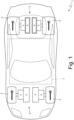
figure 1 is a schematic plan view of a road vehicle with electric drive; -
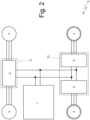
figure 2 is a schematic view of an high-voltage electric system of the vehicle offigure 1 provided with three electronic power converters according to the invention; -
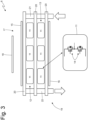
figure 3 is a schematic view of one single electronic power converter of the high-voltage electric system offigure 2 ; -
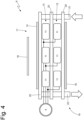
figure 4 is a schematic view of a rear electronic power converter of the high-voltage electric system offigure 2 ; -
figure 5 is a schematic view of a front electronic power converter of the high-voltage electric system offigure 2 ; -
figures 6 and7 are two different perspective views, with parts removed for greater clarity, of the electronic power converter offigure 3 ; -
figure 8 is a perspective view, with parts removed for greater clarity, of a double electronic power converter; -
figure 9 is a schematic view of a variant of the electronic power converter offigure 3 ; -
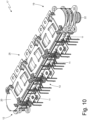
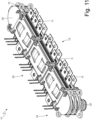
figures 10 and11 are two different perspective views of pile of components of the electronic power converter offigure 3 ; -
figure 12 is a plan view of the pile of components offigures 10 and11 ; -
figures 13 and 14 are two cross section views, along section lines XIII-XIII and XIV-XIV of the pile of components offigures 10 and11 ; -
figure 15 is a perspective view of the pile of components offigures 10 and11 highlighting a clamping system; -
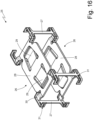
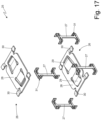
figures 16 and17 are two different perspective views of part of the clamping system offigure 15 ; and -
figure 18 is a cross section view of the pile of components offigures 10 and11 provided with an alternative embodiment of the clamping system, which is not part of the invention. - In
figure 1 ,number 1 indicates, as a whole, an electric drive vehicle provided with four drive wheels 2 (twofront drive wheels 2 and two rear drive wheels 2). - The
vehicle 1 comprises anelectric powertrain system 3, which is arranged in a front position (namely, is connected to the two front drive wheels 2), and anelectric powertrain system 3, which is arranged in a rear position (namely, is connected to the two rear drive wheels 2), is structurally identical to theelectric powertrain system 3 arranged in a front position and is mechanically independent of and separate from theelectric powertrain system 3 arranged in a front position. - According to a different embodiment which is not shown herein, the
vehicle 1 comprises one single electric powertrain system 3 (arranged in a front position or arranged in a rear position) and, therefore, it only has twodrive wheels 2; in this embodiment, thevehicle 1 could also comprise a combustion powertrain system connected to thedrive wheels 2 that do not receive the motion from theelectric powertrain system 3 and the combustion powertrain system could be provided with a furtherelectric motor 4 connected to the drive shaft of an internal combustion engine. - Each
electric powertrain system 3 comprises a pair of reversible electric motors 4 (i.e. which can work both as eclectic motor, absorbing electrical energy and generating a mechanical torque, and as electric generator, absorbing mechanical energy and generating electrical energy) provided with respective shafts and a pair ofdrivetrains 5, which connect the electric motors 4 (namely, the shafts of the electric motors 4) to thecorresponding drive wheels 2 without the interposition of a clutch. - According to
figure 2 , eachelectric motor 4 is controlled by an AC/DC electronic power converter 6 (namely, an "inverter"), which is connected to apower storage system 7 provided with chemical batteries; namely, eachelectronic power converter 6 is a two-way converter and comprises a DC side, which is connected to thepower storage system 7, and a three-phase AC side, which is connected to at least oneelectric motor 4. - As schematically shown in
figure 1 , thepower storage system 7 has a flat and (relatively) thin conformation so that it can be integrated inside the floor of thevehicle 1. - According to
figure 2 , a high-voltageelectric system 8 of thevehicle 1 comprises threeelectronic power converters 6, which are structurally identical to one another: one single frontelectronic power converter 6 powers both frontelectric motors 4, whereas two rearelectronic power converters 6 each power one single rearelectric motor 4. Since the threeelectronic power converters 6 are structurally identical to one another, the frontelectric motors 4 evidently have a single nominal power (relative to the rear electric motors 4), whereas the rearelectric motors 4 have a double nominal power (relative to the front electric motors 4); in other words, the rearelectric motors 4 have a nominal power that is twice the one of the frontelectric motors 4, namely the frontelectric motors 4 have a nominal power that is half the one of the rearelectric motors 4. - Said single front electronic power converter 6 (shown more in detail in
figure 6 ) is housed in a container 9, whereas the two rear electronic power converters 6 (shown more in detail infigure 8 ) are housed together in onesingle container 10. - According to
figure 3 , each electronic power converter 6 (both the front one and the rear ones) comprises sixpower modules 11, each designed to power with an alternating current one single phase of a correspondingelectric motor 4; namely, eachpower module 11 represents one single "leg" of a three-phase inverter. In particular, the sixpower modules 11 are divided into agroup 12 consisting of threepower modules 11, which are arranged next to one another on a same plane, and agroup 13 consisting of the other threepower modules 11, which are arranged next to one another on a same plane, which is parallel to and separate from the plane of thegroup 12. - Each
power module 11 is provided withrespective transistors 14, each having a gate; obviously, the electric diagram of apower module 11 shown infigure 3 merely is a possible non-limiting example and, therefore, thepower modules 11 could have any other electric diagram. - Each
electronic power converter 6 comprises agate control device 15, which is connected to the gates of thetransistors 14 of thepower modules 11 of thegroup 12, and agate control device 16, which is separate from and independent of thegate control device 15 and is connected to the gates of thetransistors 14 of thepower modules 11 of thegroup 13. Thegate control devices power modules 11. - The two
groups power modules 11 are piled on top of one another so as to form one singlecompact pile 17; the twogate control devices pile 17, namely thegate control device 15 rests on thegroup 12 ofpower modules 11 on one side of thepile 17, whereas thegate control device 16 rests under thegroup 13 ofpower modules 11 on the other side of thepile 17. - Each
electronic power converter 6 comprises acontrol unit 18, which controls the operation of the entireelectronic power converter 6 and is directly connected to the twogate control devices control unit 18 and the twogate control devices gate control devices power modules 11. In eachelectronic power converter 6, the entire control logic is implemented in thecontrol unit 18, which is the "brain" of theelectronic power converter 6. Thecontrol unit 18 normally comprises an electronic circuit, which is provided with (at least) a microprocessor and is physically separate from the pile 17 (comprising the twogroups gate control devices - The
control unit 18 is configured to operate according to a first mode (shown infigure 4 and relating to the two rear electronic power converter 6), in which theelectronic power converter 6 controls one singleelectric motor 4 with a double nominal power and each phase of theelectric motor 4 is powered in parallel by apower module 11 of thegroup 12 and by apower module 11 of thegroup 13, or to operate according to a second mode (shown infigure 5 and relating to the front electronic power converter 6), in which two differentelectric motors 4 with a single nominal power are controlled and eachpower module 11 of thegroup 12 powers a corresponding phase of anelectric motor 4 and eachpower module 11 of thegroup 13 powers a corresponding phase of the otherelectric motor 4. - Therefore, the same identical
electronic power converter 6 can power one singleelectric motor 4 with a double nominal power (which is what happen in the rear axle) or can control two differentelectric motors 4 with a single nominal power (which is what happens in the front axle). - According to
figure 3 , eachelectronic power converter 6 comprises acooling system 19 provided with threeplates 20, which are interposed (inserted) in thepile 17; namely, the threeplates 20 are part of thepile 17 and form thepile 17 together with the twogroups power modules 11. Thecooling system 19 is also provided with a hydraulic circuit configured to cause a cooling liquid to circulate inside theplates 20, namely to cause "cold" cooling liquid to flow into eachplate 20 and to cause "hot" cooling liquid to flow out of eachcooling plate 20. In particular, acentral plate 20 is arranged between the twogroups power modules 11, whereas the other twolateral plates 20 are arranged on the other sides of thegroups group gate control device 15 or 16); namely, thecooling system 19 comprises thecentral plate 20, which is interposed between the twogroups lateral plates 20 arranged at the two opposite ends of the twogroups - The hydraulic circuit comprises delivery pipe 21 (where the "cold" cooling liquid flows), which is oriented perpendicularly to the
plates 20 and goes through twoplates 20 from side to side, and a return pipe 22 (where the "hot" cooling liquid flows), which is oriented perpendicularly to theplates 20 and goes through twoplates 20 from side to side. - Each
electronic power converter 6 comprises one single common DC input (schematically shown infigure 2 ), to which all sixpower modules 11 are connected in parallel, and one single common capacitor 23 (shown infigures 6 ,7 and8 ), which is connected to the common input in parallel and is arranged next to the pile 17 (namely, next to the twogroups - The DC input comprises a positive bar, which has one single connection for each
power module 11, and a negative bar, which has two different connections for eachpower module 11; namely, eachpower module 11 has one single connection to the positive bar, which is arranged in the middle of the two connection to the negative bar (as clearly shown infigure 11 ). - According to a possible embodiment shown in
figure 9 , anelectronic power converter 6 can be "demoted" to power one singleelectric motor 4 with a single nominal power by eliminating thegroup 13 of power modules 11 (and, hence, the corresponding gate control device 16) and by replacing the threepower modules 11 of thegroup 13 with the same number ofempty casings 24 having the same outer dimensions (in order not to change the size and the conformation of the pile 17) . This solution allows theelectronic power converter 6 to be used to also power one singleelectric motor 4 with a single nominal power, for example when theelectric motor 4 with a single nominal power is connected to an axle by means of a differential or when theelectric motor 4 with a single nominal power is connected to a drive shaft of an internal combustion engine. - Alternatively, the
electronic power converter 6 only comprises thegroup 12 ofpower modules 11 and there are neither thegroup 13 ofpower modules 11 nor thecentral plate 20; namely, there are only the twolateral plates 20 arranged at the two opposite ends of the single group ofpower modules 11. - According to
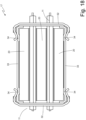
figures 10 and11 , in eachelectronic power converter 6, thepile 17 consists of the twogroups power modules 11 and of the threeplates 20 of thecooling system 19 and is provided with aclamping system 25, which applies a clamping force to thepile 17 in order to keep thepile 17 compressed (and, hence, also hold thepile 17 together); it should be pointed out that the clamping force applied by theclamping system 25 to thepile 17 must be capable of resisting, without undesired movements, to the force of hydraulic origin generated by the circulation of the cooling liquid under pressure. - According to the embodiment better shown in
figures 15 ,16 and17 , theclamping system 25 compriseselastic elements 26, which are deformed in order to apply a compression force of elastic origin to thepile 17; namely, theelastic elements 26 press against two opposite outer walls of thelateral plates 20 in order to apply a clamping force of elastic origin to thepile 17 so as to keep thepile 17 compressed. In particular, three pairs ofelastic elements 26 are provided (one pair ofelastic elements 26 for eachpower module 11 making up thegroup 12 or the group 13) and, in each pair ofelastic elements 26, the twoelastic elements 26 rest against two outer walls of thelateral plates 20 so as to clamp thepile 17 between them in a "sandwich"-like manner. Theclamping system 25 comprises twotie rods 27, which apply a traction between two opposite elastic elements 26 (this traction presses the oppositeelastic elements 26 against the opposite outer walls of thelateral plates 20 and determines the elastic deformation of the opposite elastic elements 26). - Each
elastic element 26 has a frame 28 (with a substantially rectangular shape) and at least onepressing member 29, which is hinged to theframe 28, projects from theframe 28 towards an outer wall of alateral plate 20 lying underneath and is elastically deformed by being pressed against the outer wall of alateral plate 20 lying underneath. Eachelastic element 26 preferably has two pressingmembers 29 arranged next to one another and opposite one another, namely oriented in an opposite manner relative to one another. - Furthermore, each
elastic element 26 has fourappendages 30, which project from theframe 28 at the four corners of theframe 28; furthermore, eachtie rod 27 has at least one slit 31, which is engaged by anappendage 30 of a correspondingelastic element 26. Preferably, in eachelastic element 26, theappendages 30 are parallel and non-coplanar to the frame 28 (namely, are arranged higher than the frame 28) and are connected to theframe 28 by means of respective inclined planes. Thetie rods 27 arranged in the central area of thepile 17 are shared by twoelastic elements 26 next to one another; furthermore, alltie rods 27 are arranged next to thepower modules 11, namely in the free space beside thepower modules 11. - In other words, in each clamping
system 25, thetie rods 27 are arranged next to thepower modules 11, namely half thetie rods 27 are arranged on one side of thepile 17 and the other half of thetie rods 27 are arranged on the other side of thepile 17; in particular, thetie rods 27 are each arranged next to at least onepower module 11, namely thetie rods 27 are arranged in the areas where there are nopower modules 11. In the embodiment shown in the accompanying figures, each clampingsystem 25 totally comprises eighttie rods 27 arranged four on one side of thepile 17 and four on the other side of thepile 17. - In each
elastic element 26, theframe 28 consists of a flat plate, from which the two pressing members 29 (opposite and next to one another) project in a direction and from which the fourappendages 30 project in an opposite direction. In particular, in eachelastic element 26, each pressingmember 29 forms an obtuse angle with theframe 28 and is "L"-shaped with a rounded corner. - The
clamping system 25 described above offers many advantages for it has a small weight (smaller than a traditional clamping system using screws and bolts) combined with a particularly small transverse dimension (significantly smaller than a traditional clamping system using screws and bolts). Furthermore, theclamping system 25 described above automatically compensates (namely, without any type of intervention) for manufacturing tolerances in the total thickness of thepile 17, always and anyway applying a constant and predetermined clamping force. - The embodiments described herein can be combined with one another, without for this reason going beyond the scope of protection of the invention.
- In the example shown in
figure 18 , which is not part of the invention, each clampingsystem 25 comprises a plurality ofelastic elements 32 consisting of "C"-shaped springs made of steel, each pressing on the twolateral plates 20 to push the twolateral plates 20 towards one another with a predetermined elastic force. - In the example shown in
figure 18 , which is not part of the invention, in each clampingsystem 25, the elastic elements 32 (namely, the springs 32) are arranged next to thepower modules 11, namely half theelastic elements 32 are arranged on one side of thepile 17 and the other half of theelastic elements 32 are arranged on the other side of thepile 17; in particular, the elastic elements 32 (namely, the springs) are each arranged next to at least onepower module 11, namely theelastic elements 32 are arranged in the areas where there are nopower modules 11. - In the example shown in
figure 18 , which is not part of the invention, each clampingsystem 25 totally comprises eight elastic elements 32 (springs) arranged four on one side of thepile 17 and four on the other side of thepile 17. - In the example shown in
figure 18 , which is not part of the invention, each clampingsystem 25 comprises twocoupling elements 33, each having an inner surface, which directly rests against a correspondinglateral plate 20, and an outer surface (opposite the inner surface), against which the ends of the corresponding elastic elements 32 (springs) directly rest. In other words, the twocoupling elements 33 are arranged at the opposite ends of thepile 17 in order to hold thepile 17 together. The function of thecoupling elements 33 is that of properly distributing the clamping force applied by theelastic elements 32, preventing the ends of theelastic elements 32 from directly stressing thelateral plates 20. - In the example shown in
figure 18 , which is not part of the invention, eachcoupling element 33 consists of pressed sheet metal, namely consists of a sheet of metal material, which is shaped through pressing. - In the example shown in
figure 18 , which is not part of the invention, eachcoupling element 33 has a succession of identical structures (namely, a repetition of identical structures), each located in the area of acorresponding power module 11; namely, eachcoupling element 33 has a number of identical structures that is the same as the number ofpower modules 11 making up eachgroup 12 or 13 (hence, three identical structures in the embodiment shown in the accompanying figures). - In the example shown in
figure 18 , which is not part of the invention, each structure has fourappendages 34, on which the ends of the correspondingelastic elements 32 rest, and is configured to apply the elastic force generated by the correspondingelastic elements 32 in a central area of the structure; two adjacent structures share thesame appendages 34, which are common for the two adjacent structures. Each structure has an approximately rectangular outline and the fourappendages 34 project from the approximately rectangular outline. - In the example shown in
figure 18 , which is not part of the invention, each structure has two through openings arranged on the opposite sides of the central area of the structure; the two through openings give the structure a cross-like shape, which allows the clamping force applied by theelastic elements 32 to be directed towards the central area of thelateral plates 20. - In the example shown in
figure 18 , which is not part of the invention, each structure has a lowering, preferably with a circular shape, coinciding with the central area of the structure; the lowering helps concentrate the clamping force applied by theelastic elements 32 in the central area of thelateral plates 20. - The
electronic power converter 6 described above has numerous advantages. - First of all, the
electronic power converter 6 described above has a significant use flexibility, since, preserving the same hardware structure, it can indifferently power (obviously, with suitable software adjustments) one singleelectric motor 4 with a double nominal power, one singleelectric motor 4 with a single nominal power or twoelectric motors 4 with a double nominal power. - Furthermore, the
electronic power converter 6 described above has an arrangement that optimizes the cooling of all those components which, in use, generate a lot of heat (mainly, the six power modules 11), namely it cools the sixpower modules 11 in an effective manner (ensuring that their work temperature never is too high) and, at the same time, also in an efficient manner (namely, using a reduced cooling liquid flow rate). - The
electronic power converter 6 described above is particularly compact thanks to the particular arrangement of the sixpower modules 11 alternated with the threeplates 20 of thecooling system 19. - Finally, the
electronic power converter 6 described above ensures relatively low costs as well as a relatively small manufacturing complexity. -
- 1
- vehicle
- 1
- vehicle
- 2
- wheels
- 3
- powertrain system
- 4
- electric motor
- 5
- drivetrain
- 6
- electronic power converter
- 7
- power storage system
- 8
- high-voltage electric system
- 9
- container
- 10
- container
- 11
- power modules
- 12
- group
- 13
- group
- 14
- transistor
- 15
- gate control device
- 16
- gate control device
- 17
- pile
- 18
- control unit
- 19
- cooling system
- 20
- plate
- 21
- delivery pipe
- 22
- return pipe
- 23
- capacitor
- 24
- empty casings
- 25
- clamping system
- 26
- elastic elements
- 27
- tie rods
- 28
- frame
- 29
- pressing member
- 30
- appendages
- 31
- slits
- 32
- springs
- 33
- coupling elements
- 34
- appendages
Claims (15)
- An electronic power converter (6) to control at least one electric motor (4) of a vehicle (1); the electronic power converter (6) comprises:at least one first group (12) of three power modules (11) arranged next to one another on a same first plane , each designed to power with an alternating current one single phase of the electric motor (4);two lateral plates (20), which are arranged on opposite sides of the first group (12) so as to form a pile (17) together with the first group (12);a hydraulic circuit, which is configured to cause a cooling liquid to circulate inside the plates (20); anda clamping system (25) comprising at least three pairs of elastic elements (26), which press against two opposite outer walls of the lateral plates (20) so as to apply a clamping force of elastic origin to the pile (17) in order to keep the pile (17) compressed;wherein in each pair of elastic elements (26), the two elastic elements (26) rest against two outer walls of the lateral plates (20) so as to clamp the pile (17) between them in a "sandwich"-like manner;whereineach elastic element (26) has a frame (28) and at least one pressing member (29), which is hinged to the frame (28), projects from the frame (28) towards a corresponding outer wall of thelateral plate (20) lying underneath and is elastically deformed by being pressed against said outer wall of the lateral plate (20) lying underneath; andwhereinthe clamping system (25) comprises, in each pair of elastic elements (26), at least two tie rods (27), which connect the frames (28) of the two elastic elements (26) to one another in order to pull the frames (28) towards one another, hence applying a traction between the frames (28).
- The electronic power converter (6) according to claim 1, wherein each elastic element (26) has two pressing members (29) arranged next to and opposite one another.
- The electronic power converter (6) according to claim 1 or 2, wherein:the frame (28) of each elastic element (26) has at least four appendages (30), which project from the frame (28) at the four corners of the frame 28; andeach tie rod (27) has at least one slit (31), which is engaged by an appendage (30) of a corresponding elastic element (26).
- The electronic power converter (6) according to claim 3, wherein, in each elastic element (26), the frame (28) consists of a flat plate, from which the pressing member (29) projects in a direction against the corresponding outer wall of the lateral plate (20) lying underneath and from which the appendages (30) project in the opposite direction.
- The electronic power converter (6) according to claim 3 or 4, wherein:four tie rods (27) are provided in each pair of elastic elements (26); andthe frame (28) of each elastic element (26) has a substantially rectangular shape and has four appendages (30), which project from the frame (28) at the four corners of the frame (28).
- The electronic power converter (6) according to claim 3, 4 or 5, wherein, in each elastic element (26), the appendages (30) are parallel and non-coplanar to the frame (28) and are connected to the frame (28) by means of respective inclined planes.
- The electronic power converter (6) according to one of the claims from 1 to 6, wherein for each power module (11) of the first group (12) there are provided a pair of opposite elastic elements (26).
- The electronic power converter (6) according to claim 7, wherein some tie rods (27) are shared by two elastic elements (26) next to one another.
- The electronic power converter (6) according to one of the claims from 1 to 8, wherein the tie rods (27) are arranged next to the power modules (11).
- The electronic power converter (6) according to one of the claims from 1 to 9, wherein, in each elastic element (26), the pressing member (29) forms an obtuse angle with the frame (28).
- The electronic power converter (6) according to one of the claims from 1 to 10, wherein, in each elastic element (26), the pressing member (29) is "L"-shaped with a rounded corner.
- The electronic power converter (6) according to one of the claims from 1 to 11, wherein, in each elastic element (26), the frame (28) consists of a flat plate, from which the pressing member (29) projects.
- The electronic power converter (6) according to one of the claims from 1 to 12 and comprising:a second group (13) of three power modules (11), each designed to power with an alternating current one single phase of the electric motor (4); anda central plate (20), which is arranged between the first group (12) and the second group (13).
- The electronic power converter (6) according to claim 13, wherein: the power modules (11) of the second group (13) which are arranged next to one another on a same second plane, which is parallel to and separate from the first plane.
- The electronic power converter (6) according to one of the claims from 1 to 14, wherein the hydraulic circuit comprises a delivery pipe (21), which is oriented perpendicularly to the plates (20) and goes through at least one plate (20) from side to side, and a return pipe (22), which is oriented perpendicularly to the plates (20) and goes through at least one plate (20) from side to side.
Applications Claiming Priority (1)
| Application Number | Priority Date | Filing Date | Title |
|---|---|---|---|
| IT202100013676 | 2021-05-26 |
Publications (2)
| Publication Number | Publication Date |
|---|---|
| EP4096380A1 EP4096380A1 (en) | 2022-11-30 |
| EP4096380B1 true EP4096380B1 (en) | 2023-12-27 |
Family
ID=77519547
Family Applications (1)
| Application Number | Title | Priority Date | Filing Date |
|---|---|---|---|
| EP22174645.6A Active EP4096380B1 (en) | 2021-05-26 | 2022-05-20 | Compact electronic power converter to control at least one electric motor of a vehicle |
Country Status (4)
| Country | Link |
|---|---|
| US (1) | US12101916B2 (en) |
| EP (1) | EP4096380B1 (en) |
| JP (1) | JP2022183059A (en) |
| CN (1) | CN115411965A (en) |
Families Citing this family (1)
| Publication number | Priority date | Publication date | Assignee | Title |
|---|---|---|---|---|
| US20240164071A1 (en) * | 2022-11-10 | 2024-05-16 | Caterpillar Inc. | Power electronic systems packaged using common heat sink and enclosure |
Family Cites Families (13)
| Publication number | Priority date | Publication date | Assignee | Title |
|---|---|---|---|---|
| US5469331A (en) | 1994-04-07 | 1995-11-21 | Conway; Harry E. | Cooling system for modular power supply device |
| JP2006190972A (en) * | 2004-12-08 | 2006-07-20 | Mitsubishi Electric Corp | Power semiconductor device |
| JP4580997B2 (en) * | 2008-03-11 | 2010-11-17 | 日立オートモティブシステムズ株式会社 | Power converter |
| JP4988665B2 (en) * | 2008-08-06 | 2012-08-01 | 日立オートモティブシステムズ株式会社 | Semiconductor device and power conversion device using the semiconductor device |
| JP5506741B2 (en) * | 2011-06-02 | 2014-05-28 | 日立オートモティブシステムズ株式会社 | Power converter |
| JP5978151B2 (en) * | 2013-02-27 | 2016-08-24 | 日立オートモティブシステムズ株式会社 | Power converter |
| WO2016186102A1 (en) * | 2015-05-18 | 2016-11-24 | カルソニックカンセイ株式会社 | Power conversion device |
| US10137798B2 (en) * | 2015-08-04 | 2018-11-27 | Ford Global Technologies, Llc | Busbars for a power module assembly |
| KR102440583B1 (en) | 2016-11-22 | 2022-09-05 | 현대자동차 주식회사 | Power unit, and power transformatin device |
| JP6805932B2 (en) * | 2017-03-30 | 2020-12-23 | 株式会社デンソー | vehicle |
| US10631429B2 (en) | 2018-07-13 | 2020-04-21 | Ford Global Technologies, Llc | Vehicle power module assembly |
| JP7151599B2 (en) | 2019-04-08 | 2022-10-12 | 株式会社デンソー | power converter |
| JP7133762B2 (en) | 2019-06-07 | 2022-09-09 | 株式会社デンソー | Power conversion device and its manufacturing method |
-
2022
- 2022-05-19 US US17/748,334 patent/US12101916B2/en active Active
- 2022-05-20 EP EP22174645.6A patent/EP4096380B1/en active Active
- 2022-05-23 JP JP2022083732A patent/JP2022183059A/en active Pending
- 2022-05-26 CN CN202210591219.8A patent/CN115411965A/en active Pending
Also Published As
| Publication number | Publication date |
|---|---|
| EP4096380A1 (en) | 2022-11-30 |
| CN115411965A (en) | 2022-11-29 |
| US20220386516A1 (en) | 2022-12-01 |
| JP2022183059A (en) | 2022-12-08 |
| US12101916B2 (en) | 2024-09-24 |
Similar Documents
| Publication | Publication Date | Title |
|---|---|---|
| KR102614123B1 (en) | Inverter structure for vehicle | |
| EP4096380B1 (en) | Compact electronic power converter to control at least one electric motor of a vehicle | |
| DE112011103941B4 (en) | Semiconductor device | |
| US9774247B2 (en) | Power module cooling system | |
| JP7051774B2 (en) | Heat dissipation structure of electrical component assembly, heat conduction sheet, manufacturing method of electrical component assembly | |
| CA2425111A1 (en) | Microdrive | |
| US20220407167A1 (en) | Liquid-cooled motor vehicle traction battery module | |
| DE102016114299A1 (en) | BUSBARS FOR A POWER MODULE LAYOUT | |
| US10000126B2 (en) | Power-module assembly and method | |
| CN103078471A (en) | Power module and current converter | |
| US10631429B2 (en) | Vehicle power module assembly | |
| US9502331B2 (en) | Electric power converter with a spring member | |
| DE112016002611T5 (en) | Automotive battery thermoelectric device with integrated cold plate assembly | |
| CN117441414A (en) | Circuit layout and electric drive layout | |
| JP2011259544A (en) | Power conversion apparatus | |
| JP7546684B2 (en) | Drive with self-regulating cooling | |
| EP3996177A1 (en) | Power storage system for a vehicle provided with at least one electric motor | |
| DE102017213395A1 (en) | Three-phase inverter for one motor | |
| JP5835145B2 (en) | Semiconductor laminated unit and manufacturing method thereof | |
| DE102016203390A1 (en) | SEMICONDUCTOR MODULE | |
| EP4096381B1 (en) | Vehicle provided with two electric motors | |
| JP6491528B2 (en) | Power converter | |
| JP2015213406A (en) | Power converter | |
| CN108880200A (en) | A kind of AC excitation frequency converter of water cooling and air-cooled combination | |
| CN117293470B (en) | Energy storage power station convenient to transportation |
Legal Events
| Date | Code | Title | Description |
|---|---|---|---|
| PUAI | Public reference made under article 153(3) epc to a published international application that has entered the european phase |
Free format text: ORIGINAL CODE: 0009012 |
|
| STAA | Information on the status of an ep patent application or granted ep patent |
Free format text: STATUS: THE APPLICATION HAS BEEN PUBLISHED |
|
| AK | Designated contracting states |
Kind code of ref document: A1 Designated state(s): AL AT BE BG CH CY CZ DE DK EE ES FI FR GB GR HR HU IE IS IT LI LT LU LV MC MK MT NL NO PL PT RO RS SE SI SK SM TR |
|
| STAA | Information on the status of an ep patent application or granted ep patent |
Free format text: STATUS: REQUEST FOR EXAMINATION WAS MADE |
|
| 17P | Request for examination filed |
Effective date: 20230530 |
|
| P01 | Opt-out of the competence of the unified patent court (upc) registered |
Effective date: 20230525 |
|
| RBV | Designated contracting states (corrected) |
Designated state(s): AL AT BE BG CH CY CZ DE DK EE ES FI FR GB GR HR HU IE IS IT LI LT LU LV MC MK MT NL NO PL PT RO RS SE SI SK SM TR |
|
| GRAP | Despatch of communication of intention to grant a patent |
Free format text: ORIGINAL CODE: EPIDOSNIGR1 |
|
| STAA | Information on the status of an ep patent application or granted ep patent |
Free format text: STATUS: GRANT OF PATENT IS INTENDED |
|
| INTG | Intention to grant announced |
Effective date: 20230721 |
|
| GRAS | Grant fee paid |
Free format text: ORIGINAL CODE: EPIDOSNIGR3 |
|
| GRAA | (expected) grant |
Free format text: ORIGINAL CODE: 0009210 |
|
| STAA | Information on the status of an ep patent application or granted ep patent |
Free format text: STATUS: THE PATENT HAS BEEN GRANTED |
|
| AK | Designated contracting states |
Kind code of ref document: B1 Designated state(s): AL AT BE BG CH CY CZ DE DK EE ES FI FR GB GR HR HU IE IS IT LI LT LU LV MC MK MT NL NO PL PT RO RS SE SI SK SM TR |
|
| REG | Reference to a national code |
Ref country code: GB Ref legal event code: FG4D |
|
| REG | Reference to a national code |
Ref country code: CH Ref legal event code: EP |
|
| REG | Reference to a national code |
Ref country code: DE Ref legal event code: R096 Ref document number: 602022001465 Country of ref document: DE |
|
| REG | Reference to a national code |
Ref country code: IE Ref legal event code: FG4D |
|
| PG25 | Lapsed in a contracting state [announced via postgrant information from national office to epo] |
Ref country code: GR Free format text: LAPSE BECAUSE OF FAILURE TO SUBMIT A TRANSLATION OF THE DESCRIPTION OR TO PAY THE FEE WITHIN THE PRESCRIBED TIME-LIMIT Effective date: 20240328 |
|
| REG | Reference to a national code |
Ref country code: LT Ref legal event code: MG9D |
|
| PG25 | Lapsed in a contracting state [announced via postgrant information from national office to epo] |
Ref country code: LT Free format text: LAPSE BECAUSE OF FAILURE TO SUBMIT A TRANSLATION OF THE DESCRIPTION OR TO PAY THE FEE WITHIN THE PRESCRIBED TIME-LIMIT Effective date: 20231227 |
|
| PG25 | Lapsed in a contracting state [announced via postgrant information from national office to epo] |
Ref country code: ES Free format text: LAPSE BECAUSE OF FAILURE TO SUBMIT A TRANSLATION OF THE DESCRIPTION OR TO PAY THE FEE WITHIN THE PRESCRIBED TIME-LIMIT Effective date: 20231227 |
|
| PG25 | Lapsed in a contracting state [announced via postgrant information from national office to epo] |
Ref country code: LT Free format text: LAPSE BECAUSE OF FAILURE TO SUBMIT A TRANSLATION OF THE DESCRIPTION OR TO PAY THE FEE WITHIN THE PRESCRIBED TIME-LIMIT Effective date: 20231227 Ref country code: GR Free format text: LAPSE BECAUSE OF FAILURE TO SUBMIT A TRANSLATION OF THE DESCRIPTION OR TO PAY THE FEE WITHIN THE PRESCRIBED TIME-LIMIT Effective date: 20240328 Ref country code: FI Free format text: LAPSE BECAUSE OF FAILURE TO SUBMIT A TRANSLATION OF THE DESCRIPTION OR TO PAY THE FEE WITHIN THE PRESCRIBED TIME-LIMIT Effective date: 20231227 Ref country code: ES Free format text: LAPSE BECAUSE OF FAILURE TO SUBMIT A TRANSLATION OF THE DESCRIPTION OR TO PAY THE FEE WITHIN THE PRESCRIBED TIME-LIMIT Effective date: 20231227 Ref country code: BG Free format text: LAPSE BECAUSE OF FAILURE TO SUBMIT A TRANSLATION OF THE DESCRIPTION OR TO PAY THE FEE WITHIN THE PRESCRIBED TIME-LIMIT Effective date: 20240327 |
|
| REG | Reference to a national code |
Ref country code: NL Ref legal event code: MP Effective date: 20231227 |
|
| REG | Reference to a national code |
Ref country code: AT Ref legal event code: MK05 Ref document number: 1645773 Country of ref document: AT Kind code of ref document: T Effective date: 20231227 |
|
| PG25 | Lapsed in a contracting state [announced via postgrant information from national office to epo] |
Ref country code: NL Free format text: LAPSE BECAUSE OF FAILURE TO SUBMIT A TRANSLATION OF THE DESCRIPTION OR TO PAY THE FEE WITHIN THE PRESCRIBED TIME-LIMIT Effective date: 20231227 |
|
| PG25 | Lapsed in a contracting state [announced via postgrant information from national office to epo] |
Ref country code: SE Free format text: LAPSE BECAUSE OF FAILURE TO SUBMIT A TRANSLATION OF THE DESCRIPTION OR TO PAY THE FEE WITHIN THE PRESCRIBED TIME-LIMIT Effective date: 20231227 Ref country code: RS Free format text: LAPSE BECAUSE OF FAILURE TO SUBMIT A TRANSLATION OF THE DESCRIPTION OR TO PAY THE FEE WITHIN THE PRESCRIBED TIME-LIMIT Effective date: 20231227 Ref country code: NO Free format text: LAPSE BECAUSE OF FAILURE TO SUBMIT A TRANSLATION OF THE DESCRIPTION OR TO PAY THE FEE WITHIN THE PRESCRIBED TIME-LIMIT Effective date: 20240327 Ref country code: NL Free format text: LAPSE BECAUSE OF FAILURE TO SUBMIT A TRANSLATION OF THE DESCRIPTION OR TO PAY THE FEE WITHIN THE PRESCRIBED TIME-LIMIT Effective date: 20231227 Ref country code: LV Free format text: LAPSE BECAUSE OF FAILURE TO SUBMIT A TRANSLATION OF THE DESCRIPTION OR TO PAY THE FEE WITHIN THE PRESCRIBED TIME-LIMIT Effective date: 20231227 Ref country code: HR Free format text: LAPSE BECAUSE OF FAILURE TO SUBMIT A TRANSLATION OF THE DESCRIPTION OR TO PAY THE FEE WITHIN THE PRESCRIBED TIME-LIMIT Effective date: 20231227 |
|
| PG25 | Lapsed in a contracting state [announced via postgrant information from national office to epo] |
Ref country code: IS Free format text: LAPSE BECAUSE OF FAILURE TO SUBMIT A TRANSLATION OF THE DESCRIPTION OR TO PAY THE FEE WITHIN THE PRESCRIBED TIME-LIMIT Effective date: 20240427 |
|
| PG25 | Lapsed in a contracting state [announced via postgrant information from national office to epo] |
Ref country code: CZ Free format text: LAPSE BECAUSE OF FAILURE TO SUBMIT A TRANSLATION OF THE DESCRIPTION OR TO PAY THE FEE WITHIN THE PRESCRIBED TIME-LIMIT Effective date: 20231227 Ref country code: AT Free format text: LAPSE BECAUSE OF FAILURE TO SUBMIT A TRANSLATION OF THE DESCRIPTION OR TO PAY THE FEE WITHIN THE PRESCRIBED TIME-LIMIT Effective date: 20231227 |
|
| PG25 | Lapsed in a contracting state [announced via postgrant information from national office to epo] |
Ref country code: SK Free format text: LAPSE BECAUSE OF FAILURE TO SUBMIT A TRANSLATION OF THE DESCRIPTION OR TO PAY THE FEE WITHIN THE PRESCRIBED TIME-LIMIT Effective date: 20231227 |
|
| PG25 | Lapsed in a contracting state [announced via postgrant information from national office to epo] |
Ref country code: SM Free format text: LAPSE BECAUSE OF FAILURE TO SUBMIT A TRANSLATION OF THE DESCRIPTION OR TO PAY THE FEE WITHIN THE PRESCRIBED TIME-LIMIT Effective date: 20231227 Ref country code: SK Free format text: LAPSE BECAUSE OF FAILURE TO SUBMIT A TRANSLATION OF THE DESCRIPTION OR TO PAY THE FEE WITHIN THE PRESCRIBED TIME-LIMIT Effective date: 20231227 Ref country code: RO Free format text: LAPSE BECAUSE OF FAILURE TO SUBMIT A TRANSLATION OF THE DESCRIPTION OR TO PAY THE FEE WITHIN THE PRESCRIBED TIME-LIMIT Effective date: 20231227 Ref country code: IS Free format text: LAPSE BECAUSE OF FAILURE TO SUBMIT A TRANSLATION OF THE DESCRIPTION OR TO PAY THE FEE WITHIN THE PRESCRIBED TIME-LIMIT Effective date: 20240427 Ref country code: EE Free format text: LAPSE BECAUSE OF FAILURE TO SUBMIT A TRANSLATION OF THE DESCRIPTION OR TO PAY THE FEE WITHIN THE PRESCRIBED TIME-LIMIT Effective date: 20231227 Ref country code: CZ Free format text: LAPSE BECAUSE OF FAILURE TO SUBMIT A TRANSLATION OF THE DESCRIPTION OR TO PAY THE FEE WITHIN THE PRESCRIBED TIME-LIMIT Effective date: 20231227 Ref country code: AT Free format text: LAPSE BECAUSE OF FAILURE TO SUBMIT A TRANSLATION OF THE DESCRIPTION OR TO PAY THE FEE WITHIN THE PRESCRIBED TIME-LIMIT Effective date: 20231227 |
|
| PG25 | Lapsed in a contracting state [announced via postgrant information from national office to epo] |
Ref country code: PL Free format text: LAPSE BECAUSE OF FAILURE TO SUBMIT A TRANSLATION OF THE DESCRIPTION OR TO PAY THE FEE WITHIN THE PRESCRIBED TIME-LIMIT Effective date: 20231227 Ref country code: PT Free format text: LAPSE BECAUSE OF FAILURE TO SUBMIT A TRANSLATION OF THE DESCRIPTION OR TO PAY THE FEE WITHIN THE PRESCRIBED TIME-LIMIT Effective date: 20240429 |
|
| PG25 | Lapsed in a contracting state [announced via postgrant information from national office to epo] |
Ref country code: PT Free format text: LAPSE BECAUSE OF FAILURE TO SUBMIT A TRANSLATION OF THE DESCRIPTION OR TO PAY THE FEE WITHIN THE PRESCRIBED TIME-LIMIT Effective date: 20240429 Ref country code: PL Free format text: LAPSE BECAUSE OF FAILURE TO SUBMIT A TRANSLATION OF THE DESCRIPTION OR TO PAY THE FEE WITHIN THE PRESCRIBED TIME-LIMIT Effective date: 20231227 |
|
| REG | Reference to a national code |
Ref country code: DE Ref legal event code: R097 Ref document number: 602022001465 Country of ref document: DE |
|
| PG25 | Lapsed in a contracting state [announced via postgrant information from national office to epo] |
Ref country code: DK Free format text: LAPSE BECAUSE OF FAILURE TO SUBMIT A TRANSLATION OF THE DESCRIPTION OR TO PAY THE FEE WITHIN THE PRESCRIBED TIME-LIMIT Effective date: 20231227 |
|
| PG25 | Lapsed in a contracting state [announced via postgrant information from national office to epo] |
Ref country code: DK Free format text: LAPSE BECAUSE OF FAILURE TO SUBMIT A TRANSLATION OF THE DESCRIPTION OR TO PAY THE FEE WITHIN THE PRESCRIBED TIME-LIMIT Effective date: 20231227 |
|
| PLBE | No opposition filed within time limit |
Free format text: ORIGINAL CODE: 0009261 |
|
| STAA | Information on the status of an ep patent application or granted ep patent |
Free format text: STATUS: NO OPPOSITION FILED WITHIN TIME LIMIT |
|
| 26N | No opposition filed |
Effective date: 20240930 |
|
| PG25 | Lapsed in a contracting state [announced via postgrant information from national office to epo] |
Ref country code: MC Free format text: LAPSE BECAUSE OF FAILURE TO SUBMIT A TRANSLATION OF THE DESCRIPTION OR TO PAY THE FEE WITHIN THE PRESCRIBED TIME-LIMIT Effective date: 20231227 |
|
| PG25 | Lapsed in a contracting state [announced via postgrant information from national office to epo] |
Ref country code: LU Free format text: LAPSE BECAUSE OF NON-PAYMENT OF DUE FEES Effective date: 20240520 |
|
| PG25 | Lapsed in a contracting state [announced via postgrant information from national office to epo] |
Ref country code: MC Free format text: LAPSE BECAUSE OF FAILURE TO SUBMIT A TRANSLATION OF THE DESCRIPTION OR TO PAY THE FEE WITHIN THE PRESCRIBED TIME-LIMIT Effective date: 20231227 Ref country code: LU Free format text: LAPSE BECAUSE OF NON-PAYMENT OF DUE FEES Effective date: 20240520 |
|
| REG | Reference to a national code |
Ref country code: BE Ref legal event code: MM Effective date: 20240531 |
|
| PG25 | Lapsed in a contracting state [announced via postgrant information from national office to epo] |
Ref country code: IE Free format text: LAPSE BECAUSE OF NON-PAYMENT OF DUE FEES Effective date: 20240520 |
|
| PG25 | Lapsed in a contracting state [announced via postgrant information from national office to epo] |
Ref country code: SI Free format text: LAPSE BECAUSE OF FAILURE TO SUBMIT A TRANSLATION OF THE DESCRIPTION OR TO PAY THE FEE WITHIN THE PRESCRIBED TIME-LIMIT Effective date: 20231227 Ref country code: BE Free format text: LAPSE BECAUSE OF NON-PAYMENT OF DUE FEES Effective date: 20240531 |
|
| PGFP | Annual fee paid to national office [announced via postgrant information from national office to epo] |
Ref country code: DE Payment date: 20250528 Year of fee payment: 4 |
|
| PGFP | Annual fee paid to national office [announced via postgrant information from national office to epo] |
Ref country code: IT Payment date: 20250531 Year of fee payment: 4 |
|
| PGFP | Annual fee paid to national office [announced via postgrant information from national office to epo] |
Ref country code: FR Payment date: 20250526 Year of fee payment: 4 |
|
| PG25 | Lapsed in a contracting state [announced via postgrant information from national office to epo] |
Ref country code: CY Free format text: LAPSE BECAUSE OF FAILURE TO SUBMIT A TRANSLATION OF THE DESCRIPTION OR TO PAY THE FEE WITHIN THE PRESCRIBED TIME-LIMIT; INVALID AB INITIO Effective date: 20220520 |
|
| PG25 | Lapsed in a contracting state [announced via postgrant information from national office to epo] |
Ref country code: HU Free format text: LAPSE BECAUSE OF FAILURE TO SUBMIT A TRANSLATION OF THE DESCRIPTION OR TO PAY THE FEE WITHIN THE PRESCRIBED TIME-LIMIT; INVALID AB INITIO Effective date: 20220520 |
|
| REG | Reference to a national code |
Ref country code: CH Ref legal event code: H13 Free format text: ST27 STATUS EVENT CODE: U-0-0-H10-H13 (AS PROVIDED BY THE NATIONAL OFFICE) Effective date: 20251223 |
|
| PG25 | Lapsed in a contracting state [announced via postgrant information from national office to epo] |
Ref country code: CH Free format text: LAPSE BECAUSE OF NON-PAYMENT OF DUE FEES Effective date: 20250531 |
|
| PGFP | Annual fee paid to national office [announced via postgrant information from national office to epo] |
Ref country code: GB Payment date: 20260304 Year of fee payment: 5 |