EP4095640A1 - Method and system for controlling a plurality of vehicles, in particular autonomous vehicles - Google Patents
Method and system for controlling a plurality of vehicles, in particular autonomous vehicles Download PDFInfo
- Publication number
- EP4095640A1 EP4095640A1 EP21175955.0A EP21175955A EP4095640A1 EP 4095640 A1 EP4095640 A1 EP 4095640A1 EP 21175955 A EP21175955 A EP 21175955A EP 4095640 A1 EP4095640 A1 EP 4095640A1
- Authority
- EP
- European Patent Office
- Prior art keywords
- vehicles
- occupancies
- motion commands
- planning
- search
- Prior art date
- Legal status (The legal status is an assumption and is not a legal conclusion. Google has not performed a legal analysis and makes no representation as to the accuracy of the status listed.)
- Granted
Links
Images

Classifications
-
- G—PHYSICS
- G08—SIGNALLING
- G08G—TRAFFIC CONTROL SYSTEMS
- G08G1/00—Traffic control systems for road vehicles
- G08G1/09—Arrangements for giving variable traffic instructions
-
- G—PHYSICS
- G08—SIGNALLING
- G08G—TRAFFIC CONTROL SYSTEMS
- G08G1/00—Traffic control systems for road vehicles
- G08G1/20—Monitoring the location of vehicles belonging to a group, e.g. fleet of vehicles, countable or determined number of vehicles
- G08G1/202—Dispatching vehicles on the basis of a location, e.g. taxi dispatching
-
- B—PERFORMING OPERATIONS; TRANSPORTING
- B60—VEHICLES IN GENERAL
- B60W—CONJOINT CONTROL OF VEHICLE SUB-UNITS OF DIFFERENT TYPE OR DIFFERENT FUNCTION; CONTROL SYSTEMS SPECIALLY ADAPTED FOR HYBRID VEHICLES; ROAD VEHICLE DRIVE CONTROL SYSTEMS FOR PURPOSES NOT RELATED TO THE CONTROL OF A PARTICULAR SUB-UNIT
- B60W60/00—Drive control systems specially adapted for autonomous road vehicles
- B60W60/001—Planning or execution of driving tasks
- B60W60/0025—Planning or execution of driving tasks specially adapted for specific operations
-
- G—PHYSICS
- G05—CONTROLLING; REGULATING
- G05D—SYSTEMS FOR CONTROLLING OR REGULATING NON-ELECTRIC VARIABLES
- G05D1/00—Control of position, course, altitude or attitude of land, water, air or space vehicles, e.g. using automatic pilots
- G05D1/02—Control of position or course in two dimensions
- G05D1/021—Control of position or course in two dimensions specially adapted to land vehicles
- G05D1/0287—Control of position or course in two dimensions specially adapted to land vehicles involving a plurality of land vehicles, e.g. fleet or convoy travelling
- G05D1/0291—Fleet control
- G05D1/0297—Fleet control by controlling means in a control room
-
- B—PERFORMING OPERATIONS; TRANSPORTING
- B60—VEHICLES IN GENERAL
- B60W—CONJOINT CONTROL OF VEHICLE SUB-UNITS OF DIFFERENT TYPE OR DIFFERENT FUNCTION; CONTROL SYSTEMS SPECIALLY ADAPTED FOR HYBRID VEHICLES; ROAD VEHICLE DRIVE CONTROL SYSTEMS FOR PURPOSES NOT RELATED TO THE CONTROL OF A PARTICULAR SUB-UNIT
- B60W2300/00—Indexing codes relating to the type of vehicle
- B60W2300/10—Buses
-
- B—PERFORMING OPERATIONS; TRANSPORTING
- B60—VEHICLES IN GENERAL
- B60W—CONJOINT CONTROL OF VEHICLE SUB-UNITS OF DIFFERENT TYPE OR DIFFERENT FUNCTION; CONTROL SYSTEMS SPECIALLY ADAPTED FOR HYBRID VEHICLES; ROAD VEHICLE DRIVE CONTROL SYSTEMS FOR PURPOSES NOT RELATED TO THE CONTROL OF A PARTICULAR SUB-UNIT
- B60W2300/00—Indexing codes relating to the type of vehicle
- B60W2300/12—Trucks; Load vehicles
-
- B—PERFORMING OPERATIONS; TRANSPORTING
- B60—VEHICLES IN GENERAL
- B60W—CONJOINT CONTROL OF VEHICLE SUB-UNITS OF DIFFERENT TYPE OR DIFFERENT FUNCTION; CONTROL SYSTEMS SPECIALLY ADAPTED FOR HYBRID VEHICLES; ROAD VEHICLE DRIVE CONTROL SYSTEMS FOR PURPOSES NOT RELATED TO THE CONTROL OF A PARTICULAR SUB-UNIT
- B60W2300/00—Indexing codes relating to the type of vehicle
- B60W2300/17—Construction vehicles, e.g. graders, excavators
-
- G—PHYSICS
- G05—CONTROLLING; REGULATING
- G05D—SYSTEMS FOR CONTROLLING OR REGULATING NON-ELECTRIC VARIABLES
- G05D1/00—Control of position, course, altitude or attitude of land, water, air or space vehicles, e.g. using automatic pilots
- G05D1/02—Control of position or course in two dimensions
- G05D1/021—Control of position or course in two dimensions specially adapted to land vehicles
- G05D1/0287—Control of position or course in two dimensions specially adapted to land vehicles involving a plurality of land vehicles, e.g. fleet or convoy travelling
- G05D1/0291—Fleet control
Definitions
- the present disclosure relates to the field of centralized vehicle control, and in particular to methods and devices allowing centralized control of a scalable number of vehicles using limited computational resources.
- US20200247611A1 discloses an object-handling coordination system with a plurality of transporting vessels arranged as a three-dimensional cluster. Motion planning is performed by evaluating possible future states, where each state corresponds to the contemporaneous positions of all transporting vessels. More precisely, US20200247611A1 executes a method for planning the movement of the transport vessels, comprising the steps of:
- An objective of the present disclosure is to make available methods and devices for centrally controlling a scalable number of vehicles.
- the methods and devices should preferably be suitable for the control of autonomous vehicles. It is a particular objective to propose vehicle control techniques that optimize the use of a predefined computational budget.
- a still further objective is to support the evaluation of potential vehicle trajectories represented as a tree-like structure.
- a traffic planning method for controlling a plurality of vehicles, wherein each vehicle occupies one node in a shared set of planning nodes and is movable to other nodes along predefined edges between pairs of the nodes in accordance with a finite set of motion commands.
- initial node occupancies of the vehicles are obtained, and a suitable sequence of motion commands is determined by means of an optimization process which considers a search depth d.
- the search depth is variable and shall be determined by executing these preliminary steps: a mean number of feasible motion commands in a neighborhood of the initial node occupancies is determined from said finite set of motion commands, and a search depth d which makes optimal use of a predefined computational budget is determined in view of the mean number of feasible motion commands.
- the background reference US20200247611A1 applies a preset maximum search tree depth c max and therefore fails to leverage the fact that a maximum-depth search tree may still leave some of the computational resources unused if many states are not "viable". Thanks to the preliminary steps introduced above, where non-feasible motion commands are eliminated, the first aspect of the invention can achieve a higher efficiency in this regard. The scalability of the number of vehicles may improve too, as the resulting method is able to suggest a suitable search depth reduction that offsets the increase in computational burden when more vehicles are deployed.
- a “planning node” may refer to a resource which is shared among the vehicles, such as a waypoint or a road segment.
- a motion command may be described as "feasible” if it is directed to a movable vehicle (i.e., not in an absorption state) and it does not lead the vehicle system into a deadlock or terminal state.
- a motion command may also be non-feasible if it is excluded on the basis if control heuristics, e.g., to remove vehicles as soon as possible from positions where they may later become blocking, such as single-lane road segments.
- the step of determining the mean number of feasible motion commands in a neighborhood of the initial node occupancies may comprise processing the initial node occupancies to identify vehicles which are temporarily non-movable.
- this step may comprise comparing the initial node occupancies with a set of deadlock patterns; the deadlock patterns may include both deadlock states and other states which lead into deadlock states. Either one of these options constitutes a systematic and automatable approach to finding the mean number of feasible motion commands.
- a "neighborhood" of the initial node occupancies may be expressed as a predefined search depth d 0 .
- the predefined search depth d 0 is significantly less than typical values of the search depth d .
- a search tree for this neighborhood is generated by evolving the vehicle system according to all possible commands up to the d 0 th epoch, and the mean number of feasible motion commands is computed.
- a "computational budget" may be expressed as the maximum number L max of leaves which a search tree may include.
- the search depth d may be calculated by applying the mean number of feasible motion commands as a mean branching factor b of the search tree.
- the method within the first aspect of the invention is useful for autonomous, semi-autonomous or driver-operated vehicles.
- An example use case may be a fleet of fully autonomous vehicles.
- Another example use case is a fleet of public-transport or industrial vehicles which are operated by human drivers but routed in real time by a central planning entity. Determining routing instructions to vehicles is one example of tactical decision-making.
- a tactical decision for a vehicle may have a validity time of the order of 1 s, 10 s, 100 s or even more.
- a search depth of d units may therefore correspond to a planning horizon of d s, 10 d s, 100 d s or more.
- the method within the first aspect may be applied to a fleet of 2-10 vehicles, a fleet of the order of 10 vehicles, 100 vehicles, 1000 vehicles or more. In at least some of these numerical ranges, the first aspect is computationally advantageous over the prior art.
- the solving of the planning problem does not necessarily rely on a tree search. Rather, the solver to be used for the planning problem can be chosen freely in view of the intended use case. It is foreseen in some embodiments to use machine-learning, such as Q-learning approaches.
- a device for performing the above method includes first and second interfaces and processing circuitry.
- the first interface is configured to receive initial node occupancies of the vehicles. This is given as input data to the motion planning. Further input data to the motion planning may define a mission (utility task) to be carried out may by the vehicles and/or it may define, for each vehicle, a set of predefined commands and predefined motion constraints.
- the second interface is configured to feed commands selected from said predefined commands - the output of the motion planning - to said plurality of vehicles.
- the processing circuitry is configured to perform the steps of the above method.
- the second aspect shares the advantages of the first aspect, and it can be implemented with a corresponding degree of technical variation.
- the invention further relates to a computer program containing instructions for causing a computer to carry out the above method.
- the computer program may be stored or distributed on a data carrier.
- a “data carrier” may be a transitory data carrier, such as modulated electromagnetic or optical waves, or a non-transitory data carrier.
- Non-transitory data carriers include volatile and non-volatile memories, such as permanent and non-permanent storage media of magnetic, optical or solid-state type. Still within the scope of "data carrier”, such memories may be fixedly mounted or portable.
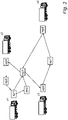
- Figure 3 is a schematic representation of a road network.
- Waypoints are defined at the road junctions wp1, wp3 and additionally at some intermediate locations wp2, wp4, wp5, ..., wp8. Some of the intermediate locations may correspond to so-called absorption nodes, where a visiting vehicle is required to dwell for a predetermined or variable time, for purposes of loading, unloading, maintenance etc.
- the arrangement of the waypoints is not essential to the present invention, rather their location and number may be chosen as deemed necessary in each use case to achieve smooth and efficient traffic control.
- the waypoints are treated as planning nodes which are shared by a plurality of vehicles v1, v2, v3, v4.
- a planning node may be understood as a logical entity which is either free or occupied by exactly one vehicle at a time. An occupied node is not consumed but can be released for use by the same or another vehicle. Planning nodes may represent physical space for transport or parking, a communication channel, maintenance machinery, additional equipment for optional temporary use, such as tools or trailers.
- Each vehicle is controllable by an individual control signal, which may indicate a command from a finite set of predetermined commands. It is understood that individual control signals may be multiplexed onto a common carrier.
- a predefined command may represent an action to be taken at the next waypoint (e.g., continue straight, continue right, continue left, stop), a next destination, a speed adjustment, a loading operation or the like. Implicit signaling is possible, in that a command has a different meaning depending on its current state (e.g., toggle between an electric engine and a combustion engne, toggle between high and low speed, drive/wait at the next waypoint).
- a vehicle which receives no control signal or a neutrally-valued control signal may be configured to continue the previously instructed action or to halt.
- the predetermined commands preferably relate to tactical decision-making, which corresponds to a time scale typically shorter than strategic decision-making and typically longer than operational (or machine-level) decision-making. Different vehicles may have different sets of commands.
- One aim of the present disclosure is to enable efficient centralized control of the vehicles v1, v2, v3, v4.
- the vehicles v1, v2, v3, v4 are to be controlled as a group, with mutual coordination.
- the mutual coordination may entail that any planning node utilization conflicts that could arise between vehicles are deferred to a planning algorithm and resolved at the planning stage.
- the planning may aim to maximize productivity, such as the total quantity of useful transport system work or the percentage of on-schedule deliveries of goods.
- the planning may additionally aim to minimize cost, including fuel consumption, battery wear, mechanical component wear or the like.
- a waypoint topology populated with many vehicles may also include deadlock states, where no vehicle movement is possible. This may correspond to a real-life scenario where the controlled vehicles need external help to resume operation, such as operator intervention, towing etc.
- the following description is made under an assumption of discrete time, that is, the traffic system evolves in evenly spaced epochs.
- the length of an epoch may be of the order of 0.1 s, 1 s, 10 s or longer.
- a command a1, a2 is given to one of the vehicles v1, v2, v3, v4, a command is given to a predefined group of vehicles, or no command is given.
- Quasi-simultaneous commands v1.a1, v2.a1 to two vehicles v1, v2 or two vehicle groups can be distributed over two consecutive epochs.
- the epoch length may be configured shorter than the typical time scale of the tactical decision-making for one vehicle.
- the space of possible planning outcomes corresponds to the set of all command sequences of length d , where d is the planning horizon (or lookahead horizon).
- d is the planning horizon (or lookahead horizon).
- the planning process is represented as a search tree of the type shown in figure 5 , the possible planning outcomes are in a one-to-one relationship with the leaves; the corresponding command sequence is the path from the root to this leaf.
- the search tree covers seven epochs t1, t2, ..., t7.
- the planning horizon is seven times the duration of an epoch.
- command a1 is given to vehicle v1 (v1.a1)
- command a2 is given to vehicle v1 (v1.a2)
- command a1 is given to vehicle v2 (v2.a1)
- command a2 is given to vehicle v2 (v2.a2).
- a straightforward possible planning approach may be to assign a rule-based score to each possible planning outcome (i.e., sequence of commands) and select the most beneficial one.
- the score may be assigned on the basis of simulating the movement of the vehicles which will result from applying that sequence of commands, e.g., to find their positions at the planning horizon.
- Other approaches may include heuristics to accelerate the search for an acceptable solution. The heuristics may help identify on an early stage such sequences of commands that are less promising and exclude them from a full evaluation. As mentioned above, an example heuristic is to remove vehicles from potentially blocking positions without delay. Machine-learning techniques may be useful.
- the machine-learning agent e.g., an artificial neural network
- the machine-learning agent may be trained to propose the most suitable action (i.e., command sequence) for a given state.
- the computational effort generally has a high sensitivity to a change in the number of leaves, which means that the necessary resource allocation varies significantly with the search depth considered in each execution.
- the use of a greater planning horizon usually promotes overall more economical vehicle movements, as it helps avoid blocking or near-blocking states, or other consequences of overly 'short-sighted' planning. This however comes at a computational cost:
- the number of leaves grows exponentially with the planning depth d .
- the search tree has ( N + 1) d leaves.
- N 1 d leaves.
- the search space size may be independent of the number of planning nodes.
- the present invention can achieve a potential efficiency gain in cases where the branching factor drops below the theoretical maximum for some epochs. Such drops may result when it is not possible or meaningful to control some of the vehicles. For example, the initial node occupancies may render some of the commands infeasible, e.g., since one vehicle is temporarily not mobile. Further, it may turn out that some of the commands that are a priori available in one epoch may in fact evolve the vehicle system into a deadlock pattern, and that command is to be treated as infeasible too.
- the branching factor may vary across different epochs and it may be less than 5 in some epochs.
- the number of leaves in a seven-epoch tree may be much below 78125.
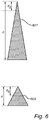
- figure 6 shows outlines of two example search trees 601, 602.
- the horizontal length scale is logarithmic, in the sense that the local width of the tree corresponds to the logarithm of the number of states in that epoch, whereas the vertical length scale is linear with respect to the number of epochs.
- the first search tree 601 grows weakly: the feasible commands are fewer than the theoretical maximum branching factor in at least some epochs.
- the second search tree 602 grows with the theoretical maximum branching factor in every epoch, and therefore reaches a number of leaves equal to that of the first search tree 601 already for a smaller search depth d .
- the inventor has realized that the branching factor has a limited variation with respect to successive epochs.
- the mean branching factor of the search tree can be estimated on the basis of the mean number of feasible motion commands for a neighborhood of the initial node occupancies.
- the neighborhood may comprise the first d 0 epochs of the actual search tree.
- the predefined search depth d 0 may be significantly less than typical values of the search depth d , it may provide enough guidance towards the true mean branching factor, as an indicator of whether the search tree has weak or strong growth.
- Example 1 First waypoint topology (not shown); eight deployed vehicles; each vehicle is controllable by the commands "drive” and "wait”. Initially, all vehicles are freely movable; none occupies an absorption node. For a search depth of 3 epochs, the search tree has 158 leaves.
- Example 2 First waypoint topology; eight deployed vehicles; each vehicle is controllable by the commands "drive” and "wait”. Initially, one of the vehicles occupies an absorption node (unloading). For a search depth (planning horizon) of 3 epochs, the search tree has 69 leaves.
- examples 1 and 2 may be likened to the respective outlined search trees 602 and 601, where the weaker growing tree 601 allows a greater planning depth d without exceeding the tractable number of leaves.
- Example 3 Second waypoint topology; two deployed vehicles; each vehicle is controllable by the commands "drive” and “wait”. Initially, all vehicles are freely movable. For a search depth of 5 epochs, the search tree has 262 leaves.
- Example 4 Second waypoint topology; two deployed vehicles; each vehicle is controllable by the commands "drive” and "wait". Initially, one of the vehicles is in a single-lane two-way section of the road network, where the command "wait" is blocked according to preprogrammed control logic. For a search depth of 5 epochs, the search tree has 63 leaves.
- the method 100 may be implemented by a general-purpose programmable computer, such as the device 200 shown in figure 2 to be described below.
- the initial node occupancies of the vehicles are obtained.
- the node occupancies may be represented as a data structure associating each vehicle with a planning node, like the 0 function above.
- a mean number of feasible motion commands in a neighborhood of the initial node occupancies is determined. Reference is made to the above definition of feasible motion commands, and it is recalled that this number is equal to the local branching factor.
- the neighborhood may correspond to a smaller search tree with the initial node occupancies as its root and having a predefined search depth d 0 , wherein the predefined search depth d 0 is typically significantly less than typical values of the search depth d .
- the second step 112 may be described metaphorically as 'scouting' the branching factor, i.e., generating the first d 0 levels of the search tree, sampling the branching factor for these levels, and using this number to approximate b , the mean branching factor for the full tree.
- the approximation is well justified as it has been found that, in traffic-planning applications, the branching factor has a limited variation with respect to successive epochs.
- the mean branching factor in the neighborhood may be computed as the arithmetic mean of the local branching factors: b ⁇ ⁇ b 1 + b 2 + ⁇ + b d 0 d 0 , where b l is the branching factor on the l th level of the search tree.
- the number of leaves L at the d 0 th level is determined and the mean value branching factor is computed as the d 0 th root, i.e., b ⁇ L 1/ d 0 .
- the second step 112 may include a substep of processing 112.1 the initial node occupancies to identify vehicles which are temporarily non-movable.
- the second step 112 includes a substep of comparing 112.2 the initial node occupancies with a set of deadlock patterns, to thereby assess which motion commands cannot be used.
- a suitable sequence of motion commands is determined by means of an optimization process which considers a search depth of d .
- the optimization process may include executing a planning algorithm of any of the types discussed above. It is noted that the optimization process may be allowed to execute until a converge criterion is met, until an optimality criterion is fulfilled and/or until a predefined time has elapsed. Actually reaching optimality is no necessary condition under the present invention.
- step 118 the thus determined sequence of motion commands is fed to said plurality of vehicles for execution.
- FIG. 2 shows, in accordance with a further embodiment, a device 200 for controlling a plurality of vehicles 299 sharing a set of planning nodes.
- the device 200 has a first interface 210 configured to receive initial node occupancies of the vehicles 299.
- it may further receive, for each vehicle, information representing a set of predefined commands v1.a1, v1.a2, v2.a1, v2.a2, which can be fed to the respective vehicles, and/or a mission (utility task) to be carried out may by the vehicles 299.
- the initial node occupancies may be obtained from a traffic control entity communicating with the vehicles 299, from sensors detecting the positions of the vehicles 299, or from a reply to a self-positioning query issued to the vehicles 299.
- the optional information may be entered into the first interface 210 by an operator or provided as configuration data once it is known which vehicles 299 will form the fleet.
- the device 200 further has a second interface 220 configured to feed commands selected from said predefined commands to said plurality of vehicles, as well as processing circuitry 230 configured to perform the method 100 described above.
- Figure 2 shows direct wireless links from the second interface 220 to the vehicles 299.
- the second interface 220 may instead feed sequences of the predefined commands to the traffic control entity, which takes care of the delivery of the commands to the vehicles 299.
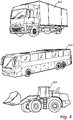
- Figure 4 shows a truck 400, a bus 402 and a construction equipment vehicle 404.
- a fleet of vehicles of one or more of these types, whether they are autonomous or conventional, can be controlled in a centralized fashion using the method 100 or the device 200 described above.
Landscapes
- Engineering & Computer Science (AREA)
- Physics & Mathematics (AREA)
- General Physics & Mathematics (AREA)
- Automation & Control Theory (AREA)
- Human Computer Interaction (AREA)
- Transportation (AREA)
- Mechanical Engineering (AREA)
- Aviation & Aerospace Engineering (AREA)
- Radar, Positioning & Navigation (AREA)
- Remote Sensing (AREA)
- Traffic Control Systems (AREA)
Abstract
Description
- The present disclosure relates to the field of centralized vehicle control, and in particular to methods and devices allowing centralized control of a scalable number of vehicles using limited computational resources.
- Motion planning for multiple vehicles is discussed in
US20200247611A1 , which discloses an object-handling coordination system with a plurality of transporting vessels arranged as a three-dimensional cluster. Motion planning is performed by evaluating possible future states, where each state corresponds to the contemporaneous positions of all transporting vessels. More precisely,US20200247611A1 executes a method for planning the movement of the transport vessels, comprising the steps of: - 1. initializing a counter c = 1 (search tree depth),
- 2. generating a plurality of potential subsequent states with respect to counter c using a search tree,
- 3. using a constraint checker to retain only "viable" subsequent states,
- 4. incrementing the counter c, and
- 5. repeating steps 2-4 until a preset maximum search tree depth c max has been reached.
- In relation to
US20200247611A1 , one problem is to spend a preset computational budget more efficiently. - An objective of the present disclosure is to make available methods and devices for centrally controlling a scalable number of vehicles. The methods and devices should preferably be suitable for the control of autonomous vehicles. It is a particular objective to propose vehicle control techniques that optimize the use of a predefined computational budget. A still further objective is to support the evaluation of potential vehicle trajectories represented as a tree-like structure.
- At least some of these objectives are achieved by the invention as defined by the independent claims. The dependent claims relate to advantageous embodiments of the invention.
- In a first aspect of the invention, there is provided a traffic planning method for controlling a plurality of vehicles, wherein each vehicle occupies one node in a shared set of planning nodes and is movable to other nodes along predefined edges between pairs of the nodes in accordance with a finite set of motion commands. In this method, initial node occupancies of the vehicles are obtained, and a suitable sequence of motion commands is determined by means of an optimization process which considers a search depth d. According to the first aspect, the search depth is variable and shall be determined by executing these preliminary steps: a mean number of feasible motion commands in a neighborhood of the initial node occupancies is determined from said finite set of motion commands, and a search depth d which makes optimal use of a predefined computational budget is determined in view of the mean number of feasible motion commands.
- The background reference
US20200247611A1 applies a preset maximum search tree depth c max and therefore fails to leverage the fact that a maximum-depth search tree may still leave some of the computational resources unused if many states are not "viable". Thanks to the preliminary steps introduced above, where non-feasible motion commands are eliminated, the first aspect of the invention can achieve a higher efficiency in this regard. The scalability of the number of vehicles may improve too, as the resulting method is able to suggest a suitable search depth reduction that offsets the increase in computational burden when more vehicles are deployed. - In the terminology of the present disclosure, a "planning node" may refer to a resource which is shared among the vehicles, such as a waypoint or a road segment.
- A motion command may be described as "feasible" if it is directed to a movable vehicle (i.e., not in an absorption state) and it does not lead the vehicle system into a deadlock or terminal state. A motion command may also be non-feasible if it is excluded on the basis if control heuristics, e.g., to remove vehicles as soon as possible from positions where they may later become blocking, such as single-lane road segments. In particular, the step of determining the mean number of feasible motion commands in a neighborhood of the initial node occupancies may comprise processing the initial node occupancies to identify vehicles which are temporarily non-movable. Alternatively or additionally, this step may comprise comparing the initial node occupancies with a set of deadlock patterns; the deadlock patterns may include both deadlock states and other states which lead into deadlock states. Either one of these options constitutes a systematic and automatable approach to finding the mean number of feasible motion commands.
- A "neighborhood" of the initial node occupancies may be expressed as a predefined search depth d 0. Normally, the predefined search depth d 0 is significantly less than typical values of the search depth d. A search tree for this neighborhood is generated by evolving the vehicle system according to all possible commands up to the d 0 th epoch, and the mean number of feasible motion commands is computed.
- A "computational budget" may be expressed as the maximum number L max of leaves which a search tree may include. In this case, the search depth d may be calculated by applying the mean number of feasible motion commands as a mean branching factor
b of the search tree. - Generally, all terms used in the claims are to be interpreted according to their ordinary meaning in the technical field, unless explicitly defined otherwise herein. All references to "a/an/the element, apparatus, component, means, step, etc." are to be interpreted openly as referring to at least one instance of the element, apparatus, component, means, step, etc., unless explicitly stated otherwise. The steps of any method disclosed herein do not have to be performed in the exact order disclosed, unless explicitly stated.
- The method within the first aspect of the invention is useful for autonomous, semi-autonomous or driver-operated vehicles. An example use case may be a fleet of fully autonomous vehicles. Another example use case is a fleet of public-transport or industrial vehicles which are operated by human drivers but routed in real time by a central planning entity. Determining routing instructions to vehicles is one example of tactical decision-making. In the context of the present disclosure, a tactical decision for a vehicle may have a validity time of the order of 1 s, 10 s, 100 s or even more. A search depth of d units may therefore correspond to a planning horizon of d s, 10d s, 100d s or more. The method within the first aspect may be applied to a fleet of 2-10 vehicles, a fleet of the order of 10 vehicles, 100 vehicles, 1000 vehicles or more. In at least some of these numerical ranges, the first aspect is computationally advantageous over the prior art.
- It is noted that the solving of the planning problem does not necessarily rely on a tree search. Rather, the solver to be used for the planning problem can be chosen freely in view of the intended use case. It is foreseen in some embodiments to use machine-learning, such as Q-learning approaches.
- In a second aspect of the invention, a device for performing the above method is provided. The device includes first and second interfaces and processing circuitry. The first interface is configured to receive initial node occupancies of the vehicles. This is given as input data to the motion planning. Further input data to the motion planning may define a mission (utility task) to be carried out may by the vehicles and/or it may define, for each vehicle, a set of predefined commands and predefined motion constraints. The second interface is configured to feed commands selected from said predefined commands - the output of the motion planning - to said plurality of vehicles. The processing circuitry is configured to perform the steps of the above method.
- On a general level, the second aspect shares the advantages of the first aspect, and it can be implemented with a corresponding degree of technical variation.
- The invention further relates to a computer program containing instructions for causing a computer to carry out the above method. The computer program may be stored or distributed on a data carrier. As used herein, a "data carrier" may be a transitory data carrier, such as modulated electromagnetic or optical waves, or a non-transitory data carrier. Non-transitory data carriers include volatile and non-volatile memories, such as permanent and non-permanent storage media of magnetic, optical or solid-state type. Still within the scope of "data carrier", such memories may be fixedly mounted or portable.
- Aspects and embodiments are now described, by way of example, with reference to the accompanying drawings, on which:
-
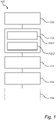
figure 1 is a flowchart of a traffic planning method; -
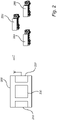
figure 2 shows a device suitable for controlling a plurality of vehicles; -
figure 3 is a schematical representation of a road network with numbered waypoints; -
figure 4 shows example vehicles that can be controlled centrally using embodiments of the invention; -
figure 5 is a search tree representing possible sequences of commands to the vehicles; and -
figure 6 are outlines in semilogarithmic scale of two example search trees illustrating the significance of the notation d, d 0 . - The aspects of the present disclosure will now be described more fully hereinafter with reference to the accompanying drawings, in which certain embodiments of the invention are shown. These aspects may, however, be embodied in many different forms and should not be construed as limiting; rather, these embodiments are provided by way of example so that this disclosure will be thorough and complete, and to fully convey the scope of all aspects of the invention to those skilled in the art. Like numbers refer to like elements throughout the description.
-
Figure 3 is a schematic representation of a road network. Waypoints are defined at the road junctions wp1, wp3 and additionally at some intermediate locations wp2, wp4, wp5, ..., wp8. Some of the intermediate locations may correspond to so-called absorption nodes, where a visiting vehicle is required to dwell for a predetermined or variable time, for purposes of loading, unloading, maintenance etc. The arrangement of the waypoints is not essential to the present invention, rather their location and number may be chosen as deemed necessary in each use case to achieve smooth and efficient traffic control. The waypoints are treated as planning nodes which are shared by a plurality of vehicles v1, v2, v3, v4. Abstractly, a planning node may be understood as a logical entity which is either free or occupied by exactly one vehicle at a time. An occupied node is not consumed but can be released for use by the same or another vehicle. Planning nodes may represent physical space for transport or parking, a communication channel, maintenance machinery, additional equipment for optional temporary use, such as tools or trailers. - Each vehicle (see
figure 4 ) is controllable by an individual control signal, which may indicate a command from a finite set of predetermined commands. It is understood that individual control signals may be multiplexed onto a common carrier. A predefined command may represent an action to be taken at the next waypoint (e.g., continue straight, continue right, continue left, stop), a next destination, a speed adjustment, a loading operation or the like. Implicit signaling is possible, in that a command has a different meaning depending on its current state (e.g., toggle between an electric engine and a combustion engne, toggle between high and low speed, drive/wait at the next waypoint). A vehicle which receives no control signal or a neutrally-valued control signal may be configured to continue the previously instructed action or to halt. The predetermined commands preferably relate to tactical decision-making, which corresponds to a time scale typically shorter than strategic decision-making and typically longer than operational (or machine-level) decision-making. Different vehicles may have different sets of commands. - One aim of the present disclosure is to enable efficient centralized control of the vehicles v1, v2, v3, v4. The vehicles v1, v2, v3, v4 are to be controlled as a group, with mutual coordination. The mutual coordination may entail that any planning node utilization conflicts that could arise between vehicles are deferred to a planning algorithm and resolved at the planning stage. The planning may aim to maximize productivity, such as the total quantity of useful transport system work or the percentage of on-schedule deliveries of goods. The planning may additionally aim to minimize cost, including fuel consumption, battery wear, mechanical component wear or the like.
- Regarding the planning node utilization conflicts that may arise, it may initially be noted that no vehicle blocks any other vehicle for the node occupancies (start state) shown in
figure 3 , that is

- It is easy to realize that the difficulty of the blocking states (as measured, say, by the number of vehicle movements needed to reach a non-blocking state) in a given waypoint topology will increase with the number of vehicles present. The efficiency gain of deploying many vehicles may therefore be offset by the increased risk of conflicts. A waypoint topology populated with many vehicles may also include deadlock states, where no vehicle movement is possible. This may correspond to a real-life scenario where the controlled vehicles need external help to resume operation, such as operator intervention, towing etc.
- The following description is made under an assumption of discrete time, that is, the traffic system evolves in evenly spaced epochs. The length of an epoch may be of the order of 0.1 s, 1 s, 10 s or longer. At each epoch, either a command a1, a2 is given to one of the vehicles v1, v2, v3, v4, a command is given to a predefined group of vehicles, or no command is given. Quasi-simultaneous commands v1.a1, v2.a1 to two vehicles v1, v2 or two vehicle groups can be distributed over two consecutive epochs. To allow approximate simultaneity, the epoch length may be configured shorter than the typical time scale of the tactical decision-making for one vehicle.
- With this setup, the space of possible planning outcomes corresponds to the set of all command sequences of length d, where d is the planning horizon (or lookahead horizon). Equivalently, if the planning process is represented as a search tree of the type shown in
figure 5 , the possible planning outcomes are in a one-to-one relationship with the leaves; the corresponding command sequence is the path from the root to this leaf. The search tree covers seven epochs t1, t2, ..., t7. The planning horizon is seven times the duration of an epoch. For each epoch, there are five possibilities: no command is given (o), command a1 is given to vehicle v1 (v1.a1), command a2 is given to vehicle v1 (v1.a2), command a1 is given to vehicle v2 (v2.a1) or command a2 is given to vehicle v2 (v2.a2). - Within the scope of the present disclosure, a multitude of planning algorithms can be used. A straightforward possible planning approach may be to assign a rule-based score to each possible planning outcome (i.e., sequence of commands) and select the most beneficial one. The score may be assigned on the basis of simulating the movement of the vehicles which will result from applying that sequence of commands, e.g., to find their positions at the planning horizon. Other approaches may include heuristics to accelerate the search for an acceptable solution. The heuristics may help identify on an early stage such sequences of commands that are less promising and exclude them from a full evaluation. As mentioned above, an example heuristic is to remove vehicles from potentially blocking positions without delay. Machine-learning techniques may be useful. The machine-learning agent (e.g., an artificial neural network) may be trained to propose the most suitable action (i.e., command sequence) for a given state. Regardless of the choice of planning algorithm, the computational effort generally has a high sensitivity to a change in the number of leaves, which means that the necessary resource allocation varies significantly with the search depth considered in each execution.
- It is initially assumed that all five possibilities remain available in the next epoch, whichever possibility is chosen in the present epoch, so that the branching factor (or fan-out) of the search tree is 5 everywhere. An outcome of the planning is a 7-element sequence, like (v1.a1, v2.a2, v2.a2, v2.a2, v2.a2, v2.a2, 0), as suggested in
figure 5 , or (0, 0, 0, 0, 0, 0, 0). Due to the limited drawing space infigure 5 , repeating parts of the search tree are represented by elliptic dots (...) or altogether omitted. The leaves of the tree are the tree nodes at the last epoch t7. Their number is 57 = 78125. - The use of a greater planning horizon usually promotes overall more economical vehicle movements, as it helps avoid blocking or near-blocking states, or other consequences of overly 'short-sighted' planning. This however comes at a computational cost: The number of leaves grows exponentially with the planning depth d. When a further vehicle v3 is added, the number of leaves grows as a power of the planning depth d = 7. If the addition implies that one more command v3.a1 can be given at each epoch, there will be 6 d leaves; if the addition implies that two more commands v3.a1, v3.a2 per epoch are available, there will be 7 d leaves, and so forth. There is clearly a dependence on the number of commands as well. In a hypothetic case where each one of N vehicles is controllable by exactly one command each (e.g., drive/wait), the search tree has (N + 1) d leaves. In the general case, if the n th vehicle accepts kn ≥ 1 commands, the number of leaves for planning depth d is

- As announced, the search space size is proportional to the d th power of a number which grows at least linearly with the number N of vehicles. For example, if d = 10, N = 2 and k 1 = k 2 = 2, then the search space size (number of leaves) is about 107, which may or may be computationally tractable, depending on the available processing power. If instead d = 10, N = 10 and k 1 = k 2 = ··· = k 10 = 2, the search space size of the order of 1013, which would be extremely costly to process. The search space size may be independent of the number of planning nodes.
- It is now assumed, instead, that some epochs allow less than all five possibilities. The present invention can achieve a potential efficiency gain in cases where the branching factor drops below the theoretical maximum for some epochs. Such drops may result when it is not possible or meaningful to control some of the vehicles. For example, the initial node occupancies may render some of the commands infeasible, e.g., since one vehicle is temporarily not mobile. Further, it may turn out that some of the commands that are a priori available in one epoch may in fact evolve the vehicle system into a deadlock pattern, and that command is to be treated as infeasible too. For these and similar reasons, the branching factor may vary across different epochs and it may be less than 5 in some epochs. As a result, and notably since the epochs with a branching factor below 5 may restrain the exponential growth of the tree significantly, the number of leaves in a seven-epoch tree may be much below 78125. The number of leaves can be computed as
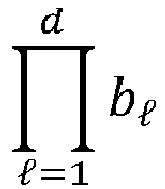
figure 5 , the search depth d = 7 and the local branching factors bℓ ≤ 5. - To illustrate,
figure 6 shows outlines of twoexample search trees first search tree 601 grows weakly: the feasible commands are fewer than the theoretical maximum branching factor in at least some epochs. Thesecond search tree 602 grows with the theoretical maximum branching factor in every epoch, and therefore reaches a number of leaves equal to that of thefirst search tree 601 already for a smaller search depth d. The inventor has realized that the branching factor has a limited variation with respect to successive epochs. This is why the mean branching factor of the search tree can be estimated on the basis of the mean number of feasible motion commands for a neighborhood of the initial node occupancies. The neighborhood may comprise the first d 0 epochs of the actual search tree. Although the predefined search depth d 0 may be significantly less than typical values of the search depth d, it may provide enough guidance towards the true mean branching factor, as an indicator of whether the search tree has weak or strong growth. - The usefulness of the invention is confirmed by numerical data for two example waypoint topologies.
- Example 1: First waypoint topology (not shown); eight deployed vehicles; each vehicle is controllable by the commands "drive" and "wait". Initially, all vehicles are freely movable; none occupies an absorption node. For a search depth of 3 epochs, the search tree has 158 leaves.
- Example 2: First waypoint topology; eight deployed vehicles; each vehicle is controllable by the commands "drive" and "wait". Initially, one of the vehicles occupies an absorption node (unloading). For a search depth (planning horizon) of 3 epochs, the search tree has 69 leaves.
- A comparison of the above data sets suggests that a processor which solves the planning problem of example 1 in acceptable time runs with excess capacity when handling example 2. The excess capacity could be spent on increasing the search depth by one or more epochs. With reference to
figure 6 , examples 1 and 2 may be likened to the respective outlinedsearch trees tree 601 allows a greater planning depth d without exceeding the tractable number of leaves. - Example 3: Second waypoint topology; two deployed vehicles; each vehicle is controllable by the commands "drive" and "wait". Initially, all vehicles are freely movable. For a search depth of 5 epochs, the search tree has 262 leaves.
- Example 4: Second waypoint topology; two deployed vehicles; each vehicle is controllable by the commands "drive" and "wait". Initially, one of the vehicles is in a single-lane two-way section of the road network, where the command "wait" is blocked according to preprogrammed control logic. For a search depth of 5 epochs, the search tree has 63 leaves.
- Again, it appears that the available computational resources would suffice even if the search depth in example 4 was increased to 6, 7 or more. This may promote more prudent vehicle control and, as a consequence, smoother and more economical operation.
- With reference now to
figure 1 , atraffic planning method 100 according to one embodiment will be described. Themethod 100 may be implemented by a general-purpose programmable computer, such as thedevice 200 shown infigure 2 to be described below. - In a
first step 110 of themethod 100, the initial node occupancies of the vehicles are obtained. The node occupancies may be represented as a data structure associating each vehicle with a planning node, like the 0 function above. - In a
second step 112, a mean number of feasible motion commands in a neighborhood of the initial node occupancies is determined. Reference is made to the above definition of feasible motion commands, and it is recalled that this number is equal to the local branching factor. The neighborhood may correspond to a smaller search tree with the initial node occupancies as its root and having a predefined search depth d 0, wherein the predefined search depth d 0 is typically significantly less than typical values of the search depth d. Thesecond step 112 may be described metaphorically as 'scouting' the branching factor, i.e., generating the first d 0 levels of the search tree, sampling the branching factor for these levels, and using this number to approximateb , the mean branching factor for the full tree. The approximation is well justified as it has been found that, in traffic-planning applications, the branching factor has a limited variation with respect to successive epochs. - The mean branching factor in the neighborhood may be computed as the arithmetic mean of the local branching factors:

b ≈ L 1/d0 . - In specific implementations, the
second step 112 may include a substep of processing 112.1 the initial node occupancies to identify vehicles which are temporarily non-movable. Alternatively or additionally, thesecond step 112 includes a substep of comparing 112.2 the initial node occupancies with a set of deadlock patterns, to thereby assess which motion commands cannot be used. - In a
third step 114 of themethod 100, a search depth d which makes optimal use of a predefined computational budget is computed on the basis of the approximate mean branching factorb , i.e., the mean number of feasible motion commands in the neighborhood of the initial node occupancies. If the computational budget is expressed as a maximum number of leaves in a search tree, L max, then one may set d to the greatest integer satisfyingb d ≤ L max, or d = └logL max / logb ┘. - In a
fourth step 116 of themethod 100, a suitable sequence of motion commands is determined by means of an optimization process which considers a search depth of d. The optimization process may include executing a planning algorithm of any of the types discussed above. It is noted that the optimization process may be allowed to execute until a converge criterion is met, until an optimality criterion is fulfilled and/or until a predefined time has elapsed. Actually reaching optimality is no necessary condition under the present invention. - In an optional
fifth step 118, the thus determined sequence of motion commands is fed to said plurality of vehicles for execution. -
Figure 2 shows, in accordance with a further embodiment, adevice 200 for controlling a plurality ofvehicles 299 sharing a set of planning nodes. Thedevice 200 has afirst interface 210 configured to receive initial node occupancies of thevehicles 299. Optionally, it may further receive, for each vehicle, information representing a set of predefined commands v1.a1, v1.a2, v2.a1, v2.a2, which can be fed to the respective vehicles, and/or a mission (utility task) to be carried out may by thevehicles 299. The initial node occupancies may be obtained from a traffic control entity communicating with thevehicles 299, from sensors detecting the positions of thevehicles 299, or from a reply to a self-positioning query issued to thevehicles 299. The optional information may be entered into thefirst interface 210 by an operator or provided as configuration data once it is known whichvehicles 299 will form the fleet. - The
device 200 further has asecond interface 220 configured to feed commands selected from said predefined commands to said plurality of vehicles, as well asprocessing circuitry 230 configured to perform themethod 100 described above.Figure 2 shows direct wireless links from thesecond interface 220 to thevehicles 299. In other embodiments, as explained above, thesecond interface 220 may instead feed sequences of the predefined commands to the traffic control entity, which takes care of the delivery of the commands to thevehicles 299. -
Figure 4 shows atruck 400, abus 402 and aconstruction equipment vehicle 404. A fleet of vehicles of one or more of these types, whether they are autonomous or conventional, can be controlled in a centralized fashion using themethod 100 or thedevice 200 described above. - The aspects of the present disclosure have mainly been described above with reference to a few embodiments. However, as is readily appreciated by a person skilled in the art, other embodiments than the ones disclosed above are equally possible within the scope of the invention, as defined by the appended patent claims.
Claims (11)
- A traffic planning method (100) for controlling a plurality of vehicles (v1, v2, v3, v4), wherein each vehicle occupies one node in a shared set of planning nodes (wp1, wp2, wp3, wp4, wp5, wp6, wp7, wp8) and is movable to other nodes along predefined edges between pairs of the nodes in accordance with a finite set of motion commands (v1.a1, v1.a2, v2.a1, v2.a2), the method comprising:obtaining (110) initial node occupancies of the vehicles; anddetermining (116) a suitable sequence of motion commands by means of an optimization process which considers a search depth (d),characterized in that the search depth is variable and determined by the following preceding steps:- from said finite set of motion commands, determining (112) a mean number of feasible motion commands in a neighborhood of the initial node occupancies; and- determining (114) said search depth d which makes optimal use of a predefined computational budget.
- The method of claim 1, wherein:the computational budget is a maximum number of leaves in a search tree; andthe search depth (d) is calculated by applying the mean number of feasible motion commands as a mean branching factor of the search tree.
- The method of claim 1 or 2, wherein the neighborhood of the initial node occupancies is a predefined search depth (d 0).
- The method of any of the preceding claims, wherein the predefined search depth (d 0) is significantly less than typical values of the search depth (d).
- The method of any of the preceding claims, wherein said determining (112) comprises processing (112.1) the initial node occupancies to identify vehicles which are temporarily non-movable.
- The method of any of the preceding claims, wherein said determining (112) includes comparing (112.2) the initial node occupancies with a set of deadlock patterns.
- The method of any of the preceding claims, further comprising feeding (118) the sequence of motion commands to said plurality of vehicles.
- The method of any of the preceding claims, wherein the vehicles are autonomous vehicles.
- The method of any of the preceding claims, wherein the predefined commands correspond to tactical decision-making.
- A device (200) configured to control a plurality of vehicles (v1, v2, v3, v4), wherein each vehicle occupies one node in a shared set of planning nodes (wp1, wp2, wp3, wp4, wp5, wp6, wp7, wp8) and is movable to other nodes along predefined edges between pairs of the nodes in accordance with a finite set of motion commands (v1.a1, v1.a2, v2.a1, v2.a2), the device comprising:a first interface (210) configured to receive initial node occupancies of the vehicles;a second interface (220) configured to feed motion commands selected from said finite set to said plurality of vehicles; andprocessing circuitry (230) configured to perform the method of any of the preceding claims.
- A computer program comprising instructions which, when the program is executed by a computer, cause the device of claim 10 to carry out the method of any of claims 1 to 9.
Priority Applications (2)
| Application Number | Priority Date | Filing Date | Title |
|---|---|---|---|
| EP21175955.0A EP4095640B1 (en) | 2021-05-26 | 2021-05-26 | Method and system for controlling a plurality of vehicles, in particular autonomous vehicles |
| US17/662,775 US20220383740A1 (en) | 2021-05-26 | 2022-05-10 | Method and system for controlling a plurality of vehicles, in particular autonomous vehicles |
Applications Claiming Priority (1)
| Application Number | Priority Date | Filing Date | Title |
|---|---|---|---|
| EP21175955.0A EP4095640B1 (en) | 2021-05-26 | 2021-05-26 | Method and system for controlling a plurality of vehicles, in particular autonomous vehicles |
Publications (2)
| Publication Number | Publication Date |
|---|---|
| EP4095640A1 true EP4095640A1 (en) | 2022-11-30 |
| EP4095640B1 EP4095640B1 (en) | 2025-01-22 |
Family
ID=76137975
Family Applications (1)
| Application Number | Title | Priority Date | Filing Date |
|---|---|---|---|
| EP21175955.0A Active EP4095640B1 (en) | 2021-05-26 | 2021-05-26 | Method and system for controlling a plurality of vehicles, in particular autonomous vehicles |
Country Status (2)
| Country | Link |
|---|---|
| US (1) | US20220383740A1 (en) |
| EP (1) | EP4095640B1 (en) |
Cited By (2)
| Publication number | Priority date | Publication date | Assignee | Title |
|---|---|---|---|---|
| EP4462403A1 (en) | 2023-05-12 | 2024-11-13 | Volvo Autonomous Solutions AB | A traffic planning method for a vehicle fleet |
| EP4535330A1 (en) * | 2023-10-04 | 2025-04-09 | Volvo Autonomous Solutions AB | System and method of controlling movements of vehicles |
Families Citing this family (1)
| Publication number | Priority date | Publication date | Assignee | Title |
|---|---|---|---|---|
| US11710276B1 (en) * | 2020-09-21 | 2023-07-25 | Apple Inc. | Method and device for improved motion planning |
Citations (2)
| Publication number | Priority date | Publication date | Assignee | Title |
|---|---|---|---|---|
| WO2015011661A2 (en) * | 2013-07-26 | 2015-01-29 | Elettric 80 S.P.A. | Device and method for optimising the movement of automated-guided vehicles, and the like |
| US20200247611A1 (en) * | 2017-10-04 | 2020-08-06 | Ocado Innovation Limited | Object handling coordination system and method of relocating a transporting vessel |
Family Cites Families (1)
| Publication number | Priority date | Publication date | Assignee | Title |
|---|---|---|---|---|
| US6047283A (en) * | 1998-02-26 | 2000-04-04 | Sap Aktiengesellschaft | Fast string searching and indexing using a search tree having a plurality of linked nodes |
-
2021
- 2021-05-26 EP EP21175955.0A patent/EP4095640B1/en active Active
-
2022
- 2022-05-10 US US17/662,775 patent/US20220383740A1/en not_active Abandoned
Patent Citations (2)
| Publication number | Priority date | Publication date | Assignee | Title |
|---|---|---|---|---|
| WO2015011661A2 (en) * | 2013-07-26 | 2015-01-29 | Elettric 80 S.P.A. | Device and method for optimising the movement of automated-guided vehicles, and the like |
| US20200247611A1 (en) * | 2017-10-04 | 2020-08-06 | Ocado Innovation Limited | Object handling coordination system and method of relocating a transporting vessel |
Cited By (2)
| Publication number | Priority date | Publication date | Assignee | Title |
|---|---|---|---|---|
| EP4462403A1 (en) | 2023-05-12 | 2024-11-13 | Volvo Autonomous Solutions AB | A traffic planning method for a vehicle fleet |
| EP4535330A1 (en) * | 2023-10-04 | 2025-04-09 | Volvo Autonomous Solutions AB | System and method of controlling movements of vehicles |
Also Published As
| Publication number | Publication date |
|---|---|
| US20220383740A1 (en) | 2022-12-01 |
| EP4095640B1 (en) | 2025-01-22 |
Similar Documents
| Publication | Publication Date | Title |
|---|---|---|
| US20220383740A1 (en) | Method and system for controlling a plurality of vehicles, in particular autonomous vehicles | |
| EP3696744B1 (en) | Safeguarding resources of physical entites in a shared environment | |
| CN108287545B (en) | Conflict management method and system for multiple mobile robots | |
| CN108268038B (en) | Dispatching method and system for multiple mobile robots | |
| Popović et al. | Application of genetic algorithms for sequencing of AS/RS with a triple-shuttle module in class-based storage | |
| Chieng et al. | A performance comparison of genetic algorithm’s mutation operators in n-cities open loop travelling salesman problem | |
| US20240379000A1 (en) | Traffic planning method for a vehicle fleet | |
| CN119692739B (en) | Optimization method for unmanned truck dispatching in dry bulk terminal yard based on substitution graph model | |
| Sanches et al. | An adaptive genetic algorithm for production scheduling on manufacturing systems with simultaneous use of machines and AGVs | |
| Gunarathna et al. | Real-time intelligent autonomous intersection management using reinforcement learning | |
| US20230004163A1 (en) | Method and system for controlling a plurality of vehicles, in particular autonomous vehicles | |
| Noori et al. | High-level relay hybrid metaheuristic method for multi-depot vehicle routing problem with time windows | |
| Liu et al. | Simultaneous planning and scheduling for multi-autonomous vehicles | |
| Li et al. | An integrated scheduling method for AGVs in an automated container terminal considering battery swapping and battery degradation | |
| Tarau et al. | Model-based control for route choice in automated baggage handling systems | |
| Kaveshgar et al. | A genetic algorithm heuristic for solving the quay crane scheduling problem with time windows | |
| Pagani et al. | A neural network-based algorithm with genetic training for a combined job and energy management for AGVs | |
| Schwab | A decentralized control strategy for high density material flow systems with automated guided vehicles | |
| EP4462403B1 (en) | A traffic planning method for a vehicle fleet | |
| Dang et al. | Simultaneous scheduling of machines and mobile robots | |
| CN119990597B (en) | Mine vehicle dispatching method, device, equipment and storage medium | |
| CN115619127A (en) | Capacity distribution method, electronic device and storage medium | |
| US12399511B2 (en) | Method and system for controlling a plurality of vehicles, in particular autonomous vehicles | |
| US20220397910A1 (en) | Method and device for tuning a hyperparameter of a machine-learning algorithm | |
| Dahl et al. | Emergent robot differentiation for distributed multi-robot task allocation |
Legal Events
| Date | Code | Title | Description |
|---|---|---|---|
| PUAI | Public reference made under article 153(3) epc to a published international application that has entered the european phase |
Free format text: ORIGINAL CODE: 0009012 |
|
| STAA | Information on the status of an ep patent application or granted ep patent |
Free format text: STATUS: THE APPLICATION HAS BEEN PUBLISHED |
|
| STAA | Information on the status of an ep patent application or granted ep patent |
Free format text: STATUS: REQUEST FOR EXAMINATION WAS MADE |
|
| AK | Designated contracting states |
Kind code of ref document: A1 Designated state(s): AL AT BE BG CH CY CZ DE DK EE ES FI FR GB GR HR HU IE IS IT LI LT LU LV MC MK MT NL NO PL PT RO RS SE SI SK SM TR |
|
| 17P | Request for examination filed |
Effective date: 20221107 |
|
| RBV | Designated contracting states (corrected) |
Designated state(s): AL AT BE BG CH CY CZ DE DK EE ES FI FR GB GR HR HU IE IS IT LI LT LU LV MC MK MT NL NO PL PT RO RS SE SI SK SM TR |
|
| STAA | Information on the status of an ep patent application or granted ep patent |
Free format text: STATUS: EXAMINATION IS IN PROGRESS |
|
| REG | Reference to a national code |
Ref legal event code: R079 Ref country code: DE Ref document number: 602021025062 Country of ref document: DE Free format text: PREVIOUS MAIN CLASS: G05D0001020000 Ipc: G05D0001000000 |
|
| 17Q | First examination report despatched |
Effective date: 20240823 |
|
| GRAP | Despatch of communication of intention to grant a patent |
Free format text: ORIGINAL CODE: EPIDOSNIGR1 |
|
| STAA | Information on the status of an ep patent application or granted ep patent |
Free format text: STATUS: GRANT OF PATENT IS INTENDED |
|
| RIC1 | Information provided on ipc code assigned before grant |
Ipc: G06Q 10/08 20120101ALI20240917BHEP Ipc: G08G 1/00 20060101ALI20240917BHEP Ipc: G05D 1/00 20060101AFI20240917BHEP |
|
| INTG | Intention to grant announced |
Effective date: 20240930 |
|
| GRAS | Grant fee paid |
Free format text: ORIGINAL CODE: EPIDOSNIGR3 |
|
| GRAA | (expected) grant |
Free format text: ORIGINAL CODE: 0009210 |
|
| STAA | Information on the status of an ep patent application or granted ep patent |
Free format text: STATUS: THE PATENT HAS BEEN GRANTED |
|
| AK | Designated contracting states |
Kind code of ref document: B1 Designated state(s): AL AT BE BG CH CY CZ DE DK EE ES FI FR GB GR HR HU IE IS IT LI LT LU LV MC MK MT NL NO PL PT RO RS SE SI SK SM TR |
|
| REG | Reference to a national code |
Ref country code: GB Ref legal event code: FG4D |
|
| REG | Reference to a national code |
Ref country code: CH Ref legal event code: EP |
|
| REG | Reference to a national code |
Ref country code: IE Ref legal event code: FG4D |
|
| REG | Reference to a national code |
Ref country code: DE Ref legal event code: R096 Ref document number: 602021025062 Country of ref document: DE |
|
| REG | Reference to a national code |
Ref country code: SE Ref legal event code: TRGR |
|
| REG | Reference to a national code |
Ref country code: NL Ref legal event code: MP Effective date: 20250122 |
|
| PG25 | Lapsed in a contracting state [announced via postgrant information from national office to epo] |
Ref country code: NL Free format text: LAPSE BECAUSE OF FAILURE TO SUBMIT A TRANSLATION OF THE DESCRIPTION OR TO PAY THE FEE WITHIN THE PRESCRIBED TIME-LIMIT Effective date: 20250122 |
|
| PG25 | Lapsed in a contracting state [announced via postgrant information from national office to epo] |
Ref country code: RS Free format text: LAPSE BECAUSE OF FAILURE TO SUBMIT A TRANSLATION OF THE DESCRIPTION OR TO PAY THE FEE WITHIN THE PRESCRIBED TIME-LIMIT Effective date: 20250422 |
|
| PG25 | Lapsed in a contracting state [announced via postgrant information from national office to epo] |
Ref country code: FI Free format text: LAPSE BECAUSE OF FAILURE TO SUBMIT A TRANSLATION OF THE DESCRIPTION OR TO PAY THE FEE WITHIN THE PRESCRIBED TIME-LIMIT Effective date: 20250122 |
|
| PG25 | Lapsed in a contracting state [announced via postgrant information from national office to epo] |
Ref country code: PL Free format text: LAPSE BECAUSE OF FAILURE TO SUBMIT A TRANSLATION OF THE DESCRIPTION OR TO PAY THE FEE WITHIN THE PRESCRIBED TIME-LIMIT Effective date: 20250122 |
|
| PGFP | Annual fee paid to national office [announced via postgrant information from national office to epo] |
Ref country code: DE Payment date: 20250528 Year of fee payment: 5 |
|
| PG25 | Lapsed in a contracting state [announced via postgrant information from national office to epo] |
Ref country code: ES Free format text: LAPSE BECAUSE OF FAILURE TO SUBMIT A TRANSLATION OF THE DESCRIPTION OR TO PAY THE FEE WITHIN THE PRESCRIBED TIME-LIMIT Effective date: 20250122 |
|
| REG | Reference to a national code |
Ref country code: LT Ref legal event code: MG9D |
|
| PG25 | Lapsed in a contracting state [announced via postgrant information from national office to epo] |
Ref country code: NO Free format text: LAPSE BECAUSE OF FAILURE TO SUBMIT A TRANSLATION OF THE DESCRIPTION OR TO PAY THE FEE WITHIN THE PRESCRIBED TIME-LIMIT Effective date: 20250422 Ref country code: IS Free format text: LAPSE BECAUSE OF FAILURE TO SUBMIT A TRANSLATION OF THE DESCRIPTION OR TO PAY THE FEE WITHIN THE PRESCRIBED TIME-LIMIT Effective date: 20250522 |
|
| REG | Reference to a national code |
Ref country code: AT Ref legal event code: MK05 Ref document number: 1761926 Country of ref document: AT Kind code of ref document: T Effective date: 20250122 |
|
| PG25 | Lapsed in a contracting state [announced via postgrant information from national office to epo] |
Ref country code: HR Free format text: LAPSE BECAUSE OF FAILURE TO SUBMIT A TRANSLATION OF THE DESCRIPTION OR TO PAY THE FEE WITHIN THE PRESCRIBED TIME-LIMIT Effective date: 20250122 |
|
| PG25 | Lapsed in a contracting state [announced via postgrant information from national office to epo] |
Ref country code: PT Free format text: LAPSE BECAUSE OF FAILURE TO SUBMIT A TRANSLATION OF THE DESCRIPTION OR TO PAY THE FEE WITHIN THE PRESCRIBED TIME-LIMIT Effective date: 20250522 Ref country code: LV Free format text: LAPSE BECAUSE OF FAILURE TO SUBMIT A TRANSLATION OF THE DESCRIPTION OR TO PAY THE FEE WITHIN THE PRESCRIBED TIME-LIMIT Effective date: 20250122 |
|
| PG25 | Lapsed in a contracting state [announced via postgrant information from national office to epo] |
Ref country code: BG Free format text: LAPSE BECAUSE OF FAILURE TO SUBMIT A TRANSLATION OF THE DESCRIPTION OR TO PAY THE FEE WITHIN THE PRESCRIBED TIME-LIMIT Effective date: 20250122 Ref country code: GR Free format text: LAPSE BECAUSE OF FAILURE TO SUBMIT A TRANSLATION OF THE DESCRIPTION OR TO PAY THE FEE WITHIN THE PRESCRIBED TIME-LIMIT Effective date: 20250423 |
|
| PG25 | Lapsed in a contracting state [announced via postgrant information from national office to epo] |
Ref country code: AT Free format text: LAPSE BECAUSE OF FAILURE TO SUBMIT A TRANSLATION OF THE DESCRIPTION OR TO PAY THE FEE WITHIN THE PRESCRIBED TIME-LIMIT Effective date: 20250122 |
|
| PGFP | Annual fee paid to national office [announced via postgrant information from national office to epo] |
Ref country code: SE Payment date: 20250526 Year of fee payment: 5 |
|
| PG25 | Lapsed in a contracting state [announced via postgrant information from national office to epo] |
Ref country code: SM Free format text: LAPSE BECAUSE OF FAILURE TO SUBMIT A TRANSLATION OF THE DESCRIPTION OR TO PAY THE FEE WITHIN THE PRESCRIBED TIME-LIMIT Effective date: 20250122 |
|
| PG25 | Lapsed in a contracting state [announced via postgrant information from national office to epo] |
Ref country code: DK Free format text: LAPSE BECAUSE OF FAILURE TO SUBMIT A TRANSLATION OF THE DESCRIPTION OR TO PAY THE FEE WITHIN THE PRESCRIBED TIME-LIMIT Effective date: 20250122 |
|
| PG25 | Lapsed in a contracting state [announced via postgrant information from national office to epo] |
Ref country code: IT Free format text: LAPSE BECAUSE OF FAILURE TO SUBMIT A TRANSLATION OF THE DESCRIPTION OR TO PAY THE FEE WITHIN THE PRESCRIBED TIME-LIMIT Effective date: 20250122 |
|
| PG25 | Lapsed in a contracting state [announced via postgrant information from national office to epo] |
Ref country code: EE Free format text: LAPSE BECAUSE OF FAILURE TO SUBMIT A TRANSLATION OF THE DESCRIPTION OR TO PAY THE FEE WITHIN THE PRESCRIBED TIME-LIMIT Effective date: 20250122 Ref country code: CZ Free format text: LAPSE BECAUSE OF FAILURE TO SUBMIT A TRANSLATION OF THE DESCRIPTION OR TO PAY THE FEE WITHIN THE PRESCRIBED TIME-LIMIT Effective date: 20250122 |
|
| REG | Reference to a national code |
Ref country code: DE Ref legal event code: R097 Ref document number: 602021025062 Country of ref document: DE |
|
| PG25 | Lapsed in a contracting state [announced via postgrant information from national office to epo] |
Ref country code: RO Free format text: LAPSE BECAUSE OF FAILURE TO SUBMIT A TRANSLATION OF THE DESCRIPTION OR TO PAY THE FEE WITHIN THE PRESCRIBED TIME-LIMIT Effective date: 20250122 |
|
| PG25 | Lapsed in a contracting state [announced via postgrant information from national office to epo] |
Ref country code: SK Free format text: LAPSE BECAUSE OF FAILURE TO SUBMIT A TRANSLATION OF THE DESCRIPTION OR TO PAY THE FEE WITHIN THE PRESCRIBED TIME-LIMIT Effective date: 20250122 |
|
| PLBE | No opposition filed within time limit |
Free format text: ORIGINAL CODE: 0009261 |
|
| STAA | Information on the status of an ep patent application or granted ep patent |
Free format text: STATUS: NO OPPOSITION FILED WITHIN TIME LIMIT |
|
| REG | Reference to a national code |
Ref country code: CH Ref legal event code: L10 Free format text: ST27 STATUS EVENT CODE: U-0-0-L10-L00 (AS PROVIDED BY THE NATIONAL OFFICE) Effective date: 20251203 |
|
| REG | Reference to a national code |
Ref country code: CH Ref legal event code: H13 Free format text: ST27 STATUS EVENT CODE: U-0-0-H10-H13 (AS PROVIDED BY THE NATIONAL OFFICE) Effective date: 20251223 |
|
| 26N | No opposition filed |
Effective date: 20251023 |
|
| PG25 | Lapsed in a contracting state [announced via postgrant information from national office to epo] |
Ref country code: LU Free format text: LAPSE BECAUSE OF NON-PAYMENT OF DUE FEES Effective date: 20250526 |
|
| PG25 | Lapsed in a contracting state [announced via postgrant information from national office to epo] |
Ref country code: CH Free format text: LAPSE BECAUSE OF NON-PAYMENT OF DUE FEES Effective date: 20250531 |
|
| GBPC | Gb: european patent ceased through non-payment of renewal fee |
Effective date: 20250526 |
|
| REG | Reference to a national code |
Ref country code: BE Ref legal event code: MM Effective date: 20250531 |
|
| PG25 | Lapsed in a contracting state [announced via postgrant information from national office to epo] |
Ref country code: MC Free format text: LAPSE BECAUSE OF FAILURE TO SUBMIT A TRANSLATION OF THE DESCRIPTION OR TO PAY THE FEE WITHIN THE PRESCRIBED TIME-LIMIT Effective date: 20250122 |
|
| PG25 | Lapsed in a contracting state [announced via postgrant information from national office to epo] |
Ref country code: GB Free format text: LAPSE BECAUSE OF NON-PAYMENT OF DUE FEES Effective date: 20250526 |
|
| PG25 | Lapsed in a contracting state [announced via postgrant information from national office to epo] |
Ref country code: IE Free format text: LAPSE BECAUSE OF NON-PAYMENT OF DUE FEES Effective date: 20250526 |
|
| PG25 | Lapsed in a contracting state [announced via postgrant information from national office to epo] |
Ref country code: BE Free format text: LAPSE BECAUSE OF NON-PAYMENT OF DUE FEES Effective date: 20250531 |
|
| PG25 | Lapsed in a contracting state [announced via postgrant information from national office to epo] |
Ref country code: FR Free format text: LAPSE BECAUSE OF NON-PAYMENT OF DUE FEES Effective date: 20250531 |