EP4095612A1 - Electrostatic image developing toner, electrostatic image developer, toner cartridge, process cartridge, and image forming apparatus - Google Patents
Electrostatic image developing toner, electrostatic image developer, toner cartridge, process cartridge, and image forming apparatus Download PDFInfo
- Publication number
- EP4095612A1 EP4095612A1 EP21211626.3A EP21211626A EP4095612A1 EP 4095612 A1 EP4095612 A1 EP 4095612A1 EP 21211626 A EP21211626 A EP 21211626A EP 4095612 A1 EP4095612 A1 EP 4095612A1
- Authority
- EP
- European Patent Office
- Prior art keywords
- toner
- toner particle
- domains
- particle
- resin
- Prior art date
- Legal status (The legal status is an assumption and is not a legal conclusion. Google has not performed a legal analysis and makes no representation as to the accuracy of the status listed.)
- Pending
Links
- 238000000034 method Methods 0.000 title claims description 54
- 230000008569 process Effects 0.000 title claims description 24
- 239000002245 particle Substances 0.000 claims abstract description 625
- 239000003795 chemical substances by application Substances 0.000 claims abstract description 182
- 229920005989 resin Polymers 0.000 claims abstract description 143
- 239000011347 resin Substances 0.000 claims abstract description 143
- 239000011230 binding agent Substances 0.000 claims abstract description 33
- 229920001225 polyester resin Polymers 0.000 claims description 75
- 239000004645 polyester resin Substances 0.000 claims description 75
- 238000012546 transfer Methods 0.000 claims description 74
- 229920006127 amorphous resin Polymers 0.000 claims description 48
- 150000002148 esters Chemical class 0.000 claims description 47
- 238000002844 melting Methods 0.000 claims description 30
- 230000008018 melting Effects 0.000 claims description 30
- 229920005792 styrene-acrylic resin Polymers 0.000 claims description 30
- 230000015572 biosynthetic process Effects 0.000 claims description 21
- 239000007788 liquid Substances 0.000 description 137
- 239000006185 dispersion Substances 0.000 description 134
- -1 ethylene, propylene Chemical group 0.000 description 54
- 239000001993 wax Substances 0.000 description 52
- 239000000203 mixture Substances 0.000 description 43
- 239000002609 medium Substances 0.000 description 38
- 239000000178 monomer Substances 0.000 description 35
- XLYOFNOQVPJJNP-UHFFFAOYSA-N water Substances O XLYOFNOQVPJJNP-UHFFFAOYSA-N 0.000 description 30
- 238000002360 preparation method Methods 0.000 description 29
- 239000003086 colorant Substances 0.000 description 27
- 238000000151 deposition Methods 0.000 description 27
- 230000008021 deposition Effects 0.000 description 26
- 239000000654 additive Substances 0.000 description 24
- 239000004094 surface-active agent Substances 0.000 description 22
- PPBRXRYQALVLMV-UHFFFAOYSA-N Styrene Chemical compound C=CC1=CC=CC=C1 PPBRXRYQALVLMV-UHFFFAOYSA-N 0.000 description 21
- 239000012188 paraffin wax Substances 0.000 description 21
- 239000007787 solid Substances 0.000 description 21
- 238000005342 ion exchange Methods 0.000 description 20
- 229920006038 crystalline resin Polymers 0.000 description 19
- NIXOWILDQLNWCW-UHFFFAOYSA-M Acrylate Chemical compound [O-]C(=O)C=C NIXOWILDQLNWCW-UHFFFAOYSA-M 0.000 description 17
- 230000000052 comparative effect Effects 0.000 description 17
- 239000000243 solution Substances 0.000 description 16
- LYCAIKOWRPUZTN-UHFFFAOYSA-N Ethylene glycol Chemical compound OCCO LYCAIKOWRPUZTN-UHFFFAOYSA-N 0.000 description 15
- 150000005846 sugar alcohols Polymers 0.000 description 15
- 230000000996 additive effect Effects 0.000 description 14
- 230000009477 glass transition Effects 0.000 description 14
- 238000004581 coalescence Methods 0.000 description 13
- 230000001186 cumulative effect Effects 0.000 description 12
- TVIDDXQYHWJXFK-UHFFFAOYSA-N dodecanedioic acid Chemical compound OC(=O)CCCCCCCCCCC(O)=O TVIDDXQYHWJXFK-UHFFFAOYSA-N 0.000 description 12
- 239000000463 material Substances 0.000 description 12
- CXMXRPHRNRROMY-UHFFFAOYSA-N sebacic acid Chemical compound OC(=O)CCCCCCCCC(O)=O CXMXRPHRNRROMY-UHFFFAOYSA-N 0.000 description 12
- IJGRMHOSHXDMSA-UHFFFAOYSA-N Atomic nitrogen Chemical compound N#N IJGRMHOSHXDMSA-UHFFFAOYSA-N 0.000 description 11
- 125000004432 carbon atom Chemical group C* 0.000 description 11
- 238000004140 cleaning Methods 0.000 description 11
- 238000009826 distribution Methods 0.000 description 11
- 239000000975 dye Substances 0.000 description 11
- 229920000642 polymer Polymers 0.000 description 11
- 239000000126 substance Substances 0.000 description 11
- OFOBLEOULBTSOW-UHFFFAOYSA-N Malonic acid Chemical compound OC(=O)CC(O)=O OFOBLEOULBTSOW-UHFFFAOYSA-N 0.000 description 10
- 238000004220 aggregation Methods 0.000 description 10
- 230000002776 aggregation Effects 0.000 description 10
- 150000001732 carboxylic acid derivatives Chemical class 0.000 description 10
- TYFQFVWCELRYAO-UHFFFAOYSA-N suberic acid Chemical compound OC(=O)CCCCCCC(O)=O TYFQFVWCELRYAO-UHFFFAOYSA-N 0.000 description 10
- 150000001735 carboxylic acids Chemical class 0.000 description 9
- 238000006243 chemical reaction Methods 0.000 description 9
- 150000001991 dicarboxylic acids Chemical class 0.000 description 9
- 229910052751 metal Inorganic materials 0.000 description 9
- 239000002184 metal Substances 0.000 description 9
- 125000000391 vinyl group Chemical group [H]C([*])=C([H])[H] 0.000 description 9
- 229920002554 vinyl polymer Polymers 0.000 description 9
- KKEYFWRCBNTPAC-UHFFFAOYSA-N Terephthalic acid Chemical compound OC(=O)C1=CC=C(C(O)=O)C=C1 KKEYFWRCBNTPAC-UHFFFAOYSA-N 0.000 description 8
- 239000011247 coating layer Substances 0.000 description 8
- LWBHHRRTOZQPDM-UHFFFAOYSA-N undecanedioic acid Chemical compound OC(=O)CCCCCCCCCC(O)=O LWBHHRRTOZQPDM-UHFFFAOYSA-N 0.000 description 8
- VYPSYNLAJGMNEJ-UHFFFAOYSA-N Silicium dioxide Chemical compound O=[Si]=O VYPSYNLAJGMNEJ-UHFFFAOYSA-N 0.000 description 7
- 125000001931 aliphatic group Chemical group 0.000 description 7
- 239000003945 anionic surfactant Substances 0.000 description 7
- 238000001035 drying Methods 0.000 description 7
- 230000004927 fusion Effects 0.000 description 7
- BDJRBEYXGGNYIS-UHFFFAOYSA-N nonanedioic acid Chemical compound OC(=O)CCCCCCCC(O)=O BDJRBEYXGGNYIS-UHFFFAOYSA-N 0.000 description 7
- PFIOPNYSBSJFJJ-UHFFFAOYSA-M sodium;2-octylbenzenesulfonate Chemical compound [Na+].CCCCCCCCC1=CC=CC=C1S([O-])(=O)=O PFIOPNYSBSJFJJ-UHFFFAOYSA-M 0.000 description 7
- PUPZLCDOIYMWBV-UHFFFAOYSA-N (+/-)-1,3-Butanediol Chemical compound CC(O)CCO PUPZLCDOIYMWBV-UHFFFAOYSA-N 0.000 description 6
- LFQSCWFLJHTTHZ-UHFFFAOYSA-N Ethanol Chemical compound CCO LFQSCWFLJHTTHZ-UHFFFAOYSA-N 0.000 description 6
- VZCYOOQTPOCHFL-OWOJBTEDSA-N Fumaric acid Chemical compound OC(=O)\C=C\C(O)=O VZCYOOQTPOCHFL-OWOJBTEDSA-N 0.000 description 6
- PEDCQBHIVMGVHV-UHFFFAOYSA-N Glycerine Chemical compound OCC(O)CO PEDCQBHIVMGVHV-UHFFFAOYSA-N 0.000 description 6
- MUBZPKHOEPUJKR-UHFFFAOYSA-N Oxalic acid Chemical compound OC(=O)C(O)=O MUBZPKHOEPUJKR-UHFFFAOYSA-N 0.000 description 6
- DNIAPMSPPWPWGF-UHFFFAOYSA-N Propylene glycol Chemical compound CC(O)CO DNIAPMSPPWPWGF-UHFFFAOYSA-N 0.000 description 6
- WNLRTRBMVRJNCN-UHFFFAOYSA-N adipic acid Chemical compound OC(=O)CCCCC(O)=O WNLRTRBMVRJNCN-UHFFFAOYSA-N 0.000 description 6
- 150000001298 alcohols Chemical class 0.000 description 6
- 238000000113 differential scanning calorimetry Methods 0.000 description 6
- 239000003822 epoxy resin Substances 0.000 description 6
- XXMIOPMDWAUFGU-UHFFFAOYSA-N hexane-1,6-diol Chemical compound OCCCCCCO XXMIOPMDWAUFGU-UHFFFAOYSA-N 0.000 description 6
- 229920000647 polyepoxide Polymers 0.000 description 6
- 239000000843 powder Substances 0.000 description 6
- 239000000047 product Substances 0.000 description 6
- 150000003839 salts Chemical class 0.000 description 6
- ARCGXLSVLAOJQL-UHFFFAOYSA-N trimellitic acid Chemical compound OC(=O)C1=CC=C(C(O)=O)C(C(O)=O)=C1 ARCGXLSVLAOJQL-UHFFFAOYSA-N 0.000 description 6
- ALVZNPYWJMLXKV-UHFFFAOYSA-N 1,9-Nonanediol Chemical compound OCCCCCCCCCO ALVZNPYWJMLXKV-UHFFFAOYSA-N 0.000 description 5
- GWEVSGVZZGPLCZ-UHFFFAOYSA-N Titan oxide Chemical compound O=[Ti]=O GWEVSGVZZGPLCZ-UHFFFAOYSA-N 0.000 description 5
- 239000012736 aqueous medium Substances 0.000 description 5
- 239000002738 chelating agent Substances 0.000 description 5
- 238000009833 condensation Methods 0.000 description 5
- 230000005494 condensation Effects 0.000 description 5
- FOTKYAAJKYLFFN-UHFFFAOYSA-N decane-1,10-diol Chemical compound OCCCCCCCCCCO FOTKYAAJKYLFFN-UHFFFAOYSA-N 0.000 description 5
- 235000014113 dietary fatty acids Nutrition 0.000 description 5
- 239000000194 fatty acid Substances 0.000 description 5
- 229930195729 fatty acid Natural products 0.000 description 5
- 230000002209 hydrophobic effect Effects 0.000 description 5
- 239000010954 inorganic particle Substances 0.000 description 5
- SZVJSHCCFOBDDC-UHFFFAOYSA-N iron(II,III) oxide Inorganic materials O=[Fe]O[Fe]O[Fe]=O SZVJSHCCFOBDDC-UHFFFAOYSA-N 0.000 description 5
- 239000010410 layer Substances 0.000 description 5
- OEIJHBUUFURJLI-UHFFFAOYSA-N octane-1,8-diol Chemical compound OCCCCCCCCO OEIJHBUUFURJLI-UHFFFAOYSA-N 0.000 description 5
- 239000000049 pigment Substances 0.000 description 5
- 238000006116 polymerization reaction Methods 0.000 description 5
- 239000002904 solvent Substances 0.000 description 5
- 238000003756 stirring Methods 0.000 description 5
- BDHFUVZGWQCTTF-UHFFFAOYSA-M sulfonate Chemical compound [O-]S(=O)=O BDHFUVZGWQCTTF-UHFFFAOYSA-M 0.000 description 5
- DGAQECJNVWCQMB-PUAWFVPOSA-M Ilexoside XXIX Chemical compound C[C@@H]1CC[C@@]2(CC[C@@]3(C(=CC[C@H]4[C@]3(CC[C@@H]5[C@@]4(CC[C@@H](C5(C)C)OS(=O)(=O)[O-])C)C)[C@@H]2[C@]1(C)O)C)C(=O)O[C@H]6[C@@H]([C@H]([C@@H]([C@H](O6)CO)O)O)O.[Na+] DGAQECJNVWCQMB-PUAWFVPOSA-M 0.000 description 4
- 239000004793 Polystyrene Substances 0.000 description 4
- KDYFGRWQOYBRFD-UHFFFAOYSA-N Succinic acid Natural products OC(=O)CCC(O)=O KDYFGRWQOYBRFD-UHFFFAOYSA-N 0.000 description 4
- WYURNTSHIVDZCO-UHFFFAOYSA-N Tetrahydrofuran Chemical compound C1CCOC1 WYURNTSHIVDZCO-UHFFFAOYSA-N 0.000 description 4
- XLOMVQKBTHCTTD-UHFFFAOYSA-N Zinc monoxide Chemical compound [Zn]=O XLOMVQKBTHCTTD-UHFFFAOYSA-N 0.000 description 4
- 239000002253 acid Substances 0.000 description 4
- 125000005907 alkyl ester group Chemical group 0.000 description 4
- 125000002947 alkylene group Chemical group 0.000 description 4
- 150000008064 anhydrides Chemical class 0.000 description 4
- TZCXTZWJZNENPQ-UHFFFAOYSA-L barium sulfate Chemical compound [Ba+2].[O-]S([O-])(=O)=O TZCXTZWJZNENPQ-UHFFFAOYSA-L 0.000 description 4
- WERYXYBDKMZEQL-UHFFFAOYSA-N butane-1,4-diol Chemical compound OCCCCO WERYXYBDKMZEQL-UHFFFAOYSA-N 0.000 description 4
- KDYFGRWQOYBRFD-NUQCWPJISA-N butanedioic acid Chemical compound O[14C](=O)CC[14C](O)=O KDYFGRWQOYBRFD-NUQCWPJISA-N 0.000 description 4
- 239000011248 coating agent Substances 0.000 description 4
- 238000000576 coating method Methods 0.000 description 4
- 229920001577 copolymer Polymers 0.000 description 4
- 239000007822 coupling agent Substances 0.000 description 4
- 239000002270 dispersing agent Substances 0.000 description 4
- 239000002612 dispersion medium Substances 0.000 description 4
- GHLKSLMMWAKNBM-UHFFFAOYSA-N dodecane-1,12-diol Chemical compound OCCCCCCCCCCCCO GHLKSLMMWAKNBM-UHFFFAOYSA-N 0.000 description 4
- 238000011156 evaluation Methods 0.000 description 4
- 150000004665 fatty acids Chemical class 0.000 description 4
- SXCBDZAEHILGLM-UHFFFAOYSA-N heptane-1,7-diol Chemical compound OCCCCCCCO SXCBDZAEHILGLM-UHFFFAOYSA-N 0.000 description 4
- QQHJDPROMQRDLA-UHFFFAOYSA-N hexadecanedioic acid Chemical compound OC(=O)CCCCCCCCCCCCCCC(O)=O QQHJDPROMQRDLA-UHFFFAOYSA-N 0.000 description 4
- JJOJFIHJIRWASH-UHFFFAOYSA-N icosanedioic acid Chemical compound OC(=O)CCCCCCCCCCCCCCCCCCC(O)=O JJOJFIHJIRWASH-UHFFFAOYSA-N 0.000 description 4
- QQVIHTHCMHWDBS-UHFFFAOYSA-N isophthalic acid Chemical compound OC(=O)C1=CC=CC(C(O)=O)=C1 QQVIHTHCMHWDBS-UHFFFAOYSA-N 0.000 description 4
- 239000006247 magnetic powder Substances 0.000 description 4
- 238000002156 mixing Methods 0.000 description 4
- 229910052757 nitrogen Inorganic materials 0.000 description 4
- LUUFSCNUZAYHAT-UHFFFAOYSA-N octadecane-1,18-diol Chemical compound OCCCCCCCCCCCCCCCCCCO LUUFSCNUZAYHAT-UHFFFAOYSA-N 0.000 description 4
- XNGIFLGASWRNHJ-UHFFFAOYSA-N phthalic acid Chemical compound OC(=O)C1=CC=CC=C1C(O)=O XNGIFLGASWRNHJ-UHFFFAOYSA-N 0.000 description 4
- 238000012643 polycondensation polymerization Methods 0.000 description 4
- 229920002223 polystyrene Polymers 0.000 description 4
- 230000009467 reduction Effects 0.000 description 4
- 238000000926 separation method Methods 0.000 description 4
- 239000011734 sodium Substances 0.000 description 4
- 229910052708 sodium Inorganic materials 0.000 description 4
- HQHCYKULIHKCEB-UHFFFAOYSA-N tetradecanedioic acid Chemical compound OC(=O)CCCCCCCCCCCCC(O)=O HQHCYKULIHKCEB-UHFFFAOYSA-N 0.000 description 4
- VZCYOOQTPOCHFL-UHFFFAOYSA-N trans-butenedioic acid Natural products OC(=O)C=CC(O)=O VZCYOOQTPOCHFL-UHFFFAOYSA-N 0.000 description 4
- XEKOWRVHYACXOJ-UHFFFAOYSA-N Ethyl acetate Chemical compound CCOC(C)=O XEKOWRVHYACXOJ-UHFFFAOYSA-N 0.000 description 3
- OKKJLVBELUTLKV-UHFFFAOYSA-N Methanol Chemical compound OC OKKJLVBELUTLKV-UHFFFAOYSA-N 0.000 description 3
- ALQSHHUCVQOPAS-UHFFFAOYSA-N Pentane-1,5-diol Chemical compound OCCCCCO ALQSHHUCVQOPAS-UHFFFAOYSA-N 0.000 description 3
- 239000004698 Polyethylene Substances 0.000 description 3
- KWYUFKZDYYNOTN-UHFFFAOYSA-M Potassium hydroxide Chemical compound [OH-].[K+] KWYUFKZDYYNOTN-UHFFFAOYSA-M 0.000 description 3
- HEMHJVSKTPXQMS-UHFFFAOYSA-M Sodium hydroxide Chemical compound [OH-].[Na+] HEMHJVSKTPXQMS-UHFFFAOYSA-M 0.000 description 3
- RTAQQCXQSZGOHL-UHFFFAOYSA-N Titanium Chemical compound [Ti] RTAQQCXQSZGOHL-UHFFFAOYSA-N 0.000 description 3
- YXFVVABEGXRONW-UHFFFAOYSA-N Toluene Chemical compound CC1=CC=CC=C1 YXFVVABEGXRONW-UHFFFAOYSA-N 0.000 description 3
- 230000009471 action Effects 0.000 description 3
- 238000012644 addition polymerization Methods 0.000 description 3
- 239000001361 adipic acid Substances 0.000 description 3
- 235000011037 adipic acid Nutrition 0.000 description 3
- BTANRVKWQNVYAZ-UHFFFAOYSA-N butan-2-ol Chemical compound CCC(C)O BTANRVKWQNVYAZ-UHFFFAOYSA-N 0.000 description 3
- 239000006229 carbon black Substances 0.000 description 3
- 239000003093 cationic surfactant Substances 0.000 description 3
- KRKNYBCHXYNGOX-UHFFFAOYSA-N citric acid Chemical compound OC(=O)CC(O)(C(O)=O)CC(O)=O KRKNYBCHXYNGOX-UHFFFAOYSA-N 0.000 description 3
- 239000000470 constituent Substances 0.000 description 3
- 238000007334 copolymerization reaction Methods 0.000 description 3
- MTHSVFCYNBDYFN-UHFFFAOYSA-N diethylene glycol Chemical compound OCCOCCO MTHSVFCYNBDYFN-UHFFFAOYSA-N 0.000 description 3
- 229910001873 dinitrogen Inorganic materials 0.000 description 3
- 150000002009 diols Chemical class 0.000 description 3
- 238000004090 dissolution Methods 0.000 description 3
- 239000003792 electrolyte Substances 0.000 description 3
- 238000004945 emulsification Methods 0.000 description 3
- 239000001530 fumaric acid Substances 0.000 description 3
- 238000005227 gel permeation chromatography Methods 0.000 description 3
- 235000011187 glycerol Nutrition 0.000 description 3
- 238000010438 heat treatment Methods 0.000 description 3
- 230000001678 irradiating effect Effects 0.000 description 3
- 238000004519 manufacturing process Methods 0.000 description 3
- 239000011159 matrix material Substances 0.000 description 3
- 238000005259 measurement Methods 0.000 description 3
- 230000004048 modification Effects 0.000 description 3
- 238000012986 modification Methods 0.000 description 3
- 239000002736 nonionic surfactant Substances 0.000 description 3
- WXZMFSXDPGVJKK-UHFFFAOYSA-N pentaerythritol Chemical compound OCC(CO)(CO)CO WXZMFSXDPGVJKK-UHFFFAOYSA-N 0.000 description 3
- 229920003023 plastic Polymers 0.000 description 3
- 239000004033 plastic Substances 0.000 description 3
- 229920000728 polyester Polymers 0.000 description 3
- 229920000573 polyethylene Polymers 0.000 description 3
- 239000000377 silicon dioxide Substances 0.000 description 3
- 238000012360 testing method Methods 0.000 description 3
- XOLBLPGZBRYERU-UHFFFAOYSA-N tin dioxide Chemical compound O=[Sn]=O XOLBLPGZBRYERU-UHFFFAOYSA-N 0.000 description 3
- 230000007704 transition Effects 0.000 description 3
- DNIAPMSPPWPWGF-VKHMYHEASA-N (+)-propylene glycol Chemical compound C[C@H](O)CO DNIAPMSPPWPWGF-VKHMYHEASA-N 0.000 description 2
- DNIAPMSPPWPWGF-GSVOUGTGSA-N (R)-(-)-Propylene glycol Chemical compound C[C@@H](O)CO DNIAPMSPPWPWGF-GSVOUGTGSA-N 0.000 description 2
- YPFDHNVEDLHUCE-UHFFFAOYSA-N 1,3-propanediol Substances OCCCO YPFDHNVEDLHUCE-UHFFFAOYSA-N 0.000 description 2
- KBPLFHHGFOOTCA-UHFFFAOYSA-N 1-Octanol Chemical compound CCCCCCCCO KBPLFHHGFOOTCA-UHFFFAOYSA-N 0.000 description 2
- KTZVZZJJVJQZHV-UHFFFAOYSA-N 1-chloro-4-ethenylbenzene Chemical compound ClC1=CC=C(C=C)C=C1 KTZVZZJJVJQZHV-UHFFFAOYSA-N 0.000 description 2
- RTBFRGCFXZNCOE-UHFFFAOYSA-N 1-methylsulfonylpiperidin-4-one Chemical compound CS(=O)(=O)N1CCC(=O)CC1 RTBFRGCFXZNCOE-UHFFFAOYSA-N 0.000 description 2
- JLIDVCMBCGBIEY-UHFFFAOYSA-N 1-penten-3-one Chemical compound CCC(=O)C=C JLIDVCMBCGBIEY-UHFFFAOYSA-N 0.000 description 2
- 239000004925 Acrylic resin Substances 0.000 description 2
- VHUUQVKOLVNVRT-UHFFFAOYSA-N Ammonium hydroxide Chemical compound [NH4+].[OH-] VHUUQVKOLVNVRT-UHFFFAOYSA-N 0.000 description 2
- KAKZBPTYRLMSJV-UHFFFAOYSA-N Butadiene Chemical compound C=CC=C KAKZBPTYRLMSJV-UHFFFAOYSA-N 0.000 description 2
- VTYYLEPIZMXCLO-UHFFFAOYSA-L Calcium carbonate Chemical compound [Ca+2].[O-]C([O-])=O VTYYLEPIZMXCLO-UHFFFAOYSA-L 0.000 description 2
- VEXZGXHMUGYJMC-UHFFFAOYSA-M Chloride anion Chemical compound [Cl-] VEXZGXHMUGYJMC-UHFFFAOYSA-M 0.000 description 2
- RGHNJXZEOKUKBD-SQOUGZDYSA-N D-gluconic acid Chemical compound OC[C@@H](O)[C@@H](O)[C@H](O)[C@@H](O)C(O)=O RGHNJXZEOKUKBD-SQOUGZDYSA-N 0.000 description 2
- KCXVZYZYPLLWCC-UHFFFAOYSA-N EDTA Chemical compound OC(=O)CN(CC(O)=O)CCN(CC(O)=O)CC(O)=O KCXVZYZYPLLWCC-UHFFFAOYSA-N 0.000 description 2
- JIGUQPWFLRLWPJ-UHFFFAOYSA-N Ethyl acrylate Chemical compound CCOC(=O)C=C JIGUQPWFLRLWPJ-UHFFFAOYSA-N 0.000 description 2
- WSFSSNUMVMOOMR-UHFFFAOYSA-N Formaldehyde Chemical compound O=C WSFSSNUMVMOOMR-UHFFFAOYSA-N 0.000 description 2
- XEEYBQQBJWHFJM-UHFFFAOYSA-N Iron Chemical compound [Fe] XEEYBQQBJWHFJM-UHFFFAOYSA-N 0.000 description 2
- KFZMGEQAYNKOFK-UHFFFAOYSA-N Isopropanol Chemical compound CC(C)O KFZMGEQAYNKOFK-UHFFFAOYSA-N 0.000 description 2
- TWRXJAOTZQYOKJ-UHFFFAOYSA-L Magnesium chloride Chemical compound [Mg+2].[Cl-].[Cl-] TWRXJAOTZQYOKJ-UHFFFAOYSA-L 0.000 description 2
- CSNNHWWHGAXBCP-UHFFFAOYSA-L Magnesium sulfate Chemical compound [Mg+2].[O-][S+2]([O-])([O-])[O-] CSNNHWWHGAXBCP-UHFFFAOYSA-L 0.000 description 2
- CERQOIWHTDAKMF-UHFFFAOYSA-N Methacrylic acid Chemical compound CC(=C)C(O)=O CERQOIWHTDAKMF-UHFFFAOYSA-N 0.000 description 2
- BAPJBEWLBFYGME-UHFFFAOYSA-N Methyl acrylate Chemical compound COC(=O)C=C BAPJBEWLBFYGME-UHFFFAOYSA-N 0.000 description 2
- LRHPLDYGYMQRHN-UHFFFAOYSA-N N-Butanol Chemical compound CCCCO LRHPLDYGYMQRHN-UHFFFAOYSA-N 0.000 description 2
- PXHVJJICTQNCMI-UHFFFAOYSA-N Nickel Chemical compound [Ni] PXHVJJICTQNCMI-UHFFFAOYSA-N 0.000 description 2
- ISWSIDIOOBJBQZ-UHFFFAOYSA-N Phenol Chemical compound OC1=CC=CC=C1 ISWSIDIOOBJBQZ-UHFFFAOYSA-N 0.000 description 2
- 229920003171 Poly (ethylene oxide) Polymers 0.000 description 2
- KJTLSVCANCCWHF-UHFFFAOYSA-N Ruthenium Chemical compound [Ru] KJTLSVCANCCWHF-UHFFFAOYSA-N 0.000 description 2
- ZJCCRDAZUWHFQH-UHFFFAOYSA-N Trimethylolpropane Chemical compound CCC(CO)(CO)CO ZJCCRDAZUWHFQH-UHFFFAOYSA-N 0.000 description 2
- MCMNRKCIXSYSNV-UHFFFAOYSA-N Zirconium dioxide Chemical compound O=[Zr]=O MCMNRKCIXSYSNV-UHFFFAOYSA-N 0.000 description 2
- 230000002378 acidificating effect Effects 0.000 description 2
- 150000007513 acids Chemical class 0.000 description 2
- NIXOWILDQLNWCW-UHFFFAOYSA-N acrylic acid group Chemical group C(C=C)(=O)O NIXOWILDQLNWCW-UHFFFAOYSA-N 0.000 description 2
- 239000002671 adjuvant Substances 0.000 description 2
- XYLMUPLGERFSHI-UHFFFAOYSA-N alpha-Methylstyrene Chemical compound CC(=C)C1=CC=CC=C1 XYLMUPLGERFSHI-UHFFFAOYSA-N 0.000 description 2
- PNEYBMLMFCGWSK-UHFFFAOYSA-N aluminium oxide Inorganic materials [O-2].[O-2].[O-2].[Al+3].[Al+3] PNEYBMLMFCGWSK-UHFFFAOYSA-N 0.000 description 2
- VSCWAEJMTAWNJL-UHFFFAOYSA-K aluminium trichloride Chemical compound Cl[Al](Cl)Cl VSCWAEJMTAWNJL-UHFFFAOYSA-K 0.000 description 2
- 235000011114 ammonium hydroxide Nutrition 0.000 description 2
- JFCQEDHGNNZCLN-UHFFFAOYSA-N anhydrous glutaric acid Natural products OC(=O)CCCC(O)=O JFCQEDHGNNZCLN-UHFFFAOYSA-N 0.000 description 2
- 239000007864 aqueous solution Substances 0.000 description 2
- 230000001174 ascending effect Effects 0.000 description 2
- UJMDYLWCYJJYMO-UHFFFAOYSA-N benzene-1,2,3-tricarboxylic acid Chemical compound OC(=O)C1=CC=CC(C(O)=O)=C1C(O)=O UJMDYLWCYJJYMO-UHFFFAOYSA-N 0.000 description 2
- ZCCIPPOKBCJFDN-UHFFFAOYSA-N calcium nitrate Chemical compound [Ca+2].[O-][N+]([O-])=O.[O-][N+]([O-])=O ZCCIPPOKBCJFDN-UHFFFAOYSA-N 0.000 description 2
- 239000004204 candelilla wax Substances 0.000 description 2
- 235000013868 candelilla wax Nutrition 0.000 description 2
- 229940073532 candelilla wax Drugs 0.000 description 2
- 239000004203 carnauba wax Substances 0.000 description 2
- 235000013869 carnauba wax Nutrition 0.000 description 2
- 230000015556 catabolic process Effects 0.000 description 2
- 230000008859 change Effects 0.000 description 2
- 229910052681 coesite Inorganic materials 0.000 description 2
- 238000006482 condensation reaction Methods 0.000 description 2
- 238000011109 contamination Methods 0.000 description 2
- 238000010924 continuous production Methods 0.000 description 2
- 238000001816 cooling Methods 0.000 description 2
- 239000007771 core particle Substances 0.000 description 2
- 239000011258 core-shell material Substances 0.000 description 2
- 229910052593 corundum Inorganic materials 0.000 description 2
- 229910052906 cristobalite Inorganic materials 0.000 description 2
- GHVNFZFCNZKVNT-UHFFFAOYSA-N decanoic acid Chemical compound CCCCCCCCCC(O)=O GHVNFZFCNZKVNT-UHFFFAOYSA-N 0.000 description 2
- 238000006731 degradation reaction Methods 0.000 description 2
- 239000008367 deionised water Substances 0.000 description 2
- 229910021641 deionized water Inorganic materials 0.000 description 2
- 238000010586 diagram Methods 0.000 description 2
- 238000001938 differential scanning calorimetry curve Methods 0.000 description 2
- UKMSUNONTOPOIO-UHFFFAOYSA-N docosanoic acid Chemical compound CCCCCCCCCCCCCCCCCCCCCC(O)=O UKMSUNONTOPOIO-UHFFFAOYSA-N 0.000 description 2
- POULHZVOKOAJMA-UHFFFAOYSA-N dodecanoic acid Chemical compound CCCCCCCCCCCC(O)=O POULHZVOKOAJMA-UHFFFAOYSA-N 0.000 description 2
- IUJAMGNYPWYUPM-UHFFFAOYSA-N hentriacontane Chemical compound CCCCCCCCCCCCCCCCCCCCCCCCCCCCCCC IUJAMGNYPWYUPM-UHFFFAOYSA-N 0.000 description 2
- BXWNKGSJHAJOGX-UHFFFAOYSA-N hexadecan-1-ol Chemical compound CCCCCCCCCCCCCCCCO BXWNKGSJHAJOGX-UHFFFAOYSA-N 0.000 description 2
- IPCSVZSSVZVIGE-UHFFFAOYSA-N hexadecanoic acid Chemical compound CCCCCCCCCCCCCCCC(O)=O IPCSVZSSVZVIGE-UHFFFAOYSA-N 0.000 description 2
- VKOBVWXKNCXXDE-UHFFFAOYSA-N icosanoic acid Chemical compound CCCCCCCCCCCCCCCCCCCC(O)=O VKOBVWXKNCXXDE-UHFFFAOYSA-N 0.000 description 2
- NBZBKCUXIYYUSX-UHFFFAOYSA-N iminodiacetic acid Chemical compound OC(=O)CNCC(O)=O NBZBKCUXIYYUSX-UHFFFAOYSA-N 0.000 description 2
- 239000002563 ionic surfactant Substances 0.000 description 2
- 150000002739 metals Chemical class 0.000 description 2
- MGFYIUFZLHCRTH-UHFFFAOYSA-N nitrilotriacetic acid Chemical compound OC(=O)CN(CC(O)=O)CC(O)=O MGFYIUFZLHCRTH-UHFFFAOYSA-N 0.000 description 2
- 239000012299 nitrogen atmosphere Substances 0.000 description 2
- GLDOVTGHNKAZLK-UHFFFAOYSA-N octadecan-1-ol Chemical compound CCCCCCCCCCCCCCCCCCO GLDOVTGHNKAZLK-UHFFFAOYSA-N 0.000 description 2
- WWZKQHOCKIZLMA-UHFFFAOYSA-N octanoic acid Chemical compound CCCCCCCC(O)=O WWZKQHOCKIZLMA-UHFFFAOYSA-N 0.000 description 2
- 235000006408 oxalic acid Nutrition 0.000 description 2
- PNJWIWWMYCMZRO-UHFFFAOYSA-N pent‐4‐en‐2‐one Natural products CC(=O)CC=C PNJWIWWMYCMZRO-UHFFFAOYSA-N 0.000 description 2
- 229920003229 poly(methyl methacrylate) Polymers 0.000 description 2
- 238000006068 polycondensation reaction Methods 0.000 description 2
- 239000004926 polymethyl methacrylate Substances 0.000 description 2
- 229920000166 polytrimethylene carbonate Polymers 0.000 description 2
- 229920005749 polyurethane resin Polymers 0.000 description 2
- 239000002244 precipitate Substances 0.000 description 2
- CYIDZMCFTVVTJO-UHFFFAOYSA-N pyromellitic acid Chemical compound OC(=O)C1=CC(C(O)=O)=C(C(O)=O)C=C1C(O)=O CYIDZMCFTVVTJO-UHFFFAOYSA-N 0.000 description 2
- 239000002994 raw material Substances 0.000 description 2
- 239000004170 rice bran wax Substances 0.000 description 2
- 235000019384 rice bran wax Nutrition 0.000 description 2
- 229910052707 ruthenium Inorganic materials 0.000 description 2
- 229910001927 ruthenium tetroxide Inorganic materials 0.000 description 2
- 238000001878 scanning electron micrograph Methods 0.000 description 2
- 238000010008 shearing Methods 0.000 description 2
- 239000003381 stabilizer Substances 0.000 description 2
- 230000003068 static effect Effects 0.000 description 2
- 229910052682 stishovite Inorganic materials 0.000 description 2
- 239000002344 surface layer Substances 0.000 description 2
- 238000010557 suspension polymerization reaction Methods 0.000 description 2
- HLZKNKRTKFSKGZ-UHFFFAOYSA-N tetradecan-1-ol Chemical compound CCCCCCCCCCCCCCO HLZKNKRTKFSKGZ-UHFFFAOYSA-N 0.000 description 2
- XLKZJJVNBQCVIX-UHFFFAOYSA-N tetradecane-1,14-diol Chemical compound OCCCCCCCCCCCCCCO XLKZJJVNBQCVIX-UHFFFAOYSA-N 0.000 description 2
- YLQBMQCUIZJEEH-UHFFFAOYSA-N tetrahydrofuran Natural products C=1C=COC=1 YLQBMQCUIZJEEH-UHFFFAOYSA-N 0.000 description 2
- 150000003628 tricarboxylic acids Chemical class 0.000 description 2
- HCEPYODGJFPWOI-UHFFFAOYSA-N tridecane-1,13-diol Chemical compound OCCCCCCCCCCCCCO HCEPYODGJFPWOI-UHFFFAOYSA-N 0.000 description 2
- 229910052905 tridymite Inorganic materials 0.000 description 2
- XSMIOONHPKRREI-UHFFFAOYSA-N undecane-1,11-diol Chemical compound OCCCCCCCCCCCO XSMIOONHPKRREI-UHFFFAOYSA-N 0.000 description 2
- 229910001845 yogo sapphire Inorganic materials 0.000 description 2
- JIAARYAFYJHUJI-UHFFFAOYSA-L zinc dichloride Chemical compound [Cl-].[Cl-].[Zn+2] JIAARYAFYJHUJI-UHFFFAOYSA-L 0.000 description 2
- 239000011787 zinc oxide Substances 0.000 description 2
- DTGKSKDOIYIVQL-WEDXCCLWSA-N (+)-borneol Chemical group C1C[C@@]2(C)[C@@H](O)C[C@@H]1C2(C)C DTGKSKDOIYIVQL-WEDXCCLWSA-N 0.000 description 1
- ALSTYHKOOCGGFT-KTKRTIGZSA-N (9Z)-octadecen-1-ol Chemical compound CCCCCCCC\C=C/CCCCCCCCO ALSTYHKOOCGGFT-KTKRTIGZSA-N 0.000 description 1
- WRIDQFICGBMAFQ-UHFFFAOYSA-N (E)-8-Octadecenoic acid Natural products CCCCCCCCCC=CCCCCCCC(O)=O WRIDQFICGBMAFQ-UHFFFAOYSA-N 0.000 description 1
- XVOUMQNXTGKGMA-OWOJBTEDSA-N (E)-glutaconic acid Chemical compound OC(=O)C\C=C\C(O)=O XVOUMQNXTGKGMA-OWOJBTEDSA-N 0.000 description 1
- AZQWKYJCGOJGHM-UHFFFAOYSA-N 1,4-benzoquinone Chemical compound O=C1C=CC(=O)C=C1 AZQWKYJCGOJGHM-UHFFFAOYSA-N 0.000 description 1
- OSNILPMOSNGHLC-UHFFFAOYSA-N 1-[4-methoxy-3-(piperidin-1-ylmethyl)phenyl]ethanone Chemical compound COC1=CC=C(C(C)=O)C=C1CN1CCCCC1 OSNILPMOSNGHLC-UHFFFAOYSA-N 0.000 description 1
- BOVQCIDBZXNFEJ-UHFFFAOYSA-N 1-chloro-3-ethenylbenzene Chemical compound ClC1=CC=CC(C=C)=C1 BOVQCIDBZXNFEJ-UHFFFAOYSA-N 0.000 description 1
- OZCMOJQQLBXBKI-UHFFFAOYSA-N 1-ethenoxy-2-methylpropane Chemical compound CC(C)COC=C OZCMOJQQLBXBKI-UHFFFAOYSA-N 0.000 description 1
- JWVTWJNGILGLAT-UHFFFAOYSA-N 1-ethenyl-4-fluorobenzene Chemical compound FC1=CC=C(C=C)C=C1 JWVTWJNGILGLAT-UHFFFAOYSA-N 0.000 description 1
- UAJRSHJHFRVGMG-UHFFFAOYSA-N 1-ethenyl-4-methoxybenzene Chemical compound COC1=CC=C(C=C)C=C1 UAJRSHJHFRVGMG-UHFFFAOYSA-N 0.000 description 1
- RHNJVKIVSXGYBD-UHFFFAOYSA-N 10-prop-2-enoyloxydecyl prop-2-enoate Chemical compound C=CC(=O)OCCCCCCCCCCOC(=O)C=C RHNJVKIVSXGYBD-UHFFFAOYSA-N 0.000 description 1
- SMZOUWXMTYCWNB-UHFFFAOYSA-N 2-(2-methoxy-5-methylphenyl)ethanamine Chemical compound COC1=CC=C(C)C=C1CCN SMZOUWXMTYCWNB-UHFFFAOYSA-N 0.000 description 1
- JAHNSTQSQJOJLO-UHFFFAOYSA-N 2-(3-fluorophenyl)-1h-imidazole Chemical compound FC1=CC=CC(C=2NC=CN=2)=C1 JAHNSTQSQJOJLO-UHFFFAOYSA-N 0.000 description 1
- GOXQRTZXKQZDDN-UHFFFAOYSA-N 2-Ethylhexyl acrylate Chemical compound CCCCC(CC)COC(=O)C=C GOXQRTZXKQZDDN-UHFFFAOYSA-N 0.000 description 1
- FWLHAQYOFMQTHQ-UHFFFAOYSA-N 2-N-[8-[[8-(4-aminoanilino)-10-phenylphenazin-10-ium-2-yl]amino]-10-phenylphenazin-10-ium-2-yl]-8-N,10-diphenylphenazin-10-ium-2,8-diamine hydroxy-oxido-dioxochromium Chemical compound O[Cr]([O-])(=O)=O.O[Cr]([O-])(=O)=O.O[Cr]([O-])(=O)=O.Nc1ccc(Nc2ccc3nc4ccc(Nc5ccc6nc7ccc(Nc8ccc9nc%10ccc(Nc%11ccccc%11)cc%10[n+](-c%10ccccc%10)c9c8)cc7[n+](-c7ccccc7)c6c5)cc4[n+](-c4ccccc4)c3c2)cc1 FWLHAQYOFMQTHQ-UHFFFAOYSA-N 0.000 description 1
- WDQMWEYDKDCEHT-UHFFFAOYSA-N 2-ethylhexyl 2-methylprop-2-enoate Chemical compound CCCCC(CC)COC(=O)C(C)=C WDQMWEYDKDCEHT-UHFFFAOYSA-N 0.000 description 1
- 125000000954 2-hydroxyethyl group Chemical group [H]C([*])([H])C([H])([H])O[H] 0.000 description 1
- KXGFMDJXCMQABM-UHFFFAOYSA-N 2-methoxy-6-methylphenol Chemical compound [CH]OC1=CC=CC([CH])=C1O KXGFMDJXCMQABM-UHFFFAOYSA-N 0.000 description 1
- XVTXLKJBAYGTJS-UHFFFAOYSA-N 2-methylpenta-1,4-dien-3-one Chemical compound CC(=C)C(=O)C=C XVTXLKJBAYGTJS-UHFFFAOYSA-N 0.000 description 1
- LQJBNNIYVWPHFW-UHFFFAOYSA-N 20:1omega9c fatty acid Natural products CCCCCCCCCCC=CCCCCCCCC(O)=O LQJBNNIYVWPHFW-UHFFFAOYSA-N 0.000 description 1
- VNGLVZLEUDIDQH-UHFFFAOYSA-N 4-[2-(4-hydroxyphenyl)propan-2-yl]phenol;2-methyloxirane Chemical compound CC1CO1.C=1C=C(O)C=CC=1C(C)(C)C1=CC=C(O)C=C1 VNGLVZLEUDIDQH-UHFFFAOYSA-N 0.000 description 1
- WPSWDCBWMRJJED-UHFFFAOYSA-N 4-[2-(4-hydroxyphenyl)propan-2-yl]phenol;oxirane Chemical compound C1CO1.C=1C=C(O)C=CC=1C(C)(C)C1=CC=C(O)C=C1 WPSWDCBWMRJJED-UHFFFAOYSA-N 0.000 description 1
- IRQWEODKXLDORP-UHFFFAOYSA-N 4-ethenylbenzoic acid Chemical compound OC(=O)C1=CC=C(C=C)C=C1 IRQWEODKXLDORP-UHFFFAOYSA-N 0.000 description 1
- SXIFAEWFOJETOA-UHFFFAOYSA-N 4-hydroxy-butyl Chemical group [CH2]CCCO SXIFAEWFOJETOA-UHFFFAOYSA-N 0.000 description 1
- FEIQOMCWGDNMHM-UHFFFAOYSA-N 5-phenylpenta-2,4-dienoic acid Chemical compound OC(=O)C=CC=CC1=CC=CC=C1 FEIQOMCWGDNMHM-UHFFFAOYSA-N 0.000 description 1
- QSBYPNXLFMSGKH-UHFFFAOYSA-N 9-Heptadecensaeure Natural products CCCCCCCC=CCCCCCCCC(O)=O QSBYPNXLFMSGKH-UHFFFAOYSA-N 0.000 description 1
- 229920000178 Acrylic resin Polymers 0.000 description 1
- NLHHRLWOUZZQLW-UHFFFAOYSA-N Acrylonitrile Chemical compound C=CC#N NLHHRLWOUZZQLW-UHFFFAOYSA-N 0.000 description 1
- 229910002012 Aerosil® Inorganic materials 0.000 description 1
- NLXLAEXVIDQMFP-UHFFFAOYSA-N Ammonium chloride Substances [NH4+].[Cl-] NLXLAEXVIDQMFP-UHFFFAOYSA-N 0.000 description 1
- 235000021357 Behenic acid Nutrition 0.000 description 1
- OYPRJOBELJOOCE-UHFFFAOYSA-N Calcium Chemical compound [Ca] OYPRJOBELJOOCE-UHFFFAOYSA-N 0.000 description 1
- UXVMQQNJUSDDNG-UHFFFAOYSA-L Calcium chloride Chemical compound [Cl-].[Cl-].[Ca+2] UXVMQQNJUSDDNG-UHFFFAOYSA-L 0.000 description 1
- 239000005632 Capric acid (CAS 334-48-5) Substances 0.000 description 1
- 239000005635 Caprylic acid (CAS 124-07-2) Substances 0.000 description 1
- OKTJSMMVPCPJKN-UHFFFAOYSA-N Carbon Chemical compound [C] OKTJSMMVPCPJKN-UHFFFAOYSA-N 0.000 description 1
- 239000004215 Carbon black (E152) Substances 0.000 description 1
- REEFSLKDEDEWAO-UHFFFAOYSA-N Chloraniformethan Chemical compound ClC1=CC=C(NC(NC=O)C(Cl)(Cl)Cl)C=C1Cl REEFSLKDEDEWAO-UHFFFAOYSA-N 0.000 description 1
- RYGMFSIKBFXOCR-UHFFFAOYSA-N Copper Chemical compound [Cu] RYGMFSIKBFXOCR-UHFFFAOYSA-N 0.000 description 1
- FBPFZTCFMRRESA-FSIIMWSLSA-N D-Glucitol Natural products OC[C@H](O)[C@H](O)[C@@H](O)[C@H](O)CO FBPFZTCFMRRESA-FSIIMWSLSA-N 0.000 description 1
- FBPFZTCFMRRESA-JGWLITMVSA-N D-glucitol Chemical compound OC[C@H](O)[C@@H](O)[C@H](O)[C@H](O)CO FBPFZTCFMRRESA-JGWLITMVSA-N 0.000 description 1
- RGHNJXZEOKUKBD-UHFFFAOYSA-N D-gluconic acid Natural products OCC(O)C(O)C(O)C(O)C(O)=O RGHNJXZEOKUKBD-UHFFFAOYSA-N 0.000 description 1
- FEWJPZIEWOKRBE-JCYAYHJZSA-N Dextrotartaric acid Chemical compound OC(=O)[C@H](O)[C@@H](O)C(O)=O FEWJPZIEWOKRBE-JCYAYHJZSA-N 0.000 description 1
- IAYPIBMASNFSPL-UHFFFAOYSA-N Ethylene oxide Chemical compound C1CO1 IAYPIBMASNFSPL-UHFFFAOYSA-N 0.000 description 1
- YCKRFDGAMUMZLT-UHFFFAOYSA-N Fluorine atom Chemical compound [F] YCKRFDGAMUMZLT-UHFFFAOYSA-N 0.000 description 1
- 235000000177 Indigofera tinctoria Nutrition 0.000 description 1
- 239000005639 Lauric acid Substances 0.000 description 1
- 239000004640 Melamine resin Substances 0.000 description 1
- 229920000877 Melamine resin Polymers 0.000 description 1
- VVQNEPGJFQJSBK-UHFFFAOYSA-N Methyl methacrylate Chemical compound COC(=O)C(C)=C VVQNEPGJFQJSBK-UHFFFAOYSA-N 0.000 description 1
- GYCMBHHDWRMZGG-UHFFFAOYSA-N Methylacrylonitrile Chemical compound CC(=C)C#N GYCMBHHDWRMZGG-UHFFFAOYSA-N 0.000 description 1
- KKCBUQHMOMHUOY-UHFFFAOYSA-N Na2O Inorganic materials [O-2].[Na+].[Na+] KKCBUQHMOMHUOY-UHFFFAOYSA-N 0.000 description 1
- GRYLNZFGIOXLOG-UHFFFAOYSA-N Nitric acid Chemical compound O[N+]([O-])=O GRYLNZFGIOXLOG-UHFFFAOYSA-N 0.000 description 1
- 239000005642 Oleic acid Substances 0.000 description 1
- ZQPPMHVWECSIRJ-UHFFFAOYSA-N Oleic acid Natural products CCCCCCCCC=CCCCCCCCC(O)=O ZQPPMHVWECSIRJ-UHFFFAOYSA-N 0.000 description 1
- 229910019142 PO4 Inorganic materials 0.000 description 1
- 235000021314 Palmitic acid Nutrition 0.000 description 1
- 239000002202 Polyethylene glycol Substances 0.000 description 1
- 239000004721 Polyphenylene oxide Substances 0.000 description 1
- 239000004743 Polypropylene Substances 0.000 description 1
- JUJWROOIHBZHMG-UHFFFAOYSA-N Pyridine Chemical compound C1=CC=NC=C1 JUJWROOIHBZHMG-UHFFFAOYSA-N 0.000 description 1
- 239000006087 Silane Coupling Agent Substances 0.000 description 1
- BQCADISMDOOEFD-UHFFFAOYSA-N Silver Chemical compound [Ag] BQCADISMDOOEFD-UHFFFAOYSA-N 0.000 description 1
- 235000021355 Stearic acid Nutrition 0.000 description 1
- QAOWNCQODCNURD-UHFFFAOYSA-L Sulfate Chemical compound [O-]S([O-])(=O)=O QAOWNCQODCNURD-UHFFFAOYSA-L 0.000 description 1
- FEWJPZIEWOKRBE-UHFFFAOYSA-N Tartaric acid Natural products [H+].[H+].[O-]C(=O)C(O)C(O)C([O-])=O FEWJPZIEWOKRBE-UHFFFAOYSA-N 0.000 description 1
- 229920002433 Vinyl chloride-vinyl acetate copolymer Polymers 0.000 description 1
- QYKIQEUNHZKYBP-UHFFFAOYSA-N Vinyl ether Chemical class C=COC=C QYKIQEUNHZKYBP-UHFFFAOYSA-N 0.000 description 1
- 235000010724 Wisteria floribunda Nutrition 0.000 description 1
- ORLQHILJRHBSAY-UHFFFAOYSA-N [1-(hydroxymethyl)cyclohexyl]methanol Chemical compound OCC1(CO)CCCCC1 ORLQHILJRHBSAY-UHFFFAOYSA-N 0.000 description 1
- 230000001133 acceleration Effects 0.000 description 1
- 239000000999 acridine dye Substances 0.000 description 1
- 150000001252 acrylic acid derivatives Chemical class 0.000 description 1
- 150000001336 alkenes Chemical class 0.000 description 1
- 125000003342 alkenyl group Chemical group 0.000 description 1
- 150000004996 alkyl benzenes Chemical class 0.000 description 1
- 150000005215 alkyl ethers Chemical class 0.000 description 1
- 125000000217 alkyl group Chemical group 0.000 description 1
- 229910052782 aluminium Inorganic materials 0.000 description 1
- XAGFODPZIPBFFR-UHFFFAOYSA-N aluminium Chemical compound [Al] XAGFODPZIPBFFR-UHFFFAOYSA-N 0.000 description 1
- DIZPMCHEQGEION-UHFFFAOYSA-H aluminium sulfate (anhydrous) Chemical compound [Al+3].[Al+3].[O-]S([O-])(=O)=O.[O-]S([O-])(=O)=O.[O-]S([O-])(=O)=O DIZPMCHEQGEION-UHFFFAOYSA-H 0.000 description 1
- OJMOMXZKOWKUTA-UHFFFAOYSA-N aluminum;borate Chemical compound [Al+3].[O-]B([O-])[O-] OJMOMXZKOWKUTA-UHFFFAOYSA-N 0.000 description 1
- QGZKDVFQNNGYKY-UHFFFAOYSA-N ammonia Natural products N QGZKDVFQNNGYKY-UHFFFAOYSA-N 0.000 description 1
- 239000001000 anthraquinone dye Substances 0.000 description 1
- 125000003118 aryl group Chemical group 0.000 description 1
- 239000012298 atmosphere Substances 0.000 description 1
- 239000000987 azo dye Substances 0.000 description 1
- IRERQBUNZFJFGC-UHFFFAOYSA-L azure blue Chemical compound [Na+].[Na+].[Na+].[Na+].[Na+].[Na+].[Na+].[Na+].[Al+3].[Al+3].[Al+3].[Al+3].[Al+3].[Al+3].[S-]S[S-].[O-][Si]([O-])([O-])[O-].[O-][Si]([O-])([O-])[O-].[O-][Si]([O-])([O-])[O-].[O-][Si]([O-])([O-])[O-].[O-][Si]([O-])([O-])[O-].[O-][Si]([O-])([O-])[O-] IRERQBUNZFJFGC-UHFFFAOYSA-L 0.000 description 1
- WDIHJSXYQDMJHN-UHFFFAOYSA-L barium chloride Chemical compound [Cl-].[Cl-].[Ba+2] WDIHJSXYQDMJHN-UHFFFAOYSA-L 0.000 description 1
- 229910001626 barium chloride Inorganic materials 0.000 description 1
- POJOORKDYOPQLS-UHFFFAOYSA-L barium(2+) 5-chloro-2-[(2-hydroxynaphthalen-1-yl)diazenyl]-4-methylbenzenesulfonate Chemical compound [Ba+2].C1=C(Cl)C(C)=CC(N=NC=2C3=CC=CC=C3C=CC=2O)=C1S([O-])(=O)=O.C1=C(Cl)C(C)=CC(N=NC=2C3=CC=CC=C3C=CC=2O)=C1S([O-])(=O)=O POJOORKDYOPQLS-UHFFFAOYSA-L 0.000 description 1
- 239000002585 base Substances 0.000 description 1
- 238000010923 batch production Methods 0.000 description 1
- 235000013871 bee wax Nutrition 0.000 description 1
- 239000012166 beeswax Substances 0.000 description 1
- 229940116226 behenic acid Drugs 0.000 description 1
- 230000005540 biological transmission Effects 0.000 description 1
- IISBACLAFKSPIT-UHFFFAOYSA-N bisphenol A Chemical class C=1C=C(O)C=CC=1C(C)(C)C1=CC=C(O)C=C1 IISBACLAFKSPIT-UHFFFAOYSA-N 0.000 description 1
- 238000009835 boiling Methods 0.000 description 1
- 238000012662 bulk polymerization Methods 0.000 description 1
- CDQSJQSWAWPGKG-UHFFFAOYSA-N butane-1,1-diol Chemical compound CCCC(O)O CDQSJQSWAWPGKG-UHFFFAOYSA-N 0.000 description 1
- CQEYYJKEWSMYFG-UHFFFAOYSA-N butyl acrylate Chemical compound CCCCOC(=O)C=C CQEYYJKEWSMYFG-UHFFFAOYSA-N 0.000 description 1
- 239000011575 calcium Substances 0.000 description 1
- 229910052791 calcium Inorganic materials 0.000 description 1
- 229910000019 calcium carbonate Inorganic materials 0.000 description 1
- 239000001110 calcium chloride Substances 0.000 description 1
- 229910001628 calcium chloride Inorganic materials 0.000 description 1
- 238000011088 calibration curve Methods 0.000 description 1
- 125000003178 carboxy group Chemical group [H]OC(*)=O 0.000 description 1
- 239000003054 catalyst Substances 0.000 description 1
- 239000012461 cellulose resin Substances 0.000 description 1
- CETPSERCERDGAM-UHFFFAOYSA-N ceric oxide Chemical compound O=[Ce]=O CETPSERCERDGAM-UHFFFAOYSA-N 0.000 description 1
- 229910000422 cerium(IV) oxide Inorganic materials 0.000 description 1
- 229960000541 cetyl alcohol Drugs 0.000 description 1
- HBHZKFOUIUMKHV-UHFFFAOYSA-N chembl1982121 Chemical compound OC1=CC=C2C=CC=CC2=C1N=NC1=CC=C([N+]([O-])=O)C=C1[N+]([O-])=O HBHZKFOUIUMKHV-UHFFFAOYSA-N 0.000 description 1
- PZTQVMXMKVTIRC-UHFFFAOYSA-L chembl2028348 Chemical compound [Ca+2].[O-]S(=O)(=O)C1=CC(C)=CC=C1N=NC1=C(O)C(C([O-])=O)=CC2=CC=CC=C12 PZTQVMXMKVTIRC-UHFFFAOYSA-L 0.000 description 1
- 239000012174 chinese wax Substances 0.000 description 1
- HNEGQIOMVPPMNR-IHWYPQMZSA-N citraconic acid Chemical compound OC(=O)C(/C)=C\C(O)=O HNEGQIOMVPPMNR-IHWYPQMZSA-N 0.000 description 1
- 229940018557 citraconic acid Drugs 0.000 description 1
- 235000015165 citric acid Nutrition 0.000 description 1
- 229910017052 cobalt Inorganic materials 0.000 description 1
- 239000010941 cobalt Substances 0.000 description 1
- GUTLYIVDDKVIGB-UHFFFAOYSA-N cobalt atom Chemical compound [Co] GUTLYIVDDKVIGB-UHFFFAOYSA-N 0.000 description 1
- 150000004696 coordination complex Chemical class 0.000 description 1
- 229910052802 copper Inorganic materials 0.000 description 1
- 239000010949 copper Substances 0.000 description 1
- XCJYREBRNVKWGJ-UHFFFAOYSA-N copper(II) phthalocyanine Chemical compound [Cu+2].C12=CC=CC=C2C(N=C2[N-]C(C3=CC=CC=C32)=N2)=NC1=NC([C]1C=CC=CC1=1)=NC=1N=C1[C]3C=CC=CC3=C2[N-]1 XCJYREBRNVKWGJ-UHFFFAOYSA-N 0.000 description 1
- 239000013078 crystal Substances 0.000 description 1
- QYQADNCHXSEGJT-UHFFFAOYSA-N cyclohexane-1,1-dicarboxylate;hydron Chemical compound OC(=O)C1(C(O)=O)CCCCC1 QYQADNCHXSEGJT-UHFFFAOYSA-N 0.000 description 1
- PDXRQENMIVHKPI-UHFFFAOYSA-N cyclohexane-1,1-diol Chemical compound OC1(O)CCCCC1 PDXRQENMIVHKPI-UHFFFAOYSA-N 0.000 description 1
- 125000000113 cyclohexyl group Chemical group [H]C1([H])C([H])([H])C([H])([H])C([H])(*)C([H])([H])C1([H])[H] 0.000 description 1
- 230000018044 dehydration Effects 0.000 description 1
- 238000006297 dehydration reaction Methods 0.000 description 1
- JGFBRKRYDCGYKD-UHFFFAOYSA-N dibutyl(oxo)tin Chemical compound CCCC[Sn](=O)CCCC JGFBRKRYDCGYKD-UHFFFAOYSA-N 0.000 description 1
- 150000005690 diesters Chemical class 0.000 description 1
- PPSZHCXTGRHULJ-UHFFFAOYSA-N dioxazine Chemical compound O1ON=CC=C1 PPSZHCXTGRHULJ-UHFFFAOYSA-N 0.000 description 1
- CZZYITDELCSZES-UHFFFAOYSA-N diphenylmethane Chemical compound C=1C=CC=CC=1CC1=CC=CC=C1 CZZYITDELCSZES-UHFFFAOYSA-N 0.000 description 1
- NJLLQSBAHIKGKF-UHFFFAOYSA-N dipotassium dioxido(oxo)titanium Chemical compound [K+].[K+].[O-][Ti]([O-])=O NJLLQSBAHIKGKF-UHFFFAOYSA-N 0.000 description 1
- 238000006073 displacement reaction Methods 0.000 description 1
- 238000004821 distillation Methods 0.000 description 1
- 239000012153 distilled water Substances 0.000 description 1
- LQZZUXJYWNFBMV-UHFFFAOYSA-N dodecan-1-ol Chemical compound CCCCCCCCCCCCO LQZZUXJYWNFBMV-UHFFFAOYSA-N 0.000 description 1
- GMSCBRSQMRDRCD-UHFFFAOYSA-N dodecyl 2-methylprop-2-enoate Chemical compound CCCCCCCCCCCCOC(=O)C(C)=C GMSCBRSQMRDRCD-UHFFFAOYSA-N 0.000 description 1
- GVGUFUZHNYFZLC-UHFFFAOYSA-N dodecyl benzenesulfonate;sodium Chemical compound [Na].CCCCCCCCCCCCOS(=O)(=O)C1=CC=CC=C1 GVGUFUZHNYFZLC-UHFFFAOYSA-N 0.000 description 1
- 125000003438 dodecyl group Chemical group [H]C([H])([H])C([H])([H])C([H])([H])C([H])([H])C([H])([H])C([H])([H])C([H])([H])C([H])([H])C([H])([H])C([H])([H])C([H])([H])C([H])([H])* 0.000 description 1
- 239000000839 emulsion Substances 0.000 description 1
- 238000007720 emulsion polymerization reaction Methods 0.000 description 1
- SUPCQIBBMFXVTL-UHFFFAOYSA-N ethyl 2-methylprop-2-enoate Chemical compound CCOC(=O)C(C)=C SUPCQIBBMFXVTL-UHFFFAOYSA-N 0.000 description 1
- PLYDMIIYRWUYBP-UHFFFAOYSA-N ethyl 4-[[2-chloro-4-[3-chloro-4-[(3-ethoxycarbonyl-5-oxo-1-phenyl-4h-pyrazol-4-yl)diazenyl]phenyl]phenyl]diazenyl]-5-oxo-1-phenyl-4h-pyrazole-3-carboxylate Chemical compound CCOC(=O)C1=NN(C=2C=CC=CC=2)C(=O)C1N=NC(C(=C1)Cl)=CC=C1C(C=C1Cl)=CC=C1N=NC(C(=N1)C(=O)OCC)C(=O)N1C1=CC=CC=C1 PLYDMIIYRWUYBP-UHFFFAOYSA-N 0.000 description 1
- 125000001495 ethyl group Chemical group [H]C([H])([H])C([H])([H])* 0.000 description 1
- 239000000706 filtrate Substances 0.000 description 1
- 239000011737 fluorine Substances 0.000 description 1
- 229910052731 fluorine Inorganic materials 0.000 description 1
- 238000010528 free radical solution polymerization reaction Methods 0.000 description 1
- 238000004108 freeze drying Methods 0.000 description 1
- 125000000524 functional group Chemical group 0.000 description 1
- 239000000174 gluconic acid Substances 0.000 description 1
- 235000012208 gluconic acid Nutrition 0.000 description 1
- PCHJSUWPFVWCPO-UHFFFAOYSA-N gold Chemical compound [Au] PCHJSUWPFVWCPO-UHFFFAOYSA-N 0.000 description 1
- 229910052737 gold Inorganic materials 0.000 description 1
- 239000010931 gold Substances 0.000 description 1
- 229920000578 graft copolymer Polymers 0.000 description 1
- LNEPOXFFQSENCJ-UHFFFAOYSA-N haloperidol Chemical compound C1CC(O)(C=2C=CC(Cl)=CC=2)CCN1CCCC(=O)C1=CC=C(F)C=C1 LNEPOXFFQSENCJ-UHFFFAOYSA-N 0.000 description 1
- PBZROIMXDZTJDF-UHFFFAOYSA-N hepta-1,6-dien-4-one Chemical compound C=CCC(=O)CC=C PBZROIMXDZTJDF-UHFFFAOYSA-N 0.000 description 1
- ACCCMOQWYVYDOT-UHFFFAOYSA-N hexane-1,1-diol Chemical compound CCCCCC(O)O ACCCMOQWYVYDOT-UHFFFAOYSA-N 0.000 description 1
- 229920001519 homopolymer Polymers 0.000 description 1
- 229930195733 hydrocarbon Natural products 0.000 description 1
- 150000002430 hydrocarbons Chemical class 0.000 description 1
- 239000001257 hydrogen Substances 0.000 description 1
- 229910052739 hydrogen Inorganic materials 0.000 description 1
- XLYOFNOQVPJJNP-UHFFFAOYSA-M hydroxide Chemical compound [OH-] XLYOFNOQVPJJNP-UHFFFAOYSA-M 0.000 description 1
- 125000002887 hydroxy group Chemical group [H]O* 0.000 description 1
- 238000010191 image analysis Methods 0.000 description 1
- 238000007654 immersion Methods 0.000 description 1
- 229940097275 indigo Drugs 0.000 description 1
- COHYTHOBJLSHDF-UHFFFAOYSA-N indigo powder Natural products N1C2=CC=CC=C2C(=O)C1=C1C(=O)C2=CC=CC=C2N1 COHYTHOBJLSHDF-UHFFFAOYSA-N 0.000 description 1
- 229910052742 iron Inorganic materials 0.000 description 1
- JEIPFZHSYJVQDO-UHFFFAOYSA-N iron(III) oxide Inorganic materials O=[Fe]O[Fe]=O JEIPFZHSYJVQDO-UHFFFAOYSA-N 0.000 description 1
- 125000000959 isobutyl group Chemical group [H]C([H])([H])C([H])(C([H])([H])[H])C([H])([H])* 0.000 description 1
- IQPQWNKOIGAROB-UHFFFAOYSA-N isocyanate group Chemical group [N-]=C=O IQPQWNKOIGAROB-UHFFFAOYSA-N 0.000 description 1
- QXJSBBXBKPUZAA-UHFFFAOYSA-N isooleic acid Natural products CCCCCCCC=CCCCCCCCCC(O)=O QXJSBBXBKPUZAA-UHFFFAOYSA-N 0.000 description 1
- 125000001449 isopropyl group Chemical group [H]C([H])([H])C([H])(*)C([H])([H])[H] 0.000 description 1
- 239000012182 japan wax Substances 0.000 description 1
- 229940119170 jojoba wax Drugs 0.000 description 1
- PBOSTUDLECTMNL-UHFFFAOYSA-N lauryl acrylate Chemical compound CCCCCCCCCCCCOC(=O)C=C PBOSTUDLECTMNL-UHFFFAOYSA-N 0.000 description 1
- 235000010187 litholrubine BK Nutrition 0.000 description 1
- 239000000314 lubricant Substances 0.000 description 1
- 239000001095 magnesium carbonate Substances 0.000 description 1
- ZLNQQNXFFQJAID-UHFFFAOYSA-L magnesium carbonate Chemical compound [Mg+2].[O-]C([O-])=O ZLNQQNXFFQJAID-UHFFFAOYSA-L 0.000 description 1
- 229910000021 magnesium carbonate Inorganic materials 0.000 description 1
- 229910001629 magnesium chloride Inorganic materials 0.000 description 1
- 229910052943 magnesium sulfate Inorganic materials 0.000 description 1
- 229940002712 malachite green oxalate Drugs 0.000 description 1
- VZCYOOQTPOCHFL-UPHRSURJSA-N maleic acid Chemical compound OC(=O)\C=C/C(O)=O VZCYOOQTPOCHFL-UPHRSURJSA-N 0.000 description 1
- 239000011976 maleic acid Substances 0.000 description 1
- 238000010907 mechanical stirring Methods 0.000 description 1
- 230000007246 mechanism Effects 0.000 description 1
- 229910021645 metal ion Inorganic materials 0.000 description 1
- 125000005641 methacryl group Chemical group 0.000 description 1
- 125000005395 methacrylic acid group Chemical group 0.000 description 1
- 125000002496 methyl group Chemical group [H]C([H])([H])* 0.000 description 1
- XJRBAMWJDBPFIM-UHFFFAOYSA-N methyl vinyl ether Chemical compound COC=C XJRBAMWJDBPFIM-UHFFFAOYSA-N 0.000 description 1
- CXKWCBBOMKCUKX-UHFFFAOYSA-M methylene blue Chemical compound [Cl-].C1=CC(N(C)C)=CC2=[S+]C3=CC(N(C)C)=CC=C3N=C21 CXKWCBBOMKCUKX-UHFFFAOYSA-M 0.000 description 1
- LVHBHZANLOWSRM-UHFFFAOYSA-N methylenebutanedioic acid Natural products OC(=O)CC(=C)C(O)=O LVHBHZANLOWSRM-UHFFFAOYSA-N 0.000 description 1
- 239000012046 mixed solvent Substances 0.000 description 1
- 239000012170 montan wax Substances 0.000 description 1
- 229940043348 myristyl alcohol Drugs 0.000 description 1
- WQEPLUUGTLDZJY-UHFFFAOYSA-N n-Pentadecanoic acid Natural products CCCCCCCCCCCCCCC(O)=O WQEPLUUGTLDZJY-UHFFFAOYSA-N 0.000 description 1
- 125000004108 n-butyl group Chemical group [H]C([H])([H])C([H])([H])C([H])([H])C([H])([H])* 0.000 description 1
- GOQYKNQRPGWPLP-UHFFFAOYSA-N n-heptadecyl alcohol Natural products CCCCCCCCCCCCCCCCCO GOQYKNQRPGWPLP-UHFFFAOYSA-N 0.000 description 1
- 125000001280 n-hexyl group Chemical group C(CCCCC)* 0.000 description 1
- 125000004123 n-propyl group Chemical group [H]C([H])([H])C([H])([H])C([H])([H])* 0.000 description 1
- WRYWBRATLBWSSG-UHFFFAOYSA-N naphthalene-1,2,4-tricarboxylic acid Chemical compound C1=CC=CC2=C(C(O)=O)C(C(=O)O)=CC(C(O)=O)=C21 WRYWBRATLBWSSG-UHFFFAOYSA-N 0.000 description 1
- KYTZHLUVELPASH-UHFFFAOYSA-N naphthalene-1,2-dicarboxylic acid Chemical compound C1=CC=CC2=C(C(O)=O)C(C(=O)O)=CC=C21 KYTZHLUVELPASH-UHFFFAOYSA-N 0.000 description 1
- RXOHFPCZGPKIRD-UHFFFAOYSA-N naphthalene-2,6-dicarboxylic acid Chemical compound C1=C(C(O)=O)C=CC2=CC(C(=O)O)=CC=C21 RXOHFPCZGPKIRD-UHFFFAOYSA-N 0.000 description 1
- SLCVBVWXLSEKPL-UHFFFAOYSA-N neopentyl glycol Chemical compound OCC(C)(C)CO SLCVBVWXLSEKPL-UHFFFAOYSA-N 0.000 description 1
- 238000006386 neutralization reaction Methods 0.000 description 1
- 229910052759 nickel Inorganic materials 0.000 description 1
- 229910017604 nitric acid Inorganic materials 0.000 description 1
- 150000002825 nitriles Chemical class 0.000 description 1
- UTOPWMOLSKOLTQ-UHFFFAOYSA-M octacosanoate Chemical compound CCCCCCCCCCCCCCCCCCCCCCCCCCCC([O-])=O UTOPWMOLSKOLTQ-UHFFFAOYSA-M 0.000 description 1
- QIQXTHQIDYTFRH-UHFFFAOYSA-N octadecanoic acid Chemical compound CCCCCCCCCCCCCCCCCC(O)=O QIQXTHQIDYTFRH-UHFFFAOYSA-N 0.000 description 1
- OQCDKBAXFALNLD-UHFFFAOYSA-N octadecanoic acid Natural products CCCCCCCC(C)CCCCCCCCC(O)=O OQCDKBAXFALNLD-UHFFFAOYSA-N 0.000 description 1
- 229960002446 octanoic acid Drugs 0.000 description 1
- ZQPPMHVWECSIRJ-KTKRTIGZSA-N oleic acid Chemical compound CCCCCCCC\C=C/CCCCCCCC(O)=O ZQPPMHVWECSIRJ-KTKRTIGZSA-N 0.000 description 1
- 229940055577 oleyl alcohol Drugs 0.000 description 1
- XMLQWXUVTXCDDL-UHFFFAOYSA-N oleyl alcohol Natural products CCCCCCC=CCCCCCCCCCCO XMLQWXUVTXCDDL-UHFFFAOYSA-N 0.000 description 1
- 239000003960 organic solvent Substances 0.000 description 1
- 229920001558 organosilicon polymer Polymers 0.000 description 1
- UCUUFSAXZMGPGH-UHFFFAOYSA-N penta-1,4-dien-3-one Chemical class C=CC(=O)C=C UCUUFSAXZMGPGH-UHFFFAOYSA-N 0.000 description 1
- 239000012169 petroleum derived wax Substances 0.000 description 1
- 229920001568 phenolic resin Polymers 0.000 description 1
- 239000005011 phenolic resin Substances 0.000 description 1
- 239000010452 phosphate Substances 0.000 description 1
- NBIIXXVUZAFLBC-UHFFFAOYSA-K phosphate Chemical compound [O-]P([O-])([O-])=O NBIIXXVUZAFLBC-UHFFFAOYSA-K 0.000 description 1
- IEQIEDJGQAUEQZ-UHFFFAOYSA-N phthalocyanine Chemical compound N1C(N=C2C3=CC=CC=C3C(N=C3C4=CC=CC=C4C(=N4)N3)=N2)=C(C=CC=C2)C2=C1N=C1C2=CC=CC=C2C4=N1 IEQIEDJGQAUEQZ-UHFFFAOYSA-N 0.000 description 1
- 239000001007 phthalocyanine dye Substances 0.000 description 1
- 229920002037 poly(vinyl butyral) polymer Polymers 0.000 description 1
- 229920001281 polyalkylene Polymers 0.000 description 1
- 229920006122 polyamide resin Polymers 0.000 description 1
- 229920000767 polyaniline Polymers 0.000 description 1
- 239000004417 polycarbonate Substances 0.000 description 1
- 229920000515 polycarbonate Polymers 0.000 description 1
- 229920005668 polycarbonate resin Polymers 0.000 description 1
- 239000004431 polycarbonate resin Substances 0.000 description 1
- 229920000570 polyether Polymers 0.000 description 1
- 229920001223 polyethylene glycol Polymers 0.000 description 1
- 229920001155 polypropylene Polymers 0.000 description 1
- 229920001451 polypropylene glycol Polymers 0.000 description 1
- 239000005077 polysulfide Substances 0.000 description 1
- 229920001021 polysulfide Polymers 0.000 description 1
- 150000008117 polysulfides Polymers 0.000 description 1
- 229920002689 polyvinyl acetate Polymers 0.000 description 1
- 239000011118 polyvinyl acetate Substances 0.000 description 1
- 229920002451 polyvinyl alcohol Polymers 0.000 description 1
- 239000004800 polyvinyl chloride Substances 0.000 description 1
- 229920000915 polyvinyl chloride Polymers 0.000 description 1
- 238000012673 precipitation polymerization Methods 0.000 description 1
- 238000011085 pressure filtration Methods 0.000 description 1
- 238000012545 processing Methods 0.000 description 1
- BDERNNFJNOPAEC-UHFFFAOYSA-N propan-1-ol Chemical compound CCCO BDERNNFJNOPAEC-UHFFFAOYSA-N 0.000 description 1
- NHARPDSAXCBDDR-UHFFFAOYSA-N propyl 2-methylprop-2-enoate Chemical compound CCCOC(=O)C(C)=C NHARPDSAXCBDDR-UHFFFAOYSA-N 0.000 description 1
- PNXMTCDJUBJHQJ-UHFFFAOYSA-N propyl prop-2-enoate Chemical compound CCCOC(=O)C=C PNXMTCDJUBJHQJ-UHFFFAOYSA-N 0.000 description 1
- 238000010298 pulverizing process Methods 0.000 description 1
- 238000010926 purge Methods 0.000 description 1
- 150000003242 quaternary ammonium salts Chemical class 0.000 description 1
- 235000012752 quinoline yellow Nutrition 0.000 description 1
- 239000004172 quinoline yellow Substances 0.000 description 1
- 229940051201 quinoline yellow Drugs 0.000 description 1
- IZMJMCDDWKSTTK-UHFFFAOYSA-N quinoline yellow Chemical compound C1=CC=CC2=NC(C3C(C4=CC=CC=C4C3=O)=O)=CC=C21 IZMJMCDDWKSTTK-UHFFFAOYSA-N 0.000 description 1
- 238000010992 reflux Methods 0.000 description 1
- PYWVYCXTNDRMGF-UHFFFAOYSA-N rhodamine B Chemical compound [Cl-].C=12C=CC(=[N+](CC)CC)C=C2OC2=CC(N(CC)CC)=CC=C2C=1C1=CC=CC=C1C(O)=O PYWVYCXTNDRMGF-UHFFFAOYSA-N 0.000 description 1
- 229940043267 rhodamine b Drugs 0.000 description 1
- 239000004576 sand Substances 0.000 description 1
- 229920002545 silicone oil Polymers 0.000 description 1
- 229920002050 silicone resin Polymers 0.000 description 1
- 229910052709 silver Inorganic materials 0.000 description 1
- 239000004332 silver Substances 0.000 description 1
- 239000002356 single layer Substances 0.000 description 1
- VVNRQZDDMYBBJY-UHFFFAOYSA-M sodium 1-[(1-sulfonaphthalen-2-yl)diazenyl]naphthalen-2-olate Chemical compound [Na+].C1=CC=CC2=C(S([O-])(=O)=O)C(N=NC3=C4C=CC=CC4=CC=C3O)=CC=C21 VVNRQZDDMYBBJY-UHFFFAOYSA-M 0.000 description 1
- 229940080264 sodium dodecylbenzenesulfonate Drugs 0.000 description 1
- HRQDCDQDOPSGBR-UHFFFAOYSA-M sodium;octane-1-sulfonate Chemical compound [Na+].CCCCCCCCS([O-])(=O)=O HRQDCDQDOPSGBR-UHFFFAOYSA-M 0.000 description 1
- 239000000600 sorbitol Substances 0.000 description 1
- 239000007921 spray Substances 0.000 description 1
- 238000010186 staining Methods 0.000 description 1
- 239000008117 stearic acid Substances 0.000 description 1
- 229940012831 stearyl alcohol Drugs 0.000 description 1
- 125000004079 stearyl group Chemical group [H]C([*])([H])C([H])([H])C([H])([H])C([H])([H])C([H])([H])C([H])([H])C([H])([H])C([H])([H])C([H])([H])C([H])([H])C([H])([H])C([H])([H])C([H])([H])C([H])([H])C([H])([H])C([H])([H])C([H])([H])C([H])([H])[H] 0.000 description 1
- 150000003440 styrenes Chemical class 0.000 description 1
- 125000003011 styrenyl group Chemical group [H]\C(*)=C(/[H])C1=C([H])C([H])=C([H])C([H])=C1[H] 0.000 description 1
- 239000000758 substrate Substances 0.000 description 1
- 238000000967 suction filtration Methods 0.000 description 1
- 239000006228 supernatant Substances 0.000 description 1
- 238000004381 surface treatment Methods 0.000 description 1
- 239000000725 suspension Substances 0.000 description 1
- 238000003786 synthesis reaction Methods 0.000 description 1
- 239000011975 tartaric acid Substances 0.000 description 1
- 235000002906 tartaric acid Nutrition 0.000 description 1
- TUNFSRHWOTWDNC-HKGQFRNVSA-N tetradecanoic acid Chemical compound CCCCCCCCCCCCC[14C](O)=O TUNFSRHWOTWDNC-HKGQFRNVSA-N 0.000 description 1
- 238000002076 thermal analysis method Methods 0.000 description 1
- 239000001016 thiazine dye Substances 0.000 description 1
- 239000001017 thiazole dye Substances 0.000 description 1
- JOUDBUYBGJYFFP-FOCLMDBBSA-N thioindigo Chemical compound S\1C2=CC=CC=C2C(=O)C/1=C1/C(=O)C2=CC=CC=C2S1 JOUDBUYBGJYFFP-FOCLMDBBSA-N 0.000 description 1
- 229910001887 tin oxide Inorganic materials 0.000 description 1
- KSBAEPSJVUENNK-UHFFFAOYSA-L tin(ii) 2-ethylhexanoate Chemical compound [Sn+2].CCCCC(CC)C([O-])=O.CCCCC(CC)C([O-])=O KSBAEPSJVUENNK-UHFFFAOYSA-L 0.000 description 1
- JMXKSZRRTHPKDL-UHFFFAOYSA-N titanium ethoxide Chemical compound [Ti+4].CC[O-].CC[O-].CC[O-].CC[O-] JMXKSZRRTHPKDL-UHFFFAOYSA-N 0.000 description 1
- OGIDPMRJRNCKJF-UHFFFAOYSA-N titanium oxide Inorganic materials [Ti]=O OGIDPMRJRNCKJF-UHFFFAOYSA-N 0.000 description 1
- 150000005691 triesters Chemical class 0.000 description 1
- ZIBGPFATKBEMQZ-UHFFFAOYSA-N triethylene glycol Chemical compound OCCOCCOCCO ZIBGPFATKBEMQZ-UHFFFAOYSA-N 0.000 description 1
- QXJQHYBHAIHNGG-UHFFFAOYSA-N trimethylolethane Chemical compound OCC(C)(CO)CO QXJQHYBHAIHNGG-UHFFFAOYSA-N 0.000 description 1
- AAAQKTZKLRYKHR-UHFFFAOYSA-N triphenylmethane Chemical compound C1=CC=CC=C1C(C=1C=CC=CC=1)C1=CC=CC=C1 AAAQKTZKLRYKHR-UHFFFAOYSA-N 0.000 description 1
- RBKBGHZMNFTKRE-UHFFFAOYSA-K trisodium 2-[(2-oxido-3-sulfo-6-sulfonatonaphthalen-1-yl)diazenyl]benzoate Chemical compound C1=CC=C(C(=C1)C(=O)[O-])N=NC2=C3C=CC(=CC3=CC(=C2[O-])S(=O)(=O)O)S(=O)(=O)[O-].[Na+].[Na+].[Na+] RBKBGHZMNFTKRE-UHFFFAOYSA-K 0.000 description 1
- 235000013799 ultramarine blue Nutrition 0.000 description 1
- 238000011144 upstream manufacturing Methods 0.000 description 1
- 238000001291 vacuum drying Methods 0.000 description 1
- FUSUHKVFWTUUBE-UHFFFAOYSA-N vinyl methyl ketone Natural products CC(=O)C=C FUSUHKVFWTUUBE-UHFFFAOYSA-N 0.000 description 1
- 238000005406 washing Methods 0.000 description 1
- 239000001018 xanthene dye Substances 0.000 description 1
- 239000011592 zinc chloride Substances 0.000 description 1
- 235000005074 zinc chloride Nutrition 0.000 description 1
- XOOUIPVCVHRTMJ-UHFFFAOYSA-L zinc stearate Chemical compound [Zn+2].CCCCCCCCCCCCCCCCCC([O-])=O.CCCCCCCCCCCCCCCCCC([O-])=O XOOUIPVCVHRTMJ-UHFFFAOYSA-L 0.000 description 1
- 229910000859 α-Fe Inorganic materials 0.000 description 1
Images

Classifications
-
- G—PHYSICS
- G03—PHOTOGRAPHY; CINEMATOGRAPHY; ANALOGOUS TECHNIQUES USING WAVES OTHER THAN OPTICAL WAVES; ELECTROGRAPHY; HOLOGRAPHY
- G03G—ELECTROGRAPHY; ELECTROPHOTOGRAPHY; MAGNETOGRAPHY
- G03G9/00—Developers
- G03G9/08—Developers with toner particles
- G03G9/087—Binders for toner particles
- G03G9/08775—Natural macromolecular compounds or derivatives thereof
- G03G9/08782—Waxes
-
- G—PHYSICS
- G03—PHOTOGRAPHY; CINEMATOGRAPHY; ANALOGOUS TECHNIQUES USING WAVES OTHER THAN OPTICAL WAVES; ELECTROGRAPHY; HOLOGRAPHY
- G03G—ELECTROGRAPHY; ELECTROPHOTOGRAPHY; MAGNETOGRAPHY
- G03G9/00—Developers
- G03G9/08—Developers with toner particles
- G03G9/0819—Developers with toner particles characterised by the dimensions of the particles
-
- G—PHYSICS
- G03—PHOTOGRAPHY; CINEMATOGRAPHY; ANALOGOUS TECHNIQUES USING WAVES OTHER THAN OPTICAL WAVES; ELECTROGRAPHY; HOLOGRAPHY
- G03G—ELECTROGRAPHY; ELECTROPHOTOGRAPHY; MAGNETOGRAPHY
- G03G9/00—Developers
- G03G9/08—Developers with toner particles
-
- G—PHYSICS
- G03—PHOTOGRAPHY; CINEMATOGRAPHY; ANALOGOUS TECHNIQUES USING WAVES OTHER THAN OPTICAL WAVES; ELECTROGRAPHY; HOLOGRAPHY
- G03G—ELECTROGRAPHY; ELECTROPHOTOGRAPHY; MAGNETOGRAPHY
- G03G9/00—Developers
- G03G9/08—Developers with toner particles
- G03G9/0821—Developers with toner particles characterised by physical parameters
-
- G—PHYSICS
- G03—PHOTOGRAPHY; CINEMATOGRAPHY; ANALOGOUS TECHNIQUES USING WAVES OTHER THAN OPTICAL WAVES; ELECTROGRAPHY; HOLOGRAPHY
- G03G—ELECTROGRAPHY; ELECTROPHOTOGRAPHY; MAGNETOGRAPHY
- G03G9/00—Developers
- G03G9/08—Developers with toner particles
- G03G9/0821—Developers with toner particles characterised by physical parameters
- G03G9/0823—Electric parameters
-
- G—PHYSICS
- G03—PHOTOGRAPHY; CINEMATOGRAPHY; ANALOGOUS TECHNIQUES USING WAVES OTHER THAN OPTICAL WAVES; ELECTROGRAPHY; HOLOGRAPHY
- G03G—ELECTROGRAPHY; ELECTROPHOTOGRAPHY; MAGNETOGRAPHY
- G03G9/00—Developers
- G03G9/08—Developers with toner particles
- G03G9/0825—Developers with toner particles characterised by their structure; characterised by non-homogenuous distribution of components
-
- G—PHYSICS
- G03—PHOTOGRAPHY; CINEMATOGRAPHY; ANALOGOUS TECHNIQUES USING WAVES OTHER THAN OPTICAL WAVES; ELECTROGRAPHY; HOLOGRAPHY
- G03G—ELECTROGRAPHY; ELECTROPHOTOGRAPHY; MAGNETOGRAPHY
- G03G9/00—Developers
- G03G9/08—Developers with toner particles
- G03G9/0827—Developers with toner particles characterised by their shape, e.g. degree of sphericity
-
- G—PHYSICS
- G03—PHOTOGRAPHY; CINEMATOGRAPHY; ANALOGOUS TECHNIQUES USING WAVES OTHER THAN OPTICAL WAVES; ELECTROGRAPHY; HOLOGRAPHY
- G03G—ELECTROGRAPHY; ELECTROPHOTOGRAPHY; MAGNETOGRAPHY
- G03G9/00—Developers
- G03G9/08—Developers with toner particles
- G03G9/087—Binders for toner particles
-
- G—PHYSICS
- G03—PHOTOGRAPHY; CINEMATOGRAPHY; ANALOGOUS TECHNIQUES USING WAVES OTHER THAN OPTICAL WAVES; ELECTROGRAPHY; HOLOGRAPHY
- G03G—ELECTROGRAPHY; ELECTROPHOTOGRAPHY; MAGNETOGRAPHY
- G03G9/00—Developers
- G03G9/08—Developers with toner particles
- G03G9/087—Binders for toner particles
- G03G9/08702—Binders for toner particles comprising macromolecular compounds obtained by reactions only involving carbon-to-carbon unsaturated bonds
- G03G9/08706—Polymers of alkenyl-aromatic compounds
- G03G9/08708—Copolymers of styrene
- G03G9/08711—Copolymers of styrene with esters of acrylic or methacrylic acid
-
- G—PHYSICS
- G03—PHOTOGRAPHY; CINEMATOGRAPHY; ANALOGOUS TECHNIQUES USING WAVES OTHER THAN OPTICAL WAVES; ELECTROGRAPHY; HOLOGRAPHY
- G03G—ELECTROGRAPHY; ELECTROPHOTOGRAPHY; MAGNETOGRAPHY
- G03G9/00—Developers
- G03G9/08—Developers with toner particles
- G03G9/087—Binders for toner particles
- G03G9/08742—Binders for toner particles comprising macromolecular compounds obtained otherwise than by reactions only involving carbon-to-carbon unsaturated bonds
- G03G9/08755—Polyesters
-
- G—PHYSICS
- G03—PHOTOGRAPHY; CINEMATOGRAPHY; ANALOGOUS TECHNIQUES USING WAVES OTHER THAN OPTICAL WAVES; ELECTROGRAPHY; HOLOGRAPHY
- G03G—ELECTROGRAPHY; ELECTROPHOTOGRAPHY; MAGNETOGRAPHY
- G03G9/00—Developers
- G03G9/08—Developers with toner particles
- G03G9/087—Binders for toner particles
- G03G9/08742—Binders for toner particles comprising macromolecular compounds obtained otherwise than by reactions only involving carbon-to-carbon unsaturated bonds
- G03G9/08773—Polymers having silicon in the main chain, with or without sulfur, oxygen, nitrogen or carbon only
-
- G—PHYSICS
- G03—PHOTOGRAPHY; CINEMATOGRAPHY; ANALOGOUS TECHNIQUES USING WAVES OTHER THAN OPTICAL WAVES; ELECTROGRAPHY; HOLOGRAPHY
- G03G—ELECTROGRAPHY; ELECTROPHOTOGRAPHY; MAGNETOGRAPHY
- G03G9/00—Developers
- G03G9/08—Developers with toner particles
- G03G9/087—Binders for toner particles
- G03G9/08784—Macromolecular material not specially provided for in a single one of groups G03G9/08702 - G03G9/08775
- G03G9/08788—Block polymers
-
- G—PHYSICS
- G03—PHOTOGRAPHY; CINEMATOGRAPHY; ANALOGOUS TECHNIQUES USING WAVES OTHER THAN OPTICAL WAVES; ELECTROGRAPHY; HOLOGRAPHY
- G03G—ELECTROGRAPHY; ELECTROPHOTOGRAPHY; MAGNETOGRAPHY
- G03G9/00—Developers
- G03G9/08—Developers with toner particles
- G03G9/097—Plasticisers; Charge controlling agents
- G03G9/09708—Inorganic compounds
- G03G9/09725—Silicon-oxides; Silicates
-
- G—PHYSICS
- G03—PHOTOGRAPHY; CINEMATOGRAPHY; ANALOGOUS TECHNIQUES USING WAVES OTHER THAN OPTICAL WAVES; ELECTROGRAPHY; HOLOGRAPHY
- G03G—ELECTROGRAPHY; ELECTROPHOTOGRAPHY; MAGNETOGRAPHY
- G03G9/00—Developers
- G03G9/08—Developers with toner particles
- G03G9/097—Plasticisers; Charge controlling agents
- G03G9/09733—Organic compounds
-
- G—PHYSICS
- G03—PHOTOGRAPHY; CINEMATOGRAPHY; ANALOGOUS TECHNIQUES USING WAVES OTHER THAN OPTICAL WAVES; ELECTROGRAPHY; HOLOGRAPHY
- G03G—ELECTROGRAPHY; ELECTROPHOTOGRAPHY; MAGNETOGRAPHY
- G03G9/00—Developers
- G03G9/08—Developers with toner particles
- G03G9/097—Plasticisers; Charge controlling agents
- G03G9/09733—Organic compounds
- G03G9/09775—Organic compounds containing atoms other than carbon, hydrogen or oxygen
Definitions
- the present disclosure relates to an electrostatic image developing toner, an electrostatic image developer, a toner cartridge, a process cartridge, and an image forming apparatus.
- electrophotography an electrostatic image is formed, as image information, on the surface of an image holding member by charging and electrostatic image formation.
- a toner image is formed on the surface of the image holding member with a developer including a toner.
- the toner image is transferred to a recording medium and then fixed to the recording medium. Through the above steps, image information is visualized as an image.
- Japanese Laid Open Patent Application Publication No. 2020-086032 discloses a toner including at least a binder resin, a crystalline polyester resin, a colorant, and a release agent, the toner having a volume average particle size of 4 to 8 ⁇ m. Furthermore, a release agent domain is present in a cross sectional image of a toner particle having an equivalent circle diameter of 4 to 8 ⁇ m.
- the ratio of the distance A between the geometric center of the release agent domain and the geometric center of the cross section of the toner particle to the equivalent circle diameter of the cross section of the toner particle that is, [Distance A]/[Equivalent circle diameter]
- the number-weighted frequency of the release agent domain becomes the maximum in the region in which the above ratio [Distance A]/[Equivalent circle diameter] is 0.25 or more and 0.3 or less
- the number-weighted frequency of the release agent domain in the region in which the above ratio [Distance A]/[Equivalent circle diameter] is 0.25 or more and 0.3 or less is 20% or more.
- Japanese Laid Open Patent Application Publication No. 2016-061966 discloses an electrostatic image developing toner that includes a toner particle including a release agent, the toner particle including a release agent domain satisfying the conditions (1) to (4) below.
- the length of the release agent domain in the major axis direction is 300 nm or more and 1,500 nm or less.
- Condition (2) the ratio between the lengths of the release agent domain in the major and minor axis directions, that is, [Major axis length]/[Minor axis length], is 3.0 or more and 15.0 or less.
- Condition (3) the angle formed by a tangent line to a circle inscribed in the circumference of the toner particle with the center being the geometric center of the release agent domain, the tangent line passing through the point of contact of the above circle with the circumference of the toner particle, and a line that passes through the geometric center of the release agent domain and extends in the major axis direction of the release agent domain is 0° or more and 45° or less.
- Condition (4) the ratio between the equivalent circle diameter of the toner particle and the distance A between the geometric center of the release agent domain and the above contact point, that is, [Distance A]/[Equivalent circle diameter], is 0.03 or more and 0.25 or less.
- Japanese Laid Open Patent Application Publication No. 2020-109500 discloses a toner that includes a toner particle including a binder resin and a wax and an organosilicon polymer particle, wherein the wax is an ester wax, the average major-axis diameter of domains of the wax is 0.03 ⁇ m or more and 2.00 ⁇ m or less, and the SP value SPw of the wax is 8.59 or more and 9.01 or less.
- an object of the present disclosure to provide an electrostatic image developing toner that may reduce the likelihood of a part of an image having a high toner deposition density being missed when the image is formed on a recording medium having an uneven surface at a high speed (hereinafter, this phenomenon is referred to as "image missing"), compared with an electrostatic image developing toner that includes only toner particles including a binder resin and a release agent, wherein, when cross sections of the toner particles are observed, the toner particles do not satisfy the condition (A1) below.
- an electrostatic image developing toner including a toner particle including a binder resin and a release agent, wherein, when a cross section of the toner particle is observed, the toner particle satisfies a condition (A1) below: Condition (A1): the toner particle includes one or more domains of the release agent, the one or more domains having a diameter equal to 8% or more and 30% or less of a maximum diameter of the toner particle, the one or more domains having a geometric center at a depth of R/2 or less below a surface of the toner particle, where R represents a distance between a geometric center of the toner particle and the surface of the toner particle, the one or more domains being entirely included in an inside portion of the toner particle, the inside portion extending below a depth of 50 nm from the surface of the toner particle.
- the toner particle when the cross section of the toner particle is observed, the toner particle may satisfy a condition (A2) below: Condition (A2): the toner particle includes a plurality of domains of the release agent, the domains having a diameter equal to 8% or more and 30% or less of the maximum diameter of the toner particle, the domains having a geometric center at a depth of R/2 or less below the surface of the toner particle, where R represents a distance between the geometric center of the toner particle and the surface of the toner particle, the domains being entirely included in an inside portion of the toner particle, the inside portion extending below a depth of 50 nm from the surface of the toner particle.
- A2 the toner particle includes a plurality of domains of the release agent, the domains having a diameter equal to 8% or more and 30% or less of the maximum diameter of the toner particle, the domains having a geometric center at a depth of R/2 or less below the surface of the toner particle, where R represents a distance between the geometric center of the
- the toner particle when the cross section of the toner particle is observed, the toner particle may satisfy a condition (B1) below: Condition (B1): the toner particle includes one or more domains of the release agent, the one or more domains having a diameter equal to 8% or more and 30% or less of the maximum diameter of the toner particle, the one or more domains having a geometric center at a depth of R/3 or less below the surface of the toner particle, where R represents a distance between the geometric center of the toner particle and the surface of the toner particle, the one or more domains being entirely included in an inside portion of the toner particle, the inside portion extending below a depth of 50 nm from the surface of the toner particle.
- Condition (B1) the toner particle includes one or more domains of the release agent, the one or more domains having a diameter equal to 8% or more and 30% or less of the maximum diameter of the toner particle, the one or more domains having a geometric center at a depth of R/3 or less below the surface of the toner particle
- the toner particle when the cross section of the toner particle is observed, the toner particle may satisfy a condition (B2) below: Condition (B2): the toner particle includes a plurality of domains of the release agent, the domains having a diameter equal to 8% or more and 30% or less of the maximum diameter of the toner particle, the domains having a geometric center at a depth of R/3 or less below the surface of the toner particle, where R represents a distance between the geometric center of the toner particle and the surface of the toner particle, the domains being entirely included in an inside portion of the toner particle, the inside portion extending below a depth of 50 nm from the surface of the toner particle.
- the toner particle when the cross section of the toner particle is observed, the toner particle may satisfy a condition (C) below: Condition (C): the one or more domains of the release agent have a circularity of 0.92 or more and 1.00 or less.
- the release agent may have a melting temperature of 65°C or more and 95°C or less.
- the release agent having a melting temperature of 65°C or more and 95°C or less may be an ester wax.
- the binder resin included in the toner particle may include an amorphous resin, the amorphous resin including a polyester resin segment and a styrene acrylic resin segment.
- the binder resin included in the toner particle may further include a crystalline polyester resin.
- a proportion of the toner particle to entire toner particles may be 30% by number or more.
- the proportion of the toner particle to the entire toner particles may be 70% by number or more.
- an electrostatic image developer including the above-described electrostatic image developing toner.
- a toner cartridge detachably attachable to an image forming apparatus, the toner cartridge including the above-described electrostatic image developing toner.
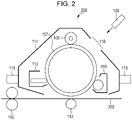
- a process cartridge detachably attachable to an image forming apparatus including a developing unit that includes the above-described electrostatic image developer and develops an electrostatic image formed on a surface of an image holding member with the electrostatic image developer to form a toner image.
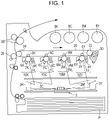
- an image forming apparatus including an image holding member; a charging unit that charges a surface of the image holding member; an electrostatic image formation unit that forms an electrostatic image on the charged surface of the image holding member; a developing unit that includes the above-described electrostatic image developer and develops the electrostatic image formed on the surface of the image holding member with the electrostatic image developer to form a toner image; a transfer unit that transfers the toner image formed on the surface of the image holding member onto a surface of a recording medium; and a fixing unit that fixes the toner image transferred onto the surface of the recording medium.
- the electrostatic image developing toner according to the first aspect of the present disclosure may reduce the likelihood of a part of an image having a high toner deposition density being missed when the image is formed on a recording medium having an uneven surface at a high speed, compared with an electrostatic image developing toner that includes only toner particles including a binder resin and a release agent, wherein, when cross sections of the toner particles are observed, the toner particles do not satisfy the condition (A1).
- the electrostatic image developing toner according to the second aspect of the present disclosure may reduce the likelihood of a part of an image having a high toner deposition density being missed when the image is formed on a recording medium having an uneven surface at a high speed, compared with an electrostatic image developing toner including toner particles that satisfy the condition (A1) but do not satisfy the condition (A2).
- the electrostatic image developing toner according to the third aspect of the present disclosure may reduce the likelihood of a part of an image having a high toner deposition density being missed when the image is formed on a recording medium having an uneven surface at a high speed, compared with an electrostatic image developing toner including toner particles that satisfy the condition (A1) but do not satisfy the condition (B1).
- the electrostatic image developing toner according to the fourth aspect of the present disclosure may reduce the likelihood of a part of an image having a high toner deposition density being missed when the image is formed on a recording medium having an uneven surface at a high speed, compared with an electrostatic image developing toner including toner particles that satisfy the condition (A1) but do not satisfy the condition (B2).
- the electrostatic image developing toner according to the fifth aspect of the present disclosure may reduce the likelihood of a part of an image having a high toner deposition density being missed when the image is formed on a recording medium having an uneven surface at a high speed, compared with an electrostatic image developing toner including toner particles that satisfy the condition (A1) but do not satisfy the condition (C).
- the electrostatic image developing toner according to the sixth aspect of the present disclosure may reduce the likelihood of a part of an image having a high toner deposition density being missed when the image is formed on a recording medium having an uneven surface at a high speed, compared with the case where the release agent has a melting temperature of more than 95°C.
- the electrostatic image developing toner according to the seventh aspect of the present disclosure may reduce the likelihood of a part of an image having a high toner deposition density being missed when the image is formed on a recording medium having an uneven surface at a high speed, compared with the case where the release agent having a melting temperature of 65°C or more and 95°C or less is a release agent other than an ester wax.
- the electrostatic image developing toner according to the eighth aspect of the present disclosure may reduce the likelihood of a part of an image having a high toner deposition density being missed when the image is formed on a recording medium having an uneven surface at a high speed, compared with an electrostatic image developing toner that includes only toner particles including a binder resin and a release agent, wherein, when cross sections of the toner particles are observed, the toner particles do not satisfy the condition (A1), even in the case where the binder resin included in the toner particles includes an amorphous resin, the amorphous resin including a polyester resin segment and a styrene acrylic resin segment.
- the electrostatic image developing toner according to the ninth aspect of the present disclosure may reduce the likelihood of a part of an image having a high toner deposition density being missed when the image is formed on a recording medium having an uneven surface at a high speed, compared with an electrostatic image developing toner that includes only toner particles including a binder resin and a release agent, wherein, when cross sections of the toner particles are observed, the toner particles do not satisfy the condition (A1), even in the case where the binder resin included in the toner particles includes a crystalline polyester resin.
- the electrostatic image developing toners according to the tenth and eleventh aspects of the present disclosure may reduce the likelihood of a part of an image having a high toner deposition density being missed when the image is formed on a recording medium having an uneven surface at a high speed, compared with the cases where a proportion of the toner particle to entire toner particles is less than 30% by number and less than 70% by number, respectively.
- the electrostatic image developer, the toner cartridge, the process cartridge, and the image forming apparatus may reduce the likelihood of a part of an image having a high toner deposition density being missed when the image is formed on a recording medium having an uneven surface at a high speed, compared with the cases where an electrostatic image developing toner that includes only toner particles including a binder resin and a release agent, wherein, when cross sections of the toner particles are observed, the toner particles do not satisfy the condition (A1), is used.
- the content of the component in the composition is the total content of the plural substances in the composition unless otherwise specified.
- step refers not only to an individual step but also to a step that is not distinguishable from other steps but achieves the intended purpose of the step.
- An electrostatic image developing toner (hereinafter, referred to simply as "toner”) according to the exemplary embodiment includes a toner particle including a binder resin and a release agent. When a cross section of the toner particle is observed, the toner particle satisfies the condition (A1) below.
- the toner particle includes one or more domains of the release agent, the domains having a diameter equal to 8% or more and 30% or less of the maximum diameter of the toner particle, the domains having a geometric center at a depth of R/2 or less below the surface of the toner particle, where R represents the distance between the geometric center of the toner particle and the surface of the toner particle, the domains being entirely included in an inside portion of the toner particle, the inside portion extending below a depth of 50 nm from the surface of the toner particle.
- the above-described toner according to the exemplary embodiment may reduce the likelihood of a part of an image having a high toner deposition density being missed when the image is formed on a recording medium having an uneven surface at a high speed. The reasons are presumably as follows.
- a technique in which domains of a release agent are arranged in the vicinity of the surface layers of toner particles is known. Arranging domains of a release agent in the vicinity of the surface layers of toner particles increases the ease at which the release agent seeps through the toner particles upon the toner particles being crushed when an image is fixed and consequently increases ease of detaching from a fixing member.
- an image having a high toner deposition density e.g., an image having a toner deposition density of 10.0 g/m 2 or more
- a high speed e.g., a speed equal to or higher than that at which the recording medium is transported, i.e., 300 mm/sec or more.
- the reduction in the ease of seepage of the release agent results in a reduction in ease of detaching from a fixing member.
- image missing may occur.
- an amount of heat required for dissolving toner particles that are present in the recesses of the uneven surface to a sufficient degree may fail to be applied to the toner particles and, consequently, the ease at which the release agent seeps through the toner particles may be significantly reduced. This increases the occurrence of image missing.
- the toner according to the exemplary embodiment includes toner particles that satisfy the condition (A1).
- condition (A1) means that the large release agent domains are present in the vicinity of the surface of a toner particle without being exposed at the surface (see Fig. 3 ).
- arranging large release agent domains in the vicinity of the surfaces of toner particles increases the rate at which heat is conducted to the cores of toner particles and consequently increases the ease at which the entire toner particles can melt. This may reduce inconsistencies in the density of an image having a high toner deposition density.
- Arranging the large release agent domains in the vicinity of the surfaces of toner particles so as not to be exposed at the surfaces of the toner particles reduces the occurrence of problems, such as degradation of consistency of the flowability of the toner, degradation of transferability, and machine contamination.
- the fundamental properties of the toner may be achieved.
- the toner according to the exemplary embodiment may reduce the likelihood of a part of an image having a high toner deposition density being missed when the image is formed on a recording medium having an uneven surface at a high speed.
- the toner according to the exemplary embodiment may also reduce inconsistencies in the density of an image having a high toner deposition density.
- the size of release agent domains that are present in the vicinity of the surfaces of toner particles is increased in a straightforward manner, the release agent domains may be exposed at the surfaces of the toner particles and, consequently, selective deposition of an external additive may occur. This may degrade flowability and transferability and cause machine contamination by the toner. Therefore, when the size of release agent domains is increased in the related art, the size of release agent domains that are present in the vicinity of the cores of toner particles has been increased in order to achieve the fundamental toner properties. That is, it has been difficult to increase the size of release agent domains that are present in the vicinity of the surfaces of toner particles.
- the toner according to the exemplary embodiment includes toner particles.
- the toner may optionally include an external additive.
- the toner particles include a binder resin and a release agent.
- the toner particles may include additives, such as a colorant.
- domains of the release agent satisfy the condition (A1) described below.
- the release agent domains preferably satisfy the condition (A2) below, more preferably satisfy the condition (B1) below, and further preferably satisfy the condition (B2) below.
- the release agent domains preferably further satisfy the condition (C) below in order to reduce the occurrence of image missing.
- the proportion of toner particles that satisfy the condition (A1) to all the toner particles is 30% by number or more, is more preferably 70% by number or more, is further preferably 80% by number or more, and is particularly preferably 90% by number or more in order to reduce the occurrence of image missing. Ideally, the proportion of toner particles that satisfy the above condition is 100% by number.
- the proportion of toner particles that satisfy at least one of the conditions (A2), (B1), (B2), and (C) to all the toner particles is preferably 30% by number or more, is more preferably 70% by number or more, is further preferably 80% by number or more, and is particularly preferably 90% by number or more. Ideally, the proportion of toner particles that satisfy the above condition is 100% by number.
- the toner particle includes one or more domains of the release agent, the domains having a diameter equal to 8% or more and 30% or less of the maximum diameter of the toner particle, the domains having a geometric center at a depth of R/2 or less below the surface of the toner particle, where R represents the distance between the geometric center of the toner particle and the surface of the toner particle, the domains being entirely included in an inside portion of the toner particle, the inside portion extending below a depth of 50 nm from the surface of the toner particle.
- the toner particle includes a plurality of domains of the release agent, the domains having a diameter equal to 8% or more and 30% or less of the maximum diameter of the toner particle, the domains having a geometric center at a depth of R/2 or less below the surface of the toner particle, where R represents the distance between the geometric center of the toner particle and the surface of the toner particle, the domains being entirely included in an inside portion of the toner particle, the inside portion extending below a depth of 50 nm from the surface of the toner particle.
- the toner particle includes one or more domains of the release agent, the domains having a diameter equal to 8% or more and 30% or less of the maximum diameter of the toner particle, the domains having a geometric center at a depth of R/3 or less below the surface of the toner particle, where R represents the distance between the geometric center of the toner particle and the surface of the toner particle, the domains being entirely included in an inside portion of the toner particle, the inside portion extending below a depth of 50 nm from the surface of the toner particle.
- the toner particle includes a plurality of domains of the release agent, the domains having a diameter equal to 8% or more and 30% or less of the maximum diameter of the toner particle, the domains having a geometric center at a depth of R/3 or less below the surface of the toner particle, where R represents the distance between the geometric center of the toner particle and the surface of the toner particle, the domains being entirely included in an inside portion of the toner particle, the inside portion extending below a depth of 50 nm from the surface of the toner particle.
- the diameter of domains of the release agent is, for example, 0.5 ⁇ m or more and 1.5 ⁇ m or less.
- the diameter of a release agent domain is the maximum diameter of the release agent domain, that is, the maximum length of a straight line segment that connects any two points on the circumference of the release agent domain.
- the maximum diameter of a toner particle is the maximum length of a straight line segment that connects any two points on the circumference of a cross section of the toner particle.
- distance between the geometric center of the toner particle and the surface of the toner particle means the distance between the point at which a straight line that passes through the geometric center of the corresponding release agent domain and the geometric center of the toner particle intersects the circumference of the toner particle and the geometric center of the toner particle along the straight line (see R T in Fig. 3 ).
- release agent domains are included in an inside portion of the toner particle, the inside portion extending below a depth of 50 nm from the surface of the toner particle" used herein means that, when a cross section of the toner particle is observed, the minimum distance between the release agent domains present in the toner particle and the surface (i.e., the circumference) of the toner particle is 50 nm or more.
- release agent domains are included in an inside portion of the toner particle, the inside portion extending below a depth of 50 nm from the surface of the toner particle” used herein means that the release agent domains are not exposed at the surface of the toner particle.
- Circularity 100 / SF2 4 ⁇ ⁇ A / I 2 where I represents the perimeter of the domain and A represents the area of the domain.
- the method for observing a cross section of a toner particle in order to determine whether the toner particle satisfies the above conditions is as described below.
- a toner particle (or a toner particle including an external additive adhered thereon) is mixed with an epoxy resin so as to be buried in the epoxy resin.
- the epoxy resin is then solidified.
- the resulting solid is cut with an ultramicrotome apparatus "Ultracut UCT" produced by Leica Biosystems into a thin specimen having a thickness of 80 nm or more and 130 nm or less.
- the thin specimen is stained with ruthenium tetroxide in a desiccator at 30°C for 3 hours.
- a transmission image-mode STEM observation image (acceleration voltage: 30 kV, magnification: 20,000 times) of the stained thin specimen is captured with an ultra-high-resolution field-emission scanning electron microscope (FE-SEM) "S-4800" produced by Hitachi High-Tech Corporation.
- FE-SEM field-emission scanning electron microscope
- a crystalline polyester resin and a release agent are distinguished from one another on the basis of contrast and shape.
- the binder resin other than the release agent includes a number of double bond portions and stained with ruthenium tetroxide, a release agent portion and a resin portion other than the release agent can be distinguished from each other.
- a release agent domain is stained most slightly, a crystalline resin (e.g., a crystalline polyester resin) is stained second most slightly, and an amorphous resin (e.g., an amorphous polyester resin) is stained most intensely.
- a release agent appears as a white domain
- an amorphous resin appears as a black domain
- a crystalline resin appears as a light gray domain.
- An image analysis of crystalline resin domains stained with ruthenium is conducted to determine whether the toner particle satisfies the above conditions.
- While the SEM image contains cross sections of toner particles having various sizes, cross sections of specific toner particles having a diameter that is 85% or more of the volume average particle size of the toner particles are selected and used as toner particles that are to be observed.
- the diameter of a cross section of a toner particle is the maximum length of a line segment that connects any two points on the circumference of the cross section of the toner particle (i.e., major axis length).
- binder resin examples include vinyl resins that are homopolymers of the following monomers or copolymers of two or more monomers selected from the following monomers: styrenes, such as styrene, para-chlorostyrene, and ⁇ -methylstyrene; (meth)acrylates, such as methyl acrylate, ethyl acrylate, n-propyl acrylate, n-butyl acrylate, lauryl acrylate, 2-ethylhexyl acrylate, methyl methacrylate, ethyl methacrylate, n-propyl methacrylate, lauryl methacrylate, and 2-ethylhexyl methacrylate; ethylenically unsaturated nitriles, such as acrylonitrile and methacrylonitrile; vinyl ethers, such as vinyl methyl ether and vinyl isobutyl ether; vinyl ketones, such as vinyl methyl ketone
- binder resin further include non-vinyl resins, such as epoxy resins, polyester resins, polyurethane resins, polyamide resins, cellulose resins, polyether resins, and modified rosins; a mixture of the non-vinyl resin and the vinyl resin; and a graft polymer produced by polymerization of the vinyl monomer in the presence of the non-vinyl resin.
- non-vinyl resins such as epoxy resins, polyester resins, polyurethane resins, polyamide resins, cellulose resins, polyether resins, and modified rosins
- a mixture of the non-vinyl resin and the vinyl resin such as epoxy resins, polyester resins, polyurethane resins, polyamide resins, cellulose resins, polyether resins, and modified rosins
- a mixture of the non-vinyl resin and the vinyl resin such as a graft polymer produced by polymerization of the vinyl monomer in the presence of the non-vinyl resin.
- the above binder resins may be used alone or in combination of two or more.
- an amorphous resin and a crystalline resin may be used as a binder resin.
- the mass ratio between the amorphous resin and the crystalline resin is preferably 3/97 or more and 50/50 or less and is more preferably 7/93 or more and 30/70 or less.
- Using an amorphous resin and a crystalline resin as a binder resin increases the ease at which the toner can melt when fixing is performed and ease of seepage of the release agent even in the case where an image having a high toner deposition density is formed on a recording medium having an uneven surface at a high speed. This may further reduce the occurrence of image missing.
- amorphous resin used herein refers to a resin that does not exhibit a distinct endothermic peak but only a step-like endothermic change in thermal analysis conducted using differential scanning calorimetry (DSC), that is solid at normal temperature, and that undergoes heat plasticization at a temperature equal to or higher than the glass transition temperature.
- DSC differential scanning calorimetry
- crystalline resin used herein refers to a resin that exhibits a distinct endothermic peak instead of a step-like endothermic change in DSC.
- an crystalline resin is a resin that exhibits an endothermic peak with a half-width of 10°C or less at a heating rate of 10 °C/min.
- An amorphous resin is a resin the half-width of which is more than 10°C or a resin that does not exhibit a distinct endothermic peak.
- the amorphous resin is described below.
- the amorphous resin examples include the amorphous resins known in the related art, such as an amorphous polyester resin, an amorphous vinyl resin (e.g., a styrene acrylic resin), an epoxy resin, a polycarbonate resin, and a polyurethane resin.
- an amorphous polyester resin and an amorphous vinyl resin are preferable, and an amorphous polyester resin is more preferable.
- An amorphous polyester resin and a styrene acrylic resin may be used in combination with each other as an amorphous resin.
- An amorphous resin including an amorphous polyester resin segment and a styrene acrylic resin segment may be used as an amorphous resin.
- the amorphous resin including an amorphous polyester resin segment and a styrene acrylic resin segment is used as an amorphous resin
- compatibility with ester release agents may be increased and the ease at which the toner can melt may be further increased accordingly. This may further reduce the occurrence of image missing even in the case where an image having a high toner deposition density is formed on a recording medium having an uneven surface at a high speed.
- amorphous polyester resin examples include condensation polymers of a polyvalent carboxylic acid and a polyhydric alcohol.
- the amorphous polyester resin may be a commercially available one or a synthesized one.
- polyvalent carboxylic acid examples include aliphatic dicarboxylic acids, such as oxalic acid, malonic acid, maleic acid, fumaric acid, citraconic acid, itaconic acid, glutaconic acid, succinic acid, alkenyl succinic acid, adipic acid, and sebacic acid; alicyclic dicarboxylic acids, such as cyclohexanedicarboxylic acid; aromatic dicarboxylic acids, such as terephthalic acid, isophthalic acid, phthalic acid, and naphthalenedicarboxylic acid; anhydrides of these dicarboxylic acids; and lower (e.g., 1 to 5 carbon atoms) alkyl esters of these dicarboxylic acids.
- aromatic dicarboxylic acids may be used.
- Trivalent or higher carboxylic acids having a crosslinked structure or a branched structure may be used as a polyvalent carboxylic acid in combination with the dicarboxylic acids.
- Examples of the trivalent or higher carboxylic acids include trimellitic acid, pyromellitic acid, anhydrides of these carboxylic acids, and lower (e.g., 1 to 5 carbon atoms) alkyl esters of these carboxylic acids.
- the above polyvalent carboxylic acids may be used alone or in combination of two or more.
- polyhydric alcohol examples include aliphatic diols, such as ethylene glycol, diethylene glycol, triethylene glycol, propylene glycol, butanediol, hexanediol, and neopentyl glycol; alicyclic diols, such as cyclohexanediol, cyclohexanedimethanol, and hydrogenated bisphenol A; and aromatic diols, such as bisphenol A-ethylene oxide adduct and bisphenol A-propylene oxide adduct.
- aromatic diols and alicyclic diols may be used. In particular, aromatic diols may be used.
- Trihydric or higher alcohols having a crosslinked structure or a branched structure may be used as a polyhydric alcohol in combination with the diols.
- examples of the trihydric or higher alcohols include glycerin, trimethylolpropane, and pentaerythritol.
- the above polyhydric alcohols may be used alone or in combination of two or more.
- the amorphous polyester resin may be produced by any suitable production method known in the related art. Specifically, the amorphous polyester resin may be produced by, for example, a method in which polymerization is performed at 180°C or more and 230°C or less, the pressure inside the reaction system is reduced as needed, and water and alcohols that are generated by condensation are removed. In the case where the raw materials, that is, the monomers, are not dissolved in or miscible with each other at the reaction temperature, a solvent having a high boiling point may be used as a dissolution adjuvant in order to dissolve the raw materials. In such a case, the condensation polymerization reaction is performed while the dissolution adjuvant is distilled away.
- a condensation reaction of the monomers with an acid or alcohol that is to undergo a polycondensation reaction with the monomers may be performed in advance and subsequently polycondensation of the resulting polymers with the other components may be performed.
- the amorphous polyester resin may be a modified amorphous polyester resin as well as an unmodified amorphous polyester resin.
- the modified amorphous polyester resin is an amorphous polyester resin including a bond other than an ester bond or an amorphous polyester resin including a resin component other than a polyester, the resin component being bonded to the amorphous polyester resin with a covalent bond, an ionic bond, or the like.
- Examples of the modified amorphous polyester resin include a terminal-modified amorphous polyester resin produced by reacting an amorphous polyester resin having a functional group, such as an isocyanate group, introduced at the terminal with an active hydrogen compound.
- the proportion of the amorphous polyester resin to the entire binder resin is preferably 60% by mass or more and 98% by mass or less, is more preferably 65% by mass or more and 95% by mass or less, and is further preferably 70% by mass or more and 90% by mass or less.
- the styrene acrylic resin is a copolymer produced by copolymerization of at least a monomer having a styrene skeleton (hereinafter, such a monomer is referred to as "styrene-based monomer”) with a monomer having a (meth)acryl group or preferably a (meth)acryloxy group (hereinafter, such a monomer is referred to as "(meth)acryl-based monomer).
- styrene acrylic resin include a copolymer of a styrene monomer with a (meth)acrylic acid ester monomer.
- an acrylic resin portion of the styrene acrylic resin is a partial structure produced by polymerization of either or both of an acrylic monomer and a methacrylic monomer.
- (meth)acryl used herein refers to both "acryl” and "methacryl”.
- styrene-based monomer examples include styrene, ⁇ -methylstyrene, meta-chlorostyrene, para-chlorostyrene, para-fluorostyrene, para-methoxystyrene, meta-tert-butoxystyrene, para-tert-butoxystyrene, para-vinylbenzoic acid, and para-methyl- ⁇ -methylstyrene.
- the above styrene-based monomers may be used alone or in combination of two or more.
- Examples of the (meth)acryl-based monomer include (meth)acrylic acid, methyl (meth)acrylate, ethyl (meth)acrylate, n-propyl (meth)acrylate, isopropyl (meth)acrylate, n-butyl (meth)acrylate, isobutyl (meth)acrylate, n-hexyl (meth)acrylate, 2-ethylhexyl (meth)acrylate, lauryl (meth)acrylate, stearyl (meth)acrylate, cyclohexyl (meth)acrylate, dicyclopentanyl (meth)acrylate, isobornyl (meth)acrylate, 2-hydroxyethyl (meth)acrylate, hydroxypropyl (meth)acrylate, and 4-hydroxybutyl (meth)acrylate.
- the above (meth)acryl-based monomers may be used alone or in combination of two or more.
- the polymerization ratio between the styrene-based monomer and the (meth)acryl-based monomer, that is, Styrene-based monomer:(Meth)acryl-based monomer, may be 70:30 to 95:5 by mass.
- the styrene acrylic resin may include a crosslinked structure.
- the styrene acrylic resin including a crosslinked structure may be produced by, for example, copolymerization of the styrene-based monomer, the (meth)acryl-based monomer, and a crosslinkable monomer.
- the crosslinkable monomer may be, but not limited to, a difunctional or higher (meth)acrylate.
- the method for preparing the styrene acrylic resin is not limited.
- solution polymerization, precipitation polymerization, suspension polymerization, bulk polymerization, and emulsion polymerization may be used.
- the polymerization reaction may be conducted by any suitable process known in the related art, such as a batch process, a semi-continuous process, or a continuous process.
- the proportion of the styrene acrylic resin to the entire binder resin is preferably 0% by mass or more and 20% by mass or less, is more preferably 1% by mass or more and 15% by mass or less, and is further preferably 2% by mass or more and 10% by mass or less.
- hybrid amorphous resin Amorphous Resin Including Amorphous Polyester Resin Segment and Styrene Acrylic Resin Segment
- a hybrid amorphous resin is an amorphous resin that includes an amorphous polyester resin segment and a styrene acrylic resin segment that are chemically bonded to each other.
- Examples of the hybrid amorphous resin include a resin constituted by a backbone composed of a polyester resin and a side chain composed of a styrene acrylic resin chemically bonded to the backbone; a resin constituted by a backbone composed of a styrene acrylic resin and a side chain composed of a polyester resin chemically bonded to the backbone; a resin that includes a backbone composed of a polyester resin and a styrene acrylic resin chemically bonded to each other; and a resin constituted by a backbone composed of a polyester resin and a styrene acrylic resin chemically bonded to each other and at least one of a side chain composed of a polyester resin chemically bonded to the backbone and a side chain composed of a styrene acrylic resin chemically bonded to the backbone.
- amorphous polyester resin and styrene acrylic resin included in the above segments are as described above; descriptions thereof are omitted herein.
- the ratio of the total amount of the polyester resin segment and the styrene acrylic resin segment to the total amount of the hybrid amorphous resin is preferably 80% by mass or more, is more preferably 90% by mass or more, is further preferably 95% by mass or more, and is most preferably 100% by mass.
- the proportion of the amount of the styrene acrylic resin segment to the total amount of the polyester resin segment and the styrene acrylic resin segment is preferably 20% by mass or more and 60% by mass or less, is more preferably 25% by mass or more and 55% by mass or less, and is further preferably 30% by mass or more and 50% by mass or less.
- the hybrid amorphous resin may be produced by any of the methods (i) to (iii) below.
- the proportion of the hybrid amorphous resin to the entire binder resin is preferably 60% by mass or more and 98% by mass or less, is more preferably 65% by mass or more and 95% by mass or less, and is further preferably 70% by mass or more and 90% by mass or less.
- the glass transition temperature Tg of the amorphous resin is preferably 50°C or more and 80°C or less and is more preferably 50°C or more and 65°C or less.
- the glass transition temperature of the amorphous resin is determined from a differential scanning calorimetry (DSC) curve obtained by DSC. More specifically, the glass transition temperature of the amorphous resin is determined from the "extrapolated glass-transition-starting temperature" according to a method for determining glass transition temperature which is described in JIS K 7121:1987 "Testing Methods for Transition Temperatures of Plastics".
- the weight average molecular weight Mw of the amorphous resin is preferably 5,000 or more and 1,000,000 or less and is more preferably 7,000 or more and 500,000 or less.
- the number average molecular weight Mn of the amorphous resin may be 2,000 or more and 100,000 or less.
- the molecular weight distribution index Mw/Mn of the amorphous resin is preferably 1.5 or more and 100 or less and is more preferably 2 or more and 60 or less.
- the weight average molecular weight and number average molecular weight of the amorphous resin are determined by gel permeation chromatography (GPC). Specifically, the molecular weights of the amorphous resin are determined by GPC using a "HLC-8120GPC” produced by Tosoh Corporation as measuring equipment, a column “TSKgel SuperHM-M (15 cm)” produced by Tosoh Corporation, and a tetrahydrofuran (THF) solvent. The weight average molecular weight and number average molecular weight of the amorphous resin are determined on the basis of the results of the measurement using a molecular-weight calibration curve based on monodisperse polystyrene standard samples.
- GPC gel permeation chromatography
- the crystalline resin is described below.
- the crystalline resin examples include the crystalline resins known in the related art, such as a crystalline polyester resin and a crystalline vinyl resin (e.g., a polyalkylene resin or a long-chain alkyl (meth)acrylate resin).
- a crystalline polyester resin may be used in consideration of the mechanical strength and low-temperature fixability of the toner.
- Examples of the crystalline polyester resin include condensation polymers of a polyvalent carboxylic acid and a polyhydric alcohol.
- the crystalline polyester resin may be commercially available one or a synthesized one.
- a condensation polymer prepared from linear aliphatic polymerizable monomers may be used as a crystalline polyester resin instead of a condensation polymer prepared from polymerizable monomers having an aromatic ring.
- polyvalent carboxylic acid examples include aliphatic dicarboxylic acids, such as oxalic acid, succinic acid, glutaric acid, adipic acid, suberic acid, azelaic acid, sebacic acid, 1,9-nonanedicarboxylic acid, 1,10-decanedicarboxylic acid, 1,12-dodecanedicarboxylic acid, 1,14-tetradecanedicarboxylic acid, and 1,18-octadecanedicarboxylic acid; aromatic dicarboxylic acids, such as dibasic acids (e.g., phthalic acid, isophthalic acid, terephthalic acid, and naphthalene-2,6-dicarboxylic acid); anhydrides of these dicarboxylic acids; and lower (e.g., 1 to 5 carbon atoms) alkyl esters of these dicarboxylic acids.
- aliphatic dicarboxylic acids such as oxalic acid
- Trivalent or higher carboxylic acids having a crosslinked structure or a branched structure may be used as a polyvalent carboxylic acid in combination with the dicarboxylic acids.
- the trivalent carboxylic acids include aromatic carboxylic acids, such as 1,2,3-benzenetricarboxylic acid, 1,2,4-benzenetricarboxylic acid, and 1,2,4-naphthalenetricarboxylic acid; anhydrides of these tricarboxylic acids; and lower (e.g., 1 to 5 carbon atoms) alkyl esters of these tricarboxylic acids.
- Dicarboxylic acids including a sulfonic group and dicarboxylic acids including an ethylenic double bond may be used as a polyvalent carboxylic acid in combination with the above dicarboxylic acids.
- the above polyvalent carboxylic acids may be used alone or in combination of two or more.
- polyhydric alcohol examples include aliphatic diols, such as linear aliphatic diols including a backbone having 7 to 20 carbon atoms.
- aliphatic diols include ethylene glycol, 1,3-propanediol, 1,4-butanediol, 1,5-pentanediol, 1,6-hexanediol, 1,7-heptanediol, 1,8-octanediol, 1,9-nonanediol, 1,10-decanediol, 1,11-undecanediol, 1,12-dodecanediol, 1,13-tridecanediol, 1,14-tetradecanediol, 1,18-octadecanediol, and 1,14-eicosanedecanediol.
- 1,8-octaned 1,8-octaned
- Trihydric or higher alcohols having a crosslinked structure or a branched structure may be used as a polyhydric alcohol in combination with the above diols.
- examples of the trihydric or higher alcohols include glycerin, trimethylolethane, trimethylolpropane, and pentaerythritol.
- the above polyhydric alcohols may be used alone or in combination of two or more.
- the content of the aliphatic diols in the polyhydric alcohol may be 80 mol% or more and is preferably 90 mol% or more.
- the crystalline polyester resin may be produced by any suitable method known in the related art similarly to, for example, the amorphous polyester resin.
- the crystalline polyester resin may be a polymer of an ⁇ , ⁇ -linear aliphatic dicarboxylic acid with an ⁇ , ⁇ -linear aliphatic diol.
- a polymer of an ⁇ , ⁇ -linear aliphatic dicarboxylic acid with an ⁇ , ⁇ -linear aliphatic diol is highly compatible with an amorphous polyester resin, the ease at which the toner can melt when fixing is performed may be increased and ease of seepage of the release agent may be also increased even in the case where an image having a high toner deposition density is formed on a recording medium having an uneven surface at a high speed. This may further reduce the occurrence of image missing.
- the ⁇ , ⁇ -linear aliphatic dicarboxylic acid may be an ⁇ , ⁇ -linear aliphatic dicarboxylic acid that includes two carboxyl groups connected to each other with an alkylene group having 3 to 14 carbon atoms.
- the number of carbon atoms included in the alkylene group is preferably 4 to 12 and is further preferably 6 to 10.
- Examples of the ⁇ , ⁇ -linear aliphatic dicarboxylic acid include succinic acid, glutaric acid, adipic acid, 1,6-hexanedicarboxylic acid (common name: suberic acid), 1,7-heptanedicarboxylic acid (common name: azelaic acid), 1,8-octanedicarboxylic acid (common name: sebacic acid), 1,9-nonanedicarboxylic acid, 1,10-decanedicarboxylic acid, 1,12-dodecanedicarboxylic acid, 1,14-tetradecanedicarboxylic acid, and 1,18-octadecanedicarboxylic acid.
- 1,6-hexanedicarboxylic acid 1,7-heptanedicarboxylic acid, 1,8-octanedicarboxylic acid, 1,9-nonanedicarboxylic acid, and 1,10-decanedicarboxylic acid are preferable.
- ⁇ , ⁇ -linear aliphatic dicarboxylic acids may be used alone or in combination of two or more.
- the ⁇ , ⁇ -linear aliphatic diol may be an ⁇ , ⁇ -linear aliphatic diol that includes two hydroxyl groups connected to each other with an alkylene group having 3 to 14 carbon atoms.
- the number of carbon atoms included in the alkylene group is preferably 4 to 12 and is further preferably 6 to 10.
- Examples of the ⁇ , ⁇ -linear aliphatic diol include ethylene glycol, 1,3-propanediol, 1,4-butanediol, 1,5-pentanediol, 1,6-hexanediol, 1,7-heptanediol, 1,8-octanediol, 1,9-nonanediol, 1,10-decanediol, 1,12-dodecanediol, 1,14-tetradecanediol, and 1,18-octadecanediol.
- 1,6-hexanediol, 1,7-heptanediol, 1,8-octanediol, 1,9-nonanediol, and 1,10-decanediol are preferable.
- ⁇ , ⁇ -linear aliphatic diols may be used alone or in combination of two or more.
- the polymer of the ⁇ , ⁇ -linear aliphatic dicarboxylic acid with the ⁇ , ⁇ -linear aliphatic diol is preferably a polymer of at least one dicarboxylic acid selected from the group consisting of 1,6-hexanedicarboxylic acid, 1,7-heptanedicarboxylic acid, 1,8-octanedicarboxylic acid, 1,9-nonanedicarboxylic acid, and 1,10-decanedicarboxylic acid with at least one diol selected from the group consisting of 1,6-hexanediol, 1,7-heptanediol, 1,8-octanediol, 1,9-nonanediol, and 1,10-decanediol, in order to reduce the occurrence of image missing.
- a polymer of 1,10-decanedicarboxylic acid with 1,6-hexanediol is more preferable.
- the proportion of the crystalline polyester resin to the entire binder resin is preferably 1% by mass or more and 20% by mass or less, is more preferably 2% by mass or more and 15% by mass or less, and is further preferably 3% by mass or more and 10% by mass or less.
- the melting temperature of the crystalline resin is preferably 50°C or more and 100°C or less, is more preferably 55°C or more and 90°C or less, and is further preferably 60°C or more and 85°C or less.
- the melting temperature of the crystalline resin is determined from the "melting peak temperature” according to a method for determining melting temperature which is described in JIS K 7121:1987 "Testing Methods for Transition Temperatures of Plastics” using a DSC curve obtained by differential scanning calorimetry (DSC).
- the crystalline resin may have a weight average molecular weight Mw of 6,000 or more and 35,000 or less.
- the content of the binder resin in the entire toner particles is preferably 40% by mass or more and 95% by mass or less, is more preferably 50% by mass or more and 90% by mass or less, and is further preferably 60% by mass or more and 85% by mass or less.
- colorant examples include pigments, such as Carbon Black, Chrome Yellow, Hansa Yellow, Benzidine Yellow, Threne Yellow, Quinoline Yellow, Pigment Yellow, Permanent Orange GTR, Pyrazolone Orange, Vulcan Orange, Watching Red, Permanent Red, Brilliant Carmine 3B, Brilliant Carmine 6B, DuPont Oil Red, Pyrazolone Red, Lithol Red, Rhodamine B Lake, Lake Red C, Pigment Red, Rose Bengal, Aniline Blue, Ultramarine Blue, Calco Oil Blue, Methylene Blue Chloride, Phthalocyanine Blue, Pigment Blue, Phthalocyanine Green, and Malachite Green Oxalate; and dyes, such as acridine dyes, xanthene dyes, azo dyes, benzoquinone dyes, azine dyes, anthraquinone dyes, thioindigo dyes, dioxazine dyes, thiazine dyes, azomethine dyes, indigo dyes, phthal
- the above colorants may be used alone or in combination of two or more.
- the colorant may optionally be subjected to a surface treatment and may be used in combination with a dispersant. Plural types of colorants may be used in combination.
- the content of the colorant in the entire toner particles is preferably 1% by mass or more and 30% by mass or less and is more preferably 3% by mass or more and 15% by mass or less.
- release agent examples include, but are not limited to, hydrocarbon waxes; natural waxes, such as a carnauba wax, a rice bran wax, and a candelilla wax; synthetic or mineral-petroleum-derived waxes, such as a montan wax; and ester waxes, such as a fatty-acid ester wax and a montanate wax.
- the melting temperature of the release agent is preferably 50°C or more and 110°C or less and is more preferably 60°C or more and 100°C or less.
- the melting temperature of the release agent is determined from the "melting peak temperature” according to a method for determining melting temperature which is described in JIS K 7121:1987 "Testing Methods for Transition Temperatures of Plastics” using a DSC curve obtained by differential scanning calorimetry (DSC).
- the melting temperature of the release agent is preferably 65°C or more and 95°C or less and is more preferably 67°C or more and 91°C or less.
- Using a release agent having a melting temperature of 65°C or more and 95°C or less increases the likelihood of the release agent domains having a large diameter and a spherical shape and consequently increases the likelihood of the toner particles satisfying the above conditions.
- the release agent having a melting temperature of 65°C or more and 95°C or less may be an ester wax.
- the use of an ester wax also increases the likelihood of the release agent domains having a large diameter and a spherical shape and consequently increases the likelihood of the toner particles satisfying the above conditions.
- ester wax used herein refers to a wax having an ester linkage.
- the ester wax may be any of a monoester, a diester, a triester, and a tetraester.
- the natural and synthesis ester waxes known in the related art may be used.
- ester wax examples include an ester of a higher fatty acid (e.g., a fatty acid having 10 or more carbon atoms) with a monovalent or polyvalent aliphatic alcohol (e.g., an aliphatic alcohol having 8 or more carbon atoms).
- a higher fatty acid e.g., a fatty acid having 10 or more carbon atoms
- a monovalent or polyvalent aliphatic alcohol e.g., an aliphatic alcohol having 8 or more carbon atoms.
- ester wax examples include an ester of a higher fatty acid, such as caprylic acid, capric acid, lauric acid, myristic acid, palmitic acid, stearic acid, arachidic acid, behenic acid, or oleic acid, with an alcohol (e.g., a monohydric alcohol, such as methanol, ethanol, propanol, isopropanol, butanol, capryl alcohol, lauryl alcohol, myristyl alcohol, cetyl alcohol, stearyl alcohol, or oleyl alcohol; or a polyhydric alcohol, such as glycerin, ethylene glycol, propylene glycol, sorbitol, or pentaerythritol).
- an alcohol e.g., a monohydric alcohol, such as methanol, ethanol, propanol, isopropanol, butanol, capryl alcohol, lauryl alcohol, myristyl alcohol, cetyl alcohol, stearyl alcohol
- the content of the release agent in the entire toner particles is preferably 1% by mass or more and 20% by mass or less and is more preferably 5% by mass or more and 15% by mass or less.
- additives known in the related art such as a magnetic substance, a charge-controlling agent, and an inorganic powder. These additives may be added to the toner particles as internal additives.
- the toner particles may have a single-layer structure or a "core-shell" structure constituted by a core (i.e., core particle) and a coating layer (i.e., shell layer) covering the core.
- the core-shell structure of the toner particles may be constituted by, for example, a core including a binder resin and, as needed, other additives such as a colorant and a release agent and by a coating layer including the binder resin.
- the volume average diameter D50v of the toner particles is preferably 2 ⁇ m or more and 15 ⁇ m or less and is more preferably 4 ⁇ m or more and 8 ⁇ m or less.
- the various average particle sizes and various particle size distribution indices of the toner particles are measured using "COULTER MULTISIZER II” produced by Beckman Coulter, Inc. with an electrolyte “ISOTON-II” produced by Beckman Coulter, Inc. in the following manner.
- a sample to be measured (0.5 mg or more and 50 mg or less) is added to 2 ml of a 5%-aqueous solution of a surfactant (e.g., sodium alkylbenzene sulfonate) that serves as a dispersant.
- a surfactant e.g., sodium alkylbenzene sulfonate
- the resulting mixture is added to 100 ml or more and 150 ml or less of an electrolyte.
- the resulting electrolyte containing the sample suspended therein is subjected to a dispersion treatment for 1 minute using an ultrasonic disperser, and the distribution of the diameters of particles having a diameter of 2 ⁇ m or more and 60 ⁇ m or less is measured using COULTER MULTISIZER II with an aperture having a diameter of 100 ⁇ m.
- the number of the particles sampled is 50,000.
- the particle diameter distribution measured is divided into a number of particle diameter ranges (i.e., channels). For each range, in ascending order in terms of particle diameter, the cumulative volume and the cumulative number are calculated and plotted to draw cumulative distribution curves. Particle diameters at which the cumulative volume and the cumulative number reach 16% are considered to be the volume particle diameter D16v and the number particle diameter D16p, respectively. Particle diameters at which the cumulative volume and the cumulative number reach 50% are considered to be the volume average particle diameter D50v and the number average particle diameter D50p, respectively. Particle diameters at which the cumulative volume and the cumulative number reach 84% are considered to be the volume particle diameter D84v and the number particle diameter D84p, respectively.
- the volume particle size distribution index (GSDv) is calculated as (D84v/D16v) 1/2 and the number particle size distribution index (GSDp) is calculated as (D84p/D16p) 1/2 .
- the toner particles preferably have an average circularity of 0.94 or more and 1.00 or less.
- the average circularity of the toner particles is more preferably 0.95 or more and 0.98 or less.
- the average circularity of the toner particles is determined as [Equivalent circle perimeter]/[Perimeter] (i.e., [Perimeter of a circle having the same projection area as the particles]/[Perimeter of the projection image of the particles]. Specifically, the average circularity of the toner particles is determined by the following method.
- the toner particles to be measured are sampled by suction so as to form a flat stream.
- a static image of the particles is taken by instantaneously flashing a strobe light.
- the image of the particles is analyzed with a flow particle image analyzer "FPIA-3000" produced by Sysmex Corporation.
- the number of samples used for determining the average circularity of the toner particles is 3,500.
- the toner i.e., the developer
- the toner is dispersed in water containing a surfactant and then subjected to an ultrasonic wave treatment in order to remove the external additive from the toner particles.
- Examples of the external additive include inorganic particles.
- Examples of the inorganic particles include SiO 2 particles, TiO 2 particles, Al 2 O 3 particles, CuO particles, ZnO particles, SnO 2 particles, CeO 2 particles, Fe 2 O 3 particles, MgO particles, BaO particles, CaO particles, K 2 O particles, Na 2 O particles, ZrO 2 particles, CaO ⁇ SiO 2 particles, K 2 O ⁇ (TiO 2 ) n particles, Al 2 O 3 ⁇ 2SiO 2 particles, CaCO 3 particles, MgCO 3 particles, BaSO 4 particles, and MgSO 4 particles.
- the surfaces of the inorganic particles used as an external additive may be subjected to a hydrophobic treatment.
- the hydrophobic treatment is performed by, for example, immersing the inorganic particles in a hydrophobizing agent.
- the hydrophobizing agent include, but are not limited to, a silane coupling agent, a silicone oil, a titanate coupling agent, and aluminum coupling agent. These hydrophobizing agents may be used alone or in combination of two or more.
- the amount of the hydrophobizing agent is commonly, for example, 1 part by mass or more and 10 parts by mass or less relative to 100 parts by mass of the inorganic particles.
- Examples of the external additive further include particles of a resin, such as polystyrene, polymethyl methacrylate (PMMA), or a melamine resin; and particles of a cleaning lubricant, such as a metal salt of a higher fatty acid, such as zinc stearate, or a fluorine-contained resin.
- a resin such as polystyrene, polymethyl methacrylate (PMMA), or a melamine resin
- particles of a cleaning lubricant such as a metal salt of a higher fatty acid, such as zinc stearate, or a fluorine-contained resin.
- the amount of the external additive used is, for example, preferably 0.01% by mass or more and 5% by mass or less and is more preferably 0.01% by mass or more and 2.0% by mass or less of the amount of the toner particles.
- the toner according to the exemplary embodiment is produced by, after the preparation of the toner particles, depositing an external additive on the surfaces of the toner particles.
- the toner particles may be prepared by any dry process, such as knead pulverization, or any wet process, such as aggregation coalescence, suspension polymerization, or dissolution suspension.
- a method for preparing the toner particles is not limited thereto, and any suitable method known in the related art may be used.
- aggregation coalescence may be used for preparing the toner particles, in order to form crystalline resin domains satisfying the above conditions.
- the toner particles are prepared by the following steps:
- a surfactant may be added to the release agent particle dispersion liquid in order to enhance the hydrophobicity of the release agent particle dispersion liquid.
- the above surfactant include highly hydrophilic surfactants, such as sodium octanesulfonate, sodium octylbenzene sulfonate, and sodium benzeneoxybistetrapropylene sulfonate.
- holding is performed at a temperature equal to or higher than the melting temperature of the release agent in order to increase the size of the release agent domains.
- This increases the likelihood of the aggregated particles being covered with the resin particles used in the second and third aggregated particle formation steps and enables the size of the release agent domains to be increased in the vicinity of the surfaces of the toner particles while the exposure of the release agent domains at the surfaces of the toner particles is inhibited.
- the highly hydrophilic surfactant to the release agent particle dispersion liquid as a dispersant for the release agent particles causes the release agent particles to become hydrophobic as a result of the surfactant detaching from the release agent particles in the fusion and coalescence step. This makes the release agent particles to be buried in the toner particles. Consequently, the size of the release agent domains can be increased in the vicinity of the surfaces of the toner particles as a result of the hydrophobization of the release agent while the exposure of the release agent domains at the surfaces of the toner particles is inhibited.
- toner particles that satisfy the above conditions such as the condition (A1), may be produced by the above-described method.
- toner particles including a colorant and a release agent
- the colorant is optional. It is needless to say that additives other than a colorant may be used.
- resin particle dispersion liquids i.e., an amorphous resin particle dispersion liquid and a crystalline resin particle dispersion liquid
- a colorant particle dispersion liquid in which particles of a colorant are dispersed and a release agent particle dispersion liquid in which particles of a release agent are dispersed are prepared.
- the resin particle dispersion liquid is prepared by, for example, dispersing resin particles in a dispersion medium using a surfactant.
- Examples of the dispersion medium used for preparing the resin particle dispersion liquid include aqueous media.
- aqueous media examples include water, such as distilled water and ion-exchange water; and alcohols. These aqueous media may be used alone or in combination of two or more.
- the surfactant examples include anionic surfactants, such as sulfate surfactants, sulfonate surfactants, and phosphate surfactants; cationic surfactants, such as amine salt surfactants and quaternary ammonium salt surfactants; and nonionic surfactants, such as polyethylene glycol surfactants, alkylphenol ethylene oxide adduct surfactants, and polyhydric alcohol surfactants.
- anionic surfactants such as sulfate surfactants, sulfonate surfactants, and phosphate surfactants
- cationic surfactants such as amine salt surfactants and quaternary ammonium salt surfactants
- nonionic surfactants such as polyethylene glycol surfactants, alkylphenol ethylene oxide adduct surfactants, and polyhydric alcohol surfactants.
- the nonionic surfactants may be used in combination with the anionic surfactants and the cationic surfactants.
- surfactants may be used alone or in combination of two or more.
- the resin particles can be dispersed in a dispersion medium by any suitable dispersion method commonly used in the related art in which, for example, a rotary-shearing homogenizer, a ball mill, a sand mill, or a dyno mill that includes media is used.
- a rotary-shearing homogenizer for example, a ball mill, a sand mill, or a dyno mill that includes media is used.
- the resin particles may be dispersed in the resin particle dispersion liquid by, for example, phase-inversion emulsification.
- Phase-inversion emulsification is a method in which the resin to be dispersed is dissolved in a hydrophobic organic solvent in which the resin is soluble, a base is added to the resulting organic continuous phase (i.e., O phase) to perform neutralization, and subsequently an aqueous medium (i.e., W phase) is charged in order to perform conversion of resin (i.e., phase inversion) from W/O to O/W, form a discontinuous phase, and disperse the resin in the aqueous medium in the form of particles.
- the volume average diameter of the resin particles dispersed in the resin particle dispersion liquid is preferably, for example, 0.01 ⁇ m or more and 1 ⁇ m or less, is more preferably 0.08 ⁇ m or more and 0.8 ⁇ m or less, and is further preferably 0.1 ⁇ m or more and 0.6 ⁇ m or less.
- the volume average diameter of the resin particles is determined in the following manner.
- the particle diameter distribution of the resin particles is obtained using a laser-diffraction particle-size-distribution measurement apparatus, such as "LA-700" produced by HORIBA, Ltd.
- the particle diameter distribution measured is divided into a number of particle diameter ranges (i.e., channels). For each range, in ascending order in terms of particle diameter, the cumulative volume is calculated and plotted to draw a cumulative distribution curve. A particle diameter at which the cumulative volume reaches 50% is considered to be the volume particle diameter D50v.
- the volume average diameters of particles included in the other dispersion liquids are also determined in the above-described manner.
- the content of the resin particles included in the resin particle dispersion liquid is, for example, preferably 5% by mass or more and 50% by mass or less and is more preferably 10% by mass or more and 40% by mass or less.
- the colorant particle dispersion liquid, the release agent particle dispersion liquid, and the like are also prepared as in the preparation of the resin particle dispersion liquid.
- the above-described specifications for the volume average diameter of the particles included in the resin particle dispersion liquid, the dispersion medium of the resin particle dispersion liquid, the dispersion method used for preparing the resin particle dispersion liquid, and the content of the particles in the resin particle dispersion liquid can also be applied to colorant particles dispersed in the colorant particle dispersion liquid and release agent particles dispersed in the release agent particle dispersion liquid.
- the above resin particle dispersion liquids are mixed with the colorant particle dispersion liquid.
- heteroaggregation of the resin particles with the colorant particles is performed in order to form first aggregated particles including the resin particles and the colorant particles, the first aggregated particles having a diameter close to that of the intended toner particles.
- a flocculant is added to the mixed dispersion liquid, and the pH of the mixed dispersion liquid is controlled to be acidic (e.g., pH of 2 or more and 5 or less).
- a dispersion stabilizer may be added to the mixed dispersion liquid as needed.
- the mixed dispersion liquid is heated to the glass transition temperature of the resin particles (specifically, e.g., [Glass transition temperature of the resin particles - 30°C] or more and [the Glass transition temperature - 10°C] or less), and thereby the particles dispersed in the mixed dispersion liquid are caused to aggregate together to form first aggregated particles.
- the above flocculant may be added to the mixed dispersion liquid at room temperature (e.g., 25°C) while the mixed dispersion liquid is stirred using a rotary-shearing homogenizer. Then, the pH of the mixed dispersion liquid is controlled to be acidic (e.g., pH of 2 or more and 5 or less), and a dispersion stabilizer may be added to the mixed dispersion liquid as needed. Subsequently, the mixed dispersion liquid is heated in the above-described manner.
- room temperature e.g. 25°C
- a dispersion stabilizer may be added to the mixed dispersion liquid as needed.
- the flocculant examples include surfactants, inorganic metal salts, and divalent or higher metal complexes that have a polarity opposite to that of the surfactant included in the mixed dispersion liquid as a dispersant.
- a metal complex as a flocculant reduces the amount of surfactant used and, as a result, charging characteristics may be enhanced.
- An additive capable of forming a complex or a bond similar to a complex with the metal ions contained in the flocculant may optionally be used.
- An example of the additive is a chelating agent.
- inorganic metal salts examples include metal salts, such as calcium chloride, calcium nitrate, barium chloride, magnesium chloride, zinc chloride, aluminum chloride, and aluminum sulfate; and inorganic metal salt polymers, such as polyaluminum chloride, polyaluminum hydroxide, and calcium polysulfide.
- the chelating agent may be a water-soluble chelating agent.
- a chelating agent include oxycarboxylic acids, such as tartaric acid, citric acid, and gluconic acid; and iminodiacetic acid (IDA), nitrilotriacetic acid (NTA), and ethylenediaminetetraacetic acid (EDTA).
- IDA iminodiacetic acid
- NTA nitrilotriacetic acid
- EDTA ethylenediaminetetraacetic acid
- the amount of the chelating agent used is, for example, preferably 0.01 parts by mass or more and 5.0 parts by mass or less and is more preferably 0.1 parts by mass or more and less than 3.0 parts by mass relative to 100 parts by mass of the amorphous resin particles.
- the above aggregated particle dispersion liquid is mixed with the resin particle dispersion liquids and the release agent particle dispersion liquid.
- the above aggregated particle dispersion liquid may be mixed with a liquid mixture of the resin particle dispersion liquids and the release agent particle dispersion liquid.
- dispersion liquid containing the first aggregated particles, the resin particles, and the release agent particles dispersed therein aggregation is performed such that the resin particles and the release agent particles are deposited on the surfaces of the first aggregated particles.
- the resin particle dispersion liquids and the release agent particle dispersion liquid are added to the first aggregated particle dispersion liquid.
- the resulting dispersion liquid is heated at a temperature equal to or less than the glass transition temperature of the resin particles.
- the above aggregation operation is repeated one or more times in order to form second aggregated particles.
- the above aggregated particle dispersion liquid is mixed with the resin particle dispersion liquids.
- aggregation is performed such that the resin particles are deposited on the surfaces of the second aggregated particles.
- the resin particle dispersion liquids are added to the second aggregated particle dispersion liquid.
- the resulting dispersion liquid is heated at a temperature equal to or less than the glass transition temperature of the resin particles.
- the pH of the dispersion liquid is adjusted in order to stop the aggregation reaction.
- a third aggregated particle dispersion liquid in which the third aggregated particles are dispersed is heated to, for example, a temperature equal to or higher than the glass transition temperature of the resin particles (e.g., [Glass transition temperature of the resin particles + 10°C] or more and [the Glass transition temperature + 30°C] or less) in order to perform fusion and coalescence of the aggregated particles.
- a temperature equal to or higher than the glass transition temperature of the resin particles e.g., [Glass transition temperature of the resin particles + 10°C] or more and [the Glass transition temperature + 30°C] or less
- the toner particles formed in the solution are subjected to any suitable cleaning step, solid-liquid separation step, and drying step that are known in the related art in order to obtain dried toner particles.
- the toner particles may be subjected to displacement washing using ion-exchange water to a sufficient degree from the viewpoint of electrification characteristics.
- a solid-liquid separation method used in the solid-liquid separation step include, but are not limited to, suction filtration and pressure filtration from the viewpoint of productivity.
- a drying method used in the drying step include, but are not limited to, freeze-drying, flash drying, fluidized drying, and vibrating fluidized drying from the viewpoint of productivity.
- the toner according to the exemplary embodiment is produced by, for example, adding an external additive to the dried toner particles and mixing the resulting toner particles using a V-blender, a HENSCHEL mixer, a Lodige mixer, or the like.
- coarse toner particles may be removed using a vibrating screen classifier, a wind screen classifier, or the like.
- An electrostatic image developer according to the exemplary embodiment includes at least the toner according to the exemplary embodiment.
- the electrostatic image developer according to the exemplary embodiment may be a single component developer including only the toner according to the exemplary embodiment or may be a two-component developer that is a mixture of the toner and a carrier.
- the type of the carrier is not limited, and any suitable carrier known in the related art may be used.
- the carrier include a coated carrier prepared by coating the surfaces of cores including magnetic powder particles with a resin; a magnetic-powder-dispersed carrier prepared by dispersing and mixing magnetic powder particles in a matrix resin; and a resin-impregnated carrier prepared by impregnating a porous magnetic powder with a resin.
- the magnetic-powder-dispersed carrier and the resin-impregnated carrier may also be prepared by coating the surfaces of particles constituting the carrier, that is, core particles, with a resin.
- magnétique powder examples include powders of magnetic metals, such as iron, nickel, and cobalt; and powders of magnetic oxides, such as ferrite and magnetite.
- coat resin and the matrix resin examples include polyethylene, polypropylene, polystyrene, poly(vinyl acetate), poly(vinyl alcohol), poly(vinyl butyral), poly(vinyl chloride), poly(vinyl ether), poly(vinyl ketone), a vinyl chloride-vinyl acetate copolymer, a styrene-acrylic acid ester copolymer, a straight silicone resin including an organosiloxane bond and the modified products thereof, a fluorine resin, polyester, polycarbonate, a phenolic resin, and an epoxy resin.
- the coat resin and the matrix resin may optionally include additives, such as conductive particles.
- Examples of the conductive particles include particles of metals, such as gold, silver, and copper; and particles of carbon black, titanium oxide, zinc oxide, tin oxide, barium sulfate, aluminum borate, and potassium titanate.
- the surfaces of the cores can be coated with a resin by, for example, using a coating-layer forming solution prepared by dissolving the coat resin and, as needed, various types of additives in a suitable solvent.
- the type of the solvent is not limited and may be selected with consideration of the type of the resin used, ease of applying the coating-layer forming solution, and the like.
- a method for coating the surfaces of the cores with the coat resin include an immersion method in which the cores are immersed in the coating-layer forming solution; a spray method in which the coating-layer forming solution is sprayed onto the surfaces of the cores; a fluidized-bed method in which the coating-layer forming solution is sprayed onto the surfaces of the cores while the cores are floated using flowing air; and a kneader-coater method in which the cores of the carrier are mixed with the coating-layer forming solution in a kneader coater and subsequently the solvent is removed.
- the image forming apparatus includes an image holding member; a charging unit that charges the surface of the image holding member; an electrostatic image formation unit that forms an electrostatic image on the charged surface of the image holding member; a developing unit that includes an electrostatic image developer and develops the electrostatic image formed on the surface of the image holding member with the electrostatic image developer to form a toner image; a transfer unit that transfers the toner image formed on the surface of the image holding member onto the surface of a recording medium; and a fixing unit that fixes the toner image onto the surface of the recording medium.
- the electrostatic image developer is the electrostatic image developer according to the exemplary embodiment.
- the image forming apparatus uses an image forming method (image forming method according to the exemplary embodiment) including charging the surface of the image holding member; forming an electrostatic image on the charged surface of the image holding member; developing the electrostatic image formed on the surface of the image holding member with the electrostatic image developer according to the exemplary embodiment to form a toner image; transferring the toner image formed on the surface of the image holding member onto the surface of a recording medium; and fixing the toner image onto the surface of the recording medium.
- image forming method image forming method according to the exemplary embodiment
- the image forming apparatus may be any image forming apparatus known in the related art, such as a direct-transfer image forming apparatus in which a toner image formed on the surface of an image holding member is directly transferred to a recording medium; an intermediate-transfer image forming apparatus in which a toner image formed on the surface of an image holding member is transferred onto the surface of an intermediate transfer body in the first transfer step and the toner image transferred on the surface of the intermediate transfer body is transferred onto the surface of a recording medium in the second transfer step; an image forming apparatus including a cleaning unit that cleans the surface of the image holding member subsequent to the transfer of the toner image before the image holding member is again charged; and an image forming apparatus including a static-erasing unit that erases static by irradiating the surface of an image holding member with static-erasing light subsequent to the transfer of the toner image before the image holding member is again charged.
- a direct-transfer image forming apparatus in which a toner image formed on the surface of an image holding member is directly transferred to a
- the transfer unit may be constituted by, for example, an intermediate transfer body to which a toner image is transferred, a first transfer subunit that transfers a toner image formed on the surface of the image holding member onto the surface of the intermediate transfer body in the first transfer step, and a second transfer subunit that transfers the toner image transferred on the surface of the intermediate transfer body onto the surface of a recording medium in the second transfer step.
- a portion including the developing unit may have a cartridge structure (i.e., process cartridge) detachably attachable to the image forming apparatus.
- a process cartridge is a process cartridge including the electrostatic image developer according to the exemplary embodiment and the developing unit.
- Fig. 1 schematically illustrates the image forming apparatus according to the exemplary embodiment.
- the image forming apparatus illustrated in Fig. 1 includes first to fourth electrophotographic image formation units 10Y, 10M, 10C, and 10K that form yellow (Y), magenta (M), cyan (C), and black (K) images, respectively, on the basis of color separation image data.
- the image formation units (hereinafter, referred to simply as "units") 10Y, 10M, 10C, and 10K are horizontally arranged in parallel at a predetermined distance from one another.
- the units 10Y, 10M, 10C, and 10K may be process cartridges detachably attachable to the image forming apparatus.
- An intermediate transfer belt 20 that serves as an intermediate transfer body runs above (in Fig. 1 ) and extends over the units 10Y, 10M, 10C, and 10K.
- the intermediate transfer belt 20 is wound around a drive roller 22 and a support roller 24 arranged to contact with the inner surface of the intermediate transfer belt 20, which are spaced from each other in a direction from left to right in Fig. 1 , and runs clockwise in Fig. 1 , that is, in the direction from the first unit 10Y to the fourth unit 10K.
- a force is applied to the support roller 24 in a direction away from the drive roller 22, thereby applying tension to the intermediate transfer belt 20 wound around the drive roller 22 and the support roller 24.
- An intermediate transfer body-cleaning device 30 is disposed so as to contact with the image-carrier-side surface of the intermediate transfer belt 20 and to face the drive roller 22.
- Developing devices i.e., developing units 4Y, 4M, 4C, and 4K of the units 10Y, 10M, 10C, and 10K are supplied with yellow, magenta, cyan, and black toners stored in toner cartridges 8Y, 8M, 8C, and 8K, respectively.
- first to fourth units 10Y, 10M, 10C, and 10K have the same structure and the same action, the following description is made with reference to, as a representative, the first unit 10Y that forms an yellow image and is located upstream in a direction in which the intermediate transfer belt runs.
- components of the second to fourth units 10M, 10C, and 10K which are equivalent to the above-described components of the first unit 10Y are denoted with reference numerals including magenta (M), cyan (C), or black (K) instead of yellow (Y), and the descriptions of the second to fourth units 10M, 10C, and 10K are omitted.
- the first unit 10Y includes a photosensitive member 1Y serving as an image holding member.
- the following components are disposed around the photosensitive member 1Y sequentially in the counterclockwise direction: a charging roller (example of the charging unit) 2Y that charges the surface of the photosensitive member 1Y at a predetermined potential; an exposure device (example of the electrostatic image formation unit) 3 that forms an electrostatic image by irradiating the charged surface of the photosensitive member 1Y with a laser beam 3Y based on a color separated image signal; a developing device (example of the developing unit) 4Y that develops the electrostatic image by supplying a charged toner to the electrostatic image; a first transfer roller (example of the first transfer subunit) 5Y that transfers the developed toner image to the intermediate transfer belt 20; and a photosensitive-member cleaning device (example of the cleaning unit) 6Y that removes a toner remaining on the surface of the photosensitive member 1Y after the first transfer.
- a charging roller example of the charging unit
- the first transfer roller 5Y is disposed so as to contact with the inner surface of the intermediate transfer belt 20 and to face the photosensitive member 1Y.
- Each of the first transfer rollers 5Y, 5M, 5C, and 5K is connected to a bias power supply (not illustrated) that applies a first transfer bias to the first transfer rollers.
- Each bias power supply varies the transfer bias applied to the corresponding first transfer roller on the basis of the control by a controller (not illustrated).
- the surface of the photosensitive member 1Y is charged at a potential of -600 to -800 V by the charging roller 2Y.
- the photosensitive member 1Y is formed by stacking a photosensitive layer on a conductive substrate (e.g., volume resistivity at 20°C: 1 ⁇ 10 -6 ⁇ cm or less) .
- the photosensitive layer is normally of high resistance (comparable with the resistance of ordinary resins), but, upon being irradiated with the laser beam 3Y, the specific resistance of the portion irradiated with the laser beam varies.
- the exposure device 3 irradiates the surface of the charged photosensitive member 1Y with the laser beam 3Y on the basis of the image data of the yellow image sent from the controller (not illustrated).
- the laser beam 3Y is impinged on the photosensitive layer formed in the surface of the photosensitive member 1Y. As a result, an electrostatic image of yellow image pattern is formed on the surface of the photosensitive member 1Y.
- electrostatic image refers to an image formed on the surface of the photosensitive member 1Y by charging, the image being a "negative latent image” formed by irradiating a portion of the photosensitive layer with the laser beam 3Y to reduce the specific resistance of the irradiated portion such that the charges on the irradiated surface of the photosensitive member 1Y discharge while the charges on the portion that is not irradiated with the laser beam 3Y remain.
- the electrostatic image which is formed on the photosensitive member 1Y as described above, is sent to the predetermined developing position by the rotating photosensitive member 1Y.
- the electrostatic image on the photosensitive member 1Y is visualized (i.e., developed) in the form of a toner image by the developing device 4Y at the developing position.
- the developing device 4Y includes an electrostatic image developer including, for example, at least, a yellow toner and a carrier.
- the yellow toner is stirred in the developing device 4Y to be charged by friction and supported on a developer roller (example of the developer support), carrying an electric charge of the same polarity (i.e., negative) as the electric charge generated on the photosensitive member 1Y.
- the yellow toner is electrostatically adhered to the erased latent image portion on the surface of the photosensitive member 1Y as the surface of the photosensitive member 1Y passes through the developing device 4Y.
- the photosensitive member 1Y on which the yellow toner image is formed keeps rotating at the predetermined rate, thereby transporting the toner image developed on the photosensitive member 1Y to the predetermined first transfer position.
- first transfer bias is applied to the first transfer roller 5Y so as to generate an electrostatic force on the toner image in the direction from the photosensitive member 1Y toward the first transfer roller 5Y.
- the transfer bias applied has the opposite polarity (+) to that of the toner (-) and controlled to be, for example, in the first unit 10Y, +10 ⁇ A by a controller (not illustrated).
- the toner particles remaining on the photosensitive member 1Y are removed by the photosensitive-member cleaning device 6Y and then collected.
- Each of the first transfer biases applied to first transfer rollers 5M, 5C, and 5K of the second, third, and fourth units 10M, 10C, and 10K is controlled in accordance with the first unit 10Y.
- the intermediate transfer belt 20, on which the yellow toner image is transferred in the first unit 10Y is successively transported through the second to fourth units 10M, 10C, and 10K while toner images of the respective colors are stacked on top of another.
- the resulting intermediate transfer belt 20 on which toner images of four colors are multiple-transferred in the first to fourth units is then transported to a second transfer section including a support roller 24 contacting with the inner surface of the intermediate transfer belt 20 and a second transfer roller (example of the second transfer subunit) 26 disposed on the image-carrier-side of the intermediate transfer belt 20.
- a recording paper (example of the recording medium) P is fed by a feed mechanism into a narrow space between the second transfer roller 26 and the intermediate transfer belt 20 that contact with each other at the predetermined timing.
- the second transfer bias is then applied to the support roller 24.
- the transfer bias applied here has the same polarity (-) as that of the toner (-) and generates an electrostatic force on the toner image in the direction from the intermediate transfer belt 20 toward the recording paper P.
- the intensity of the second transfer bias applied is determined on the basis of the resistance of the second transfer section which is detected by a resistance detector (not illustrated) that detects the resistance of the second transfer section and controlled by changing voltage.
- the recording paper P is transported into a nip part of the fixing device (example of the fixing unit) 28 at which a pair of fixing rollers contact with each other.
- the toner image is fixed to the recording paper P to form a fixed image.
- Examples of the recording paper P to which a toner image is transferred include plain paper used in electrophotographic copiers, printers, and the like. Instead of the recording paper P, OHP films and the like may be used as a recording medium.
- the surface of the recording paper P may be smooth in order to enhance the smoothness of the surface of the fixed image.
- Examples of such a recording paper include coated paper produced by coating the surface of plain paper with resin or the like and art paper for printing.
- the recording paper P to which the color image has been fixed, is transported toward an exit portion. Thus, the series of the steps for forming a color image are terminated.
- a process cartridge according to the exemplary embodiment is described below.
- the process cartridge according to the exemplary embodiment includes a developing unit that includes the electrostatic image developer according to the exemplary embodiment and develops an electrostatic image formed on the surface of an image holding member with the electrostatic image developer to form a toner image.
- the process cartridge according to the exemplary embodiment is detachably attachable to an image forming apparatus.
- the structure of the process cartridge according to the exemplary embodiment is not limited to the above-described one.
- the process cartridge according to the exemplary embodiment may further include, in addition to the developing device, at least one unit selected from an image holding member, a charging unit, an electrostatic image formation unit, a transfer unit, etc.
- Fig. 2 schematically illustrates the process cartridge according to the exemplary embodiment.
- a process cartridge 200 illustrated in Fig. 2 includes, for example, a photosensitive member 107 (example of the image holding member), a charging roller 108 (example of the charging unit) disposed on the periphery of the photosensitive member 107, a developing device 111 (example of the developing unit), and a photosensitive-member cleaning device 113 (example of the cleaning unit), which are combined into one unit using a housing 117 to form a cartridge.
- the housing 117 has an aperture 118 for exposure.
- a mounting rail 116 is disposed on the housing 117.
- Reference numeral 109 denotes an exposure device (example of the electrostatic image formation unit)
- Reference numeral 112 denotes a transfer device (example of the transfer unit)
- Reference numeral 115 denotes a fixing device (example of the fixing unit)
- the Reference numeral 300 denotes recording paper (example of the recording medium).
- a toner cartridge according to the exemplary embodiment is described below.
- the toner cartridge according to the exemplary embodiment is a toner cartridge that includes the toner according to the exemplary embodiment and is detachably attachable to an image forming apparatus.
- the toner cartridge includes a replenishment toner that is to be supplied to the developing unit disposed inside an image forming apparatus.
- the image forming apparatus illustrated in Fig. 1 is an image forming apparatus that includes the toner cartridges 8Y, 8M, 8C, and 8K detachably attached to the image forming apparatus.
- Each of the developing devices 4Y, 4M, 4C, and 4K is connected to a specific one of the toner cartridges which corresponds to the color of the developing device with a toner supply pipe (not illustrated). When the amount of toner contained in a toner cartridge is small, the toner cartridge is replaced.
- the above materials are charged into a flask having a volume of 5 liter which is equipped with a stirring apparatus, a nitrogen introduction tube, a temperature sensor, and a fractionating column. Subsequently, the temperature is increased to 220°C over 1 hour under a stream of nitrogen gas. Then, 1 part of titanium tetraethoxide is added to the flask relative to 100 parts of the total amount of the above materials. While the product water is removed by distillation, the temperature is then increased to 240°C over 0.5 hours and a dehydration condensation reaction is continued for 1 hour at 240°C. Subsequently, the product of the reaction is cooled.
- an amorphous polyester resin (A) having a weight average molecular weight of 96,000 and a glass transition temperature of 61°C is synthesized.
- a container equipped with a temperature control device and a nitrogen purging device 40 parts of ethyl acetate and 25 parts of 2-butanol are charged. After the resulting mixture has been formed into a mixed solvent, 100 parts of the amorphous polyester resin (A) is gradually charged into the container to form a solution. To the solution, a 10% aqueous ammonia solution is added in an amount equivalent to an amount three times the acid value of the resin in terms of molar ratio. The resulting liquid mixture is stirred for 30 minutes. Subsequently, the inside of the container is purged with a dry nitrogen gas.
- a resin particle dispersion liquid containing resin particles having a volume average particle size of 190 nm is prepared.
- the solid content in the resin particle dispersion liquid is adjusted to be 20% by the addition of ion-exchange water.
- an amorphous polyester resin particle dispersion liquid (A1) is prepared.
- the above constituents are charged into a three-necked flask dried by heating.
- the air inside the container is replaced with a nitrogen gas by reducing pressure to create an inert atmosphere.
- stirring and reflux are performed at 180°C for 5 hours by mechanical stirring.
- the temperature is gradually increased to 230°C under reduced pressure.
- stirring is performed for 2 hours.
- air cooling is performed to stop the reaction.
- the weight average molecular weight Mw of the resulting crystalline polyester resin (B) measured in the molecular weight measurement (polystyrene equivalent) is 12,700.
- the melting temperature of the crystalline polyester resin (B) is 73°C.
- Hybrid Resin (Amorphous Resin Including Amorphous Polyester Resin Segment and Styrene Acrylic Resin Segment) Particle Dispersion Liquid (SPE1)
- an amorphous polyester resin A (i.e., polyester segment) is prepared.
- the ratio of the amount of the styrene-derived structural unit of the synthesized hybrid resin to the total amount of the hybrid resin is 4% by mass.
- the above constituents are mixed with one another.
- the resulting mixture is treated with "ULTIMIZER” produced by Sugino Machine Limited at 240 MPa for 10 minutes to form a colorant particle dispersion liquid having a solid content of 20%.
- the above materials are mixed with one another and heated to 100°C.
- the resulting mixture is dispersed with a homogenizer "ULTRA-TURRAX T50" produced by IKA and then further dispersed with Manton Gaulin high-pressure homogenizer produced by Gaulin.
- a release agent particle dispersion liquid (W1, solid content: 20%) in which release agent particles having a volume average particle size of 220 nm are dispersed is prepared.
- the above materials are mixed with one another and heated to 100°C.
- the resulting mixture is dispersed with a homogenizer "ULTRA-TURRAX T50" produced by IKA and then further dispersed with Manton Gaulin high-pressure homogenizer produced by Gaulin.
- a release agent particle dispersion liquid (W2, solid content: 20%) in which release agent particles having a volume average particle size of 220 nm are dispersed is prepared.
- the above materials are mixed with one another and heated to 100°C.
- the resulting mixture is dispersed with a homogenizer "ULTRA-TURRAX T50" produced by IKA and then further dispersed with Manton Gaulin high-pressure homogenizer produced by Gaulin.
- a release agent particle dispersion liquid W3, solid content: 20% in which release agent particles having a volume average particle size of 220 nm are dispersed is prepared.
- the above materials are mixed with one another and heated to 100°C.
- the resulting mixture is dispersed with a homogenizer "ULTRA-TURRAX T50" produced by IKA and then further dispersed with Manton Gaulin high-pressure homogenizer produced by Gaulin.
- a release agent particle dispersion liquid W4, solid content: 20% in which release agent particles having a volume average particle size of 220 nm are dispersed is prepared.
- the above materials are mixed with one another and heated to 100°C.
- the resulting mixture is dispersed with a homogenizer "ULTRA-TURRAX T50" produced by IKA and then further dispersed with Manton Gaulin high-pressure homogenizer produced by Gaulin.
- a release agent particle dispersion liquid (W5, solid content: 20%) in which release agent particles having a volume average particle size of 220 nm are dispersed is prepared.
- the above materials are mixed with one another and heated to 100°C.
- the resulting mixture is dispersed with a homogenizer "ULTRA-TURRAX T50" produced by IKA and then further dispersed with Manton Gaulin high-pressure homogenizer produced by Gaulin.
- a release agent particle dispersion liquid (W6, solid content: 20%) in which release agent particles having a volume average particle size of 220 nm are dispersed is prepared.
- the above materials are mixed with one another and heated to 100°C.
- the resulting mixture is dispersed with a homogenizer "ULTRA-TURRAX T50" produced by IKA and then further dispersed with Manton Gaulin high-pressure homogenizer produced by Gaulin.
- a release agent particle dispersion liquid (W7, solid content: 20%) in which release agent particles having a volume average particle size of 220 nm are dispersed is prepared.
- the above materials are mixed with one another and heated to 100°C.
- the resulting mixture is dispersed with a homogenizer "ULTRA-TURRAX T50" produced by IKA and then further dispersed with Manton Gaulin high-pressure homogenizer produced by Gaulin.
- a release agent particle dispersion liquid (W8, solid content: 20%) in which release agent particles having a volume average particle size of 220 nm are dispersed is prepared.
- a release agent particle dispersion liquid (WC1, solid content: 20%) in which release agent particles having a volume average particle size of 220 nm are dispersed is prepared.
- a release agent particle dispersion liquid (WC2, solid content: 20%) in which release agent particles having a volume average particle size of 220 nm are dispersed is prepared.
- the above constituents are charged into a 3-liter reactor equipped with a thermometer, a pH meter, and a stirrer. While the temperature is controlled from the outside with a mantle heater, the resulting mixture is held for 30 minutes at a temperature of 30°C and a stirrer rotational speed of 150 rpm. Subsequently, a 0.3 N aqueous nitric acid solution is added to the mixture in order to adjust the pH of the mixture in the aggregation step to be 3.0.
- a liquid mixture of 30 parts of the amorphous polyester resin particle dispersion liquid (A1) the pH of which has been adjusted to be 4.0 and 40 parts of the release agent particle dispersion liquid (W1) is further added to the reactor, and the resulting mixture is held for 30 minutes. Then, 75 parts of the amorphous polyester resin particle dispersion liquid (A1) the pH of which has been adjusted to be 4.0 is further added to the reactor.
- the volume average size of the aggregated particles is 5.0 ⁇ m.
- NTA nitrilotriacetic acid
- CHELEST 70 nitrilotriacetic acid
- the pH of the dispersion liquid is adjusted to be 9.0 using a 1 N aqueous sodium hydroxide solution.
- the temperature is increased to 80°C, then held for 60 minutes, and subsequently reduced to 30°C.
- the dispersion liquid is filtered to prepare coarse toner particles.
- the coarse toner particles are again dispersed in ion-exchange water and then filtered.
- the above treatment is repeated to perform cleaning until the electric conductivity of the filtrate reaches 20 ⁇ S/cm or less.
- vacuum drying is performed in an oven kept at 40°C for 5 hours. Hereby, toner particles are formed.
- toner particles With 100 parts of the toner particles, 1.5 parts of hydrophobic silica "RY50" produced by Nippon Aerosil Co., Ltd. is mixed for 30 seconds using a sample mill at 10,000 rpm. The resulting mixture is screened through a vibration sieve having an opening of 45 ⁇ m. Hereby, a toner is prepared.
- Toner particles are prepared as in Example 1, except that the amounts and types of the dispersion liquids used and the coalescence temperature at which the coalesced particles are formed are changed in accordance with Tables 1-1, 1-2, 2, 3-1, and 3-2.
- Table 2 lists the arrangement of release agent domains included in representative toner particles. Details are as described below.
- a developer is prepared using a specific one of the toners prepared in Examples and Comparative examples.
- spherical magnetite powder particles volume average particle size: 0.55 ⁇ m
- a titanate coupling agent is added to the magnetite powder particles.
- stirring is performed for 30 minutes.
- spherical magnetite particles coated with a titanate coupling agent are prepared.
- Each of the developers is evaluated in terms of image missing in the following manner.
- a specific one of the developers prepared in Examples and Comparative examples is charged into a developing device of a modification of an image forming apparatus "DocuCentrecolor 400" produced by Fuji Xerox Co., Ltd.
- a 100-mm long 100-mm wide solid image having a toner deposition density (TMA) of 10.0 g/m 2 is formed on 100 embossed paper sheets ("LEATHAC 66" produced by Tokushu Tokai Paper Co., Ltd.; 203 gsm) at a processing speed of 308 mm/s.
- the solid image formed on the 1,000th sheet is inspected visually and with a magnifier at a 10-fold area magnification and graded in accordance with the following standard. In this evaluation, the grades A to E are considered acceptable.
Landscapes
- Physics & Mathematics (AREA)
- General Physics & Mathematics (AREA)
- Spectroscopy & Molecular Physics (AREA)
- Chemical & Material Sciences (AREA)
- Chemical Kinetics & Catalysis (AREA)
- Inorganic Chemistry (AREA)
- Developing Agents For Electrophotography (AREA)
Abstract
An electrostatic image developing toner includes a toner particle including a binder resin and a release agent. When a cross section of the toner particle is observed, the toner particle satisfies a condition (A1) below: Condition (A1): the toner particle includes one or more domains of the release agent, the one or more domains having a diameter equal to 8% or more and 30% or less of the maximum diameter of the toner particle, the one or more domains having a geometric center at a depth of R/2 or less below the surface of the toner particle, where R represents the distance between the geometric center of the toner particle and the surface of the toner particle, the one or more domains being entirely included in an inside portion of the toner particle which extends below a depth of 50 nm from the surface of the toner particle.
Description
- The present disclosure relates to an electrostatic image developing toner, an electrostatic image developer, a toner cartridge, a process cartridge, and an image forming apparatus.
- Methods for visualizing image information, such as electrophotography, have been used in various fields. In electrophotography, an electrostatic image is formed, as image information, on the surface of an image holding member by charging and electrostatic image formation.
- Subsequently, a toner image is formed on the surface of the image holding member with a developer including a toner.
- The toner image is transferred to a recording medium and then fixed to the recording medium. Through the above steps, image information is visualized as an image.
- For example,
Japanese Laid Open Patent Application Publication No. 2020-086032 -
Japanese Laid Open Patent Application Publication No. 2016-061966 - Condition (1): the length of the release agent domain in the major axis direction is 300 nm or more and 1,500 nm or less.
- Condition (2): the ratio between the lengths of the release agent domain in the major and minor axis directions, that is, [Major axis length]/[Minor axis length], is 3.0 or more and 15.0 or less.
- Condition (3): the angle formed by a tangent line to a circle inscribed in the circumference of the toner particle with the center being the geometric center of the release agent domain, the tangent line passing through the point of contact of the above circle with the circumference of the toner particle, and a line that passes through the geometric center of the release agent domain and extends in the major axis direction of the release agent domain is 0° or more and 45° or less.
- Condition (4): the ratio between the equivalent circle diameter of the toner particle and the distance A between the geometric center of the release agent domain and the above contact point, that is, [Distance A]/[Equivalent circle diameter], is 0.03 or more and 0.25 or less.
-
Japanese Laid Open Patent Application Publication No. 2020-109500 - Accordingly, it is an object of the present disclosure to provide an electrostatic image developing toner that may reduce the likelihood of a part of an image having a high toner deposition density being missed when the image is formed on a recording medium having an uneven surface at a high speed (hereinafter, this phenomenon is referred to as "image missing"), compared with an electrostatic image developing toner that includes only toner particles including a binder resin and a release agent, wherein, when cross sections of the toner particles are observed, the toner particles do not satisfy the condition (A1) below.
- According to a first aspect of the present disclosure, there is provided an electrostatic image developing toner including a toner particle including a binder resin and a release agent, wherein, when a cross section of the toner particle is observed, the toner particle satisfies a condition (A1) below: Condition (A1): the toner particle includes one or more domains of the release agent, the one or more domains having a diameter equal to 8% or more and 30% or less of a maximum diameter of the toner particle, the one or more domains having a geometric center at a depth of R/2 or less below a surface of the toner particle, where R represents a distance between a geometric center of the toner particle and the surface of the toner particle, the one or more domains being entirely included in an inside portion of the toner particle, the inside portion extending below a depth of 50 nm from the surface of the toner particle.
- According to a second aspect of the present disclosure, when the cross section of the toner particle is observed, the toner particle may satisfy a condition (A2) below: Condition (A2): the toner particle includes a plurality of domains of the release agent, the domains having a diameter equal to 8% or more and 30% or less of the maximum diameter of the toner particle, the domains having a geometric center at a depth of R/2 or less below the surface of the toner particle, where R represents a distance between the geometric center of the toner particle and the surface of the toner particle, the domains being entirely included in an inside portion of the toner particle, the inside portion extending below a depth of 50 nm from the surface of the toner particle.
- According to a third aspect of the present disclosure, when the cross section of the toner particle is observed, the toner particle may satisfy a condition (B1) below: Condition (B1): the toner particle includes one or more domains of the release agent, the one or more domains having a diameter equal to 8% or more and 30% or less of the maximum diameter of the toner particle, the one or more domains having a geometric center at a depth of R/3 or less below the surface of the toner particle, where R represents a distance between the geometric center of the toner particle and the surface of the toner particle, the one or more domains being entirely included in an inside portion of the toner particle, the inside portion extending below a depth of 50 nm from the surface of the toner particle.
- According to a fourth aspect of the present disclosure, when the cross section of the toner particle is observed, the toner particle may satisfy a condition (B2) below: Condition (B2): the toner particle includes a plurality of domains of the release agent, the domains having a diameter equal to 8% or more and 30% or less of the maximum diameter of the toner particle, the domains having a geometric center at a depth of R/3 or less below the surface of the toner particle, where R represents a distance between the geometric center of the toner particle and the surface of the toner particle, the domains being entirely included in an inside portion of the toner particle, the inside portion extending below a depth of 50 nm from the surface of the toner particle.
- According to a fifth aspect of the present disclosure, when the cross section of the toner particle is observed, the toner particle may satisfy a condition (C) below: Condition (C): the one or more domains of the release agent have a circularity of 0.92 or more and 1.00 or less.
- According to a sixth aspect of the present disclosure, the release agent may have a melting temperature of 65°C or more and 95°C or less.
- According to a seventh aspect of the present disclosure, the release agent having a melting temperature of 65°C or more and 95°C or less may be an ester wax.
- According to an eighth aspect of the present disclosure, the binder resin included in the toner particle may include an amorphous resin, the amorphous resin including a polyester resin segment and a styrene acrylic resin segment.
- According to a ninth aspect of the present disclosure, the binder resin included in the toner particle may further include a crystalline polyester resin.
- According to a tenth aspect of the present disclosure, a proportion of the toner particle to entire toner particles may be 30% by number or more.
- According to an eleventh aspect of the present disclosure, the proportion of the toner particle to the entire toner particles may be 70% by number or more.
- According to a twelfth aspect of the present disclosure, there is provided an electrostatic image developer including the above-described electrostatic image developing toner.
- According to a thirteenth aspect of the present disclosure, there is provided a toner cartridge detachably attachable to an image forming apparatus, the toner cartridge including the above-described electrostatic image developing toner.
- According to a fourteenth aspect of the present disclosure, there is provided a process cartridge detachably attachable to an image forming apparatus, the process cartridge including a developing unit that includes the above-described electrostatic image developer and develops an electrostatic image formed on a surface of an image holding member with the electrostatic image developer to form a toner image.
- According to a fifteenth aspect of the present disclosure, there is provided an image forming apparatus including an image holding member; a charging unit that charges a surface of the image holding member; an electrostatic image formation unit that forms an electrostatic image on the charged surface of the image holding member; a developing unit that includes the above-described electrostatic image developer and develops the electrostatic image formed on the surface of the image holding member with the electrostatic image developer to form a toner image; a transfer unit that transfers the toner image formed on the surface of the image holding member onto a surface of a recording medium; and a fixing unit that fixes the toner image transferred onto the surface of the recording medium.
- The electrostatic image developing toner according to the first aspect of the present disclosure may reduce the likelihood of a part of an image having a high toner deposition density being missed when the image is formed on a recording medium having an uneven surface at a high speed, compared with an electrostatic image developing toner that includes only toner particles including a binder resin and a release agent, wherein, when cross sections of the toner particles are observed, the toner particles do not satisfy the condition (A1).
- The electrostatic image developing toner according to the second aspect of the present disclosure may reduce the likelihood of a part of an image having a high toner deposition density being missed when the image is formed on a recording medium having an uneven surface at a high speed, compared with an electrostatic image developing toner including toner particles that satisfy the condition (A1) but do not satisfy the condition (A2).
- The electrostatic image developing toner according to the third aspect of the present disclosure may reduce the likelihood of a part of an image having a high toner deposition density being missed when the image is formed on a recording medium having an uneven surface at a high speed, compared with an electrostatic image developing toner including toner particles that satisfy the condition (A1) but do not satisfy the condition (B1).
- The electrostatic image developing toner according to the fourth aspect of the present disclosure may reduce the likelihood of a part of an image having a high toner deposition density being missed when the image is formed on a recording medium having an uneven surface at a high speed, compared with an electrostatic image developing toner including toner particles that satisfy the condition (A1) but do not satisfy the condition (B2).
- The electrostatic image developing toner according to the fifth aspect of the present disclosure may reduce the likelihood of a part of an image having a high toner deposition density being missed when the image is formed on a recording medium having an uneven surface at a high speed, compared with an electrostatic image developing toner including toner particles that satisfy the condition (A1) but do not satisfy the condition (C).
- The electrostatic image developing toner according to the sixth aspect of the present disclosure may reduce the likelihood of a part of an image having a high toner deposition density being missed when the image is formed on a recording medium having an uneven surface at a high speed, compared with the case where the release agent has a melting temperature of more than 95°C.
- The electrostatic image developing toner according to the seventh aspect of the present disclosure may reduce the likelihood of a part of an image having a high toner deposition density being missed when the image is formed on a recording medium having an uneven surface at a high speed, compared with the case where the release agent having a melting temperature of 65°C or more and 95°C or less is a release agent other than an ester wax.
- The electrostatic image developing toner according to the eighth aspect of the present disclosure may reduce the likelihood of a part of an image having a high toner deposition density being missed when the image is formed on a recording medium having an uneven surface at a high speed, compared with an electrostatic image developing toner that includes only toner particles including a binder resin and a release agent, wherein, when cross sections of the toner particles are observed, the toner particles do not satisfy the condition (A1), even in the case where the binder resin included in the toner particles includes an amorphous resin, the amorphous resin including a polyester resin segment and a styrene acrylic resin segment.
- The electrostatic image developing toner according to the ninth aspect of the present disclosure may reduce the likelihood of a part of an image having a high toner deposition density being missed when the image is formed on a recording medium having an uneven surface at a high speed, compared with an electrostatic image developing toner that includes only toner particles including a binder resin and a release agent, wherein, when cross sections of the toner particles are observed, the toner particles do not satisfy the condition (A1), even in the case where the binder resin included in the toner particles includes a crystalline polyester resin.
- The electrostatic image developing toners according to the tenth and eleventh aspects of the present disclosure may reduce the likelihood of a part of an image having a high toner deposition density being missed when the image is formed on a recording medium having an uneven surface at a high speed, compared with the cases where a proportion of the toner particle to entire toner particles is less than 30% by number and less than 70% by number, respectively.
- The electrostatic image developer, the toner cartridge, the process cartridge, and the image forming apparatus according to the twelfth, thirteenth, fourteenth, and fifteenth aspects of the present disclosure may reduce the likelihood of a part of an image having a high toner deposition density being missed when the image is formed on a recording medium having an uneven surface at a high speed, compared with the cases where an electrostatic image developing toner that includes only toner particles including a binder resin and a release agent, wherein, when cross sections of the toner particles are observed, the toner particles do not satisfy the condition (A1), is used.
- An exemplary embodiment of the present disclosure will be described in detail based on the following figures, wherein:
-
Fig. 1 is a schematic diagram illustrating an example of an image forming apparatus according to an exemplary embodiment; -
Fig. 2 is a schematic diagram illustrating an example of a process cartridge according to the exemplary embodiment; and -
Fig. 3 is a schematic cross-sectional view of a toner particle included in an electrostatic image developing toner according to the exemplary embodiment. - An exemplary embodiment of the present disclosure is described in detail below.
- Hereinafter, when numerical ranges are described in a stepwise manner, the upper or lower limit of a numerical range may be replaced with the upper or lower limit of another numerical range, respectively.
- The upper and lower limits of a numerical range may be replaced with the upper and lower limits described in Examples below.
- In the case where a composition includes plural substances that correspond to a component of the composition, the content of the component in the composition is the total content of the plural substances in the composition unless otherwise specified.
- The term "step" used herein refers not only to an individual step but also to a step that is not distinguishable from other steps but achieves the intended purpose of the step.
- An electrostatic image developing toner (hereinafter, referred to simply as "toner") according to the exemplary embodiment includes a toner particle including a binder resin and a release agent. When a cross section of the toner particle is observed, the toner particle satisfies the condition (A1) below.
- Condition (A1): the toner particle includes one or more domains of the release agent, the domains having a diameter equal to 8% or more and 30% or less of the maximum diameter of the toner particle, the domains having a geometric center at a depth of R/2 or less below the surface of the toner particle, where R represents the distance between the geometric center of the toner particle and the surface of the toner particle, the domains being entirely included in an inside portion of the toner particle, the inside portion extending below a depth of 50 nm from the surface of the toner particle.
- The above-described toner according to the exemplary embodiment may reduce the likelihood of a part of an image having a high toner deposition density being missed when the image is formed on a recording medium having an uneven surface at a high speed. The reasons are presumably as follows.
- A technique in which domains of a release agent are arranged in the vicinity of the surface layers of toner particles is known. Arranging domains of a release agent in the vicinity of the surface layers of toner particles increases the ease at which the release agent seeps through the toner particles upon the toner particles being crushed when an image is fixed and consequently increases ease of detaching from a fixing member.
- However, in the case where the diameters of the release agent domains are small, a part of an image having a high toner deposition density (e.g., an image having a toner deposition density of 10.0 g/m2 or more) may be missed when the image is formed on a recording medium having an uneven surface (e.g., an embossed paper sheet) at a high speed (e.g., a speed equal to or higher than that at which the recording medium is transported, i.e., 300 mm/sec or more).
- This is because, when an image having a high toner deposition density is fixed at a high speed, the adhesion between toner particles becomes insufficient since the amount of toner deposited on the recording medium is large. If a sufficient amount of release agent does not seep through the toner particles in this state, the ease of detaching from a fixing member may be reduced and, consequently, toner particles may detach from the recording medium. This results in image missing. Furthermore, in such a case, it becomes difficult to transfer heat to the toner and melt the toner to a sufficient degree. This may reduce the ease of seepage of the release agent, which is present in the vicinity of the cores of the toner particles. Specifically, the reduction in the ease of seepage of the release agent results in a reduction in ease of detaching from a fixing member. As a result, image missing may occur. In particular, when the image is fixed to a recording medium having an uneven surface at a high speed and a low temperature, an amount of heat required for dissolving toner particles that are present in the recesses of the uneven surface to a sufficient degree may fail to be applied to the toner particles and, consequently, the ease at which the release agent seeps through the toner particles may be significantly reduced. This increases the occurrence of image missing.
- In order to address the above issues, the toner according to the exemplary embodiment includes toner particles that satisfy the condition (A1).
- The condition (A1) means that the large release agent domains are present in the vicinity of the surface of a toner particle without being exposed at the surface (see
Fig. 3 ). - When large release agent domains are present in the vicinity of the surfaces of toner particles, the ease at which the release agent seeps through the toner particles when an image is fixed is increased even in the case where the amount of heat applied is small, compared with the cases where large release agent domains are present in the vicinity of the cores of toner particles or small release agent domains are present in the vicinity of the surfaces of toner particles.
- Moreover, arranging large release agent domains in the vicinity of the surfaces of toner particles increases the rate at which heat is conducted to the cores of toner particles and consequently increases the ease at which the entire toner particles can melt. This may reduce inconsistencies in the density of an image having a high toner deposition density.
- As a result, even in the case where an image having a high toner deposition density is formed on a recording medium having an uneven surface at a high speed, the ease of seepage of the release agent is increased and ease of detaching from a fixing member is increased accordingly. This may reduce the occurrence of image missing.
- Arranging the large release agent domains in the vicinity of the surfaces of toner particles so as not to be exposed at the surfaces of the toner particles reduces the occurrence of problems, such as degradation of consistency of the flowability of the toner, degradation of transferability, and machine contamination. In addition, the fundamental properties of the toner may be achieved.
- It is considered that, for the above reasons, the toner according to the exemplary embodiment may reduce the likelihood of a part of an image having a high toner deposition density being missed when the image is formed on a recording medium having an uneven surface at a high speed. The toner according to the exemplary embodiment may also reduce inconsistencies in the density of an image having a high toner deposition density.
- Note that, if the size of release agent domains that are present in the vicinity of the surfaces of toner particles is increased in a straightforward manner, the release agent domains may be exposed at the surfaces of the toner particles and, consequently, selective deposition of an external additive may occur. This may degrade flowability and transferability and cause machine contamination by the toner. Therefore, when the size of release agent domains is increased in the related art, the size of release agent domains that are present in the vicinity of the cores of toner particles has been increased in order to achieve the fundamental toner properties. That is, it has been difficult to increase the size of release agent domains that are present in the vicinity of the surfaces of toner particles.
- Note that the symbols used in
Fig. 3 denote the followings. - TN: Toner particles
- Amo: Binder resin
- LT: Maximum diameter of toner particle
- Lw: Diameter of release agent domain
- Tcg: Geometric center of toner particle
- Wcg: Geometric center of release agent domain
- RT: Distance between geometric center of toner particle and surface of the toner particle
- Details of the toner according to the exemplary embodiment are described below.
- The toner according to the exemplary embodiment includes toner particles. The toner may optionally include an external additive.
- The toner particles include a binder resin and a release agent. The toner particles may include additives, such as a colorant.
- Arrangement of Release Agent Domains in Toner Particles
- When a cross section of each of the toner particles is observed, domains of the release agent satisfy the condition (A1) described below.
- The larger the number of large release agent domains and the closer to the surfaces of toner particles the large release agent domains, the greater the reduction in the occurrence of image missing. Therefore, the release agent domains preferably satisfy the condition (A2) below, more preferably satisfy the condition (B1) below, and further preferably satisfy the condition (B2) below.
- The release agent domains preferably further satisfy the condition (C) below in order to reduce the occurrence of image missing.
- The proportion of toner particles that satisfy the condition (A1) to all the toner particles is 30% by number or more, is more preferably 70% by number or more, is further preferably 80% by number or more, and is particularly preferably 90% by number or more in order to reduce the occurrence of image missing. Ideally, the proportion of toner particles that satisfy the above condition is 100% by number.
- The higher the proportion of toner particles that satisfy the above condition, the greater the reduction in the occurrence of image missing.
- Similarly, in order to reduce the occurrence of image missing, the proportion of toner particles that satisfy at least one of the conditions (A2), (B1), (B2), and (C) to all the toner particles is preferably 30% by number or more, is more preferably 70% by number or more, is further preferably 80% by number or more, and is particularly preferably 90% by number or more. Ideally, the proportion of toner particles that satisfy the above condition is 100% by number.
- Condition (A1): the toner particle includes one or more domains of the release agent, the domains having a diameter equal to 8% or more and 30% or less of the maximum diameter of the toner particle, the domains having a geometric center at a depth of R/2 or less below the surface of the toner particle, where R represents the distance between the geometric center of the toner particle and the surface of the toner particle, the domains being entirely included in an inside portion of the toner particle, the inside portion extending below a depth of 50 nm from the surface of the toner particle.
- Condition (A2): the toner particle includes a plurality of domains of the release agent, the domains having a diameter equal to 8% or more and 30% or less of the maximum diameter of the toner particle, the domains having a geometric center at a depth of R/2 or less below the surface of the toner particle, where R represents the distance between the geometric center of the toner particle and the surface of the toner particle, the domains being entirely included in an inside portion of the toner particle, the inside portion extending below a depth of 50 nm from the surface of the toner particle.
- Condition (B1): the toner particle includes one or more domains of the release agent, the domains having a diameter equal to 8% or more and 30% or less of the maximum diameter of the toner particle, the domains having a geometric center at a depth of R/3 or less below the surface of the toner particle, where R represents the distance between the geometric center of the toner particle and the surface of the toner particle, the domains being entirely included in an inside portion of the toner particle, the inside portion extending below a depth of 50 nm from the surface of the toner particle.
- Condition (B2): the toner particle includes a plurality of domains of the release agent, the domains having a diameter equal to 8% or more and 30% or less of the maximum diameter of the toner particle, the domains having a geometric center at a depth of R/3 or less below the surface of the toner particle, where R represents the distance between the geometric center of the toner particle and the surface of the toner particle, the domains being entirely included in an inside portion of the toner particle, the inside portion extending below a depth of 50 nm from the surface of the toner particle.
- Specifically, in the conditions (A1) to (B2) above, the diameter of domains of the release agent is, for example, 0.5 µm or more and 1.5 µm or less.
- Note that the diameter of a release agent domain is the maximum diameter of the release agent domain, that is, the maximum length of a straight line segment that connects any two points on the circumference of the release agent domain.
- Note that the maximum diameter of a toner particle is the maximum length of a straight line segment that connects any two points on the circumference of a cross section of the toner particle.
- Note that the expression "distance between the geometric center of the toner particle and the surface of the toner particle" means the distance between the point at which a straight line that passes through the geometric center of the corresponding release agent domain and the geometric center of the toner particle intersects the circumference of the toner particle and the geometric center of the toner particle along the straight line (see RT in
Fig. 3 ). - Note that the expression "release agent domains are included in an inside portion of the toner particle, the inside portion extending below a depth of 50 nm from the surface of the toner particle" used herein means that, when a cross section of the toner particle is observed, the minimum distance between the release agent domains present in the toner particle and the surface (i.e., the circumference) of the toner particle is 50 nm or more. In other words, the expression "release agent domains are included in an inside portion of the toner particle, the inside portion extending below a depth of 50 nm from the surface of the toner particle" used herein means that the release agent domains are not exposed at the surface of the toner particle.
- Condition (C): the domains of the release agent (i.e., the release agent domains that satisfy the condition (A1), (A2), (B1), or (B2)) have a circularity of 0.92 or more and 1.00 or less.
- When the domains of the release agent are large and circular, the ease of seepage of the release agent is increased. Therefore, when the condition (C) is satisfied, the occurrence of image missing may be further reduced.
- The circularity of a domain is defined by the following formula.

- The method for observing a cross section of a toner particle in order to determine whether the toner particle satisfies the above conditions is as described below.
- A toner particle (or a toner particle including an external additive adhered thereon) is mixed with an epoxy resin so as to be buried in the epoxy resin. The epoxy resin is then solidified. The resulting solid is cut with an ultramicrotome apparatus "Ultracut UCT" produced by Leica Biosystems into a thin specimen having a thickness of 80 nm or more and 130 nm or less. The thin specimen is stained with ruthenium tetroxide in a desiccator at 30°C for 3 hours. A transmission image-mode STEM observation image (acceleration voltage: 30 kV, magnification: 20,000 times) of the stained thin specimen is captured with an ultra-high-resolution field-emission scanning electron microscope (FE-SEM) "S-4800" produced by Hitachi High-Tech Corporation.
- In the toner particle, a crystalline polyester resin and a release agent are distinguished from one another on the basis of contrast and shape. In the SEM image, since the binder resin other than the release agent includes a number of double bond portions and stained with ruthenium tetroxide, a release agent portion and a resin portion other than the release agent can be distinguished from each other.
- Specifically, by ruthenium staining, a release agent domain is stained most slightly, a crystalline resin (e.g., a crystalline polyester resin) is stained second most slightly, and an amorphous resin (e.g., an amorphous polyester resin) is stained most intensely. When contrast is adjusted appropriately, a release agent appears as a white domain, an amorphous resin appears as a black domain, and a crystalline resin appears as a light gray domain.
- An image analysis of crystalline resin domains stained with ruthenium is conducted to determine whether the toner particle satisfies the above conditions.
- For determining the proportion of toner particles that satisfy the above conditions, 100 toner particles are observed and the proportion of toner particles that satisfy the above conditions is calculated.
- While the SEM image contains cross sections of toner particles having various sizes, cross sections of specific toner particles having a diameter that is 85% or more of the volume average particle size of the toner particles are selected and used as toner particles that are to be observed. The diameter of a cross section of a toner particle is the maximum length of a line segment that connects any two points on the circumference of the cross section of the toner particle (i.e., major axis length).
- Examples of the binder resin include vinyl resins that are homopolymers of the following monomers or copolymers of two or more monomers selected from the following monomers: styrenes, such as styrene, para-chlorostyrene, and α-methylstyrene; (meth)acrylates, such as methyl acrylate, ethyl acrylate, n-propyl acrylate, n-butyl acrylate, lauryl acrylate, 2-ethylhexyl acrylate, methyl methacrylate, ethyl methacrylate, n-propyl methacrylate, lauryl methacrylate, and 2-ethylhexyl methacrylate; ethylenically unsaturated nitriles, such as acrylonitrile and methacrylonitrile; vinyl ethers, such as vinyl methyl ether and vinyl isobutyl ether; vinyl ketones, such as vinyl methyl ketone, vinyl ethyl ketone, and vinyl isopropenyl ketone; and olefins, such as ethylene, propylene, and butadiene.
- Examples of the binder resin further include non-vinyl resins, such as epoxy resins, polyester resins, polyurethane resins, polyamide resins, cellulose resins, polyether resins, and modified rosins; a mixture of the non-vinyl resin and the vinyl resin; and a graft polymer produced by polymerization of the vinyl monomer in the presence of the non-vinyl resin.
- The above binder resins may be used alone or in combination of two or more.
- In particular, an amorphous resin and a crystalline resin may be used as a binder resin.
- The mass ratio between the amorphous resin and the crystalline resin (crystalline resin/amorphous resin) is preferably 3/97 or more and 50/50 or less and is more preferably 7/93 or more and 30/70 or less.
- Using an amorphous resin and a crystalline resin as a binder resin increases the ease at which the toner can melt when fixing is performed and ease of seepage of the release agent even in the case where an image having a high toner deposition density is formed on a recording medium having an uneven surface at a high speed. This may further reduce the occurrence of image missing.
- The term "amorphous resin" used herein refers to a resin that does not exhibit a distinct endothermic peak but only a step-like endothermic change in thermal analysis conducted using differential scanning calorimetry (DSC), that is solid at normal temperature, and that undergoes heat plasticization at a temperature equal to or higher than the glass transition temperature.
- The term "crystalline resin" used herein refers to a resin that exhibits a distinct endothermic peak instead of a step-like endothermic change in DSC.
- Specifically, for example, an crystalline resin is a resin that exhibits an endothermic peak with a half-width of 10°C or less at a heating rate of 10 °C/min. An amorphous resin is a resin the half-width of which is more than 10°C or a resin that does not exhibit a distinct endothermic peak.
- The amorphous resin is described below.
- Examples of the amorphous resin include the amorphous resins known in the related art, such as an amorphous polyester resin, an amorphous vinyl resin (e.g., a styrene acrylic resin), an epoxy resin, a polycarbonate resin, and a polyurethane resin. Among the above amorphous resins, an amorphous polyester resin and an amorphous vinyl resin (in particular, a styrene acrylic resin) are preferable, and an amorphous polyester resin is more preferable.
- An amorphous polyester resin and a styrene acrylic resin may be used in combination with each other as an amorphous resin. An amorphous resin including an amorphous polyester resin segment and a styrene acrylic resin segment may be used as an amorphous resin.
- In particular, when the amorphous resin including an amorphous polyester resin segment and a styrene acrylic resin segment is used as an amorphous resin, in the case where the above resin is bonded with an ester linkage, compatibility with ester release agents may be increased and the ease at which the toner can melt may be further increased accordingly. This may further reduce the occurrence of image missing even in the case where an image having a high toner deposition density is formed on a recording medium having an uneven surface at a high speed.
- Examples of the amorphous polyester resin include condensation polymers of a polyvalent carboxylic acid and a polyhydric alcohol. The amorphous polyester resin may be a commercially available one or a synthesized one.
- Examples of the polyvalent carboxylic acid include aliphatic dicarboxylic acids, such as oxalic acid, malonic acid, maleic acid, fumaric acid, citraconic acid, itaconic acid, glutaconic acid, succinic acid, alkenyl succinic acid, adipic acid, and sebacic acid; alicyclic dicarboxylic acids, such as cyclohexanedicarboxylic acid; aromatic dicarboxylic acids, such as terephthalic acid, isophthalic acid, phthalic acid, and naphthalenedicarboxylic acid; anhydrides of these dicarboxylic acids; and lower (e.g., 1 to 5 carbon atoms) alkyl esters of these dicarboxylic acids. Among these polyvalent carboxylic acids, aromatic dicarboxylic acids may be used.
- Trivalent or higher carboxylic acids having a crosslinked structure or a branched structure may be used as a polyvalent carboxylic acid in combination with the dicarboxylic acids. Examples of the trivalent or higher carboxylic acids include trimellitic acid, pyromellitic acid, anhydrides of these carboxylic acids, and lower (e.g., 1 to 5 carbon atoms) alkyl esters of these carboxylic acids.
- The above polyvalent carboxylic acids may be used alone or in combination of two or more.
- Examples of the polyhydric alcohol include aliphatic diols, such as ethylene glycol, diethylene glycol, triethylene glycol, propylene glycol, butanediol, hexanediol, and neopentyl glycol; alicyclic diols, such as cyclohexanediol, cyclohexanedimethanol, and hydrogenated bisphenol A; and aromatic diols, such as bisphenol A-ethylene oxide adduct and bisphenol A-propylene oxide adduct. Among these polyhydric alcohols, aromatic diols and alicyclic diols may be used. In particular, aromatic diols may be used.
- Trihydric or higher alcohols having a crosslinked structure or a branched structure may be used as a polyhydric alcohol in combination with the diols. Examples of the trihydric or higher alcohols include glycerin, trimethylolpropane, and pentaerythritol.
- The above polyhydric alcohols may be used alone or in combination of two or more.
- The amorphous polyester resin may be produced by any suitable production method known in the related art. Specifically, the amorphous polyester resin may be produced by, for example, a method in which polymerization is performed at 180°C or more and 230°C or less, the pressure inside the reaction system is reduced as needed, and water and alcohols that are generated by condensation are removed. In the case where the raw materials, that is, the monomers, are not dissolved in or miscible with each other at the reaction temperature, a solvent having a high boiling point may be used as a dissolution adjuvant in order to dissolve the raw materials. In such a case, the condensation polymerization reaction is performed while the dissolution adjuvant is distilled away. In the case where the monomers used in the copolymerization reaction have low miscibility with each other, a condensation reaction of the monomers with an acid or alcohol that is to undergo a polycondensation reaction with the monomers may be performed in advance and subsequently polycondensation of the resulting polymers with the other components may be performed.
- The amorphous polyester resin may be a modified amorphous polyester resin as well as an unmodified amorphous polyester resin. The modified amorphous polyester resin is an amorphous polyester resin including a bond other than an ester bond or an amorphous polyester resin including a resin component other than a polyester, the resin component being bonded to the amorphous polyester resin with a covalent bond, an ionic bond, or the like. Examples of the modified amorphous polyester resin include a terminal-modified amorphous polyester resin produced by reacting an amorphous polyester resin having a functional group, such as an isocyanate group, introduced at the terminal with an active hydrogen compound.
- The proportion of the amorphous polyester resin to the entire binder resin is preferably 60% by mass or more and 98% by mass or less, is more preferably 65% by mass or more and 95% by mass or less, and is further preferably 70% by mass or more and 90% by mass or less.
- The styrene acrylic resin is a copolymer produced by copolymerization of at least a monomer having a styrene skeleton (hereinafter, such a monomer is referred to as "styrene-based monomer") with a monomer having a (meth)acryl group or preferably a (meth)acryloxy group (hereinafter, such a monomer is referred to as "(meth)acryl-based monomer). Examples of the styrene acrylic resin include a copolymer of a styrene monomer with a (meth)acrylic acid ester monomer.
- Note that an acrylic resin portion of the styrene acrylic resin is a partial structure produced by polymerization of either or both of an acrylic monomer and a methacrylic monomer. Note that the term "(meth)acryl" used herein refers to both "acryl" and "methacryl".
- Examples of the styrene-based monomer include styrene, α-methylstyrene, meta-chlorostyrene, para-chlorostyrene, para-fluorostyrene, para-methoxystyrene, meta-tert-butoxystyrene, para-tert-butoxystyrene, para-vinylbenzoic acid, and para-methyl-α-methylstyrene. The above styrene-based monomers may be used alone or in combination of two or more.
- Examples of the (meth)acryl-based monomer include (meth)acrylic acid, methyl (meth)acrylate, ethyl (meth)acrylate, n-propyl (meth)acrylate, isopropyl (meth)acrylate, n-butyl (meth)acrylate, isobutyl (meth)acrylate, n-hexyl (meth)acrylate, 2-ethylhexyl (meth)acrylate, lauryl (meth)acrylate, stearyl (meth)acrylate, cyclohexyl (meth)acrylate, dicyclopentanyl (meth)acrylate, isobornyl (meth)acrylate, 2-hydroxyethyl (meth)acrylate, hydroxypropyl (meth)acrylate, and 4-hydroxybutyl (meth)acrylate. The above (meth)acryl-based monomers may be used alone or in combination of two or more.
- The polymerization ratio between the styrene-based monomer and the (meth)acryl-based monomer, that is, Styrene-based monomer:(Meth)acryl-based monomer, may be 70:30 to 95:5 by mass.
- The styrene acrylic resin may include a crosslinked structure. The styrene acrylic resin including a crosslinked structure may be produced by, for example, copolymerization of the styrene-based monomer, the (meth)acryl-based monomer, and a crosslinkable monomer. The crosslinkable monomer may be, but not limited to, a difunctional or higher (meth)acrylate.
- The method for preparing the styrene acrylic resin is not limited. For example, solution polymerization, precipitation polymerization, suspension polymerization, bulk polymerization, and emulsion polymerization may be used. The polymerization reaction may be conducted by any suitable process known in the related art, such as a batch process, a semi-continuous process, or a continuous process.
- The proportion of the styrene acrylic resin to the entire binder resin is preferably 0% by mass or more and 20% by mass or less, is more preferably 1% by mass or more and 15% by mass or less, and is further preferably 2% by mass or more and 10% by mass or less.
- Amorphous Resin Including Amorphous Polyester Resin Segment and Styrene Acrylic Resin Segment (hereinafter, such an amorphous resin is referred to as "hybrid amorphous resin")
- A hybrid amorphous resin is an amorphous resin that includes an amorphous polyester resin segment and a styrene acrylic resin segment that are chemically bonded to each other.
- Examples of the hybrid amorphous resin include a resin constituted by a backbone composed of a polyester resin and a side chain composed of a styrene acrylic resin chemically bonded to the backbone; a resin constituted by a backbone composed of a styrene acrylic resin and a side chain composed of a polyester resin chemically bonded to the backbone; a resin that includes a backbone composed of a polyester resin and a styrene acrylic resin chemically bonded to each other; and a resin constituted by a backbone composed of a polyester resin and a styrene acrylic resin chemically bonded to each other and at least one of a side chain composed of a polyester resin chemically bonded to the backbone and a side chain composed of a styrene acrylic resin chemically bonded to the backbone.
- The amorphous polyester resin and styrene acrylic resin included in the above segments are as described above; descriptions thereof are omitted herein.
- The ratio of the total amount of the polyester resin segment and the styrene acrylic resin segment to the total amount of the hybrid amorphous resin is preferably 80% by mass or more, is more preferably 90% by mass or more, is further preferably 95% by mass or more, and is most preferably 100% by mass.
- In the hybrid amorphous resin, the proportion of the amount of the styrene acrylic resin segment to the total amount of the polyester resin segment and the styrene acrylic resin segment is preferably 20% by mass or more and 60% by mass or less, is more preferably 25% by mass or more and 55% by mass or less, and is further preferably 30% by mass or more and 50% by mass or less.
- The hybrid amorphous resin may be produced by any of the methods (i) to (iii) below.
- (i) condensation polymerization of a polyhydric alcohol with a polyvalent carboxylic acid is performed to prepare a polyester resin segment, and addition polymerization of a monomer constituting a styrene acrylic resin segment to the polyester resin segment is performed.
- (ii) addition polymerization of an addition polymerizable monomer is performed to prepare a styrene acrylic resin segment and, subsequently, condensation polymerization of a polyhydric alcohol with a polyvalent carboxylic acid is performed.
- (iii) condensation polymerization of a polyhydric alcohol with a polyvalent carboxylic acid and addition polymerization of an addition polymerizable monomer are performed simultaneously.
- The proportion of the hybrid amorphous resin to the entire binder resin is preferably 60% by mass or more and 98% by mass or less, is more preferably 65% by mass or more and 95% by mass or less, and is further preferably 70% by mass or more and 90% by mass or less.
- The properties of the amorphous resin are described below.
- The glass transition temperature Tg of the amorphous resin is preferably 50°C or more and 80°C or less and is more preferably 50°C or more and 65°C or less.
- The glass transition temperature of the amorphous resin is determined from a differential scanning calorimetry (DSC) curve obtained by DSC. More specifically, the glass transition temperature of the amorphous resin is determined from the "extrapolated glass-transition-starting temperature" according to a method for determining glass transition temperature which is described in JIS K 7121:1987 "Testing Methods for Transition Temperatures of Plastics".
- The weight average molecular weight Mw of the amorphous resin is preferably 5,000 or more and 1,000,000 or less and is more preferably 7,000 or more and 500,000 or less.
- The number average molecular weight Mn of the amorphous resin may be 2,000 or more and 100,000 or less.
- The molecular weight distribution index Mw/Mn of the amorphous resin is preferably 1.5 or more and 100 or less and is more preferably 2 or more and 60 or less.
- The weight average molecular weight and number average molecular weight of the amorphous resin are determined by gel permeation chromatography (GPC). Specifically, the molecular weights of the amorphous resin are determined by GPC using a "HLC-8120GPC" produced by Tosoh Corporation as measuring equipment, a column "TSKgel SuperHM-M (15 cm)" produced by Tosoh Corporation, and a tetrahydrofuran (THF) solvent. The weight average molecular weight and number average molecular weight of the amorphous resin are determined on the basis of the results of the measurement using a molecular-weight calibration curve based on monodisperse polystyrene standard samples.
- The crystalline resin is described below.
- Examples of the crystalline resin include the crystalline resins known in the related art, such as a crystalline polyester resin and a crystalline vinyl resin (e.g., a polyalkylene resin or a long-chain alkyl (meth)acrylate resin). Among these, a crystalline polyester resin may be used in consideration of the mechanical strength and low-temperature fixability of the toner.
- Examples of the crystalline polyester resin include condensation polymers of a polyvalent carboxylic acid and a polyhydric alcohol. The crystalline polyester resin may be commercially available one or a synthesized one.
- In order to increase ease of forming a crystal structure, a condensation polymer prepared from linear aliphatic polymerizable monomers may be used as a crystalline polyester resin instead of a condensation polymer prepared from polymerizable monomers having an aromatic ring.
- Examples of the polyvalent carboxylic acid include aliphatic dicarboxylic acids, such as oxalic acid, succinic acid, glutaric acid, adipic acid, suberic acid, azelaic acid, sebacic acid, 1,9-nonanedicarboxylic acid, 1,10-decanedicarboxylic acid, 1,12-dodecanedicarboxylic acid, 1,14-tetradecanedicarboxylic acid, and 1,18-octadecanedicarboxylic acid; aromatic dicarboxylic acids, such as dibasic acids (e.g., phthalic acid, isophthalic acid, terephthalic acid, and naphthalene-2,6-dicarboxylic acid); anhydrides of these dicarboxylic acids; and lower (e.g., 1 to 5 carbon atoms) alkyl esters of these dicarboxylic acids.
- Trivalent or higher carboxylic acids having a crosslinked structure or a branched structure may be used as a polyvalent carboxylic acid in combination with the dicarboxylic acids. Examples of the trivalent carboxylic acids include aromatic carboxylic acids, such as 1,2,3-benzenetricarboxylic acid, 1,2,4-benzenetricarboxylic acid, and 1,2,4-naphthalenetricarboxylic acid; anhydrides of these tricarboxylic acids; and lower (e.g., 1 to 5 carbon atoms) alkyl esters of these tricarboxylic acids.
- Dicarboxylic acids including a sulfonic group and dicarboxylic acids including an ethylenic double bond may be used as a polyvalent carboxylic acid in combination with the above dicarboxylic acids.
- The above polyvalent carboxylic acids may be used alone or in combination of two or more.
- Examples of the polyhydric alcohol include aliphatic diols, such as linear aliphatic diols including a backbone having 7 to 20 carbon atoms. Examples of the aliphatic diols include ethylene glycol, 1,3-propanediol, 1,4-butanediol, 1,5-pentanediol, 1,6-hexanediol, 1,7-heptanediol, 1,8-octanediol, 1,9-nonanediol, 1,10-decanediol, 1,11-undecanediol, 1,12-dodecanediol, 1,13-tridecanediol, 1,14-tetradecanediol, 1,18-octadecanediol, and 1,14-eicosanedecanediol. Among these aliphatic diols, 1,8-octanediol, 1,9-nonanediol, and 1,10-decanediol may be used.
- Trihydric or higher alcohols having a crosslinked structure or a branched structure may be used as a polyhydric alcohol in combination with the above diols. Examples of the trihydric or higher alcohols include glycerin, trimethylolethane, trimethylolpropane, and pentaerythritol.
- The above polyhydric alcohols may be used alone or in combination of two or more.
- The content of the aliphatic diols in the polyhydric alcohol may be 80 mol% or more and is preferably 90 mol% or more.
- The crystalline polyester resin may be produced by any suitable method known in the related art similarly to, for example, the amorphous polyester resin.
- The crystalline polyester resin may be a polymer of an α,ω-linear aliphatic dicarboxylic acid with an α,ω-linear aliphatic diol.
- Since a polymer of an α,ω-linear aliphatic dicarboxylic acid with an α,ω-linear aliphatic diol is highly compatible with an amorphous polyester resin, the ease at which the toner can melt when fixing is performed may be increased and ease of seepage of the release agent may be also increased even in the case where an image having a high toner deposition density is formed on a recording medium having an uneven surface at a high speed. This may further reduce the occurrence of image missing.
- The α,ω-linear aliphatic dicarboxylic acid may be an α,ω-linear aliphatic dicarboxylic acid that includes two carboxyl groups connected to each other with an alkylene group having 3 to 14 carbon atoms. The number of carbon atoms included in the alkylene group is preferably 4 to 12 and is further preferably 6 to 10.
- Examples of the α,ω-linear aliphatic dicarboxylic acid include succinic acid, glutaric acid, adipic acid, 1,6-hexanedicarboxylic acid (common name: suberic acid), 1,7-heptanedicarboxylic acid (common name: azelaic acid), 1,8-octanedicarboxylic acid (common name: sebacic acid), 1,9-nonanedicarboxylic acid, 1,10-decanedicarboxylic acid, 1,12-dodecanedicarboxylic acid, 1,14-tetradecanedicarboxylic acid, and 1,18-octadecanedicarboxylic acid. Among these, 1,6-hexanedicarboxylic acid, 1,7-heptanedicarboxylic acid, 1,8-octanedicarboxylic acid, 1,9-nonanedicarboxylic acid, and 1,10-decanedicarboxylic acid are preferable.
- The above α,ω-linear aliphatic dicarboxylic acids may be used alone or in combination of two or more.
- The α,ω-linear aliphatic diol may be an α,ω-linear aliphatic diol that includes two hydroxyl groups connected to each other with an alkylene group having 3 to 14 carbon atoms. The number of carbon atoms included in the alkylene group is preferably 4 to 12 and is further preferably 6 to 10.
- Examples of the α,ω-linear aliphatic diol include ethylene glycol, 1,3-propanediol, 1,4-butanediol, 1,5-pentanediol, 1,6-hexanediol, 1,7-heptanediol, 1,8-octanediol, 1,9-nonanediol, 1,10-decanediol, 1,12-dodecanediol, 1,14-tetradecanediol, and 1,18-octadecanediol. Among these, 1,6-hexanediol, 1,7-heptanediol, 1,8-octanediol, 1,9-nonanediol, and 1,10-decanediol are preferable.
- The above α,ω-linear aliphatic diols may be used alone or in combination of two or more.
- The polymer of the α,ω-linear aliphatic dicarboxylic acid with the α,ω-linear aliphatic diol is preferably a polymer of at least one dicarboxylic acid selected from the group consisting of 1,6-hexanedicarboxylic acid, 1,7-heptanedicarboxylic acid, 1,8-octanedicarboxylic acid, 1,9-nonanedicarboxylic acid, and 1,10-decanedicarboxylic acid with at least one diol selected from the group consisting of 1,6-hexanediol, 1,7-heptanediol, 1,8-octanediol, 1,9-nonanediol, and 1,10-decanediol, in order to reduce the occurrence of image missing. In particular, a polymer of 1,10-decanedicarboxylic acid with 1,6-hexanediol is more preferable.
- The proportion of the crystalline polyester resin to the entire binder resin is preferably 1% by mass or more and 20% by mass or less, is more preferably 2% by mass or more and 15% by mass or less, and is further preferably 3% by mass or more and 10% by mass or less.
- The properties of the crystalline resin are described below.
- The melting temperature of the crystalline resin is preferably 50°C or more and 100°C or less, is more preferably 55°C or more and 90°C or less, and is further preferably 60°C or more and 85°C or less.
- The melting temperature of the crystalline resin is determined from the "melting peak temperature" according to a method for determining melting temperature which is described in JIS K 7121:1987 "Testing Methods for Transition Temperatures of Plastics" using a DSC curve obtained by differential scanning calorimetry (DSC).
- The crystalline resin may have a weight average molecular weight Mw of 6,000 or more and 35,000 or less.
- The content of the binder resin in the entire toner particles is preferably 40% by mass or more and 95% by mass or less, is more preferably 50% by mass or more and 90% by mass or less, and is further preferably 60% by mass or more and 85% by mass or less.
- Colorant
- Examples of the colorant include pigments, such as Carbon Black, Chrome Yellow, Hansa Yellow, Benzidine Yellow, Threne Yellow, Quinoline Yellow, Pigment Yellow, Permanent Orange GTR, Pyrazolone Orange, Vulcan Orange, Watching Red, Permanent Red, Brilliant Carmine 3B, Brilliant Carmine 6B, DuPont Oil Red, Pyrazolone Red, Lithol Red, Rhodamine B Lake, Lake Red C, Pigment Red, Rose Bengal, Aniline Blue, Ultramarine Blue, Calco Oil Blue, Methylene Blue Chloride, Phthalocyanine Blue, Pigment Blue, Phthalocyanine Green, and Malachite Green Oxalate; and dyes, such as acridine dyes, xanthene dyes, azo dyes, benzoquinone dyes, azine dyes, anthraquinone dyes, thioindigo dyes, dioxazine dyes, thiazine dyes, azomethine dyes, indigo dyes, phthalocyanine dyes, aniline black dyes, polymethine dyes, triphenylmethane dyes, diphenylmethane dyes, and thiazole dyes.
- The above colorants may be used alone or in combination of two or more.
- The colorant may optionally be subjected to a surface treatment and may be used in combination with a dispersant. Plural types of colorants may be used in combination.
- The content of the colorant in the entire toner particles is preferably 1% by mass or more and 30% by mass or less and is more preferably 3% by mass or more and 15% by mass or less.
- Examples of the release agent include, but are not limited to, hydrocarbon waxes; natural waxes, such as a carnauba wax, a rice bran wax, and a candelilla wax; synthetic or mineral-petroleum-derived waxes, such as a montan wax; and ester waxes, such as a fatty-acid ester wax and a montanate wax.
- The melting temperature of the release agent is preferably 50°C or more and 110°C or less and is more preferably 60°C or more and 100°C or less.
- The melting temperature of the release agent is determined from the "melting peak temperature" according to a method for determining melting temperature which is described in JIS K 7121:1987 "Testing Methods for Transition Temperatures of Plastics" using a DSC curve obtained by differential scanning calorimetry (DSC).
- In particular, the melting temperature of the release agent is preferably 65°C or more and 95°C or less and is more preferably 67°C or more and 91°C or less. Using a release agent having a melting temperature of 65°C or more and 95°C or less increases the likelihood of the release agent domains having a large diameter and a spherical shape and consequently increases the likelihood of the toner particles satisfying the above conditions.
- The release agent having a melting temperature of 65°C or more and 95°C or less may be an ester wax. The use of an ester wax also increases the likelihood of the release agent domains having a large diameter and a spherical shape and consequently increases the likelihood of the toner particles satisfying the above conditions.
- The term "ester wax" used herein refers to a wax having an ester linkage. The ester wax may be any of a monoester, a diester, a triester, and a tetraester. The natural and synthesis ester waxes known in the related art may be used.
- Examples of the ester wax include an ester of a higher fatty acid (e.g., a fatty acid having 10 or more carbon atoms) with a monovalent or polyvalent aliphatic alcohol (e.g., an aliphatic alcohol having 8 or more carbon atoms).
- Examples of the ester wax include an ester of a higher fatty acid, such as caprylic acid, capric acid, lauric acid, myristic acid, palmitic acid, stearic acid, arachidic acid, behenic acid, or oleic acid, with an alcohol (e.g., a monohydric alcohol, such as methanol, ethanol, propanol, isopropanol, butanol, capryl alcohol, lauryl alcohol, myristyl alcohol, cetyl alcohol, stearyl alcohol, or oleyl alcohol; or a polyhydric alcohol, such as glycerin, ethylene glycol, propylene glycol, sorbitol, or pentaerythritol). Specific examples thereof include a carnauba wax, a rice bran wax, a candelilla wax, a jojoba oil, a Japan wax, a beeswax, a Chinese wax, lanoline, and a montanic ester wax. The content of the release agent in the entire toner particles is preferably 1% by mass or more and 20% by mass or less and is more preferably 5% by mass or more and 15% by mass or less.
- Examples of the other additives include additives known in the related art, such as a magnetic substance, a charge-controlling agent, and an inorganic powder. These additives may be added to the toner particles as internal additives.
- The toner particles may have a single-layer structure or a "core-shell" structure constituted by a core (i.e., core particle) and a coating layer (i.e., shell layer) covering the core.
- The core-shell structure of the toner particles may be constituted by, for example, a core including a binder resin and, as needed, other additives such as a colorant and a release agent and by a coating layer including the binder resin.
- The volume average diameter D50v of the toner particles is preferably 2 µm or more and 15 µm or less and is more preferably 4 µm or more and 8 µm or less.
- The various average particle sizes and various particle size distribution indices of the toner particles are measured using "COULTER MULTISIZER II" produced by Beckman Coulter, Inc. with an electrolyte "ISOTON-II" produced by Beckman Coulter, Inc. in the following manner.
- A sample to be measured (0.5 mg or more and 50 mg or less) is added to 2 ml of a 5%-aqueous solution of a surfactant (e.g., sodium alkylbenzene sulfonate) that serves as a dispersant. The resulting mixture is added to 100 ml or more and 150 ml or less of an electrolyte.
- The resulting electrolyte containing the sample suspended therein is subjected to a dispersion treatment for 1 minute using an ultrasonic disperser, and the distribution of the diameters of particles having a diameter of 2 µm or more and 60 µm or less is measured using COULTER MULTISIZER II with an aperture having a diameter of 100 µm. The number of the particles sampled is 50,000.
- The particle diameter distribution measured is divided into a number of particle diameter ranges (i.e., channels). For each range, in ascending order in terms of particle diameter, the cumulative volume and the cumulative number are calculated and plotted to draw cumulative distribution curves. Particle diameters at which the cumulative volume and the cumulative number reach 16% are considered to be the volume particle diameter D16v and the number particle diameter D16p, respectively. Particle diameters at which the cumulative volume and the cumulative number reach 50% are considered to be the volume average particle diameter D50v and the number average particle diameter D50p, respectively. Particle diameters at which the cumulative volume and the cumulative number reach 84% are considered to be the volume particle diameter D84v and the number particle diameter D84p, respectively.
- Using the volume particle diameters and number particle diameters measured, the volume particle size distribution index (GSDv) is calculated as (D84v/D16v)1/2 and the number particle size distribution index (GSDp) is calculated as (D84p/D16p)1/2.
- The toner particles preferably have an average circularity of 0.94 or more and 1.00 or less. The average circularity of the toner particles is more preferably 0.95 or more and 0.98 or less.
- The average circularity of the toner particles is determined as [Equivalent circle perimeter]/[Perimeter] (i.e., [Perimeter of a circle having the same projection area as the particles]/[Perimeter of the projection image of the particles]. Specifically, the average circularity of the toner particles is determined by the following method.
- The toner particles to be measured are sampled by suction so as to form a flat stream. A static image of the particles is taken by instantaneously flashing a strobe light. The image of the particles is analyzed with a flow particle image analyzer "FPIA-3000" produced by Sysmex Corporation. The number of samples used for determining the average circularity of the toner particles is 3,500.
- In the case where the toner includes an external additive, the toner (i.e., the developer) to be measured is dispersed in water containing a surfactant and then subjected to an ultrasonic wave treatment in order to remove the external additive from the toner particles.
- Examples of the external additive include inorganic particles. Examples of the inorganic particles include SiO2 particles, TiO2 particles, Al2O3 particles, CuO particles, ZnO particles, SnO2 particles, CeO2 particles, Fe2O3 particles, MgO particles, BaO particles, CaO particles, K2O particles, Na2O particles, ZrO2 particles, CaO·SiO2 particles, K2O·(TiO2)n particles, Al2O3·2SiO2 particles, CaCO3 particles, MgCO3 particles, BaSO4 particles, and MgSO4 particles.
- The surfaces of the inorganic particles used as an external additive may be subjected to a hydrophobic treatment. The hydrophobic treatment is performed by, for example, immersing the inorganic particles in a hydrophobizing agent. Examples of the hydrophobizing agent include, but are not limited to, a silane coupling agent, a silicone oil, a titanate coupling agent, and aluminum coupling agent. These hydrophobizing agents may be used alone or in combination of two or more.
- The amount of the hydrophobizing agent is commonly, for example, 1 part by mass or more and 10 parts by mass or less relative to 100 parts by mass of the inorganic particles.
- Examples of the external additive further include particles of a resin, such as polystyrene, polymethyl methacrylate (PMMA), or a melamine resin; and particles of a cleaning lubricant, such as a metal salt of a higher fatty acid, such as zinc stearate, or a fluorine-contained resin.
- The amount of the external additive used is, for example, preferably 0.01% by mass or more and 5% by mass or less and is more preferably 0.01% by mass or more and 2.0% by mass or less of the amount of the toner particles.
- The method for producing the toner according to the exemplary embodiment is described below.
- The toner according to the exemplary embodiment is produced by, after the preparation of the toner particles, depositing an external additive on the surfaces of the toner particles.
- The toner particles may be prepared by any dry process, such as knead pulverization, or any wet process, such as aggregation coalescence, suspension polymerization, or dissolution suspension. However, a method for preparing the toner particles is not limited thereto, and any suitable method known in the related art may be used.
- Among these methods, aggregation coalescence may be used for preparing the toner particles, in order to form crystalline resin domains satisfying the above conditions.
- Specifically, in the case where, for example, aggregation coalescence is used in order to prepare the toner particles, the toner particles are prepared by the following steps:
- preparing a resin particle dispersion liquid in which particles of a resin are dispersed and a release agent particle dispersion liquid in which particles of a release agent are dispersed (hereinafter, this step is referred to as "particle dispersion liquid preparation step");
- causing the above resin particles and, as needed, colorant particles or the like to aggregate together in the resin particle dispersion liquid or a dispersion liquid that is a mixture of the resin particle dispersion liquid and a colorant particle dispersion liquid in order to form first aggregated particles (hereinafter, this step is referred to as "first aggregated particle formation step);
- after an aggregated particle dispersion liquid in which the first aggregated particles are dispersed has been prepared, performing an operation in which the above aggregated particle dispersion liquid is mixed with the resin particle dispersion liquid and the release agent particle dispersion liquid or with a liquid mixture of the resin particle dispersion liquid and the release agent particle dispersion liquid to cause aggregation such that the resin particles and the release agent particles are further deposited on the surfaces of the first aggregated particles, the operation being repeated one or more times, in order to form second aggregated particles (hereinafter, this step is referred to as "second aggregated particle formation step);
- after an aggregated particle dispersion liquid in which the second aggregated particles are dispersed has been prepared, mixing the above aggregated particle dispersion liquid with the resin particle dispersion liquid to cause aggregation such that the resin particles are deposited on the surfaces of the second aggregated particles, in order to form third aggregated particles (hereinafter, this step is referred to as "third aggregated particle formation step); and
- heating the resulting aggregated particle dispersion liquid in which the third aggregated particles are dispersed to perform fusion and coalescence of the third aggregated particles and form toner particles (hereinafter, this step is referred to as "fusion and coalescence step").
- In the second aggregated particle formation step, a surfactant may be added to the release agent particle dispersion liquid in order to enhance the hydrophobicity of the release agent particle dispersion liquid. Examples of the above surfactant include highly hydrophilic surfactants, such as sodium octanesulfonate, sodium octylbenzene sulfonate, and sodium benzeneoxybistetrapropylene sulfonate.
- In the subsequent fusion and coalescence step, holding is performed at a temperature equal to or higher than the melting temperature of the release agent in order to increase the size of the release agent domains.
- This increases the likelihood of the aggregated particles being covered with the resin particles used in the second and third aggregated particle formation steps and enables the size of the release agent domains to be increased in the vicinity of the surfaces of the toner particles while the exposure of the release agent domains at the surfaces of the toner particles is inhibited.
- Moreover, adding the highly hydrophilic surfactant to the release agent particle dispersion liquid as a dispersant for the release agent particles causes the release agent particles to become hydrophobic as a result of the surfactant detaching from the release agent particles in the fusion and coalescence step. This makes the release agent particles to be buried in the toner particles. Consequently, the size of the release agent domains can be increased in the vicinity of the surfaces of the toner particles as a result of the hydrophobization of the release agent while the exposure of the release agent domains at the surfaces of the toner particles is inhibited.
- For the above reasons, toner particles that satisfy the above conditions, such as the condition (A1), may be produced by the above-described method.
- Each of the above steps is described below in detail.
- Hereinafter, a method for preparing toner particles including a colorant and a release agent is described. However, it should be noted that the colorant is optional. It is needless to say that additives other than a colorant may be used.
- First, resin particle dispersion liquids (i.e., an amorphous resin particle dispersion liquid and a crystalline resin particle dispersion liquid) in which particles of different resins that serve as a binder resin are dispersed are prepared. Furthermore, for example, a colorant particle dispersion liquid in which particles of a colorant are dispersed and a release agent particle dispersion liquid in which particles of a release agent are dispersed are prepared.
- The resin particle dispersion liquid is prepared by, for example, dispersing resin particles in a dispersion medium using a surfactant.
- Examples of the dispersion medium used for preparing the resin particle dispersion liquid include aqueous media.
- Examples of the aqueous media include water, such as distilled water and ion-exchange water; and alcohols. These aqueous media may be used alone or in combination of two or more.
- Examples of the surfactant include anionic surfactants, such as sulfate surfactants, sulfonate surfactants, and phosphate surfactants; cationic surfactants, such as amine salt surfactants and quaternary ammonium salt surfactants; and nonionic surfactants, such as polyethylene glycol surfactants, alkylphenol ethylene oxide adduct surfactants, and polyhydric alcohol surfactants. Among these surfactants, in particular, the anionic surfactants and the cationic surfactants may be used. The nonionic surfactants may be used in combination with the anionic surfactants and the cationic surfactants.
- These surfactants may be used alone or in combination of two or more.
- In the preparation of the resin particle dispersion liquid, the resin particles can be dispersed in a dispersion medium by any suitable dispersion method commonly used in the related art in which, for example, a rotary-shearing homogenizer, a ball mill, a sand mill, or a dyno mill that includes media is used. Depending on the type of the resin particles used, the resin particles may be dispersed in the resin particle dispersion liquid by, for example, phase-inversion emulsification.
- Phase-inversion emulsification is a method in which the resin to be dispersed is dissolved in a hydrophobic organic solvent in which the resin is soluble, a base is added to the resulting organic continuous phase (i.e., O phase) to perform neutralization, and subsequently an aqueous medium (i.e., W phase) is charged in order to perform conversion of resin (i.e., phase inversion) from W/O to O/W, form a discontinuous phase, and disperse the resin in the aqueous medium in the form of particles.
- The volume average diameter of the resin particles dispersed in the resin particle dispersion liquid is preferably, for example, 0.01 µm or more and 1 µm or less, is more preferably 0.08 µm or more and 0.8 µm or less, and is further preferably 0.1 µm or more and 0.6 µm or less.
- The volume average diameter of the resin particles is determined in the following manner. The particle diameter distribution of the resin particles is obtained using a laser-diffraction particle-size-distribution measurement apparatus, such as "LA-700" produced by HORIBA, Ltd. The particle diameter distribution measured is divided into a number of particle diameter ranges (i.e., channels). For each range, in ascending order in terms of particle diameter, the cumulative volume is calculated and plotted to draw a cumulative distribution curve. A particle diameter at which the cumulative volume reaches 50% is considered to be the volume particle diameter D50v. The volume average diameters of particles included in the other dispersion liquids are also determined in the above-described manner.
- The content of the resin particles included in the resin particle dispersion liquid is, for example, preferably 5% by mass or more and 50% by mass or less and is more preferably 10% by mass or more and 40% by mass or less.
- The colorant particle dispersion liquid, the release agent particle dispersion liquid, and the like are also prepared as in the preparation of the resin particle dispersion liquid. In other words, the above-described specifications for the volume average diameter of the particles included in the resin particle dispersion liquid, the dispersion medium of the resin particle dispersion liquid, the dispersion method used for preparing the resin particle dispersion liquid, and the content of the particles in the resin particle dispersion liquid can also be applied to colorant particles dispersed in the colorant particle dispersion liquid and release agent particles dispersed in the release agent particle dispersion liquid.
- The above resin particle dispersion liquids are mixed with the colorant particle dispersion liquid.
- In the resulting mixed dispersion liquid, heteroaggregation of the resin particles with the colorant particles is performed in order to form first aggregated particles including the resin particles and the colorant particles, the first aggregated particles having a diameter close to that of the intended toner particles.
- Specifically, for example, a flocculant is added to the mixed dispersion liquid, and the pH of the mixed dispersion liquid is controlled to be acidic (e.g., pH of 2 or more and 5 or less). A dispersion stabilizer may be added to the mixed dispersion liquid as needed. Subsequently, the mixed dispersion liquid is heated to the glass transition temperature of the resin particles (specifically, e.g., [Glass transition temperature of the resin particles - 30°C] or more and [the Glass transition temperature - 10°C] or less), and thereby the particles dispersed in the mixed dispersion liquid are caused to aggregate together to form first aggregated particles.
- In the first aggregated particle formation step, alternatively, for example, the above flocculant may be added to the mixed dispersion liquid at room temperature (e.g., 25°C) while the mixed dispersion liquid is stirred using a rotary-shearing homogenizer. Then, the pH of the mixed dispersion liquid is controlled to be acidic (e.g., pH of 2 or more and 5 or less), and a dispersion stabilizer may be added to the mixed dispersion liquid as needed. Subsequently, the mixed dispersion liquid is heated in the above-described manner.
- Examples of the flocculant include surfactants, inorganic metal salts, and divalent or higher metal complexes that have a polarity opposite to that of the surfactant included in the mixed dispersion liquid as a dispersant. In particular, using a metal complex as a flocculant reduces the amount of surfactant used and, as a result, charging characteristics may be enhanced.
- An additive capable of forming a complex or a bond similar to a complex with the metal ions contained in the flocculant may optionally be used. An example of the additive is a chelating agent.
- Examples of the inorganic metal salts include metal salts, such as calcium chloride, calcium nitrate, barium chloride, magnesium chloride, zinc chloride, aluminum chloride, and aluminum sulfate; and inorganic metal salt polymers, such as polyaluminum chloride, polyaluminum hydroxide, and calcium polysulfide.
- The chelating agent may be a water-soluble chelating agent. Examples of such a chelating agent include oxycarboxylic acids, such as tartaric acid, citric acid, and gluconic acid; and iminodiacetic acid (IDA), nitrilotriacetic acid (NTA), and ethylenediaminetetraacetic acid (EDTA).
- The amount of the chelating agent used is, for example, preferably 0.01 parts by mass or more and 5.0 parts by mass or less and is more preferably 0.1 parts by mass or more and less than 3.0 parts by mass relative to 100 parts by mass of the amorphous resin particles.
- After an aggregated particle dispersion liquid in which the first aggregated particles are dispersed has been prepared, the above aggregated particle dispersion liquid is mixed with the resin particle dispersion liquids and the release agent particle dispersion liquid. Alternatively, the above aggregated particle dispersion liquid may be mixed with a liquid mixture of the resin particle dispersion liquids and the release agent particle dispersion liquid.
- In the dispersion liquid containing the first aggregated particles, the resin particles, and the release agent particles dispersed therein, aggregation is performed such that the resin particles and the release agent particles are deposited on the surfaces of the first aggregated particles.
- Specifically, for example, when the size of the first aggregated particles has reached the intended particle size in the first aggregated particle formation step, the resin particle dispersion liquids and the release agent particle dispersion liquid are added to the first aggregated particle dispersion liquid. The resulting dispersion liquid is heated at a temperature equal to or less than the glass transition temperature of the resin particles. The above aggregation operation is repeated one or more times in order to form second aggregated particles.
- After an aggregated particle dispersion liquid in which the second aggregated particles are dispersed has been prepared, the above aggregated particle dispersion liquid is mixed with the resin particle dispersion liquids.
- In a dispersion liquid in which the second aggregated particles and the resin particles are dispersed, aggregation is performed such that the resin particles are deposited on the surfaces of the second aggregated particles.
- Specifically, in the third aggregated particle formation step, for example, when the size of the second aggregated particles has reached the intended particle size, the resin particle dispersion liquids are added to the second aggregated particle dispersion liquid. The resulting dispersion liquid is heated at a temperature equal to or less than the glass transition temperature of the resin particles.
- Subsequently, the pH of the dispersion liquid is adjusted in order to stop the aggregation reaction.
- A third aggregated particle dispersion liquid in which the third aggregated particles are dispersed is heated to, for example, a temperature equal to or higher than the glass transition temperature of the resin particles (e.g., [Glass transition temperature of the resin particles + 10°C] or more and [the Glass transition temperature + 30°C] or less) in order to perform fusion and coalescence of the aggregated particles. Hereby, toner particles are formed.
- After the completion of the fusion and coalescence step, the toner particles formed in the solution are subjected to any suitable cleaning step, solid-liquid separation step, and drying step that are known in the related art in order to obtain dried toner particles.
- In the cleaning step, the toner particles may be subjected to displacement washing using ion-exchange water to a sufficient degree from the viewpoint of electrification characteristics. Examples of a solid-liquid separation method used in the solid-liquid separation step include, but are not limited to, suction filtration and pressure filtration from the viewpoint of productivity. Examples of a drying method used in the drying step include, but are not limited to, freeze-drying, flash drying, fluidized drying, and vibrating fluidized drying from the viewpoint of productivity.
- The toner according to the exemplary embodiment is produced by, for example, adding an external additive to the dried toner particles and mixing the resulting toner particles using a V-blender, a HENSCHEL mixer, a Lodige mixer, or the like. Optionally, coarse toner particles may be removed using a vibrating screen classifier, a wind screen classifier, or the like.
- An electrostatic image developer according to the exemplary embodiment includes at least the toner according to the exemplary embodiment.
- The electrostatic image developer according to the exemplary embodiment may be a single component developer including only the toner according to the exemplary embodiment or may be a two-component developer that is a mixture of the toner and a carrier.
- The type of the carrier is not limited, and any suitable carrier known in the related art may be used. Examples of the carrier include a coated carrier prepared by coating the surfaces of cores including magnetic powder particles with a resin; a magnetic-powder-dispersed carrier prepared by dispersing and mixing magnetic powder particles in a matrix resin; and a resin-impregnated carrier prepared by impregnating a porous magnetic powder with a resin.
- The magnetic-powder-dispersed carrier and the resin-impregnated carrier may also be prepared by coating the surfaces of particles constituting the carrier, that is, core particles, with a resin.
- Examples of the magnetic powder include powders of magnetic metals, such as iron, nickel, and cobalt; and powders of magnetic oxides, such as ferrite and magnetite.
- Examples of the coat resin and the matrix resin include polyethylene, polypropylene, polystyrene, poly(vinyl acetate), poly(vinyl alcohol), poly(vinyl butyral), poly(vinyl chloride), poly(vinyl ether), poly(vinyl ketone), a vinyl chloride-vinyl acetate copolymer, a styrene-acrylic acid ester copolymer, a straight silicone resin including an organosiloxane bond and the modified products thereof, a fluorine resin, polyester, polycarbonate, a phenolic resin, and an epoxy resin.
- The coat resin and the matrix resin may optionally include additives, such as conductive particles.
- Examples of the conductive particles include particles of metals, such as gold, silver, and copper; and particles of carbon black, titanium oxide, zinc oxide, tin oxide, barium sulfate, aluminum borate, and potassium titanate.
- The surfaces of the cores can be coated with a resin by, for example, using a coating-layer forming solution prepared by dissolving the coat resin and, as needed, various types of additives in a suitable solvent. The type of the solvent is not limited and may be selected with consideration of the type of the resin used, ease of applying the coating-layer forming solution, and the like.
- Specific examples of a method for coating the surfaces of the cores with the coat resin include an immersion method in which the cores are immersed in the coating-layer forming solution; a spray method in which the coating-layer forming solution is sprayed onto the surfaces of the cores; a fluidized-bed method in which the coating-layer forming solution is sprayed onto the surfaces of the cores while the cores are floated using flowing air; and a kneader-coater method in which the cores of the carrier are mixed with the coating-layer forming solution in a kneader coater and subsequently the solvent is removed.
- The mixing ratio (i.e., mass ratio) of the toner to the carrier in the two-component developer is preferably toner:carrier = 1:100 to 30:100 and is more preferably 3:100 to 20:100.
- An image forming apparatus and an image forming method according to the exemplary embodiment are described below.
- The image forming apparatus according to the exemplary embodiment includes an image holding member; a charging unit that charges the surface of the image holding member; an electrostatic image formation unit that forms an electrostatic image on the charged surface of the image holding member; a developing unit that includes an electrostatic image developer and develops the electrostatic image formed on the surface of the image holding member with the electrostatic image developer to form a toner image; a transfer unit that transfers the toner image formed on the surface of the image holding member onto the surface of a recording medium; and a fixing unit that fixes the toner image onto the surface of the recording medium. The electrostatic image developer is the electrostatic image developer according to the exemplary embodiment.
- The image forming apparatus according to the exemplary embodiment uses an image forming method (image forming method according to the exemplary embodiment) including charging the surface of the image holding member; forming an electrostatic image on the charged surface of the image holding member; developing the electrostatic image formed on the surface of the image holding member with the electrostatic image developer according to the exemplary embodiment to form a toner image; transferring the toner image formed on the surface of the image holding member onto the surface of a recording medium; and fixing the toner image onto the surface of the recording medium.
- The image forming apparatus according to the exemplary embodiment may be any image forming apparatus known in the related art, such as a direct-transfer image forming apparatus in which a toner image formed on the surface of an image holding member is directly transferred to a recording medium; an intermediate-transfer image forming apparatus in which a toner image formed on the surface of an image holding member is transferred onto the surface of an intermediate transfer body in the first transfer step and the toner image transferred on the surface of the intermediate transfer body is transferred onto the surface of a recording medium in the second transfer step; an image forming apparatus including a cleaning unit that cleans the surface of the image holding member subsequent to the transfer of the toner image before the image holding member is again charged; and an image forming apparatus including a static-erasing unit that erases static by irradiating the surface of an image holding member with static-erasing light subsequent to the transfer of the toner image before the image holding member is again charged.
- In the case where the image forming apparatus is the intermediate-transfer image forming apparatus, the transfer unit may be constituted by, for example, an intermediate transfer body to which a toner image is transferred, a first transfer subunit that transfers a toner image formed on the surface of the image holding member onto the surface of the intermediate transfer body in the first transfer step, and a second transfer subunit that transfers the toner image transferred on the surface of the intermediate transfer body onto the surface of a recording medium in the second transfer step.
- In the image forming apparatus according to the exemplary embodiment, for example, a portion including the developing unit may have a cartridge structure (i.e., process cartridge) detachably attachable to the image forming apparatus. An example of the process cartridge is a process cartridge including the electrostatic image developer according to the exemplary embodiment and the developing unit.
- An example of the image forming apparatus according to the exemplary embodiment is described below, but the image forming apparatus is not limited thereto. Hereinafter, only components illustrated in drawings are described; others are omitted.
-
Fig. 1 schematically illustrates the image forming apparatus according to the exemplary embodiment. - The image forming apparatus illustrated in
Fig. 1 includes first to fourth electrophotographicimage formation units units - An intermediate transfer belt 20 that serves as an intermediate transfer body runs above (in
Fig. 1 ) and extends over theunits drive roller 22 and asupport roller 24 arranged to contact with the inner surface of the intermediate transfer belt 20, which are spaced from each other in a direction from left to right inFig. 1 , and runs clockwise inFig. 1 , that is, in the direction from thefirst unit 10Y to thefourth unit 10K. Using a spring or the like (not illustrated), a force is applied to thesupport roller 24 in a direction away from thedrive roller 22, thereby applying tension to the intermediate transfer belt 20 wound around thedrive roller 22 and thesupport roller 24. An intermediate transfer body-cleaningdevice 30 is disposed so as to contact with the image-carrier-side surface of the intermediate transfer belt 20 and to face thedrive roller 22. - Developing devices (i.e., developing units) 4Y, 4M, 4C, and 4K of the
units toner cartridges - Since the first to
fourth units first unit 10Y that forms an yellow image and is located upstream in a direction in which the intermediate transfer belt runs. Note that components of the second tofourth units first unit 10Y are denoted with reference numerals including magenta (M), cyan (C), or black (K) instead of yellow (Y), and the descriptions of the second tofourth units - The
first unit 10Y includes aphotosensitive member 1Y serving as an image holding member. The following components are disposed around thephotosensitive member 1Y sequentially in the counterclockwise direction: a charging roller (example of the charging unit) 2Y that charges the surface of thephotosensitive member 1Y at a predetermined potential; an exposure device (example of the electrostatic image formation unit) 3 that forms an electrostatic image by irradiating the charged surface of thephotosensitive member 1Y with alaser beam 3Y based on a color separated image signal; a developing device (example of the developing unit) 4Y that develops the electrostatic image by supplying a charged toner to the electrostatic image; a first transfer roller (example of the first transfer subunit) 5Y that transfers the developed toner image to the intermediate transfer belt 20; and a photosensitive-member cleaning device (example of the cleaning unit) 6Y that removes a toner remaining on the surface of thephotosensitive member 1Y after the first transfer. - The
first transfer roller 5Y is disposed so as to contact with the inner surface of the intermediate transfer belt 20 and to face thephotosensitive member 1Y. Each of thefirst transfer rollers - The action of forming a yellow image in the
first unit 10Y is described below. - Before the action starts, the surface of the
photosensitive member 1Y is charged at a potential of -600 to -800 V by the chargingroller 2Y. - The
photosensitive member 1Y is formed by stacking a photosensitive layer on a conductive substrate (e.g., volume resistivity at 20°C: 1 × 10⁻⁶ Ωcm or less) . The photosensitive layer is normally of high resistance (comparable with the resistance of ordinary resins), but, upon being irradiated with thelaser beam 3Y, the specific resistance of the portion irradiated with the laser beam varies. Thus, theexposure device 3 irradiates the surface of the chargedphotosensitive member 1Y with thelaser beam 3Y on the basis of the image data of the yellow image sent from the controller (not illustrated). Thelaser beam 3Y is impinged on the photosensitive layer formed in the surface of thephotosensitive member 1Y. As a result, an electrostatic image of yellow image pattern is formed on the surface of thephotosensitive member 1Y. - The term "electrostatic image" used herein refers to an image formed on the surface of the
photosensitive member 1Y by charging, the image being a "negative latent image" formed by irradiating a portion of the photosensitive layer with thelaser beam 3Y to reduce the specific resistance of the irradiated portion such that the charges on the irradiated surface of thephotosensitive member 1Y discharge while the charges on the portion that is not irradiated with thelaser beam 3Y remain. - The electrostatic image, which is formed on the
photosensitive member 1Y as described above, is sent to the predetermined developing position by the rotatingphotosensitive member 1Y. The electrostatic image on thephotosensitive member 1Y is visualized (i.e., developed) in the form of a toner image by the developingdevice 4Y at the developing position. - The developing
device 4Y includes an electrostatic image developer including, for example, at least, a yellow toner and a carrier. The yellow toner is stirred in the developingdevice 4Y to be charged by friction and supported on a developer roller (example of the developer support), carrying an electric charge of the same polarity (i.e., negative) as the electric charge generated on thephotosensitive member 1Y. The yellow toner is electrostatically adhered to the erased latent image portion on the surface of thephotosensitive member 1Y as the surface of thephotosensitive member 1Y passes through the developingdevice 4Y. Thus, the latent image is developed using the yellow toner. Thephotosensitive member 1Y on which the yellow toner image is formed keeps rotating at the predetermined rate, thereby transporting the toner image developed on thephotosensitive member 1Y to the predetermined first transfer position. - Upon the yellow toner image on the
photosensitive member 1Y reaching the first transfer position, first transfer bias is applied to thefirst transfer roller 5Y so as to generate an electrostatic force on the toner image in the direction from thephotosensitive member 1Y toward thefirst transfer roller 5Y. Thus, the toner image on thephotosensitive member 1Y is transferred to the intermediate transfer belt 20. The transfer bias applied has the opposite polarity (+) to that of the toner (-) and controlled to be, for example, in thefirst unit 10Y, +10 µA by a controller (not illustrated). - The toner particles remaining on the
photosensitive member 1Y are removed by the photosensitive-member cleaning device 6Y and then collected. - Each of the first transfer biases applied to
first transfer rollers fourth units first unit 10Y. - Thus, the intermediate transfer belt 20, on which the yellow toner image is transferred in the
first unit 10Y, is successively transported through the second tofourth units - The resulting intermediate transfer belt 20 on which toner images of four colors are multiple-transferred in the first to fourth units is then transported to a second transfer section including a
support roller 24 contacting with the inner surface of the intermediate transfer belt 20 and a second transfer roller (example of the second transfer subunit) 26 disposed on the image-carrier-side of the intermediate transfer belt 20. A recording paper (example of the recording medium) P is fed by a feed mechanism into a narrow space between thesecond transfer roller 26 and the intermediate transfer belt 20 that contact with each other at the predetermined timing. The second transfer bias is then applied to thesupport roller 24. The transfer bias applied here has the same polarity (-) as that of the toner (-) and generates an electrostatic force on the toner image in the direction from the intermediate transfer belt 20 toward the recording paper P. Thus, the toner image on the intermediate transfer belt 20 is transferred to the recording paper P. The intensity of the second transfer bias applied is determined on the basis of the resistance of the second transfer section which is detected by a resistance detector (not illustrated) that detects the resistance of the second transfer section and controlled by changing voltage. - Subsequently, the recording paper P is transported into a nip part of the fixing device (example of the fixing unit) 28 at which a pair of fixing rollers contact with each other. The toner image is fixed to the recording paper P to form a fixed image.
- Examples of the recording paper P to which a toner image is transferred include plain paper used in electrophotographic copiers, printers, and the like. Instead of the recording paper P, OHP films and the like may be used as a recording medium.
- The surface of the recording paper P may be smooth in order to enhance the smoothness of the surface of the fixed image. Examples of such a recording paper include coated paper produced by coating the surface of plain paper with resin or the like and art paper for printing.
- The recording paper P, to which the color image has been fixed, is transported toward an exit portion. Thus, the series of the steps for forming a color image are terminated.
- A process cartridge according to the exemplary embodiment is described below.
- The process cartridge according to the exemplary embodiment includes a developing unit that includes the electrostatic image developer according to the exemplary embodiment and develops an electrostatic image formed on the surface of an image holding member with the electrostatic image developer to form a toner image. The process cartridge according to the exemplary embodiment is detachably attachable to an image forming apparatus.
- The structure of the process cartridge according to the exemplary embodiment is not limited to the above-described one. The process cartridge according to the exemplary embodiment may further include, in addition to the developing device, at least one unit selected from an image holding member, a charging unit, an electrostatic image formation unit, a transfer unit, etc.
- An example of the process cartridge according to the exemplary embodiment is described below, but the process cartridge is not limited thereto. Hereinafter, only components illustrated in
Fig. 2 are described; others are omitted. -
Fig. 2 schematically illustrates the process cartridge according to the exemplary embodiment. - A
process cartridge 200 illustrated inFig. 2 includes, for example, a photosensitive member 107 (example of the image holding member), a charging roller 108 (example of the charging unit) disposed on the periphery of thephotosensitive member 107, a developing device 111 (example of the developing unit), and a photosensitive-member cleaning device 113 (example of the cleaning unit), which are combined into one unit using ahousing 117 to form a cartridge. Thehousing 117 has anaperture 118 for exposure. A mountingrail 116 is disposed on thehousing 117. - In
Fig. 2 ,Reference numeral 109 denotes an exposure device (example of the electrostatic image formation unit),Reference numeral 112 denotes a transfer device (example of the transfer unit),Reference numeral 115 denotes a fixing device (example of the fixing unit), and theReference numeral 300 denotes recording paper (example of the recording medium). - A toner cartridge according to the exemplary embodiment is described below.
- The toner cartridge according to the exemplary embodiment is a toner cartridge that includes the toner according to the exemplary embodiment and is detachably attachable to an image forming apparatus. The toner cartridge includes a replenishment toner that is to be supplied to the developing unit disposed inside an image forming apparatus.
- The image forming apparatus illustrated in
Fig. 1 is an image forming apparatus that includes thetoner cartridges devices - Details of the exemplary embodiment are described further specifically with reference to Examples and Comparative examples below. The exemplary embodiment is not limited to Examples below. Hereinafter, the terms "part" and "%" used for representing quantity are on a mass basis unless otherwise specified.
-
- Terephthalic acid: 70 parts
- Fumaric acid: 30 parts
- Ethylene glycol: 41 parts
- 1,5-Pentanediol: 48 parts
- The above materials are charged into a flask having a volume of 5 liter which is equipped with a stirring apparatus, a nitrogen introduction tube, a temperature sensor, and a fractionating column. Subsequently, the temperature is increased to 220°C over 1 hour under a stream of nitrogen gas. Then, 1 part of titanium tetraethoxide is added to the flask relative to 100 parts of the total amount of the above materials. While the product water is removed by distillation, the temperature is then increased to 240°C over 0.5 hours and a dehydration condensation reaction is continued for 1 hour at 240°C. Subsequently, the product of the reaction is cooled. Hereby, an amorphous polyester resin (A) having a weight average molecular weight of 96,000 and a glass transition temperature of 61°C is synthesized.
- Into a container equipped with a temperature control device and a nitrogen purging device, 40 parts of ethyl acetate and 25 parts of 2-butanol are charged. After the resulting mixture has been formed into a mixed solvent, 100 parts of the amorphous polyester resin (A) is gradually charged into the container to form a solution. To the solution, a 10% aqueous ammonia solution is added in an amount equivalent to an amount three times the acid value of the resin in terms of molar ratio. The resulting liquid mixture is stirred for 30 minutes. Subsequently, the inside of the container is purged with a dry nitrogen gas. While the temperature is maintained to be 40°C and the liquid mixture is stirred, 400 parts of ion-exchange water is added dropwise to the container at a rate of 2 part/min to perform emulsification. After the addition of the ion-exchange water has been terminated, the resulting emulsion liquid is cooled to 25°C. Hereby, a resin particle dispersion liquid containing resin particles having a volume average particle size of 190 nm is prepared. The solid content in the resin particle dispersion liquid is adjusted to be 20% by the addition of ion-exchange water. Hereby, an amorphous polyester resin particle dispersion liquid (A1) is prepared.
-
- 1,10-Decanedicarboxylic acid: 265 parts
- 1,6-Hexanediol: 168 parts
- Dibutyltin oxide (catalyst): 0.3 parts
- The above constituents are charged into a three-necked flask dried by heating. The air inside the container is replaced with a nitrogen gas by reducing pressure to create an inert atmosphere. Then, stirring and reflux are performed at 180°C for 5 hours by mechanical stirring. Subsequently, the temperature is gradually increased to 230°C under reduced pressure. Then, stirring is performed for 2 hours. After the viscosity has been increased to a sufficiently high level, air cooling is performed to stop the reaction. The weight average molecular weight Mw of the resulting crystalline polyester resin (B) measured in the molecular weight measurement (polystyrene equivalent) is 12,700. The melting temperature of the crystalline polyester resin (B) is 73°C.
- With 90 parts of the crystalline polyester resin (B), 1.8 parts of an ionic surfactant "NEOGEN RK" produced by DKS Co. Ltd. and 210 parts of ion-exchange water are mixed. After the resulting mixture has been heated to 120°C, it is dispersed with "ULTRA-TURRAX T50" produced by IKA to a sufficient degree. Subsequently, a dispersion treatment is performed for 1 hour with a pressure-discharge Gaulin homogenizer. Hereby, a crystalline polyester resin particle dispersion liquid (B1) having a volume average particle size of 190 nm and a solid content of 20% is prepared.
- The inside of a four-necked flask equipped with a nitrogen introduction tube, a dewatering tube, a stirrer, and a thermocouple is purged with nitrogen. Into the flask, 5,670 parts of polyoxypropylene(2.2)-2,2-bis(4-hydroxyphenyl)propane, 585 parts of polyoxyethylene(2.0)-2,2-bis(4-hydroxyphenyl)propane, 2,450 parts of terephthalic acid, and 44 parts of tin(II) di(2-ethylhexanoate) are charged. Then, the temperature is increased to 235°C in a nitrogen atmosphere while the resulting mixture is stirred. After the mixture has been held for 5 hours, the pressure inside the flask is reduced. Subsequently, holding is performed at 8.0 kPa for 1 hour. After the pressure has been increased to atmospheric pressure, the temperature is reduced to 190°C. Then, 42 parts of fumaric acid and 207 parts of trimellitic acid are added to the flask. After holding has been performed at 190°C for 2 hours, the temperature is increased to 210°C over 2 hours. Subsequently, the pressure inside the flask is reduced. Then, holding is performed at 8.0 kPa for 4 hours. Hereby, an amorphous polyester resin A (i.e., polyester segment) is prepared.
- To a four-necked flask equipped with a cooling tube, a stirrer, and a thermocouple, 800 parts of the amorphous polyester resin A is added. The resulting mixture is stirred at 200 rpm in a nitrogen atmosphere. Subsequently, as addition polymerizable monomers, 40 parts of styrene, 142 parts of ethyl acrylate, 16 parts of acrylic acid, 2 parts of 1,10-decanediol diacrylate, and 1,000 parts of toluene are added to the flask. The resulting mixture is stirred for 30 minutes.
- Into the flask, 6 parts of polyoxyethylene alkyl ether (non-ionic surfactant "EMULGEN 430" produced by Kao Corporation), 40 parts of a 15% aqueous sodium dodecylbenzene sulfonate solution (anionic surfactant "NEOPELEX G-15" produced by Kao Corporation), and 233 parts of 5% potassium hydroxide are further charged. While the resulting mixture is stirred, the temperature is increased to 95°C in order to perform melting. Subsequently, stirring is performed at 95°C for 2 hours. Hereby, a resin mixture solution is prepared.
- While the resin mixture solution is stirred, 1,145 parts of deionized water is added dropwise to the flask at 6 part/min to produce an emulsified product. The emulsified product is cooled to 25°C and then passed through a 200-mesh screen. The solid content of the resulting dispersion liquid is adjusted to be 20% by the addition of deionized water. Hereby, a hybrid resin particle dispersion liquid (SPE1) is prepared.
- The ratio of the amount of the styrene-derived structural unit of the synthesized hybrid resin to the total amount of the hybrid resin is 4% by mass.
-
- Carbon black "Regal330" produced by Cabot Corporation: 50 parts
- Ionic surfactant "NEOGEN RK" produced by DKS Co. Ltd.: 5 parts
- Ion-exchange water: 193 parts
- The above constituents are mixed with one another. The resulting mixture is treated with "ULTIMIZER" produced by Sugino Machine Limited at 240 MPa for 10 minutes to form a colorant particle dispersion liquid having a solid content of 20%.
-
- Ester wax "WEP-5" produced by NOF CORPORATION (melting temperature: 85°C): 100 parts
- Sodium octylbenzene sulfonate produced by Wako Pure Chemical Industries, Ltd.: 3 parts
- Ion-exchange water: 350 parts
- The above materials are mixed with one another and heated to 100°C. The resulting mixture is dispersed with a homogenizer "ULTRA-TURRAX T50" produced by IKA and then further dispersed with Manton Gaulin high-pressure homogenizer produced by Gaulin. Hereby, a release agent particle dispersion liquid (W1, solid content: 20%) in which release agent particles having a volume average particle size of 220 nm are dispersed is prepared.
-
- Ester wax "WEP-9" produced by NOF CORPORATION (melting temperature: 67°C): 100 parts
- Sodium octylbenzene sulfonate produced by Wako Pure Chemical Industries, Ltd.: 3 parts
- Ion-exchange water: 350 parts
- The above materials are mixed with one another and heated to 100°C. The resulting mixture is dispersed with a homogenizer "ULTRA-TURRAX T50" produced by IKA and then further dispersed with Manton Gaulin high-pressure homogenizer produced by Gaulin. Hereby, a release agent particle dispersion liquid (W2, solid content: 20%) in which release agent particles having a volume average particle size of 220 nm are dispersed is prepared.
-
- Ester wax "WEP-2" produced by NOF CORPORATION (melting temperature: 60°C): 100 parts
- Sodium octylbenzene sulfonate produced by Wako Pure Chemical Industries, Ltd.: 3 parts
- Ion-exchange water: 350 parts
- The above materials are mixed with one another and heated to 100°C. The resulting mixture is dispersed with a homogenizer "ULTRA-TURRAX T50" produced by IKA and then further dispersed with Manton Gaulin high-pressure homogenizer produced by Gaulin. Hereby, a release agent particle dispersion liquid (W3, solid content: 20%) in which release agent particles having a volume average particle size of 220 nm are dispersed is prepared.
-
- Paraffin wax "HNP-9" produced by Nippon Seiro Co., Ltd. (melting temperature: 75°C): 100 parts
- Sodium octylbenzene sulfonate produced by Wako Pure Chemical Industries, Ltd.: 3 parts
- Ion-exchange water: 350 parts
- The above materials are mixed with one another and heated to 100°C. The resulting mixture is dispersed with a homogenizer "ULTRA-TURRAX T50" produced by IKA and then further dispersed with Manton Gaulin high-pressure homogenizer produced by Gaulin. Hereby, a release agent particle dispersion liquid (W4, solid content: 20%) in which release agent particles having a volume average particle size of 220 nm are dispersed is prepared.
-
- Polyethylene wax "PW600" produced by Toyo Adl Corporation (melting temperature: 91°C): 100 parts
- Sodium octylbenzene sulfonate produced by Wako Pure Chemical Industries, Ltd.: 3 parts
- Ion-exchange water: 350 parts
- The above materials are mixed with one another and heated to 100°C. The resulting mixture is dispersed with a homogenizer "ULTRA-TURRAX T50" produced by IKA and then further dispersed with Manton Gaulin high-pressure homogenizer produced by Gaulin. Hereby, a release agent particle dispersion liquid (W5, solid content: 20%) in which release agent particles having a volume average particle size of 220 nm are dispersed is prepared.
-
- Paraffin wax "FT-100" produced by Nippon Seiro Co., Ltd. (melting temperature: 98°C): 100 parts
- Sodium octylbenzene sulfonate produced by Wako Pure Chemical Industries, Ltd.: 3 parts
- Ion-exchange water: 350 parts
- The above materials are mixed with one another and heated to 100°C. The resulting mixture is dispersed with a homogenizer "ULTRA-TURRAX T50" produced by IKA and then further dispersed with Manton Gaulin high-pressure homogenizer produced by Gaulin. Hereby, a release agent particle dispersion liquid (W6, solid content: 20%) in which release agent particles having a volume average particle size of 220 nm are dispersed is prepared.
-
- Ester wax "WEP-5" produced by NOF CORPORATION (melting temperature: 85°C): 100 parts
- Sodium benzeneoxybistetrapropylene sulfonate produced by The Dow Chemical Company: 3 parts
- Ion-exchange water: 350 parts
- The above materials are mixed with one another and heated to 100°C. The resulting mixture is dispersed with a homogenizer "ULTRA-TURRAX T50" produced by IKA and then further dispersed with Manton Gaulin high-pressure homogenizer produced by Gaulin. Hereby, a release agent particle dispersion liquid (W7, solid content: 20%) in which release agent particles having a volume average particle size of 220 nm are dispersed is prepared.
-
- Paraffin wax "HNP-9" produced by Nippon Seiro Co., Ltd. (melting temperature: 75°C): 100 parts
- Sodium benzeneoxybistetrapropylene sulfonate produced by The Dow Chemical Company: 3 parts
- Ion-exchange water: 350 parts
- The above materials are mixed with one another and heated to 100°C. The resulting mixture is dispersed with a homogenizer "ULTRA-TURRAX T50" produced by IKA and then further dispersed with Manton Gaulin high-pressure homogenizer produced by Gaulin. Hereby, a release agent particle dispersion liquid (W8, solid content: 20%) in which release agent particles having a volume average particle size of 220 nm are dispersed is prepared.
-
- Ester wax "WEP-5" produced by NOF CORPORATION (melting temperature: 85°C): 100 parts
- Anionic surfactant "NEOGEN RK" produced by Dai-ichi Kogyo Seiyaku Co., Ltd.: 3 parts
- Ion-exchange water: 350 parts
- The above materials are mixed with one another and heated to 100°C. The resulting mixture is dispersed with a homogenizer "ULTRA-TURRAX T50" produced by IKA and then further dispersed with Manton Gaulin high-pressure homogenizer produced by Gaulin. Hereby, a release agent particle dispersion liquid (WC1, solid content: 20%) in which release agent particles having a volume average particle size of 220 nm are dispersed is prepared.
-
- Paraffin wax "HNP-9" produced by Nippon Seiro Co., Ltd. (melting temperature: 75°C): 100 parts
- Anionic surfactant "NEOGEN RK" produced by Dai-ichi Kogyo Seiyaku Co., Ltd.: 3 parts
- Ion-exchange water: 350 parts
- The above materials are mixed with one another and heated to 100°C. The resulting mixture is dispersed with a homogenizer "ULTRA-TURRAX T50" produced by IKA and then further dispersed with Manton Gaulin high-pressure homogenizer produced by Gaulin. Hereby, a release agent particle dispersion liquid (WC2, solid content: 20%) in which release agent particles having a volume average particle size of 220 nm are dispersed is prepared.
-
- Amorphous polyester resin particle dispersion liquid (A1): 230 parts (solid content: 20%)
- Crystalline polyester resin particle dispersion liquid (B1): 60 parts (solid content: 20%)
- Colorant particle dispersion liquid: 20 parts (solid content: 20%)
- Anionic surfactant "NEOGEN RK" (20%) produced by Dai-ichi Kogyo Seiyaku Co., Ltd.: 2.0 parts
- Ion-exchange water: 215 parts
- The above constituents are charged into a 3-liter reactor equipped with a thermometer, a pH meter, and a stirrer. While the temperature is controlled from the outside with a mantle heater, the resulting mixture is held for 30 minutes at a temperature of 30°C and a stirrer rotational speed of 150 rpm. Subsequently, a 0.3 N aqueous nitric acid solution is added to the mixture in order to adjust the pH of the mixture in the aggregation step to be 3.0.
- Subsequently, while the mixture is dispersed with a homogenizer "ULTRA-TURRAX T50" produced by IKA Japan, an aqueous polyaluminum chloride (PAC) solution prepared by dissolving 0.7 parts of PAC produced by Oji Paper Co., Ltd. (30% powder product) in 7 parts of ion-exchange water is added to the mixture. Then, while the mixture is stirred, the temperature is increased to 50°C. The size of the resulting aggregated particles is measured with COULTER MULTISIZER II (aperture diameter: 50 µm) produced by Beckman Coulter, Inc. The volume average size of the aggregated particles is 4.5 µm.
- A liquid mixture of 30 parts of the amorphous polyester resin particle dispersion liquid (A1) the pH of which has been adjusted to be 4.0 and 40 parts of the release agent particle dispersion liquid (W1) is further added to the reactor, and the resulting mixture is held for 30 minutes. Then, 75 parts of the amorphous polyester resin particle dispersion liquid (A1) the pH of which has been adjusted to be 4.0 is further added to the reactor. The volume average size of the aggregated particles is 5.0 µm.
- Subsequently, 20 parts of a 10% aqueous solution of nitrilotriacetic acid (NTA) metal salt "CHELEST 70" produced by Chelest Corporation is added to the dispersion liquid. Then, the pH of the dispersion liquid is adjusted to be 9.0 using a 1 N aqueous sodium hydroxide solution. Then, in order to perform coalescence, the temperature is increased to 80°C, then held for 60 minutes, and subsequently reduced to 30°C. Then, the dispersion liquid is filtered to prepare coarse toner particles.
- The coarse toner particles are again dispersed in ion-exchange water and then filtered. The above treatment is repeated to perform cleaning until the electric conductivity of the filtrate reaches 20 µS/cm or less. Subsequently, vacuum drying is performed in an oven kept at 40°C for 5 hours. Hereby, toner particles are formed.
- With 100 parts of the toner particles, 1.5 parts of hydrophobic silica "RY50" produced by Nippon Aerosil Co., Ltd. is mixed for 30 seconds using a sample mill at 10,000 rpm. The resulting mixture is screened through a vibration sieve having an opening of 45 µm. Hereby, a toner is prepared.
- Toner particles are prepared as in Example 1, except that the amounts and types of the dispersion liquids used and the coalescence temperature at which the coalesced particles are formed are changed in accordance with Tables 1-1, 1-2, 2, 3-1, and 3-2.
- The following properties of each of the toners prepared in Examples and Comparative examples are determined by the above-described methods.
-
- Number of release agent domains having a diameter equal to 8% or more and 30% or less of the maximum diameter of the toner particle (in Table 2, referred to as "Number of large domains")
- Minimum distance between release agent domains and the surface of toner particle (in Table 2, referred to as "Minimum distance WT")
- Proportion (number%) of toner particles A1 satisfying the condition (A1) to all the toner particles (100 toner particles measured)
- Proportion (number%) of toner particles A2 satisfying the condition (A2) to all the toner particles (100 toner particles measured)
- Proportion (number%) of toner particles B1 satisfying the condition (B1) to all the toner particles (100 toner particles measured)
- Proportion (number%) of toner particles B2 satisfying the condition (B2) to all the toner particles (100 toner particles measured)
- Proportion (number%) of toner particles AC1 satisfying the conditions (A1) and (C) to all the toner particles (100 toner particles measured)
- Proportion (number%) of toner particles AC2 satisfying the conditions (A2) and (C) to all the toner particles (100 toner particles measured)
- Proportion (number%) of toner particles BC1 satisfying the conditions (B1) and (C) to all the toner particles (100 toner particles measured)
- Proportion (number%) of toner particles BC2 satisfying the conditions (B2) and (C) to all the toner particles (100 toner particles measured)
- Table 2 lists the arrangement of release agent domains included in representative toner particles. Details are as described below.
- A developer is prepared using a specific one of the toners prepared in Examples and Comparative examples.
- With a Henschel mixer, 500 parts of spherical magnetite powder particles (volume average particle size: 0.55 µm) are stirred to a sufficient degree. Subsequently, 5.0 parts of a titanate coupling agent is added to the magnetite powder particles. After the temperature has been increased to 100°C, stirring is performed for 30 minutes. Hereby, spherical magnetite particles coated with a titanate coupling agent are prepared.
- Into a four-necked flask, 6.25 parts of phenol, 9.25 parts of 35% formalin, 500 parts of the magnetite particles, 6.25 parts of 25% ammonia water, and 425 parts of water are charged. The resulting mixture is stirred. After the reaction has been conducted at 85°C for 120 minutes while being stirred, the temperature is reduced to 25°C. Then, 500 parts of water is added to the reaction solution. Subsequently, the supernatant is removed, and the precipitate is washed with water. The precipitate is dried at 150°C or more and 180°C or less at reduced pressure. Hereby, carrier particles having an average size of 35 µm are prepared.
- A specific one of the toners prepared in Examples and Comparative examples and the above carrier are charged into a V-blender at proportions of [Toner]:[Carrier] = 5:95 by mass. The resulting mixture is stirred for 20 minutes to form a developer.
- Each of the developers is evaluated in terms of image missing in the following manner.
- A specific one of the developers prepared in Examples and Comparative examples is charged into a developing device of a modification of an image forming apparatus "DocuCentrecolor 400" produced by Fuji Xerox Co., Ltd. Using the above image forming apparatus, at a temperature of 28°C and a humidity of 85%RH, a 100-mm long 100-mm wide solid image having a toner deposition density (TMA) of 10.0 g/m2 is formed on 100 embossed paper sheets ("LEATHAC 66" produced by Tokushu Tokai Paper Co., Ltd.; 203 gsm) at a processing speed of 308 mm/s.
- In the evaluation of image missing, the solid image formed on the 1,000th sheet is inspected visually and with a magnifier at a 10-fold area magnification and graded in accordance with the following standard. In this evaluation, the grades A to E are considered acceptable.
- A: Image missing parts are not visually confirmed in the embossed paper sheet.
- B: Although image missing parts are not visually confirmed in the embossed paper sheet, 10 or less image missing parts are confirmed with the magnifier.
- C: The area fraction of image missing parts present in the embossed paper sheet is 2% or less.
- D: The area fraction of image missing parts present in the embossed paper sheet is 5% or less.
- E: The area fraction of image missing parts present in the embossed paper sheet is 10% or less.
- F: The area fraction of image missing parts present in the embossed paper sheet is more than 10%, which is not at an acceptable level.
- The above results confirm that the toners prepared in Examples reduce the likelihood of a part of an image having a high toner deposition density being missed when the image is formed on a recording medium having an uneven surface at a high speed, compared with the toners prepared in Comparative examples.
- The foregoing description of the exemplary embodiments of the present disclosure has been provided for the purposes of illustration and description. It is not intended to be exhaustive or to limit the disclosure to the precise forms disclosed. Obviously, many modifications and variations will be apparent to practitioners skilled in the art. The embodiments were chosen and described in order to best explain the principles of the disclosure and its practical applications, thereby enabling others skilled in the art to understand the disclosure for various embodiments and with the various modifications as are suited to the particular use contemplated. It is intended that the scope of the disclosure be defined by the following claims and their equivalents.
| Toner particles | Type of amorphous PES resin | First aggregated particles | |||
| Maximum diameter | Amount of amorphous PES resin particle dispersion liquid | Amount of crystalline PES resin particle dispersion liquid | Amount of pigment particle dispersion liquid | ||
| µm | - | Part | Part | Part | |
| Example 1 | 5.8 | A1 | 250 | 80 | 20 |
| Example 2 | 5.8 | A1 | 250 | 80 | 20 |
| Example 3 | 5.8 | A1 | 250 | 80 | 20 |
| Example 4 | 5.8 | A1 | 250 | 80 | 20 |
| Example 5 | 5.8 | A1 | 250 | 80 | 20 |
| Example 6 | 5.8 | A1 | 250 | 80 | 20 |
| Example 7 | 5.9 | A1 | 250 | 80 | 20 |
| Example 8 | 5.9 | A1 | 250 | 80 | 20 |
| Example 9 | 5.8 | A1 | 250 | 80 | 20 |
| Example 10 | 5.8 | A1 | 250 | 80 | 20 |
| Example 11 | 5.8 | A1 | 250 | 80 | 20 |
| Example 12 | 5.7 | A1 | 250 | 80 | 20 |
| Example 13 | 5.7 | A1 | 250 | 80 | 20 |
| Example 14 | 5.7 | A1 | 250 | 80 | 20 |
| Example 15 | 5.7 | A1 | 250 | 80 | 20 |
| Example 16 | 5.7 | A1 | 250 | 80 | 20 |
| Example 17 | 5.7 | A1 | 250 | 80 | 20 |
| Example 18 | 5.7 | A1 | 250 | 80 | 20 |
| Example 19 | 5.7 | A1 | 250 | 80 | 20 |
| Example 20 | 5.7 | A1 | 250 | 80 | 20 |
| Example 21 | 5.8 | A1 | 250 | 80 | 20 |
| Example 22 | 5.8 | A1 | 250 | 80 | 20 |
| Example 23 | 5.8 | A1 | 250 | 80 | 20 |
| Example 24 | 5.8 | A1 | 250 | 80 | 20 |
| Example 25 | 5.8 | A1 | 250 | 80 | 20 |
| Example 26 | 5.7 | A1 | 250 | 80 | 20 |
| Example 27 | 5.7 | A1 | 250 | 80 | 20 |
| Example 28 | 5.7 | A1 | 250 | 80 | 20 |
| Example 29 | 5.8 | A1 | 250 | 80 | 20 |
| Example 30 | 5.8 | A1 | 250 | 80 | 20 |
| Example 31 | 5.8 | A1 | 250 | 80 | 20 |
| Example 32 | 5.8 | A1 | 250 | 80 | 20 |
| Example 33 | 5.8 | A1 | 250 | 80 | 20 |
| Example 34 | 5.8 | A1 | 250 | 80 | 20 |
| Example 35 | 5.7 | A1 | 250 | 80 | 20 |
| Example 36 | 5.8 | SPE1 | 250 | 80 | 20 |
| Example 37 | 5.8 | SPE1 | 250 | 80 | 20 |
| Example 38 | 5.8 | SPE1 | 250 | 80 | 20 |
| Example 39 | 4.3 | A1 | 250 | 80 | 20 |
| Example 40 | 7.3 | A1 | 250 | 80 | 20 |
| Comparative example 1 | 5.8 | A1 | 250 | 80 | 20 |
| Comparative example 2 | 5.8 | A1 | 250 | 80 | 20 |
| Second aggregated particles | Third aggregated particles | Coalesced particles | ||||
| Amount of amorphous PES resin particle dispersion liquid | Type of release agent particle dispersion liquid | Amount of release agent particle dispersion liquid | Amount of amorphous PES resin particle dispersion liquid | Coalescence temperature | ||
| Part | - | Part | Part | °C | ||
| Example 1 | 50 | W1 | Ester wax | 25 | 75 | 80 |
| Example 2 | 50 | W1 | Ester wax | 25 | 75 | 85 |
| Example 3 | 50 | W1 | Ester wax | 25 | 75 | 90 |
| Example 4 | 65 | W1 | Ester wax | 10 | 75 | 85 |
| Example 5 | 60 | W1 | Ester wax | 15 | 75 | 85 |
| Example 6 | 35 | W1 | Ester wax | 40 | 75 | 85 |
| Example 7 | 15 | W1 | Ester wax | 60 | 75 | 85 |
| Example 8 | 15 | W1 | Ester wax | 60 | 75 | 90 |
| Example 9 | 50 | W1 | Ester wax | 25 | 35 | 80 |
| Example 10 | 50 | W1 | Ester wax | 25 | 35 | 85 |
| Example 11 | 50 | W1 | Ester wax | 25 | 35 | 90 |
| Example 12 | 65 | W1 | Ester wax | 10 | 35 | 85 |
| Example 13 | 60 | W1 | Ester wax | 15 | 35 | 85 |
| Example 14 | 35 | W1 | Ester wax | 40 | 35 | 85 |
| Example 15 | 15 | W1 | Ester wax | 60 | 35 | 85 |
| Example 16 | 50 | W4 | Paraffin wax | 25 | 75 | 80 |
| Example 17 | 50 | W4 | Paraffin wax | 25 | 75 | 85 |
| Example 18 | 50 | W4 | Paraffin wax | 25 | 75 | 90 |
| Example 19 | 65 | W4 | Paraffin wax | 10 | 75 | 85 |
| Example 20 | 60 | W4 | Paraffin wax | 15 | 75 | 85 |
| Example 21 | 35 | W4 | Paraffin wax | 40 | 75 | 85 |
| Example 22 | 15 | W4 | Paraffin wax | 60 | 75 | 85 |
| Example 23 | 50 | W4 | Paraffin wax | 25 | 35 | 80 |
| Example 24 | 50 | W4 | Paraffin wax | 25 | 35 | 85 |
| Example 25 | 50 | W4 | Paraffin wax | 25 | 35 | 90 |
| Example 26 | 65 | W4 | Paraffin wax | 10 | 35 | 85 |
| Example 27 | 60 | W4 | Paraffin wax | 15 | 35 | 85 |
| Example 28 | 35 | W4 | Paraffin wax | 40 | 35 | 85 |
| Example 29 | 15 | W4 | Paraffin wax | 60 | 35 | 85 |
| Example 30 | 50 | W2 | Ester wax | 25 | 75 | 80 |
| Example 31 | 50 | W3 | Ester wax | 25 | 75 | 80 |
| Example 32 | 50 | W5 | Polyethylene wax | 25 | 75 | 90 |
| Example 33 | 50 | W6 | Paraffin wax | 25 | 75 | 90 |
| Example 34 | 50 | W7 | Ester wax | 25 | 75 | 85 |
| Example 35 | 50 | W8 | Paraffin wax | 25 | 75 | 85 |
| Example 36 | 50 | W1 | Ester wax | 25 | 75 | 80 |
| Example 37 | 50 | W1 | Ester wax | 25 | 75 | 85 |
| Example 38 | 50 | W1 | Ester wax | 25 | 75 | 90 |
| Example 39 | 50 | W1 | Ester wax | 25 | 75 | 85 |
| Example 40 | 50 | W1 | Ester wax | 25 | 75 | 85 |
| Comparative example 1 | 50 | WC1 | Ester wax | 25 | 75 | 85 |
| Comparative example 2 | 50 | WC2 | Paraffin wax | 25 | 75 | 85 |
| Arrangement of representative release agent domains | Minimum distance WT nm | ||||
| Domain diameter | Ratio of domain diameter to maximum diameter of toner particle | Circularity | Number of large domains | ||
| µm | % | - | |||
| Example 1 | 0.8 | 14 | 0.93 | 3 | 50 |
| Example 2 | 1.0 | 17 | 0.95 | 2 | 60 |
| Example 3 | 1.2 | 21 | 0.96 | 2 | 60 |
| Example 4 | 0.5 | 9 | 0.96 | 1 | 50 |
| Example 5 | 0.5 | 9 | 0.95 | 1 | 50 |
| Example 6 | 0.7 | 12 | 0.96 | 4 | 60 |
| Example 7 | 0.7 | 12 | 0.96 | 3 | 60 |
| Example 8 | 1.4 | 24 | 0.97 | 3 | 50 |
| Example 9 | 0.8 | 14 | 0.93 | 3 | 20 |
| Example 10 | 1.1 | 19 | 0.96 | 2 | 20 |
| Example 11 | 1.3 | 22 | 0.96 | 2 | 20 |
| Example 12 | 0.6 | 11 | 0.96 | 2 | 60 |
| Example 13 | 0.6 | 11 | 0.96 | 2 | 60 |
| Example 14 | 0.7 | 12 | 0.96 | 4 | 50 |
| Example 15 | 0.8 | 14 | 0.95 | 4 | 50 |
| Example 16 | 0.7 | 12 | 0.83 | 3 | 60 |
| Example 17 | 1.1 | 19 | 0.85 | 3 | 60 |
| Example 18 | 1.4 | 25 | 0.85 | 2 | 50 |
| Example 19 | 0.5 | 9 | 0.83 | 2 | 60 |
| Example 20 | 0.5 | 9 | 0.83 | 2 | 60 |
| Example 21 | 0.7 | 12 | 0.86 | 4 | 50 |
| Example 22 | 0.8 | 14 | 0.86 | 4 | 50 |
| Example 23 | 0.6 | 10 | 0.83 | 3 | 20 |
| Example 24 | 1.1 | 19 | 0.83 | 2 | 20 |
| Example 25 | 1.5 | 26 | 0.85 | 2 | 20 |
| Example 26 | 0.6 | 11 | 0.83 | 2 | 50 |
| Example 27 | 0.6 | 11 | 0.86 | 2 | 50 |
| Example 28 | 0.7 | 12 | 0.86 | 4 | 60 |
| Example 29 | 0.7 | 12 | 0.86 | 4 | 60 |
| Example 30 | 1.2 | 21 | 0.96 | 3 | 50 |
| Example 31 | 1.6 | 28 | 0.96 | 2 | 50 |
| Example 32 | 1.3 | 22 | 0.85 | 3 | 50 |
| Example 33 | 1.1 | 19 | 0.85 | 4 | 50 |
| Example 34 | 1.0 | 17 | 0.95 | 3 | 60 |
| Example 35 | 1.1 | 19 | 0.85 | 3 | 60 |
| Example 36 | 0.9 | 16 | 0.93 | 3 | 60 |
| Example 37 | 1.2 | 21 | 0.96 | 2 | 60 |
| Example 38 | 1.5 | 26 | 0.96 | 2 | 60 |
| Example 39 | 0.8 | 19 | 0.96 | 2 | 60 |
| Example 40 | 0.7 | 10 | 0.96 | 4 | 50 |
| Comparative example 1 | 0.2 | 3 | 0.96 | 6 | 50 |
| Comparative example 2 | 0.2 | 3 | 0.85 | 7 | 50 |
| Proportion of toner particles satisfying the conditions (number%) | ||||
| Toner particles A1 satisfying condition A1 | Toner particles A2 satisfying condition A2 | Toner particles B1 satisfying condition B1 | Toner particles B2 satisfying condition B2 | |
| Example 1 | 82 | 62 | 35 | 34 |
| Example 2 | 84 | 65 | 33 | 31 |
| Example 3 | 84 | 32 | 25 | 18 |
| Example 4 | 63 | 12 | 17 | 3 |
| Example 5 | 65 | 23 | 21 | 7 |
| Example 6 | 92 | 86 | 56 | 48 |
| Example 7 | 93 | 72 | 48 | 41 |
| Example 8 | 89 | 37 | 35 | 21 |
| Example 9 | 85 | 67 | 73 | 53 |
| Example 10 | 84 | 76 | 77 | 72 |
| Example 11 | 87 | 47 | 81 | 38 |
| Example 12 | 65 | 15 | 47 | 10 |
| Example 13 | 67 | 21 | 48 | 18 |
| Example 14 | 91 | 85 | 77 | 73 |
| Example 15 | 92 | 71 | 75 | 62 |
| Example 16 | 85 | 67 | 38 | 23 |
| Example 17 | 83 | 64 | 35 | 18 |
| Example 18 | 78 | 17 | 31 | 8 |
| Example 19 | 73 | 31 | 47 | 25 |
| Example 20 | 75 | 33 | 51 | 26 |
| Example 21 | 97 | 90 | 65 | 61 |
| Example 22 | 96 | 89 | 58 | 54 |
| Example 23 | 87 | 67 | 81 | 61 |
| Example 24 | 86 | 78 | 79 | 71 |
| Example 25 | 90 | 47 | 85 | 39 |
| Example 26 | 58 | 18 | 37 | 13 |
| Example 27 | 61 | 22 | 41 | 17 |
| Example 28 | 94 | 87 | 83 | 76 |
| Example 29 | 93 | 72 | 81 | 65 |
| Example 30 | 83 | 75 | 41 | 37 |
| Example 31 | 87 | 27 | 46 | 11 |
| Example 32 | 89 | 67 | 38 | 23 |
| Example 33 | 53 | 42 | 38 | 29 |
| Example 34 | 81 | 62 | 32 | 30 |
| Example 35 | 85 | 65 | 37 | 23 |
| Example 36 | 88 | 67 | 33 | 29 |
| Example 37 | 90 | 72 | 35 | 33 |
| Example 38 | 93 | 42 | 31 | 27 |
| Example 39 | 87 | 73 | 48 | 42 |
| Example 40 | 96 | 93 | 41 | 37 |
| Comparative example 1 | 0 | 0 | 0 | 0 |
| Comparative example 2 | 0 | 0 | 0 | 0 |
| Proportion of toner particles satisfying the conditions (number%) | Evaluation | ||||
| Toner particles AC1 satisfying conditions A1 and C | Toner particles AC2 satisfying conditions A2 and C | Toner particles BC1 satisfying conditions B1 and C | Toner particles BC2 satisfying conditions B2 and C | Image missing | |
| Example 1 | 80 | 60 | 34 | 33 | B |
| Example 2 | 82 | 63 | 30 | 29 | B |
| Example 3 | 84 | 32 | 24 | 17 | C |
| Example 4 | 62 | 11 | 16 | 3 | C |
| Example 5 | 64 | 21 | 3 | 7 | C |
| Example 6 | 91 | 85 | 54 | 47 | B |
| Example 7 | 91 | 71 | 46 | 40 | B |
| Example 8 | 88 | 35 | 34 | 20 | C |
| Example 9 | 84 | 65 | 72 | 51 | B |
| Example 10 | 81 | 75 | 75 | 70 | A |
| Example 11 | 85 | 45 | 79 | 36 | B |
| Example 12 | 64 | 13 | 45 | 8 | C |
| Example 13 | 65 | 19 | 47 | 17 | C |
| Example 14 | 89 | 84 | 75 | 72 | A |
| Example 15 | 90 | 70 | 74 | 61 | B |
| Example 16 | 0 | 0 | 0 | 0 | D |
| Example 17 | 0 | 0 | 0 | 0 | D |
| Example 18 | 0 | 0 | 0 | 0 | E |
| Example 19 | 0 | 0 | 0 | 0 | D |
| Example 20 | 0 | 0 | 0 | 0 | D |
| Example 21 | 0 | 0 | 0 | 0 | C |
| Example 22 | 0 | 0 | 0 | 0 | C |
| Example 23 | 0 | 0 | 0 | 0 | C |
| Example 24 | 0 | 0 | 0 | 0 | C |
| Example 25 | 0 | 0 | 0 | 0 | D |
| Example 26 | 0 | 0 | 0 | 0 | E |
| Example 27 | 0 | 0 | 0 | 0 | E |
| Example 28 | 0 | 0 | 0 | 0 | B |
| Example 29 | 0 | 0 | 0 | 0 | C |
| Example 30 | 80 | 73 | 39 | 36 | B |
| Example 31 | 86 | 27 | 45 | 11 | D |
| Example 32 | 0 | 0 | 0 | 0 | D |
| Example 33 | 0 | 0 | 0 | 0 | D |
| Example 34 | 79 | 60 | 31 | 29 | B |
| Example 35 | 0 | 0 | 0 | 0 | D |
| Example 36 | 87 | 65 | 32 | 29 | B |
| Example 37 | 88 | 71 | 35 | 33 | A |
| Example 38 | 92 | 41 | 30 | 25 | B |
| Example 39 | 85 | 71 | 47 | 41 | B |
| Example 40 | 95 | 92 | 39 | 35 | B |
| Comparative example 1 | 0 | 0 | 0 | 0 | F |
| Comparative example 2 | 0 | 0 | 0 | 0 | F |
Claims (15)
- An electrostatic image developing toner comprising a toner particle including:a binder resin; anda release agent,wherein, when a cross section of the toner particle is observed, the toner particle satisfies a condition (A1) below,Condition (A1): the toner particle includes one or more domains of the release agent, the one or more domains having a diameter equal to 8% or more and 30% or less of a maximum diameter of the toner particle, the one or more domains having a geometric center at a depth of R/2 or less below a surface of the toner particle, where R represents a distance between a geometric center of the toner particle and the surface of the toner particle, the one or more domains being entirely included in an inside portion of the toner particle, the inside portion extending below a depth of 50 nm from the surface of the toner particle.
- The electrostatic image developing toner according to Claim 1,wherein, when the cross section of the toner particle is observed, the toner particle satisfies a condition (A2) below,Condition (A2): the toner particle includes a plurality of domains of the release agent, the domains having a diameter equal to 8% or more and 30% or less of the maximum diameter of the toner particle, the domains having a geometric center at a depth of R/2 or less below the surface of the toner particle, where R represents a distance between the geometric center of the toner particle and the surface of the toner particle, the domains being entirely included in an inside portion of the toner particle, the inside portion extending below a depth of 50 nm from the surface of the toner particle.
- The electrostatic image developing toner according to Claim 1 or 2,wherein, when the cross section of the toner particle is observed, the toner particle satisfies a condition (B1) below,Condition (B1): the toner particle includes one or more domains of the release agent, the one or more domains having a diameter equal to 8% or more and 30% or less of the maximum diameter of the toner particle, the one or more domains having a geometric center at a depth of R/3 or less below the surface of the toner particle, where R represents a distance between the geometric center of the toner particle and the surface of the toner particle, the one or more domains being entirely included in an inside portion of the toner particle, the inside portion extending below a depth of 50 nm from the surface of the toner particle.
- The electrostatic image developing toner according to Claim 3,wherein, when the cross section of the toner particle is observed, the toner particle satisfies a condition (B2) below,Condition (B2): the toner particle includes a plurality of domains of the release agent, the domains having a diameter equal to 8% or more and 30% or less of the maximum diameter of the toner particle, the domains having a geometric center at a depth of R/3 or less below the surface of the toner particle, where R represents a distance between the geometric center of the toner particle and the surface of the toner particle, the domains being entirely included in an inside portion of the toner particle, the inside portion extending below a depth of 50 nm from the surface of the toner particle.
- The electrostatic image developing toner according to any one of Claims 1 to 4,wherein, when the cross section of the toner particle is observed, the toner particle satisfies a condition (C) below,Condition (C): the one or more domains of the release agent have a circularity of 0.92 or more and 1.00 or less.
- The electrostatic image developing toner according to any one of Claims 1 to 5,
wherein the release agent has a melting temperature of 65°C or more and 95°C or less. - The electrostatic image developing toner according to Claim 6,
wherein the release agent having a melting temperature of 65°C or more and 95°C or less is an ester wax. - The electrostatic image developing toner according to any one of Claims 1 to 7,
wherein the binder resin included in the toner particle includes an amorphous resin, the amorphous resin including a polyester resin segment and a styrene acrylic resin segment. - The electrostatic image developing toner according to Claim 8,
wherein the binder resin included in the toner particle further includes a crystalline polyester resin. - The electrostatic image developing toner according to any one of Claims 1 to 9,
wherein a proportion of the toner particle to entire toner particles is 30% by number or more. - The electrostatic image developing toner according to Claim 10,
wherein the proportion of the toner particle to the entire toner particles is 70% by number or more. - An electrostatic image developer comprising:
the electrostatic image developing toner according to any one of Claims 1 to 11. - A toner cartridge detachably attachable to an image forming apparatus, the toner cartridge comprising:
the electrostatic image developing toner according to any one of Claims 1 to 11. - A process cartridge detachably attachable to an image forming apparatus, the process cartridge comprising:
a developing unit that includes the electrostatic image developer according to Claim 12 and develops an electrostatic image formed on a surface of an image holding member with the electrostatic image developer to form a toner image. - An image forming apparatus comprising:an image holding member;a charging unit that charges a surface of the image holding member;an electrostatic image formation unit that forms an electrostatic image on the charged surface of the image holding member;a developing unit that includes the electrostatic image developer according to Claim 12 and develops the electrostatic image formed on the surface of the image holding member with the electrostatic image developer to form a toner image;a transfer unit that transfers the toner image formed on the surface of the image holding member onto a surface of a recording medium; anda fixing unit that fixes the toner image transferred onto the surface of the recording medium.
Applications Claiming Priority (1)
| Application Number | Priority Date | Filing Date | Title |
|---|---|---|---|
| JP2021087877A JP7687052B2 (en) | 2021-05-25 | 2021-05-25 | Toner for developing electrostatic image, electrostatic image developer, toner cartridge, process cartridge, image forming apparatus, and image forming method |
Publications (1)
| Publication Number | Publication Date |
|---|---|
| EP4095612A1 true EP4095612A1 (en) | 2022-11-30 |
Family
ID=78820887
Family Applications (1)
| Application Number | Title | Priority Date | Filing Date |
|---|---|---|---|
| EP21211626.3A Pending EP4095612A1 (en) | 2021-05-25 | 2021-12-01 | Electrostatic image developing toner, electrostatic image developer, toner cartridge, process cartridge, and image forming apparatus |
Country Status (4)
| Country | Link |
|---|---|
| US (1) | US12455514B2 (en) |
| EP (1) | EP4095612A1 (en) |
| JP (1) | JP7687052B2 (en) |
| CN (1) | CN115390392A (en) |
Cited By (1)
| Publication number | Priority date | Publication date | Assignee | Title |
|---|---|---|---|---|
| EP4390550A1 (en) * | 2022-12-23 | 2024-06-26 | FUJIFILM Business Innovation Corp. | Toner for developing electrostatic charge image, electrostatic charge image developer, and toner cartridge |
Citations (5)
| Publication number | Priority date | Publication date | Assignee | Title |
|---|---|---|---|---|
| US20130244158A1 (en) * | 2012-03-14 | 2013-09-19 | Junichi Awamura | Toner set, developer set, and image forming apparatus |
| JP2016061966A (en) | 2014-09-18 | 2016-04-25 | 富士ゼロックス株式会社 | Toner for electrostatic charge image development, electrostatic charge image developer, toner cartridge, process cartridge, image forming apparatus, and image forming method |
| US20190294063A1 (en) * | 2018-03-23 | 2019-09-26 | Fuji Xerox Co., Ltd. | Electrostatic image developing toner, electrostatic latent image developer, and toner cartridge |
| JP2020086032A (en) | 2018-11-20 | 2020-06-04 | コニカミノルタ株式会社 | Toner and manufacturing method of toner |
| JP2020109500A (en) | 2018-12-28 | 2020-07-16 | キヤノン株式会社 | toner |
Family Cites Families (7)
| Publication number | Priority date | Publication date | Assignee | Title |
|---|---|---|---|---|
| JP2004287185A (en) | 2003-03-24 | 2004-10-14 | Fuji Xerox Co Ltd | Electrostatic latent image developing toner and its manufacturing method, electrostatic latent image developer and image forming method |
| US7785760B2 (en) * | 2006-01-18 | 2010-08-31 | Ricoh Company Limited | Toner and method of preparing the toner |
| JP2016206387A (en) | 2015-04-22 | 2016-12-08 | コニカミノルタ株式会社 | Toner for electrostatic charge image development |
| JP2019053129A (en) * | 2017-09-13 | 2019-04-04 | 京セラドキュメントソリューションズ株式会社 | toner |
| JP7683328B2 (en) * | 2021-05-25 | 2025-05-27 | 富士フイルムビジネスイノベーション株式会社 | Toner for developing electrostatic image, electrostatic image developer, toner cartridge, process cartridge, image forming apparatus, and image forming method |
| JP2022181047A (en) * | 2021-05-25 | 2022-12-07 | 富士フイルムビジネスイノベーション株式会社 | Electrostatic charge image developing toner, electrostatic charge image developer, toner cartridge, process cartridge, image forming device, and image forming method |
| JP7844847B2 (en) * | 2021-11-24 | 2026-04-14 | 富士フイルムビジネスイノベーション株式会社 | Toner for electrostatic image development, electrostatic image developer, toner cartridge, process cartridge, image forming apparatus, and image forming method. |
-
2021
- 2021-05-25 JP JP2021087877A patent/JP7687052B2/en active Active
- 2021-10-27 US US17/512,178 patent/US12455514B2/en active Active
- 2021-12-01 EP EP21211626.3A patent/EP4095612A1/en active Pending
- 2021-12-08 CN CN202111493019.0A patent/CN115390392A/en active Pending
Patent Citations (5)
| Publication number | Priority date | Publication date | Assignee | Title |
|---|---|---|---|---|
| US20130244158A1 (en) * | 2012-03-14 | 2013-09-19 | Junichi Awamura | Toner set, developer set, and image forming apparatus |
| JP2016061966A (en) | 2014-09-18 | 2016-04-25 | 富士ゼロックス株式会社 | Toner for electrostatic charge image development, electrostatic charge image developer, toner cartridge, process cartridge, image forming apparatus, and image forming method |
| US20190294063A1 (en) * | 2018-03-23 | 2019-09-26 | Fuji Xerox Co., Ltd. | Electrostatic image developing toner, electrostatic latent image developer, and toner cartridge |
| JP2020086032A (en) | 2018-11-20 | 2020-06-04 | コニカミノルタ株式会社 | Toner and manufacturing method of toner |
| JP2020109500A (en) | 2018-12-28 | 2020-07-16 | キヤノン株式会社 | toner |
Cited By (1)
| Publication number | Priority date | Publication date | Assignee | Title |
|---|---|---|---|---|
| EP4390550A1 (en) * | 2022-12-23 | 2024-06-26 | FUJIFILM Business Innovation Corp. | Toner for developing electrostatic charge image, electrostatic charge image developer, and toner cartridge |
Also Published As
| Publication number | Publication date |
|---|---|
| JP7687052B2 (en) | 2025-06-03 |
| JP2022181049A (en) | 2022-12-07 |
| CN115390392A (en) | 2022-11-25 |
| US20220390865A1 (en) | 2022-12-08 |
| US12455514B2 (en) | 2025-10-28 |
Similar Documents
| Publication | Publication Date | Title |
|---|---|---|
| EP4095608B1 (en) | Electrostatic image developing toner | |
| US11733618B2 (en) | Electrostatic image developing toner, electrostatic image developer, toner cartridge, process cartridge, image forming apparatus, and image forming method | |
| EP4095609A1 (en) | Toner for developing electrostatic charge image, electrostatic charge image developer, toner cartridge, and process cartridge | |
| US12455514B2 (en) | Electrostatic image developing toner, electrostatic image developer, and toner cartridge | |
| US12436477B2 (en) | Electrostatic image developing toner, electrostatic image developer, and toner cartridge | |
| EP4095610A1 (en) | Electrostatic image developing toner, electrostatic image developer, toner cartridge, process cartridge, image forming apparatus, and image forming method | |
| EP4063962B1 (en) | Electrostatic charge image developing carrier, electrostatic charge image developer, process cartridge, image forming apparatus and image forming method | |
| EP4063960B1 (en) | Electrostatic charge image developing carrier, electrostatic charge image developer, process cartridge, image forming apparatus and image forming method | |
| US11829103B2 (en) | Electrostatic image developing toner, electrostatic image developer, and toner cartridge | |
| EP4095615B1 (en) | Electrostatic charge image developing toner, electrostatic charge image developer, toner cartridge, process cartridge, and image forming apparatus | |
| US11067913B1 (en) | Electrostatic image developing toner, electrostatic image developer, toner cartridge, process cartridge, image forming apparatus, and image forming method | |
| US20220299898A1 (en) | Method for producing toner for developing electrostatic charge image, and toner for developing electrostatic charge image | |
| US20220308477A1 (en) | Method for producing toner for developing electrostatic charge image, and toner for developing electrostatic charge image | |
| CN111722488B (en) | Toner for electrostatic image development, electrostatic image developer and toner cartridge | |
| EP4063961B1 (en) | Electrostatic charge image developing carrier, electrostatic charge image developer, process cartridge, image forming apparatus and image forming method | |
| EP4435520B1 (en) | Electrostatic image developing toner | |
| EP4439182B1 (en) | Electrostatic image developing toner | |
| EP4092487A1 (en) | Electrostatic charge image developer, process cartridge, image forming apparatus, and image forming method | |
| EP4063963B1 (en) | Electrostatic charge image developing carrier, electrostatic charge image developer, process cartridge, image forming apparatus and image forming method | |
| EP4332680A1 (en) | Electrostatic charge image developing toner, electrostatic charge image developer, toner cartridge, process cartridge, and image forming apparatus | |
| EP4435522B1 (en) | Fluorescent green toner, electrostatic image developer, toner cartridge, process cartridge, image forming apparatus, image forming method, and printed material | |
| US12111613B2 (en) | Preparing method of electrostatic charge image developing toner and electrostatic charge image developing toner | |
| EP4092484B1 (en) | Electrostatic charge image developing toner, electrostatic charge image developer, method for producing electrostatic charge image developing toner, toner cartridge, process cartridge, image forming apparatus, and image forming method | |
| US20230305409A1 (en) | Method for producing toner for developing electrostatic charge image, toner for developing electrostatic charge image, electrostatic charge image developer, toner cartridge, process cartridge, image forming apparatus, and image forming method | |
| EP4092483A1 (en) | Electrostatic charge image developer, process cartridge, image forming apparatus, and image forming method |
Legal Events
| Date | Code | Title | Description |
|---|---|---|---|
| PUAI | Public reference made under article 153(3) epc to a published international application that has entered the european phase |
Free format text: ORIGINAL CODE: 0009012 |
|
| STAA | Information on the status of an ep patent application or granted ep patent |
Free format text: STATUS: REQUEST FOR EXAMINATION WAS MADE |
|
| 17P | Request for examination filed |
Effective date: 20220307 |
|
| AK | Designated contracting states |
Kind code of ref document: A1 Designated state(s): AL AT BE BG CH CY CZ DE DK EE ES FI FR GB GR HR HU IE IS IT LI LT LU LV MC MK MT NL NO PL PT RO RS SE SI SK SM TR |