EP4094899A2 - Method and system for narrow passage path sampling based on levy flight - Google Patents
Method and system for narrow passage path sampling based on levy flight Download PDFInfo
- Publication number
- EP4094899A2 EP4094899A2 EP22170824.1A EP22170824A EP4094899A2 EP 4094899 A2 EP4094899 A2 EP 4094899A2 EP 22170824 A EP22170824 A EP 22170824A EP 4094899 A2 EP4094899 A2 EP 4094899A2
- Authority
- EP
- European Patent Office
- Prior art keywords
- narrow passage
- sampling
- technique
- obstacle
- sampling point
- Prior art date
- Legal status (The legal status is an assumption and is not a legal conclusion. Google has not performed a legal analysis and makes no representation as to the accuracy of the status listed.)
- Pending
Links
Images




Classifications
-
- B—PERFORMING OPERATIONS; TRANSPORTING
- B60—VEHICLES IN GENERAL
- B60W—CONJOINT CONTROL OF VEHICLE SUB-UNITS OF DIFFERENT TYPE OR DIFFERENT FUNCTION; CONTROL SYSTEMS SPECIALLY ADAPTED FOR HYBRID VEHICLES; ROAD VEHICLE DRIVE CONTROL SYSTEMS FOR PURPOSES NOT RELATED TO THE CONTROL OF A PARTICULAR SUB-UNIT
- B60W30/00—Purposes of road vehicle drive control systems not related to the control of a particular sub-unit, e.g. of systems using conjoint control of vehicle sub-units
- B60W30/08—Active safety systems predicting or avoiding probable or impending collision or attempting to minimise its consequences
- B60W30/095—Predicting travel path or likelihood of collision
-
- G—PHYSICS
- G01—MEASURING; TESTING
- G01C—MEASURING DISTANCES, LEVELS OR BEARINGS; SURVEYING; NAVIGATION; GYROSCOPIC INSTRUMENTS; PHOTOGRAMMETRY OR VIDEOGRAMMETRY
- G01C21/00—Navigation; Navigational instruments not provided for in groups G01C1/00 - G01C19/00
- G01C21/20—Instruments for performing navigational calculations
-
- B—PERFORMING OPERATIONS; TRANSPORTING
- B60—VEHICLES IN GENERAL
- B60W—CONJOINT CONTROL OF VEHICLE SUB-UNITS OF DIFFERENT TYPE OR DIFFERENT FUNCTION; CONTROL SYSTEMS SPECIALLY ADAPTED FOR HYBRID VEHICLES; ROAD VEHICLE DRIVE CONTROL SYSTEMS FOR PURPOSES NOT RELATED TO THE CONTROL OF A PARTICULAR SUB-UNIT
- B60W60/00—Drive control systems specially adapted for autonomous road vehicles
- B60W60/001—Planning or execution of driving tasks
- B60W60/0015—Planning or execution of driving tasks specially adapted for safety
- B60W60/0016—Planning or execution of driving tasks specially adapted for safety of the vehicle or its occupants
-
- G—PHYSICS
- G01—MEASURING; TESTING
- G01B—MEASURING LENGTH, THICKNESS OR SIMILAR LINEAR DIMENSIONS; MEASURING ANGLES; MEASURING AREAS; MEASURING IRREGULARITIES OF SURFACES OR CONTOURS
- G01B21/00—Measuring arrangements or details thereof, where the measuring technique is not covered by the other groups of this subclass, unspecified or not relevant
- G01B21/02—Measuring arrangements or details thereof, where the measuring technique is not covered by the other groups of this subclass, unspecified or not relevant for measuring length, width, or thickness
-
- G—PHYSICS
- G01—MEASURING; TESTING
- G01B—MEASURING LENGTH, THICKNESS OR SIMILAR LINEAR DIMENSIONS; MEASURING ANGLES; MEASURING AREAS; MEASURING IRREGULARITIES OF SURFACES OR CONTOURS
- G01B21/00—Measuring arrangements or details thereof, where the measuring technique is not covered by the other groups of this subclass, unspecified or not relevant
- G01B21/16—Measuring arrangements or details thereof, where the measuring technique is not covered by the other groups of this subclass, unspecified or not relevant for measuring distance of clearance between spaced objects
-
- G—PHYSICS
- G01—MEASURING; TESTING
- G01B—MEASURING LENGTH, THICKNESS OR SIMILAR LINEAR DIMENSIONS; MEASURING ANGLES; MEASURING AREAS; MEASURING IRREGULARITIES OF SURFACES OR CONTOURS
- G01B21/00—Measuring arrangements or details thereof, where the measuring technique is not covered by the other groups of this subclass, unspecified or not relevant
- G01B21/20—Measuring arrangements or details thereof, where the measuring technique is not covered by the other groups of this subclass, unspecified or not relevant for measuring contours or curvatures, e.g. determining profile
-
- G—PHYSICS
- G01—MEASURING; TESTING
- G01B—MEASURING LENGTH, THICKNESS OR SIMILAR LINEAR DIMENSIONS; MEASURING ANGLES; MEASURING AREAS; MEASURING IRREGULARITIES OF SURFACES OR CONTOURS
- G01B21/00—Measuring arrangements or details thereof, where the measuring technique is not covered by the other groups of this subclass, unspecified or not relevant
- G01B21/30—Measuring arrangements or details thereof, where the measuring technique is not covered by the other groups of this subclass, unspecified or not relevant for measuring roughness or irregularity of surfaces
-
- G—PHYSICS
- G01—MEASURING; TESTING
- G01C—MEASURING DISTANCES, LEVELS OR BEARINGS; SURVEYING; NAVIGATION; GYROSCOPIC INSTRUMENTS; PHOTOGRAMMETRY OR VIDEOGRAMMETRY
- G01C21/00—Navigation; Navigational instruments not provided for in groups G01C1/00 - G01C19/00
- G01C21/26—Navigation; Navigational instruments not provided for in groups G01C1/00 - G01C19/00 specially adapted for navigation in a road network
- G01C21/34—Route searching; Route guidance
- G01C21/3446—Details of route searching algorithms, e.g. Dijkstra, A*, arc-flags or using precalculated routes
-
- G—PHYSICS
- G01—MEASURING; TESTING
- G01C—MEASURING DISTANCES, LEVELS OR BEARINGS; SURVEYING; NAVIGATION; GYROSCOPIC INSTRUMENTS; PHOTOGRAMMETRY OR VIDEOGRAMMETRY
- G01C21/00—Navigation; Navigational instruments not provided for in groups G01C1/00 - G01C19/00
- G01C21/26—Navigation; Navigational instruments not provided for in groups G01C1/00 - G01C19/00 specially adapted for navigation in a road network
- G01C21/34—Route searching; Route guidance
- G01C21/36—Input/output arrangements for on-board computers
- G01C21/3605—Destination input or retrieval
-
- G—PHYSICS
- G01—MEASURING; TESTING
- G01C—MEASURING DISTANCES, LEVELS OR BEARINGS; SURVEYING; NAVIGATION; GYROSCOPIC INSTRUMENTS; PHOTOGRAMMETRY OR VIDEOGRAMMETRY
- G01C21/00—Navigation; Navigational instruments not provided for in groups G01C1/00 - G01C19/00
- G01C21/38—Electronic maps specially adapted for navigation; Updating thereof
- G01C21/3804—Creation or updating of map data
-
- G—PHYSICS
- G06—COMPUTING OR CALCULATING; COUNTING
- G06N—COMPUTING ARRANGEMENTS BASED ON SPECIFIC COMPUTATIONAL MODELS
- G06N5/00—Computing arrangements using knowledge-based models
- G06N5/04—Inference or reasoning models
-
- G—PHYSICS
- G06—COMPUTING OR CALCULATING; COUNTING
- G06N—COMPUTING ARRANGEMENTS BASED ON SPECIFIC COMPUTATIONAL MODELS
- G06N7/00—Computing arrangements based on specific mathematical models
- G06N7/01—Probabilistic graphical models, e.g. probabilistic networks
-
- B—PERFORMING OPERATIONS; TRANSPORTING
- B60—VEHICLES IN GENERAL
- B60W—CONJOINT CONTROL OF VEHICLE SUB-UNITS OF DIFFERENT TYPE OR DIFFERENT FUNCTION; CONTROL SYSTEMS SPECIALLY ADAPTED FOR HYBRID VEHICLES; ROAD VEHICLE DRIVE CONTROL SYSTEMS FOR PURPOSES NOT RELATED TO THE CONTROL OF A PARTICULAR SUB-UNIT
- B60W2554/00—Input parameters relating to objects
- B60W2554/40—Dynamic objects, e.g. animals, windblown objects
- B60W2554/404—Characteristics
- B60W2554/4049—Relationship among other objects, e.g. converging dynamic objects
Definitions
- the disclosure herein generally relates to the field of probabilistic roadmap planners (PRM) in motion planning of robots with higher degrees of freedom, and, more particularly, to a method and a system for narrow passage path sampling based on levy flight.
- PRM probabilistic roadmap planners
- path planning is a core part of extensive area of research.
- Path planning/motion planning for autonomous vehicles is a process of finding a contiguous path to travel from a source to destination in a real time environment.
- Narrow passage scenario includes constrained spaces between obstacles or between the obstacles and the environment boundary. It is very important to identify narrow passages present in the environment to obtain an effective path planning. However, path planning in narrow passage scenario is quite challenging due to difficulty in obtaining sample points as the area of free space is relatively lesser compared to the complete environment. Also, while generating sampling points in narrow passage it is also important to effectively improve the sample density in such regions to plan a path effectively.
- Embodiments of the present disclosure present technological improvements as solutions to one or more of the above-mentioned technical problems recognized by the inventors in conventional systems. For example, in one embodiment, a method and a system for narrow passage path sampling based on levy flight is provided.
- the system includes a memory storing instructions, one or more communication interfaces; and one or more hardware processors coupled to the memory via the one or more communication interfaces, wherein the one or more hardware processors are configured by the instructions to receive a plurality of inputs associated with a plurality of obstacles within a narrow passage of an environment, via a one or more hardware processors, wherein the plurality of inputs comprise a plurality of dimensions of a configuration space of each of the plurality of obstacles, a plurality of obstacle geometry of each of the plurality of obstacles, wherein the plurality of dimension of the configuration space comprise of a plurality of obstacle space and a plurality of free spaces.
- the system is further configured to identify a step size, via the one or more hardware processors, based on the plurality of dimensions of the configuration space of each of the plurality of obstacles and the plurality of obstacle geometry using a probability distribution function technique.
- the system is further configured to iteratively determine a plurality narrow passage sampling points in the narrow passage for the narrow passage path sampling, via the one or more hardware processors, wherein the step of the determining the narrow passage sample among the plurality narrow passages sampling point, comprises: generating a random configuration in the obstacle based on a random uniform sampling technique, wherein the random configuration comprises a position defined by x, y and z coordinates and an orientation defined by Euler angles ; identifying a sampling point using the random configuration based on a levy flight function and a collision detection technique, wherein the sampling point lies in the plurality of free spaces and outside the plurality of obstacle space ; and identifying, based on a levy flight bridge sampler technique, the narrow passage sample for narrow passage path sampling from the sampling point.
- a method for narrow passage path sampling based on levy flight includes receiving a plurality of inputs associated with a plurality of obstacles within a narrow passage of an environment wherein the plurality of inputs comprise a plurality of dimensions of a configuration space of each of the plurality of obstacles, a plurality of obstacle geometry of each of the plurality of obstacles, wherein the plurality of dimension of the configuration space comprise of a plurality of obstacle space and a plurality of free spaces.
- the method further includes identifying a step size based on the plurality of dimensions of the configuration space of each of the plurality of obstacles and the plurality of obstacle geometry using a probability distribution function technique.
- the method further includes iteratively determining a plurality narrow passage sampling points in the narrow passage for the narrow passage path sampling, wherein the step of the determining the narrow passage sample among the plurality narrow passages sampling point, comprises: generating a random configuration in the obstacle based on a random uniform sampling technique, wherein the random configuration comprises a position defined by x, y and z coordinates and an orientation defined by Euler angles ; identifying a sampling point using the random configuration based on a levy flight function and a collision detection technique, wherein the sampling point lies in the plurality of free spaces and outside the plurality of obstacle space ; and identifying, based on a levy flight bridge sampler technique, the narrow passage sample for narrow passage path sampling from the sampling point.
- a non-transitory computer readable medium for narrow passage path sampling based on levy flight includes receiving a plurality of inputs associated with a plurality of obstacles within a narrow passage of an environment wherein the plurality of inputs comprise a plurality of dimensions of a configuration space of each of the plurality of obstacles, a plurality of obstacle geometry of each of the plurality of obstacles, wherein the plurality of dimension of the configuration space comprise of a plurality of obstacle space and a plurality of free spaces.
- the program further includes identifying a step size based on the plurality of dimensions of the configuration space of each of the plurality of obstacles and the plurality of obstacle geometry using a probability distribution function technique.
- Narrow passage scenario includes constrained spaces between obstacles or between the obstacles and the environment boundary. It is very important to identify narrow passages present in the environment to obtain an effective path planning.
- path planning in narrow passage scenario is quite challenging.
- PRM Probabilistic Roadmaps
- the existing standard techniques such as Probabilistic Roadmaps (PRM) samples the free space randomly and connects the sample points, called roadmap, to generate a path between the source and destination points.
- the sampling probability of each region in the map remains the same. Therefore, when the number of sampling points is constant, more the sampling points are generated for the large area the area of a free space while making it difficult to obtain sample points in narrow passages, where the area of free space is much less.
- RRT the sampling of random points for expansion of the tree is uniform, hence making it very important to identify narrow passages present in the environment while generating sampling points to effectively improve the sample density in such regions.
- the disclosed technique for narrow passage path sampling based on levy flight is an improvisation of existing techniques .
- the disclosed technique is based on Random Walk to Surface (RWS), wherein sample configurations are generated on the obstacle boundaries.
- RWS Random Walk to Surface
- the proposed technique utilizes the levy flight mechanism to identify samples.
- FIG.1 through FIG.8 where similar reference characters denote corresponding features consistently throughout the figures, there are shown preferred embodiments and these embodiments are described in the context of the following exemplary system and/or method.
- FIG. 1 is a functional block diagram of a system 100 for narrow passage path sampling based on levy flight in accordance with some embodiments of the present disclosure.
- the system 100 includes a processor(s) 104, communication interface device(s), alternatively referred as input/output (I/O) interface(s) 106, and one or more data storage devices or a memory 102 operatively coupled to the processor(s) 104.
- the system 100 with one or more hardware processors is configured to execute functions of one or more functional blocks of the system 100.
- the processor(s) 104 can be one or more hardware processors 104.
- the one or more hardware processors 104 can be implemented as one or more microprocessors, microcomputers, microcontrollers, digital signal processors, central processing units, state machines, logic circuitries, and/or any devices that manipulate signals based on operational instructions.
- the one or more hardware processors 104 are configured to fetch and execute computer-readable instructions stored in the memory 102.
- the system 100 can be implemented in a variety of computing systems including laptop computers, notebooks, hand-held devices such as mobile phones, workstations, mainframe computers, servers, a network cloud and the like.
- the I/O interface(s) 106 can include a variety of software and hardware interfaces, for example, a web interface, a graphical user interface, a touch user interface (TUI) and the like and can facilitate multiple communications within a wide variety of networks N/W and protocol types, including wired networks, for example, LAN, cable, etc., and wireless networks, such as WLAN, cellular, or satellite.
- the I/O interface (s) 106 can include one or more ports for connecting a number of devices (nodes) of the system 100 to one another or to another server.
- the memory 102 may include any computer-readable medium known in the art including, for example, volatile memory, such as static random access memory (SRAM) and dynamic random access memory (DRAM), and/or non-volatile memory, such as read only memory (ROM), erasable programmable ROM, flash memories, hard disks, optical disks, and magnetic tapes.
- volatile memory such as static random access memory (SRAM) and dynamic random access memory (DRAM)
- DRAM dynamic random access memory
- non-volatile memory such as read only memory (ROM), erasable programmable ROM, flash memories, hard disks, optical disks, and magnetic tapes.
- the memory 102 may include a database 108, wherein the database 108 includes information related to algorithms related to performing narrow passage sampling.
- the memory 102 may comprise information pertaining to input(s)/output(s) of each step performed by the processor(s) 104 of the system 100 and methods of the present disclosure.
- the database 108 may be external (not shown) to the system 100 and coupled to the system via the I/O interface 106.
- the system 100 supports various connectivity options such as BLUETOOTH ® , USB, ZigBee and other cellular services.
- the network environment enables connection of various components of the system 100 using any communication link including Internet, WAN, MAN, and so on.
- the system 100 is implemented to operate as a stand-alone device.
- the system 100 may be implemented to work as a loosely coupled device to a smart computing environment. The components and functionalities of the system 100 are described further in detail.
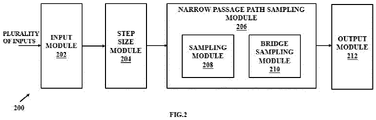
- FIG.2 is a functional block diagram of the various modules of the system of FIG. 1 , in accordance with some embodiments of the present disclosure. As depicted in the architecture, the FIG.2 illustrates the functions of the components of the system 100 that includes for narrow passage path sampling based on levy flight.
- the system 200 for narrow passage path sampling based on levy flight is configured for receiving a plurality of inputs associated with a plurality of obstacles within a narrow passage of an environment using an input/output module 202.
- the received plurality of inputs is used for identifying a step size in a step size module 204.
- a plurality narrow passages sampling points are determined for the narrow passage in a narrow passage path sampling module 206.
- the process of determination of plurality narrow passages sampling points comprises of several steps that includes generating a random configuration and identifying a sampling point in a sampling module 208.
- the narrow passage samples are identified for narrow passage path sampling in a bridge sampling module 210.
- the identified narrow passage path samplings are displayed on an output module 212.
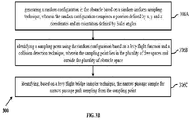
- FIG.3A and FIG.3B is an exemplary flow diagram illustrating a method 300 for using the system 100 of FIG.1 for narrow passage path sampling based on levy flight according to an embodiment of the present disclosure.
- a plurality of inputs associated with a plurality of obstacles within a narrow passage of an environment is received at the input/output module 202.
- the plurality of inputs comprises a plurality of dimensions of a configuration space of each of the plurality of obstacles, a plurality of obstacle geometry (o) of each of the plurality of obstacles.
- the plurality of dimension of the configuration space comprise of a plurality of obstacle space ( C obs ) and a plurality of free spaces ( C free ).
- narrow passage in an environment includes constrained spaces between obstacles or between the obstacles and the environment boundary.
- a step-size depending on input d is considered, wherein for a 2D environment, where only point objects are sampled, then the dimension of the C space .is 2.
- two values (x,y) as positions to be determined on performing the levy flight are considered.
- the number of levy distribution values would also increase. Basically, the number of levy distribution values required is equal to the dimension of the C space .
- a step size ( ⁇ ) is identified at step size module 204.
- the step size is identified based on the plurality of dimensions of the configuration space of each of the plurality of obstacle (d) and the plurality of obstacle geometry(o) using a probability distribution function technique.
- ⁇ is heuristically defined based on the plurality of obstacle (d) and the plurality of obstacle geometry(o) between 0 and 2 wherein a higher value of ⁇ implies small steps and occasional long jumps which makes it difficult for a random walker to return to the starting point. Hence, making the walk intrinsically exploratory.
- a plurality of narrow passages sampling points in the narrow passage is iteratively determined for the narrow passage path sampling in the narrow passage path sampling module 206.
- the step of the determining a narrow passage sample among the plurality of narrow passages sampling point comprises of several steps that includes:
- a random configuration (q, ⁇ ) is generated in the obstacle in the sampling module 208.
- the random configuration comprises a position (q) defined by x, y and z coordinates and an orientation ( ⁇ ) defined by Euler angles ( ⁇ , ⁇ , ⁇ ).
- the random configuration (q, ⁇ ) is generated based on a random uniform sampling technique.
- the random uniform sampling technique used includes a uniform sampling based on normal distribution (N).
- the uniform sampling based on N gives values from -1 to 1, wherein the non-negative values of N are considered using modulus operator.
- a sampling point (q', ⁇ ') is identified in the sampling module 208.
- the sampling point (q', ⁇ ') is identified using the random configuration (q, ⁇ ) based on a levy flight function and a collision detection technique.
- the sampling point (q', ⁇ ') lies in the plurality of free spaces ( C free ) and outside the plurality of obstacle space ( C obs ).
- a Levy Flight function to generate a sampling point.
- the position of new configuration of a sampling position (q') is identified from q based on Levy Flight function ( f L ( l )).
- the sampling position (q') can be expressed as shown below: q ′ ⁇ q + ⁇ + f L l
- the position of new configuration of a sampling orientation ( ⁇ ') is identified from ⁇ based on Levy Flight function ( f L ( l )).
- the narrow passage sample for narrow passage path sampling is identified in the bridge sampling module 210.
- the narrow passage sample is identified from the sampling point (q', ⁇ ') based on a levy flight bridge sampler technique.
- the levy flight bridge sampler technique is depicted as a flow chart in FIG.4 .
- the levy flight bridge sampler technique comprises of the following steps:
- the random configuration (q, ⁇ ) and the sampling point (q', ⁇ ') are joined to form a straight line.
- the straight line is extended along q' till a point q", wherein q' is a midpoint of the extended line between qq".
- the sampling point (q', ⁇ ') is identified as a narrow passage sampling point based on determining if the point q" lies in the plurality of obstacle space ( C obs ) based on the collision detection technique.
- the collision detection technique includes a OpenGL based collision detection technique.
- the identified narrow passage path samplings are displayed on an output module 212.
- the performance of the above disclosed narrow passage sampling methods is compared with the standard Gaussian sampler, Randomized Bridge Builder Sampler (RBBS) and Random Walk Sampler (RWS).
- the comparison has been done by extensively simulating narrow passage scenarios in 2-D as well as 3-D environments.
- 2-D environment experiments are conducted for a 3-link, 5- link and 7-link manipulator, and the results are simulated considering a Bar Shape, a Joint Shape and a Teeth Shape obstacle scenario.
- the environment considered for simulation is a 100 unit sided square area and cube volume in 2-D and 3-D respectively.
- the width of the narrow passage between the obstacles varies between 5 to 10 units depending on the obstacle scenario.
- FIG.5 and FIG.6 shows that t ⁇ and ⁇ c for Levy Flight Bridge Sampler (LFBS) and Randowm Walk Bridge Sampler (RWBS) are less than or comparable to those of the disclosed technique.
- results obtained show superiority of LFBS and RWBS in terms of time/collision checks and sampling quality, as is evident from FIG.7 and FIG.8 that show the results with reference to t ⁇ and ⁇ c .
- the embodiments of present disclosure of narrow passage path sampling based on levy flight is an improvisation of existing techniques path planning techniques, especially pure random walk based methods.
- the disclosed technique is an improvisation of Random Walk to Surface (RWS), wherein sample configurations are generated on the obstacle boundaries.
- RWS Random Walk to Surface
- LFS the disclosed technique
- the disclosed technique utilizes the levy flight mechanism to identify samples in narrow passages (on the obstacle boundaries). The embodiment thus provides improvised sample quality at the expense of a minimum additional computation, when compared with pure random walk based methods.
- the disclosed technique for identification of narrow passages sampling points in the narrow passage is based on several techniques that include random uniform sampling technique, a levy flight function (step size) and a collision detection technique. Moreover, in addition to identification of narrow passages sampling points, the disclosed technique also performs an additional check to ensure that the identified narrow passages sampling points are present in the narrow passage based on a levy flight bridge sampler technique.
- Such computer-readable storage means contain program-code means for implementation of one or more steps of the method, when the program runs on a server or mobile device or any suitable programmable device.
- the hardware device can be any kind of device which can be programmed including e.g., any kind of computer like a server or a personal computer, or the like, or any combination thereof.
- the device may also include means which could be e.g., hardware means like e.g., an application-specific integrated circuit (ASIC), a field-programmable gate array (FPGA), or a combination of hardware and software means, e.g., an ASIC and an FPGA, or at least one microprocessor and at least one memory with software processing components located therein.
- the means can include both hardware means and software means.
- the method embodiments described herein could be implemented in hardware and software.
- the device may also include software means. Alternatively, the embodiments may be implemented on different hardware devices, e.g., using a plurality of CPUs.
- the embodiments herein can comprise hardware and software elements.
- the embodiments that are implemented in software include but are not limited to, firmware, resident software, microcode, etc.
- the functions performed by various components described herein may be implemented in other components or combinations of other components.
- a computer-usable or computer readable medium can be any apparatus that can comprise, store, communicate, propagate, or transport the program for use by or in connection with the instruction execution system, apparatus, or device.
- a computer-readable storage medium refers to any type of physical memory on which information or data readable by a processor may be stored.
- a computer-readable storage medium may store instructions for execution by one or more processors, including instructions for causing the processor(s) to perform steps or stages consistent with the embodiments described herein.
- the term "computer-readable medium” should be understood to include tangible items and exclude carrier waves and transient signals, i.e., be non-transitory. Examples include random access memory (RAM), read-only memory (ROM), volatile memory, nonvolatile memory, hard drives, CD ROMs, DVDs, flash drives, disks, and any other known physical storage media.
Landscapes
- Engineering & Computer Science (AREA)
- Radar, Positioning & Navigation (AREA)
- Remote Sensing (AREA)
- Physics & Mathematics (AREA)
- General Physics & Mathematics (AREA)
- Automation & Control Theory (AREA)
- Theoretical Computer Science (AREA)
- Transportation (AREA)
- Mechanical Engineering (AREA)
- Evolutionary Computation (AREA)
- Software Systems (AREA)
- Data Mining & Analysis (AREA)
- Artificial Intelligence (AREA)
- Computing Systems (AREA)
- General Engineering & Computer Science (AREA)
- Mathematical Physics (AREA)
- Human Computer Interaction (AREA)
- Computational Linguistics (AREA)
- Probability & Statistics with Applications (AREA)
- Algebra (AREA)
- Computational Mathematics (AREA)
- Mathematical Analysis (AREA)
- Mathematical Optimization (AREA)
- Pure & Applied Mathematics (AREA)
- Control Of Position, Course, Altitude, Or Attitude Of Moving Bodies (AREA)
Abstract
Description
- The present application claims priority from
Indian patent application no. 202121023849, filed on May 28, 2021 - The disclosure herein generally relates to the field of probabilistic roadmap planners (PRM) in motion planning of robots with higher degrees of freedom, and, more particularly, to a method and a system for narrow passage path sampling based on levy flight.
- In the research of autonomous mobile robots/ autonomous vehicles, path planning is a core part of extensive area of research. Path planning/motion planning, for autonomous vehicles is a process of finding a contiguous path to travel from a source to destination in a real time environment.
- Traditional path planning methods include Artificial Potential Field Theory (A-PFT), Probabilistic Roadmaps (PRM), Rapidly-Exploring Random Trees (RRT), etc. However, the traditional path planning methods require accurate map of the environment, wherein the environment is usually complicated with several obstacles. Further the existing standard path planning method sampling based approaches, viz. PRM, RRT are efficient for environments that have high uncertainty and high-dimensional maps. However, the standard path planning may not be very efficiently in all scenarios and applications such as a narrow passage scenario.
- Narrow passage scenario includes constrained spaces between obstacles or between the obstacles and the environment boundary. It is very important to identify narrow passages present in the environment to obtain an effective path planning. However, path planning in narrow passage scenario is quite challenging due to difficulty in obtaining sample points as the area of free space is relatively lesser compared to the complete environment. Also, while generating sampling points in narrow passage it is also important to effectively improve the sample density in such regions to plan a path effectively.
- Embodiments of the present disclosure present technological improvements as solutions to one or more of the above-mentioned technical problems recognized by the inventors in conventional systems. For example, in one embodiment, a method and a system for narrow passage path sampling based on levy flight is provided. The system includes a memory storing instructions, one or more communication interfaces; and one or more hardware processors coupled to the memory via the one or more communication interfaces, wherein the one or more hardware processors are configured by the instructions to receive a plurality of inputs associated with a plurality of obstacles within a narrow passage of an environment, via a one or more hardware processors, wherein the plurality of inputs comprise a plurality of dimensions of a configuration space of each of the plurality of obstacles, a plurality of obstacle geometry of each of the plurality of obstacles, wherein the plurality of dimension of the configuration space comprise of a plurality of obstacle space and a plurality of free spaces. The system is further configured to identify a step size, via the one or more hardware processors, based on the plurality of dimensions of the configuration space of each of the plurality of obstacles and the plurality of obstacle geometry using a probability distribution function technique. The system is further configured to iteratively determine a plurality narrow passage sampling points in the narrow passage for the narrow passage path sampling, via the one or more hardware processors, wherein the step of the determining the narrow passage sample among the plurality narrow passages sampling point, comprises: generating a random configuration in the obstacle based on a random uniform sampling technique, wherein the random configuration comprises a position defined by x, y and z coordinates and an orientation defined by Euler angles ; identifying a sampling point using the random configuration based on a levy flight function and a collision detection technique, wherein the sampling point lies in the plurality of free spaces and outside the plurality of obstacle space ; and identifying, based on a levy flight bridge sampler technique, the narrow passage sample for narrow passage path sampling from the sampling point.
- In another aspect, a method for narrow passage path sampling based on levy flight is provided. The method includes receiving a plurality of inputs associated with a plurality of obstacles within a narrow passage of an environment wherein the plurality of inputs comprise a plurality of dimensions of a configuration space of each of the plurality of obstacles, a plurality of obstacle geometry of each of the plurality of obstacles, wherein the plurality of dimension of the configuration space comprise of a plurality of obstacle space and a plurality of free spaces. The method further includes identifying a step size based on the plurality of dimensions of the configuration space of each of the plurality of obstacles and the plurality of obstacle geometry using a probability distribution function technique. The method further includes iteratively determining a plurality narrow passage sampling points in the narrow passage for the narrow passage path sampling, wherein the step of the determining the narrow passage sample among the plurality narrow passages sampling point, comprises: generating a random configuration in the obstacle based on a random uniform sampling technique, wherein the random configuration comprises a position defined by x, y and z coordinates and an orientation defined by Euler angles ; identifying a sampling point using the random configuration based on a levy flight function and a collision detection technique, wherein the sampling point lies in the plurality of free spaces and outside the plurality of obstacle space ; and identifying, based on a levy flight bridge sampler technique, the narrow passage sample for narrow passage path sampling from the sampling point.
- In yet another aspect, a non-transitory computer readable medium for narrow passage path sampling based on levy flight is provided. The program includes receiving a plurality of inputs associated with a plurality of obstacles within a narrow passage of an environment wherein the plurality of inputs comprise a plurality of dimensions of a configuration space of each of the plurality of obstacles, a plurality of obstacle geometry of each of the plurality of obstacles, wherein the plurality of dimension of the configuration space comprise of a plurality of obstacle space and a plurality of free spaces. The program further includes identifying a step size based on the plurality of dimensions of the configuration space of each of the plurality of obstacles and the plurality of obstacle geometry using a probability distribution function technique. The program further includes iteratively determining a plurality narrow passage sampling points in the narrow passage for the narrow passage path sampling, wherein the step of the determining the narrow passage sample among the plurality narrow passages sampling point, comprises: generating a random configuration in the obstacle based on a random uniform sampling technique, wherein the random configuration comprises a position defined by x, y and z coordinates and an orientation defined by Euler angles ; identifying a sampling point using the random configuration based on a levy flight function and a collision detection technique, wherein the sampling point lies in the plurality of free spaces and outside the plurality of obstacle space ; and identifying, based on a levy flight bridge sampler technique, the narrow passage sample for narrow passage path sampling from the sampling point.
- It is to be understood that both the foregoing general description and the following detailed description are exemplary and explanatory only and are not restrictive of the invention, as claimed.
- The accompanying drawings, which are incorporated in and constitute a part of this disclosure, illustrate exemplary embodiments and, together with the description, serve to explain the disclosed principles:
-
FIG.1 illustrates an exemplary system for narrow passage path sampling based on levy flight, according to some embodiments of the present disclosure. -
FIG.2 is a functional block diagram of the system(100) for narrow passage path sampling based on levy flight, according to some embodiments of the present disclosure. -
FIG.3A andFIG.3B is a flow diagram illustrating a method for narrow passage path sampling based on levy flight, in accordance with some embodiments of the present disclosure. -
FIG.4 a flow diagram illustrating a method for the levy flight bridge sampler technique during narrow passage path sampling based on the levy flight in accordance with some embodiments of the present disclosure. -
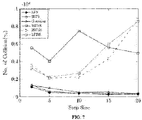
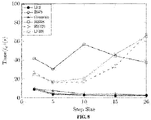
FIG.5 andFIG.6 is a graph illustrating a simulation results in 3D-environment for a joint shape obstacle scenario to determine narrow passage path sampling based on the levy flight in accordance with some embodiments of the present disclosure. -
FIG.7 andFIG.8 is a graph illustrating a simulation results in 3D-environment for a teeth shaped obstacle scenario to determine narrow passage path sampling based on the levy flight in accordance with some embodiments of the present disclosure. - Exemplary embodiments are described with reference to the accompanying drawings. In the figures, the left-most digit(s) of a reference number identifies the figure in which the reference number first appears. Wherever convenient, the same reference numbers are used throughout the drawings to refer to the same or like parts. While examples and features of disclosed principles are described herein, modifications, adaptations, and other implementations are possible without departing from the scope of the disclosed embodiments.
- Narrow passage scenario includes constrained spaces between obstacles or between the obstacles and the environment boundary. It is very important to identify narrow passages present in the environment to obtain an effective path planning. However, path planning in narrow passage scenario is quite challenging. The existing standard techniques such as Probabilistic Roadmaps (PRM) samples the free space randomly and connects the sample points, called roadmap, to generate a path between the source and destination points. However, because of the probability property of the sampling strategy of the PRM, the sampling probability of each region in the map remains the same. Therefore, when the number of sampling points is constant, more the sampling points are generated for the large area the area of a free space while making it difficult to obtain sample points in narrow passages, where the area of free space is much less. Similarly, in RRT, the sampling of random points for expansion of the tree is uniform, hence making it very important to identify narrow passages present in the environment while generating sampling points to effectively improve the sample density in such regions.
- The disclosed technique for narrow passage path sampling based on levy flight is an improvisation of existing techniques . The disclosed technique is based on Random Walk to Surface (RWS), wherein sample configurations are generated on the obstacle boundaries. However, instead of performing a random walk, the proposed technique utilizes the levy flight mechanism to identify samples.
- Referring now to the drawings, and more particularly to
FIG.1 through FIG.8 , where similar reference characters denote corresponding features consistently throughout the figures, there are shown preferred embodiments and these embodiments are described in the context of the following exemplary system and/or method. -
FIG. 1 is a functional block diagram of asystem 100 for narrow passage path sampling based on levy flight in accordance with some embodiments of the present disclosure. - In an embodiment, the
system 100 includes a processor(s) 104, communication interface device(s), alternatively referred as input/output (I/O) interface(s) 106, and one or more data storage devices or amemory 102 operatively coupled to the processor(s) 104. Thesystem 100 with one or more hardware processors is configured to execute functions of one or more functional blocks of thesystem 100. - Referring to the components of
system 100, in an embodiment, the processor(s) 104, can be one ormore hardware processors 104. In an embodiment, the one ormore hardware processors 104 can be implemented as one or more microprocessors, microcomputers, microcontrollers, digital signal processors, central processing units, state machines, logic circuitries, and/or any devices that manipulate signals based on operational instructions. Among other capabilities, the one ormore hardware processors 104 are configured to fetch and execute computer-readable instructions stored in thememory 102. In an embodiment, thesystem 100 can be implemented in a variety of computing systems including laptop computers, notebooks, hand-held devices such as mobile phones, workstations, mainframe computers, servers, a network cloud and the like. - The I/O interface(s) 106 can include a variety of software and hardware interfaces, for example, a web interface, a graphical user interface, a touch user interface (TUI) and the like and can facilitate multiple communications within a wide variety of networks N/W and protocol types, including wired networks, for example, LAN, cable, etc., and wireless networks, such as WLAN, cellular, or satellite. In an embodiment, the I/O interface (s) 106 can include one or more ports for connecting a number of devices (nodes) of the
system 100 to one another or to another server. - The
memory 102 may include any computer-readable medium known in the art including, for example, volatile memory, such as static random access memory (SRAM) and dynamic random access memory (DRAM), and/or non-volatile memory, such as read only memory (ROM), erasable programmable ROM, flash memories, hard disks, optical disks, and magnetic tapes. - Further, the
memory 102 may include adatabase 108, wherein thedatabase 108 includes information related to algorithms related to performing narrow passage sampling. Thus, thememory 102 may comprise information pertaining to input(s)/output(s) of each step performed by the processor(s) 104 of thesystem 100 and methods of the present disclosure. In an embodiment, thedatabase 108 may be external (not shown) to thesystem 100 and coupled to the system via the I/O interface 106. - Functions of the components of
system 100 are explained in conjunction with functional overview of thesystem 100 inFIG.2 and flow diagram ofFIGS. 3 A and3B for narrow passage path sampling based on levy flight. - The
system 100 supports various connectivity options such as BLUETOOTH®, USB, ZigBee and other cellular services. The network environment enables connection of various components of thesystem 100 using any communication link including Internet, WAN, MAN, and so on. In an exemplary embodiment, thesystem 100 is implemented to operate as a stand-alone device. In another embodiment, thesystem 100 may be implemented to work as a loosely coupled device to a smart computing environment. The components and functionalities of thesystem 100 are described further in detail. -
FIG.2 is a functional block diagram of the various modules of the system ofFIG. 1 , in accordance with some embodiments of the present disclosure. As depicted in the architecture, theFIG.2 illustrates the functions of the components of thesystem 100 that includes for narrow passage path sampling based on levy flight. - The
system 200 for narrow passage path sampling based on levy flight is configured for receiving a plurality of inputs associated with a plurality of obstacles within a narrow passage of an environment using an input/output module 202. The received plurality of inputs is used for identifying a step size in astep size module 204. Further a plurality narrow passages sampling points are determined for the narrow passage in a narrow passagepath sampling module 206. The process of determination of plurality narrow passages sampling points comprises of several steps that includes generating a random configuration and identifying a sampling point in asampling module 208. Further using the sampling point, the narrow passage samples are identified for narrow passage path sampling in abridge sampling module 210. Finally, the identified narrow passage path samplings are displayed on anoutput module 212. - The various modules of the
system 100 for narrow passage path sampling based on levy flight are implemented as at least one of a logically self-contained part of a software program, a self-contained hardware component, and/or, a self-contained hardware component with a logically self-contained part of a software program embedded into each of the hardware component that when executed perform the above method described herein. - Functions of the components of the
system 200 are explained in conjunction with functional modules of thesystem 100 stored in thememory 102 such as the input/output module 202, thestep size module 204, the narrow passagepath sampling module 206, thesampling module 208 and thebridge sampling module 210 and further explained in conjunction with flow diagram ofFIGS. 3A and3B . TheFIG.3A andFIG.3B , with reference toFIG.1 , is an exemplary flow diagram illustrating amethod 300 for using thesystem 100 ofFIG.1 for narrow passage path sampling based on levy flight according to an embodiment of the present disclosure. - The steps of the method of the present disclosure will now be explained with reference to the components of the system(100) for narrow passage path sampling based on levy flight and the modules (202-212) as depicted in
FIGS.2 and the flow diagrams as depicted inFIG.3A andFIG.3B . Although process steps, method steps, techniques or the like may be described in a sequential order, such processes, methods and techniques may be configured to work in alternate orders. In other words, any sequence or order of steps that may be described does not necessarily indicate a requirement that the steps to be performed in that order. The steps of processes described herein may be performed in any order practical. Further, some steps may be performed simultaneously. - At
step 302 of the method (300), a plurality of inputs associated with a plurality of obstacles within a narrow passage of an environment is received at the input/output module 202. The plurality of inputs comprises a plurality of dimensions of a configuration space of each of the plurality of obstacles, a plurality of obstacle geometry (o) of each of the plurality of obstacles. The plurality of dimension of the configuration space comprise of a plurality of obstacle space (Cobs ) and a plurality of free spaces (Cfree ). - In an embodiment, narrow passage in an environment includes constrained spaces between obstacles or between the obstacles and the environment boundary. In an example scenario, a step-size depending on input d is considered, wherein for a 2D environment, where only point objects are sampled, then the dimension of the Cspace .is 2. Hence, two values (x,y) as positions to be determined on performing the levy flight. Similarly, if dimensions increase as in manipulator sampling or 3D sampling, the number of levy distribution values would also increase. Basically, the number of levy distribution values required is equal to the dimension of the Cspace.
- At the
next step 304 of the method (300), a step size (α) is identified atstep size module 204. The step size is identified based on the plurality of dimensions of the configuration space of each of the plurality of obstacle (d) and the plurality of obstacle geometry(o) using a probability distribution function technique. - In an embodiment, the proposed technique is based on Random Walk to Surface(RWS), wherein sample configurations are generated on the obstacle boundaries. However, instead of performing a random walk, the proposed technique utilizes the levy flight mechanism. The Levy flight is a category of random walk in which the random walk step-size has a Levy distribution, a probability distribution that is heavy-tailed. The PDF of the length X of each step is a power law function and is expressed as shown below:


- Based in
equation 1, α is heuristically defined based on the plurality of obstacle (d) and the plurality of obstacle geometry(o) between 0 and 2 wherein a higher value of α implies small steps and occasional long jumps which makes it difficult for a random walker to return to the starting point. Hence, making the walk intrinsically exploratory. - At the
next step 306 of the method (300), a plurality of narrow passages sampling points in the narrow passage is iteratively determined for the narrow passage path sampling in the narrow passagepath sampling module 206. - In an embodiment, the step of the determining a narrow passage sample among the plurality of narrow passages sampling point, comprises of several steps that includes:
- (i) Generating a random configuration in the
sampling module 208 within the narrow passagepath sampling module 206. - (ii) Identifying a sampling point in in the
sampling module 208 within the narrow passagepath sampling module 206. - (iii) Identifying the narrow passage samples narrow passage path sampling using the sampling point, in the
bridge sampling 210 within the narrow passagepath sampling module 206. - Referring to
FIG.3B , wherein the step of the determining a narrow passage sample among the plurality of narrow passages sampling point is explained. - At
step 306A of the method (300), a random configuration (q,θ) is generated in the obstacle in thesampling module 208. The random configuration comprises a position (q) defined by x, y and z coordinates and an orientation (θ) defined by Euler angles (Ψ,Θ,Φ). The random configuration (q,θ) is generated based on a random uniform sampling technique. - In an embodiment, the random uniform sampling technique used includes a uniform sampling based on normal distribution (N). The uniform sampling based on N gives values from -1 to 1, wherein the non-negative values of N are considered using modulus operator. Considering a min and a max as the lower and upper boundary limits of an environment, then a random sample (R) can be calculated as shown below:

- At
step 306B of the method (300), a sampling point (q',θ') is identified in thesampling module 208. The sampling point (q',θ') is identified using the random configuration (q,θ ) based on a levy flight function and a collision detection technique. The sampling point (q', θ') lies in the plurality of free spaces (Cfree ) and outside the plurality of obstacle space (Cobs ). - In an embodiment, a Levy Flight function to generate a sampling point. The position of new configuration of a sampling position (q') is identified from q based on Levy Flight function (fL (l)). The sampling position (q') can be expressed as shown below:

- The position of new configuration of a sampling orientation (θ') is identified from θ based on Levy Flight function (fL (l)). The sampling orientation (θ') can be expressed as shown below:

- In an example scenario, the α is chosen as 1.9 for fL (l) and as α = 1.1 for fθ (θ).
- At
step 306C of the method (300), the narrow passage sample for narrow passage path sampling is identified in thebridge sampling module 210. The narrow passage sample is identified from the sampling point (q',θ') based on a levy flight bridge sampler technique. - The levy flight bridge sampler technique is depicted as a flow chart in
FIG.4 . The levy flight bridge sampler technique comprises of the following steps: - At
step 402 of the method (400), the random configuration (q,θ) and the sampling point (q',θ') are joined to form a straight line. - In an embodiment, considering an example scenario for a point sampling in 2D environment, wherein q = (x,y) and q'=(x',y') and a line is drawn from a point (x,y) to another point (x',y') and its length is represented by L. Hence a line is drawn from (x',y') to find a sample q" at same length L from q'.
- At the
next step 404 of the method (400), the straight line is extended along q' till a point q", wherein q' is a midpoint of the extended line between qq". - In an embodiment, the extension of straight line can be expressed as shown below:

- At the
next step 404 of the method (400), the sampling point (q',θ') is identified as a narrow passage sampling point based on determining if the point q" lies in the plurality of obstacle space (Cobs ) based on the collision detection technique. - In an embodiment, the collision detection technique includes a OpenGL based collision detection technique.
- The identified narrow passage path samplings are displayed on an
output module 212. - The performance of the above disclosed narrow passage sampling methods is compared with the standard Gaussian sampler, Randomized Bridge Builder Sampler (RBBS) and Random Walk Sampler (RWS). The comparison has been done by extensively simulating narrow passage scenarios in 2-D as well as 3-D environments. In 2-D environment, experiments are conducted for a 3-link, 5- link and 7-link manipulator, and the results are simulated considering a Bar Shape, a Joint Shape and a Teeth Shape obstacle scenario. The environment considered for simulation is a 100 unit sided square area and cube volume in 2-D and 3-D respectively. The width of the narrow passage between the obstacles varies between 5 to 10 units depending on the obstacle scenario. For comparison, the total execution time t ∈and number of collision checking calls γc to generate a fixed number of candidate samples, Kc , here Kc = 30, are considered. To have a comprehensive comparison of all the above mentioned parameters, all the algorithms are run in the simulated environment with step-size, α, varying from 2 units to 20 units. Algorithms are executed for 300 times for each obstacle scenario and for each step-size, to approximate the average case performance.
- The simulation results in 3D-environment are depicted in
FIG.5 to FIG.8 . For a joint shape obstacle scenario,FIG.5 andFIG.6 shows that t ∈and γc for Levy Flight Bridge Sampler (LFBS) and Randowm Walk Bridge Sampler (RWBS) are less than or comparable to those of the disclosed technique. For the teeth shaped obstacle scenario, results obtained show superiority of LFBS and RWBS in terms of time/collision checks and sampling quality, as is evident fromFIG.7 andFIG.8 that show the results with reference to t ∈and γc. These results are for the simulation of an L-shaped plank within the narrow regions between the obstacles. Hence based on the results it can be concluded that most samples generated using state of art techniques are not in the critical zone/narrow passage, however the disclosed techniques are evidently more efficient. - The written description describes the subject matter herein to enable any person skilled in the art to make and use the embodiments. The scope of the subject matter embodiments is defined by the claims and may include other modifications that occur to those skilled in the art. Such other modifications are intended to be within the scope of the claims if they have similar elements that do not differ from the literal language of the claims or if they include equivalent elements with insubstantial differences from the literal language of the claims.
- The embodiments of present disclosure of narrow passage path sampling based on levy flight is an improvisation of existing techniques path planning techniques, especially pure random walk based methods. The disclosed technique is an improvisation of Random Walk to Surface (RWS), wherein sample configurations are generated on the obstacle boundaries. However, in comparison with traditional RWS, instead of performing a random walk, the disclosed technique (represented as LFS) utilizes the levy flight mechanism to identify samples in narrow passages (on the obstacle boundaries). The embodiment thus provides improvised sample quality at the expense of a minimum additional computation, when compared with pure random walk based methods. The disclosed technique (represented as LFS) for identification of narrow passages sampling points in the narrow passage is based on several techniques that include random uniform sampling technique, a levy flight function (step size) and a collision detection technique. Moreover, in addition to identification of narrow passages sampling points, the disclosed technique also performs an additional check to ensure that the identified narrow passages sampling points are present in the narrow passage based on a levy flight bridge sampler technique.
- It is to be understood that the scope of the protection is extended to such a program and in addition to a computer-readable means having a message therein; such computer-readable storage means contain program-code means for implementation of one or more steps of the method, when the program runs on a server or mobile device or any suitable programmable device. The hardware device can be any kind of device which can be programmed including e.g., any kind of computer like a server or a personal computer, or the like, or any combination thereof. The device may also include means which could be e.g., hardware means like e.g., an application-specific integrated circuit (ASIC), a field-programmable gate array (FPGA), or a combination of hardware and software means, e.g., an ASIC and an FPGA, or at least one microprocessor and at least one memory with software processing components located therein. Thus, the means can include both hardware means and software means. The method embodiments described herein could be implemented in hardware and software. The device may also include software means. Alternatively, the embodiments may be implemented on different hardware devices, e.g., using a plurality of CPUs.
- The embodiments herein can comprise hardware and software elements. The embodiments that are implemented in software include but are not limited to, firmware, resident software, microcode, etc. The functions performed by various components described herein may be implemented in other components or combinations of other components. For the purposes of this description, a computer-usable or computer readable medium can be any apparatus that can comprise, store, communicate, propagate, or transport the program for use by or in connection with the instruction execution system, apparatus, or device.
- The illustrated steps are set out to explain the exemplary embodiments shown, and it should be anticipated that ongoing technological development will change the manner in which particular functions are performed. These examples are presented herein for purposes of illustration, and not limitation. Further, the boundaries of the functional building blocks have been arbitrarily defined herein for the convenience of the description. Alternative boundaries can be defined so long as the specified functions and relationships thereof are appropriately performed. Alternatives (including equivalents, extensions, variations, deviations, etc., of those described herein) will be apparent to persons skilled in the relevant art(s) based on the teachings contained herein. Such alternatives fall within the scope of the disclosed embodiments. Also, the words "comprising," "having," "containing," and "including," and other similar forms are intended to be equivalent in meaning and be open ended in that an item or items following any one of these words is not meant to be an exhaustive listing of such item or items, or meant to be limited to only the listed item or items. It must also be noted that as used herein and in the appended claims, the singular forms "a," "an," and "the" include plural references unless the context clearly dictates otherwise.
- Furthermore, one or more computer-readable storage media may be utilized in implementing embodiments consistent with the present disclosure. A computer-readable storage medium refers to any type of physical memory on which information or data readable by a processor may be stored. Thus, a computer-readable storage medium may store instructions for execution by one or more processors, including instructions for causing the processor(s) to perform steps or stages consistent with the embodiments described herein. The term "computer-readable medium" should be understood to include tangible items and exclude carrier waves and transient signals, i.e., be non-transitory. Examples include random access memory (RAM), read-only memory (ROM), volatile memory, nonvolatile memory, hard drives, CD ROMs, DVDs, flash drives, disks, and any other known physical storage media.
- It is intended that the disclosure and examples be considered as exemplary only, with a true scope of disclosed embodiments being indicated by the following claims.
Claims (10)
- A processor-implemented method (300) comprising:receiving a plurality of inputs associated with a plurality of obstacles within a narrow passage of an environment, via a one or more hardware processors, the plurality of inputs comprise a plurality of dimensions of a configuration space of each of the plurality of obstacles(d), a plurality of obstacle geometry (o) of each of the plurality of obstacles, wherein the plurality of dimension of the configuration space comprise of a plurality of obstacle space (Cobs ) and a plurality of free spaces (Cfree ); (302)identifying a step size (α), via the one or more hardware processors, based on the plurality of dimensions of the configuration space of each of the plurality of obstacles (d) and the plurality of obstacle geometry(o) using a probability distribution function technique; (304) anditeratively determining (306) a plurality narrow passage sampling points in the narrow passage for the narrow passage path sampling, via the one or more hardware processors, wherein the step of the determining the narrow passage sample among the plurality narrow passages sampling point, comprises:generating a random configuration (q,θ) in the obstacle based on a random uniform sampling technique, wherein the random configuration comprises a position (q) defined by x, y and z coordinates and an orientation (θ) defined by Euler angles (Ψ,Θ,Φ) (306A);identifying a sampling point (q',θ') using the random configuration (q,θ ) based on a levy flight function and a collision detection technique, wherein the sampling point (q', θ') lies in the plurality of free spaces (Cfree ) and outside the plurality of obstacle space (Cobs ) (306B); andidentifying, based on a levy flight bridge sampler technique, the narrow passage sample for narrow passage path sampling from the sampling point (q',θ') (306C).
- The processor implemented method according to claim 1, wherein the narrow passage is a constrained space between the plurality of obstacle space (Cobs ) and the plurality of free spaces (Cfree );
- The processor implemented method according to claim 1, wherein the step size (α) is identified based on the probability distribution function technique for a length X and is expressed as:


- The processor implemented method according to claim 1, wherein the sampling point includes a point position (q') and a point orientation (θ') expressed as:


- The processor implemented method according to claim 1, wherein the levy flight bridge sampler technique (400) comprises of:joining the random configuration (q,θ) and the sampling point (q',θ') using a straight line; (402)extending the straight line along q' till a point q", wherein q' is a midpoint of the extended line between qq" ;(404) andidentifying the sampling point (q ,θ') as a narrow passage the sampling point based on determining if the point q" lies in the plurality of obstacle space (Cobs ) based on the collision detection technique. (406)
- A system (100), comprising:a memory (102) storing instructions;one or more communication interfaces (106); andone or more hardware processors (104) coupled to the memory (102) via the one or more communication interfaces (106), wherein the one or more hardware processors (104) are configured by the instructions to:receive a plurality of inputs associated with a plurality of obstacles within a narrow passage of an environment, via a one or more hardware processors, the plurality of inputs comprise a plurality of dimensions of a configuration space of each of the plurality of obstacles(d), a plurality of obstacle geometry (o) of each of the plurality of obstacles, wherein the plurality of dimension of the configuration space comprise of a plurality of obstacle space (Cobs ) and a plurality of free spaces (Cfree );identify a step size (α), via the one or more hardware processors, based on the plurality of dimensions of the configuration space of each of the plurality of obstacles (d) and the plurality of obstacle geometry(o) using a probability distribution function technique; anditeratively determine a plurality narrow passage sampling points in the narrow passage for the narrow passage path sampling, via the one or more hardware processors, wherein the step of the determining the narrow passage sample among the plurality narrow passages sampling point, comprises:generating a random configuration (q,θ) in the obstacle based on a random uniform sampling technique, wherein the random configuration comprises a position (q) defined by x, y and z coordinates and an orientation (θ) defined by Euler angles (Ψ,Θ,Φ);identifying a sampling point (q',θ') using the random configuration (q,θ ) based on a levy flight function and a collision detection technique, wherein the sampling point (q', θ') lies in the plurality of free spaces (Cfree ) and outside the plurality of obstacle space (Cobs ); andidentifying, based on a levy flight bridge sampler technique, the narrow passage sample for narrow passage path sampling from the sampling point (q',θ').
- The system according to claim 6, wherein the one or more hardware processors are configured by the instructions to identify the step size (α based on the probability distribution function technique for a length X and is expressed as shown below :


- The system according to claim 6, wherein the one or more hardware processors are configured by the instructions to identify the sampling point (q',θ'), wherein the sampling point includes a point position (q') and a point orientation (θ') expressed as:


- The system according to claim 6, wherein the one or more hardware processors are configured by the instructions to perform the levy flight bridge sampler technique comprising of:joining the random configuration (q,θ) and the sampling point (q',θ') using a straight line;extending the straight line along q' till a point q", wherein q' is a midpoint of the extended line between qq"; andidentifying the sampling point (q',θ') as a narrow passage the sampling point based on determining if the point q" lies in the plurality of obstacle space (Cobs ) based on the collision detection technique.
- A computer program product comprising a non-transitory computer readable medium having a computer readable program embodied therein, wherein the computer readable program, when executed on a computing device, causes the computing device to:
receive a plurality of inputs associated with a plurality of obstacles within a narrow passage of an environment, via a one or more hardware processors, the plurality of inputs comprise a plurality of dimensions of a configuration space of each of the plurality of obstacles(d), a plurality of obstacle geometry (o) of each of the plurality of obstacles, wherein the plurality of dimension of the configuration space comprise of a plurality of obstacle space (Cobs ) and a plurality of free spaces (Cfree );identify a step size (α), via the one or more hardware processors, based on the plurality of dimensions of the configuration space of each of the plurality of obstacles (d) and the plurality of obstacle geometry(o) using a probability distribution function technique; anditeratively determine a plurality narrow passage sampling points in the narrow passage for the narrow passage path sampling, via the one or more hardware processors, wherein the step of the determining the narrow passage sample among the plurality narrow passages sampling point, comprises:generating a random configuration (q,θ) in the obstacle based on a random uniform sampling technique, wherein the random configuration comprises a position (q) defined by x, y and z coordinates and an orientation (θ) defined by Euler angles (Ψ,Θ,Φ);identifying a sampling point (q',θ') using the random configuration (q,θ ) based on a levy flight function and a collision detection technique, wherein the sampling point (q', θ') lies in the plurality of free spaces (Cfree ) and outside the plurality of obstacle space (Cobs ); andidentifying, based on a levy flight bridge sampler technique, the narrow passage sample for narrow passage path sampling from the sampling point (q',θ').
Applications Claiming Priority (1)
| Application Number | Priority Date | Filing Date | Title |
|---|---|---|---|
| IN202121023849 | 2021-05-28 |
Publications (2)
| Publication Number | Publication Date |
|---|---|
| EP4094899A2 true EP4094899A2 (en) | 2022-11-30 |
| EP4094899A3 EP4094899A3 (en) | 2023-01-11 |
Family
ID=81448746
Family Applications (1)
| Application Number | Title | Priority Date | Filing Date |
|---|---|---|---|
| EP22170824.1A Pending EP4094899A3 (en) | 2021-05-28 | 2022-04-29 | Method and system for narrow passage path sampling based on levy flight |
Country Status (2)
| Country | Link |
|---|---|
| US (1) | US12391244B2 (en) |
| EP (1) | EP4094899A3 (en) |
Cited By (4)
| Publication number | Priority date | Publication date | Assignee | Title |
|---|---|---|---|---|
| CN117371638A (en) * | 2023-12-06 | 2024-01-09 | 合肥工业大学 | Optimization method of multi-torpedo tanks and multi-track walking paths based on raccoon optimization algorithm |
| CN119665974A (en) * | 2024-12-03 | 2025-03-21 | 北京邮电大学 | A path planning method and related equipment for narrow scenes |
| CN120084349A (en) * | 2025-03-06 | 2025-06-03 | 湖南大学 | A local trajectory planning method and system based on stochastic model |
| DE102024201058A1 (en) | 2024-02-06 | 2025-08-07 | Robert Bosch Gesellschaft mit beschränkter Haftung | Method for planning a target path for a motor vehicle |
Family Cites Families (6)
| Publication number | Priority date | Publication date | Assignee | Title |
|---|---|---|---|---|
| US10521473B2 (en) * | 2012-05-21 | 2019-12-31 | Kent State University | Shortest path computation in large networks |
| US11530921B2 (en) * | 2018-09-28 | 2022-12-20 | Intel Corporation | Method of generating a collision free path of travel and computing system |
| US10901425B2 (en) * | 2018-11-30 | 2021-01-26 | Honda Motor Co., Ltd. | Systems and methods for navigational planning |
| EP3742125B1 (en) * | 2019-05-20 | 2024-08-07 | Tata Consultancy Services Limited | Method and system for path planning |
| CN112904897B (en) * | 2021-01-26 | 2022-02-15 | 华中科技大学 | A trajectory optimization method and device for accurately dropping ocean sensors underwater |
| KR102381678B1 (en) * | 2021-03-31 | 2022-04-01 | 주식회사 클로버스튜디오 | 4-dimensional path display method for unmanned vehicle using point cloud |
-
2022
- 2022-04-29 EP EP22170824.1A patent/EP4094899A3/en active Pending
- 2022-05-04 US US17/662,043 patent/US12391244B2/en active Active
Cited By (5)
| Publication number | Priority date | Publication date | Assignee | Title |
|---|---|---|---|---|
| CN117371638A (en) * | 2023-12-06 | 2024-01-09 | 合肥工业大学 | Optimization method of multi-torpedo tanks and multi-track walking paths based on raccoon optimization algorithm |
| CN117371638B (en) * | 2023-12-06 | 2024-02-20 | 合肥工业大学 | Optimization method of multi-torpedo tanks and multi-track walking paths based on raccoon optimization algorithm |
| DE102024201058A1 (en) | 2024-02-06 | 2025-08-07 | Robert Bosch Gesellschaft mit beschränkter Haftung | Method for planning a target path for a motor vehicle |
| CN119665974A (en) * | 2024-12-03 | 2025-03-21 | 北京邮电大学 | A path planning method and related equipment for narrow scenes |
| CN120084349A (en) * | 2025-03-06 | 2025-06-03 | 湖南大学 | A local trajectory planning method and system based on stochastic model |
Also Published As
| Publication number | Publication date |
|---|---|
| US20230001920A1 (en) | 2023-01-05 |
| EP4094899A3 (en) | 2023-01-11 |
| US12391244B2 (en) | 2025-08-19 |
Similar Documents
| Publication | Publication Date | Title |
|---|---|---|
| US12391244B2 (en) | Method and system for narrow passage path sampling based on levy flight | |
| US11983269B2 (en) | Deep neural network system for similarity-based graph representations | |
| EP3748455B1 (en) | A method and a system for hierarchical network based diverse trajectory proposal | |
| EP3627250B1 (en) | Method and system for free space detection in a cluttered environment | |
| EP3742125B1 (en) | Method and system for path planning | |
| US8843492B2 (en) | Record linkage based on a trained blocking scheme | |
| US11188795B1 (en) | Domain adaptation using probability distribution distance | |
| US20130339352A1 (en) | Shortest path computation in large networks | |
| CN110866930B (en) | Semantic segmentation auxiliary labeling method and device | |
| CN113377888A (en) | Training target detection model and method for detecting target | |
| Elizondo-Leal et al. | The exact Euclidean distance transform: a new algorithm for universal path planning | |
| US20240319735A1 (en) | Robotic navigation with simultaneous local path planning and learning | |
| EP4488892A1 (en) | Methods and systems for graph assisted unsupervised domain adaptation for machine fault diagnosis | |
| Jafarzadeh et al. | An exact geometry–based algorithm for path planning | |
| Joshi et al. | Non-parametric informed exploration for sampling-based motion planning | |
| US20100315977A1 (en) | Shrink wrap technique for enclosing multiple polygons | |
| US20240013081A1 (en) | Method and system for recommending optimum combination of quantum circuits | |
| US20240410706A1 (en) | Using a Machine-Trained Model that provides an Estimated Time-of-Arrival and Distribution Parameters | |
| EP4160549A1 (en) | Image-based vehicle loss assessment method, apparatus and system | |
| US20240373232A1 (en) | Method of annotating map data for navigation of vehicles | |
| CN115146095A (en) | High-precision map element vectorization method and device, electronic equipment and storage medium | |
| EP4390782A1 (en) | Method and system to estimate model performance without ground truth based on model decision boundaries | |
| CN116701627B (en) | Method and device for identifying emotion of document, electronic equipment and storage medium | |
| CN117131223B (en) | Information processing methods, devices, electronic equipment and storage media | |
| US20250232558A1 (en) | Attention-based three-dimensional object detection |
Legal Events
| Date | Code | Title | Description |
|---|---|---|---|
| PUAI | Public reference made under article 153(3) epc to a published international application that has entered the european phase |
Free format text: ORIGINAL CODE: 0009012 |
|
| STAA | Information on the status of an ep patent application or granted ep patent |
Free format text: STATUS: THE APPLICATION HAS BEEN PUBLISHED |
|
| AK | Designated contracting states |
Kind code of ref document: A2 Designated state(s): AL AT BE BG CH CY CZ DE DK EE ES FI FR GB GR HR HU IE IS IT LI LT LU LV MC MK MT NL NO PL PT RO RS SE SI SK SM TR |
|
| PUAL | Search report despatched |
Free format text: ORIGINAL CODE: 0009013 |
|
| AK | Designated contracting states |
Kind code of ref document: A3 Designated state(s): AL AT BE BG CH CY CZ DE DK EE ES FI FR GB GR HR HU IE IS IT LI LT LU LV MC MK MT NL NO PL PT RO RS SE SI SK SM TR |
|
| RIC1 | Information provided on ipc code assigned before grant |
Ipc: G06Q 10/04 20120101ALI20221205BHEP Ipc: G06N 7/00 20060101ALI20221205BHEP Ipc: G01C 21/34 20060101ALI20221205BHEP Ipc: G01C 21/20 20060101ALI20221205BHEP Ipc: G01C 21/00 20060101ALI20221205BHEP Ipc: B25J 9/16 20060101AFI20221205BHEP |
|
| STAA | Information on the status of an ep patent application or granted ep patent |
Free format text: STATUS: REQUEST FOR EXAMINATION WAS MADE |
|
| 17P | Request for examination filed |
Effective date: 20230316 |
|
| RBV | Designated contracting states (corrected) |
Designated state(s): AL AT BE BG CH CY CZ DE DK EE ES FI FR GB GR HR HU IE IS IT LI LT LU LV MC MK MT NL NO PL PT RO RS SE SI SK SM TR |
|
| STAA | Information on the status of an ep patent application or granted ep patent |
Free format text: STATUS: EXAMINATION IS IN PROGRESS |
|
| 17Q | First examination report despatched |
Effective date: 20251013 |