EP4094830A1 - Novel adsorbent - Google Patents
Novel adsorbent Download PDFInfo
- Publication number
- EP4094830A1 EP4094830A1 EP21744818.2A EP21744818A EP4094830A1 EP 4094830 A1 EP4094830 A1 EP 4094830A1 EP 21744818 A EP21744818 A EP 21744818A EP 4094830 A1 EP4094830 A1 EP 4094830A1
- Authority
- EP
- European Patent Office
- Prior art keywords
- salt
- adsorbent
- aqueous solution
- prepared
- copper
- Prior art date
- Legal status (The legal status is an assumption and is not a legal conclusion. Google has not performed a legal analysis and makes no representation as to the accuracy of the status listed.)
- Pending
Links
Images
Classifications
-
- G—PHYSICS
- G21—NUCLEAR PHYSICS; NUCLEAR ENGINEERING
- G21F—PROTECTION AGAINST X-RADIATION, GAMMA RADIATION, CORPUSCULAR RADIATION OR PARTICLE BOMBARDMENT; TREATING RADIOACTIVELY CONTAMINATED MATERIAL; DECONTAMINATION ARRANGEMENTS THEREFOR
- G21F9/00—Treating radioactively contaminated material; Decontamination arrangements therefor
- G21F9/04—Treating liquids
- G21F9/06—Processing
- G21F9/12—Processing by absorption; by adsorption; by ion-exchange
-
- B—PERFORMING OPERATIONS; TRANSPORTING
- B01—PHYSICAL OR CHEMICAL PROCESSES OR APPARATUS IN GENERAL
- B01J—CHEMICAL OR PHYSICAL PROCESSES, e.g. CATALYSIS OR COLLOID CHEMISTRY; THEIR RELEVANT APPARATUS
- B01J20/00—Solid sorbent compositions or filter aid compositions; Sorbents for chromatography; Processes for preparing, regenerating or reactivating thereof
- B01J20/02—Solid sorbent compositions or filter aid compositions; Sorbents for chromatography; Processes for preparing, regenerating or reactivating thereof comprising inorganic material
- B01J20/0203—Solid sorbent compositions or filter aid compositions; Sorbents for chromatography; Processes for preparing, regenerating or reactivating thereof comprising inorganic material comprising compounds of metals not provided for in B01J20/04
- B01J20/0222—Compounds of Mn, Re
-
- B—PERFORMING OPERATIONS; TRANSPORTING
- B01—PHYSICAL OR CHEMICAL PROCESSES OR APPARATUS IN GENERAL
- B01J—CHEMICAL OR PHYSICAL PROCESSES, e.g. CATALYSIS OR COLLOID CHEMISTRY; THEIR RELEVANT APPARATUS
- B01J20/00—Solid sorbent compositions or filter aid compositions; Sorbents for chromatography; Processes for preparing, regenerating or reactivating thereof
- B01J20/02—Solid sorbent compositions or filter aid compositions; Sorbents for chromatography; Processes for preparing, regenerating or reactivating thereof comprising inorganic material
- B01J20/0203—Solid sorbent compositions or filter aid compositions; Sorbents for chromatography; Processes for preparing, regenerating or reactivating thereof comprising inorganic material comprising compounds of metals not provided for in B01J20/04
- B01J20/0225—Compounds of Fe, Ru, Os, Co, Rh, Ir, Ni, Pd, Pt
-
- B—PERFORMING OPERATIONS; TRANSPORTING
- B01—PHYSICAL OR CHEMICAL PROCESSES OR APPARATUS IN GENERAL
- B01J—CHEMICAL OR PHYSICAL PROCESSES, e.g. CATALYSIS OR COLLOID CHEMISTRY; THEIR RELEVANT APPARATUS
- B01J20/00—Solid sorbent compositions or filter aid compositions; Sorbents for chromatography; Processes for preparing, regenerating or reactivating thereof
- B01J20/02—Solid sorbent compositions or filter aid compositions; Sorbents for chromatography; Processes for preparing, regenerating or reactivating thereof comprising inorganic material
- B01J20/0203—Solid sorbent compositions or filter aid compositions; Sorbents for chromatography; Processes for preparing, regenerating or reactivating thereof comprising inorganic material comprising compounds of metals not provided for in B01J20/04
- B01J20/0225—Compounds of Fe, Ru, Os, Co, Rh, Ir, Ni, Pd, Pt
- B01J20/0229—Compounds of Fe
-
- B—PERFORMING OPERATIONS; TRANSPORTING
- B01—PHYSICAL OR CHEMICAL PROCESSES OR APPARATUS IN GENERAL
- B01J—CHEMICAL OR PHYSICAL PROCESSES, e.g. CATALYSIS OR COLLOID CHEMISTRY; THEIR RELEVANT APPARATUS
- B01J20/00—Solid sorbent compositions or filter aid compositions; Sorbents for chromatography; Processes for preparing, regenerating or reactivating thereof
- B01J20/02—Solid sorbent compositions or filter aid compositions; Sorbents for chromatography; Processes for preparing, regenerating or reactivating thereof comprising inorganic material
- B01J20/0203—Solid sorbent compositions or filter aid compositions; Sorbents for chromatography; Processes for preparing, regenerating or reactivating thereof comprising inorganic material comprising compounds of metals not provided for in B01J20/04
- B01J20/0233—Compounds of Cu, Ag, Au
- B01J20/0237—Compounds of Cu
-
- B—PERFORMING OPERATIONS; TRANSPORTING
- B01—PHYSICAL OR CHEMICAL PROCESSES OR APPARATUS IN GENERAL
- B01J—CHEMICAL OR PHYSICAL PROCESSES, e.g. CATALYSIS OR COLLOID CHEMISTRY; THEIR RELEVANT APPARATUS
- B01J20/00—Solid sorbent compositions or filter aid compositions; Sorbents for chromatography; Processes for preparing, regenerating or reactivating thereof
- B01J20/02—Solid sorbent compositions or filter aid compositions; Sorbents for chromatography; Processes for preparing, regenerating or reactivating thereof comprising inorganic material
- B01J20/0203—Solid sorbent compositions or filter aid compositions; Sorbents for chromatography; Processes for preparing, regenerating or reactivating thereof comprising inorganic material comprising compounds of metals not provided for in B01J20/04
- B01J20/024—Compounds of Zn, Cd, Hg
- B01J20/0244—Compounds of Zn
-
- B—PERFORMING OPERATIONS; TRANSPORTING
- B01—PHYSICAL OR CHEMICAL PROCESSES OR APPARATUS IN GENERAL
- B01J—CHEMICAL OR PHYSICAL PROCESSES, e.g. CATALYSIS OR COLLOID CHEMISTRY; THEIR RELEVANT APPARATUS
- B01J20/00—Solid sorbent compositions or filter aid compositions; Sorbents for chromatography; Processes for preparing, regenerating or reactivating thereof
- B01J20/02—Solid sorbent compositions or filter aid compositions; Sorbents for chromatography; Processes for preparing, regenerating or reactivating thereof comprising inorganic material
- B01J20/0203—Solid sorbent compositions or filter aid compositions; Sorbents for chromatography; Processes for preparing, regenerating or reactivating thereof comprising inorganic material comprising compounds of metals not provided for in B01J20/04
- B01J20/0259—Compounds of N, P, As, Sb, Bi
-
- B—PERFORMING OPERATIONS; TRANSPORTING
- B01—PHYSICAL OR CHEMICAL PROCESSES OR APPARATUS IN GENERAL
- B01J—CHEMICAL OR PHYSICAL PROCESSES, e.g. CATALYSIS OR COLLOID CHEMISTRY; THEIR RELEVANT APPARATUS
- B01J20/00—Solid sorbent compositions or filter aid compositions; Sorbents for chromatography; Processes for preparing, regenerating or reactivating thereof
- B01J20/02—Solid sorbent compositions or filter aid compositions; Sorbents for chromatography; Processes for preparing, regenerating or reactivating thereof comprising inorganic material
- B01J20/0203—Solid sorbent compositions or filter aid compositions; Sorbents for chromatography; Processes for preparing, regenerating or reactivating thereof comprising inorganic material comprising compounds of metals not provided for in B01J20/04
- B01J20/0274—Solid sorbent compositions or filter aid compositions; Sorbents for chromatography; Processes for preparing, regenerating or reactivating thereof comprising inorganic material comprising compounds of metals not provided for in B01J20/04 characterised by the type of anion
-
- B—PERFORMING OPERATIONS; TRANSPORTING
- B01—PHYSICAL OR CHEMICAL PROCESSES OR APPARATUS IN GENERAL
- B01J—CHEMICAL OR PHYSICAL PROCESSES, e.g. CATALYSIS OR COLLOID CHEMISTRY; THEIR RELEVANT APPARATUS
- B01J20/00—Solid sorbent compositions or filter aid compositions; Sorbents for chromatography; Processes for preparing, regenerating or reactivating thereof
- B01J20/30—Processes for preparing, regenerating, or reactivating
- B01J20/32—Impregnating or coating ; Solid sorbent compositions obtained from processes involving impregnating or coating
- B01J20/3202—Impregnating or coating ; Solid sorbent compositions obtained from processes involving impregnating or coating characterised by the carrier, support or substrate used for impregnation or coating
- B01J20/3206—Organic carriers, supports or substrates
- B01J20/3208—Polymeric carriers, supports or substrates
- B01J20/321—Polymeric carriers, supports or substrates consisting of a polymer obtained by reactions involving only carbon to carbon unsaturated bonds
-
- B—PERFORMING OPERATIONS; TRANSPORTING
- B01—PHYSICAL OR CHEMICAL PROCESSES OR APPARATUS IN GENERAL
- B01J—CHEMICAL OR PHYSICAL PROCESSES, e.g. CATALYSIS OR COLLOID CHEMISTRY; THEIR RELEVANT APPARATUS
- B01J20/00—Solid sorbent compositions or filter aid compositions; Sorbents for chromatography; Processes for preparing, regenerating or reactivating thereof
- B01J20/30—Processes for preparing, regenerating, or reactivating
- B01J20/32—Impregnating or coating ; Solid sorbent compositions obtained from processes involving impregnating or coating
- B01J20/3202—Impregnating or coating ; Solid sorbent compositions obtained from processes involving impregnating or coating characterised by the carrier, support or substrate used for impregnation or coating
- B01J20/3206—Organic carriers, supports or substrates
- B01J20/3208—Polymeric carriers, supports or substrates
- B01J20/3212—Polymeric carriers, supports or substrates consisting of a polymer obtained by reactions otherwise than involving only carbon to carbon unsaturated bonds
-
- B—PERFORMING OPERATIONS; TRANSPORTING
- B01—PHYSICAL OR CHEMICAL PROCESSES OR APPARATUS IN GENERAL
- B01J—CHEMICAL OR PHYSICAL PROCESSES, e.g. CATALYSIS OR COLLOID CHEMISTRY; THEIR RELEVANT APPARATUS
- B01J20/00—Solid sorbent compositions or filter aid compositions; Sorbents for chromatography; Processes for preparing, regenerating or reactivating thereof
- B01J20/30—Processes for preparing, regenerating, or reactivating
- B01J20/32—Impregnating or coating ; Solid sorbent compositions obtained from processes involving impregnating or coating
- B01J20/3231—Impregnating or coating ; Solid sorbent compositions obtained from processes involving impregnating or coating characterised by the coating or impregnating layer
- B01J20/3234—Inorganic material layers
- B01J20/3236—Inorganic material layers containing metal, other than zeolites, e.g. oxides, hydroxides, sulphides or salts
-
- B—PERFORMING OPERATIONS; TRANSPORTING
- B01—PHYSICAL OR CHEMICAL PROCESSES OR APPARATUS IN GENERAL
- B01J—CHEMICAL OR PHYSICAL PROCESSES, e.g. CATALYSIS OR COLLOID CHEMISTRY; THEIR RELEVANT APPARATUS
- B01J20/00—Solid sorbent compositions or filter aid compositions; Sorbents for chromatography; Processes for preparing, regenerating or reactivating thereof
- B01J20/30—Processes for preparing, regenerating, or reactivating
- B01J20/32—Impregnating or coating ; Solid sorbent compositions obtained from processes involving impregnating or coating
- B01J20/3291—Characterised by the shape of the carrier, the coating or the obtained coated product
- B01J20/3293—Coatings on a core, the core being particle or fiber shaped, e.g. encapsulated particles, coated fibers
-
- C—CHEMISTRY; METALLURGY
- C01—INORGANIC CHEMISTRY
- C01C—AMMONIA; CYANOGEN; COMPOUNDS THEREOF
- C01C3/00—Cyanogen; Compounds thereof
- C01C3/08—Simple or complex cyanides of metals
- C01C3/10—Simple alkali metal cyanides
-
- C—CHEMISTRY; METALLURGY
- C01—INORGANIC CHEMISTRY
- C01C—AMMONIA; CYANOGEN; COMPOUNDS THEREOF
- C01C3/00—Cyanogen; Compounds thereof
- C01C3/08—Simple or complex cyanides of metals
- C01C3/11—Complex cyanides
-
- C—CHEMISTRY; METALLURGY
- C01—INORGANIC CHEMISTRY
- C01C—AMMONIA; CYANOGEN; COMPOUNDS THEREOF
- C01C3/00—Cyanogen; Compounds thereof
- C01C3/08—Simple or complex cyanides of metals
- C01C3/12—Simple or complex iron cyanides
-
- C—CHEMISTRY; METALLURGY
- C02—TREATMENT OF WATER, WASTE WATER, SEWAGE, OR SLUDGE
- C02F—TREATMENT OF WATER, WASTE WATER, SEWAGE, OR SLUDGE
- C02F1/00—Treatment of water, waste water, or sewage
- C02F1/28—Treatment of water, waste water, or sewage by sorption
- C02F1/288—Treatment of water, waste water, or sewage by sorption using composite sorbents, e.g. coated, impregnated, multi-layered
-
- C—CHEMISTRY; METALLURGY
- C02—TREATMENT OF WATER, WASTE WATER, SEWAGE, OR SLUDGE
- C02F—TREATMENT OF WATER, WASTE WATER, SEWAGE, OR SLUDGE
- C02F1/00—Treatment of water, waste water, or sewage
- C02F1/28—Treatment of water, waste water, or sewage by sorption
- C02F1/281—Treatment of water, waste water, or sewage by sorption using inorganic sorbents
-
- C—CHEMISTRY; METALLURGY
- C02—TREATMENT OF WATER, WASTE WATER, SEWAGE, OR SLUDGE
- C02F—TREATMENT OF WATER, WASTE WATER, SEWAGE, OR SLUDGE
- C02F2101/00—Nature of the contaminant
- C02F2101/10—Inorganic compounds
- C02F2101/20—Heavy metals or heavy metal compounds
-
- C—CHEMISTRY; METALLURGY
- C02—TREATMENT OF WATER, WASTE WATER, SEWAGE, OR SLUDGE
- C02F—TREATMENT OF WATER, WASTE WATER, SEWAGE, OR SLUDGE
- C02F2101/00—Nature of the contaminant
- C02F2101/10—Inorganic compounds
- C02F2101/20—Heavy metals or heavy metal compounds
- C02F2101/203—Iron or iron compound
-
- C—CHEMISTRY; METALLURGY
- C02—TREATMENT OF WATER, WASTE WATER, SEWAGE, OR SLUDGE
- C02F—TREATMENT OF WATER, WASTE WATER, SEWAGE, OR SLUDGE
- C02F2101/00—Nature of the contaminant
- C02F2101/10—Inorganic compounds
- C02F2101/20—Heavy metals or heavy metal compounds
- C02F2101/206—Manganese or manganese compounds
Definitions
- the present invention relates to a novel adsorbent capable of adsorbing harmful ions.
- porous materials such as activated carbon and zeolite are commonly used. These are inexpensive and effective in removing organic substances, but have poor absorption ability for metal ions. Therefore, various adsorbents and methods for removing, from wastewater, harmful ions, in particular, harmful heavy metal ions and radioactive metal ions, have been studied.
- An object of the present invention is to provide an adsorbent that is low in cost, has versatility and has high adsorption ability for harmful ions.
- the present inventors have been carrying out extensive research on adsorption techniques for radioactive cesium utilizing Prussian blue or analogues thereof, that is, a metal salts of a cyanometallic acid.
- a metal salt of a cyanometallic acid is produced, the reaction of the salt of a cyanometallic acid with the compound containing a metal element carried out using the compound containing a metal element in an amount of less than 100 mol% of the theoretical amount relative to 1 mol of the salt of a cyanometallic acid results in adsorption of harmful ions other than cesium onto the resulting metal salt of a cyanometallic acid, thereby completing the present invention.
- the present invention is as follows:
- the adsorbent of the present invention is characterized in that it contains a metal salt of a cyanometallic acid obtained by reacting a compound containing a metal element in an amount of less than 100 mol% of the theoretical amount relative to 1 mol of a salt of a cyanometallic acid. It is believed that using an amount of the compound containing a metal element that is less than 100 mol% (that is, less than the theoretical amount) leads to increased defects in the coordination structure of the metal salt of a cyanometallic acid, thereby allowing harmful ions to be adsorbed in the defects or void portions. Accordingly, the adsorbent of the present invention allows targeting of a plurality of harmful ions in wastewater that can adsorb in the defects or void portions of the metal salt of a cyanometallic acid, and is, therefore, excellent in versatility.
- the adsorbent of the present invention can be obtained from inexpensive and easily processable materials using a simple and easy production method, and it is, therefore, suitable for industrial uses such as treatment of a large amount of wastewater from an economical point of view, too. Further, since a metal salt of a cyanometallic acid is almost insoluble in water, it can be easily recovered without leaving the adsorbent used in the treatment in the water environment.
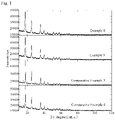
- Fig. 1 shows diffraction peaks by powder X-ray diffraction measurement of the adsorbents of Examples 8 and 9, and Comparative Examples 3 and 4 in Test Example 19.
- the present invention relates to an adsorbent comprising a metal salt of a cyanometallic acid obtained by a reaction of a salt of a cyanometallic acid and a compound comprising a metal element, wherein the reaction is carried out using the compound comprising a metal element in an amount of less than 100 mol% of the theoretical amount relative to 1 mol of the salt of a cyanometallic acid.
- the metal salt of a cyanometallic acid (also referred to as a "Prussian blue analogue (PBA)") contained in the adsorbent of the present invention is a type of a cyano bridged metal complex in which a cyanometallic acid ion is used as a constructing element, and is preferably a metal salt of a hexacyanometallic acid or a metal salt of an octacyanometallic acid, and more preferably a metal salt of a hexacyanometallic acid.
- PBA Prussian blue analogue
- a metal salt of a hexacyanometallic acid is a compound whose composition is represented by the formula: M A m [M B (CN) 6 ] n ⁇ hH 2 O, and is considered to be a face-centered-cubic crystal structure in which the metal ions (M A , M B ) are alternately cross-linked with the cyano groups.
- M A is preferably a transition metal, and more preferably a first-row transition metal.
- the first-row transition metal there may be mentioned scandium (Sc), titanium (Ti), vanadium (V), chromium (Cr), manganese (Mn), iron (Fe), cobalt (Co), nickel (Ni), copper (Cu) and zinc (Zn).
- the metal salt of a cyanometallic acid of the present invention may contain a material in which a part of the metal ions (for example, M A ) is substituted by an alkali metal ion derived from a starting material.
- M B may be any metal species capable of having an octahedral hexacoordination structure, and is preferably chromium (Cr), manganese (Mn), iron (Fe) or cobalt (Co), more preferably iron (Fe), and particularly ferrous (Fe(II)).
- Cr chromium
- Mn manganese
- Fe iron
- Co cobalt
- m, n and h are determined depending on the oxidation numbers of M A and M B .
- the metal salt of the hexacyanoferrate(II), which is one embodiment of the metal salt of a cyanometallic acid of the present invention there may be mentioned a first-row transition metal salt thereof, and specific examples include a scandium (Sc) salt, titanium (Ti) salt, vanadium (V) salt, chromium (Cr) salt, manganese (Mn) salt, iron (Fe) salt, cobalt (Co) salt, nickel (Ni) salt, copper (Cu) salt, zinc (Zn) salt, and a mixed salt of one kind or two or more kinds thereof.
- the ferric (Fe(III)) salt of hexacyanoferrate(II), which is one embodiment of the metal salt of a hexacyanometallic acid of the present invention, is also referred to as Prussian blue or Berlin blue, and has been used as a pigment for a long time.
- the adsorbent of the present invention is characterized in that it contains a metal salt of a cyanometallic acid obtained by reacting a compound containing a metal element in an amount of less than 100 mol% of the theoretical amount relative to 1 mol of a salt of a cyanometallic acid.
- the "theoretical amount” means a molar amount (theoretical amount) of the compound containing a metal element theoretically required for forming the composition of the metal salt of a cyanometallic acid relative to 1 mol of the salt of a cyanometallic acid.
- the metal salt of a cyanometallic acid is copper(II) hexacyanoferrate(II)
- the molar amount of a compound containing Cu(II) for example, copper(II) chloride theoretically required for forming the formula: Cu(II) 2 [Fe(II)(CN) 6 ], which is an ideal composition, is 2 mol relative to 1 mol of the salt of a hexacyanometallic acid, which means the amount of less than 100 mol% of the theoretical amount means an amount of less than 2 mol.
- the salt of a cyanometallic acid used in the present invention is not particularly limited as long as it is water soluble, and can form a Prussian blue analogue (that is, the metal salt of a cyanometallic acid) of the present invention by reaction with a compound containing a metal element.
- a Prussian blue analogue that is, the metal salt of a cyanometallic acid
- an alkali metal salt sodium salt, potassium salt, etc.
- alkali metal salt sodium salt, potassium salt, etc.
- sodium salt, potassium salt, etc. of hexacyanochromic(III) acid, hexacyanomanganese(II) acid, hexacyanoferric(II) acid or hexacyanocobalt(III) acid, or a hydrate thereof.
- the salt of the hexacyanoferric(II) acid used in the present invention is not particularly limited as long as it is water soluble and can form a metal salt of the hexacyanoferric(II) acid by a reaction with a compound containing a metal element.
- Specific examples thereof include potassium hexacyanoferrate(II), and sodium hexacyanoferrate(II) and a hydrate thereof.
- Use of potassium hexacyanoferrate(II) or a hydrate thereof is preferable.
- the compound containing a metal element used in the present invention is not particularly limited as long as it is water soluble, and can form a metal salt of a cyanometallic acid of the present invention by a reaction with a salt of a cyanometallic acid.
- a compound containing a metal element include a halide salt, nitrate salt, sulfate salt, perchlorate salt, acetate salt, phosphate salt, hexafluorophosphate salt, borate salt, and tetrafluoroborate salt of a first-row transition metal and hydrates thereof, etc.
- halides such as manganese(II) chloride, ferric(III) chloride, cobalt(II) chloride, nickel(II) chloride and copper(II) chloride, etc.; nitrates such as iron(III) nitrate and copper(II) nitrate, etc.; sulfates such as iron(III) sulfate and copper(II) sulfate, etc.; perchlorates such as iron(III) perchlorate, etc.; acetates such as copper(II) acetate and zinc(II) acetate, etc.; or a hydrate thereof.
- the adsorbent of the present invention can be obtained by a reaction of a salt of a cyanometallic acid and a compound containing a metal element.
- the reaction can be carried out in water by mixing a salt of a cyanometallic acid and a compound containing a metal element in water, and the order of addition thereof is not particularly limited. For example, as shown in Examples described later, it may be carried out by preparing an aqueous solution of a salt of a cyanometallic acid and an aqueous solution of a compound containing a metal element, followed by mixing these.
- the concentration of the salt of a cyanometallic acid in the reaction solution may be selected as appropriate depending on the water solubility of the salt of a cyanometallic acid to be used, etc., and, for example, it is selected from the range of 0.001 to 1 M, and in particular, from the range of 0.01 to 0.3 M.
- the concentration of the compound containing a metal element in the reaction solution may be selected as appropriate depending on the water solubility of the compound containing a metal element to be used, etc., and for example, it is selected from the range of 0.001 to 1 M, and in particular, from the range of 0.01 to 0.3 M.
- the reaction temperature varies depending on the kind and amount of the starting materials to be used, etc., and it is typically 0°C to 100°C, preferably 10°C to 30°C, and more preferably ambient temperature (about 25°C).
- the reaction time varies depending on the reaction temperature, etc., and is generally 1 second to 24 hours, and preferably 1 second to 10 minutes.
- the reaction pressure is set as appropriate depending on necessity, and may be pressurized, depressurized or at atmospheric pressure, preferably at atmospheric pressure.
- the reaction atmosphere can be selected as appropriate and carried out depending on necessity, and is preferably an air atmosphere or an inert gas atmosphere such as nitrogen or argon, etc.
- an adsorbent containing a metal salt of a cyanometallic acid is precipitated as a solid.
- the precipitated metal salt of a cyanometallic acid can be isolated and purified by methods known in the art, for example, centrifugation, filtration, decantation, extraction and washing, etc. Further, if necessary, the adsorbent of the present invention can be obtained as a powder by using means such as drying and pulverization, etc.
- the adsorbent of the present invention may be in the form of being carried on a porous substance.
- the reaction is carried out using a compound containing a metal element in an amount of less than 100 mol% of the theoretical amount relative to 1 mol of a salt of a cyanometallic acid, and using a porous substance that has been prepared to carry either one of the salt of a cyanometallic acid or the compound containing a metal element as well as an aqueous solution of the other, and the reaction is preferably carried out using the porous substance carrying the compound containing a metal element and an aqueous solution of the salt of a cyanometallic acid.
- the resulting metal salt of a cyanometallic acid is formed and fixed inside or outside the porous substance.
- Metal salts of a cyanometallic acid in particular, "pigments” such as Prussian blue are insoluble in a medium such as water and organic solvents and have no dyeing affinity for a substrate. Therefore, when the adsorbent of the present invention is carried on a porous substance, it is typically necessary to subject it to post-treatment with a binder resin, etc., and to fix the metal salt of a cyanometallic acid in the form of being attached onto the surface of the porous substance.
- the metal salt of a cyanometallic acid is formed in situ and exists as fine particles on the surface and/or inside of the porous substance, so that it can be stably fixed to the porous substance without using a binder resin, etc.
- the porous substance can be optionally selected from known materials such as powders, particles, membranes, foams, woven fabrics, non-woven fabrics, textiles, etc., preferably hydrophilic or water-absorbent powders, particles, membranes, foams, woven fabrics, non-woven fabrics, textile fabric, etc.
- the porous substance include hydrophilic inorganic particles such as silica gel, alumina, diatomaceous earth, etc.; and a filter medium using a hydrophilic fiber as a base material (for example, filter paper, membrane filter, porous particles, fiber rod, etc.).
- the hydrophilic fiber in the present invention may be paraphrased as a water-absorbent fiber.
- the hydrophilic fiber is a general term for fibers that can easily take in water molecules, and is typically a cellulose fiber.
- cellulose fibers include natural fibers such as wool, cotton, silk, linen, pulp, etc., regenerated fiber such as rayon, polynosic, cupra (Bemberg (Registered trademark)), lyocell (Tencel (Registered trademark)), etc., and composite fibers thereof.
- it may be semi-synthetic fibers such as acetate, triacetate, etc., or synthetic fibers such as polyamide-based, polyvinyl alcohol-based, polyvinylidene chloride-based, polyvinyl chloride-based, polyester-based, polyacrylonitrile-based, polyolefin-based or polyurethane-based fibers, etc., or those in which these composite fibers are modified by a known method to impart hydrophilicity.
- semi-synthetic fibers such as acetate, triacetate, etc.
- synthetic fibers such as polyamide-based, polyvinyl alcohol-based, polyvinylidene chloride-based, polyvinyl chloride-based, polyester-based, polyacrylonitrile-based, polyolefin-based or polyurethane-based fibers, etc., or those in which these composite fibers are modified by a known method to impart hydrophilicity.
- hydrophilic fiber and synthetic fiber for example, a cellulose composite fiber of a cellulose fiber and a synthetic fiber (for example, a polyolefin-based fiber such as polyethylene, polypropylene, etc.).
- a cellulose fiber or a cellulose composite fiber is preferable in view of price and availability.
- the present invention relates to a method for adsorbing and removing harmful ions contained in wastewater, etc., specifically, metal ions, and particularly harmful heavy metal ions or radioactive metal ions.
- the method of the present invention includes a step of bringing the above-mentioned adsorbent of the present invention into contact with an aqueous solution containing the harmful ions that are the targets of adsorption, to adsorb the harmful ions to the defects or void portions in the metal salt of a cyanometallic acid contained in the adsorbent.
- the aqueous solution containing harmful ions typically refers to water contaminated with harmful substances such as chemical substances, etc. Examples of chemical substances include harmful ions or compounds capable of releasing such harmful ions.
- Examples of harmful ions include metal ions, in particular, harmful heavy metal ions or radioactive metal ions.
- metals include magnesium (Mg), aluminum (Al), chromium (Cr), manganese (Mn), iron (Fe), cobalt (Co), nickel (Ni), copper (Cu), zinc (Zn), strontium (Sr), ruthenium (Ru), rhodium (Rh), silver (Ag), cadmium (Cd), tin (Sn), cesium (Cs), barium (Ba), mercury (Hg), thallium (Tl), lead (Pb), lanthanum (La), cerium (Ce) and radioactive isotopes thereof, etc.
- the metal which is an object to be adsorbed manganese, iron, cobalt, nickel, zinc, strontium, ruthenium, rhodium, cesium, barium, lanthanum or cerium is suitable. Accordingly, as the aqueous solution containing the metal ion that is the object to be adsorbed, there may be mentioned water environments such as contaminated seas, rivers, ponds, lakes, etc., water taken from a contaminated water environment, industrial wastewater, etc.
- the method of the present invention is suitable for adsorbing and removing strontium, as the wastewater, water contaminated with radioactive strontium, that is, water environments such as seas, rivers, ponds, lakes, etc., contaminated with radioactive strontium, water taken from a water environment contaminated with radioactive strontium, wastewater or groundwater containing radioactive strontium, etc., are to be targeted.
- a step of removing the adsorbent may be included.
- the metal salt of a cyanometallic acid contained in the adsorbent is almost insoluble in water, so that it can be easily recovered without leaving the adsorbent used in the treatment in the aqueous solution by methods known in the art, for example, centrifugation, filtration, decantation, etc.
- the obtained solid was dried at 50°C under reduced pressure, and then pulverized in a mortar. Again, the solid was washed using purified water and decantation was repeated 12 times using a centrifuge. The obtained solid was dried at 50°C under reduced pressure, then pulverized in a mortar to form a powder, and dried at 50°C under reduced pressure to obtain an adsorbent.
- the obtained solid was dried at 50°C under reduced pressure, and then pulverized in a mortar. Again, the solid was washed using purified water and decantation was repeated 15 times using a centrifuge. The obtained solid was dried at 50°C under reduced pressure, then pulverized in a mortar to form a powder, and dried at 50°C under reduced pressure to obtain an adsorbent.
- Test Example 1 Measurement experiment of strontium adsorption ability
- the solid was washed using a 1% sodium chloride aqueous solution or purified water and decantation and washing were repeated 22 times or more using a centrifuge. During this washing, drying at 50°C under reduced pressure or pulverization in a mortar was sometimes carried out to the washed solid. After these operations, about 1 g of an adsorbent was obtained.
- the solid was washed using a 1% sodium chloride aqueous solution or purified water and decantation and washing were repeated 22 times or more using a centrifuge. During this washing, drying at 50°C under reduced pressure or pulverization in a mortar was sometimes carried out to the washed solid. After these operations, an adsorbent was obtained.
- Test Example 2 Measurement experiment of strontium adsorption ability
- Test Example 3 Measurement experiment of cesium adsorption ability
- Test Example 4 Measurement experiment of zinc adsorption ability
- Test Example 5 Measurement experiment of barium adsorption ability
- Test Example 6 Measurement experiment of manganese adsorption ability
- Test Example 7 Measurement experiment of lanthanum adsorption ability
- Test Example 8 Measurement experiment of nickel adsorption ability
- Test Example 9 Measurement experiment of cerium adsorption ability
- Test Example 10 Measurement experiment of cobalt adsorption ability
- Test Example 11 Measurement experiment of iron adsorption ability
- Test Example 12 Measurement experiment of rhodium adsorption ability
- Test Example 13 Measurement experiment of ruthenium adsorption ability
- Test Example 2 [Table 2] Residual ratio [%] Test Example 2 Test Example 3 Test Example 4 Test Example 5 Test Example 6 Test Example 7 Test Example 8 Test Example 9 Test Example 10 Test Example 11 Test Example 12 Test Example 13 Example 2 1:1 1> 1> 1> 1> 1 1 2 2 10 11 22 34 Comparative Example 2 1:2 18 1> 9 17 29 3 18 3 50 2 18 66
- the solid was washed with a 1% sodium chloride aqueous solution or purified water, and decantation and washing were repeated 22 times or more using a HITACHI High-speed Micro Centrifuge type CF15RXII, 11,000 rpm. During this washing, drying at 50°C under reduced pressure or pulverization in a mortar was sometimes carried out to the washed solid. After these operations, an adsorbent was obtained.
- the solid was washed with a 1% sodium chloride aqueous solution or purified water, and decantation and washing were repeated 22 times or more using a HITACHI High-speed Micro Centrifuge type CF15RXII, 11,000 rpm. During this washing, drying at 50°C under reduced pressure or pulverization in a mortar was sometimes carried out to the washed solid. After these operations, an adsorbent was obtained.
- the solid was washed with a 1% sodium chloride aqueous solution or purified water, and decantation and washing were repeated 22 times or more using a HITACHI High-speed Micro Centrifuge type CF15RXII, 11,000 rpm. During this washing, drying at 50°C under reduced pressure or pulverization in a mortar was sometimes carried out to the washed solid. After these operations, an adsorbent was obtained.
- the solid was washed with a 1% sodium chloride aqueous solution or purified water, and decantation and washing were repeated 22 times or more using a HITACHI High-speed Micro Centrifuge type CF15RXII, 11,000 rpm. During this washing, drying at 50°C under reduced pressure or pulverization in a mortar was sometimes carried out to the washed solid. After these operations, an adsorbent was obtained.
- Test Example 14 Measurement experiment of strontium adsorption ability
- Test Example 15 Measurement experiment of cesium adsorption ability
- Test Example 16 Measurement experiment of barium adsorption ability
- the solid was washed using a 1% sodium chloride aqueous solution or purified water, and decantation and washing were repeated 22 times or more using a centrifuge. During this washing, drying at 50°C under reduced pressure or pulverization in a mortar was sometimes carried out to the washed solid. After these operations, an adsorbent was obtained.
- the solid was washed using a 1% sodium chloride aqueous solution or purified water, and decantation and washing were repeated 22 times or more using a centrifuge. During this washing, drying at 50°C under reduced pressure or pulverization in a mortar was sometimes carried out to the washed solid. After these operations, an adsorbent was obtained.
- the solid was washed using a 1% sodium chloride aqueous solution or purified water, and decantation and washing were repeated 22 times or more using a centrifuge. During this washing, drying at 50°C under reduced pressure or pulverization in a mortar was sometimes carried out to the washed solid. After these operations, an adsorbent was obtained.
- the solid was washed using a 1% sodium chloride aqueous solution or purified water, and decantation and washing were repeated 22 times or more using a centrifuge. During this washing, drying at 50°C under reduced pressure or pulverization in a mortar was sometimes carried out to the washed solid. After these operations, an adsorbent was obtained.
- the solid was washed using a 1% sodium chloride aqueous solution or purified water, and decantation and washing were repeated 22 times or more using a centrifuge. During this washing, drying at 50°C under reduced pressure or pulverization in a mortar was sometimes carried out to the washed solid. After these operations, an adsorbent was obtained.
- the solid was washed using a 1% sodium chloride aqueous solution or purified water, and decantation and washing were repeated 22 times or more using a centrifuge. During this washing, drying at 50°C under reduced pressure or pulverization in a mortar was sometimes carried out to the washed solid. After these operations, an adsorbent was obtained.
- the solid was washed using a 1% sodium chloride aqueous solution or purified water, and decantation and washing were repeated 22 times or more using a centrifuge. During this washing, drying at 50°C under reduced pressure or pulverization in a mortar was sometimes carried out to the washed solid. After these operations, an adsorbent was obtained.
- the solid was washed using a 1% sodium chloride aqueous solution or purified water, and decantation and washing were repeated 22 times or more using a centrifuge. During this washing, drying at 50°C under reduced pressure or pulverization in a mortar was sometimes carried out to the washed solid. After these operations, an adsorbent was obtained.
- the solid was washed using a 1% sodium chloride aqueous solution or purified water, and decantation and washing were repeated 22 times or more using a centrifuge. During this washing, drying at 50°C under reduced pressure or pulverization in a mortar was sometimes carried out to the washed solid. After these operations, an adsorbent was obtained.
- Test Example 17 Measurement experiment of strontium adsorption ability
- Test Example 18 Quantification of iron and copper
- Example 8 or 9 The adsorbent of Example 8 or 9, or Comparative Example 3 or 4 was filled in a glass holder as a sample, and measurement was carried out with a centralized optical system using a fully automatic horizontal multipurpose X-ray diffractometer of Rigaku Corporation. The results are shown in Fig. 1 .
- Test Example 20 Measurement experiment of strontium adsorption ability in environmental water (simulated groundwater)
- strontium standard solution 1.0 g/L
- calcium standard solution 1.0 g/L
- magnesium standard solution 1.0 g/L
- sodium standard solution 1.0 g/L
- each 30 mL of the prepared simulated groundwater was added to each of the four centrifuge tubes, and 50 mg, 100 mg, 200 mg or 400 mg of the adsorbent of Example 2 was added, and the mixture was shaken at a shaking width of 5 cm and a rotation speed of 150 rpm for 5 hours. After completion of the shaking, each centrifuge tube was centrifuged at room temperature at a rotation speed of 4,000 rpm for 60 minutes. 20 mL of the supernatant after centrifugation was taken in another centrifuge tube, and allowed to stand at room temperature for 24 hours. 15 mL of the supernatant after allowing to stand was taken in another centrifuge tube, and this was made a pretreatment solution.
- test solution which was appropriately diluted with ultrapure water and added with nitric acid to a concentration of about 0.6% was introduced into an ICP mass spectrometer (quadrupole ICP mass spectrometer Agilent 7500cx manufactured by Agilent Technologies), and quantitative analysis of strontium was carried out and evaluation was carried out by the residual ratio.
- ICP mass spectrometer quadrature ICP mass spectrometer Agilent 7500cx manufactured by Agilent Technologies
- the adsorbent of the present invention could remove harmful metals from the aqueous solution with good efficiency.
- the adsorbent of the present invention can increase defects in the coordination structure of the metal salt of a cyanometallic acid by making the amount to be used of the compound containing a metal element constituting the metal salt of a cyanometallic acid less than the theoretical amount, whereby the harmful metal ions are considered to be adsorbed to the defects or void portions. Accordingly, it is possible to target a plurality of harmful metal ions in wastewater, which can be adsorbed onto the defects or void portions of the metal salt of a cyanometallic acid, so that it is excellent in versatility.
- the starting materials of the adsorbent are each inexpensive and production thereof is easy, so that it is also suitable for industrial use such as treatment of a large amount of wastewater.
Landscapes
- Chemical & Material Sciences (AREA)
- Organic Chemistry (AREA)
- Inorganic Chemistry (AREA)
- Analytical Chemistry (AREA)
- Chemical Kinetics & Catalysis (AREA)
- Health & Medical Sciences (AREA)
- Toxicology (AREA)
- General Health & Medical Sciences (AREA)
- Engineering & Computer Science (AREA)
- Environmental & Geological Engineering (AREA)
- Water Supply & Treatment (AREA)
- Hydrology & Water Resources (AREA)
- Life Sciences & Earth Sciences (AREA)
- Physics & Mathematics (AREA)
- General Engineering & Computer Science (AREA)
- High Energy & Nuclear Physics (AREA)
- Solid-Sorbent Or Filter-Aiding Compositions (AREA)
Abstract
Description
- The present invention relates to a novel adsorbent capable of adsorbing harmful ions.
- For the treatment of wastewater, porous materials such as activated carbon and zeolite are commonly used. These are inexpensive and effective in removing organic substances, but have poor absorption ability for metal ions. Therefore, various adsorbents and methods for removing, from wastewater, harmful ions, in particular, harmful heavy metal ions and radioactive metal ions, have been studied.
- For example, a technique utilizing Prussian blue or analogues thereof as an adsorbent for radioactive cesium (134Cs, 137Cs) has been reported (see, for example, Patent Document 1). According to this document, cesium can be removed from contaminated water by adsorption. However, there have been few reports on the adsorption ability for other elements regarding techniques utilizing Prussian blue or its analogues.
- In addition, as adsorbents for radioactive cesium (134Cs, 137Cs) or strontium (90Sr), a technique utilizing crystalline silicotitanates that have specific compositions and titanic acid salts has been reported (see, for example, Patent Document 2). However, crystalline silicotitanates and titanic acid salts are expensive and, therefore, not suitable for industrial uses such as wastewater treatment of large amounts of wastewater due to their high costs.
-
- Patent Document 1:
JP 2013/27652A - Patent Document 2:
JP Patent No. 5,696,244 - An object of the present invention is to provide an adsorbent that is low in cost, has versatility and has high adsorption ability for harmful ions.
- The present inventors have been carrying out extensive research on adsorption techniques for radioactive cesium utilizing Prussian blue or analogues thereof, that is, a metal salts of a cyanometallic acid. During the research, they have found that, when a metal salt of a cyanometallic acid is produced, the reaction of the salt of a cyanometallic acid with the compound containing a metal element carried out using the compound containing a metal element in an amount of less than 100 mol% of the theoretical amount relative to 1 mol of the salt of a cyanometallic acid results in adsorption of harmful ions other than cesium onto the resulting metal salt of a cyanometallic acid, thereby completing the present invention.
- The present invention is as follows:
- (1) An adsorbent comprising a metal salt of a cyanometallic acid obtained by a reaction of a salt of a cyanometallic acid and a compound comprising a metal element, wherein the reaction is carried out using the compound comprising a metal element in an amount of less than 100 mol% of a theoretical amount relative to 1 mol of the salt of a cyanometallic acid.
- (2) The adsorbent described in (1) above, wherein the reaction is carried out using a porous substance carrying either one of the compound comprising a metal element or the salt of a cyanometallic acid and an aqueous solution of the other, and wherein the metal salt of a cyanometallic acid is formed and fixed inside or outside the porous substance.
- (3) The adsorbent described in (2) above, wherein the porous substance is a hydrophilic fiber.
- (4) A method for removing a harmful metal ion from water, comprising a step of bringing the adsorbent described in any one of (1) to (3) above into contact with an aqueous solution comprising the harmful metal ion.
- (5) The method described in (4) above, further comprising a step of removing the adsorbent.
- (6) A method for producing an adsorbent comprising a metal salt of a cyanometallic acid, the method comprising reacting a salt of a cyanometallic acid with a compound comprising a metal element, wherein the reacting is carried out using the compound comprising a metal element in an amount of less than 100 mol% of a theoretical amount relative to 1 mol of the salt of a cyanometallic acid.
- (7) The method described in (6) above, wherein the reacting is carried out using a porous substance carrying either one of the compound comprising a metal element or the salt of a cyanometallic acid and an aqueous solution of the other.
- (8) The method described in (7) above, wherein the porous substance is a hydrophilic fiber.
- The adsorbent of the present invention is characterized in that it contains a metal salt of a cyanometallic acid obtained by reacting a compound containing a metal element in an amount of less than 100 mol% of the theoretical amount relative to 1 mol of a salt of a cyanometallic acid. It is believed that using an amount of the compound containing a metal element that is less than 100 mol% (that is, less than the theoretical amount) leads to increased defects in the coordination structure of the metal salt of a cyanometallic acid, thereby allowing harmful ions to be adsorbed in the defects or void portions. Accordingly, the adsorbent of the present invention allows targeting of a plurality of harmful ions in wastewater that can adsorb in the defects or void portions of the metal salt of a cyanometallic acid, and is, therefore, excellent in versatility.
- In addition, the adsorbent of the present invention can be obtained from inexpensive and easily processable materials using a simple and easy production method, and it is, therefore, suitable for industrial uses such as treatment of a large amount of wastewater from an economical point of view, too. Further, since a metal salt of a cyanometallic acid is almost insoluble in water, it can be easily recovered without leaving the adsorbent used in the treatment in the water environment.
-
Fig. 1 shows diffraction peaks by powder X-ray diffraction measurement of the adsorbents of Examples 8 and 9, and Comparative Examples 3 and 4 in Test Example 19. - The present invention relates to an adsorbent comprising a metal salt of a cyanometallic acid obtained by a reaction of a salt of a cyanometallic acid and a compound comprising a metal element, wherein the reaction is carried out using the compound comprising a metal element in an amount of less than 100 mol% of the theoretical amount relative to 1 mol of the salt of a cyanometallic acid.
- The metal salt of a cyanometallic acid (also referred to as a "Prussian blue analogue (PBA)") contained in the adsorbent of the present invention is a type of a cyano bridged metal complex in which a cyanometallic acid ion is used as a constructing element, and is preferably a metal salt of a hexacyanometallic acid or a metal salt of an octacyanometallic acid, and more preferably a metal salt of a hexacyanometallic acid. For example, a metal salt of a hexacyanometallic acid is a compound whose composition is represented by the formula: MA m[MB(CN)6]n·hH2O, and is considered to be a face-centered-cubic crystal structure in which the metal ions (MA, MB) are alternately cross-linked with the cyano groups. Here, MA is preferably a transition metal, and more preferably a first-row transition metal. As the first-row transition metal, there may be mentioned scandium (Sc), titanium (Ti), vanadium (V), chromium (Cr), manganese (Mn), iron (Fe), cobalt (Co), nickel (Ni), copper (Cu) and zinc (Zn). It is preferably manganese (Mn), iron (Fe), cobalt (Co), nickel (Ni), copper (Cu) and zinc (Zn), more preferably iron (Fe), cobalt (Co), copper (Cu) and zinc (Zn), further preferably iron (Fe), copper (Cu) and zinc (Zn), further more preferably iron (Fe) and copper (Cu), particularly, ferric (Fe(III)) or cupric (Cu(II)). Incidentally, the metal salt of a cyanometallic acid of the present invention may contain a material in which a part of the metal ions (for example, MA) is substituted by an alkali metal ion derived from a starting material.
- In the above-mentioned formula, MB may be any metal species capable of having an octahedral hexacoordination structure, and is preferably chromium (Cr), manganese (Mn), iron (Fe) or cobalt (Co), more preferably iron (Fe), and particularly ferrous (Fe(II)). In the above-mentioned formula, the values of m, n and h are determined depending on the oxidation numbers of MA and MB.
- For example, as the metal salt of the hexacyanoferrate(II), which is one embodiment of the metal salt of a cyanometallic acid of the present invention, there may be mentioned a first-row transition metal salt thereof, and specific examples include a scandium (Sc) salt, titanium (Ti) salt, vanadium (V) salt, chromium (Cr) salt, manganese (Mn) salt, iron (Fe) salt, cobalt (Co) salt, nickel (Ni) salt, copper (Cu) salt, zinc (Zn) salt, and a mixed salt of one kind or two or more kinds thereof. It is preferably a manganese (Mn) salt, iron (Fe) salt, cobalt (Co) salt, nickel (Ni) salt, copper (Cu) salt, zinc (Zn) salt of hexacyanoferrate(II) or a mixed salt of one kind or two or more kinds thereof, more preferably an iron (Fe) salt, cobalt (Co) salt, copper (Cu) salt and zinc (Zn) salt, further preferably an iron (Fe) salt, copper (Cu) salt and zinc (Zn) salt, further more preferably a copper (Cu) salt or iron (Fe) salt, and particularly a ferric (Fe(III)) salt or cupric (Cu(II)) salt.
- The ferric (Fe(III)) salt of hexacyanoferrate(II), which is one embodiment of the metal salt of a hexacyanometallic acid of the present invention, is also referred to as Prussian blue or Berlin blue, and has been used as a pigment for a long time. Its ideal chemical composition is Fe(III)4[Fe(II)(CN)6]3·xH2O(x=14 to 16) (that is, "iron(III) hexacyanoferrate(II) hydrate"), and part of the iron ions may, in some cases, be substituted by alkali metal ions, etc., derived from the starting material, depending on the producing method, etc.
- The adsorbent of the present invention is characterized in that it contains a metal salt of a cyanometallic acid obtained by reacting a compound containing a metal element in an amount of less than 100 mol% of the theoretical amount relative to 1 mol of a salt of a cyanometallic acid. Here, the "theoretical amount" means a molar amount (theoretical amount) of the compound containing a metal element theoretically required for forming the composition of the metal salt of a cyanometallic acid relative to 1 mol of the salt of a cyanometallic acid. For example, when the metal salt of a cyanometallic acid is copper(II) hexacyanoferrate(II), the molar amount of a compound containing Cu(II), for example, copper(II) chloride theoretically required for forming the formula: Cu(II)2[Fe(II)(CN)6], which is an ideal composition, is 2 mol relative to 1 mol of the salt of a hexacyanometallic acid, which means the amount of less than 100 mol% of the theoretical amount means an amount of less than 2 mol. It is contemplated that, by using an amount of less than 100 mol%, preferably 10 mol% or more and less than 100 mol%, more preferably 15 mol% or more and 90 mol% or less, further preferably 20 mol% or more and 80 mol% or less, and particularly preferably 30 mol% or more and 80 mol% or less, of the theoretical amount, defects in the coordination structure of the metal salt of a cyanometallic acid can be increased, thereby allowing harmful ions to be adsorbed in the defects or void portions.
- The salt of a cyanometallic acid used in the present invention is not particularly limited as long as it is water soluble, and can form a Prussian blue analogue (that is, the metal salt of a cyanometallic acid) of the present invention by reaction with a compound containing a metal element. As examples, there may be mentioned, an alkali metal salt (sodium salt, potassium salt, etc.) of a cyanometallic acid or a hydrate thereof. There may be specifically mentioned an alkali metal salt (sodium salt, potassium salt, etc.) of hexacyanochromic(III) acid, hexacyanomanganese(II) acid, hexacyanoferric(II) acid or hexacyanocobalt(III) acid, or a hydrate thereof.
- For example, when the cyanometallic acid is hexacyanoferric(II) acid, the salt of the hexacyanoferric(II) acid used in the present invention is not particularly limited as long as it is water soluble and can form a metal salt of the hexacyanoferric(II) acid by a reaction with a compound containing a metal element. Specific examples thereof include potassium hexacyanoferrate(II), and sodium hexacyanoferrate(II) and a hydrate thereof. Use of potassium hexacyanoferrate(II) or a hydrate thereof is preferable.
- The compound containing a metal element used in the present invention is not particularly limited as long as it is water soluble, and can form a metal salt of a cyanometallic acid of the present invention by a reaction with a salt of a cyanometallic acid. Examples of such a compound containing a metal element include a halide salt, nitrate salt, sulfate salt, perchlorate salt, acetate salt, phosphate salt, hexafluorophosphate salt, borate salt, and tetrafluoroborate salt of a first-row transition metal and hydrates thereof, etc. For example, there may be mentioned halides such as manganese(II) chloride, ferric(III) chloride, cobalt(II) chloride, nickel(II) chloride and copper(II) chloride, etc.; nitrates such as iron(III) nitrate and copper(II) nitrate, etc.; sulfates such as iron(III) sulfate and copper(II) sulfate, etc.; perchlorates such as iron(III) perchlorate, etc.; acetates such as copper(II) acetate and zinc(II) acetate, etc.; or a hydrate thereof.
- The adsorbent of the present invention can be obtained by a reaction of a salt of a cyanometallic acid and a compound containing a metal element. The reaction can be carried out in water by mixing a salt of a cyanometallic acid and a compound containing a metal element in water, and the order of addition thereof is not particularly limited. For example, as shown in Examples described later, it may be carried out by preparing an aqueous solution of a salt of a cyanometallic acid and an aqueous solution of a compound containing a metal element, followed by mixing these.
- The concentration of the salt of a cyanometallic acid in the reaction solution may be selected as appropriate depending on the water solubility of the salt of a cyanometallic acid to be used, etc., and, for example, it is selected from the range of 0.001 to 1 M, and in particular, from the range of 0.01 to 0.3 M. Similarly, the concentration of the compound containing a metal element in the reaction solution may be selected as appropriate depending on the water solubility of the compound containing a metal element to be used, etc., and for example, it is selected from the range of 0.001 to 1 M, and in particular, from the range of 0.01 to 0.3 M.
- The reaction temperature varies depending on the kind and amount of the starting materials to be used, etc., and it is typically 0°C to 100°C, preferably 10°C to 30°C, and more preferably ambient temperature (about 25°C). The reaction time varies depending on the reaction temperature, etc., and is generally 1 second to 24 hours, and preferably 1 second to 10 minutes. The reaction pressure is set as appropriate depending on necessity, and may be pressurized, depressurized or at atmospheric pressure, preferably at atmospheric pressure. The reaction atmosphere can be selected as appropriate and carried out depending on necessity, and is preferably an air atmosphere or an inert gas atmosphere such as nitrogen or argon, etc.
- When the reaction proceeds, an adsorbent containing a metal salt of a cyanometallic acid is precipitated as a solid. After completion of the reaction, the precipitated metal salt of a cyanometallic acid can be isolated and purified by methods known in the art, for example, centrifugation, filtration, decantation, extraction and washing, etc. Further, if necessary, the adsorbent of the present invention can be obtained as a powder by using means such as drying and pulverization, etc.
- In addition, the adsorbent of the present invention may be in the form of being carried on a porous substance. When the adsorbent of the present invention is in the form of being carried on a porous substance, the reaction is carried out using a compound containing a metal element in an amount of less than 100 mol% of the theoretical amount relative to 1 mol of a salt of a cyanometallic acid, and using a porous substance that has been prepared to carry either one of the salt of a cyanometallic acid or the compound containing a metal element as well as an aqueous solution of the other, and the reaction is preferably carried out using the porous substance carrying the compound containing a metal element and an aqueous solution of the salt of a cyanometallic acid. By such a reaction, the resulting metal salt of a cyanometallic acid is formed and fixed inside or outside the porous substance. Metal salts of a cyanometallic acid, in particular, "pigments" such as Prussian blue are insoluble in a medium such as water and organic solvents and have no dyeing affinity for a substrate. Therefore, when the adsorbent of the present invention is carried on a porous substance, it is typically necessary to subject it to post-treatment with a binder resin, etc., and to fix the metal salt of a cyanometallic acid in the form of being attached onto the surface of the porous substance. By contrast, in the adsorbent of the present invention, the metal salt of a cyanometallic acid is formed in situ and exists as fine particles on the surface and/or inside of the porous substance, so that it can be stably fixed to the porous substance without using a binder resin, etc.
- The porous substance can be optionally selected from known materials such as powders, particles, membranes, foams, woven fabrics, non-woven fabrics, textiles, etc., preferably hydrophilic or water-absorbent powders, particles, membranes, foams, woven fabrics, non-woven fabrics, textile fabric, etc. Examples of the porous substance include hydrophilic inorganic particles such as silica gel, alumina, diatomaceous earth, etc.; and a filter medium using a hydrophilic fiber as a base material (for example, filter paper, membrane filter, porous particles, fiber rod, etc.). The hydrophilic fiber in the present invention may be paraphrased as a water-absorbent fiber. The hydrophilic fiber is a general term for fibers that can easily take in water molecules, and is typically a cellulose fiber. Examples of cellulose fibers include natural fibers such as wool, cotton, silk, linen, pulp, etc., regenerated fiber such as rayon, polynosic, cupra (Bemberg (Registered trademark)), lyocell (Tencel (Registered trademark)), etc., and composite fibers thereof. In addition, it may be semi-synthetic fibers such as acetate, triacetate, etc., or synthetic fibers such as polyamide-based, polyvinyl alcohol-based, polyvinylidene chloride-based, polyvinyl chloride-based, polyester-based, polyacrylonitrile-based, polyolefin-based or polyurethane-based fibers, etc., or those in which these composite fibers are modified by a known method to impart hydrophilicity. In addition, to the extent that it has the desired hydrophilicity, it may be a composite material of hydrophilic fiber and synthetic fiber, for example, a cellulose composite fiber of a cellulose fiber and a synthetic fiber (for example, a polyolefin-based fiber such as polyethylene, polypropylene, etc.). As the hydrophilic fiber, a cellulose fiber or a cellulose composite fiber is preferable in view of price and availability.
- The present invention relates to a method for adsorbing and removing harmful ions contained in wastewater, etc., specifically, metal ions, and particularly harmful heavy metal ions or radioactive metal ions. The method of the present invention includes a step of bringing the above-mentioned adsorbent of the present invention into contact with an aqueous solution containing the harmful ions that are the targets of adsorption, to adsorb the harmful ions to the defects or void portions in the metal salt of a cyanometallic acid contained in the adsorbent. In the present invention, the aqueous solution containing harmful ions typically refers to water contaminated with harmful substances such as chemical substances, etc. Examples of chemical substances include harmful ions or compounds capable of releasing such harmful ions. Examples of harmful ions include metal ions, in particular, harmful heavy metal ions or radioactive metal ions. Examples of such metals include magnesium (Mg), aluminum (Al), chromium (Cr), manganese (Mn), iron (Fe), cobalt (Co), nickel (Ni), copper (Cu), zinc (Zn), strontium (Sr), ruthenium (Ru), rhodium (Rh), silver (Ag), cadmium (Cd), tin (Sn), cesium (Cs), barium (Ba), mercury (Hg), thallium (Tl), lead (Pb), lanthanum (La), cerium (Ce) and radioactive isotopes thereof, etc. As the metal which is an object to be adsorbed, manganese, iron, cobalt, nickel, zinc, strontium, ruthenium, rhodium, cesium, barium, lanthanum or cerium is suitable. Accordingly, as the aqueous solution containing the metal ion that is the object to be adsorbed, there may be mentioned water environments such as contaminated seas, rivers, ponds, lakes, etc., water taken from a contaminated water environment, industrial wastewater, etc. Among these, since the method of the present invention is suitable for adsorbing and removing strontium, as the wastewater, water contaminated with radioactive strontium, that is, water environments such as seas, rivers, ponds, lakes, etc., contaminated with radioactive strontium, water taken from a water environment contaminated with radioactive strontium, wastewater or groundwater containing radioactive strontium, etc., are to be targeted.
- In the method of the present invention for removing harmful ions which are objects to be adsorbed from water, subsequent to the above-mentioned step of bringing the adsorbent of the present invention into contact with an aqueous solution containing the harmful ion that is the target of adsorption, a step of removing the adsorbent may be included. In the method of the present invention, the metal salt of a cyanometallic acid contained in the adsorbent is almost insoluble in water, so that it can be easily recovered without leaving the adsorbent used in the treatment in the aqueous solution by methods known in the art, for example, centrifugation, filtration, decantation, etc.
- Hereinafter, specific embodiments of the present invention will be shown as Examples, but these are illustrative and are not intended to limit the present invention.
- Ten mL of a 0.06 M potassium hexacyanoferrate(II) trihydrate aqueous solution was prepared. Similarly, 10 mL of a 0.06 M cupric chloride aqueous solution was prepared. By mixing the prepared two aqueous solutions, copper(II) hexacyanoferrate(II) (copper ferrocyanide: Cu-PBA) was precipitated as a brown solid. After completion of the reaction, the reaction mixture was centrifuged at 4,000 rpm for 10 minutes, and the supernatant was discarded. The solid was washed using a 1% sodium chloride aqueous solution or purified water and decantation was repeated 15 times using a centrifuge. The obtained solid was dried at 50°C under reduced pressure, and then pulverized in a mortar. Again, the solid was washed using purified water and decantation was repeated 12 times using a centrifuge. The obtained solid was dried at 50°C under reduced pressure, then pulverized in a mortar to form a powder, and dried at 50°C under reduced pressure to obtain an adsorbent.
- Ten mL of a 0.06 M potassium hexacyanoferrate(II) trihydrate aqueous solution was prepared. Similarly, 10 mL of a 0.12 M cupric chloride aqueous solution was prepared. By mixing the prepared two aqueous solutions, copper(II) hexacyanoferrate(II) (copper ferrocyanide: Cu-PBA) was precipitated as a brown solid. After completion of the reaction, the reaction mixture was centrifuged at 4,000 rpm for 10 minutes, and the supernatant was discarded. The solid was washed using a 1% sodium chloride aqueous solution or purified water and decantation was repeated 8 times using a centrifuge. The obtained solid was dried at 50°C under reduced pressure, and then pulverized in a mortar. Again, the solid was washed using purified water and decantation was repeated 15 times using a centrifuge. The obtained solid was dried at 50°C under reduced pressure, then pulverized in a mortar to form a powder, and dried at 50°C under reduced pressure to obtain an adsorbent.
-
- (1) Using a strontium standard solution (Sr1000) available from FUJIFILM Wako Pure Chemical Corporation, a 0.65 ppm Sr aqueous solution was prepared.
- (2) Into 40 mL of a 0.65 ppm strontium aqueous solution was weighed 5 mg of the adsorbent prepared in Example 1 or Comparative Example 1, and the mixture was stirred with AS ONE Double-Action Lab Shaker SRR-2 at 150 rpm for 5 hours.
- (3) After stirring, the container was centrifuged as it was at 4,000 rpm for 1 hour to precipitate the adsorbent.
- (4) The supernatant was separated into another container and allowed to stand overnight to prepare a sample solution.
- (5) Each sample solution was measured by ICP-MS (inductively coupled plasma mass spectrometry: SPQ9000 manufactured by Seiko Instruments Inc.). A primary calibration curve was drawn with the values of the counting rates of the standard samples whose concentrations were known and the blank sample (milli-Q water), and the concentration of each sample was determined. It was evaluated by the residual ratio expressed by the following formula. The results are shown in Table 1.
- Calculation formula of residual ratio

- Co: Sr ion concentration [mg/L] in test solution before adsorption operation
- C: Sr ion concentration [mg/L] in test solution after adsorption operation
- Eighty mL of a 0.06 M potassium hexacyanoferrate(II) trihydrate aqueous solution was prepared. Similarly, 80 mL of a 0.06 M copper(II) chloride aqueous solution was prepared. By mixing the prepared two aqueous solutions, copper(II) hexacyanoferrate(II) (copper ferrocyanide: Cu-PBA) was precipitated as a brown solid. After completion of the reaction, the reaction mixture was centrifuged at 4,000 rpm for 10 minutes with a KUBOTA desktop small centrifuge 2410 swing rotor, and the supernatant was discarded. The solid was washed using a 1% sodium chloride aqueous solution or purified water and decantation and washing were repeated 22 times or more using a centrifuge. During this washing, drying at 50°C under reduced pressure or pulverization in a mortar was sometimes carried out to the washed solid. After these operations, about 1 g of an adsorbent was obtained.
- Ten mL of a 0.06 M potassium hexacyanoferrate(II) trihydrate aqueous solution was prepared. Similarly, 10 mL of a 0.12 M copper(II) chloride aqueous solution was prepared. By mixing the prepared two aqueous solutions, copper(II) hexacyanoferrate(II) (copper ferrocyanide: Cu-PBA) was precipitated as a brown solid. After completion of the reaction, the reaction mixture was centrifuged at 4,000 rpm for 10 minutes with a KUBOTA desktop small centrifuge 2410 swing rotor, and the supernatant was discarded. The solid was washed using a 1% sodium chloride aqueous solution or purified water and decantation and washing were repeated 22 times or more using a centrifuge. During this washing, drying at 50°C under reduced pressure or pulverization in a mortar was sometimes carried out to the washed solid. After these operations, an adsorbent was obtained.
-
- (1) Using a strontium standard solution (Sr1000) available from FUJIFILM Wako Pure Chemical Corporation, a strontium aqueous solution of about 0.6 ppm was prepared.
- (2) Into 40 mL of the strontium aqueous solution prepared in (1) was weighed and incorporated 5 mg of the adsorbent prepared in Example 2 or Comparative Example 2, and the mixture was stirred with AS ONE Double-Action Lab Shaker SRR-2 at 150 rpm for 5 hours.
- (3) After stirring, the container was centrifuged as it was at 4,000 rpm for 1 hour with a KUBOTA desktop small centrifuge model 2410 swing rotor to precipitate the adsorbent.
- (4) The supernatant was separated into another container and allowed to stand overnight to prepare a sample solution.
- (5) Each sample solution was measured by ICP-MS (inductively coupled plasma mass spectrometry: SPQ9000 manufactured by Seiko Instruments Inc.). A primary calibration curve was drawn with the values of the counting rates of the standard samples whose concentrations were known and the blank sample (ultrapure water), the concentration of each sample was determined, and it was evaluated by the residual ratio. The results are shown in Table 2.
- In the same procedure as in (1) to (5) of [Procedure] of Test Example 2 except for changing the strontium standard solution (Sr1000) available from FUJIFILM Wako Pure Chemical Corporation to a cesium standard solution (Cs1000) available from FUJIFILM Wako Pure Chemical Corporation, a measurement experiment of cesium adsorption ability was carried out and each of the adsorbents prepared in Example 2 and Comparative Example 2 was evaluated by the residual ratio. The results are shown in Table 2.
- In the same procedure as in (1) to (5) of [Procedure] of Test Example 2 except for changing the strontium standard solution (Sr1000) available from FUJIFILM Wako Pure Chemical Corporation to zinc acetate (anhydrous) available from FUJIFILM Wako Pure Chemical Corporation, a measurement experiment of zinc adsorption ability was carried out and each of the adsorbents prepared in Example 2 and Comparative Example 2 was evaluated by the residual ratio. The results are shown in Table 2.
- In the same procedure as in (1) to (5) of [Procedure] of Test Example 2 except for changing the strontium standard solution (Sr1000) available from FUJIFILM Wako Pure Chemical Corporation to a barium standard solution (Ba1000) available from FUJIFILM Wako Pure Chemical Corporation, a measurement experiment of barium adsorption ability was carried out and each of the adsorbents prepared in Example 2 and Comparative Example 2 was evaluated by the residual ratio. The results are shown in Table 2.
- In the same procedure as in (1) to (5) of [Procedure] of Test Example 2 except for changing the strontium standard solution (Sr1000) available from FUJIFILM Wako Pure Chemical Corporation to manganese(II) chloride tetrahydrate available from FUJIFILM Wako Pure Chemical Corporation, a measurement experiment of manganese adsorption ability was carried out and each of the adsorbents prepared in Example 2 and Comparative Example 2 was evaluated by the residual ratio. The results are shown in Table 2.
- In the same procedure as in (1) to (5) of [Procedure] of Test Example 2 except for changing the strontium standard solution (Sr1000) available from FUJIFILM Wako Pure Chemical Corporation to lanthanum chloride heptahydrate available from FUJIFILM Wako Pure Chemical Corporation, a measurement experiment of lanthanum adsorption ability was carried out and each of the adsorbents prepared in Example 2 and Comparative Example 2 was evaluated by the residual ratio. The results are shown in Table 2.
- In the same procedure as in (1) to (5) of [Procedure] of Test Example 2 except for changing the strontium standard solution (Sr1000) available from FUJIFILM Wako Pure Chemical Corporation to nickel(II) chloride hexahydrate available from FUJIFILM Wako Pure Chemical Corporation, a measurement experiment of nickel adsorption ability was carried out and each of the adsorbents prepared in Example 2 and Comparative Example 2 was evaluated by the residual ratio. The results are shown in Table 2.
- In the same procedure as in (1) to (5) of [Procedure] of Test Example 2 except for changing the strontium standard solution (Sr1000) available from FUJIFILM Wako Pure Chemical Corporation to cerium(III) chloride (anhydrous) available from FUJIFILM Wako Pure Chemical Corporation, a measurement experiment of cerium adsorption ability was carried out and each of the adsorbents prepared in Example 2 and Comparative Example 2 was evaluated by the residual ratio. The results are shown in Table 2.
- In the same procedure as in (1) to (5) of [Procedure] of Test Example 2 except for changing the strontium standard solution (Sr1000) available from FUJIFILM Wako Pure Chemical Corporation to a cobalt standard solution (Co1000) available from FUJIFILM Wako Pure Chemical Corporation, a measurement experiment of cobalt adsorption ability was carried out and each of the adsorbents prepared in Example 2 and Comparative Example 2 was evaluated by the residual ratio. The results are shown in Table 2.
- In the same procedure as in (1) to (5) of [Procedure] of Test Example 2 except for changing the strontium standard solution (Sr1000) available from FUJIFILM Wako Pure Chemical Corporation to an iron standard solution (Fe1000) available from FUJIFILM Wako Pure Chemical Corporation, a measurement experiment of iron adsorption ability was carried out and each of the adsorbents prepared in Example 2 and Comparative Example 2 was evaluated by the residual ratio. The results are shown in Table 2.
- In the same procedure as in (1) to (5) of [Procedure] of Test Example 2 except for changing the strontium standard solution (Sr1000) available from FUJIFILM Wako Pure Chemical Corporation to rhodium(III) chloride trihydrate available from FUJIFILM Wako Pure Chemical Corporation, a measurement experiment of rhodium adsorption ability was carried out and each of the adsorbents prepared in Example 2 and Comparative Example 2 was evaluated by the residual ratio. The results are shown in Table 2.
- In the same procedure as in (1) to (5) of [Procedure] of Test Example 2 except for changing the strontium standard solution (Sr1000) available from FUJIFILM Wako Pure Chemical Corporation to a ruthenium(III) chloride n-hydrate (purity 36-44%, calculated to as purity of 40%) available from FUJIFILM Wako Pure Chemical Corporation, a measurement experiment of ruthenium adsorption ability was carried out and each of the adsorbents prepared in Example 2 and Comparative Example 2 was evaluated by the residual ratio. The results are shown in Table 2.
[Table 2] Residual ratio [%] Test Example 2 Test Example 3 Test Example 4 Test Example 5 Test Example 6 Test Example 7 Test Example 8 Test Example 9 Test Example 10 Test Example 11 Test Example 12 Test Example 13 Example 2 1:1 1> 1> 1> 1> 1 1 2 2 10 11 22 34 Comparative Example 2 1:2 18 1> 9 17 29 3 18 3 50 2 18 66 - Twenty mL of a 0.06 M potassium hexacyanoferrate(II) trihydrate aqueous solution was prepared. Similarly, 20 mL of a 0.06 M manganese(II) chloride tetrahydrate aqueous solution was prepared. By mixing the prepared two aqueous solutions, manganese(II) hexacyanoferrate(II) (Mn-PBA) was precipitated as a white solid. After completion of the reaction, the reaction mixture was centrifuged at 4,000 rpm for 10 minutes with a KUBOTA desktop small centrifuge 2410 swing rotor, and the supernatant was discarded. The solid was washed with a 1% sodium chloride aqueous solution or purified water, and decantation and washing were repeated 22 times or more using a HITACHI High-speed Micro Centrifuge type CF15RXII, 11,000 rpm. During this washing, drying at 50°C under reduced pressure or pulverization in a mortar was sometimes carried out to the washed solid. After these operations, an adsorbent was obtained.
- Twenty mL of a 0.06 M potassium hexacyanoferrate(II) trihydrate aqueous solution was prepared. Similarly, 20 mL of a 0.06 M nickel(II) chloride hexahydrate aqueous solution was prepared. By mixing the prepared two aqueous solutions, nickel(II) hexacyanoferrate(II) (Ni-PBA) was precipitated as a light blue solid. After completion of the reaction, the reaction mixture was centrifuged at 4,000 rpm for 10 minutes with a KUBOTA desktop small centrifuge 2410 swing rotor, and the supernatant was discarded. The solid was washed with a 1% sodium chloride aqueous solution or purified water, and decantation and washing were repeated 22 times or more using a HITACHI High-speed Micro Centrifuge type CF15RXII, 11,000 rpm. During this washing, drying at 50°C under reduced pressure or pulverization in a mortar was sometimes carried out to the washed solid. After these operations, an adsorbent was obtained.
- Twenty mL of a 0.06 M potassium hexacyanoferrate(II) trihydrate aqueous solution was prepared. Similarly, 20 mL of a 0.06 M cobalt(II) chloride hexahydrate aqueous solution was prepared. By mixing the prepared two aqueous solutions, cobalt(II) hexacyanoferrate(II) trihydrate (Co-PBA) was precipitated as a dark green solid. After completion of the reaction, the reaction mixture was centrifuged at 4,000 rpm for 10 minutes with a KUBOTA desktop small centrifuge 2410 swing rotor, and the supernatant was discarded. The solid was washed with a 1% sodium chloride aqueous solution or purified water, and decantation and washing were repeated 22 times or more using a HITACHI High-speed Micro Centrifuge type CF15RXII, 11,000 rpm. During this washing, drying at 50°C under reduced pressure or pulverization in a mortar was sometimes carried out to the washed solid. After these operations, an adsorbent was obtained.
- Twenty mL of a 0.06 M potassium hexacyanoferrate(II) trihydrate aqueous solution was prepared. Similarly, 20 mL of a 0.06 M zinc acetate (anhydrous) aqueous solution was prepared. By mixing the prepared two aqueous solutions, zinc(II) hexacyanoferrate(II) (Zn-PBA) was precipitated as a white solid. After completion of the reaction, the reaction mixture was centrifuged at 4,000 rpm for 10 minutes with a KUBOTA desktop small centrifuge 2410 swing rotor, and the supernatant was discarded. The solid was washed with a 1% sodium chloride aqueous solution or purified water, and decantation and washing were repeated 22 times or more using a HITACHI High-speed Micro Centrifuge type CF15RXII, 11,000 rpm. During this washing, drying at 50°C under reduced pressure or pulverization in a mortar was sometimes carried out to the washed solid. After these operations, an adsorbent was obtained.
- In the same procedure as in (1) to (5) of [Procedure] of Test Example 2, a measurement experiment of strontium adsorption ability was carried out, and each of the adsorbents prepared in Examples 4 to 6 was evaluated by the residual ratio. The results are shown in Table 3.
[Table 3] Sample Residual ratio [%] Example 4 Ni-PBA 70 Example 5 Co-PBA 58 Example 6 Zn-PBA 1> - In the same procedure as in Test Example 3, a measurement experiment of cesium adsorption ability was carried out and each of the adsorbents prepared in Examples 3 to 6 was evaluated by the residual ratio. The results are shown in Table 4.
[Table 4] Sample Residual ratio [%] Example 3 Mn- PBA 3 Example 4 Ni-PBA 1> Example 5 Co-PBA 1> Example 6 Zn-PBA 1> - In the same procedure as in Test Example 5, a measurement experiment of barium adsorption ability was carried out and each of the adsorbents prepared in Examples 4 to 6 was evaluated by the residual ratio. The results are shown in Table 5.
[Table 5] Sample Residual ratio [%] Example 4 Ni-PBA 39 Example 5 Co-PBA 7 Example 6 Zn-PBA 1> - Ten mL of a 0.18 M potassium hexacyanoferrate(II) trihydrate aqueous solution was prepared. Similarly, 10 mL of a 0.06 M copper(II) chloride aqueous solution was prepared. By mixing the prepared two aqueous solutions, copper(II) hexacyanoferrate(II) (copper ferrocyanide: Cu-PBA) was precipitated as a brown solid. After completion of the reaction, the reaction mixture was centrifuged at 4,000 rpm for 10 minutes with a KUBOTA desktop small centrifuge 2410 swing rotor, and the supernatant was discarded. The solid was washed using a 1% sodium chloride aqueous solution or purified water, and decantation and washing were repeated 22 times or more using a centrifuge. During this washing, drying at 50°C under reduced pressure or pulverization in a mortar was sometimes carried out to the washed solid. After these operations, an adsorbent was obtained.
- Ten mL of a 0.12 M potassium hexacyanoferrate(II) trihydrate aqueous solution was prepared. Similarly, 10 mL of a 0.06 M copper(II) chloride aqueous solution was prepared. By mixing the prepared two aqueous solutions, copper(II) hexacyanoferrate(II) (copper ferrocyanide: Cu-PBA) was precipitated as a brown solid. After completion of the reaction, the reaction mixture was centrifuged at 4,000 rpm for 10 minutes with a KUBOTA desktop small centrifuge 2410 swing rotor, and the supernatant was discarded. The solid was washed using a 1% sodium chloride aqueous solution or purified water, and decantation and washing were repeated 22 times or more using a centrifuge. During this washing, drying at 50°C under reduced pressure or pulverization in a mortar was sometimes carried out to the washed solid. After these operations, an adsorbent was obtained.
- Ten mL of a 0.06 M potassium hexacyanoferrate(II) trihydrate aqueous solution was prepared. Similarly, 10 mL of a 0.06 M copper(II) chloride aqueous solution was prepared. By mixing the prepared two aqueous solutions, copper(II) hexacyanoferrate(II) (copper ferrocyanide: Cu-PBA) was precipitated as a brown solid. After completion of the reaction, the reaction mixture was centrifuged at 4,000 rpm for 10 minutes with a KUBOTA desktop small centrifuge 2410 swing rotor, and the supernatant was discarded. The solid was washed using a 1% sodium chloride aqueous solution or purified water, and decantation and washing were repeated 22 times or more using a centrifuge. During this washing, drying at 50°C under reduced pressure or pulverization in a mortar was sometimes carried out to the washed solid. After these operations, an adsorbent was obtained.
- Ten mL of a 0.06 M potassium hexacyanoferrate(II) trihydrate aqueous solution was prepared. Similarly, 10 mL of a 0.09M copper(II) chloride aqueous solution was prepared. By mixing the prepared two aqueous solutions, copper(II) hexacyanoferrate(II) (copper ferrocyanide: Cu-PBA) was precipitated as a brown solid. After completion of the reaction, the reaction mixture was centrifuged at 4,000 rpm for 10 minutes with a KUBOTA desktop small centrifuge 2410 swing rotor, and the supernatant was discarded. The solid was washed using a 1% sodium chloride aqueous solution or purified water, and decantation and washing were repeated 22 times or more using a centrifuge. During this washing, drying at 50°C under reduced pressure or pulverization in a mortar was sometimes carried out to the washed solid. After these operations, an adsorbent was obtained.
- Ten mL of a 0.06 M potassium hexacyanoferrate(II) trihydrate aqueous solution was prepared. Similarly, 10 mL of a 0.10 M copper(II) chloride aqueous solution was prepared. By mixing the prepared two aqueous solutions, copper(II) hexacyanoferrate(II) (copper ferrocyanide: Cu-PBA) was precipitated as a brown solid. After completion of the reaction, the reaction mixture was centrifuged at 4,000 rpm for 10 minutes with a KUBOTA desktop small centrifuge 2410 swing rotor, and the supernatant was discarded. The solid was washed using a 1% sodium chloride aqueous solution or purified water, and decantation and washing were repeated 22 times or more using a centrifuge. During this washing, drying at 50°C under reduced pressure or pulverization in a mortar was sometimes carried out to the washed solid. After these operations, an adsorbent was obtained.
- Ten mL of a 0.06 M potassium hexacyanoferrate(II) trihydrate aqueous solution was prepared. Similarly, 10 mL of a 0.11 M copper(II) chloride aqueous solution was prepared. By mixing the prepared two aqueous solutions, copper(II) hexacyanoferrate(II) (copper ferrocyanide: Cu-PBA) was precipitated as a brown solid. After completion of the reaction, the reaction mixture was centrifuged at 4,000 rpm for 10 minutes with a KUBOTA desktop small centrifuge 2410 swing rotor, and the supernatant was discarded. The solid was washed using a 1% sodium chloride aqueous solution or purified water, and decantation and washing were repeated 22 times or more using a centrifuge. During this washing, drying at 50°C under reduced pressure or pulverization in a mortar was sometimes carried out to the washed solid. After these operations, an adsorbent was obtained.
- Ten mL of a 0.06 M potassium hexacyanoferrate(II) trihydrate aqueous solution was prepared. Similarly, 10 mL of a 0.12 M copper(II) chloride aqueous solution was prepared. By mixing the prepared two aqueous solutions, copper(II) hexacyanoferrate(II) (copper ferrocyanide: Cu-PBA) was precipitated as a brown solid. After completion of the reaction, the reaction mixture was centrifuged at 4,000 rpm for 10 minutes with a KUBOTA desktop small centrifuge 2410 swing rotor, and the supernatant was discarded. The solid was washed using a 1% sodium chloride aqueous solution or purified water, and decantation and washing were repeated 22 times or more using a centrifuge. During this washing, drying at 50°C under reduced pressure or pulverization in a mortar was sometimes carried out to the washed solid. After these operations, an adsorbent was obtained.
- Ten mL of a 0.06 M potassium hexacyanoferrate(II) trihydrate aqueous solution was prepared. Similarly, 10 mL of a 0.18 M copper(II) chloride aqueous solution was prepared. By mixing the prepared two aqueous solutions, copper(II) hexacyanoferrate(II) (copper ferrocyanide: Cu-PBA) was precipitated as a brown solid. After completion of the reaction, the reaction mixture was centrifuged at 4,000 rpm for 10 minutes with a KUBOTA desktop small centrifuge 2410 swing rotor, and the supernatant was discarded. The solid was washed using a 1% sodium chloride aqueous solution or purified water, and decantation and washing were repeated 22 times or more using a centrifuge. During this washing, drying at 50°C under reduced pressure or pulverization in a mortar was sometimes carried out to the washed solid. After these operations, an adsorbent was obtained.
- Ten mL of a 0.06 M potassium hexacyanoferrate(II) trihydrate aqueous solution was prepared. Similarly, 10 mL of a 0.24 M copper(II) chloride aqueous solution was prepared. By mixing the prepared two aqueous solutions, copper(II) hexacyanoferrate(II) (copper ferrocyanide: Cu-PBA) was precipitated as a brown solid. After completion of the reaction, the reaction mixture was centrifuged at 4,000 rpm for 10 minutes with a KUBOTA desktop small centrifuge 2410 swing rotor, and the supernatant was discarded. The solid was washed using a 1% sodium chloride aqueous solution or purified water, and decantation and washing were repeated 22 times or more using a centrifuge. During this washing, drying at 50°C under reduced pressure or pulverization in a mortar was sometimes carried out to the washed solid. After these operations, an adsorbent was obtained.
- In the same procedure as in (1) to (5) of [Procedure] of Test Example 2, a measurement experiment of strontium adsorption ability was carried out and each of the adsorbents prepared in Examples 7 to 12 and Comparative Examples 3 to 5 was evaluated by the residual ratio. The results are shown in Table 6.
[Table 6] Example 7 Example 8 Example 9 Example 10 Example 11 Example 12 Comparative Example 3 Comparative Example 4 Comparative Example 5 Residual ratio [%] 1> 1> 1> 1> 1> 3 15 15 15 -
- (1) Aluminum foil was screwed to the platen, and the adsorbents of Example 2 and Comparative Example 2 were fixed thereon with silver paste, respectively.
- (2) Each sample was measured for iron and copper with XPS (X-ray photoelectron spectrometer: PHI Quantera SXM manufactured by ULVAC-PHI Inc.).
- (3) After completion of the measurement, analysis was carried out by MultiPac manufactured by ULVAC-PHI Inc. The results of the obtained atomic compositional ratio (Atomic Concentration) are shown in Table 7.
- The adsorbent of Example 8 or 9, or Comparative Example 3 or 4 was filled in a glass holder as a sample, and measurement was carried out with a centralized optical system using a fully automatic horizontal multipurpose X-ray diffractometer of Rigaku Corporation. The results are shown in
Fig. 1 . - In the adsorbents of Examples 8 and 9, and Comparative Examples 3 and 4, diffraction peaks were observed at the same positions in either of these. These diffraction peaks were the same as the crystal phase of Prussian blue (ICDD 00-052-1907), so that it could be found that these were cubic.
- Using strontium standard solution (1.0 g/L), calcium standard solution (1.0 g/L), magnesium standard solution (1.0 g/L) and sodium standard solution (1.0 g/L) available from FUJIFILM Wako Pure Chemical Corporation, simulated groundwater (strontium 1 ppm, calcium 30 ppm, sodium 14 ppm,
magnesium 8 ppm) was prepared. - Each 30 mL of the prepared simulated groundwater was added to each of the four centrifuge tubes, and 50 mg, 100 mg, 200 mg or 400 mg of the adsorbent of Example 2 was added, and the mixture was shaken at a shaking width of 5 cm and a rotation speed of 150 rpm for 5 hours. After completion of the shaking, each centrifuge tube was centrifuged at room temperature at a rotation speed of 4,000 rpm for 60 minutes. 20 mL of the supernatant after centrifugation was taken in another centrifuge tube, and allowed to stand at room temperature for 24 hours. 15 mL of the supernatant after allowing to stand was taken in another centrifuge tube, and this was made a pretreatment solution.
- The test solution which was appropriately diluted with ultrapure water and added with nitric acid to a concentration of about 0.6% was introduced into an ICP mass spectrometer (quadrupole ICP mass spectrometer Agilent 7500cx manufactured by Agilent Technologies), and quantitative analysis of strontium was carried out and evaluation was carried out by the residual ratio. The results are shown in Table 8.
[Table 8] Sample weight [mg] Residual ratio [%] 50 28 100 10 200 2 400 1> - The adsorbent of the present invention could remove harmful metals from the aqueous solution with good efficiency. The adsorbent of the present invention can increase defects in the coordination structure of the metal salt of a cyanometallic acid by making the amount to be used of the compound containing a metal element constituting the metal salt of a cyanometallic acid less than the theoretical amount, whereby the harmful metal ions are considered to be adsorbed to the defects or void portions. Accordingly, it is possible to target a plurality of harmful metal ions in wastewater, which can be adsorbed onto the defects or void portions of the metal salt of a cyanometallic acid, so that it is excellent in versatility. In addition, the starting materials of the adsorbent are each inexpensive and production thereof is easy, so that it is also suitable for industrial use such as treatment of a large amount of wastewater.
| Sample | Residual ratio [%] |
| Example 1 | 1> |
| Comparative Example 1 | 18 |
| Atomic Concentration, three-point average (%) | ||
| K4[Fe(CN)6] concentration : CuCl2 concentration | Iron Fe | Copper Cu |
| 1 : 1 | 70 | 30 |
| 1 : 2 | 59 | 41 |
Claims (8)
- An adsorbent comprising a metal salt of a cyanometallic acid obtained by a reaction of a salt of a cyanometallic acid and a compound comprising a metal element, wherein the reaction is carried out using the compound comprising a metal element in an amount of less than 100 mol% of a theoretical amount relative to 1 mol of the salt of a cyanometallic acid.
- The adsorbent according to claim 1, wherein the reaction is carried out using a porous substance carrying either one of the compound comprising a metal element or the salt of a cyanometallic acid and an aqueous solution of the other, and wherein the metal salt of a cyanometallic acid is formed and fixed inside or outside the porous substance.
- The adsorbent according to claim 2, wherein the porous substance is a hydrophilic fiber.
- A method for removing a harmful metal ion from water, comprising a step of bringing the adsorbent according to any one of claims 1 to 3 into contact with an aqueous solution comprising the harmful metal ion.
- The method according to claim 4, further comprising a step of removing the adsorbent.
- A method for producing an adsorbent comprising a metal salt of a cyanometallic acid, the method comprising reacting a salt of a cyanometallic acid with a compound comprising a metal element, wherein the reacting is carried out using the compound comprising a metal element in an amount of less than 100 mol% of a theoretical amount relative to 1 mol of the salt of a cyanometallic acid.
- The method according to claim 6, wherein the reacting is carried out using a porous substance carrying either one of the compound comprising a metal element or the salt of a cyanometallic acid and an aqueous solution of the other.
- The method according to claim 7, wherein the porous substance is a hydrophilic fiber.
Applications Claiming Priority (2)
| Application Number | Priority Date | Filing Date | Title |
|---|---|---|---|
| JP2020007095 | 2020-01-20 | ||
| PCT/JP2021/001878 WO2021149730A1 (en) | 2020-01-20 | 2021-01-20 | Novel adsorbent |
Publications (2)
| Publication Number | Publication Date |
|---|---|
| EP4094830A1 true EP4094830A1 (en) | 2022-11-30 |
| EP4094830A4 EP4094830A4 (en) | 2024-04-17 |
Family
ID=76992890
Family Applications (1)
| Application Number | Title | Priority Date | Filing Date |
|---|---|---|---|
| EP21744818.2A Pending EP4094830A4 (en) | 2020-01-20 | 2021-01-20 | NEW ADSORPTION AGENT |
Country Status (4)
| Country | Link |
|---|---|
| US (1) | US20230143744A1 (en) |
| EP (1) | EP4094830A4 (en) |
| JP (1) | JPWO2021149730A1 (en) |
| WO (1) | WO2021149730A1 (en) |
Family Cites Families (6)
| Publication number | Priority date | Publication date | Assignee | Title |
|---|---|---|---|---|
| EP0575612B1 (en) * | 1991-12-24 | 1997-09-10 | Sovmestnoe Sovetsko-Kanadskoe Predpriyatie " Compomet Cantec" | Method for obtaining composite sorbents |
| JP5110455B1 (en) | 2011-07-29 | 2012-12-26 | 株式会社大都技研 | Amusement stand |
| WO2013027652A1 (en) * | 2011-08-19 | 2013-02-28 | 一般財団法人生産技術研究奨励会 | Radioactive cesium adsorbent and method for producing same, and method for removing radioactive cesium from environment using said adsorbent |
| JP5224223B1 (en) * | 2012-01-24 | 2013-07-03 | 独立行政法人産業技術総合研究所 | Method for producing cation sorbent |
| JP5696244B1 (en) | 2014-03-27 | 2015-04-08 | 日本化学工業株式会社 | Adsorbent |
| JP6259954B2 (en) * | 2014-10-28 | 2018-01-10 | コーニンクレッカ フィリップス エヌ ヴェKoninklijke Philips N.V. | A pleated filter structure and an air filtering method for air purification |
-
2021
- 2021-01-20 JP JP2021572770A patent/JPWO2021149730A1/ja active Pending
- 2021-01-20 WO PCT/JP2021/001878 patent/WO2021149730A1/en not_active Ceased
- 2021-01-20 EP EP21744818.2A patent/EP4094830A4/en active Pending
- 2021-01-20 US US17/793,815 patent/US20230143744A1/en not_active Abandoned
Also Published As
| Publication number | Publication date |
|---|---|
| US20230143744A1 (en) | 2023-05-11 |
| JPWO2021149730A1 (en) | 2021-07-29 |
| WO2021149730A1 (en) | 2021-07-29 |
| EP4094830A4 (en) | 2024-04-17 |
Similar Documents
| Publication | Publication Date | Title |
|---|---|---|
| Liu et al. | A novel monolith ZnS-ZIF-8 adsorption material for ultraeffective Hg (II) capture from wastewater | |
| Pyrzynska | Carbon nanostructures for separation, preconcentration and speciation of metal ions | |
| US8269029B2 (en) | Water repellent metal-organic frameworks, process for making and uses regarding same | |
| KR102901905B1 (en) | Metal-organic framework for removal of multiple liquid compounds and method for using and preparing the same | |
| Barefield et al. | Complexes of silver (II) and silver (III) with macrocyclic tetraaza ligands | |
| US3909455A (en) | Catalyst and process for making same | |
| Zheng et al. | Construction of hydrophobic interface on natural biomaterials for higher efficient and reversible radioactive iodine adsorption in water | |
| WO2009011545A2 (en) | Compound or solvate thereof with mesoporous metal-organic framework | |
| JP2004532725A (en) | Inorganic ion exchanger for removing contaminant metal ions from liquid streams | |
| KR100907907B1 (en) | Coordination Polymer Compounds Having Porous Metal-Organic Skeletal Structures and Their Solvent Containments | |
| Doan et al. | A highly sensitive electrochemical sensor for the detection of lead (ii) ions utilizing rice-shaped bimetallic MOFs incorporated reduced graphene oxide | |
| CN113385148A (en) | Framework material with Ag nano-particle compound, preparation method and application | |
| Terada et al. | Sorption of copper (II) by some complexing agents loaded on various supports | |
| KR20210001745A (en) | Method for preparation of MOF with improved stability against moisture, MOF prepared by the same and use thereof | |
| Carneiro et al. | On-line micro-packed column solid-phase extraction of cadmium using metal-organic framework (MOF) UiO-66 with posterior determination by TS-FF-AAS | |
| EP3774826B1 (en) | Multifunctional co-ordination framework materials | |
| US5126466A (en) | Cyanocobaltate oxygen adducts | |
| EP4094829A1 (en) | Novel adsorbent | |
| US20230143744A1 (en) | Novel adsorbent | |
| EP0503483B1 (en) | Process using cyanocobaltate complexes for removing oxygen from a fluid stream | |
| CN115926086B (en) | A multifunctional ionic porous organic cage material and its preparation method and chromium adsorption application | |
| CN115845788B (en) | Application of natural manganese mineral powder in adsorbing mercury ions, application of removing mercury ions in wastewater and application of removing mercury ions in soil | |
| CN115216022B (en) | Thiolated Zr-based metal-organic framework and preparation method and application thereof | |
| KR100967632B1 (en) | Metal-organic framework, gas separation method and metal nanoparticle manufacturing method using the same | |
| US12534489B2 (en) | Ionic solid |
Legal Events
| Date | Code | Title | Description |
|---|---|---|---|
| STAA | Information on the status of an ep patent application or granted ep patent |
Free format text: STATUS: THE INTERNATIONAL PUBLICATION HAS BEEN MADE |
|
| PUAI | Public reference made under article 153(3) epc to a published international application that has entered the european phase |
Free format text: ORIGINAL CODE: 0009012 |
|
| STAA | Information on the status of an ep patent application or granted ep patent |
Free format text: STATUS: REQUEST FOR EXAMINATION WAS MADE |
|
| 17P | Request for examination filed |
Effective date: 20220817 |
|
| AK | Designated contracting states |
Kind code of ref document: A1 Designated state(s): AL AT BE BG CH CY CZ DE DK EE ES FI FR GB GR HR HU IE IS IT LI LT LU LV MC MK MT NL NO PL PT RO RS SE SI SK SM TR |
|
| DAV | Request for validation of the european patent (deleted) | ||
| DAX | Request for extension of the european patent (deleted) | ||
| A4 | Supplementary search report drawn up and despatched |
Effective date: 20240319 |
|
| RIC1 | Information provided on ipc code assigned before grant |
Ipc: C01C 3/11 20060101ALI20240314BHEP Ipc: C01C 3/10 20060101ALI20240314BHEP Ipc: G21F 9/12 20060101ALI20240314BHEP Ipc: C02F 1/28 20060101ALI20240314BHEP Ipc: C01C 3/12 20060101ALI20240314BHEP Ipc: B01J 20/32 20060101ALI20240314BHEP Ipc: B01J 20/30 20060101ALI20240314BHEP Ipc: B01J 20/02 20060101AFI20240314BHEP |