EP4094414B1 - Method for intrusion detection to detect malicious insider threat activities and system for intrusion detection - Google Patents
Method for intrusion detection to detect malicious insider threat activities and system for intrusion detection Download PDFInfo
- Publication number
- EP4094414B1 EP4094414B1 EP20725412.9A EP20725412A EP4094414B1 EP 4094414 B1 EP4094414 B1 EP 4094414B1 EP 20725412 A EP20725412 A EP 20725412A EP 4094414 B1 EP4094414 B1 EP 4094414B1
- Authority
- EP
- European Patent Office
- Prior art keywords
- user profile
- data
- activity
- network
- further user
- Prior art date
- Legal status (The legal status is an assumption and is not a legal conclusion. Google has not performed a legal analysis and makes no representation as to the accuracy of the status listed.)
- Active
Links
Images

Classifications
-
- H—ELECTRICITY
- H04—ELECTRIC COMMUNICATION TECHNIQUE
- H04L—TRANSMISSION OF DIGITAL INFORMATION, e.g. TELEGRAPHIC COMMUNICATION
- H04L63/00—Network architectures or network communication protocols for network security
- H04L63/14—Network architectures or network communication protocols for network security for detecting or protecting against malicious traffic
- H04L63/1408—Network architectures or network communication protocols for network security for detecting or protecting against malicious traffic by monitoring network traffic
- H04L63/1425—Traffic logging, e.g. anomaly detection
-
- G—PHYSICS
- G06—COMPUTING OR CALCULATING; COUNTING
- G06F—ELECTRIC DIGITAL DATA PROCESSING
- G06F21/00—Security arrangements for protecting computers, components thereof, programs or data against unauthorised activity
- G06F21/50—Monitoring users, programs or devices to maintain the integrity of platforms, e.g. of processors, firmware or operating systems
- G06F21/55—Detecting local intrusion or implementing counter-measures
-
- G—PHYSICS
- G06—COMPUTING OR CALCULATING; COUNTING
- G06N—COMPUTING ARRANGEMENTS BASED ON SPECIFIC COMPUTATIONAL MODELS
- G06N3/00—Computing arrangements based on biological models
- G06N3/02—Neural networks
- G06N3/04—Architecture, e.g. interconnection topology
- G06N3/045—Combinations of networks
-
- G—PHYSICS
- G06—COMPUTING OR CALCULATING; COUNTING
- G06N—COMPUTING ARRANGEMENTS BASED ON SPECIFIC COMPUTATIONAL MODELS
- G06N3/00—Computing arrangements based on biological models
- G06N3/02—Neural networks
- G06N3/04—Architecture, e.g. interconnection topology
- G06N3/0499—Feedforward networks
-
- G—PHYSICS
- G06—COMPUTING OR CALCULATING; COUNTING
- G06N—COMPUTING ARRANGEMENTS BASED ON SPECIFIC COMPUTATIONAL MODELS
- G06N3/00—Computing arrangements based on biological models
- G06N3/02—Neural networks
- G06N3/08—Learning methods
-
- G—PHYSICS
- G06—COMPUTING OR CALCULATING; COUNTING
- G06N—COMPUTING ARRANGEMENTS BASED ON SPECIFIC COMPUTATIONAL MODELS
- G06N3/00—Computing arrangements based on biological models
- G06N3/02—Neural networks
- G06N3/08—Learning methods
- G06N3/09—Supervised learning
-
- H—ELECTRICITY
- H04—ELECTRIC COMMUNICATION TECHNIQUE
- H04L—TRANSMISSION OF DIGITAL INFORMATION, e.g. TELEGRAPHIC COMMUNICATION
- H04L63/00—Network architectures or network communication protocols for network security
- H04L63/10—Network architectures or network communication protocols for network security for controlling access to devices or network resources
- H04L63/102—Entity profiles
-
- H—ELECTRICITY
- H04—ELECTRIC COMMUNICATION TECHNIQUE
- H04L—TRANSMISSION OF DIGITAL INFORMATION, e.g. TELEGRAPHIC COMMUNICATION
- H04L67/00—Network arrangements or protocols for supporting network services or applications
- H04L67/2866—Architectures; Arrangements
- H04L67/30—Profiles
- H04L67/306—User profiles
-
- H—ELECTRICITY
- H04—ELECTRIC COMMUNICATION TECHNIQUE
- H04L—TRANSMISSION OF DIGITAL INFORMATION, e.g. TELEGRAPHIC COMMUNICATION
- H04L67/00—Network arrangements or protocols for supporting network services or applications
- H04L67/50—Network services
- H04L67/535—Tracking the activity of the user
-
- G—PHYSICS
- G06—COMPUTING OR CALCULATING; COUNTING
- G06N—COMPUTING ARRANGEMENTS BASED ON SPECIFIC COMPUTATIONAL MODELS
- G06N5/00—Computing arrangements using knowledge-based models
- G06N5/02—Knowledge representation; Symbolic representation
- G06N5/022—Knowledge engineering; Knowledge acquisition
Definitions
- the present invention relates to a method for intrusion detection to detect malicious insider threat activities.
- the present invention further relates to a system for intrusion detection that is configured to execute the method for intrusion detection to detect malicious insider threat activities.
- Cyber-attacks are one of the biggest risks that threatens an operational IT system and can lead to an exposure of sensitive personal and business data or even cause some serious damage. These attacks are becoming more sophisticated and hard to defend against which increases the difficulty of accurately detecting intrusions.
- Several intrusion detection methods have been introduced in the literature to tackle those threats, but they are unable to handle challenging scenarios in which new classes may appear after the learning stage.
- This application presents an improved intrusion detection framework that utilize graph embedding techniques to extract extensive context and then exploit it in detecting new threats.
- Intrusion detection System The aim of an Intrusion detection System is to identify different kinds of attacks as early as possible, which cannot be achieved by traditional security solutions. Consequently, detecting zero-day attacks has become the highest priority.
- Tuor et al. "Deep Learning for Unsupervised Insider Threat Detection in Structured Cybersecurity Data Streams"; arXiv:cs.NE/1710.00811 introduce user-based profiling system which aims to detect anomalies in online fashion.
- Tuor et al. model users' normal behaviour based on meta data stored in audit logs and use anomaly as an indicator of potential malicious behaviour.
- Tuor et al. use audit log data of users, that document the behaviour of said users over a predetermined time period of behavioural observation. These audit log data are further used to train specific neural networks to create a pattern of normal behaviour for each user. Based on this training and the respective behavioural pattern for each user a future behaviour for each user can be predicted. Abnormal behaviour can then be detected via discrepancies between future behaviour predicted for a certain time span and the actual behaviour monitored during this specific time span.
- Tuor et al. fails in the cases that either a new user joins the company or that users change roles or positions or certain departments or teams within the company are restructured as for these cases the method cannot rely on previously obtained behaviour patterns.
- one objective of the current invention is to provide an improved method for intrusion detection to detect malicious insider threat activities that is capable of overcoming or mitigating the deficiencies present in the state of the art.
- Another objective of the current invention is to provide a system that is configured to execute the method for intrusion detection to detect malicious insider threat activities.
- Zero-shot learning is known to be inspired from the way human identify new and unseen classes when a high-level description is provided. This high-level description is then used to identify new classes without any training samples by relating them to classes that we previously learned during the training.
- ZSL has two main stages: the Attribute Learning Stage (training phase) in which knowledge about the attributes is captured, and then the Inference Stage where this knowledge is used to classify instances among a new set of classes.
- This zero-shot learning capability of identifying new classes when a high-level description is provided can be deployed in many fields especially in improving intrusion detection systems.
- IDS Intrusion detection systems
- graph embeddings were utilized to extract user embeddings from Lightweight Directory Access Protocol LDAP attributes which characterize the user behaviour in two scenarios which reflect a zero-shot learning situation in a real-world environment (an organization's infrastructure).
- an IDS is tasked to protect the organization's information systems and communications network from malicious attacks and unauthorized access to sensitive information and data.
- it is also asked to deal with newly added employees, newly created projects, teams and departments, new clients and comparable changes in the structure of the company or organization.
- two scenarios are of intensified interest.
- the first scenario regards the case where a new employee is added to an organization's infrastructure.
- the second scenario regards the changing of behaviour that occurs when an existing employee changes the project he's working on or is transferred to another team or department.
- the two scenarios used in this application are realistic and focus on a specific type of cases where the methods known from state of the art fail to distinguish threats and normal user behaviour.
- Graph embedding is a widely used technique alongside with link prediction, classification and clustering in organizational network analysis to learn low-dimensional representations for nodes in graphs.
- graph embedding techniques are utilized to improve the classification of insider threat behaviours, especially in zero-shot learning situations.
- Graph Embedding techniques transform nodes within a graph into low-dimensional dense vectors and position the vectors in a particular vector space, such that for nodes which are similar in the original graph (different methods have different definitions) and therefore exhibit some sort of proximity within the graph the respective vectors are also positioned within the vector space with comparable proximity.
- graph embeddings are generally categorized as either community or role-based.
- the goal in graph-based intrusion detection is to identify an anomalous node, edge or sub-graph that do not conform to the expected behaviour in the graph.
- Community-based embeddings are known to remain stationary over time, which allows us to raise a flag whenever a group of nodes suddenly becomes more similar to another community.
- role-based embeddings help detecting anomalies which are defined with reference to the structural properties and behaviour in a given network.
- the current invention utilizes the following embedding methods:
- the current invention regards the development and improvement of an unsupervised machine learning system which analyzes data from different sources and detect malicious insider threat activities.
- a method for intrusion detection to detect malicious insider threat activities within a network of multiple interconnected computerized user profiles wherein each user profile is defined by a set of user profile data, wherein the user profile data of a user profile are configured to identify the respective user profile within an organization structure of the network of the multiple interconnected user profiles, wherein for each user profile multiple sets of activity data are available, wherein each set of activity data of a user profile is configured to illustrate the activity of the user profile for a particular date during a predefined time span, wherein the network further comprises a further user profile, wherein the further user profile is defined by a set of further user profile data, wherein the further user profile data of the further user profile are configured to identify the further user profile within the organization structure of the network of the multiple interconnected user profiles, and wherein for the further user profile no sets of activity data are available, and wherein the method comprises the following method steps:
- a method for intrusion detection to detect malicious insider threat activities within a network of multiple interconnected computerized user profiles that is configured to detect malicious activities of at least one of the user profiles based on a comparison between actually observed activities of a user profile and expected activities of that user profile.
- the method of the current invention is further configured to consider user profiles for which past activities have not been recorded yet. This way, new user profiles, which either are just previously added to the network or for which certain properties of the user profile had been modified, can be considered for the intrusion detection.
- a Neural Network is trained on multiple sets of user profile data and activity data of multiple user profiles of the network or company, such that after training the neural network is capable of predicting future activities for at least some or all of the multiple user profiles for future dates.
- a set of further user profile data of a further user profile, for which no previous activity data exists, can be analysed and future activities for the further user profile can be predicted based on the multiple sets of activity data of the other user profiles of the network
- Each of the user profiles has an individual set of user profile data, in which multiple features, properties and information regarding the respective user profile is recorded.
- the further user profile is provided with a set of further user profile data, which comprise multiple features, properties and information regarding the user profile that are configured to identify the further user profile within the network of multiple interconnected user profiles.
- the trained Neural Network learns the features and properties of the further user profile.
- the trained Neural network is capable of predicting future activities of the further user profile by taking into account the properties, features and information regarding the multiple user profiles listed in the sets of user profile data on which the Neural Network is trained and the respective features, properties and information regarding the further user profile listed in the set of further user profile data on which the trained neural network is applied.
- the activity of the further user profile is observed and the trained Neural Network is applied on the observed activity of the further user profile.
- a user profile is a computerized profile that is generated to allow a certain user access to a computerized network of multiple computerized workplaces. Via the user profile, the respective user can execute a data communication with other user profiles, that is other users, of the network.
- a user profile can be assigned individually to a certain user. Alternatively, a user profile can be assigned to a certain computerized workplace.
- the user profile is a logon profile installed on a computer workplace via which an employee can access the intranet of the company or organization.
- a network is a network of multiple interconnected computerized workplaces.
- a network can be a network, i.e. the intranet of computers of a company or a comparable organization.
- the employees can individually access the network via respective user profiles.
- The provides a data communication between the multiple computers of the network or access to data of internal databanks of the respective company or organization.
- a user can be an employee of that company or organization.
- a set of user profile data is a set of information that is configured to identify the respective user profile within the network of interconnected user profiles.
- the set of user profile data comprises multiple features or properties that allow a detailed description of the respective user profile.
- User profile data can for example comprise a user name and password of the respective user profile, an affiliation of the respective user to a team, group or department of the company or organization, a telephone number, an e-mail address or other information that allows an identification of the user the respective profile is assigned to.
- the user profile data can comprise an IP address of the computer or computerized workplace the respective user profile is assigned to.
- a user profile can be individually assigned to a particular user.
- a user profile can be assigned to a particular computerized workplace.
- a set of activity data is a data set that comprises raw events of activity of a particular user profile.
- a set of activity data can comprise raw events of an audit log, in which the activity of a certain user profile is listed.
- Each set of activity data comprises the activity of a certain user profile for a given predetermined time span.
- An activity of a user profile can be a logon to the user profile, a sending or receiving of emails, a browsing of certain webpages, an access to certain databanks, a data communication with other user profiles, the generation or deletion of certain datafiles, or the execution of certain work processes.
- a further user profile for which no sets of activity data exist comprises the case that previous activity data exist but are insufficient to predict future activities of that particular further user profile.
- This can in particular be the case, if a user or employee of the company or organization is affiliated to a different role, team, group or position, such that the activity data obtained for his or her previous role, team, group or position does not allow a prediction of future activities of the user or employee, i.e. further user profile, due to the stark differences in the previous role, team, group or position the user profile previously assigned to compared to the role, team, group or position the employee, user, i.e. further user profile, is currently assigned to.
- a malicious activity is an activity that deviates from an expected activity for a particular user profile.
- a malicious activity therefore can be any activity of a user profile that is uncommon and therefore unexpected for that particular user profile.
- a malicious activity can therefore be based on malicious activity of a certain employee suing this particular user profile, or based on a hacking attack to that particular user profile by an external entity not part of the network of interconnected user profiles.
- the method further comprises:
- each set of user profile data of each user profile and the set of further user profile data of the further user profile comprise, respectively at least one of the following list comprising information regarding an identity of the respective user profile or further user profile, an affiliation of the respective user profile or further user profile to a certain team and/or group and/or department within the organization structure, a role of the respective user profile or further user profile within the organization structure, an affiliation to a project of the respective user profile or further user profile, relations to other user profiles or the further user profile, access permit to certain information and the like.
- every user profile can be classified into the organization structure of the network of interconnected user profiles.
- the respective user profile can be assigned to a certain team, group or department within the organization or company.
- the respective user profile can be assigned to a certain supervisor or a certain role within the company or organization.
- the respective user profile can be assigned to certain relations to other user profiles within the organization or company. This information allows a comparison between a different user profile in order to determine comparable activities of different user profiles. For example, for different user profiles which are assigned to identical teams, groups or departments comparable activities can be expected.
- the further user profile is a user profile additionally added to the network of computerized user profiles or a user profile of the network of computerized user profiles with a modified set of user profile data, wherein a modified set of user profile data comprises at least one modified information regarding the user profile.
- user profiles can be considered which are either new user profiles that just recently have been generated, or that are existing user profiles for which certain features or properties of the user profile data have been modified.
- newly generated user profiles can be considered for the intrusion detection by identifying already existing user profiles that are comparable to the newly generated user profile with regard to the respective user profile data and by predicting activities for the newly generated user profile based on the existing activity data of the user profiles identified as comparable to the newly generated user profile.
- the same comparison can be executed for user profiles that have been modified with regard to at least one property or feature of the user profile.
- a user profile can be modified with regard to a team or group or department the user profile is affiliated with. This could resemble the case where a certain user or employee of the company is transferred to another team, group or department.
- a user profile could be modified by assigning a new role or a project to the respective user profile, which resembled the case where a certain user or employee of the company or organization is assigned to a new role or works on a new project.
- Expected activity of the user profile with at least one modified property or feature can then be predicted based on the activity of existing user profiles with comparable features or properties. For example, the activity of a user profile assigned to a new team can be predicted by the common activities of other user profiles of that particular team.
- the sets of user profile data and the set of further user profile data are generated by using a graph representation of the respective user profile data and the further user profile data and by performing graph embedding transformations of the respective graph representations.
- the graph representation of the user profile data can be transformed into respective vector representations which allows the sets of user profile data to be used as input to neural networks in order to provide reliable predictions of activities of the respective user profiles.
- the predefined comparison criterion is a level of congruence of the graph representation of the respective sets of user profile data and the set of further user profile data.
- an individual neural network is assigned to each of the user profiles and the further user profile.
- the neural network performs Zero Shot Learning.
- the neural network is capable of predicting expected activity for the further user profile by taking into consideration the set of further user profile data of the further user profile and the multiple sets of activity data of the identified user profile with features and properties comparable to the features and properties of the further user profile.
- the Zero Shot Learning method therefore allows for a precise and reliable prediction of expected activity for the further user profile and therefore for a consideration of user profiles for which no activity data exists in the intrusion detection to detect malicious insider threat activities in the sense of the current application.
- the time span comprises 24 hours
- the activity data comprises data from audit log files comprising activity information of the respective user profile or further user profile.
- a system for intrusion detection to detect malicious insider threat activities within a network of multiple interconnected computerized user profiles wherein the systems is electronically connectable to the network of interconnected user profiles, wherein the system comprises at least a processor unit, and wherein the system is configured to execute the method for intrusion detection to detect malicious insider threat activities within a network of multiple interconnected computerized user profiles.
- a system configured to execute the method for intrusion detection to detect malicious insider threat activities within a network of multiple interconnected computerized user profiles of the current invention.
- Fig. 1 shows a flow chart of a method 100 for intrusion detection to detect malicious insider threat activities within a network 201 of multiple interconnected computerized user profiles 203 according to an embodiment.
- the method 100 for intrusion detection to detect malicious insider threat activities within a network 201 of multiple interconnected computerized user profiles 203 is applicable to a network 201 with user profiles 203, with each user profile 203 being defined by a set of user profile data 209, wherein the user profile data 209 of a user profile 203 are configured to identify the respective user profile 203 within an organization structure of the network 201 of the multiple interconnected user profiles 203, wherein for each user profile 203 multiple sets of activity data 211 are available, wherein each set of activity data 211 of a user profile 203 is configured to illustrate the activity of the user profile 203 for a particular date during a predefined time span, wherein the network 201 further comprises a further user profile 204, wherein the further user profile 204 is defined by a set of further user profile data, wherein the further user profile data of the further user profile 204 are configured to identify the further user profile 204 within the organization structure of the network 201 of the multiple interconnected user profiles 203
- the method 100 comprises the following method steps:
- a network 201 of multiple interconnected computerized user profiles 203 can for example be an intranet network of computerized workplaces within a company or organization that provides multiple users or employees access to databanks and allows for a data communication between users or employees of the company.
- the user profiles 203 can be logon profiles installed on the computerized workplaces via which the users or employees can access the intranet of the company or organization.
- the user profiles can be individually assigned to particular users or employees of the company and can for example be individualized via certain user names and passwords.
- Computerized workplaces can be desktop computers, laptops, mobile devices, industrial computers, server or cloud entities or the like.
- the user profiles 203 can be identified within the organization structure of the network 201 via individualized user profile data 209 that comprise significant information regarding the respective user profile 203.
- user profile data 209 can comprise individual information like user names or passwords or identity information regarding the respective user or employee.
- User profile data can further include affiliations of the user profile, i.e. the respective user or employee, to certain teams, groups or departments within the organization or company and can further comprise information regarding the role of the respective user or employee within the organization structure or certain projects, the user or employee is affiliated to.
- User profile data can comprise all kinds of information that allows an identification of the respective user profile and the corresponding user or employee within the organization structure of the company or organization.
- the activity data 211 can comprise information regarding the activity of the respective user profile 203.
- Recorded activity of respective user profiles 203 can comprise data regarding logon of a user or employee to the respective user profile.
- Activity data can further comprise data regarding emails that are send and/or received from a particular user profile.
- Activity data can further comprise data regarding browsing of websites in the internet performed by the respective user profile.
- Activity data can further comprise data regarding usage of removable devices.
- Activity data can further comprise the access to certain databanks and with this the access to certain information, the generation of certain data files, the interaction with other user profiles 203 of the network 201, the communication with individuals outside the network 201 as well as other information of interest for the activity of user profiles 203 within the network 201 of the organization or company.
- Sets of activity data 211 can comprise activity events of the respective user profiles 203 for a predefined timespan.
- a predefined timespan can be 24 hours.
- the predefined timespan can be any time period of interest, spanning from few hours to days, weeks, months or years.
- the multiple sets of activity data 211 allow for a determination of a normal behaviour of a certain user profile 203.
- a normal behaviour of a certain user profile i.e. a respective employee, is a behaviour that complies with the previous activity data of the multiple sets of activity data 211.
- a normal activity for that particular user profile 203 can be predicted for a future date. This is achieved by the training of the neural network 215, 216 on the multiple sets of user profile data and the multiple sets of activity data 211 of the multiple user profiles 203. Due to the training the neural network 215, 216 is capable of predicting future activities for each of the multiple user profiles, wherein the predicted activity matches the previous activities of the multiple user profiles and therefore can be regarded as normal activity.
- the expected normal behaviour corresponds to activity of that particular user profile 203, i.e. the respective employee, that complies with the previous activity of the multiple sets of activity data 211.
- the future date for example can be the following workday.
- the future date can be any future time period of interest.
- a further user profile 204 is a user profile of the network 201 for which no activity data 211 exists.
- a further user profile 204 can be a new user profile that was added to the network 201 just recently and therefore no activity data could be recorded.
- This new user profile could for example resemble a new employee of the organization or company that just previously joined the company.
- the further user profile 204 can be a user profile that has already been a member of the network 201, for which however certain properties or features of the respective further user profile data had been modified. This could for example resemble an employee of the company or organization that was transferred to another team, group or department or that was affiliated to a different project or role. Since the activity of a certain user profile strongly correlates with its affiliation to certain teams, groups, departments or projects and roles within the organization or company, an affiliation to a different team, group, department, project or role can lead to prominent differences in activity, such that the activities previously recorded for that particular user are insufficient for a reliable prediction of future activities of the user profile affiliated to a different team, group, department, project or role.
- the neural network 215, 216 is trained on multiple sets of user profile data and multiple sets of activity data of multiple user profiles 203 of the network 201.
- the multiple sets of user profile data and activity data is fed to the neural network 215, 216 and the Network is trained until it is capable of predicting future activities for the multiple user profiles 203 for future dates.
- the predictions are based on the multiple sets of user profile data and activity data used for the training of the neural network 215, 216 and the predicted activities therefore correspond to some degree to the previous activities of the respected user profiles 203 listed in the multiple sets of activity data.
- the predicted activities for a particular user profile 203 can be regarded as normal activity of that user profile 203.
- These features and properties can for example comprise the affiliations of the respective user profiles 203 to certain teams, groups, departments, projects and roles within the organization or company.
- the trained neural network 215, 216 is applied to the set of further user profile data of the further ser profile 204, in order for the neural network 215, 216 to learn the properties and features of the further user profile data.
- These features and properties of the further user profile 204 can for example comprise the affiliations of the respective user profiles 203 to certain teams, groups, departments, projects and roles within the organization or company.
- the trained neural network 215, 216 has learned several features of the network 201 and the relations between user profiles 203 as well as certain activities of the respective user profiles 203, for example that user profiles that are affiliated to identical teams, groups, departments, projects or roles in normal situations exhibit comparable activities.
- User profiles with identical roles within the organization or company can therefore be regarded as comparable user profiles.
- the role of a user or employee within the company or organization can be a telling property for a prediction of expected activities.
- accountants in a company or organization usually have comparable activities, even if they are affiliated to different projects or teams.
- user profiles affiliated to identical teams or departments can be regarded as comparable user profiles, as members of identical teams or departments most likely will show comparable or identical activities.
- the user profile data 211 of the user profiles 203 and the further user profile data of the further user profile 204 can be represented in a graph representation.
- each of the nodes can be assigned to certain features or properties of the respective user profiles.
- each of the graphs can include other user profiles and therefore resemble the organization structure of the network 201. Edges between the nodes of the graph representation can therefore resemble relations between different user profiles within the organization structure.
- a high level of congruence between different graph representations of the user profile data of the respective user profiles can be interpreted as a high level of similarity between the properties and features of the respective user profiles.
- congruence is to be understood in its mathematical sense, meaning that two entities with high level of congruence possess similar geometrical properties.
- the application of the neural network 215, 216 on the set of further user data in step 103 was performed in order for the neural network 215, 216 to learn the properties and features of the further user profile 204, such that the trained neural network 215, 216 is capable of predicting future activity for the further user profile 204 based on the activity that the neural network 215, 216 has learned during the training process is normal for user profiles that are comparable to the further user profile 204 with regard to their features and properties.
- an activity of the further user profile 203 for a future date is predicted by the trained neural network 215, 216 based on the multiple sets of user profile data and the multiple sets of activity data 211 of multiple user profiles 203 the neural network 215, 216 was trained on and based on the features and properties of the further user profile 204 listed in the set of further user profile data.
- the future date can for example be the next working day.
- the future date can for example be the next working day.
- the prediction of the expected activity of the further user profile 204 is performed in a way, that the predicted activity complies with the previous activity recorded in the selected multiple sets of activity data of the identified user profile.
- step 107 the activity of the further user profile 204 at the future date is observed and recorded. This can include an observation and recording of the activity of the new employee on the following workday.
- the trained neural network 215, 216 is applied to the observed activity of the further user profile 204, as the observed activity of the further user profile 204 is fed to the trained neural network 215, 216 as input data.
- a malicious activity of the further user profile 204 is detected if the observed activity of the further user profile 204 deviates from the predicted activity. This can include the case that at the following workday the new employee in fact shows a different activity pattern that according to some predetermined criteria deviates from the predicted activity based on the multiple sets of activity data 211 of the identified employee that for example is affiliated to the same team and project and has a comparable role within the company or organization.
- the method 100 further comprises the method step:
- step 113 After the detection of the malicious activity, in the following step 113, all activities of the further user profile 204 are stopped and/or the further user profile 204 is removed from the network 201. This can include shutting down the respective user profile of the new employee and if necessary, removing the new employee from the company.
- the neural network 215, 216 can execute a Zero Shot Learning method in order to predict the expected activity of the further user profile 204, i.e. the employee just recently joining the company or organization or just recently being affiliated to another team, group, project or role.
- the neural network 215, 216 can take into account the multiple sets of activity data 211 of a previously identified user profile 203 with comparable or identical features and properties and the features and properties recorded in the further user profile data of the further user profile 204 in order to predict an activity of the further user profile 204 for a future date, without being trained on the previous activity of the further user profile 204.
- an activity of a new employee for which no previous activity is recorded, for a future date, for example a future workday can be predicted by taking into consideration the multiple features and properties that are assigned to that particular new employee, for example the specific role that the new employee has in the company or organization, the team the employee is assigned to or the project the employee is working in.
- the respective further user profile data will be regarded as additional semantic information regarding the further user profile 204, i.e. the new employee of the organization or company.
- the selected multiple sets of activity data 211 of the identified user profile 203 will be regarded as input data used for training the neural network 215, 216 in order to predict expected activities of the employees of the company or organization.
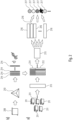
- Fig. 2 shows a schematic overview of the method for intrusion detection to detect malicious insider threat activities within a network of multiple interconnected computerized user profiles according to another embodiment.
- sections a) and b) in Fig. 2 illustrate different aspects of method 100 according to an embodiment of the current invention.
- the different actions illustrated in sections a) and b) can be conducted individually and independent from each other.
- the succession of the following description of sections a) and b) does not indicate that the respective actions in sections a) and b) must be conducting in this particular order.
- multiple sets of activity data 211 are transformed in a vector representation.
- multiple sets of raw events of activity data 211 that are extracted from user logs or audit logs configured to record the activity of the employee of the organization or company are assembled.
- the recorded activities i.e. the raw events of the audit logs, are assigned to a particular user profile 203.
- the user profile 203 can be assigned to a particular computerized workplace or to a particular user or employee of the company or organization.
- the raw events from the audit logs are organized in multiple sets, wherein each set comprises the activities for a predefined timespan. The timespan can be for example a workday or 24 hours.
- the raw activity events can comprise logon events to a particular user profile, sent and/or received emails from a particular user profile, web browsing events including access to webpages by a user profile, access to internal data banks, usage of removable drives, creation and/or deletion of datafiles and other activities of user profiles within the internal network of the company.
- each of the multiple sets of activity data 211 are transformed into a low dimensional vector representation 212.
- one individual vector representation 212 is generated.
- one vector per user profile per day can be generated.
- the predefined time span can be a different value than one day.
- the predefined time span can be a work day, i.e. 8 hours.
- the predefined time span can be an arbitrary time period over which the activity data for a given user profile are recorded and summarized into one set of activity data and then output in one feature vector.
- Each of the vector representations 212 represents one set of activity data 211 for that particular user profile.
- section b) a graph representation and graph embedding of user profile data is illustrated.
- a set of user profile attributes 208 is transformed into a graph representation 210.
- the user profile attributes 208 comprise the features and properties of the user profile.
- each of the nodes is assigned to either a feature or property of the respective user profile 203 recorded in the profile attributes 208 or to other user profiles 203 of the organization structure.
- the edges of the graph representation 210 represent certain relations between different user profiles 203 or illustrate certain assignments to teams, groups, projects or roles of the respective user profile representing a user or employee of the company or organization.
- a graph representation of the user profile data 209 can be constructed in different ways. Graphs can be built from nodes and edges directly in a symbolic form, where each node can be assigned to one feature of the respective user profile 203 whereas edges can be assigned to certain links and relations of the respective user profile.
- Graphs can further comprise built-in curated collections of theoretical or empirical graphs.
- a graph can be grown in either by adding one edge at a time or one node at a time.
- the sets of user profile attributes 208 can further be accompanied by LDAP attributes and mainly be composed of information that define relationships of a user with different entities, i.e. different user profiles within the organization structure.
- graph embedding techniques known from state of the art can be applied to the graph representations 210.
- the feature representations are mostly known to preserve the structural information of graphs, and thus can be used as features in building machine learning models.
- the graph representation 210 is transformed via a graph embedding transformation into multiple vector representations of the user profile data 214.
- the embedding maps each node of the graph representation 201 to a low dimensional vector representation 214 and tries to preserve the connection strengths between the nodes.
- section c) an example of a graphical representation of the embeddings of the vector representations of the user profile data 209 of an organization structure in the respective vector space is shown.
- the graphical representation in section c) is merely for illustrative purposes.
- a set of multiple vectors of the user profile data 214 is combined with the set of multiple vector representations of the activity data 212.
- a set of multiple low-dimensional vectors 214 is generated based on the multiple sets of raw events of activity data 211 and the information regarding the features and properties of the user profile 203 recorded in the user profile attributes 208 and the set of user profile data 209, respectively.
- this set of low-dimensional vector representations 212, 214 is input into a neural network 215.
- the neural network 215 is realized via multiple individual neural networks 216, wherein each neural network is assigned to one particular user profile 203 and therefore is configured to predict an activity for that particular user profile 203.
- Each of the neural networks 216 is assigned to one particular user or user profile and is configured to learn to model the normal behavior of each user profile 203 based on the activity data 211 of each user profile 203.
- the neural networks are further tasked and configured to predict the next vector in the sequence, i.e. the most likely activity of the respective user profile for the next day.
- a certain anomality score 217 is generated by the neural networks 216.
- the anomality score 217 gives a number value that describes the objective deviation between the predicted activity and the actually observed activity for each of the user profiles 203. Based on the anomality scores 217, malicious activities can be identified.
- a graph embedding according to the method illustrated in section b) of user profile attributes 208 of the new user or employee is computed and respective vector representations of the user profile attributes 214 are generated.
- a vector representation of activity data 212 of a user profile 203 identified as comparable to the further user profile 204 of the new user or employee is generated.
- the generated vector representation of the user profile attributes 214 of the new user or employee are then combined with the vector representation of the sets of activity data 212 of the user profile 203.
- the generated set of vector representations 212, 214 for the new user or employee is then fed into the respective neural network 215, 216 to provide a prediction of activity of that new user or employee for a future date.
- a respective anomality score 217 is generated by the respective neural network 215, 216 in order to identify malicious activities.
- the method 100 of the current invention is applicable to different networks of interconnected user profiles.
- These networks can be networks of interconnected computerized workplaces of an internal network of a company or organization, but are not limited thereto.
- Fig. 3 shows a schematic drawing of a system for intrusion detection to detect malicious insider threat activities within a network of multiple interconnected computerized user profiles according to an embodiment.
- the system 200 comprises a processor unit 207.
- the processor unit 207 is connected to a network 201 of multiple interconnected user profiles 203.
- the user profiles 203 are connected via a data connection 205 configured to conduct data transfer and data communication between the multiple user profiles 203.
- the multiple user profiles 203 can be assigned to individual computerized workplaces. Alternatively, the multiple user profiles 203 can be organized on a computer server unit.
- the network 201 can be a network of different computerized workplaces of a company or any comparable organization.
- the processor unit 207 is connected to the network 201 via the data connection 205 and is configured to execute the method 100.
- the illustration of the network 201 and the multiple user profiles 203 in Fig. 3 is merely for illustrative purpose. Modifications of the network 201, the multiple user profiles 203, in particular the organization of the network 201 including the interconnection of the multiple user profiles 203 as well as the number of user profiles 203, are covered by the scope of the current invention.
Landscapes
- Engineering & Computer Science (AREA)
- Theoretical Computer Science (AREA)
- General Engineering & Computer Science (AREA)
- Physics & Mathematics (AREA)
- Computer Security & Cryptography (AREA)
- Computing Systems (AREA)
- Computer Networks & Wireless Communication (AREA)
- Signal Processing (AREA)
- Software Systems (AREA)
- Computer Hardware Design (AREA)
- General Physics & Mathematics (AREA)
- Molecular Biology (AREA)
- Biophysics (AREA)
- Biomedical Technology (AREA)
- Computational Linguistics (AREA)
- Mathematical Physics (AREA)
- General Health & Medical Sciences (AREA)
- Artificial Intelligence (AREA)
- Life Sciences & Earth Sciences (AREA)
- Evolutionary Computation (AREA)
- Data Mining & Analysis (AREA)
- Health & Medical Sciences (AREA)
- Data Exchanges In Wide-Area Networks (AREA)
- Management, Administration, Business Operations System, And Electronic Commerce (AREA)
Description
- The present invention relates to a method for intrusion detection to detect malicious insider threat activities. The present invention further relates to a system for intrusion detection that is configured to execute the method for intrusion detection to detect malicious insider threat activities.
- Cyber-attacks are one of the biggest risks that threatens an operational IT system and can lead to an exposure of sensitive personal and business data or even cause some serious damage. These attacks are becoming more sophisticated and hard to defend against which increases the difficulty of accurately detecting intrusions. Several intrusion detection methods have been introduced in the literature to tackle those threats, but they are unable to handle challenging scenarios in which new classes may appear after the learning stage. This application presents an improved intrusion detection framework that utilize graph embedding techniques to extract extensive context and then exploit it in detecting new threats.
- Nowadays, traditional security solutions such as firewalls and intrusion detection systems do not prevent nor offer an optimal immunity against insider threat problems. This is mostly due to the fact that insider threats are performed by people working within an organization and trusted by having access and knowledge of multiple important assets. As a result, the US, India and many other countries have been impacted by the zero-day (previously unseen) attacks. The 2019 Symantec Internet Security Threat (SIST) Report showed that even if the number of zero-day attacks that were reported has declined from 27 percent in 2017 down to 23 in 2018, it still recorded more than three billion zero-day attacks. Moreover, the 2019 Data Breach Statistics Report highlighted that the number of security breach incidents is on the rise despite of the positive impact of GDPR which lead businesses to take positive steps toward improving their cyber security.
- The aim of an Intrusion detection System is to identify different kinds of attacks as early as possible, which cannot be achieved by traditional security solutions. Consequently, detecting zero-day attacks has become the highest priority.
- For example, Tuor et al., "Deep Learning for Unsupervised Insider Threat Detection in Structured Cybersecurity Data Streams"; arXiv:cs.NE/1710.00811 introduce user-based profiling system which aims to detect anomalies in online fashion. In their work Tuor et al. model users' normal behaviour based on meta data stored in audit logs and use anomaly as an indicator of potential malicious behaviour. In particular Tuor et al. use audit log data of users, that document the behaviour of said users over a predetermined time period of behavioural observation. These audit log data are further used to train specific neural networks to create a pattern of normal behaviour for each user. Based on this training and the respective behavioural pattern for each user a future behaviour for each user can be predicted. Abnormal behaviour can then be detected via discrepancies between future behaviour predicted for a certain time span and the actual behaviour monitored during this specific time span.
- The method taught be Tuor et al. however fails in the cases that either a new user joins the company or that users change roles or positions or certain departments or teams within the company are restructured as for these cases the method cannot rely on previously obtained behaviour patterns.
- Thus, one objective of the current invention is to provide an improved method for intrusion detection to detect malicious insider threat activities that is capable of overcoming or mitigating the deficiencies present in the state of the art. Another objective of the current invention is to provide a system that is configured to execute the method for intrusion detection to detect malicious insider threat activities.
- The objectives are solved by the method and systems according to the independent claims. Advantageous embodiments of the method and system are specified in the dependent claims.
- Zero-shot learning (ZSL) is known to be inspired from the way human identify new and unseen classes when a high-level description is provided. This high-level description is then used to identify new classes without any training samples by relating them to classes that we previously learned during the training. ZSL has two main stages: the Attribute Learning Stage (training phase) in which knowledge about the attributes is captured, and then the Inference Stage where this knowledge is used to classify instances among a new set of classes.
- This zero-shot learning capability of identifying new classes when a high-level description is provided can be deployed in many fields especially in improving intrusion detection systems. In order to adapt zero-shot learning to Intrusion detection systems (IDS) in the current invention graph embeddings were utilized to extract user embeddings from Lightweight Directory Access Protocol LDAP attributes which characterize the user behaviour in two scenarios which reflect a zero-shot learning situation in a real-world environment (an organization's infrastructure).
- Typically, an IDS is tasked to protect the organization's information systems and communications network from malicious attacks and unauthorized access to sensitive information and data. However, it is also asked to deal with newly added employees, newly created projects, teams and departments, new clients and comparable changes in the structure of the company or organization. In this regard two scenarios are of intensified interest. The first scenario regards the case where a new employee is added to an organization's infrastructure. The second scenario regards the changing of behaviour that occurs when an existing employee changes the project he's working on or is transferred to another team or department. The two scenarios used in this application are realistic and focus on a specific type of cases where the methods known from state of the art fail to distinguish threats and normal user behaviour.
- Graph embedding is a widely used technique alongside with link prediction, classification and clustering in organizational network analysis to learn low-dimensional representations for nodes in graphs. In the current invention graph embedding techniques are utilized to improve the classification of insider threat behaviours, especially in zero-shot learning situations.
- Graph Embedding techniques transform nodes within a graph into low-dimensional dense vectors and position the vectors in a particular vector space, such that for nodes which are similar in the original graph (different methods have different definitions) and therefore exhibit some sort of proximity within the graph the respective vectors are also positioned within the vector space with comparable proximity.
- Many approaches can be used in graph embeddings and are generally categorized as either community or role-based. The goal in graph-based intrusion detection is to identify an anomalous node, edge or sub-graph that do not conform to the expected behaviour in the graph. Community-based embeddings are known to remain stationary over time, which allows us to raise a flag whenever a group of nodes suddenly becomes more similar to another community. While role-based embeddings help detecting anomalies which are defined with reference to the structural properties and behaviour in a given network.
- The current invention utilizes the following embedding methods:
- DeepWalk disclosed by Bryan et al. 2014; DeepWalk; Proceedings of the 20th ACM SIGKDD international conference on Knowledge discovery and data mining - KDD '14 (2014).
- LINE disclosed by Jian et al. 2015; LINE: Large-scale Information Network Embedding. arXiv:cs.LG/1503.03578,
- Node2vec disclosed by Aditya et al. 2016; node2vec; Proceedings of the 22nd ACM SIGKDD International Conference on Knowledge Discovery and Data Mining - KDD '16 (2016).
- SDNE disclosed by Daixin et al. 2016. Structural Deep Network Embedding. 1225-1234. and
- Struc2Vec disclosed by Leonardo et al. 2017. struc2vec. Proceedings of the 23rd ACM SIGKDD International Conference on Knowledge Discovery and Data Mining - KDD '17 (2017) .
- The current invention regards the development and improvement of an unsupervised machine learning system which analyzes data from different sources and detect malicious insider threat activities.
- According to an aspect of the current invention a method for intrusion detection to detect malicious insider threat activities within a network of multiple interconnected computerized user profiles is provided, wherein each user profile is defined by a set of user profile data, wherein the user profile data of a user profile are configured to identify the respective user profile within an organization structure of the network of the multiple interconnected user profiles, wherein for each user profile multiple sets of activity data are available, wherein each set of activity data of a user profile is configured to illustrate the activity of the user profile for a particular date during a predefined time span, wherein the network further comprises a further user profile, wherein the further user profile is defined by a set of further user profile data, wherein the further user profile data of the further user profile are configured to identify the further user profile within the organization structure of the network of the multiple interconnected user profiles, and wherein for the further user profile no sets of activity data are available, and wherein the method comprises the following method steps:
- Training a Neural Network on multiple sets of user profile data for multiple user profiles and on multiple sets of activity data of the multiple user profiles of the network, such that the Neural Network is capable of predicting for future dates activities for multiple user profiles,
- Applying the trained Neural Network on the set of further user profile data of the further user profile, - Predicting an activity of the further user profile for a future date based on the multiple sets of activity data by the trained Neural Network,
- Observing the activity of the further user profile at the future date
- Applying the trained Neural Network on the observed activity of the further user profile at the future date, and
- Detecting malicious activity for the further user profile at the future date by the trained Neural Network, if the observed activity of the further user profile at the future date deviates from the predicted activity of the further user profile for the future date.
- This achieves the technical advantage, that a method for intrusion detection to detect malicious insider threat activities within a network of multiple interconnected computerized user profiles is provided, that is configured to detect malicious activities of at least one of the user profiles based on a comparison between actually observed activities of a user profile and expected activities of that user profile. The method of the current invention is further configured to consider user profiles for which past activities have not been recorded yet. This way, new user profiles, which either are just previously added to the network or for which certain properties of the user profile had been modified, can be considered for the intrusion detection.
- For this a Neural Network is trained on multiple sets of user profile data and activity data of multiple user profiles of the network or company, such that after training the neural network is capable of predicting future activities for at least some or all of the multiple user profiles for future dates.
- Via the neural network trained on the multiple sets of activity data of the multiple user profiles a set of further user profile data of a further user profile, for which no previous activity data exists, can be analysed and future activities for the further user profile can be predicted based on the multiple sets of activity data of the other user profiles of the network
- Each of the user profiles has an individual set of user profile data, in which multiple features, properties and information regarding the respective user profile is recorded.
- If a further user profile, for which no activity data is available, is added to the network, the further user profile is provided with a set of further user profile data, which comprise multiple features, properties and information regarding the user profile that are configured to identify the further user profile within the network of multiple interconnected user profiles.
- By applying the Neural Network to the set of further user profile data the trained Neural Network learns the features and properties of the further user profile.
- Due to the training process and the learned properties and features of the further user profile the trained Neural network is capable of predicting future activities of the further user profile by taking into account the properties, features and information regarding the multiple user profiles listed in the sets of user profile data on which the Neural Network is trained and the respective features, properties and information regarding the further user profile listed in the set of further user profile data on which the trained neural network is applied.
- In the next steps, on this predetermined future date, the activity of the further user profile is observed and the trained Neural Network is applied on the observed activity of the further user profile.
- If in the next step it is detected by the trained Neural Network that the observed activity deviates from the predicted activity of the further user profile, a malicious activity of the further user profile is detected.
- With this, user profiles for which no activity data are available can be included into the detection of malicious activity within the network of multiple interconnected user profiles.
- By the application of a Neural Network trained specifically on multiple sets of user profile data and activity data of multiple user profiles of the network the technical advantage of high accuracy of the prediction of activity data for the further user profile can be achieved.
- In the sense of the current application, a user profile is a computerized profile that is generated to allow a certain user access to a computerized network of multiple computerized workplaces. Via the user profile, the respective user can execute a data communication with other user profiles, that is other users, of the network. A user profile can be assigned individually to a certain user. Alternatively, a user profile can be assigned to a certain computerized workplace.
- In application to a company or organization the user profile is a logon profile installed on a computer workplace via which an employee can access the intranet of the company or organization.
- In the sense of the current application a network is a network of multiple interconnected computerized workplaces. In particular, a network can be a network, i.e. the intranet of computers of a company or a comparable organization. The employees can individually access the network via respective user profiles. The provides a data communication between the multiple computers of the network or access to data of internal databanks of the respective company or organization.
- In the following, the terms user and user profile can be used synonymously. In the context of a company or organization, a user can be an employee of that company or organization.
- In the sense of the current application, a set of user profile data is a set of information that is configured to identify the respective user profile within the network of interconnected user profiles. The set of user profile data comprises multiple features or properties that allow a detailed description of the respective user profile. User profile data can for example comprise a user name and password of the respective user profile, an affiliation of the respective user to a team, group or department of the company or organization, a telephone number, an e-mail address or other information that allows an identification of the user the respective profile is assigned to. Alternatively, the user profile data can comprise an IP address of the computer or computerized workplace the respective user profile is assigned to. A user profile can be individually assigned to a particular user. Alternatively, a user profile can be assigned to a particular computerized workplace.
- In the sense of the current application a set of activity data is a data set that comprises raw events of activity of a particular user profile. A set of activity data can comprise raw events of an audit log, in which the activity of a certain user profile is listed. Each set of activity data comprises the activity of a certain user profile for a given predetermined time span. An activity of a user profile can be a logon to the user profile, a sending or receiving of emails, a browsing of certain webpages, an access to certain databanks, a data communication with other user profiles, the generation or deletion of certain datafiles, or the execution of certain work processes.
- In the sense of the current application the wording "a further user profile for which no sets of activity data exist" comprises the case that previous activity data exist but are insufficient to predict future activities of that particular further user profile. This can in particular be the case, if a user or employee of the company or organization is affiliated to a different role, team, group or position, such that the activity data obtained for his or her previous role, team, group or position does not allow a prediction of future activities of the user or employee, i.e. further user profile, due to the stark differences in the previous role, team, group or position the user profile previously assigned to compared to the role, team, group or position the employee, user, i.e. further user profile, is currently assigned to.
- In the sense of the current application, a malicious activity is an activity that deviates from an expected activity for a particular user profile. A malicious activity therefore can be any activity of a user profile that is uncommon and therefore unexpected for that particular user profile. A malicious activity can therefore be based on malicious activity of a certain employee suing this particular user profile, or based on a hacking attack to that particular user profile by an external entity not part of the network of interconnected user profiles.
- According to an embodiment, the method further comprises:
- Stopping all activities of the at least one user profile and and/or removing the at least one user profile from the network, if the malicious activity is detected for the further user profile.
- This achieves the technical effect, that after detection of the malicious activities the security of the network can be maintained or re-established.
- According to an embodiment of the method, each set of user profile data of each user profile and the set of further user profile data of the further user profile comprise, respectively at least one of the following list comprising information regarding an identity of the respective user profile or further user profile, an affiliation of the respective user profile or further user profile to a certain team and/or group and/or department within the organization structure, a role of the respective user profile or further user profile within the organization structure, an affiliation to a project of the respective user profile or further user profile, relations to other user profiles or the further user profile, access permit to certain information and the like.
- This achieves the technical advantage, that a clear identification of a user profile based on a respective set of user profile data can be achieved. Further, based on the respective set of user profile data, every user profile can be classified into the organization structure of the network of interconnected user profiles. With the respective information from the set of user profile data, the respective user profile can be assigned to a certain team, group or department within the organization or company.
- Further, the respective user profile can be assigned to a certain supervisor or a certain role within the company or organization.
- Further, the respective user profile can be assigned to certain relations to other user profiles within the organization or company. This information allows a comparison between a different user profile in order to determine comparable activities of different user profiles. For example, for different user profiles which are assigned to identical teams, groups or departments comparable activities can be expected.
- Further, based on the roles or projects of the respective user profiles, common activities of the respective user profiles can be predicted. Therefore, based on the information of the respective user profile data user profiles can be classified within the organization structure of the company or organization, and based on the activities that are common for user profiles with a respective classification within the organization or company, activities can be predicted or user profiles with comparable classification.
- According to an embodiment of the method, the further user profile is a user profile additionally added to the network of computerized user profiles or a user profile of the network of computerized user profiles with a modified set of user profile data, wherein a modified set of user profile data comprises at least one modified information regarding the user profile.
- This achieves the technical advantage that for the intrusion detection to detect malicious insider activities within the network of multiple interconnected computerized user profiles user profiles can be considered which are either new user profiles that just recently have been generated, or that are existing user profiles for which certain features or properties of the user profile data have been modified.
- If a new user profile is generated, no activity data exists for the new user profile. This can be the case if a new employee joins the company or organization. Because of the missing previous activity data for the new user expected activities cannot be predicted accurately, as no basis for this prediction exists. Consequently, usually a new generated user profile cannot be considered for the intrusion detection.
- With the method for intrusion detection according to the current invention, newly generated user profiles can be considered for the intrusion detection by identifying already existing user profiles that are comparable to the newly generated user profile with regard to the respective user profile data and by predicting activities for the newly generated user profile based on the existing activity data of the user profiles identified as comparable to the newly generated user profile.
- The same comparison can be executed for user profiles that have been modified with regard to at least one property or feature of the user profile. For example, a user profile can be modified with regard to a team or group or department the user profile is affiliated with. This could resemble the case where a certain user or employee of the company is transferred to another team, group or department.
- Further, a user profile could be modified by assigning a new role or a project to the respective user profile, which resembled the case where a certain user or employee of the company or organization is assigned to a new role or works on a new project. Expected activity of the user profile with at least one modified property or feature can then be predicted based on the activity of existing user profiles with comparable features or properties. For example, the activity of a user profile assigned to a new team can be predicted by the common activities of other user profiles of that particular team.
- According to an embodiment of the method, the sets of user profile data and the set of further user profile data are generated by using a graph representation of the respective user profile data and the further user profile data and by performing graph embedding transformations of the respective graph representations.
- This achieves the technical advantage, that a clear representation of the user profile data via the graph representation can be provided.
- Further, by executing a graph embedding transformation, the graph representation of the user profile data can be transformed into respective vector representations which allows the sets of user profile data to be used as input to neural networks in order to provide reliable predictions of activities of the respective user profiles.
- Via the graph representation of the user profile data, it can be achieved that user profiles that are positioned with close proximity within the organization structure of the network because of their comparable or identical affiliation to certain teams, groups, departments or projects or that are assigned to comparable or identical roles can be provided with graph representations of the respective user profile data that resemble the close proximity of the two user profiles within the organization structure by a comparable close proximity of their positioning within the respective vector space.
- With this, a comparison between user profiles with great agreements in their respective features or properties can be achieved. This allows for an improved identification of comparable or identical user profiles.
- This further allows for an improved prediction of respective activity, in particular for new or modified user profiles for which no activity data exist. Via the execution of graph representation and graph embedding transformation, the information of the user profile data can be used for the prediction of activity of certain user profiles for which activity data do not exist in the most efficient way. Thus, via the execution of graph representation and of graph embedding transformation, the quality and reliability of the predicted activity for user profiles for which activity data do not exist can be enhanced. With this, the overall quality of the intrusion detection can be improved as user profiles for which no activity data exist can be included into the intrusion detection.
- According to an embodiment of the method, the predefined comparison criterion is a level of congruence of the graph representation of the respective sets of user profile data and the set of further user profile data.
- This achieves the technical advantage, that a reliable comparison between different user profiles can be achieved. A high level of congruence between two graph representations of different sets of user profile data leads to a high degree of agreements of the features and the properties of the respective user profiles. Therefore, two user profiles with comparable features and properties that have graph representations of their user profile data with high congruence can be identified as comparable user profiles.
- According to an embodiment of the method, an individual neural network is assigned to each of the user profiles and the further user profile.
- This achieves the technical advantage, that an improved prediction of expected activity for each of the user profiles can be achieved. By assigning individual neural networks to each of the user profiles, the respective neural networks can be trained more specific to the activity data of each of the user profiles. As a result, the quality of the prediction of the expected activity for each of the user profiles can be enhanced. This further leads to an improvement of the accuracy of the final results of the method for intrusion detection. This leads to more reliability of intrusion detection.
- According to an embodiment of the method, the neural network performs Zero Shot Learning.
- This achieves the technical advantage that the quality of the prediction of the expected activity of the further user profile for which no activity data exists can be enhanced. By performing Zero Shot Learning for at least the neural network assigned to the further user profile, the neural network is capable of predicting expected activity for the further user profile by taking into consideration the set of further user profile data of the further user profile and the multiple sets of activity data of the identified user profile with features and properties comparable to the features and properties of the further user profile.
- The Zero Shot Learning method therefore allows for a precise and reliable prediction of expected activity for the further user profile and therefore for a consideration of user profiles for which no activity data exists in the intrusion detection to detect malicious insider threat activities in the sense of the current application.
- According to an embodiment, the time span comprises 24 hours, and wherein the activity data comprises data from audit log files comprising activity information of the respective user profile or further user profile.
- This achieves the technical advantage that the activity of the user profiles within the network of multiple interconnected user profiles can be monitored for a complete workday.
- Further, the consideration of audit logs in order to generate the sets of activity data provides an easy way of generating activity data with a high level of detail and accuracy. According to another aspect of the current invention a system for intrusion detection to detect malicious insider threat activities within a network of multiple interconnected computerized user profiles is provided, wherein the systems is electronically connectable to the network of interconnected user profiles, wherein the system comprises at least a processor unit, and wherein the system is configured to execute the method for intrusion detection to detect malicious insider threat activities within a network of multiple interconnected computerized user profiles.
- This achieves the technical advantage, that a system can be provided that is configured to execute the method for intrusion detection to detect malicious insider threat activities within a network of multiple interconnected computerized user profiles of the current invention.
- The above-described properties, features and advantages of this invention and the way in which they are achieved will become clearer and more clearly understood in association with the following description of the exemplary embodiments which are explained in greater detail in association with the drawings. Here in schematic illustration in each case:
-
Fig. 1 shows a flow chart of a method for intrusion detection to detect malicious insider threat activities within a network of multiple interconnected computerized user profiles according to an embodiment; -
Fig. 2 shows a schematic overview of the method for intrusion detection to detect malicious insider threat activities within a network of multiple interconnected computerized user profiles according to another embodiment; and -
Fig. 3 shows a schematic drawing of a system for intrusion detection to detect malicious insider threat activities within a network of multiple interconnected computerized user profiles according to an embodiment. - The detailed description of
Fig. 1 will be conducted with reference toFig. 2 andFig. 3 and the respective description. -
Fig. 1 shows a flow chart of amethod 100 for intrusion detection to detect malicious insider threat activities within anetwork 201 of multiple interconnectedcomputerized user profiles 203 according to an embodiment. - According to the embodiment in
Fig. 1 , themethod 100 for intrusion detection to detect malicious insider threat activities within anetwork 201 of multiple interconnected computerized user profiles 203 is applicable to anetwork 201 withuser profiles 203, with eachuser profile 203 being defined by a set of user profile data 209, wherein the user profile data 209 of auser profile 203 are configured to identify therespective user profile 203 within an organization structure of thenetwork 201 of the multipleinterconnected user profiles 203, wherein for eachuser profile 203 multiple sets ofactivity data 211 are available, wherein each set ofactivity data 211 of auser profile 203 is configured to illustrate the activity of theuser profile 203 for a particular date during a predefined time span, wherein thenetwork 201 further comprises afurther user profile 204, wherein thefurther user profile 204 is defined by a set of further user profile data, wherein the further user profile data of thefurther user profile 204 are configured to identify thefurther user profile 204 within the organization structure of thenetwork 201 of the multipleinterconnected user profiles activity data 211 are available. - According to the embodiment of
Fig. 1 , themethod 100 comprises the following method steps: - Training 101 a
neural network multiple user profiles 203 and on multiple sets ofactivity data 211 of themultiple user profiles 203 of thenetwork 201, such that theneural network multiple user profiles 203, - Applying 103 the trained
neural network - Predicting 105 an activity of the
further user profile 204 for a future date based on the multiple sets ofactivity data 211 by the trainedneural network - Observing 107 the activity of the
further user profile 204 at the future date - Applying 109 the trained
neural network further user profile 204 at the future date with the predicted activity for thefurther user profile 204 at the future date, and - Detecting 111 malicious activity for the
further user profile 204 at the future date by the trainedneural network further user profile 204 at the future date deviates from the predicted activity of thefurther user profile 204 for the future date. - A
network 201 of multiple interconnectedcomputerized user profiles 203 can for example be an intranet network of computerized workplaces within a company or organization that provides multiple users or employees access to databanks and allows for a data communication between users or employees of the company. - The user profiles 203 can be logon profiles installed on the computerized workplaces via which the users or employees can access the intranet of the company or organization.
- The user profiles can be individually assigned to particular users or employees of the company and can for example be individualized via certain user names and passwords.
- Computerized workplaces can be desktop computers, laptops, mobile devices, industrial computers, server or cloud entities or the like.
- The user profiles 203 can be identified within the organization structure of the
network 201 via individualized user profile data 209 that comprise significant information regarding therespective user profile 203. For example, user profile data 209 can comprise individual information like user names or passwords or identity information regarding the respective user or employee. - User profile data can further include affiliations of the user profile, i.e. the respective user or employee, to certain teams, groups or departments within the organization or company and can further comprise information regarding the role of the respective user or employee within the organization structure or certain projects, the user or employee is affiliated to.
- User profile data can comprise all kinds of information that allows an identification of the respective user profile and the corresponding user or employee within the organization structure of the company or organization.
- For each of the user profiles 203 multiple sets of
activity data 211 are available. Theactivity data 211 can comprise information regarding the activity of therespective user profile 203. - Recorded activity of
respective user profiles 203 can comprise data regarding logon of a user or employee to the respective user profile. Activity data can further comprise data regarding emails that are send and/or received from a particular user profile. Activity data can further comprise data regarding browsing of websites in the internet performed by the respective user profile. Activity data can further comprise data regarding usage of removable devices. Activity data can further comprise the access to certain databanks and with this the access to certain information, the generation of certain data files, the interaction withother user profiles 203 of thenetwork 201, the communication with individuals outside thenetwork 201 as well as other information of interest for the activity ofuser profiles 203 within thenetwork 201 of the organization or company. - Sets of
activity data 211 can comprise activity events of therespective user profiles 203 for a predefined timespan. A predefined timespan can be 24 hours. Alternatively, the predefined timespan can be any time period of interest, spanning from few hours to days, weeks, months or years. - The multiple sets of
activity data 211 allow for a determination of a normal behaviour of acertain user profile 203. A normal behaviour of a certain user profile, i.e. a respective employee, is a behaviour that complies with the previous activity data of the multiple sets ofactivity data 211. - Via the multiple sets of
activity data 211 and the respective normal behaviour of theuser profile 203, a normal activity for thatparticular user profile 203 can be predicted for a future date. This is achieved by the training of theneural network activity data 211 of the multiple user profiles 203. Due to the training theneural network particular user profile 203, i.e. the respective employee, that complies with the previous activity of the multiple sets ofactivity data 211. - The future date for example can be the following workday. Alternatively, the future date can be any future time period of interest.
- A
further user profile 204 is a user profile of thenetwork 201 for which noactivity data 211 exists. For example, afurther user profile 204 can be a new user profile that was added to thenetwork 201 just recently and therefore no activity data could be recorded. This new user profile could for example resemble a new employee of the organization or company that just previously joined the company. - In another embodiment, the
further user profile 204 can be a user profile that has already been a member of thenetwork 201, for which however certain properties or features of the respective further user profile data had been modified. This could for example resemble an employee of the company or organization that was transferred to another team, group or department or that was affiliated to a different project or role. Since the activity of a certain user profile strongly correlates with its affiliation to certain teams, groups, departments or projects and roles within the organization or company, an affiliation to a different team, group, department, project or role can lead to prominent differences in activity, such that the activities previously recorded for that particular user are insufficient for a reliable prediction of future activities of the user profile affiliated to a different team, group, department, project or role. - In a
first method step 101, theneural network multiple user profiles 203 of thenetwork 201. For this, the multiple sets of user profile data and activity data is fed to theneural network multiple user profiles 203 for future dates. The predictions are based on the multiple sets of user profile data and activity data used for the training of theneural network respected user profiles 203 listed in the multiple sets of activity data. Thus, the predicted activities for aparticular user profile 203 can be regarded as normal activity of thatuser profile 203. - During the training of the
neural network step 101, different features and properties of therespective user profiles 203 that are recorded in the sets of user profile data 209 are considered and incorporated into theneural network - These features and properties can for example comprise the affiliations of the
respective user profiles 203 to certain teams, groups, departments, projects and roles within the organization or company. - In the
following step 103, the trainedneural network further ser profile 204, in order for theneural network - These features and properties of the
further user profile 204 can for example comprise the affiliations of therespective user profiles 203 to certain teams, groups, departments, projects and roles within the organization or company. - Through the training on the user profile data and the activity data of the user profiles 203 and through the consideration of the set of further user profile data of the
further user profile 204 the trainedneural network network 201 and the relations betweenuser profiles 203 as well as certain activities of therespective user profiles 203, for example that user profiles that are affiliated to identical teams, groups, departments, projects or roles in normal situations exhibit comparable activities. - User profiles with identical roles within the organization or company can therefore be regarded as comparable user profiles. The role of a user or employee within the company or organization can be a telling property for a prediction of expected activities. For example, accountants in a company or organization usually have comparable activities, even if they are affiliated to different projects or teams.
- Alternatively, user profiles affiliated to identical teams or departments, can be regarded as comparable user profiles, as members of identical teams or departments most likely will show comparable or identical activities.
- In an embodiment, the
user profile data 211 of the user profiles 203 and the further user profile data of thefurther user profile 204 can be represented in a graph representation. In this graph representation, each of the nodes can be assigned to certain features or properties of the respective user profiles. - Further, each of the graphs can include other user profiles and therefore resemble the organization structure of the
network 201. Edges between the nodes of the graph representation can therefore resemble relations between different user profiles within the organization structure. - In this embodiment, a high level of congruence between different graph representations of the user profile data of the respective user profiles can be interpreted as a high level of similarity between the properties and features of the respective user profiles. In this context, congruence is to be understood in its mathematical sense, meaning that two entities with high level of congruence possess similar geometrical properties.
- The application of the
neural network step 103 was performed in order for theneural network further user profile 204, such that the trainedneural network further user profile 204 based on the activity that theneural network further user profile 204 with regard to their features and properties. - Thus, after training the
neural network further user profile 204, in the followingmethod step 105 an activity of thefurther user profile 203 for a future date is predicted by the trainedneural network activity data 211 ofmultiple user profiles 203 theneural network further user profile 204 listed in the set of further user profile data. - The future date can for example be the next working day. Thus, based on the previous activities of the employee affiliated to the same team project and role as the new employee can be used for a prediction of the further activity of the new employee.
- The prediction of the expected activity of the
further user profile 204 is performed in a way, that the predicted activity complies with the previous activity recorded in the selected multiple sets of activity data of the identified user profile. - In the
following step 107, the activity of thefurther user profile 204 at the future date is observed and recorded. This can include an observation and recording of the activity of the new employee on the following workday. - After the recording of the activity of the
further user profile 204, in the followingmethod step 109, the trainedneural network further user profile 204, as the observed activity of thefurther user profile 204 is fed to the trainedneural network - In the
following step 111, a malicious activity of thefurther user profile 204 is detected if the observed activity of thefurther user profile 204 deviates from the predicted activity. This can include the case that at the following workday the new employee in fact shows a different activity pattern that according to some predetermined criteria deviates from the predicted activity based on the multiple sets ofactivity data 211 of the identified employee that for example is affiliated to the same team and project and has a comparable role within the company or organization. - According to the embodiment in
Fig. 1 themethod 100 further comprises the method step: - Stopping 113 all activities of the
further user profile 204 and/or removing thefurther user profile 204 from thenetwork 201, if the malicious activity is detected for thefurther user profile 204. - After the detection of the malicious activity, in the following
step 113, all activities of thefurther user profile 204 are stopped and/or thefurther user profile 204 is removed from thenetwork 201. This can include shutting down the respective user profile of the new employee and if necessary, removing the new employee from the company. - According to one embodiment of
method 100, theneural network further user profile 204, i.e. the employee just recently joining the company or organization or just recently being affiliated to another team, group, project or role. - For the Zero Shot Learning method, the
neural network activity data 211 of a previously identifieduser profile 203 with comparable or identical features and properties and the features and properties recorded in the further user profile data of thefurther user profile 204 in order to predict an activity of thefurther user profile 204 for a future date, without being trained on the previous activity of thefurther user profile 204. - Via the application of the Zero Shot Learning method, an activity of a new employee for which no previous activity is recorded, for a future date, for example a future workday, can be predicted by taking into consideration the multiple features and properties that are assigned to that particular new employee, for example the specific role that the new employee has in the company or organization, the team the employee is assigned to or the project the employee is working in.
- In this case, the respective further user profile data will be regarded as additional semantic information regarding the
further user profile 204, i.e. the new employee of the organization or company. The selected multiple sets ofactivity data 211 of the identifieduser profile 203 will be regarded as input data used for training theneural network -
Fig. 2 shows a schematic overview of the method for intrusion detection to detect malicious insider threat activities within a network of multiple interconnected computerized user profiles according to another embodiment. - The sections a) and b) in
Fig. 2 illustrate different aspects ofmethod 100 according to an embodiment of the current invention. The different actions illustrated in sections a) and b) can be conducted individually and independent from each other. The succession of the following description of sections a) and b) does not indicate that the respective actions in sections a) and b) must be conducting in this particular order. - In section a) multiple sets of
activity data 211 are transformed in a vector representation. For this, multiple sets of raw events ofactivity data 211 that are extracted from user logs or audit logs configured to record the activity of the employee of the organization or company are assembled. The recorded activities, i.e. the raw events of the audit logs, are assigned to aparticular user profile 203. Theuser profile 203 can be assigned to a particular computerized workplace or to a particular user or employee of the company or organization. The raw events from the audit logs are organized in multiple sets, wherein each set comprises the activities for a predefined timespan. The timespan can be for example a workday or 24 hours. - The raw activity events can comprise logon events to a particular user profile, sent and/or received emails from a particular user profile, web browsing events including access to webpages by a user profile, access to internal data banks, usage of removable drives, creation and/or deletion of datafiles and other activities of user profiles within the internal network of the company.
- Via a
feature extraction algorithm 213, each of the multiple sets ofactivity data 211 are transformed into a lowdimensional vector representation 212. Thus, for each set ofactivity data 211, oneindividual vector representation 212 is generated. In particular, one vector per user profile per day can be generated. - Alternatively, the predefined time span can be a different value than one day. For example, the predefined time span can be a work day, i.e. 8 hours. Alternatively, the predefined time span can be an arbitrary time period over which the activity data for a given user profile are recorded and summarized into one set of activity data and then output in one feature vector. Each of the
vector representations 212 represents one set ofactivity data 211 for that particular user profile. - In section b) a graph representation and graph embedding of user profile data is illustrated. For this, a set of user profile attributes 208 is transformed into a
graph representation 210. The user profile attributes 208 comprise the features and properties of the user profile. - In the
graph representation 210, each of the nodes is assigned to either a feature or property of therespective user profile 203 recorded in the profile attributes 208 or toother user profiles 203 of the organization structure. The edges of thegraph representation 210 represent certain relations betweendifferent user profiles 203 or illustrate certain assignments to teams, groups, projects or roles of the respective user profile representing a user or employee of the company or organization. - A graph representation of the user profile data 209 can be constructed in different ways. Graphs can be built from nodes and edges directly in a symbolic form, where each node can be assigned to one feature of the
respective user profile 203 whereas edges can be assigned to certain links and relations of the respective user profile. - Graphs can further comprise built-in curated collections of theoretical or empirical graphs. In particular, a graph can be grown in either by adding one edge at a time or one node at a time. The sets of user profile attributes 208 can further be accompanied by LDAP attributes and mainly be composed of information that define relationships of a user with different entities, i.e. different user profiles within the organization structure.
- In order to analyze graph data, several graph embedding techniques known from state of the art can be applied to the
graph representations 210. The feature representations are mostly known to preserve the structural information of graphs, and thus can be used as features in building machine learning models. - In the next step, the
graph representation 210 is transformed via a graph embedding transformation into multiple vector representations of theuser profile data 214. The embedding maps each node of thegraph representation 201 to a lowdimensional vector representation 214 and tries to preserve the connection strengths between the nodes. - With the vector representation of the
user profile data 214 all information of the user profile attributes 208 and thegraph representation 210 of the user profile attributes 208 is transformed into a set of multiple low-dimensional vectors. - In section c) an example of a graphical representation of the embeddings of the vector representations of the user profile data 209 of an organization structure in the respective vector space is shown. The graphical representation in section c) is merely for illustrative purposes.
- After the graph representation and the generation of the set of multiple low-dimensional vector representation of the
user profile data 214, a set of multiple vectors of theuser profile data 214 is combined with the set of multiple vector representations of theactivity data 212. With this, a set of multiple low-dimensional vectors 214 is generated based on the multiple sets of raw events ofactivity data 211 and the information regarding the features and properties of theuser profile 203 recorded in the user profile attributes 208 and the set of user profile data 209, respectively. - After the generation of the set of multiple low-
dimensional vector representations 212 combined with the multiple vector representation of theuser profile data 214, this set of low-dimensional vector representations neural network 215. In the embodiment shown inFig. 2 , theneural network 215 is realized via multiple individualneural networks 216, wherein each neural network is assigned to oneparticular user profile 203 and therefore is configured to predict an activity for thatparticular user profile 203. - Each of the
neural networks 216 is assigned to one particular user or user profile and is configured to learn to model the normal behavior of eachuser profile 203 based on theactivity data 211 of eachuser profile 203. The neural networks are further tasked and configured to predict the next vector in the sequence, i.e. the most likely activity of the respective user profile for the next day. - Based on the activity predicted by the
neural networks 216 for each of the user profiles 203 for a given future date and the actual activity observed for each of the user profiles 203 for that particular future date, acertain anomality score 217 is generated by theneural networks 216. Theanomality score 217 gives a number value that describes the objective deviation between the predicted activity and the actually observed activity for each of the user profiles 203. Based on the anomality scores 217, malicious activities can be identified. - To include a new user or employee of the organization or company into the intrusion detection, a graph embedding according to the method illustrated in section b) of user profile attributes 208 of the new user or employee is computed and respective vector representations of the user profile attributes 214 are generated.
- Further, a vector representation of
activity data 212 of auser profile 203 identified as comparable to thefurther user profile 204 of the new user or employee is generated. - The generated vector representation of the user profile attributes 214 of the new user or employee are then combined with the vector representation of the sets of
activity data 212 of theuser profile 203. The generated set ofvector representations neural network - Based on this prediction, a
respective anomality score 217 is generated by the respectiveneural network - The
method 100 of the current invention is applicable to different networks of interconnected user profiles. These networks can be networks of interconnected computerized workplaces of an internal network of a company or organization, but are not limited thereto. -
Fig. 3 shows a schematic drawing of a system for intrusion detection to detect malicious insider threat activities within a network of multiple interconnected computerized user profiles according to an embodiment. - The
system 200 comprises aprocessor unit 207. Theprocessor unit 207 is connected to anetwork 201 of multiple interconnected user profiles 203. The user profiles 203 are connected via adata connection 205 configured to conduct data transfer and data communication between the multiple user profiles 203. - The
multiple user profiles 203 can be assigned to individual computerized workplaces. Alternatively, themultiple user profiles 203 can be organized on a computer server unit. Thenetwork 201 can be a network of different computerized workplaces of a company or any comparable organization. - The
processor unit 207 is connected to thenetwork 201 via thedata connection 205 and is configured to execute themethod 100. - The illustration of the
network 201 and themultiple user profiles 203 inFig. 3 is merely for illustrative purpose. Modifications of thenetwork 201, themultiple user profiles 203, in particular the organization of thenetwork 201 including the interconnection of themultiple user profiles 203 as well as the number ofuser profiles 203, are covered by the scope of the current invention. -
- 100 method for intrusion detection to detect malicious insider threat activities within a network of multiple interconnected computerized user profiles
- 101 training of neural network
- 103 applying neural network to further user profile
- 105 predicting activity of further user profile
- 107 observing activity of further user profile
- 109 applying neural network to observed activity
- 111 detecting malicious activity
- 113 stopping activity and/or removing further user profile from network
- 200 system for intrusion detection to detect malicious insider threat activities within a network of multiple interconnected computerized user profiles
- 201 network
- 203 user profile
- 204 further user profile
- 205 data connection
- 207 processor unit
- 208 user profile attributes
- 209 set of user profile data
- 210 graph representation
- 211 activity data
- 212 vector representation
- 213 feature extraction algorithm
- 214 vector representation
- 215 neural network
- 216 neural network
- 217 anomality score
Claims (11)
- Method (100) for intrusion detection to detect malicious insider threat activities within a network (201) of multiple interconnected computerized user profiles (203), the method being performed by a system, wherein each user profile (203) is defined by a set of user profile data (209), wherein the user profile data (209) of a user profile (203) are configured to identify the respective user profile (203) within an organization structure of the network (201) of the multiple interconnected user profiles (203), wherein for each user profile (203) multiple sets of activity data (211) are available, wherein each set of activity data (211) of a user profile (203) is configured to illustrate the activity of the user profile (203) for a particular date during a predefined time span, wherein the network (201) further comprises a further user profile (204), wherein the further user profile (204) is defined by a set of further user profile data, wherein the further user profile data of the further user profile (204) are configured to identify the further user profile (204) within the organization structure of the network (201) of the multiple interconnected user profiles (203, 204), and the method being characterized in that for the further user profile (204) no sets of activity data (211) are available, and by comprising the following method steps:- Training (101) a neural network on multiple sets of user profile data for multiple user profiles (203) and on multiple sets of activity data (211) of the multiple user profiles (203) of the network (201), such that the Neural Network is capable of predicting for future dates activities for multiple user profiles (203),- Applying (103) the trained neural network on the set of further user profile data of the further user profile (204),- Predicting (105) an activity of the further user profile (204) for a future date based on the multiple sets of activity data (211) by the trained neural network,- Observing (107) the activity of the further user profile (204) at the future date,- Applying (109) the trained neural network on the observed activity of the further user profile (204) at the future date, and- Detecting (111) malicious activity for the further user profile (204) at the future date by the trained neural network, if the observed activity of the further user profile (204) at the future date deviates from the predicted activity of the further user profile (204) for the future date.
- Method (100) according to claim 1, further comprising:- Stopping (113) all activities of the further user profile (204) and/or removing the further user profile (204) from the network (201), if the malicious activity is detected for the further user profile (204).
- Method (100) according to claim 1 or 2, wherein each set of user profile data (209) of each user profile (203) and the set of further user profile data of the further user profile (204) comprise, respectively at least one of the following list comprising information regarding an identity of the respective user profile (203) or further user profile (204), an affiliation of the respective user profile (203) or further user profile (204) to a certain team and/or group and/or department within the organization structure, a role of the respective user profile (203) or further user profile (204) within the organization structure, an affiliation to a project of the respective user profile (203) or further user profile (204), relations to other user profiles (203) or the further user profile (204), access permit to certain information and the like.
- Method (100) according to claim 1, 2 or 3, wherein the further user profile (204) is a user profile additionally added to the network (201) of computerized user profiles (203) or a user profile of the network (201) of computerized user profiles (203) with a modified set of user profile data (209), wherein a modified set of user profile data (209) comprises at least one modified information regarding the user profile (203).
- Method (100) according to any of the proceeding claims, wherein the sets of user profile data (209) and the set of further user profile data are generated by using a graph representation of the respective user profile data (209) and the further user profile data and by performing graph embedding transformations of the respective graph representations.
- Method (100) according to claim 5, wherein the predefined comparison criterion is a level of congruence of the graph representation of the respective sets of user profile data (209) and the set of further user profile data.
- Method (100) according to any of the proceeding claims, wherein an individual neural network (215, 216) is assigned to each of the user profiles (203) and the further user profile (204).
- Method (100) according to any of the proceeding claims, wherein the neural network (215, 216) performs Zero Shot Learning.
- Method (100) according to any of the proceeding claims, wherein the time span comprises 24 hours, and wherein the activity data (211) comprises data from audit log files comprising activity information of the respective user profile (203) or further user profile (204).
- Method (100) according to any of the proceeding claims, wherein the time span comprises 24 hours, and wherein the activity data (211) comprises data from audit log files comprising activity information of the respective user profile (203) or further user profile (204).
- System (200) for intrusion detection to detect malicious insider threat activities within a network (201) of multiple interconnected computerized user profiles (203), wherein the system (200) is electronically connectable to the network (201) of interconnected user profiles (203), wherein the system (200) comprises at least a processor unit (207), and wherein the system (200) is configured to execute the method (100) according to any of the proceeding claims 1 to 10.
Applications Claiming Priority (2)
| Application Number | Priority Date | Filing Date | Title |
|---|---|---|---|
| EP20152652 | 2020-01-20 | ||
| PCT/EP2020/060573 WO2021148145A1 (en) | 2020-01-20 | 2020-04-15 | Method for intrusion detection to detect malicious insider threat activities and system for intrusion detection |
Publications (2)
| Publication Number | Publication Date |
|---|---|
| EP4094414A1 EP4094414A1 (en) | 2022-11-30 |
| EP4094414B1 true EP4094414B1 (en) | 2023-10-18 |
Family
ID=70681762
Family Applications (1)
| Application Number | Title | Priority Date | Filing Date |
|---|---|---|---|
| EP20725412.9A Active EP4094414B1 (en) | 2020-01-20 | 2020-04-15 | Method for intrusion detection to detect malicious insider threat activities and system for intrusion detection |
Country Status (3)
| Country | Link |
|---|---|
| US (1) | US12058158B2 (en) |
| EP (1) | EP4094414B1 (en) |
| WO (1) | WO2021148145A1 (en) |
Families Citing this family (4)
| Publication number | Priority date | Publication date | Assignee | Title |
|---|---|---|---|---|
| US12131613B2 (en) * | 2021-12-03 | 2024-10-29 | Honeywell International Inc. | Surveillance system for data centers and other secure areas |
| CN114579981B (en) * | 2022-03-10 | 2022-11-01 | 北京国腾创新科技有限公司 | Cross-domain vulnerability detection method, system, storage medium and electronic equipment |
| EP4481578A1 (en) * | 2023-06-22 | 2024-12-25 | Koninklijke Philips N.V. | Automatic configuration of medical systems |
| CN118677682B (en) * | 2024-07-08 | 2025-01-28 | 河北雄安拓研科技有限公司 | A network information security management method and system based on big data |
Family Cites Families (10)
| Publication number | Priority date | Publication date | Assignee | Title |
|---|---|---|---|---|
| US8209758B1 (en) * | 2011-12-21 | 2012-06-26 | Kaspersky Lab Zao | System and method for classifying users of antivirus software based on their level of expertise in the field of computer security |
| US9589245B2 (en) * | 2014-04-07 | 2017-03-07 | International Business Machines Corporation | Insider threat prediction |
| US20160065594A1 (en) * | 2014-08-29 | 2016-03-03 | Verizon Patent And Licensing Inc. | Intrusion detection platform |
| US9537880B1 (en) * | 2015-08-19 | 2017-01-03 | Palantir Technologies Inc. | Anomalous network monitoring, user behavior detection and database system |
| US11611564B2 (en) * | 2016-02-15 | 2023-03-21 | Luigius Caramico | Methods and systems of dual-layer computer-system security |
| US10462169B2 (en) * | 2017-04-29 | 2019-10-29 | Splunk Inc. | Lateral movement detection through graph-based candidate selection |
| US10701094B2 (en) * | 2017-06-22 | 2020-06-30 | Oracle International Corporation | Techniques for monitoring privileged users and detecting anomalous activities in a computing environment |
| US10986113B2 (en) * | 2018-01-24 | 2021-04-20 | Hrl Laboratories, Llc | System for continuous validation and threat protection of mobile applications |
| US11698962B2 (en) * | 2018-11-29 | 2023-07-11 | Bull Sas | Method for detecting intrusions in an audit log |
| US11297083B1 (en) * | 2019-08-15 | 2022-04-05 | Ca, Inc. | Identifying and protecting against an attack against an anomaly detector machine learning classifier |
-
2020
- 2020-04-15 EP EP20725412.9A patent/EP4094414B1/en active Active
- 2020-04-15 WO PCT/EP2020/060573 patent/WO2021148145A1/en not_active Ceased
-
2022
- 2022-07-20 US US17/869,730 patent/US12058158B2/en active Active
Also Published As
| Publication number | Publication date |
|---|---|
| US12058158B2 (en) | 2024-08-06 |
| WO2021148145A1 (en) | 2021-07-29 |
| US20220368714A1 (en) | 2022-11-17 |
| EP4094414A1 (en) | 2022-11-30 |
Similar Documents
| Publication | Publication Date | Title |
|---|---|---|
| US12105801B2 (en) | Method for intrusion detection to detect malicious insider threat activities and system for intrusion detection | |
| Vielberth et al. | Security operations center: A systematic study and open challenges | |
| Ansari et al. | The impact and limitations of artificial intelligence in cybersecurity: a literature review | |
| US12058158B2 (en) | Method for intrusion detection to detect malicious insider threat activities and system for intrusion detection | |
| Binhammad et al. | The role of AI in cyber security: Safeguarding digital identity | |
| Chebrolu et al. | Feature deduction and ensemble design of intrusion detection systems | |
| Garcia-Teodoro et al. | Anomaly-based network intrusion detection: Techniques, systems and challenges | |
| Yilmaz et al. | Unveiling shadows: Harnessing artificial intelligence for insider threat detection | |
| Dahmane et al. | Combating insider threats by user profiling from activity logging data | |
| Orizio et al. | Towards an explainable approach for insider threat detection: Constraint network learning | |
| Cinar | A study on cyber threat intelligence based on current trends and future perspectives | |
| Wairagade et al. | User Behavior Analysis for Cyber Threat Detection: A Comparative Study of Machine Learning Algorithms | |
| Wang et al. | Network attack detection based on domain attack behavior analysis | |
| Alguliyev et al. | CTI challenges and perspectives as a comprehensive approach to cyber resilience | |
| Wendt | AI for Defense | |
| Abualkas et al. | Methodologies for predicting cybersecurity incidents | |
| Bolukonda et al. | Insider threat detection and its behavior with excessive access privileges | |
| Matilainen | Using cyber threat intelligence as a part of organisational cybersecurity | |
| Mocean et al. | Artificial Intelligence in Cybersecurity: Applications and Challenges | |
| Yadav et al. | Artificial Intelligence for Information System Security | |
| Zimmer et al. | Catching inside attackers: Balancing forensic detectability and privacy of employees | |
| Wang | Behavioral Computing for Human Factor Security and Safety in Production | |
| Annarelli et al. | A multi-layer attack model integrating human factors in delivering cybersecurity | |
| Besnaci et al. | Behavior-Based Insider Threat Detection Using a Deep Neural Network | |
| Rajvanshi et al. | A Comparative Analysis |
Legal Events
| Date | Code | Title | Description |
|---|---|---|---|
| STAA | Information on the status of an ep patent application or granted ep patent |
Free format text: STATUS: UNKNOWN |
|
| STAA | Information on the status of an ep patent application or granted ep patent |
Free format text: STATUS: THE INTERNATIONAL PUBLICATION HAS BEEN MADE |
|
| PUAI | Public reference made under article 153(3) epc to a published international application that has entered the european phase |
Free format text: ORIGINAL CODE: 0009012 |
|
| STAA | Information on the status of an ep patent application or granted ep patent |
Free format text: STATUS: REQUEST FOR EXAMINATION WAS MADE |
|
| 17P | Request for examination filed |
Effective date: 20220606 |
|
| AK | Designated contracting states |
Kind code of ref document: A1 Designated state(s): AL AT BE BG CH CY CZ DE DK EE ES FI FR GB GR HR HU IE IS IT LI LT LU LV MC MK MT NL NO PL PT RO RS SE SI SK SM TR |
|
| DAV | Request for validation of the european patent (deleted) | ||
| DAX | Request for extension of the european patent (deleted) | ||
| REG | Reference to a national code |
Ref country code: DE Ref legal event code: R079 Free format text: PREVIOUS MAIN CLASS: H04L0029060000 Ipc: H04L0009400000 Ref document number: 602020019444 Country of ref document: DE |
|
| GRAP | Despatch of communication of intention to grant a patent |
Free format text: ORIGINAL CODE: EPIDOSNIGR1 |
|
| STAA | Information on the status of an ep patent application or granted ep patent |
Free format text: STATUS: GRANT OF PATENT IS INTENDED |
|
| P01 | Opt-out of the competence of the unified patent court (upc) registered |
Effective date: 20230330 |
|
| RIC1 | Information provided on ipc code assigned before grant |
Ipc: G06N 5/022 20230101ALI20230505BHEP Ipc: G06N 3/08 20060101ALI20230505BHEP Ipc: G06N 3/045 20230101ALI20230505BHEP Ipc: G06F 21/55 20130101ALI20230505BHEP Ipc: H04L 9/40 20220101AFI20230505BHEP |
|
| INTG | Intention to grant announced |
Effective date: 20230601 |
|
| GRAS | Grant fee paid |
Free format text: ORIGINAL CODE: EPIDOSNIGR3 |
|
| GRAA | (expected) grant |
Free format text: ORIGINAL CODE: 0009210 |
|
| STAA | Information on the status of an ep patent application or granted ep patent |
Free format text: STATUS: THE PATENT HAS BEEN GRANTED |
|
| AK | Designated contracting states |
Kind code of ref document: B1 Designated state(s): AL AT BE BG CH CY CZ DE DK EE ES FI FR GB GR HR HU IE IS IT LI LT LU LV MC MK MT NL NO PL PT RO RS SE SI SK SM TR |
|
| REG | Reference to a national code |
Ref country code: GB Ref legal event code: FG4D |
|
| REG | Reference to a national code |
Ref country code: CH Ref legal event code: EP |
|
| REG | Reference to a national code |
Ref country code: DE Ref legal event code: R096 Ref document number: 602020019444 Country of ref document: DE |
|
| REG | Reference to a national code |
Ref country code: IE Ref legal event code: FG4D |
|
| REG | Reference to a national code |
Ref country code: LT Ref legal event code: MG9D |
|
| REG | Reference to a national code |
Ref country code: NL Ref legal event code: MP Effective date: 20231018 |
|
| REG | Reference to a national code |
Ref country code: AT Ref legal event code: MK05 Ref document number: 1623472 Country of ref document: AT Kind code of ref document: T Effective date: 20231018 |
|
| PG25 | Lapsed in a contracting state [announced via postgrant information from national office to epo] |
Ref country code: NL Free format text: LAPSE BECAUSE OF FAILURE TO SUBMIT A TRANSLATION OF THE DESCRIPTION OR TO PAY THE FEE WITHIN THE PRESCRIBED TIME-LIMIT Effective date: 20231018 |
|
| PG25 | Lapsed in a contracting state [announced via postgrant information from national office to epo] |
Ref country code: GR Free format text: LAPSE BECAUSE OF FAILURE TO SUBMIT A TRANSLATION OF THE DESCRIPTION OR TO PAY THE FEE WITHIN THE PRESCRIBED TIME-LIMIT Effective date: 20240119 |
|
| PG25 | Lapsed in a contracting state [announced via postgrant information from national office to epo] |
Ref country code: IS Free format text: LAPSE BECAUSE OF FAILURE TO SUBMIT A TRANSLATION OF THE DESCRIPTION OR TO PAY THE FEE WITHIN THE PRESCRIBED TIME-LIMIT Effective date: 20240218 |
|
| PG25 | Lapsed in a contracting state [announced via postgrant information from national office to epo] |
Ref country code: LT Free format text: LAPSE BECAUSE OF FAILURE TO SUBMIT A TRANSLATION OF THE DESCRIPTION OR TO PAY THE FEE WITHIN THE PRESCRIBED TIME-LIMIT Effective date: 20231018 |
|
| PG25 | Lapsed in a contracting state [announced via postgrant information from national office to epo] |
Ref country code: AT Free format text: LAPSE BECAUSE OF FAILURE TO SUBMIT A TRANSLATION OF THE DESCRIPTION OR TO PAY THE FEE WITHIN THE PRESCRIBED TIME-LIMIT Effective date: 20231018 |
|
| PG25 | Lapsed in a contracting state [announced via postgrant information from national office to epo] |
Ref country code: ES Free format text: LAPSE BECAUSE OF FAILURE TO SUBMIT A TRANSLATION OF THE DESCRIPTION OR TO PAY THE FEE WITHIN THE PRESCRIBED TIME-LIMIT Effective date: 20231018 |
|
| PG25 | Lapsed in a contracting state [announced via postgrant information from national office to epo] |
Ref country code: LT Free format text: LAPSE BECAUSE OF FAILURE TO SUBMIT A TRANSLATION OF THE DESCRIPTION OR TO PAY THE FEE WITHIN THE PRESCRIBED TIME-LIMIT Effective date: 20231018 Ref country code: IS Free format text: LAPSE BECAUSE OF FAILURE TO SUBMIT A TRANSLATION OF THE DESCRIPTION OR TO PAY THE FEE WITHIN THE PRESCRIBED TIME-LIMIT Effective date: 20240218 Ref country code: GR Free format text: LAPSE BECAUSE OF FAILURE TO SUBMIT A TRANSLATION OF THE DESCRIPTION OR TO PAY THE FEE WITHIN THE PRESCRIBED TIME-LIMIT Effective date: 20240119 Ref country code: ES Free format text: LAPSE BECAUSE OF FAILURE TO SUBMIT A TRANSLATION OF THE DESCRIPTION OR TO PAY THE FEE WITHIN THE PRESCRIBED TIME-LIMIT Effective date: 20231018 Ref country code: BG Free format text: LAPSE BECAUSE OF FAILURE TO SUBMIT A TRANSLATION OF THE DESCRIPTION OR TO PAY THE FEE WITHIN THE PRESCRIBED TIME-LIMIT Effective date: 20240118 Ref country code: AT Free format text: LAPSE BECAUSE OF FAILURE TO SUBMIT A TRANSLATION OF THE DESCRIPTION OR TO PAY THE FEE WITHIN THE PRESCRIBED TIME-LIMIT Effective date: 20231018 Ref country code: PT Free format text: LAPSE BECAUSE OF FAILURE TO SUBMIT A TRANSLATION OF THE DESCRIPTION OR TO PAY THE FEE WITHIN THE PRESCRIBED TIME-LIMIT Effective date: 20240219 |
|
| PG25 | Lapsed in a contracting state [announced via postgrant information from national office to epo] |
Ref country code: SE Free format text: LAPSE BECAUSE OF FAILURE TO SUBMIT A TRANSLATION OF THE DESCRIPTION OR TO PAY THE FEE WITHIN THE PRESCRIBED TIME-LIMIT Effective date: 20231018 Ref country code: RS Free format text: LAPSE BECAUSE OF FAILURE TO SUBMIT A TRANSLATION OF THE DESCRIPTION OR TO PAY THE FEE WITHIN THE PRESCRIBED TIME-LIMIT Effective date: 20231018 Ref country code: PL Free format text: LAPSE BECAUSE OF FAILURE TO SUBMIT A TRANSLATION OF THE DESCRIPTION OR TO PAY THE FEE WITHIN THE PRESCRIBED TIME-LIMIT Effective date: 20231018 Ref country code: NO Free format text: LAPSE BECAUSE OF FAILURE TO SUBMIT A TRANSLATION OF THE DESCRIPTION OR TO PAY THE FEE WITHIN THE PRESCRIBED TIME-LIMIT Effective date: 20240118 Ref country code: LV Free format text: LAPSE BECAUSE OF FAILURE TO SUBMIT A TRANSLATION OF THE DESCRIPTION OR TO PAY THE FEE WITHIN THE PRESCRIBED TIME-LIMIT Effective date: 20231018 Ref country code: HR Free format text: LAPSE BECAUSE OF FAILURE TO SUBMIT A TRANSLATION OF THE DESCRIPTION OR TO PAY THE FEE WITHIN THE PRESCRIBED TIME-LIMIT Effective date: 20231018 |
|
| PG25 | Lapsed in a contracting state [announced via postgrant information from national office to epo] |
Ref country code: DK Free format text: LAPSE BECAUSE OF FAILURE TO SUBMIT A TRANSLATION OF THE DESCRIPTION OR TO PAY THE FEE WITHIN THE PRESCRIBED TIME-LIMIT Effective date: 20231018 |
|
| REG | Reference to a national code |
Ref country code: DE Ref legal event code: R097 Ref document number: 602020019444 Country of ref document: DE |
|
| PG25 | Lapsed in a contracting state [announced via postgrant information from national office to epo] |
Ref country code: CZ Free format text: LAPSE BECAUSE OF FAILURE TO SUBMIT A TRANSLATION OF THE DESCRIPTION OR TO PAY THE FEE WITHIN THE PRESCRIBED TIME-LIMIT Effective date: 20231018 |
|
| PG25 | Lapsed in a contracting state [announced via postgrant information from national office to epo] |
Ref country code: SK Free format text: LAPSE BECAUSE OF FAILURE TO SUBMIT A TRANSLATION OF THE DESCRIPTION OR TO PAY THE FEE WITHIN THE PRESCRIBED TIME-LIMIT Effective date: 20231018 |
|
| PG25 | Lapsed in a contracting state [announced via postgrant information from national office to epo] |
Ref country code: SM Free format text: LAPSE BECAUSE OF FAILURE TO SUBMIT A TRANSLATION OF THE DESCRIPTION OR TO PAY THE FEE WITHIN THE PRESCRIBED TIME-LIMIT Effective date: 20231018 Ref country code: SK Free format text: LAPSE BECAUSE OF FAILURE TO SUBMIT A TRANSLATION OF THE DESCRIPTION OR TO PAY THE FEE WITHIN THE PRESCRIBED TIME-LIMIT Effective date: 20231018 Ref country code: RO Free format text: LAPSE BECAUSE OF FAILURE TO SUBMIT A TRANSLATION OF THE DESCRIPTION OR TO PAY THE FEE WITHIN THE PRESCRIBED TIME-LIMIT Effective date: 20231018 Ref country code: IT Free format text: LAPSE BECAUSE OF FAILURE TO SUBMIT A TRANSLATION OF THE DESCRIPTION OR TO PAY THE FEE WITHIN THE PRESCRIBED TIME-LIMIT Effective date: 20231018 Ref country code: EE Free format text: LAPSE BECAUSE OF FAILURE TO SUBMIT A TRANSLATION OF THE DESCRIPTION OR TO PAY THE FEE WITHIN THE PRESCRIBED TIME-LIMIT Effective date: 20231018 Ref country code: DK Free format text: LAPSE BECAUSE OF FAILURE TO SUBMIT A TRANSLATION OF THE DESCRIPTION OR TO PAY THE FEE WITHIN THE PRESCRIBED TIME-LIMIT Effective date: 20231018 Ref country code: CZ Free format text: LAPSE BECAUSE OF FAILURE TO SUBMIT A TRANSLATION OF THE DESCRIPTION OR TO PAY THE FEE WITHIN THE PRESCRIBED TIME-LIMIT Effective date: 20231018 |
|
| PLBE | No opposition filed within time limit |
Free format text: ORIGINAL CODE: 0009261 |
|
| STAA | Information on the status of an ep patent application or granted ep patent |
Free format text: STATUS: NO OPPOSITION FILED WITHIN TIME LIMIT |
|
| 26N | No opposition filed |
Effective date: 20240719 |
|
| PG25 | Lapsed in a contracting state [announced via postgrant information from national office to epo] |
Ref country code: SI Free format text: LAPSE BECAUSE OF FAILURE TO SUBMIT A TRANSLATION OF THE DESCRIPTION OR TO PAY THE FEE WITHIN THE PRESCRIBED TIME-LIMIT Effective date: 20231018 |
|
| PG25 | Lapsed in a contracting state [announced via postgrant information from national office to epo] |
Ref country code: SI Free format text: LAPSE BECAUSE OF FAILURE TO SUBMIT A TRANSLATION OF THE DESCRIPTION OR TO PAY THE FEE WITHIN THE PRESCRIBED TIME-LIMIT Effective date: 20231018 |
|
| PG25 | Lapsed in a contracting state [announced via postgrant information from national office to epo] |
Ref country code: MC Free format text: LAPSE BECAUSE OF FAILURE TO SUBMIT A TRANSLATION OF THE DESCRIPTION OR TO PAY THE FEE WITHIN THE PRESCRIBED TIME-LIMIT Effective date: 20231018 |
|
| PG25 | Lapsed in a contracting state [announced via postgrant information from national office to epo] |
Ref country code: MC Free format text: LAPSE BECAUSE OF FAILURE TO SUBMIT A TRANSLATION OF THE DESCRIPTION OR TO PAY THE FEE WITHIN THE PRESCRIBED TIME-LIMIT Effective date: 20231018 |
|
| REG | Reference to a national code |
Ref country code: CH Ref legal event code: PL |
|
| PG25 | Lapsed in a contracting state [announced via postgrant information from national office to epo] |
Ref country code: LU Free format text: LAPSE BECAUSE OF NON-PAYMENT OF DUE FEES Effective date: 20240415 |
|
| REG | Reference to a national code |
Ref country code: BE Ref legal event code: MM Effective date: 20240430 |
|
| PG25 | Lapsed in a contracting state [announced via postgrant information from national office to epo] |
Ref country code: LU Free format text: LAPSE BECAUSE OF NON-PAYMENT OF DUE FEES Effective date: 20240415 |
|
| PG25 | Lapsed in a contracting state [announced via postgrant information from national office to epo] |
Ref country code: BE Free format text: LAPSE BECAUSE OF NON-PAYMENT OF DUE FEES Effective date: 20240430 |
|
| PG25 | Lapsed in a contracting state [announced via postgrant information from national office to epo] |
Ref country code: BE Free format text: LAPSE BECAUSE OF NON-PAYMENT OF DUE FEES Effective date: 20240430 Ref country code: CH Free format text: LAPSE BECAUSE OF NON-PAYMENT OF DUE FEES Effective date: 20240430 |
|
| PG25 | Lapsed in a contracting state [announced via postgrant information from national office to epo] |
Ref country code: IE Free format text: LAPSE BECAUSE OF NON-PAYMENT OF DUE FEES Effective date: 20240415 |
|
| PGFP | Annual fee paid to national office [announced via postgrant information from national office to epo] |
Ref country code: DE Payment date: 20250417 Year of fee payment: 6 |
|
| PGFP | Annual fee paid to national office [announced via postgrant information from national office to epo] |
Ref country code: FR Payment date: 20250422 Year of fee payment: 6 |
|
| PG25 | Lapsed in a contracting state [announced via postgrant information from national office to epo] |
Ref country code: CY Free format text: LAPSE BECAUSE OF FAILURE TO SUBMIT A TRANSLATION OF THE DESCRIPTION OR TO PAY THE FEE WITHIN THE PRESCRIBED TIME-LIMIT; INVALID AB INITIO Effective date: 20200415 |
|
| PG25 | Lapsed in a contracting state [announced via postgrant information from national office to epo] |
Ref country code: HU Free format text: LAPSE BECAUSE OF FAILURE TO SUBMIT A TRANSLATION OF THE DESCRIPTION OR TO PAY THE FEE WITHIN THE PRESCRIBED TIME-LIMIT; INVALID AB INITIO Effective date: 20200415 |
|
| PG25 | Lapsed in a contracting state [announced via postgrant information from national office to epo] |
Ref country code: FI Free format text: LAPSE BECAUSE OF FAILURE TO SUBMIT A TRANSLATION OF THE DESCRIPTION OR TO PAY THE FEE WITHIN THE PRESCRIBED TIME-LIMIT Effective date: 20231019 |
|
| PGFP | Annual fee paid to national office [announced via postgrant information from national office to epo] |
Ref country code: GB Payment date: 20260324 Year of fee payment: 7 |