EP4093590B1 - Process for manufacturing a foam article with an insert - Google Patents
Process for manufacturing a foam article with an insert Download PDFInfo
- Publication number
- EP4093590B1 EP4093590B1 EP20701459.8A EP20701459A EP4093590B1 EP 4093590 B1 EP4093590 B1 EP 4093590B1 EP 20701459 A EP20701459 A EP 20701459A EP 4093590 B1 EP4093590 B1 EP 4093590B1
- Authority
- EP
- European Patent Office
- Prior art keywords
- insert
- foam
- manufacturing
- notch
- foam article
- Prior art date
- Legal status (The legal status is an assumption and is not a legal conclusion. Google has not performed a legal analysis and makes no representation as to the accuracy of the status listed.)
- Active
Links
Images



Classifications
-
- B—PERFORMING OPERATIONS; TRANSPORTING
- B29—WORKING OF PLASTICS; WORKING OF SUBSTANCES IN A PLASTIC STATE IN GENERAL
- B29C—SHAPING OR JOINING OF PLASTICS; SHAPING OF MATERIAL IN A PLASTIC STATE, NOT OTHERWISE PROVIDED FOR; AFTER-TREATMENT OF THE SHAPED PRODUCTS, e.g. REPAIRING
- B29C44/00—Shaping by internal pressure generated in the material, e.g. swelling or foaming ; Producing porous or cellular expanded plastics articles
- B29C44/02—Shaping by internal pressure generated in the material, e.g. swelling or foaming ; Producing porous or cellular expanded plastics articles for articles of definite length, i.e. discrete articles
- B29C44/12—Incorporating or moulding on preformed parts, e.g. inserts or reinforcements
- B29C44/1271—Incorporating or moulding on preformed parts, e.g. inserts or reinforcements the preformed parts being partially covered
-
- B—PERFORMING OPERATIONS; TRANSPORTING
- B29—WORKING OF PLASTICS; WORKING OF SUBSTANCES IN A PLASTIC STATE IN GENERAL
- B29C—SHAPING OR JOINING OF PLASTICS; SHAPING OF MATERIAL IN A PLASTIC STATE, NOT OTHERWISE PROVIDED FOR; AFTER-TREATMENT OF THE SHAPED PRODUCTS, e.g. REPAIRING
- B29C33/00—Moulds or cores; Details thereof or accessories therefor
- B29C33/12—Moulds or cores; Details thereof or accessories therefor with incorporated means for positioning inserts, e.g. labels
-
- B—PERFORMING OPERATIONS; TRANSPORTING
- B60—VEHICLES IN GENERAL
- B60N—SEATS SPECIALLY ADAPTED FOR VEHICLES; VEHICLE PASSENGER ACCOMMODATION NOT OTHERWISE PROVIDED FOR
- B60N2/00—Seats specially adapted for vehicles; Arrangement or mounting of seats in vehicles
- B60N2/68—Seat frames
- B60N2/682—Joining means
-
- B—PERFORMING OPERATIONS; TRANSPORTING
- B60—VEHICLES IN GENERAL
- B60N—SEATS SPECIALLY ADAPTED FOR VEHICLES; VEHICLE PASSENGER ACCOMMODATION NOT OTHERWISE PROVIDED FOR
- B60N2/00—Seats specially adapted for vehicles; Arrangement or mounting of seats in vehicles
- B60N2/70—Upholstery springs ; Upholstery
- B60N2/7017—Upholstery springs ; Upholstery characterised by the manufacturing process; manufacturing upholstery or upholstery springs not otherwise provided for
-
- B—PERFORMING OPERATIONS; TRANSPORTING
- B29—WORKING OF PLASTICS; WORKING OF SUBSTANCES IN A PLASTIC STATE IN GENERAL
- B29L—INDEXING SCHEME ASSOCIATED WITH SUBCLASS B29C, RELATING TO PARTICULAR ARTICLES
- B29L2031/00—Other particular articles
- B29L2031/58—Upholstery or cushions, e.g. vehicle upholstery or interior padding
-
- B—PERFORMING OPERATIONS; TRANSPORTING
- B29—WORKING OF PLASTICS; WORKING OF SUBSTANCES IN A PLASTIC STATE IN GENERAL
- B29L—INDEXING SCHEME ASSOCIATED WITH SUBCLASS B29C, RELATING TO PARTICULAR ARTICLES
- B29L2031/00—Other particular articles
- B29L2031/771—Seats
Definitions
- the disclosure relates to a process for manufacturing a foam article, such as those used for cushioning, and in particular for seat cushions.
- Foam articles may incorporate embedded inserts to provide strengthening and/or interfaces for attachment, as disclosed for instance in US Patent Application Publication US 2016/0375808 A1 .
- the insert When producing such foam articles using molding processes, the insert may be introduced into the mold cavity before being overmolded with the foam, thus incorporating the insert into the foam article in a single step, with minimum cost, as disclosed for instance in French Patent Application Publication FR 2 889 495 A1 .
- the insert is to provide a mechanical interface for attaching the foam article to another element, is may be desirable for part of the embedded insert to emerge from the foam, as disclosed for instance in US Patent Application Publication US 2019/0030765 A1 .
- a first object of the disclosure is that of providing a simple, inexpensive process for manufacturing a foam article with an embedded insert, so that a surface of the insert emerges from the foam in the resulting foam article, to provide, for example, a mechanical attachment interface.
- the process may comprise a foam molding step in which a foam material is molded within a mold while the insert is held under elastic stress against an inner surface of the mold, so that the surface of the insert in contact with the inner surface of the mold during the foam molding step may not be covered by the foam, emerging thus from the foam in the resulting foam article.
- the insert may in particular be elongated, and be held under elastic bending stress against the inner surface of the mold during the foam molding step. It may in particular be a metal wire, in which case it may be magnetically held to maintain a correct position during the foam molding step.
- the insert may be held within a notch in the mold, and the inner surface of the mold against which the insert is held under elastic bending stress may be a side surface of the notch.
- the insert may comprise at least two segments at an angle to each other in an unstressed state of the insert, and the notch may comprise two corresponding segments at a different angle to each other. When the insert is received into the notch, the elastic bending of the insert to adapt it to the different angle of the notch may thus force the insert locally against the side of the notch.
- the insert may comprise further segments at angles to each other, and in particular be U-shaped.
- the process may further comprise an assembly step wherein a solid body is attached to the insert after the foam molding step.
- This solid body may be a sensor.
- the foam article may be a seat cushion and the solid body an occupant detection sensor.
- a foam article 1 may comprise a foam material 2, and, embedded within this foam material 2, an insert 3.
- the foam material 2 may be an organic polymer foam material such as polyurethane foam.
- the insert 3 may be an elongated insert 3, for example in the form of a metal wire, and in particular a ferromagnetic metal wire.
- the foam article 1 may further provide one or more solid bodies 4 attached to the insert 3, for example through a snap connection. These solid bodies 4 may be sensors, and more specifically occupancy detection sensors configured to detect whether a person is sitting on the foam article 1 when it is built as a seat cushion into a vehicle seat.
- Such an occupancy detection sensor may be used for instance to activate a warning if the corresponding seatbelt is not buckled.
- the solid bodies 4 may be located outside of the foam material 2, and in particular may be received in corresponding cavities 5 formed in an underside 6 of the foam material 2, as shown in FIG. 2 .
- a part 7 of each insert 3 may be embedded into a corresponding rib 8 of the foam material 2 protruding into one of the cavities 5.
- This part 7 of the insert 3 may comprise successive segments at angles to each other.
- This part 7 may for example be U-shaped, with a first segment 7a, a second segment 7b, and a third segment 7c bent at angles to each other.
- FIG. 3 shows how a surface 10 of the insert 3 may emerge from the foam material 2, in particular in said ribs 8, to facilitate the attachment of the solid bodies 4 to the insert 3, for instance with elastic hooks 11 snapping onto the exposed surface 10 of the insert 3 and biting into the foam material 2 behind. With three such hooks 11, each engaging one segment 7a,7b or 7c of the U-shaped part 7, as shown in FIG. 4 , it is possible to establish a stable attachment of the solid body 4 to the insert 3.
- the insert 3 may be introduced into a mold 20.
- the mold 20 may comprise a raised inner surface 21 to form the cavity 5 in the foam material 2.
- said raised inner surface 21 may include a notch 22 to form the rib 8.
- This notch 22 may also comprise successive segments at angles to each other. In particular, it may also be U-shaped, with a first segment 22a bent at an angle ⁇ 1 with respect to a second segment 22b, and a third segment 22c bent at an angle ⁇ 2 with respect to a second segment 22b, which may be identical to the angle ⁇ 1 between the first and second segments 22a, 22b.
- Each segment 22a, 22b, 22c may comprise a narrower central portion 22a', 22b', 22c'.
- the mold 20 may also comprise magnets 25 adjacent to the notch 22.
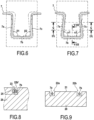
- the insert 3 When the insert 3 is introduced into the mold 20, it may in particular be inserted into the notch 22. Due to the difference between the angles ⁇ 1 and ⁇ 2 in the unstressed state of the insert 3 and the corresponding angles ⁇ 1 and ⁇ 2 in the notch 22, the insert 3 may be, within the notch 22, under an elastic bending stress pressing one or more surfaces 10 of the insert against outer sides 23 of the notch 22, in particular in the narrower central portions 22a', 22b', 22c', as shown in FIGS. 7-12 . Consequently, in a subsequent foam molding step, wherein the foam material 2 may be introduced into and molded within the mold 20 with the insert 3 still held within the notch 22, as shown in FIGS. 11 and 12 , these surfaces 10 may not be covered by the foam material 2.
- the magnets 25 may in particular be located adjacent to the narrower central portions 22a', 22b' and 22c' of the notch 22. In particular, they may be located at the bottom 24 of the notch 22 at the narrower central portions 22a', 22b' and 22c', as well as at an outer side 23 of the notch 22 at the narrower central portion 22b' of the second segment 22b of the notch 22. In these locations, the magnets 25 may magnetically hold the insert 3 within the notch 22 during the foam molding step, preventing in particular that the insert 3 snaps out of the notch 22 under its elastic bending stress.
Landscapes
- Engineering & Computer Science (AREA)
- Mechanical Engineering (AREA)
- Aviation & Aerospace Engineering (AREA)
- Transportation (AREA)
- Manufacturing & Machinery (AREA)
- Casting Or Compression Moulding Of Plastics Or The Like (AREA)
Description
- The disclosure relates to a process for manufacturing a foam article, such as those used for cushioning, and in particular for seat cushions.
- Foam articles may incorporate embedded inserts to provide strengthening and/or interfaces for attachment, as disclosed for instance in US Patent Application Publication
US 2016/0375808 A1 . When producing such foam articles using molding processes, the insert may be introduced into the mold cavity before being overmolded with the foam, thus incorporating the insert into the foam article in a single step, with minimum cost, as disclosed for instance in French PatentApplication Publication FR 2 889 495 A1 US 2019/0030765 A1 . In order to achieve this, when the insert is incorporated into the foam article in a foam molding process, it has been proposed to install a barrier within the mold cavity to seal off from the foam, during the foam molding process, a volume of the mold cavity where the emerging part of the insert is received, as disclosed for instance in Japanese Patent Application Laid-OpenJP 2015-173786 A - A first object of the disclosure is that of providing a simple, inexpensive process for manufacturing a foam article with an embedded insert, so that a surface of the insert emerges from the foam in the resulting foam article, to provide, for example, a mechanical attachment interface.
- According to a first aspect, the process may comprise a foam molding step in which a foam material is molded within a mold while the insert is held under elastic stress against an inner surface of the mold, so that the surface of the insert in contact with the inner surface of the mold during the foam molding step may not be covered by the foam, emerging thus from the foam in the resulting foam article.
- The insert may in particular be elongated, and be held under elastic bending stress against the inner surface of the mold during the foam molding step. It may in particular be a metal wire, in which case it may be magnetically held to maintain a correct position during the foam molding step. The insert may be held within a notch in the mold, and the inner surface of the mold against which the insert is held under elastic bending stress may be a side surface of the notch. In this case, to exert the elastic bending stress on the insert within the notch which holds the insert against the side surface of the notch, the insert may comprise at least two segments at an angle to each other in an unstressed state of the insert, and the notch may comprise two corresponding segments at a different angle to each other. When the insert is received into the notch, the elastic bending of the insert to adapt it to the different angle of the notch may thus force the insert locally against the side of the notch. The insert may comprise further segments at angles to each other, and in particular be U-shaped.
- The process may further comprise an assembly step wherein a solid body is attached to the insert after the foam molding step. This solid body may be a sensor. In particular, the foam article may be a seat cushion and the solid body an occupant detection sensor.
- The above summary of some example embodiments is not intended to describe each disclosed embodiment or every implementation of the invention. In particular, selected features of any illustrative embodiment within this specification may be incorporated into an additional embodiment unless clearly stated to the contrary.
- The invention may be more completely understood in consideration of the following detailed description of various embodiments in connection with the accompanying drawings, in which:
-
FIG. 1 is an exploded perspective view of a vehicle seat cushion with a metal wire insert and occupancy detection sensors; -
FIG. 2 is a lower plan view of the vehicle seat cushion ofFIG. 1 ; -
FIG. 3 is a detail cut view of the attachment of a occupancy detection sensor attached to the partially exposed metal wire insert on a lower surface of the vehicle seat cushion ofFIG. 1 ; -
FIG. 4 schematically illustrates how the occupancy detection sensor is attached to the metal wire; -
FIG. 5 is a detail view of a raised area in a mold cavity for molding the vehicle seat cushion ofFIG. 1 , with a notch for receiving a U-shaped part of the metal wire insert; -
FIG. 6 illustrates the U-shaped part of the metal wire insert in an unstressed state; -
FIG. 7 illustrates the raised area and notch ofFIG. 3 with the U-shaped part of the metal wire insert under bending stress; -
FIGS. 8, 9 and10 are cut views of the raised area, notch and metal wire insert ofFIG. 7 in planes VIII-VIII, IX-IX and X-X, respectively, as the metal wire insert is introduced into the notch; -
FIGS. 11 and 12 are detail views of the raised area, notch and metal wire insert in planes IX-IX and X-X,, respectively, at the end of a subsequent foam molding step. - While the invention is amenable to various modifications and alternative forms, specifics thereof have been shown by way of example in the drawings and will be described in detail. It should be understood, however, that the intention is not to limit aspects of the invention to the particular embodiments described.
- For the following defined terms, these definitions shall be applied, unless a different definition is given in the claims or elsewhere in this specification.
- As used in this specification and the appended claims, the singular forms "a", "an", and "the" include plural referents unless the content clearly dictates otherwise. As used in this specification and the appended claims, the term "or" is generally employed in its sense including "and/or" unless the content clearly dictates otherwise.
- The following detailed description should be read with reference to the drawings in which similar elements in different drawings are numbered the same. The detailed description and the drawings, which are not necessarily to scale, depict illustrative embodiments and are not intended to limit the scope of the invention. The illustrative embodiments depicted are intended only as exemplary. Selected features of any illustrative embodiment may be incorporated into an additional embodiment unless clearly stated to the contrary.
- A
foam article 1, in the form of a seat cushion, and in particular of a vehicle seat cushion such as a rear bench passenger car seat cushion, is shown inFIG. 1 . Such afoam article 1 may comprise afoam material 2, and, embedded within thisfoam material 2, aninsert 3. Thefoam material 2 may be an organic polymer foam material such as polyurethane foam. Theinsert 3 may be anelongated insert 3, for example in the form of a metal wire, and in particular a ferromagnetic metal wire. Thefoam article 1 may further provide one or moresolid bodies 4 attached to theinsert 3, for example through a snap connection. Thesesolid bodies 4 may be sensors, and more specifically occupancy detection sensors configured to detect whether a person is sitting on thefoam article 1 when it is built as a seat cushion into a vehicle seat. Such an occupancy detection sensor may be used for instance to activate a warning if the corresponding seatbelt is not buckled. Thesolid bodies 4 may be located outside of thefoam material 2, and in particular may be received incorresponding cavities 5 formed in anunderside 6 of thefoam material 2, as shown inFIG. 2 . Apart 7 of eachinsert 3 may be embedded into acorresponding rib 8 of thefoam material 2 protruding into one of thecavities 5. Thispart 7 of theinsert 3 may comprise successive segments at angles to each other. Thispart 7 may for example be U-shaped, with afirst segment 7a, asecond segment 7b, and athird segment 7c bent at angles to each other. -
FIG. 3 shows how asurface 10 of theinsert 3 may emerge from thefoam material 2, in particular in saidribs 8, to facilitate the attachment of thesolid bodies 4 to theinsert 3, for instance withelastic hooks 11 snapping onto the exposedsurface 10 of theinsert 3 and biting into thefoam material 2 behind. With threesuch hooks 11, each engaging onesegment part 7, as shown inFIG. 4 , it is possible to establish a stable attachment of thesolid body 4 to theinsert 3. - In a first step of a process for manufacturing the
foam article 1, theinsert 3 may be introduced into amold 20. As shown inFIG. 5 , themold 20 may comprise a raisedinner surface 21 to form thecavity 5 in thefoam material 2. Furthermore, said raisedinner surface 21 may include anotch 22 to form therib 8. Thisnotch 22 may also comprise successive segments at angles to each other. In particular, it may also be U-shaped, with afirst segment 22a bent at an angle α1 with respect to asecond segment 22b, and athird segment 22c bent at an angle α2 with respect to asecond segment 22b, which may be identical to the angle α1 between the first andsecond segments segment central portion 22a', 22b', 22c'. Themold 20 may also comprisemagnets 25 adjacent to thenotch 22. - As shown in
FIG. 6 , in an unstressed state, before its introduction into themold 20, theinsert 3 may have an angle β1 between the first andsecond segments second segments notch 22. It may also have an angle β2 between the second andthird segments third segments notch 22. In particular, the angles α1 and α2 may be acute, and the angles β1 and β2 may be straight. - When the
insert 3 is introduced into themold 20, it may in particular be inserted into thenotch 22. Due to the difference between the angles β1 and β2 in the unstressed state of theinsert 3 and the corresponding angles α1 and α2 in thenotch 22, theinsert 3 may be, within thenotch 22, under an elastic bending stress pressing one ormore surfaces 10 of the insert againstouter sides 23 of thenotch 22, in particular in the narrowercentral portions 22a', 22b', 22c', as shown inFIGS. 7-12 . Consequently, in a subsequent foam molding step, wherein thefoam material 2 may be introduced into and molded within themold 20 with theinsert 3 still held within thenotch 22, as shown inFIGS. 11 and 12 , thesesurfaces 10 may not be covered by thefoam material 2. After a subsequent unmolding step in which thefoam material 2, with theinsert 3 embedded therein, may be extracted from themold 20, these surfaces may thus still be exposed, emerging from thefoam material 2 within eachcavity 5 to facilitate attachment to thesolid bodies 4 in an assembly step, as shown inFIGS. 3 and4 . - As shown in
FIGS. 8 ,10 and 12 , themagnets 25 may in particular be located adjacent to the narrowercentral portions 22a', 22b' and 22c' of thenotch 22. In particular, they may be located at the bottom 24 of thenotch 22 at the narrowercentral portions 22a', 22b' and 22c', as well as at anouter side 23 of thenotch 22 at the narrowercentral portion 22b' of thesecond segment 22b of thenotch 22. In these locations, themagnets 25 may magnetically hold theinsert 3 within thenotch 22 during the foam molding step, preventing in particular that theinsert 3 snaps out of thenotch 22 under its elastic bending stress. - Those skilled in the art will recognize that the present invention may be manifested in a variety of forms other than the specific embodiments described and contemplated herein. Accordingly, departure in form and detail may be made without departing from the scope of the present invention as described in the appended claims.
Claims (10)
- Process for manufacturing a foam article (1) with an embedded insert (3), characterized by comprising a foam molding step in which a foam material (2) is molded within a mold (20) while the insert (3) is held under elastic stress against an inner surface of the mold (20).
- Process for manufacturing a foam article (1) with an embedded insert (3) according to claim 1, wherein the insert (3) is elongated and is held under elastic bending stress against the inner surface of the mold (20) during the foam molding step.
- Process for manufacturing a foam article (1) with an embedded insert (3) according to claim 2, wherein the insert (3) is a metal wire.
- Process for manufacturing a foam article (1) with an embedded insert (3) according to claim 3, wherein the insert is magnetically held during the foam molding step.
- Process for manufacturing a foam article (1) with an embedded insert (3) according to any one of claims 2 to 4, wherein the insert (3) is held within a notch (22) in the mold (22), and the inner surface of the mold (20) against which the insert (3) is held under elastic bending stress is a side (23) of the notch (22).
- Process for manufacturing a foam article (1) with an embedded insert (3) according to claim 5, wherein the insert (3) comprises at least two segments (7a,7b) which are at an angle (β1) to each other in an unstressed state of the insert (3), and the notch (22) comprises two corresponding segments (22a,22b) at a different angle (α1) to each other, exerting the elastic bending stress on the insert (3) within the notch (22).
- Process for manufacturing a foam article (1) with an embedded insert (3) according to claim 6, wherein the insert (3) includes a U-shaped part (7).
- Process for manufacturing a foam article (1) with an embedded insert (3) according to any one of claims 1 to 7, further comprising an assembly step wherein a solid body (4) is attached to the insert (3) after the foam molding step.
- Process for manufacturing a foam article (1) with an embedded insert (3) according to claim 8, wherein the solid body (4) is a sensor.
- Process for manufacturing a foam article (1) with an embedded insert (3) according to claim 9, wherein the foam article (1) is a seat cushion and the solid body (4) is an occupant detection sensor.
Applications Claiming Priority (1)
| Application Number | Priority Date | Filing Date | Title |
|---|---|---|---|
| PCT/EP2020/051440 WO2021148111A1 (en) | 2020-01-21 | 2020-01-21 | Process for manufacturing a foam article with an insert |
Publications (2)
| Publication Number | Publication Date |
|---|---|
| EP4093590A1 EP4093590A1 (en) | 2022-11-30 |
| EP4093590B1 true EP4093590B1 (en) | 2024-07-24 |
Family
ID=69185610
Family Applications (1)
| Application Number | Title | Priority Date | Filing Date |
|---|---|---|---|
| EP20701459.8A Active EP4093590B1 (en) | 2020-01-21 | 2020-01-21 | Process for manufacturing a foam article with an insert |
Country Status (2)
| Country | Link |
|---|---|
| EP (1) | EP4093590B1 (en) |
| WO (1) | WO2021148111A1 (en) |
Family Cites Families (4)
| Publication number | Priority date | Publication date | Assignee | Title |
|---|---|---|---|---|
| FR2889495B1 (en) * | 2005-08-04 | 2007-10-12 | Faurecia Sieges Automobile | MOTOR VEHICLE SEAT COMPRISING A VIBRATION ALERT DEVICE. |
| JP2015173786A (en) * | 2014-03-14 | 2015-10-05 | トヨタ紡織株式会社 | Manufacturing method of seat cushion material |
| FR3037890B1 (en) * | 2015-06-29 | 2019-03-15 | Faurecia Sieges D'automobile | COMPRISING A CLOTHING ELEMENT FOR A MOTOR VEHICLE SEAT OR A MOTOR VEHICLE HABITACLE |
| WO2017169350A1 (en) * | 2016-03-29 | 2017-10-05 | 株式会社カネカ | Foamed composite molding and method for manufacturing foamed composite molding |
-
2020
- 2020-01-21 WO PCT/EP2020/051440 patent/WO2021148111A1/en not_active Ceased
- 2020-01-21 EP EP20701459.8A patent/EP4093590B1/en active Active
Also Published As
| Publication number | Publication date |
|---|---|
| EP4093590A1 (en) | 2022-11-30 |
| WO2021148111A1 (en) | 2021-07-29 |
Similar Documents
| Publication | Publication Date | Title |
|---|---|---|
| EP2374652B1 (en) | Seat cushion mat with pressure sensor | |
| EP2337709B1 (en) | Upholstery item comprising occupancy sensor mat | |
| US8662483B2 (en) | Shock absorber for vehicle seat | |
| US8646827B2 (en) | Vehicle interior assembly | |
| US20120112512A1 (en) | Vehicle seat | |
| US8690240B2 (en) | Protection member for coupling device | |
| EP2620317B1 (en) | Occupant detection sensor assembly with integrated fasteners | |
| EP1477376B1 (en) | Through anchor and method of manufacture thereof | |
| US20010034977A1 (en) | Weather strip | |
| JP4535226B2 (en) | Method for manufacturing vehicle window glass with decorative molding member and window glass for vehicle with decorative molding member | |
| EP4093590B1 (en) | Process for manufacturing a foam article with an insert | |
| CN107031476B (en) | Buffer cushion | |
| JP2012091544A (en) | Vehicle seat pad and manufacturing method therefor | |
| JP6279168B2 (en) | Vehicle seat member and vehicle seat | |
| EP1818208A1 (en) | Vehicule seat with pressure activatable sensor | |
| JP5037105B2 (en) | Cushion pad | |
| EP1712403A1 (en) | Method for fitting a seat sensor into a seat cushion | |
| JP4191620B2 (en) | Cushion pad | |
| JP2021509649A (en) | Foamed parts for automobile seats with seat usage detection function and their manufacturing methods | |
| CN102652074B (en) | Installation structure of load detection device | |
| CA3173530C (en) | Vehicle floor cover retention device with spiked base | |
| JP2004360752A (en) | Clip | |
| JP4191619B2 (en) | Cushion pad | |
| JP2023079243A (en) | Weatherstrip and its manufacturing method | |
| JP2002053002A (en) | Pillar garnish with built-in airbag and method of manufacturing the same |
Legal Events
| Date | Code | Title | Description |
|---|---|---|---|
| STAA | Information on the status of an ep patent application or granted ep patent |
Free format text: STATUS: UNKNOWN |
|
| STAA | Information on the status of an ep patent application or granted ep patent |
Free format text: STATUS: THE INTERNATIONAL PUBLICATION HAS BEEN MADE |
|
| PUAI | Public reference made under article 153(3) epc to a published international application that has entered the european phase |
Free format text: ORIGINAL CODE: 0009012 |
|
| STAA | Information on the status of an ep patent application or granted ep patent |
Free format text: STATUS: REQUEST FOR EXAMINATION WAS MADE |
|
| 17P | Request for examination filed |
Effective date: 20220818 |
|
| AK | Designated contracting states |
Kind code of ref document: A1 Designated state(s): AL AT BE BG CH CY CZ DE DK EE ES FI FR GB GR HR HU IE IS IT LI LT LU LV MC MK MT NL NO PL PT RO RS SE SI SK SM TR |
|
| DAV | Request for validation of the european patent (deleted) | ||
| DAX | Request for extension of the european patent (deleted) | ||
| GRAP | Despatch of communication of intention to grant a patent |
Free format text: ORIGINAL CODE: EPIDOSNIGR1 |
|
| STAA | Information on the status of an ep patent application or granted ep patent |
Free format text: STATUS: GRANT OF PATENT IS INTENDED |
|
| RIC1 | Information provided on ipc code assigned before grant |
Ipc: B60N 2/70 20060101ALI20240131BHEP Ipc: B60N 2/68 20060101ALI20240131BHEP Ipc: B29L 31/00 20060101ALI20240131BHEP Ipc: B29L 31/58 20060101ALI20240131BHEP Ipc: B29C 33/12 20060101ALI20240131BHEP Ipc: B60N 2/00 20060101ALI20240131BHEP Ipc: B29C 44/12 20060101AFI20240131BHEP |
|
| INTG | Intention to grant announced |
Effective date: 20240219 |
|
| GRAS | Grant fee paid |
Free format text: ORIGINAL CODE: EPIDOSNIGR3 |
|
| GRAA | (expected) grant |
Free format text: ORIGINAL CODE: 0009210 |
|
| STAA | Information on the status of an ep patent application or granted ep patent |
Free format text: STATUS: THE PATENT HAS BEEN GRANTED |
|
| AK | Designated contracting states |
Kind code of ref document: B1 Designated state(s): AL AT BE BG CH CY CZ DE DK EE ES FI FR GB GR HR HU IE IS IT LI LT LU LV MC MK MT NL NO PL PT RO RS SE SI SK SM TR |
|
| REG | Reference to a national code |
Ref country code: GB Ref legal event code: FG4D |
|
| REG | Reference to a national code |
Ref country code: CH Ref legal event code: EP |
|
| REG | Reference to a national code |
Ref country code: IE Ref legal event code: FG4D Ref country code: DE Ref legal event code: R096 Ref document number: 602020034416 Country of ref document: DE |
|
| REG | Reference to a national code |
Ref country code: LT Ref legal event code: MG9D |
|
| REG | Reference to a national code |
Ref country code: NL Ref legal event code: MP Effective date: 20240724 |
|
| RAP2 | Party data changed (patent owner data changed or rights of a patent transferred) |
Owner name: TOYOTA JIDOSHA KABUSHIKI KAISHA |
|
| PG25 | Lapsed in a contracting state [announced via postgrant information from national office to epo] |
Ref country code: PT Free format text: LAPSE BECAUSE OF FAILURE TO SUBMIT A TRANSLATION OF THE DESCRIPTION OR TO PAY THE FEE WITHIN THE PRESCRIBED TIME-LIMIT Effective date: 20241125 |
|
| REG | Reference to a national code |
Ref country code: AT Ref legal event code: MK05 Ref document number: 1705930 Country of ref document: AT Kind code of ref document: T Effective date: 20240724 |
|
| PG25 | Lapsed in a contracting state [announced via postgrant information from national office to epo] |
Ref country code: NL Free format text: LAPSE BECAUSE OF FAILURE TO SUBMIT A TRANSLATION OF THE DESCRIPTION OR TO PAY THE FEE WITHIN THE PRESCRIBED TIME-LIMIT Effective date: 20240724 |
|
| PG25 | Lapsed in a contracting state [announced via postgrant information from national office to epo] |
Ref country code: PT Free format text: LAPSE BECAUSE OF FAILURE TO SUBMIT A TRANSLATION OF THE DESCRIPTION OR TO PAY THE FEE WITHIN THE PRESCRIBED TIME-LIMIT Effective date: 20241125 Ref country code: NL Free format text: LAPSE BECAUSE OF FAILURE TO SUBMIT A TRANSLATION OF THE DESCRIPTION OR TO PAY THE FEE WITHIN THE PRESCRIBED TIME-LIMIT Effective date: 20240724 |
|
| PG25 | Lapsed in a contracting state [announced via postgrant information from national office to epo] |
Ref country code: NO Free format text: LAPSE BECAUSE OF FAILURE TO SUBMIT A TRANSLATION OF THE DESCRIPTION OR TO PAY THE FEE WITHIN THE PRESCRIBED TIME-LIMIT Effective date: 20241024 |
|
| PG25 | Lapsed in a contracting state [announced via postgrant information from national office to epo] |
Ref country code: FI Free format text: LAPSE BECAUSE OF FAILURE TO SUBMIT A TRANSLATION OF THE DESCRIPTION OR TO PAY THE FEE WITHIN THE PRESCRIBED TIME-LIMIT Effective date: 20240724 Ref country code: PL Free format text: LAPSE BECAUSE OF FAILURE TO SUBMIT A TRANSLATION OF THE DESCRIPTION OR TO PAY THE FEE WITHIN THE PRESCRIBED TIME-LIMIT Effective date: 20240724 Ref country code: GR Free format text: LAPSE BECAUSE OF FAILURE TO SUBMIT A TRANSLATION OF THE DESCRIPTION OR TO PAY THE FEE WITHIN THE PRESCRIBED TIME-LIMIT Effective date: 20241025 |
|
| PG25 | Lapsed in a contracting state [announced via postgrant information from national office to epo] |
Ref country code: BG Free format text: LAPSE BECAUSE OF FAILURE TO SUBMIT A TRANSLATION OF THE DESCRIPTION OR TO PAY THE FEE WITHIN THE PRESCRIBED TIME-LIMIT Effective date: 20240724 |
|
| PG25 | Lapsed in a contracting state [announced via postgrant information from national office to epo] |
Ref country code: LV Free format text: LAPSE BECAUSE OF FAILURE TO SUBMIT A TRANSLATION OF THE DESCRIPTION OR TO PAY THE FEE WITHIN THE PRESCRIBED TIME-LIMIT Effective date: 20240724 |
|
| PG25 | Lapsed in a contracting state [announced via postgrant information from national office to epo] |
Ref country code: IS Free format text: LAPSE BECAUSE OF FAILURE TO SUBMIT A TRANSLATION OF THE DESCRIPTION OR TO PAY THE FEE WITHIN THE PRESCRIBED TIME-LIMIT Effective date: 20241124 Ref country code: AT Free format text: LAPSE BECAUSE OF FAILURE TO SUBMIT A TRANSLATION OF THE DESCRIPTION OR TO PAY THE FEE WITHIN THE PRESCRIBED TIME-LIMIT Effective date: 20240724 |
|
| PG25 | Lapsed in a contracting state [announced via postgrant information from national office to epo] |
Ref country code: HR Free format text: LAPSE BECAUSE OF FAILURE TO SUBMIT A TRANSLATION OF THE DESCRIPTION OR TO PAY THE FEE WITHIN THE PRESCRIBED TIME-LIMIT Effective date: 20240724 |
|
| PG25 | Lapsed in a contracting state [announced via postgrant information from national office to epo] |
Ref country code: ES Free format text: LAPSE BECAUSE OF FAILURE TO SUBMIT A TRANSLATION OF THE DESCRIPTION OR TO PAY THE FEE WITHIN THE PRESCRIBED TIME-LIMIT Effective date: 20240724 Ref country code: RS Free format text: LAPSE BECAUSE OF FAILURE TO SUBMIT A TRANSLATION OF THE DESCRIPTION OR TO PAY THE FEE WITHIN THE PRESCRIBED TIME-LIMIT Effective date: 20241024 |
|
| PG25 | Lapsed in a contracting state [announced via postgrant information from national office to epo] |
Ref country code: RS Free format text: LAPSE BECAUSE OF FAILURE TO SUBMIT A TRANSLATION OF THE DESCRIPTION OR TO PAY THE FEE WITHIN THE PRESCRIBED TIME-LIMIT Effective date: 20241024 Ref country code: PL Free format text: LAPSE BECAUSE OF FAILURE TO SUBMIT A TRANSLATION OF THE DESCRIPTION OR TO PAY THE FEE WITHIN THE PRESCRIBED TIME-LIMIT Effective date: 20240724 Ref country code: NO Free format text: LAPSE BECAUSE OF FAILURE TO SUBMIT A TRANSLATION OF THE DESCRIPTION OR TO PAY THE FEE WITHIN THE PRESCRIBED TIME-LIMIT Effective date: 20241024 Ref country code: LV Free format text: LAPSE BECAUSE OF FAILURE TO SUBMIT A TRANSLATION OF THE DESCRIPTION OR TO PAY THE FEE WITHIN THE PRESCRIBED TIME-LIMIT Effective date: 20240724 Ref country code: IS Free format text: LAPSE BECAUSE OF FAILURE TO SUBMIT A TRANSLATION OF THE DESCRIPTION OR TO PAY THE FEE WITHIN THE PRESCRIBED TIME-LIMIT Effective date: 20241124 Ref country code: HR Free format text: LAPSE BECAUSE OF FAILURE TO SUBMIT A TRANSLATION OF THE DESCRIPTION OR TO PAY THE FEE WITHIN THE PRESCRIBED TIME-LIMIT Effective date: 20240724 Ref country code: GR Free format text: LAPSE BECAUSE OF FAILURE TO SUBMIT A TRANSLATION OF THE DESCRIPTION OR TO PAY THE FEE WITHIN THE PRESCRIBED TIME-LIMIT Effective date: 20241025 Ref country code: FI Free format text: LAPSE BECAUSE OF FAILURE TO SUBMIT A TRANSLATION OF THE DESCRIPTION OR TO PAY THE FEE WITHIN THE PRESCRIBED TIME-LIMIT Effective date: 20240724 Ref country code: ES Free format text: LAPSE BECAUSE OF FAILURE TO SUBMIT A TRANSLATION OF THE DESCRIPTION OR TO PAY THE FEE WITHIN THE PRESCRIBED TIME-LIMIT Effective date: 20240724 Ref country code: BG Free format text: LAPSE BECAUSE OF FAILURE TO SUBMIT A TRANSLATION OF THE DESCRIPTION OR TO PAY THE FEE WITHIN THE PRESCRIBED TIME-LIMIT Effective date: 20240724 Ref country code: AT Free format text: LAPSE BECAUSE OF FAILURE TO SUBMIT A TRANSLATION OF THE DESCRIPTION OR TO PAY THE FEE WITHIN THE PRESCRIBED TIME-LIMIT Effective date: 20240724 |
|
| REG | Reference to a national code |
Ref country code: DE Ref legal event code: R081 Ref document number: 602020034416 Country of ref document: DE Owner name: TOYOTA JIDOSHA KABUSHIKI KAISHA, TOYOTA-SHI, JP Free format text: FORMER OWNER: TOYOTA MOTOR EUROPE, BRUSSELS, BE |
|
| PG25 | Lapsed in a contracting state [announced via postgrant information from national office to epo] |
Ref country code: RO Free format text: LAPSE BECAUSE OF FAILURE TO SUBMIT A TRANSLATION OF THE DESCRIPTION OR TO PAY THE FEE WITHIN THE PRESCRIBED TIME-LIMIT Effective date: 20240724 Ref country code: SM Free format text: LAPSE BECAUSE OF FAILURE TO SUBMIT A TRANSLATION OF THE DESCRIPTION OR TO PAY THE FEE WITHIN THE PRESCRIBED TIME-LIMIT Effective date: 20240724 Ref country code: DK Free format text: LAPSE BECAUSE OF FAILURE TO SUBMIT A TRANSLATION OF THE DESCRIPTION OR TO PAY THE FEE WITHIN THE PRESCRIBED TIME-LIMIT Effective date: 20240724 |
|
| PG25 | Lapsed in a contracting state [announced via postgrant information from national office to epo] |
Ref country code: EE Free format text: LAPSE BECAUSE OF FAILURE TO SUBMIT A TRANSLATION OF THE DESCRIPTION OR TO PAY THE FEE WITHIN THE PRESCRIBED TIME-LIMIT Effective date: 20240724 |
|
| PG25 | Lapsed in a contracting state [announced via postgrant information from national office to epo] |
Ref country code: CZ Free format text: LAPSE BECAUSE OF FAILURE TO SUBMIT A TRANSLATION OF THE DESCRIPTION OR TO PAY THE FEE WITHIN THE PRESCRIBED TIME-LIMIT Effective date: 20240724 |
|
| REG | Reference to a national code |
Ref country code: DE Ref legal event code: R097 Ref document number: 602020034416 Country of ref document: DE |
|
| PG25 | Lapsed in a contracting state [announced via postgrant information from national office to epo] |
Ref country code: IT Free format text: LAPSE BECAUSE OF FAILURE TO SUBMIT A TRANSLATION OF THE DESCRIPTION OR TO PAY THE FEE WITHIN THE PRESCRIBED TIME-LIMIT Effective date: 20240724 Ref country code: SK Free format text: LAPSE BECAUSE OF FAILURE TO SUBMIT A TRANSLATION OF THE DESCRIPTION OR TO PAY THE FEE WITHIN THE PRESCRIBED TIME-LIMIT Effective date: 20240724 |
|
| PLBE | No opposition filed within time limit |
Free format text: ORIGINAL CODE: 0009261 |
|
| STAA | Information on the status of an ep patent application or granted ep patent |
Free format text: STATUS: NO OPPOSITION FILED WITHIN TIME LIMIT |
|
| 26N | No opposition filed |
Effective date: 20250425 |
|
| REG | Reference to a national code |
Ref country code: CH Ref legal event code: PL |
|
| PG25 | Lapsed in a contracting state [announced via postgrant information from national office to epo] |
Ref country code: SE Free format text: LAPSE BECAUSE OF FAILURE TO SUBMIT A TRANSLATION OF THE DESCRIPTION OR TO PAY THE FEE WITHIN THE PRESCRIBED TIME-LIMIT Effective date: 20240724 |
|
| PG25 | Lapsed in a contracting state [announced via postgrant information from national office to epo] |
Ref country code: MC Free format text: LAPSE BECAUSE OF FAILURE TO SUBMIT A TRANSLATION OF THE DESCRIPTION OR TO PAY THE FEE WITHIN THE PRESCRIBED TIME-LIMIT Effective date: 20240724 Ref country code: LU Free format text: LAPSE BECAUSE OF NON-PAYMENT OF DUE FEES Effective date: 20250121 |
|
| GBPC | Gb: european patent ceased through non-payment of renewal fee |
Effective date: 20250121 |
|
| PG25 | Lapsed in a contracting state [announced via postgrant information from national office to epo] |
Ref country code: GB Free format text: LAPSE BECAUSE OF NON-PAYMENT OF DUE FEES Effective date: 20250121 Ref country code: BE Free format text: LAPSE BECAUSE OF NON-PAYMENT OF DUE FEES Effective date: 20250131 |
|
| PG25 | Lapsed in a contracting state [announced via postgrant information from national office to epo] |
Ref country code: FR Free format text: LAPSE BECAUSE OF NON-PAYMENT OF DUE FEES Effective date: 20250131 |
|
| PG25 | Lapsed in a contracting state [announced via postgrant information from national office to epo] |
Ref country code: CH Free format text: LAPSE BECAUSE OF NON-PAYMENT OF DUE FEES Effective date: 20250131 |
|
| REG | Reference to a national code |
Ref country code: BE Ref legal event code: MM Effective date: 20250131 |
|
| PG25 | Lapsed in a contracting state [announced via postgrant information from national office to epo] |
Ref country code: IE Free format text: LAPSE BECAUSE OF NON-PAYMENT OF DUE FEES Effective date: 20250121 |
|
| PGFP | Annual fee paid to national office [announced via postgrant information from national office to epo] |
Ref country code: DE Payment date: 20260114 Year of fee payment: 7 |