EP4092799A1 - Electrolyte and electrochemical device using same - Google Patents
Electrolyte and electrochemical device using same Download PDFInfo
- Publication number
- EP4092799A1 EP4092799A1 EP20915120.8A EP20915120A EP4092799A1 EP 4092799 A1 EP4092799 A1 EP 4092799A1 EP 20915120 A EP20915120 A EP 20915120A EP 4092799 A1 EP4092799 A1 EP 4092799A1
- Authority
- EP
- European Patent Office
- Prior art keywords
- group
- substituted
- unsubstituted
- electrolytic solution
- compound
- Prior art date
- Legal status (The legal status is an assumption and is not a legal conclusion. Google has not performed a legal analysis and makes no representation as to the accuracy of the status listed.)
- Granted
Links
Classifications
-
- C—CHEMISTRY; METALLURGY
- C07—ORGANIC CHEMISTRY
- C07D—HETEROCYCLIC COMPOUNDS
- C07D411/00—Heterocyclic compounds containing two or more hetero rings, at least one ring having oxygen and sulfur atoms as the only ring hetero atoms
- C07D411/14—Heterocyclic compounds containing two or more hetero rings, at least one ring having oxygen and sulfur atoms as the only ring hetero atoms containing three or more hetero rings
-
- C—CHEMISTRY; METALLURGY
- C07—ORGANIC CHEMISTRY
- C07D—HETEROCYCLIC COMPOUNDS
- C07D411/00—Heterocyclic compounds containing two or more hetero rings, at least one ring having oxygen and sulfur atoms as the only ring hetero atoms
- C07D411/02—Heterocyclic compounds containing two or more hetero rings, at least one ring having oxygen and sulfur atoms as the only ring hetero atoms containing two hetero rings
- C07D411/04—Heterocyclic compounds containing two or more hetero rings, at least one ring having oxygen and sulfur atoms as the only ring hetero atoms containing two hetero rings directly linked by a ring-member-to-ring-member bond
-
- H—ELECTRICITY
- H01—ELECTRIC ELEMENTS
- H01M—PROCESSES OR MEANS, e.g. BATTERIES, FOR THE DIRECT CONVERSION OF CHEMICAL ENERGY INTO ELECTRICAL ENERGY
- H01M10/00—Secondary cells; Manufacture thereof
- H01M10/05—Accumulators with non-aqueous electrolyte
- H01M10/052—Li-accumulators
- H01M10/0525—Rocking-chair batteries, i.e. batteries with lithium insertion or intercalation in both electrodes; Lithium-ion batteries
-
- H—ELECTRICITY
- H01—ELECTRIC ELEMENTS
- H01M—PROCESSES OR MEANS, e.g. BATTERIES, FOR THE DIRECT CONVERSION OF CHEMICAL ENERGY INTO ELECTRICAL ENERGY
- H01M10/00—Secondary cells; Manufacture thereof
- H01M10/05—Accumulators with non-aqueous electrolyte
- H01M10/056—Accumulators with non-aqueous electrolyte characterised by the materials used as electrolytes, e.g. mixed inorganic/organic electrolytes
- H01M10/0564—Accumulators with non-aqueous electrolyte characterised by the materials used as electrolytes, e.g. mixed inorganic/organic electrolytes the electrolyte being constituted of organic materials only
- H01M10/0566—Liquid materials
- H01M10/0567—Liquid materials characterised by the additives
-
- H—ELECTRICITY
- H01—ELECTRIC ELEMENTS
- H01M—PROCESSES OR MEANS, e.g. BATTERIES, FOR THE DIRECT CONVERSION OF CHEMICAL ENERGY INTO ELECTRICAL ENERGY
- H01M10/00—Secondary cells; Manufacture thereof
- H01M10/05—Accumulators with non-aqueous electrolyte
- H01M10/056—Accumulators with non-aqueous electrolyte characterised by the materials used as electrolytes, e.g. mixed inorganic/organic electrolytes
- H01M10/0564—Accumulators with non-aqueous electrolyte characterised by the materials used as electrolytes, e.g. mixed inorganic/organic electrolytes the electrolyte being constituted of organic materials only
- H01M10/0566—Liquid materials
- H01M10/0568—Liquid materials characterised by the solutes
-
- H—ELECTRICITY
- H01—ELECTRIC ELEMENTS
- H01M—PROCESSES OR MEANS, e.g. BATTERIES, FOR THE DIRECT CONVERSION OF CHEMICAL ENERGY INTO ELECTRICAL ENERGY
- H01M10/00—Secondary cells; Manufacture thereof
- H01M10/05—Accumulators with non-aqueous electrolyte
- H01M10/056—Accumulators with non-aqueous electrolyte characterised by the materials used as electrolytes, e.g. mixed inorganic/organic electrolytes
- H01M10/0564—Accumulators with non-aqueous electrolyte characterised by the materials used as electrolytes, e.g. mixed inorganic/organic electrolytes the electrolyte being constituted of organic materials only
- H01M10/0566—Liquid materials
- H01M10/0569—Liquid materials characterised by the solvents
-
- H—ELECTRICITY
- H01—ELECTRIC ELEMENTS
- H01M—PROCESSES OR MEANS, e.g. BATTERIES, FOR THE DIRECT CONVERSION OF CHEMICAL ENERGY INTO ELECTRICAL ENERGY
- H01M10/00—Secondary cells; Manufacture thereof
- H01M10/42—Methods or arrangements for servicing or maintenance of secondary cells or secondary half-cells
- H01M10/4235—Safety or regulating additives or arrangements in electrodes, separators or electrolyte
-
- H—ELECTRICITY
- H01—ELECTRIC ELEMENTS
- H01M—PROCESSES OR MEANS, e.g. BATTERIES, FOR THE DIRECT CONVERSION OF CHEMICAL ENERGY INTO ELECTRICAL ENERGY
- H01M4/00—Electrodes
- H01M4/02—Electrodes composed of, or comprising, active material
- H01M4/36—Selection of substances as active materials, active masses, active liquids
- H01M4/362—Composites
- H01M4/366—Composites as layered products
-
- H—ELECTRICITY
- H01—ELECTRIC ELEMENTS
- H01M—PROCESSES OR MEANS, e.g. BATTERIES, FOR THE DIRECT CONVERSION OF CHEMICAL ENERGY INTO ELECTRICAL ENERGY
- H01M4/00—Electrodes
- H01M4/02—Electrodes composed of, or comprising, active material
- H01M4/36—Selection of substances as active materials, active masses, active liquids
- H01M4/48—Selection of substances as active materials, active masses, active liquids of inorganic oxides or hydroxides
- H01M4/485—Selection of substances as active materials, active masses, active liquids of inorganic oxides or hydroxides of mixed oxides or hydroxides for inserting or intercalating light metals, e.g. LiTi2O4 or LiTi2OxFy
-
- H—ELECTRICITY
- H01—ELECTRIC ELEMENTS
- H01M—PROCESSES OR MEANS, e.g. BATTERIES, FOR THE DIRECT CONVERSION OF CHEMICAL ENERGY INTO ELECTRICAL ENERGY
- H01M4/00—Electrodes
- H01M4/02—Electrodes composed of, or comprising, active material
- H01M4/36—Selection of substances as active materials, active masses, active liquids
- H01M4/48—Selection of substances as active materials, active masses, active liquids of inorganic oxides or hydroxides
- H01M4/52—Selection of substances as active materials, active masses, active liquids of inorganic oxides or hydroxides of nickel, cobalt or iron
- H01M4/525—Selection of substances as active materials, active masses, active liquids of inorganic oxides or hydroxides of nickel, cobalt or iron of mixed oxides or hydroxides containing iron, cobalt or nickel for inserting or intercalating light metals, e.g. LiNiO2, LiCoO2 or LiCoOxFy
-
- H—ELECTRICITY
- H01—ELECTRIC ELEMENTS
- H01M—PROCESSES OR MEANS, e.g. BATTERIES, FOR THE DIRECT CONVERSION OF CHEMICAL ENERGY INTO ELECTRICAL ENERGY
- H01M4/00—Electrodes
- H01M4/02—Electrodes composed of, or comprising, active material
- H01M4/62—Selection of inactive substances as ingredients for active masses, e.g. binders, fillers
-
- C—CHEMISTRY; METALLURGY
- C07—ORGANIC CHEMISTRY
- C07D—HETEROCYCLIC COMPOUNDS
- C07D327/00—Heterocyclic compounds containing rings having oxygen and sulfur atoms as the only ring hetero atoms
- C07D327/10—Heterocyclic compounds containing rings having oxygen and sulfur atoms as the only ring hetero atoms two oxygen atoms and one sulfur atom, e.g. cyclic sulfates
-
- C—CHEMISTRY; METALLURGY
- C07—ORGANIC CHEMISTRY
- C07D—HETEROCYCLIC COMPOUNDS
- C07D497/00—Heterocyclic compounds containing in the condensed system at least one hetero ring having oxygen and sulfur atoms as the only ring hetero atoms
- C07D497/02—Heterocyclic compounds containing in the condensed system at least one hetero ring having oxygen and sulfur atoms as the only ring hetero atoms in which the condensed system contains two hetero rings
- C07D497/04—Ortho-condensed systems
-
- H—ELECTRICITY
- H01—ELECTRIC ELEMENTS
- H01G—CAPACITORS; CAPACITORS, RECTIFIERS, DETECTORS, SWITCHING DEVICES, LIGHT-SENSITIVE OR TEMPERATURE-SENSITIVE DEVICES OF THE ELECTROLYTIC TYPE
- H01G11/00—Hybrid capacitors, i.e. capacitors having different positive and negative electrodes; Electric double-layer [EDL] capacitors; Processes for the manufacture thereof or of parts thereof
- H01G11/54—Electrolytes
- H01G11/58—Liquid electrolytes
- H01G11/64—Liquid electrolytes characterised by additives
-
- H—ELECTRICITY
- H01—ELECTRIC ELEMENTS
- H01M—PROCESSES OR MEANS, e.g. BATTERIES, FOR THE DIRECT CONVERSION OF CHEMICAL ENERGY INTO ELECTRICAL ENERGY
- H01M2300/00—Electrolytes
- H01M2300/0017—Non-aqueous electrolytes
- H01M2300/0025—Organic electrolyte
- H01M2300/0028—Organic electrolyte characterised by the solvent
- H01M2300/0034—Fluorinated solvents
-
- H—ELECTRICITY
- H01—ELECTRIC ELEMENTS
- H01M—PROCESSES OR MEANS, e.g. BATTERIES, FOR THE DIRECT CONVERSION OF CHEMICAL ENERGY INTO ELECTRICAL ENERGY
- H01M2300/00—Electrolytes
- H01M2300/0017—Non-aqueous electrolytes
- H01M2300/0025—Organic electrolyte
- H01M2300/0028—Organic electrolyte characterised by the solvent
- H01M2300/0037—Mixture of solvents
-
- H—ELECTRICITY
- H01—ELECTRIC ELEMENTS
- H01M—PROCESSES OR MEANS, e.g. BATTERIES, FOR THE DIRECT CONVERSION OF CHEMICAL ENERGY INTO ELECTRICAL ENERGY
- H01M2300/00—Electrolytes
- H01M2300/0017—Non-aqueous electrolytes
- H01M2300/0025—Organic electrolyte
- H01M2300/0028—Organic electrolyte characterised by the solvent
- H01M2300/0037—Mixture of solvents
- H01M2300/004—Three solvents
-
- Y—GENERAL TAGGING OF NEW TECHNOLOGICAL DEVELOPMENTS; GENERAL TAGGING OF CROSS-SECTIONAL TECHNOLOGIES SPANNING OVER SEVERAL SECTIONS OF THE IPC; TECHNICAL SUBJECTS COVERED BY FORMER USPC CROSS-REFERENCE ART COLLECTIONS [XRACs] AND DIGESTS
- Y02—TECHNOLOGIES OR APPLICATIONS FOR MITIGATION OR ADAPTATION AGAINST CLIMATE CHANGE
- Y02E—REDUCTION OF GREENHOUSE GAS [GHG] EMISSIONS, RELATED TO ENERGY GENERATION, TRANSMISSION OR DISTRIBUTION
- Y02E60/00—Enabling technologies; Technologies with a potential or indirect contribution to GHG emissions mitigation
- Y02E60/10—Energy storage using batteries
Definitions
- the present application relates to the technical field of electrochemical devices, and more particularly to an electrolytic solution and an electrochemical device using the electrolytic solution.
- the present application provides an electrolytic solution and an electrochemical device using the electrolytic solution to solve the above problems.
- An embodiment of the present application provides an electrolytic solution and an electrochemical device using the electrolytic solution, to solve at least one of the problems existing in related art to some extent.
- An embodiment of the present application also provides an electrochemical device using the electrolytic solution, and an electronic device.
- the present application provides an electrolytic solution, which includes the compound of Formula I and a carboxylate compound:
- R 11 , R 12 , R 13 , and R 14 are each independently selected from: or R 11 and R 12 , together with the carbon atoms to which R 11 and R 12 are attached, form
- the weight percentage of the compound of Formula I is a wt% based on the total weight of the electrolytic solution, where a is 0.001-5.
- the compound of Formula I includes at least one of the following compounds:
- the carboxylate compound includes the compound of Formula II:
- the weight percentage of the carboxylate compound is b wt% based on the total weight of the electrolytic solution, where b is 0.05-75.
- the carboxylate compound includes at least one of:
- the electrolytic solution further includes the compound of Formula III: where M is C or Si;
- the weight percentage of the compound of Formula III is 0.01-5wt% based on the total weight of the electrolytic solution.
- the compound of Formula III includes at least one of the following compounds: or
- the electrolytic solution further includes a lithium salt additive, including at least one of LiPO 2 F 2 , lithium bis(trifluoromethanesulphonyl)imide, lithium bis(fluorosulfonyl)imide, lithium bis(oxalate)borate, lithium tetrafluorophosphate xalate, lithium difluoro(oxalate)borate, or lithium hexafluorocesate.
- a lithium salt additive including at least one of LiPO 2 F 2 , lithium bis(trifluoromethanesulphonyl)imide, lithium bis(fluorosulfonyl)imide, lithium bis(oxalate)borate, lithium tetrafluorophosphate xalate, lithium difluoro(oxalate)borate, or lithium hexafluorocesate.
- the weight percentage of the lithium salt additive is 0.001-5wt% based on the total weight of the electrolytic solution.
- the present application provides an electrochemical device, which includes a cathode, having a cathode active material layer including a cathode active material; and an electrolytic solution according to an embodiment of the present application.
- the electrolytic solution of the electrochemical device further includes copper ions, and the content of the copper ions is 0.01 -50 ppm based on the total weight of the electrolytic solution.
- the cathode active material includes a Ti element, and the content of the Ti element is t ⁇ 10 2 ppm based on the total weight of the cathode active material layer, where t is 2-10, and meets (a+b)/t ⁇ 35.
- the present application provides an electronic device, which includes an electrochemical device according to an embodiment of the present application.
- the lithium-ion battery prepared with the electrolytic solution of the present application has reduced storage impedance, and improved storage swelling, overcharge performance and hot box performance.
- a list of items connected by the term “one of” or similar terms may mean any of the listed items. For example, if items A and B are listed, then the phrase “one of A and B" means only A or only B. In another example, if items A, B, and C are listed, then the phrase "one of A, B and C" means only A; only B; or only C.
- the item A may include a single component or multiple components.
- the item B may include a single component or multiple components.
- the item C may include a single component or multiple components.
- a list of items connected by the term "at least one of” or similar terms may mean any combination of the listed items. For example, if items A and B are listed, then the phrase "at least one of A and B" means only A; only B; or A and B. In another example, if items A, B and C are listed, then the phrase "at least one of A, B and C" means only A; or only B; only C; A and B (excluding C); A and C (excluding B); B and C (excluding A); or all of A, B and C.
- the item A may include a single component or multiple components.
- the item B may include a single component or multiple components.
- the item C may include a single component or multiple components.
- alkyl group is intended to be a linear saturated hydrocarbon structure having 1 to 20 carbon atoms.
- the alkyl group is also intended to be a branched or cyclic hydrocarbon structure having 3 to 20 carbon atoms.
- the alkyl group may be an alkyl group having 1-20 carbon atoms, an alkyl group having 1-10 carbon atoms, an alkyl group having 1-5 carbon atoms, an alkyl group having 5-20 carbon atoms, an alkyl group having 5-15 carbon atoms, or alkyl group having 5-10 carbon atoms.
- an alkyl group having a specific number of carbon atoms is defined, it is intended to cover all geometric isomers having the carbon number.
- butyl means n-butyl, sec-butyl, isobutyl, tert-butyl and cyclobutyl; and "propyl” includes n-propyl, isopropyl and cyclopropyl.
- alkyl group examples include, but are not limited to, methyl, ethyl, n-propyl, isopropyl, cyclopropyl, n-butyl, isobutyl, sec-butyl, tert-butyl, cyclobutyl, n-pentyl, isoamyl, neopentyl, cyclopentyl, methylcyclopentyl, ethylcyclopentyl, n-hexyl, isohexyl, cyclohexyl, n-heptyl, octyl, cyclopropyl, cyclobutyl, norbornanyl and so on. Additionally, the alkyl group can be optionally substituted.
- cycloalkyl group encompasses cyclic alkyl groups.
- the cycloalkyl group may be a cycloalkyl group having 3 to 20 carbon atoms, a cycloalkyl group having 6 to 20 carbon atoms, a cycloalkyl group having 3 to 12 carbon atoms, or a cycloalkyl group having 3 to 6 carbon atoms.
- the cycloalkyl group may be cyclopropyl, cyclobutyl, cyclopentyl, cyclohexyl or the like. Additionally, the cycloalkyl group can be optionally substituted.
- alkoxy refers to a -L-O- group, where L is an alkyl group.
- the alkoxy group may be an alkoxy group having 1-20 carbon atoms, an alkoxy group having 1-12 carbon atoms, an alkoxy group having 1-5 carbon atoms, an alkoxy group having 5-20 carbon atoms, an alkoxy group having 5-15 carbon atoms, or an alkoxy group having 5-10 carbon atoms. Additionally, the alkoxy group can be optionally substituted.
- alkenyl group refers to a monovalent unsaturated hydrocarbyl group which may be straight or branched and which has at least one and usually 1, 2 or 3 carbon-carbon double bonds. Unless otherwise defined, the alkenyl group typically contains from 2 to 20 carbon atoms, for example an alkenyl group having 2 to 20 carbon atoms, an alkenyl group having 6 to 20 carbon atoms, an alkenyl group having 2 to 12 carbon atoms or an alkenyl group having 2 to 6 carbon atoms.
- alkenyl groups include (for example) ethenyl, n-propenyl, iso-propenyl, n-but-2-enyl, butyl-3-enyl, n-hex-3-enyl, and the like. Additionally, the alkenyl group can be optionally substituted.
- alkylene group means a linear or branched divalent saturated hydrocarbyl group.
- the alkylene group may be an alkylene group having 1-20 carbon atoms, an alkylene group having 1-15 carbon atoms, an alkylene group having 1-10 carbon atoms, an alkylene group having 1-5 carbon atoms, an alkylene group having 5-20 carbon atoms, an alkylene group having 5-15 carbon atoms, or an alkylene group having 5-10 carbon atoms.
- Representative alkylene group includes (for example) methylene, ethane-1,2-diyl ("ethylene”), propane-1,2-diyl, propane-1,3-diyl, butane-1, 4-diyl, pentane-1,5-diyl and the like. Additionally, the alkylene group can be optionally substituted.
- alkenylene group encompasses both linear and branched alkenylene groups. When an alkenylene group having a specific number of carbon atoms is defined, it is intended to cover all geometric isomers having the carbon number.
- the alkenylene group may be an alkenylene group having 2-20 carbon atoms, an alkenylene group having 2-15 carbon atoms, an alkenylene group having 2-10 carbon atoms, an alkenylene group having 2-5 carbon atoms, an alkenylene group having 5-20 carbon atoms, an alkenylene group having 5-15 carbon atoms, or an alkenylene group having 5-10 carbon atoms.
- Representative alkenylene group includes (for example) ethenylene, propenylene, butenylene and the like. Additionally, the alkenylene group can be optionally substituted.
- heterocyclic group encompasses both aromatic and non-aromatic cyclic groups. Heteroaromatic cyclic groups also mean heteroaryl groups.
- the heteroaromatic cyclic group and hetero-non-aromatic cyclic group include a C 3 -C 20 heterocyclic group, C 3 -C 150 heterocyclic group, C 3 -C 10 heterocyclic group, C 5 -C 20 heterocyclic group, C 5 -C 10 heterocyclic group, or a C 3 -C 6 heterocyclic group having at least one heteroatom.
- morpholinyl for example, morpholinyl, piperidinyl, pyrrolidinyl, and cyclic ethers, for example, tetrahydrofuran, tetrahydropyran, and the like.
- the heterocyclic group can be optionally substituted.
- aryl group encompasses both monocyclic and polycyclic systems.
- a polycyclic ring may have two or more rings where two carbons are shared by two adjacent rings (where the rings are "fused"), where at least one of the rings is aromatic and other rings may be for example, a cycloalkyl group, a cycloalkenyl group, an aryl group, a heterocyclic group and/or a heteroaryl group.
- the aryl group may be a C 6 -C 50 aryl group, a C 6 -C 40 aryl group, a C 6 -C 30 aryl group, a C6-C 20 aryl group, or a C 6 -C 10 aryl group.
- aryl group includes (for example) phenyl, methylphenyl, propylphenyl, isopropylphenyl, benzyl and naphthalen-1-yl, naphthalen-2-yl and the like. Additionally, the aryl group can be optionally substituted.
- heteroaryl group encompasses a monocyclic heteroaromatic group which may include one to three heteroatoms, for example, pyrrole, furan, thiophene, imidazole, oxazole, thiazole, triazole, pyrazole, pyridine, pyrazine, pyrimidine, and the like.
- heteroaryl group also includes a polycyclic heteroaromatic system having two or more rings in which two atoms are shared by two adjacent rings (where the ring is "fused"), in which at least one of the rings is a heteroaryl group, and other rings may be a cycloalkyl group, a cycloalkenyl group, an aryl group, a heterocyclic group and/or a heteroaryl group.
- the heteroatom in the heteroaryl group may be for example O, S, N, Se, and so on.
- the heteroaryl group may be C 3 -C 50 heteroaryl, C 3 -C 40 heteroaryl, C 3 -C 30 heteroaryl, C 3 -C 20 heteroaryl, or C 3 -C 10 heteroaryl. Additionally, the heteroaryl group can be optionally substituted.
- dinitrile compound refers to the compound having two -CN functional groups.
- heteroatom encompasses O, S, P, N, B or their isosteres.
- halogen encompasses F, Cl, Br or I.
- substituents are each independently selected from the group consisting of halogen, an alkyl group, an alkenyl group, and an aryl group.
- substituted means substitution with one or more (e.g., 2, 3) substituents.
- the content of each component is calculated based on the total weight of the electrolytic solution.
- the present application provides an electrolytic solution, which includes the compound of Formula I and a carboxylate compound:
- R 11 , R 12 , R 13 , and R 14 are each independently selected from: or
- the weight percentage of the compound of Formula I is a wt% based on the total weight of the electrolyte solution, where a is 0.001-5. In some embodiments, the weight percentage of the compound of Formula I is 0.001wt%, 0.005wt%, 0.01wt%, 0.05wt%, 0.1wt%, 0.15wt%, 0.2wt%, 0.3wt%, 0.4wt%, 0.5wt%, 0.6wt%, 0.7wt%, 0.8wt%, 1wt%, 2wt%, 3wt%, 3.5wt%, 4wt%, 4.5wt%, 5wt%, or within a range consisting of any two of these values, based on the total weight of the electrolyte solution. When the weight percentage of the compound of Formula I within this range, the compound of Formula I can form a better protective film, which can more effectively prevent the side reaction between the electrolyte solution and the cathode or ano
- the compound of Formula I includes at least one of the following compounds or is at least one selected from the following compounds:
- the combination of the compound of Formula I and the fluorinated carboxylate can fully exert the stability of the organic protective film and the oxidation resistance of the electrolytic solution, and can effectively improve the hot box and overcharge performance.
- the detailed mechanism underlying this effect is unknown, and may be considered as follows: the compound of Formula I and the fluorinated carboxylate work together to improve the oxidation resistance of the electrolytic solution system. This is more conducive to the film formation from the additives on the cathode and anode, thereby effectively protecting the active material. As the temperature rises, the protection of the organic protective film for the active material will be gradually weakened.
- the compound of Formula I and the fluorinated carboxylate work together to effectively reduce chemical heat production and improve the safety of the electrochemical device.
- the carboxylate compound includes or is selected from the compound of Formula II:
- the weight percentage of the carboxylate compound is b wt% based on the total weight of the electrolytic solution, where b is 0.05-75. In some embodiments, the weight percentage of the carboxylate compound is 0.05wt%, 0.1wt%, 0.5wt%, 1wt%, 3wt%, 5wt%, 10wt%, 15wt%, 20wt%, 25wt%, 30wt%, 35wt%, 40wt%, 45wt%, 50wt%, 55wt%, 55wt%, 60wt%, 65wt%, 70wt%, 75wt%, or within a range consisting of any two of these values, based on the total weight of the electrolytic solution. When the weight percentage of the carboxylate is within this range, the electrochemical device has better overcharge performance and hot box performance.
- the carboxylate compound includes at least one of the following compounds or is at least one selected from the following compounds:
- the electrolytic solution further includes the compound of Formula III: where M is one of C or Si;
- the compound of Formula I, the carboxylate compound and the compound of Formula III work together to further improve the overcharge performance of the electrochemical device and also improve the swelling problem during high-temperature storage of the electrochemical device.
- the detailed mechanism underlying this effect is unknown, it can be considered as follows: the compound of Formula I, the carboxylate compound and the compound of Formula III work together to further reduce the risk of oxidation of the electrolytic solution, and also improve the protection for the cathode and reduce the direct contact between the cathode active material interface with the electrolytic solution, thereby alleviating the swelling caused by the contact between the electrolytic solution and the cathode active material during high-temperature storage.
- the weight percentage of the compound of Formula III is 0.01-5wt% based on the total weight of the electrolytic solution. In some embodiments, the weight percentage of the compound of Formula III is 0.01wt%, 0.05wt%, 0.1wt%, 0.5wt%, 1wt%, 1.5wt%, 2wt%, 2.5wt%, 3wt%, 3.5wt%, 4wt%, 4.5wt%, 5wt%, or within a range consisting of any two of these values, based on the total weight of the electrolytic solution. When the weight percentage of the compound of Formula III is within this range, a better overcharge performance and high-temperature storage performance can be achieved.
- the compound of Formula III includes at least one of the following compounds or is at least one selected from the following compounds: or
- the electrolytic solution further includes a lithium salt additive, including at least one of LiPO 2 F 2 , lithium bis(trifluoromethanesulphonyl)imide, lithium bis(fluorosulfonyl)imide, lithium bis(oxalate)borate, tetrafluorophosphate xalate, lithium difluoro(oxalate)borate, or lithium hexafluorocesate.
- a lithium salt additive including at least one of LiPO 2 F 2 , lithium bis(trifluoromethanesulphonyl)imide, lithium bis(fluorosulfonyl)imide, lithium bis(oxalate)borate, tetrafluorophosphate xalate, lithium difluoro(oxalate)borate, or lithium hexafluorocesate.
- the weight percentage of the lithium salt additive is about 0.001-5wt% based on the total weight of the electrolytic solution. In some embodiments, the weight percentage of the lithium salt additive is 0.001wt%, 0.005wt%, 0.01wt%, 0.05wt%, 0.1wt%, 0.5wt%, 1wt%, 1.5wt%, 1.5wt%, 2wt%, 2.5wt%, 3wt%, 3.5wt%, 4wt%, 4.5wt%, 5wt%, or within a range consisting of any two of these values, based on the total weight of the electrolytic solution.
- the electrolytic solution further includes a dinitrile compound. Due to the low steric hindrance, the dinitrile compound can make up the film formation deficiency of the compound of Formula III and enhance the interface protection for the cathode active material.
- the dinitrile compound includes, but is not limited to: succinonitrile, glutaronitrile, adiponitrile, 1,5-dicyanopentane, 1,6-dicyanohexane, 1,7-dicyanoheptane, 1,8-dicyanooctane, 1,9-dicyanononane, 1,10-dicyanodecane, 1,12-dicyanododecane, tetramethylsuccinonitrile, 2-methylglutaronitrile, 2,4-dimethylglutaronitrile, 2,2,4,4-tetramethylglutaronitrile, 1,4-dicyanopentane, 1,4-dicyanopentane, 2,5-dimethyl-2,5-hexane dicarbonitrile, 2,6-dicyanoheptane, 2,7-dicyanooctane, 2,8-dicyanononane, 1,6-dicyanodecane, 1,
- the weight percentage of the dinitrile compound is 0.1-15wt% based on the total weight of the electrolytic solution. In some embodiments, the weight percentage of the dinitrile compound is no less than 0.1wt% based on the total weight of the electrolytic solution. In some embodiments, the weight percentage of the dinitrile compound is no less than 0.5wt% based on the total weight of the electrolytic solution. In some embodiments, the weight percentage of the dinitrile compound is no less than 2wt% based on the total weight of the electrolytic solution. In some embodiments, the weight percentage of the dinitrile compound is no less than 4wt% based on the total weight of the electrolytic solution.
- the weight percentage of the dinitrile compound is not greater than 15wt% based on the total weight of the electrolytic solution. In some embodiments, the weight percentage of the dinitrile compound is not greater than 10wt% based on the total weight of the electrolytic solution. In some embodiments, the weight percentage of the dinitrile compound is not greater than 8wt% based on the total weight of the electrolytic solution.
- the electrolytic solution further includes a cyclic ether.
- the cyclic ether can form a film on both the cathode and the anode, reducing the reaction between the electrolytic solution and the active material.
- the cyclic ether includes, but is not limited to, tetrahydrofuran, 2-methyltetrahydrofuran, 1,3-dioxolane, 2-methyl1,3-dioxolane, 4-methyl1,3-dioxolane, 1,3-dioxane, 1,4-dioxane and dimethoxypropane.
- the weight percentage of the cyclic ether is 0.1-10wt% based on the total weight of the electrolytic solution. In some embodiments, the weight percentage of the cyclic ether is no less than 0.1wt% based on the total weight of the electrolytic solution. In some embodiments, the weight percentage of the cyclic ether is no less than 0.5wt% based on the total weight of the electrolytic solution. In some embodiments, the weight percentage of the cyclic ether is not greater than 2wt% based on the total weight of the electrolytic solution. In some embodiments, the weight percentage of the cyclic ether is not greater than 5wt% based on the total weight of the electrolytic solution.
- the electrolytic solution further includes a chain ether.
- the chain ether includes, but is not limited to, dimethoxymethane, 1,1-dimethoxyethane, 1,2-dimethoxyethane, diethoxymethane, 1,1-diethoxyethane, 1,2-di ethoxyethane, ethoxymethoxymethane, 1,1-ethoxymethoxyethane and 1,2-ethoxymethoxyethane.
- the weight percentage of the chain ether is 0.1-10wt% based on the total weight of the electrolytic solution. In some embodiments, the weight percentage of the chain ether is no less than 0.5wt% based on the total weight of the electrolytic solution. In some embodiments, the weight percentage of the chain ether is no less than 2wt% based on the total weight of the electrolytic solution. In some embodiments, the weight percentage of the chain ether is no less than 3wt% based on the total weight of the electrolytic solution. In some embodiments, the weight percentage of the chain ether is not greater than 10wt% based on the total weight of the electrolytic solution. In some embodiments, the weight percentage of the chain ether is not greater than 5wt% based on the total weight of the electrolytic solution.
- the electrolytic solution further includes a phosphorus containing organic solvent.
- the phosphorus containing organic solvent includes, but is not limited to, trimethyl phosphate, triethyl phosphate, dimethyl ethyl phosphate, methyl diethyl phosphate, ethylene methyl phosphate, ethylene ethyl phosphate, triphenyl phosphate, trimethyl phosphite, triethyl phosphite, triphenyl phosphite, tris(2,2,2-trifluoroethyl) phosphate and tris(2,2,3,3,3-pentafluoropropyl) phosphate.
- the weight percentage of the phosphorus containing organic solvent is 0.1-10wt% based on the total weight of the electrolytic solution. In some embodiments, the weight percentage of the phosphorus containing organic solvent is no less than 0.1wt% based on the total weight of the electrolytic solution. In some embodiments, the weight percentage of the phosphorus containing organic solvent is no less than 0.5wt% based on the total weight of the electrolytic solution. In some embodiments, the weight percentage of the phosphorus containing organic solvent is not greater than 2wt% based on the total weight of the electrolytic solution. In some embodiments, the weight percentage of the phosphorus containing organic solvent is not greater than 3wt% based on the total weight of the electrolytic solution. In some embodiments, the weight percentage of the phosphorus containing organic solvent is not greater than 5wt% based on the total weight of the electrolytic solution.
- the electrolytic solution further includes an aromatic fluorine-containing organic solvent.
- the aromatic fluorine-containing solvent can quickly form a film to protect the active material, and the fluorine-containing substance can improve the infiltration of the electrolytic solution to the active material.
- the aromatic fluorine-containing organic solvent includes, but is not limited to, fluorobenzene, difluorobenzene, trifluorobenzene, tetrafluorobenzene, pentafluorobenzene, hexafluorobenzene, and trifluoromethylbenzene.
- the weight percentage of the aromatic fluorine-containing solvent is about 0.1-10wt% based on the total weight of the electrolytic solution. In some embodiments, the weight percentage of the aromatic fluorine-containing solvent is no less than 0.5wt% based on the total weight of the electrolytic solution. In some embodiments, the weight percentage of the aromatic fluorine-containing solvent is no less than 2wt% based on the total weight of the electrolytic solution. In some embodiments, the weight percentage of the aromatic fluorine-containing solvent is not greater than 4wt% based on the total weight of the electrolytic solution. In some embodiments, the weight percentage of the aromatic fluorine-containing solvent is not greater than 8wt% based on the total weight of the electrolytic solution.
- the electrolyte used in the electrolyte solution according to the embodiments of the present application may be an electrolyte known in the prior art, including, but not limited to, an inorganic lithium salt, such as LiClO 4 , LiAsF 6 , LiPF 6 , LiBF 4 , LiSbF 6 , LiSO 3 F, and LiN(FSO 2 ) 2 ; a fluorine-containing organic lithium salt, such as LiCF 3 SO 3 , LiN(FSO 2 )(CF 3 SO 2 ), LiN(CF 3 SO 2 ) 2 , LiN(C 2 F 5 SO 2 ) 2 , cyclic lithium 1,3-hexafluoropropane disulfonimide, cyclic lithium 1,2-tetrafluoroethane disulfonimide, LiN(CF 3 SO 2 )(C 4 F 9 SO 2 ), LiC(CF 3 SO 2 ) 3 , LiPF 4 (CF 3 ) 2 , LiPF 4 (C 2 F 5
- the electrolytic solution may be used alone or in combination of two or more thereof.
- the electrolytic solution includes a combination of LiPF 6 and LiBF 4 .
- the electrolytic solution includes a combination of an inorganic lithium salt such as LiPF 6 or LiBF 4 and a fluorine-containing organic lithium salt such as LiCF 3 SO 3 , LiN(CF 3 SO 2 ) 2 , and LiN(C 2 F 5 SO 2 ) 2 .
- the concentration of the electrolytic solution is in the range of 0.8-3 mol/L, for example, 0.8-2.5 mol/L, 0.8-2 mol/L, 1-2 mol/L, 0.5-1.5 mol/L, 0.8-1.3 mol/L, 0.5-1.2 mol/L, such as 1 mol/L, 1.15mol/L, 1.2mol/L, 1.5mol/L, 2mol/L or 2.5mol/L.
- the electrochemical device of the present application includes any device where an electrochemical reaction takes place, and specific examples include all kinds of primary batteries, secondary batteries, fuel cells, solar cells, or capacitors.
- the electrochemical device is a lithium secondary battery including a lithium metal secondary battery, a lithium ion secondary battery, a lithium polymer secondary battery or a lithium ion polymer secondary battery.
- the electrochemical device of the present application is an electrochemical device having a cathode having a cathode active material capable of absorbing and releasing metal ions; an anode having an anode active material capable of absorbing and releasing metal ions, and characterized by including an electrolytic solution according to any embodiment of the present application.
- the electrolytic solution used in the electrochemical device of the present application is an electrolytic solution according to any embodiment of the present application.
- the electrolytic solution of the electrochemical device according to the present application further includes copper ions, and the content of the copper ions is 0.01 -50 ppm based on the total weight of the electrolytic solution.
- the content of copper ions is 0.01 ppm, 0.05 ppm, 0.1 ppm, 0.5 ppm, 1 ppm, 2 ppm, 3 ppm, 4 ppm, 5 ppm, 7 ppm, 10 ppm, 15 ppm, 20 ppm, 25 ppm, 30 ppm, 35 ppm, 40 ppm, 45 ppm, 50 ppm, or within a range consisting of any two of these values, based on the total weight of the electrolytic solution.
- electrolytic solution used in the electrochemical device of the present application may include other electrolytic solutions falling within the scope of present application.
- the anode material used in the electrochemical device of the present application, and the construction and manufacturing methods therefor are not particularly limited, and may be any of the techniques disclosed in the prior art.
- the anode may be one described in US9812739B , which is incorporated herein by reference to its entirety.
- the anode includes a current collector and an anode active material layer on the current collector.
- the anode active material includes a material that reversibly intercalates/deintercalates lithium ions.
- the material that reversibly intercalates/deintercalates lithium ions includes a carbon material.
- the carbon material may be any carbon-based anode active material commonly used in lithium ion rechargeable batteries.
- the carbon material includes, but is not limited to, crystalline carbon, amorphous carbon, or a mixture thereof.
- the crystalline carbon may be amorphous or flake -shaped, small flake-shaped, spherical or fibrous natural graphite or artificial graphite.
- the amorphous carbon may be soft carbon, hard carbon, mesophase pitch carbide, calcined coke, and the like.
- the anode active material layer includes an anode active material.
- the anode active material includes, but is not limited to, lithium metal, structured lithium metal, natural graphite, artificial graphite, mesocarbon microbead (MCMB), hard carbon, soft carbon, silicon, silicon-carbon composite, Li-Sn alloy, Li-Sn-O alloy, Sn, SnO, SnO 2 , lithiated TiO 2 -Li 4 Ti 5 O 12 having spinel structure, Li-Al alloy and any combination thereof.
- anode active material layer can be formed by vapor deposition, sputtering, or plating.
- an anode active material layer is formed by for example a conductive skeleton of twisted spherical shape and metal particles dispersed in the conductive skeleton.
- the conductive skeleton of twisted spherical shape may have a porosity of 5% to 85%.
- a protective layer may be further disposed on the anode active material layer of lithium metal.
- the anode active material layer includes a binder, and optionally a conductive material.
- the binder increases the binding of the anode active material particles to each other and the binding of the anode active material to the current collector.
- the binder includes, but is not limited to, polyvinyl alcohol, carboxymethyl cellulose, hydroxypropyl cellulose, diacetyl cellulose, polyvinyl chloride, carboxylated polyvinyl chloride, polyvinyl fluoride, a polymer containing ethylene oxide, polyvinylpyrrolidone, polyurethane, polytetrafluoroethylene, poly(1,1-vinylidene fluoride), polyethylene, polypropylene, styrene butadiene rubber, acrylated styrene butadiene rubber, epoxy resins, Nylon and so on.
- the conductive material includes, but is not limited to, a carbon based material, a metal based material, a conductive polymer, or a mixture thereof.
- the carbon-based material is selected from natural graphite, artificial graphite, carbon black, acetylene black, Ketjen black, carbon fiber, or any combinations thereof.
- the metal based material is selected from metal powders, metal fibers, copper, nickel, aluminum, and silver.
- the conductive polymer is a polyphenylene derivative.
- the current collector include, but is not limited to, copper foil, nickel foil, stainless steel foil, titanium foil, foamed nickel, foamed copper, polymeric substrates coated with a conductive metal, and any combinations thereof.
- the anode can be produced by a production method well known in the art.
- the anode can be obtained by mixing an active material, a conductive material and a binder in a solvent to prepare an active material composition, and coating the active material composition on a current collector.
- the solvent may include, but is not limited to, water.
- the cathode material used in the electrochemical device of the present application can be prepared using materials, construction and manufacturing methods well known in the art.
- the cathode of the present application can be prepared using the technique described in US9812739B , which is incorporated herein by reference to its entirety.
- the cathode includes a current collector and a cathode active material layer on the current collector.
- the cathode active material includes at least one lithiated intercalation compound that reversibly intercalates and deintercalates lithium ions.
- the cathode active material includes a composite oxide.
- the composite oxide contains lithium and at least one element selected from the group consisting of cobalt, manganese, and nickel.
- the cathode active material is selected from lithium cobalt oxide (LiCoO 2 ), lithium nickel cobalt manganese (NCM) ternary material, lithium iron phosphate (LiFePO 4 ), lithium manganese oxide (LiMn 2 O 4 ) or any combinations thereof.
- the cathode active material may have a coating on its surface or may be mixed with another compound having a coating.
- the coating may include at least one coating element compound selected from the group consisting of an oxide of a coating element, a hydroxide of a coating element, an oxyhydroxide of a coating element, an oxycarbonate of a coating element, and a hydroxycarbonate of a coating element.
- the compound used for the coating may be amorphous or crystalline.
- the coating element contained in the coating may include Mg, Al, Co, K, Na, Ca, Si, V, Sn, Ge, Ga, B, As, Zr, F or any combinations thereof.
- the coating can be applied by any method as long as the method does not adversely affect the performance of the cathode active material.
- the method may include any coating method known in the art, such as spraying, dipping, and others.
- the cathode active material includes a Ti element, and the content of the Ti element is t ⁇ 10 2 ppm based on the total weight of the cathode active material layer, where t is 2-10, and meets (a+b)/t ⁇ 35.
- t is 2, 3, 4, 5, 6, 7, 8, 9, 10 or in a range consisting of any two of these values.
- (a+b)/t is 35, 30, 25, 20, 15, 10, 15, 10, 5, 1, 0.5, 0.4, 0.3, or within a range consisting of any two of these values.
- the cathode active material layer further includes a binder, and optionally a conductive material.
- the binder increases the binding of the cathode active material particles to each other and the binding of the cathode active material to the current collector.
- the binder includes, but is not limited to, polyvinyl alcohol, hydroxypropyl cellulose, diacetyl cellulose, polyvinyl chloride, carboxylated polyvinyl chloride, polyvinyl fluoride, a polymer containing ethylene oxide, polyvinylpyrrolidone, polyurethane, polytetrafluoroethylene, poly(1,1-vinylidene fluoride), polyethylene, polypropylene, styrene butadiene rubber, acrylated styrene butadiene rubber, epoxy resins, Nylon and so on.
- the conductive material includes, but is not limited to, a carbon based material, a metal based material, a conductive polymer, and a mixture thereof.
- the carbon-based material is selected from natural graphite, artificial graphite, carbon black, acetylene black, Ketjen black, carbon fiber, or any combinations thereof.
- the metal based material is selected from metal powders, metal fibers, copper, nickel, aluminum, and silver.
- the conductive polymer is a polyphenylene derivative.
- the current collector may be, but is not limited to, aluminum.
- the cathode can be prepared by a preparation method well known in the art.
- the cathode can be obtained by mixing an active material, a conductive material and a binder in a solvent to prepare an active material composition, and coating the active material composition on a current collector.
- the solvent may include, but is not limited to, N-methylpyrrolidone or the like.
- the cathode is prepared by forming a cathode material with a cathode active material layer including a lithium-transition metal compound powder and a binder on a current collector.
- the cathode active material layer can generally be produced by dry mixing a cathode material and a binder (and a conductive material and a thickener if needed) to form flakes, and pressing the obtained flakes on a cathode current collector; or dissolving or dispersing the material in a liquid medium to form a slurry, coating the slurry on a cathode current collector, and drying.
- the material of the cathode active material layer includes any material known in the art.
- the electrochemical device of the present application is provided with a separator between the cathode and the anode to prevent short circuit.
- the material and shape of the separator used in the electrochemical device of the present application are not particularly limited, and may be any of the techniques disclosed in the prior art.
- the separator includes a polymer or an inorganic substance or the like formed of a material which is stable against the electrolytic solution of the present application.
- the separator may include a substrate layer and a surface treatment layer.
- the substrate layer is a non-woven fabric, film, or composite film having a porous structure, and the material of the substrate layer is at least one selected from the group consisting of polyethylene, polypropylene, polyethylene terephthalate, and polyimide.
- a porous polypropylene film, a porous polyethylene film, a polypropylene nonwoven fabric, a polyethylene nonwoven fabric, and a porous polypropylene-polyethylene-polypropylene composite film may be used.
- At least one surface of the substrate layer is provided with a surface treatment layer, which may be a polymer layer or an inorganic layer, or a layer formed by mixing a polymer and an inorganic material.
- a surface treatment layer which may be a polymer layer or an inorganic layer, or a layer formed by mixing a polymer and an inorganic material.
- the ratio of the thickness of the substrate layer to the thickness of the surface treatment layer is 1:1 to 20:1, the thickness of the substrate layer is 4 to 14 ⁇ m, and the thickness of the surface treatment layer is 1 to 5 ⁇ m.
- the inorganic layer includes inorganic particles and a binder.
- the inorganic particles are at least one selected from the group consisting of alumina, silica, magnesia, titania, hafnium dioxide, tin oxide, cerium dioxide, nickel oxide, zinc oxide, calcium oxide, zirconia, yttria, silicon carbide, eboehmite, aluminum hydroxide, magnesium hydroxide, calcium hydroxide and barium sulfate, or a combination of more than one thereof.
- the binder is one selected from the group consisting of polyvinylidene fluoride, a copolymer of vinylidene fluoride-hexafluoropropylene, a polyamide, polyacrylonitrile, a polyacrylate ester, polyacrylic acid, a polyacrylate salt, polyvinylpyrrolidone, polyvinyl ether, polymethyl methacrylate, polytetrafluoroethylene, and polyhexafluoropropylene, or a combination of more than one thereof.
- the polymer layer contains a polymer, and the material of the polymer includes at least one of a polyamide, polyacrylonitrile, a polyacrylate ester, polyacrylic acid, a polyacrylate salt, polyvinylpyrrolidone, polyvinyl ether, polyvinylidene fluoride or poly (vinylidene fluoride-hexafluoropropylene).
- the electrolytic solution according to the embodiments of the present application can be used to reduce the storage impedance of the battery, the capacity retention rate after storage at normal temperature, the cycle and high-temperature storage performance, the overcharge performance, and the hot box performance, and is thus applicable to an electronic device including an electrochemical device.
- the use of the electrochemical device according to the present application is not particularly limited, and can be used in various known applications, such as notebook computers, pen-input computers, mobile computers, e-book players, portable phones, portable fax machines, portable copiers, portable printers, head-mounted stereo headphones, video recorders, LCD TVs, portable cleaners, portable CD players, minidisc players, transceivers, electronic notebooks, calculators, memory cards, portable recorders, radios, backup power sources, motors, vehicles, motorcycles, scooters, bicycles, lighting apparatus, toys, game consoles, clocks, electric tools, flash lights, cameras, large batteries for household use, or lithium ion capacitors.
- a lithium ion battery is taken as an example and the preparation and performance of a lithium ion battery according to the present application is described in conjunction with specific examples of preparing the electrolytic solution of the present application and methods for testing the electrochemical device.
- preparation methods described in the present application are merely exemplary, and any other suitable preparation methods also fall within the protection scope of the present application.
- the cathode material of the present application can be used therewith may occur to those skilled in the art after reading this application.
- Such electrochemical devices include any device in which an electrochemical reaction takes place, and specific examples include all kinds of primary batteries, secondary batteries, fuel cells, solar cells, or capacitors.
- the electrochemical device is a lithium secondary battery including a lithium metal secondary battery, a lithium ion secondary battery, a lithium polymer secondary battery or a lithium ion polymer secondary battery.
- ethylene carbonate (EC), diethyl carbonate (DEC), and propylene carbonate (PC) were mixed uniformly according to a weight ratio of 3:4:3. Then a sufficiently dried lithium salt LiPF 6 was dissolved in the mixed solvent, to obtain a basic electrolytic solution where the concentration of LiPF 6 was 1 mol/L.
- EC ethylene carbonate
- DEC diethyl carbonate
- PC propylene carbonate
- Examples of the compound of Formula I include: and
- carboxylate compound examples include:
- Examples of the compound of Formula III include: and
- the cathode active material lithium cobalt oxide (molecular formula being LiCoO 2 ) containing the Ti element, acetylene black, and the binder polyvinylidene fluoride (PVDF) were fully stirred and mixed in a suitable amount of N-methylpyrrolidone (NMP) as a solvent according to a weight ratio of 96:2:2, to form a uniform cathode slurry.
- NMP N-methylpyrrolidone
- the slurry was coated on a current collector Al foil of the cathode, dried, and cold-pressed to obtain a cathode active material layer. After cutting and welding with a tab, a cathode was obtained.
- the cathode active material lithium cobalt oxide contains a Ti element. Unless otherwise particularly specified, in the following examples and comparative examples, the content of the Ti element is 400 ppm based on the total weight of the cathode active material layer.
- the following example illustrates the preparation method of a cathode active material lithium cobalt oxide containing a Ti element, wherein the content of the Ti element is 400 ppm based on the total weight of the cathode active material layer:
- CoCl 2 and TiCl 4 were respectively formulated into an aqueous solution, and mixed according to a molar ratio of 1:n (0 ⁇ n ⁇ 0.00081787) of active substances.
- a NH 3 ⁇ HCO 3 solution was added to adjust the pH of mixture to 10.5, and a precipitate was obtained.
- the obtained precipitate was calcined at 400°C for 5 hr to obtain Co 3 O 4 containing a Ti element.
- the obtained Co 3 O 4 was mixed uniformly with Li 2 CO 3 according to a molar ratio of 2:3.15, and calcined at 1000°C for 8 hrs to obtain LiCoO 2 .
- TiO 2 was added to the obtained LiCoO 2 according to a molar ratio of 1:(0.00081787-n), mixed uniformly, and sintered at 800°C for 8 hr to obtain the cathode active material lithium cobalt oxide (LiCoO 2 ) containing the Ti element.
- the anode active material graphite, the conductive agent acetylene black, the binder styrene-butadiene rubber (SBR), and the thickener carboxymethylcellulose sodium (CMC) were fully mixed and stirred according to a weight ratio of 95:2:2:1 in a suitable amount of deionized water as a solvent to form a uniform anode slurry.
- the slurry was coated on an anode current collector Cu foil, dried, and cold pressed to obtain an anode active material layer. After cutting and welding with a tab, an anode was obtained.
- Separator a 7.5-8.5 ⁇ m polyethylene (PE) porous polymer film was used as a substrate.
- the substrate had an Al 2 O 3 particle layer thereon, and the thickness of the Al 2 O 3 particle layer was 2-4 ⁇ m.
- the battery was discharged to 3.0 V at a current of 0.5 C, allowed to stand for 5 min, then charged to 6.5 V at a current of 3 C, and charged for 1 hr at a constant voltage of 6.5 V.
- the battery passed the test if no fire or explosion occurred. Five batteries in each Example or Comparative Example were tested, and the number of batteries that passed the test was recorded.
- the battery was discharged to 3.0 V at a current of 0.5 C, allowed to stand for 5 min, then charged to 4.4 V at a current of 0.5 C, and charged to 0.05 C at a constant voltage of 4.4 V.
- the fully charged battery was placed in a hot box at 140°C for 60 min. The battery passed the test if no fire or explosion occurred. At fixed positions in the hot box, five batteries in each Example or Comparative Example were tested, and the number of batteries that passed the test was recorded.
- the battery was discharged to 4.4 V at a current of 0.5 C at 25°C, charged to 4.4 V at a current of 0.5 C, and charged to a current of 0.05 C at a constant voltage of 4.4 V.
- the thickness of the fully charged battery was measured with a flat-plate low-load thickness gauge under a load of 700 g and recorded as a 1 .
- the battery was placed in an oven at 60°C and stored for 21 days (21d) at 60°C. The thickness after 21 days was tested and recorded as b 1 .
- the thickness swelling ratio of the battery was calculated by the following formula: (b1-a1)/a1 ⁇ 100%.
- the battery was discharged to 4.4 V at a current of 0.5 C at 25°C, charged to 4.4 V at a current of 0.5 C, and charged to a current of 0.05 C at a constant voltage of 4.4 V.
- the battery was placed in an oven at 60°C, and stored for 21 days at 60°C. The resistance after storage was monitored by a resistivity meter and recorded.
- the battery was discharged to 2.8 V at a current of 0.5 C, was allowed to stand for 5 min, discharged to 2.8 V at a current of 0.05 C, was allowed to stand for 5 min, and discharged to 2.8 V at a current of 0.01 C.
- the outer aluminum-plastic film was removed from the discharged battery.
- the electrolyte solution in the lithium ion battery was centrifuged out by a centrifuge. The centrifuged electrolyte solution was taken out, and the sample was placed in a numbered digestion tank, and weighed with an electronic scale (accurate to 0.0001 g). The sample weight was recorded as c (c ⁇ 10) g.
- the battery was discharged to 2.8 V at a current of 0.5 C, was allowed to stand for 5 min, discharged to 2.8 V at a current of 0.05 C, was allowed to stand for 5 min, discharged to 2.8 V at a current of 0.01 C, allowed to stand for 5 min, and repeatedly discharged 3 times at a current of 0.01 C.
- the battery was disassembled by hand wearing clean gloves, and the cathode and the anode were carefully separated without touching each other. In a glove box, the cathode was soaked in high-purity DMC (dimethyl carbonate, purity ⁇ 99.99%) for 10 min, removed and air dried for 30 min. (DMC dosage: >15 ml/1540 mm 2 of wafer area).
- the digestion tank was removed, the lid was washed 3 times with ultrapure water, and the washing solution was poured into the digestion tank.
- the sample solution was shaken, slowly poured into a funnel to flow into a volumetric flask.
- the digestion tank was washed 3 times, and the solution was diluted to 100 ml, and shaken well.
- the sample was tested by plasma emission spectrometry (ICP) using the standard curve method, and the concentration of the test sample was recorded as ⁇ 2 g/ml.
- the calculation formula for Ti ions is: ( ⁇ 2 ⁇ 100)/d.
- Table 1-2 shows the test results of the overcharge test, and hot box test of the lithium ion batteries in Examples 1.1-1.19 and Comparative Examples 1.1-1.4. Table 1-2 No. Over charge test (3 C/6.5 V) 2) Hot box test: (140°C-60 min) Example 1.1 4/5 pass 4/5 pass Example 1.2 4/5 pass 4/5 pass Example 1.3 5/5 pass 5/5 pass Example 1.4 5/5 pass 5/5 pass Example 1.5 5/5 pass 5/5 pass Example 1.6 5/5 pass 5/5 pass Example 1.7 5/5 pass 5/5 pass Example 1.8 5/5 pass 5/5 pass Example 1.9 5/5 pass 5/5 pass Example 1.10 5/5 pass 5/5 pass Example 1.11 5/5 pass 5/5 pass Example 1.12 5/5 pass 5/5 pass Example 1.13 5/5 pass 5/5 pass Example 1.14 5/5 pass 5/5 pass Example 1.15 5/5 pass 5/5 pass Example 1.16 5/5 pass 5/5 pass Example 1.17 5/5 pass 5/5 pass Example 1.18 5/5 pass 5/5 pass Example 1.19 5/5 pass 5/5 pass Comparative Example 1.1 0/5 pass 0/5 pass Comparative Example 1.2
- Example 1.11 and Examples 2.1-2.12 were prepared according to the above preparation methods.
- the contents of the compound of Formula I, the carboxylate compound, and the compound of Formula III in the electrolytic solution are shown in Table 2-1.
- Table 2-1 also shows the test results of the overcharge test, and storage swelling test of the lithium ion batteries in Examples 1.11 and Comparative Examples 2.1-2.12. Table 2-1 No.
- Example 1.11 and Examples 3.1-3.7 were prepared according to the above preparation methods.
- the contents of the compound of Formula I, the carboxylate compound, and the lithium salt additive in the electrolytic solution are shown in Table 3-1.
- Table 3-1 also shows the test results of the hot box test, and storage impedance test of lithium ion batteries in Example 1.11 and Examples 3.1-3.7.
- Example 1.11 and Examples 4.1-4.9 were prepared according to the above preparation methods.
- the contents of related compounds in the electrolytic solution are shown in Table 4-1.
- Table 4-1 also shows the test results of the overcharge test, and storage impedance test of the lithium ion batteries in Examples 1.11 and Comparative Examples 4.1-4.9.
- the cathode active material includes the Ti element, which can not only enhance the interface contact between the cathode active material and the electrolytic solution, but also stabilize the oxygen radicals in the cathode active material, so as to reduce the contact between oxygen radicals and the electrolytic solution, and reduce the oxidation reaction between the cathode active material and the electrolytic solution. Oxygen radicals will accelerate the catalytic oxidation of the electrolytic solution, especially during safety tests.
- Table 6-2 shows the test results of the overcharge test, hot box test, storage swelling test and storage impedance test of the lithium ion batteries in Example 1.11 and Examples 6.1-6.3. Table 6-2 No. Overcharge test (3 C/6.5 V) Hot box test (140°C-60 min) Swelling rate after storage (60°C-21d) Storage impedance test (60°C-21d(m ⁇ )) Example 1.11 5/5 pass 5/5 pass 7.50% 27.2 Example 6.1 5/5 pass 5/5 pass 6.50% 26.8 Example 6.2 5/5 pass 5/5 pass 6.20% 26.5 Example 6.3 5/5 pass 5/5 pass 6.10% 26.6
- Example 1.11 and Examples 6.1-6.3 that when the trinitrile compound and LiPO 2 F 2 are added to the electrolytic solution containing the compound of Formula I and the carboxylate compound, the cathode active material layer contains an appropriate amount of the Ti element, and the content of the Cu ions in the electrolytic solution is within a certain range, the overcharge performance and hot box performance of the lithium ion battery can be significantly improved, and the storage swelling rate and storage impedance can be significantly reduced.
- references to “some embodiments”, “part of embodiments”, “one embodiment”, “another example”, “example”, “specific example” or “part of examples” mean that at least one embodiment or example of the present application includes specific features, structures, materials or characteristics described in the embodiment or example.
- references to “some embodiments”, “part of embodiments”, “one embodiment”, “another example”, “example”, “specific example” or “part of examples” mean that at least one embodiment or example of the present application includes specific features, structures, materials or characteristics described in the embodiment or example.
- the descriptions that appear throughout the specification, such as “in some embodiments”, “in an embodiment”, “in one embodiment”, “in another example”, “in an example”, “in a particular example” or “for example” are not necessarily the same embodiment or example in the application.
- the specific features, structures, materials or characteristics in the descriptions can be combined in any suitable manner in one or more embodiments or examples.
Landscapes
- Chemical & Material Sciences (AREA)
- Chemical Kinetics & Catalysis (AREA)
- General Chemical & Material Sciences (AREA)
- Electrochemistry (AREA)
- Engineering & Computer Science (AREA)
- Organic Chemistry (AREA)
- Manufacturing & Machinery (AREA)
- Inorganic Chemistry (AREA)
- General Physics & Mathematics (AREA)
- Condensed Matter Physics & Semiconductors (AREA)
- Physics & Mathematics (AREA)
- Composite Materials (AREA)
- Materials Engineering (AREA)
- Secondary Cells (AREA)
- Primary Cells (AREA)
- Electric Double-Layer Capacitors Or The Like (AREA)
- Battery Electrode And Active Subsutance (AREA)
Abstract
Description
- The present application relates to the technical field of electrochemical devices, and more particularly to an electrolytic solution and an electrochemical device using the electrolytic solution.
- Developing lithium-ion batteries having high energy density is a trending area of research. With the rapid development of 5G technologies and the continuous development of smart devices towards thinness and miniaturization in recent years, the resulting volume of batteries is increasing smaller, while the energy required to be provided by the batteries is increasingly higher. High voltage has provided a more effective solution and way to improve energy density, but higher voltage may be accompanied by serious safety problems. Such safety issues must be resolved so that lithium-ion batteries can be developed toward higher voltage.
- The present application provides an electrolytic solution and an electrochemical device using the electrolytic solution to solve the above problems.
- An embodiment of the present application provides an electrolytic solution and an electrochemical device using the electrolytic solution, to solve at least one of the problems existing in related art to some extent. An embodiment of the present application also provides an electrochemical device using the electrolytic solution, and an electronic device.
- In one aspect of the present application, the present application provides an electrolytic solution, which includes the compound of Formula I and a carboxylate compound:
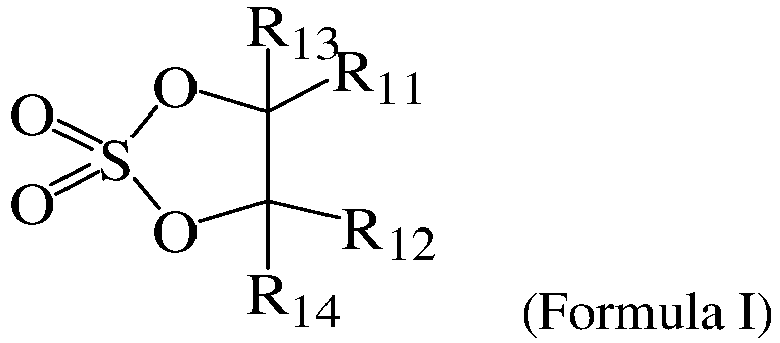
- where R11, R12, R13, and R14 are each independently selected from H, halogen, a cyano group, substituted or unsubstituted C1-20 alkyl group, substituted or unsubstituted C3-20 cycloalkyl group, substituted or unsubstituted C2-20 alkenyl group, substituted or unsubstituted C1-20 alkoxy, substituted or unsubstituted C3-20 heterocyclic group, substituted or unsubstituted C6-20 aryl group, substituted or unsubstituted C6-20 heteroaryl or -Ro-O-R group, substituted or unsubstituted sultone, substituted or unsubstituted sulfurous acid lactone, and substituted or unsubstituted sulfuric acid lactone, where the heteroatom in the heterocyclic group is at least one selected from O, S, N or P; or R11 and R12, together with the carbon atoms to which they are attached, form a 5-10 membered ring structure, wherein the ring structure optionally includes a heteroatom that is at least one selected from O, S, N or P;
- where R0 is selected from C1-6 alkylene group, R is selected from sulfonyl, methylsulfonyl, substituted or unsubstituted C1-20 alkyl group, substituted or unsubstituted C3-20 cycloalkyl group, substituted or unsubstituted C2-20 alkenyl group, substituted or unsubstituted C6-20 aryl group, or substituted or unsubstituted C6-20 heteroaryl group;
- where when R11, R12, R13, R14, and R are each independently substituted, the substituent is selected from halogen, a cyano group, sulfonyl, methylsulfonyl, C1-20 alkyl group, C3-20 cycloalkyl group, C1-20 alkoxy, C2-20 alkenyl group, C6-20 aryl group, C6-20 heteroaryl group, or any combination thereof.
- In some embodiments, R11, R12, R13, and R14 are each independently selected from:


- In some embodiments, the weight percentage of the compound of Formula I is a wt% based on the total weight of the electrolytic solution, where a is 0.001-5.
- In some embodiments, the compound of Formula I includes at least one of the following compounds:


- In some embodiments, the carboxylate compound includes the compound of Formula II:

- where R21 and R22 are each independently selected from H, halogen, a cyano group, substituted or unsubstituted C1-20 alkyl group, substituted or unsubstituted C3-20 cycloalkyl group, substituted or unsubstituted C2-20 alkenyl group, substituted or unsubstituted C1-20 alkoxy, substituted or unsubstituted C6-20 aryl group, or substituted or unsubstituted C6-20 heteroaryl group;
- where when R21 and R22 are each independently substituted, the substituent is selected from halogen, a cyano group, C1-20 alkyl group, C3-20 cycloalkyl group, C1-20 alkoxy, C2-20 alkenyl group, C6-20 aryl group, or any combination thereof.
- In some embodiments, the weight percentage of the carboxylate compound is b wt% based on the total weight of the electrolytic solution, where b is 0.05-75.
- In some embodiments, the carboxylate compound includes at least one of:


- In some embodiments, the electrolytic solution further includes the compound of Formula III:

- R31, R32, and R33 are each independently selected from substituted or unsubstituted C1-C20 alkylene group, substituted or unsubstituted C2-C20 alkenylene group, -R35-S-R36- or -R37-O-R38-, where R35, R36, R37 and R38 are each independently a single bond, substituted or unsubstituted C1-C20 alkylene group, or substituted or unsubstituted C2-C20 alkenylene group;
- R34 is selected from H, substituted or unsubstituted C1-C20 alkyl, or substituted or unsubstituted C2-C20 alkenyl;
- where when R31, R32, R33, R34, R35, R36, R37 and R38 are each independently substituted, the substituent is selected from halogen, a cyano group, C1-20 alkyl group, C3-20 cycloalkyl group, C1-20 alkoxy, C2-20 alkenyl group, C6-20 aryl group, or any combination thereof.
- In some embodiments, the weight percentage of the compound of Formula III is 0.01-5wt% based on the total weight of the electrolytic solution.
- In some embodiments, the compound of Formula III includes at least one of the following compounds:


- In some embodiments, the electrolytic solution further includes a lithium salt additive, including at least one of LiPO2F2, lithium bis(trifluoromethanesulphonyl)imide, lithium bis(fluorosulfonyl)imide, lithium bis(oxalate)borate, lithium tetrafluorophosphate xalate, lithium difluoro(oxalate)borate, or lithium hexafluorocesate.
- In some embodiments, the weight percentage of the lithium salt additive is 0.001-5wt% based on the total weight of the electrolytic solution.
- In an aspect of the present application, the present application provides an electrochemical device, which includes a cathode, having a cathode active material layer including a cathode active material; and an electrolytic solution according to an embodiment of the present application.
- In some embodiments, the electrolytic solution of the electrochemical device further includes copper ions, and the content of the copper ions is 0.01 -50 ppm based on the total weight of the electrolytic solution.
- In some embodiments, the cathode active material includes a Ti element, and the content of the Ti element is t×102 ppm based on the total weight of the cathode active material layer, where t is 2-10, and meets (a+b)/t≤35.
- In another aspect of the present application, the present application provides an electronic device, which includes an electrochemical device according to an embodiment of the present application.
- The lithium-ion battery prepared with the electrolytic solution of the present application has reduced storage impedance, and improved storage swelling, overcharge performance and hot box performance.
- Additional aspects and advantages of the embodiments of the present application will be described or shown in the following description or interpreted by implementing the embodiments of the present application.
- The embodiments of the present application will be described in detail below. The embodiments of the present application should not be interpreted as limitations to the present application.
- In the detailed description and the claims, a list of items connected by the term "one of" or similar terms may mean any of the listed items. For example, if items A and B are listed, then the phrase "one of A and B" means only A or only B. In another example, if items A, B, and C are listed, then the phrase "one of A, B and C" means only A; only B; or only C. The item A may include a single component or multiple components. The item B may include a single component or multiple components. The item C may include a single component or multiple components.
- In the detailed description and the claims, a list of items connected by the term "at least one of" or similar terms may mean any combination of the listed items. For example, if items A and B are listed, then the phrase "at least one of A and B" means only A; only B; or A and B. In another example, if items A, B and C are listed, then the phrase "at least one of A, B and C" means only A; or only B; only C; A and B (excluding C); A and C (excluding B); B and C (excluding A); or all of A, B and C. The item A may include a single component or multiple components. The item B may include a single component or multiple components. The item C may include a single component or multiple components.
- As used herein, the term "alkyl group" is intended to be a linear saturated hydrocarbon structure having 1 to 20 carbon atoms. The alkyl group is also intended to be a branched or cyclic hydrocarbon structure having 3 to 20 carbon atoms. For example, the alkyl group may be an alkyl group having 1-20 carbon atoms, an alkyl group having 1-10 carbon atoms, an alkyl group having 1-5 carbon atoms, an alkyl group having 5-20 carbon atoms, an alkyl group having 5-15 carbon atoms, or alkyl group having 5-10 carbon atoms. When an alkyl group having a specific number of carbon atoms is defined, it is intended to cover all geometric isomers having the carbon number. Therefore, for example, "butyl" means n-butyl, sec-butyl, isobutyl, tert-butyl and cyclobutyl; and "propyl" includes n-propyl, isopropyl and cyclopropyl. Examples of the alkyl group include, but are not limited to, methyl, ethyl, n-propyl, isopropyl, cyclopropyl, n-butyl, isobutyl, sec-butyl, tert-butyl, cyclobutyl, n-pentyl, isoamyl, neopentyl, cyclopentyl, methylcyclopentyl, ethylcyclopentyl, n-hexyl, isohexyl, cyclohexyl, n-heptyl, octyl, cyclopropyl, cyclobutyl, norbornanyl and so on. Additionally, the alkyl group can be optionally substituted.
- As used herein, the term "cycloalkyl group" encompasses cyclic alkyl groups. The cycloalkyl group may be a cycloalkyl group having 3 to 20 carbon atoms, a cycloalkyl group having 6 to 20 carbon atoms, a cycloalkyl group having 3 to 12 carbon atoms, or a cycloalkyl group having 3 to 6 carbon atoms. For example, the cycloalkyl group may be cyclopropyl, cyclobutyl, cyclopentyl, cyclohexyl or the like. Additionally, the cycloalkyl group can be optionally substituted.
- As used herein, the term "alkoxy" refers to a -L-O- group, where L is an alkyl group. For example, the alkoxy group may be an alkoxy group having 1-20 carbon atoms, an alkoxy group having 1-12 carbon atoms, an alkoxy group having 1-5 carbon atoms, an alkoxy group having 5-20 carbon atoms, an alkoxy group having 5-15 carbon atoms, or an alkoxy group having 5-10 carbon atoms. Additionally, the alkoxy group can be optionally substituted.
- As used herein, the term "alkenyl group" refers to a monovalent unsaturated hydrocarbyl group which may be straight or branched and which has at least one and usually 1, 2 or 3 carbon-carbon double bonds. Unless otherwise defined, the alkenyl group typically contains from 2 to 20 carbon atoms, for example an alkenyl group having 2 to 20 carbon atoms, an alkenyl group having 6 to 20 carbon atoms, an alkenyl group having 2 to 12 carbon atoms or an alkenyl group having 2 to 6 carbon atoms. Representative alkenyl groups include (for example) ethenyl, n-propenyl, iso-propenyl, n-but-2-enyl, butyl-3-enyl, n-hex-3-enyl, and the like. Additionally, the alkenyl group can be optionally substituted.
- As used herein, the term "alkylene group" means a linear or branched divalent saturated hydrocarbyl group. For example, the alkylene group may be an alkylene group having 1-20 carbon atoms, an alkylene group having 1-15 carbon atoms, an alkylene group having 1-10 carbon atoms, an alkylene group having 1-5 carbon atoms, an alkylene group having 5-20 carbon atoms, an alkylene group having 5-15 carbon atoms, or an alkylene group having 5-10 carbon atoms. Representative alkylene group includes (for example) methylene, ethane-1,2-diyl ("ethylene"), propane-1,2-diyl, propane-1,3-diyl, butane-1, 4-diyl, pentane-1,5-diyl and the like. Additionally, the alkylene group can be optionally substituted.
- As used herein, the term "alkenylene group" encompasses both linear and branched alkenylene groups. When an alkenylene group having a specific number of carbon atoms is defined, it is intended to cover all geometric isomers having the carbon number. For example, the alkenylene group may be an alkenylene group having 2-20 carbon atoms, an alkenylene group having 2-15 carbon atoms, an alkenylene group having 2-10 carbon atoms, an alkenylene group having 2-5 carbon atoms, an alkenylene group having 5-20 carbon atoms, an alkenylene group having 5-15 carbon atoms, or an alkenylene group having 5-10 carbon atoms. Representative alkenylene group includes (for example) ethenylene, propenylene, butenylene and the like. Additionally, the alkenylene group can be optionally substituted.
- As used herein, the term "heterocyclic group" encompasses both aromatic and non-aromatic cyclic groups. Heteroaromatic cyclic groups also mean heteroaryl groups. In some embodiments, the heteroaromatic cyclic group and hetero-non-aromatic cyclic group include a C3-C20 heterocyclic group, C3-C150 heterocyclic group, C3-C10 heterocyclic group, C5-C20 heterocyclic group, C5-C10 heterocyclic group, or a C3-C6 heterocyclic group having at least one heteroatom. For example, morpholinyl, piperidinyl, pyrrolidinyl, and cyclic ethers, for example, tetrahydrofuran, tetrahydropyran, and the like. Additionally, the heterocyclic group can be optionally substituted.
- As used herein, the term "aryl group" encompasses both monocyclic and polycyclic systems. A polycyclic ring may have two or more rings where two carbons are shared by two adjacent rings (where the rings are "fused"), where at least one of the rings is aromatic and other rings may be for example, a cycloalkyl group, a cycloalkenyl group, an aryl group, a heterocyclic group and/or a heteroaryl group. For example, the aryl group may be a C6-C50 aryl group, a C6-C40 aryl group, a C6-C30 aryl group, a C6-C20 aryl group, or a C6-C10 aryl group. Representative aryl group includes (for example) phenyl, methylphenyl, propylphenyl, isopropylphenyl, benzyl and naphthalen-1-yl, naphthalen-2-yl and the like. Additionally, the aryl group can be optionally substituted.
- As used herein, the term "heteroaryl group" encompasses a monocyclic heteroaromatic group which may include one to three heteroatoms, for example, pyrrole, furan, thiophene, imidazole, oxazole, thiazole, triazole, pyrazole, pyridine, pyrazine, pyrimidine, and the like. The term heteroaryl group also includes a polycyclic heteroaromatic system having two or more rings in which two atoms are shared by two adjacent rings (where the ring is "fused"), in which at least one of the rings is a heteroaryl group, and other rings may be a cycloalkyl group, a cycloalkenyl group, an aryl group, a heterocyclic group and/or a heteroaryl group. The heteroatom in the heteroaryl group may be for example O, S, N, Se, and so on. For example, the heteroaryl group may be C3-C50 heteroaryl, C3-C40 heteroaryl, C3-C30 heteroaryl, C3-C20 heteroaryl, or C3-C10 heteroaryl. Additionally, the heteroaryl group can be optionally substituted.
- As used herein, the term "dinitrile compound" refers to the compound having two -CN functional groups.
- As used herein, the term "heteroatom" encompasses O, S, P, N, B or their isosteres.
- As used herein, the term "halogen" encompasses F, Cl, Br or I.
- When the above substituents are substituted, their substituents are each independently selected from the group consisting of halogen, an alkyl group, an alkenyl group, and an aryl group.
- As used herein, the term "substituted" means substitution with one or more (e.g., 2, 3) substituents.
- As used herein, the content of each component is calculated based on the total weight of the electrolytic solution.
- In some embodiments, the present application provides an electrolytic solution, which includes the compound of Formula I and a carboxylate compound:

- where R11, R12, R13, and R14 are each independently selected from H, halogen, a cyano group, substituted or unsubstituted C1-20 alkyl group, substituted or unsubstituted C3-20 cycloalkyl group, substituted or unsubstituted C2-20 alkenyl group, substituted or unsubstituted C1-20 alkoxy, substituted or unsubstituted C3-20 heterocyclic group, substituted or unsubstituted C6-20 aryl, substituted or unsubstituted C6-20 heteroaryl or -R0-O-R group, substituted or unsubstituted sultone, substituted or unsubstituted sulfurous acid lactone, and substituted or unsubstituted sulfuric acid lactone, where the heteroatom in the heterocyclic group is at least one selected from O, S, N or P; or R11 and R12, together with the carbon atoms to which they are attached, form a 5-10 membered ring structure, where the ring structure optionally includes a heteroatom that is at least one selected from O, S, N or P, where the ring structure may be a saturated or unsaturated structure;
- where R0 is selected from C1-6 alkylene group, R is selected from sulfonyl, methylsulfonyl, substituted or unsubstituted C1-20 alkyl group, substituted or unsubstituted C3-20 cycloalkyl group, substituted or unsubstituted C2-20 alkenyl group, substituted or unsubstituted C6-20 aryl group, or substituted or unsubstituted C6-20 heteroaryl group;
- where when R11, R12, R13, R14, and R are each independently substituted, the substituent is selected from halogen, a cyano group, sulfonyl, methylsulfonyl, C1-20 alkyl group, C3-20 cycloalkyl group, C1-20 alkoxy, C2-20 alkenyl group, C6-20 aryl group, C6-20 heteroaryl group, or any combination thereof.
- In some embodiments, R11, R12, R13, and R14 are each independently selected from:


- R11 and R12, together with the carbon atoms to which R11 and R12 are attached,
- form

- In some embodiments, the weight percentage of the compound of Formula I is a wt% based on the total weight of the electrolyte solution, where a is 0.001-5. In some embodiments, the weight percentage of the compound of Formula I is 0.001wt%, 0.005wt%, 0.01wt%, 0.05wt%, 0.1wt%, 0.15wt%, 0.2wt%, 0.3wt%, 0.4wt%, 0.5wt%, 0.6wt%, 0.7wt%, 0.8wt%, 1wt%, 2wt%, 3wt%, 3.5wt%, 4wt%, 4.5wt%, 5wt%, or within a range consisting of any two of these values, based on the total weight of the electrolyte solution. When the weight percentage of the compound of Formula I within this range, the compound of Formula I can form a better protective film, which can more effectively prevent the side reaction between the electrolyte solution and the cathode or anode.
- In some embodiments, the compound of Formula I includes at least one of the following compounds or is at least one selected from the following compounds:


- The combination of the compound of Formula I and the fluorinated carboxylate can fully exert the stability of the organic protective film and the oxidation resistance of the electrolytic solution, and can effectively improve the hot box and overcharge performance. The detailed mechanism underlying this effect is unknown, and may be considered as follows: the compound of Formula I and the fluorinated carboxylate work together to improve the oxidation resistance of the electrolytic solution system. This is more conducive to the film formation from the additives on the cathode and anode, thereby effectively protecting the active material. As the temperature rises, the protection of the organic protective film for the active material will be gradually weakened. The compound of Formula I and the fluorinated carboxylate work together to effectively reduce chemical heat production and improve the safety of the electrochemical device.
- In some embodiments, the carboxylate compound includes or is selected from the compound of Formula II:

- where R21 and R22 are each independently selected from H, halogen, a cyano group, substituted or unsubstituted C1-20 alkyl group, substituted or unsubstituted C3-20 cycloalkyl group, substituted or unsubstituted C2-20 alkenyl group, substituted or unsubstituted C1-20 alkoxy, substituted or unsubstituted C6-20 aryl group, or substituted or unsubstituted C6-20 heteroaryl group;
- where when R21 and R22 are each independently substituted, the substituent is selected from halogen, a cyano group, C1-20 alkyl group, C3-20 cycloalkyl group, C1-20 alkoxy, C2-20 alkenyl group, C6-20 aryl group, or any combination thereof.
- In some embodiments, the weight percentage of the carboxylate compound is b wt% based on the total weight of the electrolytic solution, where b is 0.05-75. In some embodiments, the weight percentage of the carboxylate compound is 0.05wt%, 0.1wt%, 0.5wt%, 1wt%, 3wt%, 5wt%, 10wt%, 15wt%, 20wt%, 25wt%, 30wt%, 35wt%, 40wt%, 45wt%, 50wt%, 55wt%, 55wt%, 60wt%, 65wt%, 70wt%, 75wt%, or within a range consisting of any two of these values, based on the total weight of the electrolytic solution. When the weight percentage of the carboxylate is within this range, the electrochemical device has better overcharge performance and hot box performance.
- In some embodiments, the carboxylate compound includes at least one of the following compounds or is at least one selected from the following compounds:


- In some embodiments, the electrolytic solution further includes the compound of Formula III:

- R31, R32, and R33 are each independently selected from substituted or unsubstituted C1-C20 alkylene group, substituted or unsubstituted C2-C20 alkenylene group, -R35-S-R36- or -R37-O-R38-, where R35, R36, R37 and R38 are each independently a single bond, substituted or unsubstituted C1-C20 alkylene group, or substituted or unsubstituted C2-C20 alkenylene group;
- R34 is selected from H, substituted or unsubstituted C1-C20 alkyl group, or substituted or unsubstituted C2-C20 alkenyl group;
- where when R31, R32, R33, R34, R35, R36, R37 and R38are each independently substituted, the substituent is selected from halogen, a cyano group, C1-20 alkyl group, C3-20 cycloalkyl group, C1-20 alkoxy, C2-20 alkenyl group, C6-20 aryl group, or any combination thereof.
- The compound of Formula I, the carboxylate compound and the compound of Formula III work together to further improve the overcharge performance of the electrochemical device and also improve the swelling problem during high-temperature storage of the electrochemical device. The detailed mechanism underlying this effect is unknown, it can be considered as follows: the compound of Formula I, the carboxylate compound and the compound of Formula III work together to further reduce the risk of oxidation of the electrolytic solution, and also improve the protection for the cathode and reduce the direct contact between the cathode active material interface with the electrolytic solution, thereby alleviating the swelling caused by the contact between the electrolytic solution and the cathode active material during high-temperature storage.
- In some embodiments, the weight percentage of the compound of Formula III is 0.01-5wt% based on the total weight of the electrolytic solution. In some embodiments, the weight percentage of the compound of Formula III is 0.01wt%, 0.05wt%, 0.1wt%, 0.5wt%, 1wt%, 1.5wt%, 2wt%, 2.5wt%, 3wt%, 3.5wt%, 4wt%, 4.5wt%, 5wt%, or within a range consisting of any two of these values, based on the total weight of the electrolytic solution. When the weight percentage of the compound of Formula III is within this range, a better overcharge performance and high-temperature storage performance can be achieved.
- In some embodiments, the compound of Formula III includes at least one of the following compounds or is at least one selected from the following compounds:


- In some embodiments, the electrolytic solution further includes a lithium salt additive, including at least one of LiPO2F2, lithium bis(trifluoromethanesulphonyl)imide, lithium bis(fluorosulfonyl)imide, lithium bis(oxalate)borate, tetrafluorophosphate xalate, lithium difluoro(oxalate)borate, or lithium hexafluorocesate.
- In some embodiments, the weight percentage of the lithium salt additive is about 0.001-5wt% based on the total weight of the electrolytic solution. In some embodiments, the weight percentage of the lithium salt additive is 0.001wt%, 0.005wt%, 0.01wt%, 0.05wt%, 0.1wt%, 0.5wt%, 1wt%, 1.5wt%, 1.5wt%, 2wt%, 2.5wt%, 3wt%, 3.5wt%, 4wt%, 4.5wt%, 5wt%, or within a range consisting of any two of these values, based on the total weight of the electrolytic solution.
- In some embodiments, the electrolytic solution further includes a dinitrile compound. Due to the low steric hindrance, the dinitrile compound can make up the film formation deficiency of the compound of Formula III and enhance the interface protection for the cathode active material.
- In some embodiments, the dinitrile compound includes, but is not limited to: succinonitrile, glutaronitrile, adiponitrile, 1,5-dicyanopentane, 1,6-dicyanohexane, 1,7-dicyanoheptane, 1,8-dicyanooctane, 1,9-dicyanononane, 1,10-dicyanodecane, 1,12-dicyanododecane, tetramethylsuccinonitrile, 2-methylglutaronitrile, 2,4-dimethylglutaronitrile, 2,2,4,4-tetramethylglutaronitrile, 1,4-dicyanopentane, 1,4-dicyanopentane, 2,5-dimethyl-2,5-hexane dicarbonitrile, 2,6-dicyanoheptane, 2,7-dicyanooctane, 2,8-dicyanononane, 1,6-dicyanodecane, 1,2-dicyanobenzene, 1,3-dicyanobenzene, 1,4-dicyanobenzene, 3,5-dioxa-pimelonitrile, 1,4-bis(cyanoethoxy)butane, ethylene glycol bis(2-cyanoethyl)ether, diethylene glycol bis(2-cyanoethyl)ether, triethylene glycol bis(2-cyanoethyl)ether, tetraethylene glycol bis(2-cyanoethyl)ether, 3,6,9,12,15,18-hexaoxaeicosoic acid dinitrile, 1,3-bis(2-cyanoethoxy)propane, 1,4-bis(2-cyanoethoxy)butane, 1,5-bis(2-cyanoethoxy)pentane, ethylene glycol bis(4-cyanobutyl)ether, 1,4-dicyano-2-butene, 1,4-dicyano-2-methyl-2-butene, 1,4-dicyano-2-ethyl-2-butene, 1,4-dicyano-2,3-dimethyl-2-butene, 1,4-dicyano-2,3-diethyl-2-butene, 1,6-dicyano-3-hexene, 1,6-dicyano-2-methyl-3-hexene, or 1,6-dicyano-2-methyl-5-methyl-3-hexene.
- In some embodiments, the weight percentage of the dinitrile compound is 0.1-15wt% based on the total weight of the electrolytic solution. In some embodiments, the weight percentage of the dinitrile compound is no less than 0.1wt% based on the total weight of the electrolytic solution. In some embodiments, the weight percentage of the dinitrile compound is no less than 0.5wt% based on the total weight of the electrolytic solution. In some embodiments, the weight percentage of the dinitrile compound is no less than 2wt% based on the total weight of the electrolytic solution. In some embodiments, the weight percentage of the dinitrile compound is no less than 4wt% based on the total weight of the electrolytic solution. In some embodiments, the weight percentage of the dinitrile compound is not greater than 15wt% based on the total weight of the electrolytic solution. In some embodiments, the weight percentage of the dinitrile compound is not greater than 10wt% based on the total weight of the electrolytic solution. In some embodiments, the weight percentage of the dinitrile compound is not greater than 8wt% based on the total weight of the electrolytic solution.
- In some embodiments, the electrolytic solution further includes a cyclic ether. The cyclic ether can form a film on both the cathode and the anode, reducing the reaction between the electrolytic solution and the active material.
- In some embodiments, the cyclic ether includes, but is not limited to, tetrahydrofuran, 2-methyltetrahydrofuran, 1,3-dioxolane, 2-methyl1,3-dioxolane, 4-methyl1,3-dioxolane, 1,3-dioxane, 1,4-dioxane and dimethoxypropane.
- In some embodiments, the weight percentage of the cyclic ether is 0.1-10wt% based on the total weight of the electrolytic solution. In some embodiments, the weight percentage of the cyclic ether is no less than 0.1wt% based on the total weight of the electrolytic solution. In some embodiments, the weight percentage of the cyclic ether is no less than 0.5wt% based on the total weight of the electrolytic solution. In some embodiments, the weight percentage of the cyclic ether is not greater than 2wt% based on the total weight of the electrolytic solution. In some embodiments, the weight percentage of the cyclic ether is not greater than 5wt% based on the total weight of the electrolytic solution.
- In some embodiments, the electrolytic solution further includes a chain ether. In some embodiments, the chain ether includes, but is not limited to, dimethoxymethane, 1,1-dimethoxyethane, 1,2-dimethoxyethane, diethoxymethane, 1,1-diethoxyethane, 1,2-di ethoxyethane, ethoxymethoxymethane, 1,1-ethoxymethoxyethane and 1,2-ethoxymethoxyethane.
- In some embodiments, the weight percentage of the chain ether is 0.1-10wt% based on the total weight of the electrolytic solution. In some embodiments, the weight percentage of the chain ether is no less than 0.5wt% based on the total weight of the electrolytic solution. In some embodiments, the weight percentage of the chain ether is no less than 2wt% based on the total weight of the electrolytic solution. In some embodiments, the weight percentage of the chain ether is no less than 3wt% based on the total weight of the electrolytic solution. In some embodiments, the weight percentage of the chain ether is not greater than 10wt% based on the total weight of the electrolytic solution. In some embodiments, the weight percentage of the chain ether is not greater than 5wt% based on the total weight of the electrolytic solution.
- In some embodiments, the electrolytic solution further includes a phosphorus containing organic solvent. In some embodiments, the phosphorus containing organic solvent includes, but is not limited to, trimethyl phosphate, triethyl phosphate, dimethyl ethyl phosphate, methyl diethyl phosphate, ethylene methyl phosphate, ethylene ethyl phosphate, triphenyl phosphate, trimethyl phosphite, triethyl phosphite, triphenyl phosphite, tris(2,2,2-trifluoroethyl) phosphate and tris(2,2,3,3,3-pentafluoropropyl) phosphate.
- In some embodiments, the weight percentage of the phosphorus containing organic solvent is 0.1-10wt% based on the total weight of the electrolytic solution. In some embodiments, the weight percentage of the phosphorus containing organic solvent is no less than 0.1wt% based on the total weight of the electrolytic solution. In some embodiments, the weight percentage of the phosphorus containing organic solvent is no less than 0.5wt% based on the total weight of the electrolytic solution. In some embodiments, the weight percentage of the phosphorus containing organic solvent is not greater than 2wt% based on the total weight of the electrolytic solution. In some embodiments, the weight percentage of the phosphorus containing organic solvent is not greater than 3wt% based on the total weight of the electrolytic solution. In some embodiments, the weight percentage of the phosphorus containing organic solvent is not greater than 5wt% based on the total weight of the electrolytic solution.
- In some embodiments, the electrolytic solution further includes an aromatic fluorine-containing organic solvent. The aromatic fluorine-containing solvent can quickly form a film to protect the active material, and the fluorine-containing substance can improve the infiltration of the electrolytic solution to the active material. In some embodiments, the aromatic fluorine-containing organic solvent includes, but is not limited to, fluorobenzene, difluorobenzene, trifluorobenzene, tetrafluorobenzene, pentafluorobenzene, hexafluorobenzene, and trifluoromethylbenzene.
- In some embodiments, the weight percentage of the aromatic fluorine-containing solvent is about 0.1-10wt% based on the total weight of the electrolytic solution. In some embodiments, the weight percentage of the aromatic fluorine-containing solvent is no less than 0.5wt% based on the total weight of the electrolytic solution. In some embodiments, the weight percentage of the aromatic fluorine-containing solvent is no less than 2wt% based on the total weight of the electrolytic solution. In some embodiments, the weight percentage of the aromatic fluorine-containing solvent is not greater than 4wt% based on the total weight of the electrolytic solution. In some embodiments, the weight percentage of the aromatic fluorine-containing solvent is not greater than 8wt% based on the total weight of the electrolytic solution.
- The electrolyte used in the electrolyte solution according to the embodiments of the present application may be an electrolyte known in the prior art, including, but not limited to, an inorganic lithium salt, such as LiClO4, LiAsF6, LiPF6, LiBF4, LiSbF6, LiSO3F, and LiN(FSO2)2; a fluorine-containing organic lithium salt, such as LiCF3SO3, LiN(FSO2)(CF3SO2), LiN(CF3SO2)2, LiN(C2F5SO2)2, cyclic lithium 1,3-hexafluoropropane disulfonimide, cyclic lithium 1,2-tetrafluoroethane disulfonimide, LiN(CF3SO2)(C4F9SO2), LiC(CF3SO2)3, LiPF4(CF3)2, LiPF4(C2F5)2, LiPF4(CF3SO2)2, LiPF4(C2F5SO2)2, LiBF2(CF3)2, LiBF2(C2F5)2, LiBF2(CF3SO2)2, and LiBF2(C2F5SO2)2; and a lithium salt containing a dicarboxylic acid complex, such as lithium bis(oxalato)borate, lithium difluoro(oxalato)borate, lithium tris(oxalato)phosphate, lithium difluorobis(oxalato)phosphate, and lithiumtetrafluoro(oxalato)phosphate. Additionally, the electrolytic solution may be used alone or in combination of two or more thereof. For example, in some embodiments, the electrolytic solution includes a combination of LiPF6 and LiBF4. In some embodiments, the electrolytic solution includes a combination of an inorganic lithium salt such as LiPF6 or LiBF4 and a fluorine-containing organic lithium salt such as LiCF3SO3, LiN(CF3SO2)2, and LiN(C2F5SO2)2. In some embodiments, the concentration of the electrolytic solution is in the range of 0.8-3 mol/L, for example, 0.8-2.5 mol/L, 0.8-2 mol/L, 1-2 mol/L, 0.5-1.5 mol/L, 0.8-1.3 mol/L, 0.5-1.2 mol/L, such as 1 mol/L, 1.15mol/L, 1.2mol/L, 1.5mol/L, 2mol/L or 2.5mol/L.
- The electrochemical device of the present application includes any device where an electrochemical reaction takes place, and specific examples include all kinds of primary batteries, secondary batteries, fuel cells, solar cells, or capacitors. In particular, the electrochemical device is a lithium secondary battery including a lithium metal secondary battery, a lithium ion secondary battery, a lithium polymer secondary battery or a lithium ion polymer secondary battery. In some embodiments, the electrochemical device of the present application is an electrochemical device having a cathode having a cathode active material capable of absorbing and releasing metal ions; an anode having an anode active material capable of absorbing and releasing metal ions, and characterized by including an electrolytic solution according to any embodiment of the present application.
- The electrolytic solution used in the electrochemical device of the present application is an electrolytic solution according to any embodiment of the present application.
- In some embodiments, the electrolytic solution of the electrochemical device according to the present application further includes copper ions, and the content of the copper ions is 0.01 -50 ppm based on the total weight of the electrolytic solution. In some embodiments, the content of copper ions is 0.01 ppm, 0.05 ppm, 0.1 ppm, 0.5 ppm, 1 ppm, 2 ppm, 3 ppm, 4 ppm, 5 ppm, 7 ppm, 10 ppm, 15 ppm, 20 ppm, 25 ppm, 30 ppm, 35 ppm, 40 ppm, 45 ppm, 50 ppm, or within a range consisting of any two of these values, based on the total weight of the electrolytic solution.
- Moreover, the electrolytic solution used in the electrochemical device of the present application may include other electrolytic solutions falling within the scope of present application.
- The anode material used in the electrochemical device of the present application, and the construction and manufacturing methods therefor are not particularly limited, and may be any of the techniques disclosed in the prior art. In some embodiments, the anode may be one described in
US9812739B - In some embodiments, the anode includes a current collector and an anode active material layer on the current collector. The anode active material includes a material that reversibly intercalates/deintercalates lithium ions. In some embodiments, the material that reversibly intercalates/deintercalates lithium ions includes a carbon material. In some embodiments, the carbon material may be any carbon-based anode active material commonly used in lithium ion rechargeable batteries. In some embodiments, the carbon material includes, but is not limited to, crystalline carbon, amorphous carbon, or a mixture thereof. The crystalline carbon may be amorphous or flake -shaped, small flake-shaped, spherical or fibrous natural graphite or artificial graphite. The amorphous carbon may be soft carbon, hard carbon, mesophase pitch carbide, calcined coke, and the like.
- In some embodiments, the anode active material layer includes an anode active material. In some embodiments, the anode active material includes, but is not limited to, lithium metal, structured lithium metal, natural graphite, artificial graphite, mesocarbon microbead (MCMB), hard carbon, soft carbon, silicon, silicon-carbon composite, Li-Sn alloy, Li-Sn-O alloy, Sn, SnO, SnO2, lithiated TiO2-Li4Ti5O12 having spinel structure, Li-Al alloy and any combination thereof.
- When the anode includes a silicon-carbon compound, based on the total weight of the anode active material, silicon:carbon=1:10-10:1, and the median diameter D50 of the silicon-carbon compound is 0.1 µm-100 µm. When the anode includes an alloy material, an anode active material layer can be formed by vapor deposition, sputtering, or plating. When the anode includes lithium metal, an anode active material layer is formed by for example a conductive skeleton of twisted spherical shape and metal particles dispersed in the conductive skeleton. In some embodiments, the conductive skeleton of twisted spherical shape may have a porosity of 5% to 85%. In some embodiments, a protective layer may be further disposed on the anode active material layer of lithium metal.
- In some embodiments, the anode active material layer includes a binder, and optionally a conductive material. The binder increases the binding of the anode active material particles to each other and the binding of the anode active material to the current collector. In some embodiments, the binder includes, but is not limited to, polyvinyl alcohol, carboxymethyl cellulose, hydroxypropyl cellulose, diacetyl cellulose, polyvinyl chloride, carboxylated polyvinyl chloride, polyvinyl fluoride, a polymer containing ethylene oxide, polyvinylpyrrolidone, polyurethane, polytetrafluoroethylene, poly(1,1-vinylidene fluoride), polyethylene, polypropylene, styrene butadiene rubber, acrylated styrene butadiene rubber, epoxy resins, Nylon and so on.
- In some embodiments, the conductive material includes, but is not limited to, a carbon based material, a metal based material, a conductive polymer, or a mixture thereof. In some embodiments, the carbon-based material is selected from natural graphite, artificial graphite, carbon black, acetylene black, Ketjen black, carbon fiber, or any combinations thereof. In some embodiments, the metal based material is selected from metal powders, metal fibers, copper, nickel, aluminum, and silver. In some embodiments, the conductive polymer is a polyphenylene derivative.
- In some embodiments, the current collector include, but is not limited to, copper foil, nickel foil, stainless steel foil, titanium foil, foamed nickel, foamed copper, polymeric substrates coated with a conductive metal, and any combinations thereof.
- The anode can be produced by a production method well known in the art. For example, the anode can be obtained by mixing an active material, a conductive material and a binder in a solvent to prepare an active material composition, and coating the active material composition on a current collector. In some embodiments, the solvent may include, but is not limited to, water.
- The cathode material used in the electrochemical device of the present application can be prepared using materials, construction and manufacturing methods well known in the art. In some embodiments, the cathode of the present application can be prepared using the technique described in
US9812739B - In some embodiments, the cathode includes a current collector and a cathode active material layer on the current collector. The cathode active material includes at least one lithiated intercalation compound that reversibly intercalates and deintercalates lithium ions. In some embodiments, the cathode active material includes a composite oxide. In some embodiments, the composite oxide contains lithium and at least one element selected from the group consisting of cobalt, manganese, and nickel.
- In some embodiments, the cathode active material is selected from lithium cobalt oxide (LiCoO2), lithium nickel cobalt manganese (NCM) ternary material, lithium iron phosphate (LiFePO4), lithium manganese oxide (LiMn2O4) or any combinations thereof.
- In some embodiments, the cathode active material may have a coating on its surface or may be mixed with another compound having a coating. The coating may include at least one coating element compound selected from the group consisting of an oxide of a coating element, a hydroxide of a coating element, an oxyhydroxide of a coating element, an oxycarbonate of a coating element, and a hydroxycarbonate of a coating element. The compound used for the coating may be amorphous or crystalline.
- In some embodiments, the coating element contained in the coating may include Mg, Al, Co, K, Na, Ca, Si, V, Sn, Ge, Ga, B, As, Zr, F or any combinations thereof. The coating can be applied by any method as long as the method does not adversely affect the performance of the cathode active material. For example, the method may include any coating method known in the art, such as spraying, dipping, and others.
- In some embodiments, the cathode active material includes a Ti element, and the content of the Ti element is t×102 ppm based on the total weight of the cathode active material layer, where t is 2-10, and meets (a+b)/t≤35.
- In some embodiments, t is 2, 3, 4, 5, 6, 7, 8, 9, 10 or in a range consisting of any two of these values.
- In some embodiments, (a+b)/t is 35, 30, 25, 20, 15, 10, 15, 10, 5, 1, 0.5, 0.4, 0.3, or within a range consisting of any two of these values.
- In some embodiments, the cathode active material layer further includes a binder, and optionally a conductive material. The binder increases the binding of the cathode active material particles to each other and the binding of the cathode active material to the current collector.
- In some embodiments, the binder includes, but is not limited to, polyvinyl alcohol, hydroxypropyl cellulose, diacetyl cellulose, polyvinyl chloride, carboxylated polyvinyl chloride, polyvinyl fluoride, a polymer containing ethylene oxide, polyvinylpyrrolidone, polyurethane, polytetrafluoroethylene, poly(1,1-vinylidene fluoride), polyethylene, polypropylene, styrene butadiene rubber, acrylated styrene butadiene rubber, epoxy resins, Nylon and so on.
- In some embodiments, the conductive material includes, but is not limited to, a carbon based material, a metal based material, a conductive polymer, and a mixture thereof. In some embodiments, the carbon-based material is selected from natural graphite, artificial graphite, carbon black, acetylene black, Ketjen black, carbon fiber, or any combinations thereof. In some embodiments, the metal based material is selected from metal powders, metal fibers, copper, nickel, aluminum, and silver. In some embodiments, the conductive polymer is a polyphenylene derivative.
- In some embodiments, the current collector may be, but is not limited to, aluminum.
- The cathode can be prepared by a preparation method well known in the art. For example, the cathode can be obtained by mixing an active material, a conductive material and a binder in a solvent to prepare an active material composition, and coating the active material composition on a current collector. In some embodiments, the solvent may include, but is not limited to, N-methylpyrrolidone or the like.
- In some embodiments, the cathode is prepared by forming a cathode material with a cathode active material layer including a lithium-transition metal compound powder and a binder on a current collector.
- In some embodiments, the cathode active material layer can generally be produced by dry mixing a cathode material and a binder (and a conductive material and a thickener if needed) to form flakes, and pressing the obtained flakes on a cathode current collector; or dissolving or dispersing the material in a liquid medium to form a slurry, coating the slurry on a cathode current collector, and drying. In some embodiments, the material of the cathode active material layer includes any material known in the art.
- In some embodiments, the electrochemical device of the present application is provided with a separator between the cathode and the anode to prevent short circuit. The material and shape of the separator used in the electrochemical device of the present application are not particularly limited, and may be any of the techniques disclosed in the prior art. In some embodiments, the separator includes a polymer or an inorganic substance or the like formed of a material which is stable against the electrolytic solution of the present application.
- For example, the separator may include a substrate layer and a surface treatment layer. The substrate layer is a non-woven fabric, film, or composite film having a porous structure, and the material of the substrate layer is at least one selected from the group consisting of polyethylene, polypropylene, polyethylene terephthalate, and polyimide. Particularly, a porous polypropylene film, a porous polyethylene film, a polypropylene nonwoven fabric, a polyethylene nonwoven fabric, and a porous polypropylene-polyethylene-polypropylene composite film may be used.
- At least one surface of the substrate layer is provided with a surface treatment layer, which may be a polymer layer or an inorganic layer, or a layer formed by mixing a polymer and an inorganic material. The ratio of the thickness of the substrate layer to the thickness of the surface treatment layer is 1:1 to 20:1, the thickness of the substrate layer is 4 to 14 µm, and the thickness of the surface treatment layer is 1 to 5 µm.
- The inorganic layer includes inorganic particles and a binder. The inorganic particles are at least one selected from the group consisting of alumina, silica, magnesia, titania, hafnium dioxide, tin oxide, cerium dioxide, nickel oxide, zinc oxide, calcium oxide, zirconia, yttria, silicon carbide, eboehmite, aluminum hydroxide, magnesium hydroxide, calcium hydroxide and barium sulfate, or a combination of more than one thereof. The binder is one selected from the group consisting of polyvinylidene fluoride, a copolymer of vinylidene fluoride-hexafluoropropylene, a polyamide, polyacrylonitrile, a polyacrylate ester, polyacrylic acid, a polyacrylate salt, polyvinylpyrrolidone, polyvinyl ether, polymethyl methacrylate, polytetrafluoroethylene, and polyhexafluoropropylene, or a combination of more than one thereof. The polymer layer contains a polymer, and the material of the polymer includes at least one of a polyamide, polyacrylonitrile, a polyacrylate ester, polyacrylic acid, a polyacrylate salt, polyvinylpyrrolidone, polyvinyl ether, polyvinylidene fluoride or poly (vinylidene fluoride-hexafluoropropylene).
- The electrolytic solution according to the embodiments of the present application can be used to reduce the storage impedance of the battery, the capacity retention rate after storage at normal temperature, the cycle and high-temperature storage performance, the overcharge performance, and the hot box performance, and is thus applicable to an electronic device including an electrochemical device.
- The use of the electrochemical device according to the present application is not particularly limited, and can be used in various known applications, such as notebook computers, pen-input computers, mobile computers, e-book players, portable phones, portable fax machines, portable copiers, portable printers, head-mounted stereo headphones, video recorders, LCD TVs, portable cleaners, portable CD players, minidisc players, transceivers, electronic notebooks, calculators, memory cards, portable recorders, radios, backup power sources, motors, vehicles, motorcycles, scooters, bicycles, lighting apparatus, toys, game consoles, clocks, electric tools, flash lights, cameras, large batteries for household use, or lithium ion capacitors.
- Hereinafter, a lithium ion battery is taken as an example and the preparation and performance of a lithium ion battery according to the present application is described in conjunction with specific examples of preparing the electrolytic solution of the present application and methods for testing the electrochemical device. Those skilled in the art will understand that the preparation methods described in the present application are merely exemplary, and any other suitable preparation methods also fall within the protection scope of the present application.
- Although a lithium ion battery is exemplified above, other suitable electrochemical devices that the cathode material of the present application can be used therewith may occur to those skilled in the art after reading this application. Such electrochemical devices include any device in which an electrochemical reaction takes place, and specific examples include all kinds of primary batteries, secondary batteries, fuel cells, solar cells, or capacitors. In particular, the electrochemical device is a lithium secondary battery including a lithium metal secondary battery, a lithium ion secondary battery, a lithium polymer secondary battery or a lithium ion polymer secondary battery.
- Hereinafter, the present application will be specifically described by way of examples and comparative examples; however, the present application is not limited thereto as long as they do not deviate from the spirit of the present application.
- In a glove box under an argon atmosphere with a moisture content of < 10 ppm, ethylene carbonate (EC), diethyl carbonate (DEC), and propylene carbonate (PC) were mixed uniformly according to a weight ratio of 3:4:3. Then a sufficiently dried lithium salt LiPF6 was dissolved in the mixed solvent, to obtain a basic electrolytic solution where the concentration of LiPF6 was 1 mol/L. Different amounts of materials shown in the Tables below were added to the basic electrolytic solution to obtain the electrolytic solutions of various examples and comparative examples. The weight percentages of each substance in the electrolytic solution described below were calculated based on the total weight of the electrolytic solution.
- Examples of the compound of Formula I include:


- Examples of the carboxylate compound include:


- Examples of the compound of Formula III include:

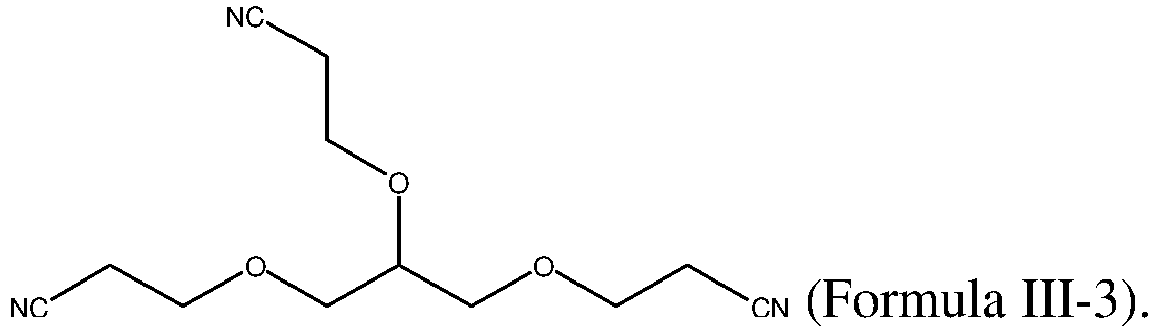
- The cathode active material lithium cobalt oxide (molecular formula being LiCoO2) containing the Ti element, acetylene black, and the binder polyvinylidene fluoride (PVDF) were fully stirred and mixed in a suitable amount of N-methylpyrrolidone (NMP) as a solvent according to a weight ratio of 96:2:2, to form a uniform cathode slurry. The slurry was coated on a current collector Al foil of the cathode, dried, and cold-pressed to obtain a cathode active material layer. After cutting and welding with a tab, a cathode was obtained. The cathode active material lithium cobalt oxide contains a Ti element. Unless otherwise particularly specified, in the following examples and comparative examples, the content of the Ti element is 400 ppm based on the total weight of the cathode active material layer.
- The following example illustrates the preparation method of a cathode active material lithium cobalt oxide containing a Ti element, wherein the content of the Ti element is 400 ppm based on the total weight of the cathode active material layer: CoCl2 and TiCl4 were respectively formulated into an aqueous solution, and mixed according to a molar ratio of 1:n (0≤n≤0.00081787) of active substances. A NH3·HCO3 solution was added to adjust the pH of mixture to 10.5, and a precipitate was obtained. The obtained precipitate was calcined at 400°C for 5 hr to obtain Co3O4 containing a Ti element. The obtained Co3O4 was mixed uniformly with Li2CO3 according to a molar ratio of 2:3.15, and calcined at 1000°C for 8 hrs to obtain LiCoO2. TiO2 was added to the obtained LiCoO2 according to a molar ratio of 1:(0.00081787-n), mixed uniformly, and sintered at 800°C for 8 hr to obtain the cathode active material lithium cobalt oxide (LiCoO2) containing the Ti element.
- The anode active material graphite, the conductive agent acetylene black, the binder styrene-butadiene rubber (SBR), and the thickener carboxymethylcellulose sodium (CMC) were fully mixed and stirred according to a weight ratio of 95:2:2:1 in a suitable amount of deionized water as a solvent to form a uniform anode slurry. The slurry was coated on an anode current collector Cu foil, dried, and cold pressed to obtain an anode active material layer. After cutting and welding with a tab, an anode was obtained.
- 4) Separator: a 7.5-8.5 µm polyethylene (PE) porous polymer film was used as a substrate. The substrate had an Al2O3 particle layer thereon, and the thickness of the Al2O3 particle layer was 2-4 µm.
- 5) Preparation of the lithium ion battery: The cathode, the separator, and the anode were laminated in order such that the separator was placed between and served to separate the cathode and the anode. Then, the system was wound up, and placed in an outer packaging foil. The electrolyte solution prepared above was injected into the dried battery, and after vacuum packaging, standing, formation, shaping, and other procedures, the preparation of the lithium ion battery was completed. The electrolyte solution of the lithium ion battery contains Cu ions. Unless otherwise particularly specified, the content of the Cu ions in the following examples and comparative examples is 4 ppm.
- The battery was discharged to 3.0 V at a current of 0.5 C, allowed to stand for 5 min, then charged to 6.5 V at a current of 3 C, and charged for 1 hr at a constant voltage of 6.5 V. The battery passed the test if no fire or explosion occurred. Five batteries in each Example or Comparative Example were tested, and the number of batteries that passed the test was recorded.
- The battery was discharged to 3.0 V at a current of 0.5 C, allowed to stand for 5 min, then charged to 4.4 V at a current of 0.5 C, and charged to 0.05 C at a constant voltage of 4.4 V. The fully charged battery was placed in a hot box at 140°C for 60 min. The battery passed the test if no fire or explosion occurred. At fixed positions in the hot box, five batteries in each Example or Comparative Example were tested, and the number of batteries that passed the test was recorded.
- The battery was discharged to 4.4 V at a current of 0.5 C at 25°C, charged to 4.4 V at a current of 0.5 C, and charged to a current of 0.05 C at a constant voltage of 4.4 V. The thickness of the fully charged battery was measured with a flat-plate low-load thickness gauge under a load of 700 g and recorded as a1. The battery was placed in an oven at 60°C and stored for 21 days (21d) at 60°C. The thickness after 21 days was tested and recorded as b1. The thickness swelling ratio of the battery was calculated by the following formula: (b1-a1)/a1 × 100%.
- The battery was discharged to 4.4 V at a current of 0.5 C at 25°C, charged to 4.4 V at a current of 0.5 C, and charged to a current of 0.05 C at a constant voltage of 4.4 V. The battery was placed in an oven at 60°C, and stored for 21 days at 60°C. The resistance after storage was monitored by a resistivity meter and recorded.
- The battery was discharged to 2.8 V at a current of 0.5 C, was allowed to stand for 5 min, discharged to 2.8 V at a current of 0.05 C, was allowed to stand for 5 min, and discharged to 2.8 V at a current of 0.01 C. The outer aluminum-plastic film was removed from the discharged battery. The electrolyte solution in the lithium ion battery was centrifuged out by a centrifuge. The centrifuged electrolyte solution was taken out, and the sample was placed in a numbered digestion tank, and weighed with an electronic scale (accurate to 0.0001 g). The sample weight was recorded as c (c≤10) g. 10 mL of concentrated HNO3 (68wt%) was slowly added, the sample on the inner wall was rinsed to the bottom of the tank, and the digestion tank was gently shaken. The water drops on the outer wall of the digestion tank were wiped off with dust-free paper, and then the digestion tank was placed in an acid removing device and digested at 180°C for 20 min. When the solution was evaporated to 1 to 2 ml, the digestion tank was removed and cooled to room temperature. The digestion tank was washed 3 times with ultrapure water. After rinsing, the liquid was poured into a 50 ml plastic volumetric flask, diluted to the volume, and shaken fully. The sample was tested by plasma emission spectrometry (ICP) using the standard curve method, and the concentration of the test sample was recorded as ρ1g/ml. The calculation formula for Cu ions is: (p1×50)/c.
- The battery was discharged to 2.8 V at a current of 0.5 C, was allowed to stand for 5 min, discharged to 2.8 V at a current of 0.05 C, was allowed to stand for 5 min, discharged to 2.8 V at a current of 0.01 C, allowed to stand for 5 min, and repeatedly discharged 3 times at a current of 0.01 C. The battery was disassembled by hand wearing clean gloves, and the cathode and the anode were carefully separated without touching each other. In a glove box, the cathode was soaked in high-purity DMC (dimethyl carbonate, purity≥99.99%) for 10 min, removed and air dried for 30 min. (DMC dosage: >15 ml/1540 mm2 of wafer area). In a dry environment, >0.4 g of powder was scraped off using a ceramic scraper, and packaged with weighing paper. The sample was weighed with an electronic scale (accurate to 0.0001 g). The sample weight was recorded as d (d≤0.4) g. 10 mL of nitrohydrochloric acid with concentrated nitric acid and concentrated hydrochloric acid at a weight ratio of 1:1 was slowly added, the sample on the inner wall was rinsed into the bottom of the tank, and the digestion tank was gently shaken. The water drops on the outer wall of the digestion tank were wiped off with dust-free paper, and then the digestion device was assembled and digested in a microwave digestion instrument. The digestion tank was removed, the lid was washed 3 times with ultrapure water, and the washing solution was poured into the digestion tank. The sample solution was shaken, slowly poured into a funnel to flow into a volumetric flask. The digestion tank was washed 3 times, and the solution was diluted to 100 ml, and shaken well. The sample was tested by plasma emission spectrometry (ICP) using the standard curve method, and the concentration of the test sample was recorded as ρ2g/ml. The calculation formula for Ti ions is: (ρ2×100)/d.
- A. The electrolytic solutions and lithium ion batteries of Examples 1.1-1.19 and Comparative Examples 1.1-1.4 were prepared according to the above preparation methods. The contents of the compound of Formula I and the carboxylate compound in the electrolytic solution are shown in Table 1-1.
Table 1-1 No. Compound of Formula I (wt%) Carboxylate compound (wt%) 1-4 1-5 1-7 II-1 II-2 III-5 Example 1.1 - 0.1 - - 5 - Example 1.2 - 0.2 - - 5 - Example 1.3 - 0.3 - - 5 - Example 1.4 - 0.5 - - 5 - Example 1.5 - 0.7 - - 5 - Example 1.6 - 1 - - 5 - Example 1.7 - 2 - - 5 - Example 1.8 - 3 - - 5 - Example 1.9 - 0.5 - - 1 - Example 1.10 - 0.5 - - 3 - Example 1.11 - 0.5 - - 10 - Example 1.12 - 0.5 - - 15 - Example 1.13 - 0.5 - - 20 - Example 1.14 - 0.5 - - 30 - Example 1.15 - 0.5 - - 70 - Example 1.16 0.5 - - 10 - - Example 1.17 0.5 - - - 10 Example 1.18 - - 0.5 10 - - Example 1.19 - - 0.5 - - 10 Comparative Example 1.1 - 0.5 - - - - Comparative Example 1.2 - - - - 10 - Comparative Example 1.3 - 5 - - - - Comparative Example 1.4 - - - - 80 - "-" represents substance not present. - Table 1-2 shows the test results of the overcharge test, and hot box test of the lithium ion batteries in Examples 1.1-1.19 and Comparative Examples 1.1-1.4.
Table 1-2 No. Over charge test (3 C/6.5 V) 2) Hot box test: (140°C-60 min) Example 1.1 4/5 pass 4/5 pass Example 1.2 4/5 pass 4/5 pass Example 1.3 5/5 pass 5/5 pass Example 1.4 5/5 pass 5/5 pass Example 1.5 5/5 pass 5/5 pass Example 1.6 5/5 pass 5/5 pass Example 1.7 5/5 pass 5/5 pass Example 1.8 5/5 pass 5/5 pass Example 1.9 5/5 pass 5/5 pass Example 1.10 5/5 pass 5/5 pass Example 1.11 5/5 pass 5/5 pass Example 1.12 5/5 pass 5/5 pass Example 1.13 5/5 pass 5/5 pass Example 1.14 5/5 pass 5/5 pass Example 1.15 5/5 pass 5/5 pass Example 1.16 5/5 pass 5/5 pass Example 1.17 5/5 pass 5/5 pass Example 1.18 5/5 pass 5/5 pass Example 1.19 5/5 pass 5/5 pass Comparative Example 1.1 0/5 pass 0/5 pass Comparative Example 1.2 1/5 pass 1/5 pass Comparative Example 1.3 1/5 pass 1/5 pass Comparative Example 1.4 2/5 pass 2/5 pass - From the test results of Examples 1.1-1.19 and Comparative Examples 1.1-1.4, it can be seen that the addition of both the compound of Formula I and the carboxylate compound to the electrolytic solution can significantly improve the overcharge performance and hot box performance of lithium ion batteries.
- B. The electrolytic solutions and lithium ion batteries of Example 1.11 and Examples 2.1-2.12 were prepared according to the above preparation methods. The contents of the compound of Formula I, the carboxylate compound, and the compound of Formula III in the electrolytic solution are shown in Table 2-1. Table 2-1 also shows the test results of the overcharge test, and storage swelling test of the lithium ion batteries in Examples 1.11 and Comparative Examples 2.1-2.12.
Table 2-1 No. Compound 1-5 (wt%) Compound II-2 (wt%) Compound of Formula III (wt%) Over charge test (3 C/6.5 V) Swelling rate after storage (60°C-21d) III-2 III-3 Example 1.11 0.5 10 - - 5/5 pass 7.50% Example 2.1 0.5 10 1 - 5/5 pass 6.50% Example 2.2 0.5 10 3 - 5/5 pass 5.00% Example 2.3 0.5 10 - 1 5/5 pass 6.50% Example 2.4 0.5 10 - 3 5/5 pass 5.00% Example 2.5 0.3 5 2 - 5/5 pass 6.20% Example 2.6 0.5 15 2 - 5/5 pass 5.80% Example 2.7 0.5 20 2 - 5/5 pass 5.70% Example 2.8 0.3 20 2 - 5/5 pass 5.90% Example 2.9 0.3 5 - 2 5/5 pass 6.10% Example 2.10 0.5 15 - 2 5/5 pass 5.70% Example 2.11 0.5 20 - 2 5/5 pass 5.60% Example 2.12 0.3 20 - 2 5/5 pass 5.80% "-" represents substance not present. - It can be seen from the test results of Examples 2.1-2.12 and Example 1.11 that adding the compound of Formula III to the electrolytic solution containing the compound of Formula I and the carboxylate compound can significantly reduce the storage swelling rate of lithium ion batteries. This may be attributed to the fact that the compound of Formula I, the carboxylate compound and the compound of Formula III work together to further reduce the risk of oxidation of the electrolytic solution, and also improve the protection for the cathode and reduce the direct contact between the cathode active material interface and the electrolytic solution, thereby alleviating the swelling caused by the contact between the electrolytic solution and the cathode active material during high-temperature storage.
- C. The electrolytic solutions and lithium ion batteries of Example 1.11 and Examples 3.1-3.7 were prepared according to the above preparation methods. The contents of the compound of Formula I, the carboxylate compound, and the lithium salt additive in the electrolytic solution are shown in Table 3-1. Table 3-1 also shows the test results of the hot box test, and storage impedance test of lithium ion batteries in Example 1.11 and Examples 3.1-3.7.
Table 3-1 No. Compound 1-5 (wt%) Compound II-2 (wt%) LiPO2F2 (wt%) Hot box test (140°C-60 min) Storage impedance at 60°C for 21d (mΩ) Example 1.11 0.5 10 - 5/5 pass 27.2 Example 3.1 0.5 10 0.1 5/5 pass 27.0 Example 3.2 0.5 10 0.3 5/5 pass 25.7 Example 3.3 0.5 10 0.5 5/5 pass 26.4 Example 3.4 0.3 5 0.3 5/5 pass 26.2 Example 3.5 0.5 15 0.3 5/5 pass 26.1 Example 3.6 0.5 20 0.3 5/5 pass 26.0 Example 3.7 0.3 20 0.3 5/5 pass 26.2 "-" represents substance not present. - It can be seen from the test results of Examples 3.1-3.7 and Example 1.11 that adding the lithium salt additive LiPO2F2 to the electrolytic solution containing the compound of Formula I and the carboxylate compound can significantly reduce storage impedance of lithium ion batteries. This may be because the compound of Formula I, the carboxylate compound and LiPO2F2 work together to increase the LiF component in the organic protective film, which enhances the stability of the organic protective film, improves the resistance to high temperature, and thus improves storage impedance.
- D. The electrolytic solutions and lithium ion batteries of Example 1.11 and Examples 4.1-4.9 were prepared according to the above preparation methods. The contents of related compounds in the electrolytic solution are shown in Table 4-1. Table 4-1 also shows the test results of the overcharge test, and storage impedance test of the lithium ion batteries in Examples 1.11 and Comparative Examples 4.1-4.9.
Table 4-1 No. Compound 1-5 (wt%) Compound II-2 (wt%) Cu ion (ppm) Overcharge test (3 C/6.5 V) Storage impedance test (60°C-21d(mΩ)) Example 1.11 0.5 10 4 5/5 pass 27.2 Example 4.1 0.5 10 1 5/5 pass 30.0 Example 4.2 0.5 10 5 5/5 pass 27.0 Example 4.3 0.5 10 10 5/5 pass 26.4 Example 4.4 0.5 10 20 5/5 pass 26.7 Example 4.5 0.5 10 30 5/5 pass 27.1 Example 4.6 0.3 5 5 5/5 pass 27.6 Example 4.7 0.5 15 7 5/5 pass 26.5 Example 4.8 0.5 20 8 5/5 pass 26.4 Example 4.9 0.3 20 6 5/5 pass 26.8 "-" represents substance not present. - During the preparation of lithium-ion batteries, the batteries after injecting electrolytic solution were allowed to stand at high temperature. The electrolytic solution in the lithium-ion battery resulted in some chemical reactions during this process, and trace Cu metal impurities in the anode of the lithium-ion battery were dissolved out. The trace Cu ions enhanced the conductivity of the electrolytic solution, thereby reducing the impedance. It can be seen from the test results of Examples 4.1-4.9 and Example 1.11 that including a suitable amount of Cu ions in the electrolytic solution containing the compound of Formula I and the carboxylate compound can significantly reduce the storage impedance of lithium ion batteries.
- E. The electrolytic solutions and lithium ion batteries of Examples 1.11 and 5.1-5.10 were prepared according to the above preparation method. Table 5-1 shows the contents of relevant substances in the electrolytic solutions of Example 1.11 and Examples 5.1-5.10, the content of the Ti element in the cathode active material layer and the test results of the hot box test.
Table 5-1 No. Compound 1-5 (wt%) Compound II-2 (wt%) Ti element (ppm) Hot box test (140°C-60 min) Example 1.11 0.5 10 400 5/5 pass Example 5.1 0.5 10 100 1/5 pass Example 5.2 0.5 10 200 2/5 pass Example 5.3 0.5 10 300 3/5 pass Example 5.4 0.5 10 500 5/5 pass Example 5.5 0.5 10 600 5/5 pass Example 5.6 0.5 10 800 5/5 pass Example 5.7 0.3 5 500 5/5 pass Example 5.8 0.5 15 500 5/5 pass Example 5.9 0.5 20 500 5/5 pass Example 5.10 0.3 20 500 5/5 pass - The cathode active material includes the Ti element, which can not only enhance the interface contact between the cathode active material and the electrolytic solution, but also stabilize the oxygen radicals in the cathode active material, so as to reduce the contact between oxygen radicals and the electrolytic solution, and reduce the oxidation reaction between the cathode active material and the electrolytic solution. Oxygen radicals will accelerate the catalytic oxidation of the electrolytic solution, especially during safety tests. In the subject application, a combination of the compound of Formula I and fluorocarboxylate was used, which has a certain protective effect on the cathode interface, and has enhanced oxidation resistance, and further reduces the reaction of the cathode active material with the electrolyte solution in combination with the doped Ti element., thereby achieving the effect of improving hot box safety. It can be seen from the test results of Example 1.11 and Example 5.1-5.10 that with the amount of Ti doped increasing, the improvement effect of the hot box performance is significant.
- F. The electrolytic solutions and lithium ion batteries of Examples 1.11 and 6.1-6.3 were prepared according to the above preparation method. Table 6-1 shows the contents of relevant substances in the electrolytic solutions of Example 1.11 and Examples 6.1-6.3.
Table 6-1 No. Compoun dI-5 (wt%) Compound II-2 (wt%) Compound III-3 (wt%) LiPO2F2 (wt%) Cu ion (ppm) Ti element (ppm) Example 1.11 0.5 10 - - 7 400 Example 6.1 0.5 10 1 0.2 7 400 Example 6.2 0.5 10 2 0.3 8 500 Example 6.3 0.5 10 2 0.5 5 500 "-" denotes that the substance is not present. - Table 6-2 shows the test results of the overcharge test, hot box test, storage swelling test and storage impedance test of the lithium ion batteries in Example 1.11 and Examples 6.1-6.3.
Table 6-2 No. Overcharge test (3 C/6.5 V) Hot box test (140°C-60 min) Swelling rate after storage (60°C-21d) Storage impedance test (60°C-21d(mΩ)) Example 1.11 5/5 pass 5/5 pass 7.50% 27.2 Example 6.1 5/5 pass 5/5 pass 6.50% 26.8 Example 6.2 5/5 pass 5/5 pass 6.20% 26.5 Example 6.3 5/5 pass 5/5 pass 6.10% 26.6 - It can be seen from the test results of Example 1.11 and Examples 6.1-6.3 that when the trinitrile compound and LiPO2F2 are added to the electrolytic solution containing the compound of Formula I and the carboxylate compound, the cathode active material layer contains an appropriate amount of the Ti element, and the content of the Cu ions in the electrolytic solution is within a certain range, the overcharge performance and hot box performance of the lithium ion battery can be significantly improved, and the storage swelling rate and storage impedance can be significantly reduced.
- Throughout the specification, references to "some embodiments", "part of embodiments", "one embodiment", "another example", "example", "specific example" or "part of examples" mean that at least one embodiment or example of the present application includes specific features, structures, materials or characteristics described in the embodiment or example. Thus, the descriptions that appear throughout the specification, such as "in some embodiments", "in an embodiment", "in one embodiment", "in another example", "in an example", "in a particular example" or "for example" are not necessarily the same embodiment or example in the application. Furthermore, the specific features, structures, materials or characteristics in the descriptions can be combined in any suitable manner in one or more embodiments or examples.
- Although illustrative embodiments have been shown and described, it should be understood by those skilled in the art that the above embodiments cannot be interpreted as limitations to the present application, and the embodiments can be changed, substituted and modified without departing from the spirit, principle and scope of the present application.
- The above-described embodiments of the present application are intended to be illustrative only. Numerous alternative embodiments may be devised by a person skilled in the art without departing from the scope of the following claims.
Claims (12)
- An electrolytic solution, comprising a compound of Formula I and a carboxylate compound, wherein the compound of Formula I is
 wherein R11, R12, R13, and R14 are each independently selected from the group consisting of H, halogen, a cyano group, substituted or unsubstituted C1-20 alkyl group, substituted or unsubstituted C3-20 cycloalkyl group, substituted or unsubstituted C2-20 alkenyl group, substituted or unsubstituted C1-20 alkoxy, substituted or unsubstituted C1-20 heterocyclic group, substituted or unsubstituted C6-20 aryl group, substituted or unsubstituted C6-20 heteroaryl group or -Ro-O-R group, substituted or unsubstituted sultone, substituted or unsubstituted sulfurous acid lactone, and substituted or unsubstituted sulfuric acid lactone, wherein the heteroatom in the heterocyclic group is at least one selected from O, S, N or P; or R11 and R12, together with the carbon atoms to which R11 and R12 are attached, form a 5-10 membered ring structure, wherein the ring structure optionally comprises a heteroatom that is at least one selected from O, S, N or P;wherein R0 is selected from C1-6 alkylene group, R is selected from sulfonyl, methylsulfonyl, substituted or unsubstituted C1-20 alkyl group, substituted or unsubstituted C3-20 cycloalkyl group, substituted or unsubstituted C2-20 alkenyl group, substituted or unsubstituted C6-20 aryl group, or substituted or unsubstituted C6-20 heteroaryl group;wherein when R11, R12, R13, R14, and R are each independently substituted, the substituent is selected from halogen, a cyano group, sulfonyl, methylsulfonyl, C1-20 alkyl group, C3-20 cycloalkyl group, C1-20 alkoxy, C2-20 alkenyl group, C6-20 aryl group, C6-20 heteroaryl group, or any combination thereof.
 - The electrolytic solution according to claim 1, wherein R11, R12, R13, R14 are each independently selected from:


- The electrolytic solution according to claim 1, wherein the compound of Formula I comprises at least one of the following compounds:


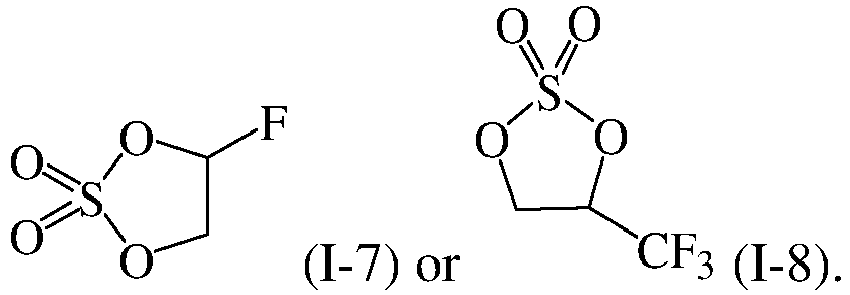
- The electrolytic solution according to claim 1, wherein the carboxylate compound comprises the compound of Formula II:
 wherein R21 and R22 are each independently selected from H, halogen, a cyano group, substituted or unsubstituted C1-20 alkyl group, substituted or unsubstituted C3-20 cycloalkyl group, substituted or unsubstituted C2-20 alkenyl group, substituted or unsubstituted C1-20 alkoxy, substituted or unsubstituted C6-20 aryl group, or substituted or unsubstituted C6-20 heteroaryl group;wherein when R21 and R22 are each independently substituted, the substituent is selected from halogen, a cyano group, C1-20 alkyl group, C3-20 cycloalkyl group, C1-20 alkoxy, C2-20 alkenyl group, C6-20 aryl group, or any combination thereof,wherein a weight percentage of the carboxylate compound is b wt% based on a total weight of the electrolytic solution, wherein b is 0.05-75.
 - The electrolytic solution according to claim 1, wherein the carboxylate compound comprises at least one of:


- The electrolytic solution according to claim 1, further comprising the compound of Formula III:
 R31, R32, and R33 are each independently selected from substituted or unsubstituted C1-C20 alkylene group, substituted or unsubstituted C2-C20 alkenylene group, -R35-S-R36- or -R37-O-R38-, wherein R35, R36, R37 and R38 are each independently a single bond, substituted or unsubstituted C1-C20 alkylene group, or substituted or unsubstituted C2-C20 alkenylene group;R34 is selected from H, substituted or unsubstituted C1-C20 alkyl group, or substituted or unsubstituted C2-C20 alkenyl group;wherein when R31, R32, R33, R34, R35, R36, R37 and R38 are each independently substituted, the substituent is selected from halogen, a cyano group, C1-20 alkyl group, C3-20 cycloalkyl group, C1-20 alkoxy, C2-20 alkenyl group, C6-20 aryl group, or any combination thereof,wherein a weight percentage of the compound of Formula III is 0.01-5wt% based on a total weight of the electrolytic solution.
 - The electrolytic solution according to claim 6, wherein the compound of Formula III comprises at least one of:


- The electrolytic solution according to claim 1, further comprising a lithium salt additive, including at least one of LiPO2F2, lithium bis(trifluoromethanesulphonyl)imide, lithium bis(fluorosulfonyl)imide, lithium bis(oxalate)borate, lithium tetrafluorophosphate xalate, lithium difluoro(oxalate)borate or lithium hexafluorocesate,
wherein a weight percentage of the lithium salt additive is 0.001-5wt% based on a total weight of the electrolytic solution. - An electrochemical device, comprising a cathode, having a cathode active material layer comprising a cathode active material; and an electrolytic solution according to any one of claims 1 to 8.
- The electrochemical device according to claim 9, wherein the electrolytic solution of the electrochemical device further comprises copper ions, and a content of the copper ions is 0.01-50 ppm based on a total weight of the electrolytic solution.
- The electrochemical device according to claim 9, wherein the cathode active material comprises a Ti element, and a content of the Ti element is t×102 ppm based on a total weight of the cathode active material layer, wherein t is 2-10, and meets (a+b)/t≤35.
- An electronic device, comprising an electrochemical device according to any one of claims 9 to 11.
Applications Claiming Priority (1)
| Application Number | Priority Date | Filing Date | Title |
|---|---|---|---|
| PCT/CN2020/073221 WO2021146839A1 (en) | 2020-01-20 | 2020-01-20 | Electrolyte and electrochemical device using same |
Publications (3)
| Publication Number | Publication Date |
|---|---|
| EP4092799A1 true EP4092799A1 (en) | 2022-11-23 |
| EP4092799A4 EP4092799A4 (en) | 2023-03-08 |
| EP4092799B1 EP4092799B1 (en) | 2026-04-29 |
Family
ID=76991933
Family Applications (1)
| Application Number | Title | Priority Date | Filing Date |
|---|---|---|---|
| EP20915120.8A Active EP4092799B1 (en) | 2020-01-20 | 2020-01-20 | Electrolyte and electrochemical device using same |
Country Status (5)
| Country | Link |
|---|---|
| US (1) | US12095035B2 (en) |
| EP (1) | EP4092799B1 (en) |
| JP (1) | JP7457135B2 (en) |
| KR (1) | KR102887987B1 (en) |
| WO (1) | WO2021146839A1 (en) |
Families Citing this family (4)
| Publication number | Priority date | Publication date | Assignee | Title |
|---|---|---|---|---|
| KR102879726B1 (en) * | 2020-02-28 | 2025-10-30 | 에스케이온 주식회사 | Electrolyte for lithium secondary battery and lithium secondary battery including the same |
| ES3060465T3 (en) * | 2021-07-30 | 2026-03-26 | Contemporary Amperex Technology Hong Kong Ltd | Electrolyte, secondary battery, battery module, battery pack, and electric device |
| KR102824104B1 (en) * | 2022-09-30 | 2025-06-23 | 주식회사 엘지에너지솔루션 | Non-aqueous electrolyte and lithium secondary battery comprising the same |
| CN118307530B (en) * | 2024-06-13 | 2025-01-21 | 广州天赐高新材料股份有限公司 | Polycyclic compound and preparation method, use, electrolyte and battery thereof |
Family Cites Families (25)
| Publication number | Priority date | Publication date | Assignee | Title |
|---|---|---|---|---|
| JP3760540B2 (en) * | 1996-12-25 | 2006-03-29 | 三菱化学株式会社 | Electrolyte for lithium secondary battery |
| JP2010015719A (en) | 2008-07-01 | 2010-01-21 | Bridgestone Corp | Nonaqueous electrolyte for battery, and nonaqueous electrolyte secondary battery equipped with it |
| CN103098290B (en) * | 2010-10-22 | 2015-05-13 | 三井化学株式会社 | Cyclic sulfate compound, non-aqueous electrolyte solution containing same, and lithium secondary battery |
| JP6102494B2 (en) | 2013-05-14 | 2017-03-29 | Tdk株式会社 | Non-aqueous electrolyte and lithium ion secondary battery |
| CN105830270B (en) | 2013-12-19 | 2019-04-02 | 宇部兴产株式会社 | Non-aqueous electrolyte solution, power storage device using the same, and carboxylate compound used in the same |
| WO2015179205A1 (en) | 2014-05-23 | 2015-11-26 | E. I. Du Pont De Nemours And Company | Nonaqueous electrolyte compositions comprising cyclic sulfates |
| EP3146588B1 (en) * | 2014-05-23 | 2018-07-25 | Solvay Sa | Nonaqueous electrolyte compositions comprising cyclic sulfates and lithium borates |
| CN104766995B (en) | 2015-03-31 | 2017-03-15 | 宁德时代新能源科技股份有限公司 | Electrolyte additive and application thereof in lithium ion battery |
| JP2017045722A (en) * | 2015-08-28 | 2017-03-02 | 三井化学株式会社 | Nonaqueous electrolyte for battery and lithium secondary battery |
| CN105895955A (en) | 2016-06-02 | 2016-08-24 | 宁德新能源科技有限公司 | Electrolyte and lithium ion battery |
| CN106025356B (en) | 2016-06-23 | 2019-05-24 | 宁德新能源科技有限公司 | A kind of electrolyte and lithium ion battery containing the electrolyte |
| WO2018011062A2 (en) | 2016-07-15 | 2018-01-18 | Solvay Sa | Nonaqueous electrolyte compositions |
| HUE068211T2 (en) | 2016-09-14 | 2024-12-28 | Syensqo Sa | Electrolytes containing six membered ring cyclic sulfates |
| KR20180057944A (en) | 2016-11-23 | 2018-05-31 | 에스케이케미칼 주식회사 | Electrolyte for secondary battery and secondary battery comprising same |
| CN108242566A (en) * | 2016-12-26 | 2018-07-03 | 宁德时代新能源科技股份有限公司 | Electrolyte solution and secondary battery |
| JP6965173B2 (en) | 2017-02-13 | 2021-11-10 | 三菱ケミカル株式会社 | Non-aqueous electrolyte solution and power storage device using it |
| JP2018133284A (en) | 2017-02-17 | 2018-08-23 | Tdk株式会社 | Nonaqueous electrolyte and nonaqueous electrolyte battery using the same |
| CN109037776A (en) * | 2017-06-09 | 2018-12-18 | 宁德时代新能源科技股份有限公司 | Electrolyte and battery comprising same |
| CN113381072A (en) * | 2017-12-06 | 2021-09-10 | 宁德新能源科技有限公司 | Electrolyte and battery containing the same |
| CN113555604A (en) * | 2018-04-11 | 2021-10-26 | 宁德新能源科技有限公司 | Lithium Ion Battery |
| PL3788667T3 (en) | 2018-05-04 | 2025-04-22 | Umicore | A lithium cobalt oxide secondary battery comprising a fluorinated electrolyte and a positive electrode material for high voltage applications |
| US20210234199A1 (en) * | 2018-05-04 | 2021-07-29 | Solvay Sa | Non-aqueous liquid electrolyte composition |
| CN109860703B (en) * | 2019-01-25 | 2021-04-06 | 宁德新能源科技有限公司 | Electrolyte and electrochemical device |
| CN109786834B (en) * | 2019-01-25 | 2021-01-12 | 宁德新能源科技有限公司 | Electrolyte and Electrochemical Device |
| CN110021785A (en) * | 2019-04-15 | 2019-07-16 | 杉杉新材料(衢州)有限公司 | A kind of ternary high-voltage lithium-ion battery electrolyte and ternary high-voltage lithium ion batteries |
-
2020
- 2020-01-20 WO PCT/CN2020/073221 patent/WO2021146839A1/en not_active Ceased
- 2020-01-20 US US17/059,701 patent/US12095035B2/en active Active
- 2020-01-20 KR KR1020227028091A patent/KR102887987B1/en active Active
- 2020-01-20 EP EP20915120.8A patent/EP4092799B1/en active Active
- 2020-01-20 JP JP2022544205A patent/JP7457135B2/en active Active
Also Published As
| Publication number | Publication date |
|---|---|
| JP2023511138A (en) | 2023-03-16 |
| EP4092799A4 (en) | 2023-03-08 |
| KR102887987B1 (en) | 2025-11-19 |
| US12095035B2 (en) | 2024-09-17 |
| EP4092799B1 (en) | 2026-04-29 |
| JP7457135B2 (en) | 2024-03-27 |
| US20210408603A1 (en) | 2021-12-30 |
| KR20220121263A (en) | 2022-08-31 |
| WO2021146839A1 (en) | 2021-07-29 |
Similar Documents
| Publication | Publication Date | Title |
|---|---|---|
| US12159970B2 (en) | Electrolytic solution and electrochemical device using the same | |
| US11735771B2 (en) | Electrolyte solution and electrochemical device using the same | |
| EP4333150A1 (en) | Electrolytic solution, electrochemical device, and electronic device | |
| CN114388890B (en) | Electrochemical device and electronic device including the same | |
| EP4131546A1 (en) | Electrochemical device and electronic device comprising same | |
| US20200243905A1 (en) | Electrolyte, electrochemical device and electronic device containing the same | |
| CN111244541B (en) | Electrolyte and electrochemical device using the same | |
| CN111628219A (en) | Electrolyte and electrochemical device and electronic device containing electrolyte | |
| EP3907804B1 (en) | Electrochemical device and electronic device comprising the same | |
| EP4092799B1 (en) | Electrolyte and electrochemical device using same | |
| CN112956063A (en) | Electrolyte solution, and electrochemical device and electronic device comprising same | |
| CN110429335A (en) | Electrolyte and electrochemical device and electronic device containing same | |
| CN111261939A (en) | Electrolyte solution and electrochemical device using the same | |
| US11742518B2 (en) | Electrolyte, and electrochemical device and electronic device using the same | |
| CN110380120A (en) | Electrolyte, electrochemical appliance and electronic device comprising the electrolyte | |
| CN111740165B (en) | Electrolyte solution, electrochemical device containing electrolyte solution, and electronic device | |
| EP3876329A1 (en) | Electrolyte, electrochemical device and electronic device | |
| US11031630B2 (en) | Electrolyte and electrochemical device | |
| CN110247115B (en) | Electrolyte solution, electrochemical device and electronic device comprising the same | |
| CN110120554A (en) | A kind of electrolyte and the secondary cell containing the electrolyte | |
| CN111430793A (en) | Electrolyte and electrochemical device and electronic device using the same | |
| EP4246641A1 (en) | Electrolyte, as well as electrochemical apparatus and electronic apparatus containing the same | |
| US12176491B2 (en) | Electrolyte and electrochemical apparatus using same | |
| WO2021232406A1 (en) | Electrolyte and electrochemical device using same | |
| CN120184364A (en) | Electrolyte and secondary battery containing the same |
Legal Events
| Date | Code | Title | Description |
|---|---|---|---|
| STAA | Information on the status of an ep patent application or granted ep patent |
Free format text: STATUS: THE INTERNATIONAL PUBLICATION HAS BEEN MADE |
|
| PUAI | Public reference made under article 153(3) epc to a published international application that has entered the european phase |
Free format text: ORIGINAL CODE: 0009012 |
|
| STAA | Information on the status of an ep patent application or granted ep patent |
Free format text: STATUS: REQUEST FOR EXAMINATION WAS MADE |
|
| 17P | Request for examination filed |
Effective date: 20220818 |
|
| AK | Designated contracting states |
Kind code of ref document: A1 Designated state(s): AL AT BE BG CH CY CZ DE DK EE ES FI FR GB GR HR HU IE IS IT LI LT LU LV MC MK MT NL NO PL PT RO RS SE SI SK SM TR |
|
| A4 | Supplementary search report drawn up and despatched |
Effective date: 20230203 |
|
| RIC1 | Information provided on ipc code assigned before grant |
Ipc: H01M 10/0568 20100101ALI20230130BHEP Ipc: H01M 4/525 20100101ALI20230130BHEP Ipc: H01M 4/485 20100101ALI20230130BHEP Ipc: H01M 4/36 20060101ALI20230130BHEP Ipc: C07D 497/04 20060101ALI20230130BHEP Ipc: C07D 411/14 20060101ALI20230130BHEP Ipc: C07D 411/04 20060101ALI20230130BHEP Ipc: C07D 327/10 20060101ALI20230130BHEP Ipc: H01M 10/0567 20100101ALI20230130BHEP Ipc: H01M 10/0525 20100101ALI20230130BHEP Ipc: H01M 10/0566 20100101AFI20230130BHEP |
|
| DAV | Request for validation of the european patent (deleted) | ||
| DAX | Request for extension of the european patent (deleted) | ||
| STAA | Information on the status of an ep patent application or granted ep patent |
Free format text: STATUS: EXAMINATION IS IN PROGRESS |
|
| 17Q | First examination report despatched |
Effective date: 20250311 |
|
| GRAP | Despatch of communication of intention to grant a patent |
Free format text: ORIGINAL CODE: EPIDOSNIGR1 |
|
| STAA | Information on the status of an ep patent application or granted ep patent |
Free format text: STATUS: GRANT OF PATENT IS INTENDED |
|
| INTG | Intention to grant announced |
Effective date: 20251128 |
|
| GRAS | Grant fee paid |
Free format text: ORIGINAL CODE: EPIDOSNIGR3 |
|
| GRAA | (expected) grant |
Free format text: ORIGINAL CODE: 0009210 |
|
| STAA | Information on the status of an ep patent application or granted ep patent |
Free format text: STATUS: THE PATENT HAS BEEN GRANTED |
|
| P01 | Opt-out of the competence of the unified patent court (upc) registered |
Free format text: CASE NUMBER: UPC_APP_0010152_4092799/2026 Effective date: 20260317 |
|
| AK | Designated contracting states |
Kind code of ref document: B1 Designated state(s): AL AT BE BG CH CY CZ DE DK EE ES FI FR GB GR HR HU IE IS IT LI LT LU LV MC MK MT NL NO PL PT RO RS SE SI SK SM TR |
|
| REG | Reference to a national code |
Ref country code: CH Ref legal event code: F10 Free format text: ST27 STATUS EVENT CODE: U-0-0-F10-F00 (AS PROVIDED BY THE NATIONAL OFFICE) Effective date: 20260429 |