EP4092623A1 - Image processing method and apparatus, and device and storage medium - Google Patents
Image processing method and apparatus, and device and storage medium Download PDFInfo
- Publication number
- EP4092623A1 EP4092623A1 EP21846696.9A EP21846696A EP4092623A1 EP 4092623 A1 EP4092623 A1 EP 4092623A1 EP 21846696 A EP21846696 A EP 21846696A EP 4092623 A1 EP4092623 A1 EP 4092623A1
- Authority
- EP
- European Patent Office
- Prior art keywords
- image
- region
- candidate
- segmentation
- probability
- Prior art date
- Legal status (The legal status is an assumption and is not a legal conclusion. Google has not performed a legal analysis and makes no representation as to the accuracy of the status listed.)
- Granted
Links
Images




Classifications
-
- G—PHYSICS
- G06—COMPUTING OR CALCULATING; COUNTING
- G06T—IMAGE DATA PROCESSING OR GENERATION, IN GENERAL
- G06T7/00—Image analysis
- G06T7/10—Segmentation; Edge detection
- G06T7/194—Segmentation; Edge detection involving foreground-background segmentation
-
- G—PHYSICS
- G06—COMPUTING OR CALCULATING; COUNTING
- G06T—IMAGE DATA PROCESSING OR GENERATION, IN GENERAL
- G06T5/00—Image enhancement or restoration
- G06T5/70—Denoising; Smoothing
-
- G—PHYSICS
- G06—COMPUTING OR CALCULATING; COUNTING
- G06T—IMAGE DATA PROCESSING OR GENERATION, IN GENERAL
- G06T7/00—Image analysis
- G06T7/10—Segmentation; Edge detection
- G06T7/11—Region-based segmentation
-
- G—PHYSICS
- G06—COMPUTING OR CALCULATING; COUNTING
- G06V—IMAGE OR VIDEO RECOGNITION OR UNDERSTANDING
- G06V10/00—Arrangements for image or video recognition or understanding
- G06V10/20—Image preprocessing
- G06V10/22—Image preprocessing by selection of a specific region containing or referencing a pattern; Locating or processing of specific regions to guide the detection or recognition
-
- G—PHYSICS
- G06—COMPUTING OR CALCULATING; COUNTING
- G06V—IMAGE OR VIDEO RECOGNITION OR UNDERSTANDING
- G06V10/00—Arrangements for image or video recognition or understanding
- G06V10/20—Image preprocessing
- G06V10/26—Segmentation of patterns in the image field; Cutting or merging of image elements to establish the pattern region, e.g. clustering-based techniques; Detection of occlusion
- G06V10/267—Segmentation of patterns in the image field; Cutting or merging of image elements to establish the pattern region, e.g. clustering-based techniques; Detection of occlusion by performing operations on regions, e.g. growing, shrinking or watersheds
-
- G—PHYSICS
- G06—COMPUTING OR CALCULATING; COUNTING
- G06V—IMAGE OR VIDEO RECOGNITION OR UNDERSTANDING
- G06V10/00—Arrangements for image or video recognition or understanding
- G06V10/40—Extraction of image or video features
-
- G—PHYSICS
- G06—COMPUTING OR CALCULATING; COUNTING
- G06V—IMAGE OR VIDEO RECOGNITION OR UNDERSTANDING
- G06V10/00—Arrangements for image or video recognition or understanding
- G06V10/70—Arrangements for image or video recognition or understanding using pattern recognition or machine learning
- G06V10/77—Processing image or video features in feature spaces; using data integration or data reduction, e.g. principal component analysis [PCA] or independent component analysis [ICA] or self-organising maps [SOM]; Blind source separation
- G06V10/776—Validation; Performance evaluation
-
- G—PHYSICS
- G06—COMPUTING OR CALCULATING; COUNTING
- G06T—IMAGE DATA PROCESSING OR GENERATION, IN GENERAL
- G06T2207/00—Indexing scheme for image analysis or image enhancement
- G06T2207/20—Special algorithmic details
- G06T2207/20076—Probabilistic image processing
-
- G—PHYSICS
- G06—COMPUTING OR CALCULATING; COUNTING
- G06T—IMAGE DATA PROCESSING OR GENERATION, IN GENERAL
- G06T2207/00—Indexing scheme for image analysis or image enhancement
- G06T2207/20—Special algorithmic details
- G06T2207/20081—Training; Learning
-
- G—PHYSICS
- G06—COMPUTING OR CALCULATING; COUNTING
- G06T—IMAGE DATA PROCESSING OR GENERATION, IN GENERAL
- G06T2207/00—Indexing scheme for image analysis or image enhancement
- G06T2207/20—Special algorithmic details
- G06T2207/20084—Artificial neural networks [ANN]
-
- G—PHYSICS
- G06—COMPUTING OR CALCULATING; COUNTING
- G06T—IMAGE DATA PROCESSING OR GENERATION, IN GENERAL
- G06T2207/00—Indexing scheme for image analysis or image enhancement
- G06T2207/20—Special algorithmic details
- G06T2207/20212—Image combination
- G06T2207/20221—Image fusion; Image merging
Definitions
- This application relates to the field of computer vision related technologies in artificial intelligence (AI), and in particular, to an image processing method and apparatus, a device, and a storage medium.
- AI artificial intelligence
- AI is a comprehensive technology of computer science, and through study of design principles and implementation methods of various intelligent machines, enables the machines to have functions of perception, reasoning, and decision-making.
- the AI technology is a comprehensive discipline, involving a wide range of fields, such as computer vision technology, natural language processing technology, machine learning/deep learning, and other major fields. With the development of technologies, the AI technology is to be applied in more fields and play an increasingly important role.
- image segmentation is an important research field, and a foreground image region and a background image region can be obtained through segmentation from a raw image, so that corresponding processing, such as face recognition, replacement of a background image region, and addition of an image effect, can be performed on the foreground image region or the background image region.
- Embodiments of this application provide an image processing method, including:
- inventions of this application further provide an image processing apparatus, including:
- the embodiments of this application further provide a computer device, including a processor and a memory; the memory being configured to store a computer program, and the processor being configured to call the computer program to perform the steps of the foregoing method.
- the embodiments of this application further provide a non-volatile computer-readable storage medium, the computer-readable storage medium storing a computer program, the computer program including program instructions, and the program instructions, when executed by a processor, performing the steps of the foregoing method.
- An image processing method provided in the embodiments of this application mainly relates to computer vision technologies in AI, and in particular, to an image segment technology in the computer vision technologies.
- an image processing system for implementing the image processing method of this application is described. As shown in FIG. 1 , the image processing system includes a server 10 and at least one terminal 11.
- the terminal 11 may be a user-oriented terminal, that is, the terminal 11 may be a terminal used by a user to obtain a raw image and send the image to the server 10.
- the raw image may be an image on which image segmentation needs to be performed.
- the raw image may be captured by the terminal 11, or the raw image may be downloaded by the terminal 11 from a network.
- the server 10 may be a back end service device for image processing, and may be specifically configured to obtain the raw image from the terminal 11, and segment the raw image to obtain a target foreground image region or a target background image region of the raw image.
- the target foreground image region may be a region that includes a target object.
- the target background image region may be a region that does not include the target object.
- the target object may be a person, a building, an animal, an article, or the like.
- the segmentation process of the raw image may be implemented by the terminal 11 or the server 10.
- description is provided by using an example in which the server 10 segments the raw image.
- the server 10 may be an independent physical server, or may be a server cluster or a distributed system formed by a plurality of physical servers, or may be a cloud server that provides basic cloud computing services such as a cloud service, a cloud database, cloud computing, a cloud function, cloud storage, a network service, cloud communication, a middleware service, a domain name service, a security service, a content delivery network (CDN), big data, and an AI platform.
- the terminal 11 may be, but is not limited to, a smart phone, a pad, a laptop, a desktop, a smart speaker, a smart watch, and the like.
- the terminal and the server may be directly or indirectly connected in a wired or wireless communication manner. This is not limited in this application.
- the terminal 11 may download an image from the network or capture an image, use the image as a raw image, and send the raw image to the server 10.
- the raw image may be a person image.
- the raw image includes a foreground image region 12 and a background image region 13.
- the foreground image region 12 is a region that includes a person.
- the background image region 13 is a region behind the person.
- the background image region 13 includes plants.
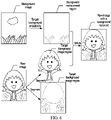
- the server 10 may receive the raw image sent by the terminal 11, input the raw image into a first segmentation model, and perform preliminary segmentation recognition on the raw image to obtain a candidate region type probability of a pixel in the raw image.
- the preliminary segmentation recognition may be preliminary recognition of the raw image.
- the candidate region type probability is used for indicating a probability that the pixel in the raw image belongs to the background image region, that is, a candidate background probability.
- the candidate region type probability is used for indicating a probability that the pixel in the raw image belongs to the foreground image region, that is, a candidate foreground probability.
- the candidate region type probability includes a candidate background probability and a candidate foreground probability.
- the server 10 may segment the raw image according to the candidate region type probability to obtain a candidate background image region and a candidate foreground image region of the raw image.
- some lines are missing in the candidate background image region and the candidate foreground image region, that is, there is a problem of information loss in the candidate foreground image region and the candidate background image region.
- accuracy of a segmentation result obtained by using the first segmentation model is relatively low. Therefore, the segmentation result of the first segmentation model needs to be optimized. Specifically, as shown in FIG.
- the server 10 may recombine the raw image, the candidate background image region, and the candidate foreground image region to obtain a recombined image, and perform region segmentation recognition on the recombined image by using a second segmentation model to obtain a region segmentation adjustment parameter of a pixel in the recombined image.
- the region segmentation adjustment parameter may be a parameter used for optimizing the segmentation result of the first segmentation model.
- adjusted segmentation may be performed on the raw image according to the region segmentation adjustment parameter and the candidate region type probability to obtain a target foreground image region and a target background image region of the raw image.
- a boundary between the target background image region and the target foreground image region is smoother and more precise.
- preliminary segmentation is performed on the raw image by using the first segmentation model, and the segmentation result of the first segmentation model is optimized by using the second segmentation model, so that accuracy of image segmentation can be improved.
- the raw image, the candidate background image region, and the candidate foreground image region are recombined to provide more information for a region segmentation recognition process of the second segmentation model, so that a problem of information loss of the raw image during segmentation of the raw image is avoided, and the accuracy of image segmentation can be further improved.
- FIG. 3 is a schematic flowchart of an image processing method according to an embodiment of this application.
- the method may be performed by a computer device.
- the computer device may be the server 10 or the terminal 11 FIG. 1 .
- the image processing method may include the following steps S101 to S104.
- S101 Perform preliminary segmentation recognition on a raw image by using a first segmentation model to obtain a candidate foreground image region and a candidate background image region of the raw image.
- the foreground image region may be a region that includes a target object.
- the target object may be at least one of a person, a building, an article, a plant, an animal, and the like, that is, the target object may be an object that a user is interested in.
- the background image region may be a region where a person or a thing behind the target object is located, that is, the background image region is a region where an object that the user is not interested in is located.
- the computer device may perform preliminary segmentation recognition on the raw image by using the first segmentation model to obtain the candidate foreground image region and the candidate background image region of the raw image.
- the first segmentation model may be a model used for performing preliminary segmentation recognition on the raw image.
- the candidate foreground image region and the candidate background image region may be obtained by performing preliminary segmentation on the raw image.
- step S101 may include the following s01 and s02.
- the computer device may perform segmentation recognition on the raw image by using the first segmentation model to obtain the candidate region type probability of the pixel in the raw image. That is, the raw image is inputted into the first segmentation model to perform segmentation recognition on the raw image to obtain the candidate region type probability of the pixel in the raw image.
- the computer device may segment the raw image according to the candidate region type probability to obtain the candidate foreground image region and the candidate background image region of the raw image.
- the candidate region type probability includes a candidate foreground probability, the candidate foreground probability being used for reflecting a probability that the corresponding pixel in the raw image belongs to the foreground image region.
- the computer device may determine, in the raw image, a pixel whose candidate foreground probability is greater than a foreground probability threshold as a foreground pixel, and determine, in the raw image, a pixel whose candidate foreground probability is less than or equal to the foreground probability threshold as a background pixel. Further, a region belonging to the foreground pixel is obtained through segmentation from the raw image as the foreground image region, and a region belonging to the background pixel is obtained through segmentation from the raw image as the background image region.
- the candidate region type probability includes a candidate foreground probability.
- the computer device may obtain a sum of candidate foreground probabilities of pixels in the raw image as a first probability value.
- a ratio of the candidate foreground probability of the pixel in the raw image to the first probability value is obtained.
- a pixel whose ratio is greater than a first foreground ratio threshold is determined as a foreground pixel.
- a pixel whose ratio is less than or equal to the first foreground ratio threshold in the raw image is determined as a background pixel.
- a region belonging to the foreground pixel is obtained through segmentation from the raw image as the foreground image region, and a region belonging to the background pixel is obtained through segmentation from the raw image as the background image region.
- the ratio of the candidate foreground probability of the pixel in the raw image to the first probability value may be expressed by the following formula (1).
- F i represents a ratio of a candidate foreground probability of an i th pixel in the raw image to the first probability value
- K represents a quantity of pixels in the raw image
- FG i represents the candidate foreground probability of the pixel in the raw image.
- the candidate region type probability includes a candidate background probability, the candidate background probability being used for reflecting a probability that the corresponding pixel in the raw image belongs to the background image region.
- the computer device may determine, in the raw image, a pixel whose candidate background probability is less than a background probability threshold as a foreground pixel, and determine, in the raw image, a pixel whose candidate background probability is greater than or equal to the background probability threshold as a background pixel. Further, a region belonging to the foreground pixel is obtained through segmentation from the raw image as the foreground image region, and a region belonging to the background pixel is obtained through segmentation from the raw image as the background image region.
- the candidate region type probability includes a candidate background probability.
- the computer device may obtain a sum of candidate background probabilities of pixels in the raw image as a second probability value.
- a ratio of the candidate background probability of the pixel in the raw image to the second probability value is obtained.
- a pixel whose ratio is greater than a first background ratio threshold is determined as a background pixel.
- a pixel whose ratio is less than or equal to the first background ratio threshold in the raw image is determined as a foreground pixel.
- a region belonging to the background pixel is obtained through segmentation from the raw image as the background image region, and a region belonging to the foreground pixel is obtained through segmentation from the raw image as the foreground image region.
- the candidate region type probability includes a candidate background probability and a candidate foreground probability.
- the computer device may select one of the candidate background probability and the candidate foreground probability, segment the raw image according to the selected probability to obtain the candidate foreground image region and the candidate background image region of the raw image.
- the computer device can recombine the candidate foreground image region, the candidate background image region, and the raw image to obtain the recombined image, that is, fuse the candidate foreground image region, the candidate background image region, and the raw image, and use an image obtained through fusion as the recombined image.
- the recombined image can provide more information than the raw image, that is, can compensate for the boundary information lost during segmentation of the raw image, thereby helping improve accuracy of image segmentation.
- the recombined image has the same size as the raw image, that is, the pixels in the recombined image are in a one-to-one correspondence with the pixels in the raw image, that is, there is a correspondence between two pixels with the same position information in the raw image and the recombined image.
- a coordinate system is established with a lower left corner of each of the raw image and the recombined image as a coordinate origin, and it is determined that there is a correspondence between two pixels with the same position coordinates in the raw image and the recombined image. For example, it is determined that there is a correspondence between a pixel with position coordinates of (1, 2) in the raw image and a pixel with position coordinates of (1, 2) in the recombined image.
- S103 Perform region segmentation recognition on the recombined image by using a second segmentation model to obtain a target foreground image region and a target background image region of the raw image.
- the computer device may optimize a segmentation result of the first segmentation model by using the second segmentation model to obtain the target background image region and the target foreground image region of the raw image. That is, the target background image region and the target background image region may be obtained by optimizing the candidate foreground image region and the candidate background image region.
- step S103 may include the following s03 and s04.
- the computer device may perform region segmentation recognition on the recombined image by using the second segmentation model to obtain the region segmentation adjustment parameter of the pixel in the recombined image, that is, input the recombined image into the second segmentation model to perform region segmentation recognition on the recombined image to obtain the region segmentation adjustment parameter of the pixel in the recombined image.
- the second segmentation model may be a model used for optimizing the segmentation result of the first segmentation model, or may be referred to as a fine segmentation model.
- the segmentation result herein may be the candidate region type probability.
- the computer device may perform adjusted segmentation on the raw image according to the region segmentation adjustment parameter and the candidate region type probability to obtain the target foreground image region and the target background image region of the raw image, that is, may adjust the candidate background image region and the candidate foreground image region according to the region segmentation adjustment parameter and the candidate region type probability, use the adjusted candidate background image region as the target background image region of the raw image, and use the adjusted candidate foreground image region as the target foreground image region of the raw image.
- the second segmentation model may be a depth refinement model, including a plurality of stacked modules with a depthwise separable convolution as a base structure.
- the second segmentation model may include three stacked modules with the depthwise separable convolution as a base structure.
- a size of a feature map (that is, the recombined image) of the second segmentation model in the region segmentation recognition process remains unchanged, thereby avoiding information loss of the recombined image due to adjustment of a size of the recombined image.
- preliminary segmentation recognition is performed on the raw image by using the first segmentation model to obtain the candidate region type probability of the pixel in the raw image, and the raw image is segmented according to the candidate region type probability to obtain the candidate background image region and the candidate background image region of the raw image. That is, preliminary segmentation can be performed on the raw image by using the first segmentation model. Further, the raw image, the candidate background image region, and the candidate background image region may be recombined to obtain the recombined image, so that boundary information lost during the preliminary segmentation of the raw image can be compensated, thereby helping provide rich information during optimized segmentation of the raw image.
- the computer device may perform region segmentation recognition on the recombined image by using the second segmentation model to obtain the region segmentation adjustment parameter of the pixel in the recombined image, and may perform adjusted segmentation on the raw image according to the region segmentation adjustment parameter and the candidate region type probability to obtain the target foreground image region and the target background image region of the raw image.
- segmentation prior information is provided for the second segmentation model by using the first segmentation model, that is, the segmentation prior information herein may be the candidate region type probability, the candidate background image region, and the candidate foreground image region.
- the accuracy of image segmentation can be improved by optimizing the segmentation result of the first segmentation model by using the second segmentation model.
- the first segmentation model includes a feature extraction layer and a segmentation layer.
- Step s01 may include the following steps s11 and s12.
- the first segmentation model includes the feature extraction layer and the segmentation layer
- the feature extraction layer may be used for extracting features of the raw image
- the segmentation layer may be used for performing candidate segmentation on the raw image.
- feature extraction may be performed on the raw image by using the feature extraction layer to obtain the structural feature information and semantic feature information of the pixel in the raw image.
- the structural feature information may be shallow features of the raw image, that is, the structural feature information may be used for reflecting contour information (that is, texture information) in the raw image.
- the semantic feature information may be deep features of the raw image, that is, the semantic feature information may be used for reflecting object information in the raw image, the object information including a type, a size, a color, and the like of an object.
- the computer device may perform segmentation recognition on the structural feature information and the semantic feature information by using the segmentation layer to obtain the candidate region type probability of the pixel in the raw image. That is, the structural feature information and the semantic feature information are fused by using the segmentation layer, and segmentation recognition is performed on fused feature information to obtain the candidate region type probability of the pixel in the raw image.
- the first segmentation model and the second segmentation model may each be a model constructed based on a convolutional neural network (CNN), for example, Visual Geometry Group Network (VGGNet, a convolutional neural network), ResNet (residual network), and AlexNet (a convolutional neural network); or may be a model constructed based on a fully convolutional network (FCN, a full neural network). This is not limited.
- CNN convolutional neural network
- VCGNet Visual Geometry Group Network
- ResNet ResNet
- AlexNet a convolutional neural network
- FCN fully convolutional network
- the first segmentation model may be a semantic segmentation model with a depthwise separable convolution structure and a capability to recognize a foreground image region and a background image region.
- the first segmentation model may include a feature extraction layer and a segmentation recognition layer.
- the feature extraction layer may be an encoder.
- the segmentation recognition layer may be a decoder.
- the encoder may include stacked modules with the depthwise separable convolution as a based structure.
- the decoder may be of a deconvolution structure.
- Feature transfer of shallow features and deep features is performed between the encoder and the decoder through skip connections, so that the decoder can perform segmentation recognition on the semantic feature information in the shallow features and the structural feature information in the deep feature by fusing different features to obtain the candidate region type probability.
- Such an "encoder-decoder" network structure with the depthwise separable convolution as the base structure allows the first segmentation model to greatly reduce an amount of computation and parameters of the network while ensuring an image segmentation effect.
- step S102 may include the following steps s21 to s24.
- the computer device may recombine the candidate background image region, the candidate foreground image region, and the raw image. Specifically, the computer device may fuse the candidate background image region and the raw image to obtain the first fused image, that is, fuse the candidate background image region and the raw image according to a position of the candidate background image region in the raw image to obtain the first fused image.
- the candidate foreground image region and the raw image may be fused according to a position of the candidate foreground image region in the raw image to obtain the second fused image.
- the candidate foreground image region and the candidate background image region may be fused according to positions of the candidate foreground image region and the background image region in the raw image to obtain the third fused image.
- the raw image, the first fused image, the second fused image, and the third fused image are fused to obtain the recombined image.
- the recombination of the candidate background image region, the candidate foreground image region, and the raw image can compensate for boundary information lost during the preliminary segmentation of the raw image, thereby helping provide rich information during optimized segmentation of the raw image.
- a boundary between the background image region and the foreground image region of the raw image is smoother and clearer, thereby improving accuracy of segmentation of the raw image.
- step s04 may include the following steps s31 and s32.
- s32 Perform adjusted segmentation on the raw image according to the target region type probability to obtain the target foreground image region and the target background image region of the raw image.
- the computer device may perform optimized segmentation on the raw image according to an output result of the second segmentation model to obtain the target foreground image region and the target background image region of the raw image. Specifically, as shown in FIG. 5 , the computer device may adjust the candidate region type probability according to the region segmentation adjustment parameter to obtain the target region type probability, that is, the target region type probability is obtained by optimizing the candidate region type probability by using the second segmentation model. The accuracy of the target region type probability is higher. Therefore, adjusted segmentation may be performed on the raw image according to the target region type probability to obtain the target foreground image region and the target background image region of the raw image.
- the target region type probability includes a target foreground probability, the target foreground probability being used for reflecting a probability that the corresponding pixel in the raw image belongs to the foreground image region.
- the computer device may determine, in the raw image, a pixel whose target foreground probability is greater than a foreground probability threshold as a foreground pixel, and determine, in the raw image, a pixel whose target foreground probability is less than or equal to the foreground probability threshold as a background pixel. Further, a region belonging to the foreground pixel is obtained through segmentation from the raw image as the foreground image region, and a region belonging to the background pixel is obtained through segmentation from the raw image as the background image region.
- the target region type probability includes a target foreground probability.
- the computer device may obtain a sum of target foreground probabilities of pixels in the raw image as a third probability value.
- a ratio of the target foreground probability of the pixel in the raw image to the third probability value is obtained.
- a pixel whose ratio is greater than a second foreground ratio threshold is determined as a foreground pixel.
- a pixel whose ratio is less than or equal to the second foreground ratio threshold in the raw image is determined as a background pixel.
- a region belonging to the foreground pixel is obtained through segmentation from the raw image as the foreground image region, and a region belonging to the background pixel is obtained through segmentation from the raw image as the background image region.
- the target region type probability includes a target background probability, the target background probability being used for reflecting a probability that the corresponding pixel in the raw image belongs to the background image region.
- the computer device may determine, in the raw image, a pixel whose target background probability is less than a background probability threshold as a foreground pixel, and determine, in the raw image, a pixel whose target background probability is greater than or equal to the background probability threshold as a background pixel. Further, a region belonging to the foreground pixel is obtained through segmentation from the raw image as the foreground image region, and a region belonging to the background pixel is obtained through segmentation from the raw image as the background image region.
- the target region type probability includes a target background probability.
- the computer device may obtain a sum of target background probabilities of pixels in the raw image as a fourth probability value.
- a ratio of the target background probability of the pixel in the raw image to the fourth probability value is obtained.
- a pixel whose ratio is greater than a second background ratio threshold is determined as a background pixel.
- a pixel whose ratio is less than or equal to the second background ratio threshold in the raw image is determined as a foreground pixel.
- a region belonging to the background pixel is obtained through segmentation from the raw image as the background image region, and a region belonging to the foreground pixel is obtained through segmentation from the raw image as the foreground image region.
- the target region type probability includes a target background probability and a target foreground probability.
- the computer device may select one of the target background probability and the target foreground probability, and perform adjusted segmentation on the raw image according to the selected probability to obtain the target foreground image region and the target background image region of the raw image.
- the region segmentation adjustment parameter includes a foreground segmentation adjustment parameter, a background segmentation adjustment parameter, and an offset value.
- the candidate region type probability includes a candidate foreground probability and a candidate background probability.
- Step s31 may include the following steps s41 to s43.
- s42 Generate a target foreground probability according to the probability sum and the offset value; and obtain a target background probability according to the target foreground probability.
- the region segmentation adjustment parameter includes the foreground segmentation adjustment parameter, the background segmentation adjustment parameter, and the offset value.
- the foreground segmentation adjustment parameter is used for reflecting accuracy (that is, confidence) of the candidate foreground probability of the corresponding pixel in the raw image, that is, a larger foreground segmentation adjustment parameter of the pixel indicates lower accuracy of the candidate foreground probability of the pixel and a greater adjustment of the candidate foreground probability of the pixel.
- a smaller foreground segmentation adjustment parameter of the pixel indicates higher accuracy of the candidate foreground probability of the pixel and a smaller adjustment of the candidate foreground probability of the pixel.
- the background segmentation adjustment parameter is used for reflecting accuracy (that is, confidence) of the candidate background probability of the corresponding pixel in the raw image, that is, a larger background segmentation adjustment parameter of the pixel indicates lower accuracy of the candidate background probability of the pixel and a greater adjustment of the candidate background probability of the pixel.
- a smaller background segmentation adjustment parameter of the pixel indicates higher accuracy of the candidate background probability of the pixel and a smaller adjustment of the candidate background probability of the pixel.
- the offset value may be an equilibrium parameter between the candidate background probability and the candidate foreground probability, and used for fine-tuning the candidate background probability and the candidate foreground probability.
- the computer device may perform weighted summation on the candidate foreground probability and the candidate background probability by using the foreground segmentation adjustment parameter and the background segmentation adjustment parameter to obtain the probability sum, that is, adjust the candidate foreground probability by using the foreground segmentation adjustment parameter, adjust the candidate background probability by using the background segmentation adjustment parameter, and determine a sum of the adjusted candidate foreground probability and the adjusted candidate background probability as the probability sum.
- a target foreground probability may be generated according to the probability sum and the offset value.
- a target background probability is obtained according to the target foreground probability.
- the target foreground probability and the target background probability are determined as the target region type probability.
- the target region type probability may be expressed by the following formula (2).
- Pr e d i a i ⁇ FG i + b i ⁇ BG i + c i
- Pr e d i in formula (2) represents a target foreground probability of an i th pixel in the raw image
- a i , b i , and c i respectively represent a foreground segmentation adjustment parameter, a background segmentation adjustment parameter, and an offset value of the i th pixel in the recombined image
- FG i and BG i respectively represent a candidate foreground probability and a candidate background probability of the i th pixel in the raw image.
- 1 - Pr e d i may be used as a target background probability of the i th pixel in the raw image.
- the i th pixel of the recombined image corresponds to the i th pixel of the raw image, that is, position information of the i th pixel of the recombined image is the same as position information of the i th pixel of the raw image.
- the method may include the following steps s51 to s53.
- a raw image background replacement operation is performed.
- the computer device may obtain the background image.
- the background image may be used for replacing an image of the background image region of the raw image.
- the background image includes grass and clouds. Pixels in the background image are in one-to-one correspondence with pixels in the raw image, that is, there is a correspondence between pixels with the same position information in the background image and the raw image, that is, a target background probability of a pixel in the raw image may be determined as a target background probability of a corresponding pixel in the background image.
- the computer device may adjust the background image according to the target background probability to obtain the background replacement region, that is, a pixel whose target background probability is greater than a background probability threshold in the background image is used as a background pixel, and a pixel whose target background probability is less than or equal to the background probability threshold in the background image is used as a foreground pixel.
- Color information of the background pixel in the background image may be adjusted according to color information of the target foreground image region (or a bokeh effect, such as transparency reduction may be performed on the background pixel in the background image), and foreground pixels in the background image are removed to obtain the background replacement region.
- the background replacement region and the target foreground region may be stitched to obtain the raw image with the background replaced.
- the background image is adjusted according to the target background probability to obtain the background replacement region, so that the background replacement region and the target foreground region can be better stitched, that is, a color and a size of the background replacement region better match a color and a size of the target foreground region, and the raw image with the background replaced is smoother and clearer.
- a person in the raw image is still located in the foreground image region of the raw image with the background replaced, and the grass in the background image is located in the background image region of the raw image with the background replaced.
- the raw image with the background replaced may be expressed by the following formula (3).
- Pr e d final Pr e d ⁇ RAW + 1 ⁇ Pr e d ⁇ BACK
- RAW may be the raw image
- BACK may be the background image
- Pr e d final represents the raw image with the background replaced
- Pr e d ⁇ RAW represents the target foreground image region obtained by segmenting the raw image by using the target foreground probability of the raw image
- (1 - Pr e d) ⁇ BACK represents the background replacement region obtained by segmenting (that is, adjusting) the background image by using the target background probability of the raw image
- Pr e d represents a target foreground probability matrix including target foreground probabilities of all pixels in the raw image.
- the method may further include the following steps s61 to s64.
- s61 Obtain a first candidate segmentation model and a sample image set, the sample image set including a sample image and a labeled region type probability of a pixel in the sample image.
- Predict the sample image by using the first candidate segmentation model to obtain a prediction region type probability of the pixel in the sample image as a first prediction region type probability.
- the computer device may train the first candidate segmentation model to obtain the first segmentation model.
- the first candidate segmentation model and the sample image set may be obtained, the sample image set including the sample image and the labeled region type probability of the pixel in the sample image.
- the sample image set may include sample images with various target objects, such as including a sample image with persons, a sample image with animals, and a sample image with buildings.
- the labeled region type probability of the pixel in the sample image may be obtained by manually labeling the sample image.
- the sample image may be predicted by using the first candidate segmentation model to obtain the prediction region type probability of the pixel in the sample image as the first prediction region type probability.
- the computer device may adjust the first candidate segmentation model according to the first prediction region type probability and the labeled region type probability, and determine the adjusted first candidate segmentation model as the first segmentation model.
- the adjustment of the first candidate segmentation model can improve image segmentation accuracy of the first candidate segmentation model.
- step s63 may include the following steps s71 to s76.
- s75 Determine a total loss value of the first candidate segmentation model according to the boundary loss value and the original loss value.
- the computer device may determine the original loss value of the first candidate segmentation model according to the first prediction region type probability and the labeled region type probability, the original loss value being used for reflecting accuracy of the first prediction region type probability outputted by the first candidate segmentation model. Further, a change rate between first prediction region type probabilities of adjacent pixels in the sample image may be obtained as the first gradient change rate, and a change rate between labeled region type probabilities of the adjacent pixels in the sample image is obtained as the second gradient change rate. The first gradient change rate may be used for reflecting a speed of change between the first prediction region type probabilities.
- first prediction region type probabilities of pixels at a boundary between the foreground image region and the background image region of the sample image change slowly. Therefore, the first gradient change rate may be used for reflecting accuracy of segmentation recognition of the first candidate segmentation model for the pixels at the boundary between the foreground image region and the background image region in the sample image. Therefore, the boundary loss value of the first candidate segmentation model can be determined according to the first gradient change rate and the second gradient change rate, that is, the boundary loss value is used for reflecting boundary segmentation recognition accuracy of the first candidate segmentation model. Further, the total loss value of the first candidate segmentation model may be determined according to the boundary loss value and the original loss value.
- the first candidate segmentation model may be used as the first segmentation model. If the total loss value does not meet the convergence condition, it indicates that the boundary segmentation recognition accuracy of the first candidate segmentation model and accuracy of the outputted first prediction region type probability are relatively low, and the first candidate segmentation model is adjusted according to the total loss value.
- the first candidate segmentation model is adjusted by using the boundary loss value and the original loss value to obtain the first segmentation model, so that accuracy and clarity of the first segmentation model for segmenting a boundary between a foreground image region and a background image region of an image are improved.
- the total loss value of the first candidate segmentation model may be expressed by the following formula (4).
- L 1 L ce + L grad
- L 1 represents the total loss value of the first candidate segmentation model
- L ce represents the original loss value of the first candidate segmentation model
- L grad represents the boundary loss value of the first candidate segmentation model, or may be referred to as a gradient loss value.
- the original loss value L ce of the first candidate segmentation model may be expressed by the following formula (5).
- p i represents a labeled region type probability of an i th pixel of the sample image
- q i represents a prediction region type probability of the i th pixel of the sample image
- K represents a quantity of pixels in the sample image.
- G ( q i ) represents the first gradient change rate, that is, represents a gradient of the first prediction region type probability of the pixel in the sample image
- G ( p i ) represents the second gradient change rate, that is, represents a gradient of the labeled region type probability of the pixel in the sample image
- S and S T respectively represent gradient operators of the pixel in the sample image in x-axis and Y-axis directions
- S T is the transpose of S
- S may be expressed by the following formula (7).
- S ⁇ 1 ⁇ 2 ⁇ 1 0 0 0 1 2 1
- the method may further include the following steps s81 to s86.
- s81 Obtain a second candidate segmentation model and a target prediction region type probability, the target prediction region type probability being a first prediction region type probability outputted in a case that the total loss value of the first candidate segmentation model is in a convergence state.
- the second candidate segmentation model may be trained according to the first candidate segmentation model.
- the computer device may obtain the second candidate segmentation model and target prediction region type probability.
- the target prediction region type probability is a first prediction region type probability outputted in a case that the total loss value of the first candidate segmentation model is in the convergence state, that is, the target prediction region type probability is a first prediction region type probability outputted in a case that prediction accuracy of the first candidate segmentation model is relatively high.
- the sample image may be segmented according to the target prediction region type probability to obtain the foreground image region and the background image region of the sample image, and the sample image and the foreground image region and the background image region of the sample image are recombined to obtain the sample recombined image.
- the sample recombined image is predicted by using the second candidate segmentation model to obtain the second prediction region type probability. If the second prediction region type probability is relatively close to the labeled region type probability, it indicates that prediction accuracy of the second candidate segmentation model is relatively high. If a difference between the second prediction region type probability and the labeled region type probability is relatively large, it indicates that prediction accuracy of the second candidate segmentation model is relatively low. Therefore, the second candidate segmentation model is adjusted according to the second prediction region type probability and the labeled region type probability, and the adjustment of the second segmentation model can improve image segmentation accuracy of the second candidate segmentation model.
- step s84 includes the following steps s88 and s89.
- the computer device may predict the sample recombined image by using the second candidate segmentation model to obtain the prediction region segmentation adjustment parameter of the pixel in the sample recombined image.
- the prediction region segmentation adjustment parameter is used for adjusting the target prediction region type probability outputted by the first candidate segmentation model. Then, the target prediction region type probability is adjusted by using the prediction region segmentation adjustment parameter to obtain the second prediction region type probability.
- step s85 may include the following steps s91 and s92.
- the computer device may determine the segmentation loss value of the second candidate segmentation model according to the second prediction region type probability and the labeled region type probability, the segmentation loss value being used for reflecting image segmentation accuracy of the second candidate segmentation model. Therefore, if the segmentation loss value meets the convergence condition, it indicates that the image segmentation accuracy of the second candidate segmentation model is relatively high, and the second candidate segmentation model is used as the second segmentation model. If the segmentation loss value does not meet the convergence condition, it indicates that the image segmentation accuracy of the second candidate segmentation model is relatively low, and the second candidate segmentation model is adjusted according to the segmentation loss value. The adjustment of the second candidate segmentation model can improve the image segmentation accuracy of the second candidate segmentation model.
- the segmentation loss value of the second candidate segmentation model may be expressed by the following formula (8).
- w i and p i respectively represent a second prediction region type probability and a labeled region type probability of an i th pixel in the sample image
- L 2 represents the segmentation loss value of the second candidate segmentation model
- FIG. 9 is a schematic structural diagram of an image processing apparatus according to an embodiment of this application.
- the image processing apparatus may be a computer program (including program code) running in a computer device.
- the image processing apparatus is application software.
- the apparatus may be configured to perform the corresponding steps in the method provided in the embodiments of this application.
- the image processing apparatus may include a recognition module 901 and a recombination module 902.
- the recognition module 901 is configured to perform preliminary segmentation recognition on a raw image by using a first segmentation model to obtain a candidate foreground image region and a candidate background image region of the raw image.
- the recombination module 902 is configured to recombine the candidate foreground image region, the candidate background image region, and the raw image to obtain a recombined image; pixels in the recombined image being in a one-to-one correspondence with pixels in the raw image.
- the recognition module 901 is further configured to perform region segmentation recognition on the recombined image by using a second segmentation model to obtain a target foreground image region and a target background image region of the raw image.
- a specific implementation in which the recognition module 901 performs preliminary segmentation recognition on the raw image by using the first segmentation model to obtain the candidate foreground image region and the candidate background image region of the raw image includes:
- the first segmentation model includes a feature extraction layer and a segmentation layer.
- a specific implementation in which the recognition module 901 performs segmentation recognition on the raw image by using the first segmentation model to obtain the candidate region type probability of the pixel in the raw image includes:
- a specific implementation in which the recombination module 902 recombines the candidate foreground image region, the candidate background image region, and the raw image to obtain the recombined image includes:
- a specific implementation in which the recognition module 901 performs region segmentation recognition on the recombined image by using the second segmentation model to obtain the target foreground image region and the target background image region of the raw image includes:
- a specific implementation in which the recognition module 901 performs adjusted segmentation on the raw image according to the region segmentation adjustment parameter and the candidate region type probability to obtain the target foreground image region and the target background image region of the raw image includes:
- the region segmentation adjustment parameter includes a foreground segmentation adjustment parameter, a background segmentation adjustment parameter, and an offset value; and the candidate region type probability includes a candidate foreground probability and a candidate background probability.
- a specific implementation in which the recognition module 901 adjusts the candidate region type probability according to the region segmentation adjustment parameter to obtain the target region type probability includes:
- the apparatus further includes: an obtaining module 906, configured to obtain a background image; and an adjustment module 903, configured to adjust the background image according to the target background probability to obtain a background replacement region; and stitch the background replacement region and the target foreground region to obtain a raw image with a background replaced.
- the obtaining module 906 is further configured to obtain a first candidate segmentation model and a sample image set, the sample image set including a sample image and a labeled region type probability of a pixel in the sample image.
- the apparatus further includes a prediction module 904, configured to predict the sample image by using the first candidate segmentation model to obtain a prediction region type probability of the pixel in the sample image as a first prediction region type probability.
- the adjustment module 903 is further configured to adjust the first candidate segmentation model according to the first prediction region type probability and the labeled region type probability.
- the apparatus further includes a determining module 905, configured to determine the adjusted first candidate segmentation model as the first segmentation model.
- a specific implementation in which the adjustment module 903 adjusts the first candidate segmentation model according to the first prediction region type probability and the labeled region type probability includes:
- the obtaining module 906 is further configured to obtain a second candidate segmentation model and a target prediction region type probability, the target prediction region type probability being a first prediction region type probability outputted in a case that the total loss value of the first candidate segmentation model is in a convergence state.
- the recognition module 901 is further configured to segment the sample image according to the target prediction region type probability to obtain a foreground image region and a background image region of the sample image.
- the recombination module 902 is further configured to recombine the sample image and the foreground image region and the background image region of the sample image to obtain a sample recombined image.
- the prediction module 904 is further configured to predict the sample recombined image by using the second candidate segmentation model to obtain a second prediction region type probability.
- the adjustment module 903 is further configured to adjust the second candidate segmentation model according to the second prediction region type probability and the labeled region type probability.
- the determining module 905 is further configured to determine the adjusted second candidate segmentation model as the second segmentation model.
- a specific implementation in which the prediction module 904 predicts the sample recombined image by using the second candidate segmentation model to obtain the second prediction region type probability includes:
- a specific implementation in which the adjustment module 903 adjusts the second candidate segmentation model according to the second prediction region type probability and the labeled region type probability includes:
- the steps in the image processing method shown in FIG. 3 may be performed by the modules of the image processing apparatus shown in FIG. 9 .
- steps S101 and S103 shown in FIG. 3 may be performed by the recognition module 901 in FIG. 9
- step S102 shown in FIG. 3 may be performed by the recombination module 902 in FIG. 9 .
- the modules of the image processing apparatus shown in FIG. 9 may be separately or wholly combined into one or several units, or one (or more) of the units may further be divided into a plurality of subunits of smaller functions. In this way, same operations may be implemented, and the implementation of the technical effects of the embodiments of this application is not affected.
- the foregoing modules are divided based on logical functions.
- a function of one module may also be implemented by a plurality of units, or functions of a plurality of modules are implemented by one unit.
- the image processing apparatus may also include other units.
- the functions may also be cooperatively implemented by other units and may be cooperatively implemented by a plurality of units.
- a computer program (including program code) that can perform the steps in the corresponding methods shown in FIG. 3 and FIG. 7 may be run on a general computing device, such as a computer, which include processing elements and storage elements such as a central processing unit (CPU), a random access memory (RAM), and a read-only memory (ROM), to construct the image processing apparatus shown in FIG. 9 , and implement the image processing method in the embodiments of this application.
- the computer program may be recorded in, for example, a computer readable recording medium, and may be loaded into the foregoing computing device by using the computer readable recording medium, and run on the computing device.
- FIG. 10 is a schematic structural diagram of a computer device according to an embodiment of this application.
- the computer device 1000 may include: a processor 1001, a network interface 1004, and a memory 1005.
- the computer device 1000 may further include a user interface 1003 and at least one communication bus 1002.
- the communication bus 1002 is configured to implement connection and communication between these components.
- the user interface 1003 may include a display and a keyboard.
- the user interface 1003 may further include a standard wired interface and a standard wireless interface.
- the network interface 1004 may include a standard wired interface and a standard wireless interface (such as a Wi-Fi interface).
- the memory 1005 may be a highspeed RAM, or may be a non-volatile memory, for example, at least one magnetic disk memory.
- the memory 1005 may alternatively be at least one storage apparatus located away from the processor 1001.
- the memory 1005 may include an operating system, a network communication module, a user interface module, and an image processing application.
- the network interface 1004 can provide a network communication function; the user interface 1003 is mainly configured to provide a user with an interface for input; and the processor 1001 can be configured to call the image processing application stored in the memory 1005 to implement the image processing method described in the embodiments.
- the computer device 1000 described in this embodiment of this application may implement the descriptions of the image processing method in the embodiments corresponding to FIG. 3 , or the descriptions of the image processing apparatus in the embodiment corresponding to FIG. 9 . Details are not described herein again. In addition, the description of beneficial effects of the same method is not described herein again.
- an embodiment of this application further provides a computer-readable storage medium.
- the computer storage medium stores a computer program executed by the image processing apparatus mentioned above, and the computer program includes program instructions.
- the processor can implement the descriptions of the image processing method in the embodiments corresponding to FIG. 3 . Therefore, details are not described herein again.
- the description of beneficial effects of the same method is not described herein again.
- the foregoing program instruction may be deployed to be executed on a computer device, or deployed to be executed on a plurality of computer devices at the same location, or deployed to be executed on a plurality of computer devices that are distributed in a plurality of locations and interconnected through a communication network.
- the plurality of computer devices that are distributed in the plurality of locations and interconnected through the communication network may form a blockchain network.
- the program may be stored in a computer-readable storage medium.
- the foregoing storage medium may include a magnetic disk, an optical disk, a read-only memory (ROM), a random access memory (RAM), or the like.
Landscapes
- Engineering & Computer Science (AREA)
- Theoretical Computer Science (AREA)
- General Physics & Mathematics (AREA)
- Physics & Mathematics (AREA)
- Computer Vision & Pattern Recognition (AREA)
- Multimedia (AREA)
- Evolutionary Computation (AREA)
- General Health & Medical Sciences (AREA)
- Medical Informatics (AREA)
- Software Systems (AREA)
- Health & Medical Sciences (AREA)
- Databases & Information Systems (AREA)
- Computing Systems (AREA)
- Artificial Intelligence (AREA)
- Image Analysis (AREA)
Abstract
Description
- This application claims priority to
Chinese Patent Application No. 2020107186929, entitled "IMAGE PROCESSING METHOD AND APPARATUS, AND DEVICE" filed on July 23, 2020 - This application relates to the field of computer vision related technologies in artificial intelligence (AI), and in particular, to an image processing method and apparatus, a device, and a storage medium.
- AI is a comprehensive technology of computer science, and through study of design principles and implementation methods of various intelligent machines, enables the machines to have functions of perception, reasoning, and decision-making. The AI technology is a comprehensive discipline, involving a wide range of fields, such as computer vision technology, natural language processing technology, machine learning/deep learning, and other major fields. With the development of technologies, the AI technology is to be applied in more fields and play an increasingly important role.
- In an AI-based computer vision technology, image segmentation is an important research field, and a foreground image region and a background image region can be obtained through segmentation from a raw image, so that corresponding processing, such as face recognition, replacement of a background image region, and addition of an image effect, can be performed on the foreground image region or the background image region.
- Embodiments of this application provide an image processing method, including:
- performing preliminary segmentation recognition on a raw image by using a first segmentation model to obtain a candidate foreground image region and a candidate background image region of the raw image;
- recombining the candidate foreground image region, the candidate background image region, and the raw image to obtain a recombined image; pixels in the recombined image being in a one-to-one correspondence with pixels in the raw image; and
- performing region segmentation recognition on the recombined image by using a second segmentation model to obtain a target foreground image region and a target background image region of the raw image.
- The embodiments of this application further provide an image processing apparatus, including:
- a recognition module, configured to perform preliminary segmentation recognition on a raw image by using a first segmentation model to obtain a candidate foreground image region and a candidate background image region of the raw image; and
- a recombination module, configured to recombine the candidate foreground image region, the candidate background image region, and the raw image to obtain a recombined image; pixels in the recombined image being in a one-to-one correspondence with pixels in the raw image; and
- the recognition module being further configured to perform region segmentation recognition on the recombined image by using a second segmentation model to obtain a target foreground image region and a target background image region of the raw image.
- The embodiments of this application further provide a computer device, including a processor and a memory;
the memory being configured to store a computer program, and the processor being configured to call the computer program to perform the steps of the foregoing method. - The embodiments of this application further provide a non-volatile computer-readable storage medium, the computer-readable storage medium storing a computer program, the computer program including program instructions, and the program instructions, when executed by a processor, performing the steps of the foregoing method.
-
-
FIG. 1 is a schematic architectural diagram of an image processing system according to this application. -
FIG. 2a is a schematic diagram of an interaction scenario between devices of an image processing system according to this application. -
FIG. 2b is a schematic diagram of an interaction scenario between devices of an image processing system according to this application. -
FIG. 3 is a schematic flowchart of an image processing method according to an embodiment of this application. -
FIG. 4 is a schematic diagram of a scenario for obtaining a candidate region type probability according to an embodiment of this application. -
FIG. 5 is a schematic diagram of a scenario for performing segmentation adjustment on a raw image to obtain a target foreground image region and a target background image region of a raw image according to an embodiment of this application. -
FIG. 6 is a schematic diagram of a scenario for performing segmentation adjustment on a raw image to obtain a target foreground image region and a target background image region of a raw image according to an embodiment of this application. -
FIG. 7 is a schematic diagram of a scenario for adjusting a first candidate segmentation model to obtain a first segmentation model according to an embodiment of this application. -
FIG. 8 is a schematic diagram of a scenario for adjusting a second candidate segmentation model to obtain a second segmentation model according to an embodiment of this application. -
FIG. 9 is a schematic structural diagram of an image processing apparatus according to an embodiment of this application. -
FIG. 10 is a schematic structural diagram of a computer device according to an embodiment of this application. - The following clearly and completely describes the technical solutions in the embodiments of this application with reference to the accompanying drawings in the embodiments of this application. Apparently, the described embodiments are merely some embodiments of this application rather than all of the embodiments. All other embodiments obtained by a person of ordinary skill in the art based on the embodiments of this application without creative efforts shall fall within the protection scope of this application.
- An image processing method provided in the embodiments of this application mainly relates to computer vision technologies in AI, and in particular, to an image segment technology in the computer vision technologies. First, an image processing system for implementing the image processing method of this application is described. As shown in
FIG. 1 , the image processing system includes aserver 10 and at least oneterminal 11. - The
terminal 11 may be a user-oriented terminal, that is, theterminal 11 may be a terminal used by a user to obtain a raw image and send the image to theserver 10. The raw image may be an image on which image segmentation needs to be performed. The raw image may be captured by theterminal 11, or the raw image may be downloaded by theterminal 11 from a network. Theserver 10 may be a back end service device for image processing, and may be specifically configured to obtain the raw image from theterminal 11, and segment the raw image to obtain a target foreground image region or a target background image region of the raw image. The target foreground image region may be a region that includes a target object. The target background image region may be a region that does not include the target object. The target object may be a person, a building, an animal, an article, or the like. - In some embodiments, the segmentation process of the raw image may be implemented by the
terminal 11 or theserver 10. In this application, description is provided by using an example in which theserver 10 segments the raw image. For a process of segmenting the raw image by theterminal 11, refer to the process of segmenting the raw image by theserver 10. Details are not described in this application again. - The
server 10 may be an independent physical server, or may be a server cluster or a distributed system formed by a plurality of physical servers, or may be a cloud server that provides basic cloud computing services such as a cloud service, a cloud database, cloud computing, a cloud function, cloud storage, a network service, cloud communication, a middleware service, a domain name service, a security service, a content delivery network (CDN), big data, and an AI platform. Theterminal 11 may be, but is not limited to, a smart phone, a pad, a laptop, a desktop, a smart speaker, a smart watch, and the like. The terminal and the server may be directly or indirectly connected in a wired or wireless communication manner. This is not limited in this application. - In a specific implementation, as shown in
FIG. 2a , theterminal 11 may download an image from the network or capture an image, use the image as a raw image, and send the raw image to theserver 10. The raw image may be a person image. The raw image includes aforeground image region 12 and abackground image region 13. Theforeground image region 12 is a region that includes a person. Thebackground image region 13 is a region behind the person. For example, thebackground image region 13 includes plants. Correspondingly, theserver 10 may receive the raw image sent by theterminal 11, input the raw image into a first segmentation model, and perform preliminary segmentation recognition on the raw image to obtain a candidate region type probability of a pixel in the raw image. The preliminary segmentation recognition may be preliminary recognition of the raw image. The candidate region type probability is used for indicating a probability that the pixel in the raw image belongs to the background image region, that is, a candidate background probability. Alternatively, the candidate region type probability is used for indicating a probability that the pixel in the raw image belongs to the foreground image region, that is, a candidate foreground probability. Alternatively, the candidate region type probability includes a candidate background probability and a candidate foreground probability. - After obtaining the candidate region type probability, the
server 10 may segment the raw image according to the candidate region type probability to obtain a candidate background image region and a candidate foreground image region of the raw image. As shown inFIG. 2a , some lines are missing in the candidate background image region and the candidate foreground image region, that is, there is a problem of information loss in the candidate foreground image region and the candidate background image region. In other words, accuracy of a segmentation result obtained by using the first segmentation model is relatively low. Therefore, the segmentation result of the first segmentation model needs to be optimized. Specifically, as shown inFIG. 2b , theserver 10 may recombine the raw image, the candidate background image region, and the candidate foreground image region to obtain a recombined image, and perform region segmentation recognition on the recombined image by using a second segmentation model to obtain a region segmentation adjustment parameter of a pixel in the recombined image. That is, the region segmentation adjustment parameter may be a parameter used for optimizing the segmentation result of the first segmentation model. Further, adjusted segmentation may be performed on the raw image according to the region segmentation adjustment parameter and the candidate region type probability to obtain a target foreground image region and a target background image region of the raw image. As can be learned by comparing the candidate background image region and the candidate foreground image region inFIG. 2a with the target background image region and the target foreground image region inFIG. 2b , a boundary between the target background image region and the target foreground image region is smoother and more precise. - It can be learned that, in this application, preliminary segmentation is performed on the raw image by using the first segmentation model, and the segmentation result of the first segmentation model is optimized by using the second segmentation model, so that accuracy of image segmentation can be improved. In addition, the raw image, the candidate background image region, and the candidate foreground image region are recombined to provide more information for a region segmentation recognition process of the second segmentation model, so that a problem of information loss of the raw image during segmentation of the raw image is avoided, and the accuracy of image segmentation can be further improved.
- Based on the foregoing description, refer to
FIG. 3. FIG. 3 is a schematic flowchart of an image processing method according to an embodiment of this application. The method may be performed by a computer device. The computer device may be theserver 10 or the terminal 11FIG. 1 . As shown inFIG. 3 , the image processing method may include the following steps S101 to S104. - S101. Perform preliminary segmentation recognition on a raw image by using a first segmentation model to obtain a candidate foreground image region and a candidate background image region of the raw image.
- The foreground image region may be a region that includes a target object. The target object may be at least one of a person, a building, an article, a plant, an animal, and the like, that is, the target object may be an object that a user is interested in. The background image region may be a region where a person or a thing behind the target object is located, that is, the background image region is a region where an object that the user is not interested in is located.
- After obtaining the raw image, the computer device may perform preliminary segmentation recognition on the raw image by using the first segmentation model to obtain the candidate foreground image region and the candidate background image region of the raw image. The first segmentation model may be a model used for performing preliminary segmentation recognition on the raw image. The candidate foreground image region and the candidate background image region may be obtained by performing preliminary segmentation on the raw image.
- In some embodiments, step S101 may include the following s01 and s02.
- s01. Perform segmentation recognition on the raw image by using the first segmentation model to obtain a candidate region type probability of a pixel in the raw image.
- s02. Segment the raw image according to the candidate region type probability to obtain the candidate foreground image region and the candidate background image region of the raw image.
- In steps s01 and s02, after obtaining the raw image, the computer device may perform segmentation recognition on the raw image by using the first segmentation model to obtain the candidate region type probability of the pixel in the raw image. That is, the raw image is inputted into the first segmentation model to perform segmentation recognition on the raw image to obtain the candidate region type probability of the pixel in the raw image. After obtaining the candidate region type probability of the pixel in the raw image, the computer device may segment the raw image according to the candidate region type probability to obtain the candidate foreground image region and the candidate background image region of the raw image.
- In some embodiments, the candidate region type probability includes a candidate foreground probability, the candidate foreground probability being used for reflecting a probability that the corresponding pixel in the raw image belongs to the foreground image region. The computer device may determine, in the raw image, a pixel whose candidate foreground probability is greater than a foreground probability threshold as a foreground pixel, and determine, in the raw image, a pixel whose candidate foreground probability is less than or equal to the foreground probability threshold as a background pixel. Further, a region belonging to the foreground pixel is obtained through segmentation from the raw image as the foreground image region, and a region belonging to the background pixel is obtained through segmentation from the raw image as the background image region.
- In some embodiments, the candidate region type probability includes a candidate foreground probability. After obtaining the candidate foreground probability, the computer device may obtain a sum of candidate foreground probabilities of pixels in the raw image as a first probability value. A ratio of the candidate foreground probability of the pixel in the raw image to the first probability value is obtained. A pixel whose ratio is greater than a first foreground ratio threshold is determined as a foreground pixel. A pixel whose ratio is less than or equal to the first foreground ratio threshold in the raw image is determined as a background pixel. Further, a region belonging to the foreground pixel is obtained through segmentation from the raw image as the foreground image region, and a region belonging to the background pixel is obtained through segmentation from the raw image as the background image region. The ratio of the candidate foreground probability of the pixel in the raw image to the first probability value may be expressed by the following formula (1).

- In formula (1), Fi represents a ratio of a candidate foreground probability of an ith pixel in the raw image to the first probability value, K represents a quantity of pixels in the raw image, and FGi represents the candidate foreground probability of the pixel in the raw image.
- In some embodiments, the candidate region type probability includes a candidate background probability, the candidate background probability being used for reflecting a probability that the corresponding pixel in the raw image belongs to the background image region. The computer device may determine, in the raw image, a pixel whose candidate background probability is less than a background probability threshold as a foreground pixel, and determine, in the raw image, a pixel whose candidate background probability is greater than or equal to the background probability threshold as a background pixel. Further, a region belonging to the foreground pixel is obtained through segmentation from the raw image as the foreground image region, and a region belonging to the background pixel is obtained through segmentation from the raw image as the background image region.
- In some embodiments, the candidate region type probability includes a candidate background probability. After obtaining the candidate background probability, the computer device may obtain a sum of candidate background probabilities of pixels in the raw image as a second probability value. A ratio of the candidate background probability of the pixel in the raw image to the second probability value is obtained. A pixel whose ratio is greater than a first background ratio threshold is determined as a background pixel. A pixel whose ratio is less than or equal to the first background ratio threshold in the raw image is determined as a foreground pixel. Further, a region belonging to the background pixel is obtained through segmentation from the raw image as the background image region, and a region belonging to the foreground pixel is obtained through segmentation from the raw image as the foreground image region.
- In some embodiments, the candidate region type probability includes a candidate background probability and a candidate foreground probability. The computer device may select one of the candidate background probability and the candidate foreground probability, segment the raw image according to the selected probability to obtain the candidate foreground image region and the candidate background image region of the raw image.
- S102. Recombine the candidate foreground image region, the candidate background image region, and the raw image to obtain a recombined image; pixels in the recombined image being in a one-to-one correspondence with pixels in the raw image.
- During segmentation of the raw image, loss of boundary information between the candidate foreground image region and the candidate background image region is easily caused. Therefore, the computer device can recombine the candidate foreground image region, the candidate background image region, and the raw image to obtain the recombined image, that is, fuse the candidate foreground image region, the candidate background image region, and the raw image, and use an image obtained through fusion as the recombined image. The recombined image can provide more information than the raw image, that is, can compensate for the boundary information lost during segmentation of the raw image, thereby helping improve accuracy of image segmentation. The recombined image has the same size as the raw image, that is, the pixels in the recombined image are in a one-to-one correspondence with the pixels in the raw image, that is, there is a correspondence between two pixels with the same position information in the raw image and the recombined image. For example, a coordinate system is established with a lower left corner of each of the raw image and the recombined image as a coordinate origin, and it is determined that there is a correspondence between two pixels with the same position coordinates in the raw image and the recombined image. For example, it is determined that there is a correspondence between a pixel with position coordinates of (1, 2) in the raw image and a pixel with position coordinates of (1, 2) in the recombined image.
- S103. Perform region segmentation recognition on the recombined image by using a second segmentation model to obtain a target foreground image region and a target background image region of the raw image.
- The computer device may optimize a segmentation result of the first segmentation model by using the second segmentation model to obtain the target background image region and the target foreground image region of the raw image. That is, the target background image region and the target background image region may be obtained by optimizing the candidate foreground image region and the candidate background image region.
- In some embodiments, step S103 may include the following s03 and s04.
- s03. Perform region segmentation recognition on the recombined image by using the second segmentation model to obtain a region segmentation adjustment parameter of the pixel in the recombined image.
- s04. Perform adjusted segmentation on the raw image according to the region segmentation adjustment parameter and the candidate region type probability to obtain the target foreground image region and the target background image region of the raw image.
- In steps s03 and s04, the computer device may perform region segmentation recognition on the recombined image by using the second segmentation model to obtain the region segmentation adjustment parameter of the pixel in the recombined image, that is, input the recombined image into the second segmentation model to perform region segmentation recognition on the recombined image to obtain the region segmentation adjustment parameter of the pixel in the recombined image. The second segmentation model may be a model used for optimizing the segmentation result of the first segmentation model, or may be referred to as a fine segmentation model. The segmentation result herein may be the candidate region type probability. After obtaining the region segmentation adjustment parameter of the pixel in the recombined image, the computer device may perform adjusted segmentation on the raw image according to the region segmentation adjustment parameter and the candidate region type probability to obtain the target foreground image region and the target background image region of the raw image, that is, may adjust the candidate background image region and the candidate foreground image region according to the region segmentation adjustment parameter and the candidate region type probability, use the adjusted candidate background image region as the target background image region of the raw image, and use the adjusted candidate foreground image region as the target foreground image region of the raw image.
- The second segmentation model may be a depth refinement model, including a plurality of stacked modules with a depthwise separable convolution as a base structure. Considering complexity of the second segmentation model and accuracy of region segmentation recognition, the second segmentation model may include three stacked modules with the depthwise separable convolution as a base structure. A size of a feature map (that is, the recombined image) of the second segmentation model in the region segmentation recognition process remains unchanged, thereby avoiding information loss of the recombined image due to adjustment of a size of the recombined image.
- In this embodiment of this application, preliminary segmentation recognition is performed on the raw image by using the first segmentation model to obtain the candidate region type probability of the pixel in the raw image, and the raw image is segmented according to the candidate region type probability to obtain the candidate background image region and the candidate background image region of the raw image. That is, preliminary segmentation can be performed on the raw image by using the first segmentation model. Further, the raw image, the candidate background image region, and the candidate background image region may be recombined to obtain the recombined image, so that boundary information lost during the preliminary segmentation of the raw image can be compensated, thereby helping provide rich information during optimized segmentation of the raw image. In this way, a boundary between the background image region and the foreground image region of the raw image is smoother and clearer, thereby improving accuracy of segmentation of the raw image. After obtaining the recombined image, the computer device may perform region segmentation recognition on the recombined image by using the second segmentation model to obtain the region segmentation adjustment parameter of the pixel in the recombined image, and may perform adjusted segmentation on the raw image according to the region segmentation adjustment parameter and the candidate region type probability to obtain the target foreground image region and the target background image region of the raw image. That is, segmentation prior information is provided for the second segmentation model by using the first segmentation model, that is, the segmentation prior information herein may be the candidate region type probability, the candidate background image region, and the candidate foreground image region. The accuracy of image segmentation can be improved by optimizing the segmentation result of the first segmentation model by using the second segmentation model.
- In some embodiments, the first segmentation model includes a feature extraction layer and a segmentation layer. Step s01 may include the following steps s11 and s12.
- s11. Perform feature extraction on the raw image by using the feature extraction layer to obtain structural feature information and semantic feature information of the pixel in the raw image.
- s12. Perform segmentation recognition on the structural feature information and the semantic feature information by using the segmentation layer to obtain the candidate region type probability of the pixel in the raw image.
- In steps s11 and s12, as shown in
FIG. 4 , the first segmentation model includes the feature extraction layer and the segmentation layer, the feature extraction layer may be used for extracting features of the raw image, and the segmentation layer may be used for performing candidate segmentation on the raw image. Specifically, feature extraction may be performed on the raw image by using the feature extraction layer to obtain the structural feature information and semantic feature information of the pixel in the raw image. The structural feature information may be shallow features of the raw image, that is, the structural feature information may be used for reflecting contour information (that is, texture information) in the raw image. The semantic feature information may be deep features of the raw image, that is, the semantic feature information may be used for reflecting object information in the raw image, the object information including a type, a size, a color, and the like of an object. Further, the computer device may perform segmentation recognition on the structural feature information and the semantic feature information by using the segmentation layer to obtain the candidate region type probability of the pixel in the raw image. That is, the structural feature information and the semantic feature information are fused by using the segmentation layer, and segmentation recognition is performed on fused feature information to obtain the candidate region type probability of the pixel in the raw image. - The first segmentation model and the second segmentation model may each be a model constructed based on a convolutional neural network (CNN), for example, Visual Geometry Group Network (VGGNet, a convolutional neural network), ResNet (residual network), and AlexNet (a convolutional neural network); or may be a model constructed based on a fully convolutional network (FCN, a full neural network). This is not limited.
- For example, the first segmentation model may be a semantic segmentation model with a depthwise separable convolution structure and a capability to recognize a foreground image region and a background image region. The first segmentation model may include a feature extraction layer and a segmentation recognition layer. The feature extraction layer may be an encoder. The segmentation recognition layer may be a decoder. The encoder may include stacked modules with the depthwise separable convolution as a based structure. The decoder may be of a deconvolution structure. Feature transfer of shallow features and deep features is performed between the encoder and the decoder through skip connections, so that the decoder can perform segmentation recognition on the semantic feature information in the shallow features and the structural feature information in the deep feature by fusing different features to obtain the candidate region type probability. Such an "encoder-decoder" network structure with the depthwise separable convolution as the base structure allows the first segmentation model to greatly reduce an amount of computation and parameters of the network while ensuring an image segmentation effect.
- In some embodiments, step S102 may include the following steps s21 to s24.
- s21. Fuse the candidate background image region and the raw image to obtain a first fused image.
- s22. Fuse the candidate foreground image region and the raw image to obtain a second fused image.
- s23. Fuse the candidate foreground image region and the candidate background image region to obtain a third fused image.
- s24. Fuse the raw image, the first fused image, the second fused image, and the third fused image to obtain the recombined image.
- In steps s21 to s24, the computer device may recombine the candidate background image region, the candidate foreground image region, and the raw image. Specifically, the computer device may fuse the candidate background image region and the raw image to obtain the first fused image, that is, fuse the candidate background image region and the raw image according to a position of the candidate background image region in the raw image to obtain the first fused image. The candidate foreground image region and the raw image may be fused according to a position of the candidate foreground image region in the raw image to obtain the second fused image. The candidate foreground image region and the candidate background image region may be fused according to positions of the candidate foreground image region and the background image region in the raw image to obtain the third fused image. Then, the raw image, the first fused image, the second fused image, and the third fused image are fused to obtain the recombined image. The recombination of the candidate background image region, the candidate foreground image region, and the raw image can compensate for boundary information lost during the preliminary segmentation of the raw image, thereby helping provide rich information during optimized segmentation of the raw image. In this way, a boundary between the background image region and the foreground image region of the raw image is smoother and clearer, thereby improving accuracy of segmentation of the raw image.
- In some embodiments, step s04 may include the following steps s31 and s32.
- s31. Adjust the candidate region type probability according to the region segmentation adjustment parameter to obtain a target region type probability.
- s32. Perform adjusted segmentation on the raw image according to the target region type probability to obtain the target foreground image region and the target background image region of the raw image.
- In steps s31 and s32, the computer device may perform optimized segmentation on the raw image according to an output result of the second segmentation model to obtain the target foreground image region and the target background image region of the raw image. Specifically, as shown in
FIG. 5 , the computer device may adjust the candidate region type probability according to the region segmentation adjustment parameter to obtain the target region type probability, that is, the target region type probability is obtained by optimizing the candidate region type probability by using the second segmentation model. The accuracy of the target region type probability is higher. Therefore, adjusted segmentation may be performed on the raw image according to the target region type probability to obtain the target foreground image region and the target background image region of the raw image. - In some embodiments, the target region type probability includes a target foreground probability, the target foreground probability being used for reflecting a probability that the corresponding pixel in the raw image belongs to the foreground image region. The computer device may determine, in the raw image, a pixel whose target foreground probability is greater than a foreground probability threshold as a foreground pixel, and determine, in the raw image, a pixel whose target foreground probability is less than or equal to the foreground probability threshold as a background pixel. Further, a region belonging to the foreground pixel is obtained through segmentation from the raw image as the foreground image region, and a region belonging to the background pixel is obtained through segmentation from the raw image as the background image region.
- In some embodiments, the target region type probability includes a target foreground probability. After obtaining the target foreground probability, the computer device may obtain a sum of target foreground probabilities of pixels in the raw image as a third probability value. A ratio of the target foreground probability of the pixel in the raw image to the third probability value is obtained. A pixel whose ratio is greater than a second foreground ratio threshold is determined as a foreground pixel. A pixel whose ratio is less than or equal to the second foreground ratio threshold in the raw image is determined as a background pixel. Further, a region belonging to the foreground pixel is obtained through segmentation from the raw image as the foreground image region, and a region belonging to the background pixel is obtained through segmentation from the raw image as the background image region.
- In some embodiments, the target region type probability includes a target background probability, the target background probability being used for reflecting a probability that the corresponding pixel in the raw image belongs to the background image region. The computer device may determine, in the raw image, a pixel whose target background probability is less than a background probability threshold as a foreground pixel, and determine, in the raw image, a pixel whose target background probability is greater than or equal to the background probability threshold as a background pixel. Further, a region belonging to the foreground pixel is obtained through segmentation from the raw image as the foreground image region, and a region belonging to the background pixel is obtained through segmentation from the raw image as the background image region.
- In some embodiments, the target region type probability includes a target background probability. After obtaining the target background probability, the computer device may obtain a sum of target background probabilities of pixels in the raw image as a fourth probability value. A ratio of the target background probability of the pixel in the raw image to the fourth probability value is obtained. A pixel whose ratio is greater than a second background ratio threshold is determined as a background pixel. A pixel whose ratio is less than or equal to the second background ratio threshold in the raw image is determined as a foreground pixel. Further, a region belonging to the background pixel is obtained through segmentation from the raw image as the background image region, and a region belonging to the foreground pixel is obtained through segmentation from the raw image as the foreground image region.
- In some embodiments, the target region type probability includes a target background probability and a target foreground probability. The computer device may select one of the target background probability and the target foreground probability, and perform adjusted segmentation on the raw image according to the selected probability to obtain the target foreground image region and the target background image region of the raw image.
- In this embodiment, the region segmentation adjustment parameter includes a foreground segmentation adjustment parameter, a background segmentation adjustment parameter, and an offset value. The candidate region type probability includes a candidate foreground probability and a candidate background probability. Step s31 may include the following steps s41 to s43.
- s41. Perform weighted summation on the candidate foreground probability and the candidate background probability by using the foreground segmentation adjustment parameter and the background segmentation adjustment parameter to obtain a probability sum.
- s42. Generate a target foreground probability according to the probability sum and the offset value; and obtain a target background probability according to the target foreground probability.
- s43. Determine the target region type probability according to the target foreground probability and the target background probability.
- In steps s41 to s43, the region segmentation adjustment parameter includes the foreground segmentation adjustment parameter, the background segmentation adjustment parameter, and the offset value. The foreground segmentation adjustment parameter is used for reflecting accuracy (that is, confidence) of the candidate foreground probability of the corresponding pixel in the raw image, that is, a larger foreground segmentation adjustment parameter of the pixel indicates lower accuracy of the candidate foreground probability of the pixel and a greater adjustment of the candidate foreground probability of the pixel. A smaller foreground segmentation adjustment parameter of the pixel indicates higher accuracy of the candidate foreground probability of the pixel and a smaller adjustment of the candidate foreground probability of the pixel. Similarly, the background segmentation adjustment parameter is used for reflecting accuracy (that is, confidence) of the candidate background probability of the corresponding pixel in the raw image, that is, a larger background segmentation adjustment parameter of the pixel indicates lower accuracy of the candidate background probability of the pixel and a greater adjustment of the candidate background probability of the pixel. A smaller background segmentation adjustment parameter of the pixel indicates higher accuracy of the candidate background probability of the pixel and a smaller adjustment of the candidate background probability of the pixel. The offset value may be an equilibrium parameter between the candidate background probability and the candidate foreground probability, and used for fine-tuning the candidate background probability and the candidate foreground probability. In a specific application, the computer device may perform weighted summation on the candidate foreground probability and the candidate background probability by using the foreground segmentation adjustment parameter and the background segmentation adjustment parameter to obtain the probability sum, that is, adjust the candidate foreground probability by using the foreground segmentation adjustment parameter, adjust the candidate background probability by using the background segmentation adjustment parameter, and determine a sum of the adjusted candidate foreground probability and the adjusted candidate background probability as the probability sum. Further, a target foreground probability may be generated according to the probability sum and the offset value. A target background probability is obtained according to the target foreground probability. The target foreground probability and the target background probability are determined as the target region type probability.
- In some embodiments, the target region type probability may be expressed by the following formula (2).

where Pr e di in formula (2) represents a target foreground probability of an ith pixel in the raw image, and ai , bi , and ci respectively represent a foreground segmentation adjustment parameter, a background segmentation adjustment parameter, and an offset value of the ith pixel in the recombined image; and FGi and BGi respectively represent a candidate foreground probability and a candidate background probability of the ith pixel in the raw image. After the target foreground probability of the ith pixel in the raw image is obtained through calculation, 1 - Pr e di may be used as a target background probability of the ith pixel in the raw image. The ith pixel of the recombined image corresponds to the ith pixel of the raw image, that is, position information of the ith pixel of the recombined image is the same as position information of the ith pixel of the raw image. - In an embodiment, the method may include the following steps s51 to s53.
- s51. Obtain a background image.
- s52. Adjust the background image according to the target background probability to obtain a background replacement region.
- s53. Stitch the background replacement region and the target foreground region to obtain a raw image with a background replaced.
- In steps s51 to s53, after the target background image region and the target foreground image region of the raw image are recognized, a raw image background replacement operation is performed. Specifically, the computer device may obtain the background image. The background image may be used for replacing an image of the background image region of the raw image. As shown in
FIG. 6 , the background image includes grass and clouds. Pixels in the background image are in one-to-one correspondence with pixels in the raw image, that is, there is a correspondence between pixels with the same position information in the background image and the raw image, that is, a target background probability of a pixel in the raw image may be determined as a target background probability of a corresponding pixel in the background image. The computer device may adjust the background image according to the target background probability to obtain the background replacement region, that is, a pixel whose target background probability is greater than a background probability threshold in the background image is used as a background pixel, and a pixel whose target background probability is less than or equal to the background probability threshold in the background image is used as a foreground pixel. Color information of the background pixel in the background image may be adjusted according to color information of the target foreground image region (or a bokeh effect, such as transparency reduction may be performed on the background pixel in the background image), and foreground pixels in the background image are removed to obtain the background replacement region. The background replacement region and the target foreground region may be stitched to obtain the raw image with the background replaced. The background image is adjusted according to the target background probability to obtain the background replacement region, so that the background replacement region and the target foreground region can be better stitched, that is, a color and a size of the background replacement region better match a color and a size of the target foreground region, and the raw image with the background replaced is smoother and clearer. As shown inFIG. 6 , a person in the raw image is still located in the foreground image region of the raw image with the background replaced, and the grass in the background image is located in the background image region of the raw image with the background replaced. - In some embodiments, the raw image with the background replaced may be expressed by the following formula (3).

where RAW may be the raw image, BACK may be the background image, Pr e dfinal represents the raw image with the background replaced, Pr e d ∗ RAW represents the target foreground image region obtained by segmenting the raw image by using the target foreground probability of the raw image, and (1 - Pr e d) ∗ BACK represents the background replacement region obtained by segmenting (that is, adjusting) the background image by using the target background probability of the raw image; and Pr e d represents a target foreground probability matrix including target foreground probabilities of all pixels in the raw image. - In an embodiment, the method may further include the following steps s61 to s64.
- s61. Obtain a first candidate segmentation model and a sample image set, the sample image set including a sample image and a labeled region type probability of a pixel in the sample image.
- s62. Predict the sample image by using the first candidate segmentation model to obtain a prediction region type probability of the pixel in the sample image as a first prediction region type probability.
- s63. Adjust the first candidate segmentation model according to the first prediction region type probability and the labeled region type probability.
- s64. Determine the adjusted first candidate segmentation model as the first segmentation model.
- In steps s61 to s64, the computer device may train the first candidate segmentation model to obtain the first segmentation model. Specifically, the first candidate segmentation model and the sample image set may be obtained, the sample image set including the sample image and the labeled region type probability of the pixel in the sample image. The sample image set may include sample images with various target objects, such as including a sample image with persons, a sample image with animals, and a sample image with buildings. The labeled region type probability of the pixel in the sample image may be obtained by manually labeling the sample image. Further, the sample image may be predicted by using the first candidate segmentation model to obtain the prediction region type probability of the pixel in the sample image as the first prediction region type probability. If the first prediction region type probability is relatively close to the labeled region type probability, it indicates that prediction accuracy of the first candidate segmentation model is relatively high. If a difference between the first prediction region type probability and the labeled region type probability is relatively large, it indicates that prediction accuracy of the first candidate segmentation model is relatively low. Therefore, the computer device may adjust the first candidate segmentation model according to the first prediction region type probability and the labeled region type probability, and determine the adjusted first candidate segmentation model as the first segmentation model. The adjustment of the first candidate segmentation model can improve image segmentation accuracy of the first candidate segmentation model.
- In some embodiments, step s63 may include the following steps s71 to s76.
- s71. Determine an original loss value of the first candidate segmentation model according to the first prediction region type probability and the labeled region type probability.
- s72. Obtain a change rate between first prediction region type probabilities of pixels in the sample image as a first gradient change rate.
- s73. Obtain a change rate between labeled region type probabilities of pixels in the sample image as a second gradient change rate.
- s74. Determine a boundary loss value of the first candidate segmentation model according to the first gradient change rate and the second gradient change rate.
- s75. Determine a total loss value of the first candidate segmentation model according to the boundary loss value and the original loss value.
- s76. Adjust the first candidate segmentation model according to the total loss value in a case that the total loss value does not meet a convergence condition.
- In steps s71 to s76, as shown in
FIG. 7 , the computer device may determine the original loss value of the first candidate segmentation model according to the first prediction region type probability and the labeled region type probability, the original loss value being used for reflecting accuracy of the first prediction region type probability outputted by the first candidate segmentation model. Further, a change rate between first prediction region type probabilities of adjacent pixels in the sample image may be obtained as the first gradient change rate, and a change rate between labeled region type probabilities of the adjacent pixels in the sample image is obtained as the second gradient change rate. The first gradient change rate may be used for reflecting a speed of change between the first prediction region type probabilities. Usually, first prediction region type probabilities of pixels at a boundary between the foreground image region and the background image region of the sample image change slowly. Therefore, the first gradient change rate may be used for reflecting accuracy of segmentation recognition of the first candidate segmentation model for the pixels at the boundary between the foreground image region and the background image region in the sample image. Therefore, the boundary loss value of the first candidate segmentation model can be determined according to the first gradient change rate and the second gradient change rate, that is, the boundary loss value is used for reflecting boundary segmentation recognition accuracy of the first candidate segmentation model. Further, the total loss value of the first candidate segmentation model may be determined according to the boundary loss value and the original loss value. If the total loss value meets the convergence condition, it indicates that the boundary segmentation recognition accuracy of the first candidate segmentation model and accuracy of the outputted first prediction region type probability are relatively high, and the first candidate segmentation model may be used as the first segmentation model. If the total loss value does not meet the convergence condition, it indicates that the boundary segmentation recognition accuracy of the first candidate segmentation model and accuracy of the outputted first prediction region type probability are relatively low, and the first candidate segmentation model is adjusted according to the total loss value. The first candidate segmentation model is adjusted by using the boundary loss value and the original loss value to obtain the first segmentation model, so that accuracy and clarity of the first segmentation model for segmenting a boundary between a foreground image region and a background image region of an image are improved. - In some embodiments, the total loss value of the first candidate segmentation model may be expressed by the following formula (4).

- In formula (4), L 1 represents the total loss value of the first candidate segmentation model, Lce represents the original loss value of the first candidate segmentation model, and Lgrad represents the boundary loss value of the first candidate segmentation model, or may be referred to as a gradient loss value.
- The original loss value Lce of the first candidate segmentation model may be expressed by the following formula (5).

- In formula (5), pi represents a labeled region type probability of an ith pixel of the sample image, qi represents a prediction region type probability of the ith pixel of the sample image, and K represents a quantity of pixels in the sample image.
- The boundary loss value Lgrad of the first candidate segmentation model may be expressed by the following formula (6).

- In formula (6), G(qi ) represents the first gradient change rate, that is, represents a gradient of the first prediction region type probability of the pixel in the sample image, G(pi ) represents the second gradient change rate, that is, represents a gradient of the labeled region type probability of the pixel in the sample image, S and ST respectively represent gradient operators of the pixel in the sample image in x-axis and Y-axis directions, ST is the transpose of S, and S may be expressed by the following formula (7).

- In some embodiments, the method may further include the following steps s81 to s86.
- s81. Obtain a second candidate segmentation model and a target prediction region type probability, the target prediction region type probability being a first prediction region type probability outputted in a case that the total loss value of the first candidate segmentation model is in a convergence state.
- s82. Segment the sample image according to the target prediction region type probability to obtain a foreground image region and a background image region of the sample image.
- s83. Recombine the sample image and the foreground image region and the background image region of the sample image to obtain a sample recombined image.
- s84. Predict the sample recombined image by using the second candidate segmentation model to obtain a second prediction region type probability.
- s85. Adjust the second candidate segmentation model according to the second prediction region type probability and the labeled region type probability.
- s86. Determine the adjusted second candidate segmentation model as the second segmentation model.
- In steps s81 to s86, as shown in
FIG. 8 , after training of the first candidate segmentation model is completed, the second candidate segmentation model may be trained according to the first candidate segmentation model. Specifically, the computer device may obtain the second candidate segmentation model and target prediction region type probability. The target prediction region type probability is a first prediction region type probability outputted in a case that the total loss value of the first candidate segmentation model is in the convergence state, that is, the target prediction region type probability is a first prediction region type probability outputted in a case that prediction accuracy of the first candidate segmentation model is relatively high. The sample image may be segmented according to the target prediction region type probability to obtain the foreground image region and the background image region of the sample image, and the sample image and the foreground image region and the background image region of the sample image are recombined to obtain the sample recombined image. The sample recombined image is predicted by using the second candidate segmentation model to obtain the second prediction region type probability. If the second prediction region type probability is relatively close to the labeled region type probability, it indicates that prediction accuracy of the second candidate segmentation model is relatively high. If a difference between the second prediction region type probability and the labeled region type probability is relatively large, it indicates that prediction accuracy of the second candidate segmentation model is relatively low. Therefore, the second candidate segmentation model is adjusted according to the second prediction region type probability and the labeled region type probability, and the adjustment of the second segmentation model can improve image segmentation accuracy of the second candidate segmentation model. - In some embodiments, step s84 includes the following steps s88 and s89.
- s88. Predict the sample recombined image by using the second candidate segmentation model to obtain a prediction region segmentation adjustment parameter of a pixel in the sample recombined image.
- s89. Adjust the target prediction region type probability by using the prediction region segmentation adjustment parameter to obtain the second prediction region type probability.
- In steps s88 and s89, the computer device may predict the sample recombined image by using the second candidate segmentation model to obtain the prediction region segmentation adjustment parameter of the pixel in the sample recombined image. The prediction region segmentation adjustment parameter is used for adjusting the target prediction region type probability outputted by the first candidate segmentation model. Then, the target prediction region type probability is adjusted by using the prediction region segmentation adjustment parameter to obtain the second prediction region type probability.
- In some embodiments, step s85 may include the following steps s91 and s92.
- s91. Determine a segmentation loss value of the second candidate segmentation model according to the second prediction region type probability and the labeled region type probability.
- s92. Adjust the second candidate segmentation model according to the segmentation loss value in a case that the segmentation loss value does not meet the convergence condition.
- In steps s91 and s92, the computer device may determine the segmentation loss value of the second candidate segmentation model according to the second prediction region type probability and the labeled region type probability, the segmentation loss value being used for reflecting image segmentation accuracy of the second candidate segmentation model. Therefore, if the segmentation loss value meets the convergence condition, it indicates that the image segmentation accuracy of the second candidate segmentation model is relatively high, and the second candidate segmentation model is used as the second segmentation model. If the segmentation loss value does not meet the convergence condition, it indicates that the image segmentation accuracy of the second candidate segmentation model is relatively low, and the second candidate segmentation model is adjusted according to the segmentation loss value. The adjustment of the second candidate segmentation model can improve the image segmentation accuracy of the second candidate segmentation model.
- In some embodiments, the segmentation loss value of the second candidate segmentation model may be expressed by the following formula (8).

- In formula (8), wi and pi respectively represent a second prediction region type probability and a labeled region type probability of an ith pixel in the sample image, and L 2 represents the segmentation loss value of the second candidate segmentation model.
- Referring to
FIG. 9, FIG. 9 is a schematic structural diagram of an image processing apparatus according to an embodiment of this application. The image processing apparatus may be a computer program (including program code) running in a computer device. For example, the image processing apparatus is application software. The apparatus may be configured to perform the corresponding steps in the method provided in the embodiments of this application. As shown inFIG. 9 , the image processing apparatus may include arecognition module 901 and arecombination module 902. - The
recognition module 901 is configured to perform preliminary segmentation recognition on a raw image by using a first segmentation model to obtain a candidate foreground image region and a candidate background image region of the raw image. - The
recombination module 902 is configured to recombine the candidate foreground image region, the candidate background image region, and the raw image to obtain a recombined image; pixels in the recombined image being in a one-to-one correspondence with pixels in the raw image. - The
recognition module 901 is further configured to perform region segmentation recognition on the recombined image by using a second segmentation model to obtain a target foreground image region and a target background image region of the raw image. - In some embodiments, a specific implementation in which the
recognition module 901 performs preliminary segmentation recognition on the raw image by using the first segmentation model to obtain the candidate foreground image region and the candidate background image region of the raw image includes: - performing segmentation recognition on the raw image by using the first segmentation model to obtain a candidate region type probability of a pixel in the raw image;
- segmenting the raw image according to the candidate region type probability to obtain the candidate foreground image region and the candidate background image region of the raw image.
- In some embodiments, the first segmentation model includes a feature extraction layer and a segmentation layer.
- In some embodiments, a specific implementation in which the
recognition module 901 performs segmentation recognition on the raw image by using the first segmentation model to obtain the candidate region type probability of the pixel in the raw image includes: - performing feature extraction on the raw image by using the feature extraction layer to obtain structural feature information and semantic feature information of the pixel in the raw image; and
- performing segmentation recognition on the structural feature information and the semantic feature information by using the segmentation layer to obtain the candidate region type probability of the pixel in the raw image.
- A specific implementation in which the
recombination module 902 recombines the candidate foreground image region, the candidate background image region, and the raw image to obtain the recombined image includes: - fusing the candidate background image region and the raw image to obtain a first fused image;
- fusing the candidate foreground image region and the raw image to obtain a second fused image;
- fusing the candidate foreground image region and the candidate background image region to obtain a third fused image; and
- fusing the raw image, the first fused image, the second fused image, and the third fused image to obtain the recombined image.
- In some embodiments, a specific implementation in which the
recognition module 901 performs region segmentation recognition on the recombined image by using the second segmentation model to obtain the target foreground image region and the target background image region of the raw image includes: - performing region segmentation recognition on the recombined image by using the second segmentation model to obtain a region segmentation adjustment parameter of the pixel in the recombined image; and
- performing adjusted segmentation on the raw image according to the region segmentation adjustment parameter and the candidate region type probability to obtain the target foreground image region and the target background image region of the raw image.
- In some embodiments, a specific implementation in which the
recognition module 901 performs adjusted segmentation on the raw image according to the region segmentation adjustment parameter and the candidate region type probability to obtain the target foreground image region and the target background image region of the raw image includes: - adjusting the candidate region type probability according to the region segmentation adjustment parameter to obtain a target region type probability; and
- performing adjusted segmentation on the raw image according to the target region type probability to obtain the target foreground image region and the target background image region of the raw image.
- In some embodiments, the region segmentation adjustment parameter includes a foreground segmentation adjustment parameter, a background segmentation adjustment parameter, and an offset value; and the candidate region type probability includes a candidate foreground probability and a candidate background probability.
- A specific implementation in which the
recognition module 901 adjusts the candidate region type probability according to the region segmentation adjustment parameter to obtain the target region type probability includes: - performing weighted summation on the candidate foreground probability and the candidate background probability by using the foreground segmentation adjustment parameter and the background segmentation adjustment parameter to obtain a probability sum;
- generating a target foreground probability according to the probability sum and the offset value; and obtaining a target background probability according to the target foreground probability; and
- determining the target region type probability according to the target foreground probability and the target background probability.
- In some embodiments, the apparatus further includes: an obtaining
module 906, configured to obtain a background image; and
anadjustment module 903, configured to adjust the background image according to the target background probability to obtain a background replacement region; and stitch the background replacement region and the target foreground region to obtain a raw image with a background replaced. - In some embodiments, the obtaining
module 906 is further configured to obtain a first candidate segmentation model and a sample image set, the sample image set including a sample image and a labeled region type probability of a pixel in the sample image. - The apparatus further includes a
prediction module 904, configured to predict the sample image by using the first candidate segmentation model to obtain a prediction region type probability of the pixel in the sample image as a first prediction region type probability. - In some embodiments, the
adjustment module 903 is further configured to adjust the first candidate segmentation model according to the first prediction region type probability and the labeled region type probability. - The apparatus further includes a determining
module 905, configured to determine the adjusted first candidate segmentation model as the first segmentation model. - In some embodiments, a specific implementation in which the
adjustment module 903 adjusts the first candidate segmentation model according to the first prediction region type probability and the labeled region type probability includes: - determining an original loss value of the first candidate segmentation model according to the first prediction region type probability and the labeled region type probability;
- obtaining a change rate between first prediction region type probabilities of pixels in the sample image as a first gradient change rate;
- obtaining a change rate between labeled region type probabilities of pixels in the sample image as a second gradient change rate;
- determining a boundary loss value of the first candidate segmentation model according to the first gradient change rate and the second gradient change rate;
- determining a total loss value of the first candidate segmentation model according to the boundary loss value and the original loss value; and
- adjusting the first candidate segmentation model according to the total loss value in a case that the total loss value does not meet a convergence condition.
- In some embodiments, the obtaining
module 906 is further configured to obtain a second candidate segmentation model and a target prediction region type probability, the target prediction region type probability being a first prediction region type probability outputted in a case that the total loss value of the first candidate segmentation model is in a convergence state. - The
recognition module 901 is further configured to segment the sample image according to the target prediction region type probability to obtain a foreground image region and a background image region of the sample image. - The
recombination module 902 is further configured to recombine the sample image and the foreground image region and the background image region of the sample image to obtain a sample recombined image. - The
prediction module 904 is further configured to predict the sample recombined image by using the second candidate segmentation model to obtain a second prediction region type probability. - The
adjustment module 903 is further configured to adjust the second candidate segmentation model according to the second prediction region type probability and the labeled region type probability. - The determining
module 905 is further configured to determine the adjusted second candidate segmentation model as the second segmentation model. - In some embodiments, a specific implementation in which the
prediction module 904 predicts the sample recombined image by using the second candidate segmentation model to obtain the second prediction region type probability includes: - predicting the sample recombined image by using the second candidate segmentation model to obtain a prediction region segmentation adjustment parameter of a pixel in the sample recombined image; and
- adjusting the target prediction region type probability by using the prediction region segmentation adjustment parameter to obtain the second prediction region type probability.
- In some embodiments, a specific implementation in which the
adjustment module 903 adjusts the second candidate segmentation model according to the second prediction region type probability and the labeled region type probability includes: - determining a segmentation loss value of the second candidate segmentation model according to the second prediction region type probability and the labeled region type probability; and
- adjusting the second candidate segmentation model according to the segmentation loss value in a case that the segmentation loss value does not meet the convergence condition.
- According to an embodiment of this application, the steps in the image processing method shown in
FIG. 3 may be performed by the modules of the image processing apparatus shown inFIG. 9 . For example, steps S101 and S103 shown inFIG. 3 may be performed by therecognition module 901 inFIG. 9 , and step S102 shown inFIG. 3 may be performed by therecombination module 902 inFIG. 9 . - According to another embodiment of this application, the modules of the image processing apparatus shown in
FIG. 9 may be separately or wholly combined into one or several units, or one (or more) of the units may further be divided into a plurality of subunits of smaller functions. In this way, same operations may be implemented, and the implementation of the technical effects of the embodiments of this application is not affected. The foregoing modules are divided based on logical functions. In an actual application, a function of one module may also be implemented by a plurality of units, or functions of a plurality of modules are implemented by one unit. In other embodiments of this application, the image processing apparatus may also include other units. In an actual application, the functions may also be cooperatively implemented by other units and may be cooperatively implemented by a plurality of units. - According to an embodiment of this application, a computer program (including program code) that can perform the steps in the corresponding methods shown in
FIG. 3 andFIG. 7 may be run on a general computing device, such as a computer, which include processing elements and storage elements such as a central processing unit (CPU), a random access memory (RAM), and a read-only memory (ROM), to construct the image processing apparatus shown inFIG. 9 , and implement the image processing method in the embodiments of this application. The computer program may be recorded in, for example, a computer readable recording medium, and may be loaded into the foregoing computing device by using the computer readable recording medium, and run on the computing device. - Referring to
FIG. 10, FIG. 10 is a schematic structural diagram of a computer device according to an embodiment of this application. As shown inFIG. 10 , thecomputer device 1000 may include: aprocessor 1001, anetwork interface 1004, and amemory 1005. In addition, thecomputer device 1000 may further include auser interface 1003 and at least onecommunication bus 1002. Thecommunication bus 1002 is configured to implement connection and communication between these components. Theuser interface 1003 may include a display and a keyboard. Theuser interface 1003 may further include a standard wired interface and a standard wireless interface. Thenetwork interface 1004 may include a standard wired interface and a standard wireless interface (such as a Wi-Fi interface). Thememory 1005 may be a highspeed RAM, or may be a non-volatile memory, for example, at least one magnetic disk memory. Thememory 1005 may alternatively be at least one storage apparatus located away from theprocessor 1001. As shown inFIG. 10 , as a computer-readable storage medium, thememory 1005 may include an operating system, a network communication module, a user interface module, and an image processing application. - In the
computer device 1000 shown inFIG. 10 , thenetwork interface 1004 can provide a network communication function; theuser interface 1003 is mainly configured to provide a user with an interface for input; and theprocessor 1001 can be configured to call the image processing application stored in thememory 1005 to implement the image processing method described in the embodiments. - It is to be understood that, the
computer device 1000 described in this embodiment of this application may implement the descriptions of the image processing method in the embodiments corresponding toFIG. 3 , or the descriptions of the image processing apparatus in the embodiment corresponding toFIG. 9 . Details are not described herein again. In addition, the description of beneficial effects of the same method is not described herein again. - In addition, an embodiment of this application further provides a computer-readable storage medium. The computer storage medium stores a computer program executed by the image processing apparatus mentioned above, and the computer program includes program instructions. When executing the program instructions, the processor can implement the descriptions of the image processing method in the embodiments corresponding to
FIG. 3 . Therefore, details are not described herein again. In addition, the description of beneficial effects of the same method is not described herein again. For technical details that are not disclosed in the computer-readable storage medium embodiments of this application, refer to the descriptions of the method embodiments of this application. - In an example, the foregoing program instruction may be deployed to be executed on a computer device, or deployed to be executed on a plurality of computer devices at the same location, or deployed to be executed on a plurality of computer devices that are distributed in a plurality of locations and interconnected through a communication network. The plurality of computer devices that are distributed in the plurality of locations and interconnected through the communication network may form a blockchain network.
- A person skilled in the art may understand that all or some of the procedures of the methods of the foregoing embodiments may be implemented by a computer program instructing relevant hardware. The program may be stored in a computer-readable storage medium. When the program is executed, the procedures of the foregoing method embodiments may be implemented. The foregoing storage medium may include a magnetic disk, an optical disk, a read-only memory (ROM), a random access memory (RAM), or the like.
- What are disclosed above are merely examples of embodiments of this application, and certainly are not intended to limit the protection scope of this application. Therefore, equivalent variations made in accordance with the claims of this application shall fall within the scope of this application.
Claims (16)
- An image processing method, comprising:performing preliminary segmentation recognition on a raw image by using a first segmentation model to obtain a candidate foreground image region and a candidate background image region of the raw image;recombining the candidate foreground image region, the candidate background image region, and the raw image to obtain a recombined image; pixels in the recombined image being in a one-to-one correspondence with pixels in the raw image; andperforming region segmentation recognition on the recombined image by using a second segmentation model to obtain a target foreground image region and a target background image region of the raw image.
- The method according to claim 1, wherein the performing preliminary segmentation recognition on a raw image by using a first segmentation model to obtain a candidate foreground image region and a candidate background image region of the raw image comprises:performing segmentation recognition on the raw image by using the first segmentation model to obtain a candidate region type probability of a pixel in the raw image; the candidate region type probability being used for indicating a probability that the pixel in the raw image belongs to a foreground image region and/or a probability that the pixel in the raw image belongs to a background image region; andsegmenting the raw image according to the candidate region type probability to obtain the candidate foreground image region and the candidate background image region of the raw image.
- The method according to claim 2, wherein the first segmentation model comprises a feature extraction layer and a segmentation layer, and the performing segmentation recognition on the raw image by using the first segmentation model to obtain a candidate region type probability of a pixel in the raw image comprises:performing feature extraction on the raw image by using the feature extraction layer to obtain structural feature information and semantic feature information of the pixel in the raw image; andperforming segmentation recognition on the structural feature information and the semantic feature information by using the segmentation layer to obtain the candidate region type probability of the pixel in the raw image.
- The method according to claim 2 or 3, wherein the performing region segmentation recognition on the recombined image by using a second segmentation model to obtain a target foreground image region and a target background image region of the raw image comprises:performing region segmentation recognition on the recombined image by using the second segmentation model to obtain a region segmentation adjustment parameter of the pixel in the recombined image; andperforming adjusted segmentation on the raw image according to the region segmentation adjustment parameter and the candidate region type probability to obtain the target foreground image region and the target background image region of the raw image.
- The method according to claim 4, wherein the performing adjusted segmentation on the raw image according to the region segmentation adjustment parameter and the candidate region type probability to obtain the target foreground image region and the target background image region of the raw image comprises:adjusting the candidate region type probability according to the region segmentation adjustment parameter to obtain a target region type probability; andperforming adjusted segmentation on the raw image according to the target region type probability to obtain the target foreground image region and the target background image region of the raw image.
- The method according to claim 5, wherein the region segmentation adjustment parameter comprises a foreground segmentation adjustment parameter, a background segmentation adjustment parameter, and an offset value; and the candidate region type probability comprises a candidate foreground probability and a candidate background probability; and
the adjusting the candidate region type probability according to the region segmentation adjustment parameter to obtain a target region type probability comprises:performing weighted summation on the candidate foreground probability and the candidate background probability by using the foreground segmentation adjustment parameter and the background segmentation adjustment parameter to obtain a probability sum;generating a target foreground probability according to the probability sum and the offset value; and obtaining a target background probability according to the target foreground probability; anddetermining the target region type probability according to the target foreground probability and the target background probability. - The method according to claim 6, further comprising:obtaining a background image; the background image being used for replacing the background image region in the raw image;adjusting the background image according to the target background probability to obtain a background replacement region; andstitching the background replacement region and the target foreground region to obtain a raw image with a background replaced.
- The method according to claim 1, wherein the recombining the candidate foreground image region, the candidate background image region, and the raw image to obtain a recombined image comprises:fusing the candidate background image region and the raw image to obtain a first fused image;fusing the candidate foreground image region and the raw image to obtain a second fused image;fusing the candidate foreground image region and the candidate background image region to obtain a third fused image; andfusing the raw image, the first fused image, the second fused image, and the third fused image to obtain the recombined image.
- The method according to claim 1, further comprising:obtaining a first candidate segmentation model and a sample image set, the sample image set comprising a sample image and a labeled region type probability of a pixel in the sample image;predicting the sample image by using the first candidate segmentation model to obtain a prediction region type probability of the pixel in the sample image as a first prediction region type probability;adjusting the first candidate segmentation model according to the first prediction region type probability and the labeled region type probability; anddetermining the adjusted first candidate segmentation model as the first segmentation model.
- The method according to claim 9, wherein the adjusting the first candidate segmentation model according to the first prediction region type probability and the labeled region type probability comprises:determining an original loss value of the first candidate segmentation model according to the first prediction region type probability and the labeled region type probability;obtaining a change rate between first prediction region type probabilities of pixels in the sample image as a first gradient change rate;obtaining a change rate between labeled region type probabilities of pixels in the sample image as a second gradient change rate;determining a boundary loss value of the first candidate segmentation model according to the first gradient change rate and the second gradient change rate;determining a total loss value of the first candidate segmentation model according to the boundary loss value and the original loss value; andadjusting the first candidate segmentation model according to the total loss value in a case that the total loss value does not meet a convergence condition.
- The method according to claim 10, further comprising:obtaining a second candidate segmentation model and a target prediction region type probability, the target prediction region type probability being a first prediction region type probability outputted in a case that the total loss value of the first candidate segmentation model is in a convergence state;segmenting the sample image according to the target prediction region type probability to obtain a foreground image region and a background image region of the sample image;recombining the sample image and the foreground image region and the background image region of the sample image to obtain a sample recombined image;predicting the sample recombined image by using the second candidate segmentation model to obtain a second prediction region type probability;adjusting the second candidate segmentation model according to the second prediction region type probability and the labeled region type probability; anddetermining the adjusted second candidate segmentation model as the second segmentation model.
- The method according to claim 11, wherein the predicting the sample recombined image by using the second candidate segmentation model to obtain a second prediction region type probability comprises:predicting the sample recombined image by using the second candidate segmentation model to obtain a prediction region segmentation adjustment parameter of a pixel in the sample recombined image; andadjusting the target prediction region type probability by using the prediction region segmentation adjustment parameter to obtain the second prediction region type probability.
- The method according to claim 11 or 12, wherein the adjusting the second candidate segmentation model according to the second prediction region type probability and the labeled region type probability comprises:determining a segmentation loss value of the second candidate segmentation model according to the second prediction region type probability and the labeled region type probability; andadjusting the second candidate segmentation model according to the segmentation loss value in a case that the segmentation loss value does not meet the convergence condition.
- An image processing apparatus, comprising:a recognition module, configured to perform preliminary segmentation recognition on a raw image by using a first segmentation model to obtain a candidate foreground image region and a candidate background image region of the raw image; anda recombination module, configured to recombine the candidate foreground image region, the candidate background image region, and the raw image to obtain a recombined image; pixels in the recombined image being in a one-to-one correspondence with pixels in the raw image; andthe recognition module being further configured to perform region segmentation recognition on the recombined image by using a second segmentation model to obtain a target foreground image region and a target background image region of the raw image.
- A computer device, comprising a processor, a memory, and a network interface;
the processor being connected to the memory and the network interface, the network interface being configured to provide a data communication function, the memory being configured to store program code, and the processor being configured to call the program code to perform the method according to any one of claims 1 to 13. - A non-volatile computer-readable storage medium, the storage medium storing machine readable instructions, and the machine readable instructions being executable by a processor to complete the method according to any one of claims 1 to 13.
Applications Claiming Priority (2)
| Application Number | Priority Date | Filing Date | Title |
|---|---|---|---|
| CN202010718692.9A CN111768425B (en) | 2020-07-23 | 2020-07-23 | Image processing method, device and equipment |
| PCT/CN2021/104481 WO2022017163A1 (en) | 2020-07-23 | 2021-07-05 | Image processing method and apparatus, and device and storage medium |
Publications (3)
| Publication Number | Publication Date |
|---|---|
| EP4092623A1 true EP4092623A1 (en) | 2022-11-23 |
| EP4092623A4 EP4092623A4 (en) | 2023-08-30 |
| EP4092623B1 EP4092623B1 (en) | 2026-02-18 |
Family
ID=72727075
Family Applications (1)
| Application Number | Title | Priority Date | Filing Date |
|---|---|---|---|
| EP21846696.9A Active EP4092623B1 (en) | 2020-07-23 | 2021-07-05 | Image processing method and apparatus, and device and storage medium |
Country Status (4)
| Country | Link |
|---|---|
| US (1) | US12266114B2 (en) |
| EP (1) | EP4092623B1 (en) |
| CN (1) | CN111768425B (en) |
| WO (1) | WO2022017163A1 (en) |
Families Citing this family (19)
| Publication number | Priority date | Publication date | Assignee | Title |
|---|---|---|---|---|
| CN111768425B (en) | 2020-07-23 | 2021-08-10 | 腾讯科技(深圳)有限公司 | Image processing method, device and equipment |
| CN111951157B (en) * | 2020-09-02 | 2024-09-06 | 深圳传音控股股份有限公司 | Image processing method, device and storage medium |
| CN112613519B (en) * | 2020-12-18 | 2023-11-24 | 浙江大华技术股份有限公司 | Image segmentation method, network training method, electronic device and storage medium |
| CN114743230B (en) * | 2021-01-08 | 2025-12-09 | 腾讯科技(深圳)有限公司 | Face segmentation method, device, equipment and medium |
| CN112966730A (en) * | 2021-03-01 | 2021-06-15 | 创新奇智(上海)科技有限公司 | Vehicle damage identification method, device, equipment and storage medium |
| CN113012188B (en) * | 2021-03-23 | 2025-06-20 | 影石创新科技股份有限公司 | Image fusion method, device, computer equipment and storage medium |
| JP7480088B2 (en) * | 2021-04-27 | 2024-05-09 | キヤノン株式会社 | Image processing device, image processing method, and program |
| CN113486716B (en) * | 2021-06-04 | 2022-06-14 | 电子科技大学长三角研究院(衢州) | Airport scene target segmentation method and system thereof |
| CN113724276B (en) * | 2021-08-04 | 2024-05-28 | 香港中文大学(深圳) | A method and device for segmenting polyp images |
| CN114419321B (en) * | 2022-03-30 | 2022-07-08 | 珠海市人民医院 | CT image heart segmentation method and system based on artificial intelligence |
| CN115131634B (en) * | 2022-04-22 | 2025-10-03 | 腾讯科技(深圳)有限公司 | Image recognition method, device, equipment, storage medium and computer program product |
| CN114998584B (en) * | 2022-05-10 | 2024-12-03 | 浙江大华技术股份有限公司 | A method, device, system and storage medium for detecting abnormal vegetation |
| CN114926491B (en) * | 2022-05-11 | 2024-07-09 | 北京字节跳动网络技术有限公司 | Matting method and device, electronic equipment and storage medium |
| CN115439381B (en) * | 2022-08-25 | 2026-07-31 | 杭州当虹科技股份有限公司 | Data enhancement method for enhancing background quality optimization robustness under lens shake scene |
| CN115439382B (en) * | 2022-08-25 | 2025-11-07 | 杭州当虹科技股份有限公司 | Method and device for improving background quality in complex scene with low code rate |
| CN115761152B (en) * | 2023-01-06 | 2023-06-23 | 深圳星坊科技有限公司 | Image processing and three-dimensional reconstruction method and device under common light source and computer equipment |
| CN117058168A (en) * | 2023-08-09 | 2023-11-14 | 北京字跳网络技术有限公司 | Image processing methods, devices and electronic equipment |
| CN117218483B (en) * | 2023-09-01 | 2025-10-24 | 深圳数联康健智能科技有限公司 | A method for training a human target segmentation model, a human target segmentation method and related devices |
| CN118967680B (en) * | 2024-10-15 | 2025-08-05 | 支付宝(杭州)信息技术有限公司 | Image evaluation method, model training method, device, medium and equipment |
Family Cites Families (25)
| Publication number | Priority date | Publication date | Assignee | Title |
|---|---|---|---|---|
| DE60042588D1 (en) * | 1999-12-28 | 2009-09-03 | Sony Corp | Signal processing device and method and recording medium |
| US20030156759A1 (en) * | 2002-02-19 | 2003-08-21 | Koninklijke Philips Electronics N.V. | Background-foreground segmentation using probability models that can provide pixel dependency and incremental training |
| CA2771018C (en) * | 2009-08-14 | 2017-06-13 | Genesis Group Inc. | Real-time image and video matting |
| US9311567B2 (en) * | 2010-05-10 | 2016-04-12 | Kuang-chih Lee | Manifold learning and matting |
| US20130308856A1 (en) * | 2012-01-12 | 2013-11-21 | Google Inc. | Background Detection As An Optimization For Gesture Recognition |
| US8897562B2 (en) * | 2012-06-29 | 2014-11-25 | Adobe Systems Incorporated | Adaptive trimap propagation for video matting |
| US9792698B2 (en) * | 2013-05-30 | 2017-10-17 | Nokia Technologies Oy | Image refocusing |
| US9584814B2 (en) * | 2014-05-15 | 2017-02-28 | Intel Corporation | Content adaptive background foreground segmentation for video coding |
| US9350924B2 (en) * | 2014-08-25 | 2016-05-24 | John G. Posa | Portable electronic devices with integrated image/video compositing |
| CN106846336B (en) * | 2017-02-06 | 2022-07-15 | 腾讯科技(上海)有限公司 | Method and device for extracting foreground image and replacing image background |
| EP3596449A4 (en) * | 2017-03-14 | 2021-01-06 | University of Manitoba | DETECTION OF STRUCTURAL DEFECTS USING AUTOMATIC LEARNING ALGORITHMS |
| CN108734712B (en) * | 2017-04-18 | 2020-12-25 | 北京旷视科技有限公司 | Background segmentation method and device and computer storage medium |
| US10504259B2 (en) * | 2017-04-24 | 2019-12-10 | Intel Corporation | Separately processing regions or objects or interest from a render engine to a display engine or a display panel |
| CN108038857B (en) * | 2017-12-25 | 2018-10-12 | 北京航空航天大学 | A kind of foreground target detection method based on semantic information and edge constraint |
| CN111292333B (en) * | 2018-12-07 | 2024-05-17 | 北京京东尚科信息技术有限公司 | Method and apparatus for segmenting an image |
| CN109934812B (en) * | 2019-03-08 | 2022-12-09 | 腾讯科技(深圳)有限公司 | Image processing method, device, server and storage medium |
| CN110335277B (en) * | 2019-05-07 | 2024-09-10 | 腾讯科技(深圳)有限公司 | Image processing method, device, computer readable storage medium and computer equipment |
| CN110544258B (en) * | 2019-08-30 | 2021-05-25 | 北京海益同展信息科技有限公司 | Image segmentation method and device, electronic equipment and storage medium |
| CN110853022B (en) * | 2019-11-14 | 2020-11-06 | 腾讯科技(深圳)有限公司 | Pathological section image processing method, device and system and storage medium |
| CN110956654B (en) * | 2019-12-02 | 2023-09-19 | Oppo广东移动通信有限公司 | Image processing methods, devices, equipment and storage media |
| CN111127486B (en) * | 2019-12-25 | 2023-09-08 | Oppo广东移动通信有限公司 | Image segmentation method, device, terminal and storage medium |
| CN111369582B (en) * | 2020-03-06 | 2023-04-07 | 腾讯科技(深圳)有限公司 | Image segmentation method, background replacement method, device, equipment and storage medium |
| US11887358B2 (en) * | 2020-06-10 | 2024-01-30 | Ancestry.Com Operations Inc. | Systems and methods for identifying and segmenting objects from images |
| CN111428726B (en) * | 2020-06-10 | 2020-09-11 | 中山大学 | Panoptic segmentation method, system, device and storage medium based on graph neural network |
| CN111768425B (en) * | 2020-07-23 | 2021-08-10 | 腾讯科技(深圳)有限公司 | Image processing method, device and equipment |
-
2020
- 2020-07-23 CN CN202010718692.9A patent/CN111768425B/en active Active
-
2021
- 2021-07-05 EP EP21846696.9A patent/EP4092623B1/en active Active
- 2021-07-05 WO PCT/CN2021/104481 patent/WO2022017163A1/en not_active Ceased
-
2022
- 2022-08-15 US US17/887,994 patent/US12266114B2/en active Active
Also Published As
| Publication number | Publication date |
|---|---|
| US20220398742A1 (en) | 2022-12-15 |
| EP4092623A4 (en) | 2023-08-30 |
| WO2022017163A1 (en) | 2022-01-27 |
| EP4092623B1 (en) | 2026-02-18 |
| US12266114B2 (en) | 2025-04-01 |
| CN111768425A (en) | 2020-10-13 |
| CN111768425B (en) | 2021-08-10 |
Similar Documents
| Publication | Publication Date | Title |
|---|---|---|
| EP4092623B1 (en) | Image processing method and apparatus, and device and storage medium | |
| US11967151B2 (en) | Video classification method and apparatus, model training method and apparatus, device, and storage medium | |
| US12125170B2 (en) | Image processing method and apparatus, server, and storage medium | |
| CN111739027B (en) | Image processing method, device, equipment and readable storage medium | |
| EP4120181A2 (en) | Method and apparatus of fusing image, and method of training image fusion model | |
| EP4137991A1 (en) | Pedestrian re-identification method and device | |
| US20260030809A1 (en) | Image processing method and apparatus, storage medium, and electronic device | |
| EP4220555A1 (en) | Training method and apparatus for image segmentation model, image segmentation method and apparatus, and device | |
| CN114820871A (en) | Font generation method, model training method, device, equipment and medium | |
| CN114222181B (en) | Image processing method, device, equipment and medium | |
| CN113223121A (en) | Video generation method and device, electronic equipment and storage medium | |
| EP4309115B1 (en) | Segmenting and removing objects from media items | |
| KR20230132350A (en) | Joint perception model training method, joint perception method, device, and storage medium | |
| CN110555334B (en) | Face feature determination method and device, storage medium and electronic equipment | |
| CN120953465A (en) | Methods for building real-time rendering engines for generative AI models and related equipment | |
| Qi et al. | A DNN-based object detection system on mobile cloud computing | |
| CN116935425A (en) | Form image recognition method, device, equipment and computer storage medium | |
| KR20230103790A (en) | Adversarial learning-based image correction method and apparatus for deep learning analysis of heterogeneous images | |
| CN116704588A (en) | Face image replacement method, device, equipment and storage medium | |
| CN117095019A (en) | An image segmentation method and related devices | |
| CN119622138A (en) | A picture preloading method based on image annotation | |
| CN113298747A (en) | Picture and video detection method and device | |
| US20220294867A1 (en) | Method, electronic device, and computer program product for data processing | |
| CN116129534A (en) | Image living body detection method and device, storage medium and electronic equipment | |
| HK40030849B (en) | Image processing method and apparatus, and device |
Legal Events
| Date | Code | Title | Description |
|---|---|---|---|
| STAA | Information on the status of an ep patent application or granted ep patent |
Free format text: STATUS: THE INTERNATIONAL PUBLICATION HAS BEEN MADE |
|
| PUAI | Public reference made under article 153(3) epc to a published international application that has entered the european phase |
Free format text: ORIGINAL CODE: 0009012 |
|
| STAA | Information on the status of an ep patent application or granted ep patent |
Free format text: STATUS: REQUEST FOR EXAMINATION WAS MADE |
|
| 17P | Request for examination filed |
Effective date: 20220818 |
|
| AK | Designated contracting states |
Kind code of ref document: A1 Designated state(s): AL AT BE BG CH CY CZ DE DK EE ES FI FR GB GR HR HU IE IS IT LI LT LU LV MC MK MT NL NO PL PT RO RS SE SI SK SM TR |
|
| REG | Reference to a national code |
Ref country code: DE Ref legal event code: R079 Free format text: PREVIOUS MAIN CLASS: G06T0007194000 Ipc: G06T0007110000 Ref document number: 602021048377 Country of ref document: DE |
|
| A4 | Supplementary search report drawn up and despatched |
Effective date: 20230801 |
|
| RIC1 | Information provided on ipc code assigned before grant |
Ipc: G06T 7/194 20170101ALI20230726BHEP Ipc: G06T 7/11 20170101AFI20230726BHEP |
|
| DAV | Request for validation of the european patent (deleted) | ||
| DAX | Request for extension of the european patent (deleted) | ||
| GRAP | Despatch of communication of intention to grant a patent |
Free format text: ORIGINAL CODE: EPIDOSNIGR1 |
|
| STAA | Information on the status of an ep patent application or granted ep patent |
Free format text: STATUS: GRANT OF PATENT IS INTENDED |
|
| INTG | Intention to grant announced |
Effective date: 20250829 |
|
| GRAS | Grant fee paid |
Free format text: ORIGINAL CODE: EPIDOSNIGR3 |
|
| GRAA | (expected) grant |
Free format text: ORIGINAL CODE: 0009210 |
|
| STAA | Information on the status of an ep patent application or granted ep patent |
Free format text: STATUS: THE PATENT HAS BEEN GRANTED |
|
| AK | Designated contracting states |
Kind code of ref document: B1 Designated state(s): AL AT BE BG CH CY CZ DE DK EE ES FI FR GB GR HR HU IE IS IT LI LT LU LV MC MK MT NL NO PL PT RO RS SE SI SK SM TR |
|
| REG | Reference to a national code |
Ref country code: CH Ref legal event code: F10 Free format text: ST27 STATUS EVENT CODE: U-0-0-F10-F00 (AS PROVIDED BY THE NATIONAL OFFICE) Effective date: 20260218 Ref country code: GB Ref legal event code: FG4D |
|
| REG | Reference to a national code |
Ref country code: IE Ref legal event code: FG4D |
|
| REG | Reference to a national code |
Ref country code: DE Ref legal event code: R096 Ref document number: 602021048377 Country of ref document: DE |
|
| REG | Reference to a national code |
Ref country code: NL Ref legal event code: FP |
|
| PG25 | Lapsed in a contracting state [announced via postgrant information from national office to epo] |
Ref country code: RS Free format text: LAPSE BECAUSE OF FAILURE TO SUBMIT A TRANSLATION OF THE DESCRIPTION OR TO PAY THE FEE WITHIN THE PRESCRIBED TIME-LIMIT Effective date: 20260518 |
|
| PG25 | Lapsed in a contracting state [announced via postgrant information from national office to epo] |
Ref country code: ES Free format text: LAPSE BECAUSE OF FAILURE TO SUBMIT A TRANSLATION OF THE DESCRIPTION OR TO PAY THE FEE WITHIN THE PRESCRIBED TIME-LIMIT Effective date: 20260218 |
|
| PG25 | Lapsed in a contracting state [announced via postgrant information from national office to epo] |
Ref country code: PL Free format text: LAPSE BECAUSE OF FAILURE TO SUBMIT A TRANSLATION OF THE DESCRIPTION OR TO PAY THE FEE WITHIN THE PRESCRIBED TIME-LIMIT Effective date: 20260218 |
|
| PG25 | Lapsed in a contracting state [announced via postgrant information from national office to epo] |
Ref country code: GR Free format text: LAPSE BECAUSE OF FAILURE TO SUBMIT A TRANSLATION OF THE DESCRIPTION OR TO PAY THE FEE WITHIN THE PRESCRIBED TIME-LIMIT Effective date: 20260519 |
|
| REG | Reference to a national code |
Ref country code: LT Ref legal event code: MG9D |
|
| PG25 | Lapsed in a contracting state [announced via postgrant information from national office to epo] |
Ref country code: LT Free format text: LAPSE BECAUSE OF FAILURE TO SUBMIT A TRANSLATION OF THE DESCRIPTION OR TO PAY THE FEE WITHIN THE PRESCRIBED TIME-LIMIT Effective date: 20260218 |
|
| PG25 | Lapsed in a contracting state [announced via postgrant information from national office to epo] |
Ref country code: NO Free format text: LAPSE BECAUSE OF FAILURE TO SUBMIT A TRANSLATION OF THE DESCRIPTION OR TO PAY THE FEE WITHIN THE PRESCRIBED TIME-LIMIT Effective date: 20260518 |
|
| PG25 | Lapsed in a contracting state [announced via postgrant information from national office to epo] |
Ref country code: FI Free format text: LAPSE BECAUSE OF FAILURE TO SUBMIT A TRANSLATION OF THE DESCRIPTION OR TO PAY THE FEE WITHIN THE PRESCRIBED TIME-LIMIT Effective date: 20260218 Ref country code: AT Free format text: LAPSE BECAUSE OF FAILURE TO SUBMIT A TRANSLATION OF THE DESCRIPTION OR TO PAY THE FEE WITHIN THE PRESCRIBED TIME-LIMIT Effective date: 20260218 Ref country code: SE Free format text: LAPSE BECAUSE OF FAILURE TO SUBMIT A TRANSLATION OF THE DESCRIPTION OR TO PAY THE FEE WITHIN THE PRESCRIBED TIME-LIMIT Effective date: 20260218 |
|
| REG | Reference to a national code |
Ref country code: AT Ref legal event code: MK05 Ref document number: 1888982 Country of ref document: AT Kind code of ref document: T Effective date: 20260218 |
|
| PG25 | Lapsed in a contracting state [announced via postgrant information from national office to epo] |
Ref country code: HR Free format text: LAPSE BECAUSE OF FAILURE TO SUBMIT A TRANSLATION OF THE DESCRIPTION OR TO PAY THE FEE WITHIN THE PRESCRIBED TIME-LIMIT Effective date: 20260218 |
|
| PG25 | Lapsed in a contracting state [announced via postgrant information from national office to epo] |
Ref country code: IS Free format text: LAPSE BECAUSE OF FAILURE TO SUBMIT A TRANSLATION OF THE DESCRIPTION OR TO PAY THE FEE WITHIN THE PRESCRIBED TIME-LIMIT Effective date: 20260618 Ref country code: PT Free format text: LAPSE BECAUSE OF FAILURE TO SUBMIT A TRANSLATION OF THE DESCRIPTION OR TO PAY THE FEE WITHIN THE PRESCRIBED TIME-LIMIT Effective date: 20260618 |
|
| PG25 | Lapsed in a contracting state [announced via postgrant information from national office to epo] |
Ref country code: LV Free format text: LAPSE BECAUSE OF FAILURE TO SUBMIT A TRANSLATION OF THE DESCRIPTION OR TO PAY THE FEE WITHIN THE PRESCRIBED TIME-LIMIT Effective date: 20260218 |
|
| PG25 | Lapsed in a contracting state [announced via postgrant information from national office to epo] |
Ref country code: BG Free format text: LAPSE BECAUSE OF FAILURE TO SUBMIT A TRANSLATION OF THE DESCRIPTION OR TO PAY THE FEE WITHIN THE PRESCRIBED TIME-LIMIT Effective date: 20260218 |