EP4091886B1 - A vehicle scratch protection device - Google Patents
A vehicle scratch protection device Download PDFInfo
- Publication number
- EP4091886B1 EP4091886B1 EP22174423.8A EP22174423A EP4091886B1 EP 4091886 B1 EP4091886 B1 EP 4091886B1 EP 22174423 A EP22174423 A EP 22174423A EP 4091886 B1 EP4091886 B1 EP 4091886B1
- Authority
- EP
- European Patent Office
- Prior art keywords
- scratch
- protection device
- bumper
- vehicle
- roller
- Prior art date
- Legal status (The legal status is an assumption and is not a legal conclusion. Google has not performed a legal analysis and makes no representation as to the accuracy of the status listed.)
- Active
Links
Images


Classifications
-
- B—PERFORMING OPERATIONS; TRANSPORTING
- B60—VEHICLES IN GENERAL
- B60R—VEHICLES, VEHICLE FITTINGS, OR VEHICLE PARTS, NOT OTHERWISE PROVIDED FOR
- B60R19/00—Wheel guards; Radiator guards, e.g. grilles; Obstruction removers; Fittings damping bouncing force in collisions
- B60R19/02—Bumpers, i.e. impact receiving or absorbing members for protecting vehicles or fending off blows from other vehicles or objects
- B60R19/44—Bumper guards
-
- B—PERFORMING OPERATIONS; TRANSPORTING
- B60—VEHICLES IN GENERAL
- B60R—VEHICLES, VEHICLE FITTINGS, OR VEHICLE PARTS, NOT OTHERWISE PROVIDED FOR
- B60R19/00—Wheel guards; Radiator guards, e.g. grilles; Obstruction removers; Fittings damping bouncing force in collisions
- B60R19/02—Bumpers, i.e. impact receiving or absorbing members for protecting vehicles or fending off blows from other vehicles or objects
- B60R19/24—Arrangements for mounting bumpers on vehicles
- B60R19/38—Arrangements for mounting bumpers on vehicles adjustably or movably mounted, e.g. horizontally displaceable for securing a space between parked vehicles
-
- B—PERFORMING OPERATIONS; TRANSPORTING
- B60—VEHICLES IN GENERAL
- B60J—WINDOWS, WINDSCREENS, NON-FIXED ROOFS, DOORS, OR SIMILAR DEVICES FOR VEHICLES; REMOVABLE EXTERNAL PROTECTIVE COVERINGS SPECIALLY ADAPTED FOR VEHICLES
- B60J11/00—Removable external protective coverings specially adapted for vehicles or parts of vehicles, e.g. parking covers
- B60J11/02—Covers wound on rollers
- B60J11/025—Covers wound on rollers specially adapted for covering vehicle parts, e.g. for doors, windows or windscreens
Definitions
- the present invention relates to a vehicle scratch protection device for protecting the bumper of a vehicle, including the body and paintwork of the bumper, in particular during parking for example for use when reversing of the car or when parked.
- a vehicle can be more liable to become scratched by another vehicle or object during parking manoeuvres.
- a vehicle bumper provides a protective element to a vehicle that may be replaced or repaired if damaged.
- bumper repair or replacement can be costly, but it is undesirable to leave scratches on the bumper.
- An alternative protection method may be to have a vehicle wrapped in a protective film such as Vinyl (RTM), however this process can affect exterior appearance of the vehicle, is expensive and is not environmentally friendly as the process is toxic, typically emitting toxic chemical dioxin and often the wrap cannot be recycled.
- RTM Vinyl
- the present invention provides a simple means of protecting the bumpers of any vehicle.
- US2020/0130609 discloses an apparatus for an automated bumper protection roll.
- US2018/0281717 discloses a deployable dent shield assembly for a vehicle.
- US2018/009303 discloses a protective cover system for a motor vehicle with first and second rollers each with a cover wound onto each roller and a control module for displacing the covers.
- US4848823 discloses a remotely controlled power- assisted vehicle cover attached to a take-up spool winding and unwinding mechanism.
- US4856842 discloses a self-storing retractable automobile cover.
- DE19620790 discloses a cover for a motor vehicle against weather with a cover that can be rolled onto and off a rotatable shaft.
- US9713952B1 discloses a vehicle side protection device that prevents damage to the side of a vehicle.
- This document discloses a scratch protection device for a vehicle comprising a vehicle attachment means, at least one roller for deploying and retracting at least one length of anti-scratch material, the at least one roller is arranged on a frame and a motor drives rotation of the roller, and at least one substantially vertical linear actuator is provided for moving the at least one roller with respect to the frame.
- US4264093 discloses a front bumper for vehicles which can replace a conventional bumper.
- GB487419 discloses a bumper with actuating means operable within the vehicle that may project simultaneously before or while parking.
- This document discloses a scratch protection device for a vehicle comprising a vehicle attachment means, at least one roller for deploying and retracting at least one length of anti-scratch material, the at least one roller is arranged on a frame and a motor drives rotation of the roller, and at least one substantially horizontal linear actuator is provided for extending and retracting a bumper.
- DE10159300A1 discloses a device with deployable bump protection strips along the longitudinal sides of a vehicle and at least one sensor for detecting approach of external objections.
- a scratch protection device for a vehicle comprising: a vehicle attachment means, at least one roller for deploying and retracting at least one length of anti-scratch material, the at least one roller is arranged on a frame and a motor drives rotation of the roller, and at least one substantially vertical linear actuator is provided for moving the at least one roller with respect to the frame and at least one substantially horizontal linear actuator is provided for extending and retracting a bumper.
- the scratch protection device provides a means of selectively deploying a protective material over part of a vehicle, typically a vehicle bumper, to prevent damage to another vehicle, or from another vehicle contacting the vehicle, or damage caused by the vehicle coming to contact with an object.
- a vehicle typically a vehicle bumper
- the scratch protection device may remain deployed during parking to prevent risk of damage from other passing vehicles, such as vehicles that are parking alongside.
- a scratch protection device may be provided on both a front and a rear bumper.
- the devices may be used individually or may operate in sequence or in unison.
- the anti-scratch material is a low friction fabric.
- the material may be a strong, durable, flexible material so that it can easily bend around the shape of a vehicle and so that the material is suitable for repeated use and does not become damaged upon impact.
- the anti-scratch material may be silicone.
- the anti-scratch material may be transparent or translucent so that the material does not detract from the appearance of the vehicle.
- the anti-scratch material may be customised with decoration such as a bespoke design.
- the anti-scratch material may be coloured, and/or may include a pattern, branding or artwork.
- the material is formed from environmentally friendly components and using environmentally friendly methods of manufacture.
- the scratch protection device is associated with the bumper area of a vehicle and the bumpers are displaced by the horizontal linear actuators in order to enable the anti-scratch material to be deployed from the scratch protection device.
- the scratch protection device may be located behind a bumper, in the bonnet space and/or vehicle boot space so that the scratch prevention device is not visible until deployed.
- the scratch protection device has a frame upon which components such as the at least one actuator, roller and a motor driven train are driven by the motor are mounted.
- the frame is attached to the vehicle by the vehicle attachment means.
- the vehicle attachment means may comprise bolt holes in the frame so that the frame can be bolted to the vehicle and/or the attachment means may comprise brackets for mounting to part of the vehicle.
- the frame may be adjustable to permit easy attachment to different vehicles.
- the device includes one or more vertical linear actuator to move the roller with respect to the frame.
- the at least one roller can be moved up and down with respect to the frame.
- the roller may be stowed behind the bumper of a vehicle when not in use and then deployed upward from behind the bumper when in use. This enables the roller to project above the bumper so that the anti-scratch material is deployed over the bumper.
- the vertical linear actuator may be pre-set to the dimensions of the vehicle so that the roller is automatically moved to a pre-selected position for correct deployment of the anti-scratch material.
- the at least one actuator may be cable of a full range of movement between a first position and a second extended position and a controller may be provided to stop deployment of the actuator when a preset distance of extension has been reached. In this way a device may be selectively programmed for different vehicles.
- the roller may be positioned when deployed by the at least one substantially vertical linear actuator so that the material is spaced away from the vehicle so that the anti-scratch material is deployed from the roller without directly contact the vehicle during deployment or retraction.
- the substantially vertical actuator may deploy the roller upwards and away from the vehicle.
- this ensures that the material easily deploys over the bumper and does bunch up on the bumper and also prevents the bumper from being scratched or worn by repeated movement of the material over the bumper, in particular as the bumper is likely to have accumulated particles of dirt whilst being driven which could rub against the bumper if the material drags over the bumper during deployment and retraction. This may also be particularly beneficial in windy conditions where the material may be blown against the vehicle.
- the scratch protection device also has at least one second actuator for displacing the bumper, or part of the bumper, away from the vehicle and returning the bumper to its original configuration. In this way when the bumper is displaced an opening through which the roller can be deployed is created.
- the at least one second actuator that is a substantially horizontal linear actuator is connected to the bumper of a vehicle, for extending and retracting the bumper, or part of the bumper, substantially horizontally with respect to the vehicle. In this way the bumper, or part of the bumper, can be displaced from a first position (connected to the vehicle) to a second position (spaced apart from the vehicle).
- the at least one horizontal linear actuator that moves the bumper back and forth with respect to the vehicle may be pre-set to the dimensions of the vehicle so that the bumper, or at least part of the bumper, is automatically moved to a pre-selected position that enables space for the roller to be deployed. In this way the bumper is only displaced the distance required to deploy the roller.
- the scratch protection device has both a substantially vertical linear actuator to move the roller and a substantially horizontal linear actuator to displace the bumper or part of the bumper.
- the actuators may be connecter to a programable controller which transmits signals to the actuators to start and cease movement.
- the roller is displaceable on the frame by means of at least one substantially vertically moving actuator. In this way the roller is moved from a first position stowed on the vehicle to a second deployed position in which the roller is spaced apart from the frame so that the anti-scratch material can be deployed over the vehicle.
- Rotation of the roller is driven from the motor by a motor driven train which may be a belt or toothed belt.
- the motor is a stepper motor connected to timing pulleys and belts that enable drive wheels to rotate and feed the material from, or on to, the roller.
- a power supply for the motor and actuators may be provided by the vehicle.
- a power source may be provided by the vehicle's battery.
- an independent power supply may be provided for the scratch protection device.
- the scratch protection device may include a rechargeable battery.
- the scratch protection device has a roll tensioning system to retain the at least one length of anti-scratch material taut against the at least one roller.
- the material is kept close to the roller so that the roller and material wrapped around the roller take up minimal space within the bumper space of the vehicle. Additionally this may assist in keeping the material flat and smooth against the roller so that when deployed it feeds evenly, hangs, and fully covers, the part or parts of the vehicle to be protected.
- the scratch protection device includes an automated deployment mechanism so that it may be possible that the scratch protection device is automatically deployed by a user within the vehicle or by a user remotely from the vehicle.
- the automated deployment mechanism may be activated from within the vehicle by pressing a button, or remotely by means of a fob that transmits a signal to a receiver associated with the scratch protection device to activate deployment of scratch protection device, so that the bumper, or part of the bumper is displaced from the vehicle and the material of the scratch protection device is deployed. It is appreciated that retraction of the material may also be automated.
- the scratch protection device preferably has a controller that includes a receiver for receiving signals to activate and deactivate the device.
- the front and rear bumpers may move out away from the vehicle by means of the horizontal linear actuator(s) to enable the protective anti-scratch material to be deployed.
- the bumper, or part of the bumper can be replaced to the original position on the vehicle.
- the bumper, or part of the bumper is displaced to enable the material to be retracted back on to the roller so that the scratch protection device is again stowed in the bumper area.
- the anti-scratch material may be adapted to the shape, dimensions and location of parts on the vehicle to enable the material to remain deployed over the vehicle whilst the bumper is retracted and returned to the first position.
- the material may include apertures that correspond with locations of sensors on the vehicle.
- the scratch protection device may include at least one proximity sensor to detect presence of objects that may transmit a signal to a controller to prevent or restrict movement of the bumper if an object within a preset proximity is detected. In this way damage to the scratch protection device, the vehicle and other nearby objects is prevented.
- the scratch resistant material may include one or more magnet to assist with locating the anti-scratch material against the vehicle body when deployed.
- the magnets may engage with the metal or metal alloy of the vehicle body.
- the bumper may include, or be adapted to receive, corresponding electro-magnets on the lower edges of the bumpers that permit release of the magnets when an electric current is received by the electromagnet, so that the anti-scratch material is released from its magnetic connection with the vehicle and can be rolled away. In this way the anti-scratch material can be secured against the bumper in use.
- a distal end of the roll of material may be weighted to encourage the material to hand down over the vehicle when deployed.
- a distal end of the material may have an end strip that is shaped to correspond to the profile of the vehicle so that when deployed the distal end of the material covers the desired parts of the vehicle. It is appreciated that this distal end strip does not wrap around the roller, but that the material is rolled up to this part.
- the end strip is less flexible that the material and may for example be a length of synthetic plastics, or may be formed from a malleable material such as metal wire coated in a synthetic plastic material.
- Typical deployment of a preferred embodiment of the scratch protection device includes at least the steps of: activating the horizontal linear actuator(s) to displace a bumper from a first position to a second position away from the vehicle body, activating the vertical linear actuator(s) to move the roller substantially upwards from a first position to a second position in which the roller is above the bumper, activating the drive train so that the anti-scratch material unrolls over the bumper, lowering of the roller by the vertical linear actuator(s) to the first position, returning the bumper to the first position against the vehicle body by means of the horizonal linear actuators.
- the vehicle protection device includes at least one brush strip that is shaped and dimensioned to correspond to a vehicle bumper.
- the brush strip provides a protective layer over which the anti-scratch material is deployed.
- the vehicle protection device has a pair of brush strips through which the anti-scratch material passes.
- the brush strip allows the sheet of anti-scratch material to roll out over the top of the bumpers without it snagging on any corners or shaping of the bumper.
- rollers may be arranged to correspond to the shape of brush strip.
- multiple rollers may be provided that are arranged to feed and retract separate reels of anti-scratch material so as to permit deployment around a bumper that is typically curved.
- the rollers may all be driven simultaneously by the motor so that deployment and retraction occur simultaneously.
- a very flexible and optionally elastic material may be deployed as a single sheet from a single roller.
- the flexible material may be arranged on a curved roller and/or may cover an area of the vehicle that is wider than the roller once the material is deployed.
- the material may be tensioned but will not be flat on the roller and may have bunched regions to accommodate the material and/or the shape of the roller.
- one or more brush strip may assist with spreading and smoothing the material as it is deployed and retracted.
- the material may be guided by guide means comprising side edges of the material that are guided through channel so that the material is spread and tensioned width wise during deployment and retraction.
- guide means comprising side edges of the material that are guided through channel so that the material is spread and tensioned width wise during deployment and retraction.
- the side edges of the material may include a flexible T-bar that travels through a T-shaped channel on an end of the brush strip.
- a vehicle bumper may incorporate the scratch protection device.
- the vehicle may be manufactured to include the scratch protection device.
- the scratch protection device may be retrofitted to a vehicle so as to be provided in the bumper area.
- Figures 1 to 3 show a preferred embodiment of the scratch protection device 100.
- the scratch protection device 100 is for a vehicle 200 and is preferably provided at the bumper regions 150 of a vehicle ( Figures 3A and 3B which show the bumper regions).
- the scratch protection device 100 has a vehicle attachment means 10 that enables the device to be connected to a vehicle 200.
- the device 100 has least one roller 15 for deploying and retracting at least one length of anti-scratch material 20.
- the at least one roller 15 is arranged on a frame 30.
- a motor driven train (belt) 40 drives rotation of the roller 15 by rotation of drive wheels 41.
- the scratch protection device 100 has at least one vertical linear actuator 50 for moving the at least one roller 15, up and down, with respect to the frame 30. This enables the roller 15 to be deployed from a stowed location in the bumper area 150 (for example bonnet space or boot space) to an area external to the bumper space 150 from which the anti-scratch material 20 can be deployed so that is lays over the bumper(s) 150.
- a stowed location in the bumper area 150 for example bonnet space or boot space
- the scratch protection device 100 also has at least one horizontal linear actuator 60 for extending and retracting part of the frame 30 that is connected to the bumper (not shown in Figures 1 and 2 ). This enables the bumper to be moved forward and backwards with respect to the vehicle.
- roller 15 is positioned so that material 20 is deployed over an external face of the bumper.
- the actuators 50, 60 may be powered by a motor, or each powered by their own motor (not shown). Preferably a stepper motor is provided.
- the actuators may be driven by means of a hydraulic or pneumatic system (not shown).
- the motor (not shown) is operatively connected to drive wheels 41, 41A that rotate the roller 15 by means of a timing belt 40 when activated (see Figure 2 ).
- the drive wheels 41A are provided at ends and mid points of the roller 15.
- the drive wheels 41 are driven by the motor and connected by a timing belt to drive wheels 41 A on the roller.
- the scratch protection device 100 has a roll tensioning system 70 to retain the at least one length of anti-scratch material 20 taut against the at least one roller 15.
- the tensioning system 70 has wheels 71 mounted in an arm 72 (see Figure 2 ).
- the wheels 70 are arranged in contact with the material 20 to ensure that the material remains taut against the roller when deployed and when retracted.
- the scratch protection device 100 has a pair of brush strips 80 that is shaped and dimensioned to correspond to a vehicle bumper. Feeding the anti-scratch material through the pair of brush strips helps prevent snagging and ensures the material is correctly deployed to cover the bumpers.
Landscapes
- Engineering & Computer Science (AREA)
- Mechanical Engineering (AREA)
- Vehicle Interior And Exterior Ornaments, Soundproofing, And Insulation (AREA)
- Power-Operated Mechanisms For Wings (AREA)
Description
- The present invention relates to a vehicle scratch protection device for protecting the bumper of a vehicle, including the body and paintwork of the bumper, in particular during parking for example for use when reversing of the car or when parked.
- A vehicle can be more liable to become scratched by another vehicle or object during parking manoeuvres.
- A vehicle bumper provides a protective element to a vehicle that may be replaced or repaired if damaged. However, bumper repair or replacement can be costly, but it is undesirable to leave scratches on the bumper.
- An alternative protection method may be to have a vehicle wrapped in a protective film such as Vinyl (RTM), however this process can affect exterior appearance of the vehicle, is expensive and is not environmentally friendly as the process is toxic, typically emitting toxic chemical dioxin and often the wrap cannot be recycled.
- Other protection systems such as parking sensors also may only offer limited protection, for example they may not function correctly if the sensors are scratched or dirty.
- The present invention provides a simple means of protecting the bumpers of any vehicle.
-
US2020/0130609 (IBITOYE ) discloses an apparatus for an automated bumper protection roll. -
US2018/0281717 (CHURCHWELL ) discloses a deployable dent shield assembly for a vehicle. -
US2018/009303 (ROMERO REGALADO ) discloses a protective cover system for a motor vehicle with first and second rollers each with a cover wound onto each roller and a control module for displacing the covers. -
US4848823 (FLOHR ) discloses a remotely controlled power- assisted vehicle cover attached to a take-up spool winding and unwinding mechanism.US4856842 (ROSS ) discloses a self-storing retractable automobile cover. -
DE19620790 (HUNECKER ) discloses a cover for a motor vehicle against weather with a cover that can be rolled onto and off a rotatable shaft. -
US9713952B1 (BRUGGEMAN -
US4264093 (LONG ) discloses a front bumper for vehicles which can replace a conventional bumper. -
GB487419 (KELLY -
DE10159300A1 (SCHROTTER ) discloses a device with deployable bump protection strips along the longitudinal sides of a vehicle and at least one sensor for detecting approach of external objections. - According to the present invention there is provided a scratch protection device for a vehicle comprising: a vehicle attachment means, at least one roller for deploying and retracting at least one length of anti-scratch material, the at least one roller is arranged on a frame and a motor drives rotation of the roller, and at least one substantially vertical linear actuator is provided for moving the at least one roller with respect to the frame and at least one substantially horizontal linear actuator is provided for extending and retracting a bumper.
- In this way the scratch protection device provides a means of selectively deploying a protective material over part of a vehicle, typically a vehicle bumper, to prevent damage to another vehicle, or from another vehicle contacting the vehicle, or damage caused by the vehicle coming to contact with an object. For example, when parking in a car park or in a parking space or garage it may be useful to protect the bumpers to avoid potential damage during parking manoeuvres and the scratch protection device may remain deployed during parking to prevent risk of damage from other passing vehicles, such as vehicles that are parking alongside.
- It is appreciated that a scratch protection device may be provided on both a front and a rear bumper. For a vehicle with a device on the front bumper and a device on the rear bumper, the devices may be used individually or may operate in sequence or in unison.
- Ideally the anti-scratch material is a low friction fabric. For example, the material may be a strong, durable, flexible material so that it can easily bend around the shape of a vehicle and so that the material is suitable for repeated use and does not become damaged upon impact. For example, the anti-scratch material may be silicone.
- In some embodiments the anti-scratch material may be transparent or translucent so that the material does not detract from the appearance of the vehicle.
- In yet a further embodiment the anti-scratch material may be customised with decoration such as a bespoke design. For example the anti-scratch material may be coloured, and/or may include a pattern, branding or artwork. Preferably the material is formed from environmentally friendly components and using environmentally friendly methods of manufacture.
- According to the invention the scratch protection device is associated with the bumper area of a vehicle and the bumpers are displaced by the horizontal linear actuators in order to enable the anti-scratch material to be deployed from the scratch protection device. For example, the scratch protection device may be located behind a bumper, in the bonnet space and/or vehicle boot space so that the scratch prevention device is not visible until deployed.
- The scratch protection device has a frame upon which components such as the at least one actuator, roller and a motor driven train are driven by the motor are mounted. Typically, the frame is attached to the vehicle by the vehicle attachment means. For example, the vehicle attachment means may comprise bolt holes in the frame so that the frame can be bolted to the vehicle and/or the attachment means may comprise brackets for mounting to part of the vehicle.
- The frame may be adjustable to permit easy attachment to different vehicles.
- The device includes one or more vertical linear actuator to move the roller with respect to the frame. In this way the at least one roller can be moved up and down with respect to the frame. In this way the roller may be stowed behind the bumper of a vehicle when not in use and then deployed upward from behind the bumper when in use. This enables the roller to project above the bumper so that the anti-scratch material is deployed over the bumper.
- Ideally the vertical linear actuator may be pre-set to the dimensions of the vehicle so that the roller is automatically moved to a pre-selected position for correct deployment of the anti-scratch material. For example the at least one actuator may be cable of a full range of movement between a first position and a second extended position and a controller may be provided to stop deployment of the actuator when a preset distance of extension has been reached. In this way a device may be selectively programmed for different vehicles.
- In some embodiments the roller may be positioned when deployed by the at least one substantially vertical linear actuator so that the material is spaced away from the vehicle so that the anti-scratch material is deployed from the roller without directly contact the vehicle during deployment or retraction. For example the substantially vertical actuator may deploy the roller upwards and away from the vehicle. Advantageously this ensures that the material easily deploys over the bumper and does bunch up on the bumper and also prevents the bumper from being scratched or worn by repeated movement of the material over the bumper, in particular as the bumper is likely to have accumulated particles of dirt whilst being driven which could rub against the bumper if the material drags over the bumper during deployment and retraction. This may also be particularly beneficial in windy conditions where the material may be blown against the vehicle.
- The scratch protection device also has at least one second actuator for displacing the bumper, or part of the bumper, away from the vehicle and returning the bumper to its original configuration. In this way when the bumper is displaced an opening through which the roller can be deployed is created.
- The at least one second actuator that is a substantially horizontal linear actuator is connected to the bumper of a vehicle, for extending and retracting the bumper, or part of the bumper, substantially horizontally with respect to the vehicle. In this way the bumper, or part of the bumper, can be displaced from a first position (connected to the vehicle) to a second position (spaced apart from the vehicle).
- Preferably the at least one horizontal linear actuator that moves the bumper back and forth with respect to the vehicle may be pre-set to the dimensions of the vehicle so that the bumper, or at least part of the bumper, is automatically moved to a pre-selected position that enables space for the roller to be deployed. In this way the bumper is only displaced the distance required to deploy the roller.
- The scratch protection device has both a substantially vertical linear actuator to move the roller and a substantially horizontal linear actuator to displace the bumper or part of the bumper.
- There may be a plurality of pre-set positions of the vertical and/or horizontal actuators, to accommodate different vehicles, so that it is possible to program the actuators to deploy to pre-set positions. In this way the scratch protection device may be readily fitted to different vehicles.
- The actuators may be connecter to a programable controller which transmits signals to the actuators to start and cease movement.
- The roller is displaceable on the frame by means of at least one substantially vertically moving actuator. In this way the roller is moved from a first position stowed on the vehicle to a second deployed position in which the roller is spaced apart from the frame so that the anti-scratch material can be deployed over the vehicle.
- Rotation of the roller is driven from the motor by a motor driven train which may be a belt or toothed belt. Preferably the motor is a stepper motor connected to timing pulleys and belts that enable drive wheels to rotate and feed the material from, or on to, the roller.
- It is appreciated that a power supply for the motor and actuators may be provided by the vehicle. For example, a power source may be provided by the vehicle's battery.
- In some embodiments an independent power supply may be provided for the scratch protection device. For example the scratch protection device may include a rechargeable battery.
- Preferably the scratch protection device has a roll tensioning system to retain the at least one length of anti-scratch material taut against the at least one roller. In this way the material is kept close to the roller so that the roller and material wrapped around the roller take up minimal space within the bumper space of the vehicle. Additionally this may assist in keeping the material flat and smooth against the roller so that when deployed it feeds evenly, hangs, and fully covers, the part or parts of the vehicle to be protected.
- In a preferred embodiment the scratch protection device includes an automated deployment mechanism so that it may be possible that the scratch protection device is automatically deployed by a user within the vehicle or by a user remotely from the vehicle. For example, the automated deployment mechanism may be activated from within the vehicle by pressing a button, or remotely by means of a fob that transmits a signal to a receiver associated with the scratch protection device to activate deployment of scratch protection device, so that the bumper, or part of the bumper is displaced from the vehicle and the material of the scratch protection device is deployed. It is appreciated that retraction of the material may also be automated. The scratch protection device preferably has a controller that includes a receiver for receiving signals to activate and deactivate the device.
- For example when the automated deployment mechanism is activated the front and rear bumpers may move out away from the vehicle by means of the horizontal linear actuator(s) to enable the protective anti-scratch material to be deployed.
- Once the anti-scratch material has been deployed the bumper, or part of the bumper, can be replaced to the original position on the vehicle. When the protection provided by the anti-scratch material over the bumper is no longer required, the bumper, or part of the bumper, is displaced to enable the material to be retracted back on to the roller so that the scratch protection device is again stowed in the bumper area.
- It is appreciated that the anti-scratch material may be adapted to the shape, dimensions and location of parts on the vehicle to enable the material to remain deployed over the vehicle whilst the bumper is retracted and returned to the first position. For example the material may include apertures that correspond with locations of sensors on the vehicle.
- In some embodiments the scratch protection device may include at least one proximity sensor to detect presence of objects that may transmit a signal to a controller to prevent or restrict movement of the bumper if an object within a preset proximity is detected. In this way damage to the scratch protection device, the vehicle and other nearby objects is prevented.
- In some embodiments the scratch resistant material may include one or more magnet to assist with locating the anti-scratch material against the vehicle body when deployed. For example the magnets may engage with the metal or metal alloy of the vehicle body. Or in an alternative embodiment the bumper may include, or be adapted to receive, corresponding electro-magnets on the lower edges of the bumpers that permit release of the magnets when an electric current is received by the electromagnet, so that the anti-scratch material is released from its magnetic connection with the vehicle and can be rolled away. In this way the anti-scratch material can be secured against the bumper in use.
- In another embodiment a distal end of the roll of material may be weighted to encourage the material to hand down over the vehicle when deployed.
- In some embodiments a distal end of the material may have an end strip that is shaped to correspond to the profile of the vehicle so that when deployed the distal end of the material covers the desired parts of the vehicle. It is appreciated that this distal end strip does not wrap around the roller, but that the material is rolled up to this part. The end strip is less flexible that the material and may for example be a length of synthetic plastics, or may be formed from a malleable material such as metal wire coated in a synthetic plastic material.
- Typically deployment of a preferred embodiment of the scratch protection device includes at least the steps of: activating the horizontal linear actuator(s) to displace a bumper from a first position to a second position away from the vehicle body, activating the vertical linear actuator(s) to move the roller substantially upwards from a first position to a second position in which the roller is above the bumper, activating the drive train so that the anti-scratch material unrolls over the bumper, lowering of the roller by the vertical linear actuator(s) to the first position, returning the bumper to the first position against the vehicle body by means of the horizonal linear actuators.
- In a preferred embodiment the steps of operation of the scratch protection device may be:
- STEP 1: The user presses a button on their steering wheel that activates the deployment of the scratch protection device.
- STEP 2: An alert is generated to notify the user and optionally any nearby third parties, such as passing pedestrians, that the device is being deployed. For example, an audible alert may sound.
- STEP 3: The horizontal linear actuator(s) connected to each bumper are activated to displace each bumper away from the vehicle body.
- STEP 4: Once the bumpers have moved far enough away from the vehicle body to clear space for deployment of the roller, the vertical linear actuators are activated to move the roller substantially upwards so that the roller is above the bumpers.
- STEP 5: When the roller has reached the necessary height, the drive train is activated so that the scratch resistant fabric begins to unroll. The drive train is powered by a stepper motor that drives rotation of the roller to unroll the scratch resistant material over the bumpers. The material is fed out through a pair of brush strips that guide the anti-scratch material over the top of the bumpers without it snagging on corners. At all times the roll tensioning system keeps the material tight against the roll whilst being deployed and retracted to limit or prevent it wrinkling.
- STEP 6: When the anti-scratch material has been deployed to cover the bumpers, the roller can be lowered by the vertical linear actuator which pulls the anti-scratch material taut, and the bumpers can be returned to their first position against the vehicle body by means of the horizonal linear actuators.
- To retract the anti-scratch material the above mentioned steps occur in reverse.
- In preferred embodiments the vehicle protection device includes at least one brush strip that is shaped and dimensioned to correspond to a vehicle bumper. The brush strip provides a protective layer over which the anti-scratch material is deployed.
- In some embodiments the vehicle protection device has a pair of brush strips through which the anti-scratch material passes.
- Advantageously the brush strip allows the sheet of anti-scratch material to roll out over the top of the bumpers without it snagging on any corners or shaping of the bumper.
- In a preferred embodiment rollers may be arranged to correspond to the shape of brush strip. For example multiple rollers may be provided that are arranged to feed and retract separate reels of anti-scratch material so as to permit deployment around a bumper that is typically curved. The rollers may all be driven simultaneously by the motor so that deployment and retraction occur simultaneously.
- Alternatively a very flexible and optionally elastic material may be deployed as a single sheet from a single roller. In this way the flexible material may be arranged on a curved roller and/or may cover an area of the vehicle that is wider than the roller once the material is deployed. It is appreciated that in this embodiment the material may be tensioned but will not be flat on the roller and may have bunched regions to accommodate the material and/or the shape of the roller. In such embodiments one or more brush strip may assist with spreading and smoothing the material as it is deployed and retracted.
- In some embodiments the material may be guided by guide means comprising side edges of the material that are guided through channel so that the material is spread and tensioned width wise during deployment and retraction. For example the side edges of the material may include a flexible T-bar that travels through a T-shaped channel on an end of the brush strip.
- In some embodiments a vehicle bumper may incorporate the scratch protection device. For example the vehicle may be manufactured to include the scratch protection device.
- Alternatively the scratch protection device may be retrofitted to a vehicle so as to be provided in the bumper area.
- Preferred embodiments of the invention will now be described, by way of example and with reference to the Figures in which:
-
-
Figure 1 shows a preferred embodiment of a scratch protection device: -
Figure 2 shows the first embodiment of the scratch protection device with a close up image of the drive train and tensioning means; and -
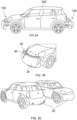
Figures 3A, 3B and 3C show the stages of deployment of the scratch protection device. -
Figures 1 to 3 show a preferred embodiment of thescratch protection device 100. - The
scratch protection device 100 is for avehicle 200 and is preferably provided at thebumper regions 150 of a vehicle (Figures 3A and 3B which show the bumper regions). - The
scratch protection device 100 has a vehicle attachment means 10 that enables the device to be connected to avehicle 200. - The
device 100 has least oneroller 15 for deploying and retracting at least one length ofanti-scratch material 20. The at least oneroller 15 is arranged on aframe 30. - A motor driven train (belt) 40 drives rotation of the
roller 15 by rotation ofdrive wheels 41. - The
scratch protection device 100 has at least one verticallinear actuator 50 for moving the at least oneroller 15, up and down, with respect to theframe 30. This enables theroller 15 to be deployed from a stowed location in the bumper area 150 (for example bonnet space or boot space) to an area external to thebumper space 150 from which theanti-scratch material 20 can be deployed so that is lays over the bumper(s) 150. - The
scratch protection device 100 also has at least one horizontallinear actuator 60 for extending and retracting part of theframe 30 that is connected to the bumper (not shown inFigures 1 and2 ). This enables the bumper to be moved forward and backwards with respect to the vehicle. - In this way the
roller 15 is positioned so thatmaterial 20 is deployed over an external face of the bumper. - The
actuators - In some embodiments the actuators may be driven by means of a hydraulic or pneumatic system (not shown).
- The motor (not shown) is operatively connected to drive
wheels roller 15 by means of atiming belt 40 when activated (seeFigure 2 ). Thedrive wheels 41A are provided at ends and mid points of theroller 15. Thedrive wheels 41 are driven by the motor and connected by a timing belt to drivewheels 41 A on the roller. - The
scratch protection device 100 has aroll tensioning system 70 to retain the at least one length ofanti-scratch material 20 taut against the at least oneroller 15. - The
tensioning system 70 haswheels 71 mounted in an arm 72 (seeFigure 2 ). Thewheels 70 are arranged in contact with the material 20 to ensure that the material remains taut against the roller when deployed and when retracted. - The
scratch protection device 100 has a pair of brush strips 80 that is shaped and dimensioned to correspond to a vehicle bumper. Feeding the anti-scratch material through the pair of brush strips helps prevent snagging and ensures the material is correctly deployed to cover the bumpers. - The invention has been described by way of examples only and it will be appreciated that variation may be made to the above-mentioned embodiments without departing from the scope of invention as defined by the claims.
Claims (13)
- A scratch protection device 100 for a vehicle (200) that is deployed from a stowed location in a bumper region (150) comprising: a vehicle attachment means (10), at least one roller (12) for deploying and retracting at least one length of anti-scratch material (20), the at least one roller (15) is arranged on a frame (30) and a motor drives rotation of the roller (15), characterised in that there is at least one substantially vertical linear actuator (50) is provided for moving the at least one roller (15) with respect to the frame (30) and at least one substantially horizontal linear actuator (60) is provided for extending and retracting part of the frame (30) that is connected to a bumper (150).
- A scratch protection device (100) according to any preceding claim including a roll tensioning system (70) to retain the at least one length of anti-scratch material (20) taut against the at least one roller (15).
- A scratch protection device (100) according to any preceding claim including an automated deployment mechanism.
- A scratch protection device (100) according to any preceding claim including at least one brush strip (80) that is shaped and dimensioned to correspond to a vehicle bumper profile.
- A scratch protection device (100) according to any preceding claim wherein the anti-scratch material (20) is transparent or translucent.
- A scratch protection device (100) according to any preceding claim wherein the anti-scratch material is decorated.
- A scratch protection device (100) according to any preceding claim including at least one proximity sensor to detect nearby objects which causes the device to deploy.
- A scratch protection device (100) according to any preceding claim wherein the anti-scratch material (20) includes an end strip provided at a distal end.
- A scratch protection device (100) according to any preceding claim including a guide means wherein the anti-scratch material (20) includes a side edge that is guided through a channel to assist with deployment and retraction of the anti-scratch material (20).
- A scratch protection device (100) according to claim 11 wherein the side edge is a flexible T-shaped cross section that is fed through a T-shaped channel.
- A vehicle bumper (150) including the scratch protection device (100) according to any preceding claim.
- A vehicle (200) including the scratch protection device (100) as described in any of claims 1 to 10.
- A method of deploying the scratch protection device (100) described in claims 1 to 12 including the steps of: activating the horizontal linear actuator(s) (60) that is provided for extending and retracting part of the frame (30) that is connected to a bumper to displace the bumper (150) from a first position to a second position away from the vehicle body, activating the vertical linear actuator(s) (50) to move the roller substantially upwards from a first position to a second position in which the roller (15) is above the bumper (150), activating the motor driven train so that the anti-scratch material (20) unrolls over the bumper (150), lowering the roller (15) by the vertical linear actuator(s) (50) to the first position, returning the bumper (150) to the first position against the vehicle body by means of the horizonal linear actuators (60).
Applications Claiming Priority (1)
| Application Number | Priority Date | Filing Date | Title |
|---|---|---|---|
| GB2107215.2A GB2596643B (en) | 2021-05-20 | 2021-05-20 | A vehicle scratch protection device |
Publications (3)
| Publication Number | Publication Date |
|---|---|
| EP4091886A1 EP4091886A1 (en) | 2022-11-23 |
| EP4091886B1 true EP4091886B1 (en) | 2023-10-11 |
| EP4091886C0 EP4091886C0 (en) | 2023-10-11 |
Family
ID=76637619
Family Applications (1)
| Application Number | Title | Priority Date | Filing Date |
|---|---|---|---|
| EP22174423.8A Active EP4091886B1 (en) | 2021-05-20 | 2022-05-19 | A vehicle scratch protection device |
Country Status (2)
| Country | Link |
|---|---|
| EP (1) | EP4091886B1 (en) |
| GB (1) | GB2596643B (en) |
Family Cites Families (11)
| Publication number | Priority date | Publication date | Assignee | Title |
|---|---|---|---|---|
| GB487419A (en) * | 1937-01-04 | 1938-06-21 | Andrew Kelly | Improvements relating to bumpers and like collision-guards for motor road vehicles |
| US4264093A (en) * | 1979-04-05 | 1981-04-28 | Long Alvin L | Bumper extension for heavy vehicles |
| US4856842A (en) * | 1986-10-30 | 1989-08-15 | Ross Richard E | Self-storing, retractable automobile cover |
| US4848823A (en) * | 1987-10-13 | 1989-07-18 | Entretec, Inc. | Remote control power-assisted vehicle cover |
| DE19620790A1 (en) * | 1996-05-23 | 1997-11-27 | Vitali Hunecker | Cover for motor vehicle for protection against weather |
| DE10159300B4 (en) * | 2001-12-04 | 2005-09-22 | Webasto Ag | Device for preventing body damage to a vehicle |
| JP7211704B2 (en) * | 2015-01-29 | 2023-01-24 | ノヴォ ノルディスク アー/エス | A tablet containing a GLP-1 agonist and an enteric coating |
| US9908394B2 (en) | 2016-07-07 | 2018-03-06 | Ford Global Technologies, Llc | Protective cover system and related method |
| US9713952B1 (en) * | 2016-07-08 | 2017-07-25 | Christopher Brueggeman | Vehicle side protection device |
| US11007953B2 (en) * | 2016-11-23 | 2021-05-18 | Ayodeji Stephen Ibitoye | Apparatus and system for an automated bumper protection roll |
| US10239478B2 (en) * | 2017-03-30 | 2019-03-26 | Ford Global Technologies Llc | Four-quadrant protective dent shield system |
-
2021
- 2021-05-20 GB GB2107215.2A patent/GB2596643B/en not_active Expired - Fee Related
-
2022
- 2022-05-19 EP EP22174423.8A patent/EP4091886B1/en active Active
Also Published As
| Publication number | Publication date |
|---|---|
| EP4091886C0 (en) | 2023-10-11 |
| GB202107215D0 (en) | 2021-07-07 |
| GB2596643A (en) | 2022-01-05 |
| EP4091886A1 (en) | 2022-11-23 |
| GB2596643B (en) | 2022-07-13 |
Similar Documents
| Publication | Publication Date | Title |
|---|---|---|
| US9428039B2 (en) | Motor vehicle provided with a protective tarpaulin system | |
| US5655807A (en) | Cover for the bed of a pickup truck with an associated roll-up housing | |
| US4848823A (en) | Remote control power-assisted vehicle cover | |
| US5597196A (en) | Automobile cover deployment and storage system | |
| US4834445A (en) | Cover deployment apparatus | |
| US9533558B2 (en) | Automatic vehicle cover | |
| WO2007099384A1 (en) | Sunscreen apparatus | |
| US7252321B2 (en) | Electric car sunshade | |
| CA2576363A1 (en) | Vehicle protecting cover device | |
| JP2005119655A (en) | Protection device of luggage area of automobile | |
| RU2016140333A (en) | SUN SYSTEM FOR MOTOR VEHICLE (OPTIONS) AND METHOD FOR SUN COATING PROTECTION | |
| JP7146817B2 (en) | Motor vehicle with protective tarpaulin system | |
| EP4091886B1 (en) | A vehicle scratch protection device | |
| US20240217324A1 (en) | Vehicle Scratch Protection Device | |
| US7140662B1 (en) | Retractable sunshade | |
| US10239478B2 (en) | Four-quadrant protective dent shield system | |
| US5454136A (en) | Forced air vehicle dryer and proximity control system therefor | |
| US3292684A (en) | Roll up protective convering for vehicle tops including the windows | |
| CA2814515C (en) | Rolling tarpaulin system for selectively covering and uncovering trailers for trucks | |
| JP2024524479A (en) | Anti-slip device for wheeled vehicles and assembly including such a device | |
| AT11244U1 (en) | COVER FOR MOTOR VEHICLES | |
| CN102452301A (en) | Shading system for a motor vehicle | |
| KR101672493B1 (en) | Protection device for vehicle side panel when parking | |
| US11891004B1 (en) | Vehicle protection assembly | |
| EP2431206B1 (en) | Arrangement for laying out a covering over a container |
Legal Events
| Date | Code | Title | Description |
|---|---|---|---|
| PUAI | Public reference made under article 153(3) epc to a published international application that has entered the european phase |
Free format text: ORIGINAL CODE: 0009012 |
|
| STAA | Information on the status of an ep patent application or granted ep patent |
Free format text: STATUS: THE APPLICATION HAS BEEN PUBLISHED |
|
| AK | Designated contracting states |
Kind code of ref document: A1 Designated state(s): AL AT BE BG CH CY CZ DE DK EE ES FI FR GB GR HR HU IE IS IT LI LT LU LV MC MK MT NL NO PL PT RO RS SE SI SK SM TR |
|
| STAA | Information on the status of an ep patent application or granted ep patent |
Free format text: STATUS: REQUEST FOR EXAMINATION WAS MADE |
|
| 17P | Request for examination filed |
Effective date: 20230227 |
|
| RBV | Designated contracting states (corrected) |
Designated state(s): AL AT BE BG CH CY CZ DE DK EE ES FI FR GB GR HR HU IE IS IT LI LT LU LV MC MK MT NL NO PL PT RO RS SE SI SK SM TR |
|
| GRAP | Despatch of communication of intention to grant a patent |
Free format text: ORIGINAL CODE: EPIDOSNIGR1 |
|
| STAA | Information on the status of an ep patent application or granted ep patent |
Free format text: STATUS: GRANT OF PATENT IS INTENDED |
|
| INTG | Intention to grant announced |
Effective date: 20230503 |
|
| GRAS | Grant fee paid |
Free format text: ORIGINAL CODE: EPIDOSNIGR3 |
|
| GRAA | (expected) grant |
Free format text: ORIGINAL CODE: 0009210 |
|
| STAA | Information on the status of an ep patent application or granted ep patent |
Free format text: STATUS: THE PATENT HAS BEEN GRANTED |
|
| AK | Designated contracting states |
Kind code of ref document: B1 Designated state(s): AL AT BE BG CH CY CZ DE DK EE ES FI FR GB GR HR HU IE IS IT LI LT LU LV MC MK MT NL NO PL PT RO RS SE SI SK SM TR |
|
| REG | Reference to a national code |
Ref country code: GB Ref legal event code: FG4D |
|
| REG | Reference to a national code |
Ref country code: CH Ref legal event code: EP |
|
| REG | Reference to a national code |
Ref country code: DE Ref legal event code: R096 Ref document number: 602022000662 Country of ref document: DE |
|
| REG | Reference to a national code |
Ref country code: IE Ref legal event code: FG4D |
|
| U01 | Request for unitary effect filed |
Effective date: 20231110 |
|
| U07 | Unitary effect registered |
Designated state(s): AT BE BG DE DK EE FI FR IT LT LU LV MT NL PT SE SI Effective date: 20231121 |
|
| PG25 | Lapsed in a contracting state [announced via postgrant information from national office to epo] |
Ref country code: GR Free format text: LAPSE BECAUSE OF FAILURE TO SUBMIT A TRANSLATION OF THE DESCRIPTION OR TO PAY THE FEE WITHIN THE PRESCRIBED TIME-LIMIT Effective date: 20240112 |
|
| PG25 | Lapsed in a contracting state [announced via postgrant information from national office to epo] |
Ref country code: IS Free format text: LAPSE BECAUSE OF FAILURE TO SUBMIT A TRANSLATION OF THE DESCRIPTION OR TO PAY THE FEE WITHIN THE PRESCRIBED TIME-LIMIT Effective date: 20240211 |
|
| PG25 | Lapsed in a contracting state [announced via postgrant information from national office to epo] |
Ref country code: ES Free format text: LAPSE BECAUSE OF FAILURE TO SUBMIT A TRANSLATION OF THE DESCRIPTION OR TO PAY THE FEE WITHIN THE PRESCRIBED TIME-LIMIT Effective date: 20231011 |
|
| PG25 | Lapsed in a contracting state [announced via postgrant information from national office to epo] |
Ref country code: IS Free format text: LAPSE BECAUSE OF FAILURE TO SUBMIT A TRANSLATION OF THE DESCRIPTION OR TO PAY THE FEE WITHIN THE PRESCRIBED TIME-LIMIT Effective date: 20240211 Ref country code: GR Free format text: LAPSE BECAUSE OF FAILURE TO SUBMIT A TRANSLATION OF THE DESCRIPTION OR TO PAY THE FEE WITHIN THE PRESCRIBED TIME-LIMIT Effective date: 20240112 Ref country code: ES Free format text: LAPSE BECAUSE OF FAILURE TO SUBMIT A TRANSLATION OF THE DESCRIPTION OR TO PAY THE FEE WITHIN THE PRESCRIBED TIME-LIMIT Effective date: 20231011 |
|
| PG25 | Lapsed in a contracting state [announced via postgrant information from national office to epo] |
Ref country code: RS Free format text: LAPSE BECAUSE OF FAILURE TO SUBMIT A TRANSLATION OF THE DESCRIPTION OR TO PAY THE FEE WITHIN THE PRESCRIBED TIME-LIMIT Effective date: 20231011 Ref country code: PL Free format text: LAPSE BECAUSE OF FAILURE TO SUBMIT A TRANSLATION OF THE DESCRIPTION OR TO PAY THE FEE WITHIN THE PRESCRIBED TIME-LIMIT Effective date: 20231011 Ref country code: NO Free format text: LAPSE BECAUSE OF FAILURE TO SUBMIT A TRANSLATION OF THE DESCRIPTION OR TO PAY THE FEE WITHIN THE PRESCRIBED TIME-LIMIT Effective date: 20240111 Ref country code: HR Free format text: LAPSE BECAUSE OF FAILURE TO SUBMIT A TRANSLATION OF THE DESCRIPTION OR TO PAY THE FEE WITHIN THE PRESCRIBED TIME-LIMIT Effective date: 20231011 |
|
| U20 | Renewal fee for the european patent with unitary effect paid |
Year of fee payment: 3 Effective date: 20240503 |
|
| REG | Reference to a national code |
Ref country code: DE Ref legal event code: R097 Ref document number: 602022000662 Country of ref document: DE |
|
| PG25 | Lapsed in a contracting state [announced via postgrant information from national office to epo] |
Ref country code: CZ Free format text: LAPSE BECAUSE OF FAILURE TO SUBMIT A TRANSLATION OF THE DESCRIPTION OR TO PAY THE FEE WITHIN THE PRESCRIBED TIME-LIMIT Effective date: 20231011 |
|
| PG25 | Lapsed in a contracting state [announced via postgrant information from national office to epo] |
Ref country code: SK Free format text: LAPSE BECAUSE OF FAILURE TO SUBMIT A TRANSLATION OF THE DESCRIPTION OR TO PAY THE FEE WITHIN THE PRESCRIBED TIME-LIMIT Effective date: 20231011 |
|
| PG25 | Lapsed in a contracting state [announced via postgrant information from national office to epo] |
Ref country code: SM Free format text: LAPSE BECAUSE OF FAILURE TO SUBMIT A TRANSLATION OF THE DESCRIPTION OR TO PAY THE FEE WITHIN THE PRESCRIBED TIME-LIMIT Effective date: 20231011 Ref country code: SK Free format text: LAPSE BECAUSE OF FAILURE TO SUBMIT A TRANSLATION OF THE DESCRIPTION OR TO PAY THE FEE WITHIN THE PRESCRIBED TIME-LIMIT Effective date: 20231011 Ref country code: RO Free format text: LAPSE BECAUSE OF FAILURE TO SUBMIT A TRANSLATION OF THE DESCRIPTION OR TO PAY THE FEE WITHIN THE PRESCRIBED TIME-LIMIT Effective date: 20231011 Ref country code: CZ Free format text: LAPSE BECAUSE OF FAILURE TO SUBMIT A TRANSLATION OF THE DESCRIPTION OR TO PAY THE FEE WITHIN THE PRESCRIBED TIME-LIMIT Effective date: 20231011 |
|
| PLBE | No opposition filed within time limit |
Free format text: ORIGINAL CODE: 0009261 |
|
| STAA | Information on the status of an ep patent application or granted ep patent |
Free format text: STATUS: NO OPPOSITION FILED WITHIN TIME LIMIT |
|
| 26N | No opposition filed |
Effective date: 20240712 |
|
| PG25 | Lapsed in a contracting state [announced via postgrant information from national office to epo] |
Ref country code: MC Free format text: LAPSE BECAUSE OF FAILURE TO SUBMIT A TRANSLATION OF THE DESCRIPTION OR TO PAY THE FEE WITHIN THE PRESCRIBED TIME-LIMIT Effective date: 20231011 |
|
| PG25 | Lapsed in a contracting state [announced via postgrant information from national office to epo] |
Ref country code: MC Free format text: LAPSE BECAUSE OF FAILURE TO SUBMIT A TRANSLATION OF THE DESCRIPTION OR TO PAY THE FEE WITHIN THE PRESCRIBED TIME-LIMIT Effective date: 20231011 |
|
| PG25 | Lapsed in a contracting state [announced via postgrant information from national office to epo] |
Ref country code: IE Free format text: LAPSE BECAUSE OF NON-PAYMENT OF DUE FEES Effective date: 20240519 |
|
| U1N | Appointed representative for the unitary patent procedure changed after the registration of the unitary effect |
Representative=s name: IPCONSULT; GB |
|
| PG25 | Lapsed in a contracting state [announced via postgrant information from national office to epo] |
Ref country code: CY Free format text: LAPSE BECAUSE OF FAILURE TO SUBMIT A TRANSLATION OF THE DESCRIPTION OR TO PAY THE FEE WITHIN THE PRESCRIBED TIME-LIMIT; INVALID AB INITIO Effective date: 20220519 |
|
| PG25 | Lapsed in a contracting state [announced via postgrant information from national office to epo] |
Ref country code: HU Free format text: LAPSE BECAUSE OF FAILURE TO SUBMIT A TRANSLATION OF THE DESCRIPTION OR TO PAY THE FEE WITHIN THE PRESCRIBED TIME-LIMIT; INVALID AB INITIO Effective date: 20220519 |
|
| REG | Reference to a national code |
Ref country code: CH Ref legal event code: H13 Free format text: ST27 STATUS EVENT CODE: U-0-0-H10-H13 (AS PROVIDED BY THE NATIONAL OFFICE) Effective date: 20251223 |
|
| U90 | Renewal fees not paid: noting of loss of rights |
Free format text: RENEWAL FEE NOT PAID FOR YEAR 04 Effective date: 20251216 |
|
| PG25 | Lapsed in a contracting state [announced via postgrant information from national office to epo] |
Ref country code: CH Free format text: LAPSE BECAUSE OF NON-PAYMENT OF DUE FEES Effective date: 20250531 |
|
| U93 | Unitary patent lapsed |
Free format text: RENEWAL FEE NOT PAID Effective date: 20250531 |