EP4091163B1 - Adaptive frame batching to reduce speech recognition latency - Google Patents
Adaptive frame batching to reduce speech recognition latency Download PDFInfo
- Publication number
- EP4091163B1 EP4091163B1 EP20842072.9A EP20842072A EP4091163B1 EP 4091163 B1 EP4091163 B1 EP 4091163B1 EP 20842072 A EP20842072 A EP 20842072A EP 4091163 B1 EP4091163 B1 EP 4091163B1
- Authority
- EP
- European Patent Office
- Prior art keywords
- batch
- frames
- look
- ahead
- speech recognition
- Prior art date
- Legal status (The legal status is an assumption and is not a legal conclusion. Google has not performed a legal analysis and makes no representation as to the accuracy of the status listed.)
- Active
Links
Images





Classifications
-
- G—PHYSICS
- G10—MUSICAL INSTRUMENTS; ACOUSTICS
- G10L—SPEECH ANALYSIS TECHNIQUES OR SPEECH SYNTHESIS; SPEECH RECOGNITION; SPEECH OR VOICE PROCESSING TECHNIQUES; SPEECH OR AUDIO CODING OR DECODING
- G10L15/00—Speech recognition
- G10L15/02—Feature extraction for speech recognition; Selection of recognition unit
-
- G—PHYSICS
- G10—MUSICAL INSTRUMENTS; ACOUSTICS
- G10L—SPEECH ANALYSIS TECHNIQUES OR SPEECH SYNTHESIS; SPEECH RECOGNITION; SPEECH OR VOICE PROCESSING TECHNIQUES; SPEECH OR AUDIO CODING OR DECODING
- G10L15/00—Speech recognition
- G10L15/08—Speech classification or search
- G10L15/18—Speech classification or search using natural language modelling
- G10L15/183—Speech classification or search using natural language modelling using context dependencies, e.g. language models
- G10L15/19—Grammatical context, e.g. disambiguation of the recognition hypotheses based on word sequence rules
- G10L15/197—Probabilistic grammars, e.g. word n-grams
-
- G—PHYSICS
- G10—MUSICAL INSTRUMENTS; ACOUSTICS
- G10L—SPEECH ANALYSIS TECHNIQUES OR SPEECH SYNTHESIS; SPEECH RECOGNITION; SPEECH OR VOICE PROCESSING TECHNIQUES; SPEECH OR AUDIO CODING OR DECODING
- G10L15/00—Speech recognition
- G10L15/28—Constructional details of speech recognition systems
- G10L15/32—Multiple recognisers used in sequence or in parallel; Score combination systems therefor, e.g. voting systems
-
- G—PHYSICS
- G10—MUSICAL INSTRUMENTS; ACOUSTICS
- G10L—SPEECH ANALYSIS TECHNIQUES OR SPEECH SYNTHESIS; SPEECH RECOGNITION; SPEECH OR VOICE PROCESSING TECHNIQUES; SPEECH OR AUDIO CODING OR DECODING
- G10L15/00—Speech recognition
- G10L15/04—Segmentation; Word boundary detection
- G10L15/05—Word boundary detection
-
- G—PHYSICS
- G10—MUSICAL INSTRUMENTS; ACOUSTICS
- G10L—SPEECH ANALYSIS TECHNIQUES OR SPEECH SYNTHESIS; SPEECH RECOGNITION; SPEECH OR VOICE PROCESSING TECHNIQUES; SPEECH OR AUDIO CODING OR DECODING
- G10L15/00—Speech recognition
- G10L15/22—Procedures used during a speech recognition process, e.g. man-machine dialogue
-
- G—PHYSICS
- G10—MUSICAL INSTRUMENTS; ACOUSTICS
- G10L—SPEECH ANALYSIS TECHNIQUES OR SPEECH SYNTHESIS; SPEECH RECOGNITION; SPEECH OR VOICE PROCESSING TECHNIQUES; SPEECH OR AUDIO CODING OR DECODING
- G10L15/00—Speech recognition
- G10L15/28—Constructional details of speech recognition systems
- G10L15/30—Distributed recognition, e.g. in client-server systems, for mobile phones or network applications
-
- G—PHYSICS
- G10—MUSICAL INSTRUMENTS; ACOUSTICS
- G10L—SPEECH ANALYSIS TECHNIQUES OR SPEECH SYNTHESIS; SPEECH RECOGNITION; SPEECH OR VOICE PROCESSING TECHNIQUES; SPEECH OR AUDIO CODING OR DECODING
- G10L15/00—Speech recognition
- G10L15/08—Speech classification or search
- G10L15/16—Speech classification or search using artificial neural networks
Definitions
- Neural network-based models are commonly used to perform automatic speech recognition (ASR).
- ASR automatic speech recognition
- a neural network-based acoustic model is trained to extract senone-discriminative features from input audio frames and to classify senones based on the extracted features.
- a decoder generates word hypotheses based on the classifications and outputs corresponding text.
- the input audio frames may be batched into a batch of two or more frames to allow for joint processing and recognition, with the goal of improving accuracy and performance.
- batching requires the system to wait to receive all frames of the batch before submitting the batch to the ASR. This waiting may result in undesirable user-perceived latency regardless of the processing speed of the ASR.
- ASR systems may use several physically-different models to satisfy different latency requirements within a given deployment. This approach multiplies processor-related training and deployment costs. Systems are desired to improve latency without resorting to parallel models.
- US 2018/012593 A1 describes that features are disclosed for detecting words in audio using contextual information in addition to automatic speech recognition results.
- a detection model can be generated and used to determine whether a particular word, such as a keyword or "wake word," has been uttered.
- the detection model can operate on features derived from an audio signal, contextual information associated with generation of the audio signal, and the like.
- the detection model can be customized for particular users or groups of users based usage patterns associated with the users.
- US 2017/236518 A1 describes a GPU-accelerated speech recognition engine optimized for faster than real time speech recognition on a scalable server-client heterogeneous CPU-GPU architecture, which is specifically optimized to simultaneously decode multiple users in real-time.
- a "producer/consumer" design pattern is applied to decouple speech processes that run at different rates in order to handle multiple processes at the same time.
- the speech recognition process is divided into multiple consumers in order to maximize hardware utilization.
- US 2016/217367 A1 describes methods, systems, and apparatus, including computer programs encoded on computer storage media, for training a neural network.
- One of the methods includes generating, by a speech recognition system, a matrix from a predetermined quantity of vectors that each represent input for a layer of a neural network, generating a plurality of sub-matrices from the matrix, using, for each of the sub-matrices, the respective sub-matrix as input to a node in the layer of the neural network to determine whether an utterance encoded in an audio signal comprises a keyword for which the neural network is trained.
- XUE SHAOFEI ET AL "Improving latency-controlled BLSTM acoustic models for online speech recognition", 2017 IEEE INTERNATIONAL CONFERENCE ON ACOUSTICS, SPEECH AND SIGNAL PROCESSING (ICASSP), IEEE, 5 March 2017 , describes that bidirectional long short-term memory (BLSTM) recurrent neural networks are powerful acoustic models in terms of recognition accuracy.
- BLSTM acoustic models are used in decoding, the speech decoder needs to wait until the end of a whole sentence is reached, such that forward-propagation in the backward direction can then be performed.
- the nature of BLSTM acoustic models makes them inappropriate for real-time online speech recognition because of the latency issue.
- the number of frames which are simultaneously-input to an acoustic model is dynamically controlled during ASR processing. For example, a small batch size is used until a word hypothesis is generated. Use of a small batch size may provide lower latency than a larger batch size because less time is required to collect a small batch than to collect a larger batch of identically-sized frames. The batch size is then increased after the word hypothesis is generated, which may improve processing efficiency because simultaneously processing of a larger number of frames is more CPU- and cache-efficient than the processing of a smaller number of frames. A user may therefore be presented with a word hypothesis quickly while retaining most of the processing advantages of larger batch sizes.
- Some embodiments are operable in conjunction with models employing look-ahead frames within each batch of input frames, where the number of look-ahead frames relates to the degree of overlap between consecutive batches of input frames. These embodiments may also dynamically control batch sizes as described above to provide low initial user-perceived latency and, subsequent to a first hypothesis, further provide improved processing efficiency.
- Some models are operable to receive input batches of various size and including various numbers of look-ahead frames. By dynamically increasing the batch size in response to a first hypothesis, embodiments using such models may provide low initial user-perceived latency and, thereafter, improved processing efficiency as described above. Moreover, increased recognition accuracy may be achieved by increasing the number of look-ahead frames in response to the first hypothesis.
- such an acoustic model may be trained in view of a particular number of look-ahead frames which is greater than the initially-used number of look-ahead frames. Therefore, although initial operation is suboptimal, changing the number of look-ahead frames to the number of look-ahead frames based on which the acoustic model was trained may result in increased recognition accuracy. Embodiment may also allow for changing the number of look-ahead frames while holding the batch size constant.
- some embodiments monitor the input frames independently of the hypothesis generation in order to detect an end-of-speech state. Upon detecting this state, the batch size may be reduced to avoid waiting for non-speech frames which would otherwise be added to a current batch of input frames. The batch size may be additionally or alternatively reduced in response to detection of an end-of-stream, of a target maximum processing time, or other condition. Such embodiments may therefore support an early exit from the batching process and reduce latency in the generation of a final hypothesis.
- FIG. 1A illustrates speech recognition system 100 employing initial latency-sensitive adaptive batching during operation according to some embodiments.
- System 100 may be implemented using any suitable combinations of hardware and software components.
- Each illustrated function of system 100 or otherwise described herein may be implemented by one or more computing devices (e.g., computer servers), storage devices (e.g., hard or solid-state disk drives), and other hardware as is known in the art.
- the components may be located remote from one another and may be elements of one or more cloud computing platforms, including but not limited to a Software-as-a-Service, a Platform-as-a-Service, and an Infrastructure-as-a-Service platform.
- one or more components are implemented by one or more dedicated virtual machines executing one or more trained neural network models.
- Frame generation unit 110 receives an audio signal and generates a frame-level magnitude spectra, or raw acoustic feature frame, corresponding to a respective frame of the audio signal as is known in the art. For example, assuming an audio frame size of 25ms, frame generation unit 110 generates first raw acoustic feature frame s 0 based on the first 25ms of the incoming audio signal. In this regard, FIG. 1A illustrates the commencement of ASR based on the incoming audio signal.
- a next raw acoustic feature frame may be generated based on a next 25ms of the incoming audio signal.
- temporally-adjacent raw acoustic feature frames may represent overlapping frames of the audio signal.
- first raw acoustic feature frame s 0 may be generated based on the first 25ms of the incoming audio signal
- a next raw acoustic feature frame may be generated based on a 15ms through 40ms frame of the incoming audio signal
- a third raw acoustic feature frame may be generated based on a 30ms through 55ms frame of the incoming audio signal.
- the generated raw acoustic feature frames are Mel-Frequency Cepstral Coefficients or log-filterbank features as is known in the art.
- Frame generation unit 110 may implement any suitable signal processing to determine a raw acoustic feature frames corresponding to a respective frame of the incoming audio signal.
- frame generation unit 110 may implement a custom-designed Fast Fourier Transform and custom filterbank parameters.
- Trained acoustic model 130 may comprise any acoustic model capable of processing batches of input frames having various batch sizes.
- trained acoustic model 130 may comprise a uni-directional long short-term memory model (LSTM), a bi-directional LSTM (BLSTM) model, or a layer-trajectory LSTM (ltLSTM), but embodiments are not limited thereto.
- LSTM long short-term memory model
- BLSTM bi-directional LSTM
- ltLSTM layer-trajectory LSTM
- trained acoustic model 130 is also capable of processing batches of input frames which include look-ahead frames.
- Trained acoustic model 130 may support only a fixed number of look-ahead frames (e.g., a contextual layer-trajectory LSTM (cltLSTM) model) or may support batches including varying numbers of look-ahead frames (e.g., a latency-controlled BLSTM (LC-BLSTM) model).
- cltLSTM contextual layer-trajectory LSTM
- LC-BLSTM latency-controlled BLSTM
- Decoder 140 forms word hypotheses based on the output of trained acoustic model 130.
- model 130 outputs senone posteriors in response to a received batch of input frames.
- Batcher 120 determines a batch size and/or a number of look-ahead frames based on which the batches are collected. As described herein, the determination may be based on word hypotheses generated by decoder 140 and/or on an otherwise-detected end-of-speech state. Accordingly, batcher 120 implements a function which determines a batch size (and, in some embodiments, a number of look-ahead frames) based on a received work hypothesis and/or end-of-speech signal.
- FIG. 1B illustrates continued operation of system 200 according to the present example.
- frame generation unit 110 has generated frame s 1 based on a second (potentially-overlapping) frame of the input audio signal. It will be assumed that the initial batch size is set to two.
- Batcher 120 has previously received frame s 0 as illustrated in FIG. 1A . Due to the initial batch size of two, batcher 120 collects frames s 0 and s 1 into batch 150 and provides batch 150 to trained acoustic model 130. Model 130 outputs corresponding posteriors based upon its architecture and trained parameter values as is known in the art. The posteriors are received by decoder 140, which proceeds to attempt to form a hypothesis.
- FIG. 1C illustrates generation of frame s 10 based on a respective frame of the audio signal.
- batcher 120 has already collected frames s 8 and s 9 into batch 152, and passes these frames to model 130.
- decoder 140 now generates a non-silent, non-noise hypothesis based on the batches received up to the present point. As illustrated, the hypothesis is returned to batcher 120. Based on the generation of the hypothesis, batcher 120 determines to increase the batch size.
- the determination to change the batch size and/or of the new batch size based on the hypotheses may be performed by a component different from batcher 120. Such a component may therefore transmit the new batch size to batcher 120 so batcher 120 may conform subsequent batching to the new batch size.
- Determination of a new batch size is at least triggered by a first-generated word hypothesis.
- the determination may be triggered by an n -th-generated word hypothesis, by generation of one (or more) of a particular subset of word hypotheses, or by any other function of word hypotheses output by decoder 140.
- FIG. 1D illustrates implementation of the new batch size according to some embodiments.
- the new batch size is assumed to be four, although embodiments are not limited thereto. Accordingly, after the output of batch 152 as shown in FIG. 1C , batcher 120 collects frames s 10 through s 14 into batch 154 and provides batch 154 to model 130. In contrast, if the batch size had remained at two, batcher 120 would have collected only frames s 10 and s 11 into a batch and provided that batch to model 130.
- the illustrated process may continue, with batches consisting of four frames, until ASR terminates (e.g., the end of the audio signal has been reached).
- the batch size is reduced to the initial batch size (e.g., two) upon detecting silence based on the output of decoder 140, and is again increased as described above in response to a word hypothesis.
- the batch size may increase gradually to a target batch size.
- batcher 120 may increase the batch size from two to three for a particular time period, and then may increase the batch size from three to four. The increases may be effected based on the generation of further hypotheses instead of, or in addition to, on elapsed time.
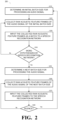
- FIG. 2 is a flow diagram of process 200 to provide dynamic batching according to some embodiments.
- Process 200 and the other processes described herein may be performed using any suitable combination of hardware and software.
- Software program code embodying these processes may be stored by any non-transitory tangible medium, including a fixed disk, a volatile or non-volatile random access memory, a DVD, a Flash drive, or a magnetic tape, and executed by any number of processing units, including but not limited to processors, processor cores, and processor threads. Embodiments are not limited to the examples described herein.
- Process 200 may be initiated in response to a request to perform ASR on an audio signal.
- Process 200 may be executed, for example, by a cloud-based ASR service which receives the request and audio signal from a cloud-based meeting provider.
- the audio signal may be received as a near real-time stream according to some embodiments.
- process 200 executes continuously to process any signal which is present on an incoming audio channel.
- An initial batch size for processing the audio signal is determined at 5210.
- the initial batch size may be a predefined experimentally-determined value.
- the initial batch size may be selected from several values based on a desired initial latency, where lower latency corresponds to smaller batch sizes. With reference to the example of FIGS. 1A through 1D , an initial batch size of two frames is determined at S210.
- Raw acoustic feature frames of the audio signal are collected at S220.
- the number of collected raw acoustic feature frames is equal to the determined initial batch size. Accordingly, with respect to the above example, flow pauses at S220 while batcher 120 waits to receive frames s 0 and s 1 from frame generation unit 110.
- the collected frames are input as a batch to a speech recognition network at S230.
- the speech recognition network may comprise any system capable of generating word hypotheses based on batches of acoustic frames.
- Trained acoustic model 130 and decoder 140 of FIGS. 1A through 1D comprise a speech recognition network according to some embodiments.
- S240 it is determined whether a word hypothesis has been generated by the speech recognition network. More specifically, S240 may comprise determination of whether the speech recognition network has generated a non-silent, non-noise hypothesis based on the batches received up to the present point. If not, flow returns to S220 to collect another batch of frames conforming to the initial batch size. Flow therefore cycles between S220, S230 and S240 until a word hypothesis has been generated by the speech recognition network. As described above, the determination at S240 is not limited to identification of a first-generated word hypothesis.
- the determination at S240 may occur independently of and in parallel with the cycling of flow between S220 and S230.
- the collection and input of batches of frames may proceed until interrupted by a separate determination of a generated word hypothesis, after which flow proceeds to S250.
- a next batch size for processing the audio signal is determined.
- the next batch size may be predetermined based on experimentation and/or selected from several possible batch sizes. According to some embodiments, the next batch size is eighty frames.
- raw acoustic feature frames of the next batch size are collected at S260 and input to the speech recognition network at S270.
- flow cycles between S260 and S270 to collect and input batches of frames until silence is detected at S280.
- Silence detection at S280 may comprise detection of a lack of word hypotheses generated by the speech recognition network over a period of time or and/or may be otherwise heuristically-based.
- the detection of silence at S280 causes process 200 to return to S210 to reset the batch size to the initial batch size. Consequently, if later frames of the audio signal include speech, the user-perceived latency of processing that speech may be lower than a latency resulting from a larger batch size.
- Some embodiments may, in response to the determination at S240, gradually increase the batch size to a target batch size. For example, the batch size may increase by a predefined number for every n iterations of S260 until a target batch size is reached.
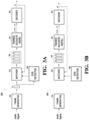
- Process 200 may terminate upon reaching the end of the audio signal. In some embodiments, process 200 terminates in response to detection of an end-of-speech state. FIGS. 3A and 3B illustrate such processing according to some embodiments.
- System 300 adds end-of-speech detector 360 to the above-described components of system 100.
- End-of-speech detector 360 receives raw acoustic frames directly from frame generation unit 310 and determines whether speech has ended based thereon.
- End-of-speech detector 360 may comprise any system for detecting an end-of-speech state based on input frames, and may include one or more trained neural networks.
- detector 360 is an LSTM classifier formulated and trained independently of the decoder hypotheses, and which predicts the end of the query based solely on past frames. Detector 360 may operate in conjunction with operational heuristics.
- components 310, 320, 330 and 340 have operated as described above to modify an initial batch size to a next batch size of four frames. Accordingly, batcher 320 has collected batch 350 of frames s 10 through s 13 for input to model 330.
- FIG. 3A also shows transmission of frame s 16 from frame generation unit 310 to batcher 320 and detector 360. Frame generation unit 310 has therefore already generated frames s 14 and s 15 , which have collected by batcher 320 in anticipation of generating a next four-frame batch.
- end-of-speech detector 360 detects an end-of-speech state in response to reception of frame s 16 .
- end-of-speech detector 360 notifies batcher 320 of the detected state.
- Batcher 320 collects frame s 16 as a last frame of the current batch.
- FIG. 3B illustrates the foregoing operation, in which batcher 320 generates batch 352 including frames s 14 , s 15 and s 16 and batch 352 is input to model 330.
- the batch size of the last batch is reduced to avoid waiting for non-speech frames which would otherwise be added to the current batch of input frames.
- Such embodiments may therefore support an early exit from the batching process and reduce latency in the generation of a final hypothesis.
- the last batch size may be reduced in response to other conditions according to some embodiments, including but not limited to detection of an end-of-stream condition and detection of an elapsed maximum recognition time.
- FIGS. 4A through 4C comprise a flow diagram of process 400 to provide dynamic batching according to some embodiments.
- Process 400 may be implemented by system 300 of FIG. 3 , but embodiments are not limited thereto.
- Steps S405, S410, S415, S420 and S425 may proceed similarly to respective ones of steps S210, S220, S230, S240 and S250 of process 200.
- an initial batch size for processing an incoming audio signal is determined at S405 and a corresponding batch of raw acoustic feature frames of the audio signal is collected at S410.
- the batch of collected frames is input to a speech recognition network at S415.
- a speech recognition network Next, at S420, it is determined whether a suitable word hypothesis has been generated by the speech recognition network. If not, flow returns to S410 to collect another batch of frames conforming to the initial batch size. If so, a next batch size for processing the audio signal is determined at S425 as described above.
- S430 it is determined whether an end-of-speech state has been detected based on a next raw acoustic feature frame.
- S430 may be executed by an end-of-speech detector operating independently of the speech recognition network as described with respect to FIGS. 3A and 3B .
- S430 may comprise receiving a frame from frame generation unit 310 and evaluating an end-of-speech state based on the received frame (and, e.g., on previously-received frames and/or other heuristics). If an end-of-speech state is not detected, flow continues to S435 to collect a next raw acoustic frame at S435. The frame may be collected at S435 for inclusion into a next batch of frames. In this regard, it is determined at S440 whether a batch conforming to the next batch size has been collected. If not, flow returns to S430.
- Flow proceeds from S430 to S455 if an end-of-speech state is detected at S430 during the collection of batches of the next batch size.
- the next raw acoustic frame based on which the end-of-speech state was detected is collected.
- an end-of-speech state is detected at S430 based on frame s 16 and frame s 16 is then collected by batcher 320 at S455 as a last frame of the current batch.
- the collected frames of the current batch ( s 14 , s 15 and s 16 ) are then input to model 330 at S460, even though the size of the current batch is less than the next batch size determined at S425.
- the determination at S420 may occur independently of and in parallel with the cycling of flow between S410 and S415.
- the end-of-speech determination at S430 may also or alternatively occur independently of and in parallel with the cycling of flow from S435 through S450.
- FIGS. 5A through 5D illustrate look-ahead-enabled speech recognition system 500 employing initial latency-sensitive adaptive batching during operation according to some embodiments.
- System 500 includes trained acoustic model 530 which supports "look-ahead" input frames as is known in the art.
- Trained acoustic model 530 may comprise any model architecture employing look-ahead frames that is or becomes known, including but not limited to a latency-controlled bi-directional long short-term memory (LC-BLSTM) acoustic model and a contextual layer-trajectory long short-term memory (cltLSTM) acoustic model.
- LC-BLSTM bi-directional long short-term memory
- cltLSTM contextual layer-trajectory long short-term memory
- a cltLSTM model may support only a fixed number of look-ahead frames while a LC-BLSTM model may support batches including varying numbers of look-ahead frames.
- FIG. 5A illustrates an example in which batcher 520 collects batches consisting of six raw acoustic feature frames, in which four of the frames (i.e., frames s 2 , s 3 , s 4 and s 5 ) are look-ahead frames.
- the batch size is defined as a window including a start frame and an end frame
- the look-ahead frames are defined by an overlap value.
- batch 550 may be defined by window ⁇ s 0 , s 5 ⁇ and by an overlap value of four (frames).
- FIG. 5B illustrates collection and input of next batch 552 according to the present example.
- Batch 552 overlaps the last four frames ( s 2 , s 3 , s 4 , and s 5 ) of batch 550 and includes look-ahead frames s 4 , s 5 , s 6 and s 7 . Therefore, batcher 520 must wait for frames s 6 and s 7 before generating batch 552.
- model 130 outputs posteriors corresponding to received batches based upon its architecture and trained parameter values as is known in the art.
- the posteriors are received by a decoder (unshown) which to attempts to form word hypotheses based on the received posteriors.
- the decoder generates a non-silent, non-noise hypothesis based on the batches received up to the point illustrated in FIG. 5B .
- batcher 520 (or another component) determines to increase the batch size.
- FIG. 5C illustrates implementation of a new batch size according to some embodiments.
- the number of look-ahead frames is fixed, but embodiments are not limited thereto.
- the example may therefore illustrate operation using a cltLSTM model, which employs a fixed number of look-ahead frames.
- the new batch size is eight frames.
- Next batch 554 therefore includes eight frames and overlaps the last four frames of preceding batch 552. embodiments are not limited thereto.
- Batch 554 includes look-ahead frames s 8 , s 9 , s 10 and s 11 . Accordingly, after the output of batch 552 as shown in FIG. 1B , batcher 520 collects frames s 8 through s 11 and adds these frames to already-received frames s 4 through s 7 to generate batch 554.
- FIG. 5D illustrates operation based on the modified batch size.
- Batcher 520 has collected frames s 12 through s 15 and added these frames to already-received frames s 8 through s 11 to generate batch 556.
- Batch 556 has a batch size of eight frames and includes four look-ahead frames.
- the batch size may increase gradually to a target batch size in some embodiments. These increases may, for example, be responsive to the generation of further hypotheses and/or to an elapsed time since a first hypothesis.
- FIGS. 5A through 5D illustrate operation to change a batch size while a number of look-ahead frames remains fixed.
- FIGS. 6A through 6D illustrate look-ahead-enabled speech recognition system 600 employing initial latency-sensitive adaptive look-ahead.
- Frame generation unit 610 receives an audio signal and generates a frame-level magnitude spectra, or raw acoustic feature frame, corresponding to a respective frame of the audio signal.
- Batcher 620 collects generated raw acoustic feature frames into batches of an initial specified batch size (or window) and having a specified number of look-ahead frames (or overlap).
- Trained acoustic model 630 receives the batches and outputs, for example, senone posteriors which are used by decoder 640 to generate word hypotheses.
- Trained acoustic model 630 supports batches including different numbers of look-ahead frames, and may therefore comprise a LC-BLSTM model in some embodiments.
- the initial batch size is three and each batch includes two look-ahead frames (i.e., frames s 1 and s 2 of batch 650).
- FIG. 6B shows output of next batch 652, which includes three frames and overlaps the two look-ahead frames of batch 650. It will be assumed that decoder 640 now generates a non-silent, non-noise hypothesis based on the batches received up to the present point.
- batch 654 overlaps look-ahead frames s 2 and s 3 of batch 652 and includes four frames.
- the four frames of batch 654 include three look-ahead frames s 3 , s 4 and s 5 .
- batcher 620 collects next batch 656 including four frames.
- the four frames of batch 656 include frames overlapping look-ahead frames s 3 , s 4 and s 5 of batch 654 and also include look-ahead frames s 4 , s 5 and s 6 .
- Embodiments may therefore increase or decrease the batch size and/or the number of look-ahead frames per batch.
- the increase or decrease to either parameter may occur once or gradually in response to a detected hypothesis.
- acoustic model 630 and decoder 640 are trained using the batch size and number of look-ahead frames of FIGS. 6C and 6D , and therefore operate optimally after detection of the first word hypothesis. Accordingly, accuracy of acoustic model 630 and decoder 640 may be less than optimal when operated in conjunction with the initial batch size and initial number of look-ahead frames as shown in FIGS. 6A and 6B , as a trade-off for shorter user-perceived latency.
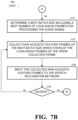
- FIGS. 7A and 7B comprise a flow diagram of process 700 to provide dynamic batching according to some embodiments.
- Process 700 may be implemented by system 600, but embodiments are not limited thereto.
- An initial batch size for processing an input audio signal is determined at S710. Also determined at S710 is an initial number of look-ahead frames to be included in each batch.
- the initial batch size may be designated as a window size and the number of look-ahead frames may be defined as a particular fraction (e.g., 1 ⁇ 2) of the window size.
- Raw acoustic feature frames of the audio signal are collected at S720 based on the initial batch size and initial number of look-ahead frames. As shown in the example of FIG. 6A , and assuming an initial batch size of three frames, flow pauses at S720 while batcher 620 waits to receive frames s 0 , s 1 and s 2 from frame generation unit 610.
- the collected frames are input as a batch to a speech recognition network at S730.
- the speech recognition network may comprise any system capable of generating word hypotheses based on batches of acoustic frames which include look-ahead frames.
- raw acoustic feature frames of the audio signal are collected based on the initial batch size and initial number of look-ahead frames.
- the frames collected at S740 overlap the look-ahead frames of the prior collected frame.
- batch 652 may be collected at S740, consisting of three frames and overlapping the look-ahead frames s 1 and s 2 of batch 650.
- the frames collected at S740 are input as a batch to the speech recognition network at S750.
- Collection of frames which overlap the look-ahead frames of a prior collected frame may comprise setting the beginning of the window of the current batch of frames to the start of the overlapped frames of the prior batch. For example, in a case where the overlap is one-half of the window size, the window of the current batch of frames is set to begin at the middle of the window of the prior batch.
- S760 comprises determination of whether a word hypothesis has been generated by the speech recognition network, and may be implemented as described above. If a word hypothesis has not yet been generated, flow returns to S740 to collect another batch of frames conforming to the initial batch size, including look-ahead frames, and overlapping the look-ahead frames of the previous batch. Flow therefore cycles between S740, S750 and S760 until a word hypothesis has been generated by the speech recognition network.
- a next batch size for processing the audio signal is determined at S770.
- Determination of a next batch size may also include determination of a next number of look-ahead frames.
- S770 may include determining a new batch size and/or a new number of look-ahead frames per batch.
- S770 comprises determining a next window size, and the next look-ahead size is determined as a function of the next window size.
- a new number of look-ahead frames may be determined only if process 700 is executed in conjunction with a speech recognition network capable of processing batches including arbitrary numbers of look-ahead frames.
- raw acoustic feature frames of the next batch size which overlap the prior look-ahead frames are collected at S775 and input to the speech recognition network at S780.
- embodiments of process 700 may further incorporate an end-of-speech detector for independently detecting an end-of-speech state. Based on the detection, a size of a last batch may be reduced (e.g., the window may be shortened) to include only up to the end-of-speech frame.
- a neural network (e.g., deep learning, deep convolutional, or recurrent) according to some embodiments comprises a series of "neurons,” such as LSTM nodes, arranged into a network.
- a neuron is an architecture used in data processing and artificial intelligence, particularly machine learning, that includes memory that may determine when to "remember” and when to “forget” values held in that memory based on the weights of inputs provided to the given neuron.
- Each of the neurons used herein are configured to accept a predefined number of inputs from other neurons in the network to provide relational and sub-relational outputs for the content of the frames being analyzed.
- Individual neurons may be chained together and/or organized into tree structures in various configurations of neural networks to provide interactions and relationship learning modeling for how each of the frames in an utterance are related to one another.
- an LSTM serving as a neuron includes several gates to handle input vectors, a memory cell, and an output vector.
- the input gate and output gate control the information flowing into and out of the memory cell, respectively, whereas forget gates optionally remove information from the memory cell based on the inputs from linked cells earlier in the neural network.
- Weights and bias vectors for the various gates are adjusted over the course of a training phase, and once the training phase is complete, those weights and biases are finalized for normal operation.
- Neurons and neural networks may be constructed programmatically (e.g., via software instructions) or via specialized hardware linking each neuron to form the neural network.
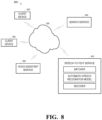
- FIG. 8 illustrates distributed transcription system 800 according to some embodiments.
- System 800 may be cloud-based and components thereof may be implemented using on-demand virtual machines, virtual servers and cloud storage instances.
- Speech-to-text service 810 may be implemented as a cloud service providing transcription of speech audio signals received over cloud 820.
- Speech-to-text service 810 may include a batcher component, an ASR model and a decoder operating as described above to provide ASR using latency-sensitive adaptive batching as described herein.
- Each of client devices 830 and 832 may be operated to request services such as search service 840 and voice assistant service 850.
- Services 840 and 850 may, in turn, request speech-to-text functionality from speech-to-text service 810.
- a client device e.g., a smart speaker, a smartphone
- a client device includes at least one of a frame generation component, a batcher component, an ASR model, a decoder, and, optionally, an end-of-speech detector, and the client device calls a remote system (e.g., a cloud service) to access functionality of any of these components which are not implemented on the client device.
- a remote system e.g., a cloud service
- FIG. 9 is a block diagram of system 900 according to some embodiments.
- System 900 may comprise a general-purpose computing device and may execute program code to provide ASR using latency-sensitive adaptive batching as described herein.
- System 900 may be implemented by a standalone device such as a personal computer, a smart speaker, and a smartphone, or a cloud-based virtual server according to some embodiments.
- System 900 includes processing unit 910 operatively coupled to communication device 920, persistent data storage system 930, one or more input devices 940, one or more output devices 950 and memory 960.
- Processing unit 910 may comprise one or more processors, processing cores, etc. for executing program code.
- Communication interface 920 may facilitate communication with external networks, such as the internet.
- Input device(s) 940 may comprise, for example, a keyboard, a keypad, a mouse or other pointing device, a microphone, a touch screen, and/or an eye-tracking device.
- Output device(s) 950 may comprise, for example, a display (e.g., a display screen), a speaker, and/or a printer.
- Data storage system 930 may comprise any number of appropriate persistent storage devices, including combinations of magnetic storage devices (e.g., magnetic tape, hard disk drives and flash memory), optical storage devices, Read Only Memory (ROM) devices, etc.
- Memory 960 may comprise Random Access Memory (RAM), Storage Class Memory (SCM) or any other fast-access memory.
- RAM Random Access Memory
- SCM Storage Class Memory
- Batcher 932 and decoder 936 may comprise program code executable to provide functions as described herein. Batcher 932 and/or decoder 936 may comprise one or more trained neural networks according to some embodiments. Node operator libraries 934 may comprise program code executable to provide an acoustic model defined by hyperparameters 938 and trained parameter values 939 as is known in the art. Data storage device 930 may also store data and other program code for providing additional functionality and/or which are necessary for operation of system 900, such as device drivers, operating system files, etc.
- Each functional component and process described herein may be implemented at least in part in computer hardware, in program code and/or in one or more computing systems executing such program code as is known in the art.
- a computing system may include one or more processing units which execute processor-executable program code stored in a memory system.
- Processor-executable program code embodying the described processes may be stored by any non-transitory tangible medium, including a fixed disk, a volatile or non-volatile random access memory, a DVD, a Flash drive, or a magnetic tape, and executed by any number of processing units, including but not limited to processors, processor cores, and processor threads. Embodiments are not limited to the examples described below.
- each component or device described herein may be implemented by any number of devices in communication via any number of other public and/or private networks. Two or more of such computing devices may be located remote from one another and may communicate with one another via any known manner of network(s) and/or a dedicated connection. Each component or device may comprise any number of hardware and/or software elements suitable to provide the functions described herein as well as any other functions.
- any computing device used in an implementation of a system according to some embodiments may include a processor to execute program code such that the computing device operates as described herein.
Landscapes
- Engineering & Computer Science (AREA)
- Physics & Mathematics (AREA)
- Multimedia (AREA)
- Audiology, Speech & Language Pathology (AREA)
- Human Computer Interaction (AREA)
- Computational Linguistics (AREA)
- Acoustics & Sound (AREA)
- Health & Medical Sciences (AREA)
- Artificial Intelligence (AREA)
- Computer Vision & Pattern Recognition (AREA)
- Probability & Statistics with Applications (AREA)
- Evolutionary Computation (AREA)
- Telephonic Communication Services (AREA)
- Telephone Function (AREA)
- Circuit For Audible Band Transducer (AREA)
- Synchronisation In Digital Transmission Systems (AREA)
- Time-Division Multiplex Systems (AREA)
- Compression, Expansion, Code Conversion, And Decoders (AREA)
Description
- Neural network-based models are commonly used to perform automatic speech recognition (ASR). In some examples, a neural network-based acoustic model is trained to extract senone-discriminative features from input audio frames and to classify senones based on the extracted features. A decoder generates word hypotheses based on the classifications and outputs corresponding text.
- The input audio frames may be batched into a batch of two or more frames to allow for joint processing and recognition, with the goal of improving accuracy and performance. However, batching requires the system to wait to receive all frames of the batch before submitting the batch to the ASR. This waiting may result in undesirable user-perceived latency regardless of the processing speed of the ASR.
- Conventional ASR systems may use several physically-different models to satisfy different latency requirements within a given deployment. This approach multiplies processor-related training and deployment costs. Systems are desired to improve latency without resorting to parallel models.
US 2018/012593 A1 describes that features are disclosed for detecting words in audio using contextual information in addition to automatic speech recognition results. A detection model can be generated and used to determine whether a particular word, such as a keyword or "wake word," has been uttered. The detection model can operate on features derived from an audio signal, contextual information associated with generation of the audio signal, and the like. In some embodiments, the detection model can be customized for particular users or groups of users based usage patterns associated with the users.
US 2017/236518 A1 describes a GPU-accelerated speech recognition engine optimized for faster than real time speech recognition on a scalable server-client heterogeneous CPU-GPU architecture, which is specifically optimized to simultaneously decode multiple users in real-time. In order to support real-time speech recognition for multiple users, a "producer/consumer" design pattern is applied to decouple speech processes that run at different rates in order to handle multiple processes at the same time. Furthermore, the speech recognition process is divided into multiple consumers in order to maximize hardware utilization.
US 2016/217367 A1 describes methods, systems, and apparatus, including computer programs encoded on computer storage media, for training a neural network. One of the methods includes generating, by a speech recognition system, a matrix from a predetermined quantity of vectors that each represent input for a layer of a neural network, generating a plurality of sub-matrices from the matrix, using, for each of the sub-matrices, the respective sub-matrix as input to a node in the layer of the neural network to determine whether an utterance encoded in an audio signal comprises a keyword for which the neural network is trained.
XUE SHAOFEI ET AL: "Improving latency-controlled BLSTM acoustic models for online speech recognition", 2017 IEEE INTERNATIONAL CONFERENCE ON ACOUSTICS, SPEECH AND SIGNAL PROCESSING (ICASSP), IEEE, 5 March 2017, describes that bidirectional long short-term memory (BLSTM) recurrent neural networks are powerful acoustic models in terms of recognition accuracy. When BLSTM acoustic models are used in decoding, the speech decoder needs to wait until the end of a whole sentence is reached, such that forward-propagation in the backward direction can then be performed. The nature of BLSTM acoustic models makes them inappropriate for real-time online speech recognition because of the latency issue. Recently, the context-sensitive-chunk BLSTM and latency-controlled BLSTM acoustic models have been proposed, both chop a whole sentence into several overlapping chunks. By appending several left and/or right contextual frames, forward-propagation of BLSTM can be down within a controlled time delay, while the recognition accuracy is maintained when comparing with conventional BLSTM models. By using different types of neural network topology to initialize the BLSTM memory cell states, XUE SHAOFFEI ET AL aim to reduce the computational cost introduced by the contextual frames and enable faster online recognition. Experimental results on a 320-hour Switchboard task have shown that the improved versions accelerate from 24% to 61% in decoding without significant loss in recognition accuracy. - The invention is set out in the appended set of claims.
-
-
FIG. 1A is a block diagram of a speech recognition system employing initial latency-sensitive adaptive batching during operation according to some embodiments. -
FIG. 1B is a block diagram of a speech recognition system employing initial latency-sensitive adaptive batching during operation according to some embodiments. -
FIG. 1C is a block diagram of a speech recognition system employing initial latency-sensitive adaptive batching during operation according to some embodiments. -
FIG. 1D is a block diagram of a speech recognition system employing initial latency-sensitive adaptive batching during operation according to some embodiments. -
FIG. 2 is a flow diagram of a process for initial latency-sensitive adaptive batching according to some embodiments. -
FIG. 3A is a block diagram of a speech recognition system employing terminal latency-sensitive adaptive batching during operation according to some embodiments. -
FIG. 3B is a block diagram of a speech recognition system employing terminal latency-sensitive adaptive batching during operation according to some embodiments. -
FIGS. 4A through 4C comprise a flow diagram of a process for initial and terminal latency-sensitive adaptive batching according to some embodiments. -
FIG. 5A is a block diagram of a look-ahead-enabled speech recognition system employing initial latency-sensitive adaptive batching during operation according to some embodiments. -
FIG. 5B is a block diagram of a look-ahead-enabled speech recognition system employing initial latency-sensitive adaptive batching during operation according to some embodiments. -
FIG. 5C is a block diagram of a look-ahead-enabled speech recognition system employing initial latency-sensitive adaptive batching during operation according to some embodiments. -
FIG. 5D is a block diagram of a look-ahead-enabled speech recognition system employing initial latency-sensitive adaptive batching during operation according to some embodiments. -
FIG. 6A is a block diagram of a look-ahead-enabled speech recognition system employing initial latency-sensitive adaptive batching and adaptive look-ahead during operation according to some embodiments. -
FIG. 6B is a block diagram of a look-ahead-enabled speech recognition system employing initial latency-sensitive adaptive batching and adaptive look-ahead during operation according to some embodiments. -
FIG. 6C is a block diagram of a look-ahead-enabled speech recognition system employing initial latency-sensitive adaptive batching and adaptive look-ahead during operation according to some embodiments. -
FIG. 6D is a block diagram of a look-ahead-enabled speech recognition system employing initial latency-sensitive adaptive batching and adaptive look-ahead during operation according to some embodiments. -
FIGS. 7A and7B comprise a flow diagram of a process for initial and latency-sensitive adaptive batching and adaptive look-ahead according to some embodiments. -
FIG. 8 is a block diagram of a cloud-based speech recognition service according to some embodiments. -
FIG. 9 is a block diagram of a speech recognition system according to some embodiments. - The following description is provided to enable any person in the art to make and use the described embodiments. Various modifications, however, will remain readily apparent to those of ordinary skill in the art.
- According to some embodiments, the number of frames which are simultaneously-input to an acoustic model (i.e., the batch size) is dynamically controlled during ASR processing. For example, a small batch size is used until a word hypothesis is generated. Use of a small batch size may provide lower latency than a larger batch size because less time is required to collect a small batch than to collect a larger batch of identically-sized frames. The batch size is then increased after the word hypothesis is generated, which may improve processing efficiency because simultaneously processing of a larger number of frames is more CPU- and cache-efficient than the processing of a smaller number of frames. A user may therefore be presented with a word hypothesis quickly while retaining most of the processing advantages of larger batch sizes.
- Some embodiments are operable in conjunction with models employing look-ahead frames within each batch of input frames, where the number of look-ahead frames relates to the degree of overlap between consecutive batches of input frames. These embodiments may also dynamically control batch sizes as described above to provide low initial user-perceived latency and, subsequent to a first hypothesis, further provide improved processing efficiency.
- Some models are operable to receive input batches of various size and including various numbers of look-ahead frames. By dynamically increasing the batch size in response to a first hypothesis, embodiments using such models may provide low initial user-perceived latency and, thereafter, improved processing efficiency as described above. Moreover, increased recognition accuracy may be achieved by increasing the number of look-ahead frames in response to the first hypothesis.
- In this regard, such an acoustic model may be trained in view of a particular number of look-ahead frames which is greater than the initially-used number of look-ahead frames. Therefore, although initial operation is suboptimal, changing the number of look-ahead frames to the number of look-ahead frames based on which the acoustic model was trained may result in increased recognition accuracy. Embodiment may also allow for changing the number of look-ahead frames while holding the batch size constant.
- Additionally or alternatively, some embodiments monitor the input frames independently of the hypothesis generation in order to detect an end-of-speech state. Upon detecting this state, the batch size may be reduced to avoid waiting for non-speech frames which would otherwise be added to a current batch of input frames. The batch size may be additionally or alternatively reduced in response to detection of an end-of-stream, of a target maximum processing time, or other condition. Such embodiments may therefore support an early exit from the batching process and reduce latency in the generation of a final hypothesis.
-
FIG. 1A illustratesspeech recognition system 100 employing initial latency-sensitive adaptive batching during operation according to some embodiments.System 100 may be implemented using any suitable combinations of hardware and software components. Each illustrated function ofsystem 100 or otherwise described herein may be implemented by one or more computing devices (e.g., computer servers), storage devices (e.g., hard or solid-state disk drives), and other hardware as is known in the art. The components may be located remote from one another and may be elements of one or more cloud computing platforms, including but not limited to a Software-as-a-Service, a Platform-as-a-Service, and an Infrastructure-as-a-Service platform. According to some embodiments, one or more components are implemented by one or more dedicated virtual machines executing one or more trained neural network models. -
Frame generation unit 110 receives an audio signal and generates a frame-level magnitude spectra, or raw acoustic feature frame, corresponding to a respective frame of the audio signal as is known in the art. For example, assuming an audio frame size of 25ms,frame generation unit 110 generates first raw acoustic feature frame s 0 based on the first 25ms of the incoming audio signal. In this regard,FIG. 1A illustrates the commencement of ASR based on the incoming audio signal. - A next raw acoustic feature frame may be generated based on a next 25ms of the incoming audio signal. In some embodiments, temporally-adjacent raw acoustic feature frames may represent overlapping frames of the audio signal. For example, first raw acoustic feature frame s 0 may be generated based on the first 25ms of the incoming audio signal, while a next raw acoustic feature frame may be generated based on a 15ms through 40ms frame of the incoming audio signal, and a third raw acoustic feature frame may be generated based on a 30ms through 55ms frame of the incoming audio signal.
- According to some embodiments, the generated raw acoustic feature frames are Mel-Frequency Cepstral Coefficients or log-filterbank features as is known in the art.
Frame generation unit 110 may implement any suitable signal processing to determine a raw acoustic feature frames corresponding to a respective frame of the incoming audio signal. For example,frame generation unit 110 may implement a custom-designed Fast Fourier Transform and custom filterbank parameters. -
Batcher 120 operates to collect raw acoustic feature frames into batches and provide the batches to trainedacoustic model 130. Trainedacoustic model 130 may comprise any acoustic model capable of processing batches of input frames having various batch sizes. For example, trainedacoustic model 130 may comprise a uni-directional long short-term memory model (LSTM), a bi-directional LSTM (BLSTM) model, or a layer-trajectory LSTM (ltLSTM), but embodiments are not limited thereto. - According to some embodiments as will be described below, trained
acoustic model 130 is also capable of processing batches of input frames which include look-ahead frames. Trainedacoustic model 130 may support only a fixed number of look-ahead frames (e.g., a contextual layer-trajectory LSTM (cltLSTM) model) or may support batches including varying numbers of look-ahead frames (e.g., a latency-controlled BLSTM (LC-BLSTM) model). -
Decoder 140 forms word hypotheses based on the output of trainedacoustic model 130. According to some non-exhaustive examples,model 130 outputs senone posteriors in response to a received batch of input frames. Based on the posteriors and hidden Markov models,decoder 140 outputs a most probable sequence of words Ŵ = w 0 ... wm given input frames S = s 0 ... sn. -
Batcher 120 determines a batch size and/or a number of look-ahead frames based on which the batches are collected. As described herein, the determination may be based on word hypotheses generated bydecoder 140 and/or on an otherwise-detected end-of-speech state. Accordingly,batcher 120 implements a function which determines a batch size (and, in some embodiments, a number of look-ahead frames) based on a received work hypothesis and/or end-of-speech signal. -
FIG. 1B illustrates continued operation ofsystem 200 according to the present example. As shown,frame generation unit 110 has generated frame s 1 based on a second (potentially-overlapping) frame of the input audio signal. It will be assumed that the initial batch size is set to two. -
Batcher 120 has previously received frame s 0 as illustrated inFIG. 1A . Due to the initial batch size of two,batcher 120 collects frames s 0 and s 1 intobatch 150 and providesbatch 150 to trainedacoustic model 130.Model 130 outputs corresponding posteriors based upon its architecture and trained parameter values as is known in the art. The posteriors are received bydecoder 140, which proceeds to attempt to form a hypothesis. - According to some embodiments, the above process continues as shown with respect to subsequently-received frames of the audio signal. For example,
FIG. 1C illustrates generation of frame s 10 based on a respective frame of the audio signal. At this point,batcher 120 has already collected frames s 8 and s 9 intobatch 152, and passes these frames to model 130. - It will be assumed that
decoder 140 now generates a non-silent, non-noise hypothesis based on the batches received up to the present point. As illustrated, the hypothesis is returned tobatcher 120. Based on the generation of the hypothesis,batcher 120 determines to increase the batch size. - The determination to change the batch size and/or of the new batch size based on the hypotheses may be performed by a component different from
batcher 120. Such a component may therefore transmit the new batch size tobatcher 120 so batcher 120 may conform subsequent batching to the new batch size. - Determination of a new batch size is at least triggered by a first-generated word hypothesis. The determination may be triggered by an n-th-generated word hypothesis, by generation of one (or more) of a particular subset of word hypotheses, or by any other function of word hypotheses output by
decoder 140. -
FIG. 1D illustrates implementation of the new batch size according to some embodiments. The new batch size is assumed to be four, although embodiments are not limited thereto. Accordingly, after the output ofbatch 152 as shown inFIG. 1C ,batcher 120 collects frames s 10 through s 14 intobatch 154 and providesbatch 154 tomodel 130. In contrast, if the batch size had remained at two,batcher 120 would have collected only frames s 10 and s 11 into a batch and provided that batch tomodel 130. - The illustrated process may continue, with batches consisting of four frames, until ASR terminates (e.g., the end of the audio signal has been reached). According to some embodiments, the batch size is reduced to the initial batch size (e.g., two) upon detecting silence based on the output of
decoder 140, and is again increased as described above in response to a word hypothesis. - In some embodiments, the batch size may increase gradually to a target batch size. With respect to the above example,
batcher 120 may increase the batch size from two to three for a particular time period, and then may increase the batch size from three to four. The increases may be effected based on the generation of further hypotheses instead of, or in addition to, on elapsed time. -
FIG. 2 is a flow diagram ofprocess 200 to provide dynamic batching according to some embodiments.Process 200 and the other processes described herein may be performed using any suitable combination of hardware and software. Software program code embodying these processes may be stored by any non-transitory tangible medium, including a fixed disk, a volatile or non-volatile random access memory, a DVD, a Flash drive, or a magnetic tape, and executed by any number of processing units, including but not limited to processors, processor cores, and processor threads. Embodiments are not limited to the examples described herein. -
Process 200 may be initiated in response to a request to perform ASR on an audio signal.Process 200 may be executed, for example, by a cloud-based ASR service which receives the request and audio signal from a cloud-based meeting provider. The audio signal may be received as a near real-time stream according to some embodiments. In some embodiments,process 200 executes continuously to process any signal which is present on an incoming audio channel. - An initial batch size for processing the audio signal is determined at 5210. The initial batch size may be a predefined experimentally-determined value. The initial batch size may be selected from several values based on a desired initial latency, where lower latency corresponds to smaller batch sizes. With reference to the example of
FIGS. 1A through 1D , an initial batch size of two frames is determined at S210. - Raw acoustic feature frames of the audio signal are collected at S220. The number of collected raw acoustic feature frames is equal to the determined initial batch size. Accordingly, with respect to the above example, flow pauses at S220 while
batcher 120 waits to receive frames s 0 and s 1 fromframe generation unit 110. - The collected frames are input as a batch to a speech recognition network at S230. The speech recognition network may comprise any system capable of generating word hypotheses based on batches of acoustic frames. Trained
acoustic model 130 anddecoder 140 ofFIGS. 1A through 1D comprise a speech recognition network according to some embodiments. - Next, at S240, it is determined whether a word hypothesis has been generated by the speech recognition network. More specifically, S240 may comprise determination of whether the speech recognition network has generated a non-silent, non-noise hypothesis based on the batches received up to the present point. If not, flow returns to S220 to collect another batch of frames conforming to the initial batch size. Flow therefore cycles between S220, S230 and S240 until a word hypothesis has been generated by the speech recognition network. As described above, the determination at S240 is not limited to identification of a first-generated word hypothesis.
- Although illustrated as a linear flow, the determination at S240 may occur independently of and in parallel with the cycling of flow between S220 and S230. For example, the collection and input of batches of frames may proceed until interrupted by a separate determination of a generated word hypothesis, after which flow proceeds to S250.
- At S250, a next batch size for processing the audio signal is determined. The next batch size may be predetermined based on experimentation and/or selected from several possible batch sizes. According to some embodiments, the next batch size is eighty frames.
- As described with respect to
FIG. 1D , raw acoustic feature frames of the next batch size are collected at S260 and input to the speech recognition network at S270. According to some embodiments, flow cycles between S260 and S270 to collect and input batches of frames until silence is detected at S280. Silence detection at S280 may comprise detection of a lack of word hypotheses generated by the speech recognition network over a period of time or and/or may be otherwise heuristically-based. - According to the illustrated example, the detection of silence at S280 causes
process 200 to return to S210 to reset the batch size to the initial batch size. Consequently, if later frames of the audio signal include speech, the user-perceived latency of processing that speech may be lower than a latency resulting from a larger batch size. - Switching from the initial batch size to the next batch size may introduce a noticeable delay in processing. Some embodiments may, in response to the determination at S240, gradually increase the batch size to a target batch size. For example, the batch size may increase by a predefined number for every n iterations of S260 until a target batch size is reached.
-
Process 200 may terminate upon reaching the end of the audio signal. In some embodiments,process 200 terminates in response to detection of an end-of-speech state.FIGS. 3A and 3B illustrate such processing according to some embodiments. -
System 300 adds end-of-speech detector 360 to the above-described components ofsystem 100. End-of-speech detector 360 receives raw acoustic frames directly fromframe generation unit 310 and determines whether speech has ended based thereon. End-of-speech detector 360 may comprise any system for detecting an end-of-speech state based on input frames, and may include one or more trained neural networks. In one example,detector 360 is an LSTM classifier formulated and trained independently of the decoder hypotheses, and which predicts the end of the query based solely on past frames.Detector 360 may operate in conjunction with operational heuristics. - In one example of operation,
components batcher 320 has collectedbatch 350 of frames s 10 through s 13 for input to model 330.FIG. 3A also shows transmission of frame s 16 fromframe generation unit 310 tobatcher 320 anddetector 360.Frame generation unit 310 has therefore already generated frames s14 and s15, which have collected bybatcher 320 in anticipation of generating a next four-frame batch. - It will be assumed that end-of-
speech detector 360 detects an end-of-speech state in response to reception of frame s 16. In response, end-of-speech detector 360 notifies batcher 320 of the detected state.Batcher 320 then collects frame s 16 as a last frame of the current batch.FIG. 3B illustrates the foregoing operation, in which batcher 320 generatesbatch 352 including frames s 14, s 15 and s 16 andbatch 352 is input tomodel 330. Accordingly, the batch size of the last batch is reduced to avoid waiting for non-speech frames which would otherwise be added to the current batch of input frames. Such embodiments may therefore support an early exit from the batching process and reduce latency in the generation of a final hypothesis. As mentioned above, the last batch size may be reduced in response to other conditions according to some embodiments, including but not limited to detection of an end-of-stream condition and detection of an elapsed maximum recognition time. -
FIGS. 4A through 4C comprise a flow diagram ofprocess 400 to provide dynamic batching according to some embodiments.Process 400 may be implemented bysystem 300 ofFIG. 3 , but embodiments are not limited thereto. - Steps S405, S410, S415, S420 and S425 may proceed similarly to respective ones of steps S210, S220, S230, S240 and S250 of
process 200. As described, an initial batch size for processing an incoming audio signal is determined at S405 and a corresponding batch of raw acoustic feature frames of the audio signal is collected at S410. - The batch of collected frames is input to a speech recognition network at S415. Next, at S420, it is determined whether a suitable word hypothesis has been generated by the speech recognition network. If not, flow returns to S410 to collect another batch of frames conforming to the initial batch size. If so, a next batch size for processing the audio signal is determined at S425 as described above.
- Next, at S430, it is determined whether an end-of-speech state has been detected based on a next raw acoustic feature frame. S430 may be executed by an end-of-speech detector operating independently of the speech recognition network as described with respect to
FIGS. 3A and 3B . With reference toFIG. 3A , S430 may comprise receiving a frame fromframe generation unit 310 and evaluating an end-of-speech state based on the received frame (and, e.g., on previously-received frames and/or other heuristics). If an end-of-speech state is not detected, flow continues to S435 to collect a next raw acoustic frame at S435. The frame may be collected at S435 for inclusion into a next batch of frames. In this regard, it is determined at S440 whether a batch conforming to the next batch size has been collected. If not, flow returns to S430. - It will be assumed that the determination at S430 continues to be negative as flow cycles between S430, S435 and S440 until the desired number of frames have been collected. Flow then continues to S445 to input the collected frames of the current batch to the speech recognition network. Flow returns to S430 if silence is not detected at S450. Flow therefore cycles between S430 and S450 to collect and input batches of frames of the current batch size until silence is detected at S450 or an end-of-speech state is detected at S430. The detection of silence at S430 causes flow to return to S405 to reset the batch size to the initial batch size. As mentioned above, if next-received frames of the audio signal include speech, the user-perceived latency of processing that speech may be lower than a latency which would resulting from a larger batch size.
- Flow proceeds from S430 to S455 if an end-of-speech state is detected at S430 during the collection of batches of the next batch size. At S455, the next raw acoustic frame based on which the end-of-speech state was detected is collected. With reference to the example of
FIGS. 3A and 3B , an end-of-speech state is detected at S430 based on frame s 16 and frame s 16 is then collected bybatcher 320 at S455 as a last frame of the current batch. The collected frames of the current batch (s 14, s 15 and s 16) are then input to model 330 at S460, even though the size of the current batch is less than the next batch size determined at S425. - The determination at S420 may occur independently of and in parallel with the cycling of flow between S410 and S415. Similarly, the end-of-speech determination at S430 may also or alternatively occur independently of and in parallel with the cycling of flow from S435 through S450.
-
FIGS. 5A through 5D illustrate look-ahead-enabledspeech recognition system 500 employing initial latency-sensitive adaptive batching during operation according to some embodiments.System 500 includes trainedacoustic model 530 which supports "look-ahead" input frames as is known in the art. Trainedacoustic model 530 may comprise any model architecture employing look-ahead frames that is or becomes known, including but not limited to a latency-controlled bi-directional long short-term memory (LC-BLSTM) acoustic model and a contextual layer-trajectory long short-term memory (cltLSTM) acoustic model. As is known in the art, a cltLSTM model may support only a fixed number of look-ahead frames while a LC-BLSTM model may support batches including varying numbers of look-ahead frames. -
FIG. 5A illustrates an example in which batcher 520 collects batches consisting of six raw acoustic feature frames, in which four of the frames (i.e., frames s 2, s 3, s 4 and s 5) are look-ahead frames. In some embodiments, the batch size is defined as a window including a start frame and an end frame, and the look-ahead frames are defined by an overlap value. For example,batch 550 may be defined by window {s 0, s 5} and by an overlap value of four (frames). -
FIG. 5B illustrates collection and input ofnext batch 552 according to the present example.Batch 552 overlaps the last four frames (s 2, s 3, s 4, and s 5) ofbatch 550 and includes look-ahead frames s 4, s 5, s 6 and s 7. Therefore,batcher 520 must wait for frames s 6 and s 7 before generatingbatch 552. - As described above,
model 130 outputs posteriors corresponding to received batches based upon its architecture and trained parameter values as is known in the art. The posteriors are received by a decoder (unshown) which to attempts to form word hypotheses based on the received posteriors. - It will now be assumed that the decoder generates a non-silent, non-noise hypothesis based on the batches received up to the point illustrated in
FIG. 5B . Based on the generation of the hypothesis, batcher 520 (or another component) determines to increase the batch size. -
FIG. 5C illustrates implementation of a new batch size according to some embodiments. According to theFIG. 5C example, the number of look-ahead frames is fixed, but embodiments are not limited thereto. The example may therefore illustrate operation using a cltLSTM model, which employs a fixed number of look-ahead frames. - As shown in
FIG. 5C , the new batch size is eight frames.Next batch 554 therefore includes eight frames and overlaps the last four frames of precedingbatch 552. embodiments are not limited thereto.Batch 554 includes look-ahead frames s 8, s 9, s 10 and s 11. Accordingly, after the output ofbatch 552 as shown inFIG. 1B ,batcher 520 collects frames s 8 through s 11 and adds these frames to already-received frames s 4 through s 7 to generatebatch 554. -
FIG. 5D illustrates operation based on the modified batch size.Batcher 520 has collected frames s 12 through s 15 and added these frames to already-received frames s 8 through s 11 to generatebatch 556.Batch 556 has a batch size of eight frames and includes four look-ahead frames. - As described above, the batch size may increase gradually to a target batch size in some embodiments. These increases may, for example, be responsive to the generation of further hypotheses and/or to an elapsed time since a first hypothesis.
-
FIGS. 5A through 5D illustrate operation to change a batch size while a number of look-ahead frames remains fixed. In contrast,FIGS. 6A through 6D illustrate look-ahead-enabledspeech recognition system 600 employing initial latency-sensitive adaptive look-ahead. -
Frame generation unit 610 receives an audio signal and generates a frame-level magnitude spectra, or raw acoustic feature frame, corresponding to a respective frame of the audio signal.Batcher 620 collects generated raw acoustic feature frames into batches of an initial specified batch size (or window) and having a specified number of look-ahead frames (or overlap). Trainedacoustic model 630 receives the batches and outputs, for example, senone posteriors which are used bydecoder 640 to generate word hypotheses. Trainedacoustic model 630 supports batches including different numbers of look-ahead frames, and may therefore comprise a LC-BLSTM model in some embodiments. - In the example of
FIG. 6A , the initial batch size is three and each batch includes two look-ahead frames (i.e., frames s 1 and s 2 of batch 650).FIG. 6B shows output ofnext batch 652, which includes three frames and overlaps the two look-ahead frames ofbatch 650. It will be assumed thatdecoder 640 now generates a non-silent, non-noise hypothesis based on the batches received up to the present point. - In response, and as shown in
FIGS. 6C and 6D , the batch size is changed to four and the number of look-ahead frames per batch is changed to three. Accordingly,batch 654 overlaps look-ahead frames s 2 and s 3 ofbatch 652 and includes four frames. The four frames ofbatch 654 include three look-ahead frames s 3, s 4 and s 5. In view of the now-changed batch size and number of look-ahead frames,batcher 620 collectsnext batch 656 including four frames. The four frames ofbatch 656 include frames overlapping look-ahead frames s 3, s 4 and s 5 ofbatch 654 and also include look-ahead frames s 4, s 5 and s 6. - Embodiments may therefore increase or decrease the batch size and/or the number of look-ahead frames per batch. The increase or decrease to either parameter may occur once or gradually in response to a detected hypothesis.
- According to some embodiments,
acoustic model 630 anddecoder 640 are trained using the batch size and number of look-ahead frames ofFIGS. 6C and 6D , and therefore operate optimally after detection of the first word hypothesis. Accordingly, accuracy ofacoustic model 630 anddecoder 640 may be less than optimal when operated in conjunction with the initial batch size and initial number of look-ahead frames as shown inFIGS. 6A and 6B , as a trade-off for shorter user-perceived latency. -
FIGS. 7A and7B comprise a flow diagram ofprocess 700 to provide dynamic batching according to some embodiments.Process 700 may be implemented bysystem 600, but embodiments are not limited thereto. - An initial batch size for processing an input audio signal is determined at S710. Also determined at S710 is an initial number of look-ahead frames to be included in each batch. The initial batch size may be designated as a window size and the number of look-ahead frames may be defined as a particular fraction (e.g., ½) of the window size.
- Raw acoustic feature frames of the audio signal are collected at S720 based on the initial batch size and initial number of look-ahead frames. As shown in the example of
FIG. 6A , and assuming an initial batch size of three frames, flow pauses at S720 whilebatcher 620 waits to receive frames s 0, s 1 and s 2 fromframe generation unit 610. - The collected frames are input as a batch to a speech recognition network at S730. The speech recognition network may comprise any system capable of generating word hypotheses based on batches of acoustic frames which include look-ahead frames.
- Next, at S740, raw acoustic feature frames of the audio signal are collected based on the initial batch size and initial number of look-ahead frames. The frames collected at S740 overlap the look-ahead frames of the prior collected frame. With reference to
FIG. 6B ,batch 652 may be collected at S740, consisting of three frames and overlapping the look-ahead frames s 1 and s 2 ofbatch 650. The frames collected at S740 are input as a batch to the speech recognition network at S750. - Collection of frames which overlap the look-ahead frames of a prior collected frame may comprise setting the beginning of the window of the current batch of frames to the start of the overlapped frames of the prior batch. For example, in a case where the overlap is one-half of the window size, the window of the current batch of frames is set to begin at the middle of the window of the prior batch.
- S760 comprises determination of whether a word hypothesis has been generated by the speech recognition network, and may be implemented as described above. If a word hypothesis has not yet been generated, flow returns to S740 to collect another batch of frames conforming to the initial batch size, including look-ahead frames, and overlapping the look-ahead frames of the previous batch. Flow therefore cycles between S740, S750 and S760 until a word hypothesis has been generated by the speech recognition network.
- Once the determination at S760 is affirmative, a next batch size for processing the audio signal is determined at S770. Determination of a next batch size may also include determination of a next number of look-ahead frames. Accordingly, S770 may include determining a new batch size and/or a new number of look-ahead frames per batch. In some embodiments, S770 comprises determining a next window size, and the next look-ahead size is determined as a function of the next window size. As mentioned above, a new number of look-ahead frames may be determined only if
process 700 is executed in conjunction with a speech recognition network capable of processing batches including arbitrary numbers of look-ahead frames. - As described with respect to
FIGS. 6C and 6D , raw acoustic feature frames of the next batch size which overlap the prior look-ahead frames are collected at S775 and input to the speech recognition network at S780. Flow cycles between S775 and S780 to collect and input batches of frames until silence is detected at S785. Flow then returns to S710 to reset the batch size and the number of look-ahead frames to their initial values so as to reduce the user-perceived latency of processing subsequently-received speech. - As described with respect to process 400, embodiments of
process 700 may further incorporate an end-of-speech detector for independently detecting an end-of-speech state. Based on the detection, a size of a last batch may be reduced (e.g., the window may be shortened) to include only up to the end-of-speech frame. - A neural network (e.g., deep learning, deep convolutional, or recurrent) according to some embodiments comprises a series of "neurons," such as LSTM nodes, arranged into a network. A neuron is an architecture used in data processing and artificial intelligence, particularly machine learning, that includes memory that may determine when to "remember" and when to "forget" values held in that memory based on the weights of inputs provided to the given neuron. Each of the neurons used herein are configured to accept a predefined number of inputs from other neurons in the network to provide relational and sub-relational outputs for the content of the frames being analyzed. Individual neurons may be chained together and/or organized into tree structures in various configurations of neural networks to provide interactions and relationship learning modeling for how each of the frames in an utterance are related to one another.
- For example, an LSTM serving as a neuron includes several gates to handle input vectors, a memory cell, and an output vector. The input gate and output gate control the information flowing into and out of the memory cell, respectively, whereas forget gates optionally remove information from the memory cell based on the inputs from linked cells earlier in the neural network. Weights and bias vectors for the various gates are adjusted over the course of a training phase, and once the training phase is complete, those weights and biases are finalized for normal operation. Neurons and neural networks may be constructed programmatically (e.g., via software instructions) or via specialized hardware linking each neuron to form the neural network.
-
FIG. 8 illustrates distributedtranscription system 800 according to some embodiments.System 800 may be cloud-based and components thereof may be implemented using on-demand virtual machines, virtual servers and cloud storage instances. - Speech-to-
text service 810 may be implemented as a cloud service providing transcription of speech audio signals received overcloud 820. Speech-to-text service 810 may include a batcher component, an ASR model and a decoder operating as described above to provide ASR using latency-sensitive adaptive batching as described herein. - Each of
client devices search service 840 andvoice assistant service 850.Services text service 810. According to some embodiments, a client device (e.g., a smart speaker, a smartphone) includes all components of a system such assystem 100 orsystem 300, and operation does not require communication with a cloud service. In some embodiments, a client device includes at least one of a frame generation component, a batcher component, an ASR model, a decoder, and, optionally, an end-of-speech detector, and the client device calls a remote system (e.g., a cloud service) to access functionality of any of these components which are not implemented on the client device. -
FIG. 9 is a block diagram ofsystem 900 according to some embodiments.System 900 may comprise a general-purpose computing device and may execute program code to provide ASR using latency-sensitive adaptive batching as described herein.System 900 may be implemented by a standalone device such as a personal computer, a smart speaker, and a smartphone, or a cloud-based virtual server according to some embodiments. -
System 900 includesprocessing unit 910 operatively coupled tocommunication device 920, persistentdata storage system 930, one ormore input devices 940, one ormore output devices 950 andmemory 960.Processing unit 910 may comprise one or more processors, processing cores, etc. for executing program code.Communication interface 920 may facilitate communication with external networks, such as the internet. Input device(s) 940 may comprise, for example, a keyboard, a keypad, a mouse or other pointing device, a microphone, a touch screen, and/or an eye-tracking device. Output device(s) 950 may comprise, for example, a display (e.g., a display screen), a speaker, and/or a printer. -
Data storage system 930 may comprise any number of appropriate persistent storage devices, including combinations of magnetic storage devices (e.g., magnetic tape, hard disk drives and flash memory), optical storage devices, Read Only Memory (ROM) devices, etc.Memory 960 may comprise Random Access Memory (RAM), Storage Class Memory (SCM) or any other fast-access memory. -
Batcher 932 anddecoder 936 may comprise program code executable to provide functions as described herein.Batcher 932 and/ordecoder 936 may comprise one or more trained neural networks according to some embodiments.Node operator libraries 934 may comprise program code executable to provide an acoustic model defined byhyperparameters 938 and trainedparameter values 939 as is known in the art.Data storage device 930 may also store data and other program code for providing additional functionality and/or which are necessary for operation ofsystem 900, such as device drivers, operating system files, etc. - Each functional component and process described herein may be implemented at least in part in computer hardware, in program code and/or in one or more computing systems executing such program code as is known in the art. Such a computing system may include one or more processing units which execute processor-executable program code stored in a memory system.
- Processor-executable program code embodying the described processes may be stored by any non-transitory tangible medium, including a fixed disk, a volatile or non-volatile random access memory, a DVD, a Flash drive, or a magnetic tape, and executed by any number of processing units, including but not limited to processors, processor cores, and processor threads. Embodiments are not limited to the examples described below.
- The foregoing diagrams represent logical architectures for describing systems according to some embodiments, and actual implementations may include more or different components arranged in other manners. Other topologies may be used in conjunction with other embodiments. Moreover, each component or device described herein may be implemented by any number of devices in communication via any number of other public and/or private networks. Two or more of such computing devices may be located remote from one another and may communicate with one another via any known manner of network(s) and/or a dedicated connection. Each component or device may comprise any number of hardware and/or software elements suitable to provide the functions described herein as well as any other functions. For example, any computing device used in an implementation of a system according to some embodiments may include a processor to execute program code such that the computing device operates as described herein.
- The diagrams described herein do not imply a fixed order to the illustrated methods, and embodiments may be practiced in any order that is practicable. Moreover, any of the methods described herein may be performed by hardware, software, or any combination of these approaches. For example, a computer-readable storage medium may store thereon instructions which when executed by a machine result in performance of methods according to any of the embodiments described herein.
- Those in the art will appreciate that various adaptations and modifications of the above-described embodiments can be configured without departing from the claims.
Claims (15)
- A system (900) comprising:a processing unit (910); anda storage device including program code that when executed by the processing unit (910) causes the system to:determine (S405) a first batch size for processing an audio signal;collect (S410) a first batch comprising a first number of raw acoustic feature frames of the audio signal, the first number equal to the first batch size;input (S415) the first batch to a speech recognition network;determine (S425) a second batch size based on a word hypothesis output (S420) by the speech recognition network, the second batch size greater than the first batch size;collect (S435) a second batch comprising a second number of acoustic feature frames of the audio signal, the second number equal to the second batch size; andinput (S445) the second batch to the speech recognition network.
- A system according to Claim 1, wherein determination of the second batch size based on the word hypothesis comprises detection of a first non-silent word hypothesis output by the speech recognition network and determination of the second batch size in response to the detection.
- A system according to Claim 1, the program code that when executed by the processing unit causes the system to:collect a plurality of batches, each of the plurality of batches comprising the first number of acoustic feature frames of the audio signal;input the plurality of batches to the speech recognition network until the word hypothesis is output by the speech recognition network.
- A system according to Claim 1, the program code that when executed by the processing unit causes the system to:detect an end-of-speech frame; andreduce a size of a next collected batch of acoustic feature frames to include the end-of-speech frame as a last frame of the next collected batch.
- A system according to Claim 1, wherein the first batch size comprises a first number of look-ahead frames and the first batch comprises first look-ahead frames, the number of first look-ahead frames of the first batch equal to the first number of look-ahead frames, the program code that when executed by the processing unit causes the system to:collect a third batch comprising the first number of acoustic feature frames of the audio signal, a time period associated with a plurality of frames of the third batch overlapping a time period associated with the first look-ahead frames of the first batch,wherein determination of the second batch size comprises determination of a second number of look-ahead frames, andwherein the second batch comprises second look-ahead frames, the number of second look-ahead frames of the second batch equal to the second number of look-ahead frames.
- A system according to Claim 5, wherein the speech recognition network comprises a latency-controlled bi-directional long short-term memory model.
- A system according to Claim 1, wherein the first batch size comprises a first number of look-ahead frames and the first batch comprises first look-ahead frames, the number of first look-ahead frames of the first batch equal to the first number of look-ahead frames, the program code that when executed by the processing unit causes the system to:collect a third batch comprising the first number of acoustic feature frames of the audio signal, a time period associated with a plurality of frames of the third batch overlapping a time period associated with the first look-ahead frames of the first batch,wherein the second batch comprises second look-ahead frames, the number of second look-ahead frames of the second batch equal to the first number of look-ahead frames.
- A system according to Claim 7, wherein the speech recognition network comprises a contextual layer-trajectory long short-term memory model.
- A computer-implemented method (400) comprising:Collecting (S410) a first batch of acoustic feature frames of an audio signal, the number of acoustic feature frames of the first batch equal to a first batch size;Inputting (S415) the first batch to a speech recognition network;in response to detection (S420) of a word hypothesis output by the speech recognition network, collecting (S435) a second batch of acoustic feature frames of the audio signal, the number of acoustic feature frames of the second batch equal to a second batch size, the second batch size greater than the first batch size; andinputting (S445) the second batch to the speech recognition network.
- A method according to Claim 9, wherein detection of the word hypothesis comprises detection of a first non-silent word hypothesis output by the speech recognition network.
- A method according to Claim 9, further comprising:detecting an end-of-speech frame;in response to detecting the end-of-speech frame, collecting a third batch of acoustic feature frames of the audio signal, the third batch to include the end-of-speech frame as a last frame of the third batch; andinputting the third batch to the speech recognition network.
- A method according to Claim 9, wherein the first batch size comprises a first number of look-ahead frames and the first batch comprises first look-ahead frames, the number of first look-ahead frames of the first batch equal to the first number of look-ahead frames, the method further comprising:collecting a third batch comprising the first number of acoustic feature frames of the audio signal, a time period associated with a plurality of frames of the third batch overlapping a time period associated with the first look-ahead frames of the first batch,wherein the second batch comprises second look-ahead frames, the number of second look-ahead frames of the second batch equal to the second number of look-ahead frames.
- A method according to Claim 12, wherein the speech recognition network comprises a latency-controlled bi-directional long short-term memory model.
- A method according to Claim 9, wherein the first batch size comprises a first number of look-ahead frames and the first batch comprises first look-ahead frames, the number of first look-ahead frames of the first batch equal to the first number of look-ahead frames, further comprising:collecting a third batch comprising the first number of acoustic feature frames of the audio signal, a time period associated with a plurality of frames of the third batch overlapping a time period associated with the first look-ahead frames of the first batch,wherein the second batch comprises second look-ahead frames, the number of second look-ahead frames of the second batch equal to the first number of look-ahead frames.
- A method according to Claim 14, wherein the speech recognition network comprises a contextual layer-trajectory long short-term memory model.
Priority Applications (1)
| Application Number | Priority Date | Filing Date | Title |
|---|---|---|---|
| EP24164657.9A EP4401073B1 (en) | 2020-01-13 | 2020-12-15 | Adaptive frame batching to reduce speech recognition latency |
Applications Claiming Priority (3)
| Application Number | Priority Date | Filing Date | Title |
|---|---|---|---|
| US202062960240P | 2020-01-13 | 2020-01-13 | |
| US16/773,205 US11183178B2 (en) | 2020-01-13 | 2020-01-27 | Adaptive batching to reduce recognition latency |
| PCT/US2020/065034 WO2021146009A1 (en) | 2020-01-13 | 2020-12-15 | Adaptive frame batching to reduce speech recognition latency |
Related Child Applications (2)
| Application Number | Title | Priority Date | Filing Date |
|---|---|---|---|
| EP24164657.9A Division EP4401073B1 (en) | 2020-01-13 | 2020-12-15 | Adaptive frame batching to reduce speech recognition latency |
| EP24164657.9A Division-Into EP4401073B1 (en) | 2020-01-13 | 2020-12-15 | Adaptive frame batching to reduce speech recognition latency |
Publications (2)
| Publication Number | Publication Date |
|---|---|
| EP4091163A1 EP4091163A1 (en) | 2022-11-23 |
| EP4091163B1 true EP4091163B1 (en) | 2024-05-01 |
Family
ID=76763252
Family Applications (2)
| Application Number | Title | Priority Date | Filing Date |
|---|---|---|---|
| EP20842072.9A Active EP4091163B1 (en) | 2020-01-13 | 2020-12-15 | Adaptive frame batching to reduce speech recognition latency |
| EP24164657.9A Active EP4401073B1 (en) | 2020-01-13 | 2020-12-15 | Adaptive frame batching to reduce speech recognition latency |
Family Applications After (1)
| Application Number | Title | Priority Date | Filing Date |
|---|---|---|---|
| EP24164657.9A Active EP4401073B1 (en) | 2020-01-13 | 2020-12-15 | Adaptive frame batching to reduce speech recognition latency |
Country Status (13)
| Country | Link |
|---|---|
| US (2) | US11183178B2 (en) |
| EP (2) | EP4091163B1 (en) |
| JP (1) | JP7693988B2 (en) |
| KR (1) | KR20220125237A (en) |
| CN (1) | CN114981887B (en) |
| AU (1) | AU2020423124A1 (en) |
| BR (1) | BR112022011063A2 (en) |
| CA (1) | CA3166381A1 (en) |
| IL (1) | IL294377A (en) |
| MX (1) | MX2022008633A (en) |
| PH (1) | PH12022551740A1 (en) |
| WO (1) | WO2021146009A1 (en) |
| ZA (1) | ZA202206832B (en) |
Families Citing this family (6)
| Publication number | Priority date | Publication date | Assignee | Title |
|---|---|---|---|---|
| US11183178B2 (en) * | 2020-01-13 | 2021-11-23 | Microsoft Technology Licensing, Llc | Adaptive batching to reduce recognition latency |
| US11521617B2 (en) * | 2020-09-03 | 2022-12-06 | International Business Machines Corporation | Speech-to-text auto-scaling for live use cases |
| EP4399704A1 (en) * | 2021-10-05 | 2024-07-17 | Google LLC | Predicting word boundaries for on-device batching of end-to-end speech recognition models |
| US20250054491A1 (en) * | 2021-12-22 | 2025-02-13 | Microsoft Technology Licensing, Llc | Smart audio segmentation using look-ahead based acousto-linguistic features |
| CN116052684A (en) * | 2022-11-15 | 2023-05-02 | 网易有道信息技术(北京)有限公司 | Speech recognition method and device, electronic device and storage medium |
| CN118381581B (en) * | 2024-06-25 | 2024-10-11 | 南京信息工程大学 | A tactical communication network service framing method based on deep reinforcement learning |
Family Cites Families (32)
| Publication number | Priority date | Publication date | Assignee | Title |
|---|---|---|---|---|
| US7023868B2 (en) | 1999-04-13 | 2006-04-04 | Broadcom Corporation | Voice gateway with downstream voice synchronization |
| US7110947B2 (en) * | 1999-12-10 | 2006-09-19 | At&T Corp. | Frame erasure concealment technique for a bitstream-based feature extractor |
| WO2006075648A1 (en) | 2005-01-17 | 2006-07-20 | Nec Corporation | Speech recognition system, speech recognition method, and speech recognition program |
| US20070129943A1 (en) | 2005-12-06 | 2007-06-07 | Microsoft Corporation | Speech recognition using adaptation and prior knowledge |
| US9128926B2 (en) | 2006-10-26 | 2015-09-08 | Facebook, Inc. | Simultaneous translation of open domain lectures and speeches |
| JP5739718B2 (en) | 2011-04-19 | 2015-06-24 | 本田技研工業株式会社 | Interactive device |
| US9401140B1 (en) | 2012-08-22 | 2016-07-26 | Amazon Technologies, Inc. | Unsupervised acoustic model training |
| US9821517B2 (en) | 2013-06-26 | 2017-11-21 | Microsoft Technology Licensing, Llc | 3D manufacturing platform |
| US9514747B1 (en) | 2013-08-28 | 2016-12-06 | Amazon Technologies, Inc. | Reducing speech recognition latency |
| US10019985B2 (en) * | 2013-11-04 | 2018-07-10 | Google Llc | Asynchronous optimization for sequence training of neural networks |
| US9697828B1 (en) | 2014-06-20 | 2017-07-04 | Amazon Technologies, Inc. | Keyword detection modeling using contextual and environmental information |
| US9613624B1 (en) | 2014-06-25 | 2017-04-04 | Amazon Technologies, Inc. | Dynamic pruning in speech recognition |
| US11100420B2 (en) | 2014-06-30 | 2021-08-24 | Amazon Technologies, Inc. | Input processing for machine learning |
| US10229686B2 (en) | 2014-08-18 | 2019-03-12 | Nuance Communications, Inc. | Methods and apparatus for speech segmentation using multiple metadata |
| US10580401B2 (en) | 2015-01-27 | 2020-03-03 | Google Llc | Sub-matrix input for neural network layers |
| KR102423302B1 (en) * | 2015-10-06 | 2022-07-19 | 삼성전자주식회사 | Apparatus and method for calculating acoustic score in speech recognition, apparatus and method for learning acoustic model |
| US10319374B2 (en) | 2015-11-25 | 2019-06-11 | Baidu USA, LLC | Deployed end-to-end speech recognition |
| US10453445B2 (en) | 2016-02-16 | 2019-10-22 | Carnegie Mellon University | System and method for multi-user GPU-accelerated speech recognition engine for client-server architectures |
| CN107785015A (en) | 2016-08-26 | 2018-03-09 | 阿里巴巴集团控股有限公司 | A kind of audio recognition method and device |
| WO2018118442A1 (en) | 2016-12-21 | 2018-06-28 | Google Llc | Acoustic-to-word neural network speech recognizer |
| CN107240396B (en) | 2017-06-16 | 2023-01-17 | 百度在线网络技术(北京)有限公司 | Speaker self-adaptation method, device, equipment and storage medium |
| US10313416B2 (en) | 2017-07-21 | 2019-06-04 | Nxp B.V. | Dynamic latency control |
| CN109754784B (en) * | 2017-11-02 | 2021-01-29 | 华为技术有限公司 | Method for training filtering model and method for speech recognition |
| US10490183B2 (en) | 2017-11-22 | 2019-11-26 | Amazon Technologies, Inc. | Fully managed and continuously trained automatic speech recognition service |
| US10380997B1 (en) | 2018-07-27 | 2019-08-13 | Deepgram, Inc. | Deep learning internal state index-based search and classification |
| US11170761B2 (en) * | 2018-12-04 | 2021-11-09 | Sorenson Ip Holdings, Llc | Training of speech recognition systems |
| US10388272B1 (en) * | 2018-12-04 | 2019-08-20 | Sorenson Ip Holdings, Llc | Training speech recognition systems using word sequences |
| US10573312B1 (en) * | 2018-12-04 | 2020-02-25 | Sorenson Ip Holdings, Llc | Transcription generation from multiple speech recognition systems |
| US10510002B1 (en) * | 2019-02-14 | 2019-12-17 | Capital One Services, Llc | Stochastic gradient boosting for deep neural networks |
| US11436051B2 (en) * | 2019-04-30 | 2022-09-06 | Intel Corporation | Technologies for providing attestation of function as a service flavors |
| CN110288999B (en) * | 2019-07-02 | 2020-12-11 | 腾讯科技(深圳)有限公司 | Speech recognition method, device, computer equipment and storage medium |
| US11183178B2 (en) * | 2020-01-13 | 2021-11-23 | Microsoft Technology Licensing, Llc | Adaptive batching to reduce recognition latency |
-
2020
- 2020-01-27 US US16/773,205 patent/US11183178B2/en active Active
- 2020-12-15 WO PCT/US2020/065034 patent/WO2021146009A1/en not_active Ceased
- 2020-12-15 CA CA3166381A patent/CA3166381A1/en active Pending
- 2020-12-15 MX MX2022008633A patent/MX2022008633A/en unknown
- 2020-12-15 JP JP2022542461A patent/JP7693988B2/en active Active
- 2020-12-15 EP EP20842072.9A patent/EP4091163B1/en active Active
- 2020-12-15 PH PH1/2022/551740A patent/PH12022551740A1/en unknown
- 2020-12-15 EP EP24164657.9A patent/EP4401073B1/en active Active
- 2020-12-15 IL IL294377A patent/IL294377A/en unknown
- 2020-12-15 BR BR112022011063A patent/BR112022011063A2/en unknown
- 2020-12-15 KR KR1020227022325A patent/KR20220125237A/en active Pending
- 2020-12-15 CN CN202080093002.3A patent/CN114981887B/en active Active
- 2020-12-15 AU AU2020423124A patent/AU2020423124A1/en active Pending
-
2021
- 2021-10-13 US US17/500,585 patent/US11705117B2/en active Active
-
2022
- 2022-06-20 ZA ZA2022/06832A patent/ZA202206832B/en unknown
Also Published As
| Publication number | Publication date |
|---|---|
| AU2020423124A1 (en) | 2022-09-01 |
| EP4401073A1 (en) | 2024-07-17 |
| EP4091163A1 (en) | 2022-11-23 |
| MX2022008633A (en) | 2022-08-08 |
| US20210217410A1 (en) | 2021-07-15 |
| BR112022011063A2 (en) | 2022-08-23 |
| CA3166381A1 (en) | 2021-07-22 |
| PH12022551740A1 (en) | 2023-10-02 |
| US20220068269A1 (en) | 2022-03-03 |
| US11183178B2 (en) | 2021-11-23 |
| JP7693988B2 (en) | 2025-06-18 |
| CN114981887A (en) | 2022-08-30 |
| US11705117B2 (en) | 2023-07-18 |
| EP4401073B1 (en) | 2026-04-01 |
| JP2023509984A (en) | 2023-03-10 |
| CN114981887B (en) | 2025-02-14 |
| IL294377A (en) | 2022-08-01 |
| WO2021146009A1 (en) | 2021-07-22 |
| ZA202206832B (en) | 2023-11-29 |
| KR20220125237A (en) | 2022-09-14 |
Similar Documents
| Publication | Publication Date | Title |
|---|---|---|
| EP4401073B1 (en) | Adaptive frame batching to reduce speech recognition latency | |
| US12014726B2 (en) | Language model adaptation | |
| US11996097B2 (en) | Multilingual wakeword detection | |
| US10726830B1 (en) | Deep multi-channel acoustic modeling | |
| US11132509B1 (en) | Utilization of natural language understanding (NLU) models | |
| JP6772198B2 (en) | Language model speech end pointing | |
| US11205420B1 (en) | Speech processing using a recurrent neural network | |
| US11017763B1 (en) | Synthetic speech processing | |
| US20230162728A1 (en) | Wakeword detection using a neural network | |
| US11557292B1 (en) | Speech command verification | |
| US20240428797A1 (en) | Speech processing | |
| US20260038504A1 (en) | Natural language generation | |
| US12190883B2 (en) | Speaker recognition adaptation | |
| US20240420453A1 (en) | Synthetic data generation for machine learning models | |
| US12205574B1 (en) | Speech processing techniques | |
| US12499309B1 (en) | Programmatically updating machine learning models | |
| US12315507B1 (en) | Automatic speech recognition (ASR) techniques | |
| WO2012076895A1 (en) | Pattern recognition | |
| EP4728435A1 (en) | Synthetic data generation for machine learning models | |
| HK40079759A (en) | Adaptive frame batching to reduce speech recognition latency | |
| RU2820934C1 (en) | Adaptive frame packing to reduce speech recognition delay | |
| US12586565B1 (en) | Context-based automatic speech recognition processing | |
| US11908452B1 (en) | Alternative input representations for speech inputs | |
| US12412567B1 (en) | Low latency audio processing techniques | |
| CN117012199A (en) | Speech recognition methods, devices, equipment, storage media and program products |
Legal Events
| Date | Code | Title | Description |
|---|---|---|---|
| STAA | Information on the status of an ep patent application or granted ep patent |
Free format text: STATUS: UNKNOWN |
|
| STAA | Information on the status of an ep patent application or granted ep patent |
Free format text: STATUS: THE INTERNATIONAL PUBLICATION HAS BEEN MADE |
|
| PUAI | Public reference made under article 153(3) epc to a published international application that has entered the european phase |
Free format text: ORIGINAL CODE: 0009012 |
|
| STAA | Information on the status of an ep patent application or granted ep patent |
Free format text: STATUS: REQUEST FOR EXAMINATION WAS MADE |
|
| 17P | Request for examination filed |
Effective date: 20220630 |
|
| AK | Designated contracting states |
Kind code of ref document: A1 Designated state(s): AL AT BE BG CH CY CZ DE DK EE ES FI FR GB GR HR HU IE IS IT LI LT LU LV MC MK MT NL NO PL PT RO RS SE SI SK SM TR |
|
| DAV | Request for validation of the european patent (deleted) | ||
| DAX | Request for extension of the european patent (deleted) | ||
| GRAP | Despatch of communication of intention to grant a patent |
Free format text: ORIGINAL CODE: EPIDOSNIGR1 |
|
| STAA | Information on the status of an ep patent application or granted ep patent |
Free format text: STATUS: GRANT OF PATENT IS INTENDED |
|
| INTG | Intention to grant announced |
Effective date: 20230719 |
|
| P01 | Opt-out of the competence of the unified patent court (upc) registered |
Effective date: 20230823 |
|
| GRAJ | Information related to disapproval of communication of intention to grant by the applicant or resumption of examination proceedings by the epo deleted |
Free format text: ORIGINAL CODE: EPIDOSDIGR1 |
|
| STAA | Information on the status of an ep patent application or granted ep patent |
Free format text: STATUS: REQUEST FOR EXAMINATION WAS MADE |
|
| GRAP | Despatch of communication of intention to grant a patent |
Free format text: ORIGINAL CODE: EPIDOSNIGR1 |
|
| STAA | Information on the status of an ep patent application or granted ep patent |
Free format text: STATUS: GRANT OF PATENT IS INTENDED |
|
| INTC | Intention to grant announced (deleted) | ||
| INTG | Intention to grant announced |
Effective date: 20231120 |
|
| GRAS | Grant fee paid |
Free format text: ORIGINAL CODE: EPIDOSNIGR3 |
|
| GRAA | (expected) grant |
Free format text: ORIGINAL CODE: 0009210 |
|
| STAA | Information on the status of an ep patent application or granted ep patent |
Free format text: STATUS: THE PATENT HAS BEEN GRANTED |
|
| AK | Designated contracting states |
Kind code of ref document: B1 Designated state(s): AL AT BE BG CH CY CZ DE DK EE ES FI FR GB GR HR HU IE IS IT LI LT LU LV MC MK MT NL NO PL PT RO RS SE SI SK SM TR |
|
| REG | Reference to a national code |
Ref country code: GB Ref legal event code: FG4D |
|
| REG | Reference to a national code |
Ref country code: CH Ref legal event code: EP |
|
| REG | Reference to a national code |
Ref country code: IE Ref legal event code: FG4D |
|
| REG | Reference to a national code |
Ref country code: DE Ref legal event code: R096 Ref document number: 602020030371 Country of ref document: DE |
|
| REG | Reference to a national code |
Ref country code: LT Ref legal event code: MG9D |
|
| REG | Reference to a national code |
Ref country code: NL Ref legal event code: MP Effective date: 20240501 |
|
| PG25 | Lapsed in a contracting state [announced via postgrant information from national office to epo] |
Ref country code: IS Free format text: LAPSE BECAUSE OF FAILURE TO SUBMIT A TRANSLATION OF THE DESCRIPTION OR TO PAY THE FEE WITHIN THE PRESCRIBED TIME-LIMIT Effective date: 20240901 |
|
| PG25 | Lapsed in a contracting state [announced via postgrant information from national office to epo] |
Ref country code: BG Free format text: LAPSE BECAUSE OF FAILURE TO SUBMIT A TRANSLATION OF THE DESCRIPTION OR TO PAY THE FEE WITHIN THE PRESCRIBED TIME-LIMIT Effective date: 20240501 |
|
| PG25 | Lapsed in a contracting state [announced via postgrant information from national office to epo] |
Ref country code: FI Free format text: LAPSE BECAUSE OF FAILURE TO SUBMIT A TRANSLATION OF THE DESCRIPTION OR TO PAY THE FEE WITHIN THE PRESCRIBED TIME-LIMIT Effective date: 20240501 Ref country code: HR Free format text: LAPSE BECAUSE OF FAILURE TO SUBMIT A TRANSLATION OF THE DESCRIPTION OR TO PAY THE FEE WITHIN THE PRESCRIBED TIME-LIMIT Effective date: 20240501 |
|
| PG25 | Lapsed in a contracting state [announced via postgrant information from national office to epo] |
Ref country code: GR Free format text: LAPSE BECAUSE OF FAILURE TO SUBMIT A TRANSLATION OF THE DESCRIPTION OR TO PAY THE FEE WITHIN THE PRESCRIBED TIME-LIMIT Effective date: 20240802 |
|
| PG25 | Lapsed in a contracting state [announced via postgrant information from national office to epo] |
Ref country code: PT Free format text: LAPSE BECAUSE OF FAILURE TO SUBMIT A TRANSLATION OF THE DESCRIPTION OR TO PAY THE FEE WITHIN THE PRESCRIBED TIME-LIMIT Effective date: 20240902 |
|
| REG | Reference to a national code |
Ref country code: AT Ref legal event code: MK05 Ref document number: 1683529 Country of ref document: AT Kind code of ref document: T Effective date: 20240501 |
|
| PG25 | Lapsed in a contracting state [announced via postgrant information from national office to epo] |
Ref country code: NL Free format text: LAPSE BECAUSE OF FAILURE TO SUBMIT A TRANSLATION OF THE DESCRIPTION OR TO PAY THE FEE WITHIN THE PRESCRIBED TIME-LIMIT Effective date: 20240501 |
|
| PG25 | Lapsed in a contracting state [announced via postgrant information from national office to epo] |
Ref country code: ES Free format text: LAPSE BECAUSE OF FAILURE TO SUBMIT A TRANSLATION OF THE DESCRIPTION OR TO PAY THE FEE WITHIN THE PRESCRIBED TIME-LIMIT Effective date: 20240501 |
|
| PG25 | Lapsed in a contracting state [announced via postgrant information from national office to epo] |
Ref country code: AT Free format text: LAPSE BECAUSE OF FAILURE TO SUBMIT A TRANSLATION OF THE DESCRIPTION OR TO PAY THE FEE WITHIN THE PRESCRIBED TIME-LIMIT Effective date: 20240501 |
|
| PG25 | Lapsed in a contracting state [announced via postgrant information from national office to epo] |
Ref country code: PL Free format text: LAPSE BECAUSE OF FAILURE TO SUBMIT A TRANSLATION OF THE DESCRIPTION OR TO PAY THE FEE WITHIN THE PRESCRIBED TIME-LIMIT Effective date: 20240501 |
|
| PG25 | Lapsed in a contracting state [announced via postgrant information from national office to epo] |
Ref country code: LV Free format text: LAPSE BECAUSE OF FAILURE TO SUBMIT A TRANSLATION OF THE DESCRIPTION OR TO PAY THE FEE WITHIN THE PRESCRIBED TIME-LIMIT Effective date: 20240501 |
|
| PG25 | Lapsed in a contracting state [announced via postgrant information from national office to epo] |
Ref country code: PT Free format text: LAPSE BECAUSE OF FAILURE TO SUBMIT A TRANSLATION OF THE DESCRIPTION OR TO PAY THE FEE WITHIN THE PRESCRIBED TIME-LIMIT Effective date: 20240902 Ref country code: PL Free format text: LAPSE BECAUSE OF FAILURE TO SUBMIT A TRANSLATION OF THE DESCRIPTION OR TO PAY THE FEE WITHIN THE PRESCRIBED TIME-LIMIT Effective date: 20240501 Ref country code: NO Free format text: LAPSE BECAUSE OF FAILURE TO SUBMIT A TRANSLATION OF THE DESCRIPTION OR TO PAY THE FEE WITHIN THE PRESCRIBED TIME-LIMIT Effective date: 20240801 Ref country code: NL Free format text: LAPSE BECAUSE OF FAILURE TO SUBMIT A TRANSLATION OF THE DESCRIPTION OR TO PAY THE FEE WITHIN THE PRESCRIBED TIME-LIMIT Effective date: 20240501 Ref country code: LV Free format text: LAPSE BECAUSE OF FAILURE TO SUBMIT A TRANSLATION OF THE DESCRIPTION OR TO PAY THE FEE WITHIN THE PRESCRIBED TIME-LIMIT Effective date: 20240501 Ref country code: IS Free format text: LAPSE BECAUSE OF FAILURE TO SUBMIT A TRANSLATION OF THE DESCRIPTION OR TO PAY THE FEE WITHIN THE PRESCRIBED TIME-LIMIT Effective date: 20240901 Ref country code: HR Free format text: LAPSE BECAUSE OF FAILURE TO SUBMIT A TRANSLATION OF THE DESCRIPTION OR TO PAY THE FEE WITHIN THE PRESCRIBED TIME-LIMIT Effective date: 20240501 Ref country code: GR Free format text: LAPSE BECAUSE OF FAILURE TO SUBMIT A TRANSLATION OF THE DESCRIPTION OR TO PAY THE FEE WITHIN THE PRESCRIBED TIME-LIMIT Effective date: 20240802 Ref country code: FI Free format text: LAPSE BECAUSE OF FAILURE TO SUBMIT A TRANSLATION OF THE DESCRIPTION OR TO PAY THE FEE WITHIN THE PRESCRIBED TIME-LIMIT Effective date: 20240501 Ref country code: ES Free format text: LAPSE BECAUSE OF FAILURE TO SUBMIT A TRANSLATION OF THE DESCRIPTION OR TO PAY THE FEE WITHIN THE PRESCRIBED TIME-LIMIT Effective date: 20240501 Ref country code: BG Free format text: LAPSE BECAUSE OF FAILURE TO SUBMIT A TRANSLATION OF THE DESCRIPTION OR TO PAY THE FEE WITHIN THE PRESCRIBED TIME-LIMIT Effective date: 20240501 Ref country code: AT Free format text: LAPSE BECAUSE OF FAILURE TO SUBMIT A TRANSLATION OF THE DESCRIPTION OR TO PAY THE FEE WITHIN THE PRESCRIBED TIME-LIMIT Effective date: 20240501 Ref country code: RS Free format text: LAPSE BECAUSE OF FAILURE TO SUBMIT A TRANSLATION OF THE DESCRIPTION OR TO PAY THE FEE WITHIN THE PRESCRIBED TIME-LIMIT Effective date: 20240801 |
|
| PG25 | Lapsed in a contracting state [announced via postgrant information from national office to epo] |
Ref country code: DK Free format text: LAPSE BECAUSE OF FAILURE TO SUBMIT A TRANSLATION OF THE DESCRIPTION OR TO PAY THE FEE WITHIN THE PRESCRIBED TIME-LIMIT Effective date: 20240501 |
|
| PG25 | Lapsed in a contracting state [announced via postgrant information from national office to epo] |
Ref country code: EE Free format text: LAPSE BECAUSE OF FAILURE TO SUBMIT A TRANSLATION OF THE DESCRIPTION OR TO PAY THE FEE WITHIN THE PRESCRIBED TIME-LIMIT Effective date: 20240501 |
|
| PG25 | Lapsed in a contracting state [announced via postgrant information from national office to epo] |
Ref country code: CZ Free format text: LAPSE BECAUSE OF FAILURE TO SUBMIT A TRANSLATION OF THE DESCRIPTION OR TO PAY THE FEE WITHIN THE PRESCRIBED TIME-LIMIT Effective date: 20240501 |
|
| PG25 | Lapsed in a contracting state [announced via postgrant information from national office to epo] |
Ref country code: SK Free format text: LAPSE BECAUSE OF FAILURE TO SUBMIT A TRANSLATION OF THE DESCRIPTION OR TO PAY THE FEE WITHIN THE PRESCRIBED TIME-LIMIT Effective date: 20240501 Ref country code: RO Free format text: LAPSE BECAUSE OF FAILURE TO SUBMIT A TRANSLATION OF THE DESCRIPTION OR TO PAY THE FEE WITHIN THE PRESCRIBED TIME-LIMIT Effective date: 20240501 |
|
| PG25 | Lapsed in a contracting state [announced via postgrant information from national office to epo] |
Ref country code: SM Free format text: LAPSE BECAUSE OF FAILURE TO SUBMIT A TRANSLATION OF THE DESCRIPTION OR TO PAY THE FEE WITHIN THE PRESCRIBED TIME-LIMIT Effective date: 20240501 |
|
| PG25 | Lapsed in a contracting state [announced via postgrant information from national office to epo] |
Ref country code: SM Free format text: LAPSE BECAUSE OF FAILURE TO SUBMIT A TRANSLATION OF THE DESCRIPTION OR TO PAY THE FEE WITHIN THE PRESCRIBED TIME-LIMIT Effective date: 20240501 Ref country code: SK Free format text: LAPSE BECAUSE OF FAILURE TO SUBMIT A TRANSLATION OF THE DESCRIPTION OR TO PAY THE FEE WITHIN THE PRESCRIBED TIME-LIMIT Effective date: 20240501 Ref country code: RO Free format text: LAPSE BECAUSE OF FAILURE TO SUBMIT A TRANSLATION OF THE DESCRIPTION OR TO PAY THE FEE WITHIN THE PRESCRIBED TIME-LIMIT Effective date: 20240501 Ref country code: EE Free format text: LAPSE BECAUSE OF FAILURE TO SUBMIT A TRANSLATION OF THE DESCRIPTION OR TO PAY THE FEE WITHIN THE PRESCRIBED TIME-LIMIT Effective date: 20240501 Ref country code: DK Free format text: LAPSE BECAUSE OF FAILURE TO SUBMIT A TRANSLATION OF THE DESCRIPTION OR TO PAY THE FEE WITHIN THE PRESCRIBED TIME-LIMIT Effective date: 20240501 Ref country code: CZ Free format text: LAPSE BECAUSE OF FAILURE TO SUBMIT A TRANSLATION OF THE DESCRIPTION OR TO PAY THE FEE WITHIN THE PRESCRIBED TIME-LIMIT Effective date: 20240501 |
|
| REG | Reference to a national code |
Ref country code: DE Ref legal event code: R097 Ref document number: 602020030371 Country of ref document: DE |
|
| PG25 | Lapsed in a contracting state [announced via postgrant information from national office to epo] |
Ref country code: IT Free format text: LAPSE BECAUSE OF FAILURE TO SUBMIT A TRANSLATION OF THE DESCRIPTION OR TO PAY THE FEE WITHIN THE PRESCRIBED TIME-LIMIT Effective date: 20240501 |
|
| PLBE | No opposition filed within time limit |
Free format text: ORIGINAL CODE: 0009261 |
|
| STAA | Information on the status of an ep patent application or granted ep patent |
Free format text: STATUS: NO OPPOSITION FILED WITHIN TIME LIMIT |
|
| 26N | No opposition filed |
Effective date: 20250204 |
|
| PG25 | Lapsed in a contracting state [announced via postgrant information from national office to epo] |
Ref country code: SI Free format text: LAPSE BECAUSE OF FAILURE TO SUBMIT A TRANSLATION OF THE DESCRIPTION OR TO PAY THE FEE WITHIN THE PRESCRIBED TIME-LIMIT Effective date: 20240501 |
|
| PG25 | Lapsed in a contracting state [announced via postgrant information from national office to epo] |
Ref country code: MC Free format text: LAPSE BECAUSE OF FAILURE TO SUBMIT A TRANSLATION OF THE DESCRIPTION OR TO PAY THE FEE WITHIN THE PRESCRIBED TIME-LIMIT Effective date: 20240501 |
|
| REG | Reference to a national code |
Ref country code: CH Ref legal event code: PL |
|
| PG25 | Lapsed in a contracting state [announced via postgrant information from national office to epo] |
Ref country code: LU Free format text: LAPSE BECAUSE OF NON-PAYMENT OF DUE FEES Effective date: 20241215 |
|
| PG25 | Lapsed in a contracting state [announced via postgrant information from national office to epo] |
Ref country code: SE Free format text: LAPSE BECAUSE OF FAILURE TO SUBMIT A TRANSLATION OF THE DESCRIPTION OR TO PAY THE FEE WITHIN THE PRESCRIBED TIME-LIMIT Effective date: 20240501 |
|
| REG | Reference to a national code |
Ref country code: BE Ref legal event code: MM Effective date: 20241231 |
|
| PG25 | Lapsed in a contracting state [announced via postgrant information from national office to epo] |
Ref country code: BE Free format text: LAPSE BECAUSE OF NON-PAYMENT OF DUE FEES Effective date: 20241231 |
|
| PG25 | Lapsed in a contracting state [announced via postgrant information from national office to epo] |
Ref country code: CH Free format text: LAPSE BECAUSE OF NON-PAYMENT OF DUE FEES Effective date: 20241231 |
|
| PG25 | Lapsed in a contracting state [announced via postgrant information from national office to epo] |
Ref country code: IE Free format text: LAPSE BECAUSE OF NON-PAYMENT OF DUE FEES Effective date: 20241215 |
|
| PGFP | Annual fee paid to national office [announced via postgrant information from national office to epo] |
Ref country code: DE Payment date: 20251126 Year of fee payment: 6 |
|
| PGFP | Annual fee paid to national office [announced via postgrant information from national office to epo] |
Ref country code: GB Payment date: 20251120 Year of fee payment: 6 |
|
| PGFP | Annual fee paid to national office [announced via postgrant information from national office to epo] |
Ref country code: FR Payment date: 20251120 Year of fee payment: 6 |