EP4090021A1 - Point cloud data encapsulation method and point cloud data transmission method - Google Patents
Point cloud data encapsulation method and point cloud data transmission method Download PDFInfo
- Publication number
- EP4090021A1 EP4090021A1 EP21738215.9A EP21738215A EP4090021A1 EP 4090021 A1 EP4090021 A1 EP 4090021A1 EP 21738215 A EP21738215 A EP 21738215A EP 4090021 A1 EP4090021 A1 EP 4090021A1
- Authority
- EP
- European Patent Office
- Prior art keywords
- point cloud
- media
- list
- information
- data
- Prior art date
- Legal status (The legal status is an assumption and is not a legal conclusion. Google has not performed a legal analysis and makes no representation as to the accuracy of the status listed.)
- Pending
Links
Images

Classifications
-
- H—ELECTRICITY
- H04—ELECTRIC COMMUNICATION TECHNIQUE
- H04L—TRANSMISSION OF DIGITAL INFORMATION, e.g. TELEGRAPHIC COMMUNICATION
- H04L65/00—Network arrangements, protocols or services for supporting real-time applications in data packet communication
- H04L65/60—Network streaming of media packets
- H04L65/70—Media network packetisation
-
- H—ELECTRICITY
- H04—ELECTRIC COMMUNICATION TECHNIQUE
- H04N—PICTORIAL COMMUNICATION, e.g. TELEVISION
- H04N21/00—Selective content distribution, e.g. interactive television or video on demand [VOD]
- H04N21/20—Servers specifically adapted for the distribution of content, e.g. VOD servers; Operations thereof
- H04N21/23—Processing of content or additional data; Elementary server operations; Server middleware
- H04N21/236—Assembling of a multiplex stream, e.g. transport stream, by combining a video stream with other content or additional data, e.g. inserting a URL [Uniform Resource Locator] into a video stream, multiplexing software data into a video stream; Remultiplexing of multiplex streams; Insertion of stuffing bits into the multiplex stream, e.g. to obtain a constant bit-rate; Assembling of a packetised elementary stream
- H04N21/23605—Creation or processing of packetized elementary streams [PES]
-
- G—PHYSICS
- G06—COMPUTING OR CALCULATING; COUNTING
- G06F—ELECTRIC DIGITAL DATA PROCESSING
- G06F16/00—Information retrieval; Database structures therefor; File system structures therefor
- G06F16/10—File systems; File servers
- G06F16/17—Details of further file system functions
- G06F16/174—Redundancy elimination performed by the file system
- G06F16/1744—Redundancy elimination performed by the file system using compression, e.g. sparse files
-
- G—PHYSICS
- G06—COMPUTING OR CALCULATING; COUNTING
- G06F—ELECTRIC DIGITAL DATA PROCESSING
- G06F16/00—Information retrieval; Database structures therefor; File system structures therefor
- G06F16/10—File systems; File servers
- G06F16/18—File system types
- G06F16/182—Distributed file systems
-
- G—PHYSICS
- G06—COMPUTING OR CALCULATING; COUNTING
- G06F—ELECTRIC DIGITAL DATA PROCESSING
- G06F16/00—Information retrieval; Database structures therefor; File system structures therefor
- G06F16/40—Information retrieval; Database structures therefor; File system structures therefor of multimedia data, e.g. slideshows comprising image and additional audio data
- G06F16/45—Clustering; Classification
-
- G—PHYSICS
- G06—COMPUTING OR CALCULATING; COUNTING
- G06T—IMAGE DATA PROCESSING OR GENERATION, IN GENERAL
- G06T9/00—Image coding
-
- G—PHYSICS
- G06—COMPUTING OR CALCULATING; COUNTING
- G06T—IMAGE DATA PROCESSING OR GENERATION, IN GENERAL
- G06T9/00—Image coding
- G06T9/001—Model-based coding, e.g. wire frame
-
- H—ELECTRICITY
- H04—ELECTRIC COMMUNICATION TECHNIQUE
- H04L—TRANSMISSION OF DIGITAL INFORMATION, e.g. TELEGRAPHIC COMMUNICATION
- H04L65/00—Network arrangements, protocols or services for supporting real-time applications in data packet communication
- H04L65/60—Network streaming of media packets
- H04L65/61—Network streaming of media packets for supporting one-way streaming services, e.g. Internet radio
-
- H—ELECTRICITY
- H04—ELECTRIC COMMUNICATION TECHNIQUE
- H04L—TRANSMISSION OF DIGITAL INFORMATION, e.g. TELEGRAPHIC COMMUNICATION
- H04L67/00—Network arrangements or protocols for supporting network services or applications
- H04L67/01—Protocols
- H04L67/06—Protocols specially adapted for file transfer, e.g. file transfer protocol [FTP]
-
- H—ELECTRICITY
- H04—ELECTRIC COMMUNICATION TECHNIQUE
- H04L—TRANSMISSION OF DIGITAL INFORMATION, e.g. TELEGRAPHIC COMMUNICATION
- H04L69/00—Network arrangements, protocols or services independent of the application payload and not provided for in the other groups of this subclass
- H04L69/04—Protocols for data compression, e.g. ROHC
-
- H—ELECTRICITY
- H04—ELECTRIC COMMUNICATION TECHNIQUE
- H04N—PICTORIAL COMMUNICATION, e.g. TELEVISION
- H04N21/00—Selective content distribution, e.g. interactive television or video on demand [VOD]
- H04N21/20—Servers specifically adapted for the distribution of content, e.g. VOD servers; Operations thereof
- H04N21/23—Processing of content or additional data; Elementary server operations; Server middleware
- H04N21/234—Processing of video elementary streams, e.g. splicing of video streams or manipulating encoded video stream scene graphs
- H04N21/2343—Processing of video elementary streams, e.g. splicing of video streams or manipulating encoded video stream scene graphs involving reformatting operations of video signals for distribution or compliance with end-user requests or end-user device requirements
-
- H—ELECTRICITY
- H04—ELECTRIC COMMUNICATION TECHNIQUE
- H04N—PICTORIAL COMMUNICATION, e.g. TELEVISION
- H04N21/00—Selective content distribution, e.g. interactive television or video on demand [VOD]
- H04N21/20—Servers specifically adapted for the distribution of content, e.g. VOD servers; Operations thereof
- H04N21/23—Processing of content or additional data; Elementary server operations; Server middleware
- H04N21/236—Assembling of a multiplex stream, e.g. transport stream, by combining a video stream with other content or additional data, e.g. inserting a URL [Uniform Resource Locator] into a video stream, multiplexing software data into a video stream; Remultiplexing of multiplex streams; Insertion of stuffing bits into the multiplex stream, e.g. to obtain a constant bit-rate; Assembling of a packetised elementary stream
- H04N21/23608—Remultiplexing multiplex streams, e.g. involving modifying time stamps or remapping the packet identifiers
-
- H—ELECTRICITY
- H04—ELECTRIC COMMUNICATION TECHNIQUE
- H04N—PICTORIAL COMMUNICATION, e.g. TELEVISION
- H04N21/00—Selective content distribution, e.g. interactive television or video on demand [VOD]
- H04N21/80—Generation or processing of content or additional data by content creator independently of the distribution process; Content per se
- H04N21/81—Monomedia components thereof
- H04N21/816—Monomedia components thereof involving special video data, e.g 3D video
-
- H—ELECTRICITY
- H04—ELECTRIC COMMUNICATION TECHNIQUE
- H04N—PICTORIAL COMMUNICATION, e.g. TELEVISION
- H04N21/00—Selective content distribution, e.g. interactive television or video on demand [VOD]
- H04N21/80—Generation or processing of content or additional data by content creator independently of the distribution process; Content per se
- H04N21/83—Generation or processing of protective or descriptive data associated with content; Content structuring
- H04N21/845—Structuring of content, e.g. decomposing content into time segments
- H04N21/8456—Structuring of content, e.g. decomposing content into time segments by decomposing the content in the time domain, e.g. in time segments
-
- H—ELECTRICITY
- H04—ELECTRIC COMMUNICATION TECHNIQUE
- H04N—PICTORIAL COMMUNICATION, e.g. TELEVISION
- H04N21/00—Selective content distribution, e.g. interactive television or video on demand [VOD]
- H04N21/80—Generation or processing of content or additional data by content creator independently of the distribution process; Content per se
- H04N21/85—Assembly of content; Generation of multimedia applications
- H04N21/854—Content authoring
- H04N21/85406—Content authoring involving a specific file format, e.g. MP4 format
-
- H—ELECTRICITY
- H04—ELECTRIC COMMUNICATION TECHNIQUE
- H04N—PICTORIAL COMMUNICATION, e.g. TELEVISION
- H04N19/00—Methods or arrangements for coding, decoding, compressing or decompressing digital video signals
- H04N19/50—Methods or arrangements for coding, decoding, compressing or decompressing digital video signals using predictive coding
- H04N19/597—Methods or arrangements for coding, decoding, compressing or decompressing digital video signals using predictive coding specially adapted for multi-view video sequence encoding
Definitions
- the present disclosure relates to the field of multimedia transmission technologies and, in particular, to a point cloud data encapsulation method and a point cloud data transmission method.
- Three-dimensional point cloud data as a new type of image media data, can provide more accurate and vivid image information for users and bring a more realistic and interactive communication experience.
- the point cloud data is the object surface information obtained by scanning, including three-dimensional coordinate data, depth information, color information and the like. With the maturity of three-dimensional (3D) scanning technology and the perfection of system architecture, the accuracy of point cloud data is improved, and the amount of point cloud data is greatly improved.
- 3D three-dimensional
- point cloud data of machine perception point cloud data of human eye perception
- point cloud data of human eye perception there are different point cloud data compression algorithms.
- the typical point cloud compression algorithms is to convert 3D point cloud data into two-dimensional (2D) image data and then process the data
- one of the typical point cloud compression algorithm is the video-based point cloud compression (VPCC) algorithm.
- 3D point cloud is firstly projected onto a 2D plane to obtain occupation graph information, geometric information, attribute information and auxiliary information, where the attribute information usually includes texture information and color information. Therefore, the compressed information is usually divided into four types of data for transmission.
- the to-be-processed information mainly includes four types of data, that is, geometric information, attribute information, occupation graph information and auxiliary information.
- the decoding of the geometric information depends on the occupation graph information and the auxiliary information
- the decoding of the attribute information depends on the geometric information, the occupation graph and the auxiliary information.
- the object of the present disclosure is to provide a point cloud data encapsulation method and a point cloud data transmission method.
- the point cloud data encapsulation method provided by the present disclosure includes the steps described below.
- a point cloud media file is compressed.
- the compressed point cloud media file is encapsulated and a classification record is set according to a data type, where the classification record is used for indicating a data type of each portion of point cloud data in the point cloud media file.
- a pending flag is set in the encapsulated point cloud media file, where the pending flag is used for indicating whether media assets of all data types in each point cloud content have been transmitted.
- the classification record is a classification list, and the classification list indicates the correspondence between the media segment, the media version and the data type.
- the step where the compressed point cloud media file is encapsulated and the classification record is set according to the data type includes the steps described below.
- the compressed point cloud media file is encapsulated to obtain one media asset which includes a plurality of media segments.
- the plurality of media segments is associated with the media version and the data type based on the classification list.
- the plurality of media assets has different media asset numbers;
- the classification list includes a type list, a content list and a segment number list;
- the type list corresponds to a data type of a point cloud media file;
- the content list is a set of a plurality of media versions;
- the segment number list is a set of all media segment numbers; each data type corresponds to at least one media version, and each media version corresponds to at least one media segment number.
- the classification record is a classification flag
- the classification flag represents the correspondence between the media segment and the media version and the data type.
- the step where the compressed point cloud media file is encapsulated and the classification record is set according to the data type includes the steps described below.
- the compressed point cloud media file is encapsulated to obtain one media asset, where the media asset includes a plurality of media segments.
- One classification flag is added to each media segment.
- the added classification flags are the same.
- the classification flag includes two flag bits; one flag bit is used for defining the data type of a media segment, and the other flag bit is used for defining the version of the media segment.
- the classification record is a classification list, and the classification list represents the correspondence between the media asset and the data type.
- the step where the compressed point cloud media file is encapsulated and the classification record is set according to the data type includes the steps described below.
- the compressed point cloud media file is encapsulated to obtain a plurality of media assets.
- the plurality of media assets is associated with the data type based on the classification list.
- the plurality of media assets has different media asset numbers;
- the classification list includes a media asset list and an asset number list;
- the media asset list corresponds to a data type of the point cloud media file;
- the asset number list is a set of all media asset numbers;
- each media asset list corresponds to at least one media asset number, and the quantity of media asset numbers corresponding to each media asset list is consistent with the number of media versions.
- the point cloud data transmission method provided by the present disclosure includes the steps described below.
- the related content of a classification record is added to signaling information, where the classification record is used for indicating a data type of each portion of point cloud data in a point cloud media file when the point cloud media file is encapsulated.
- the classification record is acquired according to the signaling information, and local data that needs to be updated in the current point cloud media file is transmitted according to the classification record.
- the method further includes the following step: all data of the point cloud media file is transmitted.
- a pending flag is set in the encapsulated point cloud media file, where the pending flag is used for indicating whether media assets of all data types in each point cloud content have been transmitted.
- the compressed point cloud media file is encapsulated and a classification record is set according to a data type, where the classification record is a classification list, and the classification list indicates the correspondence between the media asset and the data type.
- the step where the compressed point cloud media file is encapsulated and the classification record is set according to the data type includes the steps described below.
- the compressed point cloud media file is encapsulated as a group of media assets to obtain a plurality of media assets.
- the plurality of media assets is associated with a data type based on the classification list.
- the plurality of media assets has different media asset numbers;
- the classification list includes a media asset list and an asset number list;
- the media asset list corresponds to a data type of a point cloud media file;
- the asset number list is a set of all media asset numbers;
- each media asset list corresponds to at least one media asset number, and the quantity of media asset numbers corresponding to each media asset list is consistent with the number of media versions.
- the classification record is a classification list, and the classification list represents the correspondence between the media segment and the media version and the data type.
- the step where the related content of the classification record is added to the signaling information includes the step described below.
- the classification list is defined as a data type group (DTG) information file, and the DTG information file is written into the signaling information.
- TSG data type group
- the DTG information file is written into a media presentation information (MPI) table, or a descriptive descriptor is added to describe the DTG information file, or a signaling table is added to describe the DTG information file.
- MPI media presentation information
- the classification record is a classification list, and the classification list represents the correspondence between the media asset and the data type.
- the step where the related content of the classification record is added to the signaling information includes the step described below.
- the classification list is defined as an asset content relationship (ACR) information file, and the ACR information file is written into the signaling information.
- ACR asset content relationship
- the ACR information file is written into an MPI table or a descriptive descriptor is added to describe the ACR information file or a signaling table is added to describe the DTG information file.
- the classification record is a classification flag, and the classification record represents the correspondence between the media segment and the media version and the data type.
- the step where the related content of the classification record is added to the signaling information includes the step described below.
- One classification flag is defined for each media segment using a reserved field.
- the classification flag includes two flag bits; one flag bit is used for defining the data type of a media segment, and the other flag bit is used for defining the version of the media segment; when the version of the media segment is 1, the media segment has only the flag bit that is used for defining the data type of the media segment.
- one flag bit is defined using 2 bits of a reserved field in a media processing unit (MPU) Box to represent the data type of the media segment, and the other flag bit is defined using 3 bits of the reserved field in the MPU Box to represent the version of the media segment.
- MPU media processing unit
- the present disclosure has the following beneficial effects.
- the classification record is set for the point cloud media file according to the data type so that different data of the point cloud data can be easily identified according to the classification record.
- the local data of the point cloud data can be flexibly sent according to the application requirements, and not all the point cloud data needs to be sent. Therefore, the bandwidth is saved while the application requirements are satisfied, the point cloud data can be more flexible and efficiently transmitted, and the flexible transmission of the point cloud data in the heterogeneous network is achieved.
- the present disclosure solves the problem of low transmission efficiency of the media content and waste of storage space in the point cloud data transmission, increases the flexibility of the media content combination, increases management control of a multimedia service, gives users more rights to independently select and acquire the media content, provides diversified application scenarios, and provides better multimedia content provision and transmission solutions for network operators.
- the point cloud media content may have the interaction with the user during the presentation of the point cloud media content, and some information of the point cloud is required to be changed. For example, in a point cloud media-based character dressing operation, attribute information such as the texture and color of the point cloud is usually required to be changed. At this point, in the conventional technology, all the point cloud data is usually sent to the client, and this operation increases the bandwidth, has low transmission efficiency and affects the user experience.
- the present disclosure provides a point cloud data encapsulation method, and as shown in FIG. 1 , the method includes the steps S01 and S02.
- step S01 a point cloud media file is compressed.
- the compressed point cloud media file is encapsulated and a classification record is set according to a data type.
- the classification record is used for indicating a data type of each portion of point cloud data in the point cloud media file.
- the present disclosure sets the classification record so that different data of the point cloud data is identified according to the classification record when the point cloud content is presented, thereby achieving the self-adaptive transmission and presentation of the point cloud data.
- the present disclosure also provides a point cloud data transmission method, and the method includes the steps described below.
- a related content of the classification record described above is added to signaling information.
- the classification record is acquired according to the signaling information, and local data that needs to be updated in the current point cloud media file is transmitted according to the classification record.
- the method further includes the following step: all data of the current point cloud media file is transmitted.
- the classification record is made through a classification list.
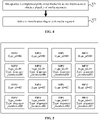
- the classification list represents the correspondence between the media segment in the point cloud media file and the media version and the data type. More specifically, the compressed point cloud media file is encapsulated as one media asset and may be segmented to obtain a plurality of media segments (MPUs), for example, 16 media segments shown in FIG. 3 . Each media segment has one media segment number, such as media segment numbers 1 to 16, sequentially numbered. It can be seen that each media segment number is different, that is, the media segment is represented by the media segment number.
- FIG. 2 is a flowchart of the encapsulation of point cloud data according to this embodiment. As shown in FIG. 2 , after the compressed point cloud media file is obtained, the method further includes the steps S11 and S12.
- step S11 the compressed point cloud media file is encapsulated as one media asset to obtain a plurality of media segments.
- step S12 the plurality of media segments is associated with the version and the data type based on the classification list.
- the "being associated” refers to the establishment of the correspondence between the data type and the media version and the media segment number, and the "being associated” below has the same definition.
- FIG. 3 shows the definition content of the classification list according to this embodiment.
- the classification list includes a type list, a content list and a segment number list.
- the type list corresponds to the data type of the point cloud media file.
- the content list is a set of a plurality of media versions.
- the segment number list is a set of all media segment numbers.
- Each data type corresponds to at least one media version, and each media version corresponds to at least one media segment number.
- the number of type lists corresponds to the data type of the point cloud media file, and one media version is one application scenario.
- the following is described using the video-based point cloud compression algorithm (VPCC) as an example.
- VPCC video-based point cloud compression algorithm
- the four types of data described above are represented by type lists 1, 2, 3 and 4, respectively.
- the type list 1 represents the occupation map information; the type list 2 represents the geometric information; the type list 3 represents the attribute information; and the type list 4 represents the auxiliary information.
- the occupation graph information includes two versions that are the content list 1 and the content list 2 respectively, the content list 1 is composed of media segments with media segment numbers 1 and 2, and the content list 2 is composed of media segments with media segment numbers 3, 4 and 5, that is, the occupation graph information is composed of media segments with media segment numbers 1, 2, 3, 4 and 5.
- geometric information includes only one version that is the content list 3, and the content list 3 is composed of media segments with media segment numbers 6 and 7, that is, the geometric information is composed of media segments with media segment numbers 6 and 7.
- attribute information includes two versions that are the content list 4 and the content list 5 respectively, the content list 4 is composed of media segments with media segment numbers of 8, 9 and 10, and the content list 5 is composed of media segments with media segment numbers of 11 and 12, that is, the attribute information is composed of media segments with media segment numbers of 8, 9, 10, 11 and 12.
- the attribute information includes two versions that are the content list 6 and the content list 7 respectively, the content list 6 is composed of media segments with media segment numbers 13 and 14, and the content list 7 is composed of media segments with media segment numbers 15 and 16, that is, the attribute information is composed of media segments with media segment numbers 13, 14, 15 and 16.
- the attribute information is composed of media segments with media segment numbers 13, 14, 15 and 16.
- the point cloud compression algorithm is not limited in the present disclosure, and the point cloud data encapsulation method is not limited in the present disclosure. Therefore, the data type of the point cloud media file includes, but is not limited to, the four types exemplified herein, and if other compression algorithms are adopted, other numbers and/or types of data may be obtained.
- the classification list is defined as a DTG information file, and the DTG information file is written into the signaling information for transmission.
- the content defined by the DTG information file is the content defined by the type list so that the DTG information file is used for describing the correspondence between the point cloud media file and the media segment number, the correspondence between the point cloud media file and the content list, and the correspondence between the point cloud media file and the type list.
- the receiving end can obtain the data classification of the point cloud media file by reading the DTG information file, and then can selectively send the data that needs to be updated in the current point cloud media file according to the demands of users.
- the point cloud content (that is, point cloud media file) includes occupancy map information, geometric information, attribute information and auxiliary information. If the occupancy map information, the geometric information, the attribute information and the auxiliary information have only one version, the number of type lists is the same as the number of content lists. However, in other cases, if the occupancy map information, the geometric information, the attribute information and the auxiliary information have only one version, the content list may not be set, but this operation will increase the complexity. If the occupancy map information, the geometric information, the attribute information and the auxiliary information all have a plurality of versions, at this point, the content list needs to be set.
- type lists 1 to 4 correspond to the occupancy map information, the geometric information, the attribute information and the auxiliary information, respectively.
- the occupancy map information includes two versions, there may be two content lists in the type list 1, and when a user selects one content list, the corresponding media segments may be obtained according to the media segment numbers listed in the content list for presenting the point cloud content.
- the DTG information file includes the information of the correspondence between the point cloud content and the media segment number, and the information may be transmitted using many methods, for example, a new signaling unit, signaling file or signaling message is defined or a new descriptor is added or header information of a transmission packet is added. According to the difference of implementation methods, the information described in the DTG information file may be transmitted and used in different manners.
- this embodiment provides three transmission manners for the transmission of the DTG information file, but the manner of adding the DTG information file to the signaling information includes, but is not limited to, the following manners.
- a DTG information file for describing DTG information is added to the signaling information.
- the DTG information file is written into the MPI table and transmitted as part of the signaling message, as shown in Table 1.
- the DTG information file is added to the MPI table, the part that needs to be modified is the description part of the PI_content, and the value of PI_content_count is increased by 1;
- the PI_content_type field describes the type of DTG information file, and the file format suitable for describing the DTG information may be selected according to the actual situation;
- the value of PI_content_type length is the length of the file type;
- the value of PI_content_type_length_byte is the type of the DTG information file;
- the value of PI_contentname length is the length of the name of the DTG information file;
- the value PI_content_name_byte is the value of the name of the DTG information file;
- PI_content_descriptores_length and PI_contentdescriptors byte are the length and content of the description information of the DTG information file, respectively, and may be null at present for subsequent expansion;
- PI_content_length and PI_content_byte are the length and content of the
- the DTG information file is written into the MPI table, and then the DTG information may be sent through the signaling information.
- some descriptive descriptors are defined in the signaling message defined by the existing multimedia transmission (MMT) protocol, and descriptors are the descriptive information in the signaling part of MMT and used for defining some fields or functions, such as dependency descriptor and MPU_timestamp_descriptor. Therefore, in Manner two, one new descriptor of describing the DTG information may be defined and may be used for describing the type information of the media segment.
- MMT multimedia transmission
- Descriptor tag is used for indicating the type of the descriptor
- descriptor length is used for indicating the length of the descriptor
- num_mpu is used for indicating the number of MPUs
- mpu_type is used for indicating the data type of the MPU.
- one new signaling table may be added to the signaling information to specifically describe the DTG file information.
- signaling information describing DTG information may be generated.
- the signaling information together with a PA message, an MPI message, an MP message and a CRI message, constitutes new signaling information and is then transmitted.
- the receiving end may parse the signaling message to obtain the content list information.
- the receiving end finds out the content list 1 corresponding to the occupancy map information by checking the DTG information file and finds out the media segment numbers 1 and 2 corresponding to the content list 1, and at this point, the client (point cloud media player) requests to send these media segments, store these media segments locally and update the local database.
- the receiving end also finds out the content list 3 corresponding to the geometric information by checking the DTG information file and finds out the media segment numbers 6 and 7 corresponding to the content list 3, and at this time, the client requests to send these media segments, store these media segments locally and updates the local database.
- the receiving end finds out the content list 4 corresponding to the attribute information by checking the DTG information file and finds out the media segment numbers 8, 9 and 10 corresponding to the content list 4, and at this point, the client requests to send these media segments, store these media segments locally and update the local database.
- the receiving end finds out the content list 6 corresponding to the auxiliary information by checking the DTG information file and finds out the media segment numbers 13 and 14 corresponding to the content list 6, and at this point, the client requests to send these media segments, store these media segments locally and update the local database.
- the user may integrate the information in four content lists (content lists 1, 3, 4 and 6) to completely present one point cloud media. Then, when the user needs to perform the dressing operation, the user first finds out a corresponding type list according to the type of the required dressing data, selects a content list from the type list, and then extracts the required media segments according to the media segment numbers in the content list.
- point cloud data transmission method is illustrated by using the MMT protocol as an example in this embodiment, the point cloud data of this embodiment may also be transmitted by using other files, such as Dynamic Adaptive Streaming over HTTP (DASH) transmission.
- DASH Dynamic Adaptive Streaming over HTTP
- the classification record is formed through a classification flag, and the classification flag represents the correspondence between the media segment and the media version and the data type.
- FIG. 4 is a flowchart of the encapsulation of point cloud data according to this embodiment. As shown in FIG. 4 , after the compressed point cloud media file is obtained, the method further includes the steps S21 and S22.
- the compressed point cloud media file is encapsulated as one media asset and may be segmented to obtain a plurality of media segments (MPUs), for example, 16 media segments (MPUs) shown in FIG. 5 .
- MPUs media segments
- step S22 during encapsulation, one classification flag is added to each media segment, and the classification flag records the data type and version information of the media segment.
- the added classification flags are the same.
- the manner of adding the classification flag is not limited to this embodiment. For example, when the point cloud media file is encapsulated, a reserved field may be used to add the classification flag for the MPU, and subsequently, the user only needs to request a certain type of point cloud data according to the classification flag.
- the classification flag typically includes two flag bits, such as type_id and type_sequence_number, as described below.
- Type id is used for defining the data type of the media segment
- type_sequence_number is used for defining the version of the media segment.
- the four values of type id correspond to four types of data, such as occupancy map information, geometric information, attribute information and ancillary information.
- the specific manner in which type_id and type_sequence_number are added is not limited to this embodiment.
- type id and type_sequence_number may be defined using a reserved field in the MPUBox. For example, 2 bits in the reserved field are defined as type id, 3 bits in the reserved field are defined as type_sequence_number, and the remaining 1 bit continues to be the reserved field (in the future, if more or fewer types of type id need to be defined, the field length of type_id may be increased or decreased). In this manner, all MPUs belonging to the same media asset (defined as asset_id) may be divided into different types by using type_id, as shown in Table 3.
- the left column is the existing MMT definition
- the right column is the MMT definition of the present disclosure.
- 2 bits are allocated for type id and 3 bits are allocated for type_sequence_number.
- the occupation map information, the geometric information and the auxiliary information may have only one version, but the corresponding attribute information may have a plurality of versions, so one type_sequence_number may be set for each type_id, and the quantity of type_sequence_number is the number of versions.
- the value of type id is 10
- the value of type_sequence_number may be 000, 001 and 010
- the MPUs having the same type_sequence_number correspond to the same set of clothes.
- the classification record is also the classification list.
- the classification list represents the correspondence between the media asset and the data type in the point cloud media file, more specifically, the correspondence between the media asset number and the media asset list.
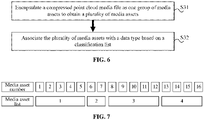
- FIG. 6 is a flowchart of the encapsulation of point cloud data according to this embodiment. As shown in FIG. 6 , after the compressed point cloud media file is obtained, the method further includes the steps S31 and S32.
- step S31 the compressed point cloud media file is encapsulated as one group of media assets (asset list) to obtain a plurality of media assets, for example, 16 media assets shown in FIG. 7 .
- Each media asset has one media asset number, such as media asset numbers 1 to 16, sequentially numbered. It can be seen that each media asset number is different, that is, the media asset is represented by the media asset number.
- step S32 the plurality of media assets is associated with the data type based on the classification list.
- the classification list includes a media asset list and an asset number list.
- the media asset list corresponds to the data type of the point cloud media file.
- the asset number list is a set of all media asset numbers.
- Each media asset list corresponds to at least one media asset number, and the number of media asset numbers corresponding to each media asset list is consistent with the number of media versions.
- Each media asset includes at least one media segment whose time period may be several seconds.
- the point cloud content is composed of 16 media assets, and the media asset numbers are 1 to 16 in sequence. It is assumed that the number of media asset lists is 4, and these media asset lists correspond to occupancy map information, geometric information, attribute information and auxiliary information, respectively. As shown in FIG.
- the occupation map information is the media asset list 1, correspondingly includes 5 versions, and may correspond to media assets whose media asset numbers are 1 to 5;
- the geometric information is the asset category 2, correspondingly includes 2 versions, and corresponds to the media assets whose media asset numbers are 6 and 7;
- the attribute information is the media asset list 3, correspondingly includes 5 versions, and corresponds to media assets whose media asset numbers are 8 to 12;
- the auxiliary information is the media asset list 4, correspondingly includes 4 versions, and corresponds to media assets whose media asset numbers are 13 to 16.
- the media asset number is the flag field in the media asset.
- the point cloud content corresponds to the media assets whose media asset numbers are 1 to 16, respectively, and different point cloud contents correspond to different combinations of media assets.
- the point cloud content corresponding to the media assets whose media asset numbers are 1, 6, 8 and 13 and the point cloud content corresponding to the media assets whose media asset numbers are 1, 6, 9 and 13 may correspond to images of the same point cloud character in different dress.
- the point cloud media file includes a plurality of point cloud contents, and a pending flag (pending_flag) is set in the encapsulated point cloud media file, where the pending flag is used for indicating whether media assets of all data types in each point cloud content have been transmitted.
- pending_flag a pending flag
- the point cloud content corresponding to the media assets whose media asset numbers are 1, 6, 8 and 13 is transmitted before the point cloud content corresponding to the media assets whose media asset numbers are 1, 6, 9 and 13. Since the two point cloud contents have only one different media asset, only the media asset whose media asset number is 9 needs to be transmitted when the latter point cloud content is transmitted.
- the value of pending flag is 1; after the former point cloud has been transmitted and when the latter point cloud content (only the media asset whose media asset number is 9 needs to be transmitted) is being transmitted, the value of pending_flag becomes 0; after the latter point cloud content (only the media asset whose media asset number is 9 needs to be transmitted) has been transmitted, the value of pending flag becomes 1.
- One pending flag may be set for each point cloud content to indicate whether media assets of all data types of the point cloud content have been prepared.
- the classification list is defined as an ACR information file, and the ACR information file is written into the signaling information.
- the content defined by the ACR information file is the content corresponding to the classification table of this embodiment and is used for describing the correspondence between the data type of the point cloud media file and the media asset number.
- One presentable point cloud content corresponds to one media asset list, the media asset list is a set of media asset numbers, and the media asset number is the flag field of the media asset.
- the classification of the point cloud media file may be obtained by reading the ACR information file so that the data that needs to be updated in the current point cloud media file is selectively sent according to the demands of users.
- the media assets whose media asset numbers (asset_id) are 0 and 1 correspond to the occupation map information and geometric information of the point cloud, respectively, and the media assets whose media asset numbers are 2 and 3 and the media assets whose media asset numbers are 4 and 5 are two sets of attribute information and auxiliary information. Therefore, the media assets whose media asset numbers are 0, 1, 2, 3 and the media assets whose media asset numbers are 0, 1, 4 and 5 may constitute different point cloud contents and are different dress of the same character.
- the ACR information file includes important information of different data types of the point cloud, and the important information may be transmitted using different methods, for example, a new signaling unit, signaling file or signaling message is defined or a new descriptor is added or header information of a packet is added. According to the difference of implementation methods, the information described in the ACR information file may be transmitted and used in different manners.
- this embodiment provides three transmission manners for the transmission of the ACR information file, but the manner of adding the ACR information file to the signaling information includes, but is not limited to, the following manners.
- an ACR information file for describing ACR information is added to the signaling information.
- the ACR information file is written into the MPI table and transmitted as part of the signaling message, as shown in Table 5.
- the ACR information file is added to the MPI table, the part that needs to be modified is the description part of the PI_content, and the value of PI_content_count is increased by 1;
- the PI_content_type field describes the type of ACR information file, and the file format suitable for describing the ACR information may be selected according to the actual situation;
- the value of PI_content_type_length is the length of the file type;
- the value of PI_content_type_length_byte is the type of the ACR information file;
- the value of PI_content_name_length is the length of the name of the ACR information file;
- the value PI_content_name_byte is the value of the name of the ACR information file;
- PI_content_descriptores_length and PI_content_descriptors_byte are the length and content of the description information of the ACR information file, respectively, and may be null at present for subsequent expansion;
- PI_content_length and PI_content_byte are the length
- the ACR information file is written into the MPI table, and then the ACR information may be sent through the signaling information.
- one new signaling table may be added in the signaling information to specially describe the ACR file information. After a table describing the ACR information is generated and a specific header is added, signaling information describing ACR information may be generated.
- the signaling information together with a PA message, an MPI message, an MP message and a CRI message, constitutes new signaling information for transmission. After the signaling message is received, the receiving end may parse the signaling message to obtain the media asset list information.
- the sending end sends signaling information.
- the user may know the media asset numbers (asset_id) corresponding to the occupancy map information, geometry information, attribute information and auxiliary information from asset_list[0], asset_list[1], asset_list[2] and asset_list[3].
- the receiving end finds out by checking the ACR information file that the corresponding asset_id of the occupancy graph in the asset_list[0] is 0.
- the corresponding media assets are obtained from the sending end by checking the DTG information file and the local database, where these media assets are the media assets corresponding to a certain asset_id included in the asset_list[1].
- the corresponding media assets are obtained from the sending end by checking the ACR information file and the local database, where these media assets are the media assets corresponding to an asset_id included in the asset_list[2].
- the auxiliary information the corresponding media assets are obtained from the sending end by checking the DTG information file and the local database, where these media assets are the media assets corresponding to an asset_id included in the asset_list[3].
- the user may integrate the information in four kinds of obtained media assets to completely present one point cloud media.
- the user needs to perform the dressing operation, the user only needs to request the corresponding media assets in asset_list[2] and asset_list[3] again.
- point cloud data transmission method is illustrated by using the MMT protocol as an example in this embodiment, the point cloud data of this embodiment may also be transmitted by using other files, such as DASH transmission.
Landscapes
- Engineering & Computer Science (AREA)
- Multimedia (AREA)
- Signal Processing (AREA)
- Theoretical Computer Science (AREA)
- Computer Networks & Wireless Communication (AREA)
- General Physics & Mathematics (AREA)
- Physics & Mathematics (AREA)
- Databases & Information Systems (AREA)
- General Engineering & Computer Science (AREA)
- Data Mining & Analysis (AREA)
- Computer Security & Cryptography (AREA)
- Information Retrieval, Db Structures And Fs Structures Therefor (AREA)
- Information Transfer Between Computers (AREA)
- Two-Way Televisions, Distribution Of Moving Picture Or The Like (AREA)
- Radar Systems Or Details Thereof (AREA)
Abstract
Description
- The present disclosure relates to the field of multimedia transmission technologies and, in particular, to a point cloud data encapsulation method and a point cloud data transmission method.
- In recent years, with the rapid development and improvement of media transmission technology, the lowering cost of transmitting image and video information, and the improving accuracy of image and video information, the maturity of relevant application fields is promoted. Three-dimensional point cloud data, as a new type of image media data, can provide more accurate and vivid image information for users and bring a more realistic and interactive communication experience.
- The point cloud data is the object surface information obtained by scanning, including three-dimensional coordinate data, depth information, color information and the like. With the maturity of three-dimensional (3D) scanning technology and the perfection of system architecture, the accuracy of point cloud data is improved, and the amount of point cloud data is greatly improved. For static point cloud data, dynamic point cloud data, point cloud data of machine perception, point cloud data of human eye perception and other different types of point cloud data, there are different point cloud data compression algorithms. For example, for dynamic point cloud data of human eye perception, the typical point cloud compression algorithms is to convert 3D point cloud data into two-dimensional (2D) image data and then process the data, and one of the typical point cloud compression algorithm is the video-based point cloud compression (VPCC) algorithm. In such a compression method, 3D point cloud is firstly projected onto a 2D plane to obtain occupation graph information, geometric information, attribute information and auxiliary information, where the attribute information usually includes texture information and color information. Therefore, the compressed information is usually divided into four types of data for transmission.
- Therefore, when the VPCC data is about to be transmitted, the to-be-processed information mainly includes four types of data, that is, geometric information, attribute information, occupation graph information and auxiliary information. The decoding of the geometric information depends on the occupation graph information and the auxiliary information, and the decoding of the attribute information depends on the geometric information, the occupation graph and the auxiliary information. It can be seen that the point cloud media data is more complex and multivariate than the conventional media data, and different types of data need to be processed synchronously and integrated, and then the media having rich spatial characteristics and texture characteristics is presented to users. At present, the research on encapsulation and transmission of 3D point cloud data using existing multimedia transmission protocols has made some progress. However, with the development of network transmission technology, the heterogeneous network environment becomes increasingly complex, and the transmission effect of point cloud data in the heterogeneous network environment is poor in the existing art.
- In view of the defects in the existing art, the object of the present disclosure is to provide a point cloud data encapsulation method and a point cloud data transmission method.
- The point cloud data encapsulation method provided by the present disclosure includes the steps described below.
- A point cloud media file is compressed.
- The compressed point cloud media file is encapsulated and a classification record is set according to a data type, where the classification record is used for indicating a data type of each portion of point cloud data in the point cloud media file.
- Optionally, in a case where the point cloud media file includes a plurality of point cloud contents, a pending flag is set in the encapsulated point cloud media file, where the pending flag is used for indicating whether media assets of all data types in each point cloud content have been transmitted.
- Optionally, the classification record is a classification list, and the classification list indicates the correspondence between the media segment, the media version and the data type.
- The step where the compressed point cloud media file is encapsulated and the classification record is set according to the data type includes the steps described below.
- The compressed point cloud media file is encapsulated to obtain one media asset which includes a plurality of media segments.
- The plurality of media segments is associated with the media version and the data type based on the classification list.
- Optionally, the plurality of media assets has different media asset numbers; the classification list includes a type list, a content list and a segment number list; the type list corresponds to a data type of a point cloud media file; the content list is a set of a plurality of media versions; the segment number list is a set of all media segment numbers; each data type corresponds to at least one media version, and each media version corresponds to at least one media segment number.
- Optionally, the classification record is a classification flag, and the classification flag represents the correspondence between the media segment and the media version and the data type.
- The step where the compressed point cloud media file is encapsulated and the classification record is set according to the data type includes the steps described below.
- The compressed point cloud media file is encapsulated to obtain one media asset, where the media asset includes a plurality of media segments.
- One classification flag is added to each media segment.
- Optionally, when different media segments have the same media version and the same data type, the added classification flags are the same.
- Optionally, the classification flag includes two flag bits; one flag bit is used for defining the data type of a media segment, and the other flag bit is used for defining the version of the media segment.
- Optionally, the classification record is a classification list, and the classification list represents the correspondence between the media asset and the data type.
- The step where the compressed point cloud media file is encapsulated and the classification record is set according to the data type includes the steps described below.
- The compressed point cloud media file is encapsulated to obtain a plurality of media assets.
- The plurality of media assets is associated with the data type based on the classification list.
- Optionally, the plurality of media assets has different media asset numbers; the classification list includes a media asset list and an asset number list; the media asset list corresponds to a data type of the point cloud media file; the asset number list is a set of all media asset numbers; each media asset list corresponds to at least one media asset number, and the quantity of media asset numbers corresponding to each media asset list is consistent with the number of media versions.
- The point cloud data transmission method provided by the present disclosure includes the steps described below.
- The related content of a classification record is added to signaling information, where the classification record is used for indicating a data type of each portion of point cloud data in a point cloud media file when the point cloud media file is encapsulated.
- The classification record is acquired according to the signaling information, and local data that needs to be updated in the current point cloud media file is transmitted according to the classification record.
- Before the local data that needs to be updated in the point cloud media file is transmitted, the method further includes the following step: all data of the point cloud media file is transmitted.
- Optionally, in a case where the point cloud media file includes a plurality of point cloud contents, a pending flag is set in the encapsulated point cloud media file, where the pending flag is used for indicating whether media assets of all data types in each point cloud content have been transmitted.
- Optionally, the compressed point cloud media file is encapsulated and a classification record is set according to a data type, where the classification record is a classification list, and the classification list indicates the correspondence between the media asset and the data type.
- Optionally, the step where the compressed point cloud media file is encapsulated and the classification record is set according to the data type includes the steps described below.
- The compressed point cloud media file is encapsulated as a group of media assets to obtain a plurality of media assets.
- The plurality of media assets is associated with a data type based on the classification list.
- Optionally, the plurality of media assets has different media asset numbers; the classification list includes a media asset list and an asset number list; the media asset list corresponds to a data type of a point cloud media file; the asset number list is a set of all media asset numbers; each media asset list corresponds to at least one media asset number, and the quantity of media asset numbers corresponding to each media asset list is consistent with the number of media versions.
- Optionally, the classification record is a classification list, and the classification list represents the correspondence between the media segment and the media version and the data type.
- The step where the related content of the classification record is added to the signaling information includes the step described below.
- The classification list is defined as a data type group (DTG) information file, and the DTG information file is written into the signaling information.
- Optionally, the DTG information file is written into a media presentation information (MPI) table, or a descriptive descriptor is added to describe the DTG information file, or a signaling table is added to describe the DTG information file.
- Optionally, the classification record is a classification list, and the classification list represents the correspondence between the media asset and the data type.
- The step where the related content of the classification record is added to the signaling information includes the step described below.
- The classification list is defined as an asset content relationship (ACR) information file, and the ACR information file is written into the signaling information.
- Optionally, the ACR information file is written into an MPI table or a descriptive descriptor is added to describe the ACR information file or a signaling table is added to describe the DTG information file.
- Optionally, the classification record is a classification flag, and the classification record represents the correspondence between the media segment and the media version and the data type.
- The step where the related content of the classification record is added to the signaling information includes the step described below.
- One classification flag is defined for each media segment using a reserved field.
- Optionally, the classification flag includes two flag bits; one flag bit is used for defining the data type of a media segment, and the other flag bit is used for defining the version of the media segment; when the version of the media segment is 1, the media segment has only the flag bit that is used for defining the data type of the media segment.
- Optionally, one flag bit is defined using 2 bits of a reserved field in a media processing unit (MPU) Box to represent the data type of the media segment, and the other flag bit is defined using 3 bits of the reserved field in the MPU Box to represent the version of the media segment.
- Compared with the existing art, the present disclosure has the following beneficial effects.
- In the present disclosure, based on the existing point cloud data processing method, the classification record is set for the point cloud media file according to the data type so that different data of the point cloud data can be easily identified according to the classification record. In this manner, the local data of the point cloud data can be flexibly sent according to the application requirements, and not all the point cloud data needs to be sent. Therefore, the bandwidth is saved while the application requirements are satisfied, the point cloud data can be more flexible and efficiently transmitted, and the flexible transmission of the point cloud data in the heterogeneous network is achieved. Therefore, the present disclosure solves the problem of low transmission efficiency of the media content and waste of storage space in the point cloud data transmission, increases the flexibility of the media content combination, increases management control of a multimedia service, gives users more rights to independently select and acquire the media content, provides diversified application scenarios, and provides better multimedia content provision and transmission solutions for network operators.
- Other features, objects and advantages of the present disclosure will become more apparent from the detailed description of non-limiting embodiments with reference to the drawings below.
-
FIG. 1 is a flowchart of the encapsulation of point cloud data according to an embodiment of the present disclosure; -
FIG. 2 is a flowchart of the encapsulation of point cloud data according to embodiment one of the present disclosure; -
FIG. 3 shows the definition content of a DTG information file according to embodiment one of the present disclosure; -
FIG. 4 is a flowchart of the encapsulation of point cloud data according to embodiment two of the present disclosure; -
FIG. 5 is a schematic diagram of the addition of flag bits to media segments according to embodiment two of the present disclosure; -
FIG. 6 is a flowchart of the encapsulation of point cloud data according to embodiment three of the present disclosure; and -
FIG. 7 shows the definition content of an ACR information file according to embodiment three of the present disclosure. - The present disclosure will be described below in detail in conjunction with specific embodiments. The following embodiments are provided for ease of understanding of the present disclosure by those skilled in the art but are not intended to limit the present disclosure in any manner. It is to be noted that those of ordinary skill in the art can make a number of variations and improvements without departing from the concept of the present disclosure, and such variations and improvements are within the scope of the present disclosure.
- The inventor of the present application found that the point cloud media content may have the interaction with the user during the presentation of the point cloud media content, and some information of the point cloud is required to be changed. For example, in a point cloud media-based character dressing operation, attribute information such as the texture and color of the point cloud is usually required to be changed. At this point, in the conventional technology, all the point cloud data is usually sent to the client, and this operation increases the bandwidth, has low transmission efficiency and affects the user experience.
- In view of the problems described above, the present disclosure provides a point cloud data encapsulation method, and as shown in
FIG. 1 , the method includes the steps S01 and S02. - In step S01, a point cloud media file is compressed.
- In S02, the compressed point cloud media file is encapsulated and a classification record is set according to a data type. The classification record is used for indicating a data type of each portion of point cloud data in the point cloud media file.
- The present disclosure sets the classification record so that different data of the point cloud data is identified according to the classification record when the point cloud content is presented, thereby achieving the self-adaptive transmission and presentation of the point cloud data.
- Furthermore, based on the point cloud data encapsulation method of the present disclosure, the present disclosure also provides a point cloud data transmission method, and the method includes the steps described below.
- A related content of the classification record described above is added to signaling information.
- The classification record is acquired according to the signaling information, and local data that needs to be updated in the current point cloud media file is transmitted according to the classification record. Before the local data that needs to be updated in the current point cloud media file is transmitted, the method further includes the following step: all data of the current point cloud media file is transmitted.
- Based on the encapsulation method and the transmission method described above, when the point cloud content is presented for the first time, complete point cloud data is required to be acquired to present the point cloud content. After the point cloud content is presented, if only dressing and other operations need to be performed, the data that needs to be updated in the current point cloud media file may be selectively transmitted according to the classification record, and not all information needs to be transmitted.
- The object, features and advantages of the present disclosure will be more apparent from the detailed description of the embodiments of the present disclosure in conjunction with the drawings.
- In this embodiment, the classification record is made through a classification list. The classification list represents the correspondence between the media segment in the point cloud media file and the media version and the data type. More specifically, the compressed point cloud media file is encapsulated as one media asset and may be segmented to obtain a plurality of media segments (MPUs), for example, 16 media segments shown in
FIG. 3 . Each media segment has one media segment number, such asmedia segment numbers 1 to 16, sequentially numbered. It can be seen that each media segment number is different, that is, the media segment is represented by the media segment number. -
FIG. 2 is a flowchart of the encapsulation of point cloud data according to this embodiment. As shown inFIG. 2 , after the compressed point cloud media file is obtained, the method further includes the steps S11 and S12. - In step S11, the compressed point cloud media file is encapsulated as one media asset to obtain a plurality of media segments.
- In step S12, the plurality of media segments is associated with the version and the data type based on the classification list. The "being associated" refers to the establishment of the correspondence between the data type and the media version and the media segment number, and the "being associated" below has the same definition.
-
FIG. 3 shows the definition content of the classification list according to this embodiment. As shown inFIG. 3 , the classification list includes a type list, a content list and a segment number list. The type list corresponds to the data type of the point cloud media file. The content list is a set of a plurality of media versions. The segment number list is a set of all media segment numbers. Each data type corresponds to at least one media version, and each media version corresponds to at least one media segment number. In this embodiment, the number of type lists corresponds to the data type of the point cloud media file, and one media version is one application scenario. - With continued reference to
FIG. 3 , the following is described using the video-based point cloud compression algorithm (VPCC) as an example. After one point cloud media file is processed, four types of data may be obtained, that is, occupation graph information, geometric information, attribute information and auxiliary information. At this point, during encapsulation, the media asset is segmented into a plurality of media segments, and these media segments also include four types of data, that is, occupation graph information, geometric information, attribute information and auxiliary information. Assuming that one media asset is segmented into 16 media segments that are numbered 1 to 16 sequentially, the data type of each part of one point cloud media file is the set of media segments. - In an example embodiment, the four types of data described above are represented by
type lists type list 1 represents the occupation map information; thetype list 2 represents the geometric information; thetype list 3 represents the attribute information; and thetype list 4 represents the auxiliary information. It is further assumed that the occupation graph information includes two versions that are thecontent list 1 and thecontent list 2 respectively, thecontent list 1 is composed of media segments withmedia segment numbers content list 2 is composed of media segments withmedia segment numbers media segment numbers content list 3, and thecontent list 3 is composed of media segments withmedia segment numbers media segment numbers content list 4 and thecontent list 5 respectively, thecontent list 4 is composed of media segments with media segment numbers of 8, 9 and 10, and thecontent list 5 is composed of media segments with media segment numbers of 11 and 12, that is, the attribute information is composed of media segments with media segment numbers of 8, 9, 10, 11 and 12. It is further assumed that the attribute information includes two versions that are thecontent list 6 and thecontent list 7 respectively, thecontent list 6 is composed of media segments withmedia segment numbers content list 7 is composed of media segments withmedia segment numbers media segment numbers - It is to be noted that although this embodiment is described using the VPCC point cloud compression algorithm as an example, the point cloud compression algorithm is not limited in the present disclosure, and the point cloud data encapsulation method is not limited in the present disclosure. Therefore, the data type of the point cloud media file includes, but is not limited to, the four types exemplified herein, and if other compression algorithms are adopted, other numbers and/or types of data may be obtained.
- Further, in order to transmit and present the point cloud content, the classification list is defined as a DTG information file, and the DTG information file is written into the signaling information for transmission. It is to be understood that the content defined by the DTG information file is the content defined by the type list so that the DTG information file is used for describing the correspondence between the point cloud media file and the media segment number, the correspondence between the point cloud media file and the content list, and the correspondence between the point cloud media file and the type list. In this manner, the receiving end can obtain the data classification of the point cloud media file by reading the DTG information file, and then can selectively send the data that needs to be updated in the current point cloud media file according to the demands of users.
- The transmission manner of the DTG information file of this embodiment and the performance of the character dressing operation based on the point cloud media file will be described below in detail according to the above embodiments.
- It is assumed that the point cloud content (that is, point cloud media file) includes occupancy map information, geometric information, attribute information and auxiliary information. If the occupancy map information, the geometric information, the attribute information and the auxiliary information have only one version, the number of type lists is the same as the number of content lists. However, in other cases, if the occupancy map information, the geometric information, the attribute information and the auxiliary information have only one version, the content list may not be set, but this operation will increase the complexity. If the occupancy map information, the geometric information, the attribute information and the auxiliary information all have a plurality of versions, at this point, the content list needs to be set.
- For example, if the occupancy map information, the geometric information, the attribute information and the auxiliary information of the point cloud need to be transmitted, corresponding type lists need to be found. For example, in
FIG. 3 , type lists 1 to 4 correspond to the occupancy map information, the geometric information, the attribute information and the auxiliary information, respectively. Assuming that the occupancy map information includes two versions, there may be two content lists in thetype list 1, and when a user selects one content list, the corresponding media segments may be obtained according to the media segment numbers listed in the content list for presenting the point cloud content. - Therefore, the DTG information file includes the information of the correspondence between the point cloud content and the media segment number, and the information may be transmitted using many methods, for example, a new signaling unit, signaling file or signaling message is defined or a new descriptor is added or header information of a transmission packet is added. According to the difference of implementation methods, the information described in the DTG information file may be transmitted and used in different manners.
- For example, this embodiment provides three transmission manners for the transmission of the DTG information file, but the manner of adding the DTG information file to the signaling information includes, but is not limited to, the following manners.
- In Manner one, a DTG information file for describing DTG information is added to the signaling information.
- In Manner one, the DTG information file is written into the MPI table and transmitted as part of the signaling message, as shown in Table 1.
Table 1 Addition of the definition of the DTG Information file to the MPI table Grammar Value Bit width Mnemonic MPI_table () { table id 8 uimsbf version 8 uimsbf length N1 16 uimsbf reserved '1111' 4 bslbf PI_mode 2 uimsbf reserved '11' 2 bslbf MPIT_descriptors { MPIT_descriptors_length N2 16 uimsbf for (i=0; i<N2; i++) { MPIT_descriptors_byte 8 uimsbf } } PI _content_count N3 8 uimsbf for (i =0; i<N3; i++) { PI_content_type { PI_content_type_length N4 8 uimsbf for (j=0; j<N4; j++) { PI_content_type_length _byte 8 uimsbf } } PI _content_name_length N5 8 uimsbf for (j=0; j<N5; j++) { PI_content_name_byte 8 uimsbf } PI_content_descriptors { PI_content_descriptors_length N6 16 uimsbf for (i=0; i<N6; i++) { PI _contnent_descriptors_byte 8 uimsbf } } PI _content_length N7 16 uimsbf for (j=0; j<N7; j++) { PI_content_byte 8 uimsbf } } } - The DTG information file is added to the MPI table, the part that needs to be modified is the description part of the PI_content, and the value of PI_content_count is increased by 1; where the PI_content_type field describes the type of DTG information file, and the file format suitable for describing the DTG information may be selected according to the actual situation; the value of PI_content_type length is the length of the file type; the value of PI_content_type_length_byte is the type of the DTG information file; the value of PI_contentname length is the length of the name of the DTG information file; the value PI_content_name_byte is the value of the name of the DTG information file; PI_content_descriptores_length and PI_contentdescriptors byte are the length and content of the description information of the DTG information file, respectively, and may be null at present for subsequent expansion; PI_content_length and PI_content_byte are the length and content of the DTG information file, respectively.
- According to the above instructions, the DTG information file is written into the MPI table, and then the DTG information may be sent through the signaling information.
- In Manner two, a descriptor for describing DTG information is added.
- For example, some descriptive descriptors are defined in the signaling message defined by the existing multimedia transmission (MMT) protocol, and descriptors are the descriptive information in the signaling part of MMT and used for defining some fields or functions, such as dependency descriptor and MPU_timestamp_descriptor. Therefore, in Manner two, one new descriptor of describing the DTG information may be defined and may be used for describing the type information of the media segment. In the MP table, an asset_descriptors field exists, and the filed may be implemented by adding MPUtype_descriptor to asset_ descriptors as needed, as shown in Table 2.
Table 2 Definition of MPUtype_descriptor Grammar Value Bit width Mnemonic MPUtype_descriptor() { descriptor_tag 16 uimsbf descriptor_length 16 uimsbf num_mpu N1 8 uimsbf for (i = 0 ; i < N1 ; i++) { mpu_type() } } - Descriptor tag is used for indicating the type of the descriptor, descriptor length is used for indicating the length of the descriptor, num_mpu is used for indicating the number of MPUs, and mpu_type () is used for indicating the data type of the MPU.
- In Manner three, a signaling table for describing DTG information is added.
- In addition to the manners described above, one new signaling table may be added to the signaling information to specifically describe the DTG file information. After a table describing the DTG file information is generated and a specific header is added, signaling information describing DTG information may be generated. The signaling information, together with a PA message, an MPI message, an MP message and a CRI message, constitutes new signaling information and is then transmitted. After the signaling message is received, the receiving end may parse the signaling message to obtain the content list information.
- In an example operation, when the user requests the occupancy map information of the point cloud, the receiving end finds out the
content list 1 corresponding to the occupancy map information by checking the DTG information file and finds out themedia segment numbers content list 1, and at this point, the client (point cloud media player) requests to send these media segments, store these media segments locally and update the local database. When the user then requests the geometric information of the point cloud, the receiving end also finds out thecontent list 3 corresponding to the geometric information by checking the DTG information file and finds out themedia segment numbers content list 3, and at this time, the client requests to send these media segments, store these media segments locally and updates the local database. When the user then requests the attribute information of the point cloud, the receiving end finds out thecontent list 4 corresponding to the attribute information by checking the DTG information file and finds out themedia segment numbers content list 4, and at this point, the client requests to send these media segments, store these media segments locally and update the local database. When the user then requests the auxiliary information of the point cloud, the receiving end finds out thecontent list 6 corresponding to the auxiliary information by checking the DTG information file and finds out themedia segment numbers content list 6, and at this point, the client requests to send these media segments, store these media segments locally and update the local database. After the user obtains all the information, the user may integrate the information in four content lists (content lists 1, 3, 4 and 6) to completely present one point cloud media. Then, when the user needs to perform the dressing operation, the user first finds out a corresponding type list according to the type of the required dressing data, selects a content list from the type list, and then extracts the required media segments according to the media segment numbers in the content list. - It is to be noted that although the point cloud data transmission method is illustrated by using the MMT protocol as an example in this embodiment, the point cloud data of this embodiment may also be transmitted by using other files, such as Dynamic Adaptive Streaming over HTTP (DASH) transmission.
- In this embodiment, the classification record is formed through a classification flag, and the classification flag represents the correspondence between the media segment and the media version and the data type.
-
FIG. 4 is a flowchart of the encapsulation of point cloud data according to this embodiment. As shown inFIG. 4 , after the compressed point cloud media file is obtained, the method further includes the steps S21 and S22. - In step S21, the compressed point cloud media file is encapsulated as one media asset and may be segmented to obtain a plurality of media segments (MPUs), for example, 16 media segments (MPUs) shown in
FIG. 5 . - In step S22, during encapsulation, one classification flag is added to each media segment, and the classification flag records the data type and version information of the media segment.
- When different media segments have the same media version and the same data type, the added classification flags are the same. The manner of adding the classification flag is not limited to this embodiment. For example, when the point cloud media file is encapsulated, a reserved field may be used to add the classification flag for the MPU, and subsequently, the user only needs to request a certain type of point cloud data according to the classification flag.
- The classification flag typically includes two flag bits, such as type_id and type_sequence_number, as described below. Type id is used for defining the data type of the media segment, and type_sequence_number is used for defining the version of the media segment. As shown in
FIG. 5 , the data types of the four MPUs in the first row are all defined as type_id=00; the data types of the four MPUs in the second row are defined as type_id=01; the four data types in the third row are defined as type_id=02; the data type of the four MPUs in the last row are defined as type_id=03. The four values of type id correspond to four types of data, such as occupancy map information, geometric information, attribute information and ancillary information. The specific manner in which type_id and type_sequence_number are added is not limited to this embodiment. - In an example embodiment, type id and type_sequence_number may be defined using a reserved field in the MPUBox. For example, 2 bits in the reserved field are defined as type id, 3 bits in the reserved field are defined as type_sequence_number, and the remaining 1 bit continues to be the reserved field (in the future, if more or fewer types of type id need to be defined, the field length of type_id may be increased or decreased). In this manner, all MPUs belonging to the same media asset (defined as asset_id) may be divided into different types by using type_id, as shown in Table 3.
Table 3 Modifications made by the present disclosure to the existing MMT definition Existing MMT definition MMT definition of the present disclosure aligned(8) class MPUBox aligned(8) class MPUBox extends FullBox('mmpu', extends FullBox('mmpu', version, 0){ version, 0){ unsigned int(1) is_complete; unsigned int(1) is_complete; unsigned int(2) type_id; unsigned int(6) reserved; unsigned int(3) type_sequence_number; unsigned int(32) unsigned int(1) reserved; mpu_sequence_number; unsigned int(32) mpu_sequence_number; - As shown in Table 3, the left column is the existing MMT definition, and the right column is the MMT definition of the present disclosure. As can be seen, in the present disclosure, 2 bits are allocated for type id and 3 bits are allocated for type_sequence_number.
- For example, when the character dressing is performed, the occupation map information, the geometric information and the auxiliary information may have only one version, but the corresponding attribute information may have a plurality of versions, so one type_sequence_number may be set for each type_id, and the quantity of type_sequence_number is the number of versions. For example, when one point cloud character has three sets of clothes, the value of type id is 10, the value of type_sequence_number may be 000, 001 and 010, and the MPUs having the same type_sequence_number correspond to the same set of clothes.
- Further, in conjunction with
FIG. 5 , when the value of type_id is 01, the corresponding data has two versions, and then type_sequence_number has two different values, such as 000 and 001; when the value of type_id is 03, the corresponding data has four versions, and then type_sequence_number has four different values, such as 000, 001, 002 and 003. It is to be understood that for the MPU with type_id=00, no type_sequence_number needs to be defined for the MPU if the data has only one version. - In this embodiment, the classification record is also the classification list. Different from embodiment one, the classification list represents the correspondence between the media asset and the data type in the point cloud media file, more specifically, the correspondence between the media asset number and the media asset list.
-
FIG. 6 is a flowchart of the encapsulation of point cloud data according to this embodiment. As shown inFIG. 6 , after the compressed point cloud media file is obtained, the method further includes the steps S31 and S32. - In step S31, the compressed point cloud media file is encapsulated as one group of media assets (asset list) to obtain a plurality of media assets, for example, 16 media assets shown in
FIG. 7 . - Each media asset has one media asset number, such as
media asset numbers 1 to 16, sequentially numbered. It can be seen that each media asset number is different, that is, the media asset is represented by the media asset number. - In step S32, the plurality of media assets is associated with the data type based on the classification list.
- As shown in
FIG. 7 , the classification list includes a media asset list and an asset number list. The media asset list corresponds to the data type of the point cloud media file. The asset number list is a set of all media asset numbers. Each media asset list corresponds to at least one media asset number, and the number of media asset numbers corresponding to each media asset list is consistent with the number of media versions. Each media asset includes at least one media segment whose time period may be several seconds. - For a certain point cloud content, it is assumed that the point cloud content is composed of 16 media assets, and the media asset numbers are 1 to 16 in sequence. It is assumed that the number of media asset lists is 4, and these media asset lists correspond to occupancy map information, geometric information, attribute information and auxiliary information, respectively. As shown in
FIG. 7 , the occupation map information is themedia asset list 1, correspondingly includes 5 versions, and may correspond to media assets whose media asset numbers are 1 to 5; the geometric information is theasset category 2, correspondingly includes 2 versions, and corresponds to the media assets whose media asset numbers are 6 and 7; the attribute information is themedia asset list 3, correspondingly includes 5 versions, and corresponds to media assets whose media asset numbers are 8 to 12; the auxiliary information is themedia asset list 4, correspondingly includes 4 versions, and corresponds to media assets whose media asset numbers are 13 to 16. The media asset number is the flag field in the media asset. The point cloud content corresponds to the media assets whose media asset numbers are 1 to 16, respectively, and different point cloud contents correspond to different combinations of media assets. For example, the point cloud content corresponding to the media assets whose media asset numbers are 1, 6, 8 and 13 and the point cloud content corresponding to the media assets whose media asset numbers are 1, 6, 9 and 13 may correspond to images of the same point cloud character in different dress. The point cloud media file includes a plurality of point cloud contents, and a pending flag (pending_flag) is set in the encapsulated point cloud media file, where the pending flag is used for indicating whether media assets of all data types in each point cloud content have been transmitted. When the media assets of all data types of each point cloud content have been prepared, the value of pending flag is 1; otherwise, the value is 0. - For example, the point cloud content corresponding to the media assets whose media asset numbers are 1, 6, 8 and 13 is transmitted before the point cloud content corresponding to the media assets whose media asset numbers are 1, 6, 9 and 13. Since the two point cloud contents have only one different media asset, only the media asset whose media asset number is 9 needs to be transmitted when the latter point cloud content is transmitted. After the media assets whose media asset numbers are 1, 6, 8 and 13 included in the former point cloud content have been transmitted, the value of pending flag is 1; after the former point cloud has been transmitted and when the latter point cloud content (only the media asset whose media asset number is 9 needs to be transmitted) is being transmitted, the value of pending_flag becomes 0; after the latter point cloud content (only the media asset whose media asset number is 9 needs to be transmitted) has been transmitted, the value of pending flag becomes 1.
- One pending flag (pending flag) may be set for each point cloud content to indicate whether media assets of all data types of the point cloud content have been prepared.
- Further, in order to transmit and present the point cloud content, in this embodiment, the classification list is defined as an ACR information file, and the ACR information file is written into the signaling information. Similarly, the content defined by the ACR information file is the content corresponding to the classification table of this embodiment and is used for describing the correspondence between the data type of the point cloud media file and the media asset number. One presentable point cloud content corresponds to one media asset list, the media asset list is a set of media asset numbers, and the media asset number is the flag field of the media asset. In this manner, the classification of the point cloud media file may be obtained by reading the ACR information file so that the data that needs to be updated in the current point cloud media file is selectively sent according to the demands of users.
- The transmission manner of the ACR information file of this embodiment and the performance of the character dressing operation based on the point cloud media file will be described below in detail according to the above embodiments.
- It is assumed that one complete point cloud content needs to search media asset numbers from the media asset lists corresponding to occupation map information, geometric information, attribute information and auxiliary information and then extract corresponding media assets. It is assumed that the media asset lists corresponding to the occupation map information, geometric information, attribute information and auxiliary information are asset_list[0], asset_list[1], asset_list[2] and asset_list[3], respectively, one media asset is extracted from each media asset list, and the media assets are distinguished by media asset numbers. The setting rule is shown in Table 4.
Table 4 Correspondence between the point cloud data and the media asset and the media asset number asset_list[] 0 1 2 3 asset id set 0 1 2,4 3,5 Point cloud data type Occupation map information Geometric information Attribute information Auxiliary information - The media assets whose media asset numbers (asset_id) are 0 and 1 correspond to the occupation map information and geometric information of the point cloud, respectively, and the media assets whose media asset numbers are 2 and 3 and the media assets whose media asset numbers are 4 and 5 are two sets of attribute information and auxiliary information. Therefore, the media assets whose media asset numbers are 0, 1, 2, 3 and the media assets whose media asset numbers are 0, 1, 4 and 5 may constitute different point cloud contents and are different dress of the same character.
- The ACR information file includes important information of different data types of the point cloud, and the important information may be transmitted using different methods, for example, a new signaling unit, signaling file or signaling message is defined or a new descriptor is added or header information of a packet is added. According to the difference of implementation methods, the information described in the ACR information file may be transmitted and used in different manners.
- For example, this embodiment provides three transmission manners for the transmission of the ACR information file, but the manner of adding the ACR information file to the signaling information includes, but is not limited to, the following manners.
- In manner one, an ACR information file for describing ACR information is added to the signaling information.
- In Manner one, the ACR information file is written into the MPI table and transmitted as part of the signaling message, as shown in Table 5.
Table 5 Addition of the definition of the ACR Information file to the MPI table Grammar Value Bit width Mnemonic MPI_table () { table id 8 uimsbf version 8 uimsbf length N1 16 uimsbf reserved '1111' 4 bslbf PI_mode 2 uimsbf reserved '11' 2 bslbf MPIT_descriptors { MPIT_descriptors_length N2 16 uimsbf for (i=0; i<N2; i++) { MPIT_descriptors_byte 8 uimsbf } } PI_content_count N3 8 uimsbf for (i =0; i<N3; i++) { PI_content_type { PI_content_type_length N4 8 uimsbf for (j=0; j<N4; j++) { PI_content_type_length_byte 8 uimsbf } } PI_content_name_length N5 8 uimsbf for (j=0; j<N5; j++) { PI_content_name_byte 8 uimsbf } PI_content_descriptors { PI_content_descriptors_length N6 16 uimsbf for (i=0; i<N6; i++) { PI _contnent_descriptors_byte 8 uimsbf } } PI _content_length N7 16 uimsbf for (j=0; j<N7; j++) { PI_content_byte 8 uimsbf } } } - More specifically, the ACR information file is added to the MPI table, the part that needs to be modified is the description part of the PI_content, and the value of PI_content_count is increased by 1; where the PI_content_type field describes the type of ACR information file, and the file format suitable for describing the ACR information may be selected according to the actual situation; the value of PI_content_type_length is the length of the file type; the value of PI_content_type_length_byte is the type of the ACR information file; the value of PI_content_name_length is the length of the name of the ACR information file; the value PI_content_name_byte is the value of the name of the ACR information file; PI_content_descriptores_length and PI_content_descriptors_byte are the length and content of the description information of the ACR information file, respectively, and may be null at present for subsequent expansion; PI_content_length and PI_content_byte are the length and content of the ACR information file, respectively.
- According to the above instructions, the ACR information file is written into the MPI table, and then the ACR information may be sent through the signaling information.
- In Manner two, a signaling table for describing ACR information is added.
- In addition to the manners described above, one new signaling table may be added in the signaling information to specially describe the ACR file information. After a table describing the ACR information is generated and a specific header is added, signaling information describing ACR information may be generated. The signaling information, together with a PA message, an MPI message, an MP message and a CRI message, constitutes new signaling information for transmission. After the signaling message is received, the receiving end may parse the signaling message to obtain the media asset list information.
- To describe the implementation method proposed by the present disclosure more clearly, one specific implementation process is described according to Manner one.
- When the receiving end logs in to the service, the sending end sends signaling information. After the user obtains the media asset list (asset list) in the ACR information file, the user may know the media asset numbers (asset_id) corresponding to the occupancy map information, geometry information, attribute information and auxiliary information from asset_list[0], asset_list[1], asset_list[2] and asset_list[3]. When the occupancy map information of the point cloud is requested from the sending end, the receiving end finds out by checking the ACR information file that the corresponding asset_id of the occupancy graph in the asset_list[0] is 0. When the user then requests the geometry information, the corresponding media assets are obtained from the sending end by checking the DTG information file and the local database, where these media assets are the media assets corresponding to a certain asset_id included in the asset_list[1]. When the user then requests the attribute, the corresponding media assets are obtained from the sending end by checking the ACR information file and the local database, where these media assets are the media assets corresponding to an asset_id included in the asset_list[2]. When the user then requests the auxiliary information, the corresponding media assets are obtained from the sending end by checking the DTG information file and the local database, where these media assets are the media assets corresponding to an asset_id included in the asset_list[3]. After the user obtains all the information, the user may integrate the information in four kinds of obtained media assets to completely present one point cloud media. When the user needs to perform the dressing operation, the user only needs to request the corresponding media assets in asset_list[2] and asset_list[3] again.
- It is to be noted that although the point cloud data transmission method is illustrated by using the MMT protocol as an example in this embodiment, the point cloud data of this embodiment may also be transmitted by using other files, such as DASH transmission.
- The specific embodiments of the present disclosure have been described above. It is to be understood that the present disclosure is not limited to the specific embodiments described above, and various variations or modifications can be made by those skilled in the art within the scope of the appended claims and do not affect the present disclosure materially. If not in collision, the embodiments described herein and the features thereof can be combined with each other.
Claims (9)
- A point cloud data encapsulation method, comprising:compressing a point cloud media file; andencapsulating the compressed point cloud media file and setting a classification record according to a data type, wherein the classification record is used for indicating a data type of each portion of point cloud data in the point cloud media file.
- The method according to claim 1, further comprising:
in a case where the point cloud media file comprises a plurality of point cloud contents, setting a pending flag in the encapsulated point cloud media file, wherein the pending flag is used for indicating whether media assets of all data types in each of the plurality of point cloud contents have been transmitted. - The method according to claim 1, whereinthe classification record is a classification list, and the classification list indicates a correspondence between a media asset and the data type; andencapsulating the compressed point cloud media file and setting the classification record according to the data type comprises: encapsulating the compressed point cloud media file as a group of media assets to obtain a plurality of media assets; and associating the plurality of media assets with a data type based on the classification list.
- The method according to claim 3, whereinthe plurality of media assets has different media asset numbers; the classification list comprises a media asset list and an asset number list;the media asset list corresponds to a data type of a point cloud media file;the asset number list is a set of all media asset numbers;each media asset list corresponds to at least one media asset number, and a quantity of media asset numbers corresponding to each media asset list is consistent with a number of media versions.
- A point cloud data transmission method, comprising:adding a related content of a classification record to signaling information, wherein the classification record is used for indicating a data type of each portion of point cloud data in a point cloud media file when the point cloud media file is encapsulated; andacquiring the classification record according to the signaling information, and transmitting local data that needs to be updated in the point cloud media file according to the classification record;wherein before transmitting the local data that needs to be updated in the point cloud media file, the method further comprises: transmitting all data of the point cloud media file.
- The method according to claim 5, further comprising:
in a case where the point cloud media file comprises a plurality of point cloud contents, setting a pending flag in the encapsulated point cloud media file, wherein the pending flag is used for indicating whether media assets of all data types in each of the plurality of point cloud contents have been transmitted. - The method according to claim 5, further comprising:encapsulating the compressed point cloud media file and setting the classification record according to the data type;wherein the classification record is a classification list, and the classification list indicates a correspondence between a media asset and the data type.
- The point cloud data transmission method according to claim 7, wherein encapsulating the compressed point cloud media file and setting the classification record according to the data type comprises:encapsulating the compressed point cloud media file as a group of media assets to obtain a plurality of media assets; andassociating the plurality of media assets with a data type based on the classification list.
- The method according to claim 8, whereinthe plurality of media assets has different media asset numbers; the classification list comprises a media asset list and an asset number list;the media asset list corresponds to a data type of a point cloud media file; the asset number list is a set of all media asset numbers;each media asset list corresponds to at least one media asset number, and a quantity of media asset numbers corresponding to each media asset list is consistent with a number of media versions.
Applications Claiming Priority (2)
| Application Number | Priority Date | Filing Date | Title |
|---|---|---|---|
| CN202010026089.4A CN113114608B (en) | 2020-01-10 | 2020-01-10 | Point cloud data packaging method and transmission method |
| PCT/CN2021/070917 WO2021139784A1 (en) | 2020-01-10 | 2021-01-08 | Point cloud data encapsulation method and point cloud data transmission method |
Publications (2)
| Publication Number | Publication Date |
|---|---|
| EP4090021A1 true EP4090021A1 (en) | 2022-11-16 |
| EP4090021A4 EP4090021A4 (en) | 2024-01-24 |
Family
ID=76708606
Family Applications (1)
| Application Number | Title | Priority Date | Filing Date |
|---|---|---|---|
| EP21738215.9A Pending EP4090021A4 (en) | 2020-01-10 | 2021-01-08 | POINT CLOUD DATA ENCAPSULATION METHOD AND POINT CLOUD DATA TRANSMISSION METHOD |
Country Status (6)
| Country | Link |
|---|---|
| US (1) | US12056091B2 (en) |
| EP (1) | EP4090021A4 (en) |
| JP (1) | JP7577357B2 (en) |
| KR (1) | KR102827477B1 (en) |
| CN (1) | CN113114608B (en) |
| WO (1) | WO2021139784A1 (en) |
Families Citing this family (7)
| Publication number | Priority date | Publication date | Assignee | Title |
|---|---|---|---|---|
| CN115733576B (en) * | 2021-08-26 | 2024-06-25 | 腾讯科技(深圳)有限公司 | Method, device and storage medium for encapsulating and decapsulating point cloud media files |
| CN113852829A (en) * | 2021-09-01 | 2021-12-28 | 腾讯科技(深圳)有限公司 | Method, device and storage medium for encapsulating and decapsulating point cloud media files |
| CN113891117B (en) * | 2021-09-29 | 2023-02-14 | 腾讯科技(深圳)有限公司 | Immersion medium data processing method, device, equipment and readable storage medium |
| GB2613853B (en) * | 2021-12-16 | 2024-01-24 | Canon Kk | Method, device, and computer program for optimizing encapsulation of point cloud data |
| CN115061984B (en) * | 2022-06-28 | 2025-09-16 | 腾讯科技(深圳)有限公司 | Data processing method, device, equipment and storage medium of point cloud media |
| CN118118694B (en) * | 2022-11-29 | 2026-03-10 | 腾讯科技(深圳)有限公司 | Point cloud encapsulation and decapsulation method and device, medium and electronic equipment |
| EP4664395A4 (en) * | 2023-03-16 | 2026-04-01 | Huawei Tech Co Ltd | DATA TRANSFER PROCEDURES, COMMUNICATION DEVICE AND COMMUNICATION SYSTEM |
Family Cites Families (33)
| Publication number | Priority date | Publication date | Assignee | Title |
|---|---|---|---|---|
| KR100657633B1 (en) * | 2004-08-11 | 2006-12-13 | 주식회사 케이티프리텔 | Electronic file transmission and reception service method using mobile communication network |
| CN100485662C (en) | 2006-07-10 | 2009-05-06 | 山东理工大学 | Characteristic analytical method for product point clouds surface based on dynamic data access model |
| US9116893B2 (en) * | 2011-10-21 | 2015-08-25 | Qualcomm Incorporated | Network connected media gateway for communication networks |
| WO2015104303A2 (en) * | 2014-01-07 | 2015-07-16 | Canon Kabushiki Kaisha | Method, device, and computer program for encoding inter-layer dependencies in encapsulating multi-layer partitioned timed media data |
| JP6567064B2 (en) * | 2015-02-13 | 2019-08-28 | 上海交通大学Shanghai Jiao Tong University | Realization method of customized display of related multimedia contents and its application |
| US20170214943A1 (en) * | 2016-01-22 | 2017-07-27 | Mitsubishi Electric Research Laboratories, Inc. | Point Cloud Compression using Prediction and Shape-Adaptive Transforms |
| EP3249921A1 (en) * | 2016-05-24 | 2017-11-29 | Thomson Licensing | Method, apparatus and stream for immersive video format |
| US20180053324A1 (en) * | 2016-08-19 | 2018-02-22 | Mitsubishi Electric Research Laboratories, Inc. | Method for Predictive Coding of Point Cloud Geometries |
| CN106331676B (en) * | 2016-08-31 | 2018-03-27 | 贾岳杭 | The processing of three-dimensional data based on reality environment and transmission method |
| CN108510558B (en) * | 2017-02-28 | 2019-08-16 | 贝壳找房(北京)科技有限公司 | Compression method, device and the terminal of point cloud data |
| US10535161B2 (en) * | 2017-11-09 | 2020-01-14 | Samsung Electronics Co., Ltd. | Point cloud compression using non-orthogonal projection |
| US10764911B2 (en) * | 2017-12-01 | 2020-09-01 | Renovo Motors, Inc. | Systems and methods for prioritizing data for autonomous mobility on demand |
| CN108009979B (en) * | 2017-12-15 | 2021-02-26 | 湖北大学 | 3D point cloud compression storage method and system based on spatiotemporal data fusion |
| US10735826B2 (en) * | 2017-12-20 | 2020-08-04 | Intel Corporation | Free dimension format and codec |
| US10783668B2 (en) * | 2017-12-22 | 2020-09-22 | Samsung Electronics Co., Ltd. | Handling duplicate points in point cloud compression |
| CN110012279B (en) * | 2018-01-05 | 2020-11-17 | 上海交通大学 | 3D point cloud data-based view-division compression and transmission method and system |
| EP3514969B1 (en) * | 2018-01-18 | 2021-08-04 | BlackBerry Limited | Methods and devices using direct coding in point cloud compression |
| US11381621B2 (en) * | 2018-04-11 | 2022-07-05 | Samsung Electronics Co., Ltd. | Device and method for processing data in multimedia system |
| CN110363822A (en) * | 2018-04-11 | 2019-10-22 | 上海交通大学 | A 3D point cloud compression method |
| EP3595180B1 (en) * | 2018-07-10 | 2021-12-08 | BlackBerry Limited | Methods and devices for neighbourhood-based occupancy prediction in point cloud compression |
| US11449771B2 (en) * | 2018-09-21 | 2022-09-20 | Woven Planet North America, Inc. | Systems and methods for processing vehicle data |
| US10911572B2 (en) * | 2018-10-01 | 2021-02-02 | Renovo Motors, Inc. | Systems and methods for dynamic application management with an autonomous vehicle |
| US11348284B2 (en) * | 2019-01-08 | 2022-05-31 | Apple Inc. | Auxiliary information signaling and reference management for projection-based point cloud compression |
| US11259048B2 (en) * | 2019-01-09 | 2022-02-22 | Samsung Electronics Co., Ltd. | Adaptive selection of occupancy map precision |
| US11200700B2 (en) * | 2019-01-10 | 2021-12-14 | Mediatek Singapore Pte. Ltd. | Methods and apparatus for signaling viewports and regions of interest for point cloud multimedia data |
| EP3712854B1 (en) * | 2019-03-19 | 2024-07-24 | Nokia Technologies Oy | Method and apparatus for storage and signaling of static point cloud data |
| US11122102B2 (en) * | 2019-07-03 | 2021-09-14 | Lg Electronics Inc. | Point cloud data transmission apparatus, point cloud data transmission method, point cloud data reception apparatus and point cloud data reception method |
| WO2021002657A1 (en) * | 2019-07-04 | 2021-01-07 | 엘지전자 주식회사 | Point cloud data transmission device, point cloud data transmission method, point cloud data reception device, and point cloud data reception method |
| US11627314B2 (en) * | 2019-09-27 | 2023-04-11 | Apple Inc. | Video-based point cloud compression with non-normative smoothing |
| WO2021066445A1 (en) * | 2019-10-01 | 2021-04-08 | Samsung Electronics Co., Ltd. | Method, apparatus and computer-readable recording medium for transmitting or receiving vpcc data |
| CN114503587B (en) * | 2019-10-07 | 2024-11-01 | Lg电子株式会社 | Point cloud data transmitting device, point cloud data transmitting method, point cloud data receiving device and point cloud data receiving method |
| US11589032B2 (en) * | 2020-01-07 | 2023-02-21 | Mediatek Singapore Pte. Ltd. | Methods and apparatus for using track derivations to generate new tracks for network based media processing applications |
| US11477483B2 (en) * | 2020-01-08 | 2022-10-18 | Apple Inc. | Video-based point cloud compression with variable patch scaling |
-
2020
- 2020-01-10 CN CN202010026089.4A patent/CN113114608B/en active Active
-
2021
- 2021-01-08 US US17/791,599 patent/US12056091B2/en active Active
- 2021-01-08 EP EP21738215.9A patent/EP4090021A4/en active Pending
- 2021-01-08 WO PCT/CN2021/070917 patent/WO2021139784A1/en not_active Ceased
- 2021-01-08 KR KR1020227027538A patent/KR102827477B1/en active Active
- 2021-01-08 JP JP2022542466A patent/JP7577357B2/en active Active
Also Published As
| Publication number | Publication date |
|---|---|
| EP4090021A4 (en) | 2024-01-24 |
| JP7577357B2 (en) | 2024-11-05 |
| KR102827477B1 (en) | 2025-07-01 |
| US12056091B2 (en) | 2024-08-06 |
| CN113114608B (en) | 2022-06-10 |
| KR20220124790A (en) | 2022-09-14 |
| CN113114608A (en) | 2021-07-13 |
| WO2021139784A1 (en) | 2021-07-15 |
| US20230048715A1 (en) | 2023-02-16 |
| JP2023510822A (en) | 2023-03-15 |
Similar Documents
| Publication | Publication Date | Title |
|---|---|---|
| US12056091B2 (en) | Point cloud data encapsulation method and point cloud data transmission method | |
| JP7472220B2 (en) | Method, program, and device | |
| CN114697668B (en) | Encoding and decoding method of point cloud media and related products | |
| US20100223648A1 (en) | Implementation Method And System For A Media-On-Demand Frame-Spanning Playing Mode In A Peer-To-Peer Network | |
| WO2019192509A1 (en) | Media data processing method and apparatus | |
| WO2020043126A1 (en) | Video data processing and transmission methods and apparatus, and video data processing system | |
| US20200145736A1 (en) | Media data processing method and apparatus | |
| KR102076139B1 (en) | Live Streaming Service Method and Server Apparatus for 360 Degree Video | |
| US20240214521A1 (en) | Video processing method and apparatus, computer, and readable storage medium | |
| CN113891117B (en) | Immersion medium data processing method, device, equipment and readable storage medium | |
| CN114697631A (en) | Immersion medium processing method, device, equipment and storage medium | |
| EP4258621A1 (en) | Data processing method and apparatus, and communication node and storage medium | |
| JP4040577B2 (en) | Schema, parsing, and how to generate a bitstream based on a schema | |
| JP7471731B2 (en) | METHOD FOR ENCAPSULATING MEDIA FILES, METHOD FOR DECAPSULATING MEDIA FILES AND RELATED DEVICES | |
| US20260019644A1 (en) | Point cloud media encoding and decoding | |
| WO2021209044A1 (en) | Multimedia data transmission and reception methods, system, processor, and player | |
| CN107872626B (en) | Panoramic video playing method and system and server for playing panoramic video | |
| CN114186546B (en) | Method for providing, method for obtaining, device, equipment and storage medium for directional content | |
| EP3996374A1 (en) | Media processing method | |
| CN116456129A (en) | Live video stream processing method and device, live video stream playing method and electronic equipment | |
| US12301776B2 (en) | Data processing method and apparatus, computer and readable storage medium | |
| US20230334716A1 (en) | Apparatus and method for providing 3-dimensional spatial data based on spatial random access | |
| US12243278B2 (en) | Data processing method and apparatus for immersive media, device and storage medium | |
| CN120568148A (en) | Point cloud data processing method and device and storage medium | |
| HK40092358A (en) | Method for coding and decoding point cloud media and related product |
Legal Events
| Date | Code | Title | Description |
|---|---|---|---|
| STAA | Information on the status of an ep patent application or granted ep patent |
Free format text: STATUS: THE INTERNATIONAL PUBLICATION HAS BEEN MADE |
|
| PUAI | Public reference made under article 153(3) epc to a published international application that has entered the european phase |
Free format text: ORIGINAL CODE: 0009012 |
|
| STAA | Information on the status of an ep patent application or granted ep patent |
Free format text: STATUS: REQUEST FOR EXAMINATION WAS MADE |
|
| 17P | Request for examination filed |
Effective date: 20220801 |
|
| AK | Designated contracting states |
Kind code of ref document: A1 Designated state(s): AL AT BE BG CH CY CZ DE DK EE ES FI FR GB GR HR HU IE IS IT LI LT LU LV MC MK MT NL NO PL PT RO RS SE SI SK SM TR |
|
| DAV | Request for validation of the european patent (deleted) | ||
| DAX | Request for extension of the european patent (deleted) | ||
| REG | Reference to a national code |
Ref country code: DE Ref legal event code: R079 Free format text: PREVIOUS MAIN CLASS: H04N0019130000 Ipc: H04N0021854000 |
|
| A4 | Supplementary search report drawn up and despatched |
Effective date: 20240103 |
|
| RIC1 | Information provided on ipc code assigned before grant |
Ipc: H04N 19/597 20140101ALN20231220BHEP Ipc: H04L 65/70 20220101ALI20231220BHEP Ipc: G06F 16/45 20190101ALI20231220BHEP Ipc: H04L 69/04 20220101ALI20231220BHEP Ipc: H04L 65/61 20220101ALI20231220BHEP Ipc: H04N 21/2343 20110101ALI20231220BHEP Ipc: G06T 9/00 20060101ALI20231220BHEP Ipc: H04N 21/845 20110101ALI20231220BHEP Ipc: H04N 21/236 20110101ALI20231220BHEP Ipc: H04N 21/81 20110101ALI20231220BHEP Ipc: H04N 21/854 20110101AFI20231220BHEP |
|
| GRAP | Despatch of communication of intention to grant a patent |
Free format text: ORIGINAL CODE: EPIDOSNIGR1 |
|
| STAA | Information on the status of an ep patent application or granted ep patent |
Free format text: STATUS: GRANT OF PATENT IS INTENDED |
|
| GRAJ | Information related to disapproval of communication of intention to grant by the applicant or resumption of examination proceedings by the epo deleted |
Free format text: ORIGINAL CODE: EPIDOSDIGR1 |
|
| RIC1 | Information provided on ipc code assigned before grant |
Ipc: H04N 21/854 20110101AFI20260108BHEP Ipc: H04N 21/81 20110101ALI20260108BHEP Ipc: H04N 21/236 20110101ALI20260108BHEP Ipc: H04N 21/845 20110101ALI20260108BHEP Ipc: G06T 9/00 20060101ALI20260108BHEP Ipc: H04N 21/2343 20110101ALI20260108BHEP Ipc: H04L 65/61 20220101ALI20260108BHEP Ipc: H04L 69/04 20220101ALI20260108BHEP Ipc: G06F 16/45 20190101ALI20260108BHEP Ipc: H04L 65/70 20220101ALI20260108BHEP Ipc: H04N 19/597 20140101ALN20260108BHEP |
|
| STAA | Information on the status of an ep patent application or granted ep patent |
Free format text: STATUS: REQUEST FOR EXAMINATION WAS MADE |
|
| GRAP | Despatch of communication of intention to grant a patent |
Free format text: ORIGINAL CODE: EPIDOSNIGR1 |
|
| STAA | Information on the status of an ep patent application or granted ep patent |
Free format text: STATUS: GRANT OF PATENT IS INTENDED |
|
| INTG | Intention to grant announced |
Effective date: 20260209 |
|
| RIC1 | Information provided on ipc code assigned before grant |
Ipc: H04N 21/854 20110101AFI20260202BHEP Ipc: H04N 21/81 20110101ALI20260202BHEP Ipc: H04N 21/236 20110101ALI20260202BHEP Ipc: H04N 21/845 20110101ALI20260202BHEP Ipc: G06T 9/00 20060101ALI20260202BHEP Ipc: H04N 21/2343 20110101ALI20260202BHEP Ipc: H04L 65/61 20220101ALI20260202BHEP Ipc: H04L 69/04 20220101ALI20260202BHEP Ipc: G06F 16/45 20190101ALI20260202BHEP Ipc: H04L 65/70 20220101ALI20260202BHEP Ipc: H04N 19/597 20140101ALN20260202BHEP |
|
| INTC | Intention to grant announced (deleted) | ||
| RIC1 | Information provided on ipc code assigned before grant |
Ipc: H04N 21/854 20110101AFI20260211BHEP Ipc: H04N 21/81 20110101ALI20260211BHEP Ipc: H04N 21/236 20110101ALI20260211BHEP Ipc: H04N 21/845 20110101ALI20260211BHEP Ipc: G06T 9/00 20060101ALI20260211BHEP Ipc: H04N 21/2343 20110101ALI20260211BHEP Ipc: H04L 65/61 20220101ALI20260211BHEP Ipc: H04L 69/04 20220101ALI20260211BHEP Ipc: G06F 16/45 20190101ALI20260211BHEP Ipc: H04L 65/70 20220101ALI20260211BHEP Ipc: H04N 19/597 20140101ALN20260211BHEP |
|
| INTG | Intention to grant announced |
Effective date: 20260219 |