EP4090019A1 - Intra-frame prediction method and apparatus, coder, decoder and storage medium - Google Patents
Intra-frame prediction method and apparatus, coder, decoder and storage medium Download PDFInfo
- Publication number
- EP4090019A1 EP4090019A1 EP20911782.9A EP20911782A EP4090019A1 EP 4090019 A1 EP4090019 A1 EP 4090019A1 EP 20911782 A EP20911782 A EP 20911782A EP 4090019 A1 EP4090019 A1 EP 4090019A1
- Authority
- EP
- European Patent Office
- Prior art keywords
- occupancy
- intra prediction
- occupancy information
- current node
- threshold
- Prior art date
- Legal status (The legal status is an assumption and is not a legal conclusion. Google has not performed a legal analysis and makes no representation as to the accuracy of the status listed.)
- Granted
Links
Images





Classifications
-
- H—ELECTRICITY
- H04—ELECTRIC COMMUNICATION TECHNIQUE
- H04N—PICTORIAL COMMUNICATION, e.g. TELEVISION
- H04N19/00—Methods or arrangements for coding, decoding, compressing or decompressing digital video signals
- H04N19/50—Methods or arrangements for coding, decoding, compressing or decompressing digital video signals using predictive coding
- H04N19/593—Methods or arrangements for coding, decoding, compressing or decompressing digital video signals using predictive coding involving spatial prediction techniques
-
- H—ELECTRICITY
- H04—ELECTRIC COMMUNICATION TECHNIQUE
- H04N—PICTORIAL COMMUNICATION, e.g. TELEVISION
- H04N19/00—Methods or arrangements for coding, decoding, compressing or decompressing digital video signals
- H04N19/50—Methods or arrangements for coding, decoding, compressing or decompressing digital video signals using predictive coding
- H04N19/597—Methods or arrangements for coding, decoding, compressing or decompressing digital video signals using predictive coding specially adapted for multi-view video sequence encoding
-
- H—ELECTRICITY
- H04—ELECTRIC COMMUNICATION TECHNIQUE
- H04N—PICTORIAL COMMUNICATION, e.g. TELEVISION
- H04N19/00—Methods or arrangements for coding, decoding, compressing or decompressing digital video signals
- H04N19/10—Methods or arrangements for coding, decoding, compressing or decompressing digital video signals using adaptive coding
- H04N19/102—Methods or arrangements for coding, decoding, compressing or decompressing digital video signals using adaptive coding characterised by the element, parameter or selection affected or controlled by the adaptive coding
- H04N19/103—Selection of coding mode or of prediction mode
- H04N19/105—Selection of the reference unit for prediction within a chosen coding or prediction mode, e.g. adaptive choice of position and number of pixels used for prediction
-
- G—PHYSICS
- G06—COMPUTING OR CALCULATING; COUNTING
- G06T—IMAGE DATA PROCESSING OR GENERATION, IN GENERAL
- G06T9/00—Image coding
- G06T9/40—Tree coding, e.g. quadtree, octree
-
- H—ELECTRICITY
- H04—ELECTRIC COMMUNICATION TECHNIQUE
- H04N—PICTORIAL COMMUNICATION, e.g. TELEVISION
- H04N19/00—Methods or arrangements for coding, decoding, compressing or decompressing digital video signals
- H04N19/10—Methods or arrangements for coding, decoding, compressing or decompressing digital video signals using adaptive coding
- H04N19/102—Methods or arrangements for coding, decoding, compressing or decompressing digital video signals using adaptive coding characterised by the element, parameter or selection affected or controlled by the adaptive coding
- H04N19/124—Quantisation
-
- H—ELECTRICITY
- H04—ELECTRIC COMMUNICATION TECHNIQUE
- H04N—PICTORIAL COMMUNICATION, e.g. TELEVISION
- H04N19/00—Methods or arrangements for coding, decoding, compressing or decompressing digital video signals
- H04N19/10—Methods or arrangements for coding, decoding, compressing or decompressing digital video signals using adaptive coding
- H04N19/102—Methods or arrangements for coding, decoding, compressing or decompressing digital video signals using adaptive coding characterised by the element, parameter or selection affected or controlled by the adaptive coding
- H04N19/13—Adaptive entropy coding, e.g. adaptive variable length coding [AVLC] or context adaptive binary arithmetic coding [CABAC]
-
- H—ELECTRICITY
- H04—ELECTRIC COMMUNICATION TECHNIQUE
- H04N—PICTORIAL COMMUNICATION, e.g. TELEVISION
- H04N19/00—Methods or arrangements for coding, decoding, compressing or decompressing digital video signals
- H04N19/10—Methods or arrangements for coding, decoding, compressing or decompressing digital video signals using adaptive coding
- H04N19/134—Methods or arrangements for coding, decoding, compressing or decompressing digital video signals using adaptive coding characterised by the element, parameter or criterion affecting or controlling the adaptive coding
- H04N19/136—Incoming video signal characteristics or properties
- H04N19/14—Coding unit complexity, e.g. amount of activity or edge presence estimation
-
- H—ELECTRICITY
- H04—ELECTRIC COMMUNICATION TECHNIQUE
- H04N—PICTORIAL COMMUNICATION, e.g. TELEVISION
- H04N19/00—Methods or arrangements for coding, decoding, compressing or decompressing digital video signals
- H04N19/10—Methods or arrangements for coding, decoding, compressing or decompressing digital video signals using adaptive coding
- H04N19/134—Methods or arrangements for coding, decoding, compressing or decompressing digital video signals using adaptive coding characterised by the element, parameter or criterion affecting or controlling the adaptive coding
- H04N19/167—Position within a video image, e.g. region of interest [ROI]
-
- H—ELECTRICITY
- H04—ELECTRIC COMMUNICATION TECHNIQUE
- H04N—PICTORIAL COMMUNICATION, e.g. TELEVISION
- H04N19/00—Methods or arrangements for coding, decoding, compressing or decompressing digital video signals
- H04N19/10—Methods or arrangements for coding, decoding, compressing or decompressing digital video signals using adaptive coding
- H04N19/169—Methods or arrangements for coding, decoding, compressing or decompressing digital video signals using adaptive coding characterised by the coding unit, i.e. the structural portion or semantic portion of the video signal being the object or the subject of the adaptive coding
- H04N19/184—Methods or arrangements for coding, decoding, compressing or decompressing digital video signals using adaptive coding characterised by the coding unit, i.e. the structural portion or semantic portion of the video signal being the object or the subject of the adaptive coding the unit being bits, e.g. of the compressed video stream
-
- H—ELECTRICITY
- H04—ELECTRIC COMMUNICATION TECHNIQUE
- H04N—PICTORIAL COMMUNICATION, e.g. TELEVISION
- H04N19/00—Methods or arrangements for coding, decoding, compressing or decompressing digital video signals
- H04N19/10—Methods or arrangements for coding, decoding, compressing or decompressing digital video signals using adaptive coding
- H04N19/189—Methods or arrangements for coding, decoding, compressing or decompressing digital video signals using adaptive coding characterised by the adaptation method, adaptation tool or adaptation type used for the adaptive coding
- H04N19/196—Methods or arrangements for coding, decoding, compressing or decompressing digital video signals using adaptive coding characterised by the adaptation method, adaptation tool or adaptation type used for the adaptive coding being specially adapted for the computation of encoding parameters, e.g. by averaging previously computed encoding parameters
-
- H—ELECTRICITY
- H04—ELECTRIC COMMUNICATION TECHNIQUE
- H04N—PICTORIAL COMMUNICATION, e.g. TELEVISION
- H04N19/00—Methods or arrangements for coding, decoding, compressing or decompressing digital video signals
- H04N19/30—Methods or arrangements for coding, decoding, compressing or decompressing digital video signals using hierarchical techniques, e.g. scalability
-
- H—ELECTRICITY
- H04—ELECTRIC COMMUNICATION TECHNIQUE
- H04N—PICTORIAL COMMUNICATION, e.g. TELEVISION
- H04N19/00—Methods or arrangements for coding, decoding, compressing or decompressing digital video signals
- H04N19/42—Methods or arrangements for coding, decoding, compressing or decompressing digital video signals characterised by implementation details or hardware specially adapted for video compression or decompression, e.g. dedicated software implementation
-
- H—ELECTRICITY
- H04—ELECTRIC COMMUNICATION TECHNIQUE
- H04N—PICTORIAL COMMUNICATION, e.g. TELEVISION
- H04N19/00—Methods or arrangements for coding, decoding, compressing or decompressing digital video signals
- H04N19/44—Decoders specially adapted therefor, e.g. video decoders which are asymmetric with respect to the encoder
-
- H—ELECTRICITY
- H04—ELECTRIC COMMUNICATION TECHNIQUE
- H04N—PICTORIAL COMMUNICATION, e.g. TELEVISION
- H04N19/00—Methods or arrangements for coding, decoding, compressing or decompressing digital video signals
- H04N19/90—Methods or arrangements for coding, decoding, compressing or decompressing digital video signals using coding techniques not provided for in groups H04N19/10-H04N19/85, e.g. fractals
- H04N19/96—Tree coding, e.g. quad-tree coding
Definitions
- Embodiments of the present disclosure relate to encoding and decoding technologies in the field of communications, and particularly to a method and apparatus for intra prediction, an encoder, a decoder, and a storage medium.
- an intra prediction scheme for octree-based geometric information coding in a related art, occupancy information of 26 neighboring nodes of a current node and multiple preset thresholds are used for calculation and comparison.
- LUTs Look Up Tables
- intra prediction at least involves the setting of 16 weights and 10 thresholds.
- intra prediction in the related art has the problems of large calculation amount, relatively long encoding and decoding time, and inaccurate intra prediction result.
- the embodiments of the present disclosure provide a method and apparatus for intra prediction, an encoder, a decoder, and a storage medium, which can improve the speed and accuracy of intra prediction during encoding and decoding processing and further improve the encoding and decoding quality.
- the embodiments of the present disclosure provide a method for intra prediction, which includes the following operations.
- Occupancy information of a first number of neighboring nodes of a current node is obtained in response to determining that a current level obtained by dividing an input point cloud is lower than a target level.
- Occupancy information of a second number of neighboring nodes is extracted from the occupancy information of the first number of neighboring nodes, the first number being greater than the second number, and the second number of neighboring nodes being in association with a child node of the current node.
- Intra prediction is performed on occupancy information of the child node of the current node based on the occupancy information of the second number of neighboring nodes to derive a first prediction result.
- the embodiments of the present disclosure also provide an apparatus for intra prediction, which includes a first processing module, a first extraction module, and a second processing module.
- the first processing module is configured to obtain occupancy information of a first number of neighboring nodes of a current node in response to determining that a current level obtained by dividing an input point cloud is lower than a target level.
- the first extraction module is configured to extract occupancy information of a second number of neighboring nodes from the occupancy information of the first number of neighboring nodes, the first number being greater than the second number, and the second number of neighboring nodes being in association with a child node of the current node.
- the second processing module is configured to perform intra prediction on occupancy information of the child node of the current node based on the occupancy information of the second number of neighboring nodes to derive a first prediction result.
- the embodiments of the present disclosure provide an encoder, which includes a first memory and a first processor.
- the first memory is configured to store executable instructions for intra prediction.
- the first processor is configured to execute the executable instructions for intra prediction stored in the first memory to perform the intra prediction method as described in the first aspect.
- the embodiments of the present disclosure also provide a decoder, which includes a second memory and a second processor.
- the second memory is configured to store executable instructions for intra prediction.
- the second processor is configured to execute the executable instructions for intra prediction stored in the second memory to perform the intra prediction method as described in the second aspect.
- the embodiments of the present disclosure provide a computer-readable storage medium, which stores executable instructions for intra prediction executed by a first processor to perform the intra prediction method as described in the first aspect.
- the embodiments of the present disclosure provide an intra prediction method and apparatus, an encoder, a decoder, and a storage medium.
- the method includes the following operations. Occupancy information of a first number of neighboring nodes of a current node is obtained in response to determining that a current level obtained by dividing an input point cloud is lower than a target level.
- the occupancy information of a second number of neighboring nodes is extracted from the occupancy information of the first number of neighboring nodes, the first number being greater than the second number, and the second number of neighboring nodes being in association with a child node of the current node.
- Intra prediction is performed on occupancy information of the child node of the current node based on the occupancy information of the second number of neighboring nodes to derive a first prediction result.
- first/second/third involved in the embodiments of the present disclosure is only for distinguishing similar objects and does not represent a specific sequence of the objects. It can be understood that “first/second/third” may be interchanged according to specific sequences or orders if allowed such that the embodiments of the present disclosure described herein may be implemented in a sequence other than those illustrated or described herein.
- each slice is encoded independently.
- each of the slices is encoded independently.
- geometric information of the point cloud and attribute information corresponding to each point are encoded separately.
- coordinate transform is performed on the geometric information so as to include the whole point cloud in a bounding box.
- quantization is performed.
- the quantization mainly implements scaling. Rounding in quantization makes the geometric information corresponding to a part of points the same. Whether to remove duplicate points is determined based on parameters.
- the process of quantization and removal of the duplicate points is also referred to as a voxelization process.
- octree-based division is performed on the bounding box.
- the geometric information is encoded by two octree- and trisoup-based frameworks according to different depths of octree division levels.
- the bounding box is equally divided into eight sub-cubes, and occupancy information of each sub-cube is recorded (where 1 represents nonempty, and 0 represents empty).
- a nonempty sub-cube continues to be equally divided into eight parts. Division is stopped when a leaf node obtained by division is a 1 ⁇ 1 ⁇ 1 unit cube.
- intra prediction is performed on the occupancy information by use of a spatial correlation between a node and a surrounding node.
- CABAC is performed to generate a binary bitstream.
- octree-based division is also performed first.
- the trisoup-based geometric information coding does not need to divide the point cloud level by level into unit cubes with side lengths of 1 ⁇ 1 ⁇ 1, and instead, division is stopped when a side length of a block is W.
- the trisoup-based geometric information coding Based on a surface formed by the distribution of a point cloud in each block, at most 12 vertexes generated by the surface and the 12 sides of the block are obtained. Vertex coordinates of each block are encoded sequentially to generate a binary bitstream.
- the geometric information is reconstructed after geometry coding is completed.
- attribute coding is performed mainly for color information.
- the color information is transformed from an RGB color space to a YUV color space.
- the point cloud is recolored by use of the reconstructed geometric information so as to achieve a correspondence between the un-encoded attribute information and the reconstructed geometric information.
- the color information may be transformed from a space domain to a frequency domain. A high-frequency coefficient and a lowfrequency coefficient are obtained by transform.
- the coefficients are quantized and encoded to generate a binary bitstream.
- Prediction i.e., intra prediction
- intra prediction is performed on whether a child node of a current node is occupied according to occupancy information of 26 neighboring nodes of the current node.
- the implementation of intra prediction is described as follows.
- intra prediction is enabled when a current level of octree division is lower than a preset level L.
- An input is a Morton 3D map for mapping an (x, y, z) coordinate and a flag bit, a map shift parameter, and a coordinate of an origin of the current node.
- th 0 (No) and th 1 (No) related to No (number of occupied neighbors) in the neighboring nodes are set. It is predicted that the node is "unoccupied” when score m is less than or equal to th 0 (No) and the node is "occupied” when score m is greater than or equal to th 1 (No). Otherwise, "skip prediction" is obtained.
- values of W0(d k,m ), W1(d k,m ), th 0 (No), and th 1 (No) are all obtained by training. They are preset fixed values in an encoder and a decoder, and need not to be transmitted by the encoder to the decoder. Processes, frameworks, and algorithms of the technical solution at the encoder and the decoder are completely the same.
- the technical solution of intra prediction for octree-based geometric information coding at least has the following defect.
- the occupancy information of the 26 neighboring nodes of the current node is used. "1" represents nonempty, and "0" represents empty.
- calculation and comparison are performed according to the values of W0(d k,m ), W1(d k,m ), th 0 (No), and th 1 (No).
- three kinds of prediction results are obtained.
- more LUTs are involved, and 16 weights and 10 thresholds are set.
- prediction with all of the 26 neighbors brings excessive calculations, thereby prolonging the encoding and decoding time.
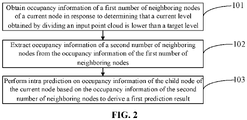
- An embodiment of the present disclosure provides an intra prediction method. Referring to FIG. 2 , the method includes the following operations.
- occupancy information of a first number of neighboring nodes of a current node is obtained in response to determining that a current level obtained by dividing an input point cloud is lower than a target level.
- an encoder or a decoder may execute the operations illustrated in 101 to 103 so as to derive a first prediction result of performing intra prediction on occupancy information of a child node of a current node.
- the encoder executes the operations illustrated in 101 to 103.
- the encoder includes a 3D point cloud encoder, such as a G-PCC encoder.
- the G-PCC encoder after dividing the input point cloud into slices, encodes each slice independently.
- the encoder obtains occupancy information of the first number of neighboring nodes of the current node in response to determining that the current level obtained by dividing the input point cloud is lower than the target level.
- the encoder may divide the input point cloud based on octree.
- occupancy information of a second number of neighboring nodes is extracted from the occupancy information of the first number of neighboring nodes.
- the first number is greater than the second number.
- the second number of neighboring nodes are in association with the child node of the current node.
- the encoder after obtaining the occupancy information of the first number of neighboring nodes of the current node, extracts the occupancy information of the second number of neighboring nodes from the occupancy information of the first number of neighboring nodes.
- the second number of neighboring nodes are in association with the child node of the current node. That is, after the occupancy information of the first number of neighboring nodes of the current node is obtained, the occupancy information of the first number of neighboring nodes of the current node is screened first to determine occupancy information of neighboring nodes with certain influences on the child node of the current node, and the screened-out occupancy information is taken as a reference factor for intra prediction of the occupancy information of the child node of the current node. As such, calculations brought considering the occupancy information of all of the first number of neighboring nodes are reduced, and a foundation is laid for shortening the encoding and decoding time and improving the encoding and decoding efficiency and the encoding and decoding accuracy.
- intra prediction is performed on occupancy information of a child node of the current node based on the occupancy information of the second number of neighboring nodes to derive a first prediction result.
- the encoder after screening out the occupancy information of the second number of neighboring nodes, performs intra prediction on occupancy information of the child node of the current node based on the occupancy information of the second number of neighboring nodes to derive a first prediction result.
- occupancy information of a first number of neighboring nodes of a current node is obtained in response to determining that a current level obtained by dividing an input point cloud is lower than a target level.
- the occupancy information of a second number of neighboring nodes is extracted from the occupancy information of the first number of neighboring nodes, the first number being greater than the second number, and the second number of neighboring nodes being in association with a child node of the current node.
- Intra prediction is performed on occupancy information of the child node of the current node based on the occupancy information of the second number of neighboring nodes to derive a first prediction result.
- An embodiment of the present disclosure provides an intra prediction method.
- the method when the intra prediction method is applied to an encoder, the method includes operations illustrated in 201 to 206.
- the intra prediction method when the intra prediction method is applied to a decoder, the method includes operations illustrated in 201 to 204 and 207 to 208.
- the encoder includes a 3D point cloud encoder
- the decoder includes a 3D point cloud decoder
- occupancy information of a first number of neighboring nodes of a current node is obtained in response to determining that a current level obtained by dividing an input point cloud is lower than a target level.
- the encoder or the decoder obtains occupancy information of a first number of neighboring nodes of a current node in response to determining that a current level L obtained by dividing an input point cloud is lower than a target level.
- the encoder or the decoder obtains occupancy information ⁇ (k) of the current node k according to the input point cloud, where k is valued to [0, 25], and ⁇ is 0 or 1.
- occupancy information of a second number of neighboring nodes is extracted from the occupancy information of the first number of neighboring nodes.
- the first number is greater than the second number.
- the second number of neighboring nodes are in association with a child node of the current node.
- the association includes the second number of neighboring nodes adjoin the child node of the current node by faces, edges, or corners.
- the second number of neighboring nodes include neighboring nodes that adjoin the child node of the current node by faces, edges, or corners. Therefore, neighboring nodes hardly or slightly affecting a certain child node of the current node are screened out from the first number of neighboring nodes. As such, calculations are reduced, meanwhile, the encoding and decoding time is shortened effectively, and the encoding and decoding accuracy is ensured.
- an occupancy number corresponding to the second number of neighboring nodes of the child node is determined based on the occupancy information of the second number of neighboring nodes.
- the encoder or the decoder determines an occupancy number corresponding to the second number of neighboring nodes of the child node based on the occupancy information of the screened-out second number of neighboring nodes, to obtain No m .
- occupancy information of seven neighbors thereof is considered, and a LUT I m,n is set to map numbers n of the seven neighbors to numbers k of 26 neighbors. Then, the number of occupied neighbors in the seven neighbors of the child node m is recorded.
- intra prediction is performed on occupancy information of the current node based on the occupancy number to derive a first prediction result.
- the first prediction result indicates a prediction parameter about whether to perform prediction and a parameter indicating a predicted value in case of performing prediction.
- the operation in 204 that intra prediction is performed on occupancy information of the current node based on the occupancy number to derive a first prediction result may be implemented by the following operations.
- the third number may be equal to a half of the second number.
- the third number may be determined flexibly based on the second number according to an actual situation.
- the third number may be 4 in case of considering seven neighboring nodes of the child node m.
- intra prediction is performed on occupancy information of the current node based on the occupancy number and the third number to derive the first prediction result.
- the operation in S204b that the intra prediction is performed on the occupancy information of the current node based on the occupancy number and the third number to derive the first prediction result includes the following operations.
- intra prediction is performed, in response to determining that the occupancy number is different from the third number, on the occupancy information of the current node based on the occupancy number, a first threshold, and a second threshold to derive the first prediction result.
- two sets of thresholds are set, including a first threshold th 0 and a second threshold th 1 . It is predicted that the node is "unoccupied” when No m is less than or equal to th 0 and the node is "occupied” when No m is greater than or equal to th 1 . Otherwise, “skip prediction” is obtained. It is to be noted that “occupied” indicates that the child node of the current node includes a point cloud and "unoccupied” indicates that the child node of the current node does not include any point cloud.
- the operation in S204b 1 that the intra prediction is performed on the occupancy information of the current node based on the occupancy number, the first threshold, and the second threshold to derive the first prediction result may include the following operations.
- the occupancy number is compared with the first threshold.
- intra prediction is performed, in response to determining that the occupancy number is less than or equal to the first threshold, on the occupancy information of the child node of the current node to derive a first prediction result that the child node of the current node does not include any point cloud.
- the operation that the intra prediction is performed on the occupancy information of the current node based on the occupancy number, the first threshold, and the second threshold to derive the first prediction result may include the following operations.
- the occupancy number is compared with the first threshold.
- intra prediction is performed, in response to determining that the occupancy number is greater than or equal to the second threshold, on the occupancy information of the child node of the current node to derive a first prediction result that the child node of the current node includes a point cloud.
- the occupancy number is compared with the first threshold, and a second prediction result that intra prediction is skipped for the occupancy information of the child node of the current node is obtained in response to determining that the occupancy number is greater than the first threshold and less than the second threshold.
- the operation in S204b that intra prediction is performed on occupancy information of the current node based on the occupancy number and the third number to derive the first prediction result includes the following operation.
- intra prediction is performed, in response to determining that the occupancy number is the same as the third number, on the occupancy information of the current node based on the occupancy number, a third threshold, and a fourth threshold to derive the first prediction result.
- the operation in S204b2 that intra prediction is performed, in response to determining that the occupancy number is the same as the third number, on the occupancy information of the current node based on the occupancy number, the third threshold, and the fourth threshold to derive the first prediction result may include the following operations.
- weights of the occupancy information of the second number of neighboring nodes are set according to distances from the second number of neighboring nodes of the child node to the child node in response to determining that the occupancy number is the same as the third number.
- a value of a target parameter of the child node is determined based on the occupancy information of the second number of neighboring nodes and the weights corresponding to the occupancy information of the second number of neighboring nodes.
- the first prediction result is determined based on the value of the target parameter, the third threshold, and the fourth threshold.
- the operation in S204b23 that the first prediction result is determined based on the value of the target parameter, the third threshold, and the fourth threshold may include the following operation. Intra prediction is performed, in response to determining that the value of the target parameter is less than or equal to the third threshold, on the occupancy information of the current node to derive a first prediction result that the child node of the current node does not include any point cloud.
- a third threshold th 2 and a fourth threshold th 3 are set. It is predicted that the node is "unoccupied” when score m is less than or equal to th 2 and the node is "occupied” when score m is greater than or equal to th 3 . Otherwise, "skip prediction" is obtained.
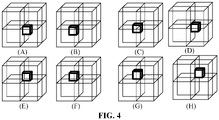
- (A) to (H) in FIG. 4 represent occupancy conditions corresponding to different child nodes of the current node respectively, i.e., occupancy information of different child nodes of the current node.
- I m,n and d m,n are 8 ⁇ 7 LUTs.
- w(d m,n ), th 0 , th 1 , th 2 , and th 3 are theoretical optimal values set according to the probability statistics and calculation of an encoding and decoding result of a training set, and they are preset fixed values in the encoder and the decoder, and need not to be transmitted by the encoder to the decoder.
- LUT _ I 8 7 0 1 3 4,9 10 12 1 2 4,5 10 11 13 3 4 6,7 12 14 15 4 , 5 , 7,8 , 13 , 15 , 16 9 10 12 17 18 20 21 10 11 13 18 19 21 22 12 14 15 20 21 23 24 13 15 16 21 22 24 25 ;
- LUT _ d 8 7 2 1 1 0 1 0,0 1 2 0 1 0 1,0 1 0 2 1 0 1,0 0 1 1 2 0 0,1 1 , 0 , 0,2 , 1 , 1,0 0 1 0 1 2 0,1 0 1 0 1 0 2,1 0 0 1 0 1 1,2 .
- the setting of the weights w(d m,n ) needs to satisfy the condition that score m may be mapped to order-irrelevant combinations of ⁇ (I m,n ) and w(d m,n ) one to one.
- the operation in S204b23 that the first prediction result is determined based on the value of the target parameter, the third threshold, and the fourth threshold may include the following operation. Intra prediction is performed, in response to determining that the value of the target parameter is greater than or equal to the fourth threshold, on the occupancy information of the current node to derive a first prediction result that the child node of the current node includes a point cloud.
- the operation in S204b23 that the first prediction result is determined based on the value of the target parameter, the third threshold, and the fourth threshold may include the following operation.
- a second prediction result that intra prediction is skipped for the occupancy information of the child node of the current node is obtained in response to determining that the value of the target parameter is greater than the third threshold and less than the fourth threshold.
- an encoding model associated with the first prediction result is determined.
- the encoder after deriving the first prediction result, determines an encoding model associated with the first prediction result.
- the occupancy information of the child node of the current node is encoded based on the encoding model and written to a bitstream.
- the encoder encodes, based on the encoding model, and writes, to a bitstream, the occupancy information of the child node of the current node.
- a decoding model associated with the first prediction result is determined.
- the decoder after obtaining the first prediction result, determines a decoding model associated with the first prediction result.
- an obtained bitstream is parsed based on the decoding model to obtain the occupancy information of the child node of the current node.
- the decoder parses an obtained bitstream based on the decoding model to obtain the occupancy information of the child node of the current node.
- the encoder when predicting a certain child node of the current node, only considers influences of seven connected neighbor parent nodes that adjoin the child node by faces, edges, or corners. Then, three kinds of prediction results are obtained according to the calculation of weights and the setting of thresholds.
- the intra prediction method executed by the encoder includes the following operations.
- intra prediction is enabled when a current level L of octree division is lower than a preset level.
- An input is a Morton 3D map for mapping an (x, y, z) coordinate and a flag bit, a map shift parameter, and a coordinate of an origin of the current node.
- occupancy information ⁇ (k) of a neighboring node k is obtained according to the input information, where k is valued to [0, 25], and ⁇ is 0 or 1.
- Two sets of thresholds th 2 and th 3 are set. It is predicted that the node is "unoccupied” when score m is less than or equal to th 2 and the node is "occupied” when score m is greater than or equal to th 3 . Otherwise, "skip prediction" is obtained.
- I m,n and d m,n are 8 ⁇ 7 LUTs.
- w(d m,n ), th 0 , th 1 , th 2 , and th 3 are theoretical optimal values set according to the probability statistics and calculation of an encoding and decoding result of a training set, and they are preset fixed values in the encoder and the decoder, and need not to be transmitted by the encoder to the decoder. That is, the technical concepts of the intra prediction method provided in the present disclosure at the encoder side and the decoder side are the same. It can be understood that, except related operations for encoding at the encoder side and decoding at the decoder side, the operations for the intra prediction of the occupancy information of the child node of the current node are the same.
- LUT _ I 8 7 0 1 3 4,9 10 12 1 2 4,5 10 11 13 3 4 6,7 12 14 15 4 , 5 , 7,8 , 13 , 15 , 16 9 10 12 17 18 20 21 10 11 13 18 19 21 22 12 14 15 20 21 23 24 13 15 16 21 22 24 25 ;
- LUT _ d 8 7 2 1 1 0 1 0,0 1 2 0 1 0 1,0 1 , 0 , 2 , 1 , 0 , 1,0 , 0 1 1 2 0 0,1 1 , 0 , 0,2 , 1 , 1,0 0 1 0 1 2 0,1 0 1 0 1 0 2,1 0 0 1 0 1 1,2 .
- the setting of the weight w(d m,n ) needs to satisfy the condition that score m may be mapped to order-irrelevant combinations of ⁇ (I m,n ) and w(d m,n ) one to one.
- the encoder determines an encoding model associated with the first prediction result, and encodes, based on the encoding model, and writes, to a bitstream, the occupancy information of the child node of the current node.
- the decoder when predicting a certain child node of the current node, only considers influences of seven connected neighbor parent nodes that adjoin the child node by faces, edges, or corners. Then, three kinds of prediction results are obtained according to the calculation of weights and the setting of thresholds.
- the intra prediction method executed by the decoder includes the following operations.
- intra prediction is enabled when a current level L of octree division is lower than a preset level.
- An input is a Morton 3D map for mapping an (x, y, z) coordinate and a flag bit, a map shift parameter, and a coordinate of an origin of the current node.
- occupancy information ⁇ (k) of a neighboring node k is obtained according to the input information, where k is valued to [0, 25], and ⁇ is 0 or 1.
- Two sets of thresholds th 2 and th 3 are set. It is predicted that the node is "unoccupied” when score m is less than or equal to th 2 and the node is "occupied” when score m is greater than or equal to th 3 . Otherwise, "skip prediction" is obtained.
- the decoder determines a decoding model associated with the first prediction result, and parses an obtained bitstream based on the decoding model to obtain occupancy information of the child node of the current node.
- I m,n and d m,n are 8 ⁇ 7 LUTs.
- w(d m,n ), th 0 , th 1 , th 2 , and th 3 are theoretical optimal values set according to the probability statistics and calculation of an encoding and decoding result of a training set, and they are preset fixed values in the encoder and the decoder, and need not to be transmitted by the encoder to the decoder. That is, the technical concepts of the intra prediction method provided in the present disclosure at the encoder side and the decoder side are the same. It can be understood that, except related operations for encoding at the encoder side and decoding at the decoder side, the operations for the intra prediction of the occupancy information of the child node of the current node are the same.
- LUT_I 8 7 0 1 3 4,9 10 12 1 2 4,5 10 11 13 3 4 6,7 12 14 15 4 , 5 , 7,8 , 13 , 15 , 16 9 10 12 17 18 20 21 10 11 13 18 19 21 22 12 14 15 20 21 23 24 13 15 16 21 22 24 25 ;
- LUT _ d 8 7 2 1 1 0 1 0,0 1 2 0 1 0 1,0 1 0 2 1 0 1,0 0 1 1 2 0 0,1 1 , 0 , 0,2 , 1 , 1,0 0 1 0 1 2 0,1 0 1 0 1 0 2,1 0 0 1 0 1 1,2 .
- the setting of the weight w(d m,n ) needs to satisfy the condition that score m may be mapped to order-irrelevant combinations of ⁇ (I m,n ) and w(d m,n ) one to one.
- the above-mentioned intra prediction solution may further be simplified, thereby further reducing calculations for intra prediction.
- the intra prediction method executed by the encoder includes the following operations.
- the intra prediction method includes the following operations.
- intra prediction is enabled when a current level L of octree division is lower than a preset level.
- An input is a Morton 3D map for mapping an (x, y, z) coordinate and a flag bit, a map shift parameter, and a coordinate of an origin of the current node.
- occupancy information ⁇ (k) of a neighboring node k is obtained according to the input information, where k is valued to [0, 25], and ⁇ is 0 or 1.
- a fourth step two sets of thresholds th 0 and th 1 are set. It is predicted that the node is "unoccupied” when No m is less than or equal to th 0 and the node is "occupied” when No m is greater than or equal to th 1 . Otherwise, "skip prediction" is obtained.
- I m,n is an 8 ⁇ 7 LUT.
- th 0 and th 1 are theoretical optimal values set according to the probability statistics and calculation of an encoding and decoding result of a training set, and they are preset fixed values in the encoder and the decoder, and need not to be transmitted by the encoder to the decoder. That is, the technical concepts of the intra prediction method provided in the present disclosure at the encoder side and the decoder side are the same. It can be understood that, except related operations for encoding at the encoder side and decoding at the decoder side, the operations for the intra prediction of the occupancy information of the child node of the current node are the same.
- any possible combination is selected from the seven neighbor parent nodes connected with the current child node to construct an intra prediction method based on occupancy information of N neighbor parent nodes connected with a current child node, where N ⁇ [1,7].
- N occupancy information of N neighbor parent nodes connected with a current child node
- FIG. 7 is a schematic diagram of intra prediction based on occupancy information of six neighbor parent nodes.
- the intra prediction method executed by the encoder includes the following operations.
- intra prediction is enabled when a current level L of octree division is lower than a preset level.
- An input is a Morton 3D map for mapping an (x, y, z) coordinate and a flag bit, a map shift parameter, and a coordinate of an origin of the current node.
- occupancy information ⁇ (k) of a neighboring node k is obtained according to the input information, where k is valued to [0, 25], and ⁇ is 0 or 1.
- a fourth step two sets of thresholds th 0 and th 1 are set. It is predicted that the node is "unoccupied” when No m is less than or equal to th 0 and the node is "occupied” when No m is greater than or equal to th 1 . Otherwise, "skip prediction" is obtained.
- I m,n is an 8 ⁇ 7 LUT.
- th 0 and th 1 are theoretical optimal values set according to the probability statistics and calculation of an encoding and decoding result of a training set, and they are preset fixed values in the encoder and the decoder, and need not to be transmitted by the encoder to the decoder. That is, the technical concepts of the intra prediction method provided in the present disclosure at the encoder side and the decoder side are the same. It can be understood that, except related operations for encoding at the encoder side and decoding at the decoder side, the operations for the intra prediction of the occupancy information of the child node of the current node are the same.
- Table 1 shows what percentage of the code rate achieved by a PCC-based solution in the related art may be reduced under the same coding quality in case of lossy compression.
- Table 1 shows what percentage of the code rate achieved by a PCC-based solution in the related art may be reduced under the same coding quality in case of lossy compression.
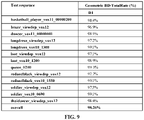
- Table 2 shows a size of a compressed bitstream in case of lossless compression. It can be seen from Table 2 that all compressed bitstreams are less than 100%, and the bitstream may be obtained by using only part of the code rate in the related art.
- the embodiment of the present disclosure may have the following beneficial effects.
- the situation of occupancy information of a child node of an encoded/decoded node in 26 neighboring nodes when a certain child node of the current node is predicted, only influences of seven connected neighbor parent nodes that adjoin the child node by faces, edges, or corners are considered, thereby achieving the effect of reducing LUTs and the calculation complexity.
- simple weight and threshold setting makes it easy to find an optimal solution, and under the optimal weight and threshold setting, the technology achieves the effect of reducing the code rate with the Peak Signal to Noise Ratio (PSNR) remaining unchanged.
- PSNR Peak Signal to Noise Ratio
- a spatial correlation of a point cloud is used more simply and accurately, so that an intra prediction result for octree-based geometric information coding is more suitable for the construction of a probability model in CABAC, and the binary bitstream is reduced.
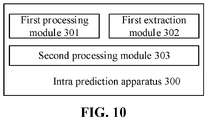
- FIG. 10 is a composition structure diagram of an intra prediction apparatus according to an embodiment of the present disclosure.
- the intra prediction apparatus 300 includes a first processing module 301, a first extraction module 302, and a second processing module 303.
- the first processing module 301 is configured to obtain occupancy information of a first number of neighboring nodes of a current node in response to determining that a current level obtained by dividing an input point cloud is lower than a target level.
- the first extraction module 302 is configured to extract occupancy information of a second number of neighboring nodes from the occupancy information of the first number of neighboring nodes, the first number being greater than the second number, and the second number of neighboring nodes being in association with a child node of the current node.
- the second processing module 303 is configured to perform intra prediction on occupancy information of the child node of the current node based on the occupancy information of the second number of neighboring nodes to derive a first prediction result.
- the association includes that the second number of neighboring nodes adjoin the child node of the current node by faces, edges, or corners.
- the second processing module 303 is configured to: determine an occupancy number corresponding to the second number of neighboring nodes of the child node is determined based on the occupancy information of the second number of neighboring nodes, and perform intra prediction on occupancy information of the current node based on the occupancy number to derive the first prediction result.
- the first prediction result indicates a prediction parameter about whether to perform prediction and a parameter indicating a predicted value in case of performing prediction.
- the second processing module 303 is configured to: obtain a third number associated with the second number, and perform intra prediction on occupancy information of the current node based on the occupancy number and the third number to derive the first prediction result.
- the second processing module 303 is configured to perform, in response to determining that the occupancy number is different from the third number, intra prediction on the occupancy information of the current node based on the occupancy number, a first threshold, and a second threshold to derive the first prediction result.
- the second processing module 303 is configured to: compare the occupancy number with the first threshold in response to determining that the occupancy number is different from the third number, and perform, in response to determining that the occupancy number is less than or equal to the first threshold, intra prediction on the occupancy information of the child node of the current node to derive a first prediction result that the child node of the current node does not include any point cloud.
- the second processing module 303 is configured to perform, in response to determining that the occupancy number is greater than or equal to the second threshold, intra prediction on the occupancy information of the child node of the current node to derive a first prediction result that the child node of the current node includes a point cloud.
- the second processing module 303 is configured to derive, in response to determining that the occupancy number is greater than the first threshold and less than the second threshold, a second prediction result that intra prediction is skipped for the occupancy information of the child node of the current node.
- the second processing module 303 is configured to perform, in response to determining that the occupancy number is the same as the third number, intra prediction on the occupancy information of the current node based on the occupancy number, a third threshold, and a fourth threshold to derive the first prediction result.
- the second processing module 303 is configured to: set weights of the occupancy information of the second number of neighboring nodes according to distances from the second number of neighboring nodes of the child node to the child node in response to determining that the occupancy number is the same as the third number; determine a value of a target parameter of the child node based on the occupancy information of the second number of neighboring nodes and the weights corresponding to the occupancy information of the second number of neighboring nodes; and determine the first prediction result based on the value of the target parameter, the third threshold, and the fourth threshold.
- the second processing module 303 is configured to perform, in response to determining that the value of the target parameter is less than or equal to the third threshold, intra prediction on the occupancy information of the current node to derive a first prediction result that the child node of the current node does not include any point cloud.
- the second processing module 303 is configured to perform, in response to determining that the value of target parameter is greater than or equal to the fourth threshold, intra prediction on the occupancy information of the current node to derive a first prediction result that the child node of the current node includes a point cloud.
- the second processing module 303 is configured to derive, in response to determining that the value of the target parameter is greater than the third threshold and less than the fourth threshold, a second prediction result that intra prediction is skipped for the occupancy information of the child node of the current node.
- the intra prediction apparatus is an encoding apparatus.
- the encoding apparatus further includes a first determination module and an encoding module.
- the first determination module is configured to determine an encoding model associated with the first prediction result.
- the encoding module is configured to encode, based on the encoding model, and write, to a bitstream, the occupancy information of the child node of the current node.
- the intra prediction apparatus is a decoding apparatus.
- the decoding apparatus further includes a second determination module and a decoding module.
- the second determination module is configured to determine a decoding model associated with the first prediction result.
- the decoding module is configured to parse an obtained bitstream based on the decoding model to obtain the occupancy information of the child node of the current node.
- an embodiment of the present disclosure also provides an encoder, which includes a first memory 41 and a first processor 42.
- the first memory 41 is configured to store executable instructions for intra prediction.
- the first processor 42 is configured to execute the executable instructions for intra prediction stored in the first memory 41 to perform an intra prediction method for an encoding apparatus side in the embodiments of the present disclosure.
- the processor may be implemented by software, hardware, firmware, or a combination thereof.
- the processor may execute the corresponding steps of the intra prediction method in the embodiment of the encoding apparatus by use of a circuit, one or more Application Specific Integrated Circuits (ASICs), one or more general-purpose integrated circuits, one or more microprocessors, one or more programmable logic devices, or a combination of the above-mentioned circuits or devices, or another proper circuit or device.
- ASICs Application Specific Integrated Circuits
- microprocessors one or more programmable logic devices, or a combination of the above-mentioned circuits or devices, or another proper circuit or device.
- occupancy information of a first number of neighboring nodes of a current node is obtained in response to determining that a current level obtained by dividing an input point cloud is lower than a target level.
- the occupancy information of a second number of neighboring nodes is extracted from the occupancy information of the first number of neighboring nodes, the first number being greater than the second number, and the second number of neighboring nodes being in association with a child node of the current node.
- Intra prediction is performed on occupancy information of the child node of the current node based on the occupancy information of the second number of neighboring nodes to derive a first prediction result.
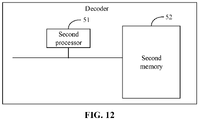
- an embodiment of the present disclosure also provides a decoder, which includes a second memory 51 and a second processor 52.
- the second memory 51 is configured to store executable instructions for intra prediction.
- the second processor 52 is configured to execute the executable instructions for intra prediction stored in the second memory 51 to perform an intra prediction method for a decoding apparatus side in the embodiments of the present disclosure.
- the processor may be implemented by software, hardware, firmware, or a combination thereof.
- the processor may execute the corresponding steps of the intra prediction method in the embodiment of the decoding apparatus by use of a circuit, one or more ASICs, one or more general-purpose integrated circuits, one or more microprocessors, one or more programmable logic devices, or a combination of the above-mentioned circuits or devices, or another proper circuit or device.
- occupancy information of a first number of neighboring nodes of a current node is obtained in response to determining that a current level obtained by dividing an input point cloud is lower than a target level.
- the occupancy information of a second number of neighboring nodes is extracted from the occupancy information of the first number of neighboring nodes, the first number being greater than the second number, and the second number of neighboring nodes being in association with a child node of the current node.
- Intra prediction is performed on occupancy information of the child node of the current node based on the occupancy information of the second number of neighboring nodes to derive a first prediction result.
- Each component in the embodiment of the disclosure may be integrated into a processing unit.
- each unit may physically exist independently.
- two or more than two units may be integrated into a unit.
- the integrated unit may be implemented in a hardware form, or in form of a software function module.
- the integrated unit When being implemented in form of a software function module and sold or used not as an independent product, the integrated unit may be stored in a computer-readable storage medium.
- the technical solution of the embodiment substantially or parts making contributions to the conventional art or all or part of the technical solution may be embodied in form of a software product.
- the computer software product is stored in a storage medium, including a plurality of instructions for enabling a computer device (which may be a personal computer, a server, a network device, or the like) or a processor to execute all or part of the steps of the method in the embodiment.
- the storage medium may include various media capable of storing program codes, such as a Ferromagnetic Random Access Memory (FRAM), a Read Only Memory (ROM), a Programmable ROM (PROM), an Erasable PROM (EPROM), an Electrically EPROM (EEPROM), a flash memory, a magnetic surface memory, a compact disc, or a Compact Disc Read-Only Memory (CD-ROM). No limits are made in the embodiment of the disclosure.
- FRAM Ferromagnetic Random Access Memory
- ROM Read Only Memory
- PROM Programmable ROM
- EPROM Erasable PROM
- EEPROM Electrically EPROM
- flash memory a magnetic surface memory
- CD-ROM Compact Disc Read-Only Memory
- An embodiment of the present disclosure also provides a computer-readable storage medium, which stores executable instructions for intra prediction executed by a first processor to perform an intra prediction method for an encoder side in the embodiments of the present disclosure.
- An embodiment of the present disclosure also provides a computer-readable storage medium, which stores executable instructions for intra prediction executed by a second processor to perform an intra prediction method for a decoder side in the embodiments of the present disclosure.
- the embodiments of the present disclosure provide an intra prediction method and apparatus, an encoder, a decoder, and a storage medium.
- Occupancy information of a first number of neighboring nodes of a current node is obtained in response to determining that a current level obtained by dividing an input point cloud is lower than a target level.
- the occupancy information of a second number of neighboring nodes is extracted from the occupancy information of the first number of neighboring nodes, the first number being greater than the second number, and the second number of neighboring nodes being in association with a child node of the current node.
- Intra prediction is performed on occupancy information of the child node of the current node based on the occupancy information of the second number of neighboring nodes to derive a first prediction result.
Landscapes
- Engineering & Computer Science (AREA)
- Multimedia (AREA)
- Signal Processing (AREA)
- Theoretical Computer Science (AREA)
- Computing Systems (AREA)
- Physics & Mathematics (AREA)
- General Physics & Mathematics (AREA)
- Compression Or Coding Systems Of Tv Signals (AREA)
- Compression, Expansion, Code Conversion, And Decoders (AREA)
- Signal Processing For Digital Recording And Reproducing (AREA)
- Transmission Systems Not Characterized By The Medium Used For Transmission (AREA)
Abstract
Description
- Embodiments of the present disclosure relate to encoding and decoding technologies in the field of communications, and particularly to a method and apparatus for intra prediction, an encoder, a decoder, and a storage medium.
- At present, in an intra prediction scheme for octree-based geometric information coding in a related art, occupancy information of 26 neighboring nodes of a current node and multiple preset thresholds are used for calculation and comparison. It is to be noted that, when the above-mentioned prediction scheme is used for intra prediction, more Look Up Tables (LUTs) are involved, and moreover, intra prediction at least involves the setting of 16 weights and 10 thresholds. As a result, it is hard to find an optimal solution, and furthermore, an intra prediction result may not be optimized. Thus, it can be seen that intra prediction in the related art has the problems of large calculation amount, relatively long encoding and decoding time, and inaccurate intra prediction result.
- The embodiments of the present disclosure provide a method and apparatus for intra prediction, an encoder, a decoder, and a storage medium, which can improve the speed and accuracy of intra prediction during encoding and decoding processing and further improve the encoding and decoding quality.
- The technical solutions of the embodiments of the present disclosure may be implemented as follows.
- According to a first aspect, the embodiments of the present disclosure provide a method for intra prediction, which includes the following operations.
- Occupancy information of a first number of neighboring nodes of a current node is obtained in response to determining that a current level obtained by dividing an input point cloud is lower than a target level.
- Occupancy information of a second number of neighboring nodes is extracted from the occupancy information of the first number of neighboring nodes, the first number being greater than the second number, and the second number of neighboring nodes being in association with a child node of the current node.
- Intra prediction is performed on occupancy information of the child node of the current node based on the occupancy information of the second number of neighboring nodes to derive a first prediction result.
- According to a second aspect, the embodiments of the present disclosure also provide an apparatus for intra prediction, which includes a first processing module, a first extraction module, and a second processing module.
- The first processing module is configured to obtain occupancy information of a first number of neighboring nodes of a current node in response to determining that a current level obtained by dividing an input point cloud is lower than a target level.
- The first extraction module is configured to extract occupancy information of a second number of neighboring nodes from the occupancy information of the first number of neighboring nodes, the first number being greater than the second number, and the second number of neighboring nodes being in association with a child node of the current node.
- The second processing module is configured to perform intra prediction on occupancy information of the child node of the current node based on the occupancy information of the second number of neighboring nodes to derive a first prediction result.
- According to a third aspect, the embodiments of the present disclosure provide an encoder, which includes a first memory and a first processor.
- The first memory is configured to store executable instructions for intra prediction.
- The first processor is configured to execute the executable instructions for intra prediction stored in the first memory to perform the intra prediction method as described in the first aspect.
- According to a fourth aspect, the embodiments of the present disclosure also provide a decoder, which includes a second memory and a second processor.
- The second memory is configured to store executable instructions for intra prediction.
- The second processor is configured to execute the executable instructions for intra prediction stored in the second memory to perform the intra prediction method as described in the second aspect.
- According to a fifth aspect, the embodiments of the present disclosure provide a computer-readable storage medium, which stores executable instructions for intra prediction executed by a first processor to perform the intra prediction method as described in the first aspect.
- The embodiments of the present disclosure provide an intra prediction method and apparatus, an encoder, a decoder, and a storage medium. The method includes the following operations. Occupancy information of a first number of neighboring nodes of a current node is obtained in response to determining that a current level obtained by dividing an input point cloud is lower than a target level. The occupancy information of a second number of neighboring nodes is extracted from the occupancy information of the first number of neighboring nodes, the first number being greater than the second number, and the second number of neighboring nodes being in association with a child node of the current node. Intra prediction is performed on occupancy information of the child node of the current node based on the occupancy information of the second number of neighboring nodes to derive a first prediction result. That is, in the embodiments of the present disclosure, when intra prediction is performed on the occupancy information of the child node of the current node, only the second number of neighboring nodes that are in association with the child node of the current node are considered. Therefore, the aims of reducing LUTs and the calculation complexity, improving the accuracy of an intra prediction result, shortening the encoding and decoding time, and improving the encoding and decoding accuracy are fulfilled.
-
-
FIG. 1 is an exemplary flow block diagram of coding according to an embodiment of the present disclosure. -
FIG. 2 is a first exemplary flowchart of an intra prediction method according to an embodiment of the present disclosure. -
FIG. 3 is a second exemplary flowchart of an intra prediction method according to an embodiment of the present disclosure. -
FIG. 4 is an exemplary schematic diagram that different child nodes of a current node include point clouds according to an embodiment of the present disclosure. -
FIG. 5 is a schematic flowchart of an intra prediction method executed by an encoder according to an embodiment of the present disclosure. -
FIG. 6 is a schematic flowchart of an intra prediction method executed by a decoder according to an embodiment of the present disclosure. -
FIG. 7 is a schematic diagram that a certain child node of a current node includes a point cloud according to an embodiment of the present disclosure. -
FIG. 8 shows a BD-Rate under lossy compression according to an embodiment of the present disclosure. -
FIG. 9 shows a bpip ratio under lossless compression according to an embodiment of the present disclosure. -
FIG. 10 is a structure diagram of an intra prediction apparatus according to an embodiment of the present disclosure. -
FIG. 11 is a structure diagram of an encoder according to an embodiment of the present disclosure. -
FIG. 12 is a structure diagram of a decoder according to an embodiment of the present disclosure. - In order to make the objectives, technical solutions, and advantages of the embodiments of the present disclosure clearer, specific technical solutions of the present disclosure will further be described below in combination with the drawings in the embodiments of the present disclosure in detail. The following embodiments are used to describe the present disclosure rather than limit the scope of the present disclosure.
- Unless otherwise defined, all technical and scientific terms used herein have the same meanings as commonly understood by those skilled in the art the present disclosure belongs to. Terms used herein are only for a purpose of describing the embodiments of the present disclosure and not intended to limit the present disclosure.
- "Some embodiments" involved in the following descriptions describes a subset of all possible embodiments. However, it can be understood that "some embodiments" may be the same or different subsets of all the possible embodiments, and may be combined without conflicts.
- It is to be pointed out that term "first/second/third" involved in the embodiments of the present disclosure is only for distinguishing similar objects and does not represent a specific sequence of the objects. It can be understood that "first/second/third" may be interchanged according to specific sequences or orders if allowed such that the embodiments of the present disclosure described herein may be implemented in a sequence other than those illustrated or described herein.
- Nouns and terms involved in the embodiments of the present disclosure will be described before the embodiments of the present disclosure are further described in detail. The nouns and terms involved in the embodiments of the present disclosure are suitable to be explained as follows.
- 1) Point Cloud Compression (PCC)
- 2) Geometry-based Point Cloud Compression (G-PCC)
- 3) Slice
- 4) Bounding box
- 5) Octree
- 6) Intra prediction
- 7) Triangle Soup (trisoup)
- 8) Context-based Adaptive Binary Arithmetic Coding (CABAC)
- 9) Block
- 10) Vertex
- 11) Red-Green-Blue (RGB)
- 12) Luminance-Chrominance (YUV)
- 13) Level of Detail (LOD)
- 14) Region Adaptive Hierarchical Transform (RAHT)
- 15) Look Up Table (LUT)
- 16) Moving Picture Experts Group (MPEG)
- 17) International Standardization Organization (ISO)
- 18) International Electrotechnical Commission (IEC)
- 19) Number of occupied neighbors (No) in neighboring nodes
- In the embodiments of the present disclosure, in a G-PCC encoder framework, after slice division is performed on a point cloud input to a Three-Dimensional (3D) image model, each slice is encoded independently.
- In a flow block diagram of G-PCC encoding shown in
FIG. 1 , after the input point cloud is divided into slices, each of the slices is encoded independently. In each slice, geometric information of the point cloud and attribute information corresponding to each point are encoded separately. First, coordinate transform is performed on the geometric information so as to include the whole point cloud in a bounding box. Then, quantization is performed. The quantization mainly implements scaling. Rounding in quantization makes the geometric information corresponding to a part of points the same. Whether to remove duplicate points is determined based on parameters. The process of quantization and removal of the duplicate points is also referred to as a voxelization process. Next, octree-based division is performed on the bounding box. The geometric information is encoded by two octree- and trisoup-based frameworks according to different depths of octree division levels. - In the octree-based geometric information coding framework, the bounding box is equally divided into eight sub-cubes, and occupancy information of each sub-cube is recorded (where 1 represents nonempty, and 0 represents empty). A nonempty sub-cube continues to be equally divided into eight parts. Division is stopped when a leaf node obtained by division is a 1 × 1 × 1 unit cube. In this process, intra prediction is performed on the occupancy information by use of a spatial correlation between a node and a surrounding node. Finally, CABAC is performed to generate a binary bitstream.
- In the trisoup-based geometric information coding framework, octree-based division is also performed first. However, different from the octree-based geometric information coding, the trisoup-based geometric information coding does not need to divide the point cloud level by level into unit cubes with side lengths of 1 × 1 × 1, and instead, division is stopped when a side length of a block is W. Based on a surface formed by the distribution of a point cloud in each block, at most 12 vertexes generated by the surface and the 12 sides of the block are obtained. Vertex coordinates of each block are encoded sequentially to generate a binary bitstream.
- The geometric information is reconstructed after geometry coding is completed. At present, attribute coding is performed mainly for color information. First, the color information is transformed from an RGB color space to a YUV color space. Then, the point cloud is recolored by use of the reconstructed geometric information so as to achieve a correspondence between the un-encoded attribute information and the reconstructed geometric information. There are mainly two transform methods for the encoding of the color information: one is distance-based lifting transform dependent on LOD division, and the other is direct RAHT. By both methods, the color information may be transformed from a space domain to a frequency domain. A high-frequency coefficient and a lowfrequency coefficient are obtained by transform. Finally, the coefficients are quantized and encoded to generate a binary bitstream.
- Here, intra prediction for octree-based geometric information coding is described.
- Prediction, i.e., intra prediction, is performed on whether a child node of a current node is occupied according to occupancy information of 26 neighboring nodes of the current node. The implementation of intra prediction is described as follows.
- First, intra prediction is enabled when a current level of octree division is lower than a preset level L. An input is a
Morton 3D map for mapping an (x, y, z) coordinate and a flag bit, a map shift parameter, and a coordinate of an origin of the current node. - Then, a weight value W(dk,m, δk) is set according to the occupancy information δk of a neighboring node k and a distance dk,m from the neighboring node k to the child node of the current node:

- Next, 26 weights are averaged to derive a corresponding score scorem:

- Later on, two sets of thresholds th0(No) and th1(No) related to No (number of occupied neighbors) in the neighboring nodes are set. It is predicted that the node is "unoccupied" when scorem is less than or equal to th0(No) and the node is "occupied" when scorem is greater than or equal to th1 (No). Otherwise, "skip prediction" is obtained.
- Finally, "whether to perform prediction" and "predicted value" represented by 0 or 1 are output for subsequent entropy coding of occupancy information. Here, "1, 1" represents "occupied", "1, 0" represents "unoccupied", and "0, 0" represents "skip prediction".
- Here, values of W0(dk,m), W1(dk,m), th0(No), and th1(No) are all obtained by training. They are preset fixed values in an encoder and a decoder, and need not to be transmitted by the encoder to the decoder. Processes, frameworks, and algorithms of the technical solution at the encoder and the decoder are completely the same.
- It is to be noted that the technical solution of intra prediction for octree-based geometric information coding at least has the following defect. The occupancy information of the 26 neighboring nodes of the current node is used. "1" represents nonempty, and "0" represents empty. Then, calculation and comparison are performed according to the values of W0(dk,m), W1(dk,m), th0(No), and th1(No). Finally, three kinds of prediction results are obtained. In the solution, more LUTs are involved, and 16 weights and 10 thresholds are set. As a result, it is hard to find an optimal solution, and furthermore, an intra prediction result may not be optimized. In addition, considering that some neighboring nodes hardly affect a certain child node of the current node, prediction with all of the 26 neighbors brings excessive calculations, thereby prolonging the encoding and decoding time.
- An embodiment of the present disclosure provides an intra prediction method. Referring to
FIG. 2 , the method includes the following operations. - In 101, occupancy information of a first number of neighboring nodes of a current node is obtained in response to determining that a current level obtained by dividing an input point cloud is lower than a target level.
- In the embodiment of the present disclosure, an encoder or a decoder may execute the operations illustrated in 101 to 103 so as to derive a first prediction result of performing intra prediction on occupancy information of a child node of a current node.
- For example, the encoder executes the operations illustrated in 101 to 103. The encoder includes a 3D point cloud encoder, such as a G-PCC encoder. The G-PCC encoder, after dividing the input point cloud into slices, encodes each slice independently. Here, the encoder obtains occupancy information of the first number of neighboring nodes of the current node in response to determining that the current level obtained by dividing the input point cloud is lower than the target level. In some embodiments, the encoder may divide the input point cloud based on octree.
- In 102, occupancy information of a second number of neighboring nodes is extracted from the occupancy information of the first number of neighboring nodes.
- The first number is greater than the second number. The second number of neighboring nodes are in association with the child node of the current node.
- In the embodiment of the present disclosure, the encoder, after obtaining the occupancy information of the first number of neighboring nodes of the current node, extracts the occupancy information of the second number of neighboring nodes from the occupancy information of the first number of neighboring nodes. It is to be noted that the second number of neighboring nodes are in association with the child node of the current node. That is, after the occupancy information of the first number of neighboring nodes of the current node is obtained, the occupancy information of the first number of neighboring nodes of the current node is screened first to determine occupancy information of neighboring nodes with certain influences on the child node of the current node, and the screened-out occupancy information is taken as a reference factor for intra prediction of the occupancy information of the child node of the current node. As such, calculations brought considering the occupancy information of all of the first number of neighboring nodes are reduced, and a foundation is laid for shortening the encoding and decoding time and improving the encoding and decoding efficiency and the encoding and decoding accuracy.
- In 103, intra prediction is performed on occupancy information of a child node of the current node based on the occupancy information of the second number of neighboring nodes to derive a first prediction result.
- In the embodiment of the present disclosure, the encoder, after screening out the occupancy information of the second number of neighboring nodes, performs intra prediction on occupancy information of the child node of the current node based on the occupancy information of the second number of neighboring nodes to derive a first prediction result.
- According to the intra prediction method provided in the embodiment of the present disclosure, occupancy information of a first number of neighboring nodes of a current node is obtained in response to determining that a current level obtained by dividing an input point cloud is lower than a target level. The occupancy information of a second number of neighboring nodes is extracted from the occupancy information of the first number of neighboring nodes, the first number being greater than the second number, and the second number of neighboring nodes being in association with a child node of the current node. Intra prediction is performed on occupancy information of the child node of the current node based on the occupancy information of the second number of neighboring nodes to derive a first prediction result. That is, in the embodiments of the present disclosure, when intra prediction is performed on the occupancy information of the child node of the current node, only the second number of neighboring nodes in association with the child node of the current node are considered. Therefore, the aims of reducing LUTs and the calculation complexity, improving the accuracy of an intra prediction result, shortening the encoding and decoding time, and improving the encoding and decoding accuracy are fulfilled.
- An embodiment of the present disclosure provides an intra prediction method. Referring to
FIG. 3 , it is to be noted that, when the intra prediction method is applied to an encoder, the method includes operations illustrated in 201 to 206. When the intra prediction method is applied to a decoder, the method includes operations illustrated in 201 to 204 and 207 to 208. - In some embodiments, the encoder includes a 3D point cloud encoder, and the decoder includes a 3D point cloud decoder.
- In 201, occupancy information of a first number of neighboring nodes of a current node is obtained in response to determining that a current level obtained by dividing an input point cloud is lower than a target level.
- In the embodiment of the present disclosure, the encoder or the decoder obtains occupancy information of a first number of neighboring nodes of a current node in response to determining that a current level L obtained by dividing an input point cloud is lower than a target level. Exemplarily, the encoder or the decoder obtains occupancy information δ(k) of the current node k according to the input point cloud, where k is valued to [0, 25], and δ is 0 or 1.
- In 202, occupancy information of a second number of neighboring nodes is extracted from the occupancy information of the first number of neighboring nodes.
- The first number is greater than the second number. The second number of neighboring nodes are in association with a child node of the current node. Here, the association includes the second number of neighboring nodes adjoin the child node of the current node by faces, edges, or corners.
- In the embodiment of the present disclosure, the second number of neighboring nodes include neighboring nodes that adjoin the child node of the current node by faces, edges, or corners. Therefore, neighboring nodes hardly or slightly affecting a certain child node of the current node are screened out from the first number of neighboring nodes. As such, calculations are reduced, meanwhile, the encoding and decoding time is shortened effectively, and the encoding and decoding accuracy is ensured.
- In 203, an occupancy number corresponding to the second number of neighboring nodes of the child node is determined based on the occupancy information of the second number of neighboring nodes.
- In the embodiment of the present disclosure, the encoder or the decoder determines an occupancy number corresponding to the second number of neighboring nodes of the child node based on the occupancy information of the screened-out second number of neighboring nodes, to obtain Nom.
- Exemplarily, for a child node m of the current node, occupancy information of seven neighbors thereof is considered, and a LUT Im,n is set to map numbers n of the seven neighbors to numbers k of 26 neighbors. Then, the number of occupied neighbors in the seven neighbors of the child node m is recorded.
- Here,

- In 204, intra prediction is performed on occupancy information of the current node based on the occupancy number to derive a first prediction result.
- The first prediction result indicates a prediction parameter about whether to perform prediction and a parameter indicating a predicted value in case of performing prediction.
- In the embodiment of the present disclosure, the operation in 204 that intra prediction is performed on occupancy information of the current node based on the occupancy number to derive a first prediction result may be implemented by the following operations.
- In S204a, a third number associated with the second number is obtained.
- In some embodiments, the third number may be equal to a half of the second number. Certainly, in another embodiment of the present disclosure, the third number may be determined flexibly based on the second number according to an actual situation.
- Exemplarily, the third number may be 4 in case of considering seven neighboring nodes of the child node m.
- In S204b, intra prediction is performed on occupancy information of the current node based on the occupancy number and the third number to derive the first prediction result.
- In some embodiments of the present disclosure, the operation in S204b that the intra prediction is performed on the occupancy information of the current node based on the occupancy number and the third number to derive the first prediction result includes the following operations.
- In S204b1, intra prediction is performed, in response to determining that the occupancy number is different from the third number, on the occupancy information of the current node based on the occupancy number, a first threshold, and a second threshold to derive the first prediction result.
- In the embodiment of the present disclosure, in case of Nom ≠ 4, two sets of thresholds are set, including a first threshold th0 and a second threshold th1. It is predicted that the node is "unoccupied" when Nom is less than or equal to th0 and the node is "occupied" when Nom is greater than or equal to th1. Otherwise, "skip prediction" is obtained. It is to be noted that "occupied" indicates that the child node of the current node includes a point cloud and "unoccupied" indicates that the child node of the current node does not include any point cloud.
- Further, when it is determined that the occupancy number is different from the third number, in an implementable scenario, the operation in
S204b 1 that the intra prediction is performed on the occupancy information of the current node based on the occupancy number, the first threshold, and the second threshold to derive the first prediction result may include the following operations. - In S11, the occupancy number is compared with the first threshold.
- In S12, intra prediction is performed, in response to determining that the occupancy number is less than or equal to the first threshold, on the occupancy information of the child node of the current node to derive a first prediction result that the child node of the current node does not include any point cloud.
- Further, when it is determined that the occupancy number is different from the third number, in another implementable scenario, the operation that the intra prediction is performed on the occupancy information of the current node based on the occupancy number, the first threshold, and the second threshold to derive the first prediction result may include the following operations.
- In S21, the occupancy number is compared with the first threshold.
- In S22, intra prediction is performed, in response to determining that the occupancy number is greater than or equal to the second threshold, on the occupancy information of the child node of the current node to derive a first prediction result that the child node of the current node includes a point cloud.
- In another implementable scenario of the present disclosure, the occupancy number is compared with the first threshold, and a second prediction result that intra prediction is skipped for the occupancy information of the child node of the current node is obtained in response to determining that the occupancy number is greater than the first threshold and less than the second threshold.
- In another embodiment of the present disclosure, the operation in S204b that intra prediction is performed on occupancy information of the current node based on the occupancy number and the third number to derive the first prediction result includes the following operation.
- In S204b2, intra prediction is performed, in response to determining that the occupancy number is the same as the third number, on the occupancy information of the current node based on the occupancy number, a third threshold, and a fourth threshold to derive the first prediction result.
- In the embodiment of the present disclosure, the operation in S204b2 that intra prediction is performed, in response to determining that the occupancy number is the same as the third number, on the occupancy information of the current node based on the occupancy number, the third threshold, and the fourth threshold to derive the first prediction result may include the following operations.
- In S204b21, weights of the occupancy information of the second number of neighboring nodes are set according to distances from the second number of neighboring nodes of the child node to the child node in response to determining that the occupancy number is the same as the third number.
- In S204b22, a value of a target parameter of the child node is determined based on the occupancy information of the second number of neighboring nodes and the weights corresponding to the occupancy information of the second number of neighboring nodes.
- In S204b23, the first prediction result is determined based on the value of the target parameter, the third threshold, and the fourth threshold.
- Further, in an implementable scenario, the operation in S204b23 that the first prediction result is determined based on the value of the target parameter, the third threshold, and the fourth threshold may include the following operation. Intra prediction is performed, in response to determining that the value of the target parameter is less than or equal to the third threshold, on the occupancy information of the current node to derive a first prediction result that the child node of the current node does not include any point cloud.
- In the embodiment of the present disclosure, when Nom = 4, weights w(dm,n) are set according to levels of distances dm,n from the seven neighbors of the current child node m to the current child node m, and a value of the target parameter scorem is calculated according to scorem =

- Here, two sets of thresholds, i.e., a third threshold th2 and a fourth threshold th3 are set. It is predicted that the node is "unoccupied" when scorem is less than or equal to th2 and the node is "occupied" when scorem is greater than or equal to th3. Otherwise, "skip prediction" is obtained.
- Exemplarily, (A) to (H) in
FIG. 4 represent occupancy conditions corresponding to different child nodes of the current node respectively, i.e., occupancy information of different child nodes of the current node. - Here, Im,n and dm,n are 8×7 LUTs. w(dm,n), th0, th1, th2, and th3 are theoretical optimal values set according to the probability statistics and calculation of an encoding and decoding result of a training set, and they are preset fixed values in the encoder and the decoder, and need not to be transmitted by the encoder to the decoder.
- In the embodiment of the present disclosure, exemplarily,


- The setting of the weights w(dm,n) needs to satisfy the condition that scorem may be mapped to order-irrelevant combinations of δ(Im,n) and w(dm,n) one to one. Taking w[3]={11,7,5} as an example, the thresholds are set as follows: th0= 2, th1 = 5, th2 = 0, and th3 = 40.
- Further, in another implementable scenario, the operation in S204b23 that the first prediction result is determined based on the value of the target parameter, the third threshold, and the fourth threshold may include the following operation. Intra prediction is performed, in response to determining that the value of the target parameter is greater than or equal to the fourth threshold, on the occupancy information of the current node to derive a first prediction result that the child node of the current node includes a point cloud.
- Further, in another implementable scenario, the operation in S204b23 that the first prediction result is determined based on the value of the target parameter, the third threshold, and the fourth threshold may include the following operation. A second prediction result that intra prediction is skipped for the occupancy information of the child node of the current node is obtained in response to determining that the value of the target parameter is greater than the third threshold and less than the fourth threshold.
- In 205, an encoding model associated with the first prediction result is determined.
- In the embodiment of the present disclosure, the encoder, after deriving the first prediction result, determines an encoding model associated with the first prediction result.
- In 206, the occupancy information of the child node of the current node is encoded based on the encoding model and written to a bitstream.
- In the embodiment of the present disclosure, the encoder encodes, based on the encoding model, and writes, to a bitstream, the occupancy information of the child node of the current node.
- In 207, a decoding model associated with the first prediction result is determined.
- In the embodiment of the present disclosure, the decoder, after obtaining the first prediction result, determines a decoding model associated with the first prediction result.
- In 208, an obtained bitstream is parsed based on the decoding model to obtain the occupancy information of the child node of the current node.
- In the embodiment of the present disclosure, the decoder parses an obtained bitstream based on the decoding model to obtain the occupancy information of the child node of the current node.
- In an implementable scenario, referring to
FIG. 5 , taking the intra prediction method being applied to the encoder as an example, the encoder, when predicting a certain child node of the current node, only considers influences of seven connected neighbor parent nodes that adjoin the child node by faces, edges, or corners. Then, three kinds of prediction results are obtained according to the calculation of weights and the setting of thresholds. The intra prediction method executed by the encoder includes the following operations. - At a first step, intra prediction is enabled when a current level L of octree division is lower than a preset level. An input is a
Morton 3D map for mapping an (x, y, z) coordinate and a flag bit, a map shift parameter, and a coordinate of an origin of the current node. - At a second step, occupancy information δ(k) of a neighboring node k is obtained according to the input information, where k is valued to [0, 25], and δ is 0 or 1.
- At a third step, for a child node m of the current node, occupancy information of seven neighbors thereof is considered only, and a LUT Im,n is set to map numbers n of the seven neighbors to numbers k of 26 neighbors. Then, the number of occupied neighbors in the seven neighbors of the child node m is recorded:

- At a fourth step, when Nom ≠ 4, two sets of thresholds th0 and th1 are set. It is predicted that the node is "unoccupied" when Nom is less than or equal to th0 and the node is "occupied" when Nom is greater than or equal to th1. Otherwise, "skip prediction" is obtained.
- When Nom = 4, weights w(dm,n) are set according to levels of distances dm,n between the seven neighbors of the current child node m and the current child node m, and calculation is performed as follows:

- Two sets of thresholds th2 and th3 are set. It is predicted that the node is "unoccupied" when scorem is less than or equal to th2 and the node is "occupied" when scorem is greater than or equal to th3. Otherwise, "skip prediction" is obtained.
- At a fifth step, "whether to perform prediction" and "predicted value" represented by 0 or 1 are output for subsequent entropy coding of occupancy information. Here, "1, 1" represents "occupied", "1, 0" represents "unoccupied", and "0, 0" represents "skip prediction".
- It is to be noted that Im,n and dm,n are 8×7 LUTs. w(dm,n), th0, th1, th2, and th3 are theoretical optimal values set according to the probability statistics and calculation of an encoding and decoding result of a training set, and they are preset fixed values in the encoder and the decoder, and need not to be transmitted by the encoder to the decoder. That is, the technical concepts of the intra prediction method provided in the present disclosure at the encoder side and the decoder side are the same. It can be understood that, except related operations for encoding at the encoder side and decoding at the decoder side, the operations for the intra prediction of the occupancy information of the child node of the current node are the same.
- Exemplarily, in some embodiments,


- The setting of the weight w(dm,n) needs to satisfy the condition that scorem may be mapped to order-irrelevant combinations of δ(Im,n) and w(dm,n) one to one. Taking w[3]={11,7,5} as an example, the thresholds are set as follows: th0 = 2, th1 = 5, th2 = 0, and th3 = 40.
- Further, the encoder determines an encoding model associated with the first prediction result, and encodes, based on the encoding model, and writes, to a bitstream, the occupancy information of the child node of the current node.
- In an implementable scenario, referring to
FIG. 6 , taking the intra prediction method being applied to the decoder as an example. The decoder, when predicting a certain child node of the current node, only considers influences of seven connected neighbor parent nodes that adjoin the child node by faces, edges, or corners. Then, three kinds of prediction results are obtained according to the calculation of weights and the setting of thresholds. The intra prediction method executed by the decoder includes the following operations. - At a first step, intra prediction is enabled when a current level L of octree division is lower than a preset level. An input is a
Morton 3D map for mapping an (x, y, z) coordinate and a flag bit, a map shift parameter, and a coordinate of an origin of the current node. - At a second step, occupancy information δ(k) of a neighboring node k is obtained according to the input information, where k is valued to [0, 25], and δ is 0 or 1.
- At a third step, for a child node m of the current node, occupancy information of seven neighbors thereof is considered only, and a LUT Im,n is set to map numbers n of the seven neighbors to numbers k of 26 neighbors. Then, the number of occupied neighbors in the seven neighbors of the child node m is recorded:

- At a fourth step, when Nom ≠ 4, two sets of thresholds th0 and th1 are set. It is predicted that the node is "unoccupied" when Nom is less than or equal to th0 and the node is "occupied" when Nom is greater than or equal to th1. Otherwise, "skip prediction" is obtained.
- When Nom = 4, weights w(dm,n) are set according to levels of distances dm,n between the seven neighbors of the current child node m and the current child node m, and calculation is performed as follows:

- Two sets of thresholds th2 and th3 are set. It is predicted that the node is "unoccupied" when scorem is less than or equal to th2 and the node is "occupied" when scorem is greater than or equal to th3. Otherwise, "skip prediction" is obtained.
- At a fifth step, "whether to perform prediction" and "predicted value" represented by 0 or 1 are output for subsequent entropy coding of occupancy information. Here, "1, 1" represents "occupied", "1, 0" represents "unoccupied", and "0, 0" represents "skip prediction".
- Further, the decoder determines a decoding model associated with the first prediction result, and parses an obtained bitstream based on the decoding model to obtain occupancy information of the child node of the current node.
- It is to be noted that Im,n and dm,n are 8×7 LUTs. w(dm,n), th0, th1, th2, and th3 are theoretical optimal values set according to the probability statistics and calculation of an encoding and decoding result of a training set, and they are preset fixed values in the encoder and the decoder, and need not to be transmitted by the encoder to the decoder. That is, the technical concepts of the intra prediction method provided in the present disclosure at the encoder side and the decoder side are the same. It can be understood that, except related operations for encoding at the encoder side and decoding at the decoder side, the operations for the intra prediction of the occupancy information of the child node of the current node are the same.
- Exemplarily, in some embodiments,


- The setting of the weight w(dm,n) needs to satisfy the condition that scorem may be mapped to order-irrelevant combinations of δ(Im,n) and w(dm,n) one to one. Taking w[3]={11,7,5} as an example, the thresholds are set as follows: th0 = 2, th1 = 5, th2 = 0, and th3 = 40.
- In another implementable scenario, taking the intra prediction method being applied to the encoder as an example, the above-mentioned intra prediction solution may further be simplified, thereby further reducing calculations for intra prediction. The intra prediction method executed by the encoder includes the following operations.
- In this scenario, the calculation of scorem and judgment in case of Nom = 4 may be omitted, and meanwhile, the setting of the levels of distances dm,n and the weights w(dm,n) may also be omitted. Therefore, the intra prediction method includes the following operations.
- At a first step, intra prediction is enabled when a current level L of octree division is lower than a preset level. An input is a
Morton 3D map for mapping an (x, y, z) coordinate and a flag bit, a map shift parameter, and a coordinate of an origin of the current node. - At a second step, occupancy information δ(k) of a neighboring node k is obtained according to the input information, where k is valued to [0, 25], and δ is 0 or 1.
- At a third step, for a child node m of the current node, occupancy information of seven neighbors thereof is considered only, and a LUT Im,n is set to map numbers n of the seven neighbors to numbers k of 26 neighbors. Then, the number of occupied neighbors in the seven neighbors of the child node m is recorded:

- At a fourth step, two sets of thresholds th0 and th1 are set. It is predicted that the node is "unoccupied" when Nom is less than or equal to th0 and the node is "occupied" when Nom is greater than or equal to th1. Otherwise, "skip prediction" is obtained.
- At a fifth step, "whether to perform prediction" and "predicted value" represented by 0 or 1 are output for subsequent entropy coding of occupancy information. Here, "1, 1" represents "occupied", "1, 0" represents "unoccupied", and "0, 0" represents "skip prediction".
- It is to be noted that Im,n is an 8×7 LUT. th0 and th1 are theoretical optimal values set according to the probability statistics and calculation of an encoding and decoding result of a training set, and they are preset fixed values in the encoder and the decoder, and need not to be transmitted by the encoder to the decoder. That is, the technical concepts of the intra prediction method provided in the present disclosure at the encoder side and the decoder side are the same. It can be understood that, except related operations for encoding at the encoder side and decoding at the decoder side, the operations for the intra prediction of the occupancy information of the child node of the current node are the same.
- In another implementable scenario, taking the intra prediction method being applied to the encoder as an example, any possible combination is selected from the seven neighbor parent nodes connected with the current child node to construct an intra prediction method based on occupancy information of N neighbor parent nodes connected with a current child node, where N ∈ [1,7]. Exemplarily, referring to
FIG. 7 , there are
FIG. 7 is a schematic diagram of intra prediction based on occupancy information of six neighbor parent nodes. In this scenario, the intra prediction method executed by the encoder includes the following operations. - At a first step, intra prediction is enabled when a current level L of octree division is lower than a preset level. An input is a
Morton 3D map for mapping an (x, y, z) coordinate and a flag bit, a map shift parameter, and a coordinate of an origin of the current node. - At a second step, occupancy information δ(k) of a neighboring node k is obtained according to the input information, where k is valued to [0, 25], and δ is 0 or 1.
- At a third step, for a child node m of the current node, occupancy information of N neighbors thereof is considered only, and a LUT Im,n is set to map numbers n of the N neighbors to numbers k of 26 neighbors. Then, the number of occupied neighbors in the N neighbors of the child node m is recorded:

- At a fourth step, two sets of thresholds th0 and th1 are set. It is predicted that the node is "unoccupied" when Nom is less than or equal to th0 and the node is "occupied" when Nom is greater than or equal to th1. Otherwise, "skip prediction" is obtained.
- At a fifth step, "whether to perform prediction" and "predicted value" represented by 0 or 1 are output for subsequent entropy coding of occupancy information. Here, "1, 1" represents "occupied", "1, 0" represents "unoccupied", and "0, 0" represents "skip prediction".
- It is to be noted that Im,n is an 8×7 LUT. th0 and th1 are theoretical optimal values set according to the probability statistics and calculation of an encoding and decoding result of a training set, and they are preset fixed values in the encoder and the decoder, and need not to be transmitted by the encoder to the decoder. That is, the technical concepts of the intra prediction method provided in the present disclosure at the encoder side and the decoder side are the same. It can be understood that, except related operations for encoding at the encoder side and decoding at the decoder side, the operations for the intra prediction of the occupancy information of the child node of the current node are the same.
- Based on the intra prediction method provided in the present disclosure, referring to
FIG. 8 , Table 1 shows what percentage of the code rate achieved by a PCC-based solution in the related art may be reduced under the same coding quality in case of lossy compression. Here, there are 13 test sequences. It can be seen from Table 1 that, when each test sequence is processed by the intra prediction method provided in the present disclosure, the bitstream may be reduced. Referring toFIG. 9 , Table 2 shows a size of a compressed bitstream in case of lossless compression. It can be seen from Table 2 that all compressed bitstreams are less than 100%, and the bitstream may be obtained by using only part of the code rate in the related art. - The embodiment of the present disclosure may have the following beneficial effects. According to the situation of occupancy information of a child node of an encoded/decoded node in 26 neighboring nodes, when a certain child node of the current node is predicted, only influences of seven connected neighbor parent nodes that adjoin the child node by faces, edges, or corners are considered, thereby achieving the effect of reducing LUTs and the calculation complexity. In addition, simple weight and threshold setting makes it easy to find an optimal solution, and under the optimal weight and threshold setting, the technology achieves the effect of reducing the code rate with the Peak Signal to Noise Ratio (PSNR) remaining unchanged. Moreover, a spatial correlation of a point cloud is used more simply and accurately, so that an intra prediction result for octree-based geometric information coding is more suitable for the construction of a probability model in CABAC, and the binary bitstream is reduced.
-
FIG. 10 is a composition structure diagram of an intra prediction apparatus according to an embodiment of the present disclosure. As shown inFIG. 10 , the intra prediction apparatus 300 includes afirst processing module 301, afirst extraction module 302, and asecond processing module 303. - The
first processing module 301 is configured to obtain occupancy information of a first number of neighboring nodes of a current node in response to determining that a current level obtained by dividing an input point cloud is lower than a target level. - The
first extraction module 302 is configured to extract occupancy information of a second number of neighboring nodes from the occupancy information of the first number of neighboring nodes, the first number being greater than the second number, and the second number of neighboring nodes being in association with a child node of the current node. - The
second processing module 303 is configured to perform intra prediction on occupancy information of the child node of the current node based on the occupancy information of the second number of neighboring nodes to derive a first prediction result. - In another embodiment, the association includes that the second number of neighboring nodes adjoin the child node of the current node by faces, edges, or corners.
- In another embodiment, the
second processing module 303 is configured to: determine an occupancy number corresponding to the second number of neighboring nodes of the child node is determined based on the occupancy information of the second number of neighboring nodes, and perform intra prediction on occupancy information of the current node based on the occupancy number to derive the first prediction result. The first prediction result indicates a prediction parameter about whether to perform prediction and a parameter indicating a predicted value in case of performing prediction. - In another embodiment, the
second processing module 303 is configured to: obtain a third number associated with the second number, and perform intra prediction on occupancy information of the current node based on the occupancy number and the third number to derive the first prediction result. - In another embodiment, the
second processing module 303 is configured to perform, in response to determining that the occupancy number is different from the third number, intra prediction on the occupancy information of the current node based on the occupancy number, a first threshold, and a second threshold to derive the first prediction result. - In another embodiment, the
second processing module 303 is configured to: compare the occupancy number with the first threshold in response to determining that the occupancy number is different from the third number, and perform, in response to determining that the occupancy number is less than or equal to the first threshold, intra prediction on the occupancy information of the child node of the current node to derive a first prediction result that the child node of the current node does not include any point cloud. - In another embodiment, the
second processing module 303 is configured to perform, in response to determining that the occupancy number is greater than or equal to the second threshold, intra prediction on the occupancy information of the child node of the current node to derive a first prediction result that the child node of the current node includes a point cloud. - In another embodiment, the
second processing module 303 is configured to derive, in response to determining that the occupancy number is greater than the first threshold and less than the second threshold, a second prediction result that intra prediction is skipped for the occupancy information of the child node of the current node. - In another embodiment, the
second processing module 303 is configured to perform, in response to determining that the occupancy number is the same as the third number, intra prediction on the occupancy information of the current node based on the occupancy number, a third threshold, and a fourth threshold to derive the first prediction result. - In another embodiment, the
second processing module 303 is configured to: set weights of the occupancy information of the second number of neighboring nodes according to distances from the second number of neighboring nodes of the child node to the child node in response to determining that the occupancy number is the same as the third number; determine a value of a target parameter of the child node based on the occupancy information of the second number of neighboring nodes and the weights corresponding to the occupancy information of the second number of neighboring nodes; and determine the first prediction result based on the value of the target parameter, the third threshold, and the fourth threshold. - In another embodiment, the
second processing module 303 is configured to perform, in response to determining that the value of the target parameter is less than or equal to the third threshold, intra prediction on the occupancy information of the current node to derive a first prediction result that the child node of the current node does not include any point cloud. - In another embodiment, the
second processing module 303 is configured to perform, in response to determining that the value of target parameter is greater than or equal to the fourth threshold, intra prediction on the occupancy information of the current node to derive a first prediction result that the child node of the current node includes a point cloud. - In another embodiment, the
second processing module 303 is configured to derive, in response to determining that the value of the target parameter is greater than the third threshold and less than the fourth threshold, a second prediction result that intra prediction is skipped for the occupancy information of the child node of the current node. - In another embodiment, the intra prediction apparatus is an encoding apparatus. The encoding apparatus further includes a first determination module and an encoding module. The first determination module is configured to determine an encoding model associated with the first prediction result.
- The encoding module is configured to encode, based on the encoding model, and write, to a bitstream, the occupancy information of the child node of the current node.
- In another embodiment, the intra prediction apparatus is a decoding apparatus. The decoding apparatus further includes a second determination module and a decoding module. The second determination module is configured to determine a decoding model associated with the first prediction result.
- The decoding module is configured to parse an obtained bitstream based on the decoding model to obtain the occupancy information of the child node of the current node.
- In practical applications, as shown in
FIG. 11 , an embodiment of the present disclosure also provides an encoder, which includes afirst memory 41 and afirst processor 42. - The
first memory 41 is configured to store executable instructions for intra prediction. - The
first processor 42 is configured to execute the executable instructions for intra prediction stored in thefirst memory 41 to perform an intra prediction method for an encoding apparatus side in the embodiments of the present disclosure. - The processor may be implemented by software, hardware, firmware, or a combination thereof. The processor may execute the corresponding steps of the intra prediction method in the embodiment of the encoding apparatus by use of a circuit, one or more Application Specific Integrated Circuits (ASICs), one or more general-purpose integrated circuits, one or more microprocessors, one or more programmable logic devices, or a combination of the above-mentioned circuits or devices, or another proper circuit or device.
- It can be understood that occupancy information of a first number of neighboring nodes of a current node is obtained in response to determining that a current level obtained by dividing an input point cloud is lower than a target level. The occupancy information of a second number of neighboring nodes is extracted from the occupancy information of the first number of neighboring nodes, the first number being greater than the second number, and the second number of neighboring nodes being in association with a child node of the current node. Intra prediction is performed on occupancy information of the child node of the current node based on the occupancy information of the second number of neighboring nodes to derive a first prediction result. That is, in the embodiments of the present disclosure, when intra prediction is performed on the occupancy information of the child node of the current node, only the second number of neighboring nodes in association with the child node of the current node are considered. Therefore, the aims of reducing LUTs and the calculation complexity, improving the accuracy of an intra prediction result, shortening the encoding and decoding time, and improving the encoding and decoding accuracy are fulfilled.
- In practical applications, as shown in
FIG. 12 , an embodiment of the present disclosure also provides a decoder, which includes asecond memory 51 and asecond processor 52. - The
second memory 51 is configured to store executable instructions for intra prediction. - The
second processor 52 is configured to execute the executable instructions for intra prediction stored in thesecond memory 51 to perform an intra prediction method for a decoding apparatus side in the embodiments of the present disclosure. - The processor may be implemented by software, hardware, firmware, or a combination thereof. The processor may execute the corresponding steps of the intra prediction method in the embodiment of the decoding apparatus by use of a circuit, one or more ASICs, one or more general-purpose integrated circuits, one or more microprocessors, one or more programmable logic devices, or a combination of the above-mentioned circuits or devices, or another proper circuit or device.
- It can be understood that occupancy information of a first number of neighboring nodes of a current node is obtained in response to determining that a current level obtained by dividing an input point cloud is lower than a target level. The occupancy information of a second number of neighboring nodes is extracted from the occupancy information of the first number of neighboring nodes, the first number being greater than the second number, and the second number of neighboring nodes being in association with a child node of the current node. Intra prediction is performed on occupancy information of the child node of the current node based on the occupancy information of the second number of neighboring nodes to derive a first prediction result. That is, in the embodiments of the present disclosure, when intra prediction is performed on the occupancy information of the child node of the current node, only the second number of neighboring nodes in association with the child node of the current node are considered. Therefore, the aims of reducing LUTs and the calculation complexity, improving the accuracy of an intra prediction result, shortening the encoding and decoding time, and improving the encoding and decoding accuracy are fulfilled.
- Each component in the embodiment of the disclosure may be integrated into a processing unit. Alternatively, each unit may physically exist independently. Alternatively, two or more than two units may be integrated into a unit. The integrated unit may be implemented in a hardware form, or in form of a software function module.
- When being implemented in form of a software function module and sold or used not as an independent product, the integrated unit may be stored in a computer-readable storage medium. Based on such an understanding, the technical solution of the embodiment substantially or parts making contributions to the conventional art or all or part of the technical solution may be embodied in form of a software product. The computer software product is stored in a storage medium, including a plurality of instructions for enabling a computer device (which may be a personal computer, a server, a network device, or the like) or a processor to execute all or part of the steps of the method in the embodiment. The storage medium may include various media capable of storing program codes, such as a Ferromagnetic Random Access Memory (FRAM), a Read Only Memory (ROM), a Programmable ROM (PROM), an Erasable PROM (EPROM), an Electrically EPROM (EEPROM), a flash memory, a magnetic surface memory, a compact disc, or a Compact Disc Read-Only Memory (CD-ROM). No limits are made in the embodiment of the disclosure.
- An embodiment of the present disclosure also provides a computer-readable storage medium, which stores executable instructions for intra prediction executed by a first processor to perform an intra prediction method for an encoder side in the embodiments of the present disclosure.
- An embodiment of the present disclosure also provides a computer-readable storage medium, which stores executable instructions for intra prediction executed by a second processor to perform an intra prediction method for a decoder side in the embodiments of the present disclosure.
- The embodiments of the present disclosure provide an intra prediction method and apparatus, an encoder, a decoder, and a storage medium. Occupancy information of a first number of neighboring nodes of a current node is obtained in response to determining that a current level obtained by dividing an input point cloud is lower than a target level. The occupancy information of a second number of neighboring nodes is extracted from the occupancy information of the first number of neighboring nodes, the first number being greater than the second number, and the second number of neighboring nodes being in association with a child node of the current node. Intra prediction is performed on occupancy information of the child node of the current node based on the occupancy information of the second number of neighboring nodes to derive a first prediction result. That is, in the embodiments of the present disclosure, when intra prediction is performed on the occupancy information of the child node of the current node, only the second number of neighboring nodes in association with the child node of the current node are considered. Therefore, the aims of reducing LUTs and the calculation complexity, improving the accuracy of an intra prediction result, shortening the encoding and decoding time, and improving the encoding and decoding accuracy are fulfilled.
Claims (22)
- A method for intra prediction, comprising:obtaining occupancy information of a first number of neighboring nodes of a current node in response to determining that a current level obtained by dividing an input point cloud is lower than a target level;extracting occupancy information of a second number of neighboring nodes from the occupancy information of the first number of neighboring nodes, wherein the first number is greater than the second number, and the second number of neighboring nodes are in association with a child node of the current node; andperforming intra prediction on occupancy information of the child node of the current node based on the occupancy information of the second number of neighboring nodes to derive a first prediction result.
- The method of claim 1, wherein the association comprises: the second number of neighboring nodes adjoin the child node of the current node by faces, edges, or corners.
- The method of claim 2, wherein performing intra prediction on occupancy information of the current node based on the occupancy information of the second number of neighboring nodes to derive the first prediction result comprises:determining an occupancy number corresponding to the second number of neighboring nodes of the child node based on the occupancy information of the second number of neighboring nodes; andperforming intra prediction on the occupancy information of the current node based on the occupancy number to derive the first prediction result, wherein the first prediction result indicates a prediction parameter about whether to perform prediction and a parameter indicating a predicted value in case of performing prediction.
- The method of claim 3, wherein performing intra prediction on the occupancy information of the current node based on the occupancy number to derive the first prediction result comprises:obtaining a third number associated with the second number; andperforming intra prediction on the occupancy information of the current node based on the occupancy number and the third number to derive the first prediction result.
- The method of claim 4, wherein performing intra prediction on the occupancy information of the current node based on the occupancy number and the third number to derive the first prediction result comprises:
performing, in response to determining that the occupancy number is different from the third number, intra prediction on the occupancy information of the current node based on the occupancy number, a first threshold, and a second threshold to derive the first prediction result. - The method of claim 5, wherein performing, in response to determining that the occupancy number is different from the third number, intra prediction on the occupancy information of the current node based on the occupancy number, the first threshold, and the second threshold to derive the first prediction result comprises:comparing the occupancy number with the first threshold in response to determining that the occupancy number is different from the third number; andperforming, in response to determining that the occupancy number is less than or equal to the first threshold, intra prediction on the occupancy information of the child node of the current node to derive a first prediction result that the child node of the current node does not comprise any point cloud.
- The method of claim 6, further comprising:
performing, in response to determining that the occupancy number is greater than or equal to the second threshold, intra prediction on the occupancy information of the child node of the current node to derive a first prediction result that the child node of the current node comprises a point cloud. - The method of claim 6, further comprising:
deriving, in response to determining that the occupancy number is greater than the first threshold and less than the second threshold, a second prediction result that intra prediction is skipped for the occupancy information of the child node of the current node. - The method of claim 4, wherein performing intra prediction on the occupancy information of the current node based on the occupancy number and the third number to derive the first prediction result comprises:
performing, in response to determining that the occupancy number is the same as the third number, intra prediction on the occupancy information of the current node based on the occupancy number, a third threshold, and a fourth threshold to derive the first prediction result. - The method of claim 9, wherein performing, in response to determining that the occupancy number is the same as the third number, intra prediction on the occupancy information of the current node based on the occupancy number, the third threshold, and the fourth threshold to derive the first prediction result comprises:setting weights corresponding to the occupancy information of the second number of neighboring nodes according to distances from the second number of neighboring nodes of the child node to the child node in response to determining that the occupancy number is the same as the third number;determining a value of a target parameter of the child node based on the occupancy information of the second number of neighboring nodes and the weights corresponding to the occupancy information of the second number of neighboring nodes; anddetermining the first prediction result based on the value of the target parameter, the third threshold, and the fourth threshold.
- The method of claim 10, wherein determining the first prediction result based on the value of the target parameter, the third threshold, and the fourth threshold comprises:
performing, in response to determining that the value of the target parameter is less than or equal to the third threshold, intra prediction on the occupancy information of the current node to derive a first prediction result that the child node of the current node does not comprise any point cloud. - The method of claim 10, further comprising:
performing, in response to determining that the value of the target parameter is greater than or equal to the fourth threshold, intra prediction on the occupancy information of the current node to derive a first prediction result that the child node of the current node comprises a point cloud. - The method of claim 10, further comprising:
deriving, in response to determining that the value of the target parameter is greater than the third threshold and less than the fourth threshold, a second prediction result that intra prediction is skipped for the occupancy information of the child node of the current node. - The method of any one of claims 1-7 and 9-12, wherein the method is applied to an encoder and further comprises:determining an encoding model associated with the first prediction result; andencoding the occupancy information of the child node of the current node into a bitstream based on the encoding model.
- The method of any one of claims 1-7 and 9-12, wherein the method is applied to a decoder and further comprises:determining a decoding model associated with the first prediction result; andparsing an obtained bitstream based on the decoding model to obtain the occupancy information of the child node of the current node.
- An apparatus for intra prediction, comprising:a first processing module, configured to obtain occupancy information of a first number of neighboring nodes of a current node in response to determining that a current level obtained by dividing an input point cloud is lower than a target level;a first extraction module, configured to extract occupancy information of a second number of neighboring nodes from the occupancy information of the first number of neighboring nodes, wherein the first number is greater than the second number, and the second number of neighboring nodes are in association with a child node of the current node; anda second processing module, configured to perform intra prediction on occupancy information of the child node of the current node based on the occupancy information of the second number of neighboring nodes to derive a first prediction result.
- The apparatus of claim 16, wherein the apparatus for intra prediction is an encoding apparatus, and the encoding apparatus further comprises:a first determination module, configured to determine an encoding model associated with the first prediction result; andan encoding module, configured to code, based on the encoding model, and write, to a bitstream, the occupancy information of the child node of the current node.
- The apparatus of claim 16, wherein the apparatus for intra prediction is a decoding apparatus, and the decoding apparatus further comprises:a second determination module, configured to determine a decoding model associated with the first prediction result; anda decoding module, configured to parse an obtained bitstream based on the decoding model to obtain the occupancy information of the child node of the current node.
- An encoder, comprising:a first memory, configured to store executable instructions for intra prediction; anda first processor, configured to execute the executable instructions for intra prediction stored in the first memory to perform the method of any one of claims 1-14.
- A decoder, comprising:a second memory, configured to store executable instructions for intra prediction; anda second processor, configured to execute the executable instructions for intra prediction stored in the second memory to perform the method of any one of claims 1-13 and 15.
- A computer-readable storage medium having stored therein executable instructions for intra prediction that, when executed by a first processor, cause the first processor to perform the method of any one of claims 1-14.
- A computer-readable storage medium having stored therein executable instructions for intra prediction that, when executed by a first processor, cause the first processor to perform the method of any one of claims 1-13 and 15.
Applications Claiming Priority (1)
| Application Number | Priority Date | Filing Date | Title |
|---|---|---|---|
| PCT/CN2020/070557 WO2021138788A1 (en) | 2020-01-06 | 2020-01-06 | Intra-frame prediction method and apparatus, coder, decoder and storage medium |
Publications (3)
| Publication Number | Publication Date |
|---|---|
| EP4090019A1 true EP4090019A1 (en) | 2022-11-16 |
| EP4090019A4 EP4090019A4 (en) | 2023-09-06 |
| EP4090019B1 EP4090019B1 (en) | 2026-01-28 |
Family
ID=76787438
Family Applications (1)
| Application Number | Title | Priority Date | Filing Date |
|---|---|---|---|
| EP20911782.9A Active EP4090019B1 (en) | 2020-01-06 | 2020-01-06 | Intra-frame prediction method and apparatus, coder, and decoder |
Country Status (6)
| Country | Link |
|---|---|
| US (2) | US11936850B2 (en) |
| EP (1) | EP4090019B1 (en) |
| JP (2) | JP7546677B2 (en) |
| KR (1) | KR20220123258A (en) |
| CN (2) | CN114930823A (en) |
| WO (1) | WO2021138788A1 (en) |
Cited By (1)
| Publication number | Priority date | Publication date | Assignee | Title |
|---|---|---|---|---|
| WO2025077881A1 (en) * | 2023-10-13 | 2025-04-17 | Douyin Vision (Beijing) Co., Ltd. | Method, apparatus, and medium for point cloud coding |
Families Citing this family (9)
| Publication number | Priority date | Publication date | Assignee | Title |
|---|---|---|---|---|
| CN114930823A (en) | 2020-01-06 | 2022-08-19 | Oppo广东移动通信有限公司 | Intra-frame prediction method, device, encoder, decoder, and storage medium |
| CN116320488A (en) * | 2020-03-24 | 2023-06-23 | Oppo广东移动通信有限公司 | Intra prediction method, device, encoder, decoder, and storage medium |
| JP7425899B2 (en) * | 2020-06-24 | 2024-01-31 | 北京小米移動軟件有限公司 | Point cloud encoding and decoding method |
| KR102987219B1 (en) | 2020-06-24 | 2026-07-06 | 베이징 시아오미 모바일 소프트웨어 컴퍼니 리미티드 | Encoding and decoding methods, encoders, decoders, and software |
| JP2023077494A (en) * | 2021-11-25 | 2023-06-06 | Kddi株式会社 | Point group decoding device, point group decoding method and program |
| CN118827998B (en) * | 2023-04-17 | 2026-05-19 | 维沃移动通信有限公司 | Point cloud encoding processing method, point cloud decoding processing method and related equipment |
| CN121058252A (en) * | 2023-04-17 | 2025-12-02 | Oppo广东移动通信有限公司 | Encoding and decoding methods, encoders, decoders, bitstreams, and storage media |
| WO2026064925A1 (en) * | 2024-09-24 | 2026-04-02 | Oppo广东移动通信有限公司 | Encoding and decoding methods and apparatuses, encoder, decoder, and storage medium |
| WO2026143371A1 (en) * | 2024-12-30 | 2026-07-09 | Oppo广东移动通信有限公司 | Point cloud encoding method, point cloud decoding method, bitstream, encoder, decoder, and storage medium |
Family Cites Families (24)
| Publication number | Priority date | Publication date | Assignee | Title |
|---|---|---|---|---|
| HRP20240953T1 (en) * | 2013-04-08 | 2024-10-25 | Dolby International Ab | ENCODING METHOD AND LUT DECODING METHOD AND CORRESPONDING DEVICES |
| US11297346B2 (en) * | 2016-05-28 | 2022-04-05 | Microsoft Technology Licensing, Llc | Motion-compensated compression of dynamic voxelized point clouds |
| US10861196B2 (en) * | 2017-09-14 | 2020-12-08 | Apple Inc. | Point cloud compression |
| EP3467778A1 (en) * | 2017-10-06 | 2019-04-10 | Thomson Licensing | A method and apparatus for encoding/decoding the geometry of a point cloud representing a 3d object |
| EP3474233A1 (en) * | 2017-10-19 | 2019-04-24 | Thomson Licensing | A method and apparatus for encoding/decoding the geometry of a point cloud representing a 3d object |
| FI3514968T3 (en) * | 2018-01-18 | 2023-05-25 | Blackberry Ltd | METHODS AND APPARATUS FOR ENTROPY CODING OF POINT CLOUDS |
| EP3514969B1 (en) * | 2018-01-18 | 2021-08-04 | BlackBerry Limited | Methods and devices using direct coding in point cloud compression |
| EP3553745B1 (en) * | 2018-04-09 | 2021-09-01 | BlackBerry Limited | Methods and devices for binary entropy coding of point clouds |
| CN108632607B (en) * | 2018-05-09 | 2019-06-21 | 北京大学深圳研究生院 | A point cloud attribute compression method based on multi-angle adaptive intra prediction |
| EP3809373A4 (en) | 2018-06-13 | 2021-07-28 | Panasonic Intellectual Property Corporation of America | THREE-DIMENSIONAL DATA ENCODING PROCESS, THREE-DIMENSIONAL DATA DECODING PROCESS, THREE-DIMENSIONAL DATA ENCODING DEVICE AND TRIDIMENSIONAL DATA DECODING DEVICE |
| CA3297505A1 (en) | 2018-06-15 | 2026-03-02 | Panasonic Intellectual Property Corporation Of America | Three-dimensional data encoding method, three-dimensional data decoding method, three-dimensional data encoding device, and three-dimensional data decoding device |
| CN120014080A (en) | 2018-06-27 | 2025-05-16 | 松下电器(美国)知识产权公司 | Three-dimensional data encoding method, three-dimensional data decoding method, three-dimensional data encoding device and three-dimensional data decoding device |
| EP3595180B1 (en) * | 2018-07-10 | 2021-12-08 | BlackBerry Limited | Methods and devices for neighbourhood-based occupancy prediction in point cloud compression |
| EP3595181B1 (en) * | 2018-07-11 | 2023-09-06 | BlackBerry Limited | Predictor-copy coding mode for coding of point clouds |
| WO2020190093A1 (en) | 2019-03-20 | 2020-09-24 | 엘지전자 주식회사 | Point cloud data transmission device, point cloud data transmission method, point cloud data reception device, and point cloud data reception method |
| WO2020190090A1 (en) | 2019-03-20 | 2020-09-24 | 엘지전자 주식회사 | Point cloud data transmission device, point cloud data transmission method, point cloud data reception device and point cloud data reception method |
| WO2020197228A1 (en) | 2019-03-22 | 2020-10-01 | 엘지전자 주식회사 | Point cloud data transmission device, point cloud data transmission method, point cloud data reception device and point cloud data reception method |
| CN120769062A (en) * | 2019-06-21 | 2025-10-10 | Lg电子株式会社 | Device and method for processing point cloud data |
| CN110418135B (en) * | 2019-08-05 | 2022-05-27 | 北京大学深圳研究生院 | A method and device for point cloud intra prediction based on neighbor weight optimization |
| WO2021045601A1 (en) * | 2019-09-05 | 2021-03-11 | 엘지전자 주식회사 | Point cloud data transmission device, point cloud data transmission method, point cloud data reception device, and point cloud data reception method |
| WO2021062743A1 (en) | 2019-09-30 | 2021-04-08 | Oppo广东移动通信有限公司 | Occupancy information prediction method, encoder, decoder, and storage medium |
| EP3800886B1 (en) | 2019-10-01 | 2025-03-12 | BlackBerry Limited | Angular mode for tree-based point cloud coding |
| CN114930823A (en) | 2020-01-06 | 2022-08-19 | Oppo广东移动通信有限公司 | Intra-frame prediction method, device, encoder, decoder, and storage medium |
| US11625866B2 (en) | 2020-01-09 | 2023-04-11 | Apple Inc. | Geometry encoding using octrees and predictive trees |
-
2020
- 2020-01-06 CN CN202080092122.1A patent/CN114930823A/en active Pending
- 2020-01-06 JP JP2022541650A patent/JP7546677B2/en active Active
- 2020-01-06 EP EP20911782.9A patent/EP4090019B1/en active Active
- 2020-01-06 WO PCT/CN2020/070557 patent/WO2021138788A1/en not_active Ceased
- 2020-01-06 KR KR1020227025848A patent/KR20220123258A/en not_active Withdrawn
- 2020-01-06 CN CN202310244899.0A patent/CN116320487A/en active Pending
-
2022
- 2022-07-05 US US17/857,789 patent/US11936850B2/en active Active
-
2024
- 2024-02-08 US US18/436,213 patent/US12432341B2/en active Active
- 2024-06-12 JP JP2024095127A patent/JP7830549B2/en active Active
Cited By (1)
| Publication number | Priority date | Publication date | Assignee | Title |
|---|---|---|---|---|
| WO2025077881A1 (en) * | 2023-10-13 | 2025-04-17 | Douyin Vision (Beijing) Co., Ltd. | Method, apparatus, and medium for point cloud coding |
Also Published As
| Publication number | Publication date |
|---|---|
| EP4090019A4 (en) | 2023-09-06 |
| JP2024113190A (en) | 2024-08-21 |
| JP2023514034A (en) | 2023-04-05 |
| JP7830549B2 (en) | 2026-03-16 |
| JP7546677B2 (en) | 2024-09-06 |
| EP4090019B1 (en) | 2026-01-28 |
| US20220345695A1 (en) | 2022-10-27 |
| KR20220123258A (en) | 2022-09-06 |
| WO2021138788A1 (en) | 2021-07-15 |
| CN114930823A (en) | 2022-08-19 |
| US12432341B2 (en) | 2025-09-30 |
| US11936850B2 (en) | 2024-03-19 |
| US20240195953A1 (en) | 2024-06-13 |
| CN116320487A (en) | 2023-06-23 |
Similar Documents
| Publication | Publication Date | Title |
|---|---|---|
| US12432341B2 (en) | Methods for intra prediction, and encoder | |
| US12389032B2 (en) | Method and device for intra prediction | |
| US11742878B2 (en) | Occupancy information prediction method, encoder, decoder, and storage medium | |
| US11790563B2 (en) | Point cloud model reconstruction method, encoder, and decoder | |
| EP3514969B1 (en) | Methods and devices using direct coding in point cloud compression | |
| US12225241B2 (en) | Intra prediction method and decoder for geometric-based point cloud coding | |
| US20220210471A1 (en) | Prediction method, encoder, decoder, and computer storage medium | |
| US20230319294A1 (en) | Point cloud encoding and decoding methods, encoder, decoder, and computer storage medium | |
| US20230351639A1 (en) | Point cloud encoding and decoding method, encoder and decoder | |
| US20250024041A1 (en) | Method for index determination, decoder, encoder, and bitstream | |
| US20250024040A1 (en) | Method for index determination and decoder | |
| US12499586B2 (en) | Point cloud decoding method, decoder, and non-transitory computer-readable storage medium | |
| US20250232455A1 (en) | Encoding and decoding methods, encoder, decoder, code stream, and computer storage medium | |
| CN116830579A (en) | Geometric reconstruction method, decoder and computer storage medium | |
| US20250247550A1 (en) | Method for encoding, method for decoding, and decoder | |
| US20250315984A1 (en) | Encoding method, decoding method, code stream, encoder, decoder and storage medium | |
| CN119790659A (en) | Coding and decoding method and device, codec, code stream, device, storage medium |
Legal Events
| Date | Code | Title | Description |
|---|---|---|---|
| STAA | Information on the status of an ep patent application or granted ep patent |
Free format text: STATUS: THE INTERNATIONAL PUBLICATION HAS BEEN MADE |
|
| PUAI | Public reference made under article 153(3) epc to a published international application that has entered the european phase |
Free format text: ORIGINAL CODE: 0009012 |
|
| STAA | Information on the status of an ep patent application or granted ep patent |
Free format text: STATUS: REQUEST FOR EXAMINATION WAS MADE |
|
| 17P | Request for examination filed |
Effective date: 20220729 |
|
| AK | Designated contracting states |
Kind code of ref document: A1 Designated state(s): AL AT BE BG CH CY CZ DE DK EE ES FI FR GB GR HR HU IE IS IT LI LT LU LV MC MK MT NL NO PL PT RO RS SE SI SK SM TR |
|
| DAV | Request for validation of the european patent (deleted) | ||
| DAX | Request for extension of the european patent (deleted) | ||
| REG | Reference to a national code |
Ref country code: DE Ref legal event code: R079 Free format text: PREVIOUS MAIN CLASS: H04N0019124000 Ipc: H04N0019960000 Ref document number: 602020066356 Country of ref document: DE |
|
| A4 | Supplementary search report drawn up and despatched |
Effective date: 20230804 |
|
| RIC1 | Information provided on ipc code assigned before grant |
Ipc: H04N 19/597 20140101ALI20230731BHEP Ipc: H04N 19/96 20140101AFI20230731BHEP |
|
| STAA | Information on the status of an ep patent application or granted ep patent |
Free format text: STATUS: EXAMINATION IS IN PROGRESS |
|
| 17Q | First examination report despatched |
Effective date: 20240301 |
|
| GRAP | Despatch of communication of intention to grant a patent |
Free format text: ORIGINAL CODE: EPIDOSNIGR1 |
|
| STAA | Information on the status of an ep patent application or granted ep patent |
Free format text: STATUS: GRANT OF PATENT IS INTENDED |
|
| INTG | Intention to grant announced |
Effective date: 20250909 |
|
| GRAS | Grant fee paid |
Free format text: ORIGINAL CODE: EPIDOSNIGR3 |
|
| GRAA | (expected) grant |
Free format text: ORIGINAL CODE: 0009210 |
|
| STAA | Information on the status of an ep patent application or granted ep patent |
Free format text: STATUS: THE PATENT HAS BEEN GRANTED |
|
| AK | Designated contracting states |
Kind code of ref document: B1 Designated state(s): AL AT BE BG CH CY CZ DE DK EE ES FI FR GB GR HR HU IE IS IT LI LT LU LV MC MK MT NL NO PL PT RO RS SE SI SK SM TR |
|
| REG | Reference to a national code |
Ref country code: CH Ref legal event code: F10 Free format text: ST27 STATUS EVENT CODE: U-0-0-F10-F00 (AS PROVIDED BY THE NATIONAL OFFICE) Effective date: 20260128 Ref country code: GB Ref legal event code: FG4D |
|
| REG | Reference to a national code |
Ref country code: DE Ref legal event code: R096 Ref document number: 602020066356 Country of ref document: DE |
|
| REG | Reference to a national code |
Ref country code: IE Ref legal event code: FG4D |
|
| REG | Reference to a national code |
Ref country code: NL Ref legal event code: MP Effective date: 20260128 |
|
| PG25 | Lapsed in a contracting state [announced via postgrant information from national office to epo] |
Ref country code: NL Free format text: LAPSE BECAUSE OF FAILURE TO SUBMIT A TRANSLATION OF THE DESCRIPTION OR TO PAY THE FEE WITHIN THE PRESCRIBED TIME-LIMIT Effective date: 20260128 |
|
| REG | Reference to a national code |
Ref country code: AT Ref legal event code: MK05 Ref document number: 1883187 Country of ref document: AT Kind code of ref document: T Effective date: 20260128 |
|
| PG25 | Lapsed in a contracting state [announced via postgrant information from national office to epo] |
Ref country code: RS Free format text: LAPSE BECAUSE OF FAILURE TO SUBMIT A TRANSLATION OF THE DESCRIPTION OR TO PAY THE FEE WITHIN THE PRESCRIBED TIME-LIMIT Effective date: 20260428 |
|
| PG25 | Lapsed in a contracting state [announced via postgrant information from national office to epo] |
Ref country code: ES Free format text: LAPSE BECAUSE OF FAILURE TO SUBMIT A TRANSLATION OF THE DESCRIPTION OR TO PAY THE FEE WITHIN THE PRESCRIBED TIME-LIMIT Effective date: 20260128 |
|
| PG25 | Lapsed in a contracting state [announced via postgrant information from national office to epo] |
Ref country code: PL Free format text: LAPSE BECAUSE OF FAILURE TO SUBMIT A TRANSLATION OF THE DESCRIPTION OR TO PAY THE FEE WITHIN THE PRESCRIBED TIME-LIMIT Effective date: 20260128 |
|
| PG25 | Lapsed in a contracting state [announced via postgrant information from national office to epo] |
Ref country code: GR Free format text: LAPSE BECAUSE OF FAILURE TO SUBMIT A TRANSLATION OF THE DESCRIPTION OR TO PAY THE FEE WITHIN THE PRESCRIBED TIME-LIMIT Effective date: 20260429 |
|
| REG | Reference to a national code |
Ref country code: LT Ref legal event code: MG9D |
|
| PG25 | Lapsed in a contracting state [announced via postgrant information from national office to epo] |
Ref country code: LT Free format text: LAPSE BECAUSE OF FAILURE TO SUBMIT A TRANSLATION OF THE DESCRIPTION OR TO PAY THE FEE WITHIN THE PRESCRIBED TIME-LIMIT Effective date: 20260128 |
|
| PG25 | Lapsed in a contracting state [announced via postgrant information from national office to epo] |
Ref country code: NO Free format text: LAPSE BECAUSE OF FAILURE TO SUBMIT A TRANSLATION OF THE DESCRIPTION OR TO PAY THE FEE WITHIN THE PRESCRIBED TIME-LIMIT Effective date: 20260428 |
|
| PG25 | Lapsed in a contracting state [announced via postgrant information from national office to epo] |
Ref country code: AT Free format text: LAPSE BECAUSE OF FAILURE TO SUBMIT A TRANSLATION OF THE DESCRIPTION OR TO PAY THE FEE WITHIN THE PRESCRIBED TIME-LIMIT Effective date: 20260128 Ref country code: SE Free format text: LAPSE BECAUSE OF FAILURE TO SUBMIT A TRANSLATION OF THE DESCRIPTION OR TO PAY THE FEE WITHIN THE PRESCRIBED TIME-LIMIT Effective date: 20260128 Ref country code: FI Free format text: LAPSE BECAUSE OF FAILURE TO SUBMIT A TRANSLATION OF THE DESCRIPTION OR TO PAY THE FEE WITHIN THE PRESCRIBED TIME-LIMIT Effective date: 20260128 |
|
| PG25 | Lapsed in a contracting state [announced via postgrant information from national office to epo] |
Ref country code: HR Free format text: LAPSE BECAUSE OF FAILURE TO SUBMIT A TRANSLATION OF THE DESCRIPTION OR TO PAY THE FEE WITHIN THE PRESCRIBED TIME-LIMIT Effective date: 20260128 |
|
| PG25 | Lapsed in a contracting state [announced via postgrant information from national office to epo] |
Ref country code: PT Free format text: LAPSE BECAUSE OF FAILURE TO SUBMIT A TRANSLATION OF THE DESCRIPTION OR TO PAY THE FEE WITHIN THE PRESCRIBED TIME-LIMIT Effective date: 20260528 Ref country code: IS Free format text: LAPSE BECAUSE OF FAILURE TO SUBMIT A TRANSLATION OF THE DESCRIPTION OR TO PAY THE FEE WITHIN THE PRESCRIBED TIME-LIMIT Effective date: 20260528 |
|
| PG25 | Lapsed in a contracting state [announced via postgrant information from national office to epo] |
Ref country code: LV Free format text: LAPSE BECAUSE OF FAILURE TO SUBMIT A TRANSLATION OF THE DESCRIPTION OR TO PAY THE FEE WITHIN THE PRESCRIBED TIME-LIMIT Effective date: 20260128 |
|
| PG25 | Lapsed in a contracting state [announced via postgrant information from national office to epo] |
Ref country code: BG Free format text: LAPSE BECAUSE OF FAILURE TO SUBMIT A TRANSLATION OF THE DESCRIPTION OR TO PAY THE FEE WITHIN THE PRESCRIBED TIME-LIMIT Effective date: 20260128 |
|
| P01 | Opt-out of the competence of the unified patent court (upc) registered |
Free format text: CASE NUMBER: UPC_APP_0020940_4090019/2026 Effective date: 20260706 |