EP4089671A1 - Audio information processing method and apparatus, electronic device, and storage medium - Google Patents
Audio information processing method and apparatus, electronic device, and storage medium Download PDFInfo
- Publication number
- EP4089671A1 EP4089671A1 EP21738888.3A EP21738888A EP4089671A1 EP 4089671 A1 EP4089671 A1 EP 4089671A1 EP 21738888 A EP21738888 A EP 21738888A EP 4089671 A1 EP4089671 A1 EP 4089671A1
- Authority
- EP
- European Patent Office
- Prior art keywords
- audio
- feature
- information
- audio feature
- specified moment
- Prior art date
- Legal status (The legal status is an assumption and is not a legal conclusion. Google has not performed a legal analysis and makes no representation as to the accuracy of the status listed.)
- Pending
Links
Images




Classifications
-
- G—PHYSICS
- G10—MUSICAL INSTRUMENTS; ACOUSTICS
- G10L—SPEECH ANALYSIS TECHNIQUES OR SPEECH SYNTHESIS; SPEECH RECOGNITION; SPEECH OR VOICE PROCESSING TECHNIQUES; SPEECH OR AUDIO CODING OR DECODING
- G10L15/00—Speech recognition
- G10L15/005—Language recognition
-
- G—PHYSICS
- G10—MUSICAL INSTRUMENTS; ACOUSTICS
- G10L—SPEECH ANALYSIS TECHNIQUES OR SPEECH SYNTHESIS; SPEECH RECOGNITION; SPEECH OR VOICE PROCESSING TECHNIQUES; SPEECH OR AUDIO CODING OR DECODING
- G10L15/00—Speech recognition
- G10L15/02—Feature extraction for speech recognition; Selection of recognition unit
-
- G—PHYSICS
- G10—MUSICAL INSTRUMENTS; ACOUSTICS
- G10L—SPEECH ANALYSIS TECHNIQUES OR SPEECH SYNTHESIS; SPEECH RECOGNITION; SPEECH OR VOICE PROCESSING TECHNIQUES; SPEECH OR AUDIO CODING OR DECODING
- G10L13/00—Speech synthesis; Text to speech systems
-
- G—PHYSICS
- G10—MUSICAL INSTRUMENTS; ACOUSTICS
- G10L—SPEECH ANALYSIS TECHNIQUES OR SPEECH SYNTHESIS; SPEECH RECOGNITION; SPEECH OR VOICE PROCESSING TECHNIQUES; SPEECH OR AUDIO CODING OR DECODING
- G10L15/00—Speech recognition
- G10L15/08—Speech classification or search
- G10L15/16—Speech classification or search using artificial neural networks
-
- G—PHYSICS
- G10—MUSICAL INSTRUMENTS; ACOUSTICS
- G10L—SPEECH ANALYSIS TECHNIQUES OR SPEECH SYNTHESIS; SPEECH RECOGNITION; SPEECH OR VOICE PROCESSING TECHNIQUES; SPEECH OR AUDIO CODING OR DECODING
- G10L15/00—Speech recognition
- G10L15/22—Procedures used during a speech recognition process, e.g. man-machine dialogue
-
- G—PHYSICS
- G10—MUSICAL INSTRUMENTS; ACOUSTICS
- G10L—SPEECH ANALYSIS TECHNIQUES OR SPEECH SYNTHESIS; SPEECH RECOGNITION; SPEECH OR VOICE PROCESSING TECHNIQUES; SPEECH OR AUDIO CODING OR DECODING
- G10L19/00—Speech or audio signals analysis-synthesis techniques for redundancy reduction, e.g. in vocoders; Coding or decoding of speech or audio signals, using source filter models or psychoacoustic analysis
- G10L19/008—Multichannel audio signal coding or decoding using interchannel correlation to reduce redundancy, e.g. joint-stereo, intensity-coding or matrixing
-
- G—PHYSICS
- G10—MUSICAL INSTRUMENTS; ACOUSTICS
- G10L—SPEECH ANALYSIS TECHNIQUES OR SPEECH SYNTHESIS; SPEECH RECOGNITION; SPEECH OR VOICE PROCESSING TECHNIQUES; SPEECH OR AUDIO CODING OR DECODING
- G10L25/00—Speech or voice analysis techniques not restricted to a single one of groups G10L15/00 - G10L21/00
- G10L25/03—Speech or voice analysis techniques not restricted to a single one of groups G10L15/00 - G10L21/00 characterised by the type of extracted parameters
- G10L25/18—Speech or voice analysis techniques not restricted to a single one of groups G10L15/00 - G10L21/00 characterised by the type of extracted parameters the extracted parameters being spectral information of each sub-band
-
- G—PHYSICS
- G10—MUSICAL INSTRUMENTS; ACOUSTICS
- G10L—SPEECH ANALYSIS TECHNIQUES OR SPEECH SYNTHESIS; SPEECH RECOGNITION; SPEECH OR VOICE PROCESSING TECHNIQUES; SPEECH OR AUDIO CODING OR DECODING
- G10L15/00—Speech recognition
- G10L15/02—Feature extraction for speech recognition; Selection of recognition unit
- G10L2015/025—Phonemes, fenemes or fenones being the recognition units
-
- G—PHYSICS
- G10—MUSICAL INSTRUMENTS; ACOUSTICS
- G10L—SPEECH ANALYSIS TECHNIQUES OR SPEECH SYNTHESIS; SPEECH RECOGNITION; SPEECH OR VOICE PROCESSING TECHNIQUES; SPEECH OR AUDIO CODING OR DECODING
- G10L15/00—Speech recognition
- G10L15/22—Procedures used during a speech recognition process, e.g. man-machine dialogue
- G10L2015/223—Execution procedure of a spoken command
-
- G—PHYSICS
- G10—MUSICAL INSTRUMENTS; ACOUSTICS
- G10L—SPEECH ANALYSIS TECHNIQUES OR SPEECH SYNTHESIS; SPEECH RECOGNITION; SPEECH OR VOICE PROCESSING TECHNIQUES; SPEECH OR AUDIO CODING OR DECODING
- G10L15/00—Speech recognition
- G10L15/22—Procedures used during a speech recognition process, e.g. man-machine dialogue
- G10L2015/225—Feedback of the input speech
Definitions
- This application relates to the field of computer technologies, and specifically to an audio information processing method, an audio information processing apparatus, an electronic device, and a storage medium.
- a smart device needs to collect speech information related to user instructions, and further make corresponding feedback according to user instructions, so as to realize human-machine speech interaction.
- how the smart device recognizes speech information related to user instructions becomes a key to completing the human-machine speech interaction.
- Traditional speech recognition methods are generally based on ASR (Automatic Speech Recognition, automatic speech recognition technology) speech recognition technology, have a cumbersome training process and require introduction of lots of artificially defined prior knowledge.
- the traditional speech recognition methods need to train an acoustic model and a language model separately, which does not allow for benefits of joint optimization.
- end-to-end speech recognition methods have received growing attention in the field of speech recognition.
- the acoustic model and the language model in the traditional speech recognition method are unified, and text information corresponding to audio information can be obtained directly based on the audio information, so that a speech recognition process is simplified.
- Existing end-to-end speech recognition methods are mainly based on neural networks such as an RNN (Recurrent Neural Network, recurrent neural network) or a CNN (Convolutional Neural Networks, convolutional neural network).
- RNN Recurrent Neural Network, recurrent neural network
- CNN Convolutional Neural Networks, convolutional neural network
- This application provides an audio information processing method, an audio information processing apparatus, an electronic device, and a storage medium, to reduce computational complexity in a process of audio information processing and improve audio information processing efficiency.
- This application provides an audio information processing method, including:
- the performing, based on an audio feature at a specified moment in the first audio feature and audio features adjacent to the audio feature at the specified moment, an encoding on the audio feature at the specified moment includes:
- the performing, based on the audio feature at the specified moment and the audio features at the plurality of the target moments, an encoding on the audio feature at the specified moment includes:
- the performing, based on a first encoded audio feature corresponding to the audio feature at the specified moment and first encoded audio features corresponding to the audio features at the plurality of the target moments, a second encoding on the audio feature at the specified moment, to obtain a second encoded audio feature corresponding to the first audio feature includes: performing the second encoding based on a first encoded linear audio feature corresponding to the audio feature at the specified moment, a first encoded nonlinear audio feature corresponding to the audio feature at the specified moment, first encoded linear audio features corresponding to the audio features at the plurality of the target moments, and first encoded nonlinear audio features corresponding to the audio features at the plurality of the target moments, to obtain the second encoded audio feature corresponding to the first audio feature.
- the audio information processing method further includes:
- the selecting audio features at a plurality of target moments from the audio features adjacent to the audio feature at the specified moment includes:
- the determining a range of the audio features adjacent to the audio feature at the specified moment includes: determining a first range of audio features that are adjacent to the audio feature at the specified moment and before the audio feature at the specified moment, and determining a second range of audio features that are adjacent to the audio feature at the specified moment and after the audio feature at the specified moment; and the selecting, based on the range of the audio features adjacent to the audio feature at the specified moment, the audio features at the plurality of the target moments from the audio features adjacent to the audio feature at the specified moment includes: selecting, based on the first range and the second range, the audio features at the plurality of the target moments from the audio features adjacent to the audio feature at the specified moment.
- the selecting, based on the first range and the second range, the audio features at the plurality of the target moments from the audio features adjacent to the audio feature at the specified moment includes:
- the selecting, based on the step factor, the first range, and the second range, the audio features at the plurality of the target moments from the audio features adjacent to the audio feature at the specified moment includes: selecting, based on a first step factor and the first range, the audio features at the plurality of the target moments from the audio features adjacent to the audio feature at the specified moment.
- the selecting, based on the step factor, the first range, and the second range, the audio features at the plurality of the target moments from the audio features adjacent to the audio feature at the specified moment includes: selecting, based on a second step factor and the second range, the audio features at the plurality of the target moments from the audio features adjacent to the audio feature at the specified moment.
- the obtaining, based on the second audio feature and the decoded text information, text information corresponding to the audio information includes: performing, based on the second audio feature and the decoded text information, a decoding on to-be-decoded audio information corresponding to second audio information, to obtain the text information corresponding to the audio information.
- the performing, based on the second audio feature and the decoded text information, a decoding on to-be-decoded audio information corresponding to second audio information, to obtain the text information corresponding to the audio information includes:
- the decoded information includes indication information for indicating decoding of to-be-decoded audio information corresponding to the second audio information.
- the performing, based on the second audio feature and the decoded text information, a decoding on the first to-be-decoded audio information, to obtain first decoded text information includes:
- the performing, based on the second audio feature and the decoded text information, a decoding on the first to-be-decoded audio information, to obtain text information corresponding to the first to-be-decoded audio information includes:
- the performing feature extraction on the audio information to obtain the first audio feature includes: performing feature extraction on the audio information to obtain a first audio feature sequence corresponding to the audio information.
- the audio information processing method further includes: outputting text information corresponding to the audio information.
- an audio information processing apparatus including:
- an electronic device including: a processor; and a memory, adapted to store a program of an audio information processing method, where after being powered and running the program of the audio information processing method via the processor, the device performs the following steps:
- an storage device is further provided, storing a program of an audio information processing method, where when the program is executed by a processor, the following steps are performed: obtaining a first audio feature corresponding to audio information;
- a smart speaker including: an audio collection device and an audio recognition device, where the audio recognition device includes: an audio feature extraction module, an audio feature encoding module, a decoded text storage module, and an audio feature encoding module;
- an in-vehicle smart speech interaction apparatus including: an audio collection device, an audio recognition device, and an execution device, where the audio recognition device includes: an audio feature extraction module, an audio feature encoding module, a decoded text storage module, and an audio feature encoding module;
- an audio information processing system including: a client and a server, where
- the audio information processing method provided in this application firstly obtains a first audio feature corresponding to audio information; secondly, performs, based on an audio feature at a specified moment in the first audio feature and audio features adjacent to the audio feature at the specified moment, an encoding on the audio feature at the specified moment to obtain a second audio feature corresponding to the audio information; thirdly, obtains decoded text information corresponding to the audio information; and finally, obtains, based on the second audio feature and the decoded text information, text information corresponding to the audio information.
- the audio information processing method provided in this application can perform, based on the audio feature at the specified moment in the first audio feature and the audio features adjacent to the audio feature at the specified moment, an encoding on the audio feature at the specified moment in the first audio feature, to obtain the second audio feature corresponding to the audio information, and further based on the second audio feature and the decoded text information, obtain the text information corresponding to the audio information.
- fewer parameters need to be used in the process of obtaining the second audio feature and obtaining, based on the second audio feature and the decoded text information, the text information corresponding to the audio information, thereby reducing computational complexity in the audio information processing process and improving audio information processing efficiency.
- FIG. 1 is a schematic diagram of an embodiment of a first application scenario of an audio information processing method according to this application.
- the audio information processing method provided in this application is described in detail by specifically using an application scenario as an example in which the audio information processing method provided in this application is applied to a simultaneous translation headset.
- the audio information is speech information of a user.
- the simultaneous translation headset When the user uses the simultaneous translation headset to conduct a conversation, the simultaneous translation headset is capable of collecting speech information of a target user through its built-in sound collection device. After the speech information of the target user is collected, the simultaneous translation headset first recognizes a language corresponding to the speech, and further determines whether the language of the speech is a to-be-translated language preset by the user. If so, the simultaneous translation headset will process the speech information of the user, recognize and translate the speech information.
- a specific process of recognizing the speech information of the target user by the simultaneous translation headset is as follows: Firstly, noise reduction processing is performed on the speech information, and after the noise reduction processing, acoustic feature extraction is further performed on the speech information to obtain a first speech feature corresponding to the speech information, where the first speech feature is specifically a sequence of speech features, that is, speech features of the speech information in N speech frames, where the speech features include phonetic features of the speech, spectral features of the speech, and the like.
- an encoding unit of the simultaneous translation headset performs, based on a speech feature at a specified moment in the first speech feature and speech features adjacent to the speech feature at the specified moment, an encoding on the speech feature at the specified moment, to obtain a second speech feature corresponding to the speech information.
- the specified moment is determined according to a preset number of encodings and an audio length. Specifically, a time interval for encoding is calculated based on the audio length and the preset number of encodings, one moment is selected as a starting moment, and each specified moment can be obtained based on the starting moment, the number of encodings, and the time interval.
- a decoding unit of the simultaneous translation headset obtains the second speech feature, and uses decoded text information corresponding to the speech information as an output of decoded speech information in the decoded speech information, where decoded information may be indication information for indicating decoding of to-be-decoded speech information corresponding to second speech information.
- the decoding unit of the simultaneous translation headset obtains, based on the second speech feature and the decoded text information, text information corresponding to the speech information.
- a specific process of performing, by the encoding unit of the simultaneous translation headset based on a speech feature at a specified moment in the first speech feature and speech features adjacent to the speech feature at the specified moment, an encoding on the speech feature at the specified moment, to obtain a second speech feature corresponding to the speech information is as follows: firstly, selecting speech features at a plurality of target moments from the speech features adjacent to the speech feature at the specified moment; secondly, performing, based on the speech feature at the specified moment and the speech features at the plurality of the target moments, a first encoding on the speech feature at the specified moment, to obtain a first encoded speech feature corresponding to the first speech feature; obtaining, based on a first encoded speech feature corresponding to the speech feature at the specified moment and first encoded speech features corresponding to the audio features at the plurality of the target moments, a second encoded speech feature corresponding to the first speech feature, and performing the foregoing steps in sequence until the number of encodings reaches a specified number of
- a specific process of performing a first encoding on the speech feature at the specified moment to obtain a first encoded speech feature corresponding to the first speech feature is as follows: performing the first encoding based on a linear speech feature at the specified moment, a nonlinear speech feature at the specified moment, linear speech features at the plurality of the target moments, and nonlinear speech features at the plurality of the target moments, to obtain the first encoded speech feature corresponding to the first speech feature.
- a specific process of performing an N-th encoding on the speech feature at the specified moment to obtain an N-th encoded speech feature corresponding to the first speech feature is as follows: performing the N-th encoding based on an (N-1)-th encoded linear speech feature corresponding to the speech feature at the specified moment, an (N-1)-th encoded nonlinear speech feature corresponding to the speech feature at the specified moment, (N-1)-th encoded linear speech features corresponding to the speech features at the plurality of the target moments, and (N-1)-th encoded nonlinear speech features corresponding to the speech features at the plurality of the target moments, to obtain the N-th encoded speech feature corresponding to the first speech feature, where N is a preset number of encodings.
- a specific process of obtaining, based on the second speech feature and the decoded text information, text information corresponding to the speech information is as follows: obtaining first to-be-decoded speech information corresponding to the second speech feature after the decoding unit of the simultaneous translation headset obtains the second speech feature and the decoded text information; performing, based on the second speech feature and the decoded text information, a decoding on the first to-be-decoded speech information, to obtain first decoded text information; obtaining second to-be-decoded speech information corresponding to the second speech feature; updating the first decoded text information to decoded information; and performing, based on the second speech feature and the decoded text information, a decoding on the second to-be-decoded speech information, to obtain second decoded text information, and performing the foregoing steps in sequence until all to-be-decoded information corresponding to second speech information is decoded, to obtain the text information corresponding to the speech information.
- the decoding unit When performing, based on the second speech feature and the decoded text information, a decoding on the first to-be-decoded speech information, to obtain first decoded text information, firstly, the decoding unit needs to obtain, based on the second speech feature and the decoded text information, a predicted value of a text unit corresponding to the first to-be-decoded speech information; then obtain a probability distribution of the text unit; and finally, obtain a text unit with a largest probability value as text information corresponding to the first to-be-decoded speech information.
- the decoding unit of the simultaneous translation After obtaining the text information corresponding to the speech information, the decoding unit of the simultaneous translation provides the text information corresponding to the speech information to a translation module unit of the simultaneous translation.
- the translation module unit performs translation for the text information corresponding to the speech information, translates the text information corresponding to the speech information into text information in a preset language, converts the text information into speech information in the preset language, and outputs the speech information.
- FIG. 2 is a schematic diagram of an embodiment of a second application scenario of the audio information processing method according to this application.
- the audio information processing method provided in this application is described in detail by using an application scenario as an example in which the audio information processing method provided in this application is applied to social software for speech-to-text conversion.
- the audio information is speech information.
- the social software When converting received speech information into text information, the social software first sends the speech information to a speech recognition system for speech recognition on the speech information by the speech recognition system.
- the speech recognition system includes a speech feature extraction module 201, an encoding module 202, and a decoding module 203.
- a process of recognizing the speech information by the speech recognition system is as follows: Firstly, the speech feature extraction module 201 performs feature extraction on the speech information to obtain a first speech feature corresponding to the speech information, and further provides the first speech feature to the encoding module 202.
- the encoding module 202 sequentially performs linear transformation on the first speech feature through a linear projection layer 202-1 in the encoding module 202, to obtain a linear speech feature of the first speech feature, and performs linear rectification on the linear speech feature of the first speech feature through a linear rectification layer 202-2, to obtain a nonlinear speech feature of the first speech feature.
- N encoding layers 202-3 in the encoding module 202 perform, based on a speech feature at a specified moment in the first speech feature and speech features adjacent to the speech feature at the specified moment, an encoding on the speech feature at the specified moment, to obtain a second speech feature corresponding to the speech information.
- the decoding module 203 obtains decoded text information corresponding to the speech information and a second speech feature, and based on the second speech feature and the decoded text information, obtains text information corresponding to the speech information.
- a first embodiment of this application provides a method for displaying content of an electronic reading object on a handheld device, which will be described below with reference to FIG. 1 to FIG. 6 .
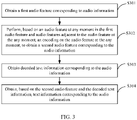
- FIG. 3 is a flowchart of an audio information processing method according to the first embodiment of this application.
- step S301 a first audio feature corresponding to audio information is obtained.
- An audio feature includes a phonetic feature of an audio, a spectral feature of the audio, and the like.
- the audio information in the first embodiment of this application is generally speech information from a person, speech information from an audio device such as a sound of a song, and the like.
- Specific steps for obtaining a first audio feature corresponding to audio information are: obtaining the audio information; and performing feature extraction on the audio information to obtain the first audio feature, where the performing feature extraction on the audio information to obtain the first audio feature includes: performing feature extraction on the audio information to obtain a first audio feature sequence corresponding to the audio information, that is, to obtain an audio feature of the audio information in N speech frames.
- step S302 an encoding is performed on an audio feature at a specified moment based on the audio feature at the specified moment in the first audio feature and audio features adjacent to the audio feature at the specified moment, to obtain a second audio feature corresponding to the audio information.
- a process of performing an encoding on the audio feature at the specified moment is to input the audio feature at the specified moment and the audio features adjacent to the audio feature at the specified moment into an encoder for linear and non-linear transformation, so as to perform feature attribute dimension reduction on the first audio feature and obtain an expression of a new audio feature.
- second audio feature information is audio feature information obtained by performing an encoding on the first audio feature.
- a process of performing, based on an audio feature at a specified moment in the first audio feature and audio features adjacent to the audio feature at the specified moment, an encoding on the audio feature at the specified moment is as follows: selecting audio features at a plurality of target moments from the audio features adjacent to the audio feature at the specified moment; and performing, based on the audio feature at the specified moment and the audio features at the plurality of the target moments, an encoding on the audio feature at the specified moment.
- FIG. 4 is a flowchart of a method for performing an encoding on an audio feature at a specified moment according to the first embodiment of this application.
- step S401 a first encoding is performed on the audio feature at the specified moment based on the audio feature at the specified moment and the audio features at the plurality of the target moments, to obtain a first encoded audio feature corresponding to the first audio feature.
- the performing, based on the audio feature at the specified moment and the audio features at the plurality of the target moments, a first encoding on the audio feature at the specified moment, to obtain a first encoded audio feature corresponding to the first audio feature includes: performing the first encoding based on a linear audio feature at the specified moment, a nonlinear audio feature at the specified moment, linear audio features at the plurality of the target moments, and nonlinear audio features at the plurality of the target moments, to obtain the first encoded audio feature corresponding to the first audio feature.
- step S402 a second encoding is performed on the audio feature at the specified moment based on a first encoded audio feature corresponding to the audio feature at the specified moment and first encoded audio features corresponding to the audio features at the plurality of the target moments, to obtain a second encoded audio feature corresponding to the first audio feature, and the foregoing steps are performed in sequence until the number of encodings reaches a specified number of encodings, to complete encoding of the audio feature at the specified moment.
- the number of encodings is related to an audio length.
- an audio feature of one frame of audio information is generally extracted every 10 ms.
- 600 frames of audio features can be extracted from 6-second audio information, to obtain the first audio feature corresponding to the audio information.
- the 600 frames of audio features in the first audio feature corresponding to the audio information are the audio features of non-adjacent frames, splicing processing and sampling processing of adjacent frames are performed for the 600 frames of audio features in the first audio feature in obtaining the second audio feature corresponding to the audio information.
- the 600 frames of audio features will be further converted into an audio feature spliced from 100 frames.
- an encoding is performed on an audio feature at any specified moment, and the number of encodings is also 100.
- the performing, based on a first encoded audio feature corresponding to the audio feature at the specified moment and first encoded audio features corresponding to the audio features at the plurality of the target moments, a second encoding on the audio feature at the specified moment, to obtain a second encoded audio feature corresponding to the first audio feature includes: performing the second encoding based on a first encoded linear audio feature corresponding to the audio feature at the specified moment, a first encoded nonlinear audio feature corresponding to the audio feature at the specified moment, first encoded linear audio features corresponding to the audio features at the plurality of the target moments, and first encoded nonlinear audio features corresponding to the audio features at the plurality of the target moments, to obtain the second encoded audio feature corresponding to the first audio feature.
- the second encoding performed on the audio feature at the specified moment is specifically described. Before performing the second encoding on the audio feature at the specified moment, the method also needs to perform linear transformation on the first encoded audio feature corresponding to the first audio feature to obtain a first encoded linear audio feature corresponding to the first audio feature; and performs linear rectification on the first encoded linear audio feature corresponding to the first audio feature, to obtain a first encoded nonlinear audio feature corresponding to the first audio feature.
- a ReLU function (Rectified Linear Unit, rectified linear function) is generally used to perform linear rectification on linear audio features to obtain nonlinear audio features.
- the audio features at the plurality of the target moments need to be selected from the audio features adjacent to the audio feature at the specified moment.
- FIG. 5 is a flowchart of a method for selecting audio features at a plurality of target moments according to the first embodiment of this application.
- step S501 a range of audio features adjacent to an audio feature at a specified moment is determined.
- the determining a range of audio features adjacent to an audio feature at a specified moment includes: determining a first range of audio features that are adjacent to the audio feature at the specified moment and before the audio feature at the specified moment, and determining a second range of audio features that are adjacent to the audio feature at the specified moment and after the audio feature at the specified moment.
- step S502 audio features at a plurality of target moments are selected from the audio features adjacent to the audio feature at the specified moment based on the range of the audio features adjacent to the audio feature at the specified moment.
- the selecting, based on the range of the audio features adjacent to the audio feature at the specified moment, audio features at a plurality of target moments from the audio features adjacent to the audio feature at the specified moment includes: selecting, based on the first range and the second range, the audio features at the plurality of the target moments from the audio features adjacent to the audio feature at the specified moment.
- the method needs to first determine a step factor, where the step factor is used to indicate a value-taking time interval when the audio features at the plurality of the target moments are selected from the audio features adjacent to the audio features of the specified moment; and then select, based on the step factor, the first range, and the second range, the audio features at the plurality of the target moments from the audio features adjacent to the audio feature at the specified moment.
- the selecting, based on the step factor, first range, and the second range, the audio features at the plurality of the target moments from the audio features adjacent to the audio feature at the specified moment includes: selecting, based on a first step factor and the first range, the audio features at the plurality of the target moments from the audio features adjacent to the audio feature at the specified moment.
- the selecting, based on the step factor, the first range, and the second range, the audio features at the plurality of the target moments from the audio features adjacent to the audio feature at the specified moment includes: selecting, based on a second step factor and the second range, the audio features at the plurality of the target moments from the audio features adjacent to the audio feature at the specified moment.
- step S403 a final encoded audio feature corresponding to the first audio feature is used as a second audio feature.
- step S303 decoded text information corresponding to the audio information is obtained.
- the decoded text information may be text information that corresponds to the audio information and that has been obtained before a current moment.
- the decoded text information may alternatively be indication information for indicating decoding of to-be-decoded audio information corresponding to the second audio information.
- step S304 text information corresponding to the audio information is obtained based on the second audio features and the decoded text information.
- the obtaining, based on the second audio feature and the decoded text information, text information corresponding to the audio information specifically includes: performing, based on the second audio feature and the decoded text information, a decoding on to-be-decoded audio information corresponding to the second audio information, to obtain the text information corresponding to the audio information.
- FIG. 6 is a flowchart of a method for obtaining text information corresponding to audio information according to the first embodiment of this application.
- step S601 first to-be-decoded audio information corresponding to a second audio feature is obtained.
- a decoding process is a process of inputting a decoding result of a previous moment and an encoded expression of an encoder into a decoder to obtain a corresponding decoding output.
- step S602 a decoding is performed on the first to-be-decoded audio information based on the second audio feature and decoded text information, to obtain first decoded text information.
- a specific process of performing, based on the second audio feature and decoded text information, a decoding on the first to-be-decoded audio information to obtain first decoded text information is as follows:
- step S603 the first decoded text information is updated to decoded information.
- step S604 a decoding is performed on second to-be-decoded audio information based on the second audio feature and the decoded text information, to obtain second decoded text information, and the foregoing steps are performed in sequence until all to-be-decoded information corresponding to the second audio information is decoded, to obtain the text information corresponding to the audio information.
- the audio information processing method provided in this application firstly obtains a first audio feature corresponding to audio information; secondly, performs, based on an audio feature at a specified moment in the first audio feature and audio features adjacent to the audio feature at the specified moment, an encoding on the audio feature at the specified moment to obtain a second audio feature corresponding to the audio information; thirdly, obtains decoded text information corresponding to the audio information; and finally, obtains, based on the second audio feature and the decoded text information, text information corresponding to the audio information.
- the audio information processing method provided in this application can perform, based on the audio feature at the specified moment in the first audio feature and the audio features adjacent to the audio feature at the specified moment, an encoding on the audio feature at the specified moment in the first audio feature, to obtain the second audio feature corresponding to the audio information, and further based on the second audio feature and the decoded text information, obtain the text information corresponding to the audio information.
- fewer parameters need to be used in the process of obtaining the second audio feature and obtaining, based on the second audio feature and the decoded text information, the text information corresponding to the audio information, thereby reducing computational complexity in the audio information processing process and improving audio information processing efficiency.
- the audio information processing method provided in the first embodiment of this application further includes: outputting the text information corresponding to the audio information.
- a second embodiment of this application provides an audio information processing apparatus.
- the apparatus embodiment is essentially similar to the first embodiment of the method. Therefore, descriptions of this embodiment are relatively simple. For related content, refer to related descriptions of the method embodiment.
- the apparatus embodiment described below is merely illustrative.
- FIG. 7 is a schematic diagram of an audio information processing apparatus according to a second embodiment of this application.
- the audio information processing apparatus includes:
- the second audio feature obtaining unit 702 is specifically adapted to select audio features at a plurality of target moments from the audio features adjacent to the audio feature at the specified moment; and perform, based on the audio feature at the specified moment and the audio features at the plurality of the target moments, an encoding on the audio feature at the specified moment.
- the performing, based on the audio feature at the specified moment and the audio features at the plurality of the target moments, an encoding on the audio feature at the specified moment includes:
- the performing, based on a first encoded audio feature corresponding to the audio feature at the specified moment and first encoded audio features corresponding to the audio features at the plurality of the target moments, a second encoding on the audio feature at the specified moment, to obtain a second encoded audio feature corresponding to the first audio feature includes: performing the second encoding based on a first encoded linear audio feature corresponding to the audio feature at the specified moment, a first encoded nonlinear audio feature corresponding to the audio feature at the specified moment, first encoded linear audio features corresponding to the audio features at the plurality of the target moments, and first encoded nonlinear audio features corresponding to the audio features at the plurality of the target moments, to obtain the second encoded audio feature corresponding to the first audio feature.
- the audio information processing method further includes:
- the selecting audio features at a plurality of target moments from the audio features adjacent to the audio feature at the specified moment includes:
- the determining a range of the audio features adjacent to the audio feature at the specified moment includes: determining a first range of audio features that are adjacent to the audio feature at the specified moment and before the audio feature at the specified moment, and determining a second range of audio features that are adjacent to the audio feature at the specified moment and after the audio feature at the specified moment; and the selecting, based on the range of the audio features adjacent to the audio feature at the specified moment, the audio features at the plurality of the target moments from the audio features adjacent to the audio feature at the specified moment includes: selecting, based on the first range and the second range, the audio features at the plurality of the target moments from the audio features adjacent to the audio feature at the specified moment.
- the selecting, based on the first range and the second range, the audio features at the plurality of the target moments from the audio features adjacent to the audio feature at the specified moment includes:
- the selecting, based on the step factor, the first range, and the second range, the audio features at the plurality of the target moments from the audio features adjacent to the audio feature at the specified moment includes: selecting, based on a first step factor and the first range, the audio features at the plurality of the target moments from the audio features adjacent to the audio feature at the specified moment.
- the selecting, based on the step factor, the first range, and the second range, the audio features at the plurality of the target moments from the audio features adjacent to the audio feature at the specified moment includes: selecting, based on a second step factor and the second range, the audio features at the plurality of the target moments from the audio features adjacent to the audio feature at the specified moment.
- the text information obtaining unit 704 is specifically adapted to perform, based on the second audio feature and the decoded text information, a decoding on to-be-decoded audio information corresponding to second audio information, to obtain the text information corresponding to the audio information.
- the performing, based on the second audio feature and the decoded text information, a decoding on to-be-decoded audio information corresponding to second audio information, to obtain the text information corresponding to the audio information includes:
- the decoded information includes indication information for indicating decoding of to-be-decoded audio information corresponding to the second audio information.
- the performing, based on the second audio feature and the decoded text information, a decoding on the first to-be-decoded audio information, to obtain first decoded text information includes:
- the performing, based on the second audio feature and the decoded text information, a decoding on the first to-be-decoded audio information, to obtain text information corresponding to the first to-be-decoded audio information includes:
- the performing feature extraction on the audio information to obtain the first audio feature includes: performing feature extraction on the audio information to obtain a first audio feature sequence corresponding to the audio information.
- the audio information processing apparatus further includes a text information output unit, adapted to output the text information corresponding to the audio information.
- the audio information processing apparatus firstly obtains a first audio feature corresponding to audio information; secondly, performs, based on an audio feature at a specified moment in the first audio feature and audio features adjacent to the audio feature at the specified moment, an encoding on the audio feature at the specified moment to obtain a second audio feature corresponding to the audio information; thirdly, obtains decoded text information corresponding to the audio information; and finally, obtains, based on the second audio feature and the decoded text information, text information corresponding to the audio information.
- the audio information processing apparatus can perform, based on the audio feature at the specified moment in the first audio feature and the audio features adjacent to the audio feature at the specified moment, an encoding on the audio feature at the specified moment in the first audio feature, to obtain the second audio feature corresponding to the audio information, and further based on the second audio feature and the decoded text information, obtain the text information corresponding to the audio information.
- fewer parameters need to be used in the process of obtaining the second audio feature and obtaining, based on the second audio feature and the decoded text information, the text information corresponding to the audio information, thereby reducing computational complexity in the audio information processing process and improving audio information processing efficiency.
- a third embodiment of this application provides an electronic device.
- FIG. 8 is a schematic diagram of an electronic device according to an embodiment of this application.
- the electronic device includes:
- the electronic device provided in the third embodiment of this application firstly obtains a first audio feature corresponding to audio information; secondly, performs, based on an audio feature at a specified moment in the first audio feature and audio features adjacent to the audio feature at the specified moment, an encoding on the audio feature at the specified moment to obtain a second audio feature corresponding to the audio information; thirdly, obtains decoded text information corresponding to the audio information; and finally, obtains, based on the second audio feature and the decoded text information, text information corresponding to the audio information.
- the electronic device for audio information processing provided in this application can perform, based on the audio feature at the specified moment in the first audio feature and the audio features adjacent to the audio feature at the specified moment, an encoding on the audio feature at the specified moment in the first audio feature, to obtain the second audio feature corresponding to the audio information, and further based on the second audio feature and the decoded text information, obtain the text information corresponding to the audio information.
- fewer parameters need to be used in the process of obtaining the second audio feature and obtaining, based on the second audio feature and the decoded text information, the text information corresponding to the audio information, thereby reducing computational complexity in the audio information processing process and improving audio information processing efficiency.
- a fourth embodiment of this application provides a storage medium, where the storage medium stores a computer program, and when the computer program is executed by a processor, the audio information processing method in the first embodiment of this application is performed.
- the storage medium provided in the fourth embodiment of this application firstly obtains a first audio feature corresponding to audio information; secondly, performs, based on an audio feature at a specified moment in the first audio feature and audio features adjacent to the audio feature at the specified moment, an encoding on the audio feature at the specified moment to obtain a second audio feature corresponding to the audio information; thirdly, obtains decoded text information corresponding to the audio information; and finally, obtains, based on the second audio feature and the decoded text information, text information corresponding to the audio information.
- the storage medium for audio information processing provided in this application can perform, based on the audio feature at the specified moment in the first audio feature and the audio features adjacent to the audio feature at the specified moment, an encoding on the audio feature at the specified moment in the first audio feature, to obtain the second audio feature corresponding to the audio information, and further based on the second audio feature and the decoded text information, obtain the text information corresponding to the audio information.
- fewer parameters need to be used in the process of obtaining the second audio feature and obtaining, based on the second audio feature and the decoded text information, the text information corresponding to the audio information, thereby reducing computational complexity in the audio information processing process and improving audio information processing efficiency.
- an audio information processing method is provided, and in correspondence to the audio information processing method, a fifth embodiment of this application provides a smart speaker.
- the smart speaker provided in the fifth embodiment of this application includes: an audio collection device and an audio recognition device, where the audio recognition device includes: an audio feature extraction module, an audio feature encoding module, a decoded text storage module, and an audio feature encoding module; the audio collection device is adapted to obtain audio information;
- an audio information processing method is provided, and in correspondence to the audio information processing method, a sixth embodiment of this application provides an in-vehicle smart speech interaction apparatus.
- the in-vehicle smart speech interaction apparatus includes: an audio collection device, an audio recognition device, and an execution device, where the audio recognition device includes: an audio feature extraction module, an audio feature encoding module, a decoded text storage module, and an audio feature encoding module;
- an audio information processing method is provided, and in correspondence to the audio information processing method, a seventh embodiment of this application provides an audio information processing system.
- the audio information processing method provided in the seventh embodiment of this application includes: a client and a server, where
- the computing device includes one or more processors (CPU), an input/output interface, a network interface, and a memory.
- processors CPU
- input/output interface IO
- network interface IO
- memory e.g., RAM
- the memory may include a form of a non-permanent memory such as a random access memory (RAM) and/or a non-volatile memory such as a read-only memory (ROM) or a flash memory (flash RAM) in computer-readable media.
- RAM random access memory
- ROM read-only memory
- flash RAM flash memory
- Computer-readable media include permanent and non-permanent, removable and non-removable media, and information storage may be implemented by any method or technology.
- the information may be computer-readable instructions, an information structure, a program module, or other information.
- Examples of computer storage media include, but are not limited to, a phase-change memory (PRAM), a static random access memory (SRAM), a dynamic random access memory (DRAM), other types of random access memories (RAM), a read-only memory (ROM), an electrically erasable programmable read-only memory (EEPROM), a flash memory or other memory technologies, a compact disc read-only memory (CD-ROM), a digital versatile disc
- the computer-readable medium does not include non transitory computer-readable media (transitory media), such as modulated information signals and carriers.
- this application can be provided as a method, a system, or a computer program product. Therefore, this application may use a form of hardware only embodiments, software only embodiments, or software-hardware combined embodiments. Moreover, this application may use a form of a computer program product that is implemented on one or more computer-usable storage media (including but not limited to disk memories, CD-ROMs, optical memories, and the like) that include computer usable program code.
- computer-usable storage media including but not limited to disk memories, CD-ROMs, optical memories, and the like
Landscapes
- Engineering & Computer Science (AREA)
- Physics & Mathematics (AREA)
- Acoustics & Sound (AREA)
- Multimedia (AREA)
- Computational Linguistics (AREA)
- Health & Medical Sciences (AREA)
- Audiology, Speech & Language Pathology (AREA)
- Human Computer Interaction (AREA)
- Signal Processing (AREA)
- Computer Vision & Pattern Recognition (AREA)
- Mathematical Physics (AREA)
- Artificial Intelligence (AREA)
- Evolutionary Computation (AREA)
- Spectroscopy & Molecular Physics (AREA)
- Compression, Expansion, Code Conversion, And Decoders (AREA)
- Information Retrieval, Db Structures And Fs Structures Therefor (AREA)
Abstract
Description
- This application relates to the field of computer technologies, and specifically to an audio information processing method, an audio information processing apparatus, an electronic device, and a storage medium.
- With the development of computer technologies and Internet of Things technologies, more and more smart devices have begun to support human-machine speech interaction. In the process of human-machine speech interaction, a smart device needs to collect speech information related to user instructions, and further make corresponding feedback according to user instructions, so as to realize human-machine speech interaction. In the process of human-machine speech interaction between a user and the smart device, how the smart device recognizes speech information related to user instructions becomes a key to completing the human-machine speech interaction. Traditional speech recognition methods are generally based on ASR (Automatic Speech Recognition, automatic speech recognition technology) speech recognition technology, have a cumbersome training process and require introduction of lots of artificially defined prior knowledge. In addition, the traditional speech recognition methods need to train an acoustic model and a language model separately, which does not allow for benefits of joint optimization.
- In recent years, end-to-end speech recognition methods have received growing attention in the field of speech recognition. In the end-to-end speech recognition method, the acoustic model and the language model in the traditional speech recognition method are unified, and text information corresponding to audio information can be obtained directly based on the audio information, so that a speech recognition process is simplified. Existing end-to-end speech recognition methods are mainly based on neural networks such as an RNN (Recurrent Neural Network, recurrent neural network) or a CNN (Convolutional Neural Networks, convolutional neural network). However, the end-to-end speech recognition methods based on an RNN or a CNN usually have a problem of low speech recognition efficiency due to high computational complexity.
- This application provides an audio information processing method, an audio information processing apparatus, an electronic device, and a storage medium, to reduce computational complexity in a process of audio information processing and improve audio information processing efficiency.
- This application provides an audio information processing method, including:
- obtaining a first audio feature corresponding to audio information;
- performing, based on an audio feature at a specified moment in the first audio feature and audio features adjacent to the audio feature at the specified moment, an encoding on the audio feature at the specified moment, to obtain a second audio feature corresponding to the audio information;
- obtaining decoded text information corresponding to the audio information; and
- obtaining, based on the second audio feature and the decoded text information, text information corresponding to the audio information.
- Optionally, the performing, based on an audio feature at a specified moment in the first audio feature and audio features adjacent to the audio feature at the specified moment, an encoding on the audio feature at the specified moment includes:
- selecting audio features at a plurality of target moments from the audio features adjacent to the audio feature at the specified moment; and
- performing, based on the audio feature at the specified moment and the audio features at the plurality of the target moments, an encoding on the audio feature at the specified moment.
- Optionally, the performing, based on the audio feature at the specified moment and the audio features at the plurality of the target moments, an encoding on the audio feature at the specified moment includes:
- performing, based on the audio feature at the specified moment and the audio features at the plurality of the target moments, a first encoding on the audio feature at the specified moment, to obtain a first encoded audio feature corresponding to the first audio feature;
- performing, based on a first encoded audio feature corresponding to the audio feature at the specified moment and first encoded audio features corresponding to the audio features at the plurality of the target moments, a second encoding on the audio feature at the specified moment, to obtain a second encoded audio feature corresponding to the first audio feature, and performing the foregoing steps in sequence until the number of encodings reaches a specified number of encodings, to complete encoding of the audio feature at the specified moment; and
- using a final encoded audio feature corresponding to the first audio feature as the second audio feature. Optionally, the performing, based on the audio feature at the specified moment and the audio features at the plurality of the target moments, a first encoding on the audio feature at the specified moment, to obtain a first encoded audio feature corresponding to the first audio feature includes: performing the first encoding based on a linear audio feature at the specified moment, a nonlinear audio feature at the specified moment, linear audio features at the plurality of the target moments, and nonlinear audio features at the plurality of the target moments, to obtain the first encoded audio feature corresponding to the first audio feature.
- Optionally, the performing, based on a first encoded audio feature corresponding to the audio feature at the specified moment and first encoded audio features corresponding to the audio features at the plurality of the target moments, a second encoding on the audio feature at the specified moment, to obtain a second encoded audio feature corresponding to the first audio feature includes: performing the second encoding based on a first encoded linear audio feature corresponding to the audio feature at the specified moment, a first encoded nonlinear audio feature corresponding to the audio feature at the specified moment, first encoded linear audio features corresponding to the audio features at the plurality of the target moments, and first encoded nonlinear audio features corresponding to the audio features at the plurality of the target moments, to obtain the second encoded audio feature corresponding to the first audio feature.
- Optionally, the audio information processing method further includes:
- performing linear transformation on the first encoded audio feature corresponding to the first audio feature, to obtain a first encoded linear audio feature corresponding to the first audio feature; and
- performing linear rectification on the first encoded linear audio feature corresponding to the first audio feature, to obtain a first encoded nonlinear audio feature corresponding to the first audio feature.
- Optionally, the selecting audio features at a plurality of target moments from the audio features adjacent to the audio feature at the specified moment includes:
- determining a range of the audio features adj acent to the audio feature at the specified moment; and
- selecting, based on the range of the audio features adjacent to the audio feature at the specified moment, the audio features at the plurality of the target moments from the audio features adj acent to the audio feature at the specified moment.
- Optionally, the determining a range of the audio features adjacent to the audio feature at the specified moment includes: determining a first range of audio features that are adjacent to the audio feature at the specified moment and before the audio feature at the specified moment, and determining a second range of audio features that are adjacent to the audio feature at the specified moment and after the audio feature at the specified moment; and
the selecting, based on the range of the audio features adjacent to the audio feature at the specified moment, the audio features at the plurality of the target moments from the audio features adjacent to the audio feature at the specified moment includes: selecting, based on the first range and the second range, the audio features at the plurality of the target moments from the audio features adjacent to the audio feature at the specified moment. - Optionally, the selecting, based on the first range and the second range, the audio features at the plurality of the target moments from the audio features adjacent to the audio feature at the specified moment includes:
- determining a step factor, where the step factor is used to indicate a value-taking time interval when the audio features at the plurality of the target moments are selected from the audio features adjacent to the audio features of the specified moment; and
- selecting, based on the step factor, the first range, and the second range, the audio features at the plurality of the target moments from the audio features adj acent to the audio feature at the specified moment.
- Optionally, the selecting, based on the step factor, the first range, and the second range, the audio features at the plurality of the target moments from the audio features adjacent to the audio feature at the specified moment includes: selecting, based on a first step factor and the first range, the audio features at the plurality of the target moments from the audio features adjacent to the audio feature at the specified moment.
- Optionally, the selecting, based on the step factor, the first range, and the second range, the audio features at the plurality of the target moments from the audio features adjacent to the audio feature at the specified moment includes: selecting, based on a second step factor and the second range, the audio features at the plurality of the target moments from the audio features adjacent to the audio feature at the specified moment.
- Optionally, the obtaining, based on the second audio feature and the decoded text information, text information corresponding to the audio information includes: performing, based on the second audio feature and the decoded text information, a decoding on to-be-decoded audio information corresponding to second audio information, to obtain the text information corresponding to the audio information.
- Optionally, the performing, based on the second audio feature and the decoded text information, a decoding on to-be-decoded audio information corresponding to second audio information, to obtain the text information corresponding to the audio information includes:
- obtaining first to-be-decoded audio information corresponding to the second audio feature;
- performing, based on the second audio feature and the decoded text information, a decoding on the first to-be-decoded audio information, to obtain first decoded text information;
- obtaining second to-be-decoded audio information corresponding to the second audio feature; updating the first decoded text information to decoded information; and
- performing, based on the second audio feature and the decoded text information, a decoding on the second to-be-decoded audio information, to obtain second decoded text information, and performing the foregoing steps in sequence until all to-be-decoded information corresponding to the second audio information is decoded, to obtain the text information corresponding to the audio information.
- Optionally, the decoded information includes indication information for indicating decoding of to-be-decoded audio information corresponding to the second audio information.
- Optionally, the performing, based on the second audio feature and the decoded text information, a decoding on the first to-be-decoded audio information, to obtain first decoded text information includes:
- performing, based on the second audio feature and the decoded text information, a decoding on the first to-be-decoded audio information, to obtain text information corresponding to the first to-be-decoded audio information; and
- obtaining, based on the text information corresponding to the first to-be-decoded audio information and the decoded text information, the first decoded text information.
- Optionally, the performing, based on the second audio feature and the decoded text information, a decoding on the first to-be-decoded audio information, to obtain text information corresponding to the first to-be-decoded audio information includes:
- obtaining, based on the second audio feature and the decoded text information, a predicted value of a text unit corresponding to the first to-be-decoded audio information;
- obtaining a probability distribution of the text unit; and
- obtaining a text unit with a largest probability value as the text information corresponding to the first to-be-decoded audio information. Optionally, the obtaining a first audio feature corresponding to audio information includes:
- obtaining the audio information; and
- performing feature extraction on the audio information to obtain the first audio feature.
- Optionally, the performing feature extraction on the audio information to obtain the first audio feature includes: performing feature extraction on the audio information to obtain a first audio feature sequence corresponding to the audio information.
- Optionally, the audio information processing method further includes: outputting text information corresponding to the audio information.
- According to another aspect of this application, an audio information processing apparatus is further provided, including:
- a first audio feature obtaining unit, adapted to obtain a first audio feature corresponding to audio information;
- a second audio feature obtaining unit, adapted to perform, based on an audio feature at a specified moment in the first audio feature and audio features adjacent to the audio feature at the specified moment, an encoding on the audio feature at the specified moment, to obtain a second audio feature corresponding to the audio information;
- a decoded text information obtaining unit, adapted to obtain decoded text information corresponding to the audio information; and a text information obtaining unit, adapted to obtain, based on the second audio feature and the decoded text information, text information corresponding to the audio information.
- According to another aspect of this application, an electronic device is further provided, including: a processor; and
a memory, adapted to store a program of an audio information processing method, where after being powered and running the program of the audio information processing method via the processor, the device performs the following steps: - obtaining a first audio feature corresponding to audio information;
- performing, based on an audio feature at a specified moment in the first audio feature and audio features adjacent to the audio feature at the specified moment, an encoding on the audio feature at the specified moment, to obtain a second audio feature corresponding to the audio information;
- obtaining decoded text information corresponding to the audio information; and
- obtaining, based on the second audio feature and the decoded text information, text information corresponding to the audio information.
- According to another aspect of this application, an storage device is further provided, storing a program of an audio information processing method, where when the program is executed by a processor, the following steps are performed: obtaining a first audio feature corresponding to audio information;
- performing, based on an audio feature at a specified moment in the first audio feature and audio features adjacent to the audio feature at the specified moment, an encoding on the audio feature at the specified moment, to obtain a second audio feature corresponding to the audio information;
- obtaining decoded text information corresponding to the audio information; and
- obtaining, based on the second audio feature and the decoded text information, text information corresponding to the audio information.
- According to another aspect of this application, a smart speaker is further provided, including: an audio collection device and an audio recognition device, where the audio recognition device includes: an audio feature extraction module, an audio feature encoding module, a decoded text storage module, and an audio feature encoding module;
- the audio collection device is adapted to obtain audio information;
- the audio feature extraction module is adapted to obtain a first audio feature corresponding to the audio information;
- the audio feature encoding module is adapted to perform, based on an audio feature at a specified moment in the first audio feature and audio features adjacent to the audio feature at the specified moment, an encoding on the audio feature at the specified moment, to obtain a second audio feature corresponding to the audio information;
- the decoded text storage module is adapted to obtain decoded text information corresponding to the audio information; and
- the audio feature encoding module is adapted to obtain, based on the second audio feature and the decoded text information, text information corresponding to the audio information.
- According to another aspect of this application, an in-vehicle smart speech interaction apparatus is further provided, including: an audio collection device, an audio recognition device, and an execution device, where the audio recognition device includes: an audio feature extraction module, an audio feature encoding module, a decoded text storage module, and an audio feature encoding module;
- the audio collection device is adapted to obtain audio information;
- the audio feature extraction module is adapted to obtain a first audio feature corresponding to the audio information; the audio feature encoding module is adapted to perform, based on an audio feature at a specified moment in the first audio feature and audio features adjacent to the audio feature at the specified moment, an encoding on the audio feature at the specified moment, to obtain a second audio feature corresponding to the audio information;
- the decoded text storage module is adapted to obtain decoded text information corresponding to the audio information;
- the audio feature encoding module is adapted to obtain, based on the second audio feature and the decoded text information, text information corresponding to the audio information; and
- the execution device is adapted to execute, based on the text information corresponding to the audio information, a corresponding instruction.
- According to another aspect of this application, an audio information processing system is further provided, including: a client and a server, where
- the client is adapted to obtain audio information and send the audio information to the server; and
- the server is adapted to: obtain a first audio feature corresponding to the audio information; perform, based on an audio feature at a specified moment in the first audio feature and audio features adjacent to the audio feature at the specified moment, an encoding on the audio feature at the specified moment, to obtain a second audio feature corresponding to the audio information; obtain decoded text information corresponding to the audio information; obtain, based on the second audio feature and the decoded text information, text information corresponding to the audio information; and send the text information corresponding to the audio information to the client.
- Compared with the prior art, this application has the following advantages:
The audio information processing method provided in this application firstly obtains a first audio feature corresponding to audio information; secondly, performs, based on an audio feature at a specified moment in the first audio feature and audio features adjacent to the audio feature at the specified moment, an encoding on the audio feature at the specified moment to obtain a second audio feature corresponding to the audio information; thirdly, obtains decoded text information corresponding to the audio information; and finally, obtains, based on the second audio feature and the decoded text information, text information corresponding to the audio information. The audio information processing method provided in this application can perform, based on the audio feature at the specified moment in the first audio feature and the audio features adjacent to the audio feature at the specified moment, an encoding on the audio feature at the specified moment in the first audio feature, to obtain the second audio feature corresponding to the audio information, and further based on the second audio feature and the decoded text information, obtain the text information corresponding to the audio information. According to the audio information processing method provided in this application, fewer parameters need to be used in the process of obtaining the second audio feature and obtaining, based on the second audio feature and the decoded text information, the text information corresponding to the audio information, thereby reducing computational complexity in the audio information processing process and improving audio information processing efficiency. -
-
FIG. 1 is a schematic diagram of an embodiment of a first application scenario of an audio information processing method according to this application. -
FIG. 2 is a schematic diagram of an embodiment of a second application scenario of an audio information processing method according to this application. -
FIG. 3 is a flowchart of an audio information processing method according to a first embodiment of this application. -
FIG. 4 is a flowchart of a method for performing an encoding on an audio feature at a specified moment according to the first embodiment of this application. -
FIG. 5 is a flowchart of a method for selecting audio features at a plurality of target moments according to the first embodiment of this application. -
FIG. 6 is a flowchart of a method for obtaining text information corresponding to audio information according to the first embodiment of this application. -
FIG. 7 is a schematic diagram of an audio information processing apparatus according to a second embodiment of this application. -
FIG. 8 is a schematic diagram of an electronic device according to an embodiment of this application. - In the following descriptions, many specific details are provided to help thoroughly understand the present invention. However, the present invention can be implemented in many other manners different from those described herein. A person skilled in the art can make similar expansions without departing from the connotation of the present invention. Therefore, the present invention is not limited by the specific embodiments disclosed below.
- To describe an audio information processing method provided in this application more clearly, an application scenario of the audio information processing method provided in this application is first described. The audio information processing method provided in this application can be applied to a machine translation scenario.
FIG. 1 is a schematic diagram of an embodiment of a first application scenario of an audio information processing method according to this application. In this embodiment of the first scenario of this application, the audio information processing method provided in this application is described in detail by specifically using an application scenario as an example in which the audio information processing method provided in this application is applied to a simultaneous translation headset. When the audio information processing method provided in this application is applied to a simultaneous translation headset, the audio information is speech information of a user. - When the user uses the simultaneous translation headset to conduct a conversation, the simultaneous translation headset is capable of collecting speech information of a target user through its built-in sound collection device. After the speech information of the target user is collected, the simultaneous translation headset first recognizes a language corresponding to the speech, and further determines whether the language of the speech is a to-be-translated language preset by the user. If so, the simultaneous translation headset will process the speech information of the user, recognize and translate the speech information.
- A specific process of recognizing the speech information of the target user by the simultaneous translation headset is as follows: Firstly, noise reduction processing is performed on the speech information, and after the noise reduction processing, acoustic feature extraction is further performed on the speech information to obtain a first speech feature corresponding to the speech information, where the first speech feature is specifically a sequence of speech features, that is, speech features of the speech information in N speech frames, where the speech features include phonetic features of the speech, spectral features of the speech, and the like. Secondly, an encoding unit of the simultaneous translation headset performs, based on a speech feature at a specified moment in the first speech feature and speech features adjacent to the speech feature at the specified moment, an encoding on the speech feature at the specified moment, to obtain a second speech feature corresponding to the speech information. In an embodiment of a scenario of this application, the specified moment is determined according to a preset number of encodings and an audio length. Specifically, a time interval for encoding is calculated based on the audio length and the preset number of encodings, one moment is selected as a starting moment, and each specified moment can be obtained based on the starting moment, the number of encodings, and the time interval. Thirdly, a decoding unit of the simultaneous translation headset obtains the second speech feature, and uses decoded text information corresponding to the speech information as an output of decoded speech information in the decoded speech information, where decoded information may be indication information for indicating decoding of to-be-decoded speech information corresponding to second speech information. Finally, the decoding unit of the simultaneous translation headset obtains, based on the second speech feature and the decoded text information, text information corresponding to the speech information.
- It should be noted that a specific process of performing, by the encoding unit of the simultaneous translation headset based on a speech feature at a specified moment in the first speech feature and speech features adjacent to the speech feature at the specified moment, an encoding on the speech feature at the specified moment, to obtain a second speech feature corresponding to the speech information is as follows: firstly, selecting speech features at a plurality of target moments from the speech features adjacent to the speech feature at the specified moment; secondly, performing, based on the speech feature at the specified moment and the speech features at the plurality of the target moments, a first encoding on the speech feature at the specified moment, to obtain a first encoded speech feature corresponding to the first speech feature; obtaining, based on a first encoded speech feature corresponding to the speech feature at the specified moment and first encoded speech features corresponding to the audio features at the plurality of the target moments, a second encoded speech feature corresponding to the first speech feature, and performing the foregoing steps in sequence until the number of encodings reaches a specified number of encodings, to complete encoding of the speech feature at the specified moment; and using a final encoded speech feature corresponding to the first speech feature as the second speech feature.
- A specific process of performing a first encoding on the speech feature at the specified moment to obtain a first encoded speech feature corresponding to the first speech feature is as follows: performing the first encoding based on a linear speech feature at the specified moment, a nonlinear speech feature at the specified moment, linear speech features at the plurality of the target moments, and nonlinear speech features at the plurality of the target moments, to obtain the first encoded speech feature corresponding to the first speech feature.
- A specific process of performing an N-th encoding on the speech feature at the specified moment to obtain an N-th encoded speech feature corresponding to the first speech feature is as follows: performing the N-th encoding based on an (N-1)-th encoded linear speech feature corresponding to the speech feature at the specified moment, an (N-1)-th encoded nonlinear speech feature corresponding to the speech feature at the specified moment, (N-1)-th encoded linear speech features corresponding to the speech features at the plurality of the target moments, and (N-1)-th encoded nonlinear speech features corresponding to the speech features at the plurality of the target moments, to obtain the N-th encoded speech feature corresponding to the first speech feature, where N is a preset number of encodings.
- It should be noted that a specific process of obtaining, based on the second speech feature and the decoded text information, text information corresponding to the speech information is as follows: obtaining first to-be-decoded speech information corresponding to the second speech feature after the decoding unit of the simultaneous translation headset obtains the second speech feature and the decoded text information; performing, based on the second speech feature and the decoded text information, a decoding on the first to-be-decoded speech information, to obtain first decoded text information; obtaining second to-be-decoded speech information corresponding to the second speech feature; updating the first decoded text information to decoded information; and performing, based on the second speech feature and the decoded text information, a decoding on the second to-be-decoded speech information, to obtain second decoded text information, and performing the foregoing steps in sequence until all to-be-decoded information corresponding to second speech information is decoded, to obtain the text information corresponding to the speech information. When performing, based on the second speech feature and the decoded text information, a decoding on the first to-be-decoded speech information, to obtain first decoded text information, firstly, the decoding unit needs to obtain, based on the second speech feature and the decoded text information, a predicted value of a text unit corresponding to the first to-be-decoded speech information; then obtain a probability distribution of the text unit; and finally, obtain a text unit with a largest probability value as text information corresponding to the first to-be-decoded speech information.
- After obtaining the text information corresponding to the speech information, the decoding unit of the simultaneous translation provides the text information corresponding to the speech information to a translation module unit of the simultaneous translation. The translation module unit performs translation for the text information corresponding to the speech information, translates the text information corresponding to the speech information into text information in a preset language, converts the text information into speech information in the preset language, and outputs the speech information.
- The audio information processing method provided in this application can be applied to a speech-to-text scenario.
FIG. 2 is a schematic diagram of an embodiment of a second application scenario of the audio information processing method according to this application. In this embodiment of the second scenario of this application, the audio information processing method provided in this application is described in detail by using an application scenario as an example in which the audio information processing method provided in this application is applied to social software for speech-to-text conversion. In this embodiment of the second application scenario of this application, the audio information is speech information. - When converting received speech information into text information, the social software first sends the speech information to a speech recognition system for speech recognition on the speech information by the speech recognition system. Specifically, the speech recognition system includes a speech
feature extraction module 201, anencoding module 202, and adecoding module 203. A process of recognizing the speech information by the speech recognition system is as follows:
Firstly, the speechfeature extraction module 201 performs feature extraction on the speech information to obtain a first speech feature corresponding to the speech information, and further provides the first speech feature to theencoding module 202. - Secondly, after obtaining the first speech feature, the
encoding module 202 sequentially performs linear transformation on the first speech feature through a linear projection layer 202-1 in theencoding module 202, to obtain a linear speech feature of the first speech feature, and performs linear rectification on the linear speech feature of the first speech feature through a linear rectification layer 202-2, to obtain a nonlinear speech feature of the first speech feature. - Thirdly, N encoding layers 202-3 in the
encoding module 202 perform, based on a speech feature at a specified moment in the first speech feature and speech features adjacent to the speech feature at the specified moment, an encoding on the speech feature at the specified moment, to obtain a second speech feature corresponding to the speech information. - Finally, the
decoding module 203 obtains decoded text information corresponding to the speech information and a second speech feature, and based on the second speech feature and the decoded text information, obtains text information corresponding to the speech information. - It should be noted that the foregoing two application scenarios are merely two embodiments of application scenarios of the audio information processing method provided in this application. The purpose of providing the two embodiments of application scenarios is to facilitate understanding of the audio information processing method provided in this application, but not to limit the audio information processing method provided in this application. A first embodiment of this application provides a method for displaying content of an electronic reading object on a handheld device, which will be described below with reference to
FIG. 1 to FIG. 6 . -
FIG. 3 is a flowchart of an audio information processing method according to the first embodiment of this application. - In step S301, a first audio feature corresponding to audio information is obtained.
- An audio feature includes a phonetic feature of an audio, a spectral feature of the audio, and the like. The audio information in the first embodiment of this application is generally speech information from a person, speech information from an audio device such as a sound of a song, and the like.
- Specific steps for obtaining a first audio feature corresponding to audio information are: obtaining the audio information; and performing feature extraction on the audio information to obtain the first audio feature, where the performing feature extraction on the audio information to obtain the first audio feature includes: performing feature extraction on the audio information to obtain a first audio feature sequence corresponding to the audio information, that is, to obtain an audio feature of the audio information in N speech frames.
- In step S302, an encoding is performed on an audio feature at a specified moment based on the audio feature at the specified moment in the first audio feature and audio features adjacent to the audio feature at the specified moment, to obtain a second audio feature corresponding to the audio information.
- In the first embodiment of this application, a process of performing an encoding on the audio feature at the specified moment is to input the audio feature at the specified moment and the audio features adjacent to the audio feature at the specified moment into an encoder for linear and non-linear transformation, so as to perform feature attribute dimension reduction on the first audio feature and obtain an expression of a new audio feature. In the first embodiment of this application, second audio feature information is audio feature information obtained by performing an encoding on the first audio feature.
- A process of performing, based on an audio feature at a specified moment in the first audio feature and audio features adjacent to the audio feature at the specified moment, an encoding on the audio feature at the specified moment is as follows: selecting audio features at a plurality of target moments from the audio features adjacent to the audio feature at the specified moment; and performing, based on the audio feature at the specified moment and the audio features at the plurality of the target moments, an encoding on the audio feature at the specified moment. For a process of performing, based on the audio feature at the specified moment and the audio features at the plurality of the target moments, an encoding on the audio feature at the specified moment, refer to
FIG. 4 , which is a flowchart of a method for performing an encoding on an audio feature at a specified moment according to the first embodiment of this application. - In step S401, a first encoding is performed on the audio feature at the specified moment based on the audio feature at the specified moment and the audio features at the plurality of the target moments, to obtain a first encoded audio feature corresponding to the first audio feature.
- The performing, based on the audio feature at the specified moment and the audio features at the plurality of the target moments, a first encoding on the audio feature at the specified moment, to obtain a first encoded audio feature corresponding to the first audio feature includes: performing the first encoding based on a linear audio feature at the specified moment, a nonlinear audio feature at the specified moment, linear audio features at the plurality of the target moments, and nonlinear audio features at the plurality of the target moments, to obtain the first encoded audio feature corresponding to the first audio feature.
- In step S402, a second encoding is performed on the audio feature at the specified moment based on a first encoded audio feature corresponding to the audio feature at the specified moment and first encoded audio features corresponding to the audio features at the plurality of the target moments, to obtain a second encoded audio feature corresponding to the first audio feature, and the foregoing steps are performed in sequence until the number of encodings reaches a specified number of encodings, to complete encoding of the audio feature at the specified moment.
- The number of encodings is related to an audio length. In the first embodiment of this application, in obtaining the first audio feature corresponding to the audio information, an audio feature of one frame of audio information is generally extracted every 10 ms. For example, 600 frames of audio features can be extracted from 6-second audio information, to obtain the first audio feature corresponding to the audio information. After the first audio feature corresponding to the audio information is obtained, because the 600 frames of audio features in the first audio feature corresponding to the audio information are the audio features of non-adjacent frames, splicing processing and sampling processing of adjacent frames are performed for the 600 frames of audio features in the first audio feature in obtaining the second audio feature corresponding to the audio information. If a sampling rate is 6, the 600 frames of audio features will be further converted into an audio feature spliced from 100 frames. In converting the 600 frames of audio features into the audio feature spliced from 100 frames, an encoding is performed on an audio feature at any specified moment, and the number of encodings is also 100.
- In the first embodiment of this application, processes of performing a second to an N-th encodings on the audio feature at the specified moment are similar. Therefore, only a process of performing a second encoding on the audio feature at the specified moment is described in detail in the first embodiment of this application. The performing, based on a first encoded audio feature corresponding to the audio feature at the specified moment and first encoded audio features corresponding to the audio features at the plurality of the target moments, a second encoding on the audio feature at the specified moment, to obtain a second encoded audio feature corresponding to the first audio feature includes: performing the second encoding based on a first encoded linear audio feature corresponding to the audio feature at the specified moment, a first encoded nonlinear audio feature corresponding to the audio feature at the specified moment, first encoded linear audio features corresponding to the audio features at the plurality of the target moments, and first encoded nonlinear audio features corresponding to the audio features at the plurality of the target moments, to obtain the second encoded audio feature corresponding to the first audio feature.
- Because linear audio features and nonlinear audio features need to be used in each encoding process, the second encoding performed on the audio feature at the specified moment is specifically described. Before performing the second encoding on the audio feature at the specified moment, the method also needs to perform linear transformation on the first encoded audio feature corresponding to the first audio feature to obtain a first encoded linear audio feature corresponding to the first audio feature; and performs linear rectification on the first encoded linear audio feature corresponding to the first audio feature, to obtain a first encoded nonlinear audio feature corresponding to the first audio feature.
- In the first embodiment of this application, a ReLU function (Rectified Linear Unit, rectified linear function) is generally used to perform linear rectification on linear audio features to obtain nonlinear audio features.
- In a process of performing step S302, the audio features at the plurality of the target moments need to be selected from the audio features adjacent to the audio feature at the specified moment. In the first embodiment of this application, for the step of selecting audio features at the plurality of the target moments from the audio features adjacent to the audio feature at the specified moment, refer to
FIG. 5 , which is a flowchart of a method for selecting audio features at a plurality of target moments according to the first embodiment of this application. - In step S501, a range of audio features adjacent to an audio feature at a specified moment is determined.
- The determining a range of audio features adjacent to an audio feature at a specified moment includes: determining a first range of audio features that are adjacent to the audio feature at the specified moment and before the audio feature at the specified moment, and determining a second range of audio features that are adjacent to the audio feature at the specified moment and after the audio feature at the specified moment.
- In step S502, audio features at a plurality of target moments are selected from the audio features adjacent to the audio feature at the specified moment based on the range of the audio features adjacent to the audio feature at the specified moment.
- The selecting, based on the range of the audio features adjacent to the audio feature at the specified moment, audio features at a plurality of target moments from the audio features adjacent to the audio feature at the specified moment includes: selecting, based on the first range and the second range, the audio features at the plurality of the target moments from the audio features adjacent to the audio feature at the specified moment. Specifically, in selecting, based on the first range and the second range, the audio features at the plurality of the target moments from the audio features adjacent to the audio feature at the specified moment, the method needs to first determine a step factor, where the step factor is used to indicate a value-taking time interval when the audio features at the plurality of the target moments are selected from the audio features adjacent to the audio features of the specified moment; and then select, based on the step factor, the first range, and the second range, the audio features at the plurality of the target moments from the audio features adjacent to the audio feature at the specified moment.
- It should be noted that the selecting, based on the step factor, first range, and the second range, the audio features at the plurality of the target moments from the audio features adjacent to the audio feature at the specified moment includes: selecting, based on a first step factor and the first range, the audio features at the plurality of the target moments from the audio features adjacent to the audio feature at the specified moment.
- It should be noted that the selecting, based on the step factor, the first range, and the second range, the audio features at the plurality of the target moments from the audio features adjacent to the audio feature at the specified moment includes: selecting, based on a second step factor and the second range, the audio features at the plurality of the target moments from the audio features adjacent to the audio feature at the specified moment.
- In step S403, a final encoded audio feature corresponding to the first audio feature is used as a second audio feature.
- After the second audio feature is obtained, text information corresponding to the audio information needs to be further obtained based on the second audio feature.
- In step S303, decoded text information corresponding to the audio information is obtained.
- In the first embodiment of this application, the decoded text information may be text information that corresponds to the audio information and that has been obtained before a current moment. When no text information corresponding to the audio information has been obtained before the current moment, the decoded text information may alternatively be indication information for indicating decoding of to-be-decoded audio information corresponding to the second audio information.
- In step S304, text information corresponding to the audio information is obtained based on the second audio features and the decoded text information.
- The obtaining, based on the second audio feature and the decoded text information, text information corresponding to the audio information specifically includes: performing, based on the second audio feature and the decoded text information, a decoding on to-be-decoded audio information corresponding to the second audio information, to obtain the text information corresponding to the audio information. For a specific process, refer to
FIG. 6 , which is a flowchart of a method for obtaining text information corresponding to audio information according to the first embodiment of this application. - In step S601, first to-be-decoded audio information corresponding to a second audio feature is obtained.
- In the first embodiment of this application, a decoding process is a process of inputting a decoding result of a previous moment and an encoded expression of an encoder into a decoder to obtain a corresponding decoding output.
- In step S602, a decoding is performed on the first to-be-decoded audio information based on the second audio feature and decoded text information, to obtain first decoded text information.
- A specific process of performing, based on the second audio feature and decoded text information, a decoding on the first to-be-decoded audio information to obtain first decoded text information is as follows:
- firstly, performing, based on the second audio feature and the decoded text information, a decoding on the first to-be-decoded audio information, to obtain text information corresponding to the first to-be-decoded audio information; and
- then, obtaining, based on the text information corresponding to the first to-be-decoded audio information and the decoded text information, the first decoded text information, that is, obtaining, based on the second audio feature and the decoded text information, a predicted value of a text unit corresponding to the first to-be-decoded audio information; obtaining a probability distribution of the text unit; and obtaining a text unit with a largest probability value as the text information corresponding to the first to-be-decoded audio information.
- In step S603, the first decoded text information is updated to decoded information.
- In step S604, a decoding is performed on second to-be-decoded audio information based on the second audio feature and the decoded text information, to obtain second decoded text information, and the foregoing steps are performed in sequence until all to-be-decoded information corresponding to the second audio information is decoded, to obtain the text information corresponding to the audio information.
- For a process of performing a decoding on the second to M-th to-be-decoded audio information in this application, refer to the process of performing a decoding on the first to-be-decoded audio information in step S602.
- The audio information processing method provided in this application firstly obtains a first audio feature corresponding to audio information; secondly, performs, based on an audio feature at a specified moment in the first audio feature and audio features adjacent to the audio feature at the specified moment, an encoding on the audio feature at the specified moment to obtain a second audio feature corresponding to the audio information; thirdly, obtains decoded text information corresponding to the audio information; and finally, obtains, based on the second audio feature and the decoded text information, text information corresponding to the audio information. The audio information processing method provided in this application can perform, based on the audio feature at the specified moment in the first audio feature and the audio features adjacent to the audio feature at the specified moment, an encoding on the audio feature at the specified moment in the first audio feature, to obtain the second audio feature corresponding to the audio information, and further based on the second audio feature and the decoded text information, obtain the text information corresponding to the audio information. According to the audio information processing method provided in this application, fewer parameters need to be used in the process of obtaining the second audio feature and obtaining, based on the second audio feature and the decoded text information, the text information corresponding to the audio information, thereby reducing computational complexity in the audio information processing process and improving audio information processing efficiency.
- The audio information processing method provided in the first embodiment of this application further includes: outputting the text information corresponding to the audio information.
- In correspondence to the audio information processing method in the first embodiment of this application, a second embodiment of this application provides an audio information processing apparatus. The apparatus embodiment is essentially similar to the first embodiment of the method. Therefore, descriptions of this embodiment are relatively simple. For related content, refer to related descriptions of the method embodiment. The apparatus embodiment described below is merely illustrative.
-
FIG. 7 is a schematic diagram of an audio information processing apparatus according to a second embodiment of this application. - The audio information processing apparatus includes:
- a first audio
feature obtaining unit 701, adapted to obtain a first audio feature corresponding to audio information; - a second audio
feature obtaining unit 702, adapted to perform, based on an audio feature at a specified moment in the first audio feature and audio features adjacent to the audio feature at the specified moment, an encoding on the audio feature at the specified moment, to obtain a second audio feature corresponding to the audio information; - a decoded text
information obtaining unit 703, adapted to obtain decoded text information corresponding to the audio information; and - a text
information obtaining unit 704, adapted to obtain, based on the second audio feature and the decoded text information, text information corresponding to the audio information. - Optionally, the second audio
feature obtaining unit 702 is specifically adapted to select audio features at a plurality of target moments from the audio features adjacent to the audio feature at the specified moment; and perform, based on the audio feature at the specified moment and the audio features at the plurality of the target moments, an encoding on the audio feature at the specified moment. Optionally, the performing, based on the audio feature at the specified moment and the audio features at the plurality of the target moments, an encoding on the audio feature at the specified moment includes: - performing, based on the audio feature at the specified moment and the audio features at the plurality of the target moments, a first encoding on the audio feature at the specified moment, to obtain a first encoded audio feature corresponding to the first audio feature;
- performing, based on a first encoded audio feature corresponding to the audio feature at the specified moment and first encoded audio features corresponding to the audio features at the plurality of the target moments, a second encoding on the audio feature at the specified moment, to obtain a second encoded audio feature corresponding to the first audio feature, and performing the foregoing steps in sequence until the number of encodings reaches a specified number of encodings, to complete encoding of the audio feature at the specified moment; and
- using a final encoded audio feature corresponding to the first audio feature as the second audio feature. Optionally, the performing, based on the audio feature at the specified moment and the audio features at the plurality of the target moments, a first encoding on the audio feature at the specified moment, to obtain a first encoded audio feature corresponding to the first audio feature includes: performing the first encoding based on a linear audio feature at the specified moment, a nonlinear audio feature at the specified moment, linear audio features at the plurality of the target moments, and nonlinear audio features at the plurality of the target moments, to obtain the first encoded audio feature corresponding to the first audio feature.
- Optionally, the performing, based on a first encoded audio feature corresponding to the audio feature at the specified moment and first encoded audio features corresponding to the audio features at the plurality of the target moments, a second encoding on the audio feature at the specified moment, to obtain a second encoded audio feature corresponding to the first audio feature includes: performing the second encoding based on a first encoded linear audio feature corresponding to the audio feature at the specified moment, a first encoded nonlinear audio feature corresponding to the audio feature at the specified moment, first encoded linear audio features corresponding to the audio features at the plurality of the target moments, and first encoded nonlinear audio features corresponding to the audio features at the plurality of the target moments, to obtain the second encoded audio feature corresponding to the first audio feature.
- Optionally, the audio information processing method further includes:
- performing linear transformation on the first encoded audio feature corresponding to the first audio feature, to obtain a first encoded linear audio feature corresponding to the first audio feature; and
- performing linear rectification on the first encoded linear audio feature corresponding to the first audio feature, to obtain a first encoded nonlinear audio feature corresponding to the first audio feature.
- Optionally, the selecting audio features at a plurality of target moments from the audio features adjacent to the audio feature at the specified moment includes:
- determining a range of the audio features adj acent to the audio feature at the specified moment; and
- selecting, based on the range of the audio features adjacent to the audio feature at the specified moment, the audio features at the plurality of the target moments from the audio features adj acent to the audio feature at the specified moment.
- Optionally, the determining a range of the audio features adjacent to the audio feature at the specified moment includes: determining a first range of audio features that are adjacent to the audio feature at the specified moment and before the audio feature at the specified moment, and determining a second range of audio features that are adjacent to the audio feature at the specified moment and after the audio feature at the specified moment; and
the selecting, based on the range of the audio features adjacent to the audio feature at the specified moment, the audio features at the plurality of the target moments from the audio features adjacent to the audio feature at the specified moment includes: selecting, based on the first range and the second range, the audio features at the plurality of the target moments from the audio features adjacent to the audio feature at the specified moment. - Optionally, the selecting, based on the first range and the second range, the audio features at the plurality of the target moments from the audio features adjacent to the audio feature at the specified moment includes:
- determining a step factor, where the step factor is used to indicate a value-taking time interval when the audio features at the plurality of the target moments are selected from the audio features adjacent to the audio features of the specified moment; and
- selecting, based on the step factor, the first range, and the second range, the audio features at the plurality of the target moments from the audio features adj acent to the audio feature at the specified moment.
- Optionally, the selecting, based on the step factor, the first range, and the second range, the audio features at the plurality of the target moments from the audio features adjacent to the audio feature at the specified moment includes: selecting, based on a first step factor and the first range, the audio features at the plurality of the target moments from the audio features adjacent to the audio feature at the specified moment.
- Optionally, the selecting, based on the step factor, the first range, and the second range, the audio features at the plurality of the target moments from the audio features adjacent to the audio feature at the specified moment includes: selecting, based on a second step factor and the second range, the audio features at the plurality of the target moments from the audio features adjacent to the audio feature at the specified moment.
- Optionally, the text
information obtaining unit 704 is specifically adapted to perform, based on the second audio feature and the decoded text information, a decoding on to-be-decoded audio information corresponding to second audio information, to obtain the text information corresponding to the audio information. - Optionally, the performing, based on the second audio feature and the decoded text information, a decoding on to-be-decoded audio information corresponding to second audio information, to obtain the text information corresponding to the audio information includes:
- obtaining first to-be-decoded audio information corresponding to the second audio feature;
- performing, based on the second audio feature and the decoded text information, a decoding on the first to-be-decoded audio information, to obtain first decoded text information;
- obtaining second to-be-decoded audio information corresponding to the second audio feature; updating the first decoded text information to decoded information; and
- performing, based on the second audio feature and the decoded text information, a decoding on the second to-be-decoded audio information, to obtain second decoded text information, and performing the foregoing steps in sequence until all to-be-decoded information corresponding to the second audio information is decoded, to obtain the text information corresponding to the audio information.
- Optionally, the decoded information includes indication information for indicating decoding of to-be-decoded audio information corresponding to the second audio information.
- Optionally, the performing, based on the second audio feature and the decoded text information, a decoding on the first to-be-decoded audio information, to obtain first decoded text information includes:
- performing, based on the second audio feature and the decoded text information, a decoding on the first to-be-decoded audio information, to obtain text information corresponding to the first to-be-decoded audio information; and
- obtaining, based on the text information corresponding to the first to-be-decoded audio information and the decoded text information, the first decoded text information.
- Optionally, the performing, based on the second audio feature and the decoded text information, a decoding on the first to-be-decoded audio information, to obtain text information corresponding to the first to-be-decoded audio information includes:
- obtaining, based on the second audio feature and the decoded text information, a predicted value of a text unit corresponding to the first to-be-decoded audio information;
- obtaining a probability distribution of the text unit; and
- obtaining a text unit with a largest probability value as the text information corresponding to the first to-be-decoded audio information. Optionally, the first audio
feature obtaining unit 701 is specifically adapted to obtain the audio information; and perform feature extraction on the audio information to obtain the first audio feature. - Optionally, the performing feature extraction on the audio information to obtain the first audio feature includes: performing feature extraction on the audio information to obtain a first audio feature sequence corresponding to the audio information.
- Optionally, the audio information processing apparatus further includes a text information output unit, adapted to output the text information corresponding to the audio information.
- The audio information processing apparatus provided in the second embodiment of this application firstly obtains a first audio feature corresponding to audio information; secondly, performs, based on an audio feature at a specified moment in the first audio feature and audio features adjacent to the audio feature at the specified moment, an encoding on the audio feature at the specified moment to obtain a second audio feature corresponding to the audio information; thirdly, obtains decoded text information corresponding to the audio information; and finally, obtains, based on the second audio feature and the decoded text information, text information corresponding to the audio information. The audio information processing apparatus provided in this application can perform, based on the audio feature at the specified moment in the first audio feature and the audio features adjacent to the audio feature at the specified moment, an encoding on the audio feature at the specified moment in the first audio feature, to obtain the second audio feature corresponding to the audio information, and further based on the second audio feature and the decoded text information, obtain the text information corresponding to the audio information. According to the audio information processing apparatus provided in this application, fewer parameters need to be used in the process of obtaining the second audio feature and obtaining, based on the second audio feature and the decoded text information, the text information corresponding to the audio information, thereby reducing computational complexity in the audio information processing process and improving audio information processing efficiency.
- In correspondence to the audio information processing method in the first embodiment of this application, a third embodiment of this application provides an electronic device.
- As shown in
FIG. 8, FIG. 8 is a schematic diagram of an electronic device according to an embodiment of this application. The electronic device includes: - a
processor 801; and - a
memory 802, adapted to store a computer program, where after being powered and running the computer program via the processor, the device performs the audio information processing method in the first embodiment of this application. - The electronic device provided in the third embodiment of this application firstly obtains a first audio feature corresponding to audio information; secondly, performs, based on an audio feature at a specified moment in the first audio feature and audio features adjacent to the audio feature at the specified moment, an encoding on the audio feature at the specified moment to obtain a second audio feature corresponding to the audio information; thirdly, obtains decoded text information corresponding to the audio information; and finally, obtains, based on the second audio feature and the decoded text information, text information corresponding to the audio information. The electronic device for audio information processing provided in this application can perform, based on the audio feature at the specified moment in the first audio feature and the audio features adjacent to the audio feature at the specified moment, an encoding on the audio feature at the specified moment in the first audio feature, to obtain the second audio feature corresponding to the audio information, and further based on the second audio feature and the decoded text information, obtain the text information corresponding to the audio information. According to the electronic device for audio information processing provided in this application, fewer parameters need to be used in the process of obtaining the second audio feature and obtaining, based on the second audio feature and the decoded text information, the text information corresponding to the audio information, thereby reducing computational complexity in the audio information processing process and improving audio information processing efficiency.
- It should be noted that, for detailed descriptions of the audio information processing method performed by the electronic device provided in the third embodiment of this application, reference may be made to related descriptions in the first embodiment of this application, and details are not described herein again.
- In correspondence to the audio information processing method in the first embodiment of this application, a fourth embodiment of this application provides a storage medium, where the storage medium stores a computer program, and when the computer program is executed by a processor, the audio information processing method in the first embodiment of this application is performed.
- The storage medium provided in the fourth embodiment of this application firstly obtains a first audio feature corresponding to audio information; secondly, performs, based on an audio feature at a specified moment in the first audio feature and audio features adjacent to the audio feature at the specified moment, an encoding on the audio feature at the specified moment to obtain a second audio feature corresponding to the audio information; thirdly, obtains decoded text information corresponding to the audio information; and finally, obtains, based on the second audio feature and the decoded text information, text information corresponding to the audio information. The storage medium for audio information processing provided in this application can perform, based on the audio feature at the specified moment in the first audio feature and the audio features adjacent to the audio feature at the specified moment, an encoding on the audio feature at the specified moment in the first audio feature, to obtain the second audio feature corresponding to the audio information, and further based on the second audio feature and the decoded text information, obtain the text information corresponding to the audio information. According to the storage medium for audio information processing provided in this application, fewer parameters need to be used in the process of obtaining the second audio feature and obtaining, based on the second audio feature and the decoded text information, the text information corresponding to the audio information, thereby reducing computational complexity in the audio information processing process and improving audio information processing efficiency.
- It should be noted that, for detailed descriptions of the storage medium provided in the fourth embodiment of this application, reference may be made to related descriptions in the first embodiment of this application, and details are not described herein again.
- In the first embodiment of this application, an audio information processing method is provided, and in correspondence to the audio information processing method, a fifth embodiment of this application provides a smart speaker.
- The smart speaker provided in the fifth embodiment of this application includes: an audio collection device and an audio recognition device, where the audio recognition device includes: an audio feature extraction module, an audio feature encoding module, a decoded text storage module, and an audio feature encoding module; the audio collection device is adapted to obtain audio information;
- the audio feature extraction module is adapted to obtain a first audio feature corresponding to the audio information;
- the audio feature encoding module is adapted to perform, based on an audio feature at a specified moment in the first audio feature and audio features adjacent to the audio feature at the specified moment, an encoding on the audio feature at the specified moment, to obtain a second audio feature corresponding to the audio information;
- the decoded text storage module is adapted to obtain decoded text information corresponding to the audio information; and
- the audio feature encoding module is adapted to obtain, based on the second audio feature and the decoded text information, text information corresponding to the audio information.
- In the first embodiment of this application, an audio information processing method is provided, and in correspondence to the audio information processing method, a sixth embodiment of this application provides an in-vehicle smart speech interaction apparatus.
- The in-vehicle smart speech interaction apparatus provided in the sixth embodiment of this application includes: an audio collection device, an audio recognition device, and an execution device, where the audio recognition device includes: an audio feature extraction module, an audio feature encoding module, a decoded text storage module, and an audio feature encoding module;
- the audio collection device is adapted to obtain audio information;
- the audio feature extraction module is adapted to obtain a first audio feature corresponding to the audio information;
- the audio feature encoding module is adapted to perform, based on an audio feature at a specified moment in the first audio feature and audio features adjacent to the audio feature at the specified moment, an encoding on the audio feature at the specified moment, to obtain a second audio feature corresponding to the audio information;
- the decoded text storage module is adapted to obtain decoded text information corresponding to the audio information;
- the audio feature encoding module is adapted to obtain, based on the second audio feature and the decoded text information, text information corresponding to the audio information; and
- the execution device is adapted to execute, based on the text information corresponding to the audio information, a corresponding instruction.
- In the first embodiment of this application, an audio information processing method is provided, and in correspondence to the audio information processing method, a seventh embodiment of this application provides an audio information processing system.
- The audio information processing method provided in the seventh embodiment of this application includes: a client and a server, where
- the client is adapted to obtain audio information and send the audio information to the server; and
- the server is adapted to: obtain a first audio feature corresponding to the audio information; perform, based on an audio feature at a specified moment in the first audio feature and audio features adjacent to the audio feature at the specified moment, an encoding on the audio feature at the specified moment, to obtain a second audio feature corresponding to the audio information; obtain decoded text information corresponding to the audio information; obtain, based on the second audio feature and the decoded text information, text information corresponding to the audio information; and send the text information corresponding to the audio information to the client.
- Although this application is disclosed as above with preferred embodiments, these preferred embodiments are not intended to limit this application. Any person skilled in the art can make possible changes and modifications without departing from the spirit and scope of this application. Therefore, the protection scope of this application should be subjected to the scope defined by the claims of this application.
- In a typical configuration, the computing device includes one or more processors (CPU), an input/output interface, a network interface, and a memory.
- The memory may include a form of a non-permanent memory such as a random access memory (RAM) and/or a non-volatile memory such as a read-only memory (ROM) or a flash memory (flash RAM) in computer-readable media. The memory is an example of the computer-readable medium.
- Computer-readable media include permanent and non-permanent, removable and non-removable media, and information storage may be implemented by any method or technology. The information may be computer-readable instructions, an information structure, a program module, or other information. Examples of computer storage media include, but are not limited to, a phase-change memory (PRAM), a static random access memory (SRAM), a dynamic random access memory (DRAM), other types of random access memories (RAM), a read-only memory (ROM), an electrically erasable programmable read-only memory (EEPROM), a flash memory or other memory technologies, a compact disc read-only memory (CD-ROM), a digital versatile disc
- (DVD) or other optical storage, a magnetic cassette, a magnetic tape, a magnetic disk storage or other magnetic storage devices, or any other non-transmission media, which can be used to store information that can be accessed by a computing device. As defined in this specification, the computer-readable medium does not include non transitory computer-readable media (transitory media), such as modulated information signals and carriers.
- A person skilled in the art should understand that the embodiments of this application can be provided as a method, a system, or a computer program product. Therefore, this application may use a form of hardware only embodiments, software only embodiments, or software-hardware combined embodiments. Moreover, this application may use a form of a computer program product that is implemented on one or more computer-usable storage media (including but not limited to disk memories, CD-ROMs, optical memories, and the like) that include computer usable program code.
Claims (25)
- An audio information processing method, comprising:obtaining a first audio feature corresponding to audio information;performing, based on an audio feature at a specified moment in the first audio feature and audio features adjacent to the audio feature at the specified moment, an encoding on the audio feature at the specified moment, to obtain a second audio feature corresponding to the audio information;obtaining decoded text information corresponding to the audio information; andobtaining, based on the second audio feature and the decoded text information, text information corresponding to the audio information.
- The audio information processing method according to claim 1, wherein the performing, based on an audio feature at a specified moment in the first audio feature and audio features adjacent to the audio feature at the specified moment, an encoding on the audio feature at the specified moment comprises:selecting audio features at a plurality of target moments from the audio features adjacent to the audio feature at the specified moment; andperforming, based on the audio feature at the specified moment and the audio features at the plurality of the target moments, an encoding on the audio feature at the specified moment.
- The audio information processing method according to claim 2, wherein the performing, based on the audio feature at the specified moment and the audio features at the plurality of the target moments, an encoding on the audio feature at the specified moment comprises:performing, based on the audio feature at the specified moment and the audio features at the plurality of the target moments, a first encoding on the audio feature at the specified moment, to obtain a first encoded audio feature corresponding to the first audio feature;performing, based on a first encoded audio feature corresponding to the audio feature at the specified moment and first encoded audio features corresponding to the audio features at the plurality of the target moments, a second encoding on the audio feature at the specified moment, to obtain a second encoded audio feature corresponding to the first audio feature, and performing the foregoing steps in sequence until the number of encodings reaches a specified number of encodings, to complete encoding of the audio feature at the specified moment; andusing a final encoded audio feature corresponding to the first audio feature as the second audio feature.
- The audio information processing method according to claim 3, wherein the performing, based on the audio feature at the specified moment and the audio features at the plurality of the target moments, a first encoding on the audio feature at the specified moment, to obtain a first encoded audio feature corresponding to the first audio feature comprises: performing the first encoding based on a linear audio feature at the specified moment, a nonlinear audio feature at the specified moment, linear audio features at the plurality of the target moments, and nonlinear audio features at the plurality of the target moments, to obtain the first encoded audio feature corresponding to the first audio feature.
- The audio information processing method according to claim 3, wherein the performing, based on a first encoded audio feature corresponding to the audio feature at the specified moment and first encoded audio features corresponding to the audio features at the plurality of the target moments, a second encoding on the audio feature at the specified moment, to obtain a second encoded audio feature corresponding to the first audio feature comprises: performing the second encoding based on a first encoded linear audio feature corresponding to the audio feature at the specified moment, a first encoded nonlinear audio feature corresponding to the audio feature at the specified moment, first encoded linear audio features corresponding to the audio features at the plurality of the target moments, and first encoded nonlinear audio features corresponding to the audio features at the plurality of the target moments, to obtain the second encoded audio feature corresponding to the first audio feature.
- The audio information processing method according to claim 5, further comprising:performing linear transformation on the first encoded audio feature corresponding to the first audio feature, to obtain a first encoded linear audio feature corresponding to the first audio feature; andperforming linear rectification on the first encoded linear audio feature corresponding to the first audio feature, to obtain a first encoded nonlinear audio feature corresponding to the first audio feature.
- The audio information processing method according to claim 2, wherein the selecting audio features at a plurality of target moments from the audio features adjacent to the audio feature at the specified moment comprises:determining a range of the audio features adjacent to the audio feature at the specified moment; andselecting, based on the range of the audio features adjacent to the audio feature at the specified moment, the audio features at the plurality of the target moments from the audio features adjacent to the audio feature at the specified moment.
- The audio information processing method according to claim 7, wherein the determining a range of the audio features adjacent to the audio feature at the specified moment comprises: determining a first range of audio features that are adjacent to the audio feature at the specified moment and before the audio feature at the specified moment, and determining a second range of audio features that are adjacent to the audio feature at the specified moment and after the audio feature at the specified moment; and
the selecting, based on the range of the audio features adjacent to the audio feature at the specified moment, the audio features at the plurality of the target moments from the audio features adjacent to the audio feature at the specified moment comprises: selecting, based on the first range and the second range, the audio features at the plurality of the target moments from the audio features adjacent to the audio feature at the specified moment. - The audio information processing method according to claim 8, wherein the selecting, based on the first range and the second range, the audio features at the plurality of the target moments from the audio features adjacent to the audio feature at the specified moment comprises:determining a step factor, wherein the step factor is used to indicate a value-taking time interval when the audio features at the plurality of the target moments are selected from the audio features adjacent to the audio features of the specified moment; andselecting, based on the step factor, the first range, and the second range, the audio features at the plurality of the target moments from the audio features adjacent to the audio feature at the specified moment.
- The audio information processing method according to claim 9, wherein the selecting, based on the step factor, the first range, and the second range, the audio features at the plurality of the target moments from the audio features adjacent to the audio feature at the specified moment comprises: selecting, based on a first step factor and the first range, the audio features at the plurality of the target moments from the audio features adjacent to the audio feature at the specified moment.
- The audio information processing method according to claim 9, wherein the selecting, based on the step factor, the first range, and the second range, the audio features at the plurality of the target moments from the audio features adjacent to the audio feature at the specified moment comprises: selecting, based on a second step factor and the second range, the audio features at the plurality of the target moments from the audio features adjacent to the audio feature at the specified moment.
- The audio information processing method according to claim 1, wherein the obtaining, based on the second audio feature and the decoded text information, text information corresponding to the audio information comprises: performing, based on the second audio feature and the decoded text information, a decoding on to-be-decoded audio information corresponding to the second audio information, to obtain the text information corresponding to the audio information.
- The audio information processing method according to claim 12, wherein the performing, based on the second audio feature and the decoded text information, a decoding on to-be-decoded audio information corresponding to the second audio information, to obtain the text information corresponding to the audio information comprises:obtaining first to-be-decoded audio information corresponding to the second audio feature;performing, based on the second audio feature and the decoded text information, a decoding on the first to-be-decoded audio information, to obtain first decoded text information;obtaining second to-be-decoded audio information corresponding to the second audio feature;updating the first decoded text information to decoded information; andperforming, based on the second audio feature and the decoded text information, a decoding on the second to-be-decoded audio information, to obtain second decoded text information, and performing the foregoing steps in sequence until all to-be-decoded information corresponding to the second audio information is decoded, to obtain the text information corresponding to the audio information.
- The audio information processing method according to claim 13, wherein the decoded information comprises indication information for indicating decoding of to-be-decoded audio information corresponding to the second audio information.
- The audio information processing method according to claim 13, wherein the performing, based on the second audio feature and the decoded text information, a decoding on the first to-be-decoded audio information, to obtain first decoded text information comprises:performing, based on the second audio feature and the decoded text information, a decoding on the first to-be-decoded audio information, to obtain text information corresponding to the first to-be-decoded audio information; andobtaining, based on the text information corresponding to the first to-be-decoded audio information and the decoded text information, the first decoded text information.
- The audio information processing method according to claim 15, wherein the performing, based on the second audio feature and the decoded text information, a decoding on the first to-be-decoded audio information, to obtain text information corresponding to the first to-be-decoded audio information comprises:obtaining, based on the second audio feature and the decoded text information, a predicted value of a text unit corresponding to the first to-be-decoded audio information;obtaining a probability distribution of the text unit; andobtaining a text unit with a largest probability value as the text information corresponding to the first to-be-decoded audio information.
- The audio information processing method according to claim 1, wherein the obtaining a first audio feature corresponding to audio information comprises:obtaining the audio information; andperforming feature extraction on the audio information to obtain the first audio feature.
- The audio information processing method according to claim 17, wherein the performing feature extraction on the audio information to obtain the first audio feature comprises: performing feature extraction on the audio information to obtain a first audio feature sequence corresponding to the audio information.
- The audio information processing method according to claim 1, further comprising: outputting text information corresponding to the audio information.
- An audio information processing apparatus, comprising:a first audio feature obtaining unit, adapted to obtain a first audio feature corresponding to audio information;a second audio feature obtaining unit, adapted to perform, based on an audio feature at a specified moment in the first audio feature and audio features adjacent to the audio feature at the specified moment, an encoding on the audio feature at the specified moment, to obtain a second audio feature corresponding to the audio information;a decoded text information obtaining unit, adapted to obtain decoded text information corresponding to the audio information; anda text information obtaining unit, adapted to obtain, based on the second audio feature and the decoded text information, text information corresponding to the audio information.
- An electronic device, comprising:a processor; anda memory, adapted to store a program of an audio information processing method, wherein after being powered and running the program of the audio information processing method via the processor, the device performs the following steps:obtaining a first audio feature corresponding to audio information;performing, based on an audio feature at a specified moment in the first audio feature and audio features adjacent to the audio feature at the specified moment, an encoding on the audio feature at the specified moment, to obtain a second audio feature corresponding to the audio information;obtaining decoded text information corresponding to the audio information; andobtaining, based on the second audio feature and the decoded text information, text information corresponding to the audio information.
- A storage device, storing a program of an audio information processing method, wherein when the program is executed by a processor, the following steps are performed:obtaining a first audio feature corresponding to audio information;performing, based on an audio feature at a specified moment in the first audio feature and audio features adjacent to the audio feature at the specified moment, an encoding on the audio feature at the specified moment, to obtain a second audio feature corresponding to the audio information;obtaining decoded text information corresponding to the audio information; andobtaining, based on the second audio feature and the decoded text information, text information corresponding to the audio information.
- A smart speaker, comprising: an audio collection device and an audio recognition device, wherein the audio recognition device comprises: an audio feature extraction module, an audio feature encoding module, a decoded text storage module, and an audio feature encoding module;the audio collection device is adapted to obtain audio information;the audio feature extraction module is adapted to obtain a first audio feature corresponding to the audio information;the audio feature encoding module is adapted to perform, based on an audio feature at a specified moment in the first audio feature and audio features adjacent to the audio feature at the specified moment, an encoding on the audio feature at the specified moment, to obtain a second audio feature corresponding to the audio information;the decoded text storage module is adapted to obtain decoded text information corresponding to the audio information; andthe audio feature encoding module is adapted to obtain, based on the second audio feature and the decoded text information, text information corresponding to the audio information.
- An in-vehicle smart speech interaction apparatus, comprising: an audio collection device, an audio recognition device, and an execution device, wherein the audio recognition device comprises: an audio feature extraction module, an audio feature encoding module, a decoded text storage module, and an audio feature encoding module;the audio collection device is adapted to obtain audio information;the audio feature extraction module is adapted to obtain a first audio feature corresponding to the audio information;the audio feature encoding module is adapted to perform, based on an audio feature at a specified moment in the first audio feature and audio features adjacent to the audio feature at the specified moment, an encoding on the audio feature at the specified moment, to obtain a second audio feature corresponding to the audio information;the decoded text storage module is adapted to obtain decoded text information corresponding to the audio information;the audio feature encoding module is adapted to obtain, based on the second audio feature and the decoded text information, text information corresponding to the audio information; andthe execution device is adapted to execute, based on the text information corresponding to the audio information, a corresponding instruction.
- An audio information processing system, comprising: a client, and a server, wherein:the client is adapted to obtain audio information and send the audio information to the server; andthe server is adapted to: obtain a first audio feature corresponding to the audio information; perform, based on an audio feature at a specified moment in the first audio feature and audio features adjacent to the audio feature at the specified moment, an encoding on the audio feature at the specified moment, to obtain a second audio feature corresponding to the audio information; obtain decoded text information corresponding to the audio information; obtain, based on the second audio feature and the decoded text information, text information corresponding to the audio information; and send the text information corresponding to the audio information to the client.
Applications Claiming Priority (2)
| Application Number | Priority Date | Filing Date | Title |
|---|---|---|---|
| CN202010026971.9A CN113112993B (en) | 2020-01-10 | 2020-01-10 | Audio information processing method and device, electronic equipment and storage medium |
| PCT/CN2021/070879 WO2021139772A1 (en) | 2020-01-10 | 2021-01-08 | Audio information processing method and apparatus, electronic device, and storage medium |
Publications (2)
| Publication Number | Publication Date |
|---|---|
| EP4089671A1 true EP4089671A1 (en) | 2022-11-16 |
| EP4089671A4 EP4089671A4 (en) | 2024-02-21 |
Family
ID=76708744
Family Applications (1)
| Application Number | Title | Priority Date | Filing Date |
|---|---|---|---|
| EP21738888.3A Pending EP4089671A4 (en) | 2020-01-10 | 2021-01-08 | Audio information processing method and apparatus, electronic device, and storage medium |
Country Status (4)
| Country | Link |
|---|---|
| US (1) | US12154545B2 (en) |
| EP (1) | EP4089671A4 (en) |
| CN (1) | CN113112993B (en) |
| WO (1) | WO2021139772A1 (en) |
Families Citing this family (4)
| Publication number | Priority date | Publication date | Assignee | Title |
|---|---|---|---|---|
| CN113112993B (en) * | 2020-01-10 | 2024-04-02 | 阿里巴巴集团控股有限公司 | Audio information processing method and device, electronic equipment and storage medium |
| WO2023063569A1 (en) * | 2021-10-15 | 2023-04-20 | 삼성전자주식회사 | Electronic device and control method thereof |
| US20240066398A1 (en) * | 2022-08-27 | 2024-02-29 | Courtney Robinson | Gaming headset |
| WO2026000347A1 (en) * | 2024-06-28 | 2026-01-02 | Douyin Vision Co., Ltd. | Audio signal encoding method, apparatus and audio signal decoding method, apparatus |
Family Cites Families (82)
| Publication number | Priority date | Publication date | Assignee | Title |
|---|---|---|---|---|
| US5706290A (en) | 1994-12-15 | 1998-01-06 | Shaw; Venson | Method and apparatus including system architecture for multimedia communication |
| WO1995027335A1 (en) * | 1994-04-01 | 1995-10-12 | Sony Corporation | Method and device for encoding information, method and device for decoding information, information transmitting method, and information recording medium |
| US5640490A (en) | 1994-11-14 | 1997-06-17 | Fonix Corporation | User independent, real-time speech recognition system and method |
| US6408331B1 (en) | 1995-07-27 | 2002-06-18 | Digimarc Corporation | Computer linking methods using encoded graphics |
| US6549147B1 (en) * | 1999-05-21 | 2003-04-15 | Nippon Telegraph And Telephone Corporation | Methods, apparatuses and recorded medium for reversible encoding and decoding |
| JP3620787B2 (en) * | 2000-02-28 | 2005-02-16 | カナース・データー株式会社 | Audio data encoding method |
| EP1288911B1 (en) * | 2001-08-08 | 2005-06-29 | Nippon Telegraph and Telephone Corporation | Emphasis detection for automatic speech summary |
| WO2003088534A1 (en) * | 2002-04-05 | 2003-10-23 | International Business Machines Corporation | Feature-based audio content identification |
| GB0211644D0 (en) | 2002-05-21 | 2002-07-03 | Wesby Philip B | System and method for remote asset management |
| JP4133559B2 (en) * | 2003-05-02 | 2008-08-13 | 株式会社コナミデジタルエンタテインメント | Audio reproduction program, audio reproduction method, and audio reproduction apparatus |
| FR2862799B1 (en) * | 2003-11-26 | 2006-02-24 | Inst Nat Rech Inf Automat | IMPROVED DEVICE AND METHOD FOR SPATIALIZING SOUND |
| JP4792703B2 (en) * | 2004-02-26 | 2011-10-12 | 株式会社セガ | Speech analysis apparatus, speech analysis method, and speech analysis program |
| US20080022343A1 (en) * | 2006-07-24 | 2008-01-24 | Vvond, Inc. | Multiple audio streams |
| WO2007050997A2 (en) | 2005-10-26 | 2007-05-03 | Cellscient, Inc. | Wireless interactive communication system |
| US8684748B1 (en) * | 2005-11-30 | 2014-04-01 | Saba Software, Inc. | System and method for playing web-based training content on a client computer system |
| US20100051693A1 (en) | 2006-03-24 | 2010-03-04 | Nikolai Nikolaevich Dubina | Information encoding and decoding method |
| KR100903958B1 (en) * | 2006-08-02 | 2009-06-25 | 엠텍비젼 주식회사 | A recording medium for performing digital audio data decoding method, digital audio data decoding device and digital audio data decoding method |
| US20080120676A1 (en) | 2006-11-22 | 2008-05-22 | Horizon Semiconductors Ltd. | Integrated circuit, an encoder/decoder architecture, and a method for processing a media stream |
| CN101178897B (en) | 2007-12-05 | 2011-04-20 | 浙江大学 | Speaking man recognizing method using base frequency envelope to eliminate emotion voice |
| KR100928998B1 (en) | 2007-12-12 | 2009-11-26 | 한국전자통신연구원 | Adaptive Multimedia System and Method for Providing Multimedia Contents and Codecs to User Terminals |
| US9293130B2 (en) * | 2008-05-02 | 2016-03-22 | Nuance Communications, Inc. | Method and system for robust pattern matching in continuous speech for spotting a keyword of interest using orthogonal matching pursuit |
| CN101740030B (en) * | 2008-11-04 | 2012-07-18 | 北京中星微电子有限公司 | Method and device for transmitting and receiving speech signals |
| CN102257564B (en) * | 2009-10-21 | 2013-07-10 | 松下电器产业株式会社 | Audio encoding apparatus, decoding apparatus, method, circuit and program |
| US9986009B2 (en) * | 2010-10-06 | 2018-05-29 | Electronics And Telecommunications Research Institute | Apparatus and method for providing streaming content |
| CN102810314B (en) * | 2011-06-02 | 2014-05-07 | 华为终端有限公司 | Audio encoding method and device, audio decoding method and device, and encoding and decoding system |
| US9524651B2 (en) * | 2011-07-25 | 2016-12-20 | Raymond Fix | System and method for electronic communication using a voiceover in combination with user interaction events on a selected background |
| DE102012218966B4 (en) * | 2011-10-31 | 2018-07-12 | International Business Machines Corporation | Method and system for identifying original data generated by things in the Internet of Things |
| CN103123787B (en) * | 2011-11-21 | 2015-11-18 | 金峰 | A kind of mobile terminal and media sync and mutual method |
| CN102708862B (en) * | 2012-04-27 | 2014-09-24 | 苏州思必驰信息科技有限公司 | Touch-assisted real-time speech recognition system and its synchronous decoding method |
| US11922974B1 (en) * | 2012-05-02 | 2024-03-05 | James E. Plankey | System and method for creating and managing multimedia sales promotions |
| CN103236260B (en) * | 2013-03-29 | 2015-08-12 | 京东方科技集团股份有限公司 | Speech recognition system |
| BR112015029113B1 (en) * | 2013-05-24 | 2022-03-22 | Dolby International Ab | Method for encoding audio objects as a data stream, method for reconstructing audio objects based on a data stream, and decoder for reconstructing audio objects based on a data stream |
| US9628528B2 (en) * | 2013-07-19 | 2017-04-18 | Electronics And Telecommunications Research Institute | Apparatus and method for providing content |
| JP6309742B2 (en) * | 2013-11-06 | 2018-04-11 | 株式会社東芝 | Information communication method and information communication apparatus |
| EP2879047A3 (en) * | 2013-11-28 | 2015-12-16 | LG Electronics Inc. | Mobile terminal and controlling method thereof |
| US20150177940A1 (en) | 2013-12-20 | 2015-06-25 | Clixie Media, LLC | System, article, method and apparatus for creating event-driven content for online video, audio and images |
| US20160320922A1 (en) * | 2015-04-28 | 2016-11-03 | Nhn Entertainment Corporation | Service method and system for providing service by associating appstore with timeline |
| WO2016203501A1 (en) * | 2015-06-17 | 2016-12-22 | TISCALI S.p.A. | A method to rank documents by a computer, using additive ensembles of regression trees and cache optimisation, and search engine using such a method |
| CA2999100A1 (en) * | 2015-09-16 | 2017-03-23 | David Joseph Yochum | Data-based memorabilia product and method of making the same |
| CN106559588B (en) * | 2015-09-30 | 2021-01-26 | 中兴通讯股份有限公司 | Method and device for uploading text information |
| WO2017075279A1 (en) * | 2015-10-27 | 2017-05-04 | ZALON, Zack, J. | Audio content production, audio sequencing, and audio blending system and method |
| CN105657579A (en) * | 2015-10-29 | 2016-06-08 | 乐视致新电子科技(天津)有限公司 | Live broadcast audio switching method, stream media server and client |
| JP6517670B2 (en) * | 2015-11-13 | 2019-05-22 | 日本電信電話株式会社 | Speech recognition apparatus, speech recognition method and speech recognition program |
| US10332508B1 (en) * | 2016-03-31 | 2019-06-25 | Amazon Technologies, Inc. | Confidence checking for speech processing and query answering |
| US10245698B2 (en) * | 2016-05-06 | 2019-04-02 | Massachusetts Institute Of Technology | Method and apparatus for efficient use of CNC machine shaping tool including cessation of use no later than the onset of tool deterioration by monitoring audible sound during shaping |
| HK1220078A2 (en) * | 2016-06-08 | 2017-04-21 | Wai Yuk Annie YUEN | Computer-assisted method and computer system for teaching piano |
| US10319365B1 (en) * | 2016-06-27 | 2019-06-11 | Amazon Technologies, Inc. | Text-to-speech processing with emphasized output audio |
| CN107871497A (en) * | 2016-09-23 | 2018-04-03 | 北京眼神科技有限公司 | Audio recognition method and device |
| US20180122251A1 (en) * | 2016-11-02 | 2018-05-03 | Beijing Century Superstar Information Technology Co., Ltd. | Systems, methods and techniques for e-education on an interactive information platform |
| CN108122035B (en) * | 2016-11-29 | 2019-10-18 | 科大讯飞股份有限公司 | End-to-end modeling method and system |
| KR102940875B1 (en) * | 2016-12-19 | 2026-03-18 | 삼성전자주식회사 | Method and apparatus for speech recognition |
| US10475438B1 (en) * | 2017-03-02 | 2019-11-12 | Amazon Technologies, Inc. | Contextual text-to-speech processing |
| US11133011B2 (en) * | 2017-03-13 | 2021-09-28 | Mitsubishi Electric Research Laboratories, Inc. | System and method for multichannel end-to-end speech recognition |
| US20180330718A1 (en) * | 2017-05-11 | 2018-11-15 | Mitsubishi Electric Research Laboratories, Inc. | System and Method for End-to-End speech recognition |
| CN107170453B (en) | 2017-05-18 | 2020-11-03 | 百度在线网络技术(北京)有限公司 | Cross-language voice transcription method, equipment and readable medium based on artificial intelligence |
| CN109661664B (en) * | 2017-06-22 | 2021-04-27 | 腾讯科技(深圳)有限公司 | Information processing method and related device |
| US10706840B2 (en) * | 2017-08-18 | 2020-07-07 | Google Llc | Encoder-decoder models for sequence to sequence mapping |
| US10872596B2 (en) | 2017-10-19 | 2020-12-22 | Baidu Usa Llc | Systems and methods for parallel wave generation in end-to-end text-to-speech |
| US10796686B2 (en) | 2017-10-19 | 2020-10-06 | Baidu Usa Llc | Systems and methods for neural text-to-speech using convolutional sequence learning |
| US11354371B2 (en) * | 2017-11-07 | 2022-06-07 | Lale Ann Gokyi{hacek over (g)}it | Progressive chain network graph, map and search engine |
| CN107734193A (en) | 2017-11-22 | 2018-02-23 | 深圳悉罗机器人有限公司 | Smart machine system and smart machine control method |
| US10593321B2 (en) * | 2017-12-15 | 2020-03-17 | Mitsubishi Electric Research Laboratories, Inc. | Method and apparatus for multi-lingual end-to-end speech recognition |
| US10672388B2 (en) * | 2017-12-15 | 2020-06-02 | Mitsubishi Electric Research Laboratories, Inc. | Method and apparatus for open-vocabulary end-to-end speech recognition |
| CN108417202B (en) | 2018-01-19 | 2020-09-01 | 苏州思必驰信息科技有限公司 | Speech recognition method and system |
| US10825318B1 (en) * | 2018-04-09 | 2020-11-03 | State Farm Mutual Automobile Insurance Company | Sensing peripheral heuristic evidence, reinforcement, and engagement system |
| US10811000B2 (en) * | 2018-04-13 | 2020-10-20 | Mitsubishi Electric Research Laboratories, Inc. | Methods and systems for recognizing simultaneous speech by multiple speakers |
| US11107463B2 (en) * | 2018-08-01 | 2021-08-31 | Google Llc | Minimum word error rate training for attention-based sequence-to-sequence models |
| CN109192198B (en) * | 2018-09-06 | 2020-08-07 | 北京邮电大学 | A text input method based on sound wave perception |
| KR20200030789A (en) * | 2018-09-13 | 2020-03-23 | 삼성전자주식회사 | Method and apparatus for speech recognition |
| CN109509475B (en) * | 2018-12-28 | 2021-11-23 | 出门问问信息科技有限公司 | Voice recognition method and device, electronic equipment and computer readable storage medium |
| CN111429889B (en) * | 2019-01-08 | 2023-04-28 | 百度在线网络技术(北京)有限公司 | Method, apparatus, device and computer readable storage medium for real-time speech recognition based on truncated attention |
| US10861441B2 (en) * | 2019-02-14 | 2020-12-08 | Tencent America LLC | Large margin training for attention-based end-to-end speech recognition |
| KR102375115B1 (en) * | 2019-05-03 | 2022-03-17 | 구글 엘엘씨 | Phoneme-Based Contextualization for Cross-Language Speech Recognition in End-to-End Models |
| EP3966816B1 (en) * | 2019-05-28 | 2023-12-27 | Google LLC | Large-scale multilingual speech recognition with a streaming end-to-end model |
| CN110197658B (en) | 2019-05-30 | 2021-01-26 | 百度在线网络技术(北京)有限公司 | Voice processing method and device and electronic equipment |
| KR102390940B1 (en) * | 2019-06-19 | 2022-04-26 | 구글 엘엘씨 | Context biasing for speech recognition |
| CN110444223B (en) | 2019-06-26 | 2023-05-23 | 平安科技(深圳)有限公司 | Speaker separation method and device based on cyclic neural network and acoustic characteristics |
| US11749281B2 (en) * | 2019-12-04 | 2023-09-05 | Soundhound Ai Ip, Llc | Neural speech-to-meaning |
| US11373639B2 (en) * | 2019-12-12 | 2022-06-28 | Mitsubishi Electric Research Laboratories, Inc. | System and method for streaming end-to-end speech recognition with asynchronous decoders pruning prefixes using a joint label and frame information in transcribing technique |
| US11727913B2 (en) * | 2019-12-23 | 2023-08-15 | Adobe Inc. | Automatically associating context-based sounds with text |
| US11514948B1 (en) * | 2020-01-09 | 2022-11-29 | Amazon Technologies, Inc. | Model-based dubbing to translate spoken audio in a video |
| CN113112993B (en) * | 2020-01-10 | 2024-04-02 | 阿里巴巴集团控股有限公司 | Audio information processing method and device, electronic equipment and storage medium |
-
2020
- 2020-01-10 CN CN202010026971.9A patent/CN113112993B/en active Active
-
2021
- 2021-01-08 EP EP21738888.3A patent/EP4089671A4/en active Pending
- 2021-01-08 US US17/789,055 patent/US12154545B2/en active Active
- 2021-01-08 WO PCT/CN2021/070879 patent/WO2021139772A1/en not_active Ceased
Also Published As
| Publication number | Publication date |
|---|---|
| WO2021139772A1 (en) | 2021-07-15 |
| US20230047378A1 (en) | 2023-02-16 |
| US12154545B2 (en) | 2024-11-26 |
| CN113112993A (en) | 2021-07-13 |
| CN113112993B (en) | 2024-04-02 |
| EP4089671A4 (en) | 2024-02-21 |
Similar Documents
| Publication | Publication Date | Title |
|---|---|---|
| US12154545B2 (en) | Audio information processing method, audio information processing apparatus, electronic device, and storage medium | |
| US11996084B2 (en) | Speech synthesis method and apparatus, device and computer storage medium | |
| US10593333B2 (en) | Method and device for processing voice message, terminal and storage medium | |
| US9666208B1 (en) | Hybrid audio representations for editing audio content | |
| US20230127787A1 (en) | Method and apparatus for converting voice timbre, method and apparatus for training model, device and medium | |
| EP4425482B1 (en) | Model training and tone conversion method and apparatus, device, and medium | |
| CN111798821B (en) | Sound conversion method, device, readable storage medium and electronic equipment | |
| CN112115706A (en) | Text processing method and device, electronic equipment and medium | |
| EP3255633B1 (en) | Audio content recognition method and device | |
| CN113223487B (en) | An information identification method and device, electronic equipment and storage medium | |
| CN108877779B (en) | Method and device for detecting voice tail point | |
| CN114783423A (en) | Speech segmentation method and device based on speech rate adjustment, computer equipment and medium | |
| CN112289343A (en) | Audio repairing method and device, electronic equipment and computer readable storage medium | |
| CN118506773A (en) | Joint speech and language model using large language model | |
| JP2025102754A (en) | Adaptive Visual Speech Recognition | |
| US20230056128A1 (en) | Speech processing method and apparatus, device and computer storage medium | |
| CN112951274A (en) | Voice similarity determination method and device, and program product | |
| CN112542157B (en) | Voice processing method, device, electronic device and computer readable storage medium | |
| US11627185B1 (en) | Wireless data protocol | |
| CN120496560A (en) | Voice interactive chart dynamic generation method and system based on large language model | |
| CN114495977A (en) | Speech translation and model training method, device, electronic equipment and storage medium | |
| CN116895289B (en) | Training method of voice activity detection model, voice activity detection method and device | |
| JP7846831B2 (en) | Audio synthesis for synchronous communication | |
| CN119600995A (en) | Speech recognition method, device, electronic device and storage medium | |
| CN116884402A (en) | Speech-to-text method, device, electronic device and storage medium |
Legal Events
| Date | Code | Title | Description |
|---|---|---|---|
| STAA | Information on the status of an ep patent application or granted ep patent |
Free format text: STATUS: THE INTERNATIONAL PUBLICATION HAS BEEN MADE |
|
| PUAI | Public reference made under article 153(3) epc to a published international application that has entered the european phase |
Free format text: ORIGINAL CODE: 0009012 |
|
| STAA | Information on the status of an ep patent application or granted ep patent |
Free format text: STATUS: REQUEST FOR EXAMINATION WAS MADE |
|
| 17P | Request for examination filed |
Effective date: 20220726 |
|
| AK | Designated contracting states |
Kind code of ref document: A1 Designated state(s): AL AT BE BG CH CY CZ DE DK EE ES FI FR GB GR HR HU IE IS IT LI LT LU LV MC MK MT NL NO PL PT RO RS SE SI SK SM TR |
|
| DAV | Request for validation of the european patent (deleted) | ||
| DAX | Request for extension of the european patent (deleted) | ||
| P01 | Opt-out of the competence of the unified patent court (upc) registered |
Effective date: 20230418 |
|
| REG | Reference to a national code |
Ref country code: DE Ref legal event code: R079 Free format text: PREVIOUS MAIN CLASS: G10L0015020000 Ipc: G10L0015260000 |
|
| A4 | Supplementary search report drawn up and despatched |
Effective date: 20240117 |
|
| RIC1 | Information provided on ipc code assigned before grant |
Ipc: G10L 15/16 20060101ALI20240112BHEP Ipc: G10L 15/02 20060101ALI20240112BHEP Ipc: G10L 15/26 20060101AFI20240112BHEP |
|
| STAA | Information on the status of an ep patent application or granted ep patent |
Free format text: STATUS: EXAMINATION IS IN PROGRESS |
|
| 17Q | First examination report despatched |
Effective date: 20250519 |