EP4089528A1 - Method and system for machine learning based understanding of data elements in mainframe program code - Google Patents
Method and system for machine learning based understanding of data elements in mainframe program code Download PDFInfo
- Publication number
- EP4089528A1 EP4089528A1 EP22172765.4A EP22172765A EP4089528A1 EP 4089528 A1 EP4089528 A1 EP 4089528A1 EP 22172765 A EP22172765 A EP 22172765A EP 4089528 A1 EP4089528 A1 EP 4089528A1
- Authority
- EP
- European Patent Office
- Prior art keywords
- graph
- data
- data elements
- hardware processors
- parental
- Prior art date
- Legal status (The legal status is an assumption and is not a legal conclusion. Google has not performed a legal analysis and makes no representation as to the accuracy of the status listed.)
- Granted
Links
Images


Classifications
-
- G—PHYSICS
- G06—COMPUTING OR CALCULATING; COUNTING
- G06F—ELECTRIC DIGITAL DATA PROCESSING
- G06F8/00—Arrangements for software engineering
- G06F8/40—Transformation of program code
- G06F8/41—Compilation
- G06F8/43—Checking; Contextual analysis
- G06F8/433—Dependency analysis; Data or control flow analysis
-
- G—PHYSICS
- G06—COMPUTING OR CALCULATING; COUNTING
- G06N—COMPUTING ARRANGEMENTS BASED ON SPECIFIC COMPUTATIONAL MODELS
- G06N3/00—Computing arrangements based on biological models
- G06N3/02—Neural networks
- G06N3/08—Learning methods
-
- G—PHYSICS
- G06—COMPUTING OR CALCULATING; COUNTING
- G06F—ELECTRIC DIGITAL DATA PROCESSING
- G06F16/00—Information retrieval; Database structures therefor; File system structures therefor
- G06F16/90—Details of database functions independent of the retrieved data types
- G06F16/901—Indexing; Data structures therefor; Storage structures
- G06F16/9024—Graphs; Linked lists
-
- G—PHYSICS
- G06—COMPUTING OR CALCULATING; COUNTING
- G06N—COMPUTING ARRANGEMENTS BASED ON SPECIFIC COMPUTATIONAL MODELS
- G06N3/00—Computing arrangements based on biological models
- G06N3/02—Neural networks
- G06N3/04—Architecture, e.g. interconnection topology
- G06N3/042—Knowledge-based neural networks; Logical representations of neural networks
-
- G—PHYSICS
- G06—COMPUTING OR CALCULATING; COUNTING
- G06N—COMPUTING ARRANGEMENTS BASED ON SPECIFIC COMPUTATIONAL MODELS
- G06N3/00—Computing arrangements based on biological models
- G06N3/02—Neural networks
- G06N3/04—Architecture, e.g. interconnection topology
- G06N3/045—Combinations of networks
- G06N3/0455—Auto-encoder networks; Encoder-decoder networks
-
- G—PHYSICS
- G06—COMPUTING OR CALCULATING; COUNTING
- G06N—COMPUTING ARRANGEMENTS BASED ON SPECIFIC COMPUTATIONAL MODELS
- G06N3/00—Computing arrangements based on biological models
- G06N3/02—Neural networks
- G06N3/08—Learning methods
- G06N3/088—Non-supervised learning, e.g. competitive learning
-
- G—PHYSICS
- G06—COMPUTING OR CALCULATING; COUNTING
- G06N—COMPUTING ARRANGEMENTS BASED ON SPECIFIC COMPUTATIONAL MODELS
- G06N3/00—Computing arrangements based on biological models
- G06N3/02—Neural networks
- G06N3/08—Learning methods
- G06N3/09—Supervised learning
-
- G—PHYSICS
- G06—COMPUTING OR CALCULATING; COUNTING
- G06N—COMPUTING ARRANGEMENTS BASED ON SPECIFIC COMPUTATIONAL MODELS
- G06N3/00—Computing arrangements based on biological models
- G06N3/02—Neural networks
- G06N3/04—Architecture, e.g. interconnection topology
- G06N3/047—Probabilistic or stochastic networks
-
- G—PHYSICS
- G06—COMPUTING OR CALCULATING; COUNTING
- G06N—COMPUTING ARRANGEMENTS BASED ON SPECIFIC COMPUTATIONAL MODELS
- G06N3/00—Computing arrangements based on biological models
- G06N3/02—Neural networks
- G06N3/04—Architecture, e.g. interconnection topology
- G06N3/0475—Generative networks
Definitions
- the disclosure herein generally relates to the field of memory mapping during application transformation in mainframe program, and, more particularly, to a method and system for machine learning based understanding of a plurality of data elements in a mainframe program code.
- Mainframe applications in production receive data from various resources and process these data within. Both the input data and the output data flowing into or from the applications follow a structure. Understanding the structure of this input data and output data is extremely important and serves as a building block in all kinds of problems such as code translation, code reverse engineering, code impact analysis and so on.
- code translation code reverse engineering
- code impact analysis code impact analysis and so on.
- the data elements and its structure in Mainframe makes it even more difficult to understand its memory structure and the impact of its change in the overall application. This gap in the understanding makes enhancements/ transformation of the application more difficult.
- the structure of the input data and output data can be in the form of data elements such as screen or file or table or other program copybooks.
- the data movement through these data elements into the applications can be to either small or large local data structures. These data movement may lead to truncation or padding of the information.
- the structure of these data elements or variables ensure that the values passed on to them are automatically assigned to their child variables also. As the data movement in the child and parent variables are not explicitly available as physical statements in the code, parsing techniques alone cannot be applied to solve the same.
- a system for machine learning based understanding of a plurality of data elements in a mainframe program code comprises a user interface, one or more hardware processors and a memory.
- the user interface receives a set of application programs as input training data for training a graph neural network model, wherein the set of application programs comprises a structure of the plurality of data elements and a plurality of relations between the plurality of data elements.
- the memory is in communication with the one or more hardware processors, wherein the one or more first hardware processors are configured to execute programmed instructions stored in the one or more first memories, to: parse the set of application programs using a parser to get a structured data; capture relations based on statements in the input training data by creating a graph, wherein the graph represents a parental graph and an operation graph, wherein the graph comprises parental edges and operation edges; learn latent embeddings of each of the plurality of data elements using a message passing technique through the parental graph and the operation graph, wherein the latent embeddings are represented using a single latent vector; pretrain the graph neural network model by reconstructing the relation graphs from the single latent vector, wherein the graph neural network model comprises a unique encoder; train the graph neural network model for predicting a set of links of the plurality of data element graphs based on a set of training losses, wherein the set of training losses are obtained from a known database; receive the mainframe program code as an input for understanding structure of the plurality
- a method for machine learning based understanding of a plurality of data elements in a mainframe program code is provided.
- a set of application programs is received as input training data for training a graph neural network model, wherein the set of application programs comprises a structure of the plurality of data elements and a plurality of relations between the plurality of data elements.
- the set of application programs are then parsed using a parser to get a structured data.
- relations based on statements in the input training data is captured by creating a graph, wherein the graph represents a parental graph and an operation graph, wherein the graph comprises parental edges and operation edges.
- latent embeddings of each of the plurality of data elements is learnt using a message passing technique through the parental graph and the operation graph, wherein the latent embeddings are represented using a single latent vector.
- the graph neural network model is pretrained by reconstructing the relation graphs from the single latent vector, wherein the graph neural network model comprises a unique encoder.
- the graph neural network model is trained for predicting a set of links of the data element graphs based on a set of training losses, wherein the set of training losses are obtained from a known database.
- the mainframe program code is received as an input for understanding structure of the plurality of data elements, wherein the plurality of data elements comprises one or more child variables and parent variables.
- the data element graphs representing structure of the plurality of data elements are then obtained corresponding to the mainframe program code using a parser.
- the data element graphs are then converted into a coordinate list (COO) matrix format.
- the set of links is predicted for the data element graphs using the trained graph neural network model based on the COO matrix format, wherein the set of links comprises: positive edges if memory mappings between the plurality data elements are intact, and negative edges if memory mappings between the plurality of data elements are not possible.
- the memory mapping between child variables is predicted when two parent variables interact based on the parental graph and operation graph using the set of links.
- the memory mapping between parent variables is predicted when two child variables interact based on the parental graph and operation graph using the set of links.
- one or more non-transitory machine-readable information storage mediums comprising one or more instructions which when executed by one or more hardware processors cause machine learning based understanding of a plurality of data elements in a mainframe program code.
- a set of application programs is received as input training data for training a graph neural network model, wherein the set of application programs comprises a structure of the plurality of data elements and a plurality of relations between the plurality of data elements.
- the set of application programs are then parsed using a parser to get a structured data.
- relations based on statements in the input training data is captured by creating a graph, wherein the graph represents a parental graph and an operation graph, wherein the graph comprises parental edges and operation edges.
- latent embeddings of each of the plurality of data elements is learnt using a message passing technique through the parental graph and the operation graph, wherein the latent embeddings are represented using a single latent vector.
- the graph neural network model is pretrained by reconstructing the relation graphs from the single latent vector, wherein the graph neural network model comprises a unique encoder.
- the graph neural network model is trained for predicting a set of links of the data element graphs based on a set of training losses, wherein the set of training losses are obtained from a known database.
- the mainframe program code is received as an input for understanding structure of the plurality of data elements, wherein the plurality of data elements comprises one or more child variables and parent variables.
- the data element graphs representing structure of the plurality of data elements are then obtained corresponding to the mainframe program code using a parser.
- the data element graphs are then converted into a coordinate list (COO) matrix format.
- the set of links is predicted for the data element graphs using the trained graph neural network model based on the COO matrix format, wherein the set of links comprises: positive edges if memory mappings between the plurality data elements are intact, and negative edges if memory mappings between the plurality of data elements are not possible.
- the memory mapping between child variables is predicted when two parent variables interact based on the parental graph and operation graph using the set of links.
- the memory mapping between parent variables is predicted when two child variables interact based on the parental graph and operation graph using the set of links.
- Mainframe applications in production receive data from various resources and process these data within. Both the input data and the output data flowing into or from the applications follows a structure. Understanding the structure of this input data and output data is extremely important and serves as a building block in all kinds of problems. The data elements and its structure in Mainframe makes it even more difficult to understand its memory structure and the impact of its change in the overall application. This gap in the understanding makes enhancements/ transformation of the application more difficult.
- the present disclosure provides a method and system for machine learning based understanding of a plurality of data elements in a mainframe program code.
- the method discloses a machine learning model that understands the structure of data elements in a Mainframe program code.
- the machine learning model considered is a graph neural network based architecture model.
- the application program considered for understanding the data element structure may be a mainframe program, a natural program, an AS400 program and so on.
- the disclosed method replicates memory mapping happening in the application program environment.
- the method understands the structure of the data element and the impact created by each data element on other data elements in the application and interfacing applications.
- the solution of the disclosed method serves as a building block in problems such as code translation, code reverse engineering, code impact analysis and so on.
- the graph neural network based architecture model may alternatively be referred as a model.
- FIG. 1 through FIG. 4 where similar reference characters denote corresponding features consistently throughout the figures, there are shown preferred embodiments and these embodiments are described in the context of the following exemplary system and/or method.
- FIG. 1 illustrates a network diagram of a system 100 for machine learning based understanding of a plurality of data elements in a mainframe program code.
- the present disclosure provides machine learning (ML) based memory map learning approach that mimics the memory mapping as in the Mainframe compiler itself and understands the structure and the impact created by each data element on other data elements in the application and interfacing applications.
- the solution involves learning latent embedding of nodes (Variables) in the program by using distinct message passing in two different graphs: a) Operation based message passing, and b) Hierarchy based message passing.
- the structure of the input variable is learnt by the system and a prediction of the data movement that happens between the children (due to a parent) / between the parents (due to child movement) etc. is learnt by the system.
- the system 100 comprises one or more computing devices 102, such as a laptop computer, a desktop computer, a notebook, a workstation, a cloud-based computing environment and the like. It will be understood that the system 100 may be accessed through one or more input/output interfaces 104-1, 104-2... 104-N, collectively referred to as I/O interface 104. Examples of the I/O interface 104 may include, but are not limited to, a user interface, a portable computer, a personal digital assistant, a handheld device, a smartphone, a tablet computer, a workstation and the like. The I/O interface 104 are communicatively coupled to the system 100 through a network 106.
- the network 106 may be a wireless or a wired network, or a combination thereof.
- the network 106 can be implemented as a computer network, as one of the different types of networks, such as virtual private network (VPN), intranet, local area network (LAN), wide area network (WAN), the internet, and such.
- the network 106 may either be a dedicated network or a shared network, which represents an association of the different types of networks that use a variety of protocols, for example, Hypertext Transfer Protocol (HTTP), Transmission Control Protocol/Internet Protocol (TCP/IP), and Wireless Application Protocol (WAP), to communicate with each other.
- the network 106 may include a variety of network devices, including routers, bridges, servers, computing devices, storage devices. The network devices within the network 106 may interact with the system 100 through communication links.
- the system 100 may be implemented in a workstation, a mainframe computer, a server, and a network server.
- the computing device 102 further comprises one or more hardware processors 108, one or more memory 110, hereinafter referred as a memory 110 and a data repository 112, for example, a repository 112.
- the memory 110 is in communication with the one or more hardware processors 108, wherein the one or more hardware processors 108 are configured to execute programmed instructions stored in the memory 110, to perform various functions as explained in the later part of the disclosure.
- the repository 112 may store data processed, received, and generated by the system 100.
- the memory 110 further comprises a plurality of modules.
- the plurality of modules is configured to perform various functions.
- the plurality of modules comprises a model training module 114, a parser 116, a link prediction module 118 and a memory mapping prediction module 120.
- the system 100 supports various connectivity options such as BLUETOOTH ® , USB, ZigBee and other cellular services.
- the network environment enables connection of various components of the system 100 using any communication link including Internet, WAN, MAN, and so on.
- the system 100 is implemented to operate as a stand-alone device.
- the system 100 may be implemented to work as a loosely coupled device to a smart computing environment. The components and functionalities of the system 100 are described further in detail.
- FIG. 1 a block diagram of the system 100 for machine learning based understanding of a plurality of data elements in the mainframe program code is shown in FIG. 1 .
- the system 100 comprises the model training module 114.
- the module training module 114 is configured to train a graph neural network based architecture model for data element structure understanding.
- a flowchart 200 illustrating steps involved in training the graph neural network model is shown in FIG. 2 .
- the system 100 is configured to receive a set of application programs as input training data for training the graph neural network model, wherein the set of application programs comprises a structure of the plurality of data elements and a plurality of relations between the plurality of data element.
- the system 100 is configured to parse the set of application programs using a parser to get a structured data.
- the data element graphs representing data element structures are obtained corresponding to each of the application programs among the set of application programs.
- a native parser may be used for parsing an unstructured code text into a structured data. Size, properties and other information of data element structures are captured to create node of data element graphs.
- the system 100 is configured to capture relations based on statements in the input training data by creating a graph, wherein the graph represents a parental graph and an operation graph, wherein the graph comprises parental edges and operation edges.
- the parental graph provides a mapping of parent-child relation of data element structure and the operation graph provides the kind of relation between the parent and child data element structure such as MOV, COMP and so on.
- the system 100 is configured to learn latent embeddings of each of the data element using a message passing technique through the parental graph and the operation graph, wherein the latent embeddings are represented using a single latent vector.
- the system 100 is configured to pretrain the graph neural network model by reconstructing the relation graphs from the single latent vector, wherein the graph neural network model comprises a unique encoder.
- the reconstruction of relation graphs comprises encoding the relation graph and further reconstructing from a single latent vector provided by the unique encoder.
- the unique encoder learns an optimal order of stacking of relational messages. The learning starts with random stacking of relational messages. After a few steps of learning, the probability of the order of stacking used becomes aligned with respect to the pretraining. Thus, at the end of the learning, the optimal order of stacking is obtained.
- the graph neural network model is pre-trained using the coordinate list (COO) matrix format of the data element graphs.
- the pre-training task of the model involves reconstructing relation graphs from a single latent vector, accompanied by the unique encoder.
- graph neural network models based message passing models are permutation invariant.
- the unique encoder designed for the model breaks the permutation invariant nature.
- the unique encoder starts stacking up different relational messages passed, in order to learn an optimal order of stacking of relational messages. This improves the composability in the latent vector, which increases the complexity for a decoder to decode and also provides flexibility for the model to prioritize specific types of relation over the complete set of relations.
- This trained unique encoder is further used for any downstream task.
- the system 100 is configured to train the graph neural network model for predicting a set of links of the data element graphs based on a set of training losses, wherein the set of training losses are obtained from a known database.
- the training task is modelled with two different training strategies, both of which happens during each batch.
- the weights in the graph neural network based architecture model during training are updated based on two distinct training tasks.
- the first training task is unsupervised variational-auto-encoder training using an unsupervised auto-encoder loss.
- the unsupervised auto-encoder loss tries to reconstruct both the data element graphs from the same latent embedding. Both the graphs of the data element graphs based message passing are alternatively updated into one latent embedding. The auto-encoder loss is reconstructed from each of node embedding.
- the second training task is for a supervised link prediction task.
- This training is based on a link prediction task wherein a new edge with the possibility of memory mapping is predicted.
- the prediction of link is based on a binary classification. If the memory mapping between two data elements are intact, then the binary classification is true which results into positive edges. If the memory mapping between two data elements are not possible, then the binary classification is false which results into negative edges.
- the model is trained with a collection of losses such as loss from reconstruction of operation graph, loss from reconstruction of parental graph and cross entropy loss. Thus, a prediction of the data movement that happens between the children (due to parent movement) or between the parents (due to child movement) is learnt by the model.
- the steps from 202 to 210 depicts the process steps for training the graph neural network based architecture model for data element structure understanding in application program.
- FIG. 3 illustrates an example flow chart of a method 300 for machine learning based understanding of the plurality of data elements in the mainframe program code, in accordance with an example embodiment of the present disclosure.
- the method 300 depicted in the flow chart may be executed by a system, for example, the system 100 of FIG. 1 .
- the system 100 may be embodied in a computing device.
- Operations of the flowchart, and combinations of operations in the flowchart may be implemented by various means, such as hardware, firmware, processor, circuitry and/or other device associated with execution of software including one or more computer program instructions.
- one or more of the procedures described in various embodiments may be embodied by computer program instructions.
- the computer program instructions, which embody the procedures, described in various embodiments may be stored by at least one memory device of a system and executed by at least one processor in the system. Any such computer program instructions may be loaded onto a computer or other programmable system (for example, hardware) to produce a machine, such that the resulting computer or other programmable system embody means for implementing the operations specified in the flowchart.
- the operations of the method 300 are described with help of system 100. However, the operations of the method 300 can be described and/or practiced by using any other system.
- the set of application programs is received as input training data for training the graph neural network model.
- the set of application programs comprises the structure of the plurality of data elements and the plurality of relations between the plurality of data element.
- the graph neural network model is trained using the model training module 114. The detailed steps involved in the training are explained in flowchart 200.
- the system 100 is configured to receive the mainframe program code as the input for understanding structure of the plurality of data elements, wherein the plurality of data elements comprises one or more child variables and parent variables.
- the system 100 is configured to obtain data element graphs representing structure of the plurality of data element corresponding to the mainframe program code using the parser 116. Further at step 310, the data element graphs are converted into a coordinate list (COO) matrix format.
- COO coordinate list
- the system 100 is configured to predict the set of links using the link prediction module 118 for the data element graphs using the trained graph neural network model based on the COO matrix format.
- the set of links comprises: positive edges if memory mapping between the plurality data elements are intact, and negative edges if memory mapping between the plurality of data elements are not possible.
- the system 100 is configured to predict the memory mapping using the memory mapping prediction module 320.
- the memory mapping prediction module 230 predicts the memory mapping between child variables when two parent variables interact based on the parental graph and operation graph using the set of links.
- the memory mapping prediction module 320 predicts the memory mapping between parent variables when two child variables interact based on the parental graph and operation graph using the set of links.
- TABLE 1 shows example of a Mainframe program code.
- TABLE 1 Example of memory mapping 01 FILE-CUSTOMER-DETAILS PIC X(69) 01 CUSTOMER-DETAILS 01 WS-CUSTOMER-DETAILS 05 CUSTOMER-NAME 05 WS-CUSTOMER-NAME 10 FIRST-NAME PICX(15) 10 WS-FIRST-NAME PIC X(15) 10 LAST-NAME PIC X(15) 10 WS-LAST-NAMEPIC X(15) 05 CUSTOMER-ADDRESS 05 WS-CUSTOMER-ADDRESS 10 ADDRESS-UNE-1 PICX(15) 10 WS-ADDRESS-LINE-1 PICX(15) 10 ADDRESS-LINE-2 PIC X(15) 10 WS-ADDRESS-LINE-2 PIC X(15) 10 STATE
- the graph neural network model of the present disclosure brings out these hidden relations using the memory mapping.
- the existing methods rely on brute force algorithms and are data and computation intensive, which consumes more time. But now the graph neural network model learns of the hidden relations without mentioning explicitly.
- FIG. 4 An example of group expansion in legacy systems with same structure is shown in FIG. 4 .
- the figure shows mapping between ACCOUNT and ACCOUNT-COPY.
- a moving to B is the only explicit relation explained in the example code. But due to the graph mechanism, the indirect relations between X, Y and P, Q are also conveyed due to the closer embeddings. Since Q has 2 children Q1 Q2, the information of Q gets split according to the size - which means Y is not only closer to Q, but also to Q1 and Q2. Any change in Y will affect Q, Q1 and Q2.
- the disclosure herein addresses unresolved problem related to parent-child impact analysis in the Mainframe program application.
- the process is computationally expensive and becomes further complex when the structure goes deeper.
- the embodiment thus provides the method and system for machine learning based understanding of a plurality of data elements in a mainframe program code
- the hardware device can be any kind of device which can be programmed including e.g. any kind of computer like a server or a personal computer, or the like, or any combination thereof.
- the device may also include means which could be e.g. hardware means like e.g. an application-specific integrated circuit (ASIC), a field-programmable gate array (FPGA), or a combination of hardware and software means, e.g.
- ASIC application-specific integrated circuit
- FPGA field-programmable gate array
- the means can include both hardware means and software means.
- the method embodiments described herein could be implemented in hardware and software.
- the device may also include software means.
- the embodiments may be implemented on different hardware devices, e.g. using a plurality of CPUs, GPUs etc.
- the embodiments herein can comprise hardware and software elements.
- the embodiments that are implemented in software include but are not limited to, firmware, resident software, microcode, etc.
- the functions performed by various components described herein may be implemented in other components or combinations of other components.
- a computer-usable or computer readable medium can be any apparatus that can comprise, store, communicate, propagate, or transport the program for use by or in connection with the instruction execution system, apparatus, or device.
- a computer-readable storage medium refers to any type of physical memory on which information or data readable by a processor may be stored.
- a computer-readable storage medium may store instructions for execution by one or more processors, including instructions for causing the processor(s) to perform steps or stages consistent with the embodiments described herein.
- the term "computer-readable medium” should be understood to include tangible items and exclude carrier waves and transient signals, i.e., be non-transitory. Examples include random access memory (RAM), read-only memory (ROM), volatile memory, nonvolatile memory, hard drives, CD ROMs, DVDs, flash drives, disks, and any other known physical storage media.
Landscapes
- Engineering & Computer Science (AREA)
- Theoretical Computer Science (AREA)
- Physics & Mathematics (AREA)
- General Engineering & Computer Science (AREA)
- Software Systems (AREA)
- General Physics & Mathematics (AREA)
- Data Mining & Analysis (AREA)
- Artificial Intelligence (AREA)
- Health & Medical Sciences (AREA)
- Life Sciences & Earth Sciences (AREA)
- Biomedical Technology (AREA)
- Biophysics (AREA)
- Computational Linguistics (AREA)
- Evolutionary Computation (AREA)
- General Health & Medical Sciences (AREA)
- Molecular Biology (AREA)
- Computing Systems (AREA)
- Mathematical Physics (AREA)
- Databases & Information Systems (AREA)
- Machine Translation (AREA)
Abstract
Description
- The present application claims priority to
Indian application no. 202121021729 filed on 13 May 2021 - The disclosure herein generally relates to the field of memory mapping during application transformation in mainframe program, and, more particularly, to a method and system for machine learning based understanding of a plurality of data elements in a mainframe program code.
- Most of the existing production applications in different domains of banking, insurance, retail, manufacturing etc. are still running on Mainframe and the have evolved over the decades in response to the business, technology and regulatory needs. Mainframe applications in production receive data from various resources and process these data within. Both the input data and the output data flowing into or from the applications follow a structure. Understanding the structure of this input data and output data is extremely important and serves as a building block in all kinds of problems such as code translation, code reverse engineering, code impact analysis and so on. The data elements and its structure in Mainframe makes it even more difficult to understand its memory structure and the impact of its change in the overall application. This gap in the understanding makes enhancements/ transformation of the application more difficult.
- The structure of the input data and output data can be in the form of data elements such as screen or file or table or other program copybooks. The data movement through these data elements into the applications can be to either small or large local data structures. These data movement may lead to truncation or padding of the information. Also, the structure of these data elements or variables ensure that the values passed on to them are automatically assigned to their child variables also. As the data movement in the child and parent variables are not explicitly available as physical statements in the code, parsing techniques alone cannot be applied to solve the same.
- The prior techniques of resolving parent-child impact analysis is a sequential process wherein the depth is solved one after the other from the super-parent variable to the elementary. The process is computationally expensive and becomes further complex when the structure goes deeper.
- Embodiments of the present disclosure present technological improvements as solutions to one or more of the above-mentioned technical problems recognized by the inventors in conventional systems. For example, in one embodiment, a system for machine learning based understanding of a plurality of data elements in a mainframe program code. The system comprises a user interface, one or more hardware processors and a memory. The user interface receives a set of application programs as input training data for training a graph neural network model, wherein the set of application programs comprises a structure of the plurality of data elements and a plurality of relations between the plurality of data elements. The memory is in communication with the one or more hardware processors, wherein the one or more first hardware processors are configured to execute programmed instructions stored in the one or more first memories, to: parse the set of application programs using a parser to get a structured data; capture relations based on statements in the input training data by creating a graph, wherein the graph represents a parental graph and an operation graph, wherein the graph comprises parental edges and operation edges; learn latent embeddings of each of the plurality of data elements using a message passing technique through the parental graph and the operation graph, wherein the latent embeddings are represented using a single latent vector; pretrain the graph neural network model by reconstructing the relation graphs from the single latent vector, wherein the graph neural network model comprises a unique encoder; train the graph neural network model for predicting a set of links of the plurality of data element graphs based on a set of training losses, wherein the set of training losses are obtained from a known database; receive the mainframe program code as an input for understanding structure of the plurality of data elements, wherein the plurality of data elements comprises one or more child variables and parent variables; obtain data element graphs representing structure of the plurality of data elements corresponding to the mainframe program code using a parser; convert the data element graphs into a coordinate list (COO) matrix format; predict the set of links for the data element graphs using the trained graph neural network model based on the COO matrix format, wherein the set of new links comprises: positive edges if memory mappings between the plurality data elements are intact, and negative edges if memory mappings between the plurality of data elements are not possible; predict the memory mapping between child variables when two parent variables interact based on the parental graph and operation graph using the set of links; and predict the memory mapping between parent variables when two child variables interact based on the parental graph and operation graph using the set of links.
- In another aspect, a method for machine learning based understanding of a plurality of data elements in a mainframe program code is provided. Initially, a set of application programs is received as input training data for training a graph neural network model, wherein the set of application programs comprises a structure of the plurality of data elements and a plurality of relations between the plurality of data elements. The set of application programs are then parsed using a parser to get a structured data. In the next step, relations based on statements in the input training data is captured by creating a graph, wherein the graph represents a parental graph and an operation graph, wherein the graph comprises parental edges and operation edges. Further latent embeddings of each of the plurality of data elements is learnt using a message passing technique through the parental graph and the operation graph, wherein the latent embeddings are represented using a single latent vector. In the next step, the graph neural network model is pretrained by reconstructing the relation graphs from the single latent vector, wherein the graph neural network model comprises a unique encoder. In the next step, the graph neural network model is trained for predicting a set of links of the data element graphs based on a set of training losses, wherein the set of training losses are obtained from a known database. Further, the mainframe program code is received as an input for understanding structure of the plurality of data elements, wherein the plurality of data elements comprises one or more child variables and parent variables. The data element graphs representing structure of the plurality of data elements are then obtained corresponding to the mainframe program code using a parser. The data element graphs are then converted into a coordinate list (COO) matrix format. In the next step, the set of links is predicted for the data element graphs using the trained graph neural network model based on the COO matrix format, wherein the set of links comprises: positive edges if memory mappings between the plurality data elements are intact, and negative edges if memory mappings between the plurality of data elements are not possible. Further the memory mapping between child variables is predicted when two parent variables interact based on the parental graph and operation graph using the set of links. And finally, the memory mapping between parent variables is predicted when two child variables interact based on the parental graph and operation graph using the set of links.
- In yet another aspect, there are provided one or more non-transitory machine-readable information storage mediums comprising one or more instructions which when executed by one or more hardware processors cause machine learning based understanding of a plurality of data elements in a mainframe program code. Initially, a set of application programs is received as input training data for training a graph neural network model, wherein the set of application programs comprises a structure of the plurality of data elements and a plurality of relations between the plurality of data elements. The set of application programs are then parsed using a parser to get a structured data. In the next step, relations based on statements in the input training data is captured by creating a graph, wherein the graph represents a parental graph and an operation graph, wherein the graph comprises parental edges and operation edges. Further latent embeddings of each of the plurality of data elements is learnt using a message passing technique through the parental graph and the operation graph, wherein the latent embeddings are represented using a single latent vector. In the next step, the graph neural network model is pretrained by reconstructing the relation graphs from the single latent vector, wherein the graph neural network model comprises a unique encoder. In the next step, the graph neural network model is trained for predicting a set of links of the data element graphs based on a set of training losses, wherein the set of training losses are obtained from a known database. Further, the mainframe program code is received as an input for understanding structure of the plurality of data elements, wherein the plurality of data elements comprises one or more child variables and parent variables. The data element graphs representing structure of the plurality of data elements are then obtained corresponding to the mainframe program code using a parser. The data element graphs are then converted into a coordinate list (COO) matrix format. In the next step, the set of links is predicted for the data element graphs using the trained graph neural network model based on the COO matrix format, wherein the set of links comprises: positive edges if memory mappings between the plurality data elements are intact, and negative edges if memory mappings between the plurality of data elements are not possible. Further the memory mapping between child variables is predicted when two parent variables interact based on the parental graph and operation graph using the set of links. And finally, the memory mapping between parent variables is predicted when two child variables interact based on the parental graph and operation graph using the set of links.
- It is to be understood that both the foregoing general description and the following detailed description are exemplary and explanatory only and are not restrictive of the invention, as claimed.
- The accompanying drawings, which are incorporated in and constitute a part of this disclosure, illustrate exemplary embodiments and, together with the description, serve to explain the disclosed principles:
-
FIG. 1 illustrates a block diagram of a system for machine learning based understanding of a plurality of data elements in a mainframe program code according to some embodiments of the present disclosure. -
FIG. 2 is a flowchart showing steps involved in training a graph neural network model according to some embodiments of the present disclosure. -
FIG. 3 is a flow chart of a method for machine learning based understanding of a plurality of data elements in a mainframe program code accordance with some embodiments of the present disclosure. -
FIG. 4 is an example scenario showing group expansion in a legacy system with the same structure according to some embodiments of the present disclosure. - Exemplary embodiments are described with reference to the accompanying drawings. In the figures, the left-most digit(s) of a reference number identifies the figure in which the reference number first appears. Wherever convenient, the same reference numbers are used throughout the drawings to refer to the same or like parts. While examples and features of disclosed principles are described herein, modifications, adaptations, and other implementations are possible without departing from the scope of the disclosed embodiments.
- Most of the existing production applications in different domains of banking, insurance, retail, manufacturing etc. are still running on Mainframe and have evolved over the decades in response to the business, technology and regulatory needs. Mainframe applications in production receive data from various resources and process these data within. Both the input data and the output data flowing into or from the applications follows a structure. Understanding the structure of this input data and output data is extremely important and serves as a building block in all kinds of problems. The data elements and its structure in Mainframe makes it even more difficult to understand its memory structure and the impact of its change in the overall application. This gap in the understanding makes enhancements/ transformation of the application more difficult.
- The present disclosure provides a method and system for machine learning based understanding of a plurality of data elements in a mainframe program code. The method discloses a machine learning model that understands the structure of data elements in a Mainframe program code. The machine learning model considered is a graph neural network based architecture model. The application program considered for understanding the data element structure may be a mainframe program, a natural program, an AS400 program and so on. The disclosed method replicates memory mapping happening in the application program environment. The method understands the structure of the data element and the impact created by each data element on other data elements in the application and interfacing applications. The solution of the disclosed method serves as a building block in problems such as code translation, code reverse engineering, code impact analysis and so on.
- In an embodiment, the graph neural network based architecture model may alternatively be referred as a model.
- Referring now to the drawings, and more particularly to
FIG. 1 through FIG. 4 , where similar reference characters denote corresponding features consistently throughout the figures, there are shown preferred embodiments and these embodiments are described in the context of the following exemplary system and/or method. -
FIG. 1 illustrates a network diagram of asystem 100 for machine learning based understanding of a plurality of data elements in a mainframe program code. The present disclosure provides machine learning (ML) based memory map learning approach that mimics the memory mapping as in the Mainframe compiler itself and understands the structure and the impact created by each data element on other data elements in the application and interfacing applications. The solution involves learning latent embedding of nodes (Variables) in the program by using distinct message passing in two different graphs: a) Operation based message passing, and b) Hierarchy based message passing. In the proposed solution approach, the structure of the input variable is learnt by the system and a prediction of the data movement that happens between the children (due to a parent) / between the parents (due to child movement) etc. is learnt by the system. - Although the present disclosure is explained considering that the
system 100 is implemented on a server, it may also be present elsewhere such as a local machine. It may be understood that thesystem 100 comprises one ormore computing devices 102, such as a laptop computer, a desktop computer, a notebook, a workstation, a cloud-based computing environment and the like. It will be understood that thesystem 100 may be accessed through one or more input/output interfaces 104-1, 104-2... 104-N, collectively referred to as I/O interface 104. Examples of the I/O interface 104 may include, but are not limited to, a user interface, a portable computer, a personal digital assistant, a handheld device, a smartphone, a tablet computer, a workstation and the like. The I/O interface 104 are communicatively coupled to thesystem 100 through anetwork 106. - In an embodiment, the
network 106 may be a wireless or a wired network, or a combination thereof. In an example, thenetwork 106 can be implemented as a computer network, as one of the different types of networks, such as virtual private network (VPN), intranet, local area network (LAN), wide area network (WAN), the internet, and such. Thenetwork 106 may either be a dedicated network or a shared network, which represents an association of the different types of networks that use a variety of protocols, for example, Hypertext Transfer Protocol (HTTP), Transmission Control Protocol/Internet Protocol (TCP/IP), and Wireless Application Protocol (WAP), to communicate with each other. Further, thenetwork 106 may include a variety of network devices, including routers, bridges, servers, computing devices, storage devices. The network devices within thenetwork 106 may interact with thesystem 100 through communication links. - The
system 100 may be implemented in a workstation, a mainframe computer, a server, and a network server. In an embodiment, thecomputing device 102 further comprises one ormore hardware processors 108, one ormore memory 110, hereinafter referred as amemory 110 and adata repository 112, for example, arepository 112. Thememory 110 is in communication with the one ormore hardware processors 108, wherein the one ormore hardware processors 108 are configured to execute programmed instructions stored in thememory 110, to perform various functions as explained in the later part of the disclosure. Therepository 112 may store data processed, received, and generated by thesystem 100. Thememory 110 further comprises a plurality of modules. The plurality of modules is configured to perform various functions. The plurality of modules comprises amodel training module 114, aparser 116, a link prediction module 118 and a memory mapping prediction module 120. - The
system 100 supports various connectivity options such as BLUETOOTH®, USB, ZigBee and other cellular services. The network environment enables connection of various components of thesystem 100 using any communication link including Internet, WAN, MAN, and so on. In an exemplary embodiment, thesystem 100 is implemented to operate as a stand-alone device. In another embodiment, thesystem 100 may be implemented to work as a loosely coupled device to a smart computing environment. The components and functionalities of thesystem 100 are described further in detail. - According to an embodiment of the disclosure, a block diagram of the
system 100 for machine learning based understanding of a plurality of data elements in the mainframe program code is shown inFIG. 1 . According to an embodiment of the disclosure, thesystem 100 comprises themodel training module 114. Themodule training module 114 is configured to train a graph neural network based architecture model for data element structure understanding. Aflowchart 200 illustrating steps involved in training the graph neural network model is shown inFIG. 2 . Atstep 202 of themethod 200, thesystem 100 is configured to receive a set of application programs as input training data for training the graph neural network model, wherein the set of application programs comprises a structure of the plurality of data elements and a plurality of relations between the plurality of data element. - At
step 204 of themethod 200, thesystem 100 is configured to parse the set of application programs using a parser to get a structured data. The data element graphs representing data element structures are obtained corresponding to each of the application programs among the set of application programs. A native parser may be used for parsing an unstructured code text into a structured data. Size, properties and other information of data element structures are captured to create node of data element graphs. - At
step 206 of themethod 200, thesystem 100 is configured to capture relations based on statements in the input training data by creating a graph, wherein the graph represents a parental graph and an operation graph, wherein the graph comprises parental edges and operation edges. The parental graph provides a mapping of parent-child relation of data element structure and the operation graph provides the kind of relation between the parent and child data element structure such as MOV, COMP and so on. - At
step 208 of themethod 200, thesystem 100 is configured to learn latent embeddings of each of the data element using a message passing technique through the parental graph and the operation graph, wherein the latent embeddings are represented using a single latent vector. - At
step 210 of themethod 200, thesystem 100 is configured to pretrain the graph neural network model by reconstructing the relation graphs from the single latent vector, wherein the graph neural network model comprises a unique encoder. The reconstruction of relation graphs comprises encoding the relation graph and further reconstructing from a single latent vector provided by the unique encoder. The unique encoder learns an optimal order of stacking of relational messages. The learning starts with random stacking of relational messages. After a few steps of learning, the probability of the order of stacking used becomes aligned with respect to the pretraining. Thus, at the end of the learning, the optimal order of stacking is obtained. The graph neural network model is pre-trained using the coordinate list (COO) matrix format of the data element graphs. The pre-training task of the model involves reconstructing relation graphs from a single latent vector, accompanied by the unique encoder. Typically graph neural network models based message passing models are permutation invariant. The unique encoder designed for the model breaks the permutation invariant nature. The unique encoder starts stacking up different relational messages passed, in order to learn an optimal order of stacking of relational messages. This improves the composability in the latent vector, which increases the complexity for a decoder to decode and also provides flexibility for the model to prioritize specific types of relation over the complete set of relations. This trained unique encoder is further used for any downstream task. - At
step 212 of themethod 200, thesystem 100 is configured to train the graph neural network model for predicting a set of links of the data element graphs based on a set of training losses, wherein the set of training losses are obtained from a known database. The training task is modelled with two different training strategies, both of which happens during each batch. The weights in the graph neural network based architecture model during training are updated based on two distinct training tasks. - In an embodiment, the first training task is unsupervised variational-auto-encoder training using an unsupervised auto-encoder loss. The unsupervised auto-encoder loss tries to reconstruct both the data element graphs from the same latent embedding. Both the graphs of the data element graphs based message passing are alternatively updated into one latent embedding. The auto-encoder loss is reconstructed from each of node embedding.
- In another embodiment, the second training task is for a supervised link prediction task. This training is based on a link prediction task wherein a new edge with the possibility of memory mapping is predicted. The prediction of link is based on a binary classification. If the memory mapping between two data elements are intact, then the binary classification is true which results into positive edges. If the memory mapping between two data elements are not possible, then the binary classification is false which results into negative edges. The model is trained with a collection of losses such as loss from reconstruction of operation graph, loss from reconstruction of parental graph and cross entropy loss. Thus, a prediction of the data movement that happens between the children (due to parent movement) or between the parents (due to child movement) is learnt by the model. The steps from 202 to 210 depicts the process steps for training the graph neural network based architecture model for data element structure understanding in application program.
-
FIG. 3 illustrates an example flow chart of amethod 300 for machine learning based understanding of the plurality of data elements in the mainframe program code, in accordance with an example embodiment of the present disclosure. Themethod 300 depicted in the flow chart may be executed by a system, for example, thesystem 100 ofFIG. 1 . In an example embodiment, thesystem 100 may be embodied in a computing device. - Operations of the flowchart, and combinations of operations in the flowchart, may be implemented by various means, such as hardware, firmware, processor, circuitry and/or other device associated with execution of software including one or more computer program instructions. For example, one or more of the procedures described in various embodiments may be embodied by computer program instructions. In an example embodiment, the computer program instructions, which embody the procedures, described in various embodiments may be stored by at least one memory device of a system and executed by at least one processor in the system. Any such computer program instructions may be loaded onto a computer or other programmable system (for example, hardware) to produce a machine, such that the resulting computer or other programmable system embody means for implementing the operations specified in the flowchart. It will be noted herein that the operations of the
method 300 are described with help ofsystem 100. However, the operations of themethod 300 can be described and/or practiced by using any other system. - Initially, at
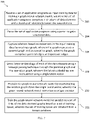
step 302 of themethod 300, the set of application programs is received as input training data for training the graph neural network model. The set of application programs comprises the structure of the plurality of data elements and the plurality of relations between the plurality of data element. Atstep 304, the graph neural network model is trained using themodel training module 114. The detailed steps involved in the training are explained inflowchart 200. - At
step 306 of themethod 300, thesystem 100 is configured to receive the mainframe program code as the input for understanding structure of the plurality of data elements, wherein the plurality of data elements comprises one or more child variables and parent variables. - At
step 308 of themethod 300, thesystem 100 is configured to obtain data element graphs representing structure of the plurality of data element corresponding to the mainframe program code using theparser 116. Further atstep 310, the data element graphs are converted into a coordinate list (COO) matrix format. - At
step 312 of themethod 300, thesystem 100 is configured to predict the set of links using the link prediction module 118 for the data element graphs using the trained graph neural network model based on the COO matrix format. The set of links comprises: positive edges if memory mapping between the plurality data elements are intact, and negative edges if memory mapping between the plurality of data elements are not possible. And finally, atstep system 100 is configured to predict the memory mapping using the memory mapping prediction module 320. Atstep 314, the memory mapping prediction module 230 predicts the memory mapping between child variables when two parent variables interact based on the parental graph and operation graph using the set of links. And atstep 316, the memory mapping prediction module 320 predicts the memory mapping between parent variables when two child variables interact based on the parental graph and operation graph using the set of links. - According to an embodiment of the disclosure, the concept of variable memory mapping can also be explained with the help of following example. The TABLE 1 below shows example of a Mainframe program code.
TABLE 1: Example of memory mapping 01 FILE-CUSTOMER-DETAILS PIC X(69) 01 CUSTOMER-DETAILS 01 WS-CUSTOMER-DETAILS 05 CUSTOMER-NAME 05 WS-CUSTOMER-NAME 10 FIRST-NAME PICX(15) 10 WS-FIRST-NAME PIC X(15) 10 LAST-NAME PIC X(15) 10 WS-LAST-NAMEPIC X(15) 05 CUSTOMER-ADDRESS 05 WS-CUSTOMER-ADDRESS 10 ADDRESS-UNE-1 PICX(15) 10 WS-ADDRESS-LINE-1 PICX(15) 10 ADDRESS-LINE-2 PIC X(15) 10 WS-ADDRESS-LINE-2 PIC X(15) 10 STATE-CODE PIC X(3) 10 WS-STATE-CODE PIC X(3) 10 PIN-CODE PIC 9(6) 10 WS-PIN-CODE PIC 9(6) MOVE FILE-CUSTOMER-DETAILS TO CUSTOMER-DETAILS All the content in the FILE-CUSTOMER-DETAILS variable is moved to the CUSTOMER-DETAILS variable and the corresponding child variable also gets its appropriate value. MOVE CUSTOMER-DETAILS TO WS-CUSTOMER-DETAILS This means that all the child variable values are also associated as is from the source variable to the target variable. Similarly, if there is a child variable to child variable movement, the parent variable is also impacted. - MOVE CUSTOMER-DETAILS TO WS-CUSTOMER -DETAILS is the only existing relation / info in source code. But hidden / implicit relations are existing regarding their child variables. For example,
- First-name - ws-first-name
- Last-name - ws-last-name... etc.
- The graph neural network model of the present disclosure brings out these hidden relations using the memory mapping. The existing methods rely on brute force algorithms and are data and computation intensive, which consumes more time. But now the graph neural network model learns of the hidden relations without mentioning explicitly.
- There are following types of memory mapping when different types of variables interact with each other:
- Parent to child interaction: Embeddings of variable "FIRST-NAME" is created in a way that it has the information that (has the message) it is a child of "CUSTOMER-NAME" and CUSTOMER-NAME should have the info that it is a parent of FIRST-NAME and LAST-NAME and also that it is a child of CUSTOMER-DETAILS. Hence message gets passed from child to parent.
- Parent to parent interaction: When customer-details is moved to ws-customer-details, all the child variables also get moved to ws-customer-details' child variables. Meaning first-name and ws-first-name will share a similar embedding vector. Hence when messages get passed from parent to parent, the children messages are also passed accordingly.
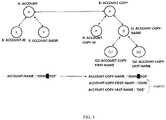
- An example of group expansion in legacy systems with same structure is shown in
FIG. 4 . The figure shows mapping between ACCOUNT and ACCOUNT-COPY. A moving to B is the only explicit relation explained in the example code. But due to the graph mechanism, the indirect relations between X, Y and P, Q are also conveyed due to the closer embeddings. Since Q has 2 children Q1 Q2, the information of Q gets split according to the size - which means Y is not only closer to Q, but also to Q1 and Q2. Any change in Y will affect Q, Q1 and Q2. - The written description describes the subject matter herein to enable any person skilled in the art to make and use the embodiments. The scope of the subject matter embodiments is defined by the claims and may include other modifications that occur to those skilled in the art. Such other modifications are intended to be within the scope of the claims if they have similar elements that do not differ from the literal language of the claims or if they include equivalent elements with insubstantial differences from the literal language of the claims.
- The disclosure herein addresses unresolved problem related to parent-child impact analysis in the Mainframe program application. The process is computationally expensive and becomes further complex when the structure goes deeper. The embodiment thus provides the method and system for machine learning based understanding of a plurality of data elements in a mainframe program code
- It is to be understood that the scope of the protection is extended to such a program and in addition to a computer-readable means having a message therein; such computer-readable storage means contain program-code means for implementation of one or more steps of the method, when the program runs on a server or mobile device or any suitable programmable device. The hardware device can be any kind of device which can be programmed including e.g. any kind of computer like a server or a personal computer, or the like, or any combination thereof. The device may also include means which could be e.g. hardware means like e.g. an application-specific integrated circuit (ASIC), a field-programmable gate array (FPGA), or a combination of hardware and software means, e.g. an ASIC and an FPGA, or at least one microprocessor and at least one memory with software processing components located therein. Thus, the means can include both hardware means and software means. The method embodiments described herein could be implemented in hardware and software. The device may also include software means. Alternatively, the embodiments may be implemented on different hardware devices, e.g. using a plurality of CPUs, GPUs etc.
- The embodiments herein can comprise hardware and software elements. The embodiments that are implemented in software include but are not limited to, firmware, resident software, microcode, etc. The functions performed by various components described herein may be implemented in other components or combinations of other components. For the purposes of this description, a computer-usable or computer readable medium can be any apparatus that can comprise, store, communicate, propagate, or transport the program for use by or in connection with the instruction execution system, apparatus, or device.
- The illustrated steps are set out to explain the exemplary embodiments shown, and it should be anticipated that ongoing technological development will change the manner in which particular functions are performed. These examples are presented herein for purposes of illustration, and not limitation. Further, the boundaries of the functional building blocks have been arbitrarily defined herein for the convenience of the description. Alternative boundaries can be defined so long as the specified functions and relationships thereof are appropriately performed. Alternatives (including equivalents, extensions, variations, deviations, etc., of those described herein) will be apparent to persons skilled in the relevant art(s) based on the teachings contained herein. Such alternatives fall within the scope of the disclosed embodiments. Also, the words "comprising," "having," "containing," and "including," and other similar forms are intended to be equivalent in meaning and be open ended in that an item or items following any one of these words is not meant to be an exhaustive listing of such item or items, or meant to be limited to only the listed item or items. It must also be noted that as used herein and in the appended claims, the singular forms "a," "an," and "the" include plural references unless the context clearly dictates otherwise.
- Furthermore, one or more computer-readable storage media may be utilized in implementing embodiments consistent with the present disclosure. A computer-readable storage medium refers to any type of physical memory on which information or data readable by a processor may be stored. Thus, a computer-readable storage medium may store instructions for execution by one or more processors, including instructions for causing the processor(s) to perform steps or stages consistent with the embodiments described herein. The term "computer-readable medium" should be understood to include tangible items and exclude carrier waves and transient signals, i.e., be non-transitory. Examples include random access memory (RAM), read-only memory (ROM), volatile memory, nonvolatile memory, hard drives, CD ROMs, DVDs, flash drives, disks, and any other known physical storage media.
- It is intended that the disclosure and examples be considered as exemplary only, with a true scope of disclosed embodiments being indicated by the following claims.
Claims (11)
- A processor implemented method (300) for machine learning based understanding of a plurality of data elements in a mainframe program code, the method comprising:receiving, via one or more hardware processors, a set of application programs as input training data for training a graph neural network model, wherein the set of application programs comprises a structure of the plurality of data elements and a plurality of relations between the plurality of data elements (202);parsing, via the one or more hardware processors, the set of application programs using a parser to get a structured data (204);capturing, via the one or more hardware processors, relations based on statements in the input training data by creating a graph, wherein the graph represents a parental graph and an operation graph, wherein the graph comprises parental edges and operation edges (206);learning, via the one or more hardware processors, latent embeddings of each of the plurality of data elements using a message passing technique through the parental graph and the operation graph, wherein the latent embeddings are represented using a single latent vector (208);pretraining, via the one or more hardware processors, the graph neural network model by reconstructing the relation graphs from the single latent vector, wherein the graph neural network model comprises a unique encoder (210);training, via the one or more hardware processors, the graph neural network model for predicting a set of links of the plurality of data elements graphs based on a set of training losses, wherein the set of training losses are obtained from a known database (212);receiving, via the one or more hardware processors, the mainframe program code as an input for understanding structure of the plurality of data elements, wherein the plurality of data elements comprises one or more child variables and parent variables (306);obtaining, via the one or more hardware processors, data element graphs representing structure of the plurality of data elements corresponding to the mainframe program code using a parser (308);converting, via the one or more hardware processors, the data element graphs into a coordinate list (COO) matrix format (310);predicting, via the one or more hardware processors, the set of links for the data element graphs using the trained graph neural network model based on the COO matrix format, wherein the set of links comprises:positive edges if memory mappings between the plurality data elements are intact, andnegative edges if memory mappings between the plurality of data elements are not possible (312);predicting, via the one or more hardware processors, the memory mapping between child variables when two parent variables interact based on the parental graph and operation graph using the set of links (314); andpredicting, via the one or more hardware processors, the memory mapping between parent variables when two child variables interact based on the parental graph and operation graph using the set of links (316).
- The processor implemented method of claim 1, wherein size, and properties of data element structures are captured to create node of data element graphs.
- The processor implemented method of claim 1, wherein the parental graph provides a mapping of parent-child relation of data element structure and the operation graph provides the kind of relation between the parent and child data element structure.
- The processor implemented method as claimed claim 1 further comprising:passing the operation edges based on operation based edges between nodes; andpassing the parental edges based on parental edges between nodes.
- The processor implemented method of claim 1, further comprising utilizing the predicted data element graphs for a plurality of applications comprising code translation, and data element classification.
- A system (100) for machine learning based understanding of a plurality of data elements in a mainframe program code, the system comprises:a user interface (104) for receiving a set of application programs as input training data for training a graph neural network model, wherein the set of application programs comprises a structure of the plurality of data elements and a plurality of relations between the plurality of data elements;one or more hardware processors (108);a memory (110) in communication with the one or more hardware processors, wherein the one or more first hardware processors are configured to execute programmed instructions stored in the one or more first memories, to:parse the set of application programs using a parser to get a structured data;capture relations based on statements in the input training data by creating a graph, wherein the graph represents a parental graph and an operation graph, wherein the graph comprises parental edges and operation edges;learn latent embeddings of each of the plurality of data elements using a message passing technique through the parental graph and the operation graph, wherein the latent embeddings are represented using a single latent vector;pretrain the graph neural network model by reconstructing the relation graphs from the single latent vector, wherein the graph neural network model comprises a unique encoder;train the graph neural network model for predicting a set of links of the plurality of data element graphs based on a set of training losses, wherein the set of training losses are obtained from a known database;receive the mainframe program code as an input for understanding structure of the plurality of data elements, wherein the plurality of data elements comprises one or more child variables and parent variables;obtain data element graphs representing structure of the plurality of data elements corresponding to the mainframe program code using a parser;convert the data element graphs into a coordinate list (COO) matrix format;predict the set of links for the data element graphs using the trained graph neural network model based on the COO matrix format, wherein the set of new links comprises:positive edges if memory mappings between the plurality data elements are intact, andnegative edges if memory mappings between the plurality of data elements are not possible;predict the memory mapping between child variables when two parent variables interact based on the parental graph and operation graph using the set of links; andpredict the memory mapping between parent variables when two child variables interact based on the parental graph and operation graph using the set of links.
- The system of claim 6, wherein size, and properties of data element structures are captured to create node of data element graphs.
- The system of claim 6, wherein the parental graph provides a mapping of parent-child relation of data element structure and the operation graph provides the kind of relation between the parent and child data element structure.
- The system of claim 6 further configured to:pass the operation edges based on operation based edges between nodes; andpass the parental edges based on parental edges between nodes.
- The system of claim 6, further configured to utilize the predicted data element graphs for a plurality of applications comprising code translation, and data element classification.
- One or more non-transitory machine-readable information storage mediums comprising one or more instructions which when executed by one or more hardware processors cause:receiving, a set of application programs as input training data for training a graph neural network model, wherein the set of application programs comprises a structure of the plurality of data elements and a plurality of relations between the plurality of data elements;parsing, via the one or more hardware processors, the set of application programs using a parser to get a structured data;capturing, via the one or more hardware processors, relations based on statements in the input training data by creating a graph, wherein the graph represents a parental graph and an operation graph, wherein the graph comprises parental edges and operation edges;learning, via the one or more hardware processors, latent embeddings of each of the plurality of data elements using a message passing technique through the parental graph and the operation graph, wherein the latent embeddings are represented using a single latent vector;pretraining, via the one or more hardware processors, the graph neural network model by reconstructing the relation graphs from the single latent vector, wherein the graph neural network model comprises a unique encoder;training, via the one or more hardware processors, the graph neural network model for predicting a set of links of the plurality of data elements graphs based on a set of training losses, wherein the set of training losses are obtained from a known database;receiving, via the one or more hardware processors, the mainframe program code as an input for understanding structure of the plurality of data elements, wherein the plurality of data elements comprises one or more child variables and parent variables;obtaining, via the one or more hardware processors, data element graphs representing structure of the plurality of data elements corresponding to the mainframe program code using a parser;converting, via the one or more hardware processors, the data element graphs into a coordinate list (COO) matrix format;predicting, via the one or more hardware processors, the set of links for the data element graphs using the trained graph neural network model based on the COO matrix format, wherein the set of links comprises:positive edges if memory mappings between the plurality data elements are intact, andnegative edges if memory mappings between the plurality of data elements are not possible;predicting, via the one or more hardware processors, the memory mapping between child variables when two parent variables interact based on the parental graph and operation graph using the set of links; andpredicting, via the one or more hardware processors, the memory mapping between parent variables when two child variables interact based on the parental graph and operation graph using the set of links.
Applications Claiming Priority (1)
| Application Number | Priority Date | Filing Date | Title |
|---|---|---|---|
| IN202121021729 | 2021-05-13 |
Publications (3)
| Publication Number | Publication Date |
|---|---|
| EP4089528A1 true EP4089528A1 (en) | 2022-11-16 |
| EP4089528C0 EP4089528C0 (en) | 2025-07-16 |
| EP4089528B1 EP4089528B1 (en) | 2025-07-16 |
Family
ID=81940710
Family Applications (1)
| Application Number | Title | Priority Date | Filing Date |
|---|---|---|---|
| EP22172765.4A Active EP4089528B1 (en) | 2021-05-13 | 2022-05-11 | Method and system for machine learning based understanding of data elements in mainframe program code |
Country Status (2)
| Country | Link |
|---|---|
| US (1) | US12579431B2 (en) |
| EP (1) | EP4089528B1 (en) |
Families Citing this family (1)
| Publication number | Priority date | Publication date | Assignee | Title |
|---|---|---|---|---|
| CN116610919B (en) * | 2023-05-31 | 2025-09-19 | 大连大学 | Space time sequence prediction method based on cyclic graph algorithm sub-neural network |
Citations (1)
| Publication number | Priority date | Publication date | Assignee | Title |
|---|---|---|---|---|
| US20130042221A1 (en) * | 2011-08-12 | 2013-02-14 | Tata Consultancy Services Limited | System and method for automatic impact variable analysis and field expansion in mainframe systems |
Family Cites Families (1)
| Publication number | Priority date | Publication date | Assignee | Title |
|---|---|---|---|---|
| US10162611B2 (en) | 2016-01-04 | 2018-12-25 | Syntel, Inc. | Method and apparatus for business rule extraction |
-
2022
- 2022-05-11 EP EP22172765.4A patent/EP4089528B1/en active Active
- 2022-05-11 US US17/741,612 patent/US12579431B2/en active Active
Patent Citations (1)
| Publication number | Priority date | Publication date | Assignee | Title |
|---|---|---|---|---|
| US20130042221A1 (en) * | 2011-08-12 | 2013-02-14 | Tata Consultancy Services Limited | System and method for automatic impact variable analysis and field expansion in mainframe systems |
Non-Patent Citations (3)
| Title |
|---|
| FAEZ AHMED ET AL: "A Graph Neural Network Approach for Product Relationship Prediction", ARXIV.ORG, CORNELL UNIVERSITY LIBRARY, 201 OLIN LIBRARY CORNELL UNIVERSITY ITHACA, NY 14853, 12 May 2021 (2021-05-12), XP081962766 * |
| KOMAL K TERU ET AL: "Inductive Relation Prediction by Subgraph Reasoning", ARXIV.ORG, CORNELL UNIVERSITY LIBRARY, 201 OLIN LIBRARY CORNELL UNIVERSITY ITHACA, NY 14853, 16 November 2019 (2019-11-16), XP081597607 * |
| MUHAN ZHANG ET AL: "D-VAE: A Variational Autoencoder for Directed Acyclic Graphs", ARXIV.ORG, CORNELL UNIVERSITY LIBRARY, 201 OLIN LIBRARY CORNELL UNIVERSITY ITHACA, NY 14853, 25 April 2019 (2019-04-25), XP081173413 * |
Also Published As
| Publication number | Publication date |
|---|---|
| US12579431B2 (en) | 2026-03-17 |
| US20220405584A1 (en) | 2022-12-22 |
| EP4089528C0 (en) | 2025-07-16 |
| EP4089528B1 (en) | 2025-07-16 |
Similar Documents
| Publication | Publication Date | Title |
|---|---|---|
| EP4113285A1 (en) | Method and system for translation of codes based on semantic similarity | |
| US11907675B2 (en) | Generating training datasets for training neural networks | |
| US12417389B2 (en) | Efficient mixed-precision search for quantizers in artificial neural networks | |
| US20200210511A1 (en) | System and method for a web scraping tool and classification engine | |
| US11281438B2 (en) | Platform for web services development and method therefor | |
| US12346810B2 (en) | Method and system for self supervised training of deep learning based time series models | |
| EP3992838B1 (en) | Method and system for extracting natural language elements embedded in application source code | |
| US11042710B2 (en) | User-friendly explanation production using generative adversarial networks | |
| US11847565B1 (en) | Automatic refinement of intent classification for virtual assistant applications | |
| CN116310667A (en) | A Self-Supervised Visual Representation Learning Approach by Joint Contrastive Loss and Reconstruction Loss | |
| CN115081616A (en) | Data denoising method and related equipment | |
| US12579431B2 (en) | Method and system for machine learning based understanding of data elements in mainframe program code | |
| US20240338599A1 (en) | Adapting a language model for multimodal multi-task learning | |
| US20260025407A1 (en) | Method and system for explaining and filtering cybersecurity alerts | |
| CN113867724A (en) | Method and system for automatically generating GUI (graphical user interface) code, server and medium | |
| US11487533B2 (en) | Method and system for inferencing logic out of an application source | |
| EP3961374B1 (en) | Method and system for automated classification of variables using unsupervised distribution agnostic clustering | |
| US20260067162A1 (en) | Language model transformer for cross-platform configuration and script conversion | |
| EP4303719A1 (en) | Automated generation of web applications based on wireframe metadata generated from user requirements | |
| WO2025181595A1 (en) | Data processing method, text processing method, image processing method, computing device, computer storage medium and computer program product | |
| US12596549B2 (en) | Method and system for acceleration of slower data processing codes in machine learning pipelines | |
| US12020024B2 (en) | Method and system for identifying terms from cryptic forms of variable names in program code | |
| EP4478261A1 (en) | Method and system for explaining cybersecurity alerts | |
| CN113011555B (en) | Data processing method, device, equipment and storage medium | |
| US20230290128A1 (en) | Model training method and apparatus, deidentification method and apparatus, device, and storage medium |
Legal Events
| Date | Code | Title | Description |
|---|---|---|---|
| PUAI | Public reference made under article 153(3) epc to a published international application that has entered the european phase |
Free format text: ORIGINAL CODE: 0009012 |
|
| STAA | Information on the status of an ep patent application or granted ep patent |
Free format text: STATUS: THE APPLICATION HAS BEEN PUBLISHED |
|
| AK | Designated contracting states |
Kind code of ref document: A1 Designated state(s): AL AT BE BG CH CY CZ DE DK EE ES FI FR GB GR HR HU IE IS IT LI LT LU LV MC MK MT NL NO PL PT RO RS SE SI SK SM TR |
|
| STAA | Information on the status of an ep patent application or granted ep patent |
Free format text: STATUS: REQUEST FOR EXAMINATION WAS MADE |
|
| 17P | Request for examination filed |
Effective date: 20221208 |
|
| RBV | Designated contracting states (corrected) |
Designated state(s): AL AT BE BG CH CY CZ DE DK EE ES FI FR GB GR HR HU IE IS IT LI LT LU LV MC MK MT NL NO PL PT RO RS SE SI SK SM TR |
|
| STAA | Information on the status of an ep patent application or granted ep patent |
Free format text: STATUS: EXAMINATION IS IN PROGRESS |
|
| 17Q | First examination report despatched |
Effective date: 20230808 |
|
| REG | Reference to a national code |
Ref country code: DE Ref legal event code: R079 Free format text: PREVIOUS MAIN CLASS: G06F0008410000 Ipc: G06N0003088000 Ref country code: DE Ref legal event code: R079 Ref document number: 602022017537 Country of ref document: DE Free format text: PREVIOUS MAIN CLASS: G06F0008410000 Ipc: G06N0003088000 |
|
| GRAP | Despatch of communication of intention to grant a patent |
Free format text: ORIGINAL CODE: EPIDOSNIGR1 |
|
| STAA | Information on the status of an ep patent application or granted ep patent |
Free format text: STATUS: GRANT OF PATENT IS INTENDED |
|
| RIC1 | Information provided on ipc code assigned before grant |
Ipc: G06F 8/41 20180101ALI20250314BHEP Ipc: G06N 3/0455 20230101ALI20250314BHEP Ipc: G06N 3/042 20230101ALI20250314BHEP Ipc: G06N 3/088 20230101AFI20250314BHEP |
|
| INTG | Intention to grant announced |
Effective date: 20250327 |
|
| GRAS | Grant fee paid |
Free format text: ORIGINAL CODE: EPIDOSNIGR3 |
|
| GRAA | (expected) grant |
Free format text: ORIGINAL CODE: 0009210 |
|
| STAA | Information on the status of an ep patent application or granted ep patent |
Free format text: STATUS: THE PATENT HAS BEEN GRANTED |
|
| AK | Designated contracting states |
Kind code of ref document: B1 Designated state(s): AL AT BE BG CH CY CZ DE DK EE ES FI FR GB GR HR HU IE IS IT LI LT LU LV MC MK MT NL NO PL PT RO RS SE SI SK SM TR |
|
| REG | Reference to a national code |
Ref country code: GB Ref legal event code: FG4D |
|
| REG | Reference to a national code |
Ref country code: CH Ref legal event code: EP |
|
| REG | Reference to a national code |
Ref country code: IE Ref legal event code: FG4D |
|
| U01 | Request for unitary effect filed |
Effective date: 20250716 |
|
| U07 | Unitary effect registered |
Designated state(s): AT BE BG DE DK EE FI FR IT LT LU LV MT NL PT RO SE SI Effective date: 20250722 |
|
| PG25 | Lapsed in a contracting state [announced via postgrant information from national office to epo] |
Ref country code: IS Free format text: LAPSE BECAUSE OF FAILURE TO SUBMIT A TRANSLATION OF THE DESCRIPTION OR TO PAY THE FEE WITHIN THE PRESCRIBED TIME-LIMIT Effective date: 20251116 |
|
| PG25 | Lapsed in a contracting state [announced via postgrant information from national office to epo] |
Ref country code: NO Free format text: LAPSE BECAUSE OF FAILURE TO SUBMIT A TRANSLATION OF THE DESCRIPTION OR TO PAY THE FEE WITHIN THE PRESCRIBED TIME-LIMIT Effective date: 20251016 |
|
| PG25 | Lapsed in a contracting state [announced via postgrant information from national office to epo] |
Ref country code: HR Free format text: LAPSE BECAUSE OF FAILURE TO SUBMIT A TRANSLATION OF THE DESCRIPTION OR TO PAY THE FEE WITHIN THE PRESCRIBED TIME-LIMIT Effective date: 20250716 |
|
| PG25 | Lapsed in a contracting state [announced via postgrant information from national office to epo] |
Ref country code: GR Free format text: LAPSE BECAUSE OF FAILURE TO SUBMIT A TRANSLATION OF THE DESCRIPTION OR TO PAY THE FEE WITHIN THE PRESCRIBED TIME-LIMIT Effective date: 20251017 |
|
| PG25 | Lapsed in a contracting state [announced via postgrant information from national office to epo] |
Ref country code: PL Free format text: LAPSE BECAUSE OF FAILURE TO SUBMIT A TRANSLATION OF THE DESCRIPTION OR TO PAY THE FEE WITHIN THE PRESCRIBED TIME-LIMIT Effective date: 20250716 |
|
| PG25 | Lapsed in a contracting state [announced via postgrant information from national office to epo] |
Ref country code: RS Free format text: LAPSE BECAUSE OF FAILURE TO SUBMIT A TRANSLATION OF THE DESCRIPTION OR TO PAY THE FEE WITHIN THE PRESCRIBED TIME-LIMIT Effective date: 20251016 |
|
| PG25 | Lapsed in a contracting state [announced via postgrant information from national office to epo] |
Ref country code: ES Free format text: LAPSE BECAUSE OF FAILURE TO SUBMIT A TRANSLATION OF THE DESCRIPTION OR TO PAY THE FEE WITHIN THE PRESCRIBED TIME-LIMIT Effective date: 20250716 |
|
| PG25 | Lapsed in a contracting state [announced via postgrant information from national office to epo] |
Ref country code: SM Free format text: LAPSE BECAUSE OF FAILURE TO SUBMIT A TRANSLATION OF THE DESCRIPTION OR TO PAY THE FEE WITHIN THE PRESCRIBED TIME-LIMIT Effective date: 20250716 |
|
| PGFP | Annual fee paid to national office [announced via postgrant information from national office to epo] |
Ref country code: GB Payment date: 20260309 Year of fee payment: 5 |
|
| PG25 | Lapsed in a contracting state [announced via postgrant information from national office to epo] |
Ref country code: CZ Free format text: LAPSE BECAUSE OF FAILURE TO SUBMIT A TRANSLATION OF THE DESCRIPTION OR TO PAY THE FEE WITHIN THE PRESCRIBED TIME-LIMIT Effective date: 20250716 |
|
| PG25 | Lapsed in a contracting state [announced via postgrant information from national office to epo] |
Ref country code: SK Free format text: LAPSE BECAUSE OF FAILURE TO SUBMIT A TRANSLATION OF THE DESCRIPTION OR TO PAY THE FEE WITHIN THE PRESCRIBED TIME-LIMIT Effective date: 20250716 |