EP4086813B1 - Managing aleatoric and epistemic uncertainty in reinforcement learning, with applications to autonomous vehicle control - Google Patents
Managing aleatoric and epistemic uncertainty in reinforcement learning, with applications to autonomous vehicle control Download PDFInfo
- Publication number
- EP4086813B1 EP4086813B1 EP21172327.5A EP21172327A EP4086813B1 EP 4086813 B1 EP4086813 B1 EP 4086813B1 EP 21172327 A EP21172327 A EP 21172327A EP 4086813 B1 EP4086813 B1 EP 4086813B1
- Authority
- EP
- European Patent Office
- Prior art keywords
- state
- action
- uncertainty
- quantile
- agent
- Prior art date
- Legal status (The legal status is an assumption and is not a legal conclusion. Google has not performed a legal analysis and makes no representation as to the accuracy of the status listed.)
- Active
Links
Images



Classifications
-
- G—PHYSICS
- G06—COMPUTING OR CALCULATING; COUNTING
- G06N—COMPUTING ARRANGEMENTS BASED ON SPECIFIC COMPUTATIONAL MODELS
- G06N3/00—Computing arrangements based on biological models
- G06N3/004—Artificial life, i.e. computing arrangements simulating life
- G06N3/006—Artificial life, i.e. computing arrangements simulating life based on simulated virtual individual or collective life forms, e.g. social simulations or particle swarm optimisation [PSO]
-
- B—PERFORMING OPERATIONS; TRANSPORTING
- B60—VEHICLES IN GENERAL
- B60W—CONJOINT CONTROL OF VEHICLE SUB-UNITS OF DIFFERENT TYPE OR DIFFERENT FUNCTION; CONTROL SYSTEMS SPECIALLY ADAPTED FOR HYBRID VEHICLES; ROAD VEHICLE DRIVE CONTROL SYSTEMS FOR PURPOSES NOT RELATED TO THE CONTROL OF A PARTICULAR SUB-UNIT
- B60W60/00—Drive control systems specially adapted for autonomous road vehicles
- B60W60/001—Planning or execution of driving tasks
-
- G—PHYSICS
- G06—COMPUTING OR CALCULATING; COUNTING
- G06F—ELECTRIC DIGITAL DATA PROCESSING
- G06F18/00—Pattern recognition
- G06F18/20—Analysing
- G06F18/21—Design or setup of recognition systems or techniques; Extraction of features in feature space; Blind source separation
- G06F18/214—Generating training patterns; Bootstrap methods, e.g. bagging or boosting
-
- G—PHYSICS
- G06—COMPUTING OR CALCULATING; COUNTING
- G06F—ELECTRIC DIGITAL DATA PROCESSING
- G06F18/00—Pattern recognition
- G06F18/20—Analysing
- G06F18/21—Design or setup of recognition systems or techniques; Extraction of features in feature space; Blind source separation
- G06F18/217—Validation; Performance evaluation; Active pattern learning techniques
-
- G—PHYSICS
- G06—COMPUTING OR CALCULATING; COUNTING
- G06N—COMPUTING ARRANGEMENTS BASED ON SPECIFIC COMPUTATIONAL MODELS
- G06N3/00—Computing arrangements based on biological models
- G06N3/02—Neural networks
- G06N3/04—Architecture, e.g. interconnection topology
-
- G—PHYSICS
- G06—COMPUTING OR CALCULATING; COUNTING
- G06N—COMPUTING ARRANGEMENTS BASED ON SPECIFIC COMPUTATIONAL MODELS
- G06N3/00—Computing arrangements based on biological models
- G06N3/02—Neural networks
- G06N3/04—Architecture, e.g. interconnection topology
- G06N3/0464—Convolutional networks [CNN, ConvNet]
-
- G—PHYSICS
- G06—COMPUTING OR CALCULATING; COUNTING
- G06N—COMPUTING ARRANGEMENTS BASED ON SPECIFIC COMPUTATIONAL MODELS
- G06N3/00—Computing arrangements based on biological models
- G06N3/02—Neural networks
- G06N3/08—Learning methods
-
- G—PHYSICS
- G06—COMPUTING OR CALCULATING; COUNTING
- G06N—COMPUTING ARRANGEMENTS BASED ON SPECIFIC COMPUTATIONAL MODELS
- G06N3/00—Computing arrangements based on biological models
- G06N3/02—Neural networks
- G06N3/08—Learning methods
- G06N3/092—Reinforcement learning
-
- G—PHYSICS
- G06—COMPUTING OR CALCULATING; COUNTING
- G06N—COMPUTING ARRANGEMENTS BASED ON SPECIFIC COMPUTATIONAL MODELS
- G06N7/00—Computing arrangements based on specific mathematical models
- G06N7/01—Probabilistic graphical models, e.g. probabilistic networks
-
- B—PERFORMING OPERATIONS; TRANSPORTING
- B60—VEHICLES IN GENERAL
- B60W—CONJOINT CONTROL OF VEHICLE SUB-UNITS OF DIFFERENT TYPE OR DIFFERENT FUNCTION; CONTROL SYSTEMS SPECIALLY ADAPTED FOR HYBRID VEHICLES; ROAD VEHICLE DRIVE CONTROL SYSTEMS FOR PURPOSES NOT RELATED TO THE CONTROL OF A PARTICULAR SUB-UNIT
- B60W2556/00—Input parameters relating to data
- B60W2556/20—Data confidence level
-
- G—PHYSICS
- G06—COMPUTING OR CALCULATING; COUNTING
- G06N—COMPUTING ARRANGEMENTS BASED ON SPECIFIC COMPUTATIONAL MODELS
- G06N3/00—Computing arrangements based on biological models
- G06N3/02—Neural networks
- G06N3/04—Architecture, e.g. interconnection topology
- G06N3/045—Combinations of networks
Definitions
- the present disclosure relates to the field of autonomous vehicles.
- it describes methods and devices for providing a reinforcement learning agent and for controlling an autonomous vehicle using the reinforcement learning agent.
- the decision-making task for an autonomous vehicle is commonly divided into strategic, tactical, and operational decision-making, also called navigation, guidance and stabilization.
- tactical decisions refer to high-level, often discrete, decisions, such as when to change lanes on a highway, or whether to stop or go at an intersection.
- This invention primarily targets the tactical decision-making field.
- Reinforcement learning is being applied to decision-making for autonomous driving.
- the agents that were trained by RL in early works could only be expected to output rational decisions in situations that were close to the training distribution. Indeed, a fundamental problem with these methods was that no matter what situation the agents were facing, they would always output a decision, with no suggestion or indication about the uncertainty of the decision or whether the agent had experienced anything similar during its training. If, for example, an agent previously trained for one-way highway driving was deployed in a scenario with oncoming traffic, it would still produce decisions, without any warning that these were presumably of a much lower quality.
- a more subtle case of insufficient training is one where the agent has been exposed to a nominal or normal highway driving environment and suddenly faces a speeding driver or an accident that creates standstill traffic.
- the two highway examples illustrate epistemic uncertainty.
- the present inventors have proposed methods for managing this type of uncertainty, see C. J. Hoel, K. Wolff and L. Laine, "Tactical decision-making in autonomous driving by reinforcement learning with uncertainty estimation", IEEE Intel. Veh. Symp. (IV), 2020, pp. 1563-1569 . See also PCT/EP2020/061006 .
- an ensemble of neural networks with additive random prior functions is used to obtain a posterior distribution over the expected return.
- One use of this distribution is to estimate the uncertainty of a decision.
- Another use is to direct further training of an RL agent to the situations in most need thereof.
Landscapes
- Engineering & Computer Science (AREA)
- Theoretical Computer Science (AREA)
- Physics & Mathematics (AREA)
- Data Mining & Analysis (AREA)
- General Physics & Mathematics (AREA)
- Artificial Intelligence (AREA)
- Evolutionary Computation (AREA)
- General Engineering & Computer Science (AREA)
- Life Sciences & Earth Sciences (AREA)
- Software Systems (AREA)
- Mathematical Physics (AREA)
- Computing Systems (AREA)
- Computational Linguistics (AREA)
- Molecular Biology (AREA)
- General Health & Medical Sciences (AREA)
- Health & Medical Sciences (AREA)
- Biophysics (AREA)
- Biomedical Technology (AREA)
- Evolutionary Biology (AREA)
- Computer Vision & Pattern Recognition (AREA)
- Bioinformatics & Computational Biology (AREA)
- Bioinformatics & Cheminformatics (AREA)
- Mathematical Analysis (AREA)
- Human Computer Interaction (AREA)
- Transportation (AREA)
- Mechanical Engineering (AREA)
- Automation & Control Theory (AREA)
- Pure & Applied Mathematics (AREA)
- Mathematical Optimization (AREA)
- Computational Mathematics (AREA)
- Algebra (AREA)
- Probability & Statistics with Applications (AREA)
- Feedback Control In General (AREA)
Description
- The present disclosure relates to the field of autonomous vehicles. In particular, it describes methods and devices for providing a reinforcement learning agent and for controlling an autonomous vehicle using the reinforcement learning agent.
- The decision-making task for an autonomous vehicle is commonly divided into strategic, tactical, and operational decision-making, also called navigation, guidance and stabilization. In short, tactical decisions refer to high-level, often discrete, decisions, such as when to change lanes on a highway, or whether to stop or go at an intersection. This invention primarily targets the tactical decision-making field.
- Reinforcement learning (RL) is being applied to decision-making for autonomous driving. The agents that were trained by RL in early works could only be expected to output rational decisions in situations that were close to the training distribution. Indeed, a fundamental problem with these methods was that no matter what situation the agents were facing, they would always output a decision, with no suggestion or indication about the uncertainty of the decision or whether the agent had experienced anything similar during its training. If, for example, an agent previously trained for one-way highway driving was deployed in a scenario with oncoming traffic, it would still produce decisions, without any warning that these were presumably of a much lower quality. A more subtle case of insufficient training is one where the agent has been exposed to a nominal or normal highway driving environment and suddenly faces a speeding driver or an accident that creates standstill traffic.
- Uncertainty can be classified into the categories aleatoric and epistemic uncertainty, and many decision-making problems require consideration of both. The two highway examples illustrate epistemic uncertainty. The present inventors have proposed methods for managing this type of uncertainty, see C. J. Hoel, K. Wolff and L. Laine, "Tactical decision-making in autonomous driving by reinforcement learning with uncertainty estimation", IEEE Intel. Veh. Symp. (IV), 2020, pp. 1563-1569. See also
PCT/EP2020/061006 - Aleatoric uncertainty, by contrast, refers to the inherent randomness of an outcome and can therefore not be reduced by observing more data. For example, when approaching an occluded intersection, there is an aleatoric uncertainty in whether, or when, another vehicle will enter the intersection. Estimating the aleatoric uncertainty is important since such information can be used to make risk-aware decisions. An approach to estimating the aleatoric uncertainty associated with a single trained neural network is presented in W. R. Clements et al., "Estimating Risk and Uncertainty in Deep Reinforcement Learning", arXiv:1905.09638 [cs.LG]. This paper applies theoretical concepts originally proposed by W. Dabney et al. in "Distributional reinforcement learning with quantile regression", AAAI Conference on Artificial Intelligence, 2018 (preprint arXiv:1707.06887 [cs.LG]) and in "Implicit quantile networks for distributional reinforcement learning", Int. Conf. on Machine Learning, 2018, pp. 1096-1105; see also
WO2019155061A1 . Clements and coauthors represent the aleatoric uncertainty as the variance of the expected value of the quantiles according to the neural network weights θ. - On this background, it would be desirable to enable a complete uncertainty estimate, including both the aleatoric and epistemic uncertainty, for a trained RL agent and its decisions.
- One objective of the present invention is to make available methods and devices for assessing the aleatoric and epistemic uncertainty of outputs of a decision-making agent, such as an RL agent. A particular objective is to provide methods and devices by which the decision-making agent does not just output a recommended decision, but also estimates an aleatoric and epistemic uncertainty of this decision. Such methods and devices may preferably include a safety criterion that determines whether the trained decision-making agent is confident enough about a particular decision, so that - in the negative case - the agent can be overridden by a safety-oriented fallback decision. A further objective of the present invention is to make available methods and devices for assessing, based on aleatoric and epistemic uncertainty, the need for additional training of a decision-making agent, such as an RL agent. A particular objective is to provide methods and devices determining the situations which the additional training of decision-making agent should focus on. Such methods and devices may preferably include a criterion - similar to the safety criterion above - that determines whether the trained decision-making agent is confident enough about a given state-action pair (corresponding to a possible decision) or about a given state, so that - in the negative case - the agent can be given additional training aimed at this situation.
- At least some of these objectives are achieved by the invention as defined by the independent claims. The dependent claims relate to embodiments of the invention.
- In a first aspect of the invention, there is provided a method of controlling an autonomous vehicle, as defined in claim 1. Rather than concatenating the previously known techniques for estimating only aleatoric uncertainty and only epistemic uncertainty straightforwardly, this method utilizes a unified computational framework where both types of uncertainties can be derived from the K state-action quantile functions Zk,τ (s,a) which result from the K training sessions. Each function Zk,τ (s,a) refers to the quantiles of the distribution over returns. The use of a unified framework is likely to eliminate irreconcilable results of the type that could occur if, for example, an IQN-based estimation of the aleatoric uncertainty was run in parallel to an ensemble-based estimation of the epistemic uncertainty. When execution of the tentative decision to perform action â in state ŝ is made dependent on the uncertainty - wherein possible outcomes may be non-execution, execution with additional safety-oriented restrictions, or reliance on a backup policy - a desired safety level can be achieved and maintained.
- Independent protection for an arrangement suitable for performing this method is claimed.
- In a second aspect of the invention, there is provided a method of providing an RL agent for decision-making to be used in controlling an autonomous vehicle, as defined in
claim 2. The second aspect of the invention relies on the same unified computational framework as the first aspect. The utility of this method is based on the realization that epistemic uncertainty (second uncertainty estimation) can be reduced by further training. If the second uncertainty estimation produces a relatively higher value for one or more state-action pairs, then further training may be directed at those state-action pairs. This makes it possible to provide an RL agent with a desired safety level in shorter time. In implementations, the respective outcomes of the first and second uncertainty estimations may not be accessible separately; for example, only the sum
- Independent protection for an arrangement suitable for performing the method of the second aspect is claimed as well.
- It is noted that the first and second aspects have in common that an ensemble of multiple neural networks are used, from which each network learns a state-action quantile function corresponding to a sought optimal policy. It is from the variability within the ensemble and the variability with respect to the quantile that the epistemic and aleatoric uncertainties can be estimated. Without departing from the invention, one may alternatively use a network architecture where a common initial network is divided into K branches with different weights, which then provide K outputs equivalent to the outputs of an ensemble of K neural networks. A still further option is to use one neural network that learns a distribution over weights; after the training phase, the weights are sampled K times.
- The invention further relates to a computer program containing instructions for causing a computer, or an autonomous vehicle control arrangement in particular, to carry out the above methods. The computer program may be stored or distributed on a data carrier. As used herein, a "data carrier" may be a transitory data carrier, such as modulated electromagnetic or optical waves, or a non-transitory data carrier. Non-transitory data carriers include volatile and non-volatile memories, such as permanent and non-permanent storages of the magnetic, optical or solid-state type. Still within the scope of "data carrier", such memories may be fixedly mounted or portable.
- As used herein, an "RL agent" may be understood as software instructions implementing a mapping from a state s to an action a. The term "environment" refers to a simulated or real-world environment, in which the autonomous vehicle - or its model/avatar in the case of a simulated environment - operates. A mathematical model of the RL agent's interaction with an "environment" in this sense is given below. According to the claimed invention, a "variability measure" is a variance, a suitable measure for quantifying statistic dispersion. A "state-action quantile function" refers to the quantiles of the distribution over returns Rt for a policy. Generally, all terms used in the claims are to be interpreted according to their ordinary meaning in the technical field, unless explicitly defined otherwise herein. All references to "a/an/the element, apparatus, component, means, step, etc." are to be interpreted openly as referring to at least one instance of the element, apparatus, component, means, step, etc., unless explicitly stated otherwise. The steps of any method disclosed herein do not have to be performed in the exact order described, unless explicitly stated.
- Aspects and embodiments are now described, by way of example, with reference to the accompanying drawings, on which:
-
figures 1 and 2 are flowcharts of two methods according to embodiments of the invention; -
figures 3 and4 are block diagrams of arrangements for controlling an autonomous vehicle, according to embodiments of the invention; -
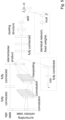
figure 5 is an example neural network architecture of an Ensemble Quantile Network (EQN) algorithm; -
figure 6 is a plot of the percentage of collisions vs crossing time for an EQN algorithm, wherein the threshold σa on the aleatoric threshold is varied; and, - The aspects of the present disclosure will now be described more fully hereinafter with reference to the accompanying drawings, on which certain embodiments of the invention are shown. These aspects may, however, be embodied in many different forms and should not be construed as limiting; rather, these embodiments are provided by way of example so that this disclosure will be thorough and complete, and to fully convey the scope of all aspects of invention to those skilled in the art. Like numbers refer to like elements throughout the description.
- Reinforcement learning (RL) is a branch of machine learning, where an agent interacts with some environment to learn a policy π(s) that maximizes the future expected return. Reference is made to the textbook R. S. Sutton and A. G. Barto, Reinforcement Learning: An Introduction, 2nd ed., MIT Press (2018).
- The policy π(s) defines which action a to take in each state s. When an action is taken, the environment transitions to a new state s' and the agent receives a reward r. The decision-making problem that the RL agent tries to solve can be modeled as a Markov decision process (MDP), which is defined by the tuple (;
 ; T; R; y), where
 is the state space,
 is the action space, T is a state transition model (or evolution operator), R is a reward model, and y is a discount factor. The goal of the RL agent is to maximize expected future return


- In contrast to Q-learning, distributional RL aims to learn not only the expected return but also the distribution over returns. This distribution is represented by the random variable


- The random variable Zπ has a cumulative distribution function Fz
π (z), whose inverse is referred to as quantile function and may be denoted simply as Zτ = (0,1), the sample Zτ (s,a) has the probability distribution of Zπ (s,a), that is, Zτ (s,a)~Zπ (s,a).
- The present invention's approach, termed Ensemble Quantile Networks (EQN) method, enables a full uncertainty estimate covering both the aleatoric and the epistemic uncertainty. An agent that is trained by EQN can then take actions that consider both the inherent uncertainty of the outcome and the model uncertainty in each situation.
- The EQN method uses an ensemble of neural networks, where each ensemble member individually estimates the distribution over returns. This is related to the implicit quantile network (IQN) framework; reference is made to the above-cited works by Dabney and coauthors. The k th ensemble member provides:
 (0,1) is

 (0,1) and Kτ is a positive integer.
- Quantile regression is used. The regression loss, with threshold κ, is calculated as


- An advantageous option is to use quantile Huber regression loss, which is given by


- The full training process of the EQN agent that was used in this implementation may be represented in pseudo-code as follows:In the pseudo-code, the function StepEnvironment corresponds to a combination of the reward model R and state transition model T discussed above. The notation v~
 {1, K} refers to sampling of an integer v from a uniform distribution over the integer range [1, K], and τ~
 (0, α) denotes sampling of a real number from a uniform distribution over the open interval (0, α). SGD is short for stochastic gradient descent and i.i.d. means independent and identically distributed.
- The EQN agent allows an estimation of both the aleatoric and epistemic uncertainties, based on a variability measure of the returns,


- On this basis, the trained agent may be configured to follow the following policy:



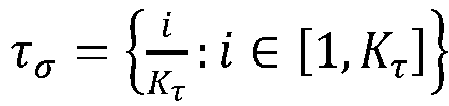
- For computational simplicity, the first part of the confidence condition can be approximated by replacing the quantile variability Varτ with an approximate variability measure Varτ
σ which is based on samples taken for the set τσ of points in the real interval [0,1]. Here, the sampling points in τσ may be uniformly spaced, as defined above, or non-uniformly spaced. Alternatively or additionally, the second part of the confidence condition can be approximated by replacing the expected value

- The presented algorithms for estimating the aleatoric or epistemic uncertainty of an agent have been tested in simulated traffic intersection scenarios. However, these algorithms provide a general approach and could be applied to any type of driving scenarios. This section describes how a test scenario is set up, the MDP formulation of the decision-making problem, the design of the neural network architecture, and the details of the training process.
- Simulation setup. An occluded intersection scenario was used. The scenario includes dense traffic and is used to compare the different algorithms, both qualitatively and quantitatively. The scenario was parameterized to create complicated traffic situations, where an optimal policy has to consider both the occlusions and the intentions of the other vehicles, sometimes drive through the intersection at a high speed, and sometimes wait at the intersection for an extended period of time.
- The Simulation of Urban Mobility (SUMO) was used to run the simulations. The controlled ego vehicle, a 12 m long truck, aims to pass the intersection, within which it must yield to the crossing traffic. In each episode, the ego vehicle is inserted 200 m south from the intersection, and with a desired speed vset = 15 m/s. Passenger cars are randomly inserted into the simulation from the east and west end of the road network with an average flow of 0.5 vehicles per second. The cars intend to either cross the intersection or turn right. The desired speeds of the cars are uniformly distributed in the range [vmin,vmax ) = [10,15] m/s, and the longitudinal speed is controlled by the standard SUMO speed controller (which is a type of adaptive cruise controller, based on the Intelligent Driver Model (IDM)) with the exception that the cars ignore the presence of the ego vehicle. Normally, the crossing cars would brake to avoid a collision with the ego vehicle, even when the ego vehicle violates the traffic rules and does not yield. With this exception, however, more collisions occur, which gives a more distinct quantitative difference between different policies. Each episode is terminated when the ego vehicle has passed the intersection, when a collision occurs, or after Nmax = 100 simulation steps. The simulations use a step size of Δt = 1 s.
- It is noted that the setup of this scenario includes two important sources of randomness in the outcome for a given policy, which the aleatoric uncertainty estimation should capture. From the viewpoint of the ego vehicle, a crossing vehicle can appear at any time until the ego vehicle is sufficiently close to the intersection, due to the occlusions. Furthermore, there is uncertainty in the underlying driver state of the other vehicles, most importantly in the intention of going straight or turning to the right, but also in the desired speed.
- Epistemic uncertainty is introduced by a separate test, in which the trained agent faces situations outside of the training distribution. In these test episodes, the maximum speed vmax of the surrounding vehicles are gradually increased from 15 m/s (which is included in the training episodes) to 25 m/s. To exclude effects of aleatoric uncertainty in this test, the ego vehicle starts in the non-occluded region close to the intersection, with a speed of 7 m/s.
- MDP formulation. The following Markov decision process (MDP) describes the decision-making problem.
- State space,: The state of the system,


- Action space,: At every time step, the agent can choose between three high-level actions: 'stop', 'cruise', and 'go', which are translated into accelerations through the IDM. The action 'go' makes the IDM control the speed towards vset by treating the situation as if there are no preceding vehicles, whereas 'cruise' simply keeps the current speed. The action 'stop' places an imaginary target vehicle just before the intersection, which causes the IDM to slow down and stop at the stop line. If the ego vehicle has already passed the stop line, 'stop' is interpreted as maximum braking. Finally, the output of the IDM is limited to [amin , amax ] = [-3, 1] m/s2. The agent takes a new decision at every time step Δt and can therefore switch between, e.g., 'stop' and 'go' multiple times during an episode.

- Reward model, R: The objective of the agent is to drive through the intersection in a time efficient way, without colliding with other vehicles. A simple reward model is used to achieve this objective. The agent receives a positive reward rgoal = 10 when the ego vehicle manages to cross the intersection and a negative reward rcol = -10 if a collision occurs. If the ego vehicle gets closer to another vehicle than 2.5 m longitudinally or 1 m laterally, a negative reward rnear = -10 is given, but the episode is not terminated. At all other time steps, the agent receives a zero reward.
- Transition model, T: The state transition probabilities are not known by the agent. They are implicitly defined by the simulation model described above.
- Backup policy. A simple backup policy πbackup (s) is used together with the uncertainty criteria. This policy selects the action 'stop' if the vehicle is able to stop before the intersection, considering the braking limit amin . Otherwise, the backup policy selects the action that is recommended by the agent. If the backup policy always consisted of 'stop', the ego vehicle could end up standing still in the intersection and thereby cause more collisions. Naturally, more advanced backup policies would be considered in a real-world implementation.
- Neural network architecture.
Figure 5 shows the neural network architecture that is used in this example implementation. The size and stride of the first convolutional layers are set to four, which is equal to the number of states that describe each surrounding vehicle, whereas the second convolutional layer has a size and stride of one. Both convolutional layers have 256 filters each, and all fully connected layers have 256 units. Finally, a dueling structure, which separates the estimation of the value of a state and the advantage of an action, outputs Zτ (s, a). All layers use rectified linear units (ReLUs) as activation functions, except for the dueling structure which has a linear activation function. Before the state s is fed to the network, each entry is normalized to the range [-1,1]. - At the low left part of the network, an input for the sample quantile τ is seen. An embedding from τ is created by setting ϕ(τ) = (ϕ 1(τ), ... , ϕ 64(τ)), where ϕj (τ) = cos πjτ, and then passing ϕ(τ) through a fully connected layer with 512 units. The output of the embedding is then merged with the output of the concatenating layer as the element-wise (or Hadamard) product.
- At the right side of the network in
figure 5 , the additive combination of the variable-weight and fixed-weight (RPF) contributions, after the latter have been scaled by β, of course corresponds to the linear combination fτ (s, a; θk ) + βpτ (s, a; θ̂k ) which appeared in the previous section. - Training process. Algorithm 3 was used to train the EQN agent. As mentioned above, an episode is terminated due to a timeout after maximally Nmax steps, since otherwise the current policy could make the ego vehicle stop at the intersection indefinitely. However, since the time is not part of the state space, a timeout terminating state is not described by the MDP. Therefore, in order to make the agents act as if the episodes have no time limit, the last experience of a timeout episode is not added to the experience replay buffer. Values of the hyperparameters used for the training are shown in Table 1.
Table 1: Hyperparameters Number of quantile samples N, N', Kτ 32 Number of ensemble members K 10 Prior scale factor β 300 Experience adding probability padd 0.5 Discount factor γ 0.95 Learning start iteration Nstart 50,000 Replay memory size Nreplay 500,000 Learning rate η 0.0005 Mini-batch size |M| 32 Target network update frequency Nupdate 20,000 Huber loss threshold κ 10 Initial exploration parameter ε 0 1 Final exploration parameter ε 1 0.05 Final exploration iteration Nε 500,000 - The training was performed for 3,000,000 training steps, at which point the agents' policies have converged, and then the trained agents are tested on 1,000 test episodes. The test episodes are generated in the same way as the training episodes, but they are not present during the training phase.
- Results. The performance of the EQN agent has been evaluated within the training distribution, results of being presented in Table 2.
Table 2: Dense traffic scenario, tested within training distribution thresholds collisions (%) crossing time (s) EQN with K = 10 and β = 300 σa = ∞ 0.9 ± 0.1 32.0 ± 0.2 σa = 3.0 0.6 ± 0.2 33.8 ± 0.3 σa = 2.0 0.5 ± 0.1 38.4 ± 0.5 σa = 1.5 0.3 ± 0.1 47.2 ± 1.2 σα = 1.0 0.0 ± 0.0 71.1 ± 1.9 σa = 1.5, 0.0 ± 0.0 48.9 ± 1.6 σe = 1.0 figure 6 . Thereby, the trade-off between risk and time efficiency, here illustrated by number of collisions and crossing time, can be controlled by tuning the value of σa . - The performance of the epistemic uncertainty estimation of the EQN agent is illustrated in
figures 7-8 , where the speed of the surrounding vehicles is increased. A sufficiently strict epistemic uncertainty criterion, i.e., sufficiently low value of the parameter σe , prevents the number of collisions to increase when the speed of the surrounding vehicles grows. The result at 15 m/s also indicates that the number of collisions within the training distribution is somewhat reduced when the epistemic uncertainty condition is applied. Interestingly, when combining moderate aleatoric and epistemic uncertainty criteria, by setting σa = 1.5 and σe = 1.0, all the collisions within the training distribution are removed, see Table 2. These results show that it is useful to consider the epistemic uncertainty even within the training distribution, where the detection of uncertain situations can prevent collisions in rare edge cases. - The results demonstrate that the EQN agent combines the advantages of the individual components and provides a full uncertainty estimate, including both the aleatoric and epistemic dimensions. The aleatoric uncertainty estimate given by the EQN algorithm can be used to balance risk and time efficiency, by applying the aleatoric uncertainty criterion (varying the allowed variance

figure 6 ). An important advantage of the uncertainty criterion approach is that its parameter σa , can be tuned after the training process has been completed. An alternative to estimating the distribution over returns and still consider aleatoric risk in the decision-making is to adapt the reward function. Risk-sensitivity could be achieved by, for example, increasing the size of the negative reward for collisions. However, rewards with different orders of magnitude create numerical problems, which can disrupt the training process. Furthermore, for a complex reward function, it would be non-trivial to balance the different components to achieve the desired result. - The epistemic uncertainty information provides insight into how far a situation is from the training distribution. In this disclosure, the usefulness of an epistemic uncertainty estimate is demonstrated by increasing the safety, through classifying the agent's decisions in situations far from the training distribution as unsafe and then instead applying a backup policy. Whether it is possible to formally guarantee safety with a learning-based method is an open question, and likely an underlying safety layer is required in a real-world application. The EQN agent can reduce the activation frequency of such a safety layer, but possibly even more importantly, the epistemic uncertainty information could be used to guide the training process to regions of the state space in which the current agent requires more training. Furthermore, if an agent is trained in a simulated world and then deployed in the real world, the epistemic uncertainty information can identify situations with high uncertainty, which should be added to the simulated world.
- The algorithms that were introduced in the present disclosure include a few hyperparameters, whose values need to be set appropriately. The aleatoric and epistemic uncertainty criteria parameters, σa and σe , can both be tuned after the training is completed and allow a trade-off between risk and time efficiency, see
figures 6-8 . Note that both these parameters determine the allowed spread in returns, between quantiles or ensemble members, which means that the size of these parameters are closely connected to the magnitude of the reward function. In order to detect situations with high epistemic uncertainty, a sufficiently large spread between the ensemble members is required, which is controlled by the scaling factor β and the number of ensemble members K. The choice of β scales with the magnitude of the reward function. A too small parameter value creates a small spread, which makes it difficult to classify situations outside the training distribution as uncertain. On the other hand, a too large value of β makes it difficult for the trainable network to adapt to the fixed prior network. Furthermore, while an increased number of ensemble members K certainly improves the accuracy of the epistemic uncertainty estimate, it also induces a higher computational cost. - After summarizing the theoretical concepts underlying the invention and empirical results confirming their effects, specific embodiments of the present invention will now be described.
-
Figure 1 is a flowchart of amethod 100 of controlling an autonomous vehicle using an RL agent. - The
method 100 may be implemented by anarrangement 300 of the type illustrated infigure 3 , which is adapted for controlling anautonomous vehicle 299. Theautonomous vehicle 299 may be any road vehicle or vehicle combination, including trucks, buses, construction equipment, mining equipment and other heavy equipment operating in public or non-public traffic. Thearrangement 300 may be provided, at last partially, in theautonomous vehicle 299. Thearrangement 300, or portions thereof, may alternatively be provided as part of a stationary or mobile controller (not shown), which communicates with thevehicle 299 wirelessly. Thearrangement 300 includesprocessing circuitry 310, amemory 312 and avehicle control interface 314. Thevehicle control interface 314 is configured to control theautonomous vehicle 299 by transmitting wired or wireless signals, directly or via intermediary components, to actuators (not shown) in the vehicle. In a similar fashion, thevehicle control interface 314 may receive signals from physical sensors (not shown) in the vehicle so as to detect current conditions of the driving environment or internal states prevailing in thevehicle 299. Theprocessing circuitry 310 implements anRL agent 320 and twouncertainty estimators vehicle control interface 314 which is configured to control theautonomous vehicle 299 by executing the at least one tentative decision in dependence of the estimated first and/or second uncertainties, as will be understood from the following description of themethod 100. - The
method 100 begins with a plurality of training sessions 110-1, 110-2, ..., 110-K (K ≥ 2), which may preferably be carried out in a simultaneous or at least time-overlapping fashion. In particular, each of the K training sessions may use a different neural network initiated with an independently sampled set of weights (initial value), see Algorithm 3. Each neural network may implicitly estimate a quantile of the return distribution. In a training session, the RL agent interacts with an environment which includes the autonomous vehicle (or, if the environment is simulated, a model of the vehicle). The environment may further include the surrounding traffic (or a model thereof). The k th training session returns a state-action quantile function Zk,τ(s, a) =
- A next step of the
method 100 includes decision-making 112, in which the RL agent outputs at least one tentative decision (ŝ, âl ), 1 ≤ l ≤ L with L ≥ 1, relating to control of the autonomous vehicle. The decision-making may be based on a central tendency of the K neural networks, such as the mean of the state-action value functions:
- There follows a first
uncertainty estimation step 114, which is carried out on the basis of a variability measure


- The
method 100 further comprises a seconduncertainty estimation step 116 on the basis of a variability measure


- The method then continues to
vehicle control 118, wherein the at least one tentative decision (ŝ, âl ) is executed in dependence of the first and/or second estimated uncertainties. For example, step 118 may apply a rule by which the decision (ŝ, âl ) is executed only if the condition

- While the
method 100 in the embodiment described hitherto may be said to quantize the estimated uncertainty into a binary variable - it passes or fails the uncertainty criterion - other embodiments may treat the estimated uncertainty as a continuous variable. The continuous variable may indicate how much additional safety measures need to be applied to achieve a desired safety standard. For example, a moderately elevated uncertainty may trigger the enforcement of a maximum speed limit or maximum traffic density limit, or else the tentative decision shall not be considered safe to execute. - In one embodiment, where the decision-making
step 112 produces multiple tentative decisions by the RL agent (L ≥ 2), the tentative decisions are ordered in some sequence and evaluated with respect to their estimated uncertainties. The method may apply a rule that the first tentative decision in the sequence which is found to have an estimated uncertainty below the predefined threshold shall be executed. While this may imply that a tentative decision which is located late in the sequence is not executed even though its estimated uncertainty is below the predefined threshold, this remains one of several possible ways in which the tentative decisions can be "executed in dependence of" the estimated uncertainties in the sense of the claims. An advantage with this embodiment is that an executable tentative decision is found without having to evaluate all available tentative decision with respect to uncertainty. - In a further development of the preceding embodiment, a backup (or fallback) decision is executed if the sequential evaluation does not return a tentative decision to be executed. For example, if the last tentative decision in the sequence is found to have too large uncertainty, the backup decision is executed. The backup decision may be safety-oriented, which benefits road safety. At least in tactical decision-making, the backup decision may include taking no action. To illustrate, if all tentative decisions achieving an overtaking of a slow vehicle ahead are found to be too uncertain, the backup decision may be to not overtake the slow vehicle. The backup decision may be derived from a predefined backup policy πbackup , e.g., by evaluating the backup policy for the state ŝ.
-
Figure 2 is a flowchart of amethod 200 for providing an RL agent for decision-making to be used in controlling an autonomous vehicle. Conceptually, an intermediate goal of themethod 200 is to determine a training setof those states for which the RL agent will benefit most from additional training:
= {s ∈ : RL agent not confident for some a ∈
 | s }, where
 | s is the set of possible actions in state s and the property "confident" was defined above. The thresholds σa ,σe appearing in the definition of "confident" represent a desired safety level at which the autonomous vehicle is to be operated. The thresholds may have been determined or calibrated by traffic testing and may be based on the frequency of decisions deemed erroneous, of collisions, near-collisions, road departures and the like. A possible alternative is to set the thresholds σa ,σ e dynamically, e.g., in such manner that a predefined percentage of the state-action pairs will have an increased exposure during the additional training.
- The
method 200 may be implemented by anarrangement 400 of the type illustrated infigure 4 , which is adapted for controlling anautonomous vehicle 299. General reference is made to the above description of thearrangement 300 shown infigure 3 , which is similar in many respect to thearrangement 400 infigure 4 . Theprocessing circuitry 410 of thearrangement 400 implements anRL agent 420, atraining manager 422 and at least two environments E1, E2, where the second environment E2 provides more intense exposure to the training set. The
training manager 422 is configured, inter alia, to perform the first and second uncertainty estimations described above. - The
method 200 begins with a plurality of training sessions 210-1, 210-2, ..., 210-K (K ≥ 2), which may preferably be carried out in a simultaneous or at least time-overlapping fashion. In particular, each of the K training sessions may use a different neural network initiated with an independently sampled set of weights (initial value), see Algorithm 3. Each neural network may implicitly estimate a quantile of the return distribution. In a training session, the RL agent interacts with an environment E1 which includes the autonomous vehicle (or, if the environment is simulated, a model of the vehicle). The environment may further include the surrounding traffic (or a model thereof). The k th training session returns a state-action quantile function
- To determine the need for additional training, the disclosed
method 200 includes a first 214 and a second 216 uncertainty evaluation of at least some of the RL agent's possible decisions, which can be represented as state-action pairs (s, a). One option is to perform a full uncertainty evaluation including also state-action pairs with a relatively low incidence in real traffic. Thefirst uncertainty evaluation 214 includes computing the variability measure
step 114 ofmethod 100 above. Thesecond uncertainty evaluation 216 includes computing the variability measure
method 100. - The
method 200 then concludes with anadditional training stage 218, in which the RL agent interacts with a second environment E2 including the autonomous vehicle, wherein the second environment differs from the first environment E1 by an increased exposure to.
- In some embodiments, the
uncertainty evaluations traffic sampling step 212 is be performed prior to theuncertainty evaluations traffic sampling 212, the state-action pairs that are encountered in the traffic are recorded as a set. Then, an approximate training set =
= ∩
∩ may be generated by evaluating the uncertainties only for the elements of
 . The approximate training set
 then replaces
 in the
additional training stage 218. To illustrate, Table 3 shows an uncertainty evaluation for the elements in an examplecontaining fifteen elements, where l is a sequence number.
Table 3: Example uncertainty evaluations l (sl, al ) 

1 (S1, right) 1.1 0.3 2 (S1, remain) 1.5 0.2 3 (S1, left) 44 2.2 4 (S2, yes) 0.5 0.0 5 (S2, no) 0.6 0.1 6 (S3, A71) 10.1 0.9 7 (S3, A72) 1.7 0.3 8 (S3, A73) 2.6 0.4 9 (S3, A74) 3.4 0.0 10 (S3, A75) 1.5 0.3 11 (S3, A76) 12.5 0.7 12 (S3, A77) 3.3 0.2 13 (S4, stop) 1.7 0.1 14 (S4, cruise) 0.2 0.0 15 (S4, go) 0.9 0.2 | S1 = {right, remain, left},| S2 = {yes, no},| S3 = {A71, A72, A73, A74, A75, A76, A77} and| S4 = {stop, cruise, go}. If the enumeration is not exhaustive, then {right, remain, left} ⊂| S1, {yes, no} ⊂| S2 and so forth. For an example value of the threshold
threshold  is defined as all states for which at least one action belongs to a state-action pair with an epistemic uncertainty exceeding the threshold, one obtains= {S1}. Alternatively, if the training set is all states for which at least one action belongs to a state-action pair with an aleatoric and/or epistemic uncertainty exceeding the threshold, then= {S1, S3}. This will be the emphasis of the
additional training 218. - In still other embodiments of the
method 200, the training setmay be taken to include all states s ∈for which the mean epistemic variability of the possible actions| s exceeds thethreshold  may be taken to include all states s ∈for which the mean sum of aleatoric and epistemic variability of the possible actions| s exceeds the sum of the thresholds
- The aspects of the present disclosure have mainly been described above with reference to a few embodiments. However, as is readily appreciated by a person skilled in the art, other embodiments than the ones disclosed above are equally possible within the scope of the invention, as defined by the appended patent claims.
Claims (13)
- A computer-implemented method (100) of controlling actuators in an autonomous vehicle using a reinforcement learning, RL, agent, the method comprising:a plurality of training sessions (110-1, ..., 110-K), in which the RL agent interacts with a simulated or real-world environment including the autonomous vehicle, each training session having a different initial value and yielding a state-action quantile function
 decision-making (112), in which the RL agent outputs, for a state which describes the surrounding vehicles in a driving environment of the autonomous vehicle, at least one tentative tactical driving decision, such as a lane change or whether to stop or go at an intersection, relating to control of the autonomous vehicle in the real world, wherein the tentative tactical driving decision is derived from the plurality of state-action quantile functions from the training sessions;a first uncertainty estimation (114) on the basis of a variance
 a second uncertainty estimation (116) on the basis of a variance
 vehicle control (118), wherein the at least one tentative tactical driving decision is executed in the real world by transmitting wired or wireless signals to the actuators in the vehicle and in dependence of the first and/or second estimated uncertainty.
 - A computer-implemented method (200) of providing a reinforcement learning, RL, agent for tactical driving decision-making to be used in controlling actuators of an autonomous vehicle in the real world, the method comprising:a plurality of training sessions (210-1, ..., 210-K), in which the RL agent interacts with a first simulated or real-world environment including the autonomous vehicle, each training session having a different initial value and yielding a state-action quantile function
 a first uncertainty estimation (214) on the basis of a variance
 a second uncertainty estimation (216) on the basis of a variance
 additional training (218), in which the RL agent interacts with a second simulated or real-world environment including the autonomous vehicle, wherein the second environment differs from the first environment by an increased exposure to a subset of state-action pairs for which the first and/or second estimated uncertainty is relatively higher.
 - The method of claim 1 or 2, wherein the RL agent includes at least one neural network.
- The method of any of the preceding claims, wherein each of the training sessions employs an implicit quantile network, IQN, from which the RL agent is derivable.
- The method of claim 4, wherein the initial value of a training session corresponds to a randomized prior function, RPF.
- The method of any of the preceding claims, wherein the uncertainty estimations relate to a combined aleatoric and epistemic uncertainty.
- The method of any of the preceding claims, wherein the variability measure used in the second uncertainty estimation is applied to sampled expected values

- The method of any of claims 1 and 3-7, wherein the tentative tactical driving decision is executed only if the first and second estimated uncertainties are less than respective predefined thresholds.
- The method of claim 8, wherein:the decision-making includes the RL agent outputting multiple tentative tactical driving decisions; andthe vehicle control includes sequential evaluation of the tentative tactical driving decisions with respect to their estimated uncertainties.
- The method of claim 9, wherein a backup decision, which is optionally based on a backup policy, is executed if the sequential evaluation does not return a tentative tactical driving decision to be executed.
- The method of any of claims 1 and 3-10, wherein the decision-making is based on a central tendency of weighted averages of the respective state-action quantile functions,

- An arrangement (300) for controlling actuators in an autonomous vehicle (299), comprising:processing circuitry (310) and memory (312) implementing a reinforcement learning, RL, agent (320) configured to- interact with a simulated or real-world environment including the autonomous vehicle in a plurality of training sessions, each training session having a different initial value and yielding a state-action quantile function Z k,τ (s, a) =
 - output, for a state which describes the surrounding vehicles in a driving environment of the autonomous vehicle, at least one tentative tactical driving decision, such as a lane change or whether to stop or go at an intersection, relating to control of the autonomous vehicle in the real world, wherein the tentative tactical driving decision is derived from the plurality of state-action quantile functions from the training sessions,the processing circuitry and memory further implementing a first uncertainty estimator (322) and a second uncertainty estimator (324) configured for- a first uncertainty estimation on the basis of a variance
 - a second uncertainty estimation on the basis of a variance
 the arrangement further comprising a vehicle control interface (314) configured to control the autonomous vehicle by executing the at least one tentative tactical driving decision in the real world by transmitting wired or wireless signals to the actuators in the vehicle and in dependence of the estimated first and/or second uncertainty.
 - An arrangement (400) for controlling actuators in an autonomous vehicle (299), comprising:processing circuitry (410) and memory (412) implementing a reinforcement learning, RL, agent (420) configured to interact with a simulated or real-world first environment including the autonomous vehicle in a plurality of training sessions, each training session having a different initial value and yielding a state-action quantile function
 the processing circuitry and memory further implementing a training manager (422) configured to- perform a first uncertainty estimation on the basis of a variance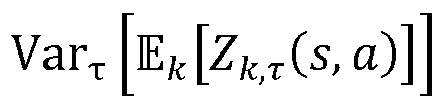
 - perform a second uncertainty estimation on the basis of a variance
 - initiate additional training, in which the RL agent interacts with a second simulated or real-world environment including the autonomous vehicle, wherein the second environment differs from the first environment by an increased exposure to a subset of state-action pairs for which the first and/or second estimated uncertainty is relatively higher.
Priority Applications (3)
| Application Number | Priority Date | Filing Date | Title |
|---|---|---|---|
| EP21172327.5A EP4086813B1 (en) | 2021-05-05 | 2021-05-05 | Managing aleatoric and epistemic uncertainty in reinforcement learning, with applications to autonomous vehicle control |
| US17/660,512 US20220374705A1 (en) | 2021-05-05 | 2022-04-25 | Managing aleatoric and epistemic uncertainty in reinforcement learning, with applications to autonomous vehicle control |
| CN202210451347.2A CN115392429A (en) | 2021-05-05 | 2022-04-27 | Method and apparatus for providing reinforcement learning agent and controlling autonomous vehicle using the same |
Applications Claiming Priority (1)
| Application Number | Priority Date | Filing Date | Title |
|---|---|---|---|
| EP21172327.5A EP4086813B1 (en) | 2021-05-05 | 2021-05-05 | Managing aleatoric and epistemic uncertainty in reinforcement learning, with applications to autonomous vehicle control |
Publications (2)
| Publication Number | Publication Date |
|---|---|
| EP4086813A1 EP4086813A1 (en) | 2022-11-09 |
| EP4086813B1 true EP4086813B1 (en) | 2025-07-02 |
Family
ID=75825565
Family Applications (1)
| Application Number | Title | Priority Date | Filing Date |
|---|---|---|---|
| EP21172327.5A Active EP4086813B1 (en) | 2021-05-05 | 2021-05-05 | Managing aleatoric and epistemic uncertainty in reinforcement learning, with applications to autonomous vehicle control |
Country Status (3)
| Country | Link |
|---|---|
| US (1) | US20220374705A1 (en) |
| EP (1) | EP4086813B1 (en) |
| CN (1) | CN115392429A (en) |
Families Citing this family (5)
| Publication number | Priority date | Publication date | Assignee | Title |
|---|---|---|---|---|
| US11887193B2 (en) * | 2021-12-09 | 2024-01-30 | International Business Machines Corporation | Risk adaptive asset management |
| CN117208019B (en) * | 2023-11-08 | 2024-04-05 | 北京理工大学前沿技术研究院 | Longitudinal decision method and system under perceived occlusion based on value distribution reinforcement learning |
| CN118238849B (en) * | 2024-05-21 | 2024-09-10 | 吉林大学 | A highway driving decision-making method based on multi-level safety regulation strategy optimization |
| CN118313484B (en) * | 2024-05-24 | 2024-08-06 | 中国科学技术大学 | Model-based offline-to-online reinforcement learning method in automatic driving |
| CN118306427B (en) * | 2024-06-05 | 2024-08-23 | 广汽埃安新能源汽车股份有限公司 | Automatic driving decision method, device, electronic equipment and storage medium |
Family Cites Families (12)
| Publication number | Priority date | Publication date | Assignee | Title |
|---|---|---|---|---|
| US9679258B2 (en) * | 2013-10-08 | 2017-06-13 | Google Inc. | Methods and apparatus for reinforcement learning |
| EP3231682B1 (en) * | 2016-04-15 | 2018-12-26 | Volvo Car Corporation | Handover notification arrangement, a vehicle and a method of providing a handover notification |
| EP3701432B1 (en) * | 2018-02-09 | 2025-04-02 | DeepMind Technologies Limited | Distributional reinforcement learning using quantile function neural networks |
| US10732639B2 (en) * | 2018-03-08 | 2020-08-04 | GM Global Technology Operations LLC | Method and apparatus for automatically generated curriculum sequence based reinforcement learning for autonomous vehicles |
| WO2020121494A1 (en) * | 2018-12-13 | 2020-06-18 | 日本電気株式会社 | Arithmetic device, action determination method, and non-transitory computer-readable medium storing control program |
| US20200372410A1 (en) * | 2019-05-23 | 2020-11-26 | Uber Technologies, Inc. | Model based reinforcement learning based on generalized hidden parameter markov decision processes |
| US20210073912A1 (en) * | 2019-09-05 | 2021-03-11 | Royal Bank Of Canada | System and method for uncertainty-based advice for deep reinforcement learning agents |
| KR102303126B1 (en) * | 2019-10-24 | 2021-09-17 | 네이버 주식회사 | Method and system for optimizing reinforcement learning based navigation to human preference |
| US11586854B2 (en) * | 2020-03-26 | 2023-02-21 | Intel Corporation | Devices and methods for accurately identifying objects in a vehicle's environment |
| EP4162339B1 (en) * | 2020-06-05 | 2025-07-02 | Gatik AI Inc. | Method and system for data-driven and modular decision making and trajectory generation of an autonomous agent |
| US11958529B2 (en) * | 2020-08-20 | 2024-04-16 | Nvidia Corporation | Controlling position of robot by determining goal proposals by using neural networks |
| CN112418237A (en) * | 2020-12-07 | 2021-02-26 | 苏州挚途科技有限公司 | Vehicle driving decision method and device and electronic equipment |
-
2021
- 2021-05-05 EP EP21172327.5A patent/EP4086813B1/en active Active
-
2022
- 2022-04-25 US US17/660,512 patent/US20220374705A1/en active Pending
- 2022-04-27 CN CN202210451347.2A patent/CN115392429A/en active Pending
Also Published As
| Publication number | Publication date |
|---|---|
| US20220374705A1 (en) | 2022-11-24 |
| CN115392429A (en) | 2022-11-25 |
| EP4086813A1 (en) | 2022-11-09 |
Similar Documents
| Publication | Publication Date | Title |
|---|---|---|
| EP4086813B1 (en) | Managing aleatoric and epistemic uncertainty in reinforcement learning, with applications to autonomous vehicle control | |
| Hoel et al. | Ensemble quantile networks: Uncertainty-aware reinforcement learning with applications in autonomous driving | |
| Watts et al. | A dynamic deep reinforcement learning-Bayesian framework for anomaly detection | |
| Mirchevska et al. | High-level decision making for safe and reasonable autonomous lane changing using reinforcement learning | |
| CN115578876B (en) | An autonomous driving method, system, device, and storage medium for a vehicle. | |
| Koschi et al. | Computationally efficient safety falsification of adaptive cruise control systems | |
| EP4139845B1 (en) | Uncertainty-directed training of a reinforcement learning agent for tactical decision-making | |
| CN118238847B (en) | Autonomous lane change decision planning method and system adaptive to different driving styles and road surface environments | |
| Li et al. | Detecting stealthy cyberattacks on automated vehicles via generative adversarial networks | |
| Pierson et al. | Learning risk level set parameters from data sets for safer driving | |
| EP4139844B1 (en) | Tactical decision-making through reinforcement learning with uncertainty estimation | |
| Luo et al. | Interactive planning for autonomous urban driving in adversarial scenarios | |
| CN120440073A (en) | Driving decision-making method and system based on driving behavior tendency of surrounding vehicles | |
| Bang et al. | Safe merging in mixed traffic with confidence | |
| CA3190157A1 (en) | Method for providing a machine-learned control function for vehicle control on the basis of provided vehicle sensor data | |
| Kherroubi et al. | Review of driver behaviour modelling for highway on‐ramp merging | |
| Ran et al. | A car-following model integrating personalized driving style based on the DER-DDPG deep reinforcement learning algorithm | |
| Yang et al. | Decision-making in autonomous driving by reinforcement learning combined with planning & control | |
| CN114616157A (en) | Method and system for checking automated driving functions by reinforcement learning | |
| US20230195977A1 (en) | Method and system for classifying scenarios of a virtual test, and training method | |
| EP3654246A1 (en) | Method, vehicle, system, and storage medium for indicating anomalous vehicle scenario using encoder network and replay buffer | |
| Syama et al. | Context-aware behaviour prediction for autonomous driving: a deep learning approach | |
| Rodaro et al. | A multi-lane traffic simulation model via continuous cellular automata | |
| Wang et al. | Benchmarking lane-changing decision-making for deep reinforcement learning | |
| Patil | Prediction of driving outcomes based on driver behaviour and roadway information |
Legal Events
| Date | Code | Title | Description |
|---|---|---|---|
| PUAI | Public reference made under article 153(3) epc to a published international application that has entered the european phase |
Free format text: ORIGINAL CODE: 0009012 |
|
| STAA | Information on the status of an ep patent application or granted ep patent |
Free format text: STATUS: REQUEST FOR EXAMINATION WAS MADE |
|
| 17P | Request for examination filed |
Effective date: 20220224 |
|
| AK | Designated contracting states |
Kind code of ref document: A1 Designated state(s): AL AT BE BG CH CY CZ DE DK EE ES FI FR GB GR HR HU IE IS IT LI LT LU LV MC MK MT NL NO PL PT RO RS SE SI SK SM TR |
|
| REG | Reference to a national code |
Ref country code: DE Ref legal event code: R079 Free format text: PREVIOUS MAIN CLASS: G06N0003000000 Ipc: G06N0003006000 Ref document number: 602021033184 Country of ref document: DE |
|
| GRAP | Despatch of communication of intention to grant a patent |
Free format text: ORIGINAL CODE: EPIDOSNIGR1 |
|
| STAA | Information on the status of an ep patent application or granted ep patent |
Free format text: STATUS: GRANT OF PATENT IS INTENDED |
|
| RIC1 | Information provided on ipc code assigned before grant |
Ipc: G06N 3/045 20230101ALN20241212BHEP Ipc: B60W 60/00 20200101ALI20241212BHEP Ipc: G06N 7/01 20230101ALI20241212BHEP Ipc: G06N 3/092 20230101ALI20241212BHEP Ipc: G06N 3/006 20230101AFI20241212BHEP |
|
| GRAJ | Information related to disapproval of communication of intention to grant by the applicant or resumption of examination proceedings by the epo deleted |
Free format text: ORIGINAL CODE: EPIDOSDIGR1 |
|
| STAA | Information on the status of an ep patent application or granted ep patent |
Free format text: STATUS: REQUEST FOR EXAMINATION WAS MADE |
|
| GRAP | Despatch of communication of intention to grant a patent |
Free format text: ORIGINAL CODE: EPIDOSNIGR1 |
|
| STAA | Information on the status of an ep patent application or granted ep patent |
Free format text: STATUS: GRANT OF PATENT IS INTENDED |
|
| INTG | Intention to grant announced |
Effective date: 20250113 |
|
| INTC | Intention to grant announced (deleted) | ||
| RIC1 | Information provided on ipc code assigned before grant |
Ipc: G06N 3/045 20230101ALN20250123BHEP Ipc: B60W 60/00 20200101ALI20250123BHEP Ipc: G06N 7/01 20230101ALI20250123BHEP Ipc: G06N 3/092 20230101ALI20250123BHEP Ipc: G06N 3/006 20230101AFI20250123BHEP |
|
| INTG | Intention to grant announced |
Effective date: 20250130 |
|
| GRAS | Grant fee paid |
Free format text: ORIGINAL CODE: EPIDOSNIGR3 |
|
| GRAA | (expected) grant |
Free format text: ORIGINAL CODE: 0009210 |
|
| STAA | Information on the status of an ep patent application or granted ep patent |
Free format text: STATUS: THE PATENT HAS BEEN GRANTED |
|
| AK | Designated contracting states |
Kind code of ref document: B1 Designated state(s): AL AT BE BG CH CY CZ DE DK EE ES FI FR GB GR HR HU IE IS IT LI LT LU LV MC MK MT NL NO PL PT RO RS SE SI SK SM TR |
|
| REG | Reference to a national code |
Ref country code: GB Ref legal event code: FG4D |
|
| REG | Reference to a national code |
Ref country code: CH Ref legal event code: EP |
|
| REG | Reference to a national code |
Ref country code: DE Ref legal event code: R096 Ref document number: 602021033184 Country of ref document: DE |
|
| REG | Reference to a national code |
Ref country code: IE Ref legal event code: FG4D |
|
| REG | Reference to a national code |
Ref country code: NL Ref legal event code: MP Effective date: 20250702 |
|
| PG25 | Lapsed in a contracting state [announced via postgrant information from national office to epo] |
Ref country code: PT Free format text: LAPSE BECAUSE OF FAILURE TO SUBMIT A TRANSLATION OF THE DESCRIPTION OR TO PAY THE FEE WITHIN THE PRESCRIBED TIME-LIMIT Effective date: 20251103 |
|
| PG25 | Lapsed in a contracting state [announced via postgrant information from national office to epo] |
Ref country code: NL Free format text: LAPSE BECAUSE OF FAILURE TO SUBMIT A TRANSLATION OF THE DESCRIPTION OR TO PAY THE FEE WITHIN THE PRESCRIBED TIME-LIMIT Effective date: 20250702 |
|
| REG | Reference to a national code |
Ref country code: AT Ref legal event code: MK05 Ref document number: 1810070 Country of ref document: AT Kind code of ref document: T Effective date: 20250702 |
|
| PG25 | Lapsed in a contracting state [announced via postgrant information from national office to epo] |
Ref country code: IS Free format text: LAPSE BECAUSE OF FAILURE TO SUBMIT A TRANSLATION OF THE DESCRIPTION OR TO PAY THE FEE WITHIN THE PRESCRIBED TIME-LIMIT Effective date: 20251102 |
|
| PG25 | Lapsed in a contracting state [announced via postgrant information from national office to epo] |
Ref country code: NO Free format text: LAPSE BECAUSE OF FAILURE TO SUBMIT A TRANSLATION OF THE DESCRIPTION OR TO PAY THE FEE WITHIN THE PRESCRIBED TIME-LIMIT Effective date: 20251002 |
|
| REG | Reference to a national code |
Ref country code: LT Ref legal event code: MG9D |
|
| PG25 | Lapsed in a contracting state [announced via postgrant information from national office to epo] |
Ref country code: AT Free format text: LAPSE BECAUSE OF FAILURE TO SUBMIT A TRANSLATION OF THE DESCRIPTION OR TO PAY THE FEE WITHIN THE PRESCRIBED TIME-LIMIT Effective date: 20250702 |
|
| PG25 | Lapsed in a contracting state [announced via postgrant information from national office to epo] |
Ref country code: FI Free format text: LAPSE BECAUSE OF FAILURE TO SUBMIT A TRANSLATION OF THE DESCRIPTION OR TO PAY THE FEE WITHIN THE PRESCRIBED TIME-LIMIT Effective date: 20250702 |
|
| PG25 | Lapsed in a contracting state [announced via postgrant information from national office to epo] |
Ref country code: HR Free format text: LAPSE BECAUSE OF FAILURE TO SUBMIT A TRANSLATION OF THE DESCRIPTION OR TO PAY THE FEE WITHIN THE PRESCRIBED TIME-LIMIT Effective date: 20250702 |
|
| PG25 | Lapsed in a contracting state [announced via postgrant information from national office to epo] |
Ref country code: GR Free format text: LAPSE BECAUSE OF FAILURE TO SUBMIT A TRANSLATION OF THE DESCRIPTION OR TO PAY THE FEE WITHIN THE PRESCRIBED TIME-LIMIT Effective date: 20251003 |
|
| PG25 | Lapsed in a contracting state [announced via postgrant information from national office to epo] |
Ref country code: SE Free format text: LAPSE BECAUSE OF FAILURE TO SUBMIT A TRANSLATION OF THE DESCRIPTION OR TO PAY THE FEE WITHIN THE PRESCRIBED TIME-LIMIT Effective date: 20250702 Ref country code: CZ Free format text: LAPSE BECAUSE OF FAILURE TO SUBMIT A TRANSLATION OF THE DESCRIPTION OR TO PAY THE FEE WITHIN THE PRESCRIBED TIME-LIMIT Effective date: 20250702 |
|
| PG25 | Lapsed in a contracting state [announced via postgrant information from national office to epo] |
Ref country code: LV Free format text: LAPSE BECAUSE OF FAILURE TO SUBMIT A TRANSLATION OF THE DESCRIPTION OR TO PAY THE FEE WITHIN THE PRESCRIBED TIME-LIMIT Effective date: 20250702 |
|
| PG25 | Lapsed in a contracting state [announced via postgrant information from national office to epo] |
Ref country code: BG Free format text: LAPSE BECAUSE OF FAILURE TO SUBMIT A TRANSLATION OF THE DESCRIPTION OR TO PAY THE FEE WITHIN THE PRESCRIBED TIME-LIMIT Effective date: 20250702 Ref country code: PL Free format text: LAPSE BECAUSE OF FAILURE TO SUBMIT A TRANSLATION OF THE DESCRIPTION OR TO PAY THE FEE WITHIN THE PRESCRIBED TIME-LIMIT Effective date: 20250702 |
|
| PG25 | Lapsed in a contracting state [announced via postgrant information from national office to epo] |
Ref country code: RS Free format text: LAPSE BECAUSE OF FAILURE TO SUBMIT A TRANSLATION OF THE DESCRIPTION OR TO PAY THE FEE WITHIN THE PRESCRIBED TIME-LIMIT Effective date: 20251002 |
|
| PG25 | Lapsed in a contracting state [announced via postgrant information from national office to epo] |
Ref country code: ES Free format text: LAPSE BECAUSE OF FAILURE TO SUBMIT A TRANSLATION OF THE DESCRIPTION OR TO PAY THE FEE WITHIN THE PRESCRIBED TIME-LIMIT Effective date: 20250702 |
|
| PG25 | Lapsed in a contracting state [announced via postgrant information from national office to epo] |
Ref country code: SM Free format text: LAPSE BECAUSE OF FAILURE TO SUBMIT A TRANSLATION OF THE DESCRIPTION OR TO PAY THE FEE WITHIN THE PRESCRIBED TIME-LIMIT Effective date: 20250702 |
|
| PG25 | Lapsed in a contracting state [announced via postgrant information from national office to epo] |
Ref country code: DK Free format text: LAPSE BECAUSE OF FAILURE TO SUBMIT A TRANSLATION OF THE DESCRIPTION OR TO PAY THE FEE WITHIN THE PRESCRIBED TIME-LIMIT Effective date: 20250702 |
|
| PG25 | Lapsed in a contracting state [announced via postgrant information from national office to epo] |
Ref country code: IT Free format text: LAPSE BECAUSE OF FAILURE TO SUBMIT A TRANSLATION OF THE DESCRIPTION OR TO PAY THE FEE WITHIN THE PRESCRIBED TIME-LIMIT Effective date: 20250702 |
|
| PG25 | Lapsed in a contracting state [announced via postgrant information from national office to epo] |
Ref country code: SK Free format text: LAPSE BECAUSE OF FAILURE TO SUBMIT A TRANSLATION OF THE DESCRIPTION OR TO PAY THE FEE WITHIN THE PRESCRIBED TIME-LIMIT Effective date: 20250702 Ref country code: EE Free format text: LAPSE BECAUSE OF FAILURE TO SUBMIT A TRANSLATION OF THE DESCRIPTION OR TO PAY THE FEE WITHIN THE PRESCRIBED TIME-LIMIT Effective date: 20250702 |