EP4086775A1 - Portable information terminal, information processing system, and method for identifying area where portable information terminal is present - Google Patents
Portable information terminal, information processing system, and method for identifying area where portable information terminal is present Download PDFInfo
- Publication number
- EP4086775A1 EP4086775A1 EP19957961.6A EP19957961A EP4086775A1 EP 4086775 A1 EP4086775 A1 EP 4086775A1 EP 19957961 A EP19957961 A EP 19957961A EP 4086775 A1 EP4086775 A1 EP 4086775A1
- Authority
- EP
- European Patent Office
- Prior art keywords
- server
- spatial configuration
- configuration information
- information
- hmd
- Prior art date
- Legal status (The legal status is an assumption and is not a legal conclusion. Google has not performed a legal analysis and makes no representation as to the accuracy of the status listed.)
- Granted
Links
Images








Classifications
-
- H—ELECTRICITY
- H04—ELECTRIC COMMUNICATION TECHNIQUE
- H04W—WIRELESS COMMUNICATION NETWORKS
- H04W64/00—Locating users or terminals or network equipment for network management purposes, e.g. mobility management
- H04W64/003—Locating users or terminals or network equipment for network management purposes, e.g. mobility management locating network equipment
-
- G—PHYSICS
- G06—COMPUTING OR CALCULATING; COUNTING
- G06F—ELECTRIC DIGITAL DATA PROCESSING
- G06F3/00—Input arrangements for transferring data to be processed into a form capable of being handled by the computer; Output arrangements for transferring data from processing unit to output unit, e.g. interface arrangements
- G06F3/01—Input arrangements or combined input and output arrangements for interaction between user and computer
- G06F3/011—Arrangements for interaction with the human body, e.g. for user immersion in virtual reality
-
- G—PHYSICS
- G06—COMPUTING OR CALCULATING; COUNTING
- G06F—ELECTRIC DIGITAL DATA PROCESSING
- G06F3/00—Input arrangements for transferring data to be processed into a form capable of being handled by the computer; Output arrangements for transferring data from processing unit to output unit, e.g. interface arrangements
- G06F3/14—Digital output to display device ; Cooperation and interconnection of the display device with other functional units
-
- G—PHYSICS
- G06—COMPUTING OR CALCULATING; COUNTING
- G06T—IMAGE DATA PROCESSING OR GENERATION, IN GENERAL
- G06T7/00—Image analysis
- G06T7/50—Depth or shape recovery
-
- G—PHYSICS
- G06—COMPUTING OR CALCULATING; COUNTING
- G06T—IMAGE DATA PROCESSING OR GENERATION, IN GENERAL
- G06T7/00—Image analysis
- G06T7/70—Determining position or orientation of objects or cameras
-
- H—ELECTRICITY
- H04—ELECTRIC COMMUNICATION TECHNIQUE
- H04W—WIRELESS COMMUNICATION NETWORKS
- H04W12/00—Security arrangements; Authentication; Protecting privacy or anonymity
- H04W12/06—Authentication
-
- H—ELECTRICITY
- H04—ELECTRIC COMMUNICATION TECHNIQUE
- H04W—WIRELESS COMMUNICATION NETWORKS
- H04W4/00—Services specially adapted for wireless communication networks; Facilities therefor
- H04W4/02—Services making use of location information
- H04W4/021—Services related to particular areas, e.g. point of interest [POI] services, venue services or geofences
-
- H—ELECTRICITY
- H04—ELECTRIC COMMUNICATION TECHNIQUE
- H04W—WIRELESS COMMUNICATION NETWORKS
- H04W84/00—Network topologies
- H04W84/02—Hierarchically pre-organised networks, e.g. paging networks, cellular networks, WLAN [Wireless Local Area Network] or WLL [Wireless Local Loop]
- H04W84/10—Small scale networks; Flat hierarchical networks
- H04W84/12—WLAN [Wireless Local Area Networks]
Definitions
- the present invention relates to a technique for identifying an area where a portable information device such as a head mounted display (hereinafter, referred to as an "HMD") is present.
- a portable information device such as a head mounted display (hereinafter, referred to as an "HMD" is present.
- HMD head mounted display
- An HMD is configured to display a video, in which an augmented reality (AR) image (AR image of an avatar or the like) generated by a computer is superimposed on an image of a real space, on a display screen in the form of spectacles.
- AR augmented reality
- the AR images are generally stored in external servers.
- an HMD In order for an HMD to accurately extract information about an area where the HMD is currently present from among a large number of AR images stored in the external servers, or in order for the external servers to properly provide each HMD with information, it is necessary to identify the area where the HMD is present.
- Patent Literature 1 discloses "an experience facility comprises a plurality of section areas.
- a detection antenna D receives an identification code generated by a head mount display device (HMD) to detect in which section area the HMD exists among the section areas, and in which direction the HMD faces.
- a storage means stores image information different from each section area and an extract means extracts the image information in response to the detected direction in the image information in the corresponding section area.
- the HMD displays the extracted virtual image (excerpted from Abstract)".
- Patent Literature 1 JP Application NO.2000-297243
- a total of sixteen reception antennas receives an identification signal transmitted from the HMD, whereby an area where the HMD is present is identified based on the relative topology of each of the reception antennas. Furthermore, a total of four transmission antennas installed in advance transmits position codes which are different to each other, respectively, and then the HMD identifies an area where it is present based on the relative topology of the received four position codes. Thus, in order to identify an area where an HMD is present, it is necessary to install a new facility such as a plurality of antennas, and this requires a huge cost.
- the present invention has been made in view of the circumstances described above, and an object of the present invention is to provide a technique enabling identification of an area where a portable information device having a communication function, such as an HMD, is present with necessary and sufficient accuracy without requiring a special facility (hardware).
- the present invention provides an information processing system, comprising: a portable information device; relay apparatuses each of which connects the portable information device to a network; and a server, the server including a library in which an area where each of the relay apparatuses is present is registered, for each of the relay apparatuses, in association with relay apparatus identification information identifying each of the relay apparatuses, the portable information device being configured to obtain connection authentication from corresponding one of the relay apparatuses which is installed in an area where an own device is present, and when the connection authentication is successful, the corresponding one of the relay apparatuses that has provided the connection authentication being configured to transmit the relay apparatus identification information to the server.
- FIG. 1(a) illustrates an outline and operating environment of a presence area identification system 100 according to the present embodiment.
- the presence area identification area 100 of the present embodiment includes an HMD 110, an access point 310 installed in each room 510, and a server 700.
- the presence area identification area 100 of the present embodiment is a wireless local area network (LAN) system in which the HMD 110 and the server 700 transmit and receive data wirelessly therebetween through the access point 310.
- LAN wireless local area network
- each room 510 (511, 512) is provided with an access point (AP) 310 (311, 312) for wireless LAN connection.
- the server 700 which manages various data necessary for AR display, identifies the room 510 based on the identification information on the access point 310.
- the HMD 110 when a user (HMD wearer) wearing the head mounted display (HMD) 110 enters the room 510, the HMD 110 is made connected to the access point (AP) 310, which is a relay apparatus installed in advance in the room 510, to perform authentication processing. Through the authentication processing, the HMD 110 obtains the identification information on the access point 310. Then, the HMD 110 makes various kinds of information (display-related information) necessary for AR image display transmitted from the server 700 in association with the identification information on the access point 310. This enables the HMD 110 to identify to which of the rooms 510 the information belongs.
- AP access point
- the server 700 makes the display-related information on each room 510 in association with the identification information on the access point 310 installed in each room 510 and manages them. Based on the identification information on the access point 310 through which a request of data transmission from the HMD 110 has passed, the server 700 identifies an area where the HMD 110 is present (room 510), and provides the HMD 110, which is a transmission source, with the display-related information which has been prepared for the room 510.
- the spatial configuration information is obtained by scanning the arrangement and shape of walls and installation objects of the room 510 and then mapping the scanned data.
- the spatial configuration information is used to grasp the shape of the inside of the room 510 surrounded by the walls and the arrangement and shape of furniture and the like installed in the room 510.
- Using this spatial configuration information enables AR objects to be arranged in a realistic manner. According to the arrangement in a realistic manner, for example, an AR object is prevented from being arranged behind a wall.
- the spatial configuration information is generated, each time when the wearer of the HMD 110 enters a predetermined space such as the room 510, by scanning the space using various sensors provided in the HMD 110.
- this causes a large processing load.
- the server 700 and the HMD 110 themselves can easily identify an area where the HMD 110 is present (the room 510), if the spatial configuration information on each room 510 was created in the past, the previously created spatial configuration information is used.
- the present embodiment will be described by referring to an example in which the number of rooms is two (first room 511 and second room 512).
- the first room 511 is provided with a first access point 311
- the second room 512 is provided with a second access point 312.
- the number of HMDs 110 is not necessarily one, but may be two, i.e., a first HMD 111 and a second HMD 112.
- the exemplary room 510 is referred to in the case where it is not necessary to distinguish the rooms.
- the exemplary access point 310 and the exemplary HMD 110 are referred to, respectively, in the case where it is not necessary to distinguish the access points and the HMDs.
- Each access point 310 can transmit and receive data to and from the server 700 through a network 610.
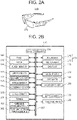
- FIG. 2(a) illustrates an appearance of the HMD 110 of the present embodiment.
- the HMD 110 illustrated in FIG. 2(a) is a see-through HMD 110.
- the HMD 110 includes a transmissive or semi-transmissive display 173.
- the wearer wearing the HMD 110 can see a virtual object or video displayed on the display 173, which is superimposed on the outside scenery.
- the present embodiment is also applicable to an immersive HMD.
- the wearer wearing the immersive HMD does not directly see the surrounding scene, but sees a virtual world (virtual reality).
- the immersive HMD employs a video-through method, that is, uses data of an external field image captured by an out-camera 172 (see FIG. 2(b) ) to see a video in which a virtual object is superimposed on the external field image.
- a video-through method that is, uses data of an external field image captured by an out-camera 172 (see FIG. 2(b) ) to see a video in which a virtual object is superimposed on the external field image.
- FIG. 2(b) is a hardware configuration diagram illustrating an exemplary internal configuration of the HMD 110.
- the HMD 110 includes a system bus 113, a main processor 120, a RAM 141, a ROM 142, a flash memory 143, a GPS (Global Positioning System) receiver 151, a geomagnetic sensor 152, a range sensor 153, an acceleration sensor 154, a gyro sensor 155, a timer 156, a wireless communication IF 161, a telephone network communication IF 162, an in-camera 171, the out-camera 172, a display 173, a microphone 181, a speaker 182, an audio decoder 183, a button switch 191, and a touch screen 192. These components are connected to the system bus 113.
- a main processor 120 includes a RAM 141, a ROM 142, a flash memory 143, a GPS (Global Positioning System) receiver 151, a geomagnetic sensor 152, a range sensor 153, an acceleration sensor 154, a gyro sensor 155, a timer 156,
- the main processor 120 controls the entire operations of the HMD 110 in accordance with predetermined operation programs.
- the main processor 120 may be configured with any component such as a CPU, an MPU, or a dedicated logic circuitry.
- the system bus 113 is a data communication channel that interconnects the main processor 120 with the respective components in the HMD 110.
- the main processor 120 and the components in the HMD 110 transmit and receive various commands, data, and the like through the system bus 113.
- the RAM 141 defines a rewritable program work area, which is, for example, used by the main processor 120 at the time of execution of various programs.
- Each of the ROM 142 and the flash memory 143 retains various programs for implementing the functions of the HMD 110, operation setting values, sensor information including values detected by sensors which will be described later, and various data for display such as virtual objects and content.
- the ROM 142 and flash memory 143 are so-called nonvolatile storages that retain stored data even when power is not supplied to the HMD 110 from the outside.
- the flash memory 143 retains operation programs downloaded from a network and various data created by the operation programs. Through download processing from each server device on the network, it is possible to update and enhance each operation program stored in the flash memory 143.
- the flash memory 143 can retain content such as moving images, still images, and sounds downloaded from a network.
- the flash memory 143 can retain data such as moving images and still images captured by the in-camera 171 or the out-camera 172.
- the RAM 141, the ROM 142, and the flash memory 143 are examples of storages.
- Other devices for example, a semiconductor memory element such as a solid state drive (SSD) or a magnetic disk drive such a hard disc drive (HDD) may be used therefor.
- SSD solid state drive
- HDD hard disc drive
- the main processor 120 is configured to acquire sensor information from the GPS receiver 151, the geomagnetic sensor 152, the range sensor 153, the acceleration sensor 154, and the gyro sensor 155, respectively, and also acquire a viewing time measured by the timer 156. Then, the main processor 120 uses the sensor information and the viewing time to detect the position, tilt, direction, movement, and the like of the HMD 110. Furthermore, the HMD 110 may further include other sensors, such as an illuminance sensor, a proximity sensor, an altitude sensor, and the like.
- the wireless communication interface (I/F) 161 is connected to the network 610 such as the Internet through the access point 310 to transmit and receive data to and from each server 700 on the network 610.
- millimeter waves 60GHz band
- the millimeter waves are highly directional and the radio waves are easily absorbed by the wall of the room.
- Using millimeter waves enables the HMD 110 to be connected to the access point 310 that is installed in the room 510 where the HMD 110 is surely present via the wireless LAN.
- Wi-Fi registered trademark
- Bluetooth registered trademark
- the telephone network communication I/F 162 is connected to a communication network through a base station using a mobile communication network to transmit and receive data to and from a server on a communication network according to the third-generation mobile communication system (hereinafter, referred to as "3G") such as Global System for Mobile Communications (GSM, registered trademark), Wideband Code Division Multiple Access (W-CDMA), CDMA 2000, or Universal Mobile Telecommunications System (UMTS).
- 3G third-generation mobile communication system
- GSM Global System for Mobile Communications
- W-CDMA Wideband Code Division Multiple Access
- CDMA 2000 Code Division Multiple Access 2000
- UMTS Universal Mobile Telecommunications System
- the telephone network communication I/F 62 is connected to the communication network according to the Long-Term Evolution system (LTE), or a communication method such as so-called the fourth-generation system (4G) or fifth-generation system (5G).
- LTE Long-Term Evolution system
- 4G fourth-generation system
- 5G fifth-generation system
- Each of the wireless communication I/F 161 and telephone network communication I/F 162 includes an encoding circuitry, a decoding circuitry, an antenna, and the like.
- the HMD 110 may include other communication interfaces such as an infrared communication I/F.
- Each of the in-camera 171 and the out-camera 172 converts the light received through a lens into an electric signal using an electronic device such as a charge coupled device (CCD) or a complementary metal oxide semiconductor (CMOS) sensor to input image data of the surroundings and that of an object.
- an exemplary camera 170 is referred to in the case where it is not particularly necessary to distinguish the in-camera 171 and out-camera 172.
- the display 173 is, for example, a display device such as a liquid crystal panel, and provides the wearer of the HMD 110 with image data.
- the HMD 110 includes a video RAM (not illustrated). A virtual object or a video is displayed on the screen of the display 173 based on the image data received by the video RAM.
- the microphone 181 converts the voice of the wearer into sound data and inputs the sound data.
- the speaker 182 outputs sound information and the like.
- the audio decoder 183 performs decoding processing of an encoded sound signal as necessary.
- Each of the button switch 191 and touch screen 192 is an operation device used to input an operation instruction to the HMD 110.
- the operation device is not limited to the button switch 191 and the touch screen 192.
- an operation signal to the HMD 110 may be transmitted from a separate portable device (for example, a smartphone or a tablet device) connected thereto by wired communication or wireless communication.
- the HMD 110 Upon receiving the operation signal, the HMD 110 is operated in accordance with the received operation signal.
- the main processor 120 may execute sound recognition processing to generate an operation signal to control the operation of the HMD 110.
- a part of the exemplary configuration of the HMD 110 illustrated in FIG. 2(a) is not essential to the present embodiment. Accordingly, even if the configuration of the HMD 110 does not include such an unessential component, the advantageous effects of the present embodiment are not impaired.
- the configuration of the HMD 110 may further include components which are not illustrated, for example, a digital broadcast reception function and an electronic money settlement function.
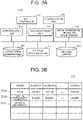
- FIG. 3(a) is a functional block diagram of the HMD 110 according to the present embodiment.
- the HMD 110 of the present embodiment includes the functions of each of a main controller 211, an authentication unit 212, a data management unit 213, a spatial configuration information acquisition unit 214, an AR image processing unit 215, and a communication unit 216.
- the HMD 110 further includes an HMD-side spatial configuration information table (HMD-side library) 221 and an authentication information table 222.
- the main processor 120 loads a program stored in the ROM 142 or the flash memory 143 onto the RAM 141 and executes it, whereby the functions mentioned above are implemented.
- the HMD-side library 221 is provided in the ROM 142 or the flash memory 143.
- the main controller 211 is configured to control the operations of each unit of the HMD 110.
- the authentication unit 212 is configured to access the access point 310 installed in each room 510 to perform authentication.
- the authentication unit 212 when receiving the network name (name of the wireless LAN network) of the access point 310 and the information identifying the access point 310 (access point ID) through the wireless communication IF 161, the authentication unit 212 transmits a password necessary for network connection to the access point 310.
- the password is stored in advance in the authentication information table 222.
- the authentication unit 212 Upon receiving a notification that the authentication is successful from the access point 310, the authentication unit 212 provides the other functions such as the main controller 211 with a notification to the effect that.
- the authentication information table 222 retains passwords required in various authentication, the names of the devices, and the like. In the present embodiment, for example, the authentication information table 222 retains the passwords for authentication required to establish connection to the access point 310.
- the data management unit 213 is configured to manage the spatial configuration information and the like of the HMD-side library 221.
- the spatial configuration information is acquired by the spatial configuration information acquisition unit 214, which will be described later.
- the data management unit 213 is configured to determine, firstly, the presence or absence of the spatial configuration information on the room 510 (hereinafter, referred to as the "own room") where the HMD 110 is currently present.
- the spatial configuration information on each room 510 is stored in the HMD-side library 221 in association with the access point ID provided to the room.
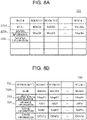
- FIG. 3(b) illustrates an example of the HMD-side library 221 of the present embodiment.
- spatial configuration information 221b is registered in association with an access point ID 221a for each room 510.
- other display-related information such as AR image information 221c may be registered in the HMD-side library 221.
- the access point ID 221a information identifying the access point 310 acquired in the authentication is used.
- a MAC address of the access point 310 may be used as the access point ID 221a.
- the data management unit 213 requests the server 700 to transmit the spatial configuration information on the room 510. This request is made through the access point 310.
- the data management unit 213 When receiving the spatial configuration information from the server 700 through the access point 310, the data management unit 213 stores, in the HMD-side library 221, the received spatial configuration information 221b in association with the access point ID 221a. On the other hand, when receiving a reply that the spatial configuration information is not registered from the server 700, the data management unit 213 instructs the spatial configuration information acquisition unit 214 to acquire the spatial configuration information.
- the data management unit 213 obtains the spatial configuration information on the room 510 stored in the server 700, and stores it in the HMD-side library 221.
- the spatial configuration information acquisition unit 214 When receiving the instruction to acquire the spatial configuration information from the data management unit 213, the spatial configuration information acquisition unit 214 creates the spatial configuration information on an area where the own device (HMD 110) is currently present (room 510). The spatial configuration information acquisition unit 214 registers the created spatial configuration information 221b in the HMD-side library 221. At this time, the created spatial configuration information is registered in association with the access point ID 221a acquired by the authentication unit 212.
- the spatial configuration information acquisition unit 214 is configured to scan and capture images of the walls of the room 510, arrangement and shape of the installation objects, and the like with the camera 170. Then, the spatial configuration information acquisition unit 214 performs mapping with respect to the captured image data to acquire the spatial configuration information on the room 510.
- the AR image processing unit 215 is configured to generate an AR image using the AR image information 221c, and display the generated AR image on the display 173.
- the AR image processing unit 215 displays the AR image when the display position of the generated AR image is within the visual field of the wearer of the HMD 110.
- the HMD 110 itself determines whether the display position of the AR image is in within the visual field of the HMD 110 by determining the display position of the AR image.
- the AR image information 221c may be acquired from the server 700 and stored in the HMD-side library 221.
- the server 700 may determine the display position of the AR image based on the visual filed information on the HMD 110 which has been transmitted to the server 700, and transmit the necessary AR image information 221c to the HMD 110.
- the communication unit 216 is configured to transmit and receive data to and from an external device via the wireless communication IF 161.
- the communication unit 216 transmits data to the access point 310 via the wireless communication IF 161 and receives data transmitted from the access point 310.
- the HMD 110 of the present embodiment may further include, for example, a captured image data storage unit for storing the image data captured by the camera 170. All data other than authentication information may be stored in the outside, for example, a device such as a server connected via a network. In this case, the data is acquired from such a server via the wireless communication IF 161.
- the access point 310 is configured in the similar manner as a conventional access point.
- the access point 310 is a wireless device that includes a router function for connecting a wireless LAN client such as the HMD 110 to another network.
- each room 510 is provided with at least one access point 310. Furthermore, in order to prevent the HMD 110 from being connected to other access points 310 of other rooms 510, in the present embodiment, for example, millimeter waves (60-GHz band) are used for the wireless LAN connection between the HMD 110 and the access point 310.
- millimeter waves 60-GHz band
- Electromagnetic waves of any wavelength band may be used as long as they are hardly connected to other access points 310 of other rooms and thus are reliably connected to the access point 310 of the own room.
- each access point 310 near the center of each room 510 allows the HMD 110 to be connected to the access point 310 regardless of the position of the wearer of the HMD 110 within the room 510.
- each access point 310 is configured with a media access control (MAC) address, which is a unique physical address
- the MAC address may be used as an access point ID identifying the access point 310.
- MAC media access control
- IP internet protocol
- the server 700 of the present embodiment retains the information relating to AR display as the display-related information on each room 510 to be managed. Then, in response to a request from the HMD 110, the sever 700 provides the display-related information on the room 510 where the HMD 110, which is the request source, is present. This function is similar to that of the conventional AR server.
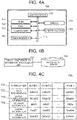
- FIG. 4(a) illustrates an exemplary hardware configuration of the server 700 according to the present embodiment.
- the server 700 includes a processor (main processor) 720, a storage device (server storage device) including a RAM 741, a ROM 742, a flash memory 743, and the like, and a communication interface (I/F) 761.
- the sever 700 may further include a display 773, an operation device 791, and the like.
- FIG. 4(b) is a functional block diagram of a part of the server 700 according to the present embodiment, which relates to the processing according to the present embodiment.
- the server 700 includes a spatial configuration information management unit 721 and server-side spatial configuration information (hereinafter, referred to as a server-side library) 730.
- the spatial configuration information management unit 721 is configured to manage data stored in the server-side library 730.
- the spatial configuration information management unit 721 provides, in response to a request from the HMD 110, the spatial configuration information on the room 510 where the access point 310 through which the request has passed is present.
- the spatial configuration information management unit 721 checks whether the spatial configuration information is registered in the server-side library 730 in association with the access point ID (MAC address) of the access point 310 included in the request data. If it is registered, the spatial configuration information management unit 721 provides the registered spatial configuration information. If it is not registered, the spatial configuration information management unit 721 provides the HMD 110 with data indicating that it is not registered.
- MAC address access point ID
- the transmitted spatial configuration information is registered in the server-side library 730 in association with the access point ID of the relayed access point 310.
- FIG. 4(c) illustrates an example of the server-side library 730.
- the display-related information (including spatial configuration information) of each room 510 is registered in the server-side library 730.
- the server-side library 730 includes, for each room 510, a room number 731 used to identify a room, an access point ID 732, spatial configuration information 733 of the room 510, and information (AR image information) 735 on an augmented reality image (AR image) generated by a computer.
- the server-side library 730 may further include sound information relating to the room 510 and other information relating to the room 510, and may not include the room number 731.
- the data of which the room number 731 is "room 511” includes "Adrs01” as the access point ID 732, "Map01” as the spatial configuration information 733, "AR01” as the AR image information 735, "Snd01” as the sound information, and "Othr01” as other information.
- the data of each of the room 512 to room n includes the ones as illustrated in FIG. 4(c) .
- the server 700 includes the server-side library 730 configured as described above. Thus, if the access point ID of the access point 310 is found, the room 510 is identified and all information about the room 510 is available.
- the server-side library 730 basically, it is preferable to acquire the spatial configuration information 733, AR image information 735, sound information, and other information relating to each room 510 in advance and register them in association with the room number 731 and the access point ID 732. In particular, it is preferable to generate the spatial configuration information 733 of each room 510 in advance by the general HMD 110 or the like and register it in the server-side library 730.
- the transmitted spatial configuration information is newly registered. That is, in the present embodiment, the server-side library 730 can be replenished later.
- the server-side library 730 is stored in a storage device of the server 700.
- the spatial configuration information created in the past can be managed in association with (the access point 310 provided in) the room 510, and thus can be used later.
- This processing is started when the HMD 110 is activated. Alternatively, it is started in accordance with an instruction from the wearer. For example, when entering the predetermined room 510, the wearer provides the HMD 110 with the instruction to perform the initial spatial configuration information acquisition processing. Further alternatively, the HMD 110 may be configured to detect the network name of the access point 310 and automatically initiate this processing.
- the authentication unit 212 performs the authentication processing in order to establish connection to the access point 310 of the wireless LAN (step S1101). Details of the authentication processing will be described later.
- the data management unit 213 determines whether the spatial configuration information on the room 510 is stored in the HMD 110 (step S1102).
- step S1102 If it is stored (step S1102; Yes), the data management unit 213 ends the processing as it is.
- step S1102 if it is not stored (step S1102; No), the data management unit 213 requests the server 700 to transmit the spatial configuration information on the room 510 through the access point 310 (step S1103). Then, the data management unit 213 distinguishes the content of a reply provided in response to the request (step S1104).
- the data management unit 213 acquires (downloads) the spatial configuration information to be provided from the server 700 (step S1105), and registers the acquired spatial configuration information in the HMD-side library 221 (step S1108) . At this time, the data management unit 213 registers the spatial configuration information 221b in association with the access point ID 221a of the access point 310 acquired by the authentication unit 212, and ends the processing.
- step S1104 when the reply does not include the spatial configuration information (step S1104; No), the data management unit 213 instructs the spatial configuration information acquisition unit 214 to acquire the spatial configuration information.
- the spatial configuration information acquisition unit 214 scans the room 510 (step S1106) to acquire the mapped spatial configuration information. Then, the spatial configuration information acquisition unit 214 transmits the acquired spatial configuration information to the server 700 (step S1107), and also registers it in the HMD-side library 221 in association with the access point ID of the access point 310 acquired by the authentication unit 212 (step S1108). At this time, the acquired spatial configuration information is transmitted to the server 700 through the access point 310. Then, the spatial configuration information acquisition unit 214 ends the processing.
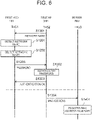
- FIG. 6 is a time chart illustrating the transmission and reception of data between the first HMD 111 and first access point 311, which are provided in the first room 511 of FIG. 1 , and the server 700.
- the time chart includes a total of three time-axes, i.e., a time axis T451 for the processing by the first HMD 111, a time axis T452 for the processing by the first access point 311, and a time axis T453 for the processing by the server 700.
- the network name of the access point 310 (network name of the wireless LAN) is constantly transmitted to devices including the HMD 110, which are ready to be connected via the wireless LANs.
- the network name of the access point is also transmitted from the first access point 311 (step S1301).
- the first HMD 111 detects the transmitted network names (step S1201), and selects, as a connection target, one of the network names desired by the wearer of the first HMD 111 from among the obtained network name group (step S1202).
- the transmitted network names step S1201
- only one access point 310 is installed in each room 510.
- millimeter waves are used for the communication between the HMD 110 and the access point 310 since using the millimeter waves prevents the HMD 110 from being connected to the access points other than the access point 310 of the room 510.
- the first HMD 111 can detect only the network name transmitted from the first access point 311 installed in the first room 511, and select the detected network name as the connection target.
- the first HMD 111 transmits an authentication request to the first access point 311.
- the first HMD 111 notifies the first access point 311 of a password required for the network connection (step S1203).
- the authentication unit 212 acquires the password from the authentication information table 222 and transmits it to the first access point 311.
- the first access point 311 authenticates the received password (step S1302).
- the first access point 311 verifies, for each connectable network, whether the received password matches the password necessary for connection with the network, which is registered in advance. If it matches the registered password, the authentication is successful. If successful, the connection between the first HMD 111 and the first access point 311 is established via the wireless LAN.
- the first access point 311 transmits a signal for permitting the authentication (authentication OK) to the first HMD 111 (step S1303).
- password authentication In order to enhance the security of the network, not only password authentication but also identity document (ID) authentication may be performed. Furthermore, an authentication server that authenticates both an ID and password may be additionally provided so that password authentication may be performed by the authentication server.
- ID identity document
- the first access point 311 After the connection is established between the first HMD 111 and the AP 311, that is, if the authentication is successful in step S1302, the first access point 311 transmits the identification information identifying the first access point 311 to the server 700 (step S1304).
- the MAC address which is a physical address unique to the device, is used as the identification information. If the password authentication fails in step S1302, the process in step S1304 is not performed.
- the spatial configuration information management unit 721 verifies whether the received MAC address is registered in the server-side library 730.
- the spatial configuration information management unit 721 determines that the received MAC address is a new MAC address (new room) and registers it as the access point ID 732 in the server-side library 730 (step S1401).
- the MAC address of the first access point 311 installed in the first room 511 where the first HMD 111 is present is registered in the server 700.
- the server 700 recognizes that the first HMD 111 is present in the first room 511 in which the first access point 311 having the newly registered MAC address is installed.
- step S1401 If it is determined in step S1401 that the MAC address is registered, the server 700 recognizes that the first HMD 111 is present in the first room 511 in which the first access point 311 having the corresponding MAC address is installed.
- the spatial configuration information management unit 721 confirms the presence or absence of the corresponding spatial configuration information. The confirmation is made based on whether the spatial configuration information 733 is registered in the server-side library 730 in association with the MAC address of the first access point 311 which is the transmission source.
- the spatial configuration information management unit 721 transmits the registered spatial configuration information 733 to the transmission source. On the other hand, if it is unregistered, the spatial configuration information management unit 721 provides the transmission source with a notification to the effect that.
- the spatial configuration information management unit 721 After transmitting the notification that the spatial configuration information 733 is not registered, if receiving the spatial configuration information through the first access point 311, the spatial configuration information management unit 721 registers the received spatial configuration information 733 in the server-side library 730 in association with the MAC address of the first access point 311.
- the HMD 110 when the wearer enters the room 510, the HMD 110 is authenticated by the access point 310, which is installed in the room, to be connected thereto, and then makes the room associated with the access point.
- the access point 310 After providing the HMD 110 with the connection authentication, the access point 310 transmits a MAC address to the server 700 as the identification information on the access point 310.
- the server 700 Upon receiving the MAC address, the server 700 recognizes that the HMD 110 is present in the room 510 registered in association with the MAC address.
- the MAC address and the room 510 are made associated with each other and stored in advance in the server-side library 730 by the server 700.
- the server 700 uses the identification information on the access point used by the wireless LAN to identify an area where the HMD 110 is present, i.e., the room 510 where the HMD 110 is present.
- an area where the HMD 110 is present can be easily grasped only with the existing devices. That is, it is possible to identify an area where the HMD 110 is present without providing additional hardware.
- the HMD 110 can provide the server 700 with the information necessary for identifying an area where the HMD 110 is present simply by performing the general authentication processing with the access point 310. That is, the HMD 110 enables the servers 700 to grasp the room 510 where the own device is present without requesting a new instruction or the like from the wearer.
- information for uniquely identifying the access point 310 installed in each room 510 is used to identify an area where the HMD 110 is present.
- the GPS has a restriction of location identification in the height direction
- there is no such a restriction in the present embodiment that is, in the case where an HMD is present in a building or the like of a plurality of stories, it is difficult for the GPS to distinguish the positions on the same plane even if they are of the different stories.
- the present embodiment even in such a case, it is possible to accurately identify the area where the HMD 110 is present.
- the server 700 can easily identify an area where the HMD 110 is present with sufficient accuracy, it is possible to appropriately provide the HMD 110 with various kinds of display-related information that was created in the past and is required for the AR display simply by managing the display-related information for each area where the HMD is to be present. Furthermore, the HMD 110 can appropriately receive the display-related information managed by the server 700.
- the spatial configuration information needs to be generated each time the wearer of the HMD 110 moves between the rooms 510, which causes a burden to the processing of the HMD 110.
- the server 700 can easily grasp the room 510 where the HMD 110 has entered, in the case where the server 700 manages the spatial configuration information created in the past, the spatial configuration information can be provided from the server 700. Therefore, according to the present embodiment, it is possible to greatly reduce the processing burden which may be caused when the HMD 110 enters a room.
- the access point 310 and the wireless LAN are used to identify the room 510 where the HMD 110 is present.
- a relay apparatus used to identify the room 510 is not limited to the access point 310.
- a base station of mobile phones may be used.
- FIG. 7(a) illustrates an outline of the present modification.
- a presence area identification system 100a according to the present modification is basically configured in the same manner as the embodiment described above, while the difference therebetween is found in that the presence area identification system 100a uses a base station (hereinafter, referred to as a "BS") 320 of mobile phones instead of the access point 310 which is used as a relay apparatus in the embodiment described above.
- FIG. 7(a) illustrates an example in which a first BS 321 is installed in the first room 511, and a second BS 322 is installed in the second room 512.
- the network to which the BS 320 is connected is a mobile phone network 620 rather than the network 610 such as the Internet.
- a mobile management 631 is provided between the BS 320 and the server 700.
- the mobile management 631 is located at the core of the mobile phone network, and configured to manage the mobile phone network together with a home subscriber server 632 that retains subscriber information.
- the BS 320 provided in each room 510 is connected to the mobile management 631 via the mobile phone network 621. Then, each BS 320 is connected to the network 610 through the mobile management 631 to access the server 700.
- the mobile management 631 is connected to other mobile phone networks 622 which are connected to a plurality of mobile phone base stations (not illustrated).
- the BS 320 is wirelessly connected to the HMD 110, which is as a mobile phone, using millimeter waves (28GHz band) which are the 5G standard of mobile phones.
- the millimeter waves are highly directional and the radio waves are easily absorbed by the walls of the room 510. Since using the millimeter waves surely enables the HMD 110 which is present in the room 510 to be wirelessly connected to the BS 320 that is installed in the room 510, the HMD 110 is prevented from being connected to other BSs 320 installed in other rooms 510.
- Each BS 320 is provided with a unique BS-ID . Accordingly, when the correspondence between the room 510 and the BS-ID of the BS 320 installed in the room 510 is found, the room 510 can be identified based on the BS-ID of the BS 320.
- the HMD 110 is basically configured in the same manner as that of the first embodiment.
- the spatial configuration information (HMD-side library 221) of each room 510 held by the HMD 110 is stored in association with a BS-ID 221d of the BS 320 installed in each room 510.
- the server 700 is basically configured in the same manner as that of the embodiment described above, while the difference therebetween is found in that, as illustrated in FIG. 8(b) , the server-side library 730 is managed in association with the BS-ID 732b instead of the MAC address of the access point 310.
- the spatial configuration information is stored for each room 510 in association with the identification information on a relay apparatus installed in each room 510.
- the spatial configuration information acquisition processing by the HMD 110 is also basically the same as that by the embodiment described above, while in the authentication processing, instead of the authentication processing to establish the connection to the access point 310, processing to establish the connection to the BS 320 is performed.
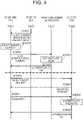
- FIG. 9 is a time chart of the authentication processing according to the present modification.
- FIG. 9 includes a total of four time-axes, i.e., a time axis T421 for the processing by the first HMD 111, a time axis T422 for the processing by a BS 321, a time axis T423 for the processing by the home subscriber server 632, and a time axis T424 for the processing by the server 700.
- each BS 320 always notifies mobile phone devices (HMDs 110) that are connectable thereto of a mobile network code and a BS-ID.
- the first BS 321 notifies the first HMD 111 of the mobile network code and BS-ID (step S1601).
- the first HMD 111 detects the notified mobile network code and selects a desired mobile carrier (step S1501).
- the first HMD 111 uses the corresponding mobile phone carrier information stored in a SIM card built in the first HMD 111 to select the BS 321 provided by the corresponding mobile carrier.
- the first HMD 111 holds the mobile network code and BS-ID of the selected BS 321.
- the first HMD 111 stores the identification number of the first HMD 111, which is being used as a mobile phone, in the SIM card built in the own device.
- the first HMD 111 transmits the stored identification number to the home subscriber server 632 through the BS 321 (step S1502).
- the home subscriber server 632 uses the identification number of the first HMD 111 received in step S1502 in the user authentication (step S1701).
- the home subscriber server 632 authenticates a user by comparing the identification number with the subscriber information registered in advance in the home subscriber server 632 and determining whether they match. If the received identification number matches the subscriber information, the authentication is successful, and thus the home subscriber server 632 transmits a signal indicating that the authentication is successful (authentication OK) to the first HMD 111 (step S1702).
- the first HMD 111 transmits, together with the received BS-ID, a request of transmission of the spatial configuration information to the server 700 (step S1503).
- the server 700 requests the first HMD 111 to transmit a password (step S1801).
- the first HMD 111 transmits the password to the server 700 (step S1504).
- the password for this authentication is registered in advance in the server 700.
- the server 700 authenticates the received password (step S1802). If the received password matches the password for authentication, the server 700 transmits a signal indicating that the authentication is successful (authentication OK) to the first HMD 111 (step S1803).
- the first HMD 111 acquires the spatial configuration information on the first room 511 where the own device is present from the server 700 as needed.
- using a base station of a mobile phone network used by mobile phones enable the server 700 to identify an area where an HMD is present (room 510).
- an area where the HMD 110 is present can be easily grasped only with the existing devices. That is, it is possible to identify an area where the HMD 110 is present without providing additional hardware.
- the HMD 110 simply performs the general authentication processing for establishing communication, whereby the server 700 can grasp an area where the HMD 110 is present. That is, the HMD 110 can provide the server 700 with the information necessary for identifying an area where the own device is present without requesting the wearer to provide a new instruction or the like.
- a mobile phone network designed with a femtocell which is a low power mobile phone base station, has been provided. Since a coverage area of the femtocell is much narrower than that of a conventional cell, it is very likely that such a mobile phone base station in the room 510 will receive an output from a device in the room 510. Therefore, a mobile phone base station designed with the femtocell may be used.
- the access point 310 is connected to the server 700 via the wireless LAN and accesses the server 700 through the network 610 such as an Internet network, however, the present invention is not limited thereto.
- the network 610 such as an Internet network
- a wired LAN network 630 may be used instead of the network 610.
- a relay apparatus such as a hub (HUB) 340 (341, 342) is used.
- wired LAN Using the wired LAN will give the advantageous effects of reducing the risk of information leakage through the Internet network, in addition to the advantageous effects which can be obtained by the embodiment and modifications above.
- a second embodiment of the present invention will be described.
- a plurality of access points 330 is provided in one room 510. Some of the access points 330 are different from others in their performance.
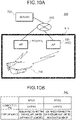
- FIG. 10(a) illustrates an outline of an operating environment of the presence area identification system 100 according to the present embodiment.
- the presence area identification system 100 including, as the plurality of access points 330, a toral of two systems, i.e., an access point 331 and an access point 332 will be described.
- the presence area identification system 100 may be configured to be connectable to the server 700 via three or more systems of wireless LANs of different transmission standards.
- FIG. 10(b) illustrates a table 340 showing the difference in performance between the access point 331 and the access point 332.
- the access point 331 and the access point 332 are different from each other in performance, such as connection speed and the presence or absence of limit of data volume.
- This information may be held in, for example, the HMD 110 or the server 700. Note that they may have a difference in the amount of money to be charged.
- connection speed is medium, data volume is limited, and advertisements are included.
- the connection speed is high, data volume is not limited, and no advertisements are included.
- using the access point 332 as a relay apparatus enables transmission and reception of more detailed data in a short time.
- the server 700 determines that the HMD 110 is present in the room 510 when the HMD 110 is connected thereto via any of the access points 330 installed in the room 510.
- the server 700 may hold, as the server-side library 730, the spatial configuration information and AR image information having different resolutions for each access point 330 having different performance.
- FIG. 11 illustrates an example of the server-side library 730 in this case.
- the server-side library 730 includes the access point ID of each access point 330, the spatial configuration information 733, the information indicating the resolution of the spatial configuration information 733 (hereinafter, simply referred to as resolution) 734, the AR image information 735, and a resolution 736 of the AR image information 735.
- resolution the information indicating the resolution of the spatial configuration information 733
- the AR image information 735 hereinafter, simply referred to as resolution 734
- a resolution 736 of the AR image information 735 a resolution 736 of the AR image information 735.
- the quality of the AR image information may be one type.
- the spatial configuration information management unit 721 of the server 700 transmits the spatial configuration information stored in the server-side library 730 in accordance with the relayed access point 330.
- the HMD 110 can acquire the spatial configuration information with higher resolution and higher quality.
- which of the access points 330 to be used to request the server 700 to transmit the spatial configuration information may be selected by the wearer of the HMD 110, or may be determined in advance in the HMD 110.
- the HMD 110 displays the list on the display 173 and accepts the selection by the wearer.
- a selection rule is set in advance and registered in the ROM 142, the flash memory 143, or the like.
- the selection rule may be, for example, selecting the one with the highest performance among from the charge-free access points 330, selecting the one with the highest performance regardless of whether it is charge-free or with charge, or the like.
- the authentication unit 212 selects the access point 330 to be used as a relay apparatus.
- the server 700 uses the access point ID of the access point 330 installed in each room 510 to recognize an area where the HMD 110 is present. Therefore, the same advantageous effects as those of the first embodiment can be obtained.
- the server 700 manages them separately. Then, the server 700 provides the display-related information in accordance with the performance of the access point 330 with the connection authentication with the HMD 110 has been established.
- the server 700 can easily identify an area where the HMD 110 is present with enough accuracy, and also can grasp the data quality desired by the HMD 110. This enables the server 700 to appropriately provide the HMD 110 with various types of display-related information required for AR display, which were created in the past, only by managing the display-related information for each presence area and for each quality. Furthermore, the HMD 110 can appropriately receive the display-related information managed by the server 700.
- the spatial configuration information held by the server 700 includes information on the resolution thereof. Then, in accordance with the performance of the HMD 110, the spatial configuration information of the server 700 is overwritten.
- the HMD 110 according to the present embodiment has basically the same configuration as that of the first embodiment, while the difference is found in that, when acquiring the spatial configuration information, the spatial configuration information acquisition unit 214 according to the present embodiment also identifies the resolution thereof.
- a resolution 221e of the spatial configuration information 221b is registered in association with the access point ID 221a.
- the data management unit 213 of the present embodiment is basically configured to perform the same processing as that of the first embodiment. Furthermore, the data management unit 213 of the present embodiment grasps in advance the best resolution of the spatial configuration information that can be acquired by the spatial configuration information acquisition unit 214. The performance of the HMD 110 is determined, for example, based on the spatial resolution of the sensors. Then, the data management unit 213 compares the grasped resolution with the resolution of the spatial configuration information on the own room held in the server-side library, and determines from which of the devices, i.e., the server 700 or the own device, the spatial configuration information is to be acquired.
- the data management unit 213 of the present embodiment compares the resolution of the acquired spatial configuration information with the resolution (best resolution) of the spatial configuration information that can be generated by the own device. If the best resolution is higher than that of the acquired spatial configuration information, the data management unit 213 causes the spatial configuration information acquisition unit 214 to generate the spatial configuration information by the own device. Then, the data management unit 213 transmits the generated spatial configuration information to the server 700 together with the information indicating the resolution.
- the server 700 of the present embodiment is also basically configured in the same manner as that of the first embodiment, while the difference therebetween is found in that the server-side library 730 of the present embodiment includes the information on the resolution of spatial configuration information.
- FIG. 12(b) illustrates an example of the server-side library 730 of the present embodiment.
- the server-side library 730 includes the resolution 734 of the spatial configuration information and the resolution 736 of the AR image information in addition to the information held by the server-side library 730 of the first embodiment.
- the information on the best resolution of the spatial configuration information that can be acquired by the spatial configuration information acquisition unit 214 of the own device is stored in advance.
- the spatial configuration information management unit 721 of the server 700 determines whether to register the received spatial configuration information in the server-side library 730 in association with the access point ID of the access point 310 through which the transmission source has passed.
- the spatial configuration information management unit 721 registers the received spatial configuration information in the case where it has not been registered. On the other hand, in the case where the spatial configuration information has already registered in association with the access point ID, the spatial configuration information management unit 721 compares the resolution of the registered spatial configuration information with the resolution of the received spatial configuration information. If the resolution of the received spatial configuration information is higher, the spatial configuration information management unit 721 replaces the existing spatial configuration information with the received spatial configuration information. The information on the existing resolution is also replaced with the information on the resolution of the received spatial configuration information.
- the server-side library 730 of the present embodiment retains the spatial configuration information having the best resolution at that time.
- FIG. 13 illustrates a processing flow of the spatial configuration information acquisition processing by the HMD 110 according to the present embodiment. This processing is started at the same timing as that of the first embodiment. After the processing is started, firstly, the authentication unit 212 performs the authentication processing (step S1101). This processing is the same as that of the first embodiment.
- the data management unit 213 determines whether the spatial configuration information on the room 510 is held in the HMD 110 (step S1102) .
- step S1102 If it is held (step S1102; Yes), the data management unit 213 ends the processing as it is.
- step S1102 if it is not held (step S1102; No), the data management unit 213 requests the server 700 to transmit the spatial configuration information through the access point 310 (step S1103). Then, the data management unit 213 distinguishes the content of the reply provided in response to the request (step S1104).
- step S1104 If the reply indicates the spatial configuration information is available (step S1104; Yes), the data management unit 213 downloads the spatial configuration information to be provided from the server 700 (step S1105) .
- the data management unit 213 of the present embodiment compares the resolution of the downloaded spatial configuration information with the best resolution of the spatial configuration information that can be acquired by the spatial configuration information acquisition unit 214 of the own device (step S4101). If the resolution of the spatial configuration information of the own device is equal to or less than the resolution of the spatial configuration information held by the server 700 (step S4101; No), as in the first embodiment, the data management unit 213 registers the received spatial configuration information in the HMD-side library 221 (step S1108), and ends the processing. At this time, the data management unit 213 registers the spatial configuration information in association with the access point ID of the access point 310 which was acquired by the authentication unit 212.
- the data management unit 213 instructs the spatial configuration information acquisition unit 214 to acquire the spatial configuration information.
- the spatial configuration information acquisition unit 214 scans the room 510 (step S1106) to acquire the spatial configuration information. Then, the spatial configuration information acquisition unit 214 transmits the acquired spatial configuration information to the server 700 (step S1107), and also registers it in the HMD-side library 221 in association with the access point ID of the access point 310 acquired by the authentication unit 212 (step S1108). At this time, the acquired spatial configuration information is transmitted to the server 700 through the access point 310. Then, the spatial configuration information acquisition unit 214 ends the processing.
- FIG. 14 illustrates a processing flow of the spatial configuration information management processing by the spatial configuration information management unit 721 of the server 700 according to the present embodiment.
- the spatial configuration information management unit 721 starts the processing upon receiving the spatial configuration information from the HMD 110.
- the spatial configuration information management unit 721 determines whether the spatial configuration information on the room 510, which was identified based on the received spatial configuration information, has already been registered in the server-side library 730 (step S4201). Specifically, the spatial configuration information management unit 721 determines whether the spatial configuration information has already been registered in association with the access point ID of the relayed access point 310.
- the spatial configuration information management unit 721 registers the received spatial configuration information in association with the access point ID of the relayed access point 310 (step S4203). At this time, the information on the resolution is also registered.
- the spatial configuration information management unit 721 compares the resolution of the corresponding spatial configuration information in the library with the resolution of the received spatial configuration information (step S4202).
- the spatial configuration information management unit 721 replaces the spatial configuration information in the library with the received spatial configuration information (step S4203), and ends the processing. At this time, the information on the resolution is also replaced with the information on the resolution of the received spatial configuration information.
- step S4202 the spatial configuration information management unit 721 discards the received spatial configuration and ends the processing.
- the display-related information (spatial configuration information) is held together with the information on the resolution thereof in the server-side library 730. Then, in the case where the HMD 110 can acquire the information having higher resolution, the held information is replaced with the display-related information (space configuration information) acquired by the HMD 110.
- the server 700 retains the display-related information (spatial configuration information) having high resolution provided by the HMD 110 having the highest performance among the HMDs 110 that may be used. This allows the HMD 110 to use the spatial configuration information with high resolution.
- the HMD 110 can use the spatial configuration information with high resolution regardless of the spatial resolution of the sensors of the own device.
- the server 700 replaces the registered spatial configuration information therewith.
- the present invention is not limited thereto.
- the server may hold a plurality of pieces of spatial configuration information having different resolutions.
- the HMD 110 when receiving the spatial configuration information, the HMD 110 can designate the resolution thereof.
- the HMD 110 is always connected to a relay apparatus installed in each room 510, and the server 700 uses the identification information on the relay apparatus to determine an area where the HMD 110 is present.
- the HMD 110 is not always connected to a relay apparatus installed in the room 510 where the wearer is present.
- the server-side library 730 in which the room 510, the access point ID of the access point installed in the room 510, and the spatial configuration information on the room 510 are associated with each other is created in advance and held by the server 700.
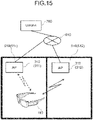
- FIG. 15 illustrates an outline of the present embodiment.
- the electric field intensity of the wireless LAN generated from the first access point 311 in the first room 511 where the HMD 110 is present is more than the electric field intensity of the wireless LAN generated from the second access point 312 in the other second room 512.
- the first access point 311 in the first room 511 is automatically selected as an access point to which the HMD 110 is to be connected.
- the HMD 110 is not always connected to the AP 310 of the room 510 where the HMD 110 is present.
- the HMD 110 may be connected to the AP 312 installed in the adjacent second room 512.
- the server 700 can appropriately identify the room 510 where the HMD 110 is present.
- the hardware configuration of the HMD 110 according to the present embodiment is the same as that of the first embodiment.
- the functional aspect of the HMD 110 according to the present embodiment is different from that of the first embodiment.
- FIG. 16(a) is a functional block diagram of the HMD 110 according to the present embodiment.
- the HMD 110 further includes an image acquisition unit 217 in addition to the units of the first embodiment.
- the image acquisition unit 217 is configured to acquire (capture) an image as visual information using the camera 170 in accordance with an instruction from the wearer.
- the image to be acquired may be a still image or a moving image.
- the spatial configuration information acquisition unit 214 of the present embodiment requests the server 700 to transmit the spatial configuration information when no spatial configuration information on the own room is available in the HMD-side library 221. At this time, in the present embodiment, the spatial configuration information acquisition unit 214 further transmits an image in which the own room is captured as the visual field information.
- the server 700 basically has the same configuration as the first embodiment, while the difference therebetween is found in the processing by the spatial configuration information management unit 721 and the data held by the server-side library 730.
- the server-side library 730 of the present embodiment further retains the location information on each room 510 or each access point 310.
- the location information may be, for example, latitude and longitude information or information based on a coordinate system defined in the system. In the case of a polygonal shaped room, latitude and longitude information on each corner of the room may be held.
- the spatial configuration information management unit 721 receives the image as the visual field information together with the spatial configuration information request. Then, the spatial configuration information management unit 721 determines whether the spatial configuration information on the room 510, which could be identified based on the simultaneously received access point ID, includes an area that matches the visual field information. If the spatial configuration information on the room 510 does not include such an area, the spatial configuration information management unit 721 sequentially determines, in order of proximity to the room 510, whether each spatial configuration information on each of the other rooms 510 includes the area that matches the visual field information. Then, the spatial configuration information management unit 721 transmits the spatial configuration information on the room including the area that matches the visual field information to the transmission source. In the case where no spatial configuration information on each room 510 in a predetermined range includes the area that matches the visual field information, the spatial configuration information management unit 721 replies that any spatial configuration information that matches the visual field information is not registered.
- the spatial configuration information management unit 721 registers, in the server-side library 730, the spatial configuration information, which was transmitted from the HMD 110 in response to the reply, in association with the access point ID of the relayed access point 310.
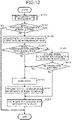
- FIG. 17 is a flowchart of the processing flow on the server 700 side according to the present embodiment.
- the server 700 starts the processing upon receiving the visual field information together with the request to transmit the spatial configuration information from the HMD 110.
- the spatial configuration information management unit 721 determines whether the spatial configuration information 733 (spatial configuration information on the room) stored in the server-side library 730 in association with the access point ID of the transmission source includes an area that matches the visual field information (step S2101).
- the spatial configuration information management unit 721 transmits the spatial configuration information to the transmission source (step S2102), and ends the processing.
- the spatial configuration information management unit 721 searches for the room 510 including the area that matches the visual field information (step S2103).
- the spatial configuration information management unit 721 uses the location information on the room 510 with which the access point ID of the transmission source is associated and the location information on another room 510 to calculate the distance therebetween, and performs the same determination processing as that in step S2101 as described above with respect to each room 510 in order from the nearest one.
- an upper limit M M is an integer of 1 or more
- the spatial configuration information management unit 721 determines whether the spatial configuration information including the area that matches the visual field information is found (step S2104). If it is found (step S2104; Yes), the spatial configuration information management unit 721 transmits the spatial configuration information to the HMD 110 which is the transmission source (step S2102), and ends the processing. If it is not found (step S2104; No), the spatial configuration information management unit 721 transmits a reply to that effect (step S2105), and ends the processing.
- the HMD 110 executes mapping of the room 510 by the own device to generate the space configuration information. Then, the generated spatial configuration information is transmitted to the server 700 and registered therein. At this time, in the present embodiment, the access point 310 installed in the room 510 is intentionally selected and transmitted.
- the spatial configuration information management unit 721 Upon receiving the spatial configuration information from the HMD 110, the spatial configuration information management unit 721 registers the spatial configuration information in the server-side library 730 in association with the access point ID of the access point of the transmission source.
- an access point ID of an access point but also an image acquired by the HMD 110 are used to identify an area where the HMD 110 is present.
- the HMD 110 may be connected to the access point 310 which is installed outside of the room 510 where the wearer of the HMD 110 is present, it can appropriately acquire and use the spatial configuration information stored in the server 700. Furthermore, at this time, no special authentication processing is required.
- the stored spatial configuration information is transmitted to the server 700, whereby the server can compare the spatial configuration information with each other to confirm whether it matches the room.
- GPS Global Positioning System
- GPS information acquired by the GPS receiver 151 of the HMD 110 may be used.
- using the GPS information enables identification of the room 510 where the HMD 110 is present.
- the latitudes and longitudes at the four corners of the room are registered in the server-side library 730 of the server 700 as location information on each room.
- the room where the HMD 110 is present is identified.
- the registration date and time of the spatial configuration information may be registered in the server-side library 730. Whether the spatial configuration information has been registered may be determined based on not only the presence or absence thereof, but also the registration date and time. That is, even if the spatial configuration information is registered, in the case where the difference between the registration date and time and the current date and time is equal to or more than a predetermined value, the spatial configuration information is determined to be unregistered.
- managing the spatial configuration information based on the date and time improves responsibility to the change in the arrangement of the interior or the like.
- the identification information on each room basically, a relay apparatus which is installed in each room 510 to relay the HMD 110 to a communication network is used.
- the identification information is not limited thereto.
- each room is provided with a unique device capable of transmitting information identifying the room, such a device may be used.
- the device capable of transmitting information identifying the room is, for example, a room access management device having a communication function.
- the HMD 110 is used as a mobile information device.
- a mobile information device is not limited thereto.
- it may be a notebook PC, a tablet PC, or any other portable information device having similar functions.
- a part of or all of the functions and the like of the present invention described above may be implemented by hardware, for example, by designing it by an integrated circuit.
- a microprocessor unit or the like may interpret and execute a program for implementing each function or the like, thereby implementing it by software.
- Hardware and software may be used together.
- the software may be stored in advance in the ROM 142 and the like of the HMD 110 at the time of product shipment.
- the software may be acquired from various servers or the like on the Internet after the product is shipped.
- the software which is provided in a memory card, an optical disk, or the like may be acquired.
- control lines and information lines which are considered to be necessary for the purpose of explanation are indicated herein, but not all the control lines and information lines of actual products are necessarily indicated. It may be considered that almost all the configurations are actually connected to each other.
Landscapes
- Engineering & Computer Science (AREA)
- Theoretical Computer Science (AREA)
- General Physics & Mathematics (AREA)
- Physics & Mathematics (AREA)
- Computer Networks & Wireless Communication (AREA)
- Signal Processing (AREA)
- General Engineering & Computer Science (AREA)
- Computer Vision & Pattern Recognition (AREA)
- Human Computer Interaction (AREA)
- Computer Security & Cryptography (AREA)
- Mobile Radio Communication Systems (AREA)
- Processing Or Creating Images (AREA)
- Position Input By Displaying (AREA)
- Telephonic Communication Services (AREA)
Abstract
Description
- The present invention relates to a technique for identifying an area where a portable information device such as a head mounted display (hereinafter, referred to as an "HMD") is present.
- An HMD is configured to display a video, in which an augmented reality (AR) image (AR image of an avatar or the like) generated by a computer is superimposed on an image of a real space, on a display screen in the form of spectacles. The AR images are generally stored in external servers. In order for an HMD to accurately extract information about an area where the HMD is currently present from among a large number of AR images stored in the external servers, or in order for the external servers to properly provide each HMD with information, it is necessary to identify the area where the HMD is present.
- As a technique for identifying an area where an HMD is present, for example,
Patent Literature 1 discloses "an experience facility comprises a plurality of section areas. A detection antenna D receives an identification code generated by a head mount display device (HMD) to detect in which section area the HMD exists among the section areas, and in which direction the HMD faces. A storage means stores image information different from each section area and an extract means extracts the image information in response to the detected direction in the image information in the corresponding section area. The HMD displays the extracted virtual image (excerpted from Abstract)". - Patent Literature 1:
JP Application NO.2000-297243 - In the technique disclosed in
Patent Literature 1, a total of sixteen reception antennas receives an identification signal transmitted from the HMD, whereby an area where the HMD is present is identified based on the relative topology of each of the reception antennas. Furthermore, a total of four transmission antennas installed in advance transmits position codes which are different to each other, respectively, and then the HMD identifies an area where it is present based on the relative topology of the received four position codes. Thus, in order to identify an area where an HMD is present, it is necessary to install a new facility such as a plurality of antennas, and this requires a huge cost. - The present invention has been made in view of the circumstances described above, and an object of the present invention is to provide a technique enabling identification of an area where a portable information device having a communication function, such as an HMD, is present with necessary and sufficient accuracy without requiring a special facility (hardware).
- In order to solve the problems described above, the present invention provides an information processing system, comprising: a portable information device; relay apparatuses each of which connects the portable information device to a network; and a server, the server including a library in which an area where each of the relay apparatuses is present is registered, for each of the relay apparatuses, in association with relay apparatus identification information identifying each of the relay apparatuses, the portable information device being configured to obtain connection authentication from corresponding one of the relay apparatuses which is installed in an area where an own device is present, and when the connection authentication is successful, the corresponding one of the relay apparatuses that has provided the connection authentication being configured to transmit the relay apparatus identification information to the server.
- It is possible to identify an area where an HMD is present with necessary and sufficient accuracy without requiring a special facility (hardware). The objects, configurations, and advantageous effects other than those described above will be clarified by explanation of the embodiments below.
-
- [
FIG. 1] FIG. 1(a) illustrates an outline of a presence area identification system according to the first embodiment, andFIG. 1(b) illustrates an outline of a presence area identification system according to the third modification. - [
FIG. 2] FIG. 2(a) illustrates an appearance of an HMD according to the first embodiment, andFIG. 2(b) is a hardware configuration diagram of the HMD according to the first embodiment. - [
FIG. 3] FIG. 3(a) is a functional block diagram of the HMD according to the first embodiment, andFIG. 3(b) illustrates an HMD-side library according to the first embodiment. - [
FIG. 4] FIG. 4(a) is a hardware configuration diagram of a server according to the first embodiment,FIG. 4(b) is a functional block diagram of a server according to the first embodiment, andFIG. 4(c) illustrates a server-side library according to the first embodiment. - [
FIG. 5] FIG. 5 is a flowchart of spatial configuration information acquisition processing according to the first embodiment. - [
FIG. 6] FIG. 6 is a time chart illustrating authentication processing according to the first embodiment. - [
FIG. 7 ] Each ofFIG. 7(a) and FIG. 7(b) illustrates an outline of a presence area identification system according to the first modification. - [
FIG. 8] FIG. 8(a) illustrates an HMD-side library according to the first modification, andFIG. 8(b) illustrates a server-side library according to the first modification. - [
FIG. 9] FIG. 9 is a time chart illustrating authentication processing according to the first modification. - [
FIG. 10] FIG. 10(a) illustrates an outline of a presence area identification system according to the second embodiment, andFIG. 10(b) illustrates an outline of performance of each access point according to the second embodiment. - [
FIG. 11] FIG. 11 illustrates a server-side library according to the second embodiment. - [
FIG. 12] FIG. 12(a) illustrates an HMD-side library according to the third embodiment, andFIG. 12(b) illustrates a server-side library according to the third embodiment. - [
FIG. 13] FIG. 13 is a flowchart of spatial configuration information acquisition processing according to the third embodiment. - [
FIG. 14] FIG. 14 is a flowchart of spatial configuration information management processing according to the third embodiment. - [
FIG. 15] FIG. 15 illustrates an outline of a presence area identification system according to the fourth embodiment. - [
FIG. 16] FIG. 16(a) is a functional block diagram of the fourth embodiment, andFIG. 16(b) illustrates a server-side library according to the fourth embodiment. - [
FIG. 17] FIG. 17 is a flowchart of spatial configuration information management processing according to the fourth embodiment. - Hereinafter, embodiments of the present invention will be described with reference to the drawings. Throughout the drawings, the same features are provided with the same reference signs, and repetitive explanation therefor will be omitted.
- Firstly, an outline of the present embodiment will be described.
FIG. 1(a) illustrates an outline and operating environment of a presencearea identification system 100 according to the present embodiment. - As illustrated in
FIG. 1(a) , the presencearea identification area 100 of the present embodiment includes an HMD 110, anaccess point 310 installed in eachroom 510, and aserver 700. The presencearea identification area 100 of the present embodiment is a wireless local area network (LAN) system in which the HMD 110 and theserver 700 transmit and receive data wirelessly therebetween through theaccess point 310. Hereinafter, in the detailed description of the present invention, a space delimited by structures is referred to as a room. - In the present embodiment, each room 510 (511, 512) is provided with an access point (AP) 310 (311, 312) for wireless LAN connection. The
server 700, which manages various data necessary for AR display, identifies theroom 510 based on the identification information on theaccess point 310. - In the present embodiment, when a user (HMD wearer) wearing the head mounted display (HMD) 110 enters the
room 510, the HMD 110 is made connected to the access point (AP) 310, which is a relay apparatus installed in advance in theroom 510, to perform authentication processing. Through the authentication processing, theHMD 110 obtains the identification information on theaccess point 310. Then, the HMD 110 makes various kinds of information (display-related information) necessary for AR image display transmitted from theserver 700 in association with the identification information on theaccess point 310. This enables the HMD 110 to identify to which of therooms 510 the information belongs. - On the other hand, the
server 700 makes the display-related information on eachroom 510 in association with the identification information on theaccess point 310 installed in eachroom 510 and manages them. Based on the identification information on theaccess point 310 through which a request of data transmission from the HMD 110 has passed, theserver 700 identifies an area where the HMD 110 is present (room 510), and provides theHMD 110, which is a transmission source, with the display-related information which has been prepared for theroom 510. - Hereinafter, in the present embodiment, spatial configuration information will be described as an example of the display-related information. The spatial configuration information is obtained by scanning the arrangement and shape of walls and installation objects of the
room 510 and then mapping the scanned data. The spatial configuration information is used to grasp the shape of the inside of theroom 510 surrounded by the walls and the arrangement and shape of furniture and the like installed in theroom 510. Using this spatial configuration information enables AR objects to be arranged in a realistic manner. According to the arrangement in a realistic manner, for example, an AR object is prevented from being arranged behind a wall. - Generally, the spatial configuration information is generated, each time when the wearer of the HMD 110 enters a predetermined space such as the
room 510, by scanning the space using various sensors provided in the HMD 110. However, this causes a large processing load. - In the present embodiment, since the
server 700 and the HMD 110 themselves can easily identify an area where the HMD 110 is present (the room 510), if the spatial configuration information on eachroom 510 was created in the past, the previously created spatial configuration information is used. - Hereinafter, the present embodiment will be described by referring to an example in which the number of rooms is two (
first room 511 and second room 512). Thefirst room 511 is provided with afirst access point 311, and thesecond room 512 is provided with asecond access point 312. Furthermore, the number ofHMDs 110 is not necessarily one, but may be two, i.e., afirst HMD 111 and asecond HMD 112. Hereinafter, theexemplary room 510 is referred to in the case where it is not necessary to distinguish the rooms. Similarly, theexemplary access point 310 and theexemplary HMD 110 are referred to, respectively, in the case where it is not necessary to distinguish the access points and the HMDs. Eachaccess point 310 can transmit and receive data to and from theserver 700 through anetwork 610. - First, the
HMD 110 according to the present embodiment will be described. -
FIG. 2(a) illustrates an appearance of theHMD 110 of the present embodiment. TheHMD 110 illustrated inFIG. 2(a) is a see-throughHMD 110. TheHMD 110 includes a transmissive orsemi-transmissive display 173. The wearer wearing theHMD 110 can see a virtual object or video displayed on thedisplay 173, which is superimposed on the outside scenery. - Although not illustrated, the present embodiment is also applicable to an immersive HMD. The wearer wearing the immersive HMD does not directly see the surrounding scene, but sees a virtual world (virtual reality). Furthermore, the immersive HMD employs a video-through method, that is, uses data of an external field image captured by an out-camera 172 (see
FIG. 2(b) ) to see a video in which a virtual object is superimposed on the external field image. Although the present embodiment is applicable to any type described above, in the following, the see-throughHMD 110 will be described as an example. -
FIG. 2(b) is a hardware configuration diagram illustrating an exemplary internal configuration of theHMD 110. - The
HMD 110 includes asystem bus 113, amain processor 120, aRAM 141, aROM 142, aflash memory 143, a GPS (Global Positioning System)receiver 151, ageomagnetic sensor 152, arange sensor 153, anacceleration sensor 154, agyro sensor 155, atimer 156, a wireless communication IF 161, a telephone network communication IF 162, an in-camera 171, the out-camera 172, adisplay 173, amicrophone 181, aspeaker 182, anaudio decoder 183, abutton switch 191, and atouch screen 192. These components are connected to thesystem bus 113. - The
main processor 120 controls the entire operations of theHMD 110 in accordance with predetermined operation programs. Themain processor 120 may be configured with any component such as a CPU, an MPU, or a dedicated logic circuitry. - The
system bus 113 is a data communication channel that interconnects themain processor 120 with the respective components in theHMD 110. Themain processor 120 and the components in theHMD 110 transmit and receive various commands, data, and the like through thesystem bus 113. - The
RAM 141 defines a rewritable program work area, which is, for example, used by themain processor 120 at the time of execution of various programs. - Each of the
ROM 142 and theflash memory 143 retains various programs for implementing the functions of theHMD 110, operation setting values, sensor information including values detected by sensors which will be described later, and various data for display such as virtual objects and content. TheROM 142 andflash memory 143 are so-called nonvolatile storages that retain stored data even when power is not supplied to theHMD 110 from the outside. - The
flash memory 143 retains operation programs downloaded from a network and various data created by the operation programs. Through download processing from each server device on the network, it is possible to update and enhance each operation program stored in theflash memory 143. - Furthermore, the
flash memory 143 can retain content such as moving images, still images, and sounds downloaded from a network. In addition, theflash memory 143 can retain data such as moving images and still images captured by the in-camera 171 or the out-camera 172. - The
RAM 141, theROM 142, and theflash memory 143 are examples of storages. Other devices, for example, a semiconductor memory element such as a solid state drive (SSD) or a magnetic disk drive such a hard disc drive (HDD) may be used therefor. - The
main processor 120 is configured to acquire sensor information from theGPS receiver 151, thegeomagnetic sensor 152, therange sensor 153, theacceleration sensor 154, and thegyro sensor 155, respectively, and also acquire a viewing time measured by thetimer 156. Then, themain processor 120 uses the sensor information and the viewing time to detect the position, tilt, direction, movement, and the like of theHMD 110. Furthermore, theHMD 110 may further include other sensors, such as an illuminance sensor, a proximity sensor, an altitude sensor, and the like. - The wireless communication interface (I/F) 161 is connected to the
network 610 such as the Internet through theaccess point 310 to transmit and receive data to and from eachserver 700 on thenetwork 610. In the present embodiment, millimeter waves (60GHz band) are used for wireless LAN connection to theaccess point 310 and the like. This is because the millimeter waves are highly directional and the radio waves are easily absorbed by the wall of the room. Using millimeter waves enables theHMD 110 to be connected to theaccess point 310 that is installed in theroom 510 where theHMD 110 is surely present via the wireless LAN. Note that Wi-Fi (registered trademark) or Bluetooth (registered trademark) may be used for the wireless communication IF 161. - The telephone network communication I/
F 162 is connected to a communication network through a base station using a mobile communication network to transmit and receive data to and from a server on a communication network according to the third-generation mobile communication system (hereinafter, referred to as "3G") such as Global System for Mobile Communications (GSM, registered trademark), Wideband Code Division Multiple Access (W-CDMA), CDMA 2000, or Universal Mobile Telecommunications System (UMTS). Similarly, the telephone network communication I/F 62 is connected to the communication network according to the Long-Term Evolution system (LTE), or a communication method such as so-called the fourth-generation system (4G) or fifth-generation system (5G). - Each of the wireless communication I/
F 161 and telephone network communication I/F 162 includes an encoding circuitry, a decoding circuitry, an antenna, and the like. - Furthermore, the
HMD 110 may include other communication interfaces such as an infrared communication I/F. - Each of the in-
camera 171 and the out-camera 172 converts the light received through a lens into an electric signal using an electronic device such as a charge coupled device (CCD) or a complementary metal oxide semiconductor (CMOS) sensor to input image data of the surroundings and that of an object. Note that anexemplary camera 170 is referred to in the case where it is not particularly necessary to distinguish the in-camera 171 and out-camera 172. - The
display 173 is, for example, a display device such as a liquid crystal panel, and provides the wearer of theHMD 110 with image data. TheHMD 110 includes a video RAM (not illustrated). A virtual object or a video is displayed on the screen of thedisplay 173 based on the image data received by the video RAM. - The
microphone 181 converts the voice of the wearer into sound data and inputs the sound data. - The
speaker 182 outputs sound information and the like. - The
audio decoder 183 performs decoding processing of an encoded sound signal as necessary. - Each of the
button switch 191 andtouch screen 192 is an operation device used to input an operation instruction to theHMD 110. The operation device is not limited to thebutton switch 191 and thetouch screen 192. For example, an operation signal to theHMD 110 may be transmitted from a separate portable device (for example, a smartphone or a tablet device) connected thereto by wired communication or wireless communication. Upon receiving the operation signal, theHMD 110 is operated in accordance with the received operation signal. Alternatively, based on the sound received by themicrophone 181, themain processor 120 may execute sound recognition processing to generate an operation signal to control the operation of theHMD 110. - A part of the exemplary configuration of the
HMD 110 illustrated inFIG. 2(a) is not essential to the present embodiment. Accordingly, even if the configuration of theHMD 110 does not include such an unessential component, the advantageous effects of the present embodiment are not impaired. In this connection, the configuration of theHMD 110 may further include components which are not illustrated, for example, a digital broadcast reception function and an electronic money settlement function. - Next, a functional configuration of the
HMD 110 according to the present embodiment will be described.FIG. 3(a) is a functional block diagram of theHMD 110 according to the present embodiment. - The
HMD 110 of the present embodiment includes the functions of each of amain controller 211, anauthentication unit 212, adata management unit 213, a spatial configurationinformation acquisition unit 214, an ARimage processing unit 215, and acommunication unit 216. TheHMD 110 further includes an HMD-side spatial configuration information table (HMD-side library) 221 and an authentication information table 222. Themain processor 120 loads a program stored in theROM 142 or theflash memory 143 onto theRAM 141 and executes it, whereby the functions mentioned above are implemented. The HMD-side library 221 is provided in theROM 142 or theflash memory 143. - The
main controller 211 is configured to control the operations of each unit of theHMD 110. - The
authentication unit 212 is configured to access theaccess point 310 installed in eachroom 510 to perform authentication. In the present embodiment, when receiving the network name (name of the wireless LAN network) of theaccess point 310 and the information identifying the access point 310 (access point ID) through the wireless communication IF 161, theauthentication unit 212 transmits a password necessary for network connection to theaccess point 310. The password is stored in advance in the authentication information table 222. Upon receiving a notification that the authentication is successful from theaccess point 310, theauthentication unit 212 provides the other functions such as themain controller 211 with a notification to the effect that. - The authentication information table 222 retains passwords required in various authentication, the names of the devices, and the like. In the present embodiment, for example, the authentication information table 222 retains the passwords for authentication required to establish connection to the
access point 310. - The
data management unit 213 is configured to manage the spatial configuration information and the like of the HMD-side library 221. The spatial configuration information is acquired by the spatial configurationinformation acquisition unit 214, which will be described later. - In the present embodiment, the
data management unit 213 is configured to determine, firstly, the presence or absence of the spatial configuration information on the room 510 (hereinafter, referred to as the "own room") where theHMD 110 is currently present. The spatial configuration information on eachroom 510 is stored in the HMD-side library 221 in association with the access point ID provided to the room. -
FIG. 3(b) illustrates an example of the HMD-side library 221 of the present embodiment. As illustrated inFIG. 3(b) , in the HMD-side library 221,spatial configuration information 221b is registered in association with anaccess point ID 221a for eachroom 510. In addition, other display-related information such asAR image information 221c may be registered in the HMD-side library 221. - In the present embodiment, as the
access point ID 221a, information identifying theaccess point 310 acquired in the authentication is used. For example, a MAC address of theaccess point 310 may be used as theaccess point ID 221a. - In this connection, for example, in the case where the spatial configuration information relating to the
room 510 is not stored in association with theaccess point ID 221a, thedata management unit 213 requests theserver 700 to transmit the spatial configuration information on theroom 510. This request is made through theaccess point 310. - When receiving the spatial configuration information from the
server 700 through theaccess point 310, thedata management unit 213 stores, in the HMD-side library 221, the receivedspatial configuration information 221b in association with theaccess point ID 221a. On the other hand, when receiving a reply that the spatial configuration information is not registered from theserver 700, thedata management unit 213 instructs the spatial configurationinformation acquisition unit 214 to acquire the spatial configuration information. - The
data management unit 213 obtains the spatial configuration information on theroom 510 stored in theserver 700, and stores it in the HMD-side library 221. - When receiving the instruction to acquire the spatial configuration information from the
data management unit 213, the spatial configurationinformation acquisition unit 214 creates the spatial configuration information on an area where the own device (HMD 110) is currently present (room 510). The spatial configurationinformation acquisition unit 214 registers the createdspatial configuration information 221b in the HMD-side library 221. At this time, the created spatial configuration information is registered in association with theaccess point ID 221a acquired by theauthentication unit 212. - In the present embodiment, the spatial configuration
information acquisition unit 214 is configured to scan and capture images of the walls of theroom 510, arrangement and shape of the installation objects, and the like with thecamera 170. Then, the spatial configurationinformation acquisition unit 214 performs mapping with respect to the captured image data to acquire the spatial configuration information on theroom 510. - The AR
image processing unit 215 is configured to generate an AR image using theAR image information 221c, and display the generated AR image on thedisplay 173. The ARimage processing unit 215 displays the AR image when the display position of the generated AR image is within the visual field of the wearer of theHMD 110. TheHMD 110 itself determines whether the display position of the AR image is in within the visual field of theHMD 110 by determining the display position of the AR image. - For example, the
AR image information 221c may be acquired from theserver 700 and stored in the HMD-side library 221. Alternatively, theserver 700 may determine the display position of the AR image based on the visual filed information on theHMD 110 which has been transmitted to theserver 700, and transmit the necessaryAR image information 221c to theHMD 110. - The
communication unit 216 is configured to transmit and receive data to and from an external device via the wireless communication IF 161. In the present embodiment, thecommunication unit 216 transmits data to theaccess point 310 via the wireless communication IF 161 and receives data transmitted from theaccess point 310. - The
HMD 110 of the present embodiment may further include, for example, a captured image data storage unit for storing the image data captured by thecamera 170. All data other than authentication information may be stored in the outside, for example, a device such as a server connected via a network. In this case, the data is acquired from such a server via the wireless communication IF 161. - The
access point 310 is configured in the similar manner as a conventional access point. In the present embodiment, theaccess point 310 is a wireless device that includes a router function for connecting a wireless LAN client such as theHMD 110 to another network. - In the present embodiment, as described above, since the
server 700 identifies in which of therooms 510 theHMD 110 is present based on the information identifying theaccess point 310, eachroom 510 is provided with at least oneaccess point 310. Furthermore, in order to prevent theHMD 110 from being connected toother access points 310 ofother rooms 510, in the present embodiment, for example, millimeter waves (60-GHz band) are used for the wireless LAN connection between theHMD 110 and theaccess point 310. - Note that the wavelength of electromagnetic waves in use is not limited thereto. Electromagnetic waves of any wavelength band may be used as long as they are hardly connected to
other access points 310 of other rooms and thus are reliably connected to theaccess point 310 of the own room. - Furthermore, preferably, installing each
access point 310 near the center of eachroom 510 allows theHMD 110 to be connected to theaccess point 310 regardless of the position of the wearer of theHMD 110 within theroom 510. - Since each
access point 310 is configured with a media access control (MAC) address, which is a unique physical address, the MAC address may be used as an access point ID identifying theaccess point 310. Instead of a MAC address, an internet protocol (IP) address, which is a logical address, or a unique access point name can be used. Hereinafter, in the present embodiment, the case where a MAC address is used will be described as an example. - Next, the
server 700 according to the present embodiment will be described. Theserver 700 of the present embodiment retains the information relating to AR display as the display-related information on eachroom 510 to be managed. Then, in response to a request from theHMD 110, thesever 700 provides the display-related information on theroom 510 where theHMD 110, which is the request source, is present. This function is similar to that of the conventional AR server. -
FIG. 4(a) illustrates an exemplary hardware configuration of theserver 700 according to the present embodiment. As illustrated inFIG. 4(a) , in the similar manner as a general server, theserver 700 includes a processor (main processor) 720, a storage device (server storage device) including aRAM 741, aROM 742, aflash memory 743, and the like, and a communication interface (I/F) 761. The sever 700 may further include adisplay 773, anoperation device 791, and the like. These components are configured in the same manner as the components of the same names of theHMD 110, and thus the repetitive explanation therefor will be omitted. -
FIG. 4(b) is a functional block diagram of a part of theserver 700 according to the present embodiment, which relates to the processing according to the present embodiment. As illustrated inFIG. 4(b) , theserver 700 includes a spatial configurationinformation management unit 721 and server-side spatial configuration information (hereinafter, referred to as a server-side library) 730. - The spatial configuration
information management unit 721 is configured to manage data stored in the server-side library 730. In the present embodiment, the spatial configurationinformation management unit 721 provides, in response to a request from theHMD 110, the spatial configuration information on theroom 510 where theaccess point 310 through which the request has passed is present. Before providing the spatial configuration information, the spatial configurationinformation management unit 721 checks whether the spatial configuration information is registered in the server-side library 730 in association with the access point ID (MAC address) of theaccess point 310 included in the request data. If it is registered, the spatial configurationinformation management unit 721 provides the registered spatial configuration information. If it is not registered, the spatial configurationinformation management unit 721 provides theHMD 110 with data indicating that it is not registered. - In response to the data indicating that it is not registered, in the case where the spatial configuration information is transmitted, the transmitted spatial configuration information is registered in the server-
side library 730 in association with the access point ID of the relayedaccess point 310. -
FIG. 4(c) illustrates an example of the server-side library 730. As illustrated inFIG. 4(c) , in the server-side library 730, the display-related information (including spatial configuration information) of eachroom 510 is registered. The server-side library 730 includes, for eachroom 510, aroom number 731 used to identify a room, anaccess point ID 732,spatial configuration information 733 of theroom 510, and information (AR image information) 735 on an augmented reality image (AR image) generated by a computer. The server-side library 730 may further include sound information relating to theroom 510 and other information relating to theroom 510, and may not include theroom number 731. - In the server-
side library 730 illustrated inFIG. 4(c) , the data of which theroom number 731 is "room 511" includes "Adrs01" as theaccess point ID 732, "Map01" as thespatial configuration information 733, "AR01" as theAR image information 735, "Snd01" as the sound information, and "Othr01" as other information. Similarly, the data of each of theroom 512 to room n includes the ones as illustrated inFIG. 4(c) . - In the present embodiment, the
server 700 includes the server-side library 730 configured as described above. Thus, if the access point ID of theaccess point 310 is found, theroom 510 is identified and all information about theroom 510 is available. - In the server-
side library 730, basically, it is preferable to acquire thespatial configuration information 733,AR image information 735, sound information, and other information relating to eachroom 510 in advance and register them in association with theroom number 731 and theaccess point ID 732. In particular, it is preferable to generate thespatial configuration information 733 of eachroom 510 in advance by thegeneral HMD 110 or the like and register it in the server-side library 730. - On the other hand, in the present embodiment, in the case where no data of the
access point ID 732 of the relayedaccess point 310 is registered, the transmitted spatial configuration information is newly registered. That is, in the present embodiment, the server-side library 730 can be replenished later. - The server-
side library 730 is stored in a storage device of theserver 700. - Hereinafter, a flow of initial processing (spatial configuration information acquisition processing) performed when the
HMD 110 enters theroom 510 by the presencearea identification system 100 according to the present embodiment, which is an information processing system capable of identifying an area where an HMD is present, will be described. - As described above, generally, each time a wearer of the
HMD 110 enters anew room 510, firstly, various sensors provided in theHMD 110 are used to collect the spatial configuration information on theroom 510. However, in the present embodiment, since an area where an HMD is present can be identified, the spatial configuration information created in the past can be managed in association with (theaccess point 310 provided in) theroom 510, and thus can be used later. - Hereinafter, the spatial configuration information acquisition processing according to the present embodiment will be described with reference to
FIG. 5 . - This processing is started when the
HMD 110 is activated. Alternatively, it is started in accordance with an instruction from the wearer. For example, when entering thepredetermined room 510, the wearer provides theHMD 110 with the instruction to perform the initial spatial configuration information acquisition processing. Further alternatively, theHMD 110 may be configured to detect the network name of theaccess point 310 and automatically initiate this processing. - Firstly, the
authentication unit 212 performs the authentication processing in order to establish connection to theaccess point 310 of the wireless LAN (step S1101). Details of the authentication processing will be described later. - After the authentication processing is performed by the
authentication unit 212 and the connection to the wireless LAN through theaccess point 310 is confirmed, thedata management unit 213 determines whether the spatial configuration information on theroom 510 is stored in the HMD 110 (step S1102). - If it is stored (step S1102; Yes), the
data management unit 213 ends the processing as it is. - On the other hand, if it is not stored (step S1102; No), the
data management unit 213 requests theserver 700 to transmit the spatial configuration information on theroom 510 through the access point 310 (step S1103). Then, thedata management unit 213 distinguishes the content of a reply provided in response to the request (step S1104). - If the reply indicates that the spatial configuration information is available (step S1104; Yes), the
data management unit 213 acquires (downloads) the spatial configuration information to be provided from the server 700 (step S1105), and registers the acquired spatial configuration information in the HMD-side library 221 (step S1108) . At this time, thedata management unit 213 registers thespatial configuration information 221b in association with theaccess point ID 221a of theaccess point 310 acquired by theauthentication unit 212, and ends the processing. - On the other hand, when the reply does not include the spatial configuration information (step S1104; No), the
data management unit 213 instructs the spatial configurationinformation acquisition unit 214 to acquire the spatial configuration information. - In response to the instruction, the spatial configuration
information acquisition unit 214 scans the room 510 (step S1106) to acquire the mapped spatial configuration information. Then, the spatial configurationinformation acquisition unit 214 transmits the acquired spatial configuration information to the server 700 (step S1107), and also registers it in the HMD-side library 221 in association with the access point ID of theaccess point 310 acquired by the authentication unit 212 (step S1108). At this time, the acquired spatial configuration information is transmitted to theserver 700 through theaccess point 310. Then, the spatial configurationinformation acquisition unit 214 ends the processing. - Next, transmission and reception of data between the devices during the authentication processing will be described.
FIG. 6 is a time chart illustrating the transmission and reception of data between thefirst HMD 111 andfirst access point 311, which are provided in thefirst room 511 ofFIG. 1 , and theserver 700. - The time chart includes a total of three time-axes, i.e., a time axis T451 for the processing by the
first HMD 111, a time axis T452 for the processing by thefirst access point 311, and a time axis T453 for the processing by theserver 700. - From each
access point 310, the network name of the access point 310 (network name of the wireless LAN) is constantly transmitted to devices including theHMD 110, which are ready to be connected via the wireless LANs. Thus, the network name of the access point is also transmitted from the first access point 311 (step S1301). - The
first HMD 111 detects the transmitted network names (step S1201), and selects, as a connection target, one of the network names desired by the wearer of thefirst HMD 111 from among the obtained network name group (step S1202). In the present embodiment, only oneaccess point 310 is installed in eachroom 510. Furthermore, millimeter waves are used for the communication between theHMD 110 and theaccess point 310 since using the millimeter waves prevents theHMD 110 from being connected to the access points other than theaccess point 310 of theroom 510. Thus, in the present embodiment, thefirst HMD 111 can detect only the network name transmitted from thefirst access point 311 installed in thefirst room 511, and select the detected network name as the connection target. - Subsequently, the
first HMD 111 transmits an authentication request to thefirst access point 311. Here, thefirst HMD 111 notifies thefirst access point 311 of a password required for the network connection (step S1203). Theauthentication unit 212 acquires the password from the authentication information table 222 and transmits it to thefirst access point 311. - The
first access point 311 authenticates the received password (step S1302). Thefirst access point 311 verifies, for each connectable network, whether the received password matches the password necessary for connection with the network, which is registered in advance. If it matches the registered password, the authentication is successful. If successful, the connection between thefirst HMD 111 and thefirst access point 311 is established via the wireless LAN. Thefirst access point 311 transmits a signal for permitting the authentication (authentication OK) to the first HMD 111 (step S1303). - Since the authentication processing between the
first HMD 111 and thefirst access point 311 is performed in the same manner as general wireless LAN connection processing, detailed explanation thereof will be omitted here. - In order to enhance the security of the network, not only password authentication but also identity document (ID) authentication may be performed. Furthermore, an authentication server that authenticates both an ID and password may be additionally provided so that password authentication may be performed by the authentication server.
- After the connection is established between the
first HMD 111 and theAP 311, that is, if the authentication is successful in step S1302, thefirst access point 311 transmits the identification information identifying thefirst access point 311 to the server 700 (step S1304). In the present embodiment, the MAC address, which is a physical address unique to the device, is used as the identification information. If the password authentication fails in step S1302, the process in step S1304 is not performed. - In the
server 700, the spatial configurationinformation management unit 721 verifies whether the received MAC address is registered in the server-side library 730. - If the MAC address is not registered, the spatial configuration
information management unit 721 determines that the received MAC address is a new MAC address (new room) and registers it as theaccess point ID 732 in the server-side library 730 (step S1401). Thus, the MAC address of thefirst access point 311 installed in thefirst room 511 where thefirst HMD 111 is present is registered in theserver 700. Theserver 700 recognizes that thefirst HMD 111 is present in thefirst room 511 in which thefirst access point 311 having the newly registered MAC address is installed. - If it is determined in step S1401 that the MAC address is registered, the
server 700 recognizes that thefirst HMD 111 is present in thefirst room 511 in which thefirst access point 311 having the corresponding MAC address is installed. - Thereafter, when the
first HMD 111 requests transmission of the spatial configuration information through thefirst access point 311, the spatial configurationinformation management unit 721 confirms the presence or absence of the corresponding spatial configuration information. The confirmation is made based on whether thespatial configuration information 733 is registered in the server-side library 730 in association with the MAC address of thefirst access point 311 which is the transmission source. - If the
spatial configuration information 733 is registered, the spatial configurationinformation management unit 721 transmits the registeredspatial configuration information 733 to the transmission source. On the other hand, if it is unregistered, the spatial configurationinformation management unit 721 provides the transmission source with a notification to the effect that. - After transmitting the notification that the
spatial configuration information 733 is not registered, if receiving the spatial configuration information through thefirst access point 311, the spatial configurationinformation management unit 721 registers the receivedspatial configuration information 733 in the server-side library 730 in association with the MAC address of thefirst access point 311. - As described above, according to the present embodiment, when the wearer enters the
room 510, theHMD 110 is authenticated by theaccess point 310, which is installed in the room, to be connected thereto, and then makes the room associated with the access point. After providing theHMD 110 with the connection authentication, theaccess point 310 transmits a MAC address to theserver 700 as the identification information on theaccess point 310. Upon receiving the MAC address, theserver 700 recognizes that theHMD 110 is present in theroom 510 registered in association with the MAC address. The MAC address and theroom 510 are made associated with each other and stored in advance in the server-side library 730 by theserver 700. - As described above, in the present embodiment, the
server 700 uses the identification information on the access point used by the wireless LAN to identify an area where theHMD 110 is present, i.e., theroom 510 where theHMD 110 is present. As a result, an area where theHMD 110 is present can be easily grasped only with the existing devices. That is, it is possible to identify an area where theHMD 110 is present without providing additional hardware. - Furthermore, according to the present embodiment, the
HMD 110 can provide theserver 700 with the information necessary for identifying an area where theHMD 110 is present simply by performing the general authentication processing with theaccess point 310. That is, theHMD 110 enables theservers 700 to grasp theroom 510 where the own device is present without requesting a new instruction or the like from the wearer. - Still further, according to the present embodiment, information for uniquely identifying the
access point 310 installed in eachroom 510 is used to identify an area where theHMD 110 is present. Accordingly, although, for example, the GPS has a restriction of location identification in the height direction, there is no such a restriction in the present embodiment. That is, in the case where an HMD is present in a building or the like of a plurality of stories, it is difficult for the GPS to distinguish the positions on the same plane even if they are of the different stories. On the other hand, according to the present embodiment, even in such a case, it is possible to accurately identify the area where theHMD 110 is present. - As described above, according to the present embodiment, since the
server 700 can easily identify an area where theHMD 110 is present with sufficient accuracy, it is possible to appropriately provide theHMD 110 with various kinds of display-related information that was created in the past and is required for the AR display simply by managing the display-related information for each area where the HMD is to be present. Furthermore, theHMD 110 can appropriately receive the display-related information managed by theserver 700. - Conventionally, the spatial configuration information needs to be generated each time the wearer of the
HMD 110 moves between therooms 510, which causes a burden to the processing of theHMD 110. On the other hand, according to the present embodiment, since theserver 700 can easily grasp theroom 510 where theHMD 110 has entered, in the case where theserver 700 manages the spatial configuration information created in the past, the spatial configuration information can be provided from theserver 700. Therefore, according to the present embodiment, it is possible to greatly reduce the processing burden which may be caused when theHMD 110 enters a room. - In the embodiment described above, the
access point 310 and the wireless LAN are used to identify theroom 510 where theHMD 110 is present. However, a relay apparatus used to identify theroom 510 is not limited to theaccess point 310. For example, a base station of mobile phones may be used. - Hereinafter, a method of identifying the
room 510 where theHMD 110 is present by using a base station of mobile phones as a relay apparatus will be described.FIG. 7(a) illustrates an outline of the present modification. - A presence
area identification system 100a according to the present modification is basically configured in the same manner as the embodiment described above, while the difference therebetween is found in that the presencearea identification system 100a uses a base station (hereinafter, referred to as a "BS") 320 of mobile phones instead of theaccess point 310 which is used as a relay apparatus in the embodiment described above.FIG. 7(a) illustrates an example in which afirst BS 321 is installed in thefirst room 511, and asecond BS 322 is installed in thesecond room 512. - Thus, the network to which the
BS 320 is connected is amobile phone network 620 rather than thenetwork 610 such as the Internet. In order to establish the connection to theserver 700 through themobile phone network 620, amobile management 631 is provided between theBS 320 and theserver 700. - The
mobile management 631 is located at the core of the mobile phone network, and configured to manage the mobile phone network together with ahome subscriber server 632 that retains subscriber information. TheBS 320 provided in eachroom 510 is connected to themobile management 631 via themobile phone network 621. Then, eachBS 320 is connected to thenetwork 610 through themobile management 631 to access theserver 700. - Note that the
mobile management 631 is connected to othermobile phone networks 622 which are connected to a plurality of mobile phone base stations (not illustrated). - In the present modification, the
BS 320 is wirelessly connected to theHMD 110, which is as a mobile phone, using millimeter waves (28GHz band) which are the 5G standard of mobile phones. The millimeter waves are highly directional and the radio waves are easily absorbed by the walls of theroom 510. Since using the millimeter waves surely enables theHMD 110 which is present in theroom 510 to be wirelessly connected to theBS 320 that is installed in theroom 510, theHMD 110 is prevented from being connected toother BSs 320 installed inother rooms 510. - Each
BS 320 is provided with a unique BS-ID . Accordingly, when the correspondence between theroom 510 and the BS-ID of theBS 320 installed in theroom 510 is found, theroom 510 can be identified based on the BS-ID of theBS 320. - Hereinafter, the present modification will be described while focusing on the points different from the first embodiment.
- The
HMD 110 is basically configured in the same manner as that of the first embodiment. On the other hand, as illustrated inFIG. 8(a) , the spatial configuration information (HMD-side library 221) of eachroom 510 held by theHMD 110 is stored in association with a BS-ID 221d of theBS 320 installed in eachroom 510. - Similarly, the
server 700 is basically configured in the same manner as that of the embodiment described above, while the difference therebetween is found in that, as illustrated inFIG. 8(b) , the server-side library 730 is managed in association with the BS-ID 732b instead of the MAC address of theaccess point 310. - Note that, there may be cases where some
rooms 510 are provided with theaccess points 310 while other rooms are provided with theBSs 320. In this case, the spatial configuration information is stored for eachroom 510 in association with the identification information on a relay apparatus installed in eachroom 510. - The spatial configuration information acquisition processing by the
HMD 110 is also basically the same as that by the embodiment described above, while in the authentication processing, instead of the authentication processing to establish the connection to theaccess point 310, processing to establish the connection to theBS 320 is performed. - Hereinafter, transmission and reception of data between the devices in the authentication processing according to the present modification will be described.
-
FIG. 9 is a time chart of the authentication processing according to the present modification. Here, the present embodiment and transmission and reception of data between thefirst BS 321, thehome subscriber server 632, and theserver 700 will be described.FIG. 9 includes a total of four time-axes, i.e., a time axis T421 for the processing by thefirst HMD 111, a time axis T422 for the processing by aBS 321, a time axis T423 for the processing by thehome subscriber server 632, and a time axis T424 for the processing by theserver 700. - Generally, each
BS 320 always notifies mobile phone devices (HMDs 110) that are connectable thereto of a mobile network code and a BS-ID. In the present modification, similarly, thefirst BS 321 notifies thefirst HMD 111 of the mobile network code and BS-ID (step S1601). - The
first HMD 111 detects the notified mobile network code and selects a desired mobile carrier (step S1501). Thefirst HMD 111 uses the corresponding mobile phone carrier information stored in a SIM card built in thefirst HMD 111 to select theBS 321 provided by the corresponding mobile carrier. Thefirst HMD 111 holds the mobile network code and BS-ID of the selectedBS 321. - The
first HMD 111 stores the identification number of thefirst HMD 111, which is being used as a mobile phone, in the SIM card built in the own device. Thefirst HMD 111 transmits the stored identification number to thehome subscriber server 632 through the BS 321 (step S1502). - The
home subscriber server 632 uses the identification number of thefirst HMD 111 received in step S1502 in the user authentication (step S1701). Thehome subscriber server 632 authenticates a user by comparing the identification number with the subscriber information registered in advance in thehome subscriber server 632 and determining whether they match. If the received identification number matches the subscriber information, the authentication is successful, and thus thehome subscriber server 632 transmits a signal indicating that the authentication is successful (authentication OK) to the first HMD 111 (step S1702). - Since the authentication processing between the
first HMD 111 and thefirst BS 321 described above is performed in the same manner as the general mobile phone connection processing, detailed explanation thereof will be omitted here. - Furthermore, when the authentication is successful in step S1701, the
first HMD 111 transmits, together with the received BS-ID, a request of transmission of the spatial configuration information to the server 700 (step S1503). - In response to this request, in order to confirm whether the spatial configuration information may be transmitted to the
first HMD 111 that is the request source, theserver 700 requests thefirst HMD 111 to transmit a password (step S1801). In response to this request, thefirst HMD 111 transmits the password to the server 700 (step S1504). The password for this authentication is registered in advance in theserver 700. - The
server 700 authenticates the received password (step S1802). If the received password matches the password for authentication, theserver 700 transmits a signal indicating that the authentication is successful (authentication OK) to the first HMD 111 (step S1803). - After the authentication by the
server 700 is successful, in the same manner as the first embodiment, thefirst HMD 111 acquires the spatial configuration information on thefirst room 511 where the own device is present from theserver 700 as needed. - As described above, according to the present modification, using a base station of a mobile phone network used by mobile phones enable the
server 700 to identify an area where an HMD is present (room 510). As a result, like the embodiment described above, an area where theHMD 110 is present can be easily grasped only with the existing devices. That is, it is possible to identify an area where theHMD 110 is present without providing additional hardware. - Furthermore, according to the present modification, like the embodiment described above, the
HMD 110 simply performs the general authentication processing for establishing communication, whereby theserver 700 can grasp an area where theHMD 110 is present. That is, theHMD 110 can provide theserver 700 with the information necessary for identifying an area where the own device is present without requesting the wearer to provide a new instruction or the like. - Thus, according to the present modification, it is possible to obtain the same advantageous effects as those of the embodiment above.
- In the first modification, using millimeter waves which have a high directivity and attenuation rate is assumed, however, the present invention is not limited thereto.
- Recently, a mobile phone network designed with a femtocell, which is a low power mobile phone base station, has been provided. Since a coverage area of the femtocell is much narrower than that of a conventional cell, it is very likely that such a mobile phone base station in the
room 510 will receive an output from a device in theroom 510. Therefore, a mobile phone base station designed with the femtocell may be used. - In the embodiment above, the
access point 310 is connected to theserver 700 via the wireless LAN and accesses theserver 700 through thenetwork 610 such as an Internet network, however, the present invention is not limited thereto. For example, as illustrated inFIG. 1(b) , instead of thenetwork 610, a wiredLAN network 630 may be used. In this case, instead of theaccess point 310, a relay apparatus such as a hub (HUB) 340 (341, 342) is used. - Using the wired LAN will give the advantageous effects of reducing the risk of information leakage through the Internet network, in addition to the advantageous effects which can be obtained by the embodiment and modifications above.
- Next, a second embodiment of the present invention will be described. In the present embodiment, a plurality of
access points 330 is provided in oneroom 510. Some of theaccess points 330 are different from others in their performance. - Hereinafter, the present embodiment will be described while focusing on the points different from the first embodiment.
-
FIG. 10(a) illustrates an outline of an operating environment of the presencearea identification system 100 according to the present embodiment. In order to simply explain, an example of the presencearea identification system 100 including, as the plurality ofaccess points 330, a toral of two systems, i.e., anaccess point 331 and anaccess point 332 will be described. The presencearea identification system 100 may be configured to be connectable to theserver 700 via three or more systems of wireless LANs of different transmission standards. -
FIG. 10(b) illustrates a table 340 showing the difference in performance between theaccess point 331 and theaccess point 332. Theaccess point 331 and theaccess point 332 are different from each other in performance, such as connection speed and the presence or absence of limit of data volume. This information may be held in, for example, theHMD 110 or theserver 700. Note that they may have a difference in the amount of money to be charged. - As illustrated in
FIG. 10(b) , in the case of theaccess point 331, the connection speed is medium, data volume is limited, and advertisements are included. On the other hand, in the case of theaccess point 332, the connection speed is high, data volume is not limited, and no advertisements are included. - Thus, for example, in the case of transmitting and receiving the spatial configuration information or AR image information, using the
access point 332 as a relay apparatus enables transmission and reception of more detailed data in a short time. - Furthermore, in the present embodiment, the
server 700 determines that theHMD 110 is present in theroom 510 when theHMD 110 is connected thereto via any of theaccess points 330 installed in theroom 510. On the other hand, theserver 700 may hold, as the server-side library 730, the spatial configuration information and AR image information having different resolutions for eachaccess point 330 having different performance. -
FIG. 11 illustrates an example of the server-side library 730 in this case. As illustrated inFIG. 11 , information is held for eachaccess point 330 installed in eachroom 510. Specifically, the server-side library 730 includes the access point ID of eachaccess point 330, thespatial configuration information 733, the information indicating the resolution of the spatial configuration information 733 (hereinafter, simply referred to as resolution) 734, theAR image information 735, and aresolution 736 of theAR image information 735. In the following, an example in which the quality (resolution) of the AR image information to be provided is changed in accordance with the performance of eachaccess point 330 will be described, however, the quality of the AR image information may be one type. - The spatial configuration
information management unit 721 of theserver 700 transmits the spatial configuration information stored in the server-side library 730 in accordance with the relayedaccess point 330. - Thus, if requesting the spatial configuration information through the
access point 330 with higher performance, theHMD 110 can acquire the spatial configuration information with higher resolution and higher quality. - Note that which of the
access points 330 to be used to request theserver 700 to transmit the spatial configuration information may be selected by the wearer of theHMD 110, or may be determined in advance in theHMD 110. - In the case where it is to be selected by the wearer and if a listing of the access points 330 is detected, the
HMD 110 displays the list on thedisplay 173 and accepts the selection by the wearer. - In the case where it is determined in advance, a selection rule is set in advance and registered in the
ROM 142, theflash memory 143, or the like. The selection rule may be, for example, selecting the one with the highest performance among from the charge-free access points 330, selecting the one with the highest performance regardless of whether it is charge-free or with charge, or the like. In accordance with the selection rule, theauthentication unit 212 selects theaccess point 330 to be used as a relay apparatus. - According to the present embodiment, as in the first embodiment, the
server 700 uses the access point ID of theaccess point 330 installed in eachroom 510 to recognize an area where theHMD 110 is present. Therefore, the same advantageous effects as those of the first embodiment can be obtained. - Furthermore, according to the present embodiment, in the case where the
access points 330 having different performance are installed in oneroom 510, theserver 700 manages them separately. Then, theserver 700 provides the display-related information in accordance with the performance of theaccess point 330 with the connection authentication with theHMD 110 has been established. - As described above, according to the present embodiment, the
server 700 can easily identify an area where theHMD 110 is present with enough accuracy, and also can grasp the data quality desired by theHMD 110. This enables theserver 700 to appropriately provide theHMD 110 with various types of display-related information required for AR display, which were created in the past, only by managing the display-related information for each presence area and for each quality. Furthermore, theHMD 110 can appropriately receive the display-related information managed by theserver 700. - Next, a third embodiment of the present invention will be described. In the present embodiment, the spatial configuration information held by the
server 700 includes information on the resolution thereof. Then, in accordance with the performance of theHMD 110, the spatial configuration information of theserver 700 is overwritten. - Hereinafter, the present embodiment will be described while focusing on the points different from the first embodiment.
- The
HMD 110 according to the present embodiment has basically the same configuration as that of the first embodiment, while the difference is found in that, when acquiring the spatial configuration information, the spatial configurationinformation acquisition unit 214 according to the present embodiment also identifies the resolution thereof. - As illustrated in
FIG. 12(a) , in the HMD-side library 221 of the present embodiment, aresolution 221e of thespatial configuration information 221b is registered in association with theaccess point ID 221a. - The
data management unit 213 of the present embodiment is basically configured to perform the same processing as that of the first embodiment. Furthermore, thedata management unit 213 of the present embodiment grasps in advance the best resolution of the spatial configuration information that can be acquired by the spatial configurationinformation acquisition unit 214. The performance of theHMD 110 is determined, for example, based on the spatial resolution of the sensors. Then, thedata management unit 213 compares the grasped resolution with the resolution of the spatial configuration information on the own room held in the server-side library, and determines from which of the devices, i.e., theserver 700 or the own device, the spatial configuration information is to be acquired. - That is, when acquiring the spatial configuration information from the
server 700, thedata management unit 213 of the present embodiment compares the resolution of the acquired spatial configuration information with the resolution (best resolution) of the spatial configuration information that can be generated by the own device. If the best resolution is higher than that of the acquired spatial configuration information, thedata management unit 213 causes the spatial configurationinformation acquisition unit 214 to generate the spatial configuration information by the own device. Then, thedata management unit 213 transmits the generated spatial configuration information to theserver 700 together with the information indicating the resolution. - The
server 700 of the present embodiment is also basically configured in the same manner as that of the first embodiment, while the difference therebetween is found in that the server-side library 730 of the present embodiment includes the information on the resolution of spatial configuration information. -
FIG. 12(b) illustrates an example of the server-side library 730 of the present embodiment. As illustrated inFIG. 12(b) , the server-side library 730 includes theresolution 734 of the spatial configuration information and theresolution 736 of the AR image information in addition to the information held by the server-side library 730 of the first embodiment. - The information on the best resolution of the spatial configuration information that can be acquired by the spatial configuration
information acquisition unit 214 of the own device is stored in advance. - Upon receiving the spatial configuration information, the spatial configuration
information management unit 721 of theserver 700 determines whether to register the received spatial configuration information in the server-side library 730 in association with the access point ID of theaccess point 310 through which the transmission source has passed. - In the present embodiment, the spatial configuration
information management unit 721 registers the received spatial configuration information in the case where it has not been registered. On the other hand, in the case where the spatial configuration information has already registered in association with the access point ID, the spatial configurationinformation management unit 721 compares the resolution of the registered spatial configuration information with the resolution of the received spatial configuration information. If the resolution of the received spatial configuration information is higher, the spatial configurationinformation management unit 721 replaces the existing spatial configuration information with the received spatial configuration information. The information on the existing resolution is also replaced with the information on the resolution of the received spatial configuration information. - Thus, the server-
side library 730 of the present embodiment retains the spatial configuration information having the best resolution at that time. - Hereinafter, a processing flow of the spatial configuration information acquisition processing according to the present embodiment will be described.
FIG. 13 illustrates a processing flow of the spatial configuration information acquisition processing by theHMD 110 according to the present embodiment. This processing is started at the same timing as that of the first embodiment. After the processing is started, firstly, theauthentication unit 212 performs the authentication processing (step S1101). This processing is the same as that of the first embodiment. - As in the first embodiment, the
data management unit 213 determines whether the spatial configuration information on theroom 510 is held in the HMD 110 (step S1102) . - If it is held (step S1102; Yes), the
data management unit 213 ends the processing as it is. - On the other hand, if it is not held (step S1102; No), the
data management unit 213 requests theserver 700 to transmit the spatial configuration information through the access point 310 (step S1103). Then, thedata management unit 213 distinguishes the content of the reply provided in response to the request (step S1104). - If the reply indicates the spatial configuration information is available (step S1104; Yes), the
data management unit 213 downloads the spatial configuration information to be provided from the server 700 (step S1105) . - Then, the
data management unit 213 of the present embodiment compares the resolution of the downloaded spatial configuration information with the best resolution of the spatial configuration information that can be acquired by the spatial configurationinformation acquisition unit 214 of the own device (step S4101). If the resolution of the spatial configuration information of the own device is equal to or less than the resolution of the spatial configuration information held by the server 700 (step S4101; No), as in the first embodiment, thedata management unit 213 registers the received spatial configuration information in the HMD-side library 221 (step S1108), and ends the processing. At this time, thedata management unit 213 registers the spatial configuration information in association with the access point ID of theaccess point 310 which was acquired by theauthentication unit 212. - On the other hand, when the reply does not include the spatial configuration information (step S1104; No) and the best resolution of the spatial configuration information of the own device is higher than that of the spatial configuration information held by the server 700 (step 4101; Yes), the
data management unit 213 instructs the spatial configurationinformation acquisition unit 214 to acquire the spatial configuration information. - In response to the instruction, the spatial configuration
information acquisition unit 214 scans the room 510 (step S1106) to acquire the spatial configuration information. Then, the spatial configurationinformation acquisition unit 214 transmits the acquired spatial configuration information to the server 700 (step S1107), and also registers it in the HMD-side library 221 in association with the access point ID of theaccess point 310 acquired by the authentication unit 212 (step S1108). At this time, the acquired spatial configuration information is transmitted to theserver 700 through theaccess point 310. Then, the spatial configurationinformation acquisition unit 214 ends the processing. - Next, the spatial configuration information management processing on the server side according to the present embodiment will be described.
FIG. 14 illustrates a processing flow of the spatial configuration information management processing by the spatial configurationinformation management unit 721 of theserver 700 according to the present embodiment. The spatial configurationinformation management unit 721 starts the processing upon receiving the spatial configuration information from theHMD 110. - The spatial configuration
information management unit 721 determines whether the spatial configuration information on theroom 510, which was identified based on the received spatial configuration information, has already been registered in the server-side library 730 (step S4201). Specifically, the spatial configurationinformation management unit 721 determines whether the spatial configuration information has already been registered in association with the access point ID of the relayedaccess point 310. - If it is not registered (step S4201; No), the spatial configuration
information management unit 721 registers the received spatial configuration information in association with the access point ID of the relayed access point 310 (step S4203). At this time, the information on the resolution is also registered. - On the other hand, if the spatial configuration information has already been registered (step S4201; Yes), the spatial configuration
information management unit 721 compares the resolution of the corresponding spatial configuration information in the library with the resolution of the received spatial configuration information (step S4202). - If the resolution of the received spatial configuration information is higher than the resolution of the spatial configuration information in the library (step S4202; Yes), the spatial configuration
information management unit 721 replaces the spatial configuration information in the library with the received spatial configuration information (step S4203), and ends the processing. At this time, the information on the resolution is also replaced with the information on the resolution of the received spatial configuration information. - Otherwise (step S4202; No), the spatial configuration
information management unit 721 discards the received spatial configuration and ends the processing. - As described above, in the present embodiment, the display-related information (spatial configuration information) is held together with the information on the resolution thereof in the server-
side library 730. Then, in the case where theHMD 110 can acquire the information having higher resolution, the held information is replaced with the display-related information (space configuration information) acquired by theHMD 110. - Thus, according to the present embodiment, the
server 700 retains the display-related information (spatial configuration information) having high resolution provided by theHMD 110 having the highest performance among theHMDs 110 that may be used. This allows theHMD 110 to use the spatial configuration information with high resolution. - Therefore, according to the present embodiment, the
HMD 110 can use the spatial configuration information with high resolution regardless of the spatial resolution of the sensors of the own device. - In the above embodiment, in the case where the resolution of the received spatial configuration information is high, the
server 700 replaces the registered spatial configuration information therewith. However, the present invention is not limited thereto. For example, the server may hold a plurality of pieces of spatial configuration information having different resolutions. - In such a case, when receiving the spatial configuration information, the
HMD 110 can designate the resolution thereof. - Next, a fourth embodiment of the present invention will be described. In the embodiments and modifications described above, the
HMD 110 is always connected to a relay apparatus installed in eachroom 510, and theserver 700 uses the identification information on the relay apparatus to determine an area where theHMD 110 is present. However, in practical communication environments, theHMD 110 is not always connected to a relay apparatus installed in theroom 510 where the wearer is present. - In the present embodiment, a method which enables identification of an area where the HMD is present even in such environments is provided. In the present embodiment, the server-
side library 730 in which theroom 510, the access point ID of the access point installed in theroom 510, and the spatial configuration information on theroom 510 are associated with each other is created in advance and held by theserver 700. - Hereinafter, the present embodiment will be described while focusing on the points different from the first embodiment.
-
FIG. 15 illustrates an outline of the present embodiment. - Generally, the electric field intensity of the wireless LAN generated from the
first access point 311 in thefirst room 511 where theHMD 110 is present is more than the electric field intensity of the wireless LAN generated from thesecond access point 312 in the othersecond room 512. Thus, thefirst access point 311 in thefirst room 511 is automatically selected as an access point to which theHMD 110 is to be connected. - However, the
HMD 110 is not always connected to theAP 310 of theroom 510 where theHMD 110 is present. For example, depending on the relation between the installation position of theaccess point 310 and the location of theHMD 110, even when the wearer of theHMD 110 is in thefirst room 511, theHMD 110 may be connected to theAP 312 installed in the adjacentsecond room 512. In the present embodiment, even in such a case, theserver 700 can appropriately identify theroom 510 where theHMD 110 is present. - The hardware configuration of the
HMD 110 according to the present embodiment is the same as that of the first embodiment. On the other hand, the functional aspect of theHMD 110 according to the present embodiment is different from that of the first embodiment. -
FIG. 16(a) is a functional block diagram of theHMD 110 according to the present embodiment. TheHMD 110 further includes animage acquisition unit 217 in addition to the units of the first embodiment. Theimage acquisition unit 217 is configured to acquire (capture) an image as visual information using thecamera 170 in accordance with an instruction from the wearer. The image to be acquired may be a still image or a moving image. - The spatial configuration
information acquisition unit 214 of the present embodiment requests theserver 700 to transmit the spatial configuration information when no spatial configuration information on the own room is available in the HMD-side library 221. At this time, in the present embodiment, the spatial configurationinformation acquisition unit 214 further transmits an image in which the own room is captured as the visual field information. - Next, the
server 700 will be described. Theserver 700 according to the present embodiment basically has the same configuration as the first embodiment, while the difference therebetween is found in the processing by the spatial configurationinformation management unit 721 and the data held by the server-side library 730. - Firstly, as illustrated in
FIG. 16(b) , the server-side library 730 of the present embodiment further retains the location information on eachroom 510 or eachaccess point 310. Here, for example, an example in which the information on a predetermined position (for example, the southwest corner) of theroom 510 is held will be described. The location information may be, for example, latitude and longitude information or information based on a coordinate system defined in the system. In the case of a polygonal shaped room, latitude and longitude information on each corner of the room may be held. - The spatial configuration
information management unit 721 receives the image as the visual field information together with the spatial configuration information request. Then, the spatial configurationinformation management unit 721 determines whether the spatial configuration information on theroom 510, which could be identified based on the simultaneously received access point ID, includes an area that matches the visual field information. If the spatial configuration information on theroom 510 does not include such an area, the spatial configurationinformation management unit 721 sequentially determines, in order of proximity to theroom 510, whether each spatial configuration information on each of theother rooms 510 includes the area that matches the visual field information. Then, the spatial configurationinformation management unit 721 transmits the spatial configuration information on the room including the area that matches the visual field information to the transmission source. In the case where no spatial configuration information on eachroom 510 in a predetermined range includes the area that matches the visual field information, the spatial configurationinformation management unit 721 replies that any spatial configuration information that matches the visual field information is not registered. - The spatial configuration
information management unit 721 registers, in the server-side library 730, the spatial configuration information, which was transmitted from theHMD 110 in response to the reply, in association with the access point ID of the relayedaccess point 310. - The flow of the spatial configuration information acquisition processing and spatial configuration information management processing according to the present embodiment will be described. The spatial configuration information acquisition processing and authentication processing on the
HMD 110 side is the same as that of the first embodiment. Here, the spatial configuration information management processing by theserver 700 will be described.FIG. 17 is a flowchart of the processing flow on theserver 700 side according to the present embodiment. Theserver 700 starts the processing upon receiving the visual field information together with the request to transmit the spatial configuration information from theHMD 110. - The spatial configuration
information management unit 721 determines whether the spatial configuration information 733 (spatial configuration information on the room) stored in the server-side library 730 in association with the access point ID of the transmission source includes an area that matches the visual field information (step S2101). - If the
spatial configuration information 733 includes such an area (step S2101; Yes), the spatial configurationinformation management unit 721 transmits the spatial configuration information to the transmission source (step S2102), and ends the processing. - If the
spatial configuration information 733 does not include the area that matches the visual field information (step S2101; No), the spatial configurationinformation management unit 721 searches for theroom 510 including the area that matches the visual field information (step S2103). Here, firstly, the spatial configurationinformation management unit 721 uses the location information on theroom 510 with which the access point ID of the transmission source is associated and the location information on anotherroom 510 to calculate the distance therebetween, and performs the same determination processing as that in step S2101 as described above with respect to eachroom 510 in order from the nearest one. Note that an upper limit M (M is an integer of 1 or more) of the number of rooms to be determined is set in advance. - Based on the search result obtained in step S2103, the spatial configuration
information management unit 721 determines whether the spatial configuration information including the area that matches the visual field information is found (step S2104). If it is found (step S2104; Yes), the spatial configurationinformation management unit 721 transmits the spatial configuration information to theHMD 110 which is the transmission source (step S2102), and ends the processing. If it is not found (step S2104; No), the spatial configurationinformation management unit 721 transmits a reply to that effect (step S2105), and ends the processing. - In the present embodiment, when receiving the reply from the
server 700 that the space configuration information on theroom 510 is not stored on the server side, as in the first embodiment, theHMD 110 executes mapping of theroom 510 by the own device to generate the space configuration information. Then, the generated spatial configuration information is transmitted to theserver 700 and registered therein. At this time, in the present embodiment, theaccess point 310 installed in theroom 510 is intentionally selected and transmitted. - Upon receiving the spatial configuration information from the
HMD 110, the spatial configurationinformation management unit 721 registers the spatial configuration information in the server-side library 730 in association with the access point ID of the access point of the transmission source. - According to the present embodiment, not only an access point ID of an access point but also an image acquired by the
HMD 110 are used to identify an area where theHMD 110 is present. - According to the present embodiment, even in the case where the
HMD 110 may be connected to theaccess point 310 which is installed outside of theroom 510 where the wearer of theHMD 110 is present, it can appropriately acquire and use the spatial configuration information stored in theserver 700. Furthermore, at this time, no special authentication processing is required. - In the case where the spatial configuration information is stored in the
HMD 110, the stored spatial configuration information is transmitted to theserver 700, whereby the server can compare the spatial configuration information with each other to confirm whether it matches the room. - As described above, a Global Positioning System (GPS) is not used in the embodiments and modifications described above. However, GPS information acquired by the
GPS receiver 151 of theHMD 110 may be used. - For example, in the case of a room in a one-story building, using the GPS information enables identification of the
room 510 where theHMD 110 is present. For example, in the case where the room has a rectangular shape, the latitudes and longitudes at the four corners of the room are registered in the server-side library 730 of theserver 700 as location information on each room. - By comparing the GPS information (latitude and longitude) transmitted from the
HMD 110 with the location information on each room registered in theserver 700, the room where theHMD 110 is present is identified. - The registration date and time of the spatial configuration information may be registered in the server-
side library 730. Whether the spatial configuration information has been registered may be determined based on not only the presence or absence thereof, but also the registration date and time. That is, even if the spatial configuration information is registered, in the case where the difference between the registration date and time and the current date and time is equal to or more than a predetermined value, the spatial configuration information is determined to be unregistered. - For example, since a condition within the
room 510 may change, managing the spatial configuration information based on the date and time improves responsibility to the change in the arrangement of the interior or the like. - In each of the embodiments described above, as the identification information on each room, basically, a relay apparatus which is installed in each
room 510 to relay theHMD 110 to a communication network is used. However, the identification information is not limited thereto. For example, in the case where each room is provided with a unique device capable of transmitting information identifying the room, such a device may be used. The device capable of transmitting information identifying the room is, for example, a room access management device having a communication function. - Furthermore, in the embodiments described above, as a mobile information device, the
HMD 110 is used. However, a mobile information device is not limited thereto. For example, it may be a notebook PC, a tablet PC, or any other portable information device having similar functions. - The present invention is not limited to the embodiments and modifications described above, and various modifications are possible. For example, a part of an exemplary embodiment may be replaced with a part of other embodiments, and a part of other embodiments may be added to the exemplary embodiment. These modifications belong to the scope of the present invention. Furthermore, the numerical values, messages, and the like appearing in the description and drawings are merely examples, and the effect of the present invention is not impaired even if different ones are used.
- A part of or all of the functions and the like of the present invention described above may be implemented by hardware, for example, by designing it by an integrated circuit. Alternatively, a microprocessor unit or the like may interpret and execute a program for implementing each function or the like, thereby implementing it by software. Hardware and software may be used together. The software may be stored in advance in the
ROM 142 and the like of theHMD 110 at the time of product shipment. The software may be acquired from various servers or the like on the Internet after the product is shipped. Furthermore, the software which is provided in a memory card, an optical disk, or the like may be acquired. - Furthermore, the control lines and information lines which are considered to be necessary for the purpose of explanation are indicated herein, but not all the control lines and information lines of actual products are necessarily indicated. It may be considered that almost all the configurations are actually connected to each other.
-
- 100: presence area identification system, 100a: presence area identification system, 111: first HMD, 112: second HMD, 113: system bus, 120: main processor, 141: RAM, 142: ROM, 143: flash memory, 151: GPS receiver, 152: geomagnetic sensor, 153: range sensor, 154: acceleration sensor, 155: gyro sensor, 156: timer, 161: wireless communication IF, 162: telephone network communication IF, 170: camera, 171: in-camera, 172: out-camera, 173: display, 181: microphone, 182: speaker, 183: audio decoder, 191: button switch, 192: touch screen,
- 211: main controller, 212: authentication unit, 213: data management unit, 214: spatial configuration information acquisition unit; 215: AR image processing unit, 216: communication unit, 217: image acquisition unit, 221: HMD-side library, 221a: access point ID, 221b: spatial configuration information, 221c: AR image information, 221d: BS-ID, 221e: resolution, 222: authentication information table,
- 310 access point, 311: first access point, 312: second access point, 321: first BS, 322: second BS, 330: access point, 331: access point, 332: access point, 340: table,
- 510: room, 511: first room, 512: second room,
- 610: network, 620: mobile phone network, 621: mobile phone network, 622: mobile phone network, 630: network, 631: mobile management, 632: home subscriber server,
- 700: server, 720: main processor, 721: spatial configuration information management unit, 730: server-side library, 731: room number, 732: access point ID, 733: spatial configuration information, 734: resolution, 735: AR image information, 736: resolution, 741: RAM, 742: ROM, 743: flash memory, 761: communication I/F, 773: display, 791: operation device,
- T421: time axis, T422: time axis, T423: time axis, T424: time axis, T451: time axis, T452: time axis, T453: time axis
Claims (13)
- A portable information device, comprising:a display;a communication interface provided for connection to a network;a storage device; anda processor,the processor being configured to:acquire, from a relay apparatus that connects the portable information device to the network, relay apparatus identification information which is information identifying the relay apparatus;determine whether display-related information, which is necessary for displaying on the display, on a space where the portable information device is present is registered in the storage device in association with the relay apparatus identification information;in a case where the display-related information is not registered, send a request to transmit the display-related information, from the communication interface to a server connected to the network through the relay apparatus;receive the display-related information transmitted from the server in response to the request; andstore the display-related information that has been received in the storage device in association with the relay apparatus identification information.
- The portable information device according to claim 1, wherein
the relay apparatus with connection authentication is installed in the space. - The portable information device according to claim 1, wherein
the relay apparatus is an access point of a wireless LAN. - The portable information device according to claim 3, wherein
millimeter waves are used for communication between the communication interface and the relay apparatus. - The portable information device according to claim 1, wherein
the relay apparatus is a base station of mobile phones. - The portable information device according to claim 1, wherein
the relay apparatus is a relay apparatus for a wired LAN. - The portable information device according to claim 2, further comprising:a camera; anda range sensor,whereinthe display-related information is spatial configuration information obtained by mapping the space, andthe processor is configured to:in a case of not receiving the spatial configuration information from the server in response to the request, use the camera and the range sensor to generate the spatial configuration information on the space, andstore the spatial configuration information that has been generated in the storage device in association with the identification information.
- The portable information device according to claim 7, whereinthe storage device retains a best resolution that is the best resolution of the spatial configuration information that can be generated by the portable information device, andthe processor is configured to:in a case of receiving the spatial configuration information from the server, compare a resolution of the spatial configuration information that has been received with the best resolution;in a case where the best resolution is higher than the resolution of the spatial configuration information that has been received, use the camera and the range sensor to generate the spatial configuration information on the space at the best resolution; andstore the spatial configuration information that has been generated in the storage device in association with the relay apparatus identification information, and also transmit the spatial configuration information that has been generated together with information indicating the best resolution to the server through the relay apparatus.
- An information processing system, comprising:a portable information device;relay apparatuses each of which connects the portable information device to a network; anda server,the server including a library in which an area where each of the relay apparatuses is present is registered, for each of the relay apparatuses, in association with relay apparatus identification information identifying each of the relay apparatuses,the portable information device being configured to obtain connection authentication from corresponding one of the relay apparatuses which is installed in an area where an own device is present, andwhen the connection authentication is successful, the corresponding one of the relay apparatuses that has provided the connection authentication being configured to transmit the relay apparatus identification information to the server.
- An information processing system, comprising:the portable information device according to claim 1;relay apparatuses installed in a plurality of spaces delimited by a structure, respectively; anda server,at least one of the relay apparatuses being provided in each of the spaces,the portable information device being configured to send the request to the server through the at least one of the relay apparatuses of each of the spaces,the server including a server storage device and a server processor,in the server storage device, the display-related information on each of the space in which the at least one of the relay apparatuses is installed is registered in association with the at least one of the relay apparatuses, andthe server processor being configured to, upon receiving the request from the portable information device through the at least one of the relay apparatuses, transmit, to the portable information device which is a transmission source, the display-related information registered in the server storage device in association with the at least one of the relayed relay apparatuses through which the request has passed.
- The information processing system according to claim 10, whereinthe space is provided with, as the relay apparatuses, a first relay apparatus and a second relay apparatus which differ from each other in performance, andin the server storage device, the display-related information having resolution corresponding to the performance of each of the relay apparatuses is registered in association with each of the relay apparatuses.
- The information processing system according to claim 10, further comprising:a camera; anda range sensor,whereinthe display-related information is spatial configuration information obtained by mapping the spaces, andthe processor is configured to:use the camera and the range sensor to generate the spatial configuration information on each of the spaces; andmake the spatial configuration information that has been generated in association with resolution thereof and transmit the spatial configuration information to the server,in the server storage device, the resolution of the spatial configuration information is registered in association with the spatial configuration information, andthe server processor is configured to:in a case of receiving the spatial configuration information and the resolution from the portable information device through the at least one of the relay apparatuses, compare the resolution that has been received with the resolution of the spatial configuration information that is made associated with the at least one of the relay apparatuses and stored in the server storage device; andin a case where the resolution that has been received is higher, update the spatial configuration information stored in the server storage device to the spatial configuration information that has been received.
- A method of identifying an area where a portable information device is present, the method being performed by a server including a library in which, for each of relay apparatuses provided for connection to a network, an area where each of the relay apparatuses is present is registered in association with relay apparatus identification information that is information identifying each of the relay apparatuses,
the method comprising the steps of:by the portable information device, obtaining connection authentication from corresponding one of the relay apparatuses installed in an area where an own device is present; andin a case where the connection authentication is successful, by the corresponding one of the relay apparatuses, transmitting the relay apparatus identification information to the server.
Priority Applications (1)
| Application Number | Priority Date | Filing Date | Title |
|---|---|---|---|
| EP25164237.7A EP4546842A3 (en) | 2019-12-25 | 2019-12-25 | Portable information terminal, information processing system, and method for identifying area where portable information terminal is present |
Applications Claiming Priority (1)
| Application Number | Priority Date | Filing Date | Title |
|---|---|---|---|
| PCT/JP2019/050925 WO2021130925A1 (en) | 2019-12-25 | 2019-12-25 | Portable information terminal, information processing system, and method for identifying area where portable information terminal is present |
Related Child Applications (2)
| Application Number | Title | Priority Date | Filing Date |
|---|---|---|---|
| EP25164237.7A Division EP4546842A3 (en) | 2019-12-25 | 2019-12-25 | Portable information terminal, information processing system, and method for identifying area where portable information terminal is present |
| EP25164237.7A Division-Into EP4546842A3 (en) | 2019-12-25 | 2019-12-25 | Portable information terminal, information processing system, and method for identifying area where portable information terminal is present |
Publications (4)
| Publication Number | Publication Date |
|---|---|
| EP4086775A1 true EP4086775A1 (en) | 2022-11-09 |
| EP4086775A4 EP4086775A4 (en) | 2024-02-07 |
| EP4086775B1 EP4086775B1 (en) | 2025-04-23 |
| EP4086775C0 EP4086775C0 (en) | 2025-04-23 |
Family
ID=76573744
Family Applications (2)
| Application Number | Title | Priority Date | Filing Date |
|---|---|---|---|
| EP25164237.7A Pending EP4546842A3 (en) | 2019-12-25 | 2019-12-25 | Portable information terminal, information processing system, and method for identifying area where portable information terminal is present |
| EP19957961.6A Active EP4086775B1 (en) | 2019-12-25 | 2019-12-25 | Portable information terminal, information processing system, and method for identifying area where portable information terminal is present |
Family Applications Before (1)
| Application Number | Title | Priority Date | Filing Date |
|---|---|---|---|
| EP25164237.7A Pending EP4546842A3 (en) | 2019-12-25 | 2019-12-25 | Portable information terminal, information processing system, and method for identifying area where portable information terminal is present |
Country Status (5)
| Country | Link |
|---|---|
| US (2) | US12267804B2 (en) |
| EP (2) | EP4546842A3 (en) |
| JP (2) | JP7458418B2 (en) |
| CN (1) | CN114902194A (en) |
| WO (1) | WO2021130925A1 (en) |
Family Cites Families (14)
| Publication number | Priority date | Publication date | Assignee | Title |
|---|---|---|---|---|
| JP4697994B2 (en) | 1999-02-08 | 2011-06-08 | 三井化学株式会社 | Resin composition for thermosetting powder coating and thermosetting powder coating composition using the same |
| JP2002112287A (en) | 2000-09-28 | 2002-04-12 | Takenaka Komuten Co Ltd | Virtual reality presentation system |
| JP2004240708A (en) * | 2003-02-06 | 2004-08-26 | Nippon Telegr & Teleph Corp <Ntt> | Information distribution system and method based on location information |
| JP2005086770A (en) * | 2003-09-11 | 2005-03-31 | Nec Corp | Information providing system, mobile terminal, radio access point, charging server, and information providing method |
| US7702821B2 (en) * | 2005-09-15 | 2010-04-20 | Eye-Fi, Inc. | Content-aware digital media storage device and methods of using the same |
| JP5067850B2 (en) | 2007-08-02 | 2012-11-07 | キヤノン株式会社 | System, head-mounted display device, and control method thereof |
| CN103098108B (en) * | 2010-11-25 | 2017-09-08 | 松下电器(美国)知识产权公司 | communication device |
| US9736119B2 (en) * | 2014-04-07 | 2017-08-15 | Google Inc. | Relay proxy providing secure connectivity in a controlled network environment |
| JP6246085B2 (en) | 2014-07-01 | 2017-12-13 | 株式会社オプティム | Portable terminal, content panel display method, portable terminal program |
| JP6350273B2 (en) * | 2014-12-26 | 2018-07-04 | 京セラドキュメントソリューションズ株式会社 | User identification wireless communication system |
| JP6476923B2 (en) * | 2015-01-30 | 2019-03-06 | 富士ゼロックス株式会社 | Device management system, management device, and program |
| JP6555060B2 (en) * | 2015-09-30 | 2019-08-07 | ブラザー工業株式会社 | Relay device and communication system |
| US11528582B2 (en) | 2018-05-29 | 2022-12-13 | Apprentice FS, Inc. | Assisting execution of manual protocols at production equipment |
| JP2020188426A (en) * | 2019-05-17 | 2020-11-19 | 富士ゼロックス株式会社 | System and program |
-
2019
- 2019-12-25 CN CN201980103283.3A patent/CN114902194A/en active Pending
- 2019-12-25 US US17/788,380 patent/US12267804B2/en active Active
- 2019-12-25 WO PCT/JP2019/050925 patent/WO2021130925A1/en not_active Ceased
- 2019-12-25 EP EP25164237.7A patent/EP4546842A3/en active Pending
- 2019-12-25 JP JP2021566656A patent/JP7458418B2/en active Active
- 2019-12-25 EP EP19957961.6A patent/EP4086775B1/en active Active
-
2024
- 2024-03-18 JP JP2024041821A patent/JP7699685B2/en active Active
-
2025
- 2025-02-19 US US19/056,850 patent/US20250193842A1/en active Pending
Also Published As
| Publication number | Publication date |
|---|---|
| EP4546842A3 (en) | 2025-07-02 |
| JP2024096700A (en) | 2024-07-17 |
| US20250193842A1 (en) | 2025-06-12 |
| US20230044852A1 (en) | 2023-02-09 |
| EP4086775B1 (en) | 2025-04-23 |
| CN114902194A (en) | 2022-08-12 |
| US12267804B2 (en) | 2025-04-01 |
| EP4086775C0 (en) | 2025-04-23 |
| JP7699685B2 (en) | 2025-06-27 |
| WO2021130925A1 (en) | 2021-07-01 |
| EP4086775A4 (en) | 2024-02-07 |
| EP4546842A2 (en) | 2025-04-30 |
| JPWO2021130925A1 (en) | 2021-07-01 |
| JP7458418B2 (en) | 2024-03-29 |
Similar Documents
| Publication | Publication Date | Title |
|---|---|---|
| US10263655B2 (en) | Method of processing provisioning profile and electronic device for supporting the same | |
| KR102060373B1 (en) | Method and apparatus for connecting short-distance wireless communication in terminal | |
| US10891196B2 (en) | Apparatus and method for contents back-up in home network system | |
| US9749859B2 (en) | Electronic device and method for updating authentication information in the electronic device | |
| US20080238661A1 (en) | Home locating network | |
| EP2787772B1 (en) | Method for connecting short-range communication in electronic device and the electronic device | |
| US9203539B2 (en) | Broadcasting content | |
| US11102644B2 (en) | Network configuration method and apparatus | |
| US8847987B2 (en) | System and method for controlling device | |
| US9609681B2 (en) | Method and apparatus for discovering target in device-to-device direct communication | |
| US20160219556A1 (en) | Mobile terminal and method for controlling the same | |
| CN112840686B (en) | Method, device and storage medium for determining cell configuration | |
| US20110285862A1 (en) | Method and apparatus for providing web camera service in a portable terminal | |
| CN108040323B (en) | Positioning method and device | |
| EP4086775B1 (en) | Portable information terminal, information processing system, and method for identifying area where portable information terminal is present | |
| JP7857090B2 (en) | Electronic equipment and information processing methods | |
| CN108109358B (en) | Information interaction method and system | |
| CN110337099A (en) | Control method, device, electronic equipment and the storage medium of equipment room connection | |
| KR20160147118A (en) | Communication path setting method and apparatus thereof | |
| HK1144351B (en) | Radio communication apparatus, information processing system, program, and radio communication method | |
| HK1144351A1 (en) | Radio communication apparatus, information processing system, program, and radio communication method | |
| KR20140063411A (en) | Electronic device and method for displaying service information in electronic device |
Legal Events
| Date | Code | Title | Description |
|---|---|---|---|
| STAA | Information on the status of an ep patent application or granted ep patent |
Free format text: STATUS: THE INTERNATIONAL PUBLICATION HAS BEEN MADE |
|
| PUAI | Public reference made under article 153(3) epc to a published international application that has entered the european phase |
Free format text: ORIGINAL CODE: 0009012 |
|
| STAA | Information on the status of an ep patent application or granted ep patent |
Free format text: STATUS: REQUEST FOR EXAMINATION WAS MADE |
|
| 17P | Request for examination filed |
Effective date: 20220906 |
|
| AK | Designated contracting states |
Kind code of ref document: A1 Designated state(s): AL AT BE BG CH CY CZ DE DK EE ES FI FR GB GR HR HU IE IS IT LI LT LU LV MC MK MT NL NO PL PT RO RS SE SI SK SM TR |
|
| DAV | Request for validation of the european patent (deleted) | ||
| DAX | Request for extension of the european patent (deleted) | ||
| REG | Reference to a national code |
Ref legal event code: R079 Ref country code: DE Ref legal event code: R079 Ref document number: 602019069207 Country of ref document: DE Free format text: PREVIOUS MAIN CLASS: G06F0013000000 Ipc: G06F0003010000 |
|
| RIC1 | Information provided on ipc code assigned before grant |
Ipc: H04W 12/06 20210101ALI20230926BHEP Ipc: H04W 4/021 20180101ALI20230926BHEP Ipc: G06F 3/01 20060101AFI20230926BHEP |
|
| A4 | Supplementary search report drawn up and despatched |
Effective date: 20240108 |
|
| RIC1 | Information provided on ipc code assigned before grant |
Ipc: H04W 12/06 20210101ALI20240102BHEP Ipc: H04W 4/021 20180101ALI20240102BHEP Ipc: G06F 3/01 20060101AFI20240102BHEP |
|
| GRAP | Despatch of communication of intention to grant a patent |
Free format text: ORIGINAL CODE: EPIDOSNIGR1 |
|
| STAA | Information on the status of an ep patent application or granted ep patent |
Free format text: STATUS: GRANT OF PATENT IS INTENDED |
|
| INTG | Intention to grant announced |
Effective date: 20241127 |
|
| GRAS | Grant fee paid |
Free format text: ORIGINAL CODE: EPIDOSNIGR3 |
|
| GRAA | (expected) grant |
Free format text: ORIGINAL CODE: 0009210 |
|
| STAA | Information on the status of an ep patent application or granted ep patent |
Free format text: STATUS: THE PATENT HAS BEEN GRANTED |
|
| AK | Designated contracting states |
Kind code of ref document: B1 Designated state(s): AL AT BE BG CH CY CZ DE DK EE ES FI FR GB GR HR HU IE IS IT LI LT LU LV MC MK MT NL NO PL PT RO RS SE SI SK SM TR |
|
| REG | Reference to a national code |
Ref country code: GB Ref legal event code: FG4D |
|
| REG | Reference to a national code |
Ref country code: CH Ref legal event code: EP |
|
| REG | Reference to a national code |
Ref country code: DE Ref legal event code: R096 Ref document number: 602019069207 Country of ref document: DE |
|
| REG | Reference to a national code |
Ref country code: IE Ref legal event code: FG4D |
|
| U01 | Request for unitary effect filed |
Effective date: 20250501 |
|
| U07 | Unitary effect registered |
Designated state(s): AT BE BG DE DK EE FI FR IT LT LU LV MT NL PT RO SE SI Effective date: 20250509 |
|
| PG25 | Lapsed in a contracting state [announced via postgrant information from national office to epo] |
Ref country code: ES Free format text: LAPSE BECAUSE OF FAILURE TO SUBMIT A TRANSLATION OF THE DESCRIPTION OR TO PAY THE FEE WITHIN THE PRESCRIBED TIME-LIMIT Effective date: 20250423 |
|
| PG25 | Lapsed in a contracting state [announced via postgrant information from national office to epo] |
Ref country code: GR Free format text: LAPSE BECAUSE OF FAILURE TO SUBMIT A TRANSLATION OF THE DESCRIPTION OR TO PAY THE FEE WITHIN THE PRESCRIBED TIME-LIMIT Effective date: 20250724 Ref country code: NO Free format text: LAPSE BECAUSE OF FAILURE TO SUBMIT A TRANSLATION OF THE DESCRIPTION OR TO PAY THE FEE WITHIN THE PRESCRIBED TIME-LIMIT Effective date: 20250723 |
|
| PG25 | Lapsed in a contracting state [announced via postgrant information from national office to epo] |
Ref country code: PL Free format text: LAPSE BECAUSE OF FAILURE TO SUBMIT A TRANSLATION OF THE DESCRIPTION OR TO PAY THE FEE WITHIN THE PRESCRIBED TIME-LIMIT Effective date: 20250423 |
|
| PG25 | Lapsed in a contracting state [announced via postgrant information from national office to epo] |
Ref country code: HR Free format text: LAPSE BECAUSE OF FAILURE TO SUBMIT A TRANSLATION OF THE DESCRIPTION OR TO PAY THE FEE WITHIN THE PRESCRIBED TIME-LIMIT Effective date: 20250423 |
|
| PG25 | Lapsed in a contracting state [announced via postgrant information from national office to epo] |
Ref country code: RS Free format text: LAPSE BECAUSE OF FAILURE TO SUBMIT A TRANSLATION OF THE DESCRIPTION OR TO PAY THE FEE WITHIN THE PRESCRIBED TIME-LIMIT Effective date: 20250723 |
|
| PG25 | Lapsed in a contracting state [announced via postgrant information from national office to epo] |
Ref country code: IS Free format text: LAPSE BECAUSE OF FAILURE TO SUBMIT A TRANSLATION OF THE DESCRIPTION OR TO PAY THE FEE WITHIN THE PRESCRIBED TIME-LIMIT Effective date: 20250823 |
|
| PGFP | Annual fee paid to national office [announced via postgrant information from national office to epo] |
Ref country code: GB Payment date: 20251219 Year of fee payment: 7 |
|
| PG25 | Lapsed in a contracting state [announced via postgrant information from national office to epo] |
Ref country code: SM Free format text: LAPSE BECAUSE OF FAILURE TO SUBMIT A TRANSLATION OF THE DESCRIPTION OR TO PAY THE FEE WITHIN THE PRESCRIBED TIME-LIMIT Effective date: 20250423 |
|
| PG25 | Lapsed in a contracting state [announced via postgrant information from national office to epo] |
Ref country code: CZ Free format text: LAPSE BECAUSE OF FAILURE TO SUBMIT A TRANSLATION OF THE DESCRIPTION OR TO PAY THE FEE WITHIN THE PRESCRIBED TIME-LIMIT Effective date: 20250423 |
|
| PG25 | Lapsed in a contracting state [announced via postgrant information from national office to epo] |
Ref country code: SK Free format text: LAPSE BECAUSE OF FAILURE TO SUBMIT A TRANSLATION OF THE DESCRIPTION OR TO PAY THE FEE WITHIN THE PRESCRIBED TIME-LIMIT Effective date: 20250423 |
|
| U20 | Renewal fee for the european patent with unitary effect paid |
Year of fee payment: 7 Effective date: 20251230 |
|
| PLBE | No opposition filed within time limit |
Free format text: ORIGINAL CODE: 0009261 |
|
| STAA | Information on the status of an ep patent application or granted ep patent |
Free format text: STATUS: NO OPPOSITION FILED WITHIN TIME LIMIT |
|
| REG | Reference to a national code |
Ref country code: CH Ref legal event code: L10 Free format text: ST27 STATUS EVENT CODE: U-0-0-L10-L00 (AS PROVIDED BY THE NATIONAL OFFICE) Effective date: 20260304 |
|
| 26N | No opposition filed |
Effective date: 20260126 |
|
| PG25 | Lapsed in a contracting state [announced via postgrant information from national office to epo] |
Ref country code: MC Free format text: LAPSE BECAUSE OF FAILURE TO SUBMIT A TRANSLATION OF THE DESCRIPTION OR TO PAY THE FEE WITHIN THE PRESCRIBED TIME-LIMIT Effective date: 20250423 |
|
| REG | Reference to a national code |
Ref country code: CH Ref legal event code: H13 Free format text: ST27 STATUS EVENT CODE: U-0-0-H10-H13 (AS PROVIDED BY THE NATIONAL OFFICE) Effective date: 20260723 |