EP4086483B1 - Dispositif de lubrification amélioré pour réducteur de turbomachine - Google Patents
Dispositif de lubrification amélioré pour réducteur de turbomachine Download PDFInfo
- Publication number
- EP4086483B1 EP4086483B1 EP22170472.9A EP22170472A EP4086483B1 EP 4086483 B1 EP4086483 B1 EP 4086483B1 EP 22170472 A EP22170472 A EP 22170472A EP 4086483 B1 EP4086483 B1 EP 4086483B1
- Authority
- EP
- European Patent Office
- Prior art keywords
- internal walls
- openings
- oil
- main axis
- internal
- Prior art date
- Legal status (The legal status is an assumption and is not a legal conclusion. Google has not performed a legal analysis and makes no representation as to the accuracy of the status listed.)
- Active
Links
Images



Classifications
-
- F—MECHANICAL ENGINEERING; LIGHTING; HEATING; WEAPONS; BLASTING
- F16—ENGINEERING ELEMENTS AND UNITS; GENERAL MEASURES FOR PRODUCING AND MAINTAINING EFFECTIVE FUNCTIONING OF MACHINES OR INSTALLATIONS; THERMAL INSULATION IN GENERAL
- F16H—GEARING
- F16H57/00—General details of gearing
- F16H57/04—Features relating to lubrication or cooling or heating
- F16H57/042—Guidance of lubricant
- F16H57/0421—Guidance of lubricant on or within the casing, e.g. shields or baffles for collecting lubricant, tubes, pipes, grooves, channels or the like
- F16H57/0423—Lubricant guiding means mounted or supported on the casing, e.g. shields or baffles for collecting lubricant, tubes or pipes
-
- F—MECHANICAL ENGINEERING; LIGHTING; HEATING; WEAPONS; BLASTING
- F01—MACHINES OR ENGINES IN GENERAL; ENGINE PLANTS IN GENERAL; STEAM ENGINES
- F01D—NON-POSITIVE DISPLACEMENT MACHINES OR ENGINES, e.g. STEAM TURBINES
- F01D25/00—Component parts, details, or accessories, not provided for in, or of interest apart from, other groups
- F01D25/18—Lubricating arrangements
-
- F—MECHANICAL ENGINEERING; LIGHTING; HEATING; WEAPONS; BLASTING
- F02—COMBUSTION ENGINES; HOT-GAS OR COMBUSTION-PRODUCT ENGINE PLANTS
- F02C—GAS-TURBINE PLANTS; AIR INTAKES FOR JET-PROPULSION PLANTS; CONTROLLING FUEL SUPPLY IN AIR-BREATHING JET-PROPULSION PLANTS
- F02C7/00—Features, components parts, details or accessories, not provided for in, or of interest apart form groups F02C1/00 - F02C6/00; Air intakes for jet-propulsion plants
- F02C7/06—Arrangements of bearings; Lubricating
-
- F—MECHANICAL ENGINEERING; LIGHTING; HEATING; WEAPONS; BLASTING
- F02—COMBUSTION ENGINES; HOT-GAS OR COMBUSTION-PRODUCT ENGINE PLANTS
- F02C—GAS-TURBINE PLANTS; AIR INTAKES FOR JET-PROPULSION PLANTS; CONTROLLING FUEL SUPPLY IN AIR-BREATHING JET-PROPULSION PLANTS
- F02C7/00—Features, components parts, details or accessories, not provided for in, or of interest apart form groups F02C1/00 - F02C6/00; Air intakes for jet-propulsion plants
- F02C7/36—Power transmission arrangements between the different shafts of the gas turbine plant, or between the gas-turbine plant and the power user
-
- F—MECHANICAL ENGINEERING; LIGHTING; HEATING; WEAPONS; BLASTING
- F16—ENGINEERING ELEMENTS AND UNITS; GENERAL MEASURES FOR PRODUCING AND MAINTAINING EFFECTIVE FUNCTIONING OF MACHINES OR INSTALLATIONS; THERMAL INSULATION IN GENERAL
- F16H—GEARING
- F16H57/00—General details of gearing
- F16H57/04—Features relating to lubrication or cooling or heating
- F16H57/042—Guidance of lubricant
- F16H57/0427—Guidance of lubricant on rotary parts, e.g. using baffles for collecting lubricant by centrifugal force
-
- F—MECHANICAL ENGINEERING; LIGHTING; HEATING; WEAPONS; BLASTING
- F16—ENGINEERING ELEMENTS AND UNITS; GENERAL MEASURES FOR PRODUCING AND MAINTAINING EFFECTIVE FUNCTIONING OF MACHINES OR INSTALLATIONS; THERMAL INSULATION IN GENERAL
- F16H—GEARING
- F16H57/00—General details of gearing
- F16H57/04—Features relating to lubrication or cooling or heating
- F16H57/0467—Elements of gearings to be lubricated, cooled or heated
- F16H57/0469—Bearings or seals
- F16H57/0471—Bearing
-
- F—MECHANICAL ENGINEERING; LIGHTING; HEATING; WEAPONS; BLASTING
- F16—ENGINEERING ELEMENTS AND UNITS; GENERAL MEASURES FOR PRODUCING AND MAINTAINING EFFECTIVE FUNCTIONING OF MACHINES OR INSTALLATIONS; THERMAL INSULATION IN GENERAL
- F16H—GEARING
- F16H57/00—General details of gearing
- F16H57/04—Features relating to lubrication or cooling or heating
- F16H57/0467—Elements of gearings to be lubricated, cooled or heated
- F16H57/0479—Gears or bearings on planet carriers
-
- F—MECHANICAL ENGINEERING; LIGHTING; HEATING; WEAPONS; BLASTING
- F16—ENGINEERING ELEMENTS AND UNITS; GENERAL MEASURES FOR PRODUCING AND MAINTAINING EFFECTIVE FUNCTIONING OF MACHINES OR INSTALLATIONS; THERMAL INSULATION IN GENERAL
- F16H—GEARING
- F16H57/00—General details of gearing
- F16H57/04—Features relating to lubrication or cooling or heating
- F16H57/048—Type of gearings to be lubricated, cooled or heated
- F16H57/0482—Gearings with gears having orbital motion
-
- F—MECHANICAL ENGINEERING; LIGHTING; HEATING; WEAPONS; BLASTING
- F05—INDEXING SCHEMES RELATING TO ENGINES OR PUMPS IN VARIOUS SUBCLASSES OF CLASSES F01-F04
- F05D—INDEXING SCHEME FOR ASPECTS RELATING TO NON-POSITIVE-DISPLACEMENT MACHINES OR ENGINES, GAS-TURBINES OR JET-PROPULSION PLANTS
- F05D2260/00—Function
- F05D2260/40—Transmission of power
- F05D2260/403—Transmission of power through the shape of the drive components
- F05D2260/4031—Transmission of power through the shape of the drive components as in toothed gearing
- F05D2260/40311—Transmission of power through the shape of the drive components as in toothed gearing of the epicyclical, planetary or differential type
-
- F—MECHANICAL ENGINEERING; LIGHTING; HEATING; WEAPONS; BLASTING
- F05—INDEXING SCHEMES RELATING TO ENGINES OR PUMPS IN VARIOUS SUBCLASSES OF CLASSES F01-F04
- F05D—INDEXING SCHEME FOR ASPECTS RELATING TO NON-POSITIVE-DISPLACEMENT MACHINES OR ENGINES, GAS-TURBINES OR JET-PROPULSION PLANTS
- F05D2260/00—Function
- F05D2260/60—Fluid transfer
- F05D2260/609—Deoiling or demisting
Definitions
- the present invention relates to the field of turbomachines, and more specifically targets oil distributors between two mobile components rotating relative to each other of a turbomachine.
- the document FR3041054 thus presents an oil distribution system for a turbomachine reducer, in which the planet carrier comprises an oil supply cup, provided with radial walls defining a plurality of bowls adapted to receive the oil and connected to oil distribution circuits.
- the distribution of the oil in the bowls thus makes it possible to distribute the oil between the different oil distribution circuits.
- the document FR3047279 also presents a similar system, in which the oil is distributed between different bowls arranged around the axis of rotation.
- the document FR3074552 A1 presents another example of a known system.
- the present invention thus aims to respond at least partially to this problem.
- each of said internal walls comprises orifices.
- said internal walls have a height h measured in the radial direction relative to the main axis, and in which orifices are formed in an internal radial half of each internal wall.
- said internal walls have a height h measured in a radial direction relative to the main axis, and in which orifices are formed in an external radial half of each internal wall.
- Said rows of orifices are typically arranged, in said one or more internal walls (38), in rows and columns, so as to form a matrix of orifices.
- the present invention also relates to a reducer comprising an input shaft, a solar, satellites and an output shaft, said reducer comprising a device as defined above, mounted axially around the input shaft, so that the oil outlets of the bowls are oriented to open towards the satellites, the solar or the satellite bearings.
- the invention also relates to an assembly comprising a shaft extending around a main axis and a device as defined in one of claims 1 or 2 extending around said main axis, in which said internal walls are formed on the shaft.
- the invention also relates to an assembly comprising a shaft extending around a main axis and a device as defined in one of claims 1 or 2 extending around said main axis, in which said internal walls are formed on the cup.
- the present invention further relates to a turbomachine comprising such a reducer.
- the invention relates, for example, to a turbomachine 1 which comprises, in a conventional manner, a fan propeller S, a low-pressure compressor 1a, a high-pressure compressor 1b, a high-pressure turbine 1d, a low-pressure turbine 1c and an exhaust nozzle 1h.
- the high-pressure compressor 1b and the high-pressure turbine 1d are connected by a high-pressure shaft 2 and form with it a high-pressure (HP) body.
- the low-pressure compressor 1a and the low-pressure turbine are connected by a low-pressure shaft 3 and form with it a low-pressure (LP) body.
- the fan propeller S is driven by a fan shaft 4 which is coupled to the LP shaft 3 by means of a reduction gear 10 with an epicyclic gear train.
- the reduction gear 10 is positioned in the upstream part of the turbomachine.
- a fixed structure schematically comprising, here, an upstream part 5a and a downstream part 5b is arranged so as to form an enclosure E1 surrounding the reduction gear 10.
- This enclosure E1 is here closed upstream by seals at the level of a bearing 6a allowing the fan shaft 4 to pass through, and downstream by seals at the level of the crossing 6b of the LP shaft 3.
- the reducer comprises a crown 14 which is fixed by means of a support casing 20 to said fixed structure 5a, 5b with flexible means arranged to allow it to follow any movements of the fan shaft 4.
- These fixing means are known to those skilled in the art and are not detailed here.
- the reducer 10 of the example considered engages on one hand on the BP3 shaft via splines 7 which drive a planetary gear pinion 11, and on the other hand on the fan shaft 4 which is attached to a planet carrier 13.
- the planetary pinion 11, the axis of rotation X of which coincides with that of the turbomachine, drives a series of planet gears 12, which are regularly distributed on the circumference of the reducer 10.
- the number of planet gears 12 is generally defined between three and six.
- the planet gears 12 also rotate around the axis X of the turbomachine, by meshing with internal teeth of the crown 14, which is fixedly mounted relative to the turbomachine, via the support casing 20.
- Each of the planet gears 12 rotates freely around a planet axis 16 connected to the planet carrier 13, using a bearing which can be smooth, as shown in the figure 2 , or a rolling element bearing (ball or roller bearings).
- the drive of the fan shaft 4 by the planet carrier 13 is ensured by a series of centering fingers 17, distributed regularly on the circumference of the reducer 10, which extend axially from the downstream end of the fan shaft 4 and which are inserted into bores made in the planet carrier 13.
- the planet carrier 13 extends symmetrically on either side of the satellite axes 16 and forms an enclosure in which a lubrication function can be implemented. gears. Closing sleeves 19, at the ends of the satellite axes 16, make it possible to close this enclosure at the level of the satellite bearings 12.
- the lubrication device schematically comprises three parts which will be described successively below, a first part linked to the fixed structure and delivering the oil to the rotating parts of the reducer 10, a rotating impeller with the planet carrier 13 receiving this oil, and oil distribution circuits supplied with oil by the impeller to convey it to the places to be lubricated.
- the first part comprises at least one injector 32 whose calibrated end is tightened to form a nozzle 33.
- the oil is supplied to the injector by a delivery pipe, from the engine tank (not shown).
- a buffer tank 31 may be interposed next to the reducer 10 on the pipe, preferably in the upper part so that the oil can flow towards the centre of the reducer by gravity.
- the nozzle 33 ejects the oil in the form of a jet 34, which is formed under the pressure produced jointly by the feed pump (not shown) and by the weight of the oil column located above it.
- the nozzle 33 is positioned here radially inside the planet carrier 13 relative to the axis X and the jet 34 is oriented with a radial component directed towards the outside of the reducer 10.
- the oil receiving wheel linked to the planet carrier 13 essentially comprises a cylindrical cup, here with a U-shaped radial section, the U-shaped opening of which is oriented in the direction of the axis of rotation X.
- the shaft 3 is not shown in the figure 4 ; it is centered on the X axis.
- the impeller is arranged on the planet carrier 13 so that the bottom 36 of the U of the cup 35 collects the oil jet 34 ejected by the nozzle 33.
- the cup 35 of the impeller is here divided into a circumferential succession of bowls 37a, 37b separated by walls 38 oriented radially and extending axially between the two side walls 39a, 39b of the U formed by the cup 35.
- the circumferential separation walls 38 delimit two alternating series of four bowls 37a, 37b, with an identical circumferential extension in one series but different from one series to another.
- the cups are thus circumferentially adjacent around the axis of rotation X.
- the cups thus define a plurality of distinct angular sectors within the cup 35.
- the radially inner edges of the walls 39a-39b-38 of a cup 37a, 37b define an inlet surface of the cup in the radial direction.
- This oil remains confined between the walls 38, 39a, 39b of the cup 37a, 37b as long as the oil level relative to the bottom 36 remains lower than the minimum height h of the walls 38 thereof relative to the bottom 36.
- the inner radial edges 40a, 40b of the side walls 39a, 39b are substantially circular. Their radius R1 defines a general depth H of the cup 35 relative to the bottom 36.
- the circumferential separation walls 38 have an internal radial edge 41 located at a distance R2 from the axis X slightly greater than the radius R1 of the internal edges 40a, 40b of the side walls 39a, 39b.
- the height h of the circumferential separation walls 38 relative to the bottom 36 of the bowls 37a, 37b is therefore slightly less than the height H of the side walls 39a, 39b relative to this same bottom 36.
- a height difference d equal to H-h is thus defined.
- This height difference d is typically small, it is sufficient that it allows the oil to flow over the circumferential partition walls 38 instead of passing through the internal edges 39a, 39b of the side walls 40a, 40b, if the oil level rises in a bowl 37a, 37b.
- a height difference d of the order of 3 millimeters may be sufficient.
- each bowl 37a, 37b has an opening 42a, 42b which communicates with a pipe 43, 45 of an oil distribution circuit installed on the planet carrier 13.
- the bowls include lubricating oil outlets intended for example for the lubrication of the reducer 10.
- a first series of oil distribution circuits corresponds to first pipes 43, which are distributed regularly on the circumference of the reducer 10 and in a number equal to that of the satellites 12. These pipes 43 start radially from the opening 42a of the bottom of the first series of bowls 37a and penetrate into the internal enclosure of each shaft of satellite 16, which is closed by the satellite carrier 13. The oil circulating in the first pipes 43 enters the internal cavity of each satellite shaft 16 and then passes, due to centrifugal force, into guide channels 44, which pass through these satellite shafts 16 while being oriented radially.
- the second series of oil distribution circuits comprises second pipes 45 which run, from the openings 42b in the bottom of the bowls 37b of the second series of bowls between the satellites 12 and are divided into several channels 45a, 45b.
- the channels 45a, 45b convey the oil to the gears formed by the pinions of the satellites 12 and the sun gear 11, on the one hand, and the pinions of the satellites 12 and the outer ring gear 14, on the other hand.
- Each channel 45a extends axially along the pinions of a satellite 12, between them and the sun gear 11, and forms a lubrication ramp over the entire width of the pinions.
- the channel 45b which supplies the gear between the ring gear 14 and the pinions of the satellites 12, projects its oil into the center of the cylinder formed by each satellite 12. As shown, each satellite 12 is made in the form of two parallel pinions.
- the assembly has been presented here with reference to a reducer architecture 10 with four satellites 12 with two series of oil distribution circuits 43-44, 45-45a-45b of different types.
- the number of bowls per series may be different.
- the number of series of cups having similar circumferential extensions may be different, depending on the types of oil distribution circuits.
- the second oil distribution circuits could be subdivided into two, one dedicated to the gearing of the pinions of the satellites 12 with the sun gear 11 and the other dedicated to the gearing with the crown 14.
- an alternative embodiment of the oil recovery wheel is conceivable with three series of cups of different circumferential extensions.
- the invention thus proposes to produce orifices 58 in the circumferential separation walls 38, so as to allow a passage of fluid between the adjacent bowls without requiring an overflow of the volume of the bowl considered above the height h of its walls 38.
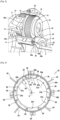
- FIG. 5 is a sectional view along a plane parallel to the X axis, along a plane passing through a wall 38. It thus shows an example of orifices 58 formed in a wall 38 separating two bowls.
- 6 orifices 58 are formed in an internal radial half of the wall 38.
- internal radial half we mean here the part of the wall 38 delimited by a ring inscribed between the radii R2 and R2+h/2.
- the orifices 58 could be formed in an external radial half of the wall 38, that is to say a part of the wall 38 delimited by a ring inscribed between the radii R2+h/2 and R2+h.
- all or part of the orifices 58 may be formed in the inner radial half or in the outer radial half of the wall 38.
- the orifices 58 may be formed in any part of the wall 38.
- the orifices 58 are arranged so as to define one or more rows of orifices in the internal walls.
- the rows of orifices are for example arranged in lines and columns, so as to form a matrix of orifices.
- fluid circulation channels 53 are formed in the shaft 3. It is understood that this embodiment is not limiting.
- the orifices 58 thus make it possible to ensure a transfer of fluid between the different bowls without requiring an overflow of the bowl in question.
- Such an embodiment thus makes it possible to achieve an equalization of the fluid level between the different bowls, without generating fluid eddies as would be the case for an overflow above the walls 38 which would not have such orifices 58.
- the location of the orifices 58 on the walls 38 makes it possible to determine from which level of fluid the transfer between the different bowls is carried out.
- the walls 38 thus extend radially around the shaft 3, and form walls extending in the direction defined by the axis X.
- the walls 38 have orifices 58 formed so as to allow fluid to pass between the different bowls thus formed.
- the orifices 58 can be formed in an internal radial part, between R and R+h/2, in an external radial part between R+h/2 and R+h, or in any part of the walls 38.
- All or part of the walls 38 may be provided with such orifices 58.
- the invention as proposed thus makes it possible to improve the balancing of the fluid in a fluid distribution wheel compared to known structures, which cause fluid overflows and only allow the start of balancing to be initiated once a highly unbalanced situation has been established.
Landscapes
- Engineering & Computer Science (AREA)
- General Engineering & Computer Science (AREA)
- Mechanical Engineering (AREA)
- Chemical & Material Sciences (AREA)
- Combustion & Propulsion (AREA)
- General Details Of Gearings (AREA)
- Structures Of Non-Positive Displacement Pumps (AREA)
Description
- La présente invention concerne le domaine des turbomachines, et vise plus précisément les distributeurs d'huile entre deux composants mobiles en rotation l'un par rapport à l'autre d'une turbomachine.
- La distribution d'huile entre deux éléments mobiles en rotation l'un par rapport à l'autre d'une turbomachine, en vue d'assurer la lubrification et le refroidissement des composants, pose des problématiques liées notamment à l'effet de l'huile sur le mouvement de rotation, et en particulier le risque de déséquilibrage et de vibrations qu'entrainerait une accumulation d'huile.
- Le document
FR3041054 - Le document
FR3047279 FR3074552 A1 - Les structures présentées dans ces documents présentent cependant une problématique en cas de déséquilibre entre les différentes cuvettes, ce qui peut aboutir à la formation d'un déséquilibre de masse, et ainsi impacter le mouvement de rotation.
- La présente invention vise ainsi à répondre au moins partiellement à cette problématique.
- La présente invention concerne ainsi un dispositif de lubrification pour un réducteur de turbomachine, présentant un axe principal,
- le dispositif comprenant une coupelle annulaire de collecte d'huile de lubrification délimitée par une première paroi et une seconde paroi,
- ladite coupelle étant divisée par des parois internes s'étendant entre le première paroi et la seconde paroi de manière à définir une pluralité de secteurs angulaires formant des cuvettes de collecte d'huile, les cuvettes étant circonférentiellement adjacentes autour de l'axe et comprenant des sorties d'huiles de lubrification destinées à la lubrification du réducteur,
- dans lequel une ou plusieurs desdites parois internes présentent des orifices permettant un passage d'huile entre les cuvettes circonférentiellement adjacentes,
- caractérisé en ce que lesdits orifices sont formés dans une ou plusieurs desdites parois internes de manière à définir une ou plusieurs rangées d'orifices dans lesdites une ou plusieurs parois internes.
- Selon un exemple, chacune desdites parois interne comprend des orifices.
- Selon un exemple, lesdites parois internes présentent une hauteur h mesurée selon la direction radiale par rapport à l'axe principal, et dans lequel des orifices sont formés dans une moitié radiale interne de chaque paroi interne.
- Selon un exemple, lesdites parois internes présentent une hauteur h mesurée selon une direction radiale par rapport à l'axe principal, et dans lequel des orifices sont formés dans une moitié radiale externe de chaque paroi interne.
- Lesdites rangées d'orifices sont typiquement disposées, dans lesdites une ou plusieurs parois (38) internes, en lignes et en colonnes, de manière à former une matrice d'orifices.
- La présente invention concerne étalement un réducteur comprenant un arbre d'entrée, un solaire, des satellites et un arbre de sortie, ledit réducteur comprenant un dispositif tel que défini précédemment, monté axialement autour de l'arbre d'entrée, de sorte que les sorties d'huile des cuvettes sont orientées pour déboucher vers les satellites, le solaire ou des paliers des satellites.
- L'invention concerne également un ensemble comprenant un arbre s'étendant autour d'un axe principal et un dispositif tel que défini dans l'une des revendications 1 ou 2 s'étendant autour dudit axe principal, dans lequel lesdites parois internes sont formées sur l'arbre.
- L'invention concerne également un ensemble comprenant un arbre s'étendant autour d'un axe principal et un dispositif tel que défini dans l'une des revendications 1 ou 2 s'étendant autour dudit axe principal, dans lequel lesdites parois internes sont formées sur la coupelle.
- La présente invention concerne en outre une turbomachine comprenant un tel réducteur.
- L'invention et ses avantages seront mieux compris à la lecture de la description détaillée faite ci-après de différents modes de réalisation de l'invention donnés à titre d'exemples non limitatifs.
- [
Fig. 1 ] Lafigure 1 présente schématiquement une vue en coupe axiale d'une turbomachine mettant en oeuvre l'invention. - [
Fig. 2 ] Lafigure 2 présente une vue détaillée en coupe d'un réducteur à train épicycloïdal, équipé d'un rouet selon l'invention. - [
Fig. 3 ] Lafigure 3 est une vue éclatée, en perspective, du réducteur de lafigure 2 . - [
Fig. 4 ] Lafigure 4 présente une vue schématique d'un rouet d'un ensemble selon l'invention. - [
Fig. 5 ] Lafigure 5 présente une vue schématique en coupe axiale d'un rouet d'un ensemble selon l'invention. - [
Fig. 6 ] Lafigure 6 présente une vue en perspective axiale d'un rouet d'un ensemble selon l'invention. - [
Fig. 7 ] Lafigure 7 présente une vue en perspective d'un ensemble selon un mode de réalisation de l'invention. - Sur l'ensemble des figures, les éléments en commun sont repérés par des références numériques identiques.
- En référence à la
figure 1 , l'invention concerne, par exemple, une turbomachine 1 qui comporte, de manière classique, une hélice de soufflante S, un compresseur basse pression 1a, un compresseur haute pression Ib, une turbine haute pression 1d, une turbine basse pression le et une tuyère d'échappement 1h. Le compresseur haute pression 1b et Ia turbine haute pression 1d sont reliés par un arbre haute pression 2 et forment avec lui un corps haute pression (HP). - Le compresseur basse pression la et la turbine basse pression sont reliés par un arbre basse pression 3 et forment avec lui un corps basse pression (BP). Dans un exemple de configuration, l'hélice de soufflante S est entraînée par un arbre de soufflante 4 qui est couplé à l'arbre BP 3 au moyen d'un réducteur 10 à train épicycloïdal. Le réducteur 10 est positionné dans la partie amont de la turbomachine. Une structure fixe comportant schématiquement, ici, une partie amont 5a et une partie aval 5b est agencée de manière à former un enceinte E1 entourant le réducteur 10.
- Cette enceinte E1 est ici fermée en amont par des joints au niveau d'un palier 6a permettant la traversée de l'arbre de soufflante 4, et en aval par des joints au niveau de la traversée 6b de l'arbre BP 3.
- En référence aux
figures 2 et3 , le réducteur comprend une couronne 14 qui est fixée par l'intermédiaire d'un carter de support 20 à ladite structure fixe 5a, 5b avec des moyens souples agencés pour lui permettre de suivre les mouvements éventuels de l'arbre de soufflante 4. Ces moyens de fixation sont connus de l'homme du métier et ne sont pas détaillés ici. - Une brève description peut en être trouvée par exemple dans
FR-A1-2987416 figure 2 , ou un palier à éléments roulants (roulements à billes ou à rouleaux). La rotation des satellites 12 autour de leur axe de satellite 16, du fait de la coopération de leurs pignons avec les dents de la couronne 14, entraîne la rotation du porte-satellites 13 autour de l'axe X, et par conséquent celle de l'arbre de soufflante 4 qui lui est lié, à une vitesse de rotation qui est inférieure à celle de l'arbre BP 3. L'entraînement de l'arbre de soufflante 4 par le porte-satellites 13 est assuré par une série de doigts de centrage 17, répartis régulièrement sur la circonférence du réducteur 10, qui s'étendent axialement de l'extrémité aval de l'arbre de soufflante 4 et qui s'enfoncent dans des alésages pratiqués dans le porte-satellites 13. Le porte-satellites 13 s'étend symétriquement de part et d'autre des axes de satellite 16 et forme une enceinte dans laquelle pourra être mise en oeuvre une fonction de lubrification des engrenages. Des douilles 19 de fermeture, aux extrémités des axes de satellites 16, permettent de fermer cette enceinte au niveau des paliers des satellites 12. - La
figure 2 montre, avec lafigure 3 , l'acheminement de l'huile vers le réducteur 10 et son cheminement à l'intérieur de celui-ci. Des flèches montrent sur lafigure 2 le cheminement suivi par l'huile depuis, sur cet exemple, un réservoir tampon 31 lié à la structure fixe de la turbomachine, jusqu'aux pignons et aux paliers à lubrifier. Le dispositif de lubrification comporte schématiquement trois parties qui vont être décrites ci-après successivement, une première partie liée à la structure fixe et délivrant l'huile vers les parties tournantes du réducteur 10, un rouet tournant avec le porte-satellites 13 réceptionnant cette huile, et des circuits de distribution d'huile alimentés en huile par le rouet pour l'acheminer vers les endroits à lubrifier. La première partie comporte au moins un injecteur 32 dont l'extrémité calibrée est resserrée pour former un gicleur 33. - L'huile est amenée vers l'injecteur par une canalisation d'acheminement, en provenance du réservoir du moteur (non représenté). Un réservoir tampon 31 peut être 30 interposé à côté du réducteur 10 sur la canalisation, de préférence en partie haute de façon à ce que l'huile puisse s'écouler vers le centre du réducteur par gravité. Le gicleur 33 éjecte l'huile sous la forme d'un jet 34, qui se forme sous la pression produite conjointement par la pompe d'alimentation (non représentée) et par le poids de la colonne d'huile située au-dessus de lui. Le gicleur 33 est positionné ici radialement à l'intérieur du porte-satellites 13 par rapport à l'axe X et le jet 34 est orienté avec une composante radiale dirigée vers l'extérieur du réducteur 10.
- En référence aux
figures 3 et 4 , le rouet de réception de l'huile lié au porte-satellites 13 comporte essentiellement une coupelle cylindrique, ici à section radiale en U, dont l'ouverture en U est orientée en direction de l'axe de rotation X. L'arbre 3 n'est pas représenté sur lafigure 4 ; il est centré sur l'axe X. - Le rouet est agencé sur le porte-satellites 13 de manière à ce que le fond 36 du U de la coupelle 35 recueille le jet d'huile 34 éjecté par le gicleur 33.
- Selon l'invention, la coupelle 35 du rouet est ici divisée en une succession circonférentielle de cuvettes 37a, 37b séparées par des parois 38 orientées radialement et s'étendant axialement entre les deux parois latérales 39a, 39b du U formé par la coupelle 35. Sur l'exemple présenté, les parois de séparation circonférentielle 38 délimitent deux séries alternées de quatre cuvettes 37a, 37b, avec une extension circonférentielle identique dans une série mais différente d'une série à l'autre. Les cuvettes sont ainsi circonférentiellement adjacentes autour de l'axe de rotation X. Les cuvettes définissent ainsi une pluralité de secteurs angulaires distincts au sein de la coupelle 35. Par centrifugation, lorsque le rouet tourne avec le porte-satellites 13, l'huile réceptionnée sur le fond 36 de la coupelle 35 est entraînée en rotation et mise en pression entre le fond 36 et les parois latérales 39a, 39b de la coupelle 35. Chaque cuvette 35a, 35b, en passant successivement devant le gicleur 33 au cours de la rotation, recueille une quantité d'huile proportionnelle à son extension circonférentielle. En effet, les bords radialement intérieurs des parois 39a-39b-38 d'une cuvette 37a, 37b définissent une surface d'entrée de la cuvette selon la direction radiale. Cette huile reste confinée entre les parois 38, 39a, 39b de la cuvette 37a, 37b tant que le niveau d'huile par rapport au fond 36 reste inférieur à la hauteur minimale h des parois 38 de celle-ci par rapport au fond 36. Les bords radiaux internes 40a, 40b des parois latérales 39a, 39b sont sensiblement circulaires. Leur rayon R1 définit une profondeur générale H de la coupelle 35 par rapport au fond 36.
- Dans l'exemple illustré, les parois de séparation circonférentielle 38 ont un bord radial interne 41 situé à une distance R2 de l'axe X légèrement supérieure au rayon R1 des bords internes 40a, 40b des parois latérales 39a, 39b. Dans l'exemple illustré, la hauteur h des parois 38 de séparation circonférentielle par rapport au fond 36 des cuvettes 37a, 37b est donc légèrement inférieure à la hauteur H des parois latérales 39a, 39b par rapport à ce même fond 36. On définit ainsi une différence de hauteur d égale à H-h.
- Cette différence de hauteur d est typiquement réduite, il suffit qu'elle permette à l'huile de s'écouler au-dessus des parois 38 de séparation circonférentielle au lieu de passer par les bords internes 39a, 39b des parois latérales 40a, 40b, si le niveau d'huile monte dans une cuvette 37a, 37b.
- Typiquement, pour un réducteur 10 de turbomachine du type de celui présenté ici, une différence de hauteur d de l'ordre de 3 millimètres peut suffire.
- Par ailleurs le fond 36 de chaque cuvette 37a, 37b comporte une ouverture 42a, 42b qui communique avec une canalisation 43, 45 d'un circuit de distribution d'huile installé sur le porte-satellites 13.
- Les cuvettes comprennent des sorties d'huiles de lubrification destinées par exemple à la lubrification du réducteur 10.
- En référence aux
figures 2 et3 , les circuits de distribution d'huile sont ici de deux types. Une première série de circuits de distribution d'huile correspond à des premières canalisations 43, qui sont réparties en régulièrement sur la circonférence du réducteur 10 et en nombre égal à celui des satellites 12. Ces canalisations 43 partent radialement de l'ouverture 42a du fond de la première série de cuvettes 37a et pénètrent dans l'enceinte interne de chaque arbre de satellite 16, qui est refermée par le porte-satellites 13. L'huile qui circule dans les premières canalisations 43 pénètre dans la cavité interne de chaque axe de satellite 16 puis passe, du fait de la force centrifuge, dans des canaux de guidage 44, qui traversent ces axes de satellite 16 en étant orientés radialement. Ces canaux 44 débouchent à la périphérie des axes de satellites 16, au niveau des paliers supportant les pignons des satellites 12 et assurent ainsi la lubrification de ces paliers. La deuxième série de circuits de distribution d'huile comprend des secondes canalisations 45 qui cheminent, depuis les ouvertures 42b du fond des cuvettes 37b de la deuxième série de cuvettes entre les satellites 12 et se divisent en plusieurs canaux 45a, 45b. Les canaux 45a, 45b acheminent l'huile vers les engrenages formés par les pignons des satellites 12 et le pignon planétaire 11, d'une part, et les pignons des satellites 12 et la couronne externe 14, d'autre part. Chaque canal 45a s'étend axialement le long des pignons d'un satellite 12, entre ceux-ci et le planétaire 11, et forme une rampe de lubrification sur toute la largeur des pignons. Le canal 45b, qui alimente l'engrenage entre la couronne 14 et les pignons des satellites 12, projette son huile au centre du cylindre formé par chaque satellite 12. Comme représenté, chaque satellite 12 est réalisé sous la forme de deux pignons parallèles. - Leur denture est orientée en diagonale par rapport à l'axe de rotation du satellite 12, de façon à leur donner une fonction de rainures dans lesquelles l'huile est entraînée, depuis le milieu du cylindre jusqu'à sa périphérie, pour lubrifier l'engrenage sur toute sa largeur. Sur cet exemple, les premiers circuits de distribution d'huile 43-44 qui lubrifient les paliers supportant les satellites ont besoin d'acheminer un débit d'huile plus important que les deuxièmes circuits 45-45a-45b. Pour cette raison, l'extension circonférentielle des cuvettes 37a de la première série, qui leur correspondent, est plus importante que celle des cuvettes 37b de la deuxième série. Ici, un rapport de deux tiers à un tiers est recherché dans le débit d'huile en fonctionnement nominal ; l'extension circonférentielle des deux séries de cuvettes 37a, 37b reprend sensiblement ce rapport.
- L'ensemble a ici été présenté en se référant à une architecture de réducteur 10 à quatre satellites 12 avec des deux séries de circuits de distribution d'huile 43-44, 45-45a-45b de types différents. Pour d'autres architectures de réducteurs, le nombre de cuvettes par série peut être différent. De même le nombre de séries de cuvettes ayant des extensions circonférentielles semblables peut être différent, suivant les types de circuits de distribution d'huile. Par exemple, les deuxièmes circuits de distribution d'huile pourraient être subdivisés en deux, l'un dédié à l'engrenage des pignons des satellites 12 avec le planétaire 11 et l'autre dédié à l'engrenage avec la couronne 14. Dans ce cas, une variante de réalisation du rouet de récupération d'huile est envisageable avec trois séries de cuvettes d'extensions circonférentielles différentes. On va maintenant décrire plusieurs modes de mise oeuvre du dispositif de lubrification, en relation avec la disposition des cuvettes 37a, 37b dans la coupelle 35.
- On comprend cependant qu'une telle structure peut entrainer des remous et des irrégularités dans la répartition de la masse de fluide autour de l'axe X.
- L'invention propose ainsi de réaliser des orifices 58 dans les parois 38 de séparation circonférentielle, de manière à permettre un passage de fluide entre les cuvettes adjacentes sans nécessiter un débordement du volume de la cuvette considérée au-dessus de la hauteur h de ses parois 38.
- Les
figures 5, 6 et7 illustrent cet aspect de l'invention. - On représente ainsi sur les
figures 5 et 6 deux vues présentant le détail d'orifices 58 formées dans les parois 38 séparant les différentes cuvettes 37a et 37b. - La
figure 5 est une vue en coupe selon un plan parallèle à l'axe X, selon un plan passant par une paroi 38. On y voit ainsi un exemple d'orifices 58 formés dans une paroi 38 séparant deux cuvettes. Dans l'exemple illustré, on forme 6 orifices 58, dans une moitié radiale interne de la paroi 38. Par moitié radiale interne, on entend ici la partie de la paroi 38 délimitée par un anneau inscrit entre les rayons R2 et R2+h/2. En variante, les orifices 58 pourraient être formés dans une moitié radiale externe de la paroi 38, c'est-à-dire une partie de la paroi 38 délimitée par un anneau inscrit entre les rayons R2+h/2 et R2+h. Plus généralement, tout ou partie des orifices 58 peuvent être formés dans la moitié radiale interne ou dans la moitié radiale externe de la paroi 38. En variante, les orifices 58 peuvent être formés dans une partie quelconque de la paroi 38. - Les orifices 58 sont disposés de manière à définir une ou plusieurs rangées d'orifices dans les parois internes. Les rangées d'orifices sont par exemple disposées en lignes et en colonnes, de manière à former une matrice d'orifices.
- Dans l'exemple illustré, des canaux 53 de circulation de fluide sont formés dans l'arbre 3. On comprend bien que ce mode de réalisation n'est pas limitatif.
- Les orifices 58 permettent ainsi d'assurer un transfert de fluide entre les différentes cuvettes sans nécessiter un débordement de la cuvette considérée.
- Un tel mode de réalisation permet ainsi de réaliser une égalisation du niveau de fluide entre les différentes cuvettes, sans générer des remous de fluide comme ce serait le cas pour un débordement au-dessus des parois 38 qui ne présenteraient pas de tels orifices 58.
- L'emplacement des orifices 58 sur les parois 38 permet de déterminer à partir de quel niveau de fluide le transfert entre les différentes cuvettes est réalisé.
- La
figure 7 présente une variante, dans laquelle les parois 38 délimitant les différentes cuvettes au sein de la coupelle 35 du rouet sont formées sur l'arbre 3. - Les parois 38 s'étendent ainsi radialement autour de l'arbre 3, et forment des parois s'étendant selon la direction définie par l'axe X.
- Comme pour le mode de réalisation décrit précédemment, les parois 38 présentent des orifices 58 formés de manière à permettre un passage de fluide entre les différentes cuvettes ainsi formées.
- Comme précédemment, si on considère que les parois 38 présentent une hauteur h mesurée selon la direction radiale et que l'arbre 3 présente un rayon externe R, les orifices 58 peuvent être formés dans une partie radiale interne, comprise entre R et R+h/2, dans une partie radiale externe comprise entre R+h/2 et R+h, ou dans une partie quelconque des parois 38.
- Tout ou partie des parois 38 peuvent être munies de tels orifices 58.
- L'invention telle que proposée permet ainsi d'améliorer l'équilibrage du fluide dans un rouet de distribution de fluide par rapport aux structures connues, qui entraînent des débordements de fluide et ne permettent d'initier un début d'équilibrage qu'une fois qu'une situation fortement déséquilibrée s'est établie.
- Bien que la présente invention ait été décrite en se référant à des exemples de réalisation spécifiques, il est évident que des modifications et des changements peuvent être effectués sur ces exemples selon les combinaisons des caractéristiques comme définies par les revendications. Par conséquent, la description et les dessins doivent être considérés dans un sens illustratif plutôt que restrictif.
Claims (9)
- Dispositif de lubrification pour un réducteur de turbomachine présentant un axe (X) principal,le dispositif comprenant une coupelle (35) annulaire de collecte d'huile de lubrification délimitée par une première paroi (39a) et une seconde paroi (39b),ladite coupelle (35) étant divisée par des parois (38) internes s'étendant entre la première paroi (39a) et la seconde paroi (39b) de manière à définir une pluralité de secteurs angulaires formant des cuvettes (37) de collecte d'huile, les cuvettes (37) étant circonférentiellement adjacentes autour de l'axe (X) et comprenant des sorties d'huiles de lubrification destinées à la lubrification du réducteur,dans lequel une ou plusieurs desdites parois (38) internes présentent des orifices (58) permettant un passage d'huile entre les cuvettes (37) circonférentiellement adjacentes,le dispositif étant caractérisé en ce que lesdits orifices (58) sont formés dans une ou plusieurs desdites parois (38) internes de manière à définir une ou plusieurs rangées d'orifices dans lesdites une ou plusieurs parois (38) internes.
- Dispositif selon la revendication 1, dans lequel chacune desdites parois (38) interne comprend des orifices (58).
- Dispositif selon l'une des revendications 1 ou 2, dans lequel lesdites parois (38) internes présentent une hauteur h mesurée selon la direction radiale par rapport à l'axe (X) principal, et dans lequel des orifices sont formés dans une moitié radiale interne de chaque paroi (38) interne.
- Dispositif selon l'une des revendications 1 à 3, dans lequel lesdites parois (38) internes présentent une hauteur h mesurée selon une direction radiale par rapport à l'axe (X) principal, et dans lequel des orifices (53) sont formés dans une moitié radiale externe de chaque paroi (38) interne.
- Dispositif selon l'une des revendications 1 à 4, dans lequel lesdites rangées d'orifices sont disposées, dans lesdites une ou plusieurs parois (38) internes, en lignes et en colonnes, de manière à former une matrice d'orifices.
- Réducteur comprenant un arbre d'entrée, un solaire, des satellites et un arbre de sortie,
ledit réducteur comprenant un dispositif selon l'une des revendications 1 à 5 monté axialement autour de l'arbre d'entrée, de sorte que les sorties d'huile des cuvettes (37) sont orientées pour déboucher vers les satellites, le solaire ou des paliers des satellites. - Ensemble comprenant un arbre (3) s'étendant autour d'un axe (X) principal et un dispositif selon l'une des revendications 1 ou 2 s'étendant autour dudit axe (X) principal, dans lequel lesdites parois (38) internes sont formées sur l'arbre (3).
- Ensemble comprenant un arbre (3) s'étendant autour d'un axe (X) principal et un dispositif selon l'une des revendications 1 ou 2 s'étendant autour dudit axe (X) principal, dans lequel lesdites parois (38) internes sont formées sur la coupelle (35).
- Turbomachine comprenant un réducteur selon la revendication 6.
Applications Claiming Priority (1)
| Application Number | Priority Date | Filing Date | Title |
|---|---|---|---|
| FR2104786A FR3122715B1 (fr) | 2021-05-06 | 2021-05-06 | Dispositif de lubrification amélioré pour réducteur de turbomachine. |
Publications (2)
| Publication Number | Publication Date |
|---|---|
| EP4086483A1 EP4086483A1 (fr) | 2022-11-09 |
| EP4086483B1 true EP4086483B1 (fr) | 2024-09-04 |
Family
ID=76730756
Family Applications (1)
| Application Number | Title | Priority Date | Filing Date |
|---|---|---|---|
| EP22170472.9A Active EP4086483B1 (fr) | 2021-05-06 | 2022-04-28 | Dispositif de lubrification amélioré pour réducteur de turbomachine |
Country Status (3)
| Country | Link |
|---|---|
| US (1) | US11927262B2 (fr) |
| EP (1) | EP4086483B1 (fr) |
| FR (1) | FR3122715B1 (fr) |
Family Cites Families (8)
| Publication number | Priority date | Publication date | Assignee | Title |
|---|---|---|---|---|
| US8398517B2 (en) * | 2009-06-10 | 2013-03-19 | United Technologies Corporation | Journal bearing with single unit jumper tube and filter |
| JP6178344B2 (ja) * | 2012-02-23 | 2017-08-09 | サフラン・エアクラフト・エンジンズ | 減速歯車装置、ファンモジュールおよびバイパスターボジェットエンジン |
| FR2987416B1 (fr) | 2012-02-23 | 2015-09-04 | Snecma | Dispositif de lubrification d'un reducteur epicycloidal. |
| FR3041054B1 (fr) | 2015-09-15 | 2017-09-15 | Hispano-Suiza | Dispositif d'alimentation en huile pour un reducteur a train epicycloidal. |
| FR3047279B1 (fr) | 2016-01-28 | 2019-06-07 | Safran Transmission Systems | Rouet de distribution a repartition axiale et reducteur a train epicycloidal ainsi equipe |
| ITUA20162737A1 (it) * | 2016-04-20 | 2017-10-20 | Ge Avio Srl | Unita' di trasferimento d'olio per trasferire olio tra una parte statica ed una parte rotante |
| US10247297B2 (en) * | 2017-01-18 | 2019-04-02 | General Electric Company | Apparatus for a gearbox with multiple scavenge ports |
| FR3074552B1 (fr) * | 2017-12-06 | 2019-11-22 | Safran Transmission Systems | Couronne de reducteur de vitesse a train planetaire de turbomachine |
-
2021
- 2021-05-06 FR FR2104786A patent/FR3122715B1/fr active Active
-
2022
- 2022-04-28 EP EP22170472.9A patent/EP4086483B1/fr active Active
- 2022-05-03 US US17/661,869 patent/US11927262B2/en active Active
Also Published As
| Publication number | Publication date |
|---|---|
| US11927262B2 (en) | 2024-03-12 |
| FR3122715A1 (fr) | 2022-11-11 |
| US20220364641A1 (en) | 2022-11-17 |
| EP4086483A1 (fr) | 2022-11-09 |
| FR3122715B1 (fr) | 2023-05-12 |
Similar Documents
| Publication | Publication Date | Title |
|---|---|---|
| EP3408504B1 (fr) | Rouet de distribution d'huile avec partitionnement axial et réducteur a train épicycloidal equipé d'un tel rouet | |
| EP3350482B1 (fr) | Dispositif d'alimentation en huile pour un reducteur a train epicycloïdal | |
| EP4058689B1 (fr) | Rouet pour un porte-satellites de reducteur de vitesse a train epicycloïdal de turbomachine | |
| EP3822516B1 (fr) | Rouet etage pour l'alimentation en huile d'un reducteur epicycloïdal ou planetaire | |
| EP3763971B1 (fr) | Couvercle de canalisation d'huile et reducteur mecanique de turbomachine d'aeronef comportant un tel couvercle | |
| EP3980633B1 (fr) | Reducteur planetaire pour une turbomachine d'aeronef | |
| EP3822515B1 (fr) | Rouet pour un porte-satellites de reducteur de vitesse à train epicycloïdal de turbomachine | |
| CA2946958C (fr) | Module de turbomachine comportant un carter autour d'un equipement avec un capot de recuperation d'huile de lubrification | |
| EP4086483B1 (fr) | Dispositif de lubrification amélioré pour réducteur de turbomachine | |
| EP3807508B1 (fr) | Porte-satellites tournant pour un reducteur mecanique d'une turbomachine | |
| WO2018189442A1 (fr) | Lubrification pour train d'engrenages épicycloïdal | |
| FR3099220A1 (fr) | Réducteur de vitesse à train épicycloïdal pour une turbomachine | |
| EP4382776B1 (fr) | Gouttière de récupération d'huile de lubrification pour réducteur mécanique comprenant un déflecteur amélioré | |
| WO2018189476A1 (fr) | Train d'engrenages epicycloïdal | |
| EP3807507B1 (fr) | Dispositif de repartition d'huile pour un porte-satellites tournant d'un reducteur mecanique d'une turbomachine | |
| EP4001703A1 (fr) | Pignon avec dispositif de lubrification | |
| EP4722503A1 (fr) | Rouet de lubrification pour un reducteur de vitesse de turbomachine | |
| WO2026017951A1 (fr) | Rouet de lubrification pour un reducteur de vitesse de turbomachine | |
| EP3901422B1 (fr) | Pignon avec un dispositif de lubrification | |
| WO2024209161A1 (fr) | Ensemble pour un reducteur mecanique d'aeronef | |
| FR3153866A1 (fr) | Reducteur mecanique de vitesse a barbotage d’huile |
Legal Events
| Date | Code | Title | Description |
|---|---|---|---|
| PUAI | Public reference made under article 153(3) epc to a published international application that has entered the european phase |
Free format text: ORIGINAL CODE: 0009012 |
|
| STAA | Information on the status of an ep patent application or granted ep patent |
Free format text: STATUS: REQUEST FOR EXAMINATION WAS MADE |
|
| 17P | Request for examination filed |
Effective date: 20220428 |
|
| AK | Designated contracting states |
Kind code of ref document: A1 Designated state(s): AL AT BE BG CH CY CZ DE DK EE ES FI FR GB GR HR HU IE IS IT LI LT LU LV MC MK MT NL NO PL PT RO RS SE SI SK SM TR |
|
| STAA | Information on the status of an ep patent application or granted ep patent |
Free format text: STATUS: EXAMINATION IS IN PROGRESS |
|
| 17Q | First examination report despatched |
Effective date: 20231115 |
|
| GRAP | Despatch of communication of intention to grant a patent |
Free format text: ORIGINAL CODE: EPIDOSNIGR1 |
|
| STAA | Information on the status of an ep patent application or granted ep patent |
Free format text: STATUS: GRANT OF PATENT IS INTENDED |
|
| INTG | Intention to grant announced |
Effective date: 20240417 |
|
| GRAS | Grant fee paid |
Free format text: ORIGINAL CODE: EPIDOSNIGR3 |
|
| GRAA | (expected) grant |
Free format text: ORIGINAL CODE: 0009210 |
|
| STAA | Information on the status of an ep patent application or granted ep patent |
Free format text: STATUS: THE PATENT HAS BEEN GRANTED |
|
| AK | Designated contracting states |
Kind code of ref document: B1 Designated state(s): AL AT BE BG CH CY CZ DE DK EE ES FI FR GB GR HR HU IE IS IT LI LT LU LV MC MK MT NL NO PL PT RO RS SE SI SK SM TR |
|
| REG | Reference to a national code |
Ref country code: GB Ref legal event code: FG4D Free format text: NOT ENGLISH |
|
| REG | Reference to a national code |
Ref country code: CH Ref legal event code: EP |
|
| REG | Reference to a national code |
Ref country code: IE Ref legal event code: FG4D Free format text: LANGUAGE OF EP DOCUMENT: FRENCH |
|
| REG | Reference to a national code |
Ref country code: DE Ref legal event code: R096 Ref document number: 602022005788 Country of ref document: DE |
|
| REG | Reference to a national code |
Ref country code: LT Ref legal event code: MG9D |
|
| REG | Reference to a national code |
Ref country code: NL Ref legal event code: MP Effective date: 20240904 |
|
| PG25 | Lapsed in a contracting state [announced via postgrant information from national office to epo] |
Ref country code: NO Free format text: LAPSE BECAUSE OF FAILURE TO SUBMIT A TRANSLATION OF THE DESCRIPTION OR TO PAY THE FEE WITHIN THE PRESCRIBED TIME-LIMIT Effective date: 20241204 |
|
| PG25 | Lapsed in a contracting state [announced via postgrant information from national office to epo] |
Ref country code: GR Free format text: LAPSE BECAUSE OF FAILURE TO SUBMIT A TRANSLATION OF THE DESCRIPTION OR TO PAY THE FEE WITHIN THE PRESCRIBED TIME-LIMIT Effective date: 20241205 Ref country code: PL Free format text: LAPSE BECAUSE OF FAILURE TO SUBMIT A TRANSLATION OF THE DESCRIPTION OR TO PAY THE FEE WITHIN THE PRESCRIBED TIME-LIMIT Effective date: 20240904 Ref country code: FI Free format text: LAPSE BECAUSE OF FAILURE TO SUBMIT A TRANSLATION OF THE DESCRIPTION OR TO PAY THE FEE WITHIN THE PRESCRIBED TIME-LIMIT Effective date: 20240904 |
|
| PG25 | Lapsed in a contracting state [announced via postgrant information from national office to epo] |
Ref country code: BG Free format text: LAPSE BECAUSE OF FAILURE TO SUBMIT A TRANSLATION OF THE DESCRIPTION OR TO PAY THE FEE WITHIN THE PRESCRIBED TIME-LIMIT Effective date: 20240904 |
|
| PG25 | Lapsed in a contracting state [announced via postgrant information from national office to epo] |
Ref country code: LV Free format text: LAPSE BECAUSE OF FAILURE TO SUBMIT A TRANSLATION OF THE DESCRIPTION OR TO PAY THE FEE WITHIN THE PRESCRIBED TIME-LIMIT Effective date: 20240904 |
|
| PG25 | Lapsed in a contracting state [announced via postgrant information from national office to epo] |
Ref country code: HR Free format text: LAPSE BECAUSE OF FAILURE TO SUBMIT A TRANSLATION OF THE DESCRIPTION OR TO PAY THE FEE WITHIN THE PRESCRIBED TIME-LIMIT Effective date: 20240904 |
|
| PG25 | Lapsed in a contracting state [announced via postgrant information from national office to epo] |
Ref country code: ES Free format text: LAPSE BECAUSE OF FAILURE TO SUBMIT A TRANSLATION OF THE DESCRIPTION OR TO PAY THE FEE WITHIN THE PRESCRIBED TIME-LIMIT Effective date: 20240904 Ref country code: RS Free format text: LAPSE BECAUSE OF FAILURE TO SUBMIT A TRANSLATION OF THE DESCRIPTION OR TO PAY THE FEE WITHIN THE PRESCRIBED TIME-LIMIT Effective date: 20241204 |
|
| PG25 | Lapsed in a contracting state [announced via postgrant information from national office to epo] |
Ref country code: RS Free format text: LAPSE BECAUSE OF FAILURE TO SUBMIT A TRANSLATION OF THE DESCRIPTION OR TO PAY THE FEE WITHIN THE PRESCRIBED TIME-LIMIT Effective date: 20241204 Ref country code: PL Free format text: LAPSE BECAUSE OF FAILURE TO SUBMIT A TRANSLATION OF THE DESCRIPTION OR TO PAY THE FEE WITHIN THE PRESCRIBED TIME-LIMIT Effective date: 20240904 Ref country code: NO Free format text: LAPSE BECAUSE OF FAILURE TO SUBMIT A TRANSLATION OF THE DESCRIPTION OR TO PAY THE FEE WITHIN THE PRESCRIBED TIME-LIMIT Effective date: 20241204 Ref country code: LV Free format text: LAPSE BECAUSE OF FAILURE TO SUBMIT A TRANSLATION OF THE DESCRIPTION OR TO PAY THE FEE WITHIN THE PRESCRIBED TIME-LIMIT Effective date: 20240904 Ref country code: HR Free format text: LAPSE BECAUSE OF FAILURE TO SUBMIT A TRANSLATION OF THE DESCRIPTION OR TO PAY THE FEE WITHIN THE PRESCRIBED TIME-LIMIT Effective date: 20240904 Ref country code: GR Free format text: LAPSE BECAUSE OF FAILURE TO SUBMIT A TRANSLATION OF THE DESCRIPTION OR TO PAY THE FEE WITHIN THE PRESCRIBED TIME-LIMIT Effective date: 20241205 Ref country code: FI Free format text: LAPSE BECAUSE OF FAILURE TO SUBMIT A TRANSLATION OF THE DESCRIPTION OR TO PAY THE FEE WITHIN THE PRESCRIBED TIME-LIMIT Effective date: 20240904 Ref country code: ES Free format text: LAPSE BECAUSE OF FAILURE TO SUBMIT A TRANSLATION OF THE DESCRIPTION OR TO PAY THE FEE WITHIN THE PRESCRIBED TIME-LIMIT Effective date: 20240904 Ref country code: BG Free format text: LAPSE BECAUSE OF FAILURE TO SUBMIT A TRANSLATION OF THE DESCRIPTION OR TO PAY THE FEE WITHIN THE PRESCRIBED TIME-LIMIT Effective date: 20240904 |
|
| REG | Reference to a national code |
Ref country code: AT Ref legal event code: MK05 Ref document number: 1720705 Country of ref document: AT Kind code of ref document: T Effective date: 20240904 |
|
| PG25 | Lapsed in a contracting state [announced via postgrant information from national office to epo] |
Ref country code: NL Free format text: LAPSE BECAUSE OF FAILURE TO SUBMIT A TRANSLATION OF THE DESCRIPTION OR TO PAY THE FEE WITHIN THE PRESCRIBED TIME-LIMIT Effective date: 20240904 |
|
| PG25 | Lapsed in a contracting state [announced via postgrant information from national office to epo] |
Ref country code: PT Free format text: LAPSE BECAUSE OF FAILURE TO SUBMIT A TRANSLATION OF THE DESCRIPTION OR TO PAY THE FEE WITHIN THE PRESCRIBED TIME-LIMIT Effective date: 20250106 Ref country code: IS Free format text: LAPSE BECAUSE OF FAILURE TO SUBMIT A TRANSLATION OF THE DESCRIPTION OR TO PAY THE FEE WITHIN THE PRESCRIBED TIME-LIMIT Effective date: 20250104 |
|
| PG25 | Lapsed in a contracting state [announced via postgrant information from national office to epo] |
Ref country code: RO Free format text: LAPSE BECAUSE OF FAILURE TO SUBMIT A TRANSLATION OF THE DESCRIPTION OR TO PAY THE FEE WITHIN THE PRESCRIBED TIME-LIMIT Effective date: 20240904 Ref country code: SM Free format text: LAPSE BECAUSE OF FAILURE TO SUBMIT A TRANSLATION OF THE DESCRIPTION OR TO PAY THE FEE WITHIN THE PRESCRIBED TIME-LIMIT Effective date: 20240904 |
|
| PG25 | Lapsed in a contracting state [announced via postgrant information from national office to epo] |
Ref country code: EE Free format text: LAPSE BECAUSE OF FAILURE TO SUBMIT A TRANSLATION OF THE DESCRIPTION OR TO PAY THE FEE WITHIN THE PRESCRIBED TIME-LIMIT Effective date: 20240904 Ref country code: AT Free format text: LAPSE BECAUSE OF FAILURE TO SUBMIT A TRANSLATION OF THE DESCRIPTION OR TO PAY THE FEE WITHIN THE PRESCRIBED TIME-LIMIT Effective date: 20240904 |
|
| PG25 | Lapsed in a contracting state [announced via postgrant information from national office to epo] |
Ref country code: CZ Free format text: LAPSE BECAUSE OF FAILURE TO SUBMIT A TRANSLATION OF THE DESCRIPTION OR TO PAY THE FEE WITHIN THE PRESCRIBED TIME-LIMIT Effective date: 20240904 |
|
| PG25 | Lapsed in a contracting state [announced via postgrant information from national office to epo] |
Ref country code: SK Free format text: LAPSE BECAUSE OF FAILURE TO SUBMIT A TRANSLATION OF THE DESCRIPTION OR TO PAY THE FEE WITHIN THE PRESCRIBED TIME-LIMIT Effective date: 20240904 Ref country code: IT Free format text: LAPSE BECAUSE OF FAILURE TO SUBMIT A TRANSLATION OF THE DESCRIPTION OR TO PAY THE FEE WITHIN THE PRESCRIBED TIME-LIMIT Effective date: 20240904 |
|
| REG | Reference to a national code |
Ref country code: DE Ref legal event code: R097 Ref document number: 602022005788 Country of ref document: DE |
|
| PGFP | Annual fee paid to national office [announced via postgrant information from national office to epo] |
Ref country code: DE Payment date: 20250417 Year of fee payment: 4 |
|
| PG25 | Lapsed in a contracting state [announced via postgrant information from national office to epo] |
Ref country code: DK Free format text: LAPSE BECAUSE OF FAILURE TO SUBMIT A TRANSLATION OF THE DESCRIPTION OR TO PAY THE FEE WITHIN THE PRESCRIBED TIME-LIMIT Effective date: 20240904 |
|
| PLBE | No opposition filed within time limit |
Free format text: ORIGINAL CODE: 0009261 |
|
| STAA | Information on the status of an ep patent application or granted ep patent |
Free format text: STATUS: NO OPPOSITION FILED WITHIN TIME LIMIT |
|
| PGFP | Annual fee paid to national office [announced via postgrant information from national office to epo] |
Ref country code: FR Payment date: 20250422 Year of fee payment: 4 |
|
| 26N | No opposition filed |
Effective date: 20250605 |
|
| PG25 | Lapsed in a contracting state [announced via postgrant information from national office to epo] |
Ref country code: SE Free format text: LAPSE BECAUSE OF FAILURE TO SUBMIT A TRANSLATION OF THE DESCRIPTION OR TO PAY THE FEE WITHIN THE PRESCRIBED TIME-LIMIT Effective date: 20240904 |
|
| REG | Reference to a national code |
Ref country code: CH Ref legal event code: H13 Free format text: ST27 STATUS EVENT CODE: U-0-0-H10-H13 (AS PROVIDED BY THE NATIONAL OFFICE) Effective date: 20251125 |
|
| PG25 | Lapsed in a contracting state [announced via postgrant information from national office to epo] |
Ref country code: LU Free format text: LAPSE BECAUSE OF NON-PAYMENT OF DUE FEES Effective date: 20250428 |
|
| PG25 | Lapsed in a contracting state [announced via postgrant information from national office to epo] |
Ref country code: MC Free format text: LAPSE BECAUSE OF FAILURE TO SUBMIT A TRANSLATION OF THE DESCRIPTION OR TO PAY THE FEE WITHIN THE PRESCRIBED TIME-LIMIT Effective date: 20240904 |
|
| REG | Reference to a national code |
Ref country code: BE Ref legal event code: MM Effective date: 20250430 |
|
| PG25 | Lapsed in a contracting state [announced via postgrant information from national office to epo] |
Ref country code: BE Free format text: LAPSE BECAUSE OF NON-PAYMENT OF DUE FEES Effective date: 20250430 |
|
| PG25 | Lapsed in a contracting state [announced via postgrant information from national office to epo] |
Ref country code: CH Free format text: LAPSE BECAUSE OF NON-PAYMENT OF DUE FEES Effective date: 20250430 |
|
| PGFP | Annual fee paid to national office [announced via postgrant information from national office to epo] |
Ref country code: GB Payment date: 20260327 Year of fee payment: 5 |
|
| PG25 | Lapsed in a contracting state [announced via postgrant information from national office to epo] |
Ref country code: IE Free format text: LAPSE BECAUSE OF NON-PAYMENT OF DUE FEES Effective date: 20250428 |