EP4086157B1 - Pipeline system and discharge method - Google Patents
Pipeline system and discharge method Download PDFInfo
- Publication number
- EP4086157B1 EP4086157B1 EP20961643.2A EP20961643A EP4086157B1 EP 4086157 B1 EP4086157 B1 EP 4086157B1 EP 20961643 A EP20961643 A EP 20961643A EP 4086157 B1 EP4086157 B1 EP 4086157B1
- Authority
- EP
- European Patent Office
- Prior art keywords
- fuel
- limit value
- drum
- valve
- pipeline valve
- Prior art date
- Legal status (The legal status is an assumption and is not a legal conclusion. Google has not performed a legal analysis and makes no representation as to the accuracy of the status listed.)
- Active
Links
Images





Classifications
-
- B—PERFORMING OPERATIONS; TRANSPORTING
- B63—SHIPS OR OTHER WATERBORNE VESSELS; RELATED EQUIPMENT
- B63J—AUXILIARIES ON VESSELS
- B63J2/00—Arrangements of ventilation, heating, cooling, or air-conditioning
- B63J2/02—Ventilation; Air-conditioning
-
- B—PERFORMING OPERATIONS; TRANSPORTING
- B63—SHIPS OR OTHER WATERBORNE VESSELS; RELATED EQUIPMENT
- B63B—SHIPS OR OTHER WATERBORNE VESSELS; EQUIPMENT FOR SHIPPING
- B63B25/00—Load-accommodating arrangements, e.g. stowing, trimming; Vessels characterised thereby
- B63B25/02—Load-accommodating arrangements, e.g. stowing, trimming; Vessels characterised thereby for bulk goods
- B63B25/08—Load-accommodating arrangements, e.g. stowing, trimming; Vessels characterised thereby for bulk goods fluid
- B63B25/12—Load-accommodating arrangements, e.g. stowing, trimming; Vessels characterised thereby for bulk goods fluid closed
- B63B25/16—Load-accommodating arrangements, e.g. stowing, trimming; Vessels characterised thereby for bulk goods fluid closed heat-insulated
-
- B—PERFORMING OPERATIONS; TRANSPORTING
- B63—SHIPS OR OTHER WATERBORNE VESSELS; RELATED EQUIPMENT
- B63H—MARINE PROPULSION OR STEERING
- B63H21/00—Use of propulsion power plant or units on vessels
- B63H21/38—Apparatus or methods specially adapted for use on marine vessels, for handling power plant or unit liquids, e.g. lubricants, coolants, fuels or the like
-
- B—PERFORMING OPERATIONS; TRANSPORTING
- B63—SHIPS OR OTHER WATERBORNE VESSELS; RELATED EQUIPMENT
- B63J—AUXILIARIES ON VESSELS
- B63J2/00—Arrangements of ventilation, heating, cooling, or air-conditioning
- B63J2/12—Heating; Cooling
-
- F—MECHANICAL ENGINEERING; LIGHTING; HEATING; WEAPONS; BLASTING
- F02—COMBUSTION ENGINES; HOT-GAS OR COMBUSTION-PRODUCT ENGINE PLANTS
- F02D—CONTROLLING COMBUSTION ENGINES
- F02D19/00—Controlling engines characterised by their use of non-liquid fuels, pluralities of fuels, or non-fuel substances added to the combustible mixtures
- F02D19/06—Controlling engines characterised by their use of non-liquid fuels, pluralities of fuels, or non-fuel substances added to the combustible mixtures peculiar to engines working with pluralities of fuels, e.g. alternatively with light and heavy fuel oil, other than engines indifferent to the fuel consumed
- F02D19/0602—Control of components of the fuel supply system
- F02D19/0613—Switch-over from one fuel to another
- F02D19/0621—Purging of the fuel system
-
- F—MECHANICAL ENGINEERING; LIGHTING; HEATING; WEAPONS; BLASTING
- F02—COMBUSTION ENGINES; HOT-GAS OR COMBUSTION-PRODUCT ENGINE PLANTS
- F02M—SUPPLYING COMBUSTION ENGINES IN GENERAL WITH COMBUSTIBLE MIXTURES OR CONSTITUENTS THEREOF
- F02M21/00—Apparatus for supplying engines with non-liquid fuels, e.g. gaseous fuels stored in liquid form
- F02M21/02—Apparatus for supplying engines with non-liquid fuels, e.g. gaseous fuels stored in liquid form for gaseous fuels
- F02M21/0203—Apparatus for supplying engines with non-liquid fuels, e.g. gaseous fuels stored in liquid form for gaseous fuels characterised by the type of gaseous fuel
- F02M21/0209—Hydrocarbon fuels, e.g. methane or acetylene
-
- F—MECHANICAL ENGINEERING; LIGHTING; HEATING; WEAPONS; BLASTING
- F02—COMBUSTION ENGINES; HOT-GAS OR COMBUSTION-PRODUCT ENGINE PLANTS
- F02M—SUPPLYING COMBUSTION ENGINES IN GENERAL WITH COMBUSTIBLE MIXTURES OR CONSTITUENTS THEREOF
- F02M21/00—Apparatus for supplying engines with non-liquid fuels, e.g. gaseous fuels stored in liquid form
- F02M21/02—Apparatus for supplying engines with non-liquid fuels, e.g. gaseous fuels stored in liquid form for gaseous fuels
- F02M21/0218—Details on the gaseous fuel supply system, e.g. tanks, valves, pipes, pumps, rails, injectors or mixers
- F02M21/0245—High pressure fuel supply systems; Rails; Pumps; Arrangement of valves
-
- F—MECHANICAL ENGINEERING; LIGHTING; HEATING; WEAPONS; BLASTING
- F02—COMBUSTION ENGINES; HOT-GAS OR COMBUSTION-PRODUCT ENGINE PLANTS
- F02M—SUPPLYING COMBUSTION ENGINES IN GENERAL WITH COMBUSTIBLE MIXTURES OR CONSTITUENTS THEREOF
- F02M21/00—Apparatus for supplying engines with non-liquid fuels, e.g. gaseous fuels stored in liquid form
- F02M21/02—Apparatus for supplying engines with non-liquid fuels, e.g. gaseous fuels stored in liquid form for gaseous fuels
- F02M21/0218—Details on the gaseous fuel supply system, e.g. tanks, valves, pipes, pumps, rails, injectors or mixers
- F02M21/0293—Safety devices; Fail-safe measures
-
- F—MECHANICAL ENGINEERING; LIGHTING; HEATING; WEAPONS; BLASTING
- F17—STORING OR DISTRIBUTING GASES OR LIQUIDS
- F17C—VESSELS FOR CONTAINING OR STORING COMPRESSED, LIQUEFIED OR SOLIDIFIED GASES; FIXED-CAPACITY GAS-HOLDERS; FILLING VESSELS WITH, OR DISCHARGING FROM VESSELS, COMPRESSED, LIQUEFIED, OR SOLIDIFIED GASES
- F17C9/00—Methods or apparatus for discharging liquefied or solidified gases from vessels not under pressure
- F17C9/02—Methods or apparatus for discharging liquefied or solidified gases from vessels not under pressure with change of state, e.g. vaporisation
-
- B—PERFORMING OPERATIONS; TRANSPORTING
- B63—SHIPS OR OTHER WATERBORNE VESSELS; RELATED EQUIPMENT
- B63J—AUXILIARIES ON VESSELS
- B63J99/00—Subject matter not provided for in other groups of this subclass
- B63J2099/001—Burning of transported goods, e.g. fuel, boil-off or refuse
- B63J2099/003—Burning of transported goods, e.g. fuel, boil-off or refuse of cargo oil or fuel, or of boil-off gases, e.g. for propulsive purposes
-
- F—MECHANICAL ENGINEERING; LIGHTING; HEATING; WEAPONS; BLASTING
- F17—STORING OR DISTRIBUTING GASES OR LIQUIDS
- F17C—VESSELS FOR CONTAINING OR STORING COMPRESSED, LIQUEFIED OR SOLIDIFIED GASES; FIXED-CAPACITY GAS-HOLDERS; FILLING VESSELS WITH, OR DISCHARGING FROM VESSELS, COMPRESSED, LIQUEFIED, OR SOLIDIFIED GASES
- F17C2205/00—Vessel construction, in particular mounting arrangements, attachments or identifications means
- F17C2205/03—Fluid connections, filters, valves, closure means or other attachments
- F17C2205/0302—Fittings, valves, filters, or components in connection with the gas storage device
- F17C2205/0323—Valves
- F17C2205/0332—Safety valves or pressure relief valves
-
- F—MECHANICAL ENGINEERING; LIGHTING; HEATING; WEAPONS; BLASTING
- F17—STORING OR DISTRIBUTING GASES OR LIQUIDS
- F17C—VESSELS FOR CONTAINING OR STORING COMPRESSED, LIQUEFIED OR SOLIDIFIED GASES; FIXED-CAPACITY GAS-HOLDERS; FILLING VESSELS WITH, OR DISCHARGING FROM VESSELS, COMPRESSED, LIQUEFIED, OR SOLIDIFIED GASES
- F17C2221/00—Handled fluid, in particular type of fluid
- F17C2221/03—Mixtures
- F17C2221/032—Hydrocarbons
-
- F—MECHANICAL ENGINEERING; LIGHTING; HEATING; WEAPONS; BLASTING
- F17—STORING OR DISTRIBUTING GASES OR LIQUIDS
- F17C—VESSELS FOR CONTAINING OR STORING COMPRESSED, LIQUEFIED OR SOLIDIFIED GASES; FIXED-CAPACITY GAS-HOLDERS; FILLING VESSELS WITH, OR DISCHARGING FROM VESSELS, COMPRESSED, LIQUEFIED, OR SOLIDIFIED GASES
- F17C2221/00—Handled fluid, in particular type of fluid
- F17C2221/03—Mixtures
- F17C2221/032—Hydrocarbons
- F17C2221/033—Methane, e.g. natural gas, CNG, LNG, GNL, GNC, PLNG
-
- F—MECHANICAL ENGINEERING; LIGHTING; HEATING; WEAPONS; BLASTING
- F17—STORING OR DISTRIBUTING GASES OR LIQUIDS
- F17C—VESSELS FOR CONTAINING OR STORING COMPRESSED, LIQUEFIED OR SOLIDIFIED GASES; FIXED-CAPACITY GAS-HOLDERS; FILLING VESSELS WITH, OR DISCHARGING FROM VESSELS, COMPRESSED, LIQUEFIED, OR SOLIDIFIED GASES
- F17C2221/00—Handled fluid, in particular type of fluid
- F17C2221/03—Mixtures
- F17C2221/032—Hydrocarbons
- F17C2221/035—Propane butane, e.g. LPG, GPL
-
- F—MECHANICAL ENGINEERING; LIGHTING; HEATING; WEAPONS; BLASTING
- F17—STORING OR DISTRIBUTING GASES OR LIQUIDS
- F17C—VESSELS FOR CONTAINING OR STORING COMPRESSED, LIQUEFIED OR SOLIDIFIED GASES; FIXED-CAPACITY GAS-HOLDERS; FILLING VESSELS WITH, OR DISCHARGING FROM VESSELS, COMPRESSED, LIQUEFIED, OR SOLIDIFIED GASES
- F17C2223/00—Handled fluid before transfer, i.e. state of fluid when stored in the vessel or before transfer from the vessel
- F17C2223/01—Handled fluid before transfer, i.e. state of fluid when stored in the vessel or before transfer from the vessel characterised by the phase
- F17C2223/0146—Two-phase
- F17C2223/0153—Liquefied gas, e.g. LPG, GPL
-
- F—MECHANICAL ENGINEERING; LIGHTING; HEATING; WEAPONS; BLASTING
- F17—STORING OR DISTRIBUTING GASES OR LIQUIDS
- F17C—VESSELS FOR CONTAINING OR STORING COMPRESSED, LIQUEFIED OR SOLIDIFIED GASES; FIXED-CAPACITY GAS-HOLDERS; FILLING VESSELS WITH, OR DISCHARGING FROM VESSELS, COMPRESSED, LIQUEFIED, OR SOLIDIFIED GASES
- F17C2223/00—Handled fluid before transfer, i.e. state of fluid when stored in the vessel or before transfer from the vessel
- F17C2223/01—Handled fluid before transfer, i.e. state of fluid when stored in the vessel or before transfer from the vessel characterised by the phase
- F17C2223/0146—Two-phase
- F17C2223/0153—Liquefied gas, e.g. LPG, GPL
- F17C2223/0161—Liquefied gas, e.g. LPG, GPL cryogenic, e.g. LNG, GNL, PLNG
-
- F—MECHANICAL ENGINEERING; LIGHTING; HEATING; WEAPONS; BLASTING
- F17—STORING OR DISTRIBUTING GASES OR LIQUIDS
- F17C—VESSELS FOR CONTAINING OR STORING COMPRESSED, LIQUEFIED OR SOLIDIFIED GASES; FIXED-CAPACITY GAS-HOLDERS; FILLING VESSELS WITH, OR DISCHARGING FROM VESSELS, COMPRESSED, LIQUEFIED, OR SOLIDIFIED GASES
- F17C2223/00—Handled fluid before transfer, i.e. state of fluid when stored in the vessel or before transfer from the vessel
- F17C2223/03—Handled fluid before transfer, i.e. state of fluid when stored in the vessel or before transfer from the vessel characterised by the pressure level
- F17C2223/033—Small pressure, e.g. for liquefied gas
-
- F—MECHANICAL ENGINEERING; LIGHTING; HEATING; WEAPONS; BLASTING
- F17—STORING OR DISTRIBUTING GASES OR LIQUIDS
- F17C—VESSELS FOR CONTAINING OR STORING COMPRESSED, LIQUEFIED OR SOLIDIFIED GASES; FIXED-CAPACITY GAS-HOLDERS; FILLING VESSELS WITH, OR DISCHARGING FROM VESSELS, COMPRESSED, LIQUEFIED, OR SOLIDIFIED GASES
- F17C2227/00—Transfer of fluids, i.e. method or means for transferring the fluid; Heat exchange with the fluid
- F17C2227/03—Heat exchange with the fluid
- F17C2227/0302—Heat exchange with the fluid by heating
-
- F—MECHANICAL ENGINEERING; LIGHTING; HEATING; WEAPONS; BLASTING
- F17—STORING OR DISTRIBUTING GASES OR LIQUIDS
- F17C—VESSELS FOR CONTAINING OR STORING COMPRESSED, LIQUEFIED OR SOLIDIFIED GASES; FIXED-CAPACITY GAS-HOLDERS; FILLING VESSELS WITH, OR DISCHARGING FROM VESSELS, COMPRESSED, LIQUEFIED, OR SOLIDIFIED GASES
- F17C2260/00—Purposes of gas storage and gas handling
- F17C2260/04—Reducing risks and environmental impact
- F17C2260/042—Reducing risk of explosion
-
- F—MECHANICAL ENGINEERING; LIGHTING; HEATING; WEAPONS; BLASTING
- F17—STORING OR DISTRIBUTING GASES OR LIQUIDS
- F17C—VESSELS FOR CONTAINING OR STORING COMPRESSED, LIQUEFIED OR SOLIDIFIED GASES; FIXED-CAPACITY GAS-HOLDERS; FILLING VESSELS WITH, OR DISCHARGING FROM VESSELS, COMPRESSED, LIQUEFIED, OR SOLIDIFIED GASES
- F17C2265/00—Effects achieved by gas storage or gas handling
- F17C2265/03—Treating the boil-off
- F17C2265/031—Treating the boil-off by discharge
-
- F—MECHANICAL ENGINEERING; LIGHTING; HEATING; WEAPONS; BLASTING
- F17—STORING OR DISTRIBUTING GASES OR LIQUIDS
- F17C—VESSELS FOR CONTAINING OR STORING COMPRESSED, LIQUEFIED OR SOLIDIFIED GASES; FIXED-CAPACITY GAS-HOLDERS; FILLING VESSELS WITH, OR DISCHARGING FROM VESSELS, COMPRESSED, LIQUEFIED, OR SOLIDIFIED GASES
- F17C2265/00—Effects achieved by gas storage or gas handling
- F17C2265/03—Treating the boil-off
- F17C2265/032—Treating the boil-off by recovery
-
- F—MECHANICAL ENGINEERING; LIGHTING; HEATING; WEAPONS; BLASTING
- F17—STORING OR DISTRIBUTING GASES OR LIQUIDS
- F17C—VESSELS FOR CONTAINING OR STORING COMPRESSED, LIQUEFIED OR SOLIDIFIED GASES; FIXED-CAPACITY GAS-HOLDERS; FILLING VESSELS WITH, OR DISCHARGING FROM VESSELS, COMPRESSED, LIQUEFIED, OR SOLIDIFIED GASES
- F17C2265/00—Effects achieved by gas storage or gas handling
- F17C2265/06—Fluid distribution
- F17C2265/066—Fluid distribution for feeding engines for propulsion
-
- F—MECHANICAL ENGINEERING; LIGHTING; HEATING; WEAPONS; BLASTING
- F17—STORING OR DISTRIBUTING GASES OR LIQUIDS
- F17C—VESSELS FOR CONTAINING OR STORING COMPRESSED, LIQUEFIED OR SOLIDIFIED GASES; FIXED-CAPACITY GAS-HOLDERS; FILLING VESSELS WITH, OR DISCHARGING FROM VESSELS, COMPRESSED, LIQUEFIED, OR SOLIDIFIED GASES
- F17C2270/00—Applications
- F17C2270/01—Applications for fluid transport or storage
- F17C2270/0102—Applications for fluid transport or storage on or in the water
- F17C2270/0105—Ships
-
- F—MECHANICAL ENGINEERING; LIGHTING; HEATING; WEAPONS; BLASTING
- F17—STORING OR DISTRIBUTING GASES OR LIQUIDS
- F17D—PIPE-LINE SYSTEMS; PIPE-LINES
- F17D1/00—Pipe-line systems
-
- Y—GENERAL TAGGING OF NEW TECHNOLOGICAL DEVELOPMENTS; GENERAL TAGGING OF CROSS-SECTIONAL TECHNOLOGIES SPANNING OVER SEVERAL SECTIONS OF THE IPC; TECHNICAL SUBJECTS COVERED BY FORMER USPC CROSS-REFERENCE ART COLLECTIONS [XRACs] AND DIGESTS
- Y02—TECHNOLOGIES OR APPLICATIONS FOR MITIGATION OR ADAPTATION AGAINST CLIMATE CHANGE
- Y02T—CLIMATE CHANGE MITIGATION TECHNOLOGIES RELATED TO TRANSPORTATION
- Y02T10/00—Road transport of goods or passengers
- Y02T10/10—Internal combustion engine [ICE] based vehicles
- Y02T10/30—Use of alternative fuels, e.g. biofuels
-
- Y—GENERAL TAGGING OF NEW TECHNOLOGICAL DEVELOPMENTS; GENERAL TAGGING OF CROSS-SECTIONAL TECHNOLOGIES SPANNING OVER SEVERAL SECTIONS OF THE IPC; TECHNICAL SUBJECTS COVERED BY FORMER USPC CROSS-REFERENCE ART COLLECTIONS [XRACs] AND DIGESTS
- Y02—TECHNOLOGIES OR APPLICATIONS FOR MITIGATION OR ADAPTATION AGAINST CLIMATE CHANGE
- Y02T—CLIMATE CHANGE MITIGATION TECHNOLOGIES RELATED TO TRANSPORTATION
- Y02T70/00—Maritime or waterways transport
- Y02T70/50—Measures to reduce greenhouse gas emissions related to the propulsion system
Definitions
- the present invention relates to a pipeline system provided in a marine vessel that discharges vent gas vaporized from liquefied gas fuel from a vent post, a method for discharging the vent gas using the pipeline system, and a control system that controls a valve provided in the pipeline system.
- liquefied gas fuel fuel liquefied from gas
- LPG fuel liquefied gas fuel
- vent gas vaporized from the residual liquefied gas fuel that has not been used in the engines is discharged from vertically provided vent posts.
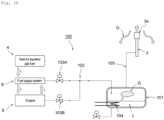
- This type of marine vessel comprises, as shown in Fig. 10 , a tank 4 for liquefied gas fuel, a fuel supply system 6 that supplies the liquefied gas fuel L from the tank 4 to an engine 5, a tank for fuel oil (not shown), and a fuel oil system (not shown) that supplies the fuel oil from the tank to the engine 5.
- the pipeline system 100 has a drum 101, a fuel pipeline 102, fuel pipeline valves 103A and 103B, a heating means 104, and a gas pipeline 105.
- the fuel pipeline valve 103A is opened, the liquefied gas fuel L present in the fuel supply system 6 is guided through the fuel pipeline 102 into the drum 101.
- the fuel pipeline valve 103B is opened, the liquefied gas fuel L present in the engine 5 is guided through the fuel pipeline 102 into the drum 101.
- the heating means 104 is to vaporize the liquefied gas fuel L present in the drum 101 by heating, and vent gas G vaporized from the liquefied gas fuel L in the drum 101 is guided through the gas pipeline 105 to the vent post 3, and discharged from the vent 3a of the vent post 3 ( Figs. 10 and 11 ).
- the inside of the drum 101 is always open to the atmosphere through the gas pipeline 105 and the vent post 3.
- the air pressure in the drum 101 is always about the same as atmospheric pressure; thus, the vent gas G vaporized in the drum 101 has a low temperature and a low pressure, and has a low kinetic energy. Therefore, the flow rate of the vent gas G discharged from the vent 3a of the vent post 3 is reduced. For this reason, as shown in Fig. 11 , the vent gas G discharged from the vent 3a may fall around the vent post 3, and as a result, the space around the vent post 3 may become an explosive atmosphere.
- the present invention was made in view of the above circumstances, and an object thereof is to provide a pipeline system that can discharge vent gas from the vent of a vent post at a high speed, thereby spreading the vent gas far away from the vent post to reduce the amount of the vent gas falling around the vent post; a method for discharging the vent gas using the pipeline system; and a control system that controls a valve provided in the pipeline system.
- the present invention includes a pipeline system according to claim 1, a method according to claim 4 and a control system according to claim 7.
- vent gas can be discharged from the vent of a vent post at a high speed, thereby spreading the vent gas far away from the vent post to reduce the amount of the vent gas falling around the vent post.
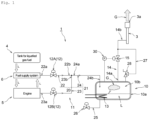
- Fig. 1 is a schematic diagram showing a pipeline system 1 according to the embodiment of the present invention.
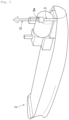
- Fig. 2 is a perspective view showing a marine vessel 2 provided with the pipeline system 1.
- the pipeline system 1 ( Fig. 1 ) according to the embodiment of the present invention is provided in the marine vessel 2 ( Fig. 2 ) that discharges vent gas G vaporized from liquefied gas fuel L from a vent post 3.
- the liquefied gas fuel L refers to fuel liquefied from gas
- examples of the liquefied gas fuel L include LPG (liquefied petroleum gas), LNG (liquefied natural gas), LAG (liquefied ammonia gas), and the like.
- the marine vessel 2 ( Fig. 2 ) is provided with a tank 4 ( Fig. 1 ) that stores the liquefied gas fuel L, an engine 5 ( Fig. 1 ) that can selectively use the liquefied gas fuel L and fuel oil, a fuel supply system 6 ( Fig. 1 ) that can supply the liquefied gas fuel L from the tank 4 to the engine 5, a fuel oil tank (not shown) that stores the fuel oil, and a fuel oil system (not shown) that can supply the fuel oil from the fuel oil tank to the engine 5.
- the liquefied gas fuel L or fuel oil is supplied to the engine 5, whereby the engine 5 can be driven to navigate.
- the fuel supply system 6 comprises a pump and a heat exchanger. Due to the pump, the liquefied gas fuel L present in the fuel supply system 6 can be supplied to the engine 5, and the liquefied gas fuel L that has not been used in the engine 5 can be returned to the fuel supply system 6.
- the liquefied gas fuel L present in the fuel supply system 6 includes the liquefied gas fuel L supplied from the tank 4, and the liquefied gas fuel L returned from the engine 5.
- the temperature of the liquefied gas fuel L supplied to the engine 5 can be adjusted within a predetermined range by the heat exchanger.
- the fuel supply system 6 and the engine 5 are each provided with a gas injection device (not shown) that injects non-combustible gas, such as nitrogen. Due to the pressure of the non-combustible gas injected from the gas injection device of the fuel supply system 6, the liquefied gas fuel L present in the fuel supply system 6 can be pumped to the pipeline system 1. Further, due to the pressure of the non-combustible gas injected from the gas injection device of the engine 5, the liquefied gas fuel L present in the engine 5 can be pumped to the pipeline system 1.
- the vent post 3 is vertically provided on the deck of the marine vessel 2, and a vent 3a for discharging the vent gas G is formed at the upper end of the vent post 3.
- the pipeline system 1 is used, for example, when the fuel used in the engine 5 is switched from the liquefied gas fuel L to fuel oil, to vaporize the residual liquefied gas fuel L present in the engine 5 and the fuel supply system 6, and discharge it from the vent 3a of the vent post 3.
- the pipeline system 1 comprises a drum 10 having an interior 10b surrounded by a wall 10a, a fuel pipeline 11 for guiding the liquefied gas fuel L to the interior 10b of the drum 10, a fuel pipeline valve 12 opening and closing the fuel pipeline 11, a heating means 13 for heating the liquefied gas fuel L guided to the interior 10b of the drum 10 to generate vent gas G, a gas pipeline 14 for guiding the vent gas G present in the interior 10b of the drum 10 to the vent post 3, and a gas pipeline valve 15 opening and closing the gas pipeline 14.
- the wall 10a of the drum 10 is made of carbon steel, and is excellent in pressure resistance.
- the fuel pipeline 11 configures a system fuel pipeline 20 for guiding the liquefied gas fuel L present in the fuel supply system 6 to the interior 10b of the drum 10, and an engine fuel pipeline 21 for guiding the liquefied gas fuel L present in the engine 5 to the interior 10b of the drum 10.
- a first fuel pipeline valve 12A opening and closing the system fuel pipeline 20, and a second fuel pipeline valve 12B opening and closing the engine fuel pipeline 21 are provided as the fuel pipeline valve 12.
- These fuel pipeline valves 12A and 12B can be valves that can switch opening and closing manually or automatically.
- the fuel pipeline 11 has a first branch pipeline 22 having one end 22a connected to the fuel supply system 6, a second branch pipeline 23 having one end 23a connected to the engine 5, and a main pipeline 24 having one end 24a connected to the other end 22b of the first branch pipeline 22 and the other end 23b of the second branch pipeline 23, and the other end 24b connected to the drum 10.
- the system fuel pipeline 20 is composed of the first branch pipeline 22 and the main pipeline 24.
- the engine fuel pipeline 21 is composed of the second branch pipeline 23 and the main pipeline 24.
- the first fuel pipeline valve 12A opens and closes the first branch pipeline 22, and the second fuel pipeline valve 12B opens and closes the second branch pipeline 23.
- the main pipeline 24 is used as part of the system fuel pipeline 20 and part of the engine fuel pipeline 21; however, the system fuel pipeline 20 and the engine fuel pipeline 21 may be individually independent pipelines.
- a first fuel pipeline valve 12A is provided to open and close the system fuel pipeline 20 manually or automatically
- a second fuel pipeline valve 12B is provided to open and close the engine fuel pipeline 21 manually or automatically.
- the heating means 13 is, for example, a heat exchanger that flows high-temperature fluid (high-temperature liquid or high-temperature gas) through the cavity of a tube.
- high-temperature fluid high-temperature liquid or high-temperature gas
- the tube is allowed to penetrate through the wall 10a of the drum 10 so that the tube is inserted into the drum 10. Then, by heat exchange with the fluid flowing through the cavity of the tube, the liquefied gas fuel L guided to the interior 10b of the drum 10 is heated.
- equipment equipped with a heating element such as a heating wire, may be used in place of the heat exchanger mentioned above.
- One end 14a of the gas pipeline 14 is connected to the drum 10, and the other end 14b of the gas pipeline 14 is connected to the vent post 3.
- the gas pipeline valve 15 opens and closes the gas pipeline 14.
- a valve that can switch opening and closing manually or automatically can be used as the gas pipeline valve 15.
- the liquefied gas fuel L can be pumped through the fuel pipeline 11 to the interior 10b of the drum 10.
- the liquefied gas fuel L present in the fuel supply system 6 can be pumped through the system fuel pipeline 20 (first branch pipeline 22 and main pipeline 24) to the interior 10b of the drum 10, due to the pressure of the non-combustible gas injected from the gas injection device of the fuel supply system 6.
- the liquefied gas fuel L present in the engine 5 can be pumped through the engine fuel pipeline 21 (second branch pipeline 23 and main pipeline 24) to the interior 10b of the drum 10, due to the pressure of the non-combustible gas injected from the gas injection device of the engine 5.
- the liquefied gas fuel L present in the fuel supply system 6 and the liquefied gas fuel L present in the engine 5 can be pumped through the fuel pipeline 11 to the interior 10b of the drum 10, due to the pressure of the non-combustible gas injected from the gas injection device of the fuel supply system 6 and the gas injection device of the engine 5.
- the interior 10b of the drum 10 can be prevented from communicating with a space where air exists. Therefore, as described above, while the gas pipeline valve 15 and the fuel pipeline valves 12A and 12B are closed, when the liquefied gas fuel L guided to the interior 10b of the drum 10 is heated by the heating means 13 to generate vent gas G, the temperature and pressure of the vent gas G present within the drum 10 can be increased to enhance the internal energy. Then, when the gas pipeline valve 15 is opened with the internal energy of vent gas G enhanced in this way, the vent gas G converted into a high kinetic energy is guided to the vent post 3 through the gas pipeline 14.
- the vent gas G can be discharged from the vent 3a of the vent post 3 at a high speed.
- the vent gas G can be diffused far away from the vent post 3, and the amount of the vent gas G falling from the vent 3a around the vent post 3 can be reduced.
- a situation where the space around the vent post 3 becomes an explosive atmosphere can be avoided.
- the wall 10a of the drum 10 is made of carbon steel that is excellent in pressure resistance, whereby even when the pressure of the vent gas G present within the drum 10 is increased, as described above, damage to the wall 10a of the drum 10 can be prevented. Therefore, it is possible to stably continue to discharge the vent gas G from the vent 3a at a high speed. It is not essential for the present invention to use carbon steel to form the wall 10a of the drum 10; the wall 10a of the drum 10 may be made of a material other than carbon steel.
- the pipeline system 1 shown in Fig. 1 is provided with, as pipelines connected to the drum 10, a discharge pipeline 25 provided with a discharge pipeline valve 26, and a discharge pipeline 27 provided with a safety valve 28.
- the discharge pipeline 25 is provided to discharge lubricating oil mixed in the liquefied gas fuel L within the drum 10, and waste water accumulated in the drum 10 during maintenance of the pipeline system 1.
- the discharge pipeline valve 26 is opened when the lubricating oil or waste water is discharged.
- the discharge pipeline 27 connects the drum 10 with the gas pipeline 14 in a position on the downstream side of the gas pipeline valve 15, and the safety valve 28 is provided on the drum 10 side of the discharge pipeline 27. If the internal pressure of the drum 10 increases more than expected, for example, due to problems with the gas pipeline valve 15 or malfunction of the pipeline system 1, the safety valve 28 is automatically activated and opened, so that the vent gas G within the drum 10 is guided through the discharge pipeline 27 and the gas pipeline 15 to the vent post 3, and discharged from the vent 3a. This prevents damage to the drum 10.
- discharge pipeline 25, discharge pipeline valve 26, discharge pipeline 27, and safety valve 28 are not necessarily required to vaporize the liquefied gas fuel L present in the engine 5 or the fuel supply system 6 and discharge it from the vent post 3, and may be omitted from the pipeline system 1.
- discharge pipeline valve 26, discharge pipeline 27, and safety valve 28 are provided in the pipeline system 1, while the discharge pipeline valve 26 and the safety valve 28 are closed, the liquefied gas fuel L present in the fuel supply system 6 is pumped into the drum 10, the liquefied gas fuel L present in the engine 5 is pumped into drum 10, the liquefied gas fuel L guided into the drum 10 is heated by the heating means 13, and the vent gas G present in the drum 10 is guided to the vent post 3 and discharged from the vent 3a.
- the method for discharging vent gas G shown in Fig. 3 comprises a pumping step and a heating discharge step performed after the pumping step.
- Opening the fuel pipeline valve 12 includes opening one or both of the first and second fuel pipeline valves 12A and 12B.
- the first fuel pipeline valve 12A and the gas pipeline valve 15 are opened, the liquefied gas fuel L present in the fuel supply system 6 is pumped to the interior 10b of the drum 10.
- the second fuel pipeline valve 12B and the gas pipeline valve 15 are opened, the liquefied gas fuel L present in the engine 5 is pumped to the interior 10b of the drum 10.
- the first and second fuel pipeline valves 12A and 12B, and the gas pipeline valve 15 are opened, the liquefied gas fuel L present in the fuel supply system 6 and the engine 5 is pumped to the interior 10b of the drum 10.
- the heating discharge step includes a heating step that is performed until the air pressure in the interior 10b of the drum 10 is increased to an upper limit value equal to or higher than atmospheric pressure, and a discharge step that is performed until the air pressure in the interior 10b of the drum 10 is reduced from the upper limit value to a lower limit value equal to or higher than atmospheric pressure.
- Closing the fuel pipeline valve 12 includes closing both of the first and second fuel pipeline valves 12A and 12B.
- the gas pipeline valve 15 is opened when the air pressure in the interior 10b of the drum 10 reaches the upper limit value, and the gas pipeline valve 15 is closed when the air pressure in the interior 10b of the drum 10 is reduced to the lower limit value, whereby during the time in which the air pressure in the interior 10b of the drum 10 is reduced from the upper limit value to the lower limit value, the vent gas G present in the interior 10b of the drum 10 is guided to the vent post 3 and discharged from the vent post 3.
- the gas pipeline valve 15 is closed, whereby the first and second fuel pipeline valves 12A and 12B, and the gas pipeline valve 15 are closed, and the step proceeds to the heating step.
- the pipeline system 1 is provided with a pressure sensor 30 ( Fig. 1 ) that measures the air pressure in the interior 10b of the drum 10. Based on the measured value of the pressure sensor 30, the time in which the air pressure in the interior 10b of the drum 10 reaches the upper limit value or is reduced to the lower limit value is specified.
- the gas pipeline valve 15 is opened during the time in which the air pressure in the interior 10b of the drum 10 is in the range equal to or higher than atmospheric pressure (from the lower limit value to the upper limit value); thus, the vent gas G can be discharged at a high speed from the vent 3a of the vent post 3. Therefore, the vent gas G can be diffused far away from the vent post 3, and the amount of the vent gas G falling around the vent post 3 can be reduced; thus, a situation where the space around the vent post 3 becomes an explosive atmosphere can be avoided.
- the heating means 13 In order to increase the discharge time of the vent gas G (i.e., the time in which the air pressure in the interior 10b of the drum 10 is reduced from the upper limit value to the lower limit value), it is preferable to heat the liquefied gas fuel L present in the interior 10b of the drum 10 by the heating means 13 to generate the vent gas G, not only in the heating step, but also in the discharge step. Further, when the discharge pipeline 25, discharge pipeline valve 26, discharge pipeline 27, and safety valve 28 are provided in the pipeline system 1, the pumping step and the heating discharge step are performed while the discharge pipeline valve 26 and the safety valve 28 are closed.
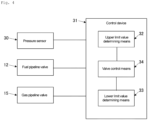
- the marine vessel 2 may be provided with a control device 31 ( Fig. 4 ) that controls the gas pipeline valve 15 based on the measured value of the pressure sensor 30, while the fuel pipeline valve 12 is closed.
- the control device 31 has, as means (functional block) for controlling the gas pipeline valve 15 while the fuel pipeline valve 12 is closed, an upper limit value determining means 32, a lower limit value determining means 33, and a valve control means 34 ( Fig. 4 ). These means 32, 33, and 34 may be realized in a hardware manner; however, these means may also be realized in a software manner in such a manner that the processor of the control device 31 reads a program into memory and executes it.
- the control device 31 includes, for example, a relay circuit, a pressure switch is used as the pressure sensor 30, and open/close valves with a drive source that utilizes hydraulic pressure or air pressure are used as the fuel pipeline valve 12 and the gas pipeline valve 15.
- control device 31 is a device including a programmable logic controller (PLC), and a pressure transmitter is used as the pressure sensor 30.
- PLC programmable logic controller
- a computer including CPU, ROM, and RAM is used as the control device 31.
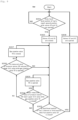
- Fig. 5 is a flowchart of processing performed by the control device 31.
- the processing shown in Fig. 5 is started in response to the closing of the fuel pipeline valve 12 and the gas pipeline valve 15 after the liquefied gas fuel L is pumped to the interior 10b of the drum 10 in the pumping step.
- Closing the fuel pipeline valve 12 means that both of the first and second fuel pipeline valves 12A and 12B are closed.
- the fuel pipeline valve 12 is kept closed, and the liquefied gas fuel L present in the interior 10b of the drum 10 is heated by the action of the heating means 13 to generate vent gas G.
- the upper limit value determining means 32 determines whether the measured value of the pressure sensor 30 reaches an upper limit value equal to or higher than atmospheric pressure, while the gas pipeline valve 15 is closed (S101). During the time in which it is not determined that the measured value of the pressure sensor 30 reaches the upper limit value (NO in S101), the gas pipeline valve 15 is kept closed.
- the valve control means 34 opens the gas pipeline valve 15 (S102).
- the lower limit value determining means 33 determines whether the measured value of the pressure sensor 30 is reduced to a lower limit value that is lower than the upper limit value and equal to or higher than atmospheric pressure, while the gas pipeline valve 15 is opened (S103).
- the gas pipeline valve 15 is kept open.
- the valve control means 34 closes the gas pipeline valve 15 (S104).
- step proceeds to S101 after S104, so that the discharge step proceeds to the heating step.
- the present invention is not limited to the above embodiment, and can be modified in various ways.
- the method for discharging vent gas G of the present invention can be such that the pumping step is performed until the liquid level position (height) of the liquefied gas fuel L stored in the interior 10b of the drum 10 is higher than a first position, the heating discharge step is performed until the liquid level position (height) of the liquefied gas fuel L stored in the interior 10b of the drum 10 is lowered to the first position, and the heating discharge step is suspended when the liquid level position of the liquefied gas fuel L stored in the interior 10b of the drum 10 reaches the first position.
- the heating step is always performed in the presence of the liquefied gas fuel L within the drum 10; thus, it is possible to avoid wasteful heating (heating with no liquid inside) by the heating means 13 in the absence of the liquefied gas fuel L within the drum 10.
- the pipeline system is provided with a fuel sensor 40 that measures the liquid level position (height) of the liquefied gas fuel L stored in the interior 10b of the drum 10, and the time in which the liquid level position (height) of the liquefied gas fuel L stored in the interior 10b of the drum 10 reaches the first position is specified based on the measured value of the fuel sensor 40.
- the fuel sensor 40 for example, an ultrasonic sensor, a radar sensor, a tuning-fork sensor, or a float sensor can be used.
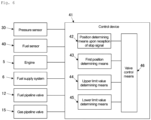
- the marine vessel 2 may be provided with a control device 41 ( Fig. 6 ) that performs processing based on the measured values of the pressure sensor 30 and fuel sensor 40 provided in the pipeline system 1.
- the control device 41 ( Fig. 6 ) has, as means (functional block) for controlling the fuel pipeline valve 12 and the gas pipeline valve 15, a position determining means 42 upon reception of a stop signal, a first position determining means 43, an upper limit value determining means 44, a lower limit value determining means 45, and a valve control means 46.
- These means 42, 43, 44, 45, and 46 may be realized in a hardware manner; however, these means may also be realized in a software manner in such a manner that the processor of the control device 41 reads a program into memory and executes it.
- the control device 41 includes, for example, a relay circuit, a pressure switch is used as the pressure sensor 30, and open/close valves with a drive source that utilizes hydraulic pressure or air pressure are used as the fuel pipeline valve 12 and the gas pipeline valve 15.
- control device 41 is a device including a programmable logic controller (PLC), and a pressure transmitter is used as the pressure sensor 30.
- PLC programmable logic controller
- a computer including CPU, ROM, and RAM is used as the control device 41.
- Fig. 7 is a flowchart of processing performed by the control device 41.
- the processing shown in Fig. 7 is executed on the condition that the signal transmissions shown in a and b below are performed, or that the signal transmissions shown in c and d below are performed.
- the time in which the signal transmissions shown in a and b below are performed, and the time in which the signal transmissions shown in c and d below are performed, are set as different times.
- the valve control means 46 Upon reception of a fuel pumping start signal by the control device 41 from one of the engine 5 and the fuel supply system 6, the valve control means 46 opens the fuel pipeline valve 12 and the gas pipeline valve 15 (S201). Opening the fuel pipeline valve 12 in S201 means that one of the first and second fuel pipeline valves 12A and 12B is opened.
- S201 a pumping step can be started to pump the liquefied gas fuel L present in one of the engine 5 and the fuel supply system 6 to the interior 10b of the drum 10.
- the position determining means 42 upon reception of a stop signal determines, based on the measured value of the fuel sensor 40, whether the liquid level position of the liquefied gas fuel L stored in the interior 10b of the drum is lower than the first position (S202).
- the liquid level position of the liquefied gas fuel L stored in the interior 10b of the drum is appropriately referred to as "the liquid level position of the liquefied gas fuel L within the drum 10.”
- valve control means 46 closes the fuel pipeline valve 12 and the gas pipeline valve 15 (S204). Closing the fuel pipeline valve 12 in S204 means that one of the first and second fuel pipeline valves 12A and 12B that has been opened in S201 is closed.
- valve control means 46 opens the first fuel pipeline valve 12A and the gas pipeline valve 15 in S201, and closes the first fuel pipeline valve 12A and the gas pipeline valve 15 in S204.
- valve control means 46 opens the second fuel pipeline valve 12B and the gas pipeline valve 15 in S201, and closes the second fuel pipeline valve 12B and the gas pipeline valve 15 in S204.
- S204 is performed, thereby stopping the pumping step of pumping the liquefied gas fuel L present in one of the engine 5 and the fuel supply system 6 through the fuel pipeline 11 to the interior 10b of the drum 10.
- the fuel pumping stop signal is transmitted from one of the engine 5 and the fuel supply system 6 to the control device 41 when the liquid level position of the liquefied gas fuel L present in one of the engine 5 and the fuel supply system 6 (hereinafter, "the liquid level position of the liquefied gas fuel L on the engine 5 side") is lowered to a predetermined position.
- the predetermined position is determined by experience.
- the determination in S202 is performed based on "the idea that when the liquid level position of the liquefied gas fuel L on the engine 5 side is lowered to the predetermined position, the liquid level position of the liquefied gas fuel L within the drum 10 should be equal to or higher than the first position.”
- the position determining means 42 When it is determined in S202 that the liquid level position of the liquefied gas fuel L within the drum 10 is lower than the first position (YES in S202), the position determining means 42 upon reception of a stop signal outputs an error signal indicating that the liquid level position of the liquefied gas fuel L within the drum 10 is lower than the first position (S205), the valve control means 26 closes the fuel pipeline valve 12 and the gas pipeline valve 15 (S206), and the processing shown in Fig. 7 is stopped.
- the output of the error signal notifies the user that the liquid level position of the liquefied gas fuel L within the drum 10 is lower than the first position, and the user performs, for example, resetting of the predetermined position (i.e., the user rests the liquid level position of the liquefied gas fuel L present in the engine 5 or the fuel supply system 6 when the engine 5 or the fuel supply system 6 transmits a fuel pumping stop signal to the control device 41).
- Closing the fuel pipeline valve 12 in S206 means that one of the first and second fuel pipeline valves 12A and 12B that has been opened in S201 is closed.
- the first position determining means 43 determines, based on the measured value of the fuel sensor 40, whether the liquid level position of the liquefied gas fuel L within the drum 10 is lower than the first position (S207).
- the upper limit value determining means 44 determines whether the measured value of the pressure sensor 30 reaches an upper limit value equal to or higher than atmospheric pressure, while the gas pipeline valve 15 is closed (S208).
- the valve control means 46 opens the gas pipeline valve 15 (S209).
- the lower limit value determining means 45 determines whether the measured value of the pressure sensor 30 is reduced to a lower limit value that is lower than the upper limit value and equal to or higher than atmospheric pressure, while the gas pipeline valve 15 is opened (S210).
- the lower limit value determining means 45 makes determination separately when the measured value of the pressure sensor 30 (air pressure within the drum 10) is increased to the lower limit value while the gas pipeline valve 15 is closed, and when the measured value of the pressure sensor 30 (air pressure within the drum 10) is reduced to the lower limit value while the gas pipeline valve 15 is opened. That is, when the measured value of the pressure sensor 30 is increased to the lower limit value (when reaching the lower limit value from a value lower than the lower limit value), the lower limit value determining means 45 determines NO in S210 because the gas pipeline valve 15 is not opened. Further, when the measured value of the pressure sensor 30 is reduced to the lower limit value (when reaching the lower limit value from a value higher than the lower limit value), the lower limit value determining means 45 determines YES in S210 because the gas pipeline valve 15 is opened.
- the valve control means 46 closes the gas pipeline valve 15 (S211).
- the valve control means 46 closes the gas pipeline valve 15 (S212), and the processing of Fig. 7 is stopped.
- the pumping step is performed while the fuel pipeline valve 12 and the gas pipeline valve 15 are opened.
- any of the following processings 1, 2, 3, and 4 is performed by the determination as NO in S207. Then, the processing returns to S207.
- Processing 1 for performing the heating step determination is made in S207 while the valves 12 and 15 are closed; NO in S207 ⁇ NO in S208 ⁇ NO in S210.
- Processing 4 for stopping the discharge step determination is made in S207 while the valve 12 is closed and the valve 15 is opened; NO in S207 ⁇ NO in S208 ⁇ YES in S210 ⁇ S211.
- processing 1 determineation is made in S207 while the valves 12 and 15 are closed; NO in S207 ⁇ NO in S208 ⁇ NO in S210) is repeated, thereby performing the heating step while the fuel pipeline valve 12 and the gas pipeline valve 15 are closed.
- processing 2 determineation is made in S207 while the valves 12 and 15 are closed; NO in S207 ⁇ YES in S208 ⁇ S209) is executed, thereby starting the discharge step while the fuel pipeline valve 12 is closed and the gas pipeline valve 15 is opened.
- processing 3 determineation is made in S207 while the valve 12 is closed and the valve 15 is opened; NO in S207 ⁇ NO in S208 ⁇ NO in S210) is repeated, thereby continuing the discharge step while the fuel pipeline valve 12 is closed and the gas pipeline valve 15 is opened.
- processing 4 determineation is made in S207 while the valve 12 is closed and the valve 15 is opened; NO in S207 ⁇ NO in S208 ⁇ YES in S210 ⁇ S211) is executed, thereby stopping the discharge step while the fuel pipeline valve 12 and the gas pipeline valve 15 are closed.
- processings 1 to 4 are repeated, thereby repeating the heating discharge step ( Fig. 3 ) in which the discharge step is performed after the heating step.
- the processing shown in Fig. 7 may be executed on the condition that the signal transmissions shown in e and f below are performed.
- the valve control means 46 opens the first and second fuel pipeline valves 12A and 12B, and the gas pipeline valve 15 (S201). Then, upon reception of a fuel pumping stop signal by the control device 41 from the sender of the fuel pumping start signal (both of the engine 5 and the fuel supply system 6) in S201, the position determining means 42 upon reception of a stop signal determines, based on the measured value of the fuel sensor 40, whether the liquid level position of the liquefied gas fuel L stored in the interior 10b of the drum is lower than the first position (S202).
- the valve control means 46 closes the first and second fuel pipeline valves 12A and 12B, and the gas pipeline valve 15 (S204). Further, when determination is made as YES in S202, the position determining means 42 upon reception of a stop signal outputs an error signal indicating that the liquid level position of the liquefied gas fuel L within the drum 10 is lower than the first position (S205), and the valve control means 26 closes the first and second fuel pipeline valves 12A and 12B, and the gas pipeline valve 15 (S206). S207 to S212 are the same processings as those described above.
- the method for discharging vent gas G of the present invention can be such that a pumping step is performed until the liquid level position (height) of the liquefied gas fuel L stored in the interior 10b of the drum 10 reaches a second position, a heating discharge step is performed until the liquid level position (height) of the liquefied gas fuel L stored in the interior 10b of the drum 10 is reduced from the second position to a third position, the heating discharge step is suspended when the liquid level position (height) of the liquefied gas fuel L stored in the interior 10b of the drum 10 reaches the third position, and the step proceeds to the pumping step.
- the pipeline system 1 is provided with a fuel sensor 40 that measures the liquid level position of the liquefied gas fuel L stored in the interior 10b of the drum 10. The time in which the amount of the liquefied gas fuel L stored in the interior 10b of the drum 10 reaches the second position or the third position is specified based on the measured value of the fuel sensor 40.
- the marine vessel 2 may be provided with a control device 51 ( Fig. 8 ) that performs processing based on the measured values of the pressure sensor 30 and fuel sensor 40 provided in the pipeline system 1.
- the control device 51 has, as means (functional block) for controlling the fuel pipeline valve 12 and the gas pipeline valve 15, a second position determining means 52, a third position determining means 53, an upper limit value determining means 54, a lower limit value determining means 55, and a valve control means 56 ( Fig. 8 ).
- These means 52, 53, 54, 55, and 56 may be realized in a hardware manner; however, these means may also be realized in a software manner in such a manner that the processor of the control device 51 reads a program into memory and executes it.
- the control device 51 includes, for example, a relay circuit, a pressure switch is used as the pressure sensor 30, and open/close valves with a drive source that utilizes hydraulic pressure or air pressure are used as the fuel pipeline valve 12 and the gas pipeline valve 15.
- control device 51 is a device including a programmable logic controller (PLC), and a pressure transmitter is used as the pressure sensor 30.
- PLC programmable logic controller
- a computer including CPU, ROM, and RAM is used as the control device 51.
- Fig. 9 is a flowchart of processing performed by the control device 51.
- Opening the fuel pipeline valve 12 means that one or both of the first and second fuel pipeline valves 12A and 12B is opened.
- the second position determining means 52 determines whether the liquid level position of the liquefied gas fuel L stored in the interior 10b of the drum 10 reaches the second position, while the fuel pipeline valve 12 and the gas pipeline valve 15 are opened (S301). This processing is performed based on the measured value of the fuel sensor 40. During the time in which it is not determined that the liquid level position of the liquefied gas fuel L within the drum 10 reaches the second position (NO in S301), the fuel pipeline valve 12 and the gas pipeline valve 15 are kept open.
- the valve control means 56 closes the fuel pipeline valve 12 and the gas pipeline valve 15 (S302). Closing the fuel pipeline valve 12 in S302 means that one or both of the first and second fuel pipeline valves 12A and 12B that has been opened before S302 is closed (when one of the first and second fuel pipeline valves 12A and 12B has been closed before S302, the one of the first and second fuel pipeline valves 12A and 12B is kept closed).
- the third position determining means 53 determines whether the liquid level position of the liquefied gas fuel L within the drum 10 is lowered to the third position, while the fuel pipeline valve 12 is closed (S303). This processing is also performed based on the measured value of the fuel sensor 40.
- the upper limit value determining means 54 determines whether the measured value of the pressure sensor 30 reaches an upper limit value equal to or higher than atmospheric pressure, while the gas pipeline valve 15 is closed (S304).
- the valve control means 56 opens the gas pipeline valve 15 (S305).
- the lower limit value determining means 54 determines whether the measured value of the pressure sensor 30 is reduced to a lower limit value that is lower than the upper limit value and equal to or higher than atmospheric pressure, while the gas pipeline valve 15 is opened (S306).
- the lower limit value determining means 55 makes determination separately when the measured value of the pressure sensor 30 (air pressure within the drum 10) is increased to the lower limit value while the gas pipeline valve 15 is closed, and when the measured value of the pressure sensor 30 (air pressure within the drum 10) is reduced to the lower limit value while the gas pipeline valve 15 is opened. That is, when the measured value of the pressure sensor 30 is increased to the lower limit value (when reaching the lower limit value from a value lower than the lower limit value), the lower limit value determining means 55 determines NO because the gas pipeline valve 15 is not opened. Further, when the measured value of the pressure sensor 30 is reduced to the lower limit value (when reaching the lower limit value from a value higher than the lower limit value), the lower limit value determining means 55 determines YES because the gas pipeline valve 15 is opened.
- the valve control means 56 closes the gas pipeline valve 15 (S307).
- the valve control means 56 opens the fuel pipeline valve 12 and the gas pipeline valve 15 (S308). Thereafter, the processing returns to determination by the second position determining means 52 in S301.
- determination is made as NO in S301 until the liquid level position of the liquefied gas fuel L within the drum 10 reaches the second position, thereby performing the pumping step while the fuel pipeline valve 12 and the gas pipeline valve 15 are opened.
- Processing 1 for performing the heating step determination is made in S303 while the valves 12 and 15 are closed; NO in S303 ⁇ NO in S304 ⁇ NO in S306.
- Processing 4 for stopping the discharge step determination is made in S303 while the valve 12 is closed and the valve 15 is opened; NO in S303 ⁇ NO in S304 ⁇ YES in S306 ⁇ S307.
- processing 1 determineation is made in S303 while the valves 12 and 15 are closed; NO in S303 ⁇ NO in S304 ⁇ NO in S306) is repeated, thereby performing the heating step while the fuel pipeline valve 12 and the gas pipeline valve 15 are closed.
- processing 2 determineation is made in S303 while the valves 12 and 15 are closed; NO in S303 ⁇ YES in S304 ⁇ S305) is executed, thereby opening the gas pipeline valve 15 while the fuel pipeline valve 12 is closed, and starting the discharge step.
- processing 3 determineation is made in S303 while the valve 12 is closed and the valve 15 is opened; NO in S303 ⁇ NO in S304 ⁇ NO in S306) is repeated, thereby continuing the discharge step, while the fuel pipeline valve 12 is closed and the gas pipeline valve 15 is opened.
- processing 4 determineation is made in S303 while the valve 12 is closed and the valve 15 is opened; NO in S303 ⁇ NO in S304 ⁇ YES in S306 ⁇ S307) is executed, thereby stopping the discharge step, while the fuel pipeline valve 12 and the gas pipeline valve 15 are closed.
- processings 1 to 4 are repeated during the time in which the liquid level position of the liquefied gas fuel L within the drum 10 is not lowered to the third position, thereby repeating the heating discharge step ( Fig. 3 ) in which the discharge step is performed after the heating step.
- one engine 5 is provided in the marine vessel 2; however, two or more engines 5 may be provided in the marine vessel 2.
- each engine 5 may be provided with one fuel supply system 6, or the plural engines 5 may be provide with one fuel supply system 6.
- the liquefied gas fuel L present in each engine 5 and each fuel supply system 6 is guided through the fuel pipeline to the interior 10b of the drum 10, whereby the liquefied gas fuel L present in each engine 5 and each fuel supply system 6 can be vaporized and discharged from the vent post 3 at a high speed.
- the liquefied gas fuel L present in a device or equipment other than the engine 5 and the fuel supply system 6 may be guided through the fuel pipeline to the interior 10b of the drum 10. In this way, the liquefied gas fuel L present in the device or equipment can be vaporized and discharged from the vent post 3 at a high speed.
Landscapes
- Engineering & Computer Science (AREA)
- Chemical & Material Sciences (AREA)
- Mechanical Engineering (AREA)
- Combustion & Propulsion (AREA)
- General Engineering & Computer Science (AREA)
- Ocean & Marine Engineering (AREA)
- Oil, Petroleum & Natural Gas (AREA)
- Chemical Kinetics & Catalysis (AREA)
- General Chemical & Material Sciences (AREA)
- Filling Or Discharging Of Gas Storage Vessels (AREA)
Description
- The present invention relates to a pipeline system provided in a marine vessel that discharges vent gas vaporized from liquefied gas fuel from a vent post, a method for discharging the vent gas using the pipeline system, and a control system that controls a valve provided in the pipeline system.
- In conventionally used marine vessels, engines are driven using fuel liquefied from gas (hereinafter, "liquefied gas fuel"), such as LPG. In these types of marine vessels, vent gas vaporized from the residual liquefied gas fuel that has not been used in the engines is discharged from vertically provided vent posts.
- In recent years, an example of such marine vessels is a marine vessel with an engine that can selectively use liquefied gas fuel and fuel oil such as heavy oil (e.g., PTL 1). This type of marine vessel comprises, as shown in
Fig. 10 , atank 4 for liquefied gas fuel, afuel supply system 6 that supplies the liquefied gas fuel L from thetank 4 to anengine 5, a tank for fuel oil (not shown), and a fuel oil system (not shown) that supplies the fuel oil from the tank to theengine 5. In such a marine vessel, for example, when the fuel used in theengine 5 is switched from the liquefied gas fuel L to the fuel oil, it is necessary to vaporize the residual liquefied gas fuel L present in theengine 5 and thefuel supply system 6, and discharge it from avent post 3. For this purpose, apipeline system 100 shown inFig. 10 is used. - The
pipeline system 100 has adrum 101, afuel pipeline 102,fuel pipeline valves gas pipeline 105. In thepipeline system 100, while thefuel pipeline valve 103A is opened, the liquefied gas fuel L present in thefuel supply system 6 is guided through thefuel pipeline 102 into thedrum 101. Further, while thefuel pipeline valve 103B is opened, the liquefied gas fuel L present in theengine 5 is guided through thefuel pipeline 102 into thedrum 101. The heating means 104 is to vaporize the liquefied gas fuel L present in thedrum 101 by heating, and vent gas G vaporized from the liquefied gas fuel L in thedrum 101 is guided through thegas pipeline 105 to thevent post 3, and discharged from thevent 3a of the vent post 3 (Figs. 10 and11 ). - PTL 1:
JP2020-050135A - In the
conventional pipeline system 100 shown inFig. 10 , the inside of thedrum 101 is always open to the atmosphere through thegas pipeline 105 and thevent post 3. As a result, the air pressure in thedrum 101 is always about the same as atmospheric pressure; thus, the vent gas G vaporized in thedrum 101 has a low temperature and a low pressure, and has a low kinetic energy. Therefore, the flow rate of the vent gas G discharged from thevent 3a of thevent post 3 is reduced. For this reason, as shown inFig. 11 , the vent gas G discharged from thevent 3a may fall around thevent post 3, and as a result, the space around thevent post 3 may become an explosive atmosphere. - The present invention was made in view of the above circumstances, and an object thereof is to provide a pipeline system that can discharge vent gas from the vent of a vent post at a high speed, thereby spreading the vent gas far away from the vent post to reduce the amount of the vent gas falling around the vent post; a method for discharging the vent gas using the pipeline system; and a control system that controls a valve provided in the pipeline system.
- In order to achieve the above object, the present invention includes a pipeline system according to claim 1, a method according to
claim 4 and a control system according to claim 7. - According to the present invention, vent gas can be discharged from the vent of a vent post at a high speed, thereby spreading the vent gas far away from the vent post to reduce the amount of the vent gas falling around the vent post.
-
-
Fig. 1 is a schematic diagram showing a pipeline system according to an embodiment of the present invention. -
Fig. 2 is a perspective view showing a marine vessel provided with the pipeline system according to the embodiment of the present invention. -
Fig. 3 is a flowchart showing a method for discharging vent gas using the pipeline system according to the embodiment of the present invention. -
Fig. 4 is a functional block diagram of a control device that controls a gas pipeline valve. -
Fig. 5 is a flowchart showing processing performed by the control device that controls the gas pipeline valve. -
Fig. 6 is a functional block diagram of a control device that controls a fuel pipeline valve and a gas pipeline valve. -
Fig. 7 is a flowchart showing processing performed by the control device that controls the fuel pipeline valve and the gas pipeline valve. -
Fig. 8 is a functional block diagram of a control device that controls a fuel pipeline valve and a gas pipeline valve. -
Fig. 9 is a flowchart showing processing performed by the control device that controls the fuel pipeline valve and the gas pipeline valve. -
Fig. 10 is a schematic diagram showing a conventional pipeline system. -
Fig. 11 is a perspective view showing a marine vessel provided with the conventional pipeline system. - An embodiment of the present invention is described below with reference to the accompanying drawings.
Fig. 1 is a schematic diagram showing a pipeline system 1 according to the embodiment of the present invention.Fig. 2 is a perspective view showing amarine vessel 2 provided with the pipeline system 1. - The pipeline system 1 (
Fig. 1 ) according to the embodiment of the present invention is provided in the marine vessel 2 (Fig. 2 ) that discharges vent gas G vaporized from liquefied gas fuel L from avent post 3. In the present invention, the liquefied gas fuel L refers to fuel liquefied from gas, and examples of the liquefied gas fuel L include LPG (liquefied petroleum gas), LNG (liquefied natural gas), LAG (liquefied ammonia gas), and the like. - The marine vessel 2 (
Fig. 2 ) is provided with a tank 4 (Fig. 1 ) that stores the liquefied gas fuel L, an engine 5 (Fig. 1 ) that can selectively use the liquefied gas fuel L and fuel oil, a fuel supply system 6 (Fig. 1 ) that can supply the liquefied gas fuel L from thetank 4 to theengine 5, a fuel oil tank (not shown) that stores the fuel oil, and a fuel oil system (not shown) that can supply the fuel oil from the fuel oil tank to theengine 5. In themarine vessel 2, the liquefied gas fuel L or fuel oil is supplied to theengine 5, whereby theengine 5 can be driven to navigate. - The
fuel supply system 6 comprises a pump and a heat exchanger. Due to the pump, the liquefied gas fuel L present in thefuel supply system 6 can be supplied to theengine 5, and the liquefied gas fuel L that has not been used in theengine 5 can be returned to thefuel supply system 6. The liquefied gas fuel L present in thefuel supply system 6 includes the liquefied gas fuel L supplied from thetank 4, and the liquefied gas fuel L returned from theengine 5. Moreover, in thefuel supply system 6, the temperature of the liquefied gas fuel L supplied to theengine 5 can be adjusted within a predetermined range by the heat exchanger. - The
fuel supply system 6 and theengine 5 are each provided with a gas injection device (not shown) that injects non-combustible gas, such as nitrogen. Due to the pressure of the non-combustible gas injected from the gas injection device of thefuel supply system 6, the liquefied gas fuel L present in thefuel supply system 6 can be pumped to the pipeline system 1. Further, due to the pressure of the non-combustible gas injected from the gas injection device of theengine 5, the liquefied gas fuel L present in theengine 5 can be pumped to the pipeline system 1. - The
vent post 3 is vertically provided on the deck of themarine vessel 2, and avent 3a for discharging the vent gas G is formed at the upper end of thevent post 3. - The pipeline system 1 is used, for example, when the fuel used in the
engine 5 is switched from the liquefied gas fuel L to fuel oil, to vaporize the residual liquefied gas fuel L present in theengine 5 and thefuel supply system 6, and discharge it from thevent 3a of thevent post 3. - As shown in
Fig. 1 , the pipeline system 1 comprises adrum 10 having an interior 10b surrounded by awall 10a, afuel pipeline 11 for guiding the liquefied gas fuel L to theinterior 10b of thedrum 10, afuel pipeline valve 12 opening and closing thefuel pipeline 11, a heating means 13 for heating the liquefied gas fuel L guided to the interior 10b of thedrum 10 to generate vent gas G, agas pipeline 14 for guiding the vent gas G present in theinterior 10b of thedrum 10 to thevent post 3, and agas pipeline valve 15 opening and closing thegas pipeline 14. - The
wall 10a of thedrum 10 is made of carbon steel, and is excellent in pressure resistance. - The
fuel pipeline 11 configures asystem fuel pipeline 20 for guiding the liquefied gas fuel L present in thefuel supply system 6 to theinterior 10b of thedrum 10, and anengine fuel pipeline 21 for guiding the liquefied gas fuel L present in theengine 5 to the interior 10b of thedrum 10. A firstfuel pipeline valve 12A opening and closing thesystem fuel pipeline 20, and a secondfuel pipeline valve 12B opening and closing theengine fuel pipeline 21 are provided as thefuel pipeline valve 12. Thesefuel pipeline valves - More specifically, the
fuel pipeline 11 has afirst branch pipeline 22 having oneend 22a connected to thefuel supply system 6, asecond branch pipeline 23 having oneend 23a connected to theengine 5, and amain pipeline 24 having oneend 24a connected to theother end 22b of thefirst branch pipeline 22 and theother end 23b of thesecond branch pipeline 23, and theother end 24b connected to thedrum 10. Thesystem fuel pipeline 20 is composed of thefirst branch pipeline 22 and themain pipeline 24. Theengine fuel pipeline 21 is composed of thesecond branch pipeline 23 and themain pipeline 24. The firstfuel pipeline valve 12A opens and closes thefirst branch pipeline 22, and the secondfuel pipeline valve 12B opens and closes thesecond branch pipeline 23. - In the illustrated example, the
main pipeline 24 is used as part of thesystem fuel pipeline 20 and part of theengine fuel pipeline 21; however, thesystem fuel pipeline 20 and theengine fuel pipeline 21 may be individually independent pipelines. In this case, a firstfuel pipeline valve 12A is provided to open and close thesystem fuel pipeline 20 manually or automatically, and a secondfuel pipeline valve 12B is provided to open and close theengine fuel pipeline 21 manually or automatically. - The heating means 13 is, for example, a heat exchanger that flows high-temperature fluid (high-temperature liquid or high-temperature gas) through the cavity of a tube. In this case, the tube is allowed to penetrate through the
wall 10a of thedrum 10 so that the tube is inserted into thedrum 10. Then, by heat exchange with the fluid flowing through the cavity of the tube, the liquefied gas fuel L guided to the interior 10b of thedrum 10 is heated. As the heating means 13, equipment equipped with a heating element, such as a heating wire, may be used in place of the heat exchanger mentioned above. - One
end 14a of thegas pipeline 14 is connected to thedrum 10, and theother end 14b of thegas pipeline 14 is connected to thevent post 3. Thegas pipeline valve 15 opens and closes thegas pipeline 14. A valve that can switch opening and closing manually or automatically can be used as thegas pipeline valve 15. - According to the pipeline system 1, when one or both of the first and second
fuel pipeline valves gas pipeline valve 15 are opened, the liquefied gas fuel L can be pumped through thefuel pipeline 11 to the interior 10b of thedrum 10. - For example, when the first
fuel pipeline valve 12A and thegas pipeline valve 15 are opened, and the secondfuel pipeline valve 12B is closed, the liquefied gas fuel L present in thefuel supply system 6 can be pumped through the system fuel pipeline 20 (first branch pipeline 22 and main pipeline 24) to the interior 10b of thedrum 10, due to the pressure of the non-combustible gas injected from the gas injection device of thefuel supply system 6. - Further, for example, when the second
fuel pipeline valve 12B and thegas pipeline valve 15 are opened, and the firstfuel pipeline valve 12A is closed, the liquefied gas fuel L present in theengine 5 can be pumped through the engine fuel pipeline 21 (second branch pipeline 23 and main pipeline 24) to the interior 10b of thedrum 10, due to the pressure of the non-combustible gas injected from the gas injection device of theengine 5. - Moreover, for example, when the first and second
fuel pipeline valves gas pipeline valve 15 are opened, the liquefied gas fuel L present in thefuel supply system 6 and the liquefied gas fuel L present in theengine 5 can be pumped through thefuel pipeline 11 to the interior 10b of thedrum 10, due to the pressure of the non-combustible gas injected from the gas injection device of thefuel supply system 6 and the gas injection device of theengine 5. - According to the pipeline system 1, when the
gas pipeline valve 15 and the first and secondfuel pipeline valves drum 10 can be prevented from communicating with a space where air exists. Therefore, as described above, while thegas pipeline valve 15 and thefuel pipeline valves drum 10 is heated by the heating means 13 to generate vent gas G, the temperature and pressure of the vent gas G present within thedrum 10 can be increased to enhance the internal energy. Then, when thegas pipeline valve 15 is opened with the internal energy of vent gas G enhanced in this way, the vent gas G converted into a high kinetic energy is guided to thevent post 3 through thegas pipeline 14. Therefore, the vent gas G can be discharged from thevent 3a of thevent post 3 at a high speed. As a result, the vent gas G can be diffused far away from thevent post 3, and the amount of the vent gas G falling from thevent 3a around thevent post 3 can be reduced. Thus, a situation where the space around thevent post 3 becomes an explosive atmosphere can be avoided. - Moreover, according to the pipeline system 1, the
wall 10a of thedrum 10 is made of carbon steel that is excellent in pressure resistance, whereby even when the pressure of the vent gas G present within thedrum 10 is increased, as described above, damage to thewall 10a of thedrum 10 can be prevented. Therefore, it is possible to stably continue to discharge the vent gas G from thevent 3a at a high speed. It is not essential for the present invention to use carbon steel to form thewall 10a of thedrum 10; thewall 10a of thedrum 10 may be made of a material other than carbon steel. - In addition to the configuration described above, the pipeline system 1 shown in
Fig. 1 is provided with, as pipelines connected to thedrum 10, adischarge pipeline 25 provided with adischarge pipeline valve 26, and adischarge pipeline 27 provided with asafety valve 28. - The
discharge pipeline 25 is provided to discharge lubricating oil mixed in the liquefied gas fuel L within thedrum 10, and waste water accumulated in thedrum 10 during maintenance of the pipeline system 1. Thedischarge pipeline valve 26 is opened when the lubricating oil or waste water is discharged. - The
discharge pipeline 27 connects thedrum 10 with thegas pipeline 14 in a position on the downstream side of thegas pipeline valve 15, and thesafety valve 28 is provided on thedrum 10 side of thedischarge pipeline 27. If the internal pressure of thedrum 10 increases more than expected, for example, due to problems with thegas pipeline valve 15 or malfunction of the pipeline system 1, thesafety valve 28 is automatically activated and opened, so that the vent gas G within thedrum 10 is guided through thedischarge pipeline 27 and thegas pipeline 15 to thevent post 3, and discharged from thevent 3a. This prevents damage to thedrum 10. - The
discharge pipeline 25,discharge pipeline valve 26,discharge pipeline 27, andsafety valve 28 are not necessarily required to vaporize the liquefied gas fuel L present in theengine 5 or thefuel supply system 6 and discharge it from thevent post 3, and may be omitted from the pipeline system 1. - When the
discharge pipeline 25,discharge pipeline valve 26,discharge pipeline 27, andsafety valve 28 are provided in the pipeline system 1, while thedischarge pipeline valve 26 and thesafety valve 28 are closed, the liquefied gas fuel L present in thefuel supply system 6 is pumped into thedrum 10, the liquefied gas fuel L present in theengine 5 is pumped intodrum 10, the liquefied gas fuel L guided into thedrum 10 is heated by the heating means 13, and the vent gas G present in thedrum 10 is guided to thevent post 3 and discharged from thevent 3a. - An example of the method for discharging vent gas G using the pipeline system 1 is described below with reference to
Fig. 3 . - The method for discharging vent gas G shown in
Fig. 3 comprises a pumping step and a heating discharge step performed after the pumping step. - In the pumping step, while the
fuel pipeline valve 12 and thegas pipeline valve 15 are opened, the liquefied gas fuel L is pumped through thefuel pipeline 11 to the interior 10b of thedrum 10. Opening thefuel pipeline valve 12 includes opening one or both of the first and secondfuel pipeline valves fuel pipeline valve 12A and thegas pipeline valve 15 are opened, the liquefied gas fuel L present in thefuel supply system 6 is pumped to the interior 10b of thedrum 10. When the secondfuel pipeline valve 12B and thegas pipeline valve 15 are opened, the liquefied gas fuel L present in theengine 5 is pumped to the interior 10b of thedrum 10. When the first and secondfuel pipeline valves gas pipeline valve 15 are opened, the liquefied gas fuel L present in thefuel supply system 6 and theengine 5 is pumped to the interior 10b of thedrum 10. - The heating discharge step includes a heating step that is performed until the air pressure in the interior 10b of the
drum 10 is increased to an upper limit value equal to or higher than atmospheric pressure, and a discharge step that is performed until the air pressure in the interior 10b of thedrum 10 is reduced from the upper limit value to a lower limit value equal to or higher than atmospheric pressure. - In the heating step, until the air pressure in the interior 10b of the
drum 10 is increased to the upper limit value, while thefuel pipeline valve 12 and thegas pipeline valve 15 are closed, the liquefied gas fuel L present in the interior 10b of thedrum 10 is heated by the heating means 13 to generate vent gas G. Closing thefuel pipeline valve 12 includes closing both of the first and secondfuel pipeline valves - In the discharge step, the
gas pipeline valve 15 is opened when the air pressure in the interior 10b of thedrum 10 reaches the upper limit value, and thegas pipeline valve 15 is closed when the air pressure in the interior 10b of thedrum 10 is reduced to the lower limit value, whereby during the time in which the air pressure in the interior 10b of thedrum 10 is reduced from the upper limit value to the lower limit value, the vent gas G present in the interior 10b of thedrum 10 is guided to thevent post 3 and discharged from thevent post 3. When the air pressure in the interior 10b of thedrum 10 is reduced to the lower limit value, thegas pipeline valve 15 is closed, whereby the first and secondfuel pipeline valves gas pipeline valve 15 are closed, and the step proceeds to the heating step. - When the above discharge method is performed, the pipeline system 1 is provided with a pressure sensor 30 (
Fig. 1 ) that measures the air pressure in the interior 10b of thedrum 10. Based on the measured value of thepressure sensor 30, the time in which the air pressure in the interior 10b of thedrum 10 reaches the upper limit value or is reduced to the lower limit value is specified. - According to the above discharge method, the
gas pipeline valve 15 is opened during the time in which the air pressure in the interior 10b of thedrum 10 is in the range equal to or higher than atmospheric pressure (from the lower limit value to the upper limit value); thus, the vent gas G can be discharged at a high speed from thevent 3a of thevent post 3. Therefore, the vent gas G can be diffused far away from thevent post 3, and the amount of the vent gas G falling around thevent post 3 can be reduced; thus, a situation where the space around thevent post 3 becomes an explosive atmosphere can be avoided. In order to increase the discharge time of the vent gas G (i.e., the time in which the air pressure in the interior 10b of thedrum 10 is reduced from the upper limit value to the lower limit value), it is preferable to heat the liquefied gas fuel L present in the interior 10b of thedrum 10 by the heating means 13 to generate the vent gas G, not only in the heating step, but also in the discharge step. Further, when thedischarge pipeline 25,discharge pipeline valve 26,discharge pipeline 27, andsafety valve 28 are provided in the pipeline system 1, the pumping step and the heating discharge step are performed while thedischarge pipeline valve 26 and thesafety valve 28 are closed. - Further, in order to automatically open and close the
gas pipeline valve 15 in the heating discharge step, themarine vessel 2 may be provided with a control device 31 (Fig. 4 ) that controls thegas pipeline valve 15 based on the measured value of thepressure sensor 30, while thefuel pipeline valve 12 is closed. - The
control device 31 has, as means (functional block) for controlling thegas pipeline valve 15 while thefuel pipeline valve 12 is closed, an upper limitvalue determining means 32, a lower limitvalue determining means 33, and a valve control means 34 (Fig. 4 ). These means 32, 33, and 34 may be realized in a hardware manner; however, these means may also be realized in a software manner in such a manner that the processor of thecontrol device 31 reads a program into memory and executes it. - When the means 32, 33, and 34 shown in
Fig. 4 are realized in a hardware manner, thecontrol device 31 includes, for example, a relay circuit, a pressure switch is used as thepressure sensor 30, and open/close valves with a drive source that utilizes hydraulic pressure or air pressure are used as thefuel pipeline valve 12 and thegas pipeline valve 15. - When the means 32, 33, and 34 shown in
Fig. 4 are realized in a software manner, for example, thecontrol device 31 is a device including a programmable logic controller (PLC), and a pressure transmitter is used as thepressure sensor 30. Alternatively, a computer including CPU, ROM, and RAM is used as thecontrol device 31. -
Fig. 5 is a flowchart of processing performed by thecontrol device 31. - The processing shown in
Fig. 5 is started in response to the closing of thefuel pipeline valve 12 and thegas pipeline valve 15 after the liquefied gas fuel L is pumped to the interior 10b of thedrum 10 in the pumping step. Closing thefuel pipeline valve 12 means that both of the first and secondfuel pipeline valves Fig. 5 is executed, thefuel pipeline valve 12 is kept closed, and the liquefied gas fuel L present in the interior 10b of thedrum 10 is heated by the action of the heating means 13 to generate vent gas G. - The upper limit
value determining means 32 determines whether the measured value of thepressure sensor 30 reaches an upper limit value equal to or higher than atmospheric pressure, while thegas pipeline valve 15 is closed (S101). During the time in which it is not determined that the measured value of thepressure sensor 30 reaches the upper limit value (NO in S101), thegas pipeline valve 15 is kept closed. - When the upper limit
value determining means 32 determines that the measured value of thepressure sensor 30 reaches the upper limit value, while thegas pipeline valve 15 is closed (YES in S101), the valve control means 34 opens the gas pipeline valve 15 (S102). - The lower limit
value determining means 33 determines whether the measured value of thepressure sensor 30 is reduced to a lower limit value that is lower than the upper limit value and equal to or higher than atmospheric pressure, while thegas pipeline valve 15 is opened (S103). - During the time in which the lower limit
value determining means 33 does not determine that the measured value of thepressure sensor 30 is reduced to the lower limit value, while thegas pipeline valve 15 is opened (NO in S103), thegas pipeline valve 15 is kept open. - When the lower limit
value determining means 33 determines that the measured value of thepressure sensor 30 is reduced to the lower limit value, while thegas pipeline valve 15 is opened (YES in S103), the valve control means 34 closes the gas pipeline valve 15 (S104). - After the valve control means 34 closes the
gas pipeline valve 15 in S104, the processing returns to determination by the upper limit value determining means 32 in S101. - According to the processing shown in
Fig. 5 , when determination is made as NO in S101 until the air pressure in the interior 10b of thedrum 10 is increased to the upper limit value, thefuel pipeline valve 12 and thegas pipeline valve 15 are closed, and the heating step is performed. - Then, when the air pressure in the interior 10b of the
drum 10 reaches the upper limit value, determination is made as YES in S101, and S102 is performed, thereby opening thegas pipeline valve 15 while thefuel pipeline valve 12 is closed, and starting the discharge step. - After S102 is performed, determination is made as NO in S103 during the time in which the air pressure in the interior 10b of the
drum 10 is reduced from the upper limit value to the lower limit value, thereby continuing the discharge step, while thefuel pipeline valve 12 is closed and thegas pipeline valve 15 is opened. - When the air pressure in the interior 10b of the
drum 10 is reduced to the lower limit value, determination is made as YES in S103, and S104 is performed, thereby stopping the discharge step, while thefuel pipeline valve 12 and thegas pipeline valve 15 are closed. - Then, the step proceeds to S101 after S104, so that the discharge step proceeds to the heating step.
- The present invention is not limited to the above embodiment, and can be modified in various ways.
- For example, the method for discharging vent gas G of the present invention can be such that the pumping step is performed until the liquid level position (height) of the liquefied gas fuel L stored in the interior 10b of the
drum 10 is higher than a first position, the heating discharge step is performed until the liquid level position (height) of the liquefied gas fuel L stored in the interior 10b of thedrum 10 is lowered to the first position, and the heating discharge step is suspended when the liquid level position of the liquefied gas fuel L stored in the interior 10b of thedrum 10 reaches the first position. In this way, the heating step is always performed in the presence of the liquefied gas fuel L within thedrum 10; thus, it is possible to avoid wasteful heating (heating with no liquid inside) by the heating means 13 in the absence of the liquefied gas fuel L within thedrum 10. In the above case, the pipeline system is provided with afuel sensor 40 that measures the liquid level position (height) of the liquefied gas fuel L stored in the interior 10b of thedrum 10, and the time in which the liquid level position (height) of the liquefied gas fuel L stored in the interior 10b of thedrum 10 reaches the first position is specified based on the measured value of thefuel sensor 40. As thefuel sensor 40, for example, an ultrasonic sensor, a radar sensor, a tuning-fork sensor, or a float sensor can be used. - Moreover, when the method for discharging vent gas G of the present invention is as described above, in order to automatically open and close the
fuel pipeline valve 12 and thegas pipeline valve 15, themarine vessel 2 may be provided with a control device 41 (Fig. 6 ) that performs processing based on the measured values of thepressure sensor 30 andfuel sensor 40 provided in the pipeline system 1. - The control device 41 (
Fig. 6 ) has, as means (functional block) for controlling thefuel pipeline valve 12 and thegas pipeline valve 15, a position determining means 42 upon reception of a stop signal, a first position determining means 43, an upper limitvalue determining means 44, a lower limitvalue determining means 45, and a valve control means 46. These means 42, 43, 44, 45, and 46 may be realized in a hardware manner; however, these means may also be realized in a software manner in such a manner that the processor of thecontrol device 41 reads a program into memory and executes it. - When the means 42, 43, 44, 45, and 46 shown in
Fig. 6 are realized in a hardware manner, thecontrol device 41 includes, for example, a relay circuit, a pressure switch is used as thepressure sensor 30, and open/close valves with a drive source that utilizes hydraulic pressure or air pressure are used as thefuel pipeline valve 12 and thegas pipeline valve 15. - When the means 42, 43, 44, 45, and 46 shown in
Fig. 6 are realized in a software manner, for example, thecontrol device 41 is a device including a programmable logic controller (PLC), and a pressure transmitter is used as thepressure sensor 30. Alternatively, a computer including CPU, ROM, and RAM is used as thecontrol device 41. -
Fig. 7 is a flowchart of processing performed by thecontrol device 41. The processing shown inFig. 7 is executed on the condition that the signal transmissions shown in a and b below are performed, or that the signal transmissions shown in c and d below are performed. The time in which the signal transmissions shown in a and b below are performed, and the time in which the signal transmissions shown in c and d below are performed, are set as different times. -
- a: When pumping of the liquefied gas fuel L present in the
engine 5 to the interior 10b of thedrum 10 is started, a fuel pumping start signal is transmitted from theengine 5 to thecontrol device 41. - b: When pumping of the liquefied gas fuel L present in the
engine 5 to the interior 10b of thedrum 10 is stopped, a fuel pumping stop signal is transmitted from theengine 5 to thecontrol device 41. - c: When pumping of the liquefied gas fuel L present in the
fuel supply system 6 to the interior 10b of thedrum 10 is started, a fuel pumping start signal is transmitted from thefuel supply system 6 to thecontrol device 41. - d: When pumping of the liquefied gas fuel L present in the
fuel supply system 6 to the interior 10b of thedrum 10 is stopped, a fuel pumping stop signal is transmitted from thefuel supply system 6 to thecontrol device 41. - Before the processing shown in
Fig. 7 is performed, the fuel pipeline valve 12 (first and secondfuel pipeline valves gas pipeline valve 15 are closed. The processing ofFig. 7 is described below. - Upon reception of a fuel pumping start signal by the
control device 41 from one of theengine 5 and thefuel supply system 6, the valve control means 46 opens thefuel pipeline valve 12 and the gas pipeline valve 15 (S201). Opening thefuel pipeline valve 12 in S201 means that one of the first and secondfuel pipeline valves engine 5 and thefuel supply system 6 to the interior 10b of thedrum 10. - Then, upon reception of a fuel pumping stop signal by the
control device 41 from the sender of the fuel pumping start signal, the position determining means 42 upon reception of a stop signal determines, based on the measured value of thefuel sensor 40, whether the liquid level position of the liquefied gas fuel L stored in the interior 10b of the drum is lower than the first position (S202). Hereinafter, "the liquid level position of the liquefied gas fuel L stored in the interior 10b of the drum" is appropriately referred to as "the liquid level position of the liquefied gas fuel L within thedrum 10." - When it is not determined in S202 that the liquid level position of the liquefied gas fuel L within the
drum 10 is lower than the first position (NO in S202), the valve control means 46 closes thefuel pipeline valve 12 and the gas pipeline valve 15 (S204). Closing thefuel pipeline valve 12 in S204 means that one of the first and secondfuel pipeline valves - For example, when the sender of the fuel pumping start signal in S201 and the sender of the fuel pumping stop signal in S202 are the
fuel supply system 6, the valve control means 46 opens the firstfuel pipeline valve 12A and thegas pipeline valve 15 in S201, and closes the firstfuel pipeline valve 12A and thegas pipeline valve 15 in S204. - Moreover, when the sender of the fuel pumping start signal in S201 and the sender of the fuel pumping stop signal in S202 are the
engine 5, the valve control means 46 opens the secondfuel pipeline valve 12B and thegas pipeline valve 15 in S201, and closes the secondfuel pipeline valve 12B and thegas pipeline valve 15 in S204. - Then, S204 is performed, thereby stopping the pumping step of pumping the liquefied gas fuel L present in one of the
engine 5 and thefuel supply system 6 through thefuel pipeline 11 to the interior 10b of thedrum 10. - The fuel pumping stop signal is transmitted from one of the
engine 5 and thefuel supply system 6 to thecontrol device 41 when the liquid level position of the liquefied gas fuel L present in one of theengine 5 and the fuel supply system 6 (hereinafter, "the liquid level position of the liquefied gas fuel L on theengine 5 side") is lowered to a predetermined position. The predetermined position is determined by experience. The determination in S202 is performed based on "the idea that when the liquid level position of the liquefied gas fuel L on theengine 5 side is lowered to the predetermined position, the liquid level position of the liquefied gas fuel L within thedrum 10 should be equal to or higher than the first position." - When it is determined in S202 that the liquid level position of the liquefied gas fuel L within the
drum 10 is lower than the first position (YES in S202), the position determining means 42 upon reception of a stop signal outputs an error signal indicating that the liquid level position of the liquefied gas fuel L within thedrum 10 is lower than the first position (S205), the valve control means 26 closes thefuel pipeline valve 12 and the gas pipeline valve 15 (S206), and the processing shown inFig. 7 is stopped. In this case, the output of the error signal notifies the user that the liquid level position of the liquefied gas fuel L within thedrum 10 is lower than the first position, and the user performs, for example, resetting of the predetermined position (i.e., the user rests the liquid level position of the liquefied gas fuel L present in theengine 5 or thefuel supply system 6 when theengine 5 or thefuel supply system 6 transmits a fuel pumping stop signal to the control device 41). Closing thefuel pipeline valve 12 in S206 means that one of the first and secondfuel pipeline valves - After determination is made as NO in S202 and S204 is performed, the first position determining means 43 determines, based on the measured value of the
fuel sensor 40, whether the liquid level position of the liquefied gas fuel L within thedrum 10 is lower than the first position (S207). - When the first position determining means 43 does not determine that the liquid level position of the liquefied gas fuel L within the
drum 10 is lower than the first position (NO in S207), the upper limitvalue determining means 44 determines whether the measured value of thepressure sensor 30 reaches an upper limit value equal to or higher than atmospheric pressure, while thegas pipeline valve 15 is closed (S208). - When the upper limit
value determining means 44 determines that the measured value of thepressure sensor 30 reaches the upper limit value while thegas pipeline valve 15 is closed (YES in S208), the valve control means 46 opens the gas pipeline valve 15 (S209). - When the upper limit
value determining means 44 does not determine that the measured value of thepressure sensor 30 reaches the upper limit value while thegas pipeline valve 15 is closed (NO in S208), the lower limitvalue determining means 45 determines whether the measured value of thepressure sensor 30 is reduced to a lower limit value that is lower than the upper limit value and equal to or higher than atmospheric pressure, while thegas pipeline valve 15 is opened (S210). - By using the opening and closing of the
gas pipeline valve 15 as the determination condition, the lower limitvalue determining means 45 makes determination separately when the measured value of the pressure sensor 30 (air pressure within the drum 10) is increased to the lower limit value while thegas pipeline valve 15 is closed, and when the measured value of the pressure sensor 30 (air pressure within the drum 10) is reduced to the lower limit value while thegas pipeline valve 15 is opened. That is, when the measured value of thepressure sensor 30 is increased to the lower limit value (when reaching the lower limit value from a value lower than the lower limit value), the lower limitvalue determining means 45 determines NO in S210 because thegas pipeline valve 15 is not opened. Further, when the measured value of thepressure sensor 30 is reduced to the lower limit value (when reaching the lower limit value from a value higher than the lower limit value), the lower limitvalue determining means 45 determines YES in S210 because thegas pipeline valve 15 is opened. - When the lower limit
value determining means 45 determines that the measured value of thepressure sensor 30 is reduced to the lower limit value while thegas pipeline valve 15 is opened (YES in S210), the valve control means 46 closes the gas pipeline valve 15 (S211). - Then, after the valve control means 46 opens the
gas pipeline valve 15 in S209, when the lower limitvalue determining means 45 determines that the measured value of thepressure sensor 30 is not reduced to the lower limit value in S210 (NO in S210), or after the valve control means 46 closes thegas pipeline valve 15 in S211, the processing returns to determination by the first position determining means 43 in S207. - Then, when the first position determining means 43 determines that the liquid level position of the liquefied gas fuel L within the
drum 10 is lowered to the first position (YES in S207), the valve control means 46 closes the gas pipeline valve 15 (S212), and the processing ofFig. 7 is stopped. - According to the processing shown in
Fig. 7 , during the time from the execution of S201 to the execution of S204, the pumping step is performed while thefuel pipeline valve 12 and thegas pipeline valve 15 are opened. - Then, S204 is performed, thereby closing the
fuel pipeline valve 12 and thegas pipeline valve 15 for the initial heating step. - Until the liquefied gas fuel L stored in the interior 10b of the
drum 10 is reduced to the first amount, any of the followingprocessings - Processing 1 for performing the heating step: determination is made in S207 while the
valves -
Processing 2 for starting the discharge step: determination is made in S207 while thevalves -
Processing 3 for continuing the discharge step: determination is made in S207 while thevalve 12 is closed and thevalve 15 is opened; NO in S207 → NO in S208 → NO in S210. -
Processing 4 for stopping the discharge step: determination is made in S207 while thevalve 12 is closed and thevalve 15 is opened; NO in S207 → NO in S208 → YES in S210 → S211. - Until the liquid level position of the liquefied gas fuel L within the
drum 10 is lowered to the first position, and until the air pressure in the interior 10b of thedrum 10 reaches the upper limit value, processing 1 (determination is made in S207 while thevalves fuel pipeline valve 12 and thegas pipeline valve 15 are closed. - Until the liquid level position of the liquefied gas fuel L within the
drum 10 is lowered to the first position, and when the air pressure in the interior 10b of thedrum 10 reaches the upper limit value, processing 2 (determination is made in S207 while thevalves fuel pipeline valve 12 is closed and thegas pipeline valve 15 is opened. - Until the liquid level position of the liquefied gas fuel L within the
drum 10 is lowered to the first position, and during the time in which the air pressure in the interior 10b of thedrum 10 is reduced from the upper limit value to the lower limit value, processing 3 (determination is made in S207 while thevalve 12 is closed and thevalve 15 is opened; NO in S207 → NO in S208 → NO in S210) is repeated, thereby continuing the discharge step while thefuel pipeline valve 12 is closed and thegas pipeline valve 15 is opened. - Until the liquid level position of the liquefied gas fuel L within the
drum 10 is lowered to the first position, and when the air pressure in the interior 10b of thedrum 10 is reduced to the lower limit value, processing 4 (determination is made in S207 while thevalve 12 is closed and thevalve 15 is opened; NO in S207 → NO in S208 → YES in S210 → S211) is executed, thereby stopping the discharge step while thefuel pipeline valve 12 and thegas pipeline valve 15 are closed. - Then, during the time in which the liquid level position of the liquefied gas fuel L within the
drum 10 is not lowered to the first position, processings 1 to 4 are repeated, thereby repeating the heating discharge step (Fig. 3 ) in which the discharge step is performed after the heating step. - Then, when the liquid level position of the liquefied gas fuel L within the
drum 10 is lowered to the first position, determination is made as YES in S207, thegas pipeline valve 15 is closed in S212, and the processing shown inFig. 7 is stopped. When thecontrol device 41 receives a fuel pumping start signal from one of theengine 5 and thefuel supply system 6, the processing shown inFig. 7 is started again. - The processing shown in
Fig. 7 may be executed on the condition that the signal transmissions shown in e and f below are performed. -
- e: When pumping of the liquefied gas fuel L present in both of the
engine 5 and thefuel supply system 6 to the interior 10b of thedrum 10 is started, a fuel pumping start signal is transmitted to thecontrol device 41 simultaneously from both of theengine 5 and thefuel supply system 6. - f: When pumping of the liquefied gas fuel L present in both of the
engine 5 and thefuel supply system 6 to the interior 10b of thedrum 10 is stopped, a fuel pumping stop signal is transmitted to thecontrol device 41 simultaneously from both of theengine 5 and thefuel supply system 6. - When the above e and f are used as the execution condition of the processing of
Fig. 7 , upon reception of a fuel pumping start signal by thecontrol device 41 from both of theengine 5 and thefuel supply system 6, the valve control means 46 opens the first and secondfuel pipeline valves control device 41 from the sender of the fuel pumping start signal (both of theengine 5 and the fuel supply system 6) in S201, the position determining means 42 upon reception of a stop signal determines, based on the measured value of thefuel sensor 40, whether the liquid level position of the liquefied gas fuel L stored in the interior 10b of the drum is lower than the first position (S202). Then, when determination is made as NO in S202, the valve control means 46 closes the first and secondfuel pipeline valves drum 10 is lower than the first position (S205), and the valve control means 26 closes the first and secondfuel pipeline valves - Moreover, the method for discharging vent gas G of the present invention can be such that a pumping step is performed until the liquid level position (height) of the liquefied gas fuel L stored in the interior 10b of the
drum 10 reaches a second position, a heating discharge step is performed until the liquid level position (height) of the liquefied gas fuel L stored in the interior 10b of thedrum 10 is reduced from the second position to a third position, the heating discharge step is suspended when the liquid level position (height) of the liquefied gas fuel L stored in the interior 10b of thedrum 10 reaches the third position, and the step proceeds to the pumping step. In this way, it is possible to prevent supplying excessive liquefied gas fuel L to the interior 10b of thedrum 10, and it is also possible to avoid wasteful heating (heating with no liquid inside) by the heating means 13 in the absence of the liquefied gas fuel L in the interior 10b of thedrum 10. In the above case, the pipeline system 1 is provided with afuel sensor 40 that measures the liquid level position of the liquefied gas fuel L stored in the interior 10b of thedrum 10. The time in which the amount of the liquefied gas fuel L stored in the interior 10b of thedrum 10 reaches the second position or the third position is specified based on the measured value of thefuel sensor 40. - When the method for discharging vent gas G of the present invention is as described above, in order to automatically open and close the
fuel pipeline valve 12 and thegas pipeline valve 15, themarine vessel 2 may be provided with a control device 51 (Fig. 8 ) that performs processing based on the measured values of thepressure sensor 30 andfuel sensor 40 provided in the pipeline system 1. - The
control device 51 has, as means (functional block) for controlling thefuel pipeline valve 12 and thegas pipeline valve 15, a second position determining means 52, a third position determining means 53, an upper limitvalue determining means 54, a lower limitvalue determining means 55, and a valve control means 56 (Fig. 8 ). These means 52, 53, 54, 55, and 56 may be realized in a hardware manner; however, these means may also be realized in a software manner in such a manner that the processor of thecontrol device 51 reads a program into memory and executes it. - When the means 52, 53, 54, 55, and 56 shown in
Fig. 8 are realized in a hardware manner, thecontrol device 51 includes, for example, a relay circuit, a pressure switch is used as thepressure sensor 30, and open/close valves with a drive source that utilizes hydraulic pressure or air pressure are used as thefuel pipeline valve 12 and thegas pipeline valve 15. - When the means 52, 53, 54, 55, and 56 shown in
Fig. 8 are realized in a software manner, for example, thecontrol device 51 is a device including a programmable logic controller (PLC), and a pressure transmitter is used as thepressure sensor 30. Alternatively, a computer including CPU, ROM, and RAM is used as thecontrol device 51. -
Fig. 9 is a flowchart of processing performed by thecontrol device 51. - The processing shown in
Fig. 9 is started in response to the opening of thefuel pipeline valve 12 and thegas pipeline valve 15 in order to perform the pumping step. Opening thefuel pipeline valve 12 means that one or both of the first and secondfuel pipeline valves - The second position determining means 52 determines whether the liquid level position of the liquefied gas fuel L stored in the interior 10b of the
drum 10 reaches the second position, while thefuel pipeline valve 12 and thegas pipeline valve 15 are opened (S301). This processing is performed based on the measured value of thefuel sensor 40. During the time in which it is not determined that the liquid level position of the liquefied gas fuel L within thedrum 10 reaches the second position (NO in S301), thefuel pipeline valve 12 and thegas pipeline valve 15 are kept open. - When the second position determining means 52 determines that the liquid level position of the liquefied gas fuel L within the
drum 10 reaches the second position (YES in S301), the valve control means 56 closes thefuel pipeline valve 12 and the gas pipeline valve 15 (S302). Closing thefuel pipeline valve 12 in S302 means that one or both of the first and secondfuel pipeline valves fuel pipeline valves fuel pipeline valves - The third position determining means 53 determines whether the liquid level position of the liquefied gas fuel L within the
drum 10 is lowered to the third position, while thefuel pipeline valve 12 is closed (S303). This processing is also performed based on the measured value of thefuel sensor 40. - When the third position determining means 53 does not determine that the liquid level position of the liquefied gas fuel L within the
drum 10 is reduced to the third position (NO in S303), the upper limitvalue determining means 54 determines whether the measured value of thepressure sensor 30 reaches an upper limit value equal to or higher than atmospheric pressure, while thegas pipeline valve 15 is closed (S304). - When the upper limit
value determining means 54 determines that the measured value of thepressure sensor 30 reaches the upper limit value while thegas pipeline valve 15 is closed (YES in S304), the valve control means 56 opens the gas pipeline valve 15 (S305). - When the upper limit
value determining means 54 does not determine that the measured value of thepressure sensor 30 reaches the upper limit value while thegas pipeline valve 15 is closed (NO in S304), the lower limitvalue determining means 54 determines whether the measured value of thepressure sensor 30 is reduced to a lower limit value that is lower than the upper limit value and equal to or higher than atmospheric pressure, while thegas pipeline valve 15 is opened (S306). - By using the opening and closing of the
gas pipeline valve 15 as the determination condition, the lower limitvalue determining means 55 makes determination separately when the measured value of the pressure sensor 30 (air pressure within the drum 10) is increased to the lower limit value while thegas pipeline valve 15 is closed, and when the measured value of the pressure sensor 30 (air pressure within the drum 10) is reduced to the lower limit value while thegas pipeline valve 15 is opened. That is, when the measured value of thepressure sensor 30 is increased to the lower limit value (when reaching the lower limit value from a value lower than the lower limit value), the lower limitvalue determining means 55 determines NO because thegas pipeline valve 15 is not opened. Further, when the measured value of thepressure sensor 30 is reduced to the lower limit value (when reaching the lower limit value from a value higher than the lower limit value), the lower limitvalue determining means 55 determines YES because thegas pipeline valve 15 is opened. - When the lower limit
value determining means 55 determines that the measured value of thepressure sensor 30 is reduced to the lower limit value while thegas pipeline valve 15 is opened (YES in S306), the valve control means 56 closes the gas pipeline valve 15 (S307). - Then, after the valve control means 56 opens the
gas pipeline valve 15 in S305, when the lower limitvalue determining means 55 determines that the measured value of thepressure sensor 30 is not reduced to the lower limit value in S306 (NO in S306), or after the valve control means 56 closes thegas pipeline valve 15 in S307, the processing returns to determination by the third position determining means 53 in S303. - Then, when the third position determining means 53 determines that the liquid level position of the liquefied gas fuel L within the
drum 10 is reduced to the third position (YES in S303), the valve control means 56 opens thefuel pipeline valve 12 and the gas pipeline valve 15 (S308). Thereafter, the processing returns to determination by the second position determining means 52 in S301. - According to the processing shown in
Fig. 9 , determination is made as NO in S301 until the liquid level position of the liquefied gas fuel L within thedrum 10 reaches the second position, thereby performing the pumping step while thefuel pipeline valve 12 and thegas pipeline valve 15 are opened. - Then, when the liquid level position of the liquefied gas fuel L within the
drum 10 reaches the second position, determination is made as YES in S301, and S302 is performed, thereby closing thefuel pipeline valve 12 and thegas pipeline valve 15 for the initial heating step. - After S302 is performed, during the time in which the liquid level position of the liquefied gas fuel L within the
drum 10 is reduced from the second position to the third position, any of the followingprocessings - Processing 1 for performing the heating step: determination is made in S303 while the
valves -
Processing 2 for starting the discharge step: determination is made in S303 while thevalves -
Processing 3 for continuing the discharge step: determination is made in S303 while thevalve 12 is closed and thevalve 15 is opened; NO in S303 → NO in S304 → NO in S306. -
Processing 4 for stopping the discharge step: determination is made in S303 while thevalve 12 is closed and thevalve 15 is opened; NO in S303 → NO in S304 → YES in S306 → S307. - During the time in which the liquid level position of the liquefied gas fuel L within the
drum 10 is lowered from the second position to the third position, and until the air pressure in the interior 10b of thedrum 10 reaches the upper limit value, processing 1 (determination is made in S303 while thevalves fuel pipeline valve 12 and thegas pipeline valve 15 are closed. - During the time in which the liquid level position of the liquefied gas fuel L within the
drum 10 is lowered from the second position to the third position, and when the air pressure in the interior 10b of thedrum 10 reaches the upper limit value, processing 2 (determination is made in S303 while thevalves gas pipeline valve 15 while thefuel pipeline valve 12 is closed, and starting the discharge step. - During the time in which the liquid level position of the liquefied gas fuel L within the
drum 10 is lowered from the second position to the third position, and during the time in which the air pressure in the interior 10b of thedrum 10 is reduced from the upper limit value to the lower limit value, processing 3 (determination is made in S303 while thevalve 12 is closed and thevalve 15 is opened; NO in S303 → NO in S304 → NO in S306) is repeated, thereby continuing the discharge step, while thefuel pipeline valve 12 is closed and thegas pipeline valve 15 is opened. - During the time in which the liquid level position of the liquefied gas fuel L within the
drum 10 is lowered from the second position to the third position, and when the air pressure in the interior 10b of thedrum 10 is reduced to the lower limit value, processing 4 (determination is made in S303 while thevalve 12 is closed and thevalve 15 is opened; NO in S303 → NO in S304 → YES in S306 → S307) is executed, thereby stopping the discharge step, while thefuel pipeline valve 12 and thegas pipeline valve 15 are closed. - Thereafter, processings 1 to 4 are repeated during the time in which the liquid level position of the liquefied gas fuel L within the
drum 10 is not lowered to the third position, thereby repeating the heating discharge step (Fig. 3 ) in which the discharge step is performed after the heating step. - Then, when the liquid level position of the liquefied gas fuel L within the
drum 10 is lowered to the third position, determination is made as YES in S303, thefuel pipeline valve 12 and thegas pipeline valve 15 are opened in S308, and the processing returns to S301, thereby suspending the heating discharge step and restarting the pumping step. - In the above example, one
engine 5 is provided in themarine vessel 2; however, two ormore engines 5 may be provided in themarine vessel 2. In that case, eachengine 5 may be provided with onefuel supply system 6, or theplural engines 5 may be provide with onefuel supply system 6. In the above case, the liquefied gas fuel L present in eachengine 5 and eachfuel supply system 6 is guided through the fuel pipeline to the interior 10b of thedrum 10, whereby the liquefied gas fuel L present in eachengine 5 and eachfuel supply system 6 can be vaporized and discharged from thevent post 3 at a high speed. - Further, the liquefied gas fuel L present in a device or equipment other than the
engine 5 and thefuel supply system 6 may be guided through the fuel pipeline to the interior 10b of thedrum 10. In this way, the liquefied gas fuel L present in the device or equipment can be vaporized and discharged from thevent post 3 at a high speed. -
- 1. Pipeline system
- 2. Marine vessel
- 3. Vent post
- 5. Engine
- 6. Fuel supply system
- 10. Drum
- 10a. Wall of drum
- 10b. Interior of drum
- 11. Fuel pipeline
- 12. Fuel pipeline valve
- 12A. First fuel pipeline valve
- 12B. Second fuel pipeline valve
- 13. Heating means
- 14. Gas pipeline
- 15. Gas pipeline valve
- 20. System fuel pipeline
- 21. Engine fuel pipeline
- 30. Pressure sensor
- 40. Fuel sensor
- 31, 41, 51. Control device
- 42. Position determining means upon reception of a stop signal
- 32, 44, 54. Upper limit value determining means
- 33, 45, 55. Lower limit value determining means
- 34, 46, 56. Valve control means
- 43. First position determining means
- 52. Second position determining means
- 53. Third position determining means
Claims (9)
- A pipeline system (1) provided in a marine vessel (2) that discharges vent gas vaporized from liquefied gas fuel from a vent post (3), the pipeline system comprising:a drum (10) having an interior (10b) surrounded by a wall (10a);a fuel pipeline (11) for guiding the liquefied gas fuel tc the interior (10b) of the drum;a fuel pipeline valve (12, 12A, 12B) opening and closing the fuel pipeline (11);a heating means (13) for heating the liquefied gas fuel guided to the interior (10b) of the drum to thereby generate the vent gas;a gas pipeline (14) for guiding the vent gas present in the interior (10b) of the drum to the vent post (3); anda gas pipeline valve (15) opening and closing the gas pipeline (14).
- The pipeline system (1) according to claim 1, wherein the marine vessel (2) supplies the liquefied gas fuel present in a fuel supply system (6) to an engine,the fuel pipeline (11) configures a system fuel pipeline (20) for guiding the liquefied gas fuel present in the fuel supply system (6) to the interior (10b) of the drum, and an engine fuel pipeline (21) for guiding the liquefied gas fuel present in the engine to the interior (10b) of the drum, anda first fuel pipeline valve (12A) opening and closing the system fuel pipeline (20), and a second fuel pipeline valve (12B) opening and closing the engine fuel pipeline (21) are provided as the fuel pipeline valve (12, 12A, 12B).
- The pipeline system according to claim 1 or 2, wherein the wall (10a) of the drum is made of carbon steel.
- A method for discharging vent gas using the pipeline system (1) according to any one of claims 1 to 3, the method comprising:a pumping step; anda heating discharge step performed after the pumping step,wherein in the pumping step, liquefied gas fuel is pumped to the interior (10b) of the drum through the fuel pipeline (11) while the fuel pipeline valve (12, 12A, 12B) and the gas pipeline valve (15) are opened; andin the heating discharge step,a heating step is performed to heat the liquefied gas fuel present in the interior (10b) of the drum by a heating means (13) tc generate vent gas, while the fuel pipeline valve (12, 12A, 12B) and the gas pipeline valve (15) are closed, until the air pressure in the interior (10b) of the drum is increased to an upper limit value equal to or higher than atmospheric pressure, anda discharge step is performed to open the gas pipeline valve (15) when the air pressure in the interior (10b) of the drum reaches the upper limit value, and close the gas pipeline valve (15) when the air pressure in the interior (10b) of the drum is reduced to a lower limit value equal to or higher than atmospheric pressure, thereby guiding the vent gas present in the interior (10b) of the drum to a vent post (3) and discharging it from the vent post (3) during the time in which the air pressure in the interior (10b) of the drum is reduced from the upper limit value to the lower limit value.
- The vent gas discharge method according to claim 4, wherein the pumping step is performed until the liquid level position of the liquefied gas fuel stored in the interior (10b) of the drum is higher than a first position, and the heating discharge step is performed until the liquid level position of the liquefied gas fuel stored in the interior (10b) of the drum is lowered to the first position.
- The vent gas discharge method according to claim 4, wherein the pumping step is performed until the liquid level position of the liquefied gas fuel stored in the interior (10b) of the drum reaches a second position, the heating discharge step is performed until the liquid level position of the liquefied gas fuel stored in the interior (10b) of the drum is lowered from the second position to a third position, and when the liquid level position of the liquefied gas fuel stored in the interior (10b) of the drum reaches the third position, the step proceeds to the pumping step.
- The pipeline system (1) according to any one of claims 1 to 3, further comprising a control device (31) that controls the gas pipeline valve (15),the pipeline system further comprising a pressure sensor (30) that measures the air pressure in the interior (10b) of the drum,the control device having an upper limit value determining means (32) , a lower limit value determining means (33) , and a valve control means as means for controlling the gas pipeline valve (15) while the fuel pipeline valve (12, 12A, 12B) is closed,the upper limit value determining means determining (S101) whether a measured value of the pressure sensor reaches an upper limit value equal to or higher than atmospheric pressure while the gas pipeline valve is closed,when the upper limit value determining means determines that the measured value of the pressure sensor reaches the upper limit value while the gas pipeline valve is closed, the valve control means opening (S102) the gas pipeline valve,the lower limit value determining means determining (S103) whether the measured value of the pressure sensor is reduced to a lower limit value equal to or higher than atmospheric pressure while the gas pipeline valve is opened,when the lower limit value determining means determines that the measured value of the pressure sensor is reduced to the lower limit value while the gas pipeline valve is opened, the valve control means closing (S104) the gas pipeline valve, andafter the valve control means closes the gas pipeline valve, processing returning to determination (S101) by the upper limit value determining means.
- The pipeline system (1) according to claim 2, further comprising a control device (41) that controls the fuel pipeline valve (12, 12A, 12B) and the gas pipeline valve (15),the pipeline system further comprising a pressure sensor (30) that measures the air pressure in the interior (10b) of the drum, and a fuel sensor (40) that measures the liquid level position of the liquefied gas fuel stored in the interior (10b) of the drum,the control device having a position determining means (42) upon reception of a stop signal, a first position determining means (43), an upper limit value determining means (44), a lower limit value determining means (45) , and a valve control means (46),upon reception of a fuel pumping start signal by the control device from one of the engine and the fuel supply system, the valve control means opening (S201) the fuel pipeline valve and the gas pipeline valve,upon reception of a fuel pumping stop signal by the control device from a sender of the fuel pumping start signal, the position determining means upon reception of a stop signal determining (S202), based on a measured value of the fuel sensor, whether the liquid level position of the liquefied gas fuel stored in the interior of the drum is lower than a first position,when the position determining means upon reception of a stop signal does not determine that the liquid level position of the liquefied gas fuel stored in the interior of the drum is lower than the first position, the valve control means closing (S204) the fuel pipeline valve and the gas pipeline valve,the first position determining means determining (S207), based on the measured value of the fuel sensor, whether the liquid level position of the liquefied gas fuel stored in the interior of the drum is lower than the first position, while the fuel pipeline valve and the gas pipeline valve are closed,when the first position determining means does not determine that the liquid level position of the liquefied gas fuel stored in the interior of the drum is lower than the first position, the upper limit value determining means determining (S208) whether a measured value of the pressure sensor reaches an upper limit value equal to or higher than atmospheric pressure, while the gas pipeline valve is closed,when the upper limit value determining means determines that the measured value of the pressure sensor reaches the upper limit value while the gas pipeline valve is closed, the valve control means opening (S209) the gas pipeline valve,when the upper limit value determining means does not determine that the measured value of the pressure sensor reaches the upper limit value, while the gas pipeline valve is closed, the lower limit value determining means determining (S210) whether the measured value of the pressure sensor is reduced to a lower limit value equal to or higher than atmospheric pressure, while the gas pipeline valve is opened,when the lower limit value determining means determines that the measured value of the pressure sensor is reduced to the lower limit value while the gas pipeline valve is opened, the valve control means closing (S211) the gas pipeline valve,after the valve control means opens the gas pipeline valve, or when the lower limit value determining means determines that the measured value of the pressure sensor is not reduced to the lower limit value, or after the valve control means closes the gas pipeline valve, processing returning to determination (S207) by the first position determining means, andwhen the first position determining means determines that the liquid level position of the liquefied gas fuel stored in the interior of the drum is lower than the first position, the valve control means closing (S212) the gas pipeline valve.
- The pipeline system (1) according to any one of claims 1 to 3, further comprising a control device (51) that controls the fuel pipeline valve (12, 12A, 12B) and the gas pipeline valve (15),the pipeline system further comprising a pressure sensor (30) that measures the air pressure in the interior (10b) of the drum, and a fuel sensor (40) that measures the amount of the liquefied gas fuel stored in the interior (10b) of the drum,the control device having a second position determining means (52), a third position determining means (53), an upper limit value determining means (54), a lower limit value determining means (55), and a valve control means (56),the second position determining means determining (S301) whether the liquid level position of the liquefied gas fuel stored in the interior of the drum reaches a second position, while the fuel pipeline valve and the gas pipeline valve are opened,when the second position determining means determines that the liquid level position of the liquefied gas fuel stored in the interior of the drum reaches the second position, the valve control means closing (S302) the fuel pipeline valve and the gas pipeline valve,the third position determining means determining (S303) whether the liquid level position of the liquefied gas fuel stored in the interior of the drum is lowered to a third position, while the fuel pipeline valve is closed,when the third position determining means does not determine that the liquid level position of the liquefied gas fuel stored in the interior of the drum is lowered to the third position, the upper limit value determining means determining (S304) whether a measured value of the pressure sensor reaches an upper limit value equal to or higher than atmospheric pressure, while the gas pipeline valve is closed,when the upper limit value determining means determines that the measured value of the pressure sensor reaches the upper limit value while the gas pipeline valve is closed, the valve control means opening (S305) the gas pipeline valve,when the upper limit value determining means does not determine that the measured value of the pressure sensor reaches the upper limit value while the gas pipeline valve is closed, the lower limit value determining means determining (S306) whether the measured value of the pressure sensor is reduced to a lower limit value equal to or higher than atmospheric pressure, while the gas pipeline valve is opened,when the lower limit value determining means determines that the measured value of the pressure sensor is reduced to the lower limit value while the gas pipeline valve is opened, the valve control means closing (S307) the gas pipeline valve,after the valve control means opens the gas pipeline valve, or when the lower limit value determining means determines that the measured value of the pressure sensor is not reduced to the lower limit value, or after the valve control means closes the gas pipeline valve, processing returning to determination (S301) by the third position determining means, andwhen the third position determining means determines that the liquid level position of the liquefied gas fuel stored in the interior of the drum is lowered to the third position, the valve control means opening (S308) the gas pipeline valve, and then processing returning to determination (S301) by the second position determining means.
Applications Claiming Priority (1)
| Application Number | Priority Date | Filing Date | Title |
|---|---|---|---|
| PCT/JP2020/042583 WO2022102120A1 (en) | 2020-11-16 | 2020-11-16 | Pipeline system, discharge method, and control device |
Publications (3)
| Publication Number | Publication Date |
|---|---|
| EP4086157A1 EP4086157A1 (en) | 2022-11-09 |
| EP4086157A4 EP4086157A4 (en) | 2023-10-18 |
| EP4086157B1 true EP4086157B1 (en) | 2025-01-01 |
Family
ID=81602367
Family Applications (1)
| Application Number | Title | Priority Date | Filing Date |
|---|---|---|---|
| EP20961643.2A Active EP4086157B1 (en) | 2020-11-16 | 2020-11-16 | Pipeline system and discharge method |
Country Status (7)
| Country | Link |
|---|---|
| EP (1) | EP4086157B1 (en) |
| JP (1) | JP7225404B2 (en) |
| KR (1) | KR102799310B1 (en) |
| CN (1) | CN115038641B (en) |
| ES (1) | ES3017237T3 (en) |
| FI (1) | FI4086157T3 (en) |
| WO (1) | WO2022102120A1 (en) |
Families Citing this family (1)
| Publication number | Priority date | Publication date | Assignee | Title |
|---|---|---|---|---|
| KR102755552B1 (en) * | 2022-11-14 | 2025-01-22 | (주)한국해사기술 | System for supplying emergency fuel to hydrogen fuel propulsion ships |
Citations (1)
| Publication number | Priority date | Publication date | Assignee | Title |
|---|---|---|---|---|
| KR20100137758A (en) * | 2009-06-23 | 2010-12-31 | 대우조선해양 주식회사 | Evaporating Gas Discharge Device for Ship Carbon Dioxide Transfer Tank |
Family Cites Families (5)
| Publication number | Priority date | Publication date | Assignee | Title |
|---|---|---|---|---|
| KR20150004087U (en) * | 2014-04-30 | 2015-11-09 | 대우조선해양 주식회사 | Fuel gas supply system of ships |
| JP2018090023A (en) * | 2016-11-30 | 2018-06-14 | 三井造船株式会社 | Vent pipe installation structure |
| JP6609865B2 (en) * | 2017-04-06 | 2019-11-27 | 三菱造船株式会社 | Floating body |
| JP6704026B2 (en) * | 2018-09-27 | 2020-06-03 | 今治造船株式会社 | Ship |
| KR20200043594A (en) * | 2018-10-17 | 2020-04-28 | 한국조선해양 주식회사 | Regasification System of liquefied Gas and Ship Having the Same |
-
2020
- 2020-11-16 CN CN202080093563.3A patent/CN115038641B/en active Active
- 2020-11-16 JP JP2021532901A patent/JP7225404B2/en active Active
- 2020-11-16 FI FIEP20961643.2T patent/FI4086157T3/en active
- 2020-11-16 ES ES20961643T patent/ES3017237T3/en active Active
- 2020-11-16 WO PCT/JP2020/042583 patent/WO2022102120A1/en not_active Ceased
- 2020-11-16 KR KR1020227026465A patent/KR102799310B1/en active Active
- 2020-11-16 EP EP20961643.2A patent/EP4086157B1/en active Active
Patent Citations (1)
| Publication number | Priority date | Publication date | Assignee | Title |
|---|---|---|---|---|
| KR20100137758A (en) * | 2009-06-23 | 2010-12-31 | 대우조선해양 주식회사 | Evaporating Gas Discharge Device for Ship Carbon Dioxide Transfer Tank |
Also Published As
| Publication number | Publication date |
|---|---|
| EP4086157A1 (en) | 2022-11-09 |
| CN115038641B (en) | 2024-08-13 |
| JPWO2022102120A1 (en) | 2022-05-19 |
| WO2022102120A1 (en) | 2022-05-19 |
| FI4086157T3 (en) | 2025-03-31 |
| EP4086157A4 (en) | 2023-10-18 |
| JP7225404B2 (en) | 2023-02-20 |
| CN115038641A (en) | 2022-09-09 |
| KR102799310B1 (en) | 2025-04-21 |
| ES3017237T3 (en) | 2025-05-12 |
| KR20220119732A (en) | 2022-08-30 |
Similar Documents
| Publication | Publication Date | Title |
|---|---|---|
| EP2832972B1 (en) | Ship, fuel gas supply apparatus, and fuel gas supply method | |
| KR102092326B1 (en) | Ship | |
| US5787940A (en) | Cryogenic fluid system and method of pumping cryogenic fluid | |
| CN115698484A (en) | Device for regulating the pressure of an aircraft cryogenic fuel tank | |
| CN109538936A (en) | Equipped with the device of tank | |
| EP4086157B1 (en) | Pipeline system and discharge method | |
| JPH07189744A (en) | Gas turbine apparatus and operating method thereof | |
| JP2010144878A (en) | Fuel storage device for lng vehicle | |
| JP2017078448A (en) | Liquefied gas fuel supply mechanism for vessel | |
| JP6757217B2 (en) | Ship | |
| RU165208U1 (en) | TANK CRYOGENIC FUEL VEHICLE OPERATING ON LIQUEFIED NATURAL GAS | |
| KR101215495B1 (en) | Method for controlling ballast system of a ship | |
| KR100808777B1 (en) | Exhaust gas treatment system for LNG gasification plant | |
| CN102828833B (en) | For running the method for the fuel supply system of heat engine | |
| KR101533238B1 (en) | fuel additive auto injection control system for shipping engine and controlling method thereof | |
| KR102590658B1 (en) | System and control method thereof for natural gas dual fuel power plant | |
| CN213453850U (en) | Novel zero cold water hanging stove | |
| CN106969260B (en) | Liquefied natural gas low-temperature pump well exhaust system and control method | |
| RU170383U1 (en) | Tank cryogenic fuel vehicle operating on liquefied natural gas | |
| JPS6143224A (en) | Fuel oil system of gas turbine | |
| EP4047259A1 (en) | Low-temperature full containment tank having low-liquid-level material extraction device | |
| KR20130042354A (en) | Steam thawing apparatus | |
| SU1257363A1 (en) | Heat-supply system | |
| JP2002323398A (en) | Gas leak detecting device and liquefied gas supply device provided with the gas leak detecting device | |
| CN118622522A (en) | Fuel supply device |
Legal Events
| Date | Code | Title | Description |
|---|---|---|---|
| STAA | Information on the status of an ep patent application or granted ep patent |
Free format text: STATUS: THE INTERNATIONAL PUBLICATION HAS BEEN MADE |
|
| PUAI | Public reference made under article 153(3) epc to a published international application that has entered the european phase |
Free format text: ORIGINAL CODE: 0009012 |
|
| STAA | Information on the status of an ep patent application or granted ep patent |
Free format text: STATUS: REQUEST FOR EXAMINATION WAS MADE |
|
| 17P | Request for examination filed |
Effective date: 20220802 |
|
| AK | Designated contracting states |
Kind code of ref document: A1 Designated state(s): AL AT BE BG CH CY CZ DE DK EE ES FI FR GB GR HR HU IE IS IT LI LT LU LV MC MK MT NL NO PL PT RO RS SE SI SK SM TR |
|
| REG | Reference to a national code |
Ref country code: DE Ref legal event code: R079 Free format text: PREVIOUS MAIN CLASS: B63B0025160000 Ipc: F02D0019060000 Ref document number: 602020044367 Country of ref document: DE |
|
| A4 | Supplementary search report drawn up and despatched |
Effective date: 20230915 |
|
| RIC1 | Information provided on ipc code assigned before grant |
Ipc: B63J 99/00 20090101ALI20230911BHEP Ipc: B63B 25/16 20060101ALI20230911BHEP Ipc: F17D 1/00 20060101ALI20230911BHEP Ipc: F17C 9/02 20060101ALI20230911BHEP Ipc: F02M 21/02 20060101ALI20230911BHEP Ipc: F02D 19/06 20060101AFI20230911BHEP |
|
| DAV | Request for validation of the european patent (deleted) | ||
| DAX | Request for extension of the european patent (deleted) | ||
| GRAP | Despatch of communication of intention to grant a patent |
Free format text: ORIGINAL CODE: EPIDOSNIGR1 |
|
| STAA | Information on the status of an ep patent application or granted ep patent |
Free format text: STATUS: GRANT OF PATENT IS INTENDED |
|
| INTG | Intention to grant announced |
Effective date: 20240723 |
|
| GRAS | Grant fee paid |
Free format text: ORIGINAL CODE: EPIDOSNIGR3 |
|
| GRAA | (expected) grant |
Free format text: ORIGINAL CODE: 0009210 |
|
| STAA | Information on the status of an ep patent application or granted ep patent |
Free format text: STATUS: THE PATENT HAS BEEN GRANTED |
|
| AK | Designated contracting states |
Kind code of ref document: B1 Designated state(s): AL AT BE BG CH CY CZ DE DK EE ES FI FR GB GR HR HU IE IS IT LI LT LU LV MC MK MT NL NO PL PT RO RS SE SI SK SM TR |
|
| P01 | Opt-out of the competence of the unified patent court (upc) registered |
Free format text: CASE NUMBER: APP_62703/2024 Effective date: 20241125 |
|
| REG | Reference to a national code |
Ref country code: GB Ref legal event code: FG4D |
|
| REG | Reference to a national code |
Ref country code: CH Ref legal event code: EP |
|
| REG | Reference to a national code |
Ref country code: DE Ref legal event code: R096 Ref document number: 602020044367 Country of ref document: DE |
|
| REG | Reference to a national code |
Ref country code: IE Ref legal event code: FG4D |
|
| REG | Reference to a national code |
Ref country code: NL Ref legal event code: FP |
|
| REG | Reference to a national code |
Ref country code: FI Ref legal event code: FGE |
|
| REG | Reference to a national code |
Ref country code: LT Ref legal event code: MG9D |
|
| REG | Reference to a national code |
Ref country code: ES Ref legal event code: FG2A Ref document number: 3017237 Country of ref document: ES Kind code of ref document: T3 Effective date: 20250512 |
|
| REG | Reference to a national code |
Ref country code: AT Ref legal event code: MK05 Ref document number: 1756469 Country of ref document: AT Kind code of ref document: T Effective date: 20250101 |
|
| PG25 | Lapsed in a contracting state [announced via postgrant information from national office to epo] |
Ref country code: PL Free format text: LAPSE BECAUSE OF FAILURE TO SUBMIT A TRANSLATION OF THE DESCRIPTION OR TO PAY THE FEE WITHIN THE PRESCRIBED TIME-LIMIT Effective date: 20250101 |
|
| PG25 | Lapsed in a contracting state [announced via postgrant information from national office to epo] |
Ref country code: IS Free format text: LAPSE BECAUSE OF FAILURE TO SUBMIT A TRANSLATION OF THE DESCRIPTION OR TO PAY THE FEE WITHIN THE PRESCRIBED TIME-LIMIT Effective date: 20250501 Ref country code: NO Free format text: LAPSE BECAUSE OF FAILURE TO SUBMIT A TRANSLATION OF THE DESCRIPTION OR TO PAY THE FEE WITHIN THE PRESCRIBED TIME-LIMIT Effective date: 20250401 |
|
| PG25 | Lapsed in a contracting state [announced via postgrant information from national office to epo] |
Ref country code: HR Free format text: LAPSE BECAUSE OF FAILURE TO SUBMIT A TRANSLATION OF THE DESCRIPTION OR TO PAY THE FEE WITHIN THE PRESCRIBED TIME-LIMIT Effective date: 20250101 |
|
| PG25 | Lapsed in a contracting state [announced via postgrant information from national office to epo] |
Ref country code: LV Free format text: LAPSE BECAUSE OF FAILURE TO SUBMIT A TRANSLATION OF THE DESCRIPTION OR TO PAY THE FEE WITHIN THE PRESCRIBED TIME-LIMIT Effective date: 20250101 Ref country code: PT Free format text: LAPSE BECAUSE OF FAILURE TO SUBMIT A TRANSLATION OF THE DESCRIPTION OR TO PAY THE FEE WITHIN THE PRESCRIBED TIME-LIMIT Effective date: 20250502 |
|
| PG25 | Lapsed in a contracting state [announced via postgrant information from national office to epo] |
Ref country code: BG Free format text: LAPSE BECAUSE OF FAILURE TO SUBMIT A TRANSLATION OF THE DESCRIPTION OR TO PAY THE FEE WITHIN THE PRESCRIBED TIME-LIMIT Effective date: 20250101 Ref country code: GR Free format text: LAPSE BECAUSE OF FAILURE TO SUBMIT A TRANSLATION OF THE DESCRIPTION OR TO PAY THE FEE WITHIN THE PRESCRIBED TIME-LIMIT Effective date: 20250402 |
|
| PG25 | Lapsed in a contracting state [announced via postgrant information from national office to epo] |
Ref country code: AT Free format text: LAPSE BECAUSE OF FAILURE TO SUBMIT A TRANSLATION OF THE DESCRIPTION OR TO PAY THE FEE WITHIN THE PRESCRIBED TIME-LIMIT Effective date: 20250101 |
|
| PG25 | Lapsed in a contracting state [announced via postgrant information from national office to epo] |
Ref country code: CZ Free format text: LAPSE BECAUSE OF FAILURE TO SUBMIT A TRANSLATION OF THE DESCRIPTION OR TO PAY THE FEE WITHIN THE PRESCRIBED TIME-LIMIT Effective date: 20250101 |
|
| PG25 | Lapsed in a contracting state [announced via postgrant information from national office to epo] |
Ref country code: SE Free format text: LAPSE BECAUSE OF FAILURE TO SUBMIT A TRANSLATION OF THE DESCRIPTION OR TO PAY THE FEE WITHIN THE PRESCRIBED TIME-LIMIT Effective date: 20250101 |
|
| REG | Reference to a national code |
Ref country code: DE Ref legal event code: R097 Ref document number: 602020044367 Country of ref document: DE |
|
| PG25 | Lapsed in a contracting state [announced via postgrant information from national office to epo] |
Ref country code: SM Free format text: LAPSE BECAUSE OF FAILURE TO SUBMIT A TRANSLATION OF THE DESCRIPTION OR TO PAY THE FEE WITHIN THE PRESCRIBED TIME-LIMIT Effective date: 20250101 |
|
| PG25 | Lapsed in a contracting state [announced via postgrant information from national office to epo] |
Ref country code: DK Free format text: LAPSE BECAUSE OF FAILURE TO SUBMIT A TRANSLATION OF THE DESCRIPTION OR TO PAY THE FEE WITHIN THE PRESCRIBED TIME-LIMIT Effective date: 20250101 |
|
| PG25 | Lapsed in a contracting state [announced via postgrant information from national office to epo] |
Ref country code: EE Free format text: LAPSE BECAUSE OF FAILURE TO SUBMIT A TRANSLATION OF THE DESCRIPTION OR TO PAY THE FEE WITHIN THE PRESCRIBED TIME-LIMIT Effective date: 20250101 |
|
| PG25 | Lapsed in a contracting state [announced via postgrant information from national office to epo] |
Ref country code: RO Free format text: LAPSE BECAUSE OF FAILURE TO SUBMIT A TRANSLATION OF THE DESCRIPTION OR TO PAY THE FEE WITHIN THE PRESCRIBED TIME-LIMIT Effective date: 20250101 |
|
| PG25 | Lapsed in a contracting state [announced via postgrant information from national office to epo] |
Ref country code: SK Free format text: LAPSE BECAUSE OF FAILURE TO SUBMIT A TRANSLATION OF THE DESCRIPTION OR TO PAY THE FEE WITHIN THE PRESCRIBED TIME-LIMIT Effective date: 20250101 |
|
| PLBE | No opposition filed within time limit |
Free format text: ORIGINAL CODE: 0009261 |
|
| STAA | Information on the status of an ep patent application or granted ep patent |
Free format text: STATUS: NO OPPOSITION FILED WITHIN TIME LIMIT |
|
| PGFP | Annual fee paid to national office [announced via postgrant information from national office to epo] |
Ref country code: NL Payment date: 20251015 Year of fee payment: 6 |
|
| 26N | No opposition filed |
Effective date: 20251002 |
|
| PGFP | Annual fee paid to national office [announced via postgrant information from national office to epo] |
Ref country code: DE Payment date: 20251014 Year of fee payment: 6 |
|
| PGFP | Annual fee paid to national office [announced via postgrant information from national office to epo] |
Ref country code: FI Payment date: 20251113 Year of fee payment: 6 Ref country code: IT Payment date: 20251022 Year of fee payment: 6 |
|
| PGFP | Annual fee paid to national office [announced via postgrant information from national office to epo] |
Ref country code: FR Payment date: 20251008 Year of fee payment: 6 |
|
| PGFP | Annual fee paid to national office [announced via postgrant information from national office to epo] |
Ref country code: ES Payment date: 20251210 Year of fee payment: 6 |