EP4084966B1 - Non-pneumatic tire having molded sidewall cover - Google Patents
Non-pneumatic tire having molded sidewall cover Download PDFInfo
- Publication number
- EP4084966B1 EP4084966B1 EP20908617.2A EP20908617A EP4084966B1 EP 4084966 B1 EP4084966 B1 EP 4084966B1 EP 20908617 A EP20908617 A EP 20908617A EP 4084966 B1 EP4084966 B1 EP 4084966B1
- Authority
- EP
- European Patent Office
- Prior art keywords
- pneumatic tire
- sidewall
- ring
- lower ring
- upper ring
- Prior art date
- Legal status (The legal status is an assumption and is not a legal conclusion. Google has not performed a legal analysis and makes no representation as to the accuracy of the status listed.)
- Active
Links
Images


Classifications
-
- B—PERFORMING OPERATIONS; TRANSPORTING
- B60—VEHICLES IN GENERAL
- B60C—VEHICLE TYRES; TYRE INFLATION; TYRE CHANGING; CONNECTING VALVES TO INFLATABLE ELASTIC BODIES IN GENERAL; DEVICES OR ARRANGEMENTS RELATED TO TYRES
- B60C7/00—Non-inflatable or solid tyres
- B60C7/10—Non-inflatable or solid tyres characterised by means for increasing resiliency
- B60C7/14—Non-inflatable or solid tyres characterised by means for increasing resiliency using springs
- B60C7/143—Non-inflatable or solid tyres characterised by means for increasing resiliency using springs having a lateral extension disposed in a plane parallel to the wheel axis
-
- B—PERFORMING OPERATIONS; TRANSPORTING
- B60—VEHICLES IN GENERAL
- B60B—VEHICLE WHEELS; CASTORS; AXLES FOR WHEELS OR CASTORS; INCREASING WHEEL ADHESION
- B60B9/00—Wheels of high resiliency, e.g. with conical interacting pressure-surfaces
- B60B9/26—Wheels of high resiliency, e.g. with conical interacting pressure-surfaces comprising resilient spokes
-
- B—PERFORMING OPERATIONS; TRANSPORTING
- B60—VEHICLES IN GENERAL
- B60B—VEHICLE WHEELS; CASTORS; AXLES FOR WHEELS OR CASTORS; INCREASING WHEEL ADHESION
- B60B9/00—Wheels of high resiliency, e.g. with conical interacting pressure-surfaces
- B60B9/02—Wheels of high resiliency, e.g. with conical interacting pressure-surfaces using springs resiliently mounted bicycle rims
- B60B9/04—Wheels of high resiliency, e.g. with conical interacting pressure-surfaces using springs resiliently mounted bicycle rims in leaf form
-
- B—PERFORMING OPERATIONS; TRANSPORTING
- B60—VEHICLES IN GENERAL
- B60C—VEHICLE TYRES; TYRE INFLATION; TYRE CHANGING; CONNECTING VALVES TO INFLATABLE ELASTIC BODIES IN GENERAL; DEVICES OR ARRANGEMENTS RELATED TO TYRES
- B60C11/00—Tyre tread bands; Tread patterns; Anti-skid inserts
- B60C11/03—Tread patterns
- B60C11/0306—Patterns comprising block rows or discontinuous ribs
-
- B—PERFORMING OPERATIONS; TRANSPORTING
- B60—VEHICLES IN GENERAL
- B60C—VEHICLE TYRES; TYRE INFLATION; TYRE CHANGING; CONNECTING VALVES TO INFLATABLE ELASTIC BODIES IN GENERAL; DEVICES OR ARRANGEMENTS RELATED TO TYRES
- B60C13/00—Tyre sidewalls; Protecting, decorating, marking, or the like, thereof
-
- B—PERFORMING OPERATIONS; TRANSPORTING
- B60—VEHICLES IN GENERAL
- B60C—VEHICLE TYRES; TYRE INFLATION; TYRE CHANGING; CONNECTING VALVES TO INFLATABLE ELASTIC BODIES IN GENERAL; DEVICES OR ARRANGEMENTS RELATED TO TYRES
- B60C13/00—Tyre sidewalls; Protecting, decorating, marking, or the like, thereof
- B60C13/002—Protection against exterior elements
-
- B—PERFORMING OPERATIONS; TRANSPORTING
- B60—VEHICLES IN GENERAL
- B60C—VEHICLE TYRES; TYRE INFLATION; TYRE CHANGING; CONNECTING VALVES TO INFLATABLE ELASTIC BODIES IN GENERAL; DEVICES OR ARRANGEMENTS RELATED TO TYRES
- B60C13/00—Tyre sidewalls; Protecting, decorating, marking, or the like, thereof
- B60C13/04—Tyre sidewalls; Protecting, decorating, marking, or the like, thereof having annular inlays or covers, e.g. white sidewalls
-
- B—PERFORMING OPERATIONS; TRANSPORTING
- B60—VEHICLES IN GENERAL
- B60C—VEHICLE TYRES; TYRE INFLATION; TYRE CHANGING; CONNECTING VALVES TO INFLATABLE ELASTIC BODIES IN GENERAL; DEVICES OR ARRANGEMENTS RELATED TO TYRES
- B60C7/00—Non-inflatable or solid tyres
- B60C7/10—Non-inflatable or solid tyres characterised by means for increasing resiliency
- B60C7/107—Non-inflatable or solid tyres characterised by means for increasing resiliency comprising lateral openings
-
- B—PERFORMING OPERATIONS; TRANSPORTING
- B60—VEHICLES IN GENERAL
- B60C—VEHICLE TYRES; TYRE INFLATION; TYRE CHANGING; CONNECTING VALVES TO INFLATABLE ELASTIC BODIES IN GENERAL; DEVICES OR ARRANGEMENTS RELATED TO TYRES
- B60C7/00—Non-inflatable or solid tyres
- B60C7/10—Non-inflatable or solid tyres characterised by means for increasing resiliency
- B60C7/14—Non-inflatable or solid tyres characterised by means for increasing resiliency using springs
- B60C7/146—Non-inflatable or solid tyres characterised by means for increasing resiliency using springs extending substantially radially, e.g. like spokes
-
- B—PERFORMING OPERATIONS; TRANSPORTING
- B60—VEHICLES IN GENERAL
- B60B—VEHICLE WHEELS; CASTORS; AXLES FOR WHEELS OR CASTORS; INCREASING WHEEL ADHESION
- B60B9/00—Wheels of high resiliency, e.g. with conical interacting pressure-surfaces
Definitions
- the present invention relates to a non-pneumatic tire having sidewalls. More particularly, the present disclosure relates to a non-pneumatic tire having molded sidewall covers.
- the opposite side surfaces of the side web lie at an angle ⁇ in the range from 0° to 30° on either side of the vertical to the rotational axis of the SWNPT.
- the ribs extend axially along the inner and outer hoops, connecting them, and the outboard edges of all the ribs lie upon the inboard face of the web.
- the ribs on each side are angled at opposite angles in the range from 15° to 75° to a radial plane which intersect them at their radially inner ends.
- a rubber tread is secured to the outer surface of the structural elements of the SWNPT provide a load-supporting outer hoop. The coaction of the structure which, in operation, is subjected to continuous compression and tensile forces as it travels over the ground.
- Deformation and buckling characteristics of the SWNPT are derived from the honeycomb structure of an elastomer which provides the SWNPT with "ride” and “handling” comparable to those of a conventional pneumatic tire.
- the outer hoop has a vulcanized rubber tread secured to the hoop's outer surface to withstand travel over a road surface.
- the unribbed face of the single side web may be faced with an elastomeric sidewall to resemble the sidewall of a conventional pneumatic tire.
- a non-pneumatic tire having a sidewall in yet another embodiment, includes a lower ring having a first diameter and an upper ring having a second diameter greater than the first diameter.
- the upper ring is substantially coaxial with the lower ring.
- the non-pneumatic tire further includes support structure extending between the lower ring and the upper ring and a tread layer formed of a rubber material.
- the non-pneumatic tire also has a sidewall formed of the rubber material and extending seamlessly from the tread layer on a first side of the non-pneumatic tire.
- Axial and “axially” refer to a direction that is parallel to the axis of rotation of a tire.
- “Circumferential” and “circumferentially” refer to a direction extending along the perimeter of the surface of the tread perpendicular to the axial direction.
- Ring and radially refer to a direction perpendicular to the axis of rotation of a tire.
- Thread refers to that portion of the tire that comes into contact with the road or ground under normal inflation and normal load.
- inward and outwardly refer to a general direction towards the equatorial plane of the tire
- outward and outwardly refer to a general direction away from the equatorial plane of the tire and towards the side of the tire.
- relative directional terms such as “inner” and “outer” are used in connection with an element, the “inner” element is spaced closer to the equatorial plane of the tire than the “outer” element.
- Figure 1 is a perspective view of one embodiment of a non-pneumatic tire and rim assembly.
- the assembly includes a non-pneumatic tire 100 having a lower ring 105 with a first diameter, and an upper ring 110 having a second diameter greater than the first diameter.
- the upper ring 110 is substantially coaxial with the lower ring 105.
- a plurality of spokes 115 extend between the lower ring 105 and the upper ring 110.
- a plurality of fillets 120 are disposed between the lower ring 105 and the upper ring 110 at the end of each spoke 115.
- the plurality of fillets 120 includes lower fillets 120 l and upper fillets 120 u .
- the lower fillets 120 l are in direct contact with the lower ring 105.
- the upper fillets 120 u are in direct contact with the upper ring 110.
- the fillets may be omitted.
- a webbing or other support structure may be employed instead of spokes.
- a circumferential tread 125 is disposed about the upper ring 110 in the illustrated embodiment.
- the tread 125 extends circumferentially about the entire upper ring 110, and further extends laterally from a first side 130 of the non-pneumatic tire 100 to a second side 135 of the non-pneumatic tire 100.
- the tread 125 may include tread elements such as grooves, ribs, blocks, lugs, sipes, studs, and other elements.
- a shear band or other shear element or reinforcement structure may be disposed between the upper ring 110 and the tread 125.
- the separate tread may be omitted and instead tread elements may be formed directly on the upper ring.
- the assembly further includes a rim 140.
- the lower ring 105 is attached to the rim 130, such as by an adhesive or through a chemical bonding process.
- the rim 140 may be attached to a vehicle through a plurality of bolts (not shown).
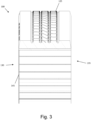
- Figures 2 and 3 provide a perspective view and a cross-sectional view, respectively, of the non-pneumatic tire and rim assembly having a molded sidewall cover 145.
- the molded sidewall cover 145 may also be referred to simply as a sidewall or a cover.
- the molded sidewall cover 145 extends from the tread 125 to the lower ring 105 on the first side 130 of the non-pneumatic tire 100.
- the sidewall cover 150 covers the upper ring 110, the spokes 115 and the upper and lower fillets 120 u,l .
- the sidewall cover 145 prevents debris from entering the openings between the spokes 115 in the non-pneumatic tire 100. Such debris could add weight to the tire and potentially damage the spokes 115 or other components.
- the sidewall cover 145 can also protect the tire 100 from curb damage.
- the sidewall cover 145 may also make the tire 100 more aerodynamic.
- a plurality of slits 150 are disposed circumferentially about the molded sidewall cover 145.
- Each slit 150 has a width less than 5 mm and a length greater than 10 mm. In more specific embodiments, each slit has a width of less than 3 mm. In yet another embodiment, each slit has a length greater than 15 mm. In still other embodiments, the width of the slits may be greater than 5 mm. Likewise, in other embodiments the length may be less than 10 mm.
- the slits 150 all have substantially the same dimensions and extend in substantially radial directions. In an alternative embodiment, one or more of the slits may have a different length or a different width. In another alternative embodiment, one or more of the slits are disposed at an acute angle with respect to the radial direction.
- the tread 125 and the sidewall cover 145 are made through a compression molding process.
- an operator provides the lower ring 105, the upper ring 110, and the spokes 115.
- the operator arranges the lower ring 105 inside of the upper ring 110, and arranges the spokes 115 such that they extend between the lower ring 105 and the upper ring 110.
- the operator places the lower ring 105, the upper ring 110, and the spokes 115 in a compression mold.
- the compression mold includes a plurality of shutoffs disposed on a first side of the compression mold.
- the compression mold may include a core and a cavity, and the shutoffs may be disposed on the core, while the cavity includes a flat plate.
- the compression mold may include a core and a cavity with the shutoffs disposed on the cavity, while the core includes a flat plate.
- the spokes may arranged such that one or more shutoffs are disposed between adjacent pairs of spokes.
- the rubber is heated such that it flows throughout the mold and forms the tread 125 and the sidewall cover 145.
- the rubber will flow around any shutoffs that are present, such it forms a plurality of openings in the sidewall cover 145.
- the operator places a reinforcement layer in the compression mold prior to placing the lower ring 105, the upper ring 110, and the spokes 115 in the compression mold, and prior to the providing of rubber in the compression mold.
- the reinforcement layer may be one of the reinforcement layers described above.
- the reinforcement layer extends between the lower ring 105 and the upper ring 110. Additionally, or in the alternative, a reinforcement layer may also be placed circumferentially about the upper ring 110 prior to providing rubber in the compression mold.
- the upper and lower rings, the support structure, the tread, and the sidewall are all formed in a mold during the same molding process.
- the upper and lower rings, the support structure, the tread, and the sidewall may be formed of the same material.
- different materials may be added to the mold at different times to form different structures.
- the tread and sidewall cover are made through an injection molding process.
- the tread and sidewall cover are formed separately, and cured together in another heating process, such as with an autoclave.
Landscapes
- Engineering & Computer Science (AREA)
- Mechanical Engineering (AREA)
- Tires In General (AREA)
Description
- The present invention relates to a non-pneumatic tire having sidewalls. More particularly, the present disclosure relates to a non-pneumatic tire having molded sidewall covers.
- Various tire constructions have been developed which enable a tire to run in an uninflated or underinflated condition. Non-pneumatic tires do not require inflation, while "run flat tires" may continue to operate after receiving a puncture and a complete or partial loss of pressurized air, for extended periods of time and at relatively high speeds. Non-pneumatic tires may include a plurality of spokes, a webbing, or other support structure that connects a lower ring to an upper ring.
-
US4945962A discloses a side web on-pneumatic tire ("SWNPT") that is integrally molded from a stiff, resilient elastomeric material with particular specifications, to form a unitary honey-comb structure bounded by integrally molded, outer and inner cylindrical coaxial and coextensive members ("hoops"), and, a single side web member. The outer hoop is supported and cushioned by the honeycomb which comprises a plurality of circumferentially spaced apart, angularly oppositely directed planar rib members (ribs) bounded by the side web on one side only. The side web, preferably on the outboard edges of the hoops, connected the hoops near their outboard edges. The opposite side surfaces of the side web lie at an angle φ in the range from 0° to 30° on either side of the vertical to the rotational axis of the SWNPT. The ribs extend axially along the inner and outer hoops, connecting them, and the outboard edges of all the ribs lie upon the inboard face of the web. The ribs on each side are angled at opposite angles in the range from 15° to 75° to a radial plane which intersect them at their radially inner ends. A rubber tread is secured to the outer surface of the structural elements of the SWNPT provide a load-supporting outer hoop. The coaction of the structure which, in operation, is subjected to continuous compression and tensile forces as it travels over the ground. Deformation and buckling characteristics of the SWNPT are derived from the honeycomb structure of an elastomer which provides the SWNPT with "ride" and "handling" comparable to those of a conventional pneumatic tire. The outer hoop has a vulcanized rubber tread secured to the hoop's outer surface to withstand travel over a road surface. The unribbed face of the single side web may be faced with an elastomeric sidewall to resemble the sidewall of a conventional pneumatic tire. -
KR20140028473A -
JP2014080151A -
US2012038206A1 discloses a non-pneumatic tire and wheel assembly that incorporates a tire tread and a conventional vehicle wheel with an elastomer tire body element molded for engagement intermediate the tread and wheel. The tire body element that includes multiple concentric layers with alternating spokes. A bonded multilayer cover that may be employed which is received within a recess in an outer surface of the tire body element from the tire tread. A mounting plate that is engaged to the cover and attached to the wheel. - In one embodiment, a non-pneumatic tire includes a lower ring having a first diameter and an upper ring having a second diameter greater than the first diameter. The upper ring is substantially coaxial with the lower ring. The non-pneumatic tire further includes support structure extending between the lower ring and the upper ring and a tread layer formed of a rubber material. The tread layer extends circumferentially about the entire upper ring, and further extends laterally from a first side of the non-pneumatic tire to a second side of the non-pneumatic tire. The non-pneumatic tire also includes a sidewall formed of the rubber material extending seamlessly from the tread layer to the lower ring on the first side of the non-pneumatic tire.
- In another embodiment, a method of covering a side of a non-pneumatic tire is provided. The method includes providing a lower ring having a first diameter, an upper ring substantially coaxial with the lower ring, and support structure extending between the lower ring and the upper ring. The method further includes placing the lower ring, the upper ring, and the support structure in a mold and providing rubber in the mold The rubber forms a tread layer extending circumferentially about the upper ring and a sidewall layer extending from the tread layer to the lower ring on a first side of the non-pneumatic tire.
- In yet another embodiment, a non-pneumatic tire having a sidewall is provided. The non-pneumatic tire includes a lower ring having a first diameter and an upper ring having a second diameter greater than the first diameter. The upper ring is substantially coaxial with the lower ring. The non-pneumatic tire further includes support structure extending between the lower ring and the upper ring and a tread layer formed of a rubber material. The non-pneumatic tire also has a sidewall formed of the rubber material and extending seamlessly from the tread layer on a first side of the non-pneumatic tire.
- In the accompanying drawings, structures are illustrated that, together with the detailed description provided below, describe exemplary embodiments of the claimed invention. Like elements are identified with the same reference numerals. It should be understood that elements shown as a single component may be replaced with multiple components, and elements shown as multiple components may be replaced with a single component. The drawings are not to scale and the proportion of certain elements may be exaggerated for the purpose of illustration.
-
Figure 1 is a perspective view of one embodiment of a non-pneumatic tire and rim assembly; -
Figure 2 is a perspective view of the non-pneumatic tire and rim assembly having one embodiment of a molded sidewall cover; -
Figure 3 is a cross-sectional view of the non-pneumatic tire and rim assembly having a molded sidewall cover as shown inFigure 2 ; and -
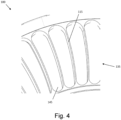
Figure 4 is a detail of a rear perspective view of the non-pneumatic tire and rim assembly having a molded sidewall cover. - The following includes definitions of selected terms employed herein. The definitions include various examples and/or forms of components that fall within the scope of a term and that may be used for implementation. The examples are not intended to be limiting. Both singular and plural forms of terms may be within the definitions.
- "Axial" and "axially" refer to a direction that is parallel to the axis of rotation of a tire.
- "Circumferential" and "circumferentially" refer to a direction extending along the perimeter of the surface of the tread perpendicular to the axial direction.
- "Radial" and "radially" refer to a direction perpendicular to the axis of rotation of a tire.
- "Tread" as used herein, refers to that portion of the tire that comes into contact with the road or ground under normal inflation and normal load.
- While similar terms used in the following descriptions describe common tire components, it should be understood that because the terms carry slightly different connotations, one of ordinary skill in the art would not consider any one of the following terms to be purely interchangeable with another term used to describe a common tire component.
- Directions are stated herein with reference to the axis of rotation of the tire. The terms "upward" and "upwardly" refer to a general direction towards the tread of the tire, whereas "downward" and "downwardly" refer to the general direction towards the axis of rotation of the tire. Thus, when relative directional terms such as "upper" and "lower" or "top" and "bottom" are used in connection with an element, the "upper" or "top" element is spaced closer to the tread than the "lower" or "bottom" element. Additionally, when relative directional terms such as "above" or "below" are used in connection with an element, an element that is "above" another element is closer to the tread than the other element.
- The terms "inward" and "inwardly" refer to a general direction towards the equatorial plane of the tire, whereas "outward" and "outwardly" refer to a general direction away from the equatorial plane of the tire and towards the side of the tire. Thus, when relative directional terms such as "inner" and "outer" are used in connection with an element, the "inner" element is spaced closer to the equatorial plane of the tire than the "outer" element.
-
Figure 1 is a perspective view of one embodiment of a non-pneumatic tire and rim assembly. The assembly includes anon-pneumatic tire 100 having alower ring 105 with a first diameter, and anupper ring 110 having a second diameter greater than the first diameter. Theupper ring 110 is substantially coaxial with thelower ring 105. A plurality ofspokes 115 extend between thelower ring 105 and theupper ring 110. - A plurality of
fillets 120 are disposed between thelower ring 105 and theupper ring 110 at the end of each spoke 115. The plurality offillets 120 includeslower fillets 120l andupper fillets 120u . Thelower fillets 120l are in direct contact with thelower ring 105. Theupper fillets 120u are in direct contact with theupper ring 110. In an alternative embodiment, the fillets may be omitted. - In an alternative embodiment (not shown) a webbing or other support structure may be employed instead of spokes.
- A
circumferential tread 125 is disposed about theupper ring 110 in the illustrated embodiment. Thetread 125 extends circumferentially about the entireupper ring 110, and further extends laterally from afirst side 130 of thenon-pneumatic tire 100 to asecond side 135 of thenon-pneumatic tire 100. Thetread 125 may include tread elements such as grooves, ribs, blocks, lugs, sipes, studs, and other elements. A shear band or other shear element or reinforcement structure (not shown) may be disposed between theupper ring 110 and thetread 125. In an alternative embodiment (not shown), the separate tread may be omitted and instead tread elements may be formed directly on the upper ring. - The lower and
upper rings upper rings spokes 115 may be constructed of elastomeric material having a single layer of reinforcement disposed therein. Thetread 125 andfillets 120 may be constructed of an elastomeric material, such as natural or synthetic rubber, other elastomeric material. - The assembly further includes a
rim 140. Thelower ring 105 is attached to therim 130, such as by an adhesive or through a chemical bonding process. Therim 140 may be attached to a vehicle through a plurality of bolts (not shown). -
Figures 2 and3 provide a perspective view and a cross-sectional view, respectively, of the non-pneumatic tire and rim assembly having a moldedsidewall cover 145. The moldedsidewall cover 145 may also be referred to simply as a sidewall or a cover. The moldedsidewall cover 145 extends from thetread 125 to thelower ring 105 on thefirst side 130 of thenon-pneumatic tire 100. Thus, thesidewall cover 150 covers theupper ring 110, thespokes 115 and the upper andlower fillets 120u,l . - The
sidewall cover 145 prevents debris from entering the openings between thespokes 115 in thenon-pneumatic tire 100. Such debris could add weight to the tire and potentially damage thespokes 115 or other components. Thesidewall cover 145 can also protect thetire 100 from curb damage. Thesidewall cover 145 may also make thetire 100 more aerodynamic. - In one embodiment, the
sidewall cover 145 is molded together with thetread 125 during the manufacturing process. Thus, as seen inFigures 2 and3 , thesidewall cover 145 extends seamlessly from thetread 125. In such an embodiment, thesidewall cover 145 is constructed of the same rubber material as thetread 125. - In the illustrated embodiment, a plurality of
slits 150 are disposed circumferentially about the moldedsidewall cover 145. Eachslit 150 has a width less than 5 mm and a length greater than 10 mm. In more specific embodiments, each slit has a width of less than 3 mm. In yet another embodiment, each slit has a length greater than 15 mm. In still other embodiments, the width of the slits may be greater than 5 mm. Likewise, in other embodiments the length may be less than 10 mm. In the illustrated embodiment, theslits 150 all have substantially the same dimensions and extend in substantially radial directions. In an alternative embodiment, one or more of the slits may have a different length or a different width. In another alternative embodiment, one or more of the slits are disposed at an acute angle with respect to the radial direction. - In the illustrated embodiment, each slit 150 is disposed between adjacent pairs of
spokes 115. In an alternative embodiment, two or more slits are disposed between adjacent pairs of spokes. In another alternative embodiment, some adjacent pairs of spokes do not have any slits disposed there between. In yet another alternative embodiment, at least one of the slits is in front of a spoke. - In other alternative embodiments, other openings may be disposed on the sidewall cover. For example, pin holes may be disposed about the sidewall cover. The openings facilitate flexing of the
sidewall cover 150. Such flexing may accommodate buckling of the spokes. The openings also provide a visual indicator that thetire 100 is non-pneumatic. Due to the openings, thesidewall 150 covers between 90-95% of the first side of thenon-pneumatic tire 100. In an alternative embodiment, the sidewall covers less than 90% of the first side of the non-pneumatic tire. In another alternative embodiment, the sidewall covers more than 95% of the first side of the non-pneumatic tire. For example, in one alternative embodiment, the sidewall does not have any openings at all, but is instead a solid sidewall. - In one embodiment, the
sidewall cover 150 may have reinforcements embedded therein. For example, a mesh or cords of reinforcing material may be embedded in the sidewall cover. Exemplary reinforcing materials include nylon, polyester, aramid, glass, or carbon fibers. Alternatively, metal reinforcements may be employed. -
Figure 4 is a detail of a rear perspective view of the non-pneumatic tire and rim assembly having a molded sidewall cover. As can be seen from this view, thesecond side 135 of thenon-pneumatic tire 100 does not have a sidewall cover. In an alternative embodiment, a second sidewall cover formed of the rubber material extends seamlessly from the tread layer on the second side of the non-pneumatic tire to the lower ring. The second sidewall cover may be substantially the same as thesidewall cover 145, or may incorporate any of the alternative features detailed above. - In one embodiment, the
tread 125 and thesidewall cover 145 are made through a compression molding process. In one such embodiment, an operator provides thelower ring 105, theupper ring 110, and thespokes 115. The operator arranges thelower ring 105 inside of theupper ring 110, and arranges thespokes 115 such that they extend between thelower ring 105 and theupper ring 110. The operator places thelower ring 105, theupper ring 110, and thespokes 115 in a compression mold. In one embodiment, the compression mold includes a plurality of shutoffs disposed on a first side of the compression mold. For example, the compression mold may include a core and a cavity, and the shutoffs may be disposed on the core, while the cavity includes a flat plate. Alternatively, the compression mold may include a core and a cavity with the shutoffs disposed on the cavity, while the core includes a flat plate. In all cases, the spokes may arranged such that one or more shutoffs are disposed between adjacent pairs of spokes. - The operator then provides rubber in the compression mold. The rubber is heated such that it flows throughout the mold and forms the
tread 125 and thesidewall cover 145. The rubber will flow around any shutoffs that are present, such it forms a plurality of openings in thesidewall cover 145. - In one embodiment, the operator places a reinforcement layer in the compression mold prior to placing the
lower ring 105, theupper ring 110, and thespokes 115 in the compression mold, and prior to the providing of rubber in the compression mold. The reinforcement layer may be one of the reinforcement layers described above. The reinforcement layer extends between thelower ring 105 and theupper ring 110. Additionally, or in the alternative, a reinforcement layer may also be placed circumferentially about theupper ring 110 prior to providing rubber in the compression mold. - In an alternative embodiment, the upper and lower rings, the support structure, the tread, and the sidewall are all formed in a mold during the same molding process. In such an embodiment, the upper and lower rings, the support structure, the tread, and the sidewall may be formed of the same material. Alternatively, different materials may be added to the mold at different times to form different structures.
- In an alternative embodiment, the tread and sidewall cover are made through an injection molding process. In another alternative embodiment, the tread and sidewall cover are formed separately, and cured together in another heating process, such as with an autoclave.
- To the extent that the term "includes" or "including" is used in the specification or the claims, it is intended to be inclusive in a manner similar to the term "comprising" as that term is interpreted when employed as a transitional word in a claim. Furthermore, to the extent that the term "or" is employed (e.g., A or B) it is intended to mean "A or B or both." When the applicants intend to indicate "only A or B but not both" then the term "only A or B but not both" will be employed. Thus, use of the term "or" herein is the inclusive, and not the exclusive use. See, Bryan A. Garner, A Dictionary of Modern Legal Usage 624 (2d. Ed. 1995). Also, to the extent that the terms "in" or "into" are used in the specification or the claims, it is intended to additionally mean "on" or "onto." Furthermore, to the extent the term "connect" is used in the specification or claims, it is intended to mean not only "directly connected to," but also "indirectly connected to" such as connected through another component or components.
- While the present application has been illustrated by the description of embodiments thereof, and while the embodiments have been described in considerable detail, it is not the intention of the applicants to restrict or in any way limit the scope of the appended claims to such detail. Additional advantages and modifications will readily appear to those skilled in the art. Therefore, the application, in its broader aspects, is not limited to the specific details, the representative apparatus and method, and illustrative examples shown and described. Accordingly, departures may be made from such details without departing from the scope of the applicant's general inventive concept, as indicated in the appended claims.
Claims (13)
- A non-pneumatic tire (100) comprising:a lower ring (105) having a first diameter;an upper ring (110) having a second diameter greater than the first diameter, the upper ring (110) being substantially coaxial with the lower ring (105); andsupport structure (115) extending between the lower ring (105) and the upper ring (110);a tread layer (125) formed of a rubber material,wherein the tread layer (125) extends circumferentially about the entire upper ring (110), andwherein the tread layer (125) extends laterally from a first side (130) of the non-pneumatic tire (100) to a second side (135) of the non-pneumatic tire (100); anda sidewall (145) formed of the rubber material extending seamlessly from the tread layer (125) to the lower ring (105) on the first side (130) of the non-pneumatic tire (100)
wherein the sidewall (145) includes a plurality of radially extending slits (150), each slit (150) having a width less than 5 mm and a length greater than 10 mm. - The non-pneumatic tire (100) of claim 1, wherein the sidewall (145) covers between 90-95% of the first side (130) of the non-pneumatic tire (100).
- The non-pneumatic tire (100) of claim 1, wherein the support structure (115) includes a plurality of radially extending spokes (115), and wherein each of the plurality of radially extending slits (150) in the sidewall (145) are disposed between adjacent pairs of the plurality of radially extending spokes (115).
- The non-pneumatic tire (100) of claim 1 or 3, further comprising a second sidewall (145) formed of the rubber material extending seamlessly from the tread layer (125) to the lower ring (105) on the second side (135) of the non-pneumatic tire (100).
- The non-pneumatic tire (100) of claim 1 or 3, wherein the sidewall (145) includes a reinforcement layer.
- The non-pneumatic tire (100) of claim 1 or 3, wherein the support structure (115) includes a plurality of spokes (115).
- A method of covering a side of a non-pneumatic tire (100), the method comprising:providing a lower ring (105) having a first diameter, an upper ring (110) substantially coaxial with the lower ring (105), and support structure (115) extending between the lower ring (105) and the upper ring (110);placing the lower ring (105), the upper ring (110), and the support structure (115) in a mold; andproviding rubber in the mold, such that the rubber forms a tread layer (125) extending circumferentially about the upper ring (110) and a sidewall layer (145) extending from the tread layer (125) to the lower ring (105) on a first side (130) of the non-pneumatic tire (100);andforming a plurality of radially extending slits (150) in the sidewall layer (145), each slit (150) having a width less than 5 mm and a length greater than 10 mm.
- The method of claim 7, further comprising placing a reinforcement layer in the mold prior to the providing of the rubber in the mold.
- The method of claim 8, wherein the reinforcement layer is placed in the mold such that it extends between the upper ring (110) and the lower ring (105).
- The method of claim 8, wherein the reinforcement layer is placed in the mold such that it extends circumferentially about the upper ring (110).
- The method of any one of claims 7 to 10, wherein the forming of a plurality of radially extending slits (150) in the sidewall layer (145) includes placing a plurality of shutoffs on a first side of the mold, such that rubber flows around the shutoffs and forms the sidewall layer (145) having the plurality of radially extending slits (150).
- The method of claim 11, wherein the support structure (115) includes a plurality of radially extending spokes (115).
- The method of claim 12, wherein the placing of the lower ring (105), the upper ring (110), and the support structure (115) in the mold includes placing the lower ring (105), the upper ring (110), and the support structure (115) in the mold such that at least one shutoff is disposed between each adjacent pair of the plurality of radially extending spokes (115).
Applications Claiming Priority (2)
| Application Number | Priority Date | Filing Date | Title |
|---|---|---|---|
| US201962954742P | 2019-12-30 | 2019-12-30 | |
| PCT/US2020/060730 WO2021137956A1 (en) | 2019-12-30 | 2020-11-16 | Non-pneumatic tire having molded sidewall cover |
Publications (3)
| Publication Number | Publication Date |
|---|---|
| EP4084966A1 EP4084966A1 (en) | 2022-11-09 |
| EP4084966A4 EP4084966A4 (en) | 2024-01-10 |
| EP4084966B1 true EP4084966B1 (en) | 2025-04-09 |
Family
ID=76685901
Family Applications (1)
| Application Number | Title | Priority Date | Filing Date |
|---|---|---|---|
| EP20908617.2A Active EP4084966B1 (en) | 2019-12-30 | 2020-11-16 | Non-pneumatic tire having molded sidewall cover |
Country Status (5)
| Country | Link |
|---|---|
| US (1) | US12304244B2 (en) |
| EP (1) | EP4084966B1 (en) |
| JP (1) | JP7398568B2 (en) |
| CN (1) | CN114867616A (en) |
| WO (1) | WO2021137956A1 (en) |
Family Cites Families (17)
| Publication number | Priority date | Publication date | Assignee | Title |
|---|---|---|---|---|
| US4945962A (en) | 1989-06-09 | 1990-08-07 | The Uniroyal Goodrich Tire Company | Honeycomb non-pneumatic tire with a single web on one side |
| US5050656A (en) | 1990-04-23 | 1991-09-24 | The B. F. Goodrich Company | Non-pneumatic tire wheel |
| JP3472398B2 (en) * | 1995-12-13 | 2003-12-02 | 住友ゴム工業株式会社 | No flat tire |
| CN1798662B (en) | 2003-02-05 | 2012-06-20 | 福山橡胶工业株式会社 | Non-pneumatic tire |
| FR2922159B1 (en) * | 2007-10-15 | 2011-04-29 | Michelin Soc Tech | PNEUMATIC ROLLER WITH CARRIER STRUCTURE |
| KR101064896B1 (en) | 2007-11-14 | 2011-09-16 | 전영일 | Non-air wheels, wheels used for them, suspensions and tires |
| US8567461B2 (en) * | 2010-08-12 | 2013-10-29 | The Boeing Company | Non-pneumatic survivable tire mounting system for conventional wheels |
| US8555941B2 (en) * | 2010-08-12 | 2013-10-15 | The Boeing Company | Non-pneumatic survivable tire, cover and fabrication processes |
| WO2012091754A1 (en) | 2010-12-29 | 2012-07-05 | Michelin Recherche Et Technique, S.A. | Structurally supported non-pneumatic wheel with reinforcements and method of manufacture |
| KR101393891B1 (en) * | 2012-08-29 | 2014-05-12 | 손영일 | Non-pneumatic tire |
| JP2014080151A (en) * | 2012-10-18 | 2014-05-08 | Bridgestone Corp | Non-pneumatic tire |
| KR101411103B1 (en) * | 2013-11-06 | 2014-06-27 | 한국타이어 주식회사 | Non-pneumatic tire |
| EP3237229B1 (en) | 2014-12-22 | 2020-11-18 | Bridgestone Americas Tire Operations, LLC | Tire and wheel assembly having angled interfaces |
| US10350945B2 (en) | 2015-12-22 | 2019-07-16 | The Goodyear Tire & Rubber Company | Beadless non-pneumatic tire with geodesic ply |
| WO2017116823A1 (en) | 2015-12-29 | 2017-07-06 | Bridgestone Americas Tire Operations, Llc | Tire with variable shear element |
| US20170368879A1 (en) * | 2016-06-28 | 2017-12-28 | The Goodyear Tire & Rubber Company | Non-pneumatic tire |
| US10749242B2 (en) * | 2017-10-30 | 2020-08-18 | The Goodyear Tire & Rubber Company | Non-pneumatic tire with radio frequency identification |
-
2020
- 2020-11-16 CN CN202080090404.8A patent/CN114867616A/en active Pending
- 2020-11-16 JP JP2022539419A patent/JP7398568B2/en active Active
- 2020-11-16 US US17/783,780 patent/US12304244B2/en active Active
- 2020-11-16 EP EP20908617.2A patent/EP4084966B1/en active Active
- 2020-11-16 WO PCT/US2020/060730 patent/WO2021137956A1/en not_active Ceased
Also Published As
| Publication number | Publication date |
|---|---|
| EP4084966A4 (en) | 2024-01-10 |
| US20230042193A1 (en) | 2023-02-09 |
| EP4084966A1 (en) | 2022-11-09 |
| JP7398568B2 (en) | 2023-12-14 |
| JP2023509008A (en) | 2023-03-06 |
| US12304244B2 (en) | 2025-05-20 |
| CN114867616A (en) | 2022-08-05 |
| WO2021137956A1 (en) | 2021-07-08 |
Similar Documents
| Publication | Publication Date | Title |
|---|---|---|
| US20250026151A1 (en) | Tire with spoke loops | |
| AU2021200240B2 (en) | Reinforced rubber spoke for a tire | |
| US20180001705A1 (en) | Molded article and improved venting assembly for a rotating mold | |
| EP3558696B1 (en) | Method of mounting a non-pneumatic tire onto a hub | |
| EP3558694B1 (en) | Non-pneumatic wheel and hub | |
| US4936365A (en) | Anisotropic tire | |
| KR20180054473A (en) | Non-pneumatic support structure | |
| EP3902691B1 (en) | Non-pneumatic tire having reinforced outer ring | |
| EP3902690B1 (en) | Non-pneumatic tire having reinforced support structure | |
| CN110014789A (en) | Pneumatic tire with solid bead area structure | |
| JPH0732827A (en) | Safety wheel and its inside ring structure | |
| WO2015036815A1 (en) | Unitary wheel for ground service supporting equipment | |
| EP4084966B1 (en) | Non-pneumatic tire having molded sidewall cover | |
| JP7700376B2 (en) | NON-PNEUMATIC TIRE HAVING REINFORCED SUPPORT STRUCTURE AND METHOD FOR MANUFACTURING SAME - Patent application | |
| KR102613768B1 (en) | Wheel for a support structure | |
| US10882364B2 (en) | Tire with concave sidewalls | |
| US12552118B2 (en) | System and method for making a band and tread assembly for a non-pneumatic tire | |
| US20250026150A1 (en) | System and method for protecting a support structure of a non-pneumatic tire | |
| KR20260031731A (en) | Non-pneumatic tire for electric wheelchair | |
| KR20260000107A (en) | A nonpneumatic tire | |
| GB1586745A (en) | Band reinforced radial tyre |
Legal Events
| Date | Code | Title | Description |
|---|---|---|---|
| STAA | Information on the status of an ep patent application or granted ep patent |
Free format text: STATUS: THE INTERNATIONAL PUBLICATION HAS BEEN MADE |
|
| PUAI | Public reference made under article 153(3) epc to a published international application that has entered the european phase |
Free format text: ORIGINAL CODE: 0009012 |
|
| STAA | Information on the status of an ep patent application or granted ep patent |
Free format text: STATUS: REQUEST FOR EXAMINATION WAS MADE |
|
| 17P | Request for examination filed |
Effective date: 20220715 |
|
| AK | Designated contracting states |
Kind code of ref document: A1 Designated state(s): AL AT BE BG CH CY CZ DE DK EE ES FI FR GB GR HR HU IE IS IT LI LT LU LV MC MK MT NL NO PL PT RO RS SE SI SK SM TR |
|
| DAV | Request for validation of the european patent (deleted) | ||
| DAX | Request for extension of the european patent (deleted) | ||
| A4 | Supplementary search report drawn up and despatched |
Effective date: 20231211 |
|
| RIC1 | Information provided on ipc code assigned before grant |
Ipc: B60C 13/04 20060101ALI20231205BHEP Ipc: B60C 13/00 20060101ALI20231205BHEP Ipc: B60C 11/03 20060101ALI20231205BHEP Ipc: B60C 7/14 20060101ALI20231205BHEP Ipc: B60B 9/00 20060101ALI20231205BHEP Ipc: B60B 9/10 20060101ALI20231205BHEP Ipc: B60C 7/10 20060101AFI20231205BHEP |
|
| GRAP | Despatch of communication of intention to grant a patent |
Free format text: ORIGINAL CODE: EPIDOSNIGR1 |
|
| STAA | Information on the status of an ep patent application or granted ep patent |
Free format text: STATUS: GRANT OF PATENT IS INTENDED |
|
| RIC1 | Information provided on ipc code assigned before grant |
Ipc: B60C 13/04 20060101ALI20241030BHEP Ipc: B60C 13/00 20060101ALI20241030BHEP Ipc: B60C 11/03 20060101ALI20241030BHEP Ipc: B60C 7/14 20060101ALI20241030BHEP Ipc: B60B 9/00 20060101ALI20241030BHEP Ipc: B60B 9/10 20060101ALI20241030BHEP Ipc: B60C 7/10 20060101AFI20241030BHEP |
|
| INTG | Intention to grant announced |
Effective date: 20241122 |
|
| P01 | Opt-out of the competence of the unified patent court (upc) registered |
Free format text: CASE NUMBER: APP_758/2025 Effective date: 20250108 |
|
| GRAS | Grant fee paid |
Free format text: ORIGINAL CODE: EPIDOSNIGR3 |
|
| GRAA | (expected) grant |
Free format text: ORIGINAL CODE: 0009210 |
|
| STAA | Information on the status of an ep patent application or granted ep patent |
Free format text: STATUS: THE PATENT HAS BEEN GRANTED |
|
| AK | Designated contracting states |
Kind code of ref document: B1 Designated state(s): AL AT BE BG CH CY CZ DE DK EE ES FI FR GB GR HR HU IE IS IT LI LT LU LV MC MK MT NL NO PL PT RO RS SE SI SK SM TR |
|
| REG | Reference to a national code |
Ref country code: GB Ref legal event code: FG4D |
|
| REG | Reference to a national code |
Ref country code: CH Ref legal event code: EP |
|
| REG | Reference to a national code |
Ref country code: DE Ref legal event code: R096 Ref document number: 602020049336 Country of ref document: DE |
|
| REG | Reference to a national code |
Ref country code: IE Ref legal event code: FG4D |
|
| REG | Reference to a national code |
Ref country code: NL Ref legal event code: MP Effective date: 20250409 |
|
| PG25 | Lapsed in a contracting state [announced via postgrant information from national office to epo] |
Ref country code: NL Free format text: LAPSE BECAUSE OF FAILURE TO SUBMIT A TRANSLATION OF THE DESCRIPTION OR TO PAY THE FEE WITHIN THE PRESCRIBED TIME-LIMIT Effective date: 20250409 |
|
| REG | Reference to a national code |
Ref country code: AT Ref legal event code: MK05 Ref document number: 1783228 Country of ref document: AT Kind code of ref document: T Effective date: 20250409 |
|
| PG25 | Lapsed in a contracting state [announced via postgrant information from national office to epo] |
Ref country code: FI Free format text: LAPSE BECAUSE OF FAILURE TO SUBMIT A TRANSLATION OF THE DESCRIPTION OR TO PAY THE FEE WITHIN THE PRESCRIBED TIME-LIMIT Effective date: 20250409 Ref country code: ES Free format text: LAPSE BECAUSE OF FAILURE TO SUBMIT A TRANSLATION OF THE DESCRIPTION OR TO PAY THE FEE WITHIN THE PRESCRIBED TIME-LIMIT Effective date: 20250409 Ref country code: PT Free format text: LAPSE BECAUSE OF FAILURE TO SUBMIT A TRANSLATION OF THE DESCRIPTION OR TO PAY THE FEE WITHIN THE PRESCRIBED TIME-LIMIT Effective date: 20250811 |
|
| REG | Reference to a national code |
Ref country code: LT Ref legal event code: MG9D |
|
| PG25 | Lapsed in a contracting state [announced via postgrant information from national office to epo] |
Ref country code: NO Free format text: LAPSE BECAUSE OF FAILURE TO SUBMIT A TRANSLATION OF THE DESCRIPTION OR TO PAY THE FEE WITHIN THE PRESCRIBED TIME-LIMIT Effective date: 20250709 Ref country code: GR Free format text: LAPSE BECAUSE OF FAILURE TO SUBMIT A TRANSLATION OF THE DESCRIPTION OR TO PAY THE FEE WITHIN THE PRESCRIBED TIME-LIMIT Effective date: 20250710 |
|
| PG25 | Lapsed in a contracting state [announced via postgrant information from national office to epo] |
Ref country code: PL Free format text: LAPSE BECAUSE OF FAILURE TO SUBMIT A TRANSLATION OF THE DESCRIPTION OR TO PAY THE FEE WITHIN THE PRESCRIBED TIME-LIMIT Effective date: 20250409 |
|
| PG25 | Lapsed in a contracting state [announced via postgrant information from national office to epo] |
Ref country code: BG Free format text: LAPSE BECAUSE OF FAILURE TO SUBMIT A TRANSLATION OF THE DESCRIPTION OR TO PAY THE FEE WITHIN THE PRESCRIBED TIME-LIMIT Effective date: 20250409 |
|
| PG25 | Lapsed in a contracting state [announced via postgrant information from national office to epo] |
Ref country code: HR Free format text: LAPSE BECAUSE OF FAILURE TO SUBMIT A TRANSLATION OF THE DESCRIPTION OR TO PAY THE FEE WITHIN THE PRESCRIBED TIME-LIMIT Effective date: 20250409 |
|
| PG25 | Lapsed in a contracting state [announced via postgrant information from national office to epo] |
Ref country code: AT Free format text: LAPSE BECAUSE OF FAILURE TO SUBMIT A TRANSLATION OF THE DESCRIPTION OR TO PAY THE FEE WITHIN THE PRESCRIBED TIME-LIMIT Effective date: 20250409 |
|
| PG25 | Lapsed in a contracting state [announced via postgrant information from national office to epo] |
Ref country code: RS Free format text: LAPSE BECAUSE OF FAILURE TO SUBMIT A TRANSLATION OF THE DESCRIPTION OR TO PAY THE FEE WITHIN THE PRESCRIBED TIME-LIMIT Effective date: 20250709 |
|
| PG25 | Lapsed in a contracting state [announced via postgrant information from national office to epo] |
Ref country code: IS Free format text: LAPSE BECAUSE OF FAILURE TO SUBMIT A TRANSLATION OF THE DESCRIPTION OR TO PAY THE FEE WITHIN THE PRESCRIBED TIME-LIMIT Effective date: 20250809 |
|
| PG25 | Lapsed in a contracting state [announced via postgrant information from national office to epo] |
Ref country code: LV Free format text: LAPSE BECAUSE OF FAILURE TO SUBMIT A TRANSLATION OF THE DESCRIPTION OR TO PAY THE FEE WITHIN THE PRESCRIBED TIME-LIMIT Effective date: 20250409 |
|
| PGFP | Annual fee paid to national office [announced via postgrant information from national office to epo] |
Ref country code: DE Payment date: 20251022 Year of fee payment: 6 |
|
| REG | Reference to a national code |
Ref country code: DE Ref legal event code: R097 Ref document number: 602020049336 Country of ref document: DE |
|
| PG25 | Lapsed in a contracting state [announced via postgrant information from national office to epo] |
Ref country code: SM Free format text: LAPSE BECAUSE OF FAILURE TO SUBMIT A TRANSLATION OF THE DESCRIPTION OR TO PAY THE FEE WITHIN THE PRESCRIBED TIME-LIMIT Effective date: 20250409 Ref country code: DK Free format text: LAPSE BECAUSE OF FAILURE TO SUBMIT A TRANSLATION OF THE DESCRIPTION OR TO PAY THE FEE WITHIN THE PRESCRIBED TIME-LIMIT Effective date: 20250409 |
|
| PGFP | Annual fee paid to national office [announced via postgrant information from national office to epo] |
Ref country code: FR Payment date: 20251022 Year of fee payment: 6 |
|
| PG25 | Lapsed in a contracting state [announced via postgrant information from national office to epo] |
Ref country code: CZ Free format text: LAPSE BECAUSE OF FAILURE TO SUBMIT A TRANSLATION OF THE DESCRIPTION OR TO PAY THE FEE WITHIN THE PRESCRIBED TIME-LIMIT Effective date: 20250409 |
|
| PG25 | Lapsed in a contracting state [announced via postgrant information from national office to epo] |
Ref country code: EE Free format text: LAPSE BECAUSE OF FAILURE TO SUBMIT A TRANSLATION OF THE DESCRIPTION OR TO PAY THE FEE WITHIN THE PRESCRIBED TIME-LIMIT Effective date: 20250409 |
|
| PG25 | Lapsed in a contracting state [announced via postgrant information from national office to epo] |
Ref country code: SK Free format text: LAPSE BECAUSE OF FAILURE TO SUBMIT A TRANSLATION OF THE DESCRIPTION OR TO PAY THE FEE WITHIN THE PRESCRIBED TIME-LIMIT Effective date: 20250409 |
|
| PG25 | Lapsed in a contracting state [announced via postgrant information from national office to epo] |
Ref country code: IT Free format text: LAPSE BECAUSE OF FAILURE TO SUBMIT A TRANSLATION OF THE DESCRIPTION OR TO PAY THE FEE WITHIN THE PRESCRIBED TIME-LIMIT Effective date: 20250409 |
|
| PG25 | Lapsed in a contracting state [announced via postgrant information from national office to epo] |
Ref country code: RO Free format text: LAPSE BECAUSE OF FAILURE TO SUBMIT A TRANSLATION OF THE DESCRIPTION OR TO PAY THE FEE WITHIN THE PRESCRIBED TIME-LIMIT Effective date: 20250409 |
|
| PLBE | No opposition filed within time limit |
Free format text: ORIGINAL CODE: 0009261 |
|
| STAA | Information on the status of an ep patent application or granted ep patent |
Free format text: STATUS: NO OPPOSITION FILED WITHIN TIME LIMIT |
|
| REG | Reference to a national code |
Ref country code: CH Ref legal event code: L10 Free format text: ST27 STATUS EVENT CODE: U-0-0-L10-L00 (AS PROVIDED BY THE NATIONAL OFFICE) Effective date: 20260218 |
|
| 26N | No opposition filed |
Effective date: 20260112 |