EP4084560A1 - Methods and devices for radio resource allocation - Google Patents
Methods and devices for radio resource allocation Download PDFInfo
- Publication number
- EP4084560A1 EP4084560A1 EP21305555.1A EP21305555A EP4084560A1 EP 4084560 A1 EP4084560 A1 EP 4084560A1 EP 21305555 A EP21305555 A EP 21305555A EP 4084560 A1 EP4084560 A1 EP 4084560A1
- Authority
- EP
- European Patent Office
- Prior art keywords
- application
- failure
- probability
- resource
- received
- Prior art date
- Legal status (The legal status is an assumption and is not a legal conclusion. Google has not performed a legal analysis and makes no representation as to the accuracy of the status listed.)
- Granted
Links
Images




Classifications
-
- H—ELECTRICITY
- H04—ELECTRIC COMMUNICATION TECHNIQUE
- H04L—TRANSMISSION OF DIGITAL INFORMATION, e.g. TELEGRAPHIC COMMUNICATION
- H04L67/00—Network arrangements or protocols for supporting network services or applications
- H04L67/50—Network services
- H04L67/60—Scheduling or organising the servicing of application requests, e.g. requests for application data transmissions using the analysis and optimisation of the required network resources
- H04L67/61—Scheduling or organising the servicing of application requests, e.g. requests for application data transmissions using the analysis and optimisation of the required network resources taking into account QoS or priority requirements
-
- H—ELECTRICITY
- H04—ELECTRIC COMMUNICATION TECHNIQUE
- H04L—TRANSMISSION OF DIGITAL INFORMATION, e.g. TELEGRAPHIC COMMUNICATION
- H04L67/00—Network arrangements or protocols for supporting network services or applications
- H04L67/50—Network services
- H04L67/60—Scheduling or organising the servicing of application requests, e.g. requests for application data transmissions using the analysis and optimisation of the required network resources
- H04L67/62—Establishing a time schedule for servicing the requests
-
- H—ELECTRICITY
- H04—ELECTRIC COMMUNICATION TECHNIQUE
- H04W—WIRELESS COMMUNICATION NETWORKS
- H04W72/00—Local resource management
- H04W72/04—Wireless resource allocation
- H04W72/044—Wireless resource allocation based on the type of the allocated resource
- H04W72/0446—Resources in time domain, e.g. slots or frames
-
- H—ELECTRICITY
- H04—ELECTRIC COMMUNICATION TECHNIQUE
- H04W—WIRELESS COMMUNICATION NETWORKS
- H04W72/00—Local resource management
- H04W72/20—Control channels or signalling for resource management
-
- H—ELECTRICITY
- H04—ELECTRIC COMMUNICATION TECHNIQUE
- H04W—WIRELESS COMMUNICATION NETWORKS
- H04W72/00—Local resource management
- H04W72/50—Allocation or scheduling criteria for wireless resources
- H04W72/54—Allocation or scheduling criteria for wireless resources based on quality criteria
-
- H—ELECTRICITY
- H04—ELECTRIC COMMUNICATION TECHNIQUE
- H04L—TRANSMISSION OF DIGITAL INFORMATION, e.g. TELEGRAPHIC COMMUNICATION
- H04L43/00—Arrangements for monitoring or testing data switching networks
- H04L43/08—Monitoring or testing based on specific metrics, e.g. QoS, energy consumption or environmental parameters
- H04L43/0823—Errors, e.g. transmission errors
-
- H—ELECTRICITY
- H04—ELECTRIC COMMUNICATION TECHNIQUE
- H04L—TRANSMISSION OF DIGITAL INFORMATION, e.g. TELEGRAPHIC COMMUNICATION
- H04L67/00—Network arrangements or protocols for supporting network services or applications
- H04L67/01—Protocols
- H04L67/12—Protocols specially adapted for proprietary or special-purpose networking environments, e.g. medical networks, sensor networks, networks in vehicles or remote metering networks
- H04L67/125—Protocols specially adapted for proprietary or special-purpose networking environments, e.g. medical networks, sensor networks, networks in vehicles or remote metering networks involving control of end-device applications over a network
-
- H—ELECTRICITY
- H04—ELECTRIC COMMUNICATION TECHNIQUE
- H04W—WIRELESS COMMUNICATION NETWORKS
- H04W4/00—Services specially adapted for wireless communication networks; Facilities therefor
- H04W4/30—Services specially adapted for particular environments, situations or purposes
- H04W4/38—Services specially adapted for particular environments, situations or purposes for collecting sensor information
-
- H—ELECTRICITY
- H04—ELECTRIC COMMUNICATION TECHNIQUE
- H04W—WIRELESS COMMUNICATION NETWORKS
- H04W72/00—Local resource management
- H04W72/12—Wireless traffic scheduling
- H04W72/1263—Mapping of traffic onto schedule, e.g. scheduled allocation or multiplexing of flows
-
- H—ELECTRICITY
- H04—ELECTRIC COMMUNICATION TECHNIQUE
- H04W—WIRELESS COMMUNICATION NETWORKS
- H04W72/00—Local resource management
- H04W72/50—Allocation or scheduling criteria for wireless resources
- H04W72/54—Allocation or scheduling criteria for wireless resources based on quality criteria
- H04W72/542—Allocation or scheduling criteria for wireless resources based on quality criteria using measured or perceived quality
Definitions
- At least one of the present embodiments generally relates to a method for allocating, by a resource scheduler, a radio resource in a system comprising a set of devices, each devices hosting at least one application.
- the Fourth Industrial Revolution (or Industry 4.0) refers to the automation of traditional manufacturing using smart technology such as Internet of Things, cloud computing.
- TSN Time Sensitive Networking
- TSN defines Time Aware Shaper (TAS) schedulers for guaranteeing the transmission of high priority deterministic traffic in a bounded time.
- TAS Time Aware Shaper
- TSN based networks cannot provide the required flexibility to support mobile industrial applications required for the factories of the future.
- Wireless networks have many advantages, including flexibility, low cost, ease of deployment but at the cost of reliability.
- At least one of the present embodiments generally relates to a method for allocating a radio resource in a system comprising a resource scheduler and a set of devices, each device hosting at least one application, each application transmitting messages to at least one receiver on a transmission channel.
- the method comprises, executed by the resource scheduler, at least one iteration n of :
- the resource allocation method makes it possible to reduce the number of application failures while still ensuring good communication performance namely thanks to the feedbacks from the resource scheduler to the applications.
- a) to e) are repeated iteratively.
- said application parameters representative of application's requirements comprise a resilience value, a message lifetime and a message period.
- computing, for each application, a metric responsive to at least part of the received application parameters, to an average probability of failure of said application and further to a channel error probability of said transmission channel comprises :
- f k n P e k n ⁇ k n H Q k n , where Q k n is a number of transmission opportunities before a resilience violation of the application of index k or a number of time slots before a resilience violation of the application of index k, H() is a predefined increasing affine function or an identity function and ⁇ k n is an average resource usage
- updating the average probability of failure F k n comprises:
- a method for allocating a radio resource in such a system comprises the following steps executed by each device hosting at least one application:
- said at least one application parameter being a resilience
- updating at least one application parameter comprises comparing the received instantaneous probability of failure with a threshold value and increasing said resilience in the case where the received instantaneous probability of failure is above said threshold value.
- updating at least one application parameter comprises updating a resilience and an angular velocity by comparing the received instantaneous probability of failure with a threshold value and decreasing said angular velocity and further increasing said resilience in the case where the received instantaneous probability of failure is above said threshold value.
- the method further comprises:
- a resource scheduler configured for allocating a radio resource in such a system is further disclosed.
- the resource scheduler comprises at least one processor configured to :
- a device hosting an application in such a system comprises at least one processor configured to :
- a system comprising such a resource scheduler and such a device hosting an application is also disclosed.
- a computer program product comprising program code instructions is disclosed that can be loaded in a programmable device, the program code instructions causing implementation of the method according to the various embodiments when the program code instructions are run by the programmable device.
- a storage medium storing such a computer program is disclosed.
- Fig. 1 depicts a system 1, for example as part of a smart factory, in which the present embodiments may be implemented.
- the system 1 comprises a set 10 of moving robots 10A to 10D, each being capable of moving from one location to another in the factory.
- the set 10 may also include non-moving robots.
- the moving robots 10A to 10D are in wireless communication with one or more controlling devices 12A-12B with which they exchange application messages.
- Each controlling device 12A-12B may be a base station, a MEC (English acronym of "Multi-access Edge Computing") station or a mobile station.
- the controlling devices 12A-12B are for example configured to plan and monitor the missions of the robots 10A-10D.
- the controlling device 12A transmits application messages comprising data representative of its mission to the robot 10A while the controlling device 12B transmits application messages comprising data representative of its mission to the robot 10C.
- the mission data may comprise displacement data (e.g. angular speed, linear speed, pressure level, etc), interaction data, motion data, etc.
- the robot 10A (10C respectively) transmits application messages to the controlling device 12A (12B respectively).
- the application messages transmitted from the robots to the controlling devices comprise for example monitoring data or environment data.
- the exchanges of application messages may be periodic or aperiodic.
- Each robot 10A-10D and each controlling device 12A-12B comprises at least one application module.
- an application message is more particularly exchanged between the application module of a robot and the application module of a controlling device.
- An application module generally comprises a software entity, namely the application, along with hardware elements such as an application buffer.
- a robot usually comprises several physical elements, e.g. a wheel, an arm, etc.
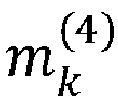
- a given robot may need to exchange application messages comprising different types of data with a controlling device depending on the concerned physical element. Therefore, in the following, a stream S k is defined as the set of application messages m k n transmitted from (respectively received by) a given physical element of a given robot in the set 10 of robots. Said otherwise a plurality of streams may be associated with one and the same robot, e.g. one stream associated with the arm of the robot and one stream associated with each wheel of the robot.
- K streams ⁇ S 1 , ..., S K ⁇ are considered wherein each stream S k is associated with a given application APP k .
- the application APP k pushes messages m k n one-by-one into an application buffer of size one message, the messages m k n being transmitted at a time instant n using a radio resource to a corresponding receiver, e.g. to a controlling device.
- the number of radio resources is limited. In the context of radio communication, the number of resources is defined as the number of frequency resources (e.g. subchannels where each subchannel comprises a finite number of frequency blocks) used in a limited amount of time.
- every dt there is thus an opportunity, i.e. a time slot, for an application message m k n to be sent.
- the resource scheduler 14 is thus configured to select one stream among K streams to allocate the radio resource to.
- the resource scheduler 14 usually comprises a software entity along with hardware elements such as a buffer.
- the resource scheduler may be located in a base station, a MEC station or a mobile station.
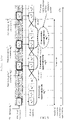
- Fig. 3 illustrates various application parameters that relate to a given application AAP k .
- the application AAP k is for example an application, located in one of the controlling device, configured to control the motion of an arm of a specific robot, e.g. the robot 10C.
- the application AAP k may be an application located in a specific robot and configured to monitor the environment of the robot.
- the transmission channel H k is characterized by its channel error probability P e k n .
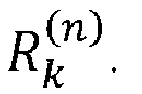
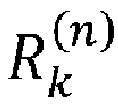
- Each application AAP k has some requirements defined by a set of application parameters whose values may vary temporally, namely a resilience R k n , a message lifetime D k n and a message period T k n .
- the resilience R k n is the maximum amount of time the application AAP k authorizes for not receiving any message.
- the associated robot may enter in a safety mode, e.g. a partial or complete stop with a reinitialization.
- the message lifetime D k n is the lifetime of a message m k n when pushed into the application buffer (also called packet delay budget in the literature). Indeed, the message m k n of, for example, any monitoring application is only relevant for a limited time duration in particular because of robot motion.
- the lifetime of the first message m k 1 is 4 time slots
- the lifetime of the second and fourth messages m k 2 , m k 4 is 2 time slots
- the lifetime of the third message m k 3 is 3 time slots.
- the message period T k n is the time between the life's start of any two consecutive messages. This period may be variable if the application does not need a periodic traffic.
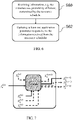
- Fig. 4 depicts a flowchart of a method for resource allocation according to a specific embodiment. The method is implemented by the resource scheduler 14.
- the resource allocation comprises selecting, for an available radio resource, a single stream S k (thus a single application APP k ) according to some metrics M k n . .
- the metrics M k n are defined to balance between the satisfaction of the application's requirements of any single stream, e.g. minimizing the number of application failures due to resilience violation, and the sharing of the radio resources between all devices in a most fair manner.
- the resource scheduler 14 uses for example an ⁇ -fair utility-based formalism to ensure a fairness resource allocation between the streams.
- the cost function J (n) is thus used by the resource scheduler 14 to select, at time instant n, one stream among the K streams to allocate a radio resource to.
- the practical implementation of the resource allocation comprises steps S40 to S46.
- the resource scheduler 14 receives, from each application APP k , the application parameters representative of its application's requirements at time instant n, i.e R k n , D k n , T k n .
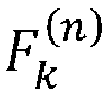
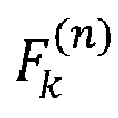
- the resource scheduler 14 computes, for each stream S k (thus for each application APP k ), a metric M k n responsive to at least part of the received application parameters, i.e. R k n , D k n , T k n , to the average probability of failure F k n ⁇ 1 and further to the channel error probability P e k n .
- F k 0 1 or F k 0 is set to a random value different from zero.
- F k n is updated later on, at step S46.
- f k n may be computed in different ways depending on the concern for radio conditions and for application's requirements.
- the metrics M k n take into account the resilience R k n in addition to the radio conditions represented by P e k n .
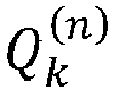
- the quantity Q k n represents the number of time slots before a resilience violation, i.e. an application failure. Either Q k n is decreased by one if the stream does not succeed in transmitting the packet or Q k n is set to the resilience R k otherwise. Said otherwise, in the case where the packet is correctly transmitted, i.e. if the resource is allocated and the packet is received, then Q k n is set to the resilience value. In fact, when a transmission succeeded at time instant n, n k is set equal to the value n and thus consequently Q k n is set equal to R k n . .
- n is increased by 1 and thus Q k n is decreased by one.
- Q k n is multiplied by an average resource usage ⁇ k n .
- the average resource usage ⁇ k n is computed by counting the number of resource allocations obtained by the stream S k (or in an equivalent manner by the application APP k ) until the current time instant n divided by the total number of time slots until the current time instant n.
- the values of average resource usage thus belong to the interval [0 ;1].
- the message lifetime D k n and the message period T k n are taken into account in addition to the resilience R k n (through N T k n ) and the radio conditions P e k n .
- N T k n ⁇ 1 is the number of remaining messages after the current message
- fct() is a predefined function of D k n and/or of SNR and/or additional parameters.
- N T k n ⁇ 1 is the number of remaining messages after the current message
- fct() is a predefined function of D k n and/or of SNR and/or additional parameters.
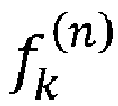
- the function f k n may be embodied in such a way that it contains the instantaneous probability of failure for the next messages as well as for the current message.
- the channel error probability is made lower and lower as the time index increases such that P e k n ⁇ P e k n ⁇ 1 because the redundancy allows for an SNR increase.
- f k n P e k 1 N T k 1 ⁇ 1 D k 1 P e k n D k 1 ⁇ n + 1 .
- Q k n represents a number of transmission opportunities before a resilience violation occurs.
- Fig. 5 illustrates the principle of transmission opportunities for each message of a given stream S k .
- Fig. 5 is similar to Fig. 3 . Therefore, the elements in common are labelled with the same numeral references. On Fig. 5 , there are 4 opportunities to transmit the first message, two opportunities for the second message and three opportunities for the third message.
- Q k n is thus split into a number of remaining transmission opportunities in the next buffered messages to come and an estimated number d k n of remaining transmission opportunities in the current message, i.e. before the current message death.
- the instantaneous current packet probability of failure is not only dependent on d k n . Any HARQ-based receiver that accumulates redundancy each time a packet is not well decoded but transmitted (channel failures) observes a reduced current packet probability of failure even considering a constant channel error probability.
- the resource scheduler 14 compares the metrics M 1 n , ⁇ , M K n and, responsive to this comparison, selects a stream k* to allocate the radio resource to.
- the message m k * n of the selected stream is thus sent through the channel H k* to the receiver.
- the average probability of failure F k n is updated for each k.
- the updated value F k n is to be used for the calculation of the metrics M k n + 1 .
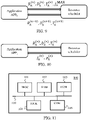
- Fig. 6 depicts a flowchart of a method for updating application parameters according to a specific embodiment. The method is implemented in an application module by an application APP k .
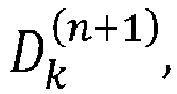
- the application APP k receives information, e.g. the instantaneous probability of failure f k n provided by the resource scheduler 14.
- f k n is only known by the scheduler, i.e. the application is not able to compute it. Consequently, transmitting this information to the application makes it possible for the application to adapt its requirements so as to decrease the probability of failure in the future so that f k n + 1 ⁇ f k n .
- the application APP k updates at least one of its application parameters responsive to the received information.
- the application APP k uses as inputs R k n and f k n to obtain an updated application parameter R k n + 1 .
- the application APP k uses as inputs f k n , R k n and optionally T k n , D k n , X k n , to obtain an updated application parameter R k n + 1 and optionally updated application parameters T k n + 1 , D k n + 1 , X k n + 1 .
- X k n is a variable directly related to the application e.g. the velocity of the associated physical element like an arm, a wheel, etc.
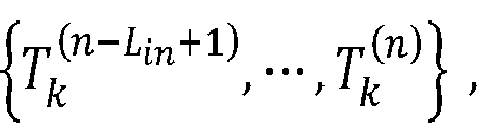
- a Lin-memory is used.
- the application APP k receives several instantaneous probabilities of failure f k t provided for time instants t ⁇ (n- L in ), ..., (n) ⁇ .
- L in 0,1,2.
- the application APP k uses as inputs R k n ⁇ L in + 1 , ... , R k n and f k n ⁇ L in + 1 , ... , f k n to obtain updated application parameters R k n + 1 , ... , R k n + L out .
- L out 0,1,2.
- the application APP k uses as inputs f k n ⁇ L in + 1 , ... , f k n , R k n ⁇ L in + 1 , ... , R k n , and optionally T k n ⁇ L in + 1 , ... , T k n , D k n ⁇ L in + 1 , ⁇ , D k n , X k n ⁇ L in + 1 , ... , X k n , to obtain updated application parameters R k n + 1 , ⁇ , R k n + L out and optionally updated application meters T k n + 1 , ⁇ , T k n + L out , D k n + 1 , ⁇ , D k n + L out , X k n + 1 , ⁇ , X k n + L out .
- the updating function F update may be defined in different ways.
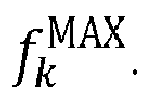
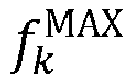
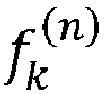
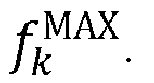
- the application initially considers a maximum probability of failure f k MAX .
- the value f k MAX is determined based on the performance's needs of the application. If the received value f k n > f k MAX then the application allows for a greater resilience such that R k n + 1 > R k n . This way, the stream S k obtains more transmission opportunities.
- ⁇ is a matrix
- fctt( ⁇ ) is a function that combines its input values.
- fctt() is a function that outputs the average, variance, median or maximum of its input values.
- fctt() is the identity function.
- f k n + 1 ⁇ f k n + L out 1 L in P e k ⁇ L in ⁇ P e k ⁇ 2 P e k ⁇ 1 P e k ⁇ L in ⁇ 1 ⁇ P e k ⁇ 3 P e k ⁇ 2 ⁇ ⁇ ⁇ P e k ⁇ L in ⁇ L out + 1 ⁇ P e k ⁇ L out ⁇ 1 P e k ⁇ L out f k n ⁇ L in + 1 ⁇ f k n
- the application APP k may updates its application parameters R k n + 1 , ⁇ , R k n + L out , D k n + 1 , ⁇ , D k n + L out , T k n + 1 , ⁇ , T k n + L out and X k n + 1 , ⁇ , X k n + L out or at least one of them, e.g. the resilience, to ensure that the estimated probabilities of failure f k n + 1 , ⁇ , f k n + L out are lower than the previous ones, i.e.
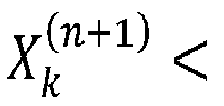
- the application APP k is a control application for a motor of a wheel of a robot.
- the variable X k n represents an angular speed provided by the motor to the wheel at time instant n.
- T k n / 2 ⁇ X k n .
- one of the controlling devices 12A-12B acts as a global application that manages all the single applications APP k .
- the controlling device that acts as a global application asks for a re-planification of the missions.
- the application APP k thus computes at least one new application parameter among R k n + 1 , T k n + 1 , D k n + 1 and optionally X k n + 1 from f k n + 1 by inverting G() f k n + 1 is determined by the application APP k so that it is lower than the received f k n .
- the application APP k learns the function G() offline.
- the application scans all the possible values of all the application parameters and selects the set of values that either minimizes f k n or leads f k n close to an arbitrary target value of f k n .
- the application APP k transmits to the resource scheduler the target failure probability f k MAX .
- the resource scheduler instead of the application APP k , updates at least one application parameter to ensure a probability of failure f k n + 1 lower than or equal to f k MAX . From f k MAX , the resource scheduler thus determines values R k n + 1 , T k n + 1 , D k n + 1 or at least one of them so that f k n + 1 ⁇ f k MAX . The determined value(s) is(are) transmitted to the corresponding application APP k .
- the resource scheduler only determines a single value of R k n + 1 and transmits it to the corresponding application APP k .
- the values T k n + 1 and D k n + 1 are not updated. Thus, they are set equal to the values previously given by the application, i.e. T k n , D k n .
- the resource scheduler may select a finite number of them, for example by taking the values of R k n + 1 in a limited search space, such as a linear quantization between a maximum and minimum value.
- the application parameters updated by the resource scheduler may be either transmitted to the application APP k as proposals or directly implemented within the application hardware.
- ⁇ k n is used to compute f k n .
- ⁇ k n and f k n are thus transmitted to the application APP k which updates at least one of its application parameters in the same manner as mentioned in the first to sixth embodiments, using ⁇ k n as an additional parameter used to update the application parameter.
- Fig. 11 illustrates schematically an example of hardware architecture of a resource scheduler according to a specific embodiment.
- the resource scheduler 100 comprises, connected by a communication bus 110: a processor or CPU (acronym of "Central Processing Unit") 101; a random access memory RAM 102; a read only memory ROM 103; a storage unit 104 such as an hard disk or such as a storage medium reader, e.g. a SD (acronym of "Secure Digital”) card reader; and at least one set of communication interfaces COM 105 enabling the resource scheduler 100 to transmit and receive data.
- a processor or CPU ascronym of "Central Processing Unit”
- RAM random access memory
- ROM 103 read only memory
- storage unit 104 such as an hard disk or such as a storage medium reader, e.g. a SD (acronym of "Secure Digital") card reader
- at least one set of communication interfaces COM 105 enabling the resource scheduler 100 to transmit and receive data.
- the processor 101 is capable of executing instructions loaded into the RAM 102 from the ROM 103, from an external memory (such as an SD card), from a storage medium (such as the HDD), or from a communication network.
- the processor 101 is capable of reading instructions from the RAM 102 and executing them.
- These instructions form a computer program causing the implementation, by the processor 101, of the method described in relation to Fig. 4 .
- the resource scheduler 100 includes electronic circuitry adapted and configured for implementing the method described in relation to Fig. 4 .
- Fig. 12 illustrates schematically an example of hardware architecture of a device 200 hosting an application APP k according to a specific embodiment.
- the device 200 may be a robot or a controlling device.
- the device 200 comprises, connected by a communication bus 210: a processor or CPU (acronym of "Central Processing Unit") 201; a random access memory RAM 202; a read only memory ROM 203; a storage unit 204 such as an hard disk or such as a storage medium reader, e.g. a SD (acronym of "Secure Digital") card reader; and at least one set of communication interfaces COM 105 enabling the device 200 to transmit and receive data.
- a processor or CPU ascronym of "Central Processing Unit”
- RAM 202 random access memory
- ROM 203 read only memory
- storage unit 204 such as an hard disk or such as a storage medium reader, e.g. a SD (acronym of "Secure Digital") card reader
- the processor 201 is capable of executing instructions loaded into the RAM 202 from the ROM 203, from an external memory (such as an SD card), from a storage medium (such as the HDD), or from a communication network. When the device 200 is powered up, the processor 201 is capable of reading instructions from the RAM 202 and executing them. These instructions form a computer program causing the implementation, by the processor 201, of the method described in relation to Figs. 6-10 . The method described in relation to Figs.
- 6-10 may be implemented in software form by the execution of the set of instructions by a programmable machine, for example a DSP (acronym of "Digital Signal Processor"), a microcontroller or a GPU (acronym of "Graphics Processing Unit”), or be implemented in hardware form by a machine or a dedicated component (chip or chipset), for example an FPGA (acronym of "Field-Programmable Gate Array”) or an ASIC (acronym of "Application-Specific Integrated Circuit”).
- the device 200 includes electronic circuitry adapted and configured for implementing the method described in relation to Figs. 6-10 .
Landscapes
- Engineering & Computer Science (AREA)
- Computer Networks & Wireless Communication (AREA)
- Signal Processing (AREA)
- Quality & Reliability (AREA)
- Environmental & Geological Engineering (AREA)
- Mobile Radio Communication Systems (AREA)
- Data Exchanges In Wide-Area Networks (AREA)
Abstract
Description
- At least one of the present embodiments generally relates to a method for allocating, by a resource scheduler, a radio resource in a system comprising a set of devices, each devices hosting at least one application.
- The Fourth Industrial Revolution (or Industry 4.0) refers to the automation of traditional manufacturing using smart technology such as Internet of Things, cloud computing.
- Robotics is part of the Industry 4.0. Indeed, in smart factories, robots are used to limit human operations. In this framework, communications play a key role. The application's requirements in Industry 4.0 is centered on multiple factors such as reliability, latency, longevity of communication devices. Currently, robots are often connected to a wired infrastructure. Time Sensitive Networking (TSN) is the standard Ethernet-based technology for converged networks of Industry 4.0 due to its capacity to support deterministic latency requirements. More precisely, TSN standard extend the traditional Ethernet data-link layer standards to guarantee data transmission with bounded ultra-low latency, low delay variation (jitter), and extremely low loss, which is ideal for industrial control and automotive applications.
- TSN defines Time Aware Shaper (TAS) schedulers for guaranteeing the transmission of high priority deterministic traffic in a bounded time. However, TAS suffers from high overhead for short lived flows and thus degrades communication performance.
- In addition, contrary to wireless technologies, TSN based networks cannot provide the required flexibility to support mobile industrial applications required for the factories of the future. Wireless networks have many advantages, including flexibility, low cost, ease of deployment but at the cost of reliability.
- It is thus desirable to find a method for resource allocation in a wireless environment that satisfies application's requirements while ensuring good communication performance.
- At least one of the present embodiments generally relates to a method for allocating a radio resource in a system comprising a resource scheduler and a set of devices, each device hosting at least one application, each application transmitting messages to at least one receiver on a transmission channel. The method comprises, executed by the resource scheduler, at least one iteration n of :
- a) receiving, from each application, application parameters representative of application's requirements ;
- b) computing, for each application, a metric responsive to at least part of the received application parameters, to an average probability of failure of said application and further to a channel error probability of said transmission channel;
- c) comparing the metrics and, responsive to said comparison, selecting the application to allocate the radio resource to ;
- d) updating, for said each application, the average probability of failure ; and
- e) transmitting an instantaneous probability of failure to each application, said instantaneous probability of failure being used by said application to update at least one of its application parameters.
- This method satisfies application's requirements while ensuring good communication performance. Thus, the resource allocation method makes it possible to reduce the number of application failures while still ensuring good communication performance namely thanks to the feedbacks from the resource scheduler to the applications.
In a specific embodiment, a) to e) are repeated iteratively. - In a specific embodiment, said application parameters representative of application's requirements comprise a resilience value, a message lifetime and a message period.
- In a specific embodiment, computing, for each application, a metric responsive to at least part of the received application parameters, to an average probability of failure of said application and further to a channel error probability of said transmission channel comprises :
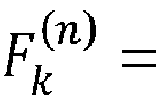
- computing, for each application of index k, an instantaneous probability of failure


- computing said metric


- where

-

- α is a predetermined parameter.
- where
- In a specific embodiment,


- In a specific embodiment, updating the average probability of failure

- computing


- otherwise if there is still a transmission opportunity, computing




- A method for allocating a radio resource in such a system is also disclosed. The method comprises the following steps executed by each device hosting at least one application:
- receiving, for said at least one application, an instantaneous probability of failure of said application from said resource scheduler ;
- updating at least one application parameter representative of application's requirements responsive to said received instantaneous probability of failure and further to a previous value of said application parameter ;
- transmitting the updated application parameter to said resource scheduler, said updated application parameters being used by said resource scheduler to allocate a new radio resource.
- In a specific embodiment, said at least one application parameter being a resilience, updating at least one application parameter comprises comparing the received instantaneous probability of failure with a threshold value and increasing said resilience in the case where the received instantaneous probability of failure is above said threshold value.
- In a specific embodiment, updating at least one application parameter comprises updating a resilience and an angular velocity by comparing the received instantaneous probability of failure with a threshold value and decreasing said angular velocity and further increasing said resilience in the case where the received instantaneous probability of failure is above said threshold value.
- In a specific embodiment, the method further comprises:
- receiving , for said at least one application, an average resource usage of said application from said resource scheduler;
- A resource scheduler configured for allocating a radio resource in such a system is further disclosed. The resource scheduler comprises at least one processor configured to :
- a) receive, from each application, application parameters representative of application's requirements ;
- b) compute, for each application, a metric responsive to at least part of the received application parameters, to an average probability of failure of said application and further to a channel error probability of said transmission channel;
- c) compare the metrics and, responsive to said comparison, selecting the application to allocate the radio resource to ;
- d) update, for each application, the average probability of failure ; and
- e) transmit an instantaneous probability of failure to each application, said instantaneous probability of failure being used by said application to update the application parameters.
- A device hosting an application in such a system is disclosed. The device comprises at least one processor configured to :
- receive, for said at least one application, an instantaneous probability of failure of said application from said resource scheduler ;
- update at least one application parameter representative of application's requirements responsive to said received instantaneous probability of failure, and further to a previous value of said application parameter ;
- transmit the updated application parameter to said resource scheduler, said updated application parameters being used by said resource scheduler to allocate a new radio resource.
- A system comprising such a resource scheduler and such a device hosting an application is also disclosed.
- A computer program product comprising program code instructions is disclosed that can be loaded in a programmable device, the program code instructions causing implementation of the method according to the various embodiments when the program code instructions are run by the programmable device. A storage medium storing such a computer program is disclosed.
- The characteristics of the invention will emerge more clearly from a reading of the following description of at least one example of embodiment, said description being produced with reference to the accompanying drawings, among which:
-
Fig. 1 depicts a system in which the present embodiments may be implemented ; -
Fig. 2 illustrates the principle of competition between devices to get a resource allocation ; -
Fig. 3 illustrates various application parameters that relate to a given application; -
Fig. 4 depicts a flowchart of a method for resource allocation according to a specific embodiment; -
Fig. 5 illustrates the principle of transmission opportunities for each message of a given stream ; -
Fig.6 depicts a flowchart of a method for updating application parameters according to a specific embodiment; -
Fig. 7 illustrates the process of updating application parameters according to a specific embodiment; -
Fig. 8 illustrates the process of updating application parameters according to another specific embodiment; -
Fig.9 illustrates the process of updating application parameters according to a specific embodiment; -
Fig.10 illustrates the process of updating application parameters according to a specific embodiment; -
Fig. 11 illustrates schematically an example of hardware architecture of a resource scheduler according to a specific embodiment; and -
Fig. 12 illustrates schematically an example of hardware architecture of a device hosting an application according to a specific embodiment. - The various embodiments are disclosed in the context of a smart factory where moving robots are installed to fulfill various missions such as for example moving from one location to another location in the factory within a certain amount of time. However, these embodiments may also apply in other environments such as for example environments including autonomous vehicles.
-
Fig. 1 depicts asystem 1, for example as part of a smart factory, in which the present embodiments may be implemented. Thesystem 1 comprises aset 10 of movingrobots 10A to 10D, each being capable of moving from one location to another in the factory. Theset 10 may also include non-moving robots. The movingrobots 10A to 10D are in wireless communication with one or morecontrolling devices 12A-12B with which they exchange application messages. Each controllingdevice 12A-12B may be a base station, a MEC (English acronym of "Multi-access Edge Computing") station or a mobile station. The controllingdevices 12A-12B are for example configured to plan and monitor the missions of therobots 10A-10D. As an example, onFig.1 , the controllingdevice 12A transmits application messages comprising data representative of its mission to therobot 10A while the controllingdevice 12B transmits application messages comprising data representative of its mission to therobot 10C. The mission data may comprise displacement data (e.g. angular speed, linear speed, pressure level, etc), interaction data, motion data, etc. In return, therobot 10A (10C respectively) transmits application messages to thecontrolling device 12A (12B respectively). The application messages transmitted from the robots to the controlling devices comprise for example monitoring data or environment data. Depending on the applications, the exchanges of application messages may be periodic or aperiodic. - Each
robot 10A-10D and eachcontrolling device 12A-12B comprises at least one application module. Thus, an application message is more particularly exchanged between the application module of a robot and the application module of a controlling device. An application module generally comprises a software entity, namely the application, along with hardware elements such as an application buffer. - A robot usually comprises several physical elements, e.g. a wheel, an arm, etc. Thus, a given robot may need to exchange application messages comprising different types of data with a controlling device depending on the concerned physical element. Therefore, in the following, a stream Sk is defined as the set of application messages

set 10 of robots. Said otherwise a plurality of streams may be associated with one and the same robot, e.g. one stream associated with the arm of the robot and one stream associated with each wheel of the robot. In the following, K streams {S1, ..., SK} are considered wherein each stream Sk is associated with a given application APPk. There is thus a one-to-one association between an application APPk and a stream Sk. The application APPk pushes messages

In a wireless environment, the number of radio resources is limited. In the context of radio communication, the number of resources is defined as the number of frequency resources (e.g. subchannels where each subchannel comprises a finite number of frequency blocks) used in a limited amount of time. In order to appropriately allocate these limited radio resources, thesystem 1 further comprises a resource scheduler (RS) 14 configured to periodically, i.e. every dt (e.g. dt=1ms), allocate an available radio resource to one specific stream Sk. As depicted onFig.2 , every dt there is thus an opportunity, i.e. a time slot, for an application message
Fig.2 the robots and more precisely the streams are in competition to get the resource allocation. Theresource scheduler 14 is thus configured to select one stream among K streams to allocate the radio resource to.
Theresource scheduler 14 usually comprises a software entity along with hardware elements such as a buffer. The resource scheduler may be located in a base station, a MEC station or a mobile station. -
Fig. 3 illustrates various application parameters that relate to a given application AAPk. The application AAPk is for example an application, located in one of the controlling device, configured to control the motion of an arm of a specific robot, e.g. therobot 10C. The application AAPk may be an application located in a specific robot and configured to monitor the environment of the robot. The application AAPk generates several messages


The message lifetime


Fig. 3 , the lifetime of the firstmessage 


The message period
-
Fig. 4 depicts a flowchart of a method for resource allocation according to a specific embodiment. The method is implemented by theresource scheduler 14. - The resource allocation comprises selecting, for an available radio resource, a single stream Sk (thus a single application APPk) according to some metrics


- To this aim, the
resource scheduler 14 uses for example an α-fair utility-based formalism to ensure a fairness resource allocation between the streams. Accordingly, a local cost function for the kth stream is defined as follows :

resource scheduler 14, e.g. α = 1 provides a proportional fair, i.e. a balance between throughput of the network while at the same time allowing at least a minimal level of service for all users and α = 10 corresponds to a max-min fairness. A global cost function J (n) is then defined as a function of all the local cost functions. For example, J (n) is defined as the sum over k of the local cost functions :
- The cost function J (n) is thus used by the
resource scheduler 14 to select, at time instant n, one stream among the K streams to allocate a radio resource to.
The practical implementation of the resource allocation comprises steps S40 to S46. - At step S40, the
resource scheduler 14 receives, from each application APPk, the application parameters representative of its application's requirements at time instant n, i.e


resource scheduler 14 computes, for each stream Sk (thus for each application APPk), a metric


example 


Each metric

- where:

-

- At the time instant n, the probability of failure


- In a first embodiment, the metrics



- In the case where the packet is not received (because not allocated or allocated but the transmission is unsuccessful), n is increased by 1 and thus

In a variant of the first embodiment,


In a second embodiment, the message lifetime


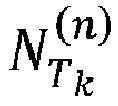


Fig. 5 illustrates the principle of transmission opportunities for each message of a given stream Sk.Fig. 5 is similar toFig. 3 . Therefore, the elements in common are labelled with the same numeral references. OnFig. 5 , there are 4 opportunities to transmit the first message, two opportunities for the second message and three opportunities for the third message. - In a variant of the second embodiment,


At step S44, theresource scheduler 14 compares the metrics


Depending on the definition of the cost J (n) :



- For APPk* in the case where the packet corresponding to the sent message is not received or for any APPk≠k*:
- o If there is still a transmission opportunity :


- o Otherwise (i.e. there is no more transmission opportunity) :

- o If there is still a transmission opportunity :
-
Fig. 6 depicts a flowchart of a method for updating application parameters according to a specific embodiment. The method is implemented in an application module by an application APPk. - In a step S60, the application APPk receives information, e.g. the instantaneous probability of failure

resource scheduler 14.

- In a step S62, the application APPk updates at least one of its application parameters responsive to the received information. As depicted on
Fig. 7 , the application APPk uses as inputs






In a variant depicted onFig. 8 , a Lin-memory is used. Thus, the application APPk receives several instantaneous probabilities of failure


L
More generally, the application APPk uses as inputs



meters


- In a first embodiment, the application initially considers a maximum probability of failure


- In a second embodiment, probabilities of failure


In a specific example,
- Given some precomputed relationships between the probability of failure and the application's requirements, the application APPk may updates its application parameters


k from the formula log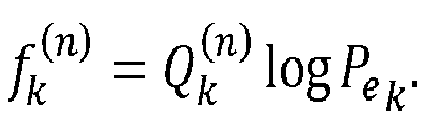


- In a third embodiment, the application APPk is a control application for a motor of a wheel of a robot. The variable




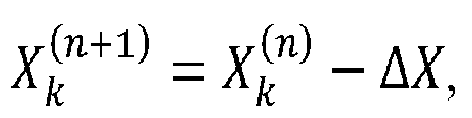


In this embodiment,
- In a fourth embodiment, one of the controlling
devices 12A-12B acts as a global application that manages all the single applications APPk. In the case where too many probabilities of failure

- In a fifth embodiment, the application APPk knows some mathematical relationships between


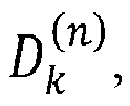


The application APPk thus computes at least one new application parameter among


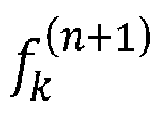


In one specific embodiment, the application APPk learns the function G() offline. In a variant, the application scans all the possible values of all the application parameters and selects the set of values that either minimizes


- In a sixth embodiment, the application APPk transmits to the resource scheduler the target failure probability


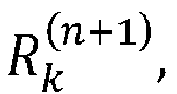


In a variant, the resource scheduler only determines a single value of


In another variant, the application APPk informs the resource scheduler of the requested feedbacks, for example, a set of values
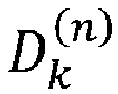


Fig. 9 , the application parameters updated by the resource scheduler may be either transmitted to the application APPk as proposals or directly implemented within the application hardware. - In a seventh embodiment illustrated by
Fig. 10 ,


-
Fig. 11 illustrates schematically an example of hardware architecture of a resource scheduler according to a specific embodiment.
Theresource scheduler 100 comprises, connected by a communication bus 110: a processor or CPU (acronym of "Central Processing Unit") 101; a randomaccess memory RAM 102; a read onlymemory ROM 103; astorage unit 104 such as an hard disk or such as a storage medium reader, e.g. a SD (acronym of "Secure Digital") card reader; and at least one set ofcommunication interfaces COM 105 enabling theresource scheduler 100 to transmit and receive data.
Theprocessor 101 is capable of executing instructions loaded into theRAM 102 from theROM 103, from an external memory (such as an SD card), from a storage medium (such as the HDD), or from a communication network. When theresource scheduler 100 is powered up, theprocessor 101 is capable of reading instructions from theRAM 102 and executing them. These instructions form a computer program causing the implementation, by theprocessor 101, of the method described in relation toFig. 4 . The method described in relation toFig. 4 may be implemented in software form by the execution of the set of instructions by a programmable machine, for example a DSP (acronym of "Digital Signal Processor"), a microcontroller or a GPU (acronym of "Graphics Processing Unit"), or be implemented in hardware form by a machine or a dedicated component (chip or chipset), for example an FPGA (acronym of "Field-Programmable Gate Array") or an ASIC (acronym of "Application-Specific Integrated Circuit"). In general, theresource scheduler 100 includes electronic circuitry adapted and configured for implementing the method described in relation toFig. 4 . -
Fig. 12 illustrates schematically an example of hardware architecture of adevice 200 hosting an application APPk according to a specific embodiment. Thedevice 200 may be a robot or a controlling device.
Thedevice 200 comprises, connected by a communication bus 210: a processor or CPU (acronym of "Central Processing Unit") 201; a randomaccess memory RAM 202; a read onlymemory ROM 203; astorage unit 204 such as an hard disk or such as a storage medium reader, e.g. a SD (acronym of "Secure Digital") card reader; and at least one set ofcommunication interfaces COM 105 enabling thedevice 200 to transmit and receive data.
Theprocessor 201 is capable of executing instructions loaded into theRAM 202 from theROM 203, from an external memory (such as an SD card), from a storage medium (such as the HDD), or from a communication network. When thedevice 200 is powered up, theprocessor 201 is capable of reading instructions from theRAM 202 and executing them. These instructions form a computer program causing the implementation, by theprocessor 201, of the method described in relation toFigs. 6-10 . The method described in relation toFigs. 6-10 may be implemented in software form by the execution of the set of instructions by a programmable machine, for example a DSP (acronym of "Digital Signal Processor"), a microcontroller or a GPU (acronym of "Graphics Processing Unit"), or be implemented in hardware form by a machine or a dedicated component (chip or chipset), for example an FPGA (acronym of "Field-Programmable Gate Array") or an ASIC (acronym of "Application-Specific Integrated Circuit"). In general, thedevice 200 includes electronic circuitry adapted and configured for implementing the method described in relation toFigs. 6-10 .


The steps S40 to S48 are repeated iteratively while n is incremented. Thus, n is thus representative of an index of iteration.
Claims (15)
- A method for allocating a radio resource in a system comprising a resource scheduler and a set of devices, each device hosting at least one application, each application transmitting messages to at least one receiver on a transmission channel, characterized in that the method comprises, executed by the resource scheduler, at least one iteration n of :a) receiving (S40), from each application, application parameters representative of application's requirements ;b) computing (S42), for each application, a metric responsive to at least part of the received application parameters, to an average probability of failure of said application and further to a channel error probability of said transmission channel;c) comparing (S44) the metrics and, responsive to said comparison, selecting the application to allocate the radio resource to ;d) updating (S46), for said each application, the average probability of failure ; ande) transmitting (S48) an instantaneous probability of failure to each application, said instantaneous probability of failure being used by said application to update at least one of its application parameters.
- The method according to claim 1, wherein a) to e) are repeated iteratively.
- The method according to claim 1 or 2, wherein said application parameters representative of application's requirements comprise a resilience value, a message lifetime and a message period.
- The method according to any one of claims 1 to 3, wherein computing (S42), for each application, a metric responsive to at least part of the received application parameters, to an average probability of failure of said application and further to a channel error probability of said transmission channel comprises :- computing, for each application of index k, an instantaneous probability of failure

 - computing said metric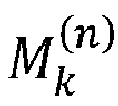
 where
where
 α is a predetermined parameter.
 - The method according to claim 4, wherein


- The method according to any one of claims 1 to 5, wherein updating the average probability of failure
 - computing
 - otherwise if there is still a transmission opportunity, computing


- A method for allocating a radio resource in a system comprising a resource scheduler and a set of devices, each device hosting at least one application, each application transmitting messages to at least one receiver on a transmission channel, characterized in that the method comprises the following steps executed by each device hosting at least one application:- receiving, for said at least one application, an instantaneous probability of failure of said application from said resource scheduler ;- updating at least one application parameter representative of application's requirements responsive to said received instantaneous probability of failure and further to a previous value of said application parameter ;- transmitting the updated application parameter to said resource scheduler, said updated application parameters being used by said resource scheduler to allocate a new radio resource.
- The method according to claim 7, wherein, said at least one application parameter being a resilience, updating at least one application parameter comprises comparing the received instantaneous probability of failure with a threshold value and increasing said resilience in the case where the received instantaneous probability of failure is above said threshold value.
- The method according to claim 7 or 8, wherein updating at least one application parameter comprises updating a resilience and an angular velocity by comparing the received instantaneous probability of failure with a threshold value and decreasing said angular velocity and further increasing said resilience in the case where the received instantaneous probability of failure is above said threshold value.
- The method according to anyone of claims 7 to 9, wherein the method further comprises:- receiving , for said at least one application, an average resource usage of said application from said resource scheduler;and wherein said at least one application parameter is updated responsive to said received instantaneous probability of failure, to a previous value of said application parameter and further to said average resource usage.
- A resource scheduler configured for allocating a radio resource in a system comprising a set of devices, each device hosting at least one application, each application transmitting messages to at least one receiver on a transmission channel, characterized in that the resource scheduler comprises at least one processor configured to :a) receive, from each application, application parameters representative of application's requirements ;b) compute, for each application, a metric responsive to at least part of the received application parameters, to an average probability of failure of said application and further to a channel error probability of said transmission channel;c) compare the metrics and, responsive to said comparison, selecting the application to allocate the radio resource to ;d) update, for each application, the average probability of failure ; ande) transmit an instantaneous probability of failure to each application, said instantaneous probability of failure being used by said application to update the application parameters.
- A device hosting an application in a system comprising a resource scheduler configured to allocate a radio resource and a set of devices, each device hosting at least one application, each application transmitting messages to at least one receiver on a transmission channel, characterized in that the device comprises at least one processor configured to :- receive, for said at least one application, an instantaneous probability of failure of said application from said resource scheduler ;- update at least one application parameter representative of application's requirements responsive to said received instantaneous probability of failure, and further to a previous value of said application parameter ;- transmit the updated application parameter to said resource scheduler, said updated application parameters being used by said resource scheduler to allocate a new radio resource.
- A system comprising a resource scheduler according to claim 11 and a device hosting an application according to claim 12.
- A computer program product comprising program code instructions that can be loaded in a programmable device, the program code instructions causing implementation of the method according to any one of claims 1 to 10 when the program code instructions are run by the programmable device.
- A storage medium storing a computer program comprising program code instructions, the program code instructions causing implementation of the method according to any one of claims 1 to 10 when the program code instructions are read from the storage medium and run by the programmable device.
Priority Applications (5)
| Application Number | Priority Date | Filing Date | Title |
|---|---|---|---|
| EP21305555.1A EP4084560B1 (en) | 2021-04-29 | 2021-04-29 | Methods and devices for radio resource allocation |
| US18/286,001 US12506671B2 (en) | 2021-04-29 | 2021-10-19 | Method and device for allocating radio resource |
| JP2023567271A JP7531731B2 (en) | 2021-04-29 | 2021-10-19 | Method and device for allocating radio resources - Patents.com |
| CN202180097413.4A CN117204102A (en) | 2021-04-29 | 2021-10-19 | Method and device for allocating radio resources |
| PCT/JP2021/039190 WO2022230218A1 (en) | 2021-04-29 | 2021-10-19 | Method and device for allocating radio resource |
Applications Claiming Priority (1)
| Application Number | Priority Date | Filing Date | Title |
|---|---|---|---|
| EP21305555.1A EP4084560B1 (en) | 2021-04-29 | 2021-04-29 | Methods and devices for radio resource allocation |
Publications (2)
| Publication Number | Publication Date |
|---|---|
| EP4084560A1 true EP4084560A1 (en) | 2022-11-02 |
| EP4084560B1 EP4084560B1 (en) | 2025-08-13 |
Family
ID=75977707
Family Applications (1)
| Application Number | Title | Priority Date | Filing Date |
|---|---|---|---|
| EP21305555.1A Active EP4084560B1 (en) | 2021-04-29 | 2021-04-29 | Methods and devices for radio resource allocation |
Country Status (5)
| Country | Link |
|---|---|
| US (1) | US12506671B2 (en) |
| EP (1) | EP4084560B1 (en) |
| JP (1) | JP7531731B2 (en) |
| CN (1) | CN117204102A (en) |
| WO (1) | WO2022230218A1 (en) |
Cited By (2)
| Publication number | Priority date | Publication date | Assignee | Title |
|---|---|---|---|---|
| CN116095840A (en) * | 2023-01-17 | 2023-05-09 | 武汉大学 | A solution method for optimal time allocation in multi-user mobile edge computing scenarios |
| WO2025188215A1 (en) * | 2024-03-06 | 2025-09-12 | Telefonaktiebolaget Lm Ericsson (Publ) | Method and apparatus for radio resource allocation |
Citations (1)
| Publication number | Priority date | Publication date | Assignee | Title |
|---|---|---|---|---|
| US20210092753A1 (en) * | 2018-01-12 | 2021-03-25 | Samsung Electronics Co., Ltd. | Apparatus and method for scheduling in wireless communication system |
Family Cites Families (10)
| Publication number | Priority date | Publication date | Assignee | Title |
|---|---|---|---|---|
| US6987729B1 (en) * | 2000-05-11 | 2006-01-17 | Lucent Technologies Inc. | Method and apparatus for admission management in wireless communication systems |
| DE602005005471T2 (en) * | 2004-05-18 | 2008-07-03 | British Telecommunications P.L.C. | PEER-TO-PEER NETWORKS |
| EP1942615A1 (en) * | 2007-01-03 | 2008-07-09 | British Telecommunications Public Limited Company | Allocation of network resources |
| US8488527B2 (en) * | 2010-07-12 | 2013-07-16 | Nokia Corporation | Apparatus and method for facilitating radio resource dimensioning for communication services |
| US8345546B2 (en) * | 2010-07-13 | 2013-01-01 | Verizon Patent And Licensing Inc. | Dynamic machine-to-machine communications and scheduling |
| US20120127951A1 (en) * | 2010-11-11 | 2012-05-24 | Qualcomm Incorporated | Method and apparatus for assigning wireless network packet resources to wireless terminals |
| ES2556381T3 (en) * | 2011-06-04 | 2016-01-15 | Alcatel Lucent | A planning concept |
| US9445427B2 (en) * | 2014-04-30 | 2016-09-13 | Telefonaktiebolaget Lm Ericsson (Publ) | Downlink resource allocation in OFDM networks |
| CN107124201B (en) * | 2017-03-10 | 2019-10-29 | 北京大学 | A kind of subsurface communication method towards Shui Zhong robot |
| EP3603280B1 (en) * | 2017-03-28 | 2024-05-01 | Telefonaktiebolaget LM Ericsson (publ) | Technique for allocating radio resources in a radio access network |
-
2021
- 2021-04-29 EP EP21305555.1A patent/EP4084560B1/en active Active
- 2021-10-19 US US18/286,001 patent/US12506671B2/en active Active
- 2021-10-19 CN CN202180097413.4A patent/CN117204102A/en active Pending
- 2021-10-19 WO PCT/JP2021/039190 patent/WO2022230218A1/en not_active Ceased
- 2021-10-19 JP JP2023567271A patent/JP7531731B2/en active Active
Patent Citations (1)
| Publication number | Priority date | Publication date | Assignee | Title |
|---|---|---|---|---|
| US20210092753A1 (en) * | 2018-01-12 | 2021-03-25 | Samsung Electronics Co., Ltd. | Apparatus and method for scheduling in wireless communication system |
Non-Patent Citations (1)
| Title |
|---|
| IVO SOUSA ET AL: "A Survey on QoE-oriented Wireless Resources Scheduling", ARXIV.ORG, CORNELL UNIVERSITY LIBRARY, 201 OLIN LIBRARY CORNELL UNIVERSITY ITHACA, NY 14853, 22 May 2017 (2017-05-22), XP081620371, DOI: 10.1016/J.JNCA.2020.102594 * |
Cited By (3)
| Publication number | Priority date | Publication date | Assignee | Title |
|---|---|---|---|---|
| CN116095840A (en) * | 2023-01-17 | 2023-05-09 | 武汉大学 | A solution method for optimal time allocation in multi-user mobile edge computing scenarios |
| CN116095840B (en) * | 2023-01-17 | 2025-08-19 | 武汉大学 | Solving method for optimal time distribution in multi-user mobile edge computing scene |
| WO2025188215A1 (en) * | 2024-03-06 | 2025-09-12 | Telefonaktiebolaget Lm Ericsson (Publ) | Method and apparatus for radio resource allocation |
Also Published As
| Publication number | Publication date |
|---|---|
| JP2024504516A (en) | 2024-01-31 |
| EP4084560B1 (en) | 2025-08-13 |
| CN117204102A (en) | 2023-12-08 |
| WO2022230218A1 (en) | 2022-11-03 |
| US20240195715A1 (en) | 2024-06-13 |
| JP7531731B2 (en) | 2024-08-09 |
| US12506671B2 (en) | 2025-12-23 |
Similar Documents
| Publication | Publication Date | Title |
|---|---|---|
| Stamatakis et al. | Optimal policies for status update generation in an IoT device with heterogeneous traffic | |
| Chen et al. | Task replication for vehicular cloud: Contextual combinatorial bandit with delayed feedback | |
| US11018798B2 (en) | Auto-tuning reliability protocol in pub-sub RTPS systems | |
| US6912198B2 (en) | Performance of data transmission using adaptive technique | |
| US12506671B2 (en) | Method and device for allocating radio resource | |
| CN113498106A (en) | Scheduling method and device for time-sensitive network TSN (transport stream network) stream | |
| Feng et al. | Age-optimal transmission of rateless codes in an erasure channel | |
| US20120057513A1 (en) | Sleep mode selection employing a semi-markov decision process | |
| US20200366760A1 (en) | Method for running an application on a distributed system architecture | |
| KR20220047408A (en) | Model-assisted deep reinforcement learning based scheduling in wireless networks | |
| CN120384803A (en) | Control method of electronic thermostat heating assembly of hydrogen fuel engine based on Internet of Things | |
| Biswal et al. | Adaptive Fault‐Tolerant System and Optimal Power Allocation for Smart Vehicles in Smart Cities Using Controller Area Network | |
| US10992583B1 (en) | Opportunistic packet retransmissions | |
| CA2848459A1 (en) | Method of controlling congestion for contention access network | |
| Chiariotti et al. | Distributed optimization of age of incorrect information with dynamic epistemic logic | |
| Wei et al. | Age-of-information minimization in multi-server edge computing networks for URLLC services | |
| Scheuvens et al. | State-aware resource allocation for wireless closed-loop control based on multi-connectivity | |
| EP4236257B1 (en) | Method for computing resource usage ratios and device configured to implement the method | |
| KR20250061485A (en) | Resource Allocation Apparatus and Method | |
| US20160323117A1 (en) | Method and terminal for transmitting and receiving data | |
| Liu | Data freshness in information-update systems: Modeling, scheduling, and tradeoffs | |
| Scheuvens et al. | System analysis of state-aware resource allocation for closed-loop control systems | |
| CN119277552B (en) | A network state-aware assisted unlicensed multiple access method | |
| CN110996398A (en) | Wireless network resource scheduling method and device | |
| Sadeghi Vilni | Status update optimization for information freshness and real-time tracking |
Legal Events
| Date | Code | Title | Description |
|---|---|---|---|
| PUAI | Public reference made under article 153(3) epc to a published international application that has entered the european phase |
Free format text: ORIGINAL CODE: 0009012 |
|
| STAA | Information on the status of an ep patent application or granted ep patent |
Free format text: STATUS: THE APPLICATION HAS BEEN PUBLISHED |
|
| AK | Designated contracting states |
Kind code of ref document: A1 Designated state(s): AL AT BE BG CH CY CZ DE DK EE ES FI FR GB GR HR HU IE IS IT LI LT LU LV MC MK MT NL NO PL PT RO RS SE SI SK SM TR |
|
| STAA | Information on the status of an ep patent application or granted ep patent |
Free format text: STATUS: REQUEST FOR EXAMINATION WAS MADE |
|
| 17P | Request for examination filed |
Effective date: 20230427 |
|
| RBV | Designated contracting states (corrected) |
Designated state(s): AL AT BE BG CH CY CZ DE DK EE ES FI FR GB GR HR HU IE IS IT LI LT LU LV MC MK MT NL NO PL PT RO RS SE SI SK SM TR |
|
| REG | Reference to a national code |
Ref country code: DE Ref legal event code: R079 Free format text: PREVIOUS MAIN CLASS: H04W0072120000 Ipc: H04L0067610000 Ref document number: 602021036037 Country of ref document: DE |
|
| GRAP | Despatch of communication of intention to grant a patent |
Free format text: ORIGINAL CODE: EPIDOSNIGR1 |
|
| STAA | Information on the status of an ep patent application or granted ep patent |
Free format text: STATUS: GRANT OF PATENT IS INTENDED |
|
| RIC1 | Information provided on ipc code assigned before grant |
Ipc: H04W 72/542 20230101ALN20250303BHEP Ipc: H04W 72/1263 20230101ALN20250303BHEP Ipc: H04L 43/0823 20220101ALN20250303BHEP Ipc: H04L 67/125 20220101ALN20250303BHEP Ipc: H04W 4/38 20180101ALN20250303BHEP Ipc: H04W 72/20 20230101ALI20250303BHEP Ipc: H04L 67/62 20220101ALI20250303BHEP Ipc: H04L 67/61 20220101AFI20250303BHEP |
|
| INTG | Intention to grant announced |
Effective date: 20250312 |
|
| P01 | Opt-out of the competence of the unified patent court (upc) registered |
Free format text: CASE NUMBER: APP_20400/2025 Effective date: 20250429 |
|
| GRAS | Grant fee paid |
Free format text: ORIGINAL CODE: EPIDOSNIGR3 |
|
| GRAA | (expected) grant |
Free format text: ORIGINAL CODE: 0009210 |
|
| STAA | Information on the status of an ep patent application or granted ep patent |
Free format text: STATUS: THE PATENT HAS BEEN GRANTED |
|
| AK | Designated contracting states |
Kind code of ref document: B1 Designated state(s): AL AT BE BG CH CY CZ DE DK EE ES FI FR GB GR HR HU IE IS IT LI LT LU LV MC MK MT NL NO PL PT RO RS SE SI SK SM TR |
|
| REG | Reference to a national code |
Ref country code: GB Ref legal event code: FG4D |
|
| REG | Reference to a national code |
Ref country code: CH Ref legal event code: EP |
|
| REG | Reference to a national code |
Ref country code: DE Ref legal event code: R096 Ref document number: 602021036037 Country of ref document: DE |
|
| REG | Reference to a national code |
Ref country code: IE Ref legal event code: FG4D |
|
| REG | Reference to a national code |
Ref country code: NL Ref legal event code: MP Effective date: 20250813 |
|
| PG25 | Lapsed in a contracting state [announced via postgrant information from national office to epo] |
Ref country code: IS Free format text: LAPSE BECAUSE OF FAILURE TO SUBMIT A TRANSLATION OF THE DESCRIPTION OR TO PAY THE FEE WITHIN THE PRESCRIBED TIME-LIMIT Effective date: 20251213 |
|
| PG25 | Lapsed in a contracting state [announced via postgrant information from national office to epo] |
Ref country code: NO Free format text: LAPSE BECAUSE OF FAILURE TO SUBMIT A TRANSLATION OF THE DESCRIPTION OR TO PAY THE FEE WITHIN THE PRESCRIBED TIME-LIMIT Effective date: 20251113 |
|
| REG | Reference to a national code |
Ref country code: LT Ref legal event code: MG9D |
|
| PG25 | Lapsed in a contracting state [announced via postgrant information from national office to epo] |
Ref country code: PT Free format text: LAPSE BECAUSE OF FAILURE TO SUBMIT A TRANSLATION OF THE DESCRIPTION OR TO PAY THE FEE WITHIN THE PRESCRIBED TIME-LIMIT Effective date: 20251215 |
|
| PG25 | Lapsed in a contracting state [announced via postgrant information from national office to epo] |
Ref country code: FI Free format text: LAPSE BECAUSE OF FAILURE TO SUBMIT A TRANSLATION OF THE DESCRIPTION OR TO PAY THE FEE WITHIN THE PRESCRIBED TIME-LIMIT Effective date: 20250813 |
|
| PG25 | Lapsed in a contracting state [announced via postgrant information from national office to epo] |
Ref country code: HR Free format text: LAPSE BECAUSE OF FAILURE TO SUBMIT A TRANSLATION OF THE DESCRIPTION OR TO PAY THE FEE WITHIN THE PRESCRIBED TIME-LIMIT Effective date: 20250813 Ref country code: NL Free format text: LAPSE BECAUSE OF FAILURE TO SUBMIT A TRANSLATION OF THE DESCRIPTION OR TO PAY THE FEE WITHIN THE PRESCRIBED TIME-LIMIT Effective date: 20250813 |
|
| PG25 | Lapsed in a contracting state [announced via postgrant information from national office to epo] |
Ref country code: GR Free format text: LAPSE BECAUSE OF FAILURE TO SUBMIT A TRANSLATION OF THE DESCRIPTION OR TO PAY THE FEE WITHIN THE PRESCRIBED TIME-LIMIT Effective date: 20251114 |
|
| PG25 | Lapsed in a contracting state [announced via postgrant information from national office to epo] |
Ref country code: SE Free format text: LAPSE BECAUSE OF FAILURE TO SUBMIT A TRANSLATION OF THE DESCRIPTION OR TO PAY THE FEE WITHIN THE PRESCRIBED TIME-LIMIT Effective date: 20250813 |
|
| PG25 | Lapsed in a contracting state [announced via postgrant information from national office to epo] |
Ref country code: LV Free format text: LAPSE BECAUSE OF FAILURE TO SUBMIT A TRANSLATION OF THE DESCRIPTION OR TO PAY THE FEE WITHIN THE PRESCRIBED TIME-LIMIT Effective date: 20250813 |
|
| PG25 | Lapsed in a contracting state [announced via postgrant information from national office to epo] |
Ref country code: PL Free format text: LAPSE BECAUSE OF FAILURE TO SUBMIT A TRANSLATION OF THE DESCRIPTION OR TO PAY THE FEE WITHIN THE PRESCRIBED TIME-LIMIT Effective date: 20250813 Ref country code: BG Free format text: LAPSE BECAUSE OF FAILURE TO SUBMIT A TRANSLATION OF THE DESCRIPTION OR TO PAY THE FEE WITHIN THE PRESCRIBED TIME-LIMIT Effective date: 20250813 |
|
| PG25 | Lapsed in a contracting state [announced via postgrant information from national office to epo] |
Ref country code: RS Free format text: LAPSE BECAUSE OF FAILURE TO SUBMIT A TRANSLATION OF THE DESCRIPTION OR TO PAY THE FEE WITHIN THE PRESCRIBED TIME-LIMIT Effective date: 20251113 |
|
| PG25 | Lapsed in a contracting state [announced via postgrant information from national office to epo] |
Ref country code: ES Free format text: LAPSE BECAUSE OF FAILURE TO SUBMIT A TRANSLATION OF THE DESCRIPTION OR TO PAY THE FEE WITHIN THE PRESCRIBED TIME-LIMIT Effective date: 20250813 |
|
| REG | Reference to a national code |
Ref country code: AT Ref legal event code: MK05 Ref document number: 1825984 Country of ref document: AT Kind code of ref document: T Effective date: 20250813 |
|
| PG25 | Lapsed in a contracting state [announced via postgrant information from national office to epo] |
Ref country code: SM Free format text: LAPSE BECAUSE OF FAILURE TO SUBMIT A TRANSLATION OF THE DESCRIPTION OR TO PAY THE FEE WITHIN THE PRESCRIBED TIME-LIMIT Effective date: 20250813 |
|
| PG25 | Lapsed in a contracting state [announced via postgrant information from national office to epo] |
Ref country code: DK Free format text: LAPSE BECAUSE OF FAILURE TO SUBMIT A TRANSLATION OF THE DESCRIPTION OR TO PAY THE FEE WITHIN THE PRESCRIBED TIME-LIMIT Effective date: 20250813 |
|
| PG25 | Lapsed in a contracting state [announced via postgrant information from national office to epo] |
Ref country code: AT Free format text: LAPSE BECAUSE OF FAILURE TO SUBMIT A TRANSLATION OF THE DESCRIPTION OR TO PAY THE FEE WITHIN THE PRESCRIBED TIME-LIMIT Effective date: 20250813 |
|
| PG25 | Lapsed in a contracting state [announced via postgrant information from national office to epo] |
Ref country code: IT Free format text: LAPSE BECAUSE OF FAILURE TO SUBMIT A TRANSLATION OF THE DESCRIPTION OR TO PAY THE FEE WITHIN THE PRESCRIBED TIME-LIMIT Effective date: 20250813 |
|
| PG25 | Lapsed in a contracting state [announced via postgrant information from national office to epo] |
Ref country code: CZ Free format text: LAPSE BECAUSE OF FAILURE TO SUBMIT A TRANSLATION OF THE DESCRIPTION OR TO PAY THE FEE WITHIN THE PRESCRIBED TIME-LIMIT Effective date: 20250813 |
|
| PG25 | Lapsed in a contracting state [announced via postgrant information from national office to epo] |
Ref country code: EE Free format text: LAPSE BECAUSE OF FAILURE TO SUBMIT A TRANSLATION OF THE DESCRIPTION OR TO PAY THE FEE WITHIN THE PRESCRIBED TIME-LIMIT Effective date: 20250813 Ref country code: SK Free format text: LAPSE BECAUSE OF FAILURE TO SUBMIT A TRANSLATION OF THE DESCRIPTION OR TO PAY THE FEE WITHIN THE PRESCRIBED TIME-LIMIT Effective date: 20250813 |