EP4084174A1 - Winding apparatus - Google Patents
Winding apparatus Download PDFInfo
- Publication number
- EP4084174A1 EP4084174A1 EP21872748.5A EP21872748A EP4084174A1 EP 4084174 A1 EP4084174 A1 EP 4084174A1 EP 21872748 A EP21872748 A EP 21872748A EP 4084174 A1 EP4084174 A1 EP 4084174A1
- Authority
- EP
- European Patent Office
- Prior art keywords
- mandrel
- electrode
- winding device
- rotation driving
- driving units
- Prior art date
- Legal status (The legal status is an assumption and is not a legal conclusion. Google has not performed a legal analysis and makes no representation as to the accuracy of the status listed.)
- Pending
Links
Images
Classifications
-
- B—PERFORMING OPERATIONS; TRANSPORTING
- B65—CONVEYING; PACKING; STORING; HANDLING THIN OR FILAMENTARY MATERIAL
- B65H—HANDLING THIN OR FILAMENTARY MATERIAL, e.g. SHEETS, WEBS, CABLES
- B65H23/00—Registering, tensioning, smoothing or guiding webs
- B65H23/04—Registering, tensioning, smoothing or guiding webs longitudinally
- B65H23/18—Registering, tensioning, smoothing or guiding webs longitudinally by controlling or regulating the web-advancing mechanism, e.g. mechanism acting on the running web
- B65H23/195—Registering, tensioning, smoothing or guiding webs longitudinally by controlling or regulating the web-advancing mechanism, e.g. mechanism acting on the running web in winding mechanisms or in connection with winding operations
- B65H23/198—Registering, tensioning, smoothing or guiding webs longitudinally by controlling or regulating the web-advancing mechanism, e.g. mechanism acting on the running web in winding mechanisms or in connection with winding operations motor-controlled (Controlling electrical drive motors therefor)
-
- B—PERFORMING OPERATIONS; TRANSPORTING
- B65—CONVEYING; PACKING; STORING; HANDLING THIN OR FILAMENTARY MATERIAL
- B65H—HANDLING THIN OR FILAMENTARY MATERIAL, e.g. SHEETS, WEBS, CABLES
- B65H18/00—Winding webs
- B65H18/08—Web-winding mechanisms
- B65H18/10—Mechanisms in which power is applied to web-roll spindle
-
- B—PERFORMING OPERATIONS; TRANSPORTING
- B65—CONVEYING; PACKING; STORING; HANDLING THIN OR FILAMENTARY MATERIAL
- B65H—HANDLING THIN OR FILAMENTARY MATERIAL, e.g. SHEETS, WEBS, CABLES
- B65H23/00—Registering, tensioning, smoothing or guiding webs
- B65H23/04—Registering, tensioning, smoothing or guiding webs longitudinally
- B65H23/18—Registering, tensioning, smoothing or guiding webs longitudinally by controlling or regulating the web-advancing mechanism, e.g. mechanism acting on the running web
- B65H23/195—Registering, tensioning, smoothing or guiding webs longitudinally by controlling or regulating the web-advancing mechanism, e.g. mechanism acting on the running web in winding mechanisms or in connection with winding operations
- B65H23/1955—Registering, tensioning, smoothing or guiding webs longitudinally by controlling or regulating the web-advancing mechanism, e.g. mechanism acting on the running web in winding mechanisms or in connection with winding operations and controlling web tension
-
- H—ELECTRICITY
- H01—ELECTRIC ELEMENTS
- H01M—PROCESSES OR MEANS, e.g. BATTERIES, FOR THE DIRECT CONVERSION OF CHEMICAL ENERGY INTO ELECTRICAL ENERGY
- H01M10/00—Secondary cells; Manufacture thereof
- H01M10/04—Construction or manufacture in general
- H01M10/0404—Machines for assembling batteries
- H01M10/0409—Machines for assembling batteries for cells with wound electrodes
-
- B—PERFORMING OPERATIONS; TRANSPORTING
- B65—CONVEYING; PACKING; STORING; HANDLING THIN OR FILAMENTARY MATERIAL
- B65H—HANDLING THIN OR FILAMENTARY MATERIAL, e.g. SHEETS, WEBS, CABLES
- B65H2403/00—Power transmission; Driving means
- B65H2403/90—Machine drive
- B65H2403/94—Other features of machine drive
- B65H2403/944—Multiple power sources for one mechanism
-
- B—PERFORMING OPERATIONS; TRANSPORTING
- B65—CONVEYING; PACKING; STORING; HANDLING THIN OR FILAMENTARY MATERIAL
- B65H—HANDLING THIN OR FILAMENTARY MATERIAL, e.g. SHEETS, WEBS, CABLES
- B65H2555/00—Actuating means
- B65H2555/20—Actuating means angular
-
- B—PERFORMING OPERATIONS; TRANSPORTING
- B65—CONVEYING; PACKING; STORING; HANDLING THIN OR FILAMENTARY MATERIAL
- B65H—HANDLING THIN OR FILAMENTARY MATERIAL, e.g. SHEETS, WEBS, CABLES
- B65H2801/00—Application field
- B65H2801/72—Fuel cell manufacture
-
- Y—GENERAL TAGGING OF NEW TECHNOLOGICAL DEVELOPMENTS; GENERAL TAGGING OF CROSS-SECTIONAL TECHNOLOGIES SPANNING OVER SEVERAL SECTIONS OF THE IPC; TECHNICAL SUBJECTS COVERED BY FORMER USPC CROSS-REFERENCE ART COLLECTIONS [XRACs] AND DIGESTS
- Y02—TECHNOLOGIES OR APPLICATIONS FOR MITIGATION OR ADAPTATION AGAINST CLIMATE CHANGE
- Y02E—REDUCTION OF GREENHOUSE GAS [GHG] EMISSIONS, RELATED TO ENERGY GENERATION, TRANSMISSION OR DISTRIBUTION
- Y02E60/00—Enabling technologies; Technologies with a potential or indirect contribution to GHG emissions mitigation
- Y02E60/10—Energy storage using batteries
-
- Y—GENERAL TAGGING OF NEW TECHNOLOGICAL DEVELOPMENTS; GENERAL TAGGING OF CROSS-SECTIONAL TECHNOLOGIES SPANNING OVER SEVERAL SECTIONS OF THE IPC; TECHNICAL SUBJECTS COVERED BY FORMER USPC CROSS-REFERENCE ART COLLECTIONS [XRACs] AND DIGESTS
- Y02—TECHNOLOGIES OR APPLICATIONS FOR MITIGATION OR ADAPTATION AGAINST CLIMATE CHANGE
- Y02P—CLIMATE CHANGE MITIGATION TECHNOLOGIES IN THE PRODUCTION OR PROCESSING OF GOODS
- Y02P70/00—Climate change mitigation technologies in the production process for final industrial or consumer products
- Y02P70/50—Manufacturing or production processes characterised by the final manufactured product
Definitions
- the present disclosure relates to a winding device, and more particularly to a winding device for winding an electrode assembly.
- the demand for the lithium secondary battery such as a lithium ion battery or a lithium ion polymer battery, which have advantages such as a high energy density, a discharge voltage, an output stability, and the like is high.
- the secondary battery may be classified based on how the electrode assembly, having a structure in which a positive electrode, a negative electrode, and a separator interposed between the positive electrode and the negative electrode are stacked, is structured.
- the electrode assembly may include a jelly-roll (wound) type electrode assembly in which long sheet type positive electrodes and long sheet type negative electrodes are wound with a separator being interposed therebetween, and a stacked (laminated) type electrode assembly in which a plurality of positive electrodes and negative electrodes, cut into predetermined unit sizes, are sequentially stacked with separators being interposed therebetween, and the like.
- the stack/folding type electrode assembly has an improved structure, which is a combination of the jelly-roll type electrode assembly and the stacked type electrode assembly.
- the stack/folding type electrode assembly has a structure in which the positive electrodes and the negative electrodes taken in predetermined units are sequentially wound with separators being disposed between the two electrodes.
- the secondary battery is classified based on the shape of a battery case into a cylindrical battery having an electrode assembly mounted in a cylindrical case, a prismatic battery having an electrode assembly mounted in a prismatic case, or a pouch-shaped case having an electrode assembly mounted in a pouch-shaped case formed of an aluminum laminate sheet.
- the cylindrical battery and the jelly-roll type or stack/folding type electrode assemblies have an advantage of having high energy density.
- an electrode assembly can be fabricated by the process of inserting a laminate comprising a positive electrode, a negative electrode and a separator into a mandrel, winding the laminate around the mandrel and then removing the mandrel.
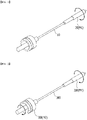
- Fig. 1 is a view showing a conventional electrode laminate winding device that rotates by uniaxial driving.
- the conventional winding device may include a mandrel 10, and a driving unit 20 that rotates through a motor M1 formed on one side of the mandrel.
- the electrode laminate was wound by rotating the mandrel by uniaxial driving through only the driving unit 20 formed on one side of the mandrel in this way.
- cracks may occur in the electrode laminate due to a torsion angle of the mandrel 10 and an increase in concentrated load.
- an electrode winding device for winding an electrode laminate, comprising: a mandrel for winding the electrode laminate; and first and second rotation driving units formed at both ends of the mandrel to rotate the mandrel.
- the first and second rotation driving units may provide a rotational force to rotate the mandrel.
- the first and second rotation driving units may each independently rotates the mandrel, and the first and second rotation driving units may have the same rotation speed.
- the first and second rotation driving units may include a motor, respectively.
- the first and second rotation driving units may have a structure in which a hollow having an inner diameter corresponding to an outer diameter of the mandrel is formed so that the mandrel can be inserted, and the first and second rotation driving units may be fastened to the mandrel in a state in which the mandrel is inserted.
- the electrode laminate may be formed by stacking a sheet-type positive electrode, a sheet-type negative electrode, or may be one in which unit cells are arranged on a sheet-type separator.
- the mandrel may be formed in the shape of a cylindrical rod.
- a torsion angle of the mandrel due to the rotation of the first and second rotation driving units may be 0.004 degrees or less, and a maximum stress acting on the electrode assembly by the rotation of the first rotation driving unit and the second rotation driving unit may be 15 MPa or less.
- planar when referred to as “planar”, it means when a target portion is viewed from the upper side, and when referred to as “cross-sectional”, it means when a target portion is viewed from the side of a cross section cut vertically.
- Fig. 2 is a view showing a winding device according to an embodiment of the present disclosure.
- the winding device includes a mandrel 100 for winding the electrode laminate, and first and second rotation driving units 200 and 300 formed at both ends of the mandrel 100 to rotate the mandrel 100.
- the mandrel 100 winds up an electrode laminate.
- the electrode laminate may be formed by laminating a sheet-type positive electrode, a sheet-type negative electrode, and a sheet-type separator, or may be one in which unit cells are arranged on a sheet-type separator.
- the electrode laminate can be wound around the mandrel 100 to form a jelly-roll type or a stack/folding type electrode assembly. Such an electrode assembly may be inserted into a cylindrical battery case.
- the unit cell means a mono-cell, which is an electrode or a laminate of one electrode and a separator, a bi-cell laminated so that electrodes of the same polarities are arranged at both ends, a full cell laminated so that electrodes of different polarities are arranged at both ends, and the like.
- the mandrel 100 may be formed in the shape of a cylindrical rod. While the outer surface of the cylindrical rod rotates, the electrode laminate in contact with the outer surface can be wound up.
- the winding device includes first and second rotation driving units 200 and 300 formed at both ends of the mandrel 100 to rotate the mandrel 100.
- the first and second rotation driving units 200 and 300 provide a rotational force to the electrode laminate to rotate the mandrel 100.
- the first and second rotation driving units 200 and 300 each independently rotate the mandrel 100.
- the first and second rotation driving units 200 and 300 include motors M1 and M2, respectively, and the motors M1 and M2 can provide a rotational force to rotate the mandrel, 100.
- the rotational force of the mandrel 100 can be improved and the mandrel 100 can be rotated more precisely, thereby more facilitating the rotation control of the mandrel 100, as compared with the case of rotating the mandrel 100 using a single motor.
- the rotation speeds of the first and second rotation driving units 200 and 300 may be the same. If the rotational speeds of both ends of the mandrel 100 that rotates by biaxial driving are different, cracks may occur due to an increase in the torsion angle of the mandrel 100 and an increase in the stress acting on the electrode laminate to be wound. Therefore, according to the present embodiment, by equalizing the rotation speeds of the first and second rotation driving units to minimize the torsion angle, it is also possible to reduce and disperse the acting stress applied to the electrode laminate to be wound.
- the first and second rotation driving units 200 and 300 are not limited as long as they have a structure that can connect to the mandrel 100 and rotate the mandrel 100. However, it is more preferable that the mandrel 100 and the first and second rotation driving units 200 and 300 are detachably formed so that they can be easily replaced when they have been consumed. Therefore, for example, they may have a structure in which a hollow having an inner diameter corresponding to the outer diameter of the mandrel is formed so that the mandrel 100 is inserted.
- the mandrel 100 must be fixed so as to be fully operated by the rotational force of the first and second rotation driving units 200 and 300. Therefore, the first and second rotation driving units 200 and 300 may be mechanically fastened to the mandrel 100 in a state in which the mandrel 100 is inserted.
- a rotation driving unit was provided only at one end of the mandrel and thus the mandrel was rotated in a uniaxial driving manner to wind up the electrode laminate.
- the uniaxial driving method is adopted in this way, the torsion angle of the mandrel increases, the acting stress increases, and it is highly likely that cracks occur in the wound electrode laminate.
- first and second rotation driving units 200 and 300 are provided on both sides of the mandrel 100, respectively, so that the mandrel 100 rotates in a biaxial driving manner, thereby reducing the torsion angle of the mandrel 100 and can reduce the acting stress. Thereby cracks, damage and the like occurring in the electrode laminate during winding can be minimized. These effects are more remarkable as the electrode is rougher, that is, as the size of the electrode laminate is larger and as the length of the electrode is larger.
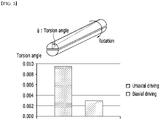
- Fig. 3 is a graph in which the torsion angle acting on the electrode laminate wound in the winding device rotating by the biaxial driving according to an embodiment of the present disclosure is compared with the torsion angle acting on the electrode stack body wound in the winding device that rotates by the uniaxial driving according to the related art.
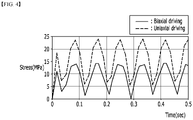
- Fig. 4 is a graph in which the stress acting on the electrode laminate wound in the winding device rotating by the biaxial driving according to an embodiment of the present disclosure is compared with the stress acting on the electrode laminate wound in the winding device that rotates by uniaxial driving according to the related art.
- the torsion angle acting on the mandrel is lowered, as compared with the torsion angle acting on the mandrel in the uniaxial drive type winding device.
- the torsion angle can be obtained by laminating one positive electrode, one negative electrode, and two separators on a mandrel having a length of 12 cm and a diameter of 0.34 cm, rotating the laminate at an equal speed of 360RPM, and measuring the displacement of both ends of the wound electrode laminate.
- the torsion angle of the mandrel may be 0.004 degrees or less. Even if the length of the mandrel increases as the size of the electrode laminate increases, according to the present disclosure which is a biaxial driving method, the torsion angle does not change significantly and can be maintained at a low value.
- the stress can be obtained by laminating a positive electrode having a size of 61 mm x 6 cm, and an negative electrode having a size of 582 cm x 5.8 cm, and a separator having a size of 63 cm x 6.13 cm so that the separator is interposed between the positive electrode and the negative electrode, and measuring the displacement of both ends of an electrode laminated body using a laser displacement sensor when winding at a speed of 360RPM using a mandrel with a length of 12cm and a diameter of 0.34 cm.
- a maximum stress acting on the electrode laminate by the rotation of the first and second rotation driving units may be 15 MPa or less. This maximum stress also increases as the size of the electrode laminate increases. Even if the length of the mandrel is increased, according to the present invention which is a biaxial driving method, it is possible to maintain a low value without a large change.
- the winding device of the present disclosure is more effective as the size of the electrode stack increases.
- the torsion angle of the mandrel is lowered through biaxial driving, and the stress acting on the electrode laminate are lowered and dispersed, thereby capable of minimizing cracks in the electrode laminate that occur through winding.
- a winding device capable of reducing cracks in an electrode stack through a twist angle reduction and load dispersing effect by providing a winding device capable of double-axial driving of the winding core during the winding process of the electrode stack.
Landscapes
- Engineering & Computer Science (AREA)
- Manufacturing & Machinery (AREA)
- Chemical & Material Sciences (AREA)
- Chemical Kinetics & Catalysis (AREA)
- Electrochemistry (AREA)
- General Chemical & Material Sciences (AREA)
- Secondary Cells (AREA)
- Primary Cells (AREA)
- Coils Or Transformers For Communication (AREA)
- Winding Of Webs (AREA)
Abstract
Description
- This application claims the benefit of
Korean Patent Application No. 10-2020-0123679 filed on September 24, 2020 Korean Patent Application No. 10-2021-0112409 filed on August 25, 2021 - The present disclosure relates to a winding device, and more particularly to a winding device for winding an electrode assembly.
- Recently, as energy source price is increasing due to the depletion of fossil fuels and increasing interest is being paid to environmental pollution, the demand for environmentally-friendly alternative energy sources is bound to play an important role in the future life. Thus, research into techniques for generating various kinds of power, such as nuclear energy, solar energy, wind energy, and tidal power, is underway, and power storage apparatuses for more efficient use of the generated energy are also drawing much attention.
- In particular, as technology development and demands for mobile devices increase, the demand for batteries as energy sources is rapidly increasing. Accordingly, many researches on batteries capable of meeting diverse demands have been conducted. In recent years, batteries have also been used in electric vehicles, and the use range is gradually expanded.
- Typically, the demand for the lithium secondary battery, such as a lithium ion battery or a lithium ion polymer battery, which have advantages such as a high energy density, a discharge voltage, an output stability, and the like is high.
- The secondary battery may be classified based on how the electrode assembly, having a structure in which a positive electrode, a negative electrode, and a separator interposed between the positive electrode and the negative electrode are stacked, is structured. Typically, the electrode assembly may include a jelly-roll (wound) type electrode assembly in which long sheet type positive electrodes and long sheet type negative electrodes are wound with a separator being interposed therebetween, and a stacked (laminated) type electrode assembly in which a plurality of positive electrodes and negative electrodes, cut into predetermined unit sizes, are sequentially stacked with separators being interposed therebetween, and the like. Recently, in order to solve the problems involved in the jelly-roll type electrode assembly and the stacked type electrode assembly, there has been developed a stack/folding type electrode assembly having an improved structure, which is a combination of the jelly-roll type electrode assembly and the stacked type electrode assembly. The stack/folding type electrode assembly has a structure in which the positive electrodes and the negative electrodes taken in predetermined units are sequentially wound with separators being disposed between the two electrodes.
- Further, the secondary battery is classified based on the shape of a battery case into a cylindrical battery having an electrode assembly mounted in a cylindrical case, a prismatic battery having an electrode assembly mounted in a prismatic case, or a pouch-shaped case having an electrode assembly mounted in a pouch-shaped case formed of an aluminum laminate sheet. Among them, the cylindrical battery and the jelly-roll type or stack/folding type electrode assemblies have an advantage of having high energy density.
- In the fabrication of an electrode assembly including such a winding process, an electrode assembly can be fabricated by the process of inserting a laminate comprising a positive electrode, a negative electrode and a separator into a mandrel, winding the laminate around the mandrel and then removing the mandrel.
-
Fig. 1 is a view showing a conventional electrode laminate winding device that rotates by uniaxial driving. - Referring to
Fig. 1 , the conventional winding device may include amandrel 10, and adriving unit 20 that rotates through a motor M1 formed on one side of the mandrel. According to the related art, the electrode laminate was wound by rotating the mandrel by uniaxial driving through only thedriving unit 20 formed on one side of the mandrel in this way. However, when the electrode laminate is wound through uniaxial driving in this way, cracks may occur in the electrode laminate due to a torsion angle of themandrel 10 and an increase in concentrated load. - In particular, recently, as the demand for a large-capacity battery increases and the electrode becomes larger, these problems are more serious.
- It is an object of the present disclosure to provide a winding device that minimizes cracks occurring on electrodes and the like during winding process of an electrode laminate.
- The objects of the present disclosure are not limited to the aforementioned objects, and other objects which are not described herein should be clearly understood by those skilled in the art from the following detailed description.
- According to one embodiment of the present disclosure, there is provided an electrode winding device for winding an electrode laminate, comprising: a mandrel for winding the electrode laminate; and first and second rotation driving units formed at both ends of the mandrel to rotate the mandrel.
- The first and second rotation driving units may provide a rotational force to rotate the mandrel. At this time, the first and second rotation driving units may each independently rotates the mandrel, and the first and second rotation driving units may have the same rotation speed.
- Here, the first and second rotation driving units may include a motor, respectively.
- The first and second rotation driving units may have a structure in which a hollow having an inner diameter corresponding to an outer diameter of the mandrel is formed so that the mandrel can be inserted, and the first and second rotation driving units may be fastened to the mandrel in a state in which the mandrel is inserted.
- The electrode laminate may be formed by stacking a sheet-type positive electrode, a sheet-type negative electrode, or may be one in which unit cells are arranged on a sheet-type separator.
- The mandrel may be formed in the shape of a cylindrical rod.
- In the winding device as described above, a torsion angle of the mandrel due to the rotation of the first and second rotation driving units may be 0.004 degrees or less, and a maximum stress acting on the electrode assembly by the rotation of the first rotation driving unit and the second rotation driving unit may be 15 MPa or less.
-
-
Fig. 1 is a view showing a conventional winding device that rotates by a uniaxial driving; -
Fig. 2 is a view showing a winding device according to an embodiment of the present disclosure; -
Fig. 3 is a graph in which the torsion angle acting on the electrode laminate wound in the winding device rotating by the biaxial driving according to an embodiment of the present disclosure is compared with the torsion angle acting on the electrode stack body wound in the winding device that rotates by the uniaxial driving according to the related art; and -
Fig. 4 is a graph in which the stress acting on the electrode laminate wound in the winding device rotating by the biaxial driving according to an embodiment of the present disclosure is compared with the stress acting on the electrode laminate wound in the winding device that rotates by uniaxial driving according to the related art. - Hereinafter, various embodiments of the present disclosure will be described in detail with reference to the accompanying drawings so that those skilled in the art can easily implement them. The present disclosure can be modified in various different ways, and is not limited to the embodiments set forth herein.
- Portions that are irrelevant to the description will be omitted to clearly describe the present disclosure, and like reference numerals designate like elements throughout the specification.
- Further, in the drawings, the size and thickness of each element are arbitrarily illustrated for convenience of description, and the present disclosure is not necessarily limited to those illustrated in the drawings. In the drawings, the thickness of layers, regions, etc. are exaggerated for clarity. In the drawings, for convenience of description, the thicknesses of some layers and regions are shown to be exaggerated.
- In addition, it will be understood that when an element such as a layer, film, region, or plate is referred to as being "on" or "above" another element, it can be directly on the other element or intervening elements may also be present. In contrast, when an element is referred to as being "directly on" another element, it means that other intervening elements are not present. Further, the word "on" or "above" means disposed on or below a reference portion, and does not necessarily mean being disposed on the upper end of the reference portion toward the opposite direction of gravity.
- Further, throughout the specification, when a portion is referred to as "including" a certain component, it means that the portion can further include other components, without excluding the other components, unless otherwise stated.
- Further, throughout the specification, when referred to as "planar", it means when a target portion is viewed from the upper side, and when referred to as "cross-sectional", it means when a target portion is viewed from the side of a cross section cut vertically.
- Hereinafter, with reference to
FIG. 2 , a winding device according to an embodiment of the present invention will be described. -
Fig. 2 is a view showing a winding device according to an embodiment of the present disclosure. - Referring to
Fig. 2 , the winding device according to an embodiment of the present disclosure includes amandrel 100 for winding the electrode laminate, and first and secondrotation driving units mandrel 100 to rotate themandrel 100. - The
mandrel 100 winds up an electrode laminate. The electrode laminate may be formed by laminating a sheet-type positive electrode, a sheet-type negative electrode, and a sheet-type separator, or may be one in which unit cells are arranged on a sheet-type separator. The electrode laminate can be wound around themandrel 100 to form a jelly-roll type or a stack/folding type electrode assembly. Such an electrode assembly may be inserted into a cylindrical battery case. - The unit cell means a mono-cell, which is an electrode or a laminate of one electrode and a separator, a bi-cell laminated so that electrodes of the same polarities are arranged at both ends, a full cell laminated so that electrodes of different polarities are arranged at both ends, and the like.
- The
mandrel 100 may be formed in the shape of a cylindrical rod. While the outer surface of the cylindrical rod rotates, the electrode laminate in contact with the outer surface can be wound up. - According to the present embodiment, the winding device includes first and second
rotation driving units mandrel 100 to rotate themandrel 100. At this time, the first and secondrotation driving units mandrel 100. At this time, the first and secondrotation driving units mandrel 100. - For example, the first and second
rotation driving units - Therefore, the rotational force of the
mandrel 100 can be improved and themandrel 100 can be rotated more precisely, thereby more facilitating the rotation control of themandrel 100, as compared with the case of rotating themandrel 100 using a single motor. - Further, according to the present embodiment, the rotation speeds of the first and second
rotation driving units mandrel 100 that rotates by biaxial driving are different, cracks may occur due to an increase in the torsion angle of themandrel 100 and an increase in the stress acting on the electrode laminate to be wound. Therefore, according to the present embodiment, by equalizing the rotation speeds of the first and second rotation driving units to minimize the torsion angle, it is also possible to reduce and disperse the acting stress applied to the electrode laminate to be wound. - The first and second
rotation driving units mandrel 100 and rotate themandrel 100. However, it is more preferable that themandrel 100 and the first and secondrotation driving units mandrel 100 is inserted. - Further, in such a structure, the
mandrel 100 must be fixed so as to be fully operated by the rotational force of the first and secondrotation driving units rotation driving units mandrel 100 in a state in which themandrel 100 is inserted. - Conventionally, as shown in
Fig. 1 , a rotation driving unit was provided only at one end of the mandrel and thus the mandrel was rotated in a uniaxial driving manner to wind up the electrode laminate. When the uniaxial driving method is adopted in this way, the torsion angle of the mandrel increases, the acting stress increases, and it is highly likely that cracks occur in the wound electrode laminate. - On the other hand, according to the present embodiment, as shown in
Fig. 2 , first and secondrotation driving units mandrel 100, respectively, so that themandrel 100 rotates in a biaxial driving manner, thereby reducing the torsion angle of themandrel 100 and can reduce the acting stress. Thereby cracks, damage and the like occurring in the electrode laminate during winding can be minimized. These effects are more remarkable as the electrode is rougher, that is, as the size of the electrode laminate is larger and as the length of the electrode is larger. - Hereinafter, with reference to
Figs. 3 and4 , a biaxial drive type winding device according to an embodiment of the present disclosure and a uniaxial drive type winding device according to the related art will be compared and described. -
Fig. 3 is a graph in which the torsion angle acting on the electrode laminate wound in the winding device rotating by the biaxial driving according to an embodiment of the present disclosure is compared with the torsion angle acting on the electrode stack body wound in the winding device that rotates by the uniaxial driving according to the related art.Fig. 4 is a graph in which the stress acting on the electrode laminate wound in the winding device rotating by the biaxial driving according to an embodiment of the present disclosure is compared with the stress acting on the electrode laminate wound in the winding device that rotates by uniaxial driving according to the related art. - Referring to
Fig. 3 , it can be seen that in the biaxial drive type winding device according to the present embodiment, the torsion angle acting on the mandrel is lowered, as compared with the torsion angle acting on the mandrel in the uniaxial drive type winding device. The torsion angle can be obtained by laminating one positive electrode, one negative electrode, and two separators on a mandrel having a length of 12 cm and a diameter of 0.34 cm, rotating the laminate at an equal speed of 360RPM, and measuring the displacement of both ends of the wound electrode laminate. - Specifically, when the winding device according to the present disclosure is used, the torsion angle of the mandrel may be 0.004 degrees or less. Even if the length of the mandrel increases as the size of the electrode laminate increases, according to the present disclosure which is a biaxial driving method, the torsion angle does not change significantly and can be maintained at a low value.
- Further, referring to
Fig. 4 , it can be seen that as compared with the stress acting on the electrode laminate wound in the uniaxial drive type winding device, the stress acting on the electrode laminate wound in the biaxial type winding device is reduced. The stress can be obtained by laminating a positive electrode having a size of 61 mm x 6 cm, and an negative electrode having a size of 582 cm x 5.8 cm, and a separator having a size of 63 cm x 6.13 cm so that the separator is interposed between the positive electrode and the negative electrode, and measuring the displacement of both ends of an electrode laminated body using a laser displacement sensor when winding at a speed of 360RPM using a mandrel with a length of 12cm and a diameter of 0.34 cm. - Specifically, when using the winding device according to the present disclosure, a maximum stress acting on the electrode laminate by the rotation of the first and second rotation driving units may be 15 MPa or less. This maximum stress also increases as the size of the electrode laminate increases. Even if the length of the mandrel is increased, according to the present invention which is a biaxial driving method, it is possible to maintain a low value without a large change.
- Therefore, the winding device of the present disclosure is more effective as the size of the electrode stack increases.
- Through this, during the electrode winding process, the torsion angle of the mandrel is lowered through biaxial driving, and the stress acting on the electrode laminate are lowered and dispersed, thereby capable of minimizing cracks in the electrode laminate that occur through winding.
- Although the invention has been shown and described above with reference to the preferred embodiments, the scope of the present disclosure is not limited thereto, and numerous other modifications and embodiments can be devised by those skilled in the art, which will fall within the spirit and scope of the principles of the invention described in the appended claims.
-
- 100: mandrel
- 200: first rotation driving unit
- 300: second rotation driving unit
- According to an embodiment of the present invention, there is provided a winding device capable of reducing cracks in an electrode stack through a twist angle reduction and load dispersing effect by providing a winding device capable of double-axial driving of the winding core during the winding process of the electrode stack.
- Effects of the present invention are not limited to the effects mentioned above, and other effects not mentioned will be clearly understood by those skilled in the art from the description of the claims.
Claims (11)
- An electrode winding device for winding an electrode laminate, comprising:a mandrel for winding the electrode laminate; andfirst and second rotation driving units formed at both ends of the mandrel to rotate the mandrel.
- The electrode winding device of claim 1, wherein:
the first and second rotation driving units provide a rotational force to rotate the mandrel. - The electrode winding device of claim 1, wherein:
the first and second rotation driving units each independently rotates the mandrel. - The electrode winding device of claim 1, wherein:
the first and second rotation driving units have the same rotation speed. - The electrode winding device of claim 1, wherein:
the first and second rotation driving units comprises a motor, respectively. - The electrode winding device of claim 1, wherein:
the first and second rotation driving units have a structure in which a hollow having an inner diameter corresponding to an outer diameter of the mandrel is formed so that the mandrel can be inserted. - The electrode winding device of claim 6, wherein:
the first and second rotation driving units are mechanically fastened to the mandrel in a state in which the mandrel is inserted. - The electrode winding device of claim 1, wherein:
the electrode laminate is formed by stacking a sheet-type positive electrode, a sheet-type negative electrode, or is one in which unit cells are arranged on a sheet-type separator. - The electrode winding device of claim 1, wherein:
the mandrel is formed in the shape of a cylindrical rod. - The electrode winding device of claim 1, wherein:
a torsion angle of the mandrel due to the rotation of the first and second rotation driving units is 0.004 degrees or less. - The electrode winding device of claim 1, wherein:
a maximum stress acting on the electrode assembly by the rotation of the first rotation driving unit and the second rotation driving unit is 15 MPa or less.
Applications Claiming Priority (3)
| Application Number | Priority Date | Filing Date | Title |
|---|---|---|---|
| KR20200123679 | 2020-09-24 | ||
| KR1020210112409A KR20220040986A (en) | 2020-09-24 | 2021-08-25 | Winding apparatus |
| PCT/KR2021/011545 WO2022065718A1 (en) | 2020-09-24 | 2021-08-27 | Winding apparatus |
Publications (2)
| Publication Number | Publication Date |
|---|---|
| EP4084174A1 true EP4084174A1 (en) | 2022-11-02 |
| EP4084174A4 EP4084174A4 (en) | 2024-08-21 |
Family
ID=80846671
Family Applications (1)
| Application Number | Title | Priority Date | Filing Date |
|---|---|---|---|
| EP21872748.5A Pending EP4084174A4 (en) | 2020-09-24 | 2021-08-27 | Winding apparatus |
Country Status (4)
| Country | Link |
|---|---|
| US (1) | US20230072029A1 (en) |
| EP (1) | EP4084174A4 (en) |
| CN (1) | CN115053374A (en) |
| WO (1) | WO2022065718A1 (en) |
Family Cites Families (22)
| Publication number | Priority date | Publication date | Assignee | Title |
|---|---|---|---|---|
| JPH09115551A (en) * | 1995-10-23 | 1997-05-02 | Sony Corp | Winding method and winding device for electrode spiral of cylindrical secondary battery |
| JPH09208093A (en) * | 1995-11-27 | 1997-08-12 | Sony Corp | Edge control device and method for strip winding machine |
| JPH1040925A (en) * | 1996-07-19 | 1998-02-13 | Mitsubishi Cable Ind Ltd | Battery winder |
| JPH10270067A (en) * | 1997-03-24 | 1998-10-09 | Toshiba Battery Co Ltd | Manufacture of wound electrode |
| JP4191850B2 (en) * | 1999-05-28 | 2008-12-03 | 株式会社日平トヤマ | Winder |
| JP3756782B2 (en) * | 2001-02-20 | 2006-03-15 | ソニーケミカル株式会社 | Winding device and delivery device |
| DE102008000042A1 (en) * | 2007-09-24 | 2009-04-02 | Voith Patent Gmbh | Method and device for winding a material web |
| JP4954129B2 (en) * | 2008-03-18 | 2012-06-13 | シーケーディ株式会社 | Method for manufacturing wound element |
| IT1393864B1 (en) * | 2008-07-30 | 2012-05-11 | Drillmec Spa | WINCH FOR HANDLING OF DRILLING DEVICES. |
| DE102008043507A1 (en) * | 2008-11-06 | 2010-05-12 | Voith Patent Gmbh | Method for winding material webs and apparatus for carrying out the method |
| KR101145840B1 (en) * | 2009-12-24 | 2012-05-17 | 씨아이에스(주) | Automatic amending apparatus for winding thickness of battery sheet, Winding apparatus for secondary battery includig the same, and automatic amendig method there of |
| KR101382548B1 (en) * | 2011-03-31 | 2014-04-07 | 주식회사 엘지화학 | Mandrel for Preparation of Jelly-roll Type Electrode Assembly |
| CN104507840A (en) * | 2012-08-03 | 2015-04-08 | 迪睿合电子材料有限公司 | Reel member, film container, and method for manufacturing film container |
| JP5984643B2 (en) * | 2012-11-29 | 2016-09-06 | 株式会社メイコー | Electrode sheet drying apparatus and electrode sheet drying method |
| KR101757381B1 (en) * | 2013-11-28 | 2017-07-12 | 주식회사 엘지화학 | Mandrel for preparation of cylindrical-jelly roll type electrode assembly |
| KR101738728B1 (en) * | 2014-01-28 | 2017-05-22 | 주식회사 엘지화학 | Winding device |
| CN204230366U (en) * | 2014-11-04 | 2015-03-25 | 深圳市富泰顶精密机械有限公司 | Electric core winding mechanism |
| JP6576896B2 (en) * | 2016-09-30 | 2019-09-18 | 富士フイルム株式会社 | Winding method and winding device |
| CN206988372U (en) * | 2017-07-14 | 2018-02-09 | 深圳市德宇智能装备有限公司 | A kind of cylindrical lithium battery film-making winding integrated machine winding head gear drive |
| CN207165697U (en) * | 2017-10-11 | 2018-03-30 | 苏州迈展自动化科技有限公司 | A kind of anode ring forming equipment |
| KR200495516Y1 (en) * | 2017-10-18 | 2022-06-10 | 에스케이넥실리스 주식회사 | Apparatus for Manufacturing Electrolytic Copper Foil |
| JP6955987B2 (en) * | 2017-12-11 | 2021-10-27 | 株式会社ディスコ | Winding unit |
-
2021
- 2021-08-27 WO PCT/KR2021/011545 patent/WO2022065718A1/en not_active Ceased
- 2021-08-27 US US17/800,118 patent/US20230072029A1/en active Pending
- 2021-08-27 EP EP21872748.5A patent/EP4084174A4/en active Pending
- 2021-08-27 CN CN202180012592.7A patent/CN115053374A/en active Pending
Also Published As
| Publication number | Publication date |
|---|---|
| CN115053374A (en) | 2022-09-13 |
| US20230072029A1 (en) | 2023-03-09 |
| EP4084174A4 (en) | 2024-08-21 |
| WO2022065718A1 (en) | 2022-03-31 |
Similar Documents
| Publication | Publication Date | Title |
|---|---|---|
| KR101553542B1 (en) | Cell stacking method for Secondary Battery and cell stack for using the same | |
| JP5714295B2 (en) | Laminate manufacturing apparatus and method | |
| EP4108375B1 (en) | Welding apparatus, welding method using same, and electrode assembly manufactured by same welding method | |
| EP3416225B1 (en) | Electrode assembly and manufacturing method therefor | |
| JP7209848B2 (en) | slitter | |
| KR20220089333A (en) | Battery cell manufacturing apparatus | |
| KR20160041225A (en) | Electrode Assembly Folded in the Bi-Direction and Lithium Secondary Battery Comprising the Same | |
| JP2024539209A (en) | Electrode assembly, battery cell, battery, manufacturing method and manufacturing equipment for electrode assembly | |
| EP3852167B1 (en) | Battery manufacturing device and manufacturing method of battery | |
| KR20220116385A (en) | Electrode assemblies and related batteries, devices, manufacturing methods and manufacturing devices | |
| KR20220100519A (en) | Electrode assemblies and related batteries, devices, manufacturing methods and manufacturing devices | |
| EP4084174A1 (en) | Winding apparatus | |
| JP7570755B2 (en) | Battery cell including electrode tab with stress relief portion formed thereon | |
| US12451509B2 (en) | Cutting-off apparatus and battery assembly line production equipment | |
| US20220246972A1 (en) | Electrode assembly, battery cell, battery, and manufacturing method and device for an electrode assembly | |
| EP3996195A1 (en) | Cylindrical battery and battery pack including same | |
| KR20220040986A (en) | Winding apparatus | |
| KR102757243B1 (en) | Cylindrical secondary battery and method manufacturing the same | |
| EP4675807A1 (en) | Battery cell, battery and electric device | |
| KR20220000639A (en) | Electrode assembly and manufacturing method of the same | |
| EP4675779A1 (en) | Battery cell, battery, and electrical device | |
| US20260031470A1 (en) | Battery cell, battery and electric device | |
| KR20210129541A (en) | The Electrode Assembly And The Secondary Battery | |
| US20260031474A1 (en) | Battery cell, battery and electric device | |
| KR102817381B1 (en) | Electrode assembly and battery comprising same |
Legal Events
| Date | Code | Title | Description |
|---|---|---|---|
| STAA | Information on the status of an ep patent application or granted ep patent |
Free format text: STATUS: THE INTERNATIONAL PUBLICATION HAS BEEN MADE |
|
| PUAI | Public reference made under article 153(3) epc to a published international application that has entered the european phase |
Free format text: ORIGINAL CODE: 0009012 |
|
| STAA | Information on the status of an ep patent application or granted ep patent |
Free format text: STATUS: REQUEST FOR EXAMINATION WAS MADE |
|
| 17P | Request for examination filed |
Effective date: 20220728 |
|
| AK | Designated contracting states |
Kind code of ref document: A1 Designated state(s): AL AT BE BG CH CY CZ DE DK EE ES FI FR GB GR HR HU IE IS IT LI LT LU LV MC MK MT NL NO PL PT RO RS SE SI SK SM TR |
|
| DAV | Request for validation of the european patent (deleted) | ||
| DAX | Request for extension of the european patent (deleted) | ||
| A4 | Supplementary search report drawn up and despatched |
Effective date: 20240718 |
|
| RIC1 | Information provided on ipc code assigned before grant |
Ipc: H01M 10/04 20060101AFI20240712BHEP |
|
| STAA | Information on the status of an ep patent application or granted ep patent |
Free format text: STATUS: EXAMINATION IS IN PROGRESS |
|
| 17Q | First examination report despatched |
Effective date: 20250919 |