EP4084138A1 - Negative electrode, electrochemical apparatus containing same, and electronic device - Google Patents
Negative electrode, electrochemical apparatus containing same, and electronic device Download PDFInfo
- Publication number
- EP4084138A1 EP4084138A1 EP20909824.3A EP20909824A EP4084138A1 EP 4084138 A1 EP4084138 A1 EP 4084138A1 EP 20909824 A EP20909824 A EP 20909824A EP 4084138 A1 EP4084138 A1 EP 4084138A1
- Authority
- EP
- European Patent Office
- Prior art keywords
- negative
- negative electrode
- active material
- silicon
- current collector
- Prior art date
- Legal status (The legal status is an assumption and is not a legal conclusion. Google has not performed a legal analysis and makes no representation as to the accuracy of the status listed.)
- Pending
Links
- 239000007773 negative electrode material Substances 0.000 claims abstract description 64
- 239000002210 silicon-based material Substances 0.000 claims abstract description 42
- 238000012360 testing method Methods 0.000 claims description 26
- 239000000463 material Substances 0.000 claims description 25
- 229910052814 silicon oxide Inorganic materials 0.000 claims description 23
- VYPSYNLAJGMNEJ-UHFFFAOYSA-N Silicium dioxide Chemical compound O=[Si]=O VYPSYNLAJGMNEJ-UHFFFAOYSA-N 0.000 claims description 21
- 229910052744 lithium Inorganic materials 0.000 claims description 16
- OKTJSMMVPCPJKN-UHFFFAOYSA-N Carbon Chemical compound [C] OKTJSMMVPCPJKN-UHFFFAOYSA-N 0.000 claims description 14
- WHXSMMKQMYFTQS-UHFFFAOYSA-N Lithium Chemical compound [Li] WHXSMMKQMYFTQS-UHFFFAOYSA-N 0.000 claims description 12
- 229920002125 Sokalan® Polymers 0.000 claims description 12
- 239000004584 polyacrylic acid Substances 0.000 claims description 12
- RYGMFSIKBFXOCR-UHFFFAOYSA-N Copper Chemical compound [Cu] RYGMFSIKBFXOCR-UHFFFAOYSA-N 0.000 claims description 11
- 239000011248 coating agent Substances 0.000 claims description 11
- 238000000576 coating method Methods 0.000 claims description 11
- PXHVJJICTQNCMI-UHFFFAOYSA-N Nickel Chemical compound [Ni] PXHVJJICTQNCMI-UHFFFAOYSA-N 0.000 claims description 10
- 238000002441 X-ray diffraction Methods 0.000 claims description 10
- 229910052782 aluminium Inorganic materials 0.000 claims description 10
- 239000011651 chromium Substances 0.000 claims description 9
- 239000011888 foil Substances 0.000 claims description 9
- 239000010936 titanium Substances 0.000 claims description 9
- 239000011230 binding agent Substances 0.000 claims description 8
- 239000003575 carbonaceous material Substances 0.000 claims description 8
- 239000001768 carboxy methyl cellulose Substances 0.000 claims description 8
- 239000006258 conductive agent Substances 0.000 claims description 8
- 239000011889 copper foil Substances 0.000 claims description 8
- VNWKTOKETHGBQD-UHFFFAOYSA-N methane Chemical compound C VNWKTOKETHGBQD-UHFFFAOYSA-N 0.000 claims description 8
- RTAQQCXQSZGOHL-UHFFFAOYSA-N Titanium Chemical compound [Ti] RTAQQCXQSZGOHL-UHFFFAOYSA-N 0.000 claims description 7
- VYZAMTAEIAYCRO-UHFFFAOYSA-N Chromium Chemical compound [Cr] VYZAMTAEIAYCRO-UHFFFAOYSA-N 0.000 claims description 6
- 239000002033 PVDF binder Substances 0.000 claims description 6
- 229910052804 chromium Inorganic materials 0.000 claims description 6
- 229910052749 magnesium Inorganic materials 0.000 claims description 6
- 239000002861 polymer material Substances 0.000 claims description 6
- 229920002981 polyvinylidene fluoride Polymers 0.000 claims description 6
- 229910052719 titanium Inorganic materials 0.000 claims description 6
- 229920002134 Carboxymethyl cellulose Polymers 0.000 claims description 4
- DPXJVFZANSGRMM-UHFFFAOYSA-N acetic acid;2,3,4,5,6-pentahydroxyhexanal;sodium Chemical compound [Na].CC(O)=O.OCC(O)C(O)C(O)C(O)C=O DPXJVFZANSGRMM-UHFFFAOYSA-N 0.000 claims description 4
- 239000002041 carbon nanotube Substances 0.000 claims description 4
- 229910021393 carbon nanotube Inorganic materials 0.000 claims description 4
- 235000010948 carboxy methyl cellulose Nutrition 0.000 claims description 4
- 239000008112 carboxymethyl-cellulose Substances 0.000 claims description 4
- 235000019812 sodium carboxymethyl cellulose Nutrition 0.000 claims description 4
- 229920001027 sodium carboxymethylcellulose Polymers 0.000 claims description 4
- 229920000049 Carbon (fiber) Polymers 0.000 claims description 3
- 239000004642 Polyimide Substances 0.000 claims description 3
- 239000004917 carbon fiber Substances 0.000 claims description 3
- 229920001721 polyimide Polymers 0.000 claims description 3
- 239000010935 stainless steel Substances 0.000 claims description 3
- 229910001220 stainless steel Inorganic materials 0.000 claims description 3
- DGAQECJNVWCQMB-PUAWFVPOSA-M Ilexoside XXIX Chemical compound C[C@@H]1CC[C@@]2(CC[C@@]3(C(=CC[C@H]4[C@]3(CC[C@@H]5[C@@]4(CC[C@@H](C5(C)C)OS(=O)(=O)[O-])C)C)[C@@H]2[C@]1(C)O)C)C(=O)O[C@H]6[C@@H]([C@H]([C@@H]([C@H](O6)CO)O)O)O.[Na+] DGAQECJNVWCQMB-PUAWFVPOSA-M 0.000 claims description 2
- 239000004962 Polyamide-imide Substances 0.000 claims description 2
- 239000005062 Polybutadiene Substances 0.000 claims description 2
- 239000004793 Polystyrene Substances 0.000 claims description 2
- 239000004372 Polyvinyl alcohol Substances 0.000 claims description 2
- ZLMJMSJWJFRBEC-UHFFFAOYSA-N Potassium Chemical compound [K] ZLMJMSJWJFRBEC-UHFFFAOYSA-N 0.000 claims description 2
- 229910003481 amorphous carbon Inorganic materials 0.000 claims description 2
- 239000002134 carbon nanofiber Substances 0.000 claims description 2
- 239000011852 carbon nanoparticle Substances 0.000 claims description 2
- 229910021389 graphene Inorganic materials 0.000 claims description 2
- 239000003273 ketjen black Substances 0.000 claims description 2
- 229920002312 polyamide-imide Polymers 0.000 claims description 2
- 229920002857 polybutadiene Polymers 0.000 claims description 2
- 229920002223 polystyrene Polymers 0.000 claims description 2
- 229920002451 polyvinyl alcohol Polymers 0.000 claims description 2
- 235000019422 polyvinyl alcohol Nutrition 0.000 claims description 2
- 229920000036 polyvinylpyrrolidone Polymers 0.000 claims description 2
- 239000001267 polyvinylpyrrolidone Substances 0.000 claims description 2
- 235000013855 polyvinylpyrrolidone Nutrition 0.000 claims description 2
- 229910052700 potassium Inorganic materials 0.000 claims description 2
- 239000011591 potassium Substances 0.000 claims description 2
- 229910052708 sodium Inorganic materials 0.000 claims description 2
- 239000011734 sodium Substances 0.000 claims description 2
- 229920003048 styrene butadiene rubber Polymers 0.000 claims description 2
- 239000011164 primary particle Substances 0.000 claims 1
- 230000002708 enhancing effect Effects 0.000 abstract description 3
- HBBGRARXTFLTSG-UHFFFAOYSA-N Lithium ion Chemical compound [Li+] HBBGRARXTFLTSG-UHFFFAOYSA-N 0.000 description 52
- 229910001416 lithium ion Inorganic materials 0.000 description 52
- -1 LiN3) Chemical compound 0.000 description 17
- 238000000034 method Methods 0.000 description 13
- 239000002245 particle Substances 0.000 description 13
- 230000014759 maintenance of location Effects 0.000 description 10
- XAGFODPZIPBFFR-UHFFFAOYSA-N aluminium Chemical compound [Al] XAGFODPZIPBFFR-UHFFFAOYSA-N 0.000 description 8
- 239000011777 magnesium Substances 0.000 description 8
- 230000000052 comparative effect Effects 0.000 description 7
- 238000007599 discharging Methods 0.000 description 7
- 239000008151 electrolyte solution Substances 0.000 description 7
- 239000007774 positive electrode material Substances 0.000 description 7
- 239000011575 calcium Substances 0.000 description 6
- 239000010949 copper Substances 0.000 description 6
- 238000002360 preparation method Methods 0.000 description 6
- 239000004698 Polyethylene Substances 0.000 description 5
- XUIMIQQOPSSXEZ-UHFFFAOYSA-N Silicon Chemical compound [Si] XUIMIQQOPSSXEZ-UHFFFAOYSA-N 0.000 description 5
- 239000011149 active material Substances 0.000 description 5
- 238000009826 distribution Methods 0.000 description 5
- 239000011572 manganese Substances 0.000 description 5
- 238000005259 measurement Methods 0.000 description 5
- 229920000573 polyethylene Polymers 0.000 description 5
- 239000010703 silicon Substances 0.000 description 5
- 229910052710 silicon Inorganic materials 0.000 description 5
- SBLRHMKNNHXPHG-UHFFFAOYSA-N 4-fluoro-1,3-dioxolan-2-one Chemical compound FC1COC(=O)O1 SBLRHMKNNHXPHG-UHFFFAOYSA-N 0.000 description 4
- FYYHWMGAXLPEAU-UHFFFAOYSA-N Magnesium Chemical compound [Mg] FYYHWMGAXLPEAU-UHFFFAOYSA-N 0.000 description 4
- SECXISVLQFMRJM-UHFFFAOYSA-N N-Methylpyrrolidone Chemical compound CN1CCCC1=O SECXISVLQFMRJM-UHFFFAOYSA-N 0.000 description 4
- 238000003490 calendering Methods 0.000 description 4
- 229910052799 carbon Inorganic materials 0.000 description 4
- 239000013078 crystal Substances 0.000 description 4
- 238000005520 cutting process Methods 0.000 description 4
- 238000007323 disproportionation reaction Methods 0.000 description 4
- 238000001035 drying Methods 0.000 description 4
- 238000006138 lithiation reaction Methods 0.000 description 4
- 229910000625 lithium cobalt oxide Inorganic materials 0.000 description 4
- BFZPBUKRYWOWDV-UHFFFAOYSA-N lithium;oxido(oxo)cobalt Chemical compound [Li+].[O-][Co]=O BFZPBUKRYWOWDV-UHFFFAOYSA-N 0.000 description 4
- 239000011268 mixed slurry Substances 0.000 description 4
- 238000011056 performance test Methods 0.000 description 4
- 239000000126 substance Substances 0.000 description 4
- XLYOFNOQVPJJNP-UHFFFAOYSA-N water Chemical compound O XLYOFNOQVPJJNP-UHFFFAOYSA-N 0.000 description 4
- WEVYAHXRMPXWCK-UHFFFAOYSA-N Acetonitrile Chemical compound CC#N WEVYAHXRMPXWCK-UHFFFAOYSA-N 0.000 description 3
- ZOXJGFHDIHLPTG-UHFFFAOYSA-N Boron Chemical compound [B] ZOXJGFHDIHLPTG-UHFFFAOYSA-N 0.000 description 3
- OYPRJOBELJOOCE-UHFFFAOYSA-N Calcium Chemical compound [Ca] OYPRJOBELJOOCE-UHFFFAOYSA-N 0.000 description 3
- KMTRUDSVKNLOMY-UHFFFAOYSA-N Ethylene carbonate Chemical compound O=C1OCCO1 KMTRUDSVKNLOMY-UHFFFAOYSA-N 0.000 description 3
- XEEYBQQBJWHFJM-UHFFFAOYSA-N Iron Chemical compound [Fe] XEEYBQQBJWHFJM-UHFFFAOYSA-N 0.000 description 3
- PWHULOQIROXLJO-UHFFFAOYSA-N Manganese Chemical compound [Mn] PWHULOQIROXLJO-UHFFFAOYSA-N 0.000 description 3
- ZOKXTWBITQBERF-UHFFFAOYSA-N Molybdenum Chemical compound [Mo] ZOKXTWBITQBERF-UHFFFAOYSA-N 0.000 description 3
- ZMXDDKWLCZADIW-UHFFFAOYSA-N N,N-Dimethylformamide Chemical compound CN(C)C=O ZMXDDKWLCZADIW-UHFFFAOYSA-N 0.000 description 3
- ATJFFYVFTNAWJD-UHFFFAOYSA-N Tin Chemical compound [Sn] ATJFFYVFTNAWJD-UHFFFAOYSA-N 0.000 description 3
- 230000015572 biosynthetic process Effects 0.000 description 3
- 229910052796 boron Inorganic materials 0.000 description 3
- 229910052791 calcium Inorganic materials 0.000 description 3
- 229910052802 copper Inorganic materials 0.000 description 3
- 239000008367 deionised water Substances 0.000 description 3
- 229910021641 deionized water Inorganic materials 0.000 description 3
- 239000003792 electrolyte Substances 0.000 description 3
- 229910003002 lithium salt Inorganic materials 0.000 description 3
- 159000000002 lithium salts Chemical class 0.000 description 3
- 229910052748 manganese Inorganic materials 0.000 description 3
- 229910052751 metal Inorganic materials 0.000 description 3
- 229910052750 molybdenum Inorganic materials 0.000 description 3
- 239000011733 molybdenum Substances 0.000 description 3
- 238000011160 research Methods 0.000 description 3
- 239000002904 solvent Substances 0.000 description 3
- 238000003756 stirring Methods 0.000 description 3
- 229910052712 strontium Inorganic materials 0.000 description 3
- CIOAGBVUUVVLOB-UHFFFAOYSA-N strontium atom Chemical compound [Sr] CIOAGBVUUVVLOB-UHFFFAOYSA-N 0.000 description 3
- JBQYATWDVHIOAR-UHFFFAOYSA-N tellanylidenegermanium Chemical compound [Te]=[Ge] JBQYATWDVHIOAR-UHFFFAOYSA-N 0.000 description 3
- WFKWXMTUELFFGS-UHFFFAOYSA-N tungsten Chemical compound [W] WFKWXMTUELFFGS-UHFFFAOYSA-N 0.000 description 3
- 229910052721 tungsten Inorganic materials 0.000 description 3
- 239000010937 tungsten Substances 0.000 description 3
- LEONUFNNVUYDNQ-UHFFFAOYSA-N vanadium atom Chemical compound [V] LEONUFNNVUYDNQ-UHFFFAOYSA-N 0.000 description 3
- OIFBSDVPJOWBCH-UHFFFAOYSA-N Diethyl carbonate Chemical compound CCOC(=O)OCC OIFBSDVPJOWBCH-UHFFFAOYSA-N 0.000 description 2
- IAZDPXIOMUYVGZ-UHFFFAOYSA-N Dimethylsulphoxide Chemical compound CS(C)=O IAZDPXIOMUYVGZ-UHFFFAOYSA-N 0.000 description 2
- ZHNUHDYFZUAESO-UHFFFAOYSA-N Formamide Chemical compound NC=O ZHNUHDYFZUAESO-UHFFFAOYSA-N 0.000 description 2
- 229910001290 LiPF6 Inorganic materials 0.000 description 2
- 229910000572 Lithium Nickel Cobalt Manganese Oxide (NCM) Inorganic materials 0.000 description 2
- 229910019142 PO4 Inorganic materials 0.000 description 2
- 239000004743 Polypropylene Substances 0.000 description 2
- FBDMTTNVIIVBKI-UHFFFAOYSA-N [O-2].[Mn+2].[Co+2].[Ni+2].[Li+] Chemical compound [O-2].[Mn+2].[Co+2].[Ni+2].[Li+] FBDMTTNVIIVBKI-UHFFFAOYSA-N 0.000 description 2
- NDPGDHBNXZOBJS-UHFFFAOYSA-N aluminum lithium cobalt(2+) nickel(2+) oxygen(2-) Chemical compound [Li+].[O--].[O--].[O--].[O--].[Al+3].[Co++].[Ni++] NDPGDHBNXZOBJS-UHFFFAOYSA-N 0.000 description 2
- 229910021383 artificial graphite Inorganic materials 0.000 description 2
- 239000003990 capacitor Substances 0.000 description 2
- 239000010941 cobalt Substances 0.000 description 2
- 229910017052 cobalt Inorganic materials 0.000 description 2
- GUTLYIVDDKVIGB-UHFFFAOYSA-N cobalt atom Chemical compound [Co] GUTLYIVDDKVIGB-UHFFFAOYSA-N 0.000 description 2
- 150000001875 compounds Chemical class 0.000 description 2
- 230000003247 decreasing effect Effects 0.000 description 2
- IEJIGPNLZYLLBP-UHFFFAOYSA-N dimethyl carbonate Chemical compound COC(=O)OC IEJIGPNLZYLLBP-UHFFFAOYSA-N 0.000 description 2
- 239000011267 electrode slurry Substances 0.000 description 2
- FKRCODPIKNYEAC-UHFFFAOYSA-N ethyl propionate Chemical compound CCOC(=O)CC FKRCODPIKNYEAC-UHFFFAOYSA-N 0.000 description 2
- 238000005087 graphitization Methods 0.000 description 2
- 229910002102 lithium manganese oxide Inorganic materials 0.000 description 2
- VLXXBCXTUVRROQ-UHFFFAOYSA-N lithium;oxido-oxo-(oxomanganiooxy)manganese Chemical compound [Li+].[O-][Mn](=O)O[Mn]=O VLXXBCXTUVRROQ-UHFFFAOYSA-N 0.000 description 2
- 238000002156 mixing Methods 0.000 description 2
- 239000000203 mixture Substances 0.000 description 2
- 229910052759 nickel Inorganic materials 0.000 description 2
- 239000003960 organic solvent Substances 0.000 description 2
- 239000010452 phosphate Substances 0.000 description 2
- 229920000642 polymer Polymers 0.000 description 2
- 229920001155 polypropylene Polymers 0.000 description 2
- 238000012545 processing Methods 0.000 description 2
- RUOJZAUFBMNUDX-UHFFFAOYSA-N propylene carbonate Chemical compound CC1COC(=O)O1 RUOJZAUFBMNUDX-UHFFFAOYSA-N 0.000 description 2
- VSZWPYCFIRKVQL-UHFFFAOYSA-N selanylidenegallium;selenium Chemical compound [Se].[Se]=[Ga].[Se]=[Ga] VSZWPYCFIRKVQL-UHFFFAOYSA-N 0.000 description 2
- 239000007784 solid electrolyte Substances 0.000 description 2
- 239000000243 solution Substances 0.000 description 2
- 230000003068 static effect Effects 0.000 description 2
- 238000009864 tensile test Methods 0.000 description 2
- 238000009461 vacuum packaging Methods 0.000 description 2
- 238000004804 winding Methods 0.000 description 2
- CYSGHNMQYZDMIA-UHFFFAOYSA-N 1,3-Dimethyl-2-imidazolidinon Chemical compound CN1CCN(C)C1=O CYSGHNMQYZDMIA-UHFFFAOYSA-N 0.000 description 1
- YEVQZPWSVWZAOB-UHFFFAOYSA-N 2-(bromomethyl)-1-iodo-4-(trifluoromethyl)benzene Chemical compound FC(F)(F)C1=CC=C(I)C(CBr)=C1 YEVQZPWSVWZAOB-UHFFFAOYSA-N 0.000 description 1
- PPDFQRAASCRJAH-UHFFFAOYSA-N 2-methylthiolane 1,1-dioxide Chemical compound CC1CCCS1(=O)=O PPDFQRAASCRJAH-UHFFFAOYSA-N 0.000 description 1
- WXNUAYPPBQAQLR-UHFFFAOYSA-N B([O-])(F)F.[Li+] Chemical compound B([O-])(F)F.[Li+] WXNUAYPPBQAQLR-UHFFFAOYSA-N 0.000 description 1
- 101100181929 Caenorhabditis elegans lin-3 gene Proteins 0.000 description 1
- 229910015044 LiB Inorganic materials 0.000 description 1
- 229910013188 LiBOB Inorganic materials 0.000 description 1
- 229910013375 LiC Inorganic materials 0.000 description 1
- 229910000552 LiCF3SO3 Inorganic materials 0.000 description 1
- 229910013406 LiN(SO2CF3)2 Inorganic materials 0.000 description 1
- 229910012576 LiSiF6 Inorganic materials 0.000 description 1
- XBDQKXXYIPTUBI-UHFFFAOYSA-M Propionate Chemical compound CCC([O-])=O XBDQKXXYIPTUBI-UHFFFAOYSA-M 0.000 description 1
- 229910000676 Si alloy Inorganic materials 0.000 description 1
- UCKMPCXJQFINFW-UHFFFAOYSA-N Sulphide Chemical compound [S-2] UCKMPCXJQFINFW-UHFFFAOYSA-N 0.000 description 1
- 239000004699 Ultra-high molecular weight polyethylene Substances 0.000 description 1
- HMDDXIMCDZRSNE-UHFFFAOYSA-N [C].[Si] Chemical compound [C].[Si] HMDDXIMCDZRSNE-UHFFFAOYSA-N 0.000 description 1
- YWJVFBOUPMWANA-UHFFFAOYSA-H [Li+].[V+5].[O-]P([O-])([O-])=O.[O-]P([O-])([O-])=O Chemical compound [Li+].[V+5].[O-]P([O-])([O-])=O.[O-]P([O-])([O-])=O YWJVFBOUPMWANA-UHFFFAOYSA-H 0.000 description 1
- FDLZQPXZHIFURF-UHFFFAOYSA-N [O-2].[Ti+4].[Li+] Chemical compound [O-2].[Ti+4].[Li+] FDLZQPXZHIFURF-UHFFFAOYSA-N 0.000 description 1
- KXKVLQRXCPHEJC-UHFFFAOYSA-N acetic acid trimethyl ester Natural products COC(C)=O KXKVLQRXCPHEJC-UHFFFAOYSA-N 0.000 description 1
- 229910045601 alloy Inorganic materials 0.000 description 1
- 239000000956 alloy Substances 0.000 description 1
- 239000004760 aramid Substances 0.000 description 1
- 229920003235 aromatic polyamide Polymers 0.000 description 1
- 239000000571 coke Substances 0.000 description 1
- 238000010276 construction Methods 0.000 description 1
- 238000007796 conventional method Methods 0.000 description 1
- 230000001186 cumulative effect Effects 0.000 description 1
- 230000002542 deteriorative effect Effects 0.000 description 1
- 238000011161 development Methods 0.000 description 1
- SNQXJPARXFUULZ-UHFFFAOYSA-N dioxolane Chemical compound C1COOC1 SNQXJPARXFUULZ-UHFFFAOYSA-N 0.000 description 1
- 239000002270 dispersing agent Substances 0.000 description 1
- 239000002019 doping agent Substances 0.000 description 1
- 230000000694 effects Effects 0.000 description 1
- 238000003487 electrochemical reaction Methods 0.000 description 1
- 238000004146 energy storage Methods 0.000 description 1
- 238000005516 engineering process Methods 0.000 description 1
- RTZKZFJDLAIYFH-UHFFFAOYSA-N ether Substances CCOCC RTZKZFJDLAIYFH-UHFFFAOYSA-N 0.000 description 1
- JBTWLSYIZRCDFO-UHFFFAOYSA-N ethyl methyl carbonate Chemical compound CCOC(=O)OC JBTWLSYIZRCDFO-UHFFFAOYSA-N 0.000 description 1
- 238000005562 fading Methods 0.000 description 1
- 239000000446 fuel Substances 0.000 description 1
- 239000011245 gel electrolyte Substances 0.000 description 1
- 230000014509 gene expression Effects 0.000 description 1
- 229910021397 glassy carbon Inorganic materials 0.000 description 1
- 229910002804 graphite Inorganic materials 0.000 description 1
- 239000010439 graphite Substances 0.000 description 1
- 229910021385 hard carbon Inorganic materials 0.000 description 1
- 229920001903 high density polyethylene Polymers 0.000 description 1
- 239000004700 high-density polyethylene Substances 0.000 description 1
- 230000001788 irregular Effects 0.000 description 1
- 230000002427 irreversible effect Effects 0.000 description 1
- 229910052746 lanthanum Inorganic materials 0.000 description 1
- FZLIPJUXYLNCLC-UHFFFAOYSA-N lanthanum atom Chemical compound [La] FZLIPJUXYLNCLC-UHFFFAOYSA-N 0.000 description 1
- 239000004973 liquid crystal related substance Substances 0.000 description 1
- GUWHRJQTTVADPB-UHFFFAOYSA-N lithium azide Chemical compound [Li+].[N-]=[N+]=[N-] GUWHRJQTTVADPB-UHFFFAOYSA-N 0.000 description 1
- 229910001540 lithium hexafluoroarsenate(V) Inorganic materials 0.000 description 1
- GELKBWJHTRAYNV-UHFFFAOYSA-K lithium iron phosphate Chemical compound [Li+].[Fe+2].[O-]P([O-])([O-])=O GELKBWJHTRAYNV-UHFFFAOYSA-K 0.000 description 1
- MHCFAGZWMAWTNR-UHFFFAOYSA-M lithium perchlorate Chemical compound [Li+].[O-]Cl(=O)(=O)=O MHCFAGZWMAWTNR-UHFFFAOYSA-M 0.000 description 1
- 229910001486 lithium perchlorate Inorganic materials 0.000 description 1
- 229910001496 lithium tetrafluoroborate Inorganic materials 0.000 description 1
- QSZMZKBZAYQGRS-UHFFFAOYSA-N lithium;bis(trifluoromethylsulfonyl)azanide Chemical compound [Li+].FC(F)(F)S(=O)(=O)[N-]S(=O)(=O)C(F)(F)F QSZMZKBZAYQGRS-UHFFFAOYSA-N 0.000 description 1
- DVATZODUVBMYHN-UHFFFAOYSA-K lithium;iron(2+);manganese(2+);phosphate Chemical compound [Li+].[Mn+2].[Fe+2].[O-]P([O-])([O-])=O DVATZODUVBMYHN-UHFFFAOYSA-K 0.000 description 1
- 229920001684 low density polyethylene Polymers 0.000 description 1
- 239000004702 low-density polyethylene Substances 0.000 description 1
- 238000004519 manufacturing process Methods 0.000 description 1
- 239000002184 metal Substances 0.000 description 1
- 150000002736 metal compounds Chemical class 0.000 description 1
- 239000004005 microsphere Substances 0.000 description 1
- 238000012986 modification Methods 0.000 description 1
- 230000004048 modification Effects 0.000 description 1
- 239000005543 nano-size silicon particle Substances 0.000 description 1
- 229910021382 natural graphite Inorganic materials 0.000 description 1
- 239000011356 non-aqueous organic solvent Substances 0.000 description 1
- 229920000620 organic polymer Polymers 0.000 description 1
- 238000004806 packaging method and process Methods 0.000 description 1
- 238000003921 particle size analysis Methods 0.000 description 1
- NBIIXXVUZAFLBC-UHFFFAOYSA-K phosphate Chemical compound [O-]P([O-])([O-])=O NBIIXXVUZAFLBC-UHFFFAOYSA-K 0.000 description 1
- 239000005020 polyethylene terephthalate Substances 0.000 description 1
- 229920000139 polyethylene terephthalate Polymers 0.000 description 1
- 229920006254 polymer film Polymers 0.000 description 1
- 238000003672 processing method Methods 0.000 description 1
- 238000000197 pyrolysis Methods 0.000 description 1
- 238000000926 separation method Methods 0.000 description 1
- LIVNPJMFVYWSIS-UHFFFAOYSA-N silicon monoxide Chemical compound [Si-]#[O+] LIVNPJMFVYWSIS-UHFFFAOYSA-N 0.000 description 1
- 229910021384 soft carbon Inorganic materials 0.000 description 1
- 230000000087 stabilizing effect Effects 0.000 description 1
- 239000012258 stirred mixture Substances 0.000 description 1
- HXJUTPCZVOIRIF-UHFFFAOYSA-N sulfolane Chemical compound O=S1(=O)CCCC1 HXJUTPCZVOIRIF-UHFFFAOYSA-N 0.000 description 1
- AKEJUJNQAAGONA-UHFFFAOYSA-N sulfur trioxide Inorganic materials O=S(=O)=O AKEJUJNQAAGONA-UHFFFAOYSA-N 0.000 description 1
- 238000010998 test method Methods 0.000 description 1
- 238000009210 therapy by ultrasound Methods 0.000 description 1
- DQWPFSLDHJDLRL-UHFFFAOYSA-N triethyl phosphate Chemical compound CCOP(=O)(OCC)OCC DQWPFSLDHJDLRL-UHFFFAOYSA-N 0.000 description 1
- BHZCMUVGYXEBMY-UHFFFAOYSA-N trilithium;azanide Chemical compound [Li+].[Li+].[Li+].[NH2-] BHZCMUVGYXEBMY-UHFFFAOYSA-N 0.000 description 1
- WVLBCYQITXONBZ-UHFFFAOYSA-N trimethyl phosphate Chemical compound COP(=O)(OC)OC WVLBCYQITXONBZ-UHFFFAOYSA-N 0.000 description 1
- 229920000785 ultra high molecular weight polyethylene Polymers 0.000 description 1
- 125000005287 vanadyl group Chemical group 0.000 description 1
- 239000003981 vehicle Substances 0.000 description 1
- 229910052727 yttrium Inorganic materials 0.000 description 1
- VWQVUPCCIRVNHF-UHFFFAOYSA-N yttrium atom Chemical compound [Y] VWQVUPCCIRVNHF-UHFFFAOYSA-N 0.000 description 1
Images


Classifications
-
- H—ELECTRICITY
- H01—ELECTRIC ELEMENTS
- H01M—PROCESSES OR MEANS, e.g. BATTERIES, FOR THE DIRECT CONVERSION OF CHEMICAL ENERGY INTO ELECTRICAL ENERGY
- H01M4/00—Electrodes
- H01M4/02—Electrodes composed of, or comprising, active material
- H01M4/13—Electrodes for accumulators with non-aqueous electrolyte, e.g. for lithium-accumulators; Processes of manufacture thereof
- H01M4/131—Electrodes based on mixed oxides or hydroxides, or on mixtures of oxides or hydroxides, e.g. LiCoOx
-
- H—ELECTRICITY
- H01—ELECTRIC ELEMENTS
- H01M—PROCESSES OR MEANS, e.g. BATTERIES, FOR THE DIRECT CONVERSION OF CHEMICAL ENERGY INTO ELECTRICAL ENERGY
- H01M10/00—Secondary cells; Manufacture thereof
- H01M10/05—Accumulators with non-aqueous electrolyte
- H01M10/052—Li-accumulators
- H01M10/0525—Rocking-chair batteries, i.e. batteries with lithium insertion or intercalation in both electrodes; Lithium-ion batteries
-
- H—ELECTRICITY
- H01—ELECTRIC ELEMENTS
- H01M—PROCESSES OR MEANS, e.g. BATTERIES, FOR THE DIRECT CONVERSION OF CHEMICAL ENERGY INTO ELECTRICAL ENERGY
- H01M4/00—Electrodes
- H01M4/02—Electrodes composed of, or comprising, active material
- H01M4/36—Selection of substances as active materials, active masses, active liquids
- H01M4/362—Composites
- H01M4/366—Composites as layered products
-
- H—ELECTRICITY
- H01—ELECTRIC ELEMENTS
- H01M—PROCESSES OR MEANS, e.g. BATTERIES, FOR THE DIRECT CONVERSION OF CHEMICAL ENERGY INTO ELECTRICAL ENERGY
- H01M4/00—Electrodes
- H01M4/02—Electrodes composed of, or comprising, active material
- H01M4/36—Selection of substances as active materials, active masses, active liquids
- H01M4/38—Selection of substances as active materials, active masses, active liquids of elements or alloys
- H01M4/386—Silicon or alloys based on silicon
-
- H—ELECTRICITY
- H01—ELECTRIC ELEMENTS
- H01M—PROCESSES OR MEANS, e.g. BATTERIES, FOR THE DIRECT CONVERSION OF CHEMICAL ENERGY INTO ELECTRICAL ENERGY
- H01M4/00—Electrodes
- H01M4/02—Electrodes composed of, or comprising, active material
- H01M4/36—Selection of substances as active materials, active masses, active liquids
- H01M4/48—Selection of substances as active materials, active masses, active liquids of inorganic oxides or hydroxides
- H01M4/483—Selection of substances as active materials, active masses, active liquids of inorganic oxides or hydroxides for non-aqueous cells
-
- H—ELECTRICITY
- H01—ELECTRIC ELEMENTS
- H01M—PROCESSES OR MEANS, e.g. BATTERIES, FOR THE DIRECT CONVERSION OF CHEMICAL ENERGY INTO ELECTRICAL ENERGY
- H01M4/00—Electrodes
- H01M4/02—Electrodes composed of, or comprising, active material
- H01M4/36—Selection of substances as active materials, active masses, active liquids
- H01M4/48—Selection of substances as active materials, active masses, active liquids of inorganic oxides or hydroxides
- H01M4/485—Selection of substances as active materials, active masses, active liquids of inorganic oxides or hydroxides of mixed oxides or hydroxides for inserting or intercalating light metals, e.g. LiTi2O4 or LiTi2OxFy
-
- H—ELECTRICITY
- H01—ELECTRIC ELEMENTS
- H01M—PROCESSES OR MEANS, e.g. BATTERIES, FOR THE DIRECT CONVERSION OF CHEMICAL ENERGY INTO ELECTRICAL ENERGY
- H01M4/00—Electrodes
- H01M4/02—Electrodes composed of, or comprising, active material
- H01M4/62—Selection of inactive substances as ingredients for active masses, e.g. binders, fillers
- H01M4/621—Binders
- H01M4/622—Binders being polymers
-
- H—ELECTRICITY
- H01—ELECTRIC ELEMENTS
- H01M—PROCESSES OR MEANS, e.g. BATTERIES, FOR THE DIRECT CONVERSION OF CHEMICAL ENERGY INTO ELECTRICAL ENERGY
- H01M4/00—Electrodes
- H01M4/02—Electrodes composed of, or comprising, active material
- H01M4/62—Selection of inactive substances as ingredients for active masses, e.g. binders, fillers
- H01M4/624—Electric conductive fillers
- H01M4/625—Carbon or graphite
-
- H—ELECTRICITY
- H01—ELECTRIC ELEMENTS
- H01M—PROCESSES OR MEANS, e.g. BATTERIES, FOR THE DIRECT CONVERSION OF CHEMICAL ENERGY INTO ELECTRICAL ENERGY
- H01M4/00—Electrodes
- H01M4/02—Electrodes composed of, or comprising, active material
- H01M4/64—Carriers or collectors
- H01M4/66—Selection of materials
- H01M4/661—Metal or alloys, e.g. alloy coatings
-
- H—ELECTRICITY
- H01—ELECTRIC ELEMENTS
- H01M—PROCESSES OR MEANS, e.g. BATTERIES, FOR THE DIRECT CONVERSION OF CHEMICAL ENERGY INTO ELECTRICAL ENERGY
- H01M4/00—Electrodes
- H01M4/02—Electrodes composed of, or comprising, active material
- H01M2004/021—Physical characteristics, e.g. porosity, surface area
-
- H—ELECTRICITY
- H01—ELECTRIC ELEMENTS
- H01M—PROCESSES OR MEANS, e.g. BATTERIES, FOR THE DIRECT CONVERSION OF CHEMICAL ENERGY INTO ELECTRICAL ENERGY
- H01M4/00—Electrodes
- H01M4/02—Electrodes composed of, or comprising, active material
- H01M2004/026—Electrodes composed of, or comprising, active material characterised by the polarity
- H01M2004/027—Negative electrodes
-
- Y—GENERAL TAGGING OF NEW TECHNOLOGICAL DEVELOPMENTS; GENERAL TAGGING OF CROSS-SECTIONAL TECHNOLOGIES SPANNING OVER SEVERAL SECTIONS OF THE IPC; TECHNICAL SUBJECTS COVERED BY FORMER USPC CROSS-REFERENCE ART COLLECTIONS [XRACs] AND DIGESTS
- Y02—TECHNOLOGIES OR APPLICATIONS FOR MITIGATION OR ADAPTATION AGAINST CLIMATE CHANGE
- Y02E—REDUCTION OF GREENHOUSE GAS [GHG] EMISSIONS, RELATED TO ENERGY GENERATION, TRANSMISSION OR DISTRIBUTION
- Y02E60/00—Enabling technologies; Technologies with a potential or indirect contribution to GHG emissions mitigation
- Y02E60/10—Energy storage using batteries
Definitions
- This application relates to the technical field of energy storage, and in particular, to a negative electrode, an electrochemical device containing the negative electrode, and an electronic device.
- an electrochemical device such as a lithium-ion battery
- a higher energy density a higher C-rate, higher safety, and less fading of capacity that occurs after repeated charge and discharge processes.
- This application provides a negative electrode, an electrochemical device containing the negative electrode, and an electronic device in an attempt to solve at least one problem in the related art to at least some extent.
- this application provides a negative electrode.
- the negative electrode includes a negative current collector and a negative active material layer.
- the negative active material layer includes a silicon-based material.
- the negative electrode according to this application can effectively mitigate XY expansion and deformation of the negative active material layer during charge and discharge cycles, thereby reducing a cycle expansion rate of the electrochemical device and enhancing cycle performance and safety performance of the electrochemical device.
- this application provides an electrochemical device, including a positive electrode, a separator, and the foregoing negative electrode.
- this application provides an electronic device.
- the electronic device includes the electrochemical device.
- the terms “roughly,” “substantially,” “substantively”, and “approximately” used herein are intended to describe and represent small variations.
- the terms may represent an example in which the event or situation occurs exactly and an example in which the event or situation occurs very approximately.
- the terms when used together with a numerical value, the terms may represent a variation range falling within ⁇ 10% of the numerical value, such as ⁇ 5%, ⁇ 4%, ⁇ 3%, ⁇ 2%, ⁇ 1%, ⁇ 0.5%, ⁇ 0.1%, or ⁇ 0.05% of the numerical value.
- the two numerical values may be considered “substantially" the same.
- relativity terms such as “central”, “longitudinal”, “lateral”, “front”, “rear”, “right” “,” “left”, “internal”, “external”, “lower”, “higher”, “horizontal”, “perpendicular”, “higher than”, “lower than” , “above”, “under”, “top”, “bottom”, and derivative terms thereof (such as “horizontally”, “downwardly”, “upwardly”) shall be interpreted as a direction described in the context or a direction illustrated in the drawings.
- the relativity terms are used for ease of description only, and do not require that the construction or operation of this application should be in a specific direction.
- a quantity, a ratio, or another numerical value is sometimes expressed in a range format herein. Understandably, such a range format is for convenience and brevity, and shall be flexibly understood to include not only the numerical values explicitly specified and defined in the range, but also all individual numerical values or sub-ranges covered in the range as if each individual numerical value and each sub-range were explicitly specified.
- a list of items referred to by using the terms such as "at least one of”, “at least one thereof”, “at least one type of” or other similar terms may mean any combination of the listed items.
- the phrases “at least one of A and B” and “at least one of A or B” mean: A alone; B alone; or both A and B.
- the phrases “at least one of A, B, and C” and “at least one of A, B, or C” mean: A alone; B alone; C alone; A and B (excluding C); A and C (excluding B); B and C (excluding A); or all of A, B, and C.
- the item A may include a single element or a plurality of elements.
- the item B may include a single element or a plurality of elements.
- the item C may include a single element or a plurality of elements.
- CN107925074A exemplarily gives a specific embodiment in which a silicon-based material serves as a negative active material, which is incorporated herein by reference in its entirety.
- a silicon-based material serves as a negative active material, which is incorporated herein by reference in its entirety.
- the volume of a silicon-based material expands greatly in a lithiation process. This further exerts a relatively large acting force on the negative current collector, and results in XY expansion and structural deformation of a negative electrode.
- Chinese Patent CN103579578B discloses an idea of suppressing stretching of a negative electrode in a charging and discharging process by restricting a tensile strength and thickness of a copper foil current collector.
- the copper foil current collector with a high tensile strength leads to a too thick copper foil and a too rigid structure of the negative electrode, thereby decreasing an energy density of a lithium-ion battery and deteriorating processing performance.
- a Chinese patent application with Chinese Patent Publication No. CN107925074A exemplarily gives a specific embodiment in which a silicon-based material serves as a negative active material, which is incorporated herein by reference in its entirety.
- a Chinese patent application with Chinese Patent Publication No. CN103579578B exemplarily gives a specific embodiment of copper foil current collectors that have different tensile strengths, which is incorporated herein by reference in its entirety.
- XY expansion means volume expansion of a negative active material layer in a horizontal direction of the negative current collector.
- this application causes a strength of the negative current collector to be greater than a stress strength generated by expansion of the silicon-based material, and enhances a tolerance of the negative current collector to volume expansion of the negative electrode.
- this application provides a negative electrode.
- the negative electrode includes a negative current collector and a negative active material layer.
- the negative active material layer includes a silicon-based material.
- roughly the relation coefficient is, for example, approximately 4,500 N/m, approximately 5,000 N/m, approximately 5,500 N/m, approximately 6,000 N/m, approximately 6,500 N/m, approximately 7,000 N/m, or a range formed by any two of such values.
- the negative electrode according to this application can effectively suppress XY expansion of the negative active material layer, reduce structural deformation of the negative electrode, and increase a cycle life of the electrochemical device containing the negative electrode.
- absolute strength is also referred to as “ultimate strength” or “breaking stress”, and represents a highest stress that an object can withstand without being deformed, stretched or fractured under an external force.
- the absolute strength of the negative current collector is greater than or equal to approximately 500 N/m. In other embodiments, roughly the absolute strength of the negative current collector is, for example, approximately 500 N/m, approximately 600 N/m, approximately 700 N/m, approximately 1,000 N/m, approximately 1,500 N/m, approximately 2,000 N/m, approximately 2,600 N/m, or a range formed by any two of such values. In other embodiments, the absolute strength of the negative current collector is approximately 1,000 N/m to approximately 2,600 N/m.
- a thickness of the negative current collector is approximately 1 ⁇ m to approximately 15 ⁇ m. In other embodiments, roughly the thickness of the negative current collector is, for example, approximately 1 ⁇ m, approximately 2 ⁇ m, approximately 3 ⁇ m, approximately 5 ⁇ m, approximately 10 ⁇ m, approximately 12 ⁇ m, approximately 15 ⁇ m, or a range formed by any two of such values. In other embodiments, the thickness of the negative current collector is approximately 3 ⁇ m to approximately 10 ⁇ m.
- the negative current collector includes at least one of a copper foil, a nickel foil, a titanium foil, a chromium foil, and a stainless steel foil. Understandably, without departing from the spirit of this application, a person skilled in the art may select any conventional conductive foil as the negative current collector according to specific requirements without limitation.
- the silicon-based material includes, but is not limited to, one or more of simple-substance silicon, a silicon oxide material, silicon carbon, and a silicon alloy.
- the silicon-based material includes one or more silicon oxide materials whose component is represented by a general formula M y SiO x , where 0 ⁇ y ⁇ 4, 0 ⁇ x ⁇ 4, and M includes at least one of Li, Mg, Ti, and Al.
- a ratio 12/11 of a second peak intensity 12 attributed to a range of 28.0° ⁇ 29.0° to a first peak intensity I1 attributed to a range of 20.5° ⁇ 21.5° can reflect the extent of impact caused by disproportionation onto the silicon oxide material.
- a higher ratio 12/11 of the second peak intensity 12 to the first peak intensity I1 means a larger size of nano-silicon crystal grains generated by the SiO disproportionation occurring inside the silicon oxide material.
- the ratio 12/11 of the second peak intensity I2 to the first peak intensity I1 of the silicon oxide material is greater than 0 and less than or equal to 10. In other embodiments, the ratio 12/11 of the second peak intensity 12 to the first peak intensity I1 of the silicon oxide material is less than or equal to 1.
- the negative active material layer further includes, but is not limited to, a carbon-based material, a metal compound, a sulfide, a lithium nitride (such as LiN3), lithium metal, a metal combined with lithium to form an alloy, and a polymer material, and other negative active materials capable of absorbing and releasing lithium.
- the carbon-based material may include low-graphitization carbon, carbon prone to graphitization, artificial graphite, natural graphite, mesophase carbon microspheres, soft carbon, hard carbon, pyrolysis carbon, coke, glassy carbon, an organic polymer compound sintered body, carbon fiber, and activated carbon.
- the negative active material layer further includes a carbon-based material.
- a weight ratio of the silicon-based material to a total weight of the negative active material layer is approximately 1% to approximately 70%. In other embodiments, roughly the weight ratio of the silicon-based material is, for example, approximately 1%, approximately 5%, approximately 10%, approximately 20%, approximately 30%, approximately 40%, approximately 50%, approximately 60%, approximately 70%, or a range formed by any two of such values. In some embodiments, the weight ratio of the silicon-based material to the total weight of the negative active material layer is approximately 10% to approximately 40%.
- the negative active material layer further includes a binder and a conductive agent.
- the binder includes at least one of polyacrylic acid, sodium polyacrylic acid, potassium polyacrylic acid, lithium polyacrylic acid, polyimide, polyvinyl alcohol, carboxymethyl cellulose, sodium carboxymethyl cellulose, polyamide imide, styrene butadiene rubber, and polyvinylidene fluoride.
- the conductive agent includes at least one of conductive carbon black, carbon nanotubes, carbon fiber, and Ketjen black.
- the silicon-based material in the negative active material layer further includes a coating.
- the coating can restrain expansion of the silicon-based material during lithiation, and serve as a buffer layer against volume changes to enhance structural stability of the negative electrode.
- the coating can effectively avoid direct contact between the silicon-based material and an electrolytic solution in a lithiation process, thereby stabilizing formation of a solid electrolyte interface (solid electrolyte interface, SEI) film on the surface of the negative electrode, reducing irreversible capacity loss, and improving the cycle performance of the lithium-ion battery.
- the highly conductive coating can effectively improve surface conductivity of the silicon-based material, enhance electronic conductivity and ionic conductivity of the negative electrode material, and enhance the rate performance of the lithium-ion battery.
- the coating includes at least one of a carbon material and a polymer material; and the carbon material includes at least one of amorphous carbon, carbon nanotubes, carbon nanoparticles, vapor grown carbon fiber, and graphene.
- the polymer material includes at least one of polyvinylidene fluoride or a derivative thereof, carboxymethyl cellulose or a derivative thereof, sodium carboxymethyl cellulose or a derivative thereof, polyvinylpyrrolidone or a derivative thereof, polyacrylic acid or a derivative thereof, and polystyrene butadiene rubber.
- a thickness of the negative active material layer is approximately 50 ⁇ m to approximately 200 ⁇ m.
- a compacted density of the negative active material layer is approximately 1.4 g/cm 3 to approximately 1.9 g/cm 3 .
- the term "compacted density” is a weight of an active material on a unit area of the current collector divided by a total thickness of the cold-calendered active material layer on the surface of the current collector in a vertical direction.
- a porosity of the negative active material layer is approximately 15% to approximately 35%.
- the method for preparing a negative electrode in this application includes the following steps:
- the steps in the method for preparing the negative electrode in the embodiments of this application may be selected according to specific requirements, or may replace other conventional processing methods in the art without limitation.
- some embodiments of this application further provide an electrochemical device that includes the negative electrode according to this application.
- the electrochemical device is a lithium-ion battery.
- the lithium-ion battery includes the negative electrode, the separator, and the positive electrode according to the foregoing embodiments.
- the separator is disposed between the positive electrode and the negative electrode.
- the positive electrode includes a positive current collector.
- the positive current collector may be an aluminum foil or a nickel foil.
- other positive current collectors and negative current collectors commonly used in the art may also be used without limitation.
- the positive electrode includes a positive active material capable of absorbing and releasing lithium (Li) (hereinafter sometimes referred to as "positive active material capable of absorbing/releasing lithium Li").
- positive active material capable of absorbing/releasing lithium (Li) may include one or more of lithium cobalt oxide, lithium nickel cobalt manganese oxide, lithium nickel cobalt aluminum oxide, lithium manganese oxide, lithium iron manganese phosphate, lithium vanadium phosphate, lithium vanadyl phosphate, lithium iron phosphate, lithium titanium oxide, and a lithium-rich manganese-based materials.
- the chemical formula of the lithium cobalt oxide may be Li y Co a M1 b O2 -c , where M1 is selected from at least one of nickel (Ni), manganese (Mn), magnesium (Mg), aluminum (Al), boron (B), titanium (Ti), vanadium (V), chromium (Cr), iron (Fe), copper (Cu), zinc (Zn), molybdenum (Mo), tin (Sn), calcium (Ca), strontium (Sr), tungsten (W), yttrium (Y), lanthanum (La), zirconium (Zr), and silicon (Si), and values of y, a, b, and c are in the following ranges: 0.8 ⁇ y ⁇ 1.2, 0.8 ⁇ a ⁇ 1, 0 ⁇ b ⁇ 0.2, -0.1 ⁇ c ⁇ 0.2, respectively.
- the chemical formula of the lithium nickel cobalt manganese oxide or the lithium nickel cobalt aluminum oxide may be Li z Ni d M2 e O 2-f , where M2 is selected from at least one of cobalt (Co), manganese (Mn), magnesium (Mg), aluminum (Al), boron (B), titanium (Ti), vanadium (V), chromium (Cr), iron (Fe), copper (Cu), zinc (Zn), molybdenum (Mo), tin (Sn), calcium (Ca), strontium (Sr), tungsten (W), zirconium (Zr), and silicon (Si), and values of z, d, e, and f are in the following ranges: 0.8 ⁇ z ⁇ 1.2, 0.3 ⁇ d ⁇ 0.98, 0.02 ⁇ e ⁇ 0.7, -0.1 ⁇ f ⁇ 0.2, respectively.
- the chemical formula of lithium manganese oxide is Li u Mn 2-g M3 g O 4-h , where M3 is selected from at least one of cobalt (Co), nickel (Ni), magnesium (Mg), aluminum (Al), boron (B), titanium (Ti), vanadium (V), chromium (Cr), iron (Fe), copper (Cu), zinc (Zn), molybdenum (Mo), tin (Sn), calcium (Ca), strontium (Sr), and tungsten (W), and values of z, g, and h are in the following ranges: 0.8 ⁇ u ⁇ 1.2, 0 ⁇ g ⁇ 1.0, and -0.2 ⁇ h ⁇ 0.2, respectively.
- the positive electrode may further include at least one of a binder and a conductive agent. Understandably, a person skilled in the art may select a conventional binder and a conventional conductive agent according actual requirements without limitation.
- the separator includes, but is not limited to, at least one of polyethylene, polypropylene, polyethylene terephthalate, polyimide, and aramid.
- the polyethylene includes a component selected from at least one of high-density polyethylene, low-density polyethylene, and ultra-high-molecular-weight polyethylene.
- the polyethylene and the polypropylene are highly effective in preventing short circuits, and improve stability of the battery through a shutdown effect.
- the lithium-ion battery according to this application further includes an electrolyte.
- the electrolyte may be one or more of a gel electrolyte, a solid-state electrolyte, and an electrolytic solution.
- the electrolytic solution includes a lithium salt and a nonaqueous solvent.
- the lithium salt is selected from one or more of LiPF 6 , LiBF 4 , LiAsF 6 , LiClO 4 , LiB(C 6 H 5 ) 4 , LiCH 3 SO 3 , LiCF 3 SO 3 , LiN(SO 2 CF 3 ) 2 , LiC(SO 2 CF 3 ) 3 , LiSiF 6 , LiBOB, and lithium difluoroborate.
- the lithium salt is LiPF 6 because it provides a high ionic conductivity and improves cycle characteristics.
- the nonaqueous solvent may be a carbonate compound, a carboxylate compound, an ether compound, another organic solvent, or any combination thereof.
- the carbonate compound may be a chain carbonate compound, a cyclic carbonate compound, a fluorocarbonate compound, or any combination thereof.
- Examples of the other organic solvent are dimethyl sulfoxide, 1,2-dioxolane, sulfolane, methyl sulfolane, 1,3-dimethyl-2-imidazolidinone, N-methyl-2-pyrrolidone, formamide, dimethylformamide, acetonitrile, trimethyl phosphate, triethyl phosphate, trioctyl phosphate, phosphate ester, and any combination thereof.
- the nonaqueous solvent is selected from groups that each include ethylene carbonate, propylene carbonate, diethyl carbonate, dimethyl carbonate, ethyl methyl carbonate, propylene carbonate, methyl acetate, ethyl propionate, fluoroethylene carbonate, and any combination thereof.
- the method for preparing the negative electrode, the positive electrode, the separator, and the lithium-ion battery in the embodiments of this application may be, but without limitation, any appropriate conventional method in the art according to specific requirements without departing from the spirit of this application.
- the method for preparing a lithium-ion battery includes: winding, folding, or stacking the negative electrode, the separator, the positive electrode in the foregoing embodiments sequentially into an electrode assembly; putting the electrode assembly into, for example, an aluminum laminated film, and injecting an electrolytic solution; and then performing steps such as vacuum packaging, static standing, formation, and reshaping to obtain a lithium-ion battery.
- the lithium-ion battery is used as an example for description above, a person skilled in the art after reading this application can learn that the negative electrode in this application is applicable to other suitable electrochemical devices.
- electrochemical devices include any device in which an electrochemical reaction occurs. Specific examples of the devices include all kinds of primary batteries, secondary batteries, fuel batteries, solar batteries, or capacitors.
- the electrochemical apparatus is a lithium secondary battery, including a lithium metal secondary battery, a lithium-ion secondary battery, a lithium polymer secondary battery, or a lithium-ion polymer secondary battery.
- Some embodiments of this application further provide an electronic device.
- the electronic device includes the electrochemical device in the embodiments of this application.
- the electronic device configured to include the electrochemical device in the embodiments of this application may be any electronic device in the prior art without being specifically limited.
- the electronic device may include, but without limitation, a notebook computer, a pen-inputting computer, a mobile computer, an e-book player, a portable phone, a portable fax machine, a portable photocopier, a portable printer, a stereo headset, a video recorder, a liquid crystal display television set, a handheld cleaner, a portable CD player, a mini CD-ROM, a transceiver, an electronic notepad, a calculator, a memory card, a portable voice recorder, a radio, a backup power supply, a motor, a car, a motorcycle, a power-assisted bicycle, a bicycle, a lighting appliance, a toy, a game machine, a watch, an electric tool, a flashlight, a camera, a large household battery, a lithium-ion capacitor, and the like.
- a weight per unit and a compacted density of a negative electrode are measured; a cycle performance test, a cycle expansion rate test, and a discharge rate test are performed on an electrochemical device (a lithium-ion b attery).
- the laser particle size test is to test a particle distribution based on a principle that particles of different sizes can cause a laser beam to scatter at different intensities.
- Main indicators indicative of particle characteristics include Dn10, Dv10, Dv50, Dv90, Dv99, and the like.
- Dv50 is called a particle size, and represents a particle size of the material at a cumulative volume of 50% in a volume-based particle size distribution as measured by starting from small particle sizes.
- a particle size of sample of particles are analyzed by using a Mastersizer 2000 laser particle size distribution analyzer.
- the test steps include: dispersing samples of the positive electrode material in 100 mL of dispersant (deionized water) so that a shading degree is 8 ⁇ 12%; then ultrasonically treating the samples at an ultrasonic intensity of 40 KHz and 180 W for 5 minutes; and analyzing the laser particle size distribution of the samples after the ultrasonic treatment, so as to obtain particle size distribution data.
- dispersant deionized water
- compacted density weight of the negative active material/total thickness in the vertical direction of the surface of the current collector.
- LiCoO 2 lithium cobalt oxide
- conductive carbon black conductive carbon black
- PVDF polyvinylidene fluoride
- NMP N-methylpyrrolidone
- a polyethylene (PE) porous polymer film as a separator; sequentially stacking the positive electrode, the separator, and the negative electrode that is disclosed in the following embodiments and comparative embodiments, placing the separator between the positive electrode and the negative electrode to serve a function of separation, and then winding them into an electrode assembly; putting the electrode assembly into an aluminum laminated film packaging bag, and performing drying at 80 °C to obtain a dry electrode assembly; and injecting the electrolytic solution into the dry electrode assembly, and performing steps such as vacuum packaging, static standing, formation, and reshaping to complete preparing the lithium-ion batteries in the following embodiments and comparative embodiments.
- PE polyethylene
- the preparation method is the same as that in Embodiment 1, but differences are: in Embodiments 2 ⁇ 8, the weight ratio of the silicon oxide material SiO x is 7%, 11%, 15%, 20%, 30%, 50%, and 70%, respectively.
- the preparation method is the same as that in Embodiment 3, but differences are: in Embodiments 9 ⁇ 15, the thickness of the negative current collector is 8 ⁇ m, 7 ⁇ m, 6 ⁇ m, 5 ⁇ m, 4 ⁇ m, 2.5 ⁇ m, and 1 ⁇ m, respectively, and the absolute strength of the negative current collector is 1,600 N/m, 1,400 N/m, 1,200 N/m, 1,000 N/m, 800 N/m, 500 N/m, and 200 N/m, respectively.
- the preparation method is the same as that in Embodiment 3, but differences are: in Embodiments 16 ⁇ 19, a nickel foil, a titanium foil, a chromium foil, and a stainless steel foil are used as the negative current collector, respectively.
- the preparation method is the same as that in Embodiment 3, but differences are: in Embodiments 20 ⁇ 23, the weight the 12/11 ratio values of the silicon oxide material after the X-ray diffraction test are 0.41, 0.64, 1, and, 2.5, respectively.
- the preparation method is the same as that in Embodiment 3, but differences are: in Embodiments 24 ⁇ 27, the silicon oxide material is doped with the metal elements lithium, magnesium, titanium, and aluminum, respectively; in Embodiments 24 ⁇ 27, the weight percent of the dopant metal elements in the negative electrode material is 1.17%, 2%, 2%, and 1.5%, respectively.
- the 400-cycle capacity retention rate at 25 °C can be maintained above 80%
- the 400-cycle thickness expansion rate at 25°C can be maintained below 9.5%
- the 400-cycle XY expansion rate at 25°C can be maintained below 0.34%
- the discharge rate can be maintained above 83.5%.
- Embodiments 1-5 and Embodiments 6 ⁇ 86 when the content of the silicon-based material in the negative active material layer is higher, the cycle expansion rate of the lithium-ion batteries also increases significantly.
- Embodiments 6 ⁇ 8 when the content of the silicon-based material in the negative active material layer exceeds the strength ranges of the negative active material layer and the negative current collector specified in the embodiments of this application, because the strength of the negative current collector is insufficient to restrain the expansion rate of the silicon-based material, the XY expansion rate of the negative active material layer increases significantly. This leads to expansion and deformation of the lithium-ion batteries, and affects the cycle performance and safety performance of the lithium-ion batteries.
- FIG. 1 shows a cycle capacity curve of a lithium-ion battery according to Embodiment 1 of this application
- FIG. 2 shows a cycle expansion rate curve of a lithium-ion battery according to Embodiment 6 of this application.
- Embodiment 6 due to a relatively high content of the silicon-based material, the stress generated by the negative active material layer during the cycles exceeds the absolute strength of the negative current collector. This leads to deformation of the negative electrode, and causes the cycle retention rate of the lithium-ion batteries to deteriorate rapidly from the beginning of cycles. Therefore, the capacity retention rate of the lithium-ion battery according to Embodiment 4 drops rapidly.
- Embodiments 9 ⁇ 12 and Embodiments 13 ⁇ 15 when the negative active material is the same, different absolute strengths of the negative current collector reflect the stress intensity that the negative current collector can withstand from the negative active material layer, and further reflect the extent of suppressing the XY expansion and deformation by the negative electrode.
- the absolute strength of the negative current collector is lower, the XY expansion rate and the deformation rate of the negative electrode is higher, the cycle performance of the battery is lower, and the capacity retention rate is lower after completion of the same quantity of cycles.
- the deformation of the negative electrode also deteriorates the rate performance of the lithium-ion batteries.
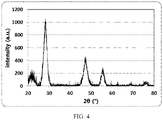
- FIG. 3 and FIG 4 show X-ray diffraction patterns of a silicon-based material according to Embodiment 20 and Embodiment 23 of this application, respectively.
- the 12/11 ratio value reflects the extent of impact caused by disproportionation onto the material in the silicon-based material.
- the value is larger, the size of silicon crystal grains caused by disproportionation of the silicon oxide inside the material is larger. Consequently, the stress in a local region of the negative active material layer increases rapidly during lithiation, thereby disrupting a crystal structure of the silicon-based material during charge and discharge cycles.
- this application can effectively reduce irregular expansion and deformation of the negative electrode in the lithium-ion battery, and can also mitigate the flake-off of the negative active material layer from the negative current collector to some extent, thereby enhancing the cycle performance and safety performance of the lithium-ion battery.
- references to “embodiments”, “some embodiments”, “an embodiment”, “another example”, “example”, “specific example” or “some examples” throughout the specification mean that at least one embodiment or example in this application includes specific features, structures, materials, or characteristics described in the embodiment(s) or example(s). Therefore, descriptions throughout the specification, which make references by using expressions such as “in some embodiments”, “in an embodiment”, “in one embodiment”, “in another example”, “in an example”, “in a specific example”, or “example”, do not necessarily refer to the same embodiment or example in this application.
- specific features, structures, materials, or characteristics herein may be combined in one or more embodiments or examples in any appropriate manner.
Landscapes
- Chemical & Material Sciences (AREA)
- Chemical Kinetics & Catalysis (AREA)
- Electrochemistry (AREA)
- General Chemical & Material Sciences (AREA)
- Engineering & Computer Science (AREA)
- Materials Engineering (AREA)
- Composite Materials (AREA)
- Inorganic Chemistry (AREA)
- Manufacturing & Machinery (AREA)
- Battery Electrode And Active Subsutance (AREA)
- Secondary Cells (AREA)
- Cell Electrode Carriers And Collectors (AREA)
Abstract
Description
- This application relates to the technical field of energy storage, and in particular, to a negative electrode, an electrochemical device containing the negative electrode, and an electronic device.
- With rapid development of mobile electronic technologies, people are using a mobile electronic device such as a mobile phone, a tablet computer, a notebook computer, and an unmanned aerial vehicle more often and people's experience requirements are increasingly higher. Therefore, an electrochemical device (such as a lithium-ion battery) that provides energy for the electronic device needs to provide a higher energy density, a higher C-rate, higher safety, and less fading of capacity that occurs after repeated charge and discharge processes.
- In the field of electrochemical devices, the use of a material of a high energy density as a negative active material is one of the main research pursuits. However, materials of a high energy density (such as a silicon-based material) are generally not compatible with existing cell structures, for example, due to a too low conductivity, a too high expansion rate, insufficient processing performance. Therefore, currently, it is an urgent research topic to improve and optimize a cell structure (for example, a negative electrode, a separator, and a positive electrode) of the electrochemical device that uses a material of a high energy density as a negative active material.
- This application provides a negative electrode, an electrochemical device containing the negative electrode, and an electronic device in an attempt to solve at least one problem in the related art to at least some extent.
- According to an aspect of this application, this application provides a negative electrode. The negative electrode includes a negative current collector and a negative active material layer. The negative active material layer includes a silicon-based material. A weight ratio R of the silicon-based material to a total weight of the negative active material layer and an absolute strength σ of the negative current collector satisfy the following formula: K = σ/(1.4 × R + 0.1), where K is a relation coefficient, and the relation coefficient is greater than or equal to approximately 4,000 N/m.
- By defining a relationship between the weight ratio of the silicon-based material and the absolute strength of the negative current collector, the negative electrode according to this application can effectively mitigate XY expansion and deformation of the negative active material layer during charge and discharge cycles, thereby reducing a cycle expansion rate of the electrochemical device and enhancing cycle performance and safety performance of the electrochemical device.
- According to another aspect of this application, this application provides an electrochemical device, including a positive electrode, a separator, and the foregoing negative electrode.
- According and another aspect of this application, this application provides an electronic device. The electronic device includes the electrochemical device.
- Additional aspects and advantages of the embodiments of this application will be described or illustrated in part later herein or expounded through implementation of the embodiments of this application.
- For ease of describing the embodiments of this application, the following outlines the drawings necessary for describing the embodiments of this application or the prior art. Apparently, the drawings outlined below are only a part of embodiments in this application. Without making any creative efforts, a person skilled in the art can still obtain the drawings of other embodiments according to the structures illustrated in these drawings.
-
FIG. 1 shows a cycle capacity curve according toEmbodiment 1 andEmbodiment 6 of this application; -
FIG. 2 shows a cycle expansion rate curve of a lithium-ion battery according toEmbodiment 1 andEmbodiment 6 of the application; -
FIG. 3 shows an X-ray diffraction pattern according to Embodiment 16 of this application; and -
FIG. 4 shows an X-ray diffraction pattern according to Embodiment 19 of this application. - Embodiments of this application will be described in detail below. Throughout the specification of this application, the same or similar components and the components having the same or similar functions are denoted by similar reference numerals. The embodiments described herein with reference to the accompanying drawings are illustrative and graphical in nature, and are intended to enable a basic understanding of this application. The embodiments of this application shall not be construed as a limitation on this application.
- The terms "roughly," "substantially," "substantively", and "approximately" used herein are intended to describe and represent small variations. When used with reference to an event or situation, the terms may represent an example in which the event or situation occurs exactly and an example in which the event or situation occurs very approximately. For example, when used together with a numerical value, the terms may represent a variation range falling within ±10% of the numerical value, such as ±5%, ±4%, ±3%, ±2%, ±1%, ±0.5%, ±0.1%, or ±0.05% of the numerical value. For example, if a difference between two numerical values falls within ±10% of an average of the numerical values (such as ±5%, ±4%, ±3%, ±2%, ±1%, ±0.5%, ±0.1%, or ±0.05% of the average), the two numerical values may be considered "substantially" the same.
- In this specification, unless otherwise specified or defined, relativity terms such as "central", "longitudinal", "lateral", "front", "rear", "right" "," "left", "internal", "external", "lower", "higher", "horizontal", "perpendicular", "higher than", "lower than" , "above", "under", "top", "bottom", and derivative terms thereof (such as "horizontally", "downwardly", "upwardly") shall be interpreted as a direction described in the context or a direction illustrated in the drawings. The relativity terms are used for ease of description only, and do not require that the construction or operation of this application should be in a specific direction.
- In addition, a quantity, a ratio, or another numerical value is sometimes expressed in a range format herein. Understandably, such a range format is for convenience and brevity, and shall be flexibly understood to include not only the numerical values explicitly specified and defined in the range, but also all individual numerical values or sub-ranges covered in the range as if each individual numerical value and each sub-range were explicitly specified.
- In the description of embodiments and claims, a list of items referred to by using the terms such as "at least one of", "at least one thereof", "at least one type of" or other similar terms may mean any combination of the listed items. For example, if items A and B are listed, the phrases "at least one of A and B" and "at least one of A or B" mean: A alone; B alone; or both A and B. In another example, if items A, B, and C are listed, the phrases "at least one of A, B, and C" and "at least one of A, B, or C" mean: A alone; B alone; C alone; A and B (excluding C); A and C (excluding B); B and C (excluding A); or all of A, B, and C. The item A may include a single element or a plurality of elements. The item B may include a single element or a plurality of elements. The item C may include a single element or a plurality of elements.
- In the field of electrochemical devices, to pursue a higher energy density of an electrochemical device, one of the research pursuits is to substitute a negative active material that has a higher gram capacity. Silicon has a high theoretical gram capacity (4,200 mAh/g), and is very promising in application in lithium-ion batteries. Chinese Patent
CN107925074A discloses a silicon-based material (SiOx, 0 ≤ x) crystal that is disproportionate to some extent, and the silicon-based material is used as a negative active material to effectively improve the first-time charge and discharge efficiency and cycle performance of a lithium-ion battery. A Chinese patent application with Chinese Patent Publication No.CN107925074A exemplarily gives a specific embodiment in which a silicon-based material serves as a negative active material, which is incorporated herein by reference in its entirety. However, during charge and discharge cycles, the volume of a silicon-based material expands greatly in a lithiation process. This further exerts a relatively large acting force on the negative current collector, and results in XY expansion and structural deformation of a negative electrode. - Chinese Patent
CN103579578B discloses an idea of suppressing stretching of a negative electrode in a charging and discharging process by restricting a tensile strength and thickness of a copper foil current collector. However, the copper foil current collector with a high tensile strength leads to a too thick copper foil and a too rigid structure of the negative electrode, thereby decreasing an energy density of a lithium-ion battery and deteriorating processing performance. - A Chinese patent application with Chinese Patent Publication No.
CN107925074A exemplarily gives a specific embodiment in which a silicon-based material serves as a negative active material, which is incorporated herein by reference in its entirety. A Chinese patent application with Chinese Patent Publication No.CN103579578B exemplarily gives a specific embodiment of copper foil current collectors that have different tensile strengths, which is incorporated herein by reference in its entirety. - In this specification, the term "XY expansion" means volume expansion of a negative active material layer in a horizontal direction of the negative current collector.
- By defining a relationship between a content of a silicon-based material in a negative electrode and an absolute strength of a negative current collector, this application causes a strength of the negative current collector to be greater than a stress strength generated by expansion of the silicon-based material, and enhances a tolerance of the negative current collector to volume expansion of the negative electrode.
- According to an aspect of this application, this application provides a negative electrode. The negative electrode includes a negative current collector and a negative active material layer. The negative active material layer includes a silicon-based material. A weight ratio R of the silicon-based material to a total weight of the negative active material layer and an absolute strength σ of the negative current collector satisfy the following formula: K = σ/(1.4 × R + 0.1), where K is a relation coefficient, and the relation coefficient is greater than or equal to approximately 4,000 N/m. In other embodiments, the relation coefficient is approximately 4,000 N/m. In other embodiments, roughly the relation coefficient is, for example, approximately 4,500 N/m, approximately 5,000 N/m, approximately 5,500 N/m, approximately 6,000 N/m, approximately 6,500 N/m, approximately 7,000 N/m, or a range formed by any two of such values. The negative electrode according to this application can effectively suppress XY expansion of the negative active material layer, reduce structural deformation of the negative electrode, and increase a cycle life of the electrochemical device containing the negative electrode.
- In this specification, the term "absolute strength" is also referred to as "ultimate strength" or "breaking stress", and represents a highest stress that an object can withstand without being deformed, stretched or fractured under an external force.
- In some embodiments, the absolute strength of the negative current collector is greater than or equal to approximately 500 N/m. In other embodiments, roughly the absolute strength of the negative current collector is, for example, approximately 500 N/m, approximately 600 N/m, approximately 700 N/m, approximately 1,000 N/m, approximately 1,500 N/m, approximately 2,000 N/m, approximately 2,600 N/m, or a range formed by any two of such values. In other embodiments, the absolute strength of the negative current collector is approximately 1,000 N/m to approximately 2,600 N/m.
- In some embodiments, a thickness of the negative current collector is approximately 1 µm to approximately 15 µm. In other embodiments, roughly the thickness of the negative current collector is, for example, approximately 1 µm, approximately 2 µm, approximately 3 µm, approximately 5 µm, approximately 10 µm, approximately 12 µm, approximately 15 µm, or a range formed by any two of such values. In other embodiments, the thickness of the negative current collector is approximately 3 µm to approximately 10 µm.
- In some embodiments, the negative current collector includes at least one of a copper foil, a nickel foil, a titanium foil, a chromium foil, and a stainless steel foil. Understandably, without departing from the spirit of this application, a person skilled in the art may select any conventional conductive foil as the negative current collector according to specific requirements without limitation.
- In some embodiments, the silicon-based material includes, but is not limited to, one or more of simple-substance silicon, a silicon oxide material, silicon carbon, and a silicon alloy. In some embodiments, the silicon-based material includes one or more silicon oxide materials whose component is represented by a general formula MySiOx, where 0 ≤ y ≤4, 0 ≤ x ≤4, and M includes at least one of Li, Mg, Ti, and Al.
- In an XRD diffraction pattern of the silicon oxide material obtained in an X-ray diffraction test (X-ray diffraction, XRD), a
ratio 12/11 of asecond peak intensity 12 attributed to a range of 28.0°~29.0° to a first peak intensity I1 attributed to a range of 20.5°~21.5° can reflect the extent of impact caused by disproportionation onto the silicon oxide material. Ahigher ratio 12/11 of thesecond peak intensity 12 to the first peak intensity I1 means a larger size of nano-silicon crystal grains generated by the SiO disproportionation occurring inside the silicon oxide material. In some embodiments, theratio 12/11 of the second peak intensity I2 to the first peak intensity I1 of the silicon oxide material is greater than 0 and less than or equal to 10. In other embodiments, theratio 12/11 of thesecond peak intensity 12 to the first peak intensity I1 of the silicon oxide material is less than or equal to 1. - In some embodiments, the negative active material layer further includes, but is not limited to, a carbon-based material, a metal compound, a sulfide, a lithium nitride (such as LiN3), lithium metal, a metal combined with lithium to form an alloy, and a polymer material, and other negative active materials capable of absorbing and releasing lithium. Examples of the carbon-based material may include low-graphitization carbon, carbon prone to graphitization, artificial graphite, natural graphite, mesophase carbon microspheres, soft carbon, hard carbon, pyrolysis carbon, coke, glassy carbon, an organic polymer compound sintered body, carbon fiber, and activated carbon. In some embodiments, the negative active material layer further includes a carbon-based material.
- In some embodiments, a weight ratio of the silicon-based material to a total weight of the negative active material layer is approximately 1% to approximately 70%. In other embodiments, roughly the weight ratio of the silicon-based material is, for example, approximately 1%, approximately 5%, approximately 10%, approximately 20%, approximately 30%, approximately 40%, approximately 50%, approximately 60%, approximately 70%, or a range formed by any two of such values. In some embodiments, the weight ratio of the silicon-based material to the total weight of the negative active material layer is approximately 10% to approximately 40%.
- In some embodiments, the negative active material layer further includes a binder and a conductive agent. The binder includes at least one of polyacrylic acid, sodium polyacrylic acid, potassium polyacrylic acid, lithium polyacrylic acid, polyimide, polyvinyl alcohol, carboxymethyl cellulose, sodium carboxymethyl cellulose, polyamide imide, styrene butadiene rubber, and polyvinylidene fluoride. The conductive agent includes at least one of conductive carbon black, carbon nanotubes, carbon fiber, and Ketjen black.
- Understandably, a person skilled in the art may select any conventional binder or conductive agent according actual requirements without limitation.
- In some embodiments, the silicon-based material in the negative active material layer further includes a coating. By coating the silicon-based material with a carbon material or a polymer material, the coating can restrain expansion of the silicon-based material during lithiation, and serve as a buffer layer against volume changes to enhance structural stability of the negative electrode. In addition, the coating can effectively avoid direct contact between the silicon-based material and an electrolytic solution in a lithiation process, thereby stabilizing formation of a solid electrolyte interface (solid electrolyte interface, SEI) film on the surface of the negative electrode, reducing irreversible capacity loss, and improving the cycle performance of the lithium-ion battery. In addition, the highly conductive coating can effectively improve surface conductivity of the silicon-based material, enhance electronic conductivity and ionic conductivity of the negative electrode material, and enhance the rate performance of the lithium-ion battery.
- In some embodiments, the coating includes at least one of a carbon material and a polymer material; and the carbon material includes at least one of amorphous carbon, carbon nanotubes, carbon nanoparticles, vapor grown carbon fiber, and graphene. The polymer material includes at least one of polyvinylidene fluoride or a derivative thereof, carboxymethyl cellulose or a derivative thereof, sodium carboxymethyl cellulose or a derivative thereof, polyvinylpyrrolidone or a derivative thereof, polyacrylic acid or a derivative thereof, and polystyrene butadiene rubber.
- In some embodiments, a thickness of the negative active material layer is approximately 50 µm to approximately 200 µm.
- In some embodiments, a compacted density of the negative active material layer is approximately 1.4 g/cm3 to approximately 1.9 g/cm3.
- In this context, the term "compacted density" is a weight of an active material on a unit area of the current collector divided by a total thickness of the cold-calendered active material layer on the surface of the current collector in a vertical direction.
- In some embodiments, a porosity of the negative active material layer is approximately 15% to approximately 35%.
- In some embodiments, the method for preparing a negative electrode in this application includes the following steps:
- taking a specific amount of silicon-based material and graphite, mixing them with a binder and a conductive agent at a fixed weight ratio, and adding the mixture into deionized water and stirring the mixture homogeneously; sifting the stirred mixture to obtain a mixed slurry; coating the mixed slurry onto a copper foil current collector, and drying the current collector; and cold-calendering the dried current collector to obtain a negative active material layer, and then performing a cutting step to obtain a negative electrode.
- Understandably, without departing from the spirit of this application, the steps in the method for preparing the negative electrode in the embodiments of this application may be selected according to specific requirements, or may replace other conventional processing methods in the art without limitation.
- According to another aspect of this application, some embodiments of this application further provide an electrochemical device that includes the negative electrode according to this application. In some embodiments, the electrochemical device is a lithium-ion battery. The lithium-ion battery includes the negative electrode, the separator, and the positive electrode according to the foregoing embodiments. The separator is disposed between the positive electrode and the negative electrode.
- In some embodiments, the positive electrode includes a positive current collector. The positive current collector may be an aluminum foil or a nickel foil. However, other positive current collectors and negative current collectors commonly used in the art may also be used without limitation.
- In some embodiments, the positive electrode includes a positive active material capable of absorbing and releasing lithium (Li) (hereinafter sometimes referred to as "positive active material capable of absorbing/releasing lithium Li"). Examples of the positive active material capable of absorbing/releasing lithium (Li) may include one or more of lithium cobalt oxide, lithium nickel cobalt manganese oxide, lithium nickel cobalt aluminum oxide, lithium manganese oxide, lithium iron manganese phosphate, lithium vanadium phosphate, lithium vanadyl phosphate, lithium iron phosphate, lithium titanium oxide, and a lithium-rich manganese-based materials.
- In the positive active material, the chemical formula of the lithium cobalt oxide may be LiyCoaM1bO2-c, where M1 is selected from at least one of nickel (Ni), manganese (Mn), magnesium (Mg), aluminum (Al), boron (B), titanium (Ti), vanadium (V), chromium (Cr), iron (Fe), copper (Cu), zinc (Zn), molybdenum (Mo), tin (Sn), calcium (Ca), strontium (Sr), tungsten (W), yttrium (Y), lanthanum (La), zirconium (Zr), and silicon (Si), and values of y, a, b, and c are in the following ranges: 0.8 ≤ y ≤ 1.2, 0.8 ≤ a ≤ 1, 0 ≤ b ≤ 0.2, -0.1 ≤ c ≤ 0.2, respectively.
- In the positive active material, the chemical formula of the lithium nickel cobalt manganese oxide or the lithium nickel cobalt aluminum oxide may be LizNidM2eO2-f, where M2 is selected from at least one of cobalt (Co), manganese (Mn), magnesium (Mg), aluminum (Al), boron (B), titanium (Ti), vanadium (V), chromium (Cr), iron (Fe), copper (Cu), zinc (Zn), molybdenum (Mo), tin (Sn), calcium (Ca), strontium (Sr), tungsten (W), zirconium (Zr), and silicon (Si), and values of z, d, e, and f are in the following ranges: 0.8 ≤ z ≤ 1.2, 0.3 ≤ d ≤ 0.98, 0.02 ≤ e ≤ 0.7, -0.1 ≤ f ≤ 0.2, respectively.
- Among the positive active materials, the chemical formula of lithium manganese oxide is LiuMn2-gM3gO4-h, where M3 is selected from at least one of cobalt (Co), nickel (Ni), magnesium (Mg), aluminum (Al), boron (B), titanium (Ti), vanadium (V), chromium (Cr), iron (Fe), copper (Cu), zinc (Zn), molybdenum (Mo), tin (Sn), calcium (Ca), strontium (Sr), and tungsten (W), and values of z, g, and h are in the following ranges: 0.8 ≤ u ≤ 1.2, 0 ≤ g <1.0, and -0.2 ≤ h ≤ 0.2, respectively.
- In some embodiments, the positive electrode may further include at least one of a binder and a conductive agent. Understandably, a person skilled in the art may select a conventional binder and a conventional conductive agent according actual requirements without limitation.
- In some embodiments, the separator includes, but is not limited to, at least one of polyethylene, polypropylene, polyethylene terephthalate, polyimide, and aramid. For example, the polyethylene includes a component selected from at least one of high-density polyethylene, low-density polyethylene, and ultra-high-molecular-weight polyethylene. Especially the polyethylene and the polypropylene are highly effective in preventing short circuits, and improve stability of the battery through a shutdown effect.
- The lithium-ion battery according to this application further includes an electrolyte. The electrolyte may be one or more of a gel electrolyte, a solid-state electrolyte, and an electrolytic solution. The electrolytic solution includes a lithium salt and a nonaqueous solvent.
- In some embodiments, the lithium salt is selected from one or more of LiPF6, LiBF4, LiAsF6, LiClO4, LiB(C6H5)4, LiCH3SO3, LiCF3SO3, LiN(SO2CF3)2, LiC(SO2CF3)3, LiSiF6, LiBOB, and lithium difluoroborate. For example, the lithium salt is LiPF6 because it provides a high ionic conductivity and improves cycle characteristics.
- The nonaqueous solvent may be a carbonate compound, a carboxylate compound, an ether compound, another organic solvent, or any combination thereof.
- The carbonate compound may be a chain carbonate compound, a cyclic carbonate compound, a fluorocarbonate compound, or any combination thereof.
- Examples of the other organic solvent are dimethyl sulfoxide, 1,2-dioxolane, sulfolane, methyl sulfolane, 1,3-dimethyl-2-imidazolidinone, N-methyl-2-pyrrolidone, formamide, dimethylformamide, acetonitrile, trimethyl phosphate, triethyl phosphate, trioctyl phosphate, phosphate ester, and any combination thereof.
- In some embodiments, the nonaqueous solvent is selected from groups that each include ethylene carbonate, propylene carbonate, diethyl carbonate, dimethyl carbonate, ethyl methyl carbonate, propylene carbonate, methyl acetate, ethyl propionate, fluoroethylene carbonate, and any combination thereof.
- Understandably, the method for preparing the negative electrode, the positive electrode, the separator, and the lithium-ion battery in the embodiments of this application may be, but without limitation, any appropriate conventional method in the art according to specific requirements without departing from the spirit of this application. In an implementation of the method for manufacturing an electrochemical device, the method for preparing a lithium-ion battery includes: winding, folding, or stacking the negative electrode, the separator, the positive electrode in the foregoing embodiments sequentially into an electrode assembly; putting the electrode assembly into, for example, an aluminum laminated film, and injecting an electrolytic solution; and then performing steps such as vacuum packaging, static standing, formation, and reshaping to obtain a lithium-ion battery.
- Although the lithium-ion battery is used as an example for description above, a person skilled in the art after reading this application can learn that the negative electrode in this application is applicable to other suitable electrochemical devices. Such electrochemical devices include any device in which an electrochemical reaction occurs. Specific examples of the devices include all kinds of primary batteries, secondary batteries, fuel batteries, solar batteries, or capacitors. In particular, the electrochemical apparatus is a lithium secondary battery, including a lithium metal secondary battery, a lithium-ion secondary battery, a lithium polymer secondary battery, or a lithium-ion polymer secondary battery.
- Some embodiments of this application further provide an electronic device. The electronic device includes the electrochemical device in the embodiments of this application.
- The electronic device configured to include the electrochemical device in the embodiments of this application may be any electronic device in the prior art without being specifically limited. In some embodiments, the electronic device may include, but without limitation, a notebook computer, a pen-inputting computer, a mobile computer, an e-book player, a portable phone, a portable fax machine, a portable photocopier, a portable printer, a stereo headset, a video recorder, a liquid crystal display television set, a handheld cleaner, a portable CD player, a mini CD-ROM, a transceiver, an electronic notepad, a calculator, a memory card, a portable voice recorder, a radio, a backup power supply, a motor, a car, a motorcycle, a power-assisted bicycle, a bicycle, a lighting appliance, a toy, a game machine, a watch, an electric tool, a flashlight, a camera, a large household battery, a lithium-ion capacitor, and the like.
- The following enumerates some specific embodiments to better describe the technical solution of this application. In the embodiments, a weight per unit and a compacted density of a negative electrode are measured; a cycle performance test, a cycle expansion rate test, and a discharge rate test are performed on an electrochemical device (a lithium-ion b attery).
- Performing measurement by using a tensile testing machine with a measurement range of 0 N to 1000 N and an indication error of ±1%, and a vernier caliper with a measurement range of 0 mm to 300 mm and a minimum graduation value of 0.02 mm or an measurement tool of a corresponding precision; cutting out a to-be-tested sample that is 200±0.5 mm in length and 15±0.25 mm in width; in a width direction of an to-be-tested object, taking 2 to-be-tested samples in a vertical direction and in a horizontal direction respectively; subsequently, putting the to-be-tested samples in the tensile testing machine, where collet chuck distance is 125±0.1 mm, a tensile speed of the chuck is 50 mm/min, and a test temperature is 20±10 °C; applying loads in a length direction of the to-be-tested sample continuously until the sample is snapped off; reading a value of a maximum load F on a dynamometer or a tensile curve, and calculating an absolute strength: σ=F/L, where L is the width of the to-be-tested sample. taking an arithmetic average of test results of 4 samples to obtain the absolute strength of the to-be-tested object.
- The laser particle size test is to test a particle distribution based on a principle that particles of different sizes can cause a laser beam to scatter at different intensities. Main indicators indicative of particle characteristics include Dn10, Dv10, Dv50, Dv90, Dv99, and the like. Dv50 is called a particle size, and represents a particle size of the material at a cumulative volume of 50% in a volume-based particle size distribution as measured by starting from small particle sizes. In the embodiments of this application and comparative embodiments, a particle size of sample of particles are analyzed by using a Mastersizer 2000 laser particle size distribution analyzer. The test steps include: dispersing samples of the positive electrode material in 100 mL of dispersant (deionized water) so that a shading degree is 8~12%; then ultrasonically treating the samples at an ultrasonic intensity of 40 KHz and 180 W for 5 minutes; and analyzing the laser particle size distribution of the samples after the ultrasonic treatment, so as to obtain particle size distribution data.
- Using an X-ray diffractometer (Bruker-D8) to carry out a test according to JJS K 0131-1996 General Rules for X-Ray Diffractometry; specifically, setting a test voltage to 40 kV, setting a current to 30 mA, setting a scanning angle range to 10°~85°, setting a scanning step length to 0.0167°, and setting the time of each step length to 0.24 s, so as to obtain an XRD diffraction pattern; and recording a
highest intensity value 12 of 2θ attributed to a range of 28.0°~29.0°, and a highest intensity value I1 attributed to a range of 20.5°~21.5°, and calculating the 12/11 ratio value. - Along the surface of the negative current collector, taking a wafer that is 1540.25 mm2 in area from the negative active material layer of the to-be-tested negative electrode, and using the wafer as a sample of the active material; recording the weight of the negative active material after removing the negative current collector; taking 12 samples of the active material from different positions for each group, and calculating the weight per unit area of the negative active material layer;
- measuring a total thickness of the negative active material layer of the negative electrode in a vertical direction of the surface of the negative current collector (excluding the thickness of the current collector); and taking 12 samples of the active material layer from different positions for each group, and calculating a compacted density of the negative active material layer: compacted density = weight of the negative active material/total thickness in the vertical direction of the surface of the current collector.
- Putting a lithium-ion battery in the following embodiments and comparative embodiments into a 25 °C±2 °C thermostat, leaving the battery to stand for 2 hours, charging the battery at a constant current of 0.7C until the voltage reaches 4.4 V, and then charging the battery at a constant voltage of 4.4 V until the current reaches 0.02C, and leaving the battery to stand for 15 minutes; discharging the battery at a constant current of 0.5C until the voltage reaches 3.0 V, thereby completing one charge and discharge cycle process; recording a discharge capacity of the lithium-ion battery in a first cycle under 25 °C±2 °C and 45 °C±2 °C; then performing charge and discharge cycles repeatedly according to the foregoing method, and recording a discharge capacity after each charge and discharge process; subsequently, comparing the discharge capacities with a discharge capacity after the first cycle to obtain a cycle capacity curve;
- taking 4 lithium-ion batteries for each group, and calculating an average value of a capacity retention rate of the lithium-ion batteries:
- cycle capacity retention rate (%) of the lithium-ion battery at 25°C = discharge capacity (mAh) after the 400th cycle/discharge capacity (mAh) after the first cycle × 100%;
- cycle capacity retention rate (%) of the lithium-ion battery at 45°C = discharge capacity (mAh) after the 200th cycle/discharge capacity (mAh) after the first cycle × 100%;
- Using a spiral micrometer to test a thickness of a lithium-ion battery in a fully charged state at the first cycle of the lithium-ion battery in the following embodiments, and a thickness in the fully charged state at the 400th cycle: cycle thickness expansion rate of (%) of the lithium-ion battery at the 400th cycle = (thickness of the fully charged battery at the 400th cycle/thickness of the battery fully charged for the first time - 1) × 100%;
using a measurement instrument to record a surface area that is of the negative active material layer and parallel to the surface of the negative current collector after the lithium-ion battery in the following embodiments are disassembled in the fully charged state at the first cycle, and to record a surface area that is of the negative active material layer and parallel to the surface of the negative current collector after the battery is disassembled in the fully charged state at the 400th cycle: XY expansion rate (%) of the lithium-ion battery at the 400th cycle = (surface area of the negative active material layer at the 400th cycle/surface area of the negative active material layer at the first cycle - 1) × 100%. - Putting the lithium-ion battery in the following embodiments into a 25 °C±2 °C thermostat, leaving the battery to stand for 2 hours, and discharging the battery at a constant current of 0.2C until the voltage reaches 3.0 V; charging the battery at a constant current of 0.5C until the voltage reaches 4.4 V, and then charging the battery at a constant voltage of 4.4 V until the current reaches 0.05 C; leaving the batteries to stand for 5 minutes; and discharging the battery at a constant current of 0.2C until the voltage reaches 3.0 V; recording the discharge capacity of the lithium-ion battery discharged at a constant current of 0.2C;
- charging the lithium-ion battery at a constant current of 0.5C until the voltage reaches 4.35 V, then charging the battery at a constant voltage of 4.35 V until the current reaches 0.05C fully charged, and then discharging the battery at a constant current of 2.0C until the voltage reaches 3.0 V; recording the discharge capacity of the lithium-ion battery discharged at a constant current of 2.0C;
- taking 4 lithium-ion battery for testing in each group, and calculating an average value of the discharge rate of the lithium-ion battery: discharge rate = discharge capacity (mAh) of discharging at a constant current of 2.0C/discharge capacity (mAh) of discharging at a constant current of 0.2C/.
- dissolving lithium cobalt oxide (LiCoO2), conductive carbon black, and polyvinylidene fluoride (PVDF) in an N-methylpyrrolidone (NMP) solution at a weight ratio of 96:2:2 to form a positive electrode slurry; and using an aluminum foil as a positive current collector, coating the positive electrode slurry onto the positive current collector; and performing drying, cold calendering, and cutting steps to obtain a positive electrode.
- in an environment with a water content of less than 10 ppm, mixing lithium hexafluorophosphate, fluoroethylene carbonate (FEC), and a nonaqueous organic solvent (at a weight ratio of ethylene carbonate (EC):dimethyl carbonate (DMC):diethyl carbonate (DEC) = 1:1:1) to prepare an electrolytic solution with an FEC weight percent of 10 wt% and a lithium hexafluorophosphate concentration of 1 mol/L.
- Using a polyethylene (PE) porous polymer film as a separator; sequentially stacking the positive electrode, the separator, and the negative electrode that is disclosed in the following embodiments and comparative embodiments, placing the separator between the positive electrode and the negative electrode to serve a function of separation, and then winding them into an electrode assembly; putting the electrode assembly into an aluminum laminated film packaging bag, and performing drying at 80 °C to obtain a dry electrode assembly; and injecting the electrolytic solution into the dry electrode assembly, and performing steps such as vacuum packaging, static standing, formation, and reshaping to complete preparing the lithium-ion batteries in the following embodiments and comparative embodiments.
- Adding a silicon oxide material SiOx (0.5 ≤ x ≤ 1.6) and artificial graphite into a mixer to mix them into a negative active material, where an 12/11 ratio value is 0.38 after the silicon oxide material undergoes an X-ray diffraction test; adding polyacrylic acid and conductive carbon black into the negative active material that is being stirred (a weight ratio of the negative active material to the conductive carbon black to the polyacrylic acid is 95:2:3); and keeping stirring for 60 minutes at a revolution speed of 20 circles/min and a rotation speed of 1,200 circles/min; then adding deionized water and stirring for 120 minutes to obtain a mixed slurry, where the weight ratio of the silicon oxide material SiOx is 1%;
using a copper foil as a negative current collector, where a thickness of the negative current collector is 9 µm and an absolute strength is 1800 N/m; coating the mixed slurry onto the negative current collector, and drying the negative current collector; cold-calendering the dried negative current collector to obtain a negative active material layer, where a thickness of the negative active material layer is 90 µm and a compacted density is 1.75 g/cm3, and then performing a cutting step to obtain a negative electrode. - The preparation method is the same as that in
Embodiment 1, but differences are: inEmbodiments 2~8, the weight ratio of the silicon oxide material SiOx is 7%, 11%, 15%, 20%, 30%, 50%, and 70%, respectively. - The preparation method is the same as that in Embodiment 3, but differences are: in Embodiments 9~15, the thickness of the negative current collector is 8 µm, 7 µm, 6 µm, 5 µm, 4 µm, 2.5 µm, and 1 µm, respectively, and the absolute strength of the negative current collector is 1,600 N/m, 1,400 N/m, 1,200 N/m, 1,000 N/m, 800 N/m, 500 N/m, and 200 N/m, respectively.
- The preparation method is the same as that in Embodiment 3, but differences are: in Embodiments 16~19, a nickel foil, a titanium foil, a chromium foil, and a stainless steel foil are used as the negative current collector, respectively.
- The preparation method is the same as that in Embodiment 3, but differences are: in
Embodiments 20~23, the weight the 12/11 ratio values of the silicon oxide material after the X-ray diffraction test are 0.41, 0.64, 1, and, 2.5, respectively. - The preparation method is the same as that in Embodiment 3, but differences are: in Embodiments 24~27, the silicon oxide material is doped with the metal elements lithium, magnesium, titanium, and aluminum, respectively; in Embodiments 24~27, the weight percent of the dopant metal elements in the negative electrode material is 1.17%, 2%, 2%, and 1.5%, respectively.
- Weight per unit and a compacted density of the negative electrodes in the foregoing embodiments and comparative embodiments are tested. Subsequently, a cycle performance test, a cycle expansion rate test, and a discharge rate test are performed on the lithium-ion battery, and test results are recorded.
- Statistic values of the negative electrodes and the lithium-ion batteries in
Embodiments 1~27 and the test results of the cycle performance test, the cycle expansion rate test, and the discharge rate test are shown Table 1 below.Table 1 Embodiment/Comparative Embodiment Weight percent of the silicon oxide material (%) Absolute strength of the current collector 400-cycle capacity retention rate at 25 °C 200-cycle capacity retention rate at 45 °C 400-cycle thickness expansion rate at 25 °C 400-cycle XY expansion rate at 25 °C Discharge rate Embodiment 1 1% 1800 92.5% 89.5% 6.2% 0.16% 89.10% Embodiment 2 7% 1800 91.2% 88.3% 6.9% 0.19% 88.40% Embodiment 3 11% 1800 90.1% 87.2% 7.4% 0.22% 87.10% Embodiment 4 15% 1800 87.6% 84.4% 8.2% 0.25% 86.70% Embodiment 5 20% 1800 85.9% 82.6% 9.5% 0.32% 84.40% Embodiment 6 30% 1800 84.6% 79.4% 10.1% 0.44% 80.10% Embodiment 7 50% 1800 72.3% 70.1% 14.5% 0.65% 75.30% Embodiment 8 70% 1800 61.4% 59.6% 16.9% 0.77% 64.80% Embodiment 9 11% 1600 88.3% 85.5% 7.9% 0.27% 86.60% Embodiment 10 11% 1400 87.4% 84.6% 8.1% 0.29% 85.90% Embodiment 11 11% 1200 86.7% 83.5% 8.4% 0.31% 84.80% Embodiment 12 11% 1000 85.8% 82.4% 8.7% 0.34% 83.50% Embodiment 13 11% 800 81.4% 79.7% 10.1% 0.44% 80.20% Embodiment 14 11% 500 73.5% 70.6% 13.6% 0.62% 76.40% Embodiment 15 11% 200 62.9% 57.8% 15.5% 0.74% 67.70% Embodiment 16 11% 1800 89.3% 86.3% 7.8% 0.25% 86.4% Embodiment 17 11% 1800 88.6% 85.4% 8.2% 0.26% 86.1% Embodiment 18 11% 1800 87.4% 85.1% 8.6% 0.29% 85.4% Embodiment 19 11% 1800 87.1% 84.8% 8.8% 0.31% 84.9% Embodiment 20 11% 1800 92.5% 89.5% 6.2% 0.19% 86.7% Embodiment 21 11% 1800 91.1% 87.2% 7.2% 0.23% 86.1% Embodiment 22 11% 1800 88.6% 84.4% 8.4% 0.28% 85.1% Embodiment 23 11% 1800 83.7% 80.4% 9.5% 0.42% 83.6% Embodiment 24 11% 1800 91.3% 88.3% 7.1% 0.21% 88.4% Embodiment 25 11% 1800 91.6% 88.4% 7.0% 0.20% 88.1% Embodiment 26 11% 1800 90.8% 87.7% 7.4% 0.21% 87.9% Embodiment 27 11% 1800 90.5% 87.5% 7.3% 0.22% 87.6% - As shown in Table 1, in the lithium-ion battery according to
Embodiments 1~5, 9~12, 16~27 of this application, the weight ratio R of the silicon-based material in the negative electrode of the battery to a total weight of the negative active material layer and the absolute strength σ of the negative current collector satisfy the following formula: K = σ/(1.4 × R + 0.1), where K is 4,000 N/m. In contrast with other embodiments, in the embodiments that satisfy the foregoing weight percent range of the silicon-based material and the foregoing absolute strength range of the negative current collector in this application, the 400-cycle capacity retention rate at 25 °C can be maintained above 80%, the 400-cycle thickness expansion rate at 25°C can be maintained below 9.5%, and the 400-cycle XY expansion rate at 25°C can be maintained below 0.34%, and the discharge rate can be maintained above 83.5%. - Specifically, as can be learned from comparison between Embodiments 1-5 and
Embodiments 6~86, when the content of the silicon-based material in the negative active material layer is higher, the cycle expansion rate of the lithium-ion batteries also increases significantly. As can be learned fromEmbodiments 6~8, when the content of the silicon-based material in the negative active material layer exceeds the strength ranges of the negative active material layer and the negative current collector specified in the embodiments of this application, because the strength of the negative current collector is insufficient to restrain the expansion rate of the silicon-based material, the XY expansion rate of the negative active material layer increases significantly. This leads to expansion and deformation of the lithium-ion batteries, and affects the cycle performance and safety performance of the lithium-ion batteries. -
FIG. 1 shows a cycle capacity curve of a lithium-ion battery according toEmbodiment 1 of this application, andFIG. 2 shows a cycle expansion rate curve of a lithium-ion battery according toEmbodiment 6 of this application. - As shown in
FIG. 1 , after 400 cycles, due to a relatively low content of the silicon-based material inEmbodiment 1, the stress generated by the negative active material layer during the cycle is relatively low. Therefore, XY expansion and deformation are not likely to occur as long as the negative current collector has a specific absolute strength, thereby ensuring bonding between the negative active material layer and the negative current collector, and ensuring relatively high cycle performance of the lithium-ion batteries. In contrast, inEmbodiment 6, due to a relatively high content of the silicon-based material, the stress generated by the negative active material layer during the cycles exceeds the absolute strength of the negative current collector. This leads to deformation of the negative electrode, and causes the cycle retention rate of the lithium-ion batteries to deteriorate rapidly from the beginning of cycles. Therefore, the capacity retention rate of the lithium-ion battery according toEmbodiment 4 drops rapidly. - As can be learned from comparison between Embodiments 9~12 and Embodiments 13~15, when the negative active material is the same, different absolute strengths of the negative current collector reflect the stress intensity that the negative current collector can withstand from the negative active material layer, and further reflect the extent of suppressing the XY expansion and deformation by the negative electrode. When the absolute strength of the negative current collector is lower, the XY expansion rate and the deformation rate of the negative electrode is higher, the cycle performance of the battery is lower, and the capacity retention rate is lower after completion of the same quantity of cycles. In addition, the deformation of the negative electrode also deteriorates the rate performance of the lithium-ion batteries.
-
FIG. 3 andFIG 4 show X-ray diffraction patterns of a silicon-based material according toEmbodiment 20 and Embodiment 23 of this application, respectively. - As can be learned from comparison among
Embodiments 20 to 23, with the increase of the 12/11 ratio value, the cycle retention rate of the lithium-ion battery keeps decreasing, the cycle expansion rate increases, and the rate performance deteriorates. The 12/11 ratio value reflects the extent of impact caused by disproportionation onto the material in the silicon-based material. When the value is larger, the size of silicon crystal grains caused by disproportionation of the silicon oxide inside the material is larger. Consequently, the stress in a local region of the negative active material layer increases rapidly during lithiation, thereby disrupting a crystal structure of the silicon-based material during charge and discharge cycles. - Through comparison of the foregoing embodiments and comparative embodiments, it can be clearly understood that, by defining the relationship between the weight ratio of the silicon-based material in the negative electrode and the absolute strength of the negative current collector, this application can effectively reduce irregular expansion and deformation of the negative electrode in the lithium-ion battery, and can also mitigate the flake-off of the negative active material layer from the negative current collector to some extent, thereby enhancing the cycle performance and safety performance of the lithium-ion battery.
- References to "embodiments", "some embodiments", "an embodiment", "another example", "example", "specific example" or "some examples" throughout the specification mean that at least one embodiment or example in this application includes specific features, structures, materials, or characteristics described in the embodiment(s) or example(s). Therefore, descriptions throughout the specification, which make references by using expressions such as "in some embodiments", "in an embodiment", "in one embodiment", "in another example", "in an example", "in a specific example", or "example", do not necessarily refer to the same embodiment or example in this application. In addition, specific features, structures, materials, or characteristics herein may be combined in one or more embodiments or examples in any appropriate manner.
- Although illustrative embodiments have been demonstrated and described above, a person skilled in the art understands that the above embodiments shall not be construed as a limitation on this application, and changes, replacements, and modifications may be made to the embodiments without departing from the spirit, principles, and scope of this application.
Claims (11)
- A negative electrode, comprising:a negative current collector; anda negative active material layer, wherein the negative active material layer comprises a silicon-based material,wherein a weight ratio R of the silicon-based material to a total weight of the negative active material layer and an absolute strength σ of the negative current collector satisfy the following formula: K = σ/(1.4 × R + 0.1), wherein K is a relation coefficient, and the relation coefficient is greater than or equal to 4,000 N/m.
- The negative electrode according to claim 1, wherein the absolute strength of the negative current collector is greater than or equal to 500 N/m.
- The negative electrode according to claim 1, wherein a thickness of the negative current collector is 1 µm to 15 µm.
- The negative electrode according to claim 1, wherein the silicon-based material comprises one or more silicon oxide materials whose component is represented by a general formula MySiOx, wherein 0 ≤ y ≤4, 0 ≤ x ≤4, and M comprises at least one of Li, Mg, Ti, and Al.
- The negative electrode according to claim 4, wherein, in a diffraction pattern of primary particles of the silicon oxide material in an X-ray diffraction test, a first peak intensity attributed to a range of 20.5°~21.5° is I1, a second peak intensity attributed to a range of 28.0°~29.0° is 12, and 0 < 12/11 ≤ 1.
- The negative electrode according to claim 1, wherein the weight ratio of the silicon-based material to the total weight of the negative active material layer is 1% to 70%.
- The negative electrode according to claim 1, wherein the negative active material layer further comprises a binder and a conductive agent; the binder comprises at least one of polyacrylic acid, sodium polyacrylic acid, potassium polyacrylic acid, lithium polyacrylic acid, polyimide, polyvinyl alcohol, carboxymethyl cellulose, sodium carboxymethyl cellulose, polyamide imide, styrene butadiene rubber, and polyvinylidene fluoride; and the conductive agent comprises at least one of conductive carbon black, carbon nanotubes, carbon fiber, and Ketjen black.
- The negative electrode according to claim 1, wherein the negative current collector comprises at least one of a copper foil, a nickel foil, a titanium foil, a chromium foil, and a stainless steel foil.
- The negative electrode according to claim 1, wherein the silicon-based material further comprises a coating, and the coating comprises at least one of a carbon material and a polymer material; the carbon material comprises at least one of amorphous carbon, carbon nanotubes, carbon nanoparticles, vapor grown carbon fiber, and graphene; and the polymer material comprises at least one of polyvinylidene fluoride or a derivative thereof, carboxymethyl cellulose or a derivative thereof, sodium carboxymethyl cellulose or a derivative thereof, polyvinylpyrrolidone or a derivative thereof, polyacrylic acid or a derivative thereof, and polystyrene butadiene rubber.
- An electrochemical device, comprising:a positive electrode;a separator; andthe negative electrode according to any one of claims 1 to 9.
- An electronic device, comprising the electrochemical device according to claim 10.
Applications Claiming Priority (1)
| Application Number | Priority Date | Filing Date | Title |
|---|---|---|---|
| PCT/CN2020/070130 WO2021134755A1 (en) | 2020-01-02 | 2020-01-02 | Negative electrode, electrochemical apparatus containing same, and electronic device |
Publications (2)
| Publication Number | Publication Date |
|---|---|
| EP4084138A1 true EP4084138A1 (en) | 2022-11-02 |
| EP4084138A4 EP4084138A4 (en) | 2023-03-08 |
Family
ID=76686856
Family Applications (1)
| Application Number | Title | Priority Date | Filing Date |
|---|---|---|---|
| EP20909824.3A Pending EP4084138A4 (en) | 2020-01-02 | 2020-01-02 | Negative electrode, electrochemical apparatus containing same, and electronic device |
Country Status (5)
| Country | Link |
|---|---|
| US (1) | US20220223835A1 (en) |
| EP (1) | EP4084138A4 (en) |
| JP (1) | JP7659563B2 (en) |
| KR (1) | KR102944450B1 (en) |
| WO (1) | WO2021134755A1 (en) |
Families Citing this family (2)
| Publication number | Priority date | Publication date | Assignee | Title |
|---|---|---|---|---|
| US12620592B2 (en) | 2018-03-05 | 2026-05-05 | The Research Foundation For The State University Of New York | ϵ-VOPO4 cathode production, and applications thereof |
| CN117594876A (en) * | 2023-11-06 | 2024-02-23 | 深圳新宙邦科技股份有限公司 | A lithium-ion battery |
Family Cites Families (18)
| Publication number | Priority date | Publication date | Assignee | Title |
|---|---|---|---|---|
| KR20060083233A (en) * | 1999-10-22 | 2006-07-20 | 산요덴키가부시키가이샤 | Lithium Secondary Battery Electrode and Lithium Secondary Battery |
| JP4895503B2 (en) * | 2004-12-28 | 2012-03-14 | 三洋電機株式会社 | Lithium secondary battery |
| US20100203387A1 (en) * | 2007-08-09 | 2010-08-12 | Taisuke Yamamoto | Electrode for lithium rechargeable battery and lithium rechargeable battery comprising the electrode |
| JP2011233349A (en) * | 2010-04-27 | 2011-11-17 | Hitachi Maxell Energy Ltd | Nonaqueous secondary battery |
| JP5590576B2 (en) * | 2011-10-14 | 2014-09-17 | 独立行政法人産業技術総合研究所 | Method for manufacturing electrode for power storage device, and power storage device |
| JP5590173B2 (en) * | 2012-03-27 | 2014-09-17 | Tdk株式会社 | Negative electrode for lithium ion secondary battery and lithium ion secondary battery |
| US9780357B2 (en) | 2012-04-19 | 2017-10-03 | Lg Chem, Ltd. | Silicon-based anode active material and secondary battery comprising the same |
| JP6040996B2 (en) * | 2012-11-22 | 2016-12-07 | 日産自動車株式会社 | Negative electrode for lithium ion secondary battery and lithium ion secondary battery using the same |
| CN103441283A (en) * | 2013-06-26 | 2013-12-11 | 东莞新能源科技有限公司 | Lithium-ion battery negative electrode current collector structure and battery comprising the structure |
| CN103579578B (en) | 2013-11-14 | 2016-03-02 | 宁德新能源科技有限公司 | Lithium ion battery and cathode pole piece thereof |
| CN107925074B (en) | 2015-07-31 | 2022-03-01 | 信越化学工业株式会社 | Negative electrode material for lithium ion secondary battery, method for producing same, and lithium ion secondary battery |
| WO2018179111A1 (en) * | 2017-03-28 | 2018-10-04 | 日立化成株式会社 | Negative electrode active material for lithium ion secondary battery, negative electrode for lithium ion secondary battery, and lithium ion secondary battery |
| KR102448299B1 (en) * | 2017-07-03 | 2022-09-28 | 삼성에스디아이 주식회사 | Anode and lithium battery including same |
| CN110915033B (en) * | 2017-12-01 | 2022-06-07 | 株式会社Lg化学 | Negative electrode for lithium secondary battery and lithium secondary battery including the same |
| CN113437274A (en) * | 2017-12-12 | 2021-09-24 | 贝特瑞新材料集团股份有限公司 | Lithium ion battery cathode material and preparation method thereof |
| EP3748741A4 (en) * | 2018-01-31 | 2021-09-01 | Hitachi Chemical Company, Ltd. | Negative electrode active material for lithium ion secondary battery, negative electrode for lithium ion secondary battery, and lithium ion secondary battery |
| JP2019160724A (en) * | 2018-03-16 | 2019-09-19 | Tdk株式会社 | Negative electrode and lithium ion secondary battery |
| WO2019240021A1 (en) * | 2018-06-15 | 2019-12-19 | 積水化学工業株式会社 | Negative electrode material for secondary battery, negative electrode for secondary battery, and secondary battery |
-
2020
- 2020-01-02 JP JP2022540790A patent/JP7659563B2/en active Active
- 2020-01-02 WO PCT/CN2020/070130 patent/WO2021134755A1/en not_active Ceased
- 2020-01-02 KR KR1020227026717A patent/KR102944450B1/en active Active
- 2020-01-02 EP EP20909824.3A patent/EP4084138A4/en active Pending
-
2022
- 2022-03-30 US US17/708,508 patent/US20220223835A1/en active Pending
Also Published As
| Publication number | Publication date |
|---|---|
| US20220223835A1 (en) | 2022-07-14 |
| WO2021134755A1 (en) | 2021-07-08 |
| KR20220116063A (en) | 2022-08-19 |
| EP4084138A4 (en) | 2023-03-08 |
| KR102944450B1 (en) | 2026-03-25 |
| JP2023509150A (en) | 2023-03-07 |
| JP7659563B2 (en) | 2025-04-09 |
Similar Documents
| Publication | Publication Date | Title |
|---|---|---|
| US20250233137A1 (en) | Negative electrode and electrochemical apparatus containing same, and electronic apparatus | |
| US20240097124A1 (en) | Positive active material, positive electrode plate and lithium-ion secondary battery | |
| EP4394949A1 (en) | Electrochemical device and electronic device | |
| KR102909157B1 (en) | Electrochemical devices and electronic devices | |
| EP3968415B1 (en) | Negative electrode active material and electrochemical device and electronic device using same | |
| EP3435454B1 (en) | Lithium-ion battery and positive active material therefor | |
| CN113380977B (en) | Negative electrode and electrochemical device and electronic device containing the same | |
| EP4089762B1 (en) | Positive electrode plate, and electrochemical device and electronic device containing positive electrode plate | |
| EP3885321A1 (en) | Positive active material and electrochemical device containing same | |
| EP4131540A1 (en) | Electrochemical device, and electronic device comprising same | |
| EP4318647A1 (en) | Negative electrode, electrochemical device comprising negative electrode, and electronic device | |
| US12334536B2 (en) | Positive electrode material, electrochemical device containing same, and electronic device | |
| US11682788B2 (en) | Secondary battery and apparatus containing such secondary battery | |
| US20240413304A1 (en) | Electrochemical device and electronic device | |
| US20220344646A1 (en) | Electrochemical device and electronic device containing the same | |
| KR20120136369A (en) | Active material for battery, and battery | |
| US20220223835A1 (en) | Negative electrode, electrochemical device containing same, and electronic device | |
| EP4246613A1 (en) | Negative electrode active material, electrochemical apparatus using same, and electronic device | |
| EP4535439A1 (en) | Positive electrode active material, electrochemical device and electrical device | |
| CN117293309A (en) | Cathode materials and electrochemical devices and electronic devices containing the materials | |
| US20250183257A1 (en) | Electrochemical apparatus and electronic apparatus | |
| EP4546452A1 (en) | Electrochemical device and electronic device | |
| EP4394944A1 (en) | Positive electrode active material, electrochemical device, and electronic device | |
| KR102957523B1 (en) | Electrochemical device and electronic device including the electrochemical device | |
| EP4386889A1 (en) | Negative electrode active substance and preparation method therefor, and secondary battery and electrical device including same |
Legal Events
| Date | Code | Title | Description |
|---|---|---|---|
| STAA | Information on the status of an ep patent application or granted ep patent |
Free format text: STATUS: THE INTERNATIONAL PUBLICATION HAS BEEN MADE |
|
| PUAI | Public reference made under article 153(3) epc to a published international application that has entered the european phase |
Free format text: ORIGINAL CODE: 0009012 |
|
| STAA | Information on the status of an ep patent application or granted ep patent |
Free format text: STATUS: REQUEST FOR EXAMINATION WAS MADE |
|
| 17P | Request for examination filed |
Effective date: 20220725 |
|
| AK | Designated contracting states |
Kind code of ref document: A1 Designated state(s): AL AT BE BG CH CY CZ DE DK EE ES FI FR GB GR HR HU IE IS IT LI LT LU LV MC MK MT NL NO PL PT RO RS SE SI SK SM TR |
|
| A4 | Supplementary search report drawn up and despatched |
Effective date: 20230207 |
|
| RIC1 | Information provided on ipc code assigned before grant |
Ipc: H01M 4/02 20060101ALN20230201BHEP Ipc: H01M 4/66 20060101ALI20230201BHEP Ipc: H01M 4/62 20060101ALI20230201BHEP Ipc: H01M 4/485 20100101ALI20230201BHEP Ipc: H01M 4/38 20060101ALI20230201BHEP Ipc: H01M 4/36 20060101AFI20230201BHEP |
|
| DAV | Request for validation of the european patent (deleted) | ||
| DAX | Request for extension of the european patent (deleted) |